On Reading less
I’m not the only parent who feels increasingly anxious about their children’s media diet. For teenage boys in particular, entertainment often comes in the form of YouTube, which for any adult briefly glancing at the screen seems to feature an array of thumbnailed gawping imbeciles, besides an invitation to watch the latest work of creativity: ‘I took a bath full of Diet Coke and Mentos’ or ‘I cemented a microwave to my head’. In comparison to this, the mindless television I watched in the 1990s seems as narratively complex as Dostoevsky.
Most of all, it’s notable that many children aren’t reading anymore, and it’s steadily become a topic of interest among fellow parents, then worry, and now panic. It’s impossible to ignore the fact that something quite bad is happening.
Every catastrophe needs its Jeremiah, and for this we have Times columnist James Marriott, whose increasing anxiety about the decline of literacy was articulated in a hugely popular substack post last year. Having written extensively about how no one reads books anymore, he decided to turn the subject into a book, The New Dark Ages, published this week.
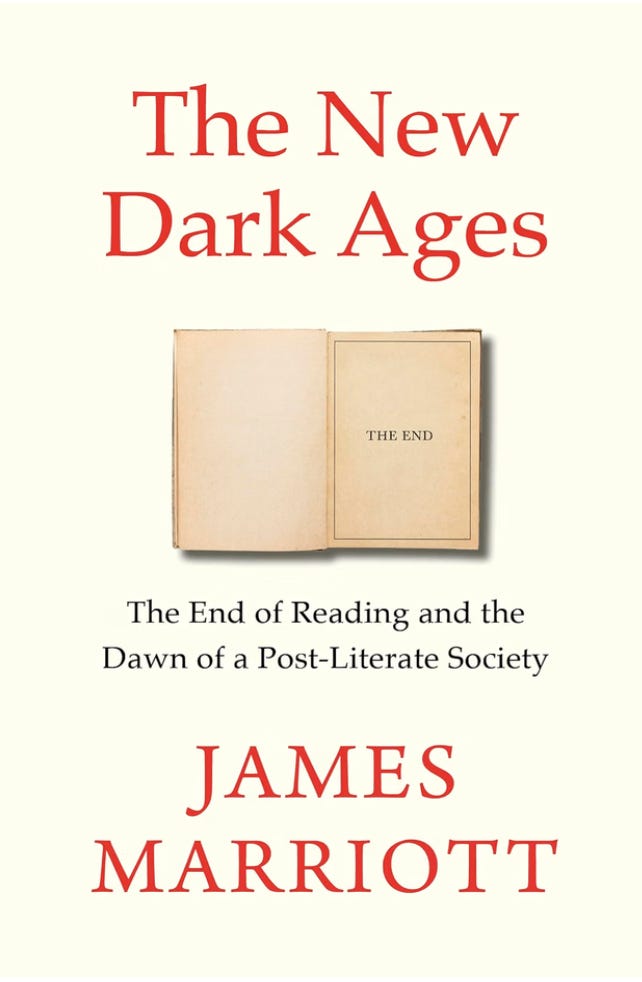
I wouldn’t call the book ‘urgent’ because I usually take that to mean ‘worthy scolding by an ideological ally’; it’s entertaining, informative, often amusing and makes a coherent case in 50,000 or so words, which many of us can still manage. But the implications he lays out are disturbing, and influence everything around us.
James and I have become friends over the past couple of years, drawn together by a mutual sense of despair, and he’s probably the only person in journalism even more pessimistic than I am. If you believe the media to be a circle-jerk of people helping their mates (which it is, obviously), bear that in mind, but reading his prose one gets a sense of how likeable as well as articulate he is, even if born in the wrong decade. His upbringing will seem as alien to those raised in the coming years as the world of Boethius would have been to Alfred the Great.
——
2025-2026 Madison 4k-3rd grade Early Literacy Screener report: The bar moves faster than the kids.
Joe Gothard, Becky Kundert and Sonia Spencer Remarks on Madison’s K-12 Literacy Crisis.
2026-2027 Madison K-12 $pending continues to grow, fueled by a 9.7% (!) property tax increase. Total spending will be at least $706,000,000 for 25,003 students, or $28,236 per student.
May 2026 Madison School District Presentation: 7,095 adults for 25,003 students (3.52 students per adult!)
2024-2025 Early Literacy Screener Map.
Map: Foundations of Reading Results: 2015–2024
Where have all the students gone?
3,887 Madison 4 year old to third grade students scored lower than 75% of the students in the national comparison group.
Madison taxpayers have long supported far above average k-12 tax & $pending. This despite our long term, disastrous reading results. May, 2026: 7,095 Staff for 25,003 students; $pending > $26k per student!
Madison Schools: More $, No Accountability
The taxpayer funded Madison School District long used Reading Recovery…
The data clearly indicate that being able to read is not a requirement for graduation at (Madison) East, especially if you are black or Hispanic.
My Question to Wisconsin Governor Tony Evers on Teacher Mulligans and our Disastrous Reading Results
2017: West High Reading Interventionist Teacher’s Remarks to the School Board on Madison’s Disastrous Reading Results
Madison’s taxpayer supported K-12 school district, despite spending far more than most, has long tolerated disastrous reading results.
“An emphasis on adult employment”
Wisconsin Public Policy Forum Madison School District Report[PDF]
WEAC: $1.57 million for Four Wisconsin Senators
Friday Afternoon Veto: Governor Evers Rejects AB446/SB454; an effort to address our long term, disastrous reading results
Booked, but can’t read (Madison): functional literacy, National citizenship and the new face of Dred Scott in the age of mass incarceration.
When A Stands for Average: Students at the UW-Madison School of Education Receive Sky-High Grades. How Smart is That?