“Our kids can’t afford for those decisions to ride on soundbites”
That’s why we’re sharing two new resources to help Milwaukee voters make informed decisions:
- Our Get Involved hub and Voter Informationpage, with everything you need to know how to register, find out what’s on the ballot, and make a plan to vote.
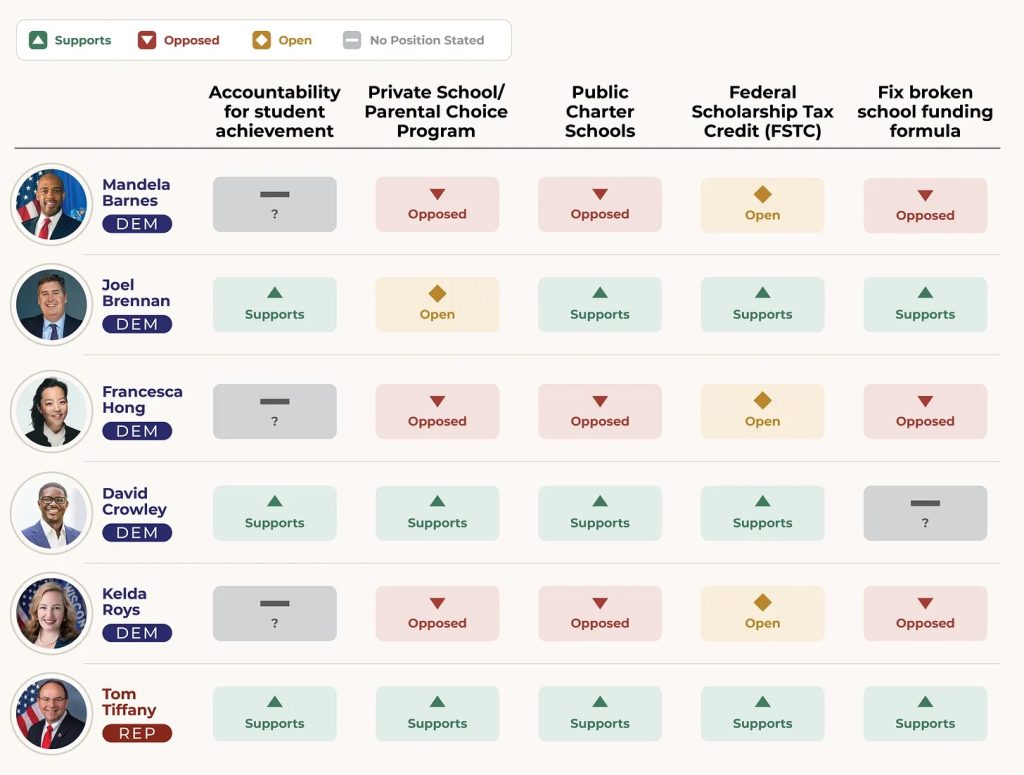
- Our Where They Stand candidate guides, with detailed, cited breakdowns of where every candidate stands on K-12 education issues.
This spring, we laid out CFC’s student-first policy priorities for the state’s next leaders:
- Fix Wisconsin’s Broken School Funding Model, an antiquated relic that’s failing both schools and property taxpayers, by joining 30+ other states in adopting a new formula that instead funds students, not sectors;
- Embrace & Protect Families’ Access to School Choice, recognizing that more than 100,000 students – 1 in 5 statewide – exercise some form of choice, and that here in Milwaukee, families have led the fight for this right for 30+ years;
- Hold Every School Accountable for Student Outcomes, addressing the concerns of more than 90% of voters that lowered academic standards are resulting in students not being prepared for the future; and
- Address The Ongoing Challenges at MPS, acknowledging that even with some recent progress, the state’s largest district remains one of the most troubled urban school systems in the country, both academically and financially.
All year, we’ve engaged directly with candidates for governor and in contested Milwaukee legislative races, asking where they stand on that agenda. Some answered. Some went quiet. We believe voters deserve to know either way, which is what Where They Stand is for.
Clear differences have emerged on the issue of K12 education in the crowded Democratic field for governor:
More.
——-
2026-2027 Madison K-12 $pending continues to grow, fueled by a 9.7% (!) property tax increase. Total spending will be at least $706,000,000 for 25,003 students, or $28,236 per student.
May 2026 Madison School District Presentation: 7,095 adults for 25,003 students (3.52 students per adult!)
Early Literacy Screener Map.
Map: Foundations of Reading Results: 2015–2024
Where have all the students gone?
3,887 Madison 4 year old to third grade students scored lower than 75% of the students in the national comparison group.
Madison taxpayers have long supported far above average k-12 tax & $pending. This despite our long term, disastrous reading results. May, 2026: 7,095 Staff for 25,003 students; $pending > $26k per student!
Madison Schools: More $, No Accountability
The taxpayer funded Madison School District long used Reading Recovery…
The data clearly indicate that being able to read is not a requirement for graduation at (Madison) East, especially if you are black or Hispanic.
My Question to Wisconsin Governor Tony Evers on Teacher Mulligans and our Disastrous Reading Results
2017: West High Reading Interventionist Teacher’s Remarks to the School Board on Madison’s Disastrous Reading Results
Madison’s taxpayer supported K-12 school district, despite spending far more than most, has long tolerated disastrous reading results.
“An emphasis on adult employment”
Wisconsin Public Policy Forum Madison School District Report[PDF]
WEAC: $1.57 million for Four Wisconsin Senators
Friday Afternoon Veto: Governor Evers Rejects AB446/SB454; an effort to address our long term, disastrous reading results
Booked, but can’t read (Madison): functional literacy, National citizenship and the new face of Dred Scott in the age of mass incarceration.
When A Stands for Average: Students at the UW-Madison School of Education Receive Sky-High Grades. How Smart is That?