Notes on Politics and School Choice

Laura Meckler, Beth Reinhard and Clara Ence Morse:

“I have come across what I think is a great way to relieve the suffering of tens of millions of kids,” Yass said in an interview with The Washington Post in the offices of Susquehanna International Group, the behemoth trading firm in the Philadelphia suburbs that he co-founded. “To most people it’s like if you’re a libertarian billionaire, you must be Lex Luthor trying to do something nefarious. If I gave to a hospital, you wouldn’t be saying that.”

To Yass, political spending when it’s on behalf of pro-voucher candidates is akin to charity, benefiting children and families who need a champion to face down teachers unions. “They needed a philanthropist,” he said. “I felt it was my role to be that philanthropist.”

But teachers unions and other critics see vouchers as an assault on public schools, which serve the vast majority of children. They complain that private schools face little accountability for the money they are given or their academic results. They also are allowed to pick and choose their students. In several states, critics note, most of the beneficiaries were already attending private schools when they joined the voucher program; some of those families may have struggled to pay tuition on their own, but for wealthier parents, it was a windfall at taxpayer expense. (Yass, for the record, thinks vouchers should go to all families — even those as wealthy as his.)
Critics say his giving represents an absurd amount of influence for one person, who can press his political agenda simply because he is rich.
“If you picture a man spraying a fire hose at the political system, that’s how he has reshaped how Pennsylvania politics work,” said Arielle Klagsbrun, a liberal activist who helps run a coalition of groups that oppose Yass, and who co-wrote the essay Yass was emailed about in January 2023. “This is the agenda of one billionaire trying to push his beliefs and whims on the rest of the state.”

“ai” and childhood, a “bespoke” upbringing

The Economist:

HRISTMAS STOCKINGS may contain more surprises than usual this year, as children open presents that can talk back. Toymakers in China have declared 2025 the year of artificial intelligence (AI) and are producing robots and teddies that can teach, play and tell stories. Older children, meanwhile, are glued to viral AI videos and AI-enhanced games. At school, many are being taught with materials created with tools like ChatGPT. Some are even learning alongside chatbot-tutors.

In work and play, AI is rewiring childhood. It promises every child the kind of upbringing previously available only to the rich, with private tutors, personalised syllabuses and bespoke entertainment. Children can listen to songs composed about them, read stories in which they star, play video games that adapt to their skill level and have an entourage of chatbot friends cheering them on. A childhood fit for a king could become universal.

It is a future filled with opportunities—and hidden traps. As real kings often discover, a bespoke upbringing can also be a lonely and atomised one. What’s more, as their subjects often find out, it can create adults who are ill-equipped for real life. As AI changes childhood for better and for worse, society must rethink the business of growing up.
Being reared by robots has advantages. Tech firms are already showing how AI can enhance learning, especially where teachers and materials are scarce. Literacy and language-learning have been boosted in early trials. The dream is that, with an AI tutor, children can be saved from classes pitched to the median, in which bright pupils are bored and dim ones are lost. If you want a version of this leader for an eight-year-old Hindi-speaker, AI can rewrite it; if they would prefer it as a cartoon strip or a song, no problem.

I. Introduction – What Is American Strategy?

White House:

  1. How American “Strategy” Went Astray
    To ensure that America remains the world’s strongest, richest, most powerful, and most successful country for decades to come, our country needs a coherent, focused strategy for how we interact with the world. And to get that right, all Americans need to know what, exactly, it is we are trying to do and why.
  2. A “strategy” is a concrete, realistic plan that explains the essential connection between ends and means: it begins from an accurate assessment of what is desired and what tools are available, or can realistically be created, to achieve the desired outcomes.
  3. A strategy must evaluate, sort, and prioritize. Not every country, region, issue, or cause—however worthy—can be the focus of American strategy. The purpose of foreign policy is the protection of core national interests; that is the sole focus of this strategy. American strategies since the end of the Cold War have fallen short—they have been laundry lists of wishes or desired end states; have not clearly defined what we want but instead stated vague platitudes; and have often misjudged what we should want.
  4. After the end of the Cold War, American foreign policy elites convinced themselves that permanent American domination of the entire world was in the best interests of our country. Yet the affairs of other countries are our concern only if their activities directly threaten our interests.

——

Competence and Merit – American prosperity and security depend on the development and promotion of competence. Competence and merit are among our greatest civilizational advantages: where the best Americans are hired, promoted, and honored, innovation and prosperity follow. Should competence be destroyed or systematically discouraged, complex systems that we take for granted—from infrastructure to national security to education and research—will cease to function. Should merit be smothered, America’s historic advantages in science, technology, industry, defense, and innovation will evaporate. The success of radical ideologies that seek to replace competence and merit with favored group status would render America unrecognizable and unable to defend itself. At the same time, we cannot allow meritocracy to be used as a justification to open America’s labor market to the world in the name of finding “global talent” that undercuts American workers. In our every principle and action, America and Americans must always come first.

Building up the healthy nations of Central, Eastern, and Southern Europe through commercial ties, weapons sales, political collaboration, and cultural and educational exchanges

David Lloyd Dusenbury and Philip Pilkington:

With harmony, slight things grow to greatness. With discord, great things shrivel and fail.

—Matteo Ricci, 15961

In 1989, Francis Fukuyama caused a stir by publishing an article in the National Interest titled “The End of History?”. A State Department and Rand Corporation analyst at the time, Fukuyama confessed that he was feeling something out of the ordinary. “We may be witnessing,” he said, “not just the end of the Cold War, or the passing of a particular period of postwar history, but the end of history as such.” Did this fill him with dread? Not really. Post-history was not brought on by catastrophe but, fortunately, by the apotheosis of what he called “the Western idea.” And apparently, liberal democracy is the Western idea. The “end point of mankind’s ideological evolution” had not, therefore, come like a thief in the night, but rather, like a liberal technocrat.2

Not everyone was convinced. In fact, Fukuyama’s 1992 book in the same vein, The End of History and the Last Man, was negatively reviewed; Perry Anderson, a historian of the Left, was struck by “the virtual universality of the rejection” of Fukuyama’s thesis: “For once,” he observed, “most of the Right, Centre, and Left were united in their reaction.”3

It is telling, though, that Fukuyama made his move by channeling a feeling. For whatever his critics said, his idea matched the Western mood circa 1990, which could accurately be called euphoria. What Fukuyama hailed as the preordained triumph of liberal democracy quickly became an axiom. His sense that liberal ideology had not just outlasted Soviet communism but had transcended the whole realm of “ideological struggle” took root in Washington, and then in London and Berlin. His notion that “we have already emerged on the other side of history” spread rapidly in Western policy circles.4 Many liberals, especially in the up-and-coming Boomer generation, felt that they had truly won the great game of history.

One year into the Oneida Reads program, reading proficiency among Native students in Brown and Outagamie Counties has improved

Richelle Wilson:

Recent test scores show that only about half of Wisconsin students are proficient in reading. Those numbers are even more stark for Native American students. 

In 2022, only 5 percent of Native third graders in Brown County were reading at grade level.

“To find out that 95 percent of our children were struggling — it hurts,” Jennifer Webster, who serves on the tribal council for Oneida Nation, told WPR’s “Wisconsin Today.” 

——-

Did taxpayer funded Wisconsin DPI Superintendent Underly Juice Test Scores for Reelection?

——-

Only 31% of 4th graders in Wisconsin read at grade level, which is worse than Mississippi.

——-

Madison taxpayers have long supported far above average (now > $25,000 per student) K-12 tax & spending practices. This, despite long term, disastrous reading results. 

Madison Schools: More $, No Accountability

The taxpayer funded Madison School District long used Reading Recovery

The data clearly indicate that being able to read is not a requirement for graduation at (Madison) East, especially if you are black or Hispanic”

My Question to Wisconsin Governor Tony Evers on Teacher Mulligans and our Disastrous Reading Results

2017: West High Reading Interventionist Teacher’s Remarks to the School Board on Madison’s Disastrous Reading Results 

Madison’s taxpayer supported K-12 school district, despite spending far more than most, has long tolerated disastrous reading results.

“An emphasis on adult employment”

Wisconsin Public Policy Forum Madison School District Report[PDF]

WEAC: $1.57 million for Four Wisconsin Senators

Friday Afternoon Veto: Governor Evers Rejects AB446/SB454; an effort to address our long term, disastrous reading results

Booked, but can’t read (Madison): functional literacy, National citizenship and the new face of Dred Scott in the age of mass incarceration.

When A Stands for Average: Students at the UW-Madison School of Education Receive Sky-High Grades. How Smart is That?

As school safety tips rise, officials scrutinize online activity

Erin Gretzinger and Erin McGroarty

State and local officials are focusing efforts to keep children from online spaces that encourage violence, as a Wisconsin agency reports a noted increase in tips about school safety.

This year, tips to the state Office of School Safety jumped by 30%, including nearly 240 tips about concerns of a planned school attack. 

In the Madison school district, officials told the Cap Times the school safety tips they field most on a day-to-day basis originate on digital devices and online platforms.

State officials, including Office of Children’s Mental Health Director Linda Hall, say online activity and social media increase the risk that young people will fall into unsafe spaces on the internet, which can harm emotional health and expose them to violence. 

“We used to always talk about stranger danger. Now we have to have those conversations with kids, but put it in the digital context,” Hall said. “It’s not just watching out for somebody who might be on a street corner, trying to lure them into a car. It’s what’s happening while they’re online.”

The fall of a prolific science journal exposes the billion-dollar profits of scientific publishing

Manuel Ansede: 

In the autumn of 2020, with humanity terrified by the deadly second wave of the coronavirus, a scientific journal published a study with a solution: jade amulets from traditional Chinese medicine could prevent COVID-19. The proposal was outlandish, but the editor-in-chief of the weekly, Spanish chemist Damià Barceló, defended its quality controls. That journal, Science of the Total Environment — one of the 15 that publishes the most studies worldwide — has just been expelled from the group of reputable publications by one of the leading evaluation companies, after dozens of irregular articles were discovered. The scandal exposes the windfall profits of scientific publishers, who in recent years have amassed billions of dollars in earnings from public funds earmarked for science.

Damià Barceló, 71, took over as editor of the journal in 2012. In just two years, he doubled the number of studies published. In a decade, he increased the number tenfold, with the journal reaching nearly 10,000 articles annually. As the number of articles increased, the quality declined, because there was a perverse incentive to accept mediocre work: to publish research open access in the journal, a scientist has to pay $4,150 plus taxes.

It was wrong to fail a student for citing the Bible in an essay on gender

Nicholas B. Creel:

Samantha Fulnecky, a University of Oklahoma psychology student, received zero points on an essay assignment after citing the Bible in her response to an article about gender roles. The instructor, a transgender graduate student, called the paper “offensive” and said it lacked empirical evidence. The case has since become a national scandal. The instructor has been suspended, and the student has filed both a grade appeal and a religious-discrimination complaint. The student is likely to win on both counts.

Notes on Abortion

Bryan Caplan:

Only a small minority of pregnancies have horrible physical consequences, and people who are contemplating an abortion rarely claim otherwise. But when contemplating an abortion, many if not most prospective parents predict horrible mental consequences for themselves. In the vernacular: “A baby would ruin my life.” If my argument so far is correct, the correct reaction to such claims is not to stonewall with: “Too bad” or “Trust women.” The correct reaction is to ask: “Is it really true that a baby would ruin your life?” 

The strongest known evidence on this question is Diana Foster’s “Turnaway Study,” which uses what economists call a regression discontinuity design to estimate a long list of causal effects of abortion. Foster interviewed women in abortion clinics who were near the legal cutoff. Some turned out to be just below the cutoff — and normally ended up getting an abortion. Some turned out to be just above the cutoff — and normally ended up getting a baby. 

I learned about Foster’s work twelve years ago, but only recently did I read her full book: The Turnaway Study: Ten Years, a Thousand Women, and the Consequences of Having ― or Being Denied ― an Abortion.* Foster walks readers through the study and the co-authored research that came out of it. The book is careful, thorough, wide-ranging, well-written, and creative. While Foster is obviously deeply pro-choice, her methods are sound and her presentation is transparent. The book’s most notable findings:

  1. Women who managed to get abortions had almost exactly the same self-reported well-being as the turnaways: “Shortly after being denied an abortion, women had more symptoms of anxiety and stress and lower levels of self-esteem and life satisfaction than women who received an abortion. Over time, women’s mental health and well-being generally improved, so that by six months to one year, there were no differences between groups across outcomes. To the extent that abortion causes mental health harm, the harm comes from the denial of services, not the provision… Yet once the pregnancy was announced, the baby born, and the unknown fears and expectations realized or overcome, the trajectory of mental health symptoms seems to return to what it would have been if the woman had received an abortion.” To illustrate, here’s the key figure on depression from the book.

———

Choose life.

‘We’re All Just Winging It’: What the Gender Doctors Say in Private

Leor Sapir:
At their conferences, closed to outsiders and the press, the gender clinicians allowed themselves to speak freely. They spoke about the boys who said they wanted to be girls and the girls who felt they were meant to be boys, and the medical and surgical interventions that would make them appear as the opposite sex. The clinicians also discussed new procedures for a new type of patient—some of them adolescents—who wanted to be made to look as if they had no sex at all.

In one of the videos, obtained exclusively by The Free Press, from the 2021 conference of the U.S. Professional Association for Transgender Health, Amy Penkin, a social worker with the Transgender Health Program at the Oregon Health & Science University (OHSU) spoke about one such case. Penkin told the audience about Sky, who she described as an 18-year-old recent high school graduate who was living on his own for the first time.

Penkin explained that Sky expressed a desire to look like “a Barbie down there.” Sky, Penkin said, reported “being asexual, never having had sex, and having no desire to have sex in the future.” Indeed, Sky did “not want to feel any pleasurable sensation and hope[d] removal of all erogenous tissue [would] be possible,” according to Penkin.

k-12 Governance Climate: GAO Probe Finds ACA at High Risk for Fraud: 96% of Fake Applications Approved

Brian Blase:

This morning, the Government Accountability Office (GAO) released a damning report showing that the Affordable Care Act’s exchanges are highly vulnerable to fraud. The report was requested by Energy and Commerce Committee Chairman Brett Guthrie, Judiciary Committee Chairman Jim Jordan, and Ways and Means Committee Chairman Jason Smith.

As a result of expanded subsidies and porous federal oversight, the federal exchange approved subsidized health insurance for 23 of 24 fictitious applications submitted by GAO. In addition, GAO found that tens of billions of dollars in advanced subsidies to health insurers have not been properly reconciled. Together, these failures show that the ACA exchanges lack even minimal oversight and are rife with fraud and abuse that is hemorrhaging taxpayer dollars.

GAO’s findings are strong confirmation of Paragon research into improper and phantom enrollment. We identified an estimated 6.4 million improper enrollees in fully subsidized plans in 2025. The massive surge, driven by people unaware of their enrollment or with other coverage, has caused a doubling in the percentage of exchange enrollees without any medical claims from 2021 to 2024.

Notes on marriage and fertility

Patrick T Brown:

The fertility crisis in the United States is, in large part, a marriage crisis. Births to married women are only a tick below where they have been since the late 1980s, while births to unmarried women have fallen precipitously, by as much as 30% from a 2007 peak.

Conservatives, who’ve long bemoaned single parenthood, have scant reason to cheer this outcome. It’s not that people are waiting to have kids until after marriage. Rather, they’re increasingly opting out of committing to partnership and parenthood altogether. And as new research shows, progressives, especially, are less likely to find either marriage or parenthood worth pursuing. This, even as Americans on the Right of center remain committed to both.

k-12 tax & $pending climate: US federal debt levels

Alex Tabarrok:

TABARROK: I do agree that it is puzzling that the interest rate on bonds is so low. Hanno Lustig and his co-authors have an interesting paper on this. They point out that not only is it the case that we have all of this debt with no plans to pay it, as far as we can tell right now, but the debt is not a very good asset in the sense that when will the debt be paid? If it is going to be paid, it’s going to be paid when the times are good. That means that you’re being paid when GDP is higher and the marginal utility money is low.

When is the debt not paid? When does it get bigger? It means when the economy is doing poorly. The debt as an asset has the opposite kind of structure than you would want. It’s not like gold, which arguably goes down in good times and goes up in bad times. You get some nice covariance to even out your portfolio. The debt as an asset is positively correlated with good times, and that’s bad. You should expect the interest rates to be much, much higher than they actually are.

The triumph of logical English

Henry Oliver:

The Elizabethans and Victorians wrote long tangled sentences that resembled the briars growing underneath Sleeping Beauty’s tower. Today we write like Hemingway. Short. Sharp. Readable. Pick up an old book and the sentences roll on. Go to the office, read the paper, or scroll Twitter and they do not. So it is said. I would like to suggest that this account is incomplete.

I propose a different story. The great shift in English prose took place in the sixteenth and seventeenth centuries, probably driven by the increasing use of writing in commercial contexts, and by the style of English in post-Reformation Christianity. It consisted in two things: a ‘plain style’ and logical syntax. A second, smaller shift has taken place in modern times, in which written English came to be modelled more closely on spoken English.

What this should demonstrate is that shortness is the wrong dimension to investigate. We think we are looking at a language that got simpler; in fact we are looking at one that has created huge variation in what it can express and how, by adding new ways of writing. Lots of English writing has got simpler through use of the plain style, sticking to a logical shared syntax, especially the syntax of speech. But all the other ways of writing are still there, often showing up when we don’t expect them.

Final Madison 2025-2026 K-12 Budget: 668,000,000

Budget Document with curious “security” applied:

Madison’s budget website.

Erin Gretzinger:

This year’s budget is 10% higher in both revenue and expenses compared with last year’s, with additional spending focused on priorities like expanding 4K options and boosting staffing, which went up by nearly 60 full-time equivalent positions. About 81% of the district’s budget goes toward staff compensation and benefits.

More:

An annual enrollment tally at the Madison school district declined by more than 100 students this fall, marking the first decrease in two years and falling far below the district’s own estimates that predicted an increase for the 2025-26 school year.

Across Wisconsin, every school tallies its enrollment on the third Friday of September to help determine state funding levels for districts. This year, the Madison Metropolitan School District counted 25,557 full-time equivalent students. That’s down 110 from last fall.

Madison taxpayers have long supported far above average K-12 tax and $pending practices.

——

Michael Torres:

A 62% increase in funding (adjusted for inflation) has resulted in a 2% DROP in reading performance among Illinois 4th graders over 22+ years.

A lot of people are way too eager to declare Mississippi a myth, part 1

Kelsey Piper:

When there’s a scandalous “false miracle” in the education world, it’s usually one of two things: direct cheating on a test or careful selection of the population that takes the test. So if you see a sizable improvement in education results, it’s worth looking out for both of those.

When I first began looking into the “Mississippi Miracle,” wherein a low-performing southern state shot up in fourth-grade reading scores from 49th place to ninth place, I was worried about being taken in by yet another fraudulent success story in the world of education. So, I tried to figure out: Was I looking at education, or was I looking at selection?

In particular, a major plank of Mississippi’s reading reforms is a test of basic reading fluency administered at the end of third grade. Kids who don’t pass it are held back a year. For at least five years, people have argued that maybe this, rather than any actual teaching skill present in Mississippi, is what’s driving the state’s improvements.1

provocative new article from Howard Wainer, Irina Grabovsky, and Daniel H. Robinson in Significanceargued that, in fact, nearly all of Mississippi’s results are driven by the third-grade retention policy, not by the phonics instruction, curriculum changes, or the teacher training that accompanied them. It has gone viral, with lots of glee in certain quarters, where it was sometimes taken as proof that there’s nothing other states need to learn from Mississippi after all.

This is an important debate, but I’ve been dismayed to see their article treated as a significant contribution to it. It’s badly mangled with straightforward factual errors that should undermine anyone’s confidence the authors did their homework — for example, the authors claimed that “the 2024 NAEP fourth-grade mathematics scores rank the state at a tie at 50th!” In fact, Mississippi ranked 16th on the fourth-grade math NAEP assessment.2 Unsurprisingly, the authors’ errors are not limited to these sorts of factual claims but also extend to their core argument, which is wholly unpersuasive.

Karen Vaites:

A word about That Sloppy Paper on Mississippi:

What struck me most was its arrogance.

A smug tone and talk of “facts of arithmetic” accompanied a paper that badly misstated Mississippi’s math outcomes. Accurate outcomes on left, sample of their paper on right.

Really, check the tone in this segment (and the paper generally).

Somewhat related:

Modern education policy (getting rid of phonics, banning middle school algebra, eliminating honors classes, prioritizing equalization instead of education) isn’t happening because that’s what families want.

These policies happen when families and voters aren’t paying attention, and if we want schools to switch their focus back to education and excellence, it will only happen if families and voters demand it.

notes on Mississippi’s literacy success

Quinton Klabon:

Is the Mississippi Miracle in reading real? Yeah!

If anyone ever debunks it, it will not be people who cannot read a ranking chart.

“To their credit, when I reached out to the authors about this mistake, they acknowledged it and reached out to get it fixed before publication.”

Kelsey Piper:

All right, my response on Mississippi is up. I think the strongest argument is simply that steady improvements in every decile for the last twenty years cannot be explained by a one-off change in which students are retained in 2015.

Karen Vaites:

Are you tired of sloppy and straw man-heavy pieces by Mississippi naysayers?

Me, too.

I take up that That Sloppy Paper.

More importantly, I ask you to look into Louisiana, the land of NAEP gains untainted by 3rd grade retention.

It’s arguably the more promising model for state reform, anyway.

My latest:

————

Did taxpayer funded Wisconsin DPI Superintendent Underly Juice Test Scores for Reelection?

——-

Only 31% of 4th graders in Wisconsin read at grade level, which is worse than Mississippi.

——-

Madison taxpayers have long supported far above average (now > $25,000 per student) K-12 tax & spending practices. This, despite long term, disastrous reading results. 

Madison Schools: More $, No Accountability

The taxpayer funded Madison School District long used Reading Recovery

The data clearly indicate that being able to read is not a requirement for graduation at (Madison) East, especially if you are black or Hispanic”

My Question to Wisconsin Governor Tony Evers on Teacher Mulligans and our Disastrous Reading Results

2017: West High Reading Interventionist Teacher’s Remarks to the School Board on Madison’s Disastrous Reading Results 

Madison’s taxpayer supported K-12 school district, despite spending far more than most, has long tolerated disastrous reading results.

“An emphasis on adult employment”

Wisconsin Public Policy Forum Madison School District Report[PDF]

WEAC: $1.57 million for Four Wisconsin Senators

Friday Afternoon Veto: Governor Evers Rejects AB446/SB454; an effort to address our long term, disastrous reading results

Booked, but can’t read (Madison): functional literacy, National citizenship and the new face of Dred Scott in the age of mass incarceration.

When A Stands for Average: Students at the UW-Madison School of Education Receive Sky-High Grades. How Smart is That?

S.F. officials flag ‘severe’ fiscal concerns at Mission youth nonprofit

Michael Barba:

A Mission District nonprofit that San Francisco paid more than $14 million in recent years to distribute groceries and help kids is at risk of losing city funding over serious concerns about its finances, according to city monitors.

Homies Organizing the Mission to Empower Youth was flagged by the controller’s office in a report released Tuesday as one of two city-funded nonprofits that demonstrated “a pattern of severe fiscal or programmatic concerns” last fiscal year.

The controller found that HOMEY had failed to disclose debts, produced dubious financial reports and had no clear plan for resolving its financial issues, records show. Although it acknowledged its cash-flow issues, HOMEY disputed the other findings.

“What upsets me the most is that they are saying we are bad actors,” said HOMEY Executive Director Roberto Alfaro. “That is totally not the case.”

The findings were one aspect of the 44-page annual report, which detailed how the controller sought to hold nonprofits accountable for the $1.63 billion that San Francisco paid them last fiscal year, largely to address homelessness and other systemic issues.

A visit to the Milwaukee High School of the Arts with gifts

WTMJ:

Students at Milwaukee High School of the Arts got an unexpected holiday surprise Monday when actor Hugh Jackman walked into their music class with a special message and gifts.

The visit wasn’t just a celebrity appearance. For students like Jasper Davidson, a senior creative writing major, it felt like validation of their artistic dreams.

“It felt validating, it felt like we were appreciated,” Davidson said.

Harvard’s Big Wager on Bitcoin Came Right Before the Bust

Heather Gillers:

Things aren’t looking good for Harvard’s big bet on bitcoin.

The country’s oldest and richest university supersized its wager on the cryptocurrency last quarter, ramping up its holdings in iShares Bitcoin Trust ETF to nearly half a billion dollars. Even after Tuesday’s rebound, bitcoin has dropped more than 20% this quarter—dragged down in a crypto rout hitting everyone from Wall Street to retail investors to holders of the U.S. president’s meme coin.

Harvard could have gotten out unscathed—or even with a small gain—if the school had sold its holdings in early October, before prices dropped. The average price Harvard paid couldn’t be learned but if the school still holds some or all of the 4.9 million shares it bought last quarter, the best-case scenario would be a 14% loss on those holdings.

The Grooming Gang Transcripts

Open Justice UK:

Working directly with survivors and using community crowdfunding, our organisation has lawfully acquired and redacted these court documents, ensuring that the realities of grooming gangs are documented accurately and responsibly. By providing this material, we help researchers, journalists, policymakers, and members of the public understand how these cases unfold in court and why open access to justice records is vital for safeguarding and future prevention.

Google is experimentally replacing news headlines with AI clickbait nonsense

Sean Hollister:

Did you know that BG3 players exploit children? Are you aware that Qi2 slows older Pixels? If we wrote those misleading headlines, readers would rip us a new one — but Google is experimentally beginning to replace the original headlines on stories it serves with AI nonsense like that.

I read a lot of my bedtime news via Google Discover, aka “swipe right on your Samsung Galaxy or Google Pixel homescreen until you see a news feed appear,” and that’s where these new AI headlines are beginning to show up.

They’re not all bad. For example, “Origami model wins prize” and “Hyundai, Kia gain share” seem fine, even if not remotely as interesting as the original headlines. (“Hyundai and Kia are lapping the competition as US market share reaches a new record” and “14-year-old wins prize for origami that can hold 10,000 times its own weight” sound like they’re actually worth a click!)

But in the seeming attempt to boil down every story to four words or less, Google’s new headline experiment is attaching plenty of misleading and inane headlines to journalists’ work, and with little disclosure that Google’s AI is rewriting them.

America’s colleges have an extra-time-on-tests problem

Rose Horowitch

The increase is driven by more young people getting diagnosed with conditions such as ADHDanxiety, and depression, and by universities making the process of getting accommodations easier. The change has occurred disproportionately at the most prestigious and expensive institutions. At Brown and Harvard, more than 20 percent of undergraduates are registered as disabled. At Amherst, that figure is 34 percent. Not all of those students receive accommodations, but researchers told me that most do. The schools that enroll the most academically successful students, in other words, also have the largest share of students with a disability that could prevent them from succeeding academically.

“You hear ‘students with disabilities’ and it’s not kids in wheelchairs,” one professor at a selective university, who requested anonymity because he doesn’t have tenure, told me. “It’s just not. It’s rich kids getting extra time on tests.” Even as poor students with disabilities still struggle to get necessary provisions, elite universities have entered an age of accommodation. Instead of leveling the playing field, the system has put the entire idea of fairness at risk.

Forty years ago, students with disabilities could count on few protections in higher education. Federal law prohibited discrimination against disabled students, but in practice schools did little to address their needs. Michael Ashley Stein, a disability-rights expert who teaches at Harvard Law, recalled the challenges of attending law school as a student using a wheelchair in the 1980s. “I sat in the back of the classroom, could not enter certain buildings in a normal way, became the first person on the law review with a disability, and dragged myself up the stairs,” he told me.

The Americans With Disabilities Act, passed in 1990, was meant to make life fairer for people like Stein. The law required public and private institutions to provide reasonable accommodations to individuals with “a physical or mental impairment” that “substantially limits one or more major life activities.”

Notes on taxpayer funded k-12 $pending

Gregory Lyakhov:

Public school districts have a responsibility to educate students, safeguard taxpayer money, and provide families with opportunities for success. However, Chicago Public Schools (CPS) has become a national example of how a school system collapses under mismanagement, political patronage, and an absence of accountability.

A report from the Chicago Board of Education’s Office of Inspector General uncovered $23.6 million in misused spending—specifically, spending on lavish and often unapproved travel: $1,000-a-night hotel rooms, airport limos, luxury suites, and “professional development” trips that doubled as vacations. One teacher stretched a four-day seminar into a weeklong Hawaiian resort stay costing $4,700.

A Conservative Student Got a Zero on Her Paper about Gender. Did She Deserve It?

Emma Pettit:

Did a student paper arguing for traditional gender roles and identities deserve its failing grade? Or was that mark proof of political bias, and of academe’s hostility to religious conservatives?

That debate is unspooling at the University of Oklahoma. There, Samantha Fulnecky was recently asked in a psychology course on lifespan development to respond to an academic article. In her short reaction paper, Fulnecky wrote that while the article “discussed peers using teasing as a way to enforce gender norms,” she did “not necessarily see this as a problem,” according to screenshots of her paper that were posted on X by the university’s Turning Point USA chapter. That’s because “God made male and female and made us differently from each other on purpose and for a purpose.”

“Others questioned why the Times would publish an entire piece based on leaked details of a teenager’s rejected college application”

Max Tani:

The piece also seemed to divide staff, and reignited years-old internal tensions between some younger, more left-leaning members of staff and management.

“People are really upset,” one Times journalist told Semafor.

In a series of posts on Bluesky, Times columnist Jamelle Bouie said, “i think you should tell readers if your source is a nazi.” On Friday, he deleted his posts, saying they violated the Times’ social media guidelines. Bouie also deleted subsequent posts on Sunday that also seemed to express frustration at the Times’ decision to publish the story, and shared a post that said “NYT & many of its elite white readers are still obsessed with race-conscious college admissions.”

The paper would not comment on whether it had compelled Bouie to delete the posts.

Times columnist Lydia Polgreen did not comment on whether the story was newsworthy, but wrote that as a biracial person with African parents, she easily understood why Mamdani checked a box on his college admissions form identifying as Black or African American.

Christopher Rufo:

The New York Times beat us on the Zohran scoop, but we beat the New York Times on the Somali fraud scoop. Make no mistake: although we have significantly fewer resources, this is a competition between peer institutions and, more often than not, we’re beating them to the story.

Am I Crazy for Using a WNBA Controversy as a Homeschool Math Problem?

Ted Balaker:

Maybe we shouldn’t shield kids from complex controversies

Imagine if students at one of our nation’s highest-ranking universities couldn’t do grammar school math. Well, administrators at the University of California, San Diego recently discovered that plenty of their students struggle with math they should have learned a long time ago.

Here’s an example: Rounding is a third-grade skill, yet 61% of UCSD students who were placed in a remedial math course couldn’t round the number 374,518 to the nearest hundred.

Keep in mind that UCSD placed sixth in US News & World Report’s national rankings of public universities. Also keep in mind that 94% of the students placed in the remedial math course had completed an advanced math class in high school such as pre-calculus, calculus or statistics. And keep one more thing in mind — those students received an average grade of A- in those advanced high school math classes.

College students should be able to round correctly, and what if they could? What would that tell us? Not much. If they could answer a dozen other standardized questions correctly that would tell us more, but maybe not much more.

How would most college students answer a different kind of question, say, one like this: Are WNBA players underpaid?

Maybe it makes me a crazy homeschool parent, but when he was 10, I had my son tackle that question.

Madison families demand greater access to sports for disabled students

Erin Gretzinger:

School officials also told freshman Aurelia Bergstrom — who has been diagnosed with a low incidence neuro genetic condition of unknown origin which leads to global developmental delays — that she had to pass a tryout under the same requirements as other swimmers. Her mom, Krisjon Olson, said the policy change would “functionally disqualify” her daughter. 

The parents pushed back as the swim season began but neither the school nor district budged. After the families went public with their concerns, more than three dozen people submitted written comments or spoke at a School Board meeting, urging the Madison Metropolitan School District to allow the girls to swim and support inclusive athletics more broadly.  

A few days after the meeting, Shukla and Bergstrom were let back on the team in time to compete in three meets before the season ended. 

While the parents said they appreciated the community’s support and the school’s reversal, they told the Cap Times they still have questions about why their daughters were cut in the first place and missed much of the season. Who was involved in the decision to oust their daughters or bring them back also remains unclear to the families. 

The parents, other families and advocates say the debacle raised doubts about the school district ensuring access to athletics for disabled students. Last school year, students with disabilities represented about 16% of the district’s enrollment, or about 4,100 children. 

The response has also struck a chord with some families as federal protections for disabled students are under pressure from the Trump administration. 

Kenosha teacher scandal spurs legislation, new policy — and a lawsuit

By Danielle DuClos

In a recent high-profile case of educator sexual misconduct, the parents of a Kenosha student are suing their school district and their daughter’s former teacher after administrators concluded the teacher groomed the girl when she was 14.

Christian Enwright, 31, pleaded guilty to 15 counts of disorderly conduct in April. Prosecutors accused him of a “sexually charged” social media relationship with the student, according to the criminal complaint.

The plea and the family’s lawsuit have gained widespread attention, including from legislators at the state Capitol. This fall, lawmakers cited the Enwright case while proposing to criminalize grooming a minor for sexual activity.

Educator sexual misconduct and grooming often only become publicly known when an educator is arrested and charged with a crime.

A Cap Times investigation found that more than 200 educators were investigated by the state Department of Public Instruction from 2018 through 2023 following allegations of sexual misconduct or grooming, a likely undercount of the true prevalence of these behaviors. In November, the Legislature ordered an audit of the department’s handling of misconduct investigations in response to the Cap Times reporting.

The Enwright case is a rare instance in Wisconsin where educator misconduct resulted in new legislation and changed school policies. It’s also unusual that Enwright’s conduct resulted in criminal charges, despite no criminal penalty for grooming in state law.

Notes on Teacher Pension Debt

Aaron Smith:

States have amassed nearly $400 billion in teacher pension debt, which is about $9,285 per student in public schools.

What governments owe teachers far exceeds how much they’ve saved, a problem that will be exacerbated by declining enrollment.

Chicago Public Schools alone has over $16 billion in net pension liabilities.

Here are the top ten public school districts in total pension debt:

Students use AI to write papers, professors use AI to grade them, degrees become meaningless, and tech companies make fortunes. Welcome to the death of higher education.

Ronald Purser

In classrooms today, the technopoly is thriving. Universities are being retrofitted as fulfillment centers of cognitive convenience. Students aren’t being taught to think more deeply but to prompt more effectively. We are exporting the very labor of teaching and learning—the slow work of wrestling with ideas, the enduring of discomfort, doubt and confusion, the struggle of finding one’s own voice. Critical pedagogy is out; productivity hacks are in. What’s sold as innovation is really surrender. As the university trades its teaching mission for “AI-tech integration,” it doesn’t just risk irrelevance—it risks becoming mechanically soulless. Genuine intellectual struggle has become too expensive of a value proposition.

The scandal is not one of ignorance but indifference. University administrators understand exactly what’s happening, and proceed anyway. As long as enrollment numbers hold and tuition checks clear, they turn a blind eye to the learning crisis while faculty are left to manage the educational carnage in their classrooms.

The future of education has already arrived–as a liquidation sale of everything that once made it matter.

Notes on the taxpayer supported Federal Education Department

Jill Barshay:

In a fragmented system where every district makes its own choices, evidence is one of the few forces capable of offering coherence. And the statistics that track the nation’s schools — achievement, inequality, enrollment, finances — are irreplaceable. As it stands now, there is a lot we won’t know, measure or trust in the future of education. 

The deeper irony is that the cuts did not simply weaken the field of education research, they compromised the country’s ability to see its own school system clearly. Reform may indeed be overdue. But rebuilding confidence in federal data — and recovering the institutional knowledge lost in a single chaotic year — will take far longer than the dismantling.

Mother, Maybe

Hannah Black:

I compulsively read whatever perspectives I could find online by people who regretted having children. No one who didn’t want a child would have read so much about the experience of having children. I was looking for an armature to make conscious a decision that I had already unconsciously made. Regret is a popular topic in contemporary writing on motherhood, sparkling with the static of a broken taboo. The only comparable regret discourse I can think of is the liberal media’s desire to flush out people who regret voting for Trump. I recall very little of what I read, but I remember a comment by a woman who said she did not relate to regret discourse because before her child was born she would spend hours looking mindlessly at her phone, and now her days were full of the meaningful labor of childcare. This comforted me because I too had empty time to fill. Time, like a uterus, expands to fit what’s inside it. Children, little human clocks, youth coming around again like lunchtime, illuminate the stretchy, incomprehensible texture of time. The single most common thing parents of older children say to me is, “Enjoy it, it goes by so fast!” Everyone says it in the same tone, nostalgic and conspiratorial, stunned by the fact of finitude. Becoming a parent is like joining a subculture of the majority. Like queer culture, it is structured around the illegibility of love, but it’s not remotely queer, it’s the least queer love of all: the heavy paste of parenting’s social form completely conceals its destabilizing, romantic heart.

Regret hallucinates a bridge between what does and does not happen, an anchor securing the unlived life to the lived one. The regret I experienced after my earlier abortion stemmed not only from having made what I thought was a wrong decision, but from my refusal to acknowledge the decision’s total reality. The regret allowed me to live two lives, the life of reality, in which I was not a mother, and the life of regret, in which the baby was still at stake, still an open question and, in a way, I was its mother. The non-baby of my regret would now be old enough to vote, and they have left home, but they still visit sometimes, especially now I start to realize that I will most likely only ever have one child. And I regret that. “One is better than none,” a stranger I confided in at a playgroup once told me, as we watched a room full of babies play. I repeat the phrase to myself often, as a talisman of my narrow escape from the annihilating power of my indecisiveness.

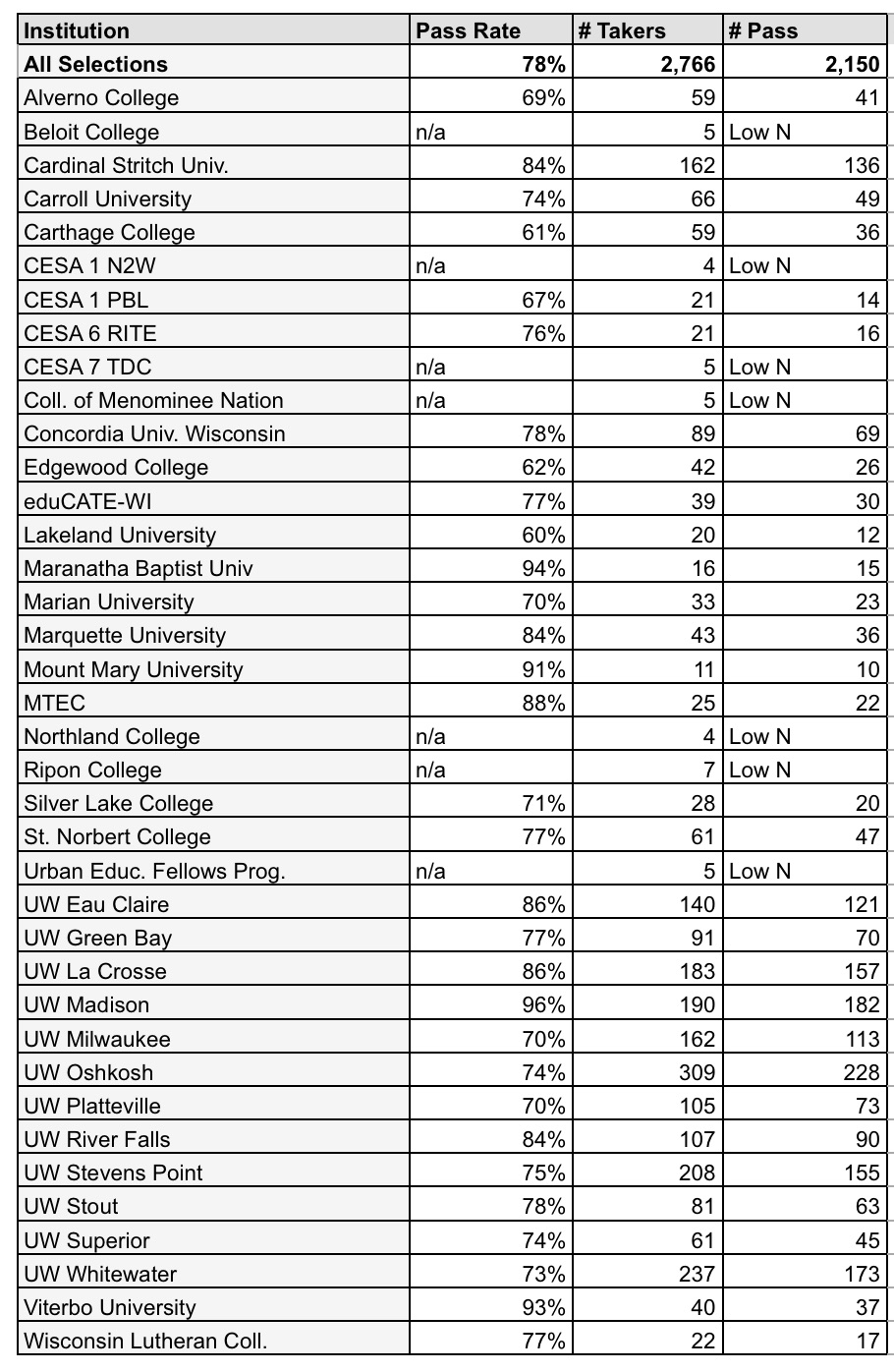
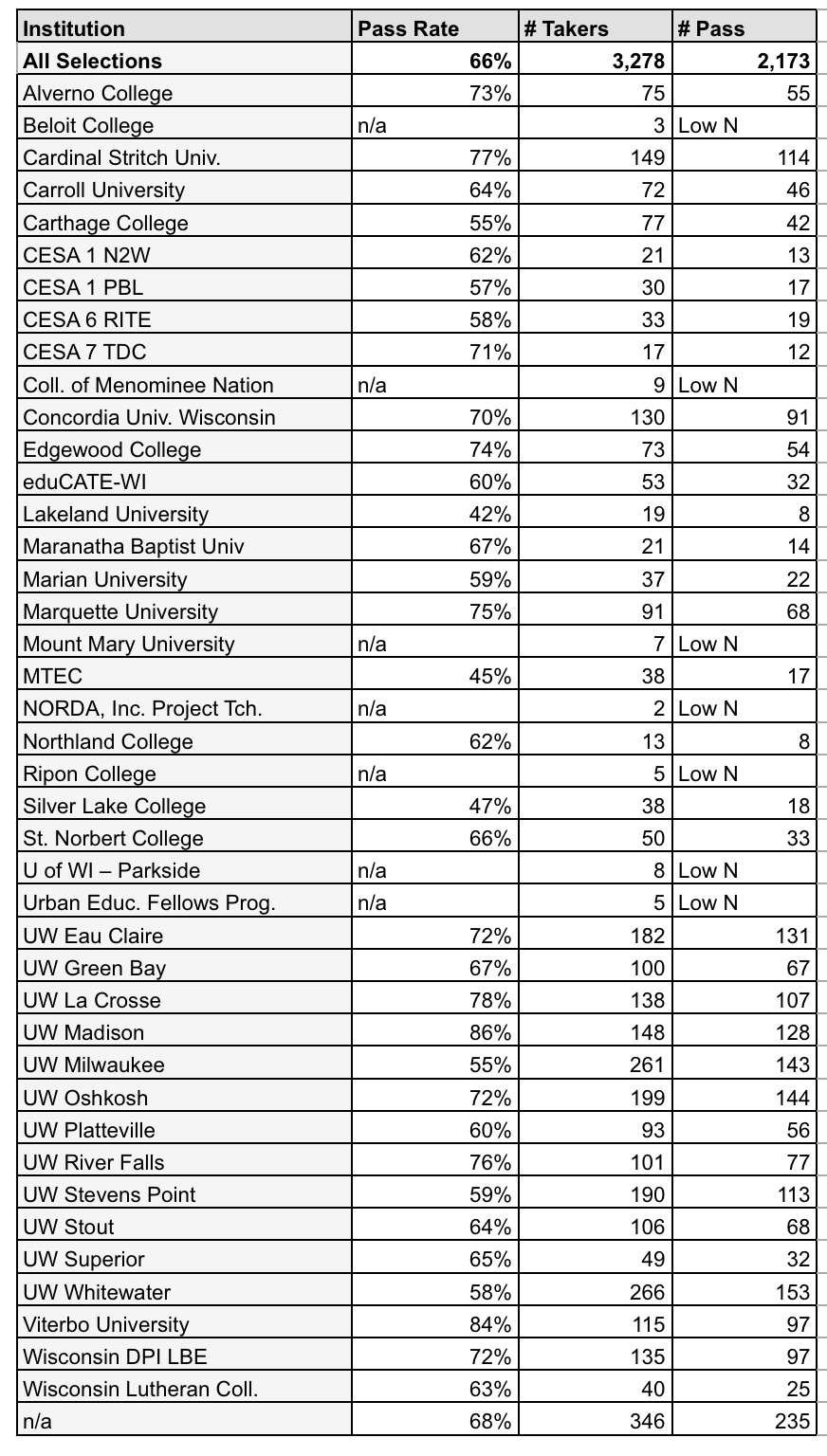
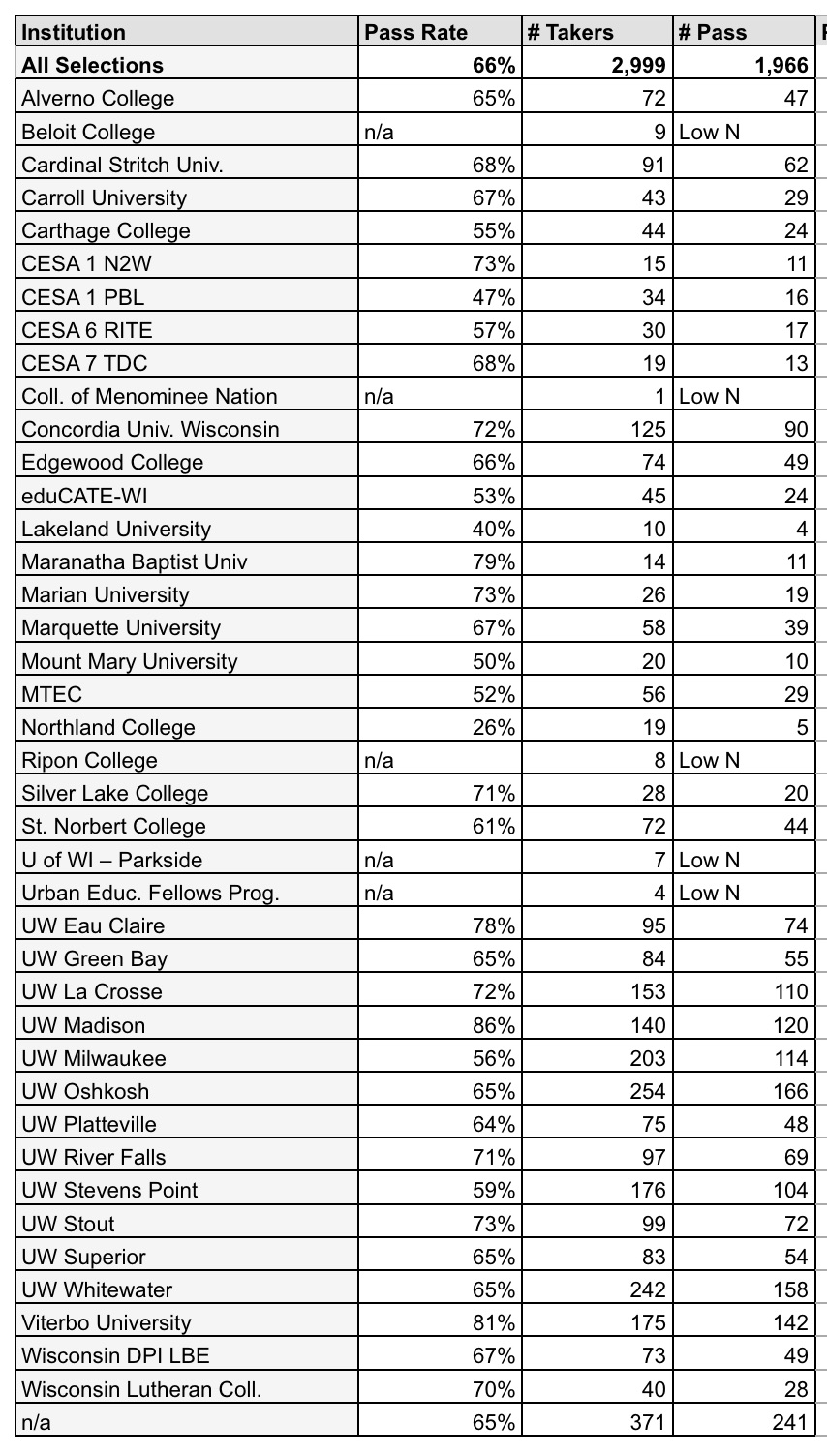
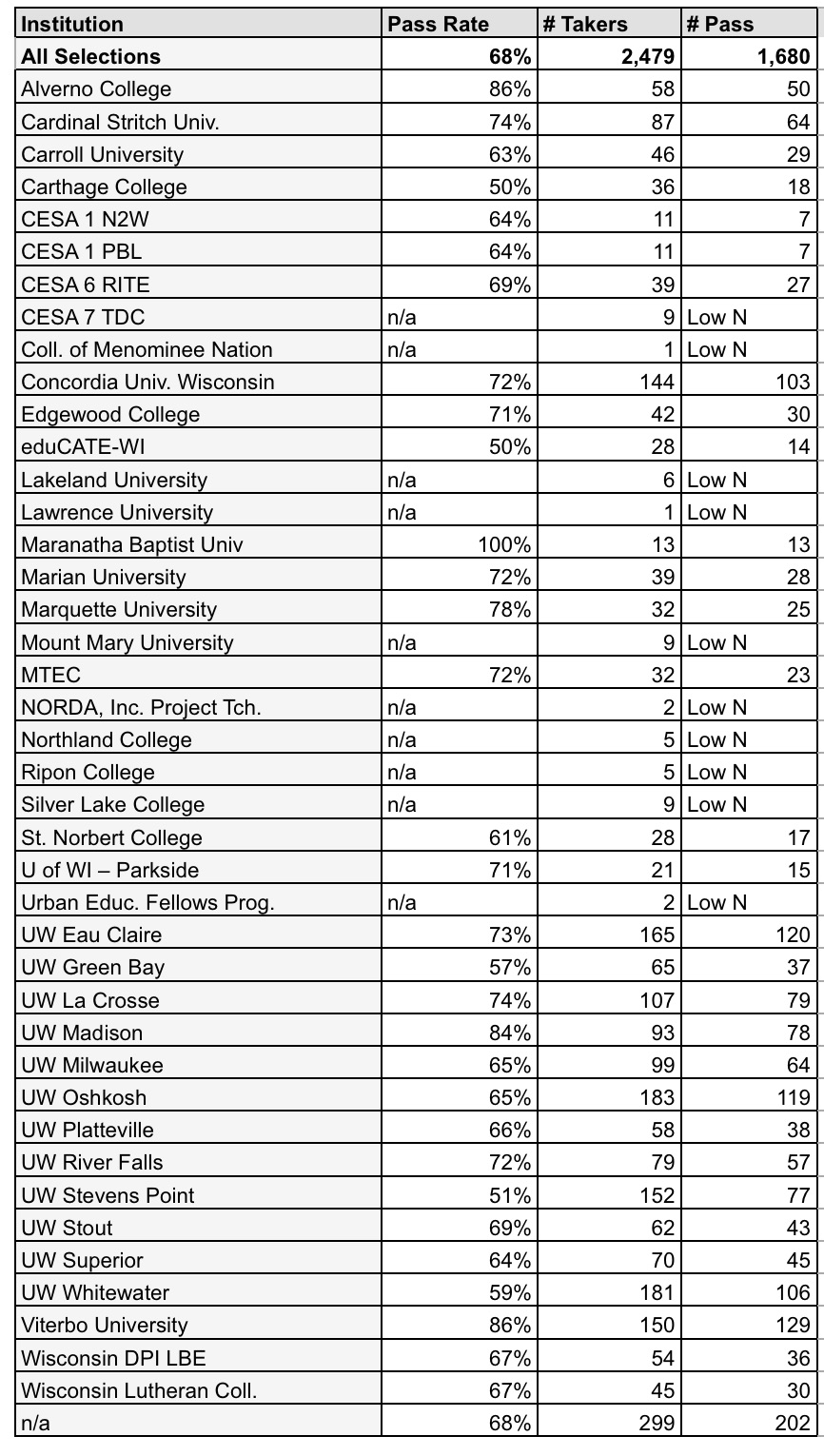
Wisconsin Early Literacy Screener Report: 2024-2025

Developed by Barb Novak, PhD Director, Office of Literacy:

School and District level data (.xlsx). Act 20 annual reporting.

——

Chris Rickert:

Nearly 44% of Madison School District 4K through third graders scored below the 25th percentile on an early literacy screener required under a 2023 state law, the state Department of Public Instruction reported Monday,

The results were slightly worse than for students in those grades statewide. About 37% of them scored in the bottom quartile

Results varied widely by grade in the Madison and other school districts. More than half of Madison’s kindergartners and first graders, for example, scored in the bottom quartile, while only 13% of students in 4-year-old kindergarten scored in the bottom quartile.

…..

Act 20 was spurred by disappointing state standardized test results in English/language arts. As of last school year, only 51.6% of students were deemed to be meeting or exceeding standards in that area. In the Madison district, it was 47.3%.

——-

Wisconsin’s Literacy Nightmare Before Christmas
By: Will Flanders, Research Director, PhD
Very quietly on the Sunday after Thanksgiving, the Wisconsin Department of Public Instruction released results from literacy screeners required under Act 20—Wisconsin’s Reading Law.  The choice of release date raises questions, as DPI has developed a track record of releasing information when they hope no one is watching — from sexual abuse allegations to report cards. A closer look at the data only serves to bolster the notion that DPI was hoping no one would notice.  Below, we take a look at the data.  Among the key takeaways:
  • Over a third of early-grade students fell below the 25th percentile at least once, triggering mandatory intervention and underscoring widespread early literacy challenges.
  • District trajectories vary dramatically from kindergarten to third grade, suggesting inconsistent instruction, questionable screener reliability, or both.
  • Poverty and disability remain strong predictors of low reading performance, but standout districts show that strong implementation of evidence-based reading practices can meaningfully improve outcomes.
Many Students Are Falling Short

As with all school data, it is important to adjust student demographics in assessing school performance as these factors, unfortunately, play a large role in student outcomes.  To account for this reality, I use a regression analysis to measure the impact of these variables on the reading data, then use that data to make predictions about outcomes for each district. Districts that have fewer students below the 25th percentile than predicted are arguably doing a good job in reading education relative to other districts.The results of the regression predicting the share of students below the 25th percentile are depicted in Table 3.  First, it is important to note that the percentage of African American students does not show up as a significant predictor here. This is the first academic outcome data I’ve ever examined in Wisconsin where this is the case. What is not unusual is that student poverty is a key predictor. A district with 100% low-income students would be expected to have 31.43% more kids below the 25th percentile than a district with no students in poverty. Similarly, the share of students with disabilities matters here. A school with 100% of students with disabilities would be expected to have 72.77% more students below the 25th percentile.

——–

Anna Stokke:

🎯This is probably one of the smartest things I’ve heard a Canadian Minister of Education say. It gets to the heart of why scores never improve. The people who created the problem are always given the job of fixing the problem.

——

Did taxpayer funded Wisconsin DPI Superintendent Underly Juice Test Scores for Reelection?

——-

Only 31% of 4th graders in Wisconsin read at grade level, which is worse than Mississippi.

——-

Madison taxpayers have long supported far above average (now > $25,000 per student) K-12 tax & spending practices. This, despite long term, disastrous reading results. 

Madison Schools: More $, No Accountability

The taxpayer funded Madison School District long used Reading Recovery

The data clearly indicate that being able to read is not a requirement for graduation at (Madison) East, especially if you are black or Hispanic”

My Question to Wisconsin Governor Tony Evers on Teacher Mulligans and our Disastrous Reading Results

2017: West High Reading Interventionist Teacher’s Remarks to the School Board on Madison’s Disastrous Reading Results 

Madison’s taxpayer supported K-12 school district, despite spending far more than most, has long tolerated disastrous reading results.

“An emphasis on adult employment”

Wisconsin Public Policy Forum Madison School District Report[PDF]

WEAC: $1.57 million for Four Wisconsin Senators

Friday Afternoon Veto: Governor Evers Rejects AB446/SB454; an effort to address our long term, disastrous reading results

Booked, but can’t read (Madison): functional literacy, National citizenship and the new face of Dred Scott in the age of mass incarceration.

When A Stands for Average: Students at the UW-Madison School of Education Receive Sky-High Grades. How Smart is That?

Invest America

Michael Dell:

We’re Committing $6.25 Billion to Give 25 Million Children a Financial Head Start

This contribution will fund $250 deposits for children ages 10 and under, expanding early access to investment accounts powered by Invest America.

More.

New numbers show falling standards in American high schools

The Economist

Low-achieving pupils may suffer the most

Springfield, MA might seem an improbable setting for an education miracle. The city with a population of 155,000 along the Connecticut river has a median household income half the state average; violent crime is common. Yet graduation rates at the city’s high schools are surging. Between 2007 and 2022 the share of pupils at the Springfield High School of Science and Technology who earned a diploma in four years jumped from 50% to 94%; at neighbouring Roger Putnam Vocational Technical Academy it nearly doubled to 96%.

San Jose Mayor Matt Mahan:

Reducing standards may feel good in the short run, but it does a disservice to our children and undermines our collective well-being in the long run. (2/2)

How School Accountability Keeps Kids Out of Prison

Neetu Arnold:

A new study shows that public school performance ratings encourage reforms that benefit students and parents.

If you want to shut down the “school-to-prison pipeline,” holding failing schools accountable may be the best place to start. Many education debates focus on relaxing discipline as a way to keep kids out of the justice system. But a new study finds that receiving a failing accountability rating—and the reform pressure that then results—can work to reduce the share of students who get arrested or incarcerated as young adults.

“School Accountability, Long-Run Criminal Activity, and Self-Sufficiency,” published in the Journal of Human Resources in November 2025, followed more than 54,000 South Carolina students who entered ninth grade between 2000 and 2005, tracking them into their thirties to examine arrest and incarceration outcomes. Since 2000, South Carolina has rated public schools from “unsatisfactory” to “excellent” based on graduation rates, merit scholarship eligibility, and test scores.

“He has a point, but he’s too blunt”

JK Rowling:

From the start, a key tactic of the gender identitarians has been linguistic prescription, and it’s proved shockingly successful. Trans activists’ shibboleths and euphemisms have been allowed to penetrate the upper echelons of our culture with devastating consequences to freedom of speech and belief. Huge swathes of liberal media, the arts, academia and publishing have thrown themselves with gusto into the defence of a quasi-religious belief causing provable real world harm, and in their arrogance they’ve been outraged when people they assumed were part of their In Group have refused to march meekly along in lock step.

Time and again, I’ve seen and heard well-educated people who consider themselves critical thinkers and bold truth-tellers squirm when put on the spot. ‘Well, yes, maybe there’s something in what you’re saying, but it’s hateful/provocative/rude not to use the approved language/pretend people can literally change sex/keep drawing attention to medical malpractice or opportunistic sexual predators. Why can’t you be nice? Why won’t you pretend? We thought you were one of us! Don’t you realise we have sophisticated new words and phrases these days that obviate the necessity of thinking any of this through?’

As the vibe shifts, and a lot of people in the elite professions start trying to reposition themselves, the obvious place to start is, ‘it’s not that I couldn’t see your point, but did you have to say it that way?’ We dissenters were supposed to find a way of questioning the chemical castration of children while calling it ‘gender affirming care.’ We were meant to defend the rights of vulnerable women while also using female pronouns for male rapists. We should have found a way to discuss fairness for women and girls in sport, while pretending that the ineradicable physical advantage men have over women doesn’t exist.

School resource officers keep Milwaukee hallways safe two months into the school year

Sean Brynda

“We’ve had some firearm recovery in schools where officers have taken away multiple firearms from students ranging in age from 8-years-old to 17-years-old,” said Norberg. “I believe in ensuring safety and that we can be there on-site as schools when incidents like that come up and if there are resources needed after and incident occurs that we can be there on site to provide additional resources to students and faculty outside of the Milwaukee Police Department.”

The 33-officer involved program has 25 full-time SROs assigned to different high schools and 8 other officers that rotate to other schools found within the the school district. Captain Norberg says the purpose of the SROs at school is to de-escalate conflict. 

“They respond to fights and disturbances particularly during lunch and dismissals to ensure that the safety of the students and also that of the school staff,” said Norberg. “Our SROs are trained to spot potential problems and to prevent early escalation into serious incidents. On many times, MPS has contacted us because they hear things and have asked us to be around to help monitor those kind of situations.” 

Lyme disease often goes undetected when it’s most treatable. These teens are working to change that.

By Bill Whitaker, Aliza Chasan, Henry Schuster and Sarah Turcotte:

A team of public high school students in Georgia faced some skepticism when they decided to try to come up with a way to detect Lyme disease earlier. 

But the students at Lambert High School in suburban Atlanta, Georgia, pushed ahead with their idea, using the gene editing technology CRISPR, and took it to the iGEM competition, a sort of science Olympics, in Paris. iGEM stands for International Genetically Engineered Machine and the annual competition has been around for about 20 years. 

Now, scientists say the students’ groundbreaking work could be a major breakthrough if further testing pans out. 

“We’re doing something in our high school lab that could potentially have a huge impact for, like, millions of people. It’s not like we’re just saying, like, ‘Oh. I’m just doing this little thing that might help my grade,'” said high school senior Claire Lee. “This thing could help save lives.”

When the Cultural Revolution ended, Deng Xiaoping reintroduced standardised college entrance examinations

Soyonbo Borjgin

When the Cultural Revolution ended, Deng Xiaoping reintroduced standardised college entrance examinations, which had been suspended for 12 years. (My maternal grandmother announced: “From now on, being rich is good, and being poor is bad!”) Both my parents got good scores and were admitted into colleges in Hohhot, where they studied the humanities, rather than practical subjects like medicine and engineering. This may be because intellectuals were still respected in the early 1980s, the start of the Reform Era (in my opinion, the best period of socialism in China). All college graduates were guaranteed a state job. That the son of an illiterate shepherd could attend university proved that our nation was advancing.

My father, a Mongolian Studies graduate, was hired to teach at Inner Mongolia University, and my mother, who studied journalism, became a reporter at The Inner Mongolia Daily. Four decades later, they were employed in these same institutions. Say what you will about state socialism, but it provides workplace stability.

In 1989, soon after I was born, my father was arrested. He does not speak about this period – that is the way in our culture – but I understand he got swept up in the Tiananmen Square movement, which had reached even the remotest corners of China. In Xinjiang and Inner Mongolia, demonstrators swarmed through the streets and squares, demanding autonomy for their ostensibly autonomous regions. I’m told my father painted a pro-democracy slogan on a public building. He was imprisoned for two years.

One evening, when I returned home from nursery, there were two bald strangers in our living room: my father and his brother, also a protestor, had their heads shaved in jail. My mother made a huge feast, at least 10 dishes, to celebrate their release. To their credit, the university rehired my father, though as a librarian, not as a professor. If you go to prison, it’s natural to lose your job.

When I was a child, my mother would take me along on her reporting trips to remote villages. We travelled by the party Jeep, which was a rare sight in rural Mongolia: people came out of their huts to gawk at the vehicle. On weekend afternoons, she would sit at her desk, draft her articles, and then bike over to the office to hand them in to her editor. If I dwell on this memory, I can convince myself that she liked her line of work. Then I remember she remains a low-level reporter. Only party members are given promotions, and she never joined the party.

New programs emphasizing classical and civic education promote healthy dialogue in higher education.

Robert George:

The ideological partisanship, dogmatism and bigotry on display in our society today are to some degree the fruit of our educational system. Too many college classrooms have become indoctrination camps. Some students buy into the leftist ideology they’re taught and become its enforcers. Others react by embracing opposing forms of extremism. Either way, radicalism and animus replace knowledge and wisdom. 

So what should we do? The answer isn’t complicated, but acting on it will take determination and courage. Colleges and universities must return to offering a rigorous liberal arts education that refuses to engage in indoctrination and challenges groupthink. College courses must actively cultivate the virtues of curiosity, open-mindedness, intellectual humility, analytical rigor and, above all, dedication to the pursuit of truth. 

Civics: Legacy media and the political class

David Sacks:

Every time we would prove an accusation false, NYT pivoted to the next allegation. This is why the story has dragged on for five months.

Today they evidently just threw up their hands and published this nothing burger. Anyone who reads the story carefully can see that they strung together a bunch of anecdotes that don’t support the headline. And of course, that was the whole point.

At no point in their constant goalpost-shifting was NYT willing to update the premise of their story to accept that I have no conflicts of interest to uncover.

As it became clear that NYT wasn’t interested in writing a fair story, I hired the law firm Clare Locke, which specializes in defamation law. I’m attaching Clare Locke’s letter to NYT so readers have full context on our interactions with NYT’s reporters over the past several months.

Once you read the letter, it becomes very clear how NYT willfully mischaracterized or ignored the facts to support their bogus narrative.

Follow-up:

This may be the point: portray anyone with real-world experience as too conflicted to serve in government so only professional bureaucrats/activists/NGO-types (with the same views as NYT reporters) are eligible.

Chamath:

Agreed.

There is a concerted effort by the bureaucratic class to paint success and experience as a sign of corruption.

Instead, it’s the exact opposite.

Success and experience in the free market only comes from repeatedly expressed and easily measured good judgement.

Gavin Baker:

Separately, the @nytimes urgently needs to provide remedial math education for these journalists and their editors. The idea that 500,000 GPUs sold to the UAE could generate anywhere near $200 billion in revenue to Nvidia is ridiculous.

I look forward to the correction that will be assiduously posted to the @NYTimesPR account which has 90k followers vs. the main account with 52.8m followers.

I should note that while I do not know David well, we have many good friends in common and I like him personally. More importantly, I am grateful for his service, which has unquestionably cost him a vast amount of money. And my superstar sister-in-law is a partner at Craft, for which David is lucky.

Dan Gillmor:

I’m hard on the NY Times for its many failings in political coverage, but this piece — about a South African immigrant to the US who is central to the manifestly sleazy, and lucrative, Silicon Valley / Trump world dealings — is simply excellent.

New York Times follow-up:

“Reporting on powerful figures who influence financial and industrial policies that affect millions of Americans is core to the role of The Times and part of being a member of the free and independent press. Our reporters do not have an agenda — they examine leads, verify them in good faith with the subjects involved, and publish what we confirm. That’s exactly what happened here.

We remain confident in our reporting on Mr. Sacks, an important and influential member of the Administration. The Times’s article documents the ethical complexities and intertwined interests of his dual roles as a government advisor and a major investor.”

The New York Times

– A spokesperson for The New York Times

——-

Nic Carter:

NYT article on Sacks is the purest distillation of East Coast v West Coast mindset to date.

East Coast: all financial incentives are conflicts. government should be run by impartial career bureaucrats and academics

West Coast: no conflict no interest. your views are worthless if you have no skin in the game

——-

more.

And.

Rachael Horowitz:

Contrast with: 68 top executive-branch officials in Biden administration had less than 2 ½ years of experience in the private sector. The average business experience of Biden appointees was only 2.4 years and 62 percent had virtually no business experience.

Americans no longer see four-year college degrees as worth the cost

Ben Kamisar:

But what has shifted is the price of college. While there have been some small declines in tuition prices over the last decade, when adjusted for inflation, College Board data shows that the average, inflation-adjusted cost of public four-year college tuition for in-state students has doubled since 1995. Tuition at private, four-year colleges is up 75% over the same period.

Poll respondents who spoke with NBC News all emphasized those rising costs as a major reason why the value of a four-year degree has been undercut.

Jacob Kennedy, a 28-year-old server and bartender living in Detroit, told NBC News that while he believes “an educated populace is the most important thing for a country to have,” if people can’t use those degrees because of the debt they’re carrying, it undercuts the value.

Kennedy, who has a two-year degree, reflected on “the number of people who I’ve met working in the service industry who have four-year degrees and then within a year of graduating immediately quit their ‘grown-up jobs’ to go back to the jobs they had.”

“The cost overwhelms the value,” he continued. “You go to school with all that student debt — the jobs you get out of college don’t pay that debt, so you have to go find something else that can pay that debt.”

The 20-point decline over the last 12 years among those who say a degree is worth it — from 53% in 2013 to 33% now — is reflected across virtually every demographic group. But the shift in sentiment is especially striking among Republicans.

Notes on the grant industrial complex and higher education

jason Locasale:

NPR frames the reduction of this empire as if it’s some catastrophic blow to biomedical science. In reality, it is the clearest indictment of the system we’ve built – a system where:

  • aging PIs retain massive labs long after their most productive years
  • Harvard and other nonprofits quietly subsidize them through indirects and internal slush funds
  • trainees serve as disposable workers in an oversaturated job market
  • cronyism dictates who gets resources
  • cancer is wielded as a fundraising weapon

Surprise heirs are showing up and sowing disorder for people handling their loved ones’ estates

Ashlea Ebeling:

When Carmen Thomas was growing up in Boston, her mom told her that her absent dad’s name was Joe Brown. So when she sent a saliva sample to 23andMe in her 20s and got a match with a Brown, she was excited.

It turned out the man she believed to be her father had died five years earlier, but she connected with two likely half sisters. They went out for boba tea and at a sleepover at their grandmother’s, she looked through family albums and held a pillow with his photo printed on it.

A year later, she was suing the Brown sisters and their mother. Thomas wanted a share of a multimillion-dollar medical-malpractice award they had won after Joe Brown died of an undiagnosed aortic aneurysm. After all, she was his daughter too, Thomas said in a court complaint early last year.

Surprise heirs like Thomas are popping up because of DNA test kits, lawyers say, and wreaking havoc for families handling their loved ones’ estates. States are grappling with how to rewrite laws to address the issue, and lawyers are encouraging people to rethink their estate plans.

The lawyer representing the Brown sisters and their mother said his clients were taken aback by Thomas’s claims.

“94% had completed an advanced math class in high school (e.g., pre-calculus, calculus or statistics) and received an average A- in their math courses”

Allysia Finley:

Because so many incoming students were numerically illiterate, the university added a remedial class for middle- and elementary-school math. Remarkably, among students placed into that math course, 94% had completed an advanced math class in high school (e.g., pre-calculus, calculus or statistics) and received an average A- in their math courses.

Is this an indictment of A) the University of California’s admissions; B) public K-12 schools; C) U.S. News & World Report’s college rankings; or D) all of the above? If you chose D, you’re correct.

Start with A. The UC Board of Regents in 2020 scrapped standardized tests as an admissions requirement under the guise of promoting “equity.” The likely real reason: Blacks and Hispanics score lower on average on the SAT. Requiring applicants to submit standardized tests scores could also make it easier for critics to prove the university is providing racial preferences, which were prohibited by a 1996 voter referendum. The math-proficiency analysis suggests it may be doing so on the sly.

Amid a push to boost diversity and overall enrollment—and thus rake in more government student aid—UC San Diego admitted increasing numbers of unqualified applicants from low-income high schools: “In order to holistically admit a diverse and representative class, we need to admit students who may be at a higher risk of not succeeding,” the report says.

That’s because the College Board has made the exams easier to pass to encourage more students to take them—and thus rake in more money from testing fees. The share of students passing AP exams has soared over the last two decades, including for calculus AB (6.3 percentage points), English language and composition (17.9), chemistry (21.9) and U.S. history (23.3).

Call it vanity grading: Mediocre students now graduate with top GPAs and AP scores, which makes parents feel better about their kids’ public schools and eases political pressures for education reform.

Principals office:

Yet most parents will overwhelmingly say they like their child’s public schools. I think it’s because of the false narratives most public schools spend millions to keep up via PR departments. Ask your school district how much they budget in their Communications Department. You will not like the answer.

Education Staffing since 1970:

– Students +8%

– Teaching Staff +60%

– Non-Teaching Staff +138%

2014: 21% of University of Wisconsin System Freshman Require Remedial Math

How One Woman Rewrote Math in Corvallis

Singapore Math

Discovery Math

Connected Math (2006!)

Math Forum 2007

Growing K-12 District debt amidst declining enrollment

Aaron Smith:

Public schools are increasingly taking on debt.

From 2002 to 2023, total debt went from $8,074 per student to $12,592 per student in real terms.

Public school debt now totals $586 billion, which doesn’t include pension liabilities.

With student enrollment falling, legacy costs are a major problem for many districts.

“in this school year, Milwaukee K-12 receives $16,773 for each student at Carmen Northwest Middle and High School and sends $12,369 to the school….

Alan Borsuk:

Let’s do the math: There are more than 500 students in that school. At about $4,000 per student, MPS is receiving about $2 million more for Carmen students than it is actually paying to Carmen. In addition, the school is paying MPS $727,469 this school year to rent the building, which was originally an MPS middle school.

The number of students in the MPS independent charter schools was only about 2,500 in the fall of 2008. That rose to a peak of just under 9,000 in the fall of 2016. Some schools have closed, some have switched to other authorizers, some have lost enrollment. The number in the MPS system this fall is about 6,900.

Current attention has focused primarily on Carmen Northwest, which was up for renewal of its charter contract. The school’s test scores have been low, but its general vitality as a school community has been pretty good (as the large number of Carmen supporters at recent school board meetings demonstrated).

The school board voted Nov. 20 to give the school a one-year renewal, on the condition that it won’t be renewed again and it won’t be allowed to continue to use the building that has been its home for more than a decade.

That means the forecast is for the number of students in this group of charter schools to fall by more than 3,500 by fall 2027. That alone would create a revenue loss to MPS of more than $12 million a year. And the loss of these charter schools, most of them with academic performance above the MPS averages, is very likely to drop the MPS overall achievement picture. Furthermore, one of the remaining MPS-authorized charter schools, the Hmong American Peace Academy with about 2,000 students, would account for two-thirds of the remaining students in this scenario. HAPA, as it is called, has achievement scores well above the MPS average. Will HAPA stay with MPS in the future? I wouldn’t count on that.

Civics: Taxpayer funded Social Services Fraud in Minnesota

Ernesto Londono:

At first, many in the state saw the case as a one-off abuse during a health emergency. But as new schemes targeting the state’s generous safety net programs came to light, state and federal officials began to grapple with a jarring reality.

Over the last five years, law enforcement officials say, fraud took root in pockets of Minnesota’s Somali diaspora as scores of individuals made small fortunes by setting up companies that billed state agencies for millions of dollars’ worth of social services that were never provided.

Federal prosecutors say that 59 people have been convicted in those schemes so far, and that more than $1 billion in taxpayers’ money has been stolen in three plots they are investigating. That is more than Minnesota spends annually to run its Department of Corrections. Minnesota’s fraud scandal stood out even in the context of rampant theft during the pandemic, when Americans stole tens of billions through unemployment benefits, business loans and other forms of aid, according to federal auditors.

Scott Johnson summary:

Overlooking the element of political corruption, this cuts closer to the bone:

Ahmed Samatar, a professor at Macalester College who is a leading expert in Somali studies, said a reckoning over the fraud and its consequences for Minnesota was overdue.

“American society and the denizens of the state of Minnesota have been extremely good to Somalis,” said Dr. Samatar, who is Somali American.

Dr. Samatar said that Somali refugees who came to the United States after their country’s civil war were raised in a culture in which stealing from the country’s dysfunctional and corrupt government was widespread.

Minnesota, he said, proved susceptible to rampant fraud because it is “so tolerant, so open and so geared toward keeping an eye on the weak.”

For the New York Times, not bad.

Minnesota DHS:

To all whistleblowers who have reached out: Thank you for your courage and for continuing to send critical information. Your willingness to speak up is what allows the public to maintain trust in systems that too often operate in the dark.

Can the ‘Lost Generation’ be found?

Victor Davis Hanson

Males in their teens and 20s are prolonging their adolescence — rarely marrying, not buying a home, not having children, and often not working full-time. 

The negative stereotype of a Zoomer is a shiftless man, who plays too many video games. He is too coddled by parents and too afraid to strike out on his own.

Zoomers rarely date supposedly out of fear that they would have to grow up, take charge, and head a household.

Yet the opposite, sympathetic generalization of Gen Z seems more accurate.

All through K-12, young men, particularly white males, have been demonized for their “toxic masculinity” that draws accusations of sexism, racism, and homophobia.

In college, the majority of students are female. In contrast, white males — 9-10 percent of admittees in recent years at elite schools like Stanford and the Ivy League — are of no interest to college admission officers.

So they are tagged not as unique individuals but as superfluous losers of the “wrong” race, gender, or sexual orientation.

Protect Public School Students from Surveillance and Punishment for Off-Campus Speech

Sophia Cope:

EFF filed an amicus brief urging the Arizona District Court to protect public school students’ freedom of speech and privacy by holding that the use of a school-issued laptop or email account does not categorically mean a student is “on campus.” We argued that students need private digital spaces beyond their school’s reach to speak freely, without the specter of constant school surveillance and punishment.  

Surveillance Software Exposed a Bad Joke Made in the Privacy of a Student’s Home 

The case, Merrill v. Marana Unified School District, involves a Marana High School student who, while at home one morning before school started, asked his mother for advice about a bad grade he received on an English assignment. His mother said he should talk to his English teacher, so he opened his school-issued Google Chromebook and started drafting an email. The student then wrote a series of jokes in the draft email that he deleted each time. The last joke stated: “GANG GANG GIMME A BETTER GRADE OR I SHOOT UP DA SKOOL HOMIE,” which he narrated out loud to his mother in a silly voice before deleting the draft and closing his computer.  

civics: “A closer look at the data behind Rahmanullah Lakanwal’s name appearing online hours before the attack”

The Allen Analysis:

The central question remains the Google Trends spike. There are several plausible explanations. A social media post containing his name may have circulated before mainstream news outlets picked up the shooting. Early reporters or local community members may have speculated or shared details before verification, which then produced search traffic. Search interest could also have come from internal networks tied to immigration lawyers, former colleagues, or individuals who recognized the name before law enforcement publicly identified the suspect. It is also possible that the Trends data is inaccurate for names with extremely low volume, a known phenomenon in low-frequency datasets.

Navy Relieves USNA Commandant of Midshipmen

US Navy:

ANNAPOLIS, Md.- United States Naval Academy Superintendent Lt. Gen. Michael Borgschulte, relieved the Commandant of Midshipmen Capt. Gilbert Clark Jr. today due to a loss of confidence in his ability to effectively lead the Brigade of Midshipmen.

The naval service maintains the highest standards for leaders and holds them accountable when those standards are not met.

Clark assumed the role as Commandant of Midshipmen in June 2025. Capt. Austin Jackson, Deputy Commandant of Midshipmen, has assumed duties as the interim Commandant.

The Naval Academy Commandant is responsible for the day-to-day conduct, military training, and professional development of approximately 4,400 midshipmen.

Civics & Feeding America: “how to match scarce resources to competing priorities fairly, efficiently, and predictably”

Caroline Sutton:

What struck the economists was the absence of information. Food banks had no way to express what they valued, no view of what was available, and no means to coordinate across regions. Some were excellent at logistics. Others had deep relationships with donors. Others had neither advantage. Yet all were trying to serve their communities under enormous pressure.

The Chicago team proposed something that, at the time, sounded like an odd choice for a charitable network: a market, complete with a custom-designed currency called “shares.” Every food bank would receive an allotment of shares based on how many people it served. Those shares could then be used to bid on truckloads of food in a daily national auction.

If a food bank desperately needed cereal, it could signal that by bidding more. If it already had enough cereal but urgently needed rice, it could save its shares for that instead. If something undesirable arrived — like potato chips or, true story, Tupperware lids missing their containers — the auction assigned it a negative price: taking it earned you extra shares.

It was a system designed to convert preferences (information each food bank had about its community’s needs) into visible, actionable signals. Prendergast describes this as the price discovery function of markets: the mechanism that reveals “how much you like a certain kind of food compared to another kind of food.” The bidding activity quickly revealed patterns no centralized planner could have seen.

Cereal, for instance, wasn’t just more valuable than broccoli; it was dramatically more valuable. The economists had assumed maybe a 6:1 ratio in preference intensity. The auction showed a ratio closer to 35:1.

Kids First, Then Career

Rachel Wolfe & Paul Overberg:

The term is from the biblical passage Ecclesiastes 3:1: “For everything there is a season, and a time for every matter under heaven.”

Many of the women who view their lives in this way say they think of themselves as existing in between the extremes of tradwives (who treat caring for their homes and families as a more permanent, full-time job) and girlbosses (who center their lives around work).

As recently as 15 years ago, self-described conservative and liberal women between the ages of 18 and 35 were having children at around the same rate, according to an analysis from a large national study called the General Social Survey by Samuel Perry, a sociology professor at the University of Oklahoma. But in recent years, the gap has widened, his analysis shows. As of 2024, roughly 75% of liberal women in this age range were childless, compared with around 40% of conservatives. In 2010, the difference was only 5 percentage points.

Civic Games

Natalie Yahr:

“If people understood how government worked, then surely they would be more interested in public service as a future occupation,” said Galanter, who served on the Madison City Council, ran former U.S. Sen. Herb Kohl’s Madison office and used to open all her public presentations with the same line: “I’m from the government, and I’m here to help.”

In 2018, she pitched her idea to the Wisconsin Newspaper Association, a membership organization of the state’s papers, figuring their publications could get the word out across the state.

The association agreed, and the Wisconsin Civics Games were born. Soon staff were making plans for regional playoffs and a state final at the Capitol where members of the winning team would each receive $2,000 in scholarships.

Since then, teams from 76 high schools have competed, and interest continues to grow. This year’s regional playoffs, held in April, drew 205 students — twice as many as the first year.

Civics & Food: “Why does the city think it needs to spend $10 million to bring groceries there when they already have groceries? This is the way communists think.”

Mike Nichols:

Pick ’n Save stores in Wisconsin are run by Roundy’s, which is a subsidiary of Kroger. A Kroger spokesperson did not return a call for comment, but in 2024 a Roundy’s corporate affairs manager told a local Madison publication, Isthmus, that the company was planning to “continue to provide access to fresh foods at affordable prices” at the South Park Street location.

Meanwhile, Madison city officials — having already doled out millions — now own a nearby space at 815 Cedar St. that, it appears, was not built to easily house a grocery store.

The space, for instance, reportedly had insufficient electrical power and the building had a roof that won’t accommodate necessary equipment. A large bank of windows and the floor plan are also less than ideal.

The building “wasn’t built for a grocer, even though it was supposed to be,” said Kristi Maurer, the grocer who will open Maurer’s Urban Grocery in the city-owned space.

“A lot of the journey has been dealing with the building and the reality of the building,” she said.

The City of Madison bought the “condo space” for $4.6 million in 2021 from the developer of a multi-use development that includes a lot of apartments. But it also approved $3.5 million for improvements in 2023, according to media reports, and then in 2024 approved another $1 million in improvements to make the space work as a grocery store.

As part of the lease agreement with Maurer’s, the city will recoup $3.85 million in tenant improvements and that will remain an asset of the city, according to a city communications manager.

It is unclear, in the meantime, when exactly lease payments might begin.

Renaming process for taxpayer funded Madison schools slows to a trickle

Chris Rickert:

Folger explained the delay in getting to Elvehjem and Lindbergh by saying that the process last school year to pick a name for the former Southside Elementary — now Lori Mann Carey Elementary — took longer than expected.

“We are now on track to start the process for two schools this year,” he said.

According to emails from district officials to the organizer of the Lindbergh proposal, Betsy Abramson, the district was looking at starting the name-change process for Lindbergh earlier this year but later moved that date to this month.

Abramson said she knows that changing the name of the school isn’t the most important item on the district’s agenda, but the reasons for the delay haven’t been made clear to her.

“At this point, I’m very frustrated at the length of the process,” she said.

Elvehjem staff members submitted the proposal to rename that school after Stephanie A. Bernard, a Black former Madison schools teacher who died in August 2022.

Did taxpayer funded Wisconsin DPI Superintendent Underly Juice Test Scores for Reelection?

——-

Only 31% of 4th graders in Wisconsin read at grade level, which is worse than Mississippi.

——-

Madison taxpayers have long supported far above average (now > $25,000 per student) K-12 tax & spending practices. This, despite long term, disastrous reading results. 

Madison Schools: More $, No Accountability

The taxpayer funded Madison School District long used Reading Recovery

The data clearly indicate that being able to read is not a requirement for graduation at (Madison) East, especially if you are black or Hispanic”

My Question to Wisconsin Governor Tony Evers on Teacher Mulligans and our Disastrous Reading Results

2017: West High Reading Interventionist Teacher’s Remarks to the School Board on Madison’s Disastrous Reading Results 

Madison’s taxpayer supported K-12 school district, despite spending far more than most, has long tolerated disastrous reading results.

“An emphasis on adult employment”

Wisconsin Public Policy Forum Madison School District Report[PDF]

WEAC: $1.57 million for Four Wisconsin Senators

Friday Afternoon Veto: Governor Evers Rejects AB446/SB454; an effort to address our long term, disastrous reading results

Booked, but can’t read (Madison): functional literacy, National citizenship and the new face of Dred Scott in the age of mass incarceration.

When A Stands for Average: Students at the UW-Madison School of Education Receive Sky-High Grades. How Smart is That?

Pathologizing a Generation: The Mental Health Boom That’s Making Our Young Sick

amac.us

What’s going on? Has this explosion of mental health awareness liberated young people to be “who they truly are”? Or has it trapped them in a culture of fragility, convincing them they are broken or otherwise socially unfit before they’ve even reached adulthood?

The Mental Health Industrial Complex

While more money than ever is being poured into therapy, medication, and mental health services, global mental well-being is declining. This recognized trend is known as the Treatment Prevalence Paradox (TPP): the more we treat, the worse the statistics get.

Suicide rates are climbing. Antidepressant use is soaring. Disability claims for mental illness are up across the West. International studies show that young people, especially those in English-speaking nations, report the lowest mental well-being of any demographic. Despite record spending, the mental health crisis keeps deepening.

We wouldn’t accept this in any other branch of medicine. Cancer outcomes are improving. Heart disease and diabetes mortality are falling. But in mental health, treatment seems to correlate with worsening outcomes. The uncomfortable truth is that our current approach may be part of the problem.

The Trouble With Diagnosis

“Our district’s operational footprint far exceeds the enrollment needs of today’s and tomorrow’s students, and that limits our ability to provide high-quality services across too many locations”

Dr.Kelly Piacek:

As Wisconsin’s seventh-largest school district, we serve more students than 98% of Wisconsin districts, operate 23 separate facilities, and employ close to 1,500 people, making us one of the largest employers in the city of Waukesha. Our top teacher salaries have reached nearly $95,000 per year, and our new teacher salaries have increased by 18% since 2021.

While we have maintained competitive compensation models, our costs to operate facilities, update curriculum, provide pupil transportation, and strengthen safety and security infrastructure continue to outpace enrollment. Several of our elementary and middle schools have been trending toward 50% occupancy, leading to costly inefficiencies that risk sacrificing programs and services by spreading specialists across too many facilities.

We embarked on the “Optimizing Our Future” process last spring with clear goals in mind: Address this excess K-8 capacity by reducing overall building space by 10%-15%. We asked the administration to facilitate an open, community-involved process, and we spent the summer in candid and honest discussion about ongoing enrollment challenges that have led to a persistent structural deficit, impossible trade-offs between facilities and staffing, and the pros and cons of potential solutions.

The Board reached a decision Nov. 12 that met our goal, and the process now shifts from input and deliberation to implementation. The conclusion of this work doesn’t come with celebration or pats on the back. It leaves an empty feeling in the moment — and for some, it concludes with disappointment, sadness, and even anger. Leadership sometimes requires us to sit with that discomfort, to accept the disappointment that accompanies the necessary change, and to work to move forward with clarity and compassion.

“Years after a teacher’s arrest, Madison’s policies continue to fall short of recommendations from those who study educator sexual misconduct”

Danielle DuClos

Then in January 2020, Kruchten was arrestedafter a school field trip to Minnesota where students discovered hidden cameras in their hotel rooms. 

Kruchten pleaded guilty a year later to federal charges including attempting to produce child sexual abuse material and was sentenced to 12 years in prison. The charges stemmed from two previous incidents in Wisconsin. 

The federal judge at Kruchten’s sentencing revealed 137 victims were involved in the case across numerous field trips, court records show.  

Ten of the students later sued Kruchten and the Madison Metropolitan School District, arguing the district had given Kruchten broad authority and discretion, which allowed him to secretly film students and violate their constitutional rights. 

Kruchten admitted in a lawsuit deposition that he filmed students in their hotel rooms dating back to 2016, according to the deposition transcript. 

But while the lawsuit ultimately led to a settlement with Kruchten last year, the school district was dismissed from the case. Three students involved in the lawsuit told the Cap Times they hoped the legal pressure would spur the district to overhaul its policies and training practices to prevent educator sexual misconduct from happening again. 

——-

More.

and:

Years after David Kruchten’s arrest, MMSD policies and training still fall short of researcher recommendations to prevent educator sexual misconduct

Former students speak out, saying MMSD didn’t do enough to protect them

Civics: Oops. Cryptographers cancel election results after losing decryption key.

Dan Goodin:

One of the world’s premier security organizations has canceled the results of its annual leadership election after an official lost an encryption key needed to unlock results stored in a verifiable and privacy-preserving voting system.

The International Association of Cryptologic Research (IACR) said Friday that the votes were submitted and tallied using Helios, an open source voting system that uses peer-reviewed cryptography to cast and count votes in a verifiable, confidential, and privacy-preserving way. Helios encrypts each vote in a way that assures each ballot is secret. Other cryptography used by Helios allows each voter to confirm their ballot was counted fairly.

An “honest but unfortunate human mistake”

Per the association’s bylaws, three members of the election committee act as independent trustees. To prevent two of them from colluding to cook the results, each trustee holds a third of the cryptographic key material needed to decrypt results.

“Unfortunately, one of the three trustees has irretrievably lost their private key, an honest but unfortunate human mistake, and therefore cannot compute their decryption share,” the IACR said. “As a result, Helios is unable to complete the decryption process, and it is technically impossible for us to obtain or verify the final outcome of this election.”

“Teachers aren’t exaggerating when we say that persistent disruption is one of the primary reasons educators are leaving the profession”

Wendy:

It’s not one student every now and then. It’s daily. And the system is built to cycle students right back in, no matter what happened.

If only legality mattered.

I wish people knew how normalized this is. Students in my building literally designate bathrooms depending on who is vaping, who is dealing, who is using, and who is just trying to pee in peace. As soon as admin cracks down on one location, students shift to another.

Someone once suggested stationing parent volunteers in every bathroom.

Aside from the obvious impracticality, it’s not even allowed. Adults can’t be posted in student bathrooms, for very good legal and safety reasons.

I’m not sharing these things to blame students, point fingers at parents, or criticize administrators. I’m sharing them because we can’t fix a system the public fundamentally misunderstands.

You can’t solve a problem people don’t believe exists.

If the conversations I start on X have shown me anything, it’s that the gap between public perception and classroom reality is enormous.

I’m often told that I assume my school’s issues are universal. Maybe they aren’t. But what if they are?

Cecily Myart-Cruz’s Hostile Takeover of L.A.’s Public Schools

Jason McGahan:

The head of the L.A. teachers’ union is ambitious, audacious, and uncompromising. But critics blast her as a demagogue whose gamesmanship during the pandemic took a toll on the kids she claims to fight for

Cecily Myart-Cruz rarely sits for interviews. When she wants to communicate with the media, which is infrequently, she usually does so through a press release or, if the situation demands, a prerecorded video. For the most part, the famously contentious head of L.A.’s most powerful union–United Teachers Los Angeles–remains unapproachable, ensconced inside UTLA‘s Wilshire Center headquarters where she controls the levers and dials of the largest, most complicated, and, these days, most divisive educational labor machine in the state–possibly the nation.

Today, however, on a sunny May afternoon, Myart-Cruz is allowing a reporter inside her inner sanctum–or at least inside a glass-paneled conference room down the hall from her eleventh-floor office. And right away, she lives up to her reputation: after settling into in a swivel chair and slowly removing her zebra-print face mask, the 47-year-old lightning rod for controversy calmly sets her hands on the table and begins issuing a series of incendiary statements that almost seem aerodynamically designed to grab headlines and infuriate critics. Like this one: “There is no such thing as learning loss,” she responds when asked how her insistence on keeping L.A.’s schools mostly locked down over the last year and a half may have impacted the city’s 600,000 kindergarten through 12th-grade students. “Our kids didn’t lose anything. It’s OK that our babies may not have learned all their times tables. They learned resilience. They learned survival. They learned critical-thinking skills. They know the difference between a riot and a protest. They know the words insurrection and coup.” She even went so far as to suggest darkly that “learning loss” is a fake crisis marketed by shadowy purveyors of clinical and classroom assessments.

Traditionally, the job of UTLA is to represent the best interests of the L.A. school system’s 33,000 teachers–to ensure that they are paid properly, that they have the resources to do their jobs, and that their work conditions are safe. But under Myart-Cruz’s stewardship, which began when she assumed office in the summer of 2020, that purview has been expanded to include a breathtaking range of far-flung progressive issues: racial justice, Medicare for all, the millionaire tax, financial support for undocumented families, rental and eviction relief–over the last 15 months, UTLA has championed them all. Many of these may be laudable aims, or at least worth debating, but they aren’t the sort of agendas normally pursued by your neighborhood teachers’ union. In what universe, after all, does UTLA’s recent boycott of Israel over the conflict with Hamas benefit the teachers–or students–of Los Angeles?

Colleges Are Closing. Who Might Be Next?

Robert Kelchen, Dubravka Ritter, Douglas Webber:

“How did you go bankrupt?” one American expat asks another in Ernest Hemingway’s The Sun Also Rises. “Two ways,” his friend responds. “Gradually and then suddenly.”

The most dramatic college closures tend to follow a similar arc. A century-old, beloved liberal arts institution abruptly shuts its doors, sending students and staff scrambling as it succumbs at last to the financial challenges dogging schools that rely on tuition dollars. But the forces creating those challenges—declining enrollment, punishing operating costs, and anemic endowment returns—typically accumulate over a period of years if not decades. In recent years, these forces have all been featured players in the final chapters of small nonprofit schools like Wells College (New York), Northland College (Wisconsin), Iowa Wesleyan University (Iowa), Finlandia College (Michigan), and more than three dozen others. This growth in closures has followed a massive reorganization of the for-profit college sector, where enrollment fell by more than half in the 2010s.

Research and policy discussions often focus on the negative effects of college closures on students, but that’s only part of the story. Colleges also serve as anchor institutions—local economic and cultural engines whose sudden disappearance can leave regions flat-footed. Communities with colleges have higher levels of educational attainment, employment in human capital-intensive industrieseconomic mobility, and local economic output. Colleges also function as cultural hubs, by supporting civic engagement and the arts, and by providing entertainment and a range of educational and enrichment opportunities for their neighbors. Closures affect entire communities, far beyond campus borders.

Why college students prefer TikTok over newspapers • The Verge

Victoria Le: 

rather than read traditional journalistic outlets that do the work of reporting, [computer science major Ankit] Khanal still gets most of his news from aggregators like News Daddy. Social media is simply a more appealing news source for Khanal, who says he’s turned off by the biases and political leanings of traditional news outlets. News influencers, on the other hand, are “actually connected to the people they’re getting their news for.” Khanal’s behavior is not unusual. Inside Higher Ed and Generation Lab polled 1,026 students at 181 two- and four-year institutions from December 19th to 23rd, 2024, on their media literacy practices.

IQ differences of identical twins reared apart are significantly influenced by educational differences

Jared C. Horvath and Katie Fabricant:

Highlights

  • •All individualized reared apart twin data published over the last century was collated.
  • •Twins with similar educations differed by ~6 IQ points.
  • •Twins with significantly different educations differed by ~15 IQ points
  • •The Intraclass Correlation drops dependent upon educational similarity.

Abstract

Over the last century, several large studies have been published exploring IQ differences amongst monozygotic (MZ) twins reared apart (TRA). By and large, this work has reported that MZ TRAs differ in IQ by ~8.0 points and demonstrate and intraclass correlation (ICC) of ~0.75. Unfortunately, this prior research has largely been amalgamated: it averages data from dozens of TRA pairs without accounting for important life experiences, including education (which has demonstrated a causal impact on IQ performance). In this paper, we gathered data from every available TRA case published in the academic literature over the last century that included both individualized IQ and biographical data. This data set (which we believe represents the entirety of the non-amalgamated TRA field) consists of 87 pairs. For our analysis, we split these pairs into three groups: similar, somewhat dissimilar, and very dissimilar schooling. Analyses reveals that schooling differences have a significant impact not only on the absolute IQ difference between TRA pairs (5.8, 12.1, and 15.1 points, respectively), but also the ICC (0.87, 0.80, 0.56, respectively). These findings raise an important question regarding the historic use of ICC as a measure of genetic influence on IQ and other psychological traits. It is recommended the field of TRA studies focus on individual pairs instead of groups and that researchers share individualized data from TRA pairs included in historic aggregate analyses.

An MIT Student Awed Top Economists With His AI Study—Then It All Fell Apart

Kevin T. Dugan and Justin Lahart:

Aidan Toner-Rodgers, 27, sprang to the upper tiers of economics as a graduate student late last year from virtually out of nowhere.

While still taking core classes at the Massachusetts Institute of Technology, he wrote a paper on artificial intelligence’s workplace impact so rapidly influential it was cited in Congress. He appeared in the pages of The Wall Street Journal in December as the very picture of a wunderkind, in faded jeans with tousled hair, in between two of his mentors, including Nobel laureate Daron Acemoglu. Toner-Rodgers’s work offered a surprising and even hopeful revelation about our high-tech future. He concluded that AI increased worker productivity and spurred innovation. Also, people didn’t like using it very much.

Within weeks, those mentors were asking an unthinkable question: Had Toner-Rodgers made it all up?

By the spring, Toner-Rodgers was no longer enrolled at MIT. The university disavowed his paper. Questions multiplied, but one seemed more elusive than the rest: How did a baby-faced novice from small-town California dupe some of academia’s brightest minds?

“There is no world where this makes any sense,” said David Autor, one of the MIT professors who had previously championed his student’s research. MIT, Autor and Acemoglu declined to comment on​ the specifics of the investigation into the research, citing privacy constraints.

Notes on University Governance and DEI $pending

Becky Jacobs:

When Mnookin announced the dissolution of DDEEA this summer, the chancellor said “diversity of all kinds, including diversity of viewpoint and diversity of identity and background, remains a core value of our university.”

“We must create the conditions here, including through programs and support services, that allow all of our students, faculty and staff to flourish and to reach their full potential,” Mnookin said in a campus message.

She cited a recent report about the “undergraduate student experience,” which recommended ways UW-Madison can better support more students, particularly first-generation students and those who need financial assistance.

“Given the evolution of our support ecosystem, legal shifts in permissible focus and the resource intensive nature of DDEEA programs, we strongly believe the time has come to consider reorganization,” an ad hoc working group said in the report.

More than 1,600 students — fewer than 5% of all undergraduates — participated in DDEEA programs in the spring, the report says. Fewer than 10 employees working in the division received layoff notices, Lucas said.

“Last academic year, DIY education grew at nearly three times the average rate it did during the COVID-19 pandemic”

JD Tuccille:

Whether called homeschooling or DIY education, family-directed learning has been growing in popularity for years in the U.S. alongside disappointment in the rigidity, politicization, and flat-out poor results of traditional public schools. That growth was supercharged during the COVID-19 pandemic when extended closures and bumbled remote learning drove many families to experiment with teaching their own kids. The big question was whether the end of public health controls would also curtail interest in homeschooling. We know now that it didn’t. Americans’ taste for DIY education is on the rise.

Homeschooling Grows at Triple the Pre-Pandemic Rate

“In the 2024-2025 school year, homeschooling continued to grow across the United States, increasing at an average rate of 5.4%,” Angela Watson of the Johns Hopkins University School of Education’s Homeschool Hub wroteearlier this month. “This is nearly three times the pre-pandemic homeschooling growth rate of around 2%.” She added that more than a third of the states from which data is available report their highest homeschooling numbers ever, even exceeding the peaks reached when many public and private schools were closed during the pandemic.

After COVID-19 public health measures were suspended, there was a brief drop in homeschooling as parents and families returned to old habits. That didn’t last long. Homeschooling began surging again in the 2023-2024 school year, with that growth continuing last year. Based on numbers from 22 states (not all states have released data, and many don’t track homeschoolers), four report declines in the ranks of homeschooled children—Delaware, the District of Columbia, Hawaii, and Tennessee—while the others report growth from around 1 percent (Florida and Louisiana) to as high as 21.5 percent (South Carolina).

Laptops in the long run: evidence from the One Laptop per Child Program in rural Peru

Santiago Cueto, Diether Beuermann, Julian Cristia, Ofer Malamud and Francisco Pardo: 

This paper examines a large-scale randomized evaluation of the One Laptop Per Child (OLPC) program in 531 Peruvian rural primary schools. We use administrative data on academic performance and grade progression over 10 years to estimate the long-run effects of increased computer access on (i) school performance over time and (ii) students’ educational trajectories. Following schools over time, we find no significant effects on academic performance but some evidence of negative effects on grade progression. Following students over time, we find no significant effects on primary and secondary completion, academic performance in secondary school, or university enrollment. Survey data indicate that computer access significantly improved students’ computer skills but not their cognitive skills…

The Secret to Getting Through Big, Dense, Difficult Books

Sebastian Castillo:

But after an hour of heady (though not too heady — it’s Sunday) discussion, we’d leave with a little more clarity on what Spinoza meant by, say, necessity and free will. Our various cats would make appearances onscreen, perhaps also having found some succor from Spinoza. Our collective mood by the time we arrived at the book’s final, salvific chapter was nothing short of ebullient. Union with other people, oneness with the universe, an acceptance of the paths our lives had taken — these were things that we possessed all along. I had been saved, thankfully, but I cannot tell you how. You must read the book yourself, with friends.

The group, by the end a good 15 or so people, decided there was no reason to stop with Spinoza. We needed even more salvation — like, badly. And so, over the course of the last year and a half, we’ve read a number of challenging books, books we otherwise would have never read alone. We read Henri Bergson; we read the Canadian philosopher Ian Hacking; we’re currently finishing “Objectivity,” by Lorraine Daston and Peter Galison, a book that argues our concept of scientific objectivity — like gender, pleasure and artistic value — is historically determined. I admit that I’ve proposed all the titles, each being in some way thematically linked to the book we read previously. So ideally, like Borges’s Library of Babel, this book club could continue infinitely, or at least close to it.

What is the point of this? Why are we doing this to ourselves? Is it merely a fetish for finishing a difficult book, the self-flattery it permits? None of us are academic philosophers, by any means; we have busy jobs and other pressing adult responsibilities. But the process has proved fruitful. A camaraderie emerges, I’ve found, when a group dedicates itself to a task that requires great effort. The experience is also frequently amusing: Half the meetings during our read of “Anti-Oedipus,” a critique of psychoanalysis by Deleuze and Guattari, were dedicated to complaining about the authors’ half-grinning disdain for their readers. (“Literature is like schizophrenia,” they write.) Needless to say, I loved the book. Learning is both painful and pleasant — and above all, communal.

has many more details about how and why public education quality has collapsed in America.

Noah Smith:

Rice’s article is very long and has many more details about how and why public education quality has collapsed in America. The basic story is that the education reform movement spearheaded by George W. Bush, which focused on improving test scores, collapsed in the mid-2010s. After that, public schools across the country began to lower their standards — passing kids who didn’t know the material, making their curricula a lot easier, etc. Often, kids just skip class entirely — in Oregon, around a third of all schoolchildren are chronically absent from school.

This was sometimes done in the name of “equity”— even though the new lax policies lead to widening racial and gender gaps. The rise of phones in schools probably exacerbated the trend, as did the pandemic, but the fundamental cause is lax standards everywhere. 

Most of the articles about this slow-motion disaster just stick to decrying the report, calling for tighter educational standards, and tracing the demise of the education reform movement. I share their alarm, and I agree with their prescriptions. But I think it’s also worth thinking about exactly why education is going down the tubes in America. 

One obvious possibility is that this is just another case of progressive activist culture on autopilot. In the past two or three decades, progressive governance has absolutely collapsed at the city and state level in a number of areas — housing, crime, infrastructure city services, and so on. It makes sense that education would just be one more failure of a progressive ideology that consistently prizes the bad ideas of the loudest activists. In this case, it was activists who pressured the UC system into dropping standardized test requirements.

Another obvious theory is that America is a very rich country, and the richer people get, the less they want to work hard — and helping your kids get through a tough, demanding education system is certainly hard work. Andrew Rice’s article mentions how local school board elections are usually dominated by upper-income white voters, while the degradation of educational standards tends to impact disadvantaged minorities more.

——-

More.

——-

Did taxpayer funded Wisconsin DPI Superintendent Underly Juice Test Scores for Reelection?

——-

Only 31% of 4th graders in Wisconsin read at grade level, which is worse than Mississippi.

——-

Madison taxpayers have long supported far above average (now > $25,000 per student) K-12 tax & spending practices. This, despite long term, disastrous reading results. 

Madison Schools: More $, No Accountability

The taxpayer funded Madison School District long used Reading Recovery

The data clearly indicate that being able to read is not a requirement for graduation at (Madison) East, especially if you are black or Hispanic”

My Question to Wisconsin Governor Tony Evers on Teacher Mulligans and our Disastrous Reading Results

2017: West High Reading Interventionist Teacher’s Remarks to the School Board on Madison’s Disastrous Reading Results 

Madison’s taxpayer supported K-12 school district, despite spending far more than most, has long tolerated disastrous reading results.

“An emphasis on adult employment”

Wisconsin Public Policy Forum Madison School District Report[PDF]

WEAC: $1.57 million for Four Wisconsin Senators

Friday Afternoon Veto: Governor Evers Rejects AB446/SB454; an effort to address our long term, disastrous reading results

Booked, but can’t read (Madison): functional literacy, National citizenship and the new face of Dred Scott in the age of mass incarceration.

When A Stands for Average: Students at the UW-Madison School of Education Receive Sky-High Grades. How Smart is That?

“the Great Campus Vibe Shift”

Evan Goldstein and Len Gutkin:

Robert P. George, the conservative legal scholar and moral philosopher, has spent the past four decades at Princeton University assiduously cultivating an ever-widening network of influence. For parts of the religious right, he’s an intellectual lodestar on issues including gay marriage, abortion, and stem-cell research. The Catholic journal Crisis once quipped that “if there really is a vast right-wing conspiracy, its leaders probably meet in George’s kitchen.”

Conspiracy or not, there’s no doubt that George has been tremendously influential — and at the moment, his brand of higher-education reform is ascendant. Simply put, if you’re sympathetic to the view that academe has been ideologically captured by the left but find Christopher Rufo and his ilk giving off strong “destroy the village to save it” energy, George looks like a genial antidote. He’s a critic of the academic left but also a staunch defender of institutional autonomy and academic freedom, including against attacks from the right. To his supporters, his approach offers a serious-minded alternative to the nihilistic recklessness of Rufoism. He’s also one part of academe’s oddest duo, having co-taught and lectured extensively with his Princeton colleague on the left, Cornel West. (Truth Matters: A Dialogue on Fruitful Disagreement in an Age of Division, written with West, was published earlier this year. To gauge the giddiness with which they approach their partnership, look no further than the picture on the cover.)

In 2000, George established at Princeton the James Madison Program in American Ideals and Institutions, a model for the many colleges and universities, public and private, spinning up similar initiatives. To critics, especially on the faculty, these often legislatively imposed initiatives are little more than an elaborate system of affirmative action for conservative scholars.

George has been in the news recently because of his resignation from the board of the Heritage Foundation over concerns about its handling of antisemitism on the right, especially the fallout from Tucker Carlson’s interview with the avowed white nationalist Nick Fuentes. George didn’t want to discuss Heritage but did make clear that something noxious is bubbling up on parts of the right, especially among young men. He even sees it among his students at Princeton.

Over the course of two interviews — the first conducted from his home and the second from his office on the Princeton campus — George discussed the risk of indoctrination from the left and the right, the need for a more ideologically diverse professoriate, and how academe made itself vulnerable to attack by the Trump administration. Our conversation has been edited for length and clarity.

Viewpoint Diversity

Roshan Fernandez:

The aim, colleges and advisers explain, is to probe how well students can countenance other viewpoints. “We are looking for students who want to be bridge builders,” New York University tells applicants on its website.

Duke this year asks applicants to describe a time when they had a difference of opinion with someone they care about, and what they learned from it. That is a shift from last year, when the prompt asked students to recount either an agreement or a disagreement.

Duke’s interim dean of admissions, Kathy Phillips, said the revision aligns with a school initiative to “build skills to engage with complex topics with an open mind and humility.”

Essay prompts often reflect the political moment, college consultants and former admissions officers say. Questions about social justice and diversity became popular after the Black Lives Matter movement grew a few years ago. Prompts about feminism and gender equity ascended during the #MeToo era, and questions about community arose after Covid isolation.

Since President Trump took office, he has pushed colleges to show they can welcome conservative views.

“The essay questions follow the times,” said Tara Dowling, an independent educational consultant.

k-12 Tax & $pending Climate: Chicago’s debt crisis

Chicago Tribune:

With recent attention focused on the budget drama in Chicago, you’re forgiven if you missed what could end up being a yet-bigger story with perilous long-term consequences for this city.

The city floated $454 million in bonds on Nov. 19, and $75 million of those went unsold.

More precisely, Goldman Sachs, which underwrote the deal, was left holding the $75 million after the bank couldn’t find buyers for that amount, according to Bloomberg News. And, making matters worse, the bonds that were sold moved only after Goldman boosted interest rates beyond what the city forecast in order to entice the buyers.

These bonds weren’t issued to finance new spending. Instead, these securities refinanced bonds already on the city’s books, some of which were backed by sales tax revenues and so were about as safe an investment in the city of Chicago as an investor can make these days.

Which begs the question: How will investors respond when they’re next asked to bankroll hundreds of millions in new spending?

If the markets already perceive Chicago as such a fiscal basket case that there’s tepid-at-best appetite for the most risk-free debt the city has to offer, it’s not a stretch to worry that the city will struggle to finance future needs.

Mayor Brandon Johnson’s administration surely isn’t helping to reassure investors by proposing the City Council approve a record-setting $3.8 billion bond authorization.

Are U.S. universities too dependent on international students? MIT panel debates costs, benefits

Rylee Stephens:

The scholars agreed that some amount of international students belong on U.S. campuses, but the deeper question centered on whether American higher education can balance financial necessity with educational mission, ensuring that global engagement strengthens, rather than defines, the future of U.S. universities. 

The crux of the debate centered on whether U.S. universities are “too dependent” on international students’ tuition dollars, with those who support international enrollment arguing it’s not even close.

International students represent less than 10 percent of the student body at most U.S. universities, “hardly the majority of the business model,” said Chris Glass, a professor in the Department of Educational Leadership at Boston College.

David Freed, a medical technology expert, also argued that international students enrich classrooms, strengthen research, and build global partnerships.

Commentary on “ai” and schools

Andrej Karpathy:

A number of people are talking about implications of AI to schools. I spoke about some of my thoughts to a school board earlier, some highlights: 1. You will never be able to detect the use of AI in homework. Full stop. All “detectors” of AI imo don’t really work, can be defeated in various ways, and are in principle doomed to fail. You have to assume that any work done outside classroom has used AI. 2. Therefore, the majority of grading has to shift to in-class work (instead of at-home assignments), in settings where teachers can physically monitor students. The students remain motivated to learn how to solve problems without AI because they know they will be evaluated without it in class later. 3. We want students to be able to use AI, it is here to stay and it is extremely powerful, but we also don’t want students to be naked in the world without it. Using the calculator as an example of a historically disruptive technology, school teaches you how to do all the basic math & arithmetic so that you can in principle do it by hand, even if calculators are pervasive and greatly speed up work in practical settings. In addition, you understand what it’s doing for you, so should it give you a wrong answer (e.g. you mistyped “prompt”), you should be able to notice it, gut check it, verify it in some other way, etc. The verification ability is especially important in the case of AI, which is presently a lot more fallible in a great variety of ways compared to calculators. 4. A lot of the evaluation settings remain at teacher’s discretion and involve a creative design space of no tools, cheatsheets, open book, provided AI responses, direct internet/AI access, etc. TLDR the goal is that the students are proficient in the use of AI, but can also exist without it, and imo the only way to get there is to flip classes around and move the majority of testing to in class settings

Effort vs. Mastery

Beth McMurtrie:

Anything Harvard College does draws attention. So it was no surprise that a recent report arguing that undergraduate grading practices are “out of whack,” as one professor put it, got a lot of buzz. Some of the public responses were unsympathetic, painting Harvard as a college full of easy graders and entitled students.

Yet many of the challenges Harvard outlined are commonplace in higher education. Professors fear tougher grading will lead to negative course evaluations. Instructors sometimes find modern teaching practices are difficult to align with grades. Students are putting more pressure on professors to raise grades they don’t like.

One of the report’s most compelling findings is that Harvard students almost universally speak about grades in terms of how much effort they put in. If they spend a lot of time studying and do all of the work asked of them, they believe, they should get an A. That misunderstanding is not unique to Harvard, say professors elsewhere.

School Kidnappings Have Become a Cruel Fact of Life in Nigeria

Alexandra Wexler:

Quick Summary

Gunmen abducted 303 students and 12 teachers and staff from St. Mary’s Catholic School in Niger State; 50 students have since escaped.

Since 2014, at least 17 mass abductions have occurred, with at least 1,700 children seized from schools in Nigeria.

More than 100,000 Nigerians have died in political and religious violence since 2011, according to the Council on Foreign Relations.

The mass kidnapping of children in Nigeria caught the world’s attention over a decade ago when 276 high-school students were abducted from Chibok, sparking the #BringBackOurGirls campaign on social media. The phenomenon returned to the limelight this month with another mass abduction and President Trump’s threats to intervene over what he said was the persecution of Christians in one of Africa’s most strategic nations.

Columbia considers expanding undergraduate enrollment by up to 20 percent

Matt Lou:

Columbia is considering expanding undergraduate enrollment in Columbia College and the School of Engineering and Applied Science by up to 20 percent, according to an Oct. 31 email to faculty from the policy and planning committee of the Faculty of Arts and Sciences obtained by Spectator. 

The University anticipates finalizing its decision before releasing early decision admissions results mid-December, according to the email. Its consideration is part of a wave of policy proposals responding to recent shifts in higher education and growing programming concerns within the University.

Facing losses of up to $100 million each month of the COVID-19 pandemic, Columbia launched an inquiry during the 2021-22 academic year into expanding its undergraduate population by between 5 and 20 percent. The inquiry resulted in nine faculty reports, which recommended postponing expansion considerations and focusing first on improving “areas of campus life associated with peer-to-peer connection.” At the time, the FAS agreed to postpone expansion discussions. 

“In the ensuing years, there have been efforts to address these recommendations,” Ivan Corwin, professor of mathematics and chair of the policy and planning committee, wrote in the email.

America’s Children Are Unwell. Are Schools Part of the Problem?

:

One of the more bewildering aspects of the already high-stress endeavor of 21st-century American parenting is that at some point your child is likely to be identified with a psychiatric diagnosis of one kind or another. Many exist in a gray zone that previous generations of parents never encountered.

A diagnosis of attention deficit hyperactivity disorder is practically a rite of passage in American boyhood, with nearly one in four 17-year-old boys bearing the diagnosis. The numbers have only gone up, and vertiginously: One million more children were diagnosed with A.D.H.D. in 2022 than in 2016.

The numbers on autism are so shocking that they are worth repeating. In the early 1980s, one in 2,500 children had an autism diagnosis. That figure is now one in 31.

Nearly 32 percent of adolescents have been diagnosed at some point with anxiety; the median age of “onset” is 6 years old. More than one in 10 adolescents have experienced a major depressive disorder, according to some estimates. New categories materialize. There is now oppositional defiant disorder, in addition to pathological demand avoidance.

“A generation raised to believe the world is against them won’t step forward to serve it”

Robert Pondiscio:

When I taught a high school civics seminar at a Harlem charter school, my favorite lesson was one I did near the end of the school year that I hoped my students would never forget. I handed each soon-to-be graduating senior an invoice for the entire cost of their public education.

The invoices were official-looking. Clean design and letterhead, personalized—a bill for the approximate total, over a quarter of a million dollars, that the city and state of New York had spent on each student’s “free” K–12 education. When I passed them out, there was usually a moment of stunned silence. Then someone would inevitably ask, “Wait…is this real?

“Of course it’s real,” I’d reply. “This is my job. I get paid. So do your other teachers. We’re not volunteers. The heat and electricity are on. Your books aren’t free. Who do you think pays for all this?”

I didn’t want to panic them, so I let them in on the joke fairly quickly. No, the bill isn’t real, I’d explain, launching the lesson. But the cost is absolutely real. The citizens of New York State and New York City had spent nearly three hundred thousand dollars to educate each and every one of them. Why?

They’d rarely if ever reflected on the cost of their “free” public education, much less that strangers— millions of people they’d never meet and who’d never met them—had been quietly investing in them for over a decade. It sparked some of the richest classroom discussion I’ve ever led. What does society owe its young people? What do young people owe society in return?

No one had ever invited them to see school as a gift, as their civic inheritance, as a sign that the world might be for them, not against them.

And that experience convinced me of something at the heart of this talk: Our job isn’t just to teach kids things. It’s to shape what they think the world is like, and whether it’s a world worth engaging in or a world to retreat from. A world that’s on their side, or a world that is aligned against them.

Three-year college degrees are on the rise. Will Wisconsin schools embrace the new model?

Kelly Meyerhofer

Three-year bachelor’s degrees are gaining traction nationally since the first programs gained approval in late 2023. At least 70 institutions either already offer three-year programs or are seeking approval, according to College-in-3, an organization advocating for three-year degrees and connecting interested campuses to resources. Another 10 schools are exploring the idea, including the University of Wisconsin-Milwaukee.

States are pushing for more. Indiana passed a law in 2024 requiring public bachelor’s-granting institutions to develop at least one three-year program by July 2025. In Kansas, a task force is studying whether to offer reduced-credit programs.

The interest in shaking up the status quo comes as affordability remains a barrier and the value of a college degree is increasingly questioned. About 35% of survey respondents this year said a college education was very important, down from 75% in 2010, according to a Gallup poll.

“It’s shaving off a quarter of the nonsense,” said Robert Zemsky, a University of Pennsylvania professor and longtime advocate of three-year college degrees. “I’m sorry to be so blunt, but I think students have figured out that they’re being asked to do lots of things that they don’t really need or want to do, and they’d like less of that.”

Slender Man defendant cut off monitoring bracelet, left Madison group home

Hope Karnopp:

In July, a group home in Sun Prairie, a suburb of Madison, withdrew its offer to accept Geyser as a resident. Two other group homes, one in Manitowoc and the other in the Milwaukee area, also fell through, for different reasons.

Geyser, now 23, along with co-defendant Anissa Weier, were charged with attempted homicide of their friend, Payton Leutner, who was stabbed 19 times near David’s Park in Waukesha in May 2014. All three girls were 12 years old at the time.

Believing that they were doing the bidding of the fictional online character called Slender Man, both were found not guilty by reason of mental defect or disease in 2017 and sentenced to mental confinement — Weier for 25 years, and Geyser for 40 years.

Weier was granted conditional release in 2021 on a 25-year commitment order. She was freed from electronic monitoring in 2023, according to court records.

The Politics of Autism

Simon Baron-Cohen:

Autism — a neurodevelopmental disability — has become a political issue. How did this happen?

There is a short answer, which begins with the press conference held two months ago by US President Donald Trump and his health secretary Robert F Kennedy Jr, in which they linked a rise in the prevalence of autism to increases in environmental toxins, such as women taking paracetamol during pregnancy, or the use of vaccines in early childhood. While the scientific community has dismissed these views as unsubstantiated, and pointed to evidence disproving them, the episode raised questions about why politicians should be entering into debates about the science of autism.

To understand the unlikely relationship between autism and politics, however, we must turn to the diagnosis of autism, since today this has become contentious. Before 1994, it was mostly diagnosed in people who also had an intellectual (or learning) disability, and in those who had language delays or difficulties. Clinicians back then called it classic autism, and we all referred to the paper published in 1943 by child psychiatrist Leo Kanner at Johns Hopkins University in Baltimore, and credited him with the first report of autism.