“A kid doesn’t need to know what year a war happened when they can ask their phone.” This was a statement from Department of Public Instruction representative Laura Roeker during a recent listening session on the Department’s new Portrait of a Graduate initiative. The initiative emphasizes preparing students for real life by focusing on qualities such as collaboration, communication, adaptability, and problem-solving.
Massachusetts lawmakers strike deal on major reading instruction overhaul requiring phonics in all schools
A long-running debate over how schoolchildren are taught to read in Massachusetts may soon be settled: Phonics is set to become the law of the land.
In an effort to reverse a decade-long decline in reading skills, Massachusetts lawmakers on Tuesday announced a deal to overhaul literacy instruction for the state’s youngest learners, imposing mandates on schools that would end the see-sawing between two different approaches.
While earlier versions of the measure has been opposed by the Massachusetts Teachers Association, lawmakers contend they have to act now to stop a decade-long decline in student achievement.
If the deal is approved, educators starting in the fall of 2027 would be required to use “evidence-based” literacy instruction that includes teaching children to sound out words, vocabulary building, oral comprehension, and more.
It would also prohibit literacy curriculums that rely on “cueing” — which instructs children to, for example, look at a picture and guess what an unknown word means based on contextual clues.
A 2023 Globe investigation found nearly half of school districts in the state used curriculums that were dubbed “low quality” by the state, in part because the education plans taught cueing to students. At the time, the state lacked the authority and money to replace those curriculums.
The compromise literacy bill, which still must be voted on by lawmakers and signed by Governor Maura Healey, would grant the state’s education department authority to approve a list of kindergarten through third grade reading programs, so that school districts would no longer decide on their own how they teach literacy.
It also includes enhanced requirements for schools to screen for disabilities such as dyslexia, according to the bill. The state would track how schools teach reading.
The Wisconsin Education Comeback: A Roadmap for Student Success
The News: The Wisconsin Institute for Law & Liberty (WILL) has launched “The Wisconsin Education Comeback: A Roadmap for Student Success” a series of reports to reform education in Wisconsin. The roadmap will aim to provide a comprehensive set of K-12 education reforms for the next Governor and legislature to tackle.
The first report titled, “The FORT Gap: How Inconsistent Teacher Preparation Is Fueling Wisconsin’s Literacy and Educator Crises”, discusses how inconsistencies in teacher preparation are fueling Wisconsin’s literacy crisis and teachers shortage.
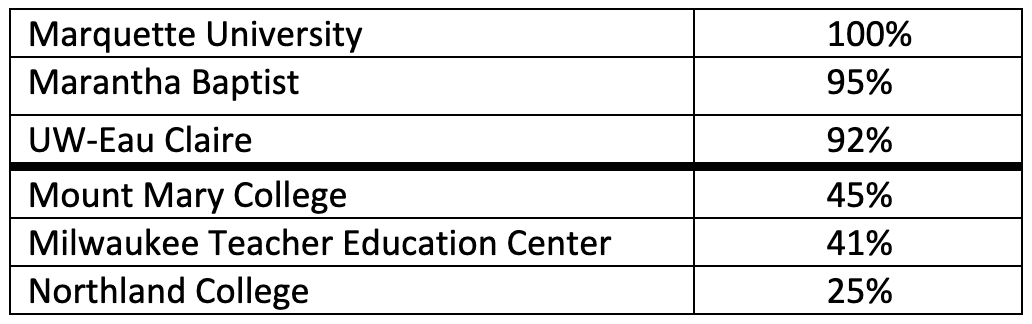
The Foundations of Reading Test (FORT) serves as a useful diagnostic tool for identifying this gap. Required for licensure in Elementary and Middle School Education, Middle Childhood-Early Adolescence, and Special Education, the FORT measures whether teaching candidates understand the five core components of evidence-based reading instruction: phonemic awareness, phonics, vocabulary, fluency, and comprehension. Inconsistent passage rates across universities reveal significant disparities in how effectively teacher preparation programs are training future educators. These gaps are directly exacerbating Wisconsin’s teacher shortage.
The Quote: WILL Research Director, Will Flanders stated, “Wisconsin is facing a growing literacy challenge marked by stagnant or declining reading proficiency and a strained teacher workforce. While these issues are often treated separately, they are actually closely connected. At the center is a systemic gap in teacher preparation—particularly in equipping educators with the knowledge and skills aligned with the “Science of Reading.”
Key Findings:
- Teacher preparation is a root cause of both low reading proficiency and teacher shortages, with inconsistent training in the Science of Reading limiting both educator effectiveness and workforce supply.
- Wide disparities in FORT passage rates across universities highlight uneven program quality. Passage rates vary from 100% to 25%. The highest and lowest passage rates are shown in the table below.
———
Map: Foundations of Reading Results: 2015–2024
Where have all the students gone?
2026-2027 Madison K-12 $pending continues to grow, fueled by a 9.7% (!) property tax increase. Total spending will be at least $706,000,000 for 25,003 students, or $28,236 per student.
May 2026 Madison School District Presentation: 7,095 adults for 25,003 students (3.52 students per adult!)
Early Literacy Screener Map.
3,887 Madison 4 year old to third grade students scored lower than 75% of the students in the national comparison group.
Madison taxpayers have long supported far above average k-12 tax & $pending. This despite our long term, disastrous reading results. May, 2026: 7,095 Staff for 25,003 students; $pending > $26k per student!
Madison Schools: More $, No Accountability
The taxpayer funded Madison School District long used Reading Recovery…
The data clearly indicate that being able to read is not a requirement for graduation at (Madison) East, especially if you are black or Hispanic”
A.B.T.: “Ain’t been taught.”
My Question to Wisconsin Governor Tony Evers on Teacher Mulligans and our Disastrous Reading Results
2017: West High Reading Interventionist Teacher’s Remarks to the School Board on Madison’s Disastrous Reading Results
Madison’s taxpayer supported K-12 school district, despite spending far more than most, has long tolerated disastrous reading results.
“An emphasis on adult employment”
Wisconsin Public Policy Forum Madison School District Report[PDF]
WEAC: $1.57 million for Four Wisconsin Senators
Friday Afternoon Veto: Governor Evers Rejects AB446/SB454; an effort to address our long term, disastrous reading results
Booked, but can’t read (Madison): functional literacy, National citizenship and the new face of Dred Scott in the age of mass incarceration.
When A Stands for Average: Students at the UW-Madison School of Education Receive Sky-High Grades. How Smart is That?
k-12 tax & $pending climate: “Twenty years later, we’re just about to get past the stop sign,” Madison said. “I’m really asking us not to do that again.”
Over more than two decades, the nearly $24 million project weathered multimillion-dollar budget gaps, pandemic-related delays and escalating construction costs before announcing its grand opening on July 23.
“We’re as anxious as everyone else to throw open the doors,” said Stacey Diehl, the market’s events manager. “So we decided to pull together a pop-up market series so people could start enjoying the space.”
The market began hosting pop-up previews June 10, which will run Wednesday evenings through July 1.
Market CEO Keisha Harrison estimated in May roughly half of the market’s 28 vendors will be open the first day. Market staples including pizza, coffee, produce, flowers and a brewery have yet to be confirmed.
Here’s a deeper look at how the Madison Public Market reached its finish line:
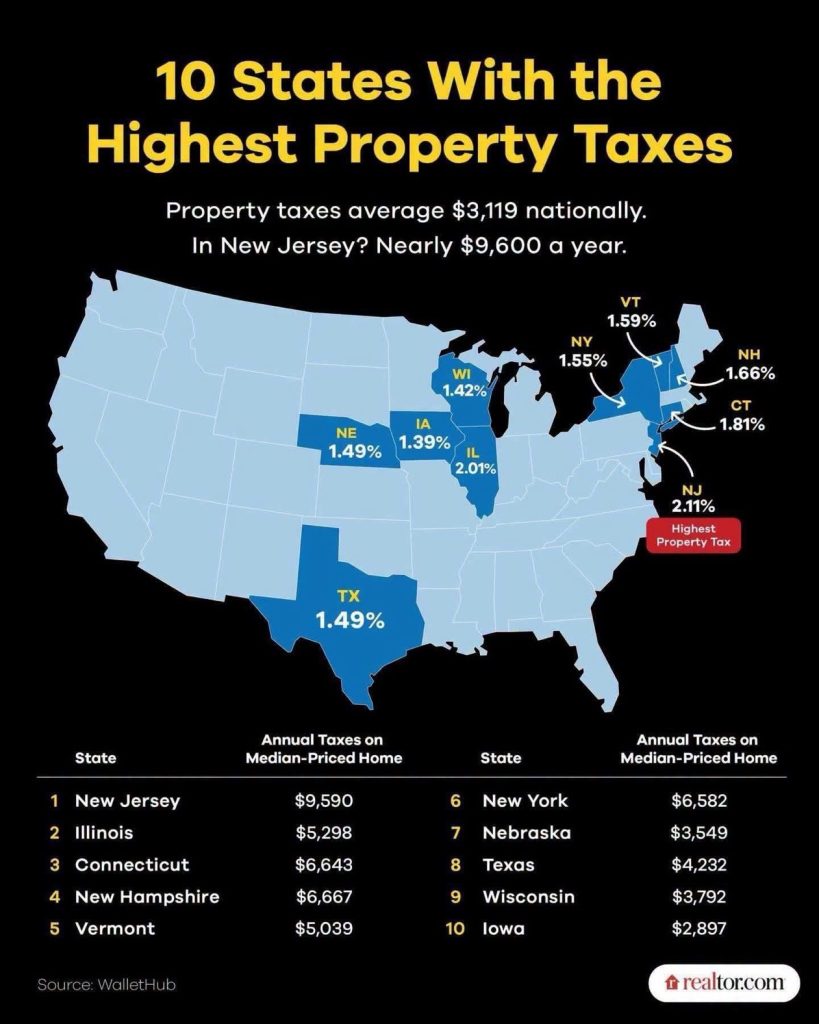
k-12 tax & $pending climate: Top 10 Property tax burden
Notes on Cost Disease
Aaron Brown, Michael Mendelson and Clifford Asness:
The cost-disease sectors generally—healthcare, higher education, anything where Baumol’s curse (upward salary pressure in fields without productivity gains) meets a regulatory cartel. These will not be fixed by any single intervention because the political coalition that benefits from the status quo is too large and too local. Housing in San Francisco will not become affordable until incumbent homeowners accept that the common good requires slower increases in house prices, which is to say, probably never. They got rich by closing the door behind them, and they would like that door to stay closed.
The two real affordability problems map to two different boxes. The destitute tail needs the cheap fixes plus targeted real-money transfers. The squeezed-talent class needs the structural fixes, which are not cheap politically even when they are nearly free fiscally. Almost everything else either fixes itself or shouldn’t be fixed.
The part nobody mentions.
Here is the move that the affordability discourse pulls off most quietly. The implicit assumption in essentially every affordability story is that we’re at year zero. That the problem has been ignored. That nobody has tried to do anything about it. That If Congress Would Only Act, things would get better.
Congress has been acting. Continuously. For decades. On every single one of these problems.
Take student loans, where we started. The federal government has been “addressing” student-loan affordability since the Higher Education Act of 1965. Pell Grants in 1972. Expanded loan eligibility in 1978 and 1992. Income-based repayment in 1994 and again in 2009. Public Service Loan Forgiveness in 2007. The federal takeover of the entire loan program in 2010. The SAVE plan in 2023. Broad-based forgiveness attempts from 2022 through 2024. The cumulative federal effort over those six decades runs into the trillions in subsidies, forgiveness, and forgone interest.
And what happened? Tuition rose at roughly twice the rate of general inflation for the entire period during which the federal government was “making college more affordable.” The standard explanation is that subsidizing demand for an inelastic good causes the price to rise to capture the subsidy. Schools raised tuition because students could borrow more. Students borrowed more because schools raised tuition. The aid rose to chase the price. The price rose to absorb the aid.
———
Map: Foundations of Reading Results: 2015–2024
Where have all the students gone?
2026-2027 Madison K-12 $pending continues to grow, fueled by a 9.7% (!) property tax increase. Total spending will be at least $706,000,000 for 25,003 students, or $28,236 per student.
May 2026 Madison School District Presentation: 7,095 adults for 25,003 students (3.52 students per adult!)
Early Literacy Screener Map.
3,887 Madison 4 year old to third grade students scored lower than 75% of the students in the national comparison group.
Madison taxpayers have long supported far above average k-12 tax & $pending. This despite our long term, disastrous reading results. May, 2026: 7,095 Staff for 25,003 students; $pending > $26k per student!
Madison Schools: More $, No Accountability
The taxpayer funded Madison School District long used Reading Recovery…
The data clearly indicate that being able to read is not a requirement for graduation at (Madison) East, especially if you are black or Hispanic”
A.B.T.: “Ain’t been taught.”
My Question to Wisconsin Governor Tony Evers on Teacher Mulligans and our Disastrous Reading Results
2017: West High Reading Interventionist Teacher’s Remarks to the School Board on Madison’s Disastrous Reading Results
Madison’s taxpayer supported K-12 school district, despite spending far more than most, has long tolerated disastrous reading results.
“An emphasis on adult employment”
Wisconsin Public Policy Forum Madison School District Report[PDF]
WEAC: $1.57 million for Four Wisconsin Senators
Friday Afternoon Veto: Governor Evers Rejects AB446/SB454; an effort to address our long term, disastrous reading results
Booked, but can’t read (Madison): functional literacy, National citizenship and the new face of Dred Scott in the age of mass incarceration.
When A Stands for Average: Students at the UW-Madison School of Education Receive Sky-High Grades. How Smart is That?
How Swapping The Princess and the Pea for Queen Cleopatra packs a global punch
Texas is so hot right now! Honestly, not really from a weather perspective, but if we are talking about bringing brisket and Buc-ee’s to the unsuspecting masses, it’s prime time. I learned at the recent ResearchEd Houston that Texas has more K-12 students than the entirety of Canada. Wow. What Texas does in education should be on everyone’s radar, if for no other reason than the sample size.
In 2023, Texas passed House Bill 1605, which, among other things, outlawed three-cueing and put into motion the creation of a Texas Open Education Resource (OER) known as Bluebonnet. The curriculum narrowly passed the State Board of Education (SBOE) with an 8-7 vote in the inaugural cycle of the Instructional Materials Review & Approval (IMRA) process. The curriculum has been somewhat mired in controversy ever since, most notably for its inclusion of Bible passages (and let’s not forget the roughly 4,200 typos across math and reading).
Critics are quick to pull isolated examples, speak in broad terms about cultural literacy and diverse populations, and end their description of Bluebonnet simply as “the controversial Bible-infused Texas curriculum.” To do so is reductive and borders upon negligence. In actuality, Bluebonnet is an adapted version of Amplify/CKLA – approximately 70% identical to one of the gold standards in knowledge-building curricula.
While the sequence of the lessons is frequently changed, and some units are unique to Bluebonnet or CKLA, it’s easy to see that the majority of the units share the same titles, and many are in fact identical. But one thing I noticed, and where I’ll focus from here, was the units that had the same titles but were flagged for religious references in Bluebonnet.
Massachusetts students may face new graduation requirements
But the role of the new tests in satisfying graduation requirements is unclear. On the one hand, officials said students will not be required to pass the new tests forgraduation; on the other hand, the recommendations say the exams will “meaningfully count toward students’ academic record.”
How “meaningfully” is not yet known. State officials have yet to define the term.
“The exam is part of the course; it is not the sole determinant to stop a student from graduating,” said Alana Davidson, deputy chief of staff at the Massachusetts Executive Office of Education. “The intention is not bringing back high-stakes tests.”
The recommendations are a “first major step towards transforming the high school experience and reimagining what it can be for every child in the Commonwealth,” said state Education Secretary Stephen Zrike Jr.
The Massachusetts Teachers Association, the force behind the ballot question that ended the MCAS requirement, expressed strong opposition to the return of standardized testing.
“Voters agreed and chose to end the MCAS graduation requirement,” the union said in a statement, “understanding how a high-stakes standardized test narrowed and reduced the quality of the education available to students in public schools.”
The real problem with “gifted” education
So I think this critique of gifted and talented is wrong, and, as I’ve written before, the push to eliminate tracking in K-12 schools is extremely misguided, especially since there are pretty straightforward ways to address the most valid critiques of how kids are identified for advanced math classes.
At the same time, I do think the N.Y.C. gifted and talented programming deserves criticism, though my complaint is roughly the opposite of the one that Arnold-Ratliff offered.
Precisely because you really can identify which kids are the most promising ones in a pretty reliable way, the mere fact that the graduates of a gifted program do well in life does not convey any information at all about whether the program is actually any good.
If you read accounts of what’s happening in G&T, you’ll see that it’s a lot of special activities that have nothing to do with basic principles like “give the smartest kids harder math problems so they learn more.” And the research on the causal impact shows not much is going on.
The level of fighting over who gets into this program and whether it’s unfair is wildly out of proportion to the scrutiny of its actual educational efficacy.
And unfortunately, this is the case almost everywhere in American education, whether it’s the link between “good schools” and property values, the practical operation of charter and public school choice programs, the tuition that people pay for private school, or the battles over who gets into exam schools or gifted programs.
A for Average: Reversing University Grade Inflation
An A in a college class used to mean achievement. Today, an A means the average.
Grade inflation—the phenomenon whereby universities increase students’ average grades without a corresponding increase in achievement—has been a persistent issue in American education since at least the 1960s. Grades matter because they are the primary metric intended to communicate a student’s mastery of classroom material to faculty, graduate schools, and employers. But grade inflation distorts the signaling value of grades, making it difficult for people evaluating from the outside to distinguish between average and exceptional students.
It is possible for universities to address grade inflation. This brief finds:
- Universities that institute some kind of grading reform, such as Wellesley and Princeton, successfully reversed some grade inflation.
- Reforms that directly address grading standards, such as caps, are effective at addressing grade inflation. Reforms that disclose grade distributions should be viewed as transparency measures, but transparency alone does not stop grade inflation.
Reversing an established habit or culture of grade inflation, however, is difficult for an institution. While individual instructors confer grades, faculty face many pressures from university administrators and students to maintain high averages. Universities also face a collective-action problem: it is not enough for a handful of universities to adopt stricter grading policies if peer institutions continue to inflate.
This brief argues that reducing grade inflation requires changing the incentives that shape grading practices. It evaluates policies that states could pursue, such as including median class grades on college and university transcripts and instituting grading caps, and makes two key recommendations:
Portrait of Deceit: Public Records Prove DPI Misled Wisconsinites About “Portrait of a Graduate” Steering Committee
When State Superintendent Jill Underly launched Wisconsin’s “Portrait of a Graduate” initiative in late May, the Department of Public Instruction (DPI) flooded the media with a carefully crafted narrative. Local press outlets quickly repeated the agency’s claims that this massive effort to redefine success in Wisconsin public education was being guided by a robust, diverse coalition of employers and industry representatives from every corner of the state.
But a document uncovered by the Dairyland Sentinel reveals a starkly different reality. Behind the public relations curtain lies a pattern of administrative stonewalling, a total absence of selection standards, and a steering committee that, despite public claims, barely shows any concern about Wisconsin’s employers’ needs.
The Broken Promise of Business Representation
DPI’s May press release explicitly boasted that the initiative was being guided by “employers and representatives from industries across Wisconsin.”
The actual roster tells a different story. Out of the 27 names provided by the state, there is exactly one private-sector employer listed: Anne Troka from Sargento. The rest of the list is heavily weighted with institutional insiders, public school administrators, and state agency bureaucrats. Even state agencies tasked with workforce development, such as the Department of Workforce Development (DWD) and the Wisconsin Economic Development Corporation (WEDC), sent government officials rather than actual job creators.
On DPI’s website, it describes the role of the steering committee:
Parent Lawfare: Justice Department Memo Further Tarnishes Record of Merrick Garland
Internal emails were uncovered recently that cast a new, negative light on Attorney General Merrick Garland’s record in targeting parents over school board controversies. The communications show that various Justice officials raised alarms over the effort pushed by Democratic allies and the National Association for School Boards. Career officials condemned the Biden Administration proposal by objecting that “If they do this, they might as well rename the damn thing the Anti-MAGA Task Force.”
As parents organized against COVID and woke policies being implemented by school boards, Democratic allies and the National Association for School Boards called upon the Biden Administration to crack down. Garland agreed and implemented a plan detailed in an October 2021 memo to treat these parents as engaged in potential “domestic terrorism.”
There was public outrage, but Garland defended the action, declaring “The obligation of the Justice Department is to protect the American people against violence and threats of violence and that particularly includes public officials.”
As the outcry grew, the Biden Administration was forced into a retreat and an apology:
“On behalf of NSBA, we regret and apologize for the letter. There was no justification for some of the language included in the letter. We should have had a better process in place to allow for consultation on a communication of this significance. We apologize also for the strain and stress this situation has caused you and your organizations.”
We now know that rank-and-file officials opposed the effort, but decided to go forward anyway. The Justice Department in October 2021 issued a memo to coordinate a response to what it described as an “increase in harassment, intimidation and threats of violence against school board members, teachers and workers in our nation’s public schools” by parents.
Bipartisan JAWBONE Act targets government censorship threats
When the state is so big and intrusive that people need its permission to do everything from building a house to merging businesses, it’s easy for the lines to blur between conversations in which government officials merely voice preferences and those in which they twist arms to get their way. That creates room for partisans to defend “jawboning”—government bullying of private parties to do what officials won’t or can’t do themselves—as nothing more than casual chats.
The best way to handle jawboning is to strip government of power so it has little coercive leverage, and we should always work to do just that. Another good approach, embodied in legislation cosponsored by Sens. Ted Cruz (R–Texas) and Ron Wyden (D–Ore.), is to make it easier to monitor government communications with private parties and to punish officials who cross the line.
Leveling the Playing Field Against Government Pressure
“Nearly all of Americans’ speech—including TV news, online streams and social media—flows through private corporations that are highly susceptible to government pressure. Regular Americans can’t count on those companies to stand up to government jawboning, they need a way to level the playing field,” Wyden said while announcing the Justice Against Weaponized Bureaucratic Overreach to Networked Expression Act (JAWBONE) Act.
The Rape Gang Inquiry Report
The Rape Gang Inquiry has now concluded the first phase of its work. It was established to examine one of the most horrendous scandals in the long history of our country: the systematic targeting of vulnerable girls, overwhelmingly White British, by predominantly Muslim Pakistani gangs across towns and cities up and down the nation.
The evidence presented throughout the hearings confirmed what had long been known but repeatedly denied by many in the political class. The Inquiry welcomed girls, boys, men, and women of all races and religions to testify to their experiences to gain a complete picture of the rape gang phenomenon.
The Casey Report of 2025 stated that disproportionate numbers of men from “Asian ethnic backgrounds” were among the suspects for group-based child sexual exploitation (‘CSE’). Baroness Casey quoted local reports showing that a significant proportion of those convicted were of Pakistani and/or Muslim heritage. The crimes stretch back generations.
Another Major Transgender Suicide Study Crumbles
Yet, in what has become routine in this research area, the NHB study’s findings and conclusions later crumbled under scientific reexamination. As a methodological criticism published (to its credit) in the NHB last month—over a year after the original study—shows, the observed elevation in suicide attempts came from a small sample (roughly 100 youth) in a single state (Idaho), at a time when that state’s “anti-transgender” laws were not even in effect. Further, the researchers did not properly control for confounding factors. (The Society for Evidence-Based Gender Medicine has published its own methodological analysis, which is worth reading.)
Predictably, neither the authors nor the media outlets that trumpeted their “findings” have so far bothered to correct the record. In fact, the authors have said that the methodological criticisms “do not alter the interpretation of our findings.” NHB gave the authors of the original study a chance to respond to the criticism. As explained below, not only did their response fall short, but it also included a potentially damning admission. To judge by how these things usually go, the study will almost certainly continue to be cited as settled fact, bolstered through citation laundering in scientific journal publications.
——
More.
civics: “He doesn’t know any of this. He knows his rent is covered”
He wakes up in Powderhorn. Shared house, cheap rent. The neighborhood has over a dozen mutual aid rent funds. A church pastor told
The Ringer in February that “we have not had to say no to a single rent payment.” Those churches aren’t freelancing — two religious organizing networks,
ISAIAH and Faith in Minnesota, collectively hold seven-figure funding from the Tides Foundation and multiple Arabella Advisors pass-through entities. They control an uncounted number of kitchens, basements, meeting rooms, and parking lots across the Twin Cities.
They’re right about the origin. Everything — the patrol networks, the Signal architecture, the medic training, the meeting spaces — was built in 2020 and never shut down.
None of this money goes to him. All of it builds the ecosystem he lives inside.
The Punchline
An unindicted coconspirator, venting in a Signal message, wished there was “an in-person career fair where you could go from booth to booth and listen to all the anarchist, rebellion, and protest plans being made.” Instead, he said, the current model “is like an Amway pyramid selling scheme.”
He was closer to the truth than he realized. It looks like a 990.
——
For a straight news account of the case, readers can turn to Jessica Costescu’s Washington Free Beacon story. I covered Dan Rosen’s press conference yesterday in “Antifa anti-ICE brigade charged.”
Age & Social Capital
Matthew Jacob and Michael Bailey
This paper studies the causal effect of being the oldest within a school cohort on social capital. Using a fuzzy regression discontinuity design and data from Facebook, we find that boys who are older than their classmates make 11% more friends in high school. This social advantage is associated with leadership roles, with relatively older boys 42% more likely to become class president than their relatively younger peers. Men who were relatively older during childhood have larger social networks in adulthood, and disproportionately sort into management and entrepreneurship. Our findings suggest that small age differences in peer composition can have persistent effects on social and economic outcomes.
More.
K-12 Tax & $pending Climate: America’s New Financial Middle: Not in Crisis, Not Thriving Either
Oyin Adedoyin and Dalvin Brown:
“They have to be very conscious of where every dollar is going,” said Heather Long, chief economist at Navy Federal Credit Union. “They can’t do everything that they were doing a few years ago, something has to give.”
Wallace and his wife have changed their grocery-shopping habits in response to rising costs. In prior years, they would order beef from a local farm and freeze it to use over time. Wallace said they stopped doing that this year after the cost of their order went up about $400. Now they look for sales at their local grocery stores.
“inconsistent preparation of new teachers in how to teach reading”
The study, titled “The FORT Gap: How Inconsistent Teacher Preparation Is Fueling Wisconsin’s Literacy and Educator Crises,” is the opening installment of a broader WILL initiative called “The Wisconsin Education Comeback: A Roadmap for Student Success.” The series is intended to hand the state’s next governor and legislature a ready-made agenda of K-12 reforms, with additional reports expected in the coming months.
The first report centers on the Foundations of Reading Test, known as the FORT, which Wisconsin requires for licensure in elementary and middle school education, middle childhood-early adolescence education, and special education. The exam is designed to confirm that aspiring teachers understand the five components of evidence-based reading instruction: phonemic awareness, phonics, vocabulary, fluency, and comprehension. WILL treats passage rates on the test as a diagnostic window into how well individual teacher-preparation programs are doing their job.
——-
Map: Foundations of Reading Results: 2015–2024
Where have all the students gone?
2026-2027 Madison K-12 $pending continues to grow, fueled by a 9.7% (!) property tax increase. Total spending will be at least $706,000,000 for 25,003 students, or $28,236 per student.
May 2026 Madison School District Presentation: 7,095 adults for 25,003 students (3.52 students per adult!)
Early Literacy Screener Map.
3,887 Madison 4 year old to third grade students scored lower than 75% of the students in the national comparison group.
Madison taxpayers have long supported far above average k-12 tax & $pending. This despite our long term, disastrous reading results. May, 2026: 7,095 Staff for 25,003 students; $pending > $26k per student!
Madison Schools: More $, No Accountability
The taxpayer funded Madison School District long used Reading Recovery…
The data clearly indicate that being able to read is not a requirement for graduation at (Madison) East, especially if you are black or Hispanic”
A.B.T.: “Ain’t been taught.”
My Question to Wisconsin Governor Tony Evers on Teacher Mulligans and our Disastrous Reading Results
2017: West High Reading Interventionist Teacher’s Remarks to the School Board on Madison’s Disastrous Reading Results
Madison’s taxpayer supported K-12 school district, despite spending far more than most, has long tolerated disastrous reading results.
“An emphasis on adult employment”
Wisconsin Public Policy Forum Madison School District Report[PDF]
WEAC: $1.57 million for Four Wisconsin Senators
Friday Afternoon Veto: Governor Evers Rejects AB446/SB454; an effort to address our long term, disastrous reading results
Booked, but can’t read (Madison): functional literacy, National citizenship and the new face of Dred Scott in the age of mass incarceration.
When A Stands for Average: Students at the UW-Madison School of Education Receive Sky-High Grades. How Smart is That?
Lexile For All?
Bottom Up Accountability
Some context:
1 – We saw again last week that we have a student achievement problem. Not just gaps — but overall issues as well. Achievement was declining post-ESSA, post-no phones, whatever your preferred monocause, but it went off a cliff in 2020.
2 – We have a holy war about public v. public charter v. private v. homeschool when in fact you can find great and lousy examples in each of those sectors. I mean, don’t tell the advocates and ruin all the fun, but the variable to pay attention to is school quality, not school type. Especially if you are a parent looking for a specific school for your kid.
3 – We are experiencing an unbundling of the public school system — that is about to be accelerated by the new federal education tax credit. Enrollment is declining, people are seeking more choices and are less ideological about it than your average education policy professional. Last week Treasury officials said* there were not going to be poison pills in the tax credit regulations, so expect more blue states to come in.** I’m hearing even some union affiliates are reluctant to fight this hard at this point given how it’s constructed. You’ll also see some energy toward creating public-school-facing options.
———
Where have all the students gone?
2026-2027 Madison K-12 $pending continues to grow, fueled by a 9.7% (!) property tax increase. Total spending will be at least $706,000,000 for 25,003 students, or $28,236 per student.
May 2026 Madison School District Presentation: 7,095 adults for 25,003 students (3.52 students per adult!)
Early Literacy Screener Map.
3,887 Madison 4 year old to third grade students scored lower than 75% of the students in the national comparison group.
Madison taxpayers have long supported far above average k-12 tax & $pending. This despite our long term, disastrous reading results. May, 2026: 7,095 Staff for 25,003 students; $pending > $26k per student!
Madison Schools: More $, No Accountability
The taxpayer funded Madison School District long used Reading Recovery…
The data clearly indicate that being able to read is not a requirement for graduation at (Madison) East, especially if you are black or Hispanic”
A.B.T.: “Ain’t been taught.”
My Question to Wisconsin Governor Tony Evers on Teacher Mulligans and our Disastrous Reading Results
2017: West High Reading Interventionist Teacher’s Remarks to the School Board on Madison’s Disastrous Reading Results
Madison’s taxpayer supported K-12 school district, despite spending far more than most, has long tolerated disastrous reading results.
“An emphasis on adult employment”
Wisconsin Public Policy Forum Madison School District Report[PDF]
WEAC: $1.57 million for Four Wisconsin Senators
Friday Afternoon Veto: Governor Evers Rejects AB446/SB454; an effort to address our long term, disastrous reading results
Booked, but can’t read (Madison): functional literacy, National citizenship and the new face of Dred Scott in the age of mass incarceration.
When A Stands for Average: Students at the UW-Madison School of Education Receive Sky-High Grades. How Smart is That?
Balanced Literacy and the Reading Wars
California was one of the first states to go all-in on whole language, which they did in 1987, although it had already spread through much of the state. The result was fast and alarming. In the 1992 and 1994 NAEP reports, California’s reading scores for 4th and 8th graders had collapsed to among the nation’s very worst (and this was more than 20 years before smartphones were in every student’s pocket).
——-
Where have all the students gone?
2026-2027 Madison K-12 $pending continues to grow, fueled by a 9.7% (!) property tax increase. Total spending will be at least $706,000,000 for 25,003 students, or $28,236 per student.
May 2026 Madison School District Presentation: 7,095 adults for 25,003 students (3.52 students per adult!)
Early Literacy Screener Map.
3,887 Madison 4 year old to third grade students scored lower than 75% of the students in the national comparison group.
Madison taxpayers have long supported far above average k-12 tax & $pending. This despite our long term, disastrous reading results. May, 2026: 7,095 Staff for 25,003 students; $pending > $26k per student!
Madison Schools: More $, No Accountability
The taxpayer funded Madison School District long used Reading Recovery…
The data clearly indicate that being able to read is not a requirement for graduation at (Madison) East, especially if you are black or Hispanic”
A.B.T.: “Ain’t been taught.”
My Question to Wisconsin Governor Tony Evers on Teacher Mulligans and our Disastrous Reading Results
2017: West High Reading Interventionist Teacher’s Remarks to the School Board on Madison’s Disastrous Reading Results
Madison’s taxpayer supported K-12 school district, despite spending far more than most, has long tolerated disastrous reading results.
“An emphasis on adult employment”
Wisconsin Public Policy Forum Madison School District Report[PDF]
WEAC: $1.57 million for Four Wisconsin Senators
Friday Afternoon Veto: Governor Evers Rejects AB446/SB454; an effort to address our long term, disastrous reading results
Booked, but can’t read (Madison): functional literacy, National citizenship and the new face of Dred Scott in the age of mass incarceration.
When A Stands for Average: Students at the UW-Madison School of Education Receive Sky-High Grades. How Smart is That?
k-12 Tax & $pending campaign rhetoric; achievement?
If you are a left-leaning policy -expert-, please, get in touch with Wisconsin’s state Legislature.
Come prepared to explain why schools score well in Massachusetts, Illinois, and New Jersey.
We are trying to copy Minnesota. 😭😭😭
———
This film was shown in most High Schools around the US for most of the 1960s. It is a wonderful insight on free enterprise and would do well to be shown again today.
———
Where have all the students gone?
2026-2027 Madison K-12 $pending continues to grow, fueled by a 9.7% (!) property tax increase. Total spending will be at least $706,000,000 for 25,003 students, or $28,236 per student.
May 2026 Madison School District Presentation: 7,095 adults for 25,003 students (3.52 students per adult!)
Early Literacy Screener Map.
3,887 Madison 4 year old to third grade students scored lower than 75% of the students in the national comparison group.
Madison taxpayers have long supported far above average k-12 tax & $pending. This despite our long term, disastrous reading results. May, 2026: 7,095 Staff for 25,003 students; $pending > $26k per student!
Madison Schools: More $, No Accountability
The taxpayer funded Madison School District long used Reading Recovery…
The data clearly indicate that being able to read is not a requirement for graduation at (Madison) East, especially if you are black or Hispanic”
A.B.T.: “Ain’t been taught.”
My Question to Wisconsin Governor Tony Evers on Teacher Mulligans and our Disastrous Reading Results
2017: West High Reading Interventionist Teacher’s Remarks to the School Board on Madison’s Disastrous Reading Results
Madison’s taxpayer supported K-12 school district, despite spending far more than most, has long tolerated disastrous reading results.
“An emphasis on adult employment”
Wisconsin Public Policy Forum Madison School District Report[PDF]
WEAC: $1.57 million for Four Wisconsin Senators
Friday Afternoon Veto: Governor Evers Rejects AB446/SB454; an effort to address our long term, disastrous reading results
Booked, but can’t read (Madison): functional literacy, National citizenship and the new face of Dred Scott in the age of mass incarceration.
When A Stands for Average: Students at the UW-Madison School of Education Receive Sky-High Grades. How Smart is That?
Democrat Congressional Reps. Gwen Moore and Mark Pocan have introduced a bill to block federal money for school choice in Wisconsin
On Thursday, Wisconsin Congressional Reps. Gwen Moore and Mark Pocan helped introduce the “Keep Public Funds in Public Schools Act,” which aims to eliminate the Educational Choice for Children Act (ECCA), which was included in President Trump’s “One Big Beautiful Bill.”
To many families, this new legislation is yet another attempt by Democrats to halt the expansion of School Choice. Right now, the bill does not directly affect Wisconsin families because Governor Evers vetoed the legislation that would have allowed our state to participate in the federal program.
The “Keep Public Funds in Public Schools Act” would redirect funding back into public school systems and, in so doing, take power away from families wanting to participate in the expanded School Choice program. Moore and Pocan have leaned on misleading claims terming School Choice “vouchers,” “schemes,” and suggesting these schools are for the wealthy.
“It’s not like you’re encouraging education in any way,” Pocan said, “it’s just you’re giving a tax break to some of the wealthiest.”
———
Where have all the students gone?
2026-2027 Madison K-12 $pending continues to grow, fueled by a 9.7% (!) property tax increase. Total spending will be at least $706,000,000 for 25,003 students, or $28,236 per student.
May 2026 Madison School District Presentation: 7,095 adults for 25,003 students (3.52 students per adult!)
Early Literacy Screener Map.
3,887 Madison 4 year old to third grade students scored lower than 75% of the students in the national comparison group.
Madison taxpayers have long supported far above average k-12 tax & $pending. This despite our long term, disastrous reading results. May, 2026: 7,095 Staff for 25,003 students; $pending > $26k per student!
Madison Schools: More $, No Accountability
The taxpayer funded Madison School District long used Reading Recovery…
The data clearly indicate that being able to read is not a requirement for graduation at (Madison) East, especially if you are black or Hispanic”
A.B.T.: “Ain’t been taught.”
My Question to Wisconsin Governor Tony Evers on Teacher Mulligans and our Disastrous Reading Results
2017: West High Reading Interventionist Teacher’s Remarks to the School Board on Madison’s Disastrous Reading Results
Madison’s taxpayer supported K-12 school district, despite spending far more than most, has long tolerated disastrous reading results.
“An emphasis on adult employment”
Wisconsin Public Policy Forum Madison School District Report[PDF]
WEAC: $1.57 million for Four Wisconsin Senators
Friday Afternoon Veto: Governor Evers Rejects AB446/SB454; an effort to address our long term, disastrous reading results
Booked, but can’t read (Madison): functional literacy, National citizenship and the new face of Dred Scott in the age of mass incarceration.
When A Stands for Average: Students at the UW-Madison School of Education Receive Sky-High Grades. How Smart is That?
The Lower Merion school board repealed its technology policy over outcry from parents who don’t want kids on laptops
Numerous parents expressed frustration, saying they felt the district had not listened to them.
Brian Nealis, a parent of children finishing seventh and fourth grades in the district, said that when he tried to talk to his sons’ assistant principal about his concerns, “his response to me was, ‘The kids need to learn self-control.’ And my reaction was like, oh, should we just hand out nicotine packets in middle school? … That is the most asinine thing to hear from an educator.”
The board voted 7-2 to repeal the current technology policies, with members Sarah Thomas and Abigail Lerner Rubin voting no.
Rubin said she was uncomfortable with repealing existing policies before the district had adopted new ones, and asked fellow board members to “pause unless and until we can provide the evidence that people have asked for, that these devices are safe, effective, and legal.”
Shurak said the board needed to repeal the existing policies to allow administrators and teachers to move forward with planning for adoption of the proposed replacement policies for the coming school year.
Let’s create the “Wynn-Williams Effect”
Sarah Wynn-Williams was a senior executive at Facebook. (You’ll remember, midway through the media storm created by Frances Haugen’s whistleblowing, Facebook changed its name to Meta, no doubt hoping that might change the story as well. Whatever. In this story, I’m going to stick with “Facebook.”) In 2025, Wynn-Williams published a book about her experiences at Facebook.
Careless People tells a story about that company that is worse than even I expected. I had had some exposure to what went on. I was helping Haugen when she became the “Facebook Whistleblower,” and spent endless hours reading through the Facebook Files. But Wynn-Williams’ experience was closer to the top. And the story she paints is astonishingly depressing. If you ever need to be convinced that the future of humanity should not rest with the judgment (or integrity) of Silicon Valley executives, this book is a must read.
When Haugen went public, there was a significant fear that Facebook would use the law to punish her. But when she wowed Congress, they wisely chose not to. Or at least, wisely, from the perspective of free speech and democratic values. Society desperately needs whistleblowers, especially among unregulated technology companies radically affecting social and democratic life. Without them, we would have no understanding of either the choices those companies make or the consequences of those choices for all of us.
Wynn-Williams’ going public, however, didn’t trigger the same non-reaction from Facebook. Instead, Facebook has aggressively litigated to silence her and suppress her book — now even comically so. As described by another critical social media whistleblower, Carole Cadwalladr, when Wynn-Williams was invited to the Hay Festival, her lawyer had to instruct the festival organizers about the risks in her appearing. As the lawyers wrote, Facebook
Moneyball: The Crisis in Oregon Public Education
An olive branch was expected.
After all, when Oregon’s powerful teachers union, OEA, decided not to endorse Gov. Tina Kotek in last month’s primary election, some reconciliation was anticipated. What were her transgressions?
Kotek issued an order demanding that schools not reduce instructional times for students as a way of balancing their budgets. They were miffed at the signing of Senate Bill 141, which implemented a level of accountability for schools to up their performance standards. Then there was Kotek’s refusal to answer the plea by the union to tap the state’s emergency fund to address a school budget deficit in Portland.
Who does Kotek think she is? The Governor? The Superintendent of Public Instruction? Oregon’s Chief Accountability Officer?
Back to the olive branch. This week the Oregon Senate will consider whether to approve three new nominees to Oregon’s Quality Education Commission. You would expect one of the three might be a top OEA union representative.
How about all three?
Students Are Using a ‘Backdoor’ to Attend Their Dream Schools
The recent high-school graduate from Park Ridge, N.J., is set to move into a private apartment right by campus. He is enrolling in a UF online program for the first few semesters and paying an extra fee package to access services like the campus gym and student-section football-game tickets. He plans to study at the library, join clubs and might rush a fraternity.
———
More.
James M. Redfield, renowned scholar of the ancient Greek world, 1935-2026
James M. Redfield, a University of Chicago scholar renowned for his groundbreaking research on the ancient Greek world and revered for shaping generations of students, died May 28 at the age of 91.
The Edward Olson Distinguished Service Professor Emeritus of Classical Languages and Literatures, in the Committee on Social Thought, the Committee on the Ancient Mediterranean World, and the College, Redfield, AM’54, PhD’61, was a member of the UChicago faculty for over five decades. His scholarship analyzed the works of classical thinkers such as Homer and Plato through an anthropological lens, and his teaching, which focused on Greek language, literature and social theory, was recognized with two Quantrell Awards for Excellence in Undergraduate Teaching.
“It is hard to overstate Jamie’s influence on the Committee on Social Thought and vice versa,” said Prof. Gabriel Lear, chair of the Committee on Social Thought. “His scholarship was a shining example of its ethos, combining anthropological, literary, and philosophical approaches to the classical Greek world with enormous erudition and sensitivity.”
Redfield’s most influential book, Nature and Culture in the Iliad: The Tragedy of Hector (1984), which placed an anthropological perspective on the role of Hector in the Iliad, had an enormous impact on the field of classics, shifting the way people thought about the structure and sense of the epic poem.
A 2022 state funding deal has quietly forced California’s elite research universities to chase graduation quotas at the expense of academic rigor, turning Nobel-minting institutions into remedial classrooms.
In 1960, the California Master Plan for Higher Educationcreated an ambitious, yet pragmatic, statewide architecture to give every Californian an affordable pathway to a university degree.
But today, the pragmatic aims of the Master Plan have been scrambled. A recent mandate for equal outcomes has pulled research faculty hired to work at the frontier into teaching high-school material. The key driver of this little-known agreement between Sacramento and the University of California, the 2022-2027 Multi-Year Compact. Signed in the midst of the pandemic recovery, the Compact ties new state funding to a set of institutional requirements.
Although radical for its time, the 1960 Master Plan was realistic in seeing education as a limited, valuable resource: It committed to a tuition-free education but acknowledged that taxpayers picked up the tab, requiring that education dollars be allocated efficiently. It tasked different institutions—community colleges, state schools, and the UCs—with different kinds of educational responsibilities to ensure equity of access without sacrificing cutting edge research.
The Master Plan’s coherence requires that students be accurately matched to, and therefore prepared for, the institutions they attend. Yet the UCs, which are at the heart of the plan, have lost this focus. Largely as a consequence of the 2022 Compact, they have been tasked with the impossible: Teach students needing high school remediation while simultaneously attempting to provide cutting edge education to those operating at the frontier.
Why Are Americans So Anxious?
Stock markets are booming (24 new record highs so-far in 2026), and 62% of U.S. households own stocks. Home values have never been higher, with the home-ownership rate at 65%. We haven’t faced a real recession in 17 years, and the unemployment sits at a mere 4.3%. U.S. life expectancy hit a record high, crime a record low. Optimism should be through the roof.
And yet…
Consumer sentiment is at its lowest point in 75 years. 59% of Americans say our country’s best years are behind us, 60% see us on the wrong track and just 21% are satisfied with the ways things are going. “Nearly 70% believe the American dream—that if you work hard, you will get ahead—no longer holds true or never did, the highest level in nearly 15 years of WSJ surveys.”
What gives? Why are Americans so anxious right now?
The 21st century has been one damn thing after another — national security crises (9/11, “forever wars”, global pandemic), economic crises (dot com crash, Great Recession; inflation spikes), and societal crises (COVID closures, school shootings, police violence, open borders). And Americans have never had more immediate, inescapable, non-stop access to “breaking” news, streaming video, unintentional misinformation & purposeful disinformation making each crisis feel personal & overwhelming.
Civics: The Rabbit Hole: Freeing the Courts
New legislation offers the possibility of free and searchable access to court records. But there are other systemic issues within the judiciary that still hinder transparency.
In Federalist No. 62, James Madison wrote, “It will be of little avail to the people, that the laws are made by men of their own choice, if the laws be so voluminous that they cannot be read, or so incoherent that they cannot be understood; if they be repealed or revised before they are promulgated, or undergo such incessant changes that no man, who knows what the law is today, can guess what it will be tomorrow. Law is defined to be a rule of action; but how can that be a rule, which is little known, and less fixed?”
Today’s problem is not that the laws themselves are unknowable, but that the entire corpus adjudicating and interpreting them is beyond the reach of Americans with average time and resources, and even the lawyers responsible for shaping them. Whether it be a court order restricting access to abortion drugs, upholding a state’s election map, or blocking national immigration policies, it takes effort and money—that adds up considerably over time—to read federal court documents.
However, a new bipartisan bill introduced by senators John Kennedy and Ron Wyden of Louisiana and Oregon, respectively, could be the most promising attempt in years to overhaul the Public Access to Court Electronic Records system, the online federal court database known as PACER. (Editor’s note: for clarity purposes, we’re using PACER and CM/ECF interchangeably because it’s a pedantic distinction for most of the public.) On June 2, the senators issued a joint press release announcing the Open Courts Act, which they plan to present to the Senate Judiciary Committee.
If enacted, the bill could radically transform public access to court records. The bill proposes ending PACER’s paywall, allowing Americans to access millions of documents that currently accrue fees for every single page accessed. It would also modernize PACER’s website and searchability, which are so antiquated that they appear a product of the early internet age, a relic in an era increasingly shaped by artificial intelligence.
A dropout-turned-influencer shakes up Chinese science
He hardly seems the guy to shake China’s scientific establishment. Geng Hongwei is a PhD dropout-turned-influencer. He posts technical videos for a general audience, leavened with cartoon memes. But in April his words, aimed at cancer researchers at a top Chinese university, triggered an earthquake. “I hope you’ll take academic fraud more seriously in the future,” he deadpanned, before demonstrating that the scientists had faked their data—and clumsily.
Notes on Columbia Admissions
35 percent of recent Columbia classes arrived without submitting an SAT: 63 percent of Black students, 46 percent of Hispanic students, and 17 percent of East Asian students don’t submit scores.
Wisconsin schools added thousands of staff despite enrollment falling
- Wisconsin public schools have seen a 9% drop in student enrollment since 2011 but a 7% increase in staffing.
- The decline in student population is largely attributed to the state’s falling birth rate since 2007.
- Despite fewer students, districts have hired more staff to address growing needs, like mental health and academic gaps.
- Financial strain from this trend may force districts to close schools, reduce staff or cut educational programs.
Wisconsin public schools are employing more staff despite serving about 80,000 fewer students than they did 16 years ago, according to a new report from the Wisconsin Policy Forum.
Since the 2010-11 school year, the number of students enrolled in the state’s public schools has fallen more than 9% to about 792,000 students this school year. Meanwhile, the number of staff in schools increased 7%, and the number of public schools decreased about 3%, the Policy Forum reported.
With state funding tied to student counts, enrollment declines put additional strain on district budgets. The Policy Forum warned “the cost pressures of increased staffing will grow” as districts seek to maintain their workforces with shrinking revenues.
——-
“I would not characterize MMSD as having an increasing student enrollment despite the change in these selected years,” he said in an email.
Madison schools’ draft budget proposes 8.5% property tax increase
The Madison school district would raise the property tax levy by 8.5% next year under its preliminary $609 million operating budget, which would include salary increases for veteran teachers, paid parental leave, more school safety staff and an expansion of community recreation facilities near West Towne Mall.
Property taxes for the average Madison home, valued at roughly $500,000, would increase by $311 or about 6.4%. Last year, the district’s property tax levy rose by 20.4% — the largest hike in more than three decades — following the passage of a facilities referendum and an operating referendum in 2024.
While the Madison Metropolitan School District is proposing a balanced budget for the 2026-27 school year, the Wisconsin Policy Forum cautioned in a recent report that additional referenda could be necessary to maintain employee benefits and raise wages in the future.
Although enrollment has largely fallen over the last decade, staffing in the district has “modestly increased,” the report found. The district’s proposed operating budget increased $35.5 million from last year to this year, driven by staff and benefits costs.
……
The School Board rejected adding a high-deductible plan option that would have saved the district an additional $1 million.
———
Where have all the students gone?
2026-2027 Madison K-12 $pending continues to grow, fueled by a 9.7% (!) property tax increase. Total spending will be at least $706,000,000 for 25,003 students, or $28,236 per student.
May 2026 Madison School District Presentation: 7,095 adults for 25,003 students (3.52 students per adult!)
Early Literacy Screener Map.
3,887 Madison 4 year old to third grade students scored lower than 75% of the students in the national comparison group.
Madison taxpayers have long supported far above average k-12 tax & $pending. This despite our long term, disastrous reading results. May, 2026: 7,095 Staff for 25,003 students; $pending > $26k per student!
Madison Schools: More $, No Accountability
The taxpayer funded Madison School District long used Reading Recovery…
The data clearly indicate that being able to read is not a requirement for graduation at (Madison) East, especially if you are black or Hispanic”
A.B.T.: “Ain’t been taught.”
My Question to Wisconsin Governor Tony Evers on Teacher Mulligans and our Disastrous Reading Results
2017: West High Reading Interventionist Teacher’s Remarks to the School Board on Madison’s Disastrous Reading Results
Madison’s taxpayer supported K-12 school district, despite spending far more than most, has long tolerated disastrous reading results.
“An emphasis on adult employment”
Wisconsin Public Policy Forum Madison School District Report[PDF]
WEAC: $1.57 million for Four Wisconsin Senators
Friday Afternoon Veto: Governor Evers Rejects AB446/SB454; an effort to address our long term, disastrous reading results
Booked, but can’t read (Madison): functional literacy, National citizenship and the new face of Dred Scott in the age of mass incarceration.
When A Stands for Average: Students at the UW-Madison School of Education Receive Sky-High Grades. How Smart is That?
“I would not characterize MMSD as having an increasing student enrollment despite the change in these selected years,” he said in an email.
Following the statewide trend, Madison added 86.2 full-time equivalent paraprofessional positions, a 25% increase. It also added 236.4 full-time equivalent teachers, a 12.1% increase. Other licensed non-classroom employees only grew by 0.9%.
The Madison School District’s student enrollment increased by 0.9%, or 223 students, over the past 16 years. It added 327 full-time employees, an 11.6% increase.
The study compared enrollment from 2011 and 2026. Don Cramer, another researcher on the report, said 2011 was MSD’s lowest enrollment, and the number of students peaked during that time in 2015 and has been declining since then.
——-
Where have all the students gone?
2026-2027 Madison K-12 $pending continues to grow, fueled by a 9.7% (!) property tax increase. Total spending will be at least $706,000,000 for 25,003 students, or $28,236 per student.
May 2026 Madison School District Presentation: 7,095 adults for 25,003 students (3.52 students per adult!)
Early Literacy Screener Map.
3,887 Madison 4 year old to third grade students scored lower than 75% of the students in the national comparison group.
Madison taxpayers have long supported far above average k-12 tax & $pending. This despite our long term, disastrous reading results. May, 2026: 7,095 Staff for 25,003 students; $pending > $26k per student!
Madison Schools: More $, No Accountability
The taxpayer funded Madison School District long used Reading Recovery…
The data clearly indicate that being able to read is not a requirement for graduation at (Madison) East, especially if you are black or Hispanic”
A.B.T.: “Ain’t been taught.”
My Question to Wisconsin Governor Tony Evers on Teacher Mulligans and our Disastrous Reading Results
2017: West High Reading Interventionist Teacher’s Remarks to the School Board on Madison’s Disastrous Reading Results
Madison’s taxpayer supported K-12 school district, despite spending far more than most, has long tolerated disastrous reading results.
“An emphasis on adult employment”
Wisconsin Public Policy Forum Madison School District Report[PDF]
WEAC: $1.57 million for Four Wisconsin Senators
Friday Afternoon Veto: Governor Evers Rejects AB446/SB454; an effort to address our long term, disastrous reading results
Booked, but can’t read (Madison): functional literacy, National citizenship and the new face of Dred Scott in the age of mass incarceration.
When A Stands for Average: Students at the UW-Madison School of Education Receive Sky-High Grades. How Smart is That?
I rebuilt the classic Voteview animation of every member of Congress since 1789. Then I made some charts. Here’s some PIG for you.
My favorite class to teach is POLS 302, Parties and Elections in the US. I am teaching it this fall. During an election. Anyway, yesterday and today, I was doing some prep for it. Basically, it’s an upper division course that covers elections and the three parts of political parties: party organization, party in the electorate, and party in government. (”PIG-PIE-PO” as I am sure my students tire of hearing.)
Well, here’s some of the PIG material for you. Along with some new visuals and a video!
Further, I figured with the PCSA markup coming Thursday, and some of my readers have been following along and reading my college athletics series, well, you suddenly care about Congress (we call this here a “teachable moment” in the biz) and you’ve now met the number 85.3 several times. That’s the share of 2025 roll-call votes that were party-unity votes, the highest CQ has recorded since it started counting in 1953. I leaned on it when the SCORE Act died its third death, and again in the PCSA targeting memo, where the whole analysis rested on a claim I kept asserting without fully showing: that on the standard yardsticks, the 119th Congress is the most disciplined, most polarized legislature ever measured.
Alabama professors react as Auburn takes more control over faculty, curriculum
After Auburn University made sweeping changes to faculty representation and curriculum, professors at other schools are wondering whether they are next.
Last week, Auburn’s Board of Trustees dissolved its faculty senate and asserted more control over curriculum.
“Faculty governance is one of the key safeguards against institutional indoctrination,” said Matthew Hudnall, a University of Alabama professor. The university is a place where “people are allowed to question, challenge and test ideas.”
Disability at the Elites
If you’re a student at the University of Michigan and you suffer from a disability, the school has two centers where you can take a test that accommodates your needs. There’s a problem, though. Lately, the centers have been flooded by qualified students and other venues have had to be found.
That’s just one example of a trend in higher education that was reported a few months ago and picked up by outlets everywhere (see, for example, here and here). More and more kids at elite institutions have been popping up on disability rolls. A story in The Atlanticfrom December calls the growth “breathtaking” At the University of Chicago, it says, the number has tripled in eight years; at UC-Berkeley it has quadrupled in fifteen years, mostly from diagnoses of ADHD, anxiety, and depression. Now, at Amherst College, fully one-third of the undergrads are marked as disabled.
A few years ago, a friend who runs field trips for students at a tier one institution told me that the number of attendees on meds these days is shocking (chaperones are always told of existing prescriptions in case of an emergency). When I visited an elite campus in 2024, my host mentioned that in one small class he was prohibited from making too-direct eye contact with one enrollee because of the student’s social anxiety disorder.
My first experience happened around 2014 when, as more and more undergraduates at Emory University carried laptops to class and flipped them open as soon as they sat down, I started banning them entirely, telling them on day one that the class would be book, paper, and pencil, nothing else. I had to do so, having written a book warning of the danger of screens in the hands of adolescents. Besides, these were English classes, and I’d been trained in close reading exercises whereby a poem on the page draws meticulous attention. We would spend the hour on details of prosody, metaphor, structure, alliteration, irony, and any other micro-element they might notice. Screens were an anathema. They sped up these young minds too much for them to grasp the layers of meaning and niceties of style in lines such as
Congress Is Treating Schools Like Mental-Health Clinics
The legally binding aspect deserves attention. Committee reports typically break down an account’s funding in tables that have no legal force; they simply act as guidance for agencies, which customarily follow them. This bill, however, contains language that the funding allocations “shall be … in the amounts specified” in the report table. That means the Department of Education would be required by law to spend the precise amounts detailed on those exact mental-health activities.
The practice of making table allocations legally binding has become more common in recent budget cycles. It locks in program allocations against an executive branch willing to withhold and redirect funds for programs it wants to eliminate—including these mental-health grants. There’s good reason for the administration’s approach: the spending buys little that’s good and a lot that’s bad. If the bill reaches the House floor for a vote as written, members should not let it pass.
Consider what actually drives school safety problems: unsafe schools are a function of unenforced disciplineand unfollowed behavioral codes of conduct, academic disengagement, inadequate physical infrastructure, poor attendance, and family breakdown. When safety issues reflect unmet clinical needs, it’s from very serious cases—like early signs of psychosis—that schools cannot address. Most school-based mental-health programs flag kids with even slight distress for potential intervention and push them toward the mental-health system for diagnosis. These programs have not made students any safer.
No Graduation without Indoctrination
Americans have long sensed that university campuses, once considered to be bastions of free inquiry, have become increasingly enthralled with an ideological orthodoxy that views spirited debate and diversity of opinion as unacceptable threats to “social justice.” These radical teachings go by different names, but recently its detractors as well as its champions have accepted the terms “Diversity, Equity, and Inclusion” (DEI).
Speech First is dedicated to preserving and promoting free speech on college campuses. To properly address the problem of DEI in higher education, we must first properly describe it. Parts of this problem are well known: e.g., college professors skew overwhelmingly to the political left, if not far-left, which can restrict the range of ideas students are exposed to as well as pressure and coerce students into espousing support for fringe ideas they disagree with. Other parts of this problem are just now coming into focus: e.g., the explosion in hiring DEI campus bureaucrats whose primary function is to police speech and thought on issues related to race, sex, gender identity, etc. But as we talk to students across the country, we have found substantial threats to free speech and open intellectual inquiry that have become facts of campus life without significant public recognition.
In our last report, published in 2022, “Freshman Disorientation: How Colleges and Universities Lay the Groundwork for Student Indoctrination,” we documented how colleges bombard students with mandatory DEI seminars the moment they step on campus. When students begin college, they often encounter a focus on DEI concepts that emphasize racial and sexual differences through critical theory exercises, all while being shielded from fundamental American principles like free speech and viewpoint diversity.
Setting the Record Straight on Anthropology – American Anthropological Association
The Report on the State of Scholarship in the Humanities and the Humanistic Social Sciences identifies anthropology as the single most extreme case of scholarly deterioration in the humanities and social sciences. The American Anthropological Association rejects that characterization, not out of institutional defensiveness, but on evidentiary and methodological grounds the committee itself would claim to care about.
Anthropologists welcome rigorous critique of the discipline. What we cannot accept is a sweeping verdict about anthropology’s intellectual culture, scholarly practices, and professional norms built on selective evidence and issued without consultation. Anthropologists routinely argue that understanding a community, institution, or social world requires engagement with the people who inhabit it. We teach students to listen carefully, examine multiple forms of evidence, situate claims in context, and remain attentive to internal diversity and disagreement. It is therefore striking that a report offering such far-reaching conclusions about anthropology appears to have done so without meaningful engagement with the largest professional association representing the field.
The committee did not contact the American Anthropological Association, not its elected leadership, not its editors, not the broad range of scholars who comprise the discipline. This despite there being an anthropologist and a linguist among the committee’s members. This is a central methodological failure of a report that claims to assess an entire field. Anthropology is not a small or intellectually uniform field. It encompasses cultural anthropology, archaeology, biological anthropology, linguistic anthropology, applied anthropology, and numerous interdisciplinary areas. It contains vigorous and ongoing debates about theory, evidence, ethics, method, public engagement, and the future of the discipline itself.
In fact, the presentation of the report’s flagship example of anthropology’s “scholarly deterioration” is factually wrong. The report implies that the deteriorative position is embodied in one article they cite and refer to a single commentary on that article and their “internal report” as evidence. Their position is a significant misrepresentation of the state of the discourse and only stands if one ignores the substantial current literature. There is substantial and active literature that contradicts or at least complexifies the assertions made by the report, literature that would have been immediately apparent to anyone who had consulted working scholars in the field.
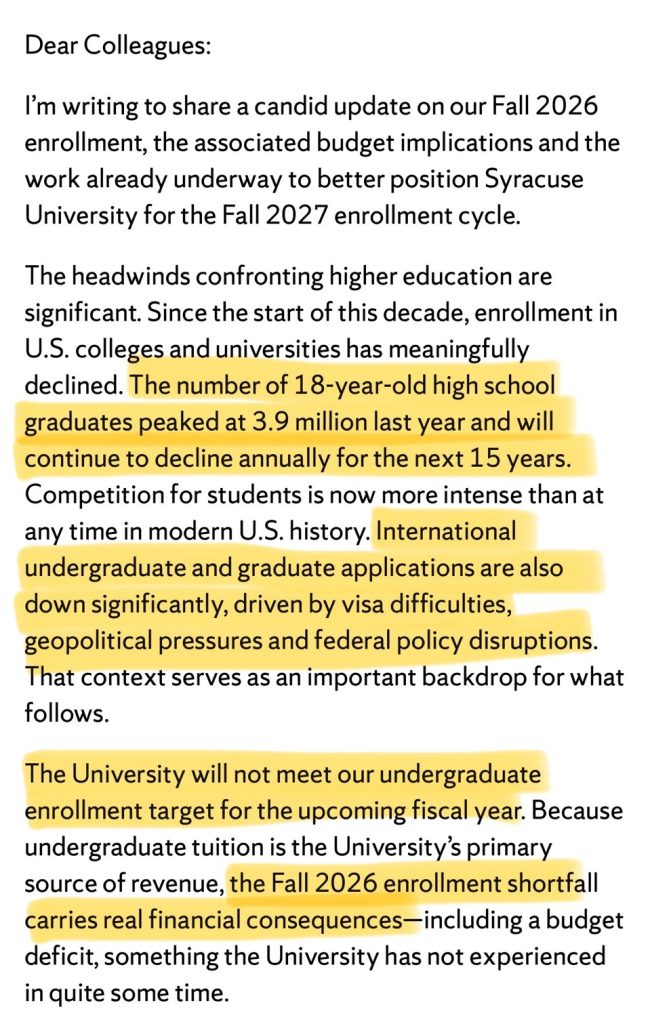
There are 5.7k higher ed institutions in the US, charging way too much for something that is worth less than ever
Syracuse announced a financial deficit this week after missing their enrollment target. They cite demographics + geopolitics, but the answer is much simpler:
Civics: The Revolution in Citizenship
Modern citizenship presents different characteristics. After the fall of the Roman Empire, the ancient model of citizenship gave way to entirely new forms of social and political organization, shaped by feudal and ecclesiastical authority across the continent. Then, after eighteenth- and nineteenth-century revolutions shattered this ancien régime, it became common for historians to view the replacement of outdated hierarchies with modern citizenship as a revival of an ancient type. But any resemblance between ancient and modern citizenship should not be overstated. It’s more accurate to see modern citizenship as new wine in an old bottle.
Whereas ancient citizenship was the prerogative of a privileged few, modern citizenship is regarded as a universal right to which everyone is entitled. It is the means by which we look to ensure our individual rights and protections; consequently, it is instrumental in a way that its ancient counterpart was not. True, one can see attempts to reproduce the classical ethos of citizenship in, say, Adam Smith’s exhortation that “he is certainly not a good citizen who does not wish to promote, by every means in his power, the welfare of the whole society of his fellow-citizens.” Yet the prevailing modern sensibility emphasizes benefits over obligations and severs the link between citizenship and military service. Citizenship is primarily understood as a status that confers entitlements.
Modern citizenship also has a decidedly administrative quality. In place of sacred duties, buttressed by honor and shame, we have passports. As the political anthropologist James Scott has observed, “If you wish to have any standing in law, you must have a document that officials accept as evidence of citizenship, be that document a birth certificate, passport, or identity card.” Yet this formalism introduces greater flexibility, making citizenship more fluid. Whereas classical citizenship was a birthright, modern citizenship—through passports—can be assigned, revoked, or replaced.
Why the Worst Get on Top in Academia
In Chapter 10 (“Why the Worst Get on Top”) of The Road to Serfdom, F. A. Hayek argued that centralized political authority tends to elevate the worst people in society. Goons and demagogues do not rise to the top in totalitarian systems by accident. The logic of totalitarianism selects for thuggish leaders.
A less dramatic, but equally perverse, logic governs American academia.
The incentive structure of the modern American university encourages relatively unsuccessful scholars, those who fail to establish fruitful research programs early in their careers, to pursue administrative positions, where they wield authority over more successful colleagues, who actually generate educational value. As a result, the American university is disproportionately governed by relative academic failures.
An effective scholar enjoys benefits impossible to find elsewhere in today’s workforce: freedom to follow ideas wherever they might lead and a considerable amount of free time to do it. Those who succeed aren’t inclined to leave the laboratory or library for administration.
Though administrative salaries tend to be higher, the rest of an administrator’s work-life is poorer in every other respect, involving endless committee meetings, paperwork, budgetary knife fights, student and parent grievance adjudication, and the difficult business of cultivating donors. Intellectual freedom and scholarly prestige are nowhere in evidence.
What a New Report About the Humanities Gets Right — and Wrong
Last summer, the chancellors of two major universities, Daniel Diermeier of Vanderbilt and Andrew D. Martin of Washington University in St. Louis, commissioned a report on the humanities by a group of distinguished scholars chaired by the New York University philosopher Paul Boghossian.
Taxpayer Financed Censorship
If left unchecked, the administration’s assertion of control would allow it to censor models that contradict the government’s preferred views or punish developers who oppose the administration. And other AI companies and users are now forced to grapple with uncertainty regarding what they may develop, deploy, and engage with without crossing the administration’s invisible line.
The administration’s action follows President Trump making plain his hostility to Anthropic, calling it a “radical left, woke” company, a stance shared by members of his cabinet. Last March, the administration deemed Anthropic insufficiently “patriotic” over model guardrails it disagreed with — ultimately designating it a “supply chain risk,” again citing national security grounds. But simply invoking national security does not immunize government officials from their constitutional obligations or give them carte blanche to punish speech.
Heavy-handed, arbitrary, behind-the-scenes governmental bullying is anathema to our free society, in any form. And its unacceptability is at its apex when directed to an endeavor that is inherently expressive, as is the creation and use of tools like Fable and Mythos.
Podcast on K-12 $pending & Outcomes
WILL:
Wisconsin public schools average $18,592 per student. High school choice gets $13,371. K-8 choice gets just $10,877.
If extra spending isn’t driving student success, what is? Hear @RickEsenberg break down the real state of education in our latest episode. 🎧
———
2026-2027 Madison K-12 $pending continues to grow, fueled by a 9.7% (!) property tax increase. Total spending will be at least $706,000,000 for 25,003 students, or $28,236 per student.
May 2026 Madison School District Presentation: 7,095 adults for 25,003 students (3.52 students per adult!)
Early Literacy Screener Map.
3,887 Madison 4 year old to third grade students scored lower than 75% of the students in the national comparison group.
Madison taxpayers have long supported far above average k-12 tax & $pending. This despite our long term, disastrous reading results. May, 2026: 7,095 Staff for 25,003 students; $pending > $26k per student!
Madison Schools: More $, No Accountability
The taxpayer funded Madison School District long used Reading Recovery…
The data clearly indicate that being able to read is not a requirement for graduation at (Madison) East, especially if you are black or Hispanic”
A.B.T.: “Ain’t been taught.”
My Question to Wisconsin Governor Tony Evers on Teacher Mulligans and our Disastrous Reading Results
2017: West High Reading Interventionist Teacher’s Remarks to the School Board on Madison’s Disastrous Reading Results
Madison’s taxpayer supported K-12 school district, despite spending far more than most, has long tolerated disastrous reading results.
“An emphasis on adult employment”
Wisconsin Public Policy Forum Madison School District Report[PDF]
WEAC: $1.57 million for Four Wisconsin Senators
Friday Afternoon Veto: Governor Evers Rejects AB446/SB454; an effort to address our long term, disastrous reading results
Booked, but can’t read (Madison): functional literacy, National citizenship and the new face of Dred Scott in the age of mass incarceration.
When A Stands for Average: Students at the UW-Madison School of Education Receive Sky-High Grades. How Smart is That?
Notes on NAEP
“If you are on the wrong road progress means doing an about-turn and walking back to the right road and in that case the man who turns back soonest is the most progressive man. There is nothing progressive about being pig-headed and refusing to admit a mistake…We’re on the wrong road. And if that is so we must go back. Going back is the quickest way on.”-C.S. Lewis
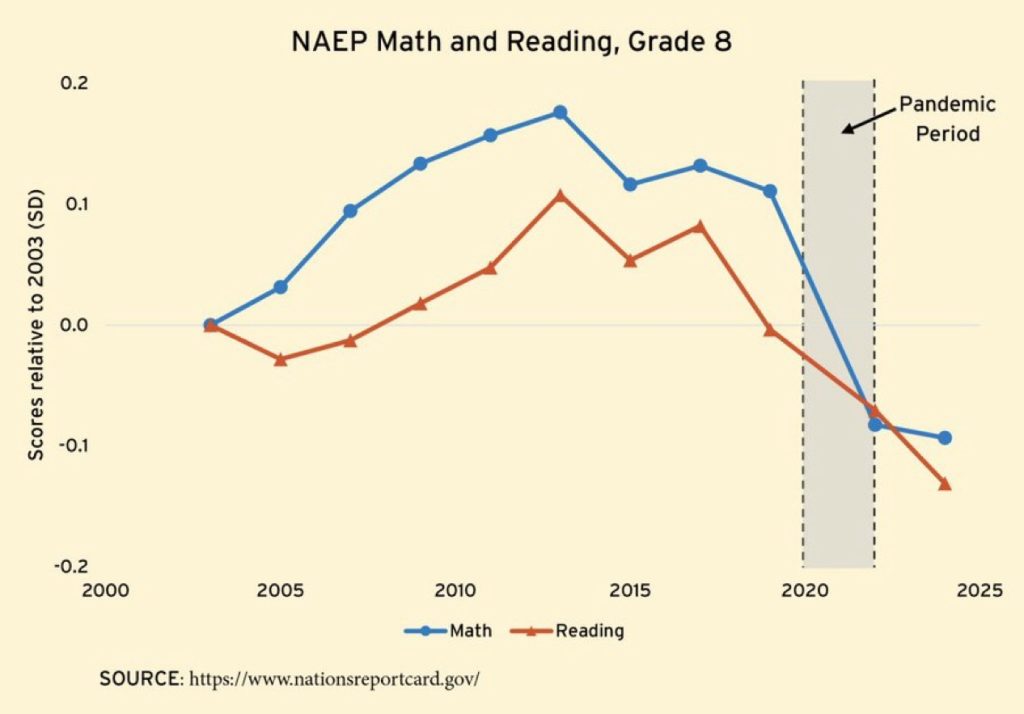
2026-2027 Madison K-12 $pending continues to grow, fueled by a 9.7% (!) property tax increase. Total spending will be at least $706,000,000 for 25,003 students, or $28,236 per student.
May 2026 Madison School District Presentation: 7,095 adults for 25,003 students (3.52 students per adult!)
Early Literacy Screener Map.
3,887 Madison 4 year old to third grade students scored lower than 75% of the students in the national comparison group.
Madison taxpayers have long supported far above average k-12 tax & $pending. This despite our long term, disastrous reading results. May, 2026: 7,095 Staff for 25,003 students; $pending > $26k per student!
Madison Schools: More $, No Accountability
The taxpayer funded Madison School District long used Reading Recovery…
The data clearly indicate that being able to read is not a requirement for graduation at (Madison) East, especially if you are black or Hispanic”
A.B.T.: “Ain’t been taught.”
My Question to Wisconsin Governor Tony Evers on Teacher Mulligans and our Disastrous Reading Results
2017: West High Reading Interventionist Teacher’s Remarks to the School Board on Madison’s Disastrous Reading Results
Madison’s taxpayer supported K-12 school district, despite spending far more than most, has long tolerated disastrous reading results.
“An emphasis on adult employment”
Wisconsin Public Policy Forum Madison School District Report[PDF]
WEAC: $1.57 million for Four Wisconsin Senators
Friday Afternoon Veto: Governor Evers Rejects AB446/SB454; an effort to address our long term, disastrous reading results
Booked, but can’t read (Madison): functional literacy, National citizenship and the new face of Dred Scott in the age of mass incarceration.
When A Stands for Average: Students at the UW-Madison School of Education Receive Sky-High Grades. How Smart is That?
Chicago’s sustainable community high schools: Lower outcomes, higher costs
The Chicago Teachers Union’s preferred model fails in academic proficiency, absenteeism and cost.
The Chicago Teachers Union continues to push a schooling model that produces poor student outcomes and costs taxpayers more.
The union’s most recent contract with Chicago Public Schools includes the addition of 50 “sustainable community schools.” CTU wanted to add 180 of these schools, which the union envisions as community hubs that offer wraparound services for students and families. Right now there are 36 such schools, 15 of which are high schools.
CTU leadership and other proponents of the sustainable community schools model argue that they will uplift neighborhoods and provide students needed support services.
But at the eight CPS high schools that have used the model since 2018, proficiency is lower while absenteeism and spending is higher. Those eight schools also are seeing enrollment fall as families flee them.
Chicago’s sustainable community high schools spend more for poorer outcomes
Seven high schools transitioned to the sustainable community school model in the just-ended school year. The original eight illustrate the poor student outcomes at CTU’s favored education model.
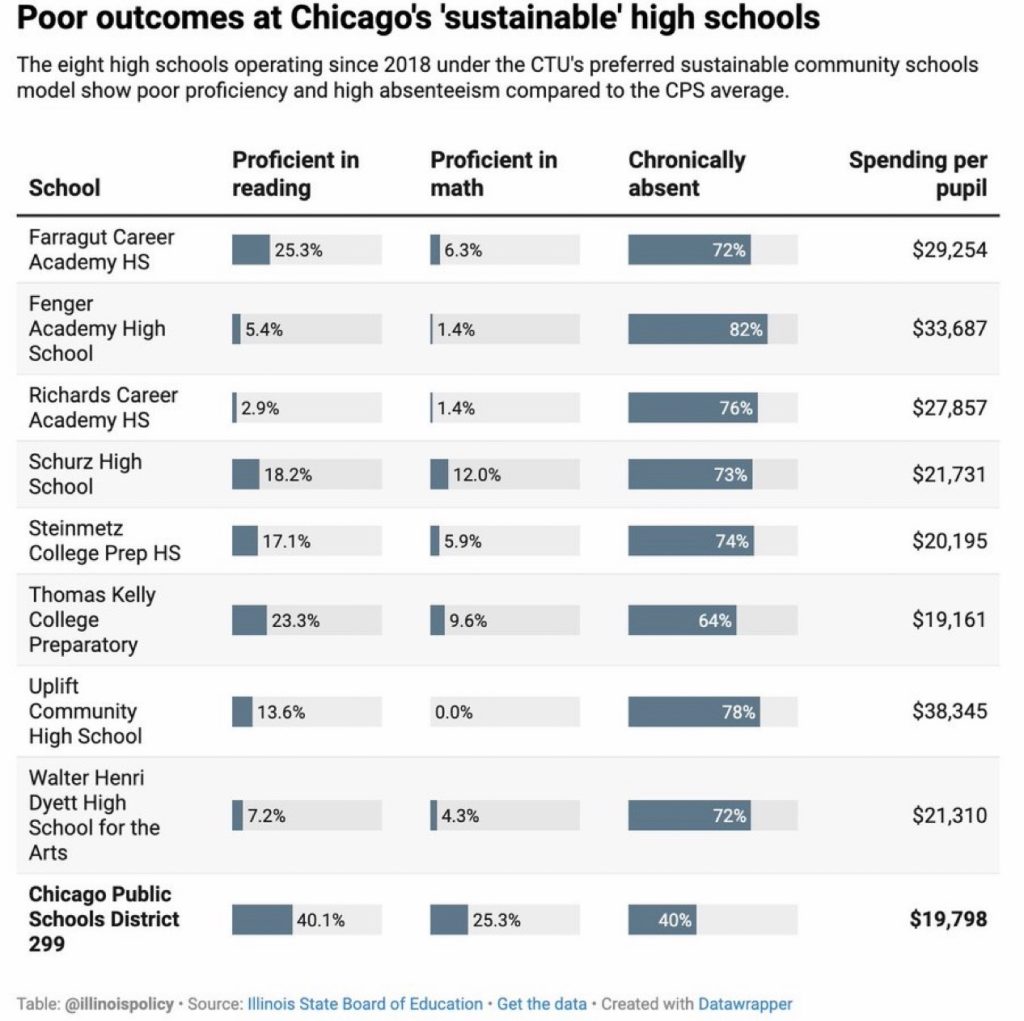
Degree in three: Why more colleges are speeding up graduation timelines
Fred de Sam Lazaro, Mike Fritz, Sam Lane:
Only about a third of Americans now believe a four-year college degree is worth the cost. Increasingly, students and families are questioning it too. As many colleges across the country face shrinking enrollment, more than 60 institutions are now offering students a faster path to graduation. Fred de Sam Lazaro reports as part of our series, Rethinking College.
Notice: Transcripts are machine and human generated and lightly edited for accuracy. They may contain errors.
Geoff Bennett:
Only about a third of Americans now believe a four-year college degree is worth the cost. And, increasingly, students and families are questioning it too. As many colleges across the country face shrinking enrollments, more than 60 institutions are now offering students a faster path to graduation.
Fred de Sam Lazaro reports as part of our series Rethinking College.
Notes on k-12 taxes, $pending and outcomes
Throwing more money at public schools, even doubling teacher salaries, has virtually no effect on student outcomes.
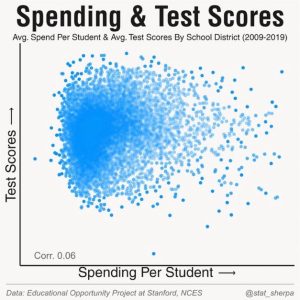
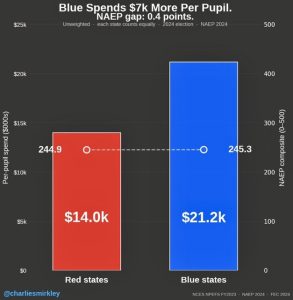
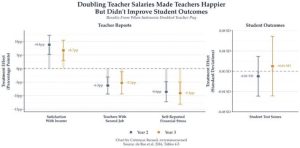
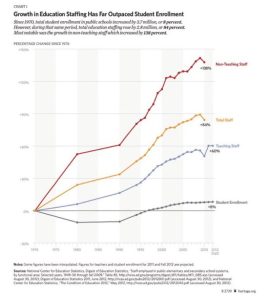
——-
Clearly adding more admin staff hasn’t improved the numbers, so maybe go back to the 1960s ratio
——-
2026-2027 Madison K-12 $pending continues to grow, fueled by a 9.7% (!) property tax increase. Total spending will be at least $706,000,000 for 25,003 students, or $28,236 per student.
May 2026 Madison School District Presentation: 7,095 adults for 25,003 students (3.52 students per adult!)
Early Literacy Screener Map.
3,887 Madison 4 year old to third grade students scored lower than 75% of the students in the national comparison group.
Madison taxpayers have long supported far above average k-12 tax & $pending. This despite our long term, disastrous reading results. May, 2026: 7,095 Staff for 25,003 students; $pending > $26k per student!
Madison Schools: More $, No Accountability
The taxpayer funded Madison School District long used Reading Recovery…
The data clearly indicate that being able to read is not a requirement for graduation at (Madison) East, especially if you are black or Hispanic”
A.B.T.: “Ain’t been taught.”
My Question to Wisconsin Governor Tony Evers on Teacher Mulligans and our Disastrous Reading Results
2017: West High Reading Interventionist Teacher’s Remarks to the School Board on Madison’s Disastrous Reading Results
Madison’s taxpayer supported K-12 school district, despite spending far more than most, has long tolerated disastrous reading results.
“An emphasis on adult employment”
Wisconsin Public Policy Forum Madison School District Report[PDF]
WEAC: $1.57 million for Four Wisconsin Senators
Friday Afternoon Veto: Governor Evers Rejects AB446/SB454; an effort to address our long term, disastrous reading results
Booked, but can’t read (Madison): functional literacy, National citizenship and the new face of Dred Scott in the age of mass incarceration.
When A Stands for Average: Students at the UW-Madison School of Education Receive Sky-High Grades. How Smart is That?
The Learning Legacy of Randi Weingarten
National test scores keep showing how pandemic lockdowns hurt students—but also that the trend of academic decline is bigger than Covid. See the latest results from the National Assessment of Educational Progress (NAEP) on long-term trends, which show some modest improvement but also signs of declining student aptitude.
First comes more evidence that the lockdowns driven by teachers unions hurt student learning. Math and reading performance for 13-year-olds stagnated between 2023 and 2025 on the NAEP’s long-term trend assessment—which isn’t the same as the traditional NAEP exam—the Education Department announced Wednesday.
These children were in elementary school when Covid hit. Their scores in both subjects are lower than in 2020, before the pandemic. Some 58% performed at an intermediate level in reading in 2025 compared to 63% in 2020. In math, 70% could do “numerical operations and beginning problem solving” in 2025, down from 79% in 2020. Teachers union chief Randi Weingarten has a lot to answer for.
The news is better for 9-year-olds, who weren’t in school in 2020. Their scores went up from 2022 to 2025 in reading and math. Some 71% demonstrated at least “partially developed” skills in reading and 84% showed “beginning skills” in math in 2025, up from 67% and 80% respectively in 2022. Their reading scores caught up to 2020 levels, though they remain three points lower in math.
JAWBONE act takes on gov’t-coerced censorship
If the JAWBONE Act becomes law, Americans will be able to sue federal officials for violating the First Amendment when they coerce social media companies, AI platforms, or broadcasters to change or take down protected speech. If the federal official did the jawboning “willfully and wantonly,” they’ll have to personally pay the damages. (Otherwise, the government will pay on their behalf.) That means federal employees will be personally incentivized to make sure they’re staying on the right side of the First Amendment when they reach out about speech on social media, AI platforms, TV, or radio.
This is the first of two columns about schools on Milwaukee’s north side.
“All eyes fixed on Hi-Mount,” the newspaper headline read. The school was “the city’s showcase of school reform,” the story said.
That was then – November 1995, to be specific. The story on Hi-Mount Community School, which I wrote, was part of an extensive project by the Milwaukee Journal Sentinel examining the state of Milwaukee Public Schools. Why did we single out the school? Because at that time, the kindergarten through fifth-grade school near North 49th Street and West North Avenue was pioneering ways to create vibrant school culture. The school had high energy and positive involvement.
This is now: Almost no eyes are on Hi-Mount, and pretty much every indicator of student and school success is much lower than three decades ago. A school showing progress and promise has become a school with a “one-star” rating in Wisconsin’s school report grades, the lowest category. Overall student success and school vitality are worrisome.
Wisconsin congressional Democrats want to repeal national voucher for education
Wisconsin’s congressional Democrats are calling for the federal scholarship tax credit to be repealed.
During a press conference in Washington D.C. on Thursday, U.S. Rep. Gwen Moore and U.S. Rep. Mark Pocan joined their colleagues to introduce the Keep Public Funds in Public Schools Act.
The bill would repeal the Educational Choice for Children Act, which was included in the reconciliation bill known as the “Big Beautiful Bill” passed by Congress last summer.
WPR’s “Wisconsin Today” newsletter keeps you connected to the state you love without feeling overwhelmed. No paywall. No agenda. No corporate filter.
“I hail from Wisconsin, we’re part of the first private school voucher program in the country,” Moore said. “It disproportionately benefits wealthy students who already attend private schools, and they sap monies from our public schools, which disproportionately and especially hurts rural students and students with disabilities. Voucher schemes even worsened segregation in our schools.”
Unlike Wisconsin’s existing voucher program, the Educational Choice for Children Act isn’t a direct voucher.
——-
2026-2027 Madison K-12 $pending continues to grow, fueled by a 9.7% (!) property tax increase. Total spending will be at least $706,000,000 for 25,003 students, or $28,236 per student.
May 2026 Madison School District Presentation: 7,095 adults for 25,003 students (3.52 students per adult!)
Early Literacy Screener Map.
3,887 Madison 4 year old to third grade students scored lower than 75% of the students in the national comparison group.
Madison taxpayers have long supported far above average k-12 tax & $pending. This despite our long term, disastrous reading results. May, 2026: 7,095 Staff for 25,003 students; $pending > $26k per student!
Madison Schools: More $, No Accountability
The taxpayer funded Madison School District long used Reading Recovery…
The data clearly indicate that being able to read is not a requirement for graduation at (Madison) East, especially if you are black or Hispanic”
A.B.T.: “Ain’t been taught.”
My Question to Wisconsin Governor Tony Evers on Teacher Mulligans and our Disastrous Reading Results
2017: West High Reading Interventionist Teacher’s Remarks to the School Board on Madison’s Disastrous Reading Results
Madison’s taxpayer supported K-12 school district, despite spending far more than most, has long tolerated disastrous reading results.
“An emphasis on adult employment”
Wisconsin Public Policy Forum Madison School District Report[PDF]
WEAC: $1.57 million for Four Wisconsin Senators
Friday Afternoon Veto: Governor Evers Rejects AB446/SB454; an effort to address our long term, disastrous reading results
Booked, but can’t read (Madison): functional literacy, National citizenship and the new face of Dred Scott in the age of mass incarceration.
When A Stands for Average: Students at the UW-Madison School of Education Receive Sky-High Grades. How Smart is That?
Civics: The Illinois Bar vs. Free Speech
That’s the plight of retired Cook County Circuit Court Judge James R. Brown, who wrote an op-ed and appeared on a podcast after he resigned from the bench in 2020. When the state Supreme Court called retired judges to return to fill vacancies in 2025, Judge Brown returned to service at traffic court, only to be kicked out weeks later.
The offense was an opinion piece he wrote for John Kass’s website that criticized Biden administration policies and anti-Trump lawfare. He wrote that “prosecutors engaging in lawfare sent shockwaves not only through the legal community but also through our system of justice.” His bio noted that the judge, “now retired, worked for 30 years in the Cook County Criminal Justice System.”
That was too much for the progressives of the Illinois bar. The Cook County Bar Association and the Chicago Council of Lawyers asked the Illinois Supreme Court in a letter to reverse its decision calling Judge Brown back to the bench. “Under the First Amendment, any private citizen is, of course, generally free to express their opinions,” the lawyers wrote, but “members of the judiciary are held to a higher standard.”
Judge Brown pushed back with the help of the Liberty Justice Center and filed a lawsuit charging that the state court vacated Judge Brown’s appointment without “the process prescribed by the Constitution of the State of Illinois” and violated his First and Fourteenth Amendment rights. The suit says the complaint wasn’t referred to the Illinois Court’s Commission, and Judge Brown wasn’t given notice of a hearing before removal.
Many Pa. colleges aren’t properly training future teachers how to teach reading, a report finds
Nearly half of educator preparation programs are failing to adequately train future teachers in how to teach reading, according to a new report, even as states across the country have passed laws to overhaul reading instruction.
And in Pennsylvania, even more teacher preparation programs may be falling short, according to the National Council on Teacher Quality, which released a report this week reviewing whether colleges and universities had aligned their instruction for future teachers with the so-called science of reading.
Of 23 graduate and undergraduate programs evaluated in Pennsylvania, five received A’s, according to the report. Just as many received F’s.
Pennsylvania is “among the lowest-performing states in this analysis,” said Ron Noble, NCTQ’s director of teacher preparation.
———
Foundations of Reading Results: 2015–2024
Wisconsin Educator Preparation Programs
What to do is obvious, but in English departments of America the last thing they want to do is provide leadership. Why do we have tenure when they would rather not lift a finger?
We have plenty of superb texts now—including in applied linguistics. There is such a need for advanced English language instruction, even for native speakers.
In university and high school they would rather do nothing. Why are they getting paid?
Stupid, aimless teaching is racist and classist.
Three years ago in The New Yorker in “The End of the English Major” Harvard Dean Amanda Claybaugh made this comment:
“Young people are very, very concerned about the ethics of representation, of cultural interaction—all these kinds of things that, actually, we think about a lot!” Amanda Claybaugh, Harvard’s dean of undergraduate education and an English professor, told me last fall. She was one of several teachers who described an orientation toward the present, to the extent that many students lost their bearings in the past. “The last time I taught ‘The Scarlet Letter,’ I discovered that my students were really struggling to understand the sentences as sentences—like, having trouble identifying the subject and the verb,” she said. “Their capacities are different, and the nineteenth century is a long time ago.” (The End of the English Major in The New Yorker.)
——-
I can’t speak for Ivy League profs, but at my level, all the pressure is on passing as many students as possible. Lots of perverse incentives in public higher ed. Lots of problems. Very complex set of circumstances that stem from problems in government, education programs, overwhelming leftist dominance of institutions, student preparation, the gobsmacking growth of administration over the last few decades, and other things. Ironically, many problems stem from well-meaning efforts to hold higher ed accountable.
Government is to blame for a lot of it. But the fact remains that if we were a culture that valued true education, we would have it.
“what’s gone wrong in the humanities”
or more than six months, a group of prominent scholars met in private to research, debate, and diagnose what’s gone wrong with the humanities. Their mandate, as laid out by the chancellors of Vanderbilt University and Washington University in St. Louis, was to ascertain whether complaints about the ideological and methodological deterioration of the humanities are justified.
In a surprise to no one, except perhaps some of the authors themselves, the fruits of that labor, the dryly titled “Report on the State of Scholarship in the Humanities and Humanistic Social Sciences,” has ignited an academic brush fire. “Every field we have studied,” the report declares, contains evidence of “a deterioration in scholarly standards fueled by the substitution of political criteria for properly scholarly criteria in the assessment of research and a more general repudiation of longstanding ideals of rigor and objectivity.”
The report has been derided on Bluesky as a “diabolically evil” attempt to “sow deep epistemic doubt about the humanities and hasten the project of killing us off entirely.” Others warned that the report would lead to “academic witch hunts” of entire fields deemed problematic. (The report singled out anthropology for its “toxic intellectual climate in which reasonable dissent on politically charged topics is routinely suppressed and punished.”) On the right, David Randall of the National Association of Scholars likened the report to Khrushchev’s momentous acknowledgement of Stalin’s crimes, but he chastised the authors for not going far enough — “a case of the mountain giving birth to a mouse.”
We invited four of the report’s authors — Kwame Anthony Appiah and Paul Boghossian, both philosophers at New York University; Katherine E. Fleming, a historian and former NYU provost who now serves as head of the J. Paul Getty Trust; and the Princeton University historian Sean Wilentz — to respond to their critics. We discussed their findings, the risks of outside interference, and what they hope happens next.
Bring Back the SAT
Diego sported a shiny blue Cal jacket and beamed with Berkeley pride as I interviewed him for the Fiat Lux Scholarship, the top award for low-income, high-achieving students admitted to the University of California (UC), Berkeley. He was one of the finalists. Diego grew up in a one-bedroom apartment with his parents and his sister—his father worked as a gardener and his mother was a factory worker; their family income was below $35,000. Diego’s dream was to pursue a degree and career in mechanical engineering, designing better agricultural machinery for farmers like his grandfather. By all the measures available to him, he had done everything right.
He took nearly every advanced class his high school offered and earned stellar grades, including an A in AP Calculus AB as an 11th grader. He seemed like the kind of student targeted by Governor Gavin Newsom’s Higher Education Compact: a multibillion-dollar agreement pressuring the UC system to close racial and socioeconomic gaps in science, technology, engineering, and mathematics (STEM) by admitting students like Diego into premier programs. But Diego also scored a 1 out of 5 on his AP Calculus exam. That’s why he was exactly the kind of student the Compact is likely to fail.
What does an A grade in AP Calculus mean when it is paired with a score of 1 on the national exam? Exactly what a recent UC San Diego report revealed: In too many public schools, grades have become completely decoupled from learning.
None of this was Diego’s fault. But now, he would face the reality of a world-class university. He would be required to retake calculus at Berkeley before moving on to the grueling upper-division requirements of mechanical engineering. With his immense drive and determination, common sense says he would catch up. Right?
——
“Today, the more successful a public high school is at preparing its students, the lower its graduates’ chances of getting into top UC campuses like Berkeley and San Diego.”
Berkeley admitted 45% of applicants from a high school where nearly 94% of “students failed to meet the state standards in mathematics.”
It admitted less than 14% of applicants from a school where “nearly 100 percent of its students in AP Calculus BC pass the national exam with a perfect score of 5.”
how to be good at research
old material is criminally underpriced. this field reruns its own past on a delay: mixture of experts dates to 1991, lstms to 1997, backprop went mainstream in 1986. rich sutton needed about a thousand words in 2019 to write the bitter lesson, and it predicts the shape of the field better than surveys ten times its length. claude shannon gave a talk on creative thinking in 1952 where his opening move was to shrink a problem until it’s nearly trivial, crack the small version, then reintroduce the difficulty one piece at a time. that single trick will carry you through more walls than any modern productivity advice.
range matters as much as depth. interpretability borrows shamelessly from neuroscience. eval design is mechanism design wearing a lab coat. a working sense of how gpus actually move memory tells you which architecture papers are doomed before the benchmarks do. and honest statistics might be the rarest skill in ml, where a lot of published rigor is vibes with error bars.
Federal Funding: The OMB Rule Proposal That’s Got Nonprofits Talking
On May 29, the Office of Budget and Management (OMB) proposed revisions to the Uniform Guidance that could reshape the compliance landscape for federally funded nonprofits. For detailed information on the proposed rule, click here.
If these federal proposals have your nonprofit spiraling, remember 501(c)(3) organizations can advocate. Whether you’re working on immigrant rights, reproductive justice, LGBTQ+ issues, voting access, or any number of public policy concerns, nonprofits have plenty of tools at their disposal, including administrative advocacy, which generally does not fall under the Internal Revenue Code’s (IRC) definition of lobbying.
In a moment when public discourse is increasingly polarized, and government policies are shifting quickly, nonprofits remain uniquely positioned to educate, convene, and intervene on behalf of their communities.
Proposed Changes
The Assault on Diversity, Equity, & Inclusion (DEI)
The proposed rule restricts federal funds from supporting DEI-related activities that agencies determine conflict with federal anti-discrimination laws. This includes a prohibition on adopting “DEI initiatives or practices that include providing benefits or opportunities based on race or sex; imposing race-conscious quotas or objectives … or conducting training sessions that endorse and encourage racial stereotyping and scapegoating, promote unlawful discrimination, or contribute to a hostile environment.”
The Prohibition on Issue & Election Season Advocacy
An ode to optimism, on the occasion of the SpaceX IPO
I. The kid with the book on his lap
There is a particular kind of person for whom the SpaceX IPO is not a financial event but a vindication. I was that kind of person — the boy in glasses who was no good at football and read all the time. While the other kids kicked a ball in the sun, I had a book open on my lap: Clarke, Asimov, Heinlein, the boy who found Jules Verne before he found girls. Throughout my life, I was told, gently and repeatedly, that the rockets were a phase I had to grow out of. That the future in those books was a child’s future, and the adult one was smaller, grayer, and mostly about managing decline.
I was lied to. A private company now lands its boosters upright, on a barge, in the sea, and reuses them — a thing that was science fiction inside my own lifetime — and has just gone public at a valuation that makes the entire space economy of my childhood look like a rounding error. The reusable rocket is not a metaphor. It is a fact, bolted to a drone ship, and it is the single most concentrated rebuke I can think of to the spirit of our age, which is dystopian, declinist, and — this is the part worth fighting about — empirically wrong.
This essay is an argument against that spirit, made with data rather than sentiment, because optimism that cannot survive contact with the numbers is just temperament. The good news is that the numbers are overwhelmingly on optimism’s side. The bad news is that we have built an intellectual class, and a politics, dedicated to not noticing.
II. The case the data actually make
Cultural Difference “Cannot Be Accepted as a Reason to Mitigate” Ethiopian-Born Lawyer’s Dishonesty-Related Misconduct
From the long (20K-word) decision of the Washington Supreme Court Thursday in In the Matter of Disciplinary Proceeding Against Feyissa, written by Justice Sheryl Gordon McCloud:
After a 12-day disciplinary hearing, a hearing officer (HO) concluded that Shakespear N. Feyissa committed six counts of misconduct. The presumptive sanction for most of those counts was disbarment…. The Disciplinary Board (Board) of the Washington State Bar Association (Bar) unanimously adopted the HO’s disbarment recommendation. Feyissa appeals….
Attorney Shakespear N. Feyissa was born in Ethiopia. He immigrated to the United States at around age 17….
There’s a lot going on in the case, and you can read it for yourself here. But here’s one brief passage that particularly struck me:
Feyissa claims that the HO refused to consider cultural differences. But the record contradicts that assertion ….
As stated above, Feyissa’s friend testified about cultural differences between Ethiopian and Western cultures relating to norms in negotiations. The witness opined that “in Ethiopia, ‘If you tell a lie but everybody’s happy, then you didn’t do anything wrong.'”
The HO clearly did not refuse to consider this testimony or to evaluate its impact on the case, as evidenced by her conclusion of law on the issue; the HO made the sustainable legal conclusion that this cultural difference “does not exempt Respondent from his professional obligations under the RPCs, and thus cannot be accepted as a reason to mitigate Respondent’s conduct as a lawyer.”
Here are the passages from Feyissa’s counsel’s briefs that raise the argument to which the supreme court was apparently referring:
To an Ivy League Professor, Who Doesn’t Understand “Equality”
Growing up I didn’t know another child, let alone an adult with a doctorate, who was confused by “all men are created equal.” You didn’t need to be propagandized by Milton Friedman to know it didn’t mean “all men are created with equal abilities and advantages” or “all men should remain economically equal,” or some other absurdity. Like a lot of the foundational American concepts, Jefferson’s line was easy to understand even for a child, one of the reasons it’s resonated across centuries. Now, a Columbia professor pretends in the pages of the nation’s leading newspaper to be confused by it, and Times editors play along with the insulting gambit.
Phillips-Fein writes, “Opposition to equality has sometimes taken on an explicitly racial character.” In support of this idea, she then quoted the author of an 1849 treatise called “Slavery Justified,” George Fitzhugh, in saying Jefferson’s preamble wasn’t a problem until emancipation. Fitzhugh believed people were “not born physically, morally or intellectually equal” and therefore, he wrote, “their natural inequalities beget inequalities of rights.”
We made college an obligation. We should not be shocked when students treat it like one.
George Leef recently used National Review to highlight Adam Ellwanger’s Martin Center essay on students who treat education as an afterthought. They are describing a real problem. I share their frustration.
But frustration is not the same as explanation.
Ellwanger asks: “If you’re a serious student, it ought to be a priority. And if it isn’t a priority (or if you’re not a serious student), then why do it?”
They do it because they have to. Many students are not seeking intellectual transformation. They are seeking a credential because the labor market told them they need one—told them brutally.
That is not merely anecdotal: Strada and Gallup found that many Americans pursue higher education chiefly for work-related reasons, and Harvard Business School’s research on degree inflation shows that employers often require bachelor’s degrees for jobs that previously did not require them.
For such students, college is less a calling than a requirement: a way to keep a promotion path open, qualify for higher pay, survive HR filters where a real person may never see their résumé, or be considered for jobs that should not even require advanced academic preparation.
To tell such students that they should not be in college unless they can put education first is not rigor. It is tone-deafness dressed up as seriousness. It asks ordinary people to honor an idealized vision of college while living inside an economy that has turned college into a practical necessity.
If a working adult needs a degree to move into a better job, what exactly are we asking when we say education must come first? Is he, in effect, supposed to tell his spouse or children, “Sorry, I cannot pursue the credential this economy requires because I cannot put college ahead of work, rent, caregiving, and family obligations”?
Is a New Report About the Humanities ‘Diabolically Evil’? We Questioned Its Authors.
For more than six months, a group of prominent scholars met in private to research, debate, and diagnose what’s gone wrong with the humanities. Their mandate, as laid out by the chancellors of Vanderbilt University and Washington University in St. Louis, was to ascertain whether complaints about the ideological and methodological deterioration of the humanities are justified.
“Trust Us”: Anthropic and the Case for Open Weights
What one week in June told us about who plans to own AI, and why open models are the only way out
I run a small mortgage company in Georgia. I am not an AI researcher. I do not work at a lab. I am a customer. I pay these companies real money every month, and their tools are part of how I work: the software, the market analysis, the grunt work that used to take a staff. People like me are the ones this technology is supposedly being protected for. So understand what this is. It is not a competitor whining. It is a paying customer telling you what your vendor just admitted in writing, and what they plan to do next with a trillion dollars behind them.
It took them 24 hours to show the whole plan.
What they shipped
On June 9, Anthropic released Claude Fable 5, the most capable AI model ever offered to the public. That is their own framing, and nobody disputes it. The dispute is over what they attached to it. Three things, in their own words.
First, disclosed routing. From the launch announcement: “When Fable’s classifiers detect a request related to cybersecurity, biology and chemistry, or distillation, the response is automatically handled by Claude Opus 4.8 instead. Users will be informed whenever this occurs.” They add that “more than 95% of Fable sessions involve no fallback at all.” Fine. You can argue the thresholds, but at least the product tells you when you are not getting the product.
Second, read this one twice, because it comes from their own system card. For requests that look like frontier AI development, building training pipelines, training infrastructure, chip design:
Civics: My excellent Conversation with Katja Hoyer
Tyler and Katja discuss why communism made East Germans more loyal to the system while it bred dissidents in Poland and Hungary, how happy or unhappy life in the GDR actually was, Tyler’s own bleak day-trip to East Berlin in 1984, the underrated literature of the GDR (Christa Wolf, Brigitte Reimann), whether Good Bye, Lenin! got the era right, why it’s no coincidence that Richter and Polke came from the East, the strange coexistence of communist prudishness and Germany’s nudist culture, what Merkel’s East German background did and didn’t give her as a chancellor, why East Germans remain dramatically underrepresented in leadership positions today, what makes Weimar the cultural and spiritual heart of Germany, why relatively few Jews ever settled there, how much the citizens of Weimar knew about Buchenwald, what actually killed the Weimar Constitution, how she’d rewrite the Treaty of Versailles, Hitler’s citizenship problem, underrated German thinkers, the complacency behind Germany’s current economic decline, which side of the Weißwurstäquator she’d choose to live on, and much more.
Here’s What It’s Like to Have Kids in America After Age 40
More people are becoming parents at older ages, and they are confronting a new and often surprising financial reality.
Some are shouldering the costs of raising children while trying to turbocharge their retirement savings or manage age-related health problems. Others are weighing whether to step back from their careers just as they reach peak earning years. Then there are the costs of in vitro fertilization and egg and embryo storage that can accompany later-in-life pregnancies.
Women 40 and older accounted for about 4.3% of U.S. births in 2025, up from 1.2% in 1990, according to provisional data from the National Center for Health Statistics. The average first-time mother was 27.5 years old, a record high, according to 2023 data, the most recent available.
Older parents tend to be more educated, federal data show, and many describe having more patience, flexibility and financial stability than they would have had a decade earlier. Research has found that children of older mothers score higher on early assessments, a result of the education, income and stability those parents tend to bring.
The Battle Hymn of the Refugee Teacher
Annika Hernandez, Robert Pondiscio:
Why Teachers Leave Traditional District Schools
Reynolds is not alone. In interviews we conducted with a dozen teachers who decamped from district to classical schools, a striking pattern emerged: The conditions that drove Reynolds out are not idiosyncratic but common.
These teachers’ stories also align with national data showing a sustained collapse in professional satisfaction. In 2024, a Pew Research Center surveyfound that a third of teachers described themselves as “extremely or very” satisfied with their work, compared with more than half of U.S. workers overall. More ominously, less than half said they would recommend the profession to a young person starting his or her career. In a five-decade review of teaching prestige, preparation, and morale, Brown University economist Matthew Kraft and political scientist Melissa Lyon of SUNY Albany found that interest in teaching among high school seniors and college freshmen has fallen by nearly half since the 1990s, and teacher satisfaction has declined 26 percent in just the last decade. Kraft and Lyon concluded that “the current state of the teaching profession is at or near its lowest levels in 50 years.”
While it is common to hear laments about teacher pay, hours, or burnout, the teachers we interviewed don’t fit these familiar narratives. They spoke of a slow erosion of purpose, the sense that their craft was being hollowed out by incoherent curricula, ineffective instructional orthodoxies, politicization, and ever-shifting priorities and pedagogical fads.
Teachers who once imagined themselves as stewards of literature, history, science, and mathematics described feeling instead like troubleshooters, counselors, compliance officers, or test-prep technicians. Many still loved children—fiercely—but increasingly questioned whether their schools still loved learning.
Therapy Is Looking More Like Re-Education
In a recent email from a fellow therapist, I noticed a section below the signature labeled “Social Location.” It identified the sender as “cis, queer, white, Euro-American, middle class, post-evangelical, spiritual but not religious.” In parts of the profession email signatures amount to political personal-identity statements. They also reflect a broader shift in the field toward reinterpreting ordinary human problems through a highly ideological vocabulary.
Psychotherapy should help people make sense of their lives. But in many training programs today, students are taught to interpret those lives through the lens of power, privilege and oppression.
“Give up the failed experiment of the last six years.”
Interesting…
One of the signatories to the new letter below calling for UC to return to using standardized tests in admissions is Professor Li Cai.
He is a statistician working on psychometrics who directs UCLA’s National Center for Research on Evaluation, Standards, and Student Testing.
He was also on the 2020 Standardized Testing Task Force that recommended AGAINST going test-optional at that time.
BUT he was one of six task force members to sign this dissenting statement calling for the university to stop using SAT/ACT scores for the sake of DEI.
Now he has signed the letter below calling for an end to this “failed experiment.”
K-12 Tax & $pending Climate: Economics
One Hundred Fifty Million Americans. About 60% of adults.
Effectively believing that @elonmusk and many billionaires could make them wealthier and help them achieve a better life.
Of course you would wipe out the net-worth of most of those people, and everyone else’s savings, as the markets crashed and brought down the economy and created the worst depression we have ever seen.
If you want @elonmusk , and most billionaires to no longer be that rich, convince those 150m to sell their stocks, funds, ETFs whatever.
Alternatively
There are ways to improve healthcare access and eventually make it available to all.
You can’t learn everything through the medium of Taylor Swift
Over the last few months I’ve heard a lot of people arguing that one of the great uses of large language models will be to personalise learning.
I am pretty dubious about personalised education. I wrote a long chapter about it in my 2020 book Teachers vs Tech, where I argued that most forms of personalisation don’t work.
I have also found that many advocates of personalisation rely on a sleight-of-hand. They will start out by asking if, when you were a student, you felt that the pace of a class was too fast or slow. Almost everyone who has ever been a student will have at least one memory of this happening, so that will predispose you to think well of the basic concept of personalisation.
But then when you look at what many actual examples of personalised classrooms involve, you’ll see kids sitting at screens on their own, constructing their own playlists on YouTube and choosing their own form of assessment.
This is a complete bait-and-switch! If the problem is “my maths teacher went too fast and I wish they could repeat that middle step again” the solution is not “demonstrate how to solve equations with iMovie videos in the style of a cooking show. Use props to represent variables and numbers. Combine with other videos to create an equations cookbook.”1
“No amount of tax and spend programs got us reusable rockets and great electric cars”
The lesson I take from the SpaceX IPO is that the only thing stopping us from solving arbitrarily difficult problems is extreme creativity in business models.
No amount of tax and spend programs got us reusable rockets and great electric cars. Customer delight is a necessary precondition for success.
There seems to be some discussion around whether successful entrepreneurs should give up control of their companies so they can subsidize some philanthropic venture that otherwise has no value prop sufficient to run it as a business where customers voluntarily exchange money for goods and services at a competitive and reasonable price.
This misses the point. Transformational products deliver tangible value at 1000x the rate of charities whose value cannot be tested in the market place. Think about the undeniable value of the smart phone, satellite Internet, electric consumer devices, etc etc.
I think the transformational moment for SpaceX was when Elon stepped away from the philanthropic Mars greenhouse concept and fixed his resolve on unlocking radically better rockets for humanity. The greenhouse would have been, at best, a neat trick. Falcon and Starship give humanity a durable economic engine to maintain and improve access to space, forever.
DARPA on Covid
“SARS-CoV-2 is an American-created recombinant bat vaccine, or its precursor virus. It was created by an EcoHealth Alliance program at the Wuhan Institute of Virology (WIV).”
———
It is criminal that our government enabled a bat virus to infect and spread between humans. Indeed, it is hard to imagine a bigger betrayal of our species.
It is equally troubling that the mad scientists who did this then gaslit all the people of the world about it, including those who CORRECTLY interpreted the evidence.
———-
In private, Francis Collins had no problem admitting that he and Fauci helped with the Proximal Origin paper.
———-
The Politicization of Scholarship
A new Vanderbilt–WashU report warns that parts of the humanities and social sciences have abandoned the pursuit of truth.
In April, Yale University released a report exploring why Americans have lost trust in higher education. Widely discussed at the time, the report was notable not so much for what it said as for who said it. Many of its conclusions—for instance, that the “high tuition-high aid” model invites distrust—were fairly obvious. The Yale report mattered because it was a Yale report, marking a rare moment of self-reflection by an elite university.
Now, another report offers further self-reflection, but with far greater substance. Last week, Vanderbilt University and Washington University in St. Louis released a jointly commissioned report on the “state of scholarship” in the humanities and social sciences. The report takes on a question closely related to higher education’s crisis of trust: has scholarship itself been politicized or otherwise degraded?
While hedging considerably, the report’s authors land on a clear thesis: a noteworthy contingent of contemporary scholars subordinates the pursuit of knowledge to political and social goals. These goals, the authors note, “are generally though not exclusively associated with the progressive left,” and involve “turning the humanities into vehicles for social justice, or the elimination of pernicious social hierarchies,” as manifested in causes such as anti-racism, feminism, and decolonization.
Despite identifying this progressive trend, the report’s committee is not recognizably conservative. It is composed of mainstream academics. That includes several philosophers from New York University—widely considered one of the world’s best philosophy departments—along with notables like NYU history professor Katherine Fleming, who is also president of the $8-billion J. Paul Getty Trust.
Charles Dickens
DICKENS is one of those writers who are well worth stealing. Even the burial of his body in Westminster Abbey was a species of theft, if you come to think of it.
When Chesterton wrote his introductions to the Everyman Edition of Dickens’s works, it seemed quite natural to him to credit Dickens with his own highly individual brand of medievalism, and more recently a Marxist writer, Mr. T. A. Jackson, has made spirited efforts to turn Dickens into a blood-thirsty revolutionary. The Marxist claims him as ‘almost’ a Marxist, the Catholic claims him as ‘almost’ a Catholic, and both claim him as a champion of the proletariat (or ‘the poor’, as Chesterton would have put it). On the other hand, Nadezhda Krupskaya, in her little book on Lenin, relates that towards the end of his life Lenin went to see a dramatized version of The Cricket on the Hearth, and found Dickens’s ‘middle-class sentimentality’ so intolerable that he walked out in the middle of a scene.
Taking ‘middle-class’ to mean what Krupskaya might be expected to mean by it, this was probably a truer judgement than those of Chesterton and Jackson. But it is worth noticing that the dislike of Dickens implied in this remark is something unusual. Plenty of people have found him unreadable, but very few seem to have felt any hostility towards the general spirit of his work. Some years later Mr. Bechhofer Roberts published a full-length attack on Dickens in the form of a novel (This Side Idolatry), but it was a merely personal attack, concerned for the most part with Dickens’s treatment of his wife. It dealt with incidents which not one in a thousand of Dickens’s readers would ever hear about, and which no more invalidates his work than the second-best bed invalidates Hamlet. All that the book really demonstrated was that a writer’s literary personality has little or nothing to do with his private character. It is quite possible that in private life Dickens was just the kind of insensitive egoist that Mr. Bechhofer Roberts makes him appear. But in his published work there is implied a personality quite different from this, a personality which has won him far more friends than enemies. It might well have been otherwise, for even if Dickens was a bourgeois, he was certainly a subversive writer, a radical, one might truthfully say a rebel. Everyone who has read widely in his work has felt this. Gissing, for instance, the best of the writers on Dickens, was anything but a radical himself, and he disapproved of this strain in Dickens and wished it were not there, but it never occurred to him to deny it. In Oliver Twist, Hard Times, Bleak House, Little Dorrit, Dickens attacked English institutions with a ferocity that has never since been approached. Yet he managed to do it without making himself hated, and, more than this, the very people he attacked have swallowed him so completely that he has become a national institution himself. In its attitude towards Dickens the English public has always been a little like the elephant which feels a blow with a walking-stick as a delightful tickling. Before I was ten years old I was having Dickens ladled down my throat by schoolmasters in whom even at that age I could see a strong resemblance to Mr. Creakle, and one knows without needing to be told that lawyers delight in Sergeant Buzfuz and that Little Dorrit is a favourite in the Home Office. Dickens seems to have succeeded in attacking everybody and antagonizing nobody. Naturally this makes one wonder whether after all there was something unreal in his attack upon society. Where exactly does he stand, socially, morally, and politically? As usual, one can define his position more easily if one starts by deciding what he was not.
The Lie at the Core of Gifted and Talented Programs
Being “gifted” — and by that I mean smart — has been woven into my sense of self for so long that it has become one of the surest things I know about myself. I was reading at age 4. And though I hated math by kindergarten, I excelled in art, reading, and writing, and every teacher loved me. It was not surprising to me when, in third grade back in 1991, I was invited to take a test to determine whether I should move to a school across town — the school for really smart kids, as I precociously told relatives, neighbors and strangers at the grocery store. Nor was it surprising when my parents told me I had been accepted to that school’s Gifted and Talented program. There, in grades four, five, and six, I had the kind of public-school education that many parents dream of, filled with discovery, creativity, and nerdy magic.
We went tidepooling on the coast, prodding shy sea stars with our fingers, and made papier-mâché dioramas of the titular fruit from James and the Giant Peach. We reenacted the Battle of Lexington and Concord using balled-up paper as bullets and argued about national politics. (Memorably, one debate about George H.W. Bush’s 1988 pledge “Read my lips: no new taxes” ended in shouting.) We went on class camping trips designed to teach the value of emotional risk-taking, pushing ourselves on night hikes to walk solo through a pitch-black tunnel to our teacher on the other side. Our classrooms were always a merry mess of paint and construction paper. I spent most of my in-school silent reading hours with the class copy of The New Yorker. My teachers, thrillingly, asked a lot of me academically, and in return, they gave me the latitude to follow my curiosity. I remember these years as some of the most invigorating of my life.
For nearly a century all across America, shrewd parents have known that the best first step in a child’s academic life is to get them into a gifted program, like the one I attended, where they can have an academic experience that is stimulating and confidence-boosting, that sets them apart from the pack. They understand that a Gifted and Talented, or G&T, program in elementary school broadens a child’s intellectual horizons, which then places them on a course toward honors classes in middle school and AP classes in high school. All of this culminates, finally, in the strategic launch of the child toward “a very good college,” maybe even one in the Ivy League. The first plotted point on the ascent is vital — it’s what makes the rest possible.
——
More:
America 250: A Visit to America in 1905
For a long time I have been interested in the stories of those who operated in the top tier of history but weren’t themselves rulers. Many were diplomats whose careers, for all their brilliant efforts, ended in disappointment. One was Sergei Witte, the long-serving finance minister who spent six months as the first prime minister of Russia’s last czar, Nicholas II. Witte’s memoirs were published in America in 1921, five years after his death. They contain a brief but vivid portrait—at once sweet and grudging—of the America he encountered in August 1905.
Witte’s wife, in the foreword, says he was neither a courtier flattering a monarch nor a demagogue flattering a mob. She quotes him as telling friends, “I am neither a Liberal nor a Conservative. I am simply a man of culture.”
But his overriding purpose couldn’t have been greater—to save Russia, to save the czar and the aristocracy from themselves, to block the revolutionists of the left by giving Russia a true constitution, to liberalize, but not at a speed that was more than the nation could bear.
He opposed Russia’s foreign policy of aggression and double-dealing in the East, and when this produced a war with Japan in 1904, he warned it would be a disaster and resigned. “Our entire fleet was buried in the Japanese waters,” Witte writes. Russia lost every major land battle. Following the catastrophe a revolution almost toppled the czar.
Here enters America. President Theodore Roosevelt offered to host and mediate peace negotiations in Portsmouth, N.H. The czar brought Witte back as his chief representative.
“More K-12 Staff For Fewer Students”
The number of students in Wisconsin’s public elementary and secondary schools declined by 9.2% over the past 16 years, even as the number of public schools decreased by 3.2%, and staff employed in public schools increased 7.0%.
Data for this report come from the Wisconsin Department of Public Instruction, including its enrollment files and the Public All Staff Report.
Enrollment in K-12 schools is important to districts because it directly influences the amount of revenue they receive. While the state’s funding formula includes hold-harmless provisions that can cushion the initial blow for districts losing students, long-term enrollment loss puts substantial pressure on district budgets. Analyzing enrollment alongside staffing and school counts provides insight into the challenges that districts face funding their largest expenditures – personnel and operations – with fewer dollars for fewer students. These challenges compound when the remaining students may have greater needs and when school finances are already strained by lagging state revenue caps.
Analysis of these figures should also take into account the barriers districts confront when attempting to reduce costs. While the decline in students may be incremental, staffing and physical buildings cannot change as easily. Student losses are typically spread across grade levels and buildings, making it difficult to cut teaching positions and shut down entire classrooms or schools. Staffing cuts and school closures are also unpopular and painful for districts and communities, leaving leaders with difficult decisions and tradeoffs.
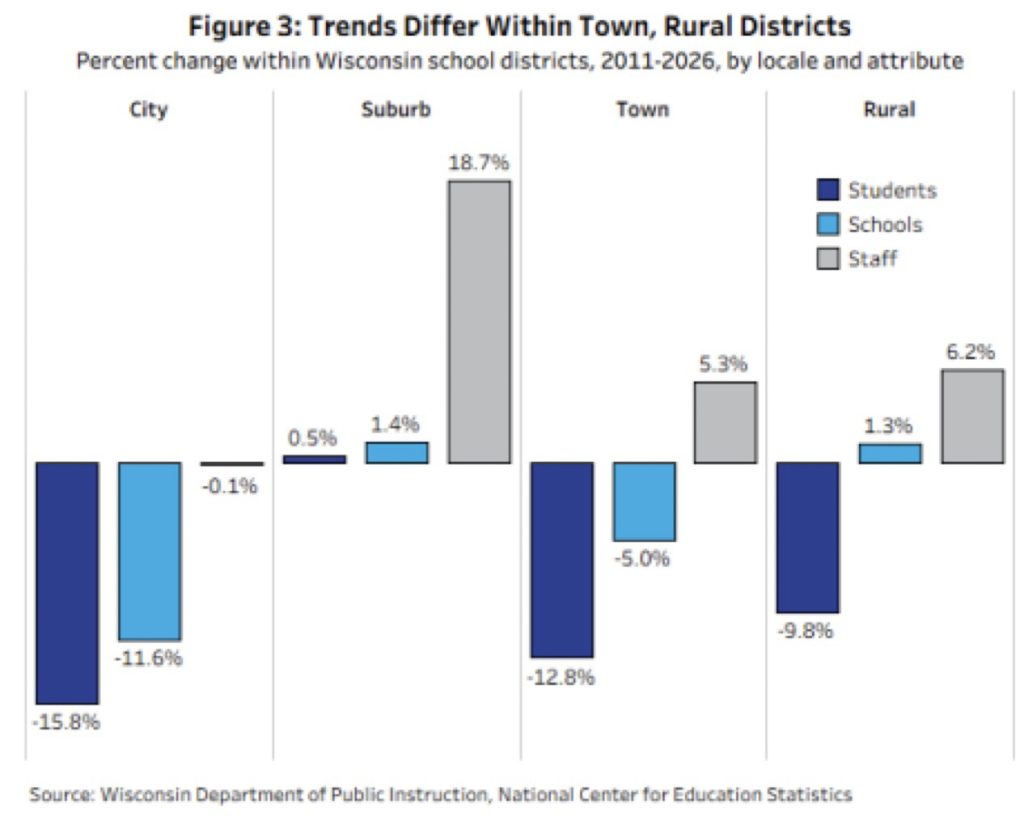
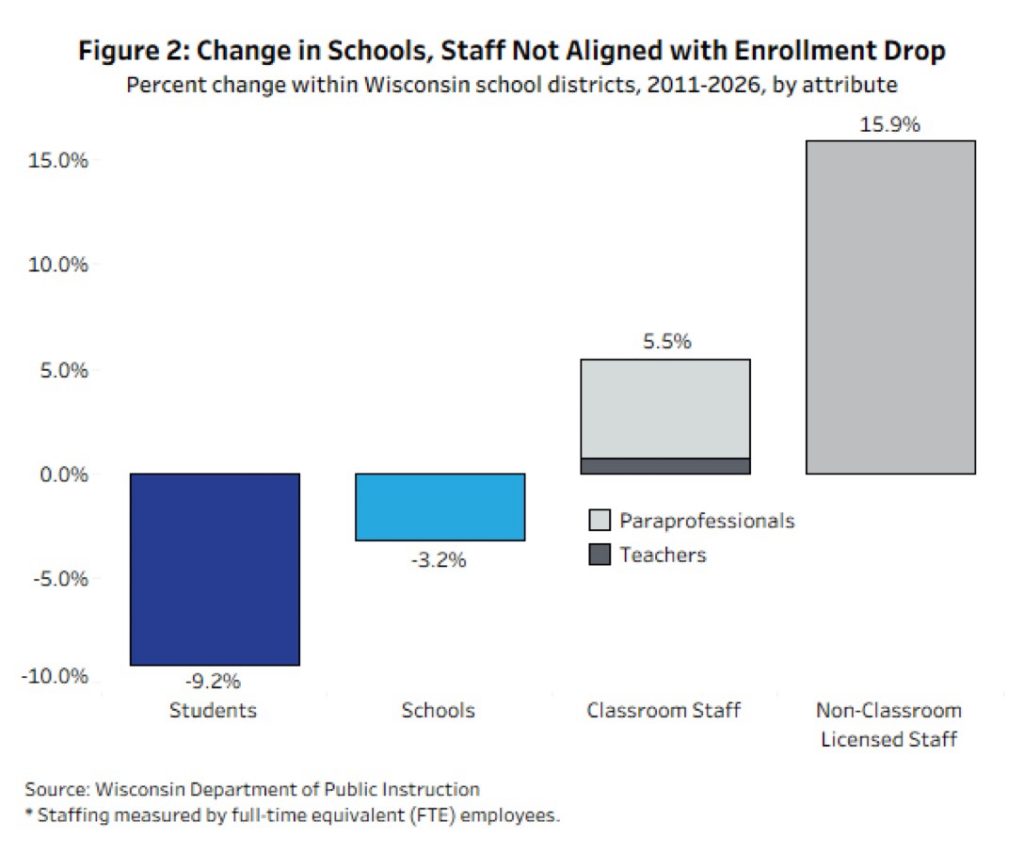
Where Have all the Students Gone? 1995 – 2019 Madison and nearby School Districts
More.
May 2026 Madison School District Presentation: 7,095 adults for 25,003 students (3.52 students per adult!)
Teacher merit pay in Indianapolis charter schools gets millions in new aid from philanthropies
Courtney Buuck thought there was some kind of mistake.
When she learned that she received a $40,000 bonus payment on top of her base teacher’s salary last fall, she was in shock. Like other staff at United Schools of Indianapolis’ three charter schools, she was eligible for a bonus based on her year-end evaluation score.
She just didn’t think she’d come out on top.
“I am just really hard on myself as an educator,” said Buuck, who teaches kindergarten at the Avondale Meadows Academy K-4 school. “And then once the shock wore off, I was just really proud of myself.”
Buuck plans to save her bonus to help her purchase her first home.
Buuck’s bonus comes from the $12.5 million Vigilance in Teaching and Learning — or VITAL — Trust, which launched in 2024 and pledged to support performance-based bonuses for staff at the charter network for 25 years. In the first year of awards, she received nearly $16,000.
Now, another venture with essentially the same name is expanding merit bonuses to 11 more Indianapolis charter schools this year in an effort to attract and retain high-quality educators. In April, the philanthropic VITAL Foundation awarded roughly $1.3 million in its first round of grants for teacher bonuses at high-needs schools that could range from $1,000 to $10,000.
Priorities! “but something about my kid putting their big emotions in a computer to become aggregate data makes me really anxious” (achievement?)
Starting next school year, Madison elementary students will take a weekly survey about their feelings on a new online platform, following the School Board’s approval despite initial concerns.
When district administrators first proposed the platform, called Sown to Grow, to the School Board this year, several members expressed doubts about using an online curriculum to gauge students’ social and emotional well-being. After an hour-long discussion in which some members indicated they would vote against the contract, the board postponed voting.
Then a month later, with little public discussion, most School Board members altered their positions on the survey and greenlit a $278,000, three-year contract with the platform.
As more Madison parents raise concerns about screen time in schools, the board’s decision on Sown to Grow underscored how some members of the School Board are weighing the benefits and costs of technology in classrooms.
“My discomfort around this, if I zoom out, is about what understanding I have about how we think about the totality … of how many different platforms our students are using on a daily or weekly basis,” board member Blair Mosner Feltham said during the first discussion about Sown to Grow. “I’m torn because I hear people say we need the curriculum … but something about my kid putting their big emotions in a computer to become aggregate data makes me really anxious.”
…..
“Encouraging students to share their feelings with the screen is gross to me,” she said. “The whole online component of it I find very problematic.”
——-
2026-2027 Madison K-12 $pending continues to grow, fueled by a 9.7% (!) property tax increase. Total spending will be at least $706,000,000 for 25,003 students, or $28,236 per student.
May 2026 Madison School District Presentation: 7,095 adults for 25,003 students (3.52 students per adult!)
Early Literacy Screener Map.
3,887 Madison 4 year old to third grade students scored lower than 75% of the students in the national comparison group.
Madison taxpayers have long supported far above average k-12 tax & $pending. This despite our long term, disastrous reading results. May, 2026: 7,095 Staff for 25,003 students; $pending > $26k per student!
Madison Schools: More $, No Accountability
The taxpayer funded Madison School District long used Reading Recovery…
The data clearly indicate that being able to read is not a requirement for graduation at (Madison) East, especially if you are black or Hispanic”
A.B.T.: “Ain’t been taught.”
My Question to Wisconsin Governor Tony Evers on Teacher Mulligans and our Disastrous Reading Results
2017: West High Reading Interventionist Teacher’s Remarks to the School Board on Madison’s Disastrous Reading Results
Madison’s taxpayer supported K-12 school district, despite spending far more than most, has long tolerated disastrous reading results.
“An emphasis on adult employment”
Wisconsin Public Policy Forum Madison School District Report[PDF]
WEAC: $1.57 million for Four Wisconsin Senators
Friday Afternoon Veto: Governor Evers Rejects AB446/SB454; an effort to address our long term, disastrous reading results
Booked, but can’t read (Madison): functional literacy, National citizenship and the new face of Dred Scott in the age of mass incarceration.
When A Stands for Average: Students at the UW-Madison School of Education Receive Sky-High Grades. How Smart is That?
Four: an education that produces explorers, not photocopiers.
All of modern schooling optimizes convergent thinking: finding THE right answer, the one from the answer key, the one from the teacher. That was perfect for manufacturing office workers in 1950. It’s exactly what machines now do better than we do. What remains for humans is the other half: divergent thinking. Asking the question no one else asks, connecting two fields that have nothing to connect them, enduring being right alone for ten years. The school of the future doesn’t grade the conformity of the answer. It grades the fertility of the question.
——-
Nobody wants to do the exercise seriously. Everyone comments on the fall of the old world, nobody describes the next one. So let’s do it. Here’s what the future of humanity looks like, and why it’s already under construction.
First the principles, because everything flows from them. A civilization is software before it’s buildings. Ours just crashed. Here are the six lines of code for the next one.
——-
Years ago, I served on several taxpayer funded Madison School District volunteer committees. My observation, then, was that half the teachers I met worked hard to improve the achievements and drive of their students, while the other half simply wanted to hold hands from k-12 and give them a piece of paper at the end.
Civics: FIRE backs JAWBONE Act to end backdoor censorship
Whether leaning on social media platforms or threatening broadcasters, federal officials of both parties have made jawboning — using government power, or the threat of it, to indirectly censor protected speech — a growing stain on American life.
To fight back, Senators Ted Cruz and Ron Wyden have introduced a landmark bill to rein in jawboning against websites and social media platforms, AI systems, and broadcast airwaves. Supported by FIRE, the Justice Against Weaponized Bureaucratic Overreach to Networked Expression (JAWBONE) Act would mark major progress toward addressing indirect and unconstitutional government censorship of Americans’ speech.
Jawboning is when the government uses threats to force private actors into censoring speech the government cannot ban directly. It’s government censorship by coercion, and FIRE has long warned that jawboning is a serious threat to free expression, especially online. (Check out our full explainer on jawboning.)
Consider the recent Supreme Court ruling in NRA V. Vullo, a case involving a New York state insurance regulator opposed to the National Rifle Association who allegedly threatened its insurance company with fines unless they dropped the NRA as a customer. In other words, the NRA claimed the regulator was going after the NRA’s speech indirectly because they couldn’t target it directly. The Court unanimously said if that was the case, it was unconstitutional coercion.
‘Reaching a crisis point’: UC Berkeley humanities professors lower expectations for assigned readings
Faculty in the humanities are grappling with a changing educational landscape asdebates arise regarding student preparation and nationwide headlines question students’ abilities to read longer texts.
Some faculty across the humanities report cutting down the amount of reading they assign to students, though others have found that students are keeping up with a standard workload the same way they would have years ago.
Carlos Noreña, a UC Berkeley history professor specializing in ancient history,said the amount of reading he could comfortably assign while expecting students to read a “substantial” portion of it has dropped over the past 20 years at UC Berkeley.
“We are now reaching a crisis point where if the number (of pages) goes down further, it’s unclear to me whether my discipline of history can really be taught,” Noreña said.
Noreña said while lectures are an important component of class, he assigns primary sources and critical writing to his students because the goal is to push them to read the material and develop their own views. When he first came to UC Berkeley in 2005, he would assign 100 pages per week for an upper division course, with the expectation that students would read 75 to 80 pages.
For the course he plans to teach in the fall, Noreña said he plans to assign about 35 pages per week.
English professor Grace Lavery, said while she noticed some students struggling with denser Charles Dickens novels, these issues weren’t new or necessarily problematic.
The Nation’s Achievement Inequality Report Card: An Assessment of Interquartile Test Score Gaps and Equality Trends in Traditional Public, Charter, Catholic, and Department of Defense
M. Danish Shakeel, Misty Gallo, Patrick J. Wolf
We present a descriptive comparison of trends in achievement and inequality across traditional public, public charter, Catholic, and Department of Defense schools in the U.S. Our sample includes 6,155,570 observations of 4th- and 8th-graders in math and reading between 2005 and 2024. We focus on changes in the 25th and 75th percentile scores of students in those school sectors on the National Assessment of Educational Progress, adjusted for key student demographics. Analysis of 96 overall achievement trends reveals that no school sector has experienced a meaningful reduction in its 75–25 performance gap over the entire course of our time series in either grade or subject. Achievement gaps are largest and widening most swiftly in the traditional public school sector, chiefly due to the declining annual trend for its low achievers at the 25th percentile. Most of this increase in inequality occurred prior to the COVID-19 pandemic, which merely accelerated the pre-existing trend. Charter trends are mixed, with minimal losses at the 25th percentile and moderate gains at the 75th percentile. The 75–25 student performance gap in the Catholic sector increased over the 20-year study period, driven by both increases at the 75th percentile and declines at the 25th percentile, much like in the traditional public school sector. The Department of Defense (DoD) schools are outliers in our study. Student achievement in DoD schools was higher in 2024 than in 2005 at both the 25th and 75th percentiles, with little change in the performance gap. Detailed subgroup findings appear in an appendix. We discuss potential causes and policy implications.
The Mellon Foundation Is Funding a Resistance Against Civics Schools
In a recording that I obtained, Isaac Kamola—the director of the AAUP’s Center for the Defense of Academic Freedom (CDAF)—repeatedly states his desire to delegitimize the upstart civic centers.
“I would really love to see kind of a robust research project on these right-wing centers and individuals—like, naming and shaming and discrediting and undermining the legitimacy,” Kamola said during the meeting (around the 1:34:50 mark). “I would love to strategically map who these f—ers are, and figure out what the weaknesses are, and design a research agenda that just goes through them and tries to knock them out.”
Through a public records request, I have acquired emails sent to a CDAF program fellow, which include links to agendas, brainstorming documents, grant records, and meeting audio recordings. The documents reveal the group’s idiosyncratic understanding of academic freedom. They also reveal how the CDAF’s funder, the Andrew W. Mellon Foundation, has bankrolled a sprawling public-relations operation to block conservative efforts to reform higher education.
Created in 2024, the CDAF owes its existence to a $1.5 million grant from the Mellon Foundation. Per the center’s grant proposal, CDAF was designed to launch a public-relations campaign defending academic freedom. In practice, it seems to prioritize institutional autonomy above all—including, of course, viewpoint diversity.
CDAF reserves special ire for “civics centers” like the University of Florida’s Hamilton School. In a brainstorming document, Kamola identifies the centers as a key target. “Bring together faculty from different campuses that have dark money-funded, or legislature-imposed, ‘free enterprise,’ ‘civics,’ or other imposed centers,” the document reads.
A for Average: Reversing University Grade Inflation
An A in a college class used to mean achievement. Today, an A means the average.
Grade inflation—the phenomenon whereby universities increase students’ average grades without a corresponding increase in achievement—has been a persistent issue in American education since at least the 1960s. Grades matter because they are the primary metric intended to communicate a student’s mastery of classroom material to faculty, graduate schools, and employers. But grade inflation distorts the signaling value of grades, making it difficult for people evaluating from the outside to distinguish between average and exceptional students.
It is possible for universities to address grade inflation. This brief finds:
- Universities that institute some kind of grading reform, such as Wesleyan and Princeton, successfully reversed some grade inflation.
- Reforms that directly address grading standards, such as caps, are effective at addressing grade inflation. Reforms that disclose grade distributions should be viewed as transparency measures, but transparency alone does not stop grade inflation.
Reversing an established habit or culture of grade inflation, however, is difficult for an institution. While individual instructors confer grades, faculty face many pressures from university administrators and students to maintain high averages. Universities also face a collective-action problem: it is not enough for a handful of universities to adopt stricter grading policies if peer institutions continue to inflate.
This brief argues that reducing grade inflation requires changing the incentives that shape grading practices. It evaluates policies that states could pursue, such as including median class grades on college and university transcripts and instituting grading caps, and makes two key recommendations:
- Implement state regulation of grade inflation at public universities. This is necessary because institutional incentives discourage serious internal reform.
- Institute inflation-adjusted GPA. This novel idea realigns students’ and professors’ incentives to reverse grade inflation.
The Nationalization of American Science
OMB, joined by some forty grantmaking agencies—NSF, HHS, DOE, NASA, DOD among them—has proposed a sweeping rewrite of the rules governing all federal grants, the Regulation for Federal Financial Assistance.
American science has long been state funded but not state directed. Since Vannevar Bush, money has flowed through many agencies to independent universities, allocated largely by peer review. The system has flaws—conformity, gerontocracy, waste—but it had one great virtue, the system was decentralized and not under state control. This rule proposes to bring science funding under top-down, state control.
Program goals must now be “aligned with administration policies and priorities” (§ 200.202). Merit review is subordinated to politics: “senior appointees must conduct these reviews,” ensuring “that discretionary awards advance the President’s policy priorities,” while “peer review remains advisory and does not replace agency discretion” (§ 200.205). And every grant becomes terminable at will, whenever it “no longer effectuates program goals, Federal agency priorities, or the national interest *as they exist at the time of the termination*” (§ 200.340, emphasis added). Universities must even ensure their subrecipients don’t “significantly damage the reputation of… the Federal Government” (§ 200.332)—a loyalty clause for scientists.
All this is sold as cutting “burdensome conditions,” a goal I would support, but sadly that is bullshit. The proposed rules add more paperwork and many more layers of bureaucratic review. Payment requests must include written justifications. Every disbursement gets screened through Treasury’s “Do Not Pay” system. Every recipient must run E-Verify. Applicants must disclose any employee who worked at the awarding agency within two years. And on top of the existing review machinery sits a new pre-issuance review committee of “senior appointees” second-guessing the experts. Fixed amount awards—pay for outputs, not inputs—an innovative reward mechanism are *eliminated*, so every award now gets routine cost monitoring and financial reporting.
Civics: “the accusation is enough”
One must have the honesty to recognize the stroke of genius from the left, because it is one. The greatest rhetorical heist of the century boils down to a single word: racist.
Here’s the mechanism.
After 1945, after the civil rights movement, the West made racism the absolute evil. Rightly so: it is one of its greatest moral conquests. “Racist” became the most radioactive word in the language, the modern excommunication, instant social death.
The stroke of genius was to hijack this moral capital. Not to protect people: to protect an ideology.
Results egalitarianism never wins a debate on the facts. It produces the opposite of what it promises, everywhere, every time. So instead of winning the debate, they made the debate unaffordable. You question the outcomes of immigration without assimilation? Racist. You defend merit? Racist. Advanced math? Racist. Borders? Racist. The word stopped describing a behavior and started describing a position on the chessboard.
And look at the technical beauty of the setup. No need for arguments: the accusation is enough. No need for a trial: denial makes the case worse (your defensiveness proves your guilt). No need for police: fear does the work, everyone polices themselves and their neighbor for free. It just takes publicly executing a few examples a year to keep millions in line. An irrefutable ideology, protected by an unpronounceable word. The two firewalls of the same system: French Theory had abolished truth, the accusation abolished debate.
——-
A planned economy, a military empire, a concrete wall. What didn’t fall was the idea. The idea that the world is divided between oppressors and oppressed. The idea that there is a final equality to be achieved, by any means necessary. The idea that everything that exists (the family, the nation, merit, inheritance) is a structure of domination to be torn down.
———
Wokism is a political economy of scarcity. It needs gatekeepers who control access to careers. It needs commissars between you and the outcome. It needs spots to be scarce for their redistribution to make sense. Its peak was COVID: populations immobilized, dependent on official channels, every interaction subject to authorization. The peak of the globalist project and the woke peak fall in the same year in all the data. It’s not a coincidence. It’s the same phenomenon.
NYC to maintain school budgets despite enrollment declines
The nation’s largest school system will keep schools’ budgets intact next year despite declining enrollment but has not yet decided on midyear budget cuts.
Details: New York City Public Schools Chancellor Kamar Samuels told principals in an email Sunday that the city will not claw back funding from schools with fewer students than anticipated for the 2026-27 school year. Schools are set to receive their budgets for the fiscal year that starts July 1 next week.
But he confirmed during a City Council executive budget hearing Monday that the city has not made any decisions with respect to the midyear adjustment it will make to school budgets when asked by Council member Lincoln Restler
Reliability of LLMs as medical assistants for the general public: a randomized preregistered study
Andrew Bean, Adam Mahdi et al (mainly at the Oxford Internet Institute):
We tested whether LLMs can assist members of the public in identifying underlying conditions and choosing a course of action (disposition) in ten medical scenarios in a controlled study with 1,298 participants. Participants were randomly assigned to receive assistance from an LLM (GPT-4o, Llama 3, Command R+) or a source of their choice (control).
Tested alone, LLMs complete the scenarios accurately, correctly identifying conditions in 94.9% of cases and disposition in 56.3% on average. However, participants using the same LLMs identified relevant conditions in fewer than 34.5% of cases and disposition in fewer than 44.2%, both no better than the control group. We identify user interactions as a challenge to the deployment of LLMs for medical advice.
The mysterious database that provides clues to China’s foreign surveillance
Beijing: It goes with the territory that foreign journalists in China routinely question how closely the government monitors their activities.
Reporters swap stories of having travelled to regional or “sensitive” areas only to be met by police on arrival, sometimes even before checking into their hotel – something I experienced first hand when on assignment near the China-Russia border last year .
The Chinese security state hoovers up vast amounts of data, including via some 700 million CCTV cameras installed across the country, checkpoints at train stations, prolific use of facial recognition software, and requirements that hotels register foreigners with police.
Less clear is how sophisticated Chinese authorities are at pulling this data together to comprehensively track movements and surveil targets.
But a German cybersecurity journalist’s recent discovery of a prototype policing dashboard has helped piece together a picture of how it could work – and may already be working in some form in parts of China.
How large would Gen X, Millennials, and Generation Z have been without abortion?
How many of the people who would’ve been in your generational cohort aren’t here because they were aborted?
Between the Roe v. Wade decision in 1973 and the Dobbs v. Jackson Women’s Health Organizationdecision in 2022, women had access to abortion because of the Supreme Court’s decision to establish a woman’s constitutional right to it based on the right to privacy. During that time, Americans underwent tens of millions of abortions. Given that America only experienced tens of millions of births in that same timeframe, the answer to my question is likely a nontrivial portion: a potentially sizable part of the generations that have been born since 1973 may have been aborted.
Using data from the Guttmacher Institute—a nongovernmental organization sprung out of Planned Parenthood in 1968 with the aim to expand reproductive rights globally—we can see that aborted generation members have been a very sizable percentage of every generational cohort since the Roe v. Wade decision.1
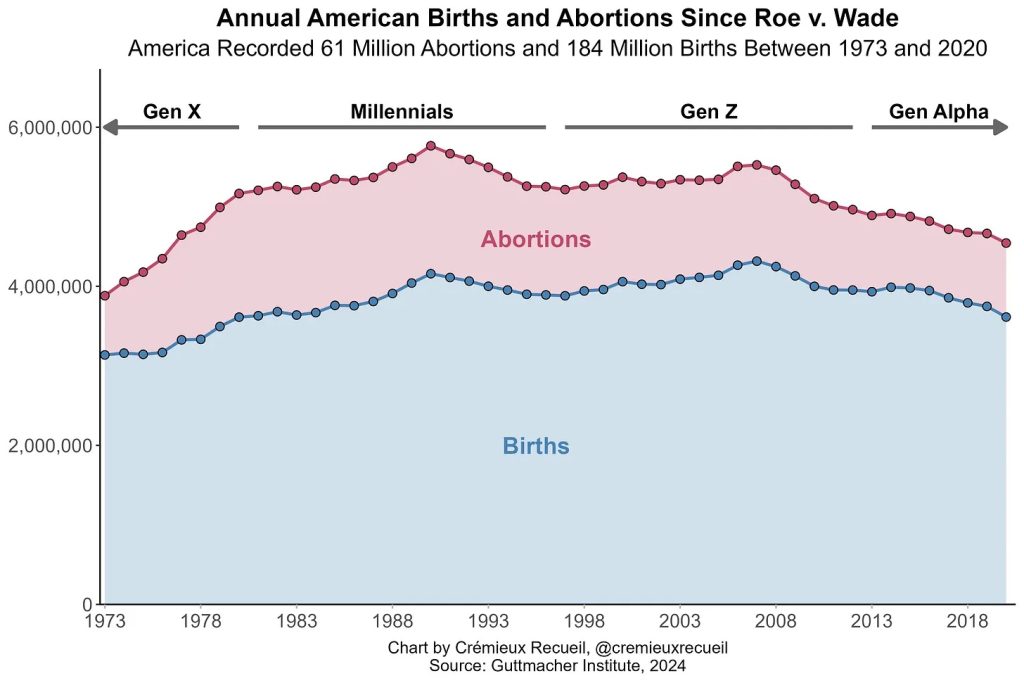
If we naïvely tally up America’s abortions, we can see that potentially over a quarter of Gen X and Millennials were aborted, nearly as many Gen Z met that fate, and almost a fifth of Gen Alpha were treated the same way.
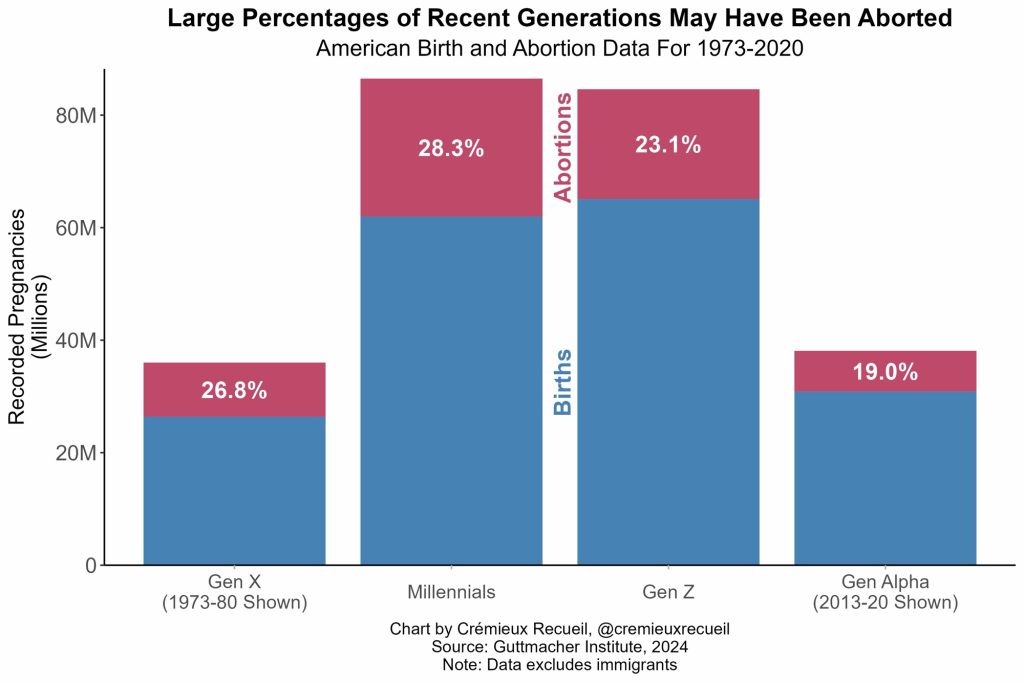
These figures help to contextualize the human toll of abortion—these are, at minimum, millions of lost lives. But these numbers are off when it comes to describing the number of people who would be in these generations were it not for abortion. If we want to understand how large generations would be without abortion, we have to account for the effect of abortions on completed fertility.
Different studies—reviewed below—suggest banning abortion would likely lead to 3-6% more births rather than the larger numbers these figures suggest, because people adjust their reproductive behavior in response to abortion availability. If we just add 3-6% to each generation, that’s 5.53 to 11.06 million more people born between 1973 and 2020. But many of the people who aren’t aborted will likely have their own kids. Therefore, we need to set up a model—detailed below—where the generational birth gains propagate forward. With that propagation, America would have likely had somewhere between 7.63 and 15.26 million additional births between 1973 and 2020.
There are millions of missing Americans due to abortion. The human toll of the practice is real and nontrivial, and I hope everyone—pro-choice or pro-life—can admit to that fact. But I also hope the discussion doesn’t end there. There’s so much more to discuss about this topic; how we can humanely reduce abortion rates; how we can save babies from miscarriages; and how we can make for more, happier families.
———
Choose life.
Lawsuit alleges Wisconsin Department of Public Instruction violated open meetings law
A new lawsuit from the conservative Institute for Reforming Government alleges the Wisconsin Department of Public Instruction violated open meetings law when it held a conference in the Wisconsin Dells in 2024.
The lawsuit, filed Tuesday in Adams County Circuit Court, focuses on a four-day conference at the Chula Vista Resort where DPI met with educators and Data Recognition Corporation, the vendor for the Forward Exam, to work on standard setting.
During the meeting, the vendor worked with a group of 88 educators on new testing standards for students, and recommended cutting scores to divide students into four performance levels.
Understanding Wisconsin, Together.
WPR’s “Wisconsin Today” newsletter keeps you connected to the state you love without feeling overwhelmed. No paywall. No agenda. No corporate filter.
“The standard setting was required because of recent changes to the tests,” according to a report from Data Recognition Corporation.
However, the lawsuit alleges DPI violated Wisconsin Open Meetings Law.
Notes on The Ongoing Wisconsin Achievement Decline
On main NAEP, Wisconsin’s 8th grade girls math’ scores FELL 8 POINTS from 2019 to 2024, 1 point above boys to 3 below. That is a reverse Mississippi miracle, debatably 1 grade level.
Their national RANK ROSE from 4th to 1st. It is bad!
(February 2026 results out January 2027)
———
2026-2027 Madison K-12 $pending continues to grow, fueled by a 9.7% (!) property tax increase. Total spending will be at least $706,000,000 for 25,003 students, or $28,236 per student.
May 2026 Madison School District Presentation: 7,095 adults for 25,003 students (3.52 students per adult!)
Early Literacy Screener Map.
3,887 Madison 4 year old to third grade students scored lower than 75% of the students in the national comparison group.
Madison taxpayers have long supported far above average k-12 tax & $pending. This despite our long term, disastrous reading results. May, 2026: 7,095 Staff for 25,003 students; $pending > $26k per student!
Madison Schools: More $, No Accountability
The taxpayer funded Madison School District long used Reading Recovery…
The data clearly indicate that being able to read is not a requirement for graduation at (Madison) East, especially if you are black or Hispanic”
A.B.T.: “Ain’t been taught.”
My Question to Wisconsin Governor Tony Evers on Teacher Mulligans and our Disastrous Reading Results
2017: West High Reading Interventionist Teacher’s Remarks to the School Board on Madison’s Disastrous Reading Results
Madison’s taxpayer supported K-12 school district, despite spending far more than most, has long tolerated disastrous reading results.
“An emphasis on adult employment”
Wisconsin Public Policy Forum Madison School District Report[PDF]
WEAC: $1.57 million for Four Wisconsin Senators
Friday Afternoon Veto: Governor Evers Rejects AB446/SB454; an effort to address our long term, disastrous reading results
Booked, but can’t read (Madison): functional literacy, National citizenship and the new face of Dred Scott in the age of mass incarceration.
When A Stands for Average: Students at the UW-Madison School of Education Receive Sky-High Grades. How Smart is That?
How 16 top economists think AI will change the job market, and how to prepare
Will artificial intelligence improve workers’ lives, or hand them the equivalent of a pink slip?
It’s one of the most pressing questions facing the U.S. economy today. Companies are pouring money into data centers, rolling out AI tools in their offices and, in some cases, rethinking how many workers they need. Polling finds Americans are more anxious than excited about these developments. At the same time, history has shown that technology can unlock productivity and innovation, fueling wealth and employment.
For answers, we turned to 16 economists—including an economics Nobel winner, academics deeply engaged on questions about AI and former top government advisers—about what they think AI will mean for the economy, workers and workplaces. We asked for bigger-picture thoughts and forecasts, and a mix of multiple-choice questions focused on the next five years. (Not every economist answered every question.)
There’s little doubt AI will boost productivity, economists we surveyed said, and smaller and newer companies should benefit from its growth. But economists diverged when it came to the question that worries many Americans the most: in the coming years, will AI eliminate more jobs than it adds?