| School Information System |
 | Sponsorships | Sponsorships |
|
|
The Urban Scientist, Scientific American
News of Kiera Wilmot's arrest has seriously unnerved me. She is the Florida high school student who was experimenting with common household chemicals in science class that resulted in a minor explosion. There were no injuries and no damage to school property; however, she was taken away in handcuffs, formally arrested and expulled from school.
I acknowledge that too little information has been provided on the case. We have NO idea what was happening in the class. Where was the teacher? Were students involved in a laboratory activity at the time? I have spent time in the high school classroom. I know the shenanigans (and havoc) these pre-adults can cause. It is no laughing matter. Even if this were a prank, say something akin to my generation's idea of setting off smoke bombs in the hall during the passing of classes, my gut reaction stands.
I don't like what our public education (and justice) systems do to urban youth (e.g. the discipline gap with Black kids). I worry about urban kids who don't (tend) to have access to social capital that advocates for them and gives them a chance after stupid mistakes. I worry what this will mean to her family financially. What will it mean for her future? Will graduating from an alternative school prevent her from attending college? Will she be marked as a trouble maker? Will she have a criminal record that prevents her from gainful employment and a meaningful life? More immediately, will she get locked away for 20 years? Shit like that happens to kids who look like her.
Newsletter signup | Send us your ideas
Anyone who has spent much time in classrooms has the sense that just a couple of disorderly kids can really disrupt learning for everyone. These kids distract the other students, and the teacher must allocate a disproportionate amount of attention to them to keep them on task.
Obvious though this point seems, there have been surprisingly few studies of just how high a cost disruptive kids exact on the learning of others.
Lori Skibbe and her colleagues have just published an interesting study on the subject.
Skibbe measured self-regulation in 445 1st graders, using the standard head-toes-knees-shoulders (HTKS) task. In this task, children must first follow the instructors direction ("Touch your toes. Now touch your shoulders.") In a second phase, they were instructed to do the opposite of what the instructor said--when told to touch their toes, they were to touch their head, for example. This is a well-known measure of self regulation in children this age (e.g., Ponitz et al., 2008).
Researchers also evaluated the growth over the first grade year in children's literacy skills, using two subtests from the Woodcock-Johnson: Passage Comprehension and Picture Vocabulary.
We would guess that children's growth in literacy would be related to their self-regulation skill (as measured by their HTKS score). What Skibbe et al showed is that the class average HTKS score also predicts how much an individual child will learn, even after you statistically account for that child's HTKS score. (Researchers also accounted for the school-wide percentage of kids qualifying for free or reduced lunch, as academic growth might covary with self-regulation as due to SES differences.)
Newsletter signup | Send us your ideas
Paul Vallas at LaFollette Video
School reform superintendent Paul Vallas spoke at LaFollette High School at the behest of Boys and Girls Club of Dane County CEO Michael Johnson. The two and a half hour presentation with question and answer periods as attended by about 100 people in the LaFollette Auditorium.
Paul Vallas has been the Superintendent of schools in Chicago (CPS), Philadelphia, New Orleans, and currently Bridgeport Connecticut. He is currently hired to improve the schools in both Chile and Haiti, and has been praised in two State of the Union addresses. His work as a superintendent has engendered both strong support and strong disagreement.
The two and a half hour meeting has been divided into five clips and I have tried to summarize comments made by Paul Vallas, the panel and the audience members who spoke.
Newsletter signup | Send us your ideas
Milwaukee Public Schools Superintendent Gregory Thornton believes the best way to deal with youth violence, at least in the short term, is to take troublemakers out of regular schools and place them into alternative schools.We agree. But there are not enough seats for the growing number of chronically disruptive youth, which is why the School Board should grant Thornton's request, coming in April, to fund more of those seats.
During the past two weeks, more than 20 students were arrested for fighting and disorderly conduct at Washington and Madison High Schools. Several Milwaukee police officers were injured during the incidents, including one officer who was kicked in the face by an 18-year-old.
Over the years, MPS has limited the number of violent incidents. But Thornton said MPS has been limited to Band-Aid approaches, and the recent uptick in violence is ominous.
Last year alone, the district spent about $10 million on safety measures, which included having additional security guards and metal detectors on every door at some schools. For a cash-strapped school district, that money would be better used on instruction.
Newsletter signup | Send us your ideas
There is something truly disturbing about a society that seeks to control the behavior of schoolchildren through fear and violence, a tactic that harkens back to an era of paddle-bruised behinds and ruler-slapped wrists. Yet, some American school districts are pushing the boundaries of corporal punishment even further with the use of Tasers against unruly schoolchildren.The deployment of Tasers against "problem" students coincides with the introduction of police officers on school campuses, also known as School Resource Officers (SROs). According to the Los Angeles Times, as of 2009, the number of SROs carrying Tasers was well over 4,000.
As far back as 1988, the American Academy of Child and Adolescent Psychiatry, National Congress of Parents and Teachers, American Medical Association, National Education Association, American Bar Association, and American Academy of Pediatrics recognized that inflicting pain and fear upon disobedient children is far more harmful than helpful. Yet, we continue to do it with disturbing results, despite mountains of evidence of more effective methods of discipline.
Newsletter signup | Send us your ideas
The Courier-Post is all over Camden Public Schools' failure to accurately report incidents of violence and vandalism. (See earlier story here.) Each year, per state mandate, districts file reports with the State DOE listing rates of violence and then the State reports out to the Legislature. While there has been a 6.4% increase in violent incidents (some of this, no doubt, attributable to the new Harassment, Intimidation and Bullying legislation), Camden Public Schools appears to be a land of milk and honey: there were only 29 incidents all of last year and only 35 for 2010-2011.Among other districts in the area "almost 30 districts reported more violent incidents than Camden - including Audobon, Cherry Hill, Cinnaminson, and Washington Township."
Newsletter signup | Send us your ideas
A headline-generating study, published in the journal Pediatrics this week, suggests that approximately one in three Americans is arrested before age 23. That's up from about one in five in 1965, the last time a similar study was conducted. The study used data from surveys given to the 7,335 people who enrolled in the federal government's National Longitudinal Survey of Youth in 1996.This study, a recent joint initiative between the Departments of Justice and Education and a spate of anecdotal stories in the news all suggest a surge in the arrests of minors, and particularly in arrests that originate in schools. But the federal government is both fighting the "school-to-prison" pipeline while continuing to fund the same programs that critics say are causing it. Moreover, because the government hasn't been collecting data on school-based arrests, and the little available data shows overall arrests of juveniles are down, it's difficult to determine if a problem exists, much less whether federal initiatives are solving it -- or contributing to it.
Newsletter signup | Send us your ideas
Among the extended family I saw over the holiday was a young relative who is working as a substitute teacher in the Northeast since he can't find a full-time teaching post. He shared a story that surprised me, and I wanted to run it by folks here.He was subbing at a low-performing high school that recently had a well-publicized stabbing. A student in his class pulled what he thought was a real gun on him, and they had a standoff for several minutes until the teen put the "gun" away and the teacher tackled him to the floor. It turned out the gun was a toy, and the student received a three-day suspension for the incident.
The substitute teacher was disappointed with the punishment, but said the school wanted to prevent another round of negative press.
Would such an incident be kept quiet in Georgia? Could it go so easily unreported under zero tolerance policies in which students can get suspended for Tweety Bird key chains?
Newsletter signup | Send us your ideas
Of the nation's 10 largest cities, eight use armed police in some form. And in the ninth city, New York, officers receive far more training and scrutiny prior to hiring.Five of those city school districts - San Diego, Los Angeles, Houston, Dallas, and San Antonio - employ their own police officers, who receive comparable training to regular city police.
Chicago, Phoenix, and the San Jose Unified School District base city police officers in some of their buildings. In the case of San Jose, the officers are not in uniform, but rather dress casually in polo shirts and conceal their weapons.
In New York - the nation's largest school system - the city police department's school-safety division staffs the schools with unarmed officers who receive 14 weeks of training, intensive background scrutiny, and drug and character screening. (Armed precinct-based officers, however, also come into the schools.)
The nation's largest cities are by no means alone.
The Council of the Great City Schools, a coalition of large urban districts, surveyed members in 2004 and found that 29 of 37 respondents indicated its officers were armed. Las Vegas, Miami, and Indianapolis are among other bigger districts with their own police forces.
Newsletter signup | Send us your ideas
The parents of three 15-year-olds who were strip-searched and jailed for three days after a trespassing charge expressed outrage Thursday during a press conference and called for the removal of Tate County Youth Court referee Leigh Ann Darby."If we don't stand up for our rights, no one else will," Dexter Burton of Senatobia, father of Lakiya Burton, told reporters at the Church of Christ at 401 W. Gilmore.
The three youths, who had not previously been identified because of their ages, were at the gathering with their parents and the families' attorney, J. Cliff Johnson II of Jackson. They are Larandra Wright of Southaven, and Lakiya Burton and Kevonta Mack, both of Senatobia.
Burton and Mack are 10th-graders at Senatobia High School; Wright is a 10th-grader at Southaven High. None had prior brushes with the law before they crossed a renter's yard at a duplex that faces Morgan Drive in Senatobia this summer.
Newsletter signup | Send us your ideas
According to statistics provided by the Oakland school district (and crunched by your devoted education reporter):TOTAL SUSPENSIONS in 2010-11: 6,137
TOTAL DAYS OF SCHOOL MISSED: 14,533
DEFIANCE ("disruption/defy authority") was the basis for 43 percent of all suspensions.
BLACK MALES made up less than 20 percent of all students in OUSD, but received about half of the suspensions.
At least two of the schools had more suspensions than students: Barack Obama Academy and Youth Empowerment School. YES (on the King Estates campus) closed in June, and Barack Obama Academy, an alternative middle school that opened on the Toler Heights campus in 2007, is slated to merge with Community Day.
Newsletter signup | Send us your ideas
The National Education Policy Center finds that districts, including L.A. Unified, have increasingly suspended minority students, mostly for nonviolent offenses, over the last decade.In the decade since school districts instituted "zero tolerance" discipline policies, administrators have increasingly suspended minority students, predominantly for nonviolent offenses, according to a report released Wednesday.
The National Education Policy Center found that suspensions across the country are increasing for offenses such as dress code and cellphone violations. Researchers expressed concerns that the overuse of suspensions could lead to dropouts and even incarceration.
Suspensions are falling mostly on black students; nearly a third of black males in middle school have been suspended at least once, researchers from the University of Colorado-based group found.
Newsletter signup | Send us your ideas
When he was 12, William Palmer joined a gang without even realizing it. To him, he was just hanging out with his big brother and their friends in their Easterhouse neighborhood in Glasgow. At first, he stood and watched as his friends defended their 200-sq-m territory from rivals. Lining up military-style, both sides would lunge and retreat until someone, usually drunk, engaged, and the fight would begin. Soon enough, Palmer was fighting alongside his brethren. By the time he was 20, he was selling drugs -- mostly ecstasy -- to younger kids in his neighborhood, taking care to avoid other gangs' territories lest he get jumped.Now 29, Palmer regards himself as lucky to have survived his youth. One of his brothers, a heroin addict, is in prison. Palmer himself did a two-year term after attacking a rival gang member with a hatchet. That led to an epiphany, and he joined Alcoholics Anonymous to dry out. Today he mentors kids at risk of joining gangs, even though the charity for which he works still has to carefully smuggle him through enemy lines -- five years after he left his gang. He is also wanted by the Glasgow police, but in a good way. They regularly ask Palmer to talk with new officers about how to get through to gang members. The role reversal amuses him. "We used to phone them up just to toy with them so we could get a chase off them," he says of the police. "Now they're phoning me up for advice."
Newsletter signup | Send us your ideas
Colorado lawmakers and police said Monday that strict disciplinary policies at schools created after the Columbine High School shootings should be scaled back or scrapped and that administrators should have more control over student punishment.The state laws put in place after high-profile cases of youth violence have tied the hands of school administrators with zero-policy standard, said members of a panel looking at school discipline trends. In turn, the officials are left with no choice but to refer a high number of students to law enforcement for minor offenses that pose no threat to school safety, they said.
"Zero tolerance has outlived its shelf life and is often inappropriately and inconsistently applied," John Jackson, the police chief for Greenwood Village, wrote in a memo by the panel. He suggested that officials come up with a better definition for what's considered a "dangerous weapon" on school grounds.
Newsletter signup | Send us your ideas
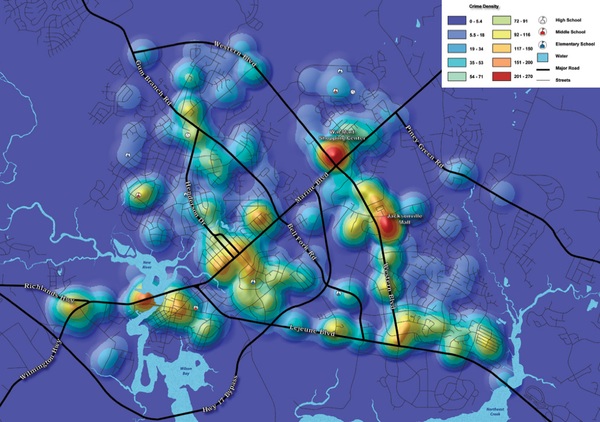
The number of arrests and citations for incidents at Madison's four main high schools dropped last year to the lowest level in more than a decade, according to police data.Related: Madison police calls near local high schools: 1996-2006.But arrests and citations at West and Memorial were twice the number at East and La Follette -- a reversal of the situation 10 years earlier when there were more than twice as many at the city's East Side high schools.
West was the only school with an increase from the previous year.
The Wisconsin State Journal obtained the data from the Madison Police Department amid a debate over whether the Madison School District should use drug-sniffing police dogs in random sweeps of high schools. The School Board was to consider the issue Monday but delayed a vote until late September -- in part to review the arrest and citation data.
District officials say an increase in drug-related disciplinary referrals in recent years, and the use of drug dogs in area school districts, support the use of police dogs. Community surveys also have showed strong support.
Luis Yudice, the School District's security coordinator, who introduced the drug-sniffing dog proposal with the support of Madison police, is concerned drugs in schools can lead to more gang activity, fights and weapons in schools as students arm themselves in self-defense. He views the police dog policy as a possible deterrent that could prevent a crisis.
Gangs & School Violence Forum Audio/Video.
Newsletter signup | Send us your ideas
A new alternative middle school for students with behavior problems and learning disabilities is set to open this September.New Jersey Left Behind has more.School officials last night briefed the Trenton board of education on the district's newest school.
Some, like board member T. Missy Balmir, called the concept "long, long overdue."
Others, like board president Rev. Toby Sanders and vice president Sasa Olessi Montaño asked for strict monitoring of the program's success and use of district dollars.
"This is a huge undertaking, a new school in our district, a district facing the financial situation that we're facing," said Olessi Montaño.
Newsletter signup | Send us your ideas
Eight more former students joined a $25.5 million lawsuit Wednesday against a "tough love" boarding school in Central Oregon that was shut down by the state in 2009 over allegations it mistreated troubled teens in its care.The new plaintiffs bring to 17 the number of people saying they were abused at the former Mount Bachelor Academy outside Prineville.
Attorney Kelly Clark said the growing number of plaintiffs will make it harder for the school's owners to deny they mistreated students in the name of rehabilitation.
"One of the initial reactions when we filed the case from Mount Bachelor lawyers was basically that this was just a couple disgruntled former students and none of this ever happened," Clark said from Portland. "The breadth of the class of plaintiffs makes it less likely and more difficult for Mount Bachelor Academy to simply dismiss this as none of it happened."
Newsletter signup | Send us your ideas
Madison Mayor Paul Soglin Interview 8.12.2011 from Jim Zellmer.
I am thankful that Madison Mayor Paul Soglin took the time to chat yesterday.Mobile (iPhone, iPad, iPod and Android) visitors, please use this link.
Newsletter signup | Send us your ideas
The recent spate of criminal activity involving marauding bands of young people has a lot of greater Milwaukee residents wondering what is going on inside the heads of today's teenagers and young adults.The answer, according to current brain research, is a lot. It turns out that the adolescent brain is not fully mature, as previously believed, but is actually in a period of intense growth until children reach their late teens or early 20s. One of the last areas of the brain to mature is the prefrontal cortex.
In a nutshell, the prefrontal cortex governs impulse control. The hormonal surges of puberty kick up heightened emotional responses at a time when the brain is least equipped to regulate emotional urges, thus creating the perfect storm for poor choices.
Newsletter signup | Send us your ideas
Bullying can affect a student's academic performance, but a school's bullying climate may be linked with lower overall test scores, a study finds.The study, presented recently at the American Psychological Assn.'s recent annual convention in Washington, D.C., surveyed 7,304 ninth-grade students and 2,918 teachers who were randomly chosen from 284 high schools in Virginia. Students and teachers were asked about incidents of bullying and teasing at the school. Ninth-grade students were chosen because researchers felt this first year of high school was a critical adjustment period, and because poor test scores in this grade may be linked with a higher drop-out rate.
In the study, bullying was defined as using strength or popularity to deliberately injure, threaten or embarrass another person, and that harassment can be verbal, physical or social. Two students close in strength who argue are not considered bullies.
Newsletter signup | Send us your ideas
PBIS is all the rage in school districts across the country. No...Sun Prairie didn't just dream this up all by themselves. What, exactly, is PBIS? PBIS stands for Positive Behavioral Interventions and Supports. It's an offshoot of the IDEA program (Individuals with Disabilities Education Act). You may see/hear it as SWPBS (School-wide Positive Behavior Supports). In a nutshell, PBIS is a system of behavior modification, with three stages of intervention.Primary intervention is targeted to all students and is s system designed to clearly identify which behaviors are acceptable and which are not. Exhibiting positive behavior is rewarded in some fashion. In theory, about 80-85% of students respond to this primary level of intervention. The overall target is to develop a system in which positive reinforcements (for "acceptable/desired" behaviors) outnumber negative reinforcements (for unacceptable behaviors) by about 4:1. In this way, kids overwhelmingly see that "being good" is the place to be. You get rewards.
PBIS extends further to the 2nd tier, kids that do not respond well to these primary tactics. These kids represent about 10-15% of the population and are those that potentially are at risk for "failure", or at the very least not realizing their academic potential. This group, however is not in need of individualized attention, but rather is targeted in small groups (a modernized form of "group" therapy). The third tier, which includes about 5-10% of students, covers those students who require individualized attention to develop positive behaviors and squelch those behaviors which are not acceptable.
Newsletter signup | Send us your ideas
Madison School Board Member Ed Hughes:
As is becoming increasingly common these days however, mine turned out to be a minority view. Other Board members took turns identifying parts of the revision that they did not like, raising some concerns that they had previously expressed and some that were new. The general tenor of the comments was that the current format of the Code was fine but that Code should be stricter and that more violations should lead to mandatory recommendations for expulsion.About an hour into the meeting, I expressed some frustration with the proceedings (since I'm just figuring this stuff out, this video starts with eight seconds of black) :
Eventually Board members settled on deep-sixing the Work Group's proposal but adopting some (but not all) of the substantive changes reflected in the revision. For example, the aggravated theft offense was added. The change to the unintentional use of force against a staff member violation was adopted (a very good move, btw), but the change to the possession and distribution of drugs or alcohol violation was not (I think). Another change boosted the potential consequences imposed for non-physical acts of bullying or harassment.
Also on our agenda Monday night was the creation of a new Board Ad Hoc Committee on Student Discipline, Conduct and Intervention, to be chaired by Lucy Mathiak. Some Board members suggested that the revisions recommended by the Work Group and rejected by the Board might be re-considered by the members of this committee in some fashion.
I found the Board's rejection of the proposed revisions and ad hoc amending of the existing Code an unfortunate turn of events and criticized what I described as our legislating on the fly right before the vote:
Newsletter signup | Send us your ideas
A new report from the Department of Social and Health Services summarizes a teenager's life and death in eight pages. After bouncing him through 22 foster homes, it concludes that caseworkers and foster parents should have had more information about the boy's history so they could have helped him.Roger Eugene Benson was in state care when he left a group home in January, walked to a freeway overpass, jumped to I-5 below and died after being struck by a van. People who witnessed the suicide were horrified. People who didn't know what was going were angry by the traffic delays caused when the Interstate was shut down during the afternoon commute.
In calling the State Patrol that day, I found out the victim was 15 years old. That struck me because I have a 15-year-old daughter. This kid, the boy who killed himself on I-5 , was somebody's son.
What went wrong in his life?
Benson was born in December of 1995. His history with the state began when he was a toddler. His mother was investigated for abuse or neglect of her children, including Benson, six times. The last time CPS was called, in May of 1998, Benson was placed in protective custody. The boy and his siblings were placed in four foster homes within three years. The longest he was in any one home was two years.
Newsletter signup | Send us your ideas
Do all Chicago public high schools really need two Chicago police officers stationed inside them every day -- at a cost of $25 million a year?
The tab for police service -- begun under former Mayor Richard M. Daley -- recently more than tripled, prompting Chicago Public School officials faced with a $712 million deficit to start taking a hard look at whether every penny of that cost is being spent effectively.
"We're looking at if we need two police officers in every high school all day long. My guess is we don't," CPS Chief Administrative Officer Tim Cawley told the Chicago Sun-Times.
Newsletter signup | Send us your ideas
The district hasn't yet provided stats on how many times people have broken into Oakland schools this year and how much they've taken, but it happens all too often. In fact, the break-in at Burbank followed burglaries at Grass Valley (stolen safe) and Redwood Heights (stolen computers and projectors), according to the school district's spokesman, Troy Flint.I don't know who wrote the essay, posted on the "On Thoughtfulness and Randomness" blog, but you should read it. Here's an excerpt:
I had to go there later in the day - and steeled myself walking in. District vans were parked outside the school, lots of people inside fixing things. Busy trying to make the break in go away.Teachers were teaching. Eyes were sad, smiles forced. But children were going to lunch - teachers were helping them celebrate "super hero day" - children looked safe, happy, excited - oblivious to the damage, oblivious to the whispers of the adults. It was their school - and it was a good place to be.
The teachers made it that way - protected the children from what wasn't right in the world. Kept their routines, listened to their stories about their costumes, worked on their colors and shapes - made the world calm, predictable, and safe. Protected the families too - told them gently, with assurance, with sympathetic smiles, with plans to make it better in the future - plans to keep the world from busting in again, stories of why everything would be OK.
Newsletter signup | Send us your ideas
When Madison La Follette High School senior Burnett Reed got into a heated argument with another student during his sophomore year in 2008, he faced a choice.He could take a disorderly conduct ticket that would stay on his court record. Or he could participate in the school's new youth court program in which a jury of fellow students would assess the case. He chose youth court and was sentenced to writing an apology letter, tutoring and four hours with a life coach.
He so liked the option he soon became a juror, and now is helping Madison West High School start its own program next year.
"It's a better way to keep youth out of the system," Reed said.
The approach has so much potential Madison Municipal Judge Dan Koval wants to start a similar program later this year for adult offenders, particularly those with chronic municipal violations such as retail theft, disorderly conduct, trespassing and other non-criminal offenses.
Newsletter signup | Send us your ideas
Tara Parker-Pope:School bullies and children who are disruptive in class are twice as likely to show signs of sleep problems compared with well-behaved children, new research shows.The findings, based on data collected from 341 Michigan elementary school children, suggests a novel approaching to solving school bullying. Currently, most efforts to curb bullying have focused on protecting victims as well as discipline and legal actions against the bullies. The new data suggests that the problem may be better addressed, at least in part, at the source, by paying attention to some of the unique health issues associated with aggressive behavior.
The University of Michigan study, which was published in the journal Sleep Medicine, collected data from parents on each child's sleep habits and asked both parents and teachers to assess behavioral concerns. Among the 341 children studied, about a third were identified by parents or teachers as having problems with disruptive behavior or bullying.
Newsletter signup | Send us your ideas
via a kind reader's email:
Please read attached letter with information about an assault at West High today. (The body of the letter is below, for anyone unable to open the attachment.)Dear Students, Parents/Legal Guardians:
We want to make you aware of an alleged serious sexual assault that happened at West High School on Monday, May 16. A female student reported being forcibly sexually assaulted in a stairwell by a student acquaintance. The female student first contacted the Fitchburg Police Department which then notified the school.
West High School administrators and our education resource officer are working with Fitchburg Police on the investigation. An individual has been arrested for 2nd degree sexual assault and has been taken into custody.
As we continually evaluate our safety and security procedures at West High, this incident requires staff and students to be extra vigilant in all areas of the school. West High staff will work with the district's security coordinator and Building Services staff to examine access to all hallways, corridors, stairwells and elevators. Lighting, security cameras and building supervision are being reviewed and if changes are needed, they will be made.
This incident is deeply disturbing to us. We want to assure you that the staff at West High School will do all they can to make certain the school is safe. We are also prepared to help any student and family needing assistance as a result of this incident. They should contact any administrative staff at West HS.
If you wish to discuss safety at West High in greater detail, please contact the Superintendent.
Newsletter signup | Send us your ideas
Omer Ninham was just 14 when he was part of a gang that threw a 13-year-old Hmong boy to his death from the top of a Green Bay parking garage in 1998.On Friday, the Wisconsin Supreme Court upheld his life-without-parole sentence over arguments that recent U.S. Supreme Court rulings and new science about adolescent brain development demand Ninham deserves at least a chance for release later in life.
Justice Annette Ziegler wrote the majority opinion; Chief Justice Shirley Abrahamson dissented, joined by Justice Ann Walsh Bradley.
"Under the circumstances of this case, Ninham's punishment is severe, but it is not disproportionately so," Ziegler wrote.
Newsletter signup | Send us your ideas
Midday presents a forum on bullying in Minnesota schools including students, parents, teachers, and a panel of experts held last night at the UBS forum. The forum tops off a special series of reports on bullying from Minnesota Public Radio News.
Newsletter signup | Send us your ideas
I was surprised to learn this week that my high school occasionally brought in drug-sniffing dogs when I was a student there some 25 years ago.That might be because they were only used after school hours. It also might be because the dogs weren't very effective, given that I never felt discouraged from engaging in the kinds of behaviors during school hours that the dogs are presumably meant to discourage.
Neither were many of my classmates, whose on-school-property, school-hours transgressions often made my own drug-related rebelliousness look pretty lame.
But it's not only questions about the effectiveness of siccing Fido on schools that make me wonder about a package of Madison School District security proposals sparked by new concerns over drug, gang and other criminal activity in and around schools.
Newsletter signup | Send us your ideas
Responding to an increase in violence, drugs and gang activity in and around schools, the Madison School District is considering a broad effort to improve building security, including the use of drug-sniffing dogs in high schools next year.The district also is proposing to lock the main entrances of middle school buildings during the day. Other recommendations include redesigning main entrances at West and Memorial high schools and adding surveillance cameras to all elementary and middle schools, district security coordinator Luis Yudice said.
"We are not doing this because we believe we have severe problems in our schools (or) because we experienced a tragedy in our schools," Yudice said. "We don't want to wait until there's a crisis. We want to get ahead of the game."
Newsletter signup | Send us your ideas
STUDENTS are using stun guns in schools to protect themselves against bullies and to threaten fellow classmates.At least one schoolboy has been hospitalised as a result of being attacked with one of the electro-shock weapons, arising from a confrontation in the playground, according to reports obtained under freedom of information laws by The Daily Telegraph.
Serious incident reports show stun guns have been used on three occasions as a weapon against students or as a threat.In the most serious case a Year 10 boy who challenged a boy to a fight at school in southwestern Sydney accosted his victim after school, pulling up in a silver car driven by a stun gun-wielding male of an unknown age.
The driver got out of the car, "pulled a Taser-like device from his pocket" and stabbed a schoolboy with it, the incident report said.
Newsletter signup | Send us your ideas
Oakland teachers, counselors, principals and other credentialed school-based staff: Friday is the deadline for completing an anonymous online survey about what it's like to work at each school in the district.How much time do you spend on various tasks during the school day? Outside of the regular school day? Are efforts made at your school to minimize interruptions, or routine paperwork? How much time do you have to collaborate with other teachers?
The results will be published online, by school, in June -- that is, as long as the response rate is at least 50 percent for a given school. If not, those schools will be omitted from the results.So far, roughly one-third have responded, said Ash Solar, who is facilitating the Effective Teaching Task Force. The goal is at least 80 percent. (You can tell how many people from each school have responded by going here.)
Newsletter signup | Send us your ideas
Members of the younger generation in today's Hong Kong are different from their parents, who grew up watching only television. Technology, in the form of the internet, has given them a more interactive medium, with two-way communication and an ability to have a say in things and express opinions. However, this new environment that young people take completely for granted has hidden dangers in the form of bullying and intimidation.Online, people can persecute or harass others behind a shield of anonymity. It is a world where the bullies may not see the impact of their work; they may think what they are doing is funny, or they may not realise the consequences of their behaviour. Incriminating or embarrassing words or pictures placed online by others may come back to haunt people later when they apply for college or a job.
Newsletter signup | Send us your ideas
On the morning of March 21, shortly after school began, a Berkeley High School student snuck into a bathroom stall with a gun to show it to a friend.Suddenly the weapon fired, the bullet ripping through the bathroom's thin outer wall and across a busy downtown street. Had the boys been facing the other direction, the bullet would have flown into a classroom full of students.
No one was injured, but it was the fifth gun discovered at the district's two high schools since January, a cluster of incidents that has sent parents into a panic and district administrators scrambling to address the new and disturbing trend.
The presence of guns on campus is not just Berkeley's problem.
According to state and national surveys, 6 percent of high school students say they have brought a gun to school at least once. That's the equivalent of at least 210 guns at Berkeley High School with its enrollment of 3,500 students.
Newsletter signup | Send us your ideas
Grade tampering suspected at three Seattle high schools has been confirmed only at Ingraham High School, according to Seattle Public Schools.It's the only school "that we've been able to verify that a grade has been changed so far," spokeswoman Teresa Wippel said.
Earlier in the week, a school-district official said it was possible there had been grade tampering at Ballard and Chief Sealth high schools, too.
Newsletter signup | Send us your ideas
We just received a tip that Seattle Public School students are using high-tech to steal teacher passwords, hack systems, and alter grades. I am waiting for SPS to confirm this.According to an email sent by the district's Chief Informational Officer Jim Ratchford at 11:15 a.m. today to SPS employees, including Interim Superintendent Susan Enfield, Department of Technology Services has determined that network log-in credentials "are being stolen and used to inappropriately access district systems."
The email, whose subject line reads "Unauthorized Access Warning," says that the incident "appears to have been going on for the last few weeks, possibly longer." "At this point, we are aware of this happening at these schools: Ballard, Ingraham, and Sealth. However, all schools and teachers are at risk," Ratchford says in his email.
Newsletter signup | Send us your ideas
Republican legislators in Wisconsin aren't the only ones getting violent threats. On Thursday, Katherine Windels pleaded not guilty to making death threats to Republican state lawmakers. Her crazed threats have gotten a lot of media attention.But what hasn't gotten attention is the ugliness directed against labor.
"We've gotten a lot of threats," says John Matthews, executive director of Madison Teachers Inc (MTI).
MTI received a death threat on April 15.
"You're all going to die. I'm going to kill you. I'm going to kill you," said a man's voice calling from the (252) area code, which MTI saw on caller ID. That area code is in North Carolina.
Newsletter signup | Send us your ideas
The American Civil Liberties Union and its Rhode Island affiliate are urging federal justice officials in Washington to investigate the lockup of truants at the state Training School.The ACLU has asked officials in the U.S. Justice Department -- who are scheduled to arrive in Rhode Island Tuesday -- to investigate "documented evidence" published in a December 2010 Providence Journal article that showed, since 2005, at least 28 youths from the state Family Court's truancy program had been detained overnight.
The Journal article described how juveniles who attended weekly truancy hearings in classrooms, cafeterias and school offices around the state were declared in criminal contempt of court and sent to the Training School. Their offenses included not answering a magistrate's questions, swearing or otherwise acting disrespectful. In one case, a 12-year-old girl was ordered held for two nights for slamming a door on her way out of the room. At the time, the girl had no parent or lawyer present.
Newsletter signup | Send us your ideas
The Philadelphia Inquirer. Related: Police calls near local Madison High Schools: 1996-2006.
Newsletter signup | Send us your ideas
In Chicago last school year, 245 public school students were shot, 27 of them fatally.It's a high toll. To try to find out who might be next, Chicago Public School officials developed a probability model by analyzing the traits of 500 shooting victims over a recent two-year period. They noted that the vast majority were poor, black and male, and had chronic absences, bad grades and serious misconduct.
Using this probability model, they identified more than 200 teenagers who have a shockingly good chance of being shot -- a better than 1 in 5 chance within the next two years.
Project Director Jonathan Moy says the probability model isn't perfect, but it's working.
Newsletter signup | Send us your ideas
When a Stafford County jury this month found an autistic teenager guilty of assaulting a law enforcement officer and recommended that he spend 101/2 years in prison, a woman in the second row sobbed.It wasn't the defendant's mother. She wouldn't cry until she reached her car. It was Teresa Champion.
Champion had sat through the trial for days and couldn't help drawing parallels between the defendant, Reginald "Neli" Latson, 19, and her son James, a 17-year-old with autism.
Newsletter signup | Send us your ideas
The discipline policy in Fairfax County public schools failed Nick Stuban.Stuban was a 15-year-old football player at W.T. Woodson High School who committed suicide during a disciplinary process that he was forced to undergo after he purchased a capsule of a legal substance.
According to a story by my colleague Donna St. George, he was kept out of school for seven weeks and not allowed on the school grounds to attend weekly Boy Scout meetings, sports events, or driver's education sessions. He killed himself Jan. 20.
This is not say the disciplinary system drove him to kill himself, or another boy before him in 2009. Suicide is complicated, and the reasons someone decides to take his/her own life are complex and often unknowable.
Newsletter signup | Send us your ideas
Idaho Superintendent of Public Instruction Tom Luna's vehicle was vandalized overnight at his Nampa home and he and his family have received threats, he told police."Yes, he has made us aware of threats to him and family members and we are looking into those, and we are aware of those, and we are doing what we can to provide protection," Nampa Police Deputy Chief Craig Kingsbury said.
On Saturday night, a man who identified himself as a teacher reportedly showed up at Luna's mother's home in Nampa in order to speak with her about the superintendent's contentious education reform plan. Luna happened to be at his mother's house at the time, Department of Education spokeswoman Melissa McGrath said.
"The man was very angry... the superintendent did feel threatened," she said. The man eventually left after Luna spoke to him for several minutes. Luna told the man it was an inappropriate place and time, and later filed a police report, McGrath said.
Newsletter signup | Send us your ideas
With the new school year starting in March, high school teacher Jennifer Chung is worried about coping without her longtime classroom companion --- a hickory stick for smacking misbehaving students."I don't know if I can survive the jungle of 40 restless boys in each class, let alone keeping them quiet with no means to punish them," said the 36-year-old maths teacher in Gyeonggi province surrounding Seoul.
Education authorities in Seoul, the country's largest school district with 1.36 million pre-college students, last November banned corporal punishment.
Gyeonggi and one other province followed suit, with the new rule to take effect there in March.
Newsletter signup | Send us your ideas
Susan Troller, via a kind reader's email
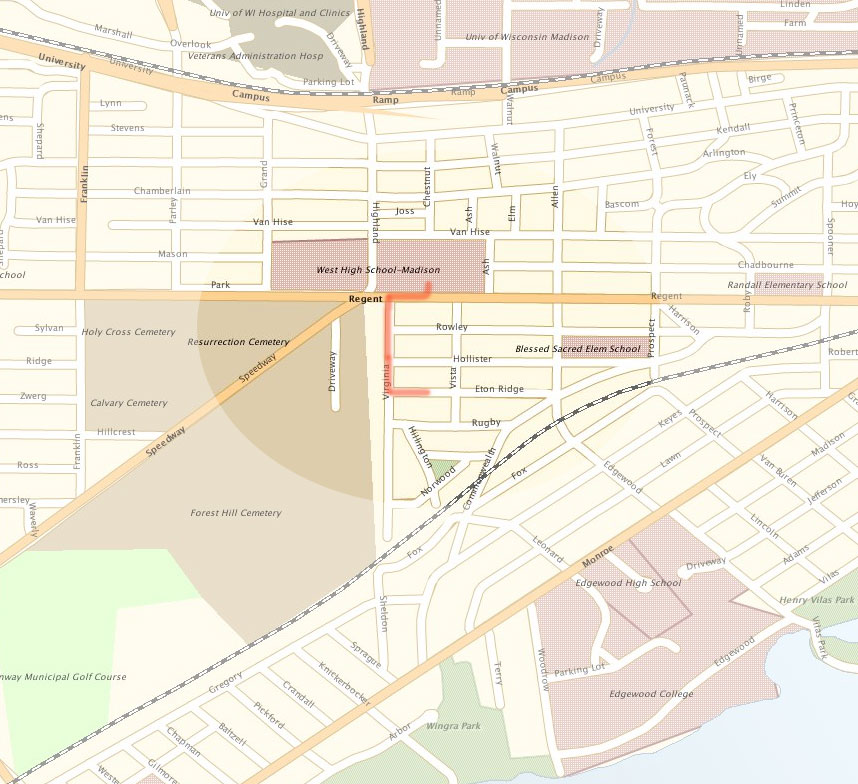
A 16-year-old Madison West High School student was arrested Friday afternoon after he allegedly dragged his ex-girlfriend out of the school and threatened to harm her in a nearby cemetery.Madison's Sherman & Shabazz schools were locked down briefly Tuesday.The teen was tentatively charged with false imprisonment, intimidation of a victim and two counts of disorderly conduct, Madison police said.
According to police, the incident was reported at about 12:15 p.m. Friday at the high school, 30 Ash St.
"The 16-year-old female victim said the boy pulled her out of school against her will and led her by the arm to a nearby cemetery where he threatened to harm her," said police spokesman Joel DeSpain.
Newsletter signup | Send us your ideas
I was assailed at my workplace. This wouldn't be out of the ordinary had my workplace been a boxing or MMA ring. But it is not typical, as my workplace is a school.I was struck in the head and face from behind as I escorted a group of students from the cafeteria. I didn't pass out or fall down, but I was stunned.
I sought medical attention and received the pat "I'm sorry that happened to you" response from those who likely couldn't find the words to make meaning of what occurred.
My assault occurred several weeks after Flamond Hightower, a paraprofessional educator at Milwaukee's Phyllis Wheatley Elementary School, sent a notorious e-mail that identified the challenges at his school. The e-mail had been intended only for Wheatley faculty and staff but found its way to the electronic mailboxes of Milwaukee Public Schools employees throughout the district. Its message was clear and strong: HELP!
Hightower pointed to and was concerned about the disorder in his school. Perhaps his means of communicating were a bit extreme, but sometimes it takes an event before people listen.
Newsletter signup | Send us your ideas
Let me start out by saying, I've never been suspended from school, and I attended Milwaukee Public Schools from kindergarten through 12th grade.Was I an angel?
No, but I was lucky enough to have teachers and school leaders who reined me in if I got out of control.
Oh, and I can't forget my mother's threat:
"Don't make me come up to your school and embarrass you in front of your friends, because you know I'll do it."
As my mother prepared to leave for work every morning, she would always say to me before I locked the door behind her, "Be good in school, and remember I love you."
That message kept me out of fights, arguments and trouble - most of the time, anyway.
When I attended school 25 years ago, a suspension was a big deal. Today, a suspension is nothing more than a vacation for kids and an inconvenience to working parents.
Newsletter signup | Send us your ideas
In the wake of several tragedies that have made bullying a high-profile issue, it's becoming clear that harassment by one's peers is something more than just a rite of passage. Bullied kids are more likely to be depressed, anxious, and suicidal. They struggle in school -- when they decide to show up at all. They are more likely to carry weapons, get in fights, and use drugs.But when it comes to the actual harm bullying does, the picture grows murkier. The psychological torment that victims feel is real. But perhaps because many of us have experienced this sort of schoolyard cruelty and lived to tell the tale, peer harassment is still commonly written off as a "soft" form of abuse -- one that leaves no obvious injuries and that most victims simply get over. It's easy to imagine that, painful as bullying can be, all it hurts is our feelings.
Newsletter signup | Send us your ideas
Luis Yudice, Safety/Security Coordinator Madison School District:
The Madison Metropolitan School District has the responsibility to provide a safe and secure learning environment for students and staff. To this end, the district periodically conducts assessments of its facilities and reviews its operating practices to ensure that all that can be done is being done to ensure the safety of our schools.Background
Following a school shooting in the Weston School District in Cazenovia, Wisconsin in 2006, Superintendent Art Rainwater issued security reminders that included the following:
- Ensure that building security and door locking procedures are followed.
- Ensure that all non-employees in a building are identified and registered in the office.
- Ensure that communication systems, radios and PA's are functioning.
- Have employees visibly display their MMSD identification badges.
- Be aware of the school's security plan and of their role in security procedures.
- Communicate with and listen to students.
- Remind students that they should always communicate with staff and share information regarding any threats to the school or to other persons.
- Ensure that the school's crisis team is in place.
Newsletter signup | Send us your ideas
Jim Wilkinson took it personally when Juan Perez murdered two men.Certainly he had sympathy for the victims, Joseph Rivera and Michael Ralston. But he didn't know them.
The issue was Perez. Wilkinson felt he barely knew him - and that was the problem. Perez had been one of Wilkinson's students the previous year when Perez was 15 and a freshman at Marquette University High School.
Almost everybody at Marquette High barely knew Perez. He never asked for help. He stayed to himself. He got mediocre grades, but he wasn't failing. And he left the school after that freshman year. Instead, he got involved deeply with a gang.
A tense, angry confrontation between members of two gangs in a restaurant on Feb. 13, 1993. A slap. Insults. A couple guns. And, in short order, the teenager was receiving a 60-year sentence.
Almost 18 years later, both Perez and Wilkinson feel they have changed for the better.
Newsletter signup | Send us your ideas
A 17-year-old honor student says she has been kicked off campus for the rest of the school year, because of a mix-up with her lunch box.In October, senior Ashley Smithwick says she got in trouble at school for the first time in her life after she mistakenly took her father's lunch container -- that's identical to hers -- to Southern Lee High School.
Her dad's container had a three-inch paring knife inside.
"And I had just grabbed my dad's lunch box," Smithwick said. "I didn't mean to. I really didn't. I just grabbed it and went out the door."
School leaders say during that day a faculty member discovered a student with marijuana on campus and Smithwick's paring knife was found during a random search.
According to a written statement received by ABC11 from Lee County Schools Superintendent Jeff Moss on Wednesday, the knife was found in Smithwick's purse, not her lunchbox.
Newsletter signup | Send us your ideas
School officials across the country are revisiting "zero-tolerance" disciplinary policies under which children are sometimes arrested for profanity, talking back to teachers or adolescent behavior that once would have been resolved in meetings with parents. The reappraisals are all to the good given that those who get suspended or arrested are more likely to drop out and become entangled in the criminal justice system permanently.The New York City Council clearly had this link in mind when it passed a new law earlier this week that will bring long overdue transparency to the school disciplinary process. Under the Student Safety Act, which takes effect in 90 days, the New York Police Department's school security division will be required to provide clear and comprehensive data that show how many students are arrested or issued summonses at school and why. School officials will also have to provide similarly detailed information on suspensions.
Newsletter signup | Send us your ideas
There was something strange in The Washington Post a week ago. A chart on page A16, using data provided by the D.C. public school system, showed that in late summer and fall 2009, Spingarn High School had by far the lowest number of assaults, thefts, threats and other crimes. There were just six incidents in four months compared with an average of 31 in the other eight high schools assessed.At that time, teachers at this allegedly safest of all regular D.C. high schools were reporting a rash of crimes and classroom intrusions. The situation became so intolerable that by January they had persuaded D.C. Schools Chancellor Michelle A. Rhee to replace the Spingarn principal.
How could the incidents being reported by security guards under school district rules be so different from what people at the school were experiencing? Why did Rhee ignore the data in changing the school's leadership and yet her successor, Kaya Henderson, used data from similar security incident reports last week to replace the principal at Dunbar High?
Newsletter signup | Send us your ideas
It comes as no surprise that Madison school districts are suffering. Public schools throughout the city struggle with a severe lack of state funding that only adds to the lack of authority figures--fueling the ideology of students who just don't give a shit. And when you combine this lack of resources and educational programs with a student attitude that cares little about achievement, you get the perfect recipe for a continual decrease in graduation rates.After all, students who fail to complete their homework or who show respect for their teachers can reasonably argue that if the state doesn't show its support for education through monetary aid, why should they be expected to put in the extra effort? And while this argument lacks concrete support, a recent rise in poor behavior among middle school and high school students shows that they lust for learning and respect for fellow classmates is plummeting.
To be honest, kids just don't care anymore.
Newsletter signup | Send us your ideas
In past years the Madison School District might have expelled more than a dozen students in the first quarter.Watch a Madison School Board discussion of the Phoenix program, here (begins about 10 minutes into the video).This year the number of expulsions in the first quarter -- zero.
The sharp reduction is the result of the district's new Phoenix program, an alternative to expulsion that district officials hope will allow students to focus on academics and improved behavior, rather than spend as long as a year-and-a-half falling behind their peers while disconnected from school services.
As of last week, 17 students who have committed expellable offenses were enrolled in the program. Rather than face an expulsion hearing, each has been given a second chance to continue learning in a classroom away from their peers. The district has expelled between 33 and 64 students a year in the last decade.
Newsletter signup | Send us your ideas
Dunbar High School Principal Stephen Jackson was fired at the end of the last school year by the private management group in charge of the school but put back in the job last week by interim D.C. Schools Chancellor Kaya Henderson at the urging of parents, community leaders and teachers. Jackson seemed an unusually lively and energetic educator when I met him at the long-troubled Northwest Washington school a year ago. He may be the person who can finally straighten Dunbar out.But the odds are against him because of the ingrown nature of the school's problems and the dispiriting message Henderson's decision sends to him and any other school leader she assigns to a low-performing school after this.
Newsletter signup | Send us your ideas
A French nursery school teacher who kept kids calm while a sword-wielding teenager took their classroom hostage is being hailed as a hero today.French authorities say Nathalie Roffet kept the 17-year-old hostage-taker talking for hours so he didn't threaten the children and reasoned with him to secure their release from the school in Besancon, a small city near the Swiss border.
Roffet, who has been teaching at the Charles-Fourier school for five years, showed "remarkable sangfroid," Besancon Mayor Jean-Louis Fousseret told reporters today, according to The Telegraph. The four-hour standoff ended this morning when the teen released the final six children and the teacher. Then, GIGN, an elite French police force, stormed the building, shot him with a stun gun and arrested him.
Newsletter signup | Send us your ideas
A West High School student was arrested Tuesday afternoon after punching another student while wearing brass knuckles, according to the Madison Police Department. Police said the incident happened in the hallway of the school at about 12:20 p.m.
Newsletter signup | Send us your ideas
The Madison School District Administration
On June 14, 2010, the Board was presented with a Document entitled Disciplinary Alternatives: Phoenix Program.That Document outlined the foundation for the current Phoenix Program, an alternative to expulsion that allows a student's expulsion recommendation to be held in abeyance while the student participates in a half-day program tailored to the student's academic, emotional and behavioral needs. At the time of presentation, the Board voted to implement the Phoenix Program.
The June 14, 2010 document did not provide all the details related to the Phoenix Program and contemplated that further details would be provided to the Board as the Program was implemented. This memo is intended to advise the Board of the current state of the Phoenix Program, provide further details of its operation and advise the Board of changes to prior practices that have been made in the process of implementing the Phoenix Program.
For ease of reference, this Update will follow the structure of the June 14, 2010 Document. Also for !he Board's reference the following documents are attached to this Update: Phoenix Program Participation Agreement, the "Knowledge" analysis form, and a chart that compares and contrasts the old practices versus the new practices.
IntroductionAs the Board will recall, the Phoenix Program was recommended and adopted in order to provide an alternative toexpulsionforstudentswhocommittedcertainexpellableoffenses. Theintentoftheprogramistoprovide academic, social and emotional interventions to students who engage in certain behavior in order for students to remain connected to the school environment and improve their prosocial skills and not repeat the same or similar behavior.
Newsletter signup | Send us your ideas
Authorities are beefing up security at schools in this border city after graffiti threatening attacks on students and teachers was scrawled on school grounds, state and local officials said Friday.Officials have increased police patrols and are installing security cameras to prevent a repeat of last week's spate of threats that targeted five or six primary and secondary schools, said Claudio Gonzalez Ruiz, head of public safety in Ciudad Juarez.
In the messages, extortionists threatened to harm teachers and students if school administrators, or in some cases the teachers themselves, failed to pay up.
At the Rafael Velarde Elementary School, extortionists demanded to be given the 50,000-peso (about $4,000) prize of a fundraising raffle, administrators said. At other schools, messages demanded teachers fork over their Christmas bonuses.
Javier Gonzalez Mocken, who heads the city's education department, declined to provide any details about the exact nature of the threats. While some of the messages were written in graffiti on walls, others were scrawled on signs tacked up on school grounds or telephoned to officials, Gonzalez Mocken said.
Newsletter signup | Send us your ideas
A few years ago, teachers at Ellis Middle School in Austin, Minn., might have said that their top students were easy to identify: they completed their homework and handed it in on time; were rarely tardy; sat in the front of the class; wrote legibly; and jumped at the chance to do extra-credit assignments.But after poring over four years of data comparing semester grades with end-of-the-year test scores on state subject exams, the teachers at Ellis began to question whether they really knew who the smartest students were.
About 10 percent of the students who earned A's and B's in school stumbled during end-of-the-year exams. By contrast, about 10 percent of students who scraped along with C's, D's and even F's -- students who turned in homework late, never raised their hands and generally seemed turned off by school -- did better than their eager-to-please B+ classmates.
Newsletter signup | Send us your ideas
Responding to safety concerns about bullying, fights and unruly behavior on student bus routes, Metro Transit is working with the Madison School District to impose sanctions against disruptive students.
Starting as early as mid-January, Metro officials may limit bus access for students who misbehave in ways that don't currently result in penalties -- such as vandalism, throwing objects, horseplay, and loud or vulgar language.
Unruly students with unlimited bus passes could receive a limited pass that would only cover travel to and from school. Currently, those passes allow students to ride buses throughout the city at any time.
Though Metro now has cameras on all of its buses, students, particularly those in middle school, are still misbehaving, school district security coordinator Luis Yudice said. Some students are bullied to the point that they arm themselves with knives or join gangs for protection, he said.
Newsletter signup | Send us your ideas
The stairwell at East High School where an alleged sexual assault took place last week will soon be off limits to students except in emergencies, a Madison School District official said Tuesday.The door at the top of the stairwell, which leads to a building exit, will be labeled as an emergency exit, and an alarm will sound if it is opened, security coordinator Luis Yudice said.
"We're talking about a comprehensive reassessment of building security at East," Yudice said. "This incident served as a reminder to other schools that we always need to be vigilant and alert."
The district also plans to add a sixth security officer to the school (other high schools have five), extra surveillance cameras and a visitor welcome center by January, as well as asking school staff to help patrol hallways.
Newsletter signup | Send us your ideas
Susan Troller, via a kind reader's email:
It's been a rough week in Madison schools, with the first degree sexual assault of a student in a stairwell at East High School and an alleged mugging at Jefferson Middle School.The sexual assault occurred on Thursday afternoon, according to police reports. The 15-year-old victim knew the alleged assailant, also 15, and he was arrested and charged at school.
On Wednesday, two 13-year-old students at Jefferson allegedly mugged another student at his locker, grabbing him from behind and using force to try to steal his wallet. The police report noted that all three students fell to the floor. According to a letter sent to Jefferson parents on Friday, "the student yelled loudly, resisted the attempt and went immediately to report the incident. The students involved in the attempted theft were immediately identified and detained in the office."
The mugging was not reported to police until Thursday morning and Jefferson parents did not learn about the incident until two days after the incident. When police arrived at school on Thursday, they arrested two students in the attempted theft.
Parents at East were notified Thursday of the sexual assault.
Luis Yudice, Madison public schools safety chief, said it was unusual for police not to be notified as soon as the alleged strong arm robbery was reported to school officials.
Related: Gangs & School Violence Forum Audio & Video and police calls near Madison high schools 1996-2006.
Newsletter signup | Send us your ideas
Channel3000, via a kind reader's email:
A Madison East High School student has been arrested and charged on suspicion of sexually assaulting another student on school grounds this week.
Madison police said the 15-year-old boy was arrested on a charge of first-degree sexual assault on Thursday after a 15-year-old girl reported the incident.Dan Nerad, superintendent of the Madison Metropolitan School District, said while these cases are rare, they happen and it forces district officials to take a step back and look how this could have been prevented. Officials sent a letter home to parents to explain the incident and the district's next steps.
"We're going to work real hard to deal with it, we're going to work real hard to learn from it. We're going to work real hard to make any necessary changes after we have a change to review what all of these facts and circumstances are," Nerad said.
Nerad said that while there are things the district can do to prevent such incidents, he believes much more help is needed from the community. He said the fact that this type of activity has entered the school door should be a wake up call to society.
Related: Gangs & School Violence Forum Audio & Video and police calls near Madison high schools 1996-2006.
Newsletter signup | Send us your ideas
Matthew DeFour & Ed Treleven, via a kind reader
The 15-year-old boy arrested Thursday for the alleged sexual assault of a 15-year-old girl at Madison East High School had been arrested four other times since March 2009, according to a county official.The boy, who isn't being identified because he is a juvenile, was charged in a delinquency petition Friday with the adult equivalent of first-degree sexual assault of a child for the incident, which allegedly happened Wednesday in a stairwell at East.
Dane County Court Commissioner Marjorie Schuett on Friday ordered the boy kept at the juvenile jail for now, citing the "very serious allegations" he faces.
Juvenile Court Administrator John Bauman said the boy has been arrested in the past for disorderly conduct, resisting arrest, battery and disorderly conduct while armed.
"He's a young man who has significant issues," Bauman said.
Newsletter signup | Send us your ideas
MPS is in the throes of an alternative to suspensions - Positive Behavioral Interventions and Supports, or PBIS.According to the Milwaukee Public Schools, the goal of PBIS is to "reduce classroom disruptions and student suspensions through a schoolwide systematic three-tiered response-to-intervention (RTI) approach." PBIS looks like adults in the school community offering positive verbal redirection and modeling positive conduct. The point: to teach students about positive behavior.
Some of the nearly 100 MPS schools that use the PBIS system this academic year have reported successes. Fewer suspensions are being reported. That's good news, right? Superintendent Gregory Thornton believes that "Finding ways to keep students in school instead of suspending them improves their chances of learning and improving academically," which minimizes disruptions and keeps kids in class.
Newsletter signup | Send us your ideas
Officials limit access to Stoughton High School after gun threatResponding to rumors that a student might bring a gun to Stoughton High School today, Stoughton police officers patrolled the school Thursday and plan to continue patrols today and Monday, district Administrator Tim Onsager said.
Access to the high school was allowed through only one door all day and at a second door before school, during lunch and after school, principal Mike Kruse said in an e-mail. Most extracurricular activities were canceled Thursday and today, as were staff meetings scheduled for today to allow teachers to remain in the classroom with students, Kruse wrote.
The district continues to investigate the origin of the rumors, but has not been able to substantiate any of the various stories circulating among students. No students have been disciplined so far, Onsager said.
Newsletter signup | Send us your ideas
Half of high school students say they've bullied someone in the past year, and nearly half say they've been the victim of bullying, according to a national study.The survey released Tuesday by the Los Angeles-based Josephson Institute of Ethics asked more than 43,000 high school students whether they'd been physically abused, teased or taunted in a way that seriously upset them. Forty-three per cent said yes, and 50 per cent admitted to being the bully.
The institute's president, Michael Josephson, said the study shows more bullying goes on at later ages than previously thought, and remains extremely prevalent through high school.
"Previous to this, the evidence was bullying really peaks in middle school," Josephson told The Associated Press.
Newsletter signup | Send us your ideas
When the principal told Sylvia Mojica that her 12-year-old son had brought a weapon with him to the Latino Studies Academy at Burns Elementary School on Friday, she became nervous and reacted, she said, as any mother would.Mojica told the principal she had given the BB gun to her son -- even though it wasn't true, she said.
"I took the blame so that my son would not get arrested," she said. "I know I made a mistake, but I believe any parent would have done the same thing."
Newsletter signup | Send us your ideas
Overall, my second year as a teacher has been ten times easier than my first year -- I am feeling confident and in control, even when I allow the students to take the wheel for a bit. It feels great! But there is one class that I'm still having trouble with.My largest class happens to also contain about 15 of the most difficult students in the grade. While this means that my other classes are wonderful, devoid of any trouble-makers, this class reduced me to tears yesterday for the first time this year (although I would never actually cry in front of them, I saved it for later). Standing in that room, watching every single student talk without giving me a second thought, I felt like a newbie all over again. What if, I thought, this is how it's always going to be.
Today, I got back out there and managed to get them somewhat under control. Here's how.
1. I let my feelings out the night before.
Newsletter signup | Send us your ideas
Tanya Lawler was taken aback. Her daughter, returning from West High's homecoming dance on Sept. 25, mentioned that students were randomly selected to take a breath test as they arrived, to see if they'd been drinking.While her daughter was not tested, Lawler considers this a "violation of Fourth Amendment rights" because officials lacked probable cause to suspect the people being tested. Her son attended La Follette's homecoming dance, held the same night, and reported that no testing was done there.
In fact, West is the only high school in Madison that has a formal written policy (PDF) regarding student dances, and the only one that randomly tests students as they enter using "a passive alcohol detection device." Students and a parent must sign a form agreeing to these rules.
Lawler, who doesn't remember this form, advised her daughter to refuse this test. "I would rather forfeit the price of the ticket and have her call me. I'd say, 'No, they're not going to violate your rights.'"
Newsletter signup | Send us your ideas
Annapolis police are changing the way they share information with schools after it was revealed that a high school senior charged this week with assaulting of a fellow student faced similar charges months ago.The 17 year old from Annapolis was charged Wednesday with attempted second-degree rape and related counts in a Sept. 29 sexual assault involving a 14-year-old girl outside Annapolis High School. He is awaiting trial on charges he raped another teenager in May.
Anne Arundel County Public Schools officials say police never told them about the earlier allegations.
Newsletter signup | Send us your ideas
In a ruling that puts new restraints on get-tough "zero tolerance" discipline, the North Carolina Supreme Court ruled Friday that schools must provide strong reasons for denying alternative schooling or tutoring to students after they are suspended for misbehavior.The case was brought on behalf of two girls who were suspended for five months in 2008 after a brief fistfight at their high school in Beaufort County that involved no weapons or injuries. The suit did not question the district's right to suspend them, but protested the additional, harsher step the district took, denying them access to the county's alternative school for troubled students or help with study at home.
Legal experts said the decision, in a case that had drawn national attention from civil rights groups, children's advocates and school leaders, was likely to be cited as a precedent as other states confront similar issues. The ruling affects one aspect of the zero-tolerance discipline policies that spread throughout the country over the last two decades, a policy originally intended to weed out dangerous children but one that critics say is used too readily for lesser infractions, derailing the lives of black children in particular.
Newsletter signup | Send us your ideas
A 15-year-old student at West High School was arrested Friday for possession of a handgun, according to the Madison Police Department.Search 53726 on crimereports.com.A letter sent to parents from principal Ed Holmes said a staff member received information that the student might be in possession of a gun, and contacted the Educational Resource Officer in the building. Police were called at about 11:45 a.m., and with their assistance, the officer located the student on Ash Street with the loaded .22 caliber handgun in his pocket and arrested him.
September, 2010 message from West High School's principal.
Newsletter signup | Send us your ideas
The father of an 11-year-old bullying victim threatened to kill his daughter's tormenters after joining her on her Florida school bus.James Jones took his daughter, who has cerebral palsy, onto her school bus and told her to point out the bullies. Then, he said he would kill them.
"I'm gonna (expletive) you up -- this is my daughter, and I will kill the (expletive) who fought her," Jones said.
Newsletter signup | Send us your ideas
The recent news that the Philadelphia School District has seen its number of "persistently dangerous" schools drop by 20 percent should be cause for optimism. Disciplinary policy changes that I advocated while I was the state safe schools advocate, which were implemented with the strong support of Mayor Nutter and Superintendent Arlene Ackerman in 2008, may be having the hoped-for effect.With most matters in the school district, however, every step forward is accompanied by at least one step backward. While the superintendent once stood up to members of the School Reform Commission who had long abetted the violence, she has since failed to back up her antiviolence policies with concrete action.
Ackerman's ham-handed reaction to the victimization of Asian students at South Philadelphia High School is only the most obvious example. Continued cuts in alternative education programs for disruptive students are equally disappointing, as was the elimination of order-enforcing "climate managers" in neighborhood schools that need more capable adults, not fewer.
It's hard for longtime observers of the district to believe the data and trust that it's turned the corner on violence, partly because we've been lied to before. The district has supposedly had a "zero tolerance" policy on violence since 2002, but it failed to expel anyone for any offense between 2005 and 2009. The district reported school violence was on the decline from 2001 to 2006, but The Inquirer found that it had vastly underreported the data.
Newsletter signup | Send us your ideas
City of Madison PDF, via a kind reader's email:
Update: Gang-Related IssuesUpdate: Safe Routes to School Discussion:
Easement Around Chavez Elementary School
Newsletter signup | Send us your ideas
When it came to violent crime, Armando Barragan started young, shooting up a van of rival gang members at age 14 and, eight months later, attacking a Milwaukee police officer, trying to grab his gun.The crimes landed Barragan in the juvenile justice system, but he got breaks that kept him on the street, where he committed new crimes, according to Children's Court records and police reports reviewed by the Journal Sentinel.
Barragan quickly rose to become a leader of the Latin Kings and was charged with ordering the execution of a man who tried to stop a fight outside a Cudahy gas station in 2003 - one of six homicides or attempted homicides he was investigated for by the time he was 18.
The Journal Sentinel reported in July that miscommunication between federal and state authorities resulted in missing a chance to arrest Barragan in a courtroom before he fled to Mexico and became one of the U.S. Marshals Service's most wanted fugitives.
Court documents show Barragan could have - and probably should have - been behind bars in April 2003, when Kevin Hirschfield was shot to death outside the gas station. He was free because of breaks he received, first from a judge and later from police, according to court records and interviews.
Newsletter signup | Send us your ideas
The Madison School District's Ken Syke via email:
Jim,I phoned (608) 252-6120 the Wisconsin State Journal (part of Capital Newspapers, which owns madison.com) and spoke with Jason (I did not ask his last name) today at about 2:20p.m. I asked about the status of this story [Dane County Case Number: 2010CF001460, Police call data via Crime Reports COMMUNITY POLICING 03 Sep 2010 1 BLOCK ASH ST Distance: 0 miles Identifier: 201000252977 Suspicious Vehicle Agency: City of Madison]. He spoke with another person, returned to the phone and said that a police officer phoned the reporter, Sandy Cullen and said the report she mentioned was incorrect. They then took the article down. I asked him to email me this summary, which I will post upon receipt.I've been made aware of the entry on the School Info Systems site about La Follette student taking gun to school. That story has been retracted by madison.com and thus the story excerpt on the the SIS site is not supported any longer. It's our understanding that this madison.com story will remain retracted.
Thus we request that the story excerpt be pulled from the School Info Systems site.
Thank you.
Links from the original post:
Related:
Newsletter signup | Send us your ideas
A La Follette High School student who police say was involved in a gang-related, armed altercation Friday outside West High School was charged Wednesday with felony possession of a firearm in a school zone.Much more, here.Uriel Duran-Martinez, 18, also was charged with misdemeanor disorderly conduct and cited for possession of marijuana, according to online Dane County Circuit Court records.
Court Commissioner W. Scott McAndrew ordered Duran-Martinez released from Dane County Jail on a signature bond.
According to Madison police:
Newsletter signup | Send us your ideas
An armed altercation Friday outside West High School involving known and suspected members of two street gangs involved in an April homicide heightened concerns of possible retaliation, police and school officials said Tuesday.Related: Gangs & School Violence Forum audio / video.Sgt. Amy Schwartz, who leads the Madison Police Department's Crime Prevention Gang Unit, said it is not known if members of the South Side Carnales gang went to the high school looking for members of the rival Clanton 14, or C-14 gang.
But staff at West and the city's three other main high schools and two middle schools were told Tuesday to determine if safety plans are needed for any students who might be at risk, said Luis Yudice, security coordinator for the Madison School District.
Police have not notified the School District of a specific threat against any student, Yudice said.
But authorities have been concerned about possible retaliation since the April 28 shooting death of Antonio Perez, 19, who police say founded Madison's C-14 gang several years ago while he was a high school student. Five people, who police say are associated with the South Side Carnales and MS-13 gangs, are charged in Perez's slaying. Two of them remain at large.
A kind reader noted this quote from the article:
"But authorities have been concerned about possible retaliation since the April 28 shooting death of Antonio Perez, 19, who police say founded Madison's C-14 gang several years ago while he was a high school student."Much more here.
Newsletter signup | Send us your ideas
The children most at risk of attempted abduction by strangers are girls ages 10 to 14, many on their way to or from school, and they escape harm mostly through their own fast thinking or fierce resistance, according to a new national analysis.Probing a crime that is infrequent but strikes fear in the hearts of parents as little else does, analysts from the National Center for Missing & Exploited Children found that children who encountered would-be abductors were usually alone, often in the late afternoon or early evening.
It's a chilling thought for working parents and all those who have asked children to hold hands tightly in crowds or to phone as soon as they get home from school. It calls to mind last year's killing of Somer Thompson, 7, snatched en route from school in Florida as she ran ahead of her siblings, and the highly publicized case of Elizabeth Smart, taken from her Utah bedroom at age 14.
Newsletter signup | Send us your ideas
A few years ago, a Madison gang targeted a prominent detective for murder. That plot failed. But police say gangs have been responsible for at least three murders in the last three years.Gangs & School violence forum audio / video.Although there are now more than 1,100 gang members in the Madison area, they're not always visible. Nor is the connection between gangs and crime. Regardless, police and social workers say the gang problem here is real and they're actively trying to combat it.
Newsletter signup | Send us your ideas
Well, we survived the first week of school, so for this week, let's review as we do every year how parents can help keep kids safe.
- Never place your child's name on any piece of clothing that is visible to anyone. You do not want to make them a target for a stranger to call out to by name.
- Make sure your child knows his or her full name, phone number, parents' full names, address and a work phone number. It is not helpful when officers find children who do not know their full names or addresses.
- Throughout the school year, talk to your child about drugs, strangers and any weapon they might see or hear about, a bully or any related concerns. Let the child know that such information should be reported to the teacher and to you immediately.
- If your child is going into a new school or going to school for the first time, ask her whether there is anything that frightens or makes him/her uncomfortable. Share that information with the teacher or school police; officers are well-trained in safety issues.
Newsletter signup | Send us your ideas
The Madison School District will ask for proof of age when registering students who live with people other than their parents or guardians or those who are 18 years or older and are enrolling themselves for school.The district disclosed the new procedure -- which goes into effect next month for the 2010-11 school year -- in a statement to the State Journal dated July 23 and received Monday.
The announcement comes three months after the revelation that a 21-year-old gang member charged in a fatal April shooting had enrolled in Madison's West High School and later transferred to Middleton High School under a fake name and age.
Ivan Mateo-Lozenzo, 21, was enrolled at Middleton High School as 18-year-old junior Arain Gutierrez at the time of the shooting. Middleton officials have said Mateo-Lozenzo, who police have identified as an illegal immigrant from Veracruz, Mexico, had transferred from Madison's West High School.
Newsletter signup | Send us your ideas
Susan Engel & Marlene Sandstrom, via a Rick Kiley email:
HERE in Massachusetts, teachers and administrators are spending their summers becoming familiar with the new state law that requires schools to institute an anti-bullying curriculum, investigate acts of bullying and report the most serious cases to law enforcement officers.This new law was passed in April after a group of South Hadley, Mass., students were indicted in the bullying of a 15-year-old girl, Phoebe Prince, who committed suicide. To the extent that it underlines the importance of the problem and demands that schools figure out how to address it, it is a move in the right direction. But legislation alone can't create kinder communities or teach children how to get along. That will take a much deeper rethinking of what schools should do for their students.
It's important, first, to recognize that while cellphones and the Internet have made bullying more anonymous and unsupervised, there is little evidence that children are meaner than they used to be. Indeed, there is ample research -- not to mention plenty of novels and memoirs -- about how children have always victimized one another in large and small ways, how often they are oblivious to the rights and feelings of others and how rarely they defend a victim.
Newsletter signup | Send us your ideas
When kids act out, it's often the parents who get the blame.Whether they're getting in trouble in school or misbehaving with family, many parents worry they're doing something wrong. But that may not always be the case.
Guests:
Dr. Richard Friedman, professor of psychiatry at Weill Cornell Medical College in New York
Po Bronson, author of NurtureShock
Newsletter signup | Send us your ideas
Contrary to Leo Tolstoy's famous observation that "happy families are all alike; every unhappy family is unhappy in its own way," a new psychology study confirms that unhappy families, in fact, are unhappy in two distinct ways. And these dual patterns of unhealthy family relationships lead to a host of specific difficulties for children during their early school years."Families can be a support and resource for children as they enter school, or they can be a source of stress, distraction, and maladaptive behavior," says Melissa Sturge-Apple, the lead researcher on the paper and an assistant professor of psychology at the University of Rochester.
"This study shows that cold and controlling family environments are linked to a growing cascade of difficulties for children in their first three years of school, from aggressive and disruptive behavior to depression and alienation," Sturge-Apple explains. "The study also finds that children from families marked by high levels of conflict and intrusive parenting increasingly struggle with anxiety and social withdrawal as they navigate their early school years."
The three-year study, published July 15 in Child Development, examines relationship patterns in 234 families with six-year-old children. The research team identified three distinct family profiles: one happy, termed cohesive, and two unhappy, termed disengaged and enmeshed.
Newsletter signup | Send us your ideas
The girl's parents, wild with outrage and fear, showed the principal the text messages: a dozen shocking, sexually explicit threats, sent to their daughter the previous Saturday night from the cellphone of a 12-year-old boy. Both children were sixth graders at Benjamin Franklin Middle School in Ridgewood, N.J."I said, 'This occurred out of school, on a weekend,' " recalled the principal, Tony Orsini. "We can't discipline him."
Had they contacted the boy's family, he asked.
Too awkward, they replied. The fathers coach sports together.
What about the police, Mr. Orsini asked.
A criminal investigation would be protracted, the parents had decided, its outcome uncertain. They wanted immediate action.
They pleaded: "Help us."
Newsletter signup | Send us your ideas
Look at this video and tell me where the hell are the teachers? WHOEVER the principal is at this school (video is from '07) needs to be fired. The teacher should be fired as well. Look closely at the 2:26 mark of this video clip and see the teacher (or some adult) sitting up against some counter watching this ish. Is this man getting thrills watching these adolescent, Black Kids grind on each other? No excuse MPS, this is why WE cannot read, write or do math with any competency at many of the public schools.
Newsletter signup | Send us your ideas
Even though the Supreme Court ordered a ban on the administration of corporal punishment to children almost a decade ago, it is shocking that schools across the country continue to adhere to the philosophy of 'spare the rod and spoil the child'. The tragic case of Rouvanjit Rawla once again highlights this point. Rouvanjit, who was a student of Kolkata's prestigious La Martiniere School for Boys, committed suicide after he was caned by his school principal and allegedly by four other teachers as well. What is truly despicable is that the school principal has no regrets about the incident and has admitted as much to the school's board of governors and the National Commission for Protection of Child Rights investigating the case. This reflects a perverse streak among certain educators who have no qualms about using their position of authority to inflict physical torture on children. The problem is symptomatic of a virulent mindset within the education system that sees corporal punishment as a legitimate means to discipline students and build character. In reality all it does is promote a culture of violence.
Newsletter signup | Send us your ideas
In response to the questions raised at the June 7 meeting of the Performance and Achievement Committee, the following information is shared in hopes ofclarifying proposed changes to the Student Code of Conduct:Will there be a more specific definition ofbullying than the one that currently exists in the Explanation of Conduct Rules and Terms?
The following definition comes from the draft Anti-Bullying & Anti-Harassment Protocol and it, or a similar definition, will be brought forward with the version of the revised Code for which Board approval will be sought in July:
Bullying is the intentional action by an individual or group of individuals to infiict physical, emotional or mental suffering on another individual or group of individuals when there is an imbalance of real or perceived power. Harassing and bullying behavior includes any electronic, written, verbal or physical act or conduct toward an individual which creates an objectively hostile or offensive environment that meets one or more of the following conditions:
Places the individual in reasonable fear of harm to one self or one's property
Has a detrimental effect on the individual's personal, physical or mental health
Has a detrimental effect on the individual's academic performance
Has the effect of interfering with the individual's ability to participate in or benefit from any curricular, extracurricular, recreational, or any other activity provided by the school
Has the intent to intimidate, annoy or alarm another individual in a manner likely to cause annoyance or harm without legitimate purpose
Has personal contact with another individual with the intent to threaten, intimidate or alarm that individual without legitimate purpose
Newsletter signup | Send us your ideas
Verona school leaders are standing by their warning of potential retaliatory gang violence at the high school or Hometown Days this weekend.The warning the Verona Area School District issued Wednesday night comes about six weeks after the fatal shooting of Antonio Perez on Madison's East Side. Madison police have said they believe the slaying was gang-related.
Police in Madison, Middleton and Verona have been on alert for potential gang retaliation since Perez was killed in April 28. Authorities said the threat of violence between the Clanton 14 gang and the Carnales gang has been on their radar.
Verona Area School District Superintendent Dean Gorrell explained Thursday that it was his decision, and not by direction of law enforcement, that a warning on the threat of violence was announced Wednesday night.
Newsletter signup | Send us your ideas
The Mayor's office was kind enough to allow me to go to the media interviews with the 3 candidates for police chief.First up was Interim Chief John Diaz. Low-key is definitely the by-word here (maybe even anemic). There is no doubting his sincerity and commitment to SPD. However, when I asked him about his thoughts on policing in the school district or programs to curb youth violence, I got a whole lotta nothing. I followed up, thinking maybe he didn't understand me, but it was just a lot of blah, blah, blah about working with the district. For my narrow perspective, it was disappointing.
Newsletter signup | Send us your ideas
Following is a message from the Superintendent and VAHS Administration. Please address any inquiries to VAHS Administration or Dr. Gorrell.Related: Gangs & School Violence Forum Audio / Video.Through our contacts with the Dane County Gang Task Force we have recieved information that indicates in the coming days the VAHS campus or Verona Hometown Days are possible locations for an altercation between two rival gangs. These gangs are the Clanton 14 gang and the Carnales gang. These are the two gangs alleged to have connections with the murder of Antonio Perez last month.
Given this information the following security measures will be put in place immediately:
Tomorrow and Friday we will have an additional VPD Officer stationed on campus working with Officer Truscott. Also, regular VPD patrol officers will be in the area patrolling both the VAHS campus and the neighboring residential area in their squad cars.
Members of the administrative team will also be out patrolling the interior and exterior of the buildings throughout the day. Special attention will be paid to monitoring the two designated K-Wing and two designated main building entrances. All other entrances are to be kept closed and locked. This too will be monitored by the VPD and HS administration.
Given current information the Administrative team, in consultation with our partners in law enforcement, believes that these are prudent preventative steps. If additional information becomes available we will alter this plan accordingly. We ask all staff members to do their usual stellar job of remaining vigilant and reporting anything of concern to the Administrative Team at once.
Keeping staff informed is a priority and more information will be provided if and when it becomes available.
Thank You,
Dr. Gorrell
Ms. Hammen
Ms. Williams
Mr. Murphy
Mr. Boehm
Newsletter signup | Send us your ideas
The district has developed over time a very detailed Student Code of Conduct that clearly outlines student misbehavior and prescribes suspension and expulsion as the specific responses for some misbehavior. While the current code is clear regarding which misbehaviors require suspension and a recommendation for expulsion, it does not offer administrators a sufficient array of options that can be used to intervene in order to support behavior change in students when suspension and expulsion are not an appropriate consequence.Related: Disciplinary Alternatives: Abeyance Option Phoenix Program:Current research shows that a reactive model in the absence of positive, proactive strategies is ineffective. As an evidence-based national model that has recently been adopted at the state level in Wisconsin, Positive Behavior Supports (PBS) provides the mechanism for schools to shift to data driven decision making and practices grounded in a tiered approach that emphasizes teaching, modeling and reinforcing pro-social skills and behavior. Many districts across the country are developing Codes of Conduct that align with the PBS Model.
As all elementary, middle and high schools move toward full implementation of Positive Behavior Supports (PBS), it is important that the Code of Conduct is aligned with the PBS model which is grounded in teaching appropriate behaviors to students and acknowledging students for learning and exhibiting positive behavior. PBS provides a framework for defining and teaching in positive terms what is expected from students as behavior expectations that are defined only by
Appendix LLL-12-11 June 14,2010
III.
rules and "what not to do" provide an inadequate understanding for students and families.
The proposed Code o f Conduct represents a step toward improved alignment with the PBS model and reflects a shift in thinking from an approach that relies heavily on rules, consequences and reactive practices to an approach that provides a multi-tiered, progressive continuum of interventions to address a wide range of student behavior. While the current code is used primarily by administrators to determine which misbehaviors are appropriate for suspension and expulsion, the proposed code would also be used by teachers and other staff to determine which behaviors they are expected to handle in the classroom and which behaviors should be referred to the administrator or designee. It will provide all staff with multiple options in three (3) categories of intervention: Education, Restoration and Restriction (see details in attached chart). In addition, the proposed code presented in 'chart form' would be used as a teaching tool to give students a visual picture o f the increasing severity o f behaviors and the increasing intensity of interventions and consequences that result from engaging in inappropriate behaviors.
The District has developed overtime, an extensive and very clear expulsion process, that is compliant with state and federal law, that focuses on procedure and is based on zero tolerance for some behaviors, In the 2007/08 school year, 198 students were recommended for expulsion with 64 actually being expelled. In the 2008/09, 182 students were recommended for expulsion with 44 actually being expelled.Students are expelled from two to three semesters depending on the violation with an option to apply for early readmission after one semester if conditions are met. Approximately 72% of the students meet early readmission conditions and retum after one semester. Currently, no services are provided to regular education students who are expelled, Expelled special education students are entitled to receive Disciplinary Free Appropriate Public Education services.
Concems have been raised by members of the Board of Education, MMSD staff and community about the zero tolerance model, lack of services to expelled students and the significant disruption caused in the lives of these students, families and neighborhoods when students are expelled.
Approval is being sought for the implementation of an abeyance option, the Phoenix Program, including the budget, to be implemented at the beginning of the 2010/11 school year,
Newsletter signup | Send us your ideas
A U.S. appeals court heard arguments Thursday over whether school officials can discipline students for making lewd, harassing or juvenile Internet postings from off-campus computers.Two students from two different Pennsylvania school districts are fighting suspensions they received for posting derisive profiles of their principals on MySpace from home computers. The American Civil Liberties Union argued that school officials infringe on student's free speech rights when they reach beyond school grounds in such cases to impose discipline.
"While children are in school, they are under the custody and tutelage of the school," ACLU lawyer Witold Walczak argued Thursday in the 3rd U.S. Circuit Court of Appeals. "Once they leave the schoolhouse gate, you've got parents that come into play."
Newsletter signup | Send us your ideas
Pediatricians should screen children for possible mental health issues at every doctor visit, according to new, extensive recommendations a national pediatrician group issued Tuesday.These doctors also should develop a network of mental-health professionals in the community to whom they can send patients if they suspect a child needs further evaluation, according to the task force on mental health convened by the American Academy of Pediatrics. The recommendations were made in a series of reports published in a supplement to the journal Pediatrics.
In recent years, pediatricians and mental health professionals have been calling for increased attention to mental health in primary-care settings because of growing rates of disorders in children such as attention-deficit hyperactivity disorder, autism and anxiety.
At the same time, there is a shortage of child mental-health experts, particularly psychiatrists. While 21% of U.S. children and adolescents have a diagnosable mental illness, only one-fifth of that group receives treatment, according to the academy.
Newsletter signup | Send us your ideas
Shocking findings about violence and abuse at schools have been revealed in a survey of secondary students.About seven in 10 students questioned by researchers from the Chinese University of Hong Kong said they have been victims of physical violence and verbal abuse, while a third have been sexually harassed.
More than half of the 1,800 respondents to the survey, which was conducted between December and February, admitted they have bullied schoolmates, though this sort of bad behavior lessens as they grow more mature.
On that, Chen Ji-kang, an assistant professor at the university's department of social work, said there is a higher incidence of violence among juniors, particularly Form One students, and boys are usually the aggressors.
On positive interaction between students, Chen said support from friends is crucial for victims.
Newsletter signup | Send us your ideas
Sokhom Mao will do something today that few like him ever do: He'll graduate from college.Little about Mao appears unusual, except maybe his waist-length black hair. He's 23, like many students who will walk the stage today at San Francisco State University. He majored in criminal justice, has applied for the usual summer internships and wants to become a politician.
What's rare about this graduating senior is that he was raised in a group home since age 12. His mother had died, leaving him in the care of abusive relatives. Just 2 percent of foster youth earn a bachelor's degree, research shows.
Mao is in that small club because of the Guardian Scholars, a program at San Francisco State that mimics, to the extent possible, the role of parents for students who have none.
Newsletter signup | Send us your ideas
Police estimate there are now more than 1,100 confirmed gang members in Madison and about 40 gangs, about 12 of which are the main Latino gangs.Related: Gangs & School Violence Forum audio, video & links.The Dane County Enhanced Youth Gang Prevention Task Force recommended in August 2007 that a countywide gang coordinator's position be considered. That group's co-chairman, former Madison police Capt. Luis Yudice, who's also security coordinator for the Madison School District, first called for a "comprehensive strategy so we can all work in unison" to address gang violence in September 2005.
Since then, Yudice said, staff in Madison schools are recognizing more issues involving gangs among students, which he attributes in part to greater awareness and training.
"We have gang-involved kids in probably most of our high schools and middle schools and some of our elementary schools," he said. Staff do a good job of keeping gang activity out of the schools, he said, and work closely with students, families, police and social workers in an effort to keep students out of gangs.
Locally, the gang issue is not unique to Madison schools. "We're seeing more gang activity in the suburban school districts," Yudice said, as well as the emergence of hate groups targeting blacks and Latinos in Madison, Deerfield, Cottage Grove and DeForest.
Newsletter signup | Send us your ideas
They are no longer rare, random acts of one or two nutcases far from the rest of the country. A series of knife attacks in kindergartens has become the symptom of a virus lurking deep in the soul of the new China.Premier Wen Jiabao said as much on May 13, a day after the fifth attack and as the death toll among children as young as three reached 16, with dozens also wounded since the first attack two months ago. "We need to resolve the deep-seated causes that have resulted in these problems," Wen said in an interview with Hong Kong-based Phoenix Television. "This includes handling social contradictions, resolving disputes and strengthening mediation at the grassroots level."
According to The Global Times, a popular newspaper published by the official People's Daily, police have foiled seven attacks at schools since the first killings. That was at the hands of Zheng Minsheng, an apparently deranged 42-year-old man who hacked eight children to death with a cleaver in the coastal province of Fujian on March 23 [1]. Zheng was convicted and executed on April 28, the day of the second successful attack, when 16 children were stabbed in a primary school in the southern province of Guangdong. The next day, 29 children and three teachers were wounded a kindergarten in Taixing, Jiangsu province, by another cleaver-wielding madman.
Newsletter signup | Send us your ideas
ALL month schools in China have been on what the state-controlled press calls a "red alert" for possible attacks on pupils by intruders. In one city police have orders to shoot perpetrators on sight. Yet a spate of mass killings and injuries by knife or hammer-wielding assailants has continued. To the government's consternation, some Chinese have been wondering aloud whether the country's repressive politics might be at least partly to blame.In the latest reported incident, on May 12th, seven children and two adults were hacked to death at a rural kindergarten in the northern province of Shaanxi. Eleven other children were injured. It was one of half a dozen such cases at schools across China in less than two months. Three attacks occurred on successive days in late April, when more than 50 children were injured. The previous deadliest attack killed eight children in the southern province of Fujian on March 23rd. The killer was executed on April 28th.
This has been embarrassing for a leadership fond of trumpeting its goal of a "harmonious society". In 2004, two years after Hu Jintao became China's top leader, he and his colleagues called for better security at schools. But occasional attacks continued. Assailants were often said to be lone, deranged, men venting their frustrations on the weak. A report last year in the Lancet, a British medical journal, said that of 173m Chinese it estimated were suffering from mental illness, fewer than 10% had seen a mental-health professional (see article). Knives are the weapons of choice in China, where firearms are hard to obtain.
Newsletter signup | Send us your ideas
Wisconsin State Journal Editorial:
The public has a right to know if Ivan Mateo-Lozenzo, 21, attended West High School or any other Madison schools and for how long.School district officials are stubbornly refusing to say.
Nor will they disclose if the district followed its own policies for screening new students when (or if) Mateo-Lozenzo enrolled at West using a fake name and age.
Police say Mateo-Lozenzo pulled the trigger in the shooting death of gang rival Antonio Perez, 19, on Madison's East Side late last month.
Mateo-Lozenzo was an illegal immigrant from Mexico. But that's not the central issue here because the U.S. Supreme Court has ruled that school districts can't withhold public education because of immigration status.
The real issue here is school safety.
Newsletter signup | Send us your ideas
via a kind reader:
Dear Parents and Guardians,I've not seen any additional comments from the Madison School District beyond this brief statement from Superintendent Dan Nerad:
Last week we informed you of the heightened security measure at Middleton High School due to the gang-related homicide in Madison. The Middleton High School student involved in the incident was last seen in Texas and police do not believe he will return to the Madison area. As a result, security will be back to normal at the high school on Monday.You have also likely seen the news in the media regarding the true identity and age of the student involved in the incident. The individual attending Middleton High School as Arain Gutierrez was later identified by police as 21-year old Ivan Mateo-Lozenzo. Once we were made aware of the suspect's identity and age we immediately began to investigate how he was enrolled at Middleton High School. Federal privacy laws prevent us from releasing the specific information or documents that are provided for an individual student. It does appear that our enrollment policies and procedures were correctly followed for his admission to our school district. To enroll in our school district the following must be provided for the student:
- A completed enrollment form
- Proof of residency in our district, such as a MGE or Alliant Energy bill, a signed apartment lease or accepted offer to purchase a home
- Proof of age is asked for but only required for children entering kindergarten
- Immunization record, if available
- Transfer of records request from the previous school district, if applicableWe also rely on information in the Wisconsin Student Locator system. This is a database with information on every student who has attended public school in Wisconsin. Arain Gutierrez was in this system as he previously attended Madison West High School before coming to Middleton. School districts throughout the state use this database to transfer student information from one district to another for thousands of students. There would be no reason to question the legitimacy of a student name or date of birth. We also have no record of an adult ever falsifying documents to gain entrance in our school district as a minor.
As a result of this incident, we are reviewing our current policies and procedures to determine what, if any, changes will be made to our enrollment process. We also continue to work with law enforcement to assess the impact this student may have had on others in the school district. The security of our schools is our highest priority. We will continue to take all measures to ensure the safety of our students and staff.
Sincerely,
Dr. Don Johnson
Superintendent
Still, Madison Superintendent Dan Nerad said the district will review its enrollment policies."I cannot tell you where this will lead, but we will have conversations about it," Nerad said.
Newsletter signup | Send us your ideas
At 12:03:50 on 05/10/10 firefighters were dispatched for fire alarm at West high school.Several readers noted that there have been a number of recent incidents in and around West High School:On location, students had evacuated. Staff directed firefighters to a bathroom on the 3rd floor of the building where rolls of toilet paper had been burned.
Strobes were operating; alarm had been silenced. Firefighters found a moderate haze of smoke in the area and there was an odor of burned plastics. The fire was out, the toilet roll dispenser was smoldering and melted.
A fan was used from Engine 4 to start clearing the smoke.
The fire had been reported to a staff member by a student. The staff member used an extinguisher to put the fire out. Another student had been attempting to extinguish the fire with water from the sink.
The scene was turned over to a fire investigator.
April 26User's may wish to search local high school addresses on the crimereports.com website. The site supports date range searching. You must enter an address and enter a date range (see below) as the site only links to zip code area searches. The data is provided by the City of Madison, UW-Madison and the Madison Police Department. I don't know if all incidents are provided to this site.
1 Block Ash St.
Identifier: 201000110451
Time: 15:00
Battery (under general heading "Assault")The fight outside the school last week was:
April 28
Chadbourne Av and Ash St
Identifier: 201000112346
Time: 12:47 (lunchtime)
Fight Call (under general heading "Disorder")
----------------April 20
1 Block Ash St. (looks like this one was in the school)
Identifier: 201000104558
Time: 13:31
Battery (Assault)April 28
Chadbourne and Allen
Identifier: 201000112447
Time: 14:35
Battery (Assault)April 22
2100 Block Regent
Identifier: 201000106686
Time: 15:11
Battery (Assault)
Madison East High
2222 E. Washington Ave.
Madison WI 53704
Madison Edgewood High School
2219 Monroe Street
Madison, WI 53711-1999
Madison LaFollette High School
702 Pflaum Rd.
Madison WI 53716
Madison Memorial High School
201 S. Gammon Rd
Madison, WI 53717
Madison West High School
30 Ash Street
Madison, WI 53726
Newsletter signup | Send us your ideas
The Madison and Middleton-Cross Plains school districts are reviewing their enrollment policies after a 21-year-old man who police said shot and killed a rival gang member successfully enrolled this fall as a Middleton High School student under an alias."As a result of this incident, we are reviewing our current policies and procedures to determine what, if any, changes will be made to our enrollment process," said district spokeswoman Michelle Larson.
Middleton records show the man, Ivan Mateo-Lozenzo, had previously attended West High School in Madison. But Madison district officials last week would not confirm he ever attended the school.
Still, Madison Superintendent Dan Nerad said the district will review its enrollment policies.
"I cannot tell you where this will lead, but we will have conversations about it," Nerad said.
Newsletter signup | Send us your ideas
Driving through some of this city's neighborhoods is like driving through an alternate, horrifying universe, a place where no one thinks it's safe to be a child.You follow a map in which the coordinates are laid out in blood. Over there, in front of that convenience store, is where Fred Couch, 16, was shot to death last December. The Couch boy went to the same school, Christian Fenger Academy, as Derrion Albert, an honor student who was beaten with wooden planks and kicked to death three months earlier in a broad daylight attack that was recorded on a cellphone by an onlooker.
Right there, on South Manistee Avenue, is where a 7-year-old girl riding her scooter was shot in the head and critically injured a few weeks ago.
And here, on East 92nd Street, is where a toddler, just 20 months old, was shot in the head and killed in the back seat of her father's car.
Newsletter signup | Send us your ideas
Ivan Mateo-Lozenzo, the man Madison police say shot and killed a gang rival last week, is known to local authorities as a 21-year-old illegal immigrant from Veracruz, Mexico, who worked as an area roofer in 2008.Middleton High School officials thought he was an 18-year-old junior named Arain Gutierrez who had previously attended West High School in Madison.
So how did the man police still have not captured enroll in area schools?
.....
Criteria for enrollmentThe Madison School District requires the parents or guardians of a student present a utility bill, a mortgage document or a lease with their address to enroll their child in school. Under district policy, school officials are directed to "verify age and name" of a student using a birth certificate or "other documentation provided by parent."
The policy states that if a student's previous school was in a foreign country, school officials should ask to see a visa. If the student doesn't have a visa, the student is still enrolled and given an "undocumented visa notice."
Middleton-Cross Plains also requires a parent or guardian to show residency through a utility bill, lease or mortgage document, said district spokeswoman Michelle Larson. The district requires proof of age and identification through a birth certificate or passport when a student enrolls in kindergarten, but does not require it for later grades, she said.
Newsletter signup | Send us your ideas
Newsletter signup | Send us your ideas
The PI had an interesting story this morning about an incident at Washington Middle School in early April. Apparently 3 students were expelled for 15-days for aiming/having a toy gun at school. However, none of the staff told the Seattle Police School Emphasis Officer about the incident and she found out when she saw one student riding a bike during school hours. He told her about the expulsion.From the story:
In an April 21 meeting with a school staff member, in which the officer asked why she was not contacted and the incident was not reported, the staff member did not have an answer, according to a police incident report. About 15 minutes later, the staff member "stated to me it wasn't reported because 'it was a clear, plastic gun and not used with malice,'" School Emphasis Officer Erin Rodriguez wrote in the report.
Newsletter signup | Send us your ideas
via a kind reader:
Following is a message from the Superintendent of VASD, Dean Gorrell. Any inquiries should be directed to Superintendent Gorrell.Dear Verona Area School District Parents,
A Verona Area High School student has been charged today with First Degree Intentional Homicide - Party to a crime in connection with the murder of Antonio Perez. The student, Victor Prado-Velasquez, is currently incarcerated in the Dane County jail. While we have no information of potential issues with students at the Verona Area High school, we have taken and will continue to take measures to increase security and surveillance. This includes:
Working with the Verona Police Department (VPD) and our VPD Police School Liaison to increase patrols in and around campus throughout the school day.
Having members of the VAHS administrative team increase their presence outside the school building during the school day.
Working with VAHS staff to make sure that they are vigilant and report any suspicious activities at once to the Administration and the VPD Police School Liaison.
Again, we have no reason to believe any Verona Area High School student was or is at risk related to this incident. We will continue these measures until such time as all suspects have been apprehended or until we receive notification from the Police that we can discontinue these measures.We are providing you this information so that you are informed. If you have any questions regarding this, please contact me by email at gorrelld@verona.k12.wi.us or by phone at 608-845-4310.
Most Sincerely,
Dean Gorrell
Superintendent
Newsletter signup | Send us your ideas
Back in the Paleolithic period, when men and women wore their Sunday best, classroom decorum was unquestioned; the relationship between professor and student was based on a set of unspoken rules. One wonders what their reaction would be to an e-mail message I received from a student: hey prof, owt late last nite .... am sic today. pls emal cls notes. yah thatd b great. thx see u.I teach a course in public speaking at Borough of Manhattan Community College, part of the City University of New York, in which students give speeches ranging from how to clean a trumpet to solar energy. My job is to show them how to arrange their thoughts, use language to its best advantage and, most important, perform in front of an audience without fear.
Newsletter signup | Send us your ideas
AP:
Minnesota lawmakers approved legislation that increases punishment for bringing weapons to school while going a little easier on fake guns and BB guns.The bill, from Rep. Sandra Peterson, DFL-New Hope, passed the House 111-18 on Thursday.
It would punish bringing dangerous weapons onto school property with a sentence of up to five years in prison, a fine of up to $10,000 or both. That's more than double the current prison sentence and twice the maximum current fine.
Newsletter signup | Send us your ideas
Sandra Stotsky and I have pieces in today's Arkansas Democrat Gazette on the current national standards push. We take slightly different approaches -- Sandy thinks national standards are a good idea in general but the current draft has bad standards, while I think national standards are a bad idea altogether. But we end up with the same policy recommendation -- the current national standards push should be stopped. I've reproduced both pieces below:One Size Fits None
by Jay P. Greene
The Obama administration and Gates Foundation are orchestrating an effort to get every state to adopt a set of national standards for public elementary and secondary schools.
These standards describe what students should learn in each subject in each grade. Eventually these standards can be used to develop national high-stakes tests, which will shape the curriculum in every school.
Newsletter signup | Send us your ideas
Two weeks ago Secretary of Education Arne Duncan said he wanted to tackle the disparity in how students of different races with discipline problems are treated in public schools.Earlier this month, the Civil Rights Division of his federal agency informed Delaware's largest school district that it is opening an investigation involving the same issue.
Then on Monday, Duncan announced that Delaware is one of two first-round winners in the federal Race To the Top education reform competition. It now has $100 million to spend on strengthening standards and assessment, supporting quality educators, developing data systems to better measure student performance, and turning around failing schools.
Talk about intended consequences.
Newsletter signup | Send us your ideas
Nine students are being prosecuted for bullying a fellow student, Phoebe Prince, who committed suicide after being taunted and threatened. What, if anything, could and should the school have tried to protect Ms. Prince? What can and should teachers and administrators do at any school where students are bullying other kids?In their article "9 Teenagers Are Charged After Classmate's Suicide," Erik Eckholm and Katie Zezima consider what happened at South Hadley High School in Massachusetts, and the legal fallout
Newsletter signup | Send us your ideas
am in the eighth grade and a student at Robert E. Howard Middle School. I have been attending the school since 2008. I'm writing to your newspaper in view of the recent allegations of bullying at the school. In all fairness, individual incidents of bullying can happen because they are hard to detect and manage. The reason for this is that bullying can take many forms.Since being at the school, I have not personally seen anyone being bullied by another student. The security at Howard is good. Teachers monitor student activities while traveling to and from classes and at the end of the day. When teachers see something going on that should not be happening, they do their best to stop it.
Newsletter signup | Send us your ideas
FOR the evolutionarily minded, the existence of fairness is a puzzle. What biological advantage accrues to those who behave in a trusting and co-operative way with unrelated individuals? And when those encounters are one-off events with strangers it is even harder to explain why humans do not choose to behave selfishly. The standard answer is that people are born with an innate social psychology that is calibrated to the lives of their ancestors in the small-scale societies of the Palaeolithic. Fairness, in other words, is an evolutionary hangover from a time when most human relationships were with relatives with whom one shared a genetic interest and who it was generally, therefore, pointless to cheat.The problem with this idea is that the concept of fairness varies a lot, depending on which society it happens to come from--something that does not sit well with the idea that it is an evolved psychological tool. Another suggestion, then, is that fairness is a social construct that emerged recently in response to cultural changes such as the development of trade. It may also, some suggest, be bound up with the rise of organised religion.
Newsletter signup | Send us your ideas
The legislation lets the public see the workings of teams that identify threats of violence at colleges and universities.The workings of college and university threat assessment teams would be opened to the public after violent incidents under a compromise bill passed by the General Assembly.
The compromise came after weeks of negotiations between legislators and open government advocates and now goes to Gov. Bob McDonnell, who is expected to act on it before April 21. The governor may sign, veto or amend the bill.
"It's a good outcome for everyone," Virginia Press Association Executive Director Ginger Stanley said of the legislation.
Newsletter signup | Send us your ideas
By age 2 Donovan Richards was kicked out of day care for hitting. At age 3, he was obsessed with dinosaurs and utterly uninterested in other children. At 4, he was hospitalized for mania after he threatened to kill himself with his toy sword. And by 5, he was on medicine for bipolar and autism spectrum disorders. One doctor told Paula Buege her son would end up in an institution. Buege vowed to help him remain at home and go to public school in Middleton instead.Followup article here.He was a handful there. School records from a grim stretch in November 2001 show Donovan, then 7, was given frequent timeouts and suspended several days in a row. "Donovan was being escorted to the calming room. When the special education aide tried to remove a ball from the room, Donovan lay on the ball and bit the EA on the wrist. He also hit her arm with the door when she was trying to get out of the room," read one report. The next school day, Donovan threw wood chips in a classmate's face and was put into the "quiet" room again. "He repeatedly kicked the wall and slammed the window with great force, spit on walls and shouted profanity," his teacher wrote.
Newsletter signup | Send us your ideas
A 16-year-old Madison boy hiding in a bathroom at Memorial High School was Tasered and arrested Friday morning after he acted combative toward police.The teenage student, who was not supposed to be inside the school at 201 S. Gammon Road, was found just before noon in the bathroom and was non-compliant and confrontational toward an assistant principal and a Madison Police Department educational resource officer, police said.
Newsletter signup | Send us your ideas
Via a Maggie Ginsberg-Schutz email:
Families and/or kids needed to discuss personal experience with cyber bullying. A reporter for a local print publication is putting together an in-depth look at electronic aggression and kids/teens. She is looking for real stories that go beyond the statistics. First names only (unless you're comfortable giving more), along with some general information like age and area (for example, "12-year-old John from Verona"). Unfortunately, time is crunched. If you have a personal experience with harassment, humiliation, or bullying on MySpace, Facebook, blogs, Twitter, text messaging, or something similar, please contact Maggie at 608-437-4659 or maggieschutz@gmail.com as soon as possible.
Newsletter signup | Send us your ideas
If you don't think the police in New York City need to be reined in, consider the way the cops and their agents are treating youngsters in the city's schools.In March 2009, a girl and a boy in the sixth grade at the Hunts Point School in the Bronx were fooling around and each drew a line on the other's desk with an erasable marker. The teacher told them to erase the lines, and the kids went to get tissues. This blew up into a major offense when school safety officers became involved.
The safety officers, who have been accused in many instances of mistreating children, are peace officers assigned to the schools. They wear uniforms, work for the New York Police Department and have the power to detain, search, handcuff and arrest students. They do not carry guns.
In this case, the officers seized the two pupils and handcuffed them. Before long, an armed police officer showed up to question the youngsters. The girl asked for her mother and began to cry. Tears were no defense in the minds of the brave New York City law enforcers surrounding this errant child. They were determined to keep the city safe from sixth graders armed with Magic Markers.
Newsletter signup | Send us your ideas
Michigan boy reportedly has been suspended from school for curling his hand into the shape of a gun and pointing it at another student.Erin Jammer, said her son, Mason, was just playing around when he made the gesture Wednesday, the Grand Rapids Press reported.
"I do think it's harsh for a six-year-old. He's six and he just likes to play. Maybe what you could do is take his recess away. He's only six and he doesn't understand any of this," Erin Jammer said.
But officials at Jefferson Elementary School said the behavior made other students uncomfortable, and they suspended Mason for the remainder of the week, the paper reported.
Newsletter signup | Send us your ideas
wenty-nine students at the private Lab School in Northwest Washington were taken to hospitals Friday morning, most of them for precautionary reasons, after someone apparently discharged a canister of pepper spray in the campus' high school building, the D.C. fire department and a school spokesman said.The incident occurred about 9:30 a.m. in a building that houses 147 high school students and other students in the fifth through eighth grades, school spokesman Edison Lee said. He said a separate building for children in the first through fourth grades was not affected.
The Lab School, in the 4700 block of River Road NW, specializes in educating youngsters with moderate to severe learning disabilities.
Edison and fire department spokesman Pete Piringer said school officials called for help after someone apparently discharged the pepper spray in a classroom on the second floor, where high school students attend classes. All the youngsters who were taken to hospitals are high school students. The younger students in the high school building attend classes on lower floors.
Newsletter signup | Send us your ideas
via a kind reader's email: Parent Diane Harrington:
Dear Board Members, Dr. Nerad, and Madison Alders,Parent Lorie Raihala:My 11-year-old and I visited John Muir Elementary for basketball practice one recent evening. Their gym has banners noting that for several years they've been named a "School of Excellence."
Ben's school, Orchard Ridge Elementary, had just been dubbed a "School of Promise."
Which school would YOU rather go to?
But Ben didn't need a marketing effort to tell him which school was which; he knows some John Muir kids. Ben, too, would like to go to a school where kids are expected to learn and to behave instead of just encouraged to.
Just like those banners, the very idea of your upcoming, $86,000 "branding" effort isn't fooling anyone.
You don't need to improve your image. You need to improve your schools.
Stop condescending to children, to parents and to the public. Skip the silly labels and the PR plans.
Instead, just do your #^%* job. (If you need help filling in that blank, head to ORE or Toki. Plenty of kids - some as young as kindergarten - use several colorful words in the hallways, classrooms, lunchroom and playground without even a second look, much less disciplinary action, from a teacher or principal.)
Create an environment that strives for excellence, not mediocrity. Guide children to go above and beyond, rather than considering your job done once they've met the minimum requirements.
Until then, it's all too obvious that any effort to "cultivate relationships with community partners" is just what you're branding it: marketing. It's just about as meaningless as that "promise" label on ORE or the "honor roll" that my 13-year-old and half the Toki seventh graders are on.
P.S. At my neighborhood association's annual Winter Social earlier tonight, one parent of a soon-to-be-elementary-age child begged me to tell him there was some way to get a voucher so he could avoid sending his daughter to ORE. His family can't afford private school. Another parent told me her soon-to-be-elementary-age kids definitely (whew!) were going to St. Maria Goretti instead of ORE. A friend - even though her son was finishing up at ORE this year - pulled her daughter out after kindergarten (yes, to send her to Goretti), because the atmosphere at ORE is just too destructive and her child wasn't learning anything. These people aren't going to be fooled by a branding effort. And you're only fooling yourselves (and wasting taxpayer money) if you think otherwise.
Regarding the Madison School District's $86,000 "branding campaign," recent polls have surveyed the many families who have left the district for private schools, virtual academies, home schooling or open enrollment in other districts.
Public schools are tuition free and close to home, so why have these parents chosen more expensive, less convenient options? The survey results are clear: because Madison schools have disregarded their children's learning needs.Top issues mentioned include a lack of challenging academics and out-of-control behavior problems. Families are leaving because of real experience in the schools, not "bad press" or "street corner stories."
How will the district brand that?
Lorie Raihala Madison
Newsletter signup | Send us your ideas
n January 2010, a 9-year old boy named Montana Lance hung himself in a bathroom at the Texas elementary school he attended. Although certainly shocking, such acts are unfortunately becoming less and less unusual. In fact, the suicide of Montana Lance is very reminiscent of what happened in April 2009 when two 11-year-old boys, one in Massachusetts and one in Georgia, likewise committed suicide just days apart. What would cause these children to end their lives? The answer in each case is the same: all three suffered extreme levels of victimization at the hands of school bullies--bullying that others have described as involving "relentless homophobic taunts." And, as we can see from the fate of these three little boys, this form of harassment was obviously very traumatic.In this article, I look at the growing problem of school bullying in America today. Now, almost all children are teased and most will even face at least some form of bullying during their childhood. However, studies reveal that some children will unfortunately become chronic victims of school bullying. Chief among that group are those children whose gender expression is at odds with what society considers "appropriate." As my article explores, the gender stereotypes that exist within our society are frequently to blame for the more extreme levels of bullying currently being carried out in our nation's schools. And the impact this bullying has on its victims is staggering. Earlier I mentioned three children who took their own lives as a result of bullying. These are but three examples of those who have lost their lives to gender-based bullying. However, there are countless other victims who, although not paying with their lives, are nonetheless paying dearly in other ways. Specifically, the psychological literature on the emotional impacts that befall these chronic victims of bullying reveals a whole host of resulting problems--debilitating consequences that can last a lifetime.
Newsletter signup | Send us your ideas
-- Feb. 10, 2010: Inskip Elementary School Principal Elisa Luna and Assistant Principal Amy Brace were shot in the school office area. The suspect, who police said "is or was an employee of the school" minutes later.-- Oct. 8, 2008: A 15-year-old Harriman High School student brought a gun to school as part of what he described as a murder-suicide plan, authorities said. The boy, a sophomore, gave up the gun when confronted
-- Oct. 7, 2008: 16-year-old student at Austin-East Performing Arts and Sciences Magnet High School in East Knoxville was arrested after authorities, acting on a tip, found a 9 mm pistol and ammunition in the boy's backpack.
Newsletter signup | Send us your ideas
More than a third of sex crimes against juveniles are committed by juveniles, according to new research commissioned by the Justice Department.Juveniles are 36% of all sex offenders who victimize children. Seven out of eight are at least 12 years old, and 93% are boys, says the study by the Crimes Against Children Research Center at the University of New Hampshire.
The report comes as states toughen penalties for adult sex offenders and wrestle with how to handle juveniles.
"They are different from adult sex offenders," says study co-author David Finkelhor. They are more likely than adults to commit sex offenses in groups, and their victims are younger and more likely to be male.
Newsletter signup | Send us your ideas
The person who posted this video on YouTube said this fight happened 1/5/10... that's some way to say Happy New Year.I know some of you readers cannot stand when I post video of US acting the fool... well that's life. Here's some reality for US to look at for the next 30 seconds and do something about OUR kids.
It's one thing to see these young girls fighting so viciously. It's a damn shame to see ALL the other kids are cheering on this ish. Where's the teachers and what took the security so long? I know this isn't going on everyday, but this ish is getting tired.
Newsletter signup | Send us your ideas
Randal Archibold:
The tour organizer received assurances, he says, from four gangs that they would not harass the bus when it passed through their turf. Paying customers must sign releases warning of potential danger. And after careful consideration, it was decided not to have residents shoot water guns at the bus and sell "I Got Shot in South Central" T-shirts.Borrowing a bit from the Hollywood star tours, the grit of the streets and a dash of hype, LA Gang Tours is making its debut on Saturday, a 12-stop, two-hour journey through what its organizer calls "the history and origin of high-profile gang areas and the top crime-scene locations" of South Los Angeles. By Friday afternoon, the 56-seat coach was nearly sold out.
On the right, Los Angeles's biggest jail, "the unofficial home to 20,000 gang members in L.A.," as the tour Web site puts it. Over there, the police station that in 1965 served as the National Guard's command post in the Watts riots. Visit the large swath of concrete riverbed taken over by graffiti taggers, and later, drop in at a graffiti workshop where, for the right price, a souvenir T-shirt or painting can be yours.
Newsletter signup | Send us your ideas
Barack Obama has exploited his youthful stint as a Chicago community organizer at every stage of his political career. As someone who had worked for grassroots "change," he said, he was a different kind of politician, one who could translate people's hopes into reality. The media lapped up this conceit, presenting Obama's organizing experience as a meaningful qualification for the Oval Office.This past September, a cell-phone video of Chicago students beating a fellow teen to death coursed over the airwaves and across the Internet. None of the news outlets that had admiringly reported on Obama's community-organizing efforts mentioned that the beating involved students from the very South Side neighborhoods where the president had once worked. Obama's connection to the area was suddenly lost in the mists of time.
Yet a critical blindness links Obama's activities on the South Side during the 1980s and the murder of Derrion Albert in 2009. Throughout his four years working for "change" in Chicago's Roseland and Altgeld Gardens neighborhoods, Obama ignored the primary cause of their escalating dysfunction: the disappearance of the black two-parent family. Obama wasn't the only activist to turn away from the problem of absent fathers, of course; decades of failed social policy, both before and after his time in Chicago, were just as blind. And that myopia continues today, guaranteeing that the current response to Chicago's youth violence will prove as useless as Obama's activities were 25 years ago.
Newsletter signup | Send us your ideas
Here is a report from my CNAS colleague Jennifer Bernal-Garcia, who is working with Bob Killebrew on the merger of drug gangs and terrorism, about a meeting they held recently with law enforcement experts on gang violence:By Jennifer BernalBest Defense Drugs & Crime Correspondent
Cops are the first line of defense against gangs, and they have a pretty good understanding of the issue. Talking with them yields a pretty grim assessment: There is a huge gang problem in the United States. Our cops in attendance estimated that the U.S. might have up to 1 million gang members, although the problem is often underreported both because it is difficult to detect and because of local politicians' incentives to downplay crime figures in their areas. The gang problem is inherently tied in to broader regional criminal trends. The extensiveness of drug trafficking south of the border and the degree to which cartels violently contest state authority is well acknowledged. There is nonetheless a common misperception that drug networks disintegrate when you cross the border into the U.S. They don't. Gangs -- mostly youth gangs -- step in to domestically distribute the drugs that cartels traffic in.
Newsletter signup | Send us your ideas
National Center for Education Statistics:
A joint effort by the Bureau of Justice Statistics and National Center for Education Statistics, this annual report examines crime occurring in school as well as on the way to and from school. It provides the most current detailed statistical information to inform the Nation on the nature of crime in schools. This report presents data on crime at school from the perspectives of students, teachers, principals, and the general population from an array of sources--the National Crime Victimization Survey, the School Crime Supplement to the National Crime Victimization Survey, the Youth Risk Behavior Survey, the School Survey on Crime and Safety and the School and Staffing Survey. Data on crime away from school are also presented to place school crime in the context of crime in the larger society.
Newsletter signup | Send us your ideas
A report by a state task force recommended today that Gov. David Paterson close or significantly downsize state run juvenile detention facilities. A draft copy of the report obtained by WNYC, says the facilities are damaging young people and wasting taxpayer dollars.Jeremy Travis, President of John Jay College of Criminal Justice, headed the task force and says the state must shift from a punitive approach to one that's therapeutic.
The report says 1,600 youth enter the facilities annually, costing the state about $200,000 a year per child. Travis says those resources should be reinvested in services for youth.
"This is a big challenge that we are laying at the doorstep of the state of New York here," he says. "Other states have made the shift and we have every confidence that New York State can make this transformation as well."
Newsletter signup | Send us your ideas
Abdalla Mursal moved his family from Atlanta to southeastern Minnesota a decade ago to raise his four children in an area with good schools and low crime.I took a cab some time ago with a Somali Driver in the Western United States. The driver's cell phone featured a 612 area code - surprising outside of Minneapolis. I asked about this and heard a remarkable story of his entire family leaving Somali as refugees and, finally, in the early 1990's receiving asylum in the United States. His large family settled in Mineapolis for more than a decade. We had a fascinating discussion about culture, academics, particularly rigor and assimilation."This city is a very peaceful city and everybody who lives here likes it," Mursal said of Rochester. "I like this city."
But in recent months, Mursal and other Somali parents have discovered that their children's schools aren't so tranquil, as Somali youngsters have been in fights with white and African American students.
On Oct. 14, another student teased Mursal's son, Abdirahman, a high school junior, and hit him with a baseball bat at school.
Newsletter signup | Send us your ideas
Ninety cameras will be installed outside Fenger and 39 other Chicago Public high schools to stop what Mayor Daley called the ugly "epidemic of children killing children," thanks to a $2.25 million gift from the banking giant that employs the mayor's brother.Last year, a bloody weekend for CPS students prompted Daley to link 4,844 cameras inside schools and 1,437 exterior school cameras to police districts, squad cars and the 911 center. Until that time, real-time video from school cameras was accessible only to school security.
Thanks to J.P. Morgan Chase, where William Daley serves as Midwest chairman, 40 more high schools will get exterior cameras. They include Fenger, where 16-year-old Derrion Albert was beaten to death in September during a brawl captured on videotape and played around the world.
Another camera will be installed outside Walter H. Dyett High School, 555 E. 51st St., where two students have been murdered this year.
Newsletter signup | Send us your ideas
Another school-violence crisis is unfolding in Philadelphia's public schools. Asian American students at South Philadelphia High School felt they had to boycott classes to bring attention to a reign of terror by violent kids and an indifferent staff. State officials, who run the district in a "reform partnership" with city leaders, have responded with a deafening silence.When the state Department of Education closed Philadelphia's Office of the Safe Schools Advocate last summer for supposed want of chump change in its multibillion-dollar budget, officials said the city's school-violence victims need not worry: Unnamed Harrisburg bureaucrats would protect them. A more hollow promise was never made.
Last year, state Auditor General Jack Wagner confirmed that the department had violated state law since 1995 by failing to establish a safe-schools office to gather violence data from all 501 of the state's school districts and to address safety issues. Instead, the department has reported false data to the public for years. For example, the Philadelphia School District habitually and significantly underreported school violence until 2005, when investigations by The Inquirer and the safe-schools advocate revealed the truth.
Newsletter signup | Send us your ideas
A handful of states have moved to restrict or regulate school staff members who restrain or seclude hard-to-handle children against their will in the wake of abuses exposed by congressional investigators seven months ago. But many more states have done little or nothing, advocates say.
"There has been a lot of attention, a lot of advocacy, a lot of family members involved, but it's slow going," says Jane Hudson, an attorney for the National Disability Rights Network, based in Washington, D.C.Many states still have no rules in place to address how and when school staff can restrain and seclude children, says Rep. George Miller, D-Calif., chairman of the House Education and Labor Committee. So he and Rep. Cathy McMorris Rodgers, R-Wash., also on the committee, are pushing legislation to set federal rules.
"Without a federal standard to set the bar, it's the Wild West," Miller says. "We believe the right approach is a balanced one that provides federal guidance to states but still allows states the flexibility to tailor their regulations to their specific needs."
Newsletter signup | Send us your ideas
In the category of "it makes you wonder," the student newspaper at Montgomery Blair High School reports that bathrooms on the second and third floors are now being locked during lunch.Why? The school has a security shortage and couldn't figure out a better way to deal with it.
The story, in silverchips.online says that the Alex Bae, president of the Student Government Association met with Principal Darryl Williams on Monday, and that the principal said he hopes the situation can be fixed soon.
Apparently, the story says, the bathrooms were closed during lunch because students abuse their bathroom privileges. Acts of vandalism occur during lunch and kids hide out in the bathroom to avoid going to class.
Newsletter signup | Send us your ideas
New York City joined a national trend in 1998 when it put the police in charge of school security. The consensus is that public schools are now safe. But juvenile justice advocates across the country are rightly worried about policies under which children are sometimes arrested and criminalized for behavior that once was dealt with by principals or guidance counselors working with a student's parents.Children who are singled out for arrest and suspension are at greater risk of dropping out and becoming permanently entangled with the criminal justice system. It is especially troubling that these children tend to be disproportionately black and Hispanic, and often have emotional problems or learning disabilities.
School officials in several cities have identified overpolicing as a problem in itself. The New York City Council has taken a first cut at the problem by drafting a bill, the Student Safety Act, that would bring badly needed accountability and transparency to the issue.
The draft bill would require police and education officials to file regular reports that would show how suspensions and other sanctions affect minority children, children with disabilities and other vulnerable groups. Detailed reports from the Police Department would show which students were arrested or issued summonses and why, so that lawmakers could get a sense of where overpolicing might be a problem.
Newsletter signup | Send us your ideas
The November 15 Washington Post had a story about gangs in Salinas, California, that deserves close attention from 4GW theorists. Salinas is reportedly overrun with Hispanic gangs. The Post wrote that its homicide rate is three times that of Los Angeles. It quoted a Salinas police officer, Sgt. Mark Lazzarini, on one of the classic results of state breakdown, chaos:"Only half of our gangs are structured; the Norteños," he said. "The southerners are completely unstructured. Half of our violence is kids who get into a car and go out and hunt. These kids don't know their victims. How do you stop that? It's very chaotic."Salinas's new slogan might be, "Salinas: where even the lettuce has tattoos."But what is interesting in the Post's article is not the gangs themselves. It is a new response to the gangs. Salinas has brought in the U.S. military to apply counter-insurgency doctrine to a situation on American soil. The Post reports that:
Newsletter signup | Send us your ideas
A West High School student was arrested Monday afternoon after allegedly having a .22 caliber revolver in the waistband of his pants inside the school.Related: Police Calls near Madison high schools 1996-2006 and the 2005 Gangs & School Violence Forum.The incident is considered the first time in at least a decade that a student has been discovered with a firearm inside a Madison Metropolitan School District facility, said Luis Yudice, coordinator of school safety for the district.
The 16-year-old student, a sophomore at West, was tentatively charged with possession of a firearm in a school zone.
The incident was reported at about 3:30 p.m. at the school, 30 Ash St.
Madison police spokesman Joel DeSpain said the revolver was missing its cylinder (which holds the bullets) and the student had no ammunition.
"He didn't threaten anyone with the firearm," DeSpain said. "He told the officer he was simply holding onto the gun for someone else."
Newsletter signup | Send us your ideas
A federal judge says Chicago Public Schools must arrange for the immediate transfer of students who want to leave a South Side high school after an honor student's brutal beating death.U.S. District Judge Robert Gettleman's ruling Monday came in a lawsuit filed last week against the district by 11 students who say they don't feel safe at Christian Fenger Academy High School. Along with the transfers, the students want a judge to order the district to make Fenger safer.
Derrion Albert, a 16-year-old Fenger honor student, was beaten to death in September during a sprawling fight that was caught by a cell phone video camera.
Newsletter signup | Send us your ideas
BBC:
Cyberbullying is a growing problem in primary schools, according to the Anti-Bullying Alliance.In a small study carried out by the group in south east England, one in five children questioned said they had been bullied online or by phone.
And many of the 227 10 and 11-year olds questioned said they used social networking sites, even though users are meant to be over 13.
Campaigners say parents must learn how to help children protect themselves.
The Anti-Bullying Alliance (ABA), which is a charity bringing together 60 organisations, also released the findings of a survey of parents on cyberbullying at the start of 'Anti-bullying week'.
Newsletter signup | Send us your ideas
Last Thursday morning, Chicago School Board President Michael Scott stood on a corner at Altgeld Gardens and surveyed the landscape.The unseasonable chill was a warning of things to come.
It would not do to have students waiting in a snowstorm for a bus to take them to Fenger High School.
Scott thought arrangements had been made with a local community center.
"What community center? Where?" asked Marguerite Jacobs, the lone parent on hand when the yellow school bus rolled up at 7 a.m.
Although her son is not yet in high school, Jacobs said she is concerned about CPS' plan to keep sending students to Fenger.
"My kid is not going to walk into this mess," she said.
Turns out, the community center that Scott thought would be a haven is a couple of blocks away and doesn't open so early in the morning.
Newsletter signup | Send us your ideas
Friends and family gathered today at Woodrow Wilson High School in Long Beach to mourn the death of a 16-year-old honors student and track athlete who was gunned down as she and her friends were leaving a football game the night before.Melody Ross, a junior in advanced-placement honors and a pole vaulter on the track team, was randomly hit by gunfire that also injured two young men, police said. It is not known if the shooting was gang-related. No arrests have been made.
Ross was identified by her uncle, Sam Che, who said their family emigrated to Southern California in the mid-1980s from Cambodia. "We escaped the killing fields," said Che, 36.
Ross was dressed as Supergirl for the homecoming game against Polytechnic High School that was attended by many other students in costume on the day before Halloween. Ross was "an innocent kid" said Mario Morales, the Wilson High football coach.
Newsletter signup | Send us your ideas
Onlookers laughed, took pictures and even joined in Saturday night during the two-hour gang rape of a semi-conscious 15-year-old outside her high school homecoming dance, police said Monday.Teams of detectives and school resource officers spent the rest of the weekend trying to track down those responsible.
"The crimes perpetrated against this 15-year-old are both startling and horrific," police Chief Chris Magnus said Monday. "We are committed to arresting the perpetrators and to preparing the strongest case possible by aggressively pursuing every lead and utilizing the full resources of the department."
Newsletter signup | Send us your ideas
The trouble at Fenger High School seems to never end.A Far South Side community group is joining some parents in promoting a boycott of the school after several violent incidents among students.
"It's a shame that a child is not safe inside that school," parent Cassandra White-Robinson told WGN9 News.
The school was in the national spotlight in September, when 16-year-old honor roll student Derrion Albert was beaten to death just outside the school. A video of the Sept. 24 killing made national headlines and urged both Education Secretary Arne Duncan and Attorney General Eric Holder to address the issue of violence by visiting the Chicago school.
Newsletter signup | Send us your ideas
New Jersey Department of Education:
Purpose of the Report1.2MB PDF Complete ReportThe Commissioner's annual report provides the Legislature with information reported by school districts concerning incidents of serious student misconduct grouped into the following four major reporting categories: violence, vandalism, weapons, and substance abuse. An analysis of trends yields indications of progress and of ongoing concern, and provides guidance to districts, other agencies, and the department as they endeavor to focus resources on areas of need. In the Programmatic Response section of this report, the department notifies the Legislature and the public of the actions taken by the State Board of Education and the Department of Education to address the problems evident in the data.
FINDINGS
The Findings section summarizes the data reported by districts over the Electronic Violence and Vandalism Reporting System (EVVRS). Districts are required to report incidents, as defined in the EVVRS, if they occur on school grounds during school hours, on a school bus, or at a school-sponsored event, using the Violence, Vandalism, and Substance Abuse (VV-SA) Incident Reporting Form in Appendix B. The reporting of this year's findings is intended to be read in electronic format; the reader can link to figures that depict the findings described in the report. Paper copies of the figures may be found in Appendix C of the print version of this document. More detailed findings, i.e., district and school summary data, may be accessed at http://www.state.nj.us/education/schools/vandv/.
Newsletter signup | Send us your ideas
A FEW weeks after I visited Fenger Academy, on Chicago's far south side, television cameras swarmed the school. The incident at Fenger was so alarming that the White House dispatched two cabinet secretaries to quell anxiety. I came for happier reasons. The Fenger was still in the heady first days of school, exciting not only because every new year brings new opportunities, but because this year seemed particularly ripe with them.Fenger is closer to Indiana's belching mills than to downtown Chicago. It has struggled for decades. From 2006 to 2008 less than 3% of students met Illinois's pathetic standards of achievement. But this meagre record had one good outcome: Fenger's district chose it as a "turnaround" school.
AFPWhen I arrive in the main office, students are still milling about, a few parents with them, looking for registration or wondering where to pick up their new uniforms--black polo shirts with the school insignia on the breast. Don Fraynd, the turnaround officer, is waiting for me. He is a youngish man whose e-mail signature is punctuated by a proud "PhD". After a quick tour we sit in the principal's anteroom. He tells me that reformers have showered Fenger with programmes, to no avail.
Newsletter signup | Send us your ideas
One of my favorite events of the year is the annual Principal for a Day event organized by the Foundation for Madison's Public Schools and sponsored by CUNA. For one thing, it's an opportunity for me to use phrases like, "Hey, hey, no running in the halls!" and, "sure, it's funny until somebody loses an eye."The southwest part of Madison, including Toki Middle School has had its share of challenges over the past few years.This year I chose to be the shadow principal at Toki Middle School. It's no secret that Toki is at the center of a neighborhood that has been in the news in recent years in part because of some changing demographics. Those changes are apparent at the school where kids eligible for free and reduced lunches have increased from about a third to about half of the school population in just a few years.
But what I saw on a typical day where most of the kids didn't know or care much who I was (just like a normal day around City Hall) was a school where a lot of learning was taking place. I visited Rhonda Chalone's Student Leadership class, Vern Laufenberg's Technology Class and Scott Mullee's Science Class. I also spent some time with Principal Nicole Schaefer and her staff. What I witnessed was dedicated teachers and engaged students in a friendly and orderly atmosphere. And the diversity that is there is a big advantage, setting those kids up for success in a world that is, if anything, even more diverse than the student body at Toki.
Every school has some challenges, but anyone that doesn't think Madison schools are doing a great job teaching our kids, should spend a day in one.
Newsletter signup | Send us your ideas
Students entering Vincent High School will be subjected to a metal detector on a daily basis in the wake of widespread fighting at the school, Milwaukee Public Schools officials said Friday.Superintendent William Andrekopoulos confirmed Friday that Matthew Boswell, principal of Northwest Secondary School, has been appointed Vincent principal, replacing Alvin Baldwin, who is being reassigned to an elementary school.
Andrekopoulos also said two additional support staff members would be brought to Vincent to aid the administration. Three of the four assistant principals at the school also have been replaced, according to MPS officials.
Andrekopoulos said he was moved to make leadership changes after a visit to Vincent this week. He said he was struck in particular when he observed the presence of 17 adults supervising the cafeteria and not one of them was talking with students.
"I want to make sure we build a positive climate" at the school, he said.
Andrekopoulos spoke at a news conference Friday at district offices, capping off a volatile week at Vincent that began with a spate of fights and ended with some 100 students on suspension. He said eight of those students were suspected of behavior so serious that they'd be given a hearing at MPS' central office.
Newsletter signup | Send us your ideas
It was three years ago that 15-year-old Eric Hainstock entered Weston High School with a 22-caliber pistol and a 20-gauge shotgun.Within a few short minutes, Principal John Klang confronted Hainstock, trying to protect his school's students and staff.
After a brief struggle, Klang was shot three times. He died later that day.
Debate continues on exactly what Hainstock intended to do - get the school's attention for the help he needed, or execute a fatalistic death wish for himself and his school.
What is clear is Hainstock had been bullied.
He was bullied by his father who, he says, treated him like a slave and refused to let him wash. At school and after school, he claimed he was bullied by as many as 30 of his fellow classmates. He says he snapped.
We can't know how much of this is true or how much it contributed to the tragedy in Weston. What we do know is that nearly a third of America's school children say they've been the victims of bullying - or been bullies themselves - or both.We know bullying can destroy a student's self-esteem and ability to learn. We know it can ruin students for the rest of their lives. It can ruin families and ruin schools.
We know it's a problem among girls and boys. We know it can be mental bullying as well as physical. We know it can border on torture for the young minds that are the victims of it.
It's a problem that affects us all. As such, it's a problem we must all help solve.
That's why we're partners with the Wisconsin Department of Public Instruction, which just launched its curriculum to help teachers cope with bullying in their classrooms, halls and playgrounds.
The DPI curriculum, called "Time to Act - Time to React," is a set of lesson plans to help teachers identify bullies and bullying and to teach their students how to deal with it.
The WEA Trust, a not-for-profit group health insurance company that insures many of Wisconsin's public school employees, paid for the printing of 1,200 sets of the curricula (one for grades 3-5, another for grades 6-8), and a free, interactive DVD available to teachers in any public grade school and public middle school.
This isn't a state mandate. It's not a requirement. It's a helping hand for teachers who feel they need the extra help to keep their students safe.
The problem is clear. So are the goals.
We, along with a large coalition of groups including those with a focus on schools, mental health, law enforcement and child advocacy, are supporting this effort to help keep our schools safe and healthy.
That's important for insurance companies that feel good mental health is important to a healthy body.
That's important for the wife of a murdered husband whose life was abruptly ended by a young boy out of control.
We're encouraging teachers to use the new curriculum. We're encouraging parents to be aware of what is happening with their children at school. This curriculum is a step in making teachers' and children's lives safer today and tomorrow.
Sue Klang is the wife of John Klang, the Weston High School principal killed trying to wrestle a pistol away from a troubled 15-year-old student on Sept. 29, 2006. Evert is executive director of the WEA Trust, Wisconsin's largest provider of group health insurance for Wisconsin school districts.
Newsletter signup | Send us your ideas
When Michael was in kindergarten, he missed more than 80 days of school. He was not ill and no one from Michael's family ever called to say why he was not attending school.When I was elected district attorney, I learned that 5,500 students in San Francisco were habitually truant and - shockingly - 44 percent of the truant students were in elementary school. That is when I partnered with the San Francisco Unified School District to combat school truancy. At the time, many asked why the city's chief prosecutor was concerned with the problem of school attendance. The answer was simple, and as our partnership now enters its fourth year, the reason remains the same: a child going without an education is tantamount to a crime.
Despite his young age, Michael's truancy makes him far more likely to be arrested or fall victim to a crime later in life. In San Francisco, over 94 percent of all homicide victims under the age of 25 are high school dropouts. Statewide, two-thirds of prison inmates are high school dropouts.
Newsletter signup | Send us your ideas
Community activists said the recent murder of a Fenger High School honor student exposes a problem many teens face every day: safe passage to and from school."I wonder how many more teens will be murdered while coming home from school," said Leonardo D. Gilbert, a Local School Council member in the Roseland community. "All this kid was trying to do was go home and it cost him his life. If we are going to save our children from violence we must make sure children have a safe way home from school."
According to Chicago police, Derrion Albert, 16, was murdered after school on Sept. 24 while waiting for a bus to go home."He was not in a gang but in the wrong place at the wrong time," said Michael Shields, a retired Chicago police officer who now works as director of security for Chicago Public Schools.
Newsletter signup | Send us your ideas
The timing could not have been much worse. The 10-year anniversary of Columbine had come and gone. We'd relearned the Columbine lessons we'd nearly forgotten -- that the questions are all too big and the answers all too small.Even worse, all that we don't know was sadly reinforced by the spate of mass shootings that arrived, as if on some deviant schedule, in the weeks leading up to the anniversary.
And just as we'd put it behind us, Dylan Klebold's mother, Susan, chose to tell her story -- "for the first time ever" -- in O, the Oprah magazine.
So it all begins again.
There has been a school of thought -- or maybe better called a school of hope -- that if the parents of Dylan Klebold and Eric Harris would only talk, they could tell us something essential, that they held family secrets that would allow us to better understand what happened that day.
Newsletter signup | Send us your ideas
n Tuesday morning, Rev. Jackson hopped onboard a bus and took students to the school at 11200 S. Wallace St. He took the ride to draw more attention to school safety in the wake of the beating death of Fenger student Derrion Albert, 16, last month.Buses left shortly after 7 a.m. Beforehand, Jackson held a news conference on South Ellis Avenue just outside the Altgeld Gardens public housing development.
Jackson blamed the closure of Carver High School, at 13100 S. Doty Ave. close to Altgeld Gardens, for the violence that has erupted at Fenger.
The fight that led to Albert's death was between Fenger students who lived in the Ville neighborhood around the school, and students form Altgeld Gardens. Critics have complained that these fights began when Carver closed and reopened as a military academy.
"This is a state of emergency given patterns of violence and patterns of killing," Jackson said in a news conference.
Newsletter signup | Send us your ideas
After recent changes to California's juvenile-prison system brought down recidivism rates and the number of incarcerated youths, and also saved millions of dollars, the state is now aiming to treat its adult prisoners more like youthful offenders.California Gov. Arnold Schwarzenegger on Sunday signed into law a bill to overhaul the state's adult-prison system. Among other things, the legislation will shift more funding and responsibility for paroled offenders to counties from the state. That echoes a key move in the state's overhaul of juvenile detention -- placing more nonviolent inmates in county jails instead of state prisons and helping counties fund rehabilitation services.
"We used the juvenile reforms as a starting point" for the bill, said Democratic Assemblywoman Nancy Skinner, who helped to craft the legislation. "We said, 'What if you take this and expand on it?' We were attracted to the ideas that worked."
Newsletter signup | Send us your ideas
His left eye still swollen shut, Vashion Bullock doesn't deny fighting in the melee that claimed a Chicago high school student's life last month.He's watched the grainy cellphone video and seen himself standing shirtless in the middle of the mob. But to him, the footage is a 2 1/2 -minute clip of his world without context, broadcast endlessly on television and the Web.
This mob included students who made the honor roll, held after-school jobs, played sports and planned for college. But they wake up in worlds frayed by poverty and violence.
For years, Vashion and others bused in from Altgeld Gardens have fought with kids who live closer to Fenger High School and who see them as outsiders, according to interviews with dozens of students and parents. The Fenger senior said he often races to the bus stop to avoid confrontation. But that Thursday, he had been suspended for a school fight. And he'd had enough.
Newsletter signup | Send us your ideas
Community leaders and parents outside Fenger are in disbelief that they are not at the breakfast table with Arne Duncan and Eric Holder.Material for the Daily Show.Attorney General Holder and Secretary of Education Duncan are in town to speak, ostensibly, with the community about youth violence -- a blight on Chicago neighborhoods so vividly brought to national attention by the videotaped beating of Derrion Albert.
"They are meeting about us without us," said Phillip Jackson of the Black Star Project, a Chicago-based educational reform organization.
Duncan and Holder's meeting at the Four Seasons also includes Mayor Daley, Pastor Michael Pfleger, CEO of Chicago Public Schools Ron Huberman, and Police Superintendent Jody Weis.
Newsletter signup | Send us your ideas
Following the recent incident of youth violence in Chicago, the Obama administration dispatched two Cabinet officials, U.S. Attorney General Eric Holder and Education Secretary Arne Duncan, to deal with the issue. Duncan says the issue is a national one -- not just urban or rural or suburban.More on Duncan's Chicago appearance here.
Newsletter signup | Send us your ideas
The new chief officer of the public schools here, Ron Huberman, a former police officer and transit executive with a passion for data analysis, has a plan to stop the killings of the city's public school students. And it does not have to do with guns or security guards. It has to do with statistics and probability.The plan comes too late for Derrion Albert, the 16-year-old who was beaten to death recently with wood planks after getting caught on his way home between two rival South Side gangs, neither of which he was a member, the police said.
The killing, captured on cellphone video and broadcast on YouTube, among other places, has once again caused widespread grief over a seemingly intractable problem here. Derrion, a football player on the honor roll, was the third youth to die violently this academic year -- and the 67th since the beginning of the 2007-8 school year. And hundreds of others have survived shootings or severe beatings on their way to and from school.
Newsletter signup | Send us your ideas
"Come on, Abigail.""No, wait!" Abigail said. "I'm not finished!" She was bent low over her clipboard, a stubby pencil in her hand, slowly scratching out the letters in the book's title, one by one: T H E. . . .
"Abigail, we're waiting!" Jocelyn said, staring forcefully at her classmate. Henry, sitting next to her, sighed dramatically.
"I'm going as fast as I can!" Abigail said, looking harried. She brushed a strand of hair out of her eyes and plowed ahead: V E R Y. . . .
The three children were seated at their classroom's listening center, where their assignment was to leaf through a book together while listening on headphones to a CD with the voice of a teacher reading it aloud. The book in question was lying on the table in front of Jocelyn, and every few seconds, Abigail would jump up and lean over Jocelyn to peer at the cover, checking what came next in the title. Then she would dive back to the paper on her clipboard, and her pencil would carefully shape yet another letter: H U N. . . .
Newsletter signup | Send us your ideas
School officials don't take it lightly when a student brings a knife to campus.But when they draw no distinction between a Bowie and a bread knife, discipline can go awry.
This year, schools throughout North Texas are implementing a new state law that ends such "zero tolerance" policies. Under House Bill 171, administrators now must consider mitigating factors such as intent and self-defense when doling out punishment.
That's welcome news for Robert Hess, whose son Taylor was briefly expelled from L.D. Bell High School in Hurst after a bread knife fell out of a 20-year-old cutlery set bound for Goodwill, and was found in his truck bed on campus.
"That certainly would have saved us an awful lot of trouble," said Hess, who holds no ill will toward school administrators over the 2002 incident. "They were bound by their own rules that they had written to dole out this ridiculous punishment, which was one year in alternative education."
Newsletter signup | Send us your ideas
The Yale murder has heightened concerns about campus security. The Daily Beast crunches the numbers and ranks the 25 schools with the biggest crime problems.The shocking murder of Yale doctoral student Annie Le had virtually every parent of a college student asking themselves the same question this week: Will my child be safe on campus?
Almost universally, that answer is yes. Statistics for campus crime--80 percent of which involve students both as perpetrator and victim--generally pale when compared to the general population, and university safety has been improving as parental pressure and federal laws have increased transparency.
Newsletter signup | Send us your ideas
I imagine you've probably heard about this by now:The [Belleville, Illinois] School Board on Monday handed out the harshest punishment allowed to two students accused of violent attacks on another boy on a school bus last week, saying it was sending a message by expelling the two boys for the rest of this year and all of next.Board President Curt Highsmith said the kind of violence caught on the school bus' surveillance camera and shown widely on TV and the Internet has "never been tolerated and never will be tolerated" in the Belleville Township High School District.
The video taken a week earlier by a camera on the bus showed a 17-year-old Belleville West High School student get on the bus and look for an open seat. He took a seat next to another teen, who after a few moments attacked the victim, punching him in the head several times. At one point, the attacker held the victim by the neck with one hand while he punched his face with the other.
A few minutes after that beating ended, another student argued with the victim and then punched him in the face several times. Each time, other students intervened in an effort to stop the attacks.
Newsletter signup | Send us your ideas
Newport-Mesa Unified School District agrees to provide harassment and discrimination prevention training after students threatened a girl who appeared in the play and used slurs to describe another.An Orange County school district where varsity athletes threatened to rape and kill the lead actress in a student production of the musical "Rent" has agreed to provide harassment and discrimination prevention training to Corona del Mar High School students, teachers and administrators and other district officials, according to a legal settlement announced Wednesday. The Newport-Mesa Unified School District will also apologize to the former student.
Because of the settlement, "no one else will have to go through what I went through," said Hail Ketchum, 17, the victim who, along with family members, identified herself for the first time on Wednesday. She is a freshman studying theater at Loyola Marymount University. "I hope the students at Corona del Mar High School will learn from my experience that it's possible to stand up for what is right and prevail."
The campus made headlines across the nation earlier this year when its principal canceled "Rent: School Edition" because of concerns about its content. It was later reinstated. Officials with the American Civil Liberties Union, who sued the district in March, said the controversy over the tale of struggling artists that includes gay characters and some with AIDS was just one example of official tolerance of misogyny and homophobia on campus.
Newsletter signup | Send us your ideas
I'VE finally got round to reading Steven Brill's piece in last week's New Yorker about incompetent teachers in New York. It's a brilliant but infuriating description of how hard it is to improve schools because the unions make it so hard to get rid of bad teachers and replace them with good ones.Brill visits the "Rubber Room", where teachers whose principals want to sack them sit around doing nothing for years, still drawing their salaries, until arbitrators hear their cases. One interviewee, who is earning more than $100,000 a year for twiddling her thumbs, offers one of the most amusingly outlandish theories I have heard in a while:
Before Bloomberg and Klein [the mayor and schools chancellor, who are trying to introduce a hint of meritocracy to New York's schools], "there was no such thing as incompetence," says Brandi Scheiner. She adds:
Newsletter signup | Send us your ideas
The Philadelphia School District should move quickly to fix flaws in the expulsion process of its zero-tolerance discipline policy.The district had not expelled any students in the four years prior to Superintendent Arlene C. Ackerman's arrival. But officials recommended 156 expulsions last school year. An expulsion can last for up to a year.
The School Reform Commission recently voted to expel 65 students, and at least 25 cases are in the pipeline.
A "no-nonsense" disciplinary policy is long overdue in a school system where students and staff often feel unsafe. But a backlog in expulsion cases left dozens of students in limbo for months. That is unacceptable.
These lengthy delays deny students due process and can unfairly harm innocent students waiting for a hearing. If the system is ill-equipped to handle the high volume of expulsion cases, then it needs to be fixed.
A parent of an Olney West High School student said her son spent five months at an alternative disciplinary school waiting for a hearing in which he was eventually exonerated. By then, he had missed most of his senior year.
The Education Law Center says suspended students facing possible expulsion should get a hearing within 10 days. The district contends it is not required to meet that timeline. OK, but it has to do better than have students miss most of an academic year before their case is heard.
Newsletter signup | Send us your ideas
While the mayor and his staff were conspicuously absent, other government institutions were well represented: Madison School Board president Arlene Silveira (middle aged white female) and members Beth Moss, Maya Cole, Marge Passman, Ed Hughes, and three school principals (all middle aged, white, of varying genders). Police Captain Jay Lengfeld (middle aged, white, male) and neighborhood officers Justine Harris (young white female) and John Amos (middle aged white male) attended. So did County Sheriff Dave Mahoney (middle aged white male), which impressed me greatly. As well as a number of alders and county board members, including Ald. Jed Sanborn and Supv. Diane Hesselbein (young white male and female, respectively), who told me she danced with my brother Mike (older white male) at a function in the Dells. (Ald. Pham-Remmele [older asian female] was called away to visit her seriously ill and aging mother [even older asian female] in California.) Did not see The Kathleen. Here's who else wasn't there: Bicycle Boy (young, white and stupid)!The people speak
The very first "citizen" to speak was an Orchard Ridge older white male whom I did not recognize. The fellow bordered on racism when he said "the complexion" of the neighborhood had changed. Perhaps it was just an unfortunate choice of words. "Put the problem people somewhere else," he demanded. But he was the only person who spoke that way Wednesday night at Falk.
On the other extreme was Lisa Kass (older white female) who (wouldn't you know it?) is a school teacher. "Just because someone is different doesn't mean people are bad," she said, demonstrating a flair for tautologies. Other than the first speaker (arguably), no one alleged different.
Here is the most racist thing your host can say: Let's have two sets of behavior, one for one race and a lesser standard for another race. That is separate but unequal!
Then Kass (she teaches our children?) committed the sin of moral equivalence. One of the Bill of Rights prohibits loud noise after 10 p.m. weekdays and 11 p.m. weekends.
"Where is the prohibition against leaf blowers at 7:30 in the morning?" she demanded.
Hey, for my money, add it to the list. Pisses me off, too. Still, it is hard to see 200 people taking an hour and a half out of a weekday evening to bitch about leaf blowers and lawn mowers -- either in Green Tree or Allied Drive. Hey, at least the blowers and mowers are keeping their properties tidy! Or, is "neat" now prima facie evidence of racism?
Yes, leaf-blowing in the early morning is inconsiderate and annoying but yelling the M-F word is inconsiderate, annoying, obscene, morally offensive, and disturbing.
Then Ms. Kass hand-slapped her seatmate Florenzo Cribbs (young black male), president of Allied Drive-Dunn's Marsh neighborhood. Prior to the event Cribbs encouraged his e-mail list to attend the meeting. "DON'T LET THE PROWER STRUCTOR THAT ALLOWED THE PROBLEWS CREAT THE RULES FOR TRY TO FIX THE PROBLEMS."
Newsletter signup | Send us your ideas
Madison school district parents dissatisfied with local schools got a boost after a 2007 U.S. Supreme Court decision which trumped state law and made it easier for students living in the district to attend schools in other districts, a practice known as open enrollment.The Private/Parochial, Open Enrollment Leave, Open Enrollment Enter, Home Based Parent Survey, including School Board discussion, can be found here. David Blask comments.The case was brought by Seattle parents who challenged the use of race in assigning students to schools, arguing it violated the Constitution's right of equal protection. The ruling was celebrated by those who favor color-blind policies, but criticized by civil rights groups as a further erosion of Brown vs. Board of Education, the landmark 1954 case that outlawed school segregation.
Last year it became easier in Madison, and in school districts across the country, for white students to transfer even if it meant increasing the district's racial imbalance.
After a flood of local students left the district last year, Madison Superintendent Dan Nerad decided to investigate why."We had an interest in knowing ideas from people that had made the decision for open enrollment," Nerad says. "We are attempting to learn from those experiences to see if there are some things as a school district that we can constructively do to address those concerns."
To that end, the district surveyed households of district residents who left Madison schools and transferred to another district for the 2008-09 school year to find out why the families left. The majority of parents who took their kids out of the Madison school district last year under open enrollment said they did so for what the district classifies as "environmental reasons": violence, gangs, drugs and negative peer pressure. Other reasons were all over the map. Many cited crowded classrooms and curriculum that wasn't challenging enough.
Only a few responses pointed directly to white flight.
Newsletter signup | Send us your ideas
Let's say you find out that your child is being bullied by a schoolmate. Naturally, you want to do something right now to make it stop. Depending on your temperament and experience, one or more of four widely attempted common-sense solutions will occur to you: telling your child to stand up to the bully, telling your child to try to ignore and avoid the bully, taking matters into your own hands by calling the bully's parents or confronting the bully yourself, or asking your child's teacher to put a stop to it.These responses share three features:
1) They all express genuine caring, concern, and good intentions.
2) You will feel better for taking action.
3) They are likely to be ineffective.
Newsletter signup | Send us your ideas
.S. Education Secretary Arne Duncan got a painful reminder last week that not enough has been done to save schoolchildren from violence.On July 25, Christina Waters, 18, was shot in the head in the 8700 block of South Wood after leaving a picnic.
Waters' best friend, Kris Owens, was wounded in the attack. Waters remains in a coma, fighting for her life.
Duncan was in Florida, heading for Chicago, when people started calling and e-mailing him about the tragedy.
Waters had attended Ariel Community Academy, a small school founded by John W. Rogers Jr., head of Ariel Investments. The school is part of the Ariel Education Initiative, which Duncan led before becoming the Chicago Public Schools CEO.
Best friends since childhood, Duncan and Rogers went to see Waters together.
Duncan was in town to discuss the U.S. Department of Education's "Race to the Top" fund. The will award states an unprecedented amount of money to dramatically overhaul schools.
Newsletter signup | Send us your ideas
Several high-profile authors are to stop visiting schools in protest at new laws requiring them to be vetted to work with youngsters.Philip Pullman, author of fantasy trilogy His Dark Materials, said the idea was "ludicrous and insulting".
Former children's laureates Anne Fine and Michael Morpurgo have hit out at the scheme which costs £64 per person.
Officials say the checks have been misunderstood and authors will only need them if they go to schools often.
The Home Office says the change from October will help protect children.
The measure was drafted in response to recommendations made by the inquiry into the murders of Holly Wells and Jessica Chapman in 2002, by school caretaker Ian Huntley.
Newsletter signup | Send us your ideas
The first things you need to know about cyberbullying are that it's not an epidemic and it's not killing our children. Yes, it's probably one of the more widespread youth risks on the Internet and yes there are some well publicized cases of cyberbullying victims who have committed suicide, but let's look at this in context.Bullying has always been a problem among adolescents and, sadly, so has suicide. In the few known cases of suicide after cyberbullying, there are other contributing factors. That's not to diminish the tragedy or suggest that the cyberbullying didn't play a role but--as with all online youth risk, we need to look at what else was going on in the child's life. Even when a suicide or other tragic event doesn't occur, cyberbullying is often accompanied by a pattern of offline bullying and sometimes there are other issues including long-term depression, problems at home, and self-esteem issues. And the most famous case of "cyberbullying"--the tragic suicide of 13-year-old Megan Meier--was far from typical. Cyberbullying is almost always peer to peer, but this was a case of an adult (the mom of one of Megan's peers) being accused of seeking revenge on a child who had allegedly bullied her own child.
Newsletter signup | Send us your ideas
Newsletter signup | Send us your ideas
Madison police chief Noble Wray wants to send more officers after gang members, and he plans to talk to the mayor next week about an initiative to make that possible.Related: Gangs & School Violence Forum.A recent assessment by the police department's two-officer Gang Unit indicated more than 900 confirmed Madison gang members and another 500 people considered associates of gang members.
"It is clear the number of young people connected to gangs is on the rise, and we need to respond to that growth," Wray said in a press release issued Friday.
Many gang members and their associates commit burglaries, robberies, assaults, shootings, and they deal drugs, he said. Wray wants to form a new "Gang/Crime Prevention Unit."
The unit would work closely with neighborhood officers, community policing teams, detectives and others by tapping the expertise of staffers who analyze crime data.
Newsletter signup | Send us your ideas
This memo is a summary of the results from the surveys completed during the past school year with various parent groups whose children reside within the MMSD attendance area but receive certain alternative education options. Also included are results of the survey conducted with non-residents who attend MMSD schools via the Open Enrollment program (Le., Open Enrollment Enter).This document will be discussed at Monday evening's Madison School Board meeting. UPDATE:
Background
Groups were surveys representing households whose students were enrolled in one of four different educational settings: MMSD resident students attending private/parochial schools, MMSD resident students attending other public schools via the Open Enrollment program, non-resident students attending MMSD schools via the Open Enrollment program, and MMSD resident students provided home based instruction.
The surveys were conducted between December 2008 and February 2009. The surveys were mailed to households or they could complete the survey online. Two mailings were conducted - the initial mailing to all households and a second to non-respondents as a reminder request. Total group sizes and responses are provided below.
Newsletter signup | Send us your ideas
David Blaska mentions that Madison's Mayor is holding a meeting this morning. The meeting includes Madison School District Superintendent Dan Nerad:
Several landlords have invited the mayor to take up residence on our troubled streets so that he can experience firsthand what many of our neighbors must put up with in their daily lives. Some of them extended the invitation/challenge even before -- hours before -- the murder. [Let the Mayor come to Meadowood.]A previous post mentioned this:In the meantime, Mayor Dave Cieslewicz has made good on his promise to convene a meeting to deal with the "Lord of the Flies" chaos in certain sections of southwest Madison.
The mayor's meeting will be held Wednesday morning -- exactly one week after Madison woke up to the news that a 17-year-old boy had been shot to death at Leland and Balsam Roads the previous evening, June 9, on the troubled southwest side. Shortly afterward, three 16-year-olds boys were apprehended and charged in connection with his murder -- two of them as adults for first degree intentional homicide.
Some of us, including Ald. Pham-Remmele, saw the trouble coming long agI blogged on May 20, quoting a neighbor, "Unless the police are able to get a handle on the roaming gangs, this summer is going to be bloody." [Going to be a long, hot summer]
Police officer Amos said the principal of Toki Middle School will not permit him to arrest children in the school, even though some of them are chronic drug users.Nearly four years ago, Rafael Gomez organized a Gangs & School Violence forum. The conversation, which included local high school principals, police personnel and Luis Yudice, among others, is worth revisiting."These people know how to work the system," said another. Yes, they know their rights but not their responsibilities.
Related: Police calls near local high schools 1996-2006 and more recent police calls via a map.
Newsletter signup | Send us your ideas
One of the most important tools in crime prevention and safety is getting an accurate and timely picture of what is going on.Eastern Michigan University and the City of Ypsilanti are taking that picture one step further.
By partnering with EMU's Institute for Geospatial Research, EMU's Department of Public Safety and the Ypsilanti Police Department have created a mapping/tracking system for area crime.
"We saw an opportunity to use EMU resources to help the campus and the community by providing timely, accurate information that enhances the safety of our campus," said Sue Martin, president of EMU.
"This is part of our commitment to having a transparent police agency," said Greg O'Dell, executive director of public safety at EMU. "With this addition to our Web site, people have total access to a lot of information."
"We want to increase the awareness of what's going on out there. If we increase awareness, people will have a better understanding of what is going on and take appropriate action," said O'Dell.
The crime mapping application is located on the DPS Web site (http://geodata.acad.emich.edu/Crime/Main.htm) and provides users with a visual representation of where crime is occurring by adding markers to a map of the campus and the city. The application uses the Google mapping Web interface to plot the points where crimes occur.
"DPS posts the data daily to its Web site and the application looks at that data and maps it," said Mike Dueweke, manager of EMU's Institute for Geospatial Research.
Newsletter signup | Send us your ideas
The School Performance Report is the annual "report card" that is required under Wisconsin law (Wi.Stat.115.38) to be compiled and published for each public school and public school district. DPI's recent announcement (noted here) that selected School Performance Report information will now be available online at the DPI web site is a step in the right direction, but this important tool for school accountability and information for parents and the public has yet to reach its full potential, due to inconsistent compliance with the requirements of the reporting law.
The School Performance Report has been required since 1991. The items that are to be included in each report are (emphases added):
(a) Indicators of academic achievement, including the performance of pupils on the tests administered under s. 121.02 (1) (r) and the performance of pupils, by subject area, on the statewide assessment examinations administered under s. 118.30.It should be noted (and is acknowledged by DPI) that the School Performance Report information on the DPI site does not cover all of these items.(b) 1. Other indicators of school and school district performance, including dropout, attendance, retention in grade and graduation rates; percentage of habitual truants, as defined in s. 118.16 (1) (a); percentage of pupils participating in extracurricular and community activities and advanced placement courses; percentage of graduates enrolled in postsecondary educational programs; and percentage of graduates entering the workforce.
2. The numbers of suspensions and expulsions; the reasons for which pupils are suspended or expelled, reported according to categories specified by the state superintendent; the length of time for which pupils are expelled, reported according to categories specified by the state superintendent; whether pupils return to school after their expulsion; the educational programs and services, if any, provided to pupils during their expulsions, reported according to categories specified by the state superintendent; the schools attended by pupils who are suspended or expelled; and the grade, sex and ethnicity of pupils who are suspended or expelled and whether the pupils are children with disabilities, as defined in s. 115.76 (5).
(c) Staffing and financial data information, as determined by the state superintendent, not to exceed 10 items. The state superintendent may not request a school board to provide information solely for the purpose of including the information in the report under this paragraph.
(d) The number and percentage of resident pupils attending a course in a nonresident school district under s. 118.52, the number of nonresident pupils attending a course in the school district under s. 118.52, and the courses taken by those pupils.
(e) The method of reading instruction used in the school district and the textbook series used to teach reading in the school district.
In 2005, the statute was amended to require that parents be alerted to the existence and availability of the report and given the opportunity to request a copy, and to require that each school district with a web site post the report on its web site (amended language italicized below):
Annually by January 1, each school board shall notify the parent or guardian of each pupil enrolled in the school district of the right to request a school and school district performance report under this subsection. Annually by May [amended from January] 1, each school board shall, upon request, distribute to the parent or guardian of each pupil enrolled in the school district, including pupils enrolled in charter schools located in the school district, or give to each pupil to bring home to his or her parent or guardian, a school and school district performance report that includes the information specified by the state superintendent under sub. (1). The report shall also include a comparison of the school district's performance under sub. (1) (a) and (b) with the performance of other school districts in the same athletic conference under sub. (1) (a) and (b). If the school district maintains an Internet site, the report shall be made available to the public at that site.This information, if fully compiled and made available as intended by the statute, could be a valuable resource to parents and the public (answering, perhaps, some of the questions in this discussion). There may be parents who are unaware that this "report card" exists, and would benefit from receiving the notice that the statute requires. For parents without access to the Internet, the right to request a hard copy of the report may be their only access to this information.
Districts who do not post their School Performance Reports on their web sites may do well to follow the example of the Kenosha School District, which does a good job of highlighting its School Performance Reports (including drop-down menus by school) on the home page of its web site.
Newsletter signup | Send us your ideas
Karen Kaldenbach, an 18-year-old high school senior in Arlington County, remembers vividly what life was like when she was 11: "I saw Social Services almost as much as I saw my mother, who was always drunk. Her best friends, alcohol and money, were always there for her. She spent so much time with them, she couldn't raise my little sister and me. Social Services always came to talk to me at school. They asked questions about my family. My response? A lie, always."Such stories are not uncommon in the Washington area. They often end unhappily. Yet these days, Kaldenbach is thriving, with a supportive adoptive mother, plus awards, scholarships and an acceptance letter from George Mason University.
We are in the midst of a national debate, its outcome uncertain, over what should be the emphasis of efforts to fix public schools. Some say the focus should be on improving teaching. Only in the classroom, they say, is there a chance to give students -- particularly those in poverty -- the tools they need to succeed. Others say teachers cannot reach those children until their family lives, shaken by parental joblessness or mental or physical illness, are straightened out by government action.
Newsletter signup | Send us your ideas
Handcuffs, tape and isolation are tools used on children with behavioral disorders in some classrooms. Restraint and isolation techniques are sometimes necessary to prevent students from harming themselves and others. But some educators argue for emphasizing prevention.
Newsletter signup | Send us your ideas
Citing "disturbing" reports of schoolchildren harmed when teachers physically restrained them, U.S. Education Secretary Arne Duncan called on state school chiefs yesterday to develop plans this summer to ensure that restraints are used safely and sparingly.Virginia and Maryland have policies that call on teachers to use other means to calm students and to turn to physical restraint only when a student is in danger of hurting himself or others. D.C. law provides no guidance on the issue for public schools but restricts public money from going to private schools if they restrain students in ways that are physically dangerous.
Duncan's announcement came a day after federal investigators revealed word of hundreds of allegations that youngsters were improperly held, bound or isolated in schools over the past two decades. Investigators with the Government Accountability Office highlighted a 2002 case in Texas that involved a teacher who now works in Loudoun County. Teacher Dawn Marie Hamilton lay on a 14-year-old boy who refused to stay in his seat, and the boy died, according to the report.
Newsletter signup | Send us your ideas
In more than 40 years of studying this city's street gangs as a social psychologist, Malcolm Klein says his home was burglarized nine times. Now, the retired University of Southern California professor is offering the city what he hopes one day will help stem crime: A test that he says could predict if a child is destined to join a gang.The multiple-choice screening, some 70 questions long, shows how closely Los Angeles has begun to examine the work of social scientists to tackle complex policy issues like gang violence. Last year, city officials turned to Dr. Klein and his colleagues at USC to design a test that they hope will empirically identify which children are headed toward a life on the street. This year, the test will help decide the direction of the millions of dollars the city spends annually on gang-prevention efforts.
Los Angeles is relying more on data to stop youths from joining gangs.
The screening, intended for children between 10 and 15 years old, asks a range of questions on issues ranging from past relationships to drug use to attitudes toward violence. One question asks test takers if they recently had a breakup with a boyfriend or girlfriend; another asks test takers if they are kind to younger children.In order to avoid stigmatizing children with the label of potential criminal, Dr. Klein says test takers aren't told that the questions are intended to screen for future gang involvement.
Newsletter signup | Send us your ideas
The video appeared on YouTube last June. Posted by a group of ninth-graders from a school in Železný Brod, a small town in northern Bohemia, it depicted a teacher requesting that a 15-year-old student clean the mess around his desk."Pick it up yourself, you piece of trash," the boy snapped back. Within seconds, the teacher charged the student and slapped him in the face.
The mobile recording received widespread attention, including a snippet on BBC News. Although it wasn't the cruelest and certainly not the only case of cyber-bullying in the Czech Republic, the video highlights how fast things have evolved in the past few years.
Newsletter signup | Send us your ideas
Even though spasms of intense violence erupt on campuses occasionally and linger in the social consciousness, violence at schools across the country has been decreasing for a number of years.Indicators of School Crime and Safety.That doesn't necessarily mean schools are safe havens. Consider:
-- Eighty-six percent of public schools in 2005-06 reported that one or more violent incidents, thefts of items valued at $10 or greater or other crimes had occurred -- a rate of 46 crimes per 1,000 enrolled students.
-- Almost a third of students ages 12 to 18 reported being bullied inside school.
-- Nearly a quarter of teenagers reported the presence of gangs at their schools.
Newsletter signup | Send us your ideas
McKinsey's report, The Economic Impact of the Achievement Gap in America's Schools, examines the dimensions and economic impact of the education achievement gap. While much controversy exists on the causes of the gap and on what the nation should do to address it, the full range of the achievement gap's character and consequences has been poorly understood.
This report examines the dimensions of four distinct gaps in education: (1) between the United States and other nations, (2) between black and Latino students and white students, (3) between students of different income levels, and (4) between similar students schooled in different systems or regions.
The report finds that the underutilization of human potential as reflected in the achievement gap is extremely costly. Existing gaps impose the economic equivalent of a permanent national recession—one substantially larger than the deep recession the country is currently experiencing. For individuals, avoidable shortfalls in academic achievement impose heavy and often tragic consequences via lower earnings, poor health, and higher rates of incarceration.
Newsletter signup | Send us your ideas
Ten years ago Monday, news started trickling out of Colorado about a shooting at a high school called Columbine. It didn't take long for the news media to descend, and reporter Dave Cullen was one of the first journalists on the story.Cullen would go on to spend another nine years delving deeper into the massacre than perhaps any other journalist. He presents his account of the tragedy -- and examines some of the myths and mistakes surrounding the shootings -- in his new book, Columbine.
The book walks readers through the events of that day, laying out Eric Harris and Dylan Klebold's murderous plan, which left 15 people dead (including the killers) and 23 injured.
Newsletter signup | Send us your ideas
AP:
Authors of an ambitious survey of hazing in colleges and universities have turned their attention to high schools and discovered that many freshmen arrive on campus with experience -- with 47 percent reporting getting hazed in high school.As in college, high school hazing pervaded groups from sports teams to the yearbook staff and performing arts, according to professors Elizabeth Allan and Mary Madden of the University of Maine's College of Education and Human Development.
The hazing included activities from silly stunts to drinking games, with 8 percent of the students drinking to the point of getting sick or passing out, they said.
Just like college students, high schoolers are susceptible to getting swept up in group activities and doing things they might not otherwise do, the authors said.
"That group dynamic can lead to the escalation where you have the hazing that's been reported in the news, some horrendous incidents," Madden said.
Among them: a "powder puff" event in which several seniors at a suburban Chicago high school were suspended or charged with roughing up junior girls, and junior varsity football players being sodomized by teammates at their New York high school.
Newsletter signup | Send us your ideas
As noted in an earlier post, the school district presented data at Monday night's meeting on the effects of implementing a strategy of Positive Behavioral Interventions and Support (PBIS). As the report notes, "Documenting behavior referrals is inconsistent across middle schools both in terms of what is recorded and where it is recorded." While this makes it unwise to make comparisons across middle schools, as one school may refer students who are late to class while another only makes referrals as a consequence of fighting, it is valid to make comparisons across time within the same school in order to see what effect the implementation of PBIS has made on student behavior. Unfortunately, as readers of the report will observe, not even that data is consistently presented across the 11 middle schools where PBIS has been implemented. Some schools only have data for the current academic year, others only have data from February 2008 through February 2009, and others provide more.
While the behavioral scientist in me wants to comment on the parts of the report that are incomprehensible (the self-assessment survey schoolwide system analysis from each school) or redundant (providing charts that show time saved in both minutes, in hours, and in days), I will restrict my comments to the data that documents the effects of the implementation of PBIS. While there have been some impressive successes with PBIS, e.g., Sherman, there have also been failures, e.g., Toki. One interpretation would be that some schools have been successful implementing these strategies and we need to see what they are doing that has led to their success, another interpretation would be that PBIS has by and large failed and resulted in an increase in behavioral referrals across our middle schools. At this point, I'll take the middle ground and say that this new approach to dealing with student behavior hasn't made any difference. You can look at the table below and draw your own conclusions, Keep in mind though, as noted above, there is not consistency across schools in what sorts of behavioral problems get documented. It is also true that there is considerable variability in the absolute number of referrals across the 11 middle schools and across months, such that a 30% change in the number of behavioral referrals may reflect 45 referrals at Blackhawk, 10 referrals at Wright, and 170 referrals at Toki.
| Comparison Data Provided | Schools | Results: Change from 07/08 to 08/09* |
|---|---|---|
| None | Cherokee Jefferson Whitehorse |
|
| One month only (February) | Blackhawk |
30% decline (decrease of 40 referrals) |
| O'Keefe | 10% decline (decrease of 10 referrals) | |
| Spring Harbor | 35% increase (increase of 8 referrals) | |
| Wright | 20% increase (increase of 7 referrals) | |
| Six months (Sept. - Feb.) | Hamilton |
Declines in Sept. (20%), Nov. (20%) and Dec. (10%); Increases October (40%) and Jan. (20%); No change in February |
| Sennett | Increases every month ranging from 5% (Dec.) to 75% (Feb.), median increase in referrals - 20% |
|
| Toki | Increases every month ranging from 7% (Nov.) to 200% (Sept), median increase in referrals - 68% |
|
| Multiple years | Sherman | Decreases every month ranging from 30% (Feb.) to 70% (Oct., a drop of more than 250 referrals), median decrease in behavioral referrals - 42% |
Newsletter signup | Send us your ideas
The attached report provides information about the PBIS model and referral information from each of the middle schools.The report includes data from all Madison middle schools.The data for this report comes from both information that has been entered in to Infinite Campus and school based alternate data collection system, Documenting behavior referrals is inconsistent across middle schools both in terms of what is recorded and where it is recorded.
This is an issue we will address as we move forward,
Also included in the report is a variety of "tools" recommended for use by the PBIS network and examples of how these tools are being used in the schools, One of the tools included for each school is the Self-Assessment Survey School Wide System Analysis, Each staff member at an individual school has been given the opportunity to rate if they feel that various systems in their school are in place, A fully implementing school will have scores at 80% or above on all scales, This tool is used to assist schools in future planning, pointing out areas of need as well as strength,
Another tool included is "Tier Analysis", The goal is to have the following percentages represented at an individual school:
Tier 1 - Universal systems (students receiving 0-1 behavior referral, and needing only universal supports) = 80-90% of students
Tier 2 - Secondary systems (students receiving 2-5 behavioral referrals and needing some form of secondary intervention) = 5-10% of students
Tier 3 - Tertiary systems (students receiving 6+ behavioral referrals and needing some form of tertiary intervention) = 1-5 % of students
As schools reach high fidelity implementation levels at each tier, further training and support is provided at the following tier next more intensive tier.
Newsletter signup | Send us your ideas
The carnage at Columbine High on April 20, 1999, prompted a swift and aggressive response around the U.S.Hundreds of millions of dollars flooded into schools after two seniors stalked the halls of Columbine in trench coats, killing 12 students and a teacher before committing suicide in the school library.
The money -- federal, state and local -- bought metal detectors, security cameras and elaborate emergency-response plans. It put 6,300 police officers on campuses and trained students to handle bullying and manage anger.
Ten years later, the money is drying up. The primary pot of federal grants has been cut by a third, a loss of $145 million. The Justice Department has scrapped the cops in schools program, once budgeted at $180 million a year. States are slashing spending, too, or allowing districts to buy textbooks with funds once set aside for security measures.
Money is so tight that the Colorado district that includes Columbine High, which reopened four months after the shootings, has canceled its annual violence-prevention convention. Miami can afford to send just half as many students as it used to through anger-management training. Many educators and security consultants find the cutbacks frightening.
Newsletter signup | Send us your ideas
Some kids just can't be saved.There just isn't a place in our schools for bullies, drug dealers or those that intimidate or assault teachers. While every kid should be given an opportunity to change, we need to ask ourselves, do we need to give them a place to hang out during the day and cause problems while endangering other students? The answer is no.
If they don't want to be at school, the school shouldn't be forced to keep them. And yes, that means public schools should be able to expel these students.
There are virtual schools on the internet -- schools that provide lesson plans and opportunities for students to learn the basics but don't have the social interaction with other students. Many of the more troublesome kids may very well do fine with an internet based school. They may even thrive in that atmosphere. But then again, some will show the same lack of commitment to their own betterment that they have in the classroom.
Newsletter signup | Send us your ideas
When teacher Deena Randle took over a Portland, Ore., preschool class three years ago, behavior problems were so bad that "kids were bouncing off the walls, pushing and shoving, not listening -- it was wild," she says.You'd never know it now. When Ms. Randle calls out, "Eyes up here! I need your attention," one recent day, all 16 pairs of eyes in her class of 3- to 5-year-olds turn toward her. Beyond Ms. Randle's considerable teaching skill, she and school officials credit a fast-growing curriculum that builds deliberate training in self-control right into the daily routine.
Behavior problems among small children are a growing issue. The possible causes are many: pressure on teachers to stress math and reading over emotional skills; family instability; a decline in playtime; heavy use of child care; or a rise in learning problems such as attention-deficit disorder. Based on preliminary findings from a federal child-care study, discussed last week at a conference for the Society for Research in Child Development in Denver, the slight increase in behavior problems found in children who spent lots of early time in child care persists all the way to age 15, in the form of more impulsivity and risk-taking.
Newsletter signup | Send us your ideas
A 14-year-old Madison teen faces weapons charges after he allegedly brought a pellet gun to St. Maria Goretti School on Thursday morning.The student was tentatively charged with possession of a dangerous weapon by a person under the age of 18 and also was tentatively charged with burglary after admitting committing other crimes, including a residential burglary from 2007, police said. Madison police said a school staff member found a black, plastic pellet gun in the student's backpack.
The student "claimed he did not mean to bring the weapon to school and had forgotten it was in his backpack," said police spokesman Joel DeSpain. "But the investigating officer was also told the suspect might have threatened to shoot another student."
St. Maria Goretti is a K-8 parochial school at 5405 Flad Ave. on the city's West Side.
Newsletter signup | Send us your ideas
Woodson Academy teacher William Pow had just finished writing on the blackboard one January afternoon, he said, when he turned to face his algebra class and saw the textbook "Mathematics in Life" hurtling toward his head.He ducked, he said, but it caught him in the neck and shoulder. His colleagues at Woodson have not been as lucky. English teacher Randy Brown said he was hit just above the left ear by a book thrown by a student last month. He was treated for a concussion and said he has since suffered from headaches and nausea.
"They think it's a game to hit people in the head," said Brown, who, like Pow, has not returned to school.
They say the 260-student ninth-grade academy, housed at Ronald H. Brown Middle School in Northeast Washington while a new Woodson High is under construction, is overcrowded and dangerous. Brown and Pow count five other teachers or administrators who they said have been attacked this academic year, including one who was pelted by textbooks and another pinned to a desktop and choked. Other teachers, Brown and Pow said, are routinely subjected to verbal threats of violence.
Newsletter signup | Send us your ideas
Emily Ramshaw and Tawnell Hobbs:
The principal and other staff members at South Oak Cliff High School were supposed to be breaking up fights. Instead, they sent troubled students into a steel utility cage in an athletic locker room to battle it out with bare fists and no head protection, records show.Documents obtained by The Dallas Morning News say the "cage fights" took place between 2003 and 2005. The records don't say how many fights may have taken place.
Donald Moten, who was principal at South Oak Cliff High at the time, denied any wrongdoing when contacted Wednesday.
District investigators learned of the fights as part of an investigation into grade-changing for student athletes that ultimately cost the school its 2006 boys state basketball championship.
Internal district reports obtained by The News describe a culture of sanctioned violence in which school employees and even the principal relied on "the cage" to settle disputes and bring unruly students under control.
Newsletter signup | Send us your ideas
Principal Ed Holmes [9K PDF] via a kind reader's email:
When Madison Schools receive any information that jeopardizes or threatens the safety of our schools, we immediately report the incident to Madison Police and consult with them to determine what the best course of action should be.Related: Police calls near Madison high schools 1996-2006 and recent Madison police calls (the event referenced in the letter above is not present on the police call map as of this morning (3/13/2009)).
The Madison School District has well-defined protocols that are implemented anytime a threat is made against schools. The decisions regarding a response to safety situations are always made in close consultation with the Madison Police Department and other law enforcement agencies.
The safest place for students is in school where we provide structure and supervision. Therefore any decision to remove students from that environment has to be weighed carefully with a potential for placing them in a less structured environment that potentially raises other safety concerns.
These procedures were followed today at West High in response to a written bomb threat.After consulting with District Administration, the building was searched at 6:00 a.m. using trained Madison Metropolitan School district engineers, architects and custodial supervisors. This procedure has been used in other schools under similar circumstances. Our goal is to maintain a safe educational environment for all students and staff. We have an excellent relationship with our students and encourage them to talk with us about possible issues. We ask you, as families, to help keep our lines of communication open by encouraging your students to talk about their concerns.
West High continues to be a safe place. We pledge that we will continue to focus our time, attention, and resources to keep it so.
Ed Holmes, Principal
Madison West High School [Map]
Newsletter signup | Send us your ideas
In schoolyards across the country, all it takes to attract a crowd are the words "Fight! Fight! Fight!"But students are increasingly showing up with cameras to record the brawls, then posting the footage on the Internet. Some of the videos have been viewed more than a million times.
Now school officials and cyberspace watchdogs are worried that the videos will encourage violence and sharpen the humiliation of defeat for the losers.
"Kids are looking for their 15 megabytes of fame," said Parry Aftab, executive director of the Internet safety group WiredSafety.org. "Kids' popularity is measured by how many hits they get, how many people visit their sites."
Not all of the fights are spontaneous or motivated strictly by animosity. Some are planned ahead of time by combatants who arrange for their own brawling to be recorded.
Scores of bare-knuckled fights appear on YouTube or on sites devoted entirely to the grainy and shaky amateur recordings, which are usually made with cell phones or digital cameras.
In one recent video, two girls are egged on by friends and soon begin punching and choking one another. In other videos, a boy appears to be knocked unconscious by a well-placed haymaker, and a second boy spits out blood after suffering a blow to the mouth.
Newsletter signup | Send us your ideas
Three students are being investigated after a "homemade explosive device" was ignited around 1 p.m. outside of Whitehorse Middle School on Madison's East Side.Police responded after "a 12-year old was caught throwing an improvised explosive device (IED) against the school building," according to a Madison Police Department news release. "A 13-year old student had made the ball-looking device out of some caps, coins, aluminum foil, and black electrical tape," the release said.
The 13-year old had given other "balls" to a second 12-year-old student who put the device in his locker, the release said.
The Dane County Sheriff's Department Bomb Squad rendered that device safe. The school was not evacuated, but the hallway around the locker was kept clear, police said.
"There was no damage, there were no injuries," said Ken Syke, spokesman for the Madison School District. "There's no indication of an intent to do harm. There's no indication that this small explosive device would go off on its own."
Newsletter signup | Send us your ideas
via a kind reader's email, who wonders if a student posting on this site violates the Madison School District's "Code of Conduct":
The Obama administration has pledged to reform the country's school system and we want to know: Are there problems in the school district where you live? Education Secretary Arne Duncan will appear on Campbell Brown's "No Bias, No Bull" Friday, and your stories may be part of the interview.Whether you're a dedicated teacher or concerned parent, we want to hear about the issues facing your school district. Express your concerns, questions and suggested solutions on video.
Newsletter signup | Send us your ideas
The Madison Police Department is posting police call data on crimereports.com. Check out these links:
Newsletter signup | Send us your ideas
Ah Ho's story is more common than many realise. Lee Tak-wai, an outreach worker with the Hong Kong Playground Association, says bullying has become a pervasive problem in schools."In the past, things were black and white: we had the bad youngsters and the good ones. But the line has become blurred and problematic behaviour is more common among teenagers," Lee says. "Bullying has spread like an epidemic."
A survey of 1,552 lower secondary students last year found that aggressive physical action - including shoving and kicking - had increased by 31 per cent compared with a similar study in 2001. Conducted jointly by the Playground Association and City University, the survey found that threatening behaviour such as taking others' belongings and forcing victims to pay for snacks had risen by 42 per cent.
Educators and social workers view most bullies as products of circumstance. "School bullies are usually low achievers," Lee says. "They often don't receive sufficient attention from their parents and their relationships with teachers are strained. Since they can't get a sense of achievement in school, they resort to improper behaviour to draw people's attention and build their self-image. It's a vicious cycle."
Newsletter signup | Send us your ideas
Senior class president Christopher Jolly says suspensions are so common at Anacostia High School -- where eight students were injured, including three who were stabbed, in a melee two months ago -- that they have become meaningless as a form of discipline."The fact that everyone knows someone who has been suspended before often causes kids not to respect the suspension process," Jolly said at a community forum this month on D.C. Schools Chancellor Michelle A. Rhee's proposal to revise the District's student behavior code.
Rhee's changes would move the system in a direction that makes sense to Jolly: away from out-of-school suspension as the disciplinary method of choice and toward counseling, peer influence and more options for keeping suspended students in school.
Officials said reliable data on suspensions are hard to come by because recordkeeping has been slipshod. But the available numbers suggest a dramatic surge. According to District figures, suspensions grew 72 percent between the 2006-07 and 2007-08 school years, from 1,303 to 2,245. That represents 4.5 percent of total enrollment. Numbers through November, the latest available for the current academic year, show suspensions running slightly behind last year.
Newsletter signup | Send us your ideas
ell that didn't take long; the glow from the inauguration of the first African-American president is rapidly dimming. In President Barack Hussein Obama's (D) Chicago, the school system, recently under the superintendency of new Education Secretary Arne Duncan,
issued the following directives for high school sports competitions.The Public League is taking drastic measures to curb a rash of violence that has erupted at its basketball games in the last week.
Newsletter signup | Send us your ideas
Three new studies of college freshmen suggest that even the most promising among them can run into academic difficulties as a long-term consequence of experiences like attending a violence-plagued high school or being raised by parents who never went to college.
And two of the studies call into question a large body of research on the educational benefits of racial and ethnic diversity on campuses, concluding that most first-year students do not reap any gains that can be measured objectively.
Taken together, the reports not only challenge many of the assumptions colleges make in admitting and educating freshmen, but could also influence discussions of how to improve the nation's high schools to promote college preparation.
In one of the studies, Mark E. Engberg, an assistant professor of higher education at Loyola University Chicago, and Gregory C. Wolniak, a research scientist at the National Opinion Research Center at the University of Chicago, looked at how high-school experiences influenced the academic success of students at several highly selective colleges.
Using data on 2,500 students from the National Longitudinal Survey of Freshmen, the two researchers found that freshmen who entered college with comparable academic records and family backgrounds had levels of success that depended on their high-school environments. Those from schools with high levels of violence tended to have lower grades. Having attended a well-maintained and well-equipped school seemed to offer many freshmen advantages over their peers.
A study published in the University of Arkansas's Education Working Paper Archive also considered high-school quality in analyzing the records of 2,800 students at an unnamed midsize, moderately selective public university.
Serge Herzog, the study's author and director of institutional analysis at the University of Nevada at Reno, found that, even after controlling for differences in background and academic preparation, low-income freshmen tended to post lower grades if their high schools had high levels of violence or disorder. The same was true if the schools had enrollments that were heavily black or Hispanic, or had a high percentage of students with limited proficiency in English.
Mr. Herzog found little evidence of a link between the number of courses students took from part-time instructors and the likelihood of their dropping out. That finding runs counter to other recent research on adjuncts.
And, in a finding that contradicts much available research on racial and ethnic diversity in higher education, Mr. Herzog found no evidence that being exposed to diversity in their classrooms, or taking classes intended to promote appreciation of diversity, fostered students' cognitive growth. He did, however, find that black, Hispanic, and American Indian students appeared to benefit, in terms of college completion, from frequent exposure to members of their own racial or ethnic group.
In the third study, two doctoral students in higher education at the University of Iowa, Ryan D. Padgett and Megan P. Johnson, examined data on about 3,100 students from 19 colleges, collected in the Wabash National Study of Liberal Arts Education. The Iowa researchers found that the educational benefits of taking part in various programs promoting diversity were "minimal and inconsistent."
The researchers also concluded that students who were the first in their families to attend college did not necessarily benefit from educational practices shown to help students whose parents did attend college. For example, while students on the whole appeared to benefit from interactions with faculty members, first-generation students who experienced the most contact with faculty members generally had the worst educational outcomes. The findings, the researchers concluded, suggest that those students "have not been conditioned to the positive benefits of interacting with instructors."
http://chronicle.com
Section: Students
Volume 55, Issue 14, Page A21
Copyright © 2008 by The Chronicle of Higher Education
Newsletter signup | Send us your ideas
AFP:
Pakistan will keep schools open in the troubled northwestern Swat valley despite a ban on girls issued by the local Taliban, a minister pledged Sunday.It follows a threat last month by a local Taliban commander to kill any girls attending classes after January 15, and to blow up schools where they are enrolled.
Officials said last week that, as a result of the threat, about 400 private schools were unlikely to open their doors after the winter holidays, depriving tens of thousands of students of an education.
But Pakistan's information minister Sherry Rehman vowed to keep open all girls schools in Swat and North West Frontier Province (NWFP).
"From March 1, all closed schools in Swat and NWFP will be reopened after the winter break," Rehman told reporters in the southern city of Karachi.
Newsletter signup | Send us your ideas
The Verona School District is planning to become the first in Dane County to lock all doors at some schools and require visitors to appear on camera to receive permission to enter, and the first to require that high school students display identification badges at all times. Many students support the moves, even as others question whether they're really needed in the community that calls itself "Hometown, USA."Related: Gangs & School Violence forum and police calls near Madison high schools: 1996-2006.In Middleton, educators are deep into discussions that could lead to asking taxpayers for $3.5 million for cameras, other equipment and remodeling projects to tighten security at their 10 schools. Madison school officials have begun a major review of security measures that by spring could lead to proposals to control the public's access to that district's 48 schools.
These are signs that despite tight budgets, Wisconsin educators are pushing ahead in their efforts to keep schools safe -- efforts that took on added urgency with the 2006 slaying of Weston High School principal John Klang by a student, and other tragedies across the nation.
Newsletter signup | Send us your ideas
ACLU:
Police arrests of students at Hartford-area schools are on the rise, according to a new American Civil Liberties Union report released today, a trend that disproportionately impacts children of color.Related:The ACLU report, entitled "Hard Lessons: School Resource Officer Programs and School-Based Arrests in Three Connecticut Towns," also shows how the use by school districts in Hartford, East Hartford and West Hartford of school resource officers who are not adequately trained and whose objectives are not clearly defined leads to the criminalization of students at the expense of their education.
The report's findings are just the latest examples of a disturbing national trend known as the "school to prison pipeline" wherein children are over-aggressively funneled out of public schools and into the juvenile and criminal justice systems.
"Our goal is to ensure that everyone has an equal opportunity to receive a quality education," said Jamie Dycus, staff attorney with the ACLU Racial Justice Program and the primary author of the report. "Relying too heavily on arrests as a disciplinary measure impedes that goal and only serves to ensure that some of our most vulnerable populations are criminalized at very young ages before alternatives are exhausted that could lead to academic success."
According to the report, students in West Hartford and East Hartford are arrested at school at a rate far out of proportion to their numbers. During the 2006-07 school year, for example, black and Hispanic students together accounted for 69 percent of East Hartford's student population, but experienced 85 percent of its school-based arrests. In West Hartford during the same year, black and Hispanic students accounted for 24 percent of the population, but experienced 63 percent of the arrests.
Newsletter signup | Send us your ideas
Barack Obama probably cannot fix every leaky roof and busted boiler in the nation's schools. But educators say his sweeping school modernization program - if he spends enough - could jump-start student achievement.More kids than ever are crammed into aging, run-down schools that need an estimated $255 billion in repairs, renovations or construction. While the president-elect is likely to ask Congress for only a fraction of that, education experts say it still could make a big difference.
"The need is definitely out there," said Robert Canavan, chairman of the Rebuild America's Schools coalition, which includes both teachers' unions and large education groups. "A federal investment of that magnitude would really have a significant impact."
Educators argue that spiffy classrooms help children learn and also remove health risks. But they warn that Obama's school spending plan won't stimulate the economy if it requires matching funds from state and local governments whose tax revenues have been slashed by the recession.
And they caution that throwing huge sums of money at programs that haven't proven effective, such as the federal "E-Rate" program that gives technology discounts to schools, won't help student achievement or the economy.
Newsletter signup | Send us your ideas
Homicides in which blacks ages 14 to 17 years old were the victims rose to 927 over the two-year period of 2006-07, the last years for which statistics are available, compared with 666 during 2000-01, according to the study by criminal-justice professors at Boston's Northeastern University. The 39% increase is much greater than the rise in overall homicides, which jumped 7.4% from 2000-01 to 2006-07.Complete report 240K PDF.Murders rose among black teens in 2006 and 2007 as overall homicides dropped compared with the previous year. And the 2000-07 rate of increase among black teens was more than twice the rate of increase among white teens, the study found.
The authors explained that they compared two-year periods to try to limit a statistical skewing of the numbers that might have occurred if they had simply looked at differences in 2000 and 2007.
The data confirm a pattern identified earlier this year by The Wall Street Journal, which found that while most communities in the U.S. were seeing a decline in homicides, many African-American neighborhoods were continuing to see an increase. The Northeastern University research shows that the pattern is more pronounced among juveniles.
Newsletter signup | Send us your ideas
Gangs are everywhere in Dane County, from the largest Madison high schools to the smallest rural hamlets.Related:In the latest of a series of informational meetings led by a Dane County detective who monitors local gang activity, Sun Prairie parents were told their help is needed.
Detective Joel Wagner estimated that 3 to 4 percent of Dane County youths are involved in a gang. Recruiting begins in the fourth grade, he said; gang members can be of any race and socioeconomic status, but are primarily kids who have fallen away from school and family and are looking for a group to belong to.
"The best thing is prevention," Wagner said. "We need to get back to eyes and ears."
"Know your children's friends. Know them well," he said. "Know your children's friends' parents. Know them better."
Wednesday night's meeting at Sun Prairie High School stretched more than two hours and included disturbing video of gang fights and other violence from Dane County and across the nation as well as online photos of gang members who identify themselves as being from Sun Prairie and other Dane County communities.
Particularly disturbing was video -- not from Dane County -- of a gang initiation in which a teen's head was smashed into a cement curb and into a florescent light tube. In another video, a teen was beaten in a bathroom as part of an initiation.
Newsletter signup | Send us your ideas
Suspensions across the Milwaukee Public Schools system are down sharply so far this school year, Superintendent William Andrekopoulos said Monday.Andrekopoulos released figures that show suspensions in MPS, as of the end of November, down sharply from last year, showing declines of about 15% in the number of students who have been suspended and of more than 20% in the number of days students have spent on suspensions, compared with the same period a year ago.
The new figures come as MPS is under pressure to lower its high suspension rate - Andrekopoulos has called it "appalling" in the past - and improve the overall behavior climate in schools.
The Council of the Great City Schools, an organization of large urban districts, submitted a report to MPS officials last spring that called for an urgent districtwide mobilization over behavior issues, especially related to suspensions. The report says MPS schools used suspensions, often for minor matters, instead of lesser steps that could bring more constructive results. It suggests the MPS suspension rate was among the highest in the country.
Andrekopoulos said data through last week showed that 12.3% of students had been suspended at least once so far this year, compared with 14.4% in the same period last year, and that the number of "suspension days" had declined from 42,994 to 33,846.
Newsletter signup | Send us your ideas
Interestingly, though Rhee is a Democrat, she almost voted for Sen. John McCain, R-Ariz."It was a very hard decision," Rhee says. "I'm somewhat terrified of what the Democrats are going to do on education."
What does President-elect Obama think? Tough to say. He has supported merit pay for teachers, which teachers' unions oppose, and heralded Rhee. He has been a strong advocate of charter schools and in 2002 said he was "not closed minded" on the subject of vouchers, though since then he has come out against vouchers. Over the Summer, I asked him why.
"The problem is, is that, you know, although it might benefit some kids at the top, what you're going to do is leave a lot of kids at the bottom," he said. "We don't have enough slots for every child to go into a parochial school or a private school. And what you would see is a huge drain of resources out of the public schools. So what I've said is let's foster competition within the public school system. Let's make sure that charter schools are up and running. Let's make sure that kids who are in failing schools, in local school districts, have an option to go to schools that are doing well.
"But what I don't want to do is to see a diminished commitment to the public schools to the point where all we have are the hardest-to-teach kids with the least involved parents with the most disabilities in the public schools," Obama continued. "That's going to make things worse, and we're going to lose the commitment to public schools that I think have been so important to building this country."
In March, Josh Patashnik of The New Republic took a closer look at PEBO and education, writing that Obama "has long advocated a reformist agenda that looks favorably upon things like competition between schools, test-based accountability, and performance pay for teachers. But the Obama campaign has hesitated to trumpet its candidate's maverick credentials. As an increasingly influential chorus of donors and policy wonks pushes an agenda within the Democratic Party that frightens teachers' unions and their traditional liberal allies, Obama seems unsure how far he can go in reassuring the former group that he's one of them without alienating the latter. And this is a shame, because Obama may represent the best hope for real reform in decades."
Newsletter signup | Send us your ideas
http://www.channel3000.com/education/18055586/detail.html:
According to Dr. Mike Kuehne, the principal of Craig High School, the reasons for keeping students has to do with the fact that some students who leave for lunch don't come back."What we're really trying to do is look out for the best interest of our students," Kuehne said.
Safety is another concern for Kuehne. School officials said that they can't control who visits students off school property."They hang around young adults -- 18-, 19-, 20-year-olds -- many of them not from our community and they're just hanging there to associate with the kids who are going to lunch," Kuehne said. "It's not an environment that we think is safe for some of our students."
So far, if the campus is closed next year it would only affect incoming students.
Newsletter signup | Send us your ideas
Revamped security and discipline policies, more specialized schools, a "Parent Academy" to help District parents take charge of their children's education and the possibility of more school closures are part of the long-term vision proposed by Chancellor Michelle A. Rhee in a new document.The 79-page "action plan," which Rhee will present to the D.C. Council tomorrow, pulls together a broad variety of ideas that have been only hinted at publicly, including a possible end to out-of-school suspensions and an increase in the number of "theme" schools, focusing on high technology, language immersion, or gifted and talented students.
Other goals in the draft document -- the need for new and better-paid teachers, higher test scores, closing the achievement gap between white and minority students -- are ones she has frequently articulated. Taken together, they provide the most detailed picture of Rhee's aspirations for the 120-school system, which is affected by declining enrollment and poor academic performance.
Newsletter signup | Send us your ideas
Don't be surprised if you hear a lot more from teachers and board members about "out of school" social issues and programs this year. Chatter about more daring and wider-ranging approaches to school improvement is all the rage right now, as part of a longer-term pushback against accountability-based reform like NCLB.Jumping into efforts to reach children in their home lives, however, may stretch schools' abilities to make a real difference--and may take you and your team's eyes off quality classroom instruction and academic improvement.
Over the past few months, there has been a slew of ideas and proposals to move beyond reform efforts that are primarily school-based. Just as the Democratic primary was wrapping up, a coalition of educators put out a call for a "broader, bolder" approach to education reform. Later in the summer, aft president-elect Randi Weingarten called for "community schools" that would provide social services as well as education. Early in the fall, Democratic presidential nominee Barack Obama began touting a proposal to create "Promise Neighborhoods" around the country, in which low-income children and their parents would receive a comprehensive set of medical and social services in addition to a quality education. About a third of states have recently embarked on new antipoverty programs, according to Stateline.org .
Newsletter signup | Send us your ideas
DeForest Area High School was closed Tuesday after school officials found a threatening note, but officials said the school will reopen on Wednesday.Officials said that the note, which was found on Monday afternoon in the school, said that there would be a bomb in a boys' restroom.
School officials, along with the DeForest Police Department, were unable to determine whether the threat had merit. As a precaution, officials made the decision to cancel all classes, events and after-school activities Tuesday at the high school.
On Tuesday, the DeForest police, along with school administrators and a canine unit from the University of Wisconsin-Madison, searched the entire high school and grounds, and did not find any signs of explosive devices. Based on the search and the status of the investigation, school officials and law enforcement personnel said they feel confident that they can reopen the school Wednesday.
Newsletter signup | Send us your ideas
As about 200 students from across Maryland took their seats at a summit to discuss the problem of school violence, the stereo played an instrumental version of a song familiar, questionable and yet somehow appropriate: "Gangsta's Paradise."Coolio's elegy to gang violence (sample lyric: "You better watch how you talking, and where you walking/Or you and your homies might be lined in chalk") perhaps didn't speak to the experience of the students from rural Garrett County in western Maryland, but the causes and tragic outcomes of school violence haven't changed much since the hit song was released in 1995.
Gossip, rumors, dirty looks exchanged in the hallway. Neighborhood beefs or quarrels over a girlfriend or boyfriend. The temptation to bully somebody defenseless or different. All could kick off a fight back then, and to listen to the students who spoke at the summit last week in Greenbelt, they still do.
A girl from Parkville High School in Baltimore County rattled off a list of the things she sees at her school: "Gang violence. Student-teacher violence. Sexual harassment. Bullying."
Newsletter signup | Send us your ideas
Middleton police have arrested a 16-year-old male Middleton High School student in connection with a bomb threat at the high school that forced the evacuation of the school Tuesday and caused election officials to move the polling place from the school to the new Middleton fire station at 7600 University Ave.Lt. Charles Foulke of the Middleton Police Department said in a release that the student used the school's computer lab to access an Internet relay Web site which translated a typed threat into a verbal message which he then sent to a school official.
Foulke said the student would be charged with making a bomb threat at the Dane County Juvenile Reception Center, and that Middleton police would consult with state and federal officials about the disruption of the voting process.
Newsletter signup | Send us your ideas
The map was created at the request of the Jacksonville Police Department to show juvenile crime patterns over space and time. Using the city's criminal geodatabase and ArcGIS, it was possible to query the system for arrests of people younger than 18 and arrests during school days. Organizing the crimes by hour clearly showed patterns in which the bulk of criminal activity occurred during school hours, with some after school, and the least number of crimes occurring in the evening.
Newsletter signup | Send us your ideas
A student from an Anne Arundel County high school said she's seen guns on campus. A Howard County girl said squabbles that start as Internet exchanges lead to fights at school. And a senior at a Baltimore school told of fights that are part of gang initiations.One of the main messages from students across Maryland who gathered yesterday at a summit on school violence is that the issue cannot be ignored.
"We have so many problems in our school system that we don't think about," said Josh Maley, 16, a junior at Howard High in Ellicott City. "We overlook so much. This summit is good because it lets [adults] hear their stories."
The event drew more than 250 students from middle and high schools to Martin's Crosswinds in Greenbelt to talk about school safety. Every jurisdiction in the state was represented, and organizers said they hope to use the students' observations and ideas to craft plans to stem violence.
Newsletter signup | Send us your ideas
If art really does imitate life, then a peek into the interracial dynamics of high school life in Madison can be found every morning inside Room 272 at West High School. There, the students, hand-picked because of their ethnicity, respond to bullying, gang-related activities, body awareness issues and racial stereotyping by creating skits that mimic common situations students experience in school.Related: Police calls near Madison High Schools 1996-2006.Lounging on pillows and passing around a bag of suckers at 9 a.m., the students, from varying backgrounds including Hmong, Chinese, African-American, Albanian and Laotian, are at ease with one another. This is not a dynamic reflected by every student in every school.
Sometimes an inspiration for a skit can be found right outside the classroom door, as junior Louisa Kornblatt found out on a recent morning when a student yelled, "Watch where your tall white ass is going, bitch," during a break between classes. Although Kornblatt returned to the classroom with a flushed face, asking if anyone else had heard the comment, most of the students reacted to it nonchalantly.
"That's just part of a day," said senior John Reynolds, one of the students in the Multico theater group, which performs in schools all over the district. "You learn to ignore it. West is a culturally diverse place, and you'll hear those kinds of statements in the hallways. You just need to learn to focus on the good, not the bad."
Newsletter signup | Send us your ideas
The fatal shooting of one Henry Ford High student and the wounding of three other teens is expected to be discussed at a special Detroit Board of Education meeting at 6 p.m. Monday at Spain Elementary-Middle School, 3700 Beaubien.The agenda includes a 2008-'09 "Checklist for Preventing and Responding to School Violence" the district has submitted to the Michigan Department of Education for Ford, Mumford, Central and Crosman high schools.
Newsletter signup | Send us your ideas
More parental involvement. Peer-to-peer mentoring. Community programs.Those are some of the ideas students, parents and others offered in the wake of a fight at Memorial High School last week between black and Latino students and early closure of the school Friday amid rumors of a gun at the school.
Tim Maymon, whose two teenagers attend Memorial and who had another graduate this year, said he believes the school is safe, that his children aren't in danger and that the racial tension is limited to small groups of students.
But he also said some students -- including those involved in the altercation last week -- aren't getting proper parental guidance.
"The two groups need more parental control," Maymon said. "There's a lot of people promoting their kids to fight and be stupid. Any smart parent would want to see their kids be safe and egging them on to fight is not safe."
Newsletter signup | Send us your ideas
Students at James Madison Memorial High School in Madison were let out early on Friday amid ongoing safety concerns, according to a Madison Metropolitan School District spokesman.Sandy Cullen has more along with WKOW-TV and NBC-15. Madison School District statement.There was increased police presence at the school and officials postponed an early lunch on Friday, according to Ken Syke.
The students were released at 12:55 p.m. Officials said that buses will be there to pick up students.
They said that all of the schools extracurricular activities are scheduled, but there will be an extra police presence at each event.
Syke said that no incidents occurred at the school on Friday, but that officials are concerned about safety after a fight broke out at the school earlier this week. The fight apparently involving two groups of students on Thursday and seven students were ultimately arrested.
Related: Gangs & School Violence Forum Audio & Video and police calls near Madison high schools 1996-2006.
Newsletter signup | Send us your ideas
A fight involving two groups of students at Memorial High School has led to the arrest of seven students, Madison police said.Related: Police calls near Madison high schools: 1996-2006.Madison police responded to a fight a Memorial High school around 9:11 a.m. on Thursday.
The fight involved two groups of students and during the incident, a 16-year-old girl was knocked to the floor and is believed to have lost consciousness, according to police.
Another student is accused of battering the girl when she was knocked down. The girl suffered abrasions but did not require hospitalization.A 17-year-old girl has been arrested and tentatively charged with substantial battery and disorderly conduct.
Newsletter signup | Send us your ideas
1. Mortgage on future property with permanent increase: Asking taxpayers to refinance/mortgage their futures and that of the school district with a permanent increase of $13 million yearly for the operations budget. It has been stated the district needs the money to help keep current programs in place. It is expected that even after 3 years of this referendum totaling $27 million, the Board is projecting a continued revenue gap and will be back asking for even more.
2. No evaluation nor analysis of programs and services: The Board will make budget cuts affecting program and services, whether or not this referendum passes. The cuts will be made with no assessment/evaluation process or strategy for objective analyses of educational or business programs and services to determine the most effective and efficient use of money they already have as well as for the additional money they are asking with this referendum.
3. Inflated criteria for property value growth: The dollar impact on property to be taxed is projected on an inflated criteria of 4% growth in property valuation assessment; therefore, reducing the cost projection for the property tax levy. The growth for property valuation in 2007 was 3.2% and for 2008 it was 1.0%. Given the state of the economy and the housing market, the growth rate is expected to further decline in 2009. [10/13 Update: The above references to property valuation assessment growth are cited from City of Madison Assessor data. See ACE document "Watch List Report Card" [2008 Referendum Watch List 755K PDF] for State Department of Revenue citations for property valuation base and growth rate used for determination of MMSD property tax levy.]
4. No direct impact on student learning and classroom instruction: There is District acknowledgement of a serious achievement gap between low-income and minority student groups compared with others. There are no plans evident for changing how new or existing money will be spent differently in order to have an impact on improving student learning/achievement and instructional effectiveness.
5. Lack of verification of reduction in negative aid impact on taxes: District scenarios illustrating a drastic reduction in the negative impact on state aids from our property-rich district is unsubstantiated and unverified, as well as raising questions about unknown possible future unintended consequences. The illustrated reduction is from approximately 60% to 1% results by switching maintenance funds from the operations budget and 2005 referendum proceeds to a newly created "Capital Expansion Fund--Fund 41" account. [Update: 10/13: The reduction in the negative aid impact will take affect regardless of the outcome of the referendum vote. See the ACE document "Watch List Report Card" [2008 Referendum Watch List 755K PDF] for details.]
6. Full disclosure, accountability and transparency: Data and information has not been presented to show and verify criteria, assumptions, base lines, calculations and analyses for stated efficiencies, effectiveness, savings, past and current projects, cuts and reductions. [Update 10/13: The new administration is gathering and preparing information and data on a pro-active, but limited, basis.]
7. No cost-sharing and collaborative initiatives with other governments: Discussions and negotiations have not taken place with city and county governments for cost-sharing and collaborative initiatives to reduce costs, minimize duplication of services, and create better defined roles and responsibilities.
8. Making schools safe for students and staff: There are no specific plans or strategies for changes in the response system for safety, use of appropriate technology and curriculum helping students and staff develop shared responsibilities and conflict resolution. [Update 10/13: The administration is engaging input from school staff, students, parents and city officials for the development of plans. They are also working on identifying funding sources to provide for safer access from outside walk-ins to the buildings.]
9. Impact of economics and affordability: The impact of tax increases becomes staggering when put in the total context of a school referendum increase and an operations increase; a City of Madison projected 4-6% budget increase; a County of Dane projected 4-6% budget increase; the State of Wisconsin budget expense deficit and decrease in revenues; and the national economic scene of increased food and fuel costs along with the lack of stability in the financial and housing markets.
10. Expected approval of future Maintenance Referendum included in tax impact: The District states that their figures showing the tax impact with approval of the current referendum includes the current Maintenance Referendum (approximately $5 million per year) running through 2009-10 will be approved again past 2009-10. [Update: 10/13: Projections are now available excluding the tax impacts of the current and projected maintenance referendums.]
11. Board discussing another new elementary school: The Board of Education has authorized the administration to seek property in south Madison to build a new elementary school. Planning initiatives are underway to propose a referendum for building an elementary school building in the near future. [Update: 10/13: The administration is not taking any action on this initiative at this time.] See ACE document "Watch List Report Card" [230K PDF Version] for detailed information on 'key issues'
2008 Referendum Watch List 755K PDF
Prepared by Active Citizens for Education
Contact: Don Severson, President
info@activecitizensforeducation.org
608 577-0851
Newsletter signup | Send us your ideas
A suspect was put in custody Friday but many parents of children at Coble Middle School say that's not the issue. They're outraged they weren't told an assault had taken place on campus.Parents lining up to pick up their children Friday received something else - a letter. The more they read, the more disturbed they became: A young girl reported she was sexually assaulted at school.
But two weeks passed before the children were told what was going on. The school says they had to protect the investigation.
Counselors handed out the letter in the car lane. The letter detailed the reported the sexual assault of a 13-year-old girl on campus, during school.
"He had a valid reason to be on campus and chose to pull this girl into a locker room and sexually assault her," said Lt. Blake Miller from Arlington police.
But even more disturbing to one father was the date of the crime, Sept. 26.
Newsletter signup | Send us your ideas
A politician after politician and CEO after CEO have pontificated for 20 years about what is wrong in American schools, all the while offering simple-minded solutions (higher expectations girded by more high-stakes testing), nearly all have ignored the great elephant in the classroom: poverty. Their behavior said, "If we pretend it isn't there, either it will go away or cease to exist."Related: "Limit Low Income Housing".Before looking at the single most intelligent approach to urban school woes (see Harlem solution below), let's look at what most impacts the classroom from outside the classroom. It is the weight of poverty that rides the at-risk child like a six-ton elephant. Consider the observations of Pulitzer-winning reporter David K. Shipler:
About 35 million Americans live below the federal poverty line. Their opportunities are defined by forces that may look unrelated, but decades of research have mapped the web of connections. A 1987 study of 215 children attributed differences in I.Q. in part to 'social risk factors' like maternal anxiety and stress, which are common features of impoverished households. Research in the 1990's demonstrated how the paint and pipes of slum housing -- major sources of lead -- damage the developing brains of children. Youngsters with elevated lead levels have lower I.Q.'s and attention deficits, and -- according to a 1990 study published in The New England Journal of Medicine -- were seven times more likely to drop out of school.The inherent suggestion in NCLB is that all of that will go away if we just expect more of our teachers and students. That is an insult to both of them and it diminishes the enormity of the problem while doing nothing to solve it.Take the case of an 8-year-old boy in Boston. He was frequently missing school because of asthma attacks, and his mother was missing work so often for doctors' appointments that she was in danger of losing her low-wage job. It was a case typical of poor neighborhoods, where asthma runs rampant among children who live amid the mold, dust mites, roaches and other triggers of the disease."1
Newsletter signup | Send us your ideas
East County's largest school district has introduced a character education program that aims to reduce cheating and other bad conduct by promoting ethical behavior."What you allow, you encourage," said ethics expert Michael Josephson, who is working with the Grossmont Union High School District on the Character Counts program. "It's about helping kids form better values, make better choices."
The Josephson Institute of Ethics plans to release in a few weeks its 2008 national survey of student attitudes and behavior.
Two years ago, the institute's survey of more than 30,000 students showed alarming rates of cheating, lying and theft at schools across the United States.
Six out of 10 high school students said they had cheated at least once during a test during the past year.
Newsletter signup | Send us your ideas
A top Madison Police Department official says the city should reduce or freeze building low-income housing because the tenants are overwhelming police services.In addition, Jay Lengfeld, captain of the West District, wrote an e-mail to Madison Alderman Thuy Pham-Remmele, 20th District, on Monday in which he suggested the city should license landlords to "weed out the bad ones" and give landlords more leeway to reject applicants with a history of bad behavior.
"The city needs to reduce or freeze the number of subsidized housing units in the city," he wrote. "The at-risk population in Madison has exceeded the ability of service providers to service them."
Lengfeld's comments, part of an exchange of e-mails between Lengfeld and Pham-Remmele over quality of life issues on the West Side, sparked the wrath of at least one affordable housing advocate.
Newsletter signup | Send us your ideas
Related: Police calls near Madison area high schools: 1996-2006.The first thing the school principal noticed was the large number of new students coming from a tiny, isolated neighborhood that didn't exist two years ago.
Then it was the repeated fights -- which would begin on the bus ride home, fester in the neighborhood, then come back to school the next day, said Glendale Elementary School Principal Mickey Buhl.
And there were other troubling signs -- youngsters shaving their eyebrows and cutting their hair in ways that Buhl said indicated flirtation with the idea of gangs. Glendale staff who went to the Owl Creek neighborhood, off Voges Road on the southeast side near McFarland, saw an unfinished development sandwiched between two industrial parks and far from stores, social services and bus lines.
Madison police also noticed problems. From March 1 to June 30 of this year, police responded to 81 calls for service, ranging from theft to battery, in the tiny development, said Lt. Carl Strasburg.
Newsletter signup | Send us your ideas
A video tape of the entire presentation and discussion with Dr. Nerad may be viewed by visiting this internet link: http://www.schoolinfosystem.org/archives/2008/09/ madison_superin_10.php
Dan Nerad opened his remarks by stating his commitment to efforts for always continuing change and improvement with the engagement of the community. He outlined four areas of focus on where we are going from here.
a. A stronger curriculum helping people relate with other people, their differences and conflicts.
b. A response system to safety. Schools must be the safest of sanctuaries for living, learning and development.
c.Must make better use of research-based technology that makes sense.
a. Good news: several recommendations for curriculum, instruction and policies for change.
b. Bad news: our students take less math than other urban schools in the state; there are notable differences in the achievement gap.- Fine Arts: Cited recent Fine Arts Task Force Report. Fine arts curriculum and activities in the schools, once a strength, has been whittled away due to budget constraints. We must deal with the 'hands of the clock' going forward and develop a closer integration of the schools and community in this area.
Dr. Nerad introduced Mr. Erik Kass, Assistant Superintendent for Business Services who made the following remarks:
#####
Newsletter signup | Send us your ideas
The new union-friendly charter school in the Bronx I wrote about last week is not the only big project that Green Dot Public Schools has taken on this fall. The other is the attempted transformation of Locke High School in the Watts neighborhood of Los Angeles. The school, which currently has about 2,500 students, has long been notorious as one of the worst in the city, with what the L.A. Times recently described as a "reputation for student fisticuffs and an appallingly high dropout rate."Green Dot was founded by Steve Barr, a garrulous, outspoken Irish American in his late 40s who helped start Rock the Vote in 1990 and nine years later decided his role in life was to run high schools. His organization now manages 10 of them, mostly in L.A., and his new mission is to transform the way public education works in the city (and then in the rest of the country).
Newsletter signup | Send us your ideas
Milwaukee Journal - Sentinel Editorial:
The stabbing at Hamilton High School last week, in which a 15-year-old girl was attacked with a knife by another girl in a bathroom, came on the day the school was to roll out its airport-quality metal detector.Police calls at and near Madison high schools: 1996-2006.But while metal detectors can keep weapons out of schools when properly used, we believe no machine could have guaranteed this attack wouldn't have happened. Students can be attacked anywhere. In order to get a handle on violence, more mentoring is needed among at-risk youth.
The Violence-Free Zones program, now in use in seven local high schools, has been successful in reducing violence and suspensions by offering a big brother, big sister type of approach.
Newsletter signup | Send us your ideas
Coming at a difficult topic from many angles, a new TV documentary examines the 2006 threats of violence against Green Bay East High School."Any School, Any Time" is a compelling hour.
It seeks balance and perspective in a case where deadly harm appears to have been averted.
Everything is told through a sophisticated technique that uses no narration, which could take on a slant. Rather, only the voices of people interviewed or recorded in news conferences, court or jail are heard.
Also, instead of quick sound bites, key people are allowed to be heard at length so explanations are fleshed out. This includes the Brown County district attorney, a representative of the U.S. Secret Service, Green Bay police chief, defense attorneys, a forensic psychiatrist and presiding judge.
Newsletter signup | Send us your ideas
MY husband and I were sitting down to dinner when the police called. It was a female dispatcher whose voice I recognized from previous incidents involving my 20-year-old son, Andrew, who has autism.In recent years, this police department has picked him up for shoplifting, taken reports from restaurants where he had dined and dashed, and once even brought him back from the airport after he tried to stow away on a plane.
Roughly half of the force has lectured me about keeping a closer eye on him, placing him in a secure facility, and finding a better psychiatrist, while the other half has been sweet and apologetic, concerned about how I'm bearing up.
On this occasion the dispatcher explained that my car, which I had earlier reported stolen, had been found on the side of the highway some 70 miles away in St. Cloud, Minn. -- scratched, filthy and out of gas but otherwise undamaged. I would need to retrieve it from the impound lot. My son, unhurt, was waiting at the station. When would I be able to pick him up?
I swallowed a sip of Chianti and recited the line I had been rehearsing all afternoon: "I want to press charges."
"I told you, the car is fine. Your son is fine. All you have to do is come pick them both up."
"I want to press charges," I said again, resolved to see this through.
"Against your son?" she asked, incredulous.
Newsletter signup | Send us your ideas
Total police calls to Madison's four main high schools declined 38 percent from the fall semester of 2006 to last spring. But those figures tell only a partial story, and not a very meaningful one.All four Madison high schools feature an open campus. It appears that Erickson only reviewed calls to the High Schools, not those nearby. 1996-2006 police calls near Madison High Schools is worth a look along with the Gangs & School violence forum.That's because the numbers include all police calls, including ones for 911 disconnects, parking lot crashes and stranded baby ducks. (It happened at La Follette last May.)
The State Journal then looked at police calls in eight categories closely related to safety -- aggravated batteries, batteries, weapons offenses, fights, bomb threats, disturbances, robberies and sexual assaults. Those calls are down 46 percent from fall 2006 to spring 2008.
The schools varied little last spring in the eight categories. Memorial and West each had 13 such calls, La Follette 14 and East 16.
School officials are relieved by the downward trend but careful not to read too much into the figures.
"We know there's almost a cyclical nature to crime statistics and even to individual behavior," said Luis Yudice, who is beginning his third year as district security coordinator.
Art Camosy, a veteran science teacher at Memorial, said he thinks the climate is improving at his school. Yet he views the police figures skeptically, in part because the numbers are "blips in time" but also because he wonders if the district's central office is behind the drop.
"Are our building administrators being pressured not to call police as often?" he asks.
John Matthews, the longtime executive director of Madison Teachers Inc. (MTI), the district's teachers union, contends that the district's leadership has indeed done this from time to time, directing building administrators to hold off on calling police so often.
Yudice, a former Madison police captain, said there was a time years ago when the district was extremely sensitive about appearing to have a large police presence at its schools. He rejects that notion now.
"It's just the opposite," he said. "We are more openly acknowledging that we have issues that need to be dealt with by the police. Since I've been working here, there has never been a directive to me or the school principals to minimize the involvement of police."
Finally, I hope that the Madison Police Department will begin publishing all police calls online, daily, so that the public can review and evaluate the information.
Newsletter signup | Send us your ideas
Making connections among various types of crimes and ways to remedy them was the theme of the night as Police Chief Noble Wray gave a talk on public safety in Madison to the City Council Wednesday night.Related:Statistically, crime in Madison was a mixed bag in 2007, Wray said. While overall crime was up 5.5 percent from 2006, according to the FBI's Uniform Crime Reports, that increase stemmed primarily from an 8.3 percent increase in property crimes such as burglary, theft and arson. By contrast, violent crime, which includes acts such as homicide, rape and aggravated assault, decreased 14.2 percent in 2007.
Wray explained that the rising rates of property crimes came from the increased theft of precious metals, in particular copper, as well as thefts of big-ticket items such as televisions from businesses, which were directly related to gang activity and the drug trade, he said.
"This is the first time that I've noticed this, and I've worked for the Madison department for 24 years, that there is a serious gang connection with these (burglaries)," he said. "We haven't had that in the past."
Newsletter signup | Send us your ideas
Saying corporal punishment disproportionately targets minority students and creates a "violent and degrading school environment," two groups want federal and state lawmakers to ban it.In a report being issued today, Human Rights Watch and the American Civil Liberties Union cite U.S. Education Department statistics that find school personnel in the 2006-07 school year reported disciplining 223,190 students by hitting, spanking or similar means. In interviews, Alice Farmer, the report's author, found that children in Texas and Mississippi are routinely paddled for "minor infractions" such as chewing gum or violating school dress codes.
Newsletter signup | Send us your ideas
In a world of increased occasions for forms of social control, the university is extending its reach. In an AP story today we learn that universities are broadening the scope of their campus behavior codes to apply to student conduct off campus, in an effort to cultivate humanity, to borrow from Martha Nussbaum. One purpose is to make students better citizens within the community. From the article: We have a responsibility to educate our students about being responsible citizens,'' said Elizabeth A. Higgins, Washington's director of community standards and student conduct, whose office has 'educated' 19 students since the extended code of conduct took effect in January.Tangentially, this is one of the issues worth looking into around local high schools: given the open campus, how much undesirable activity occurs near those facilities, and who has jurisdiction? This data: Madison police calls near local high schools: 1996-2006.The scope of these codes can be quite broad, as the article reports that the University of Colorado code "regulates any conduct that ''affects the health, safety or security of any member of the university community or the mission of the university." The article further reports that Seattle University "has put its students on notice that cyber-patrolling will continue this year."
Newsletter signup | Send us your ideas
Dr. Ignatius Piazza -- founder and director of Front Sight Firearms Training Institute near Las Vegas, NV is referred to as the Millionaire Patriot by the hundreds of thousands of students who have attended Front Sight Firearms Training courses because he has given away tens of millions of dollars in training so law abiding Americans can enjoy what he refers to as the "Comfort of Skill at Arms."Dr. Piazza has offered to provide a $2,000 Four Day Defensive Handgun course to every school teacher in the entire Harrold Independent School District to thank Harrold School District administrators for their progressive and rational decision to allow school teachers to carry concealed handguns to protect students against violent attack.
With more than 50 teachers and administrators within the Harrold, Texas School District, Dr. Piazza's commitment represents over $100,000 in training to the Harrold Independent School District.
Newsletter signup | Send us your ideas
A Texas school district will let teachers bring guns to class this fall, the district's superintendent said on Friday, in what experts said appeared to be a first in the United States.The board of the small rural Harrold Independent School District unanimously approved the plan and parents have not objected, said the district's superintendent, David Thweatt.
School experts backed Thweatt's claim that Harrold, a system of about 110 students 150 miles northwest of Fort Worth, may be the first to let teachers bring guns to the classroom.
Newsletter signup | Send us your ideas
rom the tough streets of Oakland, where so many of Alice Payne’s relatives and friends had been shot to death, the newspaper advertisement for a federally assisted rental property in this Northern California suburb was like a bridge across the River Jordan.Why is crime rising in so many American cities? The answer implicates one of the most celebrated antipoverty programs of recent decades by Hanna Rosin @ the Atlantic Monthly:Ms. Payne, a 42-year-old African-American mother of five, moved to Antioch in 2006. With the local real estate market slowing and a housing voucher covering two-thirds of the rent, she found she could afford a large, new home, with a pool, for $2,200 a month.
But old problems persisted. When her estranged husband was arrested, the local housing authority tried to cut off her subsidy, citing disturbances at her house. Then the police threatened to prosecute her landlord for any criminal activity or public nuisances caused by the family. The landlord forced the Paynes to leave when their lease was up.
Under the Section 8 federal housing voucher program, thousands of poor, urban and often African-American residents have left hardscrabble neighborhoods in the nation’s largest cities and resettled in the suburbs.
Law enforcement experts and housing researchers argue that rising crime rates follow Section 8 recipients to their new homes, while other experts discount any direct link. But there is little doubt that cultural shock waves have followed the migration. Social and racial tensions between newcomers and their neighbors have increased, forcing suburban communities like Antioch to re-evaluate their civic identities along with their methods of dealing with the new residents.
Lately, though, a new and unexpected pattern has emerged, taking criminologists by surprise. While crime rates in large cities stayed flat, homicide rates in many midsize cities (with populations of between 500,000 and 1 million) began increasing, sometimes by as much as 20percent a year. In 2006, the Police Executive Research Forum, a national police group surveying cities from coast to coast, concluded in a report called “A Gathering Storm” that this might represent “the front end … of an epidemic of violence not seen for years.” The leaders of the group, which is made up of police chiefs and sheriffs, theorized about what might be spurring the latest crime wave: the spread of gangs, the masses of offenders coming out of prison, methamphetamines. But mostly they puzzled over the bleak new landscape. According to FBI data, America’s most dangerous spots are now places where Martin Scorsese would never think of staging a shoot-out--Florence, South Carolina; Charlotte-Mecklenburg, North Carolina; Kansas City, Missouri; Reading, Pennsylvania; Orlando, Florida; Memphis, Tennessee.Related:Memphis has always been associated with some amount of violence. But why has Elvis’s hometown turned into America’s new South Bronx? Barnes thinks he knows one big part of the answer, as does the city’s chief of police. A handful of local criminologists and social scientists think they can explain it, too. But it’s a dismal answer, one that city leaders have made clear they don’t want to hear. It’s an answer that offers up racial stereotypes to fearful whites in a city trying to move beyond racial tensions. Ultimately, it reaches beyond crime and implicates one of the most ambitious antipoverty programs of recent decades.
Newsletter signup | Send us your ideas
Jan Morrison of the Gates Foundation recently posed a rhetorical question that perfectly sums up the state of K-12 education: “Do our schools still look like they did in the 1950s – now ask yourself, do our companies still look like they did in the 1950s?"The answer is quite clear – the world economy has changed dramatically since the 1950s, and any company that refuses to keep up is soon out of business. The same cannot be said of American schools, where the curricula are largely unchanged since the 1950s and classroom technology isn’t much better. Even our school calendar is still based on an agrarian society. How many bushels of corn has your child harvested this summer?
Although our schools are not going out of business, their results are akin to a company ready to file for Chapter 11. While 90 percent of the fastest-growing jobs in America require some postsecondary education, about a third of our nation's students do not even finish high school in four years. Our highest-performing state, Massachusetts, can only boast that 51 percent of its eighth grade students are proficient in math. There is a growing consensus that education reform is critical to our nation’s competitiveness, and there should be when confronted by statistics like these.
Newsletter signup | Send us your ideas
A team of national experts has urged a major overhaul in the way Milwaukee Public Schools handles behavior issues in schools, saying MPS does not do enough to deal with problems short of suspending students and may have the highest suspension rate of any urban school system in America.Madison police calls near local high schools 1996-2006."District staff members need to mobilize to meet this challenge" of dealing with behavior issues in ways that don't involve suspensions but are more effective in improving both a student's behavior and academic work, the team said in a report to MPS officials.
Superintendent William Andrekopoulos said in an interview that changes in line with the report's recommendations are under way, including a new policy in which every parent will be given a written statement this fall on the disciplinary practices that will be used in a child's classroom.
The report, submitted several months ago, is the second in two years by a team from the Council of Great City Schools that was critical of major aspects of what goes on in MPS classrooms. In both cases, the reports were not made public until a Journal Sentinel reporter asked for them. In 2006, a report from the council criticized academic practices and low achievement by students, called for more direction from the central administration of what was being done in schools, and said people involved in MPS, from the School Board to the classroom, "appear fairly complacent."
Newsletter signup | Send us your ideas
"Big picture perspective: Our community really has changed a lot within the past five years. I sense a great deal of stress within the police department. Citywide issues Increasing violence involving girls. He has looked at a lot of data with the District Attorney's office. Girls are extremely angry. Angry parents are coming into the schools. Increasing issues in the neighborhood that end up in the schools. Mentioned South Transfer Point beating and that Principal Ed Holmes mediated the situation at an early stage. Growing gang violence issue particularly in the east side schools. We do have gang activity at Memorial and West but most of the issues are at Lafollete and East. Dealing with this via training and building relationships What the school are experiencing is a reflection of what is going on in the community."Madison Police Chief Noble Wray, via Bill Lueders @ Isthmus (7/30/2008):
He (Wray) began by talking about perceptions of crime, and especially the notion that it's getting worse in Madison. He stressed that it wasn't just the media and public who felt this way: "If I would ask the average beat cop, I think they would say it's gotten worse." But, he added, "Worse compared to what?"The absence of local safety data spurred several SIS contributors to obtain and publish the police call data displayed below. Attorney and parent Chan Stroman provided pro bono public records assistance. Chan's work on this matter extended to the Wisconsin Attorney General's office. A few important notes on this data:
| Police Calls within .25 miles of: | |||||
| Madison East Area | Edgewood Area | LaFollette Area | Memorial Area | West Area | |
| 1996 | 1285 | 392 | 324 | 869 | 728 |
| 1997 | 1351 | 455 | 403 | 896 | 750 |
| 1998 | 1340 | 343 | 488 | 875 | 703 |
| 1999 | 1281 | 352 | 477 | 969 | 772 |
| 2000 | 1391 | 300 | 528 | 888 | 933 |
| 2001 | 1476 | 305 | 480 | 769 | 1034 |
| 2002 | 1470 | 363 | 491 | 886 | 1019 |
| 2003 | 1362 | 349 | 403 | 865 | 921 |
| 2004 | 1455 | 346 | 449 | 989 | 1012 |
| 2005 | 1311 | 325 | 465 | 994 | 917 |
| 2006 | 1221 | 330 | 389 | 1105 | 838 |
| Weapons Incident / Offense | |||||
| Madison East Area | Edgewood Area | LaFollette Area | Memorial Area | West Area | |
| 1996 | 5 | 0 | 3 | 4 | 6 |
| 1997 | 5 | 0 | 3 | 4 | 0 |
| 1998 | 10 | 0 | 5 | 2 | 1 |
| 1999 | 10 | 0 | 5 | 4 | 0 |
| 2000 | 4 | 0 | 6 | 2 | 5 |
| 2001 | 3 | 0 | 3 | 0 | 0 |
| 2002 | 11 | 0 | 3 | 5 | 5 |
| 2003 | 4 | 1 | 1 | 4 | 5 |
| 2004 | 4 | 0 | 9 | 7 | 4 |
| 2005 | 9 | 0 | 6 | 6 | 2 |
| 2006 | 10 | 1 | 5 | 7 | 3 |
| Drug Incident | |||||
| Madison East Area | Edgewood Area | LaFollette Area | Memorial Area | West Area | |
| 1996 | 10 | 0 | 10 | 9 | 7 |
| 1997 | 16 | 0 | 7 | 6 | 4 |
| 1998 | 12 | 1 | 8 | 10 | 6 |
| 1999 | 18 | 0 | 7 | 18 | 4 |
| 2000 | 16 | 2 | 13 | 17 | 12 |
| 2001 | 18 | 0 | 10 | 20 | 12 |
| 2002 | 22 | 0 | 14 | 16 | 12 |
| 2003 | 23 | 2 | 18 | 15 | 8 |
| 2004 | 26 | 0 | 20 | 17 | 7 |
| 2005 | 19 | 0 | 17 | 20 | 12 |
| 2006 | 24 | 2 | 11 | 15 | 8 |
| Arrested Juvenile | |||||
| Madison East Area | Edgewood Area | LaFollette Area | Memorial Area | West Area | |
| 1996 | 59 | 1 | 35 | 28 | 38 |
| 1997 | 72 | 0 | 83 | 52 | 29 |
| 1998 | 21 | 0 | 34 | 17 | 14 |
| 1999 | 16 | 0 | 29 | 24 | 7 |
| 2000 | 42 | 0 | 76 | 14 | 15 |
| 2001 | 52 | 0 | 66 | 19 | 15 |
| 2002 | 51 | 0 | 69 | 13 | 12 |
| 2003 | 9 | 0 | 9 | 9 | 3 |
| 2004 | 8 | 0 | 8 | 9 | 4 |
| 2005 | 11 | 0 | 10 | 7 | 3 |
| 2006 | 6 | 0 | 21 | 11 | 4 |
| Bomb Threat | |||||
| Madison East Area | Edgewood Area | LaFollette Area | Memorial Area | West Area | |
| 1996 | 1 | 0 | 0 | 0 | 1 |
| 1997 | 1 | 0 | 1 | 0 | 0 |
| 1998 | 4 | 2 | 0 | 0 | 1 |
| 1999 | 7 | 0 | 15 | 0 | 1 |
| 2000 | 4 | 0 | 17 | 2 | 1 |
| 2001 | 1 | 0 | 8 | 10 | 11 |
| 2002 | 2 | 0 | 9 | 0 | 4 |
| 2003 | 1 | 0 | 2 | 1 | 11 |
| 2004 | 6 | 0 | 4 | 0 | 6 |
| 2005 | 1 | 0 | 4 | 0 | 0 |
| 2006 | 3 | 0 | 0 | 0 | 4 |
Newsletter signup | Send us your ideas
Eric Hainstock's first letter to Isthmus, dated April 15, 2008, got right to the point: "When I was 15 years old I shot my high school principal. I never meant for this to happen. He grabbed me from behind and I got scared. I was already pretty stressed, so that freaked me out even more. Please don't get me wrong, I am not blaming Mr. Klang for grabbing me. But I am blaming him, the teachers, social services and the school as a whole for never listening to me.... No one ever listened."Like other communications to follow, the letter is a plaintive appeal for understanding, with a heavy dollop of self-pity. "No one ever listened"? Perhaps it felt that way to Hainstock.
"I want my story told," wrote Hainstock, now 17, who picked Isthmus on the recommendation of his "celly," a former Madison resident. "I want all the social service agencies to listen, the schools, parents all over the state." He pegged his purpose as altruistic — to make sure no one else would ever have to "live in the hell that I did." (Quotations from Hainstock's letters have been edited for spelling and style.)
Newsletter signup | Send us your ideas
Many teachers believe that a “few bad apples” can spoil a whole classroom, reducing the learning of everyone in the room. While this is part of the folk wisdom of teaching, it has been surprisingly difficult to find these effects in the data.
But a very convincing new paper, by Scott Carrell of U.C. Davis and Mark Hoekstra of U.Pitt, “Externalities in the Classroom: How Children Exposed to Domestic Violence Affect Everyone’s Kids” (available here), suggests that these effects can be pretty big.
The real difficulty in this style of research is to find a useful proxy for whether or not a classroom is affected by a disruptive student. Previously researchers have used indicators like whether a student has low standardized test scores, but as any teacher knows, the under-performing kids may not be the disruptive ones. And if you analyze only a weak statistical proxy for classroom disruption, you get weak estimates, even when the true effects are large.
The truly innovative part of the Carrell and Hoekstra study begins with their search for potentially disruptive kids: they looked for those coming from particularly difficult family situations. In particular, they combed through court records and linked every domestic violence charge in Alachua County, Florida to the county schooling records of kids living in those households.
It’s a sad story: nearly 5 percent of the kids in their sample could be linked to a household with a reported domestic violence incident. (And given under-reporting, the true number may be much larger.)
The costs of this dysfunction are even more profound. Kids exposed to domestic violence definitely do have lower reading and math scores and greater disciplinary problems. But the effects of this dysfunction are not limited to the direct victims of this violence: kids exposed to kids exposed to domestic violence also have lower test scores and more disciplinary infractions.
Around 70 percent of the classes in their sample have at least one kid exposed to domestic violence. The authors compare the outcomes of that kid’s classmates with their counterparts in the same school and the same grade in a previous or subsequent year — when there were no kids exposed to family violence — finding large negative effects.
Adding even more credibility to their estimates, they show that when a kid shares a classroom with a victim of family violence, she or he will tend to under-perform relative to a sibling who attended the same school but whose classroom had fewer kids exposed to violence. These comparisons underline the fact that the authors are isolating the causal effects of being in a classroom with a potentially disruptive kid, and not some broader socio-economic pattern linking test scores and the amount of family violence in the community.
You likely already believe there is an equity rationale for trying to help those kids subject to difficult family situations. This research also suggests a compelling efficiency rationale, as the effects radiate well beyond the dysfunctional household.
Newsletter signup | Send us your ideas
I thoroughly enjoy working for my principal. He's a great guy, has a no-nonsense approach to dealing with discipline and doesn't try to micromanage the staff. He's not perfect (e.g. he still requires me to wear a tie), but after reading all of the comments about other principals, he does an outstanding job. That said, I would very much enjoy to see him more at school, not off at DISD-mandated principals' meetings.Now, I don't know the exact number he has gone to meetings across Dallas, but it's often more than once a week, and usually half a day or longer. He tries to make it every morning, give the announcements, meet with parents, etc., but then he's off in a flash to learn about some new initiative, see how our OHI scores are faring, or TAKS test security guidelines. And when we hit the AYP list the first time, he was gone almost twice as much. I've yet to see the man take a day off and I wonder how he maintains his sanity sitting in meetings all the time.
Newsletter signup | Send us your ideas
A new initiative for Minneapolis and Hennepin County will increase penalties for juveniles caught with firearms, both replica and real.Gangs & School Violence Forum.Minneapolis and Hennepin County officials hope to reduce juvenile gun crime this summer by stiffening penalties for youths caught with BB guns, real guns or replicas.
The new Juvenile Gun Offender Initiative was announced Tuesday by Minneapolis Mayor R.T. Rybak, Hennepin County Attorney Michael Freeman and others. It will also increase enforcement of youth curfew laws, replica firearms ordinances and supervision of juveniles on probation for gun offenses.
The new rules apply to offenders between 10 and 17 years old. First-time offenders with a real gun will be given probation, four to six weeks of out-of-home placement and 40 hours of education on the dangers and effects of guns. If the requirements aren't met, youths will be given four to six months of out-of-home placement.
Newsletter signup | Send us your ideas
That rape made headlines. But if you're a UAlbany student or parent, chances are you wouldn't know about many other crimes. Most don't appear in the data UAlbany reports to the federal government. Records show many failed to trigger e-mail alerts to students.A Times Union investigation of the UAlbany off-campus crime problem spotlights a gap in the federal law that forces colleges nationwide to disclose crime data. That law, the Clery Act, holds schools accountable only for campuses, noncampus buildings such as fraternity houses, and adjacent public property like sidewalks.
The U.S. Department of Justice reports that 93 percent of violent crimes against college students occurred off campus. But even if students are repeatedly robbed and assaulted blocks from the college, a school has no legal obligation to report the crimes or warn students.
Newsletter signup | Send us your ideas
Jennifer Sullivan & Lauren Vane:
Tearing through the winding streets of the Central Area and Rainier Valley at 70 mph last Friday night, Seattle gang detectives Jim Dyment and Tom Mooney experienced an unsettling déjà vu — it was the third shooting they had responded to in a week.Gangs & School Violence Forum.As they drew near the scene of a drive-by shooting, Dyment and Mooney saw a group of officers gathered around five teens who sat handcuffed on a sidewalk in the Rainier Beach neighborhood. The hands of two teens were eventually wrapped in brown-paper sacks to protect any telltale gunpowder residue.
Dyment, a sergeant who has spent years investigating drugs, prostitutes and youth violence, muttered to no one in particular: "Being a gangster is a young man's sport."
And chasing gang members is becoming a full-time priority for police officers and sheriff's deputies throughout the Puget Sound region, where authorities say gang membership is surging. From graffiti spray-painted on a mailbox in Kent's West Hill neighborhood to recent shootings at area shopping malls, police say crimes associated with gangs appear to be on the upswing.
Newsletter signup | Send us your ideas
In a second floor classroom at St. Lima School in Newark today, 22 pupils were mulling over questions about anger.What, they were asked, do they do if they are angry?
What makes them angry?
And what can they do to control their anger?
"Go to anger management class," suggested Sean Smart, a fourth-grader.The real lesson, though, was about a topic that was never mentioned in class yesterday: gangs.
With street gangs recruiting at a younger age, law enforcement officials are trying to get to them sooner through the federally-funded Gang Resistance Education and Training program. The state parole board's gang unit began working with sixth graders two years ago, but then expanded it to third and fourth-graders this year.
Newsletter signup | Send us your ideas
Two years in the making, a report on California's juvenile courts warns that children and parents are often bewildered by what happens in courtrooms, and judges and attorneys don't always have access to all the information they need to make decisions.The California Judicial Council's stem-to-stern inspection is the first full-scale examination of court procedures and effectiveness. Juvenile courts were established statewide in 1961.
Many courts are failing in their basic responsibility to make sure children and parents know what is happening to them, according to the report, which was released in April.
"A lot of it is as basic as a kid who doesn't understand what the word allegation' means," said Judge Brian John Back, who headed the examination. "And when we have a room full of prosecutors, defense lawyers all using numbers from penal codes, shorthand and jargon, the kids just cannot comprehend what has just happened to them," said Back, who spent six years as presiding judge at Ventura County's Juvenile Court. "Juveniles uniformly said, We have no idea what just happened in court.' There is an inability for them to know what judges and attorneys do."
Newsletter signup | Send us your ideas
Black students are far more likely to be suspended from school than are their white classmates -- and Minnesota's disparity in suspensions is twice the national average. Why? What are the consequences?Keenan Hooper likes to joke around and admits he has a motormouth. He also admits to getting into trouble again and again with teachers weary of his antics. School officials have sent him home more times than Keenan or his mom can count. ¶ So often, in fact, during his past couple years at Jackson Middle School in Champlin that he was referred to special education for a "behavioral disability" and saw his grades plummet.
This is not what Keisha Hooper wants for her son, who is black. She said she has asked how sending him away is helping.
"Teachers need order in the classroom, I agree," Keisha Hooper said. "I think where we part ways is that they seem to lose patience with the black kids more than they do the white."
Newsletter signup | Send us your ideas
The expulsion of four elementary school students for bringing knives onto campus and a rise in violence involving female African-American students have left city and school officials scrambling for solutions.The Madison School District's Security Coordinator, Luis Yudice mentioned increased school violence involving girls during meeting on West High School / Regent area neighborhood crime last fall.Records obtained by the Pasadena Weekly show that more than half of the 31 students expelled from the start of the school year through March were African American, and 11 of those 17 kids were girls, including five former students of Blair International Baccalaureate Magnet School who were involved in what has come to be known by teachers, students and administrators as “The Day of Six Fights” on Feb 18.
Although all those incidents involved weapons or violence or both, and a multijurisdictional board had been working since October on combating instances of youth- and gang-related violence, that information was not shared with the former 14-member Committee on Youth Development and Violence Prevention — even though that board included two sitting members of the Board
of Education, which ultimately approved all of the expulsions.Further, the Pasadena Unified School District has few programs in place to address the rise in violence and no facilities available to help with the increase in expulsions from the district’s elementary schools.
Newsletter signup | Send us your ideas
The unsolved murder of a college student in Madison, a string of robberies near Marquette University and a recent spike in assaults at the University of Wisconsin-Milwaukee have some parents packing summer orientation sessions at local colleges, anxious about students’ safety.Colleges, in turn, are trying to ease those fears while helping parents take an active role.
In a new twist, UWM parents can now sign up for emergency text alerts on their cell phones, a service that previously has been available only for students, faculty and staff. With only about a fifth of UWM students registered for the S.A.F.E. alerts, administrators are making a harder push this summer to get new freshmen to hand over their cell phone numbers and sign up. Once registered, they would be notified via text message or e-mail in the event of a campus emergency.
UW-Madison administrators are making a similar push to register freshmen for new cell-phone alerts at orientation, although their service is not yet available to parents.
For the hundreds of parents gathered in UWM's Zelazo Center this week, a few assurances from a campus police officer produced some visible signs of relief.
Newsletter signup | Send us your ideas
Patrick Kohlmann was scared. For more than a year at Udall Road Middle School in West Islip, the soft-spoken 13-year-old had been taunted and shoved, chased through the halls and slammed into lockers.Then one day last month, Patrick says, one of his regular tormentors said, "I'm going to kill you tomorrow."
The next morning, Patrick's mother says, she warned the school's vice principal about the threat. That afternoon, Patrick says, the bully struck him on the head with a rock.
He suffered a concussion.
Newsletter signup | Send us your ideas
Milwaukee Journal-Sentinel Editorial:
The Milwaukee police chief’s concerns about the summer aren’t overinflated when three officers are injured in a melee near a high school that began with a water balloon fight.
Newsletter signup | Send us your ideas
San Francisco District Attorney Kamala Harris issued citations Tuesday against six parents whose young children missed at least 50 days of school this year, the first time the city has prosecuted adults for student truancy.Harris cited the parents of four children, ages 6 to 13, on charges that they kept the children home despite repeated efforts by the school district and law enforcement to address the problem.
"The charges are that they have violated California's Education Code and allowed their children to go without an education," Harris said at a news conference with the city's school chief, Carlos Garcia.
She called chronic truancy a matter of public safety and said the vast majority of prison inmates and homicide victims are dropouts or habitual truants.
Newsletter signup | Send us your ideas
It started with four older girls calling her vulgar names, one pouring a bottle of water on her head, then yanking a fistful of hair from her scalp - right in the Los Gatos High School cafeteria.It led to school authorities summoning police, suspending the lead bully, convening mediation sessions and checking in daily with the freshman who was bullied. The school even mapped routes around campus to ensure the antagonists remain apart after the victim's parents took out a restraining order against their daughter's harasser.
But at a time when awareness of harassment at schools seems to be growing, the Los Gatos incident underscores the difficulty of dealing with the problem: Short of kicking a bully out of school, even when educators do a lot they are often accused of doing too little to appease parents and ease victims' fears.
"We're trying to help on a daily basis," Los Gatos-Saratoga Union School District Superintendent Cary Matsuoka said. "But there's only so much we can control in the world of 14-, 15-year-old adolescents."Across the valley, parents of harassment victims insist school authorities don't react quickly or forcefully enough to protect their children - even as school officials say they're working harder than ever to prevent and respond to bullying and aggression.
Harassment peaks in middle school, the time when kids are sorting out themselves and their place in life. In California, 42 percent of seventh-graders, 38 percent of ninth-graders and 33 percent of 11th-graders reported being victims of harassment, according to the 2005-07 Healthy Kids survey.
Newsletter signup | Send us your ideas
At tomorrow’s meeting of the West Bend School Board, they will he hearing the third reading and possibly passing a new harassment policy. This proposed policy goes way overboard. Here is the proposed policy:Sorry for the images, but that’s all I have. A policy like this is a good idea. What constitutes harassment and what should be done about it should be defined to protect both the students and the faculty. But this policy is way too broad and fraught with problems. Let’s look at a couple of them. Here is the definition of “harassment:”
Harassment means verbal or physical conduct related to an individual’s membership in a protected class (including, but not limited to: sex, race, religion, national origin, ancestry, creed, pregnancy, marital or parental status, sexual orientation or physical, mental, emotional or learning disability) that has the purpose or effect of creating an intimidating, hostile, or offensive working or learning environment or interferes with the individual’s work or learning performance.
Newsletter signup | Send us your ideas
Fairfax County School Board members said they are likely to abandon a staff report that showed racial and ethnic gaps in some measures of student behavior, including in the demonstration of "sound moral character and ethical judgment."The board had delayed an April vote to approve the report after concerns were raised that findings were based on subjective measures, such as elementary report card data, and that they would fuel negative stereotypes.
Board member Phillip A. Niedzielski-Eichner (Providence) said yesterday that he plans to propose at a June 19 meeting that a vote on the report be postponed indefinitely. Several board members have indicated their support, he said.
Board member Martina A. Hone (At Large) said that the original report is "fatally flawed" and that it doesn't make sense "to work on fixing it." She said she is pleased with the way the board is rethinking it. "I think we have come out a stronger school board," she said.
Newsletter signup | Send us your ideas
Communities and schools should take a preventive approach to school violence rather than focus solely on punishing students who have behavior problems, experts said yesterday at a summit on school violence.Related:Students are looking for structure, high academic expectations, and teachers who understand and can communicate with them, said Ivan J. Juzang, a consultant who gave the keynote address at the daylong meeting at the University of Maryland, Baltimore County. Providing those basics will make schools safer, he said.
The summit was organized by Rep. Elijah E. Cummings and State Superintendent of Schools Nancy S. Grasmick after several high-profile incidents of violence in schools this year, including the beating of a Baltimore teacher that became nationwide news after it was recorded on a student's cell phone and posted on the Internet.
The summit was called to find solutions to the problems of school violence, but the conversation among participants and speakers focused more broadly on the need to intervene in the lives of troubled children as early as elementary school. The participants included legislators, teachers, school board members, community leaders, parents and students from across the state.
Newsletter signup | Send us your ideas
Keith Shields says he needed tough love.He got it, and in big doses.
Hours of physical training and military drills every day. Orders, sometimes given in nose-to-nose style, for what he was supposed to do every moment. Strict codes of conduct and dress - no cussing, no talking back, most everything done at double time, books carried with your left arm so you can salute with your right at any moment.
Last fall, when his mother brought him for the first time to Right Step, a military-style boot camp school for high school kids who generally have been failures in every other setting they've been in, Shields, now 16, said to himself, "Can't nobody change me."
The first day, he says, he mouthed off to a drill sergeant and found himself on his knees, with his arms pinned behind his back.
It was the start of a happy relationship - a process that, in Shields' description, turned him from being a street tough who had been into every form of wrongdoing into something he is proud to call himself: a cadet
Newsletter signup | Send us your ideas
Last week, a 6-year-old boy brought a gun to Cleveland Elementary School in San Francisco. And that was only three weeks after an Oakland first-grader had his skull fractured by another student and a few days after a 17-year-old brought a semiautomatic pistol to Lowell High School.
It's terrible when even one child has a gun, has drugs or gets violent in school, but apparently nearly half the students in some Bay Area elementary and middle schools are being suspended for this kind of conduct. On Monday, The Chronicle reported that some Bay Area elementary and middle schools suspend up to 40 percent of their students a year for drugs or violence.
This is an outrage. But school suspensions aren't the problem; they're a symptom of a much more serious problem. In some schools, guns, drugs and violence are becoming the norm. The students getting suspended are typically the same students who are chronically truant, end up dropping out and wind up in the criminal justice system. But they're not the only ones at risk here. Every student in these schools is being robbed of the chance to learn. Students can't learn when they're worried that someone might bring a gun to class. Students can't learn when fights are breaking out around them. Even bright, eager students can become truants or dropouts when they fall behind or get too scared to go to school.
Newsletter signup | Send us your ideas
A bomb threat found written on doors at Kennedy Elementary School this morning prompted a search inside the school and police combing the neighborhood, but school went on as normal, said Principal Niel Bender.( Map )The threat included “racial inferences” in addition to a threat of an explosion today at the school, Deputy Police Chief Dave Moore said.
The graffiti was done in what appeared to be white crayon on the front doors and one other door, and it was removed, Bender said.
The school is located at 3901 Randolph Road on the city’s east side.
Newsletter signup | Send us your ideas
Scott Glover & PJ Huffstutter:
Invoking a criminal statute more commonly used to go after computer hackers or crooked government employees, federal prosecutors in Los Angeles on Thursday charged a Missouri mother with fraudulently creating a MySpace account and using it to "cyber-bully" a 13-year-old girl who later committed suicide.The girl, Megan Meier, hanged herself in her upstairs bedroom two years ago, shortly after being jilted by an Internet suitor she thought was a 16-year-old boy. The case caused a national furor when it was alleged that the "boy" was actually Lori Drew, the mother of one of Megan's former friends.
Newsletter signup | Send us your ideas
It's what everyone wants to know after a gang member terrorizes a neighborhood: Where are the parents?For the last several months, at least some of them have been meeting in a South Side church basement to pray and cry and face a deep shame: They are mothers of the gang-bangers on the corners. Or they fear their child is about to join a gang.
Many are also single parents, struggling to pay bills. They work 16 hours a day, and every time they hear a gunshot, they worry their child has been shot or has shot someone else's child. Some chase after their kids at 2 a.m.; others have stood in defiance when they won't leave a corner.
And yes, they wonder what they did wrong.
Newsletter signup | Send us your ideas
Two weeks before the fatal shooting of a Franklin teenager in what appears to be a gang-related fight, Nashville police gave gang awareness training to Williamson County school faculty.Educating the Community on Gangs in Madison.The school officials' request in March for the training suggests a willingness to acknowledge, although not yet publicly, what they and local law enforcement had long been reluctant to admit:
Gangs exist in suburbia.
"Gangs have always been here, probably much longer than the Police Department was aware or recognized," said Sgt. Charles Warner, a detective with the Franklin Police Department. "We've started to see a slow increase. By no means is there an epidemic."
Several smaller communities outside of Nashville have seen an increase over the past few years in gang presence and gang-related crime. Local police departments attribute gangs' migration to growth — and to Metro's aggressive police crackdown on street gangs in Nashville, which pushes criminal activity to outlying cities.
Newsletter signup | Send us your ideas
Philadelphia public schools are unsafe places where students who commit violent crimes are rarely punished and rehabilitated and with a disciplinary system that is "dysfunctional and unjust," according to a report by the district's safe-schools advocate.In a blistering 72-page document obtained by The Inquirer, Jack Stollsteimer describes a district where students who assault teachers or come to school with guns are not removed from classrooms, a violation of federal and state law.
School crime, he says, has been historically underreported, victims do not receive proper rights, and the increasing violence against teachers and employees is not taken seriously.
Prompted by questions from The Inquirer and two months after receiving Stollsteimer's report - which he is required by law to complete - the state blasted the safe-schools advocate's document and said it would release its own version next week.
"The draft report has serious problems - some of the data analysis is inaccurate, the legal analysis is flawed. We are releasing the official report on Monday," said Sheila Ballen, a spokeswoman for the Pennsylvania Department of Education.
Newsletter signup | Send us your ideas
Rockford Mayor Larry Morrissey has said for months that state law should be changed to require the Rockford School District to share names and personal information about students suspected of being truants.The latest plan spearheaded by the mayor and introduced in the General Assembly on Tuesday does not compel the School District to disclose students’ information. Instead, the proposed law says the School District “may” do so.
Even if the proposal becomes law, the School District still must decide whether to provide the information in the format and within the time frame Morrissey prefers.
“I don’t think any board members would have supported legislation that compels us to share that, no matter what the situation is,” said Nancy Kalchbrenner, president of the Rockford School Board. “The collaboration and our constant communication and working together is what’s important. And this is a tool to allow us to share information.”
Newsletter signup | Send us your ideas
Set just a few subway stops apart in blue-collar Brooklyn, drawing from a similar pool of new immigrants and American-born blacks, two high schools spent the past decade careering toward opposite destinies. The question now is whether the failure of one will destroy the success of the other.Since the late 1990s, Lafayette High School in the Bath Beach neighborhood graduated fewer than half its students, posted dismal scores on standardized tests and, in the view of federal civil rights officials, “deliberately ignored” a series of bias attacks against Chinese-American students, including a valedictorian.
The principal appointed in 2005 to improve the school shut down its program for gifted students and, in front of the assembled faculty, likened Lafayette to a Nazi death camp. Finally, at the end of 2006, the Department of Education announced that it would close Lafayette and transform it into five mini-schools.
Newsletter signup | Send us your ideas
Many times people hide their heads in the sand when there is an accusation of behavior in Madison that might put the community at risk. “Not in my neighborhood” seems to be the response from many citizens in denial when the community is tainted with the reality of the growth of gang activity in Madison.Gangs & School Violence Forum audio and video.On this note, a group of University of Wisconsin-Madison social work students wanted to raise awareness in Madison of the prevalent increase in gang activity in Dane County communities. As a group project, they have researched the existence of gangs, their history, their trends and movement that could put children at risk.
On April 23 at Leopold Elementary School, Erin Wearing, Corrina Flannery, Amanda Galaviz, Teresa Rhiel, and Yer Lee, students of Professor Sandy Magana’s Advanced Macro Practice Social Work class, coordinated a community outreach event and informational session. It was presented for parents and educators in the Madison and surrounding communities by the Dane County Youth Gang Prevention Task Force.
Madison Police Detective George Chavez and Officer Lester Moore, along with Frank Rodriquez of the DARK Progam shed some light on the growing activity surrounding gang involvement in this area.
Newsletter signup | Send us your ideas
The students used to overflow the wooden booths and green tables at Don Jono’s Pizzeria, racing through pepperoni slices and large sodas before driving the quarter-mile back to Smithtown High School West in time for their next class.But now the pizzas pile up behind the counter. Pete Crescimanno, a compact man with a neat black mustache who co-owns the place, estimates that he has lost more than $500 a week in sales since the school district ended its longstanding policy of allowing seniors to go off-campus for lunch. One recent morning, Mr. Crescimanno and an assistant pounded and tossed dough in a nearly empty storefront, with only the radio to break the silence.
"It’s not the same, and you miss that because you used to prepare for the kids and now you don’t see them," he said. “Of course, you miss the business, but you also miss the fact that they’re not here anymore.”
Newsletter signup | Send us your ideas
Some Toki Middle School students are shining a positive light on the school, despite recent negative incidents.Tamira Madsen has more.On Monday night, several Toki students spoke before the Madison School Board.
"We're there, we care and want positive things to be noticed about Toki too," explained one student.
"Toki Middle School is a unique learning environment with a lot of vibrant successful students that are a reflection of the teachers," said another student.
The students were part of the school's Social Justice Club.
"People at Toki make mistakes and learn from their mistakes just like everyone else in the world," said one student.
Those mistakes were the two separate school fights that were videotaped with a camera phone and posted on Youtube.com
District officials said the students involved were disciplined.
"Toki is a wonderful school," said Superintendent Art Rainwater. "It's filled with wonderful kids and wonderful teachers and somehow in the rush to the press and the rush to complain we lose sight of that.
Newsletter signup | Send us your ideas
THE STUBBORN CORE of violence in American cities is troubling and perplexing. Even as homicide rates have declined across the country — in some places, like New York, by a remarkable amount — gunplay continues to plague economically struggling minority communities. For 25 years, murder has been the leading cause of death among African-American men between the ages of 15 and 34, according to the Centers for Disease Control and Prevention, which has analyzed data up to 2005. And the past few years have seen an uptick in homicides in many cities. Since 2004, for instance, they are up 19 percent in Philadelphia and Milwaukee, 29 percent in Houston and 54 percent in Oakland. Just two weekends ago in Chicago, with the first warm weather, 36 people were shot, 7 of them fatally. The Chicago Sun-Times called it the “weekend of rage.” Many killings are attributed to gang conflicts and are confined to particular neighborhoods. In Chicago, where on average five people were shot each day last year, 83 percent of the assaults were concentrated in half the police districts. So for people living outside those neighborhoods, the frequent outbursts of unrestrained anger have been easy to ignore. But each shooting, each murder, leaves a devastating legacy, and a growing school of thought suggests that there’s little we can do about the entrenched urban poverty if the relentless pattern of street violence isn’t somehow broken.The traditional response has been more focused policing and longer prison sentences, but law enforcement does little to disrupt a street code that allows, if not encourages, the settling of squabbles with deadly force. Zale Hoddenbach, who works for an organization called CeaseFire, is part of an unusual effort to apply the principles of public health to the brutality of the streets. CeaseFire tries to deal with these quarrels on the front end. Hoddenbach’s job is to suss out smoldering disputes and to intervene before matters get out of hand. His job title is violence interrupter, a term that while not artful seems bluntly self-explanatory. Newspaper accounts usually refer to the organization as a gang-intervention program, and Hoddenbach and most of his colleagues are indeed former gang leaders. But CeaseFire doesn’t necessarily aim to get people out of gangs — nor interrupt the drug trade. It’s almost blindly focused on one thing: preventing shootings.
Newsletter signup | Send us your ideas
Milwaukee Journal-Sentinel Editorial:
An anti-violence program at six Milwaukee high schools continues to show progress, and that is good news for Milwaukee Public Schools and especially for students in those schools.Suspensions and both violent and nonviolent incidents continue to decline since Violence-Free Zones were implemented at South Division, Marshall, Bay View, Custer, North Division and Washington high schools, according to organizers for the Center for Neighborhood Enterprise, a Washington, D.C.-based group that is working with MPS. If the program continues to show progress, MPS should consider expanding it beyond those schools.
Newsletter signup | Send us your ideas
A survey of 6,008 South Los Angeles high school students shows that many are frightened by violence in school, deeply dissatisfied with their choices of college preparatory classes, and -- perhaps most striking -- exhibit symptoms of clinical depression."A lot of students are depressed because of the conditions in their school," said Anna Exiga, a junior at Jordan High School who was one of the organizers of the survey. "They see that their school is failing them, their teachers are failing them, there's racial tension and gang violence, and also many feel that their schools are not schools -- their schools look more like prisons."
The survey, released late Thursday, was conducted in seven South L.A. public schools by a community youth organization, South Central Youth Empowered Thru Action (SCYEA), with technical guidance from the psychology department at Loyola Marymount University. It suggested that many students in some of the city's poorest, most violent neighborhoods believe their schools set the bar for success too low -- and then shove students beneath it.
In fact, the student organizers said they don't like to use the word "dropout" to describe their many peers who leave school. They prefer "pushout," because they believe the school system is pushing students to fail.
Newsletter signup | Send us your ideas
he first step is for youth advisers assigned to any school - there are 53 district-wide charged with being mentors and disciplinarians - to seek out and build relationships with the 10% of the student body that's most consistently causing trouble.More on Milwaukee's suspension rates here."The number one thing is follow-through," Robinson said. "These students feel like, 'Everybody has let me down.' "
Being accessible is important, as is giving that student time to trust the youth adviser with whatever might be going on at home - no money for food, the weight of responsibility for younger siblings, abuse or any number of problems related to or augmented by poverty.
According to 2005 U.S. Census data, a third of school-age children in Milwaukee lived with a family in poverty.
Newsletter signup | Send us your ideas
Watch the discussion via this video
Channel3000:
The Madison School Board met on Monday night to discuss a new positive behavior support plan as well as a new code of conduct for students who attend Madison public schools.Tamira Madsen:The code of conduct has been under review for months by a committee who made recommendations to the board in a special meeting on Monday.
The meeting is especially timely after the highly publicized recordings of students fighting at Toki Middle School came to light last week.
Committee members will recommend making a few major revisions or additions to the code, including specifically banning voice or image recording.
Board members discussed safety, discipline and cell phones, which were all topics of importance that applied to the Toki situation, reported WISC-TV.
Madison's new student code of conduct targets cell phones. Secret or hidden recordings are a serious offense that could get a student suspended or expelled.
"Cell phones and video cameras are being used in very wrong ways, to take pictures of tests, to film fighting, to record kids in the locker room, that's just not acceptable," said school board president Arlene Silviera. "I think we have to be very specific in the use of these types of devices -- what can and what cannot be done."
In an effort to give principals and administrators a chance to exercise discretion to expel a student who brings a weapon besides a gun to school, Madison school district officials are considering alterations to the language in the student codes of conduct.Recommended revisions were discussed at Monday night's School Board meeting.
The current rule for a first offense states that a student who has a weapon on school grounds besides a firearm, pellet gun or BB gun and isn't carrying the weapon with an "intent to cause harm to another" will receive a five-day suspension. After a second offense, a student could face an expulsion recommendation.
The rule revision would give principals and administrators the option to expel the student for a first-time offense.
Dan Mallin, who works in legal services with the Madison Metropolitan School District and is a member of the committee drafting changes to the codes of conduct, said the rule change is meant to take into account a variety of circumstances.
Newsletter signup | Send us your ideas
Oakland police have opened an investigation into the case of a first-grade boy whose skull was fractured Monday when, he said, an older student slammed him against a tree as he waited for a ride from his daycare provider.Much more here and here.Police investigators will visit Piedmont Avenue Elementary School today to question school officials and any students who might have seen what happened.
Seven-year-old Zachary Cataldo spent two nights in the intensive care unit at Children's Hospital before returning home on Wednesday.
"After our investigation, the district attorney could very well decide to prosecute and file charges," said Officer Roland Holmgren, spokesman for the Oakland police.
Vince Matthews, state administrator for the Oakland Unified School District, and other district officials did not return calls from The Chronicle on Thursday. Nor did Principal Angela Haick of Piedmont Avenue Elementary, where the incident took place.
But expressions of concern for Zachary - and outrage at what his father said was the school's lax response to repeated bullying incidents - poured in from across the country after the story appeared in The Chronicle on Thursday.
Newsletter signup | Send us your ideas
Twice this month, students at Walt Whitman High School in Bethesda have used their fists to settle disputes that arose on Facebook.I find it remarkable that many are so cavalier about exposing their social networks, detailed activities and ...... anything else on sites that mine all of this data for economic purposes. The recent discussion on "Technology & Madison Schools" is worth considering with respect to the issues our children need to understand today, and tomorrow.So Alan Goodwin, the principal, took the unusual step of asking parents to monitor their children's postings on the social networking site. He did this in a posting to the school's e-mail list, which is a forum as addictive to some Whitman parents as Facebook has become to their children.
"I am becoming increasingly frustrated by negative incidents at school that arise from students harassing other students on Facebook," Goodwin wrote April 18.
Teens are conducting an increasing share of their social lives electronically, via text-messaging, e-mail and social networking sites such as Facebook. Threats, harassment and bullying all have followed them online. Although such behavior is not new, research suggests that it is expanding rapidly, and educators and lawmakers seem resolved to pay closer attention to the words students exchange online while off campus
Newsletter signup | Send us your ideas
Nineteen Verona High School students are facing the music after partying on a school-sponsored trip to Costa Rica.
School officials have suspended the students after learning the students drank alcohol and some smoked marijuana during the trip earlier this month.
"It was a bit of a sordid affair," Principal Kelly Meyers said. "The preponderance of the trip was an outstanding and valuable learning experience, but it was tainted severely by a few nights of really, really poor choices. Now we're embarrassed, all of us."
Thirty-three students were on the 10-day trip that included hikes in rainforests and meeting villagers. The group belonged to a school club called the Land Rovers, which goes on regular outings. They paid for the trip out of their own pockets.
Most of the offenses took place in the students' hotel rooms on the final night of the trip, Meyers said. After word got out about the misdeeds, the school launched an investigation into what Meyers called "a very unfortunate occurrence."
The group had six adult chaperones, including five employees of the high school, which should be "quite ample," Meyers said. That the chaperones apparently didn't know what was going on means some changes in how trips are overseen in the future may be made, she said.
Newsletter signup | Send us your ideas
But her enthusiasm for the cameras pales in comparison to a new district-wide middle school program started this year called Positive Behavior Intervention Support, or PBIS."This is very good for kids -- very, very good," Lodholz said.
The PBIS program uses positive behavior support coaches like Sennett's Jennifer Tomlinson. She works with students, teachers and staff to teach positive behavior skills to students.
Often the behavior is rewarded and promoted by the students themselves, through handmade posters or activities aimed at showcasing such behaviors, WISC-TV reported.
Officials said the key is to actually instruct kids how to behave correctly, be it through mediation sessions, classroom instruction or other innovative approaches.
"We need to teach kids how to be accountable for their actions and that's what we're doing through this system," Tomlinson said.
Lodholz said the program helps offer instruction to students on how they should be behave. She said the PBIS program builds upon other Sennett school strategies and that it all seems to be working.
Last year incidents of misconduct at Sennett totaled 1,706, and 1,169 suspensions were handed out.
But in the 2007-08 school year to date, with the cameras and new program, Sennett's seen more than 730 fewer misconduct incidents -- at 973 -- and only 94 suspensions.
Newsletter signup | Send us your ideas
This school year some parents, teachers and staff have complained about increasing safety and violence issues at Toki, including bad behavior at the school.More here and here.Last March, after a packed PTO meeting, school district officials added another security guard and a "dean of students" to help keep the peace. A positive behavior curriculum program was initiated as well.
"We certainly have a greater comfort level with where the school is headed at this point," Yudice said.
However, some said that a couple of recent fights at the school posted on YouTube.com show the problems haven't gotten any better.
PTO President Betsy Reck said teachers have told her things have not improved, despite the extra efforts the last month or so. She said many believe more needs to be done.
"It's a typical, almost daily, occurrence, the fights at Toki," Reck said. "It's a very sad sort of affairs over there right now that they cannot get that under control."
Last week, police were called to the school for two fights, which apparently were caught on video by students and posted recently on YouTube.com. They have since been removed from the site.
Andy Hall & Karen Rivedal review local school policies on video capture and internet access.
Newsletter signup | Send us your ideas
Disturbing video showing girls engaged in vicious fights on the Toki Middle School grounds popped up on the popular Web site YouTube.More from Kathleen Masterson.The video, which was posted on April 19, featured a fight between girls outside the school and one from inside the building.
Madison police confirmed that they responded to fights at Toki on Thursday, April 17 and one on Friday, April 18, but can't say whether the fights were the same ones posted online.
"School staff are very aware not only of the videos, but of the things that happened," said Madison Superintendent Art Rainwater. "The students have been identified and are being dealt with through the discipline system in the ways that are appropriate for what the incident was."
That discipline could include suspension. Rainwater said the incidents are so new the discipline process is still ongoing.
The incidents come one month after extra security was added to the school in the form of an additional security guard and a dean of students to deal specifically with problematic students.
The additional safety measure came at the request of Toki parents who felt the school was unsafe with escalating violence all year.
Newsletter signup | Send us your ideas
In spring 1991, after a teenage girl stabbed a classmate in the cafeteria of an Anacostia school, the D.C. Board of Education voted to install metal detectors at the front entrances of 10 middle and high schools.No other school system in the region has embraced the technology, even as metal detectors have multiplied in courthouses, museums and other public buildings across the region over the past two decades.
Many school officials view metal detectors as costly, impractical and fallible. To suburban parents, they conjure up images of armed camps. Even at Albert Einstein High School in Kensington, where three loaded guns were found in a locker last week, consensus is building against them.
"I don't want my son to come to school through metal detectors. That's prison," said Alex Colina, speaking to several hundred other parents at a community meeting Monday night.
Newsletter signup | Send us your ideas
I read with interest the Thursday editorial on "The mayor and the schools." As a member of the School Board, I agree that a closer working relationship and collaboration between the city and the Madison Metropolitan School District would be a positive thing. Certainly there are critical issues in planning, housing development patterns, transportation, zoning, and other matters that have a critical impact on our district in both the short and the long term.More on the Mayor's proposal here.For example, the "best planning practices" of infill have had a great deal to do with enrollment declines in isthmus schools by replacing family housing with condos. Decisions by the traffic engineering officials -- such as roundabouts at $1.2 million each -- have an impact on our budget. When the city annexes land on the periphery, it affects how and where we must provide schools; we do not have a right to refuse to also annex the students that go with the land.
Without a voice in decisions and processes, we are effectively at the mercy of the city on key issues that affect how we use the scarce resources that we have under state finance.
Newsletter signup | Send us your ideas
Like a bouncer at a nightclub, Melissa Gladwell was parked at the main entrance of Cheektowaga Central Middle School on Friday night, with a list of 150 names highlighted in yellow marker, the names of students barred from the after-hours games, crafts and ice cream because of poor grades or bad attitudes.“You’re ineligible,” Ms. Gladwell, a sixth-grade teacher, told one boy, who turned around without protest. “That happens. I think they think we’re going to forget.”
In a far-reaching experiment with disciplinary measures reminiscent of old-style Catholic schools or military academies, the Cheektowaga district this year began essentially grounding middle school students whose grade in any class falls below 65, or who show what educators describe as a lack of effort.
Such students — more than a quarter of the 580 at the school as of last week — are excluded from all aspects of extracurricular life, including athletic contests, academic clubs, dances and plays, unless they demonstrate improvement on weekly progress reports filled out by their teachers.
Newsletter signup | Send us your ideas
Primary schoolchildren spoilt by their parents can cause disruption in the classroom by repeating manipulative behaviour used at home, a report says.
Research for the National Union of Teachers (NUT) suggested a minority of children threw tantrums, swore and were physically aggressive.NUT boss Steve Sinnott is calling for more advice for parents who struggle to say "no" to their children.
The government says it recognises parents want more support.
Cambridge University held 60 interviews with staff and pupils in 10 schools.
Newsletter signup | Send us your ideas
"You got one of ours. We're gonna get one of yours."That reality of gang life has kept nearly 200 Crane High School students from the ABLA Homes out of school since March 7, when a reputed gang member from ABLA gunned down another student who lived in rival gang territory. Their parents refuse to send them.
"You know they're coming for somebody from ABLA, and it doesn't have to be a gang member," said a 16-year-old girl, a junior who was afraid to be identified.
So officials have come up with "Operation Safe Passage," an unprecedented plan to protect students who fear they may be the next target.
Police to watch over buses
When spring break ends next week, Crane students from ABLA -- also known as "the Village" -- will gather at one central location each morning. CTA buses will pick them up after they've walked en masse to the bus stop.Then a Chicago Police escort will follow the buses to a transfer point, where under the watchful eyes of even more officers, they will board second buses to Crane at 2245 W. Jackson. They will enter the school under police watch.
Newsletter signup | Send us your ideas
The lunch lines in West Virginia’s Wood County schools move much faster than they used to. After students fill their trays with food, they approach a small machine, push their thumbs against a touch pad — and with that small movement, they’ve paid for their meal.
For half the state’s school districts, as well as hundreds more across the country, the days of dealing with lost lunch cards or forgotten identification numbers are over.
“A student cannot forget their finger,” said Beverly Blough, the director of food service in Wood County School District, which in 2003 became the first district in West Virginia to use finger scanners.
But the emergence of finger scanning has also sparked a backlash from parents and civil libertarians worried about identity theft and violation of children’s privacy rights. In several cases when parents have objected, school districts have backed down, and some states have outlawed or limited the technology.
Newsletter signup | Send us your ideas
Killing himself was the only way the 11-year-old boy could think of to be with his mom, who died of cancer three years ago.So he tried -- twice. The first time was around two years ago, near the first anniversary of her death. He tried to strangle himself at home with rosary beads, even though his dad told him it was a mortal sin to take his own life.
The second attempt was near the second anniversary of his mom's death, when he wrapped the straps of his bookbag around his neck in the coat room at his school.
In addition to the two suicide attempts, the boy had been soiling himself. His hygiene was poor. His grades were down. He was written up at school 40 times for various infractions.
After the coat room incident, Wilmington police got involved. When an officer responded and saw the marks on the boy's neck, his training with the department's Special Victims Unit of social workers kicked in.
He referred the boy's father to a social worker and a grief counselor.
Now, a year later, the boy has made a complete turnaround. No more of the old problems. He has not been written up at all this year.
Newsletter signup | Send us your ideas
All lank and bone, the boy stands at the corner with his younger sister, waiting for the yellow bus that takes them to their respective schools. He is Billy Wolfe, high school sophomore, struggling.Norman Fried has more.Moments earlier he left the sanctuary that is his home, passing those framed photographs of himself as a carefree child, back when he was 5. And now he is at the bus stop, wearing a baseball cap, vulnerable at 15.
A car the color of a school bus pulls up with a boy who tells his brother beside him that he’s going to beat up Billy Wolfe. While one records the assault with a cellphone camera, the other walks up to the oblivious Billy and punches him hard enough to leave a fist-size welt on his forehead.
The video shows Billy staggering, then dropping his book bag to fight back, lanky arms flailing. But the screams of his sister stop things cold.
The aggressor heads to school, to show friends the video of his Billy moment, while Billy heads home, again. It’s not yet 8 in the morning.
Newsletter signup | Send us your ideas
Mark Townsend & Anushka Asthana:
Primary school children should be eligible for the DNA database if they exhibit behaviour indicating they may become criminals in later life, according to Britain's most senior police forensics expert.Via Bruce Schneier.Gary Pugh, director of forensic sciences at Scotland Yard and the new DNA spokesman for the Association of Chief Police Officers (Acpo), said a debate was needed on how far Britain should go in identifying potential offenders, given that some experts believe it is possible to identify future offending traits in children as young as five.
'If we have a primary means of identifying people before they offend, then in the long-term the benefits of targeting younger people are extremely large,' said Pugh. 'You could argue the younger the better. Criminologists say some people will grow out of crime; others won't. We have to find who are possibly going to be the biggest threat to society.'
Pugh admitted that the deeply controversial suggestion raised issues of parental consent, potential stigmatisation and the role of teachers in identifying future offenders, but said society needed an open, mature discussion on how best to tackle crime before it took place. There are currently 4.5 million genetic samples on the UK database - the largest in Europe - but police believe more are required to reduce crime further. 'The number of unsolved crimes says we are not sampling enough of the right people,' Pugh told The Observer. However, he said the notion of universal sampling - everyone being forced to give their genetic samples to the database - is currently prohibited by cost and logistics.
Newsletter signup | Send us your ideas
On Wednesday morning, instead of heading to Rosa Parks Elementary School in Prince William County, James Falletta clambered downstairs to his basement bedroom. He plopped onto his blue New York Giants bedspread and stared at his pet mouse, Ratatouille, clawing inside a cage.James, an honor-roll fifth-grader, was not sick. He was starting the 10th day of a seemingly indefinite school suspension for a threat he said was made in self-defense. Late last month, James said, a bully stalked him and his younger brother on their way home from school. To ward him off, James said he was going to go home and get a gun.
That apparently ended the incident but began a 12-year-old's hands-on lesson on zero-tolerance policies in today's schools. Administrators, mindful of fatal shootings that have occurred on or near campuses across the country, say they must intervene swiftly and forcefully any time gun threats emerge.
Newsletter signup | Send us your ideas
Hmm. This is interesting. To varying degrees, both Madison school board candidates express unease with the school district's failure to report a suspected sex offender to state authorities.Ed Hughes, who is running unopposed for Seat 7, raises the most questions, but Marj Passman, the lone candidate for Seat 6, also is critical.
On the other hand, both support the Madison school board's recent decision on school boundaries, and both Passman and Hughes praise a committee's recent report on school names.
Here's what we asked the two candidates this week.
HE DAILY PAGE: DO YOU AGREE WITH HOW THE MADISON SCHOOL DISTRICT ADMINISTRATION AND THE TEACHERS UNION HANDLED THE ANTHONY HIRSCH CASE?HIRSH RESIGNED AS A SPECIAL EDUCATION AIDE AT LA FOLLETTE HIGH SCHOOL IN 2006 (HE WAS HIRED IN 1998) AFTER A FEMALE STUDENT COMPLAINED THAT HE TOUCHED HER LEG IN A SEXUALLY SUGGESTIVE WAY. HIRSCH DENIED IT HAPPENED.
THE SEPARATION AGREEMENT SIGNED BY THE DISTRICT AND THE UNION SAID THAT IN RETURN FOR HIRSCH RESIGNING THE DISTRICT WOULD OFFER A "NEUTRAL REFERENCE" TO POTENTIAL EMPLOYERS, AND THAT THE DISTRICT WOULD NOT NOTIFY THE STATE DEPARTMENT OF INSTRUCTION THAT IT SUSPECTED HIRSCH HAD ENGAGED IN IMMORAL CONDUCT.
HIRSCH WAS SUBSEQUENTLY HIRED BY THE WAUNAKEE SCHOOL DISTRICT AND IS NOW FACING FELONY CHARGES OF POSSESSING CHILD PORNOGRAPHY AND OF HAVING A SEXUAL RELATIONSHIP WITH A 14-YEAR-OLD LA FOLLETTE STUDENT. HE HAS YET TO ENTER A PLEA.
Newsletter signup | Send us your ideas
Madison school officials on Tuesday said they 're strengthening security at Toki Middle School to calm concerns from staff members and parents that the building is becoming too chaotic.via Madison Parents' School Safety Site.Beginning today, Toki will get a second security guard and also will get a dean of students to assist with discipline problems. The guard is being transferred from Memorial High School, while the dean of students is an administrative intern who has served at La Follette High School.
"I think very shortly Toki will get back on its feet, " said Pam Nash, the Madison School District 's assistant superintendent overseeing middle and high schools.
The moves come a week after about 100 parents, school staff members and top district officials attended an emotional, three-hour Parent Teacher Organization meeting at which speakers expressed fears about safety and discipline at the West Side school.
Police were called to Toki 107 times last school year for incidents that included 17 disturbances, 11 batteries, five weapons offenses and one arson, WISC-TV reported.So far this year, police have been called to 26 incidents. The district security chief said the school is safe, though, and he warned the numbers can be misleading.
There was no way to compare those numbers to police calls at other Madison middle schools because the district doesn't keep that data itself. But the district security chief said they are working on that.
Toki PTO President Betsy Reck said "it's a start," but she said she believe there needs to be a clearly defined "behavior plan" posted immediately that shows appropriate behaviors and the consequences if they are not followed.
Reck said she wants consistent consequences applied to negative behavior.
Newsletter signup | Send us your ideas
5602 Tokay Blvd. (West Transfer Point)
Suspect(s) Suspect #1: Male, age 16, Madison; Suspect #2: Male, age 16, MadisonSuspect #1 was arrested and tentatively charged with Robbery (Party to a Crime).
Suspect #2 was arrested and tentatively charged with Robbery (Party to a Crime), and Possession of Drug Paraphernalia.
Newsletter signup | Send us your ideas
Poor parenting and the erosion of family life are leaving schools as the only moral framework in many children's lives, says a head teachers' leader.Schools were increasingly expected to "fill the vacuum", John Dunford told the Association of School and College Leaders annual conference, in Brighton.
They now sometimes had to teach social skills such as eating a meal together.
"Schools have a much stronger role in bringing up children than in previous years," Dr Dunford said.
Newsletter signup | Send us your ideas
The biggest problem with "zero tolerance " policies is that they require zero thought.A kid smokes pot or drinks on school property? Bam! They 're out for a year.
Simple, right? Even a kid could understand it. Except, sometimes, teenagers aren 't so great about thinking through the consequences.
A few weeks ago I wrote about a group of Marshall Middle School girls expelled for a year for alleged marijuana use. The district offers no services to expelled students, and one family couldn 't find another public school that would take their daughter.
Since then, I 've heard similar stories. In one district, the parents didn 't see the expulsion file until the hearing. It was full of errors, even calling their daughter by a wrong first name, but still the School Board used the "investigation " to kick her out for a year.
In another district, a middle schooler was expelled for a year for letting her friend try a prescription pill. Now, her mother writes, the girl is a "pariah " who must apply for permission to be on school grounds for special events.
In still another, the parents couldn 't afford private school, and their young teen has been without any formal education for a year.
A teacher also wrote, questioning why I think the schools should be lenient to students who break clear rules.
Actually, I don 't. I 'm all in favor of punishment. But do we as a society really want teens out of school for a year? Some may never come back. And then there are fairness issues. Many times, these kids come from poor families that don 't hire lawyers like wealthier ones would. And often, when kids are doing bad things at school, it 's because bad things are happening at home.
Posted by Jim Zellmer at 3:45 AM Subscribe to this site via RSS/Atom:
Imagine being a student in a school where:Such an experience was the goal of the summer professional development series provided last August 20-24. Through the combined funding of an Evjue mini-grant ($4730), an Aristos grant ($2500), and a grant through The Foundation for Madison Public Schools ($10,000), a six-session series with noted presenter Corwin Kronenberg (pictured) was planned for an array of different target audiences. Kronenberg, the author of the Above the Line model for supporting student behavior, had provided smaller-scale trainings during the two previous summers.
- All the adults (teachers, bus drivers, administrators, after-school staff) work hard to develop relationships.
- Behavioral expectations are consistent and taught in a way that makes sense.
- Misbehaviors are viewed as teachable moments and responses help build responsibility.
Newsletter signup | Send us your ideas
Tech-savvy teenagers are increasingly paying a heavy price – including criminal arrest – for parodying their teachers on the Internet.Tired of fat jokes and false accusations of teacher-lounge partying or worse, teachers and principals are fighting back against digital ridicule and slander by their students – often with civil lawsuits and long-term suspensions or permanent expulsions.
A National School Boards Association (NSBA) study says that as many as one-third of American teens regularly post inappropriate language or manipulated images on the Web. Most online pranks deride other students. But a NSBA November 2006 survey reported 26 percent of teachers and principals being targeted.
"Kids have been pulling pranks on teachers and principals since there have been schools in the US, but now there's an edge to it – the tone and tenor of some of these attacks cross the line," says Nora Carr, a spokeswoman for Charlotte-Mecklenburg schools in North Carolina.
In the growing backlash against these cybergoofs, however, real-world norms of propriety are being pitted against the uncertain jurisdictions of the Digital Age. A new test may be emerging on how far online lampooning can go, say First Amendment experts – and to what extent schools can control off-campus pranks.
Newsletter signup | Send us your ideas
Report: American Schools Trail Behind World In Aptitude Of Child Soldiers
Newsletter signup | Send us your ideas
She lost count of the vodka shots. It was New Year's Eve 2005, and for this high school freshman, it was time to party. She figured she'd be able to sleep it off -- she'd done it before. But by the time she got home the next day, her head was still pounding, her mouth was dry, and she couldn't focus. This time, the symptoms were obvious even to her parents.After that night, she realized the weekend buzzes had gone from being a maybe to a must.
"Before, it was a novelty," the Silver Spring teen said. "It went from, 'Well, maybe . . .' to 'Oh, I know I'm going to drink this weekend.' "
A generation of parents and educators have pushed to ensure that girls have the same opportunities as their male counterparts, with notable results. In 2007, for example, it was girls who dominated the national math and science competition sponsored by Siemens. But a growing number of reports show that the message of equality might have a downside.
Teenage girls now equal or outpace teenage boys in alcohol consumption, drug use and smoking, national surveys show. The number of girls entering the juvenile justice system has risen steadily over the past few years. A 2006 study that examined accident rates among young drivers noted that although boys get into more car accidents, girls are slowly beginning to close the gap.
Newsletter signup | Send us your ideas
It's just Nolan Winecka's second time teaching a class of fifth graders at Emerald Park Elementary School in this Seattle suburb, and it shows as he stares nervously at the two dozen kids surrounding him.He burps. And the class erupts in giggles.
Nolan is 6 months old and hasn't had any formal pedagogical training. But to the group that put him in the classroom, he has everything he needs to help teach children an unconventional subject. A Canadian nonprofit group, Roots of Empathy, is now bringing to the U.S. a decade-old program designed to reduce bullying by exposing classrooms to "empathy babies" for a whole school year.
Nolan is one of 10 babies in a test of this latest education craze in Seattle-area schools. In all, more than 2,000 empathy babies are cooing, crawling and crying in classrooms in Canada, Australia, New Zealand and the U.S. The idea is that children -- typically from kindergarten to eighth grade -- can learn by observing the emotional connection between the babies and their parents, who volunteer for the program and who are with them in the classroom. It's part of a wave of programs aimed at boosting the "emotional literacy" of youngsters in schools by getting them to recognize and talk about their feelings rather than act out aggressively.
Newsletter signup | Send us your ideas
lgin School District U46 officials say they're usually in the dark when it comes to students' criminal backgrounds."I don't know what kids are out there and have what," said Pat Broncato, Elgin School District U46's chief legal officer. "They (students) may be under investigation for something, but that may never come to fruition; or they may not have done what they're under investigation for. So we're not made aware of who they are."
Law enforcement and judicial entities across the nation -- including the Elgin Police Department, the Kane County and Cook County state's attorney's offices and the Kane County Child Advocacy Center -- don't release students' juvenile records because of stringent laws regarding a minor's right to privacy, according to Douglas Thomas, a research associate at the National Center for Juvenile Justice.
The nonprofit center acts as the research division of the National Council of Juvenile and Family Court Judges, based in Pittsburgh, Pa.
"There's a fairly strict universal code of not sharing juvenile court records, seeing that confidentiality is one of the founding principles of the juvenile justice system," Thomas said.
An exception is "if a juvenile has been adjudicated and is sentenced; then the sentencing order can be turned over to an education system that has him as a pupil," said Steve Beckett, a professor and director of trial advocacy at the College of Law at the University of Illinois, Urbana-Champaign.
Newsletter signup | Send us your ideas
Half a dozen Indiana school boards are considering whether to take on the new responsibility of authorizing police officers.Related: Gangs & School Violence Forum audio / video.The move could create a minefield of issues from issuing badges to setting policies. So far, Pike Township Schools may be the only district to use a new law that allows school boards to appoint officers.
Previously, school districts could not grant police powers, although several have long said they have "police departments" that derive authority from a local sheriff or police chief.
In districts that convert, students will see little difference. A badge or uniform may change, but few officers will change duties.
The change affects school boards, which will have greater responsibility for making police policy regarding training, firearms use, police chases and various protocols.
Any school police policy entrusted to mayors and sheriffs would rest with school boards, too.
Pike Township Schools became the first school district to launch its own police department in July. Brownsburg, Center Grove and Indianapolis Public Schools are among those considering the change.
Newsletter signup | Send us your ideas
By the end of the 2007 school year, he had grown faint. The wide toothy smile and copper-colored skin less defined, the baseball cap diminishing into the background of the poster-sized photograph. Dead for more than a year, Juan Carlos Ramos greets everyone from the window at the corner of Portland and Masonic streets in Albany. As August rolled around and parents began buying new backpacks and school supplies, readying their children for the 2007 school year, the family of Juan Carlos Ramos looked for a new picture to replace the one from which he had begun to fade. In September mylar balloons floated from the railing in front of the window and a colorful Feliz Cumpleaños banner hung across the window celebrating the birth of a young man who will never grow older, who will always be 19.News of the February 2006 stabbing at the unsupervised party held by an Albany High School student at her parents' home in the Berkeley Hills arrived on Saturday, a day after the stabbing. Ron Rosenbaum, then principal of Albany High School, sent an e-mail to the AHS e-tree that described in very general terms what had happened. At the time, my older son was a junior at AHS. He was on a camping trip with the Student Conservation Association, a group he volunteers with. When he returned on Sunday, I talked with both of my sons, the youngest a ninth-grader, telling them what had happened, asking them if they knew either Juan Carlos Ramos or the Oppelt children who had held the party. The answer was no to both.
They were not interested in discussing the event in any length, and I had little information. But I reminded them that if they were ever to find themselves in a similar situation that they had an obligation to call 911, whether or not they were implicated in any wrongdoing. I imagined that students would be talking about the party, and I warned my sons against participating in gossip. What I did not anticipate was that on Monday morning, the grassy median in front of Albany High School would be covered with local news vans and reporters, no doubt because the murder had happened in the Berkeley Hills and not in Richmond or Oakland, where similar events rarely attract such attention.
Newsletter signup | Send us your ideas
On Friday, several students got into an altercation, stemming from what some are describing as racially driven harassment.WKOW-TV has more.Renee Roach said that her son, LeBraun, has been the targeted by a group of white students because of his race. LeBraun Roach is black. Roach said that her son has been taunted with racial slurs at school.
The day before the altercation at the school, several white students allegedly dropped a deer carcass on the windshield of a car at Roach's home. The family said this wasn't the first incident directed at their son. They said their driveway was blocked with Christmas trees just days earlier."My wife and kids are scared. That's understandable when you find a dead deer in your driveway; you kind of wonder what else could be next. Are they going to throw something through the window?" said Arthur Roach, who found the deer carcass.
Newsletter signup | Send us your ideas
We talk so much about the value of education and the need to do something to reduce dropouts that it may surprise some people that nearly half of all the freshmen in the Milwaukee Public Schools have been ordered not to come to school.In fact, beginning in the sixth grade, more than a third of every grade level until senior year is suspended and told to stay away from school for up to three days at a time. Many are repeatedly told not to attend school.
The good news is that Milwaukee Superintendent William Andrekopoulos, after more than five years on the job, has finally noticed the destructive practice he has been presiding over and decided to do something about it.
Andrekopoulos says Milwaukee may have the highest suspension rates in the country. He has asked outside educational experts, the Council on Great City Schools, to examine Milwaukee's suspension policies and recommend ways to keep more kids in school.
The highest in the country. Hmmm. That sounds familiar. What else have we read recently about Milwaukee Public Schools leading the country? Oh, we remember now. MPS also had the lowest reading scores in the country.
Newsletter signup | Send us your ideas
On Tuesday January 15th around 9:24 Madison Police were called to Toki Middle School to take a report of an attempted child enticement. Two girls, ages 13 and 11, said they were followed by a man in a car as they walked to school along Raymond Road from Mckenna Blvd. to Whitney Way. At a couple of points in time the students say the man spoke to them through an open passenger's side window. First he told the girls, "You guys are going to be late for school." Following this comment the students quickened their pace. The man in the car continued to follow slowly behind them. After another block or two the man said, "I know your Dad, it's okay, I can give you a ride ... hop in." One of the girls replied, "You don't know my Dad." They walked even more quickly eventually crossing from the south side of Raymond to the north side at Whitney Way where they cut in to the Walgreen's parking lot. They then observed the man in the car speed up and continue eastbound on Raymond. The girls immediately contacted a guidance counselor
Newsletter signup | Send us your ideas
All is well after an incident earlier today when police responded to a "gun" call at Sherman Middle School. According to the Madison Police Department "an 11-year-old student discharged a cap gun inside the boy's locker room." While the gun was lime green students passing by only heard the sound of the cap gun discharging. Full report below:
Newsletter signup | Send us your ideas
At age 9, Korey Davis came home from school with gang writing on his arm. At 10, he jacked his first car. At 13, he and some buddies got guns, used them to relieve a man of his Jeep, and later, while trying to outrun a police helicopter, smacked their hot wheels into a fire hydrant.For his exploits, the tough-talking teen pulled not only a 15-year sentence (the police subsequently connected him to three previous car thefts) but got "certified" as an adult offender and shipped off to the St. Louis City workhouse to inspire a change of heart.
It didn't have the desired effect.
"I wasn't wanting to listen to nobody. If you wasn't my momma, or anybody in my family, I wasn't gonna listen to you, period," says Korey, now 19. "I was very rebellious."
At that stage, most states would have written Korey off and begun shuttling him from one adult prison to the next, where he likely would have sat in sterile cells, joined a gang, and spent his days and nights plotting his next crime.
Newsletter signup | Send us your ideas
I'M KIND OF EMBARRASSED to see this happen in Tennessee: "According to the Williamson County School System, self defense is no defense when it comes to getting suspended for fighting. " In that case, I think she should sue the school system and principal for failing to protect her.
Newsletter signup | Send us your ideas
FLORIDA TODAY analyzed seven years of misbehavior incidents reported by the district to the state. The newspaper calculated a rate, which is the number of incidents per student, so schools could be compared regardless of their enrollment size.The findings, which cover the 2000-01 through 2006-07 school years, showed:
- The rate of minor violations, such as skipping detention and classroom misconduct, has been on the rise for six of the past seven years, including the past two, while the rate of serious offenses steadily declined each year. Still, both serious and minor incidents in middle schools outpaced those at the high school level. Serious incidents include fighting, drug and tobacco use and possession, battery and making threats against others.
- Showing disrespect toward teachers and insubordination -- the blatant refusal to follow directions or rules -- were among the most common minor violations committed by middle-schoolers.
- Of the 12 middle schools, Jackson in Titusville had the highest rate of overall incidents, including minor and serious offenses, each year, except 2001-02 when it had the second highest rate behind Southwest in Palm Bay. Two beachside schools -- Hoover in Indialantic and DeLaura in Satellite Beach -- had the lowest rate of overall incidents during the past seven years.
Newsletter signup | Send us your ideas
Around 6:26 p.m. on December 20th Madison police responded to the 2300 block of Eton Ridge to meet with a robbery victim. A 16-year-old told police he had just finished basketball practice and was crossing Regent Street when he observed a group of approximately seven individuals. The victim walked from Regent Street to Virginia Terrace [MAP]
to where his car was parked on Eton Ridge. As he neared his vehicle he says three from the group he had noted moments earlier came up quickly behind him. He says perpetrator #1 grabbed him and demanded money. He did not have any money. The victim says #1 next rummaged through his pockets and stole his iPhone.No weapon was seen, and it is not known whether this robbery and another (case #152841) that happened on N. Mills Street two hours later are connected.
Newsletter signup | Send us your ideas
Listen to the discussion [47MB MP3 Audio].
Andy Hall & Brittany Schoep:
"This is one of the most important things we've brought before you," Rainwater told the board. "It is critically needed to ensure our schools continue to be safe."Susan Troller has more:"We're walking a really fine line right now," School Board President Arlene Silveira said. "I think these positions will really help keep us on the positive side of that line."
The high school positions are designed to help students with behavior, academic, social, transitional and other problems who can hurt themselves and the learning environment, Memorial High School Principal Bruce Dahmen said.
In an interview before Monday night's meeting, Pam Nash, assistant superintendent for high schools and middle schools said, "The number of incidents I deal with in the high schools and middle schools is going up every year. We want to get a proactive handle on it. It's as simple as that."Related:"This is not only important but critical to the future of our schools," Superintendent Art Rainwater said as he recommended an initial proposal to spend $720,500 for security measures. The money is available through the recently signed state budget, a windfall Madison schools did not know they would get when the Board inked the final budget in October.
The board approved hiring four case managers at East, West, Memorial and La Follette and five positive behavior coaches will be brought on board at O'Keeffe, Sherman, Jefferson, Black Hawk and Whitehorse middle schools.
Newsletter signup | Send us your ideas
We are at a point in our high schools and middle schools where we need to take some action to assure the public that our schools remain safe and secure," Superintendent Art Rainwater said. He noted that public safety had become a significant issue in neighborhoods throughout the city.Related:But long time board member Carol Carstensen asked to table the proposal, and other board members agreed to put the decision off a week for more study.
"I'm probably going to vote for it," she said. "But I would like a little more time and more details in the next week."
Newsletter signup | Send us your ideas
The Madison school board on Monday night is set to consider approving a $780,000 plan to tackle problem behavior in middle and high schools.Channel3000:Principals have been complaining that behavior issues are creeping up, said Assistant Superintendent Pam Nash. That includes everything from running in the hallways to bullying to fighting.
School officials want to hire what amounts to be a behavior coach in its middle and high schools. The staff person would work with students with behavior issues, reaching out to them and contacting their parents or county agencies, as needed.
At the high school level, the proposal would add four behavior and case managers to work with students who are already having problems, who may be disengaged or disruptive.
At the middle school level, the district wants to add seven and a half positive behavior coordinators who would help teach students how to be better school citizens."In our middle schools, I would say if there is one area that we have seen a bit of a shift in behavior, it's bus behavior," said Pam Nash, assistant superintendent for Madison Middle and High Schools. "We have more issues on middle school buses than any of us would like. That's an area, that behavior piece, that we want to target as well."
Part of the school security proposal would include adding two extra security guards at each of the city's four high school and installing surveillance and radio equipment at middle schools.
Newsletter signup | Send us your ideas
Presents data on crime and safety at school from the perspectives of students, teachers, principals, and the general population. A joint effort by the Bureau of Justice Statistics and the National Center for Education Statistics, this annual report examines crime occurring in school as well as on the way to and from school. It also provides the most current detailed statistical information on the nature of crime in schools, school environments, and responses to violence and crime at school. Data are drawn from several federally funded collections including the National Crime Victimization Survey, Youth Risk Behavior Survey, School Survey on Crime and Safety, and School and Staffing Survey.
Newsletter signup | Send us your ideas
Along with the Christmas trees and family gatherings, there's another end-of-the-year ritual in Oakland - a candlelight vigil for the murdered.The body count is woven into the civic consciousness here - a number chased by homicide inspectors, studied by criminologists, lamented in churches, reported by journalists. Every mayor leaves City Hall on broken promises to quell the violence, and the killings continue. An additional 115 have been killed this year, putting Oakland on pace for another gruesome record.
In the last five years, 557 people were slain on the city's streets, making Oakland the state's second-most murderous city, behind Compton.
Most victims are young, black men who are dying in forgotten neighborhoods of East and West Oakland.
A handful of their killers, speaking from prison, describe an environment where violence is so woven into the culture that murder has become a symbol of manhood.
Newsletter signup | Send us your ideas
A generation after America decided to get tough on kids who commit crimes – sometimes locking them up for life – the tide may be turning. States are rethinking and, in some cases, retooling juvenile-sentencing laws. They’re responding to new research on the adolescent brain and studies that indicate teens sent to adult court end up worse off than those who are not: They get in trouble more often, they do it faster and the offenses are more serious. Some states are reconsidering life without parole for teens. Some are focusing on raising the age of juvenile court jurisdiction, while others are exploring ways to offer kids a second chance, once they’re locked up – or even before. "There has been a huge sea change...it’s across the country," said Laurie Garduque, a program director at the MacArthur Foundation, which is heavily involved in juvenile justice reform.
Newsletter signup | Send us your ideas
Via a reader's email - Madison Police Department:
On November 19th at 2:44 p.m. Madison police responded to 1300 Seminole Highway after a Metro bus driver noticed someone pointing a gun out of a window on the back of his bus. This was a bus with about 50 Cherokee Middle School students on board. They were going home from school. The driver also indicated he had been shot in the back of the head with a BB. This caused no injury. Officers were able to find a Smith & Wesson black plastic BB/pellet gun & a container of BBs in a backpack. The 13 year old listed above admitted the backpack was his and he had fired the weapon. A friend of his was arrested for disorderly conduct after he threatened to harm other students. He believed one of those students had "snitched."
Newsletter signup | Send us your ideas
 WKOW-TV [Watch Video | mp3 Audio]:
February 13 became a tense day in two, separate Madison schools.Related:Police reports show a fifteen year old student at Memorial High School became angry with special education teacher Tim Droster. Another staff member told officers the student made motions to mimic the act of shooting Droster. The student was arrested.
At Cherokee Heights Middle School, police reports show a thirteen year old student reacted to being denied laptop computer priveleges by posing this question to special education assistant Becky Buchmann: "Did you want me to gun you down?" Juvenile court records show the student had previously shot an acquaintance with a BB gun, and Madison Teachers Inc. (MTI) information stated the student had also brought a BB gun to school and had gang affiliation.
Buchmann went to court and obtained a restraining order against the student.
Droster worked through school officials and his threatening student was given a different school schedule and new conduct rules.
Attorney Jordan Loeb has represented teachers seeking restraining orders to protect themselves in the classroom. "It's controversial," Loeb told 27 News.
But Loeb said teachers are no different than someone from any other walk of life when it comes to needing the authority of a judge to insure a threatening person does not cause harm.
"When it's your safety on the line, you have to do everything you believe is necessary to keep yourself safe."
Loeb estimated an average of ten teachers and other school staff members per year over the past decade have obtained restraining orders against threatening students and adults in Dane County courts.
But school district statistics show a more than five fold increase in teacher and staff injuries caused by students in the past three years.
In 2003, of 532 injury reports submitted by teachers and staff members, 29 were the result of student assaults.
In 2006, 540 teacher and staff injury reports involved 153 student assaults.
School district spokesperson Ken Syke said the most recent student assault numbers may be inflated by the inclusion of teacher injuries incidental to fights between students.
Newsletter signup | Send us your ideas
A little-publicized provision of the No Child Left Behind Act requiring states to identify "persistently dangerous schools" is hampered by widespread underreporting of violent incidents and by major differences among the states in defining unsafe campuses, several audits say. Out of about 94,000 schools in the United States, only 46 were designated as persistently dangerous in the past school year.Maryland had six, all in Baltimore; the District and Virginia had none.
At Anacostia Senior High School last school year, private security guards working under D.C. police recorded 61 violent offenses, including three sexual assaults and one assault with a deadly weapon. There were 21 other nonviolent cases in which students were caught bringing knives and guns to school. Anacostia is not considered a persistently dangerous school.
One high school in Los Angeles had 289 cases of battery, two assaults with a deadly weapon, a robbery and two sex offenses in one school year, according to an audit by the U.S. Department of Education's inspector general. It did not meet the state's definition of a persistently dangerous school, or PDS. None of California's roughly 9,000 schools has.
The reason, according to an audit issued by the Department of Education in August: "States fear the political, social, and economic consequences of having schools designated as PDS, and school administrators view the label as detrimental to their careers. Consequently, states set unreasonable definitions for PDS and schools have underreported violent incidents."
Critics of the law, including lawmakers who hope the policy can be changed as part of the reauthorization of No Child Left Behind, say the low number is a sign the legislation is not working.
Newsletter signup | Send us your ideas
Madison School Board: Monday evening, November 12, 2007: 40MB mp3 audio file. Participants include: Superintendent Art Rainwater, East High Principal Al Harris, Cherokee Middle School Principal Karen Seno, Sennett Middle School Principal Colleen Lodholz and Pam Nash, assistant Superintendent for Secondary Schools.
A few notes:
Related:
Newsletter signup | Send us your ideas
Madison School Board: Monday evening, November 12, 2007: 45MB mp3 audio file.
Newsletter signup | Send us your ideas
Bus aides will soon be riding on some Sun Prairie school bus routes to keep the peace.One of those routes is an elementary route from Horizon Elementary, reported WISC-TV.
Horizon principal Kathy Klaas said a letter was sent home to parents of the students who ride that route, to alert them to the fact that an aide would soon begin riding along.
"We've had some issues of horsing around," said deputy district administrator Phil Frei."Sometimes that horsing around gets more serious where kids are bringing a paper clip and threatening kids with a paper clip. So, mostly it's horsing around, but we wouldn't allow that behavior in a classroom, and we don't allow that on a bus."
Frei said most of the 28 bus routes have 70 students on board, which can get loud, noisy, and sometimes out of hand.
If a problem or conflict arises, most drivers write up a report at the end of their shift. After that the school district must investigate the report and take the appropriate action.
Newsletter signup | Send us your ideas
A total of 92 students were recommended for expulsion in 2006-07, compared with 105 similar recommendations the previous year. Students are recommended for expulsion for a serious violation of the district's student conduct and discipline plan.Related:Following the recommendation, the student may be expelled, or may be diverted or dismissed from the process for special education reasons, or because there is not sufficient proof of the violation.
According to the report, 12 students were expelled for use of force against a staff member, eight were expelled for possession of a weapon with intent to use, and seven were expelled for possessing an illegal drug with intent to deliver.
Other offenses included engaging in physical acts of violence as part of a gang (four students), possession of a bomb or explosive device or making a bomb threat (three students), possession of a pellet or BB gun (three students), and physical attacks, arson, serious threats to students and something called "volatile acts."
School Board President Arlene Silveira noted that the board will be considering expulsion policies at its meeting on Monday.
"The board has had a series of meetings to ensure that we have a fair, consistent and unbiased process for considering expulsions," Silveira said. "This is an ongoing process, and we will be taking a look at how we fairly handle the student code of conduct in coming meetings."
Newsletter signup | Send us your ideas
Some county supervisors are trying to cut the Sheriff's Department budget next year in hopes of forcing the department to demand more funding from the schools.Sheriff's officials contend the school assignments are routine patrol decisions that should be left to law enforcement.
But critics of the program say the schools are getting special treatment and county taxpayers should not have to pay for it.
"There's something wrong here," said Supervisor Rodell Singert of Vernon, who is proposing a $200,000 cut in the sheriff's budget next year.
Some supervisors say they are willing to see no sheriff's deputies inside Arrowhead High School and others, if the school districts are unwilling to pay the bill.
Singert said having deputies patrol school grounds is "a substitute" for having school administrators capable of maintaining order in the facilities.
"I'd rather put teachers in the classrooms for that kind of money," he added.
Newsletter signup | Send us your ideas
The Barneveld School District said it will continue to have a police presence Wednesday.Schools officials said they have identified the student they said is responsible for making a threat about a shooting set to occur later this week. District officials said that the graffiti was found on a bathroom wall.
District Superintendent Joe Bertone said that the student has been suspended pending an expulsion hearing from the school board.
Newsletter signup | Send us your ideas
After a bully attacked Danny Heidenberg at Hillel School of Tampa, his parents complained to the principal of the Jewish community day school.When the bully broke 12-year-old Danny's arm in January 2004, they sued.
On Monday, a Hillsborough jury ordered the school to pay $4-million for failing to keep Danny safe.
Now 16, he has permanent nerve damage in his left hand and likely won't be able to follow in his surgeon parents' footsteps. The verdict sends a strong message to schools, the family's attorney said.
"Schools have to wake up to the point that bullying is serious and supervision is serious," said David Tirella, an attorney with Cohen, Jayson & Foster. "They allowed a bully to escalate."
Newsletter signup | Send us your ideas
More than 40 percent of male high school students in Boston say they have carried a knife and more than 40 percent of all students believe it would be easy to get a gun, according to a new public health survey.One in five students has witnessed a shooting and does not feel safe in his or her neighborhood, the survey found.
The report, which surveyed more than 1,200 students in 18 Boston public high schools in the spring of 2006, found that two-thirds of students said they had witnessed violence in the year before the survey, and one-third had been involved in a fight themselves. Nearly 40 percent of male students had been assaulted, and 28 percent said they did not feel safe on the bus or train.
The report, which city officials are releasing today to launch a series of community meetings on teenage health, highlights the pervasive exposure to violence among city teenagers and the fear it can generate.
The survey's finding of widespread fistfights - more than one-third of male and female students reported having hit, punched, kicked, or choked someone in the past month - was also disturbing, Ferrer said. Such violence can easily intensify to weapon use, she said.
"We're missing the precursor to more serious violence, which is a lot of aggressive behavior," she said. "We need to give our students some skills on how to resolve conflict before it escalates."
Marcus Peterson, a member of a youth antiviolence group called Operation Greensboro said public apathy contributes to the persistent violence.
"It's not really an issue anymore," he said. "It's just accepted."
Newsletter signup | Send us your ideas
A man who says he was badly injured by gang members on his second day at Hayward High School while campus safety supervisors sat in their offices nearby, oblivious to the attack, has won the right to a trial in his lawsuit against the school district.The plaintiff, identified by a state appeals court as Luis M., suffered a ruptured spleen and other injuries in the February 2003 attack, his lawyer, Robert Abel, said Monday. The state First District Court of Appeal ruled Friday that he can go to trial on his negligence claim against the Hayward Unified School District.
Abel said Luis M. was a 15-year-old sophomore and unaffiliated with any gang when the attack happened. He had just transferred from San Francisco to Hayward, where his mother thought the environment would be better for him, Abel said.
Luis M. transferred to another school after the attack and graduated but still suffers from his injuries, the lawyer said.
Newsletter signup | Send us your ideas
Above is a direct quote from the most recent edition of my daughter’s school newsletter, the Lapham Elementary Lookout. Parts of Madison’s Affiliated Alternatives program were moved into her K-2 school this year as a budget Band-Aid that kept Marquette and Lapham from consolidating into one large kid factory. At the time, the decision was steeped in controversy, politics, and emotion. I defaulted to the "for Affiliated Alternatives moving in" side as I vehemently opposed the consolidation option.I like to think I’m an open-minded person, not the type of mom who’d get all freaked out about some alternative teens under the same roof as my young ‘un. I recall actually being intrigued by the idea that high school students would be attending school just one floor above my six-year-old. I know there was a moment in which I wondered why, exactly, these students needed an alternative to traditional high school, so I looked it up online. It seemed like a great program with educational options for every type of student, those who’d fallen behind in coursework, were pregnant, those who needed vocational skill training in addition to regular schoolwork, the inevitable et ceteras of adolescence. When I read the Lookout, I thought, smoking on school grounds! Tsk, tsk. Ah, well, nothing a kid couldn’t run into walking down the street. Could be worse.
Newsletter signup | Send us your ideas
Following on our previous post, we’ve taken a look at the same categories of data, but this time for MMSD middle schools. The same data notes from the previous post apply here, with a couple of additional notes: the police call data for Toki includes police calls for Orchard Ridge Elementary School, if any, since those schools share the same block; and enrollment dropped in many of the middle schools between the comparison years (enrollment declined about ten percent in the aggregate for MMSD middle schools; school-specific enrollment information is available at the DPI web site).
Newsletter signup | Send us your ideas
Madison Parent's School Safety Site:
When there’s violence at school, parents want answers to their questions about school safety. If parents are told “our school is safer than other schools”, where’s the data that supports that vague reassurance? Police call-for-service data (as posted on this site from time to time) is one indicator of school crime, but it’s only part of the picture, and may not be a reliable basis of comparing school to school - or even comparing whether the safety situation in one particular school is improving or deteriorating.We looked at police call data for East, LaFollette, Memorial and West High Schools in 2001-02, and in 2005-06. (Data notes: This data was obtained by public records request to the Madison Police Department. Due to the format in which the data was provided, the call totals for each school are for calls made to the block in which each school is located, rather than the specific street address of the school. Calls for each year were tallied over a July 1 through June 30 period in order to track the corresponding school years used for comparison below. Variations in school enrollment between the comparison years aren’t reported here since they don’t appear to affect the analysis or conclusions, but that information is readily accessible on the DPI web site. The DPI web site is also the source of the discipline data presented below.)
Newsletter signup | Send us your ideas
Nestled in the hills near Cayuga Lake’s southern tip, surrounded by creeks, waterfalls and two of the Northeast’s more prestigious colleges, this city of about 30,000 has long prided itself on its cultural diversity.In 1997, the Utne Reader put Ithaca — where students from Cornell University and Ithaca College boost the population to about 50,000 — atop its list of “America’s Most Enlightened Towns,” trumpeting an environment-friendly business community and a local currency system intended to support city merchants.
A popular bumper sticker here reads, “Ithaca: 10 square miles surrounded by reality.”
But as reality encroaches, residents and community leaders now concede that racial tensions have long simmered at Ithaca High School, a volatile mix of blue-collar youths from the city, children of the farms in the surrounding countryside and the sons and daughters of professors.
“This community is at the boiling point, because not only students are frustrated, so are parents,” said James Turner, founder of the Africana Studies and Research Center at Cornell. “There’s a broad-based lack of confidence in the leadership of the district. I’m watching this go from bad to worse.”
Newsletter signup | Send us your ideas
Police were called to the alternative program at Lapham Elementary after a teacher tried to break up a fight on Tuesday. She fell, was kicked in the head, and taken away in an ambulance.
The Madison police Web site includes no incident report on the event.
Newsletter signup | Send us your ideas
Cities across the country are facing a new kind of gang problem, involving loosely affiliated, but heavily armed, neighborhood organizations that deal drugs and ferociously defend their small turf, acting Deputy Attorney General Craig Morford said Monday.Federal and local law enforcement officials have long identified such gangs as major factors in New Orleans' violent street culture. But Morford said that in recent years officials across the country are also starting to focus on these organizations, finding that they are often more violent than established groups such as the Bloods or the Crips.
"They are shooting at each other with a complete wantonness that is different than before," said Morford, who is the second-in-command at the U.S. Department of Justice. Morford, who is scheduled to give a speech today at the International Association of Chiefs of Police conference, met with attorneys at U.S. Attorney Jim Letten's office on Monday.
These proto-gangs don't have the hierarchical structure of a traditional gang. Instead, they tend to be named after a street that the members hail from. The members are often young, sometimes juveniles, Morford said.
Because of the lack of deeply ingrained organization, law enforcement didn't always pay attention to these groups. But that has begun to change, with U.S. attorney offices leading task forces that bring local and federal law enforcement together to tackle such groups, Morford said.
Newsletter signup | Send us your ideas
Via a reader's email:
An information page on restraining orders from the Dane County Clerk of CourtThe statute for harassment restraining orders is Wis. Stat. sec. 813.125. Clusty / Google / Live / Yahoo
Guide for citizens [PDF].
Madison School District Code of Conduct.
Posted by Jim Zellmer at 12:01 AM Subscribe to this site via RSS/Atom:
When a high school friend told me several years ago that he and his wife were leaving Washington's Mount Pleasant neighborhood for Montgomery County, I snickered and murmured something about white flight. Progressives who traveled regularly to Cuba and Brazil, they wanted better schools for their children. I saw their decision as one more example of liberal hypocrisy.Related:I was childless then, but I have a 6-year-old now. And I know better. So to all the friends -- most but not all of them white -- whom I've chastised over the years for abandoning the District once their children reached school age:
I'm sorry. You were right. I was wrong.
After nearly 20 years in the city's Takoma neighborhood, the last six in a century-old house that my wife and I thought we'd grow old in, we have forsaken the city for the suburbs.
Megan McArdle has more.
Newsletter signup | Send us your ideas
Hows this for Bureaucratic horse ____.I got a call on Friday from my wife telling me that our daughters school, Sunset Ridge Elementary in Middleton, was on lock down. I asked her if she knew what was going on, but she said they couldn't tell her, so I left work and picked up my daughter as quickly as possible.
When I got to the school the doors were locked, and I had to show an ID to get in. (I'm fine with that part) So I got my daughter, who's 7 and has no clue why the school had to close, and I asked the after school teacher why the school was on lock down.
His reply was "I'm not really sure on the specifics"
I replied with " OK, how about what's going on minus the specifics"
Other teacher buds in "They'll be sending a note home for it."so the weekend goes by, nothing posted on their website, or the school districts website. I take my daughter into school today instead of letting her take the bus as I wanted to find out what was going on.
So I drop my daughter off, and head to the office.
Newsletter signup | Send us your ideas
As school officials in Cleveland revise their security plans after a shooting rampage by a 14-year-old gunman, professionals who study youth violence said the solution is simple: Pay attention to threatening behavior and talk.A week before Asa Coon wounded four people and fatally shot himself at SuccessTech Academy in downtown Cleveland on Wednesday, he had threatened to blow up the school and stab students, said Doneisha LeVert, 14.
Fortifying schools with metal detectors, security guards and surveillance cameras doesn't guarantee that a gunman will be kept out, criminologists and educators said. There were no metal detectors at SuccessTech on Wednesday.
The experts said educators should learn a key lesson from the more than two dozen school shootings since Columbine in 1999: Troubled teens who plan attacks often warn of their intentions. Schools should teach staff and students to recognize and report threats, and require they be investigated, they said.
Newsletter signup | Send us your ideas
As a growing number of states pass laws against bullying, new research finds that bullies and their victims are more likely than other children to be victims of crime outside of school.
"They're often victimized in the community," says Melissa Holt, research professor at the University of New Hampshire's Crimes Against Children Research Center, co-author of a new study on bullying.The kids in the study at greatest risk are those who are both bullies and victims of bullies, Holt says. Of those, 84% had been victims of a crime, including burglary and assault, and 32% had been sexually abused. The study was based on interviews with 689 fifth-graders in 2005 in an unidentified urban, low-income school district in Massachusetts. Holt says the area's overall crime rate is higher than average, but she believes that the pattern of victimization would hold in most places.
The study found that 70% of bullies and 66% of bullying victims were crime victims, compared with 43% of kids who were neither bullies nor victims.
Holt says bullies may be less apt to walk away from fights, and therefore more likely to be assaulted, and more likely to associate with aggressive kids who would commit crimes against them. A shy or insecure child is vulnerable in and out of school, she says.
Newsletter signup | Send us your ideas
The state will provide $2.5 million to Cleveland schools to upgrade security after a student gunman shot and wounded two teachers and two students before he killed himself, the governor's office said Friday.The money would be available for security upgrades selected by the district, which has identified installing metal detectors in all of the district's 110 schools as a top priority, Keith Dailey, spokesman for Gov. Ted Strickland said Friday.
Newsletter signup | Send us your ideas
On October 18th around 9:05 Madison police arrested a Lafollette High School student on the above tenative charges. The student is accused of pulling a small knife from her purse and threatening another student with the knife. This happened in a math class following an argument between the two students. A teacher was able to help diffuse the situation peacefully and get the knife away from the suspect. There were no injuries
Newsletter signup | Send us your ideas
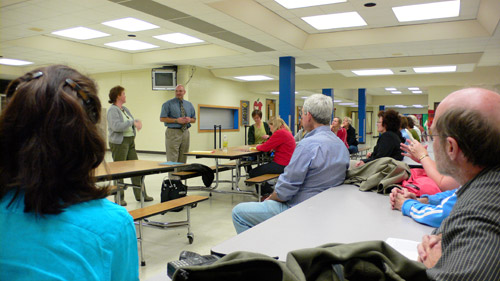
Parents, staff and community officials met Wednesday night to discuss a number of recent violent incidents at and near Madison West High School [map]
I took a few notes during the first 60 minutes:
Madison Alders Robbie Webber and Brian Solomon along with James Wheeler (Captain of Police - South District), Luis Yudice (Madison School District The Coordinator of Safety And Security), Randy Boyd (Madison Metro Security) and West Principal Ed Holmes started the meeting with a brief summary of the recent incidents along with a brief school climate discussion:
James Wheeler:
Police beat officer and Educational Resource Office (ERO) patrol during West's lunch period.Ed Holmes"There have been complaints from the houses around the school" so MPD increased patrols to "make a statement last week".
Still a relatively safe neighborhood.
3 arrests at Homecoming.
Made a drug dealing arrest recently.
People do see drug dealing going on and have reported it.
There have been additional violent incidents, especially at the Madison Metro transfer points
Behavior is atypical of what we have seen on the past . Perpetrators are new to West.Randy Boyd (Madison Metro)Emphasized the importance of a safe learning environment.
Make sure there are police and school consequences and that they are severe. These crimes are unacceptable and should not be tolerated.
Luis Yudice
60+ bus runs daily for the school system.
There have been some serious fights at the transfer points. Cameras are in place there.Main problem is confidentiality due to the students age. Can track them via bus passes.
Adding DSL so that the police precinct can monitor the transfer points. Incidents are about the same as last year but the numbers are going up.
Baptist church elders have helped patrol the South Transfer Point. We are looking for more community help.
Big picture perspective:Parents:
Our community really has changed a lot within the past five years. I sense a great deal of stress within the police department.Citywide issues
Increasing violence involving girls. He has looked at a lot of data with the District Attorney's office. Girls are extremely angry.Angry parents are coming into the schools.
Increasing issues in the neighborhood that end up in the schools. Mentioned South Transfer Point beating and that Principal Ed Holmes mediated the situation at an early stage.
Growing gang violence issue particularly in the east side schools. We do have gang activity at Memorial and West but most of the issues are at Lafollete and East. Dealing with this via training and building relationships
What the school are experiencing is a reflection of what is going on in the community.
Parent asked about weapons in school, metal detectors and k9 units.Madison School Board member (and West area parent) Maya Cole also attended this event.Response:
Do we have weapons in school? Yes we find knives in all the schools. No guns. Unfortunate fact is that if a kid wants to get their hand on a gun, they can. They are available.Ed Holmes:
"We took away a gun once in my 18 years".Parents:I want to get across to the students - if they see something they have to report it. We have 2100 students and 250 staff members.
Kids are afraid of the bathroomsA parent asked why the District/Police did not use school ID photos to help victims find the perpetrators? Ed Holmes mentioned that District has had problems with their photo ID vendor.Another lunch assault that has not been reported.
Incidents are much higher than we know because many incidents are not reported.
Newsletter signup | Send us your ideas
A Marlborough student was suspended for bringing a knife to school. A week later, a Concord student was arrested for putting 10 classmates on a hit list. Then there was the bomb threat at a Tewksbury school and a lockdown in Waltham where two knives were found in students' lockers, just a day after a pellet gun was discovered at another Waltham school.The episodes all occurred within five weeks last spring, not in high schools, but in middle schools in suburban districts, where educators and law enforcement agencies are increasingly worried about violence penetrating places once considered havens.
Massachusetts suburban and rural middle schools in 2005-06 had 4,750 reports of violence - such as fights, sexual assault, and robbery - and threats of violence; 484 drug, alcohol, and tobacco offenses; 290 cases of sexual harassment, and 383 weapons found, according to a Globe analysis of school safety statistics provided by the Massachusetts Department of Education.
Newsletter signup | Send us your ideas
I asked her how she felt living at the Phoenix. "Just scared," she said. The government pays the rent for most of the tenants here. As such, taxpayers are essentially absentee parents, writing monthly checks but not worrying much about the lives these children are living.
Posted by Jim Zellmer at 12:00 AM
Subscribe to this site via RSS/Atom:
Newsletter signup | Send us your ideas
On Thursday morning October 11, 2007 seven Madison Police officers and some 30 Lafollette High School staff members were needed to breakup a disturbance at the school around 11:15 a.m.. Officers learned that two adult women and two teenage boys (one of the woman is the mother of one of the boys) came to Lafollette where they confronted another teenage boy in a hallway. The boy, who was confronted, reportedly had gotten into a fight with the other two outside of school earlier in the week. He (the boy confronted) said the group of four circled him and the two adult women encouraged the young men to fight. Staff, hearing the ruckus, responded.Karen Rivedal has more.
Newsletter signup | Send us your ideas
Madison Police Department:
According to a Madison Police Department report, the teens went to the school nurse's office for minor injuries. The nurse's office reported the attack to a Madison police officer, who was at the high school for the West High Homecoming Parade.
Officers were dispatched at 12:20 a.m. to the emergency room at University Hospital, where the Fitchburg teen was being treated for a head injury suffered during the assault.
Newsletter signup | Send us your ideas
Jessica Blanchard & Casey McNerthney:
King County prosecutors on Wednesday charged two Seattle teenagers in a sexual assault on a developmentally disabled female classmate in a Rainier Beach High School restroom in June -- an incident that school officials never reported to police.Related:A Seattle P-I review of police and Seattle Public Schools records shows that case isn't the only likely crime that wasn't reported to police. While a majority of incidents on school campuses were recorded into the district's safety and security logs and reported to police if necessary, some incidents weren't -- including cases of assaults and strong-arm robberies.
In a few cases, parents or victims say school officials urged them not to report the crimes to police at all.
Pegi McEvoy, who recently took over as interim manger of Seattle schools' safety and security department, acknowledged that the district had a "fragmented" system for documenting and tracking alleged crimes on campuses. This fall, though, district security specialists began filing their reports electronically -- one of a handful of changes intended to streamline and strengthen the reporting process, she said.
Newsletter signup | Send us your ideas
[Editor’s note: City Comptroller William C. Thompson, Jr. released an audit on Sept. 19 that found that many safety incidents in New York City public schools are not being reported as required under state law. For the 10 large high schools audited, 21 percent of the sampled incidents were not reported, including 14 percent of those incidents deemed serious.]While we know the mayor and the chancellor want schools to be safe, this audit confirms a practice educators and the UFT have complained about for years: the failure to report all school incidents. Now with data driving all education decision-making, this audit couldn’t have come at a more important time.
Newsletter signup | Send us your ideas
Back when Debbie Heimowitz was a middle schooler in Castro Valley, if you wanted to cut somebody down you talked behind her back. Now you post your putdowns on the Internet. Heimowitz, a 26-year-old grad student at Stanford, has made a film about this online cruelty."Cyber bullying is harassing someone using the Internet, cell phones and any sort of digital technology. A common scenario is they will find somebody's picture on the Internet that they know from school. Let's say it's 'Amy.' I download the picture, Photoshop it, go to MySpace, create a new account, create a new e-mail address and display this whole 'I Hate Amy' MySpace page. Then I have everybody at school write mean things about Amy in the comments section. Amy finds out that now everybody at the school hates her and has no clue who started this page.
Newsletter signup | Send us your ideas
There's been a fundamental change in family life, and it has played out over the years in my office. Teachers, pediatricians and therapists like me are seeing children of all ages who are not afraid of their parents. Not one bit. Not of their power, not of their position, not of their ability to apply standards and enforce consequences.I am not advocating authoritarian or abusive parental behavior, which can do untold damage. No, I am talking about a feeling that was common to us baby boomers when we were kids. One of my friends described it this way: "All my mother had to do was shoot me a look." I knew exactly what she was talking about. It was a look that stopped us in our tracks -- or got us moving. And not when we felt like it.
Now.
These days, that look seems to have been replaced by a feeble nod of parental acquiescence -- and an earnest acknowledgment of "how hard it is to be a kid these days."
In my office, I have seen small children call their parents names and tell them how stupid they are; I have heard adolescents use strings of expletives toward them; and I remember one 6-year-old whose parents told me he refused to obey, debated them ad nauseam and sometimes even lashed out. As if on cue, the boy kicked his father right there in the office. When I asked the father how he reacts at home, he told me that he runs to another room!
Newsletter signup | Send us your ideas
The tables linked below summarize Madison Police Department calls for service to MMSD schools from July 1, 2006 through June 30, 2007, as follows:The tables linked below summarize Madison Police Department calls for service to MMSD schools from July 1, 2006 through June 30, 2007, as follows:
By call date
By school, subgrouped by call date
By school, subgrouped by incident type
School subtotals
Incident type subtotalsTo repeat the commentary from the last time we posted call data statistics:
Data like this provides a starting point for getting a sense of the type and levels of incidents that affect safety in our children's schools, and it'll be useful to compare these numbers from time to time against like categories of data going forward. Context that we need, but don’t have, is information on the number and types of violent or disruptive incidents occurring in the schools as a whole (not just those resulting in police calls), and to what extent policies on summoning law enforcement in response to a violent or disruptive incident vary from school to school (in which case call data alone may be an unreliable index of the school’s relative safety).
Newsletter signup | Send us your ideas
New York State education officials yesterday added 17 schools to the list of those considered “persistently dangerous,” substantially expanding the list for the second year in a row. All but 2 of the 27 schools on the new list are in New York City, including a dozen schools designed for students with severe disabilities.Madison Parent's School Safety Site posted 2006/2007 student teacher assaults/injury data here.The schools ranged from the behemoth Jamaica High School in Queens to smaller schools like Powell Middle School in Harlem and Public School 14 in Staten Island. The list also includes a school in Rochester and Berkshire Junior-Senior High School in Canaan, N.Y.
The federal No Child Left Behind Act requires states to compile annual lists of “persistently dangerous” schools but leaves it to each state to define the term. Many states, including New York, have been criticized for issuing extremely short lists in past years.
“We are utterly determined to make all schools safe,” said Richard P. Mills, the state education commissioner, in announcing the list yesterday at a news conference in Albany.
Mr. Mills said New York’s list had grown because the state had vastly improved its reporting efforts. He noted that the 49 other states had listed a total of only 30 schools as “persistently dangerous” last year, just a hairsbreadth more than the schools now listed by New York.
Wisconsin DPI "Discipline Data Collection and Reporting" webpage.
Newsletter signup | Send us your ideas
Lisa Subeck has more.Children seeing people run from police through their backyard, waking up to the sound of a gunshots, watching drug deals.
These were some of the scenes described by West and Southwest Side residents as hundreds of them turned out Wednesday to voice their concerns about crime in their neighborhoods at a meeting with Madison Police Chief Noble Wray.
"Allied Drive is not the only problem on Madison 's West Side, " said Suzanne Sarhan, who owns property there, prompting hundreds to rise to their feet in applause.
Ald. Thuy Pham-Remmele, 20th District, who set up the neighborhood listening session for Wray, said the safety problems need both short- and long-term solutions.
"I don 't ask for any quick fix, " she said.
Newsletter signup | Send us your ideas
Milwaukee Journal-Sentinel Editorial:
There isn't just one right answer to preventing school violence - you try what works. But a program that will expand this fall to five Milwaukee high schools shows promise.The Violence-Free Zone initiative places young people from the community into schools as youth advisers. These advisers form relationships within the school and nearby community, and they work to identify students labeled as the most disruptive. They may help a kid find a safe place to go after school or better living arrangements for families. At South Division High School, they have even helped families with tax forms.
In the hallways, advisers defuse arguments before they boil over, and they confront unruly students with a stern message: Violent behavior is not acceptable. But along with that message, healthy alternatives are offered.
The program is all about making stronger connections with troubled kids and offering them hope.
Newsletter signup | Send us your ideas
Minnesota Department of Education:
Governor Tim Pawlenty today announced the establishment of the Minnesota School Safety Center, which will develop a framework for all-hazard safety planning for schools and will coordinate activities of federal, state and local partners.via MPR.The School Safety Center will be housed at the Minnesota Department of Public Safety and will work in partnership with other state agencies. Retiring Brooklyn Park Chief of Police Wade Setter has been named to lead the Center.
“Bringing together all of the partners involved in school safety – law enforcement, schools, emergency response and victim service providers and others – will help us keep Minnesota students safe at school,” Governor Pawlenty said.
“This cooperation will go a long way toward ensuring the safety of our children,” said Public Safety Commissioner Michael Campion. “Wade’s experience as a law enforcement officer, a mentor to young people and his proven leadership in forming partnerships make him the ideal individual to launch this effort.”
Newsletter signup | Send us your ideas
Seven-year-old Brajon Brown is clearly a child. He hasn’t committed a crime, though he talks about it. His 12-year-old brother, Malcolm also is not in a gang – at least not one police recognize. He runs with a “crew” of friends formed when Malcolm was 9. Boston police call them “wannabes” and say they usually don’t show up on police radar until they are teenagers and committed to gangs known for more serious crimes. Some experts say Boston neglects such gangs, allowing momentum to build for a coming crime wave that would dwarf the record violence of the mid-1990s. Malcolm, who says the young males in the crew protect their territory by beating up challengers, faces charges in the beating and robbery of a boy earlier this year. “When you look into the eyes of a kid like that, in three or four years, you know he could take a life, no problem,” a former prosecutor and community activist says. He estimates that dozens of gangs like Malcolm’s – semi-organized groups of middle and elementary school-age youth who mimic the actions of older gangs – operate in Boston. Last year, 49 of 102 city-run youth programs allowed only participants 13 or older. And of 180 young people who received city counseling and intervention services, only 49 children were preteens. Stressing the diversion of preteens from lives of crime, Boston’s mayor launched an effort this year to enroll every child between 8 and 14 in a summer program. Teams of city workers knocked on more than 1,700 doors in attempts to reach families who need help. An official says 233 households signed up for services, but he doesn’t know how many were for preteens. Brajon, meanwhile, already walks the streets as if he owns them, slapping pay phones off the hook as he passes and knocking items from first-floor window ledges.
Newsletter signup | Send us your ideas
The District will be holding a parent training session with Corwin Kronenberg on Wednesday, August 22, from 7:00 p.m. to 8:30 p.m. at the Hilton Garden Inn on Deming Way. Mr. Kronenberg's focus will be "A Parent's Approach to Above-the-Line-Behavior for Students." Teachers will be doing an all-day training with Mr. Kronenberg on August 20 that will focus on creating a common understanding of behavioral expectations in the classroom.
Each MMSD principal was asked to work with their parent organization to send a representative team of five parents to the event. It is not clear if this happened at each school or if the program has reached capacity.
If you did not hear about this event before the school year ended and are interested in going, contact either your principal or the appropriate Assistant Superintendent -- for elementary parents, that would be Sue Abplanalp (sabplanalp@madison.k12.wi.us, 663-1639); for middle and high school parents, Pam Nash (pnash@madison.k12.wi.us, 663-1635).
Read more about the MMSD's adoption of Kronenberg's system --
http://www.schoolinfosystem.org/archives/2007/06/madisons_adopti.php#c195268
Newsletter signup | Send us your ideas
Madison Police Department Chief Noble Wray spoke on downtown safety at the monthly meeting of Downtown Madison, Inc. on June 28, 2007, and also briefly addressed the topic of gang activity in Madison schools during the program, as reported in The Capital Times (via the MadCrime101 blog, a welcome and valuable new resource focusing on concerns and issues relating to crime in Madison).Gangs & School Violence Forum Audio / Video. More here [RSS].Chief Wray acknowledged the growing problem of gangs in Madison and their presence in Madison schools, and spoke of the need to quantify the extent of the problem and its trends, rather than reacting based on anecdotal “information”. I couldn’t agree more. The MPD can make much progress toward this goal by fuller and consistent disclosure to the public of incidents and statistics on gang activity (whether through its police district newsletters or its public information office news releases). But to quantify the gang problem in schools, the MPD will need to rely on data from the MMSD, since much can happen in a school which is relevant to quantifying the gang problem but isn’t brought to the attention of the MPD. Can the gang problem in Madison schools be accurately and reliably quantified and assessed for those schools that don’t have ERO’s (Education Resource Officers)? Of if the policies on when calls for service are to be made to MPD vary from school to school? Or when the MMSD relies on suspension and expulsion rates, instead of actual incidents of disruptive and violent behavior, to gauge school safety (all the while moving toward a policy of discouraging suspensions and expulsions)?
Newsletter signup | Send us your ideas
BBC:
One third of US online teenagers have been victims of cyber-bullying according to research by the Pew Internet Project.The most common complaint from teens was about private information being shared rather than direct threats.
Girls were more likely than boys to be targets and teens who share their identities online are the most vulnerable, the survey found.
But teenagers still think that the majority of bullying happens offline.
Newsletter signup | Send us your ideas
Just before Owen started ninth grade in Texas, she testified against her father, sending him to prison after years of sexual abuse.She took a risk and wrote that story for an assignment in ninth-grade English class. But her teacher gave her an "F," telling her not to talk about it.
"Ironically, I ended up teaching ninth-grade English," Owen said. "I wanted to be different as a teacher. I wanted to be someone that students could talk to."
Owen went on to do just that, co-founding a school in Milwaukee as a haven for bullied and harassed students. And now, she has won a national scholarship for her efforts, paving the way for her to help others form similar schools across the country.
Owen, who helped start The Alliance School on W. Galena St. in 2005, is one of 38 undergraduate and graduate students in the nation to win scholarships this year from the Point Foundation. The Los Angeles-based non-profit has honored outstanding lesbian, gay, bisexual and transgender students for six years.
While the majority of the students who attend The Alliance School are lesbian, gay, bisexual or transgender, the campus serves any student who struggled in the traditional high school environment because of harassment, intimidation or abuse.
Newsletter signup | Send us your ideas
Details of the data behind the “School assaults, by the numbers” item (thank you, Bill Lueders) in this week’s Isthmus are posted here (sorted by school name), and here (subtotals of incidents by school type). The reports included incidents through June 4, 2007, so any incidents that occurred during the final fortnight of the school year aren’t included. There are a couple of entries whose dates predate the school year and may be typos, but they are replicated as is.
Student-on-student assault/injury information is not included in these reports, nor do these reports include incidents of verbal threats of violence against staff (even those serious enough to result in the issuance of a restraining order). Police were called in only 13 of the 224 incidents. We don’t know whether there is a district-wide policy that requires that all such incidents be reported, and, if there is, whether the policy is followed consistently from school to school. I concur with the commenters at School Information System that this is only a part of the picture, that we need to know more, and that we need to do more.
Newsletter signup | Send us your ideas
In the 2006-07 school year, there were 224 instances in which staff members in Madison schools were assaulted or injured by students, according to records provided to Isthmus. (This represents a significant increase from 2005-06, when the district tallied 173 such incidents.)Most occurred in elementary schools, and eight out of nine involved special education students. The incidents are mostly minor — kicks, bites, scratches and such — although 43 required some medical attention. Police were called on nine occasions.
Luis Yudice, the district’s safety coordinator, says the most serious incidents were the two reported recently in Isthmus (Watchdog, 6/8/07), both involving injuries to staff members trying to break up fights.
The most startling revelation is the extent to which a handful of students drive these numbers upward. A single fourth-grader at Chavez Elementary accounted for 41 of this year’s incidents. At the middle school level, a seventh-grader at Sennett and eighth-grader at Cherokee had 19 and 12, respectively. And a ninth-grader at East had 10.
Together, these four students generated 37% of the total assaults for the 24,576-student district. (In 2005-06, a single student at Lowell logged 36 incidents; no one else had more than seven.)
Newsletter signup | Send us your ideas
Joy Cardin interviews Cecil Reynolds, professor of education psychology and neuroscience at Texas A&M University, and chair of the American Psychological Association’s Zero Tolerance Taskforce. 19MB mp3. Support Wisconsin Public Radio.
Newsletter signup | Send us your ideas
RELEASE DETAILS FOR CASE# 2007-65974: Disturbance
Case Date: 06/12/07 Case Time:12:18 PM
Release Date: 06/12/07 Release Time: 9:33 PM
Released By: Lt. Dave Jugovich
Address: 702 Pflaum Road (LaFollette H.S.)
Arrested person/suspect
Victim/Injuries: Two (2) students
Details: Several officers reponded to a report of a fight at LaFollette High School. Two (2) students were transported to an area hospital as a result of injuries sustained in the disturbance. One student was stuck in the hand with a pen, the other sustained an injury to his nose. The injuries were not life-threatening and the investigation remains under investigation.
Newsletter signup | Send us your ideas
A couple of years ago, the students likely would have been suspended. But under a new approach to discipline being tried in the district, the students instead were given the option of coming up with a fix-it plan -- something more than just saying, "I'm sorry."Madison Parent has more:The students chose to spend all of their recesses over the next two days playing catch with a football, just the two of them.
"They came back and reported that they did much better playing together, and that was the end of it," said school social worker Mike Behlke.
District employees hope the approach will reduce out-of-school suspensions, which have been slowly rising at some schools and often have little effect other than causing the students to miss class.
The MMSD has high expectations for Kronenberg (”As a result of this training student behavior will improve leading to greater success in school. Both student behavioral referrals to staff and suspensions will decrease.” [from the 07-08 Aristos Grant description]). The WSJ piece does its part to create the impression that those expectations are well on the way to being achieved. But, as the scientific adage goes, anecdotes do not equal data. Since we’re in the final few days of a school year in which at least a dozen of the district’s elementary schools and at least two of the middle schools have had a year of working and living with this system, data should be available at this point on the actual incidence of classroom disruption, threats and violence as experienced by students and teachers in schools that have implemented Kronenberg, in those that have not, how they compare to each other, and how they compare over time; and that data ought to be made available to the public.
Newsletter signup | Send us your ideas
How safe are our schools? This question can’t be answered without consistent collection and analysis of information about violent and disruptive incidents in our schools. While the Madison Police Department has just released its Uniform Crime Report for 2006 (the summary of crime statistics that is reported annually to the FBI), there’s no equivalent report for Madison schools. Our state’s Department of Public Instruction collects data for expulsions and suspension, but not for incidents. The Madison Metropolitan School District’s web site simply links to the DPI site. At the individual school level, there may be no system for proactively communicating with parents about incidents affecting safety, or, worse yet, a parent’s school safety questions may languish unanswered.The post includes a list of recent school crime events. Gangs and School Violence Forum.
Newsletter signup | Send us your ideas
 | Introductions 8MB Quicktime Video Note: The audio during the first minute is not great. |
 | Question 1: Has the gang issue changed over the past 10 years? 29MB Quicktime Video |
 | Question 2: What have we learned from our initiatives? 19MB Quicktime Video |
 | Question 3: What partnerships are available to keep gangs away from schools? 13MB Quicktime Video |
 | Question 4: What procedures are available to individual schools to keep gangs away from schools? 13MB Quicktime Video |
 | The Complete Forum: 93MB Quicktime Video 25MB MP3 Audio |
Many thanks to Rafael Gomez for creating and organizing this event and a number of www.schoolinfosystem.org parents who helped with logistics along with our panelists:
| |
| Local Media Coverage | |
Newsletter signup | Send us your ideas
This evening's Gangs and School Violence Forum was quite interesting. Rafael organized an excellent panel. We'll post a link to video and audio files when they are complete. Following are links to local articles and commentary on this event:
Yudice said there has been a "huge development in the area of Latino gangs" in Madison specifically, and Blue noted an increase in girls in gangs."We have seen a great surge in activity," Yudice said.
All of the panelists offered ideas to help reduce the problem in Madison's high schools, including limiting off-campus privileges and continuing consistent enforcement against gang colors and clothing in schools.
"It's really easy to slip out a door," said Madison Memorial High School Principal Bruce Dahmen. "It's important that we have high expectations for all the children."
If you need any assistance regarding information about gangs in Madison or resources for schools to tackle the gang problem, feel free to contact me or visit my website at www.knowgangs.com.I am a former California police officer and a nationally recognized gang expert. I now reside in Jefferson County and continue to teach law enforcement officers, educators and social service workers about dealing with gang problems nationwide.
Students and parents listened during a Wednesday night meeting and took notes, a move in the right direction according to Officer Moore.Officer Moore also strongly suggested that the High Schools eliminate their open campus policy."Last year they were telling me there was no gang issue in or around any of our schools, I was told that by the administration here," he says. "So this is something that is really great for me that we are finally acknowledging that we do have gang issues."
There are resources for at risk youth in the Madison area, but many on the panel stressed that a unified strategic plan is needed.
Blue and other panelists attributed the increase in gang activity to a growing number of students who feel a disconnection with their school and community, and with adults who care about them."We're getting a wake-up call that says certain parts of our community are not healthy," Blue said.
Newsletter signup | Send us your ideas