School Information System

What’s Missing from Teachers’ Toolkits to Support Student Reading in Grades 3–8

Anna Shapiro, Rebecca Sutherland, Julia H. Kaufman

Despite the growing body of research on how to support older readers, few studies consider whether U.S. teachers can identify students who have difficulty reading instructional materials across content areas or whether teachers feel like they have the knowledge and resources to support those students. Such information could lay the groundwork for states and school systems to provide better supports to teachers to address students’ reading difficulties. In this report, researchers explore U.S. public school teachers’ perceptions of students’ difficulties with reading in grades 3–8, those teachers’ knowledge about how students learn to read, their experiences supporting these readers, and what they need to help students become proficient readers.

The findings in this report highlight the importance of including teachers in upper elementary and middle school grades in resource development and allocation and offer guidance to policymakers designing or implementing reading instruction reforms.

Share

Civics: “I am now suing the Biden Administration and two Pfizer officials for their conspiracy to censor me”

Pfizer/White House Files:

But the crucial “fifth strike” and permanent censoring of my account caught them by surprise – because a Twitter lobbyist who was the company’s closest White House contact pushed it through in hours. The lobbyist, Todd O’Boyle, acted outside Twitter’s normal safeguards for actions against large accounts like mine. Instead, O’Boyle repeatedly pressured a junior Twitter employee to ban me on a Saturday evening in late August, when few employees were working.

“Hi all – did we perm suspend Alex berenson?” Gadde wrote an hour after my ban to a senior manager in “site integrity” unit, which was usually responsible for enforcement actions on accounts like mine. “Typically these are flagged to me first? Did I miss something[?]”

O’Boyle’s sudden move to ban me caught not just Gadde but the site integrity unit by surprise, the emails show. The manager responded, “this was not an action taken by SI [site integrity]. We’re investigating what happened.”

Share

America’s Oldest Board Game Teaches 19th-Century Geography

Shiori Chen:

Travelers’ Tour Through the United States was first published by Frederick and Roe Lockwood in 1822, 46 years after America gained its independence. This geography-centric game, designed for 2 to 4 players, is based on a map of the United States at the time. It features 24 states, ranging from the Atlantic coast to new Southern ones such as Missouri and Arkansas. The map includes 139 numbered cities and towns, which serve as spots for players to move to.

Share

Open Mathematics

Tuxfamily

Depository

The primary intention of this project is to provide open access to mathematical texts in PDF format which individual mathematicians find particularly useful and which are clearly in the public domain or under open license. This provides a middle ground between large depositories like archive.org which host “everything” and subscription download services which often monopolize access to public domain texts. Please notify us, using the email below, if any of our PDF files are corrupted so that we can re-upload the readable file.

The PDFs of our mathematical texts are here.

Share

the papers that most heavily cite retracted studies

Richard Van Noorden & Miryam Naddaf

In January, a review paper1 about ways to detect human illnesses by examining the eye appeared in a conference proceedings published by the Institute of Electrical and Electronics Engineers (IEEE) in New York City. But neither its authors nor its editors noticed that 60% of the papers it cited had already been retracted.

The case is one of the most extreme spotted by a giant project to find papers whose results might be in question because they cite retracted or problematic research. The project’s creator, computer scientist Guillaume Cabanac at the University of Toulouse in France, shared his data with Nature’s news team, which analysed them to find the papers that most heavily cite retracted work yet haven’t themselves been withdrawn (see ‘Retracted references’).

“We are not accusing anybody of doing something wrong. We are just observing that in some bibliographies, the references have been retracted or withdrawn, meaning that the paper may be unreliable,” Cabanac says. He calls his tool a Feet of Clay Detector, referring to an analogy, originally from the Bible, about statues or edifices that collapse because of their weak clay foundations.

The IEEE paper is the second-highest on the list assembled by Nature, with 18 of the 30 studies it cites withdrawn. Its authors didn’t respond to requests for comment, but IEEE integrity director Luigi Longobardi says that the publisher didn’t know about the issue until Nature asked, and that it is investigating.

Share

Close some Madison schools, and a no on the November Referendums

Dave Cieslewicz

And the district’s argument in favor of what seems like madness? Enrollments may turn around some day. But that’s unlikely for two reasons. 

The first is that fertility rates are down and enrollment declines are an issue for districts all over the country. In addition, the COVID pandemic resulted in an increase in homeschooling, a switch to schools outside of public school systems, and a mysterious disappearance of some part of the school age population. 

The second reason that enrollments are not likely to turn around has to do with the policies of this district. District officials point to Dane County’s rapid growth projections, but the county has been growing at a steady pace for decades and yet MMSD has been losing students for over a decade. The numbers did stabilize this year, but they did not go up and it’s foolish to base hundreds of millions of dollars of long-term investments on a single year’s data. 

This raises a broader question and points to the reason that I’ll be voting against both this and the $100 million operating referendum, which will also be on the ballot. The district is losing market share because it is badly managed. Test scores are some of the worst in the state, absenteeism remains high, and the racial achievement gap hasn’t improved. 

Parents are voting with their kids and taking them out of the district. And it’s not because the buildings aren’t nice enough. It’s because this school board obsesses over solving all of society’s problems rather than focusing on teaching kids how to read, write, do math, and behave in a way that respects their teachers and peers. If you want to do something to solve stubborn problems of racism in our society the best way to do that is with high-achieving Black students

——

Madison’s well funded k-12 system and city government are seeking substantial 607M+ tax and spending increases via referendum this fall.

Madison taxpayers of long supported far above average K – 12 spending.

The data clearly indicate that being able to read is not a requirement for graduation at (Madison) East, especially if you are black or Hispanic”

My Question to Wisconsin Governor Tony Evers on Teacher Mulligans and our Disastrous Reading Results

2017: West High Reading Interventionist Teacher’s Remarks to the School Board on Madison’s Disastrous Reading Results 

Madison’s taxpayer supported K-12 school district, despite spending far more than most, has long tolerated disastrous reading results.

“An emphasis on adult employment”

Wisconsin Public Policy Forum Madison School District Report[PDF]

WEAC: $1.57 million for Four Wisconsin Senators

Friday Afternoon Veto: Governor Evers Rejects AB446/SB454; an effort to address our long term, disastrous reading results

Booked, but can’t read (Madison): functional literacy, National citizenship and the new face of Dred Scott in the age of mass incarceration.

When A Stands for Average: Students at the UW-Madison School of Education Receive Sky-High Grades. How Smart is That?

Share

Remedial math at Harvard

S. Mac Healey and Angelina J. Parker

“Students don’t have the skills that we had intended downstream in the curriculum, and so it creates different trajectories in students’ math abilities,” Kelly added.

Despite the schedule differences, MA5 will reflect the material and structure of MA and MB, collectively known as Math M.

“Math MA5 is actually embedded in Math M,” Kelly said.

“They’ll have the same psets, they’ll have the same office hours, they’ll have MQC, they’ll take the same exams,” Kelly added, referring to the department’s Math Question Center. “So if you’re in MA5, you will experience Math M.”

Madison math forum audio and video and math task force.

21% of University of Wisconsin System Freshman Require Remedial Math

Share

Defending reduced rigor….

AJ Bayatpour:

Wisconsin’s top education official is defending changes this year to the statewide standardized test taken by students in grades 3-8. The overhaul of the Forward Exam lowers the cut scores between groups, and it changes the terminology used to describe student performance.

In her first interview since the state Department of Public Instruction (DPI) enacted the changes, State Superintendent Jill Underly said the changes will provide a more accurate picture of how students fared on the test. 

“They were appearing to be doing worse than they really were,” she said. “And so, this will give us a better measure of where kids are.”

However, Gov. Tony Evers, who enacted the previous standards in 2012 when he was state superintendent, told reporters Tuesday he did not support lowering statewide testing standards. Critics have said scale of the test has also been changed to such an extent, it’ll be nearly impossible to compare future results to previous trends.

The changes, which the DPI made in June, affect scoring on the English language, arts and math sections of the exam.

——

More.

——

Yet, Wisconsin’s well funded DPI continues to reduce rigor….

Madison’s well funded k-12 system and city government are seeking substantial 607M+ tax and spending increases via referendum this fall.

Madison taxpayers of long supported far above average K – 12 spending.

The data clearly indicate that being able to read is not a requirement for graduation at (Madison) East, especially if you are black or Hispanic”

My Question to Wisconsin Governor Tony Evers on Teacher Mulligans and our Disastrous Reading Results

2017: West High Reading Interventionist Teacher’s Remarks to the School Board on Madison’s Disastrous Reading Results 

Madison’s taxpayer supported K-12 school district, despite spending far more than most, has long tolerated disastrous reading results.

“An emphasis on adult employment”

Wisconsin Public Policy Forum Madison School District Report[PDF]

WEAC: $1.57 million for Four Wisconsin Senators

Friday Afternoon Veto: Governor Evers Rejects AB446/SB454; an effort to address our long term, disastrous reading results

Booked, but can’t read (Madison): functional literacy, National citizenship and the new face of Dred Scott in the age of mass incarceration.

When A Stands for Average: Students at the UW-Madison School of Education Receive Sky-High Grades. How Smart is That?

Share

Why is LAUSD spending $70 million to boost capacity at a school in Silver Lake, when nearby schools have thousands of empty seats?

Tim Deroche:

It’s the feel-good story of the year for the Los Angeles Unified School District campuses. L.A. Unified recently broke ground on a beautiful new $70 million renovation of Ivanhoe Elementary in Silver Lake, adding a shiny new building that will boost permanent capacity at the school.

Ivanhoe is one of the shining stars of LAUSD with over 80% of the children reading at grade level. In an era of rapidly declining enrollment across L.A., Ivanhoe has bucked the trend, showing a 31% increase in enrollment from 2009 to 2019. It sounds like that rarest of birds: the public school success story.

But there was no need for this project. There are six other elementary schools in the neighborhood that are literally half-empty. These schools — Allesandro, Atwater Avenue, Clifford Street, Franklin Avenue, Mayberry Street and Micheltorena — once educated 3,215 elementary school students. But their enrollment in 2023-24 was just 1,642. All of these schools are less than 10 minutes from Ivanhoe.

The district could have saved that $70 million in taxpayer money by simply opening up those other schools to the Ivanhoe families.

But that wasn’t politically possible. Why? Ivanhoe is a coveted school, and parents have often paid a significant premium to live in the attendance zone and be assured of a spot in Ivanhoe. Tanya Anton, a public school admissions consultant and author of the GoMamaGuide to Los Angeles schools, has said that parents will often spend up to $300,000 extra for a home that is within the zone of a coveted public school like Ivanhoe. These parents often feel that they have already “paid for” their child’s “free” public school via their hefty mortgage.

——-

Madison expanded its least diverse schools recently as well; Van Hise and Hamilton…

Share

“I provide the first estimates of temperature s impact on high-stakes exam performance and subsequent educational attainment”

R. Jisung Park:

Cognitively intensive assessments such as college entrance exams or
job interviews have become a routine fixture of modern economies, due in large part to the increasing importance of cognitive skills in the workplace.1 Such assessments often take place in high-stakes environments, where performance over a relatively short win-
dow can have lasting educational and economic consequences and where resche-duling may be costly due to coordination costs or other frictions.2 Given potential welfare consequences, it is important to understand whether the physical conditions under which such assessments take place can affect realized performance. This is
especially true if the playing field may not be level or may be changing over time.

Share

Notes on US vs Denmark childhood vaccine practices

Tracy Hoeg

Having raised my kids, given birth & practiced medicine in both the US & Denmark, I am also fascinated by how many more vaccines the US gives to children than Denmark & most Americans I meet are shocked to learn:
Denmark 🇩🇰

More.

Share

‘They’re about two years behind’: fears for children born during lockdown as they start at school

Anna Fazackerley

Babies born in 2020 started life in the strange world of lockdown in a small bubble of people with faces hidden behind masks. Social ­experiences, such as seeing extended family, trips to the playground or mother and baby groups, could not happen. And struggling public ­services meant infants were likely to miss out on face-to-face appointments with a health visitor who might have been able to spot developmental difficulties early.

Those babies are now four years old, and in England are arriving at school for the first time this week. Experts say teachers should be braced to encounter – and tackle – problems ranging from poor speech and language development to social and emotional difficulties.

Similar problems have been seen in children who were very young during the pandemic and are already in the system.

“We’ve had an increase in reception children biting one another, throwing things, running off, spitting,” said the headteacher of a primary school in north-west England. He added they were often frustrated or struggled with taking turns, sharing, or following routines and listening in class.

Share

Forget DEI—Fire the Admissions Office

Steven Hayward:

There has been some salutary progress in recent months shutting down the divisive “diversity, equity, and inclusion” rackets on college campuses in many red states, but after the job of ridding us of the scourge of DEI attention needs to be turned to admissions offices. Thesis: Most admissions offices should be purged wholesale. Not only are most of them likely still violating civil rights law in the aftermath of the Harvard/UNC Supreme Court ruling, but they bear a large share of the responsibility for the campus climate of hate against Jews we are currently witnessing on a mass scale. Admissions officers actually seek out these horrible students.

I made this argument once before a few months back, but a fresh new episode sharpens the problem. There’s an active boycott being waged by anti-Semitic students at Sarah Lawrence College against political science professor Sam Abrams, because Abrams is Jewish. Here’s part of Sam’s account from Minding the Campus:

Share

Notes on edtech

Nancy Bailey:

Halfway into 2024, most parents have some awareness that “technology use in school” is pretty different from our own childhoods. Before the pandemic, 60% of school administrators in the U.S. provided 1:1 digital devices for every middle and high school student. For elementary schools, it was about 40%. 

In 2021, a year into the pandemic, the rates for middle and high school 1:1 programs rose to 90% and for elementary schools, it was 84%.

And three years later, these numbers have gone up, not down. In fact, when a parent recently emailed me to ask, “Do you know of any middle or high school in America where there is no 1:1 or tech-based curriculum?” (with the exception of perhaps some Waldorf schools), I knew of no other options.

This is kind of insane, when you think about it. Even just a decade ago, elementary schools used tech minimally, perhaps via classroom computers or labs to teach skills like typing and research. But somehow, in part thanks to remote learning, today it’s very difficult to find schools still operating under the “less is more” approach to technology in schools.

Share

The Far-Reaching Ripple Effects of a Discredited Cancer Study

Nidhi Subbaraman

Four years ago, a team of researchers led by a heavyweight in the field of microbiology made a stunning claim: Cancers have unique microbial signatures that could one day allow tumors to be diagnosed with a blood test

The discovery captured the attention of the scientific community, as well as investors. 

Share

Forget DEI—Fire the Admissions Office

Steven Hayward:

There has been some salutary progress in recent months shutting down the divisive “diversity, equity, and inclusion” rackets on college campuses in many red states, but after the job of ridding us of the scourge of DEI attention needs to be turned to admissions offices. Thesis: Most admissions offices should be purged wholesale. Not only are most of them likely still violating civil rights law in the aftermath of the Harvard/UNC Supreme Court ruling, but they bear a large share of the responsibility for the campus climate of hate against Jews we are currently witnessing on a mass scale. Admissions officers actually seek out these horrible students.

I made this argument once before a few months back, but a fresh new episode sharpens the problem. There’s an active boycott being waged by anti-Semitic students at Sarah Lawrence College against political science professor Sam Abrams, because Abrams is Jewish. Here’s part of Sam’s account from Minding the Campus:

Share

Mississippi students of color outperform Minnesota’s in reading and math

Catron Wigfall:

Despite spending far less per student than Minnesota, Mississippi has a better track record than Minnesota when it comes to helping its students of color grow academically. Mississippi’s overhaul of its reading pedagogy and its investment in training educators in the science of reading became a model other states are learning from. Mississippi lawmakers also passed the Literacy-Based Promotion Act (LBPA) that retains third graders who cannot read on grade level. The state’s retention policy is not just “repeating the grade,” writes Todd Collins at the Fordham Institute.

——

Yet, Wisconsin’s well funded DPI continues to reduce rigor….

Madison’s well funded k-12 system and city government are seeking substantial 607M+ tax and spending increases via referendum this fall.

Madison taxpayers of long supported far above average K – 12 spending.

The data clearly indicate that being able to read is not a requirement for graduation at (Madison) East, especially if you are black or Hispanic”

My Question to Wisconsin Governor Tony Evers on Teacher Mulligans and our Disastrous Reading Results

2017: West High Reading Interventionist Teacher’s Remarks to the School Board on Madison’s Disastrous Reading Results 

Madison’s taxpayer supported K-12 school district, despite spending far more than most, has long tolerated disastrous reading results.

“An emphasis on adult employment”

Wisconsin Public Policy Forum Madison School District Report[PDF]

WEAC: $1.57 million for Four Wisconsin Senators

Friday Afternoon Veto: Governor Evers Rejects AB446/SB454; an effort to address our long term, disastrous reading results

Booked, but can’t read (Madison): functional literacy, National citizenship and the new face of Dred Scott in the age of mass incarceration.

When A Stands for Average: Students at the UW-Madison School of Education Receive Sky-High Grades. How Smart is That?

Share

Civics: “it is now possible to vote in person without any form of identification”

Admin Rosen:

If the average American ever thinks about the Horn of Africa, they likely imagine it as one of those interchangeably poor and faraway places that is many decades behind advanced Western countries like our own. Yet in California, New York, Pennsylvania, and Nevada, it is now possible to vote in person without any form of identification. In Michigan, you can vote without a photo ID, as long as you sign an affidavit saying you don’t have one. Unlike Somalilanders, most Americans no longer have to physically show up at a polling place to vote. Instead they have the choice of filling out and submitting their ballots beyond the observation of election officials, which means there is no assurance that the people in whose names ballots are cast actually signed—or saw—their ballots, voted free of duress or the promise of some benefit, or are even still alive.

In the 2020 election, more than two-thirds of voters exercised their franchise by mail or before election day—meaning that election day itself was a mass civic formality, rather than the deciding event of a long campaign. The same is likely to be true this year. At least 20 states now open the voting more than three weeks before the campaign ends. Fifty days before an election, Pennsylvania begins holding “in-person absentee” voting, where a ballot can be filled out and submitted in a location that does not have poll watchers present or any of the privacy safeguards of a normal polling station. Thirty-six states, including every 2024 swing state in the presidential election, now either have all-mail elections in which a ballot is automatically sent to every registered voter, or no-excuse absentee voting in which any voter can ask to vote by mail for any reason. In a number of states, including Arizona, a voter only has to register as an absentee once in order to receive a ballot in the mail in every subsequent election. According to the National Vote at Home Institute, the eight states with all-mail elections automatically send out at least 77 million ballots each cycle.

Share

“Proficient” is now…a -19- on the ACT” – taxpayer funded Wisconsin DPI

Quinton Klabon:

NEW WISCONSIN STATE TEST SCORE STANDARDS
“Proficient” is now…a -19- on the ACT.

Yes, parents across Wisconsin will hear their children are “Meeting Standards,” only to have multiple UW schools reject them in senior year.

Let’s support educators and kids striving for better.

Related: “Median number of years of business experience are ZERO”

More:

If WI DPI would like to improve mental health perhaps they should get serious about literacy! Most WI schools have used 3 cueing which has been outlawed for the harm it does- but DPI continues to cite resources using 3 cueing in guidance documents for the weakest readers.

AJ Bayatpour

Wisconsin is changing its standardized test: Cut scores are lower, and the terminology is different.

We asked former state supt. @GovEvers about the changes.

“I don’t think we should be lowering them, but the fact of the matter is that’s a DPI issue, not a governor’s issue”

Will Flanders:

Even Gov Evers disagrees with DPI changing the cut points for the Forward Exam/ACT. The legislature must rein in this unilateral DPI power next session.

And.

Share

The Democrats Are Finally Running a Teacher. What Took Them So Long?

Jennifer Berkshire and Jack Schneider:

To understand why Democrats have been so reluctant to run teachers requires a trip back into the party’s history. In the 1970s, Democrats were in the throes of an identity crisis over what they stood for—and whom to blame for their electoral setbacks. For the better part of four decades, the party had been defined by the New Deal, which made it a dominant force in American politics. “The simple but powerful idea of the Democrats’ New Deal order,” observed historian Gary Gerstle, “was that a strong interventionist state was necessary to regulate capitalism.” In practice, that meant redistributing wealth via progressive taxation, growing the welfare state to provide a safety net for those left behind by the capitalist economy, supporting organized labor, and expanding educational opportunity.

By the late 1960s, however, the New Deal order had begun to deteriorate. Decades of postwar prosperity were replaced by uneven economic growth and high inflation, which the Republican Party seized on. Embracing the dynamism of free markets, the GOP offered a distinctly different vision of the good life—one built around individuals and their buying power. Between 1969 and 1993, Democrats held the White House for just a single term. The New Deal was dead, replaced by a new political order: neoliberalism.

The neoliberal order was particularly bad for teachers. Public education is one of the nation’s most costly annual projects, and suddenly both parties seemed to agree that taxes were too high. In the era of free markets, unions were out of vogue—and government employees became political punching bags; for most public school teachers, that meant a double stigma. And while educators continued to voice support for more federal programs to meet student needs, leaders in Washington increasingly agreed with Bill Clinton that “the era of big government [was] over.”

On top of all this, teachers were also becoming more politically active. In 1975 alone, teachers walked off the job in New York City, Chicago, Boston, and several other cities. Their lengthy and often bitter strikes played out against a backdrop of fiscal crisis. And for a growing segment within the Democratic Party, the specter of teachers demanding higher pay and better working conditions—even as the communities that employed them struggled to keep the lights on—was a sign that the New Deal model was exhausted.

WEAC: $1.57 million for Four Wisconsin Senators

Share

Taxpayer funded education Secretary Cardona’s anti school choice rhetoric (Madison: $23 to 28k per student)

Miguel Cardona:

This vision matters because students enrolled in well-funded public schools get a better shot at quality instruction and additional support—including tutoring and after-school programming. They get better access to nutrition assistance, mental health services, and learning environments that embrace who they are. It is this vision, when fully realized, that will allow every child in Wisconsin a chance at an education that expands their horizons regardless of race, place, or income.

Madison per student spending ranges from $22,633 to $29,827 depending on the spending number used (!)

Will Flanders rebuts:

SchoolChoice is broadly popular in Wisconsin and the nation, but that hasn’t stopped @SecCardona from penning an anti-choice screed in the Milwaukee JS. This op ed is full of misconceptions we’ll address below. 🧵

Libby Sobic:

Why is @SecCardona attacking a program that has helped thousands of families send their kids to a school of their choice? The only people that are hurt by school choice are public school establishments! Who is @SecCardona really representing?

Chrissy:

More money =/= higher proficiency (not always)

@SecCardona should look at where the money schools are receiving is going before calling it underfunded. Districts that need more help receive more money, but it doesn’t guarantee improved scores.

Notes and links on Miguel Cardona.

Yet:

Madison’s well funded k-12 system and city government are seeking substantial 607M+ tax and spending increases via referendum this fall.

Madison taxpayers of long supported far above average K – 12 spending.

The data clearly indicate that being able to read is not a requirement for graduation at (Madison) East, especially if you are black or Hispanic”

My Question to Wisconsin Governor Tony Evers on Teacher Mulligans and our Disastrous Reading Results

2017: West High Reading Interventionist Teacher’s Remarks to the School Board on Madison’s Disastrous Reading Results 

Madison’s taxpayer supported K-12 school district, despite spending far more than most, has long tolerated disastrous reading results.

“An emphasis on adult employment”

Wisconsin Public Policy Forum Madison School District Report[PDF]

WEAC: $1.57 million for Four Wisconsin Senators

Friday Afternoon Veto: Governor Evers Rejects AB446/SB454; an effort to address our long term, disastrous reading results

Booked, but can’t read (Madison): functional literacy, National citizenship and the new face of Dred Scott in the age of mass incarceration.

When A Stands for Average: Students at the UW-Madison School of Education Receive Sky-High Grades. How Smart is That?

Share

Civics: Upper-class America pretended to care about rights, until the rabble moved too close to home

Matt Taibbi:

There’s no “vibe shift.” Having written bestselling books on criminal justice for blue-leaning audiences, I can attest: American liberalism’s trumpeting of “rights” always stopped at the border of whatever tony suburb or upscale city neighborhood it inhabited. While public defenders fought rights violations at peasant wages, wealthy Democrats in the privacy of voting booths always voted in the truncheon, lapping even law-and-order Republicans in aristocratic disgust of the rabble. As podcast partner Walter Kirn put it, the mask is off:

Share

Madison tax & $pending growth and November 2024 referendum rhetoric

Dave Zweifel:

I remember writing a column a couple of years after the pool opened chiding a group of Madison alders who, during budget deliberations, were upset that the pool’s admission charges didn’t cover 100% of its annual costs. My column declared that a city that had just been given a first-class swimming pool for a paltry $500,000 of taxpayer money could afford to subsidize a few pennies of the kids’ admission fees.

The Goodman brothers called me the next day to say thanks. That was their sentiments, exactly.

If Madison has any respect for the two brothers who have contributed so mightily to better all our lives, it will stop using the pool as a pawn in its budget crisis.

It’s closed for the season now, but thousands of children learned how to swim, how to compete or just had fun or had something to do during the long, hot summer. If we can’t afford that, levy limits or not, we should be ashamed.

The strings program was used in this way over the years, as well.

Notes and links on the well funded Madison School District’s $607,000,000 November tax & $pending increase referendum along with the City of Madison’s vote on the same.

Share

“Chicago Teacher Union (CTU) share of all property taxes has grown to 56%”

Paul Vallas:

Let’s be clear, the CTU poses a threat to other labor unions by its demands and seems determined to have the city and state write them a Blank Check regardless of its impact on other city workers or hard pressed property taxpayers.

Ponder the following:

•The City’s $1 billion budget crisis is in part due to its massive school subsidies that last year exceeded $900 million. Despite the city’s own $1 billion deficit the CTU presses its former lobbyist-made Mayor to give schools more. City employees, not CTU member jobs, will go unfilled.

•CTU saw member salaries grew between 24-50% and head count climb 18.7% in last contract while other city public employees saw their much smaller salary increases delayed and their numbers shrink.

Share

Are kids learning math, or are they getting the “think system”?

Holly Korbey

The problem is that none of the boys know how to play the instruments. Don’t worry, Hill assures families—they don’t have to actually learn music. He’s come up with a brilliant innovation, a new way of learning music, the “think system,” where all you have to do is think the “Minuet in G,” or the “Moonlight Sonata.” No need to mess with learning scales or notes, or learning to read the music—just thinking about great music will have the boys playing well in no time at all. 

The comedy, of course, comes from the fact that everyone in the audience knows Hill is dead wrong about how people learn to play music. You can’t become a great musician by thinking music, you have to learn the basics of the scales and the notes, you have to know how to position your fingers, you have to be fast and accurate with the notes and practice a lot of songs to become a real musician. 

Being a good musician is less of an attitude that you take, and more a set of skills that you possess. 

The reason I bring up the “think system” is because it was on my mind this week as I read two bestselling, relatively new books about math, Math-ish: Finding Creativity, Diversity and Meaning in Mathematics, by Stanford math education professor Jo Boaler, and Math Mind: The Simple Path to Loving Math, by online learning platform Zearn founder Shalinee Sharma. I found myself wondering if both books, written by intelligent, compassionate people who clearly care about kids and math learning, are essentially arguing for a math version of the “think system.” 

Share

Odds of political contribution from a UW-Madison humanities or social science prof going to Republican: 1 in 530

Wyatt Eichholz

And when it comes to faculty in social sciences and the humanities, where professors’ viewpoints on politics and culture have more of a bearing on the lectures than fields like engineering, the odds of finding a Republican donor fall to just 1 in 530.

The numbers back-up in stark terms comments Owens made in a recent interview with the Badger Institute in which he discussed the skewed ideological climate at the Badger state’s flagship university and said the atmosphere is full of an omnipresent “left-wing, dogmatic orthodoxy.”

Owens substantiated this with another staggering statistic in that interview: over 99% of political dollars contributed by UW faculty went to Democrats and left-wing groups over the past decade.

The pair looked at data from the Federal Election Commission on contributions to candidates or PACs between 2011 and 2022. Their study looked at all UW faculty, excluding medical school donations.

Owens’ and Tahk’s study has its limitations. It might be the case that conservative professors are less likely to make political donations, given that the records are publicly accessible, in which case the count of Republican versus Democrat donors would underestimate the true ratio of conservatives to progressives among the faculty.

Share

Netherlands: Nationwide ban on phones in schools underway

DW:

Cell phones, smart watches, and tablets are now banned for pupils at Dutch primary and secondary schools. The Dutch government called them a “distraction” that reduces academic performance and social interaction.

As pupils returned to primary schools in the Netherlands on Monday, a new ban on smart devices went into effect. With the technology banned in secondary schools since January, that means there is now a blanket ban across the country.

“There is increasing evidence that cell phones in class are harmful. Students can concentrate less and their performance suffers. We need to protect students from that,” the Dutch government said in a statement.

Share

Commentary on school choice

Joshua Cowen:

Let’s start with who benefits. First and foremost, the answer is: existing private school students. Small, pilot voucher programs with income limits have been around since the early 1990s, but over the last decade they have expanded to larger statewide initiatives with few if any income-eligibility requirements. Florida just passed its version of such a universal voucher program, following Arizona’s passage in the fall of 2022. In Arizona, more than 75% of initial voucher applicants had never been in public school—either because they were new kindergartners or already in private school before getting a voucher. That’s a problem because many voucher advocates market these plans as ways to improve educational opportunities for public school children.

Share

Japan plans cash incentive for women to marry and leave Tokyo

Asahi Shimbun:

Under a program to revitalize regional economies, the government plans to offer up to 600,000 yen ($4,100) to newlywed women who move from Tokyo’s 23 wards to rural areas.

The new system, part of Prime Minister Fumio Kishida’s “Vision for a Digital Garden City Nation,” would expand the existing “relocation support fund,” which has been in place since fiscal 2019.

The fund currently provides up to 600,000 yen through local governments to single people, regardless of gender, who move to rural areas to work or start a business after living in or commuting to Tokyo’s 23 wards.

The new system would limit eligibility to women and remove the work or business requirement in rural areas.

It would first cover transportation costs for women attending matchmaking events in rural areas.

Share

A Brief History of Accelerationism

Matt Southey:

For those who are not terminally online, Nick Land might be the most influential philosopher that they have never heard of. Widely credited as the father of accelerationism, Land’s influence is felt most powerfully across two spheres: the realm of academic continental philosophy, and the tech world. In the 90s, while an academic philosopher at the University of Warwick, Land led a group called the CCRU, or the Cybernetic Culture Research Unit. Land’s writings from this period are an exciting blend of philosophy, esoterica, and science fiction. One can hear the pulpy inspirations of Terminator and Neuromancer when he writes:

Machinic desire can seem a little inhuman, as it rips up political cultures, deletes traditions, dissolves subjectivities, and hacks through security apparatuses, tracking a soulless tropism to zero control. This is because what appears to humanity as the history of capitalism is an invasion from the future by an artificial intelligent space that must assemble itself entirely from its enemy’s resources.  10

After leaving Warwick, Land gained a broader following on the internet, lost much of his continental jargon, and became accessible to a more general audience.  11 The most essential point of Land’s philosophy is the identity of capitalism and artificial intelligence: they are one and the same thing apprehended from different temporal vantage points.  12 What we understand as a market based economy is the chaotic adolescence of a future AI superintelligence. Capitalism and technology form a mutually reinforcing feedback loop that has been speeding up ever since the beginning of tool use. The natural end point of this process is an AI that is capable of increasing its own intelligence.  13 What first appears as a beneficial capitalist system to the humans working inside it is later revealed to be an AI that will shed humanity like a snakeskin when it is no longer needed.

Share

“Spend, sure, but funds fizzle without good instruction”

Quinton Klabon:

Minnesota 2024 school test scores: 🙃.

  • 12th in spending per student, cost-of-living-adjusted (18th unadjusted)
  • free meals for all
  • 4th-lowest poverty rate
  • stable enrollment
  • among easier state tests in America

More on spending more for less in Minnesota.

Share

Oregon law rolling back drug decriminalization set to take effect and make possession a crime again

Claire Rush:

The Democratic-controlled Legislature passed the recriminalization law in March, overhauling a measure approved by 58% of voters in 2020 that made possessing illicit drugs like heroin punishable by a ticket and a maximum $100 fine. The measure directed hundreds of millions of dollars in cannabis tax revenue toward addiction services, but the money was slow to get out the door at a time when the fentanyl crisis was causing a spike in deadly overdoses and health officials — grappling with the COVID-19 pandemic — were struggling to stand up the new treatment system, state auditors found.

The new law taking effect Sunday, which passed with the support of Republican lawmakers who had long opposed decriminalization, makes so-called personal use possession a misdemeanor punishable by up to six months in jail. It aims to make it easier for police to crack down on drug use in public and introduced harsher penalties for selling drugs near places such as parks.

Supporters of decriminalization say treatment is more effective than jail in helping people overcome addiction and that the decadeslong approach of arresting people for possessing and using drugs hasn’t worked.

Share

Civics: “The momentum is deeply authoritarian at the moment”

David Hansson:

The only way to defend free speech is to nuke the idea of benevolent censorship from orbit. Nobody has a monopoly on the truth, nobody can discern “misinformation” from truth consistently or without bias, and nobody can define “hate speech” in universally acceptable terms that don’t recall blasphemy laws of centuries past. The alternative, betting on more speech to counter bad speech, isn’t a guaranteed win every time, but it’s by far the best option we’ve found so far.

David Sacks:

At no point has the White House expressed concern about this new iron curtain that seems to be descending across the West. Quite the contrary, Mark Zuckerberg confirmed that the Biden-Harris administration repeatedly pressured Meta to censor during Covid. Worse, the FBI primed Facebook to censor true stories about Biden Family corruption by suggesting that Hunter Biden’s laptop was Russian disinformation (even though the FBI knew it was authentic).

Barring court intervention, TikTok will shut down in the U.S. on January 19, 2025 thanks to a new power authorized by Congress to ban websites and applications that the President determines are subject to the influence of a foreign adversary. X may not be far behind if liberal elites and deep state apparatchiks like Robert Reich and Alexander Vindman get their wish. They have called for the U.S. to adopt Brazil’s and the EU’s approach and “rein in” Elon Musk.

Share

Curious: “no contact”

Anna Russell:

Family estrangement—the process by which family members become strangers to one another, like intimacy reversed—is still somewhat taboo. But, in some circles, that’s changing. In recent years, advocates for the estranged have begun a concerted effort to normalize it. Getting rid of the stigma, they argue, will allow more people to get out of unhealthy family relationships without shame. There is relatively little data on the subject, but some psychologists cite anecdotal evidence that an increasing number of young people are cutting out their parents. Others think that we’re simply becoming more transparent about it. Discussion about the issue has “just exploded,” Yasmin Kerkez, the co-founder of Family Support Resources, a group for people dealing with estrangement and other family issues, told me. Several organizations now raise awareness and hold meetings or events to provide support for people who are estranged from their families. Becca Bland, who founded a nonprofit estrangement group called Stand Alone, told me that society tends to promote the message that “it’s good for people to have a family at all costs,” when, in fact, “it can be much healthier for people to have a life beyond their family relationships, and find a new sense of family with friends or peer groups.” Those who have cut ties often gather in forums online, where they share a new vocabulary, and a new set of norms, pertaining to estrangement. Members call cutting out relatives going “no contact.” “Can I tell you how great it was to skip out on my first Thanksgiving?” one woman who no longer speaks with her parents told me. “I haven’t heard family drama in years.”

More:

John Robb:

Social stigmas on dysfunctional behavior and negative social outcomes are good for society.

A society without them falls apart as the behaviors and outcomes that damage it lose all opposition.

‘No contact’ is a bad outcome. If it becomes an acceptable outcome, we all lose.

Share

To create a novel or a painting, an artist makes choices that are fundamentally alien to artificial intelligence.

Ted Chiang

In 1953, Roald Dahl published “The Great Automatic Grammatizator,” a short story about an electrical engineer who secretly desires to be a writer. One day, after completing construction of the world’s fastest calculating machine, the engineer realizes that “English grammar is governed by rules that are almost mathematical in their strictness.” He constructs a fiction-writing machine that can produce a five-thousand-word short story in thirty seconds; a novel takes fifteen minutes and requires the operator to manipulate handles and foot pedals, as if he were driving a car or playing an organ, to regulate the levels of humor and pathos. The resulting novels are so popular that, within a year, half the fiction published in English is a product of the engineer’s invention.

Share

“If they are capable and dependable, they are in.” 

Katja Hoyer:

I meet the owner Sebastian Wehland who brings a friend (a fireman from the Kerkwitz branch) and a few bottles of beer. We sit in his beautiful but abandoned beer garden as he tells me about his grandparents Gisela and Günther who ran the place for half a century. Now their grandson, who has returned with his young family after years spent living in western Germany, finds it difficult to get this village institution back up on its feet. Converting the pub into holiday flats seemed the only viable solution. But Wehland tries to open the place twice a year for the traditional spring festivals, determined not to “allow the Dorfkrug to disappear from Kerkwitz.”

“Is this sort of decline the reason why you have so many AfD voters here?” I ask the two young men. It’s gone dark and not a single sound fills the warm night air. “Well, there is a sense that some of the traditions here are lost,” says Wehland’s friend, who doesn’t want to be named. “We used to have a lively club here for those of us breeding pigeons, chickens and rabbits as a hobby. Now that’s as good as dead.” 

Share

Liz Magill hired by Harvard Law School despite resignation over anti-Semitism controversy

Patrick McDonald:

Less than a year after resigning her position as the president of the University of Pennsylvania following controversial statements regarding anti-Semitism on campus, Liz Magill has been hired by Harvard University for a research position.

Magill’s CV was recently obtained by The Daily Pennsylvanian and shows that she will soon be a fellow at Harvard Law School’s Center on the Legal Profession. Additionally, she will be a visiting professor at the London School of Economics. Magill remains a professor at the University of Pennsylvania’s law school.

Campus Reform has previously reported about Magill’s resignation in December. Magill, alongside the leaders of Harvard and the Massachusetts Institute of Technology (MIT), each failed to say in testimony before the U.S. Congress that they would prohibit rhetoric advocating the “genocide of Jews.”

Share

SAVE Plan Is Another Student Loan Forgiveness Boondoggle

Michael Brickman:

The Biden-Harris administration’s Saving on a Valuable Education Repayment Plan, or SAVE, sounds honorable until you scrutinize the details. The program, styled as loan repayment, is really loan forgiveness. Eighteen states are suing to stop this election-year giveaway, and a federal appeals court has issued a preliminary injunction blocking the Education Department from administering it. But if the states eventually lose in court and the plan goes into effect, taxpayers will foot the bill not only for tuition, books and student fees but also for rent, groceries, gasoline and other “living expenses.”

College students are already able to use federal loans to cover a variety of living expenses. Because students know they’ll have to pay that sum back, many borrow reasonably, or not at all, live modestly, and work while they attend school. The SAVE plan would turn that incentive on its head. Knowing that other people would foot their bills, students would have every reason to stay in school as long as they want, live lavishly and borrow to the max. If a student knows taxpayers will pay off his loans, he’ll have less incentive to try hard in school, earn a serious degree, or get a job after graduation.

The administration created the SAVE plan without clear authorization from Congress. Like some other federal loan-repayment schemes, the plan ties loan payments to a student’s future earnings. Yet the program dramatically reduces the required payments, so that even many middle-class borrowers would never pay anything. According to an analysis from the Urban Institute, only 11% of borrowers with certificates and associate degrees would have to pay back their loans in full, and 38% would never have to pay a cent. Only 22% of borrowers with bachelor’s degrees would repay in full, and 20% would pay nothing.

Share

Notes on Madison’s facility expansion (enrollment, achievement?)

Abbey Machtig:

Nearly two years after construction began, the renovations of Madison’s four comprehensive high schools are complete.

Funded by a $317 million referendum approved by voters in 2020, the aging schools got major upgrades. Dated hallways and cramped classrooms were replaced with bright and airy spaces geared toward modern learning.

Extra natural light, expanded arts and science classrooms, and new workshops where students can get experience working in the skilled trades were among the other improvements at East, La Follette, West and Memorial high schools, which the district showed off in a public tour Friday.

Memorial High School now has a newly improved arts wing, auditorium, planetarium and commons space.

——-

Madison’s well funded k-12 system and city government are seeking substantial 607M+ tax and spending increases via referendum this fall.

Madison taxpayers of long supported far above average K – 12 spending.

The data clearly indicate that being able to read is not a requirement for graduation at (Madison) East, especially if you are black or Hispanic”

My Question to Wisconsin Governor Tony Evers on Teacher Mulligans and our Disastrous Reading Results

2017: West High Reading Interventionist Teacher’s Remarks to the School Board on Madison’s Disastrous Reading Results 

Madison’s taxpayer supported K-12 school district, despite spending far more than most, has long tolerated disastrous reading results.

“An emphasis on adult employment”

Wisconsin Public Policy Forum Madison School District Report[PDF]

WEAC: $1.57 million for Four Wisconsin Senators

Friday Afternoon Veto: Governor Evers Rejects AB446/SB454; an effort to address our long term, disastrous reading results

Booked, but can’t read (Madison): functional literacy, National citizenship and the new face of Dred Scott in the age of mass incarceration.

When A Stands for Average: Students at the UW-Madison School of Education Receive Sky-High Grades. How Smart is That?

Share

K-12 tax & $pending climate: inflation 101

Notes and links on the well funded Madison School District’s $607,000,000 November tax & $pending increase referendum along with the City of Madison’s vote on the same.

Share

Civics Education: Censorship in Brazil & the US

AGHamilton:

Wow. X has released one of the orders that they refused to comply with that led to Alexandre de Moraes shutting down X, freezing the local assets of Space X, and threatening fines for anyone that uses it via VPN.

The order gave X 2 hours to block a bunch of accounts without any specific justification, including the account of sitting Brazilian Senator Marcos Ribeiro do Val.

and:

Consider how crazy this is regardless of your views on X or Musk:

A judge ordered a bunch of accounts secretly closed and info about the owners to be sent to him without explaining what those accounts did wrong. Then when X tried to contest, he threatened their legal representative. When that one quit and they refused to give him a new target, he ordered for the platform to be shut down throughout the country, for the assets of a completely unrelated business to be seized because it shares an owner, and then threatened anyone who uses the platform via alternative methods with fines.

This goes beyond just abuse of power and there is no reasonable explanation for it.

Robert Sterling:

You guys keep telling me I’m too paranoid about losing free speech.

But I’m telling you: You’re not nearly paranoid enough.

And:

I will continue to beat the drum that we must restore real civics education in America. We’re currently witnessing what happens when you teach an entire generation to despise, rather than respect, the greatest (& most free, for now) nation on earth.

Paul Graham:

Robert Reich wrote in The Guardian that “regulators around the world should threaten Musk with arrest if he doesn’t stop disseminating lies and hate on X.” The US is part of the world. So are you saying the US government should threaten him with arrest, @rbreich?

Paul Thacker:

Professional Democrats, like Robert Reich, want to control what you can say.

They call it “moderation” but the end goal is censorship.

Bill Ackman:

More.

The Biden administration censored people. Any “disinformation expert” saying otherwise is spreading disinformation.

Meanwhile, curious US rhetoric.

Fabius Maximus:

Robert Reich thinks George Soros using his billons to make the West Leftists is fine. But Musk defending classical liberal values should be arrested or at least suppressed. Leftists now openly seek tyranny.

Maud Maron:

Who decides what is “misinformation” @RBReich?? How can you even pretend that bureaucrats and political apparatchiks wielding the awesome power of idea censorship is better than America’s commitment to Free Speech enshrined in the FIRST AMENDMENT of the Bill of Rights.

Nate Silver:

The misinformation people often have latent authoritarian tendencies actually scratch that I meant explicit ones.

Walter Kirn:

The last few days have seen an almost symphonic surge of attacks on our most fundamental rights, by officials, newspapers, politicians, celebrities, & academics. It’s not rhetoric anymore, it’s an organized massing of institutional forces prior to big moves which seem imminent

Share

Virginia Board of Education approves changes to accreditation, accountability systems

Nathanial Cline

 Virginia Board of Education on Wednesday approved the final touches on the state’s Every Student Succeeds Act plan, designed to address concerns with how schools were rated and student performance was measured to determine better how to direct state resources. 

During the special meeting in Richmond, the board approved Virginia’s ESSA plan, readiness weighting for different grade levels, and the overall school performance and support framework proposal as part of its package of accountability system changes.

Compared to the existing system, the new regulations are splitting the state’s accreditation system into two: an accreditation system, to assess whether schools meet all requirements laid out in state laws and regulations; and an accountability system, to provide “timely and transparent information on student and school performance.”

VDOE staff said this plan helps meet the board’s goals of setting and assisting students in meeting high expectations and supporting learning loss recovery by ensuring the school performance framework holds schools accountable for actual performance.

Share

D.E.I. Is Not Working on College Campuses. We Need a New Approach.

Paul Brest & Emily Levine:

These findings are discouraging, given that institutions of higher learning have spent several decades and vast sums of money establishing institutional infrastructures to promote diversity, equity and inclusion. Discouraging, but not surprising — because our inquiries revealed how exclusionary and counterproductive some of these programs can be.

Our committee was pressed by many of those we interviewed to recommend adding Jews and Israelis to the identities currently recognized by Stanford’s D.E.I. programs so their harms would be treated with the same concern as those of people of color and L.G.B.T.Q.+ people, who are regarded as historically oppressed. This move would be required of many California colleges and universities under a measure moving through the California Legislature. But subsuming new groups into the traditional D.E.I. regime would only reinforce a flawed system.

D.E.I. training originated in the corporate world of the 1960s and migrated to universities in subsequent decades, initially to rectify the underrepresentation of minority groups and then to mitigate the tensions associated with more diverse populations. In recent years, the goals of diversity and inclusion have become the bête noire of the political right, in part to avoid reckoning with our nation’s history of slavery and discrimination in ways that might cause, as some state laws have put it, “discomfort, guilt or anguish.” We do not share this view. We believe that fostering a sense of belonging among students of diverse backgrounds is a precondition for educational success. That said, many D.E.I. training programs actually subvert their institutions’ educational missions.

——-

More.

Share

Aan a Public School Ask Students to State their Religion?

Mark Movsesian:

Last month, at the end of a three-year saga, the U.S. Department of Education ruled on a complaint that New Jersey parents had filed against the Cedar Grove School District. The conflict is interesting for what it suggests about overreaching school administrators and about the capacity of persistent parents who believe their kids’ rights have been violated to get things done.

Back in 2021, without giving parents prior notice, the district surveyed elementary, middle and high school students about a variety of sensitive topics, including the students’ gender identity, race, ethnicity and, in the case of high school students, religious affiliation. The district argued that it was collecting the students’ information confidentially in the interests of promoting diversity, equity, and inclusion.

When they learned about the surveys, many parents objected. One of those parents was my colleague at St. John’s Law, Patricia Montana. As she recounts in a recent Legal Spirits podcast, with a little research, she discovered that the surveys violated several state and federal privacy laws, including, with respect to the question about religious affiliation, the federal Protection of Pupil Rights Amendment, or PPRA. The PPRA requires a school district that wishes to survey students on certain subjects, including religious affiliation, to notify parents in advance and allow parents an opportunity to opt their children out of participation.

Share

John Rawls and the death of Western Marxism

Joseph Heath:

Back when I was an undergraduate, during the final years of the cold war, by far the most exciting thing going on in political philosophy was the powerful resurgence of Marxism in the English-speaking world. Most of this work was being done under the banner of “analytical Marxism” (aka “no-bullshit Marxism”), following the publication of Gerald Cohen’s Karl Marx’s Theory of History: A Defence (and his subsequent elevation to the Chichele Professorship in Social and Political Philosophy at Oxford). Meanwhile in Germany, Jürgen Habermas’s incredibly compact Legitimationsprobleme im Spätkapitalismus promised to reinvigorate Marx’s analysis of capitalist crises in the language of contemporary systems theory. It was an exciting time to be a young radical. One could say, without exaggeration, that many of the smartest and most important people working in political philosophy were Marxists of some description.

So what happened to all this ferment and excitement, all of the high-powered theory being done under the banner of Western Marxism? It’s the damndest thing, but all of those smart, important Marxists and neo-Marxists, doing all that high-powered work, became liberals. Every single one of the theorists at the core of the analytic Marxism movement – not just Cohen, but Philippe van Parijs, John Roemer, Allen Buchanan, and Jon Elster – as well as inheritors of the Frankfurt School like Habermas, wound up embracing some variant of the view that came to be known as “liberal egalitarianism.” Of course, this was not a capitulation to the old-fashioned “classical liberalism” of the 19th century, it was rather a defection to the style of modern liberalism that found its canonical expression in the work of John Rawls.

If one felt like putting the point polemically, one might say that the “no-bullshit” Marxists, after having removed all of the bullshit from Marxism, discovered that there was nothing left but liberalism. This is not quite right though, because what they actually discovered was that the new, modernized, reinvigorated liberalism propounded by Rawls was both expressively and rhetorically superior to the reconstructed Marxism they had been trying to defend. So they switched allegiances (sometimes with fanfare, more often without).

Share

European Censorship, Elon Musk and the Telegram Arrest

Wall Street Journal:

Telegram’s largely hands-off approach to moderating content has made it popular among terrorists as well as genuine political dissidents. Journalists use the app to communicate with sources, though terrorist groups and authoritarian governments also use it to spread propaganda, as Russia has in Ukraine.

Paris prosecutors say Mr. Durov was detained in relation to an investigation into criminal activity on the platform, including child pornography, drug trafficking, money laundering and its refusal to cooperate with law enforcement. Those are serious offenses if true.

But many suspect this is merely a pretext because Europe is also imposing speech controls on other media platforms. France in 2020 sought to require sites to remove hate speech, though most of its law was blocked by the country’s top court. The European Parliament then stepped into the breach with its Digital Services Act, which compels platforms to curb harmful content, including so-called hate speech, disinformation and propaganda.

The European Commission is even conducting “stress tests” to ensure platforms police harmful content. Companies can be fined up to 6% of their worldwide revenue if deemed non-compliant. Thierry Breton, the European Commissioner for Internal Market and a former French telecom executive, is wielding the law as a cudgel to censor speech worldwide.

Civics Education: Censorship in Brazil & the US

Share

Notes on literacy and the taxpayer funded Wisconsin DPi

Jenny Warner:

DPI just put out Personal Reading plans guide for Wi, and in the reference section used a Book by Scanlon an advocate for three cueing. Here is a quote from the book. This quote is false because S often makes a z sound and we can teach that! @WisconsinDPI we outlawed 3 cueing!

Share

Colorado Reaches a Property-Tax Crossroads

Wall Street Journal:

Democratic Gov. Jared Polis called a special session this week to debate a tax-cut deal he struck with legislative leaders. In the short term, homeowners would get a roughly 10% tax-rate reduction—a welcome change after property values jumped as much as 63% in booming towns from 2021 to 2023.

More promising is the bill’s long-term relief. The agreement would cap the increase in local tax revenue at 10.5% over the two-year cycle when properties are reassessed, ensuring that the next upswing in home prices won’t hit tax bills as hard. Along with a 14% commercial-rate cut, these changes would return about $1.6 billion a year to property owners, says the Colorado Office of State Planning and Budgeting.

Once approved the cap would become part of Colorado’s Taxpayer Bill of Rights, which has served as a break on the state’s taxes. Any increase to its rates or assessment cap would require a ballot measure.

The proposal is the best offer to date from Mr. Polis, who has floated smaller relief in the past but has been pushed toward a more substantive tax reform. Advance Colorado, a free-market advocacy group, managed to put a pair of proposals on the ballot that would reduce residential and commercial property tax rates by 20% and 17%, respectively. But the group has agreed to pull the measures if Mr. Polis gets his own cut through the Democratic-controlled Legislature.

Share

I am homeschooled documentary

Share

Remedial free speech at the University of Wisconsin-Madison

Becky Jacobs:

As first-year and transfer students start classes this fall at the University of Wisconsin-Madison, they must watch a new presentation about freedom of expression on campus.

The seven videos cover the First Amendment, academic freedom, campus speakers, talking across differences, offensive speech, activism and civil disobedience. Chancellor Jennifer Mnookin provides introductory and closing remarks.

“To disagree with one another, with your professors, and even with me, it’s part of learning to think critically,” Mnookin says in one video. “I also ask you to disagree productively, with respect for our common humanity.”

UW-Madison created its “Free Expression” training as part of the deal reached in December between lawmakers and the Universities of Wisconsin over funding and diversity, equity and inclusion programs. UW system leaders agreed to “develop and implement on all campuses a module regarding freedom of expression for entering undergraduate students.”

Share

Civics: Lawfare and elections

Mark Penn:

and now a whole new team has been installed and the lawfare campaign resumed.

“You’ve had two Democratic candidates who’ve not been able to give unscripted interviews, which is extraordinary.”

Share

Free speech: X’s Lawsuit Against Media Matters Can Go Forward

Eugene Volokh:

From yesterday’s opinion by Judge Reed O’Connor (N.D. Tex.) in X Corp. v. Media Matters for America:

Plaintiff alleges that Defendants knowingly and maliciously fabricated side-by-side images of various advertisers’ posts on Plaintiff’s social media platform X depicted next to neo-Nazi or other extremist content, and portrayed these designed images as if they were what the average user experiences on the X platform. Plaintiff asserts that Defendants proceeded with this course of action in an effort to publicly portray X as a social media platform dominated by neo-Nazism and anti-Semitism, and thereby alienate major advertisers, publishers, and users away from the X platform, intending to harm it….

As the Court must accept all well-pleaded facts in the complaint as true and view them in the light most favorable to the plaintiff, for the reasons that follow, Defendants’ Motion [to Dismiss] is DENIED….

[1.] Tortious Interference with Contract

To allege a prima facie case of tortious interference with existing contractual relations, a plaintiff must plead “(1) an existing contract subject to interference, (2) a willful and intentional act of interference with the contract, (3) that proximately caused the plaintiff’s injury, and (4) caused actual damages or loss.”

Share

Notes on Chicago K-12 Tax & $pending Practices

Stuart Loren:

Some context: The average Chicago teacher salary is $94.3k compared to $63.8k for the average American (or 47.8% higher). As of 2019, the average Chicago teacher pension benefit was $6,376/month (eligible at age 55) vs $1,783/month for Social Security in 2024 (eligible at age 62).

I realize there is variation between individuals and the average, and the numbers get skewed by teachers with more tenure and higher pay. I also think teachers do vital work, and it can be a challenging profession. We need to be honest, though, about what we can afford as a city. Especially so given our structural deficits, unfunded pension liabilities, distressed credit ratings and an already uncompetitive and burdensome tax regime (sales + property + state income taxes, which together rank among the highest in U.S.).

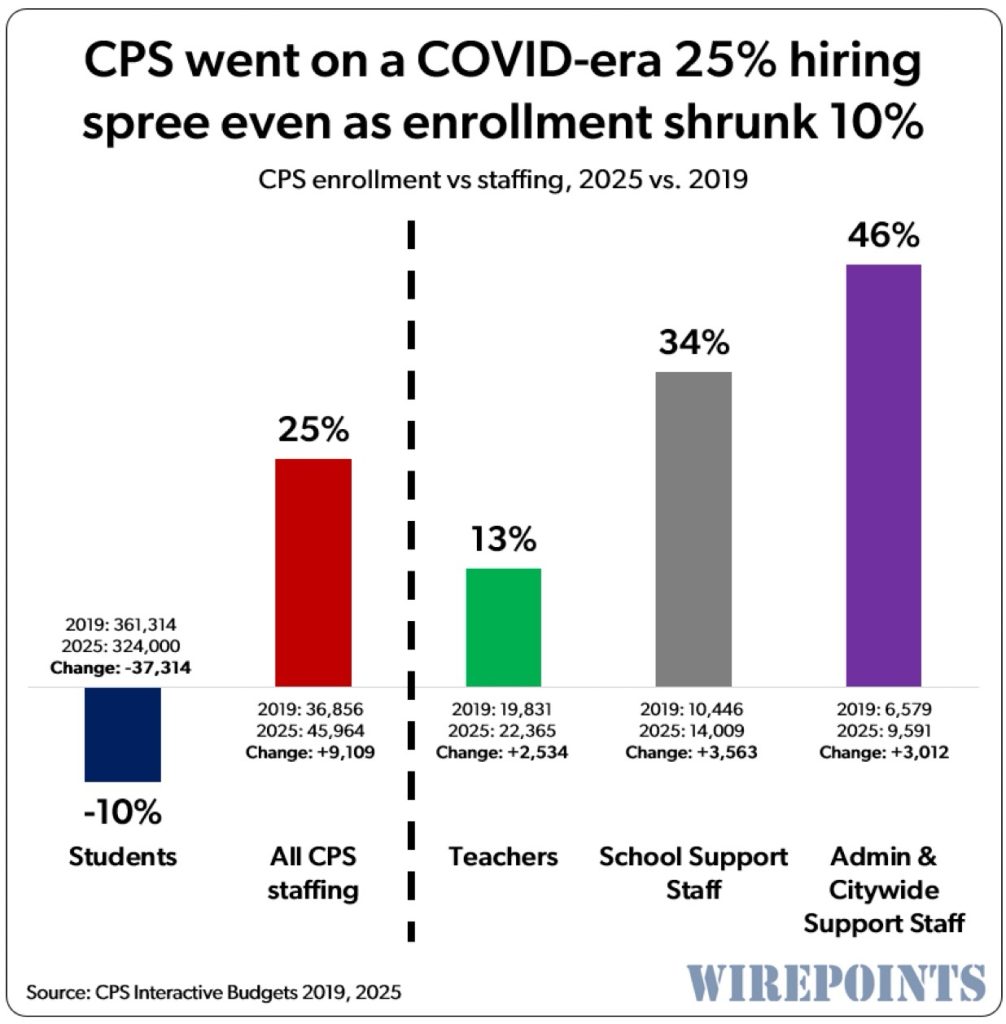
Moreover, compared to other states, Illinois residents pay the 5th highest amount of their income toward public K-12 spending in the U.S. (at 4.5%, or $21.8k) – and spending is materially higher for CPS compared to the rest of state (at around $30k per pupil). Spending isn’t the main issue…

I get that many have taken a hit with inflation and

Share

Notes on phones in schools

Kayla Huynh:

Under a Madison Metropolitan School District rule, students are allowed to have their phones in school but must refrain from using their devices in a way that disrupts learning. The policy gives school leaders latitude in creating their own rules.

The Madison School Board considered updating the district’s cell phone policy in 2022 but board members made no change. The current policy was last revised in 2014, when Apple released the iPhone 6. Apple is expected to release the iPhone 16 this fall.

A Cap Times review of school policies found most schools in the district are adopting individual rules to deter students from being on their phones.

The policies vary district-wide. Some schools require students to keep their phones off and stored in their lockers. Others allow students to keep their phones throughout the school day as long as the devices are powered down or in silent mode.

Share

“challenges this presumption of innocence”

Jack Nicastro:

The Supreme Court disagrees. In 2013, the Court ruled in Maryland v. King that taking DNA upon arrest does not violate the Fourth Amendment’s protection against unreasonable searches and seizures. Since then, warrantless DNA collection and comparison has been widely practiced, much to the chagrin of civil liberties groups such as the American Civil Liberties Union.

According to data from the National Conference of State Legislatures, 20 states do not collect DNA upon any arrest. Of the remaining 30 states that do, most limit this collection to felony arrests, while eight also include specific misdemeanors. Even among felony arrests, the relevance of collecting DNA can vary widely: using DNA from a marijuana trafficking arrest to compare against samples from the crime scene of a serial murder is unjustifiable. 

Share

The future of Coursera’s only credible alternative for universities rests in the hands of 2U’s creditors.

Dhawal Shah

In 2021, the unprofitable 2U bought edX, an unprofitable non-profit, for a staggering $800 million. Even to my untrained eye, it seemed like a questionable decision.

In my analysis of the acquisition, I had highlighted the financial strain this acquisition would place on 2U, noting the additional $42 million of annual interest expense due to the loan taken to finance the purchase.

Last month, 2U filed for bankruptcy, primarily due to the significant debt it took on, particularly to finance the acquisition of edX.

Fast forward to 2024, and we’re faced with a harsh reality: 2U is bankrupt, edX seems to have stagnated, and Axim Collaborative (the  non-profit from the sale that retained the $800 million) has barely made a peep.

As one of the few voices who expressed skepticism from the outset (in a business sense), I feel compelled to break down this triple failure and the unfulfilled promises that accompanied it.

Share

Notes on k-12 models

Jeff Hagan:

Jennifer C. Berkshire and Jack Schneider, coauthors of A Wolf at the Schoolhouse Door, have written a new book, The Education Wars: A Citizen’s Guide and Defense Manual (both books are published by the New Press). In it, the two explore the seemingly sudden assault on public schools from Christian conservatives and fiscal conservatives and show that it is, in fact, not so sudden, but rather a sustained line of attack against which public school defenders have been fighting for decades

Share

K-12 spending growth vs teacher compensation

More.

The Mackinac Center.

Share

New UW-Madison protest policy ‘clearly unconstitutional,’ free speech expert says

Noe Goldhaber

The University of Wisconsin-Madison’s new protest policy may be unconstitutional, a free speech and constitutional law expert told The Daily Cardinal Thursday. 

UW-Madison updated its protest policy Wednesday to include restrictions on “expressive activity” within 25 feet of university facility entrances, size limitations for signs in buildings, specific sound amplification restrictions and restrictions on protest activity during select times on campus areas.  

Although the policy isn’t trying to limit “individuals speaking directly to one another” such as conversation, free speech and constitutional law expert Howard Schweber said a conversation between friends, the distribution of newspapers or pamphlets, singing or wearing political merchandise could all be prohibited within 25 feet of UW-Madison facility entrances.

Schweber said the university limiting “expressive activity” within 25 feet of building entrances is “extremely problematic, clearly unconstitutional” and “begging to invite some judge to strike them down.”

UW-Madison defines “expressive activity” as activities protected by the First Amendment including “speech, lawful assembly, protesting, distributing literature and chalking” in its updated policy.

Share

Are Wisconsin students really doing better? Or does it just look that way?

Alan Borsuk:

“Instead of focusing on declining academic achievement in Wisconsin, the Department of Public Instruction is working to hide the problem,” wrote Will Flanders, research director at the Wisconsin Institute for Law & Liberty, a conservative law firm and think tank. “Unfortunately, changing standards for political correctness and to avoid accountability will hurt students today, tomorrow and long into the future.” 

Has the actual achievement of students improved much, if at all? That’s a different question that can’t be answered yet.   

But Wisconsin’s measuring stick for student performance has been changed. And the categories for student performance have been renamed in, shall we say, kinder, gentler ways.  

Results from the state’s round of standardized tests — administered in the spring and known as the Forward tests for third- through eighth-graders and the ACT and PreACT Secure tests for high school students — have been distributed to school districts and schools and, in some places, to families. The overall results will not be made public until sometime this fall. But Wisconsin Department of Public Instruction leaders have released enough information to make clear that significant changes have been made in the accountability system.  

The changes — especially in where the bars are set for categorizing students’ performance — will make it difficult, at best, to compare this year’s results to prior years for the large majority of students in Wisconsin, including large numbers of private school students who take part in one of the state’s four school voucher programs.

———

“Instead of focusing on declining academic achievement in Wisconsin, the Department of Public Instruction is working to hide the problem,” wrote Will Flanders, research director at the Wisconsin Institute for Law & Liberty, a conservative law firm and think tank. “Unfortunately, changing standards for political correctness and to avoid accountability will hurt students today, tomorrow and long into the future.”  

———-

More.

Madison taxpayers of long supported far above average K – 12 spending.

The data clearly indicate that being able to read is not a requirement for graduation at (Madison) East, especially if you are black or Hispanic”

My Question to Wisconsin Governor Tony Evers on Teacher Mulligans and our Disastrous Reading Results

2017: West High Reading Interventionist Teacher’s Remarks to the School Board on Madison’s Disastrous Reading Results 

Madison’s taxpayer supported K-12 school district, despite spending far more than most, has long tolerated disastrous reading results.

“An emphasis on adult employment”

Wisconsin Public Policy Forum Madison School District Report[PDF]

WEAC: $1.57 million for Four Wisconsin Senators

Friday Afternoon Veto: Governor Evers Rejects AB446/SB454; an effort to address our long term, disastrous reading results

Booked, but can’t read (Madison): functional literacy, National citizenship and the new face of Dred Scott in the age of mass incarceration.

When A Stands for Average: Students at the UW-Madison School of Education Receive Sky-High Grades. How Smart is That?

Share

K-12 Tax & $pending climate: Madison’s 2 no votes on the November referendum

David Blaska summary:

Ike Knox and Barbara H-McK were the only two votes against putting the City of Madison’s $22 million property tax hike on the November 5 ballot. Here is Ald. Harrington-McKinney:

I am absolutely AGAINST, and will vote NO to any referendum that seeks to increase the levy or burden residents with additional property taxes. [To Mayor Satya] The primary reason for a NO vote on the referendum is that you have lost all credibility in being fiscally responsible in managing our money.

Echoing former mayor Paul Soglin (who always seems the equivalent of the UK’s shadow government), Ald. H-McK wonders why the City hasn’t lobbied Gov. Tony Evers, a Democrat, for some kind of assistance “years ago in preparation for this day.” The alder also indicts “lack of clarity” around funding the mayor’s pet project, bus rapid transit (BRT).  

Portraying grant moniesfrom any governmental agency does not make it ‘free’ money. Capital assets require maintenance and repair (operating expenses) whether it’s a building, elevator, fire alarm/suppression system, bridge, road, bus, bus stop, bike path, etc. Any ‘net new’ asset drives maintenance as well as requiring funding (reserves) for future replacement.  

A $200 million grant will eventually require funding sufficient capital reserves, which will be a net new obligation for City and taxpayers. When ridership is falling this is a huge risk, and obligation, to citizens. What is the ridership model for the next 5 years, what happens if ridership declines, what are mitigation plans if BRT is under water?

Madison’s well funded k-12 system and city government are seeking substantial 607M+ tax and spending increases via referendum this fall.

Share

Another Madison area Tax & $pending increase referendum

Chris Rickert:

Fitchburg is allowed a 3.847% increase to its levy, the city said in the news release, which would bring the levy to about $32.6 million. A successful referendum would bump that increase to 11.01% and the levy to about $36.2 million.

Baraboo

Madison’s well funded k-12 system and city government are seeking substantial 607M+ tax and spending increases via referendum this fall

Share

 A recent study indicates that as much as 25% of Generation Z job applicants have brought a parent with them to a job interview in the past year.

LZ Granderson:

Let’s start with employers saying younger applicants are unprepared. That should not be altogether surprising given the havoc the pandemic played on the world’s education system and the lives of young people during formative years. The ramifications stemming from years of interruption in learning and social development are beginning to show up in the workforce.

Last fall, when I started teaching a college class, it took weeks for me to get my students to make eye contact and speak in class to one another — and some of them want a career in communication. I’ve spoken to friends who are also educators, and they have seen the same.

Which is why some young people would opt to bring a familiar face into an unfamiliar setting. And in some cases, they’ll choose the only adults they interacted with in person while we were sheltered in place: their parents. The image doesn’t seem so ridiculous when you think about it like that. Because of the applicant’s understandable social awkwardness — anxiety, avoiding eye contact — the presence of a parent can bring reassurance. That doesn’t mean the young person can’t do the job without Mom or Dad. It means that job interviews are stressful. It means the pandemic’s full toll is still becoming apparent.

Commentary.

Share

California Law Schools Must Encourage Viewpoint Diversity:

Keith Hand:

Many law schools operate in a manner that reinforces ideological orthodoxy and chills dissenting views.

In June, the deans of over 100 law schools published a joint letter affirming that legal education should teach students “to disagree respectfully and engage with one another across ideological lines.” As thousands of new law students begin their professional education, in the midst of a divisive election cycle and debate over another round of contentious U.S. Supreme Court decisions, are law schools doing enough to train advocates for a pluralistic society in practice? …

Educational institutions, especially those training the nation’s future lawyers and judges, should work to counter the groupthink and polarization degrading our civic life. But in practice, many law schools operate in a manner that reinforces ideological orthodoxy and chills dissenting views on contentious legal issues.

Here in California, examples of such problems abound. Many law faculties lack meaningful ideological diversity. Institutionally sponsored events and social media overwhelmingly promote progressive speakers and perspectives. Administrators issue institutional statements on national and world events, leaving the impression that dissenting views are unwelcome. And, when students invite outside experts to present alternative perspectives, they sometimes face harassment and shout downs, as we witnessed at my law school, Stanford Law School, and other institutions in recent years. … As a state that prides itself on tolerance and openness, California can and should do better.

Share

Litigation over Race based taxpayer funded scholarships

Tomer Ronen:

The lawsuit claims Rothove contacted a UW-Madison official who said he was ineligible to apply for the program “because of his race.” Rothove is not a first-generation college student and does not meet the McNair federal income guidelines, according to the lawsuit.

“I was excited when I learned about the McNair Program because I thought it would be a great way to help me get into graduate school,” Rothove said. “But when I realized that I did not qualify because of my race it was devastating. This is the 21st Century — why are we continuing to separate and divide students?”

Share

California and cursive writing

Keiran Southern:

In an age of smartphones and TikTok, students in California are now required to learn an old-school skill — joined-up writing.

Cursive writing was largely abandoned in America after 2010 when many states adopted learning standards introduced by the Obama White House. In an era when children do most of their work digitally, its popularity declined. 

However, California has now become one of 23 states that require cursive handwriting to be taught, with supporters saying it helps a child’s development and is important for reading historical documents, such as the US Declaration of Independence.

Learning joined-up writing is now obligatory for students aged six to 12 after Gavin Newsom, the governor of California, signed a bill that took effect this month.

Share

Prompt Engineering Interactive Tutorial

Anthropic

This course is structured to allow you many chances to practice writing and troubleshooting prompts yourself. The course is broken up into 9 chapters with accompanying exercises, as well as an appendix of even more advanced methods. It is intended for you to work through the course in chapter order.

Share

Auditing the taxpayer funded Wisconsin DPI

Cleo Krejci

Following news of a financial crisis in Milwaukee Public Schools, a legislative committee has mandated a state audit of Wisconsin’s education department.

The co-chairs of the Joint Legislative Audit Committee said MPS’ financial issues that came to light this spring necessitate a deeper review of the Department of Public Instruction itself. The review by the Legislative Audit Bureau will probe for answers about how DPI monitors K-12 school finances.

“Clearly (the Department of Public Instruction) decided not to treat the infection it knew about at (Milwaukee Public Schools), and let it fester until it was too late,” State Sen. Eric Wimberger, R-Green Bay and co-chair of the audit committee, said Thursday.

Though the audit was approved Thursday, not all members of the legislative committee were in support of it. Sen. Robert Wirch, D-Somers, said he voted no because the audit was a “fishing expedition” that didn’t take the taxpayers into consideration.

“I believe in local control and local responsibility,” Wirch said. “A lot of people have lost their jobs over what happened in Milwaukee. We already have an audit that’s going to be happening.”

Details about what drove the financial crisis in Milwaukee are still murky. But what’s clear is the district was months late in submitting required financial information to the state, driving its superintendent and two other administrators to vacate their positions.

Share

Civics: Independence

Nicole Shanahan Video.

Meanwhile: Harris explains in exclusive CNN interview why she’s shifted her position on key issues since her first run for president

Share

Notes on the taxpayer funded Wisconsin DPI’s “Accountability System”

Will Flanders

How do we know DPI’s accountability system is broken? Below is a count of the schools that “Met Expectations” on the report card last year. 7 schools with >4.6% proficiency in ELA were in this category, as were 3 schools with 64-69% proficiency. The current system is useless.

Share

Notes on Ohio’s K-12 climate and 2025

Megan Henry:

“Ohio is on the cutting edge of implementing universal vouchers,” Collins said. “Ohio is the Wild West when it comes to universal vouchers.” 

Project 2025 would then take it a step further by expanding education savings accounts — something Ohio is also trying to do. Rep. Gary Click, R-Vickery, introduced House Bill 339 last year which would establish the noncharted educational savings account program.

The education savings account program started in August 2011 in Arizona and have grown in popularity in the past few years as more states move toward universal school vouchers. ESAs give families access to public per-pupil funds to be used for tuition for private schools, among other things. Arizona’s budget this summer faced a meltdown due to private charter school spending, which caused hundreds of millions in budget cuts to critical state programs and projects.

Share

Endangering Vulnerable Kids

Christina Buttons

Progressives have labeled Tim Walz a “champion of children,” citing policies he enacted as governor of Minnesota. Those policies, however, have endangered some of the state’s most vulnerable kids.

In May, Walz signed into law the Minnesota African American Family Preservation and Child Welfare Disproportionality Act, the most radical child-welfare-reform bill in the country. Inspired by activists’ complaints about racial disparities in the child-welfare system, the new law makes it harder to remove black or other “disproportionately represented” children from homes where they may have been neglected or abused. While supporters have argued that the law supports children’s welfare, in reality, it keeps black and minority kids in unsafe environments in the name of racial equity.

Activists seeking to reform Minnesota’s child-welfare system had long cited its racial disparities. Black children (including those of mixed race) make up 26.9 percent of the state’s child-protection cases (blacks constitute 11 percent of the state’s population overall); white children account for slightly less than half of all cases, though whites account for nearly 75 percent of the population. Reformers present these imbalances as evidence of racial bias, but black children nationally are three times more likely to die of suspected abuse or neglect than are white children.

Even before the passage of the law, Minnesota child-welfare professionals were more likely to leave black children in dangerous environments. According to a report by Safe Passage for Children of Minnesota, black children made up 26.1 percent of all child-maltreatment deaths between January 2015 and April 2022, well outpacing blacks’ share of the state population. The report’s authors note that “counties may have left Black children in high risk settings more frequently and for longer periods than children of other races and ethnicities.”

Share

In stark SCOTUS filing, DOJ challenges appeals court ruling against SAVE student loan plan

Chris Geidner

If the court does not vacate the Eighth Circuit’s injunction, in other words, DOJ urged the Supreme Court to take the cases on the merits and hear them in the fall to rule on the legality of the SAVE plan.

When lower courts are out of control, the Justice Department should say so — to hold the courts, including the Supreme Court, accountable and to inform the public. Prelogar’s request to the justices is a breath of fresh air in that respect. 

Share

Student behavior and mediocre pay are taking their toll

Matt Barnum:

The share of teachers who say the stress and disappointment of the job are “worth it” has fallen to 42%, which is 21 points lower than other college-educated workers, according to a poll by Rand, a nonprofit think tank. As recently as 2018, over 70% of teachers said the stress was worth it.

In surveys and interviews, teachers are most often pointing to a startling rise in students’ mental-health challenges and misbehavior as the biggest drivers of burnout. In the Rand survey, student behavior was the top source of teachers’ job stress.

High-school math teacher Cory Jarrell says he saw student behavior deteriorate, yet his school grew more lenient in administering consequences. He also didn’t feel like teaching offered much opportunity to advance in his career.

And then his district, Kansas City Public Schools, rolled out a new policy last year. Teachers couldn’t give students a zero for an assignment, even if they didn’t turn it in. This was the final straw.

“When I got into teaching my one thing was about learning and love of learning,” Jarrell said. “In the end, it was less about the learning and more about babysitting.”

He left teaching this summer.

Share

The Democratic Party’s Project 2025

Wall Street Journal:

What Kamala Harris will do if she wins the White House in 77 days is still mostly an open question, since she leapfrogged the primaries and didn’t have to argue over policy with any Democratic competitors. But for one clue as to Ms. Harris’s direction, look at what the Democratic base believes, since she has a history of following her party instead of leading it.

The 92-page document is filled with political rhetoric and exaggerations that present Mr. Biden as a working-class hero and Donald Trump as a richy-rich villain. But the platform is also a peek into an economic worldview in which the government is the answer, almost no matter the question. While private businesses are always “gouging” or adding “junk fees,” or otherwise trying to rip somebody off, Washington’s wise men are capable of providing for the American people, if only they have the power to pass the laws and regulations.

Here are only some of the promises:

• “Health care should be a right in America, not a privilege,” the platform says. “We’ll never quit fighting to protect and expand the Affordable Care Act.”

• “We support Medicaid expansion, encouraging states to provide health coverage to low-income Americans on the federal government’s tab.”

• “We’ll look to expand traditional Medicare coverage to include dental, vision, and hearing services.”

Share

Book Publishers Sue Florida, Alleging School Library Law Violates First Amendment

Jacob Gershman:

Major U.S. publishers are challenging a Florida law enacted last year that cracks down on sexual content in school libraries, alleging it has led to indiscriminate book-banning in violation of the First Amendment.

Florida’s statute, also known as HB 1069, requires districts to set up a process for a parent or resident of the county to contest school and classroom library materials that they believe contain pornographic or sexual content.

The country’s major publishing houses say Florida has unleashed a wave of censorship. The county school districts implementing the state law have eliminated hundreds of titles from their collections, according to the lawsuit, including, in some districts, the removal of literary classics such as Aldous Huxley’s “Brave New World,” Kurt Vonnegut’s “Slaughterhouse-Five,” Ernest Hemingway’s “For Whom the Bell Tolls” and Leo Tolstoy’s “Anna Karenina.”

“Plaintiffs take issue with the removal of books under the guise of ‘pornography’ that are not remotely obscene,” the lawsuit states.

The complaint, filed in Orlando federal court Thursday, puts Florida Gov. Ron DeSantis’s administration at the center of a broadening legal clash over who gets to decide what books belong on library and classroom shelves.

Share

Milwaukee Police Chief Jeffrey Norman appealed to the public to get involved in the lives of youth in the city.

Fox6:

In the letter, Norman shares recent examples of teens being arrested for using firearms, stealing cars and more. He urges the public, “We need you at the table.  Our youth need you at the table.  Be a part of the solution.  What are you doing to help?”

Share

Notes on higher education governance

Christopher Rufo:

The great @JordanBPeterson praises my work exposing corruption in elite academia, but expresses concern, even opposition, to my work reforming New College of Florida. He’s wrong. Let me explain why.

First, Peterson implies that “political control” over universities is illegitimate. It is not. New College of Florida is a public university, and public universities are the creation of the state—that is, they belong to and should reflect the values of the public. In Florida, voters elect their representatives, who, in turn, charter, fund, and govern the public universities. The takeover of New College was, in this manner, an expression of the democratic will, moving the public university in line with the wishes of the public.

It was always this way. When Thomas Jefferson wrote the charter for the University of Virginia, the first public university in the United States, he explicitly stated that the university should promote the virtues of the broader society and that the ultimate authority rested with the legislature. The university’s leadership, he insisted, “should at all times conform to such laws as the legislature may from time to time think proper to enact for their government, and the said University should, in all things, and at all times be subject to the controul of the legislature.”

Share

“I believe handouts are not the answer”

Nicole Shanahan:

Kamala Harris believes in using handouts as a tool to win elections. We’ve seen this tactic before, notably in Rome just before its fall. Her proposed housing policy is inflationary, as it fails to address the need to increase the supply of homes. As the daughter of a legal immigrant who worked hard to provide for us, I believe handouts are not the answer. Instead, sound policies that promote more homebuilding, reduce costs, and remove unnecessary government barriers would significantly improve housing affordability.

Share

Google and California’s New People’s Dailies

Wall Street Journal:

Local newsrooms have been struggling amid a decline in advertising revenue and subscribers in the internet age. This means less news about local events and less scrutiny of local officials. But the worst response would be to have government finance what would amount to state-sanctioned newsrooms.

Enter Democrats, who this month advanced legislation modeled on laws in Australia and Canada that would require large internet platforms to pay publishers a share of their advertising revenue. Google and others threatened to sue and remove links to California news sites if the law passed.

The new agreement between Google and Democrats averts a costly legal fight for both sides. Gov. Gavin Newsom proclaimed it would ensure “the survival of newsrooms.” Don’t bet on that if he means independent journalism. This collusion between Big Tech and Sacramento will turn media outlets into de facto government subsidiaries.

Share

Massachusetts Fumbles the Tax Ball

Wall Street Journal:

For the latest evidence that state tax policy influences taxpayer decisions, take a look at the National Football League. On Monday former New England Patriots coach and general manager Bill Belichick explained that states with millionaire surtaxes like Massachusetts are at a disadvantage in attracting the best free-agent players.

It’s “just another thing you’ve got to contend with in negotiations up there,” Mr. Belichick added. “It’s not like Tennessee or Florida or Nevada or some of these teams that have no state income tax. You get hit pretty hard on that with the [players’] agents. They’ll come and sledgehammer you down about . . . the tax they’re paying.”

Massachusetts used to have a 5% flat tax on all incomes above $8,000. But in 2022 the state imposed a four percentage point surtax on incomes over $1 million. The Patriots are way under the NFL salary cap and have money to outbid other teams for top talent. But they have recently lost out on free agents they were reported to be courting.

Taxes may not have played a role in those cases, and pro athletes make team decisions for many reasons, from championship prospects to management to weather. But most have a short career horizon for high-dollar earnings. The state tax delta is not a rounding error.

Share

Biden-Harris Administration: No Remorse for Free-Speech Abuses

James Freeman:

A few weeks ago Vice President Kamala Harris, who has been ducking the usual media scrutiny applied to presidential candidates, said, “I’ve talked to my team. I want us to get an interview scheduled before the end of the month.” The end of the month arrives on Saturday night. If the vice president deigns to sit down for an extended discussion with a member of the news media, the lucky reporter should demand to know why the Biden-Harris administration still won’t repudiate its abuse of First Amendment rights. The government’s refusal to admit fault for pressuring social-media companies to silence dissenting voices virtually guarantees that such abuses will happen again if she’s elected president.

Americans who treasure their rights to free speech desperately need independent and courageous journalists. We’re also going to need lawmakers to codify punishments for government officials who trample on our First Amendment liberties. It would also be nice to find someone with the resources and smarts to mount a new court challenge against the Biden-Harris administration. This column nominates a man whose company was on the receiving end of outrageous government coercion and knows the territory as well as anyone.

Victor Nava reports on him for the New York Post:

Share

No, intelligence is not like height

Sasha’s Gusev:

But over the past five years it has become clear that IQ and educational attainment are not like height in fundamental and meaningful ways, and the reason behind this difference is one of the most important and interesting results to come out of modern behavioral genetics. So let’s go through it piece by piece.

IQ is much less heritable and more confounded than height

We’ll start with the specific point made in The Atlantic article (and the Vox article that it is citing) that, unlike height, adding up all of the genetic variants only predicts a small fraction of IQ score. This is just objectively true: the largest genetic analysis of IQ scores built a predictor that had an accuracy of 2-5% in Europeans, depending on the target cohort [Savage et al. (2018) – Table S9] whereas the largest genetic analysis of height build a predictor that had an accuracy of 45% in Europeans [Yengo et al. (2022) – Figure 4A]. I’m quite certain that 45% is larger than 5% though perhaps the race scientists will come up with some new math to debunk this.

Share

Most of its new students are women

Teresa Watanabe:

The auditorium was packed with hundreds of high school girls from across the nation fangirling a YouTube idol they dream to emulate. 

There before them stood Katie Bouman, an associate professor of computing and mathematical sciences, electrical engineering and astronomy at Caltech in Pasadena, showing off images of a dark hole ringed by a fire-colored halo. In 2022, Bouman co-led a team of more than 300 researchers from 80 institutions to capture the world’s first image of the supermassive black hole at the center of the Milky Way galaxy.

Share

Notes on declining k-12 enrollment

Juana Summers, Jonaki Mehta and Katia Riddle

NPR’s Juana Summers talks with ProPublica ’s Alec MacGillis about his recent reporting on how declining enrollment is a crisis for American public schools

Share

A Medical Professor Learns That Dissent About Diversity Won’t Be Tolerated

George Leef:

In the good old days of American education, professors could speak their minds freely. Disagreements would often result, with others disputing the case that the speaker had made. The solid consensus, however, was that academic freedom must never be curtailed, since intellectual progress depends on the exchange of ideas, just as John Stuart Mill had argued in On Liberty.

Perhaps the most disturbing trend in our colleges and universities today is the erosion of support for free speech. Professors who now take controversial positions have to worry about more than mere disagreement; they have to worry about punishment for having expressed “wrong” thoughts. A host of topics are now treated as sacred cows, where the official, establishment view may not be questioned. At the top of that list is “diversity.” Because of the intellectual fragility of the diversity obsession, its defenders usually respond to criticism not with reason but with punishments.

Because of the intellectual fragility of the diversity obsession, its defenders respond to criticism not with reason but with punishments.Norman Wang is a professor at the University of Pittsburgh Medical Center (UPMC), where he has been on the faculty since 2008, specializing in cardiology. His troubles at the school began in March 2020, after he published an article in the Journal of the American Heart Association (JAHA) entitled “Diversity, Inclusion, and Equity: Evolving Race and Ethnicity Considerations for the Cardiology Workforce in the U.S. from 1969 to 2019.” The article had been reviewed and accepted in the usual process.

Share

Civics: Democrats Win Some, Lose Some Trying to Kick Rivals Off Ballots

James Freeman:

In a remarkably aggressive campaign to use the court system against political rivals, Democrats can’t win ’em all. But that doesn’t mean they’re not trying. The lawfare campaign against former President Donald Trump, including criminal prosecutions by Democratic prosecutors at various levels of government, succeeded in rallying Republican primary voters to his cause but may not succeed in denying him another term. Meanwhile Democrats’ legal campaign to disqualify other rivals proceeds apace. This campaign is among the reasons former Democrat Robert F. Kennedy Jr.is now endorsing Mr. Trump. The latest news buttresses the Kennedy argument that Democrats have taken a rather undemocratic turn.

Share

Notes on the possible reorganization of the Wauwatosa and Milwaukee schools

WTMJ4

A legal memo was released to TMJ4 Wednesday morning, which stated that reorganization of the two districts, or annexation of MPS schools by the Wauwatosa district is not possible under current state law. The memo states, “due to its classification as a first class city school district, MPS is not subject to the general school district reorganization provisions under Chapter 117 of the Wisconsin Statutes.”

The only way a merger or annexation would be possible is if the State Legislature changed an existing law or the Milwaukee Common Council changed city municipal boundaries.

Commentary.

Share

“State’s fictional test score gains”

Dale Chu:

The assessment world was set alight last week with the news of skyrocketing test gains in the Sooner State. Reading scores for Oklahoma’s third graders jumped from 29 percent proficient last year to 51 percent this year. Eighth graders bested their previous mark by double, spiking from 20 percent proficiency to 40 percent. While some welcomed the ostensibly good news, Harvard’s Andrew Ho described the gains as “nonsensical fiction.”

Which indeed they were. Rather than reflecting an actual improvement in student performance, the astronomical increases resulted from a lowering of the threshold required (i.e., adjusting the cut scores) to achieve proficiency. Had the scoring system not been changed, the results would have been similar or slightly below the previous year’s. To put things in context, the new cut scores are closer to the “NAEP Basic” mark, while the previous cut scores were on the cusp of “NAEP Proficient.” This is worth nothing because once upon a time, Oklahoma was among the leaders of the pack (see graph below) in benchmarking proficiency to the higher standard:

——

Wisconsin DPI’s ongoing rigor reduction and mulligan campaign.

Share

“property tax was an unrealized gains tax”

Collin Rugg:

NEW: CNBC host Joe Kernen rolls his eyes and laughs after Harris’ economic advisor Bharat Rama tries arguing in favor of Harris’ unrealized capital gains tax.

Rama sat in silence as the hosts poked fun after he tried saying that property tax was an unrealized gains tax.

“It’s probably unconstitutional… it’s not income.”

“And it’s never gonna happen.”

——

Vivek:

A tax on unrealized capital gains is a path to a market crash & potential Great Depression.

Madison’s well funded k-12 system and city government are seeking substantial 607M+ tax and spending increases via referendum this fall.

Share

Notes on k-12 perception (and reality)?

Mark Hlavacik, Jack Schneider

Over the past half-century, conventional wisdom has been that America’s schools are in crisis (Hlavacik, 2016). The narrative is so pervasive, in fact, that we would be surprised if it didn’taffect people’s views. But we wanted to know whether that narrative reflects people’s actual experiences. Is the national-level rhetoric a lagging indicator of real problems on the ground? Or are the concerns of politicians and policy makers driving a national story that’s out of sync with local reality?

To at least partially answer this question, we traced how five major print news sources — The Boston Globe, Newsweek, The Wall Street Journal, The New York Times, and USA Today— have spread the story that schools are failing across roughly three decades. Beginning in 1984, just after the publication of the A Nation at Riskreport sounded the alarm about public schools, we looked for different permutations of “failing schools” language all the way through the end of the Obama administration in 2017.

—-

Meanwhile, the taxpayer funded Wisconsin DPI continues its mulligan and rigor reduction journey.

Share

K-12 Governance and accountability: Virginia Edition

Www.

On Wednesday August 28, the Virginia Board of Education will hold a Special Session to consider the Statewide Comprehensive Support Plan. The Plan proposes the requirements that will be imposed on schools and districts when they do not meet the Board’s new rules for accreditation and accountability. 

—-

Andrew Rotherham:

Context missing here is in VA, today, about 60% of Black 8th-graders are below basic on math on NAEP. Some NAEP levels contested, there is NO debate that below basic is not catastrophic for life outcomes. Those aren’t @GovernorVA’s #s, that’s federal. 1/x

Commentary.

Meanwhile, Madison:

Madison taxpayers of long supported far above average K – 12 spending.

The data clearly indicate that being able to read is not a requirement for graduation at (Madison) East, especially if you are black or Hispanic”

My Question to Wisconsin Governor Tony Evers on Teacher Mulligans and our Disastrous Reading Results

2017: West High Reading Interventionist Teacher’s Remarks to the School Board on Madison’s Disastrous Reading Results 

Madison’s taxpayer supported K-12 school district, despite spending far more than most, has long tolerated disastrous reading results.

“An emphasis on adult employment”

Wisconsin Public Policy Forum Madison School District Report[PDF]

WEAC: $1.57 million for Four Wisconsin Senators

Friday Afternoon Veto: Governor Evers Rejects AB446/SB454; an effort to address our long term, disastrous reading results

Booked, but can’t read (Madison): functional literacy, National citizenship and the new face of Dred Scott in the age of mass incarceration.

When A Stands for Average: Students at the UW-Madison School of Education Receive Sky-High Grades. How Smart is That?

Share

Notes on Chicago k-12 finance practices

Austin Berg:

Mayor Brandon Johnson’s Chief Financial Officer Jill Jaworski started the Chicago office of PFM Financial Advisors in 2010. Under her leadership, that office was the financial advisor or co-financial advisor on $7.6B worth of CPS borrowing across 19 deals from 2011-2019.

If those deals stole money from the district, why did Johnson hire Jaworski?

And why isn’t Davis Gates calling on Jaworski to resign?

Because all the recent talk about bank deals is just scapegoating to divert attention from the main problem: the unsustainable debt and tax burden CTU is demanding to fund their political machine.

Share

As many kids fall behind, schools try a new approach to teach how to read

Only about one-third of elementary school students in the U.S. are reading at grade level, according to the recent National Assessment of Educational Progress. In response, many schools are rethinking how they teach kids to read.

In one New York City first grade classroom, Melissa Jones-Diaz goes letter by letter, teaching the specific rules that form the English language. For decades, most schools felt it was unnecessary to explicitly teach kids these rules, preferring to give students time with books on the belief they would most likely figure it out for themselves.

Now, specific, detailed instruction is taking over.

“It was a big shift in my teaching, in my understanding of how students learn to read,” Jones-Diaz said.

The Science of Reading isn’t so much a curriculum as a grassroots movement best known for arguing that phonics, or the relationship between letters and their sounds, is key to learning to read.

——-

Madison taxpayers of long supported far above average K – 12 spending.

The data clearly indicate that being able to read is not a requirement for graduation at (Madison) East, especially if you are black or Hispanic”

My Question to Wisconsin Governor Tony Evers on Teacher Mulligans and our Disastrous Reading Results

2017: West High Reading Interventionist Teacher’s Remarks to the School Board on Madison’s Disastrous Reading Results 

Madison’s taxpayer supported K-12 school district, despite spending far more than most, has long tolerated disastrous reading results.

“An emphasis on adult employment”

Wisconsin Public Policy Forum Madison School District Report[PDF]

WEAC: $1.57 million for Four Wisconsin Senators

Friday Afternoon Veto: Governor Evers Rejects AB446/SB454; an effort to address our long term, disastrous reading results

Booked, but can’t read (Madison): functional literacy, National citizenship and the new face of Dred Scott in the age of mass incarceration.

When A Stands for Average: Students at the UW-Madison School of Education Receive Sky-High Grades. How Smart is That?

Share

The staggering death toll of scientific lies

Kelsey Piper:

I learned about the Poldermans case when I reached out to some scientific misconduct researchers, asking them a provocative question: Should scientific fraud be prosecuted? 

Unfortunately, fraud and misconduct in the scientific community isn’t nearly as rare as one might like to believe. We also know that the consequences of being caught are frequently underwhelming. It can take years to get a bad paper retracted, even if the flaws are readily apparent. Sometimes, scientists alleged to have falsified their data file frivolous lawsuits against their peers who point it out, further silencing anyone who would speak out about bad data. And we know that this behavior can have high stakes, and can dramatically affect treatment options for patients

In cases where research dishonesty is literally killing people, shouldn’t it be appropriate to resort to the criminal justice system?

Share

K-12 tax & $pending climate: “The trust fund is filled with worthless paper, so emptying it out will have no effect”

David Rose:

The true problem is the accumulation of ever more federal debt to provide revenue to allow the trust fund to redeem its claims on the Treasury. As total baby boomer benefits payments mount, the Treasury has had to issue bonds at an accelerating rate. This is why it only took 260 days to go from a national debt of $34 to $35 trillion a few weeks ago.  

In the absence of significant reform, growing shortfalls will have to be covered by evermore newly issued debt or monetized debt. In either case, the effect on long term interest rates will be the same: they will rise from either increased demand in the credit market arising from additional federal borrowing or, if the Fed decides to monetize these new debt instruments, decreased supply in the credit market arising from creditors requiring a premium for expected inflation. 

This latter effect arises because creditors will only buy a bond if its price is low enough to ensure a return that is high enough to protect the real purchasing power of their investment. This phenomenon is what economists call the Fisher effect.  

Share

The missing shop class

Mike Rowe:

In the long history of public education, it’s hard to imagine a more boneheaded ruling than the completely hairbrained and totally demented decision to remove shop class from high school. I’m still not sure exactly who to blame for this travesty, but even if I did, it wouldn’t matter. Because getting shop class back into public schools is never going to happen. But – getting students back into shop class is another matter entirely. In fact, that’s happening as we speak, and one of the people responsible for that miracle is this week’s guest. His name is Brent Haken, and he’s the perfect person for me to introduce as we approach another Labor Day, and the sixteenth anniversary of mikeroweWORKS.

Brent started his career in education as a farmer, which probably explains his extraordinary success as a teacher, principal, supervisor, and now, the state director of career and technical education in Oklahoma. What he’s accomplished in Oklahoma – in particular at Central Tech – could and should be replicated all over America. In short, Central Tech is a school for students who desire real-world opportunities, hands-on learning, and a relevant curriculum that anyone can put to immediate use. Everything from nursing to truck driving to welding. The school pride is palpable. Students graduate not at the end of a term, but when they have mastered the necessary skills. Thus, a nursing program that might typically go for 18 months, can be completed in half that time, if the student excels. Meritocracy abounds. Healthy competition keeps students at the top of their game, and there’s a student waiting list every year.

Share

Tracking Movement of Illegal Aliens From NGOs to the U.S. Interior

Oversight Project:

The investigation found approximately 30,000 cell phone devices in the NGO facilities and traced the location of those devices in the U.S. during the month of January 2022. We assign a high degree of confidence to the assumption that the vast majority of these devices belong to individuals who illegally crossed the border. This is based on first-hand observation of facilities in which illegal aliens invariably outnumber facility workers and volunteers by many degrees. Additionally, based on the travel patterns and the end location of these devices, we assume that the vast majority of the devices reflect a migration pattern from the border of illegal aliens as opposed to a consistent travel pattern of NGO workers traveling from around the country to the border and back.

Share

K-12 Tax & $pending Climate: “Brace yourself for an ‘avalanche’ of dollar selling?”

George Steer:

Morgan Stanley’s former currency supremo reckons the greenback’s recent slide may yet turn into an “avalanche” as dollar depositors with a nervous eye on America’s rising trade and budget deficits and “no loyalty” to the world’s de facto reserve currency begin to flee. Per his latest note:

Share

Capt. Grace Hopper on Future Possibilities: Data, Hardware, Software, and People (1982)

Video:

On August 26, 2024, the National Security Agency (NSA) released a digital copy of a videotaped lecture, “Future Possibilities: Data, Hardware, Software, and People” that Rear Adm. Grace Hopper gave to the NSA workforce on August 19, 1982. This lecture highlights technological foundational principles, valuable perspectives on leadership and shared experiences overcoming challenges in computer science and math. The legacy of Rear Adm. Grace Hopper continues to echo across the intelligence community to light the path for women in STEM.

Share