School Information System

Kids, Schools & Cities, Part II

Paul Soglin:

In parting, let me share with you the findings of a Northwestern University professor, James Rosenbaum.* He studied poorly performing high school students, virtually all Black, from the Chicago Public Schools who moved into areas served by suburban schools. His findings were that most of these failing students in Chicago were getting C’s in the suburbs. A tougher school district and improved grades!
The main point of his paper was to challenge the commonly accepted conclusion that once a student was doing poorly academically, there was not much hope for turn around after the 6th or 7th grade. His findings completely contradicted that conclusion.

Share

Carol Carstensen’s Weekly Message

Carol Carstensen:

Parent Group Presidents:
BUDGET FACTOID:
MTI has just informed the district that it will not agree to reopen negotiations to consider changes to health insurance. If the union had agreed to reopen negotiations on this point, the agreement was that any savings that resulted from a change in health insurance options would be used to increase salaries for staff.
FEBRUARY 13th MEETINGS:
5 p.m. Special Board Meeting Members of the Memorial/West Task Force spoke with the Board about their recommendations and how they arrived at them. They emphasized that they did not reach their recommendation (to build a new school and add on to Leopold) easily or quickly. It was only exhausting all other approaches that they came to agreement that the only truly long range solution involved building.
The Board then discussed the Memorial/West Task Force recommendation to build a new school on the far west side and to build an addition onto Leopold (known as the build-build approach). The Board decided not to put the issue on the April ballot but to provide more time for discussion and to look at the options if the community doesn’t support the build recommendation. The Board directed the administration to come back with information about the possibility of finding land in Fitchburg to build on and also to show how an addition to Leopold is necessary and would improve the current building.
FUTURE MEETINGS:
February 20:
5 p.m. Special Board Meeting, executive session – expulsions
6 p.m. Finance and Operations Committee (Johnny Winston, Jr., chair) 5-year budget forecast; proposals from community agencies for after school activities funded through the Community Service fund (Fund 80).
7 p.m. Partnerships Committee (Lawrie Kobza, chair) continued discussion about a policy governing gifts/funds to support activities during and/or after school.
February 27:
5:00 p.m. Legislative Committee (Ruth Robarts, chair) legislation that would increase the number of administrators who could be designated “at-will” employees; requirements for school district reports; requiring developers to pay fees to support the building of new schools; newly proposed TABOR-like amendment.
6 p.m. Special Board Meeting: discussion of the East Area Task Force recommendations; the Task Force will have a chance to talk with the Board at the start of the meeting; the Board will respond to the Swan Creek petition; discussion about future uses of the Doyle Building; administrator contracts.
Stay warm,
Carol
Carol Carstensen, President
Madison School Board
“Until lions have their own historians, the hunters will always be glorified.” – African Proverb

Share

Teach Math Procedures as a First Step to Conceptual Understanding

Stanford’s Keith Devlin, via Joanne Jacobs:

. . . professional mathematicians, scientists and engineers, want the schools — the pipeline that keeps those professions supplied with new personnel — to ensure student mastery of numerical, algebraic and computational skills. “We don’t want to spend our time having to reteach the incoming students how to add fractions!” is a common refrain heard in university science and engineering departments.
Basic skills are not all they want, but they don’t want them left out or de-emphasized.
Ranged against them (again, broadly speaking) is the mathematics education community, which argues that a focus on procedural skills is misplaced, and that the primary aim of school mathematics education should be to produce conceptual understanding. “If students understand the concepts, they can pick up any skills they need easily enough, as and when they need them.”
As a professional mathematician, I often have to learn a new part of my subject. Every time I have to go through the same process: Start by learning the rules, then practice using the rules, and keep practicing until understanding develops. Practically every professional mathematician, scientist, or engineer I have spoken to has said more or less the same. Understanding follows experience.

Share

Will Standards-Based Reform in Education Help Close the Poverty Gap

Reader Paul Baker emails:

February 23, 2006, 4:00-5:30 p.m.
Gale VandeBerg Auditorium, Pyle Center Room 121, 702 Langdon Street
Cosponsored by the Institute for Research on Poverty, WCER, and the School of Education. Presenter: Barbara Foorman, University of Texas-Houston. Respondent: William Clune, UW-Madison. More about this event is available here.

Share

Sable Flames 13th Annual “Second Alarm Scholarship Benefit”

On Saturday, February 25, 2006 at the Edgewater Hotel at 666 Wisconsin Avenue in Downtown Madison, The Sable Flames, Inc. will present its Thirteenth Annual “Second Alarm Scholarship Benefit” at 8:00 p.m. until 1 a.m.

(more…)

Share

Math Forum: Wednesday 2.22.2006 7:00p.m.

There’s been no shortage of discusion regarding math curriculum. Rafael Gomez’s latest event, this Wednesday’s Math Forum should prove quite interesting. The event will be at the Doyle Administration Building (McDaniels Auditorium) [Map] from 7:00 to 8:00p.m. Participants include:

The general format follows:

  1. Each Speaker presents their passion and views about math as subject matter in the school setting
    • views will be decoded into a scope and sequence of curr. in the middle school
    • views about the math program at MMSD
  2. Discussion: Questions relative to a scope and sequence as well as developmental stages of a middle school student
  3. Audience Questions

The Forum’s goal is to provide an informative event for parents and other interested parties.

Share

Madison Schools Board of Education Election Site Update

I’ve added several items to the Spring, 2006 Madison School Board election page:

  • Arlene Silveira’s response to the Northside Planning Council’s Questions;
  • Letters supporting candidates:
    • Progressive Dane’s Nick Berigan: Silveira’s actions prove she belongs on School Board (Duplicate post with more comments from Joan Knoebel, Jerry Eykholt and Marisue Horton)
    • Madison School Board Member Ruth Robarts: Cole has kids’ best interest at heart
    • Parent Jim Zellmer: Cole is the best choice for Madison’s future generations.

Parent Marisue Horton posted words for Arlene in the comments below.

Share

A Larger Conversation about Quality Inclusive Education

These are thoughts authored by community member and MMSD parent, Beth Swedeen:
The issue of children being adequately served by special education services is a challenge playing out across the country. Certainly, as someone who works with families of children with disabilities and as a parent of a child with disabilities myself, I know the anguish and frustration of watching a child flounder when needs are not adequately met. I also know families who use public school choice and even move so their child receives adequate services. This is not a Madison-specific problem.
Single solutions, such as eliminating cross-categorical staffing or segregating children into ability-grouped learning situations, is simplistic and can lead to unintended consequences, such as lower expectations in those segregated settings, or rigid one-size fits all instruction by “learning disability” or “cognitive disability” teachers.
In its most heart-breaking forms, category-specific programming in smaller districts leads to children being pulled out of their home school and bussed 15 miles or more away to the “cognitive disability” or “emotional disability” program in a neighboring town. I am working with 2 families who are facing that right now. The fact that their child, who has made friends and connections at school, is being ripped away from the community because he or she has Down symdrome or cerebral palsy is truly tragic. Less than 15 years ago, Madison grouped students in this way, and children did not attend their neighborhood school, not based on parent choice, but based on their disability labels.
Madison Partners for Inclusive Education is working closely with MMSD and with the community as a whole to help support students, their families, and educational staff in improving outcomes for students with special needs.
MMSD has some real positives going for it:

  • More than 97 percent of special needs students are either being served in their home school or in a school of the parent’s choice.
  • The vast majority of students with disabilities at all ages are spending the majority of their day in regular education classrooms (I believe the highest rate of any urban school district in the country.)
  • Leadership at the administrative and at most building levels is committed to inclusive practices.
  • Ties to the University of Wisconsin and evidence-based best practices are strong.
  • Commitment to adequate training and continuing education is present.

Madison Partners has also identified several key areas in which they want to continue to partner with the district to further strengthen the quality of services:

  • Input into hiring at key leadership levels (building principals).
  • Continued partnerships with resources in the community and with families to elevate services and get much-needed supports to classroom teachers, special educators, and related staff.
  • Continued emphasis on total team teaching (using all resources present, including reg/special ed, speech, OT/PT therapists, classroom aides, and related staff to meet every need in classrooms. This also means sharing resources: for instance, reading specialists in schools working with special educators on specific strategies to meet student reading goals.)
  • Continued resources for in-service and pre-service training on effective differentiation.
  • Direct training for families and students on how students can take part in and play leadership roles in developing their own Individual Education Plans (IEPs).
  • More leadership opportunities in schools for students with disabilities.
  • Working with MMSD and community to strengthen state funding for schools.

We know that no single person, no matter how gifted, can meet diverse needs of 15-20 students in any given classroom. Instead of separating children out, though, we endorse strategies than engage the entire school team in the success of each student. Together, we believe we can elevate outcomes, not just for students with disabilities, but for all students in our district.

Share

Change is on Candidates Minds

Sandy Cullen:

Two of the three candidates running in Tuesday’s Madison School Board primary election want to change how the board functions. But they are approaching it from different directions.

Much more on the school board elections here

Share

7.96M Spending vs. Revenue Gap Projected for the Madison School District (2006 – 2007 Budget)

Sandy Cullen:

Madison School District administrators are projecting a $7.96 million gap between what it would cost to continue the same services next year and what it will be able to raise under state revenue limits.
A gap of $6 million to $10 million had been projected.

[ed: 2005-2006 budget is $321M+]
There are many factors that affect the district’s budget including enrollment (flat or slightly declining – every time a student leaves, the district loses spending authority), state and federal redistributions, state spending caps (district spending, which increases annually is limited by enrollment and a % growth), health care costs and program choices among many others. Details here.

Share

The Poetry Foundation

www.poetryfoundation.org:

Through the new Web site, the Poetry Foundation seeks to celebrate and share the best classical and contemporary poetry with a broad and diverse audience, from the devoted poetry reader to the casual one. At the core of the new site is an extensive archive of poetry, including poetry and essays from back issues of Poetry magazine (now in its 94th year of continuous publication). At launch the archive will include more than 3,000 poems by over 300 poets. All of the site’s content, including the poetry archive, is accessible free of charge.

Share

The FruitGal

Sam Whiting:

nstead of getting employees to eat junk food on breaks at work, the company buys them fruit. They put that in the break room and the employees snack on that instead of junk and they feel good and they work hard and they don’t call in sick.
On cost
It’s about $60 for a 40-serving box of seasonal fruit that’s guaranteed to please. If it’s not of the quality you want, we’ll replace it. There’s no contract.

Share

“Extra Special Education at Public Expense”

Nanette Asimov:

At Woodside High in San Mateo County, college-prep classes awaited a 15-year-old boy with learning disabilities and anxiety.
He would blend in with other college-bound students, but also receive daily help from a special education expert. He would get a laptop computer, extra time for tests — and an advocate to smooth any ripples with teachers. If an anxiety attack came on, he could step out of class.
But Woodside High wasn’t what his parents had in mind.
Instead, they enrolled him in a $30,000-a-year prep school in Maine — then sent the bill to their local public school district.

Share

Strategies to Raise SAT Scores

Ian Shapira:

School officials said they are weighing several options, including encouraging more non-honors or non-AP students to enroll in Algebra II by sophomore year instead of participating in an easier, two-year Algebra I course; financing the PSAT for sophomores and perhaps freshmen; and, on a more basic level, adding more testing sites within the county so that students can take the exam in a comfortable setting without having to commute long distances.

Share

“We Must Show Every Child The Light”

Reaction to Joel Rubin and Nancy Cleeland’s “The Vanishing Class“:

So Much Damage
Perhaps these fiascos could be avoided if public officials first tested proposed policy changes on a small scale (instead of blindly applying them to tens of millions of students with no insight on the potential impact). At this point, so much damage has been done to so many people, I’m uncertain how the situation can be rectified (except perhaps to save future generations of students).
— MARC
Learning … Is Work
Get rid of calculators … [and get rid of the] false belief that learning should be fun! Learning, the repeated cycles of drill and mastery, is WORK!
— KATHRYN
Squeaky Wheel
Parents need to be more involved, and this involvement has to originate from the schools. With the large numbers of students whose parents do not speak English, the schools must do a better job of bringing these parents into the school community and getting them involved in their child’s education. Many a night I sat frustrated and nearly on the verge of tears because I couldn’t help my son. My son was lucky, though, I was the proverbial squeaky wheel that ensured he was not passed over, but most students aren’t that lucky.
— PAUL ROBINSON
Individual Attention
As a member of a school board in Ventura County (not the rich part), I can say that I think there are two reasons that LAUSD is failing its students. First, the system is simply too large. How can a school of 4,000 do everything well? Our kids need individual attention, and I just don’t see how any massive organization like LAUSD can succeed. Second, I believe that because politics are involved in such an intimate way in these large districts, the kids get left in the dust. The unions are fighting for ever more of the financial pie (most districts spend 85% to 90% of their total [budget] on personnel and benefits); the administration is beholden to the myriad rules and regulations coming at them from both the state and federal level; and less and less control is at the local level. The politicians don’t want to pay for raises for employees or lower student-staff ratios, so the existing dollars must be stretched. That means more students per class, more students per counselor, more students per custodian, maintenance person, etc. And we wonder why the kids feel like no one cares about them?
— JOHN G.

These links include many more words and are well worth reading.

Share

CT Poll: Most Back Soda Ban

AP:

Sixty-eight percent of Connecticut voters support the proposed ban on the sale of soda in public schools even though most do not think it will have an impact on childhood obesity, according to a Quinnipiac University poll.

Share

New Schools Venture Fund

New Schools Venture Fund:

NewSchools Venture Fund™ is a venture philanthropy firm working to transform public education through powerful ideas and passionate entrepreneurs so that all children – especially those underserved – have the opportunity to succeed in the 21st century.

James Flanigan has more:

Recipients of the fund’s investments are not whiz kids eager to become the next Bill Gates. Mainly, they are public school teachers with a passion to improve the ways poor children are taught. The companies they form are nonprofit charter school management organizations, capable of running publicly financed elementary and secondary schools that are freed from some rules and regulations in exchange for producing educational results better than those of the large urban school district. Almost all their students are eligible for free or reduced-price breakfasts and lunches.
Financing from New Schools and charitable foundations helps them to build or buy school properties and to get elementary, middle and high schools up and running. But their operations are expected to quickly become self-sustaining on the stipends paid from local, state and federal taxes for educating each student.

Share

Sex and the Single Bee

Via Joanne Jacobs:

If parents really told their kids about the birds and the bees, sex would be less popular, Eugene Volokh writes. “Now, daughter, think of yourself as a bee. There’s a 99.99% chance that you’ll never get any, and instead of…

Share

Maya Cole is best for School Board

Jim Zellmer:

Dear Editor: The election of Maya Cole to the Madison School Board is the best choice for Madison’s future generations.
Our public schools face a number of challenges, including flat or declining enrollment (despite a growing metropolitan area), providing our children with a world-class curriculum and significantly improving taxpayer confidence in the budget process so that referendums pass.
Maya’s advocacy for much stronger school district interactions with the city and local community groups, of which Madison has many, is a smart approach to increasing parent and public support (and therefore enrollment and resources) for the school district. The district has, under some current board members, declined community opportunities, such as Fitchburg biotech powerhouse Promega’s offer of free land for a school in the mid-1990s. That land became Eagle School.
Maya has extensively discussed improving the district’s curriculum by working closely with local world-class resources, such as the University of Wisconsin and adjacent higher education institutions. Maya’s words stand in stark contrast to the district’s current efforts to reduce curriculum choices and quality for our next generation.
Maya notes that many school districts provide taxpayers with a detailed school-by-school budget and a long-term forecast. Transparency and long-term budget information are critical to taxpayer support for future referendums.
I’m supporting Maya Cole, a Madison parent of three young children who attend our public schools, for Seat 1, and I hope you do as well.
Jim Zellmer
Madison
Published: February 17, 2006

Share

Advanced Classes Open Doors for Minorities

School district works to boost participation
By Kelly McBride
The path toward post-secondary education formed naturally for 18-year-old Wekeana Lassiter.
Her mom always emphasized the importance of learning. An older sister attends college at the University of Wisconsin-Milwaukee. And Lassiter is a studious Green Bay Preble High School senior with aspirations of becoming an architect.
If college was a given, the Advanced Placement courses that are preparing her for it — as well as allowing her to earn college credit — made just as much sense for Lassiter, who will attend UWM in the fall.
“Originally, why I took AP classes was to get credit,” said Lassiter, who is enrolled in AP physics and AP calculus. “Now that I’m in them, they’re really difficult, (but) it’s awesome. You get kind of a feel about how college classes are going to be.”
But the doors that have opened for Lassiter, who is black, have in many cases stayed closed for some of her peers, say officials in the Green Bay School District.
Minority participation in AP courses continues to lag behind that of their white counterparts, with a lower percentage of minority students, by about 15 percentage points, taking AP courses than that of whites during 2004-05, data show.
But the figures are improving, and district officials say new initiatives can help alter the disparity.

Share

Cole has kids’ best interest at heart

Ruth Robarts:

Dear Editor: Maya Cole gets my vote in Tuesday’s School Board primary because she believes that we can do better by our children, she’s actively looking for new solutions to old problems, and she’s committed to bringing parents and the community into policy-making.
She’s a mom on a mission to reform how the Madison schools do business at a time when we need change. Maya understands, for example, the important role that the community should play in evaluating the effectiveness of our curriculum.
We need her kind of leadership to keep all kinds of families in the public schools and serve all kids as well as we possibly can.
Ruth Robarts
member
Madison Board of Education

Share

Want to know whether the Madison schools get a good health insurance deal for teachers? Forget it.

Most of the $37M that the Madison school district will spend this year for employee health insurance goes to the cost for covering our teachers and their families. That’s about 10% of the total annual budget.
I support high quality health insurance for all of our employees. As a school board member, I also have a duty to ensure that all district dollars are spent wisely. I should know whether the district gets the best coverage that it can for teachers at the best cost that it can find. I cannot make good decisions regarding future contract negotiations or future operating budget referendums without this kind of information.
In nine years of service on the Madison school board, I have learned little in executive sessions on negotiations that would help me answer the basic question: are we getting a good deal on health insurance for teachers? When the district and Madison Teachers Inc. (MTI) agreed to form a joint task force that would publicly consider health insurance options, I hoped that open competition among providers would help me understand how the current commitments to Wisconsin Physicians Services and Group Health Cooperative compare to other options. I had hoped that the public would also learn something about how effectively the district negotiates over the cost of health insurance.
Forget it. The district and the union held two meetings on this topic and invited two insurance companies, in addition to the current providers, to make proposals. The union took an internal poll and decided to end the discussions. Teachers bar shift in health coverage
Business as usual continues. No direction from the board regarding the task force is one of many reasons that the public and the school board are no better informed as the result of creating the task force.

Share

Teachers bar shift in health coverage

Madison’s teachers union said Friday it will not agree to reopen its contract with the School District to renegotiate health-care benefits, dashing hopes the district could find cheaper coverage.
A joint committee of district and union representatives has been studying rising health- care costs, but both sides had to agree to reopen the 2005-07 contract to take any action. Either way, officials say taxpayers would not have seen savings, at least not in the short term.
John Matthews, executive director of Madison Teachers Inc., said a strong majority of union members like the coverage they have and don’t want to jeopardize it, even though any savings would have gone to higher salaries.
“Members of MTI have elected to have a higher quality insurance rather than higher wages, and that’s their choice,” he said.
By Doug Erickson, Wisconsin State Journal, February 18, 2006
derickson@madison.com

(more…)

Share

Students Form Video News Team

Marcia Standiford:

A class of sixteen high school juniors and seniors is meeting everyday in the Doyle building to learn video production and journalism skills. This district-wide High School Video News Production class is being offered for the first time thanks to the efforts of Mary Ramberg, Director of Teaching and Learning and Gabrielle Banick, Coordinator of Career and Technical Education and a grant from the Wisconsin Department of Public Instruction.

Cool.

Share

Expecting High Quality Work from Students

Mary Ramberg, MMSD Teaching and Learning:

If nothing is expected of a man, he finds that expectation hard to contradict.

Frederick Douglas

The converse of what Frederick Douglas learned from his life experience has been tested and verified by educational researchers.
Research in Chicago schools looked at what happens when teachers expect more of students. In other words, if teachers expect much of students, are those expectations affirmed? The answer is “YES.”
When students are expected — and supported — to do high quality work and to learn important content, that’s exactly what they do.

Share

The Gates Effect: High School Small Learning Communities

Wendy Zellner:

More to the point, others wonder: Is the Gates Foundation making the right calls? The early results of its high school reinvention efforts–with many foundation-backed schools now in their fourth year of existence–are mixed at best. Outside researchers hired by Gates have found “positive cultures” at the new and redesigned schools but raise serious questions about such issues as the teacher burnout, attendance, and the quality of math instruction.
Particularly troublesome has been the effort to transform existing high schools rather than start from scratch. “Improving struggling schools remains a challenge,” admits Vander Ark. Indeed, the foundation’s own studies show that these restructured schools are often bogged down in their early years with questions about facilities, schedules, and staff. In some cases, says Vander Ark, instead of beginning with structural change, “it may be better to start with curriculum–getting rid of dead-end classes and encouraging students to take more challenging courses–and improving the quality of instruction.”

Share

Oregon School Board: Presentation on Accountability for Student Success

Oregon School District:

This presentation was shared at the WASB conference. 18MB PDF file

Share

Lapham Student Move Called Unlikely

Kobza Says Most Of Board Rejects Idea
A new Madison School District report that outlines how Lapham Elementary School students could be moved to the Marquette-O’Keeffe school site has rattled parents and staff, but the School Board member who requested the analysis says she doubts it will go anywhere.
As outlined in the report, the move would free up space at Lapham for other school district programs, including Affiliated Alternatives, which currently rents space on Brearly Street, MSCR (Madison School Community Recreation) programs and a day care facility. An early childhood program would remain at Lapham under the scenario sketched out in the report.
By Susan Troller, The Capital Times, February 16, 2006

(more…)

Share

Alliances Are Unconventional In School Board Primary Race


Madison school politics make for some strange bedfellows.

Take the case of the Feb. 21 primary race for the School Board, in which three candidates are vying for the seat left open by incumbent Bill Keys’ decision not to seek re-election.
The marketing manager of a Madison-based biotechnology giant has been endorsed by the powerful Madison teachers union and Progressive Dane. Meanwhile, an activist stay-at-home mom who helped put pink paper locks on legislators’ doors to protest concealed carry legislation is aligned with voices in the community that challenge the district’s status quo. As a critic of the board’s budget, she has struck a chord with some conservatives.
And then there’s the unanticipated late entrant into the race who forced the primary to be held, a UW doctoral candidate in medieval history who arrived in Madison last August.
By Susan Troller, The Capital Times, February 16, 2006

(more…)

Share

AFRICAN-AMERICAN BOYS: THE CRIES OF A CRISIS By E. BERNARD FRANKLIN

This message was sent to me by Mazie Jenkins an MMSD employee. This trend needs to STOP. I’m committed to changing this. I need your support on Monday nights and every single day!!!
If there is not major intervention in the next 25 years, 75 percent
of urban young men will either be hopelessly hooked on drugs or
alcohol, in prison or dead.
The data are clear. Reports by the American Council on Education, the
Education Trust and the Schott Foundation show that African-American
boys spend more time in special education, spend less time in advanced
placement or college prep courses and receive more disciplinary
suspensions and expulsions than any other group in U.S. schools today.

(more…)

Share

“Why We May Have to Move …”

I received a copy of this personal essay — a letter to the Administration and BOE — last night. The author said it was fine for me to post it, if I thought it was worth it. I most definitely think it’s worth it because it so poignantly describes a family’s real life experience and frustration in our schools … not to mention their agony over whether or not to move elsewhere.

Our kids are in 5th, 4th and 1st grades. I am really very concerned about our son going into sixth grade next year. He has some special education needs related to Asperger Syndrome, such as sensory defensiveness and skills to do with what some have called “theory of mind” (self-control, recognizing and assessing others’ points-of-view and feelings, anger management). I love the idea that Spring Harbor is smaller because of his sensitivities to light, personal space issues, noise levels and the like. I do not like that they are relatively inflexible in meeting special needs otherwise because they are small and missing some services – or severely limited – due to space and spending constraints. I also do not like that we would have NO options as to who his special ed case manager/teacher would be, because there is essentially one person to cover it all for each grade, whether or not they display and apply the kind of flexibility that being a “cross-categorical” special ed teacher demands.

(more…)

Share

Noted Educator Donna Ford is Coming to Wisconsin

Dr. Donna Ford, Vanderbilt University Professor and nationally known speaker on gifted education and multi cultural and urban education issues, will be visiting Wisconsin this March.
In conjunction with the MMSD Parent Community Relations Department, Dr. Ford will be presenting a workshop for parents entitled “Promoting Achievement, Identity, and Pride in your Children” on March 8, 2006 from 6:00—8:00 p.m. at the Double Tree Hotel, 545 W. Johnson Street, Madison, WI. For more information and to register, contact Diane Crear at 663-1692 or dcrear@madison.k12.wi.us Space is limited. Please make your reservation no later than February 20, 2006
Then on March 10 and 11, the Wisconsin Association for Talented and Gifted (WATG) is proud to have Dr. Ford as the featured speaker for their spring event for educators and parents:
On Friday afternoon, March 10, Dr. Ford will speak on “In Search of the Dream: Designing Schools and Classrooms that Work for High Potential Students from Diverse Cultural Backgrounds” in Janesville.
Friday evening, March 10, Dr. Ford will address parents and educators on the topic of “Parenting for Achievement and Identity” in Milwaukee.
Saturday, March 11, Dr. Ford will present an all day workshop in Milwaukee on “In Search of the Dream: Designing Schools and Classrooms that Work for High Potential Students from Diverse Cultural Backgrounds.” This is a learning and application experience designed specifically for use in the urban/suburban classroom!
For more information and to register go to www.watg.org .

(more…)

Share

Video of Performance and Achievement Meeting Available

The video of the Performance and Achievement meeting of December 19, 2005 is available in the Performance and Achievement blog site.
This meeting is the second meeting concerning the Middle School Design Team work, with a presentation by Pam Nash explaining the current status, focus groups involved, role of the Board, access by the Board to draft decisions and general approaches being considered by the Team and Administration.

Share

A Tale of Two Budgets: the Operating Budget for Madison Schools versus its Budget for Community Programs and Services

Everybody knows that the Madison School district has an operating budget for the district’s educational programs. The district also has a second budget for community programs and services. The second budget is sometimes known as “Fund 80”.
Things to know about the community programs and services budget:
1. “Fund 80” sounds like a source of outside funding, such as federal aid. It’s not. When the district spends funds for community purposes, it accounts for the expenditures under this accounting title.
2. The district cannot raise property taxes for the operating budget more than a small percentage from year to year without passing a referendum. That’s not true of the community program budget. The district can raise taxes for community programs and services by any percentage without going to referendum and it does. In other words, there are two budgets and two taxes.

(more…)

Share

More on the CMP Math Curriculum

Celeste Roberts:

The problems with CMP go far beyond failing to reach parents. One big problem is that the edifice of mathematics is so huge. Think of how long it took mathematicians to discover all of it. When one tries to use the discovery paradigm as the sole model for math lessons, all of the time available is spent in discovery process of basic concepts. There isn’t time for more than a cursory look at any topic. There isn’t any work on hard problems related to basic concepts. There isn’t time to master computational aspects of basic concepts. Everyone learns 1/2 + 1/4, but no one learns how to find the least common denominator of 1/14 and 1/35. The people who promote a constructivist approach to math set up a false dichotomy between traditional math which teaches one to memorize formulas and tables of computations, and discovery math which teaches one to really understand how math works. I actually had a TAG resource teacher say this to me very patronizingly. “We don’t teach math anymore the way that YOU learned it. Now children really understand math when they learn it.” Excuse me, but traditional math was never like that. Tradtional math presents concepts AND teaches understanding of concepts. One learns formulas AND why they work. One also does large numbers of progressively more difficult computations to become skilled at them. The problem with traditional math is that large numbers of students don’t understand the concepts as presented and try to get by with memorizing and manipulating formulas which they don’t understand. They also don’t master the computational aspects and try to make up for this deficit by using calculators inappropriately.

(more…)

Share

Nick Berigan: Silveira’s actions prove she belongs on School Board

A letter to the editor
Dear Editor: I’m voting for Arlene Silveira for Madison School Board because she has, with words and actions, shown leadership about school resource policy. From the last year’s dialogue I’ve concluded that candidates need to be judged on how they respond to the complex issues. Does he or she problem-solve or position?
I think it’s useful when a candidate focuses on improving communications and helps devise ways to get wider circles involved in resource issues. If a candidate has actually organized people to address resource issues, then she has demonstrated credibility. Arlene has helped organize people toward solutions. I don’t think it is useful when candidates talk ambiguously about trust and perceptions without offering solutions.
I think it’s practical when, in response to state funding failures, a candidate supports interim solutions to minimize the damage. Arlene took a stand on the referendums. I think it’s disingenuous when candidates avoid taking such clear stands, preferring instead to criticize the real outcomes that result from those state failures.
I think it’s responsivewhen candidates offer interim solutions to resource issues so the community can re-evaluate as circumstances change. Arlene helped make those decisions. I think it’s “spin” when a candidate attempts to portray short-term solutions as ignoring planning just to make a political point (especially when long-term planning IS occurring).
I think it’s strategic when candidates talk about districtwide solutions that engage the support of a range of interests from real estate agents to homeowners, parents of students and teachers. As a businesswoman Arlene is credible across that spectrum. I think it erodes support for schools when candidates “work” narrow interests, promising narrow solutions.
Times are tough for our schools. Neocon policies at other levels of government are designed to reduce the expectations of publicly delivered education here and elsewhere. Candidates who resist that drift by bringing people to the process and seeking real solutions counter those damaging intentions.
Arlene has demonstrated a view that school resource policy is not just about her kids, their school or this or that program but is a matter that impacts shared expectations for our schools across the district.
Nick Berigan
Madison
Published: February 16, 2006
Copyright 2006 The Capital Times

Share

Nick Berigan: Silveira Belongs on School Board

Nick Berigan:

Dear Editor: I’m voting for Arlene Silveira for Madison School Board because she has, with words and actions, shown leadership about school resource policy. From the last year’s dialogue I’ve concluded that candidates need to be judged on how they respond to the complex issues. Does he or she problem-solve or position?
I think it’s useful when a candidate focuses on improving communications and helps devise ways to get wider circles involved in resource issues. If a candidate has actually organized people to address resource issues, then she has demonstrated credibility. Arlene has helped organize people toward solutions. I don’t think it is useful when candidates talk ambiguously about trust and perceptions without offering solutions.
I think it’s practical when, in response to state funding failures, a candidate supports interim solutions to minimize the damage. Arlene took a stand on the referendums. I think it’s disingenuous when candidates avoid taking such clear stands, preferring instead to criticize the real outcomes that result from those state failures.

(more…)

Share

Deluxe Grant Boosts Reading Recovery

Mary Ellen LaChance:

Mention accelerated learning and you probably think of high school students taking Advanced Placement classes. But did you know that every year about 300 of the very lowest performing first graders participate in a special literacy intervention that provides opportunities for them to accelerate their literacy learning skills? After just 12-20 weeks in Reading Recovery the very lowest readers have the prospect of joining an average reading group!
Rapid changes in learning depend upon the teacher’s ability to individually design a series of lessons to match the unique learning characteristics of each child. So teachers are continually confronted with the need to expand their expertise.

Share

Literacy Lumps into the Kill Zone

Tony Long:

Sadly, this devalues the thoughtful essayist and the sheer linguistic joy of the exposition. And the language dies a little more each day.
Then there’s the havoc wrought on spelling and punctuation by all this casual communication. You can’t lay all that at the feet of technology, of course. Grammar skills have been eroding in this country for years and that has a lot more to do with lax instruction than it does with e-mail or instant messaging. (Math is a different matter. No student should be allowed to bring a calculator into a math class. Ever.)
But couple those deficient grammar skills with the shorthand that’s become prevalent in fast communication (not to mention all those irritating acronyms: LOL, WYSIWYG, IMHO, etc.) and you’ve just struck a match next to a can of gasoline. And people wonder why the tone of e-mail is so easily misunderstood.

Share

Performance and Achievement Videos available.

Videos of the Performance and Achievement committee meetings of January 30 and February 6 are available in the Performance and Achievement blog.
The topics of these meetings were heterogeneous vs. homogeneous classroom instruction. Professor Adam Gamoran, Director of WCER, made a presentation at the January 30 meetng. His Powerpoint presentation and a research paper are included.
The following week continued with presentations by Mike Lipp, West HS Biology teacher; Linda McQuillen, Math Resource teacher; Jenny Ruef, Math teacher at East HS; Lisa Wachtel, Science and Environment Coordinator, and Pam Nash, Asst Superintendent for Secondary Schools.

Share

Analysis critical of proposed constitutional revenue limits

The full text of the analysis is on-line in PDF format at:
http://www.lafollette.wisc.edu/calendar-news/2006/reschovskyanalysis.pdf
From the UW-Madison on-line press releases:
Analysis critical of proposed constitutional revenue limits
February 14, 2006
by Dennis Chaptman
Proposed limits on the amount of revenue Wisconsin governments can collect would reduce public services, hamstring the state’s future economic growth, and diminish local control, according to an analysis by a UW-Madison economist.

(more…)

Share

School Voucher & SAGE Expansion?

Alan Borsuk & Sarah Carr:

An agreement is likely to be announced Thursday and is expected to include a substantial increase in state funding of the class size reduction program known as SAGE.
Two sources told the Journal Sentinel that the agreement will likely allow an increase in the number of low-income students using publicly funded vouchers to attend private schools and religious schools in Milwaukee from roughly 15,000 to about 22,500. It also reportedly calls for all schools using vouchers – currently 124 schools – to obtain one of several forms of accreditation within several years. Many have such accreditation now, but some, including some of the weakest schools, do not.

Share

Wisconsin Virtual Academy Parent Information Sessions

Wisconsin Virtual Academy:

Learn More About WIVA at These Interactive Sessions
At these online sessions, we will review the K12 curriculum, demonstrate our lessons and materials, and answer your questions about the Wisconsin Virtual Academy. For more information on how to join an online virtual information session, please email info@wivcs.org.

Share

Thinning the Milk Does Not Mean Thinning the Child

Gina Kolata:

It’s not that no one has tried. In the 1990’s, the National Institutes of Health sponsored two large, rigorous studies asking whether weight gain in children could be prevented by doing everything that obesity fighters say should be done in schools — greatly expand physical education, make cafeteria meals more nutritious and less fattening, teach students about proper nutrition and the need to exercise, and involve the parents. One study, an eight-year, $20 million project sponsored by the National Heart, Lung and Blood Institute, followed 1,704 third graders in 41 elementary schools in the Southwest, where students were mostly Native Americans, a group that is at high risk for obesity. The schools were randomly divided into two groups, one subject to intensive intervention, the other left alone. Researchers determined, beginning at grade five, if the children in the intervention schools were thinner than those in the schools that served as a control group.

Share

Realistic “Pellet Gun” Found at Memorial High

Channel3000:

Madison police said that they found a realistic-looking gun in a Memorial High School locker on Tuesday morning.

Share

Mathiak on Memorandum to Local Media

Madison School Board Candidate (Seat 2) Candidate Lucy Mathiak, via Kristian Knutsen:

Although I understand your interest in exploring the political impact of on-line communication, I was dismayed to see a piece that went beyond questions of blog influence to focus on my campaign in a way that made it appear that the memo in question was a thinly-disguised campaign ploy.
Certainly your omission of the coverage and support given to Arlene Silveira’s campaign on the SIS blog makes it appear that this resource is the personal territory of Maya Cole and me. Similarly, you neglected to mention that Michael Kelly and Juan Jose Lopez are not a presence on the site because they have chosen to not use the blog to communicate with potential voters.

Kristian includes some useful links with his post, including incumbent School Board candidate Juan Jose Lopez’s statement on blogs.
I mentioned some of the many techniques used locally to (try to) influence the media here. Having said all that, I’m ecstatic that there’s a growing discussion, online, regarding these local school board races. Perhaps we might have a bit of coverage of the upcoming middle school math forum, next Wednesday (2.22.2006).

Share

More Math Links

  • Ben Feller:

    Science and math have zoomed to the top of the nation’s education agenda. Yet Amanda Cook, a parent of two school-age girls, can’t quite see the urgency.
    “In Maine, there aren’t many jobs that scream out ‘math and science,'” said Cook, who lives in Etna, in the central part of the state. Yes, both topics are important, but “most parents are saying you’re better off going to school for something there’s a big need for.”
    Nationwide, a new poll shows, many parents are content with the science and math education their children get – a starkly different view than that held by national leaders.

  • Celia R. Baker:

    Dissatisfaction with math curriculum in Alpine School District might seem like a local issue. It isn’t.
    Alpine’s math wars made the area ground zero for the explosion of charter, home and private schools in Utah, and the discord continues to drive legislation regarding school choice.
    Eagle Mountain resident Doug Cannon, father of seven, became concerned about Alpine’s math curriculum soon after the district adopted the “Investigations” math program in its elementary schools in 2001.
    The textbook series is meant to improve students’ understanding of math through discovery of math concepts. As originally implemented, it downplayed rote learning and memorization of traditional algorithms such as times tables.

Share

What to Do About Fitchburg?

Carrie Lynch:

They were asked to build a new school at Leopold to accommodate the growth in the area and they voted it down 837 to 813. They were asked to support exceeding the revenue cap to help run the new school and they voted in down 1017 to 632. Worst of all, they were asked to support additional funds for maintenance of Madison schools and they voted it down 849 to 799.
The Madison School Board and the candidates running for the two seats available this spring have a tough battle facing them. They really do need to work out a long-term solution soon both for the residents of Fitchburg and the residents of Madison. Both areas would be served well by a long-term solution, something the residents of Fitchburg say they want. But if the long-term solution has a large price tag, and how can building new schools and classrooms not, will the residents of Fitchburg even support it?

Via The Daily Page

Share

Janesville School District’s Proposed New Food Policy

Channel3000:

The proposal would require schools to offer healthier options, like flavored water instead of juices and soda high in sugar. It would also discourage using candy for classroom rewards or for school fundraising.
Steve Salerno, principal of Marshall Middle School said schools should show nutritional responsibility.
“When we see things about childhood obesity, as we do in the news, how are we as a school practicing what we preach?” said Salerno. “We educate good nutrition, we need to be able to put our backing behind that.”
Julie Ruef, the kitchen manager at Marshall, emphasized the importance of the family meal.

Share

Isthmus Take Home Test, Week 4

Isthmus:

So what do the Madison school board candidates think about teaching Creationism/Intelligent Design as science in the schools? Given the proposed Wisconsin state legislature bill to ban it, we thought we’d dedicate week four of the Take Home Test to the issue.

This is the final round of questions before the primary election on Tuesday, Feb. 21, for Seat One on the Madison Board of Education. The three-person field of Maya Cole, Michael Kelly and Arlene Silveira will be winnowed to two candidates on the April 4 general election ballot. There is no primary for the Seat Two candidates, Juan Jose Lopez and Lucy Mathiak.

Share

Another Peek Inside the Toolbox

Inside Higher Ed:

The longitudinal study, which its author calls a “data essay,” explores the high school class of 1992 as it moved from high school to higher education and compares its success, favorably, to the high school class of 1982 tracked in an earlier report, “Answers in the Tool Box.”
Both reports provide support for efforts to improve the quality of high school curriculums and the participation in those curriculums of larger (and more diverse) proportions of students. New data indicate that progress is occurring — the eight and a half year graduation rate for the 1992 cohort rose to 66 percent, from 60 percent for the 1982 cohort.

Share

Teach Children Dollars & Sense

WiSJ:

Wisconsin students should learn to be financially savvy enough not to succumb to two huge national problems – low savings and high debt.
The state Department of Public Instruction, with help from educators, lawmakers, money managers and others, introduced voluntary state standards last week. Now it’s up to local school districts to adopt them.

Share

“Beat the Achievement Gap” Student Conference

The Simpson Street Free Press will be holding a city-wide “Beat the Achievement Gap” conference on Saturday, February 25, at 2:00 p.m. at LaFollette High School, 702 Pflaum Road. At the conference, students will take the following pledge: “I will be an active role model for younger students. I will work to spread a positive message of engagement at my school and in my community. I will encourage academic success among my peers.”
For more information, see “The Gap According to Black: A Feature Column by Cydny Black” and the inspiring two-page spread entitled “Education: Bridging the Achievement Gap” in the January, 2006, issue of The Simpson Street Free Press.
Additional information at www.simpsonstreetfreepress.org

Share

Moving Lapham to Marquette; Affiliated Programs to Lapham

The Lapham/Marquette PTG e-mailed the following to members today:

The Lapham/Marquette PTG will meet this evening from 6:30 – 8pm in the Marquette LMC. Childcare will be available.
Following are agenda items (not necessarily in this order):
1) Preschool Survey preliminary results
2) MMSD’s Feb. 9th executive summary for Lapham School summarizing the impacts of moving Lapham to Marquette and moving the Alternative Affiliated Programs into Lapham. (So, they finally said it. How will we respond?)

Share

For The Record: An Interview with Editors and Writers from the Simpson Street Press on the Achievement Gap

Neil Heinen hosted an interesting conversation Sunday morning with editors and writers (Andrea Gilmore, Ashley Crawford) from the Simpson Street Press on the achievement gap. Video and audio, available: (audio feed | video feed) or a popup window. Slick.
Share

Fragile Futures: Risk and Vulnerability Among Latino High Achievers

Patricia Gándara
Policy Information Center, Educational Testing Service
December 2005
The achievement gap usually refers to the chasm between low- and higher-performing students. But, as this study makes clear, disparities are just as pronounced among separate groups of high-achieving students. For example, in 2002 the top fifth of Latino test-takers scored means of 598 and 646 on the SAT verbal and math sections, respectively. Their white peers’ mean scores were 65 points higher on the verbal section and 74 points higher in math. Yet of the hundreds of studies reviewed for this report, hardly any “acknowledge… that high-achieving students might need support and that this support might differ from what is needed by their lower-achieving peers.” It’s tempting to think that smart youngsters, regardless of socio-economic situations or ethnic backgrounds, will turn out just fine. But as these data show, that’s not always true. Bright Latino students, who often come from low-income families and have parents with little education, are particularly susceptible to becoming frustrated or discouraged with schoolwork and the school environment. These kids require just as much encouragement, support, and instruction as their lower-performing peers, albeit in different ways. They, too, need goals, and information on where academic achievement can lead (college). But too often, they don’t receive it. Even when Latino students earn good grades in high school, register for the SAT (not an insignificant step), and do well on the exam, many still make poor college decisions. We cannot address achievement gaps by continuing to ignore these bright youngsters.

Share

“Academic Rigor Not Just for A Select Few”

Mary Ramberg, executive director of Teaching & Learning:

Rigor means different things to different people. Some people think rigor and rigidity are the same. In this case, academic rigor might look like teacher inflexibility — an “it’s my way or the highway” kind of attitude. Some people think rigor and harshness are the same. In this case, academic rigor might mean that student work is an endurance test and only a predetermined number of students can receive high grades. Neither of these views of rigor matches the MMSD understanding of rigor in an academic setting.
The MMSD Educational Framework describes three characteristics of rigor in an academic setting:

Share

Isthmus Op-Ed on Memorandum to Local Media

Kristian Knutsen:

We are in a Carboniferous period of communications, with personal media pumping tremendous volumes of oxygen into the infosphere. Here’s one example:

Last Thursday, Jim Zellmer, an organizer of School Information System (SIS), sent a memo to editors and news directors at 13 local publications, including Isthmus. It is titled 2006 Madison School Board Elections: Memorandum to Local Media, and is posted at SIS, a well-trafficked group blog devoted to educational issues, particularly as they revolve around the Madison Metropolitan School District.

There are many local techniques used to influence the media. These include op-ed pieces, letters to the editor, phone calls, lunches, meetings, editors invited to be “superintendent, mayor or principal for a day”, press conferences, blogs and events.

Share

School Board Candidate Forum Tonight @ Falk Elementary

The Falk Elementary School PTO [map] would like to extend an invitation for you and the members of your school and community to join us for our February PTO meeting. On Tuesday February 14 from 6:30-8:00pm the Falk PTO will be hosting a School Board Candidate Forum for the community to meet the candidates running for the two open seats and be able to ask them questions. Juan Lopez and Lucy Mathiak will be running for seat #2 and their will be a run-off on February 21 for seat #1 between Arlene Silveira, Maya Cole and Michael Kelly. Learn more about the candidates here.

Share

“What? Me Worry?

“What? Me Worry? is the attitude of education researchers, writes Douglas Reeves, CEO of the Center for Performance Assessment, on Education Gadfly. Reeves cites a study by Peggy Hsieh and Joel R. Levin, which ran in the Journal of Educational Psychology on “ed researchers’ continued retreat from accepted research methodology. In this case, randomized experiments.”

Randomized experiments, aka field trials, whereby an experimental group that receives an intervention (say, Whole Language) is compared with a control group that receives no intervention, have been standard operating procedure since rats were first run through mazes. But who needs control groups in the age of feelings-based research?

. . . Hsieh and Levin report that “The percentage of total articles in these four journals [Cognition & Instruction, Contemporary Educational Psychology, Journal of Educational Psychology, Journal of Experimental Education, American Educational Research Journal] based on randomized experiments decreased over the 21-year period in both the educational psychology journals (from 40 percent in 1983 to 34 percent in 1995 to 26 percent in 2004) and the American Educational Research Journal (from 33 percent to 17 percent to 4 percent).”

Education policy makers are eager for the latest magic bullet and reluctant to think through fundamental changes, Reeves argues.

via Joanne

Share

Clinton, Wood Johnson Foundation Announce Healthy Schools Effort

AP:

Former President Clinton and the Robert Wood Johnson Foundation announced an $8 million initiative Monday to fight childhood obesity by promoting healthier food and more exercise in schools.

Meanwhile, Idaho politicians are concerned with exploding soda consumption in their schools.

Notes from Monday’s Madison School Board Meeting

Two interesting notes, among many, I’m sure from Monday evening’s Madison School Board meeting:

  • Johnny Winston, Jr. introduced a motion for the Administration to look at acquiring land in Fitchburg for a new school. This motion passed 5-1, with Bill Keys voting no (and Juan Jose Lopez absent).
  • Ruth Robarts advocated curriculum changes as a means to attract more families to certain schools. She mentioned the use of Singapore Math (Note that some Madison residents are paying a chunk of money to send their children to Madison Country Day School, which uses Singapore Math).

Speaking of Math, Rafael Gomez is organizing a middle school math forum on February 22, 2006, from 7 to 8:00p.m.
Local news commentary:

  • Channel3000:

    The Madison Metropolitan School Board met for hours Monday discussing overcrowding options for the looming referendum

  • WKOW-TV:

    After nearly five hours of discussion, the Madison School Board decided to put off asking tax payers for a new school in April and says voters may have to head to the polls this fall instead.

  • Susan Troller:

    That potential option was added to the mix regarding how the Madison School District could deal with growth and overcrowding on the west side following a special School Board meeting Monday night.
    Board Vice President Johnny Winston, Jr. led a motion to ask district administrators to explore land sites and options for a possible new school in the rapidly developing areas south of the Beltline in Fitchburg, including land currently in the Verona and Oregon school districts.
    Board member Lawrie Kobza supported Winston’s motion and said she may be willing to support a new elementary school in the south Fitchburg area as part of a long-range plan for the district. Kobza does not support an addition at Leopold, saying the school already has more than 650 students, which the district has deemed its maximum acceptable capacity.

  • Sandy Cullen:

    The Madison School Board voted Monday to direct district administrators to investigate purchasing land for a future school in south Fitchburg as a long-term solution to crowding at Leopold Elementary School, while board members continue to explore a more immediate solution to the problem.

Share

WisPolitics: Walker, Green Forum

WisPolitics hosted a recent Forum for GOP candidates for governor. Incumbent governor Jim Doyle has agreed to appear at a future forum, which I will link to when that occurs. Both GOP candidates addressed school funding, to some degree. Scott Walker said that he supported 2/3 state funding, but that it was not a “blank check”. Mark Green said that given the state’s structural deficit, he could not commit to maintain the 2/3’s state funding.

Share

The New Reverse Class Struggle

Jay Matthews:

The idea seems odd to many. But some scholars and administrators say raising class sizes and teacher pay might improve achievement
It was 9:45 a.m. on a Wednesday morning. Jane Reiser’s mathematics class in Room 18 was stuffed with sixth- and seventh-graders. There were 32 of them, way above the national class size average of 25. Every seat was filled — 17 girls, 15 boys, all races, all learning styles. A teacher’s nightmare.
And yet, despite having so many students, Reiser’s class was humming, with everybody paying attention. She held up a few stray socks to introduce a lesson on probabilities with one of those weird questions that interest 11- and 12-year-olds:

Share

By Invitation Only: How the MMSD-MTI Health Insurance Task Force Limited Its Options

In June of 2005, when the majority of the Madison School Board approved the two-year collective bargaining agreement with the teachers union, the agreement included a task force to study and make recommendations on possible changes in health insurance coverage for the teachers, the majority of the district’s employees. Task force members would be the superintendent and his appointees and John Matthews, exuective director of Madison Teachers,Inc. (MTI) and his appointees. They were to issue a report no later than February 15, 2006.
From the beginning, the task force provision was a great deal for the teachers union. It was risk-free. If the parties could identify health insurance savings, the savings would go directly to increase teacher wages during 2006-07. The parties would re-open the contract to switch dollars from this important fringe benefit to wages. If not, the teachers would keep the current coverage and current wages.
A gain for the district was not so easy to identify. Superintendent Art Rainwater talked about the potential health insurance savings as a benefit in future negotiations. Lowering health insurance costs during 2006-07 would allow the district to continue high quality health insurance coverage for its teachers (as we should) and go into future negotiations with a reduced base for health insurance costs. With health insurance costs for all employees running at about $35M per year, any longterm reduction would help the board redirect significant dollars to school programs and staff.
If the task force had used the year to take a comprehensive, objective look at health insurance alternatives for the teachers, the school board might expect an important report this week. It would tell the board how dollars currently going to health insurance could be used for wage increase at no loss in quality of care for district employees. I don’t expect anything like that because we have not seen a serious effort to seek out alternative insurance proposals and evaluate them and the board has exercised no oversight or direction.
The task force has met twice at MTI headquarters, on January 11 and January 25. It did not solicit a wide range of proposals for health insurance for the teachers.
Instead, the task force invited the current providers, Wisconsin Physicians Services and Group Health Cooperative, plus Dean Care and Unity to make presentations. They did not invite Alliant (whose insurance is good enough for MMSD administrators and the custodial union), Physicians Plus (a very competitive local provider with a doctors’ network that overlaps the current providers), the State Health Plan (open to school districts) or WEA-IT (a company associated with the Wisconsin Education Associations Council). John Matthews, who continues to serve on the Board of Directors for WPS, did most of the questioning of the insurance companies at the task force meetings. The gist of his questions for Dean Care and Unity were whether they could provide what WPS currently provides, according to him.

(more…)

Share

EXECUTIVE SUMMARY MIDDLE SCHOOL DESIGN TEAM

Focus groups have been held with parents, middle school teachers, current high school students, current middle school students, and representatives of community organizations that are connected to our middle schools through tutoring, mentoring or other programming. Summaries of those focus groups are attached.
The design team has set one additional all day meeting to draft the recommendations. This meeting will be held on December 20. The report will go to the Superintendent and will also be made available to the original parent focus group for their feedback and suggestions.
Throughout this process, information, questionnaires and summaries of input have consistently been made available on the district website.
The design is going to focus on specific, consistent recommendations regarding length and duration of classes in middle school in the areas of FiFine Arts, Life Skills, Mathematics, Wellness, Student Services, and World Languages.

Share

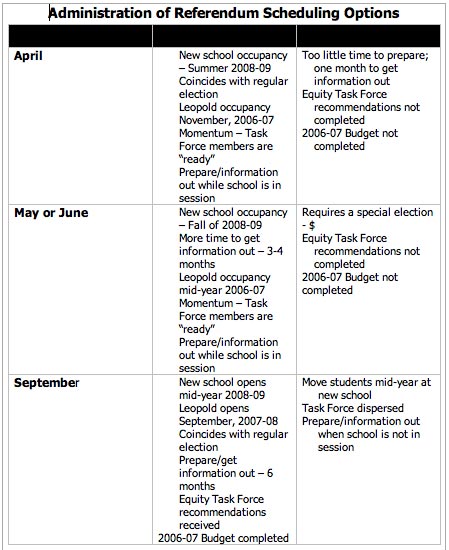
Administrative Analysis of Referendum Scheduling

A note from Superintendent Art Rainwater to the Madison Board of Education on 2006 Referendum scheduling:

At Carol’s request we have prepared an analysis of the possible dates to seek referendum approval for one or more new facilities. The analysis includes our view of the positives and negatives of three dates: April 06, June 06 and September 06

mmsd2006ref.jpg

Share

High Grades, No Skills

Joanne Jacobs:

Honor students who can’t pass California’s graduation exam should be angry, writes Ken at It Comes in Pints? They should be angry at teachers who gave them A’s they didn’t deserve.

While the hardest questions on the graduation exam require 10th grade English skills and algebra (allegedly an 8th grade skill in California), students with basic skills who guess blindly on the harder multiple-choice questions should be able to get a minimum passing grade in their first, second, third, fourth or fifth try at the test. The minimum passing grade is 60 percent for English and only 55 percent for math.

In Tracy, a girl who claims a 3.6 grade point average says she’s failed the math exam five times because teachers didn’t teach her right. She doesn’t seem to question the validity of her A’s and B’s.

My great potential is being snuffed by this test.

Share

College Goal Sunday

WKOW-TV:

The goal of college goal Sunday is to help high school students fill out this the free application for federal student aid – or the FAFSA form. Students and their parents were taken through a step-by-step process of filling out the FAFSA something organizers say is the most important step in getting high school students to attend schools of higher education.
While 48 percent of Wisconsin High School students say they plan on attending college many don’t follow through because they don’t know where to look for financial aid. There were 14 families that attended the event in madison – and organizers hope they can expand that number next year. College goal sunday held in 12 different locations around the state. Wisconsin is one of 24 states that participated in the college goal sunday event.

Share

Love Thy School Board

Ian Shapira:

It’s National School Board Recognition Month, when school officials across the country dutifully heap appreciation upon their board members, who appreciate the appreciation, even if some of them think it can be gratuitous.

Share

East High School Show Choir

Sandy Cullen:

Antonio Branch may have gotten off on the wrong foot at Madison East High School, but his tune changed once he started singing and dancing with the school’s Show Choir.
“I was with a bad crowd,” said Branch, 18, who saw many of his friends from eighth grade drop out of high school.
But Branch said the tightknit ensemble of student performers he joined last fall has helped give him the motivation to get his grades up and set his sights on attending Madison Area Technical College en route to a four-year college degree.
“They build you up, tell you you can do it,” said Branch, a senior who’s now thinking about becoming an elementary school teacher.

Share

Borsuk on What You Need to Know on Vouchers

Alan Borsuk:

Amid a barrage of television and radio ads, stories in the newspaper almost every day and conflicting claims about Milwaukee’s controversial and precedent-setting program by which almost 15,000 low-income students attend private schools using public money, the basics of what is going on can be lost easily.
Here is a primer on the current, heated episodes in the long running battle over school choice.

Share

Fall Referendum?

Channel3000:

A resolution for a referendum will go before the Madison school board Monday night.
The West-Memorial Task Force has recommended an addition to Leopold and to build a new school on the far west side of the city.
The Long Range Planning Committee chairman said there’s not enough time to build a campaign for the April election, but a referendum is inevitable.
“I still believe Madison voters do not understand the need for those new schools,” said chairman Bill Keys. “The population has shifted dramatically from the East to West side in terms of raw numbers.”
Keys believes the board may push for a fall referendum.
Keys told WISC-TV he wouldn’t be around for the final decisions because he plans to retire by then.

Share

Another Referendum?

WKOW-TV:

The Madison Metropolitan School District is hoping to address issues of overcrowding and future growth. One school board memember says Monday the board will decide whether to once again bring their concerns to the public in a referendum. The issues on that potential refereundum could include a new elementary school on the Linden Park site, operating costs for the school, and an addition a the Leopold Elementary site.
Board member Ruth Robarts believes if the board moves forward with the current plan, voters will likely vote down the referendum.
“All parents want to know which schools are going to be where two, three, five years from now. That involves more than just getting the report from our task forces back and then suddenly going to referendum,” she says.
Decisions of this type usually come in two steps…first the vote of whether to hold a referendum, and then how it will be worded. But Robarts says the board has a deadline of February 17th to notify the city, and the public of their desire for a referedum.

Share

The Ethicist: Schooling Parents

Randy Cohen:

The president of our local board of education sends her children to the public elementary schools, but when they get to high school, she moves them to private schools. Isn’t it her ethical obligation either to send her children to the schools she sets policy for and espouses as so wonderful or to step down from the board? JoAnne Manse, Rutherford, N.J.
It is not. It is the obligation of board members to strive mightily to make the public schools so good that even parents with the means to opt out choose to remain. If the public schools are not yet that good, the president may honorably send her kids elsewhere — indeed, her duty as a parent compels her to. Even where a public school is excellent, parents may seek programs it does not offer — religious instruction, for example.

Share

The Black Star Project

www.blackstarproject.org:

What Is The Black Star Project? The Black Star Project is a Chicago-based nonprofit that works around the country to help preschoolers to collegians succeed. The group focuses on low-income black, Hispanic and American Indian students in low-achieving schools.
Problems of school districts that teach Black children and the solutions

Via School Board Seat 1 Candidate Maya Cole [podcast]

Share

Schools Await Final Grade

Nick Anderson:

It has been eight years since Maryland told the Prince George’s County school to shape up, or else. It has been four years since the federal government raised the pressure with a law meant to force shake-ups through aid and sanctions.
Yet Charles Carroll Middle School has continued to fall short of state standards, even though the county has switched textbooks, changed principals three times and even assigned a “turnaround specialist.”

Share

The Art of Teaching Traditional Building

Bruce Smith:

The steady pings of hammers on molten metal, the grinding of stone and scraping of plaster fill the workshop of a new school that seeks to pass on old-world building techniques in an age of cookie-cutter construction.

Share

Student Newspaper Promotes Diversity in Language, School

Channel3000:

Students at La Follette High School are making sure every student has a voice through the use of their school newspaper, WISC-TV reported.
With the first edition of La Follette Lance in 2006, the newspaper began targeting students who thought they had been forgotten.
For example, Andres Garcia enjoys the entire page of Spanish articles the Lance editors and writers produce for each issue.
Garcia is part of 10 percent of the school that is Latino.
“This is something that was actually overdue,” Garcia said. “That was something we should have had years ago.”
The newspaper staff is involved every step of the process, including getting the paper ready for mailing and distribution.

Share

Nineteen Finance and Taxation Questions for Elected Officials

Paul Soglin:

These questions were developed in Wisconsin but are universal. Here are nineteen questions that an elected official (School Board, City Council/Town or Village Board, County Board, State Legislature) should be able to address after two budgets, or two years in office, whichever comes first.
Note: Some of the questions are premised upon faulty or erroneous assumptions, or the political view of the questioner. Other questions have no ‘correct’ answer but the answer should reflect the respondents’ views on levels of taxation and redistribution of resources through taxation.

Soglin has also begun an essay on Kids, Schools and Cities.

Share

Tutor Program Going Unused

Susan Saulny:

The No Child Left Behind law requires consistently failing schools that serve mostly poor children to offer their students a choice if they want it: a new school or tutoring from private companies or other groups, paid for with federal money — typically more than $1,800 a child in big cities. In the past the schools would have been under no obligation to use that Title I federal poverty grant to pay for outside tutoring.
City and state education officials and tutoring company executives disagree on the reasons for the low participation and cast blame on each other. But they agree that the numbers show that states and school districts have not smoothed out the difficulties that have plagued the tutoring — known as the supplemental educational services program — from its start as a novel experiment in educational entrepreneurship: largely private tutoring paid for with federal money.
Officials give multiple reasons for the problems: that the program is allotted too little federal money, is poorly advertised to parents, has too much complicated paperwork for signing up, and that it has not fully penetrated the most difficult neighborhoods, where there are high concentrations of poor, failing students.

Share

School Board Candidate Campaigns With Podcast

In what may be a Wisconsin first, Maya Cole posts pod casts on the Web. A story by Susan Troller in The Capital Times reports on the innovation:

Madison School Board candidate Maya Cole is reaching out to tech-savvy voters with a new way of communicating her campaign issues.
Cole, who is in a primary race for Seat 1 on the School Board against Arlene Silveira and Michael J. Kelly, has started podcasting what she calls a “School Board Minute.”
The 60-second audio summaries are recorded in her own voice and are available on her Web site and on the School Information Systems blog run by Jim Zellmer, who is one of Cole’s supporters.

Share

Revolution on Wheels: High Tax States See a Stealth Migration Out

Related to Johnny Winston, Jr.’s post below, Karen Hube notes a significant outbound migration from many high tax states [Wisconsin is ranked 5th in tax burden as a % of per capita income (11.4%)] including Minnesota to South Dakota:

NOT SURPRISINGLY, MANY STATES are feeling the drain of fleeing taxpayers. At a time of serious competition between states for jobs and tax revenues, “states with high taxes are losing their wealthiest and most successful taxpayers, as well as businesses, and they’re not creating as many jobs,” says Dan Clifton of Americans for Tax Reform.
Serious fiscal troubles started for most states after the stock market tanked in 2000. “They had been matching their spending habits with the flood of revenues that came in during the boom years of the 1990s,” Clifton says. “When that spigot got turned off, many states were incapable of moderating their spending to match the new reality.”
In 2000 states were still flush enough to cut taxes by a net $5.8 billion for fiscal year 2001. But shortly after, in a scramble to boost revenues, states started raising taxes.

Johnny’s point is important: Schools must diversify their revenue sources while using existing resources as efficiently as possible. This includes trying to use all sources, including, as Ed Blume pointed out, federal funds, such as the $2M in Reading First money. WISTAX notes that Wisconsin’s rose 10% last year. Finally, Neil Heinen notes that Wisconsin’s state budget has a “structural deficit“.
Bobbi raises a useful point regarding the construction of new schools: the existing $320M+ operating budget is spread over more facilities, which as several teachers have mentioned to me, has implications for current facilities.

Share

MMSD: Searching for alternative revenue streams

As a member of the Madison School Board and chair of the Finance and Operations Committee, I would like to get your ideas and perspectives regarding “alternative revenue streams” for the MMSD. The parameters would be: not to target students, No alcohol & drugs (e.g. bars), promotion of good health (e.g. no soft drinks), nothing morally questionable (use your imagination). Here are some areas identified:

(more…)

Share

For Fraught Preteen Years, A Class on Being a Friend

Michael Alison Chandler:

She surrenders her room, with its cozy couch, to the ponytailed pre-adolescents, and their dramas unfold: How could you pretend you didn’t see me in the hallway? Or: Why did you invite Celia to your slumber party and not me? There’s the inevitable “That hurt my feelings” and the occasional “I’m sorry.” On a good day, they leave the room Best Friends Forever. Again.
Many of the girls are graduates of “Chicks and Cliques,” a course Dunne designed to curb the gossiping, rumor-spreading and snubbing that’s endemic to girls. She helps them figure out how to talk through their problems, then she lets them borrow her office to use their new skills.

Share

Teach, the Film

Davis Guggenheim’s new film (CC licensed):

As our politicians and the press argue the merits of countless school reforms, it is our teachers who enter the classroom every day and fight the real fight: educating our children, one child at a time. The First Year shows the human side of this story: the determination and commitment of five novice teachers as they struggle to survive their first year in America’s toughest schools.
George teaches recent immigrants learning English as a second language. After the school board plans to cut funding for her high school class, she rallies her students to fight city hall and wins.
Geneviève “wanted to teach the kids no one else wanted to teach.” She spends hours of extra time reaching out to a middle-school student only to lose him in the end.

Share

Allied Drive units a step closer to city buyout

Mike Ivey:

The largest property owner on Allied Drive has fallen into receivership, further opening the door for the city of Madison to purchase nine buildings in the heart of the low-income neighborhood on the city’s southwest side.
Members of the Allied-Dunn’s Marsh Neighborhood Association have generally been supportive of city purchase of the properties, although there has been some concern that if the units are converted to condos it would price many out of the neighborhood.
Duane Steinhauer, a landlord who also owns rental property in the Allied neighborhood, said he is opposed to city purchase of the property. He said Hauk’s problems began when the city failed to get behind those initial plans for a private-sector redevelopment of the properties.

Share

Bringing Community to the City

Pallavi Gogol:

“Clearly, townships are promoting the idea of preventing sprawl, in clear contrast to the past when developers had to battle city hall for zoning changes,” says Roy Higgs, chief executive of Development Design Group, an architecture firm in Baltimore. This comes at a time when developers are under a lot of pressure to maximize use of both land and construction, costs of which have spiraled in the past decade.
Furthermore, many counties and townships find that the sprawl has stretched their own finances. “Communities want to trim their budgets for new roads and schools,” says Terry W. McEwen, president of Memphis-based Poag & McEwen, a developer currently making six master-planned communities, one with condos over retail shops.

Share

Job: Executive Director, MMSD Teaching & Learning

Madison Metropolitan School District:

The Madison Metropolitan School District is seeking qualified applicants for the position of Executive Director of Teaching & Learning. The Madison Metropolitan School District is the second largest school system in Wisconsin and has a student population of 24,710 students in 31 elementary schools, 11 middle schools, 5 high schools, and several alternative programs, a total staff of over 5,900 and an operatingbudget of $319 million. The District has a 42% minority student population. The Madison Metropolitan School District has schools at elementary, middle and high school levels rated as National Schools of Excellence.
Evidence of appropriate Wisconsin certification required prior to employment. The salary range for 2005/06 is $80,050-$102,233 for 225 days employment. Salary range for 2006/07 will be determined later in the school year. All positions require experience working cross-culturally and/or commitment to work toward improving one’s own cultural competence, i.e. valuing difference/diversity, recognizing personal limitations in one’s skills and expertise, and having the desire to learn in these areas. Deadline for receipt of a completed application form, including responses to the required Experience Inventory, letters of reference, and grade transcripts, is Tuesday, February 28, 2006.

MMSD employment site.

Share

Gutknecht on “Swan Creek residents ask to join Oregon schools”

Kurt Gutknecht:

Frustrated by continued uncertainty over where their children will attend school, residents of Swan Creek are asking to be transferred to the Oregon School District.
The decision would reverse a 2003 decision that transferred Swan Creek to the Madison Metropolitan School District.
Residents obtained signatures from 188 households on a petition asking the respective school boards to consider the request. Three real estate developers also endorsed the move.
If the school boards refuse the request, residents can ask that an appeals board consider the transfer.
“We know it’s an uphill battle,” said resident Renee Hammond, referring to the previous unsuccessful attempt to reverse the decision of the two school boards.
Several residents said they had been misled about schools when they purchased their homes. Some had been told that they could choose which school district they wanted to attend or that the Madison district planned to construct a school in Swan Creek or elsewhere in Fitchburg.
More upsetting to residents, however, is the uncertainty over whether their children can continue to attend Leopold Elementary School. The Madison school board is weighing plans to alleviate overcrowding at Leopold that could send children from Swan Creek to several different schools.
Organizers of the petition drive said they could easily have obtained more signatures.
Romney Ludgate said there’s no assurance that making space for additional students at Leopold would be more than a short-term solution to overcrowding and that residents might have to continually address the issue.
“Until a school is built in Fitchburg, residents of the southern part of the district in Fitchburg will continue to face extreme instability” in where Swan Creek students would attend school, Hammond said.

(more…)

Share

School board divided again over plans to reduce overcrowding

Kurt Gutknecht, writing in the Fitchburg Star about the recent Board and public discussion of the East / West Task Forces:

There was a sense of déjà vu when the Madison Metropolitan School Board met Jan. 30 when the schism that fractured it last year – and which appeared to be a key factor in the defeat of a referendum last spring – surfaced again. Four members of the board appear solidly in support of another referendum and two members appear steadfast in their opposition, although the board hasn’t officially acted on the matter.
The possibility of a divided board has already alarmed supporters of a new addition to Leopold Elementary School, who think it will provide additional ammunition to critics.
The discussion was often heated as Ruth Robarts and Lawrie Kobza charged that the board was rushing to a referendum without an adequate long-range plan.
Their stance irritated Juan Jose Lopez, who accused them of “playing politics” with the future of schoolchildren simply because they didn’t like the outcome. “I for one will not sit here and allow you to do that,” he said.
A key disagreement involved the weight accorded the recommendations of the task forces charged with formulating long-range options.

(more…)

Share

Carol Carstensen’s Weekly Update

BUDGET FACTOID:
Of the MTI-represented employees in the district, more than 50% take their health insurance with Group Health (the lowest cost of any of the HMO’s).
February 6th MEETINGS :
5 p.m. Finance & Operations Committee (Johnny Winston Jr., chair):
Report on the $100 Budget exercise in January 173 people participated in the exercise; their responses indicated that their highest priorities were: Academic Achievement and Specialized Services (special education, English as a Second Language).
Doug Pearson, in charge of buildings and grounds for the district, gave a presentation explaining that a combination of factors (drought in the Midwest, Hurricane Katrina and increased oil prices) have resulted in a huge increase in construction costs. As an example, when the district built Chavez (2000-01), construction costs were estimated at $85/sq.ft. today the estimate to build a new school is estimated to cost $162/sq.ft. These increases also affect all of the district’s maintenance projects.
6 p.m. Performance & Achievement Committee (Shwaw Vang, chair)
The Committee heard presentations about the elimination of tracking in the West High Biology course (begun in 1997) and in East High Algebra/Trig (started in 2004). In both cases the changes were the result of discussions by the teachers at the school and supported by staff from downtown. Likewise, both reported that they felt that they were serving all students more effectively and that their classes were more representative of the entire student enrollment. The Committee will continue looking at this topic.

(more…)

Share

NYC Schools: Administration, Teachers Union and Parents

Interesting article on the leadership dynamics of the New York City Department of Education by David Herszenhorn:

“Parents and parent organizations feel less enfranchised now than they did four years ago, and that is a dangerous trend,” Mr. Sanders said. He added, “Ultimately you cannot have a successful education system if parents and communities of parents don’t feel invested.”
Stephen Morello, Mr. Klein’s communications director, issued a statement saying parent involvement “has been an important priority from the beginning of our reform efforts.”

Share

Charge to the equity task force

Jason Shepard reports in this week’s Isthmus that the newly appointed task force on equity will look at “Differences in curriculum opportunities, extracurricular programs and access to meaningful information about a school’s performance . . .”
However, I can’t find a charge to the task force. Can someone post it or provide a link?

Share

Good goals, flawed reasoning: Administration Goes Full Speed Ahead on English 10 at West High

At January and February school board meetings, Madison Superintendent Art Rainwater reported on the administration’s plan to go ahead with one English course for all tenth graders at West High School starting in 2006-07. The goal of the plan is to increase academic opportunity for students of color. The mechanism is to teach all students the same curriculum, leaving it up to teachers to “differentiate” their approach and give equal challenge to every student. The school board has taken no action on this plan and does not plan to adopt, modify or otherwise vote on the plan before it is implemented.
I support the goal. I am not convinced, however, that the mechanism is based, as claimed, on the best research. The presentations to the Performance and Achievement Committee have raised my level of doubt.
At the January 30 meeting, the board heard from a University of Wisconsin expert. His published research on the subject of differentiated teaching concluded that more research is needed on this subject. Where the expert found successful differentiated teaching in high schools,the circumstances of the schools were far different from the circumstances at West High School. For example, successful “differentiated” classes occurred in schools where administration could match the skills and motivation of the teachers to the classes and where students vied for spots in the classrooms. We have a staff based on seniority and teacher options within the seniority system and must accept all students at tenth grade level into the program.
We were asked to consider the Biology I/ Advanced Biology I program at West High as a basis for making the change in the English program. In that program, approximately 20 students qualify for the advanced course and all others take Biology I. We were told that taking Biology I (rather than the advanced course) had not prevented a high percentage of West students from becoming National Merit Semi-Finalists. Never mind that the tests used for selecting the semi-finalists do not test science skills. At best, this correlation shows that taking Biology I did not harm the high-scoring students skills and aptitudes in non-science areas.
Two of our teachers made more persuasive arguments for caution in moving to “differentiated” courses. One cited research showing that the teacher training for these courses is a five to ten-year process. The other teacher gave us the factual background necessary to analyze the administration’s proposal. That teacher’s testimony follows.

(more…)

Share

2006 – 2007 Kindergarden Enrollment

Madison Metropolitan School District:

Kindergarten Enrollment for the 2006-2007 school year is Monday, March 6, 2006 from 1:00 to 6:00 p.m. at all MMSD elementary schools. To be eligible, children must be 5 years old on or before September 1, 2006.
When enrolling a child for kindergarten, parents will be required to show proof of age (birth certificate, baptismal record, medical assistance card,) proof of residency (utility bill) and an immunization record.

Find your school here.

Share

Monona Grove Sets $28M Referendum for 4/4 Election

Channel3000:

The Monona Grove School Board set a referendum date of April 4 to ask voters to spend $28 million on a new school and renovations.

Share

Gangs, Schools & City Government

Paul Soglin & Mary Kay Battaglia:

When I posted Teachers Strike in Madison: Thirty Years Later January 27, 2006, Mary commented:

While failing public schools are linked to the high number of low income students attending them, you may be interested in some MMSD data. If you go to the MMSD web site and look under their data you will find that in 1991 Madison’s elementary schools had a total %low income of 24.6%. In 2005 that number almost doubled to 42.4%. Our schools are in a crisis of becoming just another urban school in trouble. That’s almost double in 14 years.
Why is it that Madison city government is so UNinvolved with the schools? It seems to me for growth and economic stability the two should have a better working relationship. The district is clueless to the growth and the city does not seemed concerned with informing the district or working to help crisis areas of the city to help both the school and neighborhood. Allied is an example where they could work together. Mary Kay Battaglia

And this week Channel 3 WISC is running a series, Experts: New Street Gangs Rising In Dane County.

Mary Kay previously wrote about this here. Lucy Mathiak followed up on that post here.

Share

The Best and Worst of No Child Left Behind

Superintendent Art Rainwater:

One of the most significant occurrences in public education during my Superintendency has been the “No Child Left Behind Act” (NCLB) which was passed with the intention of changing and improving public education. The act is significant because it is the first time the federal government has inserted itself into determining the quality of K-12 education at the local level. NCLB captures both the best and worst of current educational thought.
The recognition of the importance in understanding our children’s learning needs through good academic assessment has been a major positive change. Educators have the best chance for success when we are using academic performance data about each individual child to inform instruction.

Share

More on the Swan Creek Petition to Leave the Madison School District

Sandy Cullen:

The Madison School Board and the Oregon School Board both are scheduled to address the petition at their Feb. 27 meetings.
The land on which the subdivision is located was previously part of the Oregon School District. It was transferred effective July 1, 2003, to the Madison district in exchange for commercial property, said Clarence Sherrod, attorney for the Madison School District.
School boards in both districts also agreed not to allow the land to be transferred back, said Madison School Board President Carol Carstensen.
“I do not want them to leave,” Carstensen said, adding, “I certainly understand their concern over the uncertainty.”
Carstensen said some Swan Creek residents who want to remain in the Madison School District “are not happy at the timing” of the petition, which they thought would used as a “last-ditch” option.

The petition, statutes and more details can be found here.

Share