School Information System

MMSD Teacher on REACH

Spring Harbor Teacher Nan Yungerman:

At the MUAE forum to discuss education for gifted and talented students, it was disturbing to hear one candidate, Maya Cole for Seat #5, talk about eliminating REACH as a way to trade money to keep Eastside schools open. I was bothered on many levels.
One; REACH was developed to provide one additional and desperately needed hour of planning time for elementary teachers. It is in this hour that teachers might differentiate curriculum or do hundreds of other necessary tasks to keep their classrooms going. This precious hour, one of about a total of five permitted during the work week, is a negotiated term or part of the Teacher Bargaining Agreement. Maya Cole is suggesting it be eliminated. If this were possible, simply by saying it —- is not a friendly gesture to teachers. This will not save money. A different method of providing for children during the negotiated hour of planning time would need to be developed. Claiming to know what would help teachers and then suggesting to take away their planning time is down right nasty. Elementary planning time is beyond necessary for teacher sanity and is is the very basic component of being a thoughtful and reflective teacher!

I’ve heard some alt views on this from other teachers (and parents).

Share

Important meetings about possible east side school closings

Forward from a friend:
The MMSD administration will hold public meetings on the following dates to detail their plans to close Lindbergh and Blackhawk. PLEASE ATTEND BOTH MEETINGS!
SUNDAY MARCH 25th 4-6pm @Warner Park
TUESDAY MARCH 27th 6:30pm @ Black Hawk

Share

Balance of power could shift with school board election

Jason Shephard:

On April 3, voters will elect three members to the Madison Board of Education. At least two will be newcomers, replacing retiring Ruth Robarts and Shwaw Vang, while board president Johnny Winston Jr. is runing for a second term. Victories by Beth Moss and Marj Passman could give Madison Teachers Inc., the teachers union, greater control of the board’s majority. A victory by Maya Cole, meanwhile, could provide a continued 4-3 split between MTI-endorsed politicians and more reform-minded officials. Here’s a look at the three races.

Share

Cap Times Editorial: “Give Winston Another Term”

The Capital Times:

Under Johnny Winston Jr.’s leadership, the often contentious Madison School Board has become a model of cooperative, respectful and efficient governance. No, the board’s not perfectly harmonious, but with Winston at the helm, it’s far more functional than it has been for a long time. Indeed, Winston’s proven to be exactly the right president at exactly the right time, ably balancing the concerns of the board’s two factions and running meetings with appropriate focus and authority.

Share

The key to good schools? Housing policy

David Rusk & Marc Eisen:

Jason Shepard’s story this week, “How Can We Help Poor Students Achieve More?,” points out the strong correlation between schools with high levels of low-income students and substandard academic performance. As Shepard reports, that same point was made about the Madison schools by urban researcher David Rusk in 2001.
Rusk was a headliner at the “Nolen In The New Century” conference sponsored by Isthmus and several community and media groups. His speech was subsequently adopted for publication in Isthmus and became the first salvo in the campaign for inclusionary zoning. It’s reprinted below.(Readers are welcome to form their own conclusions on whether or not IZ has played out in Madison as Rusk outlined here.)
Rusk is the former mayor of Albuquerque. His Cities Without Suburbs, in the words of the Congressional Quarterly, “has virtually become the Bible of the regionalism movement.” Rusk’s study of census data linked failing cities to their political separation from the suburbs and, conversely, successful cities to their ability to annex or be part of a regional government. His more recent book, Inside Game/Outside Game, argues that regional land-use and tax-revenue policies are more critical to turning around failing neighborhoods than anti-poverty programs.

Share

Cap Times Editorial: “Beth Moss for School Board”

The Capital Times:

Moss is an experienced educator who has taught diverse students in classrooms overseas and in urban districts in the U.S.
Moss is an incredibly active parent, who has been a classroom volunteer at Glenn Stephens Elementary School, a Schools of Hope tutor, a Madison School & Community Recreation program club coordinator, and a Parent Teacher Organization volunteer and fundraising chair. She’s worked with the Foundation for Madison’s Public Schools to obtain grants for student programs. And she served as co-chair of Community and Schools Together (CAST), the grass-roots group that secured passage of the last school funding referendum.

Beth Moss faces Rick Thomas April 3 for Seat 3, Madison School Board. Much more on the election here.

Share

How can we help poor students achieve more?

Jason Shephard:

As a teacher-centered lesson ended the other morning at Midvale Elementary School, about 15 first-graders jumped up from their places on the carpeted rug and dashed to their personal bins of books.
Most students quickly settled into two assigned groups. One read a story about a fox in a henhouse with the classroom teacher, and another group, headed by a UW-Madison student teacher, read a more challenging nonfiction book about a grandmother who, as one child excitedly noted, lived to be 101.
In addition to this guided reading lesson, one boy sat at a computer wearing headphones, clicking on the screen that displayed the words as a story was read aloud to him, to build word recognition and reading stamina. Two other boys read silently from more advanced books. Another boy received one-on-one help from a literacy coach conducting a Reading Recovery lesson with him.
“I think what’s so important is that this program truly meets the needs of a variety of students, from those who are struggling to those who are accelerated,” says Principal John Burkholder.

(more…)

Share

Closing Marquette: A preposterous idea

A letter to the editor that appeared in the Cap Times:

Dear Editor: As leaders in the Marquette neighborhood, we are extremely disappointed with the discussion of possibly closing Marquette Elementary School.
The Marquette neighborhood is an incredible success story. The economic upswing of this neighborhood has been tied directly to the positive programs being presented at Marquette and Lapham schools.
The $3.5 million addition and improvements made to the O’Keeffe/Marquette complex a few years ago brought incredible stability to this neighborhood. The voters and taxpayers citywide realized the importance of the improvements in keeping families in the downtown area and overwhelmingly approved this expenditure. It would be an egregious slight to abandon this elementary school as throngs of young families have moved into the Marquette neighborhood and greatly improved the housing stock and precipitated a building boom.
It is unprecedented that a diverse neighborhood that could walk in close to 300 students to fill their re-modeled school in a kindergarten through fifth grade configuration would be threatened with closing. It would be beyond belief that a School Board would ask a neighborhood to send five busloads of students to a crowded Lapham building at a cost of $36,000 per bus or $180,000 for the upcoming school year. We support the continuing elementary programs at Marquette and Lapham and keeping O’Keeffe Middle School at its current size.
We realize the school funding dilemma that the whole state faces has led to this situation. We are hoping that these inequities will change and that the option to de-stabilize our community is taken off the table.
Judy Olson
6th District alderperson
Anya Firszt
president,Greater Williamson Area Business Association
Gary Kallas
director, Wil-Mar Neighborhood Center
Published: March 22, 2007

Share

Fight and arrests at LaFollette

According to a report from the Madison Police Department:

On 3/22/07 at 10:02 a.m. there was a large disturbance at LaFollette H.S. A school administrator had noticed a large gathering of students and hostilities between some wanting to fight. It was later learned that the disturbance was caused by three females confronting three other females to fight. The Madison Police Department Education Resource Officer (ERO) noted that upon arriving to the scene several hundred students were watching the disturbance, clogging the hallway, and that 10-15 school officials had to restore order. A total of six Madison Police Officers were present in the school to help calm this disturbance. Eventually some students were detained and separated. In one separation, two students went to an office and began fighting again. Police had to respond to that office as well to break up the secondary fight. The above-listed juveniles were arrested and placed in Juvenile Reception until parents were notified.

Share

“No, My Son Doesn’t ‘Act Black.’ There’s No Such Thing.”

This powerful first-person account by Aleta Payne first appeared in the Washington Post earlier this month. It brought tears to my eyes as I read it in our own Cap Times last night. The piece drives home the multifaceted nature of the achievement gap, underscoring the fact that the search for a single solution is seriously misguided and that we must each do our part.

Sam came home from the overnighter visibly crushed. He curled around his hurt as though he’d been punched in the gut, and he refused to say what had happened. My husband and I fought panic as all the horrible things that might happen to a 14-year-old away from home pounded through our brains. We cajoled and interrogated as he tried to disappear into the living room sofa, until finally, enough of the story emerged to reassure us that our oldest son hadn’t been physically injured. But his suffering was still real.
His friends had asked him why he didn’t act black.

(more…)

Share

The Co-op Model’s Relevance Today

Nancy L Zimpher:

Cooperative education is now more than 100 years old. The co-op approach, in which students alternate time in the classroom with professionally paid work directly related to their majors, was founded at the University of Cincinnati by Dean Herman Schneider in 1906. There are co-op programs today at 500 institutions in the United States.
The centennial marks a good time to take stock. How effective is co-op? What has been its impact on its three fundamental partners — students, employers, and institutions of higher education? Is co-op still relevant? Still viable? What role should co-op play in 21st century education?
I see empirical evidence of co-op’s value every day at the University of Cincinnati. We have 3,800 students in 44 disciplines participating in co-op opportunities at more than 1,500 employers in 34 states and 9 foreign countries. At graduation, UC co-op students have an enviable head-start in their careers by virtue of their on-the-job work experience (an average of one-and-a-half years for UC students), marketable skills, impressive credentials, and networking connections. Many are hired immediately by the companies where they completed their co-ops.

Share

On Vouchers

Tyler Cowen:

1. The federal government will pay for vouchers, to some extent, and thus extend its control over schooling. Admittedly this is happening anyway.
2. No politically feasible vouchers program will apply immediate depth charges to current public schools or even reduce their initial budgets (“oh, you aren’t letting public schools compete…). That means the new money must come from somewhere. That means our taxes will go up.
Vouchers would create a new middle class entitlement, ostensibly aimed at education but often simply capitalized in the form of cash. In the meantime public schools would require additional subsidies to stay open. How pretty a picture is this?

Share

Cole wins Cap Times endorsement

The Capital Times said:

The Madison School Board’s makeup will change with the April 3 election. Its chief dissident, Ruth Robarts, is stepping down. So, too, is a quietly thoughtful member, Shwaw Vang, who has more generally sided with the board majority and the district’s administrators.
There are those who suggest that the entire direction of the board and the school district is at stake. That’s a stretch. Chances are that the next board will have a majority that is generally deferent to the administration and a potent minority that tends to challenge the administration to do better.That’s about as it should be.
Madison schools are essentially sound. But they are not improving at the rate that they should. And they are facing increasingly challenging budget shortfalls. Thus, a board that mixes those who want to maintain what is good about the schools and those who will be pushing for more accountability and progressive innovation holds the most promise.
Our endorsements in this year’s three contests for school board seats will look to achieve that mix.
We begin today with a strong endorsement of Maya Cole, who is seeking the District 5 seat being vacated by Robarts. Backed by Robarts, Cole is a solid progressive who has shown a willingness to spar with the district establishment. That upsets some defenders of the status quo, but our sense is that she strikes a mature balance between supporting sound schools and understanding the need to try new approaches in order to meet funding, staffing and curriculum challenges.

(more…)

Share

March 20, 2007 Northside Planning Council Madison School Board Candidate Forum

44MB MP3 Audio / Video. Thanks to Ed Blume for recording this event.

Share

Spring 2007 Madison School Board Election Update: Vote April 3!

  • Christine & Trent Sveom kindly forwarded candidate responses to additional questions not contained within the previously posted Video from the March 5, 2007 West High Forum. The questions:
    • Please explain your views on additional charter schools given the success of Nuestro Mundo here in Madison and several offerings in Appleton just to name a few?
    • How can the school district provide for second languages to be taught to all students starting in Kindergarten and continuing through all grades?
    • The board will be hiring a new superintendent. Please discuss what you believe is
      the top 3 criteria for a superintendent. You are free to ignore my request to address communication between Board and Administration/Superintendent, Boards communication with public, Superintendent and Public.

    • What role should School Board, Parents and Educators play in changing state law,
      which adversely affect our schools?

    • What accountability mechanisms do you envision? (Directed to Rick & Maya)
    • What is your position on the health insurance issue for teachers, that is the WPS option versus HMO’s?

    Responses:

Share

Despite ‘Mommy Guilt,’ Time With Kids Increasing

Donna St. George:

Cynthie Bush pulled on her coat and started to say goodbye. She and a friend were taking a night out — three hours in all, for a quick dinner and a PTA event. It was not the kind of thing she did often, with two small children and a full-time job.
But before she could leave her Herndon home, her 4-year-old daughter began to cry for her. For a moment, Bush recalled, she wondered if she should cancel. Her days were already so full. She needed more hours with her children, not fewer.

Share

More school closings in next budget

The board might as well start planning for the next budget’s $10 million deficit.
Making a decision on closing more schools now will allow for a more orderly transition in the years to come.

Share

Winston supports school closings

At last night’s candidate forum at the Warner Park neighborhood center, Winston was the only candidate who said he’d vote yes to closing schools.
He proudly listed his connections to the Northside, while missing the irony of being the only one who would close the Northside’s Sherman Middle School.

Share

$65M for 42 Houston Charter Schools

Jay Matthews:

The charter school movement, begun 16 years ago as an alternative to struggling public schools, will today make its strongest claim on mainstream American education when a national group announces the most successful fundraising campaign in the movement’s history — $65 million to create 42 schools in Houston.
The money, which comes from some of the nation’s foremost donors, including the Bill and Melinda Gates Foundation, would make the Knowledge Is Power Program the largest charter school organization in the country. KIPP, which runs three schools in Washington, has produced some of the highest test scores among publicly funded schools in the District and has made significant gains in the math and reading achievement of low-income students in most of its 52 schools across the country.

Meanwhile, Madison’s proposed Studio School will apparently open this fall as a private organization. I hope we learn more about the Studio School’s interactions with the Madison School District and how the process might improve in the future.

Share

Pay Schools for Better Results

Jane Galt:

But it is not true that these kids are simply genetic train wrecks who we should be prepared to write off. Disadvantaged kids can be taught to read, write, and perform basic mathematical operations, and they can be taught to behave if their parents have neglected that task. In our system, however, any school that manages to do so achieves this feat only through heroic efforts to overcome the institutional barriers put in the way. For various reasons, this is not happening. I have a novel approach to solving this problem: I propose we . . . pay schools on the basis of their ability to educate these children. I plan to call this system something nifty and new-economy, like . . . a market. That has an edgy, new-millenial kind of feel, doesn’t it? I think it’s the juxtaposition of the hard-edged k and t sounds with the soft, sensuous labials of the first syllable.
Can the school system overcome all the handicaps that disadvantaged kids are born with? I doubt it. But it could certainly do better . . . and it could hardly do worse than many urban school districts.

Galt has more on schools here.

Share

Business Tools for Better Schools

Business Tools for Better Schools:

The "Business Tools for Better Schools" toolkit is designed to engage, energize and focus company and business organization efforts in education reform. The toolkit is geared towards both policy and practical involvement, primarily at the state and local level, in three key K-12 education reform business priorities:

  • Ensuring that graduates are ready for work and college;
  • Strengthening the science, technology, education and math (STEM) pipeline;
  • Maximizing data-driven decisions in education.

The goal is to create a "one-stop" Web site where business can get the background information, facts, research and practical tools they need to effectively engage in education in their communities and states.

The toolkit was created and is maintained by Achieve, Inc. with generous support from the GE Foundation. Additional support was provided by the Business Roundtable. The content of the site was developed in consultation with national, state and local business organizations and companies. In particular, the U.S. Chamber of Commerce, the Business Roundtable and their state affiliates were instrumental in the conception and development of the website.

Wisconsin’s page & Data.
Wisconsin Data Fact Sheet.

Share

Madison’s Fund 80 & Elections

TJ Mertz:

In this morning’s Wisconsin State Journal there is a story that again misrepresents the place of Madison School Community Recreation and Fund 80 in the district and the community.
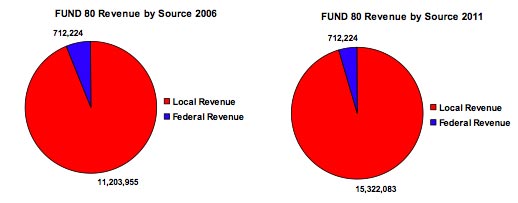
The chart comparing Fund 80 levies in Madison to those in other districts ignores the fact that most or all of those locales have municipal recreation programs paid for by municipal taxes. Due to a historical quirk, Madison has very little in the way of a municipal recreation department and programs and services that other locales fund via municipal or county taxes are funded and governed by the school district via Fund 80. In order to get a realistic comparison of Madison’s spending on recreational and community education programming one must look at total levies devoted to this. The last time I did this (early 2006) I found that the combined spending on MSCR and the Madison Parks Department was about $20 million. De Moines, IA (about the same size) has a parks and recreation budget of about $20 million. Ann Arbor, MI is about half the size of Madison and has a Parks and Recreation budget of $12 million. Green Bay, also about half the size has a Parks and Recreation Budget of $8 million. In other words, the spending in these areas is very much in line with what others spend.

There’s been no shortage of discussion on Fund 80 here. 2006 / 2007 Madison School District $333M+ Citizen’s Budget.
Related:

  • Amy Hetzner: Community Service Levies Climbed Since Revenue Caps Lifted:

    But once the Legislature removed the caps on the community service levies for the 2000-’01 school year and gave school districts an opportunity to keep their recreational activities from conflicting with educational programs, more took advantage of it.
    “I think – when you look at districts across the state – that’s really what caused the jump,” said Art Rainwater, superintendent of the Madison Metropolitan School District, which in 2005-’06 had the largest community service levy in the state.
    Like some of the bigger community service funds, Madison’s supports a full recreation department with adult and youth programming. But it also helps pay for television production activities, after-school activities, a gay and lesbian community program coordinator and part of a social worker’s time to work with low-income families, Rainwater said.
    The School District’s community service levy is expected to grow to $10.5 million in the coming school year. In contrast, the same levy for Milwaukee Public Schools – which serves nearly four times as many children in its educational programs – is expected to reach $9.3 million, said Michelle Nate, the district’s director of finance.
    Although the state Department of Public Instruction has issued guidelines to school districts on how they should use their community service levies, it leaves it up to local residents to decide whether their school boards do so wisely and legally.

  • Carol Carstensen: Fund 80 is Worth our Support.
  • Lucy Mathiak: Community Service Fund 80, Can We talk?
  • Ruth Robarts: A Tale of Two Budgets: the Operating Budget for Madison Schools versus its Budget for Community Programs and Services
  • A look at the City of Madison’s parcel count growth.

The charts are from Lucy Mathiak’s post:


Share

East Side school plan opposed

East Side school plan opposed
DEBORAH ZIFF
608-252-6120
March 19, 2007
Waving bright signs and chanting, dozens of parents, kids, and teachers converged at a School Board meeting Monday night to protest proposed budget cuts that could consolidate elementary and middle schools on the East Side.
Earlier this month, Madison school officials proposed addressing a projected $10.5 million shortfall in next year’s budget by moving Marquette Elementary students to Lapham Elementary and splitting Sherman Middle School students between O’Keeffe and Black Hawk middle school. The move would save about $800,000.
School Board members are still wrangling with at least five options to deal with the budget deficit and were presented with an alternative consolidation plan at Monday’s meeting.
But many affected students, parents and teachers came to the meeting angry about the administration’s recommendation to take students out of Marquette and Sherman, arguing it would eliminate neighborhood schools, force kids who currently walk to school to take buses, and increase class sizes.
“I really don’t want to go to Lapham,” said Kalley Rittman, a Marquette fourth-grader who was at the rally with her parents. “All the kids are going to be squished in one place.”
Currently, Kalley and her sister in third grade, Hannah, walk to Marquette, said their mother, Kit. They would have to be bused to Lapham.
Kalley was also clutching an envelope with letters from other students and teachers at Marquette, and later spoke in front of the board, telling them she created a video on the school for them to watch.
Faye Kubly said her 11-year-old son had trouble in elementary schools before he transferred to Marquette, where teachers developed a system for him to learn successfully. She and other parents called the middle school proposal a “mega middle school” and called on the state to change its funding guidelines.

(more…)

Share

Reality Check: Taxpayers Pay For Lobbying

Colin Benedict on Channel3000:

Wisconsin taxpayers are paying millions to lobby state lawmakers, in many cases, for more money.
Dane County does it too — it spent nearly $175,000 last session, WISC-TV reported. Part of it was for more money from the state to pay for county nursing home patients, and Dane County argued against the taxpayer bill of rights.
Rock County spent about $6,400 on similar issues, WISC-TV reported.
Schools do this as well. The Madison Metropolitan School District spent $133,000 on lobbying, with some of the tax money spent trying to get more tax money into the classrooms.
The district is on record fighting against revenue limits and against limits to local control, WISC-TV reported.

Share

Fixing Dixie’s tricksy schools

The Economist:

The hard lessons of segregation
WAYNE CLOUGH, the president of the Georgia Institute of Technology, has just moved into a new office. The workmen are still in the corridors outside, generating noise and dust. A few years ago the site, in Atlanta, was full of drug addicts and prostitutes. The hotel across the street was boarded up and inhabited by vagrants. Now Georgia Tech is building a “sustainable, energy-efficient campus” with white roofs, recycled building materials and a system for catching and using rainwater. It is a bit more expensive, says Mr Clough, but “if you plan to be around for a while, you’ll recapture the costs eventually.”
Georgia Tech has a global reputation. Its 16,000 students will mostly go on to careers in engineering, medicine or some other tough and lucrative field. But Mr Clough does have some worries. Southern universities got into the research game later than their northern rivals, so the region is behind the curve in attracting high-tech industries, he says. From time to time, fundamentalists try to teach creationism as science in southern public schools, which “reinforces the backward image”. But his biggest worry is that not enough young southerners are mastering science and maths.
“Brother Dave” Gardner, a stand-up comic from Tennessee, greeted the 1954 Supreme Court order to end segregated schools with the quip: “Let ’em go to school, beloved. We went, and we didn’t learn nothin’.” That was harsh, but partly grounded in fact. The point of school segregation was to keep blacks down and whites separate. When it ended, many white parents moved their children from newly integrated public schools to private schools whose chief selling point was whiteness, not academic rigour.

(more…)

Share

Finding the Best High Schools, Part Two: Low-Income Stigma

Jay Matthews:

Consider this high-minded conclusion in their report: A successful high school should show high levels of student achievement, graduate almost all of its students and not let any demographic subgroup suffer at the expense of others. In a perfect world, I would not dispute that. But in the real world that means C. Leon King High School in Tampa does not belong on the best schools list because of its high dropout rate and low average test scores, even though Newsweek ranked it 73rd in the country in AP and IB test participation last year.
Asked to comment on the notion that her school ought to be taken off the list, Susie L. Johnson, assistant principal for the school’s IB magnet curriculum, said: “Honestly, that is ridiculous.”
Whoops. Did I say she runs the magnet curriculum? The Education Sector report dismissed magnets, special programs that draw students from outside school boundaries, as a sneaky way for schools like King to look good on the Newsweek list. In fact, it said, a school with a small number of students taking many tests will receive a high Challenge Index score even if it is providing a lousy education to the rest of it students.

More from Sara.

Share

Testimony asks for three commitments

Thank you for your service and thank you for your request to hear from the community.
My name is Shari Entenmann and I’m here as a parent of 3 young children entrusting you with their school experience.
As you move forward with the budget process there are three things I’d like you to commit to:

1. Our downtown schools need to be vital, they are the heart of our city and why many of us moved here – myself included. Let’s not unravel what’s been built and what we can accomplish in the future. We want our schools to be vibrant and attractive so others choose to live here like I did.
2. Consider the details carefully – often it’s the details that matter:

a. What about the TEP program. My understanding from parents directly involved in bringing TEP to Lapham that part of what’s needed to make the program a success is the SAGE class sizes.

• Will Lapham still have TEP
• If TEP then SAGE, if SAGE is there room to consolidate?
• If not TEP, where will it go, back to Emerson – but wasn’t there concern about it being too much for one school?
• When making these decisions you have to consider this vulnerable population in this TEP program.

b. What about the alternatives program. Steve Hartley gave a very inspiring presentation last year at Marquette (when we were going through this exercise) and it was clear to me and others that the keystone to the success of the program is separating the kids from their age-group peers. Are you sure the proposal to move the program to Sherman has considered this, I didn’t see that consideration in the presentation to the board a few weeks ago.
c. Is the proposed larger middle school too big? I hear the comparison to Hamilton as a reference that it’s not. However, I don’t believe that’s an appropriate comparison. This is a very different population and I’ve heard concern from many teachers, and educators that’s it’s too big for this population, particularly with our resource restrictions.

3. An open process that allows all things to be discussed and considered with community involvement. We’ve heard several times that there’s nothing else to cut but things that effect the classroom and so everything must be on the table, even this drastic change that saves less than 700,000. However in all the discussion that’s lead to this point I haven’t heard any discussion on the following:

a. I’ve heard there may be more funds coming in the next few months – is this the time to propose such drastic changes – especially when these changes aren’t part of an overall plan but are part of the annual ad hoc widdling away process.
b. Extra-curriculars
c. Sports

Please consider what I’ve said. I believe it’s necessary to be successful because we live in a passionate community that strongly supports public education. Everyone needs to be involved.
Very sincerely, again, thank you for your service.
Shari Entemann

Share

Little Consistency in Bus Safety Standards

Debra Nussbaum:

DR. ALAN ROSS did not develop a passion for school bus safety until 10 years ago, when his son asked why there were no safety belts on the bus he rode to school in Litchfield County, Conn.
“I was your typical parent, and I just assumed we had this covered in a school bus,” said Dr. Ross, who is now the president of the National Coalition for School Bus Safety, a volunteer group. “That started my quest to improve things. The state of school bus transportation is a very sad one.”
School buses remain the safest form of transportation to and from school, according to various federal statistics, but regulation of the buses is uneven. No federal laws govern whether safety belts are required on school buses, how often the buses must be inspected or how many years they can be on the road. On a state level, there are significant differences in such laws — New York and New Jersey require seat belts on buses, for example, but Connecticut does not. Districts can have their own rules, too.

Share

For Teachers, Middle School Is Test of Wills

Elissa Gootman:

When a student at Seth Low Intermediate School loudly pronounced Corinne Kaufman a “fat lady” during a fire drill one recent day, Mrs. Kaufman, a 45-year-old math teacher, calmly turned around.
“Voluptuous,” she retorted, then proceeded to define the unfamiliar term, cutting off the laughter and offering a memorable vocabulary lesson in the process.
Such are the survival skills Mrs. Kaufman has acquired over 17 years at Seth Low, a large middle school in Bensonhurst, Brooklyn: How to snuff out brewing fistfights before the first punch is thrown, how to coax adolescents crippled by low self-esteem into raising their hands, how to turn every curveball, even the biting insult, into a teachable moment.
But not all middle school teachers can do it.

Share

School Crime Data in Madison

Madison Parent:

How safe are our schools? This question can’t be answered without consistent collection and analysis of information about violent and disruptive incidents in our schools. While the Madison Police Department has just released its Uniform Crime Report for 2006 (the summary of crime statistics that is reported annually to the FBI), there’s no equivalent report for Madison schools. Our state’s Department of Public Instruction collects data for expulsions and suspension, but not for incidents. The Madison Metropolitan School District’s web site simply links to the DPI site. At the individual school level, there may be no system for proactively communicating with parents about incidents affecting safety, or, worse yet, a parent’s school safety questions may languish unanswered.

The post includes a list of recent school crime events. Gangs and School Violence Forum.

Share

Milwaukee School Board Candidate Notes

Alan Borsuk:

Dannecker, 45, said people in the district are concerned about behavior in schools. In general, he said, “high school is a big issue to parents,” and many are not happy with most MPS high schools, particularly Bay View High School.
Dannecker played a central role in the decision in recent months to place police officers on a full-time basis in Bradley Tech High School and in a cluster of schools centered on Custer High School. He said he favors creating “almost an internal reform school” within MPS for students with major behavior issues.
Another trait: He says he pays attention to the way decisions are made. He often finds the decision-making of the current School Board and MPS administration lacking.
The recent MPS campaign against cell phones in school is an example. Falk said that with the way the ban works now, only some children don’t bring cell phones to school and enforcement efforts are weak.
The crackdown was not well thought out, he said, given the way students actually respond.

Share

What was the MMSD Budget in 2004/05?

Help! I’m getting a major headache. I’ve been trying to track some changes in the MMSD budget over the last 5-10 years, and I have noticed that the numbers aren’t always the same in the different places that I have been looking. At first, I figured it just me and that definitions for budget categories change from year to year. However, I decided to look at something simple and straightforward: What was the total MMSD budget for 2004/2005? I have included the sources of this information for anyone who wants to check my work, but I tell you it’s driving me nuts.

  • $370,226,157 – This number comes from an April 2006 Executive Summary
  • $363,366,630 – This is from a 10/24/05 Budget Amendments and Tax Levy document and this budget number includes interfund transfers.
  • $320,039,617 – If we remove interfund transfers from the budget, the above document lists this number as our total budget.
  • $316,822,781 – I found this budget amount listed twice: in a five year budget forecast from 2/14/05 and a preliminary budget forecast dated 3/7/05
  • $317,695,011 – On 5/3/05, the 2005-06 Budget and Financial Summaries document listed this amount for the 2004/05 budget.
  • $317,163,034 – this amount is similar but not identical; it comes from page 233 of the 2005-06 Budget Book released on 5/17/05
  • $318,789,509 – this is the MMSD 2004/05 budget according to DPI’s website
  • $334,626,013.5 – this is a final guess at a budget number and it comes from the Five Year Financial Forecast document that the District had prepared by PMA Financial Network. This number is based on FY2004 and FY2005 data for Fund 10 ($265,678,423; $272,015,465) and Fund 27 ($66,148,621; $65,409,518). I just added the amounts for each fund for each FY (2004: $331827044; 2005: $337424983) and then averaged them as I wasn’t sure what the relation was of a FY (fiscal year) to a school budget year. I should also state the obvious that I know the MMSD budget includes expenses beyond these two funds, but that was all that was in the document.

I realize that some variability can be the result of numbers computed before the end of the school year, but shouldn’t all of the numbers computed after the end of the 2004/05 school year be the same? I have to be honest, this doesn’t make me feel very confident about the District’s money management abilities.

Share

Rally Opposing Eastside School Closings/Consolidation Today

Via email:

I am helping an Eastside group opposing consolidation /closing of schools and crowding classrooms. We are rallying at 4:30pm this afternoon (3/19/2007) behind the Doyle Bdlg…just before the Board meeting convenes inside at 5pm.

[map]
Flyer [PDF version]

Share

Madison Spelling Champ Does it Again

Ron Seely:

Forget basketball.
The real action in Madison on Saturday was on a brightly lit stage at Monona Grove High School where 47 gutsy young people stared down the vagaries of the English language and slugged it out verbally in the Badger State Spelling Bee.
The ending matched the thrill of a double-overtime NCAA tournament basketball game. Madison’s own Isabel Jacobson, of O’Keeffe Middle School, repeated as champion in a poised and confident performance. She won against a stalwart competitor, Andrew Grose, of Lake Country Academy in Sheboygan, in a nail-biting duel over the word “ineluctable.”
With just the two spellers standing on a stage amid empty chairs late in the afternoon, Andrew, who had calmly vanquished such words as “narcissistic” and “glockenspiel” during the afternoon, mistakenly put the letter “i” where the “a” belongs in “ineluctable.”
Isabel, with hardly a blink, spelled the word correctly and then awaited the final word that, if spelled correctly, would give her a memorable second straight state championship.
“Tutelary,” said pronouncer Brad Williams.

Share

Sheboygan Oks 7 Charter Schools — DPI grants info webcast on Friday

(more…)

Share

Hard MMSD Budget Still Has Wiggle Room

Scott Milfred:

It’s a contentious fact that has run through so many Madison School Board races and referendums in recent years:
Madison schools spend a lot — $12,111 per student during the 2005-06 school year.
If the district is spending that much, how can it be in crisis?
The answer is complex and a bit murky. Yet a few things are clear.
Liberal Madison has long spent more than most K-12 districts in Wisconsin. This was true before the state adopted school revenue limits in the 1990s, and the caps only reinforced this today.
“When revenue caps went in, everyone was basically frozen in place,” Madison School Superintendent Art Rainwater said Friday. “We do spend more than the state average. But that has been the expectation of our community.”
So why does Madison spend more? Berry points to Madison’s higher number of staff who aren’t teachers. Madison hires a lot of social workers, psychologists, nurses and administrators.
Madison spends more per pupil than Racine, Green Bay and Kenosha — as well as the state average — on student and staff services, administration and building and grounds. And Madison’s non- instructional costs are rising as a percentage of its spending.
“Madison is actually de- emphasizing instruction,” Berry contends.
In addition, Berry suspects Madison is over-identifying students for learning disabilities.

Links: Madison spending, student and staffing history. 2006/2007 MMSD Citizen’s Budget. Carol Carstensen’s thoughts on a 2007 Referendum.

Share

Budget Impacts at Franklin-Randall–Don’t Get Mad, Get Active!!

(This letter is being distributed to parents of Franklin-Randall students, but should concern everyone in the MMSD and Regent Neighborhood)
SCHOOL FUNDING CRISIS:
Don’t get mad, get active!!
March 16, 2007
The School Board recently announced sweeping budget cuts for the coming school year that will have a severe impact on Franklin-Randall, as well as other schools in the district. Following Tuesday’s PTO meeting, parents in attendance agreed that we must act QUICKLY to address this crisis. Below, we have summarized the funding crisis, and how cuts to our and other schools will affect our children’s education and safety. Most importantly, we conclude with specific ideas that we can all implement, to positively address this crisis.
Brief overview of the FUNDING CRISIS: Wisconsin has placed an indefinite “Budget Cap” on all additional funding towards schools. Every year there are increased costs to our schools to cover teacher salaries, increased student numbers, and increased maintenance costs. Without intervention and change, Madison’s reputation for excellence in education is going to change significantly, and with that, so will the diversity, appeal, and attraction of our city.
How will current district recommendations directly affect the education and safety of your children in the Franklin-Randall community?
*As a result of the “SAGE” program being cut from our schools, Franklin-Randall class sizes will rise from 15 to 22 for Kindergarten and First grade, and from 15 to 24 for Second and Third grades this Fall.
*Franklin will lose 5.1 teacher allocations; this most likely means that 3 classroom teachers will be laid-off, and there will be reductions throughout Art, Music, PE, and Reach.
*Randall will lose 1.6 teacher allocations.
*Randall will lose the 5th grade strings program (last year 4th grade strings was cut).
How will cuts at OTHER schools affect the education and safety of your children?
All of our city’s elementary school children come together in middle and high schools; sub-standard education in any one of these schools will therefore affect all students eventually: a loss for one school will become a loss for all.
What can I do NOW?
1. Talk to people at your bus stop, in your neighborhood, and in the hallways at school when you’re there– work together to come up with at least one idea to present at the Rescue Our Schools brainstorm session. This meeting will follow the monthly PTO meeting (Tuesday, April 10th at 6:30) in the Randall Library.
2. Talk to grandparents, aunts, uncles, and neighbors who DON’T have children about how these changes to our schools will affect them. One key point to address is that our city is only as appealing as its future, and our children are the future. Everyone, with or without kids, will be affected. Wisconsin has a history of valuing education and performance; if this changes, we are giving up a source of identity and pride!
3. Attend the Information and Advocacy Session at the Doyle Administration Building, Thursday, March 29th at 6:30pm
4. Form shared child-care groups with friends and neighbors to allow for more parental presence in the schools. Make it a goal to do this in some capacity weekly. These cooperatives will allow you to watch or volunteer at more school functions, participate in school trips, or attend school board meetings. Education research definitively shows, that the more YOU are involved, the more success your child will have in school!
5. As you are able, contribute with time or money to the PTO! $100 can buy a violin that will last 10 years! Commit to a half-hour stint helping on the playground weekly — this equates to invaluable community-building, camaraderie, injury prevention, as well as much-needed breaks for our teachers.
6. Attend the MMSD School Board Meetings, held on Mondays at the Doyle Administration Bldg at 545 W. Dayton St, next door to the Kohl Center. Beginning at 7:15, any person or group can make a “Public Appearance” (up to three minutes each) to deliver opinions / make arguments about any school-related topic. To find out more, go to www.madison.k12.wi.us : under “District Information” click on “Board of Education”, then under “Meetings”, click on “Board of Education Calendar”.
7. Become active in the you school PTO!!! Sign up to be on the Franklin-Randall List-Serve — This is a fast, easy and inexpensive way for people to notify each other about F-R events and news. Simply send an email to: F-R_pto-subscribe@yahoogroups.com, with “subscribe” in the subject line. To find out about all the up-coming meetings and events, go to the F-R PTO website. Site address is www.franklinrandallpto.org
8. Don’t forget to VOTE on Tues, April 3rd, during Spring break–And if you’re not in town, vote ABSENTEE! To vote absentee, go anytime within one week before the election, to the City-County Building at 210 Martin Luther King Jr. Blvd, Rm. 103. 8-4:30pm. Alternatively, by calling 266-4601, you may ask the city to mail you a ballot (English, Spanish or Hmong), or simply go online: www.cityofmadison.com/clerk/voterabsentee.cfm (also downloadable in English, Spanish or Hmong)
What can I do long-term?
Ultimately, we have to address long-term changes to school funding at the State and National level. Through grassroots organizing directed at raising awareness of the issues, we can make a change. We must reach out to like-minded groups (other PTO’s, PTA etc.), and legislators around the state. To this end, following April’s PTO meeting, we will meet to collect ideas, and organize our strategies —
*PLEASE come to the PTO Meeting, April 10th at 6:30pm (Randall Library)!! *
Thank you for taking the time to read this, and for taking action in whatever way you can!
Concerned Franklin-Randall Parents
For further information, please contact any of us:
Sari Judge 233-1754, Megan Brown 250-0552, Kate Zirbel 661-9090,
Mollie Kane 232-1809, Erika Kluetmeier, 238-6209

Share

Joanne Jacobs Madison Visit 24 March 2007 @ 11:45

Joanne Jacobs will be in Madison Saturday 24 March 2007 @ 11:45a.m. Joanne is the author of Our School and a former Knight Ridder Columnist. We’ll meet at Paisans [map].
Drop me an email (zellmer at mailbag dot com) if you’d like to stop by so that we can arrange sufficient space. Paisan’s website.

Share

Spring Election Update – Vote April 3!

Much more on the election here.

Share

WSJ Endorses Rick Thomas

WSJ Endorse Thomas for Seat 3
Rick Thomas has run a successful business.
He understands the importance of serving customers. He has made decisions about which employees, equipment and services he can afford and which he can’t afford.
He also understands and appreciates schools. He has been a substitute teacher and a volunteer tutor. He is a father with a son in elementary school.
His concern for Madison schools, enlightened by his business sense, would make him a valuable addition to the School Board.
He proposes more cost-benefit analyses to weed out unsuccessful programs.
He also proposes to improve discipline in the classrooms to create an environment more conducive to learning.
In addition, he wants the School Board and administration to be more open to parents’ ideas and to more partnerships with parents, businesses and community organizations, as well as more involvement by the schools in the community, particularly through student public service projects.

Share

State Journal endorses Cole for school board

In an editorial on Saturday, the Wisconsin State Journal endorsed Maya Cole for school board:

Maya Cole likes to say that the Madison School Board needs to look outside the box.
She is right.
To solve budget shortfalls, address the district’s shifting demographics and narrow the achievement gap between minority and white students, the board cannot afford a business-as-usual approach. To push the board toward bolder action, voters should elect Cole.

(more…)

Share

Mayor Candidates Debate City Schools

Mary Yeater Rathbun:

Mayoral candidate Ray Allen told 250 Rotarians Wednesday that he would pull cops out of the schools, but later told The Capital Times that is not what he meant.
Allen said after the debate that what he meant to say, as he has said numerous times before, is that he would pull the cost of funding the police officers in the schools out of the school budget and transfer it to the city budget. This might, depending on the latest school financing laws, allow the schools to free up roughly $280,000 to apply to educational programs.
That is not, however, what members of Downtown Rotary heard at the Monona Terrace mayoral forum featuring both Allen and Mayor Dave Cieslewicz.
As Rotarian Amanda Todd said, “As a mom, I was surprised to learn Allen plans to remove the cops from the schools.”
Allen’s misstatement came in response to a question from forum moderator Regina Millner about community safety being critical to recruiting and retaining businesses in Madison. In her question, Millner said the other major factor was the quality of the schools and remarked that the mayor had no control over the quality of the schools.
Allen, who served nine years on the Madison School Board, took issue with this assumption. “The mayor can be the champion of the schools,” he said.

Gangs and School Violence Forum Audio / Video and notes.
Candidate Websites: Ray Allen | Dave Cieslewicz

Share

MPIE and MUAE Update

As some of you may recall, back in December, I posted a few questions to the members of Madison Partners for Inclusive Education. As a result of that posting, several members of each group have met a couple of times in order to try and make personal connections and identify areas of shared concern and potential joint advocacy. It is too early to say how that effort is going. I, personally, am ever hopeful that we can find the patience and persistence needed to build a foundation of mutual understanding and trust, a foundation upon which we can ultimately work together for all children.
I would like to share a recent exchange from the MUAE list serve (where MPIE members have been welcome since the get-go — in fact, more than one are longtime MUAE list serve members). In response to a post about one of the BOE candidates, an MPIE member wrote the following:
I would like to clarify something that was misstated in a recent post. Madison Partners for Inclusive Education (MPIE) does NOT promote or endorse COMPLETELY heterogeneous classrooms ALL the time. The group does not think completely heterogeneous classrooms all of the time is in the best interest of children with disabilities. Their website goes on to explain their philosophy: http://www.madisonpartnersforinclusion.org/whatisinclusion.html Thank you for understanding this and clarifying in future posts.

I then replied:
Thanks for the clarification, though I really think we are in agreement on this point. Certainly the inclusion decision for students with disabilities should be a flexible one, based on the specific nature of the disabilities, the specific educational needs, and the family’s preference for their child. Most of us know, for example, about IDEA and the K-12 IEP process. We know, too, that our high schools offer alternative classes and other learning options for those students with disabilities for whom the “regular” classes are not appropriate.
I am sure we get sloppy with our language, at times; but our language errors are surely inadvertent, mostly because — like all parents — we are simply thinking about our own children, whether or not they are thriving, and whether or not their needs are being well met by our schools. We are guilty of being good parents. Nevertheless, we apologize.
The fact is, we do not want much of anything to change for students with disabilities. (We would like to see the state and federal governments pay a larger portion of the tab for special education — can we encourage your group to take the lead on that issue at the local level?). We support all of the flexibility, all of the options, and all of the tailoring of educational programming that goes on for them during their years in the MMSD. MUAE stands absolutely with MPIE on that, as I see it (though obviously I really can’t speak for everyone). We are your partners there.
We ask the same of you.
I wonder, will you be our partners in getting our children’s educational needs met in the same way that the needs of students with disabilities are met? Just as you do not think placement in completely heterogeneous classrooms all of the time is in the best interest of children with disabilities, so do we think such placement is inappropriate for our children. Full days spent in “regular” classrooms does not necessarily meet our children’s educational needs any better than it does your children’s needs. We are told the District is committed to giving each student the appropriate “next level of challenge.” And yet too many of us know (or have) “formerly bright” students who have become turned off to school as a result of too many years of insufficient challenge and chronic boredom. They are miserable. They are in pain. They are not growing well at all. Meanwhile, our advocacy efforts on our children’s behalf are too often met with disdain, deception and complete stonewalling. We do not yet have the same legal foundation on which to stand as you do.
We at MUAE are simply asking for the same flexibility — in thinking, in approach, in educational opportunity and in classroom placement — for the District’s highest potential, highest performing students that students with disabilities experience. Nothing more; nothing less.
Can you and the other MPIE members support us in that position as wholeheartedly as MUAE members support you in yours? (That’s really the question I was asking of you in my SIS post a while back.)
I hope so.

Share

More on Madison’s Reading First Rejection and Reading Recovery

Joanne Jacobs:

Reading War II is still raging as reading experts attack a New York Times story on Madison’s decision to reject federal Reading First funds in order to continue a reading program that the Times claims is effective. Education News prints as-yet unpublished letters to the Times from Reid Lyons, Robert Sweet, Louisa Moats, Linnea Ehri and Joanna Williams, Timothy Shanahan and Mark Seidenberg. Professor Moats, formerly co-investigator of the NICHD Early Interventions Project, a five-year, federally funded study of reading instruction in high-poverty schools, points out that the Office of Management and Budget “recently gave the Reading First program its highest (and unusual) rating of effectiveness.”

Joanne will be speaking in Milwaukee on March 23, 2007. More: Reading First and Reading Recovery.

Share

“A Free and Appropriate Education”

Paula via Paul Soglin:

Federal law states that in the U.S. every child has a right to a free and appropriate education no matter if the child is gifted & talented, average, or below average. Some children will cost more to educate than others.
There is an illusion that kids come with their abilities and needs stamped on their foreheads. As you have stated, we educate students with a huge range of intellectual, emotional, physical, linguistic, and economic needs. In special education, these needs are defined by arbitrary cut-offs and definitions. The premise is that these categories can be used as predictors of education costs to be incurred by specific disability and need.

Share

Live Chat: Reaching Gifted Children

Join Education Week on Monday, March 19, from noon to 1 p.m., Eastern time, for a live Web chat with Karen Isaacson and Tamara Fisher, the co-authors of “Intelligent Life in the Classroom—Smart Kids & Their Teachers,” a new book from Great Potential Press of Scottsdale, Ariz. This is the second in a regular series of chats on education books.
http://www.edweek-chat.org
Isaacson and Fisher make a unique writing pair: Isaacson is the mother of five gifted children, while Fisher is the K-12 gifted education specialist for a school district located on an Indian reservation in northwestern Montana.

(more…)

Share

Music Lessons Affect Brain Development

As the district considers the total elimination of strings education in our elementary schools, a recently published study provides yet more evidence of the benefits of musical training.
Music Training ‘Tunes’ Human Auditory System
Science Daily — A newly published study by Northwestern University researchers suggests that Mom was right when she insisted that you continue music lessons — even after it was clear that a professional music career was not in your future.
The study, which will appear in the April issue of Nature Neuroscience, is the first to provide concrete evidence that playing a musical instrument significantly enhances the brainstem’s sensitivity to speech sounds. This finding has broad implications because it applies to sound encoding skills involved not only in music but also in language.
The findings indicate that experience with music at a young age in effect can “fine-tune” the brain’s auditory system. “Increasing music experience appears to benefit all children — whether musically exceptional or not — in a wide range of learning activities,” says Nina Kraus, director of Northwestern’s Auditory Neuroscience Laboratory and senior author of the study.
“Our findings underscore the pervasive impact of musical training on neurological development. Yet music classes are often among the first to be cut when school budgets get tight. That’s a mistake,” says Kraus, Hugh Knowles Professor of Neurobiology and Physiology and professor of communication sciences and disorders.
For further information about how music instruction impacts intellectual development, readers are encouraged to explore the work of psychologist Glenn Schellenberg:
Schellenberg, E.G. (2005). Music and cognitive ability, Current Directions in Psychological Science, 14, 322-325.
Schellenberg, E.G. (2004). Music lessons enhance IQ. Psychological Science, 15, 511-514.

Share

Schools Discover Automated Calling and Go Wild

Ellen Gameran:

All over the country, schools are putting in automated phone systems that can quickly place thousands of recorded calls. Originally intended to notify parents of emergencies, more and more automated messages are about routine matters, ranging from stern warnings about talking in class to how to dress for tomorrow’s pep rally.
One automated calling company, TeleParent Educational Systems, of Fullerton, Calif., lets teachers pick from a menu of 600 canned messages — including one that says a child is a “pleasure to have in class” and another saying he or she has “been late to class five or more times.”

Share

Reading Recovery: More chipping and shredding in Fargo!

What makes this article from Fargo interesting is how it almost exactly mirrors the findings in my home district, Hortonville, and the recent analysis of Reading Recovery done in Madison. That being, a 50% success rate for RR students. From the article:

“However, West Fargo student data over time, as presented by Director of Knowledge Management Holly Budzinski Monday night, show that while this is happening in the short term, it?s not something the students sustain in the long run. The Administration has been scrutinizing the Reading Recovery program since two days after Budzinski arrived in West Fargo last January, and she has found that the majority of students served by Reading Recovery gradually lose their abilities to meet the class average by the time they reach sixth grade.”

(more…)

Share

Finding the Best High Schools: Part One

Jay Matthews:

While we are gathering this data, I want to use the next few columns to dig into the meaning of high school quality. This has become a controversial topic. Educators have a wide range of views. Some tell me the Newsweek list, which rates schools on the very narrow basis of participation in college-level tests, is a wonderful way to recognize schools with great staffs who are working hard to prepare average and sometimes below-average students for college. Others say the list distorts the images of many schools, particularly those in wealthier neighborhoods, by giving less emphasis to test scores and by ignoring special school qualities that cannot be reduced to a single number.
It is not just educators and journalists who are concerned about how we measure schools. Probably the most enthusiastic consumers of high school data are real estate agents, and their millions of clients. A recent study on how school statistics affect home prices dramatizes once again how powerful average test scores are in shaping public perceptions, even when many experts think there are better ways to assess schools.

Share

WEAC, the EAW & the Waukesha School Board

Waukesha Taxpayer’s League:

alaries and benefits are by far the largest portion of the School District budget and the increases dictate what the School Board must do with programs and corresponding reductions in programs. During the ’90’s, negotiations used to begin with presentation of proposals of both sides, the EAW (Education Association of Waukesha) and the Waukesha School Board (the elected body that should be working on behalf of taxpayers to provide the best education possible). This was done so that negotiations was a give/take process (taxpayers usually gave more than they received in return). Recently, a couple of WTL members had a three way conversation with Bill Baumgart, President of the Waukesha School Board. In that conversation, the WTL verified that the School Board does not vote or have an acceptable QEO done prior to negotiations as a basis to work from. The School District also hasn’t filed with the appropriate Schedule D required by law at the close of negotiations for previous years. Following is the ‘proposal-less non-protection’ contract used by the School District of Waukesha (ie. Waukesha School Board) and the EAW. Is there a difference between the two groups??

Share

A Child Left Behind

Terri Cullen:

My husband Gerry and I are at odds over a decision that could have a major impact on our son Gerald’s future: Should he repeat the second grade?
By repeating second grade, Gerald may greatly improve his grades — which, if it keeps up, will affect his ability to get into a good college, potentially leading one day to a higher-paying job. By going on to third grade, Gerald will keep pace with his friends and avoid the social stigma and self-doubt of having been left back — and a college education isn’t always the key to financial security and a happy life.

Share

On Math Reform

Barry Garelick:

If one could make a case against the perpetrators of reform math—complete with arrests and jail time—showing that such programs are a form of child abuse, the math wars would cease in a matter of days. As it is, however, reasoned arguments from those who oppose the reform programs haven’t seemed to carry much weight, as the programs seem to proliferate in school after school across the U.S. And in a recent Education Week column, Mr. T.C. O’Brien seems quite content to skewer those who criticize the reform programs, resorting at times to borderline name-calling, and laying blame in large part on mathematicians. It seems that mathematicians’ call for math to be in math textbooks and that such math be is an artifact of purism and backwards thinking.
Ordinarily I would ignore such a diatribe. But I believe there have been too few rebuttals to this type of editorial which Education Week seems only too happy to publish. Take for example this statement: “The National Mathematics Advisory Panel, established by the Bush administration in April of last year, has been meeting to discuss the improvement of achievement in mathematics in the schools. A good portion of its members have no experience in mathematics, no experience teaching children, or both.”

More on Garelick

Share

Phonics is necessary but not sufficient

This post came from a listserve on reading:

This is in response to the NY Times article about Madison’s reading program. Of course a quick response is often inadequate. But here goes.
The simple fact is that correct decoding is necessary but not sufficient to comprehend what one is reading. Necessary but not sufficient appears to be a concept that escapes most of the field of education. What’s so hard about it, I wonder? You have to have water to stay alive, but that’s not sufficient to keep you alive. You have to have air to stay alive, but that’s not sufficient to keep you alive. Look at that dead person there. We gave him water and he still died. That must prove that water kills you!

(more…)

Share

Upcoming BOE Candidate Forums

March 15 Thursday, 7:00-8:30 p.m., Dane County United Candidate Action Assembly, Covenant Presbyterian Church, 326 Segoe Rd. (Mineral Point and Segoe). Plenty of Parking and free child care available. [Source: Candidate websites (Maya Cole, Rick Thomas, Johnny Winston Jr)]
March 20 Tuesday, 7:00-8/9 p.m., Northside Planning Council Forum, Warner Park Building. [Source: Candidate websites (Marj Passman website, Rick Thomas)]
March 21 Wednesday, noon, Rotary Club of Madison, the Concourse Hotel. [Source: Rotary website, Candidate websites (Maya Cole, Rick Thomas, Johnny Winston Jr)]
March 22 Thursday, 7:00 p.m., Madison United for Academic Excellence 2nd Annual Forum, Room 209 Doyle Administration Building, 545 W. Dayton Street. [Source: MUAE website, AMPs website, School Info System website, candidate websites (Maya Cole, Marj Passman, Rick Thomas, Johnny Winston Jr)]
March 27 Tuesday, 6:30-8:30 p.m., PTO candidate forum sponsored by PTO’s at Thoreau, Midvale-Lincoln, Cherokee, and Leopold schools, Leopold Elementary School, 2602 Post Road. [Source: Cherokee PTO website, AMPS website, School Info System website, candidate website (Rick Thomas)] [Note: March 20th is listed as the date for this forum on the AMPs website and two candidate websites (Maya Cole, Johnny Winston Jr). This is listed here as the 27th as the Cherokee PTO is a primary source.]
March 28 Wednesday, 7:00-9:00 a.m., Dane County Public Affairs Council Debate/Forum, U.S. Bank building, downtown. [Source: Candidate websites (Maya Cole, Rick Thomas)]

Share

MTI spending will likely top $10,000 for Moss & Passman

The Madison Teachers Union political action committee spent a little more than $7,500 in “independent expenditures” in support of for Juan Lopez and Arlene Silveira in last year’s school board races. The money paid for production and air time for radio and newspaper ads, but the figure does not include the newspapers’ charges for running the ad.
This year, MTI Voters (the official name for the union’s PAC) contributed the legal maximum – $1,560 – to each campaign committee of Marj Passman and Beth Moss.
We can surely expect MTI Voters to make independent expenditures for Passman and Moss equal to what the PAC spent last year.

Share

Examining California’s School Governance and Finance Systems

IREPP:

“Getting Down to Facts” is a research project of more than 20 studies designed to provide California’s citizens with comprehensive information about the status of the state’s school finance and governance systems. The overall hypothesis underlying this research project is that improvement to California’s school finance and governance structures could enable its schools to be more effective.
Over an 18 months period from September 2005 to March 2007, the Getting Down to Facts Project brought together an extraordinary array of scholars from 32 institutions with diverse expertise and policy orientations. It represents an unprecedented attempt to synthesize what we know as a basis for convening the necessary public conversations about what we should do. “Getting Down to Facts” was specifically requested by the Governor’s Committee on Education Excellence, former Secretary of Education Alan Bersin, the President pre Tem of the California Senate, the Speaker of the California Assembly, and the Superintendent of Public Instruction.

Nanette Asimov:

A yearlong, $3 million evaluation of California public schools by more than 30 education experts reveals a “deeply flawed” system that misdirects school money, emphasizes paperwork over progress, and fails to send the best teachers into the neediest schools.
“Getting Down to Facts” — a collection of 22 studies — begins with the sobering reminder that despite years of academic reform, California students of all ethnicities still score among the worst in the nation on tests of basic reading and math.
A year ago, Gov. Arnold Schwarzenegger and a bipartisan group of state educators and lawmakers asked the researchers to find out what was wrong with the public school system. All agreed that once the report came out, they would together try to fix the problems.

Joel Rubin and Howard Blume have more.

Share

Mark Seidenberg on the Reading First controversy

Via a reader email; Language Log:

Last Friday, the New York Times ran a story about how school administrators in Madison, Wisconsin, turned down $2M in federal Reading First funds rather than change their approach to the teaching of reading (Diana Jean Schemo, “In War Over Teaching Reading, a U.S.-Local Clash”). Considering the importance of the topic, it’s remarkable how poorly (or misleadingly) reported this article was. The story’s key claim:
Madison officials say that a year after Wisconsin joined Reading First, in 2004, contractors pressured them to drop their approach, which blends some phonics with whole language in a program called Balanced Literacy. Instead, they gave up the money — about $2 million, according to officials here, who say their program raised reading scores.
One set of problems with the article is discussed by Ken DeRosa here. Apparently the Madison program “raised reading scores” only because the test scoring system was changed. Once apples are compared to apples, the test results show that “Madison’s Balanced Literacy reading program […] failed to increase student performance in Madison and actually caused a relative decline in the schools that were supposed to get Reading First funding.”
Last night, Mark Seidenberg sent me a note in which he lays out some additional background, and identifies what he calls the “big lie” in Schemo’s story:

Share

NCLB Update: 50+ Republicans Move to Undercut Legislation

Jonathan Weisman and Amit R. Paley:

More than 50 GOP members of the House and Senate — including the House’s second-ranking Republican — will introduce legislation today that could severely undercut President Bush’s signature domestic achievement, the No Child Left Behind Act, by allowing states to opt out of its testing mandates.

Share

Strangling Wisconsin Education With Underfunded Special Ed

Paul Soglin:

I met with some special education teachers on Tuesday and wish to share my observations about the Madison Metropolitan School District (MMSD). These are my observations and conclusions, not theirs.

  • For the 1996-97 school year the State of Wisconsin paid 40.223% of the cost of special education. For 2006-2007 the state paid  28%. (Here is a MMSD memo on the subject from 2005)
  • The MMSD cannot lower the expenditures for special education and so the lost state revenues must be made up by cuts in general education.
  • The lost funding amounts to about $8 million dollars this year.
  • In the 2001-2002 school year the MMSD enrolled 197 children with a Primary Disability of Autism. That number rose to 303 for this school year. Twenty five years ago that number was less than five. If one out of every 166 children are autistic, there should be 150 autistic children in the MMSD.
  • A 2003 district study showed that 93 of the autistic children enrolled that year moved into the district from not just Wisconsin and the United States, but all over the world. That number does not include the children of families who moved to Madison prior to their child’s fifth birthday.

My conclusions: Special eduction is just one of several factors driving the cost of educating our children. More significant is the cost of educating so many children enrolled in the MMSD who’s families are below the poverty line.

There is no question that the original outstanding commitment to special education of the MMSD in the 1980’s combined with the high level of services (Waisman Center, etc) attracted a significant number of families to the MMSD.

More on state K-12 finance from Paul here:

he Madison Metropolitan School District (MMSD) struggles to make budget cuts. Some taxpayers are assuming that if they, as students, could get a quality education twenty or forty years ago, then, with a little fine tuning, it can be today’s students.
The world and Wisconsin education has changed. Here are some of the differences from thirty years ago:

Share

Our School Author Joanne Jacobs Milwaukee visit 3/23/2007

via email:

Our School: The Inspiring Story of Two Teachers, One Big Idea and the Charter School That Beat the Odds (Palgrave Macmillan) brings readers inside a San Jose charter high school that prepares students who are “failing but not in jail” to succeed at four-year colleges.
The book just came out in paperback. I’ll be in Milwaukee Friday, March 23 to speak at Marquette’s Soup and Substance lunch at noon at Alumni Memorial Union, 1442 W. Wisconsin Ave., in room 163 [Map]. The lunch is open to the public. I’ll also do a reading at Schwartz Bookshop, 2262 S. Kinnickinnic Ave at 7 pm [Map].
Most Downtown College Prep students come from Mexican immigrant families and read at the fifth-grade level when they start ninth grade. DCP promotes the work-your-butt-off style of education. Teachers don’t tell students they’re wonderful. They tell them they’re capable of improving, which is true. The school now has one of the highest pass rates in San Jose on the state graduation exam. All graduates go to four-year colleges.
Our School has received good reviews in the Wall Street Journal, New York Post, Washington Post, Milwaukee Journal-Sentinel, Sacramento Bee, Teacher Magazine and elsewhere.
After 19 years as a Knight Ridder columnist, I quit in 2001 to write “Our School,” freelance and start an education blog, joannejacobs.com, which now draws more than 1,000 visitors a day.
With all the despair about educating “left behind” kids, I think people should hear about a school that’s making a difference.

Share

Concerns Expressed on The Proposed Sherman School Closing

Channel3000:

Parents on Madison’s east side attended a meeting Tuesday to sound off on a plan that would close Sherman Middle School next year.
Parents and school staff packed a cafeteria Tuesday night to hear from the district and school board members about a plan that would consolidate Sherman with Blackhawk and O’Keefe middle schools.
The plan is estimated to save the district more than $750,000 in a budget that has a $10.5 million shortfall.
But parents said that the plan would not only uproot their children’s lives but close a school that has come a long way.

Share

Waukesha West Wins 6th Wisconsin Academic Decathalon

Amy Hetzner:

For everyone who has lamented when athletic skills overshadow intellectual prowess, Waukesha West High School answered back Tuesday, winning a sixth consecutive state Academic Decathlon crown backed by a cheering section worthy of a hockey game.
The team dominated the two-day championships, beating its nearest competitor – Sun Prairie High School – by more than 7,000 points out of a possible 60,000. Waukesha West scrimmage partner Kettle Moraine High School came in third overall.
“It’s just like fine wine – it keeps getting better and better,” Waukesha coach Duane Stein said of his sixth state title.
Not only did the Waukesha West team take home the team prize in all 10 of the events in the decathlon – from essay writing to tests in academic subjects – two team members set state records in individual categories. The team also beat the previous state records in essay and social science.

Share

Fund education where it’s needed

Steve Paske:

However, there was one thing I found alarming.
The column calling for school funding reforms wasn’t about MPS or inner-ring suburbs; it was about drastic service reductions in Waukesha.
If you ask me, to complain about Waukesha’s school funding while MPS and other area districts struggle to simply put a teacher in every regular classroom is akin to whining about a dripping faucet in your mansion’s eighth bathroom while your next-door neighbor is stuck going out back to a squatter’s pit.

More on Waukesha.

Share

Sunshine Week: Open Records in Schools

Several articles on open records issues in schools:

  • Meg Jones: School District loses 2 suits over lack of transparency

    Barry Hoerz was kicked out of a meeting of the Weyauwega-Fremont School Board in July.
    What’s unusual is that Hoerz was a member of the School Board, and he was told to leave because he was writing notes during closed session.
    A Waupaca County circuit judge agreed with Hoerz after a four-hour trial in January and ordered the district to pay a $300 fine as well as attorney expenses and other fees totaling $9,133, according to court records.
    While squabbles among school board members and superintendents are not rare, it is unusual for a school board member to sue the board for violating the state’s open meetings law.

  • Madison Parents School Safety Site:

    This week is national “Sunshine Week” (Sunshine Week web site; Sunshine Week blog), promoting open government and the public’s right to know. For last year’s Sunshine Week, the Rochester (N.Y.) Democrat and Chronicle conducted a freedom of information audit to obtain copies of its school district’s reports of violent and disruptive incidents in school buildings.

  • How to Reforum your local School Board
  • Is it Possible to Have a Good School District with Less Money? Presentation to the Florence School District
Share

Q: Wisconsin Reading Comprehension Test Changes

Does anyone have solid information about how and when the Wisconsin Reading Comprehension Test has been revised over the years?
One obvious question in comparing scores from 1998 to those in 2005 is how the tests were changed. [NYT Article on Madison’s Reading Program]

Share

Carstensen opposes consolidation, seeks referendum

Carol Carstensen circulated the e-mail below and gave permission to post it here:

I am opposed to the proposal to close/consolidate schools on the east side – I am also opposed to increasing class size (eliminating SAGE classes) in the lower poverty elementary schools (which includes Lapham and Marquette) and I am opposed to increasing the class size for specials (art, music, phy ed and REACH). Those proposals account for about $3.1M of the $7.1M proposed cuts.
I do not think there are other areas to cut that I could support, therefore, I believe it is time to talk about a referendum to maintain schools and programs that enrich our community. I am working on a proposal that for a referendum that would:
1) provide 15:1 class sizes at the 7 schools where SAGE is to be cut and the 3 schools that don’t have SAGE;
2) retain the class sizes for specials
3) keep existing schools open
4) restore strings for 4th and 5th graders
5) a number of other items that I am still working on.
This would come to about $6 M – which would cost about $100 in increased taxes on a $250,000 house.
Honesty compels me to say that, as of this moment, I do not have support from other Board members on this.

Share

Marj still mum – 10 days and counting

It’s been 10 days since I e-mailed Marj Passman to get clarification on her inaccurate statement on starting teacher salaries and clarification on what she would do to raise those salaries after she cited them as a problem in recruiting teachers to the MMSD during an interview on WORT. Here’s her response:

Thank you Ed for pointing this mistake out to me. I went back to my source and discovered it was dated (another reason not to be depend on internet research). I will post this correction on my web site the first chance I get. Marj

Here’s my response to her:

Marj, Correcting the error on your Web site is good. Thank you. But how will you correct your mistake in the interview with Tony on WORT?
And, would you please answer my questions?
1. What would you do to correct low starting salaries for Madison teacher if you’re elected to the board?
2. Will you vote against any Temporary Impasse Agreement that cedes to the union’s demand to preserve the salary schedule that keeps starting salaries low?
3. In negotiations with the union, will you push for higher salaries for starting teachers? Ed Blume

You’d think that a candidate with years of insider experience would be able to provide some answers.

Share

Saving Literature from English Departments

Tom Lutz:

I am surprised that I am not a novelist. I am an inveterate liar, so I have at least one of the necessary skills. I love the novel as a form in as deep and devoted a way as any man loved any art, and writing novels is the only thing in the way of a life’s work that I’ve ever really wanted to undertake. Still, I remain novel-less.
I have Jack Kerouac and Hunter Thompson to blame for my early misdirected energies. They encouraged me to believe that the essence of writing was the wild life that preceded it, to believe that I was doing the better part, and the most important part, of novel-writing by imitating them not on the page, but in the bars and on the highways. I realize now this was an error in judgment.
So, too, was my decision to get a Ph.D. in literature as a step toward the nice cushy professorship that would allow me to lay back and watch myself write novel after novel, with perhaps a collection of stories here and there. The graduate work and academic gigs that followed meant that I had to teach and write a bunch of other things, those publish-or-perish scholarly books and the requisite pile of articles full of words like “overdetermination,” “supplementarity,” “hybridity,” “imbrication” and “polyvocality,” words that produced the squiggly red underlines of my spell-checker and earned me the enmity of the very novelists and poets I wanted to join.

Share

Volunteer mentoring program teaches robotics

Maggie Rossiter Peterman:

In an abandoned insurance office, a handful of Madison engineers and scientists logged hundreds of volunteer hours to create a workshop so high school students could put their math and science lessons into practice.
It’s a drill two GE Healthcare engineers – Rob Washenko and Bob Schulz – have performed 20 hours a week for six weeks each of the last four years to assist Memorial High School science and aerospace engineering teacher Ben Senson in the development of a high school robotics program.
“We teach students how to think to solve problems,” said Washenko, 50, an engineering manager and inventor at GE Healthcare in Madison.

Share

Reaction to Waukesha School Budget Cutbacks & State Financial Aid

Amy Hetzner:

About 500 parents, students and spectators packed a school auditorium Monday night, pleading for help from local legislators in dealing with a financial situation that some predicted would devastate the School District.
“If we can pay for a stadium for a bunch of overpaid baseball players, we can certainly pay for an education for all of our children,” Heyer Elementary School parent Cheryl Gimignani told the six legislators participating in the forum in North High School’s auditorium.
The event came just two days before the School Board is set to approve $3.4 million worth of program and service cuts to balance its 2007-’08 budget.
Administrators have recommended eliminating the equivalent of 62 full-time staff positions, which would raise class sizes, delay band and orchestra instruction and nearly eliminate elementary guidance, elementary library and gifted programs in the district.
They blame the school system’s financial woes on perennial discrepancies between what the state allows the district to raise under revenue caps and its actual expenses. A separate law, the qualified economic offer, virtually guarantees teachers annual compensation increases of 3.8% while revenue grows by about 2%.
But the legislators offered little hope that much will change, at least in the near future, and said the school system would be better off looking for cost savings than expecting more money from Madison. Any change to the state funding system for schools likely would not benefit residents in Waukesha County, who already pay more in taxes than they receive back in aid from the state, they said.
“I do not want to change the formula,” said state Sen. Mary Lazich (R-New Berlin), “because if we tamper and change the formula, the school districts that I represent will lose, not gain.”

Lazich’s comments illustrate the unlikely nature of significant state K-12 finance changes that would benefit property rich school districts like Madison and Waukesha.

Share

Elementary School Foreign Languages

Jamaal Abdul-Alim:

That’s about all the time she has if you add up all the 15-minute Spanish lessons she gives twice a week to kindergartners at Stormonth Elementary School.
The other day, her instruction involved an animated session using stuffed toys for a lesson about the Spanish words for animals, as well as the movements and sounds they make.
“¿Cómo mueve la rana?” Harris asked the students, posing in Spanish the question: “How does the frog move?”

Share

Parents Balk at Proposed Cuts

Andy Hall:

The Madison School District’s struggle to handle a $10.5 million budget shortfall moved into a new stage Monday night, as 17 people spoke out against proposed cuts and a School Board member urged her colleagues to turn to voters for more money.
The School Board began struggling with the budget cuts following Superintendent Art Rainwater’s announcement Friday of his plans for addressing the shortfall, including consolidation of schools on the city’s East Side, increases in kindergarten through third-grade class sizes at seven elementary schools and changes in how services are delivered to students with speech and language problems.
The district’s budget next year will rise 1.9 percent to $339.1 million. But cuts are needed because that increase, which is limited by state revenue caps, isn’t enough to allow the district to continue all current services.
At the School Board meeting, five parents of Crestwood Elementary students protested Rainwater’s proposal to remove the school next year from the state’s Student Achievement Guarantee in Education (SAGE) program, which limits class sizes in grades K-3 to 15 students in order to aid low-income students.

Share

Science, math deficit holds back state

Shirley Dang
CONTRA COSTA TIMES
Amid the whir of an overhead projector, Concord High School biology teacher Ellen Fasman sketched out the long, chubby legs of an X-shaped chromosome with her erasable marker.
“What do you remember from seventh grade about mitosis?” she asked the class.
Her question on cell division met with blank stares. From underneath his baseball cap in the back of the room, sophomore Vincent Thomas muttered in confusion.
“Wait, I don’t get this,” Thomas said. “We learned this in seventh grade?”
Even in her college prep biology class, students come less and less prepared each year, Fasman said.
“They’re every bit as bright as they’ve ever been,” said Fasman, who has taught for 16 years. However, they increasingly come hampered by smaller vocabularies, lacking knowledge of basic cell biology and unable to deal with fractions, she said.
“Their math skills are rather poor,” Fasman said. “When we do the metric system at the beginning of the year, it’s a killer for them. When we get into genetics, sometimes it’s hard for them, understanding ratios.”
American students — particularly those in California — come up short in math and science.

Share

An Alt View on Concessions Before Negotiations

Carol Carstensen:

I thought it might be helpful to provide some facts and explanations about the topic of health insurance – hopefully this will clear up some of the misinformation and misconceptions present in the public discussions. It is important to remember that the focus must be on the total package settlement – because that is what has an impact on the budget. For example, Sun Prairie’s agreement to make changes in its health insurance (by using a joint committee to find a way to reduce health insurance costs) has been praised, as it should be. It should be noted, however, that Sun Prairie’s total package settlement was 4.75% – while Madison’s package, without switching health insurance carriers, was 3.98%. (A rough estimate is that a 4.75% settlement would have cost Madison about $1.5 Million more.)

Related:

Share

A Note on Wellness & PE

Via a reader’s email message:

our school banned all vending machines 1 1/2 yrs. ago. Did it help? ABSOLUTELY NOT! The kids are now bringing sodas and candy in their back packs and eat it at lunch time. They do not eat in the lunchroom. Elementary students have snack time around 9:30 to 10:30 each day depending on what grade you are in. They have 30 min. What do they eat? They bring candy, chips, sweetened tea, sodas and kool aid bursts. The school lost money and yet the kids are still eating poorly.
What could be done?
Ban the sodas and snacks from home and take away the snack time and replace it with 30 min. of instruction time. or better yet, replace it with 30 more min. of PE time.

Share

Superintendent’s March Message

Smart and successful
March, 2007
By Superintendent Art Rainwater
For children growing up today, becoming a successful adult requires much more than mastering reading, writing and arithmetic. The requirements for success are very different in an era when work on a single project may involve several countries, languages and cultures. Success requires much more than “book learning.” Success means having the “basic skills” to interact productively and have positive relationships with people who come from many different backgrounds.
The ability of today’s students to play a vital role in this changing world requires us to think differently about what constitutes a “basic” education. For many years we lived by the credo that students must primarily have the basic skills of reading, writing and arithmetic. No one disputes the essential nature of these skills. There are people who still believe that these are the only essential skills needed for success. In a world that brings together a truly diverse group of people every day in the workplace and society, being successful means much more than the advanced application of reading, writing and arithmetic.

(more…)

Share

Limits of Law-Based School Reform

Mike Antonucci:

There’s an excellent book from 1997 called The Limits of Law-Based School Reform that I think everyone – especially lawmakers and public policy experts – should read. But the title alone should be enough for all of us who think passing a law to address a perceived education problem is sufficient to solve it.
It’s only human nature after winning a tough legislative battle to want to declare victory and go home. I’m sure the 186 Republicans and 197 Democrats in the U.S. House who voted for the No Child Left Behind Act in 2001 didn’t think they would still be debating it five years later. The pattern is repeating itself in Utah.

Share

Retired Teacher And Mom Compete For School Board Seat

Channel3000:

The race for three Madison Metropolitan School District’s school board seats is off and running.
One of the spots up for grabs currently belongs to longtime board member Ruth Robarts, who is retiring, WISC-TV reported. Two local women said that they are hoping to fill that spot: retired teacher Marjorie Passman and parent Maya Cole.

Share

School Board Candidate Take Home Test, Week 8

Isthmus:

Isthmus’ cover story this week addressed the rise of “disconnected youth” in our community — kids who aren’t in school, who don’t have jobs and who don’t have supportive families to help them. These kids often get in trouble. Is there more that Madison schools can do to address their needs before they drop out?
Our schools, says former county executive Jonathan Barry, do well with motivated, college-bound students, but are increasingly failing students who don’t see college in their future. Do you agree or disagree with his assessment that the Madison schools should be doing more with vocational education, and why?

Responses:

Share

Growing Trend Toward Eighth Grade Algebra

Jay Matthews:

Experts say the trend toward early algebra is driven by more rigorous teaching and a commitment to providing greater access to a course that provides a crucial foundation for further study in math and science. Algebra, they say, opens doors. That can be especially important at schools such as Gunston Middle, where about half of the students are economically disadvantaged.
“We work to identify and support students so that they can move ahead as they are successful, and we sometimes make moves mid-year,” Allen said. “Many kids move ahead in elementary school, but many of our students make the leap in sixth or seventh grade.”
Some skeptics worry that kids are being rushed and the math curriculum is being watered down.

Share

Wisconsin Charter School News

Appleton’s Odyssey – Magellan Charter School captures state MathCounts championship
Environment-Focused Charter School Meetings at Stevens Point (March 30), Madison (May 2) and Oshkosh (May 10)
Appleton Superintendent & WCSA President TOM SCULLEN Honored
Lake Country Academy Wants Charter School Status
Portage Charter School & Aldo Leopold
Green Lake Charters Course for School
Coulee Montessori Charter School in La Crosse
D.C. Everest Exploring Charter School Options
Learn more about public charter schools at the 2007 WISCONSIN CHARTER SCHOOLS CONFERENCE, co-sponsored by WCSA & DPI, on April 15-17 at Waukesha.
See conference program: WCSA Conference Schedule & Sessions (PDF) Speakers
Learn about planning, authorizing and operating public charter schools. Why Charter Schools?
Conference Registration Info. Join the WCSA now for member registration rate.

Share

Knowledge is Power Only if You Know How To Use It

Denise Caruso:

In the 17th century, they note that reading know-how was such a known quantity that the colony of Massachusetts had a law requiring it to be taught in the home. But a century later, when Cotton Mather championed a new and effective smallpox inoculation in Boston, most of the physicians in town rejected the treatment because it was not supported by the accepted know-how of the time.
Today the situation is reversed. “While almost every child vaccinated against measles is safe from the disease,” the professors write, “an alarming number of children who are ‘taught’ to read in school never really learn to read at a level necessary to perform well in today’s society.”

Share

Middle schools giving way to K-8 programs

Sarah Carr:

But in choosing to send her children to a middle school, Allen is part of a declining breed of parents in the city.
Next year, Milwaukee Public Schools officials expect about 8,750 middle school students, down about 10% from this school year and nearly 35% from four years ago.
The School District has long planned to put more children of middle school age in kindergarten-through-eighth-grade schools. Over the last few years, the number of K-8 schools has grown from about a dozen to about 60. But recent developments raise the question of whether your run-of-the-mill middle school will survive, particularly in some urban areas.
Milwaukee, Boston, Baltimore, Cleveland and Cincinnati are only a few of the cities that have shifted heavily to K-8s in recent years. In Philadelphia, district leaders have said they plan to phase out middle schools entirely, replacing them with K-8s. Many parents and school officials consider that grade configuration to be safer and more nurturing, particularly in city schools. The trend is more of an urban than a suburban one, and nationally there are still more middle schools than K-8s.

Share

Why Fund Raising Isn’t Child’s Play

Jeff Opdyke:

A couple of times a year, my son comes home with an assignment that is supposed to warm our hearts: fund raising. But to be honest, it always leaves me cold.
It’s always the same old, painful drill. My son carries a clutch of papers that, for all he cares, could be written in Sanskrit. The only thing he sees is the catalog filled with pictures of the prizes he can win if he raises a ton of money for some cause he can’t even identify.
And it gets worse.
My son has no interest in peddling products door-to-door. I have no interest in letting him — in part because we don’t know every neighbor, and in part because I’m opposed to letting my son donate free labor to for-profit companies that run many of these nonprofit fund-raising efforts and keep a percentage of the money raised. Ultimately, the only thing my son cares about is winning some overpriced award. Since he hasn’t the time to sell this stuff to begin with, he wants me and his mom to find buyers or to pony up our own cash. And when we won’t, he wants to spend all of his money to buy ever more boxes of whatever the fund-raiser of the day is pitching.

Share

Modern-Day 3 R’s: Rules, Rules, Rules

Ian Shapira:

A culture of control has Washington area campuses in an ever-tightening grip, many students say, extending beyond the long-standing restrictions on provocative clothing, cellphone use and class-time bathroom visits. Akin to the omnipresent “helicopter parents,” these students say, are helicopter administrators who home in on their smallest moves, no matter how guileless or mundane.
Some administrators acknowledge that the list of rules meant to ban, limit or deter potentially inappropriate or dangerous actions is steadily growing.
“Where to start? It’s getting huge,” said Linda Wanner, a Blair assistant principal. “The word of the day is prevention. We’re on high alert all the time.” It’s a result, experts say, of the many pressures on those who lead a modern campus with anywhere from 1,000 to 3,000 teenagers and the potential for violence or a lawsuit around every hallway corner.

Share

“Bitter Medicine for Madison Schools”:
07/08 budget grows 3.6% from 333M (06/07) to $345M with Reductions in the Increase

Doug Erickson on the 2007/2008 $345M budget (up from $333M in 2006/2007) for 24,342 students):

As feared by some parents, the recommendations also included a plan to consolidate schools on the city’s East Side. Marquette Elementary students would move to Lapham Elementary and Sherman Middle School students would be split between O’Keeffe and Black Hawk middle schools.
No school buildings would actually close – O’Keeffe would expand into the space it currently shares with Marquette, and the district’s alternative programs would move to Sherman Middle School from leased space.
District officials sought to convince people Friday that the consolidation plan would have some educational benefits, but those officials saw no silver lining in having to increase class sizes at several elementary schools.
Friday’s announcement has become part of an annual ritual in which Madison – and most other state districts – must reduce programs and services because overhead is rising faster than state-allowed revenue increases. A state law caps property-tax income for districts based on enrollment and other factors.
The Madison School District will have more money to spend next year – about $345 million, up from $332 million – but not enough to keep doing everything it does this year.
School Board members ultimately will decide which cuts to make by late May or June, but typically they stick closely to the administration’s recommendations. Last year, out of $6.8 million in reductions, board members altered less than $500,000 of Rainwater’s proposal.
Board President Johnny Winston Jr. called the cuts “draconian” but said the district has little choice. Asked if the School Board will consider a referendum to head off the cuts, he said members “will discuss everything.”
But board Vice President Lawrie Kobza said she thinks it’s too early to ask the community for more money. Voters approved a $23 million referendum last November that included money for a new elementary school on the city’s Far West Side.
“I don’t see a referendum passing,” she said.

Links: Wisconsin K-12 spending. The 10.5M reductions in the increase plus the planned budget growth of $12M yields a “desired” increase of 7.5%. In other words, current Administration spending growth requires a 7.5% increase in tax receipts from property, sales, income, fees and other taxes (maybe less – see Susan Troller’s article below). The proposed 07/08 budget grows 3.6% from 333M+ (06/07) to $345M (07/08). Madison’s per student spending has grown an average of 5.25% since 1987 – details here.
UPDATE: A reader emails:

The spectre of central city school closings was what prompted some of us to resist the far-west side school referendum. Given the looming energy crisis, we should be encouraging folks to live in town, not at the fringes, strengthen our city neighborhoods. Plus, along with the need to overhaul the way we fund schools, we need a law requiring developers to provide a school or at least the land as a condition to development.

UPDATE 2: Susan Troller pegs the reduction in the increase at $7.2M:

Proposed reductions totaled almost $7.2 million and include increases in elementary school class sizes, changes in special education allocations and school consolidations on the near east side.
Other recommendations include increased hockey fees, the elimination of the elementary strings program and increased student-to-staff ratios at the high school and middle school levels.

UPDATE 3: Roger Price kindly emailed the total planned 07/08 budget: $339,139,282

Share

$1.74B Tax and Fee Increases in Governor Doyle’s Proposed Wisconsin 07-09 Budget

Bob Lang, Director: Legislative Fiscal Bureau, 92K PDF:

A number of legislators have requested information concerning state tax and fee changes included in the 2007-09 budget recommendations of the Governor. This memorandum responds to those inquiries.
The attached table provides a brief description of each state tax and fee modification proposed in the Governor’s bill. The table consists of three parts: (1) tax increases and decreases; (2) fee increases and decreases; and (3) measures which would enhance the collection of current taxes or fees. Each entry in the table includes the agency name, the Legislative Fiscal Bureau’s budget summary document item that describes the change in more detail, a summary of the proposed modification, and an estimate of the revenue change due to the tax or fee modification.
In the table, GPR represents general fund revenue. Revenue to a program revenue account is signified by PR and SEG signifies revenue to a segregated fund. “Unknown” means that no estimate of the revenue impact is available at this time. The fiscal effects shown in the table reflect estimates made by the administration; estimates prepared by this office during budget deliberations may be different.

Steven Walters:

Democratic Gov. Jim Doyle’s proposed two-year budget includes $1.74 billion in higher taxes and fees, according to a report by the Legislative Fiscal Bureau released Friday.
To put that number in perspective, it amounts to about $630 for each of the 2.76 million Wisconsin income tax filers for 2005.
The budget Doyle presented two years ago, before he won a second term in November, included $304 million in tax and fee increases, according to the non-partisan Fiscal Bureau.
The report says taxes would go up by a total of $1.37 billion by mid-2009, and listed the largest increases as:

Wisconsin residents paid 33.4% of income in taxes during 2006. More on Doyle’s proposed budget here.

Share

Senator Mike Ellis on Governor Doyle’s Proposed Budget

Jo Egelhoff:

While Senator Ellis can turn complex policy into a sentence or two, he claims Governor Doyle has magically turned tax hikes into tax cuts! About that Ellis quips “No wonder the governor is proposing a third year of math and science for high school students. Talk about new math…”
Ellis and his staff have poured over the Fiscal Bureau’s budget analysis “finding one time bomb after another.” The roarin’ and raspy Senator points out that Doyle’s sleight of hand creates new segregated funds out of whole cloth. An example shows up on page 238 of the Fiscal Bureau’s review – the newly created “Health Care Quality Fund” (HCQF). Here’s where all those new taxes (“hospital tax”, “cigarette tax”) show up as Revenues.

Share

Draft Madison West High School Dance Policies & Procedures

144K PDF File. This draft document was presented at Monday evening’s PTSO meeting prior to the school board candidate forum.

Share

Initiative Will Pay Students to Pass AP Tests

Percentage of admissions officials citing criteria as
John Hechinger & Susan Warren:

Jessica Stark, a 17-year-old from Abilene, Texas, earned $600 for some hard work last year. It wasn’t flipping burgers or waiting tables. She made the money for passing six of the toughest examinations in high school at $100 apiece.
Ms. Stark is part of a movement that is going national: paying kids to take Advanced Placement tests. Success on these exams, administered by the nonprofit College Board, often gives students college credit and sometimes encourages them to pursue study and careers in the field. Ms. Stark plans to become an engineer and has already been admitted to the Colorado School of Mines. “I do homework all the time,” she says. “I don’t have too much of a social life. … Study parties — we’re pretty good at those.”
A new initiative, aimed at encouraging careers in math and science, plans to replicate these AP bonuses across the country. Teachers get them, too — at times, $5,000 annually or more — for helping their kids pass AP classes in math, science and English. The money is provided by a network of private donors. Along with cash, students in Texas sometimes get gifts, such as iPods, as door prizes for attending weekend prep classes.
The program’s proponents say AP incentives have succeeded at getting more students to pass the tests in Texas, and they expect the broader initiative to encourage more students to go on to careers in math and science. But some critics question whether cash bonuses are an appropriate and effective way to engage students in the subjects. Robert Schaeffer, public education director for the National Center for Fair and Open Testing, a critic of standardized tests, calls the approach “basing education reform on a series of bribes to kids and bounties to teachers” and says the money would be better spent on broader efforts to improve instruction.

Share

Madison Superintendent’s 2007-2008 Proposed Budget Changes

Art Rainwater on the reductions in increases to the proposed 2007-2008 MMSD Budget [1.4MB PDF]:

Dear Board of Education,
The attached is my recommendation for the service reductions required to balance the budget for 2007-2008. They are provided to you for review in advance of my Recommended Balanced Budget for 2007-2008 which will be available on April 12, 2007. You requested that the service reductions be presented to you in advance to provide sufficient time for your study and analysis.
After 14 years of continuous reductions in our services for children there are no good choices. While these service reductions are not good for children or the health of the school district they represent our best professional judgment of the least harmful alternatives.
The process that we used to study, analyze, consider and finally recommend the items presented was done over a period of weeks. We first reviewed each department and division of the district and listed anything that could be reduced or eliminated legally or contractually. We narrowed that list to those items which we believed would do the least harm to:

  • Our academic programs,
  • The health and safety of our schools,
  • The opportunities for student involvement,
  • Our ability to complete our legal and fiscal requirements

The document presented to you today is the result of those discussions. The items are broken into four categories:

  1. Reductions to balance the budget ( Impact Statements provided)
  2. Reductions analyzed, discussed and not included (Impact statements provided)
  3. Reductions reviewed and not advanced
  4. Possible revenues dependent on legislative action

The administration is prepared to provide you further analysis and respond to questions as we continue to work to approve a final working budget in May.

2006/2007 Citizen’s Budget ($333M+) for 24,342 students. I did not quickly notice a total proposed 2007/2008 spending number in this document.
UPDATE: Overall spending will grow about 3.4% from $333M to $345M per Doug Erickson’s article.
Links: NBC15 | Channel3000

Share

The Future of Our Schools: The Funding Crisis

The League of Women Voters of Dane County, Dane County PTO’s, Principals and School Boards
Panel Presentation featuring:

Questions to follow presentations
Wednesday, April 11, 2007
7:00 ? 9:30 p.m.
Meriter Main Gate Grand Hall
333 W. Main Street, Madison[map]
(free parking across the street)
All Welcome! Come and Bring a friend!
For more information:
The League of Women Voters of Dane County 232-9447

Share

School District Annual Reductions in Budget Increases

Doug Erickson:

Madison School District administrators are scheduled to announce today their recommendations for millions of dollars in program and staff cuts, a grim step in a budget process that typically consumes the School Board’s attention each spring.
Larger class sizes at the elementary level and bigger caseloads for special education teachers likely will be among the proposals.
Consolidating schools on the city’s East Side also is a strong possibility – parents there already are mobilizing to beat back the idea – although district officials would not confirm that such a proposal will be part of today’s announcement.
The district’s most recent budget forecast in January put next year’s shortfall at $10.5 million. That number was being refined Thursday but is in the ballpark, district officials said.

Related:

The MMSD’s budget increases annually. A variety of perspectives on enrollment, spending and staff history can be found here.
Those interested in school finance might check out Monday’s brown bag lunch meeting “Financing Quality Education“.

Share

Homeschooling and Socialization

Richard Medlin:

Shyers (1992a, 1992b), in the most thorough study of home-schooled children’s social behavior to date, tested 70 children who had been entirely home-schooled and 70 children who had always attended traditional schools. The two groups were matched in age (all were 8-10 years old), race, gender, family size, socioeconomic status, and number and frequency of extracurricular activities. Shyers measured self-concept and assertiveness and found no significant differences between the two groups.
The observers used the Direct Observation Form of the Child Behavior Checklist . . . , a checklist of 97 problem behaviors such as argues, brags or boasts, doesn’t pay attention long, cries, disturbs other children, isolates self from others, shy or timimd, and shows off. The results were striking — the mean problem behavior score for children attending conventional schools was more than eight times higher than that of the home-schooled group.

via Joanne.

Share

Why this year is different for state public school funding

Beth Swedeen:

Many people in Madison continue to say that the district and its leadership (including the Board of Education) are helpless in changing the revenue caps and the way public education is funded in Wisconsin. They point out that the revenue caps have been in place for 14 years and at least during in the last three budget cycles (since 2000), districts have been screaming for help. I’m not a political insider, but here’s at least some reasons that this year (and definitely the budget cycle in 2009) is significantly different:

Steven Walters and Stacy Forster along with numerous notes & links:

Despite Gov. Jim Doyle’s public – and repeated – promises that his budget proposal would pay for two-thirds of public education costs, an analysis released today showed that it falls short of that goal.
In a 624-page summary of the budget that Doyle gave legislators last month, the Legislative Fiscal Bureau said the state would pay 65.3% of public school costs in the year that begins July 1, and 65.5% of those costs in the following year.

Share

WORT’s Tony Casteneda Interviews Beth Moss

Tony Casteneda interviewed Seat 3 Candidate Beth Moss (vs Rick Thomas) recently. Listen to the interview here [60 minute mp3 audio]. Tony asked Beth if MTI controls the Madison School Board (Beth has been endorsed by MTI) and also discussed this site. The interview begins at about 25 – 30 minutes into the one hour show.

Share

Madison’s Reading Battle Makes the NYT: In War Over Teaching Reading, a U.S.-Local Clash

Diana Jean Schemo has been at this article for awhile:

The program, which gives $1 billion a year in grants to states, was supposed to end the so-called reading wars — the battle over the best method of teaching reading — but has instead opened a new and bitter front in the fight.
According to interviews with school officials and a string of federal audits and e-mail messages made public in recent months, federal officials and contractors used the program to pressure schools to adopt approaches that emphasize phonics, focusing on the mechanics of sounding out syllables, and to discard methods drawn from whole language that play down these mechanics and use cues like pictures or context to teach.
Federal officials who ran Reading First maintain that only curriculums including regular, systematic phonics lessons had the backing of “scientifically based reading research” required by the program.
Madison officials say that a year after Wisconsin joined Reading First, in 2004, contractors pressured them to drop their approach, which blends some phonics with whole language in a program called Balanced Literacy. Instead, they gave up the money — about $2 million, according to officials here, who say their program raised reading scores.
“We had data demonstrating that our children were learning at the rate that Reading First was aiming for, and they could not produce a single ounce of data to show the success rates of the program they were proposing,” said Art Rainwater, Madison’s superintendent of schools.

Much more on Reading First and Madison, here.
Notes & Links:

UPDATE: Joanne Jacobs:

In part one of his response, Ken DeRosa of D-Ed Reckoning provides a reading passage altered to force readers to guess the meaning from context. Struggling this way does not inspire love of reading.
In part two, DeRosa analyzes the statistics to argue Madison students aren’t doing better in reading compared to other Wisconsin students; if anything, they’ve slipped a bit. Because the state reading test was made easier and the cut score for proficiency was lowered, all Wisconsin students look better. However, there was no progress in fourth-grade reading on the federal NAEP test.
With help from Rory of Parentalcation, who’s great at finding data, Ken shows that claims of fantastic progress by black students are illusory. Their scores improved on the easier test at a slightly slower rate than white students. It looks like to me as though blacks nearly caught up in basic skills but remain far behind at the proficient and advanced level. Perhaps someone who knows more statistics than I do — lots of you do — can find flaws in Ken’s analysis.

NYT Letters to the editor. Finally, others have raised questions about the MMSD’s analysis and publication of test score data.
Andrew Rotherham:

Diana Schemo’s NYT story on Reading First is not surprisingly sparking a lot of pushback and outraged emails, especially from the phonicshajeen. But, they have a point. There are problems with Reading First, but this may not be the best example of them at all…but, while you’re there, don’t miss the buried lede in graf eight…it’s almost like Schemo got snowed by all sides at once on this one…

Share

East siders angered by school plan

From a story by Susan Troller in The Capital Times:

Recommended Madison school district changes that involve closing a middle school and joining a pair of elementary schools on the near east side are causing heated reaction in the Lapham-Marquette neighborhood.
“Do we know what we’re doing here and does this actually reflect best practices?” Marquette parent and district teacher Kit Rittman asked, reacting to a boundary change scenario that would include closing Sherman Middle School and consolidating students at Black Hawk and O’Keeffe middle schools.
Both schools feed into East High.
Changes would also involve combining students from Lapham, a K-2 school, and Marquette, which houses grades 3, 4 and 5, at the Lapham building on East Dayton Street. Space at Sherman would be filled by moving an existing high school alternative program there.

Share

We Energies offers great scholarships to CA energy conferences

The We Energies Renewable Energy Development Program
“2007 Wind and Solar Scholarship Program”
Request for Applications
March 5, 2007
Program Description
We Energies supports the development of renewable energy technologies as part of a long-term strategy for providing low-cost, environmentally sound energy options to its customers. To help in furthering this objective, the “2007 Wind and Solar Scholarship Program” will provide grant funds to faculty members at secondary schools, colleges, technical colleges, and universities located within the We Energies electric service territory for purposes of attending one of two conferences. The conferences include:
1. Windpower 2007, Los Angeles, June 3 – 6, 2007
The Windpower conference will include over 200 speakers, 150 poster presentations, and 50 sessions on leading wind energy topics organized into tracks with policy, business, and technical focuses. The conference anticipates 6,000 visitors. www.eshow2000.com/awea/
2. Solar Power 2007, Long Beach, Sept. 24 – 27, 2007
This annual conference has become America’s largest solar energy event. Solar Power will feature 175 exhibitors, 125 speakers and networking opportunities. The conference anticipates 10,000 visitors. www.solarpowerconference.com

(more…)

Share