School Information System

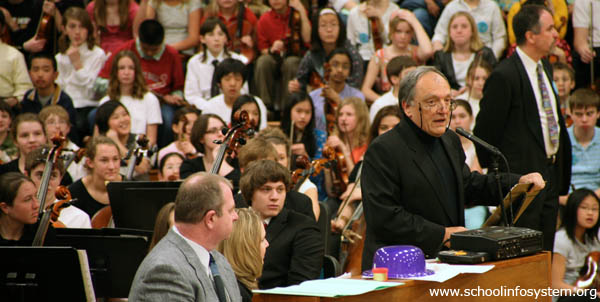
Madison West High Drama Benefit

via a Cyndie Spencer email:

Once again, excuse the duplicates… this is another great cause for West High School. Denny and i are planning to attend….
Please join Friends of West High Drama Friday March 7, 2008 at 7 PM at the Madison Club for a fundraiser to upgrade the sound system in the West High Auditorium. (see attached invite). We’ve planned a fun, welcoming and relaxing evening to celebrate the amazing student talent at West. We very much hope you can attend!
Meet the cast of West’s spring musical “A Chorus Line”. Hear them sing selections from the show as well as entertain you with some of the best “Singing Valentines” from West’s celebration of Valentine’s Day.
Enjoy delicious appetizers/dessert & bid on a few select auction items (condo in Myrtle Beach; theater tickets & dinner). Cash bar available.
Tickets are $35/person ($25 tax deductible). While tickets will be available at the door, your advance purchase helps us enormously in our planning. If you cannot attend but would like to contribute, please send your contribution made out to FMPS-Friends of West High Drama to Kay Plantes, 3432 Sunset Dr, Madison WI 53705.
We thank you in advance for your support. Your attendance and/or contribution are very much needed to improve the quality of life at West H.S. for all students.
Questions or to unsubscribe from this email, please reply to the address above or call Ruth Saecker (608-233-6943).

Share

Report: American Schools Trail Behind World In Aptitude Of Child Soldiers


Report: American Schools Trail Behind World In Aptitude Of Child Soldiers

Share

Despite IB Growth, College Credit is Elusive

Jay Matthews:

Across the Washington area, International Baccalaureate is booming, with more than two dozen high schools offering the college-level program and more signing up all the time. College admissions officers say they love seeing IB courses on transcripts. Students say the IB writing instruction and five-hour, end-of-course exams prepare them well for higher education.
But there’s a catch: Students usually can’t get college credit for one-year IB courses, even though they are similar to one-year Advanced Placement courses, which are eligible for credit. In another complication, students can get credit for passing tests after two-year IB courses, but that credit is equivalent to one year in AP.
Most university officials say they can’t explain these discrepancies. In many local high schools, bewilderment and frustration are growing among students and teachers over college policies about IB that seem at odds with the colleges’ oft-stated support for more challenging high school curricula.
“Imagine the consternation of these students who are getting the very best scores possible and are not seeing any recognition at most colleges,” said Marilyn Leeb, IB coordinator at Washington-Lee High School in Arlington County.
“I feel like we were being cheated,” said Chad King, a 2007 graduate of Mount Vernon High School in Fairfax County who received no credit for one-year IB courses from Ohio Dominican University in Columbus. “IB puts a lot of stress and pressure on its students, and for us not to get credit just because it is not AP is unfair.”

Share

Home-School Support: Parents advocate bill on leaving public school

Colin Poitras:

Anita Formichella is tired of hiding like a criminal.
“The sound of the doorbell literally strikes terror in my heart,” said Formichella, a bespectacled, middle-aged former school volunteer from Redding in her testimony to members of the legislature’s select committee on children on Tuesday.
For the past two years, Formichella said she has hidden in her house, shouting through the door when people knock because she fears the person on the other side might be a state social worker coming to take her children away.
Formichella isn’t a child abuser. She has never been cited for child neglect. She is a teacher. A home-school teacher. And therein lies the rub.
Within weeks of pulling her children from the public school system in 2006, Formichella received a letter from the local school superintendent requiring her to sign a form and submit more evidence that her children were being properly schooled. If she didn’t, Formichella said, she would risk a neglect investigation by the state Department of Children and Families. Formichella was frightened at first, then incensed.
“That’s a heinous, heinous thing to threaten a parent,” Formichella said outside the hearing room Tuesday. “And [the school superintendent] knew me!”

Share

Update on Madison BOE policy regarding students taking non-MMSD courses:

The February 25, 2008 Meeting of the Performance & Achievement Committee was devoted to developing a policy regarding students taking non-MMSD courses. The proposal Pam Nash suggested to the committee was essentially identical to the highly restrictive one she had originally proposed during the December, 2006 meeting of this committee: students would be permitted to earn a maximum of TWO ELECTIVE credits for course work and only when no comparable course is offered ANYWHERE in the District. Even Rainwater felt these rules were overly restrictive. He seemed willing (i) to increase the number of credits a student could earn, and (ii) to permit students to take a course offered elsewhere in the District if the student could not reasonably access the District’s course. Discussion of the Nash proposed policy ensued, but no specific revisions to it were made during this committee meeting. Both Maya and Johnnie (2 or the 3 members of the committee) suggested that the District needed to research the topic better, e.g., investigate what other comparable school districts in WI (e.g., Appleton which has in place a much less restrictive policy) were doing and to obtain feedback from the guidance departments of each of the 5 high schools, before the BOE should vote on approving a policy. Lawrie, chair of this committee, bypassed having a vote on whether to recommend the Nash version of the policy to the full BOE since she clearly would have lost such a vote. Instead, she simply stated that she had ALREADY placed this topic on the agenda for a special meeting of the BOE to be held March 10th, a meeting at which public appearances will NOT be permitted. Why the urgency now after we have been waiting for 6 years for the District to develop a policy in this matter? Possibly, the new Board that starts in April would approve a different policy, one that better meets the needs of students. Thus, folks, your only remaining opportunities to influence this policy to be approved by the BOE on March 10th are (i) to email and phone members of the BOE between now and March 10, telling them your opinions and why, ideally with examples of specific students, and (ii) to attend the March 10th meeting so the Board members will know you are watching how they vote.
Related:

Share

Say Cheese and Now Say Airbrush!

Jessica Bennett:

We’ve all looked back on grade-school photos and wondered, “What in God’s name was I thinking?” For me it started with buckteeth and hair-sprayed bangs-a true child of the ’80s. Then came the braces, stringy hair and oversize Kurt Cobain T-shirt, the tween years of Seattle grunge. High school wasn’t actually that long ago, but I’m sure whatever it was I wore will be grossly unfashionable by the time my 10-year reunion hits.
The grade-school class portrait is a time capsule of sorts-a bittersweet reminder of forgotten cowlicks, blemishes and crooked teeth. Awkward, at least in retrospect, is awfully cute. So it’s sad to think those mortifying school snapshots might soon be a thing of the past. A growing number of photo agencies and a horde of Web sites now offer retouching for kids to wipe their every imperfection clean: powdering complexions, whitening teeth, erasing braces or freckles. And parents are signing up their kids at younger and younger ages.
“It surprises me so much when a mom comes in and asks for retouching on a second-grader,” says Danielle Stephens, a production manager for Prestige Portraits, which has studios in nearly every state and starts its service at $6. “I have a 12-year-old, and I’d be afraid that if I asked for retouching she’d think she wasn’t good enough.”

Share

Changing Suburbs: “The Next Slum?”

Christopher Leinberger:

Strange days are upon the residents of many a suburban cul-de-sac. Once-tidy yards have become overgrown, as the houses they front have gone vacant. Signs of physical and social disorder are spreading.
At Windy Ridge, a recently built starter-home development seven miles northwest of Charlotte, North Carolina, 81 of the community’s 132 small, vinyl-sided houses were in foreclosure as of late last year. Vandals have kicked in doors and stripped the copper wire from vacant houses; drug users and homeless people have furtively moved in. In December, after a stray bullet blasted through her son’s bedroom and into her own, Laurie Talbot, who’d moved to Windy Ridge from New York in 2005, told The Charlotte Observer, “I thought I’d bought a home in Pleasantville. I never imagined in my wildest dreams that stuff like this would happen.”
In the Franklin Reserve neighborhood of Elk Grove, California, south of Sacramento, the houses are nicer than those at Windy Ridge—many once sold for well over $500,000—but the phenomenon is the same. At the height of the boom, 10,000 new homes were built there in just four years. Now many are empty; renters of dubious character occupy others. Graffiti, broken windows, and other markers of decay have multiplied. Susan McDonald, president of the local residents’ association and an executive at a local bank, told the Associated Press, “There’s been gang activity. Things have really been changing, the last few years.”
In the first half of last year, residential burglaries rose by 35 percent and robberies by 58 percent in suburban Lee County, Florida, where one in four houses stands empty. Charlotte’s crime rates have stayed flat overall in recent years—but from 2003 to 2006, in the 10 suburbs of the city that have experienced the highest foreclosure rates, crime rose 33 percent. Civic organizations in some suburbs have begun to mow the lawns around empty houses to keep up the appearance of stability. Police departments are mapping foreclosures in an effort to identify emerging criminal hot spots.

This is an interesting issue to consider, as school districts continue to ponder new edge schools.

Share

Madison School Board Committee Recommends Far West Side Boundary Changes

Susan Troller:

A Madison School Board committee recommended Monday night that students at Madison’s newest elementary school now under construction should attend Toki Middle School, not Jefferson Middle School as originally planned.
Members of the board’s long range planning committee also recommended final boundary Plan F for elementary school students in the Memorial High School attendance area that would send children in the neighborhood around Channel 3 to Falk Elementary School instead of Chavez Elementary or the new school, located west of Highway M.
The full School Board plans to vote on the recommendations March 3 at its regular meeting at the Doyle Administration Building at 7 p.m. There will be an opportunity for public commentary before the vote.
Among some west side parents, the most controversial part of planning the changes to accommodate the new school has been deciding which children and neighborhoods will attend Falk Elementary School, which has the west side’s highest percentage of low income students.
Numbers of low income students in the Memorial area range from 22 percent at Crestwood to 66 percent at Falk. Under the proposed plan, Falk’s low income percentage would drop to 57 percent.

Share

Ten Tips for Picking a Good School

Jay Matthews:

This is the time of year many parents seek advice on how to find a good elementary, middle or high school, public or private, for their children. Usually I send them a Washington Post article I wrote on this subject three years ago. But this is such an important topic to so many families, I decided to update my thoughts. Here are 10 suggestions, in no particular order. As you’ll see in recommendation number 10, your own thoughts and feelings should always be the deciding factor.
1. Buy an expensive house and you can be almost sure that the local school will be good.
This is an admittedly cynical notion, but there is truth in it. Newcomers often say to themselves, “Let’s find a school or school district we like and then find the house.” Yet most school systems in this area are so good, and parental affluence is so closely tied to educational quality, that if you buy a pricey house, the nearest school is almost guaranteed to be what you are looking for.
2. Look at the data.
In my opinion, based on 22 years of visiting schools and looking at data, the two largest school districts in the Washington area, Fairfax and Montgomery counties, are so well run that even their low-income neighborhoods have schools and teachers that compare with the best in the country. I think the same is true for public schools in Arlington, Clarke, Loudoun and Prince William counties, and the cities of Falls Church and Alexandria. (I’m based in Northern Virginia, so I have closer first-hand knowledge of school systems on that side of the Potomac River.) I also think all the D.C. public schools west of Rock Creek Park are as good as those in the suburbs.
My beliefs are influenced by data on how much schools challenge all of their students, even those with average records of achievement, to take college-level courses and tests before they finish high school. I call this the Challenge Index. (For more on the index, see recommendation No. 9 below.) I want to stress that other systems in the area have some fine public schools. Case in point: All four public high schools in Calvert County appear to be pushing students solidly toward college-level work. There are also some good charter schools. But in some places, you have to look more carefully to find them.

Share

Hunting the genes of genius

The Telegraph
Colin Blakemore,Professor of Neuroscience at the Universities of Oxford and Warwick
If we identify and eliminate the genes that cause mental disorders, do we risk destroying the rich creativity that often accompanies them?
Isaac Newton was able to work without a break for three days. Einstein took a job in a patent office because he was too disruptive to work in a university. HG Wells was so gawky and insecure at school that he had only one friend. Are these psychiatric disorders that should be treated or genius that should be cherished?
In a new book, Genius Genes, Irish psychiatrist Michael Fitzgerald argues that special forms of creativity are associated with a variety of cognitive disorders.
Fitzgerald describes how Charles de Gaulle’s Asperger’s syndrome was critical to his success as a politician. He was aloof, had a phenomenal memory, lacked empathy with other people, and was extremely controlling and dominating. He also showed signs of autistic repetitiveness and was similar in many respects to other politicians whom Fitzgerald argues also had Asperger’s, including Thomas Jefferson in the US and Enoch Powell in Britain.
The oddness of many great writers is well documented and a surprisingly high proportion of poets, in particular, had symptoms that indicate manic depression. See Touched with Fire and An Unquiet Mind
The richness of humanity and the power of our culture are, in no small way, attributable to the diversity of our minds. Do we want a world in which the creativity linked to the oddness at the fringes of normality is medicated away?

Share

Schools Let Sex Abuse Cases Slide

Amy Hsuan, Melissa Navas & Bill Graves:

The charismatic band teacher charmed students and parents alike. He won music competitions and teaching honors. He worked late, coached volleyball and mentored kids.
No one realized Joseph Billera, then 30, was having sex with children.
Yet there were warning signs for years that the popular Salem-Keizer teacher preyed on his Houck Middle School students.
School officials verbally reprimanded Billera after spotting him at a band contest in 2000 with a girl sitting on his lap, a blanket wrapped around them. In 2001, parent Robert Ogan complained to administrators after seeing Billera alone with a female student at a community softball game. Later, Ogan alerted the school’s principal after knocking on the door of Billera’s dark, locked band room one evening to be greeted by a middle school girl.
Three years passed before Billera was arrested and convicted for raping two students and molesting two others. Three of his victims were younger than 14. He assaulted one of them after the 2001 complaints.
Billera is one of 129 Oregon educators disciplined for molesting or having sexual relations with more than 215 public school children over the past 10 years.

Related editorial:

I t’s hard to believe, but Oregon protects teachers who are sexually attracted to children young enough to play with stuffed animals. The state also goes easy on teachers who seduce vulnerable, needy teenagers.
In the wake of the scandals that rocked the Catholic Church, it’s both immoral and willfully irresponsible to go on like this. Public school districts and state leaders should take swift steps to protect children from teachers who have no business remaining in any classroom.
Oregon takes a stunningly casual attitude toward sexual misconduct by teachers toward children, as The Oregonian’s Amy Hsuan, Melissa Navas and Bill Graves reported this week. This is true both of allegations and of substantiated claims. The state is slow to investigate teachers, and districts are reluctant to remove teachers from classrooms — or even to give known molesters a bad reference when they apply for their next job.
Most disturbing is the finding that districts will strike confidential settlement agreements with teachers who’ve admitted abuse. A teacher might promise to resign quietly (and not sue) in exchange for money, health insurance or positive job references.

Share

Relentless Deconstrionism: Consequences for Governance

Terry Heaton:

This concept of relentless deconstruction is a disaster for modern institutions built on “facts” of history and maintained by hierarchical systems of rule, order and especially tradition, for each — deconstructionists teach — is subject to examinations that reveal the subjective nature of humankind and its decisions, big and small.
It is in this light that I wish to state the argument that Bill Keller — and many, if not most people in such positions within the institution of modernist journalism — continue to function as if their access to knowledge is unique and justifies conclusions that can be used to manipulate culture, whether deliberately or otherwise. So deep is this belief, that Keller expresses shock when the Times’ conclusions are challenged.
The problem is that the public now has access to enough information — in most cases — to make up its own mind about issues and events, their causes and results. Moreover, the public now has enough knowledge to rightly question the assumptions and history that shape even the day-to-day decisions of the press, and with that knowledge, they also increasingly have the ability to make up their own minds. This will never return to the way it was, and in fact, will increasingly impact the culture as a whole.
So to me, Keller’s “surprise” is legitimate, but it’s based in the confusion of the era, especially for modernist, institutional thinkers. The public is a lot smarter and better informed than anybody in media gives them credit for being, and they are armed with simple tools to do their own investigating. And every time the curtain is pulled back on the editorial decision-making process within the institutional press, it gets easier and easier to find the natural biases and influences that drive the information gatekeepers of the culture.

Share

A Report on Voucher, Milwaukee Public School Performance

Alan Borsuk:

The first full-force examination since 1995 of Milwaukee’s groundbreaking school voucher program has found that students attending private schools through the program aren’t doing much better or worse than students in Milwaukee Public Schools.
The researchers gave a sample of voucher students the same tests given to public school students in Wisconsin and compared the results to those of a scientifically matched group of MPS students. Overall, they found, fourth-grade voucher students scored “somewhat lower” than MPS students but eighth-grade voucher students scored “somewhat higher.”
At all grades, both MPS and voucher students had overall test scores well below the 50th percentile nationally, and generally around the 33rd percentile, meaning they were generally scoring lower than two-thirds of students.
Results for individual voucher schools were not released as part of the study, despite calls from several legislators and others to see the private school results.
The study was conducted by the School Choice Demonstration Project, part of the Department of Education Reform at the University of Arkansas. The main researchers included John Witte, a University of Wisconsin-Madison professor who conducted studies of the Milwaukee voucher program in its early years from 1990 to 1995, before the Legislature dropped the requirement for such studies.

Share

An Interview with Todd McIntyre: About www.AppliedGiftedEd.com

Michael Shaughnessy:

3) What information are most parents and teachers seeking the most?
The first thing that parents want to know once we start talking about their situation with the district is whether or not they are crazy.
Oftentimes the situation the parent describes to me during an initial conversation defies any sort of logic – for example, the 3rd grade child is two or three grades above level in several, perhaps all, his or her courses.
The educational services the gifted child needs are not offered or even discussed with the parent because the district holds a vague concern about some future social experience such as the Senior Prom or driving a car. Parents often aren’t sure how to respond effectively to those sorts of statements.
The second thing parents want to know is what they can do about it. There are many options available, but there is a specific order in which any of the available options should be done.The starting point for the initial conversation is always the same: What are the gifted child’s present levels of educational performance? Phrased another way, the starting question for advocacy is this: How much of the district’s curriculum does the child already know?
At my Intermediate Unit and district-oriented trainings, teachers and administrators want to know about present levels of educational performance testing. Districts tend to make this kind of testing more complicated than it needs to be. Teachers and administrators also want the regulations and requirements explained to them in practical day-to-day terms

www.appliedgifteded

Share

Online Education Takes Off in India

Nandini Laksham:

It’s a Sunday afternoon and class time for 39-year-old IT worker Seema Shetty. Her feet curled under her in a swivel chair, she sits in front of a computer monitor, adjusts a set of headphones, and scribbles in a notebook. Shetty, who works for consulting firm Mastek in Mumbai, is in a virtual classroom in the Vile Parle suburb, where a dozen computers link students to some of India’s elite management institutions. Today’s class is a three-hour general management lecture, part of the online education course conducted by the Xavier Labor Relations Institute in Jamshedpur, in the remote northern Indian state of Jharkhand.
A consultant for various industries from insurance to banking, Shetty signed up for an online certificate course to “learn more about my clients’ business requirements,” she says. By enrolling in the 14-month, six-hour-per-weekend online course, at a cost of $4,600, she can further her education without having to take a two-year career break to get an MBA. Learning online, says Shetty hopefully, “will definitely boost my job prospects.”

Share

Study but don’t cap online schools

Wisconsin State Journal Editorial:

An audit to help gauge how virtual schools are performing in Wisconsin is reasonable.
But slapping a cap on how many children can enroll in online schools is unnecessary and potentially harmful.
Gov. Jim Doyle ‘s last-minute demand for a cap threatens to ruin a solid bipartisan deal to keep these interesting schools going.
The governor should drop his veto threat, and the Legislature should give Doyle and the teachers union the audit they want.
That way, a dozen virtual schools in Wisconsin serving 3,500 students can stay open and expand if more parents choose to enroll their children.
Key state lawmakers recently put together compromise legislation to keep virtual schools going after a court ruling threatened to shut them down. A court ruled in December that the Wisconsin Virtual Academy, based in suburban Milwaukee, violates state laws controlling teacher certification, charter schools and open enrollment.

Share

Doyle Defends Plan to Cap Virtual Schools Enrollment

Channel3000:

Gov. Jim Doyle said that he can’t understand why some are upset over his last-minute proposal to cap enrollment in virtual schools.
State lawmakers are trying to keep virtual schools open after a December court ruling said they were violating state law.
Without a change in law, as many as 12 schools that enroll 3,500 students could start closing as early as next school year.
Doyle recently told lawmakers that he would veto any bill that doesn’t cap enrollment while state officials study several issues related to the schools.
Republicans and Democratic Sen. Jon Erpenbach have expressed frustration at Doyle’s demands, which came after they thought they had agreement on a bill.

Share

My Suggested Changes to the Proposed MMSD Policy on Students Taking Outside Courses

February 25, 2008 draft proposal from Janet Mertz regarding the proposed MMSD Policy.
It is the policy of the Board to expand the opportunities for students to take courses outside of the District without increasing the costs to the District and without undermining the integrity of the diploma a student receives from the District. A student may receive credit for taking such outside courses. No District funds shall be utilized to pay for the costs to a student taking courses under this policy.
Taking outside courses if a student wishes to receive credit toward graduation.

  • By May 1 of the previous school year for first semester courses and by December 1 for second semester courses, the student shall submit to his/her principal or the principal’s designee the student’s request to take a course under this policy. Within 15 school days after receiving the student’s request, the principal, in consultation with the appropriate staff member(s), shall make a recommendation to the Superintendent or his/her designee as to whether the course shall be approved. Within 15 school days after receiving the principal’s recommendation, the Superintendent or his/her designee shall notify the student whether his/her request has been granted or denied.
  • A student may receive credit toward graduation. The grade will be recorded but not counted in the GPA.
  • Credits toward graduation shall be granted in the following manner:
  • No more than 4 credits per year.
  • No more than 11 credits may be applied to the total graduation requirement.
  • The student’s transcript shall include a description of the course, the institution, if any, the date the course was completed, the credit, and the grade.
  • No grades shall be included as part of a student’s grade point average (GPA).
  • All costs related to taking the course shall be the responsibility of the student and/or his/her parent/guardian.
  • Taking outside courses if a student does not wish to receive credit.
  • By May 1 of the previous school year for first semester courses and by December 1 for second semester courses, the student shall submit to his/her principal or the principal’s designee the students’ request to take a course under this policy. Within 15 days after receiving the student’s request, the principal, in consultation with the appropriate staff member(s), shall make a recommendation to the Superintendent or his/her designee as to whether the course shall be approved. Within 15 days after receiving the principal’s recommendation, the Superintendent or his/her designee shall notify whether his/her request has been granted or denied.
  • The student’s transcript shall include a description of the course, the institution, if any, the date the course was completed, and the pass/fail grade unless the student or his/her parent/guardian request that the student’s letter grade appear on the transcript in which case the student’s letter grade will appear on the transcript.
  • No grade shall be included as part of the student’s GPA.
  • All costs related to taking the course shall be the responsibility of the student and/or the student’s parent/guardian.
Share

Madison School District Memo on Students Taking Outside Courses

MMSD Legal Services; 18 Page 758K PDF

On January 8, 2007, the Board took the following action:
lt is recommended that the Board direct the Administration to: 1) freeze new procedures or guidelines for credit towards graduation for courses taken outside the MMSD until the Administration reports to the Board about whether current MMSD policies need to be updated or changed in view of any technological changes in the law and other opportunities; 2) develop a proposal on either the implementation and communication of the policies and procedures to parents and students for consistency across the District at the levels affected; and 3) have the Administration give the Board the pros and cons of adopting a policy like the one proposed by Dr. Mertz as a draft proposal. It is further recommended that the Administration review all nine of the policies, including the proposed “Guidelines for Coursework Outside the MMSD'” for possible revision, consolidation, or propose a newly created policy.
Attached is Exhibit 1, an amended draft of the policy previously submitted to the Board in a memo from Pamela Nash dated May 4, 2007. The amendments modify the timing of a student’s appiication to take courses outside the MMSD and the response time of the District. This time frame is modeled after the Youth Options time frame.
Also attached to this Memorandum is a copy of a policy proposal previously submitted by Dr. Janet Mertz, Exhibit 2A, and the District’s analysis of that proposal,
Exhibits 2 and 2B. These documents were also submitted to the Board of Education under cover of Dr. Nash’s memo of May 4, 2007. This matter is scheduled to be heard before the Performance and Achievement Committee on February 25, 2008.

Background audio, video and documents are available here. The School Board’s Performance & Achievement Committee meets today @ 5:00p.m to discuss this memorandum. [Directions & Map] Attend the meeting and send your thoughts to: comments@madison.k12.wi.us

Share

The Community Network Solution
In reweaving the social fabric of a city or town, relationships trump rank.

Karen Stephenson:

Business leaders are in­creasingly aware that the health of their enterprise is intimately connected with the health of the communities where they operate. As employers, they sometimes find themselves drawn in to help solve local problems. But they are also often frustrated by those efforts, and no wonder. When a community sets out to address complex problems, such as economic stagnation, sprawl, and failing schools, the ef­fort usually ends up going nowhere. Competing agendas surface, members delegate responsibilities to staff, difficult decisions get postponed. Hopes fade and interest flags as the hidden challenges and underlying conflicts become apparent.
The quiet failure of such initiatives is often attributed to human nature, or to some flaw in the process that shaped the effort. But in fact, the problem usually starts when the project organizers compose their first list of proposed participants. The organizers ask themselves: Who are the power brokers around town? Who are the key players? Who from business, government, education, and nonprofits should be involved?
Once the list is compiled, the usual suspects are convened. They assemble with enthusiasm, write a vision statement, sign up for committees, and pledge support. A press release goes out: “Local Leadership Team Sets to Work!”

Share

Madison School Board to Discuss Credit for Non-MMSD Courses Today @ 5:00p.m.

The Performance & Achievement committee meets today at 5:00p.m. [Directions & Map] to discuss a policy on credit for non-MMSD courses. Janet Mertz has been following this issue for years, in an effort to support a “clearly written policy” on such courses. Read Janet’s summary after the most recent discussion of this matter (26 November 2007):

Madison School Board Performance & Achievement Committee Meeting 11/26/2007At the November 26, 2007 meeting of the MMSD BOE’s Performance and Achievement Committee [18MB mp3 audio], the District’s Attorney handed out a draft of a policy for the District’s Youth Options Program dated November 20, 2007. It is a fine working draft. However, it has been written with rules making it as difficult as possible for students to actually take advantage of this State-mandated program. Thus, I urge all families with children who may be affected by this policy now or in the future to request a copy of this document, read it over carefully, and then write within the next couple of weeks to all BOE members, the District’s Attorney, Pam Nash, and Art Rainwater with suggestions for modifications to the draft text. For example, the current draft states that students are not eligible to take a course under the YOP if a comparable course is offered ANYWHERE in the MMSD (i.e., regardless of whether the student has a reasonable method to physically access the District’s comparable course). It also restricts students to taking courses at institutions “located in this State” (i.e., precluding online courses such as ones offered for academically advanced students via Stanford’s EPGY and Northwestern’s CTD).

The Attorney’s memorandum dated November 21, 2007 to this Committee, the BOE, and the Superintendent outlined a BOE policy chapter entitled “Educational Options” that would include, as well, a policy regarding “Credit for Courses Taken Outside the MMSD”. Unfortunately, this memo stated that this latter policy as one “to be developed”. It has now been almost 6 years (!) since Art Rainwater promised us that the District would develop an official policy regarding credit for courses taken outside the MMSD. A working draft available for public comment and BOE approval has yet to appear. In the interim, the “freeze” the BOE unanimously approved, yet again, last winter has been ignored by administrators, some students are leaving the MMSD because of its absence, and chaos continues to rein because there exists no clearly written policy defining the rules by which non-MMSD courses can be taken for high school credit. Can anyone give us a timetable by which an official BOE-approved policy on this topic will finally be in place?

Links:

Meanwhile, online learning options abound, including the news that National Geographic has invested in education startup ePals. Madison, home of a 25,000 student public school system, offers a rich learning environment that includes the University of Wisconsin, MATC and Edgewood among others.

Share

The Marketing of High School Sports

Texas Monthly:

If you think high school sports are too slick, too big-time, or too professional, just wait. When this Ohio transplant has his way—and he will—they’re going to get slicker, bigger, and much more pro. Stephenson, the former president of Dave Campbell’s Texas Football, founded Titus Sports Marketing in 2003. The company’s first major deal came a year later, when it sold naming rights for the Tyler Independent School District’s stadium to Trinity Mother Frances Health System for $1.92 million, the largest such contract for a high school ever. In September 2007 Titus also put together the Clash of Champions, a game televised on ESPNU between the best high school football team in Florida, Miami Northwestern, and the best in Texas, Southlake Carroll. Northwestern won the game (hyped as “the biggest game in the history of high school football”) 29—21, but the real winner may have been Stephenson.
Where did you get the idea for Titus?
I knew high schools were looking at ways of maximizing revenue. A lot of districts are looking to give their stadiums a face-lift—to add parking, double the concessions and restrooms, redo the field house. High schools are where colleges were fifteen years ago, and there’s a lot of lost advertising revenue because there’s nobody there to capture it. We’re pioneers. We work with the school district; we sell the assets that they direct us to sell.

Share

When cheers turn to depression

Stan Grossfeld:

She just wanted six-pack abs. So in the summer of 2003, Dionne Passacantando, a 17-year-old high school cheerleader, gymnast, and vice president of her Allen (Texas) High School class, made a decision she regrets. She bought anabolic steroids from a boy on the school football team.
“Nobody frowned upon it,” she says. “It was easier for me to get those than it probably was to buy beer.”
But after injecting herself with Winstrol every other day for five weeks, she became suicidal.
“I was the last person in the world you’d think would use anabolic steroids,” she says.
Her story is part of a much larger picture. The Mitchell Report, which detailed steroid use in major league baseball, noted that while steroid use among high schoolers seems to be declining, it is still estimated that 3-6 percent of students nationally have tried them. That means that, at a minimum, hundreds of thousands of high school students are using.

Share

On Credentials: Rhee-form

Denis Doyle:

Announced nine months ago by Mayor Adrian Fenty to a mixed chorus of applause and boos, Michelle’s appointment is part of two trends. The first is mayoral control of schools; the second is appointing “uncredentialed” or “unlicensed” leaders to fill the post of superintendent (or in the case of DC and NYC, chancellor).
The nightmare of credentialing is ordinary thought of in terms of teachers, a challenge that reformers like Michelle and Wendy Kopp have taken on in their respective spheres; credentials in their earliest incarnation were meant to be a floor beneath which teachers would not fall. In their modern incarnation they have become a ceiling through which they may not pass. For example, the head of the Washington DC based Sidwell Friends math program, a trained mathematician with 30 years experience of superlative high school teaching couldn’t get a job in a public school. Nor could Einstein.

Share

Washington County 4-H and Madison West Rocket Club Selected for NASA Event

Channel3000:

Four Washington County teens are among 18 groups in the nation invited to display their rocket-building skills to NASA space shuttle engineers this spring.
The challenge for the team, all members of the county’s 4-H rocketry club, was to design and build a reusable rocket. It had to be capable of carrying a science payload to one mile above the surface and returning safely to the ground.
Their 7-foot rocket will be launched in late April at the Marshall Space Flight Center in Alabama as part of NASA’s Student Launch Initiative.
A rocket club from Madison West High School in Madison also was selected this year.

Donald Behm has more:

With spring deadlines looming, four Washington County teens are working weekends to build a high-powered rocket to launch in front of NASA space shuttle engineers.
Their challenge: Design and build a reusable rocket capable of carrying a science payload to one mile above the surface and returning safely to the ground.
The team, all members of the county’s 4-H rocketry club, is one of only 18 groups in the United States invited to display their skills this year as part of NASA’s Student Launch Initiative. Their rocket will be launched in late April at the Marshall Space Flight Center in Huntsville, Ala.
“It cannot be wrecked,” said Katlin Wagner, 15, a freshman at Slinger High School and the defending rocketry champ among 4-H youth in the county. “We must be able to put it back together and use it again.”

Share

Maya Cole’s Schoolcast Update

Maya Cole:

Dear friends,
First, I would like to let you know that I have new podcasts and blog posts up on my website! You can get information on how our superintendent search evolved and learn how school districts lobby the legislature at a state level through the Wisconsin Association of School Boards.
I am also happy to report that several of us on the Board have begun to meet (after a long hiatus) as members of the Dane County School Board Consortium. The Madison School Board will be hosting other districts next month at LaFollette High School. We will be discussing how we can engage and listen to the public on boundary changes. We hope to come together in the future and combine our lobbying efforts as representatives of Dane County schools. If you know of any state or local officials who would be interested in joining us to learn more about issues facing school districts, please feel free to send them my e-mail address.
I also have two new podcasts, five minutes in length, that explain all you need to know about No Child Left Behind and its re-authorization this year. I met with Sennett school teacher David Wasserman and promised him I would work on engaging the public on this important issue. Please take a listen and pass it on to your friends.
These past few months I have been working hard on many issues on behalf of the school district. I met many fascinating educators and members of the community that are interested in our schools. Some of the Board highlights include, but are not limited to:

(more…)

Share

Milwaukee’s Ongoing Movement toward K-8 Schools

Alan Borsuk:

he dramatic trend toward K-8 schools in Milwaukee is the central factor behind the middle school trend as a whole.
But this week’s flurry of action was started by proposals from board member Michael Bonds to reopen Douglas and Jackie Robinson Middle School, 3245 N. 37th St., which also closed several years ago. Bonds argued that there was a shortage of traditional middle schools on the north side and that reopening the schools could reduce the amount of busing.
Andrekopoulos responded with proposals to close other schools to offset the reopenings. Overall MPS enrollment is expected to decline next year, and financial pressures on the system are sharp.
Finance committee members dropped the idea of reopening Robinson after a lengthy discussion of issues involved in launching the new Booker T. Washington program, such as how to meet the goal of getting at least 500 students, as well as a teaching staff, for a program that does not yet exist and at a time when the assignment process for students and the job transfer process for teachers are already well under way.

Share

Madison United for Academic Excellence meeting on MMSD Math

The Madison United for Academic Excellence (MUAE) meeting of 21 February 2008 offered a question and answer session with Welda Simousek, TAG coordinator, Lisa Wachtel, Director of Teaching and Learning, and Brian Sniff, Math Coordinator, each of MMSD.


QT Video
The video of the meeting is about 1 hours and 30 minutes long, but does not include the last 15 minutes of a spirited discussion. Click on the image at left to watch the video. The video will play immediately, while the file continues to download.

The topics covered during remarks and the question and answer sessions are

  • Middle School Math Assessment
  • Math Task Force
  • Teacher Certifications in Math
  • Connected Math Curriculum in Middle Schools
  • High School Math Curriculum and variations among schools

The slide materials for Lisa’s and Brian’s presentation are included in Powerpoint format and PDF format. (Thanks to Brian for sending).
The handouts from this presentation (thanks to Welda): In-STEP Teacher Checklist, 2007-8 Middle School Math Assessment – Draft, Math Assessment Report.
NB: The last slides discussed during this meeting are slides numbered 15 and 16 (Math Physics, Math Chemistry, respectively). These latter slides prompted the spirited discussion mentioned above, but is not part of the video. Slides 17-19 were neither discussed nor displayed.

Share

Dallas schools teacher ratings sometimes off mark

Kent Fischer:

Seth Johnson teaches Spanish at Madison High School. Yet when he received a district report that rated his performance, he was surprised to see his rating dragged down by two classes of low-scoring French students – classes he didn’t teach, and couldn’t have because he doesn’t speak French.
“They put my name on a class that I never taught,” Mr. Johnson said. He filed a complaint with the district this week.
As the Dallas public schools promote a complex teacher rating system as an impartial way to award bonuses and identify bad teachers, records and interviews indicate that the calculations are not infallible.
In all, 116 teachers challenged the accuracy of their “Classroom Effectiveness Index” reports this year. The CEIs are numerical ratings given to teachers based on gains their students made on classroom and state exams.

Share

Wisconsin “Senate Says Whoa on School Innovation”

Patrick McIlheran:

The best explanation – I mean the funniest – as to why the state Senate put a poison-pill enrollment cap on virtual schools was from state Sen. Russ Decker, the Weston Democrat who helped do it.
The fault lies with the schools, he says. Just too many parents were opting for them. In growth, “some of those virtual schools are pushing the envelope.”
Leave aside that pushing the envelope – inventing a new way to deliver a good education – is the point. On its face, the sentiment that the schools were growing faster than legally proper is nonsense.
Parents choose virtual schools, in which students are taught at home via daily online lessons, by the same law that allows any parent to send her child to any other public school. This open enrollment law has no upper limit and is now used by 23,000 students statewide. As for virtual schools, which account for 3,300 of those, the law did not limit their growth either until two months ago when a lawsuit by the Wisconsin Education Association Council, the state’s dominant teachers union, hit the jackpot. Decker’s envelope exists solely in his head.
So the Senate, on party lines with the exception of one honorable Democrat, installed one – dictating that for two years, virtual schools can grow no larger. They can inch up to 4,500 students by 2014, but senators also set auditors to studying the program. All this was needed, says Decker, because Gov. Jim Doyle wouldn’t agree to let the schools stay open otherwise.

Milwaukee Journal-Sentinel Editorial:

There is still time to save Wisconsin’s virtual schools, but the clock is ticking after a state Senate vote this week that unwisely capped enrollment and blew up a bipartisan compromise.
In a letter to legislators on the eve of the vote, Gov. Jim Doyle called for a cap on enrollment and recommended a study to determine how well virtual schools were serving students and what their fiscal impact was on existing public schools and property taxes.
The request for a study is sensible enough, but the cap is a solution looking for a problem. And now, despite exceptions for siblings of existing students and for students who signed up during the current open enrollment period, some children may be denied the opportunity to learn in an environment that is best suited to their needs.
Legislation was needed after a state Court of Appeals ruled in December that the Wisconsin Virtual Academy, operated by the Northern Ozaukee School District, was not eligible for state aid. That ruling threatened the existence of all 12 online schools in the state, which serve more than 3,000 students.
The compromise plan was a good one that balanced the need to legalize virtual schools while imposing new standards on them. It had the support of the state Department of Public Instruction.
The Senate vote sends the measure back to the Assembly, where Rep. Brett Davis (R-Oregon) said Thursday he would draft new legislation that includes a financial audit but not a cap. He also planned to send a letter to Doyle inviting the governor or his staff to a hearing on Monday to explain why a cap is necessary.

Much more on Wisconsin’s Virtual Schools here.

Share

Across the Bay, on a School Bus Wearing Skis

Susan Saulny:

From a distance, the large red aluminum contraption parked on the frozen shore of Lake Superior here looks like a small houseboat perched on skis. Up closer, as schoolchildren pile in with their backpacks and iPods, it becomes clear that the mystery vehicle, with two large fans on the back, is something else entirely.
For residents of this remote village on an ice-locked island off the tip of mainland Wisconsin, the gliding boatmobile, known here as a windsled, is a kind of school bus.
That’s right: in one of the more unorthodox modes of student travel anywhere in the country, the children of La Pointe, on Madeline Island (full-time population 250, triple that in the summer), actually windsled to class several weeks out of every year. It is the transportation a school district needs when students are separated from class by more than two miles of jigsaw ice blocks coming together to form something that approximates a floating road of shallow depth across a bay.
Everyone here knows the windsled as a homegrown solution to a tricky set of circumstances: Sometimes Lake Superior — the largest, coldest and deepest of the Great Lakes — is too chunky with ice for a ferry but not quite solid enough to make an ice bridge between La Pointe and the mainland town of Bayfield, the location of the upper school.
During those times, the Bayfield School District turns to its windsled, locally designed, built and operated to glide over thin ice.

Share

The Value of “No”

Terri Cullen:

When I was a kid, my mom, Carol, was an expert at saying “no” when we asked for money. With four kids and little income, she often found it hard to pay for food and rent, let alone luxuries such as the electronic games and designer clothes my brothers and sister and I constantly begged for.
But as we grew into adults, something odd happened. My mom suddenly found it difficult to refuse when her kids came to her with their financial problems, whether she had the cash to spare or not.
Over the years, I’ve chided her for constantly dipping into her own savings to help my family members out, asking: “How are they going to learn to manage money if you’re forever bailing them out?”
I spoke from hard experience. In college I piled up tens of thousands of dollars in student loans, auto loans and credit-card debt. When I left school, I found my entry-level salary barely able to keep up with my debt payments, and the temptation to turn to my parents for a handout was strong. But at the time my mom and dad were getting divorced, and dealing with their own emotional and financial issues. The last thing I wanted to do was add to their burdens, so I resolved to handle my debt on my own. In doing so, I learned how to budget and came to understand the real cost of accumulating debt.
Having learned my lesson, I’d urged my mom to consider the harm she was doing by not allowing other family members to do the same. And I’d point out that she really didn’t have the money to spare. Mom would reply that helping her children helped her, because it pained her to see her kids suffer. Then she’d assure me with a smile: “When you’re a mom, you’ll understand.”

Share

The Leadership Limbo

Frederick Hess & Coby Loup:

In the era of No Child Left Behind, principals are increasingly held accountable for student performance. But are teacher labor agreements giving them enough flexibility to manage effectively? The Leadership Limbo: Teacher Labor Agreements in America’s Fifty Largest School Districts, answers this question and others.
The main findings:

  • Thirty, or more than half, of the 50 districts have labor agreements that are ambiguous. The collective bargaining agreements and the formal board policies in these districts appear to grant leaders substantial leeway to manage assertively, should they so choose.
  • Fifteen of the 50 districts are home to Restrictive or Highly Restrictive labor agreements. Nearly 10 percent of the nation’s African-American K-12 students population attend school in the 15 lowest-scoring districts-making these contracts major barriers to more equal educational opportunity.
  • The study also found that districts with high concentrations of poor and minority students tend to have more restrictive contracts than other districts-another alarming indication of inequity along racial and class lines.

Madison’s collective bargaining agreement can be found here.teachercba07-09.pdf

Share

Teachers to spell out when pupils can use ‘text speak’

Andrew Denholm:

he increasing use of “text speak” by pupils in English lessons is to be addressed as part of wider moves to put basic literacy at the heart of the school curriculum.
Under the Scottish Government’s Curriculum for Excellence, reading, writing and spelling are to be embedded in all lessons – rather than just English – and close attention will be paid to spelling, comprehension and punctuation.
Because pupils spend a significant proportion of their time blogging or using webcasts, podcasts and social networking internet sites, the new emphasis on literacy is intended to teach when it is acceptable to use abbreviated forms of English such as text speak.
Literacy programmes will also teach children to think about the potential dangers of using different media and to consider the consequences of their actions online.

Share

Battery Arrest at LaFollette High School

Madison Police Department:

On Tuesday afternoon a La Follette High School principal was attempting to escort to the office a couple of students who had been arguing. One student (the 16 year old listed above) did not want to go to the office and became hostile. She began yelling and ended up punching the principal in the face. A Madison Police officer witnessed the act. That officer was also punched in the face while arresting the student. The melee took place during class passing time, and the arresting officer described the situation in a report as “extremely disturbing and disruptive to the school environment.”
Following the arrest pepper spray and a box cutter were found to be in the 16-year-old’s possession. These were grounds for additional tentative charges. The student also spit her gum on the floor, which is a violation of Madison’s Expectorating Ordinance.

Via Isthmus.

Share

Reaction to the Wisconsin Senate’s Virtual School Bill

Amy Hetzner:

The executive director of the Wisconsin Association of School Boards said today that he is disappointed that compromise legislation that would have ensured the survival of the state’s virtual schools seems to be falling apart.
“We had a bipartisan legislation that virtual schools could continue and meet our state standards and now we’re getting into some last-minute politicking and I think that’s very disappointing,” said John Ashley, whose group includes nearly all of the state’s 426 school boards.
“It was a legitimate bipartisan effort that’s unraveling,” he said. “And I think the real effect is going to be on our students. It’s unfortunate to see politics at this stage. I mean we don’t have that much of a (legislative) session left.”
In contrast, the Wisconsin Education Association Council, which brought a lawsuit that now threatens the ability of the state’s virtual charter schools to enroll students statewide and collect taxpayer dollars, released a statement by its president supporting the state Senate’s latest action.

More here.

Share

Students in Madison’s Alternative School

Andy Hall:

Alan is one of about 200 Madison middle and high school students who, having previously struggled in traditional school settings, now are thriving in the new homes of alternative education programs in elementary schools and in an office building.
Halfway through the school year, a controversial relocation of four alternative education programs appears to have been completed smoothly.
Some parents feared there’d be problems when the alternative programs for older students were moved to buildings with elementary students — the first time in at least a decade such an arrangement has been tried in Madison.
Students in the alternative programs long have assisted in the schools as part of their program requirements, but there were concerns that basing the programs’ classrooms there could expose young children to older students’ harsh language, smoking and violence.

Share

Comparing Schools

Katherine Boehret:

Education — an issue that affects everyone in some way or another — is an ideal candidate for discussions on the Web. There, parents, students and teachers can ask questions under the cloak of Internet anonymity, which enables conversations about personal topics such as learning disabilities and teacher conflicts.
But the vastness of the Internet can leave many people wondering where to begin, especially when asking sensitive questions about education. And, even in a sea of discussions and forums on education, parents are often hungry for one piece of information above all else: data that helps them select a school for their children.
So this week I tried three education-related Web sites that dedicate some or all of their resources toward providing free school comparisons, including demographics, test results, teacher-to-student ratios, and percentages of students eating free and reduced-price lunches.

Share

UW persuades Minority Student Network to bring offices here

Susan Troller:

Recently, the University of Wisconsin scored a coup over Harvard and Penn when it persuaded the Minority Student Achievement Network to bring its offices from Evanston, Ill., to the Wisconsin Center for Education Research here.
So what, exactly, is the Minority Student Achievement Network (MSAN), and why were prestigious major research universities vying to offer it a home?
The group, whose Wisconsin members include the Madison Metropolitan School District and the Green Bay school system, is a consortium of about 25 high-performing school districts from across the country. They joined forces in 1999 to figure out why their students of color aren’t doing as well in school as their white counterparts.
Besides Green Bay and Madison, other districts that have been part of the group include Ann Arbor, Mich.; Shaker Heights, Ohio; Cambridge, Mass., White Plains, N.Y. and Chapel Hill, N.C.
All are public school districts where education is a well-funded community priority. All have been disappointed that even in their relatively affluent public schools, minority students still lag behind white and Asian students.

Share

Madison Superintendent Candidate Steve Gallon Accepts Plainfield, NJ Position

Bernice Paglia:

The promise of big news was fulfilled Tuesday when the Board of Education approved Steve Gallon III as the next schools superintendent.
Gallon will begin a four-year term July 1 at a salary of $198,000, with other contract details to be negotiated.
Before the vote, three board members who visited the Miami-Dade school district effusively testified that Gallon, the winner among 30 candidates and five finalists, possessed qualities hardly ever seen before in a chief school administrator in Plainfield. The meeting reached a crescendo when Gallon himself was introduced and took the microphone to give the kind of hope that the district has been longing for.
Gallon alluded to being a finalist for another superintendent position, but said he chose Plainfield instead.
“I want to be here,” Gallon said.
Among his credentials, Gallon survived growing up in Liberty City, one of Miami’s toughest neighborhoods, and went on to achieve high recognition as an educator, motivational speaker, author and exemplar of success against all odds.

Share

AP Trends: Tests Soar, Scores Slip

Scott Cech:

While more American public school students are taking Advanced Placement tests, the proportion of tests receiving what is deemed a passing score has dipped, and the mean score is down for the fourth year in a row, an Education Week analysis of newly released data from the College Board shows.
Data released here this week by the New York City-based nonprofit organization that owns the AP brand shows that a greater-than-ever proportion of students overall—more than 15 percent of the public high school class of 2007—scored at least one 3 on an AP test. The tests are graded on a scale of 1 to 5, the highest score.
Yet, as the number of AP exams taken in U.S. public schools has ballooned by almost 25 percent over the four years that the College Board has released its “AP Report to the Nation,” the percentage of exams that received at least a 3—the minimum score that the College Board considers predictive of success in college—has slipped from about 60 percent to 57 percent.
The mean score on the nearly 2 million AP exams taken by students in last year’s U.S. public graduating class was 2.83, down from 2.9 in 2004.
“That happens,” said Jennifer Topiel, a spokeswoman for the College Board. “Any psychometrician can tell you that as participation grows, scores go down.”
Still, Ms. Topiel said the score declines are a major concern for the organization, as are widening score gaps between some racial and ethnic groups, “particularly those among underrepresented students who are not being prepared and not having the same resources.”

Links:

Share

Negative Implications Of No Child Left Behind: As Graduation Rates Go Down, School Ratings Go Up

via a Lauren Rosen Yeazel email:

Texas’ public school accountability system, the model for the national No Child Left Behind Act, directly contributes to lower graduation rates, according to new research. Each year Texas public high schools lose at least 135,000 youth prior to graduation — a disproportionate number of whom are African-American, Latino and English-as-a-second-language students.

Share

Wisconsin Governor Doyle Caps Virtual School Enrollment

Steven Walters:

It will take a new Capitol compromise to keep Wisconsin’s virtual schools open after action Tuesday by the state Senate.
t the request of Gov. Jim Doyle, the Senate voted to cap enrollment for online schools at the current level – now about 3,500 students statewide – while a study is done on virtual learning.
Under the Senate changes, that number of online students could not go up again until the 2011-’12 school year, and then only by about 875 students. Dozens of parents and virtual school students came to the Capitol on Tuesday to fight the enrollment cap.
The 18-15 vote by the Senate – controlled by Democrats – sends the measure to the Assembly, which is run by Republicans.
The Assembly will meet for only a few more days before its scheduled adjournment next month. There might not be time to negotiate a compromise to changes dictated by Doyle, who promised to veto any bill without an enrollment cap.
If the Assembly does not act, virtual schools might not continue. In a ruling that threatened all online schools, the Court of Appeals ruled in December that the 800-student Wisconsin Virtual Academy, operated by the Northern Ozaukee School District, was not eligible for state aid, now $5,845 per student per year.

More on Wisconsin Virtual Schools, along with an update from WisPolitics.

Share

DC Schools Chancellor Wants to Test “Differentiated Learning”

V. Dion Haynes:

D.C. Schools Chancellor Michelle A. Rhee plans to establish an experimental program that would offer customized lessons for disabled, regular and gifted students in the same classroom, a key component of her strategy to reduce exorbitant special education costs.
Rhee’s proposal would launch a “differentiated learning” laboratory at West Elementary School in Northwest Washington, then replicate it citywide. Under the proposal, which is being met with skepticism from some West teachers and parents, the system would hire a private special-education school to run the program.
The proposal is among several actions Rhee is taking to overhaul special education, which for years has lacked high-quality programs for learning-disabled and physically disabled students. The system spends about $137 million on private school tuition annually for about 2,400 children (out of more than 9,400 disabled students) whom it cannot serve in the public schools.
Since 2006, the D.C. public schools have been under a federal court order to eliminate a backlog of more than 1,000 decisions from hearing officers regarding placement of students in special education programs. The order stemmed from a consent decree that settled a class-action suit filed by parents protesting the system’s long delay in providing services for the students.
Federal law requires schools to practice “inclusion” — putting special education students in regular classrooms whenever possible — a mandate the system has ignored in countless cases, advocates say. Under differentiated learning or differentiated instruction, an approach that has been used in schools in Prince George’s and Montgomery counties and across the nation over the past decade, students are grouped in the same classroom according to their ability levels and learning styles. They get the same lesson but are given different assignments and tasks based on their abilities.
For instance, a third-grade class in St. Louis recently was assigned to report on Martin Luther King Jr., with some students writing a timeline, others illustrating pages and others comparing the era of the slain civil rights leader to today.
Rhee is proposing to go a step further than most other districts using the concept. She wants to treat all students in the differentiated instruction classrooms much like special education students, with each getting an education plan outlining how teachers would address the child’s specific strengths, weaknesses and learning style.
Special education “is about individualization of instruction — that is going to be the overarching theme of these schools. Every kid — gifted kids — need really good individualization,” Rhee said in an interview. “All kids will benefit when we’re operating in that manner.”

Share

New Math Textbooks Irk Some Parents

Ian Shapira:

Greg Barlow, an Air Force officer in the defense secretary’s office at the Pentagon, was helping his 8-year-old son, Christian, one recent night with a vexing problem: What is 674 plus 249?
The Prince William County third-grader did not stack the numbers and carry digits from one column to the next, the way generations have learned. Applying lessons from his school’s new math textbook, “Investigations in Number, Data, and Space,” Christian tried breaking the problem into easier-to-digest numbers.
But after several seconds, he got stumped. He drew lines connecting digits, and his computation amounted to an upside-down pyramid with numbers at the bottom. His father, in a teacherly tone, nudged him toward the old-fashioned method. “How would you do that another way?” Barlow asked.
In Prince William and elsewhere in the country, a math textbook series has fomented upheaval among some parents and teachers who say its methods are convoluted and fail to help children master basic math skills and facts. Educators who favor the series say it helps young students learn math in a deeper way as they prepare for the rigors of algebra.
The debate over “Investigations in Number, Data, and Space,” a Pearson School series used in thousands of elementary classrooms, including some in Arlington, Fairfax, Loudoun and Howard counties, is one of the newer fronts in the math wars. Such battles over textbooks and teaching methods are fueled in part by the anxieties of parents who often feel powerless over their children’s education, especially in subjects they know.
The curriculum, introduced in the 1990s and updated in a second edition issued last fall, offers one answer to the nation’s increasingly urgent quest for stronger elementary math education. The nonprofit organization TERC, based in Cambridge, Mass., developed “Investigations” with support from the National Science Foundation.

Related Links:

Share

Cultural diversity courses take root in schools

Erin Richards:

Stoecker never studied diversity issues, at least not directly, in high school. And that’s something at least one Milwaukee-area school district is trying to change: Starting this fall, Muskego High School will offer a cultural diversity class to 11th- and 12th-graders. The elective course will address issues such as white privilege in a community that is at least 97% Caucasian, Associate Principal John LaFleur said.
Meanwhile, area higher education institutions have spent the last several years ramping up multiculturalism course offerings and activities, in some cases requiring that students take diversity courses as part of their general education. More often than not, professors say, students arrive from high school largely ignorant about the four traditionally defined minority groups – African-Americans, Latinos, Asian-Americans and American Indians.
“I think part of why this is attracting attention is that all the metaphors we used to use – melting pot, mosaic – just aren’t working anymore, because they let us skirt the ideas of injustice and equal distribution of goods,” said Christine Krueger, an associate professor of English at Marquette University and the director of core curriculum.

Share

Madison School Board Update on Recruiting Policy and Public Appearances

Susan Troller:

A new policy to clarify rules on recruiting Madison high school students for the military, for post-secondary education opportunities or for potential employment is under review by the Madison School Board, but is not quite ready to pass muster.
At a meeting Monday night, the board sent the recruitment policy back to the administration for additional work and chose to table a discussion about the sales of military ads on school grounds until the recruitment policy changes are complete.
Anti-war activists have argued that the ads constitute recruiting materials and are by current policy banned anywhere except in school guidance offices. In addition, some students have complained that recruiters can be overly aggressive in pursuing students.
“I think we’re pretty close to making a decision on the revised recruitment policy,” Board President Arlene Silveira said in an interview this morning, “but we wanted some additional clarification from the administration, and we wanted to make sure the changes in the rules make sense to the people in the schools who will be working with them.”
She also said the board wanted to ensure the policy was fair and consistent toward all individuals and organizations coming into the schools to recruit students, whether they are promoting military service, employment or educational opportunities.
Issues include how many visits recruiters may make to a school, and whether activities like hanging around the cafeteria during lunch to talk with students would be permitted.
Superintendent Art Rainwater said that while only about one percent of Madison students go into the military, 80 percent go on to post-secondary education. He emphasized that treatment of recruiters, no matter who they represent, must be consistent.

Share

Save the Wisconsin Virtual School Compromise

Milwaukee Journal-Sentinel Editorial:

On the state Senate’s calendar today is a bill that would keep alive the state’s virtual schools by imposing standards on them and making sure funding for the schools continues. On Monday, various groups were in discussions on what form the final bill would take and whether it would be amended to include such items as a cap on the number of students allowed to enroll in the schools.
The Senate should reject such amendments and any attempt to weaken this bipartisan compromise measure that was carefully crafted by Sen. John Lehman (D-Racine), Rep. Brett Davis (R-Oregon) and Sen. Luther Olsen (R-Ripon). It is backed by the state Department of Public Instruction.
Right now, the state has 12 virtual schools that serve more than 3,000 children, according to the Wisconsin Coalition of Virtual School Families. The future of those schools was put in jeopardy after the state Court of Appeals ruled in December that they were not entitled to state aid. The bill put together by Lehman and others would restore that funding by requiring virtual schools to meet specific standards, among them having the same number of hours of instruction per year as traditional classrooms and using certified, licensed teachers.
Virtual schools are a sound alternative for some children, and it’s clear from state test scores that most kids in virtual schools do well. It’s also clear that their parents care passionately about the schools.

Share

Film raises troubling questions about U.S. students

Greg Toppo:

The brainchild of Memphis businessman Robert Compton, Two Million Minutes takes its title from the amount of time most students spend in high school absorbing, one hopes, enough math, science, literature and history to compete in an increasingly flat, competitive world.
It contrasts Brittany’s and Neil’s easy suburban lives with those of two Indian teenagers and two Chinese teenagers, making the case that the foreign students are just plain hungrier for success.
“You just want to shake America and say, ‘Wake up. We are falling behind daily,’ ” Compton says.
And Two Million Minutes finds plenty to be worried about: not enough study or homework time, not enough parental pressure, not enough focus on math or engineering. American teens, it argues, are preoccupied with sports, after-school jobs and leisure.
The film repeatedly contrasts foreign students’ drive with what seems like American cluelessness: In one scene, Chinese 17-year-old Hu Xiaoyuan diligently practices the violin — then we cut to bone-crunching rock ‘n’ roll and the Friday night lights of Carmel’s top-ranked football team.
In another, an Indian science teacher explains an experiment to students, then snaps, “Why are you standing simply there?”
But the scene that seems to get audiences worked up most shows Brittany and friends watching Grey’s Anatomy as they study.

Share

“The Power of Vouchers”

Alex Tabarrok:

Many studies of education vouchers have looked at the achievement of children who are given vouchers and who transfer to private schools. Generally these studies have found small but meaningful improvements (e.g. here and here). A voucher program, however, is about much more than transferring students from lousy public schools to better private schools it’s about creating incentives to improve the public schools.
Florida’s Opportunity Scholarship Program rated schools. Students at schools that received an F in multiple years became eligible for a voucher that allowed them to attend a private or higher-rated public school. In Feeling the Florida Heat? (ungated version) a paper sponsored by the Urban Institute Rouse et al. look at what happened at failing schools.

Share

Hygiene Hypothesis: A Look at Asthma

Erin Allday:

But pollution is not the main cause of asthma, researchers now say. In fact, asthma rates continued to rise as air pollution improved in the 1990s.
One of the more unusual theories on asthma comes from Dr. Homer Boushey, whose colleagues sometimes roll their eyes when his ideas are mentioned. Boushey, who runs the UCSF asthma lab, says that many cases of asthma can be pinned on a common cold virus that if caught during the first few months after birth upsets the immune system for life, leaving kids vulnerable to allergens that otherwise wouldn’t faze them.
Even Boushey calls himself a borderline heretic. But his research falls into the current prevailing theory of why asthma cases have increased so steadily: the hygiene hypothesis.
Essentially, researchers say, kids are too clean. When children are not exposed to the allergens that they might find on, say, a farm, their immune systems never develop the ability to distinguish safe irritants from unsafe ones. As a result, they become overly sensitive to harmless irritants.
“In most of our history we were exposed to enormous sources of microbes. We had large families, we lived with farm animals, we played in the dirt,” Boushey said. “Now maybe we don’t have enough stimulation of the immune system in our development as infants, and so we’re more vulnerable to things that cause asthma.”
Thinking along those lines, UCSF is running a five-year clinical trial on the relationship between asthma and probiotics, or bacteria that are commonly found in foods like yogurt and that could have health benefits. In the study, babies who have at least one parent with asthma are given daily doses of probiotics; they will be followed for five years to see if they develop asthma.

Share

Kiddie tax bites many families in ’07 – 18-year-olds off hook for now

Ellen Putnam:

If you have a child who turned 18 in 2007, you are in luck, taxwise. But that’s the only bright spot for families burdened by what is called the kiddie tax.
The tax is, in effect, a penalty on parents who saved for their child’s college by putting money into custodial accounts at a time when today’s tax-free education savings vehicles weren’t widely available or used.
“It has ruined wonderful planning people have been doing for years, people who were thinking ahead, who gave their child income-producing assets they would use when the kid went to school,” said Harvey Aaron, senior tax manager at Braver PC in Newton, Mass., and director of tax services at Braver Wealth Management.
Here’s how the kiddie tax works: If a child is under 18, he or she is allowed to have $1,700 in unearned income – nonwage income such as dividends and interest on investments – before the kiddie tax kicks in. (There’s no tax on the child’s income of $850 or less, and the next $850 in income is taxed at the child’s ordinary income tax rate, usually 10 or 15 percent.)
For unearned income over $1,700, the child’s tax is computed at the parent’s tax rate, which can be as high as 35 percent. A child who turned 18 in 2007 isn’t subject to the kiddie tax and will pay 2007 tax at his or her lower rate.

Share

The Most Irritating Education Expert in America

Jay Matthews:

I am breaking the rules of book-reviewing by admitting right away that I like Chester E. “Checker” Finn Jr., whose memoir, “Troublemaker: A Personal History of School Reform Since Sputnik,” just came out. For an education reporter, Finn is a godsend — the most quotable man in his field. But that also means he is funny, irreverent and often as irritating as he can be.
I think that’s good. I don’t know him well personally, other than seeing him in the supermarket occasionally. (A very picky shopper, he is murder on the produce.) We don’t always agree, particularly over a recent column of mine that criticized a report by his Thomas B. Fordham Institute.
But I love the fact that no one is spared his acidic sense of humor. That makes him a first-class writer, and “Troublemaker” may be the best of his many books. It’s $26.95, from Princeton University Press, though you can buy it for less online. The book offers one of the most enjoyable, astute and fair-minded reviews of the topsy-turvy course of our national effort to improve schools. It flavors that complex tale with the story of Checker Finn, a smart kid from Dayton, Ohio, who wisely attached himself to some of the most thoughtful political figures of his era and brought their practical approach to fixing schools to a new generation. Among them were Daniel Patrick Moynihan, who served as a Democratic senator from New York from 1977 to 2001; William J. Bennett, a Reagan administration education secretary; and Lamar Alexander, an education secretary in administration of President George H. W. Bush and now a Republican senator from Tennessee.

Share

Beware The Second Transcript

Donald Downs:

For years now, college students have been busy committing themselves to extracurricular activities. On the whole, such commitment can be constructive. It contributes to civic engagement by the young and helps them to develop personal responsibility and character. Meanwhile, college officials claim that would-be employers are now demanding that colleges provide evidence that graduates are prepared to deal with real world issues and conflicts that will arise in the workplace. Many educators are starting to respond to this concern.
In recent days, the president of the University of Wisconsin system has risen to the occasion by proposing to the Board of Regents that students have two transcripts upon graduation. The first transcript would be the traditional one, which would list the classes the student took, and the grades that he or she received. The second transcript would depict what the Wisconsin State Journal described as “the student’s personal development during college, such as whether the student interned for a company, directed a play, or edited the student newspaper.” The University of Wisconsin system would be the national pioneer in this movement. This effort is supported by the Association of American Colleges and Universities, whose vice president recently said that companies seek graduates who can work “with diverse groups and have a sense of social responsibility and ethics,” according to the State Journal story.
According to Reilly, the university needs to institute this policy because business leaders want “workers who can work with diverse groups and have a sense of social responsibility and ethics,” according to the State Journal story. The second transcript would involve more than a typical resume. It would have to be approved by a faculty member, and show how the student’s experiences outside the classroom represented a meaningful application of the student’s classroom work. “We know when students get to the end of their time with us, employers and graduate school admissions officers want to know what you did besides get and A or B in philosophy,” Reilly told the State Journal. “We think this will capture some of the educational experience.”

via Erin O’Connor.

Share

The Dumbing of America

Susan Jacoby:

“The mind of this country, taught to aim at low objects, eats upon itself.” Ralph Waldo Emerson offered that observation in 1837, but his words echo with painful prescience in today’s very different United States. Americans are in serious intellectual trouble — in danger of losing our hard-won cultural capital to a virulent mixture of anti-intellectualism, anti-rationalism and low expectations.
This is the last subject that any candidate would dare raise on the long and winding road to the White House. It is almost impossible to talk about the manner in which public ignorance contributes to grave national problems without being labeled an “elitist,” one of the most powerful pejoratives that can be applied to anyone aspiring to high office. Instead, our politicians repeatedly assure Americans that they are just “folks,” a patronizing term that you will search for in vain in important presidential speeches before 1980. (Just imagine: “We here highly resolve that these dead shall not have died in vain . . . and that government of the folks, by the folks, for the folks, shall not perish from the earth.”) Such exaltations of ordinariness are among the distinguishing traits of anti-intellectualism in any era.
The classic work on this subject by Columbia University historian Richard Hofstadter, “Anti-Intellectualism in American Life,” was published in early 1963, between the anti-communist crusades of the McCarthy era and the social convulsions of the late 1960s. Hofstadter saw American anti-intellectualism as a basically cyclical phenomenon that often manifested itself as the dark side of the country’s democratic impulses in religion and education. But today’s brand of anti-intellectualism is less a cycle than a flood. If Hofstadter (who died of leukemia in 1970 at age 54) had lived long enough to write a modern-day sequel, he would have found that our era of 24/7 infotainment has outstripped his most apocalyptic predictions about the future of American culture.

Share

The End of Literacy? Don’t Stop Reading.

Howard GardnerWhat will happen to reading and writing in our time?
Could the doomsayers be right? Computers, they maintain, are destroying literacy. The signs — students’ declining reading scores, the drop in leisure reading to just minutes a week, the fact that half the adult population reads no books in a year — are all pointing to the day when a literate American culture becomes a distant memory. By contract, optimists foresee the Internet ushering in a new, vibrant participatory culture of words. Will they carry the day?
Maybe neither. Let me suggest a third possibility: Literacy — or an ensemble of literacies — will continue to thrive, but in forms and formats we can’t yet envision.
That’s what has always happened as writing and reading have evolved over the ages. It was less than 100,000 years ago that our human predecessors first made meaningful marks on surfaces, notating the phases of the moon or drawing animals on cave walls. Within the past 5,000 years, societies across the Near East’s Fertile Crescent began to use systems of marks to record important trade exchanges as well as pivotal events in the present and the past. These marks gradually became less pictorial, and a decisive leap occurred when they began to capture certain sounds reliably: U kn red ths sntnz cuz Inglsh feechurs “graphic-phoneme correspondences.”

Chicago’s Turnaround Plans for Failing Schools

Amanda Paulson:

It looks like a typical day at a typical American grammar school: Students proceed in single file down hallways, a class of fourth-graders listens to their teacher read aloud, and students in another class work in small groups on independent projects.
But Andre Cowling, the tall, imposing new principal of Harvard Elementary on Chicago’s South Side, shakes his head in wonder at it all. Last year, he says, “this wouldn’t have been possible.”
Harvard is one of several public schools here to get a top-to-bottom housecleaning in recent years – including replacing the principal and most teachers – in a bid to lift student achievement out of the nation’s academic basement. The drastic approach is known as “turnaround,” and Chicago is embracing it more than any US city, though it’s unproven and is controversial among teachers, many parents, and students.
“It’s risky in that it’s new and has an untested track record,” says Andrew Calkins, senior vice president at Mass Insight, a nonprofit group focused on school reform, and coauthor of a report on turnaround schools. “It’s logical in that the other choice is to keep on doing what’s been tried before, and we know what the results of that will be. What you try to do if you’re Chicago is to minimize the risk and maximize the possibility of a good outcome” by thinking through everything that’s needed to improve the climate for learning at a school.

Share

The Dumbing of America: Call Me a Snob, but Really, We’re a Nation of Dunces

Susan Jacoby:

Despite an aggressive marketing campaign aimed at encouraging babies as young as 6 months to watch videos, there is no evidence that focusing on a screen is anything but bad for infants and toddlers. In a study released last August, University of Washington researchers found that babies between 8 and 16 months recognized an average of six to eight fewer words for every hour spent watching videos.
I cannot prove that reading for hours in a treehouse (which is what I was doing when I was 13) creates more informed citizens than hammering away at a Microsoft Xbox or obsessing about Facebook profiles. But the inability to concentrate for long periods of time — as distinct from brief reading hits for information on the Web — seems to me intimately related to the inability of the public to remember even recent news events. It is not surprising, for example, that less has been heard from the presidential candidates about the Iraq war in the later stages of the primary campaign than in the earlier ones, simply because there have been fewer video reports of violence in Iraq. Candidates, like voters, emphasize the latest news, not necessarily the most important news.
No wonder negative political ads work. “With text, it is even easy to keep track of differing levels of authority behind different pieces of information,” the cultural critic Caleb Crain noted recently in the New Yorker. “A comparison of two video reports, on the other hand, is cumbersome. Forced to choose between conflicting stories on television, the viewer falls back on hunches, or on what he believed before he started watching.”
As video consumers become progressively more impatient with the process of acquiring information through written language, all politicians find themselves under great pressure to deliver their messages as quickly as possible — and quickness today is much quicker than it used to be. Harvard University’s Kiku Adatto found that between 1968 and 1988, the average sound bite on the news for a presidential candidate — featuring the candidate’s own voice — dropped from 42.3 seconds to 9.8 seconds. By 2000, according to another Harvard study, the daily candidate bite was down to just 7.8 seconds.

A teacher friend once mentioned that “if we’re doing such a good job, why do so few people vote?”

Share

Speaking of Report Cards: “So, Is That Like an A?”

Maura Casey:

Time was that a fifth grader’s greatest concern about gym was whether he or she would be picked last for the kickball team. Now, in schools in Hartford, that 10-year-old would-be athlete is being graded on how he or she “establishes and maintains a healthy lifestyle by avoiding risk-taking behavior.” In music class, students are being graded on how they make “connections between music and other disciplines through evaluation and analysis of compositions and performances.” That is pretty far from just trying to sing “Yankee Doodle” on key.
These examples come from a new report card, introduced last November in all of Hartford’s elementary schools. It measures 58 academic, social and behavioral skills and, including other information, can run as long as seven pages.
Not surprisingly, the language was produced by a committee. Some of the wording is clear; anyone can understand “shows courtesy and respect toward others.” But the academic measurements, which are designed to grade areas of student performance that are also measured on state standardized tests, seem more likely to confuse than illuminate.
Christopher Leone, the spokesman for the Hartford school district, said that the goal was to give parents more detailed information about the progress of their children. He says that so far the response from parents has been overwhelmingly positive. The district hasn’t surveyed the teachers, but the report card made me appreciate, as nothing else has ever done, why teachers say they are buried in paperwork.

Much more on Madison’s proposed report card changes here.

Share

Elections create teaching opportunities for students of all ages

Amy Hetzner:

Tuesday is decision day at Genesee Depot’s Magee Elementary School, where a little girl named Hope is running for the Virtualville state senate with the modest proposal “she will do her best,” and where Chloe overreaches a bit with promising “a happy ever after.”
It’s a kinder and gentler primary than the one the students’ parents and others across the state can participate in on the same day. But it’s one that teacher Terry Kaldhusdal said benefits from the presence of a real election being fought at a time when Wisconsin usually is an afterthought.
“It’s always nice when it coincides with an actual election, especially a national election,” said Kaldhusdal, who has made the Virtualville election and government exercise a part of the Kettle Moraine School District for the past decade.
Virtualville’s synthetic state election is just one of the ways enterprising teachers in the Milwaukee area are capitalizing on interest in the Wisconsin primary to teach students about the political process.

Share

Oak Creek launches effort to find jobs for students with disabilities

Laura Thompson:

Oak Creek High School, North Shore Bank, other businesses and the Chamber of Commerce are hosting a “community conversation” on Feb. 20 to help find summer jobs for Oak Creek High School students with disabilities.
Here’s more information from a news release about the effort:
Four out of five Wisconsin high school students with disabilities say they plan to work during summer break. Yet fewer than half that number actually landed a job this past summer. In fact, fewer than 15% of students with the most significant disabilities worked, according to preliminary findings from a University of Wisconsin research study following 375 students with disabilities in 34 Wisconsin high schools.
One of (the group’s) first efforts will be to invite the community to an evening of conversation and free desserts in hopes of gathering great ideas, untapped resources and better connections between schools, local businesses and the greater Oak Creek/Franklin community.

Share

The Knowledge Connection

ED Hirsch, Jr:

Consider the eighth-grade NAEP results from Massachusetts, which are a stunning exception to the nationwide pattern of stagnation and decline. Since 1998, the state has improved significantly in the number of eighth-graders reading at the “proficient” or “advanced” levels: Massachusetts now has the largest percentage of students reading at that higher level, and it is No. 1 in average scores for the eighth grade. That is because Massachusetts decided in 1997 that students (and teachers) should learn certain explicit, substantive things about history, science and literature, and that students should be tested on such knowledge.

E.D. Hirsch Jr. is an author, most recently of “The Knowledge Deficit,” and chairman of the Core Knowledge Foundation.

Share

Madison Middle School Report Card/Homework Assessment Proposed Changes

Michael Maguire, via email:

I’m interested in gathering more information on this topic, as outlined in a message I received from a neighbor and PTO member. I appreciate more background info, if you have it (or a suggestion of where else I can go/with whom I can speak) to find out more: [“On Wednesday, February 20, at 7 pm Dr. Pam Nash and Lisa Wactel from MMSD will present the new format for middle school report cards. The meeting is in the LMC at Hamilton Middle School [Map].
The district is changing the middle school report cards to the same as the elementary: proficient, at grade level, needs improvement (or whatever those categories are). They will eliminate the letter grades: A, B, C, etc.
Another factor in the report cards is that homework will not count toward the grade. Teachers can still assign homework, but that will not count toward your child’s assessment.”]

Michael Maguire
RugbyMaguires@aol.com
(608) 233-1235
I’ve heard that this model is also intended for the high schools. Related posts by Mary Kay Battaglia, “Can We Talk?

Share

Wisconsin Bill Proposes to Grant Awards to add World Language Instruction in Grades One to Six

Lauren Rosen, via email:

Dear Colleagues,
I am writing to share that Senators Lassa, Schultz and Risser have introduced Senate Bill 466 cosponsored by Representatives Hebl, Musser, Hixson, Sheridan, Berceau, Cullen and Schneider. This bill, currently referred to the Committee on Education, proposes grant awards to school districts to add instruction in world languages other than English in grades one to six. This bill can be viewed at http://www.legis.state.wi.us/2007/data/SB-466.pdf. Please consider reviewing the bill, sharing this proposed legislation with others, and contacting your legislators to share your perspective and assess their position.
=====
I believe this is the golden opportunity for Madison to start keeping up with creating global citzens by supporting a bill that would allow us to request funds to start elementary school language programs. If MMSD doesn’t that too is a message from the school board that they really aren’t so interested in global citizens.
I can only hope that MMSD is willing to act on behalf of the interest of its community members with children in the schools.

Share

The American Freshman: National Norms for Fall 2007

UCLA Higher Education Research Institute:

The responses of 272,036 first-time, full-time students at 356 colleges and universities in 2007 (out of 1.4 million such freshmen), reports that only 17.6% of incoming freshmen considered rankings "very important" in influencing their decision to attend a particular college or university — tenth out of fifteen factors:

  1. College has very good academic reputation   63.0%
  2. This college’s graduates get good jobs   51.9%
  3. A visit to the campus   40.4%
  4. I was offered financial assistance    39.4%
  5. Wanted to go to a college this size   38.9%
  6. College has a good reputation for social activities   37.1%
  7. The cost of attending this college   36.8%
  8. Grads get into good grad/professional schools   34.1%
  9. Wanted to live near home   19.2%
  10. Rankings in national magazines   17.6%
  11. Information from a website   17.0%
  12. Parents wanted me to go to this school   13.0%
  13. Admitted early decision and/or early action   11.4%
  14. Could not afford first choice   9.7%
  15. High school counselor advised me   9.0%

The study includes an interesting look at parent involvement.
Via Paul Caron.

Share

LA Charter School Settlement

Howard Blume:

More Los Angeles campuses will have to make room for charter schools, even if some teachers are forced to give up their classrooms and become roving instructors, under a litigation settlement approved by the Los Angeles Board of Education on Tuesday.
The agreement requires the school district to inventory all properties and work directly with charter schools to find space on or off campus. Charter advocates say finding and paying for facilities is their No. 1 challenge.
The settlement signals “new cooperation” toward serving all students — whether they attend a charter or a traditional school, supporters said.
“We share the pain of overcrowding equally,” said Caprice Young, president of the California Charter Schools Assn., a party to both suits. “We in the charter school movement recognize that the Los Angeles Unified School District has a space crunch, and we all have to work together to create great facilities for all kids.”
Agreeing to the possibility of roving instructors, called “traveling teachers,” was perhaps the major — and most controversial — concession by the school district. Because of classroom shortages, these teachers move from room to room with cartloads of materials throughout the day, an intensely unpopular assignment.
The school district could provide no figures on how many teachers travel, but their numbers have declined dramatically in recent years with the construction of new schools and declining enrollment.

Share

Microsoft Launches Campaign to Teach Teens About Copyright

Thomas Claburn:

Teens appear to be willing to curtail illegal downloading when told they face fines or jail time.
This finding, among many in a survey published by Microsoft (NSDQ: MSFT) on Wednesday, is the basis for the software company’s new campaign to teach teens respect for intellectual property rights.
“Widespread access to the Internet has amplified the issue of intellectual property rights among children and teens,” said Sherri Erickson, global manager of Microsoft’s Genuine Software Initiative, in a statement. “This survey provides more insight into the disparity between IP awareness and young people today and highlights the opportunity for schools to help prepare their students to be good online citizens.”
Microsoft’s survey found that about half of the teenagers surveyed (49%) said they are not familiar with the rules and guidelines for downloading content from the Internet. Only 11% understood the rules well, and of those, 82% said downloading content illegally merits punishment. Among those unfamiliar with the law, only 57% supported punishment for intellectual property violations.
It’s not clear whether Microsoft’s statement to teen respondents — “When you do not follow these rules you are open to significant fines and possibly jail time” — is entirely accurate, particularly when teens under the age of 18 are involved. Emily Berger, an intellectual property fellow at the Electronic Frontier Foundation, is skeptical. “I think it’s being used as a scare tactic,” she said. “It’s a real stretch of the law to say it’s theoretically possible.”

Electronic Frontier Foundation: Fair Use FAQ.

Share

Reading Curriculum Battle in Texas

Gary Scharrer & Jennifer Radcliffe:

The alternative curriculum puts more emphasis on handwriting, grammar, spelling and punctuation. It also includes a suggested reading list, a contentious point among many educators, Bradley said. Texas is revising all of its curricula, the documents that spell out what children are taught.
Up against a tight April deadline for approving the new language arts curriculum, the state asked for help last fall from StandardsWork, a Washington, D.C.-based nonprofit group.
Some board members were dissatisfied with a draft that the group submitted in January.
“I think everybody just groaned,” Bradley said.
He added that this alternative curriculum was nearly adopted in 1997, when conservatives were unhappy with the TEA’s version. There was little they could do then, Bradley said, because then-Gov. George W. Bush and his political director, Karl Rove, “pushed it through because we had to reform education in Texas.”
The principal author of the 1997 document is retired English teacher Donna Garner.
“We don’t need input from a person who retired many years ago and thinks this document that she submitted 10 years ago is still good enough today,” Berlanga said. “They are dictating what to read. They are not even saying, ‘These are some examples.’ They are saying, ‘This is what you are going to read to them.'”

Share

The Natural History of the Only Child

Carl Zimmer:

Modern life means small families. Starting about two centuries ago, families in Western Europe began to shrink, and then — country by country, continent by continent — the rest of the world followed suit. The trend is so big that it may rein in the world population’s exponential growth, perhaps even causing it to stop growing altogether over the next century.
But exactly why families are shrinking is a mystery. Rising living standards seem to have something to do with it. It’s certainly true that as living standards rose in England — as children died less from diseases, as the country overall became richer — the size of the English family shrank. When other countries became wealthier, their families shrank, too. These days, affluent countries tend as a rule to have smaller families than poor ones.
But why should that happen? After all, the biological imperative to have kids is strong, and if people have more resources, you might expect them to have more kids. As a result, some demographers have decided that the link between more wealth and fewer children has nothing to do with biology — rather, that small families are more like fads that sweep through countries when they get richer.
Yet we shouldn’t abandon biology just yet. The idea that wealthy nations have fewer children than poorer ones is something of an illusion. If you look closer within the groups of people who make up those countries, it turns out wealthier people actually do tend to have more children. In one of the most extreme examples, scientists looked at Harvard graduates worth over a million dollars. Even among these highly successful people, the richest of them tended to have bigger families.

Share

Arts Task Force Urges Community Participation

Kristopher Schiltz:

A School Board-supported task force is calling on the community to step up their support for arts education or risk losing vital programs to budget

audio. More here from a UW Journalism class coverage of the Madison School District.

Share

San Diego’s New Superintendent Starts Early

Maureen Magee:

Grier called on employees to stop dwelling on the shortcomings of previous superintendents.
“I want us to move away from discussions about yesterday,” Grier said, in reference to the stream of complaints he has heard about Alan Bersin’s heavy-handed management and Carl Cohn’s multiple hires from the Long Beach school district.
“I’m not coming here to try to recreate Guilford County, N.C., West,” he said. “There’s a lot of bright, talented people here.”
Sam Wong, the district’s chief of human resources, was hopeful that Grier could get people to stop reliving the mishaps of Bersin and Cohn.
“You do have to say goodbye to the past to move forward, otherwise you never make progress,” Wong said. “I like what I’m hearing.”
Grier took issue with the district’s so-called 98 percent graduation rate. He suggested that the statistic was misleading, given that there are always thousands more freshmen than seniors.
“That is not acceptable,” he said. “I’m sorry, you don’t have a 98 percent graduation rate.”

Share

Two Denver Public Schools Gain Freedom in Hiring

Nancy Mitchell:

enver Public Schools and its teachers union on Tuesday announced a compromise that will grant historic freedoms in hiring, staffing and scheduling for two city schools that sought to break free of union and district rules.
Bruce Randolph and Manual schools in northeast Denver will be able to post job vacancies and hire at will, among other freedoms outlined in the agreement.
“It was a very positive resolution and came rather quickly after we all sat down together to talk about it,” said Kim Ursetta, president of the Denver Classroom Teachers Association.
Bruce Randolph Principal Kristin Waters said she was “ecstatic. It’s great for kids, for the teachers, and I think it’s good for the union.”
The news came as the principals of 18 schools in far northeast Denver put the final touches on their own autonomy proposal, which they’ll present to DPS board members Tuesday. Any agreements also must be OK’d by the union governing board.

Share

College eligibility as class policy

Antero Garcia:

Apropos to my recent post on student understanding of college eligibility, a discussion on student grades seemed to be in order.
As students review the syllabus for my classes on day one of school, there is the occasional frown at the third paragraph: “Please be aware that there is a ‘no D’ grading policy in regards to your final grade. As classes receiving a D grade are not recognized by most universities, you will be receiving an A, B, C, or F at the end of the semester.” The actual grading scale remains the same in the class – anything below 70% earns a fail. This being the second year I’ve implemented the policy, I can say I’m happy with the results. I’ve yet to actually fail a student who would have earned a D if the policy was not in place. Many students are comfortable with the idea of doing just enough to pass – they’ve expressed frustration at not being able to get “just a D,” and actually do the required amount to earn a C or better. In this sense, I feel the policy encourages students to work harder than when they were able to use a meager D as a crutch for doing the minimum required (the minimum is now simply 10% more work). I know college may not be for everybody. However, I make every effort to prepare students for and encourage students to consider college as a viable and enticing future. Everyone who passes my class is at least one step closer to being able to make a decision about college. What happens from here is up to them.

Share

English Learners Put High-Tech Blackboards to New Use

Emily Alpert:

Small hands flock into the air, fluttering before the oversized computer screen. Teacher Maria Vazquez picks a first-grader from the crowd. She bounds up to the interactive board, takes the stylus from Vazquez’ outstretched hand, and neatly highlights a few Spanish words, touching the tool to the 6-foot-wide screen. There’s no ink, no paper, no projectors — just the wide, kid-level touch screen, upon which every child’s eyes are fixed.
With that screen, Vazquez can conjure up images from the web, play videos, display textbook pages, give and grade quizzes, craft diagrams and broker chats with kids from afar; she can swap notes and lessons with fellow teachers, track students’ answers and how fast they respond. Hours spent grading are a thing of the past. Kids are rapt before the glowing screen.

Share

Wisconsin’s Budget Deficit Grows to $652,000,000

Jason Stein:

The state’s projected two-year budget shortfall has doubled to a hefty $652.3 million, the Legislature’s budget office reported today.
The potential deficit, up from last month’s estimates of $300 million to $400 million, represents a much greater challenge for lawmakers and Gov. Jim Doyle as they attempt to balance the state’s books in the face of a looming national recession and falling state tax revenues.
The red splashed across the state’s books also increases the chance that officials might have to cut programs, raise taxes or raid other state funds to cover the shortfall.
The state’s January 2008 report on tax collections — which includes key sales from the holiday retail season — and the forecasts for this month point to “further weakness” in tax revenues, the report from the Legislative Fiscal Bureau found.
That means a $586.5 million projected decrease in state collections and a $34.9 million decrease in interest income and other revenue to state agencies, the report found.

2008_02_13_Revenue estimates.pdf 84KThese deficits, along with a number of other issues, make it unlikely that we’ll see meaningful new state redistributed tax dollars for the Madison School District. Wisconsin Legislative Fiscal Bureau’s website.
Greg Bump has more.

Share

KIPP: McDonogh 15 School For the Creative Arts

Bob Lefsetz pays a visit (via email):

After breakfast at Mother’s, Marty, Felice and myself took a cab deep into the French Quarter to the McDonogh School, where the Mr. Holland’s Opus Foundation was presenting the music program with a slew of instruments. That’s what the Mr. Holland’s Opus Foundation does, grant instruments to school music programs. It was started by Michael Kamen, who composed the music for the movie. He wanted students to have the same opportunity he had, to learn an instrument in school, to be fulfilled, to be enriched. Felice runs the Foundation.
I’d been hearing about all the great work the Foundation had been doing in New Orleans for two years. And on a site visit a couple of months back, Tricia had encountered Kelvin Harrison and his program. She believed they were worthy, they deserved the instruments. The program had started after Katrina with no instruments. Mr. Harrison had taught his students on recorders when the ordered instruments hadn’t arrived. But now he was up and running, he needed more. And that’s why we were there.
The environment in the building was completely different from my educational experience. Instead of sterility, I found vibrancy. Silhouettes graced the cafeteria, with explanations of each. One student said his creation was as big as the 24″ rims on his older brother’s car. That cracked me up. But I loved the banner on the far side of the room: “Climb the mountain to college.” There were aphorisms all over the place. Informing the students to pay attention now, to apply themselves now, to prepare, for otherwise, in the future, they’d be left out.
And after reading the display about Black History Month, learning exactly who Booker T. Washington was, we ascended the stairs to the third floor, where Mr. Harrison was warming up the band. Brass members were playing notes. I prepared myself. This was going to be awful. An endurance test. You know what it’s like being in the vicinity of someone learning an instrument. You want to support them, but the sound is grating, you can’t read, you can’t watch television, you just want the noise to stop.
After quieting everybody down, Mr. Harrison looked at the assembled multitude and said the band was going to play a couple of numbers. They were going to start with “Oye Como Va”.
Oh, I know it wasn’t a Santana original. But that’s where I heard it. Coming out of John “Muddy” Waters’ room in the dorm all of freshman year. I’ve come to love “Abraxas”. I bought it on vinyl. And have a gold CD. I’ve got all the MP3s. I love “Oye Como Va”. I was trepidatiously excited. Then the two players on keys rolled out the intro, the drummers started hitting the accents, the horn players lifted their instruments to their lips and the band started to swing!
I couldn’t believe it! Fifth graders? My high school’s band wasn’t this good. This was good enough for college! The flutes are wailing. I notice the drummer is a girl. And yes, that tiny figure behind the keyboard, she’s hitting every note. Trombone players got up and soloed. Tears started coming to my eyes. This was education! If I could play in a band like this, I’d want to come to school!
And when they finished, there was raucous applause. And then they lit into Herbie Hancock’s “Watermelon Man”. These little kids, they had soul!

(more…)

Share

4 Names for Madison’s New Far West Side Elementary School

Susan Troller:

he names of four prominent deceased local citizens have gone to the head of the class as names for Madison’s newest elementary school, slated to open next fall on the far west side. They include Jeffrey Erlanger, Paul J. Olson, Howard Temin and Ilda Thomas.
A 13-member citizen naming committee, chaired by Madison historian David Mollenhoff, will recommend the names to the Madison School Board in a report to be distributed to board members on Thursday. The group has been meeting since early January to consider more than 80 names submitted by the public for the new school.

Share

Fifty Years of Math

Rather politically incorrect, but certainly on point with respect to fuzzy math. I continue to find to be amazed at the number of high school kids who cannot make change. Via instapundit.

Share

AP Report to the Nation

College Board [1.5MB PDF]:

More than 15 percent of the public high school class of 2007 achieved at least one AP® Exam grade of 3 or higher1—the score that is predictive of college success. This achievement represents a significant and consistent improvement since the class of 2002 when less than 12 percent of public school graduates attained this goal.
Out of all 50 U.S. states and the District of Columbia, Vermont captured the largest increase in the percentage of high school graduates who scored a 3 or higher on an AP Exam.
In its fourth annual “AP Report to the Nation,” the College Board (the not-for-profit membership association that owns and administers the AP Program), focuses on educators’ quantifiable successes in helping a wider segment of the nation’s students gain access to and achieve success in college-level work. Of the estimated 2.8 million students who graduated from U.S. public schools in 2007, almost 426,000 (15.2 percent) earned an AP Exam grade of at least a 3 on one or more AP Exams during their high school tenure, the report documents. This is up from 14.7 percent in 2006 and 11.7 percent in 2002.
Earning a 3 or higher on an AP Exam is one of “the very best predictors of college performance,”2 with AP students earning higher college grades and graduating from college at higher rates than otherwise similar peers in control groups, according to recent reports from researchers at the University of California at Berkeley,3 the National Center for Educational Accountability,4 and the University of Texas at Austin.5,6
New York, Maryland, Virginia, Florida, Massachusetts and Connecticut all saw more than 20 percent of their students graduate from high school having earned an AP Exam grade of 3 or higher. AP achievements for each state’s class of 2002, class of 2006 and class of 2007 are detailed in the report. (See “The 4th Annual AP Report to the Nation,” Table 1, page 5.)
“Educators and policymakers across the nation should be commended for their sustained commitment to helping students achieve access to and success in AP courses and exams” said College Board President Gaston Caperton. “More students from varied backgrounds are accomplishing their AP goals, but we can’t afford to believe equity has been achieved until the demographics of successful AP participation and performance are identical to the demographics of the overall student population.”
Though 75 percent of U.S. high school graduates enter college,7 dropout rates and the fact that about half of all college freshmen are taking at least one remedial course indicate that secondary schools must dedicate themselves to more than college admission,8 the report asserts.
“Remedial course work in college costs taxpayers an estimated $1 billion a year,”9 Caperton said. “To shrink the gap between those who enter college and those who complete a degree, we must target the divide between high school graduation standards and the skills that all students need to be prepared for the rigors of college. The critical reasoning, subject-matter expertise and study skills students must develop to succeed on the three-hour college-level AP Exams fortify high school graduates for a successful transition into their freshman year at college. This makes providing better readiness for—and access to—AP courses absolutely essential.”

Related: Dane County, WI High School AP Course Comparison. The Madison School District received a grant in 2005 to increase the number of AP classes available to students. Madison High School AP offerings, according to the College Board: East 11, Edgewood 11, LaFollette 10, Memorial 17 and West 5.
Mitchell Landsberg digs into the report here.

Share

Random drug testing at southern Nevada high school working

AP:

A random drug testing program for athletes at the Green Valley High School that began Jan. 28 is working, with students talking about why drugs are bad and about doing the right thing, its principal said.
Athletes who test positive for illegal substances jeopardize their eligibility to play or perform while in Nevada public schools.
“It’s been a great success so far,” said principal Jeff Horn. “We’ve tested over 50 individuals now, and things have gone very smoothly.”
Only one student failed to pass random testing because of prescription medication, he said. The prescription was verified with the parents, and the matter was quickly resolved.

Share

No Child Outside the Classroom

Roxana Popescu:

When No Child Left Behind became law in 2002, teachers suspected there’d be some casualties—they just didn’t think field trips would be one of them. Since the federal government’s landmark overhaul of U.S. schools, class trips have plummeted at some of the country’s traditional hot spots for brown-bag learning. The new emphasis on standardized testing has resulted in “a reluctance to take kids out of the classroom,” says Natalie Bortoli, head of the visual-arts program at the Chicago Children’s Museum, which has lost more than a tenth of its field-trip business since 2005. At Mystic Seaport, a maritime museum on the Connecticut coast, school traffic has slowed more than a quarter since 2005, while Boston’s New England Aquarium has lost nearly the same amount since 2003. Even NASA’s Johnson Space Center has started to see its figures stagnate, says marketing director Roger Bornstein, “and stability is not our goal.”
Teachers blame the bear market in part on No Child Left Behind, which requires schools to get students up to state targets in reading and math by 2014 or face sanctions that could result in school takeovers or closings. “Curriculums are so much tighter than they used to be,” says Susan Lewis, an elementary-school teacher in San Antonio, Texas. Add in rising transportation costs, and field trips are fast becoming history. Compton Avenue Elementary School in Los Angeles has halved its trips in the past three years. “They were all academically based,” says principal Claudia Ross, but they no longer fit a budget focused on test scores, not general enrichment.

Share

Plan Would Nationalize Schools to End Disparities

Scott Simon (NPR):

Matt Miller has a radical but simple proposal to improve the nation’s public schools: federalize funding to eliminate disparities in per-pupil funding between poor and affluent communities. He also proposes a single set of federal standards for math, science and reading, instead of letting each state set its own standards. Scott Simon speaks with Miller, a senior fellow at the Center for American Progress.

A reader forwarded Miller’s proposal earlier in the week.

Share

Walbridge School’s Summer Program

Madison’s Walbridge School:

Walbridge School is unique state wide in teaching children with different learning styles to become successful. With a full-day curriculum, Walbridge School teaches grades one through eight with individualized instruction focusing on strengths rathers than weaknesses. Walbridge School will host a summer school program from July 7 through August 1 offering creative courses in reading, writing, and math. Please call for more details at 608.833.1338, email: walbridge2006@yahoo.com.

Share

Teachers reveal bag of tricks to keep students focused on learning

Jacqueline Reis:

Sixteen-year-old Joel Santos recalls a shouting match between a fellow student and a teacher that started with “Shut up!” and escalated. Other students swear at their teachers. And Kim L. Veth, 16, remembers one fourth-grade classmate who got so bored that he started dancing on a table.
When it comes to being heckled, stand-up comedians have nothing on teachers. Comedians know they were hired to entertain, but teachers have to be part motivator, part counselor and part disciplinarian, all as a means to educate.
So how do they deal with the sass? For Chad Malone, an English teacher at Claremont Academy in Worcester, a public school that partners with Clark University, the keys are keeping rules to a minimum and not blowing his top.
“Crazy behavior problems come from being bored in the classroom,” he said. “The kids have to be engaged in what they’re doing, and that, I think, comes from being planned out and ready to go with the day.”
Joel, who is one of his students, agrees. “Students get bored … because teachers just stand up there and talk in a boring way,” he said.

Share

One Dad’s Campaign to Save America

Jay Matthews:

Bob Compton may be wrong about American students losing out to our hard-working Indian and Chinese competitors, but he is astonishingly sincere in his views. Even if his country doesn’t react to the international threat, he will. He has hired special tutors for his daughters, even though they already have top grades at a premier private school.
Compton, 52, is a high-tech entrepreneur and investor based in Memphis. His documentary film, “Two Million Minutes,” has become a key part of a campaign known as ED in ’08, which aims to push the next president toward big changes in U.S. schools. Compton and the ED in ’08 backers, including billionaire Bill Gates, support the growing movement for more instructional and study time. Compton’s message is that American kids are wasting much of their four years of high school–about 2 million minutes–on sports and jobs and television while Chinese and Indians are studying, studying some more and then checking in with their tutors to see what they still need to study.
I am not friendly to Compton’s argument. I think the Chinese and Indian threat to the American economy is a myth. I have been convinced by economists who argue that the more prosperous they are, the more prosperous we are, since they will have more money to buy our stuff. I also believe that prosperity in previously troubled countries such as China and India promotes democracy and peace.
I do, however, like Compton a lot, and agree with him that our high schools need to be much better–not in order to beat the international competition but to end the shame of having millions of low-income students not getting the education they deserve. I admire a dad who applies his arguments to his own life in ways I never would. He is significantly increasing the amount of time his children are devoting to their studies, whether they like it or not.

Share

19th Century School Textbooks

Nietz Old Textbook Collection:

The entire texts of all books in the collection can be searched. Searches will retrieve every title containing the search term. Clicking on a title link recovers bibliographic information about the book and a list of pages where the search term was located. Choosing a link to an individual page displays an image of the page.

Share

Why are we so Obsessed by Time?

Charles Handy:

Then I paused. Why was I so obsessed by time? If I was going to London by air, I would consider 11 hours to be normal. Why should it be different because it was San Francisco? Why, I ask myself, are we always in such a hurry? Why do eager parents want to accelerate their children’s education when life is so much longer now? In business we let the short-term pressures obscure the promise of the longer term. We forget that in nature a full ripening takes time. Push it too hard and you lose too much of the flavor.

Share

A Child’s View of Attention Deficit

Tara Parker-Pope:

What does it feel like to have attention deficit disorder?
The answer to that question can be found in a fascinating new report from the Journal of Pediatric Nursing called “I Have Always Felt Different.’’ The article gives a glimpse into the experience of attention-deficit hyperactivity disorder, or A.D.H.D., from a child’s perspective.
Assistant professors Robin Bartlett and Mona M. Shattell, from the School of Nursing at the University of North Carolina at Greensboro, interviewed 16 college students who had been diagnosed with A.D.H.D. as children. The investigators talked to them about how the disorder affected life at home, school and friendships.
Like most kids, the students described a life of both conflict with and support from their parents. But in their case, fighting with parents was often triggered by attention-related problems like failing to complete laundry chores or cleaning their rooms.

Share

Sable Flames Annual Second Alarm Scholarship Benefit on Saturday 2/23

via a Johnny Winston, Jr. email

On Saturday, February 23, 2008 at the Edgewater Hotel at 666 Wisconsin Avenue [Map] in Downtown Madison, The Sable Flames, Inc. (African American firefighters for the City of Madison) will present its Fifteenth Annual “Second Alarm Scholarship Benefit” at 8:00 p.m. until 1 a.m.
Entertainment for this year’s event features a disc jockey (DJ Surprise) and dance music; complimentary hors d’oeuvres, door prizes, music, dancing and a cash bar will be provided. A mature audience and dress attire is requested.
Tickets are available from members of The Sable Flames, Inc. or can be purchased at the door. The cost of the event is $25 in advance and $30 at the door. Tickets are tax-deductible and can be purchased as a donation if you cannot attend the event. The Sable Flames, Inc. is a non-profit, tax-exempt organization.
For tickets and additional information, please contact Mahlon Mitchell at 698-2333 or Johnny Winston, Jr. at 347-9715 or johnnywinstonjr@hotmail.com.
Please feel free to send this message to other interested persons, organizations or parties. My apologies for any duplicate messages or cross-postings.

Share

Parents Feel Betrayed by Millionaire Role Models

George Vecsey:

They will attend the Congressional hearings Wednesday, the husband and wife with the sad eyes. They have become part of the steroid circuit, honored with reserved seats near the front, silent witnesses to the plague of the last generation.
Frank and Brenda Marrero will be listening to what Roger Clemens and Andy Pettitte have to say. They want to be in the same room as Brian McNamee and Kirk Radomski, two admitted pushers of illegal bodybuilding drugs. The hearings must now be viewed in a more skeptical vein after lawmakers allowed Clemens to work on them individually late last week, roaming the halls like some supersized K Street lobbyist, explaining that a great man like himself would never do such a thing as take steroids, and doing everything but pass out autographed facsimiles of his rookie chewing-gum card.

The Marreros can only try to understand the whole crazy system of millionaire role-model athletes and local suppliers who provided their son Efrain with steroids, before he obediently went off the stuff and killed himself at 19. It all happened so fast.
Now they gravitate to the hearings, not to disrupt but to distribute fliers about the foundation they have started, about the seminars Frank Marrero gives all over the country, warning youngsters to stay off the stuff, that it isn’t worth it.
Frank and Brenda Marrero were present on March 17, 2005, six months after their son died, when Mark McGwire stammered and turned red and said he didn’t want to talk about the past.

Share

“Rainwater’s reign: Retiring school superintendent has made big impact”

Susan Troller on retiring Madison Superintendent Art Rainwater:

Later this month, a new contract between Dr. Daniel Nerad and the Madison Metropolitan School District will signal the end of an era. For over a decade, Art Rainwater has been at the helm of Madison’s public schools, guiding the district during a period of rapid demographic change and increasingly painful budget cutting. Both admirers and critics believe Rainwater has had a profound impact on the district.
Retiring Madison schools superintendent Art Rainwater may have the name of a poet, but his first ambition was to be a high school football coach.
“I grew up loving football — still do — especially the intellectual challenge of the game. I was obsessed with it,” Rainwater explained in a recent interview.
In fact, during his early years as an educator, Rainwater was so consumed by his football duties for a Catholic high school in Texas he eventually switched from coaching to school administration for the sake of his family.
In some ways, Rainwater has been an unusual person to lead Madison’s school district — an assertive personality in a town notorious for talking issues to death. His management style grows out of his coaching background — he’s been willing to make unpopular decisions, takes personal responsibility for success or failure, puts a premium on loyalty and hard work and is not swayed by armchair quarterbacks.

A few related links:

Much more on Art here. Like or loath him, Art certainly poured a huge amount of his life into what is a very difficult job. I was always amazed at the early morning emails, then, later, seeing him at an evening event. Best wishes to Art as he moves on.

Share

Virtual schools lobby to survive

Amy Hetzner:

Following a December appeals court decision that questioned the legality of about a dozen virtual schools in the state, officials with those schools worked hard to convince their students’ families they would remain open until summer.
Now, amid the three-week application period for participation in the state’s open enrollment program, they are trying to convince both current and prospective families that they will be around for at least another year. And they are doing so through a blitz of online open houses, information sessions and advertising hitting all corners of Wisconsin.
“Some of them (parents) are real concerned and some of them don’t seem concerned at all,” said Kurt Bergland, principal of Wisconsin Virtual Academy, a virtual charter school run by the Northern Ozaukee School District. “I guess the proof will be in the pudding when someone actually puts us down on their open enrollment application.”
WIVA is under perhaps more pressure than other virtual charter schools in the state, as the target of a lawsuit filed by the Wisconsin Education Association Council charging it operated in violation of state laws regarding teacher licensure, charter schools and open enrollment. A three-judge panel of the District 2 Court of Appeals in Waukesha issued a decision with statewide implications that sided with WEAC, the state’s largest teachers union.

Share

Minnesota pays to help high schoolers rack up college credits, but CLEP offer slow to catch on

Paul Tosto:

Pass a free exam. Get college credit.
Seems like a sweet deal for Minnesota high school students looking to save money on college. But after operating for more than a year, state education officials are finding a lot fewer takers than they expected for the College-Level Examination Program.
About 900 tests have been taken since the state began paying the exam fee in 2006 – far fewer than the 5,000 initially projected for last year and 7,500 hoped for this year.
Part of the problem, officials say, is that CLEP toils in the shadows of Advanced Placement, International Baccalaureate and other better-known options for high school students trying to get a jump on college credit.
Another issue: While the tests are recognized by some 2,900 schools across the country, including the Minnesota State Colleges and Universities system, the University of Minnesota-Twin Cities grants credit for only a few of the 34 CLEP exams and sets the bar for passing higher than other schools.
Despite low exam participation to date, officials say they’re buoyed by the jump in student interest last year – particularly from schools in greater Minnesota – and are trying to spread the word to high schools and home-schoolers about the opportunity. This school year, students have until June 30 to take as many as six CLEP exams paid for by the state, with the only cost being an administrative fee that runs about $15 to $25 per test.

Share

The Family Dinner Deconstructed

Alix Spiegel:

The ritual of a family dinner has been praised as an antidote to bad grades and bad habits in kids. But as researchers look closer at the family dinner, they raise the question: Is it the mere act of eating together that counts, or is it that strong families are already more likely to have a family dinner?

Share

“Blue Collar Teacher Contracts Work Against the Students”

Julia Steiny:

“I’m probably the only person in the room who was actually at the negotiating table in the mid-1960s when the first collective bargaining laws were being passed.” So said Ray Spear, former superintendent in Coventry and now a member of the Coventry School Committee, addressing the Board of Regents.
Recently, the Regents held a series of public meetings to hear creative ideas about how to prevent teacher strikes in strike-prone Rhode Island. The hearing I attended was packed to the gills with school administrators, school committee members and union officials.
Spear went on to wholeheartedly endorse “the granting of the initial bargaining rights for teachers.” Later, in an interview, he elaborated. “I was sympathetic with teachers because at the time they were not being paid at a scale comparable to other workers. I personally researched what other B.A.-level workers were being paid. Teachers weren’t even close. And they weren’t getting any benefits, no personal leave, maternity leave….”
But now, this elder statesman of the Rhode Island education community told the Regents, “It is my sincere belief that the teacher negotiation process has worn out its welcome and gone far beyond the purpose and intent which it was to serve.”
Currently, Rhode Island’s teachers’ unions are monolithically powerful forces that “fail to regard the needs of students,” according to Spear. These unions protect bad teachers, make a principal’s job nearly impossible, slow or stop educational reforms, and critically, in this fiscal climate, drive the cost of doing business through the roof.
The current problem is the result of flawed thinking back in the 1960s.
Spear was “just a young kid of a superintendent” in Michigan when that state’s collective-bargaining law passed in 1965. “When I sat down at the bargaining table for the first time, their contract proposal looked more like a General Motors contract than an education contract. They’d gone to the automotive industry for advice. Those are the roots of the situation we’re in now.”

Share

Ballard Visits Madison

Robert Ballard spoke at Saturday’s Friends of UW Hospital & Clinic’s dinner. Ballard provided an interesting look at his work over the decades, which included some interesting education related comments:

  • The joint Woods Hole – MIT Program apparently serves mostly foreign PhD. students (“we are educating our competitors”), which lead to
  • The Jason Project,
  • an attempt to create science and engineering interest in middle school students. Ballard said that if we’ve not generated such interest by the 8th grade, it is too late.
Share

College: How to Pay the Tax-Favored Way

Karen Hube:

ENDLESS CHILDHOOD ISN’T GOOD for the psyche — or parents’ pocketbooks. For the second time in two years, the “kiddie tax,” which subjects a portion of children’s investment income to their parents’ rates, has been expanded; it now applies to offspring as old as 23.
The change first goes into effect for 2008 tax returns, so families should vet adaptive strategies now. The greatest impact likely will be felt by wealthy families who’ve transferred assets into their children’s names to take advantage of their kids’ lower tax brackets. But many will get hit simply because they saved diligently in their children’s names for college, says Ed Slott, a tax adviser in Rockville Centre, N.Y.
The kiddie tax doesn’t apply to 529 plans — tax-free investment accounts earmarked for college savings. But it does apply to custodial accounts, which many set up in their children’s names as college-savings vehicles before 529 plans’ creation in the mid-1990s.
Under kiddie-tax rules, a child’s unearned income of more than $1,800 (up from $1,700) is subject to the parents’ tax rates of up to 35% on interest and short-term capital gains, and 15% on long-term capital gains and most dividends. The first $900 of the child’s unearned income is tax-free; the second $900 is taxed at the child’s rates. Most children are in the 10% or 15% income tax bracket, and they would typically be subject to the lowest capital-gains tax rate, which this year has dropped to 0%, from 5%.

More on college expense tax credits here.

Share

City Rainy Day Funds Diverted to San Francisco Schools

Jill Tucker:

With a stormy financial front headed toward San Francisco schools, Mayor Gavin Newsom offered to help the district Friday with $30.6 million from the city’s rainy day fund.
Facing a $40 million shortfall, district officials were preparing for massive layoffs and program cuts – including cutting more than 500 teachers and staff.
“This is perilous,” the mayor said of the potential impact. “This is ominous. This is simply not acceptable.”
Newsom’s proposal must be approved by the Board of Supervisors.
In 2003, city voters passed Proposition G, which required the city save excess revenue during good economic times.
The account now holds about $122 million, with the school district eligible for up to 25 percent of the total if two conditions are met: The school district must be getting less money per pupil from the state when adjusted for inflation, and must be facing significant teacher layoffs.

Share

Catching Up To the Boys, In the Good And the Bad
Teen Girls’ Alcohol, Drug Use on the Rise

Lori Aratani:

She lost count of the vodka shots. It was New Year’s Eve 2005, and for this high school freshman, it was time to party. She figured she’d be able to sleep it off — she’d done it before. But by the time she got home the next day, her head was still pounding, her mouth was dry, and she couldn’t focus. This time, the symptoms were obvious even to her parents.
After that night, she realized the weekend buzzes had gone from being a maybe to a must.
“Before, it was a novelty,” the Silver Spring teen said. “It went from, ‘Well, maybe . . .’ to ‘Oh, I know I’m going to drink this weekend.’ ”
A generation of parents and educators have pushed to ensure that girls have the same opportunities as their male counterparts, with notable results. In 2007, for example, it was girls who dominated the national math and science competition sponsored by Siemens. But a growing number of reports show that the message of equality might have a downside.
Teenage girls now equal or outpace teenage boys in alcohol consumption, drug use and smoking, national surveys show. The number of girls entering the juvenile justice system has risen steadily over the past few years. A 2006 study that examined accident rates among young drivers noted that although boys get into more car accidents, girls are slowly beginning to close the gap.

Share

New Orleans Schools Chief Pushes Swift Changes to Curb Dropout Rates

NewsHour: [mp3 audio]

In the latest in a series of reports on how education leaders are endeavoring to reform troubled urban schools, education correspondent John Merrow returns to New Orleans to check in on the city’s efforts to repair its struggling school system.

Share