School Information System

Milwaukee’s k-12 taxpayer funded financial reporting

Jason Calvi

NEW: Milwaukee Public Schools is late again in turning over required FY2023 financial reports to the state. @fox6now has learned the deadlines a year past due have sparked new delays:

—-

Legislation and Reading: The Wisconsin Experience 2004-

Share

Outcomes, $pending, teachers, administrators and parents

Andrew Clark:

Teachers unions and their apologists continue to say the problem with public schools is funding. Yet, the more funding public schools get, the worse they are doing based on their own measures of success. More money correlates with more problems rather than solving them.

———

Unions aren’t the boogeyman. We have no say in policy decisions. Stop with this nonsense.

Incompetent superintendents and school boards emphasizing SEL, equity, and “soft skills” instead of academics is what cause this.

Teachers speak up, and we are ignored.

Share

Complex Systems Won’t Survive the Competence Crisis

Harold Robertson:

In the first decades of the twentieth century, the idea that individuals should be systematically evaluated and selected based on their ability rather than wealth, class, or political connections, led to significant changes in selection techniques at all levels of American society. The Scholastic Aptitude Test (SAT) revolutionized college admissions by allowing elite universities to find and recruit talented students from beyond the boarding schools of New England. Following the adoption of the SAT, aptitude tests such as Wonderlic (1936), Graduate Record Examination (1936), Army General Classification Test (1941), and Law School Admission Test (1948) swept the United States. Spurred on by the demands of two world wars, this system of institutional management electrified the Tennessee Valley, created the first atom bomb, invented the transistor, and put a man on the moon. 

By the 1960s, the systematic selection for competence came into direct conflict with the political imperatives of the civil rights movement. During the period from 1961 to 1972, a series of Supreme Court rulings, executive orders, and laws—most critically, the Civil Rights Act of 1964—put meritocracy and the new political imperative of protected-group diversity on a collision course. Administrative law judges have accepted statistically observable disparities in outcomes between groups as prima facie evidence of illegal discrimination. The result has been clear: any time meritocracy and diversity come into direct conflict, diversity must take priority. 

Share

A ranking of U.S. colleges and universities based on revealed preferences.

Christopher Avery, Mark E. Glickman, Caroline M. Hoxby and Andrew Metrick:

We show how to construct a ranking of U.S. undergraduate programs based on students’ revealed preferences. We construct examples of national and regional rankings, using hand-collected data on 3,240 high-achieving students. Our statistical model extends models used for ranking players in tournaments, such as chess or tennis. When a student makes his matriculation decision among colleges that have admitted him, he chooses which college “wins” in head-to-head competition. The model exploits the information contained in thousands of these wins and losses. Our method produces a ranking that would be difficult for a college to manipulate. In contrast, it is easy to manipulate the matriculation rate and the admission rate, which are the common measures of preference that receive substantial weight in highly publicized college rating systems. If our ranking were used in place of these measures, the pressure on colleges to practice strategic admissions would be relieved. We show how to deal with tuition discounts, alumni preferences, early decision programs, specialty schools, and similar issues.

Share

k-12 Governance and redistributed federal taxpayer fund$

Associated Press:

In ordering U.S. schools to stop “indoctrinating” students in areas of race and sexuality or risk losing federal money, President Donald Trump singled out the Madison School District as promoting the type of policy his executive order seeks to stamp out.

The order, signed Wednesday, declares that federal money cannot be used on the “indoctrination” of children, including “radical gender ideology and critical race theory.” It says civil rights laws barring discrimination based on sex and race would be used to enforce the order, calling critical race theory an “inherently racist policy.”

In an accompanying “fact sheet,” the White House cited a Madison School District policy that urges schools to “disrupt the gender binary” by teaching students to embrace different gender identities. Another policy at Harrisonburg City Public Schools in Virginia requires teachers to use students’ preferred names and pronouns.

The examples are included under the heading, “Widespread indoctrination of gender ideology is a gross violation of parental rights.”

The Wisconsin State Journal could not confirm whether the phrase the White House objected to is included in any current Madison School District policy, although it is referenced in a 2020 lawsuit. District spokespeople did not immediately respond to a request for comment Thursday.

Share

DEI $pending at the University of Michigan

Steve Mcguire

UMich has 249 full-time DEI staff at a cost of $32 million, enough to cover tuition for 1,800 students, according to a new report by @Mark_J_Perry.

Analyzing the DEI plan, he found that another 874 people assist with DEI for a total of 1,123 employees who work on it.

And this doesn’t include the 51 employees in the civil rights and Title IX office.

Share

Research has officially confirmed that libraries have a positive impact on various aspects of life.

James Folta:

Science has backed up what many of us have long been saying: the library rocksA study from the New York Public Library surveyed 1,974 users on how the library makes them feel and how it affects their lives, and the results are overwhelmingly positive.

The researchers’ analysis (which used positive psychology’s PERMA model, if that means anything to you) discovered that libraries are good for people, their well-being, and their communities. Not only that, but the positive societal impacts are more pronounced in lower-income communities, even more reason to make sure we’re funding and supporting libraries. Don’t let the ghosts of Reagan and Thatcher tell you otherwise, government can help people!

Some top-line statistics from the study:

– 92% of respondents reported feeling somewhat to very “calm / peaceful” after visiting the Library
– 74% of respondents reported that their library use positively affects how equipped they feel to cope with the world
– 90% of respondents reported that their Library use positively affects how much they love to learn new things
– 88% of respondents reported that their Library use has supported their personal growth

Share

Result: Catholic students are 1 to 2 grade levels ahead.

Marc Porter Magee

I haven’t seen much discussion of school type on the 2024 #NAEP. Maybe it’s because no one made a chart!

You can’t break out private schools because of the sample size but you can compare public vs charter vs Catholic.

More.

Share

“The decline of reading has also been noticed among college educators”

Dwight Longenecker:

It would seem that a new generation of students is in danger of not being illiterate, but un-literate. In other words, they can read, but they don’t read. Being un-literate means they are unable to develop a decent vocabulary, develop crucial creative and critical thinking skills, broaden the mind, and experience wider cultural and historical knowledge. In other words, they will be uneducated.

One of the primary reasons for the decline in book reading among college students is the explosion of digital media. Social media platforms, streaming services, and video content compete for students’ attention. Social media platforms offer instant gratification. Short, easily consumable content is more entertaining than a lengthy novel or textbook.

Students do consume “literature” but in formats that require less effort than traditional reading. Audiobooks allow the listener to tune in while driving, exercising or doing chores making it easy way out for those struggling to curl up with a good book.

They also have more reading than ever before. In the midst of a busy academic schedule, demanding extra curricular activities and a frenetic and possibly stressed social life, students are expected to keep up not only with classic literature, but also textbooks, research papers, lecture notes and online textual resources. It is easy to brand the resulting “reading fatigue” as another snowflake phenomenon, but it is arguable that there really is an increased quantity of reading demanded—much of it badly written, wordy, dry and obtuse. No wonder students lack the energy and enthusiasm to read for pleasure.

Parents overestimate student achievement, underestimate spending

Related: Act 10

Did taxpayer funded Wisconsin DPI Superintendent Underly Juice Test Scores for Reelection?

 taxpayer funded Madison School District long used Reading Recovery…

The data clearly indicate that being able to read is not a requirement for graduation at (Madison) East, especially if you are black or Hispanic”

My Question to Wisconsin Governor Tony Evers on Teacher Mulligans and our Disastrous Reading Results

2017: West High Reading Interventionist Teacher’s Remarks to the School Board on Madison’s Disastrous Reading Results 

Madison’s taxpayer supported K-12 school district, despite spending far more than most, has long tolerated disastrous reading results.

“An emphasis on adult employment”

Wisconsin Public Policy Forum Madison School District Report[PDF]

WEAC: $1.57 million for Four Wisconsin Senators

Friday Afternoon Veto: Governor Evers Rejects AB446/SB454; an effort to address our long term, disastrous reading results

Booked, but can’t read (Madison): functional literacy, National citizenship and the new face of Dred Scott in the age of mass incarceration.

When A Stands for Average: Students at the UW-Madison School of Education Receive Sky-High Grades. How Smart is That?

Share

“unlike Western schools that hide grades to protect feelings”

Pavel Du Rove: telegram post

– Happy Chinese New Year!

Following the success of the Chinese startup DeepSeek, many are surprised at how quickly China has caught up with the US in Al. However, China’s progress in algorithmic efficiency hasn’t come out of nothing. Chinese students have long outperformed others in math and programming at international olympiads

When it comes to producing outstanding performers in math and science, China’s secondary education system is superior to that of the West. It fosters fierce competition among students, a principle borrowed from the highly efficient Soviet model 7

In contrast, most Western schools discourage competition, prohibiting public announcements of students’ grades and rankings. The rationale is understandable – to protect students from pressure or ridicule. However, such measures also predictably demotivate the best students. Victory and defeat are two sides of the same coin. Eliminate the losers – and you eliminate the winners

For many students, motivation to excel in high school comes from treating it as a competitive game, striving to rank first against strong opponents.

Removing transparency in student performance can make school feel meaningless for ambitious teenagers. It’s not surprising that many gifted kids now find competitive gaming more exciting than academics – at least in video games, they can see how each player ranks

Telling all students they are champions, regardless of performance, may seem kind – until you consider how quickly reality will shatter this illusion after graduation. Reality, unlike well-meaning school policies, does have public grades and rankings – whether in sports, business, science, or technology.

Al benchmarks that demonstrate DeepSeek’s superiority are one of such public rankings. And more are coming. Unless the US secondary education system undergoes radical reform, China’s growing dominance in technology seems inevitable

notes and links on recent academic results and discourse.

NAEP results commentary, demographic adjustments

Share

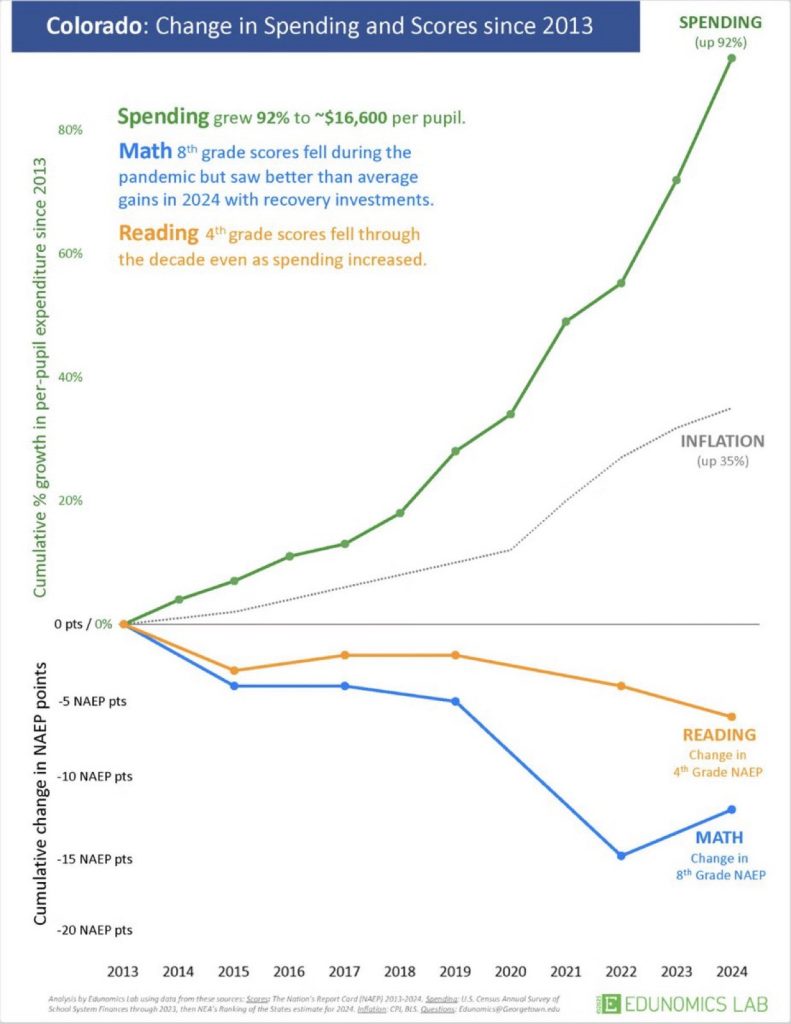
Colorado: Change in Spending Alongside Reading & Math Outcomes

Edunomics:

Edunomics Lab analyzed ROI data from 2013-2024 (NAEP 4th grade reading and 8th grade math scores alongside per-pupil spending) to see which states have been more (or less) successful at leveraging dollars to deliver academic improvement.

Share

kaizen: “continuous improvement”

Leo Lewis:

The more unsettling phrase of the moment, though, should be kaizen — the Japanese concept of “continuous improvement” which once struck nervous awe into US corporate hearts and which China, one way or another, now looks to have quietly mastered. Partly by hiring Japanese kaizen masters undervalued in their own economy.

Kaizen first properly entered the international business lexicon in the 1980s, when American and European companies needed to understand why Japanese companies were beating them — in terms of both price and quality — on cars, consumer electronics and semiconductors. It suited both sides to identify the differentiator as a patient, distinctly Japanese, betterment of product and process. 

The practical effects of kaizen were remarkable: they were among the prime reasons that Japan’s economy became huge in the 1970s and 80s, and why so many of its companies retain global competitiveness in a formidable range of manufacturing fields.

Share

Three Dynamics of AI Development

Dario Amodei

Before I make my policy argument, I’m going to describe three basic dynamics of AI systems that it’s crucial to understand:

  1. Scaling laws. A property of AI — which I and my co-founders were among the first to document back when we worked at OpenAI — is that all else equalscaling up the training of AI systems leads to smoothly better results on a range of cognitive tasks, across the board. So, for example, a $1M model might solve 20% of important coding tasks, a $10M might solve 40%, $100M might solve 60%, and so on. These differences tend to have huge implications in practice — another factor of 10 may correspond to the difference between an undergraduate and PhD skill level — and thus companies are investing heavily in training these models.
  2. Shifting the curve. The field is constantly coming up with ideas, large and small, that make things more effective or efficient: it could be an improvement to the architectureof the model (a tweak to the basic Transformer architecture that all of today’s models use) or simply a way of running the model more efficiently on the underlying hardware. New generations of hardware also have the same effect. What this typically does is shift the curve: if the innovation is a 2x “compute multiplier” (CM), then it allows you to get 40% on a coding task for $5M instead of $10M; or 60% for $50M instead of $100M, etc. Every frontier AI company regularly discovers many of these CM’s: frequently small ones (~1.2x), sometimes medium-sized ones (~2x), and every once in a while very large ones (~10x). Because the value of having a more intelligent system is so high, this shifting of the curve typically causes companies to spend more, not less, on training models: the gains in cost efficiency end up entirely devoted to training smarter models, limited only by the company’s financial resources. People are naturally attracted to the idea that “first something is expensive, then it gets cheaper” — as if AI is a single thing of constant quality, and when it gets cheaper, we’ll use fewer chips to train it. But what’s important is the scaling curve: when it shifts, we simply traverse it faster, because the value of what’s at the end of the curve is so high. In 2020, my team publisheda paper suggesting that the shift in the curve due to algorithmic progress is ~1.68x/year. That has probably sped up significantly since; it also doesn’t take efficiency and hardware into account. I’d guess the number today is maybe ~4x/year. Another estimate is here. Shifts in the training curve also shift the inference curve, and as a result large decreases in price holding constant the quality of model have been occurring for years. For instance, Claude 3.5 Sonnet which was released 15 months later than the original GPT-4 outscores GPT-4 on almost all benchmarks, while having a ~10x lower API price.
Share

notes on School Rigor

JD Busch:

First up, and arguably the most critical, are the reading wars. This topic shouldn’t be political, but welcome to 2025.

Expecting your child to learn to read in school shouldn’t be revolutionary, but don’t take it for granted in K-6.

I’ve watched two of my kids struggle through this nightmare at a fancy North Side Chicago private school. And just this weekend, I caught up with another family (an old friend from childhood) dealing with the same circus at a different North Side institution.

It’s a problem. And no number of Instagram-worthy reading nooks will fix it. Nobody cares about cute pillows if your kid can’t read the books on them.

If the school says phonics is “too rigid” or claims it’s outdated, they’re either uninformed or choosing ideology over proven science. Phonics isn’t rigid— it’s effective.

Here’s what to ask when touring schools:

Ask: “What’s your reading program?”

Good answer: Wilson or Orton-Gillingham (or something similar that is battle-proven).

Red flag: “Balanced literacy,” “whole Language”, “site reading,” or anything other than phonics (translation: your kid may need expensive tutoring).

Ask: “How do you track reading progress?”

Share

NAEP results commentary, demographic adjustments

Jill Barshay

More than 450,000 fourth and eighth graders, selected to be representative of the U.S. population, took the biennial reading and math tests between January and March of 2024. 

Depressed student achievement was pervasive across the country, regardless of state policies or instructional mandates. Student performance in every state remained below what it was in 2019 on at least one of the four reading or math tests. In addition to state and national results, the NAEP report also lists the academic performance for 26 large cities that volunteer for extra testing.

An ever-widening gap

The results also highlighted the sharp divergence between higher- and lower- achieving students. The modest progress in fourth grade math was entirely driven by high-achieving students. And the deterioration in both fourth and eighth grade reading was driven by declines among low-achieving students. 

“Certainly the most striking thing in the results is the increase in inequality,” said Martin West, a professor of education at Harvard University and vice chair of the National Assessment Governing Board, which oversees the NAEP test. “That’s a big deal. It’s something that we hadn’t paid a lot of attention to traditionally.”

——

2024 Demographically Adjusted NAEP Scores:

Wisconsin: 31st in reading, 17th in mathematics (averaging ranks, 🙃)

top R: LA, MS, MA, IN, GA, KY, CO, TX, SC, CT
top M: MS, LA, MS, TX, IN, GA, NC, FA, SC, IL

——

Want a different NAEP story? Mississippi is #1 in the country in 4th grade math and reading, #1 in the nation in 8th grade math, and #4 in the nation in 8th grade reading when NAEP scores adjusted for student demographics.

“Wisconsin’s performance in fourth grade reading was the lowest since at least 1992”

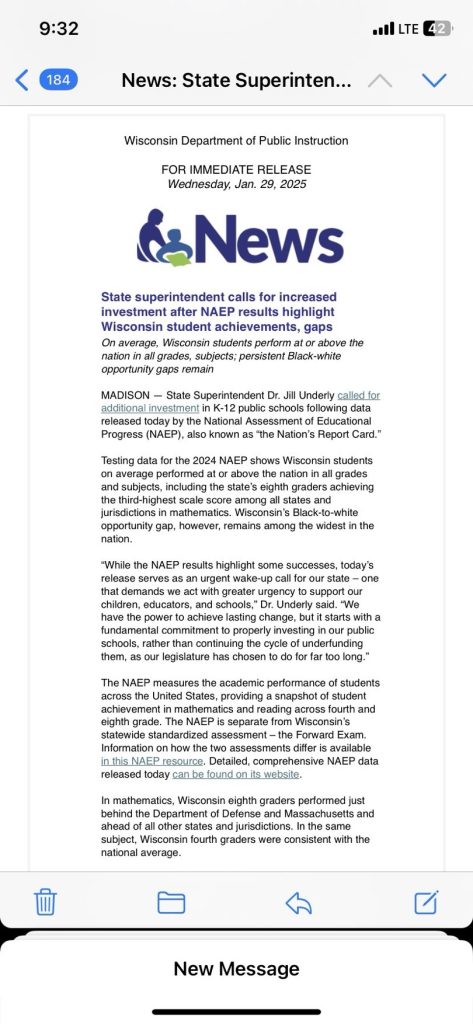
So @DrJillUnderly changed the state report cards because the NAEP tests are too rigorous and not a good indicator of success. But now she is citing the NAEP results (which highlight DPI’s failures!) to ask for more money for DPI. These people are truly shameless.

more.

Share

Lying to Parents, Teachers & taxpayers – Wisconsin DPI

WILL:

The National Assessment of Educational Progress (NAEP) is a nationally representative sample of schools throughout the country that allows for an apples-to-apples comparison of students in each state, and some cities. Early this morning, the 2024 NAEP results were released. Not surprisingly, they paint a dim picture of student performance since the pandemic, both in Wisconsin and across the nation. Here are four main takeaways.  

Dramatic Drops in Student Performance 

Student performance in 4th grade reading in Wisconsin was the lowest that had been recorded since at least 1992.  4th grade math was at it’s lowest level since 2003.  Despite spending more than $18,000 per student, not to mention huge amounts of federal funding entering the system during the COVID-19 pandemic, student outcomes have only gotten worse. This should be a five-alarm fire for the education establishment.  

NAEP Results Clearly Show how DPI has ‘Cooked the Books’ with academic outcomes.  

As we have discussed on several occasions, in 2024 DPI lowered the standards and cut scores for proficiency on the state’s Forward Exam for the most recent academic year.  Proficiency was previously tied to the NAEP in reading and math—meaning that proficiency on the Forward Exam was comparable to NAEP proficiency.  But now, that tie is broken, and Forward Exam proficiency has been dramatically inflated.  The figure below shows the gap when it comes to 4th grade reading.  

——-

Notes and links on the Wisconsin DPI and its Superintendent, Jill Underly.

Legislation and Reading: The Wisconsin Experience 2004

——

Parents overestimate student achievement, underestimate spending

Related: Act 10

Did taxpayer funded Wisconsin DPI Superintendent Underly Juice Test Scores for Reelection?

 taxpayer funded Madison School District long used Reading Recovery…

The data clearly indicate that being able to read is not a requirement for graduation at (Madison) East, especially if you are black or Hispanic”

My Question to Wisconsin Governor Tony Evers on Teacher Mulligans and our Disastrous Reading Results

2017: West High Reading Interventionist Teacher’s Remarks to the School Board on Madison’s Disastrous Reading Results 

Madison’s taxpayer supported K-12 school district, despite spending far more than most, has long tolerated disastrous reading results.

“An emphasis on adult employment”

Wisconsin Public Policy Forum Madison School District Report[PDF]

WEAC: $1.57 million for Four Wisconsin Senators

Friday Afternoon Veto: Governor Evers Rejects AB446/SB454; an effort to address our long term, disastrous reading results

Booked, but can’t read (Madison): functional literacy, National citizenship and the new face of Dred Scott in the age of mass incarceration.

When A Stands for Average: Students at the UW-Madison School of Education Receive Sky-High Grades. How Smart is That?

Share

Wisconsin DPI, for example, received nearly $2.2 billion in federal (taxpayer) grants in fiscal 2024”

wisconsin state journal summary

That includes money provided directly to the DPI itself as well as dollars that are passed along to school districts or other agencies.

Among other things, the money has gone toward bolstering the state teacher workforce, expanding access to mental health services and providing free meals to students. Schools with large populations of low-income students also qualify for federal funds under Title I of the Every Student Succeeds Act.

——-

Federal dollars accounted for about a third of the $7.5 billion Universities of Wisconsin budget in the 2023-24 school year. Federal contracts and grants were the largest piece of that, contributing $1.6 billion for research and operations, while federal aid for 74,166 students tallied $736 million.

The UW system didn’t have figures available for how much student aid has been paid out this semester or what remained outstanding, spokesperson Mark Pitsch said. Federal grants are managed by each university and often come in the form of reimbursements, Pitsch added.

At UW-Madison, federal grants and contracts made up $776.7 million of the university’s nearly $5 billion budget in 2023-24. Half of the university’s $1.7 billion research enterprise comes from federal research dollars

——

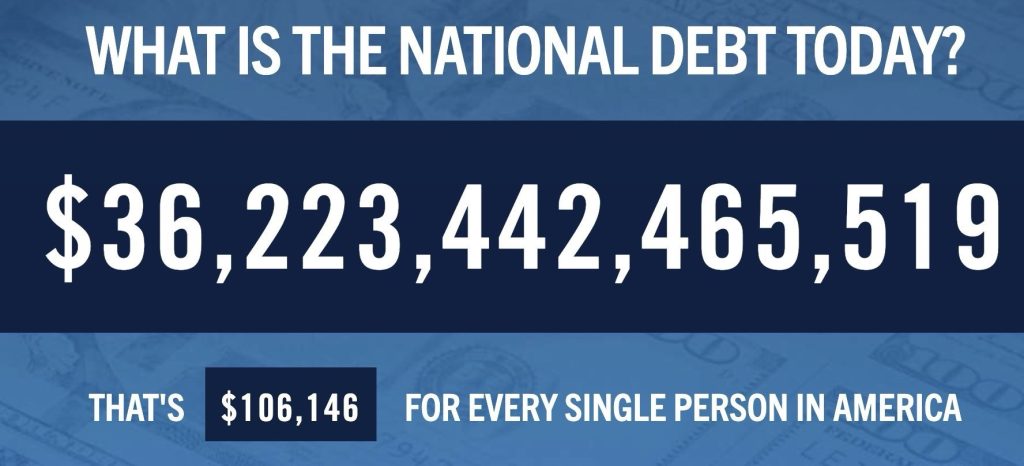
US Debt Clock

The nationals debt and how much each person in America would have to contribute to pay it off

Share

“Wisconsin’s performance in fourth grade reading was the lowest since at least 1992”

Will Flanders summary:

Last night, the 2024 NAEP was released for Wisconsin and nationwide. The picture it pains of the state of education in America is bleak, and Wisconsin was no exception. Here is a 🧵of some key results.

——

Parents overestimate student achievement, underestimate spending

Related: Act 10

Did taxpayer funded Wisconsin DPI Superintendent Underly Juice Test Scores for Reelection?

 taxpayer funded Madison School District long used Reading Recovery…

The data clearly indicate that being able to read is not a requirement for graduation at (Madison) East, especially if you are black or Hispanic”

My Question to Wisconsin Governor Tony Evers on Teacher Mulligans and our Disastrous Reading Results

2017: West High Reading Interventionist Teacher’s Remarks to the School Board on Madison’s Disastrous Reading Results 

Madison’s taxpayer supported K-12 school district, despite spending far more than most, has long tolerated disastrous reading results.

“An emphasis on adult employment”

Wisconsin Public Policy Forum Madison School District Report[PDF]

WEAC: $1.57 million for Four Wisconsin Senators

Friday Afternoon Veto: Governor Evers Rejects AB446/SB454; an effort to address our long term, disastrous reading results

Booked, but can’t read (Madison): functional literacy, National citizenship and the new face of Dred Scott in the age of mass incarceration.

When A Stands for Average: Students at the UW-Madison School of Education Receive Sky-High Grades. How Smart is That?

Share

Response to Mills College at Northeastern Undermining Students’ Civil Right to Read

Kareem J. Weaver

Here in Oakland, we know what’s at stake when it comes to education—our children’s futures depend upon it. Too often, however, powerful institutions insert themselves where they aren’t needed, driven by misguided theories and oblivious to their disconnect from the very communities they claim to serve. This time, it’s Northeastern University using the legacy of Mills College to drive debunked methods that undermine students’ civil right to read. 

Our country is in crisis: two-thirds of U.S. students aren’t reading at grade level, and illiteracy is as high as 95% in districts where parents lack the resources for private tutoring. We’re fighting a systemic, uphill battle, and there’s no end in sight so long as teacher preparation programs persist in arming new educators with literacy instruction methods that simply don’t work for most children. Northeastern’s 2022 merger with Mills College turned a legacy institution into a vehicle for ongoing community trauma and disenfranchisement, setting generations of children up for failure for years to come. Once a trusted ally in the fight for social justice, Mills is being used to advance practices that go against science. Adding salt to the wound, Northeastern recently unveiled plans to provide scholarships for Oakland students to attend college for free, a move that feels as much like a pacifier as it does a gift.

Share

The “grant industrial complex” and education

Kimberly Wethal:

UW-Madison ranks sixth in the country for research spending, with $1.7 billion in funding for fiscal 2023. Nearly half of that funding came from the federal government, largely from the NIH, National Science Foundation and the Department of Defense.

Share

civics: notes on “content moderation” or censorship

Bluesky

To meet the demands caused by user growth, we’ve increased our moderation team to roughly 100 moderators and continue to hire more staff. Some moderators specialize in particular policy areas, such as dedicated agents for child safety. Our moderation team is staffed 24/7 and reviews user reports around the clock. This is a tough job, as moderators are consistently exposed to graphic content. At the start of September 2024, we began providing psychological counselling to alleviate the burden of viewing this content.

Share

notes on using “ai” systems

Ian Leslie

I haven’t always written the actual prompt, but instead have given you a précis of what I asked. I’ve put explanatory glosses/notes in parentheses and italics. Bear in mind (and this is really important, as per my general remarks below) that most of these prompts were just the start of a dialogue. If we had infinite time I’d include the AI’s responses but suffice to say that for the majority of the prompts listed below the answers or subsequent ‘discussions’ were helpful or illuminating.

OK strap in, this is going to be a really dull ride. Although I hope a weirdly interesting one. Maybe I’ll start a trend – I’d like to see more people doing this.

Share

Civics: potus tracker

Luke:

I launched POTUS Tracker during the Biden administration. Following President Biden’s June 2024 debate performance, which raised concerns about his ability to govern, I recognized the need to provide the public with a clear and reliable tool to monitor presidential actions and travels in real time.

A key goal of POTUS Tracker is to combat misinformation. Delays in reporting and a lack of accessible information leave room for speculation and disinformation to spread. By delivering fast, accurate updates directly tied to official sources, the platform helps ensure people have the facts they need to stay informed and confirm what they see on social media.

Share

Literacy: We “believe” it works

via Quinton Klabon:

The reasons why @GeorgiaStateU under @CMcMunnDooley guidance is choosing to stick with @rrcna_org:

🚩It’s been around for a long time
🚩Districts are still requesting it
🚩We “believe” it works

Current, peer reviewed research shows RR is harmful as it teaches kids to do what poor readers do!

Watch more: investigatetv.com/2025/01/27/it-…

‘It Hurts Kids’: Many schools continue to teach controversial reading remediation program”

——-

Legislation and Reading: The Wisconsin Experience 2004-

Share

“then by the same metric the influence of bureaucracies or universities is a behemoth tidal wave”

Bismarck Analysis

If billionaires are unduly influential by virtue of spending lots of money, then by the same metric the influence of bureaucracies or universities is a behemoth tidal wave.

The Pentagon alone spends 4 Elon Musks each year. Billionaire spending is a few drops in the bucket: 🧵

Share

Nearly $4 Trillion spent on “Literacy” grants and >65% of students in government-run schools can’t read at the minimum grade level proficiency standards.

Joe is done:

Below is a keyword search over a selection of active federal government grants. Each typed word is treated as an AND condition (i.e., all must match). This search runs in two passes per keyword: (1) exact keyword match, (2) prefix matches (i.e., other keywords that start with that string). For performance reasons, only the first 100 matching rows are displayed. 

Share

Taxpayer Funded Wisconsin “DPI has not fulfilled a public records surrounding the fiscal mismanagement of MPS for 7 months”

Institute for Reforming Government

DPI has yet to fulfill a June 17, 2024, records request from IRG concerning their role in MPS’ late financial reports. Seven months later, it raises the question, what are they hiding?

THE QUOTE: 

“The Institute for Reforming Government is calling on the Department of Public Instruction to immediately release IRG’s requested records,” said Jake Curtis, General Counsel and the Director of IRG’s Center of Investigative Oversight.“Continuing to keep the public in the dark surrounding MPS’s financial mismanagement is unacceptable.”

WHY IT MATTERS:

DPI’s correction-plan deadlines are apparently meaningless: MPS recently revealed that it had blown by finance deadlines DPI had reset for them after they failed to meet previous deadlines throughout 2023 and 2024. It is now 2025, and DPI still does not have MPS’ final paperwork. MPS is now scheduled to miss federal 2024 audit deadlines, and this backlog has put 2025 compliance at risk. What has DPI done to hold MPS accountable?

——-

More.

DPI’s ongoing rigor reduction campaign.

Share

Act 10: politics, elections, and the Wisconsin Supreme Court

Scott Bauer:

The Republican-controlled Wisconsin Legislature on Tuesday asked that a liberal state Supreme Court justice step aside in a pending case that seeks to overturn a 2011 law that effectively ended collective bargaining for most state workers.

If Justice Janet Protasiewicz agrees not to hear the case, the court would be deadlocked 3-3 between liberals and conservatives. The lawsuit has massive implications for union rights in the battleground state, the court would be deadlocked 3-3 between liberals and conservatives. 

A Dane County Circuit judge last month overturned the bulk of the law, saying it violates equal protection guarantees in the Wisconsin Constitution by dividing public employees into “general” and “public safety” employees. Under the ruling, all public sector workers who lost their collective bargaining power would have it restored to what was in place before 2011.

——

Act 10 notes and links

WEAC: $1.57 million for Four Wisconsin Senators

Share

censorship and “ai” systems

Scaevola:

DeepSeek is censored, just differently than OpenAI. When I last used it, OpenAI still had woke, inclusive garbage that laced many responses. From my experience thus far, DeepSeek isn’t as blatant, but it blocks anything potentially negative to China and won’t answer a number of the questions I’ve asked it. Therefore, it only operates at China’s will, and it cannot be trusted. Neither can OpenAI, but still…

Share

Notes on redistributed federal taxpayer funds

Molly Beck and Lawrence Andrea:

Wisconsin Gov. Tony Evers is asking President Donald Trump to delay the implementation of a freeze on federal assistance, arguing Wisconsinites “are rightfully alarmed and concerned by this unprecedented decision” and are left scrambling.

Trump’s order freezing federal grants sent shockwaves through Wisconsin government on Tuesday as officials sought to understand how the move could impact agencies and infrastructure projects across the state.

Evers in a letter sent to Trump on Tuesday seeking more guidance about which programs in the state would be affected and pleaded for a delay.

“According to the memo, beginning at 5 p.m. ET on Tuesday, January 28, the Trump Administration will begin indefinitely withholding federal tax dollars from Wisconsin that were already approved bythe U.S. Congress, leaving billions sitting in Washington, D.C. that help kids, families, and businesses in Wisconsin and across America every day,” Evers wrote. “With very few details and specifics available, virtually no time for ample review and consideration, and no direct communication to date, states are left to plan for the worst, and Wisconsinites and millions of Americans who are rightfully alarmed and concerned by this unprecedented decision are left scrambling.”

——

Madison’s k-12 budget

Share

civics: the tiktok ban

Ankush Khadori:

For over a week now, Donald Trump and the Justice Department have been flouting the law meant to shut down TikTok. The legislation was unambiguous and was passed by large, bipartisan majorities in both houses of Congress; it was affirmed by a unanimous Supreme Court less than two weeks ago. And for the most part, both Republicans and Democrats have sat quietly by as Trump has waved away their previously stated concerns, as well as the constitutional powers and institutional prerogatives of Capitol Hill.

The TikTok ban was supposed to be a critical national security response to the threat posed by the Chinese government and its control over an app with 170 million users in our country. Shortly before the law went into effect, Sen. Tom Cotton (R-Ark.) said in a speech on the Senate floor that “without question, TikTok’s lethal algorithm has cost the lives of many American kids.” He announced that there would “be no extensions, no concessions and no compromises for TikTok.”

Share

civics: governance comments

Cynical Publius:

To fully understand just how remarkable today’s exchange with Colombia was, you need to understand how Washington DC has traditionally worked through these sorts of issues, and the different way it works now under Trump

Share

In a chilling warning for the future of local governments, one playground shuts down while another is sealed off from the public before it even opens.

“value of nothing”

This is a tale of two playgrounds. One is closing soon while the other – brand new – has stood empty for nearly a year, ringed with steel fencing to stop people from using it. Their stories aren’t the most important thing you’ll read today, but they illustrate something much bigger – the collapse and retreat of local government, and the profound effect it will have on our public spaces. 

Share

k-12 Governance: Legislation and tech use

Kayla Huynh:

Under the measure, school boards in Wisconsin would be required by next year to adopt policies prohibiting the use of phones, tablets, laptops and gaming devices during instructional time. Districts would determine how schools would store the devices and enforce the rules, Kitchens said. 

Students with disabilities would be allowed exemptions. Students would also be able to use phones during emergencies, to manage their health care or for educational purposes with a teacher’s permission. 

Share

“Think Tank” Funding Sources

Quincy institute:

Browse our publicly available repository of foreign government, U.S. government, and Pentagon contractor funding of the U.S.’s top 50 foreign policy think tanks going back to 2019.

Over a third of the top foreign policy think tanks in the U.S. publicly disclose little or no information about their funders. Yet, most think tanks provide at least some information about how they are funded. The Think Tank Funding Tracker allows users to explore these funding relationships for themselves. Start by searching for a donor or think tank below or use the browse function in the top right corner.

More.

Share

civics and the utility of constraints

cremieux

This might be true, and predictable.

The CIA recorded that the Soviet Union was

“essentially forced into the position of having to rely on clever theoretical approaches to computer calculations because of their lack of the most advanced computer systems.”

Share

A history of Wisconsin School Choice

Dairyland Sentinel:

In conjunction with School Choice Week, Dairyland Sentinel provides this chronicle of this history of School Choice in Wisconsin

1990s: 

An Idea Becomes Reality

The Milwaukee Parental Choice Program (MPCP) emerged in 1989 as a response to the dissatisfaction of Milwaukee families with traditional public education. Despite facing significant opposition, key figures like Governor Tommy Thompson, State Representative Polly Williams, State Senator Gary George, Susan Mitchell, and Howard Fuller fought for its establishment, leading to the creation of the country’s first voucher program in 1990.

Expanding Choices to Include Religious Schools

The ethos of educational choice is about trusting and empowering parents to select the best educational environment for their children. Initially limited to non-religious private schools, the 1995 amendment to include religious schools sparked debate. However, this expansion was upheld by the Wisconsin Supreme Court in 1998, broadening parental options.

Statewide Public School Choice

Open enrollment in Wisconsin public schools began in 1998 as a bipartisan initiative, offering parents the opportunity to send their children to schools outside their residential district. Since its inception, the program has required each district to publicize the number of available seats for open enrollment students, based on factors like student-teacher ratios and building capacities. Students could apply to up to three different districts, with districts having the discretion to evaluate applicants based on discipline history and truancy. If demand outstripped availability, a random lottery was conducted. The primary application window was established from February to April, with an additional late summer window for students affected by specific circumstances like violence or moving into the state.

Share

civics: “Will he cite President Obama’s refusal to provide notice of the Bowe Bergdahl transfers”

Josh Blackman:

Trump’s refusal to provide notification brings to mind the Bowe Bergdahl situation. The National Defense Authorization Act required the executive branch to provide Congress with thirty-days advance notice before transferring certain detainees from Guantanamo Bay. But in 2014, President Obama did not provide advance notice before he transferred detainees in exchange for Bowe Bergdhal, an American POW. At the time, these released detainees were part of a trade to bring back Bowe Bergdahl. The Government Accountability Officeconcluded that the transfer violated “clear and unambiguous Law” and violated the “Antideficiency Act.” How did Obama get around this statute?

The Obama Administration offered several defenses for the decision. Initially, at least, the Executive Branch said that the thirty-day restriction infringed on the President’s Article II powers. I wrote about the constitutional issues with the release in an unpublished article:

Share

Civics: Will tariffs help rebalance the global economy (and the Chinese economy)?

Noah Smith:

China has a huge and growing trade surplus, as you can see in the chart above. That chart is via Brad Setser, who is really a one-man army in terms of tracking global trade and financial flows. Here’s a thread from Setser with a lot more detail on China’s surplus. Interestingly, China’s exports to the developing world are a lot bigger of a factor herethan its exports to the U.S. and the EU, though the latter are up by a little bit. 

This is the Second China Shock. Trade surpluses like this can’t be explained by the good old theory of comparative advantage — a Chinese trade surplus is just countries writing China IOUs in exchange for physical goods. Countries don’t really have a comparative advantage in writing IOUs.1

Why trade surpluses and deficits do happen is an important and interesting and complex question, and my general impression from reading a bunch of economics papers on the topic is “No one really knows”. It probably has something to do with the fact that China’s government is directing its banks to loan vast amounts of money to manufacturers, and paying manufacturers tons of subsidies on top of that. But there also has to be some sort of financialfactor involved that prevents China’s currency from appreciating and allowing Chinese people to buy more imports. This could be something the Chinese government is doing intentionally, or it could be a natural outgrowth of China’s economic difficulties. More on this later.

Share

Spring 2025 Wisconsin DPI Superintendent Election & Reduced Rigor Notes

Abbey Machtig:

In 2022, about 33% of Wisconsin fourth-grade students were considered proficient in reading, according to data from the National Center for Education Statistics. About 43% of fourth-graders were proficient in math.

Underly has faced sharp criticism for revising language arts and math standards in a way that critics say lowers the bar for student performance because students now can score lower on the Forward Exam, administered in grades 3-8 every spring, and still be considered proficient or advanced.

Democratic Gov. Tony Evers, who previously served as state superintendent, told reporters this month the changes “could have been handled better.” State Sen. John Jagler, R-Watertown, and Rep. Bob Wittke, R-Caledonia, have introduced legislation that would effectively eliminate Underly’s changes.

Under the bill, DPI would have to align scoring methods for the language arts and math sections of the Forward Exam to the systems used by the National Assessment of Educational Progress. The bill also would require scoring sections of the ACT and PreACT using the scoring ranges from the 2021-22 school year.

Share

How DEI Conquered the University of Colorado

John Sailer and Louis Galarowicz

Both of these scholars, and many more, were hired through the university’s Faculty Diversity Action Plan, a special funding program for diversity-focused faculty hiring, which ran until 2023, when it was restructured and renamed. Created in 2020, the program played a significant role in dictating whom the university hired. In a 2022 faculty meeting, the dean of the College of Arts and Sciences was asked how many professors were hired through the program since it began. He estimated that around 90% were either hired through the program or were spousal hires.

Share

Civics: Immigration, Politics and The Law

Chris Arnade:

One of US’s greatest strengths is that it isn’t racist, and is open minded and empathetic — compared to the rest of the world* — and we give the benefit of the doubt when someone says, “I’m coming here because I am seeking asylum fleeing X because of Y abuse.”

That benefit of the doubt ended up being taken advantage of when, not surprisingly, a lot of people around the world started to expand the definition of abuse, with the support and help of a highly profitable non-profit industry.

The result is Americans are now feeling hoodwinked, and there is a blow-back happening.

  • You have no idea how racist a lot of the world is. Try going to Uganda and sorting through all the tribal issues.
Share

Civics: Freedom of Speech & Hong Kong

Wall Street Journal:

Now the Hong Kong government has fired back. The China Daily—a Chinese government-owned English-language newspaper—quotes Hong Kong Secretary for Security Chris Tang accusing Mr. Pence of a “malicious intention” to interfere in Hong Kong justice. Translation: The former Vice President scored a direct hit.

Mr. Pence was speaking the obvious. But instead of recognizing his remarks as a way to start unfreezing Hong Kong’s increasingly icy relations with Uncle Sam, the Hong Kong government attacked the messenger. With Donald Trump now President, you would think Hong Kong officials would be looking for a way to get out from under the U.S. sanctions directed at Hong Kong officials—including its chief executive, John Lee.

Mr. Lee answered a press question about Trump sanctions by saying, “I hope that there will be a good starting point for good relations between Hong Kong and the U.S. to progress.” One possibility is a deal that would free Mr. Lai in exchange for Washington’s lifting sanctions on Hong Kong officials such as Mr. Lee.

Share

Pricetag of “equity” in Fairfax County Schools: $6.4 million

By Asra Q. Nomani

While the salaries in one document total $6.4 million for the 52 employees in the Chief Equity Office, another document details that the total budget for the Chief Equity Office is $5.76 million, with $5.25 million going to salaries and compensation.

Whatever the discrepancies, the scope of the Chief Equity Office floors area residents. The size of the office ballooned after racial politics in 2020 elevated the concept of “equity” in school systems.

In mid-December, Spooner submitted a simple request under the Freedom of Information Act, asking for the most recent organization chart for the FCPS “Chief Equity Office,” a list of employees with their current salaries, and the office’s budget for the current fiscal year. 

After paying $140 for four hours of research time by FCPS staffers, Spooner discovered the immense scope and budget of the school district’s Chief Equity Office – a revelation that raises essential questions about the bureaucracy in one of the nation’s largest school systems. He published his analysis on Saturday on his website, Fairfax Schools Monitor

At the center of controversies

Share

Oxford & Cambridge to move away from ‘traditional’ exams to boost results of minorities

reddit discussion

Katharine Birbalsingh:

‘Black and brown ppl cannot achieve unless we make exams easier.’

Because we are all stupid?

Is that why?

Can we not see how racist these policies and assumptions are?

Utterly revolting racism. 🤮

Share

Eithan Haim, a Texas surgeon, faced prison for exposing gender surgery for minors. Trump dismissed the case, recognizing Haim’s whistleblowing.

Emily Yoffe:

Until Friday afternoon, Dr. Eithan Haim, 34, was facing a potential decade in federal prison for revealing publicly that Texas Children’s Hospital was continuing to perform gender transitions on children even after declaring a moratorium on the controversial practice. For this, Haim, a Texas surgeon, became the target of the Biden Department of Justice, which indicted him for allegedly violating patient privacy laws.

There was no violation of patient privacy. What Haim blew the whistle on were mostly surgeries to insert hormonal devices that prevent children from going through puberty. The records he revealed about these interventions carefully redacted identifying information about the patients. What’s more: He had caught the hospital in a bald-faced lie about the very existence of the program. Most dangerous for Haim was that he had run afoul of the Biden administration’s unquestioning support of medical transition of young people distressed about their gender.

“Eithan Haim was the only person with the courage to stand up for what was right,” Haim’s wife, Andrea, wrote on X about her husband taking on the powerful children’s hospital, the country’s largest. “For him, it wasn’t even a decision. Kids were being harmed, and he had to stop it.”

It came with a high price. The couple lost close friendships, all their savings, and their peace of mind. But they never budged.

Share

Screens dominate classrooms, raising questions about technology’s impact on learning.

Sara Randazzo, Matt Barnum and Julie Jargon:

Class time has become screen time in American schools.

Kindergartners now watch math lessons on YouTube, counting aloud with the videos. Middle-schoolers complete writing drills on Chromebooks while sneaking in play of an online game. High-schoolers mark up Google Docs to finish group projects. 

The rapid tech transformation amounts to a grand experiment playing out in American schools. Accelerated by pandemic-era online learning, the move has happened with little debate, conflicting research and high stakes for the nation’s children. 

Educators wonder whether the digitization of the classroom has really benefited learning—or if it’s done kids a disservice. Some teachers say online tools help create more engaging lessons and provide personalized instruction. Others say the screen-heavy approach has distracted students and burned out teachers

“Covid really shifted things toward, ‘Oh, we can do this,’” said Stephanie Galvani, a middle-school English teacher in suburban Boston. “But we didn’t ask: ‘Should we do this?’”

Share

Civics: “I’ve never in my life remembered a time when the Democratic Party supported ambitious people”

Mana Afsari;

 “I think their whole ideology is based off of oppressing those with ambition, who actually have the gumption to go out and do something and build something on their own. … The people who make humanity great, the innovators, the builders, the winners in society, they look at the winners and tell them, ‘You’re evil, and the only reason you’re at the position that you’re at is because you exploited other people.’ It’s antithetical to the way that a lot of young men work.”

But, I ask him, what do young men who aren’t aspiring to be “innovators, builders and winners” think of Trump?

“I went to public high school in a middle-class area,” he says. “A lot of the guys who I went to high school with weren’t particularly ambitious career-wise, but they do admire people who are. They all admire Trump for what he’s done.” He pauses. “Going to the gym, for example: it’s a way to improve yourself.” I immediately think of all the right-wing intellectual influencers on Twitter that post bodybuilding photos alongside their recommended reading lists. “All young men, even if they’re not actively trying to be great, still admire greatness,” he continues. “It’s really rare that you meet one that doesn’t have some respect for somebody who’s gone out and done something great.”

Trump, he explains, is a role model: “He wins against all odds. He gets impeached, he gets criminal trials thrown at him, shakes all that off. He gets shot. The fact alone that he got up and pumped his fist—that takes a lot of physical courage in itself. … He understands deep down that the U.S. has been rudderless since the Cold War. We haven’t had the best people.”

Share

civics: Politics and the Academy

Michelle Goldberg:

“ai” summary:

While many Americans welcome the end of unpopular left-wing policies, the Trump administration is using this opportunity to assert political control over higher education. This crackdown, disguised as a response to campus antisemitism, could lead to investigations, terminations, and punishments for professors and students. Harvard’s recent actions, including adopting a restrictive definition of antisemitism and canceling a Gaza-focused event, exemplify this trend of capitulation.

Share

Congratulations to Christopher Rufo and Richard Hanania

Tyler Cowen

As most of you already know, the Trump administration through Executive Orders has taken major steps against affirmative action and also DEI.  We will see how the details play out, but each of these developments seems highly significant and not just “expressive.”

Those two individuals played a decisive role in what happened, in both cases taking considerable flak along the way.  And so they deserve this hat tip.  Here Richard and Bryan Caplan discuss what happened.  Coleman Hughes too.

Share

Campus Politics

Douglas Belkin:

When Donald Trump was first elected president, universities set out milk and cookies for rattled undergraduates. College students who wore MAGA hats were berated by classmates.

This time around those same hats are eliciting fist bumps and nods.

College conservatism hasn’t gone mainstream on left-leaning campuses. But the stigma against Republicans is lifting.

Supporters of the new president on campus say they now feel more comfortable acknowledging one another in public. And membership at long-moribund college Republican clubs around the country is up, according to interviews with students at a dozen schools.

Driving the momentum is a cohort of outspoken conservative men. Some trade crypto and are members of fraternities. But many are more in line with traditional conservatives; they are religious and eschew college sweats for ties and blazers. A disproportionate number are focused on business, computer science and public policy. Some aspire to work in Washington, D.C.

Share

Solar-charging backpacks are helping children to read after dark

Joshua Korber Hoffman, CNN

When Innocent James completed his chores after school, he would light a kerosene lamp and lay down to read his books. There was no electricity in James’ part of Arusha, a region in northern Tanzania, and so his family was forced to burn expensive oil for him to learn after dark.

Today, James is 33, and many parents in rural Tanzania – where all year round the sun sets at around 7pm – must still choose between saving money and allowing their children to read at night. But now, James’ company, Soma Bags, is providing a solution: backpacks equipped with solar panels that charge a reading light.

What started as a small-scale project with some discarded cement bags, a sewing machine, and a solar panel, has become a business attracting charities and fashion brands from around the world. Last year, Soma Bags (“Reading Bags” in Swahili) sold 36,000 solar backpacks to people across Africa, providing an invaluable energy source for when the sun goes down.

Share

People often believe that all capital letters are inherently harder to read, but this is a myth.

Susan Weinschenk

WHAT YOU ARE ABOUT TO READ IN THE NEXT PARAGRAPH IS COMMONLY BELIEVED, BUT NOT TRUE — You read by recognizing the shapes of words and groups of words. Words that are in all capital letters all have the same shape: a rectangle of a certain size. This makes words displayed in all uppercase harder to read than upper and lower case (known as “mixed case”).  Mixed case words are easier to read because they make unique shapes, as demonstrated by the picture below.

The shapes of words

OK, NOW THE TRUE STUFF STARTS — When I started this article the topic was supposed to be why all capital letters are harder to read. Like most people with a usability background or a cognitive psychology background, I can describe the research — just what I wrote in the first paragraph above. I decided to look up and cite the actual research rather than just passing on the general knowledge and belief.

The research doesn’t exist, or “It’s complicated” — Something happened when I went to find the research on the shape of words and how that is related to all capital letters being harder to read. There isn’t research showing that exactly. It’s more complicated, and ultimately, more controversial. In July of 2004 Kevin Larson wrote an article that is posted at the Microsoft website that explains in depth all the research on this topic. I’ve picked out several ideas from that article and am presenting them here. A link to Kevin’s article, plus some of his research citations are at the end of this blog for those of you who want more detail.

Share

K-12 Tax & $pending climate: Healthcare cost explosion

WMC:

Wisconsin’s health care costs remain the fifth highest in the country, and 88% of survey respondents predict their costs will increase even more this year. Of these, the majority say these increases will necessitate increasing employee contributions.

“Wisconsin’s business community has serious concerns about extreme health care costs,” stated WMC’s Executive Vice President of Government Relations Scott Manley. “These costs are not only a competitive disadvantage, as they dip into employee compensation, investment opportunities, and more, but they also hurt Wisconsin families.”

According to the survey, the cost of health care is tied with the labor shortage/lack of qualified applicants as the top issue facing Wisconsin employers in 2025. When asked what the one thing state government could do to help businesses, 41% of respondents answered, “make health care more affordable.” 

As noted in An Arm & A Leg, WMC Foundation’s latest research report, Wisconsin also has the second highest medical payments for workers compensation.

“There are simple policy solutions to help make health care more affordable,” Manley continued. “The majority of the business leaders we surveyed expressed that they would like to see fee schedules for the Workers Compensation program and legislation to require health care costs and quality to be transparent and accessible.”

Share

Harvard Medical School Cancels Class Session With Gazan Patients, Calling It One-Sided

Elyse C. Goncalves and Akshaya Ravi:

Harvard Medical School canceled a planned Jan. 21 lecture on wartime healthcare and a subsequent panel with patients from Gaza receiving care in Boston in response to objections that students would hear from Gazans impacted by the war and not also Israelis.

Course instructors and students were notified Tuesday morning that the events — scheduled for that evening — would not be held.

Medical School Dean George Q. Daley ’82 wrote in a Wednesday email sent to first-year students and obtained by The Crimson that his office began receiving complaints from students and faculty within days after the session was first publicized last week.

The guest lecture — by Tufts professor Barry S. Levy, who studies the public health effects of war — was an optional evening session of the Pathways 120: “Essentials of the Profession” course, a requirement for all first-year students at the Medical School and the Harvard School of Dental Medicine.

Students had organized the moderated discussion with patients and their families as a follow-up to Levy’s lecture, which was not focused specifically on Gaza.

more.

Share

“ai” mistakes

Bruce Schneier:

“ai summary”: AI systems, particularly LLMs, make mistakes differently than humans, posing unique challenges. While human mistakes are often predictable and clustered, AI errors occur randomly and evenly across various topics, requiring new security systems to prevent harm.

Share

Yale and Free Speech

Samantha Swenson

Freshmen at Yale University voiced strong support for free speech compared to their older peers in a new poll, giving rise to hopes for the future of the Ivy League campus.

The Yale Undergraduate Student Survey by the Buckley Institute found a “significant turn in favor of free speech, driven largely” by freshmen.

“It is very encouraging that the newest class at Yale is dramatically more supportive of free speech and open discussion than its predecessors,” Lauren Noble, founder and executive director of the Buckley Institute, said in an email to The College Fix.

“The freshman class came to campus in the middle of serious debate, on campus and nationally, about free speech and resoundingly decided that free speech was the right way forward.”

Share

notes on Wisconsin DPI’s rigor reduction campaign

Dan O’Donell:

Wisconsin Governor Tony Evers has never been the most unpredictable man in the world—in each speech one can expect a few “by gollys” and references to pickleball—but on the first day of this year’s legislative session, he delivered a shocker when asked about State Superintendent Jilly Underly’s decision to change K-12 testing standards.

“I hate to even talk about things that aren’t my purview anymore in the Department of Public Instruction, but I just think there should have been some information and dialogue happening with all sorts of people before that decision,” he said in a news conference earlier this month. “It’s hard to compare year to year if one year you’re doing something completely different.”

In August, Underly’s Department of Public Instruction (DPI) announced changes to Wisconsin’s Forward Exam that renamed each level of achievement and made it much easier to attain each level. The standards, which appear on DPI’s school and district annual report cards, were for decades labeled as “advanced,” “proficient,” “basic,” and “below basic.”

Those were changed to “advanced,” “meeting,” “approaching,” and “developing,” which appear designed to sound better to parents and legislators concerned about student performance. They would naturally react more strongly to a student who is “below basic” than to one who is “developing.”

This change alone would have relatively innocuous, but it was paired with a complete overhaul of the benchmark scores needed to reach each level. For instance, previous scores ranged from 517 to 611 in third grade math. The new standards have a range of 1,370 and 1,740, making comparisons to prior years impossible.

more on Jill Underly, here.

Legislation and Reading: The Wisconsin Experience 2004-

Share

For those who don’t think unions have too much power, here is an active union contract in Michigan.

Mackinac Center

Teachers can be drunk at school five times before they are fired. They can be high three times before losing their job. And they can MAKE AND SELL DRUGS and keep their job.

James Hope:

Another unique bargaining tactic played out in a school about 100 miles north of Ann Arbor.

Bay City Public Schools currently allows a teacher who sells drugs the opportunity to keep his or her job thanks to a union provision in the district’s collective bargaining agreement.

The contract calls for disciplinary actions for people who are “involved in the unlawful sale, manufacture, or distribution or dispensation of tobacco, alcohol, or illegal drugs.”

The first offense is referred to as “activity.” If a union employee engages in an activity that state law classifies as a misdemeanor, the first offense will result in a three-day suspension and mandatory counseling. The Bay City contract expires in 2025. Michigan Capitol Confidential reported on the issue April 2024.

Share

Literacy, politics, taxpayer funds and adult employment

Quinton Klabon

It is a bit more complicated than that (dispute over when and what to fund after seeming agree), but I am excited at the prospect of moving past the partial veto and get curriculum funding to schools!

——-

Legislation and Reading: The Wisconsin Experience 2004-

Share

State of Education Freedom 2025

Andrew Handel:

We are in the midst of an educational renaissance in America. At the time of writing, a record 12 states are empowering (or will soon be empowering) every family and every student with education freedom. These states recognize the unique needs of each student and that parents, not government bureaucrats, are best positioned to determine those needs and choose a school that best fits their student.

The ALEC Index of State Education Freedom was created to provide a detailed and comprehensive 50-state analysis of what learning options are available and accessible to families. This publication conducts a deep-dive analysis of each state’s charter school, home school, virtual school, and open enrollment laws to determine how accessible these learning environments are to families. We also analyze the various programs each state has in place that help offset the cost of alternative learning environments, like education scholarship accounts (ESAs), tax-credit scholarships, voucher programs, and more.

With this being the second edition of the publication, we have made several improvements and refinements to the scoring and ranking methodology that better reflect the education freedom environment in each state. You will also notice that the category for education freedom programs has been weighted more heavily in this version, reflecting the critical importance of these programs for families seeking alternate learning environments better suited to their students.

We hope that this publication will serve as a resource for constituents looking to learn more about the programs available in their state to policymakers during the 2025 legislative sessions, who are looking to expand the educational options available to families. If you have any feedback or suggestions, please do not hesitate to reach out to me at ahandel@alec.org.

——-

More.

Share

State examiner intervenes in a dispute between Southside Madison Elementary teachers and their former principal.

Abbey Machtig:

In April 2024, staff members filed a complaint with the district about working conditions at the school. The complaint named Principal Candace Terrell and Assistant Principal Annabel Torres, saying regular bullying and poor safety practices led to an exodus of teachers from Southside that has negatively affected students.

Parents overestimate student achievement, underestimate spending

Related: Act 10

Did taxpayer funded Wisconsin DPI Superintendent Underly Juice Test Scores for Reelection?

 taxpayer funded Madison School District long used Reading Recovery…

The data clearly indicate that being able to read is not a requirement for graduation at (Madison) East, especially if you are black or Hispanic”

My Question to Wisconsin Governor Tony Evers on Teacher Mulligans and our Disastrous Reading Results

2017: West High Reading Interventionist Teacher’s Remarks to the School Board on Madison’s Disastrous Reading Results 

Madison’s taxpayer supported K-12 school district, despite spending far more than most, has long tolerated disastrous reading results.

“An emphasis on adult employment”

Wisconsin Public Policy Forum Madison School District Report[PDF]

WEAC: $1.57 million for Four Wisconsin Senators

Friday Afternoon Veto: Governor Evers Rejects AB446/SB454; an effort to address our long term, disastrous reading results

Booked, but can’t read (Madison): functional literacy, National citizenship and the new face of Dred Scott in the age of mass incarceration.

When A Stands for Average: Students at the UW-Madison School of Education Receive Sky-High Grades. How Smart is That?

Share

The company built a cheaper, competitive chatbot with fewer high-end computer chips than U.S. behemoths like Google and OpenAI, showing the limits of chip export control.

Cade Metz and Meaghan Tobin

But the performance of the DeepSeek model raises questions about the unintended consequences of the American government’s trade restrictions. The controls have forced researchers in China to get creative with a wide range of tools that are freely available on the internet.

The DeepSeek chatbot answered questions, solved logic problems and wrote its own computer programs as capably as anything already on the market, according to the benchmark tests that American A.I. companies have been using.

And it was created on the cheap, challenging the prevailing idea that only the tech industry’s biggest companies — all of them based in the United States — could afford to make the most advanced A.I. systems. The Chinese engineers said they needed only about $6 million in raw computing power to build their new system. That is about 10 times less than the tech giant Meta spent building its latest A.I. technology.

Share

Measuring Political Preferences in Artificial Intelligence Systems: An Integrative Approach

David Rozado:

This report employs four complementary methodologies to assess political bias in prominent AI systems developed by various organizations. These four approaches are then synthesized into a unified ranking of AIs’ political bias. The four methods used to measure political bias in AIs are: comparing AI-generated text with the language used by Republican and Democratic members of the U.S. Congress; examining the dominant political viewpoints embedded in AI-generated policy recommendations for the U.S.; assessing sentiment in AI-generated text toward politically aligned public figures; and administering political-orientation tests to AIs.

The findings from all the methods outlined above point in a consistent direction. Most user-facing conversational AI systems today display left-leaning political preferences in the textual content that they generate, though the degree of this bias varies across different systems.

The left-leaning bias of AI systems is not inevitable. Studies have shown that relatively low-cost fine-tuning with politically skewed data can ideologically align an LLM toward left-leaning, moderate, or right-leaning political preferences.

Share

Educators question whether the rapid shift toward more technology has benefited learning

Sara Randazzo, Matt Barnum and Julie Jargon:

Class time has become screen time in American schools.

Kindergartners now watch math lessons on YouTube, counting aloud with the videos. Middle-schoolers complete writing drills on Chromebooks while sneaking in play of an online game. High-schoolers mark up Google Docs to finish group projects.

The rapid tech transformation amounts to a grand experiment playing out in American schools. Accelerated by pandemic-era online learning, the move has happened with little debate, conflicting research and high stakes for the nation’s children.

Educators wonder whether the digitization of the classroom has really benefited learning—or if it’s done kids a disservice. Some teachers say online tools help create more engaging lessons and provide personalized instruction. Others say the screen-heavy approach has distracted students and burned out teachers.

“Covid really shifted things toward, ‘Oh, we can do this,’” said Stephanie Galvani, a middle-school English teacher in suburban Boston. “But we didn’t ask: ‘Should we do this?’”

Share

civics: The decline of journalism may have hit rock bottom with the end of Meta’s censorship regime

James Taranto:

The deceptive labeling—often self-deceptive, as Mr. Cillizza evidences—is what makes political fact-checking corrupt. Opinion journalism is a respectable craft, provided it is honestly presented as such, as this article is at the top of the page. Political fact-checkers could satisfy this objection by simply marking their work as “opinion.” But that would shatter the pretense of authoritativeness.

It would also invite readers to judge the work by the standards of opinion journalism, by which it is uniformly inferior. I’ve spent my career as a writer and editor of opinion, and I’ve cast a critical eye on political fact-checking since 2008. I have never read a fact-check article that impressed me with its enterprise, originality, passion, boldness, depth, flair or wit—the qualities that make for good opinion writing. “Pinocchios” and “pants on fire” were amusing at first, but the joke wore thin within a few years.

Share

Harvard Outsources Program to Identify Descendants of Those Enslaved by University Affiliates, Lays Off Internal Staff

Neil Shah:

Harvard University has laid off its staff in the Harvard Slavery Remembrance Program, the unit of its $100 million Harvard & the Legacy of Slavery initiative tasked with identifying the direct descendants of those enslaved by Harvard affiliates.

The work will be continued by American Ancestors, which is currently one of HSRP’s external research partners in the work, according to HSRP Director Richard J. Cellini and research fellow Wayne W. Tucker.

Employees were notified Thursday that they had been laid off, effective the same day, per Cellini and Tucker. They were not given any advance notice of the decision and, according to Tucker, rumors of the program’s impending closure only began to circulate Thursday morning.

No additional reasons were given for HSRP’s disbanding, according to Tucker. Since September, HSRP has been a focus of public attention after a Crimson investigation reported that Cellini, the director, had accused Vice Provost for Special Projects Sara N. Bleich, who leads the Legacy of Slavery initiative, of instructing HSRP “not to find too many descendants.”

Share

Campus “Institutional Review Boards” are ineffective and unconstitutional.

Russell Warne:

The newly inaugurated second Trump administration has arrived, and among the changes that the president and his allies have proposed is large-scale simplification and elimination of government regulations. President Trump stated in a press conference in December that he wants 10 old regulations eliminated for every new regulation added.

The arguments for deregulation are not new. Regulations function as an indirect tax that slows economic growth: Compliance costs money, and the expense is often passed on to the consumer. Regulations also cost the government (and, therefore, the taxpayer) money to promulgate, revise, and enforce. Deregulation, thus, is a win for everyone because it frees money for economic growth—which increases tax revenue while reducing government spending.

Share

Lower Artificial Intelligence Literacy Predicts Greater AI Receptivity

Tyler Cowen Link:

As artificial intelligence (AI) transforms society, understanding factors that influence AI receptivity is increasingly important. The current research investigates which types of consumers have greater AI receptivity. Contrary to expectations revealed in four surveys, cross country data and six additional studies find that people with lower AI literacy are typically more receptive to AI. This lower literacy-greater receptivity link is not explained by differences in perceptions of AI’s capability, ethicality, or feared impact on humanity. Instead, this link occurs because people with lower AI literacy are more likely to perceive AI as magical and experience feelings of awe in the face of AI’s execution of tasks that seem to require uniquely human attributes. In line with this theorizing, the lower literacy-higher receptivity link is mediated by perceptions of AI as magical and is moderated among tasks not assumed to require distinctly human attributes. These findings suggest that companies may benefit from shifting their marketing efforts and product development towards consumers with lower AI literacy. Additionally, efforts to demystify AI may inadvertently reduce its appeal, indicating that maintaining an aura of magic around AI could be beneficial for adoption.

Share

Cameras in Florida County are now fining drivers who illegally pass school buses.

Lewin Day:

Down in Florida, Miami-Dade County is famous for three things—sun, sand, and school bus traffic cameras. The city has implemented an automatic camera system on its school bus fleet known as BusPatrol. The cameras film cars that blow past school buses when they’re loading and unloading passengers—and automatically issue fines to offending drivers.

This might sound like a high-tech solution to a nothing problem, but that’s sadly not the case. As covered by NBC Miami, over 11,500 violations were recorded in the first few weeks of the 2024/2025 school year—or roughly 1,600 violations per school day. The sheer volume of incidents prompted Miami-Dade Sheriff’s Office to release a video of some of the worst offenders blowing past school buses with lights flashing and stop signs out.

Share

Civics & Censorship: Ace Reporters Claim Politico Killed Negative Biden Stories

Isaac Shorr:

“That story was killed by the editors, and they gave no explanation for that either,” he said. “So that general experience, you know, obviously the public doesn’t know about those things, but as a reporter having witnessed the way in which the two candidates-”

“We just get called, like, ‘the terrible mainstream media.’ It’s like you don’t understand the process there,” interjected Palmeri.

“Well, you also don’t understand the dumb decisions of cowardly editors that are made above us,” agreed Caputo.

Share

college sports and money

Todd Milewski

McIntosh said in an interview last year that the distribution likely will mirror how back damages are allocated in the settlement. Football players were expected to get around 75% of damages, with men’s and women’s basketball players getting 20% and other athletes getting 5%.

Share

The Miseducation Of America’s Elites

David Lat:

According to Shapiro, these events reflected the “illiberal takeover of legal education”—the subject of his new book, Lawless: The Miseducation of America’s Elites. I interviewed Shapiro—about Lawless, whether the intellectual climates at law schools have improved since his near-cancellation at Georgetown, and what can be done to protect and promote free speech and intellectual diversity in higher education—in the latest episode of the Original Jurisdiction podcast.

Share

Civics: Lawfare

Fabius Maximus:

Essential reading about an inflection point in US history (2016 – 2024), showing the weaponization of DoJ and the security services (no longer law enforcement agencies).

Share

The Loneliness Epidemic

Alvin Chang:

6:00 am

In this story, we’ll go through 24 hours of a typical weekend day in 2021. We know what people did – and who they did it with – because, since 2003, the American Time Use Survey has asked people to track how they use their time.

By the end of the day, we’ll learn that Martin’s isolation isn’t unique. In fact, loneliness has become a far more common experience in the last few decades – and it was supercharged by the pandemic.

We’ll follow a handful of people, including Martin. Let’s meet everyone else!

Share

Classroom Screen Time

Sara Randazzo, Matt Barnum & Julie Jargon:

Students in grades one through 12 now spend an average of 98 minutes on school-issued devices during the school day—more than 20% of the average instructional time—according to data that educational software company Lightspeed Systems analyzed at the request of The Wall Street Journal. 

Share

Federal Court (Finally) Rules Backdoor Searches of 702 Data Unconstitutional

Andrew Crocker & Matthew Guariglia:

Better late than never: last night a federal district court held that backdoor searches of databases full of Americans’ private communications collected under Section 702 ordinarily require a warrant. The landmark ruling comes in a criminal case, United States v. Hasbajrami, after more than a decade of litigation, and over four years since the Second Circuit Court of Appeals found that backdoor searches constitute “separate Fourth Amendment events” and directed the district court to determine a warrant was required. Now, that has been officially decreed.

In the intervening years, Congress has reauthorized Section 702 multiple times, each time ignoring overwhelming evidence that the FBI and the intelligence community abuse their access to databases of warrantlessly collected messages and other data. The Foreign Intelligence Surveillance Court (FISC), which Congress assigned with the primary role of judicial oversight of Section 702, has also repeatedly dismissed arguments that the backdoor searches violate the Fourth Amendment, giving the intelligence community endless do-overs despite its repeated transgressions of even lax safeguards on these searches.

This decision sheds light on the government’s liberal use of what is essential a “finders keepers” rule regarding your communication data. As a legal authority, FISA Section 702 allows the intelligence community to collect a massive amount of communications data from overseas in the name of “national security.” But, in cases where one side of that conversation is a person on US soil, that data is still collected and retained in large databases searchable by federal law enforcement. Because the US-side of these communications is already collected and just sitting there, the government has claimed that law enforcement agencies do not need a warrant to sift through them. EFF argued for over a decade that this is unconstitutional, and now a federal court agrees with us.

Share

Censorship at Harvard

Glenn Greenwald

Criticizing Israeli government policy can now get you punished at Harvard. Today, Harvard adopted an expansive version of the viewpoint-discriminatory IHRA definition of anti-Semitism — one that appears to make belief in Zionism a protected status.

Taleb:

A first general rule: whenever we hear of a constraint on free speech, it is to protect Israel.

The second general rule: whenever we hear of a site or organization officially devoted to free-speech, its true mission is to stifle free speech when it comes to Israel.

Share

The Making of Community Notes

Jay Baxter Keith Coleman Lucas Neumann Emily Thai

The team that built X’s Community Notes talks about their design process and the philosophy behind their approach to combatting false information on the platform

Share

civics: Russiagate hoax aftermath

Glenn Greenwald:

Despite what a flagrantly deranged conspiracy theory it was (and was exposed as being), it wasn’t harmless. As I always said, its greatest sin wasn’t that it was a journalistic fraud, but a US Security State ploy.

This is what it did — and still does:

Share

The highly advanced AI tool that law enforcement agencies (or potentially malicious individuals) can utilize to swiftly geolocate photographs in a matter of seconds.

Joseph Cox:

A powerful AI tool can predict with high accuracy the location of photos based on features inside the image itself—such as vegetation, architecture, and the distance between buildings—in seconds, with the company now marketing the tool to law enforcement officers and government agencies.

Called GeoSpy, made by a firm called Graylark Technologies out of Boston, the tool has also been used for months by members of the public, with many making videos marveling at the technology, and some asking for help with stalking specific women. The company’s founder has aggressively pushed back against such requests, and GeoSpy closed off public access to the tool after 404 Media contacted him for comment.  

Share

The University of Wisconsin-Madison’s chancellor removed LaVar Charleston from the Division of Diversity, Equity, and Educational Achievement

Corrinne Hess:

The University of Wisconsin-Madison’s vice chancellor for diversity, equity and inclusion has been removed from his position after an internal review found “concerns about financial operations and fiscal judgements,” according to the school. 

LaVar Charleston has led the Division of Diversity, Equity and Educational Achievement for three years. 

He will leave his role as vice chancellor and return to his backup appointment as clinical professor in the Department of Educational Leadership and Policy Analysis in the School of Education. 

Jeff Wagner:

Per public records, the guy who was just bounced as UW-Madison Chief Diversity Officer made over $308,000 a year! That’s not a typo! $308,000! Tony Evers makes $165,000. A Wisconsin Supreme Court Justice makes $185,000. Something is way out of whack. govsalaries.com/charleston-lav…

Share

Students with disabilities and school choice

WILL

An estimated 14% of students in Wisconsin school choice programs have a special needs disability, according to a new analysis conducted by the Wisconsin Institute for Law & Liberty (WILL) and School Choice Wisconsin (SCW).

The Quotes: Will Flanders, Research Director at WILL, stated: “The data is clear. Wisconsin’s school choice programs serve thousands of students with disabilities—far more than choice opponents acknowledge. The Department of Public Instruction’s method of counting grossly undercounts these students. This fuels a false narrative about private schools’ commitment to serving children with disabilities.”

Mike Metoff, Director of Research at SCW, added, “This research shows why official state estimates greatly understate the actual number of choice students with disabilities. Our data is consistent with prior scholarly work and dispel misinformation circulated in some media outlets and by opponents of school choice programs.”

Share

Awareness at the taxpayer funded Wisconsin DPI?

Will Flanders:

Given that Superintendent Underly appears to not even understand what DPI’s actions regarding the Forward Exam have resulted in, the results of this records request are vital. If Underly is checked out, who are the “experts” actually setting academic standards?

—Much more on reduced rigor and Jill Underly.

Dairyland Sentinel Files Open Records Request with DPI Over Forward Exam Benchmark Changes

Share

Madison: “Now kids teach themselves, and then I teach them after they’ve learned,” 

Kayla Huynh:

“There’s not a whole lot of research on it. But when I taught traditionally, it just wasn’t working.  The kids were zoning out during the lesson part, and then I’d have to keep explaining it all over.”

—-

2007 math forum audio video 

Connected Math

Discovery Math

Singapore Math

Remedial math

Madison’s most recent Math Task Force

When A Stands for Average: Students at the UW-Madison School of Education Receive Sky-High Grades. How Smart is That?

Share

k-12 Tax & $pending climate: Massachusetts Unemployment Fund

John Chesto:

Jones said the UI fund currently has slightly more than $2 billion, and is projected to run out of money by the end of 2027, even with the rate increases.

In a prepared statement on Monday, Healey expressed both frustration and optimism about the situation.

“We were dismayed to uncover early on in our term that the previous administration misspent billions of dollars in federal relief funds and that our state was facing what could have been a more than $3 billion tab to pay it back,” Healey said. “For the past year and a half, we have engaged in extensive negotiations with the U.S. Department of Labor to minimize the impact on Massachusetts residents, businesses and our economy. . . . It is incredibly frustrating that the prior administration allowed this to happen, but we are going to use this as a moment to come together with the business and labor community to make meaningful reforms to the Unemployment Insurance system.”

Share

Zuckerberg appeared to be aware that Meta trained its AI on a pirated library

Miles Klee

Now, under a court order from Judge Vince Chhabria of the U.S. District Court for the Northern District of California, the records of those previously confidential internal dialogues have been unsealed, and appear to confirm Zuckerberg’s decision to greenlight the transfer of pirated, copyrighted LibGen data to improve Llama — despite concerns about a backlash. In an email to Joelle Pineau, vice president of AI research at Meta, Sony Theakanath, director of product management, wrote, “After a prior escalation to MZ [Mark Zuckerberg], GenAI has been approved to use LibGen for Llama 3 […] with a number of agreed upon mitigations.” The note observed that including the LibGen material would help them reach certain performance benchmarks, and alluded to industry rumors that other AI companies, including OpenAI and Mistral AI, are “using the library for their models.” In the same email, Theakanath wrote that under no circumstances would Meta publicly disclose its use of LibGen.

Share

Math classes cause “intellectual trauma” to minorities: STUDY

Toni Airaksinen:

A group of educators has published a guide on implementing “Black Feminist Mathematical Pedagogies” in classrooms, arguing that such an approach is necessary because minorities—especially Black girls—face “violence and trauma” in math education.

“When Black female students are repeatedly disciplined for being social, loud, or goofy in the mathematics classroom, they experience mathematical violence,” claim the authors of Designing Mathematics Curricula That Center Students’ Brilliance.

The research team—including Lara Jaisen, Michael Lolkus, doctoral student Marlena Eanes Snowden, and Dr. Leslie Dietiker of Wheelock College—contends that while many believe math is politically neutral, it is actually “steeped in whiteness and heteromasculinity.”

“Whiteness is a global phenomenon, impacting marginalized students and communities… and mathematics curricula are saturated in whiteness.”

The academics assert that “whiteness” is pervasive in math classes and curriculum structures, explicitly stating:

“As a culture, whiteness is toxic in society and in education. More specifically, in society, whiteness presents through norms including—but not limited to—perfectionism, a sense of urgency, individualism, and objectivity.”

Share

“obscuring performance data and hindering informed decision-making”

WILL:

Since at least 2020, the Wisconsin Department of Public Instruction has made changes that obscure the true performance of schools, making it harder for Wisconsin families to make informed decisions about their children’s education. Today, Senator John Jagler (R-Watertown) and Representative Bob Wittke (R-Caledonia) introduced new legislation (LRB-0976) aimed at restoring transparency and accountability to Wisconsin’s K-12 testing regime.

The bill represents an important step in restoring the ability of parents, policymakers, and taxpayers to assess how well Wisconsin’s schools are doing across the public, charter, and private voucher sectors. Here, we will explain what the bill does, but we first begin with a look at what a mess DPI has made of accountability over the past few years.

Beginning in the 2020-21 school year, DPI has made a number of changes to Wisconsin’s academic accountability standards that have made them far less rigorous.  These changes were all made unilaterally by the Department without any input from the legislature or Governor. The key changes were:

  • 2020-21 School Year: DPI lowered the cut points on the state’s report cards, allowing more schools and districts to be rated as three stars or higher (“Meets Expectations” or above) without any improvement in performance.

———

obscuring performance data and hindering informed decision-making

———

Kyle Koenen:

This is just wrong. The standards are no longer aligned with national standards (NAEP). Average school proficiency jumped by 14% in math and 13.2% in ELA, despite most evidence actually pointing to lower student achievement. This was mostly the result of lowered cut points.

Parents overestimate student achievement, underestimate spending

Related: Act 10

Did taxpayer funded Wisconsin DPI Superintendent Underly Juice Test Scores for Reelection?

 taxpayer funded Madison School District long used Reading Recovery…

The data clearly indicate that being able to read is not a requirement for graduation at (Madison) East, especially if you are black or Hispanic”

My Question to Wisconsin Governor Tony Evers on Teacher Mulligans and our Disastrous Reading Results

2017: West High Reading Interventionist Teacher’s Remarks to the School Board on Madison’s Disastrous Reading Results 

Madison’s taxpayer supported K-12 school district, despite spending far more than most, has long tolerated disastrous reading results.

“An emphasis on adult employment”

Wisconsin Public Policy Forum Madison School District Report[PDF]

WEAC: $1.57 million for Four Wisconsin Senators

Friday Afternoon Veto: Governor Evers Rejects AB446/SB454; an effort to address our long term, disastrous reading results

Booked, but can’t read (Madison): functional literacy, National citizenship and the new face of Dred Scott in the age of mass incarceration.

When A Stands for Average: Students at the UW-Madison School of Education Receive Sky-High Grades. How Smart is That?

Share

A student transformation from behind grade level to scholar-athlete

JD Busch:

A few years back, I did what any reasonable parent would do after their kids came home from Chicago schools quoting Che Guevara and rattling off gender theory jargon that would give Judith Butler a headache: I pulled the plug after realizing the K-12 curriculum was infected with a mind virus embedded in the very standards and teacher education.

If you’re a Chicago parent sick of the status quo, you can pull your kids out and give them a real education — one that’s about justice, not “social justice.” Heck, you can even make it work while staying in the city if you’re brave enough and willing to drive a few miles out of state.

The results? Let’s just say I’m no longer the dad defending his kids against charges of racism for questioning whether BLM was anti-Semitic from the start (yes, this happened at a Chicago private school and Lane Tech).

What I learned yanking my kids out is that the obsession with race, gender, and all manners of victimology and suicidal empathy at these schools has sucked away time for academic excellence and building children of sound moral character.

My now 8th grader, formerly a student at a Chicago private school that worked its way into the “wrong headlines” for going woke, has gone from academic roadkill (pushed along and told he was “doing fine”) to a full-blown scholar-athlete. This is the same kid who, upon leaving his so-called elite private school, tested behind grade level in math and reading and was admitted to his new school on academic probation.

Fast forward to today, and he’s not just catching up — he’s crushing it. Three years on, my son is safely in the top quartile in state assessments, playing high school sports this spring (despite being in middle school), and learning what real accountability looks like.

Share

Teacher/Student Ratio notes

Quinton Klabon:

Wisconsin students per teacher
2011: 15.1
2020: 14.3
2023: 13.7
2024: 13.7
Non-teaching staff follows that trend.

Pandemic funds supported more staff, so that is normal! 2025 numbers will show if ratios remain low due to more special-needs diagnoses and retaining pandemic staff.

——-

Parents overestimate student achievement, underestimate spending

Related: Act 10

Did taxpayer funded Wisconsin DPI Superintendent Underly Juice Test Scores for Reelection?

 taxpayer funded Madison School District long used Reading Recovery…

The data clearly indicate that being able to read is not a requirement for graduation at (Madison) East, especially if you are black or Hispanic”

My Question to Wisconsin Governor Tony Evers on Teacher Mulligans and our Disastrous Reading Results

2017: West High Reading Interventionist Teacher’s Remarks to the School Board on Madison’s Disastrous Reading Results 

Madison’s taxpayer supported K-12 school district, despite spending far more than most, has long tolerated disastrous reading results.

“An emphasis on adult employment”

Wisconsin Public Policy Forum Madison School District Report[PDF]

WEAC: $1.57 million for Four Wisconsin Senators

Friday Afternoon Veto: Governor Evers Rejects AB446/SB454; an effort to address our long term, disastrous reading results

Booked, but can’t read (Madison): functional literacy, National citizenship and the new face of Dred Scott in the age of mass incarceration.

When A Stands for Average: Students at the UW-Madison School of Education Receive Sky-High Grades. How Smart is That?

Share

civics: Why has Biden pardoned Anthony Fauci?

Matt Ridley:

The significance of 2014 is that this was when the Obama administration responded to anxiety among some scientists about a series of experiments that made influenza viruses potentially more dangerous to people – by banning federal funding for any such gain-of-function experiments.

Yet from June 2014 money flowed from Fauci’s National Institute for Allergy and Infectious Diseases to support experimentswhich led to gain-of-functionin Wuhan in China via an organisation called the EcoHealth Alliance. There, SARS-like viruses ‘gained’ the function in certain experiments of becoming 10,000 times more infectious in humanised mice. (Both the NIH and EcoHealth Alliance have denied any wrongdoing.

more.

Further, attorneys for the defendant argued that the majority of the jury in Washington DC is made of a federal employees. This video is meant to inflame a jury, it has no probative value, and therefore is a violation of federal rule of evidence 401 (which by the way they teach like on the first day of criminal procedure in law school).

District Court Judge Bates declined the motion and allowed the prosecutor to include the video montage.

Share

Civics: “We have been talking about taking on more commitments”

A Conversation With Stephen Kotkin

Earlier this year, in trying to sketch out a way forward for the United States, you wrote this in Foreign Affairs: “The government and philanthropists should redirect significant higher education funding to community colleges that meet or exceed performance metrics. States should launch an ambitious rollout of vocational schools and training, whether reintroducing them in existing high schools or opening new self-standing ones in partnership with employers at the ground level. Beyond human capital, the United States needs to spark a housing construction boom by drastically reducing environmental regulations and to eliminate subsidies for builders, letting the market work. The country also needs to institute national service for young people, perhaps with an intergenerational component, to rekindle broad civic consciousness and a sense of everyone being in this together.”

How would you rate the Trump administration’s chances of grasping this challenge and taking those kinds of steps?

When radio was introduced on a mass scale, many elites panicked: “This is the end of democracy, the end of civilization, what are we going to do? They can just broadcast anything and everything right into the living rooms of people, unfiltered, we cannot control what they say.” The establishment couldn’t censor it, and over the radio someone could just say anything and could just make stuff up. And Mussolini was great at radio, and Goebbels was amazing at radio. And lo and behold, we got Franklin Roosevelt, who mastered the medium and was a transformative president; whether one approves or disapproves of what he did, it was significant and enduring.

And so we’ve been through this before, with radio. It was very destabilizing, and yet we managed to assimilate it. And then we got the TV version of that story, which was even worse because it was images, not just audio. And again, they could just broadcast anything and everything right into people’s living rooms. They could just say anything they wanted to, and the establishment, the self-assigned filters, couldn’t censor it. And we got Kennedy, as opposed to his opponent, Richard Nixon, who sweated on TV and was mopping his brow while Kennedy shined and beamed.

And now we have social media, which is potentially even more destabilizing for an open society. Everyone’s their own National Enquirer, and everyone is connected. And everyone can broadcast these previously fringe conspiracy theories that are now mainstream. Not because everybody believes them. I don’t know whether more people believe them now than did before. But everybody can see them, hear them, propagate them, forward them.

We always disagree on what the truth is. But now we have a problem with the truth regime. The truth regime is how we determine the truth: evidence, argument, proof. But that truth regime has been destabilized. No one has the truth alone, and we should argue about the truth. But we used to have a consensus on how we got to the truth and how we recognized truth. Not anymore. So how are we going to manage this, to assimilate this new technology and media?

——

more.

The performance of power in the arena and in the Oval Office.
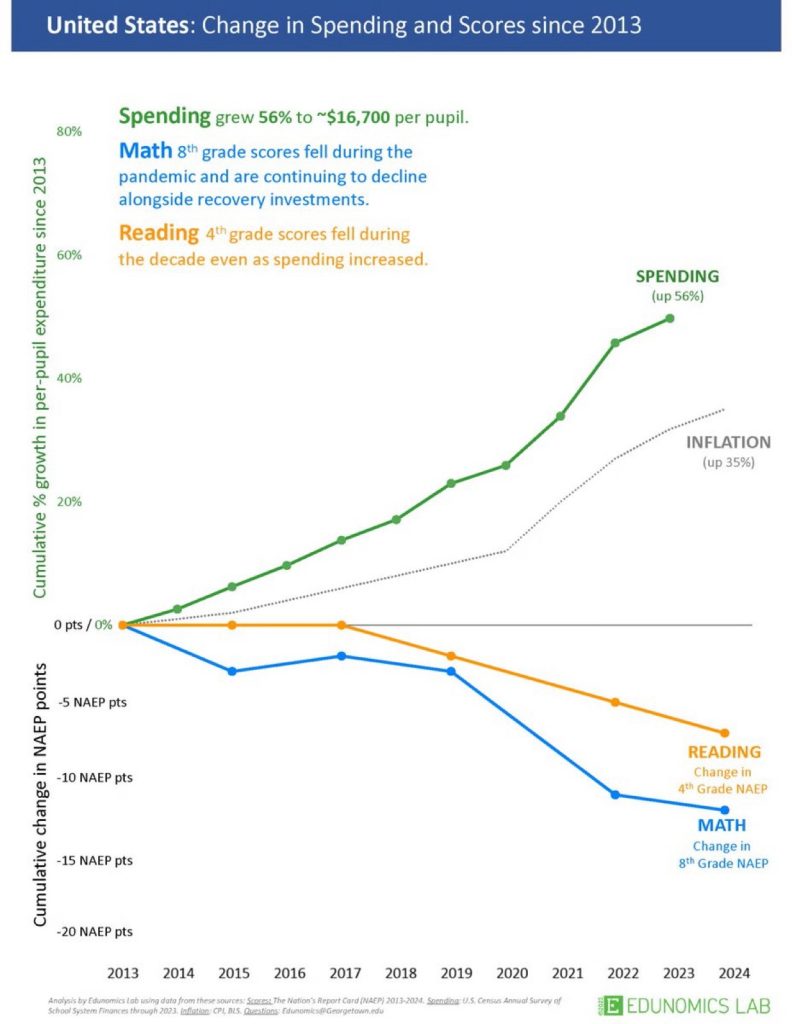
Share

From where do those undergraduate divisibility problems originate?

Chris Gtossack

Oftentimes in your “intro to proofs” class or your first “discrete math” class or something similar, you’ll be shown problems of the form “prove that for  is a multiple of  for every ”… But where do these problems come from? And have you ever stopped to think how magical this is? If I gave you some random polynomial in  and asked you if it always output multiples of , the answer would almost always be “no”! So if you really needed to come up with an example of this phenomenon, how would you do it? In this blog post, we give one approach!

I want to give some sort of attribution for this, since I remember reading about this exact topic… like a long time ago. Maybe 6 or 7 years ago? I’m sure that I saved the relevant article1 in my zotero, but I can’t find it for the life of me! Regardless, I want to emphasize that the whole idea for this topic (using Pólya-Redfield counting to build these divisibility problems) is not mine.

I’ve wanted to write a post on Pólya-Redfield counting for years now, since it was a pet topic of mine as an undergrad, but I think I was always planning too big a scope. This is a very bite-sized problem, and I won’t go into the theory very deeply, so I think it should make for a blog post I can finish in a day2.

Let’s get to it!

Share

civics: “Denver-area schools are training their staff on how to respond if ICE agents arrive at their premises”

Jessica Seaman

Superintendent Alex Marrero sent a memo to Denver Public Schools’ principals last week ahead of President Donald Trump’s return to office, offering training about what they and their front-office staff should do if federal immigration officers show up at their schools.

School leaders, he wrote, should deny U.S. Immigration and Customs Enforcement agents entry into their buildings. Next, staff shoul …

Share

Oh, the Places You’ll Go

With apologies to Dr. Suess.

Nearing 21 years of the school blog….. (!), events sometimes bring a loud chuckle to my presence.

And, so it was earlier today, when I saw the following:


and remembered Sarah Manski’s aborted 2013 Madison School Board Candidacy.

A few links:

Sarah Manski and the messed up Madison school board election

Commentary on Sarah Manski’s Sudden School Board Candidacy Withdrawal

How else does one explain Sarah Manski’s endorsement from the leader of the State Assembly Democrats, Peter Barca of Kenosha?

Share

Deepseek

Steve Hsu:

This is a must-read interview if you follow AI.

mp.weixin.qq.com/s/r9zZaEgqAa_l…

DeepSeek is one of the top LLMs in the world and its inference costs are a tiny fraction of competitors’ bc of architectural innovation, sparsity of weights, etc. DS v2 caused a huge price war in LLM inference in China.

——-

🎉 DeepSeek-R1 is now live and open source, rivaling OpenAI’s Model o1. Available on web, app, and API. Click for details.

DeepThink from DeepSeek

Share

civics: Notes on Presidential Pardons

Glenn Greenwald:

2020 fun with Sen. Chuck Schumer

and:

Everything Democrats and corporate media falsely claimed Trump would do with the pardon power to destroy democracy and the rule of law– pardon all his family members and all his political allies — were things Trump didn’t do.

They were, however, all things that Biden did:

more:

Is this still how Congressman @TedLieu feels?

We’re supposed to have civilian rule in the US, not military rule.

But these generals constantly subverted and sabotaged Trump’s foreign policy because they disagreed with it, while the media justified and cheered it, as here.

Nothing Trump did was more threatening than this:

Batya Ungar-Sargon:

Absolutely insane to hear Amy Klobuchar talk about the rule of law at the exact moment it’s announced that Joe Biden just pardoned the rest of his family.

John Cullen:

Obama launched a bio-war with China in 2014.

He approved Gain of Function after the pause, on a bird flu virus that was already spreading in China.

4 changes by Kawaoka, rendered H7N9 bird flu 200x more deadly.
Then, it was deployed.
Cost? $611,416.00

Hans Mahncke:

The fact that Fauci’s pardon specifically and explicitly addresses his Covid-related offenses, while being backdated to 2014—the year the gain-of-function ban took effect, which Fauci circumvented by outsourcing experiments to China—speaks volumes as to what this is really about.

Share

Mathematics of the NYT daily word game Waffle

S.P. Glasby

We investigate the combinatorics of permutations underlying the the daily word game Waffle, and learn why some games are easy to solve while extreme games are very hard. A perfect unscrambling must have precisely 11 orbits, with at least one of length 1, on the 21 squares.

Share

Civics: Taxpayer Funded Policies and Elections

Ross Douthat interviews Marc Andreessen:

“And then… Covid hits, which was a giant radicalizing moment. And at that point, we had lived through eight years of what was increasingly clearly a social revolution.”

“Very clearly, companies are basically being hijacked to engines of social change, social revolution. The employee base is going feral. There were cases in the Trump era where multiple companies I know felt like they were hours away from full-blown violent riots on their own campuses by their own employees. Things got really aggressive during that period. And so I go from watching Brian Williams every night and just being lied to 500 nights in a row to, basically, reading the Mueller report, reading the Horowitz I.G. report and being like, ‘Oh, my God, none of this is true.’ And then you try to explain to people, ‘This isn’t true.’ And then they get really mad at you because how can you possibly have any sympathy for a fascist?”

More.

Share