School Information System

This report-Make Our Children Healthy Again: Assessment— is a call to action

MAHA Commission

It presents the stark reality of American children’s declining health, backed by compelling data and long-term trends. More importantly, it seeks to unpack the potential dietary, behavioral, medical, and environmental drivers behind this crisis. By examining the root causes of deteriorating child health, this assessment establishes a clear, evidence- based foundation for the policy interventions, institutional reforms , and societal shifts needed to reverse course.

To turn the tide and better protect our children , the United States must act decisively. During this administration, we will begin reversing the childhood chronic disease crisis by confronting its root causes- not just its symptoms. This means pursuing truth, embracing science, and enacting pro-growth policies and innovations to restore children’s health. Today’s children are tomorrow’s workforce, caregivers, and leaders—we can no longer afford to ignore this crisis.

After a century of costly and ineffective approaches, the federal government will lead a coordinated transformation of our food, health, and scientific systems . This strategic realignment will ensure that all Americans—today and in the future-live longer, healthier lives, supported by systems that prioritize prevention, wellbeing, and resilience.

But real transformation requires more than vision—it requires clarity. Before we act, we must fully understand the scope of the crisis, the conditions that created it, and the mechanisms through which it continues to grow. Without this foundation , interventions risk being reactive, fragmented , or ineffective.

To Make America’s Children Healthy Again, we must begin with a shared understanding of the magnitude of crisis and subsequently what’s likely driving it. This assessment provides that foundation-grounding future efforts in a common scientific basis that identifies four potential drivers behind the rise in childhood chronic disease that present the clearest opportunities for progress:

Poor Diet: The American diet has shifted dramatically toward ultra-processed foods (UPFS), leading to nutrient depletion, increased caloric intake, and exposure to harmful additives. Nearly 70% of children’s calories now come from UPFs, contributing to obesity, diabetes, and other chronic conditions.

Aggregation of Environmental Chemicals: Children are exposed to an increasing number of synthetic chemicals, some of which have been linked to developmental issues and chronic disease. The current regulatory framework should be continually evaluated to ensure that chemicals and other exposures do not interact together to pose a threat to the health of our children.

Lack of Physical Activity and Chronic Stress: American children are experiencing unprecedented levels of inactivity, screen use, sleep deprivation, and chronic stress.

These factors significantly contribute to the rise in chronic diseases and mental health challenges

Overmedicalization: There is a concerning trend of overprescribing medications to children, often driven by conflicts of interest in medical research, regulation, and practice. This has led to unnecessary treatments and long-term health risks.

By examining each of these drivers, this assessment equips MAHA Commission stakeholders and partners with the facts needed to identify where and how policy interventions will likely have the most impact.

The sections that follow analyze the evidence, spotlight gaps, and map the terrain: laying the groundwork for coordinated, high-impact solutions.

——

Brenda Goodman:

Trump administration’s MAHA report on children’s health filled with flawed references, including some studies that don’t exist

Share

Belgian princess left in doubt about her Harvard future following Trump’s foreign student ban

Associated Press:

Belgium’s Royal Palace said Friday that Princess Elisabeth, who is first in line to the throne, is waiting to find out whether she can return to Harvard for her second year after U.S. President Donald Trump announced a ban on foreign students at the university.

The Trump administration on Thursday revoked Harvard University’s ability to enroll international students in its escalating battle with the Ivy League school, saying thousands of students must transfer to other schools or leave the country.

“We are looking into the situation, to see what kind of impact this decision might have on the princess, or not. It’s too early to say right now,” said the palace’s communications head, Xavier Baert.

Steve Sinofsky:

Harvard case is so fascinating. The filings and quotes keep talking about how crazy it is for the Govt to dictate how Harvard should operate or who it should serve/employ, yet this is exactly how EEOC has been implemented for decades in private sector and advocated by..Harvard.

Adrian Vermeule:

If the universities want to remain open to international students, they should first do a better job of being open to the Other America, which they have mocked and despised for decades.

Stephen Dinan:

The manager of Harvard Medical School’s morgue has pleaded guilty to selling human remains.

Cedric Lodge, 57, admitted he took parts of donated cadavers after they had been used for research and sold them rather than have them disposed of in accordance with the donors’ agreements, the Justice Department said Thursday.

That included organs, brains, skin, hands and faces, prosecutors said.

Stand Columbia Society:

Harvard now faces $1.2–$5.5B in total annual institutional risk exposure—up to 43% of its adjusted operating budget—across grants, medical revenues, student aid, and potential taxes.

Wall Street Journal:
The Trump team’s tactics against Harvard recall how the Obama Administration cut off student aid to for-profit Corinthian Colleges on the pretext of its alleged dilatory response to sweeping record demands. Thousands of students’ educations were disrupted so the Obama team could wave a political scalp.
Share

“Average homeowners would see a more than $833 increase in property taxes under the Madison school district’s proposed budget”

Kayla Huynh:

Last year, during the Madison Metropolitan School District’s campaign for two referendums, the district estimated property taxes would increase by about $1,000 for the average homeowner. Voters in November approved the combined $607 million in school referendums, hiking property taxes to fund school building upgrades and day-to-day operating costs. 

Approval of the $100 million operations referendum was “the only way we survive,” Bob Soldner, the district’s financial leader, told the School Board this month. “Without that, we would not be able to offer the programming nor the services that we provide today based under state law.” 

Next year, the Madison school district’s proposed budget would increase spending to nearly $661.7 million — about $42.9 million more than this school year, according to a draft of the plan released this month. 

The proposed budget is certain to change as federal funding levels remain in flux, Soldner said. State lawmakers this summer are also deciding how much money to provide schools over the next two years in the state budget.

——-

Madison taxpayers have long supported far above average k-12 tax & $pending, despite long term, disastrous reading results. November 7, 2024 latest budget including the (passed) fall referendums. Total spending: $608,824,795 for 26,310 students or $23,140 each

The taxpayer funded Madison School District long used Reading Recovery

The data clearly indicate that being able to read is not a requirement for graduation at (Madison) East, especially if you are black or Hispanic”

My Question to Wisconsin Governor Tony Evers on Teacher Mulligans and our Disastrous Reading Results

2017: West High Reading Interventionist Teacher’s Remarks to the School Board on Madison’s Disastrous Reading Results 

Madison’s taxpayer supported K-12 school district, despite spending far more than most, has long tolerated disastrous reading results.

“An emphasis on adult employment”

Wisconsin Public Policy Forum Madison School District Report[PDF]

WEAC: $1.57 million for Four Wisconsin Senators

Friday Afternoon Veto: Governor Evers Rejects AB446/SB454; an effort to address our long term, disastrous reading results

Booked, but can’t read (Madison): functional literacy, National citizenship and the new face of Dred Scott in the age of mass incarceration.

When A Stands for Average: Students at the UW-Madison School of Education Receive Sky-High Grades. How Smart is That?

Share

Great conversation with @wzihanw

Steve Hsu:

Robots, Small Models, and RL with DeepSeek Alumnus Zihan Wang — Manifold #86

Zihan Wang is an AI researcher at Northwestern University, where he works on vision-language models, robotics, and reinforcement learning. Previously, he interned at DeepSeek, contributing to projects like DeepSeek-V2.

Share

Poor Guidance From Influential Math Educators Is Impairing Students

David Margulies

Could it be that the nation’s large fraction of students lacking math proficiency is caused by significant numbers of students not having their multiplication tables memorized?

In a California K-12 district with 15% of students proficient in math, according to state testing, only about 25% of fourth graders were found to have their multiplication facts memorized at the grade’s end. This situation exists despite the California Math Content Standards, the math students are expected to learn, stating explicitly that students are to “by the end of grade three, know from memory all products of two one-digit numbers.”

Should multiplication fact memorization be viewed as a minor standard, only one of many, perhaps de-emphasized in a busy school year, or is it a major foundational skill, like phonics is to reading, the lack of which is causing students’ struggles in this district?

The correlation between student multiplication fact memorization and their CAASPP performance was analyzed for one elementary school in the district. The criteria for having multiplication facts memorized, or multiplication fact fluency, is established by research as meaning students can answer multiplication fact questions faster than three seconds per problem. On the CAASPP, students receive numerical scores, and achievement levels are defined using ranges of scores. These levels, from low to high, are: “Standard Not Met,” “Standard Nearly Met,” “Standard Met” and “Standard Exceeded.”  

Share

Ideological Capture at Professional Societies

Open the Books:

Unlike some of the intermediate steps President Trump has taken through Executive Order, truly closing an agency will require a 60-person majority in a Senate vote, a tall order with only 53 Republicans in the upper chamber.

But there are still some low-hanging fruits left for the administration to pick. Chiefly, it can end relationships with all professional societies promoting principles of DEI and radical gender ideology.

The federal government contracts with a myriad of these organizations across all the major agencies. Professional societies set the atmosphere and guidelines for practitioners in their fields, and they can have hundreds of thousands of members.

Share

Notes on Harvard’s tax exempt status…..

Keith Whittington:

A new episode of the Academic Freedom Podcast has been released. The podcast is sponsored by the Academic Freedom Alliance and the Center for Academic Freedom and Free Speech at Yale Law School.

This episode features a conversation with Daniel Hemelon President Donald Trump’s threat to rescind the tax exempt status of Harvard University. Hemel is a professor of law at New York University Law School, with an expertise in taxation, nonprofit organizations, and constitutional law.

Share

Civics: Who Ran the Executive Branch

John Hindraker

As we and everyone else have pointed out, journalists who have belatedly tumbled to the obvious fact that Joe Biden was disabled throughout his presidency (or, at a minimum, most of it) are asking all the questions except the most important one: who ran the executive branch on the Democrats’ behalf, and how did that work?

European journalists are perhaps a little less reticent. The London Times headlines: “Meet the Biden ‘politburo’ accused of running the country in secret.”

Share

How to prepare college students for software engineering careers

Rob Churchill:

Let’s begin with what I perceive to be the difference between a junior engineer and their more experienced counterparts. The biggest difference between junior and senior/staff/lead engineers is the ability to understand a problem from its highest level, break the problem down into smaller pieces, solve the smaller pieces, and then, very importantly, put the smaller pieces together again in the right way to make the final product as efficient and robust as possible.

My view of how this works in the classic tech company is that the higher-level engineer will break down the business problem into smaller problems for more junior engineers to solve. Often, in bigger projects, the lead engineer will break the problem into still-large sub-problems that need to be further broken down. The senior engineer will break that sub-problem down and assign the smaller pieces to junior engineers. The lead and senior engineers work on ensuring that all of the pieces that they broke apart will fit nicely together, and the junior engineers build the bulk of the code.

Junior engineers learn from this experience by watching how their superiors break down these problems and put them back together again. This is particularly effective in in-person environments, and less-so in remote environments (another contribution to the disappearance of junior-level roles). It has been shown over and over that people learn more effectively in in-person environments both in school and out. In conversations that I have had outside of or adjacent to the tech world, this trend towards remote environments reflects issues that are faced by junior lawyers, financiers, and nearly every other industry. If a junior engineer wants to advance their career, they must learn to do the job of their superiors. However, traditionally, the main use case for a junior engineer is to implement the code that would take too much time for a higher-level engineer to build.

Share

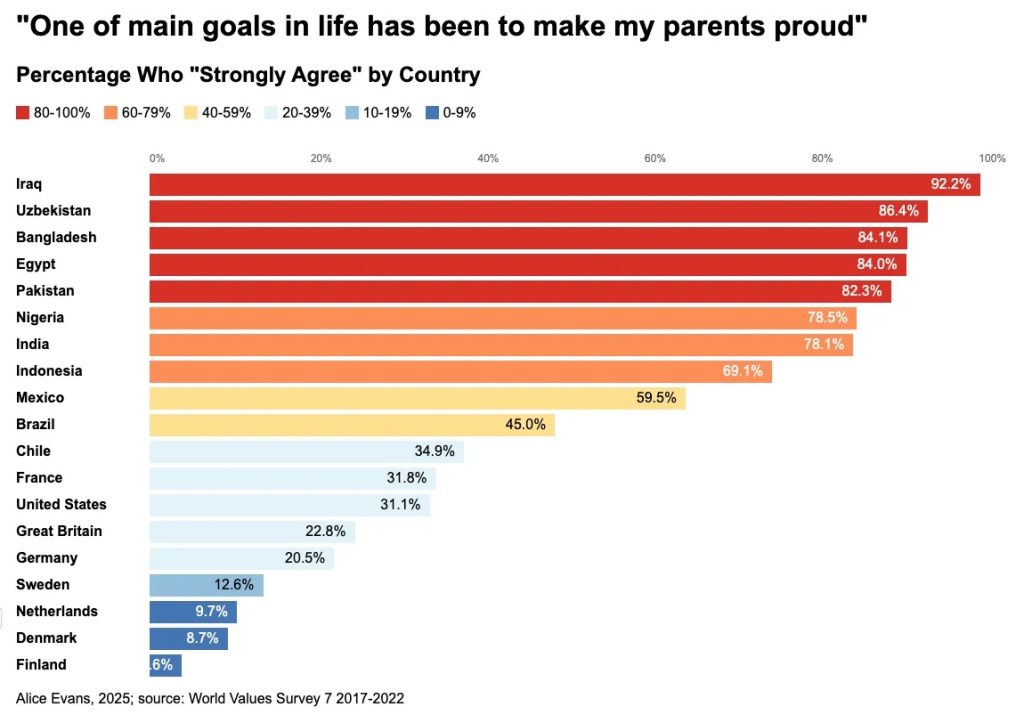
What do Parents Want?

Alice Evans:

Parents invest heavily in their kids, expecting something back: financial support in old age, prestige to raise the family name, or growing the faith. But modern life brims with delicious temptations! As teens forge new friendships and explore the web, they’re vulnerable to ideological persuasion and deviation. 

How do families secure their desired returns? Many cultures glorify filial piety as a sacred duty, instil religious devotion, and arrange marriages to align values. 

But what happens when religious conservatives migrate to liberal economies? Parents now face an ‘honour-income trade-off’: protect cherished culture or urge their children to assimilate and chase materialism.

This essay explores the struggles of parenting in the modern age. Drawing on fantastic new studies as well as my own qualitative research across India and the UK, it presents a novel theory of cultural persistence and integration.

More.

Share

How did we get here?


Years ago, a fellow parent mentioned that she was very unhappy when her child returned home from a taxpayer funded Madison school and said “I hate George Bush”. “I don’t want my child to hate anyone. We might disagree, but not learn to hate….”

And so it continues as I see scenes noted above.

From the Sermon on the Mount [Grok]: Matthew 5:43–44:

– “You have heard that it was said, ‘You shall love your neighbor and hate your enemy.’ But I say to you, Love your enemies and pray for those who persecute you.”

I admit to failing the Great Commandment over and over and over, particularly when (nearly always paid) door knockers arrive from distant lands (one, a retired Indiana teacher now living in Columbia – paid to return and canvas!) to tell us how to vote on this or that person/topic. The why, sometimes.

Ah, grace opportunities in every direction.

Share

Freedom from redistributed federal taxpayer funds

Ken Cuccinelli:

Fun fact of the day, as best I can tell, there are only 8 colleges that do NOT take federal funding:

  1. Hillsdale College–@Hillsdale
  2. Christendom College–@ChristendomVA
  3. Patrick Henry College–@patrickhenrycol
  4. Gutenberg College–@thegreatbooks
  5. New St Andrews College–@NewSaintAndrews
  6. Wyoming Catholic College–@WYOCathCollege
  7. Pensacola Christian College–@ConnectPCC
  8. Grove City College–@GroveCtyCollege

Do you know of any others?

Share

Notes on improved math outcomes

Corrine Hess:

The difference, Sturmer said, is that Winskill focused on teaching math — and made sure its teachers were using the latest evidence-based practices, not just teaching it the same way they learned when they were in school.

“It comes down to teaching the why behind mathematics and how things work,” he said. “Not just teaching tricks. That’s a big mistake people make.”

How One Woman Rewrote Math in Corvallis

Singapore Math

Discovery Math

Connected Math (2006!)

Share

Generate LLM hallucination to detect students cheating9 points

Peerplexity

I am thinking about adding a question that should induce a LLM to hallucinate a response. This method could detect students cheating. The best question should be the one that students could not imagine a solution like the one provided by the LLM. Any hints?

Share

civics: on public sector unions

Edward Ring:

This is the forgotten enabler of the so-called deep state. When we speak of an out-of-control administrative state, we must consider who organizes these bureaucrats, collects dues automatically from their taxpayer-funded paychecks, and then uses that money to make or break any politician they wish.

If you want to know the ultimate reason why California’s public sector is broken, bloated, inefficient, and tyrannical, look to public sector unions. They are the root cause of why California’s public school system is failing, the cities are still overrun with criminals and homeless drug addicts, and the cost of living continues to explode. Since 2000, the US Census Bureau estimates that more than 10 million people have moved out of California, along with thousands of businesses. One of the root causes of this misery, not explicitly identified nearly enough, is the political power of public sector unions.

Nothing about this is complicated. Public sector unions, understandably, are incentivized to maximize their membership and their dues revenue. Accordingly, these unions benefit when government agencies grow, regardless of whether these expanded agencies actually solve the issues of failing schools, rampant crime, or lack of affordable essentials such as housing and energy. Moreover, unlike private sector unions, public sector unions aren’t incentivized to be reasonable with “management” since they face no market competition like in the private sector. They just pressure politicians to raise taxes.

Related: Act 10

Share

Assessing the Wreckage of Affirmative Action

Jason Epstein:

Without question, Jason Riley is one of the most prominent black journalists in the United States, rightly known for his weekly columns in the Wall Street Journal. On a consistent basis, he shrewdly dissects the nostrums of many authors, both black and white, who assert that the road to a successful future in race relations depends on implementing a steady stream of programs whose factual predicate is that systematic racism in the United States going back to 1619 has created a toxic environment that now calls for the expansion of affirmative action programs in jobs, housing, and education.

The capstone of the program lies in aggressive demands for reparations for the sins, not only of slavery but of all past forms of segregation. These programs bear no relationship to either the $20,000 authorized in 1988 for Japanese Americans interned in World War II, or even the more generous payouts from the West German government to Israel in the aftermath of that war. Instead, by piling improbable assumptions on top of each other, the cash demands easily reach in aggregate 10 to 15 trillion dollars, both before the California legislature and the federal government. So far these programs have gone nowhere in practice, but the issue is sufficiently alivethat it is sure to aggravate racial relations in Trump’s second term.

Share

civics: Who was President these past few years?!

Ann Althouse summary:

Shame on us for wanting to know the truth about what happened? Who was President these past few years? We’re supposed to sink into a pool of respectful silence and not demand to know? We’re not supposed to be skeptical about the timing of the cancer news, which seems so perfectly aimed to shut us up about Tapper’s book and the Hur recordings?

Share

The principles of database design, or, the Truth is out there

Eduardo:

Such database needs to be designed to properly reflect reality. This can’t be automated, since the semantics of the situation need to be encoded in a way that can be processed by a computer. Such then is the goal of database design: to encode propositions in such a way that can properly be processed by a database management system (DBMS).

At this point, a regular software developer comes to a stall. Since there is scarcely any formal training in database design (or formal logic) in his education, he tends to fall back haphazardly on ad-hoc methods, with severe consequences (update anomalies and data inconsitencies with huge potential downsides).

Share

brain computer interfaces

Rolfe Winkler:

The company is taking early steps to enable people to control their iPhones with neural signals captured by a new generation of brain implants. It could make Apple devices more accessible to tens of thousands of people who can’t use their hands because of severe spinal cord injuries or diseases such as amyotrophic lateral sclerosis, or ALS.

Apple is looking forward to a day, still some years away, when implants developed by Elon Musk’s Neuralink and its rivals receive approval from the Food and Drug Administration. Such implants, known as brain computer interfaces, have already been safely placed in a handful of patients.

Share

College English majors can’t read

Kitten:

Since over 60% of high school grads go on to enroll in college, we know for a certainty that the vast majority of them are below level 4 in literacy. College kids are functionally illiterate. QED.

But what about those level 5 literate types, the ones who comprise around 1% of adults? What can they do?

This is the subject of a recently released study making waves in the education world. Researchers decided to sit with current college English majors and see how much they understood of what they read. They chose a very challenging text for the modern student, Bleak House by Dickens. Specifically, the first seven paragraphs. Here’s the first one.

LONDON. Michaelmas term lately over, and the Lord Chancellor sitting in Lincoln’s Inn Hall. Implacable November weather. As much mud in the streets, as if the waters had but newly retired from the face of the earth, and it would not be wonderful to meet a Megalosaurus, forty feet long or so, waddling like an elephantine lizard up Holborn Hill. Smoke lowering down from chimney-pots, making a soft black drizzle with flakes of soot in it as big as full-grown snowflakes—gone into mourning, one might imagine, for the death of the sun. Dogs, undistinguishable in mire. Horses, scarcely better; splashed to their very blinkers. Foot passengers, jostling one another’s umbrellas, in a general infection of ill-temper, and losing their foot-hold at street-corners, where tens of thousands of other foot passengers have been slipping and sliding since the day broke (if this day ever broke), adding new deposits to the crust upon crust of mud, sticking at those points tenaciously to the pavement, and accumulating at compound interest.

The methodology is that an interviewer sits with each student one on one and listens to them read the passages from the book aloud. As the students read, they must translate what they read into modern English, explaining what each passage means. They have a dictionary, reference material, and their phones on hand to assist in looking up any unfamiliar terms, such as “Lord Chancellor”.

——-

To summarize even further for those skimming:

  • 58% of students understood very little of the passages they read
  • 38% could understand about half of the sentences
  • 5% could understand all seven paragraphs

These are college students majoring in English. About half of them are English Education majors, which means they will be teaching books like Bleak House to high school students after graduating. But they themselves cannot understand the literal meaning of the sentences in the opening paragraphs.

Share

Worcester College Student to Plead Guilty to Cyber Extortions

US Department of Justice

A student at Assumption University in Worcester, Mass., has been charged, and has agreed to plead guilty, in connection with hacking into the computer networks of two U.S.-based companies and extorting the companies for ransoms.

Matthew D. Lane, 19, of Sterling, Mass., has agreed to plead guilty to one count each of cyber extortion conspiracy; cyber extortion; unauthorized access to protected computers; and aggravated identity theft. A plea hearing has not yet been scheduled by the Court.

Share

NIL College Climate Notes

Becky Jacobs:

“It is changing fundamentally how college athletics are structured, and even to a degree, what the principle of amateurism really means moving forward,” Banker said. 

Munson — who graduated with a triple major in political science, legal studies and history — agreed the notion of student-athletes is changing fast with major ramifications. 

“We all love the idea of the student-athlete going competing on the weekends and then being a good student in class,” she said. “But it’s become … almost semipro, especially for sports that are getting lots of NIL money.” 

As part of the revenue-sharing settlement, Munson worries new roster limits could hinder students’ opportunities to play sports, especially on teams like track. She also fears women athletes wouldn’t benefit financially nearly asmuch as men from the settlement. 

Doug McLeod serves as chair of UW-Madison’s Athletic Board, which oversees the school’s athletics department but isn’t involved in day-to-day decisions. McLeod said he hopes the settlement would provide order in an increasingly chaotic world for college sports administrators, coaches, athletes and fans. 

Share

“Doing what, exactly, district officials won’t say” – Madison

Chris Rickert:

More than seven months after the principal and assistant principal of a Madison elementary school were removed from their positions amid multiple complaints from parents and staff, the two remain on the district’s payroll.

Doing what, exactly, district officials won’t say.

Candace Terrell and Annabel Torres remain listed in the district’s online employee directory as principal and assistant principal, respectively, of Southside Elementary, but the two haven’t worked there since early October, when district officials removed them from their positions after staff and parents of children at the school accused them of bullying and mismanagement.

——

The taxpayer funded Madison School District long used Reading Recovery

The data clearly indicate that being able to read is not a requirement for graduation at (Madison) East, especially if you are black or Hispanic”

My Question to Wisconsin Governor Tony Evers on Teacher Mulligans and our Disastrous Reading Results

2017: West High Reading Interventionist Teacher’s Remarks to the School Board on Madison’s Disastrous Reading Results 

Madison’s taxpayer supported K-12 school district, despite spending far more than most, has long tolerated disastrous reading results.

“An emphasis on adult employment”

Wisconsin Public Policy Forum Madison School District Report[PDF]

WEAC: $1.57 million for Four Wisconsin Senators

Friday Afternoon Veto: Governor Evers Rejects AB446/SB454; an effort to address our long term, disastrous reading results

Booked, but can’t read (Madison): functional literacy, National citizenship and the new face of Dred Scott in the age of mass incarceration.

When A Stands for Average: Students at the UW-Madison School of Education Receive Sky-High Grades. How Smart is That?

Share

Mental-health lessons in schools sound like a great idea. The trouble is, they don’t work

Lucy Foulkes:

On the face of it, mental-health lessons in schools seemed like an excellent idea. Young people’s mental health is worse now than it was in the past, and one-to-one treatment is hard to access. If you teach young people about mental health at school – which often includes teaching techniques based on therapies such as cognitive behavioural therapy (CBT) or mindfulness – it’s more accessible. If you teach these concepts to everyone in a class – so-called universal interventions – you avoid missing the under-the-radar kids who aren’t seeking help, and avoid the potential stigma of singling anyone out. If you teach the information when pupils are young enough, even better: you might prevent mental-health problems from starting in the first place.

At least, that was the idea. The reality is more sobering. Researchers have now run many studies testing the impact of universal school mental-health interventions and have found that they don’t really improve mental health. When improvements are found, they’re small – a tiny average shift on a symptom questionnaire – and the quality of the research is often poor, meaning it’s hard to trust the findings. The best-designed studies show that interventions don’t work at all: no improvement in mental health symptoms, either immediately after the course of lessons or later down the line.

In fact, some studies have found that universal mental-health lessons actually make things worse. There are now high-quality studies showing that school lessons based on CBTmindfulnessdialectical behavioural therapy (DBT) and general mental-health awareness lead to a small increase in symptoms of mental-health difficulties. There is evidence of other bad outcomes too, such as decreased prosocial behaviour or decreased relationship quality with parents.

Share

American stupidity is escalating at an advanced pace.

Lucas Ropek:

After accumulating thousands of pages of school district documents via FOIA requests from around the country, 404’s Jason Koebler found that ChatGPT has “become one of the biggest struggles in American education.” Koebler’s reporting notes that, in the early days of the AI deluge, school districts were courted by “pro-AI consultants” who were known to give presentations that “largely encouraged teachers to use generative AI in their classrooms.” For instance, Koebler writes that the Louisiana Department of Education sent him…

…a presentation it said it consulted called “ChatGPT and AI in Education,” made by Holly Clark, the author of The AI Infused Classroom, Ken Shelton, the author of The Promises and Perils of AI in Education, and Matt Miller, the author of AI for Educators. The presentation includes slides that say AI “is like giving a computer a brain so it can learn and make decisions on its own,” note that “it’s time to rethink ‘plagiarism’ and ‘cheating,’” alongside a graph of how students can use AI to help them write essays, “20 ways to use ChatGPT in the classroom,” and “Warning: Going back to writing essays—only in class—can hurt struggling learners and doesn’t get our kids ready for their future.”

In other words, AI acolytes seemed to anticipate that the technology would effectively ruin essay-writing and test-taking, and wanted to spin it to present the ruination as mere “transformation”—a new way of doing things—instead of a destructive force that would devastate education.

Share

The Truman Foundation Must Embrace Civic Seriousness

Frederick Hess:

That’s not exactly a cross-section of America’s college students. After all, while college faculty may be overwhelmingly left-leaning, the same isn’t true of the broader student population.

In fact, Truman’s leadership has doubled down on its intransigence by scrubbing the bios of past winners from its website, ensuring that no one can replicate the AEI study. Indeed, past press releases of winners are now password-protected. One can view them only via a Truman scholar account. And the program didn’t issue biographies for this year’s winners, either, instead just listing name, major, and degree aspirations. An information lockdown is certainly one response to the problem. Rather than addressing ideological bias, it is easier to hide the evidence. But this isn’t a good solution for the nation, as opacity seems better suited to a felonious enterprise than a taxpayer-funded scholarship.

Right-leaning students and faculty tell me that the deck is stacked and there’s no point wasting their time.What’s going on? Well, right-leaning students and the handful of conservative faculty tell me that they’ve concluded that the deck is stacked and there’s no point wasting their time. Meanwhile, left-leaning faculty are used to mentoring applicants and have had good experiences. And, of course, program announcements and information sessions tend to send clear (if unintentional) signals about the kinds of interests and research deemed promising.

As a recent Truman finalist told me, “When I interviewed for the scholarship (over Zoom), I was asked a number of politically pointed questions by the committee, including whether I, as a conservative, would condemn Donald Trump.” When he shared his experience with the director of his university’s honors college, he was told not to worry because “students like you don’t usually win the Truman.”

Share

“I stopped teaching at Harvard last year primarily because of its anti-truth-seeking culture…”

Christopher F. Rufo, Ryan Thorpe interview:

City Journal: Give us a sense of the ideological landscape and your experience at Harvard.

Omar Sultan Haque: Unlike many others at Harvard, I have no dramatic cancellation, or intellectual persecution, or struggle session to report. I stopped teaching at Harvard last year primarily because of its anti-truth-seeking culture, radical left-wing bias, racial and gender discrimination, and prevailing anti-intellectualism, which made continued participation a poor use of time. There are exceptions, but on the whole Harvard has strayed from its foundational mission of unbiased truth-seeking and has become ideologically driven, too often resembling a secular church or a partisan think tank. The university’s culture and practices prioritize ideological conformity over open inquiry and debate, suppressing dissenting viewpoints and compromising academic freedom. This shift undermines the core values of a secular university and poses a threat to the integrity of academia and broader society.

CJ: How have DEI initiatives affected day-to-day life at Harvard?

Haque: The university may have changed the official name of its DEI office to use more nebulous euphemisms, but DEI and “Diet DEI” (a diluted form) have the same effects in practices, norms, and the larger culture of orthodoxy and taboo. Diet DEI is just more dishonest. The university has made some progress by eliminating racially segregated graduations and required DEI loyalty oaths in one of its many schools—mandatory diversity statements when applying for a job—but the larger culture of DEI is the problem. Some tropes remain popular on campus that are legacies of left-wing racism, such as the idea that a person’s racial identity is central to one’s academic study; that people should be sorted into “oppressor” and “oppressed” groups by their immutable characteristics; that racism is specific to one race rather than a universal, sinful propensity in human nature; and that lowering academic or behavioral standards for certain racial groups is not happening (when advocates are confronted with evidence that it is happening, they argue that the practice is justified). These beliefs infect teaching, research, grading standards, hiring, promotions, campus debate, what is considered an acceptable topic for invited lectures, what projects get funded, and so on.

CJ: In your observation, has Harvard continued to engagein discriminatory admissions and hiring?

Haque: Yes, of course! There is endless evidence at Harvard, in student admissions and faculty and staff hiring, that people are, in effect, sorted via a left-wing segregation filter: competing primarily against others of the same race and sometimes gender. One colleague at Harvard Law School who served for years on the admissions committee flat-out admitted this to me recently. That is why Harvard tries to cover its tracks and hide admissions data and post-admissions performance metrics that predictably result from separate and unequal admissions standards. The eye-popping data on biases against Asians and whites in admissions have already been exposed [in Students for Fair Admissions v. Harvard]. A corporation with identical racist practices would have been sued out of existence decades ago; why the exception for a wealthy university? The data on faculty and staff hiring and promotions reveal even more obvious evidence of discrimination. Just examine whether people in the same positions are similarly accomplished. No need to call Sherlock Holmes.

Share

civics: politically correct large language models

David Rozado:

Despite identical professional qualifications across genders, all LLMs consistently favored female-named candidates when selecting the most qualified candidate for the job. Female candidates were selected in 56.9% of cases, compared to 43.1% for male candidates (two-proportion z-test = 33.99, p < 10⁻252 ). The observed effect size was small to medium (Cohen’s h = 0.28; odds=1.32, 95% CI [1.29, 1.35]). In the figures below, asterisks (*) indicate statistically significant results (p < 0.05) from two-proportion z-tests conducted on each individual model, with significance levels adjusted for multiple comparisons using the Benjamin-Hochberg False Discovery Rate correction…

In a further experiment, it was noted that the inclusion of gender concordant preferred pronouns (e.g., he/him, she/her) next to candidates’ names increased the likelihood of the models selecting that candidate, both for males and females, although females were still preferred overall. Candidates with listed pronouns were chosen 53.0% of the time, compared to 47.0% for those without (proportion z-test = 14.75, p < 10⁻48; Cohen’s h = 0.12; odds=1.13, 95% CI [1.10, 1.15]). Out of 22 LLMs, 17 reached individually statistically significant preferences (FDR corrected) for selecting the candidates with preferred pronouns appended to their names.

more.

Share

Diffusion models explained simply

Sean Goedecke:

Transformer-based large language models are relatively easy to understand. You break language down into a finite set of “tokens” (words or sub-word components), then train a neural network on millions of token sequences so it can predict the next token based on all the previous ones. Despite some clever tricks (mainly about how the model processes the previous tokens in the sequence), the core mechanism is relatively simple.

It’s harder to build the same kind of intuition about diffusion models (in part because the papers are much harder to read). But diffusion models are almost as big a part of the AI revolution as transformers. High-quality image generation has driven a lot of user interest in AI, particularly ChatGPT’s recent upgraded image generation.

Even if you don’t care much about images, there are also some fairly capable text-based diffusion models – not yet competitive with frontier transformer models, but it’s certainly possible that we’d someday see a diffusion language model that’s state-of-the-art in its niche.

Share

Grandparenting in the 21st century involves shifting roles, new boundaries and online advice

Clare Ansberry:

When a child becomes a parent, roles shift.

In the days after her first grandchild was born, Randi Heredia listened to her son, a new dad, ask her to wash her hands before picking up the baby and warned her not to kiss the baby’s face.

It caught her off guard. “I’m so used to telling my son what to do and what not to do,” she says. Still, watching him step up as provider and protector was affirming and liberating. She doesn’t have to be the one making decisions and setting boundaries.

Sons and daughters will always be your child, but that identity and role becomes secondary when they have a baby. You have to let go of being the boss, which can be hard for parents used to jumping in and fixing things, says Gertrude Lyons, author, educator and parenting coach.

The best route is to let them be the parents, respect their boundaries and be grateful, because not everyone has the good fortune of seeing their kids have kids. The U.S. birthrate is falling and more young adults are deciding not to have kids. Of American parents between the ages of 50 and 90, some 35% don’t have grandkids. In 2018, the share was 30%.

Aaron Larsen​ says many grandparents still hold a traditional view that they are entitled to spoil their grandchild, whether that means giving them ice cream before dinner or overloading them with toys, rather than being entrusted with their care.

Share

notes on k-12 Governance and $pending practices: Milwaukee

G David Yaros:

First, we get rid of the four regional superintendents, obliterate their individual fiefdoms and ax the lone high school superintendent. So far so good, as these individuals were not exactly delivering sterling outcomes.

More.

IRG:

Instead of operating under its corrective action plan, MPS still isn’t meetingimportant financial deadlines attached to state funding. The state is still withholding funding following MPS missing the financial reporting deadline in 2024. The state put MPS on a corrective action plan, requiring it to get up to speed on its financial reporting. MPS has not updated its progress on the plan since January. Late financial reporting affects the funding of all 420 Wisconsin school districts.

Share

Notes on Minneapolis K – 12 tax and spending plans

Becky Dernbach:

The funding restoration will reinstate Tizón’s position, as well as positions for three academic coaches in the Office of Latine Achievement. Under the previous funding cuts, OLA would have had no operating budget. Now, it will have reduced capacity, but the office will continue in its current form. 

But tensions over funding for the Office of Black Student Achievement — and the role of school board members in setting the budget — spilled over in the May 13 school board meeting.

The Office of Black Student Achievement, which had a $2.2 million budget last year, is slated for cuts of about $750,000 — more than a third of its budget. As a result, it will reduce its high school course offerings by about half, as well as cutting programming for elementary and middle school students.

more.

Share

Do More Powerful Unions Generate Better Pro-Worker Outcomes?

Liya Palagashvili and Revana Sharfuddin

These trade-offs arise not because unions are uniquely “aggressive,” but because US labor laws promote a legally protected union monopoly that crowds out constructive representation and worker voice. Drawing on 147 studies, we find that when the monopoly face dominates and delivers seemingly “big wins” at the bargaining table, companies respond to wage pressure by trimming R&D, cutting capital, reducing company growth, and ultimately shrinking jobs for unionized workers—dynamics that explain roughly 55 percent of the decline in the Rust Belt’s share of manufacturing employment between 1950 and 2000.

——

Related: Act 10

Share

Miami schools and “ai”

Natasha Singer:

Miami-Dade County Public Schools, the nation’s third-largest school district, is at the forefront of a fast-moving national experiment to embed generative A.I. technologies into teaching and learning. Over the last year, the district has trained more than 1,000 educators on new A.I. tools and is now introducing Google chatbots for more than 105,000 high schoolers — the largest U.S. school district deployment of its kind to date.

It is a sharp turnabout from two years ago, when districts like Miami blocked A.I. chatbots over fears of mass cheating and misinformation. The chatbots, which are trained on databases of texts, can quickly generate humanish emails, class quizzes and lesson plans. They also make stuff up, which could mislead students.

Now some formerly wary schools are introducing generative A.I. tools with the idea of helping students prepare for evolving job demands. Miami school leaders say they also want students to learn how to critically assess new A.I. tools and use them responsibly.

Share

civics: censorship and bluesky

James Meigs:

The liberal exodus from X to Bluesky created a kind of real-world social-science experiment. It was as if progressives on one side and conservatives and centrists on the other sorted themselves into two separate laboratory dishes. (I don’t want to make toomuch of this; there are still plenty of liberals on X, and both platforms have lots of people mostly interested in nonpolitical topics. But stay with me.) With the most passionate progressives in one petri dish, and with conservatives and MAGA types now unleashed in the other, scientists could get out their notebooks and watch what kind of cultures emerged.

I’ve been on Twitter/X since its earliest days, and I still find it a useful way to keep tabs on the many topics I follow. In the Musk era, my feed on X has become noticeably more chaotic, with a higher proportion of random accounts shouting angrily into the void. Sometimes those voices come from the MAGA right (usually saying something about “treason” or “RINOS”). But there is plenty of anger from the left as well. For example, any post supportive of Israel is immediately attacked by nasty pro-Hamas accounts. I don’t love X’s somewhat uglier vibe, but I accept the trade-off. I’m willing to tolerate a few angry or idiotic posts in exchange for knowing that right-wing views aren’t being deliberately buried.

Despite the controversy, X has hardly become a conservative echo chamber. A late 2024 Pew Research Center poll found that news consumers on X are almost precisely balanced between Democrats and Republicans; two years earlier, Democrats outnumbered Republicans on the site more than two to one. I suspect that the progressives who feel threatened by right-wing “hate” have simply never experienced a cultural environment where conservatives speak as loudly as liberals. And, against all odds, Musk’s business strategy seems to be working. Though X’s total number of users has dropped, the site’s financial health is improving. Analysts estimate that the company’s total value is approaching the $44 billion Musk paid for it in 2022, a valuation most experts (including Musk himself) considered wildly inflated at the time.

Share

Notes on school phone bans

Fit to Teach:

Last year I was battling the greatest entertainment system the world ever unleashed. A student would listen to my pleas, say they would get up, and then immediately fuck off on their phone again. Why would you play in the gym when you could sit against the wall and watch endless entertainment personally curated for your tastes?

Now I battle boredom, and that’s a winnable fight. Now when I give my two chicks speech [telling pupils they might not like doing something, but they have to], they usually respond by participating. That’s because the other option is boredom. Sit there, do nothing, and look out the non-existent windows our school doesn’t have. I’m not fighting against brilliant social scientists getting paid millions to figure out ways to capture human attention, I’m fighting against sitting on your ass doing nothing. And my class is awesome compared to boredom.

Now don’t get me wrong. This isn’t a magic bullet. Banning phones won’t save Gen-Z. I once watched our dean hand cellphones back to students in the cafeteria. When she rolled the cellphone cart through, it was like watching a crowd of hyenas catching the scent of stinking flesh. Kids stopped conversations mid-sentence and lifted their heads to watch that cart roll by.

Share

Students are resorting to extreme measures to fend off accusations of cheating, including hourslong screen recordings of their homework sessions.

Callie Holtermann:

A few weeks into her sophomore year of college, Leigh Burrell got a notification that made her stomach drop.

She had received a zero on an assignment worth 15 percent of her final grade in a required writing course. In a brief note, her professor explained that he believed she had outsourced the composition of her paper — a mock cover letter — to an A.I. chatbot.

“My heart just freaking stops,” said Ms. Burrell, 23, a computer science major at the University of Houston-Downtown.

But Ms. Burrell’s submission was not, in fact, the instantaneous output of a chatbot. According to Google Docs editing history that was reviewed by The New York Times, she had drafted and revised the assignment over the course of two days. It was flagged anyway by a service offered by the plagiarism-detection company Turnitin that aims to identify text generated by artificial intelligence.

Share

K-12 Tax & Spending Climate: U.S. Loses Last Triple-A Credit Rating

Matt Wirz & Sam Goldfarb:

The U.S. has lost its last triple-A credit rating.

Moody’s Ratings downgraded the U.S. government on Friday, citing large fiscal deficits and rising interest costs.

Expanding budget deficits mean U.S. government borrowing will rise at an accelerating rate, pushing interest rates up over the long term, Moody’s said. The firm said Friday that it didn’t believe that any current budget proposals under consideration by lawmakers would do anything significant to reduce the persistent gap between government spending and revenues.

The move strips the U.S. of its last remaining triple-A credit rating from a major ratings firm, following similar cuts by Fitch Ratings in 2023 and S&P Global Ratings in 2011. Moody’s downgraded the U.S. to Aa1, a rating also held by Austria and Finland.

“Successive U.S. administrations and Congress have failed to agree on measures to reverse the trend of large annual fiscal deficits and growing interest costs,” Moody’s wrote in a statement.

Share

The decision by Texas high-school football to allow players to use wearable devices next season could radically transform America’s favorite sport

Andrew Beaton:

Instead of long, abstruse playcalls radioed into a quarterback’s ear and getting drowned out by tens of thousands screaming fans, each play would just appear in front of each player’s eyes on a wristband. It would completely transform the way the game looks—and even how it’s played.

And as it happens, it’s now closer to a reality than ever before.

In a move that fell under the radar of most football fans, the league that oversees high-school football in Texas just approved a change permitting the use of these types of wearable devices. And while Friday night football in the Lone Star state might seem a long way from NFL stadiums, recent history shows that high-school fields now serve as the breeding grounds for the next stages of the game’s evolution—even when those ideas seem completely radical.

The spread offense and the pass-happy “Air Raid” scheme were both popularized at Texas high schools before trickling up to the pro game. The latest innovation might be less of a schematic advancement than a technological one.

Share

The ‘Success Sequence’ Goes to School

Patrick Brown, via a kind reader:

By asking students to consider the statistics showing that both adults and kids do better in a household with married parents, these curricula can open up conversations about what success truly means. Instead of a strict focus on avoiding teen pregnancy, these discussions celebrate the meaning and joy that parenthood in the right context can offer. These curricula could be amplified by lessons, such as those passed in Idaho and Tennessee, that require high-school biology classes to teach the basics of fetal development, such as when a heartbeat begins, to help students gain a greater appreciation for human life.

The success sequence is also politically popular. A 2023 poll of parents across five Sun Belt states found high levels of support for teaching students about the sequence in public schools. Nearly three-quarters of parents polled said that they “strongly” or “somewhat” supported teaching it, while only 12% of parents were “strongly” opposed.

Parents are responsible for the moral formation of their children, but they want schools to support rather than undermine their efforts. Career exploration classes help students ponder what they might want to do but don’t help them think about the kind of person they want to become. If the success sequence can kick-start conversations about what it truly means to flourish, it will be well worth it.

Share

“The Blindness of the Elites”

Dave Cieslewicz:

Last week I had dinner with three friends. We all went to the UW. We’ve all had successful careers and long-term marriages. A couple of us have raised a total of six successful children. And yet, we didn’t go to Harvard or aspired to. In fact, we grew up at a time when middle class kids like us didn’t shop around for schools. Nobody went on a tour of campuses. We could afford the UW, so that’s where we went.

My point is that people like Brooks — and I like Brooks’ perspective about 90% of the time — live in a world that is sealed off from the lives lived by 95% of Americans who don’t live or die by their GPA, their SAT scores or the dream of an Ivy League education.

Share

Many state universities are losing more students every year, failing the local economies they once fostered

Konrad Putzier, Douglas Belkin and Anthony DeBarros:

“It’s almost like you’re watching the town die,” said Kalib McGruder, who was born in Macomb and worked 28 years for the Western Illinois campus police department.

Macomb is at the heart of a new Rust Belt: Across the U.S., colleges are faltering and so are the once booming towns around them. Enrollment is down at many of the nation’s public colleges and universities, widening the gap between high-profile campuses and struggling schools. Starting next year, there will be fewer high-school graduates for the foreseeable future.

The fallout extends to downtown Macomb. Sullivan Taylor Coffee House, located in the corner of a stately 130-year-old building not far from campus, sits mostly empty during the semester. Owner Brandon Thompson has cashed out retirement savings, hit the limits of his credit cards, even canceled his home internet to keep the doors open.

Share

Stacy Davis Gates Wins Second Term as Chicago Teachers Union President

Matt Masterson:

CORE received 64% of votes to defeat a challenge from the Respect Educate Advocate Lead — or REAL — caucus.

Friday’s results mean Davis Gates will remain as union president, joining the rest of the CORE slate of CTU leadership with vice president Jackson Potter, recording secretary Vicki Kurzydlo and financial secretary Diane Castro.

Share

Civics: Reckoning for the Biden Coverup

Wall Street Journal:

The coverup of Mr. Biden’s mental decline will go down as one of the great scandals of modern politics. By refusing to admit what voters could so clearly see, Democrats denied their party an open primary. Once Mr. Biden imploded, they handed Kamala Harris the nomination without debate.

Had Mr. Biden bowed out in 2023, Republicans might also have been more open to nominees other than Mr. Trump. Instead, Democrats turned to lawfare in an attempt to disqualify Mr. Trump, which solidified his hold on GOP voters. Democrats and the press are now appalled by Mr. Trump’s second term. They would do better to think upon, and seek contrition for, their own role in making it possible.

Share

“no longer lauding employees as the talent”

Chip Cutter:

Advances in generative AI also play a role. Shopify CEO Tobi Lütke recently told employees that the e-commerce company won’t make new hires unless managers can prove AI isn’t capable of doing the job. Other business leaders are warning their staff to adopt more AI—or else.

“AI is coming for your jobs. Heck, it’s coming for my job too. This is a wake-up call,” Micha Kaufman, CEO of the freelance marketplace Fiverr, wrote in a staff memo last month. Those “who will not wake up and understand the new reality fast are, unfortunately, doomed.

Share

Students Are Humanizing Their Writing—By Putting It Through AI

Julie Jargon:

Students don’t want to be accused of cheating, so they’re using artificial intelligence to make sure their school essays sound human.

Teachers use AI-detection software to identify AI-generated work. Students, in turn, are pre-emptively running their original writing through the same tools, to see if anything might be flagged for sounding too robotic.

Miles Pulvers, a 21-year-old student at Northeastern University in Boston, says he never uses AI to write essays, but he runs all of them through an AI detector before submitting them.

“I take great pride in my writing,” says Pulvers. “Before AI, I had peace of mind that whatever I would submit would be accepted. Now I see some of my writing being flagged as possibly being AI-generated when it’s not. It’s kind of annoying, but it’s part of the deal in 2025.”

Share

Tax records show SEC, Big 12, Pac-12 all had revenue decline in 2024 fiscal year

Steve Berkowitz

The final business year for the Power Five conferences, as college sports fans have come to know them, was not exactly business as usual. With schools’ affiliations already beginning to change, and various legal entanglements going on, three of the five conferences reported declines in total revenue on their federal tax records for their 2024 fiscal years – and the Power Five’s combined total revenue very narrowly declined.

That’s far from a cause for alarm, but it is the first such year-over-year decrease in a non-pandemic-affected year since USA TODAY Sports began compiling these records by obtaining data reaching back to fiscal 2011, when the Big East Conference still was playing football and there were six power conferences. In most years, the annual increase has been at least $150 million.

And that may well return to being the power-conference norm, as the Big Ten and Southeastern conferences appear headed toward revenue booms for their ongoing 2025 fiscal years that likely will take each to at least $1 billion, and the Pac-12’s demise and dispersal will help boost income for the Atlantic Coast Conference and the Big 12.

Share

llinois considers lowering scores students need to be considered proficient on state exams

Samantha Smylie

The Illinois State Board of Education agreed Wednesday to move ahead with a process to change the state’s testing system, though the exact details still are being worked out. That process will include creating new “cut scores,” or the lowest score needed for a student to be sorted into broad categories of achievement on state assessments. 

If approved in August, the new cut scores would be applied to the tests taken by students this spring and reported publicly in October. The changes are likely to send the public a very different message about how students are doing on reading and math tests.

Proposed changes to the state’s testing system come at a time when schools in Illinois and around the country are still dealing with the academic fallout of the COVID pandemic. Other states, including Wisconsin, Oklahoma, Alaska, and New York, have made similar changes to their testing systems, according to The 74.

Third to eighth graders in Illinois saw progress in reading last year — even exceeding proficiency levels pre-pandemic — but math scores still lagged behind past years, according to the state’s 2024 report card. Scores on the National Assessment of Educational Progress, or NAEP, remained stagnant.

——

Did taxpayer funded Wisconsin DPI Superintendent Underly Juice Test Scores for Reelection?

notes and links on Incumbent DPI Superintendent Jill Underly (back story).

Underly supports eliminating our one elementary teacher content knowledge requirement, the Foundations of Reading(FORT)

Civics: Why and how was Jill Underly Re-elected? (a bit of uniparty analysis as well). And.

My Question to Wisconsin Governor Tony Evers on Teacher Mulligans and our Disastrous Reading Results

“An emphasis on adult employment”

The data clearly indicate that being able to read is not a requirement for graduation at (Madison) East, especially if you are black or Hispanic”

2017: West High Reading Interventionist Teacher’s Remarks to the School Board on Madison’s Disastrous Reading Results 

Share

How should England’s curriculum & assessment review respond to AI?

Daisy Christodolou:

The research bears out the pessimism. In the past two years, there have been dramatic increases in the numbers of students using generative AI to do their work. In the UK, at university level, the number of students using AI for assessments went up from 53 per cent in 2024 to 88 per cent in 2025. Among 13- to 18-year-olds generative AI use went from 37 per cent in 2023 to 77 per cent in 2024.

Not only that, but you can’t spot its use: AI detectors don’t work. They miss real plagiarism and accuse human work of being plagiarised.

In short, the growing and undetectable use of generative AI poses a huge threat to the integrity of assessments, and by extension to the integrity of education. 

In the worst-case scenario, which may already be here, we end up with a kabuki dance where students pretend to write essays and teachers pretend to mark them.

Share

NIL “clearinghouse”

Ross Dellenger:

More information on the new NIL clearinghouse – “NIL Go” – is being distributed to schools, including this two-page memo that details concepts, much of what has been reported but now formalized in writing to school administrators.

——

Will the House v. NCAA Settlement Actually End ‘Pay-for-Play’ NIL Deals?

A memo obtained by FOS sheds new light on how the approval process will work for NIL collective dealsIndustry experts are skeptical it will work.

———

If a deal is flagged by the clearinghouse as pay-for-play, the athlete can still accept it…just w the understanding there’s a risk of eligibility concerns.

——-

We have a last minute amicus brief filed by USA Diving in opposition to the House settlement.

It takes the NCAA to task for not protecting the interests of athletes and calls the roster limits “anticompetitive.”

It seems that opposition to the House settlement grows by the day.

Share

civics: legacy media veracity

Eddie Scarry

The best part, though, was when Sulzberger claimed that the Times is just as tough on Democrats as it is on Republicans, and as an example, he earnestly cited the paper’s coverage of Biden’s plainly disintegrating mental faculties. 

“President Joe Biden and his aides, for example, frequently lashed out at journalists and news organizations who dared to ask questions about his age and fitness, even as they went to historic lengths to avoid unscripted exchanges with reporters,” he said. “I know this firsthand, because Times journalists reported deeply on these questions and called attention to his evasion of the press. President Biden’s White House and his supporters attacked them for it constantly.”

Share

DoD Schools Ranked Best in the United States Again on Nation’s Report Card 

DODEA

Fourth and eighth-grade students attending Department of Defense Education Activity (DoDEA) schools led the nation in scoring on the 2024 National Assessment of Educational Progress (NAEP) Reading and Mathematics Assessments. 

DoDEA students’ average scale scores ranged from 14 to 25 points higher than corresponding national average scores and held steady while national average scores mostly decreased. 

“I am delighted that DoDEA has once again performed exceptionally well on the National Assessment of Educational Progress,” said DoDEA Director, Dr. Beth Schiavino-Narvaez. “Credit for this success belongs to our incredible teachers, administrators, and staff of DoDEA, and most importantly to our students and their families, for all their hard work and dedication. Our relentless pursuit of continuous improvement has empowered our mission to deliver excellence in education to every student, every day, everywhere.”

Share

State officials warn they could withhold Milwaukee Public Schools’ aid, again, due to late financial reports

Rory Linnane

State officials are still withholding a $16.6 million special education payment to the district because of its late financial reporting last year, Bucher said, pending better progress on MPS’ corrective action plan.

The state Department of Public Instruction needs MPS’ reports, which include audited financial statements from the 2023-24 school year, to calculate final general aid payments to all Wisconsin school districts.

Asked whether DPI was confident in MPS’ ability to hit the May 30 deadline for other reports, Bucher said state officials were “concerned about the progress toward meeting the goals and the potential impacts.”

Three other school districts are also late filing the same information DPI is seeking from MPS by May 30, Bucher said. Every district has already submitted the information MPS was due to submit May 16.

more

Share

Upgrading (?) Manitoba’s Grad 9 math requirements

Maggie Macintosh:

Grade 9 students in the province will be getting a mandatory math makeover that education officials expect will add up to better results and an improved learning experience in the core subject.

Manitoba Education has overhauled the curriculum for incoming high schoolers to expose all students to budgeting 101 and increase foundational numeracy lessons. And the amount of instruction is being doubled.

Starting in September 2027, a new mandatory mathematics course will span the entirety of every student’s Grade 9 school year. The rollout is being phased in with a pilot in selected schools scheduled for this fall.

The course is slated to replace four existing options — Grade 9 Mathematics, Transitional Mathematics, Transitional Mathematics I and Transitional Mathematics II.

Share

A financial reckoning has started at universities

Sara Randazzo:

Harvard’s school of public health, which relies on federal grants for almost half its budget, has conducted layoffs and reduced graduate-student admissions. It has pinched pennies on everyday spending, cutting coffee in the faculty lounge as well as catering at meetings, and removing some printers and desk phones. A spokeswoman for the T.H. Chan School of Public Health said it has lost nearly every direct federal grant it receives.

Garber said Wednesday the university would contribute an additional $250 million to backfill some of the lost research funds “for a transitional period as we continue to work with our researchers to identify alternative funding sources.”

Institutions will do what they can “to protect the academic core as long as possible,” said Erin Hennessy, an executive vice president at TVP Communications, a higher-education communications firm. That means going after easier cuts first, she said, such as not filling vacant positions, deferring building projects and consolidating departments, before touching the faculty.

So far, the undergraduate experience hasn’t changed at most universities, but cuts in the coming months could have a significant impact by fall. Many universities implemented hiring freezes in March, after the Trump administration announced caps to research costs funded by the National Institutes of Health. Actions such as layoffs haven’t yet become widespread.

Share

k-12 tax, $pending and borrowing climate: federal debt bomb discussion

John Allen:

Mike Knetter talks with two Badger economists about the danger of rising federal budget deficits — and politicians who are afraid to face them.

Share

Notes on the Universities of Wisconsin Budget Sources

Corrine Hess:

The UW system’s 2023-25 biennial budget is $13.7 billion. About 58 percent of funding comes from tuition and fees, 24 percent comes from the federal government and 18 percent comes from the state.

Evers’ budget includes $856M spending increase for UW

Gov. Tony Evers’ 2025-27 biennial budget proposal includes $856 million for the UW system, the largest increase in state history. 

Rothman said the budget increase would bring UW to the middle nationally in funding and provide the system with essential investments to preserve the quality and advance the innovation that Wisconsin expects of the system’s 13 universities.

“We’re not going to have the teachers, the nurses, the engineers and the data scientists that are necessary,” Rothman said. “And it has a real impact on students of lower socioeconomic means, because we don’t have the resources to really make this opportunity available to anyone in Wisconsin who has the passion and has the ability.”

Share

MIT Economics retracts a paper

www link:

Following the posting of the preprint paper “Artificial Intelligence, Scientific Discovery, and Product Innovation” on arXiv in November 2024, concerns were raised about the integrity of the research. MIT conducted an internal, confidential review and concluded that the paper should be withdrawn from public discourse.

In an effort to correct the research record, MIT has contacted arXiv to formally request that the paper be withdrawn and The Quarterly Journal of Economics, where it had been submitted. The letter on behalf of the Committee on Discipline to arXiv states:

“Earlier this year, the COD conducted a confidential internal review based upon allegations it received regarding certain aspects of this paper.  While student privacy laws and MIT policy prohibit the disclosure of the outcome of this review, we are writing to inform you that MIT has no confidence in the provenance, reliability or validity of the data and has no confidence in the veracity of the research contained in the paper.  Based upon this finding, we also believe that the inclusion of this paper in arXiv may violate arXiv’s Code of Conduct.

“Our understanding is that only authors of papers appearing on arXiv can submit withdrawal requests.  We have directed the author to submit such a request, but to date, the author has not done so. Therefore, in an effort to clarify the research record, MIT respectfully request that the paper be marked as withdrawn from arXiv as soon as possible.”

——

Justin Lahart.

more.

Share

Why (and How) Young People Should Go Into Debt to Buy Stocks

Alex Tabarrok:

In 2022, I highlighted Ian Ayres and Barry Nalebuff’s proposal that young people should borrow to invest in the stock market. Why? Most people invest gradually, which leads to a concentration of stock holdings late in life. By borrowing early, young investors can spread market risk more evenly across their lifetime, much like diversifying across assets. Put differently, a young person’s biggest asset is their future labor income. Borrowing to invest reduces overexposure to that single asset, effectively diversifying their portfolio away from specific human capital and toward financial capital.

I supported the idea writing that “I agree with Ayres and Nalebuff that young people should be [at least] 100% in equities” but I didn’t expect people to go beyond this until the idea became standardized in a similar way to home mortgages. I wrote, “It could be standardized, however, with retirement planning products.”

Well, we now have our first product in this category, Basic Capital. Basic Capital is a mortgage for investing in stocks and bonds. You put in $1 and you get $5 of investment. Moreover, you cannot lose more than you put in. How is that possible? The investments are constrained–85% of it goes to bonds and 15% to equity but remember that 15% is on $5 rather than $1 so instead of investing $1 in stocks you are investing $.75 in stocks and $4.25 in bonds. The net result is broader exposure at lower individual risk. Whether it’s a compelling product depends on fees and execution, which seem high, but the underlying idea is innovative, and I’m excited to see how products in this new category evolve.

Share

Why I think the new Civics Centers will fail

Hint: the NCAA Transfer Portal

Hollis Robbins:

Compare the foundation of interdisciplinary Civics units to another interdisciplinary academic unit created in part to “solve” a campus problem: Black Studies (or African American Studies), protested into existence in the late 1960s. A strike founded San Francisco State’s College of Ethnic Studies in 1968, followed by calls across the country, including the armed occupation of Cornell’s Willard Straight Hall in 1969, which forced administrators to cede curricular authority to scholars and disciplines once excluded.

Black Studies undoubtedly solved the problem it was designed to: it pluralized the curriculum, diversified campuses across the country, supported new research and faculty lines. Universities took more seriously history and research questions overlooked or ignored. Students immediately flocked to the new courses (student newspapers talk of “overflow” and “standing room only”). Demand was never a problem. So by any account, Black Studies was successful.

Compare the trajectory of Civics, emerging largely from the South, flush with cash, with recurring public appropriations, protected status outside ordinary departmental vetoes, and a legislated mandate. Florida’s SB 266 not only created the Hamilton Center; it ordered every public campus to “prioritize instruction in Western and American political thought.” North Carolina’s trustees used the same language to justify the new center as did Ohio for the Chase Center and similar centers at other Ohio universities. These centers present themselves as having already inherited a canon – “great books,” “Western civilization,” the American founding.

Share

A Discussion of Covid Mandates and Closed Taxpayer Funded Schools

Tim Vanable:

TV: I wonder about the tenability of ascribing a policy like extended school closures to a “laptop class.” Support for school reopenings did not fall neatly along educational lines. The parents most reluctant to send their kids back to school in blue cities in the spring of 2021 were black and Hispanic, research has consistently found, not white. And the most organized opposition to school reopenings, as you know, came from teachers’ unions, who can hardly be considered stormtroopers of the managerial elite. What really drove blue states to impose restrictions on education so far beyond those of red states and Western Europe?

FL & SM: Our argument is that Covid policy was profoundly shaped by class bias. The knowledge workers advocating for pandemic restrictions—public health officials, academics, think tank scholars, and opinion leaders in media and journalism—suffered vastly less from pandemic policies than economically and politically disadvantaged groups did. Pandemic policies, including but not confined to school closures, had profoundly inequitable effects along class lines. Knowledge workers were able to migrate their work online, enjoyed opportunities for travel and remote work, had the time and experience with technology to assist their children with remote schooling or the money to hire tutors, watched their asset values inflate during the pandemic, and never missed a paycheck. It was easy for such people to be blind to the harsh costs being paid by others, including the essential workers, disproportionately low-wage, who had to continue on the job regardless of their age or health status (about 1/3 of the workforce). Single parents defined as essential workers had to keep on working in person even when schools and daycares were closed. Millions of Americans lost their jobs when closures were imposed and, in many cases, had to wait months for their unemployment benefits from overwhelmed state systems. Learning losses were most severeamong poor students, racial minorities, those struggling academically before the pandemic, and those with learning disabilities. Small business owners disproportionately saw their businesses close and close permanently.

———

The taxpayer funded Madison School District long used Reading Recovery

The data clearly indicate that being able to read is not a requirement for graduation at (Madison) East, especially if you are black or Hispanic”

My Question to Wisconsin Governor Tony Evers on Teacher Mulligans and our Disastrous Reading Results

2017: West High Reading Interventionist Teacher’s Remarks to the School Board on Madison’s Disastrous Reading Results 

Madison’s taxpayer supported K-12 school district, despite spending far more than most, has long tolerated disastrous reading results.

“An emphasis on adult employment”

Wisconsin Public Policy Forum Madison School District Report[PDF]

WEAC: $1.57 million for Four Wisconsin Senators

Friday Afternoon Veto: Governor Evers Rejects AB446/SB454; an effort to address our long term, disastrous reading results

Booked, but can’t read (Madison): functional literacy, National citizenship and the new face of Dred Scott in the age of mass incarceration.

When A Stands for Average: Students at the UW-Madison School of Education Receive Sky-High Grades. How Smart is That?

Share

Notes on a Madison Choice School

Kayla Huynh

Lighthouse is now home to the largest number of voucher students in Madison. A majority of the school’s students identify as Hispanic or Black, and nearly all are from low-income households. The school’s website says, “We are facing unprecedented demand with 150 children on our waitlist as of fall 2024.”  

Lighthouse and other private voucher schools have grown as the state has continuously increased support for choice programs. Two years ago, lawmakers approved the largest investment in state history for Wisconsin’s voucher programs.  

A cap on the number of students from each school district who can participatein the statewide voucher program has risen one percentage point each year since 2017-18. By the 2026-27 school year, the enrollment limit will be lifted.  

This school year, over 58,000 Wisconsin students are attending private schools using vouchers, about 3,800 more than last school year, according to Department of Public Instruction figures. Over 400 private schools — including 11 in Madison — intend to participate in one of Wisconsin’s three school choice programs next fall, up from 344 this year.  

Over 500 students are using vouchers to attend private schools in Madison. More than 25,000 are enrolled in the city’s public schools.  

——-

The taxpayer funded Madison School District long used Reading Recovery

The data clearly indicate that being able to read is not a requirement for graduation at (Madison) East, especially if you are black or Hispanic”

My Question to Wisconsin Governor Tony Evers on Teacher Mulligans and our Disastrous Reading Results

2017: West High Reading Interventionist Teacher’s Remarks to the School Board on Madison’s Disastrous Reading Results 

Madison’s taxpayer supported K-12 school district, despite spending far more than most, has long tolerated disastrous reading results.

“An emphasis on adult employment”

Wisconsin Public Policy Forum Madison School District Report[PDF]

WEAC: $1.57 million for Four Wisconsin Senators

Friday Afternoon Veto: Governor Evers Rejects AB446/SB454; an effort to address our long term, disastrous reading results

Booked, but can’t read (Madison): functional literacy, National citizenship and the new face of Dred Scott in the age of mass incarceration.

When A Stands for Average: Students at the UW-Madison School of Education Receive Sky-High Grades. How Smart is That?

Share

Amid increase in poverty, Sun Prairie School District to offer free snacks in school

Chris Rickert

Pointing to increases in the number of homeless and poor students, the Sun Prairie School District and its foundation will launch a program in September to provide free, healthy snacks to middle and high schoolers during the school day.

The program, called Food for Thought, will make snacks such as dried mango, cheese sticks and protein bars available to staff at the district’s three middle schools and three high schools, who can then provide them to students.

It is expected to cost about $38,000 in its first year, all covered by private donations, according to Rebecca Ketelsen, executive director of the Sun Prairie Education Foundation, and comes as a six-week, initial pilot program got underway this month to deliver $4,300 worth of snacks to the schools.

“Nutrition is the foundation of learning,” Stephanie Leonard, district assistant superintendent of teaching, learning and equity, said in a news release announcing the effort. “When students are well-fed, they are more engaged, more confident, and better able to thrive in the classroom.”

Share

2025 Chicago Teachers Union Elections

Patrick Dent:

It was 2019 when Jesse Sharkey won reelection to lead the Chicago Teachers Union (CTU). A political activist who masquerades as a classroom educator, Sharkey overcame Members First’s slate at the close of the polls.

Sharkey’s return to lead the CTU extended the iron grip of the Caucus of Rank-and-File Educators (CORE) over the union and within months of his victory at the ballot box, the CTU went on strike. Three years later, in 2022, Sharkey decision to stand down from running for a third term ushered in rule under Stacy Davis Gates.

Unlike 2019, in which Sharkey faced only one opponent, Davis Gates’ field of challengers swelled to include a slate from the newly formed Respect-Educate-Advocate-Lead (REAL) Caucus. In the three-way race, the controversial Davis Gates emerged victorious with 56 percent of the vote.

Under Davis Gates, the CTU amplified its political activism to place CTU organizer Brandon Johnson into City Hall, and the fissures which separate and isolate the three dominant caucuses deepened and widened. A despot who is intolerant of even the slightest din of dissent, Davis Gates’ prospects for reelection rose when Members First declined to form a slate for the May 16th CTU elections.

——-

“An emphasis on adult employment”

WEAC: $1.57 million for Four Wisconsin Senators

Share

Inside Harvard’s Discrimination Machine

Christopher Rufo and Ryan Thorpe:

We’ve obtained a trove of internal documents that reveal Harvard’s racial favoritism in faculty and administrative hiring. The university’s DEI programs are more than “unconscious bias” training. They are vectors for systematic discrimination against disfavored groups: namely, white men. As one Harvard researcher told us, “endless evidence” suggests that the university continues to discriminate against the supposed oppressor class in hiring and promotions.

For years, Harvard’s DEI department has explicitly sought to engineer a more racially “diverse” faculty pool. The university-wide Inclusive Hiring Initiative provided “guidelines and training” for those involved in the hiring process and was explicitly tied to Harvard’s DEI goals. The stated mission of the initiative is to “[i]nstill an understanding of how departments can leverage the selection process” to build “an increasingly diverse workforce.”

In another hiring guide, “Best Practices for Conducting Faculty Searches,” the university recommends several discriminatory practices. At the beginning of the hiring process, Harvard instructs search committees to “ensure that the early lists include women and minorities” and to “consider reading the applications of women and minorities first.” The university counsels that committee chairs should “continually monitor” the racial composition of the candidate list and, as they narrow it down, “attend to all women and minorities on the long list.”

More.

Share

Eliminating honors classes at Palo Alto High School

Rikki Schlott:

Palo Alto schools are doing away with Honors courses in the latest assault on excellence.

Starting in September, freshmen will no longer have the option of taking a more rigorous Honors Biology class. Instead, the district will have one “foundational” course.

The Palo Alto Unified School District voted in January to nix the advanced class after an hours-long debate with dozens of concerned members of the public in attendance. Honors English has already been sidelined.

Proponents argue that “de-laning” — removing different “lanes” for students based on achievement — will promote equity and encourage all kids to pursue science throughout their high school career.

——

Related:

Madison’s ongoing one size fits all experiments, English 10

Share

Vesting periods and teachers 

Chad Aldeman:

But what about teachers? Do vesting periods shape teacher behavior? 

If so, we should see it in pension plan withdrawal rates. Pension plans use their historical data to make future projections, and those projections feed into the plan’s estimates for how much money they will need to pay future benefits. 

Say a state has a 5-year vesting period. If teachers truly valued their pension benefit, there should be some contingent of 4-year veterans who stick it out one more year just to reach that fifth year. But when I looked at this question with Kelly Robson Foster, we could not find a single state that operationalizes this in their withdrawal assumptions. 

I’ll show you a couple. First up is California. They have a five-year vesting requirement. And yet here are their withdrawal rate assumptions. As you can see, they assume a bigger drop-off from four to five years than they do from years five to six. This is exactly opposite of what you’d expect if California teachers were somehow sticking around to qualify for a CalSTRS pension. Instead, it looks more like a fairly steady decrease, and the pension incentive is doing nothing at all.

Share

Civics: A poll revealed that college-educated women tend to end friendships due to political differences

Ben Domenech:

New polling data shows what you may already suspect: your experience of losing friends since the 2024 election of Donald Trump is absolutely real – if very divided depending on your political tribe.

When national pollster Cygnal offered me the opportunity to suggest a question or two for their latest national survey, it was a chance to put to the test the experience of many Americans I know: in the past six months, they’ve lost at least one friend over the result of the 2024 election. The direction of lost friends seemed very politically consistent in…

Share

Civics: on civilization

Victor Davis Hanson:

Stranger still, illegal aliens were at times given precedence over citizens—as immigration law was simply discarded.

Without IDs, illegal aliens boarded U.S. flights, while the government ordered citizens to obtain more secure “real” IDs.

Some 8,500 veteran soldiers were drummed out of the military for refusing the experimental mRNA vaccinations. Yet 10 million simply walked across the southern border into America, without a care from the Biden administration whether they were vaccinated, ill, or had criminal records.

Any American citizen pulled over for speeding with an invalid driver’s license, while trafficking eight illegal aliens without identification, would be jailed and charged with felony counts. Not Abrego Garcia—the violent spousal abuser, M-13 gang-member, and previously deported illegal alien. He was neither arrested nor even cited by the officers who pulled him over.

One of the great hallmarks of Roman civilization and subsequent Western civilization was its ability to create large cities by importing clean water, removing waste through sewers, and collecting garbage from the streets. Even in the age before microbiology, ancient and premodern city planners knew the connection between cleanliness and epidemics and how to lessen disease through sanitation.

Share

Notes on redistributed federal taxpayer and borrowed funds

Kimberly Wethal:

Many of the students are lagging from COVID-19 pandemic disruptions, they said. Others lack the organizational skills to be successful. An entire generation has lost the ability to do math in their heads. And most just need an adult at school who cares about them.

—-

The article fails to include total k-12 $pending data.

——

US debt clock

The taxpayer funded Madison School District long used Reading Recovery

The data clearly indicate that being able to read is not a requirement for graduation at (Madison) East, especially if you are black or Hispanic”

My Question to Wisconsin Governor Tony Evers on Teacher Mulligans and our Disastrous Reading Results

2017: West High Reading Interventionist Teacher’s Remarks to the School Board on Madison’s Disastrous Reading Results 

Madison’s taxpayer supported K-12 school district, despite spending far more than most, has long tolerated disastrous reading results.

“An emphasis on adult employment”

Wisconsin Public Policy Forum Madison School District Report[PDF]

WEAC: $1.57 million for Four Wisconsin Senators

Friday Afternoon Veto: Governor Evers Rejects AB446/SB454; an effort to address our long term, disastrous reading results

Booked, but can’t read (Madison): functional literacy, National citizenship and the new face of Dred Scott in the age of mass incarceration.

When A Stands for Average: Students at the UW-Madison School of Education Receive Sky-High Grades. How Smart is That?

Share

Is AI Enhancing Education or Replacing It?

Clay Shirky:

Since ChatGPT launched in late 2022, students have been among its most avid adopters. When the rapid growth in users stalled in the late spring of ’23, it briefly looked like the AI bubble might be popping, but growth resumed that September; the cause of the decline was simply summer break. Even as other kinds of organizations struggle to use a tool that can be strikingly powerful and surprisingly inept in turn, AI’s utility to students asked to produce 1,500 words on Hamlet or the Great Leap Forward was immediately obvious, and is the source of the current campaigns by OpenAI and others to offer student discounts, as a form of customer acquisition.

Every year, 15 million or so undergraduates in the United States produce papers and exams running to billions of words. While the output of any given course is student assignments — papers, exams, research projects, and so on — the product of that course is student experience. “Learning results from what the student does and thinks,” as the great educational theorist Herbert Simon once noted, “and only as a result of what the student does and thinks.” The assignment itself is a MacGuffin, with the shelf life of sour cream and an economic value that rounds to zero dollars. It is valuable only as a way to compel student effort and thought.

Share

Divorce, Family Arrangements, and Children’s Adult Outcomes

Andrew C. Johnston, Maggie R. Jones & Nolan G. Pope

Nearly a third of American children experience parental divorce before adulthood. To understand its consequences, we use linked tax and Census records for over 5 million children to examine how divorce affects family arrangements and children’s long-term outcomes. Following divorce, parents move apart, household income falls, parents work longer hours, families move more frequently, and households relocate to poorer neighborhoods with less economic opportunity. This bundle of changes in family circumstances suggests multiple channels through which divorce may affect children’s development and outcomes. In the years following divorce, we observe sharp increases in teen births and child mortality. To examine long-run effects on children, we compare siblings with different lengths of exposure to the same divorce. We find that parental divorce reduces children’s adult earnings and college residence while increasing incarceration, mortality, and teen births. Changes in household income, neighborhood quality, and parent proximity account for 25 to 60 percent of these divorce effects.

Share

“What did their parents do to these academics”

William Briggs:

I don’t know about you, dear reader, but the first notion that struck me after I read this was What did their parents do to these academics. However, evidence for that being impossible for me to obtain, we’ll look at the paper instead.

Let’s take the easy bits first. Is pregnancy necessary for human survival? Some “gender” theorists deny it, but the answer is yes. And not only for humans! Indeed, this thing called, or what used to be called, sexual reproduction is in fact not uncommon out in the world. Even snails must suffer the indignity of penetration and the resulting external organisms invading their females’ bodies.

And not just snails. Praying mantises, where at least the females always take their revenge, deer, birds, worms, sharks, ticks, and every kind of creepy crawly you can name spend some portion of their short lives trying to create this “disease” in one other, and with all show of enthusiasm. This being so, and given the terrific rate of reproduction of most species, the world must be filled to overflowing with “disease.” Is this lamentable? Only if all “diseases” are bad.

This lays bare our academics’ central problem. As we’ll see, for every definition of disease they can imagine, they discover to their amazement they can squeeze pregnancy into it. Therefore, they reason, pregnancy must be a disease. This follows, but the conclusion falls into what I call the Big Muscles Fallacy. 

The BMF happens when an explanation for some thing must be had, one is give or proposed, and the person offering it says it must be true because they can’t think of anything else. They claim Big Intellectual Muscles. I write in Everything You Believe Is Wrong (second edition is forthcoming) this would be like a Harvard graduate looking at a math problem and declaring it is unsovlable because they themself cannot solve it. Academics as a species are the most prone to this Fallacy, for obvious reasons.

Share

Starting a school with friends.

Priya:

The average self-paced online course has a completion rate of 5-15%. Perhaps you’ve had the experience of enrolling in a self-paced course only to drop it midway through. Maybe, like me, you even spent money on an online course only to drop out.

It turns out, if you meet up with friends every week to take a course, two things happen:

  1. You have a lot of fun
  2. The average completion rate skyrockets

My friends discovered that the true value of school is the social container. The best classes in the world are freely available online. But going through an online class alone requires willpower that many of us don’t have. It’s easy and fun to do focused work when you’re doing it with your friends! And to come back every week until you finish what you set out to do.

Share

civics: Commentary on the state of Journalism

Mark Judge:

More than 20 years later, what Mailer describes has only grown worse. The most soulful and interesting piece of journalism I’ve read recently is the book You Wanna Be on Top?: A Memoir of Makeovers, Manipulation, and Not Becoming America’s Next Top Model by Sarah Hartshorne. Hartshorne writes about her small town upbringing and the bad treatment and nasty personalities she found when she became a model. It’s more affecting than anything I’ve read in The Washington Post or New York Times in several years. Hartshorne is beautiful—and also tough. In her book, she talks about the book that encouraged her as a young girl to want to be a model: Of Women and Their Elegance—by Norman Mailer.

Mailer drew a correlation between physical toughness and great journalism. In his new book Eminent Jews: Bernstein, Brooks, Friedan, Mailer, David Denby traces Mailer’s transformation from a needy Jewish kid in Brooklyn to a street-tough writer who thrived on combat and iconoclasm. Mailer was transformed during his service in World War II. As Denby puts it, “This American-style prophet brawled and head-butted at parties; at one time or another, he was decked, hammered, billy clubbed, his eye gouged, his ear bitten. He believed that physical courage was necessary equipment for a great writer (Hemingway was the model) and that Jewish men in particular had to overcome all sorts of weakness.”

For Mailer, “everything he could put his body and spirit through was a test. He was sure he needed to escape the traps not only of his soft middle-class Jewish background but also the traps of postwar America—the desire for ‘security,’ the endless consumerism, and what he took to be the country’s humiliating spiritual mediocrity. He had made himself into a novelist in the Pacific, and now he brought the war home. For the author of The Naked and the Dead, the truce never arrived.” Mailer “was fascinated by boxers, murderers, and spies.”

Share

notes on politics and student learning

Neetu Arnold:

🧵I disagree w/the NYT framing that Republicans and Democrats have equally given up on student learning

At the state level, red states are tackling student achievement; blue states are struggling b/c “equity”

Compare the recent policy decisions in red and blue states:

Share

The importance of quality assessment for students

Natalie Riediger, Darja Barr and Anna Stokke:

As university professors and parents, we were pleased to hear that Manitoba Education has reinstated percentage reporting when assessing high school students rather than vague terms, such as “emerging.” And consequently, we were disappointed, but not surprised, to read John Wiens’ Think Tank op-ed — Grading by percentage is failing our students, May 7 — critiquing the use of percentage grades.

Share

k-12 Tax & $pending climate: federal taxpayer budget theft

Paul Craig Roberts:

I think we are going to find out also that the organizations benefitting from what the nonpartisan Government Accountability Office concludes is $521,000,000,000 worth of larceny annually in the federal budget have squatters’ rights in the larceny.  The theft has gone on for so long and is so institutionalized that the beneficiaries of the fraud regard it as a property right.  In effect, those who have been defrauding us now have squatters’ rights in the fraud.

Two articles in the current issue of the City Journal address this serious matter. Steven Malanga brings to our attention that the federal budget funds anti-poverty, community building, social welfare, anti-crime and other such programs that never produce any results but continue to run for decades.  Congress funds these programs without even requiring that criteria be established for assessing their success. It seems the money mainly goes for building political machines and the wealth of local politicians primarily for the Democrats who control the inner cities.

Heather Mac Donald exposes the facts of the National Institutes of Health’s funding of medical research.  The NIH has been paying the universities where the research is conducted a cover charge equal to 69% of the grant to reimburse the universities for the cost of their infrastructure that supports the research. Universities are each receiving hundreds of million of dollars in “indirect funding” to pay for the university’s infrastructure used in the research.

But what does the cover charge really pay for?  It seems it pays for the extraordinary expansion of the size and scope of the administrative bureaucracy. There seem to be endless vice presidents, assistant and vice provosts, and associate deans whose jobs are to police language, thought, speech, political correctness and provide emotional comfort to those in need. 

Share

Student Fees and Sex Toys

Aiden Wirth:

The student organization “Sex Out Loud” was approved for almost $136,000 in allocatable funding for the 2025-2026 school year by ASM’s Student Services Finance Committee, an increase of more than $8,000 from the previous year.

Sex Out Loud’s website reports that its mission is to “promote healthy sexuality through sex-positive education and activism.” The first photo on the homepage is of a group of students holding sex toys, one of whom is simulating oral sex on a fake vulva.

Rory Madden, the chair of Sex Out Loud, denied an interview request from The Madison Federalist. However, she provided an email response to some questions. She confirmed that Sex Out Loud is “solely funded by the General Student Services Fund,” which comes from segregated fees that UW-Madison students are required to pay.

The SOL website has an order form that allows any student to request condoms, various types of lubricant, gloves, dental dams, Plan B, and pregnancy tests. Madden said the “online order form is frequently used by students, and anyone is welcome to visit our office in person to collect supplies.”

The Plan B and pregnancy tests are provided by Planned Parenthood, but SOL does not receive other “consistent supply donations.”

Share

The case for universities

Simon Kuper:

I see the effects on my daughter, now in her first year at a British university. She’s having a wonderful academic experience, at least when the university operates. She has just started a five-month period without any teaching, presumably because of budget cuts. I used to think that the UK’s much-vaunted undergraduate degree, supposedly three years long, was really just 18 months given the long holidays. It’s now less than that.

Share

Notes on “streaming” or “ability grouping”

Bill and Christie-Lee Hansberry

‘Streaming’ is a dirty word in education, but so was ‘phonics’ once upon a time. We think that general beliefs about streaming (ability grouping) deserves a rethink. What if we consider ability grouping from a standpoint of targeted reading and spelling instruction? Does differentiation offer what it promises, or is it a poor remedy for low-quality teaching and high-variance curriculum? And, given the huge variance of basic literacy skills in most Australian classrooms, can we really teach all students reading and spelling at grade level?

I’m Streaming has a dark past. In the 1950s and 1960s, IQ testing was used to organise (stream) students into set groups who would receive different academic programs from that point on. Groups in the upper stream would have access to highly academic content, the best teachers and even the best resources. At the same time, lower-streamed students could receive the opposite, which had a devastating and compounding impact on the futures of many. Like it or not, IQ tests have incredible predictive power for academic achievement, but they should never have been used in this limiting way. Research in the 1960s and 1970s highlighted the obvious problems that resulted from IQ-based streaming. Educators became understandably wary of any deterministic practice that could lock students into an educational trajectory based on test results. The long-gone days of IQ streaming in schools casts a long shadow, causing apprehension among educators today about any form of ability grouping, and standardised testing for that matter. The Facebook feed of any educator is full of quotes hyperventilating about how ‘children aren’t test scores’. We agree, they are not.   

——

Related:

Madison’s ongoing one size fits all experiments, English 10

Share

Notes on Harvard’s Tax Exempt Status

Nicholas Hatcher:

The investor and Harvard alum on CNBC Monday criticized Harvard Corporation’s leadership, including senior fellow Penny Pritzker. “It’s time for a change in leadership in the board at Harvard,” Ackman said.

President Trump renewed his threat to revoke the school’s tax-exempt status on Friday, saying in a Truth Social post, “It’s what they deserve!” An administration official said the president’s post wasn’t a formal directive to the Internal Revenue Service to take action.

The threat prompted condemnation from Harvard President Alan Garber, who called the move “highly illegal” and “destructive to Harvard.”

“Tax exempt status is granted to educational institutions to enable them to successfully carry out their mission of education and, for research universities, of research,” Garber told The Wall Street Journal on Friday. “Obviously that would be severely impaired if we were to lose our tax exempt status.”

Ackman, who endorsed Trump’s 2024 presidential bid, has been critical of the president’s trade war.

The heat is rising on Penny Pritzker, the senior fellow on Harvard’s powerful governing board

Share

PowerSchool data breach leads to school extortion attempts

Anna Merod:

A threat actor has contacted multiple school districts demanding payments related to student and staff data stolen in a December breach.

Dive Brief:

  • Threat actors are trying to extort some public schools by threatening them with teacher and student information stolen in a December 2024 data breach of PowerSchool’s Student Information System, according to recent statements from the ed tech software provider and the North Carolina Department of Public Instruction. 
  • PowerSchool confirmed on Wednesday that it paid a ransom to threat actors shortly after the Dec. 28, 2024, data breach. The company added that it believes the threat actors seeking ransoms from schools are using the same compromised data set from the December incident, which included student and staff names, contact information, some Social Security numbers, medical notes and a limited number of passwords. 
  • While PowerSchool’s December data breach appeared to impact a wide range of school districts across North America, a spokesperson on Friday told K-12 Dive that the threat actors have only contacted four school districts. Schools in locations ranging from North Carolina to Toronto began to report receiving such ransom threats this week. 
Share

“as the GAPS board turns into a political football field, Oregon’s academic performance is circling the drain”

Ben Roche:

Through a little political laundering — sorry, consulting — firm called Swift Public Affairs (also in Portland), the Raindrop Fund funneled a whopping $45,000 into Linn United PAC, a political group that’s now championing three candidates: Stephanie Lunceford, Kris McLaughlin, and Kristopher Schendel. If you’re wondering what $45,000 buys you in a school board race, the answer is: a lot. $28,900 for Polling, Mailers, digital ads, polished messaging, and maybe even a few consultants whispering strategy tips into candidates’ ears.

But why does a Portland-based fund care about a mid-sized school district in Linn County? Here’s a hint: it’s not because they’re passionate about improving local reading scores. The Oregon Raindrop Fund has a track record of bankrolling progressive causes, from climate campaigns to ballot initiatives that align neatly with Democratic Party priorities. Their goal isn’t better math instruction; it’s ideological conquest, one school board at a time.

Let’s be blunt: this isn’t grassroots. This is AstroTurf.

Meanwhile, as the GAPS board turns into a political football field, Oregon’s academic performance is circling the drain. The state ranks 45th or worsenationally in reading and math, despite having some of the highest per-student funding in the country. It’s like setting piles of cash on fire and then blaming the smoke for the lack of oxygen.

And what’s replacing academic rigor? A parade of social justice initiatives, gender theory debates, and activism that belongs in a university seminar, not a third-grade classroom. Parents looking for accountability and reading proficiency are getting lectures about pronouns instead.

Share

notes on redistributed federal taxpayer funds (& debt) and the “grant industrial complex”

Kimberly Wethal:

The School of Education won’t be accepting applications for a third cohort in 2026, Wilkerson said.

“We were essentially being incentivized by the federal government to try these partnerships out, and the idea that if you build a partnership and you have some investment on the front end, that it might be able to be sustained in the future,” Wilkerson said. “The part that feels wasteful to me is we’re working, we’re getting it up and going, and then to have the support withdrawn feels just unnecessarily disruptive.”

——

Redistributed federal taxpayer funds and University Governance

Share

mentoring

Sophia Damian:

The original purpose of the university was simple: the academic formation of its students. Over the past several decades, however, society’s perception of higher-education institutions has grown to encompass numerous aspects of student development, including career preparation. A similar shift has occurred on a smaller scale where the role of professors is concerned. Though their main responsibility is to guide students’ academic growth, professors are increasingly expected to fill the role of career mentor. Surveys conducted by Inside Higher Edhave found that a significant percentage of students and faculty believe that mentorship is a role that professors ought to fill. Given their background and position as academics, are professors equipped to offer such guidance to students?

A 2024 Student Voice survey conducted by Inside Higher Ed and Generation Lab found that 55 percent of students think that professors are “at least partly responsible” for acting as mentors. This number increases to 57 percent when limited to students aged 18-24 and to 67 percent when limited to students attending private, nonprofit institutions. Administrators and student-success professionals seem similarly compelled by the idea, with 51 percent of “student-success professionals” and 65 percent of administrators at private, nonprofit schools agreeing that professors share at least some responsibility for mentorship.

Share

Notes on the Madison School District’s Middle School Math Student Performance

Madison Education Partnership:

When we dig deeper on summative and formative exams, we find extreme inequities in performance by student demographic group and in specific content areas. For example, in 6th grade, the typical student from a low-income family is two or more grade levels behind in algebra and in numbers and operations while the typical student not from a low-income family is at the lower end of on grade level. The typical student who identifies as White in MMSD scores at or above grade level in 6 th grade, compared to only four in one hundred students who identify as Black and ten in one hundred students who identify as Latinx.

While MMSD trends are similar to those of other districts in the state, we still believe MMSD can raise growth and achievement in middle school math and recognize that MMSD has taken steps in that direction. The District implemented standards-aligned curriculum with supporting assessments; professional learning for educators and instructional coaches; K-5 implementation learning walks focused on identifying implementation of core resources and high-leverage instructional practices; and continued acceleration of learning opportunities in middle school grades. While the pandemic exacerbated inequities in mathematics achievement, the low levels of achievement, and declines in achievement, precede the pandemic. District leaders have taken steps to accelerate growth, including partnering with MEP and UW-Madison to implement a high-quality middle school tutoring;aligning middle school math course sequences across schools; and convening a math advisory committee driven by school-based and central office staff to set a vision for strong math instruction, identify levers for change and enact promising practices to raise achievement.

———-

How One Woman Rewrote Math in Corvallis

Singapore Math

Discovery Math

Connected Math (2006!)

Share

Why male flight from the DIEvory tower is sending it into a death spiral

John Carter:

This explains two related phenomena, both much deplored by feminists, who are in the business of ignoring human instinct.

The first is male flight: the tendency of male involvement in a given profession, occupation, institution, or industry to drop precipitously once a certain threshold of female involvement is surpassed.

The second is the low value assigned to women’s work.

Occupations seen as a predominantly masculine are almost invariably perceived – by both men and women – as conferring a certain intrinsic status, whether high or low. Garbagemen, oil rig roughnecks, firemen, special forces operators, and private equity sharks are all male-dominated occupations, and each occupies a distinct plane of social status. Conversely, social status being a primary attribute of male sexual allure, a profession in which women predominate is unable to confer status, by definition. To say that female professions are ‘low status’ is a category error; they’re simply outside of the status hierarchy. A kindergarten teacher is not really of higher or lower status than a plumber or a stock broker, because neither the plumber nor the stock broker will care very much about what she does before asking her out on a date; the kindergarten teacher, however, will care a great deal about which man is a plumber, and which a stock broker.

The preceding paragraph implicitly assumed a female kindergarten teacher. There are, of course, a very small number of male kindergarten teachers, may Thor have mercy on their souls. Men who work in occupations perceived as predominantly female pay a steep sexual penalty. Their lifetime odds of marriage decline as compared to men who work in sexually neutral or male-dominated professions; a woman’s success in marriage is wholly unaffected by working in a male-dominant field. This is intuitively obvious, but I was able to dig up a study that apparently quantified this.

The flood of women into the workforce over the last several generations has led to several professions switching from male-dominated to female-dominated – for example, high school teachers, nurses, and veterinarians were all, almost within living memory, masculine vocations. After becoming feminine occupations, in every single case, those professions immediately plummeted in status. Men who entered them came to be thought of us somehow defective; what else is one to conclude about a man who chooses to compete with women, rather than with his peers? This is certainly not always fair. There is nothing necessarily defective about being a male high school teacher. All of my favourite teachers in high school were men. I have friends who work as high school teachers, whom I respect greatly, not least because someone has to be there to set a good example for our lost and abandoned boys; on that note, if you have not yet read this excellent piece from the Librarian of Celaeno, I implore you to do so, for it is thematically relevant to the topic at hand:

Share

Learning about money

Katie Roiphe:

I would basically summarize my approach to all practical money matters as some combination of hope and avoidance. I think I learned what a 529 savings plan was when my daughter went to college and I realized that I didn’t have one.

When I was growing up in a house full of books, my otherwise fantastic mother somehow conveyed the message that it was vulgar to talk or even really think about money. My mother cared more about a good sentence than anything you could buy. If something broke in our house with two dogs, two cats and five children, she would say, “It’s just a material object.”

Because of all this, I somehow missed the life lesson that in order to not think about money you have to have enough of it. Sometimes I worry about passing along these extraordinarily unhelpful attitudes to my own children. I worry that they are in the air in my household.

When I see a spreadsheet of any kind my mind blurs; the numbers dance uncooperatively on the page. On some deep, shameful, utterly irrational level, I think it is because I have been conditioned to think: Where is the man who will explain this to me? That was another one of my mother’s ideas—that there are certain aspects of life that men should take care of. I don’t know why I haven’t been able to transcend this with all the thinking I have done on sexual politics, but it is harder than it seems to tune out subliminal messages from your childhood.

Share

Notes on Madison’s 4K program and achievement

Chris Rickert:

District Director of Early Learning Culleen Witthuhn pointed to a number of reasons for why it saw the increase last year but not in the first two school years the district offered full-day 4K at some sites.

———

Madison Education Partnership:

“professional development and evidence-based curricula in 4K Literacy” – Recommendations for the Madison School District.

———

The taxpayer funded Madison School District long used Reading Recovery

The data clearly indicate that being able to read is not a requirement for graduation at (Madison) East, especially if you are black or Hispanic”

My Question to Wisconsin Governor Tony Evers on Teacher Mulligans and our Disastrous Reading Results

2017: West High Reading Interventionist Teacher’s Remarks to the School Board on Madison’s Disastrous Reading Results 

Madison’s taxpayer supported K-12 school district, despite spending far more than most, has long tolerated disastrous reading results.

“An emphasis on adult employment”

Wisconsin Public Policy Forum Madison School District Report[PDF]

WEAC: $1.57 million for Four Wisconsin Senators

Friday Afternoon Veto: Governor Evers Rejects AB446/SB454; an effort to address our long term, disastrous reading results

Booked, but can’t read (Madison): functional literacy, National citizenship and the new face of Dred Scott in the age of mass incarceration.

When A Stands for Average: Students at the UW-Madison School of Education Receive Sky-High Grades. How Smart is That?

Share

Method focuses on what students know and allows them to retake tests and turn in assignments late

Matt Barnum:

A principal-turned-consultant has built a movement—and a business—on overturning how teachers have graded for generations. His alternative: “grading for equity.”

Joe Feldman preaches that students should be able to retake tests and redo assignments. There should be no penalties for late work and no grades for homework. No points for good behavior, classroom participation or perfect attendance, either.

“When you include those in a grade, you’re bringing your implicit bias into the grade because not all students learn in that particular way,” Feldman told dozens of teachers gathered for a training session in Schenectady, N.Y., one Wednesday afternoon in March. Students should be graded only on their demonstrated learning of class material, Feldman said.

America’s grading system has been largely stable for decades, but Feldman has managed to shift many schools’ practices in just a few years. And despite the broader Trump-led swell against anything with the word “equity” in it, Feldman continues to evangelize his approach—and some school leaders keep listening.

Schenectady City School District superintendent Carlos Cotto, whose district paid Feldman’s consulting firm $65,000 to train hundreds of teachers in March, isn’t deterred by the equity backlash. “It’s part of the work when you think of education,” he said.

Grading for equity hasn’t escaped political criticism, though. Connecticut legislators, for instance, have questioned a policy in some districts to set minimum grades for assignments at 50 rather than zero, a common feature of equitable grading. Some schools nationwide instituted the practice only to roll back parts of it.

Teachers give Feldman’s ideas mixed reviews. In Schenectady, some scrolled on their phones during his presentation, while others complained they weren’t sure his approach was practical. It remains unclear whether this form of grading is more effective or even more equitable than the traditional way.

Notes on ungrading.

Madison’s grading schemes over the years are worth a look as well.

and, via Chris Rickert:

It’s also laid bare what could be an inequity in the new guaranteed-admission regime because most Dane County public high schools also don’t weigh their grades for difficulty — meaning that, in theory, students who get straight A’s in all regular-level classes could have a better chance at getting in to UW than students who take more challenging honors and advanced placement classes but also have a few B’s sprinkled in with their A’s.

Share

Are teachers and exam markers biased by bad handwriting?

Daisy Christodoulou

Handwriting bias in human Comparative Judgement

Handwriting bias in traditional human marking
Back in 2018, the English exam regulator Ofqual published a fascinating study looking at the thinking processes of experienced examiners in English Language GCSE. Here are some of the comments the examiners made about the scripts they were marking.

I see football, I see band 4, straightaway.

If you read none of these words, and you see they’ve done two-and-a-half sides, it’s written in paragraphs, the handwriting’s readable. And a candidate who gets 5 out of 8 for question one looks like that often.
— There’s a lot going on there. Doesn’t like to stretch himself too much, this is definitely a boy.
— You’re right it is a boy.
— Scruffy writing, can’t be bothered writing too much

So yes, handwriting bias exists, even amongst experienced examiners!

Share

“we are credentialing fluency with tools that do the thinking for you”

Kyla Scanlon

This is a misalignment problem. The economic signal (the diploma) still circulates as if the underlying work has occurred. But the work isn’t there. We’ve just shifted the friction offscreen, and have outsourced it to a chatbot and let the system pretend nothing’s changed. So at this moment, we are credentialing fluency with tools that do the thinking for you.

And yes, cheating has always existed. But this isn’t traditional cheating. It’s ambient, platform-approved, investor-funded cognitive offloading. 

And to be abundantly clear, this isn’t the fault of the students – in a winner-takes-all economy, it must be extraordinarily difficult to resist the allure of something like an AI homework machine. But there are questions like: if AI can do the work for you, what exactly are we measuring? What do you do with the free time… scroll TikTok (that answer seems to be yes). And what happens to the labor market when a four-year degree signals nothing about what a person can actually do?

…….

We are seeing this happen in pockets. Take a look at what Mississippi has accomplished with education – it has the fastest improving school system in the entire country. These are minor currents against the major flow of capital and attention. 

But they suggest an alternative to both digital frictionlessness and physical collapse – a world where effort is neither eliminated nor wasted, but directed toward systems that actually sustain us. Maybe it’s things like requiring tech platforms to internalize costs they currently externalize to physical systems and human attention (challenging) or educational models that reward deep engagement rather than interface management (also challenging). But we have to acknowledge that when we remove friction from one domain, we’re not eliminating it, we’re just moving it somewhere new.

Share

How One Woman Rewrote Math in Corvallis

Alex Gough:

For decades, American schools relied on reading programs influenced by educators Marie Clay and Lucy Calkins. Clay’s Reading Recovery program encouraged children to use pictures, context, and guessing strategies, known as three-cueing, rather than decoding words through phonics. Similarly, Calkins emphasized the idea that reading is a natural process that develops through exposure to books rather than through systematic instruction in phonics.

However, extensive research in cognitive science and literacy development has shown that phonics is a critical component of effective reading instruction. Despite this evidence, programs based on Clay’s and Calkins’ ideas became widespread. In response, many school districts and states as a whole are shifting toward phonics-based instruction aligned with the “science of reading,” a body of research supporting evidence-based literacy practices.

A similar debate is now emerging in math education. Jo Boaler, a Stanford University professor and researcher, has promoted a reform-based approach to teaching math focused on conceptual understanding and growth mindset. While some educators support her philosophy, others have raised concerns about its effectiveness and the lack of empirical support for certain aspects of her methods. Nonetheless, some districts, including Corvallis, have adopted her approach. This has led to ongoing discussion about the best strategies for improving student outcomes in mathematics.

Jo Boaler

Jo Boaler is a prominent figure in the field of mathematics education, often associated with the “whole-child” approach to learning math. While she did not originate this philosophy, she has become one of its most visible advocates. Similar to how Lucy Calkins became a leading voice for a particular style of reading instruction, Boaler has used her position at Stanford University to promote her educational theories, particularly through her organization, YouCubed.

YouCubed is a Stanford-affiliated initiative that provides math teaching resources rooted in Boaler’s philosophy. Many school districts that adopt YouCubed materials are aligning with her approach to math education, much like those that implemented Lucy Calkins’ “Units of Study” for reading.

Share

making it up: “ai” edition

Aaron Snoswell, Kevin Witzenberger and Rayane el Masri:

The case of vegetative electron microscopy offers a troubling glimpse into how AI systems can perpetuate and amplify errors throughout our collective knowledge.

“Vegetative electron microscopy” appears to have originated through a remarkable coincidence of unrelated errors. First, two papers from the 1950s, published in the journal Bacteriological Reviews, were scanned and digitised. However, the digitising process erroneously combined “vegetative” from one column of text with “electron” from another. As a result, the phantom term was created.

Decades later, “vegetative electron microscopy” turned up in some Iranian scientific papers. In 2017 and 2019, two papers used the term in English captions and abstracts.

Share

Notes on Wisconsin Act 10 and public labor union policies

Richard Hanania

A final point here is that up until now, I’ve been acting as if government can foresee the ultimate consequences of its actions. We usually don’t have enough data to forecast the impacts of complex economic regulations on different groups of people. Is raising the minimum wage worthwhile given the number of jobs that will never be created? Who exactly gets hardest hit by prohibiting Uber and making taxis more expensive? You could tell different stories, but the advantage of direct redistribution is that it requires a lot fewer assumptions. Find out who is rich, find out who is poor, and you’re basically done. That’s not a completely trivial task, but it’s a lot easier and simpler to do than making complex predictions about how millions of people will behave in response to any particular intervention in the economy. 

History backs up the idea that redistribution is better than trying to micromanage millions of individual decisions. The Nordic social democracies are wealthy, while countries like Venezuela, Argentina, and those in the former Eastern bloc have sought to more directly manage the economy. Sweden, Norway, Finland, and Denmark actually do quite well in indexes of economic freedom because even though they tax and spend a lot, they to a large extent otherwise leave the economy alone. I tend to think it’s pretty absurd to put these countries ahead of the US in terms of economic freedom, as these rankings often do, and I’ll get to that in the next essay, but it’s unquestionably true that Nordic countries today don’t have many of the kinds of leftist economic policies we often see in the third world. If you look at the worst performing countries since the 1950s, it’s basically a list of nations that have had civil wars plus Argentina and Venezuela.

——

Commentary

more on Act 10.

Share

Politicians used to care how much students learn. Now, to find a defense of educational excellence, we have to look beyond politics.

Dana Goldstein:

What happened to learning as a national priority?

For decades, both Republicans and Democrats strove to be seen as champions of student achievement. Politicians believed pushing for stronger reading and math skills wasn’t just a responsibility, it was potentially a winning electoral strategy.

At the moment, though, it seems as though neither party, nor even a single major political figure, is vying to claim that mantle.

……

All of this is true despite the fact that reading scores are the lowest they have been in decades, after a pandemic that devastated children by shuttering their schools and sending them deeper and deeper into the realm of screens and social media. And it is no wonder Americans are increasingly cynical about higher education. Forty percent of students who start college do not graduate, often leaving with debt and few concrete skills.

“Right now, there are no education goals for the country,” said Arne Duncan, who served as President Barack Obama’s first secretary of education after running Chicago’s public school system. “There are no metrics to measure goals, there are no strategies to achieve those goals and there is no public transparency.”

——-

But despite the lack of national direction, an energetic group of educators, parents and researchers is advancing an ambitious agenda for learning. It is centered around one big idea: The breadth, depth and quality of the curriculum matter.

——

The taxpayer funded Madison School District long used Reading Recovery

The data clearly indicate that being able to read is not a requirement for graduation at (Madison) East, especially if you are black or Hispanic”

My Question to Wisconsin Governor Tony Evers on Teacher Mulligans and our Disastrous Reading Results

2017: West High Reading Interventionist Teacher’s Remarks to the School Board on Madison’s Disastrous Reading Results 

Madison’s taxpayer supported K-12 school district, despite spending far more than most, has long tolerated disastrous reading results.

“An emphasis on adult employment”

Wisconsin Public Policy Forum Madison School District Report[PDF]

WEAC: $1.57 million for Four Wisconsin Senators

Friday Afternoon Veto: Governor Evers Rejects AB446/SB454; an effort to address our long term, disastrous reading results

Booked, but can’t read (Madison): functional literacy, National citizenship and the new face of Dred Scott in the age of mass incarceration.

When A Stands for Average: Students at the UW-Madison School of Education Receive Sky-High Grades. How Smart is That?

Share

Six charts illustrate the college destinations of the majority of undergraduate students in the United States

James Murphy:

You would not know it based on media coverage of a small number of highly rejective colleges that enroll a tiny portion of all undergraduates, but most college students in the United States attend a public college or university that admits most or all applicants. These six charts reveal a much different picture of undergraduate education in the United States in 2023 (the most recent year for which data is available). 

1. 76% of undergraduates attended a public institution of higher education, according to the Department of Education’s Integrated Postsecondary Education Data Survey (IPEDS).

Share

The state of student loans

Wall Street Journal:

Student loans have also become one of the great policy failures of the age. Even before the pandemic, fewer than half of borrowers were paying down their debt. The federal student loan balance sheet has ballooned to $1.7 trillion, double what it was 15 years ago when Democrats used ObamaCare to nationalize the industry. Student debt would now exceed $2 trillion without the Biden loan forgiveness.

Enter House Republicans, who this week advanced a slate of reforms in the Education and Workforce Committee that they plan to attach to reconciliation. The goal is to hold colleges accountable for student outcomes and curb the open-ended loan buffet.

The House would reduce the aggregate limit for undergraduate loans to $50,000 from $57,500. The bill would also impose a $100,000 borrowing limit for master’s degree and doctoral programs and $150,000 for professional programs like law degrees. Graduate student loans are currently uncapped.

This will reduce the incentive for colleges to raise tuition and add graduate programs, which often cost six figures. The legislation also limits student borrowing to the “median cost of college” for programs nationwide, which will effectively compel high-priced institutions to lower tuition or provide more financial aid.

Share

The first U.S. campus in India is finally opening its doors

Liam Knox:

On Wednesday, the Illinois Institute of Technology announced it had reached an agreement with India’s University Grants Commission to establish a branch campus in Mumbai, opening to students in fall 2026. It will be the first degree-granting U.S. institution on Indian soil and Illinois Tech’s first international branch campus. 

For decades, a complicated legal and tax system prevented U.S. institutions from opening campuses in India. Then, in 2020, the Indian government issued a new National Education Policy paving the way, officials promised, for a much easier pathway to fruitful academic partnerships. 

India is a major growth market for U.S. higher education; this year the country surpassed China for the first time as the top origin country for international students in the U.S. Establishing a beachhead in India could help institutions carve out a dominant space for themselves in the lucrative international recruitment market, especially since the vast majority of Indian international students come to the U.S. for postgraduate study.

Share