School Information System

“The new mandate does allow professors to teach less if they can “buy” research time through grants or other outside funding”

Gavin Escott:

But faculty representatives worry such a system gives an advantage to universities with greater access to external funding — typically, major research universities — at the expense of the rest of the system.

“The new teaching load requirement has the potential to exacerbate inequalities in educational opportunities within the UW System, preserving more hands-on learning and career building opportunities for students at UW-Madison and UW-Milwaukee while making it harder for faculty and students to collaborate on research at the regional comprehensive universities,” UW-Oshkosh English professor Douglas Haynes said.

“Furthermore, if the only way permitted to gain teaching release time for research work is to procure external funding, this would disproportionately impact faculty, staff and students in the arts and humanities.”

UW-Green Bay professor and chair of Democracy and Justice Studies Jon Shelton echoed that concern and questioned what the requirement would do to the regional universities’ ability to conduct research.

“It’s quite possible that this is going to prevent Green Bay from internally being able to fund course reassignments for research,” Shelton said, adding that faculty were particularly frustrated the deal was reached without their input.

“This just shouldn’t have been negotiated behind closed doors without actually determining what the impact of this would look like for people doing the work.”

Share

Student Fee Litigation

Matt Lamb:

Tayah Lackie sued St. Cloud State University, Students United, and Minnesota State University officials for her required student fees.

The money went to Students United, which advocates for taxpayer-funded bailouts of student loan borrowers, something Lackie (pictured) opposes. She first filed her lawsuit in May of last year, as previously reported by The College Fix.

On July 10, a federal judge in Minnesota dismissed her claims against the other defendants but allowed the case against the student advocacy group to continue. The next step is discovery.

“Although Students United is a private organization on paper, the court found that it qualifies as a state actor in this case because it has a special right to student fees in state law and works jointly with the government to collect those fees,” the Liberty Justice Center explained in a celebratory news release. It is representing Lackie along with the Upper Midwest Law Center.

Share

An Update on NIL College Sports Terms

Ross Dellenger:

As part of the agreement, the College Sports Commission is expected to treat collectives or any “school-associated entity” in a similar fashion as other businesses when determining the legitimacy of third-party NIL deals submitted to the CSC’s NIL Go clearinghouse.

This is a change from the CSC’s previously publicized approach.

According to a memo sent to schools two weeks ago, the CSC — created and administered by the power conferences — explained that it has denied dozens of athlete deals from collectives because it is holding collectives to a higher threshold, announcing that businesses whose sole existence is to pay athletes (i.e. collectives) cannot meet the definition of a “valid business purpose.”

Share

“I have long believed that mixing journalism and federal funding is just a recipe for disaster”

Isabel Garcia:

“In many ways, I think this is an opportunity for a reset,” Schiller said. “I think the Corporation for Public Broadcasting, which was a very bureaucratic organization that was, still is today, doling out that money, will go away. Let’s reset. Let’s come up with a new governance structure.”

Opponents argued the cuts will largely affect local news stations and rural Americans. 

CPB president Patricia Harrison said that “many local public radio and television stations will be forced to shut down.”

Share

Civics: How Is It That The State Department Grew So Big And Almost No One Knew About It?

Jonathan Leaf:

The total has been growing an astonishing rate. According to the department’s Office of the Historian, there were 6,850 career officers in 1980 – roughly the same number as when my friend enlisted. Today, however, there are 15,600 – 127% more than there were 45 years ago. But the number of countries in the world has changed little.

Share

The Big LLM Architecture Comparison

Sebastian Raschka:

So, in this article, rather than writing about benchmark performance or training algorithms, I will focus on the architectural developments that define today’s flagship open models.

(As you may remember, I wrote about multimodal LLMs not too long ago; in this article, I will focus on the text capabilities of recent models and leave the discussion of multimodal capabilities for another time.)

Share

My Return to Education

Rebecca Watson:

But I knew, even then, that my degree would have served me better — or really, I would have served my degree better — if I had been older. So, although it seems surprising to me, maybe it was inevitable that at the beginning of this year, I suddenly wanted to return to education. I was on the cusp of turning 30 — much to the relief of my colleagues, who would refer to my twenty-something state with visible nausea — and while I don’t take age markers too seriously, the neatness of the beginning of a decade tends to make you wonder how the next 10 years might play out.

My unconscious mind had evidently been working on the question without me realising, because it came to me as a fully realised certainty: I want to become a psychotherapist. I had to work backwards from there (how?), but even as I determined what it entailed (five years of training; no clue how I’m going to pay), the conviction remained.

If you had told my undergraduate self that in a decade I would be attempting to balance a social life and a career as a journalist and novelist with a part-time degree, she would be looking for the punchline. But instead, I am remarkably energised. I don’t know how I’m going to make it work, but I know that I want to.

Share

Notes on Wisconsin per student K-12 Tax & $pending Data; outcomes?

Rich Kremer:

The Forum analysis suggests another critical factor is enrollment declines. Nationally, enrollment has fallen by 1.3 percent between 2002 and 2023, the report shows. In Wisconsin, it’s dropped by 7.3 percent in that time. The report said that could actually make the state’s per-pupil spending level look better than if enrollment had held steady over the past two decades. 

There are factors the Policy Forum report suggests could alter Wisconsin’s school spending trajectory, like Democratic Gov. Tony Evers’ 2023 partial state budget veto, which extended a $325 per-pupil revenue limit increase through the year 2425. The current state budget, signed into law July 3, also increases state funding to schools for special education by more than $500 million over the next two years. And, voters across Wisconsin approved a record number of school district referendums in 2024, which authorizes districts to raise local property taxes above state revenue limits.

“Together, these decisions could provide districts with additional resources that, in future years, could mean that Wisconsin regains some ground or holds steady in comparison with the U.S. average,” the Policy Forum report said.

However, Sommerhauser said, school referendums and new authority for schools to raise property taxes to bring in new money also adds to housing costs and could “reach a point where there’s some fatigue around that among voters.” 

———

The Report:

Wisconsin ranked 26th among the 50 states in the per pupil amount it spent on public schools in 2023. This was down from 25th in 2020, the latest data available at the time of the Forum’s most recent analysis of this issue.

———-

Wisconsin’s public school districts got $18,592 of revenue per pupil in the most recent state figures.

It’s an all-time high, even after you account for inflation.

And it’s more than double what they got in 2000.

—— Wyatt Eichholz

———-

Madison taxpayers have long supported far above average (now > $25,000 per student) K-12 tax & spending practices. This, despite long term, disastrous reading results. 

Madison Schools: More $, No Accountability

The taxpayer funded Madison School District long used Reading Recovery

The data clearly indicate that being able to read is not a requirement for graduation at (Madison) East, especially if you are black or Hispanic”

My Question to Wisconsin Governor Tony Evers on Teacher Mulligans and our Disastrous Reading Results

2017: West High Reading Interventionist Teacher’s Remarks to the School Board on Madison’s Disastrous Reading Results 

Madison’s taxpayer supported K-12 school district, despite spending far more than most, has long tolerated disastrous reading results.

“An emphasis on adult employment”

Wisconsin Public Policy Forum Madison School District Report[PDF]

WEAC: $1.57 million for Four Wisconsin Senators

Friday Afternoon Veto: Governor Evers Rejects AB446/SB454; an effort to address our long term, disastrous reading results

Booked, but can’t read (Madison): functional literacy, National citizenship and the new face of Dred Scott in the age of mass incarceration.

When A Stands for Average: Students at the UW-Madison School of Education Receive Sky-High Grades. How Smart is That?

Share

Detailed list of all 44 people in Meta’s “Superintelligence team”

Deedy:

— 50% from China
— 75% have PhDs, 70% Researchers
— 40% from OpenAI, 20% DeepMind, 15% Scale
— 20% L8+ level
— 75% 1st gen immigrants

Each of these people are likely getting paid $10-$100M/yr.

Share

Private School Choice Programs: Student Applications (Information for Parents & Schools)

Wisconsin DPI:

The Private School Choice Programs (Choice) include the Milwaukee Parental Choice Program (MPCP), the Racine Parental Choice Program (RPCP) and the Wisconsin Parental Choice Program or statewide program (WPCP). These programs allow eligible students to attend a participating private school in grades four-year-old kindergarten (K4) to 12.

Each year, parents must complete the Online Parent Application. An email address is required.

Open application periods vary by Choice program. Parents may apply to one or more schools for their student(s) during the available open application period(s).

Parents or guardians with questions should contact the school(s) to which they are applying. School contact information is available here under Find Participating Schools and Open Application Periods.

——-

Quinton Klabon:

Share

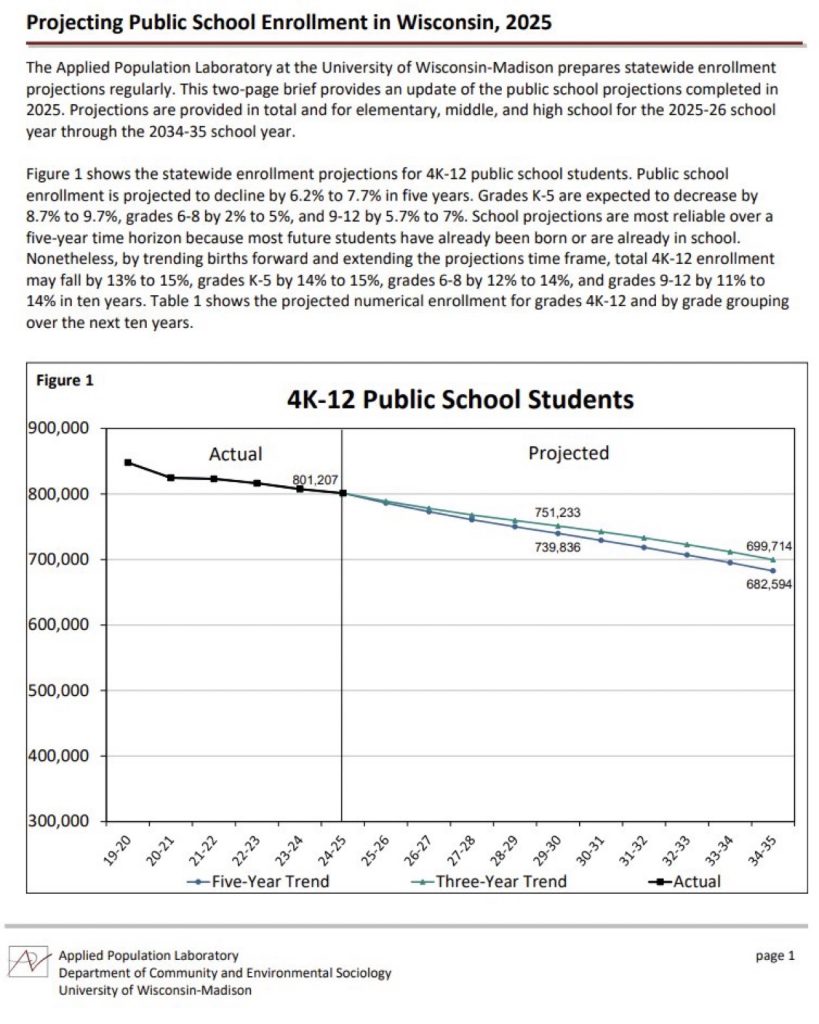
NCES projects total school enrollment to drop by 4 million in just 6 years

Daniel Buck:

Birth rate dropped again to 1.6 births per woman across a lifetime

NCES projects total school enrollment to drop by 4 million in just 6 years

When I tell you that mass school closures and layoffs are coming.

I’m telling you. School closures and layoffs are coming.

——-

Interestingly, Madison taxpayers recently funded new buildings amidst stagnant enrollment.

And:

Madison’s population is growing rapidly, but its schools are not keeping pace.

Share

“Over that period, (Madison) the district has lost a net total of 13,005 students.”

Chris Rickert:

In Christman’s case, the reasons were “affordability and convenience.”

Eliza’s “day care, 4K program and future after-school care are significantly less expensive in McFarland,” she said. “Since she was already attending day care there, it made the most logistical and financial sense for our family to continue with McFarland moving forward.”

Eliza has never attended Madison schools, so the decision to opt for McFarland “wasn’t based on dissatisfaction with Madison,” Christman said, “but rather on the practical benefits McFarland offered in terms of child care cost and ease of transition.”

In Morris’ case, it was dissatisfaction with Madison — both the schools and the high property taxes.

She recalled one incident in which there was a disruptive student in her now-12-year-old’s class and, instead of simply removing the student from the classroom, her child and the rest of the students in the classroom were removed so that the disruptive student’s needs could be addressed.

She also was not a fan of some of the district’s COVID-19 protocols, such as requiring students to wear masks while outside. She thought that the academics at Memorial High School could have been more rigorous, although she acknowledged that she doesn’t have a basis of comparison yet as her two youngest children haven’t entered high school in Verona.

She emphasized that her criticisms were not of teachers, but of some of the policies they were forced to work under.

“And just the amount of money that the community has been putting into these schools, and not sure where the money’s going,” she said. “It’s a combination of those things.”

——-

Where have all the students gone? Commentary.

——-

Madison taxpayers have long supported far above average (now > $25,000 per student) K-12 tax & spending practices. This, despite long term, disastrous reading results. 

Madison Schools: More $, No Accountability

The taxpayer funded Madison School District long used Reading Recovery

The data clearly indicate that being able to read is not a requirement for graduation at (Madison) East, especially if you are black or Hispanic”

My Question to Wisconsin Governor Tony Evers on Teacher Mulligans and our Disastrous Reading Results

2017: West High Reading Interventionist Teacher’s Remarks to the School Board on Madison’s Disastrous Reading Results 

Madison’s taxpayer supported K-12 school district, despite spending far more than most, has long tolerated disastrous reading results.

“An emphasis on adult employment”

Wisconsin Public Policy Forum Madison School District Report[PDF]

WEAC: $1.57 million for Four Wisconsin Senators

Friday Afternoon Veto: Governor Evers Rejects AB446/SB454; an effort to address our long term, disastrous reading results

Booked, but can’t read (Madison): functional literacy, National citizenship and the new face of Dred Scott in the age of mass incarceration.

When A Stands for Average: Students at the UW-Madison School of Education Receive Sky-High Grades. How Smart is That?
Share

Michigan spent big to fix schools. The result: Worse scores and plenty of blame

Ron French, Mike Wilkinson & Isabel Lohman:

  • In 10 years, Michigan boosted K-12 education spending more than 41 states
  • The result: More staffers and worse test scores. ‘We invest more per pupil than most states and achieve bottom 10 results’
  • There’s plenty of blame, and one consensus: Michigan needs a wake-up call to fix crisis

Frustrated by declining academic performance in state schools, education leaders in 2015 announced an audacious goal: make Michigan a top 10 education state by 2025.

“If 10 years from now we’re not a top 10 performing state, then shame on all of us,” said then-State Superintendent Brian Whiston. 

Share

Ed Feulner

Wall Street Journal:

In 1973 Ed Feulner and his friend Paul Weyrichco-founded the Heritage Foundation, the think tank that nurtured and spread many of the policies that informed the Reagan Administration. Its “Mandate for Leadership” policy compendium in 1980 became a guide for the Reaganauts out to change Washington. 

Under Feulner, the think tank also became known for short, fast policy summaries delivered to Members of Congress and staff in anticipation of votes. Turnover on Capitol Hill is rapid, and Heritage’s missives were influential guides to policies developed on the right over many years.

Like many Reagan-era conservatives, Feulner believed in a coalition built on the three-legged stool of free markets and a smaller government, strong national defense, and traditional views on social policy. He welcomed all factions of what was once called the “conservative movement,” from libertarians to Russell Kirk traditionalists to neocons. 

For many years, the Journal worked with Heritage on the annual Index of Economic Freedom. The volume ranked countries around the world on various measures of economic liberty. Feulner was notable for believing in a strong U.S. presence in the world, and he was especially close to leaders in Taiwan and South Korea. As recently as the mid-2000s we can recall a delegation of Heritage scholars making the case to us that U.S. defense spending should be 5% of gross domestic product. Today it’s closer to 3%, and heading lower under President Trump.

Born outside Chicago in a German-American Catholic family, Feulner attended Regis College in Denver where he discovered conservative ideas. Barry Goldwater was an early political influence. “You have to choose between liberty and equality,” Feulner told John Miller of National Review. “I picked liberty.” Each year he published an essay by thinkers who defined conservative principles.

Share

What happens when education becomes ideology?

Sergio Martinez:

In the mid-20th century, schools in communist countries were tools of the state. History lessons became hagiographies of the Soviet Union. Math examples were drawn from military production. Even literature bowed to Marxist dogma. But what did all this ideological schooling do to the people who lived through it?

Two new studies—one from Finland, the otherfrom Poland—suggest the answer: indoctrination works. Not by making people less intelligent, but by shaping their values, ambitions, and sense of agency. Decades later, it still haunts their lives.

A Tale of Two Experiments

In 1973, 221 fifth-grade students in Pirkkala, Finland, became part of a quiet experiment. Their curriculum was rewritten to reflect Marxist-Leninist ideology. Capitalism was depicted as oppression, the Soviet Union as a moral compass, and the free market as a source of inequality.

Researchers compared them to a control group of students who received standard education. They tracked these individuals over decades, analyzing data on taxable income, months worked, job choices, educational attainment, and cognitive ability.

The study found that the students exposed to the special curriculum earned roughly 10% less as adults. This wasn’t due to differences in education or intelligence, but because they made different career choices: public-sector jobs, artistic paths, and professions that aligned with values they had been taught early on—solidarity over self-interest, ideology over income.

A similar pattern emerges from Poland, where a 1954 nationwide reform quietly removed political indoctrination from school curricula. Researchers Costa-Font, García-Hombrados, and Nicińska studied what happened next. Their natural experiment exploited school enrollment cut-off dates to compare students just slightly more or less exposed to the old Stalinist education. This included removing content explicitly praising the importance of obedience to the Soviet regime and adherence to Marxist-Leninist values, along with Stalin-themed recitation competitions.

Students who experienced one fewer year of Marxist-Leninist schooling were more likely to complete high school and college. Decades later, they were also more likely to be employed. When you stop rewarding obedience and start rewarding merit, students begin to believe that their choices matter. Ambition wakes up.

Share

Notes on Quality

Daniel Soufi:

There’s one conclusion that comes up repeatedly throughout this report: the perception that everything is of lower quality is more pronounced among older people. The reasons are varied. One is that attributes like durability — which used to be a major factor in how people judged a product’s quality — have lost relevance.

Psychologist Albert Vinyals, author of El consumidor tarado (The Disordered Consumer) (2019), recalls that years ago, the first thing car ads highlighted was their longevity. “Now we don’t even consider it,” he notes over the phone. “My grandmother, when she went to buy clothes, looked at the type of fabric they were made of. Now, no one knows what their pants are made of. Why would they? In a year, we’ll stop wearing them because they’ll no longer be fashionable.”

Share

Chatbots in the classroom

Cristina Criddle and Andrew Jack:

More than a quarter of prompts by college-age users in the US put into ChatGPT, the world’s most popular large language model (LLM), are for educational purposes, according to internal research from OpenAI, the product’s maker.

Chatbots can be a helpful research tool. But some students are using the technology to do their work for them, educators say. Plagiarism is one of the top concerns raised in a survey of members of the Digital Education Council, a global network of universities. Other issues were ethical concerns, the devaluation of degrees and the complexity of integrating AI into existing data and tech systems.

Some students are also becoming more crafty, using complementary software such as word spinners — which change the order, or nature, of words — to help them evade plagiarism or AI detectors.

Share

“almost no one fully reads anything in those environments”

Steven Sinofsky:

Now imagine when even the author hasn’t read what was written… yikes. How does AI writing and reading impact this reality?

I used to write long memos—significant ones—maybe once a year. I’d send them to thousands. That scale alone signals, “someone else will read it.” I hoped direct reports and close colleagues would read them. I could count on 2 or 3 people to definitely read them.

Bill would read. Steve would read—but only if we discussed it in person, because that’s how he worked.

I knew this, so I always made a slide version. I’d use it in dozens of team meetings. But even then, for months after sending a memo, I’d be referring members of the team back to what was in it. Could I have done better, of course. I did the best I could at the time. I figured once a year people could read 20-30 pages for their job.

People want context. They want the big ideas. But getting an organization—of any size—to actually read is almost impossible.

The only reliable thing people read? Org memos. And even then, if one (as I often did) didn’t include an org chart picture—rather than just words—people would skim or skip and wait for (hopefully) a tree graph in the email.

And these were from the “big boss,” sending out “big strategy.” So if you think folks in big orgs are reading 40-page PRDs, budget plans, new product proposals, or deal docs deeply and regularly… you’re probably kidding yourself. I know how the Amazon process has evolved from friends there. It too is breaking down which is a bummer as I am a huge fan of that.

Now enter AI. What happens when it’s doing the writing—and not even the author has deep knowledge of what was written?

That’s like a compiled or multiple author memo no one ever actually read end-to-end.

And if people are asking AI to summarize—but the summary is lossy or invents data—what then?

I say all this as part of the “TV” and later “MTV” generation. Back then, we were told that fast-paced, cut-cut-cut media made us incapable of absorbing anything. Meh…ok boomer, I know you can’t follow the plot of “24” but that’s your problem not mine.

So maybe this is just old man yelling at cloud. But for me? My entire career has been defined by the reality that people in business don’t really read.

——-

Madison taxpayers have long supported far above average (now > $25,000 per student) K-12 tax & spending practices. This, despite long term, disastrous reading results. 

Madison Schools: More $, No Accountability

The taxpayer funded Madison School District long used Reading Recovery

The data clearly indicate that being able to read is not a requirement for graduation at (Madison) East, especially if you are black or Hispanic”

My Question to Wisconsin Governor Tony Evers on Teacher Mulligans and our Disastrous Reading Results

2017: West High Reading Interventionist Teacher’s Remarks to the School Board on Madison’s Disastrous Reading Results 

Madison’s taxpayer supported K-12 school district, despite spending far more than most, has long tolerated disastrous reading results.

“An emphasis on adult employment”

Wisconsin Public Policy Forum Madison School District Report[PDF]

WEAC: $1.57 million for Four Wisconsin Senators

Friday Afternoon Veto: Governor Evers Rejects AB446/SB454; an effort to address our long term, disastrous reading results

Booked, but can’t read (Madison): functional literacy, National citizenship and the new face of Dred Scott in the age of mass incarceration.

When A Stands for Average: Students at the UW-Madison School of Education Receive Sky-High Grades. How Smart is That?
Share

civics: notes on taxpayer funded grocery store outcomes

Ann Althouse summary:

“Sales [at the city-owned grocery store] were okay at first, but after the pandemic, crime rose and sales began to plummet.”

“Police data show assaults, robberies and shoplifting in the immediate vicinity have been on an upward trend since 2020…. At a community meeting last year, Pierson played videos of security incidents so graphic he gave a warning in advance — a naked woman parading through the store throwing bags of chips to the ground, another person urinating in the vestibule and a couple fornicating on the lawn of the library in broad daylight…. [P]olice Maj. Chris Young said that even an ‘overwhelming presence’ of officers in recent months didn’t significantly decrease incidents…. Part of the problem is the city’s lack of a jail, Young said. The left-leaning council closed the previous facility in 2009 as a cost-saving measure… and so people arrested for minor crimes are quickly released… and head back to the same location, Young said. ‘We typically have the same group of offenders every week that are recognizable by face and by name, just loitering and hanging out,’ he said. ‘A small percentage of people are ruining it for the rest of the community that deserves to go to their grocery store and their library.'”

Share

Life Lessons From My Teenage Son

Katie Roiphe:

My teenager, on the other hand, is very Zen at the airport. He raises his eyebrows at my excessive worrying. I can suddenly see myself through his eyes, needlessly anxious, absurdly concerned with trivial and fabricated timelines, expending unnecessary energy on pointless things.

His way of moving through the airport seems preferable, wearing headphones, gliding indifferently, even if there is the slightest chance that, left to his own devices, he would miss a flight.

My son has perfected that look of pure contempt that may be familiar to parents of teens. The recipient of this look, which I think may exclusively be me, has no real choice but to wither obligingly into nothingness. This look often comes because I have said something mean about someone or gossiped in an unkind but maybe funny way.

I do think that my son will probably become more tolerant, more forgiving of my character flaws, when he is older, but maybe I could borrow a little of that excessive moral clarity and disapproval teenagers are known for.

Share

Why “John” Became a Popular Name

Cliopatria

Jack Malvern, in the London Times (March 11, 2004):
JOHN may no longer be the name of choice for today’s new parents, who seem to prefer Jack or Alfie, but 800 years ago baby boys were unlikely to be called anything else.

Fresh research into naming patterns in the Middle Ages shows that 35 per cent of men in 1377 were called John. The dominance of a handful of names was so strong that more than half of men and boys were named John or William. A further quarter was divided between Thomas, Richard and Robert.

The supremacy of John persisted for centuries. He was knocked from the top spot by William only in the 19th century. The pattern emerged when George Redmonds, a historian from Huddersfield , combed through lists of men, women and children registered to pay the poll tax, the national tax that was so rigorously enforced that it caused the Peasants’ Revolt in 1381.

Share

k-12 tax & $ pending climate: Chicago Pensions

Conor Durkin:

An overview of 2024

As a recap of our starting point: as of the end of 2023 (e.g. last year’s numbers), the combined four pension systems (Police, Fire, Labor, and Municipal Workers) stood at 23.0% funded, with $11.12 billion in assets against $48.32 billion in liabilities (a net unfunded liability of $37.2 billion). My expectation last year was that the net unfunded liability would actually climb in the near-term, even as our funded rates climb, given the latest actuarial reports for the four funds.3

Here’s what actually happened, from the city’s 2024Annual Comprehensive Financial Report:

One thing I think worth highlighting here is just how explicitly we’re paying for the mistakes of earlier administrations (mostly Daley) not fully funding pensions. We can put a dollar number on this. The four pension funds’ annual reports break out the ‘normal cost,’ which is the amount that our liability increased from active employees accruing another year of benefits. You can think of this as what the city would have to contribute if we had no unfunded liability. For the coming year, our total normal cost across the four funds is around $438 million. Because we’re tremendously underfunded, the city instead is statutorily required to pay roughly $2.6 billion into the funds. That extra $2.2 billion is the cost we’re incurring for the underfunding of the past.

Share

Greek and Latin Texts with Facing Vocabulary and Commentary

Geoffrey Steadman:

College Vergil 2nd ed. (2025) has just been published in paperback and hardcover and is available in pdf on this website. College Pliny and Vergil (2023) is available in paperback, hardcover and as a pdf on this website. Both books are offered as a separate series for the 2025-26 AP Latin syllabus.

Share

Police Parent Surveillance

Mass Daily News

Thanks to a controversial, taxpayer-funded police training program rolling out statewide in 2025, police officers across Massachusetts are being trained to view concerned parents as potential extremists. The training is developed and delivered by the Municipal Police Training Committee (MPTC), the state agency responsible for setting standards and providing training for municipal, MBTA, environmental, UMass, campus police officers, and deputy sheriffs performing police duties.

The curriculum relies heavily on the Southern Poverty Law Center’s (SPLC) controversial “hate map,” widely criticized for broad and politicized designations.

Enter Moms for Liberty, a grassroots parental advocacy group that’s now officially “extremist” enough to merit police suspicion. Known for protesting school policies such as teaching first graders that boys can be girls, Moms for Liberty has rallied against what it views as overreach in education on topics like gender ideology and race curriculum. Despite no evidence of criminal activity, just voicing concerns about these issues is enough to get flagged.

Political commentator Mike Urban, known for cutting through the noise with sharp insight, recently dropped a bombshell video exposing the full scope of this training. In “What Massachusetts Police are Being Taught Will SHOCK You,” Urban reveals how Massachusetts Democrats are quietly funding a program that surveils citizens for their political views — all under the banner of “hate crime” prevention.

Share

“This, she acknowledges, means creating “a lot of rules in an environment where we’re all used to lots of freedom.””

John Sailer:

Earlier this year, Deborah Loewenberg Ball, a former University of Michigan dean, described how administrators can and should be “more forceful” in executing on diversity hiring goals.

What she describes is basically a clever and very effective assertion of power:

—Most importantly, she says, search committees just won’t move forward until they “bring back a pool that looks decent.”

—”You had to be very strictly rule-bound and create a bunch of very strict rules about what it would take to carry out a search. Who can be on the committee, what the charge looks like, what the description looks like, how you search.”

Share

civics: Taxpayer funded Government and media shaping

Glenn Greenwald

Yes, Claire Danes tried to explain on Colbert’s show — after he asked her about all the CIA/intel people she talks to for her role in “Homeland” – that CIA became aligned and “allied” with the corporate media in 2016 against Trump — and Colbert talked over her and cut her off:

Share

An Examination of the Social Code

Arnold Kling:

I am trying to come up with exam questions that can test how well someone has absorbed key concepts from The Social Code. The exam will be in the form of a conversation with the AI professor. The feedback that the user will receive will be qualitative. It will be based on how correctly they employ the concepts and avoid basic misunderstanding.

I could be wrong, but I think that the goals for this type of seminar are less measurable than those for, say, a course in algebra or anatomy. I am trying to offer students models of the world, and those models are themselves imperfect. 

When we teach economics, we often say that our goal is for students to be able to “think like an economist.” We might test for that by giving out problems involving supply and demand diagrams, but students can pass those and still not apply economic thinking to real-world policy questions.

One way to approach coming up with the exam for the seminar is to ask: what do I hope that a student who has sat through the seminar does not believe? 

The top misconceptions I hope to have steered someone away from are:

Share

Notes on bilingual skills

The Economist:

The biggest benefits seem to come to those who master their second languages fully. That in turn is usually because they speak the two as natives, or at least have spoken them on a near-daily basis for a long time. A bit of university French does not, unfortunately, convey the same advantages as deep knowledge and long experience. Switching languages frequently in the course of a day (or conversation) may be particularly important. Studies of interpreters and translators have provided some of the strongest evidence for a bilingual advantage. For example, they are faster at repeatedly jumping back and forth between simple addition and subtraction problems than monolinguals, suggesting generally better cognitive control.
But elsewhere is “a forest of confounding variables”, says Mark Antoniou of Western Sydney University. Bilinguals are not like monolinguals in lots of ways. The child of diplomats, raised in a foreign language abroad, may have cognitive and educational advantages that have nothing to do with bilingualism. At the other end of the socioeconomic ladder, though, studies have found striking evidence that in poorer parts of the world multilingual people show the strongest advantages from speaking several languages. Where schooling is scant, researchers surmise that bilingualism exercises children’s brains in a way that their schooling may not.

Share

Harvard considers an effort to ‘support viewpoint diversity’ with potential donors

Douglas Belkin, Juliet Chung, Emily Glazer and Natalie Andrews:

A 2024 survey by Harvard found that only one-third of the college’s graduating class felt comfortable discussing controversial topics, and a 2023 survey by the student newspaper found that just 3% of faculty at Harvard College identified as politically conservative.

Harvard President Alan Garber helped promote an “intellectual vitality” program to reinvigorate debate on campus and ensure students engage in discussions free of self-censorship.

Garber faces a delicate challenge in squaring off against President Trump: Any changes the university makes that could be perceived as bowing to the president would face blowback by large groups of faculty, alumni and students, but Trump has many levers to pull to inflict damage on the school.

Share

Elite universities ought to be promoting free markets and pro-American, pro-Western views

Naveen Nvn:

Around 2018-19ish, I was pushed into a centrist stance because I was appalled by wokeness, especially on campuses. I was in graduate school in the US at that time. Although I didn’t experience wokeness advocacy in the classroom except two or three incidents, I saw signs of wokeness on campus a lot. But even then, I was quite libertarian on how universities ought to handle campus politics.

I picked up God and Man at Yale around this time because wokeness was my primary concern.

I’ve always known that conservatives love that book. I assumed it would be a defense of free inquiry and against universities having a preferred ideology.

However, to my surprise, in the book, he argued explicitly that Yale was neglecting its true mission and it should uphold its “foundational values,” as he put it. I assumed he would be promoting a libertarian outlook on campus politics, but he was arguing the opposite.

He said Yale and other elite universities should incorporate free markets and traditional perspectives directly into the curriculum because they are betraying a contract that the current alumni and the administration have with the founders of the universities. It was a pretty shocking advocacy of conservatism being imposed on the students, and I didn’t like that at all.

But later on, around 2020-ish, I became a conservative (thanks to you; more on that in the link below). But even as late as early 2023, I still held a libertarian view on academic freedom and campus politics.

(You may be interested in a comment I left on your ‘Why Young People Are Socialist’ post yesterday, in which I shared how I was once a liberal, then turned centrist, and how I finally turned conservative. You are a major influence.)

Share

K-12 Tax & $pending Climate: Federal Debt

Stacey Vanek Smith:

People have been worrying about U.S. debt basically ever since there even was a U.S. “The accumulation of debts is a most fearful evil,” Thomas Jefferson wrote in 1787. At the time, U.S. debt was around $40 million. Today, it’s closer to $40 trillion. At the same time, the U.S. economy is bigger and more powerful than Jefferson could have ever imagined, and things are looking pretty good: unemployment is near record lows, inflation is under control… so what’s the problem?

“Part of the problem is it’s been this kind of ‘boy who cries wolf’ type thing, and people just get tired of it,” says Kent Smetters, an economist at Wharton, who has been crying wolf about the debt for years. He started to wonder: What exactly happens if the U.S. just doesn’t deal with its debt? He got a few economists and mathematicians together to build a computer model of the economy to play out scenarios. 

They made a model of the entire U.S. economy, which required a lot of computing power. “This math problem was a big one,” Smetters said. “And the model computations are about 20,000 times bigger than our standard model.”

Share

civics: 40 years of one party rule

Brian Heywood:

Watch the video below it is excellent

Sound Transit by the numbers
5300 -dougless firs cut down in one year for the light rail
8600- trees cut down the next
$5billion – current dollars over budget
11 – current projected years behind schedule
$80 -charge per $10,000 of value for your $30 car tabs

40 years of one party rule

No seriously this video is really well done and needs to be shared far and wide

Share

K-12 $pending and outcomes

Geiger Capital:

It’s because of the Teachers Unions.

We spend more money on education per student than almost every developed country in the world, yet 40% of US fourth graders read below “basic” understanding level.

In other words… they can’t read.
Data is even worse in Democrat states.

Share

Rethinking Education School Content

Daniel Buck:

Rather than banning “controversial topics” in K12 schools and playing whack-a-mole, one conservative governor needs to pass a similar bill regarding teacher prep programs

Make an example of the state’s flagship school of education.

Get the syllabi, cut out rhetoric Marxist gobblygook, and replace it with actual practical teacher prep

Would do way more good for American schools

——-

Madison taxpayers have long supported far above average (now > $25,000 per student) K-12 tax & spending practices. This, despite long term, disastrous reading results. 

Madison Schools: More $, No Accountability

The taxpayer funded Madison School District long used Reading Recovery

The data clearly indicate that being able to read is not a requirement for graduation at (Madison) East, especially if you are black or Hispanic”

My Question to Wisconsin Governor Tony Evers on Teacher Mulligans and our Disastrous Reading Results

2017: West High Reading Interventionist Teacher’s Remarks to the School Board on Madison’s Disastrous Reading Results 

Madison’s taxpayer supported K-12 school district, despite spending far more than most, has long tolerated disastrous reading results.

“An emphasis on adult employment”

Wisconsin Public Policy Forum Madison School District Report[PDF]

WEAC: $1.57 million for Four Wisconsin Senators

Friday Afternoon Veto: Governor Evers Rejects AB446/SB454; an effort to address our long term, disastrous reading results

Booked, but can’t read (Madison): functional literacy, National citizenship and the new face of Dred Scott in the age of mass incarceration.

When A Stands for Average: Students at the UW-Madison School of Education Receive Sky-High Grades. How Smart is That?
Share

Which languages take the longest to learn?

The Economist

HE DIFFICULTY in learning a foreign language lies not only in its inherent complexity. Languages are complex in different ways (though all are learnable by infants). The main reason a language is hard is that it is different from your own.

America’s State Department places the languages it teaches diplomats into four categories (see chart), with estimates of how long they take to learn them ranging from 24 to 88 weeks. What underlies the difficulty of such languages for an English-speaker?

Share

Seeking the world’s loveliest language

The Economist:

That is until three scholars—Andrey Anikin, Nikolay Aseyev and Niklas Erben Johansson—published their study of 228 languages last year*. They hit upon the idea of using an online film about the life of Jesus, which its promoters have recorded in hundreds of languages. Crucially, most recordings had at least five different speakers, as the film has both exposition and dialogue. The team recruited 820 people from three different language groups—Chinese, English and Semitic (Arabic, Hebrew and Maltese speakers)—to listen to clips and rate the languages’ attractiveness.

What they found was that nearly all the 228 languages were rated strikingly similarly—when certain factors were controlled for (of which more below). On a scale of 1 to 100, all fell between 37 and 43, and most in a bulge between 39 and 42 (see chart 1). The highest-rated? Despite the supposed allure (at least among Anglophones) of French and Italian, it was Tok Pisin, an English creole spoken in Papua New Guinea. The lowest? Chechen. The three language groups broadly coincided in their preferences. But the differences between the best and worst-rated languages were so slight—and the variation among individual raters so great—that no one should be tempted to crown Tok Pisin the world’s prettiest language with any authority.

Share

Commentary on “ai” and students

Meghan O’Rourke

Ensnaring students is not a long-term solution to the challenge A.I. poses to the humanities. This summer, educators and administrators need to reckon with what generative A.I. is doing to the classroom and to human expression. We need a coherent approach grounded in understanding how the technology works, where it is going and what it will be used for. As a teacher of creative writing, I set out to understand what A.I. could do for students, but also what it might mean for writing itself. My conversations with A.I. showcased its seductive cocktail of affirmation, perceptiveness, solicitousness and duplicity — and brought home how complicated this new era will be.

In the evenings, in spare moments, I began to test its powers. When it came to critical or creative writing, the results were erratic (though often good). It sometimes hallucinated: When I asked ChatGPT how Montaigne defined the essay form, it gave me one useful quote and invented two others. But it was excellent at producing responses to assigned reading. A short personal essay in the style of David Foster Wallace about surviving a heat wave in Paris would have passed as strong undergraduate work, though the zanier metaphors made no sense. When I challenged it to generate a poem in the style of Elizabeth Bishop, it fumbled the sestina form, apologized when I pointed that out, then failed again while announcing its success.

Share

Civics: Madison Alders Exempt a vote from a successful 1992 referendum

Esther Lauenstein:

Ald. Tag Evers said that he had heard of no opposition to the project expressed at any of the public meetings on the project. He suggested the emails he and other alders received over the last couple of days urging a referendum on the project might be reflective of the current political environment — the “concern that our democracy is being taken away from us.”

Evers also noted that much of the master plan for the project — which includes a park over John Nolen Drive from East Wilson Street and a dock and overlook near Olin Park affording a view of Madison’s skyline — cannot be built without a significant private donor stepping up. Ald. Julia Matthews noted that issue in urging her colleagues to vote for Verveer’s amendment. “This exemption would put a lot of confidence into the project,” she said.

Ald. Davy Mayer tried to refer the amended ordinance to a future meeting, but that motion failed 16-4.

Alds. Bill Tishler, Davy Mayer and Barbara Harrington-McKinney voted against the exemption.

Share

Wisconsin lawyers guild agrees to strike race and gender from applications

Wall Street Journal:

WILL also noted that the state bar’s inclusion of DEI programming violated the First Amendment because it amounted to compelled speech. Membership in the Wisconsin bar is mandatory, and all practicing state lawyers are required to pay dues. When the bar in turn spends money to support diversity programs, the fee structure forces members to fund a program some dislike.

Other cases across the country are challenging bar association programs on the same grounds. In April the American Alliance for Equal Rights filed a complaint in federal court in Illinois that the American Bar Association’s 25-year-old Legal Opportunity Scholarship illegally discriminates by race.

The problem with the program, the complaint says, is that “any incoming law student can apply—so long as their skin isn’t white.” The American Alliance for Equal Rights is led by Edward Blum, who brought the Students for Fair Admissions case against Harvard.

WILL has also filed a complaint against the American Bar Association under Title VI of the 1964 Civil Rights Act. It charged that the ABA “runs at least nine racially discriminatory programs,” including diversity clerkships. An Equal Employment Opportunity Commission charge is also pending.

Share

Defending ‘democracy against Trump’s embrace of fascism by using the term in NEA materials’ will ‘cost an additional $3,500.’

Wall Street Journal:

NEA will not use, endorse, or publicize any materials from the Anti-Defamation League (ADL), such as its curricular materials or its statistics. NEA will not participate in ADL programs or publicize ADL professional development offerings.

Cost Implications: This item cannot be accomplished with current staff and resources under the 2025-26 Modified Strategic Plan and Budget. It would cost an additional $1,625. . . .

NEA pledges to defend democracy against Trump’s embrace of fascism by using the term facism [sic] in NEA materials to correctly characterize Donald Trump’s program and actions.

The members and material resources of NEA must be committed to the defense of the democratic and educational conditions required by our hopes for a just society and the survival of civilization itself by stating the truth.

Share

Easy Application of Interleaving in the Classroom

Blake Harvard:

In more practical terms, blocking practice means asking a group of questions about a specific topic from class before moving on to questions about another topic in class. So, if I blocked my questions on the material covered in my class yesterday, I would first pose questions about Gestalt principles of perception (A) before asking about binocular and monocular depth cues (B) and then finish up with questions about schemas, assimilation, and accommodation (C). This is a very popular method for reviewing topics in class, on homework, or via some form of study guide. I use it often in my classes. 

Interleaving practice says to split those topics up and ask a question or two about one topic before questioning about another topic and maybe another. Then return to the original concept and ask about it again before moving on to the other material again. While this may seem a little counterintuitive and will probably be a bit more cognitively challenging for students, there is evidence that it produces better learning outcomes long-term. 

In the current study, 155 9th-12th grade students were given end of week practice quizzes for 4 weeks. Concepts would be assigned to a practice or non-practice condition. The information in the non-practice condition would not appear on any end of week quiz and only appeared on the final test one month after the final quiz. The information assigned to the practice condition would either be quizzed via blocked or interleaved questioning. This would alternate from week to week, meaning students would take two end of week quizzes that utilized blocked questioning and two that would utilize interleaved questioning. 

One month after the final quiz, students were given a final test composed of questions from the blocked quizzes, questions from the interleaved quizzes, and questions from material assigned to the non-practice condition.

Share

the state of higher education literacy

Aaron Gwyn:

I’ve been an English professor at UNC for the past twenty-two years and I can assure you that what Athenian Stranger is saying here is absolutely true. Student literacy has gotten especially bad over the past five years

——

Madison taxpayers have long supported far above average (now > $25,000 per student) K-12 tax & spending practices. This, despite long term, disastrous reading results. 

Madison Schools: More $, No Accountability

The taxpayer funded Madison School District long used Reading Recovery

The data clearly indicate that being able to read is not a requirement for graduation at (Madison) East, especially if you are black or Hispanic”

My Question to Wisconsin Governor Tony Evers on Teacher Mulligans and our Disastrous Reading Results

2017: West High Reading Interventionist Teacher’s Remarks to the School Board on Madison’s Disastrous Reading Results 

Madison’s taxpayer supported K-12 school district, despite spending far more than most, has long tolerated disastrous reading results.

“An emphasis on adult employment”

Wisconsin Public Policy Forum Madison School District Report[PDF]

WEAC: $1.57 million for Four Wisconsin Senators

Friday Afternoon Veto: Governor Evers Rejects AB446/SB454; an effort to address our long term, disastrous reading results

Booked, but can’t read (Madison): functional literacy, National citizenship and the new face of Dred Scott in the age of mass incarceration.

When A Stands for Average: Students at the UW-Madison School of Education Receive Sky-High Grades. How Smart is That?
Share

School leader blasts academics for ‘bizarre’ and ‘patronising’ AERO criticism

Sarah Duggan:

Australian academics and teacher educators have recently taken aim at the government-funded organisation in articles published on the AARE blog, arguing AERO is fundamentally harming teachers’ autonomy and being used by governments to push a ‘neoliberal’ agenda in classrooms.

Dr Greg Ashman, author and deputy principal at Ballarat Clarendon College in Victoria, says he’s in no way surprised that education academics are so vocally opposed to AERO and the work it does.

The organisation wouldn’t be needed if these commentators were doing their job properly, he contends.

“AERO has kind of eaten their lunch, in the sense that it’s doing what they should be doing, which is providing practical advice to teachers.

“That’s something that they’ve … failed to do over many years.

“That’s not unique to Australia, that’s education academics across the world, really.”

Share

For the first time, students at the Twin Cities campus will be charged $200 annually to support student athletes

Erin Adler:

University of Minnesota students will pay a new $200 athletics fee this year even if they never don a Gophers football helmet or attend a single game.

The Twin Cities campus for the first time has added a $100-per-semester fee to offset the substantial price for paying student athletes to play on Gophers teams. Even so, the athletics budget is $8.75 million short, though U officials said they’re hopeful they can close the gap.

The new fees are drawing ire from student government leaders and come at the same time as a significant tuition increase of 6.5% for in-state undergraduates and 7.5% increase for out-of-state undergraduates this fall.

Riley Hetland and Ethan Fiegel, the president and vice president of the U’s Undergraduate Student Government, said in a statement that “while we acknowledge that student-athletes deserve fair compensation for the amazing work they do, Gopher Athletics already generates revenue from students through voluntary contributions in the form of tickets and merchandise sales.”

“Students should not be forced to pay an additional fee on top of this,” they said. 

Mark Coyle, the U’s athletic director, said in an interview this week that the fee is not uncommon and will help maintain athletic facilities used by the student body.

Share

Data on How America Sold Out its Computer Science Graduates

Kevin Lynn:

In 2023, American colleges graduated 134,153 citizens or green card holders with bachelor’s or master’s degrees in computer science. That same year, our federal government handed out work permits to at least 110,098 foreign workers in computer occupations through just three major guest worker programs. That’s equal to 82% of our graduating class who are guaranteed jobs even before any Americans walk across the stage for their diploma.

…..

The H-1B visa program has exploded from 363,503 workers in 2011 to 685,117 in 2022—an 81% increase. Between 60% and 70% of these visas go to workers in computer occupations, directly taking entry-level positions from American graduates.

But H-1B is just the beginning. The STEM Optional Practical Training program allows international students to work for up to three years after graduation, with 30% of participants being computer science majors. Employers receive a 15% discount for every STEM OPT they hire because they don’t have to pay Social Security or Medicare taxes, while government labor protection or oversight is minimal. Meanwhile, the H-4 EAD program gives work permits to spouses of H-1B workers, who can work any job at any wage, with 63.75% working in computer science fields.

These aren’t random policy decisions—they’re deliberate choices to prioritize foreign workers over American students. We’re literally training our own replacements and calling it progress.

Share

“AI, it strikes me, applies the Gates model to the entirety of culture”

Nicholas Carr:

 Let writers and musicians and artists do the hard work of actually creating the original artifacts of culture. Then have the machine flood the market with low-cost copies, with cheap derivatives. I did some searching to see if Houellebecq had made any recent pronouncements about AI. I couldn’t find anything. So, for the hell of it, I asked Claude, Anthropic’s chatbot, what Houellebecq might say about AI. Here’s what it came up with:

The machines had finally learned to speak, and predictably, they had nothing interesting to say. Claude, ChatGPT, Bard — these names floating through the digital ether like the brand names of antidepressants, promising relief from the fundamental problem of human existence: the need to think.

I watched my neighbors queuing at the coffee shop, each hunched over their phones, asking artificial intelligences to write their emails, plan their dates, explain their feelings back to them. The barista, a philosophy graduate drowning in student debt, served lattes to people who no longer needed to form coherent thoughts. There was something almost beautiful about this collective surrender to algorithmic mediation, the way a mass suicide might be beautiful if observed from sufficient distance.

Not perfect, but pretty damn good. Maybe the machines do have something interesting to say.

Share

DeepSeek’s models, Alibaba’s Qwen and Chinese start-up Moonshot’s Kimi are ‘the best open reasoning models in the world today’, says Huang

Xinmei Shenin, Coco Fengin and Ben Jiangin

Open source was “extremely powerful” for AI innovation and Chinese firms offer the “best open reasoning models”, Nvidia co-founder and CEO Jensen Huang said in Beijing on Thursday, ahead of the expected resumption of the company’s H20 chip sales to China.

Open source allows not just the contribution of each company but the combined resource of an ecosystem, which is what was “very clever about open source engineering here in China”, Huang said at the China International Supply Chain Expo.

DeepSeek’s models, Alibaba Group Holding’s Qwen and Chinese start-up Moonshot’s Kimi were “the best open reasoning models in the world today,” and were “very advanced”, Huang said during a fireside chat with Wang Jian, founder of Alibaba Cloud, the Chinese e-commerce giant’s AI and cloud unit.

Alibaba owns the South China Morning Post.

———

Madison taxpayers have long supported far above average (now > $25,000 per student) K-12 tax & spending practices. This, despite long term, disastrous reading results. 

Madison Schools: More $, No Accountability

The taxpayer funded Madison School District long used Reading Recovery

The data clearly indicate that being able to read is not a requirement for graduation at (Madison) East, especially if you are black or Hispanic”

My Question to Wisconsin Governor Tony Evers on Teacher Mulligans and our Disastrous Reading Results

2017: West High Reading Interventionist Teacher’s Remarks to the School Board on Madison’s Disastrous Reading Results 

Madison’s taxpayer supported K-12 school district, despite spending far more than most, has long tolerated disastrous reading results.

“An emphasis on adult employment”

Wisconsin Public Policy Forum Madison School District Report[PDF]

WEAC: $1.57 million for Four Wisconsin Senators

Friday Afternoon Veto: Governor Evers Rejects AB446/SB454; an effort to address our long term, disastrous reading results

Booked, but can’t read (Madison): functional literacy, National citizenship and the new face of Dred Scott in the age of mass incarceration.

When A Stands for Average: Students at the UW-Madison School of Education Receive Sky-High Grades. How Smart is That?
Share

Civics: Mapping “elites” around the globe

Yohan:

The US has the oldest economic elite, with a median age of 62.

The UK and France are close to the European average (mid-to-late 50s).

China stands out for having a younger elite with many under 40.

In most countries, business elites are younger than regulators, except in China and Poland where regulators are the older group.

——-

Source:

Our aim is to solve the problem of comparability and heterogeneity in the study of national power structures, and to foster a cooperative community of scholars interested in studying elite populations systematically.

Share

Nearly One-Third of Pregnancies in England End in Abortion

Benjamin Rothove:

The 247,703 recorded abortions in 2022 is a 13.1 percent increase from the 218,923 abortions recorded in 2021. The numbers represent a nearly 50 percent jump in abortions since 2012, when 20.84 percent of conceptions ended in termination.

Most conceptions – 61.7 percent – occurred outside of marriage or civil partnerships. Within marriage or civil partnerships, 11.1 percent of pregnancies end in abortion, compared to 36 percent of pregnancies outside of them.

The dataset did not measure pregnancies that ended in illegal abortions, meaning the numbers could be even higher. It also did not track pregnancies that ended in miscarriages.

Archbishop John Sherrington, Lead Bishop for Life Issues for the Catholic Bishops’ Conference of England and Wales, said in a statement, “We need rapidly to re-establish a culture of life in which the unborn child is properly protected in legislation and in which we also provide compassionate assistance to those parents facing trauma as a result of their pregnancy.”

Abortion statistics released this month by the Department of Health in Ireland showed a similarly dire situation. There were 10,852 abortions in Ireland in 2024, which is an 8.16 percent increase since 2023 and a 62.8 percent increase from 2019. 

That report also showed that 10,711 – nearly 99 percent – of the abortions were not to protect the health of the mother or as a result of a health condition likely to lead to the baby’s death.

Emily E. Davis, political communications director for Susan B. Anthony Pro-Life America, called the data “staggering and heart wrenching.” She continued, “One-third is not just a statistic. It represents a generation that never saw the light of day. When the destruction of unborn life becomes so routine, so normalized, it signals a society that has begun to lose sight of the most basic of human rights.”

——-

Choose life.

Share

The Sputnik vs. Deep Seek Moment: The Answers

Alex Tabarrok:

In The Sputnik vs. DeepSeek Moment I pointed out that the US response to Sputnik was fierce competition. Following Sputnik, we increased funding for education, especially math, science and foreign languages, organizations like ARPA were spun up, federal funding for R&D was increased, immigration rules were loosened, foreign talent was attracted and tariff barriers continued to fall. In contrast, the response to what I called the “DeepSeek” moment has been nearly the opposite. Why did Sputnik spark investment while DeepSeek sparks retrenchment? I examine four explanations from the comments and argue that the rise of zero-sum thinking best fits the data.

Several comments fixated on DeepSeek itself, dismissing it as neither impressive nor threatening. Perhaps but DeepSeek was merely a symbol for China’s broader rise: the world’s largest exporter, manufacturer, electricity producer, and military by headcount. These critiques missed the point.

Share

Civics: Wisconsin State Journal ‘re-reports’ Brayton Lot story after original removed for ‘unauthorized use of AI’

Jason Joyce:

In the original story, headlined “Final piece of the puzzle” in print and “2 redevelopment plans emerge for Downtown Madison’s last vacant block” on madison.com, Korte detailed two proposals for Block 113. Better known as the Brayton Lot, the block bordered by East Washington Avenue and South Hancock, East Main and Butler streets has been targeted for redevelopment by the city for decades.

One section about “The Grove,” a proposal from Neutral, a Madison real estate development firm, outlined plans for a “food hall prioritizing minority-owned vendors” and a “community advisory board” that would shape the development’s public life. Neither of those features, nor the name “The Grove,” appear in Neutral’s proposal linked from a city press release listing the firms that responded to its RFP.

“It’s all wrong,” says Daniel Glaessl, Neutral’s chief product officer. No reporter had contacted the firm about the project before Isthmus reached out on Thursday afternoon, he says.

Share

DEI and medical schools

Maya Goldman:

What they’re saying: The declines are “much larger than we would expect,” even taking the Supreme Court decision into account, Norma Poll-Hunter, senior director of the Association of American Medical Colleges’ human capital portfolio, told Axios.

By the numbers: 11.6% fewer Black students and 10.8% fewer Hispanic students began their first year at an M.D. degree-granting institution this year compared with a year earlier, according to the AAMC.

  • But the schools saw a 2.8% and 2.2% increase in Black and Hispanic applicants, respectively. 
  • The current first-year class of M.D. students is about 51% white, 32% Asian, 11% Hispanic and 9% Black. 
  • American Indian or Alaska Natives and Native Hawaiian students account for less than 1% each. Just over 4% of students identify as from other groups. Students could self-identify as multiple races.

Medical schools saw a nearly 13% increase in new students who identified their race as “other,” and a more than 9% increase in students whose race and ethnicity were unknown.

Share

National propaganda radio finally meets its demise

Matt Taibbi:

Public media can be a great thing, but the current iteration treats America like a foreign country

Is this an argument for or against public funding of NPR? If listeners can make up the shortfall, why don’t we just do that and be done with the controversy? One reason is that the Times is doing what most outlets do in covering this story, skipping the inconvenient detail that NPR derives a significant chunk of its revenue from member stations using public funds to purchase its programs. That’s still a federal subsidy, only less direct, and not as easily made up by “dedicated listeners.” 

More interesting is that while NPR and its supporters mostly recognize the station has a bias issue, they’ve abandoned the idea that this needs fixing. Earlier this year, CEO Katherine Maher tiptoed in the direction of concessions, saying she regretted calling Trump the rare fascist-racist-sociopath trifecta (“a fascist and deranged racist sociopath”) and addressing whistleblower Uri Berliner’s concerns by noting NPR could have covered the Hunter Biden laptop story “more aggressively or sooner.” However, when NPR sued to counter a Trump executive order canceling funding, Maher took a different tone. In a defiant statement, she pointed out that Trump’s Order, “Ending Taxpayer Subsidization of Biased Media,” likely violated the First Amendment on viewpoint discrimination grounds by promising to “cease indirect funding.” In other words, even if NPR is biased, the White House can’t tell member stations not to buy it.

—-

A new poll finds 40% of respondents believe in a baseless conspiracy theory that the coronavirus was created in a lab in China.

There is zero evidence for this. Scientists say the virus was transmitted to humans from another species.

———

I’ve Been at NPR for 25 Years. Here’s How We Lost America’s Trust.

NPR and PBS must face the consequences for their divisive approach to journalism.

On tomorrow’s @AmericaWeek @mtabbi and I examine like anthropologists recordings of real NPR stories. What I learned is that the problem isn’t “bias” so much as incomprehensible levels of politicized self-consciousness about incredibly tiny matters, like “racism” in plant names.

——-

What’s everyone’s favorite ridiculous NPR story?

——

As an indication of Twitter’s tendency to expose people to more news, a simple breakdown of our data shows how a higher proportion of Twitter users (28% of them) accessed seven or more online news sources in the last week, compared to users of other platforms, those who don’t use social media, and the total sample in general. This is perhaps again a reflection of how Twitter has been seen as a destination for news.

Share

Sometimes the best thing to do in school is to get out as soon as you can.

Lillian Tara


I am of the opposite inclination. My experience of the American schooling system was that it harmed my development more than it helped, and the best thing I did for myself was to compress the time I spent in it. This post is a guide for kids who want to do the same.

Looking back, I’ve only ever lived and learned outside the classroom; While I had intimate familiarity with the college admissions game as early as elementary school, by late freshman year of high school I’d lost all motivation to play it. I grew deeply tired of the endless hoop-jumping, and instead began deriving a mischievous kind of pleasure from my ability to wriggle out of and manipulate the academic bureaucracy around me.

So I committed myself to two distinct goals:

  1. Look good on paper (without becoming a slave to it), such that I could separately…
  2. …Live an unusual and illegible life.

To look good on paper while minimizing the schooling burden on myself, I approached my education deliberately, gamed the system, and graduated early. Most people treat school as a conveyor belt operating at a preset pace, but I soon discovered how many of the formal timelines and requirements in school are really suggestions that can be modified and maneuvered out of when they don’t serve your interests. I also witnessed how frequently admin and teachers can obstruct your ambitions with ignorance, apathy, or active hostility—which helped me quickly shed any sense of dependency I had on the structures around me. As a little kid in a big system it’s far too easy to forget that school should work for you as an individual, not the other way around.

Share

“it is also a victory for those of any political stripe who believe the government has no business funding the media”

Uri Berliner:

I didn’t use to count myself among them. But over the past year, under the leadership of a divisive new CEO, instead of taking criticisms of its coverage to heart, NPR instead doubled down on agenda-driven journalism. So, as someone who had spent most of his career at the network, I didn’t support defunding. I instead suggested that NPR could build back credibility by voluntarily giving up federal support. Obviously that didn’t happen.

NPR has said President Donald Trump’s push for defunding is an attack on press freedom and the First Amendment. While defunding is a harsh rebuke to NPR, it’s not fatal. A relatively small portion of its budget—some 5 to 10 percent depending on how you do the math—comes from direct and indirect federal funding. But for small public radio stations that rely more on federal support, the repercussions could be severe. While Republicans cast the votes to defund, NPR also has itself to blame for the outcome.

Share

Commentary on Madison’s k-12 $pending, Governance and Outcome Climate

Neil Heinen:

As with most civic issues today, politics have befouled this one as well. The right side of the aisle has sought political gain by doing everything it can to turn the public away from supporting public schools, demonizing teachers and reducing their political clout, supporting private and charter schools and cutting funding for public schools. The left has stubbornly insisted on a wide array of often-costly social programs that are troubling to many within schools. They’re also resistant to change and blindly support teachers’ unions, the school board candidates they endorse and the seemingly never-ending referenda raising property taxes to offset the aforementioned reduction in state support and lack of budget discipline.

Teachers themselves are stuck in the middle, doing their damnedest to educate our kids. And the public is more confused than ever. So what to make of the gala fundraising bash this month celebrating the 10th anniversary of One City Schools

——-

Notes and links on Neil Heinen.

——-

Madison taxpayers have long supported far above average (now > $25,000 per student) K-12 tax & spending practices. This, despite long term, disastrous reading results. 

Madison Schools: More $, No Accountability

The taxpayer funded Madison School District long used Reading Recovery

The data clearly indicate that being able to read is not a requirement for graduation at (Madison) East, especially if you are black or Hispanic”

My Question to Wisconsin Governor Tony Evers on Teacher Mulligans and our Disastrous Reading Results

2017: West High Reading Interventionist Teacher’s Remarks to the School Board on Madison’s Disastrous Reading Results 

Madison’s taxpayer supported K-12 school district, despite spending far more than most, has long tolerated disastrous reading results.

“An emphasis on adult employment”

Wisconsin Public Policy Forum Madison School District Report[PDF]

WEAC: $1.57 million for Four Wisconsin Senators

Friday Afternoon Veto: Governor Evers Rejects AB446/SB454; an effort to address our long term, disastrous reading results

Booked, but can’t read (Madison): functional literacy, National citizenship and the new face of Dred Scott in the age of mass incarceration.

When A Stands for Average: Students at the UW-Madison School of Education Receive Sky-High Grades. How Smart is That?

Share

Latest “School Dashboard” Shares Comprehensive District Data to Wisconsin Families

Will Flanders, PhD::

The News: WILL released its 2025 School Scorecard Dashboard with new features and data sets to better equip parents, education stakeholders, and taxpayers with insight on how school districts across the state are performing. Over the last several years, WILL’s School Scorecard Dashboard has served as a one-stop-shop for citizens to view Wisconsin school districts’ trends in enrollment, proficiency, district funding, administrative staffing levels, and the like. The user-friendly resource uses information imported from the Department of Public Instruction. Access the dashboard at https://knowmyschoolwi.com/.

WILL is also hosting a webinar to walk through the dashboard and the tools it provides to families across Wisconsin. You can register for that webinar here.

New Features: WILL’s 2025 School Scorecard has been fully revamped with a new look and enhanced functionality. It now includes several new data points and features that allow users to take a deeper dive into district performance, including:

Interactive Map Feature: We developed an interactive map of Wisconsin’s school districts with mouseover functionality, making it easy to compare your district to neighboring areas across key metrics like Math and ELA proficiency, graduation rates, and chronic absenteeism. Future updates will expand the dashboard with additional data and features.

Enrollment by Grade Level: This feature displays district enrollment broken down by grade level, helping identify districts that may face an enrollment cliff in the coming years due to declining student populations.

Chronic Absenteeism: Chronic absenteeism measures the percentage of students who miss 10% or more of the school year. Since the pandemic, absenteeism has risen significantly in Wisconsin school districts—an alarming trend linked to lower academic achievement. The 2025 tracker highlights each district’s absenteeism rate and how it compares statewide.

Disciplinary Incidents by District: This year’s dashboard includes district-level data on disciplinary incidents, offering insight into school climate and student behavior. Safer schools are closely linked to better learning outcomes for all students.

Math and ELA Proficiency: While Math and ELA scores may seem to have improved, the increase is largely the result of the Department of Public Instruction lowering the standard for proficiency—a change WILL has extensively documented. To provide context, this year’s dashboard includes a clear marker indicating when DPI adjusted its benchmarks.

Revenue by School District with Inflation Adjustment Feature: This year’s dashboard features updated revenue data for the 2023–24 school year by district, now with the added option to view figures adjusted for inflation.

The Quote: WILL Research Director, Will Flanders, PhD, stated, “WILL’s School Scorecard Dashboard gives parents, taxpayers, and stakeholders key data on school district performance in areas such as finance, academic performance, absenteeism, and discipline. With this updated tool, Wisconsinites can hold districts accountable and make better informed decisions about education in their communities.”

2025 Key Findings:

Many Wisconsin schools will soon see an enrollment crisis, with enrollment statewide falling by more than 8% since 2015.

Statewide, first grade enrollment is only 76% of the size of 12th grade enrollment.
Waukesha’s first grade class is only 61% of the size of its 12th grade class.
298 (70.6%) of districts have seen enrollment decline since 2015.
Menomonee Fall’s first grade class is only 76% of the size of its 12th grade class.
Districts like Middleton-Cross Plains are bucking the enrollment trend with slight growth since 2015.

Milwaukee Public Schools spend more per student (up 19%) but teach less students (enrollment down 13.4% since 2015), and academic achievement continues to lag the rest of the state with Math and ELA proficiency below 25%.

Chronic absenteeism remains a significant problem, with 17.4% of students chronically absent in the 2023-24 school year.
In Beloit, 38.1% of students were chronically absent.
In Milwaukee, 47.5% of students were chronically absent.

School violence remains a significant concern across the state. Last year, 16,250 students were disciplined for “endangering behavior,” and an additional 4,586 students faced disciplinary action for assault.
Madison led the state in assaults with 1,476 incidents.
Milwaukee led the state in endangering behavior with 2,238 incidents.

Private school enrollment has skyrocketed, with massive growth in the Fox Valley.
Choice enrollment is up 389% from 2016 in Sheboygan Schools.
Choice enrollment is up 556% from 2016 in Oshkosh Schools.

Webinar: WILL’s Research Director, Dr. Will Flanders, will host a webinar on Wednesday, July 23 at 11:00 AM CST to showcase the newly enhanced dashboard and share key insights from the past year’s school data. You can REGISTER HERE if you would like to attend.

Spread the Word: WILL believes that providing accurate information is essential for parents to hold districts accountable and demand the schools our students deserve. That’s why we encourage Wisconsinites to help put this resource in front of parents, grandparents, teachers, taxpayers, school board members, and lawmakers.

Share

Is there a literacy crisis, or am I simply getting older?

Constance Grady:

I don’t think I’m alone in this confusion. Similar responses emerge almost every time a new piece arrives with tales of elite college students who can’t get through Pride and Prejudice or another report reveals just how far reading scores have plunged among America’s schoolchildren. “Ten years into my college teaching career, students stopped being able to read effectively,” Slate reported bleakly in 2024. Within days, a teacher’s blog offered a rebuttal, arguing that there has never been an era where adults were impressed by kids’ reading habits: “Find a news article published since the 1940s that shows that students not only read proficiently but eagerly and a lot.

——-

Madison taxpayers have long supported far above average (now > $25,000 per student) K-12 tax & spending practices. This, despite long term, disastrous reading results. 

Madison Schools: More $, No Accountability

The taxpayer funded Madison School District long used Reading Recovery

The data clearly indicate that being able to read is not a requirement for graduation at (Madison) East, especially if you are black or Hispanic”

My Question to Wisconsin Governor Tony Evers on Teacher Mulligans and our Disastrous Reading Results

2017: West High Reading Interventionist Teacher’s Remarks to the School Board on Madison’s Disastrous Reading Results 

Madison’s taxpayer supported K-12 school district, despite spending far more than most, has long tolerated disastrous reading results.

“An emphasis on adult employment”

Wisconsin Public Policy Forum Madison School District Report[PDF]

WEAC: $1.57 million for Four Wisconsin Senators

Friday Afternoon Veto: Governor Evers Rejects AB446/SB454; an effort to address our long term, disastrous reading results

Booked, but can’t read (Madison): functional literacy, National citizenship and the new face of Dred Scott in the age of mass incarceration.

When A Stands for Average: Students at the UW-Madison School of Education Receive Sky-High Grades. How Smart is That?

Share

“how to optimize their offspring”

Elizabeth Dwoskin and Yeganeh Torbati:

This growing movement, which is far from a monolith and has fierce debates within it, is giving a huge boost to a fertility industry already experiencing heightened demand. In February, the Trump White House issued an executive order pushing for expanded access to IVF. And while the loudest voices arguing that people should have more babies are on the right, there’s broader political support for increasing access to fertility treatments: A California law mandating that all large insurers cover IVF and other fertility services went into effect on July 1.

In Silicon Valley, innovations that could make these services more affordable and accessible are coming, some of them backed by people concerned with population decline. Thiel has funded the egg-freezing robotics start-up TMRW, launched a $200 million fund to bring fertility services to Asia and bankrolled a family planning app connected to a right-wing magazine. The investor, who is gay, has recently become a father to four children through IVF and surrogacy, according to people familiar with his family choices, who spoke on the condition of anonymity to describe personal relationships. Thiel declined, through a spokesperson, to comment.

Share

Madison native is only the second West Point graduate to receive the prestigious fellowship

Isabelle Dunai:

Eddie Chen’s trajectory has largely been inspired by community and the people he admired growing up, culminating in his graduation this May from the United States Military Academy at West Point.

His older brother, David, now a medical student, took science and math courses that captured Chen’s curiosity. At Memorial High School on Madison’s west side, chemistry teacher Ann Comins helped nurture that interest and inspired Chen to pursue the field further.

Chen found himself eager to explore what could be next and what would give him a clear sense of purpose. Then during his freshman year in high school, his swim team’s captain went to the United States Naval Academy after graduation.

“That kind of sparked an idea,” Chen said. “I didn’t know that these service academies were an opportunity.”

Share

Students Want the Liberal Arts. Administrators, Not So Much.

Jennifer Frey:

When students realize their own humanity is at stake in their education, they are deeply invested in it. The problem with liberal education in today’s academy does not lie with our students. The real threat to liberal learning is from an administrative class that is content to offer students far less than their own humanity calls for — and deserves.

Share

Workday “ai” litigation

Fisher Phillips:

A federal judge just allowed a job applicant’s lawsuit against Workday to move forward as a nationwide class action, ruling that the company’s AI-powered hiring tools may have had a discriminatory impact on applicants over age 40. The May 16 decision is a major development in Mobley v. Workday, one of the country’s most closely watched legal challenges to the use of artificial intelligence in employment decisions. While this age discrimination case is still in its early stages, the ruling serves as a warning to employers and AI vendors alike that they can be held accountable for algorithmic screening tools if they disproportionately harm protected groups – even if the bias wasn’t intentional. What do you need to know about last week’s critical ruling?

——

more.

Share

What Can We Learn from the Nation’s Oldest Voucher Program?

Ashley Jochim and Michael Q. McShane:

When the Milwaukee Parental Choice Program launched in 1990, it became the standard bearer for the school choice movement. Advocates expected it to fulfill Milton Friedman’s vision of shrinking the government’s role in K–12 education and expanding that of parents. The voucher program revitalized some private schools, led to the creation of others, and expanded competition citywide. But 35 years later, Milwaukee’s public and private school students alike still struggle with their academic performance. What happened? Did an initially laissez-faire approach to regulation permit too many low-quality schools to proliferate? Or have policymakers’ attempts to rein in the marketplace stifled entrepreneurial energies? With private-education choice programs on the march nationally, what lessons can reformers take from Cream City?

To tackle these questions, Education Next welcomes two scholars who offer divergent diagnoses of the voucher program’s struggles—and their implications. Ashley Jochim, a researcher and consultant for the Center on Reinventing Public Education, argues that inadequate regulation of private-school choice options undermined the Milwaukee voucher program’s effectiveness. Mike McShane, director of national research at EdChoice, posits that a shortage of good private schools has prevented the program from reaching its potential.

Share

Student “Social Currency”

College Navigators:

Well, that same Sal Khan, founder of Khan Academy, also co-founded Schoolhouse.world, a free, online, peer-to-peer tutoring platform – home to Dialogues.

As Khan put it best when describing Dialogues: “High-schoolers will log into a Zoom call with other students and a peer tutor, debate topics like immigration or Israel-Palestine, and rate one another on traits like empathy, curiosity, or kindness. The Schoolhouse.world site offers a scorecard: The more sessions you attend, and the more that your fellow participants recognize your virtues, the better you do.”

What could possibly go wrong?

And, as if things couldn’t get any worse – eight colleges actually love this idea:

·  Colby

·  Columbia

·  Johns Hopkins

·  MIT

·  Northwestern

·  University of Chicago

·  Vanderbilt

·  Washington University in St. Louis

And so this fall, they will begin accepting “Dialogues” portfolios from Schoolhouse.world as part of students’ admissions applications.

It’s called a Civility Transcript.

Doesn’t that sound so fancy? So much better than calling it what it really is: a student’s social currency, as Black Mirrorwould say.

——-

More.

Share

k-12 Tax & $pending Climate: Pension review

Equable:

This an annual report on the financial status of state and local public pension systems, put into a historic context. State and local governments face a wide range of challenges in general – and some of the largest are growing and unpredictable pension costs. The scale and effects of these challenges are best understood by considering the multi-decade financial trends and funding policy decisions that have brought public sector retirement systems to this moment.

In April 2025, financial markets experienced a sudden and sharp decline, triggered by the Trump administration’s aggressive tariff proposals. For public pension funds, it was just another jarring market shock that wiped out hundreds of billions in asset values and threatened an already fragile system.

Like the Covid market crash of 2020 and multiple volatility shocks since then, state and local pension funds survived—but they haven’t thrived. Not only did the need to recover losses from April mean missed opportunities for growth, but the episode revealed how reliant public plans were on political events breaking in their favor to produce improved returns. State and local pension fund assets aren’t resilient as much they have been fortunate.

——-

more.

Share

Civics & Teaching

Joel Kotkin:

The breakdown in relations between the US’s top teacher’s union, the National Education Association (NEA), and the Anti-Defamation League, a civil rights group focused on tackling anti-Semitism, reflects a deeper and dangerous takeover of education by determined activists. Besides the usual financial demands, education is increasingly seen as a means to achieve progressive, even radical “social justice”, which of course means boycotting anything connected to Israel.

The NEA is clearly taking political sides, claiming that it is pledging “to defend democracy against Trump’s embrace of fascism”. The union is also adamant in defending undocumented immigrants, opposing parental rights, and pledging to back mass demonstrations against the administration. This approach is seen by boosters as “social justice unionism”, adding political stances to the usual economic ones.

The political orientation of NEA and the second largest teacher’s organisation, the American Federation of Teachers, with a combined membership of 4.5 million, is pretty clear. Their political donations even before Trump went 95 per cent to Democrats.

Share

civics: The IRS Is Building a Vast System to Share Millions of Taxpayers’ Data With ICE

William Turton, Christopher Bing and Avi Asher-Schapiro

The Internal Revenue Service is building a computer program that would give deportation officers unprecedented access to confidential tax data.

ProPublica has obtained a blueprint of the system, which would create an “on demand” process allowing Immigration and Customs Enforcement to obtain the home addresses of people it’s seeking to deport.

Last month, in a previously undisclosed dispute, the acting general counsel at the IRS, Andrew De Mello, refused to turn over the addresses of 7.3 million taxpayers sought by ICE. In an email obtained by ProPublica, De Mello said he had identified multiple legal “deficiencies” in the agency’s request.

Two days later, on June 27, De Mello was forced out of his job, people familiar with the dispute said. The addresses have not yet been released to ICE. De Mello did not respond to requests for comment, and the administration did not address questions sent by ProPublica about his departure.

Share

Ellison & Oxford

Sheel Mohnot:

Larry Ellison ($275B, 2nd richest globally) says he will concentrate his resources into the Ellison Institute of Technology at Oxford to take on humanity’s hardest problems.

Wonder how he chose Oxford… he’s spent his whole life in the US, attended UIUC and UChicago.

——-

errata:

San Carlos airfield has the code KSQL.
Coincidently, it’s the closest airfield to @Oracle a company that built its success on databases
But it truly is a coincidence, the SQL code was in use years before Oracle was founded.

Share

Me: Do you believe in American dream? And if so, what is it?

Chris Arnade:

Willie: Yeah. To make a livelihood and live free and buy and be what you want. You don’t have to be a millionaire, just an average person being able to save money, but nowadays, you can’t hardly save money because of the price of living. Cost of living is outrageous now. But I had a good life, because I worked hard and didn’t take any government handouts. Raised three kids with my wife of fifty-two years. All of them been through college, and you can’t ask for more than that.

Me: What do you tell the young kids?

Willie: I tell them that the way in life is to listen to your parents, and take care of your family if they need help, you help them, but if they get out of hand, you gotta cut them off. You can’t keep helping someone if they abusing themselves and your help. I’ve had some cousins who abused drugs, abused the law, and I cut them off because they proved they won’t learn, and I won’t let them drag me and my family down.

Share

Literacy and the “southern surge”

Frederick Hess:

In Louisiana, Mississippi, Alabama, and Tennessee, we see a coherent series of actions that point in the same direction. The problem with most school reform efforts is not the sheer number of changes but the cultural discordance—the whiplash, fad-chasing, and stopping-and-starting. So, when a literacy agenda involves a number of moving parts, it’s not a problem so long as they’re working in concert. It would be a mistake to imagine the lesson of Spinning Wheels is that inertia is good for schools. Rather, it’s that chaos is bad for them.

Brumley and I also got into “Let Teachers Teach,” a comprehensive agenda for school leaders and legislators that the Louisiana Department of Education released last year. I love this initiative. Devised in concert with a few dozen respected Louisiana teachers, the recommendations aim to make teaching more manageable. They call for limiting students’ cell phone use, placing ungovernable students at alternative sites, abolishing antiquated lesson-planning requirements, reducing the burdens of mandated teacher trainings, ensuring adequate time for preparation, and so forth. It’s overdue and the kind of thing that I’ve been (mostly fruitlessly) urging “reformers” to do for decades, both for the practical benefits and as a way to show respect for those doing the work.

It’s tough to capture just how dramatically “Let Teachers Teach” contrasts with the ethos that’s fueled so much reform during the past few decades. Heck, I can still recall pretty clearly the time (15 years ago) when the push for value-added teacher evaluation yielded half-baked algorithms and crappy placeholder measures for the 70 percent of teachers who didn’t teach reading or math in grades 4 through 8. I’ve seen plenty of advocates roll their eyes at teachers who dare to voice sensible concerns about student misconduct or raging student absenteeism, especially when those teachers are crosswise with the dictates of “restorative justice.” It’s laughable but sadly true that a reform focused on making it easier for professional educators to do their damn job qualifies as novel.

———-

Madison taxpayers have long supported far above average (now > $25,000 per student) K-12 tax & spending practices. This, despite long term, disastrous reading results. 

Madison Schools: More $, No Accountability

The taxpayer funded Madison School District long used Reading Recovery

The data clearly indicate that being able to read is not a requirement for graduation at (Madison) East, especially if you are black or Hispanic”

My Question to Wisconsin Governor Tony Evers on Teacher Mulligans and our Disastrous Reading Results

2017: West High Reading Interventionist Teacher’s Remarks to the School Board on Madison’s Disastrous Reading Results 

Madison’s taxpayer supported K-12 school district, despite spending far more than most, has long tolerated disastrous reading results.

“An emphasis on adult employment”

Wisconsin Public Policy Forum Madison School District Report[PDF]

WEAC: $1.57 million for Four Wisconsin Senators

Friday Afternoon Veto: Governor Evers Rejects AB446/SB454; an effort to address our long term, disastrous reading results

Booked, but can’t read (Madison): functional literacy, National citizenship and the new face of Dred Scott in the age of mass incarceration.

When A Stands for Average: Students at the UW-Madison School of Education Receive Sky-High Grades. How Smart is That?

Share

Problems for mathematicians, young and old

by Halmos, Paul R. (Paul Richard),

A collection of math problems for all skill levels, from high school to professional, organized into 14 categories like matrices, probability, space, and puzzles, with hints and solutions.

Share

Let 3 sticks represent 30 and other Neanderthal math methods

Anna Stokke:

It is often desirable to explain why standard methods work using pictures and blocks but these concrete materials should not be used as actual strategies for working through arithmetic problems – our ancestors moved beyond such primitive techniques centuries ago.

These convoluted strategies take up so much time that children are still working on basic arithmetic at the end of their primary school years when they should be moving on to more advanced topics such as fraction arithmetic and algebra, like their counterparts in high-performing jurisdictions like Singapore. Some Canadian children are left hopelessly confused by the multiple, convoluted strategies and do not master basic arithmetic at all.

This leaves them with shattered confidence and unprepared for learning further mathematics.

Further to this, inquiry-based or discovery-based learning has swept North American schools over the last several years. As if multiple strategies weren’t confusing enough, teachers are encouraged to use open-ended problems that have several possible solutions as a primary instructional tool for teaching novice learners. For example,

“The answer to my question is 62. What might my question be?” or

“Create a sentence that uses the numbers 22 and 73 and the words share and almost.”

————

2014: 21% of University of Wisconsin System Freshman Require Remedial Math

How One Woman Rewrote Math in Corvallis

Singapore Math

Discovery Math

Connected Math (2006!)

Share

“the most famous birthrate “boom” had a lot to do with science and technology, as well”

Derek Thompson:

The official baby boom—the period between the 1930s and 1960s when birth rates soared in the West—is so famous that its fame obscures its strangeness. Imagine being a journalist or demographer in 1925. For the previous 100 years, going back to the early 1800s, the fertility rate in the U.S. and practically every other rich country had steadily declined toward the replacement rate of 2.1.1 Nothing in the history of western family life or economics could have predicted what happened next. 

In the 1930s and 1940s, fertility in the U.S. surged suddenly by more than 70 percent. It happened in cities and in rural areas; among working women and non-working women; among college graduates and couples who didn’t finish high school; among white and nonwhite couples; in the U.S., Europe, and beyond. In Birth Quake, the Barnard economist Diane J. Macunovich called the baby boom “a totally unexpected, earth-shattering, and ground-breaking event experienced not just in the United States, but in virtually the entire Western industrialized world.”

Share

Notes on the State Of English Literature

New Statesman

English literature no longer makes the top ten of A-level subject choices. English departments at universities are regularly closing. Studies show dramatic drops in literacy and reading, particularly amongst teenagers. 

Today we’re asking: is English literature dying?
The New Statesman’s deputy editor Will Lloyd is joined by the New Statesman’s new culture editor Tanjil Rashid and columnist and critic James Marriott.

Share

‘Reprehensible’ rise in assaults and abuse against teachers

Ramsay Hodgson:

Mark Lehain, executive headteacher at Wootton Academy Trust, described the figures are “sad but not surprising”.

The former government adviser said: “The good news is that we know better than ever how to systematically support students to be their best, have clear expectations which we explicitly teach…that are calmly and consistently upheld.

“Things are tough right now, but I’m optimistic that we will do even better as a sector over time.”

The recently published data also shows that suspensions and exclusions reached record highs in England’s state schools in 2023-24. Since 2020-21, schools have been able to record multiple reasons for a single suspension or permanent exclusion.

The number of suspensions neared 1 million for the first time (954,952) in 2023-24, up 21 per cent on the previous year (786,961), while permanent exclusions crossed the 10,000 threshold for the first time (10,885), up 16.1 per cent on 2022-23.

Share

Imagine If Universities Were Politically Biased In Their Hiring

Jesse Signal:

For example, we’ve already been through several iterations of the “diversity statement” controversy. In the University of California system and elsewhere, these required statements for applicants to faculty positions have obviously served as political litmus tests. This was a practice that was only recently discontinued, and it almost definitionally shut out a lot of conservatives — or honest ones, at least — from even being considered for UC faculty positions!

In other areas the bias works a little bit differently. To take a subject I’ve written and reported on a lot, for a while social psychology was obsessed with implicit (unconscious) bias and the IAT, a test that can supposedly detect it. Many careers were made and many research dollars won by folks who bought into the basic premises underpinning this area of research: Implicit bias is an important driver of policy outcomes, and it can be measured.

I’d consider both of these claims to still be unproven, but either way: They are obviously left-coded. If you have conservative or even moderate/nuanced views on racial discrepancies, you’re unlikely to buy into a theory requiring you to have liberal views on racial discrepancies. And if you won’t buy into that theory, that’ll make it harder to get hired into a social psychology faculty position, because at any given moment there are only a finite number of dominant ideas and only a small number of available job slots. Candidate A, who does graduate work on implicit bias and catches the eyes of one of the doyennes of the field, is going to have a much easier time than Candidate B, who works in a more obscure and/or less politically favored area.

Share

Biggest human imaging study scans 100,000th person

Jim Reed

Scientists say they can study our bodies as we age in greater detail than ever before, thanks to more than a billion scans of UK volunteers.

The world’s biggest human imaging project says it has now hit its target of scanning the brains, hearts and other organs of 100,000 people – the culmination of an ambitious 11-year study.

“Researchers are already starting to use the imaging data, along with other data we have, to identify disease early and then target treatment at an earlier stage,” says Prof Naomi Allen, chief scientist at UK Biobank.

The data is made available at low cost to teams around the world to find new ways of preventing common health conditions from heart disease to cancer.

Share

Civics: The Political Class and Families

Naomi Best:

This Obama speechwriter’s elitism shines through despite his eventual realization that he can tolerate his @joerogan listening brother-in-law.

He concludes they can agree to disagree, (truly groundbreaking), but he clings to a pecking order based on credentials. This is the elitist MO: valuing opinions AND worth by letters after a name.

Share

Civics: Meritocracy and Lottocracy

Paul Melman:

Representative republics are a perfect example. The most effective administrators and policymakers tend to be intellectually curious, well-versed in law and economics, good at taking feedback, at least somewhat good at thinking creatively, and morally upstanding. In principle, good looks, oratory eloquence, a charming personality, well-connectedness, and personal wealth are not particularly useful to creating and executing government policy. But the primary selection criterion for public office is the ability to win elections. Thus, that is the target, not being a good policymaker. And being charming is far more useful than being studious when it comes to attaining public authority. 

Hereditary monarchy is of course quite prone to this problem as well. You cannot make the selection criteria opaque, because that would cause constant succession crises. So, it has to be something transparent, such as a hierarchical list of heirs which determines who has legitimacy as a new ruler and who doesn’t. Even if the rules of succession are immutable, they can still be gamed, by assassination for example. Therefore, factors such as getting away with poisoning your elder siblings or sending your nephews to battle on suicide missions become crucial in determining who gets authority.

Share

Civics: Open Records

Lauren McGaughy:

But Bill Aleshire, a Texas-based attorney specializing in public records law, was appalled that the governor is claiming that months of emails between his office and one of the world’s richest people are all private.

“Right now, it appears they’ve charged you $244 for records they have no intention of giving you,” Aleshire said. “That is shocking.”

Aleshire said it’s not unusual for government agencies to tap the common-law privacy exception in an attempt to withhold records from the public. But he’s used to it being cited in cases that involve children, medical data or other highly personal information — not for emails between an elected official and a businessman.

“You’re boxing in the dark,” Aleshire said. “You can’t even see what the target is or what’s behind their claim.”

Share

civics: governance and the autopen

Ann Althouse summary:

How does he know he made every decision? We’re not liars if we simply doubt that he had the mental capacity to know what was going on. What sort of decision-making was it? Am I a liar if I presume he did nothing more than rubber-stamp whatever was recommended by the staff? In that light, the autopen is irrelevant. It was “a whole lot of people” who were given clemency, and that’s a reason to spare him the effort of wielding the pen, but it’s also a reason to wonder if he knew much or anything about what he was doing.

At least we can say that he takes ownership now of the decisions that were made. And yet the reasons to take ownership after the fact are completely different from the reasons to make the decision in the first place.

——

“Biden did not individually approve each name for the categorical pardons…Rather than ask Biden to keep signing revised versions, his staff waited and then ran the final version thru the autopen, which they saw as…routine”

Share

Kickback Grants (“grant industrial complex”)

datarepublican:

Billions of dollars are spent on government grants, charities, and other organizations every year. Have you ever wondered where the money is awarded or where it ends up?

We’re connecting the dots between government grants, charities, and drawing connections to expose where the money flows.

We’ve found some interesting connections, and we’ve made the data available for you to explore.

See what you can find, and if you find something interesting, please let me know on X!

– DataRepublican

———

First run of the new NGO tool from @twinforces and I was not disappointed by how it works. I was however in absolute shock what I found. (a thread)

We have long suspected of kickbacks, but this was eye opening to see kickback grants and money handlers.

This is the cash from just ONE ngo Save The Children, and shows 1) how many people touch the money along the way, and 2) a view of the kickback grants.

Share

This is your country’s brain on “equity”

Brent Williams:

———-

Madison taxpayers have long supported far above average (now > $25,000 per student) K-12 tax & spending practices. This, despite long term, disastrous reading results. 

Madison Schools: More $, No Accountability

The taxpayer funded Madison School District long used Reading Recovery

The data clearly indicate that being able to read is not a requirement for graduation at (Madison) East, especially if you are black or Hispanic”

My Question to Wisconsin Governor Tony Evers on Teacher Mulligans and our Disastrous Reading Results

2017: West High Reading Interventionist Teacher’s Remarks to the School Board on Madison’s Disastrous Reading Results 

Madison’s taxpayer supported K-12 school district, despite spending far more than most, has long tolerated disastrous reading results.

“An emphasis on adult employment”

Wisconsin Public Policy Forum Madison School District Report[PDF]

WEAC: $1.57 million for Four Wisconsin Senators

Friday Afternoon Veto: Governor Evers Rejects AB446/SB454; an effort to address our long term, disastrous reading results

Booked, but can’t read (Madison): functional literacy, National citizenship and the new face of Dred Scott in the age of mass incarceration.

When A Stands for Average: Students at the UW-Madison School of Education Receive Sky-High Grades. How Smart is That?

Share

The Manhattan Statement on Higher Education

Christopher Rufo

To that end, we have assembled a group of academics, intellectuals, and civic leaders who, today, are proud to unveil the Manhattan Statement on Higher Education, which recapitulates the crisis of the universities and calls on Trump to advance six principles for reform: truth over ideology, institutional neutrality, color-blind equality, free speech, civil discourse, and administrative transparency.

Although some academics will balk at any kind of intervention, the reality is that American taxpayers subsidize the universities to the tune of more than $150 billion per year. In exchange, those institutions have a responsibility to follow the law and to uphold basic academic standards, beginning with the most important of all: an orientation toward truth.

These principles are good for universities, conducive to the public good, and consistent with existing law. The intention is to set a baseline of minimum standards that will rein in the worst instincts of the universities, empower administrators who want to prioritize academic excellence, and ensure that taxpayer funding is devoted to the pursuit of knowledge, rather than ideological crusades.

These principles are also broadly popular. As part of this initiative, the Manhattan Institute, where I am a senior fellow, conducted a public opinion survey on each of the reform principles and found that they all enjoy the support of an overwhelming majority of Americans.

The American people have been enormously generous to our universities. It is time for the universities to honor their end of the bargain.

Voters have grown distrustful of the universities and see these reforms, which they support by margins ranging from 3:1 to 9:1, as common sense. For example, 66 percent say that universities must provide a real forum for free speech, and 67 percent agree that schools should expel students who try to squash civil discussion by disrupting events, occupying buildings, and calling for violence. Voters overwhelmingly support students’ right to protest, but have little tolerance for activism that seeks to intimidate others.

Share

k-12 tax & spending climate: economic base comparison

Ron DeSantis:

For the third straight year CNBC has ranked Florida the #1 economy in the nation among all 50 states.

Florida has:
—lowest number of state workers per capita
—lowest debt per capita
—second-lowest spending per capita
—no income tax
—#1 public higher education system
—lowest in-state tuition
—universal school choice
—law-and-order policies
—#1 for new business formations

Share

Notes on higher education governance and redistributed taxpayer dollars

Joe Lonsdale

Top universities TRIPLED their administrators, nearly all radicals; Yale even has more of them than it has students now. If they deeply cared about research, they could go to DC and show that they’ve cut their administrative staff in half, got rid of all the political ones, and show what else to change at DoEd so they can cut 1000 more.

Share

Commentary on “ai” inputs

Elon Musk:

There is a vast mountain of left-wing bullshit on the Internet and then a much smaller mountain of right-wing bullshit. The right doesn’t write very much!

Unfortunately, there is not much in the middle.

We obviously see this with people in general, where there is a bimodal distribution of opinions that break along political party lines. People tend to think that their political side is all good and the other side is all bad.

Getting @Grok to be sensible and neutral politically when there is so much nonsense out there is a serious challenge, and one that most humans fail to pass.

Share

The Federal Government Is Retreating From Student Lending

Dalvin Brown and Oyin Adedoyin:

The federal government is retreating from its central role in financing higher education.

President Trump’s big tax-and-spending law includes new restrictions on how much students can borrow and how they repay. The provisions begin to reverse the government’s near takeover of the $1.7 trillion student lending market over the past six decades.

As a result, families are reassessing the costs and risks of college. Many are likely to turn to private lenders, which typically charge higher interest rates and require creditworthy cosigners. Those lenders recently accounted for some 8% of outstanding loans, according to data from Enterval Analytics.

In particular, as many as half of graduate-student borrowers may take private loans to cover funding gaps, according to Jordan Matsudaira, director of the Postsecondary Education & Economics Research Center at American University, and former chief economist at the Education Department.

Republican lawmakers say they want to reduce taxpayer risk from the ballooning federal student-loan portfolio while forcing colleges to curb their prices.

Share

Wolfram High School Summer Research Program

Stephen Wolfram:

Wolfram Research, led by Founder and CEO Stephen Wolfram, is one of the world’s most respected computer, web and cloud software companies—as well as a powerhouse of scientific and technical innovation. As a pioneer in computation and computational knowledge, we have pursued a long-term vision to develop the science, technology and tools to make computation an ever-more-potent force in today’s and tomorrow’s world.

Wolfram Language, the only full-scale computational language, offers high-level representation for all computational ideas for people and AIs. With Wolfram, you can connect LLMs and other AI systems to powerful, accurate and current computation and knowledge.

WHEN AND WHERE IS THE WOLFRAM SUMMER RESEARCH PROGRAM HELD?

The program takes place at Bentley University in Waltham, Massachusetts. All students must arrive on campus on June 25, 2025, between 1pm and 5pm, and students must leave from campus on July 12, 2025, between 8am and 12pm.

The pre-program workshop will be held virtually June 7–8, 2025.

HOW MUCH DOES THE PROGRAM COST, AND WHAT IS THE CANCELLATION POLICY?

The cost of the program is $4500, including a $500 non-refundable deposit that is due on April 15 for Early Decision candidates and May 1 for Regular Decision candidates. The cost of the program includes access to Wolfram technologies for a full year and full room and board for the duration of the main program. The full registration fee is due May 1.

The pre-program workshop has no associated tuition fee.

Share

The FAFSA completion rates for the Class of 2025 have shown a positive rebound, returning to pre-pandemic levels

Bill DeBaun:

NCAN estimates the class of 2025’s FAFSA completion rate was 53.9%, compared to about 47% for the class of 2024 by about June 30 last year. That 53.9% is not only close to the class of 2023’s (the last cycle to open October 1) but also to the pre-pandemic classes of 2017-2019.* The class of 2025 also recorded the highest number of FAFSA completions by about June 30 that NCAN has on record by about 60,000 students.

The findings will come as a relief to practitioners and policymakers across the country, following an extremely difficult 2024-25 FAFSA cycle which saw FAFSAs decline sharply last year. These findings also reflect a smoother experience for students and families and are also a likely signal of continued strong demand for higher education nationally. 

Increasing FAFSA completions and expanding access to financial aid was, of course, the intention of FAFSA simplification. After a difficult 2024-25 cycle, the FAFSA process appears back on-track. Many students and families are reporting a smoother FAFSA completion experience. It’s a tremendous achievement that has been accomplished by a concerted effort from the field, including and especially NCAN members. Our collective nationwide goal for the class of 2026 should be to achieve an all-time high in FAFSA completion and then to push even further from there.

Share

Notes on Teacher Content Knowledge Exams

Beth Wallis:

The assessment will test educators’ knowledge on the U.S. Constitution, American exceptionalism and the “fundamental biological differences between boys and girls.”

“As long as I am superintendent, Oklahoma classrooms will be safe guarded [sic] from radical leftist ideology that California and New York have fostered,” Walters said in an email to StateImpact. “Teacher’s [sic] who move from these states will not be receiving a teaching certificate unless they pass our new assessment.”

Though the assessment is still in development, Walters says it will be implemented before the start of the school year. That’s despite most schools already having staff hired for next year, and school starting next month.

In a news release, Walters said Oklahoma is “raising a generation of patriots, not activists.”

The announcement comes days after another mandate given to schools the month before fall classes begin. On Monday, Walters announced districts must find funds within their own budgets to provide school meals for all students. Since the announcement, lawmakers have questioned whether Walters has the authority to make that decision.

Share

Notes on Measles

Alex Tabarrok Summary

I’m less interested in blame than in the useful reminder that not all politics is American politics. Vaccination rates have dipped worldwide and not in response to U.S. politics or RFK Jr. In fact, despite RFK Jr. the U.S. is doing better than some of its North American and European peers. Outbreaks here may be triggered by cross-border exposure, not failures in U.S. public health alone. Not all politics is American—and not all American outcomes are made in America.

Share

A call for professional maturity

Matt Bury:

Despite decades of educational research, evidence-based practices remain marginalised in teacher training, curriculum design, & classroom implementation. Instead, unproven fads continue to dominate. This article argues that education’s failure to mature into a profession grounded in empirical research (unlike medicine, accounting, or engineering) is the root cause. We examine ideological resistance, weak research standards, & structural failures in English Language Teaching (ELT) as a case study. Finally, we propose a pathway toward a more evidence-informed educational profession.

Share

Street-Fighting Mathematics

open courseware:

This course teaches the art of guessing results and solving problems without doing a proof or an exact calculation. Techniques include extreme-cases reasoning, dimensional analysis, successive approximation, discretization, generalization, and pictorial analysis. Applications include mental calculation, solid geometry,

Share

K-12 Tax & $pending Climate: Against Land Value Taxes

Matthew Barnett:

However, these proposed fixes fail to address a deeper and more fundamental issue: adding such patches to the LVT fundamentally undermines its ability to function as a substantial source of tax revenue.

Even in its simplest “naive” form, the LVT has a narrow tax base. The reality is that the vast majority of global wealth is created through human labor and innovation, not through the inherent value of natural or undeveloped land. If this sounds counterintuitive to you, perhaps imagine being transported to Earth millions of years ago, before humans evolved. Being the only human on Earth, you’d “own” all the natural resources on the planet, but you’d be unable to access almost any of the value tied up in those resources, because unlocking that value requires human labor and tools that haven’t been invented yet.

Share

DIE and the University of Wisconsin Administration

Sabine Martin

As of the beginning of Wednesday, the division had approximately 100 full-time employees, John Lucas, UW-Madison spokesperson, said. Lucas said UW-Madison sent the employees who were laid off a notice Wednesday.

The restructuring of the diversity division is one of several recommendations a working group consisting of administrators identified over the past year, Mnookin said. She said she charged the working group with completing a review of how UW-Madison is supporting its undergraduate students.

The changes to the diversity division come after the UW Board of Regents in 2023 reached an agreement with Republican lawmakers to freeze hiring for diversity, equity and inclusion positions for three years and restructure related roles in exchange for receiving millions of dollars in state aid.

Share

UW Regents approve tuition hikes for third consecutive year

Sabine Martin:

Tuition for most undergraduate students at the Universities of Wisconsin will increase this fall.

The UW Board of Regents at a meeting Thursday approved raising in-state undergraduate tuition at the UW system’s 13 public universities by at least 4%. All universities also opted into an additional 1% tuition increase except UW-Green Bay.

The tuition change is the third consecutive increase students will see after a 10-year-long freeze that ended in 2023. The Regents voted for a 3.75% tuition increase last year for the 2024-25 school year and a 5% raise the year prior.

Share

The Crumbling Boundary Between High School and College

Beckie Supiano:

By all appearances, students in the honors program at the University of Iowa should make a seamless adjustment to their college courses. These students, who applied and were selected by the program in a holistic process, have long been on the academic fast track. Many came in with college credits, often from Advanced Placement.

Related: Dual Enrollment across Wisconsin (very little in the taxpayer funded Madison K-12 system…)

Share

Gary Payton II’s basketball camp provides support to children with dyslexia

Cristina Rendon

A basketball camp by Warriors guard Gary Payton II is providing skills for children who love the game, while also serving a bigger purpose.

The GPII Foundation is hosting its third annual basketball summer camp at Oakland Hills Campus, formerly known as Holy Names University. On Tuesday morning, roughly 130 children gathered for the clinic to work on skills and rotations, and support children with dyslexia.

“Summer morning at 9 o’clock, you got to have a love for the game to be here,” Payton said. “I’m glad that they have that passion in them for basketball, just like I do.”

The camp is made possible by the GPII Foundation. It was established in 2021 and raises dyslexia awareness and offers support. The non-profit is run by his mother, Monique Payton, and his sister, Raquel Payton-Childs.

Share

Visiting two public charter schools in California’s poor Central Valley, note dual enrollment

Deborah Fallows:

It’s more than just talk. Many of the older students told us about the college level courses they had taken at WCPA as part of the school’s Pathways program, and how they appreciated the different style of teaching and demands of coursework. Professors from nearby Bakersfield College teach Pathway classes at WCPA; 100% of students take some of their courses, and 50% earn enough credits for an Associates degree by the time they graduate. This is a huge jumpstart in time and money toward a BA, which means a lot to large numbers of students and their families.

One by one, the older students walked-and-talked with us as we toured the campus. Here are some of the highlights we saw and heard about:

Soldiers of Change: The school sponsors a shark-tank like program for projects addressing social change. The students organize themselves into small groups, survey the other students for ideas, collect topics, and make their pitches. Judges listen, award winners, and approve budgets. A recent winner used food (always a hit). Their project was to present new cuisines as intros to new cultures, in the school cafeteria. One boy raved about Indian food, and his first-ever bites.

It’s more than just talk. Many of the older students told us about the college level courses they had taken at WCPA as part of the school’s Pathways program, and how they appreciated the different style of teaching and demands of coursework. Professors from nearby Bakersfield College teach Pathway classes at WCPA; 100% of students take some of their courses, and 50% earn enough credits for an Associates degree by the time they graduate. This is a huge jumpstart in time and money toward a BA, which means a lot to large numbers of students and their families.

One by one, the older students walked-and-talked with us as we toured the campus. Here are some of the highlights we saw and heard about:

Soldiers of Change: The school sponsors a shark-tank like program for projects addressing social change. The students organize themselves into small groups, survey the other students for ideas, collect topics, and make their pitches. Judges listen, award winners, and approve budgets. A recent winner used food (always a hit). Their project was to present new cuisines as intros to new cultures, in the school cafeteria. One boy raved about Indian food, and his first-ever bites.

…….

Learning Farm and Harvest Hall: At the school’s on-site garden, called the Learning Farm, students learn to grow and harvest crops. The results show up frequently in the school cafeteria, to the delight of the young farmers. One of our guides reported an overheard conversation,  “Hey, those are my tomatoes you’re eating. I’ve been growing those and now they’re on your flatbread! Check out my tomatoes!”

Beginning in 7th grade, in the classrooms and kitchen, students learn how to build and cook meals, and even take home ideas to their families. On any given day, high schoolers may be prepping the food, serving the meals, doing the checkout. Besides imparting these practical, lifelong skills, there is a higher purpose for the emphasis on nutritious food. Here in the Central Valley, which provides about 25 % of America’s food supply, WCPA is developing and nurturing a sophisticated sense of the ecosystem of agriculture, nutrition, and business. But also, here in Kern County, home to both Lost Hills and Delano, the rate of obesity is 49% and of diabetes, nearly 9%. So, WCPAs are starting early to build good foundations and break bad cycles. The adults emphasized to us that they’re “stamping” the kids with an understanding and experience in managing every aspect of this place-based asset of the food culture that surrounds them. “That’s a piece that we see as vital.”

———

more.

———

Notes and links on dual enrollment.

Madison High Schools & University of Wisconsin-Madison Enrollment: A Recent History

Share