School Information System

Scientific Curiousity: Questions, Questions

The Economist:

TAKE any child outside on a clear night and science becomes exciting. But science lessons at school are often dismal. Teachers drone on in front of whiteboards that are filled with perfect spheres rolling down frictionless inclined planes (usually in some strange airless world without any wind resistance).

But it does not have to be this way. Randall Munroe is a former NASA roboticist who now draws the webcomic “xkcd”, which offers up an eclectic mixture of science, maths and whimsy three times a week. One of its spin-offs is a website called “What If?”, in which readers can submit questions to Mr Munroe that he will attempt to answer to the best of science’s ability. That website has, in turn, spawned a book full of such questions (half of which are recycled from the web, half of which are new).

Share

Rural schools: Down and out in rural China

The Economist:

LIKE many rural teenagers, Yan Jingtao, the lanky son of a watermelon farmer, did not have quite the stuff for a standard upper-secondary school. Last September, encouraged by his teacher, he and three classmates enrolled instead at a vocational school on the edge of the central city of Kaifeng to study computer animation. By November, he had quit; one of 23 dropouts in less than two months from a class that had started with 57. The students had often got into brawls and skipped school in order to play games at an internet café.

Now 18, Mr Yan has landed a decent short-term job as a guard at a local military airport. “My job is better than what my friends have,” he says. But he yearns to learn a skill and get a proper career. He will have too much company in that pursuit, and not much help.

In the past three decades China has made impressive gains in sending rural children to school. This has helped fuel its rise as a low-end manufacturing power. But the easy gains have been achieved. If the country is to create the “knowledge economy” it says it wants, the government will have to change the way rural teenagers are educated and schools in the countryside are funded.

Share

It’s 2014. All Children Are Supposed To Be Proficient. What Happened?

Anya Kamenetz:

Take yourself back to those highly emotional, patriotic months after the 9/11 attacks.

In the midst of war, terrorism, fear and mourning, one bill passed 87-10 in the Senate and by a similar margin in the House — with equal support from both sides of the aisle. It was signed into law in January 2002 by George W. Bush, with the liberal lion of the Senate, Ted Kennedy, by his side.

The law set a simple if daunting goal: All of the nation’s students would perform at grade level on state tests. Every single one. 100 percent. Or as the name of the law put it, there would be No Child Left Behind. Here’s the formal language:

Madison’s long term disastrous reading results.

Share

How English beat German as language of science

Nina Porzucki:

Two Norwegian scientists have won the Nobel Prize for physiology or medicine – for work published in the English language. Historian of science Michael Gordin explains why they wrote in the language of Dickens and Twain rather than Ibsen and Hamsun.

Permafrost, oxygen, hydrogen – it all looks like science to me.
But these terms actually have origins in Russian, Greek and French.

Today, though, if a scientist is going to coin a new term, it’s most likely in English. And if they are going to publish a new discovery, it is most definitely in English.

Look no further than the Nobel Prize awarded for physiology and medicine to Norwegian couple May-Britt and Edvard Moser. Their research was written and published in English.
This was not always so.

Share

Managing Dyslexia Forum 25 October 2014

Lake Superior Tutoring Center (PDF)

Guest Speaker: Shantell Barrett
Shantell Barrett has a B.A. in English from BYU specializing in language processing deficits and behavioral issues. She is a former teacher and a parent of a child with dyslexia. She is also the Dyslexia Specialist and Director of Training for Reading Horizons. To learn more about Shantell and Reading Horizons go to: www.ReadingHorizons.com.
Forum Topic: Managing Dyslexia

We will discuss the why behind dyslexia and how it manifests in student behavior pertaining to language and otherwise. You will learn effective strategies for reading instruction, ways to address behavioral issues, and how to provide the most effective learning environment for these students.

Share

Trends in American Public Schools Since 1970

Andrew Coulson:

For the past few years I have charted the trends in American education spending and performance (see below). The goal is to see what the national data suggest about the productivity of our education system over time. Clearly, these data suggest that our educational productivity has collapsed: the inflation-adjusted cost of sending a student all the way through the K-12 system has almost tripled while test scores near the end of high-school remain largely unchanged. Put another way, per-pupil spending and achievement are not obviously correlated.

Share

What’s Next for Accountability?

Robin Lake:

here is a backlash against accountability. Critics have legitimate concerns about imperfect measurement and unintended consequences. But the demand to drop performance measurement and remedies in case of school failure is unrealistic: Americans can’t be compelled to send their children to schools that don’t have to demonstrate results. That’s why we (CRPE and Fordham) put together a group of people who agreed on the necessity of accountability but had different ideas on how it should work.

We landed on a pretty broad set of principles, which in my view imply that state agencies have to give up on the idea that they can regulate all schools into improvement. Instead, school districts and charter authorizers have critical roles to play and should be held accountable by the state for starting, overseeing, and closing schools based on performance. States should focus on providing good data and transparency for school staff, but keep testing to a minimum. And they should facilitate a healthy public school choice and parent information system to give parents options when government agencies fail to improve or close ineffective schools. Instead of trying to drive teacher evaluation from the state level, states should allow school principals to decide how to manage and staff their schools and hold the school accountable for results.

Share

Property Tax Increase Climate: Madison’s Proposed 2015 Spending Referendum

A variety of notes and links on the planned 2015 Madison School District Property Tax Increase referendum:

Madison Schools’ PDF Slides on the proposed projects. Ironically, Madison has long supported a wide variation in low income distribution across its schools. This further expenditure sustains the substantial variation, from Hamilton’s 18% low income population to Black Hawk’s 70%.

A single data point (!) comparison of Dane County School Districts: Ideally, the District would compare per student spending, operating expenditures on facilities, staffing and achievement rather than one data point.

Where have all the students gone? Madison area school district enrollment changes: 1995-2013.

Pat Schneider:

Comments on the school district’s website range from support for the project to concern about the cost and how it was decided which schools would get improvements.

One poster complained about being asked to pay more property taxes when income is not rising. A parent suggested that more space should be added now — rather than later — at west side Hamilton Middle/Van Hise Elementary School, where $2.53 million in improvements would add classrooms and a shared library, allowing current library space to be used for classrooms. Better yet, build a whole new middle school, the parent suggested.

A parent whose children attend Schenk Elementary/Whitehorse Middle school on the east side was disgusted at what were described as inconvenient, even dangerous student drop-off conditions. Another parent at Schenk said overcrowding means kids don’t eat lunch until after 1 p.m.

“It’s hard to concentrate when you’re hungry — why didn’t these schools make the list?” he asked.

Another poster took the Madison school district to task for not routinely maintaining and modernizing buildings to avoid high-ticket renovations like that planned at Mendota.

From the campaign trail:

“I had been in the private sector and I felt like half my paycheck was going to insurance.”

Middleton’s property taxes for a comparable home are 16% less than Madison’s.

Aging Societies.

Scale, progressivity, and socioeconomic cohesion.

Finally, a number of questions were raised about expenditures from the 2005 maintenance referendum. I’ve not seen any public information on the questions raised several years ago.

Bill Moyers on declining household income.

Share

Wisconsin AP exam performance strong, but racial gap persists

Erin Richards:

Wisconsin high school students performed strongly overall on Advanced Placement exams in the spring of 2014, taking more exams and performing better on them compared to 2013, according to new results released Tuesday.

About 68% of the AP exams taken by Wisconsin’s public- and private-school juniors and seniors earned scores likely to earn them college credit. The national average was 59%.

But beneath the overall results for exams taken in May are alarming figures for Wisconsin’s black students.

Black students were the only racial or ethnic subgroup where fewer students took AP exams in 2014 than in 2013.

For every other racial group in Wisconsin — American Indians, Mexican Americans, Puerto Ricans, other Latinos and white students — the number of AP test-takers rose from last year.

AP courses and the exams tied to them are a product of the College Board, a New York-based nonprofit that oversees the SAT college admissions exam and the AP program.

The challenging, accelerated AP courses culminate in a major exam scored from 1 to 5. Most colleges and universities grant credit or placement for scores of 3 or higher.

Performance on the latest exams varied widely among racial subgroups in Wisconsin. According to the new results:

Share

No Letter Grades in New NYC School Rating System

Leslie Brody:

In another break from the education policies of former Mayor Michael Bloomberg, New York City schools Chancellor Carmen Fariña said Wednesday she would no longer give schools A-through-F letter grades, bringing mixed reactions of relief and concern about watered-down accountability.

The chancellor said the old system was punitive and too focused on test scores, and often tarnished schools unfairly. She unveiled an approach she said would spur student achievement by giving educators and parents more useful information while fostering a culture of teamwork and trust, with her department giving schools more support to address weaknesses.

“Schools have unique qualities that cannot be captured in a letter grade,” she said. “They are not restaurants.”

Abandoning letter grades was the latest in a series of shifts away from Bloomberg-era strategies. Ms. Fariña has pushed partnership among schools, rather than competition. And while Mr. Bloomberg closed many troubled schools he thought couldn’t be saved, Ms. Fariña has said shutting down schools is a last resort.

Share

Madison school officials, MTI say claims regarding union dues, teachers’ rights don’t belong in Act 10 lawsuit

Pat Schneider:

The conservative legal group Wisconsin Institute for Law and Liberty has brought suit against Madison’s public schools through a plaintiff who does not have standing to bring the “scandalous” allegations of violations of teachers’ rights included in its complaint, school district officials claim in a court filing.

Plaintiff David Blaska, a conservative blogger, “is not a teacher in the district nor an employee of the District and he therefore lacks both standing and a factual basis on which to assert those allegations,” school officials say in their answer to a lawsuit brought last month against the Madison Metropolitan School District, the Madison School Board and labor union Madison Teachers, Inc.

In pleadings filed in Dane County Circuit Court last week, school officials and the union asked the court to strike portions of the complaint referring to union dues, fair share payments and other issues regarding employees, calling them “immaterial, impertinent and scandalous.”

WILL, not Blaska, is actually the “party in interest,” or entity that would benefit from the suit, Madison public school officials assert.

The lawsuit filed last month challenges the legality of labor contracts for Madison teachers and other school district employees that were negotiated and entered into after the 2011 enactment of Act 10, Gov. Scott Walker’s signature legislation curtailing the collective bargaining power of public employees.

Share

Commentary on 0.0015% of Wisconsin K-12 spending over the past 10 years

Molly Beck:

Over the past 10 years, Wisconsin taxpayers have paid about $139 million to private schools that were subsequently barred from the state’s voucher system for failing to meet requirements related to finances, accreditation, student safety and auditing, a State Journal review has found.

More than two-thirds of the 50 schools terminated from the state’s voucher system since 2004 — all in Milwaukee — had stayed open for five years or less, according to the data provided by the state Department of Public Instruction. Eleven schools, paid a total of $4.1 million, were terminated from the voucher program after just one year.

Northside High School, for example, received $1.7 million in state vouchers for low-income students attending the private school before being terminated from the program in its first year in 2006 for failing to provide an adequate curriculum.

The data highlight the challenges the state faces in requiring accountability from private schools in the voucher program, which expanded from just Milwaukee and Racine to a statewide program last school year. The issue has emerged as a key area of disagreement between Republican Gov. Scott Walker and Democratic challenger Mary Burke, a Madison School Board member, in this year’s gubernatorial campaign.

Last school year, there were 108 schools and about 25,000 students participating in the Milwaukee voucher program, and 146 voucher schools total. The state has budgeted about $210 million for all voucher schools for the current school year, compared to around $4.4 billion in general aid for public schools.

Wisconsin spent $11,774 per student in 2011 [ballotpedia] or $10,256,390,270. So, let’s assume that Wisconsin spent on average $9Billion annually since 2004. That’s $90,000,000,000 over the past decade. The state paid $139,000,000 to “failed” voucher schools during that time, or 0.0015% of total K-12 spending…

Perhaps it would be worthwhile to further analyze the effectiveness of said 90,000,000,000… not to mention the present public school “accountability” models. After all, the oft criticized WKCE was used to evaluate schools for some time.d Astonishing.

Share

Mike Rowe on the Value of a Strong Work Ethic

Paul Feine:

Mike Rowe’s new program, “Somebody’s Gotta Do It,” premiered on CNN this week. “In each episode,” according to the CNN website, “Rowe visits unique individuals and joins them in their respective undertakings, paying tribute to innovators, do-gooders, entrepreneurs, collectors, fanatics–people who simply have to do it. This show is about passion, purpose, and occasionally, hobbies that get a little out of hand.”

Providing a window into the lives of interesting, hard-working Americans is nothing new for Rowe, the long-time host of “Dirty Jobs” (the original title for which was “Somebody’s Gotta Do It”). Reason TV’s Nick Gillespie talked to Rowe about blue-collar jobs, the importance of having a strong work ethic, and the high price of college last December.

Share

A veteran teacher turned coach shadows 2 students for 2 days – a sobering lesson learned

Via Grant Wiggins:

The following account comes from a veteran HS teacher who just became a Coach in her building. Because her experience is so vivid and sobering I have kept her identity anonymous. But nothing she describes is any different than my own experience in sitting in HS classes for long periods of time. And this report of course accords fully with the results of our student surveys.

I have made a terrible mistake.

I waited fourteen years to do something that I should have done my first year of teaching: shadow a student for a day. It was so eye-opening that I wish I could go back to every class of students I ever had right now and change a minimum of ten things – the layout, the lesson plan, the checks for understanding. Most of it!

This is the first year I am working in a school but not teaching my own classes; I am the High School Learning Coach, a new position for the school this year. My job is to work with teachers and admins. to improve student learning outcomes.

As part of getting my feet wet, my principal suggested I “be” a student for two days: I was to shadow and complete all the work of a 10th grade student on one day and to do the same for a 12th grade student on another day. My task was to do everything the student was supposed to do: if there was lecture or notes on the board, I copied them as fast I could into my notebook. If there was a Chemistry lab, I did it with my host student. If there was a test, I took it (I passed the Spanish one, but I am certain I failed the business one).

My class schedules for the day
(Note: we have a block schedule; not all classes meet each day):

Share

On Teaching Mathematics

V I Arnold:

Mathematics is a part of physics. Physics is an experimental science, a part of natural science. Mathematics is the part of physics where experiments are cheap.

The Jacobi identity (which forces the heights of a triangle to cross at one point) is an experimental fact in the same way as that the Earth is round (that is, homeomorphic to a ball). But it can be discovered with less expense.

In the middle of the twentieth century it was attempted to divide physics and mathematics. The consequences turned out to be catastrophic. Whole generations of mathematicians grew up without knowing half of their science and, of course, in total ignorance of any other sciences. They first began teaching their ugly scholastic pseudo-mathematics to their students, then to schoolchildren (forgetting Hardy’s warning that ugly mathematics has no permanent place under the Sun).

Since scholastic mathematics that is cut off from physics is fit neither for teaching nor for application in any other science, the result was the universal hate towards mathematicians – both on the part of the poor schoolchildren (some of whom in the meantime became ministers) and of the users.

The ugly building, built by undereducated mathematicians who were exhausted by their inferiority complex and who were unable to make themselves familiar with physics, reminds one of the rigorous axiomatic theory of odd numbers. Obviously, it is possible to create such a theory and make pupils admire the perfection and internal consistency of the resulting structure (in which, for example, the sum of an odd number of terms and the product of any number of factors are defined). From this sectarian point of view, even numbers could either be declared a heresy or, with passage of time, be introduced into the theory supplemented with a few “ideal” objects (in order to comply with the needs of physics and the real world).

Unfortunately, it was an ugly twisted construction of mathematics like the one above which predominated in the teaching of mathematics for decades. Having originated in France, this pervertedness quickly spread to teaching of foundations of mathematics, first to university students, then to school pupils of all lines (first in France, then in other countries, including Russia).

Share

Ford celebrates 30th anniversary of high school science & technology program

Ford Motor Company:

The new Ford Blue Oval STEM Scholarship Program will provide $500,000 in scholarships over four years to 50 students to pursue qualifying STEM degrees

To be considered for the scholarship program, students must have been associated with one of three Ford-supported STEM programs – For Inspiration and Recognition of Science and Technology, Ford Next Generation Learning or Ford High School Science and Technology Program

More than 10,000 participants have completed the Ford High School Science and Technology Program to date, some of whom continued on in Ford’s internship program and are now Ford employees

Ford today announced a new Ford Blue Oval STEM Scholarship Program during the kickoff of its 30th annual High School Science and Technology Program (HSSTP). The new scholarship program will provide $500,000 in scholarships over four years to 50 students interested in pursuing degrees in science, technology, engineering or mathematic (STEM) fields.

Felicia Fields, group vice president, Human Resources and Corporate Services, made the announcement as she spoke to HSSTP participants and employee volunteers at the Ford Research and Innovation Center during the first session of the 2014-15 program.

Share

The school with no rules that teaches the unteachable

Sally Weale:

Ian Mikardo High School, in London’s east end, is the end of the line, a special school for boys aged 11-16, who have been deemed unteachable.

The boys, who have severe social, emotional and behavioural difficulties, are among the most troubled and troubling children in the country and have been excluded from their previous, mainstream schools. They are also about to appear on television, as the subjects of the latest documentary tracing the everyday ups and downs of school-life, following the hugely popular Educating Yorkshire, Essex and now the East End.

The boys’ stories feature poverty and bereavement; they may have witnessed domestic violence or murder. Their homes are unstable, their accomodation is crowded and temporary. This week a new boy kicked in a window at school. It turned out his family were to be evicted the next morning and he didn’t know where he was going to live.

Share

What Happens When Second Graders Are Treated to a Seven-Course, $220 Tasting Meal

Jeffrey Blitz:

One Saturday afternoon last month, six second graders from P.S. 295 in Brooklyn got a head start on the fine-dining life when they visited the acclaimed French restaurant Daniel. There, five waiters presented them with a seven-course tasting menu (after the trio of canapés and an amuse-bouche, naturellement). The meal was overseen by the star chef and eponym himself, Daniel Boulud, whose goal was, he says, “for the children to really discover a lot of flavor, a lot of layers, a lot of texture.” These discoveries included Smoked Paprika Cured Hamachi (the “most-foreign thing for them,” Boulud says), Crispy Japanese Snapper (“which they loved to see”) and Wagyu Beef Rib-Eye (“a big success”). To capture the children’s reactions, the magazine asked Jeffrey Blitz, the director of the Oscar-nominated documentary “Spellbound,” to make a video. The initiates seemed to enjoy the experience, but that isn’t to say they loved all those flavors and textures. At one point, after tasting a custom-made nonalcoholic cocktail, 7-year-old Chester Parish said: “This is, like, the only good course. It’s yummy.”

Share

David and Samantha Cameron look to send daughter to inner city comp

Robert Mendick, and Peter Dominiczak:

David Cameron, who was famously educated at Eton College, is considering sending his elder daughter to an ethnically diverse, inner city comprehensive.

Mr Cameron is understood to have visited the school – a Church of England all-girls’ comprehensive close to Downing Street – in the search for a place next September for his 10-year-old daughter Nancy.

It is understood Mr Cameron and his wife Samantha, who studied at Marlborough College – the same school as the Duchess of Cambridge – have decided to spurn a fee-paying school for Nancy.

Share

Deadly Force, in Black and White

by Ryan Gabrielson, Ryann Grochowski Jones and Eric Sagara:

Young black males in recent years were at a far greater risk of being shot dead by police than their white counterparts – 21 times greater i, according to a ProPublica analysis of federally collected data on fatal police shootings.

The 1,217 deadly police shootings from 2010 to 2012 captured in the federal data show that blacks, age 15 to 19, were killed at a rate of 31.17 per million, while just 1.47 per million white males in that age range died at the hands of police.

One way of appreciating that stark disparity, ProPublica’s analysis shows, is to calculate how many more whites over those three years would have had to have been killed for them to have been at equal risk. The number is jarring – 185, more than one per week.

ProPublica’s risk analysis on young males killed by police certainly seems to support what has been an article of faith in the African American community for decades: Blacks are being killed at disturbing rates when set against the rest of the American population.

Our examination involved detailed accounts of more than 12,000 police homicides stretching from 1980 to 2012 contained in the FBI’s Supplementary Homicide Report. The data, annually self-reported by hundreds of police departments across the country, confirms some assumptions, runs counter to others, and adds nuance to a wide range of questions about the use of deadly police force.

Share

Teachers Expectations Strongly Predict College Completion

Ulrich Boser, Megan Wilhelm, and Robert Hanna:

People do better when more is expected of them. In education circles, this is called the Pygmalion Effect. It has been demonstrated in study after study, and the results can sometimes be quite significant. In one research project, for instance, teacher expectations of a pre-schooler’s ability was a robust predictor of the child’s high school GPA.

Raising student expectations has been in the news a lot recently as part of a larger conversation about improving learning outcomes. Most notably, a group of states have developed the Common Core State Standards, which go a long way toward establishing higher standards by setting out what students should know and be able to accomplish in reading and math. More than 40 states have adopted the standards so far. Recently, however, there has been a great deal of political pushback against them; a number of states, including Oklahoma, recently abandoned the reform effort.

The importance of the Pygmalion Effect
To look at the issue of expectations more closely, we analyzed the National Center for Education Statistics’ Education Longitudinal Study, or ELS, which followed the progression of a nationally representative sample of 10th grade students from 2002 to 2012. The ELS has a longitudinal design, which allows researchers to link teacher expectations to individual student data collected up to 10 years later. For some findings, we conducted a logistic regression of students’ actual academic outcomes on teachers’ expectations. In other areas, we reported simple frequencies.

Share

Classroom Rules and Procedures Meet Understanding

Barry Garelick, via a kind email:

Mrs. Halloran, the teacher for whom I was subbing, was known for her strictness. On the day I met with her, she had me observe some of her classes and she introduced me. She told the students “I expect you all to behave well with Mr. Garelick. He and I will be in contact with each other and if there is trouble with any of you, I will hear about it.” This was met with a reverential silence.

On my first day, I took advantage of the students’ association of me with their former very strict teacher. I started each of my classes on that day with a general introduction and my rules. “My name is Mr. Garelick,” I said. “Or you can call me Mr. G. I answer to both. Here are my rules; there aren’t too many and they’re fairly simple. Ask permission to leave your seat; ask permission to throw something away in the wastebasket. Do NOT try to throw it in basketball style. Walk it over and drop it in. Do not throw things in class. If someone asks you for a pencil, I don’t want to see it thrown across the room. Ask for permission to leave your seat and walk the pencil over to the person. As far as behavior goes, if you are disruptive, I will give you one warning to stop the behavior. The second time it happens you will get a referral. That’s it.”

Nice and simple. I only had one student ask a question: a boy named Jacob in my 4th period pre-algebra class. He was from Chile and from what I could see, he was either going to be a mathematician or a lawyer. His question: “You say there will be two warnings before we get a referral. Is that just during one day, or is it all year?” I told him it was just for the one day.

Over the course of the semester, my rules would slowly disintegrate, though some days were better than others. These were pretty good kids and they exhibited the normal range of misbehaviors one would expect at a middle school. And compared to the high school where I had subbed, this was like paradise.

Share

The Status of College Dropouts: Struggling With Debt and No Degree

Carly Stockwell:

College is often touted as a requirement for a high-paying job, or a ticket to the middle class, especially for low-income students. However, college is also growing increasingly unaffordable for everyone but the most well-to-do families.

With students of all backgrounds unable to afford the rising cost of college on their own, the government is eager to assist by loaning them tens of thousands of dollars in order to pursue their degree.

The problem? Many of these students don’t graduate college, and when they drop out they are often burdened with debt that could be difficult for them to repay.

Less than half of college students graduate within four years, with about a quarter of first-time degree seekers not finishing their degree within six years. Not measured in these graduation rates are part-time students, transfers, and adult students, who make up a large chunk of the student population and who also often take out loans to help with tuition costs.

Share

How Preschoolers Can Predict Disease Outbreaks

Alexandra Sifferlin:

Preschoolers might be the key to identifying the next big disease outbreak, finds a new study soon to be presented at the American Academy of Pediatrics national conference.

The idea is simple—the researchers created an online disease surveillance system that allows child care staff to log symptoms, like fever or stomach flu, that they see in the young kids they care for. Nearby public health departments have access to the real-time data, which helps them quickly spot emerging trends. Health officials can then loop back to the child care staffers about a spreading illness, along with instructions on how to handle it, so that the caretakers can prepare for it and alert parents.

Share

Dangerous Places for Girls’ Education

Rebecca Winthrop and Eileen McGivney:

This week, we’re focusing on the challenges facing millions of marginalized girls who can’t access a safe, high-quality education. Yesterday we explored the data on enrollment, child marriage and attacks against girls’ education and identified hotspots—areas where girls do not have the same access to education as boys. Today, we have a top 10 list that you don’t want to be on—especially if you’re a girl.

Our data points to 10 countries in the world where girls are especially struggling to get an education, sometimes literally risking their lives to do so. These hotspots are characterized by far fewer girls than boys enrolled in secondary school, high rates of child marriage, and attacks on girls’ education. So while girls’ education has been a success story in many parts of the globe, in these countries girls are still severely disadvantaged.

Share

New Jersey’s charter school law is too restrictive (Madison lacks independent charters)

Laura Waters:

Last week the National Alliance for Public Charter Schools (NAPCS) published a new study, “The Health of the Public Charter School Movement: a State-by-State Analysis.” No worries here: according to NAPCS’s data, New Jersey is in fine fettle, ranking fourth among twenty-six states. (The analyses are restricted to states that serve more than one percent of students through public charters.)

However, a closer look at our scores reveals an infirmity that belies our glowing complexion: N.J.’s charter school sector soldiers in spite of the Legislative failure to ameliorate our outdated, pockmarked charter school law. Prognosis is guarded.

NAPCS’s new report, a follow-up to its research on model public school laws, creates a rubric based on 11 factors that indicate a healthy charter school environment. These include increases in the number of children served by these independent public schools; proportional representation of students who qualify for free and reduced lunch; proportional representation of children with disabilities and English language learner status; innovative practices like extended school calendars and higher education courses; rate of charter school closures.

Madison’s rejected charter schools include the Studio school and the Madison Preparatory Academy IB charter school.

The status quo governance (and spending, > $15k / student or double the national average) continues despite long term disastrous reading results.

Share

Educational credentialing and household income: 1973-2013

Paul Campos:

It’s well known that having more educational credentials correlates strongly with higher income. This correlation has led lots of people to make the common sense assumption that increasing the educational credentials of the population as a whole will in turn produce higher incomes. Common sense assumes, as it so often does in a naive pre-theoretical way, that correlation equals causation.

At a more sophisticated theoretical level, the assumption at work here is that enhanced credentials signal enhanced human capital. In other words, more education (or in any case more educational credentials — a distinction which is usually ignored) creates or enhances abilities in its recipients they would not otherwise have, and these abilities allow them to perform work they would not otherwise be able to do.

If we then further assume that this work would not be performed, or at least not be performed as profitably, in the absence of the enhanced abilities signaled by the credentials, then enhanced human capital increases income by ameliorating structural un-and-underemployment.

That’s why almost all of Tom Friedman’s conversations with garrulous cab drivers invariably end with him concluding that everybody needs to get an advanced degree in bio-mechanical statistics, because in a globalized flat world we can no longer afford for the average person to be average.

Share

Strong Appetite Among Parents for Improving Public Education

Peter Cunningham:

New survey research of public school parents commissioned by Education Post shows a high level of faith and trust in local public schools, principals and teachers, along with considerable concern that today’s schools are not preparing our children to fully compete in the global economy.

The results also reveal an equally significant appetite for positive change, with only 3 percent of those surveyed saying they believe schools are “fine as is.”

There is broad support for the kind of improvements needed—high standards, meaningful accountability and quality educational options for parents seeking the right school environment for their children—along with honest questions about what is and isn’t working and what it means for their own child.

Share

Too many schools fail UK pupils from disadvantaged backgrounds, says report

Richard Adams:

Tens of thousands of children from disadvantaged backgrounds could have their lives transformed if underperforming schools matched the results achieved by similar pupils in the most progressive schools in England, a report says today.

The report from the Social Mobility and Child Poverty (SMCP) commission, headed by former Labour cabinet minister Alan Milburn, says that schools are letting down many children from the worst-off circumstances, while others from similar backgrounds are able to excel.

“If some schools can do it, there is no excuse for others not to,” said Milburn, who claimed the report “unearthed a new and shocking gap in performance between similar schools serving similar communities”.

Share

Preparing world-class teachers

Louis Freedberg, Ph.D., and Stephanie Rice, via a kind email (PDF):

Despite the fundamentally important role of teachers in our public school system, how they are prepared is receiving far less attention than other current reforms, such as the Common Core State Standards, the Local Control Funding Formula, and new ways to assess and hold schools accountable for student performance.

Teachers are routinely blamed for almost every underperforming child and every short- coming of the nation’s public school system. The length of time it takes them to get tenure, seniority protections in the layoff process, and the regulations protecting them from dismissal have all come under attack.

In addition, teachers were laid off in large numbers during the Great Recession. Paralleling these developments, enrollments in teacher preparation programs plummeted to less than 20,000 in the 2012-13 school year, according to latest figures—a decline of 74 percent since 2001-02.
It has been more than 15 years since the last major reform of California’s system of teacher preparation and credentialing (with the passage of Senate Bill 2042 in 1998). Fortuitously, numerous groups have carried out a substantial amount of work that focuses on this crucial element of the state’s education system.

Most influential have been the California Commission on Teacher Credentialing, which issues credentials and oversees preparation programs; the Task Force on Educator Excellence, which released its influential “Greatness by Design” report in 2012; and the Teacher Prepara- tion Advisory Panel, which concluded its work in 2013.

Share

Punctuation Tips

Janis Bell:

Punctuation marks are to writing what vocal delivery is to speech. Can you imagine talking in a monotone without pause? Your audience would have difficulty making sense of your words, let alone figuring out where emphasis and nuance belong.

If you drain the punctuation from your writing, you have no louds, no softs, no expression, no innuendo. If you use only a few punctuation marks, you seriously restrict your style. If you misuse punctuation marks, you send your reader down the wrong road, maybe even up a tree.

You need to understand exactly what each mark can and cannot do, as well as the message it gives to your reader.

Share

Project Cybersyn and the origins of the Big Data nation.

Evgeny Morozov

In June, 1972, Ángel Parra, Chile’s leading folksinger, wrote a song titled “Litany for a Computer and a Baby About to Be Born.” Computers are like children, he sang, and Chilean bureaucrats must not abandon them. The song was prompted by a visit to Santiago from a British consultant who, with his ample beard and burly physique, reminded Parra of Santa Claus—a Santa bearing a “hidden gift, cybernetics.”

The consultant, Stafford Beer, had been brought in by Chile’s top planners to help guide the country down what Salvador Allende, its democratically elected Marxist leader, was calling “the Chilean road to socialism.” Beer was a leading theorist of cybernetics—a discipline born of midcentury efforts to understand the role of communication in controlling social, biological, and technical systems. Chile’s government had a lot to control: Allende, who took office in November of 1970, had swiftly nationalized the country’s key industries, and he promised “worker participation” in the planning process. Beer’s mission was to deliver a hypermodern information system that would make this possible, and so bring socialism into the computer age. The system he devised had a gleaming, sci-fi name: Project Cybersyn.

Share

Why gifted education doesn’t make sense

Jay Matthews:

A new book out by nationally known gifted-education expert James R. Delisle, a former fifth grade special education teacher and Kent State University professor, says our schools are making war on our nation’s finest young minds by failing to fund enough programs for the gifted.

What’s the problem with that? He — and others involved with gifted education — doesn’t address what I see as the biggest problem with gifted education: its ill-considered selectivity.

After a school district has designated a certain group of students as gifted, what should it do for the children who missed being admitted by one or two IQ points, one or two votes on the selection committee or some other narrow margin in the variously complicated ways this is done?

Given the unavoidable imprecision of any selection criteria, many children being denied gifted services would be for all practical purposes identical to many of those selected. If gifted services are as necessary for the gifted as Delisle says they are, how can he deny them to children with the same capabilities and needs?

Share

Every Child Reading: Linking Knowledge and Practice to Support School Systems

Wisconsin Reading Coalition, via a kind email:

Dyslexia 101: Wisconsin Institute for Dyslexia/Learning Disabilities is repeating Dyslexia 101 this Saturday, October 11, from 9-12, at the WILDD center in Madison. $10 [Brochure – PDF]

Free webinar: Dr. Margie Gillis presents Every Child Reading: Linking Knowledge and Practice to Support School Systems
Tuesday, October 28, 1-2 PM CT
Sponsored by Learning Ally
Margie is president of Literacy How, Inc., and a research affiliate of Haskins Laboratories and Fairfield University. She is a frequent presenter at the International Dyslexia Association annual conference and has a wealth of information. We encourage you to tune in to learn about:
supporting school leadership
using data transparently for accountability
coordinating a multi-tier system of support
providing embedded professional development based on best practice
engaging parents and families

Click on the webinar title to register

Share

Why the White House Fudged the Numbers on Student Loans

Liz Peek:

Unfortunately, it turnsout the numbers are bogus.

In keeping with a White House that talks a good game on transparency but that is cloaked in secrecy, the Department of Education moved the goalposts at the last minute, changing how the default rates were calculated and thus sparing some colleges from tough penalties. It has so far refused to say which schools were given a reprieve, though it appears likely that black colleges were the major beneficiaries.

The academic world has been anxiously awaiting the Department of Education’s annual announcement on student loan defaults. As of this year, schools with three consecutive years of default rates above 30 percent (or one year above 40 percent) will risk losing federal financial aid. The review was expected to clobber the for-profit sector, but also to penalize some smaller schools characterized by higher-then-average

Share

Connecticut Targets Homeschoolers

Matthew Hennessy:

But while Lanza’s abnormal social and emotional development surely contributed to his crime, homeschooling neither exacerbated his mental illness nor obscured it from local education officials. Lanza attended traditional public schools up to the eighth grade. From the beginning, everyone knew he was different. As Andrew Solomon detailed earlier this year in The New Yorker, Lanza suffered from sensory issues and received speech and occupational therapy beginning in kindergarten. At every juncture of his early life, he was analyzed and agitated over by psychologists, counselors, behaviorists, and other state-credentialed educators. Yet Lanza’s troubles deepened, and his anti-social behavior grew worse. Peter and Nancy Lanza were as desperate to help their son find psychological peace as they were to identify a school environment in which he could thrive. At 13, he was sent to a private psychologist, who diagnosed Asperger’s Syndrome. At 14, he underwent a psychiatric assessment at the Yale University Child Study Center, where obsessive-compulsive disorder was added to his growing list of personality disorders. The Lanzas considered moving 50 miles away, to a town with a school district known for excellence in special education. They briefly enrolled him in a Catholic school.

Share

Notes on the Academic Job Market

Gerry Canavan:

I’ve been puttering around on Twitter this afternoon thinking through my sense that framing academic job searches as a “lottery” might actually encourage, rather than combat, the cruel optimism involved in the process. The commonplace description of the market as a “lottery” has emerged in response to the framing of academia as a “market” or even as a “meritocracy,” both of which suggest some rationalistic evaluation of a candidate’s value vis-à-vis the other candidates, with the “best” candidate ultimately being selected. The market/meritocracy framing is naturally a source of anxiety for academic job-seekers, to which the lottery framing is experienced as a relief (especially for those who have been through one or more cycles without finding tenure-track employment): not getting a job isn’t “failure,” it’s the arbitrary outcome of a random and capricious system. That the applicants-to-job ratio for the most desirable jobs is now in the many-hundreds-to-one undoubtedly fuels this pervasive sense that all you can do is hope your name is the one that gets pulled out of the hat.

But the lottery framing, despite its comforts and its useful provocations, also has its limits, including some conceptual problems that may cause more harm than good in prospective job seekers. Some of this can be seen from the thought experiment of simply taking the lottery idea seriously. People use the idea of the lottery as a critique of a logic of merit and moral desert — but, perversely, nothing could be more fair than random allocation by lottery. (This contradiction is why many people who call the academic job market a lottery in practice describe something more like an anti-meritocracy: only the worst, least-deserving people get picked.)

Share

The History Of The English Language In One Chart

George Dvorsky:

Triangulations blogger Sabio Lantz recently put together this rather clever diagram showing how the English language has evolved over the past 3,000 years.

And yes, though it first emerged as a West Germanic language spoken in early medieval England, its roots go as far back as the Celts. It was carried by Germanic settlers to various parts of the Netherlands, northwest Germany, and Denmark. One of these Germanic tribes, the Angles, eventually made its way to what is now Britain. At the time, the native population in Roman Britain spoke Common Brittonic, a Celtic language, that had certain Latin features.

Lantz’s diagram is also fascinating in that it beautifully illustrates how cultural injections influence the evolution of language. For English, this ranged from the Viking and Norman invasions through to the Renaissance mixing and empiric imports, such as Hindi and Arabic.

Share

K-12 Tax & Spending Climate-The history of inequality: breaking the camel’s back

The Economist:

ANGUS MADDISON, who died in 2010, was among the most influential of economic historians; his book on the world economy over the past 2,000 years is a classic. Now, one of the institutions he worked for, the Organisation for Economic Co-operation and Development, has teamed up with the University of Utrecht to produce an account of the conditions of life in 25 countries since 1820. It details everything from builders’ wages in 1920s Japan to homicide rates in 19th-century Italy. It bridges the gap between Maddison’s macroeconomic panorama and microeconomic studies by historians such as Peter Laslett, author of “The World We Have Lost”, about early modern England.

For the most part, the findings confirm what is suspected, if not known in such detail. The number of years in education has increased everywhere. Average heights have risen almost everywhere (by 1.1cm more in America in 1820-1990 than in China). The purchasing power of construction workers’ wages has grown everywhere, though in Britain the rise was tenfold in 1820-2000; in Indonesia it was only twice.

There is an exception to this generalisation, though: inequality. You would expect that the world of the Qing dynasty, Tsar Nicholas I and the British East India Company would be more unequal than today’s. Yet in China, Thailand, Germany and Egypt, income inequality was about the same in 2000 as it had been in 1820. Brazil and Mexico are even more unequal than they were at the time of Simón Bolívar. Only in a few rich nations—such as France and Japan—do you find the expected long-term decline in income inequality.

What is true for individual countries is also true if you treat the world as a single nation. The study uses the Gini coefficient, a measure of income inequality in which zero represents perfect equality—everyone has the same income—and 100 perfect inequality—one person has everything. The global Gini rose from 49 in 1820 to 66 in 2000. But this was not caused by widening disparities between rich and poor within countries (inequality in its usual sense). Inequality of that sort fluctuated for 130 years to 1950, before falling sharply in 1950-1980, in what the report calls an egalitarian revolution. Since 1980 it has risen again (as Thomas Piketty, a French economist, has shown), back to the level of 1820.

That implies the two-century rise in global inequality must come from elsewhere: from what is called “between-country inequality”, the gap between rich and poor nations. This gap has widened sharply. In 1820 the world’s richest country—Britain—was about five times richer than the average poor nation. Now America is about 25 times wealthier than the average poor country. The Gini coefficient for between-country inequality stood at only 16 in 1820 (ie, very low). It soared to 55 in 1950, and has been stable since. The driving force of inequality since 1820, in other words, has been industrialisation in the West.

Share

Why Aid for College Is Missing the Mark

Edoardo Porter:

In 1987, when he was Ronald Reagan’s education secretary, the conservative culture warrior William J. Bennett wrote a famous essay denouncing federal aid for higher education because it allowed colleges “blithely to raise their tuitions,” at little benefit to students.

Nearly two decades later, it seems, he was broadly right. Indeed, he didn’t know the half of it.

It’s not just that many colleges and universities are bleeding taxpayers. The government’s overall strategy to subsidize higher education is failing at its core task: providing less privileged Americans with a real shot at a college degree. Alarmingly, it is burdening low-income students with risks they cannot bear and steering them into low-quality educations.

“Institutions of higher education in the United States extract a lot of money without delivering value but the government has no way of influencing that,” said Andreas Schleicher, the top education expert at the Organization for Economic Cooperation and Development, the research organization for the world’s major industrial powers. “It has very few levers of control over equity-related issues.”

Share

Lessons From “The Smartest Kids in the World”

Laura Isensee

The data is clear: Finland, South Korea and Poland are outpacing the United States in grade-school education.

Many kids there can make complex arguments and solve challenging problems.

Journalist Amanda Ripley tells what it’s like to be a student in one of these education superpowers in her book: “The Smartest Kids in the World —and How They Got That Way”.

Share

This is What the Empty Room Means

Autistic Hoya:

Today, the Georgetown University Center for Student Engagement (formerly known as the Center for Student Programs) hosted a Lunch & Learn training session aimed at student organization leadership. The goal of these trainings is to provide student leaders with knowledge and skills to assist them in running a student organization. Topics could range from strategies for bringing in outside speakers to budgeting for programs or partnering with other student groups. Today’s training was to be on accessible and inclusive event planning.

About a month ago, CSE asked if I would be willing to present during a training on accessibility in event planning. I said yes, enthusiastically yes. The outline for the event included an introduction from CSE, a presentation from our disability support services office on Georgetown’s policies for accommodation requests, and a presentation from me about the importance of accessibility and inclusion, as well as an overview of the great diversity of possible alterations and accommodations that planners might consider when developing an activity or program.

Share

Community College Students Face a Very Long Road to Graduation

Ginia Bellafonte:

On a Friday afternoon last spring, Dennis D’Amelio, an artist and teacher in late middle age was presiding over a class in color theory at LaGuardia Community College, whose location in the immigrant hub of western Queens makes it one of the most ethnically diverse colleges in the country. It was the end of the semester and the students were tackling a challenging assignment — a test of the reactive properties of color, which required the meticulous rendering of small sequential blocks of paint, an exercise that would serve as a lesson in deductive reasoning and consume hours.

Vladimir de Jesus, a child of Puerto Rican parentage and Soviet enthusiasms, had arrived early with various supplies and considerable energy. At 23, he had been at LaGuardia sporadically over six years, amassing fewer than half of the credits he needed to progress to a four-year college.

For all of that time, and really for so long before it, he had known that he wanted to pursue a life in the arts. In an essay he wrote in March, he talked about painting and drawing pastels as a young boy, and the link that art provided to his mother, who had also painted and who died in the early 1990s of AIDS, a disease that also claimed his younger sister.

Share

How I Rewired My Brain to Become Fluent in Math

Barbara Oakley:

I was a wayward kid who grew up on the literary side of life, treating math and science as if they were pustules from the plague. So it’s a little strange how I’ve ended up now—someone who dances daily with triple integrals, Fourier transforms, and that crown jewel of mathematics, Euler’s equation. It’s hard to believe I’ve flipped from a virtually congenital math-phobe to a professor of engineering.

One day, one of my students asked me how I did it—how I changed my brain. I wanted to answer Hell—with lots of difficulty! After all, I’d flunked my way through elementary, middle, and high school math and science. In fact, I didn’t start studying remedial math until I left the Army at age 26. If there were a textbook example of the potential for adult neural plasticity, I’d be Exhibit A.

Learning math and then science as an adult gave me passage into the empowering world of engineering. But these hard-won, adult-age changes in my brain have also given me an insider’s perspective on the neuroplasticity that underlies adult learning. Fortunately, my doctoral training in systems engineering—tying together the big picture of different STEM (Science, Technology, Engineering, Math) disciplines—and then my later research and writing focusing on how humans think have helped me make sense of recent advances in neuroscience and cognitive psychology related to learning.

In the years since I received my doctorate, thousands of students have swept through my classrooms—students who have been reared in elementary school and high school to believe that understanding math through active discussion is the talisman of learning. If you can explain what you’ve learned to others, perhaps drawing them a picture, the thinking goes, you must
understand it.

Share

The Secret Sauce of College Admissions

Dr. Brian Mitchell:

Moody’s issued a report last week pointing to a basic discrepancy in how we view college admissions that underscores the collapse of the college tuition-dependent finance model.

In its report, Moody’s noted that applications to private colleges rose 70 percent from 2004 to last year but the annual total of new high school graduates rose only five percent. The credit rating agency argued that the rise in applications created a perception of far greater selectivity than actually occurred at many colleges and universities.

While the argument made centered upon private colleges and universities, the same may be said for many public sector institutions. Indeed, it seems that the only group isolated from this perception was a handful of the most selective colleges and universities, whether private or public. In these cases, global branding, consumer perceptions, alumni “feeder” and job placement networks, and financial aid policies may play a larger role to assure more broadly-based, genuinely highly selective admission classes.

The truth is that selectivity is often based on how you measure and value it. Many colleges and universities have “carve out,” “conditionally accepted,” or wait list graduates lined up to create the illusion of far greater selectivity than actually exists. Thus, while the aggregate applicants/admit number may be correct, the route to acceptance may vary widely depending on what each candidate brings to the table.

Share

The Plot Against Public Education How millionaires and billionaires are ruining our schools.

Bob Herbert:

Bill Gates had an idea. He was passionate about it, absolutely sure he had a winner. His idea? America’s high schools were too big.

When a multibillionaire gets an idea, just about everybody leans in to listen. And when that idea has to do with matters of important public policy and the billionaire is willing to back it up with hard cash, public officials tend to reach for the money with one hand and their marching orders with the other. Gates backed his small-schools initiative with enormous amounts of cash. So, without a great deal of thought, one school district after another signed on to the notion that large public high schools should be broken up and new, smaller schools should be created.
This was an inherently messy process. The smaller schools—proponents sometimes called them academies—would often be shoehorned into the premises of the larger schools, so you’d end up with two, three or more schools competing for space and resources in one building. That caused all sorts of headaches: Which schools would get to use the science labs, or the gyms? How would the cafeterias be utilized? And who was responsible for policing the brawls among students from rival schools?
But those were not Gates’s concerns. He was on a mission to transform American education, and he would start with the high schools, which he saw as an embarrassment, almost a personal affront. They were “obsolete,” he declared. “When I compare our high schools to what I see when I’m traveling abroad,” he said, “I am terrified for our workforce of tomorrow.”
There used to be a running joke in the sports world about breaking up the Yankees because they were so good. Gates felt obliged to break up America’s high schools because they were so bad. Smaller schools were supposed to attack the problems of low student achievement and high dropout rates by placing students in a more personal, easier-to-manage environment. Students, teachers and administrators would be more familiar with one another. Acts of violence and other criminal behavior would diminish as everybody got to know everybody else. Academic achievement would soar.

Related: Madison’s disastrous reading results.

Small Learning Communities.

English 10.

Share

Adobe is Spying on (students) Users, Collecting Data on Their eBook Libraries

Nate Hoffelder:

Adobe has just given us a graphic demonstration of how not to handle security and privacy issues.

A hacker acquaintance of mine has tipped me to a huge security and privacy violation on the part of Adobe. That anonymous acquaintance was examining Adobe’s DRm for educational purposes when they noticed that Digital Editions 4, the newest version of Adobe’s Epub app, seemed to be sending an awful lot of data to Adobe’s servers.

My source told me, and I can confirm, that Adobe is tracking users in the app and uploading the data to their servers. (Adobe was contacted in advance of publication, but declined to respond.)

Share

Ending higher ed’s tuition addiction to produce teachers we need

Andre Perry:

If colleges want to reverse the declining number of teachers of color, create more STEM teachers, and calibrate teacher supply with district demand, then teacher preparation programs need to become less dependent on individuals’ tuition.

The current tuition-driven system is incentivizing teacher preparation programs to prioritize quantity over districts’ needs.

The country needs more effective STEM (science, technology, engineering and mathematics) teachers as well as teachers of color. President Obama endorsed the President’s Council of Advisors on Science and Technology’s 2010 report that called for the recruitment and development of 100,000 new STEM teachers over the next decade. Despite being over half of all public school students, people of color only represent 15 percent of teachers (projected 5 percent by 2020). Since collegiate teacher prep programs educate 90 percent of all teachers, universities must lead the charge in cultivating these areas of need.

Share

Technology in Schools (Reading?)

Meghan Murphy:

For an entire school year Hillsborough, New Jersey, educators undertook an experiment, asking: Is the iPad really the best device for interactive learning?

It’s a question that has been on many minds since 2010, when Apple released the iPad and schools began experimenting with it. The devices came along at a time when many school reformers were advocating to replace textbooks with online curricula and add creative apps to lessons. Some teachers welcomed the shift, which allowed their students to replace old poster-board presentations with narrated screencasts and review teacher-produced video lessons at any time.

Four years later, however, it’s still unclear whether the iPad is the device best suited to the classroom. The market for educational technology is huge and competitive: During 2014, American K-12 schools will spend an estimated $9.94 billion on educational technology, an increase of 2.5 percent over last year, according to Joseph Morris, director of market intelligence at the Center for Digital Education. On average, he said, schools spend about a third of their technology budgets on computer hardware.

Madison’s disastrous reading results.

Share

K-12 tax & spending climate: The middle class is poorer today than it was in 1989

Matt O’Brien:

The fundamentals of the economy are, well, okay.

It’s been slow and steady, but the recovery has chugged along enough to get us back to something close to normal. The economy has surpassed its pre-crisis peak, unemployment is at a six-year low, and stocks have more than tripled from their 2009 low. It’s not the best of times, but it’s certainly not the worst — which was a very real possibility after Lehman Brothers’ bankruptcy threatened to send us into a second Great Depression.

President Obama and his fellow Democrats, naturally, would like to claim some of the credit for that. If voters credited them with this economic turnaround, Obama and his party might have a better chance of holding the Senate this fall, an outcome that looks precarious. Indeed, Obama will give a high-profile speech Thursday at Northwestern University, trying to remind voters of all the economic success he’s had.

Share

K-12 Tax & Spending Climate: “Wage Growth listless & apartment rents are growing at a faster rate than household income”

Anthony Sanders

US Treasury Secretary Jacob Lew repeated First Lady Michelle Obama’s talking points that “the US Economy is Moving Strongly in the Right Direction!” It has been six years since the Great Recession ended in June 2009.

This misleading statement will be repeated many, many times leading up to the mid-term elections in November.

Let’s review the facts.

Real median household income and average earnings growth are NOT moving strongly in the right direction. In fact, their movement is rather listless. And apartment rents are growing at a faster rate than household income.

Treasury Secretary Lew did mention the declining unemployment rate, but failed to discuss the massive dropout from the labor force that has been occurring. The labor force fell by 97,000 in the latest jobs report. Those not in the labor force increased by 315,000.

So, Mr. Lew is correct that there is improvement … in sheer numbers of jobs added, but not true about the QUALITY of jobs.

And you wonder why mortgage purchase applications are in the toilet? Hint: it ISN’T overly tight credit standards. It’s a lack of income growth and inability to meet DTI requirements.

Share

Is Google Making Students Stupid?

Nick Romeo:

One of the oldest metaphors for human interaction with technology is the relationship of master and slave. Aristotle imagined that technology could replace slavery if devices like the loom became automated. In the 19th century, Oscar Wilde foresaw a future when machines performed all dull and unpleasant labor, freeing humanity to amuse itself by “making beautiful things,” or simply “contemplating the world with admiration and delight.” Marx and Engels saw things differently. “Masses of laborers are daily and hourly enslaved by the machine,” they wrote in the Communist Manifesto. Machines had not saved us from slavery; they had become a means of enslavement.

Today, computers often play both roles. Nicholas Carr, the author of the 2008 Atlantic cover story “Is Google Making Us Stupid?”, confronts this paradox in his new book, The Glass Cage: Automation and Us, analyzing the many contemporary fields in which software assists human cognition, from medical diagnostic aids to architectural modeling programs. As its title suggests, the book also takes a stand on whether such technology imprisons or liberates its users. We are increasingly encaged, he argues, but the invisibility of our high-tech snares gives us the illusion of freedom. As evidence, he cites the case of Inuit hunters in northern Canada. Older generations could track caribou through the tundra with astonishing precision by noticing subtle changes in winds, snowdrift patterns, stars, and animal behavior. Once younger hunters began using snowmobiles and GPS units, their navigational prowess declined. They began trusting the GPS devices so completely that they ignored blatant dangers, speeding over cliffs or onto thin ice. And when a GPS unit broke or its batteries froze, young hunters who had not developed and practiced the wayfinding skills of their elders were uniquely vulnerable.

Share

Throw out the college application system

Adam Grant:

THE college admissions system is broken. When students submit applications, colleges learn a great deal about their competence from grades and test scores, but remain in the dark about their creativity and character. Essays, recommendation letters and alumni interviews provide incomplete information about students’ values, social and emotional skills, and capacities for developing and discovering new ideas.

This leaves many colleges favoring achievement robots who excel at the memorization of rote knowledge, and overlooking talented C students. Those with less than perfect grades might go on to dream up blockbuster films like George Lucas and Steven Spielberg or become entrepreneurs like Steve Jobs, Barbara Corcoran and Richard Branson.

Share

English proficiency index

Third Edition:

Seven countries join the index for the first time: Estonia, Slovenia, Latvia, Ukraine, Sri Lanka, Jordan, and Iraq. Three have been removed due to insufficient data: Dominican Republic, Syria, and Pakistan.

The first two editions of the EF EPI used archival data spanning three years each from 2007 to 2009 and 2009 to 2011, respectively. Due to the overwhelming interest generated by the previous two reports, we have decided to publish the EF EPI annually from this edition forward using a single year’s data. This annual report format will allow us to capture and report trends as they occur.

In this third EF EPI report, we have used test data from the 750,000 adults who took our English tests in 2012 to create the global country rankings, while at the same time analyzing the English proficiency trends that have emerged over the past six years (2007 to 2012), using test data from nearly five million adults.

We zoom in on ten countries and one territory to consider the contexts for the improvement in English skills in China, Russia, Spain, and Brazil; the stagnation in Hong Kong, Japan, South Korea, Italy, Germany, and Mexico; and declining English skills in France. These eleven spotlights illustrate the diversity of the challenges faced and strategies devised to train a capable workforce for today’s globalized economy.

Share

Philadelphia School Reform Commission Cancels Teacher Union Contracts

Kristen Graham and Martha Woodall:

In a stunning move that could reshape the face of city schools, the Philadelphia School Reform Commission voted Monday to unilaterally cancel its teachers’ contract. The vote was unanimous.

The Philadelphia Federation of Teachers was given no advance word of the action — which happened at an early-morning SRC meeting called with minimal notice — and which figures to result in a legal challenge to the takeover law the SRC believes gives it the power to bypass negotiations and impose terms.

Jerry Jordan, PFT president, called the move “cowardly” and vowed to fight it strongly.

“I am taking nothing off the table,” a clearly angry Jordan said at an afternoon news conference. Job actions could be possible, once he determines what members want to do. “We are not indentured servants.”

Share

Standing desks are coming to schools

Ben Schiller:

Increasing numbers of adults are throwing away their office chairs in favor of standing desks, believing that staying on their feet during working hours will improve their health. Should we be encouraging kids to do the same?

Yes, according to a study from three schools in Texas. It shows that when kids are given the opportunity to stand during classroom time, they burn more calories and seem to have greater attention span.

Share

Retired Watertown teacher donates story for news project

Jenny Stepanski:

One year ago, retired Watertown Riverside Middle School teacher, Frances Milburn, wrote a children’s story that was featured in the Daily Times for Newspapers in Education use. Since then, Newspapers in Education newspapers around the country have chosen to publish her story, allowing teachers and children to benefit at no cost. Now she is at it again.

Starting Thursday, Milburn’s latest serial story, “Roscoe’s Treasure,” will be featured in the Daily Times. The story will be released in sections, with parts in the paper on Thursday and Oct. 7, 9, 14, 16, 21, 23, 27 and 28. Local teachers who wished to participate were invited to sign-up with the Times and will receive up to 20 copies of each paper in which the story is featured. Teachers are also provided with a lesson guide also written by Milburn.

“Roscoe’s Treasure” is a story about Roscoe, the family dog, who goes missing only to return with a surprise — a mysterious set of dentures. The story follows Roscoe and his family on a hilarious adventure to return the dentures to their rightful owner. Milburn said she was inspired to write the story after hearing about a similar true-life occurrence from a friend of hers. “I heard the story and how frustrating it was and thought ‘Wow! What a great idea that would be for a story!” said Milburn.

Share

Wisconsin 6th Best State for Teachers

Todd Milewski:

A data analysis has put Wisconsin as the sixth-best state for teachers.

The analysis by personal finance website WalletHub scored states and the District of Columbia based on 18 factors, including salary, job openings and school safety.

Wisconsin ranked no higher than seventh in any category, but it scored among the top 15 in five areas: average number of hours worked, best school system, wage disparity, commute time and median annual salary.

States that had higher rankings than Wisconsin in some individual categories were brought down in the weighted overall score for low performance in other areas, said WalletHub spokesperson Jill Gonzalez.

She stressed it was an objective look at the landscape for educators.

“It’s not like we took a survey and asked teachers what they think,” Gonzalez said. “This is just the raw data.”

Wyoming ranked as the best state for teachers, followed by Pennsylvania, Minnesota, Massachusetts and Virginia.

North Carolina was at the bottom of the list, trailing Mississippi and West Virginia.

Share

On Campus: Enrollment dips at UW System schools

Dan Simmons:

About 800 fewer students are on campuses that make up the sprawling University of Wisconsin System this fall, a drop of about half a percentage point from last year, the System announced Wednesday. Among freshmen, the drop is more dramatic, at 2.2 percent.

System officials said the drop was expected due to an improving economy and a decline in the number of high school graduates in the state.

“College enrollments often spike during economic downturns and then level off as the economy begins to rebound,” President Ray Cross said in a statement. “This is a natural, expected trend.”

The enrollment numbers won’t be final until early next year. They include all students who were on campus as of the 10th day of fall classes.

Seven of the System’s four-year schools and the two-year UW Colleges actually saw an increase in enrollment, although each was modest. UW-Whitewater leads the gainers at 1.1 percent. UW-Platteville is next at 1.0 percent.

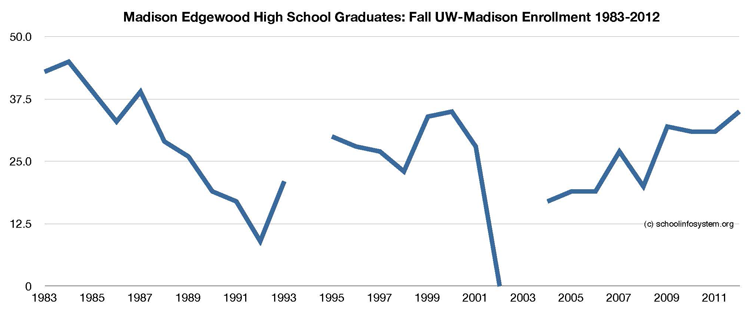
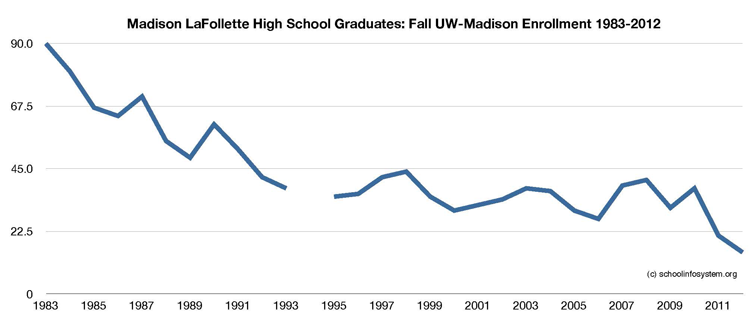
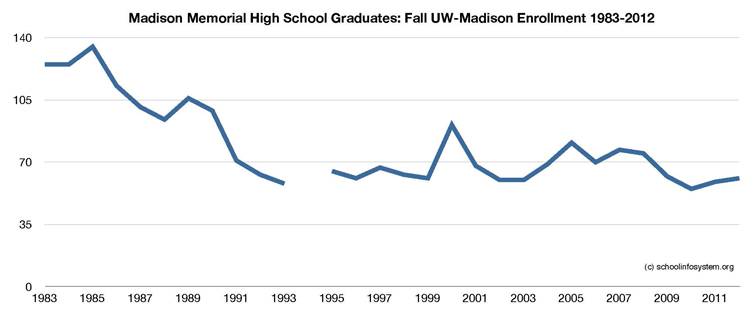
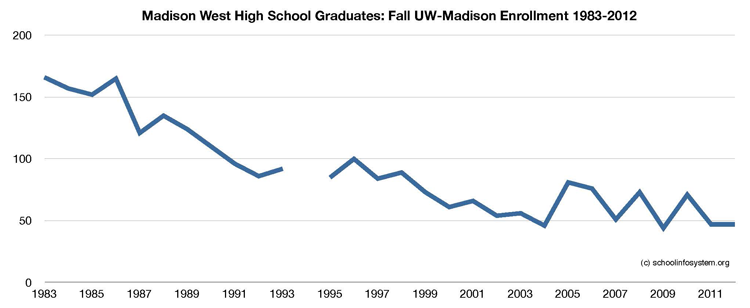
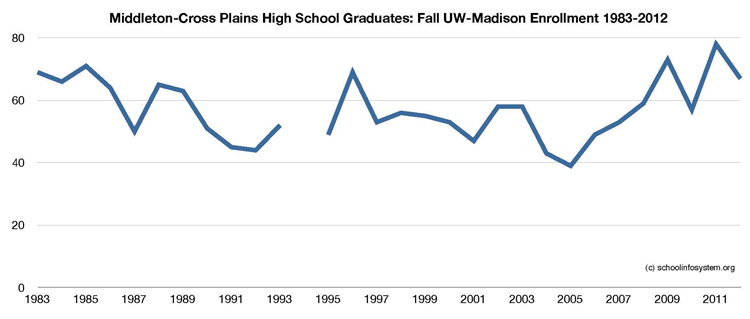
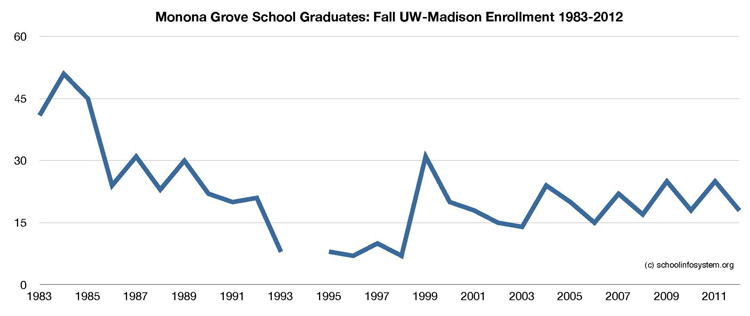
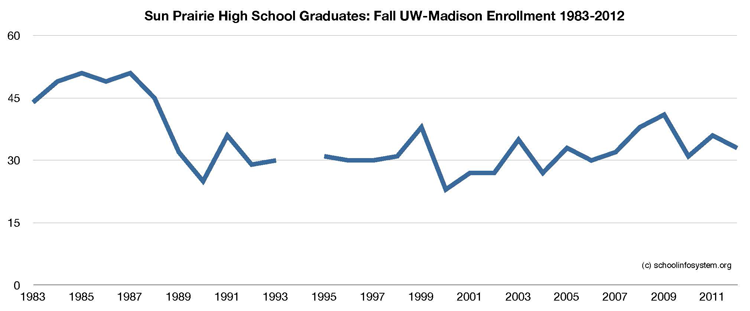
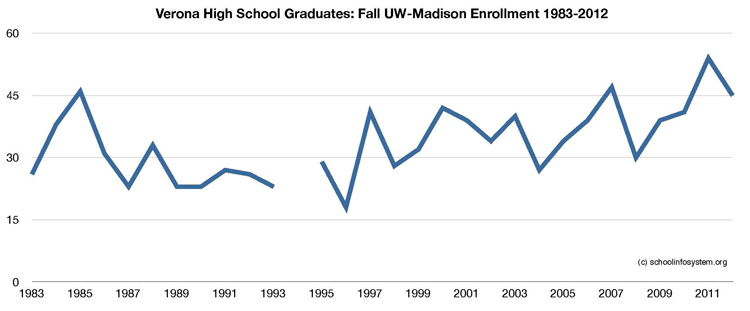
Related: Madison area high schools UW System and UW-Madison enrollment:


A look at UW-Madison freshman enrollment from Madison area high schools, 1983-2012.


Data via the UW-Madison registrar’s office.

Share

Act 10 was no mistake; in fact, it should be expanded

Edmund Henschel & Russell Knetzger

In its Sept. 17 editorial about Gov. Scott Walker’s second term agenda, the Journal Sentinel Editorial Board said, “Act 10 was a mistake” (“Gov. Scott Walker’s second term? Same as the first,” Our View). Act 10 virtually ended collective bargaining for many, but not all, state and local public employees.

It was not a mistake and should be followed up with Act 10.2 and Act 10.3. One would address the expensive early retirement feature included in the Wisconsin pension plan for all state and local public employees, and the other would bring in police and fire personnel, left out in Act 10. Police and fire together amount to about 60% of most local budgets, leaving only 40% covered by Act 10.

Wisconsin was the first state in the Union to allow public employees to bargain collectively, and, by the 1970s, unionization was showing its worst feature. That feature was, and will always remain, that unions cannot resist the temptation to try to control both sides of the bargaining table. They do this by being politically active in electing union-sympathetic public officials and in de-electing taxpayer sympathizers. The state teachers union was the first to consistently apply this power both in local and state elections and was very effective at both levels.

Wisconsin, having first created public collective bargaining, rightfully should be the first state to remove it. Indiana was slightly earlier, but the Indiana public at referendum put it back in place. That action, and the current race for Wisconsin governor, shows just how much unions are fighting to regain this power.

Early public employee unions recognized that public employee strikes did not sit well with the public. In exchange for removing the right to strike, unions were given arbitration, a power that likely gained more for unions than striking. The problem with arbitration is it becomes an averaging of the surrounding lowest and highest wages.

As the wealthier tax bases raise their wages and benefits, over time the lower tax base communities rise to the previous average of the higher base. If they both can rise faster than inflation, which they have done by a ratio of 2.5-3 to 1, in only a few successive contract periods the lower tax base pay equals the former high base levels.

Much more on Wisconsin Act 10, here.

Share

Degrading Campus Free Speech

Colleen Flaherty:

Professors and students are usually the biggest defenders of academic freedom and free speech on their campuses. But a pair of new books argues that students and faculty members themselves are degrading those values. Professors, one book says, are increasingly adopting notions of academic freedom that are too expansive, leaving the academy open to criticism from without. Students, meanwhile — says a second book — are increasingly trying to clip speech with which they feel uncomfortable, threatening free speech over all.

In Versions of Academic Freedom: From Professionalism to Revolution (University of Chicago Press), Stanley Fish, the Davidson-Kahn Distinguished Professor of Law and the Humanities at Florida International University, argues that there’s been a slow but undeniable academic freedom “creep” spanning his career. That is, where the term’s emphasis was once on “academic,” he argues, it’s now on “freedom,” promoting a kind of mythical notion of the professor as revolutionary. That creep helps explain what Fish sees as various “schools” of academic freedom, for which he creates a taxonomy in Versions.

Share

With $40 Million In New Cash, Parent-Teacher App Remind Targets A Billion Users Worldwide

Alex Konrad:

Lost permission slips and forms sent by a teacher to their student’s parents have long been a right of passage, but perhaps not for much longer. With nearly every student, parent and teacher all carrying a mobile phone, the question isn’t so much whether there’s an easier way to communicate from the classroom to the home, but how to do it in a way that doesn’t feel invasive or forced.

A startup called Remind thinks it’s figured out the balance, and its user growth would suggest that cofounder Brett Kopf is on to something. And two top Silicon Valley venture capital investors agree, betting another $40 million on Kopf in a Series C round announced Tuesday.

Share

Legacy: just a byproduct of a broken system

Tass Saperstein:

Even after years of campaigns for diversity, increased financial aid, and accessibility to all students, Harvard’s campus still does not accurately reflect society today. A recent article in The Crimson, “What Should Harvard’s Legacy Be” urged the College to “eliminate legacy preference in admissions, to make the admissions process more transparent…and to actively strive toward a legacy of equal access for its many qualified applicants” in order to better combat its homogeneity. Unfortunately, in a society dominated by institutional benefits for the wealthy, preference for legacy applicants is a tiny detail in the larger picture of Harvard’s massively flawed “meritocracy.”

First of all, it must be established that legacy applicants don’t have such high acceptance rates simply because of their legacy status. Different studies have cited a multitude of statistics; the most commonly cited stating that in the 30 most elite universities, primary legacies are 45.1 percent more likely to be accepted. There is a fundamental problem with this data. These statistics not only downplay the merit of these applicants, but they also ignore the institutional educational benefits they have received. Being a Harvard legacy means that they are significantly more likely to come from a family of wealth that values education. The annual survey by The Crimson of the current freshman class states that on average, legacy students have higher test scores than their non-legacy counterparts. Furthermore, 37.3 percent of legacies come from families with incomes of $500,000 or more. They have more access to key resources such as college counselors, SAT tutors, and job or internship opportunities. All of these factors create a significantly more desirable college applicant. They aren’t being accepted to Harvard solely because they are legacies; they are being accepted because they are taking advantage of the plethora of resources at their disposal. And who can blame them?

Share

New Milwaukee Public Schools’ chief Darienne Driver: Not the same old, same old

Alan Borsuk:

Driver was one of the few MPS leaders who developed some good relationships with education leaders independent of the system, including those involved in charter and private schools. She admits that earned her a fair amount of heat from within MPS last year. I suspected it might impede choosing her as superintendent or she might feel confined to existing ways if she were selected.

Notes and links on Darienne Driver, here.

Share

Why Textbook Prices Keep Climbing

Planet Money Podcast:

Prices of new textbooks have been going up like crazy. Faster than clothing, food, cars, and even healthcare.

Listeners have been asking for years why textbooks are getting so expensive. On today’s show, we actually find an answer.

Share

Use grades to improve remedial placement

Judith Scott-Clayton, Peter M. Crosta & Clive Belfield:

At an annual cost of roughly $7 billion nationally, remedial coursework is one of the single largest interventions intended to improve outcomes for underprepared college students. But like a costly medical treatment with non-trivial side effects, the value of remediation overall depends upon whether those most likely to benefit can be identified in advance. This NBER working paper uses administrative data and a rich predictive model to examine the accuracy of remedial screening tests, either instead of or in addition to using high school transcript data to determine remedial assignment.

The authors find that roughly one in four test-takers in math and one in three test-takers in English are severely mis-assigned under current test-based policies, with mis-assignments to remediation much more common than mis-assignments to college-level coursework. Using high school transcript information—either instead of or in addition to test scores—could significantly reduce the prevalence of assignment errors. Further, the choice of screening device has significant implications for the racial and gender composition of both remedial and college-level courses. Finally, if institutions took account of students’ high school performance, they could remediate substantially fewer students without lowering success rates in college-level courses.

Via Noel Radomski.

Share

Ivy League grade inflation

The Economist:

“WE DO not release statistics on grade-point averages so we can’t speak to the accuracy of the information you have.” That was a flack for Yale, but other Ivy League colleges—with the partial exception of Princeton—were equally reluctant to discuss their grading practices with The Economist.

Are they trying to hide something? Perhaps. Stuart Rojstaczer, a critic of grade inflation, has estimated average grades over time by combining dozens of unofficial and official sources. The results are startling (see chart). In 1950, Mr Rojstaczer estimates, Harvard’s average grade was a C-plus. An article from 2013 in the Harvard Crimson, a student newspaper, revealed that the median grade had soared to A-minus: the most commonly awarded grade is an A. The students may be much cleverer than before: the Ivies are no longer gentlemen’s clubs for rich knuckleheads. But most probably, their marks mean less.

Share

Translator Keyboard For iOS Makes Writing Foreign Missives A Breeze

Natasha Lomas:

The keyboard apps are coming in thick and fast for iOS 8 — which finally opened up Apple’s mobile platform to Qwerty disruption.

Earlier this week we came across Phraseboard, a keyboard that puts custom phrases at your fingertips for speedier texting. Now here’s another keyboard that can deal with whole sentences at a time — although not to speed up the basic typing process but rather for faster translation.

The Translator Keyboard for iOS 8 can translate what you’ve typed into one of 44 other languages — including French, Spanish and even Welsh. Beth annisgwyl!

The app, which is the work of UK developer Steven Barnegren, is using the Microsoft Translate API to do the grunt work of turning whatever you’ve typed into fair foreign phrasing.

So how does it work? Swiping left along the top of the keyboard brings in the language selection interface where you can specify your current language and the one you want to translate your words into.

Share

Inspire students in manufacturing

Vince Bertram, Via Erich Zellmer:

American manufacturing has faced many challenges over the past few decades. Today, it is facing a new one: Employers cannot find enough qualified workers with the knowledge and skills needed to meet the industry’s job demands.

The National Association of Manufacturers reports more than 600,000 unfilled jobs this year. There simply aren’t enough workers with the science, technology, engineering and math (STEM) knowledge and skills needed for these and other high-tech, high-skill jobs. Schools must prepare our students now, and that preparation must start at an early age.

As the country continues to rebound from the Great Recession, manufacturing is among the fastest-growing economic sectors. The Institute for Supply Management’s manufacturing index climbed to 59% in August, representing the 15th consecutive month of growth and the highest reading since March 2011.

Share

Cash & Awards fail to improve test results

Richard Adams:

Offering rewards such as cash payments or free trips make pupils work harder in class but fail to improve their exam results, according to an intensive £1.6m study involving 10,000 children.

The project involved pupils studying for GCSE exams at 63 schools in deprived areas across England, and was aided by a team of academics that included superstar professors such as Steven Levitt, the co-author of Freakonomics, and John List of the University of Chicago.

Share

Long Island High School Football Player Dies After Game

Mason Levinson:

A high school football player from Long Island, New York, died after colliding with an opponent in a game last night.

Tom Cutinella, a junior at Shoreham-Wading River High School in New York, died after colliding with a player from John Glenn High School’s team in Elwood, New York, Steven Cohen, superintendent of Shoreham-Wading River School District, said in a statement posted on the district website.

He was the third high-school football player to die in the past week, according to ESPN. Cornerback Demario Harris Jr. of Charles Henderson High School in Troy, Alabama, died after collapsing on the field following a tackle, and linebacker Isaiah Langston of Rolesville High School in North Carolina died after collapsing following pregame warmups, ESPN said.

Share

At U.S. universities, hour-long celebrity speeches equal more than four years of tuition

Bloomberg News:

Hundreds of University of South Florida screaming students rose as the 56-year-old actor took the stage to discuss philanthropy, social engagement and the pastime he inspired: “Six Degrees of Kevin Bacon.”
“It’s 1994 and I’m just out there minding my own business, making movies and trying to support my family and all of a sudden people start talking to me about this game,” said Bacon, best known for his role as a dancing rebel in the 1984 film “Footloose.”
“It had taken off as this drinking game spreading across campuses, and I thought I was going to be responsible for all this young alcoholism.”
The crowd laughed as Bacon paced in black jeans and a black leather jacket, telling jokes and doing impressions.
Bacon collected $70,000 for the April lecture at the Tampa campus.
From California to New York, public universities routinely pay fees that exceed four years of tuition for speeches that last little more than an hour. The practice drew scrutiny after University of Nevada at Las Vegas students protested Hillary Clinton’s $225,000 honorarium in June. A Bloomberg News review of public records at state universities in California, New York and Florida shows a rich market for those with something to say, regardless of traditional academic accomplishment.

Share

Job insecurity among Japan’s university teachers is a recipe for further decline

Hifumi Okunuki:

Universities in Japan are caught up in a cutthroat struggle for survival. As the population of children plummets, so, in turn, does the number of college entrants.

The decline is particularly stark considering that the number of universities had swelled on the back of the postwar baby boom and bubble economy. Institutions of higher learning are frantic to seize a share of the dwindling “customer base.” Universities choosing students is a thing of the past: Now students select universities.

Born in the early 1970s, I’m what’s known in Japan as a second-wave baby boomer. As a college student in the early 1990s, I experienced the emotional stress and hardship of entrance-exam hell. Many uni hopefuls failed their exams and became so-called wandering ronin for a year until the next round of tests. The term was derived from samurai in the Meiji Era and earlier who left their feudal domain and thus belonged nowhere. During this “nowhere time,” these modern-day academic ronin often studied from early morning until late at night, leading to nervous breakdowns and even cases of children murdering their overbearing parents.

Share

Reading Test Developers Call Knowledge a Source of Bias

Lisa Hansel:

You might expect to see a headline like this in the Onion, but you won’t. The Onion can’t run it because it isn’t just ironic—it’s 100% true.

A few years ago, a researcher at one of the big testing companies told me that when developing a reading comprehension test, knowledge is a source of bias. He did not mean the obvious stuff like knowledge of a yacht’s anemometer. He meant typical K–12 subject matter.

Since reading comprehension depends chiefly on knowledge of the topic (including the vocabulary) in the passage, the student with that knowledge has a large advantage over the student without it. And since there have always been great educational inequities in the United States, students’ knowledge—acquired both at home and at school—is very strongly correlated with socioeconomic status.

A logical solution would be to test reading comprehension using only those topics that students have been taught. Teachers can do this, but testing companies can’t—how would they have any idea what topics have been taught in each grade? It’s rare for districts, much less states, to indicate what or when specific books, people, ideas, and events should be taught.

Without a curriculum on which to base their assessments, testing companies have devised their own logic—which is sound given the bind they’re in. They distinguish between common and specialized knowledge, and then they select or write test passages that only have common knowledge. In essence, they’ve defined “reading comprehension skill” as including broad common knowledge. This is perfectly reasonable. When educators, parents, etc. think about reading comprehension ability, they do not think of the ability to read about trains or dolphins or lightning. They expect the ability to read about pretty much anything one encounters in daily life (including the news).

Via Will Fitzhugh.

Comment by Chrys Dougherty — October 1, 2014 @ 10:51 pm:

In this context, I would draw readers’ attention to the description in the ACT Technical Manual (p. 11) of the content areas from which selections are drawn for the ACT Reading Test:

“a. Prose Fiction. The items in this category are based on short stories or excerpts from short stories or novels.

“b. Social Studies. The items in this category are based on passages in the content areas of anthropology, archaeology, biography, business, economics, education, geography, history, political science, psychology, and sociology.

“c. Humanities. The items in this category are based on passages from memoirs and personal essays and in the content areas of architecture, art, dance, ethics, film, language, literary criticism, music, philosophy, radio, television, and theater.

“d. Natural Sciences. The items in this category are based on passages in the content areas of anatomy, astronomy, biology, botany, chemistry, ecology, geology, medicine, meteorology, microbiology, natural history, physiology, physics, technology, and zoology.”

These passages reflect the wide range of reading that a college-ready student or an avid adult reader should be able to do. A student who receives a broad, content-rich education in preschool through high school is more likely to have the necessary “common knowledge” from these fields to have an advantage on the ACT, in college, and in life.

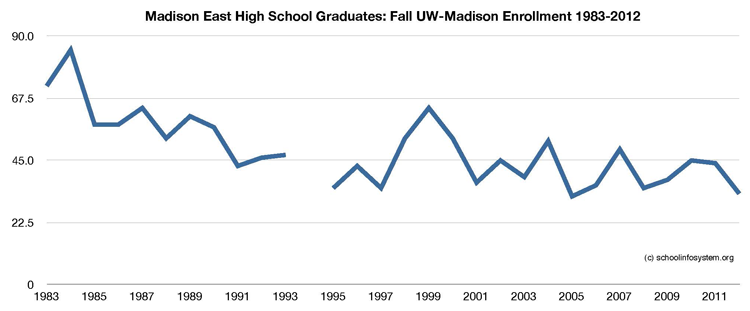
Share

Higher Education’s Aristocrats

David Francis Mihalyfy:

Last week, the Barack Obama Foundation announced that the University of Chicago is one of four finalists to house the Obama Presidential Library, according to its mission of finding a site that reflects “President Obama’s values and priorities throughout his career in public service.”

If Obama chooses UChicago, however, he risks tying his legacy to the American university that perhaps most exemplifies higher education’s current crisis of mission. Rather than being institutions that prioritize free inquiry, research, and high-quality education, universities are increasingly acting like the worst of Wall Street, where anything goes in order make a buck for the people at the top.

The latest sign of identity crisis at UChicago? Hefty pay raises to a large number of top staff, who have enriched themselves at great cost to their institution.

New analysis of tax data from publicly available IRS 990 forms shows that eight high-level UChicago administrators have received more than $7.6 million in compensation increases since 2007-2008, even as the school moved toward and suffered a credit downgrade.

Share

Are Ivy League schools overrated?

Andrew:

I won’t actually answer the above question, as I am offering neither a rating of these schools nor a measure of how others rate them (which would be necessary to calibrate the “overrated” claim). What I am doing is responding to an email from Mark Palko, who wrote:

I [Palko] am in broad agreement with this New Republic article by William Deresiewicz [entitled “Don’t Send Your Kid to the Ivy League: The nation’s top colleges are turning our kids into zombies”] and I’ll try to blog on it if I can get caught up with more topical threads. I was particularly interested in the part about there being a “non-aggression pact” outside of the sciences.

This fits in with something I’ve noticed. I know this sounds harsh, but when I run across someone who is at the top of their profession and yet seems woefully underwhelming, they often have Ivy League BAs in non-demanding majors (For example, Jeff Zucker, Harvard, History. John Tierney, Yale, American Studies). My working hypothesis is that, while everyone who graduates from an elite school has an advantage in terms of reputation and networks, the actual difficulty of completing certain degrees isn’t that high relative to non-elite schools. Thus a history degree from Harvard isn’t worth that much more than a history degree from a Cal State school.

Share

Germany’s great tuition fees U-turn

Howard Hotson:

During the past eight years, university tuition fees were introduced into most west German federal states. Yet in a few months, every single state will have abolished them. These facts raise a series of topical questions that cast current English higher education policy in a fresh and revealing light.

Why did Germany introduce tuition fees in the first place? The answer, in short, is that politicians favoured the idea. Self-styled “modernisers” had been advocating tuition fees since German reunification in 1990. Cultural differences between east and west initially hindered this plan, but the main obstacle was a federal law banning tuition fees, which echoed provisions guaranteeing free education in the constitutions of individual states. In 2005, however, the Federal Constitutional Court in Karlsruhe ruled that moderate fees, coupled with affordable loans, would safeguard these constitutional provisions. Within two years, a cascade of laws had swept through most of the federal Länder. The attraction of shifting some of the funding burden to individual beneficiaries was irresistible. So was the compulsion to imitate the changes made elsewhere, lest universities in one’s own state should remain less well funded, and the public purse more stretched, than in neighbouring states.

Seven out of 10 states in west Germany introduced fees in 2006 or 2007; an eighth, Bremen, was prevented from doing so by a lawsuit. Only two – Rheinland-Pfalz and Schleswig-Holstein – resisted the tide completely.

If such unanimity had been maintained, policymakers would now be declaring these changes inevitable. Yet within a single electoral cycle, their long-sought policy was comprehensively overturned. The only state still charging tuition fees in 2014, Lower Saxony, will cease to do so at the end of this academic year.

Share

A boy was accused of taking a backpack. The courts took the next three years of his life.

Jennifer Gonerman:

In the early hours of Saturday, May 15, 2010, ten days before his seventeenth birthday, Kalief Browder and a friend were returning home from a party in the Belmont section of the Bronx. They walked along Arthur Avenue, the main street of Little Italy, past bakeries and cafés with their metal shutters pulled down for the night. As they passed East 186th Street, Browder saw a police car driving toward them. More squad cars arrived, and soon Browder and his friend found themselves squinting in the glare of a police spotlight. An officer said that a man had just reported that they had robbed him. “I didn’t rob anybody,” Browder replied. “You can check my pockets.”

The officers searched him and his friend but found nothing. As Browder recalls, one of the officers walked back to his car, where the alleged victim was, and returned with a new story: the man said that they had robbed him not that night but two weeks earlier. The police handcuffed the teens and pressed them into the back of a squad car. “What am I being charged for?” Browder asked. “I didn’t do anything!” He remembers an officer telling them, “We’re just going to take you to the precinct. Most likely you can go home.” Browder whispered to his friend, “Are you sure you didn’t do anything?” His friend insisted that he hadn’t.

At the Forty-eighth Precinct, the pair were fingerprinted and locked in a holding cell. A few hours later, when an officer opened the door, Browder jumped up: “I can leave now?” Instead, the teens were taken to Central Booking at the Bronx County Criminal Court.

Share

An Alarming Gap

Sam Atkinson:

The venture is also an attempt to alleviate what Mr. Agarwal sees as an alarming gap between high school students’ college eligibility and their college preparedness. He pointed to a recent study by the National Center for Public Policy and Higher Education and the Southern Regional Education Board, which found that 60 percent of first-year college students were underprepared for postsecondary studies.

In an interview with Education Week, Mr. Agarwal said he hopes the new curriculum will give more high school students exposure to higher-level coursework, allowing them to enter college having already completed many of their first-year classes.

He also believes high school teachers will utilize the MOOC content to supplement their existing curricula—a common practice among college professors.

Via Will Fitzhugh.

Share

Ranking Universities Based on Career Outcomes

Navneet Kapur:

More than ever, students go to college because they want to get jobs — good jobs. To that end, students and parents want to know which schools give them the best chance at getting a desirable job after graduation. This is where we can help.

By analyzing employment patterns of over 300 million LinkedIn members from around the world, we figured out what the desirable jobs are within several professions and which graduates get those desirable jobs. As a result, we are able to rank schools based on the career outcomes of their graduates.

Defining “desirable jobs”
We define a desirable job to be a job at a desirable company for the relevant profession. For example, we define desirable finance jobs as finance jobs at companies desirable for finance professionals.

We start with identifying desirable companies for each profession.We let the career choices of our members tell us how desirable it is to work at a company. To illustrate this, imagine there are two companies, A and B. If more finance professionals are choosing to leave company A to work at company B, the data indicates that getting a finance job at B is more desirable. This is based on the hypothesis that when a professional moves from one company to another, she gives the company she moves to a strong vote of confidence.

Explore Linkedins’ University rankings.

Share

Preemptive personalization

Rob Horning:

Nicholas Carr’s forthcoming The Glass Cage, about the ethical dangers of automation, inspired me to read George Orwell’s The Road to Wigan Pier (1937), which contains a lengthy tirade against the notion of progress as efficiency and convenience. Orwell declares that “the tendency of mechanical progress is to make life safe and soft.” It assumes that a human being is “a kind of walking stomach” that is interested only in passive pleasure rather than work: “whichever way you turn there will be some machine cutting you off from the chance of working — that is, of living.” Convenience is social control, and work, for Orwell at least, is the struggle to experience a singular life. But the human addiction to machine-driven innovation and automation, he predicts, fueled apparently by a fiendish inertia that demands progress for progress’s sake, will inevitably lead to total disempowerment and dematerialization:

Share

Venture Capitalists Are Poised to ‘Disrupt’ Everything About the Education Market

Lee Fang:

In his book, Finding the Next Starbucks: How to Identify and Invest in the Hot Stocks of Tomorrow, Michael Moe describes how carefully crafted business strategies have transformed markets to create huge profits in unlikely sectors. The title relates to how Starbucks became a global corporation of almost $15 billion in revenue by capturing and streamlining the café experience. Moe, a former director at Merrill Lynch, wrote that at one point in the United States, even healthcare was an undesirable and difficult industry for investment, and that bankers once worried if profit-making in such a realm was worth their effort. In 1970, healthcare spending comprised 8 percent of GDP, yet market capitalization in healthcare stood at less than 3 percent. That shifted quickly not only as the boomer generation aged, but as a wave of privatization hit hospitals, insurers, and other segments of the healthcare system. More than thirty years later, Moe wrote, healthcare companies are among the largest in the world, and represent more than 16 percent of US capital markets. “We see the education industry today as the healthcare industry of 30 years ago,” Moe predicted.

That book came out eight years ago, before the current wave of education investing, when the prospect for growth seemed dim. Unlike in healthcare, energy and other areas of the economy that have moved from public to private hands, K-through-12 education has stubbornly remained largely out of the control of investors.

Share

Student Union of Michigan

Student Union of Michigan:

Like many public research universities around the country, the University of Michigan has raised tuition significantly over the past two decades. But administrators argue that in the end tuition hikes don’t make it harder for low-income students to attend.[1] Through financial aid, they claim, the high tuition paid by wealthier students who can afford it is used to offset tuition for lower income students. The argument is that the “high tuition/high aid” model works like a kind of progressive taxation, so paradoxically what those who criticize the university’s high tuition are in fact advocating is punishing the poor.

Unfortunately, the administration’s theory has some serious problems. It is true that the poorest students at U-M receive excellent financial aid packages made up primarily of grants instead of loans or work-study, which means they aren’t forced into debt or exploited to pay tuition. However, the number of students who meet these qualifications is steadily decreasing in both absolute terms and relative to the entire student body. Looking at the class composition of the student body, we can see some major changes over the past 15 years. Between 1997 and 2010, the percentage of the student body whose family income is under $75,000 a year dropped from 38.5% to 26.5% (a decrease of 12%), while the percentage whose family income is over $200,000 a year rose from 14.8% to 27.6% (an increase of 12.8%).[2] The growth in the richest sector of students was so significant that they actually added an extra income category to the list—instead of the maximum being $200,000 and above, they bumped it up to $250,000 and added another in between. The latest data only confirm this trend. As of 2014, a full 31% of admitted students have a family income of $200,000 and above.[3] These changes in the socioeconomic status of the student body have also intensified the ongoing exclusion of underrepresented minority students on campus. The implication is that even as the university brings in more tuition money—and therefore, according to the “high tuition/high aid” model, more aid—the number of students who actually need this aid is shrinking significantly.

Share

Excellent Sheep : The Miseducation of the American Elite and the Way to a Meaningful Life

Douglas Greenberg:

WILLIAM DERESIEWICZ IS ANGRY about the miseducation of young people at the nation’s most prestigious universities. He has written a book on the subject, and he thinks we all should be worried. Really worried. It’s a case of what Louis CK famously called “white people problems,” which he said were “when your life is so amazing that you have to make shit up to be upset about.”

Deresiewicz is definitely upset, and he is also making shit up. He is upset with Columbia and Yale, from which he holds degrees, but he is also upset with Harvard, Princeton, Stanford, and an ill-defined group of other private universities. His widely reviewed Excellent Sheep: The Miseducation of the American Elite has something unpleasant to say not only about these institutions but about everyone associated with them: the students, their parents, the faculty, the administrators, the donors, the alumni. Many of these criticisms of elite private higher education have some merit. Yet the tone of the book is so egocentric and intemperate and the framing of the issues is so narrow and sensationalistic that it might not merit a review in the Los Angeles Review of Books if it had not already received so much attention in the national press. Somehow this book has captured the entire national conversation about higher education, although it is mainly concerned with a subset of a small and atypical group of private research universities whose importance can be easily exaggerated, particularly by people who work for, graduated from, or pay tuition to them — or hope someday to do any of the three.

Share

Teacher Union Money Talks: NEA and AFT together spend roughly $700 million per year

Dmitri Mehlhorn:

One of the most-hotly debated questions is how strong is the National Education Association and the American Federation of Teachers compared to the school reform movement. When it comes to the money that is key to political influence, there is no doubt: The NEA and AFT together spend roughly $700 million per year, consistently, on a broad spectrum of political communication activities opposed to reform. This means that the financial (and political) muscle of the two unions is far greater than that of school reform organizations such as Democrats for Education Reform, StudentsFirst (for which I used to work), Stand for Children, Black Alliance for Educational Options, and the American Federation for Children.

To understand the unions’ advantages, start with the AFT and NEA national budgets. The AFT has 1.6 million members and generated $233 million in revenue (net of borrowing) as of 2013-2014, according to this week’s Dropout Nation analysis of financial data; the NEA had 3.1 million members and national revenues of $387 million in 2012-2013. This total is only the beginning. Although teachers have “unitary dues” where they pay once for national, state, and local affiliates, the state and local portions of the bill vary greatly and can be quite significant. In the state of New Jersey, for instance, compulsory dues come to $936 per teacher, less than $200 of which go to national. In Chicago, the compulsory dues that the AFT’s Chicago Teachers Union deducts from paychecks amount to $1,060 per teacher a year, several hundred dollars more than go to Illinois and national combined. Average dues of nearly $1,000 per year appear quite common.

The $63 million spent by Walton family on ed reform last year < 1/10th amount spent by NEA and AFT.

Share

ComputerCOP: The Dubious ‘Internet Safety Software’ That Hundreds of Police Agencies Have Distributed to Families

Dave Maass:

For years, local law enforcement agencies around the country have told parents that installing ComputerCOP software is the “first step” in protecting their children online.

Police chiefs, sheriffs, and district attorneys have handed out hundreds of thousands of copies of the disc to families for free at schools, libraries, and community events, usually as a part of an “Internet Safety” outreach initiative. The packaging typically features the agency’s official seal and the chief’s portrait, with a signed message warning of the “dark and dangerous off-ramps” of the Internet.

As official as it looks, ComputerCOP is actually just spyware, generally bought in bulk from a New York company that appears to do nothing but market this software to local government agencies.

Share

who and what is the university for?

Freddie DeBoer

A couple of weeks ago, I went to the University of Illinois at Urbana/Champaign with activist friends of mine. We went to protest in support of Dr. Steven Salaita and the several unions and student groups who were rallying for better labor conditions, for the principle of honoring contracts, for collective bargaining rights, for recognition by the administration, and for respect. It was a beautiful, brilliant rally; I estimated 400 people, many more than I had thought to hope for. And it posed the simplest question facing academics today: who and what is the university for?

The labor unions in attendance that day were fighting for better conditions and more honest, direct bargaining with the university administration, as labor unions in Illinois have fought for decades. Some fought for fair pay and transparent, equitable rules for advancement and compensation. The school’s young graduate union, the GEO, fights simply to be recognized by the university, in an academic world in which universities could not survive without graduate student labor. What was remarkable about the event was how easily and naturally these labor issues coincided with the fight for Dr. Salaita. Some might mistake these issues for disconnected and separate, but in fact they are part of the same fight. The fight for Dr. Salaita is about Palestine, and about academic freedom. But it is also about labor and the rights of workers. It’s about faculty governance in a university system that has seen ceaseless growth in higher administrators and an attendant growth in the cost of employing them. It’s about recognizing that a university is not its endless vice provosts and deputy deans, nor its sushi bars and climbing walls, nor its slick advertising campaigns, nor its football team, nor its statuary. A university is its students and its teachers. To defend Dr. Salaita is to defend the notion that, in an academy that crowds out actual teaching and actual learning in myriad ways, the actual teachers in the academy must preserve the right to hire other teachers, and to honor those commitments once they are made.

Share

The Modern Campus Cannot Comprehend Evil

Camille Paglia

Young women today do not understand the fragility of civilization and the constant nearness of savage nature

The disappearance of University of Virginia sophomore Hannah Graham two weeks ago is the latest in a long series of girls-gone-missing cases that often end tragically. A 32-year-old, 270-pound former football player who fled to Texas has been returned to Virginia and charged with “abduction with intent to defile.” At this date, Hannah’s fate and whereabouts remain unknown.

Wildly overblown claims about an epidemic of sexual assaults on American campuses are obscuring the true danger to young women, too often distracted by cellphones or iPods in public places: the ancient sex crime of abduction and murder. Despite hysterical propaganda about our “rape culture,” the majority of campus incidents being carelessly described as sexual assault are not felonious rape (involving force or drugs) but oafish hookup melodramas, arising from mixed signals and imprudence on both sides.

Colleges should stick to academics and stop their infantilizing supervision of students’ dating lives, an authoritarian intrusion that borders on violation of civil liberties. Real crimes should be reported to the police, not to haphazard and ill-trained campus grievance committees.

Share

Why The Christensen Institute Says Competency-Based Ed Is Disruptive

Robert McGuire:

Post -secondary competency-based education obviously has a lot of momentum, as we have reported on extensively in the past. But the Christensen Institute, a think tank co-founded by Clayton Christensen, Michael B. Horn and Jason Hwang to analyze issues in education and healthcare, argues that it’s much more than a trend.

Online competency-based education is the innovation that will shake up higher ed, they say. While most of us had our eye on the fascinating potential of MOOCs, the mixture of online ed and CBE programs has cohered into the much more significant force.

That thesis is laid out in a new ebook co-authored by Clayton Christensen and Senior Research Fellow, Michelle Weise. Hire Education: Mastery, Modularization, and the Workforce Revolution, available free for download at the institute’s website, argues that “online competency-based education is revolutionary because it marks the critical convergence of multiple vectors: the right learning model, the right technologies, the right customers and the right business model.” Inexpensive and cost-effective online CBE programs that are “good enough” are releasing working adults and employers from the tyranny of the credit hour model and can respond to marketplace needs much more quickly than traditional higher ed programs.

Share

“What Are the Children Who Grow Up to Become Police Officers Learning in School?”

Rachel Toliver:

This summer, in Missouri, America got an awful tutorial in the realities of racism. We were taught—yet again, through bullets and teargas­—what it means to be black in this country. There is much to be done to prevent future Fergusons, of course. But as a teacher, I find myself wondering what our schools can contribute.

In Philadelphia, where I live and teach high school, we have a course that could help to improve race relations. But some students believe that it doesn’t go far enough.

Here in Philly, students are required to take a one-year course in African-American history; if they don’t take the class, they won’t graduate. The scope of the course is comprehensive, focusing not only on resistance and protest traditions, but also on the cultural history of Africa and the African diaspora. This mandate, the first—and virtually the only—of its kind, has been around for almost a decade. But its story begins 40 years before that.

In 1967, a coalition of about 4,000 African-American students held a peaceful demonstration before Philadelphia’s Board of Education building. In tandem with similar movements nationwide, they demanded that the African-American experience be made more visible in their schools. One of their 25 demands was that curricula be expanded beyond the superficial-at-best treatment of African-American history. The protest remained nonviolent until Police Commissioner Frank Rizzo spurred two busloads of his officers to attack the students with teargas and clubs. According to witnesses, Rizzo galvanized his men with a rallying cry of “get their black asses!”

Share

Carceral Educations

Sabrina Alli:

For two years, I commuted to a ground-level room in a building in the Bronx a few days a week to teach GED preparation courses. My students were 17-to 24-year-olds with some sort of criminal record. We used to make jokes about the mice running across the ceiling tiles above us to lighten the mood. But we were hidden under an apartment building. I was teaching and my students were learning in a shithole. The clouded windows were covered by cracked venetian blinds and there was a poster on the wall with a handsome young man holding a baby that read, “Today’s a good day to be a dad.”margin-ad-right

I taught in one of the many social-service organizations known in the nonprofit industrial complex as “re-­entry.” Re-entry’s primary goal is to induct people back into the workforce once they are released from prison or are mired in the bureaucracy of one of the state’s “community supervision” programs, which include jails, probation, parole, or ATIs (alternatives to incarceration). In practical terms, re-entry provides “services,” broadly construed, to economically disenfranchised people who are targeted by the police and as a result are under some form of surveillance by the carceral network.

Share

Student-Loan Debt: A Federal Toxic Asset

Joel & Eric Best:

Let’s call her Alice. One of us has known her for years. She earned her Ph.D. in the mid-1990s when academic jobs were scarce, and she wound up an academic gypsy. She left graduate school to take a one-year full-time academic appointment, but then found herself cobbling together part-time teaching jobs at different community colleges in a large metropolitan area, earning a couple of thousand dollars for each course she teaches. She is a dedicated teacher, but her annual income is between $30,000 and $40,000.

Alice owes $270,000 in student loans. She only borrowed about $70,000 to pay for grad school, but she’s never been able to afford much in the way of payments, and after consolidating her loans and accumulating interest charges for years, she’s watched her debt roughly quadruple.

If Alice taught students in a low-income high school or was a recent graduate, she would be eligible for various programs that would allow her to discharge at least some of her debt. But since she graduated at a time before income-based repayment and loan-forgiveness programs, there is no federal program to help established part-time community-college faculty discharge their old student-loan debts.

Share

Nation’s Largest Teachers Union Plans To Spend More Than $40 Million In 2014

Jacob Fischler:

The nation’s largest teachers union plans to spend between $40 and $60 million in this year’s election cycle, two sources at the National Educational Association told BuzzFeed News.

On Monday, the American Federation of Teachers, which has about half the membership of the NEA, said it would spend about $20 million in the same time frame. Those numbers encompass all election spending, from Senate races down to local ballot measures.

While AFT President Randi Weingarten said they are spending more this year than they’ve spent in any cycle before, NEA Political Director Karen White said her union’s estimate is roughly on par for what they usually spend in non-presidential election years.

In an internal memo White sent last week to top NEA leaders, she wrote that education is “emerging as a top issue” in some of tighter gubernatorial races and in the country as a whole.

Share

The six paths of the typical US college graduate—and why they’re all wrong

Andrew Yang, via Kate Zellmer:

There are currently six prominent paths for achievement-minded recent college graduates: financial services, management consulting, law school (still), med school, and grad school/academia. The sixth is Teach for America, which continues to draw approximately 5,000 graduates (and 50,000 applicants) a year from universities across the country.

Share

Study contends voucher programs save money, benefit public schools

Erin Richards:

Milwaukee’s long-running school voucher program that allows certain children to attend private and religious schools at taxpayer expense has saved Wisconsin more than $238 million since its inception in 1990, according to a new study by a national voucher advocacy group.

The study released Tuesday by the Friedman Foundation for Educational Choice said that across the country, publicly funded vouchers to offset tuition for about 70,000 children attending private schools in 10 cities has saved a total of $1.7 billion.

That’s not a surprisingfinding — vouchers are generally lower in cost than public school education.

But the study’s more provocative point is that the savings from those voucher programs in Milwaukee and other cities are passively plowed back into public schools or other public programs.

Author Jeff Spalding, the director of fiscal policy and analysis at the foundation, said he lacks the data to track exactly where those savings went in each state, but said it’s just common sense that government savings from vouchers would naturally flow into other public purposes, such as schools, roads, law enforcement or health care.

Critics pounced on that reasoning, noting that taxpayer dollars to private schools in the form of vouchers siphon resources away from the public schools.

Also, the study predates new rules in Wisconsin that allowed more students to use vouchers, both by expanding the Milwaukee program and establishing the Racine and statewide private-school voucher programs.

The statewide program is now funding vouchers predominantly for students who were already attending those private schools.

Related: Comparing Milwaukee Public and Voucher Schools’ Per Student Spending
.

Share

Commission: Evaluate some home-schooled kids for emotional issues (!)

Ken Dixon:

Parents who home-school children with significant emotional, social or behavioral problems would have to file progress reports prepared by special education program teams, under a proposal being considered by the governor’s Sandy Hook Advisory Commission.

Commission members acknowledged Tuesday that the proposal, contained in a tentative section of the panel’s final report, could be controversial and prompt opposition from parents of home-schooled children across the state.

But the commission, which is preparing its final report to Gov. Dannel P. Malloy, said tighter scrutiny of home-schoolers may be needed to prevent an incident such as the December 2012 slaughter of 20 first-graders and six adults at Sandy Hook Elementary School in Newtown. The murders were carried out by Adam Lanza, a disturbed 20-year-old who had been home-schooled by his mother, Nancy Lanza, whom he also shot to death on the morning of his murder spree.

Share

On Math Education: JFK, the Beatles and Getting Back in the Swing of Things

Barry Garelick, via a kind email:

After my assignment at the high school I took on various short-term sub assignments. These seemed relatively straightforward compared to the difficulties I had been through. In fact, I was reluctant to start subbing at first, but after the first few times, I started to regain my confidence.

I had applied to various full time jobs for teachers and was waiting to hear. As the school year approached November and I was subbing more, the TV and the internet were full of discussions about the JFK assassination, which was approaching its 50 year anniversary. Like most people, I recall what I was doing at the infamous moment: I was taking a Spanish test. I remember girls in the class crying, and later, when passing in the hall, seeing the woodworking/drafting teacher outside his classroom, seemingly distant, whistling “Hail to the Chief ”.

I continued to sub, and by January, TV and the internet were focusing on the 50th anniversary of the Beatles’ appearance on Ed Sullivan. While Kennedy’s assassination is irrevocably linked in my mind to a Spanish test, the Beatles’ U.S. debut is linked to Mr. Dombey’s algebra class where I recall many discussions about the Beatles taking place. I can recall both the Kennedy assassination and the Beatles on Ed Sullivan with complete and unrelenting clarity.

By the third week in January, I was eating lunch during a sub assignment, and was at a point where I had accepted that my age was probably preventing me from being hired as a full time teacher. At that moment, my wife called me on the cell phone to tell me that the principal of the Lawrence Middle School was desperately trying to reach me, and that they had a long-term sub assignment for teaching math.

Share

Madison Teachers, Inc. Recertification Campaign

Madison Teachers, Inc. Solidarity newsletter, via a kind Jeannie Kamholtz email (PDF):

As previously reported, Governor Walker’s Act 10 requires public sector unions, except police & fire, to participate in an annual recertification election to enable Union members to retain representation by their Union. The election by all MTI-represented District employees will be conducted between November 5 and November 25, via telephone or on-line balloting (details forthcoming when received from the Wisconsin Employment Relations Commission).

MTI Faculty Representatives and EA Building Representatives at every school/work location have been asked to recruit colleagues to assist in building awareness of the importance of the recertification election, and to make sure that staff at their school/work location VOTE in the recertification elections.

These individuals are being referred to as MTI Member Organizers and will be essential to successful recertification elections. The Union needs Member Organizers from every bargaining unit (MTI, SEE-MTI, EA-MTI, SSA-MTI & USO-MTI). Retired union members are also encouraged to assist in organizing. Assuring that each and every person vote is of great importance, because Act 10 requires that to win recertification, the Union must win 51% of all eligible voters.

If you are willing to support your Union by serving as a Member Organizer, or have additional questions about what this entails, see your MTI Faculty Representative/EA-MTI Building Representative, or contact MTI Assistant Director Doug Keillor (keillord@madisonteachers.org; 257-0491). Additional information will also be available at a MTI Member Organizer Q & A Session on Saturday, October 4, from 10:00-11:30 a.m., at MTI Headquarters.

Reasons for Recertification #2: Preserving and Protecting Your Collective Bargaining Agreements – MTI has successfully negotiated Collective Bargaining Agreements which preserve the vast majority of Contract rights and benefits for both the 2014-15 and 2015-16 school years and provide the Union the means to enforce those rights and benefits.

Share

Madison Schools’ Mental Health Programs Cheered

Kelly Meyerhoffer:

Eight years ago, a community health report from the Fox Valley uncovered an alarming trend among local high school students: one in four reported experiencing depression, and more than one in 10 had attempted suicide.

An experiment soon followed that placed licensed therapists with expertise in children’s mental health in elementary, middle and high schools.

“We decided if students had trouble making their appointment (at community clinics), let’s bring the appointment to them,” said Mary Wisnet, one of the program’s officers.

Share

Parenting as a Gen Xer: We’re the first generation of parents in the age of iEverything

Allison Slater Tate:

On the days that I drive the middle school carpool, I purposely choose a route that takes us past a huge river. Some mornings, the water looks like glass; others, it reflects the moody clouds above with choppy waves – either way, it’s gorgeous. Every time we drive past it, I point it out to my car full of 12-year-olds: “Look at the water today. Isn’t it beautiful?” No one in the car looks up. They are all looking down at their phones, playing games with each other, texting a friend or watching a YouTube video. Sometimes, if I am lucky, I will get a mercy grunt out of one or two of them in reply.

It struck me recently, after one of my quiet carpool rides, that my generation of parents – we of the soon-to-be or recently 40 year old Gen X variety, the former latchkey children of the Cold War and an MTV that actually played videos, former Atari-owners who were raised by the the Cosby Show and John Hughes, graduated high school with the kids from 90210, then lumbered through our 20s with Rachel, Ross, Chandler, Monica, Phoebe, and Joey and flip phones – is perhaps the last to straddle a life experience both with and without the Internet and all its social media marvels. After all, I didn’t even learn to use e-mail until I was 19 and a sophomore in college in 1993, and only for a slightly cringe-worthy reason: a cute boy at another college asked me to e-mail him.

Share