School Information System

The Whiter, Richer School District Right Next Door

Adam Harris:

The Democratic presidential debates, when they have turned to education, have so far focused on busing, college affordability, and school safety. Senator Michael Bennet of Colorado, notably, veered away from busing to talk about modern segregation during the second slate of debates, but only for a moment. But the schools trapped within these isolating, segregating borders will require more sweeping solutions to break free of them.

Related: Madison recently expanded its least diverse schools, yet we have long tolerated disastrous reading results. This despite spending far more than most taxpayer supported K-12 school districts.

Share

Civics: Facebook Plans on Backdooring WhatsApp

Bruce Schneier:

This article points out that Facebook’s planned content moderation scheme will result in an encryption backdoor into WhatsApp:

In Facebook’s vision, the actual end-to-end encryption client itself such as WhatsApp will include embedded content moderation and blacklist filtering algorithms. These algorithms will be continually updated from a central cloud service, but will run locally on the user’s device, scanning each cleartext message before it is sent and each encrypted message after it is decrypted.

The company even noted that when it detects violations it will need to quietly stream a copy of the formerly encrypted content back to its central servers to analyze further, even if the user objects, acting as true wiretapping service.

Facebook’s model entirely bypasses the encryption debate by globalizing the current practice of compromising devices by building those encryption bypasses directly into the communications clients themselves and deploying what amounts to machine-based wiretaps to billions of users at once.

Share

Taleb is wrong about IQ

Jonatan Pallesen:

The probability if there was 0 correlation is of course 0.5. So using IQ as a criteria beats random selection by 16.67% (as Taleb also found). This is a little more than 6%, but that is a detail. More importantly, this example is a theoretical use case where using IQ testing is not so useful. To look at something a little more realistic, let’s say a company wants to avoid people with a performance more than 2 standard deviations below the mean. (Perhaps such employees have a risk of causing large harm, which could for instance be an issue in the military.) And we again compare admitting people at random vs only taking applicants with above average IQ.

If the company admits people at random, we get this proportion of people with a performance more than 2 SD below the mean:

Share

How We Got the Story About Parents Transferring Guardianship of Their Kids to Win Financial Aid They Wouldn’t Otherwise Qualify For

Jodi Cohen:

I’ve covered higher education for many years and was part of a team that revealed the University of Illinois admissions clout scandal in which students from politically connected families got preference over more-qualified applicants. This latest tip was in my wheelhouse. I got to work.

First, I needed to find the records of these guardianship transfers, which the tipster told me had taken place in Lake County, a largely wealthy area north of Chicago. So I called up the Lake County courthouse and a clerk said, “Sure, come on up.”

The case records looked like medical files: long, long rows of folders organized by date. I asked if I could start with the most recent ones, and workers at the clerk’s office patiently pulled down stacks of files. I flipped past the estate cases and stopped at the folders labeled “minors person.” I finished one stack of files, gave it back and got the next batch. This went on all day.

Most of the records dealt with families in desperate situations who needed someone else to care for their children. Those records were primarily handwritten. Then I started seeing ones filled out by lawyers — typewritten — many of which had language about the guardianship changes being for educational and financial opportunities. They just stood out.

By the end of that day, I had gotten through maybe 800 files. My colleague Melissa Sanchez joined me the next day. In total, we looked through 1,800 cases from 2018 and 2019 in about 13 hours (plus 1,200 cases from 2017). We identified about four dozen we wanted to follow up on from the past 18 months.

We called the University of Illinois, the state’s flagship public university and the school of choice for many suburban students. We had learned through social media that some of the teens involved in the guardianship changes were U. of I. students or soon-to-be students. U. of I.’s admissions director said that he was aware of the situation, which he called a “scam,” and that he was trying to combat it.

Share

K-12 Tax & SPENDING Climate: Families Go Deep in Debt to Stay in the Middle Class

AnnaMaria Andriotis, Ken Brown and Shane Shifflett:

The American middle class is falling deeper into debt to maintain a middle-class lifestyle.

Cars, college, houses and medical care have become steadily more costly, but incomes have been largely stagnant for two decades, despite a recent uptick. Filling the gap between earning and spending is an explosion of finance into nearly every corner of the consumer economy.

Consumer debt, not counting mortgages, has climbed to $4 trillion—higher than it has ever been even after adjusting for inflation. Mortgage debt slid after the financial crisis a decade ago but is rebounding.

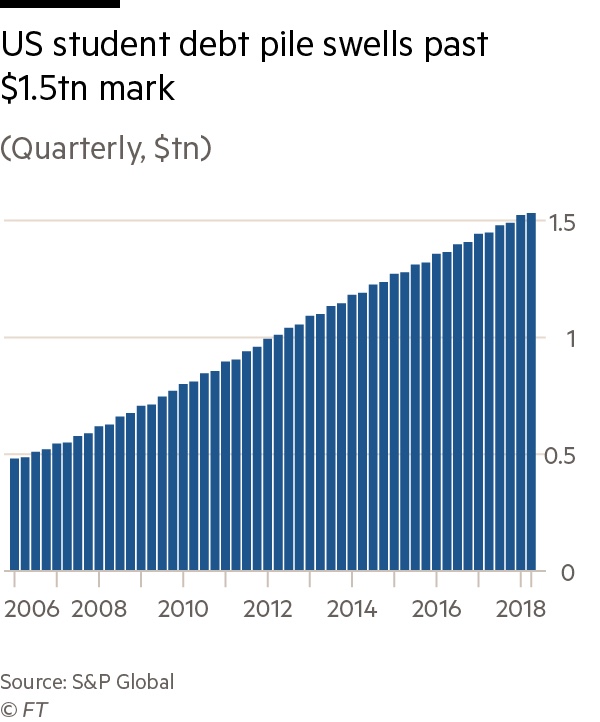
Student debt totaled about $1.5 trillion last year, exceeding all other forms of consumer debt except mortgages.

Auto debt is up nearly 40% adjusting for inflation in the last decade to $1.3 trillion. And the average loan for new cars is up an inflation-adjusted 11% in a decade, to $32,187, according to a Wall Street Journal analysis of data from credit-reporting firm Experian.

Unsecured personal loans are back in vogue, the result of competition between technology-savvy lenders and big banks for borrowers and loan volume.

Share

In a Life-or-Death Crisis, Humility Is Everything

Sam Walker:

Capt. Haynes spoke calmly and clearly to ground controllers and even thanked them for their assistance. At one point, when he was told he’d been cleared for an emergency landing on any runway at nearby Sioux City, he laughed. “You want to be particular and make it a runway, huh?”

Thinking quickly, he instructed one member of his three-man crew to grab ahold of the throttles controlling the two functioning wing engines. By carefully offsetting their thrust, the crew managed to direct Flight 232 down to one of those runways, but the odds were still against them.

The passenger jet was drifting side to side in a tailwind. It would have to land at 250 m.p.h., almost double the usual speed—and it had no brakes.

Share

The Cost of Reading

Ayşegül Savas:

Two weeks after I read Deborah Levy’s The Cost of Living, I found out that she would be speaking at a literary symposium titled “Against Storytelling” at a venue some minutes from where I live.

The Cost of Living is a memoir about the period following Levy’s separation from her husband. She moves into a dreary apartment block with her two daughters, loses her mother, takes every job she is offered, and continues writing, in an entirely new set-up of family, home, and work.

The book is about other things, too, like cycling up a hill after a day writing at a garden shed; buying a chicken to roast for dinner which tumbles out of the torn shopping bag and is flattened by a car; putting up silk curtains in the bedroom and painting the walls yellow; showing up to a meeting about optioning the film rights to her novel with leaves in her hair.

It is, mysteriously, about a scarcity of time and money, of trying to make ends meet. Mysteriously, because it is such a generous book, so lush and unrushed.

One of my best friends, visiting for the weekend, picked it up from the coffee table while my husband and I were preparing breakfast on Saturday morning.

Share

Carleton abd dUe process

Robby Soave:

Should continuing to assert your innocence be seen as a sign of guilt? After issuing a three-semester suspension to football player “John Doe” for sexual assault, Carleton College in Minnesota gave him the option of appealing the verdict. He did so, to no avail.

Then the dean of students wrote to Doe that “the fact you continue to assert that it was okay to engage in sexual activity with a person in [Jane Doe’s] condition is deeply troubling.” John’s suspension was upgraded to a permanent expulsion.

That’s just one of many troubling claims made in Doe’s lawsuit against Carleton College, which was filed in U.S. District Court earlier this month. John alleges that investigators violated his due process rights, ignored evidence that undercut his accuser’s claims, and evinced bias against him at all stages of the process.

The lawsuit stems from the events of April 28, 2017, when John, Jane, and many other students received invitations to join a secret society. They were told to meet at a specific place on campus at 2:00 a.m., where the members of the society instructed them to consume copious amounts of alcohol and then cover the president’s house in toilet paper. On the way to the house, the lawsuit claims, Jane stopped John, whom she had just met, and began kissing him and then touching him below the belt. According to John’s lawsuit, he eventually grew uncomfortable with the public nature of their contact, and suggested they go back to his dorm.

Share

Reading Lessons

Irina Dumitrescu:

I have forgotten how to read. It isn’t the first time. I have forgotten before and I will forget again. In other words, I am still learning how to read.

“Read,” like “love” or “think,” has a thousand meanings pressed into one deceptively elementary verb. We use it in a way that tends towards simplicity. It is the connection of sounds and concepts to standardized squiggles, to trails of ink on squares of paper, scratches carved into sticks, glowing lines of curved neon, careful stitches poked through a tight canvas. It can seem a basic skill, at least to those who have left the learning of letters behind.

Watching my son learn it now, I begin to understand how daunting a task it is, even given a phonetic language with a small alphabet, even with all the plasticity of a child’s brain at his disposal. Learning to read is a years-long series of internalizing rules and their many exceptions, of tiny modulations and adjustments. At first I thought it would be a matter of recognizing 26 letters. Then I saw that he must navigate upper and lower cases, print and cursive, different typefaces and hands, the sounds rendered by certain combinations of letters, umlauts and double S’s, unmarked short and long vowels, and the vagaries of foreign words and their unpredictable pronunciations.

So much work requires attention. My son approaches the challenge of decoding the world with intense concentration, straining to squeeze out meaning from each word and image. He is spellbound by anything legible, whether a phrase in bold, clear type or a comic strip that communicates just enough plot to fascinate, and will stare at it for what feels like ages. He is laboring hard, I know, but I still envy his power of absorption. Sometimes it feels like my practice as a reader has made me faster, but not consistently better. When I think of my own journey of learning to read, I am in fact thinking of a long process of learning and forgetting how to be with texts slowly, intimately, deeply.

Share

Parental Insights into Kids and Technology

Ben Bajarin, via a kind email:

Hello panelists! I hope you are all having a great summer. We have a number of surveys planned for the fall so look for many opportunities to participate coming!

We are conducting a study on kids use of technology and how parents make decisions around technology their children have access to and use. Our ideal participant for this study has children in the household between the ages of 5 and 18. If that is you, please help us and participate in this research. If that is not you, we have plenty of more survey opportunities coming!

The length of this survey is around 8-10 minutes, which I apologize as I know that is long. But we are trying to get deep insights into kids and technology, so the length was necessary.

If you complete the survey, you will automatically be entered into a raffle for $100 Amazon gift card, and we will randomly choose three winners to receive the gift card.

Thanks again for your participating in our studies we greatly appreciate it your time and contribution to our research.

Share

Need Extra Time on Tests? It Helps to Have Cash

Jugal Patel:

From Weston, Conn., to Mercer Island, Wash., word has spread on parenting message boards and in the stands at home games: A federal disability designation known as a 504 plan can help struggling students improve their grades and test scores. But the plans are not doled out equitably across the United States.

In the country’s richest enclaves, where students already have greater access to private tutors and admissions coaches, the share of high school students with the designation is double the national average. In some communities, more than one in 10 students have one — up to seven times the rate nationwide, according to a New York Times analysis of federal data.

In Weston, where the median household income is $220,000, the rate is 18 percent, eight times that of Danbury, Conn., a city 30 minutes north. In Mercer Island, outside Seattle, where the median household income is $137,000, the number is 14 percent. That is about six times the rate of nearby Federal Way, Wash., where the median income is $65,000.

Students in every ZIP code are dealing with anxiety, stress and depression as academic competition grows ever more cutthroat. But the sharp disparity in accommodations raises the question of whether families in moneyed communities are taking advantage of the system, or whether they simply have the means to address a problem that less affluent families cannot.

Related: Madison recently expanded its least diverse schools, yet we have long tolerated disastrous reading results. This despite spending far more than most taxpayer supported K-12 school districts.

Share

Is our education system failing us?

Richard Phelps: Critically Speaking:

In this episode, Therese Markow and Richard Phelps discuss the education system in the United States, especially in comparison with Western Europe and other industrialized societies. They look at how Common Core, No Child Left Behind, and the changes to the SAT test have affected the curriculum, learning, and student preparedness both for further education as well as life after school. These trends in educational standards and standardized tests continue to impede our students compared to those of the industrialized world. Students from all levels and backgrounds are affected by these programs and the changes that need to be made are discussed.

Key Takeaways: The U.S. is falling behind other countries, even those with less spending on education. Common Core and No Child Left Behind have caused progress to be lost in elementary and secondary educations standards. The SAT has become less of an aptitude test and more of an achievement test, and can discriminate against talented students from underrepresented groups that attended lower quality high schools.

Share

The U.S. Commission on Civil Rights embraces alternative facts

Max Eden:

There’s an old Mark Twain saying that there are “lies, damned lies, and statistics.” But without any statistics to support its point, the U.S. Commission on Civil Rights has stamped its imprimatur on the central lie of school discipline reform, that “students of color as a whole, as well as by individual racial group, do not commit more disciplinable offenses than their peers.”

If true, this would be astonishing. Black students are disciplined at more than three times the rate of white students. If their actual rates of misbehavior were precisely statistically equal, then the only explanation for the discipline disparity would be that teachers and administrators are tremendously, deplorably, and irredeemably racially biased.

But even the commission’s chair, Catherine Lhamon, won’t defend the claim. When Washington Post reporter Laura Meckler pointed out that the commission’s report, “Beyond Suspensions,” contained no citations that actually supported this point, Lhamon fell back to the position that the statistical disparity in school discipline “is not explained by differences in behavior.”

As I have covered in my review of the literature, there are several studies suggesting that the disparity is not entirely explained by differences in behavior. But as researchers have made more rigorous efforts to control for behavior, the remainder that could plausibly be attributed to teacher racial bias has shrunk dramatically

Share

Preschool teachers ask children too many simple questions

Ohio State:

When preschool teachers read books in their classrooms, the questions they ask play a key role in how much children learn, research has shown.

But a new study that involved observing teachers during class story times found that they asked few questions – and those that they did ask were usually too simple.

Only 24 percent of what teachers said outside of reading the text were questions, the results found. And the kids answered those questions correctly 85 percent of the time.

“When kids get 85 percent of the questions right, that means the questions the teacher is asking are too easy,” said Laura Justice, co-author of the study and professor of educational psychology at The Ohio State University.

Share

You’re probably making incorrect assumptions about your opposing political party

Arthur Brooks:

Let’s take a specific example of what this means in the case of a contentious issue like immigration, which continues to roil American politics. Despite a recent ugly rally and series of tweets from the president, the data show that, in fact, a strong majority of Republicans believe that properly controlled immigration can be good for the country. They also show that a strong majority of Democrats disagree that the United States should have completely open borders. In other words, while left and right differ on immigration, those holding extreme views are a minority in both parties. However, Republicans think a majority of Democrats believe in open borders while Democrats think a majority of Republicans believe immigration is bad for the United States. The perception gap is 33 percentage points on each side.

And that is the perception gap for the average Democrat or Republican. Strong partisans — progressive activists and devoted conservatives — are most inaccurate in their perceptions of the other side, reaching more than 45 percentage points on extremely divisive issues.

Share

California Teachers Association elected a new president. Then, it ousted its powerful executive director. Coincidence?

:

The California Teachers Association surprised just about everyone in the state’s education arena — including me — last week by abruptly dismissing executive director and longtime political powerhouse Joe Nuñez.

“The California Teachers Association recognizes the accomplishments and legacy of veteran educator and union advocate Joe Nuñez who has been the CTA Executive Director for the last six years. Nuñez is leaving the association following a vote by the Board of Directors to end his relationship with CTA,” reads the union’s July 17 press statement.
The move came a mere two weeks after Toby Boyd assumed the presidency of the 325,000-member union. Boyd was elected in an upset victory over sitting Vice President Theresa Montaño, after receiving an unexpected last-minute endorsement from outgoing President Eric Heins.

Are Boyd’s victory and Nuñez’s departure connected? A source who spoke to Politico’s Jeremy B. White seemed to think so.

Share

The Aesthetic Beauty of Math

Karen Olsson:

In 1939, as the buildup to war in Europe intensified, a brilliant French mathematician named André Weil made a plan to emigrate to the U.S. He was thirty-three and didn’t want to serve in the army; his life’s purpose was math, he felt, not soldiering. His escape turned out to be more difficult than he anticipated, in part because, as he would write in his memoir, “the Americans, who so warmly welcome those who do not need them, are much less hospitable to those who happen to be at their mercy”—as we’ve gone on to prove repeatedly since then.

He was vacationing in Finland when the war broke out, and he tried to lay low in Helsinki but was arrested and returned to France, where he sat in jail during the spring of 1940, awaiting trial for desertion. While there, he took some consolation from the fact that jail allowed him to work undisturbed, as well as to read novels and write letters, in particular letters to his sister, Simone Weil, who was also remarkably talented, a philosopher and spiritual thinker.

Though her brother’s incarceration infuriated her, Simone saw an opportunity. His work in advanced mathematics was to her, as it would be to most of us, esoteric. Since you have some spare time on your hands, she wrote to him, why don’t you explain to me exactly what it is you do?

Share

Stanford CS Education Library

Stanford:

This online library collects education CS material from Stanford courses and distributes them for free. Update 2006 For learning code concepts (Java strings, loops, arrays, …), check out Nick’s experimental javabat.com server, where you can type in little code puzzles and get immediate feedback.

Share

After the University of Alaska lost 41 percent of its state funding, thousands of students were told Alaska would no longer be providing promised state scholarships.

Ben Kesslen:

Sian Gonzales found out he would no longer be receiving the almost $5,000 he has been awarded annually from the Alaska Performance Scholarship (APS) on July 9 — a month and a half shy of the first day of classes for his junior year at the University of Alaska, Anchorage.

Gonzales, 21, didn’t lose the scholarship money because his grades slipped or because he violated any school rules; instead, Gonzales and 2,500 other students in Alaska lost the scholarship because the state is no longer funding it.

“I’m scared,” Gonzales, a nursing student, told NBC News. Raised in Juneau, Gonzales decided to stay in Alaska for college in large part because of the APS, and even worked toward earning the scholarship during high school.

Share

Parents Are Giving Up Custody of Their Kids to Get Need-Based College Financial Aid

Jodi S. Cohen and Melissa Sanchez:

Dozens of suburban Chicago families, perhaps many more, have been exploiting a legal loophole to win their children need-based college financial aid and scholarships they would not otherwise receive, court records and interviews show.

Coming months after the national “Varsity Blues” college admissions scandal, this tactic also appears to involve families attempting to gain an advantage in an increasingly competitive and expensive college admissions system.

Parents are giving up legal guardianship of their children during their junior or senior year in high school to someone else — a friend, aunt, cousin or grandparent. The guardianship status then allows the students to declare themselves financially independent of their families so they can qualify for federal, state and university aid, a ProPublica Illinois investigation found.

“It’s a scam,” said Andy Borst, director of undergraduate admissions at the University of Illinois at Urbana-Champaign. “Wealthy families are manipulating the financial aid process to be eligible for financial aid they would not be otherwise eligible for. They are taking away opportunities from families that really need it.”

Share

The Logic of the Tribe

Victor Davis Hanson:

In some sense, today’s hip new racists have adopted the ideology of Lester Maddox and not Martin Luther King, Jr. Segregation, not integration, is the new racist mantra—by dorm, by theme house, by caucus, by safe space, by graduation ceremony.

True intersectionality is impossible for racists—given that competing tribal agendas can never be reconciled. Far from creating force-multiplying woke ideologies by uniting various “identities”—black, Latino, Asian, LGBTQ, female, and non-American—intersectionality becomes a logical contest among professed victims to acquire preeminent tribal victimhood, and with it, DNA-sanctioned superiority.

The logic of the tribe leads to sectarian warfare, not harmony. We see just that when Asians revolt against black and Latino preferences in college admissions. Feminists push back against the endemic misogyny of rap music that is given an intersectional pass to demean women and freely employ the n-word. There is sometimes less, not greater, tolerance for unapologetic homosexuality in supposedly hyper-macho Latino culture. Doctrinaire Islam makes few concessions for the Muslim convert to Christianity; he is still an infidel to be shunned, even killed.

Share

Commentary on the utilty of a college degree

Charles Cooke:

The presumptions that underpin our present scramble for diplomas are as follows: that it would be a good thing if more people went to college; that going to college is the best — or perhaps the only — way to get ahead in life, leading, as it supposedly does, to automatic improvement of one’s lot; that, irrespective of what it does to the job market and to productivity, our society is materially improved by having more people with paper degrees in their possession; and that, in consequence of all of these things, it represents a major scandal that people who wish to educate themselves further are obliged to pay to do so. Alongside these presumptions are a set of implications that, while rarely acknowledged openly, are present nevertheless: that those who do not go to college have in some way failed — or that they have been failed; that every time a person declines to attend college, he is making America a little stupider on aggregate; and, by extension, that people who lack college degrees but nevertheless are successful are not demonstrating an alternative way of living their lives so much as muddling through as best they can absent vital instruction from their superiors.

Back in 2015, Howard Dean suggested on MSNBC’s Morning Joe that Scott Walker, a man who at that point was in his second term as governor of Wisconsin, was not qualified to be president because he had not completed his college degree. “I think there are going to be a lot of people who worry about that,” Dean suggested, before explaining that he himself was concerned “about people being president of the United States not knowing much about the world.” That Dean was characterizing as ignorant and unqualified a man who had, by that point, been successfully running a large American state for half a decade was preposterous. But it was also well in line with where we were headed as a society.

Share

Anthony Kronman on the ‘aristocratic ethos’ in higher education

Len Gutkin:

Since stepping down from his 10-year tenure as dean of Yale Law School, Anthony T. Kronman has been thinking a lot about the larger purposes of a humanities education. He’s addressed the topic in two books, Education’s End: Why Our Colleges and Universities Have Given Up on the Meaning of Life (Yale, 2007) and Confessions of a Born-Again Pagan (Yale, 2016), this last a 1,000-page exploration of his personal theology that draws on thinkers from antiquity to Freud to Rawls. (Kronman earned a Ph.D. in philosophy and spent some time undergoing psychoanalysis.) As Joshua Rothman put it in The New Yorker, Kronman “suspects that he might have found the meaning of life.”

His most recent book, The Assault on American Excellence, will be published by Free Press in August. It’s a crisply argued jeremiad about what Kronman sees as the wrong turn taken by elite universities in recent years. Under the guise of concerns for inclusion and a misplaced egalitarianism, Kronman argues, universities have abandoned what should be their core commitments to reasoned argumentation and, more controversially, to the development of an “aristocratic ethos.”

I met with Kronman in his office at the Yale Law School to talk about democracy and aristocracy, campus debates over free speech, affirmative action, and what he calls “the conversational ideal.”

Related: 1. Ivy League payments and entitlements cost taxpayers $41.59 billion over a six-year period (FY2010-FY2015). This is equivalent to $120,000 in government monies, subsidies, & special tax treatment per undergraduate student, or $6.93 billion per year.

Share

Commentary on newly Appointed taxpayer supported Madison school board member Savion Castro (no MMSD data in article)

Logan Wroge:

After high school, Castro studied sociology at UW-Madison and graduated with a bachelor’s degree in 2018. Castro sought out the major as he views the field as a good mix of political science and theory, history, statistics, and methodology.

Castro has also been involved with several Democratic campaigns and liberal organizations. In his senior year at high school, he worked as an organizer for former President Barack Obama’s 2012 re-election campaign.

At the university, Castro was a campus organizer for Burke’s 2014 gubernatorial run, later becoming involved in campaigns for local races, such as former City Council Ald. Denise DeMarb.

“From there, I learned how important local elections and local government are in terms of how it can affect people’s lives,” he said.

Madison has long tolerated disastrous reading results, despite spending far more than most taxpayer supported K-12 school districts – between $18.5k and 20k per student, depending on the district documents reviewed

Share

U.S. News Pulls Rankings Of UC-Berkeley (#22), Scripps (#30), And 3 Other Colleges For Misreporting Data

Robert Morse, Matt Mason, and Eric Brooks:

FIVE SCHOOLS NOTIFIED U.S. News that they misreported data used to calculate their rankings for the 2019 edition of Best Colleges. The schools are the University of California—Berkeley, Scripps College, Mars Hill University, the University of North Carolina—Pembroke and Johnson & Wales University.

What Does This Mean?

The misreporting by each school resulted in their numerical ranks being higher than they otherwise would have been. Because of the discrepancies, U.S. News has moved the schools to the “Unranked” category, meaning they do not receive numerical ranks.

All five schools’ Unranked status will last until the publication of the next edition of the Best Colleges rankings and until the schools confirm the accuracy of their next data submission in accordance with U.S. News’ requirements. All other schools’ rankings in the 2019 Best Colleges will remain the same on usnews.com

Share

CommenTary on University of California Recruiting Policies

Dan Walters:

To enforce that dictum, UC also requires applicants for new faculty employment and promotions to submit “diversity statements” that will be scored “with rubrics provided by Academic Affairs and require applicants to achieve a scoring cutoff to be considered.”

The academic affairs department at UC-Davis says that diversity statements from tenure-track faculty applicants should have “an accomplished track record…of teaching, research or service activities addressing the needs of African-American, Latino, Chicano, Hispanic and Native American students or communities.” Their statements must “indicate awareness” of those communities and “the negative consequences of underutilization” and “provide a clearly articulated vision” of how their work at UC-Davis would advance diversity policies.

Jeffrey Flier, former director of the Harvard Medical School, is among the respected academics who see the inherent contradictions and perils in UC’s one-size-fits-all concept of political correctness.

“As a supporter of the original goals of diversity, equity and inclusion initiatives, my skepticism toward this policy surprised a number of friends and colleagues,” Flier wrote this year in the Chronicle of Higher Education.

Share

‘Anonymised’ data can never be totally anonymous, says study

Alex Hern:

“Anonymised” data lies at the core of everything from modern medical research to personalised recommendations and modern AI techniques. Unfortunately, according to a paper, successfully anonymising data is practically impossible for any complex dataset.

An anonymised dataset is supposed to have had all personally identifiable information removed from it, while retaining a core of useful information for researchers to operate on without fear of invading privacy. For instance, a hospital may remove patients’ names, addresses and dates of birth from a set of health records in the hope researchers may be able to use the large sets of records to uncover hidden links between conditions.

Share

DARPA’s New Brain Device Increases Learning Speed by 40%

Don Galeon:

New research funded by the U.S. Department of Defense’s Defense Advanced Research Project Agency (DARPA) has successfully demonstrated how a non-invasive method of stimulating the brain can boost cognitive performance. Working under DARPA’s Restoring Active Memory (RAM) program, scientists from HRL Laboratories in California, McGill University in Montreal, Canada, and Soterix Medical in New York tested their brain device on macaques and observed a substantial increase in the monkeys’ ability to quickly perform certain tasks.

Share

Traveling abroad

Pamela Cotant:

CIEE is an international educational organization based in Portland, Maine. It was founded in 1947 to coordinate the efforts of a number of organizations and institutions that emerged after WWII in the U.S. and abroad to promote peaceful coexistence and respect between nations through student- and teacher-exchange programs.

Its mission has changed somewhat over the years and in the 1960s, the organization became a focal point for strategic and policy discussions on the future direction of intercultural education. In recognition of this strategic shift, the Council on Student Travel changed its name in 1967 to the Council on International Educational Exchange.

Horton, who was a sophomore at West High School last year, was one of 24 students from West who are traveling abroad this summer. There are a total of 36 from the Madison School District and 2,258 nationwide.

The West students traveled to a number of countries, including some in Europe as well as Botswana, India, Japan, Russia and Senegal. Some were on programs to learn the language and culture, while others were learning about subjects such as wildlife conservation, marine science, world government, how to empower girls through health education and mentoring youths. Some programs run for three weeks and others for four, and in some cases students can earn credit.

Share

Madison School District aiming to join resolution calling for retirement of Native AmericAn mascots across Wisconsin By Negassi Tesfamichael

Negassi Tesfamichael:

The Madison School Board is slated to support a resolution on Monday calling for legislation requiring school districts across Wisconsin to stop using Native American mascots.

The resolution, which was started by the Wausau School District, would affect the approximately 31 school districts in the state that currently use a Native American mascot, according to a resolution posted to the Madison School District’s website Friday. There are 421 public school districts in Wisconsin.

The resolution will go to the Wisconsin Association of School Boards’ policymaking committee and could be voted on by all of the state’s school districts at the WASB annual convention in January 2020.

Madison’s long term, disastrous reading results.

Share

Tulsi Gabbard, Democratic Presidential Candidate, Sues Google for $50 Million

Tulsi Gabbard:

“Google’s arbitrary and capricious treatment of Gabbard’s campaign should raise concerns for policymakers everywhere about the company’s ability to use its dominance to impact political discourse, in a way that interferes with the upcoming 2020 presidential election,” the lawsuit said.

Ms. Gabbard and her campaign are seeking an injunction against Google from further meddling in the election and damages of at least $50 million.

Google has automated systems that flag unusual activity on advertiser accounts — including large spending changes — to prevent fraud, said Jose Castaneda, a spokesman for the company

Many taxpayer supported K-12 school districts use Google Services, including Madison.

Share

The Hidden Costs of Automated Thinking

Jonathan Zittrain:

Like many medications, the wakefulness drug modafinil, which is marketed under the trade name Provigil, comes with a small, tightly folded paper pamphlet. For the most part, its contents—lists of instructions and precautions, a diagram of the drug’s molecular structure—make for anodyne reading. The subsection called “Mechanism of Action,” however, contains a sentence that might induce sleeplessness by itself: “The mechanism(s) through which modafinil promotes wakefulness is unknown.”

Provigil isn’t uniquely mysterious. Many drugs receive regulatory approval, and are widely prescribed, even though no one knows exactly how they work. This mystery is built into the process of drug discovery, which often proceeds by trial and error. Each year, any number of new substances are tested in cultured cells or animals; the best and safest of those are tried out in people. In some cases, the success of a drug promptly inspires new research that ends up explaining how it works—but not always. Aspirin was discovered in 1897, and yet no one convincingly explained how it worked until 1995. The same phenomenon exists elsewhere in medicine. Deep-brain stimulation involves the implantation of electrodes in the brains of people who suffer from specific movement disorders, such as Parkinson’s disease; it’s been in widespread use for more than twenty years, and some think it should be employed for other purposes, including general cognitive enhancement. No one can say how it works.

This approach to discovery—answers first, explanations later—accrues what I call intellectual debt. It’s possible to discover what works without knowing why it works, and then to put that insight to use immediately, assuming that the underlying mechanism will be figured out later. In some cases, we pay off this intellectual debt quickly. But, in others, we let it compound, relying, for decades, on knowledge that’s not fully known.

In the past, intellectual debt has been confined to a few areas amenable to trial-and-error discovery, such as medicine. But that may be changing, as new techniques in artificial intelligence—specifically, machine learning—increase our collective intellectual credit line. Machine-learning systems work by identifying patterns in oceans of data. Using those patterns, they hazard answers to fuzzy, open-ended questions. Provide a neural network with labelled pictures of cats and other, non-feline objects, and it will learn to distinguish cats from everything else; give it access to medical records, and it can attempt to predict a new hospital patient’s likelihood of dying. And yet, most machine-learning systems don’t uncover causal mechanisms. They are statistical-correlation engines. They can’t explain why they think some patients are more likely to die, because they don’t “think” in any colloquial sense of the word—they only answer. As we begin to integrate their insights into our lives, we will, collectively, begin to rack up more and more intellectual debt.

Theory-free advances in pharmaceuticals show us that, in some cases, intellectual debt can be indispensable. Millions of lives have been saved on the basis of interventions that we fundamentally do not understand, and we are the better for it. Few would refuse to take a life-saving drug—or, for that matter, aspirin—simply because no one knows how it works. But the accrual of intellectual debt has downsides. As drugs with unknown mechanisms of action proliferate, the number of tests required to uncover untoward interactions must scale exponentially. (If the principles by which the drugs worked were understood, bad interactions could be predicted in advance.) In practice, therefore, interactions are discovered after new drugs are on the market, contributing to a cycle in which drugs are introduced, then abandoned, with class-action lawsuits in between. In each individual case, accruing the intellectual debt associated with a new drug may be a reasonable idea. But intellectual debts don’t exist in isolation. Answers without theory, found and deployed in different areas, can complicate one another in unpredictable ways.

Share

This Emotional Intelligence Test Was So Accurate It Was Creepy

Rich Bellis:

A few weeks ago, after receiving a 21-page PDF report breaking down my so-called “emotional intelligence,” I did the logical thing and forwarded it to my boyfriend. He glanced at the list of categories on the second page and exclaimed—before reading my results—”Flexibility, uh oh!”

The report was the result of an assessment I’d taken three weeks prior called the EQ-i 2.0, which is based on nearly 20 years of research and has been taken by some 2 million people—and sure enough, it told me I’m about as inflexible as people close to me seem to think I am. Shortly afterward I scheduled a call with its developer, Steven J. Stein, who reviewed my results and offered this suggestion: “I would start looking at how you operate—what your routines are, how you get through a day.”

When I asked him for an example of a routine I might want to shake up, he said, “Like, eat a different breakfast or something.”

I glanced down. It was a Wednesday morning, and at my elbow was a Tupperware containing one of two breakfasts I pack myself pretty much every day. (Today it’s yogurt, some sliced orange, and granola.)

Share

Commentary on Madison (and WiscoNsin’s) long term, disastrous reading Results

Alan Borsuk:

Research has shown “that phonics instruction is helpful for all students, harmful for none, and crucial for some,” the paper says. It says there are other essentials to good reading instruction. But research on the value of phonics is consistent and goes back decades, it says. 

“Teaching students the basic letter-sound combinations gives them access to sounding out approximately 84% of the words in English print,” the paper says.

Phonics advocates in Wisconsin and elsewhere think this is a big deal. Steve Dykstra, a leader of the pro-phonics Wisconsin Reading Coalition, called the paper “revolutionary.” He said, “I would not go so far as to say this is the end of the reading wars. Maybe it’s the beginning of the end of the reading wars.”

Others are reacting more cautiously. Deborah Cromer, president of the Wisconsin State Reading Association, the main group of Wisconsin reading teachers, said in a statement that the organization supports the use of phonics. But she described other needs, including better staffing of classrooms and better training of teachers.

Why is this urgent in Wisconsin? Because we’re not doing so well. National Assessment of Educational Progress results released in 2017 showed that Wisconsin fourth graders scored overall below the national average, that Wisconsin’s decline in the percentage of proficient students from 2015 to 2017 was one of the largest in the country, and that Wisconsin kids of all races and ethnic groups were proficient at rates below the national average of each group — including that Wisconsin white kids were below white kids nationally.

A couple of decades ago, Wisconsin fourth grade reading ranked among the best in the United States. The state now ranks in the mid-30s

Furthermore, initiatives in Wisconsin in recent years do not seem to be bearing much fruit. They include stronger requirements for getting a license to teach reading to elementary kids and a state requirement (not enforced) that school districts screen kindergartners to spot and respond to reading problems early.

Share

After years of warnings, U.S. finally investigating secret foreign funding of American universities

Alexander Pease:

‘They can no longer expect to ignore the law with impunity’

An academic group that helped expose the reach of Chinese-funded propaganda in American universities has a message for academia: We told you so.

The Department of Education’s new investigation into universities for allegedly hiding foreign funding “is sending a powerful signal to colleges and universities: They can no longer expect to ignore the law with impunity,” Rachelle Peterson, policy director of the National Association of Scholars, told The College Fix.

The probes into Georgetown University and Texas A&M concern university assets from governments and companies in China, Russia, Qatar and Saudi Arabia, according to June 13 department letters to the universities obtained by the Associated Press.

The nonprofit Qatar Foundation comprised nearly all the foreign funding reported by Georgetown ($33 million) and all reported by Texas A&M ($6.1 million) last year, according to the AP.

Share

Global Business Professionals in the Developing World Believe that China and India will Surpass the U.S. as the World’s Centers of Tech Innovation by 2035

Bloomberg:

Bloomberg today released findings of its New Economy global survey, which gathered the views of 2,000 business professionals in 20 markets on what the future will hold as the balance of global power shifts towards new economies. Faced with a series of predictions about the world in 2035, the survey revealed sentiment from business professionals from emerging and developed economies on a range of issues including the role of technology, urbanization and climate change.

Overall, data shows that emerging country business professionals are more optimistic than developed markets about change, and have markedly higher expectations for the role that technology will play in the economy, business and daily life in the decades to come.

“It is noteworthy that emerging economies are more optimistic than developed markets about the power of technology to shape a better world by the year 2035,” said Andrew Browne, editorial director of the Bloomberg New Economy Forum. “Developing countries in general see technology more as an opportunity while the developed world has a greater sense of technology as a threat.”

“The data clearly indicate that being able to read is not a requirement for graduation at (Madison) East, especially if you are black or Hispanic”.

Share

Stretched for time, some households are starting to operate more like businesses

Taylor Lorenz Joe Pinsker:

Children’s free-play time has been on the decline for more than 50 years, and their participation in extracurricular activities has led to more schedule-juggling for parents. Parents are busier too, especially those whose jobs demand ever more attention after hours: 65 percent of parents with a college degree have trouble balancing work and family, a 2015 Pew Research Center report found, compared with about half of those without a college degree. In an effort to cope, some families are turning to software designed for offices. Parents are finding project-management platforms such as Trello, Asana, and Jira, in addition to Slack, a workplace communication tool (its slogan is “Where work happens”), particularly useful in their personal lives. In other words, confronted with relentless busyness, some modern households are starting to run more like offices.

Share

Commentary on Growing University of Wisconsin Student Fees

Kelly Meyerhofer:

The changes would make it difficult to construct buildings funded by student fees, according to a UW-Madison student leader familiar with the approval process, which has attracted scrutiny from Republicans who say the fees are making college less affordable.

UW students will pay between roughly $1,000 and $1,600 in annual fees for bus transportation, student organizations and services such as mental health counseling. A portion of those fees may go to pay for construction of buildings such as student unions or sports recreation centers if a majority of students voting in a referendum approve such a move.

Starting in the fall, for example, each UW-Madison student will pay an additional $173 to help fund major upgrades to recreational facilities. About 87% of students approved the increase in a 2014 referendum that brought a third of campus to the polls.

Share

Wisconsin judge to rule on school choice intervention request

Bethany Blankley:

Their plight “is symbolic of rural education in Wisconsin (and the Midwest) which lags far behind the suburbs and, in Wisconsin, performs worse academically than urban schools,” CJ Szafir, executive vice president at Wisconsin Institute for Law and Liberty (WILL), told The Center Square.

WILL filed a motion to intervene in the lawsuit on behalf of Shepherd’s Watch, the local Christian community group run by Wade Reimer. Reimer attempted to purchase the vacant Mattoon Elementary school building to use it as a community center and eventually a Christian school.

A Shawano County judge will hear WILL’s argument Friday and either decide then, or by the end of August.

“Children in Mattoon deserve a high quality, local school and right now there is nothing,” Szafir said. “Yet the Antigo School District would rather have an empty school building sit empty than sell it to a Christian community group with the hopes of turning it into a private school. We’re asking the judge to allow our client to intervene into the case so their story could be heard.”

To date, the district has closed seven rural schools. All students attending public school must travel to the city of Antigo, some commuting 90 minutes round trip.

It, like other districts, argues the schools are “too expensive to run,” but it won’t sell a vacant building, but it won’t sell it to anyone who wants to open a private school, according to the lawsuit.

“The Antigo School District says they own the building and refuses to sell it unless there is a promise made to not use it for a school,” Anthony LoCoco, deputy counsel on the case, told WSAU radio. “They don’t want the competition of a private school because some children from Mattoon would go to a local elementary school and they would lose funds.”

Unified School District of Antigo Superintendent Dr. Julie Sprague told The Center Square she was unable to comment due to the pending litigation.

Last fall, Antigo School District business manager Tim Prunty told the Antigo Daily Journal that opening a private school would make public schools like Antigo receive less federal aid, WJFW News 12 reported.

Share

The world’s top 50 thinkers 2019

Prospect:

Never doubt that thoughtful minds can change the world; they are the only things that ever do. Margaret Mead is thought to have said something like that, which chimes with Keynes, who wrote that the self-styled practical men running the world were unwittingly guided by forgotten academic scribblers. For Victor Hugo, meanwhile, the one thing stronger than all the armies in the world was “an idea whose time had come.”

These reflections on the power of thought are worth unearthing because these are anti-intellectual times—and not only because of the proud ignoramus in the White House. No: the roots of current disdain for educated, “liberal elites” go much deeper, tracing back to well before the financial crisis and populist backlash.

The seeds were planted in the 1970s by the New Right’s Irving Kristol, who saw reactionary potential in rallying mass opposition to the “new class” of university graduates, who had the sort of fancy ideas that would go down badly with those Nigel Farage defines as “real people.” Over the decades since, Rupert Murdoch and the popular press, preferred reflex reactions to rationality, and called them “common sense.” They have derided intellectuals, who rarely rank among the economic elite, as a class apart in ivory towers. Today we have reached the Trumpian point where, for perhaps the first time in free societies since the French Revolution, reason has to be defended as a value.

This context makes it timely to revive the Prospect tradition of identifying the world’s leading thinkers. The urge to rank and measure might itself seem anti-intellectual—more Top Trumps than top scholarship. But the aim is not to chase a chimera still less to deliver the results of some supposedly objective IQ test. Rather it is simply to honour the minds engaging most fruitfully with the questions of the moment.

We go into it aware that any such list will say as much about the people doing the listing as the names that make the grade; indeed, you—the readers—will reveal something about yourselves if and when you vote for the very top thinkers in our online poll.

Share

Education in tech is hard, here’s why.

Calder White:

Technology is a field with tremendous breadth and depth. It spans from AI and cryptocurrencies to apps that deliver meals to your doorstep. You can learn about how to make your first webpage or how a Mosfet transistor works. This incredible span of topics creates a problem when the idea of “learning technology” or “working in technology” is presented.

Determining what range of knowledge is required is a constant problem in technology. On top of this, the word “technology” and the topics it covers are changing rapidly. It’s no longer good enough to teach specific concepts or languages. We need to teach students a whole new way to think. Simplification of problems, isolation of problems, problem solving. These are skills that need to be applied no matter what you are working on.

Share

New Madison school board member defends heckler’s veto

David Blaska:

Just when you thought the Madison School Board couldn’t get worse, it did. The board voted unanimously to add Savion Castro, formerly of One Wisconsin Now and currently a Democratic legislative aide for Rep. Sheila Stubbs (D-Madison). Castro replaces former Democratic candidate for governor Mary Burke on the board who resigned earlier this year.

RightWisconsin writes:

Despite the unabashed praise of the Capital Times for Castro’s “new perspective” and the addition of “diversity” to the board, his appointment is not a good sign for a school district that has been plagued by protesters attempting to shut down dissenting opinions at school board meetings. Castro is outspoken opponent of free speech. Castro even testified at the state legislature against protecting free speech on University of Wisconsin System campuses.

In an editorial on May 4, 2017, Castro and One Wisconsin Now were named RightWisconsin’s “Losers of the Day,” with good reason. The editorial is below:

Share

What Were Robespierre’s Pronouns?

Penny Noonan:

It was a revolution largely run by sociopaths. One, Robespierre, the “messianic schoolmaster,” saw it as an opportunity for the moral instruction of the nation. Everything would be politicized, no part of the citizen’s life left untouched. As man was governed by an “empire of images,” in the words of a Jacobin intellectual, the new régime would provide new images to shape new thoughts. There would be pageants, and new names for things. They would change time itself! The first year of the new Republic was no longer 1792, it was Year One. To detach farmers from their superstitions, their Gregorian calendar and its saints’ days, they would rename the months. The first month would be in the fall, named for the harvest. There would be no more weeks, just three 10-day periods each month.

So here is our parallel, our hiccup. I thought of all this this week because I’ve been thinking about the language and behavioral directives that have been coming at us from the social and sexual justice warriors who are renaming things and attempting to control the language in America.

There is the latest speech guide from the academy, the Inclusive Communications Task Force at Colorado State University. Don’t call people “American,” it directs: “This erases other cultures.” Don’t say a person is mad or a lunatic, call him “surprising/wild” or “sad.” “Eskimo,” “freshman” and “illegal alien” are out. “You guys” should be replaced by “all/folks.” Don’t say “male” or “female”; say “man,” “woman” or “gender non-binary.”

In one way it’s the nonsense we’ve all grown used to, but it should be said that there’s an aspect of self-infatuation, of arrogance, in telling people they must reorder the common language to suit your ideological preferences. There is something mad in thinking you should control the names of things. Or perhaps I mean surprising/wild.

I see in it a spirit similar to that of the Terror. There is a tone of, “I am your moral teacher. Because you are incapable of sensitivity, I will help you, dumb farmer. I will start with the language you speak.”

An odd thing is they always insist they’re doing this in the name of kindness and large-spiritedness. And yet, have you ever met them? They’re not individually kind or large-spirited. They’re more like messianic schoolmasters.

Share

Publish or Perish: How China’s Elsevier Made its Fortune

Wang Yiwei:

During a livestreamed Q-and-A session in February, young actor Zhai Tianlin sits in front of a champagne-colored curtain holding a list of questions from his fans. He responds to each one as cutesy visual effects pop up around him, but then he’s stumped. “Is your Ph.D. paper available on Zhiwang?” He reads the question with a puzzled look, then looks straight into the camera: “What is Zhiwang?” He repeats: “What is Zhiwang?”

Known for being a “smart” actor, Zhai had then just received a doctorate degree in film studies at the prestigious Beijing Film Academy. But, viewers knew, nobody working on their dissertation in China can avoid using Zhiwang, the country’s largest database of academic papers, more formally known as the China National Knowledge Infrastructure, or CNKI. Clearly, something didn’t add up, and the video went viral. Later, Zhai was found to have plagiarized papers and to have graduated without publishing a dissertation.

Zhai apologized, and his reputation took a hit, but that wasn’t the end of the saga. People in academia noticed the sudden interest in CNKI and seized the opportunity to air their grievances with the website. CNKI abuses its legacy of state ownership to keep the Chinese world of academic publishing in a monopolistic stranglehold, they say, and uses its position to pay writers pittances while forcing universities to accept steep price hikes. All in all, CNKI makes exorbitant profits that are hard to justify, critics argue.

Such objections echo those leveled at academic publishers in the West: Why do universities that employ researchers to write papers have to pay unreasonably high prices to access those papers? For example, Dutch publisher Reed Elsevier, which also runs several online databases, has faced protests from European libraries for maintaining annual profit margins of about 37%. Still, that figure pales in comparison with CNKI’s, which for the past decade has posted an average annual profit margin of nearly 60%.

Share

Civics, Personal Data and PRIVACY

Sophie:

The UK authorities made illegal copies of the #Schengen Information System, incl photos & fingerprints of EU citizens and gave access to US companies

Share

Poetry and Prophecy, Dust and Ashes

Phil Christman:

In the early 1990s, W. W. Norton, that indefatigable supplier of textbooks, invited the literary scholar Robert Alter to assemble a critical edition of Genesis. Alter countered that he’d have to do his own translation, the existing ones being inadequate. Norton agreed. But, Alter tells us in his new treatise The Art of Bible Translation, “I had not gotten halfway through the first chapter of Genesis before I discovered that there were all sorts of things going on in the Hebrew, many having to do with its literary shaping, that had not been discussed in the conventional commentaries and that I wanted to take up.” The scholar-turned-translator thus found himself launched on a third parallel career, as commentator. Alter’s Genesis appeared in 1996 to rapturous reviews, followed by The David Story (both Samuels and a smattering of Kings) a few years later, then the Pentateuch a few years after that. Those of us who came to love Alter soon found ourselves in a position akin to that of Robert Caro’s or George R.R. Martin’s fans. Would he keep going? What if he lost interest, perhaps taking up a less exacting hobby upon his retirement? What if – morbid thought – he died? But twenty-three years after Genesis, Alter has completed his work: a finished Hebrew Bible, three volumes lovingly footnoted; an altogether worthier object of contemplation than some fantasy series, or Lyndon Johnson. And I, who am but dust and ashes, review it.

Share

Ideology crushes teachers’ ability to control classes

Robert Bolton:

The comment comes from education author and commentator Greg Ashman who researches teaching techniques globally.
He was responding to a report from the Centre for Independent Studies that showed students from disadvantaged schools performed poorly in classes where there was a high level of disruption and to the OECD Index of Discipline in schools which shows Australia near the bottom of a list of 67 countries.
Mr Ashman, who is head of research at Ballarat Clarendon College and the author of The Truth about Teaching said teaching faculties at Australian universities subscribed to the philosophy that if kids were disruptive it was the fault of the teacher for not being “interesting enough”.
In reality students misbehave for all sorts of reason which can be external to the classroom and the role of the teacher was not the problem.

Share

Oberlin College ordered to post $36 million bond to delay Gibson’s Bakery collection of Judgment Comments Permalink

William Jacobson:

Judge granted Oberlin College’s motion to stay execution of the judgment, but required the posting of a bond in the amount of the judgment plus three years interest as security.

The compensatory and punitive damages of $25 million (after reduction for tort reform caps), plus the over $6.5 million in attorney’s fees and costs, put Oberlin College almost $32 million in debt to Gibson’s Bakery and its owners.

Absent some judicial action, the next step would have been for the Gibsons to execute on the judgment, meaning start collecting the money through post-judgment remedies, such as seizing bank accounts and physical property.

Oberlin College, which intends to appeal once post-trial motions are over, obviously doesn’t want its bank accounts, computer equipment, and er, Dean of Students’ office furniture, seized just as the freshman class was arriving. So Oberlin College filed a motion for a stay of execution of the judgment until such time as it can appeal and obtain an appeal bond.

We covered the parties’ arguments for and against in our prior post, Gibson’s Bakery: “there is serious concern about [Oberlin College’s] ability to pay this sizeable judgment three years from now”. Gibson’s Bakery devoted much of its opposition to arguing for a bond on the basis that Oberlin College was in poor financial shape:

A stay of judgment execution is not automatic under Ohio law for private litigants. Defendants do not have some absolute right to a stay of execution. Should the Court decide, in its discretion under Civ. R. 62(A), that Defendants are entitled to bond off the execution of the judgment, then Plaintiffs request that the bond be set at $36,356,711.56….

The need for such bond is made clear by the College’s own statements about its dire fmancial straits. If the College is to be believed, there is serious concern about its ability to pay this sizeable judgment three years from now. At trial, and in its recent filing, the College represented that there was only $59.1 million of unrestricted endowment funds available to pay any dollar judgment and that $10 million of those funds had already been committed to pay down the College’s existing debt. [Trial Tr., June 12, 2019 at 95:13-21] There remains $190 million of existing debt on the College’s books. [Id.] The College has also testified that it has a significant operating deficit and that its deficit situation is not sustainable…. [Trial Tr., June 12, 2019 atpp. 86:1-6, 88:1-9]

The College also testified at trial that they have experienced a “significant” and “steady” decline of enrollment from 2014 to 2018. [Trial Tr., June 12, 2019 at 79:4-17] In describing their economic position, the College offered Exhibit N-33 at trial, which is its May 10, 2019 report entitled “One Oberlin: The Academic & Administrative Program Review Final Report.” [Trial Tr., June 12, 2019 at pp. 99-100] In that Report, the College describes its alleged financial hardships and warns about how many other private colleges have had to close due to financial difficulties …[Ex. N-33, pp. 4-5].

Thus, we know that Oberlin College could attempt to continue using its available funds to pay down its other debts between now and the filing of a notice of appeal, thereby leaving less available to pay the judgment in this case.

Share

Saving Lydia: Why I’m Open Sourcing My Baby To Save Her and Millions of Others

Rohan Seth:

There are six billion characters in our DNA. All of us have spontaneous typos in this code — a mutation. Some typos, like Lydia’s, cause serious diseases. Collectively, there are seven million people in the U.S. suffering from typos that affect the brain. Majority of affected are children. This doesn’t include the millions who have already died from these. Pre-natal genetic testing does not look for these. Because a typo can happen in one of billions of characters, there are only a handful of patients with the exact same one. For Lydia’s, there are only two others in the entire world — one in Greece and one in England. At position 683 of the gene KCNQ2, an A was mistyped as a G. That’s all it took.
This is a classic long tail problem — no mutation is common enough, but collectively there are tons. The existing Pharma approach to treat these is broken — they look for common typos and fix them with long drawn out trials. This barely makes a dent. Worse, they have put each in its own bucket and labeled them as rare, so the majority of the world feels they‘re not important to fix. How can these be rare when collectively there are millions with these mutations? The rare label is wrong and limits progress. These are not rare. These are genetic and have the same root cause. We need a systematic, platform-driven approach to fix these typos. We need a spell check.

Share

OP-ED: New Jersey PRESS CORPS SHOULDN’T IGNORE MURPHY’S CONFLICT OF INTEREST

Mike Lilley:

SPCNJ revealed that the New Jersey Education Association was the source of at least $2.5 million in funding for NDNJ. This was a significant victory for transparency in New Jersey’s political system because NDNJ had reneged on its promise to disclose its donors.

Since then, NDNJ has launched an extensive, million-dollar media campaign featuring the governor, promoting a millionaires tax, and attacking Democratic legislators for leaving the tax out of the fiscal year 2020 budget.

While these aggressive tactics have gained a great deal of press, the coverage has consistently left out the important fact that the state’s most powerful special interest, the NJEA, is the money behind NDNJ. This is a significant omission because it ignores a critical issue: the governor’s conflict of interest due to his leading role in NDNJ’s media campaign.

The facts are damning. It is well-known that the NJEA strongly supported Gov. Murphy’s election campaign, and that NJEA leaders played significant roles in both his transition team and his administration. Indeed, a former NJEA political operative is currently a deputy chief of staff for the governor.

Share

Is disability the new normal

Frank Furedi:

Students in higher education are increasingly classified as either disabled or as suffering from mental-health issues. Disability on campuses has become the new normal and there is a growing demand for providing students with extra time to take exams or with an ever-expanding variety of special institutional support.

At some elite institutions in the United States, around one in four students are now classified as disabled. At Pomona College in California, 22 per cent of students were considered disabled in 2018, compared with five per cent in 2014. A survey published in the Harvard Crimson says that among the class of 2018, 41 per cent of students have at some point sought mental-health support from Harvard’s health services, while 15 per cent have sought support off campus.

Share

Think Republicans are disconnected from reality? It’s even worse among liberals

Arlie Hochschild:

In a surprising new national survey, members of each major American political party were asked what they imagined to be the beliefs held by members of the other. The survey asked Democrats: “How many Republicans believe that racism is still a problem in America today?” Democrats guessed 50%. It’s actually 79%. The survey asked Republicans how many Democrats believe “most police are bad people”. Republicans estimated half; it’s really 15%.

The survey, published by the thinktank More in Common as part of its Hidden Tribes of America project, was based on a sample of more than 2,000 people. One of the study’s findings: the wilder a person’s guess as to what the other party is thinking, the more likely they are to also personally disparage members of the opposite party as mean, selfish or bad. Not only do the two parties diverge on a great many issues, they also disagree on what they disagree on.

This much we might guess. But what’s startling is the further finding that higher education does not improve a person’s perceptions – and sometimes even hurts it. In their survey answers, highly educated Republicans were no more accurate in their ideas about Democratic opinion than poorly educated Republicans. For Democrats, the education effect was even worse: the more educated a Democrat is, according to the study, the less he or she understands the Republican worldview.

Share

East High Principal Mike Hernandez to become chief of MAdison high schools

NEGASSI TESFAMICHAEL:

East High School Principal Mike Hernandez will be the Madison Metropolitan School District’s new chief of high schools, according to a letter sent out to families Wednesday morning.

Hernandez, who first started at East four years ago after previously working as a principal at Sherman Middle School, will take on the role after chief of secondary schools Alex Fralin announced earlier this month that he would leave the district.

“I am excited about the new challenges, and look forward to working with staff across the city,” Hernandez wrote. “In my new role, I vow to keep the focus on equity, achievement, trust, and positive relationships.”

Yet: “The data clearly indicate that being able to read is not a requirement for graduation at (Madison) East, especially if you are black or Hispanic”.

Share

Statement of Commissioner Gail Heriot in the U.S. Commission on Civil Rights Report: Beyond Suspensions: Examining School Discipline Policies and Connection to School to Prison Pipeline for Students of Color with Disabilities.

Gail Heriot:

On April 23, 2019, the U.S. Commission on Civil Rights released a report entitled Beyond Suspensions: Examining School Discipline Policies and Connection to School to Prison Pipeline for Students of Color with Disabilities. This Statement is part of that report.

In the report, the Commission finds “Students of color as a whole, as well as by individual racial group, do not commit more disciplinable offenses than their white peers ….” That would be a good thing if it were true, but there is no evidence to support it and abundant evidence to the contrary. “This Statement discusses that evidence. Denying facts is not helpful to students, no matter what their race or ethnicity.”

The report also asserts that students with disabilities are disciplined more often than students without disabilities. But it leaves the impression that this means students with physical disabilities are being disproportionately disciplined. That isn’t true. It is students with behavioral disorder who misbehave more often (and hence are disciplined more often). But behavioral disorders are defined by a pattern of misbehavior. All the Commission has found is that student who misbehave a lot get disciplined more often than students who don’t. No surprise there.

Laura Meckler:

Experts say it is unclear whether or why students of color may be more likely to display behavior problems. Possible explanations include the impact of poverty, family structure and systemic bias faced throughout life.

One of the commissioners who voted against adoption of the report, Gail Heriot, said she was disturbed by the finding that students of color do not commit more offenses warranting discipline than their white peers.

“The report provides no evidence to support this sweeping assertion and there is abundant evidence to the contrary,” Heriot, a law professor at the University of San Diego, wrote in her dissent. She said that denying that black and Hispanic students misbehave more often is a “slap in the face to teachers” because it suggests they are singling out students of color for punishment much more often without evidence.

Share

HOW CAPITALISM CHANGED AMERICAN LITERATURE

Dan Sinykin:

Fifty years ago, almost every publisher in the United States was independent. Beginning in the late 1960s, multinational corporations consolidated the industry. By 2007, four out of every five books on bookstore shelves were published by one of six conglomerates: corporate entities that hold businesses from different industries under one governing financial structure. I call this period—from, roughly, RCA’s purchase of Random House at the end of 1965 until the release of the Amazon Kindle and the 2007–8 financial crisis—the conglomerate era.

The conglomerate era was full of prophecies about the coming death of literature, or, on the other hand, its continued flourishing. Literature, said the doomsayers, needed some freedom from commerce to survive. Otherwise we’d be left with only cookbooks and celebrity memoirs. Novelists, especially, rattled their swords. They even convinced the US Senate, in 1980, to hold a hearing about breaking up the conglomerates. E. L. Doctorow argued on behalf of PEN that “the concentration into fewer and fewer hands of the production and distribution of literary work is by its nature constricting to free speech and the effective exchange of ideas and the diversity of opinion.” Publishers countered that—either in spite or because of their consolidations—more and more diverse literature was being published than ever.

Share

The Effects of Means-Tested Private School Choice Programs on College Enrollment and Graduation

Will Flanders:

Despite the efforts of Governor Tony Evers and Wisconsin Democrats to end school choice, the evidence continues to build on the positive effects of the program. The most recent evidence in a new study from the Urban Institute is arguably some of the most important so far.

Using rigorous research methods, the study found that students in Milwaukee’s school choice program are more likely to enroll in, and graduate from, four year colleges.

This study is a follow-on to the School Choice Demonstration Project that was commissioned by the state of Wisconsin in the mid 2000s. Researchers from the University of Arkansas tracked the progress of students in the Milwaukee Parental Choice Program (MPCP) along with a matched sample of students in traditional public schools. The matching method used here allows for the best measure of the true effect of an intervention outside of lotteries, which didn’t occur in Milwaukee.

There are two sets of results in the study, one for students that were in 9th grade at baseline and one for students who were in 3rd through 8th grade. Among 9th graders, effects were found on enrollment but not on graduation. Among 3rd through 8th graders, the study also found an effect on enrollment. They find that 50 percent of MPCP students in this group enrolled in college compared to 45 percent of Milwaukee Public Schools students. This difference was statistically significant.

Share

The death and life of the great American hipster offers an alternative history of culture over the last quarter century.

Greg Jackson:

On the college campus where I have been living, the students dress in a style I do not understand. Continuous with what we wore fifteen years ago and subtly different, it is both hipster and not. American Apparel has filed for bankruptcy, but in cities and towns across the US the styles forged a decade ago at the epicenters of bohemia still filter out. Urban Outfitters is going strong. In Zürich, on the banks of the Limmat, elaborate tattoos cover the bodies of the children of Swiss bounty. The French use Brooklyn as a metonym for hip. In this context, in such saturation, hipster can no longer stand for anything, except perhaps the attempt or ambition to look cool. But since coolness venerates its own repudiation most of all, every considered choice bears hipster’s trace. Hipster is everything and nothing—and so it is nothing.

Yet even before hipster petered out, confusion dogged its meaning. Starting in 2009, Mark Greif and his colleagues at n+1 undertook the most serious attempt to date to understand and situate the hipster in context. This realized itself in essays and panel discussions and ultimately a book, What Was the Hipster?1 Admirable as these efforts were—and Greif’s essay of the same name remains the high-water mark in hipster criticism—something elusive always troubled the boundaries of the concept. As Rob Horning wrote for PopMatters after one such panel, “The participants never really made much of an effort to establish a stable definition of what a hipster is,”2 a failure that may reflect the impossibility of the task.

Share

Raising the American Weakling

Tom Vanderbilt:

Unlike most findings in the sleepy field of occupational therapy, her findings, which were published last year in the Journal of Hand Therapy, touched off a media firestorm, as the revelation seemed to encapsulate any number of smoldering fears in one handy conflagration: The loss of human potential in the face of automation, of our increasing time spent on smartphones and other devices, the erosion of our masculine norms,2 of the fragility and general shiftlessness of millennials. Even taking into account the cautionary statistical notes—that the sample sizes of the 1980s studies were not huge, that Fain’s study was mostly college students—the idea of a loss in human strength, expressed through a statistical measure hardly anyone had previously heard of, seemed to hint at some latter-day version of degeneration.

That message was reinforced by the sheer predictive power of grip strength. In a study published in 2015 in The Lancet, the health outcomes of nearly 140,000 people across 17 countries were tracked over four years, via a variety of measures—including grip strength.3 Grip strength was not only “inversely associated with all-cause mortality”—every 5 kilogram (kg) decrement in grip strength was associated with a 17 percent risk increase—but as the team, led by McMaster University professor of medicine Darryl Leong, noted: “Grip strength was a stronger predictor of all-cause and cardiovascular mortality than systolic blood pressure.”

Share

How to Overcome Failure

Rachel Simmons:

Earlier this year, I suffered an anxiety attack while giving a speech in front of 250 people. It was disorienting and embarrassing; I’m a professional public speaker, and this was an important client. After I stopped talking, someone brought me a chair and a glass of water. I sat in front of a sea of murmuring, concerned faces, wondering if my public speaking career was over.

Years ago, that would have been the end of the story: I would have slunk off the stage and returned the money. But instead, I put my hand over my heart and reminded myself I wasn’t alone. I spoke to myself the way I would talk to my closest friend. How did I know to do this? In part because I’ve spent the last decade teaching failure resilience to students.

As it turns out, learning to fail is a skill like any other. Which means it takes practice. Here’s how you can approach a setback so that — to paraphrase Cardi B — when you’re knocked down nine times, you can get up 10.

Share

Grafton schools ordered to pay for $78,000 a year boarding school for a dyslexic student

Annysa Johnson:

The Grafton School District has been ordered to pay $78,000 a year, plus expenses, to send a student to a boarding school for young people with learning disabilities after an administrative law judge found the district failed to provide him the “free and appropriate public education” required by law.

The boy’s mother had waged a yearslong battle with the district over her son’s education, in recent years accusing his high school teachers of completing assignments for him, lying about his progress and passing him in classes when he hadn’t done the work.

“The data clearly indicate that being able to read is not a requirement for graduation at (Madison) East, especially if you are black or Hispanic”

Share

Let’s Compare: Middleton and Madison Property Taxes

Madison property taxes are 22% more than Middleton’s for a comparable home, based on this comparison of 2017 sales.

xlsx file.

Related links: Madison’s taxpayer supported K-12 tax and spending history. Madison spends around 18.5 to 20K per student, depending on the district documents reviewed (some include all referendum spending).

Middleton taxpayers spent $90,989,198 for 7,437 students during the 2018-2019 school year or $12,239 per student. Madison spends at least 50% more per student. Yet.

2016 comparison.

I pondered this while considering Chicago’s property tax growth problems.

Share

Property Tax Explosion Stunts Chicago Real Estate Market

AK Thomson:

Bryce Hill, research analyst at the independent Illinois Policy think-tank, says that the annual property-tax take in Cook County, which includes Chicago, increased 76 per cent more than median home values between 1996 and 2016.

“Both the city and the state are wrestling with unbalanced budgets, massive amounts of pension debt, and limited solutions,” he says. “As they fight these worsening financial conditions, businesses and homeowners have been saddled with high property taxes that far outpace growth in property values.”

Until last year, homeowners in Chicago could write off property taxes against their taxable income. But President Donald Trump’s 2018 reform establishes a $10,000 cap, leaving many homeowners suddenly forking out huge sums. “It has really put the brakes on sales,” says Nicholas Apostal, a principal broker at Keller Williams in Chicago.

Apostal is listing a fully renovated 19th-century brownstone in Lincoln Park with five bedrooms and four bathrooms. The $1.45m sales tag is far below the pricier markets of New York and San Francisco, but it comes with annual property taxes of just under $22,000 — and no guarantee that they will not increase in years to come.

The Madison School Board is considering another property tax and spending boost. This occurs during a time of substantial federal taxpayer subsidized property base growth.

Details.

Madison has long spent more than most taxpayer supported K-12 school districts. Yet we have tolerated disastrous reading results.

Related: A look at property taxes.

Let’s compare: Middleton and Madison property taxes: 2018 and 2016.

Share

Choose Life: ‘No girls born’ for past three months in area of India covering 132 villages

Chris Baynes:

An investigation into suspected sex-selective abortions has been launched by magistrates in a district of northern India after government data showed none of the 216 children born across 132 villages over three months were girls.

Authorities in Uttarkashi, Uttarakhand state, said the official birth rate was “alarming” and pointed towards widespread female foeticide,

India outlawed the selective abortion of female foetuses in 1994 but the practice remains commonplace in the country, where parents often see boys as breadwinners and girls as costly liabilities.

Number of deaths resulting from abortions: 1973 – 2014 more

Worldwide abortion data.

Share

Algorithmic Governance and Political Legitimacy

Matthew B. Crawford:

In ever more areas of life, algorithms are coming to substitute for judgment exercised by identifiable human beings who can be held to account. The rationale offered is that automated decision-making will be more reliable. But a further attraction is that it serves to insulate various forms of power from popular pressures.

Our readiness to acquiesce in the conceit of authorless control is surely due in part to our ideal of procedural fairness, which de­mands that individual discretion exercised by those in power should be replaced with rules whenever possible, because authority will inevitably be abused. This is the original core of liberalism, dating from the English Revolution.

Mechanized judgment resembles liberal proceduralism. It relies on our habit of deference to rules, and our suspicion of visible, personified authority. But its effect is to erode precisely those pro­cedural liberties that are the great accomplishment of the liberal tradition, and to place authority beyond scrutiny. I mean “authori­ty” in the broadest sense, including our interactions with outsized commercial entities that play a quasi-governmental role in our lives. That is the first problem. A second problem is that decisions made by algorithm are often not explainable, even by those who wrote the algorithm, and for that reason cannot win rational assent. This is the more fundamental problem posed by mechanized decision-making, as it touches on the basis of political legitimacy in any liberal regime.

I hope that what follows can help explain why so many people feel angry, put-upon, and powerless. And why so many, in expressing their anger, refer to something called “the establishment,” that shadowy and pervasive entity. In this essay I will be critiquing both algorithmic governance and (more controversially) the tenets of pro­gressive governance that make these digital innovations attractive to managers, bureaucrats, and visionaries. What is at stake is the qual­itative character of institutional authority—how we experience it.

Share

New and different ways schools innovate with time

ABL:

Dynamically re-group based on formative assessment. Dynamically assign students to level-appropriate classes daily, weekly or monthly

Share

Everything I Know: 42 Hours of Buckminster Fuller’s Visionary Lectures Free Online (1975)

Open Culture:

Think of the name Buckminster Fuller, and you may think of a few oddities of mid-twentieth-century design for living: the Dymaxion House, the Dymaxion Car, the geodesic dome. But these artifacts represent only a small fragment of Fuller’s life and work as a self-styled “comprehensive anticipatory design scientist.” In his decades-long project of developing and furthering his worldview — an elaborate humanitarian framework involving resource conservation, applied geometry, and neologisms like “tensegrity,” “ephemeralization,” and “omni-interaccommodative” — the man wrote over 30 books, registered 28 United States patents, and kept a diary documenting his every fifteen minutes. These achievements and others have made Fuller the subject of at least four documentaries and numerous books, articles, and papers, but now you can hear all about his thoughts, acts, experiences, and times straight from the source in the 42-hour lecture series Everything I Know, available to download at the Internet Archive. Though you’d perhaps expect it of someone whose journals stretch to 270 feet of solid paper, he could really talk.

Share

The Best Magazine Articles Ever

Kevin Kelly:

The following are suggestions for the best magazine articles (in English) ever. Stars denote how many times a correspondent has suggested it. Submitter comments are in italics. For a great way to read long-form magazine articles on a tablet device see my review of LongForm and Instapaper here.

Share

The Future of the City Is Childless America’s urban rebirth is missing something key—actual births.

Derek Thompson:

A few years ago, I lived in a walkup apartment in the East Village of New York. Every so often descending the stairway, I would catch a glimpse of a particular family with young children in its Sisyphean attempts to reach the fourth floor. The mom would fold the stroller to the size of a boogie board, then drag it behind her with her right hand, while cradling the younger and typically crying child in the crook of her left arm. Meanwhile, she would shout hygiene instructions in the direction of the older child, who would slap both hands against every other grimy step to use her little arms as leverage, like an adult negotiating the bolder steps of Machu Picchu. It looked like hell—or, as I once suggested to a roommate, a carefully staged public service announcement against family formation.

Apparently, the public got the message. Last year, for the first time in four decades, something strange happened in New York City. In a non-recession year, it shrank.

We are supposedly living in the golden age of the American metropolis, with the same story playing out across the country. Dirty and violent downtowns typified by the “mean streets” of the 1970s became clean and safe in the 1990s. Young college graduates flocked to brunchable neighborhoods in the 2000s, and rich companies followed them with downtown offices.

Share

The Origins of the ‘Acting White’ Charge

John McWhorter:

Classroom integration wasn’t an entirely positive development for black educational prospects. That argument, completely out of vogue, needs airing amid our reacquaintance with the busing controversy of 50 years ago. When Senator Kamala Harris exposed Vice President Joe Biden’s opposition to federally mandated busing in the early 1970s, progressives congratulated her—and that’s understandable. Busing fostered the integration that many districts resisted even after the Supreme Court in Brown v. Board of Education rejected the “separate but equal” doctrine, which had condemned so many black kids to substandard schooling. Thorough studies have confirmed that busing improved the scholarly performance of countless black kids.

Certainly, the underfunded one-room schoolhouses in the old South had to go. Something else that has to go too, though: the idea that any black student is only being properly served if white kids are studying next to him. That misimpression, fostered by the school-integration movement, has yielded a disturbing by-product: a harmful psychological association between scholastic achievement and whiteness.

Share

America’s Youth Think They Can Save the World and Get Rich

Sophie Alexander:

People have been trying to pigeonhole millennials for years, particularly when it comes to those revered 20th century totems they keep destroying. You know, movie theaters, supermarkets, cars, homeownership—you name it.

But millennials and their younger brethren in Generation Z, who together make up 40% of the U.S. population, have bigger fish to fry than worrying about the disdain of their elders (not that they would, anyway).

It’s true that these generations want a career that makes a difference, even if it doesn’t pay a lot. Piles of surveys say the same thing: Many young Americans believe that, while providing some greater good to society, they can also work less than Generation X does.

The conundrum, of course, is that exploding student debt and the concentration of jobs in outrageously expensive cities make this a bit of a challenge. As they move through college and graduate school and choose a career, where to live, whether to get married or have kids, millions of young adults are demanding everything at a time when they can least afford it.

Share

Much Ado About Data: How America and China Stack Up

Matt Sheehan:

Analysts often cite the amount of data in China as a core advantage of its artificial intelligence (AI) ecosystem compared to the United States. That’s true to a certain extent: 1.4 billion people + deep smartphone penetration + 24/7 online and offline data collection = staggering amount of data.

But the reality is far more complex, because data is not a single-dimensional input into AI, something that China simply has “more” of. The relationship between data and AI prowess is analogous to the relationship between labor and the economy. China may have an abundance of workers, but the quality, structure, and mobility of that labor force is just as important to economic development.

Likewise, data is better understood as a key input with five different dimensions—quantity, depth, quality, diversity, and access—all of which affect what data can do for AI systems.

What follows is a framework for analyzing the comparative advantages of countries and companies across the five dimensions, with the aim of bringing more precision to comparisons of how America and China stack up. This is, however, just one framework, and I welcome critiques and suggestions on how to quantitatively measure each of these dimensions.

Why Does Data Matter To AI Systems?

Before getting to the five dimensions, a detour into data’s role in AI systems is in order.

Advances in AI have given computers superhuman pattern-recognition skills: the ability to wade through oceans of digital data, spotting thousands of hidden patterns or correlations between inputs and outcomes. AI systems then use those correlations to make inferences or predictions, “learning” how to perform a task based on the examples it has seen in the data.

Share

STUDY: Faculty diversity at near stand-still despite MILLIONS spent by universities

Ethan Cai:

A new study found that universities have not made much progress on faculty diversity initiatives, despite more attention and money being given to race and inclusivity issues.

The study, published by South Texas College of Law’s Hispanic Journal of Law and Policy, concluded that colleges have not seen substantial growth in the diversity of faculty between 2013 and 2017, according to Inside Higher Ed.

“We really haven’t moved the needle that much” Tweet This
[RELATED: New survey reveals college diversity, inclusion efforts fail miserably]

“We wanted to test this hypothesis — whether we in higher ed were improving diversity in those particular areas,” Julian Vasquez Heilig, one of the study’s authors and the incoming education dean at the University of Kentucky, said, Inside Higher Ed reported. “A lot of times faculty, when we have these discussions, talk like we’re reinventing the wheel. We have these ideas and these gut feelings of what might work. But I think we need to be more empirical and data-driven on diversity.”

Overall, research-intensive schools offering doctorates showed the least progress. From 2013 to 2017 at such institutions, tenured faculty who were Hispanic and Latino only grew 0.65 percent, while African American tenured faculty increased by only 0.1 percent during the study’s time frame. Asian Americans saw only a 1.94 percent increase.

Graduate schools saw similar results, with tenured Hispanic and Latino faculty rising 0.64 percent and African American tenured faculty increasing just 0.07 percent.

Share

K-12 Tax & SPENDING Climate: America’s urban rebirth is missing something key—actual births.

Derek Thompson:

The counties that make up Los Angeles, Chicago, New York City, and Philadelphia shed a combined 2 million domestic residents from 2010 to 2018. For many years, these cities’ main source of population growth hasn’t been babies or even college graduates; it’s been immigrants. But like an archipelago of Ellis Islands, Manhattan and other wealthy downtown areas have become mere gateways into America and the labor force—“a temporary portal,” in the words of E. J. McMahon, the founder of the Empire Center for Public Policy. “The woman from Slovakia comes to Queens, lives in her second cousin’s basement, gets her feet on the ground, and gets a better apartment in West Orange, New Jersey,” he said. Or a 20-something from North Dakota moves to Chicago after school, works at a consultancy for a few years, finds a partner, and moves to Missoula.

The Madison school board is planning various tax and spending increases referendums. I wonder what the various population forecasts reveal?

Madison has long spent far more than most taxpayer supported school districts ($18.5 to 20k per student, depending on the district documents).

Yet, we have long tolerated disastrous reading results.

Suburban Madison area school districts grew substantially from 199-2019. Madison remained largely flat.

Share

The Mathematical Nomad, Paul Erdős

Jørgen Veisdal:

Mathematical truth is immutable; it lies outside physical reality … This is our belief; this is our core motivating force. Yet our attempts to describe this belief to our nonmathematical friends are akin to describing the Almighty to an atheist. Paul embodied this belief in mathematical truth. His enormous talents and energies were given entirely to the Temple of Mathematics. He harbored no doubts about the importance, the absoluteness, of his quest.
This is how American mathematician Joel Spencer remembers the now legendary late Hungarian mathematician Paul Erdős (1913–1996). Throughout his life, the nomadic Erdős was known for many things, not least of all his personal eccentricities, unimaginable cognitive abilities and purity of mission.

Born in Austria-Hungary two years before the breakout of World War I, he thought himself mathematics from books and could multiply three-digit numbers in his head before the age of four. Living out of a suitcase traveling from university to university, throughout his life he survived off speaking fees and modest endowments from various universities. As a teenager, he reproved Chebyshev’s theorem before the age of 20. He was awarded a doctorate in mathematics in addition to his undergraduate degree at age 21. In his 83 years of life, he published over 1500 academic papers with more than 500 collaborators, making him the most prolific mathematician in history, comparable only with Leonard Euler.

Here’s to Paul Erdős, who dedicated his life solely to mathematics — and his friends.

Share

Northeastern Wisconsin school districts announce class cancellations amid excessive heat

Samantha West:

Though summer school will remain in session on Thursday and students will remain inside air-conditioned school buildings at all times, parents may choose to keep their children home “if they do not feel it’s in their best interest to attend,” Rozek said.

In a Facebook post Wednesday, the Appleton school district said elementary and middle school summer classes will be canceled Friday due to excessive heat. That closure includes the district’s summer food program, as well as its Walk to the Park programming.

High school credit recovery courses at Appleton East High School will remain in session Friday, according to the post.

The Neenah Joint School District also announced in a Tuesday Facebook post that elementary summer school classes will be canceled Thursday. Free summer lunches will not be available at any elementary school sites, but will still be offered from 11:30 a.m. to 12:30 p.m. Thursday at the Neenah Public Library, 240 E. Wisconsin Ave.

Share

Homesteaders on the margins of America

Ted Conover:

The San Luis Valley in southern Colorado still looks much as it did one hundred, or even two hundred, years ago. Blanca Peak, at 14,345 feet the fourth-highest summit in the Rockies, overlooks a vast openness. Blanca, named for the snow that covers its summit most of the year, is visible from almost everywhere in the valley and is considered sacred by the Navajo. The range that Blanca presides over, the Sangre de Cristo, forms the valley’s eastern side. Nestled up against the range just north of Blanca is Great Sand Dunes National Park. The park is an amazement: winds from the west and southwest lift grains of sand from the grasses and sagebrush of the valley and deposit the finest ones, creating gigantic dunes. You can climb up these dunes and run back down, as I did as a child on a family road trip and I repeated with my own children fifteen years ago. The valley tapers to a close down in New Mexico, a little north of Taos. It is not hard to picture the indigenous people who carved inscriptions into rocks near the rivers, or the Hispanic people who established Colorado’s oldest town, San Luis, and a still-working system of communal irrigation in the southeastern corner, or a pioneer wagon train. (Feral horses still roam, as do pronghorn antelope and the occasional mountain lion.)

Share

Data: The New York Times Says Heat Waves Are Getting Worse. The National Climate Assessment Disagrees.

Ronald Bailey:

Americans east of the Rockies are sweltering as daytime temperatures soar toward 100 degrees or more. It is now customary for journalists covering big weather events to speculate on how man-made climate change may be affecting them, and the current heat wave is no exception. Take this headline in The New York Times: “Heat Waves in the Age of Climate Change: Longer, More Frequent and More Dangerous.”

As evidence, the Times cites the U.S. Global Change Research Program, reporting that “since the 1960s the average number of heat waves—defined as two or more consecutive days where daily lows exceeded historical July and August temperatures—in 50 major American cities has tripled.” That is indeed what the numbers show. But it seems odd to highlight the trend in daily low temperatures rather than daily high temperatures.

As it happens, chapter six of 2017’s Fourth National Climate Assessment reports that heat waves measured as high daily temperatures are becoming less common in the contiguous U.S., not more frequent.

Here, from the report, are the “observed changes in the coldest and warmest daily temperatures (°F) of the year for each National Climate Assessment region in the contiguous United States.” The “changes,” it explains, “are the difference between the average for present-day (1986–2016) and the average for the first half of the last century (1901–1960).”

Share

Gibson’s Bakery awarded over $6.5 million in attorney’s fees and expenses against Oberlin College

William Jacobson:

“Plaintiffs presented evidence of hourly rates for their attorneys and paralegal/support staff that ranged from $675.00 per hour on the high end and $115.00 per hour on the low end, creating an average hourly rate of $395.00 per hour. Defendants’ average hourly rates for attorneys and paralegals/support staff ranged from $400.00 per hour on the high end and $100.00 on the low end, creating an average hourly rate of $250.00 per hour. The Court hereby finds that a reasonable average hourly rate in this community, given the complexity of the issues and experience of the attorneys handling the case, is $290.00 per hour.”

The Judge’s decision does not address how the award of attorney’s fees works as between the Gibsons and their lawyers.

The lawyer’s took the case on a 40% contingent fee, which on the $25 million damages judgment is $10 million.

How this calculation will work? My assumption is that the attorney’s fees awarded by the court are not subject to the contingent fee. So if and when the judgment is collected, and putting aside interest on the judgment, the lawyers get $10 million out of the $25 million, and the Gibson’s get the roughly $6.3 million attorney fee award. So the Gibson’s walk away with $15 million on the judgment and plus the attorney’s fees, totaling between $21-22 million. If I can confirm this, I’ll update.

Share

Rising health insurance deductibles fuel middle-class anger and resentment

Noam Levey:

Denise Wall, a Fresno-area schoolteacher with more than $2,000 in medical bills, was outraged to hear she could get free care if she quit her job and enrolled her family in Medicaid.
Brenda Bartlett, a factory worker in Nebraska, was so angry about $2,500 in medical bills she ran up using the coverage she got at work that she dropped insurance altogether.

“They don’t give a rat’s butt about people like me,” she said.

Sue Andersen, burdened with nearly $10,000 in debt through her family’s high-deductible plan, had to change jobs to find better coverage after learning she and her husband earned too much for government help in Minnesota.

“We are super middle class,” she said. “How are we stuck with everything?”

Health insurance — never a standard protection in the U.S. as it is in other wealthy countries — has long divided Americans, providing generous benefits to some and slim-to-no protections to others.

But a steep run-up in deductibles, which have more than tripled in the last decade, has worsened inequality, fueling anger and resentment and adding to the country’s unsettled politics, a Los Angeles Times analysis shows.

Locally, benefits consumed 25% of taxpayer supported Madison school district spending in 2014.

Share

The plan to mine the world’s research papers

Priyanka Pulla:

Carl Malamud is on a crusade to liberate information locked up behind paywalls — and his campaigns have scored many victories. He has spent decades publishing copyrighted legal documents, from building codes to court records, and then arguing that such texts represent public-domain law that ought to be available to any citizen online. Sometimes, he has won those arguments in court. Now, the 60-year-old American technologist is turning his sights on a new objective: freeing paywalled scientific literature. And he thinks he has a legal way to do it.

Over the past year, Malamud has — without asking publishers — teamed up with Indian researchers to build a gigantic store of text and images extracted from 73 million journal articles dating from 1847 up to the present day. The cache, which is still being created, will be kept on a 576-terabyte storage facility at Jawaharlal Nehru University (JNU) in New Delhi. “This is not every journal article ever written, but it’s a lot,” Malamud says. It’s comparable to the size of the core collection in the Web of Science database, for instance. Malamud and his JNU collaborator, bioinformatician Andrew Lynn, call their facility the JNU data depot.

No one will be allowed to read or download work from the repository, because that would breach publishers’ copyright. Instead, Malamud envisages, researchers could crawl over its text and data with computer software, scanning through the world’s scientific literature to pull out insights without actually reading the text.

Share

Inside China’s top ‘party schools’: Plenty of Communist doctrine on tap

Gerry Shih:

The lecturer stood in an airy hall, clicking through slides showing examples of how governments around the world improve their “environmental civilization” — a concept espoused by Chinese leader Xi Jinping.

The United States has a vast national park system. Germans collect trash with buckets placed inside sewers, the students are told.

Sixty gathered party members — almost all men in their 40s and 50s in uniformly black slacks, black shoes, black hair — sat quietly, absorbing it all.

It’s another morning at the Central Committee Party School, the exclusive training ground for the elite apparatchiks groomed to govern China.

Since becoming paramount leader in 2012, Xi has sought to position the Communist Party at the heart of society and promulgate its ideology to skeptical young Chinese. He has policed speech on campuses and encouraged Communist Party cells to expand inside private corporations.

Share

UW System has a new state ‘charter czar’ — the 3rd in past year

Kelly Meyerhofer:

Seligman succeeds Latoya Holiday, who took over as director sometime this winter and then left to join the state Department of Public Instruction.

His salary is $103,000, Pitsch said. Twenty-two people applied for the position.

Seligman previously worked as assistant director of the UW Hillel Foundation at UW-Madison. He also practiced commercial and political law at Godfrey & Kahn, S.C. and taught high school Spanish in Washington, D.C.

He is from Madison and graduated from Madison School District. He earned a bachelor’s degree from Washington University in St. Louis, a Master’s in teaching from American University and a law degree from the UW-Madison.

He starts Aug. 1.

“The data clearly indicate that being able to read is not a requirement for graduation at (Madison) East, especially if you are black or Hispanic”.

A majority of the taxpayer supported Madison school board rejected the proposed Madison Preparatory IB charter school. more.

Share

Meeting the Challenges of Early Literacy Phonics Instruction

International Literacy Association:

Learning to read can, at times, seem almost magical. A child sits in front of a book and transforms those squig- gles and lines into sounds, puts those sounds together to make words, and puts those words together to make meaning.

But it’s not magical.

English is an alphabetic language. We have 26 letters.

These letters, in various combinations, represent the 44 sounds in our language. Teaching students the basic letter–sound combina- tions gives them access to sounding out approximately 84% of the words in English print. Of course, equal amounts of time need to be spent on teaching the meanings of these words, but the learning of these basic phonics skills is essential to becom- ing a fluent reader.

Research has shown the power of this early instruction in phonics for young students’ reading and writing development. Government-funded documents have shown that phonics in- struction is helpful for all students, harmful for none, and cru- cial for some. A recent brain research study out of Stanford explained how beginning readers who focus on letter–sound re- lationships, or phonics, instead of trying to learn whole words, increase activity in the area of the brain best wired for reading. And the meta-analysis work has detailed the significant effect size of phonics instruction on students’ early reading growth.

So why is there a debate when the research evidence has been consistent for decades? It’s because how we translate that research into instructional practice varies widely, resulting in practices that are sometimes ineffective or unbalanced and in- structional materials that too often have serious instructional design flaws. Some phonics instruction is random, incomplete, and implicit. Other instruction is overdone and isolated, devoid of the extensive application to authentic reading and writing needed for mastery. Neither is as effective as it needs to be.

Wisconsin Reading Coalitikn, via a kind email:

The International Literacy Association (ILA) has issued a Literacy Leadership Brief titled Meeting the Challenges of Early Phonics Instruction, which is closely aligned with reading science. ILA is the parent organization of the Wisconsin State Reading Association (WSRA).

Principal author Wiley Blevins and an ILA panel include the following observations:

Phonics is essential to becoming a fluent reader

Basic phonics allows 84% of English words to be decoded

Phonics is helpful for all, crucial to some, and harmful to none

Instruction should be explicit and systematic, with a logical scope and sequence, continuous review, and practice in controlled, decodable text

Phonemic awareness instruction should include blending and segmenting at grades K-1 and phoneme manipulation through grade 3

The main instruction for decoding should be blending of sounds (synthetic phonics)

Dictation of words is essential to building spelling and writing skills

Instruction should be active, engaging, and thought provoking, using techniques such as word building and word sorting

The best teachers need a background in phonics or linguistics, and a positive attitude toward using phonics instructional materials

These ILA recommendations are remarkably similar to “structured literacy,” as outlined by the International Dyslexia Association (IDA), raising hopes that a WSRA/IDA team in Wisconsin will be able to agree on the elements of effective instruction in the drafting of a guidebook for dyslexia and related conditions.

Will we soon see the day when syntactic and semantic cues are used to confirm meaning, and not used as guessing substitutes for phonic decoding? This ongoing problem is vividly described in “The three-cueing system and its misuses (or: the biggest problem in reading you’ve never heard of),”by Erica L. Meltzer. Meltzer identifies Regie Routman as an outspoken advocate of the three-cue system of decoding. Given that Routman was brought to Wisconsin in 2014 by the Department of Public Instruction, WI-ASCD (Association for Supervision and Curriculum Development), and CESA’s 2, 5, 6, 12, and brought back by WSRA for a keynote address in 2017, we know that this type of reading instruction is deeply ingrained in our state. Are we on the verge of a new day?

Additional commentary.
Stephen Sawchuk :

“This is why the ILA’s word choice ‘systematic and explicit’ matters so much. In balanced literacy, while there can be a phonics component, it’s often limited or incomplete”

“The data clearly indicate that being able to read is not a requirement for graduation at (Madison) East, especially if you are black or Hispanic”.

Share

Just published: The Rise of China’s Statist Intellectuals: Law, Sovereignty, and “Repoliticization”

Sebastian Veg:

Beginning in the 1990s, a number of elite Chinese intellectuals developed new critiques of liberalism. Within the orbit of Marxism, a group often called the “new left” mainly concentrated on economic liberalism and inequalities of wealth. Some of them also showed an affinity with the views of intellectuals referred to as statists. The statists’ three main ideas can be summarized as the superiority of political sovereignty over the rule of law, a critique of the “judicialization” of politics and the need to “repoliticize” the state, and a critique of universalism and an assertion of Chinese exceptionalism. Some of the legal scholars who developed these ideas are directly influenced by Carl Schmitt (1888–1985), an authoritarian German legal scholar and political theorist. Important texts by the current Chinese group of statist thinkers provide an intellectual background to the recent evolution in Party ideology.

Share

Returning Due Process to Campus

KC Johnson:

Last month, the Chicago-based Seventh Circuit Court of Appeals sided with a student who sued his school for unfairly finding him guilty of sexual assault. Reversing a lower court’s dismissal of the anonymous student’s claims against Purdue University, Judge Amy Coney Barrett wrote that it was “plausible” that Purdue’s investigation panel “chose to believe Jane [Doe] because she is a woman and to disbelieve John [Doe] because he is a man.” The court held that the university violated the student’s due process rights and engaged in gender discrimination, forbidden by the Title IX statute.

Since 2011, the federal government has enforced Title IX in cases of campus sexual assault, with nearly 500 accused students having filed similar lawsuits. In John Doe v. Purdue University, the plaintiff relied solely on a statement written on the accuser’s behalf by the campus victims’ rights office. Despite scant evidence, the Title IX investigator deemed the accuser the more credible party—without ever speaking to her. In what Judge Barrett called a “perplexing” decision, Purdue found the accused student guilty of sexual assault after a hearing in which the accuser didn’t even appear. Doe suffered life-altering consequences, losing his ROTC scholarship and his dream of serving in the Navy.

As Barrett noted, “Purdue’s process fell short of what even a high school must provide to a student facing a days-long suspension.” Purdue’s investigator declined to speak with Doe’s roommate, who he said would corroborate his version of events. The university then withheld the investigator’s report from Doe, a decision that the court labeled “fundamentally unfair.” Indeed, university officials appeared to have rendered their verdict upon hearing the accusation.

Share

Senator pledges to ‘break up the higher education monopoly’ with new laws

Daniel Payne:

“[W]e have a system that preferences students who want to attend a four-year college over Americans who want to learn a skill,” Hawley stated, claiming that the current system “protects higher education institutions that have been padding their endowments with taxpayer money while they raise tuition.”

Hawley’s two proposed bills would address these purported defects. One would “make more job-training and certification programs, like employer-based apprenticeships and digital boot camps, eligible to receive Pell Grants through an alternative accreditation process.” This policy would “reduce reliance on debt and maximize opportunities for students to pursue their dreams.”

The second, more significant bill would force colleges to foot the bill for students who default on their loans:

[The law] will require institutions of higher education to have skin in the game when it comes to cost and student outcomes by requiring them to repay a portion of the loan balance of students who are unable to repay their debt.

This bill requires colleges and universities to pay off 50 percent of the balance of student loans accrued while attending their institution for students who default, and forbids them from increasing the cost of attendance to offset their liability.

“It’s time to break up the higher education monopoly. It’s time to level the playing field and provide more options for career training,” Hawley said in his press release.

RELATED: Ivy League payments and entitlements cost taxpayers $41.59 billion over a six-year period (FY2010-FY2015). This is equivalent to $120,000 in government monies, subsidies, & special tax treatment per undergraduate student, or $6.93 billion per year.

Share

The death of the working class reporter

Justin Ward:

Back in college, our newswriting class was assigned All Over But the Shoutin’, an autobiography by Pulitzer Prize winner Rick Bragg. His was a Horatio Alger story, the journalist version of the American Dream. Bragg managed to make it all the way to the New York Times without ever completing college. He went straight from his high school paper to covering local sports. He kept swimming upstream to bigger and bigger papers, moving from sports to features, and ultimately he landed an assignment as an international correspondent in Haiti for the Times.

It was supposed to be inspirational for us young journos. If we just stayed on the grind and kept chasing good stories, we too could climb the ladder to the heights of our profession. But the media landscape we inherited was vastly different than the one in which Bragg made his bones.

In the late 20th century, it was possible for a college dropout to go on to be a household name. Carl Bernstein, of Watergate fame, quit school early for a job in journalism. So did legendary broadcaster Walter Cronkite, who learned his trade at the Daily Texan, just like I. But that kind of career trajectory was unimaginable to us.

The year I graduated was an inauspicious one. With the global financial crisis starting to unfold, 2007 was a bad time for the economy and an even worse time for the news industry.

Share

The Diversity Distortion

John Hasnas:

In 1996, Alan Sokal, a professor of physics, submitted a hoax article to Social Text, a journal of postmodern cultural studies, which published it. Last year, in what became known as the Sokal Squared hoax, James Lindsay, Helen Pluckrose, and Peter Boghossian created 20 fake papers that they submitted to several cultural studies journals. Seven of them had been selected for publication at the time the hoax became public.

The point of the Sokal Squared hoax was to highlight the lack of rigor in what the authors of the hoax called “grievance studies,” academic programs addressing issues of race, gender, sexual orientation, and identity. But in the uproar over the hoax, a more fundamental question has been overlooked. Why are there so many such programs? What accounts for the rapid proliferation of university departments devoted to the study of minority cultural identity?

Raising this question is not a disguised criticism of the existence of such departments. The cultural changes of the past four decades make African American, feminist, and LGBTQ studies legitimate and important fields of inquiry. The advent of such departments is a natural reaction to interesting new questions that need to be addressed to advance the university’s mission to seek truth and generate understanding. Whether the current programs are doing a good job of addressing these questions may be debated, but the study of cultural identity is a legitimate field of academic inquiry.

Nevertheless, in a time when academic resources are stretched thin and many traditional academic departments are facing retrenchment, it is reasonable to ask whether the continued expansion of these departments is justified. Is there something beyond their inherent academic value that is driving the growth of cultural studies programs at the expense of other departments and, perhaps, the overall health of the university?

The answer is yes. It is the contemporary university’s quest for a diverse faculty.

Share

ADVERTISEMENT Education publisher Pearson to phase out print textbooks

BBC:

It means that next year the firm will only update 100 of its 1,500 titles in print – down from 500 in 2019.

“There will still be [print] textbooks in use for many years to come but I think they will become a progressively smaller part of the learning experience,” Mr Fallon said.

“We learn by engaging and sharing with others, and a digital environment enables you to do that in a much more effective way.”
Digital textbooks can be updated responsively and also incorporate videos and assessments that provide students with feedback.

However, many of Pearson’s digital products are sold on a subscription basis, raising fears that authors will lose out in the way musicians have to music streaming services.

Share

Google and Facebook Are Quietly Tracking You on Sex Websites

Charlie Warzel:

Silicon Valley’s biggest companies are always watching you — even when you’re browsing pornography websites in incognito mode.

Trackers from tech companies like Google and Facebook are logging your most personal browsing details, according to a forthcoming New Media & Society paper, which scanned 22,484 pornography websites. Where that data ultimately goes is not always clear.

“These porn sites need to think more about the data that they hold and how it’s just as sensitive as something like health information,” said Elena Maris, a postdoctoral researcher at Microsoft and the study’s lead author. “Protecting this data is crucial to the safety of its visitors. And what we’ve seen suggests that these websites and platforms might not have thought all of this through like they should have.”

The study’s other authors — Jennifer Henrichsen, doctoral candidate at the University of Pennsylvania, and Tim Libert, a Carnegie Mellon computer science instructor — found that 93 percent of the pornography websites they scanned sent data to an average of seven third-party domains. The authors used webXray, an open-source software tool, which detects and matches third-party data requests to scan sites. Most of that information (79 percent of websites that transmitted user data) was sent via tracking cookies from outside companies.

Many taxpayer supported K-12 school districts use Google Services, including Madison.

Share

Commentary on temporary madison school board memBer appoIntment, replacing Mary Burke

Logan Wroge:

The temporarily six-person School Board is scheduled to decide Monday who will join the body for a nine-month stint. During that time, the board will hire a permanent superintendent and work on a potentially large November 2020 facilities referendum.

Those interested in the appointment have until 4 p.m. Friday to apply for the vacancy, which was created after Mary Burke resigned earlier this month.

As of Tuesday afternoon, those who have applied are David Aguayo, David Blaska, Carol Carstensen, Ricardo Cruz, Alexis Dean, Steve King, Pamela Klein, Dwight A. Perry, Arlene Silveira, Jeff Spitzer-Resnick and Calista Storck.

Carstensen and Silveira are both former School Board members. Elected six times, Carstensen served between 1990 and 2008. Silveira was on the board between 2006 and 2015.

Former School Board member Ed Hughes has also expressed interested in the position but said he had yet to file his application by Tuesday evening.

Aguayo, 26, is an executive assistant at the state Department of Workforce Development. He also managed the unsuccessful campaign this spring for School Board candidate Kaleem Caire and ran as an independent for a state Legislature seat in 2016.

After losing his race for the School Board in April, Blaska, a former Dane County Board supervisor and conservative blogger, has said he is applying to bring political diversity to the board.

Cruz, 52, a School District employee, is an administrative assistant helping with federal Title 1 funding. He ran for the District 9 seat on the Madison City Council in 2013 and also served on the city’s Equal Opportunities Commission from 2009 to 2011.

Negassi Tesfamichael:

The large field of applicants includes several former School Board members, public education advocates, parents, recent MMSD graduates, Freedom Inc. staff and others looking to serve on the board as it faces critical decisions over the next few months. The board plans to select a new superintendent and prepare for a facilities referendum in 2020.

For the seasoned former board members, their experience on these two tasks were motivation to return to their old gig.

Madison’s taxpayer supported K-12 school district spends far more than most, however we have long tolerated disastrous reading results.

Share

Civics: mocking GODDARD’s Rocket Vision

Ann Althouse:

50 years ago today, The New York Times withdrew its 1920 article “A Severe Strain on Credulity,” which mocked Robert Goddard for believing that a rocket could land on the moon.

Share

Adults Need To Help Students Stay Away From Colleges They Can’t Afford

Helen Raleigh:

Another acceptance was from a good, but not excellent, state college. It offered her a full-ride scholarship that would cover room, board, and tuition, meaning she wouldn’t need to come up with any extra money. In addition, the college would allow her to participate in a work-study program. She would be able to earn her spending money and gain work experience at the same time.

However, this college wasn’t her dream school. It wasn’t even one of her top choices. She only applied for it as a fallback “safety” option and as a last resort.

I knew her heart had been set on that elite college for a long time. I was the one who took her for a campus visit and encouraged her to apply. Since she is the child of a single mother, however, I knew she could only afford college on a full scholarship.

After receiving her initial admission letter from the elite college, my niece appealed for more financial aid but was told no. Some of her classmates were planning on borrowing to attend college. Since I am the financial guru in the family, my niece came to me for advice: should she borrow $50,000 each year for the next four years to attend her dream school?

Share

No Poker Face in Providence

Erika Sanzi:

Angelica Infante-Green, Rhode Island’s new education commissioner, will never be known for her poker face and at a time like the one we currently face in Providence, that is actually a comfort. The pain is real. The failure is real. And it’s important for parents and community members to see disgust, disbelief and determination on the face of the education commissioner as she listens to them talk about the desperation they feel over the system that promised—and failed— to educate their children. The million dollar question is what will that determination look like in terms of action moving forward and will the deeply-entrenched impediments to change finally topple over in favor of the educational needs of children?

Angelica Infante-Green tells the brutal truths about Providence Schools to at the final community forum.
In her opening remarks at the last of eight open community forums, Infante-Green describes feeling physically ill after reading the now notorious Johns Hopkins report about Providence Schools. She cites a 9th grade class using a 4th grade curriculum, refers to testimony of graduates who spent two full years in remedial classes after being handed a high school diploma, and reflects on the many parents who have told her that the Providence schools failed them as students and now they are watching it fail their own children.

“It turns my stomach”, she says.

And if the look on her face during the four plus hours of testimony during that final community conversation is any indication, her stomach is still turning.

“It’s painful to hear that our children are failing. I am an addict in recovery. I want my kids to be able to be educated in Providence but it’s not working,” says one mother. Standing at the microphone in the front of the room, arms wide open as her voice gets louder, she continues: “my daughter doesn’t know her times tables. How did she get passed to the 5th grade? My daughter can’t even read.”

This mother is far from alone. As the 93-page report tells us —and Infante-Green reiterates in her powerpoint at the start of each community forum—only 14 percent of Providence’s students read at grade level. And that number drops to 10 percent when we are talking about math.

Related: “The data clearly indicate that being able to read is not a requirement for graduation at (Madison) East, especially if you are black or Hispanic

Share

We Don’t Know Enough About What Happens to Our Data

Susan Fowler:

Most people who take advantage of the services of companies like Google and Facebook are aware that the companies store and use their personal data. It might seem as if the trade-offs are clear and worthwhile — I give up my location data
in exchange for access to Google Maps, for example — but the reality is darker and murkier.

The United States is becoming a surveillance state, perhaps on par with China. But unlike in China, where mass surveillance is a government endeavor, the monitoring in the United States is done in large part by private corporations — and we don’t know enough about those practices. Facebook and Google, for example, have made a killing monetizing the personal data of their users. (Google keeps a record of nearly everything users buy online.) But it’s not clear where most personal data goes and what such companies decide to do with it. Is it being used merely to improve a company’s services? Or is it being used by foreign governments or political consultants to interfere with democratic elections?

Many taxpayer supported K-12 School districts use Google services, including Madison.

Share

Civics: MIDDLE EAST DICTATORS BUY SPY TECH FROM COMPANY LINKED TO IBM AND GOOGLE

Ryan Gallagher:

Semptian is collaborating with IBM and leading U.S. chip manufacturer Xilinx to advance a breed of microprocessors that enable computers to analyze vast amounts of data more quickly. The Chinese firm is a member of an American organization called the OpenPower Foundation, which was founded by Google and IBM executives with the aim of trying to “drive innovation.”

Semptian, Google, and Xilinx did not respond to requests for comment. The OpenPower Foundation said in a statement that it “does not become involved, or seek to be informed, about the individual business strategies, goals or activities of its members,” due to antitrust and competition laws. An IBM spokesperson said that his company “has not worked with Semptian on joint technology development,” and refused to answer further questions.

Semptian’s equipment is helping China’s ruling Communist Party regime covertly monitor the internet and cellphone activity of up to 200 million people across the East Asian country, sifting through vast amounts of private data every day.

But the company’s reach extends far beyond China. In recent years, it has been marketing its technologies globally.

After receiving tips from confidential sources about Semptian’s role in mass surveillance, a reporter contacted the company using an assumed name and posing as a potential customer. In emails, a Semptian representative confirmed that the company had provided its surveillance tools to security agencies in the Middle East and North Africa — and said it had fitted a mass surveillance system in an unnamed country, creating a digital dragnet across its entire population.

Share

Civics: class rhetOric – We know best

Daniel Jupp:

Like Jeremy Corbyn or Channel 4’s scrupulously impartial Jon ‘fuck the Tories’ Snow, Attenborough has shown himself to be another elderly, middle-class man suffering under the delusion that he is an 18-year-old student radical. And Glastonbury was not an isolated incident, either. Anything a 16-year-old Swedish girl can do, Sir David has obviously decided, he can do, too. Forget the splendours of nature, huddling down close to a termite mound in South Africa, or watching a crocodile barrel roll its next meal in the Zambezi – Attenborough’s attention is now fixed firmly on the human zoo of politics.

In a recent appearance before parliament’s Business, Energy and Industrial Strategy Committee, he compared changing attitudes to plastic to changing attitudes to slavery. He also complained that air travel was ‘extraordinarily cheap’. He called for prices to be hiked, conceding that this would hit the poor hardest. At the same time, he admitted that he himself travels by air ‘frequently’. The best way to ‘restrict’ air travel would be ‘economically’, he argued. So a man who has clocked up more air miles than the average African dictator is deeply concerned that your once-a-year package holiday to Spain is destroying the planet. If Attenborough had his way, a certain class of people (by coincidence, his class) would be allowed to jet around the world enjoying themselves, while others would be restricted from doing so.

Share

Civics: Why Google’s YouTube Keeps Demonetizing Videos of the Hong Kong Protests

Will Oremus:

Creators of at least two Hong Kong-based YouTube channels covering the demonstrations say that videos, and even whole channels, have been “demonetized” by the tech platform. That means YouTube won’t run ads next to their content, and thus the creators can’t make money from its advertising program.

Demonetization is notably the same step that YouTube took against right-wing comedian Stephen Crowder last month in response to a backlash against his homophobic comments about a gay Vox employee, Carlos Maza. While it isn’t always intended as punishment, it can certainly feel like that to creators who depend on the platform for revenue, and YouTube itself seems to have used it in that way in a June 5 announcement about its plan to tackle hate speech.

Two channels that have been affected, according to their creators, are China Uncensored and Hong Kong Free Press, both of which have been regularly posting videos of the protests, alongside other news coverage and commentary. Both have since had monetization reinstated on some or all of their content, with some of the changes coming shortly after inquiries to YouTube from OneZero.

Many taxpayer supported K-12 school districts, including Madison, use Google services.

Share

Gov. Whitmer’s next move in Benton Harbor an ‘inflection point’ in Michigan’s fraught history of school takeovers

Koby Levin:

As Whitmer and the board continue negotiating, observers say the outcome could reshape how Michigan approaches struggling school districts far beyond Benton Harbor that are struggling with rising debts, low test scores, and declining enrollment.

“People in Flint are looking at this,” said Eric Scorsone, a former deputy state treasurer and the director of the Center for Local Government Finance & Policy at Michigan State University Extension. “A lot of other communities are looking at this — maybe in Saginaw or suburban Detroit.”

A fierce debate has raged in Michigan for years over the state’s policy of taking over cities and school districts that are in financial or academic ruts. Critics point out that black people are disproportionately affected by the policy — at one point, roughly half of African-Americans in Michigan lived in a city run by a state-appointed emergency manager.

Governors from both parties have advocated for state takeovers, which are allowed under a Michigan law passed in 1990. Jennifer Granholm, a Democrat, named an emergency manager to oversee the Detroit school district and other municipalities. Rick Snyder, Whitmer’s Republican predecessor, expanded the powers granted to emergency managers and appointed them in several cities and school districts.

Share

To Break Google’s Monopoly on Search, Make Its Index Public

Robert Epstein:

With those basic platforms intact, the three biggest threats that Google and Facebook pose to societies worldwide are barely affected by almost any intervention: the aggressive surveillance, the suppression of content, and the subtle manipulation of the thinking and behavior of more than 2.5 billion people.

Different tech companies pose different kinds of threats. I’m focused here on Google, which I’ve been studying for more than six years through both experimental research and monitoring projects. (Google is well aware of my work and not entirely happy with me. The company did not respond to requests for comment.) Google is especially worrisome because it has maintained an unopposed monopoly on search worldwide for nearly a decade. It controls 92 percent of search, with the next largest competitor, Microsoft’s Bing, drawing only 2.5%.

Fortunately, there is a simple way to end the company’s monopoly without breaking up its search engine, and that is to turn its “index”—the mammoth and ever-growing database it maintains of internet content—into a kind of public commons.

Many taxpayer supported K-12 school districts use Google services, including Madison.

Share