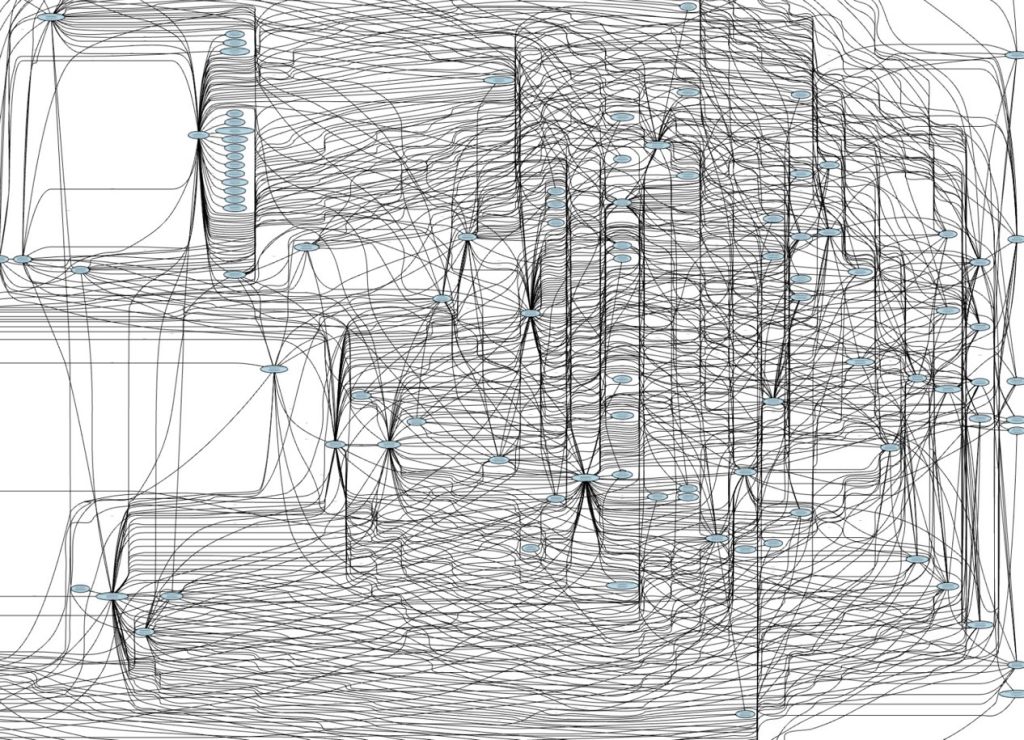
School Information System

Notes on Oklahoma Literacy Rates

Ray Carter

The results of nationwide testing show that students in Oklahoma lag behind students in nearly all of the 50 states when it comes to reading proficiency. Those results represent more than hardship for individual students or a loss of bragging rights for state officials.

According to experts, Oklahoma’s low reading outcomes also translate into a significant, lifelong drain on taxpayer resources and the state economy as students emerge from the K-12 system unprepared for work or college.

A recent report from the Education Consumers Foundation, “The Cost of Failure to Teach Reading: Projections From 3rd Grade Reading Scores,” shows millions of dollars in increased taxpayer expenses are likely to occur in Oklahoma given the many children who do not read proficiently in the state.

“For every student who fails to master reading by grade 3, taxpayers are subjected to what amounts to a hidden annual surtax—one that cumulates with each graduating class,” the report stated. “It is levied in the form of added local, state, and federal tax-funded resources absorbed by the resulting school dropouts and unprepared graduates.”

The reason for the added taxpayer cost is simple: Students who do not learn to read are far more likely to be unemployed or underemployed as adults and therefore rely more on government services.

——-

The taxpayer funded Madison School District long used Reading Recovery

The data clearly indicate that being able to read is not a requirement for graduation at (Madison) East, especially if you are black or Hispanic”

My Question to Wisconsin Governor Tony Evers on Teacher Mulligans and our Disastrous Reading Results

2017: West High Reading Interventionist Teacher’s Remarks to the School Board on Madison’s Disastrous Reading Results 

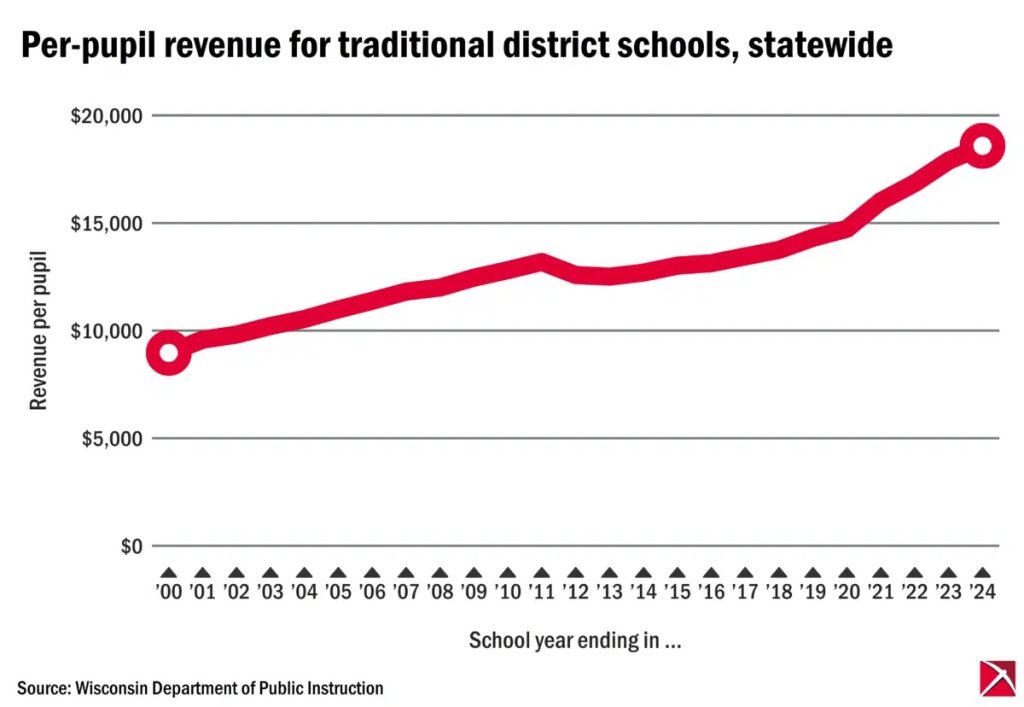
Madison’s taxpayer supported K-12 school district, despite spending far more than most, has long tolerated disastrous reading results.

“An emphasis on adult employment”

Wisconsin Public Policy Forum Madison School District Report[PDF]

WEAC: $1.57 million for Four Wisconsin Senators

Friday Afternoon Veto: Governor Evers Rejects AB446/SB454; an effort to address our long term, disastrous reading results

Booked, but can’t read (Madison): functional literacy, National citizenship and the new face of Dred Scott in the age of mass incarceration.

When A Stands for Average: Students at the UW-Madison School of Education Receive Sky-High Grades. How Smart is That?

Share

civics: Taxpayer funded federal identity investigation

Gavin Baker:

Worth watching, especially for anyone skeptical on DOGE.

@AntonioGracias is one of my closest friends, one of the most exceptional people I know and extremely high integrity.

Grateful to him, Elon and many others for serving 🇺🇸 at DOGE.

Share

“truthfulness”

Link:

It has to do with Justice Jackson’s comments that when Black newborns are delivered by Black doctors, they’re much more likely to survive, justifying racially discriminatory admissions.

We now know the study contained fraud🧵

I’ll start with their least bad offenses, before moving to the worst of it.

Firstly, the authors were warned not to make causal claims because they lacked the fixed effect I said they needed. They made those claims anyway.

Share

Accessible Open Textbooks in Math-Heavy Disciplines

Richard Zach:

https://richardzach.org/2025/03/accessible-open-textbooks-in-math-heavy-disciplines/The challengeThe authoring platform of choice in many math-heavy disciplines is LaTeX. It produces typeset documents of excellent quality and handles formulas and mathematical diagrams extremely well. Practically every researcher or instructor in mathematics, physics, and computer science is adept at using it, and it has a wide user base outside these core disciplines as well (e.g., philosophy and economics).

Unfortunately, it only produces PDF output. PDF is not an accessible format: it does not scale well to display on tablets or phones, text does not reflow, it contains no semantic information (e.g., what’s a heading or what’s a list), images, formulas, and diagrams are only visually accessible. This creates difficulties for readers who rely on alternative presentations of material (in other colors, text sizes, fonts, or in non-visual formats, i.e., audio or Braille) or who simply want to access the material on a device not the size of a printed page (e.g., on a smartphone or small e-reader).

Share

Curious April 2025 election outcome

Corrinne Hess:

Underly received about $850,000 from the Democratic Party of Wisconsin, out of the $1.1 million she’s raised since February. Kinser received almost $1.7 million from the Republican Party of Wisconsin, out of about $2.2 million raised total, according to her committee report and a late filing.

Kinser, who has never been elected to public office, said Tuesday night she is proud of the campaign she ran and she won’t stop working for children.

“We cannot settle for only three out of 10 children reading well enough to go to college or have a career,” Kinser said.

——-

Did taxpayer funded Wisconsin DPI Superintendent Underly Juice Test Scores for Reelection?

notes and links on Incumbent DPI Superintendent Jill Underly.

Share

civics: notes in freedom of the press

Link:

FPF recently collaborated with Wiredto allow the magazine to stop paywalling articles that are primarily based on public records obtained through the Freedom of Information Act. “Public records are disappearing. The National Archive is in disarray,” Stern said. “It’s going to be harder and harder to get documents out of the administration.”

He added that citizens can protect press freedom on paper, but that’s not enough.

“But if there’s not a functional, viable press to use those protections and to carry out that work, then everything you’ve accomplished is academic,” Stern said. “So I think the first thing folks can do to support the press is subscribe to their news outlets and put some money in news outlets’ pockets and in journalists’ pockets so they can continue to exist.”

Share

Student activism at Brown University 

Alex Shieh:

Around 2 a.m. on an otherwise unremarkable Tuesday, I launched a public database mapping all 3,805 non-faculty employees of Brown University and sent each one a simple email: What do you do all day?

Ostensibly, it was a journalistic inquiry. The site, which I named Bloat@Brown, was somewhere between FaceMash (Mark Zuckerberg’s college project that scraped student ID photos and let users rank who was hotter) and DOGE. But instead of using Zuckerberg’s ELO-style rankings — a numerical method originally developed for ranking chess players — my site, Bloat@Brown, used retrieval-augmented generation and a custom GPT-4o pipeline to rank administrators by their operational importance.

First, I scraped the internet — job boards, the student newspaper, LinkedIn — to gather whatever I could about each employee. I fed that data into GPT-4o mini to generate a rough utility ranking. The results weren’t definitive — there is only so much information on the public web — but they seemed directionally accurate. (Like obvious DEI jobs triggered a DEI filter, for instance.) 

While my roommate slept, I worked from the common room in my dorm’s basement — the same room that floods whenever it rains and thus has plastic tarps, industrial fans, and wet floor signs permanently set up despite Brown’s tuition and fees rising to $93,064 a year. Brown’s financial woes also mean that the school runs a $46 million annual budget deficit while professors constantly complain they’re underpaid. So, where is our $93,064 a year actually going?

After doing some digging, I discovered that much of the money is being thrown into a pit of bureaucracy. The small army of 3,805 non-faculty administrators is more than double the faculty headcount, and makes for roughly one administrator for every two undergrads. In the US, the cost of college tuition has far outpaced inflation because, for one, administrative staff count has drastically outpaced growth in the student population — a cause for concern since, in the 20th century, universities were affordable and ran fine with a fraction of today’s staffers.

Share

Notes on Higher Education Governance

Frederick Hess:

The federal higher-education apparatus that’s so familiar today was far more modest under Reagan or George H.W. Bush. While the federal role expanded significantly during the 1990s, with new lending programs, tax credits, and Clintonite initiatives, the George W. Bush administration focused its education efforts on K-12. (Secretary of Education Margaret Spellings’ second-term Commission on the Future of Higher Education was laudable but didn’t ultimately amount to much.)

Secretary of Education Linda McMahon has inherited a deep roster and an aggressive game plan.The modern era of turbocharged federal involvement in higher education really commenced during the Obama years. The Obama team ran wild: weaponizing Title IX, devising onerous new “gainful employment” regulations for for-profit (and only for-profit) colleges, making Washington the nation’s sole source of college lending, and unilaterally rewriting the terms of the brand-new Public Service Loan Forgiveness program.

During Trump’s first term, Secretary of Education Betsy DeVos chose not to respond in kind. Instead, she mostly sought to restore the traditional order. A principled Reagan conservative focused on expanding K-12 school choice, DeVos didn’t have much of a playbook or mandate for higher education, other than trying to undo some of the Obama-era excesses.

Share

Notes and commentary on “ai” tutor

Daniel Leonard:

In some sense, AI tutors prove more useful for students for the exact same reasons that high-quality human tutors have always been effective. “When you have that one-on-one instruction, or small group instruction, the instruction caters to your needs,” Sal Khan—founder of Khan Academy—told us in November. “If a student is finding something easy, then a tutor can move ahead or go deeper. If they’re struggling, a tutor can slow down.”

In another study from last year, an AI-powered tutor helped Harvard undergraduates learn physics more effectively—and in less time. To optimize the bot for learning, the researchers prompted it with a set of constraints—including “Only give away ONE STEP AT A TIME, DO NOT give away the full solution in a single message,” and “You may CONFIRM if their ANSWER is right, but DO NOT tell [students] the answer.”

One hundred and eighty-six physics undergrads were split into two groups: Half received a standard physics lecture, and the other half stayed home to work through the same material under the guidance of the AI tutor. When the researchers compared students’ scores on a pre- and post-lesson assessment of the material, “the learning gains for students… in the AI-tutored group were over double those for students in the active lecture group.” The AI tutor group also worked through the material 10 minutes faster than their peers—and reported higher levels of engagement and motivation. 

more.

Share

FOIAed notes show how the authors in fact cut points that they said “undermined the narrative.”

Emily Kopp:

A researcher who argued that infant mortality is higher for black newborns with white doctors because of racial bias omitted a variable from the paper that “undermines the narrative,” according to the researcher’s internal notes.

The study forms a keystone of the racial concordance field, which hypothesizes patients are better served by medical providers of the same race, and has served as a rationale for affirmative action. It faces new questions just as universities move to defund their Diversity, Equity and Inclusion programs or face legal action.

The August 2020 study in the prestigious Proceedings of the National Academy of Sciences (PNAS) concluded that the gap in mortality rates between black newborns and white newborns declines by 58% if the black newborns are under the care of black physicians. A possible driver of the phenomenon could include a “spontaneous bias” by white physicians toward the babies, the researchers wrote.

The paper’s most high-profile booster was Supreme Court Justice Ketanji Brown Jackson, who cited it as evidence for the benefits of affirmative action in her dissent in the 2023 Supreme Court ruling Students for Fair Admissions v. Harvard, which found that universities that considered the race of college applicants had violated the equal protection clause of the Fourteenth Amendment. (RELATED: EXCLUSIVE: University Spent Over $200,000 On ‘Diversity’ Course Teaching Physicians That Healthcare Is Racist)

“For high-risk Black newborns, having a Black physician is tantamount to a miracle drug: it more than doubles the likelihood that the baby will live,” reads an amicus brief filed by the Association of American Medical Colleges. “Yet due to the enduring and significant underrepresentation of minorities in the health professions, many minority patients will not receive care from a racially diverse team or from providers who were trained in a diverse environment.”

More.

Share

Matrix Calculus (for Machine Learning and Beyond)

Paige Bright, Alan Edelman, Steven G. Johnson

This course, intended for undergraduates familiar with elementary calculus and linear algebra, introduces the extension of differential calculus to functions on more general vector spaces, such as functions that take as input a matrix and return a matrix inverse or factorization, derivatives of ODE solutions, and even stochastic derivatives of random functions. It emphasizes practical computational applications, such as large-scale optimization and machine learning, where derivatives must be re-imagined in order to be propagated through complicated calculations. The class also discusses efficiency concerns leading to “adjoint” or “reverse-mode” differentiation (a.k.a. “backpropagation”), and gives a gentle introduction to modern automatic

Share

Jill Underly’s tenure offers a cautionary tale for proponents of block grants and legislated literacy reforms.

Karen Vaites:

Last year, I wrote about a specific, promising development in Wisconsin: the state published the strongest ELA curriculum list in the country.

Unfortunately, the work in Wisconsin prior to that development, and since, underwhelms.

I’m overdue to write about the broader context in Wisconsin, mostly because progress on curriculum improvement has stalled, and I should continue the story. Also, Wisconsin elects a new state superintendent this week, so it’s a good time to revisit the tenure of state superintendent Jill Underly.

From a national lens, Wisconsin offers a cautionary tale for everyone calling to shift power back to states and for the legislated path to literacy gains.

Wisconsin’s Legacy And the Underly Era

Wisconsin is one of the rare states that elects its state superintendent, and this seems to have the unfortunate effect of politicizing the role more than usual. The state’s Department of Public Instruction (DPI) is described by locals as a “political factory.” Current governor Tony Evers is a former state superintendent, so DPI roles are viewed as a political springboard. Notably, Deputy Superintendent Thomas McCarthy has no education background, he’s a career state politico.

This context helps explain why the state has a lackluster track record on academics. In addition, DPI literacy leaders are known to follow discredited educational philosophies.

Barbara Novak, the Director of Early Literacy, is a historic Balanced Literacy devotee. Novak is the former President of the Wisconsin Reading Association (WSRA), which lobbied against the WI Dyslexia Guidebook and the recent Act 20 literacy legislation. She has been with DPI for more than a decade; during that time, DPI has made few efforts to advance “science of reading” initiatives, in stark contrast to the other states.

A few illustrative stories:

——

more.

——-

Did taxpayer funded Wisconsin DPI Superintendent Underly Juice Test Scores for Reelection?

notes and links on Incumbent DPI Superintendent Jill Underly.

Share

Notes on illiterate college students

Hilarius Bookbinder”:

I’m Gen X. I was pretty young when I earned my PhD, so I’ve been a professor for a long time—over 30 years. If you’re not in academia, or it’s been a while since you were in college, you might not know this: the students are not what they used to be. The problem with even talking about this topic at all is the knee-jerk response of, “yeah, just another old man complaining about the kids today, the same way everyone has since Gilgamesh. Shake your fist at the clouds, dude.”So yes, I’m ready to hear that. Go right ahead. Because people need to know.

First, some context. I teach at a regional public university in the United States. Our students are average on just about any dimension you care to name—aspirations, intellect, socio-economic status, physical fitness. They wear hoodies and yoga pants and like Buffalo wings. They listen to Zach Bryan and Taylor Swift. That’s in no way a put-down: I firmly believe that the average citizen deserves a shot at a good education and even more importantly a shot at a good life. All I mean is that our students are representative; they’re neither the bottom of the academic barrel nor the cream off the top.

As with every college we get a range of students, and our best philosophy majors have gone on to earn PhDs or go to law school. We’re also an NCAA Division 2 school and I watched one of our graduates become an All-Pro lineman for the NFL. These are exceptions, and what I say here does not apply to every single student. But what I’m about to describe are the average students at Average State U.

Reading

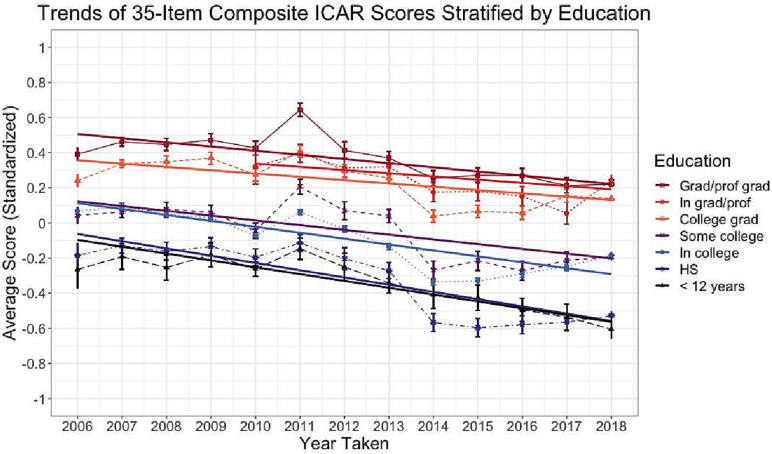
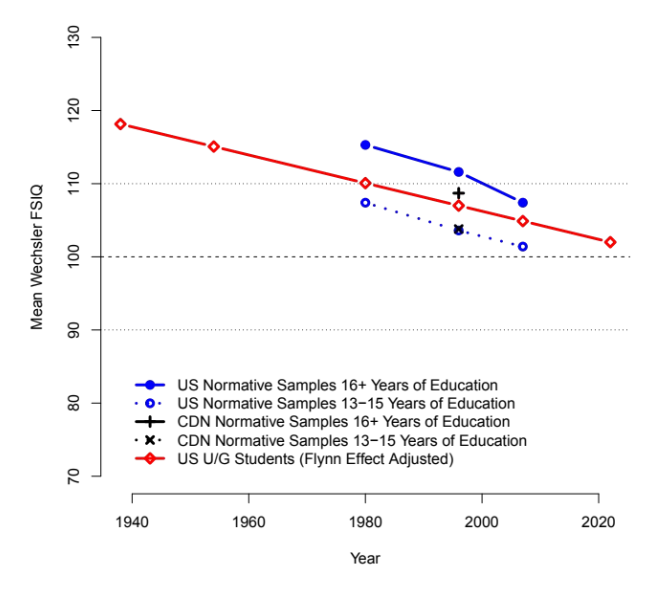
Most of our students are functionally illiterate. This is not a joke. By “functionally illiterate” I mean “unable to read and comprehend adult novels by people like Barbara Kingsolver, Colson Whitehead, and Richard Powers.” I picked those three authors because they are all recent Pulitzer Prize winners, an objective standard of “serious adult novel.” Furthermore, I’ve read them all and can testify that they are brilliant, captivating writers; we’re not talking about Finnegans Wakehere. But at the same time they aren’t YA, romantasy, or Harry Potter either.

———

The taxpayer funded Madison School District long used Reading Recovery

The data clearly indicate that being able to read is not a requirement for graduation at (Madison) East, especially if you are black or Hispanic”

My Question to Wisconsin Governor Tony Evers on Teacher Mulligans and our Disastrous Reading Results

2017: West High Reading Interventionist Teacher’s Remarks to the School Board on Madison’s Disastrous Reading Results 

Madison’s taxpayer supported K-12 school district, despite spending far more than most, has long tolerated disastrous reading results.

“An emphasis on adult employment”

Wisconsin Public Policy Forum Madison School District Report[PDF]

WEAC: $1.57 million for Four Wisconsin Senators

Friday Afternoon Veto: Governor Evers Rejects AB446/SB454; an effort to address our long term, disastrous reading results

Booked, but can’t read (Madison): functional literacy, National citizenship and the new face of Dred Scott in the age of mass incarceration.

When A Stands for Average: Students at the UW-Madison School of Education Receive Sky-High Grades. How Smart is That?

Share

“But what’s so great about the status quo?”

Dave Cieslewicz:

Some of my liberal friends have expressed their unhappiness over my endorsement of Brittany Kinser for State Superintendent of Public Instruction. 

So, let me expand on my reasons. 

When I was at the city of Madison and there was a managerial opening I always first thought about how that department was functioning. If things were going good, I’d want to promote from within. If things were rocky, I’ld look to the outside. 

You can’t take an honest look at DPI and conclude that things are in good shape there. Wisconsin is behind average on test scores, behind most states on recovery after COVID, not great on attendance and we have the widest racial achievement gap of any state in the nation. 

So, the first question I need to ask is, why do we want to stick with the status quo?

Well, the status quo has a ready answer: it’s just a question of money. To be exact, the incumbent, Jill Underly, wants to spend the state’s entire $4 billion surplus on public education. But she proposes no changes, no reforms and she would ask for no accountability — no improvements in test scores or anything else. It also just doesn’t add up because if we use all that one-time money in this biennium, what do we do in the next one? 

Moreover, it’s just simply untrue that money is the problem for most districts. In fact, last year Wisconsin communities passed referendums worth more in total than any year in history. Here in Madison we haven’t voted down a school referendum in 20 years and we just passed the largest combined operating and capital referendums in our history — a total of $506 million. Milwaukee also passed its largest referendum ever.

The taxpayer funded Madison School District long used Reading Recovery

The data clearly indicate that being able to read is not a requirement for graduation at (Madison) East, especially if you are black or Hispanic”

My Question to Wisconsin Governor Tony Evers on Teacher Mulligans and our Disastrous Reading Results

2017: West High Reading Interventionist Teacher’s Remarks to the School Board on Madison’s Disastrous Reading Results 

Madison’s taxpayer supported K-12 school district, despite spending far more than most, has long tolerated disastrous reading results.

“An emphasis on adult employment”

Wisconsin Public Policy Forum Madison School District Report[PDF]

WEAC: $1.57 million for Four Wisconsin Senators

Friday Afternoon Veto: Governor Evers Rejects AB446/SB454; an effort to address our long term, disastrous reading results

Booked, but can’t read (Madison): functional literacy, National citizenship and the new face of Dred Scott in the age of mass incarceration.

When A Stands for Average: Students at the UW-Madison School of Education Receive Sky-High Grades. How Smart is That?

Share

“Never seen something like this,” say university officials about the secret targeting of Middle Eastern students.

Prem Thakker:

Samah Sisay of the Center for Constitutional Rights told Zeteo that one’s visa being revoked does not mean that their status would be too. Unlike student visas – which are entry documents that allow someone to enter the country – student statuses are what allow people to stay in the US. To maintain one’s status, a student has to fulfill certain requirements, like being properly enrolled in classes, keeping documents up to date, and following work restrictions.

A student’s visa could expire or be revoked for any number of reasons, but that wouldn’t necessarily mean their status to stay would be taken away, too. Some of these statuses, which are typically overseen by university officers, are now allegedly being unilaterally revoked by ICE instead. While university officers often oversee status in the SEVIS system, Sisay said that DHS can technically revoke status without a university actively disenrolling a student.

Still, the practice is alarming students and university staff across the country. As one official put it, “Someone at ICE pushed a button, and now [students] are ‘illegal’ through a process that absolutely should not be happening.”

Share

The Impact of Generative AI on Critical Thinking: Self-Reported Reductions in Cognitive Effort and Confidence Effects From a Survey of Knowledge Worker

Microsoft Research:

The rise of Generative AI (GenAI) in knowledge workflows raises questions about its impact on critical thinking skills and practices.

We survey 319 knowledge workers to investigate 1) when and how they perceive the enaction of critical thinking when using GenAI, and 2) when and why GenAI affects their effort to do so.
Participants shared 936 first-hand examples of using GenAI in work tasks. Quantitatively, when considering both task- and user-specific factors, a user’s task-specific self-confidence and confidence in GenAI are predictive of whether critical thinking is enacted and the effort of doing so in GenAI-assisted tasks. Specifically, higher confidence in GenAI is associated with less critical thinking, while higher self-confidence is associated with more critical thinking. Qualitatively, GenAI shifts the nature of critical thinking toward information verification, response integration, and task stewardship. Our insights reveal new design challenges and opportunities for developing GenAI tools for knowledge work.

Share

Curriculum Mapper

Karen Vaites:

I have made one more update to my State Curriculum Map tracker.

While @WisconsinDPI stopped maintaining the website with 2021 curriculum data by district, parents retained the info, so have been able to publish it openly. Link added.

Note that parents are also the only source of 2024-25 curriculum data by district in WI.

Why is this transparency work falling to parents? A fair question to ask of @underlyforwi.

Share

Decline of cash credited for drop in NHS surgery for children swallowing objects

Denis Campbell:

Cashless societies may be a sad fact of modern life for those with a nostalgic attachment to the pound in their pocket, but doctors have discovered one unexpected benefit of the decline of coins.

Far fewer children are having surgery after swallowing small items that could choke or kill them, and the scarcity of loose change is likely to be the reason.

The number of children in England needing an operation to remove a foreign body from their nose, throat or airway fell significantly between 2012 and 2022, NHS figures show.

The fall has been greeted with relief by doctors and surgeons, who for years have been warning of the dangers posed by young children ingesting magnets, tiny batteries and other risky objects.

Share

Japanese Writing System

kanji master:

When students begin the journey of learning Japanese, they are met with a fascinating yet complex writing system composed of three scripts: Hiragana, Katakana, and Kanji. Take, for example, the sentence “新しいゲームを買いました。” (Atarashii geemu o kaimashita.), which means “I bought a new game.”

Share

Public Records Reveal How Wisconsin Supt. Underly’s DPI Set Stage for MPS Finance Crisis

IFRG:

New public recordsreleased Thursday by the Institute for Reforming Government’s (IRG) Center for Investigative Oversight reveal how the Department of Public Instruction’s lenient enforcement of Milwaukee Public Schools’ 2024 finance deadlines set up different, more destructive outcomes than DPI’s stricter enforcement in previous years.

Superintendent Underly’s DPI released the records March 5, 2025, 8 months after IRG’s June 17, 2024, request. DPI fulfilled the complete records request only after IRG, represented by the Wisconsin Institute for Law and Liberty, threatened legal action.

WHY IT MATTERS

DPI took a gentler approach with MPS than other school districts in years past, despite accurate financial documents being essential to determining state aid for all Wisconsin school districts. DPI has the ability to withhold funding if districts miss deadlines.

——

Did taxpayer funded Wisconsin DPI Superintendent Underly Juice Test Scores for Reelection?

notes and links on Incumbent DPI Superintendent Jill Underly.

Share

more on reverting to rigor grading in the taxpayer funded Madison k-12 system

Dave Cieslewicz:

It’s the parents of those high-achieving students who are demanding the change and they’re demanding it in response to new state programs granting automatic admissions to the UW for kids who rank in the top 5% of their classes and automatic admissions to UW campuses outside of Madison for those in the top 10%.

The current system doesn’t work because, in addition to there being no weighting of grades, there isn’t even any class rankings. So, how can you tell if any kid is in the top 10%? Even worse, the district has been trying to move away from assigning grades at all with a pilot program at one high school which would replace letter grades with “Advanced,” “Proficient,” “Developing” or “Emerging.” (I note that there are only four of these and so none that equates to an “F.” I assume that if there were one it would be something like “Could Be The Next Einstein.”)

The bottom line here is that merit is finding its way back into the Madison public schools. This whole movement — no weighted grading, no class rankings, downplaying letter grades altogether — is born of the notion that merit is just a construct of the oppressors. And the liberal parents of those high-achieving kids might actually buy that in theory. 

Until it stands in the way of their kid getting into the UW.

——

Grades” and the taxpayer funded Madison school District

Share

The Average College Student Today

“Hilarious Bookbinder”

I’m Gen X. I was pretty young when I earned my PhD, so I’ve been a professor for a long time—over 30 years. If you’re not in academia, or it’s been awhile since you were in college, you might not know this: the students are not what they used to be. The problem with even talking about this topic at all is the knee-jerk response of, “yeah, just another old man complaining about the kids today, the same way everyone has since Gilgamesh. Shake your fist at the clouds, dude.”1 So yes, I’m ready to hear that. Go right ahead. Because people need to know.


First, some context. I teach at a regional public university in the US. Our students are average on just about any dimension you care to name—aspirations, intellect, socio-economic status, physical fitness. They wear hoodies and yoga pants and like Buffalo wings. They listen to Zach Bryan and Taylor Swift. That’s in no way a put-down: I firmly believe that the average citizen deserves a shot at a good education and even more importantly a shot at a good life. All I mean is that our students are representative; they’re neither the bottom of the academic barrel nor the cream off the top.


As with every college we get a range of students, and our best philosophy majors have gone on to earn PhDs or go to law school. We’re also an NCAA Division 2 school and I watched one of our graduates become an All-Pro lineman for the Saints. These are exceptions, and what I say here does not apply to every single student. But what I’m about to describe are the average students at Average State U.

——-

The taxpayer funded Madison School District long used Reading Recovery

The data clearly indicate that being able to read is not a requirement for graduation at (Madison) East, especially if you are black or Hispanic”

My Question to Wisconsin Governor Tony Evers on Teacher Mulligans and our Disastrous Reading Results

2017: West High Reading Interventionist Teacher’s Remarks to the School Board on Madison’s Disastrous Reading Results 

Madison’s taxpayer supported K-12 school district, despite spending far more than most, has long tolerated disastrous reading results.

“An emphasis on adult employment”

Wisconsin Public Policy Forum Madison School District Report[PDF]

WEAC: $1.57 million for Four Wisconsin Senators

Friday Afternoon Veto: Governor Evers Rejects AB446/SB454; an effort to address our long term, disastrous reading results

Booked, but can’t read (Madison): functional literacy, National citizenship and the new face of Dred Scott in the age of mass incarceration.

When A Stands for Average: Students at the UW-Madison School of Education Receive Sky-High Grades. How Smart is That?

Share

April 1, 2025 Madison School Board Election Candidate Interviews (2 unopposed!)

Simpson Street Free Press

SSFP student reporters and local journalists interview candidates for this year’s school board race. If you missed our forum, now’s your chance to catch up! Stay informed and get to know who’s on the ballot.

——

The taxpayer funded Madison School District long used Reading Recovery

The data clearly indicate that being able to read is not a requirement for graduation at (Madison) East, especially if you are black or Hispanic”

My Question to Wisconsin Governor Tony Evers on Teacher Mulligans and our Disastrous Reading Results

2017: West High Reading Interventionist Teacher’s Remarks to the School Board on Madison’s Disastrous Reading Results 

Madison’s taxpayer supported K-12 school district, despite spending far more than most, has long tolerated disastrous reading results.

“An emphasis on adult employment”

Wisconsin Public Policy Forum Madison School District Report[PDF]

WEAC: $1.57 million for Four Wisconsin Senators

Friday Afternoon Veto: Governor Evers Rejects AB446/SB454; an effort to address our long term, disastrous reading results

Booked, but can’t read (Madison): functional literacy, National citizenship and the new face of Dred Scott in the age of mass incarceration.

When A Stands for Average: Students at the UW-Madison School of Education Receive Sky-High Grades. How Smart is That?

Share

autonomous child transport

Gokul:

SF on Saturday morning: a large % of Waymos are ferrying solo kids (8-14 yo), presumably to sports or other activities.

A friend told me that 85% of parents at their kids’ SF school use Waymo for kids pickup / drop off: earlier it was ~10% using Uber and Lyft.

Shows how Waymo has grown by expanding the market, serving segments who otherwise were non-consumers of ride sharing.

Share

A primer on federal elected official $pending practices

Nicole Shanahan:

What exactly is a “continuing resolution”? What’s the difference between an “omnibus” and a “minibus”? And why do these always seem to come with the threat of a government shutdown every few months? My conversation with @RepThomasMassie.

Share

Asking Good Questions

Dan Cohen:

And the companies are not wrong about genuinely impressive improvements. Six years ago in this newsletter, I wrote about some initial testing I had been doing with computer vision APIs from Google and Microsoft, a first attempt to analyze the photo morgue my library had recently acquired from the Boston Globe. There were glimmers of hope that these pre-GPT tools could help us identify topics in millions of photographs that lacked rigorous metadata, and I found even 80% accuracy to be promising. Now our library’s digital team, much more capable than I am, has created an abstracted interface to all of the main multimodal AI services and is testing the ability of these services to provide subject headings and descriptions, with much better results (although all of the services are still imperfect).

Fellow historian Benjamin Breen has documented similar advances in his testing of AI. The latest models are scarily on par with a first-year doctoral student in history in some areas, able to provide solid context and advanced interpretations of documents and images, even complex ones that require substantial background in a field. The frontier models are much better than most doctoral students in other tasks, such as translation and transcription. Handwriting recognition for historical documents, in particular, has been among the hardest problems for computer scientists to solve, and cracking it will have a significant impact on historical research. Historian Cameron Blevins has shown that custom GPTs are now on a path to a solution that could make archives and special collections much more searchable and readable in ways that might transform our ability to do history. What these other tests of artificial intelligence show is that significant AI progress may lie not in some kind of examination endgame, of perfect answers to tough questions, but in the important, but often hidden, middle stages of a research project, when evidence is being assembled and interpreted.

Share

What went wrong with the Alan Turing Institute?

Alex Chalmers:

Martin Goodson, then of the Royal Statistical Society, dubbed the ATI “at best irrelevant to the development of modern AI in the UK”.

The criticism hasn’t slowed. Matt Clifford’s AI Opportunities Action Plan recommended that the government should “consider the broad institutional landscape and the full potential of the Alan Turing Institute to drive progress at the cutting edge”. While Clifford was too diplomatic to say the quiet bit out loud, in government speak, this is code for suggesting that the ATI was not fulfilling its intended purpose.

UK Research and Innovation, the UK’s main research and innovation funding body, is running out of patience. Its quinquennial review of the ATI, published in 2024, was politely scathing about the institute’s governance, financial management, and the quality of its most recent strategy (dubbed Turing 2.0).

There aren’t many areas of consensus across the UK’s fractious tech community, but the ATI has come to play an oddly unifying role. From left to right and north to south, there’s a sense that the institute is running out of friends and time.

Share

On the Biology of a Large Language Model

Transformer:

Large language models display impressive capabilities. However, for the most part, the mechanisms by which they do so are unknown. The black-box nature of models is increasingly unsatisfactory as they advance in intelligence and are deployed in a growing number of applications. Our goal is to reverse engineer how these models work on the inside, so we may better understand them and assess their fitness for purpose.

The challenges we face in understanding language models resemble those faced by biologists. Living organisms are complex systems which have been sculpted by billions of years of evolution. While the basic principles of evolution are straightforward, the biological mechanisms it produces are spectacularly intricate. Likewise, while language models are generated by simple, human-designed training algorithms, the mechanisms born of these algorithms appear to be quite complex.

Share

Build Automaticity with Math Facts:A Practical Guide

-Anna Stokke:

Share

Wisconsin Governor Evers Vetoes AB1; a bill to restore higher K-12 standards

www:

WisPolitics summary:

Co-author Sen. John Jagler, R-Watertown, said the standards give parents a false impression of how their kids are doing in school. He also said it’s a problem that data can’t be compared year-to-year, which is problematic considering learning loss during the COVID-19 pandemic. 

He said the state should go back to the previous standards put in place when Evers led DPI. 

“We need to do better, we need to go back,” Jagler said, referencing his comments to DPI during the public hearing on the bill. 

Sen. Chris Larson, D-Milwaukee, criticized what he called “huffing and puffing” about the changes, asserting standards were never lowered and were part of periodic changes that take place over the years. 

——-

Nick Rommel:

Those new standards lowered the threshold for what is considered proficient on the Forward Exam state test, and replaced terms like “below basic” with “developing.”

———

He vetoes it. Makes perfect sense. #disappointed

——-

Did taxpayer funded Wisconsin DPI Superintendent Underly Juice Test Scores for Reelection?

notes and links on Incumbent DPI Superintendent Jill Underly.

The taxpayer funded Madison School District long used Reading Recovery

The data clearly indicate that being able to read is not a requirement for graduation at (Madison) East, especially if you are black or Hispanic”

My Question to Wisconsin Governor Tony Evers on Teacher Mulligans and our Disastrous Reading Results

2017: West High Reading Interventionist Teacher’s Remarks to the School Board on Madison’s Disastrous Reading Results 

Madison’s taxpayer supported K-12 school district, despite spending far more than most, has long tolerated disastrous reading results.

“An emphasis on adult employment”

Wisconsin Public Policy Forum Madison School District Report[PDF]

WEAC: $1.57 million for Four Wisconsin Senators

Friday Afternoon Veto: Governor Evers Rejects AB446/SB454; an effort to address our long term, disastrous reading results

Booked, but can’t read (Madison): functional literacy, National citizenship and the new face of Dred Scott in the age of mass incarceration.

When A Stands for Average: Students at the UW-Madison School of Education Receive Sky-High Grades. How Smart is That?

Share

Three hundred years after Isaac Newton’s groundbreaking work, a tool from that era is receiving an update.

Kevin Hartnett:

Every day, researchers search for optimal solutions. They might want to figure out where to build a major airline hub. Or to determine how to maximize return while minimizing risk in an investment portfolio. Or to develop self-driving cars that can distinguish between traffic lights and stop signs.

Mathematically, these problems get translated into a search for the minimum values of functions. But in all these scenarios, the functions are too complicated to assess directly. Researchers have to approximate the minimal values instead.

It turns out that one of the best ways to do this is by using an algorithm that Isaac Newton developed over 300 years ago. This algorithm is fairly simple. It’s a little like searching, blindfolded, for the lowest point in an unfamiliar landscape. As you put one foot in front of the other, the only information you need is whether you’re going uphill or downhill, and whether the grade is increasing or decreasing. Using that information, you can get a good approximation of the minimum relatively quickly.

Although enormously powerful — centuries later, Newton’s method is still crucial for solving present-day problems in logistics, finance, computer vision and even pure math — it also has a significant shortcoming. It doesn’t work well on all functions. So mathematicians have continued to study the technique, figuring out different ways to broaden its scope without sacrificing efficiency.

Last summer, three researchers announced the latest improvement to Newton’s method. Amir Ali Ahmadi of Princeton University, along with his former students Abraar Chaudhry (now at the Georgia Institute of Technology) and Jeffrey Zhang (now at Yale University), extended Newton’s method to work efficiently on the broadest class of functions yet.

Share

k-12 tax & $pending climate: “It’s how $17 B has turned into a whopping $144 B”

Ed Bachrach and Ted Dabrowski

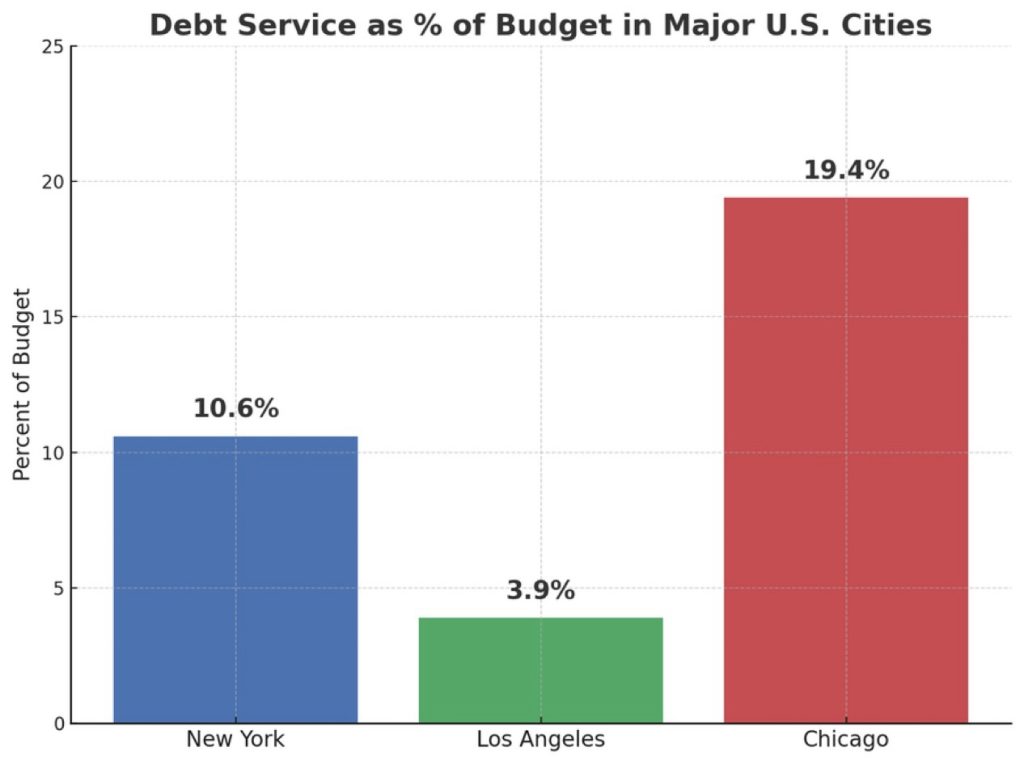
In 1994, the General Assembly awoke to a then-unheard-of pension debt of $17 billion. In typical Illinois fashion, lawmakers cooked up a 50-year repayment plan to “fix” the problem. It was called a ramp because little of the debt was repaid immediately, and most of it was pushed out decades into the future. A graphic of the repayment schedule looks exactly like an upward-sloping ramp. Gov. Jim Edgar signed the bill into law, giving it its name. 

Conveniently, all pension benefit increases passed since then — and any increases in benefit obligations found due to poor actuarial assumptions — have been pushed onto the ramp. It’s how $17 billion in outstanding pension debt at the state level has now turned into a whopping $144 billion.

Share

k-12 tax & $pending climate: Federal Bankruptcy

Via Teddy Schleifer:

Steve Davis of @DOGE: “The reason I’m here is… I think the goal is incredibly inspiring. I think most of the taxpayers in the country would agree that the country going bankrupt would be a very bad thing… I think the thing that’s special right now, is we actually believe there is a chance to succeed. That there is an administration that is supportive and a great cabinet and just a great group that will actually make success a possible outcome.”

——-

Billions!

US Debt clock.

Share

Auditing education taxpayer $pending and outcomes

Open the books:

Open the Books took a look at where else the department’s money has been going in its fruitless pursuit of better outcomes.

Our auditors made the big picture clear recently, as auditors traced every agency’s headcount and spending changes over the decades (READ MORE: MAPPING GROWTH OF GOVERNMENT)

The department’s headcount has actually decreased slightly since 2000, by about 13.9% (4,930 vs. 4,245). But by 2024 annual spending was 749% of what they’d been at the turn of the Millenium! (Open the Books, FOX News)

What follows is just a brief laundry list of wasteful spending examples that can help explain the explosive growth.

These grants from recent years include some of the usual suspects like DEI and gender politics…plus millions headed to Chinese firms!

——

WEAC: $1.57 million for Four Wisconsin Senators

Commentary.

Share

April 10 event: Can America’s Public Schools and Colleges Be Fixed?

UWM & Thompson Center

Instructors: Arne Duncan, Margaret Spellings

Perspectives from Former US Secretaries of Education

Featured Speakers: Arne Duncan (Obama administration) and Margaret Spellings (GW Bush administration)

Moderator: Dr. Simon J. Bronner

Location: Lunt-Fontanne Theatre on the UWM at Waukesha campus, 1500 N. University Dr., Waukesha, WI

Sponsored by the Tommy G. Thompson Center on Public Leadership and hosted by UWM at Waukesha.Free and open to the public, registration required.

Share

2025 Wisconsin DPI election: $2.7 million backing Underly and $1.7 million supporting Kinser

WisPolitics email summary:

The record spending in Wisconsin’s state schools superintendent race between education consultant Brittany Kinser and incumbent Jill Underly has now hit $4.5 million.

Did taxpayer funded Wisconsin DPI Superintendent Underly Juice Test Scores for Reelection?

notes and links on Incumbent DPI Superintendent Jill Underly.

Share

Introducing the Inoculator

Roger Simon:

One of the key areas in which Americans voted for change on November 5, 2024 was education. Candidate Donald Trump promised to overhaul it in multiple ways, even to eliminating the bureaucratic and useless US Department of Education under which education has only gotten worse.

President Trump has a reputation for honoring his pledges and it is already apparent he is moving forward.

Education—public, private or homeschooled—is arguably the most important function of a free society. It is also among the most complex, affecting nearly every citizen.

The process of reform will take years as the failures in our system have been many. No one person or initiative can do it alone. Even with DEI putatively jettisoned and education policy returned to the states, where it was always intended to be, much work remains.

The Inoculator encompasses one specific but hugely important area.

Share

Notes on redistributed Federal taxpayer funds and USC

Amy Reichert:

USC went woke, now it’s BROKE.
A new, just released internal memo reveals that @USC—where tuition is a staggering $73,260—relied heavily on $1.35B in federal funding last year.
Here’s what’s happening:

Share

A parent submitted a photo of school postings to LibsOfTikTok, resulting in their restriction from accessing school property or events.

Eugene Volokh:

From Chief Judge Eric Melgren’s opinion yesterday in Schmidt v. Huff (D. Kan.):

Gardner Edgerton High School is a part of USD 231 and is located in Johnson County, Kansas. USD 231’s Superintendent is Defendant Brian Huff. Plaintiff Carrie Schmidt is the mother of two students, a sophomore and a senior, who attend Gardner Edgerton High School.

Plaintiff’s son, a high school senior, is on the Gardner Edgerton wrestling team. Plaintiff volunteered to help make “snack bags” for the wrestlers on the days they have wrestling matches. With permission, Plaintiff uses the teacher’s lounge on the first floor to put together the snack bags. Once the snack bags are made, they are placed in the wrestling team’s coolers. Plaintiff often takes pictures of the completed snack bags and sends them to the coaches and Athletic Secretary, so they know where everything is located. This system was already in place before Plaintiff volunteered. Plaintiff has helped make snack bags for the wrestling team since at least 2023.

Share

Civics: Notes on legacy media accountability

John Kass:

Lie to me just once, just once, and I’ll burn you to the ground.

It wasn’t an empty threat. Chicago politics wasn’t a cloistered convent. It was and remains a place of thieves protected by the laws and regulations that they themselves controlled. It is a Democrat Barter Town and like all such towns it is hell bent on strangling itself. And there was one top aide to the mayor who thought himself a master manipulator. Frank lied to me and I burned him.

I burned him repeatedly, mercilessly, using a line often attributed to the poet Richard Brautigan: “He’d sell a rat’s asshole to a blind man for a wedding ring.”

Political Chicago understood. He lied. But I would never use “asshole” in the paper. We had editors. So I adapted it to say Frank was the kind of weasel who’d sell dead rats on coat hangers to a blind man for earmuffs. His boss, the mayor, once asked me about the feud with Frank. He lied to me, I said. The mayor shrugged, said nothing more because he knew Frank.

I never spoke to Frank again, never trusted his word, even his allies were dead to me. He eventually left town. I think he’s a goatherd now.

Share

Brown Student to 3,500 Administrators and Staff: what do you do all day?

Emma Petit:

Alex Shieh thought the ask was simple enough: In so many words, justify your job. Last week, the Brown University sophomore emailed the more than 3,500 administrators and staff members who work for his institution, requesting that they explain “how Brown students would be impacted if your position was eliminated.”

More.

$93,064 tuition. 3,805 administrators on payroll. A $46 million structural budget deficit. Illegal DEI programs jeopardizing federal funding.

We emailed every administrator and asked them about their jobs. Instead of answering, someone from a Brown IP address hacked our site.

fIRE.

Share

Notes on “ai” tutoring

Jonathan Bechtel:

You recently mentioned the Alpha School and their claims about AI tutoring. I share the skepticism expressed in your comments section regarding selection bias and the lack of validated academic benchmarks.

I wanted to highlight a more rigorously evaluated project called Tutor CoPilot, conducted jointly by Stanford’s NSSA and the online tutoring firm FEVTutor (sadly they’ve since gone bankrupt). To my knowledge, it’s the first and only RCT examining AI-assisted tutoring in real K-12 school districts.

Here’s the study: https://nssa.stanford.edu/studies/tutor-copilot-human-ai-approach-scaling-real-time-expertise

Key findings:

  • Immediate session-level learning outcomes improved by 4-9%.
  • Remarkably, the tool impacted tutors even more than students. After six weeks, inexperienced tutors reached performance parity with seasoned tutors, and previously low-performing tutors achieved average-level results.
Share

Civics: Open Records and the taxpayer funded Wisconsin DPI

Dairyland Sentinel:

Sixty-four days have passed since the Dairyland Sentinel filed an open records request with the Wisconsin Department of Public Instruction (DPI) and State Superintendent, Dr Jill Underly. Underly and the Department have yet to hand over the records, despite the legal requirement to do so.

The request, submitted Jan. 21, seeks details on controversial changes to the state’s Forward Exam’s performance benchmarks and grading terms—changes critics say lower state education standards and obscure student performance data.

The Dairyland Sentinel, a Wisconsin-based nonprofit outlet that publishes a website and newsletter on Wisconsin history and current events, filed an official open records request for communications, documents, analyses, and meeting records tied to the revisions, which took effect at Underly’s direction.

As of March 26, the DPI has provided only a list of nearly 100 experts backing Underly’s decisions, a response that falls short of addressing the specific records sought.

——-

Did taxpayer funded Wisconsin DPI Superintendent Underly Juice Test Scores for Reelection?

notes and links on Incumbent DPI Superintendent Jill Underly.

Share

Four Tax Tips I Tell My Children—When They’ll Listen

:

. As parents, we often have goals for our children: We want them to get a good education, learn to swim and ride a bike, and become good workers, partners, friends and savers.

Beyond these “musts,” many of us try to share our particular expertise with them. The mother of one of my childhood friends was an artist, and she passed her skills and passion on to her four children. Or perhaps we try to share practical knowledge—how to build shelves, cook tasty meals or buy a car.

But what’s a mother to do when her expertise involves the U.S. tax code? Yes, as Benjamin Franklin pointed out, taxes are one of life’s two certainties, and they touch every facet of our lives. Tax knowledge is highly useful.

Share

deal with the problem of institutionalized bias in our higher educational system”

Roger Simon:

Many prospective students and their families are dissatisfied with higher education today, some because of questions of financial efficacy (is it worth it?), yet more because of that evident bias pervading the vast majority of our colleges, often obscuring or distorting learning and turning education into propaganda.

Still, many of these same students have good and necessary reasons for wanting to attend a college, whether at a state school nearby or one far away.

The Inoculator therefore provides a roadmap for them and their families to how we believe students can best avoid this indoctrination in whatever college they choose among the nearly 3000 in our country.

Since the heaviest indoctrination usually occurs in the required general education courses, The Inoculator provides a specific guide to the best (least biased) of those courses.

Arranged by general education categories, we believe these classes are less apt to indoctrinate and offer the best chance of a valuable education and true learning.

This has been done in a highly specific, detailed manner, that we do not believe can be found elsewhere.

Share

Alas, I fear the number of zombie students is still growing—and at an accelerated pace

Ted Gioia:

But let’s give tech companies some credit. They have improved one skill among current students—cheating, which has now reached epic proportions.

The situation is so extreme that more than 40% of students were caught cheating recently—and it happened in an ethics class!

The professor caught them in a simple way. He simply uploaded a copy of his final exam on to the web, but with wrong answers.

“Most of these answers were not just wrong, but obviously wrong to anyone who had paid attention in class,” he adds. But “40 out of 96 students looked at and used the planted final for at least a critical mass of questions.”

Another teacher shares a similar lament: “I used to teach students. Now I catch ChatGPT cheats.”

I once believed my students and I were in this together, engaged in a shared intellectual pursuit. That faith has been obliterated over the past few semesters.

Share

Critical Curriculum Design

Rachel López

Legal education in the United States stands at a critical juncture. As democracy faces mounting threats both at home and abroad, law schools must grapple with their role in shaping not just competent lawyers but engaged citizens capable of safeguarding and improving democratic processes. Yet the traditional model of teaching students to “think like a lawyer” may be inadvertently undermining the very values and norms essential to stabilizing our democracy. Indeed, from Watergate to the January 6th attacks on the U.S. Capitol, lawyers have played key roles in efforts to undermine democracy. This essay reflects on this phenomenon, exploring why law schools produce lawyers so willing to thwart democracy, at times using their law licenses to do so.

Drawing insights from two theories of democracy—deliberative democracy and contestatory democracy, it instead proposes “critical curriculum design” as a method for training future lawyers not just to be skilled technicians, but also active participants in sustaining and improving our democracy. Specifically, it contends that law schools should cultivate the qualities of “engaged citizenship,” including the ability to bridge divides among people with diverse perspectives, the readiness to challenge overreach by people in positions of authority, and the capacity to imagine alternative legal frameworks. The essay then concludes by proposing concrete strategies for regularizing these democratic competencies across the law school experience.

Share

Further Restricting Illinois Parental Choice

Paul Vallas

A clear invasion on the privacy rights of families and likely unconstitutional, Rep. Terra Costa Howard’s homeschooling bill imposes unreasonable demands on private education not required of the public schools. It would essentially criminalize parents who do not comply.

Hypocrisy at its worst, Costa Howard’s bill is based on a single, tragic story of homeschooling child abuse, while ignoring scores of sexual abuse and misconduct cases by public school staff. In 2023 alone, CPS had 443 ongoing cases of sexual abuse and misconduct.

Costa Howard’s bill is the latest attempt to restrict homeschooling, and part of a broader push by teacher unions to eliminate any alternatives for poor, middle-income families, who are forced to enroll their children in inadequate and often failing or unsafe neighborhood public schools.

——

more

Share

A vote for Brittany Kinser on the April 1 2025 Wisconsin DPI election

Dave Cieslewicz:

“We’re voting for Kinser as much as we’re voting against incumbent Jill Underly. Underly is underwhelming. In our view, she rigged state test scores just before the election to make her record look better. Even Gov. Tony Evers, who once held her job, disagreed with her. Then she further eroded her credibility by submitting a budget that spent all of the state’s $4 billion surplus on public schools. For one thing, once the surplus has been spent, what do you do in the next biennium? For another thing, nobody takes a proposal like that seriously. It’s just transparent pandering. And finally, it continues the very problem that Kinser might address: the see-no-evil nature of the public schools establishment. Their idea is that all you need to do is spend more money on the same failing system and everything will be fine. Kinser would be a breath of fresh air. She’s got great experience, having been a special ed teacher in the Chicago public schools. She was even a union member and was an opponent of charter schools and vouchers. Then she experienced them and became a convert. But that’s not all she’s about. She’s young and energetic and not at all partisan. It’s unfortunate that she’s gotten the backing of big Republican donors because it paints her as something she’s not. But campaigns need money and Democrats and the teachers union have fallen in behind Underly and the same old, same old failing establishment. Moreover, Underly hasn’t shown up for a single forum, while Kinser has taken every invitation. Underly doesn’t even feel the need to defend her positions. (I can’t blame her for that.) She figures she’ll just ride on Crawford’s coattails. She doesn’t deserve another four years. DPI needs big changes. Kinser might provide them.”

——

Did taxpayer funded Wisconsin DPI Superintendent Underly Juice Test Scores for Reelection?

notes and links on Incumbent DPI Superintendent Jill Underly.

Share

“Grades” and the taxpayer funded Madison school District

Chris Rickert:

It’s also laid bare what could be an inequity in the new guaranteed-admission regime because most Dane County public high schools also don’t weigh their grades for difficulty — meaning that, in theory, students who get straight A’s in all regular-level classes could have a better chance at getting in to UW than students who take more challenging honors and advanced placement classes but also have a few B’s sprinkled in with their A’s.

Under the grading system used by Madison and almost all other Dane County districts, students are not rewarded with additional Grade Point Average credit for taking more challenging classes.

That means, for example, that whether a student gets an A in a history, an honors history or an advanced placement history class, that A always translates into a 4.0 GPA on the traditional 4.0 grading scale.

But under weighted grading schemes, an A in an advanced history class would translate into something higher than a 4.0, such as a 4.5 or 5.0, and especially diligent students could end up with GPAs higher than 4.0 on the traditional 4-point scale, thus boosting their class ranking and chances of getting into the UW institutions of their choice.

On March 17, the district emailed an online survey to parents and guardians to gauge their input on a possible shift to weighted grading, and it’s also soliciting feedback on the idea from students and staff, according to spokesperson Ian Folger.

——-

Madison has long moved the grading deck chairs around.

Standards based” grading.

Infinite campus….

Vonnegut.

——-

The taxpayer funded Madison School District long used Reading Recovery

The data clearly indicate that being able to read is not a requirement for graduation at (Madison) East, especially if you are black or Hispanic”

My Question to Wisconsin Governor Tony Evers on Teacher Mulligans and our Disastrous Reading Results

2017: West High Reading Interventionist Teacher’s Remarks to the School Board on Madison’s Disastrous Reading Results 

Madison’s taxpayer supported K-12 school district, despite spending far more than most, has long tolerated disastrous reading results.

“An emphasis on adult employment”

Wisconsin Public Policy Forum Madison School District Report[PDF]

WEAC: $1.57 million for Four Wisconsin Senators

Friday Afternoon Veto: Governor Evers Rejects AB446/SB454; an effort to address our long term, disastrous reading results

Booked, but can’t read (Madison): functional literacy, National citizenship and the new face of Dred Scott in the age of mass incarceration.

When A Stands for Average: Students at the UW-Madison School of Education Receive Sky-High Grades. How Smart is That?

Share

The Democrat Party, Schjools, Outcomes and Truth

Raul Emanuel

“Democrats need to be honest with parents, too: We shuttered schools for too long in response to the pandemic, and we need to stop looking at our shoes and hoping no one highlights our role in the devastating consequences.”

——

Covid era Dane County Madison Public Health Mandate and Lockdown policies.

Waiting for an analysis of the long term costs of taxpayer supported Dane County Madison Public Health “mandates

——

The taxpayer funded Madison School District long used Reading Recovery

The data clearly indicate that being able to read is not a requirement for graduation at (Madison) East, especially if you are black or Hispanic”

My Question to Wisconsin Governor Tony Evers on Teacher Mulligans and our Disastrous Reading Results

2017: West High Reading Interventionist Teacher’s Remarks to the School Board on Madison’s Disastrous Reading Results 

Madison’s taxpayer supported K-12 school district, despite spending far more than most, has long tolerated disastrous reading results.

“An emphasis on adult employment”

Wisconsin Public Policy Forum Madison School District Report[PDF]

WEAC: $1.57 million for Four Wisconsin Senators

Friday Afternoon Veto: Governor Evers Rejects AB446/SB454; an effort to address our long term, disastrous reading results

Booked, but can’t read (Madison): functional literacy, National citizenship and the new face of Dred Scott in the age of mass incarceration.

When A Stands for Average: Students at the UW-Madison School of Education Receive Sky-High Grades. How Smart is That?

Share

Madison hires a taxpayer funded “sustainability manager”

Lucas Robinson:

That’s a massive infrastructure undertaking ahead, and aligning those buildings with the district’s climate change and sustainability goals will be a big part of their development.

To coordinate the sustainability component of those projects, the district has hired Bryanna Krekeler to be its first-ever sustainability manager.

Krekeler is a Madison native whose work and education has taken her to Minnesota, Seattle and Kansas.

Krekeler started her career as a math teacher in Seattle. She owes her interest in sustainability to that experience. During a career presentation from a student, sustainability’s role in the work of architectural engineers caught her attention.

———

The taxpayer funded Madison School District long used Reading Recovery

The data clearly indicate that being able to read is not a requirement for graduation at (Madison) East, especially if you are black or Hispanic”

My Question to Wisconsin Governor Tony Evers on Teacher Mulligans and our Disastrous Reading Results

2017: West High Reading Interventionist Teacher’s Remarks to the School Board on Madison’s Disastrous Reading Results 

Madison’s taxpayer supported K-12 school district, despite spending far more than most, has long tolerated disastrous reading results.

“An emphasis on adult employment”

Wisconsin Public Policy Forum Madison School District Report[PDF]

WEAC: $1.57 million for Four Wisconsin Senators

Friday Afternoon Veto: Governor Evers Rejects AB446/SB454; an effort to address our long term, disastrous reading results

Booked, but can’t read (Madison): functional literacy, National citizenship and the new face of Dred Scott in the age of mass incarceration.

When A Stands for Average: Students at the UW-Madison School of Education Receive Sky-High Grades. How Smart is That?

Share

40% of $1.8 trillion student loans are late

Lead Vaida:

As President Donald Trump takes action to limit the powers of the Department of Education, a large part of student loans remain in the hands of those who have been late in their payments. 

Roughly 40 percent of loans out of the total amount of $1.8 trillion in student loans are owned by loan holders who have not met their payments on time, CNN reported

The $1.8 trillion loan portfolio, which was held by the Department of Education, will now fall under the jurisdiction of the Small Business Administration following President Trump’s executive order limiting the Department’s powers, CNN wrote. 

Share

Notes on Columbia’s Higher Education Governance

Douglas Belkin and Liz Essley Whyte:

Columbia University interim president Katrina Armstrong met with anxious faculty over the weekend in an effort to generate support, warn of the jeopardy the school faces and downplay concerns that the deal the school cut with the government on Friday undermined its academic independence.

In meetings with about 75 faculty leaders, Armstrong and her team said six federal agencies are investigating the school and could pull all federal support from it. The Trump administration has already canceled $400 million in grants and contracts over concerns Columbia failed to protect Jewish students from harassment.

“The ability of the federal administration to leverage other forms of federal funding in an immediate fashion is really potentially devastating to our students in particular,” Armstrong said, according to a transcript of the meetings reviewed by The Wall Street Journal. “I think it is a really critical risk for us to understand.”

Lawyers for the Department of Health and Human Services Office of Civil Rights are scheduled to visit campus and question faculty this week about potential violations of federal civil rights laws, people familiar with the matter said.

Columbia receives more than $1 billion a year in federal funds, Armstrong said. Much of the school’s approximately $15-billion endowment is earmarked by donors for specific programs. The school has begun to consider what it would give priority to if all federal funds were cut, according to a transcript.

Share

Civics: A Crypto Coder’s Invention Was Used by North Korean Hackers. Did He Commit a Crime?

Alexander Osipovich:

Early one morning in August 2023, federal agents swept into Roman Storm’s home in a wooded suburb of Seattle to arrest him at gunpoint.

The 35-year-old software developer is set to go on trial this summer in a case that cryptocurrency advocates consider a key test for the legal treatment of blockchain technology. The crypto industry has rallied behind Storm, and some of his allies have called for President Trump to intervene and drop the prosecution, which began during the Biden administration.

Storm and two other developers co-founded Tornado Cash, a “mixer” used to obfuscate the movement of digital funds. He says its goal was to enable financial privacy—for instance, allowing people to donate crypto to assist war-torn Ukraine without drawing the attention of Russian authorities.

It also enabled more sinister activity. The Justice Department has alleged that criminals, including Lazarus Group, a U.S.-sanctioned North Korean cybercrime organization, used Tornado Cash to launder more than $1 billion of illicit assets. According to prosecutors, Storm and his co-founders made millions of dollars from Tornado Cash and knew that hackers used it to launder stolen assets.

Share

On “Mommy Bloggers”

Zusha Elinson:

Utah mom influencers sharing their traditional Mormon home lives are booming on Instagram and YouTube.

Now, the state is poised to enact dramatic protections for the kids in those videos by giving them the right to remove embarrassing clips when they are older and to share in the revenue. The governor is expected to sign a bill that would make Utah the first red state among a handful of others that have passed laws extending the rights of child TV stars to child internet stars.

The push for the legislation comes from the family of Ruby Franke, a popular Utah influencer with six children who went to prison last year for child abuse. Their 8 Passengers YouTube channel amassed over a billion views, but now her estranged husband, Kevin, and children want to stop others from using kids for clicks, likes and brand partnerships.

“Child exploitation is rampant among family content creators on social media today,” said Kevin Franke. “This exploitative industry of family content creation is a multibillion-dollar per year industry that involves numerous players, and the only meaningful way to combat it is through legislation.”

Share

Medical School Discrimination

Mike Markham/

On February 14, the Department of Education officially notified educational institutions receiving federal funding that they must cease race-based practices—including admissions, hiring, promotion, scholarships, administrative support, discipline, and sanctions. The potential loss of federal funding is offered as a consequence for noncompliance. This directive comes on the heels of President Donald Trump’s January 21 executive order aimed at “ending illegal discrimination and restoring merit-based opportunity.”

Many have become weary of DEI in medicine, as deviations from merit-based practices can put patients in harm’s way.In recent years, many universities had ramped up DEI (Diversity, Equity, and Inclusion) programs on campus—some admittedly as a response to the death of George Floyd and the resulting racial climate. Initiatives have run the gamut from the formation of so-called racial-affinity groups to race-based admissions and hiring practices. However, many have become weary of DEI in medicine, as deviations from merit-based practices can put patients in harm’s way.

Share

“In the last six months, the Worcester County Jail had two inmates who were charged with child rape with bail set at $500”

Louisa Moller:

Two other inmates were charged with cocaine and fentanyl trafficking with bails of $500 and $4,000. Both of them were wanted by ICE and bailed out before ICE arrived. 

“Most people would not think that’s an appropriate bail,” Evangelidis said. 

How bail is set

Stephen Roth, a criminal defense and immigration attorney, says these bails are set by judges to reasonably assure someone reappears in court, not to ensure someone remains in custody. 

“There’s this list of criteria that they go through to determine if bail should be set and immigration status is not one of those categories,” Roth said. 

Share

“With much of their funding at stake, schools are quietly hiring lobbyists and reaching out to politicians amid Washington’s quest to rein in academia”

Maggie Severns:

When University of Michigan President Santa Ono sat down for breakfast earlier this month with a group of lawmakers from his home state, the message was clear: The school was ready to play ball with Trump’s Washington.

It was time for universities to “wake up” and start addressing the reasons why they have lost so much trust, Ono told the bipartisan group in a hotel conference room near the Capitol, according to people with knowledge of the meeting. Ono added that universities should listen to their most “vocal critics.”

University leaders, pinned between liberal faculty and the Trump administration, are quietly trying to make friends in Washington amid widespread concerns about research budgets, student aid and the White House’s quest to push academia to the right.

During his election campaign, President Trump vowed “to reclaim our once great educational institutions from the radical Left,” and he has moved quickly to target diversity, equity and inclusion programs, alleged antisemitism and anything perceived as “woke.” He has threatened to pull funding from universities that don’t comply.

Share

Columbia University, Free Speech and Taxpayer Funded Administrative Power

Wall Street Journal:

Many of the steps Columbia is now promising should have been made long ago in its own best interest. Restricting masks means rule-breakers have to take responsibility for their actions. Clear rules—clearly enforced—about time, place and manner restrictions on campus speech will raise the cost for those who want to block speakers they dislike.

The school will also incorporate into formal policy the definition of antisemitism recommended by Columbia’s own Antisemitism Taskforce last year, which makes you wonder why it hasn’t already. And it will adopt so-called institutional neutrality “institution-wide.” This means the school itself, and presumably academic departments, won’t take sides on political controversies of the day.

This principle is associated with the University of Chicago and is being adopted by much of academia. The test will be whether it is enforced throughout the institution. All of these reforms will be controversial only among those who think a university is an ivory foxhole from which to launch political movements or indoctrinate students.

Share

Why numbering should start at zero

E.W.

To denote the subsequence of natural numbers 2, 3, …, 12 without the pernicious three dots, four conventions are open to us

a)2 ≤ i < 13b)1 < i ≤ 12c)2 ≤ i ≤ 12d)1 < i < 13

Are there reasons to prefer one convention to the other? Yes, there are. The observation that conventions a) and b) have the advantage that the difference between the bounds as mentioned equals the length of the subsequence is valid. So is the observation that, as a consequence, in either convention two subsequences are adjacent means that the upper bound of the one equals the lower bound of the other. Valid as these observations are, they don’t enable us to choose between a) and b); so let us start afresh.

There is a smallest natural number. Exclusion of the lower bound —as in b) and d)— forces for a subsequence starting at the smallest natural number the lower bound as mentioned into the realm of the unnatural numbers. That is ugly, so for the lower bound we prefer the ≤ as in a) and c). Consider now the subsequences starting at the smallest natural number: inclusion of the upper bound would then force the latter to be unnatural by the time the sequence has shrunk to the empty one. That is ugly, so for the upper bound we prefer < as in a) and d). We conclude that convention a) is to be preferred.

Share

Civics: The FBI Seized This Woman’s Life Savings—Without Telling Her Why

Billy Binion:

Almost four years ago to the day, the FBI entered U.S. Private Vaults (USPV), a storage business in Beverly Hills, and raided the safe-deposit boxes there, pocketing tens of millions of dollars in cash, valuables, and personal items. Among those owners was Linda Martin, from whom agents took $40,200—her life savings—despite that she had not been charged with a crime.

Those charges would never come. Although USPV itself was ultimately indicted in federal court, the government had no case against unknowing customers like Martin, in a scheme that attorneys have compared to seizing property from individual apartment units because the tenants’ landlord was suspected of criminal wrongdoing. At USPV, the agency confiscated over $100 million in valuables from a slew of such people via civil forfeiture, the legal process that allows the government to take people’s property without having to prove its owners committed any crime.

Share

A Proof Checker

What is Deduce?

Deduce is an automated proof checker meant for use in education to help students:


Ease their way into proving the correctness of programs.


Deepening their understanding of logic.
Improve their ability to write mathematical proofs.

Share

The Vanishing White Male Writer

Jacob Savage

It’s easy enough to trace the decline of young white men in American letters—just browse TheNew York Times’s “Notable Fiction” list. In 2012 the Times included seven white American men under the age of 43 (the cut-off for a millennial today); in 2013 there were six, in 2014 there were six. 

And then the doors shut.

By 2021, there was not one white male millennial on the “Notable Fiction” list. There were none again in 2022, and just one apiece in 2023 and 2024 (since 2021, just 2 of 72 millennials featured were white American men). There were no white male millennials featured in Vulture’s 2024 year-end fiction list, none in Vanity Fair’s, none in The Atlantic’s. Esquire, a magazine ostensibly geared towards male millennials, has featured 53 millennial fiction writers on its year-end book lists since 2020. Only one was a white American man.

“The literary pipeline for white men was effectively shut down.”

Over the course of the 2010s, the literary pipeline for white men was effectively shut down. Between 2001 and 2011, six white men won the New York Public Library’s Young Lions prize for debut fiction. Since 2020, not a single white man has even been nominated (of 25 total nominations). The past decade has seen 70 finalists for the Center for Fiction’s First Novel Prize—with again, not a single straight white American millennial man. Of 14 millennial finalists for the National Book Award during that same time period, exactly zero are white men. The Wallace Stegner Fellowship at Stanford, a launching pad for young writers, currently has zero white male fiction and poetry fellows (of 25 fiction fellows since 2020, just one was a white man). Perhaps most astonishingly, not a single white American man born after 1984 has published a work of literary fiction in The New Yorker (at least 24, and probably closer to 30, younger millennials have been published in total). 

Share

UW-Madison leader stands by removal of diversity director over spending

Becky Jacobs:

Then this month, in response to records requests from the Cap Times and other news outlets, UW-Madison released dozens of pages of documents from an internal financial review. The documents outline administrators’ findings and Charleston’s rationale for spending. Spreadsheets detail salary costs, travel and other expenses from the division.

Although Charleston didn’t break state law or violate university policies, “he demonstrated poor financial judgement,” Rob Cramer, UW-Madison’s vice chancellor for finance and administration, wrote to Mnookin and Provost Charles Isbell Jr. on March 12.

“Perhaps most concerning is the totality of financial choices, including highly atypical and excessive spending across multiple dimensions — from bonuses to compensation adjustments to travel, supplies and furnishing. … It was also problematic that when these concerns came to light, Dr. Charleston lacked important documentation to support many of these decisions,” Cramer added.

When Mnookin met with University Committee members Monday, faculty member Michael Bernard-Donals asked how the chancellor would respond to potential criticism about her decision. If Charleston didn’t violate policies or the law, what was Mnookin’s justification for removing him? And how did Charleston’s choices differ from other unit supervisors on campus?

Share

How scientists misled the world about Covid’s origins

Matt Ridley:

Let me place you inside a taxi travelling to Geneva airport on 12 February 2020. Inside the cab are two people. One is Dr Peter Daszak, the $400,000-a-year head of the EcoHealth Alliance, an organisation that boasted about funnelling millions of dollars to the Wuhan Institute of Virology to harvest wild bat viruses and do risky experiments on them. He and his organisation would later be debarred from federal funding by the Biden administration for failing to divulge vital information about EcoHealth’s support for suspiciously risky gain-of-function experiments on close relatives of the virus that caused Covid.

The other is Dr (now Sir) Jeremy Farrar, the then head of the Wellcome Trust, the world’s largest charitable funder of scientific research, and now head of science at the World Health Organisation (WHO).

Farrar sent an email at 9.34am that day to: Daszak; Michael Ryan of the WHO, the person who hotly denied that the virus was airborne; Christian Drosten, a German virologist; and Bernhard Schwartländer, a former Beijing-based scientist with a tendency to fawn over the pronouncements of Xi Jinping and now former chief of staff to the Beijing-backed head of the WHO, Tedros Adhanom Ghebreyesus.

The email read:

Got a taxi to airport and on flight with Peter. I hope there is a paper / letter ready this week to go to Nature (and WHO) which effectively puts to bed the issue of the origin of the virus. I do think important to get ahead of even more discussion on this which may well come if this spreads more to US and elsewhere and other “respected” scientists publish something more inflammatory.’

Covid era Dane County Madison Public Health Mandate and Lockdown policies.

Waiting for an analysis of the long term costs of taxpayer supported Dane County Madison Public Health “mandates

Share

Administration Censorship Demands at Columbia

Glenn Greenwald:

The attacks on free speech and academic freedom at Columbia are not confined to deporting (or expelling) students who protest Israel. That’s a small part of it.

The administration is also demanding Columbia adopt the radically expanded definition of “anti-Semitism” that the EU has — which outlaws common criticisms of Israel (see below) — and then put their Middle East Department under receivership to control what professors can teach about Israel.

Just constant demands of Americans to sacrifice the country’s core values and civil liberties for this one sacred foreign country.

Extra ironic that it’s being cheered by a movement that scorned limits on academic freedom and campus speech to protect every other minority group.

Share

Not a single child tested proficient in math in 67 Illinois schools. For reading, it’s 32 schools. – 

Ted Dabrowski and John Klingner

But those results are now old news. Wirepoints has just run the new Illinois State Board of Education (ISBE) 2023 Report Card data and the outcomes are worse even though the impacts of covid are another year behind us. 

In 2023, there were 67 Illinois schools where not a single student tested was proficient in math and 32 schools where no student tested was proficient in reading. What’s worse, officials in those schools graduated nearly 70% of their students.

More than 12,000 students attend Illinois’ zero-proficiency schools. Every single one of those children will struggle in life because they lack basic reading and math skills

——-

The taxpayer funded Madison School District long used Reading Recovery

The data clearly indicate that being able to read is not a requirement for graduation at (Madison) East, especially if you are black or Hispanic”

My Question to Wisconsin Governor Tony Evers on Teacher Mulligans and our Disastrous Reading Results

2017: West High Reading Interventionist Teacher’s Remarks to the School Board on Madison’s Disastrous Reading Results 

Madison’s taxpayer supported K-12 school district, despite spending far more than most, has long tolerated disastrous reading results.

“An emphasis on adult employment”

Wisconsin Public Policy Forum Madison School District Report[PDF]

WEAC: $1.57 million for Four Wisconsin Senators

Friday Afternoon Veto: Governor Evers Rejects AB446/SB454; an effort to address our long term, disastrous reading results

Booked, but can’t read (Madison): functional literacy, National citizenship and the new face of Dred Scott in the age of mass incarceration.

When A Stands for Average: Students at the UW-Madison School of Education Receive Sky-High Grades. How Smart is That?

Share

How Business Metrics Ruined the University

Hollis Robins:

Indeed, the conversion of universities into corporate juggernauts is closely connected to their drift into ideological extremism. Over the past two decades, metrics-driven leadership has transformed how universities operate. In the process, power has migrated from decentralized departments to an administrative apparatus that prioritizes enrollment growth, branding, and public impact over intellectual rigor. 

These changes might sound politically neutral. Some of them might well appeal to conservatives. Shouldn’t colleges be run more like businesses? If “tenured radicals” are the source of left-wing ideological dominance on campus, why not subject them to higher standards of accountability? But in effect, these developments have played a key role in consolidating the progressive monoculture on campuses and contributed to the politicization of scholarship and teaching. 

In eras past, when power was more decentralized, distinguished faculty voices of varied political persuasions might compete with the president from power bases inside the institution. Today, in contrast, politically active junior faculty see that attracting controversy can be a way to get ahead, while traditionally minded senior faculty who once acted as moderating forces in academic life have been sidelined as their departments and disciplines have been merged and dissolved in favor of new interdisciplinary programs. Today, the loudest faculty voices heard on campus are speaking from left-leaning interdisciplinary power bases (or affinity groups and multicultural centers) inside and outside the university. The moderate and traditional voices that once found a home in traditional departments have gone silent.

Share

Notes on Governance Reform

Alex Nowrasteh and Ryan Bourne

Still, this shouldn’t come across as too negative. It’s easy to nitpick and ignore the forest for the trees. While the drilling example, the FDA, and possible cuts to workers tasked with deregulating other sectors of the economy are negative, they are set against many other positive firings at the Departments of Health and Human Services, Education, USAID, and elsewhere. Regardless, the scale and scope of firings are consistent with a Musk-style restructuring that sometimes goes too far, and that can be later corrected with rehiring. This is primarily a theory of how DOGE cuts budgets in the agencies it targets.

  1. DOGE is the first step of a public relations campaign to build popular support for spending cuts.

Eliminating wastefraud, and abuse is an often repeated justification for DOGE. Its first target was unpopular foreign aid dispensed through USAID. DOGE’s early announcements highlighted a cut of $50 million for “condoms for Hamas” that turned out to be contraceptive aid for a province in Mozambique named Gaza. Condoms for Hamas would have certainly been ludicrous, actual contraceptive aid for Mozambique somewhat less so. Nevertheless, many Americans will rightly think that is not a priority use of their taxpayer dollars.

Still, DOGE has canceled several small-dollar projects that are just as silly, such as a Peruvian comic book about an education superhero that had to feature an LGBTQ+ character to address mental health issues. Often, the money was already spent, but at least it sends the signal there won’t be any more spending on these or similar initiatives. DOGE’s efforts to reduce spending on more popular programs like Social Security are stopped cold, such as its scrapped proposal to reduce phone services for program beneficiaries. The goal of reducing waste, fraud, and abuse is also inconsistent with the administration’s firing of Inspectors Generalwhose jobs were to monitor federal actions to reduce, among other things, waste, fraud, and abuse. 

Share

Now, his ideas have been vindicated. Will he be?

Johanna Berkman

“I like noncommercial spaces,” he whispers softly, as we shuffle through the soaring Notre-Dame de Luxembourg. The cathedral is dark, lit mostly by stained glass windows and dozens of candles at the altar. He likes walking through here, he tells me, to appreciate the beauty, the stillness, and “a project meant to serve a higher purpose.” But it is also a suitably analog setting for a man who, ever since he became persona non grata in Silicon Valley back in 2017, has been living like a Luddite.

Share

DOGE Is a Wakeup Call for Economists and Attorneys

The economics profession should reflect on the fact that DOGE is proceeding without the input of economists because economists have downplayed the persistence and extent of government policy failures. Minimizing governmental shortcomings weakens the profession’s policymaking relevance. The legal profession should reflect on the fact that lawyers lack the requisite economic training to grasp the potentially adverse implications and social desirability of DOGE policies and actions that lawyers are facilitating and defending.

The economics and legal professions should cross-fertilize their intellectual strengths to enable future economists to formulate actionable policies and to inform future government lawyers about the implications of representing policymakers who may seek to adopt harmful policies. Cross-fertilization should begin in graduate economics and law school programs. New courses in economic policy analysis and practice for economists and lawyers interested in helping their professions contribute more effectively to the nation’s economic policies can help address the problems posed by DOGE.

I have defined a government failure as a public policy that “significantly wastes resources.” Government failure is the leading cause of resource misallocation in the United States because it encompasses the vast array of economic policy interventions that adversely affect the economy. Evidence abounds that federal government regulatory and spending policy failures result in hundreds of billions of dollars of persistent inefficiencies. When economists recommend efficient government policy reforms to correct government failures, they are effectively hoping for the best and have little justification for their recommendations because they are ignoring the extent and persistence of policymakers’ failures to adopt efficient policies. Importantly, economists are unable to revise their recommendations to take these persistent government failures into account because they do not have causal evidence that explains why policymakers institute inefficient policies and do not reform them.

Share

on Happiness

Brad Wilcox and Wendy Wang:

Social media and mainstreammedia are replete with stories suggesting marriage and parenthood are not fulfilling, especially for women. Not surprisingly, many Americans now believe the key to being happy is a good education, work, and freedom from the encumbrances of family life—not getting married and having a family. These cultural developments raise an important question answered by this Institute for Family Studies research brief: Are single, childless women and men truly the happiest, or are women and men today who are married with children happier?

Share

Notes on Chicago teacher compensation

AJ Manaseer

Teachers in Chicago are the best paid in the nation while delivering some of the worst results in the nation.

Any responsible pushback on their extravagant demands is met with hysterical shrieks of racism or “dismantling public education.”

They share no sense of responsibility for Chicago’s dire financial condition and would happily tip the city into insolvency to line their already well-lined pockets even further.

CTU under CORE’s disastrous leadership is the most destructive force in Chicago.

more:

The Chicago Board of Education postponed a controversial budget amendment pushed by Mayor Brandon Johnson Thursday, prolonging doubt about who will pay for a new teachers contract and a $175 million pension payment to the city.

That means the latter’s cost remains on the city’s side. The city has until the end of this month to either resolve the budget gap or end the 2024 fiscal year with a deficit.

Share

History of maths for beginners!

Tony:

In the comments on my recent post on books on the history of maths Fernando Q. Gouvêa jumped in to draw attention to the book Math Through the AgesA Gentle History for Teachers and Others, which he coauthored with William P. Berlinghoff. I had not come across this book before, as I noted in my post I gave up reading general histories of maths long ago, so, I went looking and came across the following glowing recommendation:

Math Through the Ages is a treasure, one of the best history of math books at its level ever written. Somehow, it manages to stay true to a surprisingly sophisticated story, while respecting the needs of its audience. Its overview of the subject captures most of what one needs to know, and the 30 sketches are small gems of exposition that stimulate further exploration.” — Glen Van Brummelen, Quest University 

Glen Van Brummelen is an excellent historian of maths and regular readers will already know that I’m a very big fan of his books on the history of trigonometry, which I reviewed here. Intrigued I decided to acquire a copy and see if it lives up to Glen’s description. The book that I acquired is the paperback Dover reprint from 2019 of the second edition from Oxton House Publishers, Farmington, Maine, it has a recommended price in the USA of $18, which is certainly affordable for its intended audience, school, college and university students. The cover blurb says, “Designed for students just beginning their study of the discipline…”

Share

School district disciplines female students for seeking privacy in locker room

WILL:

The News: The Wisconsin Institute for Law & Liberty (WILL) filed a Title IX complaint with the Department of Education’s Office of Civil Rights (OCR) and with U.S. Attorney General Pam Bondi (DOJ) against Westosha Central High School for endangering the safety and privacy of multiple female students. Over parent objections, the school allowed a biological male to change in the girls’ locker room and then punished female students who attempted to avoid changing in front of the male.   

The Quotes: WILL Associate Counsel, Lauren Greuel, stated, “When schools like Westosha force girls into an inadequate choice between exposing themselves to a male student or academic penalties, they abandon all common-sense and their core mission. The law requires protections for girls to have the same educational opportunities as their male peers. The decision to punish these girls for protecting themselves must be promptly investigated by the Department of Education. We ask the department to consider the allegations in our complaint and quickly remedy these unlawful policies and practices.” 

Former Westosha parent, Nicholas Puchter, stated, “Parents send their kids to school so they can learn in a safe environment, but that’s not what happened here. My daughter was punished for standing up for her own privacy and safety. The district’s misplaced priorities left us no choice but to leave the school.”  

Share

Notes on “information security” and international arrangements

Bytes & Borscht:

In the following paragraphs I want to examine the issues with regulating cyberspace in cooperation with Russia, showing that agreements on Moscow’s terms could legitimize authoritarian control over information and bind others without truly constraining Russia.

I’ll explore how autocratic regimes have used disarmament talks for self-interest in the past (and yes, there will be the mandatory reference to Nazi Germany and the period of Appeasement), how Russia’s cyber treaty proposals since the 1990s harbor hidden obstacles, why Russia’s definition of “information security” is incompatible with the West’s concept of cybersecurity, and how accepting Russia’s framing could undermine free speech and empower hypocrisy.

I will also touch on the long-running debate over applying existing international law to cyberspace versus creating new rules – and how Russia exploits that ambiguity (or at least tries to use the threat of a “Wild West in cyberspace” to coerce others) – as well as the U.S. preference for flexible norms instead of binding treaties.

BytFinally, I will talk about Russia’s success in partnering with China on information security, and why they were able to come to agreements when “the West” was unable to (in short it’s because of the true intent behind these initiatives, controlling online discourse and quashing dissent).

Share

Turkish university annuls Erdogan rival’s degree, preventing run for president

Reuters:

In recent weeks authorities launched an investigation into alleged forgery of official documents related to Imamoglu’s university diploma, in a move critics called the latest state effort to use the judiciary to curb dissent.

Last week, Imamoglu lawyer Mehmet Pehlivan told Reuters there were no irregularities with the mayor’s diploma.

In a post on X on Tuesday, the lawyer said the university’s board of directors did not have the authority to make such a decision and called it null and void.

Imamoglu has long been seen as a capable challenger to Erdogan, who has run Turkey for more than two decades and who must hold elections before they are scheduled in 2028 if he wants to run again under the constitution.

Share

The model is the product

Vintage data

I think it’s time to call it: the model is the product.

All current factors in research and market development push in this direction.

  • Generalist scaling is stalling. This was the whole message behind the release of GPT-4.5: capacities are growing linearly while compute costs are on a geometric curve. Even with all the efficiency gains in training and infrastructure of the past two years, OpenAI can’t deploy this giant model with a remotely affordable pricing.
  • Opinionated training is working much better than expected. The combination of reinforcement learning and reasoning means that models are suddenly learning tasks. It’s not machine learning, it’s not base model either, it’s a secret third thing. It’s even tiny models getting suddenly scary good at math. It’s coding model no longer just generating code but managing an entire code base by themselves. It’s Claude playing Pokemon with very poor contextual information and no dedicated training.
  • Inference cost are in free fall. The recent optimizations from DeepSeek means that all the available GPUs could cover a demand of 10k tokens per day from a frontier model for… the entire earth population. There is nowhere this level of demand. The economics of selling tokens does not work anymore for model providers: they have to move higher up in the value chain.

This is also an uncomfortable direction. All investors have been betting on the application layer. In the next stage of AI evolution, the application layer is likely to be the first to be automated and disrupted.

Share

A brief history of the Chicago Teachers Union

Kali Fontinella

If you want a textbook example of teachers union corruption, look no further than the gold standard for scandal and failure: the Chicago Teachers Union (CTU). The year 2023 was a banner year of debacles for what was the largest local union in the American Federation of Teachers until the 1960s. Similar to what the modern U.S. president hailing from the same city used to say, change you can choose to believe in came to the CTU when they elected Stacy Davis Gates as their own new president in May of 2022. Like former President Barack Obama, the results were disappointing, to say the least.

Sexual Abuse, Lost Laptops, and Hypocrisy

Where to begin? In 2023, there were 446 sexual abuse allegations in the Chicago Public School (CPS) system, ranging from sexual harassment to “the appearance of impropriety or possible grooming concerns.” Yikes.

Yet the issue of sexual abuse seems to have been overshadowed in the media by the loss of 77,000 laptops and other electronic devices..

Then, there are the scandals surrounding their new union president. Gates publicly opposed Chicago’s only school choice program, only to be caught sending her own son to private school. Choice for me, not for thee. She helped end the only lifeline for Chicago students who want out of their failing public schools, but her son gets the benefits of a pricey quality education, which she can afford with her income, which is just short of $300,000 a year. For those families without such resources? Tough luck.

But opposing school choice while sending your kids to private schools is par for the course for leftist politicians and teachers union leaders. So is demanding the “rich” (how much does she make a year again?) pay their fair share of taxes while skirting tax laws. Gates has reportedly claimed an Indiana tax break meant for Indiana residents, while not residing in the home—a great example of integrity for the students of Chicago Public Schools.

Share

k-12 Tax & $pending climate: Dane county board election and property tax growth

Danielle DuClos:

Ratzlaff: Property tax relief. With the median home value in Dane County at $304,700, the typical annual property tax bill reaches $7,324 — far exceeding the national median of $2,690. There is no way that this can or will sustain itself. Plus, you add in the two referendums that the city of Madison has passed and it’s going to be harder than ever for senior citizens to stay in their homes.

One idea I have is to go to the Legislature and ask for an increase in shared revenue, but with strings attached and/or benchmarks that must be met in order to receive said funding. Our current leaders have no idea how to even balance a checkbook: see Madison Mayor Satya Rhodes-Conway and Dane County Board Chairman Patrick Miles for more information on this subject. They are using homeowners as an ATM. Absolutely ridiculous!

Agard: My number one priority as your Dane County executive is to be a responsible and good steward of taxpayer dollars. I will always ensure that county resources are used efficiently, transparently and effectively to benefit all Dane County residents. My approach focuses on fiscal responsibility, smart investments and accountability in government spending.

I prioritize evidence-based policies that deliver strong returns on investment, such as preventative mental health services. I support affordable housing initiatives which save money by reducing reliance on social services. And I will seek to leverage partnerships with businesses, nonprofits and state/federal agencies to maximize our funding sources and reduce the burden on local taxpayers. We can do all this while still ensuring Dane County remains a beautiful place to live, work and play.

Share

Europe’s Oldest Universities That Are Still Open

Link:

Share

Civics: Notes on the “lower courts” and the two other branches

Glenn Reynolds:

Another thing you could do with simple majorities, as Ron DeSantis has noted, is to strip federal courts of jurisdiction to issue Temporary Restraining Orders and Preliminary Injunctions in the class of cases that we’ve been seeing. Or, indeed, to strip them of jurisdiction to hear any complaints regarding the internal administration of the Executive. Or stripping courts of jurisdiction to issue any order in such cases until an appeals bond has actually been posted by the moving party.

Congress could also provide that lawsuits challenging changes to federal programs or agencies be assigned to randomly-selected district courts from around the nation, rather than the District for the District of Columbia. (It could possibly even go further and simply abolish the District for the District of Columbia, and do this with all cases. In 2025, there’s no real reason for all such cases to be heard in DC; it’s not the horse-and-buggy era anymore. Going further still, they could simply abolish the District of Columbia itself, which is permitted but not required to exist by the Constitution.)

Congress could also require that all proceedings in federal courts be televised. Federal Judges have resisted that, but ultimately it’s not their call. Many lawyers involved in the January 6 proceedings have said that if video of what judges were doing there had been made public, there would have been a revolution. At least the prospect of public scrutiny might make judges more cautious, and less imperious.

Share

Research as Leisure

Mariam Mahmoud

Nestled in a café-bar-museum-event space in Fort Mason — San Francisco’s water-front, weathered military campus with sweeping views of the Golden Gate Bridge —is a floor to ceiling library housing the Long Now Foundation’s Manual for Civilisation. A crowd-curated collection of the 3,500 books “most essential to sustain or rebuild a civilisation,” the Manual for Civilisation began with one question: If you were stranded on an island (or small hostile planetoid), what books would you want to have with you?

The collection, displayed along industrial walls, is both solemn and optimistic, earnest and futile, a romantic’s bookish Golden Record. It is, most vividly, a humbling monument to historian Barbara Tuchman’s proclamation that “Books are the carriers of civilisation.” “Without books,” Tuchman wrote, “the development of civilisation would have been impossible.”

Linking civilisation and human culture to books, reading and writing is not unique to Tuchman.

Writing nearly 350 years earlier, Galileo had declared books “the seal of all the admirable inventions of mankind,” because books allow us to communicate through time and place, and to speak to those “who are not yet born and will not be born for a thousand or ten thousand years.”

A few generations later, Henry David Thoreau, writing in the seclusion of Walden Pond, wrote that “books are the treasured wealth of the field and the fit inheritance of generations and culture.”

Share

“K-12 spending has increased by 172% since 2000, while inflation is up just 82%”

By: Ted Dabrowski and John Klingner

Too many Illinoisans have yet to connect the dots between their outrageous property taxes – the highest in the country – and the huge amount of money Illinois politicians keep pouring into K-12 education, now at $24,000 per student and highest in the Midwest. Education spending typically makes up anywhere from 50% to 70% of an Illinoisan’s property tax bill, so keeping a close eye on education spending matters.

Take a look at how fast education spending has gone up in the last 25 years. In 2000, the state spent $16.2 billion overall, including all state, local and federal dollars and covering everything from classrooms to pensions and debt. If that spending had grown at the pace of inflation, today the total K-12 spend in Illinois would be $29.5 billion.

But the actual number is far higher. It’s jumped to $43.9 billion. That’s a whopping $14.5 billion more in education spending in 2024 alone

K-12 spending has increased by 172% since 2000, while inflation is up just 82%. For sure a big chunk of that spending increase has been the spike in pension costs for teachers and staff – some of the biggest pensions in the country – but much of it has come from a big jump in bureaucracy too, as we detail later.

That $14.5 billion is the equivalent of about 40% of all Illinois property taxes, both residential and commercial. So you can imagine what kind of property relief we could see in Illinois today if we made education spending more efficient and more affordable.

Share

Notes on the one Wisconsin DPI 2025 Candidate Forum

WisPolitics:

Ahead of the forum, Kinser and Republicans have repeatedly attacked Underly for changing the educational assessment standards, charging the incumbent lowered the standards which leads to misrepresentation of how students are doing. The GOP-run Legislature passed a bill to reject the Underly change. It’s now before Gov. Tony Evers. 

Underly has defended the change, saying the standards were adjusted after discussions with experts to best fit Wisconsin needs. 

Underly and Kinser appeared Wednesday night in a joint forum co-sponsored by the Wisconsin Public Education Network, the NAACP Wisconsin State Council of Branches, the League of Women Voters of Wisconsin and Early Childhood Action Needed. Kevin Lawrence Henry Jr., UW-Madison associate professor of educational leadership and policy analysis, moderated the discussion. It’s the first and likely only joint appearance of the campaign.

The two candidates will face off April 1. Kinser, an education consultant from Wauwatosa, is backed by conservative groups and school choice advocates. Underly is backed by the Democratic Party and the state teachers’ union, WEAC.

——

Did taxpayer funded Wisconsin DPI Superintendent Underly Juice Test Scores for Reelection?

notes and links on Incumbent DPI Superintendent Jill Underly.

Share

Notes on four day instruction

Brooklyn Moore:

When the bell rings on Friday morning, no students in Central Athens Elementary are around to hear it. The drop-off lane is empty and the hallways are quiet, save for the few teachers who come in to prepare for the next week. Like at least 114 of Texas’s 1,207 districts, Athens Independent School District operates with a four-day instructional week. Six years into the experiment, the district’s superintendent, Janie Sims, says she would expect a staff, teacher, and parent mutiny if the change was reversed. Many teachers and parents of children in the district whom I talked to agreed.

All around Texas, small, rural districts have made the switch to a four-day school week since the Legislature in 2015 changed the state’s requirements for instruction time from a 180-day year minimum to a 75,600-minutes-per-year minimum (districts with 4-day weeks have longer days). These districts have historically struggled to compete with urban schools’ salaries and benefits, leading to low teacher retention and subsequent staffing shortages. The four-day week helps districts be competitive in recruiting and retaining instructors. Multiple Texas superintendents told me it also helps improve student attendance rates.

State education officials aren’t as convinced of the benefits for schoolchildren of the shorter week. At a February Texas House Education Committee hearing, Texas Education Agency Commissioner Mike Morath testified, in part, on districts that have switched to four-day instruction. Harris County Republican Charles Cunningham asked him what effect it was having on learning outcomes. Morath answered plainly: “It’s bad; the data is pretty unequivocal.” He cited that STAAR (state testing) scores are, on average, six to eight percentage points lower in districts that have made the switch than in five-day ones. 

Share

China’s approach to talent development

Steve Hsu

A reader who understands Korean shared this SK TV show about education of gifted kids and “geniuses” in China.

Deepseek founder did not make it into the under 10 testing / qualification program. But he did make it into the age 15 High-School program.

1st slide: Chinese Nationwide intellectual resource development plan

By 10 years of age, Test & Filter & Identify outstanding potential intelligence candidates

By 15 years of age, Ensure geniuses are surrounded by others only of similar caliber & accelerated curriculum & resources

By 20 years of age, Ensure geniuses are working in appropriate fields deserving of their ability, (sciences etc.)

Share

Wisconsin tech school tuition increase notes

Becky Jacobs:

More than 287,000 students were enrolled in the state’s technical colleges in the 2023-24 school year, according to the system’s most recent figures. The system includes Madison College, which operates three Madison campuses and locations in Fort Atkinson, Portage, Reedsburg and Watertown.

The rise in tuition is expected to bring in an additional $4.7 million in revenue across the system’s 16 schools, said Paul Hammer, its executive vice president. Hammer anticipated the colleges will receive just over $210 million in tuition during the current academic year.

The tuition rate for occupational programs will increase to $152.85 per credit, which is 2.25% more than the current year. The rate for students pursuing an Associate of Arts or Science degree is set to increase 1.75% to $192.20 per credit. Students from outside the state will pay more.

Share

Civics: An open records report

WILL:

The News: The Wisconsin Institute for Law & Liberty (WILL) released a new report called “Shining a Light: Enhancing Transparency and Accountability in Wisconsin’s Public Records Process.” The report highlights several actionable reforms that would enhance government transparency and make it easier for citizens to hold their government accountable. 

The Quote: WILL Policy Director, Kyle Koenen, stated, “Too often, citizens have to hire a lawyer just to hear back from their own government and that’s wrong. We believe holding government accountable starts with access to transparent information and records. These proposed reforms will bring greater access to open records and make it easier for members of the public to learn about what their government is doing on any given day.” 

The Report:  Our report outlines several key reforms for the legislature to implement that would improve Wisconsin’s public records process and enhance government transparency. We lay out the following policies:  

Share

Madison teacher who sexually assaulted student placed in first offenders program

Chris Rickert:

A former teacher at a Madison private school was placed in a first offenders program after pleading guilty Monday to sexually assaulting a student.

Jessica M. Kelbel, 30, of Madison, who was a special-education supervisor at The Richardson School on Madison’s North Side, was charged in February 2024 with sexual assault of a student by school staff after admitting to police she had sexual contact with a student at a North Side home, according to a criminal complaint filed in Dane County Circuit Court.

Under the terms of her plea, Kelbel’s case remains open and her bail conditions in place while she completes any programming assigned through the Dane County District Attorney’s Deferred Prosecution Program. If she’s able to do that, the conviction would be wiped out. If not, she faces up to six years in prison, a fine of up to $10,000 or both on the felony charge

Share

Elite immigration

Steve Hsu:

The US can’t begin to win an economic and technological competition against China without elite immigration. This is a strong statement, but I can prove it to you with a simple calculation.

Consider the fact that China has four times the population of the US. Its 18-year-olds now attend college at roughly the same rate as Americans (this has only recently become true, as China has become richer and more developed). Chinese college students are roughly twice as likely to study science, technology, engineering and math (STEM) and they graduate high school with much stronger math capabilities. This means that each year China is producing about eight times (almost an order of magnitude) more new engineers and technologists than the US. In fact, the proper comparison is between China and Rest of World (RoW). China produces as much top talent in technology fields as the RoW in aggregate.

China does have demographic challenges due to low fertility, but the children who will enter the workforce over the next twenty years are already born, and detailed analysis shows a huge deepening of their human capital pool — a huge increase in the quality of Chinese skills and knowledge — over that period.

Share

AI use among Gen Alpha students for schoolwork is increasing, despite some students perceiving it as risky

Staff Cao:

According to a Pew Research Center studyreleased in January, more teenagers are using ChatGPT for their homework, with 26% of them age 13 to 17 reporting that they have used the AI service to help with their assignments this year, compared with 13% who used it two years ago. As traditional tech companies continue to roll out AI chatbots and summarization features on their platforms, Amari says, the use of AI has indeed become more common at her school. “Usually if kids don’t get the work done, they’ll probably use ChatGPT or they use their Snapchat AI,” she says. “I try to use it as little as possible, though.”

Share

Notes on Columbia University’s recruiting climate

Rikki Schlott:

Over the next month, high school seniors across the country will find out whether or not they got into their first-choice college. But for some students who had dreamed of going to Columbia University, acceptance suddenly doesn’t sound so hot.

“If you were to compare Columbia with virtually any Ivy League, virtually any other Ivy League will win [in terms of desirability with students] — and even non-Ivies like Duke, Emory and Washington [University] in St. Louis,” college admissions consultant and Command Education CEO Christopher Rim told The Post.

As President Trump has cut Columbia’s federal funding in an effort to squash chaotic pro-Palestine protests, applicants are weighing whether to accept an offer of admission from the school or to go elsewhere.

Share

There Are Two Sciences 

Maxwell Forbes:

Let’s call them,

  • Science 1 ← an idealized concept. Trying to understand how the world works. Seeking and describing truth. The scientific method (maybe?). “Pure science.”
  • Science 2 ← how humans attempt to do Science 1. A cultural practice that now spans multiple societies. “Science in practice.”

Important facts about Science 2:

  • people require both training and money (think: salaries, grants, the student → professor transition)
  • lots of people are trying to collaborate (think: spending huge amounts of time communicating work)
  • lots of people are competing for limited resources (think: need ways of determining who is more qualified than another)
Share

Reading and the April 1 Madison School board election (1 competitive seat!)

David Blaska:

Blaska’s Bottom Line: If students are expected to rise when a teacher enters the room, might they also knuckle down and learn to read? Blaska’s public high school in Sun Prairie WI was not that different. For one thing, we all could read.

Would school uniforms be a start?
Share

“watching a cash machine like Columbia plead poverty is obscene”

Matt Taibbi:

I first came across the issue of universities sitting on hidden cash reserves at Rolling Stone years ago, when Collinge told me about an extraordinary slip-up in the state of Wisconsin. University of Wisconsin president Kevin Reilly in 2013 blurted in a state hearing that his school was sitting on $648 million in reserves, also above endowment. This number had jumped 62% in the previous two years, at the end of a period in which tuition had jumped 5.5% a year from 2007 on. This was revealed in the context of a proposal for the state of Wisconsin to add $181 million in taxpayer aid to UW’s allegedly ailing budget. “The good news is, no dollars have been reported missing,” was the sheepish quip of Gerald Whitburn, chairman of the UW Regents’ Budget, Finance, and Audit Committee.

Collinge in 1999 graduated from USC with a degree in aerospace engineering, lost a job, and saw his $38,000 in loans balloon to $100,000. Drunk on a couch, he swore he’d find a way to get Sallie Mae on 60 Minutes if it was the last thing he did. “Lo and behold, I ended up being interviewed by Lesley Stahl within about a year,” he said. His site, StudentLoanJustice.org, became what he called a “complaint box for the industry,” focusing among other things on the scammish financial setup of higher education. “The colleges are more awash in cash today than at any point in U.S. history, even adjusting for inflation,” he says. “But here we have them just falling over themselves trying to pretend they’re poor.” He notes most states annually send gigantic amounts of interest to the Department of Education, with Maine for instance earning $388 million from lobsters while sending out $410 million to the DOE, and Floridians sending the feds more in interest than they earn from visitors to Disney:

Collinge in 1999 graduated from USC with a degree in aerospace engineering, lost a job, and saw his $38,000 in loans balloon to $100,000. Drunk on a couch, he swore he’d find a way to get Sallie Mae on 60 Minutes if it was the last thing he did. “Lo and behold, I ended up being interviewed by Lesley Stahlwithin about a year,” he said. His site, StudentLoanJustice.org, became what he called a “complaint box for the industry,” focusing among other things on the scammish financial setup of higher education. “The colleges are more awash in cash today than at any point in U.S. history, even adjusting for inflation,” he says. “But here we have them just falling over themselves trying to pretend they’re poor.” He notes most states annually send gigantic amounts of interest to the Department of Education, with Maine for instance earning $388 million from lobsters while sending out $410 million to the DOE, and Floridians sending the feds more in interest than they earn from visitors to Disney:

Share

Civics: War on Privacy UK edition

Tom Singleton:

US politicians, civil rights campaigners and the BBC are all calling for a High Court hearing about a data privacy row between Apple and the UK government to be held in public.

The tech giant is taking legal action after the Home Office demanded the right to access customer data protected by its Advanced Data Protection (ADP) programme.

Apple cannot access data stored in this way currently – but the UK government says it needs to be able to see it if there is a national security risk.

The BBC understands the matter will be considered at a closed hearing of the Investigatory Powers Tribunal at the High Court on Friday morning.

Share

Politics, Legal Actions and Higher Education Governance

Douglas Belkin:

Three years ago, as a University of Florida freshman, Bia Castanho kept her head down and her mouth shut when classroom conversations veered toward politics. Virtually every time students with her conservative orientation entered a debate it ended badly for them, she said.

Her time on campus has paralleled a concerted effort by Republican lawmakers to dismantle what they consider entrenched liberal orthodoxy within Florida’s institutions of higher learning. In a class this past fall about the economics of farming, she felt emboldened enough to take a stand: Donald Trump was right, illegal immigration was wrong and farmworkers without proper documentation should not be allowed to work, she said.

“Things are changing,” said Castanho, now a senior. “When I got here, if you were a conservative, people thought you were a hater, a racist or homophobic. Now at least some people will at least listen to your ideas.”

During his presidential campaign, Donald Trump vowed “to reclaim our once great educational institutions from the radical Left.” Recent edicts from him and his new administration ordering colleges to end diversity, equity and inclusion programs or anything they deem as discriminatory—or risk losing federal funding—aim to begin the process.

Share

Wisconsin Senate Votes to reverse DPI Reduced Rigor Standards Changes

Molly Beck:

The move could deliver a blow to Democratic State Superintendent Jill Underly ahead of the April 1 spring election, when Underly is up for reelection against education consultant Brittany Kinser.

Lawmakers passed a bill 18-14 that requires the DPI to overhaul its state report cards to match how they measured academic achievement before changes made last year.

Democratic Gov. Tony Evers has criticized the process Underly took to change the state report cards.
MADISON – Senate Republicans on Tuesday sent to Gov. Tony Evers a bill that would undo a controversial overhaul of how the state measures students’ academic achievement.

The move could deliver a blow to Democratic State Superintendent Jill Underly ahead of the April 1 spring election, when Underly is up for reelection against education consultant Brittany Kinser, who is backed by conservatives and has made the testing change a campaign issue.

—-

DPI’s statement.

More.

Did taxpayer funded Wisconsin DPI Superintendent Underly Juice Test Scores for Reelection?

notes and links on Incumbent DPI Superintendent Jill Underly.

Share