School Information System

Understanding Teachers Contracts

Andrew Rotherham & Elena Silva:

Whether it’s the contentious multi-year negotiations over the teachers contract in Washington, D.C., or the debates in many states over competing for Race to the Top funds, teachers contracts are at the center of the education reform debate today. Once of interest only to education insiders, contract issues and calls for reform are now widespread. High profile editorial boards at major newspapers including The New York Times, The Washington Post, and The Wall Street Journal regularly weigh-in on the topic. Articles in magazines like The New Yorker detail the effects of various contract provisions and processes.1 National voices as diverse as former Speaker of the House Newt Gingrich and current Secretary of Education Arne Duncan are calling for more flexibility in how teachers are hired, fired, evaluated, and paid.
Despite increasing attention to contract reform, the public often has no idea what a typical teachers contract looks like. Although they are public documents, most contracts are not easily found on the Web sites of school districts or teachers unions; newspapers and local media do not publish them (and often offer only cursory coverage of the issues being discussed during collective bargaining negotiations).2 Meanwhile, those negotiations are often held out of public view, and the deals cut late at night. The documents themselves can be cumbersome, lawyerly, heavily influenced by side agreements and addendums, and generally hard for non-experts to figure out.

Share

Will Issaquah Pick Poor Math Books?

Charlie Mas:

Issaquah and Sammamish are home to a well educated population, many of which are employed in professional and high tech occupations. Thus, it is surprising that the Issaquah School District administration is doing everything possible to place very poor math books in its schools.
Tomorrow (Wednesday, March 24) night the Issaquah School Board will vote on the administration’s recommendation for the Discovering Math series in their high schools. These are very poor math texts:
(1) Found to be “unsound” by mathematicians hired the State Board of Education.
(2) Found to be inferior to a more traditional series (Holt) by pilot tests by the Bellevue School District
(3) That have been rejected by Bellevue, Lake Washington, North Shore, and Shoreline (to name only a few)
(4) Whose selection by the Seattle School District was found to be arbitrary and capricious by King County Judge Spector.
(5) That are classic, weak, inquiry or “reform” math textbooks that stress group work, student investigations, and calculator use over the acquisition of key math skills.

http://saveissaquahmath.blogspot.com/

Share

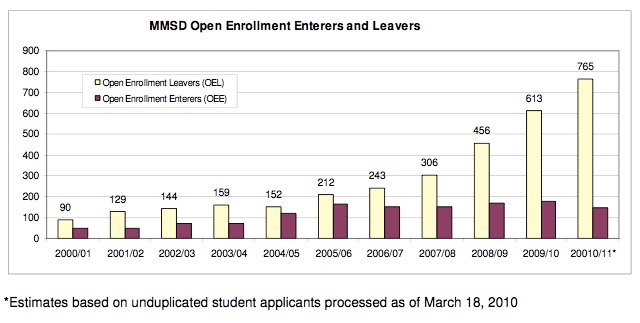
Madison School District Outbound Open Enrollment Applications 2010-2011 School Year; As of 3/18/2010


Complete Report 36k PDF, via a kind reader:

The pattern of an increasing number of open enrollment transfer applications continued this spring. As of March, 18, 2010 there were 765 unique resident MMSD students applying to attend non-MMSD districts and schools. The ratio of number of leaver applications to enterer applications is now 5:1.
It is important to note that not all applications result in students actually changing their district or school of enrollment. For example, for the 2009-10 school year although 402 new open enrollment students were approved by both MMSD and the non-resident districts to attend the non-resident district, only 199 actually were enrolled in the non-resident district on the third Friday September 2009 membership count date. Still, the trend has been upward in the number of students leaving the district.

Related: 2009 Madison School District Outbound Open Enrollment Parent Survey.
A school district’s student population affects its tax & spending authority.

Share

“Anything But Knowledge”: “Why Johnny’s Teacher Can’t Teach”

from The Burden of Bad Ideas Heather Mac Donald, Chicago: Ivan R. Dee, 2000, pp. 82ff.
America’s nearly last-place finish in the Third International Mathematics and Sciences Study of student achievement caused widespread consternation this February, except in the one place it should have mattered most: the nation’s teacher education schools. Those schools have far more important things to do than worrying about test scores–things like stamping out racism in aspiring teachers. “Let’s be honest,” darkly commanded Professor Valerie Henning-Piedmont to a lecture hall of education students at Columbia University’s Teachers College last February. “What labels do you place on young people based on your biases?” It would be difficult to imagine a less likely group of bigots than these idealistic young people, happily toting around their handbooks of multicultural education and their exposés of sexism in the classroom. But Teachers College knows better. It knows that most of its students, by virtue of being white, are complicitous in an unjust power structure.
The crusade against racism is just the latest irrelevancy to seize the nation’s teacher education schools. For over eighty years, teacher education in America has been in the grip of an immutable dogma, responsible for endless educational nonsense. That dogma may be summed up in the phrase: Anything But Knowledge. Schools are about many things, teacher educators say (depending on the decade)–self-actualization, following one’s joy, social adjustment, or multicultural sensitivity–but the one thing they are not about is knowledge. Oh, sure, educators will occasionally allow the word to pass their lips, but it is always in a compromised position, as in “constructing one’s own knowledge,” or “contextualized knowledge.” Plain old knowledge, the kind passed down in books, the kind for which Faust sold his soul, that is out.
The education profession currently stands ready to tighten its already viselike grip on teacher credentialing, persuading both the federal government and the states to “professionalize” teaching further. In New York, as elsewhere, that means closing off routes to the classroom that do not pass through an education school. But before caving in to the educrats’ pressure, we had better take a hard look at what education schools teach.
The course in “Curriculum and Teaching in Elementary Education” that Professor Anne Nelson (a pseudonym) teaches at the City College of New York is a good place to start. Dressed in a tailored brown suit, and with close-cropped hair, Nelson is a charismatic teacher, with a commanding repertoire of voices and personae. And yet, for all her obvious experience and common sense, her course is a remarkable exercise in vacuousness.
As with most education classes, the title of Professor Nelson’s course doesn’t give a clear sense of what it is about. Unfortunately, Professor Nelson doesn’t either. The semester began, she said in a pre-class interview, by “building a community, rich of talk, in which students look at what they themselves are doing by in-class writing.” On this, the third meeting of the semester, Professor Nelson said that she would be “getting the students to develop the subtext of what they’re doing.” I would soon discover why Professor Nelson was so vague.
“Developing the subtext” turns out to involve a chain reaction of solipsistic moments. After taking attendance and–most admirably–quickly checking the students’ weekly handwriting practice, Professor Nelson begins the main work of the day: generating feather-light “texts,” both written and oral, for immediate group analysis. She asks the students to write for seven minutes on each of three questions; “What excites me about teaching?” “What concerns me about teaching?” and then, the moment that brands this class as hopelessly steeped in the Anything But Knowledge credo: “What was it like to do this writing?”

(more…)

Share

10 things you won’t learn in school

Marty Abbott & Michael Fisher:

You can learn a lot of things in the classroom.
A lot of the knowledge you’ll glean comes in the form of facts (or “laws”) on how and why certain things work. A few lessons involve behaviors, such as team work. On very rare occasions, one learns a life lesson.
But there are some things you’ll never learn in the classroom. Hopefully, this will fill some of the gaps:
Ethical Challenges Occur More Frequently Than You Expect – Some engineering programs and a large number of business programs offer courses on ethics, but while these courses might expose the student to certain predicaments, they seldom help the student develop the muscle memory necessary to respond to ethical dilemmas.

Share

At Compton school, teen tutors and adult students learn from each other

Nicole Santa Cruz:

As part of a Compton Adult School tutoring program, adults trying to pass the California High School Exit Examination get an assist from Palos Verdes High students.
Brandy Rice eyed the test question.
She thought of what her tutor directed her to do: Read the entire sentence. Read all the answers.
Instead of playing multiple-choice roulette with the answers as she had so many times before, she followed the directions.
Rice, 26, was one of 20 Compton Adult School students in a tutoring program for the California High School Exit Examination. The tutors weren’t teachers, but teenagers from Palos Verdes High School.
The tutors carpooled from the green, laid-back beach community on a hill to Compton every Saturday for five weeks. Most had never before been to Compton and weren’t used to getting up at 7 a.m. on a weekend.

Share

K-12 Job Trends Amidst Stimulus Funds: Early Findings

Marguerite Roza, Chris Lozier & Cristina Sepe, via a Deb Britt email:

In February 2009, with some 600,000 education jobs threatened by the worst fiscal downturn in decades, the American Recovery and Reinvestment Act (ARRA) allocated about $100 billion to states. Topping the list of ARRA’s goals was saving and creating jobs. Since then, states have had to provide quarterly estimates of ARRA-funded jobs, and yet these reports stop far short of telling the whole story on whether the stimulus plan is meeting its job goals. Some have voiced methodological concerns, and many have acknowledged that identifying those jobs paid for by ARRA funds does not imply that the jobs were indeed saved or created.
The larger question that has been left unanswered, however, is whether ARRA has indeed worked to stabilize education employment from what otherwise might have been heavy losses in the current fiscal environment. Or for some, a parallel question is whether ARRA has prompted states to grow their education workforce, thereby making them more vulnerable to a “funding cliff” with larger layoffs when ARRA ends. Answering these questions requires evidence of the greater trend in total K-12 jobs, not just the trends in ARRA-funded jobs.

Share

“Are you a PC or a Mac?”: an interview with Principal David Elliott on the tech focus of Seattle’s Queen Anne Elementary

Mary Cropp:

Among piles of paperwork and shelves crowded with books on edu-topics, David Elliott’s office at Coe Elementary is crammed with pictures of baseball teams he has coached, crayoned drawings, and letters with childish handwriting careening all over the page. There’s a lot of stuff that he is going to need to haul out of here at the end of June when he moves to become principal at Queen Anne Elementary.
Elliott concedes that a recent shift in focus at this soon-to-open school, coupled with a lack of publicity, has a lot of parents scratching their heads about whether or not to enroll their child in this so called “Option School.” And time is running out — the Open Enrollment period will come to a close on March 31st. To that end, Elliott sat down with me earlier this week (full disclosure: my kids go to Coe Elementary) to discuss this new venture he is heading up. Elliot’s answers to my questions are in italics.

At first Seattle Public Schools said that Queen Anne Elementary was going to be a Montessori school. Now it is going to have a “technology” focus. How did that change come about?

Share

When A Stands for Average: Students at the UW-Madison School of Education Receive Sky-High Grades. How Smart is That?

Marc Eisen:

Lake Wobegon has nothing on the UW-Madison School of Education. All of the children in Garrison Keillor’s fictional Minnesota town are “above average.” Well, in the School of Education they’re all A students.
The 1,400 or so kids in the teacher-training department soared to a dizzying 3.91 grade point average on a four-point scale in the spring 2009 semester.
This was par for the course, so to speak. The eight departments in Education (see below) had an aggregate 3.69 grade point average, next to Pharmacy the highest among the UW’s schools. Scrolling through the Registrar’s online grade records is a discombobulating experience, if you hold to an old-school belief that average kids get C’s and only the really high performers score A’s.
Much like a modern-day middle school honors assembly, everybody’s a winner at the UW School of Education. In its Department of Curriculum and Instruction (that’s the teacher-training program), 96% of the undergraduates who received letter grades collected A’s and a handful of A/B’s. No fluke, another survey taken 12 years ago found almost exactly the same percentage.
A host of questions are prompted by the appearance of such brilliance. Can all these apprentice teachers really be that smart? Is there no difference in their abilities? Why do the grades of education majors far outstrip the grades of students in the physical sciences and mathematics? (Take a look at the chart below.)

The UW-Madison School of Education has no small amount of influence on the Madison School District.

Share

Meaningful Academic Work

Will Fitzhugh
The Concord Review
22 March 2010
In Outliers [2008], Malcolm Gladwell writes [p. 149-159] that: “…three things–autonomy, complexity and a connection between effort and reward–are, most people agree, the three qualities that work has to have if it is to be satisfying…Work that fulfills these three criteria is meaningful.” (emphasis in the original)
One of the perennial complaints of students in our schools is that they will never make use of what they are learning, and as for the work they are asked to do, they often say: “Why do we have to learn/do/put up with this?” In short, they often see the homework/schoolwork they are given to do as not very fulfilling or meaningful.
In this article I will argue that reading good history books and writing serious history research papers provide the sort of work which students do find meaningful, worth doing, and not as hard to imagine as having some future use.
In a June 3, 1990 column in The New York Times, Albert Shanker, President of the American Federation of Teachers, wrote:


“…It is also worth thinking about as we consider how to reform our education system. As we’ve known for a long time, factory workers who never saw the completed product and worked on only a small part of it soon became bored and demoralized, But when they were allowed to see the whole process–or better yet become involved in it–productivity and morale improved. Students are no different. When we chop up the work they do into little bits–history facts and vocabulary and grammar rules to be learned–it’s no wonder that they are bored and disengaged. The achievement of The Concord Review’s authors offers a different model of learning. Maybe it’s time for us to take it seriously.”

His point has value twenty years later. Even the current CCSSO National Standards recommend merely snippets of readings, called “informational texts,” and “literacy skills” for our students, which, if that is all they get, will likely bore them and disengage them for the reasons that Mr. Shanker pointed out.
Students who read “little bits” of history books have nothing like the engagement and interest that comes from reading the whole book, just as students who “find the main idea” and write little “personal essays,” or five-paragraph essays, or short “college” essays, will have nothing comparable to the satisfaction that comes from working on and completing a serious history research paper.
Barbara McClay, a homescholar from Tennessee, while she was in high school, wrote a paper on the “Winter War” between Finland and the Soviet Union. In an interview she was asked why she chose that topic:

“I’ve been interested in Finland for four years or so, and I had read a book (William Trotter’s A Frozen Hell) that interested me greatly on the Winter War; after reading the book, I often asked people if they had ever heard of the Winter War. To my surprise, not only had few of them heard about it, but their whole impression of Finnish-Soviet relations was almost completely different from the one I had received from the book. So there was a sense of indignation alongside my interest in Finland in general and the Winter War in particular: here was this truly magnificent story, and no one cared about it. Or knew about it, at least.
“And it is a magnificent story, whether anyone cares about it or not; it’s the stuff legends are made of, really, even down to the fact that Finland lost. And a sad one, too, both for Finland and for the Soviet soldiers destroyed by Soviet incompetence. And there’s so much my paper couldn’t even begin to go into; the whole political angle, for instance, which is very interesting, but not really what I wanted to write about. But the story as a whole, with all of its heroes and villains and absurdities–it’s amazing. Even if it were as famous as Thermopylae, and not as relatively obscure an event as it is, it would still be worth writing about.
“So what interested me, really, was the drama, the pathos, the heroism, all from this little ignored country in Northern Europe. What keeps a country fighting against an enemy it has no hope of defeating? What makes us instantly feel a connection with it?”

Perhaps this will give a feeling for the degree of engagement a young student can find in reading a good nonfiction history book and writing a serious [8,500-word, plus endnotes and bibliography] history research paper. [The Concord Review, 17/3 Spring 2007]
Now, before I get a lot of messages informing me that our American public high school students, even Seniors, are incapable of reading nonfiction books and writing 8,500 words on any topic, allow me to suggest that, if true, it may be because we need to put in place our “Page Per Year Plan,” which would give students practice, every year in school, in writing about something other than themselves. Thus, a first grader could assemble a one-page paper with one source, a fifth grader a five-page paper with five sources, a ninth grade student a nine-page with nine sources, and so on, and in that way, each and every Senior in our high schools could write a twelve-page paper [or better] with twelve sources [or better] about some historical topic.
By the time that Senior finished that paper, she/he would probably know more about that topic than anyone else in the building, and that would indeed be a source of engagement and satisfaction, in addition to providing great “readiness” for college and career writing tasks.
As one of our authors wrote:

…Yet of all my assignments in high school, none has been so academically and intellectually rewarding as my research papers for history. As young mathematicians and scientists, we cannot hope to comprehend any material that approaches the cutting edge. As young literary scholars, we know that our interpretations will almost never be original. But as young historians, we see a scope of inquiry so vast that somewhere, we must be able to find an idea all our own.
In writing this paper, I read almanacs until my head hurt. I read journal articles and books. I thought and debated and analyzed my notes. And finally, I had a synthesis that I could call my own. That experience–extracting a polished, original work from a heap of history–is one without which no student should leave high school.”

This paper [5,500 words with endnotes and bibliography; Daniel Winik, The Concord Review, 12/4 Summer 2002] seems to have allowed this student to take a break from the boredom and disengagement which comes to so many whose school work is broken up into little bits and pieces and “informational texts” rather than actual books and term papers.
If I were made the U.S. Reading and Writing Czar at the Department of Education, I would ask students to read one complete history book [i.e. “cover-to-cover” as it was called back in the day] each year, too. When Jay Mathews of The Washington Post recently called for nonfiction book ideas for high school students, I suggested David McCullough’s Mornings on Horseback, for Freshmen, David Hackett Fischer’s Washington’s Crossing for Sophomores, James McPherson’s Battle Cry of Freedom for Juniors, and David McCullough’s The Path Between the Seas for all Seniors. Naturally there could be big fights over titles even if we decided to have our high schools students read nonfiction books, but it would be tragic if the result was that they continue to read none of them. Remember the high school English teacher in New York state who insisted that her students read a nonfiction book chosen from the New York Times nonfiction bestseller list, and a big group of her female students chose The Autobiography of Paris Hilton…
When I was teaching United States History to Sophomores at the public high school in Concord, Massachusetts in the 1980s, I used to assign a 5-7-page paper (at the time I did not know what high schools students could actually accomplish, if they were allowed to work hard) on the Presidents. My reasoning was that every President has just about every problem of the day arrive on his desk, and a paper on a President would be a way of learning about the history of that day. Students drew names, and one boy was lucky enough to draw John F. Kennedy, a real coup. He was quite bright, so, on a whim, I gave him my copy of Arthur Schleshinger, Jr.’s A Thousand Days. He looked at it, and said, “I can’t read this.” But, he took it with him and wrote a very good paper and gave the book back to me. Several years later, when he was a Junior at Yale, he wrote to thank me. He said he was very glad I had made him read that first complete history book, because it helped his confidence, etc. Now, I didn’t make him read it, he made himself read it. I would never have known if he read it or not. I didn’t ask him.
But it made me think about the possibility of assigning complete history books to our high school students.
After I began The Concord Review in 1987, I had occasion to write an article now and then, for Education Week and others, in which I argued for the value of having high school students read complete nonfiction books and write real history research papers, both for the intrinsic value of such efforts and for their contribution to the student’s preparation for “college and career.”
Then, in 2004, The National Endowment for the Arts spent $300,000 on a survey of the reading of fiction by Americans, including young Americans. They concluded that it was declining, but it made me wonder if anyone would fund a much smaller study of the reading of nonfiction by students in our high schools, and I wrote a Commentary in Education Week [“Bibliophobia” October 4, 2006] asking about that.
No funding was forthcoming and still no one seems to know (or care much) whether our students typically leave with their high school diploma in hand but never having read a single complete history book. We don’t know how many of our students have never had the chance to make themselves read such a book, so that when they get to college they can be glad they had that preparation, like my old student.
As E.D. Hirsch and Daniel Willingham have pointed out so often, it takes knowledge to enrich understanding and the less knowledge a student has the more difficult it is for her/him to understand what she/he is reading in school. Complete history books are a great source of knowledge, of course, and they naturally provide more background to help our students understand more and more difficult reading material as they are asked to become “college and career ready.”
Reading a complete history book is a challenge for a student who has never read one before, just as writing a history research paper is a challenge to a student who has never been asked to do one, but we might consider why we put off such challenges until students find themselves (more than one million a year now, according to the Diploma to Nowhere report) pushed into remedial courses when they arrive at college.
It may be argued that not every student will respond to such an academic challenge, and of course no student will if never given the challenge, but I have found several thousand high school students, from 44 states and 36 other countries, who did:

“Before, I had never been much of a history student, and I did not have much more than a passing interest for the subject. However, as I began writing the paper, the myriad of facts, the entanglement of human relations, and the general excitement of the subject fired my imagination and my mind. Knowing that to submit to The Concord Review, I would have to work towards an extremely high standard, I tried to channel my newly found interest into the paper. I deliberately chose a more fiery, contentious, and generally more engaging style of writing than I was normally used to, so that my paper would better suit my thesis. The draft, however, lacked proper flow and consistency, and so when I wrote the final copy, I restructured the entire paper, reordering the points, writing an entirely new introduction, refining the conclusion, and doing more research to cover areas of the paper that seemed lacking. I replaced almost half of the content with new writing, and managed to focus the thesis into a more sustained, more forceful argument. You received that final result, which was far better than the draft had been.
In the end, working on that history paper, [“Political Machines,” Erich Suh, The Concord Review, 12/4, Summer 2002, 5,800 words] inspired by the high standard set by The Concord Review, reinvigorated my interest not only in history, but also in writing, reading and the rest of the humanities. I am now more confident in my writing ability, and I do not shy from difficult academic challenges. My academic and intellectual life was truly altered by my experience with that paper, and the Review played no small role! Without the Review, I would not have put so much work into the paper. I would not have had the heart to revise so thoroughly; instead I would have altered my paper only slightly, enough to make the final paper a low ‘A’, but nothing very great. Your Concord Review set forth a goal towards which I toiled, and it was a very fulfilling, life-changing experience.”

If this is such a great idea, and does so much good for students’ engagement and academic preparation, why don’t we do it? When I was teaching–again, back in the day 26 years ago–I noticed in one classroom a set of Profiles in Courage, and I asked my colleagues about them. They said they had bought the set and handed them out, but the students never read them, so they stopped handing them out.
This is a reminder of the death of the book report. If we do not require our students to read real books and write about them (with consequences for a failure to do so), they will not do that reading and writing, and, as a result, their learning will be diminished, their historical knowledge will be a topic for jokes, and they will not be able to write well enough either to handle college work or hold down a demanding new job.
As teachers and edupundits surrender on those requirements, students suffer. There is a saying outside the training facility for United States Marine Corps drill instructors, which says, in effect, “I will train my recruits with such diligence that if they are killed in combat, it will not be because I failed to prepare them.”
I do realize that college and good jobs are not combat (of course there are now many combat jobs too) but they do provide challenges for which too many of our high school graduates are clearly not ready.
Some teachers complain, with good reason, that they don’t have the time to monitor students as they read books, write book reports and work on serious history research papers, and that is why they can’t ask students to do those essential (and meaningful) tasks. Even after they realize that the great bulk of the time spent on complete nonfiction books and good long term papers is the student’s time, they still have a point about the demands on their time.
Many (with five classes) now do not have the time to guide such work and to assess it carefully for all their students, but I would ask them (and their administrators) to look at the time put aside each week at their high school for tackling and blocking practice in football or layup drills in basketball or for band rehearsal, etc., etc., and I suggest that perhaps reading books and writing serious term papers are worth some extra time as well, and that the administrators of the system, if they have an interest in the competence of our students in reading and writing, should consider making teacher time available during the school day, week, and year, for work on these tasks, which have to be almost as essential as blocking and tackling for our students’ futures.
=============
“Teach by Example”
Will Fitzhugh [founder]
Consortium for Varsity Academics® [2007]
The Concord Review [1987]
Ralph Waldo Emerson Prizes [1995]
National Writing Board [1998]
TCR Institute [2002]
730 Boston Post Road, Suite 24
Sudbury, Massachusetts 01776-3371 USA
978-443-0022; 800-331-5007
www.tcr.org; fitzhugh@tcr.org
Varsity Academics®
www.tcr.org/blog

Share

Tweak Hartford’s Teacher Seniority System To Preserve School Strengths

Hartford Courant:

It is easy to get drawn into the union-management aspects of public education and forget that the schools are there for the kids. What the kids need are stars in the classroom: great teachers.
With that in mind, the public should support the effort by Hartford school leaders to change from a system of district-wide teacher seniority to one of school-based seniority.
The city’s Board of Education voted Tuesday to ask the State Board of Education to step in and change this contractual guarantee. The state board has the authority to intervene in low-achieving schools to alter a union contract, but to date has never done so.
Under the current rules, the least experienced teachers are the first to be laid off and can be “bumped” by more experienced teachers from any school in the district. This can result in a disruptive shuffle of teachers among various schools.
Supporters of the proposed change say this endangers the quality of specialty schools, where particular themes or methods require teachers to have special qualifications or training.

Share

“Don’t blame teachers unions for our failing schools”

For the motion: Kate McLaughlin, Gary Smuts, Randi Weingarten Against the motion: Terry Moe, Rod Paige, Larry Sand Moderator: John Donvan:

Before the debate:
24% FOR 43% AGAINST 33% UNDECIDED
After the debate:
25% FOR 68% AGAINST 7% UNDECIDED
Robert Rozenkranz: Thank you all very much for coming. It’s my pleasure to welcome you. My job in these evenings is to frame the debate. And we thought this one would be interesting because it seems like unions would be acting in their own self interest and in the interest of their members. In the context of public education, this might mean fighting to have the highest number of dues paying members at the highest possible levels of pay and benefits. With the greatest possible jobs security. It implies resistance to technological innovation, to charter schools, to measuring and rewarding merit and to dismissals for almost any reason at all. Qualifications, defined as degrees from teacher’s colleges, trump subject matter expertise. Seniority trumps classroom performance. Individual teachers, perhaps the overwhelming majority of them do care about their students but the union’s job is to advocate for teachers, not for education. But is that a reason to blame teachers unions for failing schools? The right way to think about this is to hold all other variables constant. Failing schools are often in failing neighborhoods where crime and drugs are common and two parent families are rare. Children may not be taught at home to restrain their impulses or to work now for rewards in the future, or the value and importance of education. Even the most able students might find it hard to progress in classrooms dominated by students of lesser ability who may be disinterested at best and disruptive at worse. In these difficult conditions, maybe teachers know better than remote administrators what their students need and the unions give them an effective voice. Maybe unions do have their own agenda. But is that really the problem? Is there strong statistical evidence that incentive pay improves classroom performance? Or is that charter schools produce better results? Or that strong unions spell weak educational outcomes, holding everything else constant? That it seems to us is the correct way to frame tonight’s debate, why we expect it will give you ample reason to think twice.

Share

The Case for Saturday School

Chester Finn:

Kids in China already attend school 41 days a year more than students in the U.S. Now, schools across the country are cutting back to four-day weeks. Chester E. Finn Jr. on how to build a smarter education system.
“He who labors diligently need never despair, for all things are accomplished by diligence and labor.” –Menander
How many days a year did the future Alexander the Great study with Aristotle? Did Socrates teach Plato on Saturdays as well as weekdays? During summer’s heat and winter’s chill?
Though such details remain shrouded in mystery, historians have unearthed some information about education in ancient times. Spartans famously put their children through a rigorous public education system, although the focus was on military training rather than reading and writing. Students in Mesopotamia attended their schools from sunrise to sunset.
In the face of budget shortfalls, school districts in many parts of the United States today are moving toward four-day weeks. This is despite evidence that longer school weeks and years can improve academic performance. Schoolchildren in China attend school 41 days a year more than most young Americans–and receive 30% more hours of instruction. Schools in Singapore operate 40 weeks a year. Saturday classes are the norm in Korea and other Asian countries–and Japanese authorities are having second thoughts about their 1998 decision to cease Saturday-morning instruction. This additional time spent learning is one big reason that youngsters from many Asian nations routinely out-score their American counterparts on international tests of science and math.

Share

The New Public Option

Michael Bendetson:

How has the United States responded to this global challenge in education? We continue to lower our standards. While No Child Left Behind (NCLB) was a major step in education reform, it has inadvertently created a system where states continue to lower the expectations bar. In 2007, only 18% of Mississippi students scored proficient in the standardized national reading test. However, 88% scored proficient in the standardized state reading test. While Mississippi can be considered an extreme, a Department of Education report acknowledged, “state-defined proficiency standards are often far lower than proficiency standards on the NAEP.” While under this system test scores have improved slightly, our student’s education level has remained constant. As states are under enormous pressure to show improvements in test scores, standards are lowered. While politicians avoid future trouble, our children inherit it.
Even our once seemingly monopoly on higher education has eroded in recent years. While ranking 2nd in the world in older adults with a college diploma, the U.S. has slipped to 8th in the world in young adults with a college diploma. As other countries continue to provide numerous incentives for their students to attend universities, the United States seems content in allowing higher education to climb ever higher out of the reach of ordinary Americans. Furthermore, China and other Asian countries have created a higher education system that is far more useful in equipping its students with the needs to survive in a 21st century economy. More than 50 percent of undergraduate degrees awarded in China are in the fields of science, technology, engineering and math, compared to just 16 percent in the United States. While we are focused on creating litigators and lawyers, China and our competitors are creating the entrepreneurs and engineers of the future.

Share

Academics and state wealth

David Shaffer & David Wright:

Even before the current recession hit, the competitive challenges of a global economy were putting ever more pressure on the economic development efforts mounted by state governments across the country.
States that once could dangle their low costs of doing business to lure industry from other states have suddenly faced competition from even lower-cost places such as China and Southeast Asia. Many have been scrambling to catch up with ever-growing packages of tax incentives and grants – so much so that critics have fretted about “an economic war between the states,” as the organization Good Jobs Now calls it.
But while states scramble, the ground has shifted beneath them. The economic development contest is changing.
Traditional economic development efforts have focused on leveraging money, in one guise or another. Some states had lower costs and lower taxes to brag about – money. Some emphasized helping new industry by improving roads and water and sewers – money. Some tried to make up for high costs by offering various grants and tax breaks – in other words, money.

Share

Despite Gains, Albany Charter School Is Told to Close

Trip Gabriel:

ccountability is a mantra of the charter school movement. Students sign pledges at some schools to do their homework, and teachers owe their jobs to students’ gains on tests.
Attrition rates have been criticized, but Mr. Jean-Baptiste said, “We attract more than the amount of students we lose.”
But as New York State moves to shut down an 11-year-old charter school in Albany, whose test scores it acknowledges beat the city’s public schools last year, it is apparent that holding schools themselves accountable is not always so easy, or bloodless, as numbers on a page.
The principal, teachers and families of the New Covenant school have mounted a furious defense, citing rising achievement as well as their fears for the loss of a safe harbor from chaotic homes and streets, where teachers deliver homework to parents who are in jail to keep them involved, and the dean of students chases gang members from a nearby park.

Share

One Classroom, From Sea to Shining Sea

Susan Jacoby:

AMERICAN public education, a perennial whipping boy for both the political right and left, is once again making news in ways that show how difficult it will be to cure what ails the nation’s schools.
Only last week, President Obama declared that every high school graduate must be fully prepared for college or a job (who knew?) and called for significant changes in the No Child Left Behind law. In Kansas City, Mo., officials voted to close nearly half the public schools there to save money. And the Texas Board of Education approved a new social studies curriculum playing down the separation of church and state and even eliminating Thomas Jefferson — the author of that malignant phrase, “wall of separation” — from a list of revolutionary writers.
Each of these seemingly unrelated developments is part of a crazy quilt created by one of America’s most cherished and unexamined traditions: local and state control of public education. Schooling had been naturally decentralized in the Colonial era — with Puritan New England having a huge head start on the other colonies by the late 1600s — and, in deference to the de facto system of community control already in place, the Constitution made no mention of education. No one in either party today has the courage to say it, but what made sense for a sparsely settled continent at the dawn of the Republic is ill suited to the needs of a 21st-century nation competing in a global economy.

Share

Why Isn’t Everybody Learning Online?

Tom Vander Ark:

Pretty good free online K-12 learning options exist in most states, so why aren’t more students learning online? There are more than 2 million students learning online and that’s growing by more than 30% annually, but there are five significant barriers to more rapid adoption:

  1. Babysitting: Don’t underestimate the custodial aspect of school–it’s nice to have a place to send the kids every day. Homeschooling continues to grow aided by online learning but will never exceed 10% because most folks don’t want their kids around all day every day or just can’t afford to stay home.
  2. Money & Jobs: At the request of employee groups, the Louisiana state board recently rejected three high quality virtual charter applications. Districts don’t want to lose enrollment revenue and unions don’t want to lose jobs.
  3. Tradition: Layers of policies stand in the way of learning online starting with seat time requirements–butts in seats for 180 hours with a locally certificated teacher plowing through an adopted textbook.

There are likely many opportunities to offer online learning options for our students, particularly in tight budget times.

Share

The education president

Chicago Tribune:

Rhode Island’s Central Falls High School faces a world of problems. Not quite half of the freshmen class of 2005 went on to graduate last year. A little more than half of the juniors passed a state reading test. In math, just 7 percent passed.
Superintendent Frances Gallo asked her teachers to step up, to help her turn around their failing school. She asked them to teach 25 minutes more each day. She asked them to tutor the kids, to eat lunch once a week with the kids, to spend more time learning how to teach effectively.
She also offered to increase their pay. Teachers at Central Falls do well: $72,000 to $78,000 a year. Gallo offered them a $3,400 bump.
The teachers union said no.

Share

Madison’s $30M Spending Increase & Tax Gap Rhetoric Dissected

School Board Vice President Lucy Mathiak:

So what does this mean? Well, assuming that the board will use its levying authority under the referendum and the state funding formula, the gap is smaller than the reported (and internalized) $30 million. It is probably more like the $17 million in state aid cuts plus the $1.2 million in budget items for which there is no funding source. Or, by higher math, c. $18.2 million BEFORE the board makes its budget adjustments and amendments. (This process will take place between now and the final vote on May 4, and will likely involve a combination of cuts recommended by administration and cuts proposed by the board.)
This means that the draconian school closings and massive staff layoffs reported earlier are unlikely to happen. Indeed, the board added one cut to the list at Monday’s meeting when it voted to cut $43,000 in funding budgeted to produce a communication plan.

Share

Princeton School District’s Budget Math: Cajole Teacher Unions into Accepting Contract Concessions

New Jersey Left Behind:

Princeton Township Public Schools offers a template on what will most likely occur across many districts on the heels of Gov. Christie’s budget: an effort by school boards to cajole local unions into accepting contract concessions. With cuts of up to 5% of total school budgets, increases in health benefits, and annual salary increases ranging in the mid-4%, there’s no other way to find the money. Other costs – supplies, utilities, transportation – are not fungible.
A few quick facts about Princeton, a 3,500-student school district with sky-high test scores. The annual cost per pupil there is $18,340 compared to a state average of $15,168. (These are 2008-2009 figures from the state database.) The median teacher salary is $69,829 plus benefits. The state median salary is $59,545 plus benefits. Costs of benefits in Princeton come to 23% of each teacher’s salary.

Princeton’s “User Friendly Budget“.

Share

It starts with good teachers

Los Angeles Times Editorial:

Congratulations to the panel of teachers, administrators and parents who put together groundbreaking proposals on smarter ways to hire, pay, evaluate and fire teachers in the Los Angeles Unified School District. Improbable as it is that many of the proposals will be adopted by the school board, which is heavily influenced by the teachers union, they have opened a conversation sought by parents and school reformers, and that conversation is unlikely to be silenced until major changes are made.
We have long supported some of these recommendations: Not allowing seniority to rule which teachers are laid off. Expanding the probationary period before teachers get tenure. Including test scores and parent and student opinions in teacher evaluations. Paying more for excellent teachers who are willing to work in low-performing schools.

Share

New MIT study on student cheating

Valerie Strauss:

What surprised me most about a new study on cheating at MIT–which concludes that copying homework can lead to lower grades–was that students cheat at the prestigious school, which only admits brainy kids who don’t need to.
But of course, students cheat everywhere, even at the best schools; witness the recent grade-changing scandal at high-achieving Churchill High School, and, for that matter, the computer hacking scandal at high-achieving Whitman High School last year. Both are in Montgomery County and both are among the best secondary schools in the country.
In fact, according to the book, “Cheating in School: What we Know and What We Can Do,” by Stephen F. David, Patrick F. Drinan and Tricia Bertram Gallant, there are students cheating everywhere–from elementary to graduate school, rich and poor schools, public and private.
The authors define cheating as “acts committed by students that deceive, mislead or fool the teacher into thinking that the academic work submitted by the student was a student’s own work.”

Share

Obama Retreats on Education Reform

Karl Rove:

In a week dominated by health care, President Barack Obama released a set of education proposals that break with ideals once articulated by Robert F. Kennedy.
Kennedy’s view was that accountability is essential to educating every child. He expressed this view in 1965, while supporting an education reform initiative, saying “I do not think money in and of itself is necessarily the answer” to educational excellence. Instead, he hailed “good faith . . . effort to hold educators responsive to their constituencies and to make educational achievement the touchstone of success.”
But rather than raising standards, the Obama administration is now proposing to gut No Child Left Behind’s (NCLB) accountability framework. Enacted in 2002, NCLB requires that every school be held responsible for student achievement. Under the new proposal, up to 90% of schools can escape responsibility. Only 5% of the lowest-performing schools will be required to take action to raise poor test scores. And another 5% will be given a vague “warning” to shape up, but it is not yet clear what will happen if they don’t.

Share

What Values Are Apparent in Your School Textbooks?

Holly Epstein Ojalvo:

Students: Take a look at some of the changes to the Texas curriculum, and then at a passage from your own American history or government textbook. Considering word choice and the inclusion and treatment of leaders and movements, what values and ideas do you think it conveys? What connotations do the terms used have for you? Tell us what ideas you think are expressed in how your textbook is written.
Adults, please note: Though, of course, anyone can be a “student” at any age, we ask that adults respect the intent of the Student Opinion question and refrain from posting here. There are many other places on the NYTimes.com site for adults to post, while this is the only place that explicitly invites the voices of young people.

Math textbooks are an area ripe for this type of inquiry.

Share

Are ‘Early College’ High Schools A Good Idea?

Eliza Krigman:

In recent years, high schools that are configured to provide students the opportunity to earn both a high-school diploma and a college associate’s degree or up two years of credit toward a bachelor’s degree have grown in popularity. The Early College High School Initiative, a private partnership made up of 13 member organizations, has started or redesigned more than 200 such schools since 2002. In addition, the National Center on Education and the Economy is spearheading a similar initiative. Dozens of public schools in eight states next fall will adopt a program that lets 10th-grade students test out of high school and go to community college. The first generation of these schools targeted low-income, minority students who were likely to be the first in their family to attend college.

Share

Pleasantville Blast

New Jersey Left Behind:

We looked at Pleasantville High School last week in the context of Diane Ravitch’s new book, chosen at random among the cohort of segregated, impoverished, and failing Jersey schools. Coincidentally this challenged Abbott district made non-bloggy headlines s a day later because at that week’s Board meeting Pleasantville Superintendent Gloria Grantham blasted away at teachers to the consternation of her Board, The Press of Atlantic City reports,

Grantham spoke at length Tuesday night about the benefits teachers get – vacation days, free health coverage, free professional development – and the effort they owe their students.
“This is not to hurt anyone, this is just to present the facts. We have got to do a better balancing act between what our students receive and what our adults receive,” Grantham said. “They’re benefiting pretty well from the opportunity to teach in our high school.”

Share

The Academic Performance Tournament

David Motz:

For the fifth consecutive year, Inside Higher Ed presents its Academic Performance Tournament – a unique look at what the National Collegiate Athletic Association’s Division I Men’s Basketball Tournament would look like if teams advanced based solely on their outcomes in the classroom.
The winners were determined using the NCAA’s Academic Progress Rate, a nationally comparable score that gives points to teams whose players stay in good academic standing and remain enrolled from semester to semester. When teams had the same Academic Progress Rates, the tie was broken using the NCAA’s Graduation Success Rate – which, unlike the federal rate, considers transfers and does not punish teams whose athletes leave college before graduation if they leave in good academic standing.

Share

Colleges don’t like senior slump in high school

Beth Harpaz:

OK, mom and dad. Remember your last semester of high school? Chances are you weren’t freaking out about your AP chem class. Your prom plans may have mattered more than your 12th-grade GPA. And if you were headed to college, you were probably waiting to hear from just a couple of schools.
It’s not like that today for college-bound high school seniors. They’re cramming in AP classes for college credit. They’re waiting to hear from 10 or 12 schools. And they can’t shrug off homework, because many colleges make admission contingent on decent final grades.
“We have a policy to do 100 percent verification to ensure that final high school transcripts are received and reviewed,” said Matt Whelan, assistant provost for admissions and financial aid at Stony Brook University in New York. “While it has been the exception, unfortunately, I have had the experience of sending letters to students informing them that because they did not successfully complete high school, they could were no longer admitted, and we rescinded both admission and financial aid.”
College administrators around the country echoed Whelan’s sentiments, from the University of Southern California, to Abilene Christian University in Texas, to Dartmouth, an Ivy League college in New Hampshire.
Not only do 12th graders feel pressure to keep up academically, but many also dedicate themselves to beloved teams, clubs and the performing arts.

Share

Cheaters never prosper when teachers get in the way

Jay Matthews:

What should we do about the computer hackers at Winston Churchill High School in Montgomery County who changed dozens of grades? What is the solution to student cheating in general?
Research suggests that rising pressure to get into good colleges has led students to cut corners. One study cited by the Educational Testing Service said only about 20 percent of college students in the 1940s said they had cheated in high school, and the proportion is four times as large today.
Deemphasize the college race, some experts say, and much of this nonsense will go away. I have written for many years about research showing that adult success really doesn’t depend on the prestige of one’s alma mater. But that approach to easing cheating isn’t going to get us far. Competition is too much a part of American culture. Also, college pressure tends to affect only the top 20 percent of students who seek selective schools (it’s a higher percentage in the affluent Washington area) and not students who cheat for other reasons, such as laziness or boredom.

Share

Civil Rights Overreach Quotas for college prep courses?

Wall Street Journal:

Education Secretary Arne Duncan said last week that the Obama Administration will ramp up investigations of civil rights infractions in school districts, which might sound well and good. What it means in practice, however, is that his Office of Civil Rights (OCR) will revert to the Clinton Administration policy of equating statistical disparity with discrimination, which is troubling.
OCR oversees Title VI of the 1964 Civil Rights Act, which prohibits discrimination by race, color or national origin in public schools and colleges that receive federal funding. In a speech last week, Mr. Duncan said that “in the last decade”–that’s short for the Bush years–“the Office for Civil Rights has not been as vigilant as it should have been in combating racial and gender discrimination.” He cited statistics showing that white students are more likely than their black peers to take Advanced Placement classes and less likely to be expelled from school.
Therefore, Mr. Duncan said, OCR “will collect and monitor data on equity.” He added that the department will also conduct compliance reviews “to ensure that all students have equal access to educational opportunities” and to determine “whether districts and schools are disciplining students without regard to skin color.”

Share

Obama Flaw: Achievement Gap

Jay Matthews:

Also, I see a problem in the president using the achievement gap as a measure of schools in his suggested revisions. This could mean that a wonderfully diverse school like T.C. Williams High in Alexandria, a recent subject on this blog, would be motivated to ignore its best students, who want to get even better, and focus all its money and time on those at the bottom of the achievement scale so they can narrow the gap. That is not a good idea, and I hope the president will get it out of his proposal.

Share

The Push-Back on Charter Schools

Geoffrey Canada, Harlem Children’s Zone, Richard D. Kahlenberg, Century Foundation, Jeffrey Henig and Luis Huerta, Teachers College, Columbia, Michael Goldstein, Match Charter Public School:

Two recent New York Times articles have described opposition to the thriving charter school movement in Harlem. An influential state senator, Bill Perkins, whose district has nearly 20 charter schools, is trying to block their expansion. Some public schools in the neighborhood are also fighting back, marketing themselves to compete with the charters.
This is a New York battle, but charter schools — a cornerstone of the Obama administration’s education strategy — are facing resistance across the country, as they become more popular and as traditional public schools compete for money. The education scholar Diane Ravitch, once a booster of the movement, is now an outspoken critic.
What is causing the push-back on charter schools, beyond the local issues involved ? Critics say they are skimming off the best students, leaving the regular schools to deal with the rest? Is that a fair point?

Share

New data on how far boys are falling behind

Richard Whitmire:

Ask anyone about President Obama’s track record and you’ll hear the same: Not much movement on global warming, the domestic economy or health care. But there is one area in which Obama has already begun to move long-dormant mountains: education reform.
He has steered billions of dollars into education, which Education Secretary Arne Duncan has doled out in a carrot-and-stick approach that has forced states to promise reforms that were long thought impossible. For example, several state legislatures were “persuaded” — okay, legally bribed — into peeling back excessive teacher-protection laws.
Ultimately, however, Obama will be measured by his bottom line goal: for the United States to have the world’s highest proportion of college graduates by the year 2020. Translated, that means jumping from the middle of the rankings of developed nations to the top in just 10 years.

Share

Wisconsin Charter Schools Conference in Madison March 22-23: many important keynote speakers, including politicians + important topics for education

Laurel Cavalluzzo 160K PDF:

Featured speakers at the conference include Greg Richmond, President and founding board member of the National Association of Charter School Authorizers and establisher of the Chicago Public School District’s Charter Schools Office; Ursula Wright, the Chief Operating Officer for the National Alliance for Public Charter Schools; Sarah Archibald of the Consortium for Policy Research in Education at UW-Madison and the Value-Added Research Center; and Richard Halverson, an associate professor of Educational Leadership and Policy Analysis at the University of Wisconsin-Madison.
Also speaking at the Conference will be:

  • State Senator John Lehman (D-Racine), Chair Senate Education Committee
  • State Senator Luther Olsen (R-Berlin), Ranking Minority Member, Senate Education
  • State Representative Sondy Pope-Roberts (D-Middleton), Chair, Assembly Education Committee
  • State Representative Brett Davis (R-Oregon), Ranking Minority Member, Assembly Education

The Conference will feature interactive sessions; hands-on examples of innovative learning in classrooms; networking; a coaching room open throughout the conference; and keynote speakers that highlight the importance of quality in and around each classroom, and the impact that quality has on the learning of students everywhere. More details are attached.
Thank you for your consideration and your help in getting word out! If you would like to attend on a press pass, please let me know and I will have one in your name at the registration area.

Share

Madison School District’s 2009-2010 Citizen’s Budget Released ($421,333,692 Gross Expenditures, $370,287,471 Net); an Increase of $2,917,912 from the preliminary $418,415,780 2009-2010 Budget

Superintendent Dan Nerad 75K PDF:

Attached to this memorandum you will find the final version of the 2009-10 Citizen’s Budget. The Citizen’s Budget is intended to present financial information to the community in a format that is more easily understood. The first report groups expenditures into categories outlined as follows:

  • In-School Operations
  • Curriculum & Teacher Development & Support
  • Facilities, Other Than Debt Service
  • Transportation
  • Food Service
  • Business Services
  • Human Resources
  • General Administration
  • Debt Service
  • District-Wide
  • MSCR

The second report associates revenue sources with the specific expenditure area they are meant to support. In those areas where revenues are dedicated for a specific purpose(ie. Food Services) the actual amount is represented. In many areas of the budget, revenues had to be prorated to expenditures based on the percentage that each specific expenditure bears of the total expenditure budget. It is also important to explain that property tax funds made up the difference between expenditures and all other sources of revenues. The revenues were broken out into categories as follows:

  • Local Non-Tax Revenue
  • Equalized & Categorical State Aid
  • Direct Federal Aid
  • Direct State Aid
  • Property Taxes

Both reports combined represent the 2009-10 Citizen’s Budget.

Related:

I’m glad to see this useful document finally available for the 2009-2010 school year. Thanks to the Madison School Board members who pushed for its release.

Share

The Key To Saving American Education: Retrain or Replace Teachers?

Evan Thomas & Pat Wingert:

I’m excited for the opportunity to “debate.” The term violates my traditional sensibilities, but I’ll try to get over it. What resolution should we discuss? Resolved: “The problem with education is teachers,” as one online headline for your story read. Resolved: “The best way to deal with underperforming teachers is to fire them.” Resolved: “Much of the ability to teach is innate,” as the lead story in your package declares.
My reporting for The New York Times Magazine turned up counter-arguments to each of these declarations. But it also turned up many facts that appear in your story. Here are some premises we can probably agree on: The quality of teaching plays a major role in determining whether children learn. An upsetting number of teachers are not helping children learn as much as we want them to. A smaller group of teachers are actively impeding learning. It is insanely difficult to fire these bad teachers, and the teaching profession at large is an insanely isolated one in which it is not unusual for the only people who ever observe the professional at work to be 9 years old.
That said, the overwhelming conclusion of my reporting is that efforts to change this picture must go beyond simply firing the lowest performers. One reason is just plain money. Firing employees–in many professions, not just teaching–brings a lot of legal hurdles and therefore costs a lot of money. The bill is especially high for firing teachers; to fire underperforming teachers in New York City, Chancellor Joel Klein invested $1 million a year in a fleet of fancy attorneys tasked solely with this responsibility. In the two years the project has gone on so far, the city only fired three teachers charged with incompetence.

Share

Harvard study: Are weighted AP grades fair?

Debra Viadero:

To encourage high school students to tackle tougher academic classes, many schools assign bonus points to grades in Advanced Placement or honors courses. But schools’ policies on whether students should receive a grade-point boost and by how much are all over the map.
My local public school district, for instance, used to add an extra third of a grade-point to students’ AP course grades while the private high school on the other side of town would bump up students’ grades by a full letter grade.
Since students from both schools would be applying to many of the same colleges, and essentially competing with one another, it didn’t seem fair to me that the private school kids should get such a generous grade boost.
That’s why I was heartened to come across a new study by a Harvard University researcher that takes a more systematic look at the practice of high school grade-weighting.
He found that for every increasing level of rigor in high school science, students’ college course grades rose by an average of 2.4 points on a 100- point scale, where an A is 95 points and a B is worth 85 points and so on. In other words, the college grade for the former AP chemistry student would be expected to be 2.4 points higher than that of the typical student who took honors chemistry in high school. And the honors students’ college grade, in turn, would be 2.4 points higher than that of the student who took regular chemistry.
Translating those numbers, and some other calculations, to a typical high school 1-to-4-point grade scale, Sadler estimates that students taking an honors science class in high school ought to get an extra half a point for their trouble, and that a B in an AP science course ought to be counted as an A for the purpose of high school grade-point averages.

Share

Average Faculty Salaries by Field and Rank at 4-Year Colleges and Universities, 2009-10

The Chronicle of Higher Education.

Share

The School Board Job

Charlie Mas:

I don’t know what job the members of the school board came to do. I don’t know what job they think they are doing. But I do know what job they aren’t doing: they aren’t doing the Board job.
The Board job begins with serving as the elected representatives of the public. But the Board members aren’t representing the public’s voice in Seattle Public Schools. They certainly aren’t advocating for the public’s perspective. We know that they aren’t because if they were, we would hear them begin their sentences with the words: “My constituents want… ” and they don’t. We don’t hear them say “My constituents want equitable access to language immersion programs.” or “My constituents want equitable access to Montessori programs.” or “My constituents want access to a real Spectrum program for their Spectrum-eligible children.” or “My constituents want reduced class sizes.” We aren’t hearing that. And we sure aren’t hearing them follow these statements with “So let’s make it happen for them.”

Share

Can you lead a school system if you can’t write a clear sentence?

Maureen Downey:

In a provocative Detroit News column, columnist Laura Berman describes the troubling case of Detroit school board president Otis Mathis. Mathis appears to be a decent man admired by his colleagues. He is fair and open. He can also barely construct a sentence, as Berman shows by sharing his e-mails.
One Mathis example that she provides:

If you saw Sunday’s Free Press that shown Robert Bobb the emergency financial manager for Detroit Public Schools, move Mark Twain to Boynton which have three times the number seats then students and was one of the reason’s he gave for closing school to many empty seats.

Mathis does not deny his writing problems or his weak education record and speaks openly with Berman about them. He says his own struggles and deficiencies don’t disqualify him from leading a school system that shares many of those same struggles and shortcomings on an epic scale.

Share

Teachers Union Tops List of California Political Spenders

Patrick McGreevy:

Fifteen special interest groups including casino operators, drug firms and unions for teachers and public employees spent more than $1 billion during the last decade trying to influence California public officials and voters, the state’s watchdog agency reported today.
The money went for lobbying, campaign contributions to state politicians and ballot measure campaigns to get voters to advance the groups’ agendas, according to the report by the state Fair Political Practices Commission.
“This tsunami of special interest spending drowns out the voices of average voters, and intimidates political opponents and elected officials alike,” said Commission Chairman Ross Johnson, a former state senator.

The Wisconsin Education Association Council also tops the Badger State’s lobbying expenditures.

Share

School Districts vs. A Good Math Education

Charlie Mas:

If you are a parent in cities such as Bellevue, Issaquah or Seattle, your kids are being short-changed–being provided an inferior math education that could cripple their future aspirations–and you need to act. This blog will tell the story of an unresponsive and wrong-headed educational bureaucracies that are dead set on continuing in the current direction. And it will tell the story of how this disaster can be turned around. Parent or not, your future depends on dealing with the problem.
Let me provide you with a view from the battlefield of the math “wars”, including some information that is generally not known publicly, or has been actively suppressed by the educational establishment. Of lawsuits and locking parents out of decision making.
I know that some of you would rather that I only talk about weather, but the future of my discipline and of our highly technological society depends on mathematically literate students. Increasingly, I am finding bright students unable to complete a major in atmospheric sciences. All their lives they wanted to be a meteorologist and problems with math had ended their dreams. Most of them had excellent math grades in high school. I have talked in the past about problems with reform or discovery math; an unproven ideology-based instructional approach in vogue among the educational establishment. An approach based on student’s “discovering” math principles, group learning, heavy use of calculators, lack of practice and skills building, and heavy use of superficial “spiraling” of subject matter. As I have noted before in this blog, there is no competent research that shows that this approach works and plenty to show that it doesn’t. But I have covered much of this already in earlier blogs.

Related: Math Forum audio / video.

Share

Kansas City Adopts Plan to Close Nearly Half Its Schools

Susan Saulny:

The Kansas City Board of Education voted Wednesday night to close almost half of the city’s public schools, accepting a sweeping and contentious plan to shrink the system in the face of dwindling enrollment, budget cuts and a $50 million deficit.
In a 5-to-4 vote, the members endorsed the Right-Size plan, proposed by the schools superintendent, John Covington, to close 28 of the city’s 61 schools and cut 700 of 3,000 jobs, including those of 285 teachers. The closings are expected to save $50 million, erasing the deficit from the $300 million budget.
“We must make sacrifices,” said board member Joel Pelofsky, speaking in favor of the plan before the vote. “Unite in favor of our children.”

Share

Hillsborough teachers will soon be rated by their peers

Dong-Phuong Nguyen

Starting as early as this fall, every Hillsborough County schoolteacher will be subject to ratings by his or her peers.
The School Board on Tuesday unanimously approved the move as part of a reform effort under way to improve schools through the Bill & Melinda Gates Foundation.
The board’s vote dedicates $360,000 to an online training course for the peer evaluation system that, by 2013, will help determine whether teachers qualify for tenure or merit pay.
Within a month or so, teachers will be able to see how the system works in real life. The optional six-hour course by national teacher evaluation expert Charlotte Danielson includes an overview and video clips from actual classrooms where similar evaluations have been used.

Share

Why We Must Fire Bad Teachers

Newsweek
The relative decline of American education at the elementary- and high-school levels has long been a national embarrassment as well as a threat to the nation’s future. Once upon a time, American students tested better than any other students in the world. Now, ranked against European schoolchildren, America does about as well as Lithuania, behind at least 10 other nations. Within the United States, the achievement gap between white students and poor and minority students stubbornly persists–and as the population of disadvantaged students grows, overall scores continue to sag.
For much of this time–roughly the last half century–professional educators believed that if they could only find the right pedagogy, the right method of instruction, all would be well. They tried New Math, open classrooms, Whole Language–but nothing seemed to achieve significant or lasting improvements.
Yet in recent years researchers have discovered something that may seem obvious, but for many reasons was overlooked or denied. What really makes a difference, what matters more than the class size or the textbook, the teaching method or the technology, or even the curriculum, is the quality of the teacher. Much of the ability to teach is innate–an ability to inspire young minds as well as control unruly classrooms that some people instinctively possess (and some people definitely do not). Teaching can be taught, to some degree, but not the way many graduate schools of education do it, with a lot of insipid or marginally relevant theorizing and pedagogy. In any case the research shows that within about five years, you can generally tell who is a good teacher and who is not

Share

Draft US K-12 “Core Standards” Available for Comment

National Governors Association Center for Best Practices and Council of Chief State School Officers:

As part of the Common Core State Standards Initiative (CCSSI), the draft K-12 standards are now available for public comment. These draft standards, developed in collaboration with teachers, school administrators, and experts, seek to provide a clear and consistent framework to prepare our children for college and the workforce.
Governors and state commissioners of education from 48 states, 2 territories and the District of Columbia committed to developing a common core of state standards in English-language arts and mathematics for grades K-12. This is a state-led effort coordinated by the National Governors Association Center for Best Practices (NGA Center) and the Council of Chief State School Officers (CCSSO).
The NGA Center and CCSSO have received feedback from national organizations representing, but not limited to teachers, postsecondary education (including community colleges), civil rights groups, English language learners, and students with disabilities. These standards are now open for public comment until Friday, April 2.

Share

Notes on the Alliance for Education Teacher Quality Survey

Melissa Westbrook:

just finally got around to looking over the Alliance for Education survey called “Teaching Quality Community Survey”. What were they thinking? (Sorry to be a little late to this party but I was out of town last week.) I’m not going to even provide a link. I answered every question “don’t know” so I could read through the whole thing.
Just from a survey standpoint, it’s a mess. There are multiple values in questions starting with the very first one. It’s about (1) redesigning the salary schedule AND (2) eliminating coursework incentives AND (3) “reallocating pay to target the district’s challenges and priorities.” What?!? You can’t write a survey question like that.
Question two has a classic “leading the reader” form using phrases like “redouble efforts” and “as attempted by the current superintendent”. How does the reader know this actually DID happen? Also, the “latest” negotiations haven’t even formally started; is the district showing its hand here?
And it goes on and on. “Gather teacher data so that teachers are equitably distributed among schools.” So elsewhere they want to eliminate pay for more education for teachers but at the same time in this question they want to spread the number of teachers who do have more education more equitably among the schools?

Share

Teachers union rips Florida Senator Thrasher’s education bill

Brandon Larrabee:

The state’s largest teachers union ripped into a proposed overhaul of teacher contracts Monday, saying the bill represented an effort to score political points instead of serious education reform.
“It attacks the very people who work in our school system each and every day as opposed to giving them the resources that are needed to succeed,” said Andy Ford, president of the Florida Education Association, at a news conference called to slam the proposal from Sen. John Thrasher, R-St. Augustine.
Thrasher’s bill, filed last week, would base half of a teacher’s salary on student performance while extending to five years the period during which a new teacher can be fired at the end of each school year without cause.
It would also dismantle teacher tenure in the three counties, including Duval County, where it exists as well as other employment protections in other parts of the state. In most parts of the state, teachers can obtain a “professional service contract” after three or four years and can only be fired for cause.

Share

From his sickbed, Jaime Escalante is still delivering

Esmeralda Bermudez:

There was a time in East Los Angeles when el maestro’s el maestro’s gruff voice bounced off his classroom walls. He roamed the aisles, he juggled oranges, he dressed in costumes, he punched the air; he called you names, he called your mom, he kicked you out, he lured you in; he danced, he boxed, he screamed, he whispered. He would do anything to get your attention.
“Ganas,” he would say. “That’s all you need. The desire to learn.”
Nearly three decades later, Jaime Escalante finds himself far from Garfield High School in East Los Angeles, the place that made him internationally famous for turning a generation of low-income students into calculus whizzes. Twenty-two years have passed since his classroom exploits were captured in the film “Stand and Deliver.”
He is 79 and hunched in a wheelchair at a cancer treatment center in Reno. It is cold outside, and the snow-capped mountains that crown the city where his son brought him three weeks ago on a bed in the back of an old van remind him of his native Bolivia.

Share

K-12 Tax & Spending Climate: What’s Wrong with the Public Sector?

Charlie Mas:

I read this comment on Crosscut and I just have to share it.
Here is a link to the original article. It was about the (lack of a) Republican party alternative to the state budget.
The comment came from Stuka at 8:44pm on Thursday, March 4. I won’t quote all of it, but I absolutely want to share this part:

The fundamental problem with the public sector is not lack of taxes but lack of performance monitoring and improvement over time. Witness the public school system for evidence of the failure to monitor the quality of teachers, of teaching performance, of student performance, and of school performance. Same with the criminal-justice system: who is monitoring the quality of inmates produced by our prisons? The quality of justice by our judges and prosecutors? and the quality of policing by our police departments?
Unfortunately, we don’t pay for outcomes, but for staffing levels at fixed salary levels. A secondary effect of good government seems to be sometimes adequate government. Maybe we ought to reward for performance instead. That will happen only when compensation is tied to performance and not taking up space in a bureaucracy until the bureaucrat can collect a pension for enduring the bureaucracy, a feat that may be quite difficult and challenging, but in and of itself, produces no output that citizens value.
I highly value the services that government intends to provide (unlike many Republicans), but am unwilling to pay (unlike many Democrats) for monopolistic and ineffective government bureaucracies that have no handle on how to be effective and efficient in what they’re doing. This leaves me in a quandry since the demand for services is unceasing and the inertia of ineffective government is entrenched. Mostly I try to vote for anything that smacks of actual reward for performance, and vote against anything that looks like hoggish behavior (as in pigs get fat, hogs get slaughtered).

Share

Bill Ayers and friends eat their young

Mike Petrilli:

Amidst the Race to the Top excitement this week, an important story may have gotten lost in the buzz. On Wednesday, my colleague Jamie Davies O’Leary, a 27 year-old Princeton grad, liberal Democrat, and Teach For America alumna described her surprise bookshop encounter with former Weatherman and lefty school reformer Bill Ayers.
If Bill Ayers and Fred and Mike Klonsky were 22 again, they would be signing up for Teach For America. The whole thing is worth reading (it’s a great story) but note this passage in particular, about Ayers’ talk:

[Ayers] answered a young woman’s question about New York Teaching Fellows and Teach For America with a diatribe about how such programs can’t fix public education and consist of a bunch of ivy leaguers and white missionaries more interested in a resume boost than in helping students. Whoa.
And:
As someone who read Savage Inequalities years ago and attribute my decision to become a teacher partially to the social justice message, I almost felt embarrassed. But that was before I learned a bit of context, nuance, data, and evidence surrounding education policy debates. It’s as if Bill Ayers hasn’t been on the planet for the last two decades.

Almost as soon as Jamie’s essay was posted, the Klonsky brothers (Fred and Mike–both longtime friends and associates of Ayers, both involved in progressive education causes) went after her. Fred posted a missive titled, “File under misguided sense of one’s own importance.” Mike tweeted that her depiction of the encounter was a “fantasy.”

Share

Building a Better Teacher

Elizabeth Green:

ON A WINTER DAY five years ago, Doug Lemov realized he had a problem. After a successful career as a teacher, a principal and a charter-school founder, he was working as a consultant, hired by troubled schools eager — desperate, in some cases — for Lemov to tell them what to do to get better. There was no shortage of prescriptions at the time for how to cure the poor performance that plagued so many American schools. Proponents of No Child Left Behind saw standardized testing as a solution. President Bush also championed a billion-dollar program to encourage schools to adopt reading curriculums with an emphasis on phonics. Others argued for smaller classes or more parental involvement or more state financing.
Lemov himself pushed for data-driven programs that would diagnose individual students’ strengths and weaknesses. But as he went from school to school that winter, he was getting the sinking feeling that there was something deeper he wasn’t reaching. On that particular day, he made a depressing visit to a school in Syracuse, N.Y., that was like so many he’d seen before: “a dispiriting exercise in good people failing,” as he described it to me recently. Sometimes Lemov could diagnose problems as soon as he walked in the door. But not here. Student test scores had dipped so low that administrators worried the state might close down the school. But the teachers seemed to care about their students. They sat down with them on the floor to read and picked activities that should have engaged them. The classes were small. The school had rigorous academic standards and state-of-the-art curriculums and used a software program to analyze test results for each student, pinpointing which skills she still needed to work on.
But when it came to actual teaching, the daily task of getting students to learn, the school floundered. Students disobeyed teachers’ instructions, and class discussions veered away from the lesson plans. In one class Lemov observed, the teacher spent several minutes debating a student about why he didn’t have a pencil. Another divided her students into two groups to practice multiplication together, only to watch them turn to the more interesting work of chatting. A single quiet student soldiered on with the problems. As Lemov drove from Syracuse back to his home in Albany, he tried to figure out what he could do to help. He knew how to advise schools to adopt a better curriculum or raise standards or develop better communication channels between teachers and principals. But he realized that he had no clue how to advise schools about their main event: how to teach.

Share

K-12 Tax & Spending Climate: Federal pay ahead of private industry

Dennis Cauchon:

Federal employees earn higher average salaries than private-sector workers in more than eight out of 10 occupations, a USA TODAY analysis of federal data finds.
Accountants, nurses, chemists, surveyors, cooks, clerks and janitors are among the wide range of jobs that get paid more on average in the federal government than in the private sector.
Overall, federal workers earned an average salary of $67,691 in 2008 for occupations that exist both in government and the private sector, according to Bureau of Labor Statistics data. The average pay for the same mix of jobs in the private sector was $60,046 in 2008, the most recent data available.
These salary figures do not include the value of health, pension and other benefits, which averaged $40,785 per federal employee in 2008 vs. $9,882 per private worker, according to the Bureau of Economic Analysis.

Share

40,000 Teachers Give Their Views on Education Reform in “Primary Sources: America’s Teachers on America’s Schools”

Sarah Trabucci:

Teachers call for engaging curriculum, supportive leadership, clear standards common across states in survey by Scholastic Inc. and the Bill & Melinda Gates Foundation.
Scholastic Inc. and the Bill & Melinda Gates Foundation today released Primary Sources: America’s Teachers on America’s Schools, a landmark report presenting the results of a national survey of more than 40,000 public school teachers in grades pre-K to 12. The survey reveals that, while teachers have high expectations for their students, they overwhelmingly agree that too many students are leaving unprepared for success beyond high school. Primary Sources reveals teachers’ thoughtful, nuanced views on issues at the heart of education reform – from performance pay and standardized tests to academic standards and teacher evaluation. Teacher responses reveal five powerful solutions to raise student achievement.
“Teachers are a critical part of preparing our children for the future, and their voices are an essential addition to the national debate on education,” said Margery Mayer, Executive Vice President and President, Scholastic Education. “At Scholastic, we work daily with teachers and we know that they have powerful ideas on how best to tackle the challenges facing our schools. Since teachers are the frontline of delivering education in the classroom, the reform movement will not succeed without their active support. Primary Sources is a step in ensuring that teachers’ voices are a part of this important conversation.”

Jay Matthews has more.

Share

Rhode Island School Shake-Up Is Embraced by the President

Steven Greenhouse & Sam Dillon:

A Rhode Island school board’s decision to fire the entire faculty of a poorly performing school, and President Obama’s endorsement of the action, has stirred a storm of reaction nationwide, with teachers condemning it as an insult and conservatives hailing it as a watershed moment of school accountability.
The decision by school authorities in Central Falls to fire the 93 teachers and staff members has assumed special significance because hundreds of other school districts across the nation could face similarly hard choices in coming weeks, as a $3.5 billion federal school turnaround program kicks into gear.
While there is fierce disagreement over whether the firings were good or bad, there is widespread agreement that the decision would have lasting ripples on the nation’s education debate — especially because Mr. Obama seized on the move to show his eagerness to take bold action to improve failing schools filled with poor students.
“This is the first example of tough love under the Obama regime, and that’s what makes it significant,” said Michael J. Petrilli, a vice president at the Thomas B. Fordham Institute in Washington, an educational research and advocacy organization.

Share

As public education goes, so goes California

San Jose Mercury News Editorial:

How appropriate that, as one of the biggest education protests in history unfurled across the state, California’s application for a Race to the Top school reform grant was rejected by federal officials. Could there possibly be a louder wake-up call?
Given the chaos and infighting that muddied the state’s halting attempt to qualify for Race to the Top, the rejection is no surprise. But if education funding continues to decline, and if turf battles continue to prevent real reform, it’s not just students who will suffer. California’s greatness is at risk.
For much of the late 20th century, our public schools, colleges and universities were the envy of the nation, driving an economic boom that made the Golden State a global power. It’s no coincidence that this happened when taxpayers’ commitment to education was at its zenith.
That support has been declining for years, and the results are alarming.
Community colleges are required to accept everyone, but next fall, they’ll turn away some 200,000 students because they can’t afford to offer enough classes. With unemployment around 12 percent, what will those students — with only a high school diploma — do while waiting for a spot on campus?

Share

Teachers as reformers: L.A. Unified teachers won the right to run several new or underperforming schools. Can they pull it off?

Los Angeles Times Editorial:

Los Angeles schools did not undergo the transformation we had expected from the Public School Choice initiative, which in its first year opened more than 30 new or underperforming public schools to outside management. Top-notch charter operators applied for relatively few schools and then were removed from the running at the last minute. The school board once again mired itself in political maneuvers instead of putting students first.
What transformation there was came, more surprisingly, from the teachers. They agreed to allow and create more pilot schools, which are similar to charter schools but employ district personnel. They formed partnerships and, with the help of their union, United Teachers Los Angeles, drew up their own, often strong applications for revamping schools. It would be wrong to underestimate the effort and skills needed to pull this off. The time frame was short and the list of requirements long. Unlike charter operators, which submit such applications as a matter of course, the teachers had no particular background for this work. They met with parents who have long fumed that the schools discourage their participation. They listened. They responded.
This is a tremendous step in a school district where, too often, teachers and their union have not been the agents of change but impediments to it. In fact, had the process worked as it was supposed to, the reform initiative would have served as a much stronger application for federal Race to the Top funds than anything the Legislature came up with.

Share

Frosh will need to show writing skills

Anne Simons, via a kind reader’s email:

Seniors will have to “show evidence of their writing” in order to graduate, beginning with the class of 2013, Dean of the College Katherine Bergeron will announce Thursday.
“All students are expected to work on their writing both in general courses and in their concentration,” Bergeron wrote in an e-mail to be sent to students Thursday. Sophomores will have to reflect on their writing in their concentration forms, according to the letter.
The changes come out of recommendations from the Task Force on Undergraduate Education, Bergeron told The Herald. Based on the findings of an external review and discussions with faculty and academic committees, the College Writing Advisory Board and the College Curriculum Council collaborated on a new, clearer delineation of the expectations of writing at Brown, she said.
Bergeron’s letter ends with a statement on writing, explaining why it is an important skill for all graduates. “Writing is not only a medium through which we communicate and persuade; it is also a means for expanding our capacities to think clearly,” she wrote.

Share

“Clearly what’s needed and lacking in the district is a curriculum.”

New Jersey Left Behind:

That’s a real quote. The speaker is Asbury Park School District’s new superintendent Denise Lowe, who says that “major changes have to be made to the schools or the school district will cease to exist, ” according to the Asbury Park Press. Enrollment is dropping because students are leaving for parochial schools and charter schools, so she’s put together a five-year plan to improve achievement.
She’s got her work cut out for her. Asbury Park High School, for example, with 478 kids, has a 45.7% mobility rate. (The state average is 9.6%.) 72% of students failed the 11th grade HSPA test in language arts and 86.1% failed the math portion. Average SAT scores are 325 in math and 330 in verbal. Attendance rates in 9th grade are 83%. A whopping 64.6% of kids never pass the HSPA and end up taking the Special Review Assessment, a back-door-to-diploma-route that is impossible to fail. The total comparative cost per pupil? $24,428. (DOE data here.)

Share

Jordan School District seeks ruling on seniority layoffs could bring spate of lawsuits

Lisa Schencker & Katie Drake:

The Jordan School Board is asking a state judge to rule on how seniority must be calculated for its employees as it plans to lay off about 500 staff members and educators.
Without clarification about how seniority should be considered, the district could face liability in numerous potential lawsuits, the 3rd District Court complaint said. It names the Jordan Education Association (JEA) and the Jordan Classified Education Association, and has been assigned to Judge Joseph Fratto.
Whatever the judge determines could well decide who among Jordan’s teachers would be most vulnerable to layoffs.
The Jordan board, in the face of a projected $30 million shortfall, has decided to cut about 500 jobs, including 200 to 250 teachers. When terminating workers, school districts in Utah must abide by a “last in, first out” policy that provides job security to those with the most seniority.
The board now plans to eliminate employees in each school based on the number of years they have worked for the district. In other words, the jobs of those teachers with the least district seniority in each school would be at risk.

Share

17 states to fight dismal college completion rates

Jessie Bonner:

More than a dozen states have formed an alliance to battle dismal college completion rates and figure out how to get more students to follow through and earn their diplomas.
Stan Jones, Indiana’s former commissioner for higher education, is leading the effort with about $12 million in startup money from several national nonprofits including the Bill and Melinda Gates Foundation.
About one in every two Americans who start college never finish, said Jones, who founded Complete College America, a Washington, D.C.-based nonprofit, last year.
The U.S. has focused on access to higher education for the past several decades, and states need to turn their focus toward how many students actually graduate after they get in, even if it means using a funding structure that is based on degree completion instead of attendance, Jones said Tuesday.

Share

Survey: Supportive leadership helps retain top teachers

Nick Anderson:

A national survey of more than 40,000 public school teachers suggests that while higher salaries are far more likely than performance pay to help keep top talent in the classroom, supportive leadership trumps financial incentives.
The survey, funded by a philanthropy active in education reform, also shows that teachers have mixed feelings about proposals for new academic standards: Slightly more than half think that establishing common standards across all states would have a strong or very strong impact on student achievement, but two-thirds believe the rigor of standards in their own state is “about right.”
The survey, to be released Wednesday, was sponsored by the Bill & Melinda Gates Foundation in collaboration with the publisher Scholastic Inc. Harris Interactive canvassed the teachers via telephone and online questionnaires from March 2009 to June 2009, as the Obama administration was developing strategies to promote higher standards and more sophisticated use of test data to improve achievement and reward effective teachers.

Share

The key to education

Harriet Brown:

I wish to take issue with some of the assumptions made by the four teachers who were interviewed concerning the Gates Foundation grant (“Teachers in transition,” Views, Feb. 28).
It was said several times that good parenting is essential for children’s success in school. Not true! My two brothers and I grew up in a totally dysfunctional home, filled with constant criticism, hatred, anger, punishment, a mostly absent father, and one in which our mother constantly set us one against the other. There were no books, no magazines, no art on the walls and certainly no love or encouragement. Never once did we hear, “I’m proud of you!” or “Good job!”
We should have been poster children for not succeeding in school, but we weren’t. Today, my older brother is a medical doctor. My younger brother has two master’s degrees and is a life-long learner with a huge book collection. I started and completed my BA in English at age 25, with two toddlers to care for and no help from anyone, graduated in three years and had a successful career. We all still read voraciously.

Share

School Salary & Benefit Growth Driving Budget “Cuts”

New Jersey Left Behind:

NJEA President Barbara Keshishian has a news release out today slamming Gov. Christie’s seizure of $475 million in local district surplus accounts. Add to that a possible 15% cut in state aid, she intones, and it’s a “doomsday scenario for families” which will have “a devastating impact next fall, with many [districts] forced to lay off teachers and staff, cut academic programs or raise taxes.”
Fair enough. Local school districts are frantically calculating draconian cuts to accommodate projected shortfalls. But here’s the missing link in her jeremiad: those cuts are driven less by loss of surplus and state aid than by payroll and benefits increases radically out of sync with economic realities and private sector compensation. However, the solution’s pretty simple: NJEA should direct its local affiliates to proffer a one-year freeze on salaries, and encourage small contributions to health benefits.
Here’s an example. District A has a budget of $50 million. Typically 75% of those costs are payroll and benefits, or $37.5 million. If NJEA would exercise meaningful leadership and promote flat salaries for one year, those lay-offs, academic cuts, and tax raises would be almost entirely mitigated.

Share

Calling the Parents When a College Student Drinks

Lisa Belkin:

I visited my college-freshman son last week, and over pizza we talked about drinking. Part of pledging a fraternity means being the sober designated driver, I learned, and I was relieved that the the idea had become ingrained in college culture. Kids get it that driving while drinking is dangerous, right? Not exactly, he corrected. What they get is that a single D.U.I. means expulsion, and that’s a concept students respect.
So schools have the tools to stop students from drinking altogether, at least those who are under-age and breaking the law, I suggested. Just throw the book at anyone who gets caught?
He didn’t think that sounded like a good idea.

Share

The Substitute: After more than 30 years, he was going back to school. This time, he’d be in charge. Sort of.

Rob Hiaasen:

I was fingerprinted and cleared of any state or federal wrongdoing. No record of forgery, arson, maiming, child-selling or keeping a disorderly house — although I dodged a bullet with the last one. There are usually dishes in the sink and laundry unfolded (how do you fold fitted sheets?). Despite my domestic transgressions, I was invited to attend an orientation for substitute teachers. The word “mandatory” was used, but I preferred to think of myself as invited.
Either way, Plan B was under way.
If you need another sign of the country’s unemployment, attend an orientation for substitute teachers — if you can get a seat. It was standing room only at a Baltimore County public high school, as I sat with pencil and paper taking notes on the dangers of blood-borne pathogens, how to keep students on task, how to be positive but not overly friendly, and how to get paid $82.92 for a day’s work. Younger and older people were there, but more middle-aged men attended than I had expected. Guess that’s why this unemployment streak has been nicknamed a man-cession.

Share

School choice – an overrated concept

Francis Gilbert:

As a teacher for 20 years, I can tell parents that with their support children can flourish anywhere
The agony of waiting is over. Yesterday was national offer day, when parents learnt if their children had got into their favoured secondary schools. Unfortunately, as many as 100,000 children and their families have been bitterly disappointed.
As a teacher who has taught at various comprehensives for 20 years, I know that means a lot of tears and pain. I have seen parents who hit the bottle and come raging on to the school premises, demanding that the school takes their child; parents who do nothing but pester the school secretaries on the phone or by email; and parents who have just given up in despair, despite the fact that they have good grounds to appeal.
The main things parents should remember is not to descend into a great panic, and to review their situation dispassionately. What many don’t grasp is that if they fail to meet the admissions criteria of a school, children won’t get in, no matter how wonderful. The government has a strict admissions code that means schools have little room for manoeuvre: they can no longer just pick pupils they like the look of.

Share

Leaders Program Suffers for Lack of Milwaukee Public Schools Support

Alan Borsuk:

A startling ebb tide has been building in recent days across the Milwaukee Public Schools system, as principals and school councils make plans for next year.
Schools losing two teachers. Six teachers. A dozen teachers. More cuts in music, gym and art teachers, as well as librarians. Class sizes increasing – some principals say they are facing 25 or 30 in first-grade classes, with no aides for the teachers. High school classes that could reach 50 or more in some high schools. (“That’s not a classroom, that’s a lecture hall,” one principal said.)
Here’s one important part of that tide: New Leaders for New Schools will not launch a new class this summer to be trained as principals in MPS.
New Leaders is one of the hot acts in American education. Like Teach for America, the New Teacher Project and a few similar efforts, it is a hard-driving effort to bring talent into administrative and teaching positions in urban schools across the country.

Share

Teacher Layoffs: Rethinking “Last-Hired, First-Fired” Policies

National Council on Teacher Quality:

In September of 2009, Washington, DC, schools Chancellor Michelle Rhee laid off nearly 400 teachers, citing a serious shortfall in funds for the DC school system. The move, coming as it did after Washington hired more than 900 new teachers in the summer of 2009, made jaws drop — some in outrage, some in awe. But the controversy was due only partly to the fact that Rhee axed jobs so close on the heels of a hiring spree; she also took full advantage of a clause in DC regulation that made “school needs,” not seniority, the determining factor in who would be laid off.
Approve of Rhee’s move or not, the highly scrutinized and controversial layoffs spotlight an important question: what factors should be considered when school districts must decide who will stay and who will go?
In the past year, cash-strapped districts have been handing out pink slips by the hundreds, and some, by the thousands. The Bureau of Labor Statistics estimates that nearly 60,000 teachers were laid off in 2009. State budget gaps and deficit projections, with federal stimulus funding already spent, suggest more of the same for 2010. Some observers expect current cuts to come faster even than those of the 1970s, when the baby boom generation waned, emptying out schools across the country.

Share

Obama’s unfortunate comments on teacher firings

Valerie Strauss:

I have an uncle who was for years a Chicago public school teacher. Passionate and articulate about his subject, biology, Arnie cared a great deal about whether the kids learned in his class.
But here’s the disturbing thing he recalls about his career:
In the years that his classes were filled with kids from poor, broken homes who didn’t eat or sleep with any regularity, he worried that he wasn’t nearly as effective as he wanted to be. He reached some of the kids, sometimes, with some material, but not enough to his liking, no matter what he did or how hard he tried.
When he changed schools and suddenly was teaching kids from middle-class families who valued education, he instantly became a brilliant teacher. His students progressed at a fast clip, and everything he did seemed to work.
What some school reformers seem to forget is that the kids’ circumstances outside school affect their class performance: how much they eat, how much they sleep, how many words they heard when they were young, how many books were made available to them, the abilities and the disabilities with which they were born, etc.

Share

More on the Madison School District High School’s Use of Small Learning Communities & A Bit of Deja Vu – A Bruce King Brief Evaluation

Pam Nash 4.5MB PDF:

Introduction and Overview
1. Background and Overview Daniel A. Nerad, Superintendent of Schools
Prior to the fall of 2008, MMSD high schools functioned as four separate autonomous high schools, with minimal focus on working collaboratively across the district to address student educational needs.
In 2008 MMSD received a Federal Smaller Learning Communities for $5.3 million dollars over a five year period. The purpose of that grant is to support the large changes necessary to:

  • Increase student achievement for all students.
  • Increase and improve student to student relationships and student to adult relationships.
  • Improve post-secondary outcomes for all students.

District administration, along with school leadership and school staff, have examined the research that shows that fundamental change in education can only be accomplished by creating the opportunity for teachers to talk with one another regarding their instructional practice. The central theme and approach for REaL has been to improve and enhance instructional practice through collaboration in order to increase stndent achievement. Special attention has been paid to ensure the work is done in a cross – district, interdepartmental and collaborative manner. Central to the work, are district and school based discussions focused on what skills and knowledge students need to know and be able to do, in order to be prepared for post-secondary education and work. Systemized discussions regarding curriculum aligll1nent, course offerings, assessment systems, behavioral expectations and 21 st century skills are occurring across all four high schools and at the district level.
Collaborative professional development has been established to ensure that the work capitalizes on the expertise of current staff, furthers best practices that are already occurring within the MMSD high school classrooms, and enhances the skills of individuals at all levels from administration to classroom teachers needed. Our work to date has laid the foundation for further and more in-depth work to occur.
While we are at the formative stages of our work, evidence shows that success is occurring at the school level. Feedback from principals indicates that district meetings, school buildings and classrooms are feeling more collaborative and positive, there is increased participation by teachers in school based decisions, and school climate has improved as evidenced by a significant reduction in behavior referrals.
This report provides a summary of the REaL Grant since fall of2008 and includes:
1. Work completed across all four high schools.
2. School specific work completed.
3. District work completed.
4. REaL evaluation
5. Future implications
In addition the following attachments are included:
1. Individual REaL School Action Plans for 09-10
2. REaL District Action for 09-10
3. ACT EP AS Overview and Implementation Plan
4. AVID Overview
5. Templates used for curriculum and course alignment
6. Individual Learning Plan summary and implementation plan
7. National Student Clearninghouse StudentTracker System
8. Student Action Research example questions
2. Presenters

  • Pam Nash, Assistant Superintendent of Secondary Schools
  • Darwin Hernandez, East High School AVID Student
  • Jaquise Gardner, La Follette High School AVID Student
  • Mary Kelley, East High School
  • Joe Gothard, La Follette High School
  • Bruce Dahmen, Memorial High School
  • Ed Holmes, West High School
  • Melody Marpohl, West High School ESL Teacher

3. Action requested of the BOE
The report is an update, providing information on progress of MMSD High Schools and district initiatives in meeting grant goals and outlines future directions for MMSD High schools and district initiatives based on work completed to date.

MMSD has contracted with an outside evaluator, Bruce King, UW-Madison. Below are the initial observations submitted by Mr. King:
The REaL evaluation will ultimately report on the extent of progress toward the three main grant goals. Yearly work focuses on major REaL activities at or across the high schools through both qualitative and quantitative methods and provides schools and the district with formative evaluation and feedback. During the first two years ofthe project, the evaluation is also collecting baseline data to inform summative reports in later years of the grant. We can make several observations about implementation ofthe grant goals across the district.
These include:
Observation 1: Professional development experiences have been goal oriented and focused. On a recent survey of the staff at the four high schools, 80% of responding teachers reported that their professional development experiences in 2009-10 were closely connected to the schools’ improvement plans. In addition, the focus of these efforts is similar to the kinds of experiences that have led to changes in student achievement at other highly successful schools (e.g., Universal Design, instructional leadership, and literacy across the curriculum).
Observation 2: Teacher collaboration is a focal point for REaL grant professional development. However, teachers don’t have enough time to meet together, and Professional Collaboration Time (PCT) will be an important structure to help sustain professional development over time.
Observation 3: School and district facilitators have increased their capacity to lead collaborative, site-based professional development. In order for teachers to collaborate better, skills in facilitation and group processes should continue to be enhanced.
Observation 4: Implementing EP AS is a positive step for increasing post-secondary access and creating a common assessment program for all students.
Observation 5: There has been improved attention to and focus on key initiatives. Over two- thirds ofteachers completing the survey believed that the focus of their current initiatives addresses the needs of students in their classroom. At the same time, a persisting dilemma is prioritizing and doing a few things well rather than implementing too many initiatives at once.
Observation 6: One of the important focus areas is building capacity for instructional leadership, work carried out in conjunction with the Wallace project’s UW Educational Leadership faculty. Progress on this front has varied across the four schools.
Observation 7: District offices are working together more collaboratively than in the past, both with each other and the high schools, in support of the grant goals.
Is it likely that the four high schools will be significantly different in four more years?
Given the focus on cultivating teacher leadership that has guided the grant from the outset, the likelihood is strong that staff will embrace the work energetically as their capacity increases. At the same time, the ultimate success ofthe grant will depend on whether teachers, administrators, anddistrict personnel continue to focus on improving instruction and assessment practices to deliver a rigorous core curriculum for all and on nurturing truly smaller environments where students are known well.

Related:

Share

What happens to Madison’s bad teachers?

Lynn Welch:

It’s absurd to believe anyone wants ineffective teachers in any classroom.
So when President Barack Obama, in a speech last fall at Madison’s Wright Middle School, called for “moving bad teachers out of the classroom, once they’ve been given an opportunity to do it right,” the remark drew enormous applause. Such a pledge is integral to the president’s commitment to strengthen public education.
But this part of Obama’s Race to the Top agenda for schools has occasioned much nervousness. Educators and policymakers, school boards and school communities have questions and genuine concern about what it means. What, exactly, is a bad teacher, and how, specifically, do you go about removing him or her from a classroom?
Many other questions follow. Do we have a “bad teacher” problem in Madison? Does the current evaluation system allow Madison to employ teachers who don’t make the grade? Is our system broken and does it need Obama’s fix?
A look into the issue reveals a system that is far from perfect or transparent. But Madison school board President Arlene Silveira agrees it’s an issue that must be addressed.

Share

Portland School Board approves new contract with district teachers

Kimberly Melton:

The Portland School Board this morning unanimously approved a three-year contract between Portland Public Schools and the district’s nearly 4,000 teachers.
The new contract gives teachers a 2 percent cost-of-living pay increase in 2008-09 and in 2010-11. For 2009-10, teachers will receive no pay raise. The district gained the ability to extend the student day, which means additional support and tutoring classes could be available to kids before or after school.
“The important message is that we’re trying to balance the challenges of the economy with being fair to our teachers,” board co-chair Trudy Sargent said after the vote, “and I think the 0 percent cola in the current year, which has been a really tough year for everybody … that was an important place to balance the budget and teachers were willing to sacrifice in that year.”
Added schools Supt. Carole Smith: “We hit a sweet spot of being able to both protect services to students and reflect the tough economic times that we’re in.”

KATU:

The Portland School Board voted unanimously Saturday to approve a three-year contract between Portland Public Schools and the Portland Association of Teachers, ending a negotiation that has stretched on for more than a year and a half.
“This agreement allows us to live within our means,” said Portland School Board co-chair Trudy Sargent in a prepared statement Saturday. She said it garners two goals: It “increases instructional time for students and honors the good work of educators in Portland Public Schools,” Sargent said.
Key details of the approved contract agreement include:

Related: Madison School District & Madison Teachers Union Reach Tentative Agreement: 3.93% Increase Year 1, 3.99% Year 2; Base Rate $33,242 Year 1, $33,575 Year 2: Requires 50% MTI 4K Members and will “Review the content and frequency of report cards”.

Share

An Update on the Madison School District’s Efforts to Increase Teacher Use of the “Infinite Campus” Student Portal

Superintendent Dan Nerad 2.1MB PDF:

The Board of Education has shown concern with current levels of participation among staff, parents, and students in the use of the Infinite Campus student information system. This concern comes despite many efforts to engage the stakeholders with various professional development opportunities and promotional campaigns over the past three years. In December 2009, the Board was provided a summary from a staff survey conducted on the topic explaining why staff had been reluctant to use the teacher tools. That report is found as an attachment to this report (see Attachment 1).
A survey of Wisconsin school districts was completed to determine the standards for teacher use of student information system technologies in the state. The survey gathered information about the use of grade book, lesson planners, and parent and student portals. Responses were collected and analyzed from over 20 Wisconsin districts. Nearly all responding districts report either a requirement for online grade book use, or have close to 100 percent participation. (See Attachment 2).
Describe the action requested of the BOE
The administration is requesting that the Board of Education take action in support of the proposed action steps to enhance the overall use of the teacher and portal tools among our stakeholders.
The proposed time line for full teacher use of grade level appropriate Infinite Campus teacher tools is: High school teachers – 2011-2012 End of 4th Quarter, Middle school teachers – 2010-2011 End of 4th Quarter, Elementary school teachers – End of 4th Quarter, 2011-2012 (calendar feature only)

Fascinating tone. I support the Board’s efforts to substantially increase usage of this system. If it cannot be used across all teachers, the system should be abandoned as the District, parents and stakeholders end up paying at least twice in terms of cost and time due to duplicate processes and systems.

Share

Book: From A Wisconsin Soapbox

Mark H. Ingraham Dean Emeritus, College of Letters & Science, University of Wisconsin
Professor Emeritus of Mathematics, University of Wisconsin [Click to view this 23MB PDF “book”]:

Contents
Preface
Part I Liberal Education
The Omnivorous Mind 3
Given May 16, 1962, to the University of Wisconsin Chapter of Phi Beta Kappa. Republished from The Speech Teacher of September 1962.
Truth-An Insufficient Goal 17
The Keniston Lecture for 1964 at the University of Michi- gan; March 17, 1964. Republished from the Michigan Quarterly Review of July 1964.
On the Adjective “Common” 31
An editorial for the February 1967 Review of the Wisconsin Academy of Arts, Letters, and Sciences, February 23, 1967.
Part II Educational Policy
Super Sleep-A Form of Academic Somnambulism 37
First given as retiring address as President of A.A. U.P . This much revised version was given to the Madison Literary Club, March 12, 1940.
No, We Can’t; He Has a Committee Meeting 57
Madison Literary Club; May 11, 1953.
Is There a Heaven and a Hell for Colleges? 70
Commencement address, Hiram College; June 8, 1958.
The College of Letters and Science 79
Talk given to the Board of Regents of the University of Wisconsin, May 3, 1958.
Some Half Truths About the American Undergraduate 84
Orientation conference for Whitney-Fulbright Visiting Scholars. Sarah Lawrence College, September 6, 1962.
Maps Versus Blueprints 94
Honors Convocation, University of Wisconsin, May 18, 1973.
Part III To Students
A Talk to Freshmen 103
University of Wisconsin; September 18, 1951
Choice: The Limitation and the Expression of Freedom 112
Honors Convocation, University of Wisconsin; June 17, 1955. Republished from the Wisconsin Alumnus.
“The Good is Oft Interred with Their Bones” 121
Commencement, University of Wisconsin-Oshkosh; Janu- ary 19, 1968.
Talk at Honors Convocation at Ripon College
Talk at Honors Convocation at Ripon College 129
April 9, 1969
The Framework of Opportunity 136
Thanksgiving Address, University of Wisconsin; November, 1947
Part IV A Little Fun
Food from a Masculine Point of View 149
Madison Literary Club; November 11, 1946
On Telling and Reading Stories to Children 165
Attic Angel Tower, Madison, Wisconsin; March 6, 1978
Three Limericks 179
Fragments 181
a. From an address given to the University oF Wyoming Chapter of Phi Beta Kappa, April 26, 1965
b. A comment
Part V Somewhat Personal
Letter of Resignation from Deanship 185
April 5, 1961
Retirement Dinner Talk 188
May 24, 1966

Thanks to Richard Askey for extensive assistance with this digitized book. Search Mark Ingraham.

Share

Excellence in Action: Seven Core Principles

Foundation for Excellence in Education:

High academic standards: High academic standards are based on the principle that all students can learn. Raising expectations for what students are required to learn in the classroom will better prepare students for success. Standards in core subjects must be raised to meet international benchmarks to ensure American students can compete with their peers around the globe.
Standardized measurement: To provide an accurate depiction of where our students are, annual standardized testing must be continued and expanded in all 50 states. Measuring whether students are learning a year’s worth of knowledge in a year’s time is essential for building on progress, rewarding success and correcting failures. To accurately measure progress, modern data and information systems should be utilized, and there must be maximum transparency across the board.
Data-driven accountability: Holding schools accountable for student achievement – measured objectively with data such as annual standardized tests and graduation rates – improves the quality of an education system. Success and learning gains no longer go unnoticed and problems are no longer ignored, resulting in efforts to effectively narrow achievement gaps.

Tom Vander Ark has more.

Share

The charter school test case that didn’t happen

Howard Blume:

If they hadn’t been mostly shut out of bids to run a slew of new L.A. Unified campuses, the groups might have demonstrated how they handle students with challenging needs.
Los Angeles school officials lost a chance this week to test whether the booming charter movement can take on all the problems of the district’s traditional, and often troubled, schools.
On Tuesday, the Board of Education denied proposals from three major charter organizations that had sought to run newly built neighborhood schools, which would have included substantial numbers of limited-English speakers, special education students, foster children and low-income families.
That is exactly the population that charter schools have been criticized for not sufficiently reaching.
Charters are independently managed and exempt from some rules that govern traditional schools. They’re also schools of choice — campuses that parents seek and select. And researchers have found that charters enroll fewer students with more challenging, and often more expensive, needs.

Share

The Proposed Madison School District Administrative Reorganization Plan

Superintendent Dan Nerad, via an Arlene Silveira email 1.4MB PDF:

Processes of the Administration
The following administrative processes are currently being utilized to provide administrative leadership within the district:

  1. Superintendent’s Management Team Comprised of the Superintendent and department administrators, this team meets weekly and serves as the major decision making body of the administration.
  2. Strategic Plan Monitoring and Support
    The Superintendent meets monthly with administrators with lead responsibility for the five priority strategies within the Strategic Plan.
  3. Superintendents-Assistant Superintendents, Chief of Staff and Executive Director, Human Resources
    The Superintendent meets weekly with the Assistant Superintendents, Chief of Staff and Executive Director of Human Resources to discuss key operational issues.
  4. Board Liaison Team
    The Board Liaison Team, consisting of designated administrators, meets three times a month to coordinate Board agenda planning and preparation. District Learning Council The District Learning Council consists of curriculum, instruction and assessment related administrators and teacher leaders. This council meets bi-weekly to discuss major instructional issues in the district and provides coordination across related departments.
  5. Department Meetings Administrators assigned to each department meet as needed.
  6. Principal Meetings Assistant Superintendents meet minimally one time per month with all principals
  7. Committee Meetings
    There are numerous administrative/staff committees that meet as specific tasks require.

General Strengths of the Current Administrative Structure
The strengths of the current administrative structure within the district are as follows:

  1. The basic structure of our district has been in place for many years. As a result, the current department structure is known by many and has predictable ways of operating.
      There exist needed checks and balances within the current system, given the relative equal status of the departments, with each department leader along with the Assistant Superintendents and Chief of Staff directly reporting to the Superintendent of Schools.

    General Weaknesses of the Current Administrative Structure
    The weaknesses of the current administrative structure within the district are as follows:

    1. The degree to which the mission-work of the district, teaching and learning, is central to the function of administration is of concern especially in the way professional development is addressed without a departmental focus.
    2. Traditional organizational structures, while having a degree of predictability, can become bureaucratically laden and can lack inventiveness and the means to encourage participation in decision making.

    Organizational Principles
    In addition to the mission, belief statements and parameters, the following organizational principles serve as a guide for reviewing and defining the administrative structure and administrative processes within the district.

    1. The district will be organized in a manner to best serve the mission of the district .and to support key district strategies to accomplish the mission.
    2. Leadership decisions will be filtered through the lens of our mission.
    3. Central service functions will be organized to support teaching and learning at the schools and should foster supportive relationships between schools and central service functions.
    4. The district’s organizational structure must have coherence on a preK-12 basis and must address the successful transition of students within the district.
    5. The district will be structured to maximize inter-division and intra-division collaboration and cooperation.
    6. The district’s organizational structure must have an orientation toward being of service to stakeholders, internally and externally.
    7. The district must be organized in a manner that allows for ongoing public engagement
      and stakeholder input.

    8. To meet the district’s mission, the district will embrace the principles of learning organizations, effective schools, participative and distributive leadership and teamwork.
    9. The district will make better use of data for decision making, analyzing issues, improving district operations, developing improvement plans and evaluating district efforts.
    10. The need for continuous improvement will be emphasized in our leadership work.
    11. Ongoing development and annual evaluation of district leaders is essential.

    Leadership Needs
    Given these organizational principles, as well as a review of the current administrative structure and administrative processes within the district, the following needs exist. In addition, in the development of this plan, input was sought from all administrators during the annual leadership retreat, individual Management Team members and individual members of the Board of Education. These needs were specifically referenced in identifying the recommended changes in our administrative structure and related administrative processes that are found in this report.

    1. There is a need to better align the administrative structure to the district’s mission and Strategic Plan and to place greater priority on the mission-work of our organization (improved achievement for all students and the elimination of achievement gaps).
    2. From an administrative perspective, the mission-work of our district is mainly delivered through teaching and learning and leadership work being done in our schools. Central service functions must act in support of this work. In addition, central service functions are needed to ensure constancy of focus and direction for the district.
    3. New processes are needed to allow for stakeholder engagement and input and to create greater inter-department and division collaboration and cooperation
    4. The mission of the district must be central to decisions made in the district.
    5. The organizational structure must support PreK -12 articulation and coordination needs within the district.
    6. Leadership work must embody principles of contemporary learning organizations, effective school practices, participative and distributive leadership and teamwork. Included in this will be a focus on the purposeful use ofteacher leadership, support for our schools and a focus on positive culture within the district.
    7. There must be an enhanced focus on the use of data in our improvement and related accountability efforts.
    8. There is a need to unifonnly implement school and department improvement plans and to change administrative supervision and evaluation plans based on research in the field and on the need for continuous improvement of all schools, departments and all individual administrators.

    In addition, as this plan was constructed there was a focus on ensuring, over the next couple of years, that the plan was sustainable from a financial point of view.

Share

The hype of ‘value-added’ in teacher evaluation

Lisa Guisbond:

As a rookie mom, I used to be shocked when another parent expressed horror about a teacher I thought was a superstar. No more. The fact is that your kids’ results will vary with teachers, just as they do with pills, diets and exercise regimens.
Nonetheless, we all want our kids to have at least a few excellent teachers along the way, so it’s tempting to buy into hype about value-added measures (VAM) as a way to separate the excellent from the horrifying, or least the better from the worse.
It’s so tempting that VAM is likely to be part of a reauthorized No Child Left Behind. The problem is, researchers urge caution because of the same kinds of varied results featured in playground conversations.
Value-added measures use test scores to track the growth of individual students as they progress through the grades and see how much “value” a teacher has added.

The Madison School District has been using Value Added Assessment based on the oft – criticized WKCE.

Share

The Next Wave of Digital Textbooks – DynamicBooks from Macmillan

Thomas:

ne of the most firmly entrenched academic practices centers upon the use of textbooks as the fundamental drivers of curricula. Ultra-expensive, these items represent one of the largest costs for public school systems as well as those attending college.
As the digital age continues to work its way into the stuffy world of academics, there are clear indications that textbooks are gradually being phased out in many areas of the country. The sheer volume of resources available on the net is leading many school districts to create and share their own materials.
Macmillan, considered one of the largest players in that old, conservative world, apparently has now also seen the “handwriting on the wall.” The company recently announced it will offer academics an entirely new format: DynamicBooks.

Share

Mass firings at R.I. school may signal a trend

Greg Toppo:

The mass firing of teachers at a Rhode Island high school this week is hardly new: For nearly two decades, states and school districts have been “reconstituting” staffs at struggling public schools.
But Tuesday’s move by Central Falls, R.I., Superintendent Frances Gallo to remove all 74 teachers, administrators and counselors at the district’s only high school may be the first tangible result of an aggressive push by the Obama administration to get tough on school accountability — and may signal a more fraught relationship between teachers unions and Democratic leaders.
“This may be one school in one town, but it represents a much bigger phenomenon,” says Andy Smarick of the Thomas B. Fordham Institute, a Washington, D.C., education think tank. “Thanks to years of work battling the achievement gap and the elevation of reform-minded education leaders, we may finally be getting serious about the nation’s lowest-performing schools.”

Share

Progress Slow in City Goal to Fire Bad Teachers

Jennifer Medina:

The Bloomberg administration has made getting rid of inadequate teachers a linchpin of its efforts to improve city schools. But in the two years since the Education Department began an intensive effort to root out such teachers from the more than 55,000 who have tenure, officials have managed to fire only three for incompetence.
Ten others whom the department charged with incompetence settled their cases by resigning or retiring, and nine agreed to pay fines of a few thousand dollars or take classes, or both, so they could keep their jobs. One teacher lost his job before his case was decided, after the department called immigration officials and his visa was revoked. The cases of more than 50 others are awaiting arbitration.
Lawyers for the department said an additional 418 teachers had left the system after finding out that they could face charges of incompetence. Because no formal charges were brought in these cases, the number is hard to corroborate; officials from the teachers’ union said they doubted it was that high.

Share

Rhee reports to D.C. Council on teacher misconduct

Bill Turque:

Schools Chancellor Michelle A. Rhee has fired 10 D.C. teachers for administering corporal punishment and two for sexual misconduct since July 2007, according to a report she submitted to D.C. Council Chairman Vincent C. Gray.
Another 28 teachers served suspensions of as long as 10 days for administering corporal punishment, defined by District law as the use or attempted use of force against a student as punishment or discipline.
The report, sent to Gray (D) on Feb. 12, does not include names and offers only fragmentary descriptions of the incidents. Most involve grabbing, shoving, slapping, scratching or arm-twisting. One teacher drew a five-day suspension for putting a student in a closet and turning the lights off in February 2008. A case of spanking in November 2007 resulted in a teacher’s dismissal and reinstatement after a hearing officer’s decision. An instructor who threatened students with a knife if they misbehaved received a one-day suspension.

Share

Beloit Teachers Voluntarily Taking Furloughs to Reduce School District Costs

Channel3000:

The Beloit School District is facing a $1.5 million budget shortfall, but teachers are offering their help by taking days off.
The Beloit Education Association, which is the teacher’s union in the district, previously agreed to open its contract if state aid decreased from one year to the next.
“We went back to the table and worked out a voluntary settlement with the district regarding furlough days and salary reductions for those furlough days,” said Tim Verda, president of the Beloit Education Association.
The teacher’s union is going beyond a pay freeze by offering to take one furlough day this year and two next year.
The school district said it will result in a savings of $658,000.

Share

More Rhetoric on the Seattle School District’s Court Loss on the Use of Discovery Math

Melissa Westbrook:

For entertainment value read the Discovering Math Q&A in this article in the Seattle Times. The Discovering Math guy (1) doesn’t always answer the question asked, (2) answers but doesn’t address the topic properly – see the question on if Discovering Math is “mathematically unsound” and (3) sounds like he works for the district.
Here’s one example:
The Discovering books have been criticized by parents, but they’ve been the top pick of a couple of districts in our area, including Seattle and Issaquah. Any thoughts on why the textbooks seem to be more popular with educators than with parents?
Ryan: I think because (parents) lack familiarity — this doesn’t look like what I was taught. I don’t know how you get students to a place where more is required of them by repeating things that have been done in the past. That’s not how we move forward in life.
What?

Much more on the successful community lawsuit vs. the Seattle School District’s implementation of Discovery Math. Math Forum audio / video.

Share

Hysteria Around School Turnarounds

Tom Vander Ark:

The NYTimes ran a story with this misleading headline and byline:

A Vote to Fire All Teachers at a Failing High School
CENTRAL FALLS, R.I. — A plan to dismiss the entire faculty and staff of the only public high school in this small city just west of the Massachusetts border was approved Tuesday night at an emotional public meeting of the school board.

When the teachers failed to adopt a ‘transformation’ plan that included a modest lengthening of the day, the superintendent shifted to Plan B, what federal School Improvement Grants (SIG) call Turnaround, which requires that at least 50% of the staff be replaced. Under Rhode Island law, teachers must be notified of the potential for nonrenewal by March 20, hence the board vote and notices. All the teachers will have the opportunity to reapply, up to half will be rehired.
The hysteria is now reverberating on CNN and papers around the country. Central Falls may be an early example but there are thousands to come. As I began reporting in October, SIG will cause widespread urban disruption. But we’ll all need to be cautious to use language carefully and differentiate between ‘firing all the teachers’ and notifying them of the requirement to reapply for their positions.

Related: Ripon Superintendent Richard Zimman’s speech to the Madison Rotary:

Last Wednesday, Ripon Superintendent Richard Zimman spoke to the Madison Rotary Club on “What Wisconsin’s Public Education Model Needs to Learn from General Motors Before it is too late.” 7MB mp3 audio (the audio quality is not great, but you can hear the talk if you turn up the volume!).
Zimman’s talk ranged far and wide. He discussed Wisconsin’s K-12 funding formula (it is important to remember that school spending increases annually (from 1987 to 2005, spending grew by 5.10% annually in Wisconsin and 5.25% in the Madison School District), though perhaps not in areas some would prefer.
“Beware of legacy practices (most of what we do every day is the maintenance of the status quo), @12:40 minutes into the talk – the very public institutions intended for student learning has become focused instead on adult employment. I say that as an employee. Adult practices and attitudes have become embedded in organizational culture governed by strict regulations and union contracts that dictate most of what occurs inside schools today. Any impetus to change direction or structure is met with swift and stiff resistance. It’s as if we are stuck in a time warp keeping a 19th century school model on life support in an attempt to meet 21st century demands.” Zimman went on to discuss the Wisconsin DPI’s vigorous enforcement of teacher licensing practices and provided some unfortunate math & science teacher examples (including the “impossibility” of meeting the demand for such teachers (about 14 minutes)). He further cited exploding teacher salary, benefit and retiree costs eating instructional dollars (“Similar to GM”; “worry” about the children given this situation).

Share

Michigan teacher contracts: The black hole of school spending

Education Action Group:

The current school funding crisis has a lot of people talking about raising taxes, creating new taxes or closing so-called tax loopholes, to provide more revenue for Michigan’s K-12 school districts.
We at Education Action Group Foundation don’t pretend to be experts on school funding, particularly on a statewide level. But we do know that local school districts are forced to spend a great deal of money on unnecessary labor costs, at a time when they can least afford it.
We don’t believe the state has the moral right to ask taxpayers for another dime for education until it helps local school districts free themselves from crippling labor expenses.
To support our argument, we spent a few weeks examining 25 teacher contracts from districts throughout Michigan, carefully choosing schools of various size and geographic location. We found countless examples of contractual expenses that are questionable in the current economic environment.
Our study is by no means scientific. It simply offers a sampling of the type of expenses that schools are forced to deal with by the state’s teachers unions. We believe Michigan residents will be surprised to learn how some of their tax dollars are spent.
Our source was the public school contract database, posted online and updated regularly by the Mackinac Center for Public Policy. The database can be accessed by logging on to http://www.mackinac.org/10361.

Share

Reactions: Is Tenure a Matter of Life or Death?

The Chronicle Review:

The shootings on February 12 at the University of Alabama at Huntsville, which left three faculty members dead and two more professors and a department assistant wounded, have sparked a good deal of soul-searching within higher education. Amy Bishop, an assistant professor of biology at the university who was recently denied tenure, was arrested at the scene and has been charged with murder and attempted murder.
Bishop’s tenure denial may or may not be relevant to the shootings, but some scholars are asking what role, if any, the stresses of academic life played in the tragedy. What are the psychological effects of academic culture, particularly on rising scholars? Can or should something be done to change that culture?
The Chronicle asked a group of scholars and experts what they thought.
Cristina Nehring, writer and Ph.D. candidate in English literature at the University of California at Los Angeles:
Amy Bishop is nobody’s poster girl–not even for the tragic perversity of the tenure process.

Share

More high-schoolers reinvent or skip their senior year

Greg Toppo:

When Utah state Sen. Chris Buttars unveiled a cost-cutting measure this month that would have made the high school senior year optional, perhaps no one in the state Capitol Building was more surprised than 18-year-old Jake Trimble, who already opted out of the second half of senior year just weeks earlier.
He has spent the past month working at the Capitol as an unpaid intern for the state Democratic Party’s communications team, designing posters and writing scripts for legislators’ robocalls. Trimble graduated in January, one semester early, from the nearby Academy of Math Engineering and Science (AMES).
“I’m very happy to not be in high school anymore,” says Trimble, who proudly reports that he’s “not rotting in my parents’ basement.” Actually, when the legislative session ends next month, he’ll move on to another internship (this one paid) as a lab assistant at the University of Utah’s Orthopedic Center.
Trimble is part of a small but growing group of students — most of them academically advanced and, as a result, a tad restless — who are tinkering with their senior year. A few observers say the quiet experiment has the potential to reinvent high school altogether.

Share

An Interview with Eagle School Co-Founder Mary Olsky

It was a pleasure to meet and visit with Fitchburg’s Eagle School Co-Founder Mary Olsky recently.
We discussed a wide variety of topics, including Eagle’s History (founded in 1982), curricular rigor, the importance of good textbooks and critical student thinking. I also found it interesting to hear Mary’s perspective on public / private schools and her hope, in 1982, that that the Madison School District would take over (and apply its lessons) Eagle School. Of course, it did not turn out that way.
I’ve always found it rather amazing that Promega Founder Bill Linton’s generous land offer to the Madison School District for the “Madison Middle School 2000” charter school was rejected – and the land ended up under Eagle’s new facility.
Listen to the conversation via this 14mb mp3 audio file.

Read the transcript here.
Eagle’s website.
Finally, Mary mentioned the term “high school” a number of times, along with $20,000,000. I suspect we’ll see a high school at some point. It will take a significant effort.
Thanks to Laurie Frost for arranging this interview.

Share

New Jersey Unions lose seats of power

Charles Stile:

Marching orders bellowed from across the state Senate president’s balcony on Monday, jolting the union members nestled in the public gallery.
They had to get out — now. Too noisy. Too crowded. The beefy sergeant-at-arms did not seem to care that some people had secured those seats hours earlier.
“That’s everybody,” he said, his arms shooing them toward the exits.
“Well, that’s a first,” a stunned New Jersey Education Association representative complained.
A brigade of public employee union leaders, hoping to defeat four pension “reform” bills with a last-minute show of force, also found little sympathy or patience downstairs at the door to the Senate chambers. A “Vote No!” chant was quickly doused. Officials herded them along the wall. An irritated state trooper snapped at one protester perceived to be a little too loud.
Public employee unions, whose money and muscle once earned them a permanent access to Trenton’s inner sanctums of power, are being told to leave their business cards at the door. They once roamed the State House halls, feared and respected; now they are subjected to aggressive crowd control.

Share

Where the Bar Ought to Be

Bob Herbert:

Deborah Kenny talks a lot about passion — the passion for teaching, for reading and for learning. She has it. She wants all of her teachers to have it. Above all, she wants her students to have it.
Ms. Kenny has created three phenomenally successful charter schools in Harlem and is in the process of creating more. She’s gotten a great deal of national attention. But for all the talk about improving schools in this country, she thinks we tend to miss the point more often than not.
There is an overemphasis on “the program elements,” she said, “things like curriculum and class size and school size and the longer day.” She understood in 2001, when she was planning the first of the schools that have come to be known as the Harlem Village Academies, that none of those program elements were nearly as important as the quality of the teaching in the schools.
“If you had an amazing teacher who was talented and passionate and given the freedom and support to teach well,” she said, “that was just 100 times more important than anything else.”

Share

Teacher Seniority Rules Challenged With Tens of Thousands of Layoffs Looming, Government Officials and Parents Want to Change the ‘Last in, First out’ System

Barbara Martinez:

Teacher seniority rules are meeting resistance from government officials and parents as a wave of layoffs is hitting public schools and driving newer teachers out of classrooms.
In a majority of the country’s school districts, teacher layoffs are handled on a “last in, first out” basis. Critics of seniority rules worry that many effective and talented teachers who have been hired in recent years will lose their jobs.
Unions say that seniority rules are the only objective way to carry out layoffs, and that they protect teachers from the whims and bias of managers, who might fire effective teachers they don’t like.
This year, because of cuts in state aid to New York City, the city could be facing a loss of about 8,500 teacher jobs out of a total of 80,000. The last time the nation’s largest school system laid off a teacher was 1976.
If New York City is forced to lay off some of the more than 30,000 new teachers it has hired in the past five years, it is “going to be catastrophic,” said Joel Klein, chancellor of the city’s school system. “We’re going to be losing a lot of great new teachers that we hired” in recent years, the chancellor said.

Share

New Jersey Senate panel approves pension reforms; Whelan tells teachers times have changed

Juliet Fletcher:

As Trenton lawmakers gave first approval Thursday to a group of bills to reform the state’s public-worker pension and benefits systems, Sen. Jim Whelan, D-Atlantic, tackled the teachers unions, telling them their case for strong state pensions was out-of-date.
Shortly before committee members voted to approve three bills and a constitutional resolution, Whelan, who teaches in the Atlantic City school district, told hundreds of assembled public workers — including dozens of teachers — that state workers should no longer claim they needed large pensions to make up for low pay.
“I’m of a generation that that was true for,” Whelan said at a hearing of the Senate State Government, Wagering, Tourism and Historic Preservation Committee that he chairs.
“Quite bluntly, when I began teaching — almost 100 years ago, not quite — we made lousy money, and you were always going to make lousy money. That was true whether you were a teacher, a cop, a fireman, any public employees across the board. We were underpaid,” he said.

Share

Stowe teachers set example for rest of Vermont: Forego 5.25% Pay Raise

Burlington Free Press:

Teachers and staff members in the Stowe School District have set an example for the rest of the state by agreeing to go without a pay increase built into their contract to help preserve programs and positions threatened by tough economic times.
The teachers and staff agreed to forgo a 5.25 percent raise, shaving about $240,000 from the proposed $9.7 million budget. That was enough to save a list of athletic and academic programs, as well as save jobs in the school district.
People tasked with balancing a public budget in the midst of the worst economic downturnin a generation often talk about making difficult decisions. Those who feel the impact of reduced budgets often are quick to argue why their interests deserve to be spared. This is a phenomenon seen from the halls of the Statehouse to budgets meetings in communities throughout the state.
The Stowe teachers took a different tack, choosing to give something up so their colleagues could keep their jobs, and students could keep their classes and teams.

Related: Madison School District & Madison Teachers Union Reach Tentative Agreement: 3.93% Increase Year 1, 3.99% Year 2; Base Rate $33,242 Year 1, $33,575 Year 2: Requires 50% MTI 4K Members and will “Review the content and frequency of report cards”.

Share

Washington, DC: $28,000 per student, gives Voucher Students $7,500

John Stossel:

On my show last night — which re-runs at 10pm tonight on FBN — I said that Washington DC gives voucher schools $7,500 per student, but DC’s public schools cost twice that much: $15,000.
The $15,000 number has been cited by congressmen and newspapers like the WSJ and the Denver Post. It comes from the the National Center for Education Statistics, and the Census.
Unfortunately, it’s also wrong. Or at least very misleading, since it ignores major sources of spending. As CATO Education scholar Andrew Coulson explains:

DC also has a “state” level bureaucracy that spends nearly $200 million annually on k-12 programs, and the city spends another $275 million or so on school construction, school facilities modernization, and other so-called “capital” projects.

But those aren’t included in the regular spending figures.

Related: Education: Too Important for a Government Monopoly. Joanne has more as does Mark Perry.
Locally, the Madison School District has 24,295 students and a 2009/2010 budget of $418,415,780. $17,222 per student. The DC budget morass illustrates the necessity of K-12 budget clarity in all cases, including Madison.

Share

United Teachers Los Angeles protests school district reform

Adolfo Guzman-Lopez:

L.A. Unified’s teachers’ union organized protests today and for next week against school district administrators. The union is upset that the superintendent has tentatively allowed outside groups to assume control of new and low-performing campuses.
The school district received 85 proposals to run three dozen campuses. Teachers, charter school companies and other nonprofits crafted the plans. The superintendent is recommending teacher and district-written plans for more than half the schools. Outside groups could run another quarter of the schools.
A teacher, parent and student vote earlier this month favored the teacher plans. A nonprofit run by L.A. Mayor Antonio Villaraigosa received the recommendation to run Carver Middle School.
Kirsten Ellis, a teacher there, doesn’t like the idea. “We demand that the school board and the superintendent adhere to and follow the vote of the people, instead of throwing it out and ignoring it.”

Share

On Teacher Union Conflicts between Pay and Accountability

Kevin Manahan:

The New Jersey Education Association makes it easy to conclude that most public school teachers in New Jersey are lousy or mediocre. They must be, because they’re willing to settle for the same pay the lazy, unprepared and uninspiring slug in the chaotic classroom across the hall is getting.
The NJEA — the union for most of New Jersey’s public school teachers — refused to back the state’s application for hundreds of millions of dollars in federal aid because the Rise to the Top program demands that teachers tie their pay to measurable student performance.
President Obama has endorsed merit pay, but the NJEA, as expected, has come up with many reasons why this is a bad idea. Of course it won’t propose its own merit-pay formula, because the NJEA is against any form of merit pay.
The union doesn’t want teacher pay tied to testing because a teacher could be penalized if “a kid was up all night playing video games” or “didn’t have breakfast,” NJEA president Barbara Keshishian recently told The Star-Ledger editorial board. That’s a silly argument, because no one would suggest tying a salary to a single test, but those are the kinds of silly arguments the NJEA makes.

Share

Change and Race to the Top

Robert Godfrey:

Which brings us to this next item, one with twist and turns not completely understandable at this point, but certainly not held up by people like myself as a model of how to “get the job properly done” — to use Herbert’s words.
Diane Ravitch, an intellectual on education policy, difficult to pigeonhole politically (appointed to public office by both G.H.W. Bush and Clinton), but best described as an independent, co-writes a blog with Deborah Meier that some of our readers may be familiar with called “Bridging Differences.” This past week she highlighted a possibly disturbing development in the Race to the Top competition program of the Department of Education, that dangles $4.3 billion to the states with a possible $1.3 billion to follow. Ravitch’s critique suggests that this competition is not run by pragmatists, but rather by ideologues who are led by the Bill Gates Foundation.

If this election had been held five years ago, the department would be insisting on small schools, but because Gates has already tried and discarded that approach, the department is promoting the new Gates remedies: charter schools, privatization, and evaluating teachers by student test scores.

Two of the top lieutenants of the Gates Foundation were placed in charge of the competition by Secretary Arne Duncan. Both have backgrounds as leaders in organisations dedicated to creating privately managed schools that operate with public money.

None of this is terribly surprising (See the Sunlight Foundation’s excellent work on the Obama Administration’s insider dealings with PhRMA). Jeff Henriques did a lot of work looking at the Madison School District’s foray into Small Learning Communities.
Is it possible to change the current K-12 bureacracy from within? Ripon Superintendent Richard Zimman spoke about the “adult employment” focus of the K-12 world:

“Beware of legacy practices (most of what we do every day is the maintenance of the status quo), @12:40 minutes into the talk – the very public institutions intended for student learning has become focused instead on adult employment. I say that as an employee. Adult practices and attitudes have become embedded in organizational culture governed by strict regulations and union contracts that dictate most of what occurs inside schools today. Any impetus to change direction or structure is met with swift and stiff resistance. It’s as if we are stuck in a time warp keeping a 19th century school model on life support in an attempt to meet 21st century demands.” Zimman went on to discuss the Wisconsin DPI’s vigorous enforcement of teacher licensing practices and provided some unfortunate math & science teacher examples (including the “impossibility” of meeting the demand for such teachers (about 14 minutes)). He further cited exploding teacher salary, benefit and retiree costs eating instructional dollars (“Similar to GM”; “worry” about the children given this situation).

I suspect that Duncan and many others are trying to significantly change the adult to student process, rather than simply pumping more money into the current K-12 monopoly structures.
They are to be commended for this.
Will there be waste, fraud and abuse? Certainly. Will there be waste fraud and abuse if the funds are spent on traditional K-12 District organizations? Of course. John Stossel notes that when one puts together the numbers, Washington, DC’s schools spend $26,000 per student, while they provide $7,500 to the voucher schools…..
We’re better off with diffused governance across the board. Milwaukee despite its many travails, is developing a rich K-12 environment.
The Verona school board narrowly approved a new Mandarin immersion charter school on a 4-3 vote recently These citizen initiatives offer some hope for new opportunities for our children. I hope we see more of this.
Finally, all of this presents an interesting contrast to what appears to be the Madison School District Administration’s ongoing “same service” governance approach.

Share