School Information System

Leading the charge: Kaleem Caire returns to south side to head Urban League
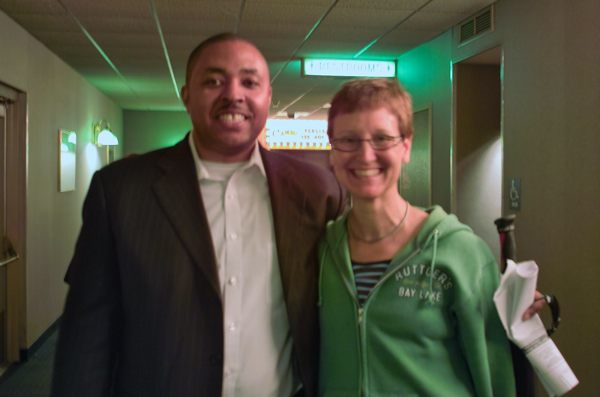


Pat Schneider:

Things have changed since Caire was raised by an aunt across the street from Penn Park at a time when adults didn’t hesitate to scold neighborhood kids who got out of line, and parents took on second jobs to make ends meet. Today, there is more “hard core” poverty, more crime, and much less sense of place, says Caire, who still can recite which families lived up Fisher Street and down Taft.
The supportive community of his boyhood began disappearing in the 1980s, as young parents moved in from Chicago to escape poverty and could not find the training and jobs they needed, Caire says. People started to lose their way. In a speech this month to the Madison Downtown Rotary, Caire said he has counted 56 black males he knew growing up that ended up incarcerated. “Most of ’em, you would never have seen it coming.”
Caire, once a consultant on minority education for the state and advocate for voucher schools, left Madison a decade ago and worked with such national nonprofit organizations as the Black Alliance for Educational Options and Fight for Children. Later he worked for discount retailer Target Corp., where he was a fast-rising executive, he says, until he realized his heart wasn’t in capitalism, despite the excellent managerial mentoring he received.
The sense of community that nurtured his youth has disappeared in cities across the country, Caire remarks. So he’s not trying to recreate the South Madison of the past, but rather to build connections that will ground people from throughout Madison in the community and inform the Urban League’s programs.

Caire recently attended the Madison Premiere of “The Lottery“, a film which highlights the battle between bureaucratic school districts, teacher unions and students (and parents).

Share

Words to the wise about writing college application essays

Jay Matthews:

I had lunch recently with two rising 12th-graders at the Potomac School in McLean. They are very bright students. They told me they had signed up for a course in column-
writing in the fall.
Naturally, I was concerned. There is enough competition for us newspaper columnists already: bloggers, TV commentators, former presidential advisers, college professors. Many of them write well and make us look unnecessary. The idea that 17-year-olds are getting graduation credit to learn how to do my job fills me with dread.
But I think I know what the Potomac School is up to. They aren’t teaching these kids to write columns. Their real purpose is to show students how to write their college application essays.

Share

Charter Schools Don’t Do Miracles

Alan Singer:

Charter schools are not the magic bullet that will transform urban minority public schools. As you peel away layers of the charter onion, the inevitable problems come to the surface.
Locke High School in Los Angeles has been touted as a charter school miracle. I wish it were true, but it’s not. In 2008, Locke was notorious as one of the worst failing schools in the United States. It had a high crime rate and a low graduate rate, the opposite of what schools should be. At one point a race riot involving 600 students made the national news.
According to The New York Times, two years after a charter school group named Green Dot, which also operates a charter school in the Bronx, took over management of the school, gang violence was down, attendance was improved, and performance on standardized tests was inching up. The school has become one of the number one stops on the charter school reform bandwagon tour, as corporate and government “education reformers,” including federal Department of Education bigwigs, get photo-ops in its newly tree lined courtyard and issue pronouncements about how wonderful everything has become.

Share

TakePart: Participant Media – Waiting For ‘Superman’ – Infographic

Jr. Canest, via a Kris Olds email:

This animation is for a startling documentary called, “Waiting For ‘Superman'” that highlights some very serious issues in America today and it made us feel good to make it.

Share

Wisconsin Democrat Representative Tammy Baldwin votes with David Obey to Reduce Race to the Top Funding and Support Teacher Union Request to Avoid Layoffs

HR 4899 roll, via Democrats for Education Reform.
Sam Dillon:

The education measure provoked fierce debate, especially because it would reduce by $500 million the award money available to three dozen states that have submitted proposals in Round 2 of the Obama initiative, the Race to the Top competition.
To become law, the legislation needs Senate approval. The White House said in a statement that if the final bill included cuts to education reforms, Mr. Obama would most likely veto it.
“It would be short-sighted to weaken funding for these reforms,” the White House said.
Using stimulus money voted on last year, the Department of Education awarded $500 million to Tennessee and $100 million to Delaware in March, and has promised to distribute the $3.4 billion that remains among additional winning states this year. The House bill would reduce the money available to $2.9 billion.
Teachers’ unions lobbied for weeks for federal money to avert what the administration estimates could be hundreds of thousands of teacher layoffs.
Several dozen charter school and other advocacy groups lobbied fiercely against cutting Race to the Top, which rewards states promising to overhaul teacher evaluation systems and shake up school systems in other ways.

Share

Blood test for Down’s syndrome

Rebecca Smith:

The new test works by extracting the DNA of the foetus from the mother’s blood and screening it for Down’s syndrome and other abnormalities.
At present, pregnant women are given the odds on whether they are carrying a child with Down’s syndrome, and if they want to know for certain they have to undergo one of two invasive processes; either amniocentesis or chorionic villus sampling. The first involves taking a sample of fluid from around the foetus and can, in some cases, cause a miscarriage even if the woman is carrying a healthy foetus. The second requires taking a fragment of the placenta.
The new test involves the same equipment needed for amniocentesis testing, but uses blood instead of amniotic fluid and is not invasive.
So far, researchers have been able to prove the technique works in principle and have described the results as “promising”. They hope to use the same method to detect other abnormalities in an unborn child’s DNA such as Edwards’ syndrome, which causes structural malformations in the foetus, and Patau’s syndrome, which can result in severe physical and mental impairment and is often fatal.

Share

Small High Schools still in flux

Kristen Graham:

For a time in the mid-2000s, small schools were booming. They were supposed to transform the large, failing American high school, to engage students and boost their achievement to ready them for college.
But the results have been mixed, national and local research shows. Students at small high schools were more likely to graduate, have positive relationships with their teachers, and feel safer. Still, they did no better on standardized tests than did their peers at big schools.
In Philadelphia, where 26 of the 32 small high schools have been opened or made smaller in the last seven years, some schools have thrived. Their presence has transformed the high school mix.
Among the district’s current 63 high schools, the 32 small schools enroll roughly a quarter of the 48,000 total enrollment. The rest attend large neighborhood high schools.

High School of the Future and Science Leadership Academy, four-year-old Phila. high schools just graduated their first classes. Their experiences differ greatly..
Related: Small Learning Communities and English 10.

Share

Plagiarism Inc. Jordan Kavoosi built an empire of fake term papers. Now the writers want their cut.

Andy Mannix:

A CAREFULLY MANICURED soul patch graces Jordan Kavoosi’s lower lip. His polo shirt exposes tattoos on both forearms–on his right, a Chinese character; on his left, a cover-up of previous work. Curling his mouth up into a sideways grin, the 24-year-old sinks back into his brown leather chair.
“I mean, anybody can do anything,” he says, gazing out a window that overlooks the strip-mall parking lot. “You just have to do whatever it takes to get there.”
Kavoosi is in the business of plagiarism. For $23 per page, one of his employees will write an essay. Just name the topic and he’ll get it done in 48 hours. He’ll even guarantee at least a “B” grade or your money back. According to his website, he’s the best essay writer in the world.
Kavoosi’s business, Essay Writing Company, employs writers from across the country. Most of the customers are high school or college students, but not all. In one case, an author asked Kavoosi’s crew to write a book to be published in his own name.
To be sure, there are ethical implications to running a business that traffics in academic fraud. The services Kavoosi offers are the same as those exposed in the University of Minnesota’s 1999 basketball scandal, during which an office manager admitted to doing homework for players.
“Sure it’s unethical, but it’s just a business,” Kavoosi explains. “I mean, what about strip clubs or porn shops? Those are unethical, and city-approved.”

Share

“I Don’t Want To Be A Smarty Anymore”

Tamara Fisher:

One day this year, one of my elementary gifted students went home and proclaimed (in obvious distress) to his mom that he didn’t want to be a “smarty” anymore. Turns out the kids in his class had been teasing him about his very-apparent intelligence. In his meltdown, he expressed that he just wanted to be normal, that he wanted to know what it was like to not worry about everything so much, that he just wanted to be a regular kid and not “stick out” so much all the time.
I wondered how many of my other students wished at times that they weren’t so intelligent. What were their thoughts on the “love/hate” relationship gifted individuals sometimes have with their giftedness? As a means of offering you some insight into the mind of a gifted child, here are their responses to the prompt, “Sometimes I wish I wasn’t so smart because…” [To their credit, about half of the kids said they were glad they were intelligent. I’ll post those responses separately.] [All names are student-chosen pseudonyms.]
“I get taken advantage of. People ask to be my partner or work with me on a paper and I am stuck doing all the work. The only thing they do is make sure their name is on the paper or project.” Charlotte, 8th grade

Share

Seattle Discovery Math Lawsuit Update

Martha McLaren:

On Monday, June 21st, we filed our “Brief of Respondent” in the School District appeal of Judge Spector’s decision. (Sorry to be late in posting it to this blog; our attorney left town after sending me hard copy, but neglected to email an electronic version of the document we filed.) A link to the brief can be found in the left-hand column, below, under “Legal Documents in Textbook Appeal.”
There’s no new information, either in the District’s brief or our response. You might notice that, rather than acknowledge the catalog of unrelated miscellany in the Seattle Public School District’s brief, our attorney, Keith Scully, chose to essentially restate our original case, upon which Judge Spector ruled favorably. He did emphasize certain statements which pertained to claims in the District’s brief.
I think Keith has, once again, done a masterful job.

5.4MB PDF file.

Share

Charter group will run one of Boston’s struggling schools

James Vaznis:

School Superintendent Carol R. Johnson will tap a charter school management organization to run one of the district’s low-achieving middle schools, a first for the state, under a plan she will present tonight to the Boston School Committee.
Johnson has not decided which middle school would be overseen by Unlocking Potential Inc., a new Boston nonprofit management organization founded by a former charter school principal.
A key part of the proposal calls for converting the middle school into an in-district charter school, which would enable the management organization to operate under greater freedom from the teacher union’s contract as it overhauls programs, dismisses teachers, and makes other changes.

Share

Tempering Tuition Hikes

Jack Stripling:

Private, nonprofit colleges will hike tuition and fees by an average of 4.5 percent in the coming academic year, outpacing inflation while still holding close to last year’s nearly 40-year low increase rate, according to a survey released Tuesday by the National Association of Independent Colleges and Universities.
The 4.5 percent increase for 2010-11 follows a 4.3 percent increase for 2009-10, which was the smallest increase since 1972-73.
“I think it’s a pretty fundamental adjustment that we’re seeing here,” said David L. Warren, NAICU president. “What we’ve got is a recession, which has indefinite future to it, and recognition all around that colleges want to hold their expenses as low as they can, and that includes of course the tuition they’re charging.”

Share

Acting White: The Ironic Legacy of Desegregation

John McWhorter:

In 2000, in a book called Losing the Race, I argued that much of the reason for the gap between the grades and test scores of black students and white students was that black teens often equated doing well in school with “acting white.” I knew that a book which did not focus on racism’s role in this problem would attract bitter criticism. I was hardly surprised to be called a “sell-out” and “not really black” because I grew up middle class and thus had no understanding of black culture. But one of the few criticisms that I had not anticipated was that the “acting white” slam did not even exist.
I was hardly the first to bring up the “acting white” problem. An early description of the phenomenon comes from a paper by John Ogbu and Signithia Fordham in 1986, and their work was less a revelation of the counterintuitive than an airing of dirty laundry. You cannot grow up black in America and avoid the “acting white” notion, unless you by chance grow up around only white kids. Yet in the wake of Losing the Race, a leading scholar/activist on minority education insisted that he had never encountered the “acting white” slander–while shortly thereafter describing his own son doing poorly in school because of precisely what Ogbu, Fordham, myself, and others had written about. Jack White, formerly of Time, roasted me in a review for making up the notion out of whole cloth. Ogbu (with Astrid Davis) published an ethnological survey of Shaker Heights, Ohio describing the “acting white” problem’s effects there in detail, while a documentary on race and education in that town explicitly showed black students attesting to it. Both book and documentary have largely been ignored by the usual suspects.
Stuart Buck at last brings together all of the relevant evidence and puts paid to two myths. The first is that the “acting white” charge is a fiction or just pointless marginal static. The other slain myth, equally important, is that black kids reject school as alien out of some sort of ingrained stupidity; the fear of this conclusion lies at the root of the studious dismissal of the issue by so many black thinkers concerned about black children. Buck conclusively argues that the phenomenon is a recent and understandable outgrowth of a particular facet of black people’s unusual social history in America–and that facet is neither slavery nor Jim Crow.

Clusty Search: Acting White: The Ironic Legacy of Desegregation, by Stuart Buck.
Related: Madison Teachers’ Harlem trip’s aim is to aid ‘culturally relevant’ teaching.

Share

The Retention Guru

Jennifer Epstein:

Two decades ago, Xavier University could only count on three of every four freshmen returning for sophomore year. Even fewer made it to graduation.
Today, though, close to 9 of every 10 students who start freshman year at the Jesuit university in Cincinnati makes it back the next fall. Seven in 10 will graduate in four years, and another one will likely graduate in the two years after that.
The quality of students Xavier admits hasn’t changed, nor have its academic standards. The biggest difference is one man – Adrian A. Schiess, a retired U.S. Army lieutenant colonel — and his day-in, day-out devotion to keeping students at Xavier.
Since 1990, Schiess, a former professor of military science at Xavier, has been the university’s full-time director for student success and retention, an on-campus guru whose job responsibilities all lead to the same goal: helping any student who wants to be at Xavier stay at Xavier.
“There’s no magic to retention,” he says. “The key is hard work and a position like mine — having someone who has focused responsibility from the university to guide and steer efforts to keep students here.”
At other colleges, Schiess says, retention is an afterthought. “All the enrollment management people are really thinking about is admissions and financial aid. They might say, ‘You get them, you pay for them and you keep them,’ but they end up taking the third part as a given — but it really isn’t.”

Share

Tribute to High School Musicals

Marshall Heyman:

There are jimmies and Jimmy Choos, and as of last year, Jimmy Awards. Monday night, the National High School Musical Theater Awards hosted its second annual Jimmy Awards at the Marquis Theatre. Don’t let your mind take you anywhere funny: The Jimmy (which is trademarked, by the way) is named after producer James M. Nederlander.
After five coaching and master classes at NYU’s Tisch, 44 competitors, representing 22 regional award programs, competed for The Jimmy. Monday night they each performed brief vocal selections as the character that won them their regional awards.
“It’s more Miss America than ‘American Idol’,” said Nick Scandalios, Executive Vice President of The Nederlander Organization, who was one of the judges. “The public isn’t voting.”

Share

Worried About a Moody Teen?

Elizabeth Bernstein:

Everyone warns parents about the drama of the teen years–the self-righteous tears, slamming doors, inexplicable fashion choices, appalling romances.
But what happens when typical teen angst starts to look like something much darker and more troubling? How can parents tell if a moody teenager is simply normal–or is spinning out of control? This may be one of the most difficult dilemmas parents will ever face.
Studies show that about 20% of teenagers have a psychiatric illness with depression, anxiety and attention-deficit hyperactivity disorder being among the most prevalent. Yet parents of teens are often blind-sided by a child’s mental illness. Some are unaware that mental illnesses typically appear for the first time during adolescence. Or they may confuse the symptoms of an actual disorder with more normal teen moodiness or anxiety.

Share

School Vouchers in DC Produce Gains in Both Test Scores and Graduation Rates

Paul Peterson:

One should not under-estimate the impact of the DC school voucher program on student achievement. According to the official announcement and the executive summary of the report, school vouchers lifted high school graduation rates but it could not be conclusively determined that it had a positive impact on student achievement.
Something about those findings sounds like a bell striking thirteen. Not only is the clock wrong, but the mechanism seems out of whack. How can more students graduate from private schools if they weren’t learning more? Are expectations so low in the private sector that any one can graduate?
Peering beneath the press release and the executive summary into the bowels of the study itself one can get some, if not all the answers, to these questions.
Let’s begin with the most important–and perfectly uncontested–result: If one uses a voucher to go to school, the impact on the percentage of students with a high school diploma increases by 21 percentage points (Table 3-5), an effect size of no less than 0.46 standard deviations. Seventy percent of those who were not offered a school voucher made it through high school. That is close to the national average in high school graduation rates among those entering 9th grade four years earlier. As compared to that 70 percent rate among those who wanted a voucher but didn’t get one, 91 percent of those who used vouchers to go to private school eventually received a high school diploma.

Share

Madison Teachers’ Harlem trip’s aim is to aid ‘culturally relevant’ teaching

Susan Troller:

Lanyon, Grams, and fellow Hawthorne teachers Julie Olsen and Abby Miller received a grant from the national nonprofit Fund for Teachers that allowed them to travel to Harlem to learn about the art, music, poetry, literary history and drama of this hub of African-American life. They all agree that they now have a new appreciation for the richness of black culture and its profound impact on American life and culture as a whole.
For these four, plus a dozen more local educators whose travel was covered by a couple of additional grants, the experience was part of a wider effort to help them better teach in what’s known as a culturally relevant way.
Culturally relevant practice” is a relatively new movement in education that recognizes that learning, for all of us, is related to our cultural background and what we know from our daily living. Research shows that effectively bridging the gaps between a teacher’s background and student’s experience can improve academic performance.
Andreal Davis is one of two district administrators in charge of helping to create culturally relevant practices in local classrooms. A former elementary school teacher at Lincoln, Davis, who is black, now helps colleagues recognize that different groups of children bring their different backgrounds, expectations and even communication styles to the classroom.
She says teachers sometimes need help learning to translate different ways their students learn, or what kind of interactions make sense to different groups of children.
“Communication styles for all of us can vary a great deal. It can be like the difference between listening to conventional music, or listening to jazz, where the narrative doesn’t just go in a straight line,” she explains. “If that flow is what you’re used to, it’s what you know how to follow in a conversation, or in a class.”
Given Hawthorne’s demographics — 70 percent of the students are poor, with a diverse population that includes 18 percent Hispanic, 20 percent Asian, 32 percent black and 28 percent white — the school has respectable, rising test scores.

People who saw the recent Madison screening of The Lottery saw another part of the Harlem world: the battle between the traditional public school system and charters, specifically the Harlem Success Academy.

Share

New York Tops Nation in Per-Pupil School Spending, Says U.S. Census Bureau

Cara Matthews:

New York spent $17,173 per student for public education in 2007-08, more than any other state and 67 percent higher than the national average, according to Census Bureau statistics released Monday (lots of data here).
The $10,259 average nationally was a 6.1 percent increase over 2006-07, the Census Bureau said. New York’s spending went up 7.4 percent over the two years. Public education is the single largest category of all state and local spending.
New York’s per-student spending was highest in 2006-07 too at $15,981 per student, compared to an average of $9,666 across the country.
Eighteen states and the District of Columbia spent more than $10,259 and 32 spent less in the 2007-08 school year. States that came close to New York that year included New Jersey ($16,491 per student) and Alaska ($14,630). At the other end of the spectrum were Utah ($5,765), Idaho ($6,931) and Arizona ($7,608).

Madison spends $15,241 per student.

Share

The National Study of Charter Management Organization (CMO) Effectiveness: Report on Interim Findings

Robin Lake, Brianna Dusseault, Melissa Bowen, Allison Demeritt, Paul Hill, via a Deb Britt email:

Charter management organizations (CMOs), nonprofit entities that directly manage public charter schools, are a significant force in today’s public K-12 charter school landscape.
CMOs were developed to solve serious problems limiting the numbers and quality of charter schools. The CMO model is meant to meld the benefits of school districts–including economies of scale, collaboration among similar schools, and support structures–with the autonomies and entrepreneurial drive of the charter sector.
In the late 1990s and early 2000s, the major philanthropies funding charter schools invested heavily in CMOs and similar organizations, spending an estimated total of $500 million between 1999 and 2009. Ultimately, those who invest in CMOs want to achieve a significantly higher number of high-quality schools in the charter school sector. Their investments in CMO growth have been targeted to specific urban school districts that have been considered difficult, if not impossible, to reform.

Share

The Foundations of Computer Science

Al Aho and Jeff Ullman:

This book has been taken out of print by W. H. Freeman. You are welcome to use it if you like. We believed in 1992 it was the way to introduce theory in Computer Science, and we believe that today.

Share

Online Bullies Pull Schools Into the Fray

Jan Hoffman:

The girl’s parents, wild with outrage and fear, showed the principal the text messages: a dozen shocking, sexually explicit threats, sent to their daughter the previous Saturday night from the cellphone of a 12-year-old boy. Both children were sixth graders at Benjamin Franklin Middle School in Ridgewood, N.J.
“I said, ‘This occurred out of school, on a weekend,’ ” recalled the principal, Tony Orsini. “We can’t discipline him.”
Had they contacted the boy’s family, he asked.
Too awkward, they replied. The fathers coach sports together.
What about the police, Mr. Orsini asked.
A criminal investigation would be protracted, the parents had decided, its outcome uncertain. They wanted immediate action.
They pleaded: “Help us.”

Share

Support for Summer Writers: Why Aren’t You Writing?

Kerry Ann Rockquemore:

Last month, I was contacted by a faculty member I had met several years ago at a conference (I’ll call her Claire). Our conversation began like many I’ve had recently, with tears in response to a negative and critical annual review. Claire is a brilliant social scientist, incredibly hard-working, and passionately committed to her scholarship, her institution and her students. While Claire is an award-winning teacher, and far exceeded her college’s service expectations, her publication record was significantly below her department’s standards. Her chair was clear that her lack of publications was problematic and she left the meeting feeling an almost desperate sense of urgency to move several manuscripts forward this summer.
Of course, I suggested she make a summer plan and join a writing group that would motivate and support her throughout the summer. Last week, when I was writing about resistance to writing I couldn’t help but think of Claire, so I decided to give her a call. Unfortunately, she had done very little writing: only three short sessions in the 30 days since we last spoke. When I asked Claire what was holding her back, she had difficulty identifying anything specific. She readily acknowledged having more free time and fewer responsibilities than she did during the academic year. But despite knowing that this was an important summer for her to be productive and having a general sense that she should try to write every day, somehow her days kept flying by without any progress on her manuscripts.

Share

Summer school is a great tool, if only more students would use it

Jay Matthews:

This Wednesday from 6:30 to 8 p.m. at Brent Elementary School at 301 North Carolina Ave. SE, the D.C. public schools will hold a chancellor’s forum on how to add useful learning to your child’s summer. Several groups, such as the D.C. Public Library, the University of the District of Columbia Science and Engineering Center, and even Madame Tussaud’s, will have booths about their summer programs.
But the District, like other urban districts, will have a summer school that includes only about a fifth of its students. Many people laugh that off: Who in their right mind wants to go to summer school? Give the poor kids a break.

Share

Is New Hampshire’s Anti-Tax Stance Hurting Schools? A Quick Look at NAEP Scores Does Not Indicate that Spending is a Problem

Jim Zarroli:

State and local tax burdens vary greatly from state to state. New Hampshire, for instance, has no income or sales tax — but its neighbor Vermont has both. Fiscal conservatives say New Hampshire’s long history of low taxes has forced the state to keep spending in line. But New Hampshire residents say that tradition of fiscal austerity has exacted a price on the state’s schools.

NAEP 4th grade average math scale score: New Hampshire: 251; Wisconsin 244; Vermont 248, Massachusetts 252, Minnesota 249, Iowa 243. Low income: New Hampshire: 237; Wisconsin 229; Vermont 235, Massachusetts 237, Minnesota 234, Iowa 232.
NAEP 4th grade average reading scale score (national average is 220): New Hampshire: 229; Wisconsin 220; Vermont 229, Massachusetts 234, Minnesota 223, Iowa 221. Low income (national average is 206): New Hampshire: 213; Wisconsin 202; Vermont 215, Massachusetts 215, Minnesota 203, Iowa 208.
NAEP 8th grade average reading scale score (national average is 262): New Hampshire: 271; Wisconsin 266; Vermont 272, Massachusetts 274, Minnesota 271, Iowa 265. Low income (national average is 249): New Hampshire: 257; Wisconsin 249; Vermont 260, Massachusetts 254, Minnesota 252, Iowa 253.
NAEP 2005 Science Assessment is here

Share

Do You Have the Ox Factor?

Susie Boyt:

I was standing on what used to be the stage on what used to be called the Old Hall at the school I used to attend. It was a stage on which I’d won minor acclaim as Dame Crammer (“Girls! Girls! Cease this vulgar brawl at once!”) and Lady Lucre (“Hark! Here comes Sir Jaspar, your first cousin once removed and twice convicted”). My Mother Abbess from The Sound of Music had done her mountain climbing in the New Hall round the corner, and my “When the Lord closes a door somewhere he opens a window” had brought the house down for some reason. It wasn’t even meant to get a laugh.
I had been invited to my old school to fire the pupils up about Oxford University. I’d sent round a warning in advance. “I had quite a mixed time,” I wrote, “but I will try to stay positive.”
I dressed smartly, but not luxuriously, for my talk. My schooldays had had a shabby, down-at-heel flavour due to slender means, so I was eager to make a fresh impression. When I was there the establishment had boasted girls so shiny it was pointless trying to keep up, let alone compete. The girls with curls had their hair straightened on Saturday mornings at their mothers’ beauty parlours, and the girls with straight hair had theirs curled. This evening my hair was newly cut and freshly curled, my nails short and neat, my outlook springy and optimistic.
My shoes and handbag very nearly matched. In fact, there was nothing about me that was remotely macabre. Apart from the 3cm thread hanging from the hem of my pencil skirt, I was damn near immaculate.
The room, containing about 60 teenagers and their parents, crackled with anxiety. It felt as though the souls in the Old Hall wanted Oxford almost more than life itself. Various experts spoke before me.

Share

W.Va. education spending audit may prove daunting

The Associated Press:

A proposed audit of West Virginia’s education spending enjoys widespread support, but that may not make its undertaking any less tricky.
Officials have yet to decide who would conduct the in-depth review, or even how to authorize it. Then there’s the scope. An estimated 14 cents of every dollar spent by the state goes to public education, from pre-kindergarten through 12th grade.
The American Federation of Teachers-West Virginia included an audit in its wish list for next month’s special legislative session focused on education.
“We are not aware of any recent or ongoing investigation regarding the spending practices by governmental departments, agencies and boards of education funded with public education dollars and whether the funds are being used for the intended purpose,” the group said in its outline of the proposal, one of eight it wants lawmakers to consider.

Related: Madison School Board member may seek audit of how 2005 maintenance referendum dollars were spent.

Share

KIPP Considers Purchase of an Abandoned Gary, Indiana School

Chelsea Schneider Kirk & Christin Nancy Lazerus:

The windows to Beckman Middle School are boarded and the grass has turned into weeds, but Taiwane Payne sees potential for the school that the Gary Community School Corp. closed and is now selling.
Payne came to an open house at the shuttered school on Thursday eager to see if it would be an ideal building for his not-for-profit venture. Payne wants to revitalize a Gary school into a technical center that would teach the unemployed green technology.
But that’s as long as the price is right.
“It’s up to the city of Gary and the school corporation not to try to get as much money out of them as possible,” Payne said. “It would be great to see the building being used and not abandoned.”
From the outside, Payne surmised Beckman, which closed in 2004, would need some work.
“I need to get in and find out exactly what needs to be done,” Payne said pulling on his work gloves and carrying an industrial flashlight.
Gary Community Schools is in the process of selling 11 of its vacant school buildings, but Gov. Mitch Daniels thinks some of the structures should be given to charter schools.

Share

Success and Scrutiny at Hebrew Charter School

Jennifer Medina:

Every so often, Aalim Moody, 5, and his twin sister, Aalima, break into a kind of secret code, chatting in a language their father does not understand.
Walking along Flatbush Avenue in Brooklyn, they make out the lettering on kosher food shops and yeshiva buses, showing off all they learn at the Hebrew Language Academy Charter School in Midwood, where they both attend kindergarten.
Ask Aalim his favorite song and he will happily belt out:
“Eretz Yisrael sheli yaffa v’gam porachat!” — My land of Israel is beautiful and blossoming! — and then he continues in Hebrew:
Who built it and who cultivated it?
All of us together!
I built a house in the land of Israel.

Share

How Many Graduates Does It Take to Be No. 1?

Winnie Hu:

There will be no valedictory speech at Jericho High School’s graduation on Sunday. With seven seniors laying claim to the title by compiling A-plus averages, no one wanted to sit through a solid half-hour of inspirational quotations and sappy memories.
Instead, the seven will perform a 10-minute skit titled “2010: A Jericho Odyssey,” about their collective experience at this high-achieving Long Island high school, finishing up with 30 seconds each to say a few words to their classmates and families.
“When did we start saying that we should limit the honors so only one person gets the glory?” asked Joe Prisinzano, the Jericho principal.

Share

Medical School Acceptance Rates, 2007-2009

Mark Perry:

Here’s a new chart (click to enlarge) with updated data from the Association of American Medical Colleges on medical school acceptance rates for Asians (data here), whites (data), Hispanics (data) and blacks (data) during the period 2007-2009, based on various combinations of MCAT scores (24-26 and 27-29) and GPAs (from 3.00 to 3.59).

Share

School Is Turned Around, but Cost Gives Pause

Sam Dillon:

As recently as 2008, Locke High School here was one of the nation’s worst failing schools, and drew national attention for its hallway beatings, bathroom rapes and rooftop parties held by gangs. For every student who graduated, four others dropped out.
Now, two years after a charter school group took over, gang violence is sharply down, fewer students are dropping out, and test scores have inched upward. Newly planted olive trees in Locke’s central plaza have helped transform the school’s concrete quadrangle into a place where students congregate and do homework.
“It’s changed a lot,” said Leslie Maya, a senior. “Before, kids were ditching school, you’d see constant fights, the lunches were nasty, the garden looked disgusting. Now there’s security, the garden looks prettier, the teachers help us more.”

Share

Milwaukee Teacher’s Union Eats Its Young

Bruce Murphy:

In the last couple weeks, we’ve seen the dispiriting spectacle of layoff notices going to nearly 500 Milwaukee Public Schools teachers. This includes some excellent ones let go simply because they have less seniority. This will mean even bigger average class sizes – and further declines in quality – for a district already struggling badly. And a clear culprit is the teachers union.
The union has always been more concerned about its veteran teachers, more worried about pensions than starting salaries for new teachers. Union officials have argued that this “career ladder” will attract new teachers, but that’s nonsense: What twentysomething teacher is thinking about a retirement that is at least 30 years away? Milwaukee teachers were already part of the excellent state pension system, yet back in the late 1990s, the union successfully pushed for an unneeded, supplementary plan that used local tax dollars to sweeten the pension for a select group of long-term teachers.
MPS officials argue that none of the recent layoffs would have been necessary if the union would agree to switch from its Aetna insurance plan to a lower-cost plan offered through United Healthcare. This could save the district some $48 million, enough to prevent any job layoffs for teachers, school board president Michael Bonds claims. “I’m not aware of any place in the nation that pays 100 percent of teachers’ health care benefits and doesn’t require a contribution from those who choose to take a more expensive plan,” Bonds told the press.

Share

Three Phases of Educational Technology

Douglas Crets:

A teacher and techie gives a presentation on how technology gets integrated into teaching in systematic ways.

Share

Vicki McKenna on Reduced Class Time for Madison’s Grade 6-12

25mb mp3 audio file. Much more on the increased adult to adult expenditures and staff time in the Madison School District here.

Share

Special Needs Voucher Program passes in Louisiana

Matthew Ladner:

A bipartisan group of legislators in Louisiana have passed a pilot voucher program for children with special needs in Louisiana.
I think this makes Louisiana the sixth state to pass a private choice program for special needs children (Florida, Ohio, Utah, Arizona, Oklahoma having already done so).

Share

Vancouver School Board’s Budget pain is not unique

Gary Mason:

Name-calling going on in the city belies reality that education budgets being slashed across Western Canada
For weeks now there has been an entertaining fight going on between the Vancouver School Board and the B.C. Education Ministry. It has often devolved into petty name-calling. There have been public tears, accusations and counter-accusations.
The public doesn’t quite know who to believe.
Boards in B.C. have to balance their budgets by law. The Vancouver board says it has a $17-million shortfall, mostly because the province doesn’t give it enough money to operate. Balancing its budget will mean closing schools, the board chair has said, which will be a blow to many parents and their children.
The government blames the problem on the incompetence of the board. It remains to be seen just how long Education Minister Margaret MacDiarmid will allow the current group of trustees to continue running the show.
Such drama.

Share

Dreyfuss says civics education can save democracy

Associated Press:

Actor Richard Dreyfuss wants students to take on a project bigger than “Jaws.”
Dreyfuss, speaking Thursday in Lexington to the annual Student Congress of the Henry Clay Center for Statesmanship, told about 60 students and teachers from around the country that improving civics education in schools is the way to save American democracy.
The Lexington Herald-Leader reported that Dreyfuss, 62, said, “We have to learn how to use the tools given to us in 1787” in the Constitution and Bill of Rights.

Share

The Common Core Math Standards: When Understanding is Overrated

Barry Garelick, via email:

Earlier this month, the Common Core State Standards Initiative (CCSSI)–a state-led effort coordinated by the National Governors Association Center for Best Practices (NGA Center) and the Council of Chief State School Officers (CCSSO)–issued the final version of its math standards for K-12.
The draft standards were released in March and CCSSI allowed the public to submit comments on the draft via their website. Over 10,000 comments were received. The U.S. Coalition for World Class Math was one of the commenter’s and I had a hand in drafting comments. We were concerned with the draft standards’ use of the word “understand” and pointed out that the use of this verb results in an interpretation by different people for different purposes. I am pleased to see that the final version of the standards has greatly reduced the use of the word “understand”, but I remain concerned that 1) it still is used for some standards, resulting in the same problems we raised in our comments, and 2) the word “understand” in some instances has been replaced with “explain”.
I am not against teaching students the conceptual underpinnings of procedures. I do not believe, however, that it is necessary to require students to then be able to recite the reasons why a particular procedure or algorithm works; i.e., to provide justification. At lower grade levels, some students will understand such explanations, but many will not. And even those who do may have trouble articulating the reasons. The key is whether they understand how such procedure is to be applied, and what the particular procedure represents. For example, does a student know how to figure out how many 2/3 ounce servings of yogurt are in a ¾ ounce container? If the student knows that the solution is to divide ¾ by 2/3, that should provide evidence that the student understands what fractional division means, without having to ask them to explain what the relationship is between multiplication and division and to show why the “invert and multiply” rule works each and every time.

Share

A second opinion on learning disorders

Aditi Shankardass:

Share

Education innovation in the slums

Charles Leadbeater:

Charles Leadbeater went looking for radical new forms of education — and found them in the slums of Rio and Kibera, where some of the world’s poorest kids are finding transformative new ways to learn. And this informal, disruptive new kind of school, he says, is what all schools need to become.

Share

Some Wisdom For Juniors and Sophomores, Before Moving On

Omosefe Aiyevbomwan:

If you’d asked me a year ago whether or not I would be sad to graduate, I probably would’ve broken out in an uproar of laughter.
But as I stood in my bedroom hours before the ceremony, clad in my cap and gown, I was completely overwhelmed. Senior year has come to an end, and with it, a new chapter of life has begun.
Needless to say, I am extremely excited to begin my life at NYU, but parting ways with Stuyvesant High School is harder than I thought it would be. As I cleared out my locker a few days ago, I found little pieces of memorabilia (my choral music folder, old math notes, gym clothes, the Stuyvesant Spectator newspaper) and instantly it hit me: this is it.
And I’m almost ashamed to admit it, but I almost cried (well, it was more of an “awww” moment than a full out cry of agony).

Share

Secret girls schools emerge in Afghanistan

Matthew Green & Kate Holt:

Hidden in the maze of mud-walled alleys in the Loy Wiyala district of Kandahar, Amina, 16, is taking her first, secretive steps towards becoming a teacher.
Banned by her father Abdul from making the short walk to school, she uses a clandestine classroom to impart her smattering of knowledge to younger sisters poring over textbooks scattered across a rug.
This is not a tale of a conservative parent depriving his daughter of an education, but an Afghan family braving the risk of Taliban violence to give their girls the chance to learn.
Abdul is one of a number of anxious fathers who have set up underground schools to allow his daughters to continue studying in defiance of an escalating campaign of insurgent attacks designed to thwart a major Nato operation to secure the city.
“I went to school in Kandahar city for a while, but now we are too scared,” said Amina. “I think it is important that we all learn as much as we can at home until the situation for us improves. I want to be a teacher one day and go to teacher training college.”
Gains in promoting female education, which was banned under the Taliban, have often been cited by Western politicians seeking to buoy support for the nine-year war among increasingly sceptical publics. But some of the initial progress has been eroded by a surge in violence, particularly in the south.

Share

Mathematica Study on KIPP Middle Schools

Mathematica Policy Research:

To understand our impact and communicate it to the public, KIPP has commissioned Mathematica Policy Research to conduct a rigorous, third-party evaluation that will examine how KIPP students fare over the long term. The Atlantic Philanthropies, the Laura and John Arnold Foundation, and the William and Flora Hewlett Foundation provided the lead support for the Mathematica evaluation of KIPP middle schools.
The Mathematica study will help us understand the degree to which KIPP schools make a difference for our students in both academic and non-academic outcomes, including achievement and motivation. The first report from the Mathematica study of KIPP middle schools was published on June 22, 2010. The next report is due to be released in late 2012.
Key Findings:
1. KIPP does not attract more able students (as compared to neighboring public schools).
2. KIPP schools typically have a statistically significant impact on student achievement.
3. Academic gains at many KIPP schools are large enough to substantially reduce race and income-based achievement gaps.
4. Most KIPP schools do not have higher levels of attrition than nearby district schools.

Share

The Case for Having more Kids

Bryan Caplan:

Amid the Father’s Day festivities, many of us are privately asking a Scroogely question: “Having kids–what’s in it for me?” An economic perspective on happiness, nature and nurture provides an answer: Parents’ sacrifice is much smaller than it looks, and much larger than it has to be.
Most of us believe that kids used to be a valuable economic asset. They worked the farm, and supported you in retirement. In the modern world, the story goes, the economic benefits of having kids seem to have faded away. While parents today make massive personal and financial sacrifices, children barely reciprocate. When they’re young, kids monopolize the remote and complain about the food, but do little to help around the house; when you’re old, kids forget to return your calls and ignore your advice, but take it for granted that you’ll continue to pay your own bills.
Many conclude that if you value your happiness and spending money, the only way to win the modern parenting game is not to play. Low fertility looks like a sign that we’ve finally grasped the winning strategy. In almost all developed nations, the total fertility rate–the number of children the average woman can expect to have in her lifetime–is well below the replacement rate of 2.1 children. (The U.S. is a bit of an outlier, with a rate just around replacement.) Empirical happiness research seems to validate this pessimism about parenting: All else equal, people with kids are indeed less happy than people without.

Share

Study: N.Y. Soda Tax Would Curb Obesity, Diabetes

R.M. Schneiderman:

New Yorkers seem to oppose Gov. Paterson’s proposed penny-per-ounce tax on sugar-sweetened beverages. But over the next decade, the tax could curb soda consumption and prevent tens of thousands of cases of adult obesity and Type 2 diabetes, a change that would save state residents an estimated $2.1 billion in related medical expenditures, according to a new study commissioned by the New York City Health Department.
The study, conducted by Dr. Claire Wang, a professor of health policy and management at Columbia University, analyzed various surveys on sugary drink consumption, related health risks and the effects of price on consumer choices. The findings: a soda tax would reduce consumption of sugary beverages by 15% to 20%. It would also prevent an estimated 37,000 or more cases of Type 2 diabetes and an estimated 145,000 or more cases of adult obesity over the next decade.

Share

Bloomberg: Obama’s Greatest Challenge is Education

Keren Blankfeld:

New York City Mayor Michael Bloomberg just spent 20 minutes speaking with New York Times’ chairman Arthur Sulzberger, Jr. at the New York Forum.
Following are some of the highlights from that conversation:
– The government’s first job is to promote economic activity. Give people the ability to enjoy life, keep food on plate, roof on head.
– The big problem NY State faces is that its number one industry is finance. Washington has forgotten that the economic engine for the United States is finance. Nothing works without it. Credit derivative swaps don’t sound good, so the government decided to go after the banks. That is potentially very damaging to the country. If you want to create jobs you have to have banks willing to provide loans. You can’t have it both ways.

Share

Winner Take All Incentives And Teacher/Student Cheating

Bob Sutton:

Steve Levitt of Freakonomics fame has shown that, when teacher’s pay is linked to the the performance of their students on standardized tests, they are prone to cheat — I mean the teacher’s cheat. Levitt’s data from Chicago suggest that about 5% of teachers cheated to get bonuses and other goodies. A recent New York Times article shows that this problem persists, and tells a rather discouraging story of a principal from Georgia who “erased bubbles on the multiple-choice answer sheets and filled in the right answers.” And if you look check out the Freakonomics blog, there is evidence that Australian teachers cheat too.
The kind of pressures that educators face aren’t just financial incentives (although that alone is plenty of pressure as many systems reward only the top performers no matter how well everyone else does), they also risk being fired, demoted, or their schools may lose accreditation, be put on probation, and in some cases, closed for poor performance
The Times article offers an interesting quote that has implications beyond education:

Share

D.C. school vouchers — the last word?

Mike DeBonis:

On Tuesday, the U.S. Department of Education issued its final evaluation of the D.C. Opportunity Scholarship Program — aka school vouchers.
To review, the federally funded voucher program is on life support. The Democratic Congress has thus far resisted attempts to reauthorize the program. The Obama administration last year budgeted enough money to allow current voucher holders to complete their high school educations, but not enough to allow new applicants; Congress has maintained that approach since.
So will the study move the ball? Here’s what it found: (a) “There is no conclusive evidence that the [voucher program] affected student achievement.” (b) The program “significantly improved students’ chances of graduating from high school” — by 12 percent. And (c), the program “raised parents’, but not students’, ratings of school safety and satisfaction.”
An initial glance at those results — no rise in test scores, but a significant rise in graduation rates — would fall into the category of mixed results. And mixed results, given the heated political climate under which the voucher program operates, means plenty of room for spin.

Share

‘Rebundling’ Liberal Education

Eric Jansson:

In 2009 a group of 42 researchers, educators, and entrepreneurs met together at the invitation of Union Square Ventures, a venture capital firm, to discuss how the Web could transform education. A major theme of the daylong discussion, which took place under the theme “Hacking Education,” was “unbundling,” the process through which online distribution of digital media and information breaks apart and erodes existing industries. At the center of “unbundling” are new technologically-enabled relationships that democratize access to the means of production and collectively create plenty where scarcity once existed.
An often-cited example of “unbundling” is newspapers: with blogs and other online tools, one no longer needs a printing press or fleet of delivery vehicles to be heard. The newspaper editorial room competes with an army of bloggers and other online media outlets. Craigslist emerges as the marketplace for used household items, local job listings, and community announcements, replacing the advertising function of the traditional print newspaper. The combination is a perfect storm leading to a steady, nationwide stream of newspaper closures.

Share

Fulton school board adopts $803 million budget (About $8,922 per student. Madison Spends $15,241 Per Student)

Gracie Bonds Staples:

The Fulton County Board of Education gave final approval Tuesday to a $803.1 million budget for the 2011 school year.
Although the district is still waiting on numbers from the tax assessor’s office, the final tally was based on increasing the millage rate by 1 mill.
“This has been the must difficult budget year that I’ve ever seen,” said Superintendent Cindy Loe.
The board is expected to tentatively adopt the millage rate at 11 a.m. Tuesday at the district’s administrative center. It will then hold three public hearings: on July 6 at 11 a.m. at the administrative center and at 6 p.m. at Dunwoody Springs Elementary Charter School in Sandy Springs; and 10:30 a.m. July 15 at the administrative center.

Fulton County Schools statistics. Notes and links on Madison’s per student spending here.

Share

Demographer says Texas must do more pre-K prep

Associated Press:

A former head of the U.S. Census Bureau said Texas must do more to prepare preschool-age children before they enter kindergarten so they won’t drop out later.
Steve Murdock, the former state demographer, also said Texas needs to boost its grant program for college students. Murdock realized current trends show that by 2040, three of every 10 workers may not have a high school education.
“Clearly, with the dismal levels that we have in terms of education right now, that’s clearly where we’re headed,” Murdock said.
Murdock also said the trend of higher dropout rates in the state’s public schools with more low-income students could also mean more Texans will depend on food stamps, Medicaid and CHIP as well as higher incarceration rates.

Share

Scaling the Digital Divide Home Computer Technology and Student Achievement

Jacob Vigdor & Helen Ladd:

Does differential access to computer technology at home compound the educational disparities between rich and poor? Would a program of government provision of computers to early secondary school students reduce these disparities? The authors use administrative data on North Carolina public school students to corroborate earlier surveys that document broad racial and socioeconomic gaps in home computer access and use. Using within‐student variation in home computer access, and across‐ ZIP code variation in the timing of the introduction of high‐speed internet service, the authors demonstrate that the introduction of home computer technology is associated with modest but statistically significant and persistent negative impacts on student math and reading test scores. Further evidence suggests that providing universal access to home computers and high‐speed internet access would broaden, rather than narrow, math and reading achievement gaps.
Is this a wise investment of public funds? Very little evidence exists to support a positive relationship between student computer access at home and academic outcomes.

Share

DC Vouchers Boost Graduation Rate

Matthew Ladner:

The Department of Education released the final report of the evaluation of the DC Opportunity Scholarship Program today. The major finding of this report, and it is MAJOR, is that students who were randomly selected to receive vouchers had an 82% graduation rate. That’s 12 percentage points higher than the students who didn’t receive vouchers. Students who actually used their vouchers had graduation rates that were 21% higher. Even better, the subgroup of students who received vouchers and came from designated Schools in Need of Improvement (SINI schools) had graduation rates that were 13 percentage points higher than the same subgroup of students who weren’t offered vouchers-and the effect was 20 percentage points higher for the SINI students who used their vouchers!
This is a huge finding. The sorry state of graduation rates, especially for disadvantaged students, has been the single largest indicator that America’s schools are failing to give every student an equal chance at success in life. Graduating high school is associated with a number of critical life outcomes, ranging from lifetime earnings to incarceration rates. And, despite countless efforts and attempts at reform, changing the dismal state of graduation rates has been an uphill battle.
Of course, the uphill battle will continue. As most are aware, Congress voted to kill the DC voucher program last year, despite evidence that the program had significantly improved reading achievement for students who received scholarships. That evidence didn’t count for much when faced with opposition from teachers’ unions.

Share

Growth of AP in Seattle – sort of

Charlie Mas:

In the Advanced Learning work session there was a slide that showed the growth of AP and IB in the District. It is true that many more students are taking AP classes than ever before. But it doesn’t necessarily mean what you think it means.
Take, for example, Roosevelt High School. At Roosevelt about half of the 10th grade students used to take AP European History. This is typically the first AP available to students, one of the few open to 10th grade students on the typical pathway. The class is challenging for 10th grade students and the fact that about half of the students took it is a testament to Roosevelt’s academic strength. The other half of the students took a history class similar to the one that students all across district and the state take in the 10th grade.

Share

Reader complains about Hispanic students who take AP Spanish

Jay Matthews:

Early last Monday , while I was still in bed and wondering why the “Today” show had gotten so tabloidish, I was slammed on my washingtonpost.com blog by a reader who did not like my column about Doris Jackson, the principal at Wakefield High School in Arlington County.
It wasn’t Jackson who bothered the commenter, but my praise of the school’s strong performance on Advanced Placement tests. He had a complaint that has often puzzled me: Hispanic students who take AP Spanish, and the schools that let them, are getting away with something, he suggested.
“It is because of the Internet that we know that about half the students in Wakefield are Hispanic,” he said. “We also know that the AP test that they are taking, which has falsely massaged these stats, is the Spanish Advanced Placement test. Take away that fabrication of academic performance, and the true percentage of AP tests passed plummets.”

Share

Reduced Grade 6-12 Class Time in the Madison School District?

Susan Troller:

What’s one sure-fire way to stress out parents? Shorten the school day.
And that’s exactly what the Madison school district is proposing, starting next year, for grades six to 12. According to a letter recently sent to middle school staff by Pam Nash, the district’s assistant superintendent of secondary schools, ending school early on Wednesdays would allow time for teachers to meet to discuss professional practices and share ideas for helping students succeed in school.
“I am pleased to announce that as a result of your hard work, investment and commitment, as well as the support of central administration and Metro busing, together we will implement Professional Collaboration Time for the 10-11 school year!” Nash wrote enthusiastically.
Despite Nash’s letter, district administrators appeared to backpedal on Monday on whether the plan is actually a done deal. Thus far there has not been public discussion of the proposal, and some teachers are expressing reservations.
Some middle school teachers, however, who also happen to be parents in the district, say they have some serious concerns about shortening the day for sixth-, seventh- and eighth-graders. Not only will there be less time spent on academics each week, they say, but the additional unsupervised hours will pose a problem for parents already struggling to keep tabs on their adolescent kids.

This expenditure appears to continue the trend of increased adult to adult expenditures, which, in this case, is at the expense of classroom (adult to student) time.
Related: Ripon Superintendent Richard Zimman:

“Beware of legacy practices (most of what we do every day is the maintenance of the status quo), @12:40 minutes into the talk – the very public institutions intended for student learning has become focused instead on adult employment. I say that as an employee. Adult practices and attitudes have become embedded in organizational culture governed by strict regulations and union contracts that dictate most of what occurs inside schools today. Any impetus to change direction or structure is met with swift and stiff resistance. It’s as if we are stuck in a time warp keeping a 19th century school model on life support in an attempt to meet 21st century demands.” Zimman went on to discuss the Wisconsin DPI’s vigorous enforcement of teacher licensing practices and provided some unfortunate math & science teacher examples (including the “impossibility” of meeting the demand for such teachers (about 14 minutes)). He further cited exploding teacher salary, benefit and retiree costs eating instructional dollars (“Similar to GM”; “worry” about the children given this situation).

Share

Competition boosts public schools

The Tampa Tribune:

During a debate last February in Tallahassee on a proposal to expand a scholarship program that allows poor children to go to private schools, state Sen. Frederica Wilson decried the legislation.
“We’re taking children out of the public schools and making them weaker,” the Miami Democrat said. “This is not America.”
A recent study by a highly regarded Northwestern University researcher shows how wrong Wilson was. Florida voters are fortunate that the Legislature passed the bill and Gov. Charlie Crist signed it into law.
The study found public schools’ performance improved when they were faced with the possibility of losing students to private schools.
At issue is the Florida Tax Credit Scholarships, which provide vouchers to children from poor families.

Share

Birthplace of charter schools tightens controls and increases accountability of sponsors

Maureen Downey:

One thing that remains murky to me is how accountable the state Charter Schools Commission – which a Fulton County judge recently ruled is constitutional – is for the schools that it approves over the objections of local boards of education. The commission is here in Atlanta, but it is approving schools across the state.
As the authorizer of the schools, how is the commission held accountable if one goes bad or if parents are unhappy and can’t go to the local school board to complain since the local folks had nothing to do with the school’s approval?
At a media briefing earlier this year, Charter Schools Commission member Jennifer Rippner surprised me when I asked whether parents of students in a commission charter school could ultimately turn to the charter commission with complaints that they felt were not being dealt with by the school itself or its board of directors.

Share

New York U.’s Abu Dhabi Campus to Start With Academically Elite Class

Andrew Mills:

Having accepted just 2.1 percent of applicants for its first freshman class, the liberal-arts college that New York University plans to open in Abu Dhabi this fall has positioned itself as one of the world’s most selective undergraduate colleges.
NYU Abu Dhabi, which its administrators like to call the “world’s honors college,” announced on Monday that its first class would be made up of 150 students who speak 43 different languages in all and hail from 39 countries.
The 63 women and 87 men, forming a female-to-male ratio of 42 percent to 58 percent, have met high standards.
Their SAT critical-reading scores are projected to be 770 at the class’s 75th percentile. Their 75th-percentile scores for SAT mathematics are projected to be 780, according to statistics released by NYU Abu Dhabi.

Share

San Francisco Schools $578,572,407 Budget Discussions ($10,331 per student, 47% less than Madison)

Jill Tucker:

The San Francisco school board will face the unsavory task Tuesday of approving a budget that cuts virtually every program offered to the city’s schoolchildren.
Art would be cut. Music too. Counselors. Physical education. Books. Summer school. Teachers. Custodians. Administrators.
All cut by a little or a lot.
The 444-page budget document up for a vote Tuesday, the board’s last meeting before summer break, has been months in the works as district officials struggled to figure out how to balance the books despite a $113 million budget shortfall expected over the next two years.
“It’s not a good budget,” said board member Rachel Norton. “How could you say that cutting 20 percent of the programs is a good budget? But it really could have been so much worse.”
The $578 million spending plan includes $255 million in restricted money that has to be spent on specific programs, including special education, school meals and facilities. The rest pays for salaries and the day-to-day costs of educating the district’s nearly 50,000 students and running its 105 schools, 34 preschool sites and nine charter schools.

Madison’s 2009-2010 budget was $370,287,471, according to the Citizen’s Budget, $15,241 per student (24,295 students). More here.
San Francisco’s 3.4MB budget document includes detailed per school allocations (numbered page 51, document page 55)

Share

A Struggle to Educate the Severely Disabled

Sharon Otterman:

Donovan Forde was dozing when the teacher came around to his end of the table. Pale winter light filtered in through the grated classroom window, and the warm room filled softly with jazz. It fell to his teacher’s aide to wake him up from his mid-morning nap.
She shined a small flashlight back and forth in his eyes like a dockworker signaling a ship, and called his name. Then she put her hand on his cheek, steering his head forward as he focused his eyes.
The teacher, Ricardo Torres, placed a red apple against Donovan’s closed left hand, and then held it near his nose so he could smell it. “Donovan, the fruit holds the seeds of the plant,” he said.
Then Mr. Torres held a plastic container of apple seeds to Donovan’s ear, shaking it, and placed Donovan’s hand inside so he could feel them. “And these are the seeds,” Mr. Torres said.

Share

Pupils sent overseas to avoid HK A-levels

Elaine Yau:

The daughter of businesswoman Winnie Tsoi is studying in the economics and finance programme at the University of Hong Kong. The price she paid to get a quality degree education for her eldest daughter was HK$900,000.
The world-renowned HKU has not become a mercenary diploma mill selling degrees to the rich – it was more a case of Tsoi sending her daughter overseas on a pricey education detour to skip the gruelling local A-levels exams, but still secure the required grades.
The HK$900,000 became the “entrance ticket” to the hotly contested programme at HKU. A student seeking admission had to score a minimum of two Bs and credits for two languages in the local A-levels last year. With a less-than-brilliant score of 21 (out of 30) in the Form Five public exam in 2007, Tsoi figured that the odds of her daughter passing the Hong Kong A-levels with flying colours and gaining entry to the HKU degree course would be very low.

Share

Shanghai student to live Harvard dream of many A Harvard-bound Shanghai pupil is the envy of her peers, for whom entry to the Ivy League ranks is a class act

Barbara Demick:

It was just a week after Chang Shui received her acceptance notice from Harvard that the first book offer came.
A publisher approached her father with a detailed outline for an inside guide to how a Shanghai couple prepared their daughter to compete successfully with the best students from America. Local newspapers weighed in with articles about how Shui’s membership in a dance troupe surely helped. “Magical girl ‘danced’ her way into Harvard,” the Shanghai Evening Post headlined its story.
Qibao High School, where Shui is a senior, trumpeted the news on a large electronic billboard at the front gate. The day that she received her acceptance notice – by e-mail at 5am on April 2 – teachers at the high school crowded around to have their picture taken with her.
“She was a celebrity,” her homeroom teacher, Xiong Gongping, boasts.

Share

University of Anarchy and No Consequences

Debra Saunders:

When activists (who are not necessarily students) were able to delay construction of a UC Berkeley sports center by living in trees for 21 months, there was no review of what went wrong.
When protesters with torches vandalized UC Chancellor Robert Birgeneau’s home, there was no review. But when UC police arrested 46 people demonstrating against higher-education cuts by occupying Wheeler Hall on Nov. 20, there were complaints that police over-reacted. And so – with authorities, not anarchists in the sights – a review was born.

Share

Madison School Board Member Ed Hughes New Blog: A Number of Comments on Maintenance Spending & Budgeting

Ed Hughes:

I plan to write in more detail about why I dislike the tradition of explaining property tax levy changes in terms of the impact on the owner of a house assessed at a value of $250,000. The editorial in this morning’s State Journal is evidence of how reliance on the $250,000 house trope can lead to mischief.
Here are the third and fourth paragraphs of the editorial:
“The Madison School Board just agreed to a preliminary budget that will increase the district’s tax on a $250,000 home by about 9 percent to $2,770. The board was dealt a difficult hand by the state. But it didn’t do nearly enough to trim spending.
“Madison Area Technical College is similarly poised to jack up its tax bite by about 8 percent to $348. MATC is at least dealing with higher enrollment. But the 8 percent jump follows a similar increase last year. And MATC is now laying the groundwork for a big building referendum.”

Blog address: http://edhughesschoolblog.wordpress.com/, RSS Feed.
I’m glad Ed is writing online. Two Madison School Board seats are open during the spring, 2011 election: the two currently occupied by Ed and Marj Passman.

Share

High School Engineers Build Revolutionary Assistive Writing Device

NewsHour:

What happens when a group of teenagers sets their minds on making something to help people with disabilities? In Boise, Idaho, a group of aspiring engineers teamed up with Bill Clark, a businessman in their community who suffers from hand tremors that keep him from being able to write legibly. They set about designing an easy-to-use, portable device that would steady Mr. Clark’s hand and, after many hours working with prototypes in their garage, came up with a design they call the PAWD – a Portable Assistive Writing Device.
When the team took their PAWD to the National Engineering Design Challenge in Washington, D.C. and won “Best Design,” they say it was just icing on the cake. Three of the student engineers behind the project spoke with NewsHour Extra about the design process, what it’s like to make something for a client and why they like engineering.

Share

In Praise of Tough Criticism

Jeffrey Di Leo:

Professor Jones is well known for her generosity. She encourages nonconfrontational exchanges of ideas and is always upbeat and positive about her colleagues and their work. She is patient with her graduate students, encouraging them to be patient with one another as well. When a student makes a comment in class that is weak or off base, unlike some other faculty members in her department, Jones will not make a fuss. When the appropriate opportunity presents itself, she will try to work with the student to improve his or her thinking. Jones’s critical credo is, “If you don’t have something positive to say, then it is best not to say anything at all–at least not in public.”
Her colleague Professor Smith is quite the opposite. He has built a successful career by telling people that they are wrong. The goal of criticism, he believes, is to persuade other people to see the world his way, and if they don’t, then he will do everything he can to prove to them–and anyone else who will listen–that they are wrong. Criticism is a competition of ideas, a nasty business in which it is acceptable and sometimes necessary to be a brute. Strong ideas survive, weak ones perish; there is no room for wishy-washy opinions and people. Smith’s assessments are harsh but well argued and persuasive. His critical credo is, “Public criticism is as valid as public praise.”

Share

Teacher: ‘Worst year in the classroom’ in decades

Gary Groth:

As a classroom teacher with 30+ years experience, I just completed the absolute worst year in the classroom I have ever endured (and it was NOT the fault of my students–they were great).
“This year I was told what to teach, when to teach, how to teach, how long to teach, who to teach, who not to teach, and how often to test. My students were assessed with easily more than 120 tests of one shape or another within the first 6 months of the school year.
“My ability to make decisions about what is best for my students was taken away by an overzealous attempt to impose ‘consistency’ within my grade group. My school hired an outside consultant who threatened us with our jobs, demanded that everyone comply, and required us to submit data on test results on a weekly basis. If your class didn’t do well, you were certainly going to be in trouble.
“In addition, my class was visited at least twice a month by the consultant, two superintendents, principal, assistant principal, reading coach, math coach, and sometimes even more people. If I was not teaching exactly what they wanted to see, I was in trouble.

I asked Madison’s 3 Superintendent candidates in 2008 if they believed in either “hiring the best teachers” and essentially setting them free, or a “top down” approach to teaching. Madison continues to expand adult to adult spending (“coaches”, “professional development”).

Share

Mistreated as a Student, an Alum Establishes Cash Prizes for Nice Professors at Israel’s Technion

Matthew Kalman:

What’s an alumnus to do when the university that was the gateway to his entrepreneurial millions was a place of “suffering” where professors “didn’t give a damn about the students”? Moshe Yanai’s answer: Give it millions of dollars to encourage faculty members to be more pleasant.
IBM minces few words when describing the work of Mr. Yanai, who holds one of the computer maker’s prestigious fellowships: “One of the most influential contributors in the history of the data-storage industry. His 30 years of technical expertise and design innovation are legendary.”
Mr. Yanai attributes his success in no small part to the Technion-Israel Institute of Technology, in Haifa, from which he graduated in 1975. Now a multimillionaire, he has given quietly to charities for many years, including to the Technion, the academic incubator of Israel’s high-tech revolution. But memories of his bitter experience there discouraged him from doing anything high profile.

Share

Michael Gove has a precious chance to save our schools from the state

Matthew d’Ancona:

In the past few days, we have heard much sound sense from the Education Secretary, Michael Gove, about schools reform. But here is what the Prime Minister had to say, and it is worth quoting at length: “No one will be able to veto parents starting new schools or new providers coming in, simply on the basis that there are local surplus places. The role of the LEA [local education authority] will change fundamentally. There will be relentless focus on failing schools to turn them round. Ofsted will continue to measure performance, albeit with a lighter touch. But otherwise the schools will be accountable not to government at the centre or locally, but to parents, with the creativity and enterprise of the teachers and school leaders set free.”
The PM continued: “Where parents are dissatisfied, they need a range of good schools to choose from; or where there is no such choice, [to be] able to take the remedy into their own hands. Where business, the voluntary sector, philanthropy, which in every other field is an increasing part of our national life, want to play a key role in education, and schools want them to, they can. Where local employers feel local schools aren’t meeting local skill needs, they can get involved. The system is being empowered to make change. The centre will provide the resources and enable local change-makers to work the change. We will set the framework and make the rules necessary for fairness. Where there is chronic failure, we will intervene. But the state’s role will be strategic; as the system evolves, its hand will be lifted, except to help where help is needed.”

Share

Michael Gove fast tracks UK parents’ schools

Jessica Shepherd:

Planning laws are being torn up so that hundreds of parents can set up their own schools in shops and houses, the education secretary, Michael Gove, announced today. Gove said at least 750 groups of teachers, parents and charities had expressed an interest in establishing the schools that will be run as academies.
Applications to set up the schools opened today. The plan, a flagship Tory education policy, is modelled on Sweden’s free schools and charter schools in the US.
Teachers argue it would strip existing schools of much-needed cash and increase social segregation. They say only middle class parents would start their own schools. The man in charge of Sweden’s schools, Per Thulberg, has said free schools do not improve standards.
Gove said the amount spent per pupil would stay the same and the policy would reduce the attainment gap between rich and poor pupils. Planning laws and regulations were being rewritten to make it far easier for the schools to be established, he said.

Share

The ‘Learning Knights’ of Bell Telephone

Wes Davis:

FIFTY-SIX years ago today, a Bell System manager sent postcards to 16 of the most capable and promising young executives at the company. What was written on the postcards was surprising, especially coming from a corporate ladder-climber at a time when the nation was just beginning to lurch out of a recession: “Happy Bloom’s Day.”
It was a message to mark the annual celebration of James Joyce’s “Ulysses,” the epic novel built around events unfolding on a single day — June 16, 1904 — in the life of the fictional Dubliner Leopold Bloom. But the postcard also served as a kind of diploma for the men who received it.
Two years earlier a number of Bell’s top executives, led by W. D. Gillen, then president of Bell Telephone of Pennsylvania, had begun to worry about the education of the managers rising through the company’s hierarchy. Many of these junior executives had technical backgrounds, gained at engineering schools or on the job, and quite a few had no college education at all. They were good at their jobs, but they would eventually rise to positions in which Gillen felt they would need broader views than their backgrounds had so far given them.

Share

Brookfield, CT School Board Plans to Adopt Strategic Plan

Scott Benjamin:

The Brookfield Board of Education plans to adopt an updated strategic plan this summer that, according to its chairman, Mike Fenton, will be, among other things, “paying closer attention to technology” and “changes in the world.”
Assistant Superintendent of Schools Genie Slone told the school board at its regular meeting Wednesday night that longtime school district consultant Jack Devine, an instructor at Western Connecticut State University in Danbury, has been coordinating discussions with a committee that is updating the strategic plan for the next five years.
The committee includes staff members, local residents, students, as well as two school board members, Jane Miller and Mr. Fenton.
Mr. Fenton said in an interview after the meeting that the plan is updated every five years and is a valuable document that provides direction in how the school board makes decisions.
“It is part of how we formulate the budget every year,” he said.

Brookfield, CT Strategic Plan 2 page pdf brochure.

Share

Los Angeles teacher makes algebra cool with a hip-hop beat

Christina Hoag:

The class of eighth graders at a Los Angeles middle school tap their rulers and nod their heads to the rhythm of the rap video projected on a screen. It’s not Snoop Dogg or Jay-Z.
It’s their math teacher, LaMar Queen, using rhyme to help them memorize seemingly complicated algebra and in the process improve their grades.
“It gets stuck in your head,” says Cindy Martinez, a 14-year-old whose math grade went from a C-average to a B.
Queen, 26, is now known at Los Angeles Academy as the rap teacher, but his fame has spread far beyond the 2,200-student school in this gritty neighborhood. He’s won a national award and shows teachers and parents how to use rap to reach children.
“Math is a bad word in a lot of households,” he says. “But if we put it in a form that kids enjoy, they’ll learn.”
Queen is doing what many veteran educators have done — using students’ music to connect with them. Where teachers once played the rock n’ roll tunes of “Schoolhouse Rocks” to explain everything from government to grammar, they now turn to rap to renew Shakespeare or geometry.
“Rap is what the kids respond to,” Queen says. “They don’t have a problem memorizing the songs at all.”

Share

Minnesota School District School district ponders whether to get rid of class rank

Tom Weber:

School officials in Mounds View will decide next week whether to get rid of class rank for graduating seniors. If they do, they’ll join a handful of other public school districts who have made the switch in recent years, and who say it might help some students get into college.
More than 400 seniors from Mounds View High School got their diplomas last week during commencement ceremonies. The school doesn’t list a valedictorian — but rather reconizes the top 10 ranking graduates during the ceremony.
That part of commencement might be gone next year, if the Mounds View School Board votes next Tuesday to ditch class rank. Class rank compares one student’s grade point average with that of his or her classmates.
Principal Julie Wikelius says the top of each class at Mounds View is compacted. Plenty of students earn good grades in honors and advanced classes, which creates a tight battle for the top-ranking GPA.

Share

Newark Teachers Union Head Supports Merit Pay, Open to Abolishing Seniority

Barbara Martinez:

he New Jersey Education Association, the state’s largest teachers’ labor group, has been railing against Gov. Chris Christie’s ideas for revamping the state’s education system, particularly merit pay and tying teacher’s evaluations to student test scores. (See related stories from The Journal on teacher absences and contract negotiations.) But the president of the Newark Teachers Union thinks those ideas aren’t so bad. It could be because he is, like Gov. Christie, a Republican. Whatever the reason, Joseph Del Grosso shares his views on what are some contentious issues in education:
WSJ: What do you think of merit pay?
Del Grosso: I think it’s good. We would have to negotiate it.
WSJ: Would you tie merit pay to student test scores?
DG: Absolutely. It has to be part of it. It can’t be tied to a single test score, but it has to be part of it. It can’t live without it. If that’s not part of the equation we’d be fooling ourselves.
WSJ: What are some other elements that you would use to determine merit pay?

Share

Missing in Newark: Its Teachers

Barbara Martinez:

Poor attendance has been plaguing the beleaguered Newark schools–but the teachers are the ones missing class.
Nearly half of all Newark teachers took at least two weeks of sick leave last year, and more than a quarter of them took three weeks or more off.
The district instituted an attendance-improvement program in October, but even so about 7% of the district’s teachers are absent on an average day, nearly twice the urban-district average of 4%, said Valerie Merritt, a spokeswoman for the system.
With more than 40,000 students, Newark represents one of the largest and most vexing school systems in the Northeast. The district was taken over by the state in 1995 and since then has seen three state-appointed superintendents and little change in student performance

Share

Cyberschools approved: Georgia kids can have full K-12 experience

D. Aileen Dood:

Some Georgia students will be able to log on to a home computer and attend high school in their pajamas this fall.
The Georgia Charter Schools Commission on Friday approved the state’s first virtual charter high schools, opening the door for kids across the state to have a full k-12 experience online.
The two statewide virtual campuses, Kaplan Academy of Georgia, for students in grades 4-12, and the Provost Academy Georgia high school, will expand choice for families of gifted, struggling and special needs students who want the flexibility of learning at their own pace. Virtual schools provide the curriculum, the teachers and, for those who qualify, the computers , too, for free.
Kaplan and Provost follow the state’s first and largest virtual charter, Georgia Cyber Academy, a K-8 cyberschool of 5,000 , in serving public school students online.
“I think it is going to be a wonderful opportunity, especially for kids who have some very unique special needs,” said Ben Scafidi, state charter commission chairman. “These virtual schools are a lifeline to them.”

Share

Houston School District loses four more principals to KIPP

Ericka Mellon:

Pamela Farinas, the principal of Houston ISD’s Foerster Elementary, was honored Wednesday night as Principal of the Year for the district’s west region. It turns out that was her final hurrah in the state’s largest school district. Farinas is headed to the popular KIPP charter school chain. She will be a deputy head of schools and school leader (KIPP lingo for principal) at LIPP Liberation College Prep).
KIPP-co-founder Mike Feinberg, who began his career as a Teach for America teacher in HISD, also confirmed today that he has snagged a few other leaders from the school district:
-Daphane Carter, the principal of Bonham Elementary, is leaving to be a deputy head of schools and school leader at KIPP Spirit College Prep.
-Bill Sorrells, the principal of Thomas Middle School, is the new school leader at KIPP Polaris Academy for Boys.

Share

Too narrow, too soon? America’s misplaced disdain for vocational education

The Economist in Waunakee, WI:

SARAH ZANDER and Ashley Jacobsen are like many teenage girls. Sarah likes soccer. Ashley was captain of her school’s team of cheerleaders this year. They are also earning good money as nursing assistants at a retirement home. Sarah plans to become a registered nurse. Ashley may become a pharmacologist. Their futures look sunny. Yet both are products of what is arguably America’s most sneered-at high-school programme: vocational training.
Vocational education has been so disparaged that its few advocates have resorted to giving it a new name: “career and technical education” (CTE). Academic courses that prepare students for getting into universities, by contrast, are seen as the key to higher wages and global prowess. Last month the National Governors Association proposed standards to make students “college and career ready”. But a few states, districts and think-tanks favour a radical notion. In America’s quest to raise wages and compete internationally, CTE may be not a hindrance but a help.

Share

Churches Mix With Charters

Joy Resmovits:

Four of the 27 new charter schools opening in New York City this fall have ties with religious organizations, although leaders assert curriculum and instruction will be secular.
Supporters say the new schools are a welcome addition amid overcrowded classrooms and heightened demand for charters, especially in neighborhoods with low-performing schools. But the development blurs the line between church and state, and also calls into question the distinction between public education and private groups, an issue with which charter schools already contend.
Four pastors are involved in starting charter schools, which receive public funding but can be privately run.
The Rev. A.R. Bernard’s Brooklyn-based nondenominational Christian Cultural Center boasts a membership of 33,000, with 5,000 coming to services on any given Sunday. Now, 120 kindergarteners and first-graders will be attending Monday through Friday as it opens a charter school called the Culture Arts Academy Charter School at Spring Creek. The charter school will share the same building–but on a different floor–as the private school Mr. Bernard previously founded, Brooklyn Preparatory School.

Share

That’s Debatable: Funding public education

Brian Fraley & Scot Ross:

Scot, looks like the Son of Stimulus, although stalled, is still on the agenda in Washington. You know, the plan to bail out local and state units of government with another boatload of “one time” money. Predictably, they are dressing this up as the salvation of “teachers” and will use the inflated figure of 300,000 teachers whose will be canned if this bloat doesn’t pass. But all it means is the federalization of local and state deficits, which will only accelerate our descent into Greece-like insolvency. At some point this ridiculous spending spree has to stop, because it has already exceeded our ability to pay. But, I know, “It’s for the kids!”
Ross Actually, I’d say “It’s for our future.” Thousands of Wisconsin teachers are facing layoffs, and students from all across the state could be forced into larger classes with less personal attention, fewer course choices and even cuts to instructional time. This responsible education funding plan would provide badly needed support in Wisconsin to save or create 6,100 jobs. Education has to be a top priority. After decades of underfunding at the hands of Republican administration and failed promises made through “No Child Left Behind,” we have a simple choice: Support education and our children, or give up on this country’s future greatness.

Share

Recess

Melissa Westbrook:

Recess will be one of the topics on today’s The Conversation starting at noon. Call in if you have thoughts, 543-KUOW. Here’s their report on it. Interesting finding:
Another big difference between the schools is that at Thornton Creek, most of the students are white and middle-class. At Dunlap, nearly all of the students are black, Latino or Asian and from low-income families.
That corresponds to what KUOW found when we surveyed recess times across the Seattle school district. For instance, we looked at the 15 highest-poverty and lowest–poverty schools. Kids at the low-poverty schools average 16 minutes more recess than kids at the high-poverty schools. That amounts to about one whole recess more.
And amount of recess?
Dornfeld: “A lot of schools in the district give kids 45 minutes to an hour of recess every single day. Is that something that you see as realistic for this school?”

Share

Madison School District Tax Climate:

Wisconsin State Journal Editorial:

It’s beginning to look a lot like another lump of coal will land on local property taxpayers just before the holidays in December.
That’s when tax bills go out to mailboxes. And so far, the tax burden is shaping up to soar at a rate far out of scale with ordinary people’s ability to pay.
The Madison School Board just agreed to a preliminary budget that will increase the district’s tax on a $250,000 home by about 9 percent to $2,770. The board was dealt a difficult hand by the state. But it didn’t do nearly enough to trim spending.
Madison Area Technical College is similarly poised to jack up its tax bite by 9 percent to $348. MATC is at least dealing with higher enrollment. But the 9 percent jump follows a nearly 8 percent increase last year. And MATC is now laying the groundwork for a big building referendum.
Then comes Dane County and the city of Madison.

Related: Wisconsin State Tax Based K-12 Spending Growth Far Exceeds University Funding.

Share

New evidence that SAT hurts blacks

A new paper has rekindled one of the most controversial questions in the long history of the nation’s most famous test: Is the SAT racially biased? In 2003, Roy O. Freedle, a retired senior research psychologist at the Educational Testing Service, took up the question in an article published in the Harvard Educational Review. His conclusion was that black students often do better than white students of similar ability on difficult SAT questions, but that they do worse than their white counterparts on easy items. He suggested that easy questions use a common vocabulary, making them more open to interpretation based on a test taker’s cultural background.
Jay Mathews
Roy Freedle is 76 now, with a research psychologist’s innate patience. He knows that decades often pass before valid ideas take root. When the notion is as radical as his, that the SAT is racially biased, an even longer wait might be expected. But after 23 years the research he has done on the surprising reaction of black students to hard words versus easy words seems to be gaining new respectability.
Seven years ago, after being discouraged from investigating findings while working for the Educational Testing Service, Freedle published a paper in the Harvard Educational Review that won significant attention.
He was retired from ETS by then. As he expected, his former supervisors dismissed his conclusions. Researchers working for the College Board, which owns the SAT, said the test was not biased. But the then president of the University of California system, a cognitive psychologist named Richard C. Atkinson, was intrigued. He asked the director of research in his office to replicate Freedle’s study.
Now, in the latest issue of the Harvard Educational Review, the two scholars who took on that project have published a paper saying Freedle was right about a flaw in the SAT, even in its current form. They say “the SAT, a high-stakes test with significant consequences for the educational opportunities available to young people in the United States, favors one ethnic group over another.”

Share

K-12 Tax & Spending Climate: Reality of America’s fiscal mess starting to bite & Greenspan Says U.S. May Soon Reach Borrowing Limit

Gillian Tett:

If you pop into a toilet on the Seattle waterfront this summer, you might see over-flowing bins. The reason? A polite notice explains that “because of 2010 budget reductions”, the Seattle government can no longer afford to “service this comfort station” each day. Hence the dirt.
Investors would do well to take note. In recent months, America’s fiscal mess has assumed a rather surreal air. On paper, the country’s federal-level deficit and debt numbers certainly look very scary. But in practical terms, the impact of those ever-swelling zeroes still seems distinctly abstract.

Jacob Greber:

Former Federal Reserve Chairman Alan Greenspan said the U.S. may soon face higher borrowing costs on its swelling debt and called for a “tectonic shift” in fiscal policy to contain borrowing.
“Perceptions of a large U.S. borrowing capacity are misleading,” and current long-term bond yields are masking America’s debt challenge, Greenspan wrote in an opinion piece posted on the Wall Street Journal’s website. “Long-term rate increases can emerge with unexpected suddenness,” such as the 4 percentage point surge over four months in 1979-80, he said.

Clearly, public and private organizations must endeavor to manage the funds available wisely.

Share

A View From Both Ends of the Educational Spectrum

James Warren:

I attended my first Chicago Board of Education meeting in decades Tuesday and my first Chicago Public Schools kindergarten graduation the next morning. The inadequacies of the former were underscored by the inspiration of the latter.
The board reaffirmed the existing teachers contract, guaranteeing a generous 4 percent raise negotiated by the weak-kneed duo of Mayor Richard M. Daley and Arne Duncan, then the superintendent of Chicago Public Schools and now the United States secretary of education. The board thus eliminated the chance of a strike in the fall as it also gave Mr. Duncan’s successor, Ron Huberman the power to perhaps lay off teachers and raise the number of students in classrooms.
“Door Open to 35 in a Class,” declared a Chicago Sun-Times headline, reflecting the prime concern of what essentially is a superficial debate.
In fact, the meeting itself might as well have been choreographed by the Goodman Theatre, given all the role-playing.

Related: The 4% Solution.

Share

Survey Finds Nearly Half of Graduating High School Seniors Lack Confidence in Ability to Manage Personal Finances

Capital One:

This high school graduation season, millions of young adults from around the country will celebrate their achievements and prepare to begin the next chapter in their lives. For many, setting out into the “real world” also means taking on new financial responsibilities. Capital One Financial Corporation (COF 42.16, -0.21, -0.49%) recently surveyed high school seniors to see how prepared they are to manage finances on their own. The survey shows that while many students are uncertain about their ability to manage their banking and personal finances, those who have had financial education — both in the classroom and through conversations at home — are significantly more confident about their personal finance skills and knowledge.
One troubling statistic shows that nearly half (45 percent) of all high school seniors polled say they are unsure or unprepared to manage their own banking and personal finances. However, of the students surveyed who have taken a personal finance class (30 percent of the sample), 75 percent said they feel prepared to manage their finances. In addition, two thirds (66 percent) of students who have taken a personal finance class rate themselves as “highly” or “very” knowledgeable about personal finance, compared to only 30 percent of students with no financial education course who show the same level of confidence in their skills.

Share

Stanford program tries to improve education for China’s poor

John Boudreau:

Hu Yu Fan, a 12-year-old boy with doleful eyes, is the face of the other China — the one untouched by the nation’s economic miracle.
He is among tens of millions of young Chinese who have moved from rural provinces to major cities but are being denied the education needed to thrive in modern society. Instead, they end up in shabby migrant schools in places like Beijing and Shanghai, with few resources and few opportunities.
“I have never dreamed of anything for the future,” the boy said.
Hu and those like him are the focus of a program run jointly by Stanford University and Chinese research centers, called Rural Education Action Project, or REAP, which is researching ways to improve education for China’s rural and urban poor.
Financially supported by American companies such as San Jose’s Adobe Systems and Dell Inc., the researchers produce reports that are reviewed by the country’s top officials, including Premier Wen Jiabao. China’s leaders have grown increasingly concerned that the widening wealth and income gap between the country’s urban and rural citizens is a threat to social stability.

Share

Business schools see big potential in Saudi Arabia

Beth Gardiner:

International business schools eager for new markets are looking to Saudi Arabia, where a still-strong economy and a big government push to boost management skills have created a pool of potential M.B.A.s.
As nearby economies like Dubai’s sag, B-schools have begun eyeing the small but growing new niche in the desert kingdom, particularly given Saudi students’ taste for foreign education. A handful of international schools have launched programs in the country, and more are recruiting Saudi students to their existing campuses.
A closed, conservative culture and reams of government red tape make Saudi Arabia a daunting place to set up shop. But its leaders are pouring money into education in an effort to tackle high unemployment and train Saudis to run the big businesses that now often depend on expat talent. Anxious to broaden an economy heavily dependent on oil, King Abdullah and his officials are also investing billions in new industries, and overseas business schools may help provide the trained executives they expect to need.

Share

More home education information needed, say inspectors

Katherine Sellgren:

It is “extremely challenging” for councils to ensure children taught at home in England receive a suitable education, inspectors have warned.
Ofsted said the absence of a home education register meant authorities did not have a full picture of how children in their area were taught.
There is no official figure for how many UK children are home schooled, but is estimated to be around 50,000.
Proposals for a register for home educators were shelved in April.
Home educators rejected the suggestion that a register for home-schooled children was necessary.

Share

KINDERREADY GRADS CHEERED\ PROGRAM THAT GETS CHILDREN READY FOR KINDERGARTEN CELEBRATES ITS FIRST GRADUATES.

Andy Hall, via a kind reader:

Two dozen children donned homemade mortarboards Wednesday for a commencement ceremony marking their graduation from a program designed to help them be ready for kindergarten this fall.
As many of their parents snapped photos, the children received certificates and were cheered by a crowd that included the graduates’ siblings and officials from government and nonprofit agencies.
The ceremony and a picnic at Madison’s Vilas Park celebrated the end of the first year of the KinderReady program, which served 320 children ages 3 to 5, far exceeding its goal of 200.
The surge was largely credited to a weekly call-in program, “Families Together,” on La Movida, 1480-AM, a Spanish-language station, that includes learning activities for children, said Andy Benedetto, who is directing KinderReady for the nonprofit Children’s Service Society of Wisconsin.
Although data measuring KinderReady’s effects won’t be available until next year, interviews with parents and officials suggest the program is helping prepare children for kindergarten.

Share

District Graduation Rate Map Tool

Education Week, via a kind reader:

EdWeek Maps is the only place to find comparable, reliable, readily accessible data on graduation rates and other indicators for every school district and high school in the country.
The Editorial Projects in Education Research Center is proud to present this powerful online mapping tool to help the public, policymakers, and educational leaders combat the nation’s graduation crisis. EdWeek Maps is the only place to find comparable, reliable data on graduation rates for every school district and high school in the country.
This Web-based application allows users to easily map out graduation rates by zooming in on any of the nation’s individual school districts. Users can then access detailed information for that district or any of its high schools.

Share

Does Professor Quality Matter? Evidence from Random Assignment of Students to Professors

Scott Carrell & James West:

In primary and secondary education, measures of teacher quality are often based on contemporaneous student performance on standardized achievement tests. In the postsecondary environment, scores on student evaluations of professors are typically used to measure teaching quality. We possess unique data that allow us to measure relative student performance in mandatory follow-on classes. We compare metrics that capture these three different notions of instructional quality and present evidence that professors who excel at promoting contemporaneous student achievement teach in ways that improve their student evaluations but harm the follow-on achievement of their students in more advanced classes.

Share

Proposals for Increasing Student Achievement

Ilya Somin:

Stuart Buck has two interesting proposals for increasing educational achievement among minority students, based on his book Acting White: The Ironic Legacy of Desegregation:

I do suggest one idea that I think has some promise: eliminate individual grades, and let students compete against other schools in academic competitions.
This idea is far from original. Rather, it comes from the eminent sociologist James Coleman. Coleman observed the striking fact that while students regularly cheer for their school’s football or basketball team, they will poke fun or jeer at other students who study too hard or who are too eager in class: “the boy who goes all-out scholastically is scorned and rebuked for working too hard; the athlete who fails to go all-out is scorned and rebuked for not giving his all.”
But this is odd, is it not? Why are attitudes toward academics and athletics so different? Sports are more fun than classwork, of course, but that does not explain why success would actually be discouraged in class.
Coleman’s explanation was disarmingly simple: The students on the athletic teams are not competing against other students from their own school. Instead, they are competing against another school. And when they win a game, they bring glory to their fellow students, who get to feel like they too are victors, if only vicariously.
But the students in the same class are competing against each other for grades and for the teacher’s attention. Naturally, that competition gives rise to resentment against other children who are too successful (just as students will hate the football team from a cross-town rival)…..

Share

Want to find your mind? Learn to direct your dreams

Jessica Hamzelou:

AM I awake or am I dreaming?” I ask myself for probably the hundredth time. I am fully awake, just like all the other times I asked, and to be honest I am beginning to feel a bit silly. All week I have been performing this “reality check” in the hope that it will become so ingrained in my mind that I will start asking it in my dreams too.
If I succeed, I will have a lucid dream – a thrilling state of consciousness somewhere between waking and sleeping in which, unlike conventional dreams, you are aware that you are dreaming and able to control your actions. Once you have figured this out, the dream world is theoretically your oyster, and you can act out your fantasies to your heart’s content.
Journalistic interest notwithstanding, I am pursuing lucid dreaming for entertainment. To some neuroscientists, however, the phenomenon is of profound interest, and they are using lucid dreamers to explore some of the weirder aspects of the brain’s behaviour during the dream state (see “Dream mysteries“). Their results are even shedding light on the way our brains produce our rich and complex conscious experience.

Share

Digital Students, Industrial-Era Universities

Arthure Levine:

The American university, like the nation’s other major social institutions — government, banks, the media, health care — was created for an industrial society. Buffeted by dramatic changes in demography, the economy, technology, and globalization, all these institutions function less well than they once did. In today’s international information economy, they appear to be broken and must be refitted for a world transformed.
At the university, the clash between old and new is manifest in profound differences between institutions of higher education and the students they enroll. Today’s traditional undergraduates, aged 18 to 25, are digital natives. They grew up in a world of computers, Internet, cell phones, MP3 players, and social networking.

Share

Students With Autism Learn How To Succeed At Work

Jon Hamilton:

People with autism often have a hard time finding and keeping jobs, so more schools are creating programs to help students with autism get prepared for the workplace. One of those programs helped change the life of Kevin Sargeant.
Just a few years ago, when Kevin was still in elementary school, things weren’t looking good for him. He was antisocial, desperately unhappy and doing poorly in school.
“He was pretty much a broken child, the way I would describe it,” says his mother, Jennifer Sargeant. “We really didn’t see that he would be able to go to college, even have a job. That just wasn’t in our future for him.”
Kevin, now 18, says his autism left him unable to handle the social interactions at school.

Share

Early Achievement Impacts of The Harlem Success Academy Charter School in New York City

Jonathan Supovitz & Sam Rikoon:

Researchers at the University of Pennsylvania conducted two external analyses of the performance of Harlem Success Academy Charter School (HSA) 2008-9 3rd graders on the New York State Test in English language arts (ELA) and mathematics. The first analysis was based on a comparison of the performance of 2006-7 first graders (who became the 2008-9 3rd graders) who were chosen through a random selection lottery process to attend HSA, and remained in HSA through the 3rd grade, relative to those who were not admitted by lottery to attend HSA and remained in New York City public schools. The second analysis compared the same HSA 3rd graders to 3rd graders in geographically proximate and demographically comparable New York City public schools. Student results were compared separately for ELA and mathematics using ordinary least squares regression and controlling for student gender, age, and special education status. The results indicated that HSA 3rd graders performed statistically significantly better than did either the randomized comparison group or the students in the demographically similar schools. More specifically, attendance at HSA was associated with 34-59 additional scale score points (depending on test subject) for non-special education students, after adjusting for differences in student demographic characteristics. Described another way, these results represent between 13-19 percent higher test performance associated with attending Harlem Success Academy.
The Harlem Success Academy Charter School (HSA) opened its doors in August 2006. The school, located in Harlem Community School District 3 of New York City at 118th street and Lenox Avenue, is currently a K-4 school that intends to add a grade each year as students matriculate until it is a full K-8 school. HSA is one of four existing Harlem Success Academies founded by the Success Charter Network. Over the next ten years, the Success Charter Network plans to expand the network to 40 schools.
Students are admitted into HSA through an annual lottery which randomly selects students to attend the school from the pool of applicants. Any student who lives in New York City can apply to HSA and the school uses the lottery process to determine who will attend the school. Since the school has documented both the students who applied to HSA and were accepted through the lottery, as well as those who applied and were not selected, these conditions make for an experimental study of the impact of HSA on student learning outcomes.

Share