School Information System

School Vouchers – Panacea or Snake Oil?

Ross Meyer:

As most Coloradans know, at least those who keep up with statewide education news, the Douglas County school board recently approved — unanimously — a groundbreaking plan to help pay the tuition costs for hundreds of students so that they can attend private schools.
This plan, known colloquially as a school voucher program, enjoys ardent support from some quarters, but vigorous opposition elsewhere.
Is such a plan useful, does it seem a wise use of taxpayer provided money, and is it available to all students?
Or, as many think, should public money earmarked for education be used exclusively for public schools to benefit all students? As with so many topics dotting the American sociological landscape, the answers lie in the murky sea of the individual’s political leanings.

Share

Wisconsin teachers union tops list of biggest lobbying groups for 2009-10, report shows

Scott Bauer:

The statewide teachers union led in spending on lobbying state lawmakers even before this year’s fight over collective bargaining rights.
The Wisconsin Education Association Council spent $2.5 million on lobbying in 2009 and 2010, years when Democrats were in control of all of state government, a report released Thursday by the Government Accountability Board showed.
WEAC is always one of the top spending lobbyists in the Capitol and they took a central role this year fighting Gov. Scott Walker’s plan curbing public employee union rights, including teachers.
Back in 2009, when Democrat Jim Doyle was governor and Democrats controlled the Senate and Assembly, WEAC wasn’t helping to organize massive protests but it was a regular presence in the Capitol.
Much of its lobbying in 2009 was in support of removing caps on raises for teachers during contract negotiations, a move supported by Doyle and approved by the Legislature.

Share

The Trouble with Debt to Degree

Robert Kelchen:

I was pleased to see the release of Education Sector’s report, “Debt to Degree: A New Way of Measuring College Success,” by Kevin Carey and Erin Dillon. They created a new measure, a “borrowing to credential ratio,” which divides the total amount of borrowing by the number of degrees or credentials awarded. Their focus on institutional productivity and dedication to methodological transparency (their data are made easily accessible on the Education Sector’s website) are certainly commendable.
That said, I have several concerns with their report. I will focus on two key points, both of which pertain to how this approach would affect the measurement of performance for 2-year and 4-year not-for-profit (public and private) colleges and universities. My comments are based on an analysis in which I merged IPEDS data with the Education Sector data to analyze additional measures; my final sample consists of 2,654 institutions.
Point 1: Use of the suggested “borrowing to credential” ratio has the potential to reduce college access for low-income students.

Related: Debt to Degree.

Share

Some Folks Have a (Really) Hard Time with Change

Peter Murphy:

Change is hard. So said many a politician trying to tackle problems confronting the state or nation.
The president of the New York State United Teachers (NYSUT), Richard Iannuzzi, is a tell-tale example of someone having real difficulty with change by showing a dark side.
Yesterday’s Associated Press story on the changing landscape of public education was telling. With strengthened accountability and teacher evaluation combined with tightening resources, changes are afoot. On the one hand, Governor Andrew Cuomo is recognizing the “gravitational forces” of change and is in some ways its instigator by his focus on “improving student performance,” including his push that gave more teeth to the state Regents evaluation requirements.

Share

Madison Schools To Start New Talented & Gifted Program

Matthew DeFour:

Spurred by a critical state audit, the Madison School District will begin a new program this year intended to better identify and provide services for talented and gifted students.
Using an approach similar to how it identifies and serves special education students, the district plans to categorize talented-and-gifted services into three tiers and identify where all students fit into those tiers based on a combination of test scores, grades, teacher and staff assessments, and parent and self-identification.
Students who qualify for the top tier could receive additional academic services outside of the classroom. The program also seeks to develop the potential talent of all students, especially those who may not have been identified in the past, such as English language learners and low-income students.
In the past, Madison schools have used a more ad hoc, less systematic, approach for identifying and serving students who demonstrate advanced abilities in intellect, academics, leadership, creativity, and the performance and visual arts. The district also has historically blanched at grouping students by ability.

Related: A group of Madison parents filed a successful complaint related to talented & gifted services with Wisconsin’s Department of Public Instruction.

Share

Super Teachers Alone Can’t Save Our Schools

Steven Brill:

A superstar teacher or charismatic principal rides to the rescue! Downtrodden public school children, otherwise destined to fail, are saved! We’ve all seen that movie–more than once, starting with “Stand and Deliver” and “Lean on Me” in the late 1980s and more recently with documentaries like “Waiting for Superman” and “The Lottery,” which brilliantly portray the heroes of the charter-school movement. And we know the villains, too: teachers’ union leaders and education bureaucrats who, for four decades, have presided over schools that provide comfortable public jobs for the adults who work there but wretched instruction for the children who are supposed to learn there.
One of the heroes of this familiar tale is Dave Levin, the co-founder of the highly regarded KIPP network of charter schools (KIPP stands for Knowledge Is Power Program). But Mr. Levin would be the first to tell you that heroes aren’t enough to turn around an American public school system whose continued failure has become the country’s most pressing long-term economic and national security threat.

65

Share

We’d All Love to See the Plan

Mike Antonucci:

On the pages of Time, Andrew Rotherham examines the various reform-minded groups that have sprung up within the ranks of the big-city teachers’ unions. Sarah Rosenberg at The Quick and the Ed follows suit. Rotherham calls them “insurgents” while Rosenberg refers to “a revolution.” While I applaud any publicly stated diversity of thought within NEA and AFT, I am considerably less sanguine about the prospects of major internal reform.

There are two problems. One is that in any corporate culture radical changes in direction are frowned upon, if not suppressed. In unions, whose very hallmark is solidarity, this reluctance to entertain unorthodox thought is ratcheted up several levels. The relative electoral success of NewTLA is remarkable, but such victories don’t usually result in further gains in subsequent elections. I admit we are operating in extraordinary times, so maybe things will be different and I’ll be surprised.

Share

Hong Kong Teachers stand up against ‘moral lessons’; Profession’s biggest union says government’s proposed curriculum should ‘be given a fail’

Jennifer Ngo:

The city’s biggest teachers’ union has called on the government to scrap its plan to introduce mandatory moral and national education classes at schools after a survey of more than 2,000 of its members found widespread opposition to the proposal.
The pro-democracy Hong Kong Professional Teachers’ Union, which claims a membership of 80,000, or 90 per cent of all the city’s teaching professionals, says the poll found 70 per cent were against the move.
Union officials also criticised the government for carrying out consultation over the move in a “condescending” way and called for a new round of talks.
“If we have to speak in terms of grading requirements, this document [proposing the new curriculum] would be given a `fail’,” said James Hon Lin-shan, deputy director of the union’s rights and complaints department.

Hong Kong Professional Teacher’s Union website. Much more on the Moral and National Education (MNE) curriculum, here.

Share

Mapping State Proficiency Standards Onto the NAEP Scales: Variation and Change in State Standards for Reading and Mathematics, 2005-2009

US Department of Education, via a kind Chan Stroman email:

State-level National Assessment of Educational Progress (NAEP) results are an important resource for policymakers and other stakeholders responsible for making sense of and acting on state assessment results. Since 2003, the National Center for Education Statistics (NCES) has supported research that focuses on comparing NAEP and state proficiency standards. By showing where states’ standards lie on the NAEP scale, the mapping analyses offer several important contributions. First, they allow each state to compare the stringency of its criteria for proficiency with that of other states.
Second, mapping analyses inform a state whether the rigor of its standards, as represented by the NAEP scale equivalent of the state’s standard, changed over time. (A state’s NAEP scale equivalent is the score on the NAEP scale at which the percentage of students in a state’s NAEP sample who score at or above that value matches the percentage of students in the state who score proficient or higher on the state assessment.) Significant differences in NAEP scale equivalents might reflect changes in state assessments and standards or changes in policies or practices that occurred between the years. Finally, when key aspects of a state’s assessment or standards remain the same, these mapping analyses allow NAEP to substantiate state-reported changes in student achievement.
The following are the research questions and the key findings regarding state proficiency standards, as they are measured on the NAEP scale.

Wisconsin’s oft criticized WKCE vis a vis NAEP:
WKCE “proficient” = 2009 NAEP Below Basic for grade 4 reading (along with 34 other states) and grade 8 reading (along with 15 other states)
= 2009 NAEP Basic for grade 4 math (along with 41 other states) and grade 8 (along with 35 other states)
WKCE results showed more positive changes than NAEP results for grade 4
reading from 2007 to 2009, grade 4 math from 2007 to 2009, and grade 4 math from 2005 to 2009
NAEP results showed more positive changes than WKCE results in grade 8
reading from 2005 to 2009.
How does Wisconsin compare? Learn more, here.

Share

Raise for Verona superintendent leaves teachers, staff feeling betrayed

Susan Troller:

Coming out of negotiations this spring, Verona School District teachers and staff felt hopeful. In the face of unprecedented cuts in state aid to public schools, they were encouraged by the words of their administrators and School Board members about the value of shared sacrifice and the importance of pulling together to ensure a quality education for the district’s students.
Then, last week, the School Board gave district Superintendent Dean Gorrell a more than 7 percent raise.
Now many Verona teachers and support staff — education aides, cooks and custodians, among others — feel betrayed, both by their School Board and their administration. They say it’s not the additional money — just under $9,500 — that Gorrell will receive on top of his $130,000 annual salary, but the principle involved.
“It’s not the dollar figure,” insists Jennifer Murphy, a high school math teacher who is president of the Verona Area Education Association, the union representing the teachers.

Share

Proposed Madison Preparatory Academy’s Website is Live

via a Kaleem Caire email:

Madison Preparatory Academy for Young Men (Madison Prep) is a tuition-free public charter school that will serve as a catalyst for change and opportunity, particularly young men of color. Our mission is to prepare students for success at a four year college or university by instilling excellence, pride, leadership and service.
To achieve this mission, young men will receive an education that:

Notes and links on the proposed Madison Preparatory Academy and Kaleem Caire.

Share

Arguing With Success Eva Moskowitz’s aptly named Harlem charter schools.

The Wall Street Journal:

We write frequently about the charter-school wars in New York City because the battle touches so many aspects of the effort to give children from poor families the education necessary to escape their circumstances.
Today’s report has good news: Results released yesterday of test scores in the New York State Assessment Program showed that the most relentlessly attacked charter schools – Eva Moskowitz’s Harlem Success academies – have outperformed their public-school peers, often by a wide margin.
At all New York City’s public schools, 60% of third, fourth and fifth graders passed the math exam; at Harlem Success, 94% passed. In the state language arts exam, 49% from the city schools passed compared to 78% at the charters. The 94% pass rate for the academies’ black and Hispanic students surpassed the 73% pass rate for white students taking the exam in New York state.

Share

Debating Early College and AP Tests

Kevin CareyL

When the producers at Fox & Friends asked me to get up early on Saturday morning to debate the merits of students earning college credits in high school, my third thought (after “Am I being set up as the liberal stooge?” and “Will this get me on The Daily Show?”) was, “Who could be against that?” The president of Belmont University, as it turns out. Here’s the clip.
While our education system is structured to move people along in age cohorts, some people obviously learn much faster than others. Falling behind is a problem, but so is falling ahead and getting stuck in boring classes that you don’t need. As I note, we’ve been running AP and IB programs in for decades now-I took seven AP tests as a high school student in the mid-80s. Curiously, the object lessons of this experience often seem lost in the broader education debate. People are constantly denouncing multiple-choice “fill in the bubble” standardized tests as horribly inadequate and a tool of corporatist oppression, yet well-off progressive parents scramble to enroll their children in high schools with a full slate of AP courses. “Teaching to test” is also a horrible sin, unless, apparently, the test is AP Physics and you’re angling for the Ivy League.

Share

India’s Teachers may work 8 hrs a day

The Times of India:

Schoolteachers had better brace for eight hours of work daily. The Right to Education (RTE) Act, which specifies 45 working hours a week for teachers, including preparation hours, is reportedly about to be implemented in the state.
Though school education minister Bratya Basu said he was not aware of any such development, a senior school education department official said the state government has decided on several changes in schools. For instance, the number of class hours to be put in by students in a year has been fixed. The number will be 800 for classes I to V and 1,000 for classes VI to VIII.
“Students of classes I to V will attend school for 200 days a year while those in classes VI to VIII will have 220 school days annually,” said a senior school education department official.

Share

Glenn Grothman – Wisconsin State Senator or Walker Education Policy Puppet?

bdgrdemocracy:

In a letter to constituents, and Wednesday on “Sly in the Morning“, Senator Glenn Grothman (R-West Bend) extolled the education-saving virtues of Act 10, saying it was “…the best thing we could do for our public schools.” Grothman went on to say that “Wisconsin Schools are just not that great right now,” citing recent test scores as signs of an education emergency that only eliminating collective bargaining could remedy. Specifically noting that the “…most recent test scores show that black kids have the worst scores in the country…” and “…white kids scored lower than the national average.” Grothman stated his belief that collective bargaining is a roadblock to student achievement that had to be removed – for the sake of the kids. According to Grothman, there are too many “bad teachers” protected by unions that are “too hard to get rid of,” and that “people shouldn’t need an Education degree to teach.”
After speaking with Senator Grothman today two things are very clear – first, he was not very familiar with the full data from the scores, admitting that Governor Walker seemed to have “cherry picked” the scores he cited. The Senator was merely repeating the information he was given by Scott Walker, trusting its accuracy – even out of context. The other issue that was perfectly clear is that he (and the other Republicans) are behaving as puppets to Scott Walker and the Corporatics pulling HIS strings – believing every bit of misinformation being fed to them to demonize teachers and their unions. The best thing for Wisconsin and our children is for this propaganda to be exposed and debunked, so that a real debate about education can take place. For the record, this information was shared with Senator Grothman today.

Share

School boards pay big money to part with leaders

Associated Press:

State records show that Texas school boards have paid more than $7.7 million in severance pay over the past several years to buy out the contracts of superintendents.
The Dallas Morning News reported Sunday that school trustees have offered buyouts to 71 superintendents since 2005 ( http://dallasne.ws/nonEL2). Most received six-figure checks.
The deals have become a common way for school districts to for part ways with their top school administrators. Among the largest settlements in recent years were in the Richardson and Irving school districts.
Though teachers have one- or two-year contracts, superintendents routinely have contracts of at least three years. School trustees also sometimes extend the contracts as shows of support during annual evaluations. To dismiss a superintendent and end the contract early requires a process that involves hearings, appeals and legal costs. So school boards choose to pay severance instead of paying salaries for the full length of superintendent contracts.

Share

Big business of school reform

Sommer Brokaw:

Critics of public school “reform” say that it looks too much like a business model with education foundations that have big wallets taking control away from local communities.
Microsoft Chairman Bill Gates, along with his wife, Melinda Gates, founded the Bill and Melinda Gates Foundation, which had an endowment of $33.5 billion as of 2009. The foundation is “driven by the passions and the interests of the Gates family,” with an education goal to expand educational opportunities and access to information technology.
Another notable figure is Los Angeles entrepreneur and philanthropist Eli Broad (rhymes with road). With his wife Edythe, Broad founded The Broad Foundations, which have assets of $2.1 billion with a mission to advance entrepreneurship for the public good in education, science and the arts.
“Priorities of some of these foundations nationally have taken precedence over parents and community members,” said Pam Grundy, co-founder of Mecklenburg Acts, the local affiliate of Parents Across America. “They’re trying to do a lot of things that have never been proven to work. We feel like our kids are like an experiment.”

Share

Does class size really matter?

Peg Tyre:

Few things about a school seem to matter more to parents than class size. For many of us it is the litmus test for a well-run school. Small class size speaks of a school that is focused on putting resources in the right place — not administrative retreats, paneling for the principal’s office, or expensive but rarely used class-room technology. Small class size is a signal to us that a hundred smaller decisions that accompany the running of a school have been shaped with our children as a priority. As a result, a school is able to invest in an appropriate number of teachers.
Classrooms with fifteen students and one teacher usually look better, too — more controlled than classrooms with thirty kids. At best, we imagine that small classes are environments where our children will be closely observed and where teachers have the opportunity to get to know each child. We assume that in small classes our children will receive personalized attention and that learning can be sprinkled like stardust through the thoughtful, free-ranging give-and-take between student and teacher. Small class size creates an environment that invites parent involvement, as well. If your daughter is one of thirty second-graders, you know without being told that the teacher is going to be hard-pressed to remember which reading group your daughter is in, much less her progress with phonemes. It’s not surprising that so many parents will move heaven and earth to get their children in schools with a low teacher-student ratio.

Share

Wisconsin Charter school growth faces uncertain future

Alan Borsuk, via a Senn Brown email:

At the start of this year, John Gee, executive director of the Wisconsin Charter Schools Association, was predicting that the state soon would have one of the best laws in the nation for improving the number and quality of charter schools.
It’s August now. There’s no new law and Gee is gone as head of the group. Clearly, things haven’t gone as expected this year for these important, independently operated, publicly funded schools.
Charters haven’t fared as badly since January as, say, teachers unions. There are going to be more charter schools in Wisconsin this fall than ever – around 225. In Milwaukee, some weak schools are gone, some strong ones are picking up momentum, and there will be more than 10,000 kids in more than 25 charters in September. Charters are here to stay.
But the bumpy ride for charter school advocates in recent months underscores questions about how big and strong the movement is going to be.

Share

More University of Washington/TFA E-Mail Conversations

Melissa Westbrook:

In this batch of e-mails you start to sense some wariness on the part of UW (and I think they should be). I think TFA is having these universities create these single-use alt certifications but will, in the end, create their own on-line teaching and cut out the middlemen. If U-ACT still exists in 5 years, I’ll be surprised.
David Szatmary (a financial Vice-Provost) to Stritikus; he submitted a number of questions like:

Share

School choice is the ‘civil rights’ issue of the 21st century

Ed Jones & Todd Hollenbeck:

It is often difficult to feel optimistic about the future of liberty. Those of us who value individual liberty and free markets look only at the encroachment of government in our lives. We often overlook the victories that should give us hope for the future of liberty. The school choice movement is one of the most important fights in the future of liberty, and one that we are starting to win.
It is fitting to talk about this now, because July 31 would have been Nobel Prize winning economist Milton Friedman’s 99th birthday. Over fifty years ago, Friedman jump-started the school choice movement with an article called “The Role of Government in Education.” In it, he laid out a plan for school vouchers that would allow parents to have a choice in where they send their children. In a 2005 interview with Reason Magazine, Friedman said, “I want vouchers to be universal, to be available to everyone. They should contain few or no restrictions on how they can be used.”

Share

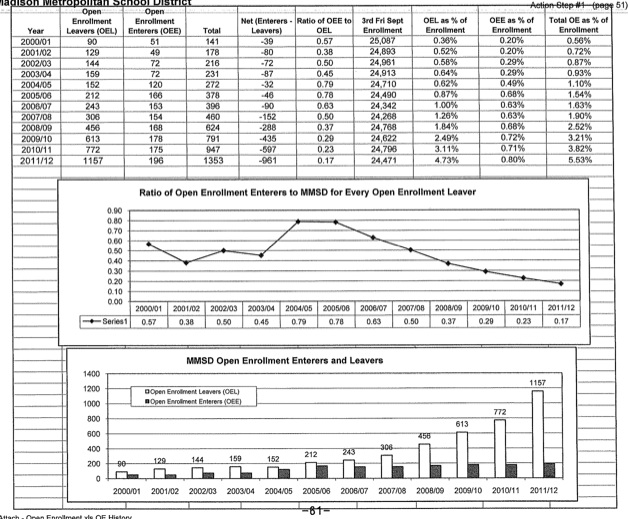
Douglas County, Colorado school voucher hearings wrap up; What happens when citizens lose faith in government? 2011 Madison School District Open Enrollment Data (4.73% Leave)

Elbert County News:

Closing arguments in the case challenging the Douglas County School District’s voucher program ended three days of hearings that could halt the program in its infancy.
A standing-room-only crowd listened in Denver District Court while a legal team from the American Civil Liberties Union faced off against a team that included the Colorado Attorney General’s Office to decide the fate of the district’s school choice scholarship program.
Both sides agreed that any decision from Denver District Court Judge Michael Martinez will likely face an appeal, regardless of the ruling.
“There will be an appeal either way,” said Michael McCarthy, a plaintiff attorney representing the Taxpayers for Public Education. “What (the school district has) done is press the envelope as far as they can. For those interested in preserving public education in this state, they have got in their face as far as they can.”

More from the Wall Street Journal: Wall Street Journal:

In a bold bid to revamp public education, a suburban district south of Denver has begun handing out vouchers that use public money to help its largely affluent residents send their children to private and church-based schools. The Douglas County School District experiment is noteworthy because nearly all voucher programs nationally aim to help children who are poor, have special needs or are trapped in failing public schools. Douglas County, by contrast, is one of the most affluent in the U.S., with household income nearly double the national median, and has schools ranked among the best in Colorado. What do you think? Should vouchers only be used with lower-income students? Should they never be used? Do they violate the constitution?

Chrystia Freeland:

One answer comes from Ivan Krastev, a Bulgarian political scientist. One of Mr. Krastev’s special interests is in the resilience of authoritarian regimes in the 21st century. To understand why they endure, Mr. Krastev has turned to the thinking of the economist Albert O. Hirschman, who was born in Berlin in 1915 and eventually became one of America’s seminal thinkers.
In 1970, while at Harvard, Mr. Hirschman wrote an influential meditation on how people respond to the decline of firms, organizations and states. He concluded that there are two options: exit — stop shopping at the store, quit your job, leave your country; and voice — speak to the manager, complain to your boss, or join the political opposition.
For Mr. Krastev, this idea — the trade-off between exit and voice — is the key to understanding what he describes as the “perverse” stability of Vladimir V. Putin’s Russia. For all the prime minister’s bare-chested public displays of machismo, his version of authoritarianism, in Mr. Krastev’s view, is “vegetarian.”
“It is fair to say that most Russians today are freer than in any other period of their history,” he wrote in an essay published this spring. But Mr. Krastev argues that it is precisely this “user-friendly” character of Mr. Putin’s authoritarianism that makes Russia stable. That is because Russia’s relatively porous dictatorship effectively encourages those people who dislike the regime most, and have the most capacity to resist it, to leave the country. They choose exit rather than voice, and the result is the death of political opposition: “Leaving the country in which they live is easier than reforming it.”

Related:
Madison School District May, 2011 Strategic Plan Update with Action Plans 1.8MB PDF

Share

Business Schools Plan Leap Into Data

Melissa Korn & Shara Tibken:

Faced with an increasing stream of data from the Web and other electronic sources, many companies are seeking managers who can make sense of the numbers through the growing practice of data analytics, also known as business intelligence. Finding qualified candidates has proven difficult, but business schools hope to fill the talent gap.
This fall several schools, including Fordham University’s Graduate School of Business and Indiana University’s Kelley School of Business, are unveiling analytics electives, certificates and degree programs; other courses and programs were launched in the previous school year.
International Business Machines Corp., which has invested more than $14 billion buying analytics industry companies such as Coremetrics and Netezza Corp. since 2005, has teamed up with more than 200 schools, including Fordham, to develop analytics curriculum and training.

Share

Back-to-School Special: 5 Tips on Picking a Good School

Ryan McVay:

I’m a policy guy, not a daddy blogger. As a general rule, I don’t discuss my children in this column or on my Eduwonk blog. But when TIME asked me to write about how my wife (who also works in education) and I chose our kids’ elementary school, I figured why not? We are constantly besieged by friends and colleagues who want to know how we went about picking a school, as if there were some secret education-analyst methodology I was privy to. I wish that were true! But even though I don’t have access to the secret sauce, I do have a pretty good sense of how to kick a school’s tires. Plus, I think it would be a shame not to use all of our parental angst for the greater good. And so, as our kids start a new year at a public school, here are some lessons from our school-hunting experience that might help guide yours.
Look beneath the label. “Public” or “private” doesn’t really tell you much, so don’t scratch a school off your list just because of how it’s governed. There are terrific and lousy schools in the public, private and (publicly funded) charter-school sectors, so relying on labels alone is a big risk. Likewise, you should do more than glance at a school’s test scores or demographic data. My wife and I, for instance, are both products of public schools. I went to ones in Virginia that on paper were both excellent and diverse. But in practice, there were different tracks for different students, so most of the kids in my gifted or AP classes were like me: Caucasian, middle-class, ruggedly good-looking. Well, two out of three of those anyway. My wife grew up in an Ohio district known for great academics but with no diversity. As our kids approached school age, we hoped to find a good school that was racially, ethnically and economically diverse — a tall order given today’s housing patterns and school boundaries. But most important, we wanted to find the right fit for our kids, so we were not opposed to going private if we couldn’t find an option in the public sector that seemed to work for us. (See the 20 best- and worst-paid college majors.)

Share

The myth of the extraordinary teacher

Ellie Herman:

Yes, we need to get rid of bad teachers. But we can’t demand that teachers be excellent in conditions that preclude excellence.
The kid in the back wants me to define “logic.” The girl next to him looks bewildered. The boy in front of me dutifully takes notes even though he has severe auditory processing issues and doesn’t understand a word I’m saying. Eight kids forgot their essays, but one has a good excuse because she had another epileptic seizure last night. The shy, quiet girl next to me hasn’t done homework for weeks, ever since she was jumped by a knife-wielding gangbanger as she walked to school. The boy next to her is asleep with his head on the desk because he works nights at a factory to support his family. Across the room, a girl weeps quietly for reasons I’ll never know. I’m trying to explain to a student what I meant when I wrote “clarify your thinking” on his essay, but he’s still confused.
It’s 8:15 a.m. and already I’m behind my scheduled lesson. A kid with dyslexia, ADD and anger-management problems walks in late, throws his books on the desk and swears at me when I tell him to take off his hood.

Share

Excellence in Education explains Florida’s reading reforms and compares Florida’s NAEP progress with Wisconsin’s at the July 29th Read to Lead task force meeting


Excellence in Education’s PowerPoint presentation: 1MB PDF, via a kind Julie Gocey email.
Related links: Video: Governor’s “Read to Lead” Task Force Meeting.
Wisconsin Reading Coalition.
Much more on Wisconsin’s Read To Lead Task Force, here.
How does Wisconsin compare? Learn more at www.wisconsin2.org

Share

The AFT’s Real Feelings About Parent Power

Rishawn Biddle:

When the AFT offers a road map on how to shut down Parent Power efforts, it offers a nice PDF document to do it. Apparently in a fit of celebration during last month’s TEACH 2011 conference, the nation’s second-largest teachers union offered up a presentation on how its Connecticut affiliate managed to make the state’s Parent Trigger law a little less harder for parents to use. (Dropout Nation is doing everyone a courtesy by making it available for public consumption; the orginal is still available at the AFT’s Web site. At least, for now.)

Rick Green has more.

Share

Union to defend teachers in cheating scandals

Greg Toppo:

The head of the USA’s second-largest teachers union on Monday said local affiliates will defend the rights of teachers caught up in cheating scandals, including the one now unfolding in Atlanta. But she said cheating “under any circumstances is unacceptable.”
Speaking to reporters during the American Federation of Teachers’ biannual training conference, Randi Weingarten said the union would “obviously” represent teachers accused of cheating “to make sure that people have some kind of fairness — and that it’s not some kind of witch hunt.”
A long-awaited report released last week by Georgia Gov. Nathan Deal, a Republican, found teacher- or principal-led cheating in 44 of 56 Atlanta schools investigated. Investigators determined that 178 educators cheated. Of those, 82 confessed.

Share

Madison School District Talented & Gifted Program Update

Superintendent Dan Nerad:

During the 2011-2012 school year, as MMSD implements Response to Instruction and Intervention (RTI2) and the new district School Support Teams, the plan for delivery of Talented and Gifted Services will continue to be integrated and refined so that it accomplishes the following: 1) is both systemic and systematic in nature; 2) is collaborative; 3) is financially sustainable; 4) is fluid and responsive to student needs; S) offers appropriate opportunities for student growth and talent development; 6) addresses the comprehensive needs (academic, social and personal growth) of students; 7) is aligned with State regulations, professional standards, current research, and effective practice; and 8) provides goals and evaluation procedures to evaluate growth and suggest areas in which change is needed. This Plan for TAG Services describes the following:

Much more on the recent complaint regarding the Madison School District’s Talent & Gifted Update, here.

Share

School choice is risk-free, Pennsylvania education secretary says

Tracie Mauriello:

Tax dollars soon could go to schools where teachers aren’t required to be certified and where students aren’t required to take the same standardized tests as their public school counterparts.
That concerns Democrats, who expressed concerns about Republican school-choice measures that were the subject of a House Education Committee public hearing today.
Rep. Jim Christiana, sponsor of one bill in the education reform package, said school choice isn’t about turning public schools into private ones; it’s about letting parents choose where their children will be best educated.
“We’re not saying students shouldn’t have to take standardized tests. We’re just saying the tests should be based on the curriculum you’re offering,” said Mr. Christiana, R-Beaver.

Share

We Want to Hear from Teachers About Teacher Prep

National Council on Teacher Quality and U.S. News & World Report, via a kind reader’s email:

Since we launched our national review of teacher preparation programs last January, we’ve heard a lot from schools of education about what they think about our effort.
We’ve also heard what state and district superintendents along with ed
reform organizations around the country think: the public needs to know
which preparation programs are doing a good job and which are not.
But now it’s time to _[4]hear_ from those most directly affected by teacher preparation programs: teachers themselves.
We want to know how ready teachers felt on their first day of class. What do teachers value about their teacher preparation programs? What do they think aspiring teachers need to know about the programs they are considering?
Links: 4. https://www.surveymonkey.com/s/teacherprepsurvey

Share

Debt to Degree: A New Way of Measuring College Success

Kevin Carey & Erin Dillon:

The American higher education system is plagued by two chronic problems: dropouts and debt. Barely half of the students who start college get a degree within six years, and graduation rates at less-selective colleges often hover at 25 percent or less. At the same time, student loan debt is at an all-time high, recently passing credit card debt in total volume.1 Loan default rates have risen sharply in recent years, consigning a growing number of students to years of financial misery. In combination, drop-outs and debt are a major threat to the nation’s ability to help students become productive, well-educated citizens.
The federal government has traditionally tracked these issues by calculating, for each college, the total number of degrees awarded, the percentage of students who graduate on time, and the percentage of students who default on their loans. Each of these statistics provides valuable information, but none shows a complete picture. A college could achieve a stellar graduation rate by passing students
along and handing out degrees that have little value in the job market, making it difficult for graduates to earn enough money to pay off their debt. Alternatively, a college could keep tuition and loan default rates low while also providing a terrible education and helping few students earn degrees. Students choosing colleges and policymakers governing higher education need an overall measure of value, one that combines debt and graduation.
Education Sector has created such a measure, the “borrowing to credential ratio.” For each college, we have taken newly available U.S. Department of Education data showing the total amount of money borrowed by undergraduates and divided that sum by the total number of degrees awarded. The results are revealing:

Share

Our Irrelevant Debates – Are Teachers Overpaid?

Andrew Rotherham:

This “everyone is saying teachers are overpaid” meme has quickly gained traction among the credulous. You can apparently attract celebrities like John Stewart and Matt Damon to rallies by playing the mom card and telling them that people are saying teachers are overpaid and it’s important to push back on that notion. Great, except for the most part it’s another in a long list of strawmen in the education debate. In fact, to the extent anyone in the mainstream of the education conversation is saying anything even approaching “teachers are overpaid” the conversation centers on the sustainability of current public sector benefit schemes for retirement (pdf) and health care. And while some of the “crisis” rhetoric is overblown there is a real problem with teacher pensions in some states. In the public debate that’s a different issue though than cash compensation, which is what people usually discuss when they want to argue about this. So, it is worth pointing out that while teachers are not overpaid, the wages are competitive in many places. Like the pension issue, and given the structure of our education “system” like most issues, there is a a great deal of variance.

Share

Include teachers in developing new evaluations

Honolulu Star-Advertiser:

The state is pursuing its broad mission to improve Hawaii’s public school system along several fronts, but sharpening the accountability of all parties surely is one top goal. And teachers are perhaps the most important of the parties being called to account, with plans to develop a more effective way to evaluate their work.
Proposing to overhaul teacher evaluations and make them more “performance-based” was a key element in the state’s successful bid for a federal Race to the Top competitive grant — specifically, to make student academic growth a factor in the teacher’s score. To their credit, the Hawaii State Teachers Association leaders have said they favor it in concept.
The ongoing dispute between the union and the state administration, unfortunately, has further complicated what already was to be a complex process. However, the HSTA, which wants to reopen talks, has an opportunity to use evaluation reform as an olive branch to help restart negotiations for contract amendments.
An olive branch is clearly needed. The state imposed its “last, best and final offer,” sparking an HSTA complaint that is now before the Hawaii Labor Relations Board.

Share

School, district ratings drop; Austin ISD has 8 underperforming schools, Round Rock has 2

Melissa Taboada:

The Round Rock school district, which earned the state’s second-highest academic rating in 2010, this year has two schools that failed to meet state standards, securing “academically unacceptable” labels that will stick for two years.
The news comes as schools and districts across Texas see their ratings slide this year despite making academic gains. Figures released by the Texas Education Agency on Friday show that more than half of all Texas schools that had the highest rating in 2010, exemplary, fell in their ratings, and five times as many schools were deemed academically unacceptable, the lowest rating.
Locally, eight of the Austin school district’s 112 rated schools missed state academic targets; last year, only one Austin school was rated academically unacceptable. Pflugerville this year has two schools rated unacceptable. Both traditional high schools in Bastrop failed to meet state standards and received the lowest rating. Hutto has two elementary schools that are rated unacceptable.

Share

Chinese teachers are on a U.S. mission

Ricardo Lopez:

The large ballroom in UCLA’s Covel Commons resembled a bustling day-care center one recent day, as laughter rang out across the room.
A boisterous game of Twister was being played in one corner, charades were set up near the refreshments and the occasional shout of “Uno!” sounded from the front.
But the participants, speaking in rapid-fire Mandarin, were not children. They were dozens of Chinese teachers in Los Angeles for a nine-day crash course to prepare them for what they consider the opportunity of a lifetime: to teach Mandarin in American schools.
In a few weeks, 176 Chinese teachers will head to kindergarten through 12th-grade classrooms across the country, from rural Kentucky towns to the tidy suburbs of Salt Lake City. Only two will remain in California, assigned to schools in Redding and Ojai.

Share

July 29 Wisconsin Read to Lead task force meeting

Julie Gocey, via email:

The fourth meeting of the Governor’s Read to Lead task force took place in Milwaukee on Friday, July 29. The meeting was filmed by Wisconsin Eye, but we have not seen it offered yet through their website. We will send out a notice when that occurs. As always, we encourage you to watch and draw your own conclusions.
Following is a synopsis of the meeting, which centered on reading improvement success in Florida and previously-discussed task force topics (teacher preparation, licensing, professional development, screening/intervention, early childhood). In addition, Superintendent Evers gave an update on activity within DPI. The discussion of the impact of societal factors on reading achievement was held over to the next meeting, as was further revisiting of early childhood issues.

In addition to this summary, you can access Chan Stroman’s Eduphilia tweets at http://twitter.com/#!/eduphilia
Opening: Governor Walker welcomed everyone and stressed the importance of this conversation on reading. Using WKCE data, which has been criticized nationally and locally for years as being derived from low standards, the Governor stated that 80% of Wisconsin students are proficient or advanced in reading, and he is seeking to serve the other 20%. The NAEP data, which figured prominently in the presentation of the guest speakers, tell a very different story. Superintendent Evers thanked the task force members and indicated that this is all about “connecting the dots” and putting all of the “puzzle pieces” together. The work of this task force will impact the work going on in other education-focused committees.
The Florida Story: Guest speakers were Patricia Levesque, the Executive Director of the Foundation for Excellence in Education and the Foundation for Florida’s Future, and Mary Laura Bragg, the director of Florida’s statewide reading initiative, Just Read, Florida! from 2001 to 2006.
In a series of slides, Levesque compared Wisconsin, Florida, and national performance on the NAEP reading test over the past decade. Despite challenges in terms of English language learners, a huge percentage of students on free/reduced lunch, and a minority-majority demographic, Florida has moved from the scraping the bottom on the NAEP to the top group of states. Over the same time period, Wisconsin has plummeted in national ranking, and our students now score below the national average in all subgroups for which NAEP data is disaggregated. 10 points on the NAEP scale is roughly equivalent to one grade level in performance, and Florida has moved from two grade levels below Wisconsin to 1/2 grade level above. For a full discussion of Wisconsin’s NAEP performance, see our website, http://www.wisconsinreadingcoalition.org.
Levesque and Bragg also described the components of the reading initiative in Florida, which included grading all schools from A to F, an objective test-based promotion policy from third to fourth grade, required state-approved reading plans in each district, trained reading coaches in schools, research assistance from the Florida Center for Reading Research, required individual student intervention plans for struggling students, universal K-2 screening for reading problems, improved licensure testing for teachers and principals, the creation of a reading endorsement for teaching licenses, and on-line professional development available to all teachers. As noted above, achievement has gone up dramatically, the gap between demographic groups has narrowed, early intervention is much more common, and third grade retention percentages continue to fall. The middle school performance is now rising as those children who received early intervention in elementary school reach that level. Those students have not yet reached high school, and there is still work to be done there. To accomplish all this, Florida leveraged federal funds for Title 1 and 2 and IDEA, requiring that they be spent for state-approved reading purposes. The Governor also worked actively with business to create private/public partnerships supporting reading. Just Read, Florida! was able to engineer a statewide conference for principals that was funded from vendor fees. While Florida is a strong local control state, reading is controlled from the state level, eliminating the need for local curriculum directors to research and design reading plans without the resources or manpower to do so. Florida also cut off funding to university professors who refused to go along with science-based reading instruction and assessment.
Florida is now sharing its story with other states, and offering assistance in reading plan development, as well as their screening program (FAIR assessment system) and their online professional development, which cost millions to develop. Levesque invited Wisconsin to join Indiana and other states at a conference in Florida this fall.
Questions for, or challenges to, the presenters came from three task force members.

  • Rachel Lander asked about the reading coaches, and Bragg responded that they were extensively trained by the state office, beginning with Reading First money. They are in the classroom modeling for teachers and also work with principals on understanding data and becoming building reading leaders. The coaches now have an association that has acquired a presence in the state.
  • Linda Pils stated her belief that Wisconsin outperforms Florida at the middle school level, and that we have higher graduation rates than Florida. She cited opinions that third grade retention has some immediate effect, but the results are the same or better for non-retained students later, and that most retained students will not graduate from high school. She also pointed out Florida’s class size reduction requirement, and suggested that the NAEP gains came from that. Levesque explained that the retention studies to which Pils was referring were from other states, where retention decisions were made subjectively by teachers, and there was no requirement for science-based individual intervention plans. The gains for retained students in Florida are greater than for matched students who are not retained, and the gains persist over time. Further, retention did not adversely affect graduation rates. In fact, graduation rates have increased, and dropout rates have declined. The University of Arkansas is planning to do a study of Florida retention. The class size reduction policy did not take effect in Florida until last year, and a Harvard study concluded that it had no effect on student reading achievement. Task force member Steve Dykstra pointed out that you cannot compare the NAEP scores from two states without considering the difference in student demographics. Wisconsin’s middle school scores benefit from the fact that we have a relative abundance of white students who are not on free/reduced lunch. Our overall average student score in middle school may be higher than Florida, but when we compare similar cohorts from both states, Florida is far ahead.
  • Tony Pedriana asked what kinds of incentives have been put in place for higher education, principals, etc. to move to a science-based system of instruction. The guests noted that when schools are graded, reading performance receives double weight in the formula. They also withheld funding for university programs that were not science-based.

DPI Update: Superintendent Evers indicated that DPI is looking at action in fours areas: teacher licensure, the Wisconsin Model Early Learning Standards, the use of a screener to detect reading problems, and implementation of the Common Core State Standards.

  • The committee looking at licensing is trying to decide whether they should recommend an existing, off-the-shelf competency exam, or revise the exam they are currently requiring (Praxis 2). He did not indicate who is on the committee or what existing tests they were looking at. In the past, several members of the task force have recommended that Wisconsin use the Foundations of Reading test given in Massachusetts and Connecticut.
  • DPI is revising the WMELS to correct definitions and descriptions of phonological and phonemic awareness and phonics. The changes will align the WMELS with both the Report of the National Reading Panel and the Common Core State Standards. Per the suggestion of Eboni Howard, a guest speaker at the last meeting, they will get an outside opinion on the WMELS when they are finished. Evers did not indicate who is doing this work.
  • DPI is looking at the possibility of using PALS screening or some other tool recommended by the National RTI Center to screen students in grades K-2 or K-3. Evers previously mentioned that this committee had been meeting for 6-7 months, but he did not indicate who is on it.
  • Evers made reference to communication that was circulated this week (by Dr. Dan Gustafson and John Humphries) that expressed concern over the method in which DPI is implementing the Common Core. He stated that districts have been asking DPI for help in implementing the CC, and they want to provide districts with a number of resources. One of those is the model curriculum being developed by CESA 7. DPI is looking at it to see how it could help the state move forward, but no final decision has yet been made.

Task force member Pam Heyde, substituting for Marcia Henry, suggested that it would be better to look at what Florida is doing rather than start from ground zero looking at guidelines. Patricia Levesque confirmed that Florida was willing to assist other states, and invited Wisconsin to join a meeting of state reading commissioners in October.
Teacher Preparation: The discussion centered around what needs to change in teacher preparation programs, and how to fit this into a four-year degree.
Steve Dykstra said that Texas has looked at this issue extensively. Most schools need three courses to cover reading adequately, but it is also important to look at the texts that are used in the courses. He referenced a study by Joshi that showed most of the college texts to be inadequate.
Dawnene Hassett, UW-Madison literacy professor in charge of elementary teacher reading preparation, was invited to participate in this part of the discussion. She indicated we should talk in terms of content knowledge, not number of credits. In a couple of years, teachers will have to pass a Teacher Performance Assessment in order to graduate. This was described as a metacognitive exercise using student data. In 2012-13, UW-Madison will change its coursework, combining courses in some of the arts, and dropping some of the pedagogical, psychological offerings.
Tony Pedriana said he felt schools of education had fallen down on teaching content derived from empirical studies.
Hassett said schools teach all five “pillars” of reading, but they may not be doing it well enough. She said you cannot replicate classroom research, so you need research “plus.”
Pils was impressed with the assistance the FCRR gives to classroom teachers regarding interventions that work. She also said spending levels were important.
Dykstra asked Mary Laura Bragg if she had worked with professors who thought they were in alignment with the research, but really weren’t.
Bragg responded that “there’s research, and then there’s research.” They had to educate people on the difference between “research” from vendors and empirical research, which involves issues of fidelity and validation with different groups of students.
Levesque stated that Florida increased reading requirements for elementary candidates from 3 to 6 credits, and added a 3 credit requirement for secondary candidates. Colleges were required to fit this in by eliminating non-content area pedagogy courses.
Kathy Champeau repeated a concern from earlier meetings that teacher candidates need the opportunity to practice their new knowledge in a classroom setting, or they will forget it.
Hassett hoped the Teacher Performance Assessment would help this. The TPA would probably require certain things to be included in the teacher candidate’s portfolio.
Governor Walker said that the key to the effectiveness of Florida’s retention policy was the intervention provided to the students. He asked what they did to make sure intervention was successful.
Levesque replied that one key was reading coaches in the classroom. Also, district reading plans, individual intervention plans, student academies, etc. all need to be approved by the state.
There was consensus that there should be a difference in reading requirements for elementary vs. secondary teachers. There was no discussion of preparation for reading teachers, reading specialists, or special education teachers.
Licensing: The discussion centered around what teacher standards need to be tested.
Dykstra suggested that the Knowledge and Practice Standards for Teachers of Reading, written by Louisa Moats, et al, and published by the International Dyslexia Association in 2010, would be good teacher standards, and the basis for a teacher competency exam. There was no need for DPI to spend the next year discussing and inventing new teacher standards.
Champeau said that the International Reading Association also has standards.
Pedriana asked if those standards are based on research.
Dykstra suggested that the task force look at the two sets of standards side-by-side and compare them.
Professional Development: The facilitators looked for input on how professional development for practicing teachers should be targeted. Should the state target struggling teachers, schools, or districts for professional development?
Rep. Jason Fields felt all three needed to be targeted.
Heyde asked Levesque for more details on how Wisconsin could do professional development, when we often hear there is no money.
Levesque provided more detail on the state making reading a priority, building public/private partnerships, and being more creative with federal grant money (e.g., the 20% of each grant that is normally carved out by the state for administration). There should be a clear reading plan (Florida started with just two people running their initiative, and after a decade only has eight people), and all the spending should align with the plan to be effective. You cannot keep sending money down the hole. Additional manpower was provided by the provision that all state employees would get one paid hour per week to volunteer on approved reading projects in schools, and also by community service requirements for high school students.
Bragg suggested using the online Florida training modules, and perhaps combining them with modules from Louisiana.
Dykstra also suggested taking advantage of existing training, including LETRS, which was made widely available in Massachusetts. He also stressed the importance of professional development for principals, coaches, and specialists.
Bragg pointed out that many online training modules are free, or provided for a nominal charge that does not come close to what it would cost Wisconsin to develop its own professional development.
Lander said there were many Wisconsin teachers who don’t need the training, and it should not be punitive.
Champeau suggested that Florida spends way more money on education that Wisconsin, based on information provided by the NAEP.
Levesque clarified that Florida actually is below the national average in cost per student. The only reason they spend more than Wisconsin is that they have more students.
Rep. Steve Kestell stated that teachers around the entire state have a need for professional development, and it is dangerous to give it only to the districts that are performing the worst.
Sarah Archibald (sitting in for Sen. Luther Olsen) said it would be good to look at the value added in districts across the state when trying to identify the greatest needs for professional development. The new statewide information system should provide us with some of this value added information, but not at a classroom teacher level.
Evers commented that the state could require new teacher Professional Development Plans to include or be focused on reading.
Pils commented that districts can have low and high performing schools, so it is not enough to look at district data.
Champeau said that administrators also need this professional development. They cannot evaluate teachers if they do not have the knowledge themselves.
Dykstra mentioned a Florida guidebook for principals with a checklist to help them. He is concerned about teachers who develop PDP’s with no guidance, and spend a lot of time and money on poor training and learning. There is a need for a clearinghouse for professional development programs.
Screening/Intervention: One of the main questions here was whether the screening should be universal using the same tools across the state.
Champeau repeated a belief that there are districts who are doing well with the screening they are doing, and they should not be required to change or add something new.
Dykstra responded that we need comparable data from every school to use value added analysis, so a universal tool makes sense. He also said there was going to be a lot of opposition to this, given the statements against screening that were issued when Rep. Keith Ripp introduced legislation on this topic in the last biennium. He felt the task force has not seen any screener in enough detail to recommend a particular one at this time.
Heyde said we need a screener that screens for the right things.
Pils agreed with Dykstra and Heyde. She mentioned that DIBELS is free and doesn’t take much time.
Michele Erickson asked if a task force recommendation would turn into a mandate. She asked if Florida used a universal screener.
Levesque replied that Florida initially used DIBELS statewide, and then the FCRR developed the FAIR assessments for them. The legislature in Florida mandated the policy of universal kindergarten screening that also traces students back to their pre-K programs to see which ones are doing a better job. Wisconsin could purchase the FAIR assessments from Florida.
Archilbald suggested phasing in screening if we could not afford to do it all at once.
Evers supports local control, but said there are reasons to have a universal screener for data systems, to inform college programs, and to implement professional development.
Lander asked what screening information we could get from the WKCE.
Evers responded that the WKCE doesn’t start unitl third grade.
Dykstra said we need a rubric about screening, and who needs what type and how often.
Pedriana said student mobility is another reason for a universal screener.
There was consensus that early screening is important. Certainly by 4K or 5K, but even at age three if a system could be established. Possibilities mentioned were district-run screenings or pediatrician screenings.
Walker reminded the task force that it only makes sense to screen if you have the ability to intervene with something.
Mara Brown wasn’t sure that a universal screener would tell her anything more about her students than she already knows.
Levesque said she could provide a screening roadmap rubric for the task force.
No one on the task force had suggestions for specific interventions. The feeling was that it is more important to have a well-trained teacher. Both Florida and Oregon started evaluating and rating interventions, but stopped because they got bogged down. Wisconsin must also be careful about evaluations by What Works Clearinghouse, which has some problems.
Pedriana asked if the task force is prepared to endorse a model of instruction based on science, where failure is not an option.
The facilitator said this discussion would have to wait for later.
Early Childhood: The task force agreed that YoungStar should include more specific literacy targets.
Rep. Kestell felt that some district are opening 4K programs primarily for added revenue, and that there is wide variability in quality. There is a need to spend more time on this and decide what 4K should look like.
Evers said we should use the Common Core and work backward to determine what needs to be done in 4K.
Wrap-Up: Further discussion of early childhood will be put over to the next meeting, as will the societal issues and accountability. A meeting site has not yet been set, but Governor Walker indicted he liked moving around the state. The Governor’s aides will follow up as to locations and specific agenda. The next meeting will be Thursday, August 25. All meetings are open to the public.

Related: An Open Letter to the Wisconsin Read To Lead Task Force on Implementing Common Core Academic Standards; DPI: “Leading Us Backwards” and how does Wisconsin Compare? www.wisconsin2.org.
Much more on Wisconsin’s Read to Lead Task Force, here.

Share

PBIS in the Sun Prairie Schools

sp-eye:

PBIS is all the rage in school districts across the country. No…Sun Prairie didn’t just dream this up all by themselves. What, exactly, is PBIS? PBIS stands for Positive Behavioral Interventions and Supports. It’s an offshoot of the IDEA program (Individuals with Disabilities Education Act). You may see/hear it as SWPBS (School-wide Positive Behavior Supports). In a nutshell, PBIS is a system of behavior modification, with three stages of intervention.
Primary intervention is targeted to all students and is s system designed to clearly identify which behaviors are acceptable and which are not. Exhibiting positive behavior is rewarded in some fashion. In theory, about 80-85% of students respond to this primary level of intervention. The overall target is to develop a system in which positive reinforcements (for “acceptable/desired” behaviors) outnumber negative reinforcements (for unacceptable behaviors) by about 4:1. In this way, kids overwhelmingly see that “being good” is the place to be. You get rewards.
PBIS extends further to the 2nd tier, kids that do not respond well to these primary tactics. These kids represent about 10-15% of the population and are those that potentially are at risk for “failure”, or at the very least not realizing their academic potential. This group, however is not in need of individualized attention, but rather is targeted in small groups (a modernized form of “group” therapy). The third tier, which includes about 5-10% of students, covers those students who require individualized attention to develop positive behaviors and squelch those behaviors which are not acceptable.

Share

Is laying off teachers by seniority a mistake?

Marcelle Kreiter:

With the economy forcing closer scrutiny of budgeting at all levels of government and politicians zeroing in on government workers’ pay, perhaps the most visible target is education.
For the most part, elementary and secondary education in the United States is funded with local tax dollars, with assists from state and federal coffers. And the biggest line-item expense? Teacher salaries. When it comes time to cut the budget, layoffs are announced, and because of union contracts teachers with seniority are favored. Usually those most recently hired are the ones who go.
But is this the smartest way to fix the budget? Dan Goldhaver, director of the Center for Education Data and Research at the University of Washington Bothell, and Roddy Theobald, a researcher at the center and a doctoral student in statistics, write in the fall issue of Education Next this subservience to union seniority rules is wreaking havoc on the education system, often axing the most energetic and creative educators in the system. Worse yet because they are the most recent hires, their salaries are at the low end of the pay scale so it takes more layoffs to meet the dollar figure necessary to reduce the budget, pushing up class size and sometimes forcing districts to eliminate subject areas and programs entirely

Share

Seize the moment for education reform in Iowa

Souix City Journal:

Add your voice to the discussion. Click here to submit a letter or mini editorial to the Journal staff.
Whatever the endeavor – be it business, athletics … or education -nobody stays number one by staying the same.
Historically, we Iowans have prided ourselves on the quality of our schools. We have considered ourselves at or near the top in the nation.
The state’s education system still gets good, passing grades, don’t get us wrong, but we can and should do better in our classrooms to prepare our children for the realities and dynamics of a changing, more-global workforce. “We must,” in the words of Iowa Department of Education Director Jason Glass, “have a world-class education system …”

Share

Bill Gates Urges Focus On Teachers To Fight Achievement Gap

Bianca Vazquez Toness:

Among the many prominent thinkers attending the Urban League’s annual conference Thursday, Microsoft founder and philanthropist Bill Gates made his case for focusing on teachers.
One of the nation’s oldest civil rights groups, the Urban League, is holding its annual conference in Boston this week.
Much of the conference focused on education Thursday — specifically, the persistent achievement gap between black and Latino students and their white counterparts.
Gates has been in the education reform game for a while, pouring billions of dollars into scholarships, research and trying to improve public schools. Gates said there have been advances on most other civil rights issues, but not much progress on education.

Share

Lessons from the Iowa Education summit

Margaret Crocco:

This is an important moment in the history of education in the state of Iowa.
Earlier this week, U.S. Secretary of Education Arne Duncan, Iowa Gov. Terry Branstad, Iowa Education Director Jason Glass and an array of educational experts offered a set of challenges to educators at the two-day Education Summit in Des Moines.
The message was simple: Things need to change if Iowa is to regain its status as one of the strongest educational systems in the nation.
Although the statistics about Iowa students’ performances on the National Assessment of Educational Progress can be used to support diverse narratives about how students are performing compared with their peers across the nation, international comparisons tell an unambiguous story: American schools will need to do better if the United States is going to produce a globally competitive work force for the 21st century.

Margaret Crocco: Clusty Search argaret Crocco

Share

Detroit school teachers to take 10 percent wage cut

Roy Roberts:

Detroit public school teachers will take a 10 percent wage cut and pay more for health care in what the school system’s manager on Friday said were “extreme measures” needed to address a financial emergency.
The measures are designed to save nearly $82 million as part of the Detroit Public Schools’ effort to address a $327 million deficit.
“These wage concessions and health care cost-sharing plans are being implemented because we are in an extremely difficult financial period for Detroit Public Schools,” Roy Roberts, the emergency manager for the school system, said in a statement.

Share

Will de-funding unravel the academic integrity of universities?

Monica Bulger:

Last week, the New York Times reported that in 2007, Deutsche Bank entered into an agreement with two German universities, Humboldt University and the Technical University of Berlin, to fund a mathematical laboratory. The problematic parts were the ‘secret’ terms: according to the article, the Deutsche Bank could not only influence the hiring process, but bank employees could serve as adjunct professors. Perhaps the most disturbing aspects of the agreement were that the bank had veto power over the laboratory’s research agenda and, more importantly, “was given the right to review any research produced by members of the Quantitative Products Laboratory 60 days before it was published and could withhold permission for publication for as long as two years.”

Share

Controversy @ The Madison School Board over Discipline Policy: “Featuring the Administration as Sisyphus” (Now with Video!)

Madison School Board Member Ed Hughes:

As is becoming increasingly common these days however, mine turned out to be a minority view. Other Board members took turns identifying parts of the revision that they did not like, raising some concerns that they had previously expressed and some that were new. The general tenor of the comments was that the current format of the Code was fine but that Code should be stricter and that more violations should lead to mandatory recommendations for expulsion.
About an hour into the meeting, I expressed some frustration with the proceedings (since I’m just figuring this stuff out, this video starts with eight seconds of black) :
Eventually Board members settled on deep-sixing the Work Group’s proposal but adopting some (but not all) of the substantive changes reflected in the revision. For example, the aggravated theft offense was added. The change to the unintentional use of force against a staff member violation was adopted (a very good move, btw), but the change to the possession and distribution of drugs or alcohol violation was not (I think). Another change boosted the potential consequences imposed for non-physical acts of bullying or harassment.
Also on our agenda Monday night was the creation of a new Board Ad Hoc Committee on Student Discipline, Conduct and Intervention, to be chaired by Lucy Mathiak. Some Board members suggested that the revisions recommended by the Work Group and rejected by the Board might be re-considered by the members of this committee in some fashion.
I found the Board’s rejection of the proposed revisions and ad hoc amending of the existing Code an unfortunate turn of events and criticized what I described as our legislating on the fly right before the vote:

Share

Will the new teacher evaluation system Improve Instruction

Jim Stergios:

In Monday’s post, I went through the DC teacher evaluation system, IMPACT, which weights value-added improvements in student scores at 50 percent of the teacher’s evaluation, with the remaining half of the evaluation covering 22 areas (fit into 9 categories). Five classroom observations are held,
three times by a building administrator and twice by an outside “master evaluator” who is a subject-matter expert and does not report to the building administrator.
Teachers in tested subjects are evaluated by standards different from those used for paraprofessionals, counselors, special education teachers and others in the system, with teachers in non-tested subjects having only 10 percent of their evaluation based on student scores.

Share

Some truths about teachers

Anurag Behar:

In many a twilight have I sat with government schoolteachers, discussing education. Discussion over, they gather their bags and lunch boxes, having come straight from school, and head home. Some ride back on two-wheelers, some take the bus. Their homes are often 10-20km away, not an easy commute in rural and small-town India. Next morning they will open their schools, often another 10-20km from their homes, and get back to work: teaching with passion, managing with care and dealing with the vagaries of life, with determination.
These are teachers doing a good job, within every constraint that our government school system has. We have found these good teachers in every block (a typical district has three-six “blocks”) that we have worked in, across 17 states. Many of them are not just good, they are exceptional.

Share

Chicago needs school vouchers. And Rahm needs to meditate.

John Kass:

Mayor Rahm Emanuel certainly made news over his angry, finger-wagging scolding of NBC Chicago TV reporter Mary Ann Ahern the other day.
Ahern dared ask the Rahmfather whether he’d send his kids to the public schools he controls. He reportedly became indignant, took off his microphone and ended the interview.
Later, and with great courtesy, Emanuel revisited the topic with a rival station — which then reported the big exclusive that the mayor was sending his children to a private school.
Emanuel runs Chicago Public Schools. He’s shown grit to stand publicly and admonish the teachers union to improve the product. But he decided his children will not attend the public schools.

Share

An Open Letter to the Wisconsin Read To Lead Task Force on Implementing Common Core Academic Standards; DPI: “Leading Us Backwards”

Dan Gustafson, PhD 133K PDF, via a kind email from the Wisconsin Reading Coalition:

WRC recommends reading the following open letter from Madison neuropsychologist Dan Gustafson to the Governor’s Read to Lead task force. It reflects many of our concerns about the state of reading instruction in Wisconsin and the lack of an effective response from the Department of Public Instruction.
An Open Letter to the Read-To-Lead Task Force
From Dan Gustafson, PhD
State Superintendent Evers, you appointed me to the Common Core Leadership Group. You charged that the Leadership Group would guide Wisconsin’s implementation of new reading instruction standards developed by the National Governors’ Association Center for Best Practices (NGA Center) and the Council of Chief State School Officers (CCSSO).
It is my understanding that I was asked to join the group with the express purpose of bringing different voices to the table. If anything, my experience with the group illustrates how very far we need to go in achieving a transparent and reasoned discussion about the reading crisis in Wisconsin.
DPI Secretly Endorses Plan Created by Poor Performing CESA-7
I have grave concerns about DPI’s recent announcement that Wisconsin will follow CESA-7’s approach to implementing the Common Core reading standards. DPI is proposing this will be the state’s new model reading curriculum.
I can attest that there was absolutely no consensus reached in the Common Core group in support of CESA-7’s approach. In point of fact, at the 27th of June Common Core meeting, CESA-7 representative Claire Wick refused to respond to even general questions about her program.
I pointed out that our group, the Common Core Leadership Group, had a right to know about how CESA-7 intended to implement the Common Core Standards. She denied this was the case, citing a “non-disclosure agreement.”
The moderator of the discussion, DPI’s Emilie Amundson, concurred that Claire didn’t need to discuss the program further on the grounds that it was only a CESA-7 program. Our Common Core meeting occurred on the 27th of June. Only two weeks later, on July 14th, DPI released the following statement:
State Superintendent Evers formally adopted the Common Core State Standards in June 2010, making Wisconsin the first state in the country to adopt these rigorous, internationally benchmarked set of expectations for what students should know and are expected to do in English Language Arts and Mathematics. These standards guide both curriculum and assessment development at the state level. Significant work is now underway to determine how training will be advanced for these new standards, and DPI is currently working with CESA 7 to develop a model curriculum aligned to the new standards.
In glaring contrast to the deliberative process that went into creating the Common Core goals, Wisconsin is rushing to implement the goals without being willing to even show their program to their own panel of experts.
What Do We Know About Wisconsin/CESA-7’s Model Curriculum?
As an outsider to DPI, I was only able to locate one piece of data regarding CESA-7’s elementary school reading performance:
4TH GRADE READING SCORES, 2007-08 WKCE-CRT,
CESA-7 IS AMONG THE WORST PERFORMING DISTRICTS.
CESA-7 RANKED 10TH OF THE 12 WISCONSIN CESA’S.
What Claire did say about her philosophy and the CESA-7 program, before she decided to refuse further comment, was that she did not think significant changes were needed in reading instruction in Wisconsin, as “only three-percent” of children were struggling to read in the state. This is a strikingly low number, one that reflects an arbitrary cutoff for special education. Her view does not reflect the painful experience of the 67% of Wisconsin 4th graders who scored below proficient on the 2009 National Assessment of Educational Progress.
As people in attendance at the meeting can attest, Claire also said that her approach was “not curriculum neutral” and she was taking a “strong stand” on how to teach reading. Again, when I pressed her on what these statements meant, she would only reference oblique whole language jargon, such as a belief in the principal of release from instruction. When I later asked her about finding a balance that included more phonics instruction, she said “too much emphasis” had been given to balanced literacy. After making her brief statements to the Common Core group, she said she had already disclosed too much, and refused to provide more details about the CESA-7 program.
Disregarding Research and Enormous Gains Made by other States, Wisconsin Continues to Stridently Support Whole Language
During the remainder of the day-long meeting on the 27th, I pressed the group to decide about a mechanism to achieve an expert consensus grounded in research. I suggested ways we could move beyond the clear differences that existed among us regarding how to assess and teach reading.
The end product of the meeting, however, was just a list of aspirational goals. We were told this would likely be the last meeting of the group. There was no substantive discussion about implementation of the goals–even though this had been Superintendent Evers’ primary mandate for the group.
I can better understand now why Emilie kept steering the discussion back to aspirational goals. The backroom deal had already been made with Claire and other leaders of the Wisconsin State Reading Association (WSRA). It would have been inconvenient to tell me the truth.
WSRA continues to unapologetically champion a remarkably strident version of whole-language reading instruction. Please take a look at the advocacy section of their website. Their model of reading instruction has been abandoned through most the United States due to lack of research support. It is still alive and well in CESA-7, however.
Our State Motto is “Forward”
After years of failing to identify and recommend model curriculum by passing it off as an issue of local control, the DPI now purports to lead. Unfortunately, Superintendent Evers, you are now leading us backward.
Making CESA-7 your model curriculum is going to cause real harm. DPI is not only rashly and secretly endorsing what appears to be a radical version of whole language, but now school districts who have adopted research validated procedures, such as the Monroe School District, will feel themselves under pressure to fall in line with your recommended curriculum.
By all appearances, CESA-7’s program is absolutely out of keeping with new Federal laws addressing Response to Intervention and Wisconsin’s own Specific Learning Disability Rule. CESA-7’s program will not earn us Race to the Top funding. Most significantly, CESA-7’s approach is going to harm children.
In medicine we would call this malpractice. There is clear and compelling data supporting one set of interventions (Monroe), and another set of intervention that are counter-indicated (CESA-7). This is not a matter of opinion, or people taking sides. This is an empirical question. If you don’t have them already, I hope you will find trusted advisors who will rise above the WSRA obfuscation and just look at the data. It is my impression that you are moving fast and receiving poor advice.
I am mystified as to why, after years of making little headway on topics related to reading, DPI is now making major decisions at a breakneck pace. Is this an effort to circumvent the Read-To-Lead Task Force by instituting new policies before the group has finished its scheduled meetings? Superintendent Evers, why haven’t you shared anything about the CESA-7 curriculum with them? Have you already made your decision, or are you prepared to show the Read-To-Lead that there is a deliberative process underway to find a true model curriculum?
There are senior leaders at DPI who recognize that the reading-related input DPI has received has been substantially unbalanced. For example, there were about five senior WSRA members present at the Common Core meetings, meaning that I was substantially outnumbered. While ultimately unsuccessful due to logistics, an 11th hour effort was made to add researchers and leadership members from the Wisconsin Reading Coalition to the Common Core group.
The Leadership Group could achieve what you asked of it, which is to thoughtfully guide implementation of the Common Core. I am still willing to work with you on this goal.
State Superintendent Evers, I assume that you asked me to be a member of the Leadership Group in good faith, and will be disappointed to learn of what actually transpired with the group. You may have the false impression that CESA-7’s approach was vetted at your Common Core Leadership Group. Lastly, and most importantly, I trust you have every desire to see beyond destructive politics and find a way to protect the welfare of the children of Wisconsin.
Sincerely,
Dan Gustafson, PhD, EdM
Neuropsychologist, Dean Clinic

View a 133K PDF or Google Docs version.
Related:
How does Wisconsin Compare: 2 Big Goals.
Wisconsin Academic Standards

Wisconsin Teacher Content Knowledge Requirement Comparison

Share

US Education Perspective from a Tech CEO

The Financial Times:

Kevin Johnson, chief executive of Juniper Networks, one of the biggest network equipment makers, talks to the FT’s Paul Taylor about cloud computing, innovation, video and his worries about the failure of the US education system to produce home-grown talent

Share

In defence of the maligned PowerPoint

Tim Harford:

I am about to do something rash, which is to disagree with Lucy Kellaway. Last week, the fearless observer of business follies went too far: she called for PowerPoint to be banned.
The prosecution’s argument is simple: many PowerPoint presentations are very bad. This is true but it hardly makes the case for a ban. Serviceable tools can produce awful results in the wrong hands, as anyone who has seen me put up shelves can attest. Banning the screwdriver is not the answer.

Share

Wisconsin Public School Advocates to Rally at the Capitol, Saturday July 30, 3:00 PM

99K PDF, via a TJ Mertz email:

As hundreds of thousands of public school supporters gather in Washington DC the weekend of July 28 to 30, 2011, Wisconsin advocates will hold a rally in support of the Save Our Schools agenda at 3:00 PM on Saturday July 30, near the State St. entrance to the Capitol.
“Public schools are under attack. There is a need for national, state, and local action in support of our schools. Wisconsin has been ground zero in this; the Save Our Schools demands from the Guiding Principles provide a great framework to build our state movement and work to expand opportunities to learn” said education activist Thomas J. Mertz.
The Save Our Schools demands are:

  • Equitable funding for all public school communities
  • An end to high stakes testing used for the purpose of student, teacher, and school evaluation
  • Teacher, family and community leadership in forming public education policies
  • Curriculum developed for and by local school communities

Doing more with less doesn’t work. “The time to act is now. While phony debates revolve around debt ceilings, students and teachers across the country are shortchanged. We need real reform, starting with finally fixing the school funding formula, and putting families and communities first. What child and what teacher don’t deserve an excellent school?” said rally organizer Todd Price, former Green Party Candidate for Department of Public Instruction and Professor of Teacher Education National Louis University.
The event will feature speeches from educators, students, parents and officials, as well as opportunities for school advocates from throughout Wisconsin to connect and organize around issues of importance in their communities.

For more information, visit: http://www.saveourschoolsmarch.org/ and http://saveourschoolswisconsin.wordpress.com/
Related:

Share

New Study: RI’s Suburban Schools Trail Nation In Advanced Programs

Dan McGowan:

A new analysis of the nation’s schools found that Rhode Island falls below the national average for offering high-level curriculum such as Advanced Placement or talented and gifted programs, particularly in the more suburban districts in the state.
The report, which seeks to showcase what is known as the “opportunity gap” between wealthy and high-poverty school districts, actually suggests that Rhode Island offers similar chances to be involved in specialty programs in urban schools as it does in suburban schools. In fact, in some cases, the high-level programs are more available in cities like Providence than they are in Barrington.
But the reality is the state offers very little advance programming overall, meaning that while there may not be a significant gap between the city schools and the ones from more rural areas, Rhode Island schools are still being outpaced by the rest of New England and most cases, the country.
The Numbers
The study, which was conducted by ProPublica, found that Rhode Island falls well-behind the rest of the country when it comes to offering AP tests, advanced mathematics courses and talented and gifted programming.
More students, however, are taking chemistry and physics than in other parts of the country.

Compare Wisconsin’s results, here.

Share

How Khan Academy Is Changing the Rules of Education

Clive Thompson:

“This,” says Matthew Carpenter, “is my favorite exercise.” I peer over his shoulder at his laptop screen to see the math problem the fifth grader is pondering. It’s an inverse trigonometric function: cos-1(1) = ?
Carpenter, a serious-faced 10-year-old wearing a gray T-shirt and an impressive black digital watch, pauses for a second, fidgets, then clicks on “0 degrees.” Presto: The computer tells him that he’s correct. The software then generates another problem, followed by another, and yet another, until he’s nailed 10 in a row in just a few minutes. All told, he’s done an insane 642 inverse trig problems. “It took a while for me to get it,” he admits sheepishly.
Carpenter, who attends Santa Rita Elementary, a public school in Los Altos, California, shouldn’t be doing work anywhere near this advanced. In fact, when I visited his class this spring–in a sun-drenched room festooned with a papercraft X-wing fighter and student paintings of trees–the kids were supposed to be learning basic fractions, decimals, and percentages. As his teacher, Kami Thordarson, explains, students don’t normally tackle inverse trig until high school, and sometimes not even then.

Share

Iowa’s task: Bet on right school reforms

As Iowa political and education leaders prepare to make sweeping changes in the state’s schools, experts monitoring similar efforts across the country caution that much of what is being tried is still controversial and uncharted territory.
For example:
– A growing body of anecdotal evidence and research supports the push toward longer school days and years to benefit students’ academic achievement, especially among low-income or disadvantaged children. But the cost-benefit ratio of such moves remains fiercely debated and some experiments have had mixed results.

Share

Caring for the Me Generation

Dr. Sara Goldrick-Rab

During the past semester, a time where I constantly felt split between my academic life and my civic life, I became acutely aware of an attitude among undergraduates that perplexed me. I tried writing about it , describing what readers pointed out (in a far more articulate manner than I’d managed) was a notable lack of empathy among some students.
Since I’ve spent the last 10 years trying to make convince higher education institutions to prioritize their students’ needs and desires, these realizations about who some of the students seemed to be and especially what they seemed to believe, made me pretty depressed. Don’t get me wrong: it’s not that I expect students to speak and act in one voice–far from it, given how much I value the democratic process. I don’t want them to share my opinions or perspectives, but rather simply want them to formulate opinions and perspectives after asking good questions and gathering and evaluating information. But what I hope for, most of all, is their recognition that they are part of a worldwide community of students, and their strength lies in that community. I hope that such a larger sense of the world will guide them to think of more than themselves, and to act for the greater good.

Share

The upside and downside of Wisconsin Governor Walker’s education vision

Alan Borsuk:

A heat dome has settled over much of American education. Is Gov. Scott Walker just going to add to the stifling atmosphere? Or is Walker right that there are cool breezes in his ideas for how to increase school quality overall?
First, the national perspective: You would think by now, the heat would have been drained from some of the debate about what works in education, especially when it comes to serving urban kids. People have been working on this for decades. Haven’t we figured out answers yet?
In most ways, no. Even a lot of things that seem like answers haven’t been brought successfully to wide use. Things that look good on paper (or in a political speech) have often accomplished little in reality. The profoundly troubling march to perpetuating educational failure, for the most part, continues.
As disappointment grows, the debates between “education reformers” and those who think the “reformers” are going in the wrong directions often have been contentious. If you follow the tweets and postings and such, you’ll find occasional light but a lot of heated rhetoric. Add in this year’s wars over the pay, benefits and unions of public employees, combined with the hyperpartisan nature of the times, and you have an atmosphere that should carry health warnings.

Share

Debunking myths about teacher education curricula

Dr. Terry Simpson:

Recently, the Tennessee Board of Regents (TBR) announced a redesign of all education programs within its six universities and 13 community colleges called “Ready2Teach.” The TBR is initiating change in the process of preparing new teachers for public school classrooms.
Although as a private college, Maryville College is not governed by the TBR, our goal in the teacher education program is to equip our teacher licensure students with research-based knowledge and skills that will facilitate the learning for all children. My concern about the June 13 Associated Press story about Ready2Teach that ran in the News Sentinel, and across the state, was the inaccuracies about how we currently prepare new public school teachers. Here are a few misconceptions:
n Education majors spend most of their time in college listening to lectures about teaching methods or education theory.

Share

When teachers weren’t maligned

Craig Barbian:

When I was growing up, there was a special mystique about teachers. They were looked up to and respected. No matter if you liked a teacher or not, you appreciated his or her efforts to educate children and prepare them for their future, no matter what that future would be.
Today, teachers are being portrayed as self-centered union lackeys who feel entitled to extraordinary benefits provided by taxpayers. Teachers appear to have suddenly morphed from members of a noble profession to members of the world’s oldest profession. What a turnaround.
My teachers over the years left an indelible mark on me and the person I became. They helped shape me, gave me encouragement and taught me to think for myself and question the status quo.
My first-grade teacher was Miss Darling (honestly). She was a sweet lady who I remember for her kindness and her patience as I struggled to master the simple act of tying my shoes. It has been almost 50 years since then, but I remember her clearly, drying my tears of frustration and embarrassment and helping me practice until I could finally tie my shoes.

Share

Trenton Schools & Teacher Tenure

New Jersey Left Behind:

There’s lots of discussion regarding the pros and cons of tenure. The Trenton Times describes an instance that highlights the difficulties school districts face in dismissing tenured employees. Rayshaun Davis, a member of one of the Trenton Public Schools unions, the Business-Technical Employees Association, was assigned as a Youth Development Liaison at Trenton Central High in a program designed to “help students avoid teen pregnancy, substance abuse and other pitfalls of at-risk youth.”
Here’s the current contract for the union.

Share

K-12 Tax & Spending Climate: Wisconsin Ranks #4 in Tax Burden

Tax Foundation

For nearly two decades the Tax Foundation has published an estimate of the combined state-local tax burden shouldered by the residents of each of the 50 states. For each state, we calcu­late the total amount paid by the residents in taxes, then divide those taxes by the state’s total income to compute a “tax burden.” We make this calculation not only for the most recent year but also for earlier years because tax and income data are revised periodically by govern­ment agencies.
The goal is to focus not on the tax collec­tors but on the taxpayers. That is, we answer the question: What percentage of their income are the residents of this state paying in state and local taxes? We are not trying to answer the question: How much money have state and local governments collected?

Share

On Their Childrens’ Schools, Politicians Should Save the Outrage

Matt Bai:

If you’re a politician who has all kinds of things to say about public education, do voters have the right to know where you send your children to school?
That’s a question that seems to be surfacing a lot lately. A few weeks ago, on NBC’s “Meet the Press,” Gov. Chris Christie of New Jersey, as vicious a critic of teachers unions as exists among American politicians today, repeated his assertion that where he chooses as a parent to educate his four children (Catholic schools, as it turns out) is nobody’s business.
This week, Rahm Emanuel, the newly installed mayor of Chicago, stormed out of an interview when asked the same question, which he apparently considered a violation of his privacy. Mr. Emanuel, who has also called for school reforms, is sending his children to the same private school the Obama girls once attended.
“My children are not in a public position,” Mr. Emanuel testily told the local NBC reporter who asked the question. “The mayor is.”

Share

Was the $5 Billion Worth It? A decade into his record-breaking education philanthropy, Bill Gates talks teachers, charters–and regrets, Mea Culpa on Small Learning Communities; Does More Money Matter?

Jason Riley:

One of the foundation’s main initial interests was schools with fewer students. In 2004 it announced that it would spend $100 million to open 20 small high schools in San Diego, Denver, New York City and elsewhere. Such schools, says Mr. Gates, were designed to–and did–promote less acting up in the classroom, better attendance and closer interaction with adults.
“But the overall impact of the intervention, particularly the measure we care most about–whether you go to college–it didn’t move the needle much,” he says. “Maybe 10% more kids, but it wasn’t dramatic. . . . We didn’t see a path to having a big impact, so we did a mea culpa on that.” Still, he adds, “we think small schools were a better deal for the kids who went to them.”
The reality is that the Gates Foundation met the same resistance that other sizeable philanthropic efforts have encountered while trying to transform dysfunctional urban school systems run by powerful labor unions and a top-down government monopoly provider.
In the 1970s, the Ford, Carnegie and Rockefeller foundations, among others, pushed education “equity” lawsuits in California, New Jersey, Texas and elsewhere that led to enormous increases in state expenditures for low-income students. In 1993, the publishing mogul Walter Annenberg, hoping to “startle” educators and policy makers into action, gave a record $500 million to nine large city school systems. Such efforts made headlines but not much of a difference in closing the achievement gap.
Asked to critique these endeavors, Mr. Gates demurs: “I applaud people for coming into this space, but unfortunately it hasn’t led to significant improvements.” He also warns against overestimating the potential power of philanthropy. “It’s worth remembering that $600 billion a year is spent by various government entities on education, and all the philanthropy that’s ever been spent on this space is not going to add up to $10 billion. So it’s truly a rounding error.”

Much more on Small Learning Communities, here.

Share

The life and death of a Washington teenager in state care

Linda Thomas:

A new report from the Department of Social and Health Services summarizes a teenager’s life and death in eight pages. After bouncing him through 22 foster homes, it concludes that caseworkers and foster parents should have had more information about the boy’s history so they could have helped him.
Roger Eugene Benson was in state care when he left a group home in January, walked to a freeway overpass, jumped to I-5 below and died after being struck by a van. People who witnessed the suicide were horrified. People who didn’t know what was going were angry by the traffic delays caused when the Interstate was shut down during the afternoon commute.
In calling the State Patrol that day, I found out the victim was 15 years old. That struck me because I have a 15-year-old daughter. This kid, the boy who killed himself on I-5 , was somebody’s son.
What went wrong in his life?
Benson was born in December of 1995. His history with the state began when he was a toddler. His mother was investigated for abuse or neglect of her children, including Benson, six times. The last time CPS was called, in May of 1998, Benson was placed in protective custody. The boy and his siblings were placed in four foster homes within three years. The longest he was in any one home was two years.

Share

Iowa: Schools slip to “mediocrity”

Joe Dejka:

Iowa has slid from a national leader in elementary and secondary education to an average performer over the past 20 years as other states accelerated past it, according to a state report released today.
The Iowa report card — the first released under Republican Gov. Terry Branstad — provides an unvarnished assessment of the state’s academic performance and sounds a clarion call to improve. The report, “Rising to Greatness: An Imperative for Improving Iowa’s Schools,” says performance on various national and state tests show “an alarming slide toward mediocrity.”
In some ways, Iowa public schools have improved over years past, but other states have surged ahead, said Jason Glass, director of the Iowa Department of Education, which produced the report.
Restoring the greatness of Iowa schools will require more than “tinkering around the edges,” he said.

Wisconsin has slid, as well.

Share

Student Teaching in the United States

National Council on Teacher Quality:

Though few would dispute its value, the job of providing apprenticeships for some 200,000 teacher candidates each year in real classrooms is a massive and complex undertaking. About 1,400 higher education institutions work with many thousands of school districts across the United States to place, mentor and supervise teacher candidates in what is popularly known as “student teaching.”1
Even as the profession pushes for more and earlier field work opportunities, student teaching is the final clinical experience.2 During the typical semester-long experience, student teaching candidates must synthesize everything they have learned about planning instruction: collecting or developing instructional materials, teaching lessons, guiding small group activities, and establishing and maintaining order–not to mention meetings with faculty and parents and, in some districts still, taking on lunchroom and playground duties. Passing (or failing) student teaching determines whether an individual will be recommended for certification as a licensed teacher.
Because few dispute the tremendous potential value of student teaching, even alternate pathways to profession, often criticized for taking too many shortcuts, generally try to provide their teaching candidates with some kind of student teaching experience, however abbreviated. Surveys of new teachers suggest that student teaching is the most important part of their teaching training experience.3

Related: Teacher colleges balk at being rated Wisconsin schools say quality survey from national nonprofit and magazine won’t be fair.
National Council on Teacher Quality website.

Share

Why I’m Marching Forward (It’s The Only Direction)

José Luis Vilson:

You’ve got to be wondering what a teacher like me is doing marching against the “reform” trends. For those of you unfamiliar with my background, I graduated with a degree in Computer Science from Syracuse University. A year later, after 6-8 months of unemployment and a stint as a data entry person at an educational database firm, I went into the NYC Teaching Fellows program, an offshoot of Michelle Rhee’s New Teacher Project. On the surface, I’m a perfect candidate to follow the corporatist thinking about education, and should be easily molded into the dominant thinking from elites who ostensibly believe they’re going into education for the common good. All it takes is the right amount of fear, the right amount of frustration, the right amount of ignorance, and the right amount of failure to tip people into the hands of those who wish to rotate our profession backwards.
Fortunately for me, I lucked out. And if you’re reading this, I’m thinking the same goes for you.

Share

How Texas Betrayed Its Schools

John Harvey:

As promised, this is my follow-up post based on our trip to the Save Texas Schools conference in Austin this past weekend. It was a sobering experience. The long and the short of it is this: Texas has abandoned its children. The Governor and the Legislators in Austin have set the stage for a protracted crisis not only in education but in the State economy. With respect to the former, we can look forward to larger class sizes, the elimination of many important programs, and the placing of even more responsibility of the backs of overworked (and fewer) teachers. Texas already ranked an embarrassing 44th in education and these developments do not bode well for future of the Lone Star State. As far as the economy is concerned, every public education layoff means less income not only for those individuals, but for local businesses where they would have shopped. Indeed, the Legislative Budget Board forecast that almost 45% of job losses would actually be in the private sector (Center for Public Policy Priorities: CPPP Urges Rejection of HB1). Furthermore, the lack of a decent education will greatly reduce the future earning power of Texans. The only firms willing to relocate here will be those hoping to find a source of cheap, low-skilled laborers. Texas will become the alternative to outsourcing to an impoverished, third-world country. The stars at night no longer look so big and bright.

Share

Why Faculty Productivity Data Matters

Rick O’Donnell:

First, a college education costs too much. Middle-class families can no longer afford tuition that increases faster than inflation, per capita personal income, consumer prices and even health insurance. Total student loan debt in America is $1 trillion and exceeds credit card debt. Taxpayer money stretches only so far, with health care, public safety and K-12 education claiming ever larger shares of state budgets.
Second, the higher education industry is undergoing a complete restructuring. Technology is fundamentally altering how courses are created and taught while upending the cost structure of delivery. New entrants – from for-profit white-label degree providers like 2tor to nonprofits like Khan Academy – are bringing disruptive innovation.

Share

Kentucky National Guard Program for At-Risk Youth

Associated Press:

A National Guard school program for at-risk teenagers is scheduled to open in 2012 in eastern Kentucky.
The Appalachian Youth ChalleNGe Academy, to be housed in a renovated former elementary school, will be the second ChalleNGE school in Kentucky. Bluegrass ChalleNGe Academy at Fort Knox opened in 1999.
“Here in Harlan, we found a county with a school system that was willing to help make a program,” said Col. John Wayne Smith, director of the Fort Knox program. “We believe that with an academy here, we will be able to get kids to come who wouldn’t come to Fort Knox.”
The primary recruiting area for the new program is 23 counties in eastern Kentucky, with any remaining openings being offered to teens in the Appalachian region of neighboring states, Smith said last week in the Harlan Daily Enterprise.
“I was looking at the numbers in our target population. I found that Appalachia has a higher rate of these kids, but we also found that because of positive family connections in the area, youth are hesitant to leave and come to Fort Knox. We have had a few come to us, but nothing like the numbers we should be getting,” he said at a community meeting.

Share

To improve U.S. education, it’s time to treat teachers as professionals

Howard Gardner:

“What are the right incentives to have in place for teachers?” The very question itself is jarring. It implies that teachers don’t want to perform well and that they need incentives, which in today’s parlance translates into rewards (money) and reprimands (fear of loss of benefits or position).
Let me present a very different picture: Teachers should be regarded as and behave like professionals. A professional is a certified expert who is afforded prestige and autonomy in return for performing at a high level, which includes making complex and disinterested judgments under conditions of uncertainty. Professionals deserve to live comfortably, but they do not enter the ranks of a profession in order obtain wealth or power; they do it out of a calling to serve. Be it law, medicine, auditing, education or science, the expectation is the same: professionals should work hard to gain the requisite credentials, behave ethically as well as legally, and when they err, should take responsibility for their error and try to learn from it.

Share

Madison schools resolves planning time dispute with teachers union

Matthew DeFour:

The Madison School District has reached an agreement with its teachers union over changes to planning time — a resolution Superintendent Dan Nerad said fits within the bounds of the state’s new collective bargaining law.
An earlier proposal prompted hundreds of teachers to protest at a School Board meeting in May and Madison Teachers Inc. executive director John Matthews to threaten a job action if the matter wasn’t resolved.
The issue relates to changes in the district’s 2011-13 collective bargaining agreement with MTI, which was approved in March before the state’s collective bargaining law took effect.
In the past, disagreements over contract language were often resolved through memorandums of understanding (MOUs). But once the collective bargaining law took effect June 29, districts that approved contracts after Feb. 1 couldn’t modify them through MOUs, or else they would be
Read more: http://host.madison.com/wsj/news/local/education/local_schools/article_82b5f386-b25e-11e0-873a-001cc4c03286.html#ixzz1SblqTZYo

Share

1998 Study Assesses the Illinois Teacher Union’s Future

Mike Antonucci:

Teachers’ Unions: Back to the Future. Back in 1998, the Illinois Education Association commissioned the Global Business Network to assess the union’s direction for the next 10-15 years and help devise options for dealing with possible scenarios. The result, a report titled The Future of the Illinois Education Association [3.1MB PDF], is a fascinating read not just for its insights into the union’s strategic thinking, but for which “predictions” it got right and wrong.
I put the scare quotes around “predictions” because GBN was explicit in stating that the possible scenarios it outlined were not predictions, but merely various possibilities for which the union should plan. As the authors put it, “After imaginatively dwelling in each scenario, participants can develop strategic options that are appropriate to managing in just that scenario.”
GBN developed a matrix of four scenarios, based on the variables of strong vs. weak political environments, and strong vs. weak membership connection with the union. Each of the four contains at least some relevance to current events, although other aspects read like one of those “flying car, food pills” science fiction stories written in the 1930s about life in the 1970s.

Fascinating.

Share

Anti-PowerPoint revolutionaries unite

Lucy Kellaway:

Last week I saw two women getting into a cab outside an office in central London. Both were in high heels and smart suits and were struggling with a flip chart, its pages flapping in the wind. The quaint sight of the large pad on aluminium legs filled me with longing for the days when people giving presentations wrote things down with felt pens on big sheets of paper.
I might have forgotten this scene, were it not for the fact that the very next day I was sent an invitation to join a brand new political party in Switzerland, the Anti PowerPoint party. “Finally do something!” its slogan says.
Actually I’ve been quietly doing something for years: I’ve been declining to learn how to use the ubiquitous piece of software. As a presenter, I’m a PowerPoint virgin, though as an audience member I’ve been gang raped by PowerPoint slides more times than I can count.

Share

‘Honors’ Should Mean a Challenge, Not an Upgrade to First Class

For example, most of our honors students place out of the first-year composition course, so it is entirely possible for them to graduate without having taken a course that involves heavy-duty writing. I would argue that the ability to write effectively is the most important skill a student should have. Is there some way to build this into an honors program before a student begins work on a senior thesis?


Kevin Knudson:

April really is the cruelest month. I discovered that firsthand this year, as the changes I have made during my two years as director of the University of Florida honors program began to take effect. Our application procedure, once a mere formality, now de-emphasizes standardized-test scores and has caused some students to be turned away. The resulting torrent of angry phone calls and e-mails made me dread going to work all month.
May put an end to that, but it gave rise to a new stream of questions, mostly about housing. One parent made multiple requests for a layout of the honors dorm so she could ensure that her son’s room location was optimal.
Has it really come to this? Are honors programs devolving into concierge services? I approach my role as director from the point of view I held as a student more than 20 years ago–that honors is a challenge to engage–but find myself confronted with parental and student expectations that honors is nothing more than a reward for a job well done in high school.
Which raises the question: Why do students want to be in our honors program? I hope they want to surround themselves with serious, like-minded peers to form a real intellectual community. But my darker suspicions about their motivation were confirmed when, during dinner with a few students, one said that the impression he’d received during his visits to the campus was that honors was like flying first class. You know: smaller classes, easier access to advising, better dorm. Further reflection led me to realize that students at universities like Florida have always been “honors students,” and that the label is important to them (and their parents). Why would they accept being just a “regular” student here? I suppose that attitude is a natural outcome of today’s K-12 achievement culture, but it is shocking nonetheless.
Perhaps we should not be surprised. Honors programs were created with good intentions, but it did not take long for them to be perceived as “better” than the regular university experience. Today’s parents and students pursue any avenue they think will give them an advantage, beginning in elementary school; hence the proliferation of honor societies, tutoring services, test-preparation courses, and leadership programs. Students are sorted and ranked by their test scores and other metrics from the time they enter school, so they expect that the process will follow them to college.
Critics of honors programs, most notably Murray Sperber in his book Beer and Circus, say this division between “regular” and “honors” students should not exist. Sperber recalls his undergraduate days at Purdue, in the 1960s, when all classes were of reasonable size, taught by regular tenure-track faculty. State flagship institutions, he argues, should stop exploiting large numbers of undergraduates (and taking their tuition dollars) to support ever-expanding research enterprises and instead return to a focus on education. He asserts that while students would like smaller classes and more individual attention, universities cynically ply them with permissive alcohol policies and large athletics programs to keep them quiet. Honors programs, he argues, are a “life raft” for a few lucky students to navigate those treacherous seas.
I agree with some of Sperber’s arguments, but I am enough of a realist to know that the ship has sailed. Business-minded legislatures are demanding more education while offering less money to pay for it. They expect flagships to produce cutting-edge research that will drive states’ economies. They are also loath to authorize tuition increases, thereby forcing universities to increase class sizes and find other ways to generate revenue. So a return to the glory days is unlikely.
But Sperber misses an important point: Many students view college simply as a means to an end and are not especially engaged in the educational process. This does not make them unintelligent or unworthy of attending a selective public university, but it does not obviate the need for an honors program to challenge students who are seeking more.
So what does the future hold for honors programs at large public research universities? I suspect that those institutions that have the resources to do so (usually via endowments designated to support honors) will very likely continue much as they always have–offering small sections of lower-division courses, recruiting faculty to teach interesting electives on offbeat topics, providing specialized advising, facilitating undergraduate research. In short, offering what they advertise: a liberal-arts-college environment within a large university.
Since honors students at selective public universities meet most of their general-education requirements through advanced placement, perhaps it is time to shift the focus of the honors curriculum to the sorts of skills that these students may still need to improve. For example, most of our honors students place out of the first-year composition course, so it is entirely possible for them to graduate without having taken a course that involves heavy-duty writing. I would argue that the ability to write effectively is the most important skill a student should have. Is there some way to build this into an honors program before a student begins work on a senior thesis?
I also worry that, by skipping general-education courses, students may miss out on acquiring a deeper understanding of material they learned in high school. One step I am taking to combat this at Florida involves a new course built around the concept of justice, to be offered to all first-year students in the honors program as of next spring. The goal is to give our students a common intellectual experience that will help hone their critical-thinking and writing skills. We also encourage our students to pursue double majors, to study abroad for a semester, or to get involved in research.
But those are technical matters. In my view, a philosophical change is needed. We should move away from the notion that honors is an upgrade to first class, one to which students are entitled merely because they scored well on some dubious standardized tests. When I speak to groups of prospective students, I emphasize this point, explaining that honors is a challenge, not a reward, and that moving from high-school honors to university honors is shifting from a culture of achievement to a culture of engagement.
That should be an honors program’s true function–engaging students who want to push the boundaries and helping them find ways to do it, rather than providing further empty rewards for students who jump through hoops with style.

Share

The Internet Will Reduce Teachers Union Power Online learning means fewer teachers (and union members) per student.

Terry Moe:

This has been a horrible year for teachers unions. The latest stunner came in Michigan, where Republicans enacted sweeping reforms last month that require performance-based evaluations of teachers, make it easier to dismiss those who are ineffective, and dramatically limit the scope of collective bargaining. Similar reforms have been adopted in Wisconsin, Ohio, New Jersey, Indiana, Tennessee, Idaho and Florida.
But the unions’ hegemony is not going to end soon. All of their big political losses have come at the hands of oversized Republican majorities. Eventually Democrats will regain control, and many of the recent reforms may be undone. The financial crisis will pass, too, taking pressure off states and giving Republicans less political cover.
The unions, meantime, are launching recall campaigns to remove offending Republicans, initiative campaigns to reverse legislation, court cases to have the bills annulled, and other efforts to reinstall the status quo ante–some of which are likely to succeed. As of today, they remain the pre-eminent power in American education.
Over the long haul, however, the unions are in grave trouble–for reasons that have little to do with the tribulations of this year.
The first is that they are losing their grip on the Democratic base. With many urban schools abysmally bad and staying that way, advocates for the disadvantaged are demanding real reform and aren’t afraid to criticize unions for obstructing it. Moderates and liberals in the media and even in Hollywood regularly excoriate unions for putting job interests ahead of children. Then there’s Race to the Top–initiated over union protests by a Democratic president who wants real reform. This ferment within the party will only grow in the future.

Share

Virtually Irrelevant: How certification rules impede the growth of virtual schools

Dr. Terry Stoops:

  • Teacher-certification requirements are among the most onerous rules enforced by state education agencies and have the potential seriously to limit the scope, quality, and accessibility of virtual schooling for years to come.
  • By design, certification requirements prohibit unlicensed individuals who reside within a state — such as higher education faculty, private-sector professionals, private school faculty, and independent scholars — from teaching virtual courses.
  • States should allow their virtual schools to have the flexibility to focus on hiring candidates who possess the requisite skills and relevant knowledge and experience, rather than those who possess mandated credentials.

Share

How to make college cheaper: Better management would allow American universities to do more with less

The Economist:

DEREK BOK, a former president of Harvard, once observed that “universities share one characteristic with compulsive gamblers and exiled royalty: there is never enough money to satisfy their desires.” This is a bit hard on compulsive gamblers and exiled royals. America’s universities have raised their fees five times as fast as inflation over the past 30 years. Student debt in America exceeds credit-card debt. Yet still the universities keep sending begging letters to alumni and philanthropists.
This insatiable appetite for money was bad enough during the boom years. It is truly irritating now that middle-class incomes are stagnant and students are struggling to find good jobs. Hence a flurry of new thinking about higher education. Are universities inevitably expensive? Vance Fried, of Oklahoma State University, recently conducted a fascinating thought experiment, backed up by detailed calculations. Is it possible to provide a first-class undergraduate education for $6,700 a year rather than the $25,900 charged by public research universities or the $51,500 charged by their private peers? He concluded that it is.
Mr Fried shunned easy solutions. He insisted that students should live in residential colleges, just as they do at Harvard and Yale. He did not suggest getting rid of football stadiums (which usually pay for themselves) or scrimping on bed-and-board.

Share

High School Grade Inflation: 1991-2003


Mark Perry

Following up on a recent post on college grade inflation, there’s also evidence that grade inflation is taking place at America’s high schools. In a study by the college entrance exam company ACT, it found evidence of significant grade inflation between 1991 and 2003 for high school students taking the ACT exam. While ACT scores remained stable between 1991 and 2003, the chart above shows that the average high school GPA increased for ever ACT composite score over that period. From the study:
“Each point on each curve represents the average GPA for all students in 1991 and 2003 who earned that specific ACT Composite score. The curve for 2003 is higher at every Composite score point than the 1991 curve, which is evidence of the existence of grade inflation.

Share

Charter School Battle Shifts to Affluent Suburbs

Winnie Hu:

Matthew Stewart believes there is a place for charter schools. Just not in his schoolyard.
Mr. Stewart, a stay-at-home father of three boys, moved to this wealthy township, about 20 miles from Midtown Manhattan, three years ago, filling his life with class activities and soccer practices. But in recent months, he has traded play dates for protests, enlisting more than 200 families in a campaign to block two Mandarin-immersion charter schools from opening in the area.
The group, Millburn Parents Against Charter Schools, argues that the schools would siphon money from its children’s education for unnecessarily specialized programs. The schools, to be based in nearby Maplewood and Livingston, would draw students and resources from Millburn and other area districts.
“I’m in favor of a quality education for everyone,” Mr. Stewart said. “In suburban areas like Millburn, there’s no evidence whatsoever that the local school district is not doing its job. So what’s the rationale for a charter school?”

http://www.hanyuschool.org/. Locally, the Verona School District offers a Mandarin immersion charter school. More, here.

Share

Teacher Evaluation and the Triumph of Empiricism

Kevin Carey:

A year ago, Adrian Fenty was the mayor of Washington, DC and Michelle Rhee was the chancellor of DC Public Schools. Rhee had made overhauling the DC system of teacher evaluation the centerpiece of her controversial and widely noted reforms. Instead of the standard system of seniority-based raises and nobody ever being fired for bad teaching, Rhee wanted to give the best teachers big raises and show the worst teachers the door.
The American Federation of Teachers was so alarmed by the prospect of the DC teachers union acceding to this plan that AFT President Randi Weingarten shoved aside local leadership and forced Rhee into a protracted series of negotiations. But because teacher evaluation is legally excluded from collective bargaining in DC, Rhee was able to put her system in place unilaterally. After a year of evaluations under the new IMPACT evaluation system, she made good on her promise: big raises for the highest performers in a time when teacher salaries were being cut and frozen in other cities, pink slips for the lowest performers, and a one-year grace period for hundreds more “minimally effective” teachers who would be fired if they didn’t improve. Unable to stop the plan through negotiations, the AFT turned to raw politics, pouring $1 million into Vincent Gray’s campaign to unseat Fenty. Gray won, and Rhee’s divisive tenure soon came to an end.

Share

Wisconsin Governor Walker instructs us on future of schools; Notes on Teacher Content Knowledge Requirements

Alan Borsuk:

Scott Walker, the governor who set the stage for a burst of educational excellence? The guy who helped teachers make their work more successful and more rewarding (at least intangibly)?
Goodness, turning those question marks into periods is going to be a project. It’s hard to imagine how Walker’s standing among teachers could be lower.
But Walker thinks that will be the verdict several years from now.
By winning (as of now) the epic battle to cut school spending and erase almost all collective bargaining powers for teachers, as well as other educational battles, Walker has changed the realities of life in just about every school in the state, including many private schools.
The focus through our tumultuous spring was on money, power and politics. Now the focus is shifting to ideas for changing education itself.
So what are Walker’s ideas on those scores?
In a 40-minute telephone interview a few days ago, Walker talked about a range of education questions. There will be strong criticism of a lot of what he stands for. Let’s deal with that in upcoming columns. For the moment, I’m going to give Walker the floor, since, so far this year, the tune he calls has been the tune that the state ends up playing. Here are some excerpts:

Much like our exploding federalism, history will certainly reveal how Walker’s big changes played out versus the mostly status quo K-12 world of the past few decades. One thing is certain: the next 10 years will be different, regardless of how the present politics play out.
I found the interview comments on the teacher climate interesting. Watching events locally for some time, it seems that there is a good deal more top down curricular (more) and pedagogy (teaching methods) dogma from administrators, ed school grants/research and others.
Other states, such as Minnesota and Massachusetts have raised the bar with respect to teacher content knowledge in certain subjects.
Wisconsin teacher license information.
Related: 2 Big Goals for Wisconsin.

Share

Debt fears drive US youth away from college

Hal Weitzman:

The eldest of Pamela Fettes’ three sons only recently celebrated his 15th birthday, but she is already worrying about the cost of their college education.
Ms Fettes, a 46-year-old single mother, lives in Belvidere, a blue-collar town 70 miles north-west of Chicago. She earns $50,000 a year as a regional healthcare co-ordinator, putting her right at the US’s median household income – although she also works two nights a week as a hospital clerk and decorates cakes on the side. She took on the extra work after being diagnosed with breast cancer in 2008 and getting divorced last year, both of which involved considerable expense.
Ms Fettes says she has about $200 left each month after all her bills are paid, but she is also trying to pay down $8,000 in credit card debt and has little saved up, meaning she will be unable to contribute to the cost of her sons’ higher education.

Share

N.J. Board of Ed votes to open superintendent positions to non-educators

Jessica Calefati:

It just got easier to become superintendent of a troubled New Jersey school district.
The state Board of Education Wednesday relaxed the requirements for hiring superintendents in more than 50 districts with failing schools, opening the positions for the first time to non-educators.
Backed by the Christie administration, the new regulations take effect immediately as part of a pilot program for districts with schools that fail to meet federal standards for student achievement based on test scores.

This is a good idea.

Share

When Teachers Cheat–And Then Blame the Test

Kyle Wingfield:

Only two years ago, Atlanta Public Schools were the toast of the educational establishment. Scores on standardized tests had been rising–skyrocketing, in some cases–for a decade. In February 2009, schools chief Beverly Hall was feted as national superintendent of the year.
Two months later, dozens of Ms. Hall’s teachers and principals engaged in the annual ritual required to produce such success: They cheated on the state standardized test.
The difference between 2009 and previous years of cheating (dating back at least as far as 2006, and perhaps 2001) was that reporters at my newspaper, the Atlanta Journal-Constitution, questioned the schools’ remarkable scores on Georgia’s Criterion-Referenced Competency Test. Those articles prompted an investigation by then-Gov. Sonny Perdue, and this month the devastating final report arrived. It uncovered cheating by adults in 44 schools, covering 1,508 classes–almost all of them serving low-income, minority students.

Share

High GPAs Have Little Use As Student Motivator or Evaluation Tool for Grad Schools and Employers

Mark Perry:

Stuart Rojstaczer is a retired Duke University professor who has tirelessly crusaded for several decades against “grade inflation” at U.S. universities and maintains a website with lots of historical GPA data and charts (GradeInflation.com).  The chart above illustrates grade inflation at the University of Michigan-Ann Arbor over roughly the last half century (data here), with the average GPA rising from 2.57 in 1951 (C+/B-) to 3.27 by 2008 (B+).  The grade inflation at Michigan is similar to the national trend at most American universities over time.  

Catherine Rampell at the NY Times Economix Blog writes about a new paper by Professor Rojstaczer and co-author Christopher Healy titled “Where A Is Ordinary: The Evolution of American College and University Grading, 1940-2009,” published in the Teachers College Record.  The main findings of the paper appear below, illustrated by this chart: 

Share

School District Competition & Budgets

Bryan Setser:

A typical school district’s reaction to tight budgets is to cut, cut, cut. While cutting education waste can sharpen focus, cutting into innovation leaves your district extremely vulnerable to competition. School districts are no longer just competing against the local private school; rather they are competing with education over the net and the global market place as well. Now more than ever we need contenders.
With the right trainers, district leaders or contenders can become innovation champions for kids. Here’s four ways you can step into the ring and put on the gloves for the upcoming education fight with the rest of the world.
Complete an Open Education Resource Scan – What are you paying for in your district with educational technology? What outcomes have you realized? Is there an open free alternative? Can this resource be shared among multiple users for multiple purposes? Example: Are you paying for a learning management system and creating your own content? Or, are you using a free engine and wrapping it around content not just for instruction but for professional development as well.

Share

Beyond the Bubble Test: How Will We Measure Learning in the Future?

Tina Barseghian

Last September, Secretary of Education Arne Duncan announced: “Today is a great day! I have looked forward to this day for a long time-and so have America’s teachers, parents, students, and school leaders.”
Duncan was excited about a new way of testing students, one that goes “beyond the bubble test,” the standardized assessments students take every year that have long been criticized as not only useless in measuring any kind of real learning, but actually detrimental to the entire education system.
Ask most teachers, and you’ll hear a litany of reasons why they detest these assessments. They contend the current tests have no bearing on student learning. They waste time that could be better spent in class (the former president of United Teachers Los Angeles, “dismisses the weeks before spring testing as ‘Bubbling-In 101,'” according to a Los Angeles Times article.) They complain about having to teach to the tests, leaving them little time to try new ways of engaging students. And in some states, teachers are evaluated based on those very scores.

Share

Six percent of D.C. public school employees get separation notes

Molly O’Toole:

The District of Columbia Public Schools has notified 413 employees of their separation as the result of IMPACT evaluations, the DCPS said on Friday.
IMPACT evaluates teacher performance based on student achievement, instructional expertise, collaboration, and professionalism. Other employees are assessed based on criteria specific to their jobs.
The 413 represent just over 6 percent of the 6,500 total DCPS employees. DCPS issued separation notices based on performance and on noncompliance with licensing requirements for the 2010-2011 school year, according to a DCPS statement.

Share

Tom Vander Ark’s New York-Area Charter Schools Falter

Anna Phillips:

After years spent directing the distribution of more than $1 billion from the Bill and Melinda Gates Foundation into hundreds of schools across the nation, Tom Vander Ark set his sights on the New York area, with a plan to create a network of charter schools of his own.
Mr. Vander Ark, the foundation’s former executive director of education and a national leader in the online learning movement, was granted charters in 2010 to open a high school in Bedford-Stuyvesant, Brooklyn, and two others in Newark. The New York school, Brooklyn City Prep, also got space in a public school building — a precious and controversial commodity — hired a principal, and welcomed applications from 150 eighth graders this spring.
But after spending more than $1.5 million of investors’ money on consultants and lawyers, Mr. Vander Ark, 52, has walked away from the project, and the schools will not open as planned this fall, leaving others involved stunned and frustrated.

Share

Atlanta School Scandal Sparks House Cleaning

The Economist:

The interim superintendent of Atlanta’s public schools promised to reform the district and remove teachers and supervisors implicated in one of the nation’s biggest cheating scandals.
Erroll Davis Jr. removed the city’s four area superintendents as well as two principals this week, pending further investigation into cheating on standardized tests. At the same time, a former Atlanta deputy superintendent agreed to go on paid leave from a Texas school district that hired her earlier this year.
All were named in an 800-page state report released last week that outlined widespread, systematic cheating by students, teachers and administrators on standardized tests required annually at Georgia’s elementary and middle public schools. The cheating, which was intended to raise scores to meet performance benchmarks, involved practices such as teachers erasing incorrect answers on the standardized tests.

Share

‘The Fall of the Faculty’

Dan Berrett:

Faculty members feeling besieged by, well, take your pick — increased scrutiny of their productivity and the relevance of their research; broadsides against tenure; attacks on their expertise and ability to collectively bargain; or their shrinking role in the affairs of their institutions — will no doubt find succor in a new book to be released next month.
In his polemic, The Fall of the Faculty: The Rise of the All-Administrative University and Why It Matters (Oxford University Press), Benjamin Ginsberg, David Bernstein Professor of Political Science at Johns Hopkins University, takes stock of what ails higher education and finds a single, unifying cause: the growth of administration.

Share

The Innovative University

Clay Christensen & Henry Eyring

Clayton Christensen and Henry Eyring, building on Christensen’s contribution to business, health care and K-12 education, apply Christensen’s model of disruptive innovation to higher education. Unlike the many doom-and-gloom books of recent years, this work offers a hopeful analysis of the university and its traditions and how it must find new models for the future.
“The Innovative University” builds upon the theory of “disruptive innovation” and applies it to the world of higher education. The concept, originally introduced by Christensen in his best-selling book “The Innovator’s Dilemma,” holds that sustaining institutions or models exist, until change “disrupts” the traditional or “sustaining” model. In the case of higher education, the disruptor to the traditional university might be a recession, the rise of for-profit schools or the prevalence of high-quality online programs. The authors suggest that to avoid the pitfalls of disruption and turn the scenario into a positive and productive one, universities must change their institutional “DNA.”

More, here.

Share

Oregon education reform bills aim to create more flexible, individualized public schools with proficiency grouping

Bill Graves:

In the typical Oregon public school classroom, students of the same age work at achievement levels that often vary by two or three grades, sometimes more.
That didn’t make sense to Mary Folberg. When she launched Northwest Academy, a private college preparatory school for grades 6-12 in downtown Portland, she grouped students the way she did as a dance instructor at Jefferson High, by proficiency rather than age.
That’s the seismic shift Gov. John Kitzhaber wants to make in the state’s public school system through a package of education bills passed by the Legislature last month.
At the heart of the package is one bill pushed by Kitzhaber to create paths from pre-school through college on which students advance at their own paces. The bill creates a 15-member Oregon Education Investment Board, chaired by the governor, to control the purse strings on all levels of education from preschool through college — about $7.4 billion or half of the state general fund.

Share

Tough Calculus as Technical Schools Face Deep Cuts

Motoko Rich:

Despite a competitive economy in which success increasingly depends on obtaining a college degree, one in four students in this country does not even finish high school in the usual four years.
Matthew Kelly was in danger of becoming one of them.
Tests showed he had a high intellect, but Mr. Kelly regularly skipped homework and was barely passing some of his classes in his early years of high school. He was living in a motel part of the time and both his parents were out of work. His mother, a former nurse, feared that Matthew had so little interest he would drop out without graduating.
Then his guidance counselor suggested he take some courses at a nearby vocational academy for his junior year. For the first time, the sloe-eyed teenager excelled, earning A’s and B’s in subjects like auto repair, electronics and metals technology. “When it comes to practicality, I can do stuff really well,” said Mr. Kelly, now 19.

Related Madison College (MATC) links:

Share

Highly rated instructors go beyond teaching to the standardized test

Teresa Watanabe:

Some Southern California teachers are finding ways to keep creativity in the lesson plan even as they prepare their students for standardized tests.
Even as the annual state testing season bore down on her this spring, fourth-grade teacher Jin Yi barely bothered with test prep materials. The Hobart Boulevard Elementary School teacher used to spend weeks with practice tests but found they bored her students.
Instead, she engages them with hands-on lessons, such as measuring their arms and comparing that data to solve above-grade-level subtraction problems.
“I used to spend time on test prep because I felt pressured to do it,” said Yi, who attended Hobart in Koreatown herself and returned a decade ago to teach. “But I think it’s kind of a waste of time. The students get bored and don’t take it seriously and it defeats the purpose.”

Share

Members chipped in $23.4 million to WEAC in 2008 union dues Dues pay exorbitant union salaries; WEAC awarded just $18,850 in scholarships out of $24 million budget

Richard Moore, via a kind reader’s email:

With the practice of paying forced union dues soon to become a relic of the past for many public employees, officials of the Wisconsin Education Association Council have reportedly contacted members in a bid to convince them to continue paying up through automatic bank withdrawals.
That’s not surprising because the revenue stream the state’s largest teachers’ union is trying to protect is substantial. In fact, the organization collected more than $23.4 million in membership dues in fiscal year 2009 from its approximately 98,000 members.
The numbers are included on WEAC’s IRS forms for the year. Fiscal year 2009 was the latest filing available. The state’s new collective bargaining law that took effect this week will end mandatory dues payments and government collection of dues for many public employees immediately and for most of the rest when current contracts expire.
According to IRS documents, the union mustered membership dues of $23,458,810 in fiscal year 2009. National Education Association revenue totaled another $1,419,819, while all revenues totaled $25,480,973, including investment income of $367,482.

Share

Harvard Researchers Accused of Breaching Students’ Privacy

Mark Parry:

In 2006, Harvard sociologists struck a mother lode of social-science data, offering a new way to answer big questions about how race and cultural tastes affect relationships.
The source: some 1,700 Facebook profiles, downloaded from an entire class of students at an “anonymous” university, that could reveal how friendships and interests evolve over time.
It was the kind of collection that hundreds of scholars would find interesting. And in 2008, the Harvard team began to realize that potential by publicly releasing part of its archive.
But today the data-sharing venture has collapsed. The Facebook archive is more like plutonium than gold–its contents yanked offline, its future release uncertain, its creators scolded by some scholars for downloading the profiles without students’ knowledge and for failing to protect their privacy. Those students have been identified as Harvard College’s Class of 2009.

Share

NY Charters Move Away from Traditional Teacher Pension Plans

Elizabeth Ling:

Here is another example of New York charter schools using their greater autonomies to develop innovative practices, in this case achieving operating efficiencies during this time where increasing pension costs are a particular concern for school districts. A recent Fordham Institute study reports that, between 2004 and 2010, district pension costs nationally increased from 12% to over 15% of salaries, amid concern that the public pension plans are underfunded.
The study reports that some New York charter schools are opting out of the traditional teacher-pension system, with only 28% of the state’s charters participating in the state or city teachers retirement systems (NYSTRS and TRSNYC, respectively) in 2008-9. Those that opt-out cite the high cost of employer contributions. In 2009, the annual employer contribution rate to NYSTRS was 6.19% of an employee’s annual salary, and that to TRSNYC was an astonishing 30.8% (by far the highest in this six-state study).
But that doesn’t mean that these charter schools are not interested in helping their employees have a more secure future. Schools that choose not to participate in public pension plans most often provide their teachers with defined-contribution plans (401(k) or 403(b)) with employer matches similar to those for private-sector professionals. Although employer contribution rates vary, they generally range up to 6% of the employee’s salary. Vesting periods range from immediate vesting to five-year vesting schedules.

Share

Point/Counterpoint: Message From a Charter School: Thrive or Transfer

In 2008, when Katherine Sprowal’s son, Matthew, was selected in a lottery to attend the Harlem Success Academy 3 charter school, she was thrilled. “I felt like we were getting the best private school, and we didn’t have to pay for it,” she recalled.
And so, when Eva S. Moskowitz, the former city councilwoman who operates seven Success charter schools in Harlem and the Bronx, asked Ms. Sprowal to be in a promotional video, she was happy to be included.
Matthew is bright but can be disruptive and easily distracted. It was not a natural fit for the Success charters, which are known for discipline and long school days. From Day 1 of kindergarten, Ms. Sprowal said, he was punished for acting out.
“They kept him after school to practice walking in the hallway,” she said.
Several times, she was called to pick him up early, she said, and in his third week he was suspended three days for bothering other children.

Eva Moskowitz responds, via Whitney Tilson:

The facts clearly show that Success Academies’ educators are incredibly committed to serving children with special needs, we serve a high percentage, and do not push out children who don’t “thrive.” The Success Academies’ special education population is equal to the citywide average of 12.5%. Our ELL population is 9.6%, and when you factor in children who we have successfully taught English (and are no longer ELL), we clearly educate the same children. As Winerip points out, our student attrition rate is significantly lower than our co-located schools and the citywide average.
As the paper trail examined by Winerip clearly indicates, no one pressured Ms. Sprowal to leave the school. Her son did not have an IEP until 3 years after he left the school. When the family left the school in 2008, Ms. Sprowal wrote effusive emails about how happy she was with how the school handled her situation. Three years later, after coaching from the United Federation of Teachers, his mother is now unhappy. The UFT spent five years hovering over our schools to find hordes of students who were unfairly “pushed” out, and the best they could find was a single story with a happy ending.
Most educators would agree that children are different and don’t all excel in the same settings. That’s why having choices is so important. Different schools are different in their approaches. Some are strict, some less strict, some have bigger class sizes, some smaller etc.. It is our obligation to advise a parent that there might be a better setting for their child.
Our schools are a work in progress, every day we try to do better for the largest number of children. While I don’t believe that the school mishandled the situation, we are always working to improve how we serve children with all types of needs. For next year, we have added a 12:1:1 program at two of our schools and a Director of Special Education at the network-level who comes from the city’s District 75.
What is most troubling about several of Winerip’s recent columns is the suggestion that low-performing schools can’t be expected to do any better. Winerip recently wrote that it wasn’t Jamaica High School’s fault that only 38% of its kids graduate with regents diplomas, because it gets more of the tough-to-serve kids (2% more homeless children, 6% more children with special needs). What school could possibly do better under those circumstances?
The theme is repeated in this story. 33% of 4th graders passed the state ELA test at PS 75, but public schools like PS 75 get more tough-to-serve children. (PS 75 does not, but schools like it do, he argues) When schools like ours have 86% of 4th graders passing the same test, it must be because we don’t have the same kids, because schools can’t possibly be expected to do that well.
Winerip also makes the argument that schools like PS 75 care about children and thus have low test scores while schools like Harlem Success Academy don’t care about children and thus have high test scores.
Those are both false arguments that we must dispel if we’re to improve the quality of public education. Schools with tough-to-serve children can do better and it’s possible to care about children AND want them to perform well on tests.
At Success Academies, we want children to achieve at high levels AND we care deeply about their social and emotional development. We aim to create schools that are nurturing, joyful, and compelling AND that prepare children to excel in whatever their chosen field. I tell our principals, our true measure of success is whether children race through the door each morning and are disappointed to leave each day because school is just that compelling. Do we also want our children to score well on tests? Yes. High performance and joy are not mutually exclusive.
Warmly,
Eva Moskowitz
CEO and Founder

Share