School Information System

What if the Secret to School Success Is Failure?

Paul Tough, via a kind reader’s email:

Dominic Randolph can seem a little out of place at Riverdale Country School — which is odd, because he’s the headmaster. Riverdale is one of New York City’s most prestigious private schools, with a 104-year-old campus that looks down grandly on Van Cortlandt Park from the top of a steep hill in the richest part of the Bronx. On the discussion boards of UrbanBaby.com, worked-up moms from the Upper East Side argue over whether Riverdale sends enough seniors to Harvard, Yale and Princeton to be considered truly “TT” (top-tier, in UrbanBabyese), or whether it is more accurately labeled “2T” (second-tier), but it is, certainly, part of the city’s private-school elite, a place members of the establishment send their kids to learn to be members of the establishment. Tuition starts at $38,500 a year, and that’s for prekindergarten.
Randolph, by contrast, comes across as an iconoclast, a disrupter, even a bit of an eccentric. He dresses for work every day in a black suit with a narrow tie, and the outfit, plus his cool demeanor and sweep of graying hair, makes you wonder, when you first meet him, if he might have played sax in a ska band in the ’80s. (The English accent helps.) He is a big thinker, always chasing new ideas, and a conversation with him can feel like a one-man TED conference, dotted with references to the latest work by behavioral psychologists and management gurus and design theorists. When he became headmaster in 2007, he swapped offices with his secretary, giving her the reclusive inner sanctum where previous headmasters sat and remodeling the small outer reception area into his own open-concept work space, its walls covered with whiteboard paint on which he sketches ideas and slogans. One day when I visited, one wall was bare except for a white sheet of paper. On it was printed a single black question mark.
For the headmaster of an intensely competitive school, Randolph, who is 49, is surprisingly skeptical about many of the basic elements of a contemporary high-stakes American education. He did away with Advanced Placement classes in the high school soon after he arrived at Riverdale; he encourages his teachers to limit the homework they assign; and he says that the standardized tests that Riverdale and other private schools require for admission to kindergarten and to middle school are “a patently unfair system” because they evaluate students almost entirely by I.Q. “This push on tests,” he told me, “is missing out on some serious parts of what it means to be a successful human.”

Share

One of the world’s oldest publishing companies brought in a ringer to revolutionize the way the company does business. The result? The first fully-interactive textbook

Eric Markowitz:

Nature Publishing Group, which publishes several highly regarded scientific journals and textbooks, was founded in England in 1869, eight years before electric lights illuminated the streets of London. Now, 140 years later, with the help of Harvard Classics scholar Vikram Savkar, the company is beginning to disrupt the traditional textbook model that it helped to create. This month at California State University, the company released Principles of Biology, an interactive, constantly updating biology textbook that retails for less than $50. Like most digital textbooks, the software is accessible on laptops and tablets, but unlike most digital textbooks, it’s not just a scan of a .pdf. The company calls it a “digital reinvention of the textbook,” meaning that students can interact with the material; they can literally match amino acids and corresponding DNA with their fingers. Inc.com’s Eric Markowitz spoke with Vikram Savkar about what it takes to create a culture of innovation in an old-school company.

Share

Chicago Teachers union: Pattern longer CPS day after Emanuel kids’ school

Rosalind Rossi:

Using the elite private school where Mayor Rahm Emanuel now sends his kids as a starting point, Chicago Teachers Union officials have crafted a proposed schedule that adds 75 minutes to the typical public elementary school student’s day.
The union’s latest salvo in the battle over a longer school day uses as a comparison point the schedule of one third-grade classroom at the University of Chicago Laboratory Schools, union officials said Tuesday.
Just like at what U of C kids often call “the Lab School,” the CTU proposal offers a well-rounded curriculum featuring far more art, music, physical education and other extras than most CPS kids now get and even includes the study of a second language.
Ultimately, the proposed CTU schedule would provide an even longer school day than the Lab School , where a third-grader’s tuition is $21,876. And it does so without requiring Chicago Public School teachers to add any minutes to their work day.

Share

Madison Preparatory Academy today announced its inaugural Board of Directors

Laura DeRoche-Perez, via email:

Media Release
Madison Preparatory Academy today announced its inaugural Board of Directors. Board members represent a diverse cross-section of corporate and community leaders from the Greater Madison area who are all passionate about and dedicated to ensuring Madison Prep becomes a reality for young men and women. They are:
Tyler Beck, Undergraduate Student, UW-Madison
Dave Boyer, CEO, MCD, Inc.
David Cagigal, Vice Chair, Urban League of Greater Madison
Elizabeth Donley, CEO, Stemina Corporation
Rosa Frazier, Clinical Professor/Immigration Law, UW-Madison Law School
Dennis Haefer, Vice President of Commercial Banking, Johnson Bank
Donna Hurd, Executive Director, Boardman Law Firm
Torrey Jaeckle, Vice President, Jaeckle Distributors
Rev. Richard Jones, Pastor, Mount Zion Baptist Church
Gloria Ladson-Billings, Chair of Urban Education and Professor of Curriculum & Instruction and Education Policy Studies, UW-Madison
Maddy Niebauer, Managing Director of Strategy & Human Assets, Teach for America
J. Marshall Osborn, Retired Math Professor, UW-Madison
Fran Petonic, President, Meriter Foundation
John Roach, Owner & CEO, John Roach Projects
Mario Garcia Sierra, Director of Programs, Centro Hispano
Derrick Smith, Area Manager, Thermo Fisher Scientific Corporation
Terrence Wall, President, T. Wall Properties
About Madison Preparatory Academy:
Madison Preparatory Academy (Madison Prep) is a tuition-free public charter school that will serve as a catalyst for change and opportunity, particularly for young people of color. Its mission is to prepare students for success at a four year college or university by instilling excellence, pride, leadership, and service. The school will open in the Fall of 2012 to students in the Madison Metropolitan School District, pending approval from the Board of Education in the Fall of 2011.
For more information, contact Laura DeRoche-Perez at 608-729-1230 or Lderoche@ulgm.org
Website: www.madison-prep.org

Much more on the proposed Madison Preparatory Academy IB Charter school, here.

Share

The 1979 6-Year-Old: Less Reading, More Range

KJ Dell Antonia:

Is your child ready for first grade? Earlier this month, Chicago Now blogger Christine Whitley reprinted a checklist from a 1979 child-rearing series designed to help a parent figure that one out. Ten out of 12 meant readiness. Can your child “draw and color and stay within the lines of the design being colored?” Of course. Can she count “eight to ten pennies correctly?” Heck, yeah, I say for parents of kindergarteners everywhere. “Does your child try to write or copy letters or numbers?” Isn’t that what preschool is for?
“Can he travel alone in the neighborhood (four to eight blocks) to store, school, playground, or to a friend’s home?”
It’s amazing what a difference 30 years have made. Academically, that 1979 first grader (who also needed to be “six years, six months” old and “have two to five permanent or second teeth”) would have been considered right on target to start preschool. In terms of life skills, she’s heading for middle school, riding her two-wheeled bike and finding her own way home. It’s not surprising that I came to this link via Lenore Skenazy’s Free-Range Kids blog. What is surprising is just how shocking a jolt it is to realize how stark the difference is between then and now.

Share

New Jersey school accountability task force report

New Jersey, via a kind Chan Stroman-Roll email:

To be sure, the Task Force recognizes, these are not always easy lines to draw. How do we define the level of school failure that is sufficiently injurious to children that we can no longer afford to “empower” districts with the authority to be the primary decision-maker? In addition to the core duty of setting goals and enforcing a schedule of consequences for failure, are there other areas that are so central to success that a state should continue to hold them “tight” rather than devolve them to local control?
(Examples might include teacher certification and evaluation criteria, requirements that schools have systems and processes in place to enable data driven decision-making to adjust instruction and address deficiencies, or matters related to health and safety.) As the entity ultimately responsible for the fiscal health of the State and the legal distribution of hundreds of millions of dollars of federal funds, should state authorities reserve a larger measure of involvement to assure that districts are responsible wards
of taxpayers’ money?
These are difficult questions, which the Task Force will continue to wrestle with throughout its tenure.Whatever the answer in these more nuanced areas however, the Task Force believes that there is much that can and should be accomplished as quickly as possible with respect to the two inextricably connected elements of the Governor’s charge: 1) an evaluation and redesign of the State’s accountability system, and 2) reduction of “empowerment – restricting” red tape.
With respect to the first, the Task force has concluded that the State’s accountability system warrants significant revision. More likely to frustrate than positively affect behavior, the system is a patchwork of essentially unconnected, sometimes contradictory, federal (No Child Left Behind) and State (QSAC, etc.)mandates.

Share

Milwaukee Public Schools’ fast-tracks proposal to make ‘voucher tax’ transparent

Karen Herzog:

A proposal that Milwaukee taxpayers be told on tax bills exactly how much of their money is going to private schools through the Milwaukee Parental Choice Program is on the fast track for school board consideration.
During a special MPS board meeting Saturday morning to discuss the district’s long-range master plan for buildings, board member Larry Miller asked that his “voucher tax” transparency proposal be discussed at a school board committee meeting Tuesday, rather than wait to be introduced at the board’s next regular meeting Sept. 22, and then be referred to committee for discussion at a later date.
“The urgency of this is there’s a huge tax burden on the community and it’s important for the community to be educated on this burden,” Miller told the board Saturday morning.
The tax that MPS must levy under state law to support low-income Milwaukee students enrolled in private schools under the choice program would have ranked just behind Milwaukee Area Technical College and ahead of the Milwaukee Metropolitan Sewerage District if it had been broken out, ranked, and displayed under the “Levy by Unit of Government” section of tax information sent to taxpayers in 2010, Miller said.

Share

What College Can Mean to the Other America

Mike Rose:

It has been nearly 50 years since Michael Harrington wrote The Other America, pulling the curtain back on invisible poverty within the United States. If he were writing today, Harrington would find the same populations he described then: young, marginally educated people who drift in and out of low-pay, dead-end jobs, and older displaced workers, unable to find work as industries transform and shops close. But he would find more of them, especially the young, their situation worsened by further economic restructuring and globalization. And while the poor he wrote about were invisible in a time of abundance, ours are visible in a terrible recession, although invisible in most public policy. In fact, the poor are drifting further into the dark underbelly of American capitalism.
One of the Obama administration’s mantras is that we need to “out-innovate, out-educate, and out-build” our competition in order to achieve fuller prosperity. The solution to our social and economic woes lies in new technologies, in the cutting edge. This is our “Sputnik moment,” a very American way to frame our problems. However, the editors of The Economist wrote a few months back that this explanation of our economic situation is “mostly nonsense.”

Share

Teachers union president says Mayor Emanuel ‘exploded’ at her

Rosalind Rossi:

The president of the Chicago Teachers Union says Mayor Rahm Emanuel “exploded” at her during a debate over a longer school day, pointing his finger in her face and cursing.
CTU President made the allegations in a Friday morning press release detailing a complaint filed by the union to the Illinois Educational Labor Relations Board over the ongoing battle between the union and City Hall.
“A couple of weeks ago I sat down with the mayor in his office to talk about how to roll out a longer school year and what components would go into making it a better school year for our students but he did not want to have that conversation,” said Lewis. “When I explained to him that a longer school day should not be used for warehousing or babysitting our youth he exploded, used profanity, pointed his finger in my face and yelled. At that point the conversation was over — soon thereafter we found ourselves subject to a full-scale propaganda war over a moot point.”

Share

Kenya Teachers strike called off ‎

Lordrick Mayabi:

Learning in public schools is set to resume on Monday after striking teachers accepted on Sunday a Government offer to hire more tutors in phases.
The Kenya National Union of Teachers (KNUT) officially called off the four-day strike on Sunday and urged teachers to ignore the Kenya Union of Post Primary Education Teachers (Kuppet) which has defied a call by the Government to end the industrial action.
KNUT’s Secretary General David Okuta told journalists in Nairobi that the resolution to call off the strike was reached by KNUT National Executive Council following a commitment by Government to meet most of their demands.

Share

Value Added Report for the Madison School District

Full Report 1.1MB PDF

Value added is the use of statistical technique to isolate the contributions of schools to measured student knowledge from other influences such as prior student knowledge and demographics. In practice, value added focuses on the improvement of students from one year to the next on an annual state examination or other periodic assessment. The Value-Added Research Center (VARC) of the Wisconsin Center for Education Research produces value-added measures for schools in Madison using the Wisconsin Knowledge and Concepts Examination (WKCE) as an outcome. The model controls for prior-year WKCE scores, gender, ethnicity, disability, English language learner, low-income status, parent education, and full academic year enrollment to capture the effects of schools on student performance on the WKCE. This model yields measures of student growth in schools in Madison relative to each other. VARC also produces value-added measures using the entire state of Wisconsin as a data set, which yields measures of student growth in Madison Metropolitan School District (MMSD) relative to the rest of the state.
Some of the most notable results are:
1. Value added for the entire district of Madison relative to the rest of the state is generally positive, but it differs by subject and grade. In both 2008-09 and 2009-10, and in both math and reading, the value added of Madison Metropolitan School District was positive in more grades than it was negative, and the average value added across grades was positive in both subjects in both years. There are variations across grades and subjects, however. In grade 4, value-added is significantly positive in both years in reading and significantly negative in both years in math. In contrast, value-added in math is significantly positive–to a very substantial extent–in grade 7. Some of these variations may be the result of the extent to which instruction in those grades facilitate student learning on tested material relative to non-tested material. Overall, between November 2009 and November 2010, value-added for MMSD as a whole relative to the state was very slightly above average in math and substantially above average in reading. The section “Results from the Wisconsin Value-Added Model” present these results in detail.
2. The variance of value added across schools is generally smaller in Madison than in the state of Wisconsin as a whole, specifically in math. In other words, at least in terms of what is measured by value added, the extent to which schools differ from each other in Madison is smaller than the extent to which schools differ from each other elsewhere in Wisconsin. This appears to be more strongly the case in the middle school grades than in the elementary grades. Some of this result may be an artifact of schools in Madison being relatively large; when schools are large, they encompass more classrooms per grade, leading to more across-classroom variance being within-school rather than across-school. More of this result may be that while the variance across schools in Madison is entirely within one district, the variance across schools for the rest of the state is across many districts, and so differences in district policies will likely generate more variance across the entire state. The section “Results from the Wisconsin Value-Added Model” present results on the variance of value added from the statewide value-added model. This result is also evident in the charts in the “School Value-Added Charts from the MMSD Value-Added Model” section: one can see that the majority of schools’ confidence intervals cross (1) the district average, which means that we cannot reject the hypothesis that these schools’ values added are not different from the district average.
Even with a relatively small variance across schools in the district in general, several individual schools have values added that are statistically significantly greater or less than the district average. At the elementary level, both Lake View and Randall have values added in both reading and math that are significantly greater than the district average. In math, Marquette, Nuestro Mundo, Shorewood Hills, and Van Hise also have values added that are significantly greater than the district average. Values added are lower than the district average in math at Crestwood, Hawthorne, Kennedy, and Stephens, and in reading at Allis. At the middle school level, value added in reading is greater than the district average at Toki and lower than the district average at Black Hawk and Sennett. Value added in math is lower than the district average at Toki and Whitehorse.
3. Gaps in student improvement persist across subgroups of students. The value-added model measures gaps in student growth over time by race, gender, English language learner, and several other subgroups. The gaps are overall gaps, not gaps relative to the rest of the state. These gaps are especially informative because they are partial coefficients. These measure the black/white, ELL/non-ELL, or high-school/college-graduate-parent gaps, controlling for all variables available, including both demographic variables and schools attended. If one wanted to measure the combined effect of being both ELL and Hispanic relative to non-ELL and white, one would add the ELL/non-ELL gap to the Hispanic/white gap to find the combined effect. The gaps are within-school gaps, based on comparison of students in different subgroups who are in the same schools; consequently, these gaps do not include any effects of students of different subgroups sorting into different schools, and reflect within-school differences only. There does not appear to be an evident trend over time in gaps by race, low-income status, and parent education measured by the value-added model. The section “Coefficients from the MMSD Value-Added Model” present these results.
4. The gap in student improvement by English language learner, race, or low-income status usually does not differ substantively across schools; that between students with disabilities and students without disabilities sometimes does differ across schools. This can be seen in the subgroup value-added results across schools, which appear in the Appendix. There are some schools where value-added for students with disabilities differs substantively from overall value- added. Some of these differences may be due to differences in the composition of students with disabilities across schools, although the model already controls for overall differences between students with learning disabilities, students with speech disabilities, and students with all other disabilities. In contrast, value-added for black, Hispanic, ELL, or economically disadvantaged students is usually very close to overall value added.
Value added for students with disabilities is greater than the school’s overall value added in math at Falk and Whitehorse and in reading at Marquette; it is lower than the school’s overall value added in math at O’Keefe and Sennett and in reading at Allis, Schenk, and Thoreau. Value added in math for Hispanic students is lower than the school’s overall value added at Lincoln, and greater than the school’s overall value added at Nuestro Mundo. Value added in math is also higher for ELL and low-income students than it is for the school overall at Nuestro Mundo.

Much more on “value added assessment”, here.

Share

Madison School District High School REaL Grant Updates

Madison School District Superintendent Dan Nerad:

Year four of the five-year REaL Grant has several key areas of focus to support our three grant goals:
Increase student achievement for all students
Strengthen student-student and student-staff relationships
Increase post-secondary outcomes for all students
Following the completion of the K-12 Literacy Evaluation during the 2010-2011 school year there is a renewed commitment and expectations to develop core practices in literacy across the content areas. Professional development around literacy has been scheduled for the 2011-2012 school year and includes: instructional resource teachers, reading interventionists, learning coordinators, literacy coaches. Data from WKCE and EXPLORE indicate the need to improve core practices in literacy.
The division of Curriculum and Assessment has structured the entire 2011-2012 school year with high school department chairperson meetings across the district. The central purpose of this important dialogue is to build consensus around a curriculum scope and sequence that is aligned to both the ACT Career and College Readiness Standards and the Common Core State Standards. Much progress has been made with the adoption of common course names and numbers throughout our high schools.
AVID/TOPS has increased in capacity throughout the high schools and preliminary data indicates continued significant differences in the success of our AVID/TOPS students and their comparison group counterparts. Several teachers and departments outside of our AVID/TOPS classrooms have adopted the AVID/TOPS strategies and we look forward to supporting this demand helping our schools develop consistent systems of support and shared high expectations for all students.
Several professional development opportunities over the summer were supported by the REaL grant. Examples include: Critical Friends, Adaptive Schools, AVID Institute, and Align by Design. Additionally, school leadership teams under the direction of principals, REaL grant coordinators and literacy coaches met to create the Welcome Back Conference sessions for their respective schools.
Principals and teacher leaders continue to increase their capacities as instructional leaders. This year we also have in place a coordinated plan to help assistant principals progress their roles as instructional leaders. This has been an area clearly lacking in the first three years of the grant. Principals and all assistant principals will receive the same professional development each month.
The four high schools received a significant grant from the DPI to support safe schools. These added resources and action plans will compliment the REaL grant goals of improved relationships. High schools continue to address critical student behavior issues with a greater systematic approach. Two areas identified district wide based on the success in one school are: Youth Court and Restorative Justice classes.

Share

The Heisenberg Uncertainty Principle applied to schools

Anneliese Dickman:

Werner Heisenberg’s Uncertainty Principle states that one cannot simultaneously measure the location of a particle while also measuring the momentum of that particle. When you apply this principle to schools, it’s a little disheartening–if we attempt to measure where we are now, we are no longer certain how fast we’re improving. If the environment in which the measurement is taking place is also moving (think of the vast legal and budgetary changes at the state level), the uncertainty is all but overwhelming.
Thus, this year’s analysis of public school data in southeast Wisconsin heeds Heisenberg and emphasizes the use of the 2010-11 data as a baseline. Knowing that all Wisconsin school districts will be in a state of flux over the next few years due to changes in contractual bargaining legislation, the state budget, a slow economic recovery, a new standardized testing system, and new standards for curriculum, in the future we hope to measure their improvements over time as these various “new normals” kick in. For now, we emphasize where they’ve been and where they are currently.

Share

Lies, damn lies and the myth of “standardized” tests

Marda Kirkwood:

[Note from Laurie Rogers: Recently, results from the 2011 state standardized test scores came out, and the general impression given to the public — for example from the state education agency (OSPI) and from media in Seattle and in Spokane — was that improvements had been made. It’s all in the definitions: How do you define “improvement”? Did some of the numbers go up? Assuredly. Did that mean that real improvments in real academic knowledge had been made? It’s best to remain skeptical.
Most students in Spokane are as weak in math skill this year as they were last year. Given a proper math test that assesses for basic skills, many high schoolers still test into 4th or 5th-grade math. College remedial rates are still high. Parents are still frantic, and students are still stressed out about math. So … what do those higher scores actually mean? I’ve been trying to find out. It’s hard to say.

Share

City, Union Stories on Votes Conflict

Hunter Clauss:

In an attempt to counter Mayor Rahm Emanuel’s relentless campaign for a longer school day, the Chicago Teachers Union claimed Friday that 30 elementary schools have voted to reject the city’s offer to extend the school day in exchange for financial incentives.
Emanuel and the Chicago Public Schools have offered up to $150,000 in discretionary funds and a roughly 2 percent raise for teachers at city elementary schools that elect to waive a portion of the union contract and add 90 minutes to the day. CPS spokeswoman Becky Carroll told the Chicago News Cooperative that the union’s list is not accurate. She said the only schools that have voted are the four elementary schools that have accepted the district’s deal.
“Not a single school voted down waivers. Not true,” Carroll said in an email. “Only four have voted on waivers and they all supported them.”

Share

What teachers really want to tell parents

Ron Clark:

This summer, I met a principal who was recently named as the administrator of the year in her state. She was loved and adored by all, but she told me she was leaving the profession.
I screamed, “You can’t leave us,” and she quite bluntly replied, “Look, if I get an offer to lead a school system of orphans, I will be all over it, but I just can’t deal with parents anymore; they are killing us.”
Unfortunately, this sentiment seems to be becoming more and more prevalent. Today, new teachers remain in our profession an average of just 4.5 years, and many of them list “issues with parents” as one of their reasons for throwing in the towel. Word is spreading, and the more negativity teachers receive from parents, the harder it becomes to recruit the best and the brightest out of colleges.

Share

Needs of schools, not seniority, best way to manage staff

Eau Claire Leader Telegram:

A debate related to the repeal of collective bargaining rights for most public employees in Wisconsin is whether teachers’ job security should be tied to seniority.
The Cadott school board recently rewrote its employee handbook, which now says the needs of the district, not the seniority of its employees, will be the “prime consideration” to determine which employees should be laid off.
Other school districts are deciding how to proceed. In the past, representatives of the school board and teachers union would negotiate the handbook’s contents. Now, the board can unilaterally set the rules, which has teachers understandably unnerved. Job security, especially in this economy, is paramount.

Share

Madison Preparatory IB Charter School School Board Discussion Notes

Matthew DeFour:

Madison Preparatory Academy will receive the first half of a $225,000 state planning grant after the Madison School Board determined Thursday that the revised proposal for the charter school addresses legal concerns about gender equality.
Madison Schools Superintendent Dan Nerad announced the decision following a closed School Board meeting.
Questions still remain about the cost of the proposal by the Urban League of Greater Madison, which calls for a school for 60 male and 60 female sixth-graders geared toward low-income minorities that would open next year.
“I understand the heartfelt needs for this program,” Nerad said, but “there are other needs we need to address.”

Madison School Board Member Ed Hughes

The school district does not have a lot of spare money lying around that it can devote to Madison Prep. Speaking for myself, I am not willing to cut educational opportunities for other students in order to fund Madison Prep. If it turns out that entering into a five-year contract with Madison Prep would impose a net cost of millions of dollars on the school district, then, for me, we’d have to be willing to raise property taxes by that same millions of dollars in order to cover the cost.
It is not at all clear that we’d be able to do this even if we wanted to. Like all school districts in the state, MMSD labors under the restrictions of the state-imposed revenue caps. The law places a limit on how much school districts can spend. The legislature determines how that limit changes from year to year. In the best of times, the increase in revenues that Wisconsin school districts have been allowed have tended to be less than their annual increases in costs. This has led to the budget-slashing exercises that the school districts endure annually.
In this environment, it is extremely difficult to see how we could justify taking on the kind of multi-million dollar obligation that entering into a five-year contract with Madison Prep would entail. Indeed, given the projected budget numbers and revenue limits, it seems inevitable that signing on to the Madison Prep proposal would obligate the school district to millions of dollars in cuts to the services we provide to our students who would not attend Madison Prep.
A sense of the magnitude of these cuts can be gleaned by taking one year as an example. Since Madison Prep would be adding classes for seven years, let’s look at year four, the 2015-16 school year, which falls smack dab in the middle.

TJ Mertz:

Last night I (TJ) was asked to leave the meeting on African American issues in the Madison Metropolitan School District (MMSD) advertised as being facilitated by the Department of Justice Community Relations Service (DOJ CRS) and hosted or convened by the Urban League of Greater Madison (ULGM) with the consent and participation of MMSD. I was told that if I did not leave, the meeting would be canceled. The reason given was that I write a blog (see here for some background on the exclusion of the media and bloggers and here for Matt DeFour’s report from outside the meeting).
I gave my word that I would not write about the meeting, but that did not alter the request. I argued that as a parent and as someone who has labored for years to address inequities in public education, I had both a legitimate interest in being there and the potential to contribute to the proceedings. This was acknowledged and I was still asked to leave and told again that the meeting would not proceed if I did not leave. I asked to speak to the DOJ CRS representatives in order to confirm that this was the case and this request was repeatedly refused by Kaleem Caire of the ULGM.

The Milwaukee Journal-Sentinel:

An idea hatched in Madison aims to give parents with boys in Wisconsin’s second-largest city another positive option for their children. It’s an idea that ought to be channeled to Milwaukee.
Madison Preparatory Academy for Young Men would feature the rigorous International Baccalaureate program, longer days, a longer school year and lofty expectations for dress and behavior for boys in sixth grade through high school. And while it would accept all comers, clearly it is designed to focus on low-income boys of color. Backers hope to open a year from now.
One of the primary movers behind Madison Prep is Kaleem Caire, the head of the Urban League of Madison, who grew up in the city and attended Madison West High School in 1980s, Alan J. Borsuk explained in a column last Sunday. Caire later worked in Washington, D.C., as an education advocate before returning to Madison.
Caire saw too many young black men wash out and end up either dead or in jail, reported Borsuk, a senior fellow in law and public policy at Marquette University Law School. And Caire now is worried, as are we, about the atrocious statistics that place young black boys so far behind their white peers.

Rebecca Kemble:

The Department of Justice official explained the shadowy, confidential nature of the Community Relations Service to the audience by describing the kinds of situations it intervenes in, mostly having to do with hate crimes and rioting. He said in no uncertain terms, “We are not here to do an investigation,” and even asked for the audience members to repeat the sentence with him. He then went on to ask for people to respect the confidentiality of those raising issues, and laid out the structure of the meeting: 30 minutes for listing problems relating to the achievement gap and 45 minutes generating solutions.
I will respect the confidentiality of the content of the meeting by not repeating it. However, I will say that what was said in that room was no different that what has been said at countless other open, public meetings with the School District and in community groups on the same topic, the only difference being that there were far fewer parents in the room and few if any teachers.
It turned out that the Department of Justice secretive meeting was a convenient way to pack the house with a captive audience for yet another infomercial about Madison Prep. Kaleem Caire adjourned the one meeting and immediately convened an Urban League meeting where he gave his Madison Prep sales pitch yet again. About 1/3 of the audience left at that point.

Share

Web of Science

Thompson Reuters:

Web of Science ® provides researchers, administrators, faculty, and students with quick, powerful access to the world’s leading citation databases. Authoritative, multidisciplinary content covers over 10,000 of the highest impact journals worldwide, including Open Access journals and over 110,000 conference proceedings. You’ll find current and retrospective coverage in the sciences, social sciences, arts, and humanities, with coverage available to 1900.
Overcome information overload and focus on essential data across 256 disciplines.

Share

People are biased against creative ideas, studies find

Mary Catt:

The next time your great idea at work elicits silence or eye rolls, you might just pity those co-workers. Fresh research indicates they don’t even know what a creative idea looks like and that creativity, hailed as a positive change agent, actually makes people squirm.
“How is it that people say they want creativity but in reality often reject it?” said Jack Goncalo, ILR School assistant professor of organizational behavior and co-author of research to be published in an upcoming issue of the journal Psychological Science. The paper reports on two 2010 experiments at the University of Pennsylvania involving more than 200 people.

Share

Will Madison School Board pull the plug on Madison Prep’s planning grant?

Susan Troller:

The threat of possible litigation has roiled the already turbulent waters surrounding the proposal for a single-sex Urban League charter school.
Madison school officials began feeling skittish over recommending a $225,000 planning grant for the Madison Preparatory Academy for Young Men after the state Department of Public Instruction raised concerns recently that the school doesn’t meet state and federal requirements to provide gender-equal education.
Now, a new legal threat has emerged, this one from Madison Teachers Inc. Together, the two issues could cause the board to pull back from supporting the planning grant, possibly as early as Thursday.
First, some background: After DPI put the planning grant on hold, the Urban League of Greater Madison last week submitted a new proposal to simultaneously establish a separate campus for girls. Kaleem Caire, Urban League president and a driving force behind Madison Prep, wants to see the schools open next year, initially with 60 sixth-grade girls and 60 sixth-grade boys. The proposal calls for adding 120 additional sixth-graders in each of the four subsequent years. Because the proposal now envisions 600 students rather 480 as originally planned, it would require more funding from the Madison Metropolitan School District than originally planned.

Much more on the proposed Madison Preparatory Academy IB Charter school, here.

Share

Back to (the wrong) school

Seth Godin:

A hundred and fifty years ago, adults were incensed about child labor. Low-wage kids were taking jobs away from hard-working adults.
Sure, there was some moral outrage at seven-year olds losing fingers and being abused at work, but the economic rationale was paramount. Factory owners insisted that losing child workers would be catastrophic to their industries and fought hard to keep the kids at work–they said they couldn’t afford to hire adults. It wasn’t until 1918 that nationwide compulsory education was in place.
Part of the rationale to sell this major transformation to industrialists was that educated kids would actually become more compliant and productive workers. Our current system of teaching kids to sit in straight rows and obey instructions isn’t a coincidence–it was an investment in our economic future. The plan: trade short-term child labor wages for longer-term productivity by giving kids a head start in doing what they’re told.
Large-scale education was never about teaching kids or creating scholars. It was invented to churn out adults who worked well within the system.

Share

Confessions of a bad teacher

John Owens:

By the time we sang “The Star-Spangled Banner” in 9th grade English, it was too late to save me. So I didn’t even try to keep the kids quiet, and joined the class as they burst into song.
Almon, an A-average boy whose parents had emigrated from the Dominican Republic by way of Milwaukee, was absolutely sure our national anthem includes the lyric “cheese bursting in air.”
Daria, who came from Honduras just a few years ago and was struggling with English, was gamely singing, trying to guess what words would be appropriate for a song about her new country. “Nice!” “Nice! In air!”
Sarah, the daughter of Ghanese immigrants, got every word right and hit every note with church-choir perfection. And from Rikkie, the highly intelligent, perhaps brilliant, boy, whose father is serving six years in an upstate prison, to Cristofer, a skinny kid who fancies himself a Puerto Rican tough (“I didn’t even cry when my father died”), to A’Don, whose mother doesn’t speak English, to Michael, whose father doesn’t speak English, to Macon, who only seems to care about basketball, we sang loud, we sang laughing, we sang whatever words we knew, and we sang for all we were worth.

Share

Degrees of separation over top US university’s online courses

Lisa Krieger:

Going online to get a college degree has been championed as a cost-effective way to educate the masses and challenged as a cheapening of academia. Now, the online classroom is coming to the vaunted University of California system, making it the nation’s first top-tier university to offer undergraduate credit for cyberstudies.
By dislodging education from its brick-and-mortar moorings, the University of California – short on money and space – hopes to ease the path to a diploma for students who are increasingly forced to wait for a vacant seat in a lecture hall. Especially in high-demand “gateway courses,” such as chemistry, calculus and composition.
This summer, UC Berkeley tested its first pilot course: Chemistry 1A. For one student, working as a lifeguard in San Rafael, it accelerated her progress toward a joint degree in biology and economics. Another was able to live at home in Sacramento, because she registered for summer school too late to get dorm space.

Share

Urgent – Support Need; School Board schedules abrupt hearing on Madison Prep; Revised Proposal Submitted to the Madison School District

Kaleem Caire, via email:

September 7, 2011
Dear Friends & Colleagues,
On Thursday, August 25, 2011, leadership of the Urban League of Greater Madison, the Wisconsin Department of Public Instruction and the Madison Metropolitan School District met at DPI’s Madison offices to discuss how the Urban League and MMSD would address DPI’s concerns that a comparable option to Madison Prep’s charter school for boys also be available to girls at the same time the boys’ school would open in August 2012.
During that meeting, all three parties discussed ways “comparability” could be achieved. DPI suggested and the Urban League agreed that starting the girl’s campus at the same time as the boy’s campus would be the best way to achieve comparability and sufficiently comply with state law and federal Title IX regulations that address single-sex public schools.
Initially, the Urban League planned to wait 12-24 months to start the girls’ campus of Madison Prep. However, given DPI’s concerns, we saw this as the perfect opportunity and argument to serve girls right away, and subsequently adjusted our plans to include a girls’ campus of Madison Prep last week. You can review a copy of the proposal we submitted last week to DPI and MMSD that explains how we’ll adjust our plans and add the girls’ campus in 2012 by clicking here. We have also attached the document to this email here.
Today, we were excited to learn from a DPI official, Mr. Bob Soldner, that our proposal for adding the girls’ campus now satisfies DPI’s concerns that a comparable option would be available for boys and girls at the same time. Mr. Soldner also said he was awaiting a response to our plan from the Madison Metropolitan School District before releasing our $225,000 charter school planning grant, which DPI put on hold two weeks ago.
I just learned 2 hours ago from MMSD Superintendent, Dr. Daniel Nerad, that the Board of Education decided today to hold an executive session tomorrow at 4:30pm at the Doyle Administration Building to “discuss the legal implications of Madison Prep and the potential for litigation.” Dr. Nerad said that immediately following their executive session, the Board of Education would also hold a “special public meeting” to discuss Madison Prep.
Unfortunately, the Urban League of Greater Madison and the Board members of Madison Prep will not be able to attend the public meeting on Madison Prep tomorrow as we are attending a long-scheduled fundraiser for the school at the same time tomorrow – 5:30pm. This will be the first major fundraiser for the school, and is being hosted by four prominent leaders and advocates for children in Greater Madison.
We hope that those of you who support Madison Prep and are not attending our fundraiser tomorrow night will be available to attend the public meeting of the Board of Education tomorrow to express your support for our proposal to establish Madison Preparatory Academy campuses for boys and girls. We assume a critical decision regarding our charter school grant application will be decided tomorrow. You can find the agenda for the Board of Education’s meeting by clicking here.
For more information about tomorrow’s Board of Education meeting, please contact the Madison Metropolitan School District’s Board of Education at board@madison.k12.wi.us or 608-204-0341. For more information about our updated Madison Prep proposal, please contact Ms. Laura DeRoche Perez at Lderoche@ulgm.org or 608-729-1230.
We intend to host our own public forum on Madison Prep in the near future. More details and information will be shared with you soon.
Thank you so much. It’s all about the future of our children.
Onward!
Kaleem Caire
President & CEO
Urban League of Greater Madison
Phone: 608-729-1200
Fax: 608-729-1205
www.ulgm.org

Much more on the proposed Madison Preparatory Academy IB Charter School, here.
The Madison Urban League’s 9.2.2011 memorandum to the Madison School District 311K PDF.
Matthew DeFour:

A Madison charter school geared toward low-income, minority students would include single-gender classrooms for both boys and girls in 2012 under a revised proposal for Madison Preparatory Academy.
The new proposal from the Urban League of Greater Madison would nearly double the contribution required by the Madison School District in the fifth year — from $4.8 million in the original plan to $9.4 million — but the net cost to the district remains unclear.
The Urban League submitted the proposal to the school district and the state Department of Public Instruction on Friday, and it was made public by the district Wednesday. The revision came after DPI withheld support for a $225,000 planning grant for an all-boys charter school that the Urban League had discussed creating for more than a year. State officials said that such a school would discriminate against girls and that if they open an all-male school, they must open a similar school for girls at the same time.
The Madison School Board has scheduled two meetings for Thursday, one in closed session at 4:30 p.m. to discuss legal issues related to the new proposal and the second in open session at 5:30 p.m., Superintendent Dan Nerad said.

Share

USDOE taking student loan enforcement seriously

Mickey Muldoon:

Yes, the US Department of Education owns guns. Its Office of the Inspector General has statutory authority to make arrests, conduct warrants, and pound open your front door. Usually if you get involved in some sort of fraud scheme related to federal student loans.
Here’s a message from a recent victim:

Share

Madison Urban League Meeting Closed, Unless its Open

Samara Kalk Derby:

A meeting Wednesday to discuss the minority achievement gap in the Madison district will be closed to the media, even if that means kicking School Board members out, the organizer said Monday.
The Urban League of Greater Madison invited Madison School Board members to its meeting facilitated by an arm of the U.S. Department of Justice, but if four board members attend, it would be considered a quorum of the school board and need to abide by the open meetings law.
Four of the seven school board members confirmed with the State Journal Monday that they plan to attend the meeting.
“We’ll have to kick one of them out,” said Urban League President Kaleem Caire, laughing. “I’m serious.”

Share

The Community of Math Teachers, from Elementary School to Graduate School

Sybilla Beckmann:

Why should mathematicians be in- terested and involved in pre-K-12 mathematics education? What are the benefits of mathematicians working with school teachers and mathematics educators?1 I will answer these questions from my perspective of research math- ematician who became interested in mathematics education, wrote a book for prospective elemen- tary teachers, and taught sixth-grade math a few years ago. I think my answers may surprise you because they would have surprised me not long ago.
It’s Interesting!
If you had told me twenty-five years ago, when I was in graduate school studying arithmetic geometry, that my work would shift toward improving pre-K- 12 mathematics education, I would have told you that you were crazy. Sure, I would have said, that is important work, it’s probably hard, and somebody needs to do it, but it doesn’t sound very interesting. Much to my surprise, this is the work I am now fully engaged in. It’s hard, and I believe what I’m doing is useful to improving education, but most surprising of all is how interesting the work is.
Yes, I find it interesting to work on improving pre-K-12 math! And in retrospect, it’s easy to see how it could be interesting. Math at every level is beautiful and has a wonderful mixture of intri- cacy, big truths, and surprising connections. Even preschool math is no exception.

Share

A Teacher Finds Good in Testing

Ama Nyamekye:

In college, I pumped my fist at a rally against standardized testing. I’d never seen the exam I was protesting, but stood in solidarity with educators and labor organizers who felt the testing movement was an attack on teachers, particularly those working in poor public schools. My opposition grew when I became a teacher in the South Bronx, one of America’s poorest communities. I wanted to uplift my students and resented the weight of a looming high-stakes test.
Besides, I thought good teachers should be left to their own devices. And, I was certain that I was a good teacher. For the most part, my students were punctual, respectful, and engaged. It wasn’t until my second year in the classroom that I began questioning this assumption.
In a routine evaluation, my principal praised my organization, management, and facilitation, but posed the following question: “How do you know the kids are really getting it?” She urged me to develop more-rigorous assessments of student learning. Ego and uncertainty inspired me to measure the impact of my instruction. I thought I was effective, but I wanted proof.

Share

All-male Madison IB charter school could put minority boys on road to success

Alan Borsuk:

Kaleem Caire knows what it is like to be a young black man growing up in Madison and going on to success. A troubled kid when he was a student at Madison West High School in the 1980s, he went on to become a nationally known Washington-based education advocate before returning in 2010 to head the Urban League of Greater Madison.
Kaleem Caire knows what it means to be a young black man growing up in Madison and going on to failure. He saw what happened to many childhood friends who ended up dead or in prison. He sees it now in the disturbing statistics on African-American education outcomes and unemployment.
And Kaleem Caire has an eye-catching idea he thinks will put more black and Latino youths on the path to success – enough to make a difference in the overall troubling picture of minority life in the state’s second largest city.
The idea? An all-male charter school for sixth- through 12th-graders with longer days and longer school years than conventional schools, an International Baccalaureate program, and high expectations of students and teachers, including academic performance, the way they treat others, and the way they dress.

Related:
Notes and links on the proposed Madison Preparatory IB Charter School.
Susan Troller:Madison Prep now says girls will be welcome:

Kaleem Caire says there’s a simple fix for concerns that a proposal for an all-male charter school in Madison would discriminate against girls.
“If it’s a problem, we’ll introduce a single-sex charter school for girls at the same time we start the boys’ school, in the fall of 2012-2013,” Caire said in an interview Friday.
Caire, president of the Urban League of Greater Madison, first began talking a year ago about creating a rigorous, prep-style public charter school for boys aimed at improving minority student performance. With its single-sex approach, International Baccalaureate curriculum, emphasis on parent involvement and expanded hours and days, Madison Preparatory Academy would not only be unique in the Madison district, but also unique in the state.

The fate of Madison Preparatory Academy will be a defining moment for our school climate.

Share

New technologies are promising, but what about the teachers?

Monica Bulger:

This post is not going to promise dramatic learning gains from using a new technology. It’s not one of those stories where at first a teacher was skeptical, but in the end, the classroom was like a sports movie where the technology scored the winning homerun. I feel skeptical when I read those stories. I don’t doubt the success, but I wonder whether the learning gains, increased student interest/participation, or higher levels of reported satisfaction have less to do with the iPad, blog, twitter stream, or virtual environment and more to do with who is in the classroom.
Cathy Davidson recently described an idyllic experience of teaching a course in which she and the students shared in the discovery of new applications of technologies for learning. She describes the process of developing the course, the thrill when the students actually invited and facilitated a guest lecture, and the ways in which the students challenged her to really be collaborative, even in grading.
If we step back for a moment, though, and consider a class with Davidson and those same students without the new technologies, what would the learning experience be like? I imagine it would still be exceptional, because Davidson is an obviously engaged teacher and the students are obviously engaged learners. She employs teaching strategies that were effective before the new technologies she describes. In particular, she encourages students to take ownership of their learning experience and creates a flexible environment to support whatever direction they take. When developing assignments, Davidson incorporates research in motivation, particularly students’ likelihood to put more effort into writing for an authentic audience. She also has deep experience with her topic and an obvious enthusiasm for both the content and the teaching. These factors are consistently linked to positive learning experiences in educational research. Additionally, the students clearly seem motivated to learn. She describes the class list as a diverse collection of disciplines, so the students appear to be choosing the course. They demonstrate active involvement with the assignments and content and even provide substantive feedback for future courses.

Share

Language learning: No, she’s foreign!

The Economist:

LANGUAGE-learning is fascinating, but not for those who can’t take the occasional humiliation.
I live in São Paulo and though I’m sure my Portuguese accent is horrible, it’s horrible in a recognisably Paulistano way. I say the “e” in duzentos (two hundred) with a twang; and I don’t say “sh” for “s”, as Cariocas, or residents of Rio, do. Generally people in São Paulo understand what I’m trying to say–and so do taxi drivers and hotel staff in Rio. Indeed, they are usually so delighted to meet a foreigner who speaks any Portuguese at all that they are highly complimentary, which even if it is more to do with Brazilian hospitality and courtesy, is delightfully confidence-inducing.
Not so Cariocas who don’t have regular contact with tourists. On holiday in Rio with my family recently, I tried to strike up conversation with some children aged around 11 or 12 on the top of the Pão de Açúcar, or Sugarloaf Mountain, one of Rio’s most famous tourist spots. I asked one if they were visiting with their school. (This was an easy guess; they were wearing uniform. But I wanted to practise.) He stared at me, bemused. I repeated: “Vocês estão aqui com sua escola?” No good. He called over a friend. By now I was getting embarrassed, but I tried again. This time he turned to her and said: “Não entendi nada” (I didn’t understand a thing). Only when a teacher came over and repeated my sentence to the children did we get anywhere. Very depressing.

Share

Lessons From the One-Room Schoolhouse

Sue Shellenbarger:

Before classes began at Spring Creek School near Decker, Mont., community volunteers cut back the grass, cleared tumbleweeds and made sure there were no rattlesnakes around the playground. Last week, the one-room schoolhouse opened for its six K-5 students.
“We all pitch in out here to support the school,” says Loren Noll, a neighbor who showed up to dig weeds. Even though his 4-year-old daughter isn’t old enough to attend, Mr. Noll volunteers as chairman of the school board.
In the U.S., 237 public schools had only one teacher, according to 2009 federal data, down from 463 in 1999. Most are located in remote areas. And while conditions are far from the rough-hewn rooms of “Little House on the Prairie,” such schools often lack the amenities typically associated with high-quality schooling, such as computer labs, libraries, sports, art, music, nurses and psychologists.

Share

Emily’s Post: In defense — and praise — of public school teachers

Emily Mills:

My mother was a public school teacher. She graduated college with a degree in elementary education and spent the rest of her life — nearly up until the time of her death at age 50 — teaching children. I remember the hours she spent at home working on projects, grading, and just making decorations for the classroom, and all this even though she spent most of those years as a substitute teacher.
Eventually she found a niche teaching children with learning disabilities how to read. My mother worked tirelessly to see that these kids had a leg-up and didn’t fall through the cracks of the system. She knew how important it is to be able not only to read, but to read well.
Through all of the time spent, hours worked, problems tackled, gold stars given, lives changed, she barely made any money. I was too young to know her exact salary but I know it wasn’t much, especially given that she had three kids of her own at home. We made do — my parents took good care of us despite what I now know were some very rough financial times. And I never heard my mom complain, not in front of us, anyway. She loved her work and the kids she worked with, and that’s what mattered.
And so I know it to be the same case, far more often than not, with teachers. Teaching is not a career that is entered into lightly. It’s some of the hardest, if most rewarding, work around — all for some pretty petty cash. They’re not living in mansions. Average yearly salary is just $46,390 in Wisconsin, with an average starting salary of a mere $25,222, ranking us 20th in the nation. For some perspective, that starting salary would put you under the federal poverty line for a family of five, and just barely over it for a family of four.

Share

Duncan Worries About Losing “Great Young Talent”: What About Us Old Timers?

Anthony Cody:

Last week during Arne Duncan’s Twitter Town Hall there was one phrase that keeps sticking in my mind. John Merrow asked him what his message is for teachers who feel under attack.
Secretary of Education Arne Duncan’s response included this:
“We have to do everything we can to support teachers. I worry about losing too much of our great young talent.”
It is hard to disagree with this. I spent the last four years leading a program in Oakland designed to do just that. We created TeamScience to give novice science teachers a professional community to belong to, offering them experienced colleagues as mentors as well as workshops, curriculum and professional development. We did this because we have a huge turnover issue among our science teachers. Most of the vacancies are filled with interns from Teach For America and other programs, and three years after they start, 75% of these teachers have left the District.

Share

New Jersey set to pilot new teacher evaluation systems

Christopher Cerf:

Every child deserves a great teacher. New Jersey — which ranks among the top states in the nation in student achievement — is making great strides in delivering on that promise.
Research shows that the effectiveness of the teacher in front of the classroom is the most important in-school factor affecting student learning, and we owe an enormous debt of gratitude to our teachers for our children’s success.
Precisely because teaching is an honored craft, we must recognize and respect effective educators, support teachers in their efforts to continue to develop their skills and ensure that those comparatively few individuals who are unable to improve no longer remain in the classroom.

Share

Ex-LA teacher union head AJ Duffy to launch charter school

Christina Hoag:

The former president of the teachers union in the nation’s second largest school district is moving on to a new job that might surprise many: He is launching a charter school organization after often criticizing such schools in his previous role.
A.J. Duffy, 67, who headed United Teachers Los Angeles for six years before he was termed out in June, said Thursday he will be executive director of the newly formed Apple Charter Academy Public Schools.
If approved by the Los Angeles Unified School District, the schools are planned to open next year, possibly as soon as February or in September at the latest, with campuses in South Los Angeles, he said.
The model he wants to create will be a radical departure from both traditional and charter schools, promised Duffy. “We want to create a system that’s not just good for kids and fair to teachers, but that’s revolutionary,” he said.

Charters are an opportunity for teacher unions.

Share

Teacher turnover: New class of educators entering the classroom

Matthew DeFour:

The Madison School District is on pace to add 300 new teachers this year — the most in at least 19 years.
Already this year, the district has hired 260 new classroom leaders, largely a response to a wave of teacher retirements prompted by a new law curtailing collective bargaining by public employees. Another 40 or so could be added throughout September.
For the thousands of students heading back to school Thursday, the turnover means both the loss of institutional memory and the potential for fresh ideas to reshape the classroom experience, Madison principals say.
“You lose a lot of knowledge around education that’s critical to helping kids be successful,” said Bruce Dahmen, principal at Memorial High School, which hired about 30 new teachers, including 12 first-timers. “With that change comes new opportunities. (New teachers) sometimes bring a different energy.”

Share

Are Texas’ Schools Really that Bad?

National Center for Policy Analysis:

The Obama administration recently attempted a pre-emptive strike on Texas Governor Rick Perry by unleashing Education Secretary Arne Duncan to attack Texas’ record on education. Duncan’s arguments have generated a lot of useful discussion across the web, but Andrew Biggs, a resident scholar at the American Enterprise Institute, throws some rudimentary data analysis into the picture.
If you look at Texas’ simple average test scores in reading and math for fourth and eighth grade students, they’re about average. But Texas’ schools serve a population with several challenges, in particular many low-income and Spanish speaking children.

Share

DOJ group to discuss Madison’s academic disparities among racial minorities

Matthew DeFour:

An arm of the U.S. Department of Justice that mediates racial tension in communities is intervening in the debate over the achievement of racial minorities in the Madison School District.
The Justice Department’s Community Relations Service won’t discuss its role.
But in an email announcement this week, the Urban League of Greater Madison said DOJ this summer “raised concerns about academic achievement disparities among students of color in the Madison Metropolitan School District (MMSD) to the District’s administration.”
DOJ officials will participate in a meeting Wednesday called by the Urban League to discuss minority achievement, graduation rates and expulsion rates in the Madison district, according to Urban League President Kaleem Caire.

Related: the proposed Madison Preparatory Academy IB Charter school.

Share

Public high school grads struggle at college

Diane Rado, Jodi S. Cohen and Joe Germuska, via a kind Chan Stroman-Roll email:

Ariana Taylor thought she was ready for college after taking Advanced Placement physics and English at her Chicago public high school and graduating with a 3.2 GPA.
Instead, at Illinois State University, she was overwhelmed by her course load and the demands of college. Her GPA freshman year dropped to 2.7 — and that was significantly better than other graduates from Morgan Park High School, who averaged a 1.75 at Illinois State.
“It was really a big culture shock,” said Taylor, 20, now a junior who has started a mentorship program for incoming freshmen. “I had no idea what it would be like.”
A Tribune analysis of data available to Illinois citizens for the first time raises fundamental questions about how well the state’s public high schools are preparing their students for college. The data show these students struggle to get a B average as freshmen at the state’s universities and community colleges, even after leaving top-performing high schools with good grades. In fact, public school graduates at 10 of the state’s 11 four-year universities averaged less than a 3.0 GPA their freshman year.

First-year performance at Illinois public universities and colleges

First-year performance at Illinois public universities and colleges

The newly-released High School-to-College Success Report shows how Illinois public school graduates fared when they became freshmen at the state’s universities and community colleges. The ACT company tracked more than 90,000 students who graduated from public high schools between 2006 and 2008, and then enrolled full-time at an Illinois university or community college that fall. The data do not include students who went to a private college or out-of-state. For each high school, families can look up average high school GPAs and grade point averages earned at each public university and community college that students attended.

Share

Wisconsin Read to Lead Task Force 8.25.2011 Meeting Summary

Wisconsin Reading Coaltion, via a kind Chan Stroman-Roll email:

Summary of the August 25, 2011 Read to Lead Task Force Meeting
Green Bay, WI
The fifth meeting of the Read to Lead task force was held on August 25, 2011, at Lambeau Field in Green Bay. Governor Walker was delayed, so State Superintendent Tony Evers opened the meeting. The main topic of discussion was accountability for reading outcomes, including the strategy of mandatory grade retention. Troy Couillard from DPI also presented an overview of reading reform in Milwaukee Public Schools.
Accountability
Superintendent Evers said that Wisconsin will seek a waiver from the No Child Left Behind proficiency requirements by instituting a new system of accountability. His Educator Effectiveness and Accountability Design teams are working on this, with the goal of a new accountability system being in place by late 2011.
Accountability at the educator level:
The concept of using student achievement or growth data in teacher and principal evaluations is not without controversy, but Wisconsin is including student data in its evaluation model, keeping in mind fairness and validity. The current thought is to base 50% of the educator evaluation on qualitative considerations, using the Danielson Framework http://www.danielsongroup.org (“promoting professional learning through self assessment, reflection on practice, and professional conversations”), and 50% on student data, including multiple measures of performance. 10% of the student data portion of the evaluation (5% of the total evaluation) would be based on whole-school performance. This 5% would be based on a proficiency standard as opposed to a value-added measurement. The 5% is thought to be small enough that it will not affect an individual teacher adversely, but large enough to send a message that all teachers need to work together to raise achievement in a school. The task force was asked if it could endorse whole-school performance as part of teacher evaluation. The task force members seemed to have some support for that notion, especially at the principal level, but had some reservations at the level of the individual teacher.
Kathy Champeau was concerned that some schools do not have the resources to serve some children. She also felt it might not be fair to teachers, as they have no control over other teachers in the school or the principal.
Steve Dykstra said it is important to make sure any value-added system is designed to be fair.
Rachel Lander felt it would be better to use value-added data for whole-school performance rather than a proficiency standard, but supported the importance of schoolwide standards.
Rep. Steve Kestell supported the 5% requirement, and questioned what the qualitative half of the evaluation would be based on. He felt perhaps there could be some schoolwide standards to be met in that part of the evaluation, also.
Tony Evers responded that the Danielson Framework was research-based observations, and that the evaluators would need to be highly trained and consistent in their evaluations.
Tony Pedriana had questions about the type of research on which the Danielson Framework is based.
Evers said he would provide further information to the task force.
Mara Brown said she cannot control what the teacher down the hall does, and that the 5% should apply only to principals.
Linda Pils agreed with the 5%, but felt principals need to be watching and guiding new teachers. She agreed with Dykstra’s comments on measuring growth.
Sen. Luther Olsen was concerned that the 5% portion of a teacher’s evaluation may be the part that tips the balance on job retention for an individual, yet that individual has no control over whole-school performance. He understood the principle of getting everyone involved and committed to a goal, but was concerned with possible consequences.
Mandatory Retention:
The task force was asked to consider whether Wisconsin should implement a mandatory retention policy. If so, what would it look like, and if not, what can be done to make sure students are reading at grade level?
After a guest presentation and discussion, the consensus of the task force was that Wisconsin should not have mandatory retention. Reasons cited were negative effects on later achievement, graduation, self esteem, and psychological well-being. Third grade was felt to be far too late to start intervention, and there needs to be more emphasis on developing teacher expertise and focusing on the responsibility of teachers, principals, and higher education as opposed to threatening the students with retention. Retention without changing the curriculum for the student the following year is pointless.
Dr. Elaine Allensworth, a director at the Consortium on Chicago School Research, joined the task force by telephone to summarize the outcomes of a mandatory retention project in Chicago. Students more than 1 year below the cut-off level on certain tested skills were retained unless they passed the test after a summer bridge program. Students identified as at-risk were given after-school tutoring during the year. Retention was thought to have three primary mechanisms that would affect student performance: motivation for students, families, and teachers to work harder, supplemental instruction after school and during the summer, and an additional year in the grade for failing students. All students in the school could be affected by the motivation and the supplemental instruction, but only the retained students by the extra year of instruction. The study found that the threat of retention worked as a positive motivator for teachers, parents, and some older students. However, there were also negatives in terms of higher-achieving students receiving less attention, more time on test preparation, and an instructional shift to focus on tested skills. The supplemental instruction, especially the summer bridge program, was the biggest positive of the retention project. There was high participation, increased personal attention, and higher-quality instruction. Retention itself had more negative effects than positive. Academic gains were either non-existent or rapidly-disappearing. Multiple year retentions resulted in a problematic mix of ages in classrooms, students unable to finish high school by age 18, and a negative overall attitude toward school.
Dykstra said it appeared that the impetus to do things differently because of the threat of retention had some benefit, but the actual retention had either no effect or a negative effect. He wondered if there was some way to provide the motivation without retention.
Allensworth agreed that the challenge was to provide a motivation without having a threat.
Pils asked if third graders could even understand the threat of retention.
Allensworth replied that they understood if teachers helped them. She also said that some schools with low-quality instruction had no way to improve student learning even with the threat of retention.
Rep. Jason Fields asked how you could avoid teaching to the test.
Allensworth replied that teaching the skills on the test was productive, but not the excessive time that was spent on test-taking strategies. She also said the tendency to teach more narrowly could cause problems later in high school where students needed to be able to participate in broader learning.
Marcia Henry inquired about students who returned to their old rate of learning when they returned to the regular classroom after successfully completing the summer bridge.
Allensworth replied that the summer program used higher quality curriculum and teachers, there was more time provided with students, and the students were more highly motivated.
Dykstra asked if it was possible to determine how much of the summer gain was due to student motivation, and how much due to teachers or parents.
Allensworth said those factors could not be pulled apart.
Champeau questioned whether the summer bridge program taught to the test.
Allensworth replied that it taught in a good way to the skills that the test assessed.
Brown asked if intervention was provided for the first time in third grade.
Allensworth replied that some schools began providing intervention and retaining in first or second grade.
Dykstra asked if the project created a situation where a majority of the school’s resources were concentrated in third grade, leaving other grades short.
Allensworth said they didn’t look at that, though some schools appeared to put their better teachers at certain grades.
Dykstra thought it was the wrong approach to tie services and supports to a specific grade rather than a specific student.
Are some types of consequences necessary to achieve the urgency and intensity necessary for performance improvement? Should there be mandatory summer school or other motivators? The task force did not seem to arrive at a consensus on this.
Lander said schools need the resources to do early intervention, plus information on what should be done in early intervention, and this is not currently the case in Wisconsin.
Pils questioned where teachers would find the time to provide intervention. She liked the idea of after-school and summer programs as well as reading the classics to kids. Providing a model of best instruction is important for teachers who don’t have that background.
Mary Read commented on Bill Gates’ experience with spending a lot of money for minimal results, and the conclusion that money needs to go into teacher training and proven programs such as the Kipp schools or into a national core curriculum.
Dykstra noted that everyone agrees that teacher training is essential, but there is disagreement as to curriculum and training content. His experience is that teachers are generally unable to pinpoint what is going wrong with a student’s reading. We must understand how poor and widespread current teacher training is, apologize to teachers, and then fix the problem, but not at teachers’ expense.
The facilitators asked what the policy should be. Is there an alternative to using retention? Should teacher re-training be mandatory for those who need the support?
Evers said that a school-by-school response does not work. The reforms in Milwaukee may have some relevance.
Olsen suggested that there are some reading programs that have been proven successful. If a school is not successful, perhaps they should be required to choose from a list of approved instructional methods and assessment tools, show their results, and monitor program fidelity. He feels we have a great resource in successful teachers in Wisconsin and other states, and the biggest issue is agreeing on programs that work for intervention and doing it right the first time.
Kestell said some major problems are teachers with high numbers of failing students, poor teacher preparation, the quality of early childhood education, and over-funding of 4K programs without a mandate on how that money is used. There has been some poor decision-making, and the kids are not responsible for that. We must somehow hold schools, school board, and individual educators accountable.
Champeau said teachers have no control over how money is spent. This accountability must be at the school and district level. More resources need to be available to some schools depending on the needs of their student population.
Lander: We must provide the necessary resources to identified schools.
Dykstra: We must develop an excellent system of value-added data so we can determine which schools are actually doing well. Right now we have no way of knowing. High-performing schools may actually be under-performing given their student demographics; projected student growth will not be the same in high and low performing schools.
Pedriana: We have long known how to teach even the most at-risk readers with evidence-based instruction. The truth is that much of our teacher training and classroom instruction is not evidence-based. We need the collective will to identify the evidence base on which we will base our choices, and then apply it consistently across the state. The task force has not yet taken on this critical question.
Pils: In her experience, she feels Wisconsin teachers are among the best in the country. There are some gaps we need to close.
Pedriana: Saying how good we are does not help the kids who are struggling.
Pils: We need to have our best teachers in the inner city, and teachers should not need to purchase their own supplies. We have to be careful with a limited list of approved programs. This may lead to ethics violations.
Pedriana: Referring to Pils’ mention of Wisconsin’s high graduation rates in a previous meeting, what does our poor performance on the NAEP reading test say about our graduation standards?
Michael Brickman (Governor’s aide): There is evidence of problems when you do retention, and evidence of problems when you do nothing. We can’t reduce the failing readers to zero using task force recommendations, so what should we do with students who leave 3rd grade not reading anywhere near grade level? Should we have mandatory summer school?
Henry: Response to Intervention (RTI) is a perfect model for intervening early in an appropriate way. A summer bridge program is excellent if it has the right focus. We must think more realistically about the budget we will require to do this intervention.
Olsen: If we do early intervention, we should have a very small number of kids who are still behind in 3rd grade. Are we teaching the right, most efficient way? We spend a lot of money on K-12 education in Wisconsin, but we may need to set priorities in reading. There is enough money to do it. Reading should be our mission at each grade level.
Facilitator: What will be the “stick” to make people provide the best instruction?
Dykstra: Accountability needs to start at the top in the state’s education system. When the same people continue to make the same mistakes, yet there are no consequences, we need to let some people go. That is what they did in Massachusetts and Florida: start with two or three people in whom you have great confidence, and build from there.
Facilitator: Is there consensus on mandatory summer school for failing students?
Michele Erickson: Summer school is OK if the right resources are available for curriculum and teachers.
Kestell: All grades 4K – 3 are gateway grades. They are all important.
Champeau: Summer school is a good idea, but we would need to solve transportation issues.
Dykstra: We should open up the concept of summer school beyond public schools to any agency that offers quality instruction using highly qualified instructors from outside the educational establishment.
Lander: Supports Dykstra’s idea. You can’t lay summer instruction on schools that can hardly educate during the school year.
Brown: Could support summer school in addition to, but not in place of, early intervention during the school year.
Erickson: Look at the school year first when allocating resources. Summer school is a hard sell to families.
Pedriana: Agrees with Olsen that we probably have sufficient funds for the school year, but we need to spend it more wisely. We cannot expect districts to make the commitment to extra instruction if there is no accountability at the top (including institutions of higher education). We need to resolve the issue of what knowledge and content standards will be taught before we address summer school or other issues.
Milwaukee Public Schools’ tiered RTI system was presented by DPI’s Troy Couillard as an example of an accountability system. MPS chose a new core reading program for 2010-11 after submitting its research base to DPI. Teachers were provided with some in-service training, and there are some site checks for fidelity of implementation. Tier 2 interventions will begin in 2011-12, and Tier 3 interventions in 2012-13. He felt that the pace of these changes, plus development of a data accountability system, student screening with MAP and other testing, progress monitoring, and professional development, has MPS moving much faster than most districts around the county on implementing RTI. DPI embedded RTI in the district’s Comprehensive Literacy Plan. DPI is pushing interventions that are listed on the National RTI site, but teachers are allowed to submit research for things they are using to see if those tools might be used.
Pils: Kids in MPS are already struggling. Reading First would suggest that they have 120 minuets of reading a day instead of the 90 minutes provided in the MPS plan.
Couillard: Tier 2 intervention for struggling students will add onto the 90 minutes of core instruction.
Olsen: Can this system work statewide without DPI monitoring all the districts?
Couillard: Districts are trained to monitor their own programs.
Pils: Veteran schools with proven strategies could be paired with struggling schools as mentors and models.
Pedriana: We have no way of knowing what proven strategies are unless we discuss what scientific evidence says works in reading. The task force must grapple with this question.
Brickman: Read to Lead task force needs to start with larger questions and then move to finer grain; this task force may not be able to do everything.
Pedriana: Is there anything more important for this task force to do than to decide what evidence-based reading instruction is?
Brickman: Task force members may submit suggestions for issues to discuss at the final meeting in September. Tony could submit some sample language on “evidence-based instruction” as a starting point for discussion.
Henry: The worst schools should be required to at least have specific guidelines, whether it is a legislative or DPI issue. Teacher retraining (not a 1-day workshop) is a necessity. Teachers are unprepared to teach.
Olsen: Wisconsin has always been a local control state, but one of the outcomes of the task force may be that we have a method for identifying schools that are not doing well, and then intervene with a plan. The state is ultimately responsible for K-12 education. Districts should take the state blueprint or come up with their own for approval by the state.
Erickson: Can we define what will work so districts can just do it?
Evers: MPS experience shows there is a process that works, and districts can do their own monitoring.
Dykstra: Sees value in making a list of things that districts are not allowed to do in reading instruction; also value in making a list of recommended programs based on alignment with the convergence of the science of reading research. That list would not be closed, but it should not include programs based on individual, publisher-funded studies that do not align with the convergence of the science. This could be of benefit to all districts. Even those doing relatively well could be doing better. Right now there is no list, and no learning targets. The MPS plan contains the Wisconsin Model Early Learning Standards, which contain errors. DPI needs to correct that information and distribute it right now. That would be a good example of accountability at the state level.
Couillard: The new statewide data collection system will help districts monitor their own data.
Champeau: School needs change depending on demographics. The goal should be to build decision-making capacity at the local level, not dictation from outside. We should be talking more about people than programs. Have MPS teachers been doing a better job? What will they do if their program goes away? We need to work on the underlying expertise and knowledge base.
Facilitator: There appears to be agreement that the state can intervene in failing districts.
Lander: We might have some consensus as to what teachers need to know, and then go into schools to see if they know it. If not, we need to teach them.
Pedriana: What is so bad about providing a program, with training, of course? It would help people.
Facilitator: There is consensus around training of teachers.
Dykstra: Some of the distinction between training and programs is artificial. You need both.
Other things the state could require: weighting of reading in evaluation systems, grading of schools etc.
Dykstra: If giving schools grades, they should get separate grades for how they do in teaching separate content areas. In addition, everything should be reported in the best value-added system we can create, because it’s the only way to know if you’re doing a good job.
Pils: Doesn’t like grading of schools. She has a whole folder on cheating in districts that have grading of schools and high stakes tests.
Evers: Do we just want to measure what schools are doing, or do we want to use it to leverage change?
Erickson: Wisconsin has gone from 3rd to 30th on the NAEP, so of course we should be seeking change.
Walker: The idea is not to pick on failing schools, but to help them. We must be able to deploy the resources to the things that work in accordance with science and research to teach reading right.
Dykstra: We should seek small kernels of detailed information about which teachers consistently produce better results in a given type of school for a given type of student. There is a problem with reliability when using MAP data at an individual student level.
Supt. Evers talked about the new state accountability system as being a better alternative to no Child Left Behind. Governor Walker said the state is not just doing this as an alternative to NCLB, but in response to comments from business that our graduates are not well-prepared. Parents want to know what all schools are doing.
Olsen: We need a system to monitor reading in Wisconsin before we get into big trouble. Our changing population is leading us to discover challenges that other states have dealt with for years.
Kestell: The accountability design team is an excellent opportunity to discuss priorities in education; a time to set aside personal agendas and look for solutions that work.
Next Meeting/Status of Report
Michael Brickman will try to send out a draft of a report the week of August 29 with his best interpretation of task force consensus items. The final meeting will be Sept. 27, perhaps in Madison, Eau Claire, or Wausau. Some task force issues will need to be passed on to other task forces in the future.

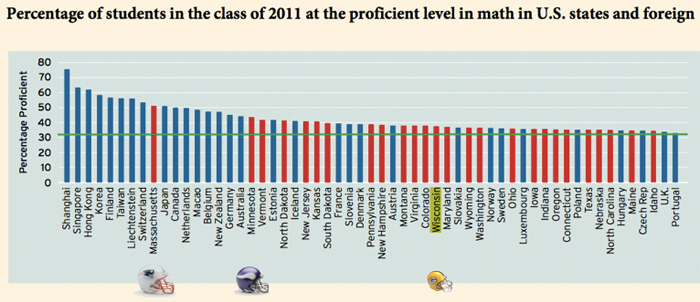
Related: A Capitol Conversation on Wisconsin’s Reading Challenges and Excellence in Education explains Florida’s reading reforms and compares Florida’s NAEP progress with Wisconsin’s at the July 29th Read to Lead task force meeting and www.wisconsin2.org.

Share

The DPI Hold on the Madison Prep Planning Grant: Yes, It Is a Big Deal

Madison School Board Member Ed Hughes:

III. The Sleeper Issue: A Collective Bargaining Agreement that Cannot Be Amended Even a Teeny, Tiny Bit
If this weren’t enough, there seems to be another legal issue. This is one that has not attracted much attention, but it seems to me to be a serious problem, at least over the short term.
The school district and Madison Teachers Inc (MTI) have a collective bargaining agreement (CBA) that governs terms and conditions of employment for teachers and other represented staff. The plans for Madison Prep calls for working conditions and terms of employment for the school’s teachers that differ in significant ways from what the CBA calls for. For example, Madison Prep plans to offer an extended school day and school year and plans to structure its pay for teachers in a different way.
In more normal times, it would be theoretically possible for the school district and MTI to enter into a memorandum of understanding (MOU) by which the parties agree to modify the terms of the CBA in some regards in order to accommodate Madison Prep’s plans.

Share

College Presidents Are Bullish on Online Education but Face a Skeptical Public

Jeffrey Young:

Delivering courses in cyberclassrooms has gained broad acceptance among top college leaders, but the general public is far less convinced of online education’s quality, according to new survey data released this week by the Pew Research Center, in association with The Chronicle.
Just over half of the 1,055 college presidents queried believe that online courses offer a value to students that equals a traditional classroom’s. By contrast, only 29 percent of 2,142 adult Americans thought online education measured up to traditional teaching. The presidents’ survey included leaders of two-year and four-year private, public, and for-profit colleges and was conducted online. The public survey was conducted by telephone.
The gauge of differing perceptions comes at a critical moment for online education. Just 10 years ago, few colleges took teaching onto the Internet, and skepticism about the practice was the norm among professors and university leaders.

Share

Indiana vouchers prompt thousands to change schools

Tom Coyne:

Weeks after Indiana began the nation’s broadest school voucher program, thousands of students have transferred from public to private schools, causing a spike in enrollment at some Catholic institutions that were only recently on the brink of closing for lack of pupils.
It’s a scenario public school advocates have long feared: Students fleeing local districts in large numbers, taking with them vital tax dollars that often end up at parochial schools. Opponents say the practice violates the separation of church and state.
In at least one district, public school principals have been pleading with parents not to move their children.
“The bottom line from our perspective is, when you cut through all the chaff, nobody can deny that public money is going to be taken from public schools, and they’re going to end up in private, mostly religious schools,” said Nate Schnellenberger, president of the Indiana State Teachers Association.

Share

Declining funding degrading quality

Katie Douglass:

In overwhelming numbers, Minnesota superintendents say the state education funding formula is broken and without changes education quality will diminish, according to Minnesota 2020’s latest survey of school administrators.
Download full report (pdf)
View online at Scribd
“To maintain a high level of academic achievement in a time of shrinking state funding, school districts have cut around the edges, but after nearly a decade of underfunding and recent delayed state payments, it’s getting difficult to keep cuts out of classrooms,” superintendents report in the survey sent to them at the end of the 2010-11 school year.

Share

Grading the Education Reformers

Richard Rothstein:

If you saw Waiting for “Superman,” Steven Brill’s tale in Class Warfare will be familiar. The founder of Court TV offers another polemic against teacher unions and a paean to self-styled “education reformers.” But even for those who follow education policy, he offers an eye-opening read that should not be missed. Where the movie evoked valiant underdogs waging an uphill battle against an ossified behemoth, Brill’s briskly written book exposes what critics of the reformers have long suspected but could never before prove: just how insular, coordinated, well-connected, and well-financed the reformers are. Class Warfare reveals their single-minded efforts to suppress any evidence that might challenge their mission to undermine the esteem in which most Americans held their public schools and teachers. These crusaders now are the establishment, as arrogant as any that preceded them.
Brill’s heroes make a high-profile gallery. They are public-school critics like former New York and Washington, D.C. schools chancellors Joel Klein and Michelle Rhee. They also include charter school operators David Levin (KIPP) and Eva Moskowitz (Harlem Success Academies), as well as alternative teacher and principal recruiters Wendy Kopp (Teach for America) and Jon Schnur (New Leaders for New Schools). Their ranks boast billionaires Bill Gates and Eli Broad, U.S. Education Secretary Arne Duncan and President Obama himself. And they don’t lack for savvy, richly endowed representation. Democrats for Education Reform, a lobbying, political action, and communications campaign rolled into one, has brought them all together. Lavishly supported by the newfound wealth of young Wall Street hedge fund managers answerable to no one, DFER’s troops have been working overtime to radically transform American public education.

Share

Wisconsin schools alter sick-leave plans

Erin Richards:

But when it comes to sick time for teachers who work around lots of kids known for having lots of germs, Forbes has cautioned districts to tread lightly and not make big changes if it’s not necessary to balance the budget.
The school districts of Hamilton and Elmbrook in Waukesha County both have modified their sick-time policies. Hamilton educators used to have about 20 sick days per year, and the new policy cuts that approximately in half, said Denise Dorn Lindberg, spokeswoman for the district.
Accrual reduction
Hamilton’s teaching staff members used to be able to accrue a maximum of 75 sick days over the course of their career; the new maximum is 30 days – time that can be used to cover extended recovery from illness or injury. But while the bank of days went down, it’s also been restructured to act more like a portable benefit, Lindberg said. For example, any unused leave acquired beyond 30 days can be converted to $125 per day and deposited in a teacher’s retirement account.

Share

26% Say U.S. Public Schools Provide World-Class Education

Rasmussen Reports:

While most adults agree with President Obama that a world-class education is the most important factor in the success of America’s children and status in the world, most don’t think U.S. public schools provide that level of education.
The latest Rasmussen Reports national telephone survey of American Adults shows that 61% agree with President Obama when he says “a world-class education is the single most important factor in determining not just whether our kids can compete for the best jobs but whether America can out-compete countries around the world.” Twenty-five percent (25%) disagree with that statement, while another 14% are undecided. (To see survey question wording, click here.)
However, only 26% believe U.S. public schools provide a world-class education. A majority (62%) does not think American public schooling provides that level of education, while another 12% are not sure.
The survey of 1,000 Adults was conducted on August 20-21, 2011 by Rasmussen Reports. The margin of sampling error is +/- 3 percentage points with a 95% level of confidence. Field work for all Rasmussen Reports surveys is conducted by Pulse Opinion Research, LLC. See methodology.

Share

Five big education ideas headed TN’s way

Julie Hubbard & Heidi Hall:

It’s rare to hear the word “education” from Tennessee’s leaders without “reform” coming after it.
Three years ago, the state began rewriting its curriculum and rethinking the way it dealt with educators. The resulting changes won Tennessee a half-billion-dollar federal grant to attempt to move students from among the lowest-achieving in the nation to the top of the pack.
The state is birthing charter schools at a brisk pace, from none seven years ago to 40 today and, some estimate, up to 20 per year moving forward.
Teachers will be judged routinely on their classroom performance and their students’ test scores. Individual districts are rolling out their own reforms, such as Williamson County’s invitation for students to bring their own technology and Metro Nashville’s dividing of high school students into specific areas of study called academies.

Share

Three Radical Ideas to Reform Education. Surprise. They Don’t Involve School Buildings

The Innovative Educator, via a kind James Dias email:

Earlier this year, I shared my disappointment with Fast Company’s compilation of “13 Radical Ideas for Spending $100 Million to Overhaul Schools” The problem was that these ideas really just weren’t all that radical. Even Will Richardson, who was featured in the article, commented on my blog that he agreed (see comment here). Richardson did feature a radical idea in his own blog a few years back in his post, One Town’s Reform…Close the Schools. The article explains how a UK community shut down its 11 schools replacing them with dynamic learning centers that looked very different than traditional compulsory schools. According to their site, they are still going strong.
The learning center idea has certainly taken off as more and more people are realizing that the compulsory, oppressive, disconnected, test-driven schools that exist today are not the best option when it comes to preparing children for success in the world.

Share

School Choice Is Here to Stay

Richard Komer:

The 2010 elections had many obvious effects, but one of the lesser-known is that they revived the school-choice movement in a big way. Although many education writers had assumed the movement was dead, there have been far more efforts to pass school-choice programs this year than ever and, more importantly, the success rate has gone up too.
This reflects the political nature of school choice, which has in modern times been promoted primarily by Republicans. Increasingly, however, Democrats, particularly minority Democrats, have begun bucking the wishes of the national teachers unions, which oppose school choice in any form.
School choice has even broken into the national consciousness with the success of such documentaries as “The Lottery” and “Waiting for ‘Superman.'” These focused on parents’ efforts to get their children into charter schools, which are public schools operated independently of their local school districts–and, not coincidentally, without teacher union involvement.
From the perspective of status quo supporters, charter schools are the least threatening form of school choice, because they remain public schools, meaning they cannot charge tuition and their admissions practices typically are controlled by lottery. This year has seen dramatic increases in interest in charter schools, as an alternative to regular public schools. Even the Obama administration got into the act, by making the removal of existing caps on the number of charter schools a component of states’ applications for federal “Race to the Top” funds.

Share

Science can lead to better (Wisconsin) readers

Marcia Henry, via a kind Chan Stroman-Roll email:

Fifteen years ago, Wisconsin fourth-graders placed third in the country in state rankings of reading ability known as the National Assessment of Educational Progress. By 2009, our fourth-graders’ scores plunged to 30th, with a third of the students reading below basic levels. The scores of minority youth were even bleaker, with 65% of African-American and 50% of Hispanic students scoring in the below-basic range.
As a member of Gov. Scott Walker’s blue ribbon reading task force, I am one of 14 people charged with reversing that drop. And, as a 50-year veteran educator, I have a partial solution. Let me spell it out for you: We need better teacher preparation.
How many of you remember your very best teachers? I remember Miss Hickey at Lincoln School and Miss Brauer at Folwell School in Rochester, Minn. They taught me to read.
I travel throughout the country consulting and providing staff development for school districts and literacy organizations. I’ve met thousands of dedicated teachers who tell me they are unprepared to teach struggling readers.
This situation is not the teachers’ fault. Some teachers in Wisconsin had only one course in reading instruction. Most were never exposed to the latest research regarding early reading acquisition and instruction. In contrast, several states require three or four classes in courses that contain the latest in science-based reading instruction.

Related: Wisconsin’s “Read to Lead” task force and “a Capitol Conversation” on reading.

Share

Arrests, citations reach lowest level in 10 years at Madison high schools

Matthew DeFour:

The number of arrests and citations for incidents at Madison’s four main high schools dropped last year to the lowest level in more than a decade, according to police data.
But arrests and citations at West and Memorial were twice the number at East and La Follette — a reversal of the situation 10 years earlier when there were more than twice as many at the city’s East Side high schools.
West was the only school with an increase from the previous year.
The Wisconsin State Journal obtained the data from the Madison Police Department amid a debate over whether the Madison School District should use drug-sniffing police dogs in random sweeps of high schools. The School Board was to consider the issue Monday but delayed a vote until late September — in part to review the arrest and citation data.
District officials say an increase in drug-related disciplinary referrals in recent years, and the use of drug dogs in area school districts, support the use of police dogs. Community surveys also have showed strong support.
Luis Yudice, the School District’s security coordinator, who introduced the drug-sniffing dog proposal with the support of Madison police, is concerned drugs in schools can lead to more gang activity, fights and weapons in schools as students arm themselves in self-defense. He views the police dog policy as a possible deterrent that could prevent a crisis.

Related: Madison police calls near local high schools: 1996-2006.
Gangs & School Violence Forum Audio/Video.

Share

Wisconsin Teachers face new employment landscape

Erin Richards:

Jeni Callan sits near the front of the school bus, listening and taking tidy notes on a legal pad.
It’s new teacher orientation day in the Hamilton School District, and the yellow bus carrying nearly 30 new hires for the 2011-’12 school year is winding through Waukesha County as the district’s spokeswoman shouts out the history of each passing school.
Callan, 26, is about to start her dream job as a language arts teacher at Templeton Middle School and knows that her good fortune is partially attributable to an unusually high number of retirements in Hamilton at the end of the school year.
But the job market has not been so kind to other young educators hunting for work, especially those lacking credentials to teach in specialty fields such as special education, math or physics.
“This is maybe the most unusual hiring climate for teachers that I’ve ever seen,” said Bill Henk, dean of Marquette University’s College of Education.

Share

It’s good to be the good guy: Teaching in Korea

Doug Lasken:

For a while now, I’ve had to get accustomed to the characterization of my 25-year teaching career with the Los Angeles Unified School District as a series of reprehensible acts on my part. As a teacher, I’ve been the bad guy.
First, over the 16 years I taught elementary, I wanted to teach immigrant children how to speak, read and write in English. Prior to 1997 when the passage of Propostion 227 mandated that immigrant children in California should learn English, my views were considered reactionary and contrary to the best interests of Hispanic children. I was told bluntly that by refusing to teach exclusively in Spanish I was destroying the children’s chances of success. One coordinator told me I was perpetuating “English as King.” “No,” I countered, “English is the common language of most of the world,” but this was a non-starter in such circles.

Share

Is NEA Following the Path of the Industrial Unions?

Mike Antonucci:

The National Education Association has always been an outlier in the world of organized labor. A member of neither the AFL-CIO nor Change to Win, the union experienced consistent and substantial growth during the same decades industrial union membership was disintegrating.
The last couple of years have provided the first opportunity to observe NEA’s actions during a period of declining membership. It appears the teachers’ union is following the AFL-CIO model for remaining relevant despite dwindling numbers – accelerated political action.
One of the constant internal battles in the labor movement has been over organizing vs. political action. Do you devote resources to growing membership in order to increase political clout, or do you increase political contributions in order to establish a friendly organizing environment? Although there have been fits and starts in both directions, overall the latter choice prevailed.

Share

Where GOP stands in war on Wisconsin Education ‘triangle’

Alan Borsuk:a

The start of the school year isn’t normally the time for issuing report cards. But it’s been an unusual and momentous year, so as the first day of classes approaches for almost every school in the state, here’s a report card on what I’ll call the war against the triangle.
Last winter, before Scott Walker was sworn in as governor, a leading Republican told a group of people (according to a reliable person who was present) that there was a triangle that was blocking the path to educational improvement in Wisconsin and his party was going to take out each leg of the triangle.
What were the legs?
Teachers unions, particularly the Wisconsin Education Association Council. WEAC spent hugely on political campaigns and was pro-Democratic. It also was the largest lobbying force in the Capitol. WEAC represented the unwillingness of teachers organizations to change and the need to get rid of most collective bargaining matters.
The state Department of Public Instruction, which represented the status quo, overregulation of schools and how things couldn’t change if they were in the hands of government bureaucrats.
Milwaukee Public Schools, which represented – well, which represented Milwaukee Public Schools. Or, to put it another way, a money pit where there was never any positive change.

Share

Breakthrough

TEACHERS NOT ENOUGH? WHO KNEW?
This situation will persist as long as those funding programs and projects for reform in education pay no attention to the actual academic work of our students…
It is settled wisdom among Funderpundits and those to whom they give their grants that the most important variable in student academic achievement is teacher quality.
However, a small number of dissenting voices have begun to speak. Richard Arum and Josipa Roksa, in Academically Adrift have suggested that (p. 131) “Studying is crucial for strong academic performance…” and “Scholarship on teaching and learning has burgeoned over the past several decades and has emphasized the importance of shifting attention from faculty teaching to student learning…”
This may seem unacceptably heterodox to those in government and the private sector who have committed billions of dollars to focusing on the selection, training, supervision, and control of K-12 teachers, while giving no thought to whether K-12 students are actually doing the academic work which they are assigned.
In 2004, Paul A. Zoch, a teacher from Texas, wrote in Domed to Fail (p. 150) that: “Let there be no doubt about it: the United States looks to its teachers and their efforts, but not to its students and their efforts, for success in education.” More recently, and less on the fringe of this new concern, Diane Ravitch wrote in Death and Life of the Great American School System (2010) (p. 162) that “One problem with test-based accountability, as currently defined and used, is that it removes all responsibility from students and their families for the students’ academic performance. NCLB neglected to acknowledge that students share in the responsibility for their academic performance and that they are not merely passive recipients of their teachers’ influence.”
There are necessarily problems in turning attention toward the work of students in judging the effectiveness of schools. First, all the present attention is on teachers, and it is not easy to turn that around. Second, teachers are employees and can be fired, while students can not. It could not be comfortable for the Funderpundits and their beneficiaries to realize that they may have been overlooking the most important variable in student academic achievement all this time.
In February, when the Associated Press reported that Natalie Monroe, a high school English teacher in Pennsylvania, had called her students, on a blog, “disengaged, lazy whiners,” and “noisy, crazy, sloppy, lazy LOAFERS,” the response of the school system was not to look more closely at the academic efforts of the students, but to suspend the teacher. As one of her students explained, “As far as motivated high school students, she’s completely correct. High school kids don’t want to do anything…(but) It’s a teacher’s job…to give students the motivation to learn.”
It would seem that no matter who points out that “You can lead a student to learning, but you can’t make him drink,” our system of schools and Funderpundits sticks with its wisdom that teachers alone are responsible for student academic achievement.
While that is wrong, it is also stupid. Alfred North Whitehead (or someone else) once wrote that; “For education, a man’s books and teachers are but a help, the real work is his.”
As in the old story about the drunk searching under the lamppost for his keys, those who control funds for education believe that as long as all their money goes to paying attention to what teachers are doing, who they are, how they are trained, and so on, they can’t see the point of looking in the darkness at those who have the complete and ultimate control over how much academic achievement there will be–namely the students.
Apart from scores on math and reading tests after all, student academic work is ignored by all those interested in paying to change the schools. What students do in literature, Latin, chemistry, history, and Asian history classes is of no interest to them. Liberal education is not only on the back burner for those focused on basic skills and job readiness as they define them, but that burner is also turned off at present.
This situation will persist as long as those funding programs and projects for reform in education pay no attention to the actual academic work of our students. And students, who see little or no pressure to be other than “disengaged lazy whiners” will continue to pay the price for their lack of education, both in college and at work, and we will continue to draw behind in comparison with those countries who realize that student academic achievement has always been, and will always be, mainly dependent on diligent student academic work.
——————————
“Teach by Example”
Will Fitzhugh [founder]
The Concord Review [1987]
Ralph Waldo Emerson Prizes [1995]
National Writing Board [1998]
TCR Institute [2002]
730 Boston Post Road, Suite 24
Sudbury, Massachusetts 01776-3371 USA
978-443-0022; 800-331-5007
www.tcr.org; fitzhugh@tcr.org
Varsity Academics(r)
www.tcr.org/blog

Share

New Site Brazenly Trades Pirated E-Textbooks

Jeff Young:

Textbook pirates have struck again. Nearly three years after publishers shut down a large Web site devoted to illegally trading e-textbooks, a copycat site has sprung up–with its leaders arguing that it is operating overseas in a way that will be more difficult to stop.
The new site, LibraryPirate, quietly started operating last year, but it began a public-relations blitz last week, sending letters to the editor to several news sites, including The Chronicle, in which it called on students to make digital scans of their printed textbooks and post them to the site for free online.
Such online trading violates copyright law, but some people have apparently been adding pirated versions of e-textbooks to the site’s directory. The site now boasts 1,700 textbooks, organized and searchable. Downloading the textbooks requires a peer-to-peer system called BitTorrent, and the LibraryPirate site hosts a step-by-step guide to using it.

Share

A Capitol Conversation on Wisconsin’s Reading Challenges

UW-Madison Professor Mark Seidenberg and I had an informative conversation with two elected officials at the Capitol recently.
I am thankful for Mark’s time and the fact that both Luther Olsen and Steve Kestell along with staff members took the time to meet. I also met recently with Brett Hulsey and hope to meet with more elected officials, from both parties.
The topic du jour was education, specifically the Governor’s Read to Lead task force.
Mark kindly shared this handout:

My name is Mark Seidenberg, Hilldale Professor and Donald O. Hebb Professor, Department of Psychology, University of Wisconsin-Madison, seidenberg@wisc.edu, http://lcnl.wisc.edu. I have studied how reading works, how children learn to read, reading disabilities, and the brain bases of reading for over 30 years. I am a co-author of a forthcoming report from the National Research Council (National Academy of Sciences) on low literacy among older adolescents and adults. I’m writing a general audience book about reading research and educational practices.
We have a literacy problem: about 30% of the US (and WI) population reads at a “basic” or “below basic” level. Literacy levels are particularly low among poor and minority individuals. The identification of this problem does not rest on any single test (e.g., NAEP, WKCE, OECD). Our literacy problem arises from many causes, some of which are not easy to address by legislative fiat. However, far more could be done in several important areas.
1. How teachers are taught. In Wisconsin as in much of the US, prospective teachers are not exposed to modern research on how children develop, learn, and think. Instead, they are immersed in the views of educational theorists such as Lev Vygotsky (d. 1934) and John Dewey (d. 1952). Talented, highly motivated prospective teachers are socialized into beliefs about children that are not informed by the past 50 years of basic research in cognitive science and cognitive neuroscience.
A vast amount is known about reading in particular, ranging from what your eyes do while reading to how people comprehend documents to what causes reading disabilities. However, there is a gulf between Education and Science, and so this research is largely ignored in teacher training and curriculum development.
2. How children are taught. There continue to be fruitless battles over how beginning readers should be taught, and how to insure that comprehension skills continue to develop through middle and high school. Teachers rely on outdated beliefs about how children learn, and how reading works. As a result, for many children, learning to read is harder than it should be. We lose many children because of how they are taught. This problem does NOT arise from “bad teachers”; there is a general, systematic problem related to teacher education and training in the US.
3. Identification of children at risk for reading failures. Some children are at risk for reading and school failure because of developmental conditions that interfere with learning to read. Such children can be identified at young ages (preschool, kindergarten) using relatively simple behavioral measures. They can also be helped by effective early interventions that target basic components of reading such as vocabulary and letter-sound knowledge. The 30% of the US population that cannot read adequately includes a large number of individuals whose reading/learning impairments were undiagnosed and untreated.
Recommendations: Improve teacher education. Mechanism: change the certification requirements for new teachers, as has been done in several other states. Certification exams must reflect the kinds of knowledge that teachers need, including relevant research findings from cognitive science and neuroscience. Instruction in these areas would then need to be provided by schools of education or via other channels. In-service training courses could be provided for current teachers (e.g., as on-line courses).
Children who are at risk for reading and schooling failures must be identified and supported at young ages. Although it is difficult to definitively confirm a reading/learning disability in children at young ages (e.g., 4-6) using behavioral, neuroimaging, or genetic measures, it is possible to identify children at risk, most of whom will develop reading difficulties unless intervention occurs, via screening that involves simple tests of pre-reading skills and spoken language plus other indicators. Few children just “grow out of” reading impairments; active intervention is required.

I am cautiously optimistic that we may see an improvement in Wisconsin’s K-12 curricular standards.
Related: Excellence in Education explains Florida’s reading reforms and compares Florida’s NAEP progress with Wisconsin’s at the July 29th Read to Lead task force meeting and www.wisconsin2.org.

Share

Our Response to State Education Department’s Hold on Madison Prep Grant

Kaleem Caire, via email

Dear Friends & Colleagues,
In the last 48 hours, local media has been abuzz about the Wisconsin Department of Public Instruction’s decision to put a hold on our charter school planning grant. The grant application was formally endorsed in March 2011 by the Board of Education of the Madison Metropolitan School District.
Last week, DPI officials contacted us to request that our team and the leadership of the Madison Metropolitan School District meet with them to discuss how we intend to address issues related to (a) the 1972 Title IX Education Amendments to the Civil Rights Act of 1964 and (b) new federal Title IX regulations on the establishment of single sex classes, extracurricular activities and schools that took effect in 2006. This meeting has been scheduled.
DPI has publicly stated that it is not uncommon for grant awards to be delayed for various reasons. In our case, DPI wants to ensure that all parties – MMSD, DPI and the Urban League of Greater Madison – are on the same page with regard to how Madison Prep will comply with federal and state statutes relative to single sex public schools. We welcome this conversation. MMSD and the Urban League have been working together on this issue since June.
Single Sex Public Schools are Growing in the U.S.
According to the National Association for Single Sex Public Education, there are presently 116 single sex public schools in the United States. The number of single sex public schools continues to grow each year. For example, the Houston (Texas) Independent School District’s Board of Education recently approved an all boys and later an all girls college preparatory academy for students in grades 6 – 12. Both campuses opened this week.
There are also public charter schools such as Bluford Drew Jemison S.T.E.M Academy for boys in Baltimore, Maryland that was approved by the Board of Education of Baltimore City Public Schools without approving a similar school for girls at the same time. Bluford Drew Jameson is part of BCPS’ bold and aggressive Charter, Innovative and Transformation Schools Plan to revitalize public education in the city. BCPS’ efforts are being heralded nationally as they are seeing clear signs of turning around.
With Confidence, Precedent and Support, We Will Succeed
Given the successful growth of single sex public/charter schools across the country, along with our plans to comply with the new Title IX regulations and our publicly stated commitment to establish the 6-12 grade Madison Preparatory Academy for Young Women, we are confident that the issues raised by DPI will be resolved.
With your support and that of DPI and MMSD, Madison Prep will soon provide a long overdue solution to a deeply rooted pattern of academic failure and under-performance, particularly among African American and Latino boys in our community. It will also serve as a learning laboratory that informs the programs, strategies and practices of schools and educators across Greater Madison and the State of Wisconsin.
We look forward to Madison Prep producing hundreds of confident, excited and future-focused young men who are ready for college and committed to promoting the schools values – leadership, excellence, pride and service – in their community, homes, peer groups and daily lives.
Visit the website and sign our petition below.
Madison Prep 2012: Empowering Young Men for Life!

IB interviewed Kaleem a few weeks ago.
Much more on Kaleem Caire and the proposed Madison Preparatory Academy IB charter school, here.

Share

Evidence Supports Charter Autonomy from Milwaukee Public Schools Milwaukee’s Non-Instrumentality Charter Schools Outperform MPS on ACT

Christian D’Andrea:

There are two different types of charter schools in the City of Milwaukee, and by at least one measure, those not chartered by the Milwaukee Public Schools are performing better.
Milwaukee’s ACT scores rose in 2011, but they still weren’t able to match the production of the city’s non-union charter schools. In the end, the non-district charter schools left their instrumentality counterparts in the dust when it came to college readiness.
The city’s non-instrumentality charter schools outperformed the MPS average when it came to the ACT, a selective college readiness test, in the past school year. These schools aren’t operated or authorized by local school boards, and have been more successful in preparing students when weighed against the city’s average. In the four qualifying high schools, students averaged a score of 18.8.

Share

Chileans Strike for Education Reform

Voice of America:

Protesters have barricaded streets and burned tires in Chile’s capital, Santiago, amid a 48-hour strike to press for education reform.
Police and protesters clashed Wednesday, as the government tried to shut down demonstrations in some parts of the city.
Reports from Santiago say business in most parts of the city was un-interrupted, with public transportation continuing to function and traffic flowing through most streets.
The strike was called by Chile’s main labor union, CUT, in support of students who have been protesting for weeks for education reform and an overhaul of educational funding. In addition, strike organizers have called for tax reform and constitutional change.

Share

Don’t let Walker take credit for teachers’ good work

Nick Zweifel:

Now that Gov. Scott Walker’s major cuts for public schools have been enacted, my question for my fellow educators is: What do we do next? I am sick and tired of constantly reacting to bad news and bad policy and always being in the position of having to play defense. Educators and school districts should organize to go on the offensive.
Walker’s budget has significantly damaged one of the best public education systems in the country. He turned half of our community members against us using false information, and now we will be fighting a public relations battle while also working harder to educate students with fewer resources.
Through all of this, we Wisconsin educators will still stand tall and deliver a top-notch education for the children of this state, regardless of what Walker has done, because that is what Wisconsin professional educators do.
My fear is that after we deliver, Walker and his minions will use the media and their bully pulpit to take all the credit for the successes that we will achieve in our classrooms. I can see the headlines now of Walker proclaiming how well his budget cuts worked because schools are performing well under his budget.
So what do we do? What should our strategy be? Here are some suggestions:

Share

Grade Inflation for Education Majors and Low Standards for Teachers When Everyone Makes the Grade

Cory Koedel

Students who take education classes at universities receive significantly higher grades than students who take classes in every other academic discipline. The higher grades cannot be explained by observable differences in student quality between education majors and other students, nor can they be explained by the fact that education classes are typically smaller than classes in other academic departments. The remaining reasonable explanation is that the higher grades in education classes are the result of low grading standards. These low grading standards likely will negatively affect the accumulation of skills for prospective teachers during university training. More generally, they contribute to a larger culture of low standards for educators.
Key points in this Outlook:
Grades awarded in university education departments are consistently higher than grades in other disciplines.
Similarly, teachers in K-12 schools receive overwhelmingly positive evaluations.
Grade inflation in education departments should be addressed through administrative directives or external accountability in K-12 schools.

When A Stands for Average: Students at the UW-Madison School of Education Receive Sky-High Grades. How Smart is That?

Share

Q&A with Christensen and Eyring on their new book: “The Innovative University”

Forbes:

Could you give our readers a short crash course to the main ideas of your book?
“The Innovative University” makes the case that a “disruptive” technology, online learning, is bringing fundamental change to higher education. Traditional universities and colleges are vulnerable because their model of education was already becoming too expensive for many students. Most young students will continue to want the campus-based learning experience, but they will expect to pay less and to enjoy a combination of face-to-face and online instruction. Institutions that don’t provide a hybrid will see declining enrollments. Most institutions will also have to focus more narrowly on student instruction, rather than emulating the large research universities, such as Harvard. Making these changes will be hard, given the strength of higher education tradition and the autonomy of faculty members. However, we believe that it can be done.

Share

Chicago Public Schools begins move to extend school day

Noreen S. Ahmed-Ullah:

Chicago Public Schools today launched their plans to extend students’ time in the classroom by 90 minutes each and by two weeks each year and set up an advisory committee to figure out how it’ll be done.
However, Chicago Teachers Union President Karen Lewis said she would decline an invitation to serve on the committee, saying in a written statement that, “this news has nothing do with helping our children and everything to do with politicizing a real serious problem.”
Mayor Rahm Emanuel began pushing for a longer school day while he was on the campaign trail, saying Chicago’s school day is the shortest in the nation when compared to public school systems in nine other large cities. School reform legislation passed in June allows the district to implement a longer school day in the fall of 2012 with or without the union’s agreement, and CPS officials have said they would do that.

Share

After Words with Steven Brill

C-Span:

The founder of The American Lawyer magazine and Court TV tells the story of a coalition of unlikely allies in the fight to change a school system that many parents believe is failing the nation’s children. He debated education solutions with former Assistant Secretary of Education Diane Ravitch.

Share

Wisconsin Reading program plans questioned Concerns raised about DPI’s approach to developing a model curriculum

Amy Hetzner:

So far, this has been the summer of education task forces in Wisconsin.
There’s one addressing school accountability, another tackling how to help school districts implement new academic standards and a third devoted to improving third-grade reading proficiency. That doesn’t even count other groups already in existence that are looking at reforming statewide tests or increasing teacher effectiveness.
“There’s so many work groups and task forces operating right now, it’s hard to keep track of them,” said state Rep. Steve Kestell (R-Elkhart Lake), chairman of the Assembly Education Committee and a member of some of those task forces.
Keeping all of the task forces on track may also prove difficult.
Earlier this month, a member of the group charged with helping school districts implement new reading standards sent an open letter to members of the governor’s Read to Lead Task Force expressing concerns about the approach that the state Department of Public Instruction was taking in developing a model reading curriculum. That letter was followed by another that recommended specific approaches that the task force should take. Dan Gustafson, a Madison-based pediatric neuropsychologist, said he wrote the letters because he was concerned that the DPI was moving ahead with a model reading curriculum without input from differing viewpoints on reading instruction.

Share

The Secret Language Code

Gareth Cook:

Are there hidden messages in your emails? Yes, and in everything you write or say, according to James Pennebaker, chair of the department of psychology at the University of Texas at Austin. Pennebaker has been a leader in the computer analysis of texts for their psychological content. And in his new book, “The Secret Life of Pronouns,” he argues that how we use words like “I,” “she,” and “who” reveal secrets of our psychology. He spoke recently with Mind Matters editor Gareth Cook.
COOK: How did you become interested in pronouns?
PENNEBAKER: A complete and total accident. Until recently, I never thought about parts of speech. However, about ten years ago I stumbled on some findings that caught my attention. In the 1980s, my students and I discovered that if people were asked to write about emotional upheavals, their physical health improved. Apparently, putting emotional experiences into language changed the ways people thought about their upheavals. In an attempt to better understand the power of writing, we developed a computerized text analysis program to determine how language use might predict later health improvements. In other words, I wanted to find if there was a healthy way to write.

Share

Wisconsin DPI announces $6 million for charter school planning and dissemination grants; Proposed IB Madison Preparatory Academy Charter School Not Funded

Wisconsin Department of Public Instruction, via a kind reader’s email:

Groups planning new charter schools and established charter schools that want to replicate their success are sharing $6 million in federal charter school grants.
Planning grants total $4.5 million and will go for planning activities in 23 charter schools that have already been approved by their local school board or authorizing authority. Five of those grants are going to districts that do not currently have charter schools. Five grants, totaling $625,000, will support the expansion of successful charter school models. Another seven grants, totaling $875,000, will help charter schools that are in the second year dissemination activities.
“Planning grant proposals in this round of funding are for a mix of innovative charter schools,” said State Superintendent Tony Evers. “This is just what the charter school law promotes: local solutions to serve students and their families.”

Matthew DeFour has more.

Share

Why unions are livid about L.A.’s new teacher-evaluation experiment

Daniel Wood

After years of frustration with its own teacher-evaluation system, the second-largest school district in the country is pilot-testing a new idea against the wishes of its union.
With the Obama administration offering incentives for school systems to revamp how they evaluate teachers’ effectiveness, the episode with the Los Angeles Unified School District (LAUSD) carries important lessons nationwide, analysts say.
The fresh approach in Los Angeles meshes with the Obama administration’s efforts to use more systematic and data-driven approaches to evaluate teachers. It includes parent and student feedback, students’ standardized test scores, and more detailed observations given by peers – who watch teachers and then type their observations and questions into laptop computers, then discuss their impressions the next day.

Share

WEAC head Mary Bell stands up to Gov. Scott Walker with sometimes controversial tactics

Roger Bybee:

Mary Bell, president of the Wisconsin Education Association Council, is quiet and thoughtful in one-on-one conversations. She’s a middle-aged, cheery, bespectacled woman whose dimpled face is surrounded by a thick corona of whitish-gray hair.
But when fighting for her members, Bell forcefully projects her belief in teachers’ right to respect, decent pay and union representation. At a rally with tens of thousands at the Capitol on a snowy, bitter Feb. 26, Bell expressed outrage at Gov. Scott Walker’s proposals for the near-total stripping of union rights for teachers, librarians, highway workers, prison guards and other public workers across the state. Yet her anger was tempered by her humor and her belief in Wisconsinites’ fundamental commitment to fairness and public education.
The rhetoric Mary Bell used that day about “Wisconsin values” was no stretch for her, because she perceives herself as a typical Wisconsinite, sharply different from the image of the insular Madison insider, as Walker likes to portray his enemies.

Share

Not a Verb…..

notaverb.com

This site is dedicated to informing people about words that are not verbs, even though people misuse them that way. You have to pick one of the non-verbs about which this site knows:

Share

Charter management group just might help Milwaukee schools

Alan Borsuk:

First, a lesson from baseball: It was roughly a year ago that Brewers fans were wringing their hands that the pitching was bad and there was little prospect for fixing that in the off-season, given a weak free agent scene and limited finances. Now, the Brewers have pitching that is basically amazing.
Sometimes, things do improve dramatically. Sometimes, that happens even when there are sound arguments for why they won’t.
I could write this entire column – if not a book – on why I’m pessimistic about things getting a lot better on the Milwaukee education scene. I would present a pretty sound case, too.
Maybe I’m wrong. In fact, I hope I’m wrong. I’d like to see things take off like a rocket ship.

Share

Minn. ed commissioner wants ACT to be an even higher-stakes test

Tom Weber:

The state’s education commissioner says she’s exploring ways to make the ACT college entrance exam even higher-stakes for Minnesota students than it already is.
Wednesday’s release of ACT scores shows 72 percent of Minnesota high school graduates took the test. No state with that much participation scored higher. But 72 percent isn’t enough for Education Commissioner Brenda Cassellius, especially considering there are waivers available so students can take the test for free.
The problem, she said, is not enough students realize how crucial the ACT is.
“There are so many tests that they’re taking; they don’t know which is the important test,” Cassellius said. “We want to have a test that actually measures their career and college readiness.”

Share

The Age of Noise

Dmitry Fadeyev:

The twentieth century is, among other things, the Age of Noise. Physical noise, mental noise and noise of desire–we hold history’s record for all of them. And no wonder; for all the resources of our almost miraculous technology have been thrown into the current assault against silence.

Aldous Huxley, The Perennial Philosophy
Huxley is talking about the radio and the newspaper, the carriers of noise at the start of the 20th century, but his words could just as well have been written today. Today, silence is a thing to be shunned, with the social ecosystem of apps and devices ready to help you do just that.

Share

Should My Kid Learn Mandarin Chinese?

Tom Scocca:

I started to truly appreciate the power of early childhood Chinese-language education when our son, at the age of two, started speaking English wrong. “The blue of cup,” he would say, meaning his blue cup.
This wasn’t a random preschool linguistic hiccup, we realized. He was trying to use Chinese syntax: “of” was standing in for the Mandarin particle “de” to turn the noun “blue” into an adjective. And his odd habit of indicating things by saying “this one” or “that one”-he was rendering the Chinese “zhege” and “neige” in English. That is, he was speaking Chinglish.
The usual arguments in favor of Mandarin education say that he should be on his way to conquering the world. An extra language, the theory goes, supplies extra brainpower, and Chinese in particular is a skill that will prepare young children to compete in the global 21st-century marketplace of talent.

Share

Why Public Schools Need Less Regulation

Michael Horn:

Picture the following scenario. You ask your friend to come up with a creative meal that will amaze your guests at a dinner party you are holding, but you impose some constraints. Your friend can only use the ingredients from a restrictive list and must follow the specific directions from a meal you cooked these same guests just weeks earlier.
What are the odds that your friend makes something innovative? Not good. After all, you’ve practically defined the solution by specifying nearly all of its inputs before she can even consider what she might cook.
A far better way to generate an innovative solution is to define the outcome you need — a five-course meal for eight — and then allow your friend to figure out the best way to get there.

Share

The Power of Academic Blogs

Kim Krawiec:

I wanted to follow up on the very clever study by David McKenzie and Berk Ozler about blogging impact that I mentioned yesterday. The authors also employ several methods to gauge the impact of blogging on the academic reputation of the blogger and of her institution, and on attitudes of readers. The authors conclude:

Share

Kids, Privacy, Free Speech & the Internet

Adam Thierer:

In the field of Internet policy, 2011 has been the year of privacy. Congress has introduced six bills related to online privacy, and the Obama administration released two major reports recommending greater federal oversight of online markets. The Federal Trade Commission (FTC) appears poised to step up regulatory activity on this front. State-level activity is also percolating, led by California, which floated two major bills recently.
These efforts would expand regulatory oversight of online activities in various ways. Some measures would institute “Fair Information Practice Principles” (FIPPS), governing the collection and use of personal information online. Others would limit some types data collection, ban certain data or advertising practices, or create new mechanisms to help consumers block online ad-targeting techniques. Another measure would mandate websites adopt a so-called Internet “Eraser Button,” which would allow users to purge unwanted personal information from online sites and services.

Share

Madison teachers union files lawsuit challenging constitutionality of collective bargaining law

Ed Treleven:

Unions representing Madison teachers and Milwaukee sanitation workers sued Gov. Scott Walker on Thursday, alleging that the controversial law severely restricting the collective bargaining rights of most public workers in Wisconsin is unconstitutional.
The lawsuit, brought by Madison Teachers Inc. and AFL-CIO Local 61 in Milwaukee alleges that the state legislature passed what was originally called the budget repair bill in violation of the state constitution’s provision that governs special legislative sessions.
The lawsuit also alleges that the law places severe and unfair restrictions on what unions and their members can discuss with municipalities and school districts, and imposes severe wage increase limits that don’t apply to nonunion workers.

Share

Globally Challenged: Wisconsin Lags 12 States & Numerous Countries in Math Proficiency


Paul E Peterson, Ludger Woessmann, Eric A. Hanushek, Carlos X. Lastra-Anadon, via a Chan Stroman email:

Given recent school-related political conflicts in Wisconsin, it is of interest that only 42 percent of that state’s white students are proficient in math, a rate no better than the national average.
At a time of persistent unemployment, especially among the less skilled, many wonder whether our schools are adequately preparing students for the 21st-century global economy. This is the second study of student achievement in global perspective prepared under the auspices of Harvard’s Program on Education Policy and Governance (PEPG).
In the 2010 PEPG report, “U.S. Math Performance in Global Perspective,” the focus was on the percentage of U.S. public and private school students performing at the advanced level in mathematics.1 The current study continues this work by reporting the percentage of public and private school students identified as at or above the proficient level (a considerably lower standard of performance than the advanced level) in mathematics and reading for the most recent cohort for which data are available, the high-school graduating Class of 2011.
Proficiency in Mathematics
U.S. students in the Class of 2011, with a 32 percent proficiency rate in mathematics, came in 32nd among the nations that participated in PISA. Although performance levels among the countries ranked 23rd to 31st are not significantly different from that of the United States, 22 countries do significantly outperform the United States in the share of students reaching the proficient level in math.
In six countries plus Shanghai and Hong Kong, a majority of students performed at the proficient level, while in the United States less than one-third did. For example, 58 percent of Korean students and 56 percent of Finnish students were proficient. Other countries in which a majority–or near majority–of students performed at or above the proficient level included Switzerland, Japan, Canada, and the Netherlands. Many other nations also had math proficiency rates well above that of the United States, including Germany (45 percent), Australia (44 percent), and France (39 percent).

Much more at www.wisconsin2.org.

Share

ACT Trends: National, Wisconsin, Madison

Jeff Henriques, via email.

Many notes and links, here.

Share

Senate Hearing on College Readiness (Imaginary)

on the 17th of never, 2011
Senator, please allow me to express my thanks for including me in these vital hearings on the readiness of our high school graduates for college work.
It would be my sad duty to report to you that if high school football coaches no longer ask their athletes to learn to block and tackle, that would fail to prepare them for college teams. Oh–wait, Senator, that is not correct. (Shuffles papers, starts over).
It would be my sad duty to report that if our high school basketball coaches no longer taught their athletes to dribble, pass, and shoot baskets, then they too would fail at basketball in college.
Oh–my apologies, Senator, that is not my testimony–just a little bad joke. Of course our high school coaches take athletics much too seriously to allow that sort of thing to happen to our kids. In fact, The Boston Globe has more than 100 pages a year on high school athletes. No, Senator, there is no coverage for high school academic achievement.
But I am sorry to have to report that our History and English teachers at the high school level no longer ask our students to read complete nonfiction books or to write substantial research papers, and naturally, this unfits them for the nonfiction books they will be asked to read and the substantial research papers they will be asked to write at the postsecondary level, in what we might call Upper Education.
The famous and influential American educator, John Dewey, wrote in 1896 that: “The centrality of reading and writing was ‘one of education’s great mistakes.'” In following in his footsteps, many of our educators have pushed academic reading and writing so far to the periphery of the curriculum that, for too many of our high school students, they might just as well have fallen off the edge of the flat earth of American secondary education.
The California State College System recently reported that 47% of their Freshmen were required to take remedial reading courses. Of course they can’t handle nonfiction books as they have never been assigned one in their whole high school career.
I have had the privilege of publishing 956 serious (average 6,000 words) history research papers by secondary students from all over this country and from 38 other countries, and I have formed the opinion in the process that high school students are fully capable of reading complete nonfiction books and of writing serious research papers.
But it should be no surprise that so long as our educators never assign nonfiction books or ask students for research papers, they will continue to believe that their students may be able somehow to manage Calculus, European history, Latin, Chemistry, British Literature and the like, but they must still not be able, for some unexplained reason, to read a history book or write a real term paper.
While our colleges do complain, persistently, about the poor preparation in reading and writing of the students who come to them, what do they do in setting requirements for admission?
Senator, hard as it may be to believe, all the writing that colleges ask for is a 500-word “college” essay about the life of the applicant. It is hard to conceive of a more nonacademic task than that, or one more likely to retard the assignment of serious reading and writing at the high school level.
When we celebrate athletes and ignore scholars in our high schools, and when we set such low standards for the high school diploma and for college admission, we should not be surprised that more than one million of our high school graduates need to be in remedial courses when they get to college every year, and that more than half of those will never graduate.
Yes, Senator, I believe that until we take reading and writing more seriously at the secondary level, we can continue to push more and more students into college, but more and more of them will be sadly unprepared to take advantage of that academic opportunities there, and more and more of them will drop out before they graduate from college.
Thanks again for the opportunity to discuss these problems.
===============
“Teach by Example”
Will Fitzhugh [founder]
The Concord Review [1987]
Ralph Waldo Emerson Prizes [1995]
National Writing Board [1998]
TCR Institute [2002]
730 Boston Post Road, Suite 24
Sudbury, Massachusetts 01776-3371 USA
978-443-0022; 800-331-5007
www.tcr.org; fitzhugh@tcr.org
Varsity Academics®
www.tcr.org/blog

Share

ACT Scores Decline Somewhat in Madison, Wisconsin Slightly Up, 32% of Badger Students “Ready” for College Level Courses in 4 Areas

Matthew DeFour:

The average ACT score among the Madison School District’s 2011 graduates dipped to its lowest level in 15 years, while the gap between white and minority student scores shrank for the first time in five years.
Though Madison’s average score dipped from 24.2 to 23.9, district students still outperformed the state average of 22.2 and national average of 21.1. A perfect score on the college entrance exam is 36.
Madison’s average scores in recent years have ranged from 23.5 in 1995 to 24.6 in 2007. The average score was also 23.9 in 2003.

Amy Hetzner:

With the highest percent of students taking the ACT in state history, Wisconsin’s Class of 2011 posted an average score slightly above that from the previous year’s graduates and maintained the state’s third-place ranking among states in which the test is widespread.
Seventy-one percent of the 2011 graduates from Wisconsin private and public schools took the college admissions test, averaging a 22.2 composite score on the 36-point test, according to information to be publicly released Wednesday. The nationwide average was 21.1 on the ACT Assessment, which includes tests in English, reading, mathematics and science.
State schools superintendent Tony Evers credited the results to more high school students pursuing more demanding coursework.
“The message of using high school as preparation for college and careers is taking hold with our students,” Evers said in a news release. “Nearly three-quarters of our kids said they took the rigorous classes recommended for college entry, up from just over half five years ago.”
Even so, ACT reported that only 32% of Wisconsin’s recently graduated seniors had test results that showed they were ready for college-level courses in all four areas. Results for individual subjects ranged from 39% readiness in science to 75% in English.

A few somewhat related links:

Ruth Robarts:

When all third graders read at grade level or beyond by the end of the year, the achievement gap will be closed…and not before.
On November 7 (2005), Superintendent Art Rainwater made his annual report to the Board of Education on progress toward meeting the district’s student achievement goal in reading. As he did last fall, the superintendent made some interesting claims about the district’s success in closing the academic achievement gap “based on race”.
According to Mr. Rainwater, the place to look for evidence of a closing achievement gap is the comparison of the percentage of African American third graders who score at the lowest level of performance on statewide tests and the percentage of other racial groups scoring at that level. He says that, after accounting for income differences, there is no gap associated with race at the lowest level of achievement in reading. He made the same claim last year, telling the Wisconsin State Journal on September 24, 2004, “for those kids for whom an ability to read would prevent them from being successful, we’ve reduced that percentage very substantially, and basically, for all practical purposes, closed the gap”. Last Monday, he stated that the gap between percentages scoring at the lowest level “is the original gap” that the board set out to close.
Unfortunately, that is not the achievement gap that the board aimed to close.

“Penelope Trunk”: (Adrienne Roston, Adrienne Greenheart(

10. Homeschool. Your kids will be screwed if you don't.
The world will not look kindly on people who put their kids into public school. We all know that learning is best when it's customized to the child and we all know that public schools are not able to do that effectively. And the truly game-changing private schools cost $40,000 a year.

Notes and links on the recent, successful Madison Talented & Gifted parent complaint.

Share

Michigan accreditation system ‘no longer has relevance’

Dave Murray:

Michigan’s school accreditation system “no longer has relevance” state educators say, as every school in the state has met state criteria despite sliding backward on federal testing goals.
The state Education Department released announced Monday that 79 percent of Michigan’s public school buildings and 93 percent of the school districts made federal testing goals – called “adequate yearly progress” – for the 2010-11 school year.
That’s down from 86 percent of schools and 95 percent of districts making AYP the previous school year.

Share

Los Angeles teachers test a pilot evaluation program

Jason Song:

This is what one of Los Angeles Unified’s most ambitious reform efforts looks like: about 30 people gathered in a Gardena school auditorium, watching a video of a teacher trying to get her young students to understand a John Updike poem.
The viewers furiously type their observations into laptop computers and discuss their impressions of the lesson the next day. They ask open-ended questions — “What are some possible explanations for the lack of understanding of the vocabulary?” — all aimed at helping the teacher improve.
These training sessions are the school district’s first concrete steps toward replacing its age-old teacher evaluation system, which is widely regarded as a failure. The new version is based on more detailed observations, student and parent feedback, and students’ standardized test scores.

Share

Chicago Principals to Get Merit Pay

Rebecca Vevea:

Chicago Public Schools will offer merit pay to principals who perform well on a new set of evaluative metrics that may include student growth on test scores, the school climate and leadership skills, Mayor Rahm Emanuel said Monday.
The performance rewards will be paid for over the next four years by a new $5 million fund created through charitable donations, Emanuel said. The district plans to create a similar incentive program for teachers, he said.
CPS CEO Jean-Claude Brizard said the bonuses will range from about $5,000 to $10,000 per principal.

Share

Little Girl Found

Patti Waldmeir:

One might easily see such a thing in a Shanghai alleyway and think nothing of it: a bundle of fabric tied up with a rope. Except that this particular bundle was screaming.
I could not tell at first if the squalling child was male or female, but I knew exactly what it was doing there: a desperate mother had swaddled her newborn infant in several layers of clothing and left it alone in the winter darkness – so that it could have a chance to live.
For me, it was an all-too-familiar story: my own two daughters were abandoned at birth, left alone in a Chinese street to the mercy of strangers. But that was more than a decade ago – a decade in which China has become a powerful force in markets from natural resources to sports cars, from luxury goods to aircraft carriers. In a China of diamond iPads and gold-plated limousines were babies still ending up in anonymous alleyways?

Share

What does it mean to be a proficient 8th grade reader in Georgia? Not much.

Maureen Downey:

The U.S. Department of Education released a new analysis of state standards this week that maps the standards against federal ones to assess rigor. We don’t look strong on the mapping, especially in eighth grade reading where we trail the nation.
The analysis using National Center for Educational Statistics data superimposes a state’s standard for proficient performance in reading and mathematics onto a common scale defined by scores on NAEP, a federal test administered to student samples in every state to produce a big picture view of American education. (This report offers a lot of data and great graphics.)
The most alarming mapping revealed that Georgia’s standard for proficiency in 8th grade reading is so low that it falls into the below basic category on NAEP scoring. (We don’t look in 8th grade math, either, but the feds warn that our change from QBE standards to Georgia Performance Standards undermines comparisons.)

Share

Pell Grants Best for Buying Votes

Neal McCluskey:

Quite simply, Pell Grants are not supposed to be for the middle class. As the U.S. Department of Education’s website makes clear, Pell is supposed to be for “low-income undergraduate and certain postbaccalaureate students.”
So why characterize Pell as a benefit for the middle class? Because lots of people consider themselves to be in that group — which federal politicians rarely define — and policymakers want their votes.
Unfortunately, as Rep. George Miller (D-CA) recently demonstrated, saying Pell is intended for the middle class also makes it a valuable weapon in waging class warfare.
“Pell is the reason they are able to go to college and get ahead,” Miller said in response to congressional Republicans purportedly looking to trim the program as part of debt reduction. “It’s a shameful excuse and an attack on middle class families.”

Share

Handbooks replace union contracts in Wisconsin schools

Erin Richards:

Some are calling it the summer of the teacher handbook.
With the start of school approaching on Sept. 1, about two-thirds of Wisconsin’s school districts are rushing to finalize employee handbooks to replace now-extinct collective bargaining agreements that for decades outlined duties and salaries for workers.
The passage of the state’s new “Act 10” legislation – in effect for all districts that didn’t extend a contract with teachers before the passage of the law – gives administrators the ability to make sweeping changes to teachers’ pay scales, hours and working conditions without having to negotiate them with unions.
Some sacred cows are disappearing, such as teacher tenure, layoffs based on seniority and the guarantee of 10 years’ worth of post-retirement health insurance. Other big and complex changes on the horizon include new salary structures and pay-for-performance plans.

Share

The ever-increasing burden of education

Ivan Lorentzen:

Even with all its flaws, I’m a proponent of public education in much the same way I remain committed to the fundamental principles of democracy despite recent events in D.C. having tested this commitment.
In terms of public education, there are countless books, articles, and research projects from numerous points of view and it’s clear one can find proponents and opponents to whatever perspective you may choose. One recent publication is noteworthy due to the clarity in writing and direct premise — “Schools Cannot Do It Alone” by Jamie Vollmer, former attorney, businessman, and harsh education critic, now an advocate and consultant to education. I’d like to quote and paraphrase from this book in the following column.
He argues schools need the trust, understanding, permission and support from their communities in order to improve the public education system and increase student success. In tracing his journey from critic to consultant, he weaves an interesting tale as he encounters “blueberries, bell curves, and smelly eighth graders,” and comes to two conclusions. First, we have a system problem, not a people problem. We need to modify the system in order to get the graduates we want. And second, we cannot touch the system without touching the culture of the surrounding town because everything that goes on inside a school is tied to local attitudes, values, traditions and beliefs. But in order to improve the system it’s vital that we first accurately understand the system that presently exists and how it came to be.
For the first time in history the security, prosperity, and health of our nation depend on our ability to unfold the full creative potential of every child — not just the easy ones, not just the top 20 percent of the class, and not just those who reflect our preferred values. The problem is that America’s public education system was never designed to do this. As Thomas Jefferson imagined it, schools should be designed to select and sort students into two groups: a small handful of thinkers and a great mass of obedient doers. Back then most everyone was a farmer, the pace of change was slow, options were few, and only a small handful of people were paid to think.

Share

10 Reasons to Skip the Expensive Colleges

Reader’s Digest:

If you’re the parent of a high-achieving high school student prepared to spend whatever it takes to send your kid to an Ivy League college, authors Claudia Dreifus and Andrew Hacker have some unlikely advice: Don’t do it.
Dreifus, a New York Times writer and an adjunct professor at Columbia University School of International and Public Affairs, and Hacker, a veteran political science professor at Queens College in New York, spent three years interviewing faculty, students, and administrators and crunching statistics for their book, Higher Education? How Colleges Are Wasting Our Money and Failing Our Kids — And What We Can Do About It. Their finding? That many of America’s colleges and universities — especially the elite — aren’t worth their tuition and serve faculty over their undergrads.
More outrageous, they say, is that tuition nationwide has jumped at more than twice the rate of inflation since 1982, so many kids graduate deeply in debt. “Tuition is probably the second-largest item you’ll buy in your lifetime, after your home,” Dreifus says. Given that, the authors suggest you consider the following as you bear down on the decision of where your child will spend the next four (or more) years.

Share

Madison Mayor Paul Soglin on The Schools, Community, Curriculum & Parenting

Madison Mayor Paul Soglin Interview 8.12.2011 from Jim Zellmer.

I am thankful that Madison Mayor Paul Soglin took the time to chat yesterday.
Mobile (iPhone, iPad, iPod and Android) visitors, please use this link.
19MB mp3 version.

Share

A Look at Sun Prairie’s Health Care Costs

sp-eye

In our last post, we made some estimates on potential savings in the 2011-12 budget due to over-budgeting for health insurance premiums in the wake of Governor Walker’s budget.
Our calculations were based on the following:
The cost to the district for a Family plan was estimated to be: $14,249
The cost to the district for a Single plan was estimated to be: $ 6,307

Sun Prairie’s website.

Share

Are school boards part of the problem or the solution?

Anne M. Byrne:

In the drama of public education, many people seem to see school boards as wearing black hats. When is the last time you heard a positive reference to school boards in our ongoing national debate? School boards are part of the problem, right?
Actually, local school boards have an essential role in education reform. More often than not, they are composed of energetic citizens who bring a passion for their communities to bear on nettlesome issues ranging from graduation rates to childhood obesity and bullying.
As a longtime school board member in New York State and chair of the student achievement committee for the National School Boards Association, I have been looking at what research says about school boards and student achievement. Does what happens in the boardroom make a difference in the classroom? The answer is yes, unequivocally.
Controlling for demographic differences, districts with high levels of student achievement have school boards that exhibit habits and characteristics that are markedly different from boards in low-achieving districts.

Share

Robots put leadership under skills pressure

Andrew Hill:

We love robots – tireless, productive workhorses of the modern assembly line. But we also hate robots – sinister mechanical simulacra of the human workers they make redundant.
In the latest episode in our complicated relationship with automatons and automation, it is appropriate that Foxconn should have a lead role. The Taiwanese company manufactures the chattering classes’ favourite piece of science fiction come true, the Apple iPad, as well as devices for Nokia and Sony. It employs 1m people in China. It was the epicentre last year of concern about pressure on low-paid young workers, following a series of suicides at its Shenzhen factories. It is, in short, iPad users’ window on to dilemmas of assembly-line politics and management that the developed world last grappled with on this scale decades ago.

Share