School Information System

New MIT study on student cheating

Valerie Strauss:

What surprised me most about a new study on cheating at MIT–which concludes that copying homework can lead to lower grades–was that students cheat at the prestigious school, which only admits brainy kids who don’t need to.
But of course, students cheat everywhere, even at the best schools; witness the recent grade-changing scandal at high-achieving Churchill High School, and, for that matter, the computer hacking scandal at high-achieving Whitman High School last year. Both are in Montgomery County and both are among the best secondary schools in the country.
In fact, according to the book, “Cheating in School: What we Know and What We Can Do,” by Stephen F. David, Patrick F. Drinan and Tricia Bertram Gallant, there are students cheating everywhere–from elementary to graduate school, rich and poor schools, public and private.
The authors define cheating as “acts committed by students that deceive, mislead or fool the teacher into thinking that the academic work submitted by the student was a student’s own work.”

Share

Formula for better schools

Providence Journal:

For years, many people, including politicians and unions, have complained that Rhode Island is the only state without a school-funding formula. The public’s distrust of the legislature, however, has made it difficult to proceed. Not without reason, people feared that vast amounts of money would be simply siphoned away, without accountability, to benefit teachers unions and other powerful interests, not students.
But now there seems hope that Rhode Island can move beyond such cynicism. State Education Commissioner Deborah Gist and the state Board of Regents have approved a plan more focused on students. The formula is now before the General Assembly.
Under their plan, state school-aid dollars would “follow the students” — even to charter schools, public institutions that operate outside the red tape of standard schools and are sometimes anathema to teachers unions.

Share

Colleges don’t like senior slump in high school

Beth Harpaz:

OK, mom and dad. Remember your last semester of high school? Chances are you weren’t freaking out about your AP chem class. Your prom plans may have mattered more than your 12th-grade GPA. And if you were headed to college, you were probably waiting to hear from just a couple of schools.
It’s not like that today for college-bound high school seniors. They’re cramming in AP classes for college credit. They’re waiting to hear from 10 or 12 schools. And they can’t shrug off homework, because many colleges make admission contingent on decent final grades.
“We have a policy to do 100 percent verification to ensure that final high school transcripts are received and reviewed,” said Matt Whelan, assistant provost for admissions and financial aid at Stony Brook University in New York. “While it has been the exception, unfortunately, I have had the experience of sending letters to students informing them that because they did not successfully complete high school, they could were no longer admitted, and we rescinded both admission and financial aid.”
College administrators around the country echoed Whelan’s sentiments, from the University of Southern California, to Abilene Christian University in Texas, to Dartmouth, an Ivy League college in New Hampshire.
Not only do 12th graders feel pressure to keep up academically, but many also dedicate themselves to beloved teams, clubs and the performing arts.

Share

Civil Rights Overreach Quotas for college prep courses?

Wall Street Journal:

Education Secretary Arne Duncan said last week that the Obama Administration will ramp up investigations of civil rights infractions in school districts, which might sound well and good. What it means in practice, however, is that his Office of Civil Rights (OCR) will revert to the Clinton Administration policy of equating statistical disparity with discrimination, which is troubling.
OCR oversees Title VI of the 1964 Civil Rights Act, which prohibits discrimination by race, color or national origin in public schools and colleges that receive federal funding. In a speech last week, Mr. Duncan said that “in the last decade”–that’s short for the Bush years–“the Office for Civil Rights has not been as vigilant as it should have been in combating racial and gender discrimination.” He cited statistics showing that white students are more likely than their black peers to take Advanced Placement classes and less likely to be expelled from school.
Therefore, Mr. Duncan said, OCR “will collect and monitor data on equity.” He added that the department will also conduct compliance reviews “to ensure that all students have equal access to educational opportunities” and to determine “whether districts and schools are disciplining students without regard to skin color.”

Share

Many Nations Passing U.S. in Education, Expert Says

Sam Dillon:

One of the world’s foremost experts on comparing national school systems told lawmakers on Tuesday that many other countries were surpassing the United States in educational attainment, including Canada, where he said 15-year-old students were, on average, more than one school year ahead of American 15-year-olds.
America’s education advantage, unrivaled in the years after World War II, is eroding quickly as a greater proportion of students in more and more countries graduate from high school and college and score higher on achievement tests than students in the United States, said Andreas Schleicher, a senior education official at the Organization for Economic Cooperation and Development in Paris, which helps coordinate policies for 30 of the world’s richest countries.
“Among O.E.C.D. countries, only New Zealand, Spain, Turkey and Mexico now have lower high school completion rates than the U.S.,” Mr. Schleicher said. About 7 in 10 American students get a high school diploma.

Share

New data on how far boys are falling behind

Richard Whitmire:

Ask anyone about President Obama’s track record and you’ll hear the same: Not much movement on global warming, the domestic economy or health care. But there is one area in which Obama has already begun to move long-dormant mountains: education reform.
He has steered billions of dollars into education, which Education Secretary Arne Duncan has doled out in a carrot-and-stick approach that has forced states to promise reforms that were long thought impossible. For example, several state legislatures were “persuaded” — okay, legally bribed — into peeling back excessive teacher-protection laws.
Ultimately, however, Obama will be measured by his bottom line goal: for the United States to have the world’s highest proportion of college graduates by the year 2020. Translated, that means jumping from the middle of the rankings of developed nations to the top in just 10 years.

Share

The World’s Most Beautiful College Campuses

Pascal Le Draoulec:

Architects and designers pick the most attractive schools.
Slideshow

Share

Feds examine LA schools’ English learner program

Associated Press:

The U.S. Education Department is planning to examine the Los Angeles Unified School District’s low achieving English-language learning program to determine whether those students are being denied a fair education.
The department’s Office for Civil Rights will investigate whether the nation’s second-largest school district is complying with federal civil rights laws with regard to English-language learners, who comprise about a third of the district’s 688,000 pupils, according to the Los Angeles Times.
The inquiry was sparked by the low academic achievement of the district’s English learners. Only 3 percent are proficient in high-school math and English.
Problems in LAUSD’s English-language learning program were highlighted last fall in a study by the Tomas Rivera Policy Institute.

Share

Notes on the Alliance for Education Teacher Quality Survey

Melissa Westbrook:

just finally got around to looking over the Alliance for Education survey called “Teaching Quality Community Survey”. What were they thinking? (Sorry to be a little late to this party but I was out of town last week.) I’m not going to even provide a link. I answered every question “don’t know” so I could read through the whole thing.
Just from a survey standpoint, it’s a mess. There are multiple values in questions starting with the very first one. It’s about (1) redesigning the salary schedule AND (2) eliminating coursework incentives AND (3) “reallocating pay to target the district’s challenges and priorities.” What?!? You can’t write a survey question like that.
Question two has a classic “leading the reader” form using phrases like “redouble efforts” and “as attempted by the current superintendent”. How does the reader know this actually DID happen? Also, the “latest” negotiations haven’t even formally started; is the district showing its hand here?
And it goes on and on. “Gather teacher data so that teachers are equitably distributed among schools.” So elsewhere they want to eliminate pay for more education for teachers but at the same time in this question they want to spread the number of teachers who do have more education more equitably among the schools?

Share

Carl Dorvil: A Great American Story

Tom Vander Ark:

Carl Dorvil started Group Excellence in his SMU dorm room. The son of Haitian immigrants, Carl never took his education for granted. He was the first African American president of his high school and balanced four jobs while completing a triple major and starting a business as an undergraduate.
Some good advice from the founder of Macaroni Grill led Carl to pursue an MBA. But when his professor saw the revenue projection for Group Excellence, he suggested a semester off to work on the business.
Carl finished his MBA in 2008, but the break allowed him to build a great business. Today Group Excellence (GE) employs 500 people in four cities and serves over 10,000 Texas students. GE provides tutoring services to struggling low-income students. Dorvil says, “The knowledge that I gained from business school propelled GE into becoming one of the most respected tutoring companies under the No Child Left Behind (NCLB) Act.”
In one Dallas middle school, math scores shot up from 12% to more than 60% passing the state test only 8 months after activating the GE program.

Share

Loud noises pose hearing-loss risk to kids

Joyce Cohen:

For football fans, the indelible image of last month’s Super Bowl might have been quarterback Drew Brees’ fourth-quarter touchdown pass that put the New Orleans Saints ahead for good. But for audiologists around the nation, the highlight came after the game – when Brees, in a shower of confetti, held aloft his 1-year-old son, Baylen.
The boy was wearing what looked like the headphones worn by his father’s coaches on the sideline, but they were actually low-cost, low-tech earmuffs meant to protect his hearing from the stadium’s roar.
Specialists say such safeguards are critical for young ears in a deafening world. Hearing loss from exposure to loud noises is cumulative and irreversible; if such exposure starts in infancy, children can live “half their lives with hearing loss,” said Brian Fligor, director of diagnostic audiology at Children’s Hospital Boston.

Share

Home schooling: Why some countries welcome children being taught at home and others don’t

The Economist:

UNLIKE many of the “huddled masses yearning to breathe free” that have sought refuge in America, the Romeike family comes from a comfortable place: Bissingen an der Teck, a town in south-western Germany. Yet on January 26th an American immigration judge granted the Romeikes–a piano teacher, his wife and five children–political asylum, accepting their case that difficulties with home schooling their children created a reasonable fear of persecution.
Under Germany’s stringent rules, home schooling is allowed only in exceptional circumstances. Before emigrating, Mr and Mrs Romeike had been fined some €12,000 ($17,000); policemen had arrived at their house and forcibly taken their children to school. The Romeikes feared that the youngsters might soon be removed by the state.
In September 2006 the European Court of Human Rights ruled that Germany was within its rights to follow this approach. Schools represented society, it judged, and it was in the children’s interest to become part of that society. The parents’ right to raise their offspring did not go as far as depriving their children of the social experience of school.

Share

War on Soft Drinks Bubbles out of Schools

Michelle Miller:

When former President Bill Clinton enlisted the beverage industries in fighting childhood obesity, he did not expect so much progress in just four years.
“I have to admit I’m stunned by the results,” Clinton said. “There has been an 88 percent reduction in the total beveraged calories shipped to schools.”
CBS News correspondent Michelle Miller report the industry is now selling healthier – instead of high calorie – drinks to students. Still not good enough, say public health officials.
A growing number of cities and states want to reduce adult consumption of sugary drinks by taxing them. New York has revived a proposal to impose a penny per ounce tax on sweetened beverages. Colorado has already levied such as tax. So has Illinois. California is considering it.

Share

Algebra in Wonderland

Melanie Bayley:

SINCE “Alice’s Adventures in Wonderland” was published, in 1865, scholars have noted how its characters are based on real people in the life of its author, Charles Dodgson, who wrote under the name Lewis Carroll. Alice is Alice Pleasance Liddell, the daughter of an Oxford dean; the Lory and Eaglet are Alice’s sisters Lorina and Edith; Dodgson himself, a stutterer, is the Dodo (“Do-Do-Dodgson”).
But Alice’s adventures with the Caterpillar, the Mad Hatter, the Cheshire Cat and so on have often been assumed to be based purely on wild imagination. Just fantastical tales for children — and, as such, ideal material for the fanciful movie director Tim Burton, whose “Alice in Wonderland” opened on Friday.
Yet Dodgson most likely had real models for the strange happenings in Wonderland, too. He was a tutor in mathematics at Christ Church, Oxford, and Alice’s search for a beautiful garden can be neatly interpreted as a mishmash of satire directed at the advances taking place in Dodgson’s field.
In the mid-19th century, mathematics was rapidly blossoming into what it is today: a finely honed language for describing the conceptual relations between things. Dodgson found the radical new math illogical and lacking in intellectual rigor. In “Alice,” he attacked some of the new ideas as nonsense — using a technique familiar from Euclid’s proofs, reductio ad absurdum, where the validity of an idea is tested by taking its premises to their logical extreme.

Share

Officials Allow Sex Offender to Live Near School

Gerry Shih:

A convicted sex offender has moved into a home across the street from Wildwood Elementary School in Piedmont, infuriating parents, who are asking school officials and the police why the 2006 state law mandating a minimum distance of 2,000 feet between schools and the residences of sex offenders is not being enforced.
But the Piedmont police, on the advice of county and state law enforcement officials, say there is nothing they can do.
On Feb. 12, James F. Donnelly, 71, a convicted sex offender, registered his new address as 256 Wildwood Avenue, where a blue-hued house overlooks Piedmont, Oakland’s upscale, uphill neighbor.
Shortly after Mr. Donnelly filed his registration, Chief John Hunt of the Piedmont police realized that the house was almost directly across from the school.
“We said, Wait, this can’t be, somebody dropped the ball,” Chief Hunt said in an interview.

Share

Patricia Travers, Violinist Who Vanished, Dies at 82

Margalit Fox:

At 11, the violinist Patricia Travers made her first solo appearance with the New York Philharmonic, playing Lalo’s “Symphonie Espagnole” with “a purity of tone, breadth of line and immersion in her task,” as a critic for The New York Times wrote in 1939.
At 13, she appeared in “There’s Magic in Music,” a Hollywood comedy set in a music camp. Released in 1941 and starring Allan Jones, the film features Patricia, chosen by audition from hundreds of child performers, playing with passionate intensity.
In her early 20s, for the Columbia label, she made the first complete recording of Charles Ives’s Sonata No.2 for Violin and Piano, a modern American work requiring a mature musical intelligence.
Not long afterward, she disappeared.
Between the ages of 10 and 23, Ms. Travers appeared with many of the world’s leading orchestras, including the New York, London and Berlin Philharmonics and the Boston and Chicago Symphonies. She performed on national radio broadcasts, gave premieres of music written expressly for her and made several well-received records.

Share

Parents love it, but Wisconsin’s open enrollment option puts school districts on edge during tough economic times

Appleton Post-Crescent:

Zachary Dupland was a kindergartner at Menasha’s Gegan Elementary School when his parents split up. His dad, Eric Dupland, moved to Appleton. His mom, Tauna Carson, moved to Neenah.
As part of their custody agreement, however, they opted to keep Zachary, now a third-grader, at a school in Menasha by applying for open enrollment.
His parents felt no reason existed to uproot him from his friends and teachers, at least until middle school.
“We wanted to avoid any more dramatic changes in his life,” Eric Dupland said.
“This option has been wonderful for us,” Carson said. “It has allowed us to do just what we need to do for Zachary.”

Share

Fixing US STEM education is possible, but will take money

Todd Morton:

The state of science, technology, engineering and math (STEM) education in the United States has seen some unflattering appraisals in recent years, and deservedly so. In early February, the House of Representatives heard testimony on undergraduate and graduate education. The message from the panel, which included experts from academia, STEM-based industries, and the National Science Foundation (NSF), was clear: the problems in STEM education are well-known, and it’s time to take action.
Both the hearing’s charter and its chair, Daniel Lipinski (D-IL), pointed out the obvious problem in higher education: students start out interested, but the STEM programs are driving them away. As the National Academies described in its 2005 report Rising Above the Gathering Storm, successful STEM education is not just an academic pursuit–it’s a necessity for competing in the knowledge-based economy that the United States had a key role in creating.
The potential for action comes thanks to the fact that the America COMPETES Act of 2007 is up for reauthorization. Its initial focus was on STEM education at the K-12 levels, but efforts at the undergraduate and graduate levels are needed to retain students to fill the jobs left vacant as baby boomers retire.

Share

Education reformers making progress

Charles Davenport, Jr.:

ittle Johnny can’t read or write because, in government schools, the interests of teachers’ unions prevail over the interests of children. Unions may be beneficial to educators, but they are indifferent — if not hostile — to the intellectual development of children.
But education reformers nationwide are celebrating a rare victory for the kids. Last month in Rhode Island, Superintendant Frances Gallo fired the entire staff of Central Falls High School — a total of 93 people. The grateful citizens of Central Falls have erected a billboard in Gallo’s honor. Rightly so. Gallo, Rhode Island Education Commissioner Deborah Gist and the Central Falls school board (which approved the firings on a 5-2 vote) are an inspiration to the public school reform movement.
Central Falls High is one of the worst schools in Rhode Island. Only 45 percent of the students are proficient in reading, 29 percent in writing and, incredibly, only 4 percent in math. Compare those abysmal numbers to Rhode Island’s (somewhat less embarrassing) statewide averages in the same subjects: 69, 42 and 27 percent, respectively. Furthermore, half of the students at Central Falls are failing every subject, and the school’s graduation rate is 48 percent.
Only teachers’ unions could defend such a spectacular failure. Several hundred bused-in, placard-waving educators and their union representatives showed up in Central Falls hours before the firings. “We are behind Central Falls teachers,” proclaimed Mark Bostic of the American Federation of Teachers, “and we will be here as long as it takes to get justice.” But on Tuesday, the Central Falls union publicly pledged to support Gallo’s reforms, and she said she’s willing to negotiate.

Share

Grades continue to climb, but does it matter?

Todd Findelmeyer:

Grades awarded to undergraduates attending college in the United States have gone up significantly in the past couple decades according to a report titled “Grading in American Colleges and Universities,” which was published in the Teachers College Record.
The article was written by UW-Madison graduate Stuart Rojstaczer and Christopher Healy, an associate professor of computer science at Furman University. Rojstaczer is a retired professor of geophysics at Duke University and the creator of GradeInflation.com, a website that tracks grading trends.
Rojstaczer has posted a free copy of the article on his Forty Questions blog.
The report analyzes decades of grading patters at American four-year institutions and notes that “grading has evolved in an ad hoc way into identifiable patterns at the national level. The mean grade point average of a school is highly dependent on the average quality of its student body and whether it is public or private. Relative to other schools, public commuter and engineering schools grade harshly. Superimposed on these trends is a nationwide rise in grades over time of roughly 0.1 change in GPA per decade.”

Share

Bill Ayers and friends eat their young

Mike Petrilli:

Amidst the Race to the Top excitement this week, an important story may have gotten lost in the buzz. On Wednesday, my colleague Jamie Davies O’Leary, a 27 year-old Princeton grad, liberal Democrat, and Teach For America alumna described her surprise bookshop encounter with former Weatherman and lefty school reformer Bill Ayers.
If Bill Ayers and Fred and Mike Klonsky were 22 again, they would be signing up for Teach For America. The whole thing is worth reading (it’s a great story) but note this passage in particular, about Ayers’ talk:

[Ayers] answered a young woman’s question about New York Teaching Fellows and Teach For America with a diatribe about how such programs can’t fix public education and consist of a bunch of ivy leaguers and white missionaries more interested in a resume boost than in helping students. Whoa.
And:
As someone who read Savage Inequalities years ago and attribute my decision to become a teacher partially to the social justice message, I almost felt embarrassed. But that was before I learned a bit of context, nuance, data, and evidence surrounding education policy debates. It’s as if Bill Ayers hasn’t been on the planet for the last two decades.

Almost as soon as Jamie’s essay was posted, the Klonsky brothers (Fred and Mike–both longtime friends and associates of Ayers, both involved in progressive education causes) went after her. Fred posted a missive titled, “File under misguided sense of one’s own importance.” Mike tweeted that her depiction of the encounter was a “fantasy.”

Share

Building a Better Teacher

Elizabeth Green:

ON A WINTER DAY five years ago, Doug Lemov realized he had a problem. After a successful career as a teacher, a principal and a charter-school founder, he was working as a consultant, hired by troubled schools eager — desperate, in some cases — for Lemov to tell them what to do to get better. There was no shortage of prescriptions at the time for how to cure the poor performance that plagued so many American schools. Proponents of No Child Left Behind saw standardized testing as a solution. President Bush also championed a billion-dollar program to encourage schools to adopt reading curriculums with an emphasis on phonics. Others argued for smaller classes or more parental involvement or more state financing.
Lemov himself pushed for data-driven programs that would diagnose individual students’ strengths and weaknesses. But as he went from school to school that winter, he was getting the sinking feeling that there was something deeper he wasn’t reaching. On that particular day, he made a depressing visit to a school in Syracuse, N.Y., that was like so many he’d seen before: “a dispiriting exercise in good people failing,” as he described it to me recently. Sometimes Lemov could diagnose problems as soon as he walked in the door. But not here. Student test scores had dipped so low that administrators worried the state might close down the school. But the teachers seemed to care about their students. They sat down with them on the floor to read and picked activities that should have engaged them. The classes were small. The school had rigorous academic standards and state-of-the-art curriculums and used a software program to analyze test results for each student, pinpointing which skills she still needed to work on.
But when it came to actual teaching, the daily task of getting students to learn, the school floundered. Students disobeyed teachers’ instructions, and class discussions veered away from the lesson plans. In one class Lemov observed, the teacher spent several minutes debating a student about why he didn’t have a pencil. Another divided her students into two groups to practice multiplication together, only to watch them turn to the more interesting work of chatting. A single quiet student soldiered on with the problems. As Lemov drove from Syracuse back to his home in Albany, he tried to figure out what he could do to help. He knew how to advise schools to adopt a better curriculum or raise standards or develop better communication channels between teachers and principals. But he realized that he had no clue how to advise schools about their main event: how to teach.

Share

OxyContin and youth

Ed Treleven:

When a Verona High School student had a headache last month, he asked his friends for Tylenol or Advil to relieve the pain. But what he unwittingly took was an OxyContin pill that one of his friends slipped him.
The prescription painkiller sent the student to the school nurse’s office, and his friend received what Verona School District Superintendent Dean Gorrell will only call “appropriate disciplinary action.”
The story, disclosed in a recent note from the district to parents, underscores the cavalier attitude some teens take toward the powerful and addictive drug.
The consequences can be tragic. A 14-year-old girl in Rock County faces a possible reckless homicide charge for giving her grandmother’s oxycodone– the generic form of OxyContin — to a friend, who died last month from an overdose of the drug.

Share

A Charter Friendly Superintendent

Jay Matthews:

Zina McGowan-Thomas, the energetic public information officer for St. Mary’s County public schools, sends me many announcements and news releases that I am tempted to delete, as I do most e-mails from local school districts. I know this is a bad idea, because sometimes you will find, in the smallest bulletin, something astonishing, like such as the e-mail she sent me a few weeks ago about the Chesapeake Public Charter School.
She told me and her long list of contacts that the school was about to have an open house. Ho-hum. All schools have open houses. Wait a minute: McGowan-Thomas works for a public school district with 27 schools and 17,000 students. Her job is to spread information about them, not a charter school. To most public school employees in the United States, charter schools are the enemy. Finding McGowan-Thomas promoting a charter school event is like seeing your local post office displaying a FedEx poster.
Charter schools are independent public schools that use tax dollars but do not have to follow a lot of school district rules. They can have different hours, different textbooks, different teaching methods and whatever else appeals to the teachers and parents who have gotten permission to set them up.

Share

Rhode Island School Shake-Up Is Embraced by the President

Steven Greenhouse & Sam Dillon:

A Rhode Island school board’s decision to fire the entire faculty of a poorly performing school, and President Obama’s endorsement of the action, has stirred a storm of reaction nationwide, with teachers condemning it as an insult and conservatives hailing it as a watershed moment of school accountability.
The decision by school authorities in Central Falls to fire the 93 teachers and staff members has assumed special significance because hundreds of other school districts across the nation could face similarly hard choices in coming weeks, as a $3.5 billion federal school turnaround program kicks into gear.
While there is fierce disagreement over whether the firings were good or bad, there is widespread agreement that the decision would have lasting ripples on the nation’s education debate — especially because Mr. Obama seized on the move to show his eagerness to take bold action to improve failing schools filled with poor students.
“This is the first example of tough love under the Obama regime, and that’s what makes it significant,” said Michael J. Petrilli, a vice president at the Thomas B. Fordham Institute in Washington, an educational research and advocacy organization.

Share

Media Use by Teens and Adolescents Continues to Explode

Thomas:

Has the time come for parents to pull the plug on mobile media?
A recent study completed by the Kaiser Family Foundation brought little in the way of surprises for those who work with children. But just to set the record straight, the foundation found that daily media use among children and teens is up dramatically even when compared to just five years ago.
With mobile devices providing nonstop internet availability, it is easy to see that entertainment media has never been more accessible than it is right now. The results of the Kaiser survey reveals that children, particularly minority youth, are taking advantage of that access.
But for parents and educators, the key question should not be simply how much time is actually spent with media. Instead, the issue should center upon what effect such consumption has on the mental, emotional and academic development of our youngsters.

Share

Jordan School District seeks ruling on seniority layoffs could bring spate of lawsuits

Lisa Schencker & Katie Drake:

The Jordan School Board is asking a state judge to rule on how seniority must be calculated for its employees as it plans to lay off about 500 staff members and educators.
Without clarification about how seniority should be considered, the district could face liability in numerous potential lawsuits, the 3rd District Court complaint said. It names the Jordan Education Association (JEA) and the Jordan Classified Education Association, and has been assigned to Judge Joseph Fratto.
Whatever the judge determines could well decide who among Jordan’s teachers would be most vulnerable to layoffs.
The Jordan board, in the face of a projected $30 million shortfall, has decided to cut about 500 jobs, including 200 to 250 teachers. When terminating workers, school districts in Utah must abide by a “last in, first out” policy that provides job security to those with the most seniority.
The board now plans to eliminate employees in each school based on the number of years they have worked for the district. In other words, the jobs of those teachers with the least district seniority in each school would be at risk.

Share

A Decent Education

Chicago Tribune Editorial:

When state Sen. James Meeks asks fellow Democrats to give education vouchers to kids who attend some of the worst schools in Chicago, the legislators often tell him they don’t want to divert dollars from public education.
Meeks’ response: “If the public schools are not doing their job, why do you want to continue to reward them with money?”
Good question.
We have yet to hear a good answer.
Meeks is trying valiantly to shake up the status quo in public education, and we stand with him in that effort. He is pushing a solid plan to create a voucher program for Chicago. The Senate’s executive subcommittee on education is set to discuss the bill on Wednesday.

Share

The key to education

Harriet Brown:

I wish to take issue with some of the assumptions made by the four teachers who were interviewed concerning the Gates Foundation grant (“Teachers in transition,” Views, Feb. 28).
It was said several times that good parenting is essential for children’s success in school. Not true! My two brothers and I grew up in a totally dysfunctional home, filled with constant criticism, hatred, anger, punishment, a mostly absent father, and one in which our mother constantly set us one against the other. There were no books, no magazines, no art on the walls and certainly no love or encouragement. Never once did we hear, “I’m proud of you!” or “Good job!”
We should have been poster children for not succeeding in school, but we weren’t. Today, my older brother is a medical doctor. My younger brother has two master’s degrees and is a life-long learner with a huge book collection. I started and completed my BA in English at age 25, with two toddlers to care for and no help from anyone, graduated in three years and had a successful career. We all still read voraciously.

Share

Calling the Parents When a College Student Drinks

Lisa Belkin:

I visited my college-freshman son last week, and over pizza we talked about drinking. Part of pledging a fraternity means being the sober designated driver, I learned, and I was relieved that the the idea had become ingrained in college culture. Kids get it that driving while drinking is dangerous, right? Not exactly, he corrected. What they get is that a single D.U.I. means expulsion, and that’s a concept students respect.
So schools have the tools to stop students from drinking altogether, at least those who are under-age and breaking the law, I suggested. Just throw the book at anyone who gets caught?
He didn’t think that sounded like a good idea.

Share

Push to strengthen environmental education is gaining traction and a Look at Madison’s 300 Acre School Forest

Mary Ellen Gabriel, via a kind reader’s email:

Two dozen seventh-graders from Jefferson Middle School toil up a stony ridge on snowshoes, in the heart of the Madison School Forest. At the top they peel off into small groups and stand gazing upward at a twiggy village of giant nests, silhouetted against a pure-blue sky.
“How many do you see in your tree?” calls Nancy Sheehan, a school forest naturalist. The kids in her group count seven great blue heron nests in the bare branches of one towering white oak. They also record data about the tree, including its GPS location, which they’ll turn over to the Department of Natural Resources as part of ongoing monitoring of this heron rookery near the Sugar River in southwest Verona.
“This is your chance to do some real science,” Sheehan tells them. “Herons are extremely sensitive creatures. If this landscape continues to suit them, they’ll come back again in spring. That’s why your work today is important.”
Seventh-grader Amos Kalder’s cheeks are red with cold (and exercise) as he gazes upward at the rookery: “Dude, it’d be so cool to see these nests with all the herons in them. There’d be like 50 birds sitting in the sky.”

The school forest is a real blessing, one in which I had an opportunity to participate in some years ago. I hope every classroom visits.

Share

A Once Great American Scholar

Tom Vander Ark:

Last week I attended Education Industry Days in a hotel between the AFT and the NEA-a bit ironic, don’t you think?. On the opening day, the front page of the USA Today reported that public sector union members now outnumber private sector members-we are well protected from ourselves.
The once respected scholar Diane Ravitch has joined the unions in monopoly protection-no choice, no market, no testing. She nearly made me crash my car in Phoenix this morning during her ridiculous back-to-the future NPR interview suggesting a return to free-for-all teach what-ever-however past. A former conservative, she now shuns markets, choice, testing-basically everything necessary to drive performance at scale. Hard to follow the logic of how her proposals would make things better for low income kids.
If you care about equality and excellence, see Education Equality Project and their case for accountability. Folks like Ravitch complain about accountability but don’t offer an alternative that has a reliable chance for making this significantly better for low income kids.

Share

50 State Report on College Readiness


Daniel de Vise:

Many states have made measurable progress in recent years toward the elusive goal of college readiness, according to a new report by the nonprofit Achieve.
Maryland, Virginia and the District have made more progress than some, but less than most. Each state has achieved only one of five college-readiness goals identified in the report.
“What started off as isolated efforts among a few states five years ago has produced a national consensus: All students should receive a quality education that prepares them to succeed in college, career and life,” said Mike Cohen, Achieve’s president, in a release.
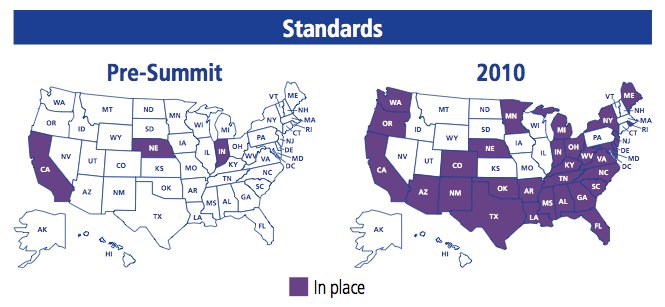
Achieve’s fifth annual “Closing the Expectations Gap” report finds that the majority of states, 31, now have high school standards in English and mathematics that align with the expectations of colleges and business. (Meaning that collegiate and business officials were involved in drafting the standards and approved the final product.) In 2005, by contrast, only three states had such standards.

Complete report here, which mentions:

Four additional states: new Hampshire, New Mexico, Wisconsin and Wyoming reported plans to administer college and career ready assessments, although their plans are not yet developed enough to include in the table on page 16.

Share

Yo, Ho, Ho, and a Digital Scrum

Jeffrey Young:

History shows that intellectual property is more complex than either its creators or copiers care to admit, says a Chicago scholar
The history of publishing is swimming with pirates–far more than Adrian Johns expected when he started hunting through the archives for them. And he thinks their stories may hold keys to understanding the latest battles over digital publishing–and the future of the book.
Johns, a historian at the University of Chicago, has done much of his hunting from his office here, which is packed so high with books that the professor bought a rolling ladder to keep them in easy reach. He can rattle off a long list of noted pirates through the years:
Alexander Pope accused “pyrates” of publishing unauthorized copies of his work in the 18th century. At the beginning of the 19th century, a man known as the “king of the pirates” used the then-new technology of photolithography to spread cheap reprints of popular sheet music. In the 1950s, a pirate music label named Jolly Roger issued recordings by Louis Armstrong and other jazz greats from LP’s that the major labels were no longer publishing. A similar label put out opera recordings smuggled from the Soviet bloc.

Share

School choice – an overrated concept

Francis Gilbert:

As a teacher for 20 years, I can tell parents that with their support children can flourish anywhere
The agony of waiting is over. Yesterday was national offer day, when parents learnt if their children had got into their favoured secondary schools. Unfortunately, as many as 100,000 children and their families have been bitterly disappointed.
As a teacher who has taught at various comprehensives for 20 years, I know that means a lot of tears and pain. I have seen parents who hit the bottle and come raging on to the school premises, demanding that the school takes their child; parents who do nothing but pester the school secretaries on the phone or by email; and parents who have just given up in despair, despite the fact that they have good grounds to appeal.
The main things parents should remember is not to descend into a great panic, and to review their situation dispassionately. What many don’t grasp is that if they fail to meet the admissions criteria of a school, children won’t get in, no matter how wonderful. The government has a strict admissions code that means schools have little room for manoeuvre: they can no longer just pick pupils they like the look of.

Share

Life Among the ‘Yakkity Yaks’

Bari Weiss:

‘Who do you think made the first stone spear?” asks Temple Grandin. “That wasn’t the yakkity yaks sitting around the campfire. It was some Asperger sitting in the back of a cave figuring out how to chip rocks into spearheads. Without some autistic traits you wouldn’t even have a recording device to record this conversation on.”
As many as one in 110 American children are affected by autism spectrum disorders, according to the Centers for Disease Control. Boys are four times more likely to be diagnosed than girls. But what causes this developmental disorder, characterized by severe social disconnection and communication impairment, remains a mystery.
Nevertheless, with aggressive early intervention and tremendous discipline many people with autism can lead productive, even remarkable, lives. And Ms. Grandin–doctor of animal science, ground-breaking cattle expert, easily the most famous autistic woman in the world–is one of them.
Earlier this month, HBO released a film about her to critical acclaim. Claire Danes captures her with such precision that Ms. Grandin tells me watching the movie feels like “a weird time machine” to the 1960s and ’70s and that it shows “exactly how my mind works.”

Share

Spring reading: The Demise of the Venerable Codex, or Bound Book….

Tim Martin:

The demise of the venerable codex, or bound book, has been predicted at least since 1899, when HG Wells in The Sleeper Awakes envisaged the entire corpus of human literature reduced to a mini-library of “peculiar double cylinders” that would be viewable on a screen. More informed commentators have been arguing since the computer became domesticised in the 1980s that it would herald the end of print but, each time, the predicted end of days has rolled around with no sign of an apocalypse. As the joke goes, books are still cheap, robust and portable, and the battery life is great.
Most of us are in no hurry to see them go. This week the UK’s early version of World Book Day rolls around with its freight of £1 children’s books (the rest of the world gets around to it on April 23). Meanwhile, Oxford has just launched upon the public its lavish Companion to the Book, a vast work of reference seven years in the making in which some 400 scholars chart the forms that books have taken since mankind began scratching out characters.
But it seems reasonable to think that change is afoot. At the time of writing, an American court is in the process of reconsidering the settlement that Google reached with the Authors Guild in 2008, allowing the company to digitise thousands of books, including many still in copyright. The case has caused heated debate – court documents this week revealed that more than 6,500 authors, many well-known, have decided to opt out of the Google settlement. The case continues: its outcome promises to transform the way in which we view and access information. If Google has its way, one of the world’s largest companies will end up with unchallenged distribution rights over one of the world’s largest book collections.

Share

Doyle: Each Wisconsin Covenant scholar will get $250 or more

Ryan Foley:

High school students who complete a new Wisconsin program to promote college attendance will be eligible for annual grants worth $250 to $2,500 for their first two years of college, Gov. Jim Doyle said Monday.
Doyle also said Wisconsin Covenant scholars would be eligible for additional aid during their final two years, with the amounts depending on the availability of funding. He said he was unhappy his administration had issued a proposal while he was traveling overseas in December to limit the grants to two years.
Under the revised proposal Doyle submitted to the Legislature on Monday, the poorest Wisconsin Covenant scholars will receive $2,500 grants _ $1,000 from the state and $1,500 from a private foundation _ during each of their first two years in college.
Those with higher family incomes _ up to $80,000 in some cases _ will receive between $1,000 and $1,500, he said. All others who complete the Covenant challenge will receive $250, an amount one Republican critic mocked as paltry.

Share

The Dictionary of Old English explores the brutality and elegance of our ancestral tongue.

Ammon Shea:

“Dictionaries are like watches, the worst is better than none, and the best cannot be expected to go quite true.” So said Samuel Johnson, according to James Boswell–and if any man can get away with making a pithy, slightly nonsensical, yet somehow illuminating statement about the merits of dictionaries, repositories of our language, it is Johnson.
Watches and other kinds of clocks may not “go quite true” yet, but they have managed to attain such a degree of exactness that the point is largely moot. The most accurate form of timekeeper available today, a cesium fountain atomic clock, is expected to become inaccurate by no more than a single second over the next fifty-plus million years (although it is by no means clear what other clock might be used to judge the world’s most accurate timekeeper).
What of dictionaries? Have they been improved to the same extent as clocks? Is there somewhere a dictionary that is expected to be wrong by only one word in the next fifty million years?

Share

Playing along with the Mozart effect
If you want music to sharpen your senses, boost your ability to focus and perhaps even improve your memory, you need to be a participant, not just a listener.

Melissa Healy:

Five months after we are conceived, music begins to capture our attention and wire our brains for a lifetime of aural experience. At the other end of life, musical memories can be imprinted on the brain so indelibly that they can be retrieved, perfectly intact, from the depths of a mind ravaged by Alzheimer’s disease.
In between, music can puncture stress, dissipate anger and comfort us in sadness.
As if all that weren’t enough, for years parents have been seduced by even loftier promises from an industry hawking the recorded music of Mozart and other classical composers as a means to ensure brilliant babies.
But for all its beauty, power and capacity to move, researchers have concluded that music is little more than ear candy for the brain if it is consumed only passively. If you want music to sharpen your senses, boost your ability to focus and perhaps even improve your memory, the latest word from science is you’ll need more than hype and a loaded iPod.

Share

Problem children should be helped, not excluded, says schools report

Anushka Asthana:

The system of excluding badly behaved pupils from school should be abolished because it punishes the most vulnerable children, a major new report on education has concluded, writes Anushka Asthana.
The study, by the thinktank Demos, says that difficult children are being pushed out of schools too often and finds that exclusions do not solve behavioural problems. Instead, they are linked to very poor results and in three out of four cases relate to children with special educational needs who should receive additional support. The report finds that 27% of children with autism have been excluded from school.
Sonia Sodha, co-author of the report, said: “Most other countries do not permanently exclude children from school in the same way we do. Instead of helping these children, we are punishing and then banishing them.”
The report comes as figures from the Conservatives show that 1,000 pupils are excluded or suspended for physical and verbal assaults every day. Speaking at the Tory party spring conference, Michael Gove, shadow children’s secretary, promised that in power he would make it easier for teachers to remove violent and disruptive pupils.

Share

Starting them young: Nursery schools are the latest front-line in the Scandinavian integration debate

The Economist:

N SOFT, southern countries, snow is enough to close schools. In Sweden–a place that lives by the maxim that “There is no such thing as bad weather, just the wrong clothes”–fresh snow is a cue to send 18-month-olds into the playground, tottering around in snowsuits and bobble hats. It is an impressive sight at any time. But it is particularly striking in a Stockholm playground filled with Somali toddlers, squeaking as they queue for sledge-rides.
The playground belongs to Karin Danielsson, a headmistress in Tensta, a Stockholm suburb with a large immigrant population. Mrs Danielsson calls her municipal preschool “a school for democracy”. In keeping with Swedish mores, even young children may choose which activities to join or where to play. All pupils’ opinions are heard, but they are then taught that the group’s wishes must also be heeded.
Swedes take preschool seriously. Though education is not compulsory until seven, more than 80% of two-year-olds are enrolled in preschool, and many begin earlier. Among European countries only Denmark has higher enrolment rates at that age.

Share

Book: From A Wisconsin Soapbox

Mark H. Ingraham Dean Emeritus, College of Letters & Science, University of Wisconsin
Professor Emeritus of Mathematics, University of Wisconsin [Click to view this 23MB PDF “book”]:

Contents
Preface
Part I Liberal Education
The Omnivorous Mind 3
Given May 16, 1962, to the University of Wisconsin Chapter of Phi Beta Kappa. Republished from The Speech Teacher of September 1962.
Truth-An Insufficient Goal 17
The Keniston Lecture for 1964 at the University of Michi- gan; March 17, 1964. Republished from the Michigan Quarterly Review of July 1964.
On the Adjective “Common” 31
An editorial for the February 1967 Review of the Wisconsin Academy of Arts, Letters, and Sciences, February 23, 1967.
Part II Educational Policy
Super Sleep-A Form of Academic Somnambulism 37
First given as retiring address as President of A.A. U.P . This much revised version was given to the Madison Literary Club, March 12, 1940.
No, We Can’t; He Has a Committee Meeting 57
Madison Literary Club; May 11, 1953.
Is There a Heaven and a Hell for Colleges? 70
Commencement address, Hiram College; June 8, 1958.
The College of Letters and Science 79
Talk given to the Board of Regents of the University of Wisconsin, May 3, 1958.
Some Half Truths About the American Undergraduate 84
Orientation conference for Whitney-Fulbright Visiting Scholars. Sarah Lawrence College, September 6, 1962.
Maps Versus Blueprints 94
Honors Convocation, University of Wisconsin, May 18, 1973.
Part III To Students
A Talk to Freshmen 103
University of Wisconsin; September 18, 1951
Choice: The Limitation and the Expression of Freedom 112
Honors Convocation, University of Wisconsin; June 17, 1955. Republished from the Wisconsin Alumnus.
“The Good is Oft Interred with Their Bones” 121
Commencement, University of Wisconsin-Oshkosh; Janu- ary 19, 1968.
Talk at Honors Convocation at Ripon College
Talk at Honors Convocation at Ripon College 129
April 9, 1969
The Framework of Opportunity 136
Thanksgiving Address, University of Wisconsin; November, 1947
Part IV A Little Fun
Food from a Masculine Point of View 149
Madison Literary Club; November 11, 1946
On Telling and Reading Stories to Children 165
Attic Angel Tower, Madison, Wisconsin; March 6, 1978
Three Limericks 179
Fragments 181
a. From an address given to the University oF Wyoming Chapter of Phi Beta Kappa, April 26, 1965
b. A comment
Part V Somewhat Personal
Letter of Resignation from Deanship 185
April 5, 1961
Retirement Dinner Talk 188
May 24, 1966

Thanks to Richard Askey for extensive assistance with this digitized book. Search Mark Ingraham.

Share

Parent Feedback on the Madison School District’s “Branding” Expenditures

via a kind reader’s email: Parent Diane Harrington:

Dear Board Members, Dr. Nerad, and Madison Alders,
My 11-year-old and I visited John Muir Elementary for basketball practice one recent evening. Their gym has banners noting that for several years they’ve been named a “School of Excellence.”
Ben’s school, Orchard Ridge Elementary, had just been dubbed a “School of Promise.”
Which school would YOU rather go to?
But Ben didn’t need a marketing effort to tell him which school was which; he knows some John Muir kids. Ben, too, would like to go to a school where kids are expected to learn and to behave instead of just encouraged to.
Just like those banners, the very idea of your upcoming, $86,000 “branding” effort isn’t fooling anyone.
You don’t need to improve your image. You need to improve your schools.
Stop condescending to children, to parents and to the public. Skip the silly labels and the PR plans.
Instead, just do your #^%* job. (If you need help filling in that blank, head to ORE or Toki. Plenty of kids – some as young as kindergarten – use several colorful words in the hallways, classrooms, lunchroom and playground without even a second look, much less disciplinary action, from a teacher or principal.)
Create an environment that strives for excellence, not mediocrity. Guide children to go above and beyond, rather than considering your job done once they’ve met the minimum requirements.
Until then, it’s all too obvious that any effort to “cultivate relationships with community partners” is just what you’re branding it: marketing. It’s just about as meaningless as that “promise” label on ORE or the “honor roll” that my 13-year-old and half the Toki seventh graders are on.
P.S. At my neighborhood association’s annual Winter Social earlier tonight, one parent of a soon-to-be-elementary-age child begged me to tell him there was some way to get a voucher so he could avoid sending his daughter to ORE. His family can’t afford private school. Another parent told me her soon-to-be-elementary-age kids definitely (whew!) were going to St. Maria Goretti instead of ORE. A friend – even though her son was finishing up at ORE this year – pulled her daughter out after kindergarten (yes, to send her to Goretti), because the atmosphere at ORE is just too destructive and her child wasn’t learning anything. These people aren’t going to be fooled by a branding effort. And you’re only fooling yourselves (and wasting taxpayer money) if you think otherwise.

Parent Lorie Raihala:

Regarding the Madison School District’s $86,000 “branding campaign,” recent polls have surveyed the many families who have left the district for private schools, virtual academies, home schooling or open enrollment in other districts.
Public schools are tuition free and close to home, so why have these parents chosen more expensive, less convenient options? The survey results are clear: because Madison schools have disregarded their children’s learning needs.
Top issues mentioned include a lack of challenging academics and out-of-control behavior problems. Families are leaving because of real experience in the schools, not “bad press” or “street corner stories.”
How will the district brand that?
Lorie Raihala Madison

Share

Virginia acts to limit use of exam for special-ed students after criticism

Michael Alison Chandler:

Virginia officials are moving to sharply limit an alternative testing program that many schools in the Washington suburbs use to measure the abilities of special education students who traditionally have fared poorly on the state’s Standards of Learning exams.
The effort by state lawmakers and education officials targets “portfolio” tests, which have helped increase passing rates at many schools by allowing students to avoid the multiple choice tests in favor of more flexible, individually tailored assessments. Critics have said that the alternative tests undermine Virginia’s widely praised accountability system and overstate the progress districts are making in closing achievement gaps between racial groups.

Share

It’s not just Lower Merion!: Bronx school watches unwitting students via Webcam

Holly Otterbein

In this week’s A Million Stories, we explored the messy Webcam scandal that’s going down at Lower Merion School District. The district insists that it only peered through students’ Webcams in order to find lost or stolen laptops, and did so using a security software called LANrev. Insanely enough, Douglas Young, the district’s spokesperson, told us that it wasn’t the only school district using such software: “The software feature isn’t just utilized in this school district,” says Young. “It’s utilized by other school districts and organizations.” (He said he couldn’t name any offhand.)

Share

Online courses can reduce the costly sting of college

Daniel de Vise:

Inessa Volkonidina had taken precalculus once and dropped it. She needed to take it again, and quickly, to fulfill a graduation requirement at Long Island University. She went online and found a company with an odd name, StraighterLine, that offered the course on even odder terms: $99 a month.
She thought it might be a scam. But StraighterLine, based in Alexandria, is a serious education company and a force that could disrupt half a millennium of higher-education tradition. The site offers students as many general-education courses as they care to take for a flat monthly fee, plus $39 per course. As college tuitions go, it is more on the scale of a cable bill.
The courses, standard freshman fare such as algebra, are cash cows for traditional schools, taught to students by the hundreds in vast lecture halls. They generate handsome profits to support more costly operations on campus.

Share

Writer David Carr’s unconventional education

Valerie Strauss:

David Carr writes about media and culture for The New York Times, which is not why I wanted to interview him for this series. Rather, it was what Atlantic Monthly called his “joyous peculiarity” in this article.
Carr tells his own story in “The Night of the Gun,” a beautifully written, funny yet wrenching memoir that spares nothing about the drug addiction and madness into which he descended, but, from which, almost unbelievably, he escaped.
Before going to The Times, he was a contributing writer for Atlantic and New York Magazine and was the media writer for Inside.com. He also worked at the alternativeCity Paper in Washington D.C., as editor.
A father with three daughters, Carr and his wife now live in Montclair, N.J. Here are excerpts from our conversation about his formal and informal education.

Share

Study: Charter school growth accompanied by racial imbalance

Nick Anderson:

Seven out of 10 black charter school students are on campuses with extremely few white students, according to a new study of enrollment trends that shows the independent public schools are less racially diverse than their traditional counterparts.
The findings from the Civil Rights Project at UCLA, which are being released Thursday, reflect the proliferation of charter schools in the District of Columbia and other major cities with struggling school systems and high minority populations.
To the authors of the study, the findings point to a civil rights issue: “As the country continues moving steadily toward greater segregation and inequality of education for students of color in schools with lower achievement and graduation rates,” the study concludes, “the rapid growth of charter schools has been expanding a sector that is even more segregated than the public schools.”

Share

Digital Dilettantism

Will Fitzhugh
The Concord Review
26 February 2010
The Kaiser Foundation, in its January 2010 report on the use of electronic entertainment media by U.S. students, aged 8-18, found that, on average, these young people are spending more than seven hours a day (53 hours a week) with such (digital) amusements.
For some, this would call into question whether students have time to read the nonfiction books and to write the research papers they will need to work on to get themselves ready for college and careers, not to mention the homework for their other courses.
For the John D. and Catherine T. MacArthur Foundation, however, the problem appears to be that we are not paying enough attention to the possible present and future connections between digital media and learning, so they have decided to invest $50,000,000 in grants to explore that relationship.
One recent two-year grant, “for $650,000 to study the effect of digital media on young people’s ethical development and to develop curricula for parents and teachers,” went to the Harvard Education School, which has distinguished itself for, among other things, seeming to have no one on its faculty with any research or teaching interest in the actual academic work of high school students, for example in chemistry, history, economics, physics, foreign languages, calculus, and the like.
The Harvard Ed School faculty do show real interest in poverty, disability, psychological problems, race, gender, ethnicity, and the development of moral character, so they may take to this idea of studying the relation between electronic media and student ethics. A visit to the Harvard Ed School website, and a review of the research interests of the faculty would prove enlightening to anyone who thought, for some odd reason, that they might be paying attention to the academic work of students in the schools.
Whether Harvard will conclude that seven hours a day doesn’t help much with the ethical development of students or not, one could certainly wish that they would discover that spending a lot of their time on digital media does very little for student preparation for college academic work that is at all demanding, not to mention the actual work of their careers, unless they are in the digital entertainment fields, of course.
The National Writing Project, which regularly has received $26,000,000 each year in federal grants for many years to help thousands of teachers feel more comfortable writing about themselves, has now received $1.1 million in grants from the MacArthur Foundation, presumably so that they may now direct some of their efforts to helping students use digital media to write about themselves as well.
Perhaps someone should point out, to MacArthur, the National Writing Project, the Harvard Ed School, and anyone else involved in this egregious folly and waste of money, that our students already spend a great deal of their time each and every day writing and talking about themselves with their friends, using a variety of electronic media.
In fact, it is generally the case that the students (without any grants) are already instructing any of their teachers who are interested in the use of a variety of electronic media.
But like folks in any other self-sustaining educational enterprise, those conversing on the uses of digital media in learning about digital media need a chance to talk about what they are doing, whether it is harmful to serious academic progress for our students or not, so MacArthur has also granted to “the Monterey Institute for Technology and Education (in Monterey, California) $2,140,000 to build the field of Digital Media and Learning through a new journal, conferences, and convenings (over five years).”
The MacArthur Foundation website has a list of scores more large grants for these projects in digital media studies and digital learning (it is not clear, of course, what “digital learning” actually means, if anything).
This very expensive and time-consuming distraction from any effort to advance respectable common standards for the actual academic work of students in our nation’s schools must be enjoyable, both for those giving out the $50 million, and, I suppose, for those receiving it, but the chances are good that their efforts will only help to make the college and career readiness of our high school students an even more distant goal.
“Teach by Example”
Will Fitzhugh [founder]
Consortium for Varsity Academics® [2007]
The Concord Review [1987]
Ralph Waldo Emerson Prizes [1995]
National Writing Board [1998]
TCR Institute [2002]
730 Boston Post Road, Suite 24
Sudbury, Massachusetts 01776-3371 USA
978-443-0022; 800-331-5007
www.tcr.org; fitzhugh@tcr.org
Varsity Academics®
www.tcr.org/blog

Share

The Next Wave of Digital Textbooks – DynamicBooks from Macmillan

Thomas:

ne of the most firmly entrenched academic practices centers upon the use of textbooks as the fundamental drivers of curricula. Ultra-expensive, these items represent one of the largest costs for public school systems as well as those attending college.
As the digital age continues to work its way into the stuffy world of academics, there are clear indications that textbooks are gradually being phased out in many areas of the country. The sheer volume of resources available on the net is leading many school districts to create and share their own materials.
Macmillan, considered one of the largest players in that old, conservative world, apparently has now also seen the “handwriting on the wall.” The company recently announced it will offer academics an entirely new format: DynamicBooks.

Share

To Lynch a Child: Bullying and Gender Non-Conformity in Our Nation’s Schools

Michael Higdon:

n January 2010, a 9-year old boy named Montana Lance hung himself in a bathroom at the Texas elementary school he attended. Although certainly shocking, such acts are unfortunately becoming less and less unusual. In fact, the suicide of Montana Lance is very reminiscent of what happened in April 2009 when two 11-year-old boys, one in Massachusetts and one in Georgia, likewise committed suicide just days apart. What would cause these children to end their lives? The answer in each case is the same: all three suffered extreme levels of victimization at the hands of school bullies–bullying that others have described as involving “relentless homophobic taunts.” And, as we can see from the fate of these three little boys, this form of harassment was obviously very traumatic.
In this article, I look at the growing problem of school bullying in America today. Now, almost all children are teased and most will even face at least some form of bullying during their childhood. However, studies reveal that some children will unfortunately become chronic victims of school bullying. Chief among that group are those children whose gender expression is at odds with what society considers “appropriate.” As my article explores, the gender stereotypes that exist within our society are frequently to blame for the more extreme levels of bullying currently being carried out in our nation’s schools. And the impact this bullying has on its victims is staggering. Earlier I mentioned three children who took their own lives as a result of bullying. These are but three examples of those who have lost their lives to gender-based bullying. However, there are countless other victims who, although not paying with their lives, are nonetheless paying dearly in other ways. Specifically, the psychological literature on the emotional impacts that befall these chronic victims of bullying reveals a whole host of resulting problems–debilitating consequences that can last a lifetime.

Share

Hysteria Around School Turnarounds

Tom Vander Ark:

The NYTimes ran a story with this misleading headline and byline:

A Vote to Fire All Teachers at a Failing High School
CENTRAL FALLS, R.I. — A plan to dismiss the entire faculty and staff of the only public high school in this small city just west of the Massachusetts border was approved Tuesday night at an emotional public meeting of the school board.

When the teachers failed to adopt a ‘transformation’ plan that included a modest lengthening of the day, the superintendent shifted to Plan B, what federal School Improvement Grants (SIG) call Turnaround, which requires that at least 50% of the staff be replaced. Under Rhode Island law, teachers must be notified of the potential for nonrenewal by March 20, hence the board vote and notices. All the teachers will have the opportunity to reapply, up to half will be rehired.
The hysteria is now reverberating on CNN and papers around the country. Central Falls may be an early example but there are thousands to come. As I began reporting in October, SIG will cause widespread urban disruption. But we’ll all need to be cautious to use language carefully and differentiate between ‘firing all the teachers’ and notifying them of the requirement to reapply for their positions.

Related: Ripon Superintendent Richard Zimman’s speech to the Madison Rotary:

Last Wednesday, Ripon Superintendent Richard Zimman spoke to the Madison Rotary Club on “What Wisconsin’s Public Education Model Needs to Learn from General Motors Before it is too late.” 7MB mp3 audio (the audio quality is not great, but you can hear the talk if you turn up the volume!).
Zimman’s talk ranged far and wide. He discussed Wisconsin’s K-12 funding formula (it is important to remember that school spending increases annually (from 1987 to 2005, spending grew by 5.10% annually in Wisconsin and 5.25% in the Madison School District), though perhaps not in areas some would prefer.
“Beware of legacy practices (most of what we do every day is the maintenance of the status quo), @12:40 minutes into the talk – the very public institutions intended for student learning has become focused instead on adult employment. I say that as an employee. Adult practices and attitudes have become embedded in organizational culture governed by strict regulations and union contracts that dictate most of what occurs inside schools today. Any impetus to change direction or structure is met with swift and stiff resistance. It’s as if we are stuck in a time warp keeping a 19th century school model on life support in an attempt to meet 21st century demands.” Zimman went on to discuss the Wisconsin DPI’s vigorous enforcement of teacher licensing practices and provided some unfortunate math & science teacher examples (including the “impossibility” of meeting the demand for such teachers (about 14 minutes)). He further cited exploding teacher salary, benefit and retiree costs eating instructional dollars (“Similar to GM”; “worry” about the children given this situation).

Share

Ten rules for writing fiction

Elmore Leonard, Diana Athill, Margaret Atwood, Roddy Doyle, Helen Dunmore, Geoff Dyer, Anne Enright, Richard Ford, Jonathan Franzen, Esther Freud, Neil Gaiman, David Hare, PD James, AL Kennedy:

Get an accountant, abstain from sex and similes, cut, rewrite, then cut and rewrite again – if all else fails, pray. Inspired by Elmore Leonard’s 10 Rules of Writing, we asked authors for their personal dos and don’ts
Elmore Leonard: Using adverbs is a mortal sin
1 Never open a book with weather. If it’s only to create atmosphere, and not a charac ter’s reaction to the weather, you don’t want to go on too long. The reader is apt to leaf ahead look ing for people. There are exceptions. If you happen to be Barry Lopez, who has more ways than an Eskimo to describe ice and snow in his book Arctic Dreams, you can do all the weather reporting you want.
2 Avoid prologues: they can be annoying, especially a prologue ­following an introduction that comes after a foreword. But these are ordinarily found in non-fiction. A prologue in a novel is backstory, and you can drop it in anywhere you want. There is a prologue in John Steinbeck’s Sweet Thursday, but it’s OK because a character in the book makes the point of what my rules are all about. He says: “I like a lot of talk in a book and I don’t like to have nobody tell me what the guy that’s talking looks like. I want to figure out what he looks like from the way he talks.”

Share

Michigan teacher contracts: The black hole of school spending

Education Action Group:

The current school funding crisis has a lot of people talking about raising taxes, creating new taxes or closing so-called tax loopholes, to provide more revenue for Michigan’s K-12 school districts.
We at Education Action Group Foundation don’t pretend to be experts on school funding, particularly on a statewide level. But we do know that local school districts are forced to spend a great deal of money on unnecessary labor costs, at a time when they can least afford it.
We don’t believe the state has the moral right to ask taxpayers for another dime for education until it helps local school districts free themselves from crippling labor expenses.
To support our argument, we spent a few weeks examining 25 teacher contracts from districts throughout Michigan, carefully choosing schools of various size and geographic location. We found countless examples of contractual expenses that are questionable in the current economic environment.
Our study is by no means scientific. It simply offers a sampling of the type of expenses that schools are forced to deal with by the state’s teachers unions. We believe Michigan residents will be surprised to learn how some of their tax dollars are spent.
Our source was the public school contract database, posted online and updated regularly by the Mackinac Center for Public Policy. The database can be accessed by logging on to http://www.mackinac.org/10361.

Share

Pennsylvania High School Spying Update: Draconian Policies, Suspicious Software

Dan Nosowitz:

Two computer security experts, Aaron Rhodes and a man known by his pseudonym Stryde Hax, put together an eye-opening and well-researched attack on both the Lower Merion High School that’s been accused of spying on students and the software that was used to do it. In the process, they reveal some disturbing school policies regarding the use of the laptops, and the unnerving nature of the software itself.
The writers scoured forum activity, blog posts, and publicity videos made by one Mike Perbix, the Harriton High School technical security staffer who was in charge of the use of LANRev, the software in question. They also hunted down comments from some of the more tech-savvy members of the student body, who revealed some pretty startling policies regarding the laptops.
The main points: the school-supplied (and monitored) MacBooks were required for certain classes; the included Webcams could not be disabled; the laptops could not be “jailbroken” to circumvent the security measures (and any attempt could result in expulsion); and possession of a personal computer, meaning one other than the school-supplied MacBook, was forbidden and subject to confiscation. One example, from a student:

More here.

Share

More high-schoolers reinvent or skip their senior year

Greg Toppo:

When Utah state Sen. Chris Buttars unveiled a cost-cutting measure this month that would have made the high school senior year optional, perhaps no one in the state Capitol Building was more surprised than 18-year-old Jake Trimble, who already opted out of the second half of senior year just weeks earlier.
He has spent the past month working at the Capitol as an unpaid intern for the state Democratic Party’s communications team, designing posters and writing scripts for legislators’ robocalls. Trimble graduated in January, one semester early, from the nearby Academy of Math Engineering and Science (AMES).
“I’m very happy to not be in high school anymore,” says Trimble, who proudly reports that he’s “not rotting in my parents’ basement.” Actually, when the legislative session ends next month, he’ll move on to another internship (this one paid) as a lab assistant at the University of Utah’s Orthopedic Center.
Trimble is part of a small but growing group of students — most of them academically advanced and, as a result, a tad restless — who are tinkering with their senior year. A few observers say the quiet experiment has the potential to reinvent high school altogether.

Share

An Interview with Eagle School Co-Founder Mary Olsky

It was a pleasure to meet and visit with Fitchburg’s Eagle School Co-Founder Mary Olsky recently.
We discussed a wide variety of topics, including Eagle’s History (founded in 1982), curricular rigor, the importance of good textbooks and critical student thinking. I also found it interesting to hear Mary’s perspective on public / private schools and her hope, in 1982, that that the Madison School District would take over (and apply its lessons) Eagle School. Of course, it did not turn out that way.
I’ve always found it rather amazing that Promega Founder Bill Linton’s generous land offer to the Madison School District for the “Madison Middle School 2000” charter school was rejected – and the land ended up under Eagle’s new facility.
Listen to the conversation via this 14mb mp3 audio file.

Read the transcript here.
Eagle’s website.
Finally, Mary mentioned the term “high school” a number of times, along with $20,000,000. I suspect we’ll see a high school at some point. It will take a significant effort.
Thanks to Laurie Frost for arranging this interview.

Share

The high school courses students need for college

Bruce Vinik via Valerie Strauss:

It’s that time of year again. Pitchers and catchers are reporting to spring training and high school students are puzzling over which classes to take next fall. The choices students make do matter. Outside of grades, nothing is more important in college admissions than the classes kids take in high school. “Strength of Program” is a big deal.
Let’s start with the basics. Colleges expect students to take at least five core academic subjects every year of high school — English, social studies, science, math and foreign language.
In a perfect world, students would take each core subject every year. But the world isn’t perfect and colleges don’t expect kids to be. As long as students take each core subject through eleventh grade, they should feel free to pursue their particular academic interests in greater depth during twelfth grade. There’s nothing wrong with dropping social studies senior year in order to double up on science.

Share

More Catholic schools reaching out to special-needs students

Michael Alison Chandler:

A math class for students with intellectual disabilities at Paul VI Catholic High School in Fairfax practiced naming dates on a calendar one recent morning and deciphering what time it is when the big hand is on the 10 and the little hand is on the 11. But first, the teacher led them in a prayer.
Father in heaven, we offer you this class and all that we may accomplish today,” they said together.
Federal law requires that public schools offer a free, appropriate education for students with disabilities, and federal and state governments subsidize the higher costs of smaller classes and extra resources. Catholic schools have no such legal mandate, and financial constraints have historically made it difficult for them to offer similar specialized services.
That is starting to change.

Share

Where the Bar Ought to Be

Bob Herbert:

Deborah Kenny talks a lot about passion — the passion for teaching, for reading and for learning. She has it. She wants all of her teachers to have it. Above all, she wants her students to have it.
Ms. Kenny has created three phenomenally successful charter schools in Harlem and is in the process of creating more. She’s gotten a great deal of national attention. But for all the talk about improving schools in this country, she thinks we tend to miss the point more often than not.
There is an overemphasis on “the program elements,” she said, “things like curriculum and class size and school size and the longer day.” She understood in 2001, when she was planning the first of the schools that have come to be known as the Harlem Village Academies, that none of those program elements were nearly as important as the quality of the teaching in the schools.
“If you had an amazing teacher who was talented and passionate and given the freedom and support to teach well,” she said, “that was just 100 times more important than anything else.”

Share

The Boy Gap

Joanne Jacobs:

It’s time for schools to focus on the widening gap in reading and writing skills that leaves so many boys unprepared for success in college or vocational training.
As a volunteer in my daughter’s kindergarten class, I was asked to help children write a “story” (a few words) to illustrate their pictures. Only one girl needed my writing help; only one boy could write for himself. Nearly all the boys seemed to be a full year behind nearly all the girls in their ability to pay attention, follow directions, control frustrations, sit still, handle a pencil or crayon and do what used to be considered first-grade work.
As reading and writing are pushed down to earlier ages, boys are struggling harder to meet higher expectations, writes Richard Whitmire, a former USA Today reporter, in Why Boys Fail.
“Each year since 1988 the gap between boys’ and girls’ reading skills has widened a bit more,” Whitmire writes. Boys aren’t wired for early verbal skills — and teachers aren’t trained in “boy-friendly” techniques to help them catch up.

Share

Khan Academy: Math & Science Lessons Online

Spencer Michels:

33-year-old math and science whiz kid — working out of his house in California’s Silicon Valley — may be revolutionizing how people all over the world will learn math. He is Salman Khan, and until a few months ago he made his living as a hedge fund analyst. But he’s become a kind of an unseen rock star in the online instruction field, posting 1200 lessons in math and science on YouTube, none of them lasting more than about 10 minutes. He quit his job at the hedge fund to devote full time to his Khan Academy teaching efforts, which he does essentially for free.
Khan explained how the U.S. unemployment rate is calculated in a NewsHour exclusive video.

Share

Raising the realtime child

Nicholas Carr:

Amazingly enough, tomorrow will mark the one-year anniversary of the start of Rough Type’s Realtime Chronicles. Time flies, and realtime flies like a bat out of hell.
Since I began writing the series, I have received innumerable emails and texts from panicked parents worried that they may be failing in what has become the central challenge of modern parenting: ensuring that children grow up to be well adapted to the realtime environment. These parents are concerned – and rightly so – that their kids will be at a disadvantage in the realtime milieu in which we all increasingly live, work, love, and compete for the small bits of attention that, in the aggregate, define the success, or failure, of our days. If maladapted to realtime existence, these parents understand, their progeny will end up socially ostracized, with few friends and even fewer followers. “Can we even be said to be alive,” one agitated young mother wrote me, “if our status updates go unread?” The answer, of course, is no. In the realtime environment, the absence of interactive stimuli, even for brief periods of “time,” may result in a state of reflective passivity indistinguishable from nonexistence. On a more practical level, a lack of realtime skills is sure to constrain a young person’s long-term job prospects. At best, he or she will be fated to spend his or her days involved in some form of manual labor, possibly even working out of doors with severely limited access to screens. At worst, he or she will have to find a non-tenure-track position in academia.

Share

Wisconsin Teachers Union Tops Lobbying Expenditures in 2009, more than Double #2

Wisconsin Government Accountability Board [22K PDF]:

The Wisconsin Education Association spent $1.5 million in 2009 lobbying state lawmakers, nearly twice as much as the next-largest spender, according to a report from the Government Accountability Board.
Overall, lobbying organizations reported spending $36.2 million in 2009, a 5.2 percent increase from the first half of the previous legislative session.
The 2009 report analyzes the activities of 746 lobbying principals and 750 registered lobbyists.
“Not only is Wisconsin’s lobbying law strong, but information about lobbying activities is easy to use online,” said Kevin J. Kennedy, director and general counsel of the G.A.B. “The law requires disclosure and prohibits gifts to lawmakers. The Board’s Eye on Lobbying online database allows the public to keep track of lobbying activities at the Capitol without leaving home.”
The most lobbied bill in 2009 was the AB 138, regarding appointment of the secretary of the Natural Resources Board. Organizations reported spending 2,923 hours attempting to influence legislators on that bill.

Complete 80K PDF Report.

Share

The Post-Text World

Idea of the Day:

Today’s idea: Since written language is merely a technology for storing and transferring information, it’s likely to be replaced by a newer technology that performs the same function more effectively, a futurist says.
E Reader on empty bookshelf. This image has been manipulated using Photoshop.
The Britannica Blog has a series of posts called Learning and Literacy in the Digital Age, including this one by Patrick Tucker, senior editor of The Futurist. He speculates that text could be rendered obsolete not by the “culture of the image” — that threat is so last century — but by the so-called “information age” itself:

… Research into cyber-telepathy has direct ramifications for the written word and its survivability. Electronic circuits mapped out in the same pattern as human neurons could, in decades ahead, reproduce the electrical activity that occurs when our natural transmitters activate. Theoretically, such circuits could allow parts of our brain to communicate with one another at greater levels of efficiency, possibly allowing humans to access data from the Web without looking it up or reading it.

Share

Comments on Seattle’s Math Curriculum Court Ruling, Governance and Community Interaction

Melissa Westbrook:

I attended Harium’s Community meeting and the 43rd Dems meeting (partial) yesterday. Here are some updates (add on if you attended either or Michael DeBell’s meeting).
We covered a fair amount of ground with Harium but a lot on the math ruling/outcomes. Here’s what he said:

  • the Board will decide what will happen from the math ruling. I asked Harium about who would be doing what because of how the phrasing the district used in their press release – “In addition to any action the School Board may take, the district expects to appeal this decision.” It made it sound like the district (1) might do something different from the Board and (2) the district had already decided what they would do. Harium said they misspoke and it was probably the heat of the moment.
  • He seems to feel the judge erred. He said they did follow the WAC rules which is what she should have been ruling on but didn’t. I probably should go back and look at the complete ruling but it seems like not going by the WAC would open her decision up to be reversed so why would she have done it? He said the issue was that there are statewide consequences to this ruling and that Issaquah and Bellevue (or Lake Washington?) are doing math adoptions and this ruling is troubling. I gently let Harium know that the Board needs to follow the law, needs to be transparent in their decision-making and the district needs to have balanced adoption committees or else this could happen again. No matter how the district or the Board feel, the judge did not throw out the case, did not rule against the plaintiffs but found for them. The ball is in the Board’s court and they need to consider this going forward with other decisions.

Share

United Teachers Los Angeles protests school district reform

Adolfo Guzman-Lopez:

L.A. Unified’s teachers’ union organized protests today and for next week against school district administrators. The union is upset that the superintendent has tentatively allowed outside groups to assume control of new and low-performing campuses.
The school district received 85 proposals to run three dozen campuses. Teachers, charter school companies and other nonprofits crafted the plans. The superintendent is recommending teacher and district-written plans for more than half the schools. Outside groups could run another quarter of the schools.
A teacher, parent and student vote earlier this month favored the teacher plans. A nonprofit run by L.A. Mayor Antonio Villaraigosa received the recommendation to run Carver Middle School.
Kirsten Ellis, a teacher there, doesn’t like the idea. “We demand that the school board and the superintendent adhere to and follow the vote of the people, instead of throwing it out and ignoring it.”

Share

Your Kids Love It. You Love It. Perfect.

Stephen Kreider, Isaac and Levi Yoder:

Time was running out, so I bought two tickets to Villahermosa, Mexico.
Three planes, a bus ride and a hike later, Levi and I are finishing this column among the Mayan pyramids of Palenque. It’s about 80 degrees out, and howler monkeys are bellowing from the surrounding jungle.
But this isn’t a column about travel. It’s about one of the loveliest fringe benefits to having kids: You can use them as an excuse to do stuff you wanted to do yourself but never would have.
Time was running out on a promise I made Levi when he was 7. He has always been keen on history, and he became fascinated with the Mayans.
“Isn’t there a pyramid where you can go inside and see the king’s grave?” he asked. “Yes, and I’ve been there!” I said. “How about you and I go there some winter break soon?”

Share

Harambee Community School has had periods of excellence. But now, lack of accreditation could mean its end after 40 years.

Alan Borsuk:

A rich history. Energetic, sweet students, including several kindergartners who spontaneously gave me hugs. Teachers and administrators who want to succeed. A good building. I enjoyed my visit to Harambee Community School, and I’d like to feel bad about what the school is facing now.
But I don’t.
Harambee faces its end, after 40 years. And it’s hard to reach any conclusion other than that it is the fault of leaders of the school.
If efforts to bring more quality to Milwaukee schools are going to mean anything, a central pillar has to be accountability or, to put it another way, taking a firm line on schools that don’t measure up, be they voucher, charter, or conventional public schools.
In a tough love sort of way, if Harambee closes after this school year, this probably will be a success for those saying high-needs children need better than what they are getting.
A law passed by the Legislature in 2006 was perfectly clear: To stay in Milwaukee’s private school voucher program and receive large sums of money from the state, a school had to get accredited by Dec. 31, 2009.
Three and a half years later, it was Dec. 31, 2009, and every school that was covered by the requirement had either succeeded or closed, except one: Harambee.

Share

Friends School of Baltimore Teaches 8th-Graders About Islam

James Tarabay:

Most American schoolchildren learn about Islam in a social studies classroom. But at the Friends School in Baltimore, eighth-graders make their own mini-pilgrimage every year, to the Islamic Center in Washington, D.C.
As their bus rattles along the highway south to Washington, most of the kids are busy making up songs about each other. But 12-year-old Julia Potter is counting off the Five Pillars of Islam on her fingers: charity, prayer, fasting, profession of faith, and the pilgrimage to Mecca.
These kids are well-versed in the basics of Islam and more: In class, they learn about Judaism, Hinduism and Christianity; about prophets, taboos and holy laws. And every year, eighth-graders visit the Islamic Center — though every year, according to teacher Deloris Jones, they get there late. “There’s absolutely nothing over the years I have been able to do to keep this thing on time,” Jones says.

Share

Change and Race to the Top

Robert Godfrey:

Which brings us to this next item, one with twist and turns not completely understandable at this point, but certainly not held up by people like myself as a model of how to “get the job properly done” — to use Herbert’s words.
Diane Ravitch, an intellectual on education policy, difficult to pigeonhole politically (appointed to public office by both G.H.W. Bush and Clinton), but best described as an independent, co-writes a blog with Deborah Meier that some of our readers may be familiar with called “Bridging Differences.” This past week she highlighted a possibly disturbing development in the Race to the Top competition program of the Department of Education, that dangles $4.3 billion to the states with a possible $1.3 billion to follow. Ravitch’s critique suggests that this competition is not run by pragmatists, but rather by ideologues who are led by the Bill Gates Foundation.

If this election had been held five years ago, the department would be insisting on small schools, but because Gates has already tried and discarded that approach, the department is promoting the new Gates remedies: charter schools, privatization, and evaluating teachers by student test scores.

Two of the top lieutenants of the Gates Foundation were placed in charge of the competition by Secretary Arne Duncan. Both have backgrounds as leaders in organisations dedicated to creating privately managed schools that operate with public money.

None of this is terribly surprising (See the Sunlight Foundation’s excellent work on the Obama Administration’s insider dealings with PhRMA). Jeff Henriques did a lot of work looking at the Madison School District’s foray into Small Learning Communities.
Is it possible to change the current K-12 bureacracy from within? Ripon Superintendent Richard Zimman spoke about the “adult employment” focus of the K-12 world:

“Beware of legacy practices (most of what we do every day is the maintenance of the status quo), @12:40 minutes into the talk – the very public institutions intended for student learning has become focused instead on adult employment. I say that as an employee. Adult practices and attitudes have become embedded in organizational culture governed by strict regulations and union contracts that dictate most of what occurs inside schools today. Any impetus to change direction or structure is met with swift and stiff resistance. It’s as if we are stuck in a time warp keeping a 19th century school model on life support in an attempt to meet 21st century demands.” Zimman went on to discuss the Wisconsin DPI’s vigorous enforcement of teacher licensing practices and provided some unfortunate math & science teacher examples (including the “impossibility” of meeting the demand for such teachers (about 14 minutes)). He further cited exploding teacher salary, benefit and retiree costs eating instructional dollars (“Similar to GM”; “worry” about the children given this situation).

I suspect that Duncan and many others are trying to significantly change the adult to student process, rather than simply pumping more money into the current K-12 monopoly structures.
They are to be commended for this.
Will there be waste, fraud and abuse? Certainly. Will there be waste fraud and abuse if the funds are spent on traditional K-12 District organizations? Of course. John Stossel notes that when one puts together the numbers, Washington, DC’s schools spend $26,000 per student, while they provide $7,500 to the voucher schools…..
We’re better off with diffused governance across the board. Milwaukee despite its many travails, is developing a rich K-12 environment.
The Verona school board narrowly approved a new Mandarin immersion charter school on a 4-3 vote recently These citizen initiatives offer some hope for new opportunities for our children. I hope we see more of this.
Finally, all of this presents an interesting contrast to what appears to be the Madison School District Administration’s ongoing “same service” governance approach.

Share

Thinking about the Cost of Educating Students via the Madison School District, Virtual Schools and a Madison School Board Member Ed Hughes email to State Senator Fred Risser

Susan Troller:

Madison School Board member Ed Hughes sent me an e-mail pointing out another vexing problem with Wisconsin’s school funding system and how it penalizes the Madison district, which I’ve written about in the past. Hughes notes in his e-mail “This particular wrinkle of the state school financing system is truly nuts.”
Hughes is incensed that the IQ Academy, a virtual school operated by the Waukesha district, gets over $6000 in state aid for poaching students from the Madison district while total state aid for educating a student in a real school here at home is $3400. Waukesha makes a profit of about $500 per student at the expense of taxpayers here, Hughes says. And that’s including profits going to the national corporate IQ Academy that supplies the school’s programming.

The complete text of Ed Hughes letter to Senator Risser:

Sen. Risser:
As if we needed one, here is another reason to be outraged by our state school financing system:
This week’s issue of Isthmus carries a full page ad on page 2. It is sponsored by “IQ Academy Wisconsin,” which is described as a “tuition-free, online middle and high school program of the School District of Waukesha, WI.” The ad invites our Madison students to open-enroll in their “thriving learning community.”
What’s in it for Waukesha? A report on virtual charter schools by the State Fiscal Bureau, released this week, sheds some light on this. The Madison school district gets a little more than $2,000 in general state aid for each of our students. If you include categorical aids and everything else from the state, the amount goes up to about $3,400/student.
However, if Waukesha (or any other school district) is successful in poaching one of our students, it will qualify for an additional $6,007 in state aid. (That was actually the amount for the 2007-08 school year, that last year for which data was available for the Fiscal Bureau report.) As it was explained to me by the author of the Fiscal Bureau report, this $6,007 figure is made up of some combination of additional state aid and a transfer of property taxes paid by our district residents to Waukesha.
So the state financing system will provide nearly double the amount of aid to a virtual charter school associated with another school district to educate a Madison student than it will provide to the Madison school district to educate the same student in an actual school, with you know, bricks and mortar and a gym and cafeteria and the rest.
The report also states that the Waukesha virtual school spends about $5,500 per student. So for each additional student it enrolls, the Waukesha district makes at least a $500 profit. (It’s actually more than that, since the incremental cost of educating one additional student is less than the average cost for the district.) This does not count the profit earned by the private corporation that sells the on-line programming to Waukesha.
The legislature has created a system that sets up very strong incentives for a school district to contract with some corporate on-line operation, open up a virtual charter school, and set about trying to poach other districts’ students. Grantsburg, for example, has a virtual charter school that serves not a single resident of the Grantsburg school district. What a great policy.
By the way, Waukesha claims in its Isthmus ad that “Since 2004, IQ Academy Wisconsin students have consistently out-performed state-wide and district averages on the WKCE and ACT tests.” I didn’t check the WKCE scores, but last year 29.3% of the IQ Academy 12th graders took the ACT test and had an average composite score of 22.9. In the Madison school district, 56.6% of 12th graders took the test and the district average composite score was 24.0.
I understand that you are probably tired of hearing from local school board members complaining about the state’s school funding system. But the enormous disparity between what the state will provide to a virtual charter school for enrolling a student living in Madison, as compared to what it will provide the Madison school district to educate the same student, is so utterly wrong-headed as to be almost beyond belief.
Ed Hughes
Madison School Board

Amy Hetzner noted this post on her blog:

An interesting side note: the Madison Metropolitan School District’s current business manager, Erik Kass, was instrumental to helping to keep Waukesha’s virtual high school open and collecting a surplus when he was the business manager for that district.

I found the following comments interesting:

An interesting note is that the complainers never talked about which system more effectively taught students.
Then again, it has never really been about the students.

Madison is spending $418,415,780 to educate 24,295 students ($17,222 each).
Related: Madison School District 2010-2011 Budget: Comments in a Vacuum? and a few comments on the recent “State of the Madison School District” presentation.
The “Great Recession” has pushed many organizations to seek more effective methods of accomplishing their goals. It would seem that virtual learning and cooperation with nearby higher education institutions would be ideal methods to provide more adult to student services at reduced cost, rather than emphasizing growing adult to adult spending.
Finally Richard Zimman’s recent Madison Rotary talk is well worth revisiting with respect to the K-12 focus on adult employment.
Fascinating.

Share

Down with parent power

Jay Matthews:

I have been exchanging emails with Gabe Rose, communications director of something called the Parent Revolution in my home state, California. Rose and his organization are part of a movement that has, to my open-mouthed amazement, persuaded the state government to give parents the power to close or change the leadership of low-performing public schools.
It sounds great. It has many parents excited. It could shake up the state educational establishment, including the education department, school boards and teacher unions. They could use some shaking up.
Yet I can’t shake my feeling it is a bad idea, a confusing distraction that will bring parents more frustration, not less, and do little to improve their children’s educations.

Share

Digital Books and Your Rights: A Checklist for Readers

Electronic Frontier Foundation:

After several years of false starts, the universe of digital books seems at last poised to expand dramatically. Readers should view this expansion with both excitement and wariness. Excitement because digital books could revolutionize reading, making more books more findable and more accessible to more people in more ways than ever before. Wariness because the various entities that will help make this digital book revolution possible may not always respect the rights and expectations that readers, authors, booksellers and librarians have built up, and defended, over generations of experience with physical books.
As new digital book tools and services roll out, we need to be able to evaluate not only the cool features they offer, but also whether they extend (or hamper) our rights and expectations.
The over-arching question: are digital books as good or better than physical books at protecting you and your rights as a reader?

Share

New Plan on San Francisco School Selection, but Still Discontent

Jesse McKinely:

After years of complaints from parents, the San Francisco Unified School District has just taken a serious step toward revamping its well-meaning but labyrinthine student-assignment system, which decides the educational homes for tens of thousands of children.
The current system — designed to meet the terms of a settlement in a long-fought federal desegregation case — involves a complicated computer algorithm that creates student “profiles,” using various economic and educational factors, with the aim of sending students of different backgrounds to the same schools.
It has resulted instead in more segregation and has aggravated parents to a point where efforts to manipulate the system have become endemic.
This month, the school district rolled out a new plan. It is designed to more closely consider proximity between a student’s home and classroom. It is to be applied to every child headed for kindergarten.

Share

Report on New York City small schools finds more choice, but modest interest

Anna Phillips:

A new report on the rapid proliferation of small schools in New York City finds that while the schools have expanded students’ options, most students choose to attend larger schools.
Commissioned by the Bill & Melinda Gates Foundation, the report is one of four that will eventually be released in order to study how the schools have multiplied, who is attending them, who is teaching in them, and whether they’re succeeding. The Gates Foundation popularized and funded the small schools movement in New York, fueling the growth of nearly 200 small schools with a $150 million investment.
A New-York based research group, MDRC, conducted the report, which does not look at the schools’ academic record — that analysis will come out in spring — but focuses on the schools’ enrollment and demographics.
One of the report’s key findings is that the small schools are seeing modest demand from students.

Complete report: 3.4MB PDF.

Share

New regulations impacting Milwaukee school choice program: School closures up, number of new schools down

The Public Policy Forum, via a kind reader’s email:

Between the 2008-09 and 2009-10 school years, fewer new schools joined the Milwaukee Parental Choice Program (MPCP) than ever before. In addition, 14 MPCP schools closed and another three schools merged–the most year-over- year closures the program has seen (Chart 1).
In this 12th edition of the Public Policy Forum’s annual census of MPCP schools, we find 112 schools are participating in the choice program, enrolling 21,062 students using taxpayer-funded tuition vouchers. The number of full-time equivalent students using vouchers is greater than in any other year of the program’s 19-year history; however, there are fewer schools participating today than earlier this decade (Chart 2, page 2).
The decline in the number of new schools and the increase in the number of closed schools are likely due to new state regulations governing the program. These regulations require schools new to the program to obtain pre-accreditation before opening and require existing schools to become accredited within three years of joining the program.
Throughout this decade, the average number of schools new to the program had been 11 per year. Under the new pre- accreditation requirement, 19 schools applied for pre-accreditation, but just three were approved. Another 38 schools had previously indicated to state regulators an intent to participate in the program in 2009-2010, but did not apply for pre -accreditation. The pre-accreditation process is conducted by the Institute for the Transformation of Learning (ITL) at Marquette University.

Milwaukee Voucher Schools – 2010.
Complete report: 184K PDF, press release: 33K PDF

Share

School used student laptop webcams to spy on them at school and home

Cory Doctorow:

According to the filings in Blake J Robbins v Lower Merion School District (PA) et al, the laptops issued to high-school students in the well-heeled Philly suburb have webcams that can be covertly activated by the schools’ administrators, who have used this facility to spy on students and even their families. The issue came to light when the Robbins’s child was disciplined for “improper behavior in his home” and the Vice Principal used a photo taken by the webcam as evidence. The suit is a class action, brought on behalf of all students issued with these machines.
If true, these allegations are about as creepy as they come. I don’t know about you, but I often have the laptop in the room while I’m getting dressed, having private discussions with my family, and so on. The idea that a school district would not only spy on its students’ clickstreams and emails (bad enough), but also use these machines as AV bugs is purely horrifying.

Share

Questioning the Way Colleges Are Managed

Jack Kadden:

Ninety percent of parents believe it is likely that their children will attend college, and most of them believe that any student can get the loans or financial aid required. But a new survey, reported on by my colleague, Tamar Lewin, finds that parents don’t have a lot of confidence in the way colleges are managed.
Increasingly, parents think colleges are too focused on their own finances, rather than the educational experience of students, the survey found.

“One of the really disturbing things about this, for those of us who work in higher education,” said Patrick Callan, president of the National Center for Public Policy and Higher Education, “is the vote of no confidence we’re getting from the public. They think college is important, but they’re really losing trust in the management and leadership.”

Share

Unionized Rhode Island Teachers Refuse To Work 25 Minutes More Per Day, So Town Fires All Of Them

Henry Blodget:

A school superintendent in Rhode Island is trying to fix an abysmally bad school system.
Her plan calls for teachers at a local high school to work 25 minutes longer per day, each lunch with students once in a while, and help with tutoring. The teachers’ union has refused to accept these apparently onerous demands.
The teachers at the high school make $70,000-$78,000, as compared to a median income in the town of $22,000. This exemplifies a nationwide trend in which public sector workers make far more than their private-sector counterparts (with better benefits).

Jennifer Jordan & Linda Borg:

After learning of the union’s position, School Supt. Frances Gallo notified the state that she was switching to an alternative she was hoping to avoid: firing the entire staff at Central Falls High School. In total, about 100 teachers, administrators and assistants will lose their jobs.
Gallo blamed the union’s “callous disregard” for the situation, saying union leaders “knew full well what would happen” if they rejected the six conditions Gallo said were crucial to improving the school. The conditions are adding 25 minutes to the school day, providing tutoring on a rotating schedule before and after school, eating lunch with students once a week, submitting to more rigorous evaluations, attending weekly after-school planning sessions with other teachers and participating in two weeks of training in the summer.
The high school’s 74 teachers will receive letters during school vacation advising them to attend a Feb. 22 meeting where each will be handed a termination notice that takes effect for the 2010-’11 school year, Gallo said.

Share

Give higher priority to Farm to School programs

Margaret Krome:

The U.S. Secretary of Agriculture, Tom Vilsack, held a conference call last week with about a thousand of his closest friends to talk about the Obama administration’s initiatives on child nutrition and physical activity. He started by describing the twin problems that make this a high priority for the administration: obesity and hunger. A third of the nation’s children are overweight, and 16.5 million children live in food-insecure households — those with hunger or fear of starvation.
For decades, the federal government has sought to address child hunger through programs such as the National School Lunch Program, School Breakfast Program, Snack Program, Fresh Fruit and Vegetable Program, and Child and Adult Care Food Program. These programs are coming up for review as part of the reauthorization of the Child Nutrition Act, which will occur this year, and attention will also be given to how they reduce obesity. Vilsack says the Obama administration is committing an additional $1 billion to this effort.
However, I was disappointed not to hear from Secretary Vilsack or see in the Obama budget proposal for Fiscal Year 2011 a clear commitment to fund Farm to School programs, which aim to get locally grown food served to children in school cafeterias. Among the groups working to do so are the National Farm to School Network and the Community Food Security Coalition.

Share

Competing for Students Who Can Pay

Jack Kadden:

My colleagues at the Economix blog have put up an interesting post by an economics professor at the University of Massachusetts at Amherst exploring the increasing competition for students who can help a school’s bottom line.
The professor, Nancy Folbre, notes that competition works when consumers “can taste before they buy,” but that’s difficult when making choices about higher education.
She particularly questions the marketing efforts of for-profit colleges.

Share

The $555,000 Student-Loan Burden

Mary Pilon:

As Default Rates on Borrowing for Higher Education Rise, Some Borrowers See No Way Out; ‘This Is Just Outrageous Now’
When Michelle Bisutti, a 41-year-old family practitioner in Columbus, Ohio, finished medical school in 2003, her student-loan debt amounted to roughly $250,000. Since then, it has ballooned to $555,000.
It is the result of her deferring loan payments while she completed her residency, default charges and relentlessly compounding interest rates. Among the charges: a single $53,870 fee for when her loan was turned over to a collection agency.
“Maybe half of it was my fault because I didn’t look at the fine print,” Dr. Bisutti says. “But this is just outrageous now.”

Share

To make school food healthy, Michelle Obama has a tall order

Ed Bruske:

First lady Michelle Obama’s new campaign against childhood obesity, dubbed “Let’s Move,” puts improvements to school food at the top of the agenda. Some 31 million children participate in federal school meal programs, Obama noted in announcing her initiative last week, “and what we don’t want is a situation where parents are taking all the right steps at home — and then their kids undo all that work with salty, fatty food in the school cafeteria,” she explained. “So let’s move to get healthier food into our nation’s schools.”
Last month I had a chance to see up close what all the school food fuss was about when I spent a week in the kitchen of my 10-year-old daughter’s public school, H.D. Cooke Elementary, in Northwest D.C. Chartwells, the company contracted by the city to provide meals to the District’s schools, had switched in the fall from serving warm-up meals prepackaged in a factory to food it called “fresh cooked,” and I couldn’t wait to chronicle in my food blog how my daughter’s school meals were being prepared from scratch.

Share

Covington calls for closing up to 31 schools

Joe Robertson:

Kansas City Superintendent John Covington this afternoon unveiled his sweeping plan to close half of the district’s schools, redistribute grade levels and sell the downtown central office.
Covington presented his proposal to the school board in advance of a series of forums next week where the community will get to weigh in on what would be the largest swath of closures in district history, as well as a major reorganization.
“Folks, it’s going to hurt,” Covington told an overflow audience. “It’s going to be painful, but if we work together, we’re going to get through it.”
Covington wants to be able to complete the public debate and present a final plan for a vote by the board at its Feb. 24 meeting.
The board and the community have a lot to digest over the next 10 days.
The proposal calls for:
•29 to 31 of the district’s 60 schools would close, including Westport High and Central Middle.

Related: Money And School Performance: Lessons from the Kansas City Desegregation Experiment:

For decades critics of the public schools have been saying, “You can’t solve educational problems by throwing money at them.” The education establishment and its supporters have replied, “No one’s ever tried.” In Kansas City they did try. To improve the education of black students and encourage desegregation, a federal judge invited the Kansas City, Missouri, School District to come up with a cost-is-no-object educational plan and ordered local and state taxpayers to find the money to pay for it.
Kansas City spent as much as $11,700 per pupil–more money per pupil, on a cost of living adjusted basis, than any other of the 280 largest districts in the country. The money bought higher teachers’ salaries, 15 new schools, and such amenities as an Olympic-sized swimming pool with an underwater viewing room, television and animation studios, a robotics lab, a 25-acre wildlife sanctuary, a zoo, a model United Nations with simultaneous translation capability, and field trips to Mexico and Senegal. The student-teacher ratio was 12 or 13 to 1, the lowest of any major school district in the country.
The results were dismal. Test scores did not rise; the black-white gap did not diminish; and there was less, not greater, integration.
The Kansas City experiment suggests that, indeed, educational problems can’t be solved by throwing money at them, that the structural problems of our current educational system are far more important than a lack of material resources, and that the focus on desegregation diverted attention from the real problem, low achievement.

Former Madison School District Superintendent Art Rainwater served in Kansas City prior to his time in Madison.
This is rather astonishing, given the amount of money spent in Kansas City.

Share

The Temptation to Cheat in Computer Science Classes at Stanford

Ryan Mac, via a kind reader’s email:

n January, on the first day of the Computer Science 106A: Program Methodology course at Stanford University, Eric Roberts, the professor, began with his customary admonition: Cheat, and you will be caught. And, he added: Cheat, and your classmates will suffer. More weight will be given to the final exam when calculating the final grade.
These are not idle threats in a department where it may be easy to cheat (cut, paste some code, voila!) but it is just as easy to detect cheating. (It is the computer science department, after all). Jay de la Torre, a senior, was caught and has been suspended this quarter as part of his punishment. Mr. de la Torre was taking the computer science class for a second time in his junior year when he cheated. After he was disciplined, he resigned from his position as student body vice president in November, The Stanford Daily reported.
“I wasn’t even thinking of how it easy it would for me to be caught,” he said.

Share

At UW-Madison, unique short courses for students who farm

Deborah Ziff:

Unlike other undergrads on the UW-Madison campus, many of these students weren’t interested in taking AP chemistry or honors English in high school.
They may not have taken the ACT college entrance exam or cared much about grades. Their kingdom is the farm, not the classroom.
“I’ve never liked school that much,” said Brittney Muenster, 18, of Seymour, about 20 miles west of Green Bay. “I just never saw fit to go to school for four years.”
One of the university’s oldest programs, UW-Madison’s Farm and Industry Short Course has been offering Wisconsin’s future farmers like Muenster cutting-edge techniques during the non-growing season, November to March.

Share

6th Annual AP Report to the Nation: Maryland Finishes #1

The College Board [1MB PDF file]:

Educators across the United States continue to enable a wider and more ethnically diverse proportion of students to achieve success in AP®. Significant inequities remain, however, which can result in traditionally underserved students not receiving the type of AP opportunities that can best prepare them for college success. The 6th Annual AP Report to the Nation uses a combination of state, national and AP Program data to provide each U.S. state with the context it can use to celebrate its successes, understand its unique challenges, and set meaningful and data-driven goals to prepare more students for success in college.

Share

Do School Libraries Need Books?

Room for Debate:

Keeping traditional school libraries up to date is costly, with the constant need to acquire new books and to find space to store them. Yet for all that trouble, students roam the stacks less and less because they find it so much more efficient to work online. One school, Cushing Academy, made news last fall when it announced that it would give away most of its 20,000 books and transform its library into a digital center.
Do schools need to maintain traditional libraries? What are the educational consequences of having students read less on the printed page and more on the Web?

Share

Amid rising tuition costs and heavy debt burdens, college marketplace lacks consumer focus

MassINC, C. Anthony Broh & Dana Ansel:

Rising college costs have Americans making greater sacrifices to get their degrees. In 2008, families took on more than $86 billion in college loans and the average undergraduate finished school with more than $23,000 in debt. Higher education is now one of the most important investment decisions middle class Americans make. But far too often they’re lured to colleges with the most energetic tour guide, the biggest reputation for partying, or the highest ranking in the popular press.
These temptations win out because the choices are complicated and families aren’t getting the information they needed to make truly informed decisions. Beyond choosing a school, families trying to find the best savings plan or the least expensive loan also face complicated choices with insufficient information.
According to the new MassINC report, “When you look at the tuition prices that middle class families are facing, together with the debt burdens graduates are taking on, it is astounding that there is such little transparency in the higher education marketplace,” said Greg Torres, President of MassINC and Publisher of CommonWealth magazine. “By laying out a framework for how parents and students navigate this system, we hope to shed some light on what we can do to give more support to families making one of the biggest investments of their lives.”

Read the complete report here. CTRL – click to download the 2.0MB PDF file.

Share

If you really want to hear about it …

Nikola Krastev:

The seminal coming-of-age novel, The Catcher in the Rye, came out in 1951 during a time of anxious, Cold War conformity. The book by J D Salinger, the reclusive American author who died last week at the age of 91, featured its immortal teenage protagonist – the anguished, rebellious Holden Caulfield.
The book struck a chord with American teenagers who identified with the novel’s themes of alienation, innocence and rebellion.
But when the novel was translated into Russian during the “Khrushchev thaw”, its anti-hero’s tormented soul-searching also reverberated among admirers throughout the Soviet bloc.
Nad propastyu vo rzhi was first published in the Soviet Union in the November 1960 issue of the popular literary magazine Inostrannaya Literatura (Overseas Literature). The translation became an instant sensation, and dog-eared copies of the magazine were passed from reader to reader.
Boris Paramonov, a Russian philosopher and contributor to RFE/RL’s Russian Service, says he and his Russian friends and colleagues instantly recognized that it was a book that would endure.

Share

HOPE Christian schools go quietly about business of teaching

Erin Richards:

It’s easy to miss the school tucked into the corner of a strip mall at N. 25th St. and W. North Ave. and its sister building a few miles away, an airy gray metal and brick structure that doesn’t have a sign yet.
The most noticeable school of the three may be at the south end of a nonprofit building on N. King Drive, and that’s because a large banner outside proclaims the high school’s name.
But within these unassuming spaces, HOPE Christian Schools are quietly expanding and changing, figuring out the best way to make sure every child – from kindergarten through 12th grade – is on the path to college.
The schools are without frills because energy and resources at this point are better spent on the elements more closely tied to student success: strong teachers who want to stay year to year, innovative and empowered administrators, testing tools that provide day-to-day and week-to-week feedback about how fast kids are progressing and which ones need more attention.
“We’re still focusing on what our model looks like,” said Andrew Neumann, president of HOPE Christian Schools.
Neumann also is president of the umbrella nonprofit Educational Enterprises, which plans to establish schools nationwide that help populations of disadvantaged, minority children get to college. The schools in Milwaukee are a testing ground; this year, Educational Enterprises opened a HOPE-inspired college prep charter elementary school in Phoenix.

Share

Autism risks detailed in children of older mothers

Lindsey Tanner:

A woman’s chance of having a child with autism increase substantially as she ages, but the risk may be less for older dads than previously suggested, a new study analyzing more than 5 million births found.
“Although fathers’ age can contribute risk, the risk is overwhelmed by maternal age,” said University of California at Davis researcher Janie Shelton, the study’s lead author.
Mothers older than 40 were about 50 percent more likely to have a child with autism than those in their 20s; the risk for fathers older than 40 was 36 percent higher than for men in their 20s.
Even at that, the study suggests the risk of a woman over 40 having an autistic child was still less than 4 in 1,000, one expert noted.
The new research suggests the father’s age appears to make the most difference with young mothers. Among children whose mothers were younger than 25, autism was twice as common when fathers were older than 40 than when dads were in their 20s.

Share

A Chicago High-Tech Alternative for Hollywood Hopefuls

James Warren:

House lights up!” proclaimed the silver-haired former lawyer who, with blue jeans, black T-shirt, black safari jacket and Nikes, looked oh-so Hollywood in an oh-so Chicago bastion, the Merchandise Mart.
As four understudies from the Second City comedy troupe entered the sound stage, they were trailed by film students climaxing three weeks of labor by taping a half-hour faux “Saturday Night Live.” It featured comedy sketches, droll pre-taped mock commercials and a live performance by Rhymefest, a hip hop artist.
The students get academic credit by handling sound, cameras, lights and the funny people, all with the help of professionals, and their polished handiwork, “Live at the Mart,” may soon be shown on NBC locally or nationally. It underscored the glitz, teamwork and market-driven pragmatism at the core of Chicago’s Flashpoint Academy of Media Arts and Sciences, one of the country’s most curious and disorienting educational institutions.
Imagine Pixar, Disney, Nintendo and Dreamworks all melded into a vocational setting. Started in 2007, this is a pricey ($25,000 a year) two-year school intended for those not motivated by high school, or brief college stays, but who are captivated by technology.

Share

For Students at Risk, Early College Proves a Draw

Tamar Lewin:

Precious Holt, a 12th grader with dangly earrings and a SpongeBob pillow, climbs on the yellow school bus and promptly falls asleep for the hour-plus ride to Sandhills Community College.
When the bus arrives, she checks in with a guidance counselor and heads off to a day of college classes, blending with older classmates until 4 p.m., when she and the other seniors from SandHoke Early College High School gather for the ride home.
There is a payoff for the long bus rides: The 48 SandHoke seniors are in a fast-track program that allows them to earn their high-school diploma and up to two years of college credit in five years — completely free.
Until recently, most programs like this were aimed at affluent, overachieving students — a way to keep them challenged and give them a head start on college work. But the goal is quite different at SandHoke, which enrolls only students whose parents do not have college degrees.
Here, and at North Carolina’s other 70 early-college schools, the goal is to keep at-risk students in school by eliminating the divide between high school and college.
“We don’t want the kids who will do well if you drop them in Timbuktu,” said Lakisha Rice, the principal. “We want the ones who need our kind of small setting.”

Once again, the MMSD and State of WI are going in the wrong direction regarding education. Much more on “Credit for non-MMSD courses.

Share

Easy = True How ‘cognitive fluency’ shapes what we believe, how we invest, and who will become a supermodel

Drake Bennett:

Imagine that your stockbroker – or the friend who’s always giving you stock tips – called and told you he had come up with a new investment strategy. Price-to-earnings ratios, debt levels, management, competition, what the company makes, and how well it makes it, all those considerations go out the window. The new strategy is this: Invest in companies with names that are very easy to pronounce.
This would probably not strike you as a great idea. But, if recent research is to be believed, it might just be brilliant.
One of the hottest topics in psychology today is something called “cognitive fluency.” Cognitive fluency is simply a measure of how easy it is to think about something, and it turns out that people prefer things that are easy to think about to those that are hard. On the face of it, it’s a rather intuitive idea. But psychologists are only beginning to uncover the surprising extent to which fluency guides our thinking, and in situations where we have no idea it is at work.
Psychologists have determined, for example, that shares in companies with easy-to-pronounce names do indeed significantly outperform those with hard-to-pronounce names. Other studies have shown that when presenting people with a factual statement, manipulations that make the statement easier to mentally process – even totally nonsubstantive changes like writing it in a cleaner font or making it rhyme or simply repeating it – can alter people’s judgment of the truth of the statement, along with their evaluation of the intelligence of the statement’s author and their confidence in their own judgments and abilities. Similar manipulations can get subjects to be more forgiving, more adventurous, and more open about their personal shortcomings.

Share

Divided Attention: In an age of classroom multitasking, scholars probe the nature of learning and memory

David Glenn:

Imagine that driving across town, you’ve fallen into a reverie, meditating on lost loves or calculating your next tax payments. You’re so distracted that you rear-end the car in front of you at 10 miles an hour. You probably think: Damn. My fault. My mind just wasn’t there.
By contrast, imagine that you drive across town in a state of mild exhilaration, multitasking on your way to a sales meeting. You’re drinking coffee and talking to your boss on a cellphone, practicing your pitch. You cause an identical accident. You’ve heard all the warnings about cellphones and driving–but on a gut level, this wreck might bewilder you in a way that the first scenario didn’t. Wasn’t I operating at peak alertness just then? Your brain had been aroused to perform several tasks, and you had an illusory sense that you must be performing them well.
That illusion of competence is one of the things that worry scholars who study attention, cognition, and the classroom. Students’ minds have been wandering since the dawn of education. But until recently–so the worry goes–students at least knew when they had checked out. A student today who moves his attention rapid-fire from text-messaging to the lecture to Facebook to note-taking and back again may walk away from the class feeling buzzed and alert, with a sense that he has absorbed much more of the lesson than he actually has.

Share

An Oasis of Calm, for Young People That Need It

Jennifer Medina:

OF all the supplies at Haven Academy, a charter school in the South Bronx, none matter as much as the squishy. Like any elementary school, Haven has pencils, books and desks. But it is the squishy — a colorful rubber ball with dozens of tentacles that can withstand the strength of any young student — that daily absorbs a fit of anger or a mess of tears.
In the office of Jessica Nauiokas, the principal, a forlorn little boy yanks at a squishy and an angry little girl tosses one like a yo-yo. When Marquis, 6, was kicking and screaming one recent morning, a purple squishy was the only thing that could calm him.
Marquis, a kindergartner, had grown so frustrated with reading that he crawled under a table while other students wrote their alphabet letters; then he threw a chair across the room. Gabriella Cassandra, the school’s social worker, literally carried him to the principal’s office, where he again crawled under a chair.

Share

The best way to guide your teenager through the high-risk years.

Alan Kazdin & Carlo Rotella:

Our last article summarized the current state of research on teens and risk. That research demonstrates that teenagers do not suffer from some special inability to reason. Larry Steinberg and other researchers explain the steep rise in risk-taking behavior that comes with puberty by elaborating the interplay between two brain systems. The social-emotional system, which develops robustly in early adolescence, seeks out rewarding experiences, especially the sensation afforded by novel and risky behavior, and is also activated by the presence of peers. The cognitive-control system, which undergoes its great burst of development in later adolescence, evaluates and governs the impulses of the social-emotional system.
During the years of greatest risk-taking, which peak somewhere around the age of 16 and during which the presence of peers greatly increases risk-taking, the adolescent brain is like a car with a powerful accelerator (the sensation- and peer-seeking social-emotional system) and weak brakes (the risk-containing cognitive-control system). That being the case, it’s clear why some common approaches to reducing risk-taking by teenagers–explaining why drunk driving is dangerous, asking them to pledge to abstain from premarital sex–don’t work very well.

Share