School Information System

Facebookgate, the 2010 edition

Jenna Johnson:

Admissions officers more than a year ago started noticing something odd about the Facebook groups built around their incoming classes: The creators weren’t newly admitted students. Or current students. Or alums. Or anyone with any tie to the universities.
Brad J. Ward, who then worked in the Butler University admissions office, began to compare the groups from colleges across the country — including Georgetown, Virginia Tech and George Washington University — and realized they were all created by the same handful of people. “There’s something going down on Facebook. Pay attention,” he wrote on his blog, Squared Peg, in December 2008
With help from admissions workers across the country, Ward traced these individuals to College Prowler, a Pittsburgh-based company that publishes campus guidebooks, and a not-yet-launched roommate-matching Web site called MatchU, started by a recent college graduate named Justin Gaither.

Share

Ever wondered why your friends seem so much more popular than you are? There’s a reason for that

Oliver Burkeman:

This is going to be ­awkward, but someone has to tell you, so it may as well be me: you’re kind of a loser. You know that feeling you sometimes have that your friends have more friends than you? You’re right. They do. And you know how almost everyone at the gym seems in better shape than you, and how everyone at your book club seems better read? Well, they are. If you’re single, it’s probably a while since you dated – what with you being such a loser – but when you did, do you recall thinking the other person was more romantically experienced than you? I’m afraid it was probably true.
The only consolation in all this is that it’s nothing personal: it’s a ­bizarre statistical fact that almost all of us have fewer friends than our friends, more flab than our ­fellow gym-goers, and so on. In other words, you’re a loser, but it’s not your fault: it’s just maths. (I mean, it’s probably just maths. You might be a catastrophic failure as a human being, for all I know. But let’s focus on the maths.)
To anyone not steeped in ­statistics, this seems crazy. ­Friendship is a two-way street, so you’d assume things would average out: any given person would be as likely to be more popular than their friends as less. But as the sociologist Scott Feld showed, in a 1991 paper bluntly entitled Why Your Friends Have More Friends Than You Do, this isn’t true. If you list all your friends, and then ask them all how many friends they have, their ­average is very likely to be higher than your friend count.

Share

Associative memories

J Storrs Hall:

AI researchers in the 80s ran into a problem: the more their systems knew, the slower they ran. Whereas we know that people who learn more tend to get faster (and better in other ways) at whatever it is they’re doing.
The solution, of course, is: Duh. the brain doesn’t work like a von Neumann model with an active processor and passive memory. It has, in a simplified sense, a processor per fact, one per memory. If I hold up an object and ask you what it is, you don’t calculate some canonicalization of it as a key into an indexed database. You compare it simultaneously to everything you’ve ever seen (and still remember). Oh, yeah, that’s that potted aspidistra that Aunt Suzie keeps in her front hallway, with the burn mark from the time she …
The processing power necessary to to that kind of parallel matching is high, but not higher than the kind of processing power that we already know the brain has. It’s also not higher than the processing power we expect to be able to throw at the problem by 2020 or so. Suppose it takes a million ops to compare a sensed object to a memory. 10 MIPS to do it in a tenth of a second. A modern workstation with 10 gigaops could handle 1000 concepts. A GPGPU with a teraops could handle 100K, which is still probably in the hypohuman range. By 2020, a same priced GPGPU could do 10M concepts, which is right smack in the human range by my best estimate.

Share

Seattle Court Reverses School Board Decision to Implement Discovery Math

Judge Julie Spector’s decision [69K PDF], via Martha McLaren:

THIS MATTER having come on for hearing, and the Court having considered the pleadings, administrative record, and argument in this matter, the Court hereby enters the following Findings of Fact, Conclusions of Law, and Order:
FINDINGS OF FACT
1. On May 6, 2009, in a 4-3 vote, the Seattle School District Board of Directors chose the Discovering Series as the District’s high school basic math materials.
a. A recommendation from the District’s Selection Committee;
b. A January, 2009 report from the Washington State Office of Public Instruction ranking High School math textbooks, listing a series by the Holt Company as number one, and the Discovering Series as number two;
c. A March 11, 2009, report from the Washington State Board of Education finding that the Discovering Series was “mathematically unsound”;
d. An April 8, 2009 School Board Action Report authored by the Superintendent;
e. The May 6, 2009 recommendation of the OSPI recommending only the Holt Series, and not recommending the Discovering Series;
f. WASL scores showing an achievement gap between racial groups;
g. WASL scores from an experiment with a different inquiry-based math text at Cleveland and Garfield High Schools, showing that W ASL scores overall declined using the inquiry-based math texts, and dropped significantly for English Language Learners, including a 0% pass rate at one high school;
h. The National Math Achievement Panel (NMAP) Report;
1. Citizen comments and expert reports criticizing the effectiveness of inquiry-based math and the Discovering Series;
J. Parent reports of difficulty teaching their children using the Discovering Series and inquiry-based math;
k. Other evidence in the Administrative Record;
I. One Board member also considered the ability of her own child to learn math using the Discovering Series.
3. The court finds that the Discovering Series IS an inquiry-based math program.
4. The court finds, based upon a review of the entire administrative record, that there IS insufficient evidence for any reasonable Board member to approve the selection of the Discovering Series.
CONCLUSIONS OF LAW
I. The court has jurisdiction under RCW 28A.645.010 to evaluate the Board’s decision for whether it is arbitrary, capricious, or contrary to law;
2. The Board’s selection of the Discovering Series was arbitrary;
3. The Board’s selection of the Discovering Series was capricious;
4. This court has the authority to remand the Board’s decision for further review;
5. Any Conclusion of Law which is more appropriately characterized as a
Finding of Fact is adopted as such, and any Finding of Fact more appropriately
characterized as a Conclusion of Law is adopted as such.
ORDER
IT IS HEREBY ORDERED:
The decision of the Board to adopt the Discovering Series is remanded for further proceedings consistent with this opinion.
Dated this 4th day of February, 2010.

Melissa Westbrook has more.
Seattle Math Group Press Release:

Judge Julie Spector today announced her finding of “arbitrary and capricious” in the Seattle School Board’s May 6 vote to adopt the Discovering Math series of high school texts despite insufficient evidence of the series’ effectiveness.
Judge Spector’s decision states, “The court finds, based upon a review of the entire administrative record, that there is insufficient evidence for any reasonable Board member to approve the selection of the Discovering series.”
Plaintiffs DaZanne Porter, an African American and mother of a 9th-grade student in Seattle Public Schools, Martha McLaren, retired Seattle math teacher and grandparent of a Seattle Public Schools fifth grader, and Cliff Mass, professor of atmospheric science at the University of Washington, had filed their appeal of the Board’s controversial decision on June 5th, 2009. The hearing was held on Tuesday, January 26th, 2010

Share

The Junior Meritocracy: Should a child’s fate be sealed by an exam he takes at the age of 4? Why kindergarten-admission tests are worthless, at best.

Jennifer Senior:

Skylar Shafran, a turquoise headband on her brunette head and a pink princess shirt on her string-bean frame, is standing on a chair in her living room, shifting from left foot to right. She has already gulped down a glass of orange juice and nibbled on some crackers; she has also demonstrated, with extemporaneous grace, the ability to pick up Hello Kitty markers with her toes. For more than an hour, she has been answering questions to a mock version of an intelligence test commonly known to New York parents as the ERB. Almost every prestigious private elementary school in the city requires that prospective kindergartners take it. Skylar’s parents, Liz and Jay, are pretty sure they know where they’re sending their daughter to school next year, but they figure it can’t hurt to get a sense of where she sits in the long spectrum of precocious New York children. And so, although it wasn’t cheap–$350–they’ve hired someone to find out. Skylar has thus far borne this process with cheerful patience and determination. But every 4-year-old has her limits.
“What is an umbrella?” asks the evaluator, a psychology graduate student in her mid-twenties.
“To keep me dry.”
“And what is a book?”

David Shenk has more.

Share

Teach your children wellness: Schools are rethinking phys ed

Lenny Bernstein:

Two months back, tiny Lincoln University attracted worldwide media attention when it threatened to withhold diplomas from overweight students unless they took a special fitness class.
Under its 2005 policy, which the Philadelphia area school rescinded in December after weeks of criticism from activists and the media, students with body mass indexes (BMI) over 30 were required to take a one-credit class called “Fitness for Life” in order to graduate from the historically black college. A person with a BMI of 30 is considered obese under health guidelines.
We’ll get back to Lincoln. But the controversy made me curious about the role our schools are playing in our children’s fitness and whether they are having any impact in the so far losing effort against the obesity epidemic.
When I went to high school in the early 1970s, phys ed was a requirement: three periods a week, if memory serves, through junior year. Team sports reigned. The athletic kids would park me on the offensive line during flag football and tell me to stay out of the way on the basketball floor. Let’s not even bring up Greco-Roman wrestling.

Share

12 local schools on state’s ‘worst’ list

Jennifer Smith Richards:

Twelve central Ohio schools are among the worst 5 percent statewide.
Their academic struggles mean they are eligible to receive federal money to help them transform or start over. A list of these schools was released yesterday by the Ohio Department of Education.
Six Columbus City Schools buildings are on the list of the worst-off, as are four in Cleveland and 16 in Cincinnati. Several charter schools — six of them in central Ohio — also made the “top” rung on the list.
“No one is going to like the fact that they’re on this list,” said Mark Real, who heads the Columbus-based nonprofit KidsOhio, which studies education issues. He’s been monitoring stimulus-related spending and improvement programs. “But this is not just a ‘label and leave it’ approach. These schools are in for some pretty intensive care.”
These schools all have a large number of poor students and have been mired in academic difficulties for several years.

Share

The Soft Shoe of School Board/Union Negotiations

New Jersey Left Behind:

The Asbury Park Press slams the Marlboro Board of Education for taking a hard line with the local teachers union during contract negotiations and then, apparently, folding after two years of an escalating impasse. If only it were that simple.
Here’s how it works in N.J.: as the end of a typically-three-year contract approaches, a school board, represented by an attorney, and the local NJEA chapter, represented by NJEA reps, exchange proposals and proceed with negotiating everything from minor changes in contract language to salary increases and contributions (or not) to health benefits. If the two sides reach an impasse (usually once they hit salary and benefits, but sometimes over a seemingly insurmountable semantic technicality), they call in a state-appointed mediator who proposes a compromise. If one or both sides reject the compromise, they go to a state-appointed fact-finder who recommends a settlement. (Here’s Marlboro’s fact-finder’s report.) If that doesn’t work, they go to someone called a super conciliator, who writes up a lengthy resolution to the impasse. None of these interventions are binding.

Share

Stanford’s effort to curb alcohol abuse grows

John Wildermuth:

Stanford’s successful effort to exempt itself from Santa Clara County’s new rules on underage drinking has put a focus on the university’s growing effort to curb alcohol abuse on campus.
The county’s new ordinance, which took effect last year, makes it easier for police to cite anyone hosting a party where underage drinking occurs. It can mean a fine of up to $1,000 plus costs anytime the police are called in.
About 95 percent of Stanford’s 6,600 undergraduates, many of them younger than 21, live on campus in university-owned housing. As the landlord, the school could have found itself facing plenty of potential liability under the new county rules.
But the financial question didn’t play a role in the university’s attempt to persuade county officials to free Stanford from the regulations, said Jean McCown, the school’s director of community relations.

Share

A Talk with Ellie Schatz: WCATY Founder and Author of “Grandma Says It’s Good to be Smart”

I enjoyed meeting and talking with Ellie Schatz recently. Listen to the conversation via this 17MB mp3 audio file CTRL-Click to download or read the transcript. Parent and activist Schatz founded WCATY and is, most recently author of “Grandma Says it’s Good to Be Smart“.
I enjoyed visiting with Ellie and found the conversation quite illuminating. Here’s a useful segment from the 37 minute interview:

Jim: What’s the best, most effective education model these days? Obviously, there are traditional schools. There are virtual schools. There are chartered schools. There are magnets. And then there’s the complete open-enrollment thing. Milwaukee has it, where the kids can go wherever they want, public or private, and the taxes follow.
Ellie: [32:52] I think there’s no one best model from the standpoint of those models that you just named. [32:59] What is important within any one of those models is that a key player in making that education available to your child believes that no matter how good the curriculum, no matter how good the model, the children they are about to serve are different, that children are not alike.
[33:30] And that they will have to make differences in the curriculum and in the way the learning takes place for different children.
[33:45] And I have experienced that myself. I’ve served on the boards of several private schools here in the city, and I have given that message: “This may be an excellent curriculum, and I believe it’s an excellent curriculum. But that’s not enough.”
[34:05] You cannot just sit this curriculum down in front of every child in the classroom and say, “We’re going to turn the pages at the same time, and we’re going to write the answers in the same way.” It does not work that way. You must believe in individually paced education.
[34:24] And that’s why I say the WCATY model cannot change. If it’s going to accomplish what I set out for WCATY to do, it must be accelerated from the nature of most of the curriculum that exists out there for kids today.

Thanks to Rick Kiley for arranging this conversation.

Share

A Tougher ‘A’ at Princeton Has Students on Edge

Jacques Steinberg, via a kind reader’s email:

p>Lisa Foderaro writes in The Times’s Metropolitan section that efforts by Princeton University to curb grade inflation are “now running into fierce resistance from the school’s Type-A-plus student body.”

The university had hoped that other institutions would follow its lead in making it harder for students to earn an A. “But the idea never took hold beyond Princeton’s walls,” Ms. Foderaro writes, adding: “with the job market not what it once was, even for Ivy Leaguers, Princetonians are complaining that the campaign against bulked-up G.P.A.’s may be coming at their expense.”

How much tougher is it to earn an A at Princeton? The percentage of grades in the A range fell below40 percent last year, compared to nearly 50 percent in 2004, when the policy was adopted.

In nearly 100 comments and counting, reader response on the issue of grade inflation has been fierce. For a sense of how one important arbiter — Yale Law School — interprets undergraduate grades, I draw your attention to this comment, from Asha Rangappa, the dean of Yale Law (and a Princeton graduate.) — Jacques

Share

Who Owns Student Work?

Meredith Davis:

A number of years ago, curious about the ownership of student work produced in a class, I asked a lawyer friend who specializes in art and design copyright law if schools had the right to reproduce student work in their recruitment publicity without the students’ permission. He informed me that the student, despite advice from faculty who may have shaped the work, owns the work and that written permission must be secured before it could be reproduced. He also said such works could be considered student records and recruitment results in some benefit to the institution that exceeds any reading of the “fair use” practices of educational institutions (i.e. those that might be applied to the use of lecture slides for a class).
This reading of the law is at odds with the prevailing opinion of many schools that the student would not have produced work of a particular quality under his or her own resources, and therefore, that faculty have some “ownership rights” in the output of any class. Since that time I have been very careful to ask students first about any public use of their work, even in lectures I give at other schools, and I always credit the work with their names and give students the details on the presentation venues for their resumes. My lawyer friend told me that statements in college catalogs claiming that the institution retains ownership of work produced in a class wouldn’t hold up in court; unless the maker is an employee of the institution/company or has signed away rights through some explicit agreement, ownership is retained by the maker. Other attorneys may have different interpretations, and I don’t profess to be a legal expert, but the ownership of work produced by students is certainly something to think about.

Share

Abstinence-Only Education Works According To New Study

Frank James:

Abstinence-only education has been a frequent point of contention between conservatives and liberals.
Conservatives, particularly religious ones, have argued that young people need to be taught the moral dimension of sexual activity as part of abstinence education and urged to avoid sex until marriage.
For those reasons, liberals and many health and education professionals have argued against abstinence-only education. Many of them have preferred comprehensive sex education.
Now a new study indicates that abstinence-only education works even when it doesn’t have a moral component.

Share

Nokia, Pearson Set Up Digital Education Joint Venture In China

Robin Wauters:

Nokia and education company Pearson have formed a joint venture in China dubbed Beijing Mobiledu Technologies to grow MobilEdu, the wireless education service that the Finnish mobile giant launched in China back in 2007.
Mobiledu is a mobile service that essentially provides English-language learning materials and other educational content, from a variety of content providers, directly to mobile phones.
Customers can access the content through an application preloaded on new Nokia handsets, or by visiting the service’s mobile website and most other WAP portals in China.
According to Nokia, Mobiledu has attracted 20 million subscribers in China so far, with 1.5 million people actively using the service each month. According to the press release and by mouth of John Fallon, Chief Executive of Pearson’s International Education business, China is the world’s largest mobile phone market and the country with the largest number of people learning English.

There are many ways to learn, not all of them require traditional methods or expensive “professional development”.

Share

Back to School, as an Adjunct

Phyllis Korkki:

IN this time of job insecurity, the question may have occurred to you: Should you consider part-time teaching as a way to improve your finances and expand your career opportunities?
Becoming a teacher can be rigorous and time-consuming, but at the college level, part-time teaching is a realistic option for some professionals. Postsecondary schools are often willing to be flexible about academic credentials in return for real-world expertise.
The need for part-time professors, known as adjuncts, is high right now. Education is one of the few areas of the economy that has been expanding, partly because so many of the unemployed are returning to school.
You may not want to pursue teaching part time, however, if your motivation is mainly financial. The pay for adjunct professors is usually low, and the work can be challenging. Still, the nonmonetary rewards that come with teaching can be substantial.
Often, people need a minimum of a master’s degree to work as adjunct professors, whether at two- or four-year colleges. But with the equivalent skills and expertise, even someone with only a bachelor’s degree might be hired, said Claire Van Ummersen, vice president for the Center for Effective Leadership at the American Council on Education.

Share

The Economic Benefits From Halving The Dropout Rate: A Boom To Businesses In The Nation’s Largest Metropolitan Areas

Alliance for Excellent Education:

Few people realize the impact that high school dropouts have on a community’s economic, social, and civic health.
Business owners and residents–in particular, those without school-aged children–may not be aware that they have much at stake in the success of their local high schools.
Indeed, everyone–from car dealers and realtors to bank managers and local business owners–benefits when more students graduate from high school.
Nationally, more than seven thousand students become dropouts every school day. That adds up to almost 1.3 million students annually who will not graduate from high school with their peers as scheduled. In addition to the moral imperative to provide every student with an equal opportunity to pursue the American dream, there is also an economic argument for helping more students graduate from high school.
To better understand the various economic benefits that a particular community could expect if it were to reduce its number of high school dropouts, the Alliance for Excellent Education (the Alliance), with the generous support of State Farm®, analyzed the local economies of the nation’s fifty largest cities and their surrounding areas. Using a
sophisticated economic model developed by Economic Modeling Specialists Inc., an Idaho-based economics firm specializing in socioeconomic impact tools, the Alliance calculated economic projections tailored to each of these metro regions.

Share

Study: Many sex offenders are kids themselves

Wendy Koch:

More than a third of sex crimes against juveniles are committed by juveniles, according to new research commissioned by the Justice Department.
Juveniles are 36% of all sex offenders who victimize children. Seven out of eight are at least 12 years old, and 93% are boys, says the study by the Crimes Against Children Research Center at the University of New Hampshire.
The report comes as states toughen penalties for adult sex offenders and wrestle with how to handle juveniles.
“They are different from adult sex offenders,” says study co-author David Finkelhor. They are more likely than adults to commit sex offenses in groups, and their victims are younger and more likely to be male.

Share

Discussing Rigor at Seattle’s Rainier Beach High School

Michael Rice:

I was reading the comments in an earlier post about the new assignment plan and there were many comments about the rigor or lack there of at Rainier Beach High School. I would like to dispel the myth that Rainier Beach does not offer rigor to the high achieving student. If you have a high achieving 8th grader and are in the RBHS attendance area, here is just a sample of what you can expect:
In math as a Freshman, you will start in at least Honors Geometry with Ms. Lessig who is our best math teacher. Once you get through that, you will take Honors Advanced Algebra with me, then Pre Calculus with Mr. Bird (a math major in college) and then as a Senior, you take AP Calculus with Ms. Day, a highly experienced and skilled teacher. As a bonus, in either your Junior or Senior year, you get to take AP Statistics with me. All of these classes are demanding and well taught by teachers who know what they are doing and are passionate about teaching math.

Share

Australia’s National School Website a victory for education

Jane Fynes-Clinton:

WHEN the Federal Government’s My School website goes live this morning, I will give a little internal cheer.
It will be a little victory for transparency, a little win for democracy and a little tick in the box that shows the Federal Government is deadly serious about improving education standards.
It will also be a little kick in the shins for those who would rather the mountain of compiled information the Government already has – and has had for some years – remains buried under layers of bureaucracy far from public view.
I will be happy because I want to know about the statistics around the performance of the schools in my area. I want to see the spots that need addressing and the areas where they are leading the way. Like most thinking parents out there, the information made available this morning will not be the sole premise on which I will judge those schools, those teachers or those students. Those who have been bleating about the way in which the students, teachers and schools will be judged must view parents as shallow and mushroom-like.

Share

Study: Online Education Continues Its Meteoric Growth

Jeff Greer:

Online college education is expanding–rapidly. More than 4.6 million college students were taking at least one online course at the start of the 2008-2009 school year. That’s more than 1 in 4 college students, and it’s a 17 percent increase from 2007.
Turns out it’s the economy, stupid.
Two major factors for the soaring numbers in the 2008-2009 school year are the sour economy and the possibility of an H1N1 flu virus outbreak, according to the seventh annual Sloan Survey of Online Learning report, titled “Learning on Demand: Online Education in the United States in 2009.” But, the survey’s authors say, there is a lot more work to be done, and there’s huge potential for online education to expand, especially at larger schools.
“For the past several years, all of the growth–90-plus percent–is coming from existing traditional schools that are growing their current offerings,” says Jeff Seaman, one of the study’s authors and codirector of the Babson Survey Research Group at Babson College. Seaman’s coauthor, Elaine Allen, who is also a codirector of the Babson Survey Research Group, added that community colleges, for-profit schools, and master’s programs have seen significant growth in online offerings.

Share

Georgia Tech president: No guns on campus

Maureen Downey, via email:

G.P. “Bud” Peterson, president of Georgia Tech, sat down with writers at the AJC today and made clear that he did not support the pending legislation in the Georgia General Assembly to allow guns on college campuses. (We talked about other education issues that I will write about later.)
Under a bill in the House, Georgia gun owners with conceal carry permits could bring their guns everywhere except the courthouse and the jailhouse. The restrictions on churches and campuses would be lifted.
Georgia Tech President Bud Peterson says “absolutely not” to guns on his campus in an interview Wednesday with the AJC
“Absolutely not,” said Peterson, who was appointed as the 11th president of Georgia Tech in April after serving as chancellor at the University of Colorado at Boulder and provost at Rensselaer Polytechnic Institute in New York. In addition, Peterson has held various positions at Texas A&M University and taught mathematics, physics and chemistry in Kansas.
In other words, this man has been around students and on campuses all his life and he doesn’t believe that guns will better protect students.
But let him do the talking.

Share

National Australia Schools comparison website going live

Sydny Morning Herald:

The federal government’s controversial website giving information on the performance of all schools will go live from this Thursday.
The site, called My School, will provide profiles for almost 10,000 schools and will allow parents to compare schools in their area as well as statistically-similar schools in other regions.
In navigating the web page, parents will be able to look at the profiles of their child’s school which includes the numbers of students, teachers, attendance rates and the percentage of indigenous students.
Federal Education Minister Julia Gillard made no apology for the introduction of the website.
“I’m passionate about this and I believe this is the right direction for this country,” she told Sky News on Monday.

www.myschool.edu.au

Share

Criticism of Australia’s National School Comparison Website

Lucy Carter:

Independent policy think-tank the Grattan Institute has added to growing criticism of the Federal Government’s My School website, saying it will not give an adequate assessment of a school’s performance.
My School, scheduled to be launched tomorrow, has already come under heavy criticism.
The Education Union says it will unfairly stigmatise disadvantaged schools, and the Secondary Principals Council says it fails to include crucial data about school funding.
However, several parent groups have supported the proposal to provide information on school performance.
Federal Education Minister Julia Gillard says it will provide parents and the community with accurate information, allowing them to be their own judge.

Share

In Oklahoma, One in Five Children Live in Poverty

Gavin Off:

A year ago, the life Demetria Overstreet and her family knew slowly began to fade.

Her husband, Lenzie, was diagnosed with kidney failure and had to leave his job to begin treatment.

With its main money-maker out of work, mounting medical bills and three children to care for, the family saw its financial problems beginning to build.

At one point, their home’s gas and electricity were turned off. Car payments lagged. And at times, the family survived on eating hotdogs and chips.

“It was depressing, especially when my son would come home and said ‘Momma, nothing comes on,’ ” Overstreet said, referring to the electricity.

Share

A study in intellectual uniformity: The Marketplace of Ideas By Louis Menand

Christopher Caldwell:

As his title hints, Louis Menand has written a business book. This is good, since the crisis in American higher education that the Harvard professor of English addresses is a business crisis. The crisis resembles the more celebrated one in the US medical system. At its best, US education, like US healthcare, is of a quality that no system in the world can match. However, the two industries have developed similar problems in limiting costs and keeping access open. Both industries have thus become a source of worry for public-spirited citizens and a punchbag for political opportunists.
Menand lowers the temperature of this discussion. He neither celebrates nor bemoans the excesses of political correctness – the replacement of Keats by Toni Morrison, or of Thucydides by queer theory. Instead, in four interlocking essays, he examines how university hiring and credentialing systems and an organisational structure based on scholarly disciplines have failed to respond to economic and social change. Menand draws his idea of what an American university education can be from the history of what it has been. This approach illuminates, as polemics cannot, two grave present-day problems: the loss of consensus on what to teach undergraduates and the lack of intellectual diversity among the US professoriate.
Much of today’s system, Menand shows, can be traced to Charles William Eliot, president of Harvard for four decades after 1869. Faced with competition from pre-professional schools, Eliot had the “revolutionary idea” of strictly separating liberal arts education from professional education (law, medicine, etc), and making the former a prerequisite for the latter. Requiring a lawyer to spend four years reading, say, Molière before he can study for the bar has no logic. Such a system would have made it impossible for Abraham Lincoln to enter public life. Funny, too, that the idea of limiting the commanding heights of the professions to young men of relative leisure arose just as the US was filling up with penurious immigrants. Menand grants that the system was a “devil’s bargain”.

Clusty Search: Louis Menand – “The Marketplace of Ideas”.

Share

Honor student world: Where all the students are above average

Maureen Downey:

Here is an interesting op-ed piece by a tenured professor of biology at Piedmont College, Robert H. Wainberg. He is alarmed because he has been told by former students who are now teachers that some schools no longer hold Honors Day to recognize the accomplishments of above average and exemplary students so they don’t hurt the feelings of kids who don’t earn awards.
This piece will appear in the paper on the education page Monday. Enjoy.
By Robert H.Wainberg:

I have been a professor of Biology and Biochemistry at a regional college for over two decades. Sadly, I have noticed a continual deterioration in the performance of my students during this time. In part I have attributed it to the poor study habits of the last few generations (X, XX and now XXX) who have relied too heavily on technology in lieu of thinking for themselves.
In fact, the basics are no longer taught in our schools because they are considered to be “too hard,” not because they are archaic or antiquated. For example, students are no longer required to learn the multiplication or division tables since they direct access to calculators in their phones.
Handwriting script and calligraphy are now in danger of extinction since computers use printed letters. A report I recently read disturbingly admitted that many of our standardized tests used for college admission or various professional schools (MCAT, LSAT and GRE) have to manipulate their normal bell-shaped curves to obtain the higher averages of decadtudenes ago.
What we fail to realize is that the concept of “survival of the fittest” still applies even within the realm of technology. There will always be those who are more “adapted” to the full potential of its use while others will be stalled at the level of downloading music or playing games.

Ah, yes. One size fits all education uber alles.

Share

Facebook case: Deposition reveals Teacher Barrow didn’t know e-mail source

Maureen Downey, via email:

Many of you have been asking me about the fate of Ashley Payne, the Barrow County high school teacher who lost her job over her Facebook page and whose experience sparked a national debate about Internet privacy, anonymous e-mails and teacher rights.
One of the Facebook photos that a “parent” complained about in an anonymous e-mail
The legal case is proceeding. Ashley Payne’s lawyer just deposed the principal and assistant principal. She is fighting to get her job back.
I asked attorney Richard Storrs if Barrow ever traced the source of the incriminating e-mail that led to Payne being called in by her principal in August and told to consider resigning rather than face losing her teaching license. Under that pressure, the 23-year-old UGA honors graduate says she felt she had no recourse but to resign – a mistake according to veteran teachers.

Share

Five areas where colleges could use some schooling

Jay Matthews:

My family has much experience in higher education, not all of it happy. I spent six years as an often struggling undergraduate and grad student. My journalist wife did ten years in higher ed, including three of what she considered hard labor as a visiting professor. Our kids add another 11 years, with the youngest child about to sign up for three more. Please don’t ask me what that will cost.
American colleges and universities are the great strength of our education system. They are revered around the world. But those schools put heavy stress on our families, since getting into, paying for and graduating from the ones we most want often exceeds our capabilities. We need to know more about what they are doing to us, so I am happy to see washingtonpost.com launch two higher education blogs: College Inc. by Daniel de Vise and Campus Overload by Jenna Johnson. Let me celebrate that event by grumbling about what I consider higher education’s five biggest blind spots:
1. College privacy rules are a mess. They are difficult to understand and infuriating when they exacerbate a family crisis. I have heard many stories about students getting into trouble, and their parents being among the last to know. University officials will sometimes take pity on a frantic dad and reveal important things in the kid’s personal file. But why can’t we have more reasonable procedures? Academics who fear intrusive helicopter parents should read the National Survey of Student Engagement report, which reveals that the children of such people do better in college than kids like mine, who didn’t hear much from us.
2. Professors know too little about what high schools are doing to prepare students for their classes.

Share

In Galileo’s Footsteps

Bethany Cobb:

Share

Milwaukee Custer High School: Our Daughters Fighting, Not Learning

The Milwaukee Drum:

The person who posted this video on YouTube said this fight happened 1/5/10… that’s some way to say Happy New Year.
I know some of you readers cannot stand when I post video of US acting the fool… well that’s life. Here’s some reality for US to look at for the next 30 seconds and do something about OUR kids.
It’s one thing to see these young girls fighting so viciously. It’s a damn shame to see ALL the other kids are cheering on this ish. Where’s the teachers and what took the security so long? I know this isn’t going on everyday, but this ish is getting tired.

Share

More teens are choosing to wait to get driver’s licenses

Donna St. George:

The quest to get a driver’s license at 16 — long an American rite of passage– is on the wane among the digital generation, which no longer sees the family car as the end-all of social life.
The holdouts include Kat Velkoff, who turned 17 in Chantilly without a license. Focused on tough classes, the debate team, dance and color guard, she turned 18 without taking the wheel. Then 19.
“It just wasn’t a priority,” said Velkoff, who got her license last fall at 20. “It was just never the next thing that needed to get done in my life.”
Federal data released Friday underscore a striking national shift: 30.7 percent of 16-year-olds got their licenses in 2008, compared with 44.7 percent in 1988. The downtrend is even sharper in Virginia and Maryland, state figures show. Numbers from the District, which go back to 2003, show a decline in the past two years.

Share

Interest up in Students Learning Personal Finance

Christine Armario:

Each day after school, 17-year-old Phyllis Quach goes to a warehouse filled with silk flowers, stuffed animals and other gift items her parents sell through their South Florida wholesale business.
The recession hit the family hard and they can no longer afford the building. Quach helps pack the goods for a move to a cheaper location. On weekends, her mother often goes door to door, hoping to find new retail customers.
“I never want to go through what they go through,” Quach said, tears gathering in her eyes.
So Quach is taking a a personal finance course at her Miami high school — getting early lessons on managing credit, balancing a budget and buying a first home. Experts say the recession’s length and severity means it could affect the students’ lifelong financial behavior, as the Great Depression affected their grandparents’ frugal generation.

Share

High cholesterol puts 1 of 5 teens at risk of heart disease

Rob Stein:

One out of every five U.S. teenagers has a cholesterol level that increases the risk of heart disease, federal health officials reported Thursday, providing striking new evidence that obesity is making more children prone to illnesses once primarily limited to adults.
A nationally representative survey of blood test results in American teenagers found that more than 20 percent of those ages 12 to 19 had at least one abnormal level of fat. The rate jumped to 43 percent among those adolescents who were obese.
Previous studies had indicated that unhealthy cholesterol levels, once a condition thought isolated to the middle-aged and elderly, were increasingly becoming a problem among the young, but the new data document the scope of the threat on a national level.
“This is the future of America,” said Linda Van Horn, a professor of preventive medicine at Northwestern University who heads the American Heart Association’s Nutrition Committee. “These data really confirm the seriousness of our obesity epidemic. This really is an urgent call for health-care providers and families to take this issue seriously.”

Share

Tackling the Term Paper

Kristy (Christiane) Henrich, Marblehead High School Class of 2010
“Civil War Medicine” paper published in the Winter 2009 Issue of The Concord Review

Before crafting my research paper on U.S. Civil War Medicine, I had never composed a piece of non-fiction literature beyond six or seven pages. Twenty pages seemed to be an unconquerable length. I remember the dread that filled me as my A.P. United States History teacher, Mrs. Melissa Humphrey, handed out the assignment for the twenty-page research paper. She also passed around copies of The Concord Review as examples of research papers done well. For us, the first deadline was only a few weeks away. We had to have a thesis. It was then that I truly realized the depth of this academic adventure. My job was not to simply report on some topic in U.S. history; I had to prove something. I had to create an arguable thesis and defend it. I was overwhelmed.
I put the assignment in the back of my mind for about a week. Then, I began to think seriously about what I could possibly want to write about. I brainstormed a list of all times in U.S. history that fascinate me, ranging from World War II to the Civil Rights Movement. Finally, I settled on Civil War medicine because of my plans to pursue a career in medicine. I figured this would be a great opportunity to gather more knowledge on my potential future profession.
Simply choosing a topic was not enough, though. I needed a thesis. So I began to search through books and online databases for any information about Civil War medicine. I gathered so much information that my head was spinning. I realized I had to narrow down my topic, and that this would be done by creating a specific, arguable thesis. Sifting through all the data and historical articles, I noticed that Civil War medicine was not as atrocious as I had always believed it to be. I had my thesis. I wanted to defend Civil War medicine by placing it in its own historical context, something many fail to do when evaluating it with a modern eye.
A few weeks later, approved thesis in hand, I stepped into the Tufts University library, the alma mater of my mother. The battle plan: gather enough materials, particularly primary sources, to prove my thesis. The enemy: the massive amounts of possibly valuable literature. I had never previously encountered the problem of finding books so specialized that they didn’t end up being helpful for my thesis nor had I ever been presented with so many options that I had to narrow down from thirty to a mere fifteen books. Actually, I had never left a library before with so many books.
For the next few months, the books populated the floor of my room. Every weekend, I methodically tackled the volumes, plastering them with Post-it notes. The deadline for the detailed outline and annotated bibliography loomed. I continued reading and researching, fascinated by all I was learning. In fact, I was so fascinated that I felt justified using it as my excuse to delay synthesizing all of my information into an outline. With thousands of pages of reading under my belt, I finally tackled the seven-page map for my twenty-page journey. That was easily the hardest part of the entire process. Once the course was charted, all I had to do was follow it. Of course, it was under construction the entire way, and detours were taken, but the course of the trip turned out much like the map.
I thought printing out the twenty-page academic undertaking, binding it, and handing it in was the greatest feeling I had ever experienced from a scholastic endeavor. I remember being overjoyed that day. I remember sleeping so soundly. I remember the day as sunny. I’m not sure if it actually was…
Clearly, I was thinking small. I had no idea what my grade would be. At that point, I did not even care. I had finished the paper. I considered that a tremendous accomplishment. Eventually, the graded research papers were handed back. What had previously been my greatest academic feeling was surpassed. The grade on my paper was a 99%. I was overjoyed and thrilled that I had not only completed such a tremendous task but had completed it pretty darn well. I thought that was the greatest feeling.
I still needed to think bigger. I submitted my paper to The Concord Review on a whim this summer. I remember Mrs. Humphrey showing us the journals and praising their quality. She is a tough teacher, and I thought since she had liked my paper so much I should give The Concord Review a go. I was not counting on being published. I knew my chances were slim, and I knew I was competing with students from around the world.

This November, I received a letter in the mail from Will Fitzhugh, the founder of The Concord Review. My paper was selected to be published in the Winter 2009 issue. That was the greatest feeling. I am a seventeen-year-old public high school student. I am also a seventeen-year-old published author. People work their whole lives to make it to this point. I feel so honored to have this recognition at my age. My hard work paid off far beyond where I thought it would. Thank you, Mr. Fitzhugh, for recognizing the true value of academic achievement and for reminding me why I love to learn.

Evaluating the Legacy of Civil War Medicine; Amputations, Anesthesia, and Administration
Share

More screen time for youth than adults on the job

Cecilia Kang:

Youth are spending more time with nearly every form of media than ever, according to a report released Wednesday by the Kaiser Family Foundation. They spend more hours on the computer, in front of television, playing video games, texting and listening to music than an adult spends full-time at work.
The only media young people aren’t soaking up, the study says, are newspapers, magazines and other print publications.
Youth spend more than 7 1/2 hours a day using electronic media, or more than 53 hours a week, the 10-year study says. “And because they spend so much of that time ‘media multitasking’ (using more than one medium at a time), they actually manage to pack a total of 10 hours and 45 minutes worth of media content into those 7½ hours.”
Affirming parents’ fears, the study showed those habits ripple throughout a youth’s life. Those who were big media consumers were more likely than kids and teens who are only seldom in front of a screen to earn average or poor grades in school. Those who use more electronic media get in more trouble, and say they are often sad.

Share

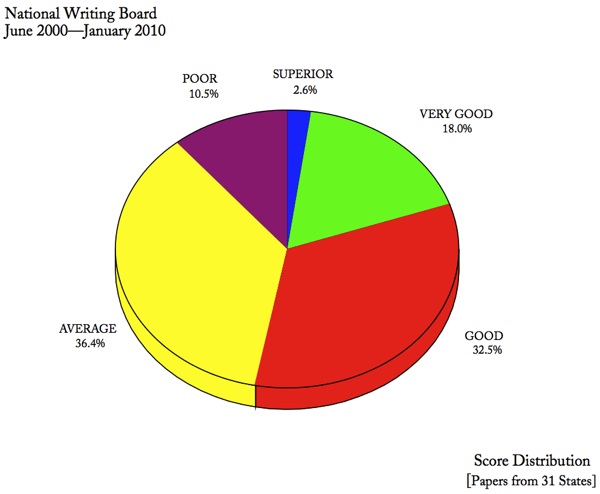
National Writing Board Score Distribution: January, 2000 to January, 2010


The National Writing Board.

Share

Yale: The musical

Jenna Johnson:

A new Yale admissions video released Friday starts as most campus tours do: an uncomfortable question-and-answer session with an over-caffeinated admissions officer. Some kid asks what year the school was founded. A dowdy mom elbows a nerdy dad.
And then a sultry young woman in a red sundress in the back row asks: “Why did you choose Yale?”
There’s a reflective pause. A reflection piano overture. Reflective looks around the room. And then — bam! — the boring admissions video turns into a musical. The admissions officer serenades the no-longer-bored students: When I was a senior in high school, colleges called out my name. Every day I debate where to matriculate, but every place seemed the same. Yet after I went through the options, only one choice remained. I wanted to hail from a college called Yale . . . .
It feels like an episode of Glee, the popular TV show that overnight made it socially acceptable and even sexy to sing in the high school show chorus. Those involved admit they watched the movie “High School Musical” for inspiration. And since the video was posted on YouTube on Friday evening, it has been viewed nearly 50,000 times.

Share

Just who made the young so doltish?

The Economist:

WHY are the young so disappointing, when it comes to their manners, dress codes, or knowledge of the canon of Western civilisation? Ask a British or American conservative, and he will blame the left: the 1960s vintage teachers who disdain dead white guys like Shakespeare, the college campuses where Derrida and deconstruction have displaced reading actual literature or the egalitarian ethos of “all shall have prizes”.
Ask someone from the left, for example in Britain, and they will trace the rot back to Thatcherism: the hostility to pure research, the focus on commercially-driven vocational education (all those degree courses in golf course management or marketing, elbowing aside history or Ancient Greek), or the dumbing down of examinations by ministers who knew the price of everything and the value of nothing.
Luc Ferry, a prolific French philosopher and former education minister in the conservative government of Jean-Pierre Raffarin, has a new book out, “Face à la crise: Matériaux pour une politique de civilisation”, offering a distinctly Gallic view of the problem: the fault lies with globalisation.

Share

The Four “R’s” – A Charter School That Works

Bruce Fuller:

“Good audience skills are imperative,” Danielle Johnson reminds her restless 10th-graders as one, Raquel, nervously fiddles with her laptop before holding forth on her project portfolio at City Arts and Technology High School (known as CAT), a charter school of 365 students on a green knoll above the blue-collar southern reaches of Mission Street in San Francisco.
“I decided to use the story of my mom getting to this country as an immigrant,” Raquel says, moving into her personal-memoir segment, sniffing back tears as a blurry photo of her mother at age 18 appears on the screen. “I had never asked my mother about how she got here.”
CAT exemplifies President Obama’s push to seed innovative schools that demand much from all students, echoed by Sacramento’s $700 million reform plan that goes to Washington this week. How to bottle the magic of CAT teachers like Johnson – listening carefully to each teen, strengthening each voice with basic skills and motivating ideals – is the challenge facing would-be reformers.

Share

Why US high school reform efforts aren’t working

Amanda Paulson:

Since it began in 2004, the Baltimore Talent Development High School has posted some impressive graduation rates and achievement scores, among other things.
Even more notable, efforts by educators at nearby Johns Hopkins University to replicate the school’s gains in dozens of other locations have also met with some success. Slowly, the network of Talent Development High Schools is helping student groups that often seem most at risk.
But good news at the high school level is unusual. Despite vigorous calls for change and a host of major reform efforts, encouraging results have been scarce. National Assessment of Educational Progress (NAEP) scores – considered the “Nation’s Report Card” – tend to be stagnant for high-schoolers, even when they rise for elementary school students.
Only about half of low-income and minority students in US high schools graduate, and many of those who do are unprepared for college. The isolated examples of success often fail when administrators or education reformers try to reproduce them on a large scale.

Share

Consider community college, three-year plan to cut costs

Janet Bodnar:

For years, Kiplinger’s has been advising parents that one way to keep higher-education costs under control is to have their kids attend community college for a year or two and then switch to a four-year school. This year, they finally listened to us — with a vengeance.
Community colleges are packed to the gills, and students are flocking to state institutions across the board. The average annual sticker price for a four-year public school remains a tad over $15,000 — less than half the tab at a private institution. In our exclusive rankings of the 100 best values in public colleges, nearly 40 percent charge in-state students less than the average price, reports Senior Associate Editor Jane Bennett Clark.
There’s nothing like a financial crisis to get families to focus on how much they’re paying for big-ticket items such as college expenses. Surprisingly, they haven’t always done that. In 2008, a survey of parents and students by Sallie Mae found that when deciding whether to borrow for college, a whopping 70 percent said a student’s potential postgraduate income did not factor into the discussion.

Share

Best Value Colleges 2010

USA Today:

The Princeton Review’s 100 “Best Value Colleges” list for 2010 is based on data compiled and analyzed by The Princeton Review, the education services and test-prep company known for its annual college listings.
The analysis uses the most recently reported data from each institution for its 2009-10 academic year. The top 10 public and private “Best Values” are ranked; the rest are listed alphabetically.
FULL STORY: Can getting a degree be affordable?
The Princeton Review selected the schools based on surveys of administrators and students at more than 650 public and private college and university campuses.

Share

US Education Chief Criticizes NBA and the NCAA

Katie Thomas:

Education Secretary Arne Duncan entered some of the most contentious debates in college sports on Thursday when, in a speech at the N.C.A.A. convention, he called for stricter consequences for college teams that do not graduate their athletes and said the N.B.A.’s age-minimum policy sets up young athletes for failure.
“Why do we allow the N.C.A.A, why do we allow universities, why do we allow sports to be tainted when the vast majority of coaches and athletic directors are striving to instill the right values?” said Duncan, who was a co-captain of his Harvard basketball team and played in an Australian professional league from 1987 until 1991.
He said his time as a college athlete was one of the most valuable periods of his life, but feared the N.B.A.’s age rule, which requires that a player be at least 19 years old and at least one year removed from high school before entering the league, does a disservice to athletes.

Share

Top public universities faulted on financial aid

Jenna Johnson:

Many of the nation’s top public universities are giving millions of dollars in financial aid to students from relatively wealthy families instead of to those who urgently need it, resulting in campuses that are often less diverse than those at elite private schools, a new report says.
From 2003 to 2007, public research universities increased the amount of aid to students whose parents make at least $115,000 a year by 28 percent, to $361.4 million, said the Education Trust, a nonprofit advocacy group.
Those schools routinely award as much in financial aid to students whose parents make more than $80,000 a year as to those whose parents make less than $54,000 a year, according to the report, “Opportunity Adrift.”

Share

The zeitgeist of reading instruction

Daniel Willingham:

By Daniel Willingham
I have written (on this blog and elsewhere) about the importance of background knowledge and about the limited value of instructing students in reading comprehension strategies.

To be clear, I don’t think that such instruction is worthless. It has a significant impact, but it seems to be a one-time effect and the strategies are quickly learned. More practice of these strategies pays little or no return. You can read more about that here.

Knowledge of the topic you’re reading about, in contrast, has an enormous impact and more important, there is no ceiling–the more knowledge you gain, the more your reading improves.

In a recent email conversation an experienced educator asked me why, if that’s true, there has been such emphasis on reading strategies and skills in teacher’s professional development.

Share

The Royal Society Turns 350

The Economist:

THE streets surrounding St James’s Palace in London are dotted with gentlemen’s clubs, many of which now also admit women. This year, one such establishment is marking its 350th anniversary. The club in question is not merely a meeting place for like-minded members, however: it is the society that founded modern science.
The first fellows of the Royal Society, as it is now known, were followers of Sir Francis Bacon, a 17th-century statesman and philosopher who argued that knowledge could be gained by testing ideas through experiments. On a damp and murky night in November 1660, a dozen of them met to hear a lecture by a 28-year-old astronomer called Christopher Wren, who would later become the architect who designed St Paul’s Cathedral. Inspired, they determined to meet every week to discuss scientific matters and to witness experiments conducted by different members of the group. In so doing, they invented the processes on which modern science rests, including scientific publishing and peer review, and made English the primary language of scientific discourse.

Share

Advantages and Drawbacks of Attending a (Mostly) Women’s College (Part the Last)

Susan O’Doherty:

Over the past several weeks, I have discussed the impact of attending a traditionally female college in the early 1970s. I wasn’t there that long — like most students of the time, I got on the train at 18 and disembarked at 22 with a diploma. But those four years were formative, shaping the rest of my personal and professional life in some important ways:
–Valuing female friendships: Most women I know value their friendships with other women, of course. But I was raised in a time and culture that put men first. We were encouraged to break a date with a girl friend, for example, if a boy asked us out. My exposure to the brilliance, fierce loyalty, seriousness and silliness of my classmates put an end to that nonsense. My best friend from college remains one of my two best friends today. She is the person I call when I need to talk through a problem, cry without explaining myself, or share good (or bad) news. There is nothing I wouldn’t do for her.
–Valuing women in the workplace: I have friends, both male and female, who complain about “women bosses”: that they are petty, self-contradictory micromanagers, mostly. For a while I thought I had just been extraordinarily lucky to have a string of extremely competent, visionary, and decisive (not to mention empathetic and fun) female employers. Then I realized that we were sometimes talking about the same people. Women of my generation were trained not to raise our voices; to deliver definite pronouncements as though they were tentative questions; and to mask and deny irritation until it builds up into an explosion. This behavior is so ingrained in many of us that we don’t realize we’re sending out seemingly mixed signals. Working on tech crews, student committees, etc., at college, I got used to decoding “Maybe we should go with the yellow scrim; what do you think?” as “Please get started on the yellow scrim now,” and this assumption that my female bosses a) knew what they wanted and b) were communicating this, if I listened hard enough, saved me many misunderstandings as a young flunky. I also, unlike many of my peers, took women’s competence as a given, and thus avoided the irritating questioning and second-guessing that tends to lead to the aforementioned explosions.

Share

U. Tube: Student Teachers Learn From Video Training

Brenda Iasevoli:

The teacher sits in a large wooden rocking chair. One by one, she invites her third-graders to get up from their desks and take a place in front of her on the rug. “Thank you, Kiara,” she says, complimenting a scrawny child with long black hair for sitting criss-cross-style. As the other students take their places on the rug, the teacher sits on the edge of her chair. Her eyes move from left to right, watchful for misbehavior.
“Look at that teacher scan,” says Jim Lengel with an excited laugh. “It’s like radar.”
The students freeze as Lengel, a visiting professor at Hunter College School of Education, pauses the video he’s been watching them on. Ten of the third-graders are looking directly at the teacher, while two look off toward the camera.

Share

The Diary: Barbara Ehrenreich

Barbara Ehrenreich:

In the course of their work my brilliant children – a human rights lawyer and a freelance journalist – travel to places such as Phnom Penh and Dubai. In the course of mine Macomb, Illinois, is a more typical destination, involving five hours of flying, including a layover in Detroit and then two hours of driving through snow-covered fields barely interrupted by a couple of semi-boarded-up “towns”, including the intriguingly named Preemption (population 71).
After all this industrial-agricultural wasteland, Macomb is a veritable hive of human, cultural and commercial activity. There is a branch of the state university system, where I have been invited to speak, and until a few months ago, my hosts inform me, there were a total of two Italian restaurants in town, one famed for its Spam-and-Doritos-topped pizza. I’m staying at the Hampton Inn, a minimalist motel chain located opposite a Farm King, an agricultural supply store. I can’t help asking whether this is where the university puts up a genuine celebrity speaker, such as Bill Cosby. “Oh no,” I am told, “he flew in in his private plane and out the same night.”
Ann, a congenial administrator at Western Illinois University, fills me in on the student body. They are mostly white, first-generation college students and, while about a third of them are studying law enforcement with a view to a career in police work, this does not stop them from illegal under-age drinking or, for that matter, smoking pot. We muse on the problem of binge drinking, endemic to American campuses: why go straight from sobriety to vomiting? Haven’t they ever sampled the pleasures of tipsiness? Then Ann tells me one of the saddest things I’ve heard on the perennial subject of Young People Today: they don’t know how to be “silly”, she says, in the sense of whimsy and absurdity. They are strait-laced and even a little timid, unless, of course, they are utterly wasted.

Share

‘Parent trigger’ shifts balance of power in debate over education reform

San Jose Mercury News:

Much has been written about how two education reform bills signed into law last week might affect California’s chances of qualifying for federal Race to the Top funds.
As important as that funding is, the new laws’ significance goes much deeper. It signals that the balance of power in education is shifting away from teachers unions and toward parents, where it belongs.
The “parent trigger,” a controversial element of the legislation, is the best evidence of this turning point.
The concept was developed by the grass-roots group Parent Revolution in the Los Angeles Unified School District. If a majority of parents in a failing school petitions for an overhaul, the district must do something — replace administrators, convert to a charter school or make other major reforms.
By law, tenured California teachers can convert their school to a charter if a majority of them vote for it, and that has happened dozens of times. But teachers unions and other groups opposed giving parents the same right. One group called it the “lynch mob” provision — an odd choice of words, given that it would empower parents primarily in minority communities where failing schools abound.

Share

Revolution in U.S. education is in California

Alain Bonsteel:

The greatest revolution in education in the United States today is taking place in Los Angeles. It is the mandate of the Los Angeles Unified School District School Board to convert almost a third of its schools either to charter schools, the public schools of choice that are the one shining light in an otherwise dysfunctional system, or other alternatives such as magnet schools. The change is not only a mighty one for the state’s largest school district, but in time it could double the number of public schools of choice in California.
What is remarkable is not just the magnitude of this earth-shaking change, but the complete shift of the paradigm about how we think about public education. The driving force behind this revolution is Los Angeles Mayor Antonio Villaraigosa, who is not only a Democrat but also a former organizer for the United Teachers of Los Angeles, Los Angeles teachers’ union. Villaraigosa took his nontraditional stand because, as he noted, LAUSD was racked with violence and plagued with a dropout rate of 50 percent, and showed no signs of improving.

Share

Getting a Job in College: Second Thoughts

Stephen Krieder Yoder, Isaac Yoder and Levi Yoder:

Isaac: My first semester at college was as fun and stimulating as I had hoped. Several classes already have changed my way of thinking, and I have a group of new friends.
But not everything went according to plan: I went back on one decision I made before going into college — the decision to not work a job during the college year.
Dad and I had agreed before college that if taking my studies seriously was my most important goal, spending time and energy working a job could detract from that goal. My part-time job at a tea shop in high school created many sleep-deprived days at school and made it more difficult to complete all my assignments well. Though I ended up succeeding despite the extra work, I thought that this added stress would be more problematic in college, when I would have more, and harder, schoolwork.
But after only my first semester, I’ve already begun to work a job in student government, in addition to my other extracurriculars.

Share

The Changing Nature of Employment in the Great Recession

Jay Fenello:

I recently saw the Great Depression film “The Grapes of Wrath,” and while I had seen it before, this time I was reminded of what’s going on in employment today. The movie starts off with Henry Fonda returning to his family farm after having been away for a few years, only to find his home abandoned. He soon learns that his family, as well as all of his Oklahoma neighbors, have been evicted and are leaving for the promise of jobs in California.
We then learn that the families in Oklahoma have been hit with a perfect storm. Drought, low farm prices, and the displacement caused by farm automation had resulted in bankruptcy and foreclosure for millions of farmers. It was reported that one man with a tractor could replace 10-15 family farms, and over 100 farm workers.
Similarities to the Great Recession
Consider the tractor for a moment. The gasoline powered tractor first appeared way back in 1892. However, it didn’t really catch on until the tractor was mass produced in the 1910’s. Then, as tractor prices came down, its use on the farm started to take off. The result was an increase in farm productivity, falling prices for farm products, and a loss of jobs for millions of farmers. This displacement peaked 20 years later, during the Great Depression.

Share

Los Angeles charter schools flex their educational muscles

Mitchell Landsberg, Doug Smith & Howard Blume:

Enrollment is up, and overall, standardized test scores outshine those at traditional campuses. Even the L.A. Unified board has eased its resistance.
Over the last decade, a quiet revolution took root in the nation’s second-largest school district.
Fueled by money and emboldened by clout from some of the city’s most powerful figures, charter schools began a period of explosive growth that has challenged the status quo in the Los Angeles Unified School District.
Today, Los Angeles is home to more than 160 charter schools, far more than any other U.S. city. Charter enrollment is up nearly 19% this year from last, while enrollment in traditional L.A. public schools is down. And a once-hostile school board has become increasingly charter-friendly, despite resistance from the teachers union. In September, the board agreed to let charters bid on potentially hundreds of existing campuses and on all 50 of its planned new schools.
Charter schools now are challenging L.A. Unified from without and within. Not only are charter school operators such as Green Dot Public Schools and ICEF Public Schools opening new schools that compete head-to-head with L.A. Unified, but the district’s own schools are showing increasing interest in jumping ship by converting to charter status.

Share

My Lazy American Students & The Blowback

Kara Miller:

IT WAS the kind of student conference I hate.
“I’ll do better,” my student told me, leaning forward in his chair. “I know I’ve gotten behind this semester, but I’m going to turn things around. Would it be OK if I finished all my uncompleted work by Monday?”
I sat silent for a moment. “Yes. But it’s important that you catch up completely this weekend, so that you’re not just perpetually behind.”
A few weeks later, I would conduct a nearly identical conversation with two other students. And, again, there would be no tangible result: No make-up papers. No change in effort. No improvement in time management.
By the time students are in college, habits can be tough to change. If you’re used to playing video games like “Modern Warfare” or “Halo” all night, how do you fit in four hours of homework? Or rest up for class?
Teaching in college, especially one with a large international student population, has given me a stark – and unwelcome – illustration of how Americans’ work ethic often pales in comparison with their peers from overseas.
My “C,” “D,” and “F” students this semester are almost exclusively American, while my students from India, China, and Latin America have – despite language barriers – generally written solid papers, excelled on exams, and become valuable class participants.

  • Lauren Garey: Lazy American students? Uninformed professor!
  • Matt Rocheleau:

    Mixed reaction to ‘My lazy American students’ column

  • Jason Woods & Matt Rocheleau: Babson dean provides rebuttal on ‘lazy American students’
  • Kara Miller: Lazy American Students: After the Deluge:

    On Monday, The Boston Globe ran an opinion piece entitled “My Lazy American Students.”
    In it, I wrote about how teaching in college has shown me that international students often work harder than their American counterparts. Though this is emphatically not true across the board, the work ethic and success of Asian, European, and South American students – who have to compete with a classroom of native English speakers – can be astounding.
    I also noted in the column that there’s too much texting in class, too much dozing off, too much e-mail-checking, too much flirting (I didn’t mention flirting in the first piece, but I’ll mention it here). Obviously, international students do all these things, but I have noticed them more amongst American students.
    I worked hard on the column and lay in bed Sunday night hoping that – amidst the flurry of Christmas shopping – someone would read it.
    And that’s when the avalanche started.

Share

Reproductive contracts and the best interests of children

Ronald Bailey:

The question of what it means to be a parent has never been simple. But three recent cases highlight just how complicated things can get–and how inconsistent the courts have been in weighing genetic parenthood against the deals struck by would-be parents (gay and straight) with their partners.
Case 1: Sean Hollingsworth and Donald Robinson Hollingsworth are legally married in California and are registered as civil union partners in New Jersey. The two husbands arranged for Donald’s sister, Angelia Robinson, to serve as a gestational surrogate carrying embryos produced using sperm from Sean Hollingsworth and donor eggs. In October 2006, Ms. Robinson bore twin girls whom she turned over to their two fathers. In March 2007, Ms. Robinson sued for custody alleging that she had been coerced into being a surrogate. A New Jersey court ruled last week that Ms. Robinson, who has no genetic tie to the twins, is their legal mother and can sue for primary custody later this year.

Share

Taking a Leap of Faith

Lorna Siggins:

OU ARE A specialist in your field, you can see the opportunities before you, but there’s little or nothing that you can do. If this place sounds vaguely familiar, it is where Dr Deirdre MacIntyre found herself almost a decade ago.
She wasn’t a solo traveller, either. A colleague and close friend, Dr Moya O’Brien, had also reached that bus stop. The trick was to recognise when it was time to jump off.
“We had trained in psychology together, she was my bridesmaid, I was her birth partner and we had worked together in what was the Eastern Health Board before it became the Eastern Regional Health Authority ,” MacIntyre recalls. “We both had families with small kids, and very heavy clinical caseloads at work.
“I loved my career in child guidance, I loved my clinical work, but both of us felt that our impact was limited within the health board structure,” MacIntyre recalls.
At this point, she had nearly 20 years’ experience as a clinical psychologist and was principal in charge of the ERHA’s child and adolescent psychology services. She had been involved in establishing community-based psychology services for children and their families.

Share

Question 2010

Katinka Matson:

Read any newspaper or magazine and you will notice the many flavors of the one big question that everyone is asking today. Or you can just stay on the page and read recent editions of Edge …
Playwright Richard Foreman asks about the replacement of complex inner density with a new kind of self-evolving under the pressure of information overload and the technology of the “instantly available”. Is it a new self? Are we becoming Pancake People — spread wide and thin as we connect with that vast network of information accessed by the mere touch of a button.
Technology analyst Nicholas Carr wrote the most notable of many magazine and newspaper pieces asking “Is Google Making Us Stupid”. Has the use of the Web made it impossible for us to read long pieces of writing?
Social software guru Clay Shirky notes that people are reading more than ever but the return of reading has not brought about the return of the cultural icons we’d been emptily praising all these years. “What’s so great about War and Peace?, he wonders. Having lost its actual centrality some time ago, the literary world is now losing its normative hold on culture as well. Is the enormity of the historical shift away from literary culture now finally becoming clear?
Science historian George Dyson asks “what if the cost of machines that think is people who don’t?” He wonders “will books end up back where they started, locked away in monasteries and read by a select few?”.

Share

The ascendancy of the non-private person

Andrea James:

OK, I lied about no more wonky posts. Xeni’s Facebook post reminded me of something. I want to float an idea about privacy as a commodity, vs. privacy as a right.
Tiger Woods, described frequently as a “very private” person, was unable to keep his private life private. Why? Because he interacted with non-private people. The reason Kim Kardashian and the Jersey Shore denizens have risen to positions of prominence in popular culture is because they each epitomize the non-private person. They have nothing to hide, so nothing that becomes public knowledge can hurt them. Ms. Kardashian can be urinated on in a sex tape and actually be helped in terms of being a public figure. My own ability to be effective as a transgender rights activist is because there’s nothing anyone could expose about me that would deter me from my activism. That gives me enormous power over anonymous haters who vent their impotent fury at me to no avail. Their own fear of exposure (loss of privacy) is their greatest weakness. What does this mean for you, dear reader? Read on.

Share

Gifted Education Outrages

Jay Matthews:

My Dec. 10 column about that troublesome Washington area gifted child, future billionaire Warren Buffett, said our schools are never going to help such kids much. I said the gifted designation was often arbitrary and should be disposed of. Instead, we ought to find ways to let all kids explore their talents.
This produced a flood of comments on my blog. Many readers thought I was callous and daft. “Unfortunately, eliminating the label generally means that the schools give up doing anything for advanced learners,” wrote a reader signing in as EduCrazy. Another commenter, CrimsonWife, said “if educators are fine with giving special attention and services to kids who are far out of the mainstream on the low end of the spectrum, why is it so controversial to provide specialized services to kids who are far out of the mainstream on the high end?”

Share

Autism cluster found in Santa Clara County linked to parent education, not neighborhood toxins

Lisa Krieger:

Researchers have identified a cluster of autism cases in the South Bay — but the elevated regional incidence seems linked to parents’ ability to gain a diagnosis for their child, rather than any geographic risk.
A rigorous study of all 2.5 million births in California between 1996 and 2000 revealed 10 places where the disability is more common than elsewhere in the state — including the Sunnyvale-Santa Clara area, the San Carlos-Belmont area and several parts of southern California and Sacramento.
The scientists found a correlation, not cause, concluding that parents of autistic children in these clusters were more likely to be white, live near a major treatment center, be highly educated and
There was a lower incidence of the diagnosis where families were Latino and less educated.
A diagnosis of autism requires considerable advocacy by parents, who must navigate the complex world of pediatrics, psychiatry and autism experts. Once diagnosed, children gain access to all types of specialized services.

UC Davis MIND Institute press release.

Share

Poll of Detroit residents finds grim conditions but optimistic outlooks

Dana Hedgpeth & Jennifer Agiesta:

The decline of the auto industry and the nation’s economic slide have left many residents here trapped, without work, in houses they can’t sell, in neighborhoods where they fear for their safety, in schools that offer their children a hard road out.
People across the metro area are feeling the stress of an uncertain financial landscape, with majorities worried about the economy, the cost of health care and having enough money to pay their bills. The region’s bleak jobs situation is residents’ No. 1 concern, by a big margin. That anxiety is compounded by a widely held feeling that the community is divided by race and income.
And yet they haven’t given up.
In a new Washington Post-Kaiser Family Foundation-Harvard University poll about Detroit, almost all residents of the main three-county metropolitan area see their economy as in ruins. About half say this is a bad place to raise a family; as many describe a declining standard of living, swelling debt, deteriorating neighborhoods and a brutal job market.

Share

Best Values in Public Colleges 2009-10

Jane Bennett Clark:

The economy may be recovering, but the effects of the recession continue to buffet the nation’s public colleges and universities. State governments, coping with shrunken tax revenues and an overwhelming demand for services, have cut funding for higher education. Universities that once relied on the income from fat endowments have yet to recoup multimillion-dollar losses to their portfolios. Families continue to apply for financial aid in record numbers. Meanwhile, enrollment at state institutions has spiked as more students go public and more people overall seek college degrees.
The schools in our top 100 best values in public colleges and universities — led by the University of North Carolina at Chapel Hill for overall value and by Binghamton University (SUNY) for out-of-state value — continue to deliver strong academics at reasonable prices, in many cases by offering the same or more financial aid as in previous years. But no one can say that it has been easy.
To cope with less money and more students, public institutions, including many in our rankings, have slashed operating costs and raised tuition beyond the average increase of about five percentage points over inflation in recent years. The University of California system, caught in the downdraft of a state budget meltdown, imposed a midyear tuition hike of 15%, to be followed by another 15% increase in the summer, precipitating statewide protests. (Our rankings reflect tuition and fees, including midyear increases, as of December 1, 2009.)

Share

Pell Grants: “The Old College Lie”

Kevin Carey:

laiborne Pell died at age 90 on January 1, 2009. In the weeks that followed, the former Democratic senator from Rhode Island was lauded for his many achievements, but one stood out: The first sentence of Pell’s obituary in The New York Times cited “the college grant program that bears his name.” Pell Grants are the quintessential progressive policy, dedicated to helping low-income students cross into the promised land of opportunity and higher education. “That is a legacy,” said Joe Biden, “that will live on for generations to come.”
What the encomiums to Pell failed to mention is that his grants have been, in all the ways that matter most, a failure. As any parent can tell you, colleges are increasingly unaffordable. Students are borrowing at record levels and loan default rates are rising. More and more low-income students are getting priced out of higher education altogether. The numbers are stark: When Pell grants were named for the senator in 1980, a typical public four-year university cost $2,551 annually. Pell Grants provided $1,750, almost 70 percent of the total. Even private colleges cost only about $5,600 back then. Low-income students could matriculate with little fear of financial hardship, as Pell intended. Over the next three decades, Congress poured vast sums into the program, increasing annual funding from $2 billion to nearly $20 billion. Yet today, Pell Grants cover only 33 percent of the cost of attending a public university. Why? Because prices have increased nearly 500 percent since 1980. Average private college costs, meanwhile, rose to over $34,000 per year.

Share

Michigan Teaching School Tries Something New

Larry Abramson:

America’s teachers’ colleges are facing some pressure to reinvent themselves.
Education Secretary Arne Duncan has been leading the assault, with a series of speeches calling for better teacher training. Duncan says it’s crucial that education schools revamp their curricula so they can help replace a wave of baby boomers who will soon retire from teaching.
One university is trying to rebuild its teacher-training program from the ground up.
At the University of Michigan School of Education, Dean Deborah Ball and her faculty have taken apart their training program and reassembled it, trying to figure out what skills teachers really need.
Katie Westin, a senior at the University of Michigan and a student teacher, says that when she compares notes with teachers-in-training at other schools, it’s clear that her program is more hands-on.
“We expect people to be reliably able to carry out that work. We don’t seem to have that same level of expectation or requirement around teaching,” Ball says.

Share

Elmbrook gets UW-Waukesha classes: “Professors Save Students the Trip”

Amy Hetzner, via a kind reader’s email:

By the time the first bell rings at Brookfield Central High School, most of the students in Room 22 are immersed in college-level vector equations, reviewing for their final exam on the Friday before Christmas.
Senior Lea Gulotta, however, looks on the bright side of waking early every morning for the past semester so she can take a Calculus 3 class taught at the school by a college professor.
“We get to sleep in for a month,” she said, noting that the regular high school semester won’t end until mid-January.
There’s another positive to Brookfield Central’s agreement with the University of Wisconsin-Waukesha continuing education department, which brought the advanced mathematics class to the high school this year as part of the state’s youth options program. Under youth options, school districts pick up the costs of courses at Wisconsin colleges if they don’t have similar offerings available to students.
Instead of seeing students spend extra time commuting and attending class on a college campus, the arrangement placed the professor in the high school to teach 11 students who had completed advanced-placement calculus as juniors. Two of the students in the class come from the Elmbrook School District’s other high school, Brookfield East.
Elmbrook pays UW-Waukesha the same tuition that it would pay if its students chose to attend the college campus on their own, she said.

Related: Janet Mertz’s tireless crusade on credit for non-Madison School District classes.

Share

The Replacements: On Substitute Teaching and Days Out of the Classroom

Carolyn Bucior:

TWO years ago, during lunch with a second-grade teacher in the Chicago area, I mentioned that I was going to substitute teach. The teacher — I’ll call him Dan — started into a story about his own experience with a substitute, which is easily summarized: Dan left a lesson plan; the sub didn’t follow it. So, he ended by asking, how hard can substitute teaching be?
I smiled, said nothing and bit into my Reuben.
Over the next two years, I would learn — as I subbed once a week for a variety of classes, including kindergarten, sixth grade, middle-school social studies, high-school chemistry, phys ed, art, Spanish, and English as a second language — that Dan’s story is standard teacher fare. Last time I heard it, though, I didn’t bite my sandwich or my tongue.
As much as I became frustrated by the lack of training and support, I was most angered by how many days teachers were out of their classrooms. Nationwide, 5.2 percent of teachers are absent on any given day, a rate three times as high as that of professionals outside teaching and more than one and a half times as high as that of teachers in Britain. Teachers in America are most likely to be absent on Fridays, followed by Mondays.
This means that children have substitute teachers for nearly a year of their kindergarten-through-12th-grade education. Taxpayers shell out $4 billion a year for subs.
I subbed for many legitimately ill teachers and for many attending educational conferences. But my first assignment was to fill in for a sixth-grade teacher who went to a home-and-garden show. My last was for a first-grade teacher who said she needed a mental health day because her class was so difficult.

Share

Making College ‘Relevant’

Kate Zernike:

THOMAS COLLEGE, a liberal arts school in Maine, advertises itself as Home of the Guaranteed Job! Students who can’t find work in their fields within six months of graduation can come back to take classes free, or have the college pay their student loans for a year.
The University of Louisiana, Lafayette, is eliminating its philosophy major, while Michigan State University is doing away with American studies and classics, after years of declining enrollments in those majors.
And in a class called “The English Major in the Workplace,” at the University of Texas, Austin, students read “Death of a Salesman” but also learn to network, write a résumé and come off well in an interview.
Even before they arrive on campus, students — and their parents — are increasingly focused on what comes after college. What’s the return on investment, especially as the cost of that investment keeps rising? How will that major translate into a job?

Share

Creativity in Schools in Europe: A survey of Teachers

The Institute for Prospective Technological Studies: CACHIA Romina, FERRARI Anusca, KEARNEY Caroline, PUNIE Yves, VAN DEN BERGHE Wouter, WASTIAU Patricia – 1MB PDF:

An overwhelming majority of teachers are convinced that creativity can be applied to every domain of knowledge and that everyone can be creative. They also subscribe to the idea that creativity is a fundamental skill to be developed in schools, even if they are more ambiguous about how it can be taught, and less sure still about how it can be assessed.
Survey respondents were asked to express their opinion about how they view creativity, as a general concept as well as in the school context, on a scale of 5 ranging from ‘strongly agree’ to ‘strongly disagree’. The results are displayed in Figure 1.
Literature reports that very often people, including teachers, refer to creativity as being related exclusively to artistic or musical performances, as springing from natural talent, and as being the characteristic of a genius. These myths about creativity stifle the creative potential of students and create barriers to fostering creativity in schools.
To a large extent, the teachers that took part in our survey have an understanding of creativity which goes against such myths. Almost all teachers who took part in the survey are convinced that creativity can be applied to every domain of knowledge (95,5%) , and to every school subject. More than 60% are even strongly convinced of this. They confirm this view very clearly by disagreeing to a large extent with a statement restricting creativity to the realm of artistic and cultural expression (85%).

Share

Top-tier schools widen the net Elite institutions seek non-Chinese speakers

Liz Heron:

Two elite English-medium schools offering the local curriculum have drawn up bold expansion plans that will enable them to admit children from non-Chinese-speaking families.
St Paul’s Co-educational College and Diocesan Boys School are setting up boarding houses and International Baccalaureate programmes and have devised adapted Chinese-language programmes for pupils who are not native speakers of Chinese.
The moves will permit the Direct Subsidy Scheme schools, which require all pupils to study Chinese language, to widen their nets to include children from English-speaking families, as well as foreign pupils and ethnic minority children.
Currently, almost all pupils at the schools, which are obliged to offer the local curriculum and will run the IB Diploma alongside it, have Chinese as their mother tongue and most are permanent residents.

Share

Landing a Job of the Future Takes a Two-Track Mind

Diana Middleton:

If you’re gearing up for a job search now as an undergraduate or returning student, there are several bright spots where new jobs and promising career paths are expected to emerge in the next few years.
Technology, health care and education will continue to be hot job sectors, according to the Bureau of Labor Statistics’ outlook for job growth between 2008 and 2018. But those and other fields will yield new opportunities, and even some tried-and-true fields will bring some new jobs that will combine a variety of skill sets.
The degrees employers say they’ll most look for include finance, engineering and computer science, says Andrea Koncz, employment-information manager at the National Association of Colleges and Employers. But to land the jobs that will see some of the most growth, job seekers will need to branch out and pick up secondary skills or combine hard science study with softer skills, career experts say, which many students already are doing. “Students are positioned well for future employment, particularly in specialized fields,” Ms. Koncz says.
Career experts say the key to securing jobs in growing fields will be coupling an in-demand degree with expertise in emerging trends. For example, communications pros will have to master social media and the analytics that come with it; nursing students will have to learn about risk management and electronic records; and techies will need to keep up with the latest in Web marketing, user-experience design and other Web-related skills.

Share

Madison School District’s Infinite Campus Teacher Tool and Parent/Student Portal Report: Approximately 2/3 of Middle and High School Parents don’t use it

Kurt Kiefer, Lisa Wachtel:

This report summarizes data on the use of Infinite Campus teacher tools and the Parent and Student Portal. Data come from a survey conducted among all teachers responsible for students within the Infinite Campus system and an analysis of the Infinite Campus data base. Below are highlights from the report.
About half of all middle and high school teachers responsible for providing grades to students are using the grade book tool.
Grade book use has declined over the past year at the middle school level due to the introduction of standards- based grading. In addition to the change in grading approach, the grade book tool in Infinite Campus does not handle standards-based grading as efficiently as traditional grading.
Lesson Planner and Grade book use is most common among World Languages, Physical Education, and Science teachers and less common among fine arts and language arts/reading teachers.
Grade book and other tool use is most common among teachers with less than three years of teaching experience. Seventy percent ofteachers responding to the survey within these years of experience category report using the tools compared with about half of all other experience categories.
Most of the other teacher tools within Infinite Campus, e.g., Messenger, Newsletters, reports, etc., are not being used due to a lack of familiarity with them.
Many teachers expressed interest in learning about how they can use other digital tools such as the Moodie learning management system, blogs, wikis, and Drupal web pages.
About one third of parents with high school students use the Infinite Campus Parent Portal. Slightly less than 30 percent of parents of middle school students use the Portal.
Having just been introduced to elementary schools this fall, slightly more that ten percent of parents of students at this level use the Portal.
Parents of white students are more likely to use the Portal than are parents of students within other racial/ethnic subgroups.
About half of all high school students have used the Portal at one time this school year.
About one in five middle school students have used the Portal this year.
Variation in student portal use is wide across the middle and high schools.
Follow up is planned during January 2010 with staff on how we can address some ofthe issues related to enhancing the use of these tools among staff, parents, and students.
This report is scheduled to be provided to the Board of Education in February 2010.

Share

Rhee vows to shield D.C. teachers, supplies amid budget cuts

Bill Turque:

D.C. Schools Chancellor Michelle A. Rhee has vowed to protect funding for teachers and classroom supplies as she prepares to cut the system’s overall budget by $22 million because of shrinking tax revenue and the end of one-time federal stimulus spending.
The fiscal 2011 budget, which begins in October, is projected to shrink from $779 million to $757 million. Spending would fall most sharply in the “school support category,” including security, food service and after-school programs. Rhee’s central office would also face cuts.
But Rhee said this week that financial constraints won’t limit her efforts to transform historically poor academic performance in the 45,000-student system.
“Obviously financial times like this make things tough, but no, they won’t stop us from being successful,” Rhee said in an e-mail Thursday.

Share

Women in the workforce Female power

The Economist:

Across the rich world more women are working than ever before. Coping with this change will be one of the great challenges of the coming decades
THE economic empowerment of women across the rich world is one of the most remarkable revolutions of the past 50 years. It is remarkable because of the extent of the change: millions of people who were once dependent on men have taken control of their own economic fates. It is remarkable also because it has produced so little friction: a change that affects the most intimate aspects of people’s identities has been widely welcomed by men as well as women. Dramatic social change seldom takes such a benign form.
Yet even benign change can come with a sting in its tail. Social arrangements have not caught up with economic changes. Many children have paid a price for the rise of the two-income household. Many women–and indeed many men–feel that they are caught in an ever-tightening tangle of commitments. If the empowerment of women was one of the great changes of the past 50 years, dealing with its social consequences will be one of the great challenges of the next 50.

Share

Easy Money For College Can Mess You Up, Man

Katherine Mangu-Ward

When the government subsidizes something, we wind up with more of it. When it subsidizes something heavily–and combines that subsidy with an aggressive campaign encouraging consumption of that thing from the presidential bully pulpit–we wind up with a lot more of it.
Oceans of federal money gush into higher education every day, and every administration promises more to come. That gush obscures the real demand for educated workers. The result is lots of cashiers and waitresses with B.A.s, and lots of people with student loan debt that’s tough for them to repay. For most students, the federal subsides geared toward nudging them to consume more education actually result in the acquisition of more education debt.
On the corporate side (and the non-profit side, for that matter) the subsidy encourages institutions to shape their practices around grabbing as much of that “free” money as possible. As critics of for-profit education never fail to note:

Share

Tracking An Emerging Movement: A Report on Expanded-Time Schools in America

David A. Farbman:

Fifteen years ago, the National Education Commission on Time and Learning explained that the American school calendar of 180 six-hour days stands as the “design flaw” of our education system, for schools could not be expected to enable children to achieve high standards within the confines of the antiquated schedule. Today, a small but growing number of schools have begun to overcome this “flaw” by operating with school days substantially longer than the six-hour norm and, in many cases, a calendar that exceeds the standard 180 days.
The National Center on Time & Learning (NCTL), with the support of the William and Flora Hewlett Foundation, has produced this groundbreaking report on the state of what can be called “expanded- time schools.” Through this effort, NCTL has helped to define and bring together this previously unidentified category of schools, while still recog- nizing the considerable diversity among this group. Extracting and analyzing information from NCTL’s newly created database of over 650 schools that feature an expanded day and/or year, this report describes the various trends emerging among these schools, including issues related to costs, time use and student outcomes. The searchable database is available on our website, www.timeandlearning.org.

Share

Father Invents ‘VerbalVictor’ App To Help Disabled Son ‘Speak’ Thru iPad

Associated Press

Victor Pauca will have plenty of presents to unwrap on Christmas, but the 5-year-old Winston-Salem boy has already received the best gift he’ll get this year: the ability to communicate.
Victor has a rare genetic disorder that delays development of a number of skills, including speech. To help him and others with disabilities, his father, Paul, and some of his students at Wake Forest University in Winston-Salem have created an application for the iPhone and iPad that turns their touch screens into communications tools.
The VerbalVictor app allows parents and caregivers to take pictures and record phrases to go with them. These become “buttons” on the screen that Victor touches when he wants to communicate. A picture of the backyard, for example, can be accompanied by a recording of a sentence like “I want to go outside and play.” When Victor touches it, his parents or teachers know what he wants to do.

Share

As college costs rise, loans become harder to get

David Cho:

When Daniel Ottalini entered the University of Maryland in 2004, his family had an array of choices to cover the cost — cheap student loans, a second mortgage at low rates, credit cards with high limits and their own soaring investments.
By the time his younger brother, Russell, started at the University of Pittsburgh this fall, the financial crisis had left the family with fewer options. Russell has had to juggle several jobs in school, and the money he could borrow came with a much higher interest rate that could climb even further over time.
The upheaval in financial markets did not just eliminate generous lending for home buyers; it also ended an era of easy credit for students and their families facing the soaring cost of a college degree.
To pay for higher education, most Americans had come to rely on a range of financial products born of the Wall Street boom. Nearly all of these shrank or disappeared in the storm that engulfed the stock and debt markets.

Share

A National Survey on Mothers’ Attitude on Fathering

National Fatherhood Initiative:

On December 1, 2009, National Fatherhood Initiative (NFI) released Mama Says: A National Survey of Mothers’ Attitudes on Fathering, the first-ever national survey taking an in-depth look at how today’s mothers view fathers and fatherhood.
Conducted online by the University of Texas Office of Survey Research, Mama Says surveyed 1,533 mothers over the age of 18 with at least one child in the home under the age of 18. They were asked a series of over 80 questions dealing with a range of topics, such as their general opinions about fatherhood, views on work-family balance, and obstacles to good fathering.
The study is a companion piece to NFI’s 2006 study, Pop’s Culture: A National Survey of Dads’ Attitudes on Fathering. The report was co-authored by Dr. Norval Glenn, PhD. and Dr. Barbara Dafoe Whitehead, PhD.

Share

SIDS report: Many doctors don’t stress back-sleeping guidelines

Lee Bowman:

Although the practice is viewed as essential to keeping babies safe, nearly a third of all caregivers still don’t regularly put infants on their backs to sleep, according to a new report published Monday.
Despite guidelines from pediatricians and a national educational campaign in place since the mid-1990s, researchers found that while there was a dramatic increase in back-sleeping during the first years of the push, the percentage of parents following the recommendations has been virtually unchanged since 2001 – holding at just over 70 percent – although that’s still a substantial improvement from the 25 percent rate in 1993.
Pediatricians and the National Institute of Child Health and Human Development called for the change in sleeping practices in the face of a large body of evidence that placing infants on their backs reduced the risk of Sudden Infant Death Syndrome, the leading cause of infant death in the first year of life in the United States.

Share

Getting an education–it’s about power

Jay Matthews:

We all know that securing a good education for your children is strongly influenced by clout. Do we have it or not? The mayor’s kid usually gets more attention than the grocery checker’s kid. If you have taken the trouble to make friends with the principal, you are more likely to get your way than if you never appear in the building, or even PTA meetings.
But rarely have I seen a better illustration of this than my colleague Emma Brown’s terrific piece leading the Monday Metro section about how much Army and Marine Corps families are gaining from those services’ decisions to back their members when they seek help for children with disabilities.
Among other examples, she tells how Karen Driscoll, wife of a Marine Corps officer, was told by officials of a northern San Diego County school district that they could only offer a classroom aide for her son ten hours a week. The child’s previous school in Fairfax County had provided 21 hours and told her that was what she deserved under federal law.
Most parents seeking special education services know what that means. They are in for a long period of testy meetings, long emails, expensive private evaluations and maybe even legal action before they get what they need, if they ever do. But because of a new Marine Corps initiative, Driscoll had the services of a caseworker and a special education attorney in her meetings with school officials, and soon got what she was looking for.

Share

30% of Teens Report Abuse in Relationships

Katie Couric:

“All I remember was landing face first on the floor,” said Tina, 18.
Tina – disguised for her safety – says the violence spiraled out of control during her six-month relationship with her 17-year-old boyfriend.
“I remember he got on top of me and he was slapping me back and forth,” Tina said. “And he said, ‘next time you walk by me, acknowledge me. Say that you love me.'”
Raped, beaten and berated on a regular basis, she stayed with him, believing the abuse was part of a normal relationship.
“I knew my aunt went through it so I thought, you know, if she stuck it out with him, with her husband for years, that I should just do the same and keep my mouth shut,” she added.
When another 15-year old – who did not want to be indentified – met a cute boy in one of her high school classes – she was smitten.

Share

In East Bay, where pollution goes, health problems follow

Sandy Kleffman & Suzanne Bohan:

In some hardscrabble East Bay neighborhoods, people die of heart disease and cancer at three times the rates found just a few miles away in more well-to-do communities.
Children living near busy freeways in Oakland are hospitalized for asthma at 12 times the rate of young people in Lafayette’s wooded housing tracts.
The East Bay’s striking health inequities extend far beyond life expectancy and involve more than differences between the rich and the poor. Disparities exist up and down the East Bay’s socioeconomic ladder, according to data compiled by the Alameda County Public Health Department for Bay Area News Group.
Middle-class communities in Dublin, Castro Valley and Fremont have higher heart disease death rates than wealthier neighborhoods in Walnut Creek and Berkeley, but lower rates than struggling areas of East Oakland and North Richmond.
These facts have led public-health leaders to advocate to equalize opportunities for healthful living, instead of focusing only on a never-ending battle to treat disease.

Share

Notes on the history of information overload

David Weinberger:

I spent most of today tracking down some information about the history of information overload, so I though I’d blog it in case someone else is looking into this. Also, I may well be getting it wrong, in which case please correct me. (The following is sketchy because it’s just notes ‘n’ pointers.)
I started with Alvin Toffler’s explanation of info overload in the 1970 edition of Future Shock. He introduces the concept carefully, expressing it as the next syndrome up from sensory overload.
So, I tried to find the origins of the phrase “sensory overload.” The earliest reference I could find (after getting some help from the Twitterverse, which pointed me to a citation in the OED) was in coverage of a June, 1958 talk at a conference held at Harvard Medical School. The article in Science (vol 129, p. 222) lists some of the papers, including:

Share

Kindness taught in Seattle school’s online class

Linda Shaw:

If you recently found a shiny gold dollar coin in downtown Bellevue, thank the kindness class. Ditto if you stumbled upon a piece of glass art in Pioneer Square, or a lottery ticket taped to a bus shelter with a note saying, “This may be your lucky day.”
Since mid-September, the 250 people in Puget Sound Community School’s online course learned about kindness by practicing it.
Along the way, they took emotional risks, repaired relationships, improved their outlook on the world, and realized that kindness is contagious.

Share

Advantages and Drawbacks to Attending a (Mostly) Women’s College

Susan O’Doherty:

Recent discussions on this blog about gender balance in colleges and universities have sparked a number of memories of my own college experiences. I thought it would be interesting to share them here and to invite you to share yours, as well.
As noted previously, in 1970 I entered a small college that had, until that year, been the “sister school” of a nearby men’s university. There were only a handful of men in my class, and of course none in the more advanced classes.
I had applied to only three colleges in total, all chosen by my parents, and all in the South; two private women’s schools and this, a well regarded branch of a state university system. I was accepted at all three, and my parents chose to send me to the cheapest school. I was in no position, or mood to argue; I had narrowly escaped secretarial school, at which I would have been a complete failure; I had no money, and because my parents did have money I was not eligible for the juiciest scholarships. I was grateful to be going anywhere.

Share

Students seek clout beyond campuses

Tim Holt:

An earlier generation of college students took on the Vietnam War. Now a new generation is poised to take on the mess in Sacramento.
This Christmas break, students from University of California and state and community college campuses will fan out across the state to collect signatures in support of an initiative that would free the Legislature from its two-thirds vote requirement on budget and revenue matters. Their goal is to collect enough signatures by April 15 to qualify for the November 2010 ballot.
Amid a welter of sit-ins, teach-ins and building takeovers, this is a bold effort to reach beyond the campuses and address the chronic problems of a dysfunctional Legislature and the state’s fiscal crisis. If it passes, the California Democracy Act will allow a simple majority in the Legislature to pass a budget and balance it if necessary with new revenue sources.

Share

You Could Hire This Robot Teacher for $77,000

Kit Eaton:

The robot revolution is indeed on its way: Soon we’ll have robovacuums, robot chefs, and now, robots teaching our kids about robots. But it’s not a one-way evolution, as humans are becoming little more futuristic too, with the help of a robo-knee.
Japan’s Bot for School Kids
The robot pictured above is yet another humanoid robot (that’ll be an android, then) joining the ranks currently led by Honda’s amazing Asimo. This unnamed machine is based on a design by ZMP and is pretty capable–even has a video-projection system built in. There’s a lithium battery to give it some autonomy, and all the gyros and accelerometers to give it a sense of balance as its 21 joints let it amble across the floor. It can speak and hear, and it’s WiFi enabled for remote control.
As you can see from the video below, this new robot just isn’t quite in the same class as Asimo. Its locomotion is stilted, and it basically hops from foot to foot while walking–Asimo’s gait, in comparison, is so very human that it can stroll, jog and even run pretty much exactly as we do. Asimo’s sensor array is also smarter, and it has manipulator hands for doing physical tasks.

Share

Kentucky leads the nation in deaths from child abuse and neglect and at least half the deaths have come after the cases came to the attention of child welfare authorities.

Deborah Yetter:

Nearly 270 Kentucky children died of abuse or neglect during the past decade — more than half of them in cases where state officials already knew of or suspected problems.
During one recent 12-month period, 41 children died — the highest rate of any state, according to a recent report by the Every Child Matters Education Fund, a Washington child-advocacy group.
In a six-month review of the problem, The Courier-Journal found that:
— Child-protection officials, day-care workers, and parents, friends and relatives missed signs of abuse such as suspicious bruising and evidence of previous injury, or were hesitant to act.

Share

To Deal With Obsession, Some Defriend Facebook

Katie Hafner:

Facebook, the popular networking site, has 350 million members worldwide who, collectively, spend 10 billion minutes there every day, checking in with friends, writing on people’s electronic walls, clicking through photos and generally keeping pace with the drift of their social world.
Make that 9.9 billion and change. Recently, Halley Lamberson, 17, and Monica Reed, 16, juniors at San Francisco University High School, made a pact to help each other resist the lure of the login. Their status might as well now read, “I can’t be bothered.”
“We decided we spent way too much time obsessing over Facebook and it would be better if we took a break from it,” Halley said.
By mutual agreement, the two friends now allow themselves to log on to Facebook on the first Saturday of every month — and only on that day.

Share

Living with their choices Teenage sisters sought freedom in pregnancy, but one found confinement

NC Aizenman:

When the Marquez sisters set out to get pregnant, Edelmira was 14 and Angela was 15.
Having babies, the girls thought, would force their Salvadoran-born parents to stop trying to keep them and their teenage boyfriends apart.
Edelmira was the first to succeed, giving birth to a baby girl in the eighth grade. She regretted it almost immediately, and warned her sister not to get pregnant.
Angela, whose round, brown eyes and shy smile are so similar to Edelmira’s they could almost be twins, stayed quiet.
“I didn’t want her to know I was still trying,” Angela recalls, sheepishly. “When I used to see my sister play with her baby, I was like, ‘She’s so cute; I want my own.’ “

Related: Between Two Worlds: How Young Latinos Come of Age in America.

Share

Human Identity

The Economist:

WITH the construction of the railways in the 19th century, a new sociological phenomenon was born: the travelling criminal. Until then, police had relied on local communities to recognise a bad apple in their midst, but now the felons were on the move, wreaking havoc in communities which had no knowledge of their past and hence no reason to be wary. For law enforcers trying to contain the problem by sharing descriptions of known recidivists, it became imperative to answer one question: what is it that identifies someone as a particular person?
This question has long troubled humanity, of course, and it is explored in all its facets in a new exhibition at the Wellcome Collection in London. One practical application lies in the forensic arena. The first solution offered, branding, was simple and effective. But even in a society that preferred to believe that criminals were born and not made, this was soon deemed unacceptable. So there was a need to find something innate to human beings that remains constant from the cradle to the grave, and that is sufficiently differentiated in the population to make it useful in identifying individuals.

Share

New Programs Aim to Lure Young Into Digital Jobs

Steve Lohr:

Growing up in the ’70s, John Halamka was a bookish child with a penchant for science and electronics. He wore black horn-rimmed glasses and buttoned his shirts up to the collar.
“I was constantly being called a geek or a nerd,” he recalled, chuckling.
Dr. Halamka grew up to be something of a cool nerd, with a career that combines his deep interests in medicine and computing, and downtime that involves rock climbing and kayaking.
Now 47, Dr. Halamka is the chief information officer at the Harvard Medical School, a practicing emergency-ward physician and an adviser to the Obama administration on electronic health records.
Hybrid careers like Dr. Halamka’s that combine computing with other fields will increasingly be the new American jobs of the future, labor experts say. In other words, the nation’s economy is going to need more cool nerds. But not enough young people are embracing computing — often because they are leery of being branded nerds.

Share

Accept Defeat: The Neuroscience of Screwing Up

Jonah Lehrer:

It all started with the sound of static. In May 1964, two astronomers at Bell Labs, Arno Penzias and Robert Wilson, were using a radio telescope in suburban New Jersey to search the far reaches of space. Their aim was to make a detailed survey of radiation in the Milky Way, which would allow them to map those vast tracts of the universe devoid of bright stars. This meant that Penzias and Wilson needed a receiver that was exquisitely sensitive, able to eavesdrop on all the emptiness. And so they had retrofitted an old radio telescope, installing amplifiers and a calibration system to make the signals coming from space just a little bit louder.
But they made the scope too sensitive. Whenever Penzias and Wilson aimed their dish at the sky, they picked up a persistent background noise, a static that interfered with all of their observations. It was an incredibly annoying technical problem, like listening to a radio station that keeps cutting out.
At first, they assumed the noise was man-made, an emanation from nearby New York City. But when they pointed their telescope straight at Manhattan, the static didn’t increase. Another possibility was that the sound was due to fallout from recent nuclear bomb tests in the upper atmosphere. But that didn’t make sense either, since the level of interference remained constant, even as the fallout dissipated. And then there were the pigeons: A pair of birds were roosting in the narrow part of the receiver, leaving a trail of what they later described as “white dielectric material.” The scientists evicted the pigeons and scrubbed away their mess, but the static remained, as loud as ever.

Share

With Scant Jobs, Grads Make Their Own

Toddi Gutner:

Andrew Levine knew he wouldn’t find a job in investment banking when he graduated with an M.B.A. from the University of Miami in 2008. Wall Street was in the midst of a financial collapse. So instead the 24-year-old focused his efforts on launching a start-up. “I figured that starting my own company was the best use of my time while I waited for the market to thaw,” says Mr. Levine.
Faced with an unemployment rate of 16% for 20- to 24-year-olds, a growing number of recent college and grad-school graduates are launching their own companies, according to anecdotal evidence from colleges, universities and entrepreneurship programs around the U.S.
For his part, Mr. Levine built upon a business plan for a niche social-networking company he had created for an entrepreneurship class the prior year. He showed the plan to the father of a college friend who was an angel investor and got $40,000 in seed money in exchange for an equity stake in the business.
Armed with start-up cash, Mr. Levine created audimated.com, an online social-networking site for musicians and their followers. It serves as a forum for the independent music community–both fans and musicians–to discover and promote new music. The site is in beta testing now with a launch expected in January.

Share

The Gift of Learning

Ellie Schatz, via a kind reader’s email:

What better gift to give that special child than the message that learning is cool. Most children really think that naturally as they begin to explore their world by walking, talking, and gaining new skills at a rapid rate as toddlers and preschoolers. A cartoon in the Dec. 14 “The New Yorker” shows two little kids in a sandbox. The older one says to the younger one: “It’s all learning-is-fun and invented spelling, and then-bam!- second grade.”
What’s wrong with second grade? As a teacher, consultant, longtime educational specialist, it is sad to often see fewer smiles and sparkling eyes with each advancing grade of school. Rather than continuing to believe that learning is fun, cool, an ultimate aim, too many children dumb down, hide their talents, and proceed in a lock-step method of learning that doesn’t fit them and holds little appeal. It doesn’t have to be that way.

Schatz founded WCATY and has written a new book: Grandma Says It’s Good to Be Smart.

Share

Studying Young Minds, and How to Teach Them

Benedict Carey:

Many 4-year-olds cannot count up to their own age when they arrive at preschool, and those at the Stanley M. Makowski Early Childhood Center are hardly prodigies. Most live in this city’s poorer districts and begin their academic life well behind the curve.
But there they were on a recent Wednesday morning, three months into the school year, counting up to seven and higher, even doing some elementary addition and subtraction. At recess, one boy, Joshua, used a pointer to illustrate a math concept known as cardinality, by completing place settings on a whiteboard.
“You just put one plate there, and one there, and one here,” he explained, stepping aside as two other students ambled by, one wearing a pair of clown pants as a headscarf. “That’s it. See?”
For much of the last century, educators and many scientists believed that children could not learn math at all before the age of five, that their brains simply were not ready.

Share

Teachers Defying Gravity to Gain Students’ Interest

Kenneth Chang:

Before showing a video to the 11th and 12th graders in his physics class, Glenn Coutoure, a teacher at Norwalk High School, warned them that his mouth would be hanging open, in childlike wonderment, almost the whole time.
Mr. Coutoure then started the DVD, showing him and other science teachers floating in an airplane during a flight in September. By flying up and down like a giant roller coaster along parabolic paths, the plane simulated the reduced gravity of the Moon and Mars and then weightlessness in 30-second chunks.
The teachers performed a series of experiments and playful stunts, like doing push-ups with others sitting on their backs and catching in their mouths M & M’s that flew in straight lines, that they hoped would help them better explain to their students the laws of motion that Sir Isaac Newton deduced centuries ago.
“You see the ball just hangs there,” Mr. Coutoure said.
“That’s hot,” a student interjected.

Share

Madison grads say the district prepared them well

Susan Troller:

As college students finish up their first semester, it’s not just time to take a break, it’s also time to look at grades and study how well their college career is going. But it’s not just an individual assessment — it’s also an assessment of how well their K-12 schooling prepared them to compete in the world beyond high school.
According to Madison School Board member Ed Hughes, information from students is one of the most important ways to test how effective schools or school districts are serving their communities.
“Probably the best single source of information about how well we’re doing comes from students themselves, and how well-prepared they feel when they go out into the world,” says Hughes, a board member since 2008 as well as an attorney and a parent.
Earlier this year, Hughes — who has a daughter who is a senior at East High School and a son in college — did an informal survey of students who had graduated from the Madison Metropolitan School District and were now either in college, graduate school or the work force. The 143 respondents ranged from the graduating classes of 1999 through 2008; most had graduated from Madison schools within the last five years.

Share

“A Throwback” Review keeps light shining on high school scholars

Adam Sell:

The Concord Review is a one-man outfit run from a cluttered office on Route 20 in Sudbury.
Back issues of the academic journal featuring research by high school history students sit in stacks, and editor Will Fitzhugh keeps his computer in the corner so he can leave even more room for books.
Fitzhugh, 73, has been running the quarterly publication for 22 years in an effort to keep old-fashioned term papers alive and well. He thinks scholarly research at the high school level has declined, and students are arriving at college unprepared.
“I think we’re doing the majority of public high school students a disservice,” said Fitzhugh. “They get to college and are assigned these nonfiction books and term papers, and they flame out. The equivalent is sending kids to college math classes with only fractions and decimals.”
Yet Fitzhugh, who started the journal while on sabbatical from his teaching job in Concord (hence the name), can’t find anybody to take over when he retires. He took no salary from the journal for 14 years, and even now averages only $10,000 a year.
“It’s going to be really hard, there’s no job security. But most people don’t want to work for nothing, and they don’t want to leave the classroom,” Fitzhugh said. “I don’t know how long I can keep going.”
Despite a perpetual lack of funding for his project–Fitzhugh said he’s been turned down by 154 foundations–The Concord Review has persevered.

(more…)

Share