School Information System

Charters lead California’s traditional schools in achievement for poor children, survey finds

Mitchell Landsberg:

Four Southern California charters and one L.A. Unified campus are among the top 15 serving students living in poverty.
The burgeoning charter school movement in California has largely made its mark as an alternative to low-performing inner-city schools. An analysis being issued today suggests that, at their best, charters are doing that job well, outperforming most traditional public schools that serve children in poverty.
Using the Academic Performance Index as a measuring tool, the California Charter Schools Assn. found that 12 of the top 15 public schools in California that cater primarily to poor children are charters.
“These results show that charter schools are opening doors of opportunity for California’s most underserved students, and effectively advancing them on the path to academic success,” said Peter Thorp, interim head of the association. He urged traditional public schools to study the charters to replicate their success.
The association, which is an advocate for charter schools, focused on schools where at least 70% of the children qualify for free or reduced price lunch. Of more than 3,000 public schools statewide that fit that description, the highest API score — 967 — was earned by American Indian Public Charter, a middle school in Oakland whose students are primarily Asian, black and Latino, and have a poverty rate of 98%. It was followed by its sibling, American Indian Public High School, with a score of 958.

Share

On Class Size & Adversity

Malcolm Gladwell:

The man who boasts of walking seven miles to school, barefoot, every morning, happily drives his own grandchildren ten blocks in an S.U.V. We have become convinced that the surest path to success for our children involves providing them with a carefully optimized educational experience: the “best” schools, the most highly educated teachers, the smallest classrooms, the shiniest facilities, the greatest variety of colors in the art-room paint box. But one need only look at countries where schoolchildren outperform their American counterparts–despite larger classes, shabbier schools, and smaller budgets–to wonder if our wholesale embrace of the advantages of advantages isn’t as simplistic as Carnegie’s wholesale embrace of the advantages of disadvantages.
In E. J. Kahn’s Profile, he tells the story of a C.E.O. retreat that Weinberg attended, organized by Averell Harriman. It was at Sun Valley, Harriman’s ski resort, where, Kahn writes, it emerged that Weinberg had never skied before:

Share

Sun Prairie parents turn up heat on school boundaries, and board responds

Karyn Seamann:

Eight months after the Sun Prairie School Board capped a hugely divisive debate over elementary boundaries by deciding to bus town of Bristol children to Westside school, Bristol parents are demanding further review.
After the March decision some School Board members said they wanted to form a committee to look long-term at elementary boundaries and related issues such as socio-economic and racial balance between buildings.
The committee never materialized.

Share

Should Kids Be Able to Graduate After 10th Grade?

Kathleen Kingsbury:

High school sophomores should be ready for college by age 16. That’s the message from New Hampshire education officials, who announced plans Oct. 30 for a new rigorous state board of exams to be given to 10th graders. Students who pass will be prepared to move on to the state’s community or technical colleges, skipping the last two years of high school. (See pictures of teens and how they would vote.)
Once implemented, the new battery of tests is expected to guarantee higher competency in core school subjects, lower dropout rates and free up millions of education dollars. Students may take the exams — which are modeled on existing AP or International Baccalaureate tests — as many times as they need to pass. Or those who want to go to a prestigious university may stay and finish the final two years, taking a second, more difficult set of exams senior year. “We want students who are ready to be able to move on to their higher education,” says Lyonel Tracy, New Hampshire’s Commissioner for Education. “And then we can focus even more attention on those kids who need more help to get there.”

Joanne has more.

Share

Charter School Fights for Funding

AP:

Advocates of a new charter school in this city’s Potowomut neighborhood are fighting for state help after winning a $750,000 federal grant.
Backers of the proposed Nathanael Greene/Potowomut Academy of Technology and Humanities said they were disappointed with budget cuts the state Board of Regents budget made to charter schools.
The group is vowing to pressure lawmakers to include funding for the school in the state budget.

Share

Needed: fresh ideas for school lunches

NewsDay:

Do as I say, not as I do. That’s the lesson being taught every day in school cafeterias across Long Island. According to a series of Newsday reports, school lunches are high in fat and sodium, and low on fresh ingredients. Lunch programs, which are expected to pay their own way without help from the school budget, rely on chip and cookie sales – not to mention sugary soda machines – to amp up their profits.
We are sending kids all the wrong messages by placing these bad-habit-forming temptations in their paths. For a few cents more per meal, children could be eating healthfully and learning by example about good nutrition.
Sure, the few cents add up. But aren’t we already paying a price? New Yorkers spend $242 million a year to treat obesity-related illness in children, and $6.1 billion a year on adults. Studies show that overweight children often carry the weight into adulthood.

Share

20,000 Milwaukee Students Now Use Vouchers

Alan Borsuk:

The number of Milwaukee children attending private schools using publicly funded vouchers has crossed 20,000 for the first time, according to data released by the Wisconsin Department of Public Instruction.
At the same time, the number of students in the main roster of Milwaukee Public Schools elementary, middle and high schools has fallen below 80,000 for the first time in well over a decade and declined for at least the 10th year in a row.
Amid a host of other factors shaping the school landscape in Milwaukee, those two trends point to some of the key stresses and looming issues for both MPS, which remains one of the nation’s larger school systems, and the voucher program, the largest, oldest and arguably most significant urban school voucher program in the United States.
For MPS, declining enrollment means greater financial pressure, a need to close school buildings and a continual search for ways to attract students and raise overall levels of achievement.
For the voucher program, the increase means the state-imposed cap on its size is coming into view, and issues related to the property-tax impact of the funding program are becoming more urgent. In addition, with Democrats having gained control of the state Legislature, efforts to impose more regulations on schools with voucher students are likely to become much more serious.
Nationwide, the momentum behind support for voucher programs such as the one in Milwaukee has been limited, and most likely has lost further steam with the election of Sen. Barack Obama to be president. Although Obama favors charter schools – generally, independent publicly funded schools that have more public accountability than private schools – he has not favored vouchers, and the Congress, controlled firmly by Democrats, is not going to support such plans either.

Somewhat related: A Madison School District enrollment analysis discloses an increase in outbound open enrollment.

Share

Education Issues for the Republicans in the Obama Era

Lance Izumi:

Decentralization must be accompanied by transparency so the public easily understands how tax dollars are being used or misused. One way to make education financing more transparent is to simplify the way Washington doles out money. Federal dollars could be attached to the individual child — so-called backpacking — and that money would be portable, meaning it would follow the child to whichever school he or she attends.
Dan Lips, an education analyst at the Heritage Foundation, notes that federal Title I dollars, which are supposed to go to disadvantaged students but because of complicated financing formulas result in wide per-student funding differences from school to school, “could be delivered through a simple formula based on the number of low-income students in a state” and “states could be allowed to use Title I funds in ways that make it follow the child.” The result would be a “simple and transparent system of school funding.”
Furthermore, Republicans should advocate for widespread state-based parental empowerment, specifically through school-choice options, to ensure that the state and local affiliates of Mr. Obama’s friends at the National Education Association and the American Federation of Teachers do not hijack decision-making power. Only if all children, not just those who are poor or have special needs, have an exit ticket out of the public school system through, say, a voucher or a tuition tax credit will state and local officials have the incentive to use their greater powers for the benefit of students rather than special interests.

Share

The Most Promising Schools in America

Jay Matthews:

My publisher and I had a fight over the subtitle of my upcoming book, “Work Hard. Be Nice,” about the Knowledge Is Power Program (KIPP). Okay, it wasn’t a fight exactly. My editor at Algonquin Books, Amy Gash, is too polite and professional for that. It was a spirited discussion. Gash said the Algonquin view was that my subtitle, “How Two Inspired Teachers Created America’s Best Schools” was off-putting and hyperbolic. Who was I to say what was best and what wasn’t?
I defended the loaded adjective because I thought it was accurate and would inspire useful arguments about how to make schools better. Nonetheless, Algonquin seemed more interested in selling books than encouraging my pugnacious tendencies, and I saw their point. We considered more than 100 alternatives before settling on “How Two Inspired Teachers Created the Most Promising Schools in America.” That seems like a trivial change, but it’s not. A new research assessment by Columbia University scholar Jeffrey R. Henig suggests it is the right way to think about these intriguing but still developing schools, and about other new approaches to schooling that may bloom in the future.
The 66 KIPP schools in 19 states and the District feed off the work of KIPP co-founders Dave Levin and Mike Feinberg, who started teaching impoverished children in Houston when they were just out of college in 1992. The first KIPP class began in 1994. It had a longer school day, required summer school, required homework, frequent contact with parents, consistent methods of discipline, imaginative and energetic teaching and lots of singing and fun. It has become the best known and most researched network of independent public charter schools in the country.

Share

Green Charter School Conference

Anita Weier:

“No child will be left inside.”
That’s the theme of the Green Charter Schools Network, an organization headquartered in Madison that links environmental charter schools around the nation. It was also the theme of a conference Saturday at the Pyle Center that drew 200 people from around Wisconsin and more than 10 other states.
“We hope to make this a national movement,” said Jim McGrath, president of the new Green Charter Schools Network. “We have identified 135 green charter schools around the country, and we believe there are another 150.”
That includes 18 in Wisconsin, in locations as far flung as Green Lake, Merrimac, Rhinelander, Oshkosh and Stevens Point.
Charter schools are innovative public schools that provide educational choices for families and school-site accountability for results. Forty states allow charter schools, and they are formed in Wisconsin when a contract is signed between a charter school and its school district or school board. The arrangement gives the school more autonomy, more on-site decision-making, but also considerable responsibility for results.

Share

Wisconsin School Finance Climate: $3,000,000,000 Budget Hole

Steven Walters & Patrick Marley:

The 2009-’10 budget that Doyle must recommend early next year will be his hardest, for several reasons. It’s the last budget before he is expected to seek a third term in 2010. The current budget had $750 million in tax and fee increases, which raised taxes on cigarettes and license plate renewals. Accounting tricks used by both parties over the past eight years are no longer available. Long-term debt has risen dramatically, raising questions about how much more debt the state can handle.
“This is going to be a very difficult time,” Doyle said.
Rep. Mark Pocan (D-Madison) said Democrats would quickly pass bills to increase job training, boost spending on green energy, require businesses to more publicly disclose their tax liabilities and bar the state from contracting with companies that ship jobs overseas.
“Our number one thing we want to do is get in there and work on the economy and jobs and the cost of living,” Pocan said. “And when working on the (state) budget, we’re going to do it with working families and the middle class first and foremost in mind, and not the special interests.”
Republican Sen. Ted Kanavas of Brookfield said Thursday that Republicans know they won’t be able to pass anything in the next legislative session, but they can be advocates for taxpayers.
“We can’t lead, but we can point out” problems in the choices Democrats make, Kanavas said.

Much more on Wisconsin state finances & school spending here.

Share

Civic Spirit Shines in School Vote

Wisconsin State Journal Editorial:

It also says something about Madison that, despite a troubled economy, people still felt they could afford to pay more. No other school referendum across the state passed with such a big majority — and many failed.
By more than a 2-1 margin, voters gave Madison schools permission to spend millions more than the state would otherwise allow.
The public seemed to recognize the difficult predicament the district is in. And good vibes from the historic election of Barack Obama framed every question on Tuesday’s ballot with a theme of hope.
Another factor in the school district’s favor was the vote of the many residents who don’t directly pay property taxes because they’re in college or rent apartments.

Share

Racine Promise: City officials explore college funding for Racine graduates

Dustin Block:

A group of city officials are exploring a program that would pay for Racine high school graduates to attend college.
The idea is based on the Kalamazoo Promise, a program started three years ago in Kalamazoo, Mich. to attract families to the city. The program is simple: If a child graduates from a Kalamazoo High School, their tuition is paid to any Michigan university or tech school. That could amount to $36,000 for a student attending the University of Michigan. The only requirement is that a student maintains a 2.0 GPA and makes continual progress toward their high school diploma.
Aldermen Aron Wisneski and Greg Helding, and City Administrator Ben Hughes, are seeking two $8,000 grants to study creating a similar program here. The City Council is expected to grant permission to pursue the grant on Wednesday.

Share

So You think the Milwaukee Public Schools Have Financial Troubles?

Rob Henken:

Those who think there couldn’t possibly be another major urban school district under greater fiscal stress than Milwaukee Public Schools (MPS) need look no further than across Lake Michigan. Articles in Saturday’s and today’s Detroit News report how Detroit Public Schools (DPS) was required either to accept a consent decree issued by a state review team examining its fiscal situation, or have a state-appointed manager take control of its finances. The school board opted to accept the decree, which requires it to submit a deficit elimination plan within four weeks and abide by a host of stringent reporting requirements.
How did the Detroit school district get into this predicament? To start, there is the district’s perennial budget deficit (at least $10 million per year since 2000), which at one point earlier this year was estimated at $400 million in a $1.1 billion annual budget. Then there was the district’s inability to meet payroll obligations during two separate months last summer, necessitating a $103 million advance in state aid payments, and its continued heavy reliance on borrowing to address cash flow needs.
DPS also faces steep declining enrollment, with a reduction of 67,000 students since 2000 to the current estimate of 98,000 students. In a recent article in Education Week, an official with the Council of the Great City Schools attributed this decline both to the flight of Detroit residents with school-age children out of the city and to competition from charter schools.

Share

Minneapolis Voters Approve School Board Geographic Districts

Suzanee Ziegler:

The school board now has seven members, all elected at large from the entire district. The new plan board will expand from six to nine members, with six of those members to be elected from districts that correspond with the current Minneapolis park board districts. The remaining three board members would be at large. That measure passed 104,283 to 54,042.
Supporters argued that it would guarantee representation from every part of the city and give parents just one point person to contact. Opponents said it would balkanize the board into factions with local, rather than citywide, concerns, could lead to political deal-making on budgets and school closings, and might diminish minority representation. Voters rejected a similar proposal in 1987.

Madison should move to geographic representation, which would significantly reduce the cost of running, and hopefully attract more candidates.

Share

Madison School District’s November 2008 Referendum Passes, 68% in favor

Preliminary voter results. Tamira Madsen:

The tumultuous state of the economy was a nagging concern for supporters of the $13 million Madison Metropolitan School District referendum, but it passed Tuesday night with a surprisingly large 68 percent of the vote.
A handful of wards were still uncounted after midnight, but the totals then were 84,084 in favor and 39,116 opposed to the measure that will allow the school district to raise its taxing limits.
Voters approved an operating referendum to maintain current services, which district officials say shows that the community places a high value on quality education.
“We also knew this was not an easy time for people and that was not lost on us,” Superintendent Dan Nerad said late Tuesday night. “We are heartened by this response, and what this will allow us to do is to maintain our existing programs as we move into a new discussion about what should our priorities be going forward, and involving the community in that discussion in regard to the strategic planning.”
The referendum allows the district to exceed its tax limits by $5 million during the 2009-10 school year, then by an additional $4 million in each of the following two years. The referendum will add $27.50 onto the taxes of a $250,000 home in the first year, district officials say, and add an extra $43 to that tax bill in 2010-11 and an additional $21 to the bill in 2011-12.
The recurring referendum will increase the current tax limit by $13 million in 2011-12 and in every year after that.

Andy Hall:

The measure, a “recurring referendum,” gives the district permission to build on the previous year’s revenue limit increase by additional amounts of $4 million in 2010-11 and another $4 million in 2011-12. The measure permits a total increase of $13 million — a change that will be permanent, unlike the impact of some other referendums that end after a specified period.
By comparison, the district’s total budget for the current school year is $368 million.
Referendum backers hoped voters would set aside concerns about the economy to help the district avert multimillion-dollar budget cuts that would lead to larger class sizes and other changes in school operations.
The measure faced no organized opposition.

Arlene Silveira:

A big thanks to those who voted in support of the school referendum. Your support is appreciated.
To those who chose not to support the referendum, please let us know why. This feedback is very important to us.
So…what are the next steps? As we have been saying throughout the referendum campaign, the referendum is really only one piece of a bigger picture. A couple of things about the bigger picture. On November 10 we continue our discussions on board-superintendent governance models. How can we best work together to strengthen our focus on student achievement?

My sense of these local questions after observing them for a number of years is that:

  • 33 to 40% of the voters will always vote yes on school related issues, and
  • 30 to 35% will always vote no, or anti-incumbent and,
  • elections are won or lost based on the remaining 25 to 35% who will vote “independently”.
Share

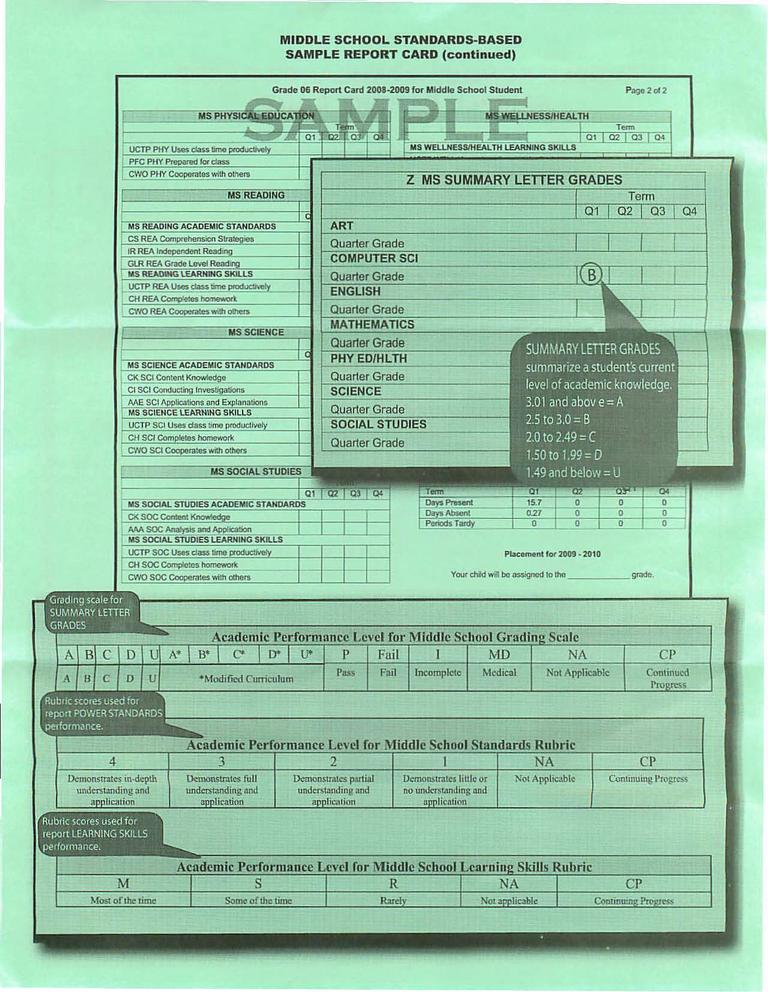
No middle school report cards??!!

I received a newsletter in the mail yesterday from Toki Middle School, where my son is now a sixth-grader. The principal’s letter says:
“With the introduction of standards-based middle school report cards, we decided to send first quarter progress reports only to students currently not meeting grade level standards in curricular areas.”
So, assuming my child meets the standards, he just doesn’t matter? He’s not worth the time to figure out how to fill out the new report cards? The teachers are taking an extra half day today (early release: 11:30) to work more on dealing with these new report cards – and they’ve already taken at least one or two other days – but it’s still too hard to give my child a report card?
What if I want to know how well my child is doing? What if I want to know if he’s EXCEEDING the standards? Oh, wait…. I forgot. MMSD doesn’t care if he exceeds them. They just want to know if he MEETS them. God forbid I learn how MUCH he’s exceeding them by, or if he’s just skating and is merely meeting the standards. Or if he excels in one subject but is simply OK in another. We went through this in elementary school, so I suppose it should be no surprise that it’s happening in middle school.
I know there’s a teacher conference coming up, but if they’re not giving us report cards, then I’m thinking 15 minutes isn’t enough time to really lay out my child’s strengths and weaknesses in several different subjects. It’s not enough time for the teacher to give me a thorough assessment of my child’s progress. Oh, wait….I forgot. MMSD doesn’t care about giving me a thorough assessment. Judging from our experience in elementary school, the teachers just want you in and out of there as quickly as possible. They don’t want to answer my questions about how we can help him at home so he can do better in any subjects. (“Your son is a joy to have in class. He’s doing well in all subjects. He talks a little too much, but we’re working on that. Thanks for coming!”)
They DID send home a note asking if I needed to meet with any of his Unified Arts teachers (in addition to just his homeroom teacher) – but I checked no, because I assumed we’d be getting report cards with information from all his teachers! Nice of MMSD to wait until AFTER those papers had been turned in to let us know we wouldn’t be GETTING report cards. (Yes, I’ll be emailing the principal to let her know I’ve changed my mind.)
Oh, and I CAN sign in to Infinite Campus to see what’s going on with my child’s record (which hopefully is updated more often that the Toki Web site, which we were told would be updated every three or four weeks, but hasn’t been updated since before the beginning of school). But to do this, I have to **go into the school during school hours** with a photo ID. I can’t just use social security numbers or anything else to access this online. Could they be more clear in the message that they’d rather you not use Infinite Campus?
Isn’t it bad enough that MMSD doesn’t do thorough third-quarter report cards, because they believe not enough time has elapsed between the second and third quarters to make any discernible improvement? If my child isn’t making any improvement, if my child’s work isn’t worthy of a report card, then WHAT’S HE DOING IN SCHOOL?
We moved here four years ago, so looking forward to the “great” Madison schools. We couldn’t have been more wrong. My bright children are lagging. My sixth-grade son who tested as gifted before we moved to Madison is no longer (witness his dropping test scores – oh, wait…they’re still average or above, so MMSD doesn’t care).
I’ve brought up my concerns repeatedly. I’ve offered constructive suggestions. I’ve offered to help, at school and at home. I did two years as a PTO president in the elementary school and struggled unsuccessfully to get improvements. I might as well have thrown myself in front of a semi truck for all the good it’s done and for how beaten down I feel by this school system. The minute this housing market turns around, I’m investigating the nearby schooling options with an eye toward getting the heck out of here. I’m SO FED UP with MMSD and it’s reverse-discrimination against children who are average and above.
Class-action lawsuit, anyone?

Share

November 2008 Madison School District Referendum Watch List Report Card

Active Citizens for Education presents this “Watch List Report Card” as a means of reporting relevant information, facts and analyses on topics appropriate for consideration by taxpayers in voting on the Madison Metropolitan School District referendum question November 4, 2008. This document is dynamic in nature, thus it is updated on a regular basis with new information and data. Questions, analyses, clarifications and perspectives will be added to the entries as appropriate. Review Ratings will be applied to report the progress (or lack thereof) of the Board of Education and Administration in its plans, data, information, reports and communications related to the referendum.
Complete PDF Document. Madison School District Revenue Summary 2005-2011 PDF

Share

Online Grading Systems Mean No More Changing D’s to B’s

Daniel de Vise:

Parents and students in a growing number of Washington area schools can track fluctuations in a grade-point average from the nearest computer in real time, a ritual that can become as addictive as watching political polls or a stock-market index.
The proliferation of online grading systems has transformed relations among teachers, parents and students and changed the rhythm of the school year. Internet-based programs including SchoolMAX and Edulink are pushing mid-term progress reports into obsolescence. Prospective failure is no longer a bombshell dropped in a parent-teacher conference. A bad grade on a test can’t be concealed by discarding the evidence. A student can log on at school, or a parent at work, to see the immediate impact of a missed assignment on the cumulative grade or to calculate what score on the next quiz might raise an 89.5 to a 90. Report cards hold little surprise.
“Half of the time, I know what grade my daughter got on something before she does,” said Susan Young, mother of an eighth-grader at Montgomery Village Middle School in Montgomery County.
Parents say the programs reconnect them to the academic lives of their children, a relationship that can decay as students move from elementary to middle and high school.

The Madison School District uses a system called “Infinite Campus“. A number of nearby districts use Powerschool, among others.

Share

Madison School District Enrollment Data Analysis

The Madison Metropolitan School District [724K PDF]:

The following document explores enrollment trends based on four different factors: intemal transfers, private school enrollments, inter-district Open Enrollment, and home based enrollments. The most current data is provided in each case. Not all data are from the current school year. Certain data are based on DPI reports and there are lags in the dates upon which reports are published.
Summary
Most internal transfers within the MMSD are a function of two factors: programs not offered at each home school (e.g., ESL centers) and students moving between attendance areas and wishing to remain in the school they had been attending prior to the move. Notable schools in regard to transfers include Shorewood Elementary which has both a very high transfer in rate and a very low transfer out rate, Marquette which has a high transfer in rate, and Emerson which has a high transfer out rate.
Based on data reported to the Department of Public Instruction (DPI), private school enrollments within the MMSD attendance area have held fairly steady for the past several years, with a slight increase in the most recent two years. The District’s percentage of private school enrollment is roughly average among two separate benchmark cohort groups: the largest Wisconsin school districts and the Dane County school districts. Using data supplied annually to the MMSD by ten area private schools it appears that for the past three year period private school elementary enrollment is declining slightly, middle school enrollment is constant, and high school enrollment has been variable. Stephens, Midvale, Leopold, and Crestwood Elementary Schools, and Cherokee and Whitehorse Middle Schools have experienced declines in private school enrollment during this period. Hawthorne and Emerson Elementary Schools, Toki and (to a lesser extent) Sherman Middle Schools, and West and Memorial High Schools have experienced increases in private school enrollments. The East attendance area has very limited private school enrollment.
Home based education has remained very steady over the past six years based on data reported to the DPI. There is no discernible trend either upward or downward. Roughly 420 to 450 students residing within the MMSD area are reported as participating in home based instruction during this period. Like private school enrollment, the MMSD’s percentage of home based enrollment is roughly average among two separate benchmark cohort groups: the largest Wisconsin school districts and the Dane County school districts.
Open Enrollment, which allows for parents to apply to enroll their Children in districts other than their home district, is by far the largest contributor to enrollment shifts relative to this list of factors. In 2008-09, there are now over 450 students leaving the MMSD to attend other districts compared with just under 170 students entering the MMSD. Transition grades appear to be critical decision points for parents. Certain schools are particularly affected by Open Enrollment decisions and these tend to be schools near locations within close proximity to surrounding school districts. Virtual school options do not appear to be increasing in popularity relative to physical school altematives.

Share

Wide Access To AP, IB Isn’t Hurting Anybody

Jay Matthews:

Jason Crocker, an educational consultant in Prince George’s County, is exasperated with me and my rating of high schools, called the Challenge Index, based on how many college-level Advanced Placement or International Baccalaureate tests schools give. In response to one of my columns, Crocker vowed to refute anything nice I say about AP, particularly in his county.
He reflects the views of many in the Washington area. People wonder why kids are taking wearisome three-hour AP exams (or five-hour IB exams) in history, calculus or physics when their grades aren’t that good and their SAT scores are low. Crocker, who is African American, is particularly worried about what all this testing is doing to black students.
“Mr. Mathews, AP in Prince George’s County is about setting African American students up for failure to satisfy your Challenge Index,” he said. “The flip side of this is that most of these new students taking the exam are not adequately prepared for the exam and Prince George’s County cannot recruit enough teachers to teach the exam who are highly qualified.”

Related: Dane County, WI High School AP course offering comparison.

Share

O’Conner on the Crisis in K-12 Civics Education

Chloe White:

A survey shows more young people today can name the Three Stooges than the three branches of government, former Supreme Court Justice Sandra Day O’Connor told a packed auditorium Friday at the University of Tennessee. Civic education has “really lost ground” in the United States, and “unless we do something to reverse that disturbing trend, the joke may be on us,” O’Connor said at the 1,000-seat Cox Auditorium at the UT Alumni Memorial Building.
O’Connor was at UT to celebrate the opening of the Howard H. Baker Jr. Center for Public Policy.
“Only an educated citizen can ensure our nation’s commitment to liberty is upheld. If we fail to educate young people to be active and informed participants at all levels, our democracy will fail,” said O’Connor, the first woman on the nation’s high court.
She spoke about the need for civic education, citing three problems with what she calls “civic illiberty”: the lack of time schools spend teaching civics; a static approach to civic education; and the lack of modern teaching methods such as computer programs in teaching civics.
“Creating engaged and active citizens is too important a priority to shortchange in curriculum planning in schools,” she said.
O’Connor, 78, is co-chairwoman of the National Advisory Council of the Campaign for the Civic Mission of Schools, a group with which the Baker Center works. The campaign promotes civic education and provides K-12 curriculum.

Share

Wisconsin School District’s Global Financial Gamble in “Synthetic Collaterilized Debt Obligations”

Charles Duhigg & Carter Dougherty:

On a snowy day two years ago, the school board in Whitefish Bay, Wis., gathered to discuss a looming problem: how to plug a gaping hole in the teachers’ retirement plan.
It turned to David W. Noack, a trusted local investment banker, who proposed that the district borrow from overseas and use the money for a complex investment that offered big profits.
“Every three months you’re going to get a payment,” he promised, according to a tape of the meeting. But would it be risky? “There would need to be 15 Enrons” for the district to lose money, he said.
The board and four other nearby districts ultimately invested $200 million in the deal, most of it borrowed from an Irish bank. Without realizing it, the schools were imitating hedge funds.
Half a continent away, New York subway officials were also being wooed by bankers. Officials were told that just as home buyers had embraced adjustable-rate loans, New York could save money by borrowing at lower interest rates that changed every day.

SIS Links. NPR covers the story here. Madison Assistant Superintendent for Business Services Erik Kass held the same position at the Waukesha School District, which was involved in this investment strategy.

Share

Salvaging School Accountability

Thomas Toch & Douglas Harris, via a kind reader’s email:

George W. Bush rode to the White House pledging high standards for all students. He’ll leave Washington with the nation’s public education system focused on teaching basic skills to disadvantaged student populations, with the United States lagging in international comparisons of educational attainment, and with his signature education law plagued by so many problems and mired in so much controversy that it has put at serious risk two decades of work to improve public schooling by making educators accountable for their students’ success.
The most important thing Barack Obama or John McCain could do quickly to salvage the accountability movement is change the way that the federal No Child Left Behind Act judges schools. Not by abandoning NCLB’s focus on students’ meeting standards, a move that would be unwise on both policy and political grounds, but by making the law a more legitimate report card of school performance, one that provides a fair and accurate gauge of educators’ contribution to their students’ achievement. Since its inception, NCLB has instead held schools responsible for factors they can’t control and perversely encouraged states to set standards low.
It’s critical in any accountability system that the metrics used to judge performance reflect accurately the contributions of those being judged. In education, that means measuring how much progress a school’s students make during the school year, a “value added” approach that accounts for the disadvantages (or advantages) students may bring to school because of the quality of prior instruction or their family backgrounds. It’s a strategy that pressures schools working with disadvantaged students to work hard in their students’ behalf without penalizing educators for taking on tough assignments. And it’s a strategy that doesn’t reward rich schools merely for having privileged students.

Clusty Search Thomas Toch and Douglas Harris.

Share

Parents cool to short-term solutions for overcrowding at Leopold

Kurt Gutknecht, via a kind reader’s email:

A temporary solution to concerns about Leopold Elementary School will be announced by June 2009, according to Daniel Nerad, superintendent of the Madison Metropolitan School District.
Nerad, members of the school board and other officials held what Nerad called “an engagement session” at Leopold on Oct. 20. About 100 parents attended the session, part of what Nerad called an effort to find “a short-term solution to find a long-term solution.”
But a show of hands after the meeting indicated most of those attending the session opposed the proposed short-term solution, which would involve transferring fifth graders to Cherokee and Wright middle schools.
“I’m confident it (the short-term solution) would work for two years,” Nerad said.
Nerad conceded that the short-term plan would address crowding but not another concern of parents- the high proportion (68 percent) of low-income students at Leopold. The long-term plan would tackle that issue, he said.

Much more on Leopold here.

Share

Maryland Urged to Require Graduation Exams

Liz Bowie:

Maryland’s state school board made a final decision yesterday to hold firm and require this year’s high school seniors to pass four subject tests to graduate in June, although it left open the possibility of exemptions for special education students and those learning English.
The decision leaves 9,059 students across the state – or about 17 percent of the Class of 2009 – at risk of not getting a diploma, according to data released yesterday.
Only 70 percent of African-Americans statewide and 50 percent of special education students have met the requirements. But the group most likely to be barred from graduation are immigrants who are learning English. Many have not yet taken all the tests, and only 15 percent have met the requirements.

Share

Monona School Board looks at closing Maywood Elementary

Karyn Saemann:

Just two months after opening a $25 million new middle school, the Monona Grove School Board is considering closing an elementary school and busing students between Monona and Cottage Grove.
Any of those moves could plunge the district into another tense struggle like the one in 2006 that ultimately led to voters approving the new middle school.
On Nov. 12, the board will consider forming a committee to study whether to close Maywood Elementary in Monona and whether to move Monona sixth-graders to Glacial Drumlin Middle School in Cottage Grove.
Glacial Drumlin opened in September for fifth- through eighth-graders from Cottage Grove, and seventh- and eighth-graders from Monona.
The board may also ask the committee to study changes in Cottage Grove, where Taylor Prairie Elementary is at its enrollment capacity and Cottage Grove Elementary is about 35 students over. Potential moves range from building a $2 million to $3 million addition at Cottage Grove Elementary to using portable classrooms to busing fourth-graders to Monona, where classroom space is abundant. With its price tag, a Cottage Grove Elementary building addition would require a referendum.

Share

On the Minneapolis Spending & Governance Referendum

Tom Weber:

Anyone keeping tabs of next week’s election in the Minneapolis School District is likely aware of a $60 million levy that would raise property taxes to garner more funding for schools. But there’s also a second question on the ballot that’s not getting much attention.
Minneapolis, Minn. — The first question would raise property taxes on a $250,000 house by about $200 a year.
Supporters, like Superintendent Bill Green, say the extra money is needed because the state hasn’t kept pace with education funding, and the district will have to make deep budget cuts without the extra money.
When we ran the previous referendum, it was based on an assumption that the state and federal government would continue the allocation formula they had set out,” Green said. “That we would be able to anticipate that they would keep pace with the cost of living and other factors.
“They didn’t, and so we feel we can’t make the same assumptions (now).”
There is no formal campaign opposing the levy, but voters have expressed opposition.

Share

Protests over Italy school reform

BBC:

School pupils, university students and teachers have staged demonstrations across Italy against a school reform law just passed by parliament.
In Rome’s Piazza Navona, a popular tourist spot, several people were lightly injured in a clash between left- and right-wing students.
The reform package is expected to cut the education budget.
In primary schools there will be just one all-purpose teacher per class and a grade system for pupils’ behaviour.
The package will reinstate a 10-point system for grading pupils’ conduct, aimed at curbing bullying.

Share

Fight at Madison Memorial shows difficulty of keeping school hallways safe

Jessica VanEgeren:

If art really does imitate life, then a peek into the interracial dynamics of high school life in Madison can be found every morning inside Room 272 at West High School. There, the students, hand-picked because of their ethnicity, respond to bullying, gang-related activities, body awareness issues and racial stereotyping by creating skits that mimic common situations students experience in school.
Lounging on pillows and passing around a bag of suckers at 9 a.m., the students, from varying backgrounds including Hmong, Chinese, African-American, Albanian and Laotian, are at ease with one another. This is not a dynamic reflected by every student in every school.
Sometimes an inspiration for a skit can be found right outside the classroom door, as junior Louisa Kornblatt found out on a recent morning when a student yelled, “Watch where your tall white ass is going, bitch,” during a break between classes. Although Kornblatt returned to the classroom with a flushed face, asking if anyone else had heard the comment, most of the students reacted to it nonchalantly.
“That’s just part of a day,” said senior John Reynolds, one of the students in the Multico theater group, which performs in schools all over the district. “You learn to ignore it. West is a culturally diverse place, and you’ll hear those kinds of statements in the hallways. You just need to learn to focus on the good, not the bad.”

Related: Police calls near Madison High Schools 1996-2006.

Share

Wisconsin SAGE program’s 15-student limit is often exceeded, report says

Amy Hetzner:

About half of the classrooms participating in the state’s school class-size reduction program in 2006-’07 exceeded its 15-student limit at least part of the school day, according to a recent report.
Dwindling resources and enrollment fluctuations were the main reasons given for the variation, according to the report by the Wisconsin Center for Education Research at the University of Wisconsin-Madison.
Although the report raises concerns about such practices, including that some school administrators seemed unaware of the program’s 15-student maximum, it concludes, “There are multiple ways to implement reduced class size well.”
The report is part of the state Department of Public Instruction’s regular monitoring of the $111 million SAGE program – Student Achievement Guarantee in Education – that aims to reduce class sizes for kindergarten through third grade in more than 470 Wisconsin schools. The center has another study in the works looking at long-term quantitative results from the program.

Share

Will Blewett be the last Milwaukee Public Schools board president?

Michael Mathias:

If there is a case to be made for dissolving the Milwaukee Public Schools board, several of its members, but particularly its president, Peter Blewett, seemed hell bent on making it during last week’s budget meetings.
That the end result of those meetings–a double digit increase in the district’s property tax levy–was the only responsible option the board could have chosen, won’t do anything to assuage the board’s growing number of critics or even improve its standing among its supporters.
Blewett has had a long time (a year, in fact, since the last budget fiasco) to persuade the public and other elected officials that the board and Superintendent William Andrekopoulos have the ability to manage the district’s complicated finances. And while the scores of people who showed up to support an increase in the tax levy made an impressive display, their presence seemed more in support of an idea and not an endorsement of those behind it. It’s notable that, as far as I know, not one elected official spoke out in support of the board’s actions despite the fact that everyone is aware of the poor hand MPS is dealt when it comes to state funding.

Share

High Schools Add Electives to Cultivate Interests

Winnie Hu:

The students in the jewelry and metalsmithing class at Pelham Memorial High School painstakingly coiled copper and brass wires into necklaces the other morning, while across the hall, the history of rock ‘n’ roll class pondered the meaning of Don McLean’s “American Pie.”
These are two of the 17 electives added this year to the curriculum in this affluent Westchester County suburb, redefining traditional notions of a college-preparatory education and allowing students to pursue specialized interests that once were relegated to after-school clubs and weekend hobbies. Now, budding musicians take guitar lessons, amateur war historians re-enact military battles, and future engineers build solar-powered cars — all during school hours, and for credit.
“It’s letting people learn about what they love rather than dictating what they should be learning,” said Morgan McDaniel, a senior who added the rock ‘n’ roll class to her roster of Advanced Placement classes in calculus, biology, European history and studio art.

Share

Madison School District Final $368M 2008/2009 Budget

1.5MB PDF. Property tax levy:

2005-2006: $200,363,255
2006-2007: 209,206,079
2007-2008: 220,290,484
2008-2009: 226,330,285
The District’s “Fund Equity” was $28,880,778.90 as of 6/30/2008, an increase from $21,966,265.61 on 6/30/2006.

The final budget will be discussed at this evening’s Madison School Board meeting.
Tamira Madsen has more.

Share

Katherine Kersten: New Minnesota charter schools heading into a legal minefield

Katherine Kersten:

The Minnesota Department of Education has received applications for three new taxpayer-funded charter schools.
They include Howard and Mattie Smith Academy, a K-3, 9-12 school proposed for Minneapolis, named for two legendary preachers at Shiloh Temple Church. Another is The Academy, a 10-12 Minneapolis school, and the third is a 7-12 school, St. Paul Rising Sun.
A new charitable organization, Minnesota Education Trust (MET), has applied to sponsor all three schools, and at one point sought to assume sponsorship of a fourth — the Academy for Food Sciences and Agriculture, whose name evokes Minnesota’s heartland. “Minnesota Education Trust” sounds pretty generic, but the name seems to convey a clear sense of the organization’s mission.
Or does it?
MET’s “principal goals” are set forth in its articles of incorporation, filed with the secretary of state in May 2007. The first goal listed is “to promote the message of Islam to Muslims and non-Muslims and promote understanding between them.” Other goals include building a virtuous society and providing education to children and adults. The final goal is to “support schools, community centers, mosques and other organizations that serve the above goals.”

Share

Michelle Rhee & The “Educational Insurgency”

Jay Matthews:

To understand D.C. Schools Chancellor Michelle A. Rhee and the educational insurgency she is part of, you have to know what happened when she taught at Baltimore’s Harlem Park Elementary School in the early 1990s.
The Teach for America program threw well-educated young people such as Rhee — bachelor’s degree from Cornell, master’s from Harvard’s John F. Kennedy School of Government — into classrooms full of impoverished children after only a summer of training. “It was a zoo, every day,” she recalled. Thirty-six children, all poor, suffered under a novice who had no idea what to do.
But within months, for Rhee and other influential educators in her age group, the situation changed. She vowed not “to let 8-year-olds run me out of town.” She discovered learning improved when everyone sat in a big U-pattern with her in the middle and she made quick marks on the blackboard for good and bad behavior without ever stopping the lesson. She spent an entire summer making lesson plans and teaching materials, with the help of indulgent aunts visiting from Korea. She found unconventional but effective ways to teach reading and math. She set written goals for each child and enlisted parents in her plans.

Share

Palin Promises School Choice for Disabled Students

Kate Zernike:

In her first policy speech of the presidential campaign, Gov. Sarah Palin vowed Friday that a McCain administration would allow all special-needs students the choice of attending private schools at public expense, a controversial and potentially costly proposal likely to be welcomed by many parents and bitterly opposed by many school districts.
Ms. Palin, the Republican nominee for vice president, also promised that she and Senator John McCain would finally provide public schools the federal money that was promised when the law covering students with special needs was passed in 1975. Her pledge was intended to address the top concern of many school districts, and is one that has been made by many other politicians but never fulfilled.
The policy speech was a departure for Ms. Palin, whose métier is the kind of foot-stomping pep rally she headlined the night before, at a stop north of Pittsburgh, where she recalled an anecdote about “Joe the quarterback” — as in Namath, a local native — to “guarantee” that she and Mr. McCain would come from behind to win.
In a hotel meeting room before about 150 parents and children with special needs, Ms. Palin was more subdued, and departed slightly from her prepared remarks to speak of her fears when she learned that the baby she was carrying earlier this year would have Down syndrome.

The Madison School District spent $70,582,539 on Special Education, according to the 2007/2008 Amended Budget (,a href=”https://www.schoolinfosystem.org/pdf/2008/10/2007_MMSD_BOE_Amended_Budgetocr.pdf”>460K PDF). Total budget was $365,248,476 according to the same document.

Share

November 2008 Madison Schools’ Referendum Roundup

Dave Blaska:

The prevailing wisdom is that the referendum will pass. The prevailing wisdom is probably correct. There has been no organized effort to fight it, unlike three years ago. And the surge of Obama voters, the scent of victory in their flaring nostrils, will carry along the schools in that high tide that lifts all boats. The Wisconsin State Journal has yet to do any serious journalism on the issue. It’s been lost in the shuffle.
On the other hand, the stock market is in the toilet and with it, people’s retirement plans. Home values are falling. Layoffs are accelerating. Energy prices are moderating but still expensive. And in the near future: a recession of unknown duration. So, maybe it doesn’t pass.
The referendum was recommended 7-0 August 26 by the overly harmonious school board, including Lucy Mathiak, who once teamed with Ruth Robarts and Laurie Kobza. Those two, however, are no longer serving.
I give Ed Hughes credit for reaching out to this irascible blogger. The schools have not done enough of that in the past. I am thinking now of former TV-3 news anchor Beth Zurbuchen, who infamously dissed of opponents of the referendum three years ago for being “selfish.”
Two of the three spending referenda were defeated that year, in no small part to such arrogance. I made that point with Ed Hughes. For arrogance this year, we have Marge Passman of Progressive Dane. You can hear Mitch Henck sputtering with amazement on his WIBA radio program Outside the Box as Passman makes the most ridiculous comments.

Channel3000:

One Madison voter with a ballot discrepancy said that she’s now questioning whether these mistakes are really mistakes, WISC-TV reported.
When Carole McGuire received her absentee ballot, she said something didn’t look right. “The ballot came, and I thought, ‘That’s odd,'” said McGuire.
She said that noticed that among all the races, the Madison Metropolitan School District referendum was nowhere to be found.
“Here is where the school district referendum would be, and it’s not there,” said McGuire, who then called the city clerk.
“I said, ‘This isn’t the correct ballot,'” said McGuire. “She said, ‘Oh well, tear it up and we’ll give you a new one.’ I said, ‘No, I don’t want to tear it up at the moment, I’ll come back.’

Paul Caron on declines in state income, sales tax and fee revenues:

States are beginning to report revenue collections for the July-September 2008 quarter, and the new figures raise the likelihood that large, additional budget shortfalls are developing. Of 15 mostly large and mid-sized states that have published complete data for this period, the majority collected less total tax revenue in July-September 2008 than was collected in the same period in 2007. … After adjustment for inflation, total revenue collections are below 2007 levels in 14 of the 15 states.

Greg Mankiw on proposed federal income tax changes:

Shelly Banjo compares McCain & Obama’s tax plans.
Much more on the November 4, 2008 Madison referendum here.

Share

Advocating Mayoral Takeover of the Milwaukee Public Schools

Charlie Sykes:

In the first place, God made idiots. That was for practice. Then he made school boards.–Mark Twain
The “goody bags” may have been the tipping point.
In August, a Milwaukee Journal Sentinel investigation highlighted massive waste and failure in the Milwaukee Public Schools (MPS): after spending more than a $100 million on neighborhood schools, the paper reported, many of the new buildings were unused and the classrooms empty. “With a few exceptions” the paper reported, “student achievement has shown little improvement–and in some cases it has fallen dramatically–at 22 schools that were among the largest beneficiaries of the district’s school construction program.”
But it was the bags that caught the public’s attention.
A week after the series on the failed building project, columnist Dan Bice reported that Milwaukee School Board member Charlene Hardin, accompanied by a high school data-processing secretary, had junketed at taxpayer expense to Philadelphia in mid-July, ostensibly to attend a conference on school safety. But organizers of the conference said that Hardin never showed up for any of the conference itself.

Share

Long Battle Expected on DC Plan to Fire Teachers

Bill Turque:

D.C. Schools Chancellor Michelle A. Rhee and the Washington Teachers’ Union — aided by its national parent organization — are digging in for what could be a protracted struggle over Rhee’s plan to fire instructors deemed to be ineffective.
School officials have posted job openings for an unspecified number of “helping teachers” to counsel instructors who have received notice to improve or face termination. Principals have been asked to identify teachers who can be placed on the so-called 90-day plan, which gives teachers 90 school days — or about five months — to upgrade their performance. The helping teachers will also document all assistance given to instructors and report to central office administrators, according to the job description posted on the D.C. schools Web site.

Share

An In-depth Look at School Lunches on Long Island


Newsday:

Newsday examined hundreds of school menus, budgets and vending machine contracts, and spoke to professionals and leaders. What we found might disturb you.

Share

Milwaukee School board OKs 14.6% levy increase

Alan Borsuk:

After acting to protect their travel budget and to keep their right to receive a $150-a-year car allowance and $3 for each time they go somewhere in the city on official business, Milwaukee School Board members early Friday approved a budget for this year that will raise the amount to be collected in property taxes for schools by 14.6%.
The approval came on a 6-3 vote at 1:46 a.m., seven minutes after the board voted down an otherwise-identical proposal that would have taken away the car allowance and tightened up travel spending.
The mini-drama over the board members’ travel budget came at the same meeting the board approved a much tighter set of rules for out-of-town trips for members, a reaction to Journal Sentinel stories about travel by board member Charlene Hardin, including a trip to a conference she reportedly did not actually attend.
The budget vote means Milwaukee Public Schools is returning to spending the maximum amount allowed by state law, a practice that had been followed in every recent year except for a year ago, when the tax levy increase was held to 9% although state law permitted an increase of more than 16%.
Because of provisions in the state school funding formula, holding down spending cost MPS more than $5 million in state aid this year, which was one of the arguments for returning to spending at the maximum level.

Share

The New WEAC

George Lightbourn:

This is an especially timely discussion as control of the Wisconsin Legislature hangs in the balance with the upcoming fall election. While it is widely believed that the state Senate will remain in Democratic hands, the Assembly is altogether another matter. With a mere five vote majority and a nation anxious to blame Republicans for both the war in Iraq as well as the weak economy, Republican retention of an Assembly majority is definitely in play. If the Assembly were to tumble into Democratic hands, Democrats would control all of state government. At long last, the thinking goes, WEAC will rise up and ensure its minions in the Capitol do what they have promised; expunge the QEO from state law books.
But is that the case? Maybe not. That picture might have been clear a few years ago, but it is less clear today.
The QEO Through Time
To understand the roots of the popular caricature of WEAC, a short history lesson is in order. As we close in on a generation under the QEO, it is easy to forget what life was like before Tommy Thompson signed the QEO into law. In the 1980s and into the early 1990s a statewide furrowing of the brow and wringing of hands occurred every Christmas season when local governments slid property tax bills into our mailboxes. In 1989 school taxes rose 9% followed by a 9.4% increase in 1990 and a 10% jump in 1991. The last straw came in 1993 when schools added 12.3% to the property tax bill. Of course every year the school tax was layered on top of the tax bill from cities, villages and town so property taxes were routinely increasing at double-digit rates.
While property taxes might not have stirred the public psyche as much as say the Vietnam War had, it was close. Every state budget discussion started and ended with property taxes. It was the third rail of Wisconsin politics. The property tax discussion drove a wedge between Democrats and Republicans; it caused short fuses between state and local governments and between general governments and schools. And everyone understood who was operating the jack that kept ratcheting up property taxes: it was teachers.
No, it wasn’t just teachers, it was WEAC. What generations of teachers had known as a helpful service organization, overnight had assumed the pale of a hard-line labor union. It was as though WEAC had undergone its own version of the Invasion of the Body Snatchers. The side of the organization that provided teacher services was taken over by the union side. Overnight it became clear that nothing mattered to the staff at WEAC if it didn’t entail: raising teacher pay, protecting jobs, or improving working conditions. This was the familiar mantra of every labor union from the autoworkers to air traffic controllers.

Share

A look at Madison Memorial’s Small Learning Communities

Andy Hall:

In 2000, Memorial became the first Madison school to land one of the U.S. Department of Education grants. It was awarded $438,000 to create its neighborhood social structure. West High School became the second, winning a $500,000 grant in 2002 and reorganizing its ninth and 10th grades around core courses.
In August, district officials were thrilled to learn the district was awarded $5.5 million over five years for its four major high schools — Memorial, West, La Follette and East — to build stronger connections among students and faculty by creating so-called “small learning communities” that divide each high school population into smaller populations.
Officials cite research showing that schools with 500 to 900 students tend to be the most effective, and recent findings suggest that students at schools with small learning communities are more likely to complete ninth grade, less likely to become involved in violence and more likely to attend college after graduation. However, the latest federal study failed to find a clear link between small learning communities and higher academic achievement.
Each Madison high school will develop its own plan for how to spend the grant money. Their common goals: Make school feel like a smaller, friendlier place where all students feel included. Shrink the racial achievement gap, raise graduation rates, expand the courses available and improve planning for further education and careers.
The high schools, with enrollments ranging from 1,600 to 2,000 students, are being redesigned as their overall scores on state 10th grade reading and math tests are worrisome, having declined slightly the past two years.

Share

In Support of the November, 2008 Madison Schools’ Referendum

In just a few days we have the opportunity and the responsibility to show our continuing support for Madison Public Schools by voting yes for the school district referendum. Please remember to vote for the referendum as you do your balloting and please talk with friends and family and urge their support for the referendum also.
In case you didn?t see the Wisconsin State Journal endorsement of the referendum, please click on the following link. For the Cap Times endorsement, click on this link. Then, read my guest column which appeared in the State Journal on October 10 and the Cap Times on October 22; here is the link to that letter. Cumulatively, these three pieces help explain the educational importance of the district initiative and the responsibility of Madison residents to support it.
If Madison residents need help understanding the property tax implications of the referendum, the following paragraphs may help some.
Passage of the referendum will permanently increase the revenue cap for operating costs by $5 million in 2009-2010, and by $4 million in both 2010-11 and 2011-12 for a total request of $13 million over the three-year period.
The average Madison homeowner would see their tax bill increase by $27.50 in 2009; $43.10 in 2010; and $20.90 in 2011. However, in 2008, school property taxes on the average home will decrease about $40. Therefore, in 2011, average homeowners will pay $51.50 more in school taxes than they paid in 2007. That means many of us will still pay less school tax in 2011 than we paid in 1994. Unbelievable, but true.
In 1993-94 Madison’s mil rate for its schools was 19.15; in 2007 it was 10.08, almost half of what it was. Unless your home assessment has doubled in that period of time (which it may have), your school property tax has gone down. If your home assessment doubled, your school property tax would be about the same now as it was in 1993-94. Again, even with passage of the referendum, many Madison taxpayers will be paying less in school taxes in 2011 than they did in 1994.
Thank you for your continued support of Madison Schools and Madison kids. Together we make the community a stronger, more vibrant place for all of us to live.
Barbara Arnold, member of GRUMPS (Grandparents United For Madison Public Schools) Steering Committee and a former President of the Madison Board of Education
barbaraarnold@charter.net

Share

DC Schools’ Chancellor Michelle Rhee: “The Lightning Rod”

Clay Risen, via a kind reader’s email:

Since her arrival, in the summer of 2007, Rhee, just 38 years old, has become the most controversial figure in American public education and the standard-bearer for a new type of schools leader nationwide. She and her cohort often seek to bypass the traditional forces of education schools and unions, instead embracing nontraditional reform mechanisms like charter schools, vouchers, and the No Child Left Behind Act. “They tend to be younger, and many didn’t come through the traditional route,” says Margaret Sullivan, a former education analyst at the Georgetown Public Policy Institute. And that often means going head-to-head with the people who did.
Rhee, responsible not to a school board but only to the mayor, went on a spree almost as soon as she arrived. She gained the right to fire central-office employees and then axed 98 of them. She canned 24 principals, 22 assistant principals, and, at the beginning of this summer, 250 teachers and 500 teaching aides. She announced plans to close 23 underused schools and set about restructuring 26 other schools (together, about a third of the system). And she began negotiating a radical performance-based compensation contract with the teachers union that could revolutionize the way teachers get paid.
Her quick action has brought Rhee laudatory profiles everywhere from Newsweek to the Memphis Commercial-Appeal, and appearances on Charlie Rose and at Allen & Company’s annual Sun Valley conference. Washington is now ground zero for education reformers. “People are coming from across the country to work for her,” says Andrew Rotherham, the co-director of Education Sector, a Washington think tank. “It’s the thing to do.” Rhee had Stanford and Harvard business-school students on her intern staff this summer, and she has received blank checks from reform-minded philanthropists at the Gates and Broad foundations to fund experimental programs. Businesses have flooded her with offers to help–providing supplies, mentoring, or just giving cash.

Clusty search: Michelle Rhee.

Share

Just What Exactly is a Charter School?

Open Education:

One of the more consistent, ongoing suggestions for improving America’s educational system centers upon the creation of greater competition amongst public schools. The reason for the steady drumbeat centers upon a belief that a change to the free market system would be one of the best methods for creating better educational opportunities for children.
In direct response to the push for greater competition, forty states across America have now initiated legislation to allow the construction of new public schools called charter schools. Minnesota was the first state to pass laws regarding charter schools, doing so in 1991.
The concept is definitely catching on. Today, according to USCharterSchools.org, there are nearly 4,000 charter schools across our country educating more than 1.1 million children. The state of California, the second to enact such legislation, has more than 600 such schools educating about one-fifth of all charter school students.
While the number of schools continues to grow, large numbers of Americans, many even within the field of education, simply do not know what a charter school really consists of or how this new school concept differs from traditional public schools. Today at OpenEducation.net, we provide our readers the fundamentals of the charter school concept.

Share

Can Interdistrict Choice Boost Student Achievement?
The Case of Connecticut’s Interdistrict Magnet School Program

Robert Bifulco, Casey Cobb & Courtney Bell [320K PDF]:

In response to a landmark civil rights ruling, the state of Connecticut has adopted models of choice-based interdistrict desegregation that appear to satisfy current legal constraints. In this paper, we focus on Connecticut’s interdistrict magnet schools, and estimate the effects these schools have had on student achievement. We use longitudinal data on individual student test performance and information from admissions lotteries to implement quasi-experimental, regression-based, and propensity score estimators. Preliminary analyses show that lottery based methods, propensity score methods, and regression analysis provide similar estimates of achievement effects of for the small set of schools for which all three methods can be implemented. We then proceed to use the latter two methods to estimate effects for all of the interdistrict magnet high schools and middle schools that serve students from Hartford, Waterbury and New Haven. Results indicate that, on average, interdistrict magnet high schools have positive effects on both math and reading achievement, and interdistrict magnet middle schools have positive effects on reading achievement. Extensions of our analysis indicate that interdistrict magnet high schools have positive effects particularly on the achievement of students in Hartford, New Haven and Waterbury and do so regardless of how much attending an interdistrict magnet high school reduces racial isolation. The positive effects of magnet middle schools appear to be limited to suburban students, except in those schools that are able to achieve substantial reductions in racial isolation for their central city students.

Share

Milwaukee Looks for Feedback on its Planned Sex Education Curriculum

Erin Richards:

After overhauling its K-12 sex education curriculum this summer with the help of community partners and health experts, Milwaukee Public School district officials have released the first draft of lessons to be taught to kids in kindergarten through fifth grade.
The problem: Despite calls to every elementary school principal for help in reaching parents, and a link to the proposed human growth and development curriculum on the MPS home website, only a handful of people have offered feedback.
“I’d like to hear from anyone in the community, but I really need parents,” said Brett Fuller, curriculum specialist for health, wellness and safe and drug-free schools.
Responses to the new curriculum can be directed to this online survey.
Expedient feedback is important to the district for several reasons. For one, sex education can be a touchy subject and the more people who see the proposed changes, the better chance there is of everyone feeling comfortable with what’s being taught.

Related: Sex Education for Primary Schools:

Primary school children are to be given compulsory lessons in sex education and the dangers of drugs, the Government confirmed.
The shake-up of lessons is aimed at cutting Britain’s high teenage pregnancy rate and steering youngsters away from drug and alcohol misuse.
It will mean primary school children will learn about puberty and the facts of life from the age of seven. From the age of five, pupils will be taught about topics such as the parts of the body, relationships and the effects of drugs on the body.
As pupils progress through school they will be given detailed information about contraception and sexually transmitted infections as well as the risks of drug and alcohol misuse.

Share

Counting on the Future: International Benchmarks in Mathematics for American School Districts

Dr. Gary W. Phillips & John A. Dossey [2.5MB PDF Report]:

Students in six major U.S. cities are performing on par or better in mathematics than their peers in other countries in grades 4 and 8, according to a new study by the American Institutes for Research (AIR). However, students from five other major cities are not faring as well, and overall, U.S. student performance in mathematics falls off from elementary to middle school grades — and remains behind many industrialized nations, particularly Asian nations.
The AIR study offers the first comparison between students from large U.S. cities and their international peers. The study compares U.S. 4th grade students with their counterparts in 24 countries and 8th grade students with peers in 45 countries.
“Globalization is not something we can hold off or turn off…it is the economic equivalent of a force of nature… like the wind and water” (Bill Clinton)
If you are a student today competing for jobs in a global economy, the good jobs will not go to the best in your graduating class–the jobs will go to the best students in the world. Large urban cities are intimately connected to the nations of the world. Large corporations locate their businesses in U.S. cities; foreign students attend U.S. schools; and U.S. businesses export goods and services to foreign nations. Large urban cities need to know how their students stack up against peers in the nations with which the U.S. does business. This is especially important for students in the fields of science, technology, engineering, and mathematics. The students in these fields will allow our future generation to remain technologically innovative and economically competitive.
This report provides a comparison of the number of mathematically Proficient students in Grades 4 and 8 in 11 large cities in the United States with their international peers.
This comparison is made possible by statistically linking the National Assessment of Educational Progress (NAEP) in 2003 and the Trends in International Mathematics and Science Study (TIMSS) in 2003 when both assessments were conducted in the United States in the same year and in the same grades.
After the statistical linking was completed, it was possible to compare the most recent NAEP results (from 2007) to the most recent TIMSS results (from 2003). How the United States compares to the overall international average.
At Grade 4, five countries (Singapore, Hong Kong SAR, Chinese Taipei, Japan, and the Flemish portion of Belgium) performed significantly better than the United States (Figure 1). However, the United States (at 39% proficiency) performed better than the international average (27% proficiency) of all 24 countries (Figure 13).
At Grade 8, eight countries (Singapore, Hong Kong SAR, Republic of Korea, Chinese Taipei, Japan, Belgium (Flemish), Netherlands, and Hungary) performed significantly better than the United States (Figure 1). However, the United States (at 31% proficiency) performed better than the international average (21% proficiency) of all 44 countries (Figure 14).
….
Because of the persistent requests of urban school districts, the U .S . Congress authorized NAEP to assess, on a trial basis, six large urban school districts beginning in 2002 . Since then, more districts have been added, resulting in 11 school districts in 2007 (and plans are underway to include even more districts in the future) . The urban school chiefs in these 11 large school districts, which voluntarily participated in the 2007 NAEP, recognized the global nature of educational expectations and the importance of having reliable external data against which to judge the performance of their students and to hold themselves accountable . They should be commended for their visionary goal of trying to benchmark their local performance against tough national standards. National standards provide a broad context and an external compass with which to steer educational policy to benefit local systems . The purpose of this report is to further help those systems navigate by providing international benchmarks.

Clusty Search: Gary W. Phillips and John A. Dossey.
Greg Toppo has more:

Even if the findings are less-than-stellar, he says, they should help local officials focus on improving results.
“In that sense, I think it could be a very positive thing to use in-house, in the district, to keep their nose to the grindstone,” says Kepner, a former middle- and high-school math teacher in Iowa and Wisconsin.”If they can show they’re improving, they might be able to attract more companies to a system that’s on the move.”
Phillips says the findings prove that in other countries “it is possible to do well and learn considerably under a lot of varied circumstances — in other words, being low-income is not really an excuse when you look around the rest of the world.”

Math Forum audio & video.

Share

Advocating a Yes Vote for the November, 2008 Madison Referendum

A Capital Times Editorial:

Even with approval of the referendum, district administrations would have to run a tight ship. They are not asking taxpayers to bridge all the gaps created by the anticipated deficits. They are prepared to trim budgets and delay the initiation of programs until economic circumstances improve or, ideally, the state accepts more of its deferred responsibilities.
Weighing the big-picture educational challenges that we face as a community, a state and a nation, as well as the hometown reality of strong schools facing genuine threats, this referendum does not pose a difficult choice.
The only vote that makes sense is “yes.”
It is essential for everyone who is heading to the polls on Nov. 4 to decide the presidential race between two men who say education is a priority — as well as every voter who casts an early ballot — and to make the extra effort to find the referendum question and mark that “yes” box.

Much more on the referendum here. Related: “Formal opposition begins to form“.

Share

Teachers take test scores to the bank as bonuses

Greg Toppo:

cross the USA, a small but growing number of school districts are experimenting with teacher-pay packages that front-load higher salaries and offer bonuses — sometimes tens of thousands of dollars’ worth — if student test scores improve or if teachers work in hard-to-staff schools.
At least eight states are moving away from a traditional pay model, which increases salaries based on seniority and advanced degrees. Many of the pay packages are funded by private foundations. In dozens of districts, test scores already have earned teachers more money. A few examples:

  • In Chicago, teachers at a handful of schools can earn up to $8,000 in annual bonuses for improved scores, while mentor teachers and “lead teachers” can earn an extra $7,000 or $15,000, respectively.
  • In Nashville, middle-school math teachers can earn up to $15,000 based on student performance.

Do such plans work? A research center launched at Vanderbilt University to study performance pay has found mostly promising, if limited, results.

Share

Updates on Madison’s Leopold Elementary School Enrollment / Capacity Discussions

Tamira Madsen:

The school district has made a number of efforts to handle Leopold’s enrollment over the years, with mixed results. Eight classrooms were added in 2003, but a $14.5 million referendum to make upgrades to the existing school and build a second school on the site failed in 2005. In 2006, the cafeteria and several areas of the campus were remodeled. In addition, attendance boundaries were adjusted on two occasions, and third-graders were transported to other schools for two years.
To handle overcrowding this year, the district approved transfers of 31 students both within and outside the district. An additional classroom was also added by moving the computer lab to the library.
Meanwhile, Nerad urged the community to be patient as the planning process continues to unfold. The district’s ultimate goals are to cap enrollment at 650 students and to implement a better balance of students according to family income. Sixty-eight percent of students at Leopold come from low-income families.
“We really want to make sure that we have dotted all of our I’s and crossed our T’s and looked at a variety of options,” Nerad said. “And I can assure you relative to the long-term solution that we have not taken anything off the table. It’s just a matter in these tough (economic) times of assuring our community that we have done that due diligence.

Much more on Leopold here.

Share

Doggie Biscuit for Kohn: Author rips testing, other sacred classroom concepts

By Lisa Schencker:

Rising test scores are no reason to celebrate, author Alfie Kohn told teachers at the Utah Education Association (UEA) convention on Friday.
Schools that improve test scores do so at the expense of other subjects and ideas, he said.
When the scores go up, it’s not just meaningless. It’s worrisome,” Kohn told hundreds of educators on the last day of the convention. “What did you sacrifice from my child’s education to raise scores on the test?”
Kohn, who’s written 11 books on human behavior, parenting and schools, spent nearly two hours Friday morning ripping into both established and relatively new education concepts. He slammed merit pay for teachers, competition in schools, Advanced Placement classes, curriculum standards and testing–including Utah’s standards and testing system — drawing mixed reactions from his audience.
“Considering what we hear a lot, it was pure blasphemy,” said Richard Heath, a teacher at Central Davis Junior High School in Layton.
Kohn called merit pay–forms of which many Utah school districts are implementing this year–an “odious” type of control imposed on teachers.
If you jump through hoops, we’ll give you a doggie biscuit in the form of money,” Kohn said.

(more…)

Share

Madison November 2008 Referendum Updates

Channel3000:

In Oregon, if the referendum passes, it’ll mean $10 more a year for property tax payers.
In Madison though, the bill is higher, over the three years of the referendum the average cost to taxpayers is about $65.
Some parents told WISC-TV if it means more money out of their pocket, then they’re saying no to a referendum.
But most Madison parents WISC-TV spoke with facing those tough cuts say they’ll support it.
There are other issues on ballots in the area including, the MMDS asking to exceed revenue limits by $13 million.

Andy Hall & Chris Rickert:

A clerical mistake in the Madison city clerk’s office means about 20 voters within the Madison School District got absentee ballots that do not have the district’s $13 million referendum question on it, city and district officials said Tuesday.
Madison City Clerk Maribeth Witzel-Behl said six of those voters have come forward, and she urged other district residents who aren’t sure if they voted on the question to call her office so her staff can destroy their old ballots and issue new ones.
Witzel-Behl said the mistake occurred because one of her employees created mailing labels for the absentee ballots’ envelopes that did not identify the voter as a resident of the School District.
“My best guess is we’re looking at less than 20 ballots total,” she said.

WKOW-TV:

There was plenty of food and equally as much information at the Goodman Community center.
The Tenny Lapham Neighborhood Association held a spaghetti dinner to help community members understand the madison school districts recurring referendum on the November ballot.
“The school referendum us a complicated issue especially in the times that we are in– people are concerned about something that is going to increase their tax bill,” says association member Carole Trone.
Here’s how the referendum works.
The referendum asks to exceed the revenue limit by $5 five million next school year.

Much more on the November, 2008 Madison referendum here.

Share

One Goal: Extending the School Day

Mariam Brillantes:

Jennifer Davis is on an educational mission to extend the school day. She’s president and CEO of the National Center on Time and Learning, an organization that describes itself as “dedicated to expanding learning time to improve student achievement and enable a well-rounded education for all children.” Ms. Davis’s says under her organization’s scenario, children would be happier because they have more time to learn, teachers would be able to devote more time for enrichment programs that go beyond standardized tests, and parents-especially those from lower-income families-would be reassured their children are safe in a learning environment. Below are excerpts from an interview with Ms. Davis:
I think it’s safe to say that most schoolchildren would probably hate the thought of an extended school day. How can a longer day help them?
The initiative we are promoting involves the redesign of the school day to include more enrichment opportunities like music and art and apprenticeship. It includes significant recess and lunch time. And it also includes a lot of project-based learning and one-on-one time with teachers — and all those things, students like. If you interviewed students in the schools we’re working with… the students are enjoying the schedule in part because it gives them lots of opportunities. What’s happening all over the country is that classes like physical education, arts and even recess and lunch time have been shortened or eliminated because of the pressures of testing and classes that are tested like math and English.

Share

On Washington, DC’s Special Education Governance

Bill Turque:

The District’s top special education official testified in federal court yesterday that some school personnel ignore scheduled meetings with parents, contributing to the city’s failure to meet the needs of students with learning disabilities or behavioral challenges.
Richard Nyankori, acting deputy chancellor for special education, said the backlog of D.C. children awaiting special education services is lengthy in part because school staff don’t show up for meetings, leaving cases unresolved and parents in the lurch.
“Sometimes it is willful on the part of some staff not to make it to meetings,” Nyankori said under questioning from U.S. District Judge Paul L. Friedman.
Friedman called the hearing to quiz officials about the District’s lack of progress in complying with a 2006 consent decree that settled a class action brought by parents of children with learning problems. The District’s public and public charter schools have nearly 11,000 special education students. About 20 percent attend private schools, at a cost to taxpayers of about $200 million, because D.C. cannot meet their needs.

Share

The High School Dropout’s Economic Ripple Effect

Gary Fields:

Mayors Go Door to Door, Personally Encouraging Students to Stay in the Game for Their Own Good — and for the Sake of the City
As the financial meltdown and economic slump hold the national spotlight, another potential crisis is on the horizon: a persistently high dropout rate that educators and mayors across the country say increases the threat to the country’s strength and prosperity.
According to one study, only half of the high school students in the nation’s 50 largest cities are graduating in four years, with a figure as low as 25% in Detroit. And while concern over dropouts isn’t new, the problem now has officials outside of public education worried enough to get directly involved.
The U.S. Conference of Mayors [PDF Report] is focusing its education efforts on dropouts. Mayors in Houston and other Texas cities go door to door to the homes of dropouts, encouraging them to return to school. Atlanta Mayor Shirley Franklin meets on weekends with students and helps them with life planning. Other cities, like Milwaukee and Kansas City, Mo., have dropout prevention programs.
Some new studies show far fewer students completing high school with diplomas than long believed. “Whereas the conventional wisdom had long placed the graduation rate around 85%, a growing consensus has emerged that only about seven in 10 students are actually successfully finishing high school” in four years, said a study by the Editorial Projects in Education Research Center, a nonprofit group based in Bethesda, Md. It was released this year by America’s Promise Alliance, a nonpartisan advocacy group for youth. In the nation’s 50 largest cities, the graduation rate was 52%.

Share

On Milwaukee’s School Budget

Milwaukee Journal Sentinel Editorial:

Milwaukee Public Schools is crippled by a broken state funding system that needs to be changed, or the district will be destitute within a decade, if not sooner.
In one sense, the financial crisis at MPS is similar to that of the banks: MPS essentially is asking the Legislature for a rescue plan.
MPS officials say the state funding formula needs to change so that it can sustain itself and perform its core mission of educating some of the state’s poorest students. Like most urban districts, MPS is dealing with low test scores, high dropout rates and violence in addition to money problems.
We back MPS in its push, and we urge the Legislature to do two things: Change the overall formula that places MPS in such a tough situation, and correct a specific problem with the way Milwaukee’s voucher schools are funded that places undue burden on Milwaukee property owners.
First, let’s consider the state’s overall funding formula. Its goal is to try to equalize funding between rich and poor districts so that students in property-poor districts are not penalized because of where they live. The idea is that a taxpayer in a property-poor district should not have to pay much higher taxes to achieve the same per-student funding.

Share

Content Knowledge Requirements Proposed for Illinois Teachers

Carlos Sadovia:

As many as 5,000 middle school teachers in Chicago could be required to go back to school for additional training to continue teaching under a plan expected to be approved by the Board of Education this week.
Under the proposal, 6th-, 7th- and 8th-grade teachers would be asked to gain an “endorsement” noting they are qualified for specific subjects at those grade levels, said Xavier Botana, head of elementary education for the Chicago Public Schools.
While teachers must be state-certified to teach in the district, currently neither the district nor the state requires teachers to gain the additional credential for classes such as math, English and science. Chicago is following many other districts in toughening requirements, officials said.
Botana said that while potentially 5,000 middle school teachers are affected, many already may have the necessary credits.
“Going forward, all of our kids in 6th through 8th grades will be taught by somebody who has a deeper level of content area knowledge than what is currently required,” he said. “We need to aim higher.”
Mary McClure, a Chicago Teachers Union official, said the union supports the move and has been working with the district to make sure teachers have enough time to take the classes.

Share

Milwaukee School Board’s Budget Dilemna

Alan Borsuk:

Here’s a tough decision: The Milwaukee School Board must decide whether to increase property taxes for schools this year by a double-digit percentage or make cuts in the budget, or maybe both.
Here’s a group that seems to be having a hard time making tough decisions: the Milwaukee School Board.
The board — and the Milwaukee Public Schools system as a whole — face one of the most demanding points in memory.
Specifically, this is the point when the budget has to be finalized for this year, along with the property tax level. Superintendent William Andrekopoulos is expected to propose something in the vicinity of a 14% one-year increase in property tax collections to support schools (school spending accounts for roughly a third of the total tax bill).
It is also the point when decisions loom about what schools to merge or move for next year because decision-making on enrollment starts soon and administrators say they need to reduce the number of school buildings to save money in the long run. That is also expected to come to a head this week.

Share

Detroit School Board to Discuss Fatal Shooting

Chastity Pratt Dawsey:

The fatal shooting of one Henry Ford High student and the wounding of three other teens is expected to be discussed at a special Detroit Board of Education meeting at 6 p.m. Monday at Spain Elementary-Middle School, 3700 Beaubien.
The agenda includes a 2008-’09 “Checklist for Preventing and Responding to School Violence” the district has submitted to the Michigan Department of Education for Ford, Mumford, Central and Crosman high schools.

Share

UK Minister outlines vision for Local School Governance

David Turner & Alex Barker:

A vision of greater state school independence has been set out by the new academies minister, with a prediction that “self-governing schools” will become the “dominant” model for secondary education.
Jim Knight’s comments, in an interview with the Financial Times, suggest Labour is determined to avoid being outflanked by the Conservatives as both parties vie to outbid each other in giving schools greater autonomy – a policy attractive to many families.
Mr Knight was schools minister but has now added academies to his responsibilities after Andrew Adonis’s move to transport in the recent cabinet reshuffle.
His first interview about academies since taking on the portfolio will soothe fears of sponsors and education officials over the departure of Lord Adonis, who conceived and ran the academies programme.
Sponsors are concerned that Ed Balls, the schools secretary, wants to give a bigger role to local authorities and is less enthusiastic about faith and independent schools becoming academies. Officials also say that without Lord Adonis’s “obsessive” commitment to establishing new academies, the programme will lose drive.

Share

Madison 2008 Referendum: Vote ‘yes’ and expect more

Wisconsin State Journal Editorial:

It’s a difficult time for Madison schools to be asking property taxpayers for more money.
But it also is a very tough time for Madison schools to be reducing services for students — a large and growing percentage of whom need extra or tailored help to succeed.
That’s why Madison should vote “yes” on its school referendum Nov. 4 — with one big demand in return. Moving forward, school leaders and, especially, the teachers union need to commit to more innovation and evaluation of existing school programs.
That means more charter and specialty schools to excite parents and to give struggling students concrete evidence of a successful career path after graduation

Much more on the November, 2008 Madison referendum here.

Share

Moving the Los Angeles Schools to the 21st Century

Charles Kerchner, a professor at Claremont Graduate University and a specialist in educational organizations, educational policy and teacher unions, writes::

While the financial markets have reached the point of panic, a longer-running crisis has enveloped Los Angeles’ school system. For at least a decade, people have called the Los Angeles Unified School District a system in crisis. Even when it does things well, it gets little credit.
In a crisis, a special type of politics is supposed to take hold. People of all political stripes are supposed to come together to fashion a solution, the very kind of politics we are witnessing in response to the financial markets’ dysfunction. But unlike that situation, there is no sure resolution of the school’s systemic failure, and no sense of urgency. So LAUSD bumps along in a state of permanent crisis.
Getting past permanent crisis and creating a 21st century institution of public education requires only that those interested in the district’s future learn from its history. After half a decade of studying efforts to transform the district, my colleagues and I have five policy ideas that we think would move the district beyond permanent crisis.

Charles Kerchner’s website. Clusty Search on Kerchner.

Share

School Efforts to Stem Violence Offer A Textbook Case of Limits on Speech

Dan Slater:

With the nation’s school systems roiled by campus shootings over the past decade, and on the lookout for conflict, students are being asked to check a broader array of free-speech rights at the door — raising questions about what lesson that is teaching them.
Public-school administrators are hewing to a zero-tolerance policy on expression they believe incites violence, and they are doing so with the backing of the courts. Controversial clothing has been a common casualty. Struggling with racial tensions at his high school, a principal in Maryville, Tenn., banned depictions of the Confederate flag in 2005 and was supported by a federal court. Last month, the Aurora Frontier K-8 School in Aurora, Colo., suspended an 11-year-old who refused to remove a homemade T-shirt that read, “Obama is a terrorist’s best friend.” The shirt caused “a very loud argument on the playground,” according to a statement from the school.
Since such actions stem from a concern over the safety of adolescents, even free-speech advocates acknowledge a need for some degree of deference to educators. But an argument of imminent danger is hard to make in many of these cases. Some think educators may be inadvertently teaching children that suppressing speech is the ready solution to ideological conflict.

Share

German Embassy Promoting (& Funding) German Language Programs

German Missions to the United States:

PASCH-Partnerschools
“Education creates prospects – multilingualism opens new horizons. With our partner schools abroad we not only want to give children access to the German language and education but also to awaken an interest in and understanding for each other. Openness to cultural diversity and tolerance towards other people’s distinctiveness are not mutually exclusive. To help children grasp this even better we need, more than ever, places where they can meet, learn and be creative together. The earlier we realize that we are an international learning community, the more capable we will be of solving our shared problems. Our partner schools abroad want to contribute towards that goal.”
— Federal Foreign Minister Frank-Walter Steinmeier
Federal Foreign Minister Frank-Walter Steinmeier has launched the “Schools: Partners for the Future” Initiative. Its goal is to build up a worldwide network of at least 1000 partner schools through which to awaken young people’s interest in and enthusiasm for modern-day Germany and German society. Additional funds to the tune of 45 million euro have been earmarked for the initiative in 2008. It will be coordinated by the Federal Foreign Office and implemented in cooperation with the Central Agency for Schools Abroad, the Goethe-Institut, the Educational Exchange Service of the Standing Conference of the Ministers of Education and Cultural Affairs of the Länder in the Federal Republic of Germany and the German Academic Exchange Service.

PDF Brochure and Teacher’s Abroad.
The Smith Academy of International Languages in Charlotte, NC received a $22,101 grant recently:

Ambassador Klaus Scharioth visited the Smith Academy of International Languages in Charlotte, North Carolina, to present a check for $22,101 on September 22, 2008. The school is one of the 16 new members in the US of the worldwide partner school network, which currently has around 500 partner schools.

Share

What Does it Mean to be an Educated Person?

New Roots to rethink old education model
Tina Nilsen-Hodges:

The State University of New York Board of Trustees approved the charter application last week for the New Roots Charter School, an innovative new high school that will be one of the first fully integrated models of education for sustainability at the secondary level in the nation. Students in my spring 2007 “Teaching Sustainability” course contributed to the development of the initial school concept paper, which provided the foundation for the charter application submitted in June.
Why this school, why here and why now? New Roots Charter School answers the call of the U.N. Decade for Education for Sustainable Development for the rethinking of education necessary to address the problems of the 21st century. Gov. David Paterson was quoted as saying, “Global warming presents each of us with a question. Do we continue with the status quo or are we ready to make significant cultural and lifestyle alterations?”
Consider our energy crisis, expanding poverty and the degradation of essential ecosystem services, and Paterson’s conclusion becomes even more urgent. “Future actions will require a fundamental change of philosophy in how we live our lives,” he said.

Green Charter Schools National Conference in Madison on November 7- 9
The Urban Environment:

HER giggling friends suddenly quiet down when Jamilka Carrasquillo, her large silver hoop earrings swinging, describes the day her class killed chickens.
“We actually had to go up to the woods to do it,” she says, perched on the back of a chair in a classroom at Common Ground High School in New Haven.
Each student who wanted one got a bird. Following a modified-kosher method (no rabbi), the students stunned the birds with an electric shock, hung them upside down and cut the jugular vein. They call the chickens “meat birds” to maintain emotional distance, but the experience can be difficult.
Jamilka cried; others, even teachers, did too. A lot emerged as vegetarians. Jamilka did not, but she says she came to understand that the pinkish slabs wrapped in plastic on the grocery shelf actually come from living animals. She pledged not to waste food.

Share

A “Comprehensive, Research Based Approach to Literacy”

Reading Review: Step By Step Learning via a kind reader’s email:

A prominent RTI educational organization recognized for achieving positive sustainable results in schools, published the latest volume of its Reading Review this week.
This newspaper is designed for Directors of Curriculum, Teachers, Principals, and Superintendents, sharing the stories of schools’ successes, LETRS Coaching, RTI Implementation and other rewarding articles. Read the Reading Review today to discover what success is actually occurring in today’s classrooms.

Share

“Madison Schools Referendum Prospects Look Good”

Jason Shephard:

November’s referendum seeks to permanently increase the revenue cap for operating costs by $5 million in 2009-10, and an additional $4 million in both 2010-11 and 2011-12, for a total of $13 million. These increases would be permanent.
The projected tax hike on an average $250,000 home is $27.50 in 2009, $70.60 in 2010, and $91.50 in 2011, for a total three-year increase of $189.60.
To demonstrate fiscal discipline, Nerad has committed to making $1 million in cuts this year, including $600,000 in staff positions, even if the referendum passes. And Nerad pledges $2.5 million in additional spending cuts in the two subsequent years. The district will also transfer $2 million from its cash balance to offset the budget deficit.
Other savings will come from a new fund that allows the district to spread out capital costs over a longer period of time, remove some costs from the operating budget, and receive more state aid.
“We are committed to making reductions, finding efficiencies and being good stewards of tax dollars,” Nerad says. “We realize this is a difficult time for people. At the same time, we have an obligation to serve our children well.”
Don Severson, head of the fiscally conservative watchdog group Active Citizens for Education and a persistent referendum critic, wishes the district would have developed its new strategic plans before launching a ballot initiative.
“This money is to continue the same services that have not provided increases in student achievement” and come with no guarantees of program evaluations or instructional changes, Severson says.

Much more on the November, 2008 Madison referendum here.

Share

ACE Update on the November 2008 Madison Referendum, Information Session Tonight

REMINDER: The MMSD district is holding its second of four “Information Sessions” regarding the referendum tonight (Thursday, October 16), 6:30 pm, Jefferson Middle School. You are urged to attend.
The Madison Metropolitan School District seeks approval of the district taxpayers to permanently exceed the revenue cap for operations money by $13 million a year. In the meantime, to establish that new tax base over the next three years, a total of $27 million in more revenue will have been raised for programs and services. The district has also projected there will continue to be a ‘gap’ or shortfall of revenue to meet expenses of approximately $4 million per year after the next three years, thereby expecting to seek approval for additional spending authority.
Whereas, the Board of Education has staked the future of the district on increased spending to maintain current programs and services for a “high quality education;”
Whereas, student performance on the Wisconsin Knowledge and Concepts Exams has languished at the 7, 8, and 9 deciles (in comparison with the rest of the state’s schools where 1 is the highest level and 10 is the lowest) in 4th, 8th and 10th grade reading, math, science, social studies and language arts exams for the past five years. The total percentage of MMSD students performing at either “proficient” or “advanced” levels (the two highest standards) has consistently ranged in mid 60%s to mid 70%s;
Whereas, the district Drop Out Rate of 2.7% (2006-07) was the highest since 1998-99. With the exception of two years with slight declines, the rate has risen steadily since 1999.
Whereas, the Attendance Rate for all students has remained basically steady since 1998-99 in a range from 95.2% (2005-06) to a high of 96.5% (2001-02);
Whereas, the district Truancy Rate of students habitually truant has risen again in the past three years to 6.0% in 2006-07. The truancy rate has ranged from 6.3% (1999-2000) to 4.4% in 2002-03;
Whereas, the district total PreK-12 enrollment has declined from 25,087 (2000-01) to its second lowest total of 24,540 (2008-09) since that time;
Whereas, the district annual budget has increased from approximately $183 million in 1994-1995 (the first year of revenue caps) to approximately $368 million (2008-09);
Whereas, the board explains the ‘budget gap’ between revenue and expenses as created by the difference between the state mandated Qualified Economic Offer of 3.8% minimum for salary and health benefits for professional teaching staff and the 2.2% average annual increases per student in the property tax levy. The district, however, has agreed with the teachers’ union for an average 4.24% in annual increases since 2001;
Whereas, the district annual cost per pupil is the second highest in the state at $13,280 for the school year 2007-08;
The Madison Metropolitan School District seeks approval of the district taxpayers to permanently exceed the revenue cap for operations money by $13 million a year. In the meantime, to establish that new tax base over the next three years, a total of $27 million in more revenue will have been raised for programs and services. The district has also projected there will continue to be a ‘gap’ or shortfall of revenue to meet expenses of approximately $4 million per year after the next three years, thereby expecting to seek approval for additional spending authority.
Whereas, the Board of Education has staked the future of the district on increased spending to maintain current programs and services for a “high quality education;”
Whereas, student performance on the Wisconsin Knowledge and Concepts Exams has languished at the 7, 8, and 9 deciles (in comparison with the rest of the state’s schools where 1 is the highest level and 10 is the lowest) in 4th, 8th and 10th grade reading, math, science, social studies and language arts exams for the past five years. The total percentage of MMSD students performing at either “proficient” or “advanced” levels (the two highest standards) has consistently ranged in mid 60%s to mid 70%s;
Whereas, the district Drop Out Rate of 2.7% (2006-07) was the highest since 1998-99. With the exception of two years with slight declines, the rate has risen steadily since 1999.
Whereas, the Attendance Rate for all students has remained basically steady since 1998-99 in a range from 95.2% (2005-06) to a high of 96.5% (2001-02);
Whereas, the district Truancy Rate of students habitually truant has risen again in the past three years to 6.0% in 2006-07. The truancy rate has ranged from 6.3% (1999-2000) to 4.4% in 2002-03;
Whereas, the district total PreK-12 enrollment has declined from 25,087 (2000-01) to its second lowest total of 24,540 (2008-09) since that time;
Whereas, the district annual budget has increased from approximately $183 million in 1994-1995 (the first year of revenue caps) to approximately $368 million (2008-09);
Whereas, the board explains the ‘budget gap’ between revenue and expenses as created by the difference between the state mandated Qualified Economic Offer of 3.8% minimum for salary and health benefits for professional teaching staff and the 2.2% average annual increases per student in the property tax levy. The district, however, has agreed with the teachers’ union for an average 4.24% in annual increases since 2001;
Whereas, the district annual cost per pupil is the second highest in the state at $13,280 for the school year 2007-08;

(more…)

Share

Picturing Wisconsin School Trends

Wisconsin Taxpayers Alliance:

Wisconsin schools budgeted to spend $9.94 billion last year, or $11,522 per pupil. About 58% of that went to instruction. Over the past decade, increases in per pupil spending have averaged 4.0% per year. Meanwhile, statewide enrollments have dropped for five consecutive years.
T he world in which Wisconsin public schools operate today is markedly different from the one in the early 1990s. Enrollments and expenditure trends, and spending and staffing patterns, have all changed–in some cases, dramatically. But, simple pictures often tell the story.
One of the most noticeable developments over the past 20 years has been the ebb and flow of student numbers. The “baby boom echo” led to K-12 enrollments rising from 757,050 in 1990 to 874,042 in 2003. Since then, however, the student count dropped to 863,660 in 2008, the fifth consecutive year of decline.

Share

Madison School district hopes to be anchor for homeless students

Pat Schneider:

That is sometimes the function — although not the intent, really, of the TEP program — which provides academic and emotional support for students whose chaotic life circumstances can set them grades behind their classmates.
The Zavala kids are among more than 280 students identified as homeless in the school district in the first six weeks of the school year. That number is a rolling count, updated throughout the school year as the district as students become homeless.
The district is on pace to exceed last year’s total, which was up sharply from the year before. The nation’s growing economic crisis is a likely culprit for at least some of the increase. One longtime TEP teacher says more homeless students are coming from established Madison families, not just those who have recently arrived to the city without housing.
As a result, homeless students are now in the attendance areas of schools all over the city — and not just those near homeless shelters and motels used to house homeless families. As a result, school officials this year are re-examining how best to use their limited resources, said Nancy Yoder, director of alternative programs. The school district now spends more than $750,000 on homeless services, but more district dollars are highly unlikely, Superintendent Dan Nerad said Thursday. District officials are preparing for a November referendum asking voters to approve increasing their spending limit by a total of $13 million over the next three years just to preserve current programs.

Share

Wisconsin State & School Finance Climate Update

I recently had an opportunity to visit with Todd Barry, President of the Wisconsin Taxpayers Alliance [29 minute mp3]. A summary of this timely conversation follows:
[2:25] Post Retirement Liabilities: Milwaukee Public Schools Post Retirement Health Care Liabilities: $2.2 to $2.5 billion
[3:01] Wisconsin’s $2.44 Billion structural deficit. The State debt load ($4billion to $9billion from 2000 to 2007) is now among the top 10.
[7:48] On property values and assessment changes. Two years ago, property values grew 9%, last year 6%, 3% this year with most of the recent growth coming from commercial properties.
[8:57] Wisconsin Income Growth: Per Capita personal income “The canary in the mineshaft” and how we lag the national average by 6% or more.
Why?
The population is aging. Senior population will double by 2030. School age population is stagnant.
Employment growth peaked before the nation (04/05)
Wisconsin wages per worker is about 10% less than the national average. 1969; 4% below national average, 1980’s; 10 or 11% below national average. Wisconsin wagers per worker are now 14% below national average. We’ve been on a 40 year slide.
We’ve hid this because the labor force participation of women has increased dramatically.
Wisconsin is losing corporate headquarters.
[18:18] What does this all mean for K-12 spending?
“If there is going to be growth in any state appropriation,it is going to be schools and Medicaid“. The way the Legislature and Governor have set up these two programs, they are more or less on auto-pilot. They will grab whatever money is available and crowd out most everything else. So you get this strange situation where state aid to schools has tripled in the last 25 years while funding for the UW has barely doubled. That sounds like a lot, but when you look at it on a year by year basis, that means state funding for the University of Wisconsin System has grown less than the rate of inflation on an annual average basis while school aids has outpaced it (inflation) as has Medicaid.”
Is there anything on the horizon in terms of changes in school finance sources? A discussion of shifting state school finance to the sales tax. “It’s clear that in states where state government became even more dominant (in K-12 finance) than in Wisconsin, the net result, in the long run, was a slowing of state support for schools. The legislature behaves like a school board, micromanaging and mandating. California is the poster child.
[20:52] On why the Madison School District, despite flat enrollment and revenue caps, has been able to grow revenues at an average of 5.25% over the past 20 years. Barry discussed: suburban growth around Madison, academic competition amongst Dane County high schools. He discussed Madison’s top end students (college bound kids, kids of professionals and faculty) versus the “other half that doesn’t take those (college entrance) tests” and that the “other half” is in the bottom 10 to 20% while the others are sitting up at the top on college entrance exams.
[23:17]: This is a long way of saying that Madison has made its problem worse and has put itself on a course toward flat enrollment because of social service policies, school boundary policies and so forth that have pushed people out of the city.
[23:42] “If there is a way within state law to get around revenue caps, Madison has been the poster child”. Mentions Fund 80 and frequent and successfully passing referendums along with Madison’s high spending per pupil.
People think of the Milwaukee Public Schools as a high spending District. When you really look start to dig into it, it is above average, but Madison is way out there compared to even MPS. People argue that argue that MPS is top heavy in terms of administrative costs per student, Madison actually spends more in some of those categories than Milwaukee. (See SchoolFacts, more)
[26:45] On K-12 School finance outlook: The last time we blew up the school finance system in Wisconsin was in 1994. And, it happened very quickly within a span of 2 to 3 months and it had everything to do with partisan political gotcha and it had nothing to do with education.
[28:26] “Where are the two bastians of Democratic seats in the legislature? Madison and Milwaukee. Madison is property rich and Milwaukee is relatively property poor. Somehow you have to reconcile those two within a Democratic environment and on the Republican side you have property rich suburbs and some very property poor rural districts.

Share

Wisconsin School districts were told of investments’ risks, firm says

Amy Hetzner:

Five Wisconsin school districts suing over investments made two years ago were given “significant disclosure” of what was in those deals and represented themselves as sophisticated investors, an official with a financial institution targeted by the lawsuit said Tuesday.
“We made full disclosure of the merits and the risks associated with these transactions, and we were never guarantors in any fashion of the performance of those investments,” said David DeYoung, senior vice president and managing director of the Wisconsin public finance unit for St. Louis-based Stifel, Nicolaus & Co. Inc.
Stifel acted as no more than a placement agent in the transactions, DeYoung said. In that capacity, the firm connected the five districts to Royal Bank of Canada, which sold them complex financial products as a way to help fund retiree benefits, and DEPFA Bank in Ireland, which lent the districts most of the money to buy the investments, he said.
“We had a very limited role in this,” DeYoung said.

Share

Amusing, but Not Funny

Bob Herbert:

Sara Rimer of The Times wrote an article last week that gave us a startling glimpse of just how mindless and self-destructive the U.S. is becoming.
Consider the lead paragraph:
“The United States is failing to develop the math skills of both girls and boys, especially among those who could excel at the highest levels, a new study asserts, and girls who do succeed in the field are almost all immigrants or the daughters of immigrants from countries where mathematics is more highly valued.”
The idea that the U.S. won’t even properly develop the skills of young people who could perform at the highest intellectual levels is breathtaking — breathtakingly stupid, that is.
The authors of the study, published in Notices of the American Mathematical Society, concluded that American culture does not value talent in math very highly. I suppose we’re busy with other things, like text-messaging while jay-walking. The math thing is seen as something for Asians and nerds.

Related: Math Forum.

Share

On Milwaukee’s Schools: A clearer picture of the district’s financial problems is essential, but a broader discussion of its challenges also must take place.

Milwaukee Journal – Sentinel Editorial:

Gov. Jim Doyle and Milwaukee Mayor Tom Barrett will hire a consultant within the next week to get a clearer picture of Milwaukee Public Schools’ financial underpinnings.
Their joint announcement Saturday feels like progress. But it’s only a first step.
Yes, by all means, learn as much as possible about the district’s troubled books. But then take action to shore up those finances and focus on other looming issues — namely the question of governance.
That broader discussion is essential. It’s one that Doyle and Barrett must lead. But before that, they agree that they need to know what works financially and what doesn’t within the district. Fair enough, because if money is the problem, then an audit will help them deliver that message to the public.

Share

Seattle School District’s Community Advisory Approach

Via a kind reader’s email [900K PDF]:

THE CASE FOR CHANGE
Seattle Public Schools has pockets of excellence and many outstanding principals, teachers and programs. WASL scores have improved consistently over the last five years and SAT scores surpass state and national averages. However, we cannot accept a system with a 59% graduation rate and a 22% dropout rate. We cannot accept the lack of proficiency demonstrated in core subjects, particularly in math. We cannot accept a system with uneven school quality. And we cannot accept the glaring, persistent achievement gap among student groups.
We cannot accept a system facing years of multimillion dollar structural deficits. Nor can we accept the burdensome, complex and inadequate state-funding model to which the District is subjected.
We cannot accept these conditions and results. Instead, we must view this as an opportunity for decision makers to demonstrate true leadership and respond to this call to action.
WHAT IT WILL TAKE
It begins with leadership, including:

  • More forceful direction from the Superintendent and greater unity and cohesion on the part of the School Board
  • Greater mission clarity and a more focused and concise strategic plan;
  • An organizational culture-shift that values creativity, fosters adaptability, demands accountability and rewards innovation, teamwork and risk-taking.

It will take resourcefulness to increase investment inacademic outcomes. This will entail a financial strategy truly driven by student achievement goals and aimed at improved outcomes for all.
It will take a resolute approach to establishing long-term fiscal viability. This must include an honest assessment of demographic realities and opportunities for improved operational and program efficiencies across the board. Business as-usual cannot continue.

Related:

Share

Wisconsin, Mississippi Have “Easy State K-12 Exams” – NY Times

Sam Dillon:

A state-by-state analysis by The New York Times found that in the 40 states reporting on their compliance so far this year, on average, 4 in 10 schools fell short of the law’s testing targets, up from about 3 in 10 last year. Few schools missed targets in states with easy exams, like Wisconsin and Mississippi, but states with tough tests had a harder time. In Hawaii, Massachusetts and New Mexico, which have stringent exams, 60 to 70 percent of schools missed testing goals. And in South Carolina, which has what may be the nation’s most rigorous tests, 83 percent of schools missed targets.

Related:

Share

2008 Madison Schools’ Referendum – Key Issues

1. Mortgage on future property with permanent increase: Asking taxpayers to refinance/mortgage their futures and that of the school district with a permanent increase of $13 million yearly for the operations budget. It has been stated the district needs the money to help keep current programs in place. It is expected that even after 3 years of this referendum totaling $27 million, the Board is projecting a continued revenue gap and will be back asking for even more.
2. No evaluation nor analysis of programs and services: The Board will make budget cuts affecting program and services, whether or not this referendum passes. The cuts will be made with no assessment/evaluation process or strategy for objective analyses of educational or business programs and services to determine the most effective and efficient use of money they already have as well as for the additional money they are asking with this referendum.
3. Inflated criteria for property value growth: The dollar impact on property to be taxed is projected on an inflated criteria of 4% growth in property valuation assessment; therefore, reducing the cost projection for the property tax levy. The growth for property valuation in 2007 was 3.2% and for 2008 it was 1.0%. Given the state of the economy and the housing market, the growth rate is expected to further decline in 2009. [10/13 Update: The above references to property valuation assessment growth are cited from City of Madison Assessor data. See ACE document “Watch List Report Card” [2008 Referendum Watch List 755K PDF] for State Department of Revenue citations for property valuation base and growth rate used for determination of MMSD property tax levy.]
4. No direct impact on student learning and classroom instruction: There is District acknowledgement of a serious achievement gap between low-income and minority student groups compared with others. There are no plans evident for changing how new or existing money will be spent differently in order to have an impact on improving student learning/achievement and instructional effectiveness.
5. Lack of verification of reduction in negative aid impact on taxes: District scenarios illustrating a drastic reduction in the negative impact on state aids from our property-rich district is unsubstantiated and unverified, as well as raising questions about unknown possible future unintended consequences. The illustrated reduction is from approximately 60% to 1% results by switching maintenance funds from the operations budget and 2005 referendum proceeds to a newly created “Capital Expansion Fund–Fund 41” account. [Update: 10/13: The reduction in the negative aid impact will take affect regardless of the outcome of the referendum vote. See the ACE document “Watch List Report Card” [2008 Referendum Watch List 755K PDF] for details.]

(more…)

Share

A Look at the Milwaukee Public Schools’ Fringe Benefit Costs

Alan Borsuk:

Milwaukee Public Schools retirees and part-time employees earn “considerably more generous benefit levels” than other groups, according to a major consultant’s report to the School Board.
The report, which comes as financial and political pressures on MPS are at levels that may be unprecedented, found that fringe benefits cost the school system 61.5 cents for every dollar spent on wages. That compared with 24.5 cents when figures for a dozen comparable employers and MPS were calculated all together.
The New York-based consulting firm, the Segal Co., analyzed data from MPS and 33 comparable employers, including school districts in Wisconsin and elsewhere and other government units. The results of the analysis are to be presented to the School Board’s finance committee Thursday night, but no action will be taken then.
With two supplemental pension funds for early retirees, MPS makes payments to four pension funds, with annual payments equal to 14% of its payroll, compared with an average of 9.9% for other public employers in the study.
And practices such as giving full health insurance to people who work 20 hours a week, and in some cases less, and giving people who retire at 55 almost the same health insurance as active workers are uncommon among employers, the report says.

Share

Governor & Mayor Plan Review of Milwaukee Public Schools

Dani McClain:

Gov. Jim Doyle and Milwaukee Mayor Tom Barrett plan to hire a consultant to analyze Milwaukee Public Schools’ finances and operations, and the study is to be finished in time for Doyle to make recommendations to the Legislature in January.
Doyle said he expects the next steps to include changing the state funding formula, changing practices in MPS or some combination of the two.
The consultant, who will be hired in the next 10 days, will be paid by local donors and will have national experience in restructuring and strategic planning, Barrett said in a conference call Saturday.
“We have to have a very solid understanding of the financial underpinnings of this district so we can decide as a community what steps are necessary to move the district forward,” he said.
Both officials expressed support for teachers and students in MPS and a desire to know whether the district is using its funds efficiently.

Share

School chief: Strike up the band again to keep students engaged

James Vaznis:

Boston high school students may soon be marching to the beat of their own drums. Or the oompah of their own tubas. Literally.
Tucked into Superintendent Carol R. Johnson’s ambitious plan to reorganize the school system is a small but splashy proposal: revive the tradition of a high school marching band in a city bereft of one for about four decades.
“I think it would be pretty exciting,” Johnson said. “In a city where we have a lot of great historical celebrations and athletic celebrations, it would make us proud to have BPS students marching down the street. I believe there is enough talent in this city to make it happen.”
The city would have to find just a few dozen students – out of more than 18,000 high school students districtwide – suit them up and make sure they can play their instruments while marching in synchronized steps. Sounds simple enough, but prior attempts have flopped.
In the mid-1980s, the district proposed a 200-piece citywide marching band with much fanfare and later unveiled a uniform inscribed with the words “Pride of Boston.” But rehearsals were never held, and newly purchased drums, cymbals, and horns ultimately collected dust in a school closet.

Share

Students take a step for safety in surveying their walks to school

Tony Barboza:

Garfield Elementary pupils note broken sidewalks, speeding motorists and other hazards in hopes that Santa Ana will correct them.
n the first day of class, Chris Marx asks his fifth-grade students how they get to school and what they encounter along the way.
Even though most students at Garfield Elementary in Santa Ana walk only a few blocks to class, they often trudge over broken sidewalks and through littered alleyways, rub up against graffiti-covered walls and step over rubble from construction sites. Some dodge roving dogs, homeless people or gang members.
“You ask the kids how many times they’ve heard gunshots and there are some hands raised,” Marx said.
Students at thousands of schools nationwide walked en masse to school Wednesday in events timed for International Walk to School Day, meant to encourage physical fitness and to reduce carbon emissions.

Share

Wisconsin Districts had some warnings about risky investments, documents show

Amy Hetzner:

Five Wisconsin school districts suing over millions of borrowed dollars they invested to help pay retiree benefits were given some warnings of the risks involved in the transactions, documents show.
At least one document appears to contradict one contention in the lawsuit filed Sept. 29.
But it remains unclear how much school officials were told about transactions they undertook in 2006 in which they poured $200 million into collateralized debt obligations, financial instruments at the center of the global economic meltdown.
The districts — Kenosha, Kimberly, Waukesha, West Allis-West Milwaukee and Whitefish Bay — allege they were misled by two financial institutions that promoted the investments: Stifel, Nicolaus & Co. Inc. of St. Louis and Royal Bank of Canada.

Share

School Buses: Still Vehicles for Change
High Transportation Costs Are Forcing Kids Back To Neighborhood Schools, Limiting Diversity

Robert Thomsho:

A generation ago, the yellow school bus became a symbol of school desegregation, with thousands of the iconic vehicles ferrying minority children away from schools in their own neighborhoods to others in higher-income white areas.
Although the Supreme Court has tightly restricted such overt racial integration efforts in recent years, buses are still crucial to many magnet schools, open-enrollment programs and other school-choice strategies designed to encourage diversity and provide options for students in low-performing schools, as is required under the No Child Left Behind law.
But more and more school districts are curtailing bus service for such programs as a result of higher fuel costs and other financial pressures. That has sparked fears that the only choice for many students will be neighborhood schools attended by classmates of their own race and economic background, which has the unintended effect of re-segregating schools.
“Basically, you can’t have racial and class diversity of any sort if you don’t provide transportation,” says Gary Orfield, co-director of the Civil Rights Project, a research group at the University of California at Los Angeles. “This is kind of closing the last door for urgently needed opportunities for kids who are in schools that are really dysfunctional and inadequate.”

Share

Alabama’s State Budget & Education Spending Forecast looks “Grim”

The Birmingham News:

Hubbert said he expects Education Trust Fund revenues to fall short at least 5 percent, or at least $318 million, of what the Legislature budgeted for the fiscal year that began Oct. 1. As bad as that sounds, it could get worse. Hubbert said if the economy continues to slide, the shortfall could top $400 million.
Trust fund revenues already are more than $200 million below what lawmakers expected. That’s mainly because tax collections for the fiscal year that ended Sept. 30 grew $146 million less than forecast, and Riley last year drained a $440 million reserve to avoid education spending cuts. Lawmakers had expected to have from $64 million to $109 million left in the reserve fund to spend this year. Instead, that money is gone.
The Legislature didn’t help matters by passing a $6.36 billion education budget for 2009. That amount exceeds by $102 million the average revenue forecasts of the state finance director and the Legislative Fiscal Office. Essentially, lawmakers decided that cutting almost $370 million from the $6.7 billion education budget from 2008 was hard enough, and they didn’t want to carve another $100 million-plus for 2009.

Tax base growth is certainly not a given at the moment. Related: November 2008 Madison School District referendum notes and links.

Share

A Public Hearing on Madison’s November, 2008 Referendum

Channel3000:

Taxpayers got a chance to ask the questions Tuesday night about the upcoming multimillion dollar Madison school referendum.
More than a dozen people turned out to Sherman Middle School for the first of four public hearings across the city.
Superintendent Dan Nerad gave a brief presentation before opening the forum up for questions.
Voters questioned everything from Fund 80 to the Capital Expansion Fund and student achievement.
Active Citizens for Education said they would like to have seen the referendum scheduled for the spring in order to give the district time to re-evaluate programs that they say are not working – programs that could be cut or changed.
“Where they’re talking about maintaining current programs and services it’s not getting good results,” said ACE’s Don Severson. “You look at the achievement gap, look at increased truancy, look an an increased drop-out rate, decreased attendance rates, more money isn’t going to get different results.”
Referendum supporters, Communities And Schools Together, know the $13 million referendum will be a tough sell, but worth it.
“I think it is going to be a hard sell,” said CAST member and first-grade teacher Troy Dassler. “We really need to get people out there who are interested still in investing in infrastructure. I can think of no greater an investment — even in the most difficult tough times that we’re facing that we wouldn’t invest in the future of Madison.”

Tamira Madsen:

School Board President Arlene Silveira was pleased with the dialogue and questions asked at the forum and said she hasn’t been overwhelmed with questions from constituents about the referendum.
“It’s been fairly quiet, and I think it’s been overshadowed by the presidential election and (downturn with) the economy,” Silveira said. “People are very interested, but it does take an explanation.
“People ask a lot of questions just because it’s different (with the tax components). Their initial reaction is: Tell me what this is again and what this means? They realize a lot of thought and work has gone into this and certainly this is something they will support or consider supporting after they go back and look at their own personal needs.”
Superintendent Dan Nerad has already formulated a plan for program and service cuts in the 2009-2010 budget if voters do not pass the referendum. Those include increasing class sizes at elementary and high schools, trimming services for at-risk students, reducing high school support staff, decreasing special education staffing, and eliminating some maintenance projects.
Nerad said outlining potential budget cuts by general categories as opposed to specific programs was the best route for the district at this juncture.

Share

Texas Proposes to Standardize GPA Calculation

Stella Chavez:

Texas school districts say a state proposal to standardize the way they calculate high school grade point averages will “dumb down” public education and discourage students from taking rigorous courses.
Later this month, the Texas Higher Education Coordinating Board will consider approval of a new regulation designed to help Texas colleges and universities better assess the academic records of high school students.
Texas Higher Education Commissioner Raymund Paredes said the current system for calculating GPAs is not consistent. A 4.0 in one district, for example, could vary greatly from a 4.0 in another district.
“There’s no uniformity in the way GPA is calculated,” said Dr. Paredes. “It’s very difficult for universities to know what grade points mean.”

Related: Madison’s “standards based” report cards.

Share

Burmaster Won’t Seek 3rd Term as Wisconsin Education Superintendent, Tony Evers Announces Run

Tamira Madsen:

There had been some speculation Burmaster was interested in running for governor if Gov. Jim Doyle didn’t seek re-election in 2010, but she said that type of campaign is not in her plans.
She would not elaborate on her future career endeavors except to say, “I’m an education leader and I want to continue to serve in that capacity.” She also said she will get back to working in community schools with students in a “hands-on” role.

Interviews with 2005 Candidates for the Wisconsin DPI Superintendent position can be seen here.
WisPolitics interview with Burmaster.

Share

Milwaukee District’s financial hole makes everything harder

Milwaukee Journal-Sentinel:

Milwaukee Public Schools’ biggest problem may be financial, but the district must not lose sight of a key goal: giving students a quality education and restoring confidence in parents.
The thought of Milwaukee Public Schools going bankrupt is scary, but like some of those big financial institutions in the headlines lately, MPS also must be considered too big to fail.
The public isn’t in any mood to hear that a big part of the system’s problems are financial. But it is inescapable.
We’d support thoughtful change to the state’s funding formula that acknowledges the special needs and challenges facing urban districts such as MPS. And we encourage MPS administrators, the School Board and the teachers union to face up to the legacy costs that are weighing the district down.
But no one should support just throwing more money at MPS — not until we know for certain how well the district is using the money it has. To say that the public lacks confidence in the district’s abilities is a vast understatement.

Share

Madison’s “Standards Based” Report Card Example

Page 1, Page 2, Page 3, Page 4.
Related links:

Share

High School Taps Institute on Ethics

Leonel Sanchez:

East County’s largest school district has introduced a character education program that aims to reduce cheating and other bad conduct by promoting ethical behavior.
“What you allow, you encourage,” said ethics expert Michael Josephson, who is working with the Grossmont Union High School District on the Character Counts program. “It’s about helping kids form better values, make better choices.”
The Josephson Institute of Ethics plans to release in a few weeks its 2008 national survey of student attitudes and behavior.
Two years ago, the institute’s survey of more than 30,000 students showed alarming rates of cheating, lying and theft at schools across the United States.
Six out of 10 high school students said they had cheated at least once during a test during the past year.

Share

Colorado Amendment 59: Education Funding and TABOR Rebates

Fort Collins Coloradoan:

1. Without raising taxes, Amendment 59 provides a future source of money for educating Colorado’s children. This money may be used to increase per-student funding and for preschool through 12th-grade, or P-12, education improvements, including expanding preschool and full-day kindergarten programs, reducing class size, expanding technology education and providing performance pay for teachers. Providing new sources of money to invest in P-12 education helps schools teach children the skills needed for the jobs of the future. A well-educated work force is necessary to attract new businesses, generate new jobs and keep existing jobs in Colorado.
1. Amendment 59 permanently eliminates all future TABOR rebates to Colorado taxpayers. It is effectively a tax increase that will grow the size of state government. In addition, while the TABOR rebates are supposed to be spent on education, the money could instead replace existing education spending, allowing growth in other state programs. Amendment 59 also allows the only major source of money that is spent on the state’s buildings to be transferred for spending on P-12 education at a time when the state is currently unable to keep up with building maintenance and construction needs.

Share

What’s in a Grade & An Update on Madison’s Standards Based Report Card Scheme

Stafford Palmieri:

The red pen. In our still largely decentralized public school system, it’s no big surprise that this old-fashioned instrument of ill repute gets starkly different treatment from district to district and state to state. Three locales, in fact, have recently reopened the question, “what’s in a grade”–and come up with very different answers. Perhaps by evaluating these recent conversations, we can imagine what standard GPAs might look like.
Fairfax County, Virginia, parents are outraged that their children must score a 94 to receive an A. Neighboring counties give As for a mere 90, they argue, and they and their kids are being unfairly penalized when competing for college admission, national merit awards, even a lower car insurance bill. Parents have taken up arms in hopes that extended pressure on the district to follow the example of nearby school systems will lead to a lower bar; Fairfax is contemplating doing so.
Fairfax’s one-county crusade against grade inflation is probably sacrificing its students on the altar of its ideals, as parents allege, and remedying that problem is not difficult. Despite cries of the old “slippery slope,” shifting the letter-number ratio to match neighboring counties will ultimately benefit Fairfax students (in the short term at least) when it comes to college admissions and the like.
Pittsburgh has tackled the other end of the grading spectrum. All failing grades (those of 50 or below) will henceforth be marked down as 50 percent credit in grade books. Long on the books but only recently enforced, this policy, the district claims, is simply giving students a better chance to “catch up” in the next quarter since quarters are averaged into semester and yearlong grades. “A failing grade is still a failing grade,” explains district spokeswoman Ebony Pugh. Seems not to matter if it’s a 14 or a 49. Round up to 50.

Locally, the Madison School District is implementing “Standards Based Report Cards” in the middle schools.
I’ve wondered what the implementation of this initiative tells parents, citizens and taxpayers, not to mention students about the new Superintendent? See his memo on the subject here. More here.
The State of Wisconsin’s standards are changing, according to this Department of Public Instruction. Peter Sobol’s post on the WKCE’s suitability for tracking student progress is illuminating:

… The WKCE is a large-scale assessment designed to provide a snapshot of how well a district or school is doing at helping all students reach proficiency on state standards, with a focus on school and district-level accountability. A large-scale, summative assessment such as the WKCE is not designed to provide diagnostic information about individual students. Those assessments are best done at the local level, where immediate results can be obtained. Schools should not rely on only WKCE data to gauge progress of individual students or to determine effectiveness of programs or curriculum.

Much more on report cards here.

Share

Invisible Ink in Collective Bargaining Agreements: Why Key Issues Are Not Addressed

Emily Cohen, Kate Walsh & RiShawn Biddle [305K PDF]:

NCTQ takes a close look at the governance of the teaching profession and finds that state legislators and other state-level policymakers crafting state laws and regulation, not those bargaining at the local level, decide some of the most important rules governing the teaching profession.
As a number of big school districts around the country such as San Diego, Broward County, and Philadelphia hammer out new teacher contracts over the next few months, both sides will no doubt bring laundry lists of “must-haves” to the bargaining table. The common assumption is that the important action happens when district administrators and union representatives sit down at the bargaining table. Yet the reality is that well before anyone meets to negotiate a collective bargaining agreement, many issues will have already been decided.
State legislators and other state-level policymakers crafting state laws and regulation, not those bargaining at the local level, decide some of the most important rules governing the teaching profession. Though the teacher contract still figures prominently on such issues as teacher pay and the schedule of the school day, it is by no means the monolithic authority that many presume it to be. In fact, on the most critical issues of the teaching profession, the state is the real powerhouse. State law dictates how often teachers must be evaluated, when teachers can earn tenure, the benefits they’ll receive, and even the rules for firing a teacher.
A recent example out of New York State illustrates the growing authority of the state legislature in shaping rules that were traditionally in the purview of the local school district. Last year New York City Public Schools sought to change the process for awarding teachers tenure by factoring in student data. The local teachers’ union, the United Federation of Teachers protested the district’s new policy, not through a local grievance (because the union, by state law, had no say on tenure issues), but by lobbying state legislatures to pass a bill that would effectively make the district’s action illegal.1 Guided by the heavy hand of the state teachers’ union and the UFT, the New York State Legislature blocked New York City’s tenure changes by embedding a provision in the 2008-2009 budget that made it illegal to consider a teacher’s job performance as a factor in the tenure process.2 The placement of the provision in the large, unwieldy budget virtually assured the union of a win, as few legislators or the governor would have been prepared to have the budget go down on the basis of a single provision.

Share

Chicago Parents Seek More Public School Input

Chicago Tribune:

Parents of Chicago public school students living on the West Side overwhelmingly want to have more of a say on school decisions and want better communication from the district when it comes to school-restructuring efforts, according to the findings of a five-month survey released Friday.
The survey conducted by the Parents & Residents Invested in School & Education Reform (PRISE Reform), queried 504 households of students in the 6th through 12th grades in the Humboldt Park, Garfield Park and Austin neighborhoods.

Share

No Common Denominator: The Preparation of Elementary Teachers in Mathematics by America’s Education Schools

Julie Greenberg and Kate Walsh, National Council on Teacher Quality1.5MB PDF:

American students’ chronically poor performance in mathematics on international tests may begin in the earliest grades, handicapped by the weak knowledge of mathematics of their own elementary teachers. NCTQ looks at the quality of preparation provided by a representative sampling of institutions in nearly every state. We also provide a test developed by leading mathematicians which assesses for the knowledge that elementary teachers should acquire during their preparation. Imagine the implications of an elementary teaching force being able to pass this test.

Share

Starting Over (Again) in New Orleans

Caitlin Corrigan:

Aug. 29, 2008, marked the end of the second week of my second year teaching at Craig Elementary school, one of nearly 35 public schools that make up the Recovery School District, a state run system created in 2005 to reform New Orleans’ failing schools.
The date had a much greater significance for my students and our city, of course — it was both the three year anniversary of Hurricane Katrina’s devastating landfall, and the day before Mayor C. Ray Nagin would declare a mandatory evacuation in preparation for what could be “the storm of the century,” Hurricane Gustav.
As we neared dismissal that day, my students buzzed around the wooden shelves that housed their binders of classwork.

Share

Merit & The Washington, DC School System

NY Times Editorial:

Mayor Adrian Fenty of Washington has moved at warp speed to make reforms since lawmakers gave him direct control of the city’s corrupt and dysfunctional school system a little more than a year ago. He named a hard-nosed schools chancellor, Michelle Rhee, who has replaced dozens of inept principals and reined in a rapacious central bureaucracy that was infamous for wasting money and thwarting reform.
The mayor and his chancellor are now hoping to negotiate an innovative new teachers’ contract that, if ratified, could become a model for underperforming school systems throughout the country.
Like many other cities, Washington wants to relax seniority rules that make it difficult to remove underperforming teachers and to reward high performers with fewer years of service.
Ms. Rhee has proposed a new approach in which teachers could choose between two employment options. The first would continue the traditional tenure arrangement, under which teachers would be compensated based on their years of experience and educational attainment. Or teachers could choose to give up tenure protection — for the first year of the new contract — and would have to agree to an evaluation of their teaching skills. The teachers who temporarily relinquished tenure, and passed the review, would be rewarded with higher salaries and bonuses that could push their earnings to as high as $130,000 a year. At present, a teacher with a Ph.D. and 21 years of experience makes $87,500 a year. Those who received lower ratings, however, would risk being fired during a probationary year.

Share