School Information System

Milwaukee School wars go nuclear?

Ted Bobrow:

When I interviewed Mayor Tom Barrett about his proposal to take over MPS last August, he insisted it was no power grab.
It was all about the kids, Mayor Barrett said. He believed the change was the right thing. He acknowledged that the plan was controversial but the legislative session in Madison would be over by the end of the year and, one way or another, we’d all move on by 2010.
Well here it is February, and we’re still talking about it. The Democratic leaders in the state legislature show no interest in bringing the plan to a vote, and there’s little evidence the bill would pass.
In an apparent change of heart, Mayor Barrett continues to push the idea. With his experience in Madison and Washington, you’d expect Barrett to know how to count and to know when to stop pushing for a piece of legislation that doesn’t have enough votes.
But Barrett is also running for statewide office, and he appears to believe this issue will play well with voters across Wisconsin. It gives him the opportunity to run against type and show that he’s willing to take on the teachers union, usually a reliable supporter of Democrats, in support of a popular initiative.

Share

My Plan for the Monona School District

Peter Sobol:

At tonight’s listening session several people talked about the structural deficit problem: the fact that due to the state funding formula, we are looking at a deficit that grows by a million dollars each year for as far as the projections go. As Craig mentioned, our revenues increase by about 2% a year (less than inflation) while our expenses go up by more than 4% per year. This is the real problem that makes the issues brought up today look like child’s play. Several people asked us to consider the long term, a sentiment I couldn’t agree with more. Others asked us to consider an operating referendum to avoid cuts. I agree that given the current situation we will need to consider this as we move forward. But an operating referendum alone can’t solve this problem – the deficit is not a one time or short term issue.
A while ago someone asked for my long term plan for solving the structural deficit. I’ve given this a lot of thought, and I have to say there is no magic bullet for this, I haven’t heard anyone on the board or administration articulate any specific ideas that get us out of this situation. What we need more than anything is else is good ideas.

Share

Rhee: Professional Development is on for Friday, after a week of snow days

Bill Turque:

Chancellor Michelle A. Rhee, trying to salvage something from a lost week, has asked teachers to report to school Friday for a scheduled day of professional development. Rhee increased funding and time devoted to helping educators lift their game. So, ice and drifting snow not withstanding, PD is on. Here is her just-released letter to teachers:
Dear DCPS Teachers,
We have decided to proceed with Friday’s professional development day as planned. One of the key messages I hear from teachers at the listening sessions I do at schools across the city is that we need to do more to support you in our work. The district-wide professional development days are a key opportunity to do exactly that. Because we have such a limited number of these days, and because the worst of the weather has passed, I have decided to move forward with the scheduled activities tomorrow.

Share

Audit: Merged School districts could save Kansas millions

John Milburn:

Consolidating public school districts in Kansas could save millions of taxpayer dollars, although not enough to solve the state’s budget crisis this year, according to a new report released Monday.
Kansas has 293 school districts and last forced consolidation in the 1960s when the state overhauled education governance. Since then, legislators have relied on districts to decide for themselves when it’s time to merge, offering a few financial incentives to ease the process.
In its report, the Legislative Division of Post Audit (2.6MB PDF, supplemental District level data) looked at methods that would reduce the number of districts to either 266 or 152.
The first scenario – in which the state would have 50 fewer public school buildings and 230 fewer teachers and administrators – would save $18 million. Auditors said the consolidation could happen among districts that already split grade levels, such as one that has the elementary school and the other the high school.

Share

Chicago’s Marshall High School Moves Closer to a Sweeping Overhaul

Crystal Yednak:

On an April morning last year, more than 200 juniors took their seats at Marshall High School for the Prairie State Achievement Examination, a measure of whether their school had prepared them to meet basic state learning standards.
When the results came in for Marshall, only three students had met the standards for the math part of the test. Eighteen had passed the reading part. No students had exceeded state standards in reading or math.
The test results were but one indication of a high school in trouble. For years, many Marshall students have been ill prepared to enter college or the job market, and the school’s long history is also marked by frustration and failures that often have little to do with math or reading.
The dismal statistics have made Marshall a target for turnaround in the next school year, along with Phillips High School and three elementary schools. Turnaround is an intervention promoted by the Obama administration that involves firing a school’s current staff, committing resources in the form of building upgrades and new curriculums, and training new teachers.

Share

K-12 Tax & Spending Climate:

Don Peck:

The Great Recession may be over, but this era of high joblessness is probably just beginning. Before it ends, it will likely change the life course and character of a generation of young adults. It will leave an indelible imprint on many blue-collar men. It could cripple marriage as an institution in many communities. It may already be plunging many inner cities into a despair not seen for decades. Ultimately, it is likely to warp our politics, our culture, and the character of our society for years to come.
HOW SHOULD WE characterize the economic period we have now entered? After nearly two brutal years, the Great Recession appears to be over, at least technically. Yet a return to normalcy seems far off. By some measures, each recession since the 1980s has retreated more slowly than the one before it. In one sense, we never fully recovered from the last one, in 2001: the share of the civilian population with a job never returned to its previous peak before this downturn began, and incomes were stagnant throughout the decade. Still, the weakness that lingered through much of the 2000s shouldn’t be confused with the trauma of the past two years, a trauma that will remain heavy for quite some time.
The unemployment rate hit 10 percent in October, and there are good reasons to believe that by 2011, 2012, even 2014, it will have declined only a little. Late last year, the average duration of unemployment surpassed six months, the first time that has happened since 1948, when the Bureau of Labor Statistics began tracking that number. As of this writing, for every open job in the U.S., six people are actively looking for work.

Share

Why Did New Jersey’s Cost-Per-Pupil Increase by 7.9% in 2009?

New Jersey Left Behind:

1) Last year’s federal stimulus bill included $100 billion for education to mitigate the effects of the recession. This money was intended to last for two years but some states used up all the money this year. The New York Times reports that even though Ed Sec Arne Duncan “repeatedly warned states and districts to avoid spending the money in ways that could lead to dislocations when the gush of federal money came to an end,” some states disregarded that advice. New Jersey is part of that club. The Times piece quotes our very own Dr. Bruce Baker of Rutgers who predicts that “States are going to face a huge problem because they’ll have to find some way to replace these billions, either with cuts to their K-12 systems or by finding alternative revenues.” Bottom line: we spent more this year because we imprudently allocated federal funds and spent it all in one shot.
2) Teachers’ annual salary increases continued at an unabated 4.5% or so. Some districts reported slightly lower settlements – about a 4.3% range – but not enough to make a difference. Health benefits packages also saw big hikes and 86% of school employees in Jersey make no contributions.

Share

Madison Public Schools Face Tax & Spending Challenges: What is the budget?

Gayle Worland, via a kind reader’s email:

The Madison School District is facing a $30 million budget hole for 2010-11, a dilemma that could force school board members this spring to order massive cuts in programs, dramatically raise property taxes, or impose a combination of both.
District officials will unveil a list of possible cuts — which could include layoffs — next month, with public hearings to follow.
“This is a big number,” School Board President Arlene Silveira said. “So we have to look at how we do business, we have to look at efficiencies, we have to look at our overall budget, and we are going to have to make hard decisions. We are in a horrible situation right now, and we do have to look at all options.”
Even with the maximum hike in school property taxes — $28.6 million, or a jump of $312.50 for the owner of a $250,000 Madison home — the district would have to close a $1.2 million budget gap, thanks in part to a 15 percent drop in state aid it had to swallow in 2009-10 and expects again for 2010-11.
The district, with a current budget of about $360 million, expects to receive $43.7 million from the state for 2010-11, which would be the lowest sum in 13 years, according to the Legislative Fiscal Bureau, and down from a high of $60.7 million in 2008-09. The district is receiving $51.5 million from the state for the current school year.

I’m not sure where the $360 million number came from. Board member Ed Hughes mentioned a $432,764,707 2010-2011 budget number. The 2009-2010 budget, according to a an October, 2009 District document was $418,415,780. The last “Citizen’s budget” number was $339,685,844 in 2007-2008 and $333,101,865 in 2006-2007.
The budget numbers remind me of current Madison School Board member Ed Hughes’ very useful 2005 quote:

This points up one of the frustrating aspects of trying to follow school issues in Madison: the recurring feeling that a quoted speaker – and it can be someone from the administration, or MTI, or the occasional school board member – believes that the audience for an assertion is composed entirely of idiots.

Related: Madison School District & Madison Teachers Union Reach Tentative Agreement: 3.93% Increase Year 1, 3.99% Year 2; Base Rate $33,242 Year 1, $33,575 Year 2: Requires 50% MTI 4K Members and will “Review the content and frequency of report cards” and “Budget comments in a vacuum?

Share

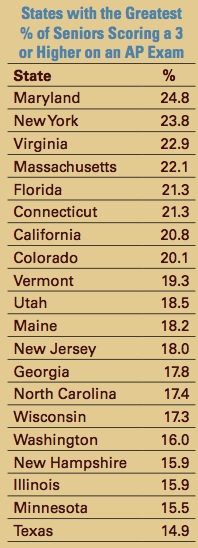
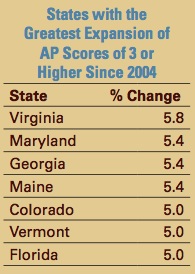
6th Annual AP Report to the Nation: Maryland Finishes #1

The College Board [1MB PDF file]:

Educators across the United States continue to enable a wider and more ethnically diverse proportion of students to achieve success in AP®. Significant inequities remain, however, which can result in traditionally underserved students not receiving the type of AP opportunities that can best prepare them for college success. The 6th Annual AP Report to the Nation uses a combination of state, national and AP Program data to provide each U.S. state with the context it can use to celebrate its successes, understand its unique challenges, and set meaningful and data-driven goals to prepare more students for success in college.

Share

Houston Area Districts consider ending salary perk for teachers

Ericka Mellon:

Houston-area school districts spend tens of millions of dollars a year on teachers with advanced degrees that studies show don’t produce better student achievement.
But with money tight, a handful of districts are considering ditching the traditional salary bump for teachers with master’s degrees in favor of pay based more on student learning. The Houston Independent School District and the top-rated YES Prep charter school chain are among those looking to experiment.
“I would like us to look with our teachers and see whether or not those dollars could be spent in a more productive way,” HISD Superintendent Terry Grier said.
HISD estimates that the extra payout for teachers with a master’s or a doctorate is costing taxpayers about $7.8 million this school year. Grier suggested that the money might be better spent to pay teachers more for taking on leadership roles or to bolster the district’s bonus plan tied to student test scores.
Texas lawmakers stopped mandating higher salaries for teachers with advanced degrees in 1984, but many districts continue the practice. The number of teachers with master’s degrees statewide has grown over the last four years, though the percentage has dropped slightly to 20.9.

Background via this spreadsheet.

Share

New Jersey School Elections & Budget Calendar

New Jersey Department of Education 140K PDF. Related: Madison School District 2010-2011 budget calendar.

Share

Do School Libraries Need Books?

Room for Debate:

Keeping traditional school libraries up to date is costly, with the constant need to acquire new books and to find space to store them. Yet for all that trouble, students roam the stacks less and less because they find it so much more efficient to work online. One school, Cushing Academy, made news last fall when it announced that it would give away most of its 20,000 books and transform its library into a digital center.
Do schools need to maintain traditional libraries? What are the educational consequences of having students read less on the printed page and more on the Web?

Share

New Jersey School, District & State Report Cards

New Jersey Department of Education:

The federal No Child Left Behind (NCLB) Act has imposed specific accountability and reporting requirements on states. The NCLB reports present school-, district-, and state-level information in those areas mandated by NCLB, which are as follows: status regarding Adequate Yearly Progress; information on highly qualified teachers; attendance and dropout data; and assessment data that has incorporated all of the conditions mandated under NCLB for meeting federally approved proficiency levels.
The results displayed on NCLB Reports are based on the state assessment data with the NCLB conditions applied. Additionally, the NCLB data incorporates the data appeals submitted by districts/schools that have been granted by the NJDOE. Therefore, the data in the NCLB Reports may be different from the data displayed on the NJ School Report Cards.

Share

State secrets on Texas school front

Rick Casey:

Before being ordered by Gov. Rick Perry not to compete for a chunk of the $4.3 billion “Race to the Top” federal grants for public schools, staffers at the Texas Education Agency had put in more than 800 hours preparing an application.
Inquiring minds, including my colleague Ericka Mellon, wanted to look at what our employees had proposed and filed requests for copies of the draft under the Texas Public Information Act.
But TEA Commissioner Robert Scott, a Perry loyalist, ordered agency attorneys to appeal to the attorney general, asking that the work be declared a state secret.
The Public Information Act states that all documents produced with the taxpayers’ money are public with certain specific exceptions
So what exception is the TEA citing?
The exception that information can be kept from the public if its release “would give advantage to a competitor or bidder.”
But we’re not bidding or competing.

Share

Denying Choices

WSFA:

Why shouldn’t local school boards have the option of allowing charter schools in their districts if they feel it can help serve students better?
A group of legislators in the House Education Appropriations Committee not only rejected that option, but didn’t allow other members of the House to even vote on it.
They rejected the charter schools possibility outright. With it they also rejected the possibility of millions of dollars in federal assistance for education.
For a state that can use every cent and more to improve education, this wasn’t a wise choice.
The $ 4 billion dollars in federal money will be spent, but the likelihood of part of it being spent for our students is now diminished, since part of the criteria for getting the money is charter schools being an option in your state.

Share

‘Algebra-for-All’ Push Found to Yield Poor Results

Debra Viadero:

Spurred by a succession of reports pointing to the importance of algebra as a gateway to college, educators and policymakers embraced “algebra for all” policies in the 1990s and began working to ensure that students take the subject by 9th grade or earlier.
A trickle of studies suggests that in practice, though, getting all students past the algebra hump has proved difficult and has failed, some of the time, to yield the kinds of payoffs educators seek.
Among the newer findings:
• An analysis using longitudinal statewide data on students in Arkansas and Texas found that, for the lowest-scoring 8th graders, even making it one course past Algebra 2 might not be enough to help them become “college and career ready” by the end of high school.
• An evaluation of the Chicago public schools’ efforts to boost algebra coursetaking found that, although more students completed the course by 9th grade as a result of the policy, failure rates increased, grades dropped slightly, test scores did not improve, and students were no more likely to attend college when they left the system.

Related: Madison School District Math Task Force and West High School Math Teachers letter to Isthmus.

Share

The most important (Madison) race this spring

Wisconsin State Journal Editorial:

t almost didn’t happen.
And Madison should be grateful that it did.
Two enthusiastic candidates are seeking an empty seat on the Madison School Board this spring.
James Howard, an economist and father of city school children, lists “high expectations” as a top priority.
Tom Farley, director of a nonprofit foundation and father of Madison school children, touts President Barack Obama’s call for innovation.
It’s the only competitive race for three seats because incumbents Maya Cole and Beth Moss are unopposed.
That leaves Howard’s and Farley’s campaigns to shine a needed spotlight on the many challenges and opportunities facing city schools.
Both men hope to replace Johnny Winston Jr., who announced last year he would not seek a third term.

Share

Madison School District appears to be softening stance toward charter schools

Susan Troller, via a Chris Murphy email:

When teachers Bryan Grau and Debora Gil R. Casado pitched an idea in 2002 to start a charter school in Madison that would teach classes in both English and Spanish, they ran into resistance from school administrators and their own union. Grau and his cohorts were asked to come up with a detailed budget for their proposal, but he says they got little help with that complex task. He recalls one meeting in particular with Roger Price, the district’s director of financial services.
“We asked for general help. He said he would provide answers to our specific questions. We asked where to begin and again he said he would answer our specific questions. That’s the way it went.”
Ruth Robarts, who was on the Madison School Board at the time, confirms that there was strong resistance from officials under the former administration to the creation of Nuestro Mundo, which finally got the green light and is now a successful program that is being replicated in schools around the district.
“First they would explain how the existing programs offered through the district were already doing a better job than this proposal, and then they would show how the proposal could never work,” says Robarts. “There seemed to be a defensiveness towards these innovative ideas, as if they meant the district programs were somehow lacking.”
The Madison School District “has historically been one of the most hostile environments in the state for charter schools, especially under Superintendent Rainwater,” adds John Gee, executive director of the Wisconsin Association of Charter Schools.

Related: the now dead proposed Madison Studio Charter and Badger Rock Middle School.
Madison continues to lag other Districts in terms of innovative opportunities, such as Verona’s new Chinese Mandarin immersion charter school.

Share

An Evaluation: Virtual Charter Schools

Wisconsin Legislative Audit Bureau:

Virtual charter schools are publicly funded nonsectarian schools that are exempt from many regulations that apply to traditional public schools and that offer the majority of their classes online. They began operating in Wisconsin during the 2002-03 school year. Pupils typically attend from their homes and communicate with teachers using e-mail, by telephone, or in online discussions. During the 2007-08 school year, 15 virtual charter schools enrolled 2,951 pupils. Most were high schools.
A Wisconsin Court of Appeals ruling in December 2007 prevented the Department of Public Instruction (DPI) from providing state aid payments to a virtual charter school through the open enrollment program, which allows pupils to attend public schools outside of their school districts of residence. 2007 Wisconsin Act 222, which was enacted to address concerns raised in the lawsuit, also required us to address a number of topics related to virtual charter schools. Therefore, we evaluated:

  • enrollment trends, including the potential effects of a limit on open enrollment in virtual charter schools that was enacted in 2007 Wisconsin Act 222;
  • virtual charter school operations, including attendance requirements, opportunities for social development and interaction, and the provision of special education and related services;
  • funding and expenditures, including the fiscal effects of open enrollment on “sending” and “receiving” districts;
  • teaching in virtual charter schools, including teacher licensing and pupil-teacher interaction; and
  • academic achievement, including test scores and other measures, as well as pupils’, parents’, and teachers’ satisfaction with virtual charter schools.

Share

K-12 Tax & Spending Climate: Clueless in Washington

The Economist:

IT WAS never reasonable to expect that Barack Obama’s budget proposal, delivered to Congress on February 1st, would do much to bring down America’s vast deficit in the near term. True, the economy has returned to growth. But a big part of that consists of restocking after a savage downturn that has left inventories depleted. Consumers are still struggling with the collapse in the values of their homes and other assets. And unemployment stands at a stubborn 10%: the administration forecasts see only a fractional fall in joblessness this year.
Unlike other rich countries, America lacks the “automatic stabilisers” that kick in during times of recession to help boost demand. Unemployment benefit is extremely limited. Most states are legally barred from running deficits, so when their revenues fall in times of recession they make painful cuts, firing workers and ending programmes–thus exacerbating the downturn rather than offsetting it. Only the federal government can fill the demand gap, and if it is too parsimonious and the recession returns, the deficit would get much worse.

Share

Achievement gap

Akron Beacon Journal:

Ask about the signature achievements of George W. Bush’s eight years as president, and the No Child Left Behind Act is certain to be high on the list. The 2002 law made accountability a watchword in public school education. It aimed to evaluate the nation’s elementary and secondary schools based on student test scores and to hold schools, teachers and administrators to account for their success or failure in moving students to achieve proficiency targets for the classroom.
The law, which has been the subject of much debate and criticism from the start, is up for reauthorization this year. President Obama has made clear his intent to reshape the legislation and the federal role in public education. Not clear yet is what precisely he intends to do.
No Child Left Behind has been criticized fiercely for its heavy emphasis on yearly testing and the rating of schools as successes or failures on the basis of test scores. For teachers and school officials, one of the most contentious of the law’s requirements is that schools be able to show, from the test scores, that every student group is making adequate yearly progress, AYP. Repeated failure to make AYP results in penalties that include shutting down schools.
The law also set a deadline: that students be proficient in math and English by 2014, a goal Obama’s secretary of education, Arne Duncan, recently described as utopian.

Share

A Letter from Polly Williams to Tony Evers on the Milwaukee Public Schools

Wisconsin Representative Annette Polly Williams:

February 5, 2010
State Superintendent Tony Evers
Department of Public Instruction
125 S. Webster Street
PO Box 7841
Madison, WI 53707-7841
Dear Superintendent Evers:
I am contacting you regarding your Notice of Decision dated February 4, 2010 issued to the Milwaukee Public Schools (MPS) which would potentially eliminate the $175 million in federal funds received for services to low-income children through the Title I program. In your press statement, you indicated that you had a legal responsibility to the children of Milwaukee and that you were using the only tool allowed under state law to ensure these federal funds are used effectively to improve MPS. Not only I am deeply perplexed by the timing of this notice, but I’m equally concemed over the use of your authority to withhold federal dollars to “speed up change” in MPS. I find your efforts to be disingenuous.

Clusty Search: Polly Williams, Tony Evers. Via the Milwaukee Drum.

Share

Politics of public education reform – exploring Race to the Top’s charter school emphasis

Bridgette Wallis:

President Obama’s Race to the Top (RttT) state competition has brought charter schools to the forefront of public education reform. Additionally, charter schools are prominent in Obama’s 2011 proposed budget – increasing funding for charter schools and an extra $1.8 billion toward Supporting Student Success (which focuses on Promise Neighborhoods, of which charter schools are the central focus).
RttT relies heavily on charter schools as a tool for reform, awarding more points to states which enable charter school creation than to those which do not:

Share

Madison School District Budget Planning Calendar 2010-2011

20K PDF:

Share

Choices without Equity: Charter
 School
 Segregation 
and 
the

 Need
 for
 Civil
 Rights
 Standards


Erica 
Frankenberg,
 Genevieve 
Siegel‐Hawley,
and
 Jia
 Wang [1.4MB PDF]
:

Seven years after the Civil Rights Project first documented extensive patterns of charter school segregation, the charter sector continues to stratify students by race, class and possibly language. This study is released at a time of mounting federal pressure to expand charter schools, despite on-going and accumulating evidence of charter school segregation.
Our analysis of the 40 states, the District of Columbia, and several dozen metropolitan areas with large enrollments of charter school students reveals that charter schools are more racially isolated than traditional public schools in virtually every state and large metropolitan area in the nation. While examples of truly diverse charter schools exist, our data show that these schools are not reflective of broader charter trends.
Four major themes emerge from this analysis of federal data. First, while charter schools are increasing in number and size, charter school enrollment presently accounts for only 2.5% of all public school students. Despite federal pressure to increase charter schools–based on the notion that charter schools are superior to traditional public schools, in spite of no conclusive evidence in support of that claim–charter school enrollment remains concentrated in just five states.
Second, we show that charter schools, in many ways, have more extensive segregation than other public schools. Charter schools attract a higher percentage of black students than traditional public schools, in part because they tend to be located in urban areas. As a result, charter school enrollment patterns display high levels of minority segregation, trends that are particularly severe for black students.

More here and here.

Share

Rigorous college-prep (AP) classes skyrocketing in Washington state

Katherine Long:

A decade ago, most Seattle-area high schools offered just a handful of rigorous classes that provided a way to earn college credit while supercharging a transcript. And only students with top grades were allowed to sign up.
But in 10 years, the intensive, fast-paced Advanced Placement (AP) classes have skyrocketed in this state.
In 2008, fully one-quarter of Washington public-school seniors took at least one AP test during their high-school years, compared with 10 percent in 1997. In some schools, almost every student takes an AP class in junior or senior year.
And other schools around the state are moving fast to add AP classes and expand participation, in part because college admissions officials say the demanding classes do a good job of preparing students for higher education.
Many schools are encouraging all students — not just the high achievers, but also average students and even those who struggle — to take AP classes or enroll in other rigorous programs such as the International Baccalaureate (IB).

Melissa Westbrook has more.

Share

Creativity & Accountability

Tom Vander Ark:

Yong Zhao is back in receptive Seattle this week preaching his gospel of edu-innovation. The anti-standards, pro-creativity Zhao is a Chinese-born prof at Michigan State. Here’s his thesis in a nutshell:
In my new book Catching Up or Leading the Way, I mostly focus on issues facing education in the United States noting that the current education reform efforts, with their emphasis on standards, testing, and outcome-based (read test score-based) accountability, are unlikely to make Americans “globally competitive.”
Zhao and I like the same schools and probably share a similar vision for what a good education looks like and the benefits it provides students. We both agree that bad standards and tests badly applied is bad for kids.
But his anti-standards mantra strikes me as a bit irresponsible in the sense that he doesn’t grapple with accountability. We have NCLB because states were not fulfilling the good school promise–they ignored generations of chronic failure. The Department of Education is now grappling with a new accountability framework, one that is tight on goals and loose on means.

Share

Students dread transition out of Beverly Hills Unified

Carla Rivera:

The few dozen nonresident eighth-graders who won’t be going to Beverly High as planned say they’re left in limbo, not sure where to enroll or how they’ll adjust to new academic and social standards.
Taylor Short said the last few weeks have been like walking through a fog, unable to see what’s ahead. The Beverly Vista Elementary eighth-grader has no idea where she’ll enroll next year. She wonders whether she’ll stay in touch with her best friends and feels let down by adults.
David Yona, a top athlete at El Rodeo Elementary, said he had been looking forward to the summer, when sports teams condition and train. Sadness sets in when he thinks about the fun he will probably miss before he starts his freshman year in the fall.
Although Taylor and David live outside the Beverly Hills Unified School District, they have attended its schools for years on special permits. The district’s Board of Education voted last month not to renew permits for the eighth-graders and other elementary students. They allowed high school students to continue through graduation.
The district is changing the way it funds schools, declining state money based on student attendance and instead using property-tax revenue. Board members argued that Beverly Hills taxpayers should not subsidize education for nonresidents.

Share

K-12 Tax & Spending Climate: Borrowing from Our Children

Kenneth Anderson:

I realized, talking in office hours with a couple of my law students, that they did not really understand what is meant by the phrase “borrowing from our children” — as we often hear it raised or referenced these days in budget, deficit, and other policy debates. These are bright students who have often taken some economics, but haven’t necessarily learned to think through common economic tropes in current arguments. So it hadn’t really occurred to them to ask, what does it mean to “borrow from our children”? The children who mostly don’t yet exist, and in any case don’t have any money from which to borrow.
As soon as it’s put that way, it is obvious that what we actually mean is, we will borrow today from people who do have money — and who are willing to forego consumption today, presumably in China and the rest of Asia — and our children will repay the principal and interest. We have internalized the consumption (er, investment? -ed.) currently and externalized the repayment. It might be more accurate to say that we have exercised an option with regards to the future — we are the holders and they the involuntary writers of an option. But the fundamental public policy point is that in order to engage in this borrowing exercise today, even if we are going to “put” the repayment to our children, someone today has to be willing to give up consumption now and lend us those resources today.
To that end, David Sanger has a nice piece in the New York Times Week in Review, “The Debtor the World Still Bets On.” While we’re at it, Irwin Steltzer’s Weekly Standard essay, “Government Intervention Will Leave a Nasty Hangover.”

Share

Schools use support centers to help students

Amy Hetzner:

Seated with a classmate at a table near the Whitnall High School library, freshman Josh Kelly stumbles into trouble with some of his make-up work for history class.
“There’s this artist in the Middle Ages, and I don’t know how to spell his name,” Josh says as teacher Andrew Baumann comes over quickly to help.
“Oh, Giotto . . .  frescoes,” Baumann replies, bending over the teenager’s textbook. “He basically invented all these new techniques that people after him started using in the Renaissance.”
While Baumann is a social studies teacher, he’s not technically Josh’s social studies teacher. Instead, he’s one of two full-time faculty members who staff the school’s academic support center, an all-day service where students can come for tutoring, to complete projects or to make up assignments and tests.
It’s one of several solutions that high schools have come up with to provide students with more academic help during the school day, as opposed to trying to compete with work, sports and other activities that commonly lure teenagers outside of the school hours.
The year after Whitnall’s center started in 2006, Germantown High School initiated one of its own.
Today, it serves between 90 and 120 students a day – enough that Germantown’s Academic Support Center teacher, Cindy Collins, had to come up with a new 15-minute pass system to ensure she wasn’t turning students away. She also depends on volunteers from the school’s junior and senior classes to provide tutoring in easier subjects that freshmen might grapple with during the center’s busy times.

Share

Chicago Public Schools Seek a Bit of Serenity

Crystal Yednak:

Ron Huberman, the chief executive of Chicago’s public schools, is looking to hire a “Culture of Calm” coordinator to improve conditions in schools deemed most at risk for student violence.
The coordinator would work closely with principals on resolving conflicts, providing better emotional support for students, and improving discipline and attendance. The job could pay up to $90,000.

Share

Contact the Seattle Public Schools’ board and administrators, asks Where’s the Math

Martha McLaren:

On February 4th, King County Superior Court Judge Julie Spector ruled that last year’s Seattle School board decision to adopt the Discovering high school textbook series was arbitrary and capricious. Judge Spector’s ruling was heard and hailed across the country by private citizens and math education advocacy groups.
This unprecedented finding shows school boards and district administration that they need to consider evidence when making decisions. The voice of the community has been upheld by law, but the Seattle School district indicated they plan to appeal, demonstrating the typical arrogant, wasteful practices which necessitated the lawsuit in the first place.
Concerned individuals in Seattle and across the country need to speak up now, and let Seattle administration know that it’s time to move forward and refocus on the students, rather than defend a past mistake.
The ruling states:
“The court finds, based upon a review of the entire administrative record, that there is insufficient evidence for any reasonable Board member to approve the selection of the Discovering Series.”

Share

“Innovation Schools” presentation

Andrew Kwatinetz:

I attended a presentation on Friday by Dr. Rob Stein, principal (and alum) of Manual High School in Denver. Manual HS has been designated an “Innovation School” with approval from its staff and the local & state school boards, which means they, by Colorado state law, can deviate from district and state regulations (but not federal). They are not a charter school – all of their staff are district employees.
Denver’s central bureaucracy and expenditures sounded similar to Seattle’s. He showed a picture of Denver’s policy manuals: thousands of pages occupying an entire shelf. Some were downright comical but illustrative of the dysfunction in public schools. For example, their 98 page union agreement includes “Article 15-1-1: Each school will have a desk and a chair for each teacher, except in unusual circumstances.” He was quick to point out that the union is not to blame, but it’s symptomatic of a breakdown in trust in a system no longer optimized for student education. He showed the Denver schools org chart with dozens of arrows pointing to all of the folks that a typical principal needs to answer to. He estimated 80+ hours a week just to respond to the emails. More importantly, he calculated $4,157 per student to pay for central staff despite a fuzzy connection to specific student learning in his school.

Well worth reading.

Share

For Students at Risk, Early College Proves a Draw

Tamar Lewin:

Precious Holt, a 12th grader with dangly earrings and a SpongeBob pillow, climbs on the yellow school bus and promptly falls asleep for the hour-plus ride to Sandhills Community College.
When the bus arrives, she checks in with a guidance counselor and heads off to a day of college classes, blending with older classmates until 4 p.m., when she and the other seniors from SandHoke Early College High School gather for the ride home.
There is a payoff for the long bus rides: The 48 SandHoke seniors are in a fast-track program that allows them to earn their high-school diploma and up to two years of college credit in five years — completely free.
Until recently, most programs like this were aimed at affluent, overachieving students — a way to keep them challenged and give them a head start on college work. But the goal is quite different at SandHoke, which enrolls only students whose parents do not have college degrees.
Here, and at North Carolina’s other 70 early-college schools, the goal is to keep at-risk students in school by eliminating the divide between high school and college.
“We don’t want the kids who will do well if you drop them in Timbuktu,” said Lakisha Rice, the principal. “We want the ones who need our kind of small setting.”

Once again, the MMSD and State of WI are going in the wrong direction regarding education. Much more on “Credit for non-MMSD courses.

Share

New Jersey Gov. Christie, lawmakers propose sweeping pension, health care changes for public employees

Claire Heininger:

Gov. Chris Christie and lawmakers of both parties will unveil a series of sweeping pension and benefit reforms Monday that could affect every public employee in New Jersey while saving the state billions of dollars, according to four officials with direct knowledge of the plan.
The proposals would require workers and retirees at all levels of government and local school districts to contribute to their own health care costs, ban part-time workers at the state and local levels from participating in the underfunded state pension system, cap sick leave payouts for all public employees and constitutionally require the state to fully fund its pension obligations each year.
Details of the four-bill package to be introduced Monday were provided to The Star-Ledger on the condition of anonymity because the four officials were not authorized to speak in advance.
The proposals go further than several past efforts at reining in taxpayer-funded pension and benefit costs, and if enacted would represent a major early victory for the new Republican governor and Democrats who control the state Legislature. But supporters anticipate an angry response from public employee and teachers unions that wield considerable power throughout the state — though lawmakers argue rank-and-file workers would have safer pensions than before.
Christie’s office declined to comment, as did top Democrats and Republicans involved in crafting the bills.
All sides had made their feelings clear last month, when Senate President Stephen Sweeney (D-Gloucester) announced the upper house’s intentions to fix a system that would otherwise “go bankrupt.” Lawmakers of both parties pledged their support, with Christie saying “bipartisan action is critical to reforming a broken pension and benefits system.”

Share

The misguided race to federalize education

David Davenport, Gordon Lloyd:

President Obama and Education Secretary Arne Duncan call their $4 billion program of education reform grants the Race to the Top. A more accurate title would be the Race to Washington, because their program culminates a stunning decade in which school policy decisions have been wrested from local and state control to become matters of federal oversight. With the possible exception of Texas – where Gov. Rick Perry is resisting federal education grants with all their strings – no state has been left behind in the race to federalize education.
It’s easy to miss this important power shift because few of us notice, much less worry about, constitutional processes during a crisis. But, as presidential Chief of Staff Rahm Emanuel famously said, “You never want a serious crisis to go to waste” because, he continued, it’s an opportunity to do things you couldn’t do before. And that’s precisely what is happening in education as we complete a transfer of money and power to Washington to oversee our schools, in violation of the 10th Amendment, a couple of hundred years of history and common sense.
There is a disturbing pattern of Washington using crises to consolidate power. First we declare war on a problem, which shifts things into crisis mode. Remember the war on poverty, the war on drugs, the war on illiteracy, the war on terror? Now we have a war on underperforming schools, so naturally Washington needs to step in and nationalize standards and tests.

Share

Ohio State President Challenges Faculty Tenure

Andrew Welsh-Huggins:

COLUMBUS, Ohio – The leader of the country’s largest university thinks it’s time to re-examine how professors are awarded tenure, a type of job-for-life protection virtually unknown outside academia.
Ohio State University President Gordon Gee says the traditional formula that rewards publishing in scholarly journals over excellence in teaching and other contributions is outdated and too often favors the quantity of a professor’s output over quality.
“Someone should gain recognition at the university for writing the great American novel or for discovering the cure for cancer,” he told The Associated Press. “In a very complex world, you can no longer expect everyone to be great at everything.”
Plenty of people have raised the issue over the years, but Gee is one of the few American college presidents with the reputation and political prowess — not to mention the golden touch at fundraising — who might be able to begin the transformation.
Still, some professors are already skeptical.

Share

More on the Successful Seattle Lawsuit against Discovering Math

Laurie Rogers:

Decision favors plaintiffs in court challenge of Seattle math text adoption
Statement from Laurie Rogers:
Last year, Seattle Public Schools adopted the Discovering math series despite valiant opposition from parents and math professionals, despite poor assessments of the Discovering series’ rigor and adherence to the new state math standards, and despite the fact that OSPI did NOT ultimately recommend the Discovering math series.
In response, three people filed a lawsuit, saying that Seattle didn’t have sufficient supporting evidence for its adoption, and also that the Discovering series was associated with an INCREASE in achievement gaps.
Recently, a judge agreed with the plaintiffs and – while stopping short of telling Seattle to cease and desist in their adoption – told Seattle to revisit its adoption. The district can continue to use the Discovering series, and Seattle administrators have stated their clear intention to do so.
Nevertheless, the court decision is momentous. It sets a precedent for districts across the country. When board members can’t justify their adoption decisions, the people now have legal recourse.

Share

When Did They Stop Calling it Detention?


Jerry Scott and Jim Borgman, via a kind reader’s email.

Share

The Players – in the Milwaukee Public Schools’ Governance Battle

Alan Borsuk:

You can bet that the state Department of Public Instruction won’t carry out its threat to withhold a bazillion dollars from Milwaukee Public Schools because MPS is not showing as much urgency as desired about making changes. (What in the world would make DPI think that?)
That doesn’t mean the threat is not an important matter and that it isn’t part of developments that could have a real impact. DPI leaders might be able to turn this into a way to force MPS to take more energetic steps, especially around special education and struggling students of all kinds.
The fact that DPI has the power to make a threat like this illustrates forcefully the changing picture of power when it comes to MPS. In fact, assuming a contract is signed in the next few days with Gregory Thornton, the School Board’s choice to be the new MPS superintendent, he will be only one of a roster of chief executives over aspects of Milwaukee schools, as I see it.
Here’s a guide to some of the folks at the center of the action these days:

Share

Chandler schools limit recruitment to science, math, special ed teachers

Kerry Fehr-Snyder:

The outlook for new teachers is dim this year, prompting Chandler school officials to limit their recruiting efforts to science, math and special-education teachers for the first time.
Although other teachers are not being turned away, the Chandler Unified School Districts is focusing on hard-to-fill science, math and special-education teaching jobs for its Feb. 18 recruiting fair.
“This is our first year . . . . . we’re not having a general recruitment fair because of there are fewer needs, fewer positions openings than in the past,” said Laura Nook, the district’s human-resources director.
The district doesn’t yet know how many new teachers it will need next school year. Demand depends on student enrollment, the number of returning teachers and whether the Arizona Legislature again cuts K-12 funding to balance the state budget.

Share

Judge holds Washington Legislature to the promise of education funding reform

Washington Attorney General:

A King County Superior Court judge today ruled the state does not provide ample funding for basic education then directed the Legislature to establish the cost of providing all Washington children with a basic education and establish how it will fully fund such education with stable and dependable state sources.
In his oral ruling this morning in McCleary v. State, also known as the “Basic Education case,” King County Superior Court Judge John Erlick also indicated the state’s 2009 education funding measure (HB 2261) could be a means to satisfy this direction. The court e-mailed the entire 73-page ruling to counsel immediately following the hearing.
“Judge Erlick rightly recognizes in his ruling the Legislature’s authority to set education funding policy,” said Attorney General Rob McKenna. “The Legislature took positive steps with its 2009 education funding reform efforts, and we understand the decision to suggest those reforms could be the basis for progress in this case.

Share

Should Extra-Curricular Fine Arts Teachers be Paid the Same as Sports Coaches?

Nick Bubb:

Last week the Capital Times ran a story about how Tom Hardin, the head coach of forensics and drama at James Madison Memorial High School, plans to retire from coaching at the end of the season. There was even a follow up blog by the Capitol Times reacting to the discussion of the story.
As an assistant coach for Memorial forensics and debate program for several years, I read the paper and the comments in the online version with a more critical eye than others. It’s worthwhile to point out that I am extremely biased on this issue. Tom Hardin and Tim Scheffler taught me how to be a speech and debate coach and gave me a job that supported me throughout my post secondary education.
My responses to the news and comments are as follows:

More here.

Share

Will school districts drop sex ed rather than comply with state law?

Shawn Doherty:

Opponents of a controversial sex ed bill passed by Wisconsin legislators last week warn that if Gov. Jim Doyle signs the bill into law as he has promised, some local school districts will stage a revolt against the measure by ignoring it or dropping their human growth and development curriculum entirely.
“Did the state in its zeal to impose its own way even think about the consequences? Because a lot of districts are just going to just walk,” predicts Matt Sande, director of legislation at Pro-Life Wisconsin.
The proposed new law would require any Wisconsin public school district that offers a course in human growth and development — or sexual education — to teach students about sexually transmitted diseases and methods of safe sex, including contraception. Under current law districts can choose to provide only instruction focusing on abstinence or chastity.
The proposed new law doesn’t require school districts to offer such courses at all, however. School districts can drop their sex ed classes completely rather than comply, which is what Julaine Appling, president of Wisconsin Family Action, says her organization will encourage them to do in upcoming mailings. “This is a Planned Parenthood dream come true,” Appling says about the bill. “They have taken options away from local school districts. Now the choice is something Madison says is best or to have no human growth and development classes at all, which, quite honestly, is the better choice.”

Share

Districts turn to arbitration to settle teacher contracts

Amy Hetzner:

In an action that’s likely to be repeated across the state, the West Bend School District is preparing to take contract negotiations with its teachers to arbitration, potentially among the first districts to do so since the Legislature removed teacher salary controls that held sway in Wisconsin for 16 years.
District negotiators and representatives for the West Bend Education Association have their first mediation session scheduled for next week, the first step they need to take before they can proceed to binding arbitration.
Administrators say they would prefer being able to resolve their issues with the teachers union by settling a contract through the mediation process. But they also say they are willing to go to arbitration if needed.
“We’re not afraid of it,” said Bill Bracken, labor relations coordinator for Davis & Kuelthau, which is representing the school district.
Other districts apparently aren’t afraid either. At least a couple of school districts outside southeastern Wisconsin are getting ready to certify their final offers after already going through the mediation process, indicating binding arbitration is probable, said Scott Mikesh, a staff attorney with the Wisconsin Association of School Boards.
On Friday, the Elmbrook School District and its teachers union announced they were filing for mediation help in their contract negotiations, although Assistant Superintendent Christine Hedstrom said the two sides were not filing for help with the state and won’t automatically go to arbitration if they reach deadlock.

Related: Madison School District & Madison Teachers Union Reach Tentative Agreement: 3.93% Increase Year 1, 3.99% Year 2; Base Rate $33,242 Year 1, $33,575 Year 2: Requires 50% MTI 4K Members and will “Review the content and frequency of report cards”.
It would be interesting to compare contracts/proposals among similarly sized Districts.

Share

Race to the Top?: Part II

Dr. Jim Taylor:

In my recent post, Race to the Top?: Part I, I described the academic achievement rat race in which students near the top of the educational food chain strive maniacally to win (or at least finish). I argued that the emphasis on testing by former President Bush’s No Child Left Behind law (NCLB) and continued with President Obama’s Race to the Top initiative (RTTT) has only exacerbated the problem better characterized by the title of the powerful new documentary by Vicki Abeles, Race to Nowhere. This post, in contrast, explores how RTTT impacts those students and schools at the other end of the educational food chain, those who are just trying to survive in the turbulent sea of American public education.
The first mistake that this administration made was to call education reform a race. Races connote winners and losers. Yet, we need to ensure that all our students and schools are winners. I think a more appropriate name for this initiative is “Climb to the Top” because the focus should be on how to get to the top.
The administration’s second mistake was to continue Bush’s initial mistake of focusing on testing; instead of being a tool for education reform, testing has morphed into the end-all, be-all of said reform. Yes, assessment is essential for determining the effectiveness of programs such as RTTT, aimed at achieving something as ethereal and elusive as education reform or the more tangible goal of closing the education and economic gaps between the haves and have-nots. At the same time, improved test scores should not be the ultimate objective of education reform.

Share

Seattle Court Reverses School Board Decision to Implement Discovery Math

Judge Julie Spector’s decision [69K PDF], via Martha McLaren:

THIS MATTER having come on for hearing, and the Court having considered the pleadings, administrative record, and argument in this matter, the Court hereby enters the following Findings of Fact, Conclusions of Law, and Order:
FINDINGS OF FACT
1. On May 6, 2009, in a 4-3 vote, the Seattle School District Board of Directors chose the Discovering Series as the District’s high school basic math materials.
a. A recommendation from the District’s Selection Committee;
b. A January, 2009 report from the Washington State Office of Public Instruction ranking High School math textbooks, listing a series by the Holt Company as number one, and the Discovering Series as number two;
c. A March 11, 2009, report from the Washington State Board of Education finding that the Discovering Series was “mathematically unsound”;
d. An April 8, 2009 School Board Action Report authored by the Superintendent;
e. The May 6, 2009 recommendation of the OSPI recommending only the Holt Series, and not recommending the Discovering Series;
f. WASL scores showing an achievement gap between racial groups;
g. WASL scores from an experiment with a different inquiry-based math text at Cleveland and Garfield High Schools, showing that W ASL scores overall declined using the inquiry-based math texts, and dropped significantly for English Language Learners, including a 0% pass rate at one high school;
h. The National Math Achievement Panel (NMAP) Report;
1. Citizen comments and expert reports criticizing the effectiveness of inquiry-based math and the Discovering Series;
J. Parent reports of difficulty teaching their children using the Discovering Series and inquiry-based math;
k. Other evidence in the Administrative Record;
I. One Board member also considered the ability of her own child to learn math using the Discovering Series.
3. The court finds that the Discovering Series IS an inquiry-based math program.
4. The court finds, based upon a review of the entire administrative record, that there IS insufficient evidence for any reasonable Board member to approve the selection of the Discovering Series.
CONCLUSIONS OF LAW
I. The court has jurisdiction under RCW 28A.645.010 to evaluate the Board’s decision for whether it is arbitrary, capricious, or contrary to law;
2. The Board’s selection of the Discovering Series was arbitrary;
3. The Board’s selection of the Discovering Series was capricious;
4. This court has the authority to remand the Board’s decision for further review;
5. Any Conclusion of Law which is more appropriately characterized as a
Finding of Fact is adopted as such, and any Finding of Fact more appropriately
characterized as a Conclusion of Law is adopted as such.
ORDER
IT IS HEREBY ORDERED:
The decision of the Board to adopt the Discovering Series is remanded for further proceedings consistent with this opinion.
Dated this 4th day of February, 2010.

Melissa Westbrook has more.
Seattle Math Group Press Release:

Judge Julie Spector today announced her finding of “arbitrary and capricious” in the Seattle School Board’s May 6 vote to adopt the Discovering Math series of high school texts despite insufficient evidence of the series’ effectiveness.
Judge Spector’s decision states, “The court finds, based upon a review of the entire administrative record, that there is insufficient evidence for any reasonable Board member to approve the selection of the Discovering series.”
Plaintiffs DaZanne Porter, an African American and mother of a 9th-grade student in Seattle Public Schools, Martha McLaren, retired Seattle math teacher and grandparent of a Seattle Public Schools fifth grader, and Cliff Mass, professor of atmospheric science at the University of Washington, had filed their appeal of the Board’s controversial decision on June 5th, 2009. The hearing was held on Tuesday, January 26th, 2010

Share

Failure rate for AP tests climbing

Greg Toppo & Jack Gillum:

The number of students taking Advanced Placement tests hit a record high last year, but the portion who fail the exams — particularly in the South — is rising as well, a USA TODAY analysis finds.
Students last year took a record 2.9 million exams through the AP program, which challenges high school students with college-level courses. Passing the exams (a score of 3 or higher on the point scale of 1 to 5) may earn students early college credits, depending on a college’s criteria.
MARYLAND: A model in AP access, achievement.
The findings about the failure rates raise questions about whether schools are pushing millions of students into AP courses without adequate preparation — and whether a race for higher standards means schools are not training enough teachers to deliver the high-level material.

Jay Matthews has more.

Share

Alabama Governor Riley enlists help from Washington on charter school legislation

Mary Orndorff:

U.S. Secretary of Education Arne Duncan is expected to travel to Alabama next month to help Gov. Bob Riley persuade lawmakers to pass legislation allowing charter schools, Riley said Wednesday.
“As a Republican I’ve always pushed for charter schools . . . but when I say it, it doesn’t have the legitimacy and credibility that the secretary of education and president of the United States has,” Riley said after meeting with Duncan Wednesday afternoon in Washington.
President Obama’s administration is preparing to hand out more than $4 billion to help states improve their public schools, and those without charter schools — like Alabama — are at a competitive disadvantage for the money.

Share

How Unions Work

Megan McArdle:

In a valiant attempt to defuse the ideological conflicts between the reformist and traditionalist wings of the liberal education wonketariat, Matthew Yglesias argues that this disagreement is not not ideological at all. Rather, it is an artifact of past decisions about educational structure:

Take, for example, the hot issue of teacher compensation. The traditionalist view is that teachers should get paid more for having more years of experience and also for having more degrees. The reform view is that teachers should get paid more for having demonstrated efficacy in raising student test scores. This is an important debate, but I think it’s really not an ideological debate at all. I think the only reason it’s taken on an ideological air is that unions have a view on the matter and people do have ideological opinions about unions in general. But if we found a place where for decades teachers had been paid based on demonstrated efficacy in raising student test scores, then veteran teachers and union leaders would probably be people who liked that system and didn’t want to change to a degree-based system. Because unions are controversial, this would take on a certain left-right ideological atmosphere but it’s all very contingent.

This is a very interesting thesis, but ultimately I think it’s wrong. There is a reason that unions kill merit pay, and it’s not because they just happened to solidify in an era when merit pay was out of fashion.

Share

12 local schools on state’s ‘worst’ list

Jennifer Smith Richards:

Twelve central Ohio schools are among the worst 5 percent statewide.
Their academic struggles mean they are eligible to receive federal money to help them transform or start over. A list of these schools was released yesterday by the Ohio Department of Education.
Six Columbus City Schools buildings are on the list of the worst-off, as are four in Cleveland and 16 in Cincinnati. Several charter schools — six of them in central Ohio — also made the “top” rung on the list.
“No one is going to like the fact that they’re on this list,” said Mark Real, who heads the Columbus-based nonprofit KidsOhio, which studies education issues. He’s been monitoring stimulus-related spending and improvement programs. “But this is not just a ‘label and leave it’ approach. These schools are in for some pretty intensive care.”
These schools all have a large number of poor students and have been mired in academic difficulties for several years.

Share

Wisconsin Starts Process to Withhold Funds from the Milwaukee Public Schools

Erin Richards:

Wisconsin’s Superintendent of Public Instruction took the first formal step Thursday toward withholding millions of dollars from Milwaukee Public Schools because of the district’s failure to show progress on improvement actions ordered by the state.
Superintendent Tony Evers officially notified the district that he would seek to “reduce to zero” all administrative funds and defer all programmatic funds that MPS currently receives to serve low-income children, unless the district could prove that it’s made progress in key areas of its corrective action plan.
“I don’t believe appropriate progress has been made in benchmark areas,” Evers said in an interview. “I can’t stand by and wait any longer.”
The state issued corrective action orders to MPS last summer because of the district’s failure to make adequate yearly progress on state test scores for five consecutive years under the No Child Left Behind law.

Share

Top step teacher pay limits budget options

Russell Moore:

There’s not much young blood in the Warwick school system and according to a top administrator – that’s costly.
There are currently 1,051 teachers in the Warwick School Department. Out of those teachers, 865 – or 82 percent of the department – rank in the top three “steps”.
All things considered, those highest paid teachers earned an average of $75,400 last year – according to Rosemary Healey, the school department’s Director of Compliance. That number represents compensation but excludes benefits such as health care and pensions.
Those 865 teachers earned a combined pay of $65,220,792.36. The school department’s total budget this fiscal year, which runs from July 1 until June 30 of this year, is just under $170 million.
The number includes a teacher’s base pay, longevity, and stipends paid to teachers for having attained various educational achievements – including a Master’s Degree or Doctorate, or advanced certifications.

Share

We (Monona, WI School Board) Get Lots and Lots of Letters

Peter Sobol:

We have received several letters over the last few days. I am posting here all of them for which I have received the author’s permission for your review. I had to reformat them for this forum, so i apologize if anything got mangled in the process:
____________________________________________________________________________
Dear School Board Members,
I am writing to urge you to keep 4th grade strings and specifically Jill Jensen on board in our schools. I know how difficult and painful the process of making budget cuts is–if anything, we would all like to see more programs available to our kids, let alone cut what we already have. I am fairly new to Monona, having moved here a year and a half ago, and have been extremely impressed by the 4th and 5th grade performances organized by Jill. It is obvious that she puts in many extra hours and goes far above and beyond her duties as a classroom teacher, because it is one thing–and hard enough–to teach a group of kids the mechanics involved in learning to read and perform music. It is another thing entirely to connect with children so closely and so well as to inspire obvious the joy and enthusiasm for performing that I have seen bursting forth in every one of their concerts that I have attended.

Share

The Soft Shoe of School Board/Union Negotiations

New Jersey Left Behind:

The Asbury Park Press slams the Marlboro Board of Education for taking a hard line with the local teachers union during contract negotiations and then, apparently, folding after two years of an escalating impasse. If only it were that simple.
Here’s how it works in N.J.: as the end of a typically-three-year contract approaches, a school board, represented by an attorney, and the local NJEA chapter, represented by NJEA reps, exchange proposals and proceed with negotiating everything from minor changes in contract language to salary increases and contributions (or not) to health benefits. If the two sides reach an impasse (usually once they hit salary and benefits, but sometimes over a seemingly insurmountable semantic technicality), they call in a state-appointed mediator who proposes a compromise. If one or both sides reject the compromise, they go to a state-appointed fact-finder who recommends a settlement. (Here’s Marlboro’s fact-finder’s report.) If that doesn’t work, they go to someone called a super conciliator, who writes up a lengthy resolution to the impasse. None of these interventions are binding.

Share

Utah Bill to prohibit paid union leave clears committee

Lisa Schencker:

A bill that would prohibit school districts from paying the salaries of teachers who leave the classroom to engage in union activities cleared its first legislative hurdle Tuesday.
Several Utah school districts now pay a portion of their local union presidents’ salaries even though they no longer teach, and the union pays the rest of their salaries according to contract agreements. Sen. Margaret Dayton’s bill, SB77, would prohibit districts from paying those on association leave and require that if a teacher or employee leaves “regular school responsibilities” for association or union duties that the employee, association or union reimburse the district for that time.
Dayton said the bill is about “keeping taxpayer dollars allocated for education in the classroom.”
Others, however, opposed the bill, saying the decision should be left up to local districts. Local union presidents have said that many of their duties, such as representing teachers on district committees and resolving conflicts, benefit both the union and the district.
“The functions [they] carry out are things the district would have to have people do or reassign staff to do,” said Susan Kuziak, of the Utah Education Association.

Share

Madison High School 2010-2011 Course Catalogs

via a kind reader’s email:

Related: Dane County High School AP Course Offering Comparison.

Share

Rhee: Uncomprising

Jay Matthews:

Late last week I had an interesting telephone conversation with D.C. Schools Chancellor Michelle A. Rhee. She called with a comment on a post in which I suggested she be more careful of her public words–like her statement that some of the teachers she fired hit or had sex with kids–in order to make sure she stays in her job and applies her considerable skills and knowledge to fixing our failing school system.
I suggested she apologize for offending teachers with her words so that we could get past this point and back to helping kids.
She said, in essence, that she is not going to do that. She said she wished that the Fast Company magazine item that sparked the controversy had included her statement that many of the teachers she had to fire for budget reasons were good people. But, she said, she was not going to compromise her methods or her beliefs. Some teachers did hit kids and have sex with kids, she said. She thought that was something people should know. It was important to root out such behaviors.
She had taken the chancellor job, which she did not seek, with the understanding she would do things her way. She had seen many big city superintendents do the more conventional thing, watch their words and try not to offend. She thinks that approach has not been successful.

Share

The Big Picture on School Performance

Sam Chaltain:

On Feb. 1, President Obama vowed to toss out the nation’s current school accountability system and replace it with a more balanced scorecard of school performance that looks at student growth and school progress.
I love the idea. Mr. Obama and education secretary Arne Duncan have repeatedly criticized the No Child Left Behind Act for keeping the “goals loose but the steps tight.” On their watch, both men aspire to introduce a new law that keeps the “goals tight but the steps loose.”
With that more flexible standard in mind, I have a scorecard to propose: the ABC’s of School Success. It provides both structure and freedom by identifying five universal measurement categories — Achievement, Balance, Climate, Democratic Practices and Equity — and letting individual schools chose which data points to track under each category.
1. ACHIEVEMENT
If there is a bottom line in schools today, it’s that educators must do whatever it takes to help close the achievement gap and improve student learning. To do so effectively and fully, schools must expand their measures for determining student achievement. After all, “achievement” isn’t only about student test scores; it’s also about other factors. The following are all critical to achievement:

Share

A Little Fiction

Will Fitzhugh
The Concord Review
February 3, 2010
I got a call the other day from the head football coach at one of the larger state universities.
He said, after the usual greetings, “I’ve got some real problems.”
“Like what?” I asked.
“The players I am getting now are out of shape, they don’t know how to block or tackle, then can’t read the playbook and they can’t follow their assignments.”
“That does sound bad. What is your record this season?”
“The teams we play seem to have similar problems, so all our games are pretty sad affairs, ending in scoreless ties.”
“Also,” he told me, “During breaks in practice, most of them are text-messaging their friends, and almost half of them just drop out of college after a year or two !”
“Have you talked to any of the high school coaches who send you players?”
“No, I don’t know them.”
“Have you visited any of the high school games or practices?”
“No, I really don’t have time for that sort of thing.”
“Well, have you heard there is a big new push for Common National Athletic Standards?”
“No, but do you think that will help solve my problems? Are they really specific this time, for a change?”
“Absolutely,” I said. “They want to require high school students, before they graduate, to be able to do five sit-ups, five pushups, and to run 100 yards without stopping. They also recommend that students spend at least an hour a week playing catch with a ball!”
“That is a start, I guess, but I don’t think it will help me much with my problem. My U.S. players have just not been prepared at all for college football. I have a couple of immigrant kids, from Asia and Eastern Europe, who are in good shape, have been well coached at the secondary level, and they have a degree of motivation to learn and determination to do their best that puts too many of our local kids to shame.”
“Well,” I said, “what do you think of the idea of getting to know some of the coaches at the high schools which are sending you players, and letting them know the problems that you are having?”
“I could do that, I guess, but I don’t know any of them, and we never meet, and I am really too busy at my level, when it comes down to it, to make that effort.”
[If we were talking about college history professors, this would not be fiction. They do complain about the basic knowledge of their students, and their inability to read books and write term papers. But like their fictional coaching counterpart, they never talk to high school history teachers (they don’t know any), they never visit their classrooms, and they satisfy themselves with criticizing the students they get from the admissions office. Their interest in National Common Academic Standards does not extend to their suggesting that high school students should read complete nonfiction books and write a serious research paper every year. In short, they, like the fictional head coach, don’t really care if students are so poorly prepared for college that half of them drop out, and that most of them do not arrive on campus prepared to do college work. They are really too busy, you see…]
===========
“Teach by Example”
Will Fitzhugh [founder]
Consortium for Varsity Academics® [2007]
The Concord Review [1987]
Ralph Waldo Emerson Prizes [1995]
National Writing Board [1998]
TCR Institute [2002]
730 Boston Post Road, Suite 24
Sudbury, Massachusetts 01776-3371 USA
978-443-0022; 800-331-5007
www.tcr.org; fitzhugh@tcr.org
Varsity Academics®
Share

Madison School District 2010-2011 Budget: Comments in a Vacuum?

TJ Mertz comments on Monday evening’s Madison School Board 2010-2011 budget discussion (video – the budget discussion begins about 170 minutes into the meeting). The discussion largely covered potential property tax increases. However and unfortunately, I’ve not seen a document that includes total revenue projections for 2010-2011.
The District’s Administration’s last public total 2009-2010 revenue disclosure ($418,415,780) was in October 2009.
Property tax revenue is one part of the MMSD’s budget picture. State and Federal redistributed tax dollars are another big part. The now dead “citizens budget” was a useful effort to provide more transparency to the public. I hope that the Board pushes for a complete picture before any further substantive budget discussions. Finally, the Administration promised program reviews as part of the “Strategic Planning Process” and the recent referendum (“breathing room”). The documents released to date do not include any substantive program review budget items.
Ed Hughes (about 190 minutes): “it is worth noting that evening if we taxed to the max and I don’t think we’ll do that, the total expenditures for the school District will be less than we were projecting during the referendum“. The documents published, as far as I can tell, on the school board’s website do not reflect 2010-2011 total spending.
Links to Madison School District spending since 2007 (the referendum Ed mentioned was in 2008)

It would be great to see a year over year spending comparison from the District, including future projections.
Further, the recent “State of the District” document [566K PDF] includes only the “instructional” portion of the District’s budget. There are no references to the $418,415,780 total budget number provided in the October 26, 2009 “Budget Amendment and Tax Levy Adoption document [1.1MB PDF]. Given the organization’s mission and the fact that it is a taxpayer supported and governed entity, the document should include a simple “citizen’s budget” financial summary. The budget numbers remind me of current Madison School Board member Ed Hughes’ very useful 2005 quote:

This points up one of the frustrating aspects of trying to follow school issues in Madison: the recurring feeling that a quoted speaker – and it can be someone from the administration, or MTI, or the occasional school board member – believes that the audience for an assertion is composed entirely of idiots.

In my view, while some things within our local public schools have become a bit more transparent (open enrollment, fine arts, math, TAG), others, unfortunately, like the budget, have become much less. This is not good.
Ed, Lucy and Arlene thankfully mentioned that the Board needs to have the full picture before proceeding.

Share

Wisconsin’s Race to the Top Application

via a kind reader’s email: 14MB PDF:

January 15, 2010 Dear Secretary Duncan:
On behalf of Wisconsin’s school children, we are pleased to present to you our application for the US Department of Education’s Race to the Top program. We were honored when President Obama traveled to Wisconsin to announce his vision for this vital program and we are ready to accept the President’s challenge to make education America’s mission.
We are proud of the steps we are taking to align our assessments with high standards, foster effective teachers and leaders, raise student achievement and transform our lowest performing schools. Over the last several months Wisconsin has pushed an educational reform agenda that has brought together over 430 Wisconsin school districts and charter schools together around these central themes.
Race to the Top funding will be instrumental in supporting and accelerating Wisconsin’s education agenda. While Wisconsin has great students, parents, teachers and leaders we recognize that more must be done to ensure that our students are prepared to compete in a global economy. The strong application presented to you today does just that.
Wisconsin’s application contains aggressive goals supported by a comprehensive plan. These goals are targeted at not only high performing schools and students but also address our lowest performers. For example, over the next four years Wisconsin, with your support, is on track to:

  • Ensure all of our children are proficient in math and reading.
  • Drastically reduce the number of high school dropouts.
  • Increase the high school graduation growth rate for Native American, African American and Hispanic students.
  • Significantly increase the annual growth in college entrance in 2010 and maintain that level of growth over the next four years.
  • Drastically cut our achievement gap.

These goals are supported by a comprehensive plan with a high degree of accountability. Our plan is focused on research proven advancements that tackle many of the challenges facing Wisconsin schools. Advancements such as the following:

  • Raising standards — joined consortium with 48 other states to develop and adopt internationally benchmarked standards.
  • More useful assessments — changes to our testing process to provide more meaningful information to teachers and parents.
  • Expanded data systems — including the ability to tie students to teachers so that we can ultimately learn what works and what doesn’t in education.
  • More support for teachers — both for new teachers through mentoring and for other teachers through coaching.
  • Increased capacity at the state and regional level to assist with instructional improvement efforts including providing training for coaches and mentors.
  • An emphasis on providing additional supports, particularly in early childhood and middle school to high school transition, to ensure that Wisconsin narrows its achievement gap and raises overall achievement.
  • Turning around our lowest performing schools — enhancing the capacity for Milwaukee Public Schools and the state to support that effort; contracting out to external organizations with research-proven track records where appropriate.
  • Providing wraparound services, complimenting school efforts in specific neighborhoods in Milwaukee to get low income children the supports necessary to succeed within and outside the school yard.
  • Investing in STEM — Building off our currently successful Science, Mathematics, Engineering and Technology efforts to ensure that more students have access to high-quality STEM courses and training.

The agenda that you have before you is one that builds on our great successes yet recognizes that we can and must do more to ensure our children are prepared for success. We appreciate your consideration of Wisconsin’s strong commitment to this mission. We look forward to joining President Obama and you in America’s Race to the Top.

Sincerely, Jim Doyle
Governor
Tony Evers
State Superintendent

Share

Stanford’s effort to curb alcohol abuse grows

John Wildermuth:

Stanford’s successful effort to exempt itself from Santa Clara County’s new rules on underage drinking has put a focus on the university’s growing effort to curb alcohol abuse on campus.
The county’s new ordinance, which took effect last year, makes it easier for police to cite anyone hosting a party where underage drinking occurs. It can mean a fine of up to $1,000 plus costs anytime the police are called in.
About 95 percent of Stanford’s 6,600 undergraduates, many of them younger than 21, live on campus in university-owned housing. As the landlord, the school could have found itself facing plenty of potential liability under the new county rules.
But the financial question didn’t play a role in the university’s attempt to persuade county officials to free Stanford from the regulations, said Jean McCown, the school’s director of community relations.

Share

Union officials are disturbingly inflexible toward charter schools

Washington Post:

IT IS HARD to square the words of American Federation of Teachers (AFT) President Randi Weingarten with the actions of many of her union’s officials. Even as Ms. Weingarten issues stirring calls for new ways of thinking, labor leaders in places such as New York use their political muscle to block important reforms. Perhaps they don’t think that she means business, or maybe they don’t care; either way, it is the interests of students that are being harmed.
The United Federation of Teachers (UFT), the AFT affiliate that represents teachers in New York City, led the opposition to legislation favored by Gov. David A. Paterson (D) that would have lifted the state’s cap on charter schools. Mr. Paterson, backed by New York Mayor Michael Bloomberg, had hoped to better position the state for up to $700 million in federal education dollars. The Obama administration has made clear that states that deny parents choice in where their children go to school by limiting the growth of these increasingly popular independent public schools will be penalized in the national competition for $4.35 billion in Race to the Top funds.

Share

Want To Know More About STEM?

Melissa Westbrook:

y husband decided to send me a couple of links to various STEM articles which then led me to even more interesting links. If you are interested in this subject from a state and national level, here are some links. Happy reading!
Apparently, Ohio is waaay ahead on this stuff so many of this articles are about different projects in that state.

  • From Government Technology magazine, an article about a new STEM school in Ohio.
  • From the University of Cincinnati (a key sponsor of a lot of these schools), an article about FUSION (Furthering Urban STEM Innovation, Outreach and New Research).

Share

Playing to Learn

Susan Engel:

So what should children be able to do by age 12, or the time they leave elementary school? They should be able to read a chapter book, write a story and a compelling essay; know how to add, subtract, divide and multiply numbers; detect patterns in complex phenomena; use evidence to support an opinion; be part of a group of people who are not their family; and engage in an exchange of ideas in conversation. If all elementary school students mastered these abilities, they would be prepared to learn almost anything in high school and college.
Imagine, for instance, a third-grade classroom that was free of the laundry list of goals currently harnessing our teachers and students, and that was devoted instead to just a few narrowly defined and deeply focused goals.
In this classroom, children would spend two hours each day hearing stories read aloud, reading aloud themselves, telling stories to one another and reading on their own. After all, the first step to literacy is simply being immersed, through conversation and storytelling, in a reading environment; the second is to read a lot and often. A school day where every child is given ample opportunities to read and discuss books would give teachers more time to help those students who need more instruction in order to become good readers.
Children would also spend an hour a day writing things that have actual meaning to them — stories, newspaper articles, captions for cartoons, letters to one another. People write best when they use writing to think and to communicate, rather than to get a good grade.

Share

Minnesota superintendent candidate holding four public meetings this week

Tom Weber:

The woman being tapped to run the Minneapolis School District will take part in four meetings this week to meet the community.
Bernadeia Johnson has been an administrator in Minneapolis for a few years – most recently as deputy superintendent. These meetings will be the first time she faces the public as the only candidate for the top job after current superintendent Bill Green retires in June.
The school board announced earlier this month that Johnson was its only candidate for the job. She had long been considered a leading candidate, but the move still surprised some people for its suddenness. It means Minneapolis won’t conduct a national search or even consider a list of a few semi-finalists, as St. Paul did last year.

Share

Education reform’s ‘Race to the Top’ features some non-starters

Kevin Huffman:

In the brave new world of data-driven education reform, most states have learned how to talk the talk. Start with “global competitiveness,” add in some “longitudinal data” and “transparency,” garnish with “accountability” and serve.
But far fewer states are committed to more than the language of reform — a reality made clear by the applications submitted last week to President Obama’s Race to the Top grant program.
Race to the Top is the crown jewel of the Obama administration’s education reform agenda and the largest-ever discretionary federal grant program for public schools. (In his State of the Union address this week, the president proposed adding an additional $1.4 billion to the pot of $4.35 billion.) The hope is that fiscally strapped states will make changes to ineffective policies and present comprehensive reform plans to be competitive for grants of up to $700 million. Indeed, Education Secretary Arne Duncan says that around a dozen states have changed laws or policies in response to the program thus far.

Share

Crazy-quilt democracy in action in Tuesday vote on L.A. Unified school reform

Howard Blume:

Voters Tuesday will choose reform plans for 30 Los Angeles-area schools in an election like no other.
For one thing, the voting age could dip to 14. Undocumented residents are welcome. Some people will get multiple votes. Ballot stuffing is expected.
And did we mention that each contestant will actually be competing in seven simultaneous elections? And that the results could be meaningless?
Whoever said democracy is messy could have been thinking of the Los Angeles Unified School District.
The subject of the election is singular: Groups inside and outside the school system are competing to run 12 persistently low-performing schools and 18 new campuses. The purpose of the balloting is for different voting blocs to select their favored bidder. Each bloc will be tallied separately, including parents, high school students and school employees.

Share

A Talk with Ellie Schatz: WCATY Founder and Author of “Grandma Says It’s Good to be Smart”

I enjoyed meeting and talking with Ellie Schatz recently. Listen to the conversation via this 17MB mp3 audio file CTRL-Click to download or read the transcript. Parent and activist Schatz founded WCATY and is, most recently author of “Grandma Says it’s Good to Be Smart“.
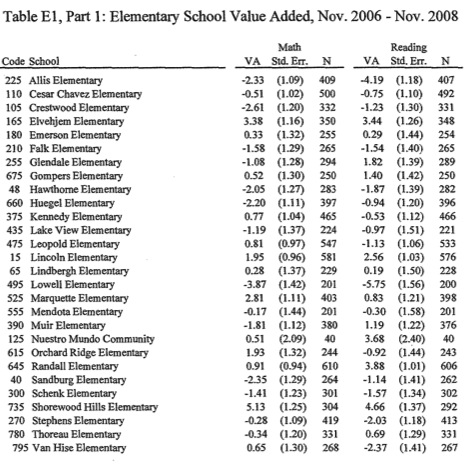
I enjoyed visiting with Ellie and found the conversation quite illuminating. Here’s a useful segment from the 37 minute interview:

Jim: What’s the best, most effective education model these days? Obviously, there are traditional schools. There are virtual schools. There are chartered schools. There are magnets. And then there’s the complete open-enrollment thing. Milwaukee has it, where the kids can go wherever they want, public or private, and the taxes follow.
Ellie: [32:52] I think there’s no one best model from the standpoint of those models that you just named. [32:59] What is important within any one of those models is that a key player in making that education available to your child believes that no matter how good the curriculum, no matter how good the model, the children they are about to serve are different, that children are not alike.
[33:30] And that they will have to make differences in the curriculum and in the way the learning takes place for different children.
[33:45] And I have experienced that myself. I’ve served on the boards of several private schools here in the city, and I have given that message: “This may be an excellent curriculum, and I believe it’s an excellent curriculum. But that’s not enough.”
[34:05] You cannot just sit this curriculum down in front of every child in the classroom and say, “We’re going to turn the pages at the same time, and we’re going to write the answers in the same way.” It does not work that way. You must believe in individually paced education.
[34:24] And that’s why I say the WCATY model cannot change. If it’s going to accomplish what I set out for WCATY to do, it must be accelerated from the nature of most of the curriculum that exists out there for kids today.

Thanks to Rick Kiley for arranging this conversation.

Share

A Tougher ‘A’ at Princeton Has Students on Edge

Jacques Steinberg, via a kind reader’s email:

p>Lisa Foderaro writes in The Times’s Metropolitan section that efforts by Princeton University to curb grade inflation are “now running into fierce resistance from the school’s Type-A-plus student body.”

The university had hoped that other institutions would follow its lead in making it harder for students to earn an A. “But the idea never took hold beyond Princeton’s walls,” Ms. Foderaro writes, adding: “with the job market not what it once was, even for Ivy Leaguers, Princetonians are complaining that the campaign against bulked-up G.P.A.’s may be coming at their expense.”

How much tougher is it to earn an A at Princeton? The percentage of grades in the A range fell below40 percent last year, compared to nearly 50 percent in 2004, when the policy was adopted.

In nearly 100 comments and counting, reader response on the issue of grade inflation has been fierce. For a sense of how one important arbiter — Yale Law School — interprets undergraduate grades, I draw your attention to this comment, from Asha Rangappa, the dean of Yale Law (and a Princeton graduate.) — Jacques

Share

Virtual Schools, Students with IEPs, and Wisconsin Open Enrollment

Chan Stroman:

Virtual schooling can be an educational choice with particular benefits for some students with disabilities. The recent study “Serving Students with Disabilities in State-level Virtual K-12 Public School Programs” by Eve Müller, Ph.D., published in September 2009 by the National Association of State Directors of Special Education (NASDSE)’s Project Forum, and funded by the U.S. Department of Education’s Office of Special Education Programs, surveyed state education agencies nationwide regarding their virtual K-12 public school programs:

Eleven states described one or more benefits associated with serving students with disabilities in virtual K-12 public school programs. These include:

Share

New Jersey State Finances & K-12 Tax & Spending

Governor Tom Kean & Governor Brendan Byrne:

Q: The governor’s advisory panels made a number of recommendations, including a possible freeze on the salaries of teachers and other public employees. Given that contracts are involved, could this be done?
BYRNE: We have to get over this attitude of “not on my back.” We have to get it across that everybody has to make sacrifices in order to make this work. It’s not going to if all hell breaks loose every time you try to eliminate one fireman. It’s not going to be easy.
KEAN: I don’t think people yet have an understanding of how bad things are.
Comprehending a $10 billion-$12 billion deficit in a $30 billion budget is difficult, if not impossible. Everybody is going to be making sacrifices, not just scattered employees.
BYRNE: It’s nice being in Washington for a day, where the talk is in trillions.
Q: Politically speaking, is taking on the teachers and state employees a fight worth considering simply because of the message it sends?
KEAN: We haven’t any choice. We have wonderful public employees, but they get paid more than anybody in the country in similar positions. We simply can’t afford to do that anymore.
BYRNE: People think this is a minor problem, and it isn’t.
KEAN: In previous years, governors and legislators have been able to paper over the problem. They’ve done so irresponsibly, by increasing debt to much more than it ought to be. Now this is coming home to roost, and we’ve all got to deal with it.
BYRNE: And that will include cutting things that are dear to our hearts, and that’s tough.

Share

K-12 Tax & Spending Climate: Watch state spend wildly at new website

Steve Contorno:

The state’s budget mess is a ticking time bomb and now Illinois residents can watch as it explodes.
A Web site launched by the Civic Committee of the Commercial Club of Chicago displays a ticker that counts up Illinois’ debt. On Friday evening, the number was around $128,586,300,000 and swiftly on the rise.
The Web site IllinoisIsBroke.com keeps track of the state’s growing deficit.
The civic committee isn’t in the business of political endorsements, so don’t ask them who those candidates are. However, President Eden Martin said he hopes voters take a better look at the individuals running for office.
“If there’s a kind of public irritation that becomes strong enough, I think there would be enough support for fundamental reforms,” Martin said.
Martin blamed changes to the pension system in 1995 that put Illinois on a path toward bankruptcy. To fix the problem, the committee proposes the state reform pensions so they are comparable to the private sector, meaning fewer benefits, a later retirement age and a less generous cost-of-living adjustment.
But Martin knows that’s no easy task and understands why some politicians prefer the status quo.

Share

Obama to Seek Sweeping Change in ‘No Child’ Law

Sam Dillon:

The Obama administration is proposing a sweeping overhaul of President Bush’s signature education law, No Child Left Behind, and will call for broad changes in how schools are judged to be succeeding or failing, as well as for the elimination of the law’s 2014 deadline for bringing every American child to academic proficiency.
Educators who have been briefed by administration officials said the proposals for changes in the main law governing the federal role in public schools would eliminate or rework many of the provisions that teachers’ unions, associations of principals, school boards and other groups have found most objectionable.
Yet the administration is not planning to abandon the law’s commitments to closing the achievement gap between minority and white students and to encouraging teacher quality.
Significantly, said those who have been briefed, the White House wants to change federal financing formulas so that a portion of the money is awarded based on academic progress, rather than by formulas that apportion money to districts according to their numbers of students, especially poor students. The well-worn formulas for distributing tens of billions of dollars in federal aid have, for decades, been a mainstay of the annual budgeting process in the nation’s 14,000 school districts.

Share

Ailing Schools Turn to Voters for Help

Joe Barrett:

The housing boom has left the sprawling school district based in this former rail town on the Little Miami River with gleaming new buildings and a dilemma over how to keep them funded.
Three times in the past 15 months, voters have rejected levies that would have kept the Little Miami School District in the black. Each time, the district fell further behind and had to ask for more. On Tuesday, voters will face the biggest request yet–a new real-estate tax that amounts to $519 per $100,000 of assessed value, nearly twice the rate rejected in November.
Backers say the levy, combined with already deep cuts, is the only way to prevent a fiscal emergency that would force a state takeover of the schools. “It’s the downturn of an entire community. People are going to start looking at moving and your property value is going to go through the floor,” said Julie Salmons Perelman, a 44-year-old part-time veterinary technician with three children in the schools, who sat stuffing bags filled with campaign literature one morning last week.
Bill Nicholson, 54, a longtime opponent of the levies, calls the rising requests in the face of repeated rejections “insanity.” In the past, he has argued on behalf of people with fixed incomes, but he recently lost his own job as a consultant in the perfume industry. “How can I cut a budget of zero” to pay more taxes, he asked.

Share

Who Owns Student Work?

Meredith Davis:

A number of years ago, curious about the ownership of student work produced in a class, I asked a lawyer friend who specializes in art and design copyright law if schools had the right to reproduce student work in their recruitment publicity without the students’ permission. He informed me that the student, despite advice from faculty who may have shaped the work, owns the work and that written permission must be secured before it could be reproduced. He also said such works could be considered student records and recruitment results in some benefit to the institution that exceeds any reading of the “fair use” practices of educational institutions (i.e. those that might be applied to the use of lecture slides for a class).
This reading of the law is at odds with the prevailing opinion of many schools that the student would not have produced work of a particular quality under his or her own resources, and therefore, that faculty have some “ownership rights” in the output of any class. Since that time I have been very careful to ask students first about any public use of their work, even in lectures I give at other schools, and I always credit the work with their names and give students the details on the presentation venues for their resumes. My lawyer friend told me that statements in college catalogs claiming that the institution retains ownership of work produced in a class wouldn’t hold up in court; unless the maker is an employee of the institution/company or has signed away rights through some explicit agreement, ownership is retained by the maker. Other attorneys may have different interpretations, and I don’t profess to be a legal expert, but the ownership of work produced by students is certainly something to think about.

Share

Why Students Fail AP Tests

Jay Matthews:

My column last week about how to reveal the secrets of which teacher is getting the best Advanced Placement results received many more comments than I expected. This was, I thought, a topic only for insiders, AP obsessives like me. I forgot, once again, that college-level exams have become a rite of passage for at least a third of American high schoolers, with that proportion increasing every year.
The column provided links to the several local school districts that have posted the subject-by-subject AP results for each school. I was shocked that any were doing it, since five years ago when I asked about this, few school officials had given it much thought. Since the AP tests are written and graded by outside experts, a teacher who does not challenge his students in class is likely to have lots of low scores on that school report, which until now hardly anyone had a chance to see.
Many thought I glossed over the effects of opening up AP courses to anyone who wants to get a useful taste of college trauma, sort of like camping in the back yard before your dad takes you to the Sierras. Enough mediocre students have enrolled in AP, and a similar program International Baccalaureate, to lower average scores even in the classes of the best teachers.

Share

Nokia, Pearson Set Up Digital Education Joint Venture In China

Robin Wauters:

Nokia and education company Pearson have formed a joint venture in China dubbed Beijing Mobiledu Technologies to grow MobilEdu, the wireless education service that the Finnish mobile giant launched in China back in 2007.
Mobiledu is a mobile service that essentially provides English-language learning materials and other educational content, from a variety of content providers, directly to mobile phones.
Customers can access the content through an application preloaded on new Nokia handsets, or by visiting the service’s mobile website and most other WAP portals in China.
According to Nokia, Mobiledu has attracted 20 million subscribers in China so far, with 1.5 million people actively using the service each month. According to the press release and by mouth of John Fallon, Chief Executive of Pearson’s International Education business, China is the world’s largest mobile phone market and the country with the largest number of people learning English.

There are many ways to learn, not all of them require traditional methods or expensive “professional development”.

Share

New Critiques on the Proposed “Common Core” English & Math Standards

via a kind reader. Math 627K PDF:

This document provides grade level standards for mathematics in grades K-8, and high school standards organized under the headings of the College and Career Readiness Standards in Mathematics. Students reaching the readiness level described in that document (adjusted in response to feedback) will be prepared for non-remedial college mathematics courses and for training programs for career-level jobs. Recognizing that most students and parents have higher aspirations, and that ready for college is not the same as ready for mathematics-intensive majors and careers, we have included in this document standards going beyond the readiness level. Most students will cover these additional standards. Students who want the option of entering STEM fields will reach the readiness level by grade 10 or 11 and take precalculus or calculus before graduating from high school. Other students will go beyond readiness through statistics to college. Other pathways can be designed and available as long as they include the readiness level. The final draft of the K-12 standards will indicate which concepts and skills are needed to reach the readiness level and which go beyond. We welcome feedback from states on where that line should be drawn.
English Language Learners in Mathematics Classrooms
English language learners (ELLs) must be held to the same high standards expected of students who are already proficient in English. However, because these students are acquiring English language proficiency and content area knowledge concurrently, some students will require additional time and all will require appropriate instructional support and aligned assessments.
ELLs are a heterogeneous group with differences in ethnic background, first language, socio-economic status, quality of prior schooling, and levels of English language proficiency. Effectively educating these students requires adjusting instruction and assessment in ways that consider these factors. For example ELLs who are literate in a first language that shares cognates with English can apply first-language vocabulary knowledge when reading in English; likewise ELLs with high levels of schooling can bring to bear conceptual knowledge developed in their first language when reading in a second language. On the other hand, ELLs with limited or interrupted schooling will need to acquire background knowledge prerequisite to educational tasks at hand. As they become acculturated to US schools, ELLs who are newcomers will need sufficiently scaffolded instruction and assessments to make sense of content delivered in a second language and display this content knowledge.

English Language Arts 3.6MB PDF
Catherine Gewertz:

A draft of grade-by-grade common standards is undergoing significant revisions in response to feedback that the outline of what students should master is confusing and insufficiently user-friendly.
Writing groups convened by the Council of Chief State School Officers and the National Governors Association are at work on what they say will be a leaner, better-organized, and easier-to-understand version than the 200-plus-page set that has been circulating among governors, scholars, education groups, teams of state education officials, and others for review in recent weeks. The first public draft of the standards, which was originally intended for a December release but was postponed until January, is now expected by mid-February.

Share

A “Value Added” Report for the Madison School District

Kurt Kiefer:

Attached are the most recent results from our MMSD value added analysis project, and effort in which we are collaborating with the Wisconsin center for Educational Research Value Added Research Center (WCERVARC). These data include the two-year models for both the 2006-2008 and 2005-2007 school year spans.
This allows us in a single report to view value added performance for consecutive intervals of time and thereby begin to identify trends. Obviously, it is a trend pattern that will provide the greatest insights into best practices in our schools.
As it relates to results, there do seem to be some patterns emerging among elementary schools especially in regard to mathematics. As for middle schools, the variation across schools is once again – as it was last year with the first set of value added results – remarkably narrow, i.e., schools perform very similar to each other, statistically speaking.
Also included in this report are attachments that show the type of information used with our school principals and staff in their professional development sessions focused on how to interpret and use the data meaningfully. The feedback from the sessions has been very positive.

Much more on the Madison School District’s Value Added Assessment program here. The “value added assessment” data is based on Wisconsin’s oft-criticized WKCE.


Table E1 presents value added at the school level for 28 elementary schools in Madison Metropolitan School District. Values added are presented for two overlapping time periods; the period between the November 2005 to November 2007 WKCE administrations, and the more recent period between the November 2006 and November 2008 WKCE. This presents value added as a two-year moving average to increase precision and avoid overinterpretation of trends. Value added is measured in reading and math.
VA is equal to the school’s value added. It is equal to the number ofextra points students at a school scored on the WKCE relative to observationally similar students across the district A school with a zero value added is an average school in terms of value added. Students at a school with a value added of 3 scored 3 points higher on the WKCE on average than observationally similar students at other schools.
Std. Err. is the standard error ofthe school’s value added. Because schools have only a finite number of students, value added (and any other school-level statistic) is measured with some error. Although it is impossible to ascertain the sign of measurement error, we can measure its likely magnitude by using its standard error. This makes it possible to create a plausible range for a school’s true value added. In particular, a school’s measured value added plus or minus 1.96 standard errors provides a 95 percent confidence interval for a school’s true value added.
N is the number of students used to measure value added. It covers students whose WKCE scores can be matched from one year to the next.

Share

K-12 Tax & Spending Climate: “We are So Screwed”

John Mauldin:

So should we, as Paul Krugman suggests, spend another trillion in stimulus if it helps growth? No, because, as I have written for a very long time, and will focus on in future weeks, increased deficits and rising debt-to-GDP is a long-term losing proposition. It simply puts off what will be a reckoning that will be even worse, with yet higher debt levels. You cannot borrow your way out of a debt crisis.
This Time Is Different
While I was in Europe, and flying back, I had the great pleasure of reading This Time is Different, by Carmen M. Reinhart and Kenneth Rogoff, on my new Kindle, courtesy of Fred Fern.
I am going to be writing about and quoting from this book for several weeks. It is a very important work, as it gives us the first really comprehensive analysis of financial crises. I highlighted more pages than in any book in recent memory (easy to do on the Kindle, and even easier to find the highlights). Rather than offering up theories on how to deal with the current financial crisis, the authors show us what happened in over 250 historical crises in 66 countries. And they offer some very clear ideas on how this current crisis might play out. Sadly, the lesson is not a happy one. There are no good endings once you start down a deleveraging path. As I have been writing for several years, we now are faced with choosing from among several bad choices, some being worse than others. This Time is Different offers up some ideas as to which are the worst choices.
If you are a serious student of economics, you should read this book. If you want to get a sense of the problems we face, the authors conveniently summarize the situation in chapters 13-16, purposefully allowing people to get the main points without drilling into the mountain of details they provide. Get the book at a 45% discount at Amazon.com.
Buy it with the excellent book I am now reading, Wall Street Revalued, and get free shipping.

Share

Madison School District Infinite Campus Usage Report

Kurt Kiefer & Lisa Wachtel [1.4MB PDF]:

This report summarizes data on the use of Infinite Campus teacher tools and the Parent and Student Portal. Data come from a survey conducted among all teachers responsible for students within the Infinite Campus system and an analysis of the Infinite Campus data base. Below are highlights from the report.

  • About half of all middle and high school teachers responsible for providing grades to students are using the grade book tool.
  • Grade book use has declined over the past year at the middle school level due to the introduction of standards- based grading. In addition to the change in grading approach, the grade book tool in Infinite Campus does not handle standards-based grading as efficiently as traditional grading.
  • Lesson Planner and Grade book use is most common among World Languages, Physical Education, and Science teachers and less common among fine arts and language arts/reading teachers.
  • Grade book and other tool use is most common among teachers with less than three years of teaching experience.
  • Seventy percent of teachers responding to the survey within these years of experience category report using the tools compared with about half of all other experience categories.
  • Most of the other teacher tools within Infinite Campus, e.g., Messenger, Newsletters, reports, etc., are not being used due to a lack o!familiarity with them.
  • Many teachers expressed interest in learning about how they can use other digital tools such as the Moodie leaming management system, blogs, wikis, and Drupal web pages.
  • About one third of parents with high school stUdents use the Infinite Campus Parent Portal. Slightly less than 30 percent of parents of middle school students use the Portal. Having just been introduced to elementary schools this fall, slightly more that ten percent of parents of students at this level use the Portal.
  • Parents of white students are more likely to use the Portal than are parents of students within other racial/ethnic subgroups.
  • About half of all high school students have used the Portal at one time this school year. About one in five middle school students have used the Portal this year.
  • Variation in student portal use is wide across the middle and high schools.

Follow up is planned during January 2010 with staff on how we can address some of the issues related to enhancing the use olthese tools among staff, parents, and stUdents. This report is scheduled to be provided to the Board of Education in February 2010.

Much more on Infinite Campus and the Madison School District here.

Share

2010-2011 Madison School District Budget Projection, Identifies $587,000 in Efficiencies to date from the 2009-2010 $418,415,780 Budget

Superintendent Dan Nerad 80K PDF.:

In November of 2008 the district was given voter approval for a three year operating referendum: $5 million in 2009-2010, $4 million in 2010-2011, and $4 million in 2011-2012. The approved operating referendum has a shared cost plan between property tax payers and the district.
During the fall adoption of the 2009-2010 budget the Board of Education worked to reduce the impact for property tax payers by eliminating costs and utilizing fund balance. The State 2009- 2011 budget impacted the district funding significantly in the fall of 2009-2010 and will again have an impact on the 2010-2011 projections.
The district and PMA Financial Network, Inc., worked to prepare a financial forecast for 2010- 2011.

Related:

The $3.8 trillion budget blueprint President Obama plans to submit to Congress on Monday calls for billions of dollars in new spending to combat persistently high unemployment and bolster a battered middle class. But it also would slash funding for hundreds of programs and raise taxes on banks and the wealthy to help rein in soaring budget deficits, according to congressional sources and others with knowledge of the document.
To put people back to work, Obama proposes to spend about $100 billion immediately on a jobs bill that would include tax cuts for small businesses, social safety net programs and aid to state and local governments. To reduce deficits, he would impose new fees on some of the nation’s largest banks and permit a range of tax cuts to expire for families earning more than $250,000 a year, in addition to freezing non-security spending for three years.
Despite those efforts, the White House expects the annual gap between spending and revenue to approach a record $1.6 trillion this year as the government continues to dig out from the worst recession in more than a generation, according to congressional sources. The red ink would recede to $1.3 trillion in 2011, but remain persistently high for years to come under Obama’s policies.

Share

US lessons on education spending

Mike Baker:

British education may be down in the dumps over government spending prospects, but in the US the picture is rather different.
This week President Barack Obama announced a big cash boost for schools and for university students.
In his state of the union address, President Obama announced a $4bn (£2.5bn) increase in federal spending on elementary and secondary schools.
That is a rise of over six per cent, one of the biggest rises for years.
He also announced an even bigger cash increase in student aid to provide more federal grants for poor students and to ease the impact of student debt repayment.
In future, graduates in the US will be “forgiven” their outstanding federal loan debt after 20 years or, if they enter public service, after 10 years.

Share

What’s your experience with the new (Discovery) math textbooks?

KUOW.org:

Last year Seattle Public Schools selected new, “inquiry-based” math textbooks. Now there’s a lawsuit against the district over the Discovering Mathematics series of textbooks.
Do you have a child in school who is using the new textbooks? What is your experience with inquiry-based math education? KUOW’s Ross Reynolds is planning a show on Wednesday, February 3 in the 12 o’clock hour. We’d like to hear from you by Wednesday morning. Share your experience with KUOW by filling out the form below, or call 206.221.3663.

Share

Fewer A’s and B’s for New York City Schools

Sabrina Jaszi:

Share

Book shares Chicago recipe for good schools

Alan Borsuk:

I think I have about as good a handle as anyone on the reasons to feel depressed about the Milwaukee school situation. I’ve been giving talks to groups around the city fairly often lately. I jokingly refer to it as my Spreading Gloom tour.
But at heart, I still am optimistic. Why?
Because I’ve had the privilege of visiting some schools lately that offer hope. There are too few of them, but they exist. You find them in the Milwaukee Public Schools system, among the private schools supported by public vouchers, and among the charter schools that operate outside MPS. I expect to feature some of them in upcoming columns.
Because there is ample reason to believe that other urban school systems are doing better than Milwaukee. Every school district that is dominated by children coming from impoverished settings has big struggles. But other cities are showing more success and exhibiting more energy than we are, and I don’t know any convincing reason why Milwaukee needs to be behind the pack so often. Certainly, this could be changed if we did the right things.
Because things have to get better in terms of the educational success of kids for the city, the metropolitan area and even the state to thrive, and I somehow think awareness of that will eventually create enough pressure to bring improvement.
And – my specific subject for today – because of a new book.

Organizing Schools for Improvement: Lessons from Chicago.

Share

Education Secretary Arne Duncan: Hurricane Katrina helped New Orleans schools

Nick Anderson:

Education Secretary Arne Duncan called Hurricane Katrina “the best thing that happened to the education system in New Orleans” because it forced the community to take steps to improve low-performing public schools, according to excerpts from the transcript of a television interview made public Friday afternoon.
The excerpts, e-mailed to reporters, quoted Duncan as giving an evaluation of the effect of the 2005 hurricane on the city’s schools.
Martin was quoted as saying to Duncan: “What’s amazing is New Orleans was devastated because of Hurricane Katrina, but because everything was wiped out, in essence, you are building from ground zero to change the dynamics of education in that city.”

Share

Green Bay Schools Advertise to Stem Losses

Matt Smith:

The Green Bay Area Public School District is losing students to open enrollment by a three-to-one ratio. Now, during a pivotal few weeks, it’s launching a major multi-media campaign.
Statewide, applications for open enrollment begin Monday and run through the first part of February.
For school districts everywhere, it’s a critical time to keep — and gain — students.
The Green Bay district is wasting no time in getting its message out. From the classroom to your TV screen, it’s an all-out multi-media blitz to highlight the district during a very vulnerable few weeks.
Beginning Monday, a TV ad hits the airwaves advertising what the Green Bay school district says it can offer current and potential students.

Current Madison Superintendent Dan Nerad formerly served in the same position in Green Bay. Much more on open enrollment here.

Share

New federal budget ups spending on education

Tom Weber:

One area of the federal government that could see more money is education as the president is proposing to spend as much as $4 billion more nationally next year on schools.
With state funding at a standstill and facing possible cuts, the prospect of any new money for schools gives the federal government more power in setting the terms.
Even $4 billion more from the federal government will not change the fact that the nation’s schools get a lion’s share of their money from their states.
But state budgets are pinched — Minnesota’s deficit tops a billion dollars – and that’s just for the remaining five months on this current fiscal year.
The Lakeville district’s budget is 80 percent state money, and Superintendent Gary Amoroso predicts that portion will stay flat for at least four years. Even as costs for things like health care and teacher pay keep increasing.

Share

Fake News About Milwaukee Mayoral Takeover

Bruce Murphy, via a kind reader’s email:

A story in last week’s Shepherd Express claimed that Wall Street hedge managers are part of a secret conspiracy favoring mayoral takeover of Milwaukee Public Schools in order to privatize the schools. It’s complete nonsense, the sort of fake news that any smart reader will see through.
The key people pushing for mayoral takeover of the schools has been no secret: It includes Gov. Jim Doyle, Mayor Tom Barrett, Common Council President Willie Hines and a
number of Milwaukee-area Democratic legislators, including state Sens. Lena Taylor and Jeff Plale and state Reps. Jason Fields and Rep. Jon Richards. None of them have offered any support for privatization in their statements. Nor does the proposed legislation have any language that would in any way privatize the schools.

Share

POLITICO Interview: Arne Duncan

Mike Allen:

MR. ALLEN: Welcome to POLITICO’s video series: “Inside Obama’s Washington.” I’m Mike Allen, Chief White House Correspondent, and we’re here at the Education Department with its leader, Arne Duncan. Mr. Secretary, thank you for having us in.
SECRETARY DUNCAN: Well, thanks for the opportunity. Good to see you.
MR. ALLEN: The President has announced a freeze for a big slice of spending. How’s that going to affect education?
SECRETARY DUNCAN: Well, education’s always been a priority for the President, so we feel very, very good about where we’re going to net out. We’re always going to make tough choices, and things that aren’t working, we’re going to stop investing in. But things that are working, we want to continue to push very hard.
MR. ALLEN: And what’s an example of something where you believe you can pull back, something that’s not working?
SECRETARY DUNCAN: Well, the budget will be forthcoming next week, but there will be a number of things where if we’re not seeing the results we want for children, we think we have a moral obligation not to just perpetuate the status quo, but to invest scarce, scarce dollars in those priorities that are really making a difference in students’ lives.

Share

L.A. groups bid to run 30 schools

Howard Blume:

So you think you can run a Los Angeles school? Make your case. You’ve got 10 minutes.
Would-be school operators are taking part in a kind of Los Angeles Unified School District reality contest, presenting proposals this month at forums on campuses across the district.
It’s the next step in an unfolding process through which groups inside and outside the system are bidding to operate 12 low-performing schools and 18 new campuses, serving some 40,000 students.
The Board of Education approved the strategy in August, and the winners for each school will be chosen before March.
Amid intense competition, the bidders are determined to add popular support to their portfolios. Parents will vote for their favorite bidders, although their choices won’t be binding on district officials.
At Jefferson High south of downtown, at least 400 people braved last week’s storms to hear staff members offer their plans for revamping the campus. They are competing against L.A. Mayor Antonio Villaraigosa’s team.

Share

Our Flagship Universities Are Straying From Their Public Mission

The Education Trust:

Public flagship universities provide excellence to students who cannot afford high-quality private institutions. Yet many of these universities direct aid to wealthy students who will attend college without it. Meantime, many high-achieving minority and poor students wind up in lesser institutions or do not attend college at all. In fact, some low-income students who literally cannot afford to attend college without a grant must find a way to finance the equivalent of 70 percent of their family’s annual income. Some flagships are stepping up to the challenge and focusing on access and success. An account of their performance and progress appears at the end of this report.

Share

Newcomers Test Schools In Plano, Texas, Population Shift Prompts Rezoning That Angers Many Parents

Ana Campoy:

This Dallas suburb, a wealthy enclave known for its top-notch schools, is struggling to integrate a flood of poor, minority students.
In a battle mirrored in other districts across the U.S., parents here have been fighting for months over which public high school their kids will attend: one under construction in an affluent corner of the Plano Independent School District, or an older school several miles away in the city’s more diverse downtown.
Last month, the district’s school board angered many parents when it created a Pac-Man-shaped zone that placed their children in the downtown school for grades nine and 10 instead of in the newer, closer campus.
The downtown school has the highest proportion of poor students of all high schools in the district; many are Hispanic and African-American.
“We want to go to our neighborhood school,” said Kelly McBrayer, a white, 48-year-old stay-at-home mother of three who lives near the site of the new high school.

Share

Response to Danny Westneat 1/27 Math column in Seattle Times

Martha McLaren:

I am one of the three plaintiffs in the math textbook appeal. I am also the white grandmother of an SPS fifth grader, and a retired SPS math teacher.
Mr. Westneat grants that the textbooks we are opposing may be “lousy,” but he faults us for citing their disproportionate effect on ethnic, racial, and other minorities. He states that we can’t prove this claim. I disagree, and West Seattle Dan has posted voluminous statistics in response to the column. They support our claim that inquiry-based texts, which have now accrued a sizable track record, are generally associated with declining achievement among most students and with a widening achievement gap between middle class whites and minorities.
We’ve brought race and ethnicity (as well as economic status) into this appeal because there is ample evidence that it is a factor. True, this is not the 80’s, and true, in my 10 years of experience teaching in Seattle Schools, I found no evidence that people of color are less capable than whites of being outstanding learners. However, in my 30+ years as a parent and grandparent of SPS students and my years as a teacher, I’ve developed deep, broad, awareness of the ways that centuries of societally mandated racism play out in our classrooms, even in this era of Barack Obama’s presidency.

Share

Next Bunch of Obama Education Reforms to Offer More Carrots

Patrice Wingert:

When the Obama administration first proposed having states duke it out for a share of a $4 billion education-reform fund, critics expected the whole enterprise to either be largely ignored or dissolve into political infighting. But instead, the Race to the Top competition has proved so successful in motivating states to accelerate their education-reform efforts that the administration has new plans to offer such competitions on an annual basis. President Obama will also announce tonight that the Department of Education will be offering a new competition to push states to create more and better preschool programs. During a briefing Tuesday, Education Secretary Arne Duncan said that the country doesn’t “need any more studies” to prove that high-quality preschool education can significantly close the achievement gap between rich and poor. Instead, he said, the country just needs to offer such programs to more kids. The president “wants to dramatically increase access and give kids a level playing field,” Duncan said. “If kids don’t come to school ready to learn and ready to read, it’s very tough for even the best kindergarten teachers to close that gap.” During the presidential campaign, Obama repeatedly promised that he would expand early education programs but has focused little attention on the issue during his first year.

Share

The Real Issue Behind the Rhee Flap: Why Can’t Schools Fire Bad Teachers?

Patrice Wingert:

Michelle Rhee, the tough-talking D.C. schools chancellor, is used to taking her lumps from the press, the teachers’ unions, and city politicians as she tries to overhaul one of the nation’s worst public-school systems. But this week she’s been under siege after a controversial quote about teachers molesting students made it into print. Rhee is fighting back, but the whole episode highlights a bigger problem in districts all over the country: why can’t a school system fire teachers who abuse kids or don’t bother showing up for work? In D.C., as in many other cities with “progressive” employee discipline procedures, school officials can suspend such teachers but can’t terminate them.
The latest uproar began with the publication of a short “update” item in the Feb. 1 issue of Fast Company, in which Rhee seemed to say that the 266 teachers laid off last fall during the system’s budget crunch had histories of abusing students, corporal punishment, and chronic absenteeism: “I got rid of teachers who had hit children, who had had sex with children, who had missed 78 days of school. Why wouldn’t we take those things into consideration?” Rhee is quoted as saying.

Share

Better system wanted over Teacher sex offenders

South China Morning Post:

Sex offenders who prey on children strike fear into the hearts of parents. That does not make it any easier to find a balance between protecting the community against these heinous crimes and upholding the rights of offenders who have paid their debt to society. One of these rights is privacy, which is key to a fair chance of rehabilitation. Reconciling this conflict is one reason Hong Kong has yet to follow other jurisdictions in maintaining a confidential sex offenders’ register that can be accessed by employers of people who work with children.
Meanwhile, the Education Bureau’s power to deregister teachers provides a degree of protection because no one can teach in our schools without a valid registration certificate or permit. Parents are entitled to assurance that this screens out applicants who pose a known risk. It is disappointing therefore that the bureau has declined an opportunity to give it, without infringing privacy. It has refused our request to simply say how many of at least 31 teachers and classroom assistants known to have committed sexual offences in the past 10 years are still registered and how many are working in schools. As a result, lawmakers, parent and child protection groups have rightly raised concerns about the vetting procedures.

Share