School Information System

Commentary on the Teaching Climate, Cost Disease & Curriculum

David Kirp:

The same message — that the personal touch is crucial — comes from community college students who have participated in the City University of New York’s anti-dropout initiative, which has doubled graduation rates.

Even as these programs, and many others with a similar philosophy, have proven their worth, public schools have been spending billions of dollars on technology which they envision as the wave of the future. Despite the hyped claims, the results have been disappointing. “The data is pretty weak,” said Tom Vander Ark, the former executive director for education at the Bill and Melinda Gates Foundation and an investor in educational technology companies. “When it comes to showing results, we better put up or shut up.”

While technology can be put to good use by talented teachers, they, and not the futurists, must take the lead. The process of teaching and learning is an intimate act that neither computers nor markets can hope to replicate. Small wonder, then, that the business model hasn’t worked in reforming the schools — there is simply no substitute for the personal element.

Related: Since 1950, US schools increased their non-teaching positions by 702%; rank #2 on non teacher staff spending.

Cost Disease“.

Thinking different in Oconomowoc.

Share

‘Vergara’ decision signals start of third wave of education reform

Joshua Lewis:

The June court ruling against teacher employment laws in California was the opening salvo in a battle that already has moved to New York and likely will spread from there. It also could mark the beginning of a third great era of U.S. education reform – one that focuses not on inputs or outcomes but on the workings of schools themselves.

Moments before closing arguments began in the landmark case Vergara v. California, Judge Rolf Treu asked those in his courtroom to stand, turn and look at two portraits: one of U.S. Supreme Court Chief Justice Earl Warren, the other of California Supreme Court Chief Justice Donald Wright. He reminded everyone that Warren led the high court to unanimity in Brown v. Board of Education, which marked the beginning of the end of segregation in U.S. public schools. Then he noted that it was Wright who led the state Supreme Court when, in Serrano v. Priest, it invalidated California’s uneven school financing system. “Both decisions have an impact on what we’re doing here today,” he noted.

Not long afterward, Treu added Vergara to that pantheon. In the most explosive education-related court ruling in a generation, he invalidated several laws dear to California teachers’ unions, including statutes that provide their members generous tenure rights and seniority protections and specify elaborate and costly procedures required to fire a teacher.

The judge’s words were as striking as his verdict: The dismissal statutes prevent firing even “grossly ineffective” teachers whose effect on students “shocks the conscience”; the logic of the “last in, first out” law that prevents job performance from being a factor in layoff decisions is “unfathomable.” Taken as a group, he said, the Vergara statutes particularly harm the most vulnerable: the poor, minority, non-English-speaking students often clustered in low-performing schools.

Share

What is the most blatant lie taught through Pakistan textbooks?

Dawn:

Nationalism and patriotism in Pakistan are contested subjects. What makes us Pakistanis and what is it that makes us love our land and nation?
The answers to these questions vary widely depending on who is being asked. A large part of our national identity stems from our sense of history and culture that are deeply rooted in the land and in the legacy of the region’s ancient civilisations. Religion has also played a big part in making us what we are today. But the picture general history textbooks paint for us does not portray the various facets of our identity.

Instead it offers quite a convoluted description of who we are. The distortion of historical facts has in turn played a quintessential role in manipulating our sense of self. What’s ironic is that the boldest fallacies in these books are about the events that are still in our living memory. Herald invited writers and commentators, well versed in history, to share their answers to what they believe is the most blatant lie taught through Pakistan history textbooks.

The fundamental divide between Hindus and Muslims
The most blatant lie in Pakistan Studies textbooks is the idea that Pakistan was formed solely because of a fundamental conflict between Hindus and Muslims. This idea bases itself on the notion of a civilisational divide between monolithic Hindu and Muslim identities, which simply did not exist.

Share

We’re too ignorant to see why we need tests

Matthew Syed:

Is development aid effective? Do school uniforms improve discipline? Don’t guess – try it out

Doctors have been given the go-ahead to conduct a trial on victims of heart attacks. Some randomly assigned patients will get a shot of adrenaline, the treatment conventionally used in these situations. Others will get a shot of saltwater: in other words, a placebo. Doctors will then measure the outcomes to see which, if any, work better.

Share

Chicago Teacher Union President “1%” Commentary

DAN MIHALOPOULOS AND CHRIS FUSCO:

Karen Lewis, the Chicago Teachers Union president now considering whether to run for mayor, has frequently railed against the influence of the wealthy.

“Why do people of wealth and privilege try to convince the world they have neither?” she said on Twitter last year. “Be honest that you don’t have a clue about poverty.”

She has ripped Mayor Rahm Emanuel as a tool of corporate Chicago, labeled him “Mayor 1%” and described herself as “not egotistical or rich.”

Lewis isn’t as wealthy as Emanuel, a multimillionaire who made his fortune during a short stint as an investment banker. But she makes more than $200,000 a year and has an ownership interest in three homes, records show.

Share

Head UK teachers’ unions and academies team up to establish new league table

Richard Adams:

After years of objecting to school league tables, headteachers’ unions are to establish a rival league table promising to offer more information for parents and downplay recent Department for Education rule changes.

The Association of School and College Leaders and the National Association of Head Teachers – which together represent the bulk of state school heads – are to join the United Learning academy chain and the PiXL network in promoting the league table

Share

Do the maths on education choices

Letters to tge Guardian:

Jenkins uses the latest data from the Higher Education Statistics Agency (Hesa) to argue that employment prospects for mathematicians are worse than those for, eg, historians. While it is true that 9% of mathematicians were unemployed six months after graduating compared with 7% of historians, the tables are turned in the longer term. The same annual Hesa reports used by Jenkins show that three years later in their careers:

(a) 2.3% of mathematicians were assumed unemployed compared to 3.8% of the historians;

(b) 75% of mathematicians thought their degree was good value for money, and 63% of historians thought theirs was;

(c) more than half the mathematicians in employment were earning more than £27,500, while this was true of only a quarter of the historians (92% of mathematicians were classified as being in “professional” employment compared with 77% of historians).

Share

The Lower Ambitions of Higher Education

Dwight Garner:

Are you a HYPSter? That’s William Deresiewicz’s term, in his new book, for Harvard, Yale, Princeton and Stanford, though it seems more idiomatic to apply that acronym to these schools’ graduates. With HYPSters, and with the recent graduates of the tier of elite American colleges a rung or two below them, he is unimpressed.

Far too many are going into the same professions, notably finance or consulting. He detects a lack of curiosity, of interesting rebellion, of moral courage, of passionate weirdness. We’ve spawned a generation of polite, striving, praise-addicted, grade-grubbing nonentities — a legion of, as his title puts it, “Excellent Sheep.”

Books like this one, volumes that probe the sick soul of American higher education, come and go, more than a few of them hitting the long tail of the best-seller lists. As a class of books, they’re almost permanently interesting, at least if you work in or around education, or if you, like me, have kids who are starting to freak out about their SATs.

Share

America’s Math Crisis

Dick Resch

Americans could use a crash course in math.
According to a new study from the Brookings Institution, jobs in science, technology, engineering and math are vacant for more than twice as long as other positions — largely because employers can’t find people with the math and science skills to fill them.

In fact, high school graduates with science, technology, engineering and math (STEM) skills are in greater demand than college grads without them.

Related: Math Forum Audio & Video and wisconsin2.org.

Share

Rating US Colleges: in 1911

US Archives (PDF)

President Obama wants to rate colleges’ “value.” Higher ed leaders hate the idea, writes Libby Nelson on Vox. When the feds tried to rate colleges by quality — in 1911 — college leaders lobbied so vigorously they got the Babcock report quashed.

The U.S. Bureau of Education’s Kendric Babcock, a former college president, rated 600 colleges and universities by how well they prepared students for graduate work. Class 1 graduates would need only a year of graduate school to finish a degree, he estimated. In Class 2 and 3, students would need more time. Class 4 graduates would start out two years behind, he predicted.

via Joanne Jacobs.

Share

What Are the Most Powerful Uses of Tech for Learning?

Katrina Schwartz:

When we talk about the digital divide in education, the discussions revolve mainly around two factors: lack of access to the internet and lack of knowing how to use that access in powerful ways that can fuel learning beyond consuming content.

There are a lot of powerful tools for change available to educators and plenty of creative, inspired educators working hard to put available technology to work in classrooms. A lack of excellence is not the problem in education; access to technology and guidance for participating in the digital space in powerful ways are much bigger challenges.

That is the message Karen Cator, president and CEO of Digital Promise and former head of the Office of Technology at the US Department of Education, is spreading around the country. “When we think about students who do not have access to these kinds of powered-up learning environments, that’s a problem,” Cator said at a presentation sponsored by SVForum, a non-profit that organizes ed-tech events. From Cator’s perspective, the digital learning gap can be broken down into three parts: access, participation and powerful use.

Share

Teacher tenure refugees flee public schools

James Richardson

When public school administrators and teachers in Washington, D.C., recently laced up their sensible shoes and launched an unprecedented canvassing campaign to goose slumped enrollment rates, the panicked affectation was unmistakable.

Short of horse-drawn carriage makers, few industries have suffered such a pronounced decline in market share than government-run schools in America’s urban centers. Consider the numbers: forty-four percent of the District’s public student population has abandoned conventional neighborhood schools for public charters.

But while the taxpayer-financed campaign was designed to signal fresh responsiveness to parents, the effort merely reinforced the perception that entrenched teachers and labor unions were braving the sweltering heat out of self-interest. No students means no jobs.

Here, where traditional public school enrollment has dipped by 30,000 students in just the last 18 years, administrators believe the key to stemming the exodus of public school refugees lies in diverting precious resources from improving instruction to marketing.

To augment the hard sell being made door-to-door by principals, the school system even retained the pricey data miners who twice won the White House for President Barack Obama.

The hiring of that degree of experience doesn’t come on the cheap — the system spent at least $44,000 for five two-hour huddles with the Obama campaign veterans and for a statistical model to pinpoint students most likely to leave the traditional public education system, according to a review of receipts by the Washington Post — and not without cause.

If enrollment trends remain constant, soon a majority of students in the nation’s capital city will be educated in charter schools. Said another way: roughly half of parents living in the seat of the federal government don’t trust government-run schools to properly educate their children.

But D.C.’s expanding educational marketplace isn’t especially unique. To the west, in California, and north, in New York, working poor communities are rejecting traditional schools whose intractable tenure regime has punished budgets, and in turn students, for decades.

Last month, a Superior Court judge in Los Angeles invalidated California’s tenure law, which shielded even grossly underperforming teachers from termination.

That verdict, which credit agency Moody’s rated a positive development for the state’s cash poor school system, prompted the filing of a parallel lawsuit this month by a group of 11 New York City students arguing the current system had denied them the right to a “sound education” promised them in the state constitution.

Spooked by the possibility that the court may finally eliminate protections for lousy teachers, one New York City public school educator, Franceso Portelos, preemptively retaliated by warning a fellow instructor on Twitter to “look away” if a “disservice” was done to two students who brought the suit.

The city had previously spent in excess of $600,000 in an unsuccessful, two-year attempt to terminate that same teacher’s employment for a host of grievances.

But in the same period that the city was fighting to exercise a measure of the same employment freedom that managers in the private sector wield as a matter of course, the number of students in New York City charter schools spiked by 24%, up to more than 48,000. Teachers like Portelo, girded by tenure safeguards, have fixed that basement, and it won’t be long before multiple stories are built atop it.

Now, the hemorrhaging enrollment rates in government-run schools isn’t the result of a profound pedagogical debate, at least not directly, among America’s parents that teachers in charter schools are necessarily better and more committed than their counterparts at traditional public schools, because they’re not.

Underperforming educators can be found in any institution, public or private, charter or traditional, but only the best among them treat education as a commodity and parents as consumers. The marketplace demands change, and traditional public schools instead remain fixed in decades past — hoping to dupe earnest-but-forgiving parents into believing that their self-interest is on par with concern for students, because it isn’t.
Share

Finnish Basic Education Standards

Finnish National Board of Education

The overall distribution of lesson hours for basic education and the minimum number of lessons for core subjects during basic education are decided by the Government. The present distribution of lesson hours was confirmed in 2012 and will be implemented together with the new core curriculum in 2016.

The new distribution of lesson hours in basic education (pdf, in Finnish)

The distribution of lesson hours stipulate such matters as the core subjects taught to all pupils, and the distribution of teaching hours between various subjects.

The national core curriculum is determined by the Finnish National Board of Education. It includes the objectives and core contents of different subjects, as well as the principles of pupil assessment, special-needs education, pupil welfare and educational guidance. The principles of a good learning environment, working approaches as well as the concept of learning are also addressed in the core curriculum. The present national core curriculum for basic education was confirmed in January 2004 and it was introduced in schools in August 2006.

Share

Princeton committee recommends end of grade deflation era

Angela Wang:

Following decades of rampant grade inflation, the average GPA and fraction of A-grades given dropped dramatically from 2003-05 — the years right before the current grading policy was implemented — according to a report released by the University on Tuesday morning.

The report, which was prepared at the request of University President Christopher Eisgruber ’83 after only a few months in office, suggests that the controversial grade deflation policy has had little direct effect on grading. Implementation began in the fall of 2005 at a time when A-grades and GPA averages had decreased significantly already, only to increase unabated soon after the policy was put in practice, the report noted.

The grade deflation policy — which states that no department should give more than 35 percent A-grades overall — has been widely criticized since its inception. At the time it was approved, it was thought that the policy would curb grade inflation and other colleges would follow suit.

Related: WHEN A STANDS FOR AVERAGE: STUDENTS AT THE UW-MADISON SCHOOL OF EDUCATION RECEIVE SKY-HIGH GRADES. HOW SMART IS THAT?.

Share

Explaining how pensions work might alarm rather than empower – strongly disagree….

Pauline Skypala:

What is the difference between per cent and percentage points? I was pulled up on this some years ago soon after joining the FT, and have since discovered many others, including prominent academics, who are not aware of the distinction.

Does it matter? For the sake of accuracy, yes it does. Given the general lack of numeracy and financial understanding though, it is a minor detail.

The financial industry has long maintained that financial education is the missing factor in making us all better customers for their wares. As financial decision-making is increasingly passed from institutions to individuals and becomes more and more complex, the apparent need for better education becomes more pressing.

Few would disagree that an appreciation of interest rates, compound interest, annual percentage rates and inflation should be taught as standard to all school children. It would not go amiss if they learned about the stock market either.

That alone, though, would not necessarily equip them to make decisions about how to invest for retirement, say. There is a distinct lack of agreement about how to do that among the professionals, for a start. There is also no agreement on the extent to which a better understanding of investment risk would lead to better decision-making.

A recent publication by Allianz, the insurer, reveals a belief on the part of some contributors that financial education would prevent the recurrence of a 2008-style crisis and contribute to lowering wealth inequality, while others maintain it is all too complex and we should leave decisions to the experts.

Share

Licensed teachers overwhelm number of job openings

Chicago Tribune:

School officials who hire teachers who aren’t properly credentialed for their positions often cite a lack of suitable candidates, in part because of teacher shortages in certain areas. But the most current state data available show that most fields actually had a surplus of newly licensed candidates available for hire. A higher ratio means fewer newly qualified teachers were hired.

Share

How the Government Exaggerates the Cost of College

David Leonhardt:

But it turns out the government’s measure is deeply misleading.

For years, that measure was based on the list prices that colleges published in their brochures, rather than the actual amount students and their families paid. The government ignored financial-aid grants. Effectively, the measure tracked the price of college for rich families, many of whom were not eligible for scholarships, but exaggerated the price – and price increases – for everyone from the upper middle class to the poor.

Share

New Rochelle Board of Education Declares War on Free Speech – Bans Criticism of Board Members, Grants “Right to Interrupt” to Board Members

Robert Cox:

NEW ROCHELLE, NY — Welcome to the administration of New Rochelle Board of Education President Lianne Merchant – where free speech goes to die and all dissent will be crushed. In her first act as the newly elected senior board President, Merchant waited until the last minute to unveil sweeping changes to board policy that eliminates any guarantees of public input into school board meetings as what can only be seen as a prelude to eliminating entirely any public involvement in school board meetings.

Beset by criticism over an unfolding story of corruption and incompetence on its watch, and infighting among its own members, the New Rochelle Board of Education last night proposed to “solve” that problem by severely curtailing public engagement during school board meetings.

THE NEWLY GUTTED POLICY: 9340 Public Participation in Meetings_REV_Track Changes

There are currently numerous criminal investigations going on concerning school district employees, the recent Board President was deposed after he was found to have misappropriated $13,000 to pay for his personal medical insurance, the U.S. Department of Justice filed a lawsuit against the District asserting the District lied to investigators after wheel-chair bound students were left behind during a fire at the local high school, the District was issued fines and violation notices related to an asbestos exposure incident at an elementary school after an investigation by the New York State Department of Labor which also found the district never checked the license of its asbestos abatement contractor (the license was forged), the District’s business manager (since fired) paid out millions of dollars to contractors with no-bid contracts and invoices lacking required documentation, filed phony documents during a New York State Comptroller Audit, and in a report to the New York State Department of Taxation and Finance, and lied repeatedly about a $3.5 million dollar environmental services contract that was never drafted or signed.

Share

Eton headmaster: England’s exam system unimaginative and outdated

Rebecca Ratcliffe:

England’s “unimaginative” exam system is little changed from Victorian times and fails to prepare young people for modern working life, Eton’s headmaster has said.

Tony Little said there was a risk that “misleading” test scores may become more important than education itself, and warned against a narrow focus on topping rankings.

“There is a great deal more to an effective and good education than jostling for position in a league table,” Little wrote in a Viewpoint article for the Radio Times.

He said England’s attempts to copy the highly academic schooling offered in areas of the far east such as Shanghai was ironic, since schools there were now looking at the value of giving children a more rounded education.

“Here is the irony; we seem intent on creating the same straitjacket the Chinese are trying to wriggle out of,” he wrote. “We should be wary of emulating Shanghai just as they themselves see some value in the liberal values of an all-round education – something we have traditionally been good at.”

Shanghai is rated the top education system in the OECD’s Pisa tests (Programme for International Student Assessment), which compare the performance of children in 65 countries.

Share

Comparison of letter positions in eight languages

Proofreader.com:

My May 27 blog post of the distribution of letters in English toward the beginning, middle and end of words seemed well-received, and generated quite a few compliments, and not a few requests to do the same for other languages. One reader was even inspired to do a similar project in French.

Since I already had the code, I thought, why not? Now the only problem was getting my hands on a corpus; you can read about my adventures in this regard, as well as some more esoteric analysis of this data set, on my other, geekier blog; suffice it to say I was quite fortunate to find the Europarl Parallel Corpus, a collection of proceedings of the European Parliament with simultaneous translations in twenty languages. Since every language has the same subject matter, we’re maximizing the chances that any differences we see are actually due to the language, not because of differences in the corpus.

I chose the seven languages with the most speakers in the European Parliament, plus Finnish because I thought it would be interesting to have a non-Indo-European language to compare as well.

Note that accents are aggregated with their non-accented versions; this is not ideal, since many languages consider accented characters separate letters, but it’s really the only way we can make the datasets comparable, by reducing everything to the Basic Latin alphabet.

Share

Middle School Students Plan to Break Dress Code, Principal Screams Terrorism

D Johnson:

A group of Georgia middle school students decided they had enough of the school dress code and would violate it together in an act of civil disobedience. The school, Cowan Road Middle, found out about the plan and suspended the students for…terrorism.
What?

According to WSB-TV (emphasis added):

“To me it was just a bunch of 13-year-olds acting crazy,” said Christopher Cagle, the father of a suspended honor roll student.

Cagle said the principal called the students’ actions terroristic threats. He said the principal was too swift and severe with the punishment.”

Read more at http://pandaunite.org/ndaa-middle-school-students-plan-to-break-dress-code-principal-screams-terrorism/#FdIlDubvj0sOkdQZ.99

Share

A Short List of Things that Do Not Explain Our Educational Mediocrity…

Amanda Ripley:

Everywhere I go, people bring me theories about why one country’s students seem smarter than another. Many of these theories make intuitive sense. Some make no sense at all. The good news is that the research helps us rule out a bunch of things based on what we do know about educational outcomes around the world:

A Short List of Things that Do NOT Explain Education Outcomes:

1. School Lunches

I hear this a lot, mostly because many people have heard that Finland–an educational utopia–gives free lunches to all students. While I think it’s a good idea to provide free lunch to all students, and I agree Finnish school lunches are quite delicious (as are Korean school lunches–see photo), free lunch does not seem to be a common theme among top performing countries.

For example, Canada, which has significant child poverty but very strong education outcomes, is rather stingy when it comes to lunch. Nine out of 10 students bring their own lunches in Canada, according to this 2008 report (which is fascinating, though a bit dated). In Poland, which also has better education outcomes than the U.S., the high school where I spent the most time did not even have a cafeteria, let alone free meals.

Share

Commentary on New Jersey’s School Equity Ruling’s 25th Anniversary

Laura Waters:

Therefore, relying on local property taxes to fund schools is unconstitutional and adequate funding, including compensatory services for disadvantaged students in New Jersey’s poorest 29 districts, “must be guaranteed and mandated by the State.” (Those 29 districts were called “Abbott districts” because the first name on the alphabetical list of plaintiffs was Raymond Abbott, a 12-year-old student from Camden. Two districts were added later.)

The court didn’t limit its pronouncement of inequity to funding formulas. The judges also pointed to the necessity of education reform in terms that today seem prescient.

In the second paragraph of the 69-page decision, Wilentz writes (emphasis my own): “We note the convincing proofs in this record that funding alone will not achieve the constitutional mandate of an equal education in these poorer urban districts; that without educational reform, the money may accomplish nothing; and that in these districts, substantial, far-reaching change in education is absolutely essential to success. The proofs compellingly demonstrate that the traditional and prevailing educational programs in these poorer urban schools were not designed to meet and are not sufficiently addressing the pervasive array of problems that inhibit the education of poorer urban children. Unless a new approach is taken, these schools — even if adequately funded –will not provide a thorough and efficient education.”

ELC’s litigation on behalf of New Jersey’s poorest students during Abbott II (it also filed a voluminous amicus brief for Robinson) has produced the most progressive and ethical schoolfunding mechanism in the country.

While we seem to rifle through funding formulas like teenagers through clothing fads — QEA, CEIFA, SFRA — Abbott districts are no longer dependent on local tax levies. In 2012, for example, the Camden public schools, which serve 15,000 students, had total revenues of $377 million, or about $27,000 per pupil. Local taxpayers were responsible for only 1.9 percent of that total.

Share

Yum, McDonald’s bottom line shrinks as Americans eat healthier

Lisa Baertlien:

Yum Brands Inc’s disappointing Pizza Hut and Taco Bell results, along with other data, suggested the U.S. fast-food business remained weak in the second quarter and that industry leader McDonald’s Corp continues to struggle.
 
 The U.S. fast-food segment has lagged the broader restaurant sector, due to weak job growth and stagnant pay among the lower-wage diners who frequent such restaurants. The sector also is struggling to remain relevant as more consumers move away from decadent food like cheeseburgers and french fries to fresher, healthier fare.

Share

“Equal Access to Good Teachers”

Joy Resmovits:

The Obama administration will announce plans on Monday to enforce a long-ignored federal mandate: a decade-old requirement that states give students of all ethnic and socioeconomic backgrounds equal access to good teachers.

The new initiative, called “Excellent Educators for All,” aims to bring states into compliance with a teacher equity mandate in the No Child Left Behind Act, the George W. Bush-era law that requires states to reward and punish schools based on standardized test scores.

There are three parts to the effort: By April 2015, states must submit “comprehensive educator equity plans” that detail how they plan to put “effective educators” in front of poor and minority kids. To help states write the plans, the Education Department will create a $4.2 million “Education Equity Support Network.” And this fall, the Education Department will publish “Educator Equity profiles” that highlight which states and districts fare well or poorly on teacher equity.

Secretary of Education Arne Duncan will announce the changes Monday at a roundtable with teachers and President Barack Obama. The White House is framing the initiative as the latest of Obama’s executive actions to circumvent congressional gridlock.

It’s not yet clear, though, exactly how the department will hold states accountable for all this planning — and ultimately produce changes in classrooms. The department’s initial press release on the effort also did not specify how it will define “effective” teachers.

Share

How Finland Keeps Kids Focused Through Free Play

Tim Walker:

Like a zombie, Sami—one of my fifth graders—lumbered over to me and hissed, “I think I’m going to explode! I’m not used to this schedule.” And I believed him. An angry red rash was starting to form on his forehead.

Yikes, I thought. What a way to begin my first year of teaching in Finland. It was only the third day of school and I was already pushing a student to the breaking point. When I took him aside, I quickly discovered why he was so upset.

Throughout this first week of school, I had gotten creative with my fifth grade timetable. Normally, students and teachers in Finland take a 15-minute break after every 45 minutes of instruction. During a typical break, students head outside to play and socialize with friends while teachers disappear to the lounge to chat over coffee.

I didn’t see the point of these frequent pit stops. As a teacher in the United States, I’d spent several consecutive hours with my students in the classroom. And I was trying to replicate this model in Finland. The Finnish way seemed soft and I was convinced that kids learned better with longer stretches of instructional time. So I decided to hold my students back from their regularly scheduled break and teach two 45-minute lessons in a row, followed by a double break of 30 minutes. Now I knew why the red dots had appeared on Sami’s forehead.

Come to think of it, I wasn’t sure if the American approach had ever worked very well. My students in the States had always seemed to drag their feet after about 45 minutes in the classroom. But they’d never thought of revolting like this shrimpy Finnish fifth grader, who was digging in his heels on the third day of school. At that moment, I decided to embrace the Finnish model of taking breaks.

Share

How hard is it to be a teacher? Story from Japan.

Daniel Willingham:

About six weeks ago, Amanda Ripley published an article suggesting that it be made more difficult to become a teacher. I’ll add one story.

My colleague at the University of Virginia, Shige Oishi, is, without exaggeration, a brilliant and highly accomplished man. I recently learned that he briefly thought about a career in teaching in Japan. I asked why he didn’t pursue it.

He told me “I wasn’t sure I could do it. The entrance examination is very very difficult. I knew I would have to study at least a year, and then I wasn’t sure I could pass.”

Share

Another Challenge to Teacher Tenure Status Quo

Mokoto Rich:

David Boies, the star trial lawyer who helped lead the legal charge that overturned California’s same-sex marriage ban, is becoming chairman of the Partnership for Educational Justice, a group that former CNN anchor Campbell Brown founded in part to pursue lawsuits challenging teacher tenure.
Mr. Boies, the son of two public schoolteachers, is a lifelong liberal who represented Al Gore in Bush v. Gore and prosecuted Microsoft in the Clinton Administration’s antitrust suit. In aligning himself with a cause that is bitterly opposed by teachers’ unions, he is emblematic of an increasingly fractured relationship between the Democrats and the teachers’ unions.
As chairman of the new group, Mr. Boies, 73, will join Ms. Brown as the public face of a legal strategy in which the group organizes parents and students to bring lawsuits against states with strong tenure and seniority protections.

Share

Commentary on Madison’s Long Term Achievement Gap Challenges; Single Year Data Points…

Pat Schneider:

“It seems reasonable to attribute a good share of the improvements to the specific and focused strategies we have pursued this year,” Hughes writes. The process of improvement will become self-reinforcing, he predicts. “This bodes well for better results on the horizon.”

Not so fast, writes Madison attorney Jeff Spitzer-Resnick in his Systems Change Consulting blog, the results are not all they’re cracked up to be upon closer examination.

At Madison East High School, for example, the results reveal significant academic problems and huge racial disparities, but no information about school discipline issues, Spitzer-Resnick writes.

The number of East High 9th graders failing two or more courses dropped to 33 percent last school year from 38 percent the year before, the report says.

“This is still a very high rate of failure,” Spitzer-Resnick says and points out the significantly more troubling breakdown for African-American (49 percent) and special education (45 percent) 9th graders who failed two or more courses.

Spitzer-Resnick plots out other disparities in student achievement and argues that the lack of data on school discipline means there are no goals or accountability for the implementation of a new behavior plan the school district will launch next year.

Tim Slekar, education policy activist and dean of the School of Education at Edgewood College who blogs at The Chalk Face, says that the gains in the MMSD report “are so small that attributing a cause and effect relationship between the scores and the improvement plan is way too premature.”

Background links: Ed Hughes and Madison’s long term disastrous reading results.

Much more on Madison and nearby Districts use of the MAP assessment, including results from 2011-2012.

It would be useful to compare results over the past few years, rather than just the current school year.

Share

Academics call for guidelines on use of online learners’ data

Chris Parr:

Guidelines to ensure the ethical use of data gathered from online learners need to be developed, to prevent the misuse of personal information, a group of academics has said.

Delegates at the Asilomar Convention for Learning Research in Higher Education, which took place in California earlier this month, have produced a framework to promote the appropriate use of both learners’ personal information, and any research based on their activity.

The document states that six principles should inform the collection, storage, distribution and analysis of information gathered from people who engage with online learning resources such as massive open online courses.

These include having respect for the rights and dignity of learners and ensuring that digital technologies never erode the relationships that make learning “a humane enterprise”.

“Virtually all modern societies have strong traditions for protecting individuals in their interactions with large organizations, especially for purposes of scientific research, yet digital media present problems for the inheritors of those traditions,” the document says.

Share

Some districts balk at latest serving of school lunch rules

Robert Gebelhoff:

Salty chips. Candy bars. Full-calorie sodas.

Don’t expect to find any of this in schools anymore — not in hot lunches, not in vending machines, not even in high school snack bars.

Schools across the nation are preparing to work with stricter standards for nutrition from the U.S. Department of Agriculture, as part of a nationwide campaign championed by first lady Michelle Obama to eliminate empty calories. The new standards took effect Tuesday for all schools that participate in the National School Lunch Program and will build off previously implemented standards that limited serving sizes and restricted what food was healthy enough for the program.

What can students expect to find? Wheat bread, low-calorie drinks, meals with limited sugar, fat and salt.

Some district officials are saying they’re all for healthy food, but they have to sell enough hot lunches to break even on their program — and that won’t work if the kids shun the food. They also are a little prickly about federal officials telling them what to do.

“We believe that proper food nutrition and meal portion guidelines are best decided at a local level,” said Rick Petfalski, School Board president for the Muskego-Norway School District.

Opting out of the program means Muskego-Norway will no longer receive federal money for its meals, but it also means the district is free to serve whatever it wants.

Already losing money because fewer kids were buying the meals, the district will now have to cover the cost of free and reduced lunches on its own. It will do this partly by spending less on foods that students don’t eat and — they believe — increasing the number of kids buying lunches by providing tastier meals.

Share

Status Quo Governance: 9 months after development deal, Malcolm X Academy remains empty

Erin Richards:

Remember last fall when the Common Council and Milwaukee Public Schools approved plans to turn the vacant Malcolm X Academy into a renovated school, low-income apartments and commercial space?

Critics at the time said it was a poorly conceived rush job designed to prevent a competing private school, St. Marcus Lutheran School, from acquiring the building as an expansion site.

Supporters said the public-private partnership would help kids and put part of the sprawling Malcolm X building, covering almost five acres on the city’s north side, back on the tax rolls.

Nine months later, nothing has been done.

The developer hasn’t applied for tax credits, let alone bought the building. Both were key to the deal. The Common Council still must act on final development plans before permits for construction can be issued, city officials say.

MPS and one of the development partners say the deal is still on, but nobody will say — publicly, anyway — the cause for the hold-up. Both suggest the other is dragging its feet.

Meanwhile, Henry Tyson, the superintendent of St. Marcus Lutheran School, submitted a letter of interest for another nearby empty MPS building — Lee School. That was in May. Six weeks later, a Milwaukee teacher who works for the teachers union submitted a proposal to turn Lee into a charter school run by district staff.

“We continue to say what we’ve said before: that this is a shell game to keep usable buildings out of the hands of high-quality voucher and charter school operators,” Tyson said.

Share

Wisconsin Court Upholds Law Curbing Unions’ Rights

Mark Peters & Caroline Porter:

Wisconsin’s highest court upheld a law ending most collective-bargaining rights for government employees in the state, a blow for public-sector unions that have been stymied in their efforts to reverse the controversial measure championed by Republican Gov. Scott Walker.

The law, passed in 2011, rocked the state, leading to mass protests and recall elections, while making Mr. Walker a favorite of conservatives across the country. The measure put Wisconsin at the center of a national debate over the role of public-employee unions, particularly in the wake of a recession that battered government finances.

Much more on Act 10, here.

Background links: Mary Spicuzza, Jason Stein & Monica Davey.

Share

Job security for teachers helps everyone

Liza Featherstone:

A New York City parents group is joining a nationwide trend — recently filing a lawsuit that challenges teacher tenure laws.
 Mona Davids of the New York City Parents Union sued in State Supreme Court in Staten Island on behalf of 11 plaintiffs who suffered in classrooms with bad teachers. A similar suit is pending in Albany by the Partnership for Educational Justice, led by former CNN anchor Campbell Brown, who has dedicated her post-TV career to crusading against teachers’ unions.
 
 These actions are part of a national lawsuit wave to undermine tenure for public schoolteachers. In California, a group called Students Matter recently won a suit: The court found the state’s teacher tenure protections unconstitutional. Students Matter plans to sue in New Jersey, Connecticut, Maryland, Minnesota, New Mexico and Oregon.
 
 Groups claiming to represent kids and parents shouldn’t attack the profession. Teacher unions and tenure provisions don’t hurt students. If you don’t believe me, try sending one of your kids to public school in Massachusetts and another to public school in Mississippi, and see how each fares. (Student reading and math proficiency scores are above the national average in Massachusetts, where unions and job protections are more prevalent.
 According to the National Center for Educational Statistics, reading and math proficiency lags below average in Mississippi, where teachers do not have tenure.)

Share

Core Supporters: We’ve Just Been Too Darned Principled!

Neal McCluskey:

The argument for the Core – to the extent one has even been given – has mainly been a simple one of “build high standards and success will come.” See, for instance, this recent op-ed from former Tennessee Representative Harold Ford (D), or these superficial videos from the U.S. Chamber of Commerce Foundation. For the most part, they simply assert that the Common Core represents high standards, and that’s what we need to vault near top place in the world educational and economic competition. This ignores the major empirical evidence I and many others have brought against the Core, and national standards generally, showing that standards – much less the Core itself – have demonstrated no such power. But Core supporters have very rarely engaged that crucial evidence, including before Washington did their bidding and coerced lightning-quick state adoption of the Core.

Of course, most of the pro-Core strategy has not been to rigorously defend the Core or nationalization generally, but to denigrate opponents. And perhaps there is some good news in that regard: some Core advocates are rebuking that strategy. This could simply be because the effort has not worked – indeed, much of the repentance in the Politico article seems to be a back-handed compliment about how principled and high-brow Core advocates have been – but if nothing else, at least dropping the cheap shots will make the debate a bit less acrimonious.

Much more on the Common Core, here.

Share

Adjuncts Outsourced in Michigan

Colleen Flaherty:

Colleges and universities have outsourced lots of services in the past several decades, from food preparation and delivery to bookstores to sanitation. But to many academics it is taboo to even consider outsourcing the faculty.
 Not in Michigan. In recent years, a handful of community colleges in that state have outsourced the recruitment and hiring of adjunct instructors – who make up the overwhelming majority of the community college teaching force – to an educational staffing company. Just last week, the faculty union at a sixth institution, Jackson College, signed a collective bargaining agreement allowing EDUStaff to take over adjunct hiring and payroll duties.
 
 
 Read more: http://www.insidehighered.com/news/2014/07/21/colleges-assign-adjunct-hiring-third-party#ixzz386Z0jm3Q
 Inside Higher Ed

Share

Do standardized tests matter?

TedTalk video

Share

K-12 Tax & Spending Climate: Income Inequality Is Not Rising Globally. It’s Falling

Tyler Cowen:

Income inequality has surged as a political and economic issue, but the numbers don’t show that inequality is rising from a global perspective. Yes, the problem has become more acute within most individual nations, yet income inequality for the world as a whole has been falling for most of the last 20 years. It’s a fact that hasn’t been noted often enough.
 
 The finding comes from a recent investigation by Christoph Lakner, a consultant at the World Bank, and Branko Milanovic, senior scholar at the Luxembourg Income Study Center. And while such a framing may sound startling at first, it should be intuitive upon reflection. The economic surges of China, India and some other nations have been among the most egalitarian developments in history.

Share

The Plot Against Merit

Dennis Saffran:

In 2004, seven-year-old Ting Shi arrived in New York from China, speaking almost no English. For two years, he shared a bedroom in a Chinatown apartment with his grandparents—a cook and a factory worker—and a young cousin, while his parents put in 12-hour days at a small Laundromat they had purchased on the Upper East Side. Ting mastered English and eventually set his sights on getting into Stuyvesant High School, the crown jewel of New York City’s eight “specialized high schools.” When he was in sixth grade, he took the subway downtown from his parents’ small apartment to the bustling high school to pick up prep books for its eighth-grade entrance exam. He prepared for the test over the next two years, working through the prep books and taking classes at one of the city’s free tutoring programs. His acceptance into Stuyvesant prompted a day of celebration at the Laundromat—an immigrant family’s dream beginning to come true. Ting, now a 17-year-old senior starting at NYU in the fall, says of his parents, who never went to college: “They came here for the next generation.”

Share

K-12 Tax & Spending Climate: The Latest Public-Sector Pension Scandal The state-pension-industrial complex corrupts politics on multiple levels

Ira Stoll:

“By the end of approximately 2007, Villalobos had made, and I had accepted, bribes totaling approximately $200,000 in cash, all of which was delivered directly to me in the Hyatt Hotel in downtown Sacramento across from the Capitol. Villalobos delivered the first two payments of approximately $50,000 each in a paper bag, while the last installment of approximately $100,000 was delivered in a shoebox.”—Plea Agreement, United States of America v. Fred Buenrostro, U.S. District Court, Northern District of California, filed July 11, 2014.

The government official who pleaded guilty here, Fred Buenrostro, wasn’t some city council member or state senator, but rather, from December 2002 to May 2008, the CEO of the California Public Employees Retirement System. Calpers, the largest public pension fund in the country, managed assets of as much as $250 billion during that period.

The bribing of Buenrostro was part of a successful effort by a New York money management firm (which claims it had no knowledge of the bribe and has not been charged with any wrongdoing) to win $3 billion in business managing pension money for California state employees and retirees.

Crooked government officials come along often enough that there’s a tendency to tune them out, but this case is worth pausing to analyze further for a number of reasons.

For one thing, there’s the hypocrisy angle. Calpers has been at the forefront of criticizing company boards for practices that are not shareholder friendly. Sometimes it’s right about that, but even when it is, it manages to come off as holier-than-thou. It doesn’t exactly add to Calpers credibility denouncing board-management coziness at big publicly traded companies when its own CEO is taking paper bags full of cash from a representative of a contractor.

Share

Colleges are hoping predictive analytics can fix their dismal graduation rates

Libby Nelson:

Decades ago, colleges would start off freshmen orientation by pointing out how many students wouldn’t succeed. The practice has gone out of style. But the graduation rate has barely budged: less than two-thirds of students who start college ever finish. So the central mystery of higher education remains the same: who will graduate? Who won’t? What separates the successes from the dropouts? And how can colleges turn the latter into the former before it’s too late?

Ellen Wagner’s job is to answer those questions. The longtime education technology expert directs the Predictive Analytics Reporting Framework, one of the biggest data sets of higher education’s nascent era of Big Data.

Using data on 1.8 million students from the past, Wagner can see the future. Give her the bare bones of a college freshman’s biography — age, major, whether he is the first in his family to go to college, whether she has served in the military — and she can predict whether that student is likely to graduate.

Share

School Climate: Socialism & Cheating

:

By running an experiment among Germans collecting their passports or ID cards in the citizen centers of Berlin, we find that individuals with an East German family background cheat significantly more on an abstract task than those with a West German family background. The longer individuals were exposed to socialism, the more likely they were to cheat on our task. While it was recently argued that markets decay morals (Falk and Szech, 2013), we provide evidence that other political and economic regimes such as socialism might have an even more detrimental effect on individuals’ behavior.

More, here.

Share

Raising the bar: New Mexico State Unversity to vote on minimum 2.75 GPA; UNM likes idea

Mike Bush:

At a time when the number of high school graduates and college enrollment rates are flat, New Mexico State University is poised to raise an important admission standard for incoming freshmen: the minimum grade point average.

The university’s Board of Regents will likely vote on a measure on July 23 that includes raising the GPA from 2.5 to 2.75, effective in the fall of 2016.

“I expect it to pass,” Provost Dan Howard said Friday, “but I don’t know that it will.”

A similar discussion is just getting started at the University of New Mexico, where the issue has caused heated controversy in the past.

Raising standards would almost certainly – at least at first – reduce the number of entering freshmen at the state’s two largest schools. And that would come at a time when the state

is projected to see only a small increase in its number of high school graduates over the next decade.

But officials say, in the long term, the move is expected to strengthen the NMSU brand, improve graduation rates and bolster the university’s image outside of New Mexico, all of which would make it easier to compete for out-of-state and foreign students.

The provost, however, said none of those benefits were behind the move to raise the admission standard.

Share

School starts Monday for 2,800 Charlotte students

Andrew Dunn:

Summer break has come to an end for about 2,800 K-8 students in four Charlotte year-round schools.
 
 Monday starts the 2014-15 school year at Bruns Academy, Walter G. Byers School, Druid Hills Academy and Thomasboro Academy. The schools are part of Project LIFT, a public-private partnership between Charlotte-Mecklenburg Schools and donors who pledged $55 million to improve academics and graduation rates at nine westside schools. The private money helps cover the cost of extra teacher time and busing.

Share

Melinda Gates On Common Core Concerns

WBUR:

The Bill and Melinda Gates Foundation is perhaps best known for funding global health programs, but in the U.S., it has focused largely on education.

The foundation has strongly backed the national education guidelines known as the Common Core. The standards in math and English that specify what skills a student should have for every grade.

“Where it got tricky was in the implementation.”
– Melinda Gates on
the Common Core
“We got so interested in Common Core because we saw such a huge number of students not being prepared to go on to college,” Melinda Gates told Here & Now’s Jeremy Hobson.

Gates attributes this to different education standards from state to state. She said it was time for something “different.” That different standard was the Common Core, which has now been adopted fully by 45 states.

“We saw the difference they could make in kids lives and we also saw that it brought flexibility to the way you were teaching and that teachers could start to collaborate with one another on lesson plans,” Gates said. “We can help come up with tools that help teachers teach the Common Core. If a teacher wants to teach ‘The Scarlet Letter’ or ‘Beloved’ or ‘The Secret Life of Bees,’ we can have tools there that then help them teach and then scaffold those lessons appropriately to meet the needs of their students.”

But Common Core has been criticized by teachers unions and parent groups, and at least three states have dropped the program this year.

Share

To Fight Grade Inflation in the Humanities, Add Context

Andrew Perrin:

“You don’t understand,” the student said. “This is sociology. I took this class to increase my GPA. It wasn’t supposed to be hard!”

It was my first semester on the faculty, and the student had come to my office to complain about the grade she’d earned on the first paper for my sociology class: a B-minus. I had explained to her why the grade was appropriate, and one she could feel proud of. (UNC’s official grade system says the B range indicates “strong performance demonstrating a high level of attainment,” and that “the student has shown solid promise in the aspect of the discipline under study.”) But the student remained dissatisfied.

Alongside too many such conversations I’ve had, I’m happy to say that there have been at least as many with genuinely curious students who want to explore the material and see where it takes them. But the governing assumption—particularly in relatively humanistic fields like mine—that merely adequate performance deserves an A makes it difficult to document or reward the outstanding work of such curious young minds. That is why I became an advocate for curtailing grade inflation and grading inequality.

When A stands for average.

Share

Citizen Oversight: Seattle Schools’ Pre-K “Mission Study”

Melissa Westbrook:

This will be Part One of a thread about the Pre-K “mission trip” that several Seattle schools’ employees took as well as one Board director.
 
 Part One will be the Narrative of what happened. Part Two will be the day-by-day planning for this trip.
 
 Mirmac1 got e-mails via public disclosure and they paint a very damning picture. Because of my concerns over this troubling incident, I wrote a full report to the State Auditor. I can only say that I believe there may have been some illegalities in what happened but that’s not my call.
 
 I DO think whether or not funds were misused, some of it feels unethical and it is clear there is a heavy push – from outside the district – on those inside the district for more and more pre-K in Seattle Schools.
 
 There are a couple of SPS individuals who are either myopic or simply do not care about how their push for pre-K could affect/impact other programs and that money is scarce. There was very much of a “just find me the money for this trip” attitude.

Part ii here.

Share

Education Issues & The Wisconsin Governor’s Race

Molly Beck:

As governor, Burke said she would seek to improve the high school experience for students to decrease the number of students who drop out or leave without much direction.
 
 “I see too much — we have either students who are not graduating or not engaged in their learning along with students who graduate but have no clear direction about their next step, and it doesn’t serve them well and it doesn’t serve the economy well,” she said.
 
 Walker’s campaign said the governor’s approach to education is influenced by several of his closest friends who are teachers, and “each of them give the governor a unique perspective on education.”
 
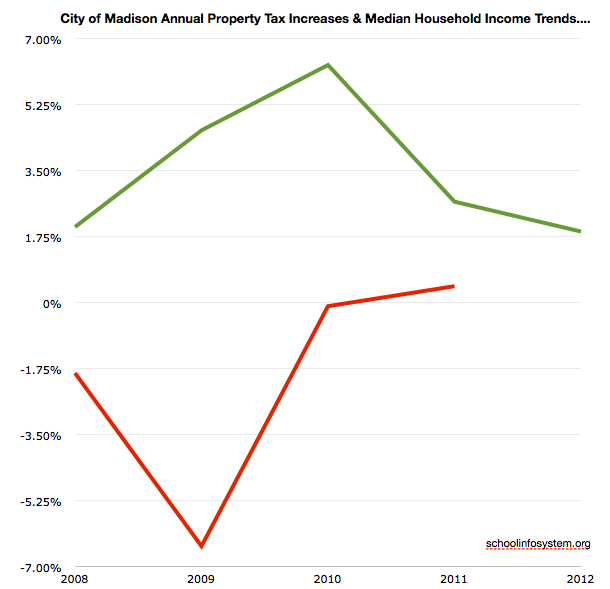
 The Republican Party of Wisconsin has highlighted Burke’s Madison School Board vote in June 2012 to increase property taxes by 4.95 percent. Later that year, after state aid came in higher than expected, she supported a 1.75 percent property tax increase, the maximum increase allowed under state law. She has not voted in favor of a school district budget since.

Related: The Common Core Commotion.

Share

See Inside The U.S. Neglects Its Best Science Students

Rena F. Subotnik, Paula Olszewski-Kubilius and Frank C. Worrell:

The U.S. education policy world—the entire country, for that matter—is on a quest to increase the ranks of future innovators in science and technology. Yet the programs that get funded in K–12 education do not support students who are already good at and in love with science. These students have potential for outstanding contributions, but without public investment they will not be prepared for the rigors of a scientific career. This is especially true for those without highly educated and resource-rich parents.

This lack of investment is not a matter of chance. It is the result of two related myths about who these students are and what they need from our education system. The first myth is that all talented students come from privileged backgrounds. A second is that students who are successful at a particular time in their school career can somehow thrive on their own, unassisted and unsupervised. We argue that all children deserve to be challenged cognitively, including the most able. Many students with low socioeconomic backgrounds never get the opportunity to develop their talents beyond the rudimentary school curriculum. Jonathan Plucker of the University of Connecticut has shown that high-achieving, low-income students fall further behind their higher-socioeconomic-status peers the closer they get to graduation. Moreover, international comparison studies show science scores improving for all students except those in the top 10 percent.

We know how to identify students who are talented in science and motivated to achieve. We find them thriving in enriched environments (think math and rocketry clubs) inside and outside of school. Standardized tests identify exceptional reasoning abilities in mathematics and spatial skills. Expressing and showing interest in science in elementary or middle school are good predictors of future pursuit of career interests in science, technology, engineering or mathematics.

Share

Wisconsin’s DPI Lags again: Minnesota Publicly Links High School Graduation to College Achievement Data

Mila Koumpilova

Six years ago, 225 students graduated from St. Paul’s Como Park High School. More than 70 percent went to college. Almost 40 percent got a degree.

That’s the sort of information Minnesota educators and parents have long wished they had. Now, it is readily available for the first time on a newly launched website that shows where a high school’s graduates went to college, how long they stayed on campus and how many graduated.

For state officials like Education Commissioner Brenda Cassellius, the information promises to highlight hidden success stories and inform policy decisions at a time of intense focus on college and career readiness. High schools can use it to assess how well they are preparing students and to spur partnerships with campuses popular with their graduates.

“This is a huge step forward in understanding how our students do when they leave us,” said Joe Munnich, the St. Paul district’s assistant director of research, evaluation and assessment. “It opens up amazing possibilities.”

Of Minnesota’s 2008 high school graduates, 69 percent went to a two- or four-year college, and 45 percent have since gotten a diploma. Eventually, the web site will also include information on how college graduates are faring on the job market.

The new data and web site are a joint effort by Minnesota’s Office of Higher Education, the Departments of Education and the Department of Employment and Economic Development. The project is funded with the same federal grant that has supported the state’s “Getting Prepared” reports, which show what portion of a high school’s graduates had to take remedial courses in college.

Until now, high schools knew which of their students graduated in a given year. Higher education institutions knew which students arrived on their campuses and which stuck around until graduation. The state project linked up that data for each student.

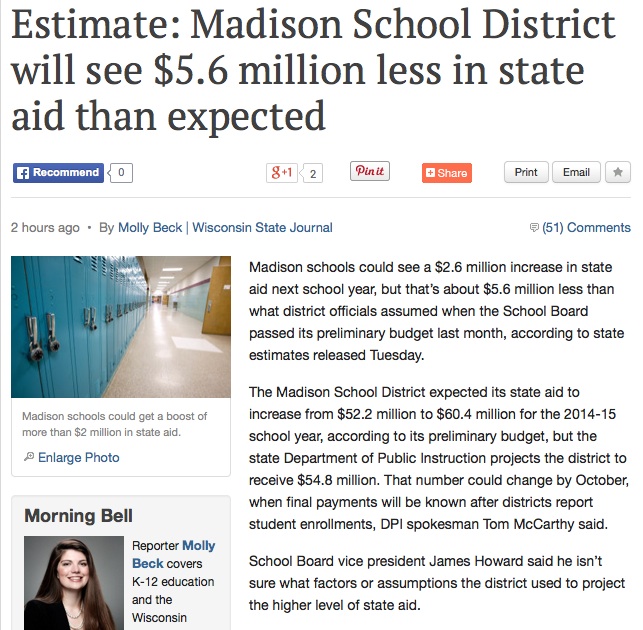
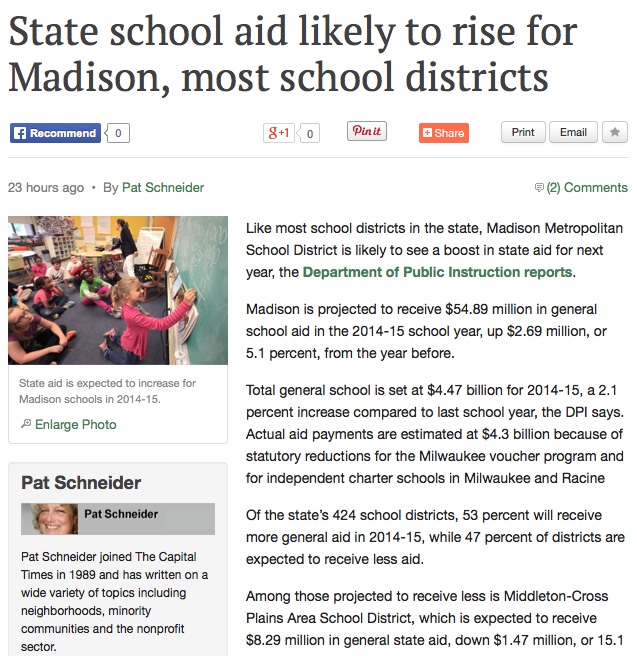
This data has been discussed from time to time in Madison & Wisconsin. Yet, our Wisconsin DPI – parent of the oft criticized WKCE – seems to be living in the status quo.

It appears that the Wisconsin DPI spent $48,531,028.75 during 2013 according to the Wisconsin “Open Book” site.

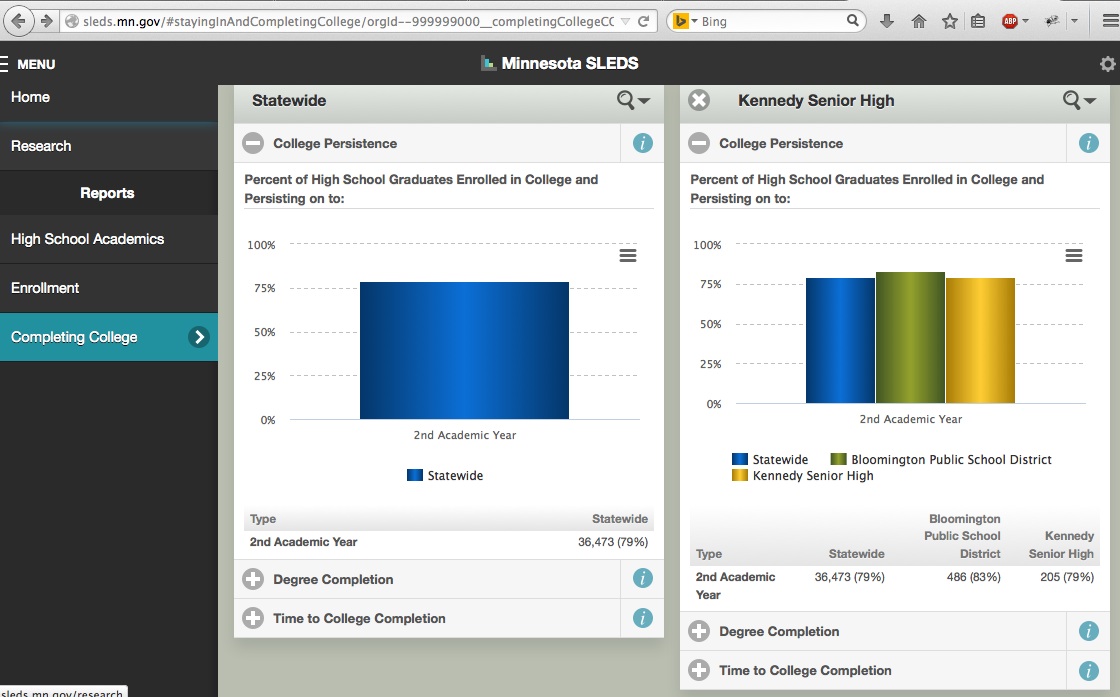
Here’s an example from Minnesota’s “SLEDS” System:


Dive in at the SLEDS site.

Share

Politics, Wisconsin & the Common Core

Erin Richards & Patrick Marley:

Gov. Scott Walker’s call to drop the Common Core State Standards in Wisconsin threw a new dart at the beleaguered academic expectations this week.

But his plan to have lawmakers pass a bill in January that repeals and replaces the standards might be easier said than done, especially because the standards are voluntary for districts.

A leading Republican senator said that establishing new, state-specific standards could actually shift power away from local school boards and to the state.

Sen. Luther Olsen (R-Ripon), chairman of the Senate Education Committee and a vocal supporter of the standards, said there’s actually nothing to “repeal” with Common Core. That’s because the standards are not codified in state law.

Much more on the Common Core, here.

And, a primer.

Share

K-12 Tax & Spending Climate: business (tax base) climate

Steve Denning:

The resulting index is bad news for business: It shows that, behind the mirage of financial engineering, mergers and acquisitions, tax gadgets, share buybacks, seemingly rising profits fed by cheap government money and soaring executive compensation, the underlying reality is harsh: US business is in a long-term secular decline and has been so for decades.
 
 The conclusion is inescapable: big hierarchical bureaucracies with legacy structures and managerial practices and short-term mindsets have not yet found a way to flourish in this new world.
 
 The Shift Index 2009 thus anticipated the conclusion to which macro-economists are now reluctantly coming, namely, that an economy comprising mainly big hierarchical bureaucracies are undergoing a “Great Stagnation” (Tyler Cowen) or “Secular Stagnation” (Larry Summers).
 
 The 2011 edition of the Shift Index covered industry-specific data for nine key sectors and provided a guide to the thought leadership, methodology, and data that drives the index’s metrics.

Share

Millennials Favor Private Accounts for Social Security Even if Benefit Cuts to Current Seniors Required

Emily Ekins:

Millennials aren’t optimistic about Social Security: 53% say Social Security is “unlikely” to exist when they are 67 years old, while 45 percent say it probably will remain.
 
 But if it does exist at that time, even fewer millennials believe government will provide them with the same level of benefits that today’s seniors receive. Only 34 percent say they are confident that government will provide them with the same level of retirement benefits as it does for today’s retirees; 64 percent say they are not confident.
 
 Education decreases the likelihood one believes Social Security will continue in the future. A majority (54%) of those with high school degrees or less expect Social Security to exist when they retire, compared to 36 percent of college graduates.

Share

Miichael Gove and the Bitter Pills of UK Education Reform

UK Teacher:

I actually began writing this post as soon as I heard the news that Michael Gove was to be replaced as Secretary of State for Education. However, it has taken me rather longer than I expected to get back into the swing of writing, and I know that many bloggers have now beaten me to it. Nonetheless, here is my take on the legacy of Gove (with apologies if it seems somewhat skewed towards my subject of secondary English). So, what chains did Michael Gove forge in post as SoS that may have lasting impact on the future of our education system? *Please note that this is simply my take on the matter, and, as ever, all comments and opinions are welcome. • He knew that there was exam dumbing down, and he dealt with it. This was a hugely unpopular stance, at the time. Prior to the reforms, some educationalists were (and some still are) suggesting that teaching was improving year on year and kids were simply getting brighter. In fact, it is now widely accepted that exam boards were deliberately making courses easier. The course with the reputation for being the easiest naturally proved more popular. The inflated grades supplied kudos for teacher, school and pupils in one fell swoop – not to mention extra business for the board’s.

Share

New Jersey’s Special Education Task Force

John Mooney:

Regardless of how long it took to appoint a new state task force on special education, the 17 members will have less time to come up with recommendations.

Formally called the Task Force for Improving Special Education of Public School Students, the group appointed by Gov. Chris Christie met for the first time on July 1 to begin its work looking into the needs of students with disabilities — assessing everything from programs to costs.

But as complicated as that job may be, the law creating the task force — enacted in spring 2013 — calls for final recommendations by the end of this calendar year.

That’s a tall order. New Jersey’s schools face some vexing issues, such as how to best pay for services for special-needs students, how to implement and monitor those services, and how to balance the sometimes-conflicting needs and wants of families, districts, and the state.

Laura Waters has more.

Share

Madison schools’ new policy on unpaid meals: Lots of carrots, no stick

Chris Rickert:

The Madison School District has decided to stop telling children with overdrawn meal accounts that they can’t have the same meals the district gives to children of parents who are keeping up with their bills and to children who are enrolled in the free and subsidized lunch program.

Providing overdrawn children with a bare-bones cheese sandwich lunch is cheaper, but district officials decided it was also an exercise in shaming, especially when a lot of the children were probably poor but whose parents just hadn’t filled out the paperwork to get help paying for them.

“Doing it at the lunch line was very inappropriate,” said School Board member Dean Loumos.

Board president Arlene Silveira didn’t respond to requests for comment about the district’s new plans for handling overdrawn accounts. But Mike Barry, the assistant superintendent of business services, said district staff would make greater efforts to help families apply for subsidies before school starts, as well as make it easier for families to pay their meal bills.

Not under consideration are more punitive measures, Barry said, including sending bills to collection agencies or denying students access to extracurricular activities or their diplomas until meal bills are paid.

Share

Best state in America: Massachusetts, for its educational success

Reid Wilson:

That’s according to the Education Week Research Center, a nonpartisan group that measured indicators such as preschool and kindergarten enrollment, high school graduation rates, and higher education attainment. The yearly study also considered family income and parental employment, which are linked to educational achievement.

In almost every category, the Bay State beats the national average: More than 60 percent of Massachusetts children have a parent with a post-secondary degree, 14 points higher than average, and nearly 60 percent of 3- and 4-year-olds are enrolled in preschool, more than 10 points above the national average.

No surprise, nearly half of Massachusetts fourth-graders are proficient on National Assessment of Educational Progress reading tests, and more than 54 percent of eighth-graders get proficient scores on NAEP math tests — both the highest rates in the country.

The underlying reason is a bipartisan commitment to education reform. Massachusetts passed a major school reform package in 1993, increasing spending, particularly in poorer districts; raising assessment standards; and making licensure exams for new teachers more difficult. Several other states improved their standards around the same time. But when partisan priorities shifted in other places, Massachusetts Republicans and Democrats alike continued investing heavily in education.

Improving scores, particularly among low-income and minority students, is still a challenge, and Massachusetts has done no better in closing the achievement gap than most other states.

Wisconsin took a very small step toward Massachusetts’ content knowledge requirements by adopting MTEL-90 for elementary English teachers.

Wisconsin results are available here.

Share

Before contract, New York teachers gave to de Blasio charity

Chris Bragg:

Less than a month before Mayor Bill de Blasio struck a major contract agreement with the United Federation of Teachers, its parent union, the American Federation of Teachers, gave $350,000 to a nonprofit run by de Blasio advisers, which lobbies on behalf of the mayor’s priorities, newly released records show.
 
 The AFT’s donation, on April 9, was the largest donation to the de Blasio-affiliated nonprofit, Campaign For One New York, since it was founded after the mayor was elected last November. Its timing raises questions about the ability of outside interests to advance their agendas before the city by supporting a nonprofit close to the mayor.

Related: $1.57 million for four senators – WEAC.

Share

Year after Rocketship’s scrutinized Milwaukee launch, signs point to progress; Status Quo in Madison

Erin Richards:

What were the highlights of Rocketship’s first year here?

Strong growth. Rocketship set a goal of having 65% of its Milwaukee students meet the national average for reading and math growth over the course of the year. In fact, 72% of the school’s students, almost all of whom are low-income and Hispanic or black, learned as much as a typical American student in English and language arts. In math, 87% of Rocketship students met or exceeded that average growth target.

New style. Rocketship introduced children to spending part of the day doing reading and math exercises on the computer, using software that adapts to each child’s skill level. Sessions are overseen by an aide rather than a teacher, which is one way Rocketship keeps costs down. Most teachers also specialize by subject matter.

Parent involvement. A Rocketship hallmark is involving parents in schools, not only to help their children with homework and goal-setting, but also to advocate in the community. Kinser said almost all teachers had 90% of their parents meet the 30-hour goal of interacting with the school.

Enrollment. This year’s enrollment goal is 487 children in kindergarten through fifth grade, and the school on its way to meeting it, Kinser said.

Rocketship’s challenges

The turbulent first year in Milwaukee also set Rocketship on its heels at times. Some challenges included:

Special education. About 17% of Milwaukee Rocketship children had special needs last year, which is close to the district average in Milwaukee Public Schools. Venskus said Rocketship went about $500,000 over budget to serve those students.

Teacher turnover. Rocketship, like other demanding urban charter schools with long hours and high expectations, was not a good fit for some teachers who left early in the school year. Rocketship did not renew some others. This fall there will be four new teachers at the school from Teach For America, the alternative teacher certification program from which Rocketship frequently recruits.

Political challenges. Rocketship leaders had to negotiate with lawmakers in Madison to try to clear a path for their staff with out-of-state teaching or administrator credentials to be recognized in Wisconsin.

Rocketship has a charter agreement with the Milwaukee Common Council to open up to eight schools serving 500 students each.

Links:

Rocketship.

Madison’s disastrous long term reading results.

A majority if the Madison School Board rejected the proposed Madison Preparatory Academy IB Charter School.

Commentary on structural change.

Via Molly Beck.

Share

In an era of high-stakes testing, a struggling school made a shocking choice.

Rachel Aviv:

One afternoon in the spring of 2006, Damany Lewis, a math teacher at Parks Middle School, in Atlanta, unlocked the room where standardized tests were kept. It was the week before his students took the Criterion-Referenced Competency Test, which determined whether schools in Georgia had met federal standards of achievement. The tests were wrapped in cellophane and stacked in cardboard boxes. Lewis, a slim twenty-nine-year-old with dreadlocks, contemplated opening the test with scissors, but he thought his cut marks would be too obvious. Instead, he left the school, walked to the corner store, and bought a razor blade. When he returned, he slit open the cellophane and gently pulled a test book from its wrapping. Then he used a lighter to warm the razor, which he wedged under the adhesive sealing the booklet, and peeled back the tab.

He photocopied the math, reading, and language-arts sections—the subjects that would determine, under the No Child Left Behind guidelines, whether Parks would be classified as a “school in need of improvement” for the sixth year in a row. Unless fifty-eight per cent of students passed the math portion of the test and sixty-seven per cent passed in language arts, the state could shut down the school. Lewis put on gloves, to prevent oil from his hands from leaving a residue on the plastic, and then used his lighter to melt the edges of the cellophane together, so that it appeared as if the package had never been opened. He gave the reading and language-arts sections to two teachers he trusted and took the math section home.

Share

K-12 Tax & Spending Climate: U.S. risks fiscal crisis from rising debt: CBO

Robert Schroeder:

The U.S. risks a fiscal crisis if it doesn’t get large and continuously growing federal debt under control, the Congressional Budget Office said Tuesday.

In its new long-term budget outlook, the nonpartisan CBO said federal debt held by the public is now 74% of the economy and will rise to 106% of gross domestic product by 2039 if current laws remain unchanged. Read the 2014 long-term budget outlook.

In its last long-term budget outlook in September 2013, CBO said debt held by the public was 73% of GDP and projected debt would be 102% of GDP in 2039.

The stark warning from the CBO comes as deficits have recently been falling. For the current fiscal year, for example, the CBO is projecting a deficit of $492 billion, which would be 2.8% of gross domestic product.

The deficit in fiscal 2013 was $680 billion, the first shortfall below $1 trillion of Barack Obama’s presidency. The deficit hit a record of $1.4 trillion in 2009.

But the agency expects deficits to rise in coming years as costs related to Social Security, Medicare and interest payments swell.

Share

Shortchanged: The Hidden Costs of Lockstep Teacher Pay

TNTP:

Nobody goes into teaching to get rich, but that’s no excuse not to pay teachers as professionals.

Compensation is one of the most important factors in determining who enters the teaching profession and how long they stay—yet 90 percent of all U.S. school districts pay teachers without any regard for their actual performance with students, shortchanging our best educators. If we seriously believe in the value of great teaching, we have to not only pay teachers more but also pay them differently.

Shortchanged examines why lockstep pay undermines the value of great teaching and hurts students and teachers, making it difficult to recruit and keep top talent, and discouraging high performers from teaching where they’re needed most. It’s time to build smarter compensation systems that actually pay for what really matters: how hard teachers’ jobs are and how well they’re doing them. Schools and districts can—and should—free up existing funds and pay teachers according to three principles:

Share

Diane Ravitch: Campbell Brown Shouldn’t Worry Her Pretty Little Head About Education Policy

Jonathan Chait:

“I have trouble with this issue because it’s so totally illogical,” says Diane Ravitch, an education historian. “It’s hard to understand why anyone thinks taking away teachers’ due-process rights will lead to great teachers in every classroom.”

As for Brown, Ravitch is dismissive: “She is a good media figure because of her looks, but she doesn’t seem to know or understand anything about teaching and why tenure matters … I know it sounds sexist to say that she is pretty, but that makes her telegenic, even if what she has to say is total nonsense.”

Why, yes, that does sound rather sexist. Now, Ravitch suggests here that Brown’s analysis is so transparently illogical that perhaps only her looks can account for her views. Why, Ravitch wonders, would the elimination of a job protection help attract better teachers? Let me reveal, via the power of logic, how this can work.

The basic problem is that some proportion of American teachers is terrible at their job and immune to improvement, yet removing them is a practical impossibility. (A good overview of the research on chronically ineffective teachers can be found here. Standard caveat: The author is my wife.) Under some conditions, loosening tenure laws can lead directly to more effective teachers in the classroom. For instance, when the Great Recession drove states to lay off teachers in order to balance their budgets, last-in, first-out hiring rules led them to fire teachers regardless of quality, thus removing highly effective (yet unprotected) teachers from classrooms.

Our Frederick Taylor style monolithic education model has obviously run its course.

Share

How to Teach Reading and Writing

Letters to the New York Times Editor on The Fallacy of ‘Balanced Literacy, via a kind reader:

To the Editor:

Kudos to Alexander Nazaryan for his eloquent defense of “conventionally rigorous” teaching techniques.

The decision by the New York City schools chancellor, Carmen Fariña, to reinstate balanced literacy despite the unfavorable results of studies done during the Bloomberg administration reflects, in my opinion, a general aversion to empirical evidence within the educational establishment in favor of ideology and faddish group think.

I very much appreciate the excellent K-12 teaching I received in Brooklyn public schools during the 1940s and ’50s, when a “conventionally rigorous” approach was the norm.

My more recent experience as a volunteer tutor in Wisconsin elementary schools during the past 12 years mirrors that of Mr. Nazaryan in Brooklyn in 2005-06. Again, an approach appropriate for the Midwestern equivalent of “brownstone Brooklyn” kids was employed in classrooms where half the kids were poor or minorities or both. The results of this approach are what the local press has described as a notoriously high racial achievement gap.

Carl Silverman
Madison, WI

Much more on “balanced literacy”, here along with Madison’s long term disastrous reading results.

Share

France to teach programming languages beginning with 10 year olds

Le Monde:

« Cette initiation devrait être inscrite dans les programmes du second degré », selon le ministre, qui considère que « certains professeurs pourraient, plus naturellement que d’autres, être des pédagogues du code : les professeurs de technologie et de mathématiques ».

« Nous lançons par ailleurs, avec Arnaud Montebourg, un grand programme en faveur de la filière industrielle française du numérique éducatif », ajoute Benoît Hamon, précisant que 70 % des élèves du primaire et de collège et 100 % des enseignants seront équipés à l’horizon 2020 en ordinateurs et tablettes dotés de ressources pédagogiques numériques.

Share

Why Middle School Should Be Abolished

David Banks:

America should do away with middle schools, which are educational wastelands. We need to cut the middle out of middle schools, either by combining them with the guidance and nurturing that children find in elementary school, or with the focus on adult success that we expect from our high schools.

For much as half of middle schools across the country, national statistics show substantial performance gaps, especially in math and reading achievement, between middle school and high school. It’s time to admit that middle school models do not work—instead, they are places where academics stall and languish.

via Marc Eisen.

Mr Eisen wrote “My Life & Times with the Madison Public Schools” in 2007. Well worth reading.

Share

Embattled teacher unions to go after ‘toxic testing’

Laura Waters:

National Education Association (NEA) President Lily Eskelsen García on the use of student test scores to evaluate teacher effectiveness:

They’re “the mark of the devil.” “For us, one thing is clear. Before anything is going to get better: It’s the Testing, Stupid. Better yet, it’s the stupid testing.”

New Jersey Education Association (NJEA) Vice President Marie Blistan on the use of student test scores to evaluate teacher effectiveness:

“We need to safeguard against a test-taking tsunami that enriches private corporations’ wallets but impoverishes our students.”

Denver, the site of the NEA’s annual meeting last week, is a long way from Trenton but you’d never know it from the sound bites.

During this past year the rhetoric from both the national teacher union leadership and N.J.’s state chapter have grown progressively more rancorous. The bicoastal target of ire is, ostensibly, the practice of linking student test scores to teacher evaluations.

Share

American Teens Achieve Mediocrity In Financial Literacy, Local math & reading background

Michelle Hackman:

When it comes to financial literacy around the world, American teens are middling.

The United States may fuel the world’s largest economy and operate its most robust financial system. But compared to the financial prowess of teenagers in 17 other countries, U.S. teens come off downright mediocre.

That’s according to a new study published Wednesday by the Organization for Economic Cooperation and Development as part of its Program for International Student Assessment, conducted once every three years.

The OECD, a 34-nation organization based in Paris, surveyed 15-year-old students in 13 member nations and five other nations throughout 2012 to ascertain their level of familiarity with the financial system as they neared adulthood.

“Finance is part of everyday life for many 15-year-olds, who are already consumers of financial services, such as bank accounts,” the report said. “As they near the end of compulsory education, students will face complex and challenging financial choices, including whether to join the labor market or continue with formal education and, if so, how to finance such study.”

Unfortunately, this is unsurprising. Read two useful articles on local math difficulties and long term disastrous reading results.

The OECD report.

Share

For years we’ve been telling kids to sit still and pay attention. That’s all wrong.

Annie Murphy Paul:

Today’s educational technology often presents itself as a radical departure from the tired practices of traditional instruction. But in one way, at least, it faithfully follows the conventions of the chalk-and-blackboard era: EdTech addresses only the student’s head, leaving the rest of the body out.

Treating mind and body as separate is an old and powerful idea in Western culture. But this venerable trope is facing down a challenge from a generation of researchers—in cognitive science, psychology, neuroscience, even philosophy—who claim that we think with and through our bodies. Even the most abstract mathematical or literary concepts, these researchers maintain, are understood in terms of the experience of our senses and of moving ourselves through space.

This perspective, known as “embodied cognition,” is now becoming a lens through which to look at educational technology. Work in the field shows promising signs that incorporating bodily movements—even subtle ones—can improve the learning that’s done on computers.

Share

Teacher pension rescue to cost LAUSD $1.1 billion

Yaha Gracile:

LA Unified must come up with $16 million this year to pay an unexpected bill as a result of legislation signed by Governor Jerry Brown aimed at rescuing the state’s teachers retirement pension system known as CalSTRS, but the district’s total increase is much higher, estimated to reach an extra $1.1 billion over the next seven years.

While teachers and school districts across the state will see their contribution rates increase, LAUSD, the largest school district in the state, will pay the lions-share.

The rescue, which will help address a $74 billion shortfall in the teachers pension fund, requires school districts to radically raise their contributions to the fund from the current rate of 8.25 percent, to a rate of 19.1 percent by 2020. Teachers will see a more modest step up, from 8.15 percent to an eventual 10.25 percent of their salary, over the same seven year period. The state’s contribution will rise from 3 percent to 6.3 percent.

But In real dollar terms, the pension contribution price tag for LAUSD is steep: it will eventually more than double by the end of the phase-in period, from its current payment of $213 million per year, to $493 million per year by 2020.

Share

“Value-added measures are the Mark of the Devil”

Caitlin Emma:

Eskelsen García already has fiery words for the feds, who she holds responsible for the growing use of “value-added measures,” or VAMs, an algorithm that aims to assess teacher effectiveness by student growth on standardized tests. The idea has gained traction under the Obama administration through waivers from No Child Left Behind and the administration’s signature Race to the Top program. But studies, including some funded by the Education Department, have cast doubt on the validity of the measures.

VAMs “are the mark of the devil,” Eskelsen García said.

The algorithms do aim to account for variables such as student poverty levels. But Eskelsen García said they can’t capture the complete picture.

The year she taught 22 students in one class and the year she taught 39 students in one class — “Is that factored into a value-added model? No,” she said. “Did they factor in the year that we didn’t have enough textbooks so all four fifth-grade teachers had to share them on a cart and I couldn’t send any books home to do homework with my kids?”

“It’s beyond absurd,” she added. “And anyone who thinks they can defend that is trying to sell you something.”

Locally, Madison schools have been spending money and time on value-added assessment for years.

Share

A Billionaire Mathematician’s Life of Ferocious Curiosity

William Broad:

James H. Simons likes to play against type. He is a billionaire star of mathematics and private investment who often wins praise for his financial gifts to scientific research and programs to get children hooked on math.

But in his Manhattan office, high atop a Fifth Avenue building in the Flatiron district, he’s quick to tell of his career failings.

He was forgetful. He was demoted. He found out the hard way that he was terrible at programming computers. “I’d keep forgetting the notation,” Dr. Simons said. “I couldn’t write programs to save my life.”

After that, he was fired.

Share

Charters Catch On Fast in Newark Parents Increasingly Look Outside District Schools

Leslie Brody:

In the debut of a system that lets families apply to charter schools and district schools at the same time, Newark got an eye-opening lesson: More than half of the applicants for kindergarten through eighth grade ranked charters as their first choice.

The application numbers, supplied by the state-operated district, show the popularity of charters at a time when Superintendent Cami Anderson’s One Newark reorganization plan faces heated opposition from some residents.

One part of the complex plan aims to make it easier for children to sign up for schools outside their neighborhoods. Ms. Anderson said the application data show many families want greater choice.

“Universal enrollment is giving us a real sense of demand and allowing families of all learners, including those who struggle, more options,” she said. Some critics, meanwhile, say the superintendent’s push to consolidate, overhaul and restaff many district schools has created such uncertainty that it hastened a flight to charters.

Via Laura Waters.

Share

K-12 Tax & Spending Climate: America’s Public Sector Union Dilemma

Lee Ohanian:

There is much less competition in the public sector than the private sector, and that has made all the difference.

Since the Great Recession began in 2008, there has been a growing criticism of public sector unions, reflecting taxpayer concerns about union compensation and unfunded pension liabilities. These concerns have led to proposals to change public sector union policy in very significant ways. Earlier this month, voters in Ohio defeated by a wide margin a law that would have restricted union powers, although polls showed broad support for portions of the law that would have reduced union benefits. In Wisconsin, a state with a long-standing pro-union stance, Governor Scott Walker advanced policy in February that would cut pay and substantially curtail collective bargaining rights of many public sector union workers. In Florida, State Senator John Thrasher introduced legislation that would prevent governments from collecting union dues from union worker state paychecks. And it is not just Ohio, Wisconsin, and Florida that are attempting to change the landscape of public unions. Cash-strapped governments in many states are considering ways to reduce the costs associated with public unions.

It is important to determine why public unionization rates are so much higher than in the private sector, and whether public union employees are excessively raising costs to taxpayers. Public sector workers may be paid significantly more than private sector workers and their pensions and job security are often higher than in the private sector. Factoring in the lower likelihood of dismissal and layoffs in the public sector, public sector compensation may be 10 percent higher than market rates.

I calculate that bringing public sector wages closer in line with private sector wages by reducing them by 5 percent can reduce state fiscal deficits considerably. For California, which is among the most fiscally strapped states in the nation, reducing state worker wages by 5 percent would reduce the state deficit by about 15 percent. Moreover, some public sector workers, such as California prison guards, are paid far in excess of competitive levels, reflecting a strong union and effective lobbying that has fostered rapid compensation growth. Other unions, such as teacher unions, do not drive up compensation nearly as much, but instead have substantial negative impact by protecting poor teachers, which in turn reduces the quality of public education and reduces human capital.

Share

“We are spending billions of dollars in our K-12 system and these kids ought to be able to meet these standards”

Scott Rothschild:

In the world of remedial education, Shine Adams, a Kansas University student, is the exception rather than the rule.

Adams, 38, dropped out of high school, worked for several years and then decided he needed to get his diploma and then a college degree.

Adams got his GED, then, using remedial courses, passed several math classes to satisfy his math requirement and is now working on a degree in social work.

He said he couldn’t have gotten where he is without remedial courses.

But for most students, the remedial courses, sometimes referred to as developmental education, aren’t working.

“We need to do things differently,” said Susan Fish, state director of adult education at the Kansas Board of Regents.

In Kansas, 42 percent of first-time students in two-year colleges and 16 percent in public, four-year colleges enroll in at least one remedial course.

Most students who enroll in remedial courses do not graduate.

State officials say the statistics are cause for alarm as they try to increase the number of people with degrees to meet workforce demands.

“We are spending billions of dollars in our K-12 system and these kids ought to be able to meet these standards. We need to be more honest with ourselves,” said Kansas Board of Regents Chairman Kenny Wilk.

A new report recommends some targeted funding increases and program changes.

The Developmental Education report was put together over the past year by regents staff and leaders at community colleges, four-year colleges and technical colleges.

Share

Shaping a School System, From the Ground Up

Claire Martin:

In the fall of 2011, an eclectic group of people from the San Francisco Bay Area began making regular trips to Lima, Peru. Among them were architects, mechanical engineers, ethnographers, communication designers and education specialists.

They were all employees of the design company Ideo, which is perhaps best known for designing the first laptop computer and the first Apple computer mouse. But now Ideo had been hired by a Peruvian businessman, Carlos Rodriguez-Pastor, to work on a new type of project: designing a network of low-cost private schools from scratch, including the classrooms, the curriculum, the teacher-training strategies and the business model.

Mr. Rodriguez-Pastor was “trying to break the traditional school model,” he recalled in a recent interview. “We thought, why not get different perspectives rather than build on what we think we know?”

Share

Technology Use in Special Education Classrooms

Gail Robinson:

Eleven-year-old Matthew Votto sits at an iPad, his teacher at his elbow. She holds up a small laminated picture of a $20 bill.

“What money is this?” she asks. Matthew looks at the iPad, touches a square marked “Money Identification” and then presses $20. “20,” the tablet intones, while the teacher, Edwina Rogers, puts another sticker on a pad, bringing Matthew closer to a reward.

They race through more questions. “What day of the week is it?” “What is the weather outside?” “What money is this?” In most cases, Matthew, who has autism, answers verbally, but he is quicker and seems more comfortable on the device.

Share

New Pittsburgh Private School offers Student Jobs to offset tuition

Max Radwin:

A new Catholic high school opening this fall in Emsworth will provide jobs to students to help them pay their tuition and gain work experience.
 
 Holy Family Academy will open its doors to about 70 students Aug. 18, with plans to use its work-study program to give students something substantial to put on their resumes that also helps pay more than half of their Catholic school tuition.
 
 The new high school will be on Ohio River Boulevard in a building the Pressley Ridge School for Autism currently occupies. Pressley Ridge’s lease has expired, and it will be moving to a different location.

Share

Politics & University Admissions

Jon Cassidy:

Speaker Joe Straus and two of his top lieutenants in the Texas House, Reps. Dan Branch and Jim Pitts, sent more letters to the president of the University of Texas on behalf of applicants than anyone else whose correspondence was included in a recent inquiry into admissions favoritism.

Chancellor Francisco Cigarroa’s office recently reviewed 86 “recommendation” letters, almost all of them from lawmakers, sent to UT President Bill Powers instead of through the proper channels.

The inquiry wasn’t exhaustive — those were just the letters uncovered by UT Regent Wallace Hall. Lawmakers launched impeachment proceedings against Hall last June, just two weeks after he began investigating whether the university was giving special treatment to the friends and family of lawmakers.

An update, here.

Share

School should be year-round

Wausau Daily Herald:

More than 40 percent of Wausau School District students are attending summer school this year. That’s about the same proportion of students who took summer classes last year, and it’s considered pretty good participation for the Summer Learning program.

It should be 100 percent. A three-month summer vacation is bad for students, and it’s especially bad for at-risk students.

Story: 40 percent of Wausau district kids in summer school

The problem with a long summer break is that, when students are out on vacation for months on end, they tend to forget a lot of what they’ve learned. Research shows that they are especially likely to forget things that require memorization, such as multiplication tables or grammatical rules.

Locally, Madison appears unable to change any material aspect (the stillborn proposed Madison Preparatory Academy IB Charter School) of its agrarian era K-12 organization, one that spends double the national average per student and has long tolerated disastrous reading results.

Share

Lawsuit Challenges New York’s Teacher Tenure Laws

Al Baker:

An education advocacy group on Thursday threw down the first challenge to New York’s teacher tenure laws in the wake of a landmark court decision in California last month finding such laws there unconstitutional.

A lawsuit filed in State Supreme Court on Staten Island argues that the tenure laws violate the State Constitution’s guarantee of a “sound basic education” by making it difficult to fire bad teachers and by protecting the most veteran teachers in the event of layoffs, regardless of their quality. The suit, filed against city and state education officials, names as plaintiffs 11 public school students whose parents belong to a group known as the New York City Parents Union.

The road ahead is less than certain in either state.

Already, the California Federation of Teachers has vowed to appeal the decision in the case, Vergara v. California. And union leaders, legal analysts and others said it would be difficult to gain any traction on the issue in New York’s judiciary.

Share

Pupils on free school meals for only a year become ‘invisible underachievers’

Richard Adams:

Children who qualify for free school meals for just one year become “invisible underachievers” who receive little government support but achieve similar results to those who remain on free school meals during their entire school career.

Research from education data analysts FFT found that the group makes up around 7% of year 11 pupils, meaning that almost 40,000 students suffer similar levels of deprivation but receive fewer of the benefits, in most cases because their household income is just above the £16,000 threshold.

Those who received FSM for only one year average a D grade at GCSE – only slightly above those who are on the meals continuously, but almost a grade lower than pupils who have never received them.

Locally, Madison plans to expand its “free meal” program. Will this address Madison’s long standing disastrous reading results?

Share

A new front has opened in the Common Core wars — over testing contracts.

Stephanie Simon & Caitlin Emma:

The high-stakes battle is undermining one of the Obama administration’s most prized initiatives: its vision, backed by more than $370 million in federal funds, of testing students across the country on a common set of exams in math, reading and writing.

The administration wants children in Mississippi to be measured against the same bar as children in Massachusetts or Michigan. But now a testing revolt is spreading across the country, adding to a slew of troubles for the Common Core initiative, which began as a bipartisan effort but has come under fire from parents and teachers across the political spectrum.

Share

What Stiglitz Misses On Inequality: The Responsibility Of Economists

Steve Denning:

It is a not novel thought that each profession is acutely aware of the problems caused by others but is often unconscious of the problems for which it is responsible. The education system stifles learning by teaching to the test. Doctors and pharmaceutical companies prescribe medicines that cause new diseases that require new cures. Engineers create time-saving devices that end up wasting large amounts of our time. So it is not entirely a surprise that economists are also blind to problems that their profession has engendered.

Share

My hero: Lord Harris, the Conservative millionaire who is saving schools

Michael Gove:

We don’t put up many statues these days. Ours is a post-heroic age, and it is assumed that no one really deserves to be put on a pedestal. But I know of many people who deserve to be remembered for acts of overlooked heroism.

The teachers who dedicate their lives to helping children from disadvantaged homes to achieve their potential are my heroes. Long after others have given up, they refuse to accept failure. Some of these heroes, like David Sellens in Thomas Jones primary in London’s North Kensington, work in local authority schools; some, like Dame Sally Coates of Burlington Danes in London’s White City, run academies; others, like Liam Nolan in Birmingham, have opened free schools. But none inspires my admiration as much as a carpet salesman who left school, as my parents did, when he was just 15.

Share

At time of austerity, eight universities spent top dollar on Hillary Clinton speeches

Philip Rucker & Tosalind Helderman:

At least eight universities, including four public institutions, have paid hundreds of thousands of dollars for Hillary Rodham Clinton to speak on their campuses over the past year, sparking a backlash from some student groups and teachers at a time of austerity in higher education.

In one previously undisclosed transaction, the University of Connecticut — which just raised tuition by 6.5 percent — paid $251,250 for Clinton to speak on campus in April. Other examples include $300,000 to address UCLA in March and $225,000 for a speech scheduled to occur in October at the University of Nevada at Las Vegas.

Share

Media Reality Check on Madison’s K-12 Tax & Spending

Molly Beck, writing for the Wisconsin State Journal:

Madison schools could see a $2.6 million increase in state aid next school year, but that’s about $5.6 million less than what district officials assumed when the School Board passed its preliminary budget last month, according to state estimates released Tuesday.

The Madison School District expected its state aid to increase from $52.2 million to $60.4 million for the 2014-15 school year, according to its preliminary budget, but the state Department of Public Instruction projects the district to receive $54.8 million. That number could change by October, when final payments will be known after districts report student enrollments, DPI spokesman Tom McCarthy said.

School Board vice president James Howard said he isn’t sure what factors or assumptions the district used to project the higher level of state aid.

“That’s a very good question, and that’s one we’ll all be looking for an answer for,” said Howard. “If the preliminary budget is based on that $60 million state aid estimate, then that’s going to be an issue.”

District spokeswoman Rachel Strauch-Nelson said officials expected state aid would cover more of the district’s costs under Wisconsin’s complex funding formula.

Pat Schneider writing for the Capital Times:

Like most school districts in the state, Madison Metropolitan School District is likely to see a boost in state aid for next year, the Department of Public Instruction reports.

Madison is projected to receive $54.89 million in general school aid in the 2014-15 school year, up $2.69 million, or 5.1 percent, from the year before.

Total general school is set at $4.47 billion for 2014-15, a 2.1 percent increase compared to last school year, the DPI says. Actual aid payments are estimated at $4.3 billion because of statutory reductions for the Milwaukee voucher program and for independent charter schools in Milwaukee and Racine

Of the state’s 424 school districts, 53 percent will receive more general aid in 2014-15, while 47 percent of districts are expected to receive less aid.

Among those projected to receive less is Middleton-Cross Plains Area School District, which is expected to receive $8.29 million in general state aid, down $1.47 million, or 15.1 percent, from the year before.

Enrollment and property values are big influences on the state general aid calculation, says Tom McCarthy, DPI communications officer. Aid increases with increased enrollment and decreases as property values rise, he said.

Perhaps Capital Newspapers might dive a bit deeper and share historic hard numbers with readers?

Remarkable.

Share

In fact, US teachers earn above average for the developed world at every grade and experience level. They earn even more than teachers in Finland!

Amanda Ripley:

Do they earn as much as they should? No, they do not (more on that below). This is a serious, intellectual job that demands serious pay. But if we keep exaggerating how bad our teachers have it, no one will want to become a teacher–and policy makers will continue to dismiss salary increases as an unimaginably expensive reform.

On the other hand, if we ground the conversation in facts, we might discover that the situation is not as overwhelmingly hopeless as we thought.

First things first: What does the evidence show about how well US teachers are paid? There are different ways to compare salaries. One way is the straightfoward way: compare teacher salaries across countries. To do this, you take a country’s average teacher salary at different grade and experience levels, convert the figure into equivalent US dollars using Purchasing Power Parities to adjust for cost-of-living differences, and see how things stack up.

When you do this, as the OECD does, then you find out a startling truth: US teachers make more than teachers in Finland at every grade and experience level.

The pay gap is most glaring for elementary teachers. Here is the average salary (in equivalent USD converted using PPPs) for new elementary-school teachers in 15 countries:

1. Luxembourg $64,043

2. Germany $47,488

3. Switzerland $47,330

4. Denmark $43,461

5. United States $37,595

6. Netherlands $36,626

7. Spain $35,881

8. Canada $35,534

9. Australia $34,610

10. Ireland $33,484

11. Norway $33,350

12. Belgium (Fl.) $32,095

12. Belgium (Fr.) $31,515

13. Austria $31,501

14. Portugal $30,946

15. Finland $30,587

Share

Harris v. Quinn ruling: Unions hit, but not fatally

Stephanie Simon:

Share

An Update On Redistributed Wisconsin Tax Dollars for K-12 Budgets

Molly Beck:

Whether the district will need to scale back its planned spending for the 2014-15 school year is a “good question,” Howard said. “I’m not sure what it means.”

McCarthy said Madison’s aid has only hit the $60 million mark once, during the 2008-09 school year when total state aid levels peaked at $4.7 billion. The district received $58.4 million during the 2012-13 school year, which was about $11 million more than the district projected at the time, but aid has ranged between $43.2 million and $52.2 million since the 2009-10 school year.

In the last three years, the district has ended up receiving more in state aid than DPI’s July 1 figures predicted. Last year, the district received about $2.6 million more than DPI first estimated and $4.2 million more in 2012. In 2011, the district received less than $1 million more.

Much more on the Madison School District’s 2014-2015 budget, here.

UP, DOWN & TRANSPARENCY: MADISON SCHOOLS RECEIVED $11.8M MORE IN STATE TAX DOLLARS LAST YEAR, LOCAL DISTRICT FORECASTS A POSSIBLE REDUCTION OF $8.7M THIS YEAR.

Share

LAUSD shifts gears on technology for students

Howard Blume:

Los Angeles school district officials have allowed a group of high schools to choose from among six different laptop computers for their students — a marked contrast to last year’s decision to give every pupil an iPad.

Contracts that will come under final review by the Board of Education on Tuesday would authorize the purchase of one of six devices for each of the 27 high schools at a cost not to exceed $40 million.

In the fall, administrators, teachers and students at those schools will test the laptops to determine whether they should be used going forward.

What they learn will affect the future of an ongoing effort to provide computers for all students in the nation’s second-largest school system.

Share

Firing Bad Teachers: A Superintendent and a Teacher’s Union Official Debate

Conor Freidersdorf:

Dr. John E. Deasy, Superintendent of the Los Angeles Unified School District, supports the California lawsuit against the state’s tenure, layoff and termination rules. He believes that the current system has a disparate impact on the quality of education offered to poor students and minorities, and is therefore unconstitutional.

Randi Weingarten is the president of the American Federation of Teachers (a separate entity from the California Teacher’s Association, which represents Golden State teachers). Her organization opposed the lawsuit. “While teachers led their classrooms, a judge in a Los Angeles courtroom said that for students to win, teachers have to lose,” the AFT stated after the plaintiffs won the case, which is being appealed. “Vergara v. California was a blow to public education everywhere, but especially demoralizing to hundreds of thousands of teachers who dedicate their lives to lifting up California’s students…Our opponents have spent months—and millions—vilifying California teachers to push a political agenda. We’re fighting back—in the media, on the ground, in the legislature and in the courts.”

These two shared a stage in Aspen this weekend, where they debated the lawsuit, teacher tenure, accountability, and related issues. The video of the entire panel is here:

Share

Michigan spends $1B on charter schools but fails to hold them accountable

Jennifer Dixon:

Michigan taxpayers pour nearly $1 billion a year into charter schools — but state laws regulating charters are among the nation’s weakest, and the state demands little accountability in how taxpayer dollars are spent and how well children are educated.

A yearlong investigation by the Detroit Free Press reveals that Michigan’s lax oversight has enabled a range of abuses in a system now responsible for more than 140,000 Michigan children. That figure is growing as more parents try charter schools as an alternative to traditional districts.

In reviewing two decades of charter school records, the Free Press found:

Are all publicly funded schools held to the same oversight standards?

Share

California voters reject tenure, layoff rules for public school teachers

Marill Bassallone:

The PACE/USC Rossier School of Education Poll showed that two-thirds of voters (68 percent) agree that the state should do away with “Last In, First Out,” a policy that requires the newest K-12 teachers be laid off first, regardless of merit. Just 17 percent said California should continue to conduct teacher layoffs in order of seniority, according to the poll. PACE stands for Policy Analysis for California Education.

California voters also largely opposed the state’s tenure laws for public school teachers, according to the poll. Six in 10 California voters said teachers should not continue to receive tenure, as it makes firing bad teachers difficult. Twenty-five percent of voters said the state should keep tenure for public school teachers to provide them job protections and the freedom to teach potentially controversial topics without fear of reprisals.

Share

One-time Jindal ally blasts Common Core move

Stephanie Simon:

A longtime ally of Louisiana Gov. Bobby Jindal is accusing the governor of violating the civil rights of poor children with his abrupt decision last week to renounce the Common Core academic standards.

State Superintendent John White has previously said the governor had no authority to scrap the Common Core or to pull out of a federally funded consortium that has been developing new reading, writing and math tests aligned to the academic standards.

On Wednesday, he ramped up his rhetoric considerably, telling POLITICO in an interview that Jindal is breaking the law, trampling the state constitution — and crushing the dreams of low-income minority students.

Share

Maths and science ‘should be studied up to age 18’: UK Royal Society Report by committee of education experts recommends baccalaureate-style qualification, and better-equipped laboratories

Richard Adams:

All pupils should study maths and science until the age of 18 as part of a broad-based, baccalaureate-style qualification, the Royal Society has recommended in a report on the future of education.

The report, written by a committee of scientists, education experts, teachers and former education secretary Charles Clarke, calls for increased investment in practical and problem-solving work in science and mathematics education from reception until sixth form, including access to adequately equipped laboratories and well-trained teachers.

Share

Obama alums join anti teachers union case

Stephanie Simon:

Teachers unions are girding for a tough fight to defend tenure laws against a coming blitz of lawsuits — and an all-out public relations campaign led by former aides to President Barack Obama.

The Incite Agency, founded by former White House press secretary Robert Gibbs and former Obama campaign spokesman Ben LaBolt, will lead a national public relations drive to support a series of lawsuits aimed at challenging tenure, seniority and other job protections that teachers unions have defended ferociously. LaBolt and another former Obama aide, Jon Jones — the first digital strategist of the 2008 campaign — will take the lead in the public relations initiative.

The involvement of such high-profile Obama alumni highlights the sharp schism within the Democratic Party over education reform.

Teachers unions have long counted on Democrats as their most loyal allies. But in the past decade, more and more big-name Democrats have split with the unions to support charter schools, tenure reform and accountability measures that hold teachers responsible for raising students’ scores on standardized tests.

The national legal campaign is being organized by Campbell Brown, a former CNN anchor who told POLITICO that she has spent hundreds of thousands of dollars in recent months to get the effort off the ground. She intends to start with a lawsuit in New York, to be filed within the next few weeks, and follow up with similar cases around the country. Her plans for the New York lawsuit were first reported by The Wall Street Journal.

Share

All Policy is Local: Education in the Governor’s races

Stephanie Simon:

GOOD MORNING! Welcome to the first installment of our monthly edu-lection newsletter, a new feature of our POLITICO series “All Policy is Local: Education.” Over the next five months, we’ll keep you in the know on all the ways education plays out in key races at the local, state and federal levels. We’ve got a full slate of stories planned, too, so check in often at the series home page for updates: http://politico.pro/SQHp9R. You might also want to bookmark the POLITICO Polling Center, which tracks the latest in races across the country: http://politi.co/1lOM3kb.

This month, we’re going to take a close look at the governor’s races. We’ve already seen nasty nicknames flying, attack ads airing, money pouring in…and cute kids being used as backdrops in TV spots. In other words: Buckle up.

OUR FIRST STOP: PENNSYLVANIA, where polls show Republican Gov. Tom Corbett is in trouble – and unions smell blood. The American Federation of Teachers and its local affiliates have been relentless in attacking Corbett all spring and a senior AFT official told us this race is their No. 1 target for the fall.

– Education polls as a top issue for Pennsylvania voters and unions see it as a huge vulnerability for Corbett. They accuse him of slashing $1 billion in education spending to pay for a tax cut and point to districts across the state that have laid off teachers, increased class sizes, eliminated full-day kindergarten and more. Democratic challenger Tom Wolf has put forth a detailed education agenda [http://bit.ly/1llmers and also http://bit.ly/1q9aFF8 ] that draws sharp contrasts with Corbett. In the K-12 arena, he wants to crack down on the state’s low-performing online charter schools. In higher ed, he’d like to offer in-state tuition and extensive support for veterans at state colleges and universities. Wolf also wants to build partnerships with the private sector to provide more financial aid and counseling for low-income and first-generation college students.

– Corbett rejects the slam that he’s cut funding. On the contrary, he notes that Pennsylvania is spending more than ever on basic education. (His opponents say that’s because the total sum includes mandatory state contributions to the underfunded teacher pension plan – money that technically supports education but doesn’t go into the classroom.) Corbett’s campaign has sought to win over parents by reminding them – in this video [http://bit.ly/1m58V02 ] and others – that the silver-haired governor used to work as a public school teacher (for one year, before he went to law school). Corbett has also proposed a big jump in education funding in the coming budget, including $25 million for college scholarships for the middle class.

Share

Teachers’ Job Security More Important than Kids’ Futures?

Nat Hentoff:

Having organized a labor union at a Boston candy store when I was 15, during the Depression — where students worked nights and weekends for 35 cents an hour — I am not anti-labor union. Threatening a strike as Christmas business neared, we won our 50 cents an hour.

But in recent years, as a reporter on education, I have found teachers’ unions bullishly and contractually protective of their members’ jobs, most commonly at the expense of low-income and minority students.

For one example, “The dismissal process for grossly ineffective teachers in California is so complex and costly that it does not work; many districts do not even bother trying” (“A historic victory for America’s kids,” Campbell Brown, New York Daily News, June 11).

The “historic victory” was in Vergara v. California, a case brought by nine student plaintiffs, decided on June 10 (“Historic Victory for Students in Vergara v. California: Court Strikes Down Five Provisions of the California Education Code as Unconstitutional,” studentsmatter.org/victory).

This decision, from Judge Rolf M. Treu of the California Superior Court for the County of Los Angeles, is not final. He had to order a stay pending an appeal — inevitable in this case.

Nonetheless, as news of this potentially huge setback for other states’ teachers’ unions spreads, many parents of public school students are organizing to bring this life-changing equal-protection reform to their children.

Share

Trial Balloon on Raising Madison’s Property Taxes via another School Referendum? Homeowners compare communities…..

Molly Beck

There’s been little movement since mid-March when Madison School District Superintendent Jennifer Cheatham proposed asking voters in November for $39.5 million in borrowing to upgrade facilities and address crowding.

The proposed referendum’s annual impact on property taxes on a $200,000 Madison home could range from $32 to $44, according to the district.

After discussing the idea, School Board members said that the always contentious idea of changes to school boundaries would at least have to be publicly vetted as a possible solution to crowding before moving forward with a referendum. There have not been any public discussions on the matter since.

Spending and accounting problems with the last maintenance referendum (2005) lead to a discussion of an audit.

I recently met a young “Epic” husband and wife who are moving from their Madison townhouse to the Middleton/Cross Plains area. I asked them what prompted the move? “Costs and taxes per square foot are quite a bit less” as they begin planning a family. See “Where have all the students gone“.

Their attention to detail is unsurprising, particularly with so many young people supporting enormous student loans.

Madison spends double the national average per student. I hope that District seeks more efficient use of it’s $402,464,374 2014-2015 budget before raising property taxes.

Dive deeper into the charts, here.

Share