School Information System

Pell Grants Best for Buying Votes

Neal McCluskey:

Quite simply, Pell Grants are not supposed to be for the middle class. As the U.S. Department of Education’s website makes clear, Pell is supposed to be for “low-income undergraduate and certain postbaccalaureate students.”
So why characterize Pell as a benefit for the middle class? Because lots of people consider themselves to be in that group — which federal politicians rarely define — and policymakers want their votes.
Unfortunately, as Rep. George Miller (D-CA) recently demonstrated, saying Pell is intended for the middle class also makes it a valuable weapon in waging class warfare.
“Pell is the reason they are able to go to college and get ahead,” Miller said in response to congressional Republicans purportedly looking to trim the program as part of debt reduction. “It’s a shameful excuse and an attack on middle class families.”

Share

Building character is a worthy subject in schools

Alan Borsuk:

Would you rather have someone graduate high school with good computer skills or good character traits?
I grant it’s a false choice. You ought to have both, and they’re not in conflict. But I ask this as a way of asking what our priorities are when it comes to educating children.
It’s hard to find a school that doesn’t have lots of computers these days. The intense push to load schools up with computers seems to have eased, compared with a decade ago. Money is tighter now, and many schools don’t need much more because they have a lot already.
But it’s not so easy to find schools that have good character education programs.
Schools are held accountable for teaching reading and math and so on. The pressure is always on for academic records for each student and for a school as a whole. But students’ character? Other than attendance and discipline for behavior problems, interest in that is pretty inconsistent.
Of course, many would say, it’s not the school’s job to civilize children. That’s the parents’ job. Absolutely correct, and I think more should be done to try to get more parents to do that job.

Share

Handbooks replace union contracts in Wisconsin schools

Erin Richards:

Some are calling it the summer of the teacher handbook.
With the start of school approaching on Sept. 1, about two-thirds of Wisconsin’s school districts are rushing to finalize employee handbooks to replace now-extinct collective bargaining agreements that for decades outlined duties and salaries for workers.
The passage of the state’s new “Act 10” legislation – in effect for all districts that didn’t extend a contract with teachers before the passage of the law – gives administrators the ability to make sweeping changes to teachers’ pay scales, hours and working conditions without having to negotiate them with unions.
Some sacred cows are disappearing, such as teacher tenure, layoffs based on seniority and the guarantee of 10 years’ worth of post-retirement health insurance. Other big and complex changes on the horizon include new salary structures and pay-for-performance plans.

Share

Discarding “No Child Left Behind”

John Van Hecke:

In the midst of unsettled, economically anxious times, conservative policy advocates have embraced a public chaos strategy. While they create disorder, sapping public confidence in public infrastructure, conservative policymakers pursue a policy agenda limiting public investment in public systems that serve all Minnesotans. They create cover for their true aim, directing public investment’s benefits to fewer and wealthier people.
“No Child Left Behind” is a terrific example of this strategy. By creating an impossible performance standard–every child must pass the mandated standardized exam–the results allow conservative advocates to express outrage and shock that public schools are failing the public. It’s not responsible public policy but it is a marvelously self-fulfilling prophecy, consistent with conservative traditions of defunding government while attacking it for failing to do what they’ve deliberately prevented it from doing.
In the meantime, while modest income people struggle, our country still fights two wars and gives huge tax breaks to the very richest Americans. Minnesota has its own version of this experience, revealed during the recent budget stand-off and state government shutdown. Conservative policy leaders preserved a lower effective tax rate on the richest Minnesotans while cutting state services and accelerating program costs shift to property tax payers.

Share

Louis Moreau Gottschalk on education

Chan Stroman:

Those favored by fortune can educate themselves in all countries: and it is for that reason that the American thinkers did not dedicate their cares to the aristocratic element of society, but rather to the lowest ranks of the great mass of the people, whom they have struggled to enlighten; comprehending that education ought not to be a privilege, but something which belongs to all, as much as the air we breathe; and that every citizen has as imprescriptible a right to the light of the Spirit as he has to the light of the sun which illuminates him.

Louis Moreau Gottschalk:

Share

Madison Mayor Paul Soglin on The Schools, Community, Curriculum & Parenting

Madison Mayor Paul Soglin Interview 8.12.2011 from Jim Zellmer.

I am thankful that Madison Mayor Paul Soglin took the time to chat yesterday.
Mobile (iPhone, iPad, iPod and Android) visitors, please use this link.
19MB mp3 version.

Share

Michigan has power to reimagine education, but will it?

Tom Watkins:

There are lessons that Michigan business and government must learn from the lost decade that stripped our state of pride and nearly 1 million high-paying middle-class jobs.
If we don’t embrace and imagine a better future, instead falling back on “business as usual,” we will be relegated to the trash heap of dinosaurian, economic history.
The revisionists among us would like us to believe Michigan’s fate was pre-determined by the collapse of the domestic auto industry, capped off by a global economic meltdown in 2008.
While the perfect storm of events that hit Michigan were clearly impactful, they need not have defined us. As my dad always told me, “You have little control what happens to you in this life, you have 100 percent control over how you respond.”
Michigan responded poorly.

Share

Judge Blocks Colorado Voucher Plan

Stephanie Simon:

A state court judge on Friday blocked a suburban school district south of Denver from using public funds to help residents pay for private and religious schools.
Judge Michael A. Martinez ruled that a voucher program designed by the Douglas County School District violated the state constitution because it sent public funds to schools that infused religion throughout their curriculum, required students and faculty to meet certain standards of faith and required students to attend religious services.
The program “provides no meaningful limitations on the use of taxpayer funds to support or promote religion, and no meaningful protections for the religious liberty of participating students,” the judge wrote in a 68-page decision. He also said it amounted to direct public aid to churches and church-sponsored schools, in violation of the Colorado constitution.

Much more on the Douglas County voucher program, here.

Share

A Look at Sun Prairie’s Health Care Costs

sp-eye

In our last post, we made some estimates on potential savings in the 2011-12 budget due to over-budgeting for health insurance premiums in the wake of Governor Walker’s budget.
Our calculations were based on the following:
The cost to the district for a Family plan was estimated to be: $14,249
The cost to the district for a Single plan was estimated to be: $ 6,307

Sun Prairie’s website.

Share

College Tours: When did they become a thing?

Jeremy Singer-Vine:

Despite a lousy economy and high gas prices, college visits by prospective students increased over the last year, according to an informal poll by the New York Times. Almost three-quarters of the 41 colleges surveyed said they had more visitors this summer than last. When did the pre-enrollment campus visit become a “thing”?
The late 1960s. The college visit as we know it–with guest-lectures from the provost, tours, and occasional free goodies–dates to the Vietnam era. During this time, universities faced increased competition from a boom in two-year colleges, while cheaper airfare, the civil rights movement, and a shift to co-educational teaching gave prospective students more choice than ever among postsecondary schools. Colleges realized they needed to market themselves more vigorously, and campus visits became a big part of the pitch. (This was a smart move: A 1982 study found that about 16 percent of prospective students considered their campus visit the most influential factor in naming their first-choice college.)

Share

Bullying climates at schools may be linked with lower test scores

Jeannine Stein:

Bullying can affect a student’s academic performance, but a school’s bullying climate may be linked with lower overall test scores, a study finds.
The study, presented recently at the American Psychological Assn.’s recent annual convention in Washington, D.C., surveyed 7,304 ninth-grade students and 2,918 teachers who were randomly chosen from 284 high schools in Virginia. Students and teachers were asked about incidents of bullying and teasing at the school. Ninth-grade students were chosen because researchers felt this first year of high school was a critical adjustment period, and because poor test scores in this grade may be linked with a higher drop-out rate.
In the study, bullying was defined as using strength or popularity to deliberately injure, threaten or embarrass another person, and that harassment can be verbal, physical or social. Two students close in strength who argue are not considered bullies.

Share

At Dalton, a Push for Change

Sophia Hollander:

Assembling diverse classes is an oft-stated goal among New York City private schools, with brochures featuring beaming multicultural students.
But this September Dalton will approach a rare benchmark: Nearly half of the incoming kindergarten class will be students of color.
Dalton will dramatically exceed the citywide average for kindergarten diversity at New York’s private schools, which was 30% students of color last year, according to data from the National Association of Independent Schools.
It’s a milestone in an aggressive campaign by the admissions director, Elisabeth “Babby” Krents, to broaden the school’s reach since she assumed the position in 1996. The previous year, the kindergarten class was 6% diverse. This year, it will be 47% of the 97-member incoming class.

Share

States Fail to Raise Bar in Reading, Math Tests

Stephanie Banchero:

Eight states have raised their standards for passing elementary-school math and reading tests in recent years, but these states and most others still fall below national benchmarks, according to a federal report released Wednesday.
The data help explain the disconnect between the relatively high pass rates on many state tests and the low scores on the national exams, known as the National Assessment of Educational Progress.
In fourth-grade reading, for example, 35 states set passing bars that are below the “basic” level on the national NAEP exam. “Basic” means students have a satisfactory understanding of material, as opposed to “proficient,” which means they have a solid grasp of it. Massachusetts is the only state to set its bar at “proficient”–and that was only in fourth- and eighth-grade math.

Share

Are school boards part of the problem or the solution?

Anne M. Byrne:

In the drama of public education, many people seem to see school boards as wearing black hats. When is the last time you heard a positive reference to school boards in our ongoing national debate? School boards are part of the problem, right?
Actually, local school boards have an essential role in education reform. More often than not, they are composed of energetic citizens who bring a passion for their communities to bear on nettlesome issues ranging from graduation rates to childhood obesity and bullying.
As a longtime school board member in New York State and chair of the student achievement committee for the National School Boards Association, I have been looking at what research says about school boards and student achievement. Does what happens in the boardroom make a difference in the classroom? The answer is yes, unequivocally.
Controlling for demographic differences, districts with high levels of student achievement have school boards that exhibit habits and characteristics that are markedly different from boards in low-achieving districts.

Share

Robots put leadership under skills pressure

Andrew Hill:

We love robots – tireless, productive workhorses of the modern assembly line. But we also hate robots – sinister mechanical simulacra of the human workers they make redundant.
In the latest episode in our complicated relationship with automatons and automation, it is appropriate that Foxconn should have a lead role. The Taiwanese company manufactures the chattering classes’ favourite piece of science fiction come true, the Apple iPad, as well as devices for Nokia and Sony. It employs 1m people in China. It was the epicentre last year of concern about pressure on low-paid young workers, following a series of suicides at its Shenzhen factories. It is, in short, iPad users’ window on to dilemmas of assembly-line politics and management that the developed world last grappled with on this scale decades ago.

Share

Why parents can’t save schools

Jay Matthews:

One of the summer scandals keeping us education wonks amused until school starts is a American Federation of Teachers gaffe in Connecticut. Union officials posted online an analysis of their lobbying against a parent trigger law in that state that revealed too much about their distaste for letting moms and dads decide who should run their schools.
Bloggers RiShawn Biddle and Alexander Russo exposed the union celebrating its gutting of a Connecticut version of California’s parent trigger law. School reform organizations and editorialists were aghast. AFT president Randi Weingarten disowned the Web post. Activists pushing for parent triggers in Texas and New York welcomed the attention.
This idea has already reached the Washington area and may someday inspire legislation here. That would be bad. Despite its worthy proponents and democratic veneer, the parent trigger is a waste of time. Let’s toss it into the trash with other once fashionable reform ideas like worksheets for slow students and brief constructed responses on state tests.

A balance of power in school governance is vital to ongoing improvements AND relevance.

Share

Don’t Filter Information

Joshua Kim:

The context for this advice was some technical information about e-learning system downtime that we needed to communicate with our leadership. I was thinking of how to present this information to communicate the meaning I thought most essential, and therefore drive toward the conclusions and actions I thought we should take. Controlling the message and managing the information might be an understandable desire, but when it comes to technology (and perhaps everything else), a controlled message is sometimes the wrong approach.
Deciding not to filter information does not mean that we cease thinking about how to effectively communicate. We need to understand the recipient of the information, and have insight into the most effective manner to package our communication. We should also be aware of how the communication will be perceived, and be prepared to address concerns or questions.

Share

School Vouchers – Panacea or Snake Oil?

Ross Meyer:

As most Coloradans know, at least those who keep up with statewide education news, the Douglas County school board recently approved — unanimously — a groundbreaking plan to help pay the tuition costs for hundreds of students so that they can attend private schools.
This plan, known colloquially as a school voucher program, enjoys ardent support from some quarters, but vigorous opposition elsewhere.
Is such a plan useful, does it seem a wise use of taxpayer provided money, and is it available to all students?
Or, as many think, should public money earmarked for education be used exclusively for public schools to benefit all students? As with so many topics dotting the American sociological landscape, the answers lie in the murky sea of the individual’s political leanings.

Share

Education in Chile: We want the world

The Economist:

IT BEGAN on August 4th with the metallic clink of a few pots and pans. By nightfall, thousands of people were on the streets of Santiago banging kitchenware, a form of protest last heard under the dictatorship of General Pinochet. This time the cacerolazos, as they are called, are being staged in the name of educational Utopia–and in response to a cack-handed government ban on marches.
Chile’s school system is the least bad in Latin America, according to the OECD’s PISA tests, which compare educational attainment across countries. But that does not make it good. And the overall performance hides huge disparities. Analysis done in Chile of the test results in the 65 countries that took part finds that it ranked 64th in terms of the variance of the results according to social class. Rich pupils get good private education; poor ones are condemned to underfunded, dilapidated state-funded schools.

Share

Wisconsin teachers union tops list of biggest lobbying groups for 2009-10, report shows

Scott Bauer:

The statewide teachers union led in spending on lobbying state lawmakers even before this year’s fight over collective bargaining rights.
The Wisconsin Education Association Council spent $2.5 million on lobbying in 2009 and 2010, years when Democrats were in control of all of state government, a report released Thursday by the Government Accountability Board showed.
WEAC is always one of the top spending lobbyists in the Capitol and they took a central role this year fighting Gov. Scott Walker’s plan curbing public employee union rights, including teachers.
Back in 2009, when Democrat Jim Doyle was governor and Democrats controlled the Senate and Assembly, WEAC wasn’t helping to organize massive protests but it was a regular presence in the Capitol.
Much of its lobbying in 2009 was in support of removing caps on raises for teachers during contract negotiations, a move supported by Doyle and approved by the Legislature.

Share

Some Folks Have a (Really) Hard Time with Change

Peter Murphy:

Change is hard. So said many a politician trying to tackle problems confronting the state or nation.
The president of the New York State United Teachers (NYSUT), Richard Iannuzzi, is a tell-tale example of someone having real difficulty with change by showing a dark side.
Yesterday’s Associated Press story on the changing landscape of public education was telling. With strengthened accountability and teacher evaluation combined with tightening resources, changes are afoot. On the one hand, Governor Andrew Cuomo is recognizing the “gravitational forces” of change and is in some ways its instigator by his focus on “improving student performance,” including his push that gave more teeth to the state Regents evaluation requirements.

Share

Preparing Future Teachers

Melissa Westbrook:

From the Grand Rapids, Michigan Press, comes a story about Arne Duncan and what he thinks should happen for teachers and teacher training:
U.S. Secretary of Education Arne Duncan says teachers should be paid between $60,000 to $150,000 – but should be held more accountable.
Duncan also told the National Board for Professional Teaching Standards last week that it should be more difficult for prospective students to enter college teacher preparation programs.
The latter sentence is part of a bigger discussion over whether colleges of education in this country do a good job of attracting good students and if they are training them properly. Indeed, a big worry expressed among some UW COE faculty about bringing in TFA is that if the COE doesn’t step up and do better they could be shut down. Some of the UW COE faculty seem to think the TFA training may be the training of the future for teachers.

Share

Madison Schools To Start New Talented & Gifted Program

Matthew DeFour:

Spurred by a critical state audit, the Madison School District will begin a new program this year intended to better identify and provide services for talented and gifted students.
Using an approach similar to how it identifies and serves special education students, the district plans to categorize talented-and-gifted services into three tiers and identify where all students fit into those tiers based on a combination of test scores, grades, teacher and staff assessments, and parent and self-identification.
Students who qualify for the top tier could receive additional academic services outside of the classroom. The program also seeks to develop the potential talent of all students, especially those who may not have been identified in the past, such as English language learners and low-income students.
In the past, Madison schools have used a more ad hoc, less systematic, approach for identifying and serving students who demonstrate advanced abilities in intellect, academics, leadership, creativity, and the performance and visual arts. The district also has historically blanched at grouping students by ability.

Related: A group of Madison parents filed a successful complaint related to talented & gifted services with Wisconsin’s Department of Public Instruction.

Share

Super Teachers Alone Can’t Save Our Schools

Steven Brill:

A superstar teacher or charismatic principal rides to the rescue! Downtrodden public school children, otherwise destined to fail, are saved! We’ve all seen that movie–more than once, starting with “Stand and Deliver” and “Lean on Me” in the late 1980s and more recently with documentaries like “Waiting for Superman” and “The Lottery,” which brilliantly portray the heroes of the charter-school movement. And we know the villains, too: teachers’ union leaders and education bureaucrats who, for four decades, have presided over schools that provide comfortable public jobs for the adults who work there but wretched instruction for the children who are supposed to learn there.
One of the heroes of this familiar tale is Dave Levin, the co-founder of the highly regarded KIPP network of charter schools (KIPP stands for Knowledge Is Power Program). But Mr. Levin would be the first to tell you that heroes aren’t enough to turn around an American public school system whose continued failure has become the country’s most pressing long-term economic and national security threat.

65

Share

Atlanta Starts New School Year Under Cloud of Cheating Scandal

Judy Woodruff

JUDY WOODRUFF: Now, the first of two stories about the nation’s schools.
Students returned to Atlanta classrooms for the start of a new school year today. But students and teachers will be laboring under the cloud of a major cheating scandal that’s raising big questions in Atlanta and in districts across the country.
JOHN TULENKO: Parks Middle School in Atlanta, Georgia, was a beacon of hope. Located in one of the poorest neighborhoods in the city, it had built a reputation as a high-achieving school.
Chandra Gallashaw felt lucky to send her children to Parks.
CHANDRA GALLASHAW, mother: This was a college prep middle school. I had seen the change going on over there. And I was really impressed with that. That’s what made me want my daughter to go there more so than ever.
JOHN TULENKO: Parks had made some of the largest gains anywhere in Georgia. Pass rates on the state tests climbed from 35 percent to 78 percent in reading, and from 24 percent to 86 percent in math.

Share

Hong Kong Teachers stand up against ‘moral lessons’; Profession’s biggest union says government’s proposed curriculum should ‘be given a fail’

Jennifer Ngo:

The city’s biggest teachers’ union has called on the government to scrap its plan to introduce mandatory moral and national education classes at schools after a survey of more than 2,000 of its members found widespread opposition to the proposal.
The pro-democracy Hong Kong Professional Teachers’ Union, which claims a membership of 80,000, or 90 per cent of all the city’s teaching professionals, says the poll found 70 per cent were against the move.
Union officials also criticised the government for carrying out consultation over the move in a “condescending” way and called for a new round of talks.
“If we have to speak in terms of grading requirements, this document [proposing the new curriculum] would be given a `fail’,” said James Hon Lin-shan, deputy director of the union’s rights and complaints department.

Hong Kong Professional Teacher’s Union website. Much more on the Moral and National Education (MNE) curriculum, here.

Share

The Annotated No Child Left Behind Waiver Conversation

Andrew Rotherham:

I’m not opposed to a new round of waivers on No Child Left Behind, but the devil is in the details. Unfortunately, the details seem to be getting short shrift lately in favor of the same talking points. To wit, let’s take a look at today’s NYT story on the forthcoming Duncan waiver proposal. Here it is (mostly) annotated with text from the article in itals.

Secretary of Education Arne Duncan has announced that he will unilaterally override the centerpiece requirement of the No Child Left Behind school accountability law, that 100 percent of students be proficient in math and reading by 2014.

Well, it’s not really 100 percent, more like 92 percent or so, and it’s not 2014 in practice but really several years later. And in practice for a school to make “adequate yearly progress” often only 6 or 7 in 10 of its students need to be passing a test at the proficient level right now. And, to be proficient doesn’t mean a perfect score on a test, often more like getting half the questions on a test right. That all makes it sound too reasonable though. Besides, those are details! Nothing but details!

Share

Judge rules Memphis city schools to merge with county

Bill Mears:

Public schools in Memphis, Tennessee, will be consolidated with those of the surrounding county beginning in 2013-14, a federal judge ruled Monday. The decision ends for now a yearslong fight over funding that spilled into questions of race and politics.
The 146-page ruling from Judge Hardy Mays was prompted by a lawsuit and subsequent voter referendum in March that dissolved the Memphis City Schools charter.
“The Memphis City Schools has been abolished for all purposes except the winding down of its operations and the transfer of administration to the Shelby County Board of Education under the terms of Public Chapter 1 and Tennessee education law,” wrote Mays. He said the surrender of the city charter did not affect the validity of the city board’s actions up until now.

Share

Mapping State Proficiency Standards Onto the NAEP Scales: Variation and Change in State Standards for Reading and Mathematics, 2005-2009

US Department of Education, via a kind Chan Stroman email:

State-level National Assessment of Educational Progress (NAEP) results are an important resource for policymakers and other stakeholders responsible for making sense of and acting on state assessment results. Since 2003, the National Center for Education Statistics (NCES) has supported research that focuses on comparing NAEP and state proficiency standards. By showing where states’ standards lie on the NAEP scale, the mapping analyses offer several important contributions. First, they allow each state to compare the stringency of its criteria for proficiency with that of other states.
Second, mapping analyses inform a state whether the rigor of its standards, as represented by the NAEP scale equivalent of the state’s standard, changed over time. (A state’s NAEP scale equivalent is the score on the NAEP scale at which the percentage of students in a state’s NAEP sample who score at or above that value matches the percentage of students in the state who score proficient or higher on the state assessment.) Significant differences in NAEP scale equivalents might reflect changes in state assessments and standards or changes in policies or practices that occurred between the years. Finally, when key aspects of a state’s assessment or standards remain the same, these mapping analyses allow NAEP to substantiate state-reported changes in student achievement.
The following are the research questions and the key findings regarding state proficiency standards, as they are measured on the NAEP scale.

Wisconsin’s oft criticized WKCE vis a vis NAEP:
WKCE “proficient” = 2009 NAEP Below Basic for grade 4 reading (along with 34 other states) and grade 8 reading (along with 15 other states)
= 2009 NAEP Basic for grade 4 math (along with 41 other states) and grade 8 (along with 35 other states)
WKCE results showed more positive changes than NAEP results for grade 4
reading from 2007 to 2009, grade 4 math from 2007 to 2009, and grade 4 math from 2005 to 2009
NAEP results showed more positive changes than WKCE results in grade 8
reading from 2005 to 2009.
How does Wisconsin compare? Learn more, here.

Share

Professors Cede Grading Power to Outsiders–Even Computers

Jeffrey Young:

The best way to eliminate grade inflation is to take professors out of the grading process: Replace them with professional evaluators who never meet the students, and who don’t worry that students will punish harsh grades with poor reviews. That’s the argument made by leaders of Western Governors University, which has hired 300 adjunct professors who do nothing but grade student work.
“They think like assessors, not professors,” says Diane Johnson, who is in charge of the university’s cadre of graders. “The evaluators have no contact with the students at all. They don’t know them. They don’t know what color they are, what they look like, or where they live. Because of that, there is no temptation to skew results in any way other than to judge the students’ work.”
Western Governors is not the only institution reassessing grading. A few others, including the University of Central Florida, now outsource the scoring of some essay tests to computers. Their software can grade essays thanks to improvements in artificial-intelligence techniques. Software has no emotional biases, either, and one Florida instructor says machines have proved more fair and balanced in grading than humans have.

Share

Emanuel defends property tax increase for Chicago Public Schools

John Byrne

Mayor Rahm Emanuel today said a property tax hike for Chicago Public Schools is acceptable because district administrators have made large cuts to the school budget and investment is necessary to improve important programs like early childhood education.
In his first comments since the proposed schools tax increase was announced last week, the mayor said school officials have done more to make the schools more efficient.
“I have no tolerance for an overblown bureaucracy, and I have no tolerance for inefficiency in the city budget, in other agencies, and I’m glad (school officials) followed the cut and invest strategy,” Emanuel said. “I think they’ve made the tough choices.”
“I also expect people to respect the hard-earned dollars of taxpayers,” he added. “But they also rely on the school system. As you know, I said I was going to protect the classroom. We’ve not only protected the classroom, we’ve expanded educational choices and opportunities for the parents that rely on the school system, while other school systems are cutting back.”

Share

Madison’s Dual language immersion program faces challenges

Matthew DeFour:

As the Madison School District’s dual language immersion program enters its eighth year, the increasingly popular option for native Spanish and English speakers is experiencing growing pains.
The district is expanding the program to all of its high school attendance areas, and is looking into possibly adding French and Chinese dual language programs, which would also pair native and non-native English speakers.
National research has shown dual language programs improve student learning better than programs that teach English to non-native speakers or two languages to non-English speakers.
But some School Board members have concerns about the expansion, especially after a recent report highlighted some of the program’s shortcomings.
“I’d rather fix the red flags and make sure we’ve got it right before we expand,” said School Board member Lucy Mathiak. “I don’t see how you expand a program and attend to the things that need to be dealt with at the same time.”

Share

Memphis Consolidation Decision Leaves Board Question Unanswered

Bill Dries:

Attorneys for all of the sides in the schools consolidation court case have a Friday, Aug. 12, deadline that will set the stage for the next crucial part of the landmark court case.
What does a new countywide school board look like and when is there a transition to that school board?
Federal Judge Hardy Mays ruled Monday that the county school system controls the move toward consolidation of Memphis City Schools and Shelby County Schools, which Mays ruled, will take place in August 2013. But he also ruled the county school board districts, which do not include the city of Memphis, are unconstitutional and have to be redrawn or changed in some way.
He gave the attorneys on all sides through Friday to suggest remedies. And his 146-page ruling left some clues about how he will judge the ideas.

Share

It Rhymes With ‘Tool’

Liam Goldrick:

Thursday morning in Washington DC — the only city that could host such a vacuous, inane event — the Thomas B. Fordham Institute is hosting (the hopefully one-off) “Education Reform Idol.” The event has nothing to do with recognizing states that get the best results for children or those that have achieved demonstrated results from education policies over time — but simply those that have passed pet reforms over the past year.
It purports to determine which state is the “reformiest” (I kid you not) with the only contenders being Florida, Illinois, Indiana, Ohio and Wisconsin and the only judges being: (1) a representative of the pro-privatization Walton (WalMart) Family Foundation; (2) the Walton-funded, public education hater Jeanne Allen; and (3) the “Fox News honorary Juan Williams chair” provided to the out-voted Richard Lee Colvin from Education Sector.

Share

Online Education: A Word of Caution

Andrew Miller:

Online education is becoming a legitimate and viable option for education systems around the country. Both colleges and secondary schools are offering classes to students. In fact many states and schools are requiring students to take some method of mode of online learning. New York made major changes around seat time and face-to-face contact between student and teacher. The state’s intentions are good. They want to move away the focus from seat time, and they want to offer courses that might be hard to offer in certain areas of the state to all students. With all these innovative systemic changes, one might think we are completely on the right track. I offer a word of caution.
Online education is in danger of replicating a system that isn’t working. Yes, I wrote it. With all the potential for innovation that online education has to offer, we have fallen into the pitfall of replication. The keyword is “danger.” There is much that online education can do to innovate the education system, and much that has already been done as a result. Yet most of the actual courses and pedagogical structures that are in place are simply replicating the traditional style of education.

Share

State budget problems keep squeezing Minn. schools

Chris Williams:

Each summer as she sets up her classroom for the fall, elementary school teacher Kate Schmidt said it seems like she spends more of her own money for school supplies, her classes get larger and she has fewer colleagues.
“I remember people telling me that if you get through your first year of teaching, you’re good to go,” said the 22-year teaching veteran. “Well, I work much harder now than I ever did as a first-year teacher.”
Schmidt, 43, teaches fourth-grade in the Rosemount-Apple Valley-Eagan district in the Twin Cities suburbs which, like most districts, is coping with state funding that has failed to keep up with inflation for nearly a decade. Then in July the Legislature and Gov. Mark Dayton held back another $700 million to solve the latest budget deficit.

Share

Raise for Verona superintendent leaves teachers, staff feeling betrayed

Susan Troller:

Coming out of negotiations this spring, Verona School District teachers and staff felt hopeful. In the face of unprecedented cuts in state aid to public schools, they were encouraged by the words of their administrators and School Board members about the value of shared sacrifice and the importance of pulling together to ensure a quality education for the district’s students.
Then, last week, the School Board gave district Superintendent Dean Gorrell a more than 7 percent raise.
Now many Verona teachers and support staff — education aides, cooks and custodians, among others — feel betrayed, both by their School Board and their administration. They say it’s not the additional money — just under $9,500 — that Gorrell will receive on top of his $130,000 annual salary, but the principle involved.
“It’s not the dollar figure,” insists Jennifer Murphy, a high school math teacher who is president of the Verona Area Education Association, the union representing the teachers.

Share

Student testing shows districts without bargaining performed better, but posted smaller gains

Erik Schelzig:

An Associated Press analysis of student testing data shows Tennessee school systems without teachers’ collective bargaining rights performed slightly better than those with negotiated contracts, but posted weaker gains.
Thirty-eight of the state’s 135 local school districts did not engage in collective bargaining with their teachers before a new law eliminated those rights this year, according to the Tennessee Education Association.

Share

Proposed Madison Preparatory Academy’s Website is Live

via a Kaleem Caire email:

Madison Preparatory Academy for Young Men (Madison Prep) is a tuition-free public charter school that will serve as a catalyst for change and opportunity, particularly young men of color. Our mission is to prepare students for success at a four year college or university by instilling excellence, pride, leadership and service.
To achieve this mission, young men will receive an education that:

Notes and links on the proposed Madison Preparatory Academy and Kaleem Caire.

Share

Arguing With Success Eva Moskowitz’s aptly named Harlem charter schools.

The Wall Street Journal:

We write frequently about the charter-school wars in New York City because the battle touches so many aspects of the effort to give children from poor families the education necessary to escape their circumstances.
Today’s report has good news: Results released yesterday of test scores in the New York State Assessment Program showed that the most relentlessly attacked charter schools – Eva Moskowitz’s Harlem Success academies – have outperformed their public-school peers, often by a wide margin.
At all New York City’s public schools, 60% of third, fourth and fifth graders passed the math exam; at Harlem Success, 94% passed. In the state language arts exam, 49% from the city schools passed compared to 78% at the charters. The 94% pass rate for the academies’ black and Hispanic students surpassed the 73% pass rate for white students taking the exam in New York state.

Share

Debating Early College and AP Tests

Kevin CareyL

When the producers at Fox & Friends asked me to get up early on Saturday morning to debate the merits of students earning college credits in high school, my third thought (after “Am I being set up as the liberal stooge?” and “Will this get me on The Daily Show?”) was, “Who could be against that?” The president of Belmont University, as it turns out. Here’s the clip.
While our education system is structured to move people along in age cohorts, some people obviously learn much faster than others. Falling behind is a problem, but so is falling ahead and getting stuck in boring classes that you don’t need. As I note, we’ve been running AP and IB programs in for decades now-I took seven AP tests as a high school student in the mid-80s. Curiously, the object lessons of this experience often seem lost in the broader education debate. People are constantly denouncing multiple-choice “fill in the bubble” standardized tests as horribly inadequate and a tool of corporatist oppression, yet well-off progressive parents scramble to enroll their children in high schools with a full slate of AP courses. “Teaching to test” is also a horrible sin, unless, apparently, the test is AP Physics and you’re angling for the Ivy League.

Share

India’s Teachers may work 8 hrs a day

The Times of India:

Schoolteachers had better brace for eight hours of work daily. The Right to Education (RTE) Act, which specifies 45 working hours a week for teachers, including preparation hours, is reportedly about to be implemented in the state.
Though school education minister Bratya Basu said he was not aware of any such development, a senior school education department official said the state government has decided on several changes in schools. For instance, the number of class hours to be put in by students in a year has been fixed. The number will be 800 for classes I to V and 1,000 for classes VI to VIII.
“Students of classes I to V will attend school for 200 days a year while those in classes VI to VIII will have 220 school days annually,” said a senior school education department official.

Share

Glenn Grothman – Wisconsin State Senator or Walker Education Policy Puppet?

bdgrdemocracy:

In a letter to constituents, and Wednesday on “Sly in the Morning“, Senator Glenn Grothman (R-West Bend) extolled the education-saving virtues of Act 10, saying it was “…the best thing we could do for our public schools.” Grothman went on to say that “Wisconsin Schools are just not that great right now,” citing recent test scores as signs of an education emergency that only eliminating collective bargaining could remedy. Specifically noting that the “…most recent test scores show that black kids have the worst scores in the country…” and “…white kids scored lower than the national average.” Grothman stated his belief that collective bargaining is a roadblock to student achievement that had to be removed – for the sake of the kids. According to Grothman, there are too many “bad teachers” protected by unions that are “too hard to get rid of,” and that “people shouldn’t need an Education degree to teach.”
After speaking with Senator Grothman today two things are very clear – first, he was not very familiar with the full data from the scores, admitting that Governor Walker seemed to have “cherry picked” the scores he cited. The Senator was merely repeating the information he was given by Scott Walker, trusting its accuracy – even out of context. The other issue that was perfectly clear is that he (and the other Republicans) are behaving as puppets to Scott Walker and the Corporatics pulling HIS strings – believing every bit of misinformation being fed to them to demonize teachers and their unions. The best thing for Wisconsin and our children is for this propaganda to be exposed and debunked, so that a real debate about education can take place. For the record, this information was shared with Senator Grothman today.

Share

Parents see big gap in school fees among districts

Diane Rado, Mick Swasko and Jim Jaworski:

On top of hefty charges for textbooks, technology, bus rides, sports and clubs, school districts are hitting up parents to pay fees for hundreds of individual courses, from French I to American literature, history, foods and furniture-making.
The so-called course or lab fees can range from $10 or $20 to more than $100 per class, depending on the school, records show, pumping up parents’ bills and adding to the rising cost of a public school education in the Chicago region.
“This is like private school,” said parent Gio Chavez, who walked out of Oak Lawn Community High School’s registration this week shellshocked. The final tally for her sophomore son’s classes: $665.

Share

School boards pay big money to part with leaders

Associated Press:

State records show that Texas school boards have paid more than $7.7 million in severance pay over the past several years to buy out the contracts of superintendents.
The Dallas Morning News reported Sunday that school trustees have offered buyouts to 71 superintendents since 2005 ( http://dallasne.ws/nonEL2). Most received six-figure checks.
The deals have become a common way for school districts to for part ways with their top school administrators. Among the largest settlements in recent years were in the Richardson and Irving school districts.
Though teachers have one- or two-year contracts, superintendents routinely have contracts of at least three years. School trustees also sometimes extend the contracts as shows of support during annual evaluations. To dismiss a superintendent and end the contract early requires a process that involves hearings, appeals and legal costs. So school boards choose to pay severance instead of paying salaries for the full length of superintendent contracts.

Share

Big business of school reform

Sommer Brokaw:

Critics of public school “reform” say that it looks too much like a business model with education foundations that have big wallets taking control away from local communities.
Microsoft Chairman Bill Gates, along with his wife, Melinda Gates, founded the Bill and Melinda Gates Foundation, which had an endowment of $33.5 billion as of 2009. The foundation is “driven by the passions and the interests of the Gates family,” with an education goal to expand educational opportunities and access to information technology.
Another notable figure is Los Angeles entrepreneur and philanthropist Eli Broad (rhymes with road). With his wife Edythe, Broad founded The Broad Foundations, which have assets of $2.1 billion with a mission to advance entrepreneurship for the public good in education, science and the arts.
“Priorities of some of these foundations nationally have taken precedence over parents and community members,” said Pam Grundy, co-founder of Mecklenburg Acts, the local affiliate of Parents Across America. “They’re trying to do a lot of things that have never been proven to work. We feel like our kids are like an experiment.”

Share

Does class size really matter?

Peg Tyre:

Few things about a school seem to matter more to parents than class size. For many of us it is the litmus test for a well-run school. Small class size speaks of a school that is focused on putting resources in the right place — not administrative retreats, paneling for the principal’s office, or expensive but rarely used class-room technology. Small class size is a signal to us that a hundred smaller decisions that accompany the running of a school have been shaped with our children as a priority. As a result, a school is able to invest in an appropriate number of teachers.
Classrooms with fifteen students and one teacher usually look better, too — more controlled than classrooms with thirty kids. At best, we imagine that small classes are environments where our children will be closely observed and where teachers have the opportunity to get to know each child. We assume that in small classes our children will receive personalized attention and that learning can be sprinkled like stardust through the thoughtful, free-ranging give-and-take between student and teacher. Small class size creates an environment that invites parent involvement, as well. If your daughter is one of thirty second-graders, you know without being told that the teacher is going to be hard-pressed to remember which reading group your daughter is in, much less her progress with phonemes. It’s not surprising that so many parents will move heaven and earth to get their children in schools with a low teacher-student ratio.

Share

State board to run Bridgeport schools

Stephanie Reitz:

A banker, a professor, a hospital administrator, and a pastor are among the members of a newly created board to run Bridgeport’s school district and overhaul its finances and student achievement.
Acting state Education Commissioner George Coleman announced the six appointments yesterday, saying the new board will start its work immediately in place of the nine-member elected school board being swept out during the state takeover.
State education officials decided this summer that Connecticut needed to assume control of the troubled Bridgeport schools under provisions of a 2007 state law that lets it step in when students’ academic performance is in dire need of improvement.

Share

Wisconsin Charter school growth faces uncertain future

Alan Borsuk, via a Senn Brown email:

At the start of this year, John Gee, executive director of the Wisconsin Charter Schools Association, was predicting that the state soon would have one of the best laws in the nation for improving the number and quality of charter schools.
It’s August now. There’s no new law and Gee is gone as head of the group. Clearly, things haven’t gone as expected this year for these important, independently operated, publicly funded schools.
Charters haven’t fared as badly since January as, say, teachers unions. There are going to be more charter schools in Wisconsin this fall than ever – around 225. In Milwaukee, some weak schools are gone, some strong ones are picking up momentum, and there will be more than 10,000 kids in more than 25 charters in September. Charters are here to stay.
But the bumpy ride for charter school advocates in recent months underscores questions about how big and strong the movement is going to be.

Share

Maximum property tax hike sought for Chicago public schools

Rosalind Rossi:

Chicago property taxes that fund schools would be raised to the maximum allowed by law for the first time in four years — costing the average homeowner an extra $84 a year — under a proposed Chicago Public School budget released Friday.
To fill a $712 million deficit, the first budget outlined by Mayor Rahm Emanuel’s new school team would hike property taxes by $150.3 million, cut spending by $320.7 million, and use $241 million in reserve dollars to keep the system in the black.
Faced with rising costs and the evaporation of one-time federal dollars, the budget marks the second year in a row that CPS plans to spend more than it takes in, a pattern experts call “unsustainable.” And, CPS officials concede, even grimmer days await three years from now, when a pension contribution waiver expires and the system’s pension tab will skyrocket.

Share

More University of Washington/TFA E-Mail Conversations

Melissa Westbrook:

In this batch of e-mails you start to sense some wariness on the part of UW (and I think they should be). I think TFA is having these universities create these single-use alt certifications but will, in the end, create their own on-line teaching and cut out the middlemen. If U-ACT still exists in 5 years, I’ll be surprised.
David Szatmary (a financial Vice-Provost) to Stritikus; he submitted a number of questions like:

Share

Georgia Governor Deal wants more college graduates, but are we pricing kids out of school?

Maureen Downey:

I am not sure the timing was ideal for Gov. Nathan Deal to talk about prodding Georgia’s public colleges to raise student completion rates. Research shows that a major obstacle to college completion is affordability, and the steps taken by Deal to preserve the long-term viability of the HOPE Scholarship have made college more expensive for thousands of students.
As we have been discussing here on the blog, the cuts to higher education by the Legislature have led to dramatic increases in student fees as colleges look for new sources of revenue. While the University System raised about $221 million from student fees five years ago, it will raise $500 million this year because of rising enrollment and higher fees.
Research suggests that costs are a major reason why low-income students fail to finish college.
But Deal wasn’t talking about higher ed funding or HOPE today. He announced that Georgia was one of 10 states to received a million dollar grant from the Bill and Melinda Gates Foundation. The grant will help underwrite a Complete College Georgia Initiative aimed at improving graduation rates.

Share

Who is Fibbing in Colorado Education Case?

Vincent Carroll

So which is it? Are most Colorado schools doing a good job, as officials regularly assure parents and the public, or are they failing miserably, as some of the same officials will be telling a state court over the next few weeks in a case known as Lobato vs. the State of Colorado?
Both types of assertions can’t be true. And if some aren’t, they amount to — let’s not sugarcoat it — deliberate fibs.
Consider Center School District Superintendent George Welsh as a case in point. According to the website Education News Colorado, Welsh was asked Monday in court to reconcile an awkward contradiction. On the one hand, he’d testified at length on the district’s failures. Yet he’d also sent a letter to parents in 2007 “citing the good education his own children had received.”
“Is that a statement you stand by today?” an assistant attorney general asked Welsh.
“You’ve got to put a positive spin on things to make your community feel comfortable,” Welsh said, but then, reports Education News, answered ” ‘no’ when asked again if he stood by the 2007 praise of the district’s quality.”

Share

School choice is the ‘civil rights’ issue of the 21st century

Ed Jones & Todd Hollenbeck:

It is often difficult to feel optimistic about the future of liberty. Those of us who value individual liberty and free markets look only at the encroachment of government in our lives. We often overlook the victories that should give us hope for the future of liberty. The school choice movement is one of the most important fights in the future of liberty, and one that we are starting to win.
It is fitting to talk about this now, because July 31 would have been Nobel Prize winning economist Milton Friedman’s 99th birthday. Over fifty years ago, Friedman jump-started the school choice movement with an article called “The Role of Government in Education.” In it, he laid out a plan for school vouchers that would allow parents to have a choice in where they send their children. In a 2005 interview with Reason Magazine, Friedman said, “I want vouchers to be universal, to be available to everyone. They should contain few or no restrictions on how they can be used.”

Share

Douglas County, Colorado school voucher hearings wrap up; What happens when citizens lose faith in government? 2011 Madison School District Open Enrollment Data (4.73% Leave)

Elbert County News:

Closing arguments in the case challenging the Douglas County School District’s voucher program ended three days of hearings that could halt the program in its infancy.
A standing-room-only crowd listened in Denver District Court while a legal team from the American Civil Liberties Union faced off against a team that included the Colorado Attorney General’s Office to decide the fate of the district’s school choice scholarship program.
Both sides agreed that any decision from Denver District Court Judge Michael Martinez will likely face an appeal, regardless of the ruling.
“There will be an appeal either way,” said Michael McCarthy, a plaintiff attorney representing the Taxpayers for Public Education. “What (the school district has) done is press the envelope as far as they can. For those interested in preserving public education in this state, they have got in their face as far as they can.”

More from the Wall Street Journal: Wall Street Journal:

In a bold bid to revamp public education, a suburban district south of Denver has begun handing out vouchers that use public money to help its largely affluent residents send their children to private and church-based schools. The Douglas County School District experiment is noteworthy because nearly all voucher programs nationally aim to help children who are poor, have special needs or are trapped in failing public schools. Douglas County, by contrast, is one of the most affluent in the U.S., with household income nearly double the national median, and has schools ranked among the best in Colorado. What do you think? Should vouchers only be used with lower-income students? Should they never be used? Do they violate the constitution?

Chrystia Freeland:

One answer comes from Ivan Krastev, a Bulgarian political scientist. One of Mr. Krastev’s special interests is in the resilience of authoritarian regimes in the 21st century. To understand why they endure, Mr. Krastev has turned to the thinking of the economist Albert O. Hirschman, who was born in Berlin in 1915 and eventually became one of America’s seminal thinkers.
In 1970, while at Harvard, Mr. Hirschman wrote an influential meditation on how people respond to the decline of firms, organizations and states. He concluded that there are two options: exit — stop shopping at the store, quit your job, leave your country; and voice — speak to the manager, complain to your boss, or join the political opposition.
For Mr. Krastev, this idea — the trade-off between exit and voice — is the key to understanding what he describes as the “perverse” stability of Vladimir V. Putin’s Russia. For all the prime minister’s bare-chested public displays of machismo, his version of authoritarianism, in Mr. Krastev’s view, is “vegetarian.”
“It is fair to say that most Russians today are freer than in any other period of their history,” he wrote in an essay published this spring. But Mr. Krastev argues that it is precisely this “user-friendly” character of Mr. Putin’s authoritarianism that makes Russia stable. That is because Russia’s relatively porous dictatorship effectively encourages those people who dislike the regime most, and have the most capacity to resist it, to leave the country. They choose exit rather than voice, and the result is the death of political opposition: “Leaving the country in which they live is easier than reforming it.”

Related:
Madison School District May, 2011 Strategic Plan Update with Action Plans 1.8MB PDF

Share

Back-to-School Special: 5 Tips on Picking a Good School

Ryan McVay:

I’m a policy guy, not a daddy blogger. As a general rule, I don’t discuss my children in this column or on my Eduwonk blog. But when TIME asked me to write about how my wife (who also works in education) and I chose our kids’ elementary school, I figured why not? We are constantly besieged by friends and colleagues who want to know how we went about picking a school, as if there were some secret education-analyst methodology I was privy to. I wish that were true! But even though I don’t have access to the secret sauce, I do have a pretty good sense of how to kick a school’s tires. Plus, I think it would be a shame not to use all of our parental angst for the greater good. And so, as our kids start a new year at a public school, here are some lessons from our school-hunting experience that might help guide yours.
Look beneath the label. “Public” or “private” doesn’t really tell you much, so don’t scratch a school off your list just because of how it’s governed. There are terrific and lousy schools in the public, private and (publicly funded) charter-school sectors, so relying on labels alone is a big risk. Likewise, you should do more than glance at a school’s test scores or demographic data. My wife and I, for instance, are both products of public schools. I went to ones in Virginia that on paper were both excellent and diverse. But in practice, there were different tracks for different students, so most of the kids in my gifted or AP classes were like me: Caucasian, middle-class, ruggedly good-looking. Well, two out of three of those anyway. My wife grew up in an Ohio district known for great academics but with no diversity. As our kids approached school age, we hoped to find a good school that was racially, ethnically and economically diverse — a tall order given today’s housing patterns and school boundaries. But most important, we wanted to find the right fit for our kids, so we were not opposed to going private if we couldn’t find an option in the public sector that seemed to work for us. (See the 20 best- and worst-paid college majors.)

Share

LAUSD fired 56 tenured teachers in 2010-11 school year

Connie Lianos:

Los Angeles Unified fired 56 tenured teachers in the 2010-11 school year – more than four times the number terminated the previous year.
The information was learned by the Daily News, a sister newspaper of the Daily Breeze.
The increase over the 13 teachers fired in 2009-10 represents a policy shift for the district as it tries to improve the quality of teaching, despite state rules that can make the dismissal process lengthy and difficult.
A total of 758 teachers – those with tenure and without – as well as substitutes and administrators were fired last year and 105 more resigned to avoid dismissal, according to a district memo.
Among those fired for poor performance were 136 nonpermanent educators – those with less than two years’ experience – and 312 substitute teachers.
The total represents less than 3 percent of the district’s workforce of 30,000 teachers, but it’s a significant increase from the number of terminations made in previous years.

Share

More Business Schools To Accept GRE Scores

Melissa Korn:

Momentum for business schools to accept the GRE test, mainly used by graduate-school applicants in the social sciences and humanities, is building as those schools aim to attract less traditional applicants.
Since April, more than 100 business schools have said they will accept applications with GRE–Graduate Record Examination–scores. In the past, business schools have only accepted the Graduate Management Admission Test, or GMAT, which looks more at reading comprehension and reasoning. The GRE has a stronger focus on vocabulary and straightforward quantitative skills.

Share

Excellence in Education explains Florida’s reading reforms and compares Florida’s NAEP progress with Wisconsin’s at the July 29th Read to Lead task force meeting


Excellence in Education’s PowerPoint presentation: 1MB PDF, via a kind Julie Gocey email.
Related links: Video: Governor’s “Read to Lead” Task Force Meeting.
Wisconsin Reading Coalition.
Much more on Wisconsin’s Read To Lead Task Force, here.
How does Wisconsin compare? Learn more at www.wisconsin2.org

Share

The AFT’s Real Feelings About Parent Power

Rishawn Biddle:

When the AFT offers a road map on how to shut down Parent Power efforts, it offers a nice PDF document to do it. Apparently in a fit of celebration during last month’s TEACH 2011 conference, the nation’s second-largest teachers union offered up a presentation on how its Connecticut affiliate managed to make the state’s Parent Trigger law a little less harder for parents to use. (Dropout Nation is doing everyone a courtesy by making it available for public consumption; the orginal is still available at the AFT’s Web site. At least, for now.)

Rick Green has more.

Share

Can Johnny Read? CA bill would eliminate standardized tests for 2nd grade students

Gloria Romero:

Remember a long time ago when educators were asking why Johnny couldn’t read? Well now in California, it appears that there is a major push to delay learning how well Johnny can read in the first place.
Early assessments are essential to get kids like Johnny on track to succeed in school. These assessments provide critical data that help schools identify which kids need extra help and use best practices to help them get to grade level proficiency.
SB 740, a bill pushed by the California Teachers Association, is quickly moving through the California Legislature, which would eliminate standardized second grade testing. SB 740 eliminates a valuable early assessment mechanism for teachers and parents. Without the data from the second grade assessment, we will be less likely to know exactly which students need extra help. And we will likely have more schools that fail to close achievement gaps and allow students–especially low income and minority students–to fall further behind.

Share

Chicago Public Schools Pushing for Property Tax Hike

Rebecca Vevea:

For the first time since 2007, Chicago Public Schools will seek to increase the amount of money it collects from property taxes to raise an estimated $150 million over the next fiscal year-and likely add to Chicago residents’ property tax bills.
School district officials said the tax increase-to the maximum allowed by state law-is needed to help reduce a $712 million deficit. The tax increase is part of the district’s proposed budget for Fiscal Year 2012 that was released Friday.
Asked if Mayor Rahm Emanuel had signed off on the politically sensitive decision, school district officials said the Board of Education, not Emanuel, decides whether to raise property taxes. But while the school system does develop its budget and has taxing authority, it has been intertwined with the mayor’s office since Mayor Richard M. Daley took control of public schools in 1995. The current CPS leadership and school board were hand-picked by Emanuel.

Share

Union to defend teachers in cheating scandals

Greg Toppo:

The head of the USA’s second-largest teachers union on Monday said local affiliates will defend the rights of teachers caught up in cheating scandals, including the one now unfolding in Atlanta. But she said cheating “under any circumstances is unacceptable.”
Speaking to reporters during the American Federation of Teachers’ biannual training conference, Randi Weingarten said the union would “obviously” represent teachers accused of cheating “to make sure that people have some kind of fairness — and that it’s not some kind of witch hunt.”
A long-awaited report released last week by Georgia Gov. Nathan Deal, a Republican, found teacher- or principal-led cheating in 44 of 56 Atlanta schools investigated. Investigators determined that 178 educators cheated. Of those, 82 confessed.

Share

Madison School District Talented & Gifted Program Update

Superintendent Dan Nerad:

During the 2011-2012 school year, as MMSD implements Response to Instruction and Intervention (RTI2) and the new district School Support Teams, the plan for delivery of Talented and Gifted Services will continue to be integrated and refined so that it accomplishes the following: 1) is both systemic and systematic in nature; 2) is collaborative; 3) is financially sustainable; 4) is fluid and responsive to student needs; S) offers appropriate opportunities for student growth and talent development; 6) addresses the comprehensive needs (academic, social and personal growth) of students; 7) is aligned with State regulations, professional standards, current research, and effective practice; and 8) provides goals and evaluation procedures to evaluate growth and suggest areas in which change is needed. This Plan for TAG Services describes the following:

Much more on the recent complaint regarding the Madison School District’s Talent & Gifted Update, here.

Share

Douglas County, CO School District Ups the Ante in Voucher War

Stephanie Simon:

In a bold bid to revamp public education, a suburban district south of Denver has begun handing out vouchers that use public money to help its largely affluent residents send their children to private and church-based schools.
The move is being challenged in state court and a judge has held hearings this week to determine if the program can go forward.
The Douglas County School District experiment is noteworthy because nearly all voucher programs nationally aim to help children who are poor, have special needs or are trapped in failing public schools. Douglas County, by contrast, is one of the most affluent in the U.S., with household income nearly double the national median, and has schools ranked among the best in Colorado.
The program is also unique in that the district explicitly promotes the move as a way for it to save money. The district is, in effect, outsourcing some students’ education to the private sector for less than it would spend to teach them in public schools.

Share

School choice is risk-free, Pennsylvania education secretary says

Tracie Mauriello:

Tax dollars soon could go to schools where teachers aren’t required to be certified and where students aren’t required to take the same standardized tests as their public school counterparts.
That concerns Democrats, who expressed concerns about Republican school-choice measures that were the subject of a House Education Committee public hearing today.
Rep. Jim Christiana, sponsor of one bill in the education reform package, said school choice isn’t about turning public schools into private ones; it’s about letting parents choose where their children will be best educated.
“We’re not saying students shouldn’t have to take standardized tests. We’re just saying the tests should be based on the curriculum you’re offering,” said Mr. Christiana, R-Beaver.

Share

SIGnificant Concerns

David DeSchryver:

If the U.S. Department of Education fancies itself a school reform organization, then the School Improvement Grant is one of its most important programs — if not the most important.

— Check out the cross-post with our good (and cynical, insightful) friends at Title I-derland. —

The purpose of SIG is to transform “persistently lowest achieving schools” into good ones and, in so doing, demonstrate that the federal government can invest our money wisely. Of course, that is no small task. If this flops, then maybe ED should reconsider its role as a reform organization. The stakes are that high.
Most readers probably know how the program works. Basically, the state identifies the bottom 5 percent of its persistently lowest achieving schools, including Title I and Title I-eligible high schools with a graduation rate of 60 percent or less. Once those schools are identified, districts can apply for SIG funds on behalf of those schools, but only if they implement one of four prescriptive school intervention models.

Share

The Jobless Recovery and the Education Gap

Mark Perry:

The charts above show the differences in: a) monthly employment levels and b) monthly unemployment rates between 1992 and 2011 for: a) college graduates and b) workers with less than a high school degree. The differences are quite striking and interesting, and might help explain some of the labor market dynamics in the current “jobless recovery.”
Note that the employment level for college graduates flattened during the 2008-2009 recession, but is now at a record high level. In contrast, the employment level for workers without a high school degree is about 2.5 million below the pre-recession peak. Likewise the jobless rate for college graduates has increased by a few percentage points because of the recession (and is now at 4.4%), but the jobless rate for workers with less than a high school degree has increased by more than six percentage points (now at 14.3%), and was recently almost ten percentage points above its pre-recession level.

Share

Education policy-making as farce

Jay Matthews:

I like writing about classrooms. I think state and national education politics, by comparison, are irrelevant and trivial. Steven Brill, in his new book “Class Warfare: Inside the Fight to Fix America’s Schools,” wants to prove me wrong. He may have done so.
The book is about the U.S. Education Department and school superintendents and teacher union leaders in New York, Denver, Florida, New Orleans and the District wallowing in regulations and legislation and memoranda of understanding. What a bore, I thought. I put it in the bathroom, my spot for stuff my job forces me to read. Within the first few pages, I was taking the book everywhere — the supermarket checkout line, the dinner table, the movies.
It is funny, exciting, surprising and deep. Brill is a remarkable person, a reporter who became a mogul, creating American Lawyer magazine, Court TV, Brill’s Content magazine and Press+, a new business model for journalism online. But he still likes reporting.

Share

Teachers Union Honesty

Wall Street Journal:

Never put on the Internet anything you wouldn’t want to see in the newspaper, right? Tell that to the American Federation of Teachers, which recently posted online an internal document bragging about how it successfully undermines parental power in education.
This document concerns “parent trigger,” an ambitious reform idea we’ve reported on several times. Invented and passed into law in California in early 2010, parent trigger empowers parents to use petition drives to force reform at failing public schools. Under California law, a 51% majority of parents can shake up a failing school’s administration or invite a charter operator to take it over.
California’s innovation caught on quickly–and that’s where the AFT’s PowerPoint presentation comes in. Prepared (off the record) for AFT activists at the union’s annual convention in Washington, D.C. last month, it explains how AFT lobbying undermined an effort to bring parent trigger to Connecticut last year. Called “How Connecticut Diffused [sic] The Parent Trigger,” it’s an illuminating look into union cynicism and power.

Share

Our Irrelevant Debates – Are Teachers Overpaid?

Andrew Rotherham:

This “everyone is saying teachers are overpaid” meme has quickly gained traction among the credulous. You can apparently attract celebrities like John Stewart and Matt Damon to rallies by playing the mom card and telling them that people are saying teachers are overpaid and it’s important to push back on that notion. Great, except for the most part it’s another in a long list of strawmen in the education debate. In fact, to the extent anyone in the mainstream of the education conversation is saying anything even approaching “teachers are overpaid” the conversation centers on the sustainability of current public sector benefit schemes for retirement (pdf) and health care. And while some of the “crisis” rhetoric is overblown there is a real problem with teacher pensions in some states. In the public debate that’s a different issue though than cash compensation, which is what people usually discuss when they want to argue about this. So, it is worth pointing out that while teachers are not overpaid, the wages are competitive in many places. Like the pension issue, and given the structure of our education “system” like most issues, there is a a great deal of variance.

Share

Imaginative Transcripts

Heather Alderfer:

It’s not often the words imagination and innovation are used in the context of transcripts, or anything related to most registrar offices. I was lucky this past month to attend the Registrar Forum at the AACRAO Technology Conference, and in the closing session, Tom Black, Associate Vice Provost for Student Affairs and University Registrar at Stanford made me remember how powerful thinking outside the box can be, especially for something I take for granted: a student’s transcript.
Like many Registrars, I came to this profession through a work-study gig. I worked simultaneously in my college IT Help Desk and Registrar’s Office, two offices with different orientations to student computing, but also a lot of overlap. When I was a freshman in the late 1990s, online services under one administrative umbrella were rare, and Wesleyan pioneered electronic portfolios as a wrap-around to most student computing services on campus. While I still think of the e-portfolio as a portal with another name, Tom Black’s presentation made me realize the synergy between the two concepts, and how portfolios can enhance the academic transcript.

Share

Court hears testimony in case to stop Douglas County Colorado’s voucher program

Karen Auge:

A business owner and father of three told a packed courtroom today that he joined a lawsuit to stop Douglas County School District’s voucher program because it will harm his daughters’ schools.
“This is taking money from public schools and funding religious and private schools. This is going to cost our school district precious resources that we do not have,” Kevin Leung said. “I taught my children to do what’s right. It might cost me business in Douglas County and things like that, but it doesn’t matter. You have to do what’s right.”
Leung testified during the first of what is expected to be three days of hearings on a request to temporarily stop Douglas County from implementing the voucher program until a lawsuit challenging the legality of the program is resolved.

Share

School Voucher Programs and the Effects of a Little Healthy Competition

DAVID FIGLIO, Institute for Policy Research, Northwestern University NADA EISSA, Georgetown University GROVER J. WHITEHURST, Brookings Institution JANE HANNAWAY, Urban Institute:

Do voucher programs force public schools into a zero-sum game by redirecting public funds and promising students to private schools? Or do school-choice options spur healthy competition by pressuring public schools to improve? Using data from Florida’s Tax Credit Scholarship Program, David Figlio of Northwestern University argues that public schools improve their performance when faced with the prospect of losing students to nearby private schools through voucher programs, and that greater competition results in greater gains in public school students’ test scores. In other words, the competitive effects of school choice could create a system where everybody wins.

Share

Michigan toughens school standards

Jennifer Chambers:

At least 200 public schools in Michigan would be at risk of losing their state accreditation — and being closed — under new standards being pushed by the state Department of Education.
Under the changes, accreditation would be based on standardized test scores, a move state education officials say would help them identify failing schools that need support and intervention.
Currently, accreditation is awarded based on a school’s compliance in six areas related mostly to administration and school organization. Schools can self-report data to the state, including staff certification, state curriculum compliance and school improvement plans.
The system misleads the public about how Michigan’s 4,000 schools are doing, said Jan Ellis, Department of Education spokeswoman. She added that a revised accreditation system would make schools more accountable to parents and the public.

Share

New Mexico commission considers charter school proposals

Associated Press:

The state Public Education Commission plans hearings across the state on proposals to establish 21 charter schools.
The commission will start with hearings on Aug. 8 in Las Cruces and Deming. Meetings will be held during the rest of the week in Albuquerque, Moriarty, Taos, Penasco, Espanola, Santa Fe and Gallup.

Share

Minidoka To Launch Online School Program

Laurie Welch:

Chance Bell does well academically, has played the piano since he was 5 years old and competes with a local swim team in the summer.
But the 12-year-old home-schooled boy from Rupert has hit the age where he wants to be more involved with his peers.
His parents, Jennifer and Mark Bell, are considering enrolling their eldest son in the state-funded Minidoka Virtual Academy that Minidoka County’s school district will launch this fall.
“He wants more friends and he’s interested in playing baseball,” his mother said.
The district’s full-time online program will offer students in grades K-8 core classes in language arts, math and science, along with a variety of electives and access to the district’s extracurricular activities and athletic teams. The program, operated with software from the private online education company K12, includes regular testing after lessons and student participation in the Idaho Standards Achievement Test.

Share

Ivy Preparatory Academy to open DeKalb, GA schools for boys and girls

Aileen Dodd:

The Georgia Board of Education on Monday unanimously approved Ivy Preparatory Academy’s plan to open k-12 boys and girls schools in DeKalb County.
The schools, Ivy Preparatory Academy at Kirkwood, will be housed on the former campus of Peachtree Hope Charter School. Each campus will have 265 students and a staff of 10. A parent information session will be held at 6 p.m. Tuesday on the DeKalb campus.
State charter school officials said the plan will help keep more educational options available for DeKalb students.

Share

Include teachers in developing new evaluations

Honolulu Star-Advertiser:

The state is pursuing its broad mission to improve Hawaii’s public school system along several fronts, but sharpening the accountability of all parties surely is one top goal. And teachers are perhaps the most important of the parties being called to account, with plans to develop a more effective way to evaluate their work.
Proposing to overhaul teacher evaluations and make them more “performance-based” was a key element in the state’s successful bid for a federal Race to the Top competitive grant — specifically, to make student academic growth a factor in the teacher’s score. To their credit, the Hawaii State Teachers Association leaders have said they favor it in concept.
The ongoing dispute between the union and the state administration, unfortunately, has further complicated what already was to be a complex process. However, the HSTA, which wants to reopen talks, has an opportunity to use evaluation reform as an olive branch to help restart negotiations for contract amendments.
An olive branch is clearly needed. The state imposed its “last, best and final offer,” sparking an HSTA complaint that is now before the Hawaii Labor Relations Board.

Share

School, district ratings drop; Austin ISD has 8 underperforming schools, Round Rock has 2

Melissa Taboada:

The Round Rock school district, which earned the state’s second-highest academic rating in 2010, this year has two schools that failed to meet state standards, securing “academically unacceptable” labels that will stick for two years.
The news comes as schools and districts across Texas see their ratings slide this year despite making academic gains. Figures released by the Texas Education Agency on Friday show that more than half of all Texas schools that had the highest rating in 2010, exemplary, fell in their ratings, and five times as many schools were deemed academically unacceptable, the lowest rating.
Locally, eight of the Austin school district’s 112 rated schools missed state academic targets; last year, only one Austin school was rated academically unacceptable. Pflugerville this year has two schools rated unacceptable. Both traditional high schools in Bastrop failed to meet state standards and received the lowest rating. Hutto has two elementary schools that are rated unacceptable.

Share

New school district keeps DPS in debt

Eric Campbell:

Appointed Detroit Public Schools Emergency Manager Roy Roberts and Gov. Rick Snyder announced on June 20 the formation of a statewide school district of “low performing” schools.
Critics of the new statewide school distrct, the Education Acievement System (EAS), say it unfairly targets Detroit students while continuing to drain DPS resources.
Beginning in 2012, according to the plan, DPS students from an undetermined number of schools would become part of the EAS for five years.
State school aid and federal grants would leave DPS and follow students to EAS, according to Lamar Lemmons, finance chair for the Detroit Board of Education.
The growing budget deficit, which now stands at $327 million, would remain. Lemmons says that scenario benefits the state apparatus, which has kept control over DPS finances by keeping the district in debt.

Share

Can’t blame WEAC for not trusting Walker on school accountability

Chris Rickert:

I feel you, Wisconsin Education Association Council; I don’t trust Gov. Scott Walker, either.
But so far as I know, he’s not trying to kill me.
This might be the key distinction in judging WEAC’s decision to skip out on a Walker-associated effort to devise an accountability system for Wisconsin schools; one would think the state’s largest teachers union would want to be a part of that.
Last week, WEAC president Mary Bell seemed to indicate it all came down to trust.
“How can we trust the governor to be a credible partner on education issues when they just passed laws to make massive cuts to school funding and silence our voices in schools?” she asked.

Share

Detroit Public School union leaders creating response to contract break

Candace Williams:

Detroit Public School union leaders said today they will use the weekend to strategize a response to the district breaking eight union contracts Friday to impose a 10 percent wage cut and increase employees’ health insurance contributions.
“We’re meeting with attorneys over the weekend and on Monday to outline what we’re going to do and how we’re going to do it,” said Keith Johnson, president of the Detroit Federation of Teachers. The response could include a court challenge, Johnson said.
Emergency Manager Roy Roberts’ order affects nearly 10,000 union and nonunion employees. The district, with a $327 million deficit, would save $81.8 million, officials said.
Teachers will have to contribute 20 percent toward their health care. Teachers will see a 10 percent cut in pay starting with their Sept. 20 paycheck, Johnson said.

Share

Researchers warn of school ‘accountability shock’

Bill Kaczor:

Math teacher Antoine Joseph already had been thinking of leaving Miami Norland Senior High School, so when its annual grade from the state dropped from a D to an F nine years ago that just solidified his decision.
Joseph said it wasn’t just a matter of being stigmatized as a failure – he was just tired of the circumstances behind the failing grade.
“There is a propensity to go to another school where the parents are more involved, the students are more eager to learn and they are more thirsty for knowledge,” he said.
Joseph apparently was not alone. A recent study by a trio of economists showed a disproportionate number of Florida teachers left schools that got lower grades in 2002 after the state changed the way it evaluated them.
The researchers call it “accountability shock.” That’s their term for unexpected results from shake-ups in the way students, teachers, administrators or schools are evaluated, graded, rewarded or punished. The study is timely advice because accountability changes are in the works across the nation due to President Barack Obama’s “Race to the Top” school initiative. The program is providing $4.35 billion in federal stimulus money to Florida, 10 other states and the District of Columbia for innovative changes aimed at improving student achievement.

Share

K-12 Tax & Spending Climate: Other People’s Money

ep-eye:

The problem with many school districts, including Sun Prairie, is that the district administration (no matter how vehemently they argue to the contrary) find it too easy to spend other people’s money. Instead of Tim Culver spending time with the high salaried muckety mucks, we’d love to see him visit a few seniors who are dangerously close to losing their homes.
We ALL want a good, solid, quality education for the kids of Sun Prairie. And we might all enjoy eating sea bass dinners. But the simple reality is that most of us don’t have the means. It is also the seniors who struggle with property tax payments that built this district from the ground up.

Share

July 29 Wisconsin Read to Lead task force meeting

Julie Gocey, via email:

The fourth meeting of the Governor’s Read to Lead task force took place in Milwaukee on Friday, July 29. The meeting was filmed by Wisconsin Eye, but we have not seen it offered yet through their website. We will send out a notice when that occurs. As always, we encourage you to watch and draw your own conclusions.
Following is a synopsis of the meeting, which centered on reading improvement success in Florida and previously-discussed task force topics (teacher preparation, licensing, professional development, screening/intervention, early childhood). In addition, Superintendent Evers gave an update on activity within DPI. The discussion of the impact of societal factors on reading achievement was held over to the next meeting, as was further revisiting of early childhood issues.

In addition to this summary, you can access Chan Stroman’s Eduphilia tweets at http://twitter.com/#!/eduphilia
Opening: Governor Walker welcomed everyone and stressed the importance of this conversation on reading. Using WKCE data, which has been criticized nationally and locally for years as being derived from low standards, the Governor stated that 80% of Wisconsin students are proficient or advanced in reading, and he is seeking to serve the other 20%. The NAEP data, which figured prominently in the presentation of the guest speakers, tell a very different story. Superintendent Evers thanked the task force members and indicated that this is all about “connecting the dots” and putting all of the “puzzle pieces” together. The work of this task force will impact the work going on in other education-focused committees.
The Florida Story: Guest speakers were Patricia Levesque, the Executive Director of the Foundation for Excellence in Education and the Foundation for Florida’s Future, and Mary Laura Bragg, the director of Florida’s statewide reading initiative, Just Read, Florida! from 2001 to 2006.
In a series of slides, Levesque compared Wisconsin, Florida, and national performance on the NAEP reading test over the past decade. Despite challenges in terms of English language learners, a huge percentage of students on free/reduced lunch, and a minority-majority demographic, Florida has moved from the scraping the bottom on the NAEP to the top group of states. Over the same time period, Wisconsin has plummeted in national ranking, and our students now score below the national average in all subgroups for which NAEP data is disaggregated. 10 points on the NAEP scale is roughly equivalent to one grade level in performance, and Florida has moved from two grade levels below Wisconsin to 1/2 grade level above. For a full discussion of Wisconsin’s NAEP performance, see our website, http://www.wisconsinreadingcoalition.org.
Levesque and Bragg also described the components of the reading initiative in Florida, which included grading all schools from A to F, an objective test-based promotion policy from third to fourth grade, required state-approved reading plans in each district, trained reading coaches in schools, research assistance from the Florida Center for Reading Research, required individual student intervention plans for struggling students, universal K-2 screening for reading problems, improved licensure testing for teachers and principals, the creation of a reading endorsement for teaching licenses, and on-line professional development available to all teachers. As noted above, achievement has gone up dramatically, the gap between demographic groups has narrowed, early intervention is much more common, and third grade retention percentages continue to fall. The middle school performance is now rising as those children who received early intervention in elementary school reach that level. Those students have not yet reached high school, and there is still work to be done there. To accomplish all this, Florida leveraged federal funds for Title 1 and 2 and IDEA, requiring that they be spent for state-approved reading purposes. The Governor also worked actively with business to create private/public partnerships supporting reading. Just Read, Florida! was able to engineer a statewide conference for principals that was funded from vendor fees. While Florida is a strong local control state, reading is controlled from the state level, eliminating the need for local curriculum directors to research and design reading plans without the resources or manpower to do so. Florida also cut off funding to university professors who refused to go along with science-based reading instruction and assessment.
Florida is now sharing its story with other states, and offering assistance in reading plan development, as well as their screening program (FAIR assessment system) and their online professional development, which cost millions to develop. Levesque invited Wisconsin to join Indiana and other states at a conference in Florida this fall.
Questions for, or challenges to, the presenters came from three task force members.

  • Rachel Lander asked about the reading coaches, and Bragg responded that they were extensively trained by the state office, beginning with Reading First money. They are in the classroom modeling for teachers and also work with principals on understanding data and becoming building reading leaders. The coaches now have an association that has acquired a presence in the state.
  • Linda Pils stated her belief that Wisconsin outperforms Florida at the middle school level, and that we have higher graduation rates than Florida. She cited opinions that third grade retention has some immediate effect, but the results are the same or better for non-retained students later, and that most retained students will not graduate from high school. She also pointed out Florida’s class size reduction requirement, and suggested that the NAEP gains came from that. Levesque explained that the retention studies to which Pils was referring were from other states, where retention decisions were made subjectively by teachers, and there was no requirement for science-based individual intervention plans. The gains for retained students in Florida are greater than for matched students who are not retained, and the gains persist over time. Further, retention did not adversely affect graduation rates. In fact, graduation rates have increased, and dropout rates have declined. The University of Arkansas is planning to do a study of Florida retention. The class size reduction policy did not take effect in Florida until last year, and a Harvard study concluded that it had no effect on student reading achievement. Task force member Steve Dykstra pointed out that you cannot compare the NAEP scores from two states without considering the difference in student demographics. Wisconsin’s middle school scores benefit from the fact that we have a relative abundance of white students who are not on free/reduced lunch. Our overall average student score in middle school may be higher than Florida, but when we compare similar cohorts from both states, Florida is far ahead.
  • Tony Pedriana asked what kinds of incentives have been put in place for higher education, principals, etc. to move to a science-based system of instruction. The guests noted that when schools are graded, reading performance receives double weight in the formula. They also withheld funding for university programs that were not science-based.

DPI Update: Superintendent Evers indicated that DPI is looking at action in fours areas: teacher licensure, the Wisconsin Model Early Learning Standards, the use of a screener to detect reading problems, and implementation of the Common Core State Standards.

  • The committee looking at licensing is trying to decide whether they should recommend an existing, off-the-shelf competency exam, or revise the exam they are currently requiring (Praxis 2). He did not indicate who is on the committee or what existing tests they were looking at. In the past, several members of the task force have recommended that Wisconsin use the Foundations of Reading test given in Massachusetts and Connecticut.
  • DPI is revising the WMELS to correct definitions and descriptions of phonological and phonemic awareness and phonics. The changes will align the WMELS with both the Report of the National Reading Panel and the Common Core State Standards. Per the suggestion of Eboni Howard, a guest speaker at the last meeting, they will get an outside opinion on the WMELS when they are finished. Evers did not indicate who is doing this work.
  • DPI is looking at the possibility of using PALS screening or some other tool recommended by the National RTI Center to screen students in grades K-2 or K-3. Evers previously mentioned that this committee had been meeting for 6-7 months, but he did not indicate who is on it.
  • Evers made reference to communication that was circulated this week (by Dr. Dan Gustafson and John Humphries) that expressed concern over the method in which DPI is implementing the Common Core. He stated that districts have been asking DPI for help in implementing the CC, and they want to provide districts with a number of resources. One of those is the model curriculum being developed by CESA 7. DPI is looking at it to see how it could help the state move forward, but no final decision has yet been made.

Task force member Pam Heyde, substituting for Marcia Henry, suggested that it would be better to look at what Florida is doing rather than start from ground zero looking at guidelines. Patricia Levesque confirmed that Florida was willing to assist other states, and invited Wisconsin to join a meeting of state reading commissioners in October.
Teacher Preparation: The discussion centered around what needs to change in teacher preparation programs, and how to fit this into a four-year degree.
Steve Dykstra said that Texas has looked at this issue extensively. Most schools need three courses to cover reading adequately, but it is also important to look at the texts that are used in the courses. He referenced a study by Joshi that showed most of the college texts to be inadequate.
Dawnene Hassett, UW-Madison literacy professor in charge of elementary teacher reading preparation, was invited to participate in this part of the discussion. She indicated we should talk in terms of content knowledge, not number of credits. In a couple of years, teachers will have to pass a Teacher Performance Assessment in order to graduate. This was described as a metacognitive exercise using student data. In 2012-13, UW-Madison will change its coursework, combining courses in some of the arts, and dropping some of the pedagogical, psychological offerings.
Tony Pedriana said he felt schools of education had fallen down on teaching content derived from empirical studies.
Hassett said schools teach all five “pillars” of reading, but they may not be doing it well enough. She said you cannot replicate classroom research, so you need research “plus.”
Pils was impressed with the assistance the FCRR gives to classroom teachers regarding interventions that work. She also said spending levels were important.
Dykstra asked Mary Laura Bragg if she had worked with professors who thought they were in alignment with the research, but really weren’t.
Bragg responded that “there’s research, and then there’s research.” They had to educate people on the difference between “research” from vendors and empirical research, which involves issues of fidelity and validation with different groups of students.
Levesque stated that Florida increased reading requirements for elementary candidates from 3 to 6 credits, and added a 3 credit requirement for secondary candidates. Colleges were required to fit this in by eliminating non-content area pedagogy courses.
Kathy Champeau repeated a concern from earlier meetings that teacher candidates need the opportunity to practice their new knowledge in a classroom setting, or they will forget it.
Hassett hoped the Teacher Performance Assessment would help this. The TPA would probably require certain things to be included in the teacher candidate’s portfolio.
Governor Walker said that the key to the effectiveness of Florida’s retention policy was the intervention provided to the students. He asked what they did to make sure intervention was successful.
Levesque replied that one key was reading coaches in the classroom. Also, district reading plans, individual intervention plans, student academies, etc. all need to be approved by the state.
There was consensus that there should be a difference in reading requirements for elementary vs. secondary teachers. There was no discussion of preparation for reading teachers, reading specialists, or special education teachers.
Licensing: The discussion centered around what teacher standards need to be tested.
Dykstra suggested that the Knowledge and Practice Standards for Teachers of Reading, written by Louisa Moats, et al, and published by the International Dyslexia Association in 2010, would be good teacher standards, and the basis for a teacher competency exam. There was no need for DPI to spend the next year discussing and inventing new teacher standards.
Champeau said that the International Reading Association also has standards.
Pedriana asked if those standards are based on research.
Dykstra suggested that the task force look at the two sets of standards side-by-side and compare them.
Professional Development: The facilitators looked for input on how professional development for practicing teachers should be targeted. Should the state target struggling teachers, schools, or districts for professional development?
Rep. Jason Fields felt all three needed to be targeted.
Heyde asked Levesque for more details on how Wisconsin could do professional development, when we often hear there is no money.
Levesque provided more detail on the state making reading a priority, building public/private partnerships, and being more creative with federal grant money (e.g., the 20% of each grant that is normally carved out by the state for administration). There should be a clear reading plan (Florida started with just two people running their initiative, and after a decade only has eight people), and all the spending should align with the plan to be effective. You cannot keep sending money down the hole. Additional manpower was provided by the provision that all state employees would get one paid hour per week to volunteer on approved reading projects in schools, and also by community service requirements for high school students.
Bragg suggested using the online Florida training modules, and perhaps combining them with modules from Louisiana.
Dykstra also suggested taking advantage of existing training, including LETRS, which was made widely available in Massachusetts. He also stressed the importance of professional development for principals, coaches, and specialists.
Bragg pointed out that many online training modules are free, or provided for a nominal charge that does not come close to what it would cost Wisconsin to develop its own professional development.
Lander said there were many Wisconsin teachers who don’t need the training, and it should not be punitive.
Champeau suggested that Florida spends way more money on education that Wisconsin, based on information provided by the NAEP.
Levesque clarified that Florida actually is below the national average in cost per student. The only reason they spend more than Wisconsin is that they have more students.
Rep. Steve Kestell stated that teachers around the entire state have a need for professional development, and it is dangerous to give it only to the districts that are performing the worst.
Sarah Archibald (sitting in for Sen. Luther Olsen) said it would be good to look at the value added in districts across the state when trying to identify the greatest needs for professional development. The new statewide information system should provide us with some of this value added information, but not at a classroom teacher level.
Evers commented that the state could require new teacher Professional Development Plans to include or be focused on reading.
Pils commented that districts can have low and high performing schools, so it is not enough to look at district data.
Champeau said that administrators also need this professional development. They cannot evaluate teachers if they do not have the knowledge themselves.
Dykstra mentioned a Florida guidebook for principals with a checklist to help them. He is concerned about teachers who develop PDP’s with no guidance, and spend a lot of time and money on poor training and learning. There is a need for a clearinghouse for professional development programs.
Screening/Intervention: One of the main questions here was whether the screening should be universal using the same tools across the state.
Champeau repeated a belief that there are districts who are doing well with the screening they are doing, and they should not be required to change or add something new.
Dykstra responded that we need comparable data from every school to use value added analysis, so a universal tool makes sense. He also said there was going to be a lot of opposition to this, given the statements against screening that were issued when Rep. Keith Ripp introduced legislation on this topic in the last biennium. He felt the task force has not seen any screener in enough detail to recommend a particular one at this time.
Heyde said we need a screener that screens for the right things.
Pils agreed with Dykstra and Heyde. She mentioned that DIBELS is free and doesn’t take much time.
Michele Erickson asked if a task force recommendation would turn into a mandate. She asked if Florida used a universal screener.
Levesque replied that Florida initially used DIBELS statewide, and then the FCRR developed the FAIR assessments for them. The legislature in Florida mandated the policy of universal kindergarten screening that also traces students back to their pre-K programs to see which ones are doing a better job. Wisconsin could purchase the FAIR assessments from Florida.
Archilbald suggested phasing in screening if we could not afford to do it all at once.
Evers supports local control, but said there are reasons to have a universal screener for data systems, to inform college programs, and to implement professional development.
Lander asked what screening information we could get from the WKCE.
Evers responded that the WKCE doesn’t start unitl third grade.
Dykstra said we need a rubric about screening, and who needs what type and how often.
Pedriana said student mobility is another reason for a universal screener.
There was consensus that early screening is important. Certainly by 4K or 5K, but even at age three if a system could be established. Possibilities mentioned were district-run screenings or pediatrician screenings.
Walker reminded the task force that it only makes sense to screen if you have the ability to intervene with something.
Mara Brown wasn’t sure that a universal screener would tell her anything more about her students than she already knows.
Levesque said she could provide a screening roadmap rubric for the task force.
No one on the task force had suggestions for specific interventions. The feeling was that it is more important to have a well-trained teacher. Both Florida and Oregon started evaluating and rating interventions, but stopped because they got bogged down. Wisconsin must also be careful about evaluations by What Works Clearinghouse, which has some problems.
Pedriana asked if the task force is prepared to endorse a model of instruction based on science, where failure is not an option.
The facilitator said this discussion would have to wait for later.
Early Childhood: The task force agreed that YoungStar should include more specific literacy targets.
Rep. Kestell felt that some district are opening 4K programs primarily for added revenue, and that there is wide variability in quality. There is a need to spend more time on this and decide what 4K should look like.
Evers said we should use the Common Core and work backward to determine what needs to be done in 4K.
Wrap-Up: Further discussion of early childhood will be put over to the next meeting, as will the societal issues and accountability. A meeting site has not yet been set, but Governor Walker indicted he liked moving around the state. The Governor’s aides will follow up as to locations and specific agenda. The next meeting will be Thursday, August 25. All meetings are open to the public.
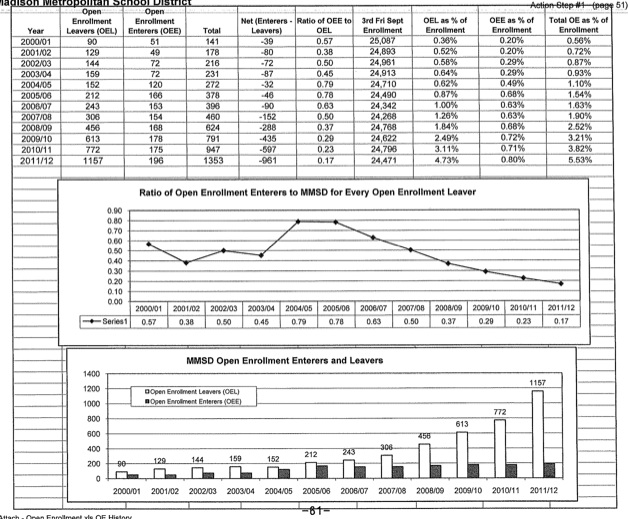

Related: An Open Letter to the Wisconsin Read To Lead Task Force on Implementing Common Core Academic Standards; DPI: “Leading Us Backwards” and how does Wisconsin Compare? www.wisconsin2.org.
Much more on Wisconsin’s Read to Lead Task Force, here.

Share

7.28.2011 Wisconsin School Accountability Conference, with Video

Matthew DeFour:

An effort to develop a statewide school accountability system marks a turning point in Wisconsin, education experts said last week as a public effort to design the system got under way.
When the modern school accountability movement began in the 1990s, several states such as Massachusetts, Kentucky and Florida developed their own systems for measuring how well schools helped students learn. Wisconsin created a statewide test in 1993, but deferred to local districts on what it meant for schools.
“Some states have embraced (school accountability) more than others,” said UW-Madison education professor Doug Harris. “Wisconsin hasn’t.”
Gov. Scott Walker and State Superintendent Tony Evers, who otherwise have clashed on education issues, have agreed to change that. A task force they formed began collecting information at a symposium last week organized by Walker, Evers and the La Follette School of Public Affairs and will soon meet to begin designing the system.

Susan Troller:

When it comes to developing a system for accountability for Wisconsin’s schools, including ways to measure whether students are meeting the ultimate goal of being ready for a career or college, Betebenner says, “My advice to you is to go slow … and be deliberate.”
John Johnson, director of education information for DPI, was encouraged by the standing-room-only crowd and the attendance by a number of policymakers, including key legislators, at Thursday’s meeting.
“Maybe by wading into school reform rather than diving into the deep end of the pool with Race to the Top, we’ll actually be able to swim, instead of drowning,” he says.

Watch the “Building a New School Accountability System for Wisconsin” conference, here.
Wisconsin’s academic standards have long been criticized for their lack of rigor.

Share

Schools of education thriving despite the market

Perry Stein:

When Jodi Bell enrolled in Miami Dade College’s bachelor in education program, she thought she had chosen a recession-proof career and expected to land a job in special education upon graduation.
But while she’s been in school, the job market has shrunk.
Broward County laid off 1,400 teachers this spring; Dade was able to balance its budget without slashing teacher jobs, but a few hundred non-instructional positions were cut.
But Bell, who is expected to graduate in May 2012, is still optimistic she’ll land a job in her chosen career.
“I’m willing to move for a job, I’m not tied down to this area,” Bell said. “I’m optimistic, I’m doing well in my program and my program is good.”

Share

PBIS in the Sun Prairie Schools

sp-eye:

PBIS is all the rage in school districts across the country. No…Sun Prairie didn’t just dream this up all by themselves. What, exactly, is PBIS? PBIS stands for Positive Behavioral Interventions and Supports. It’s an offshoot of the IDEA program (Individuals with Disabilities Education Act). You may see/hear it as SWPBS (School-wide Positive Behavior Supports). In a nutshell, PBIS is a system of behavior modification, with three stages of intervention.
Primary intervention is targeted to all students and is s system designed to clearly identify which behaviors are acceptable and which are not. Exhibiting positive behavior is rewarded in some fashion. In theory, about 80-85% of students respond to this primary level of intervention. The overall target is to develop a system in which positive reinforcements (for “acceptable/desired” behaviors) outnumber negative reinforcements (for unacceptable behaviors) by about 4:1. In this way, kids overwhelmingly see that “being good” is the place to be. You get rewards.
PBIS extends further to the 2nd tier, kids that do not respond well to these primary tactics. These kids represent about 10-15% of the population and are those that potentially are at risk for “failure”, or at the very least not realizing their academic potential. This group, however is not in need of individualized attention, but rather is targeted in small groups (a modernized form of “group” therapy). The third tier, which includes about 5-10% of students, covers those students who require individualized attention to develop positive behaviors and squelch those behaviors which are not acceptable.

Share

Leadership begins with School Board

Superintendent Mark Porter:

Leadership in any organization comes from the top. No, the superintendent is not “the top” of a school district organization. The top spot is held by the School Board, seven elected individuals who work together to implement policies and practices to meet the changing needs of students and families, all within the limited resources, financial and otherwise, that are available.
I have been fortunate during my first two years as superintendent to work with a dedicated and hard-working School Board. Being a board member requires the commitment of endless hours of time and effort, and is frequently somewhat thankless as there are very few decisions made in a large school district that will be welcomed by all. The service and support of our current board is appreciated.
Recently the School Board met in a retreat to review the best practices of high-performing boards and evaluate what changes they can implement to improve not only the functioning of the School Board, but ultimately the effectiveness and efficiency of the school district. I commend our board for this undertaking as it is a great modeling and example of the culture we are seeking to develop in the South Washington County Schools of continuous improvement and performance excellence. While the School Board generally functions very well, there is always room for improvement and this board is committed to such evaluation, assessment and improvement of their performance.

Share

Groups Rally To ‘Save Our Schools’

Channel3000:

Several Madison groups gathered on the Capitol square Saturday afternoon to be part of the national movement to “Save Our Schools.”
Rallies across the nation, including a march in Washington, D.C., were planned for the weekend to highlight what organizers feel is a crisis in public education.
Those who attended the rally said they want the political games to end in the nation’s capital when it comes to the debt ceiling impasse.
“I think the debt ceiling has something to do with public education,” said Todd Allan Price, an assistant professor at National-Louis University. “It’s showing where our misplaced priorities are. The debt ceiling has actually been raised many, many times before and the president could do that, but the problem is, is there’s a lot of gamesmanship going on.”

Share

Is laying off teachers by seniority a mistake?

Marcelle Kreiter:

With the economy forcing closer scrutiny of budgeting at all levels of government and politicians zeroing in on government workers’ pay, perhaps the most visible target is education.
For the most part, elementary and secondary education in the United States is funded with local tax dollars, with assists from state and federal coffers. And the biggest line-item expense? Teacher salaries. When it comes time to cut the budget, layoffs are announced, and because of union contracts teachers with seniority are favored. Usually those most recently hired are the ones who go.
But is this the smartest way to fix the budget? Dan Goldhaver, director of the Center for Education Data and Research at the University of Washington Bothell, and Roddy Theobald, a researcher at the center and a doctoral student in statistics, write in the fall issue of Education Next this subservience to union seniority rules is wreaking havoc on the education system, often axing the most energetic and creative educators in the system. Worse yet because they are the most recent hires, their salaries are at the low end of the pay scale so it takes more layoffs to meet the dollar figure necessary to reduce the budget, pushing up class size and sometimes forcing districts to eliminate subject areas and programs entirely

Share

Public School Comes Home

Laurie Welch:

Chance Bell does well academically, has played the piano since he was 5 years old and competes with a local swim team in the summer.
But the 12-year-old home-schooled boy from Rupert has hit the age where he wants to be more involved with his peers.
His parents, Jennifer and Mark Bell, are considering enrolling their eldest son in the state-funded Minidoka Virtual Academy that Minidoka County’s school district will launch this fall.
“He wants more friends and he’s interested in playing baseball,” his mother said.
The district’s full-time online program will offer students in grades K-8 core classes in language arts, math and science, along with a variety of electives and access to the district’s extracurricular activities and athletic teams. The program, operated with software from the private online education company K12, includes regular testing after lessons and student participation in the Idaho Standards Achievement Test.

Share

Seize the moment for education reform in Iowa

Souix City Journal:

Add your voice to the discussion. Click here to submit a letter or mini editorial to the Journal staff.
Whatever the endeavor – be it business, athletics … or education -nobody stays number one by staying the same.
Historically, we Iowans have prided ourselves on the quality of our schools. We have considered ourselves at or near the top in the nation.
The state’s education system still gets good, passing grades, don’t get us wrong, but we can and should do better in our classrooms to prepare our children for the realities and dynamics of a changing, more-global workforce. “We must,” in the words of Iowa Department of Education Director Jason Glass, “have a world-class education system …”

Share

School administrator pay varies across Washington state

Jody Lawrence-Turner:

School administrator pay is not capped or regulated in Washington and it’s not consistent by student population or region, according to an analysis of statewide compensation records obtained by The Spokesman-Review.
Last year, for example, West Valley School District Superintendent Polly Crowley – who oversees a district with about 3,600 students – made about $12,000 more than Superintendent Nancy Stowell of Spokane Public Schools, the state’s third-largest district with about 28,100 students. Compensation for 21 Washington public school administrators exceeded that of the governor – $199,038 – in 2010, while 41 top school officials made more than the state’s K-12 superintendent, Randy Dorn. His total compensation was $146,751.
Superintendents overseeing similar-size districts in the same county can have salaries that vary by thousands of dollars. And the superintendent of the second-largest school district is not necessarily the second-highest paid in the state.

Share

Should School Superintendents’ Salaries be Capped?

Megan Trent:

An Indiana Education Committee met for the fist time in Indianapolis Thursday to evaluate whether the state should cap school superintendent salaries and benefits.
Indiana’s 2011 Interim Study Committee on Education Issues is being co-chaired by State Senator Dennis Kruse. Kruse says the committee decided superintendent compensation was an issue for local school boards, not legislators.
“School board members need the flexibility to be able to choose the best person, and they need that negotiation to be able to offer a package deal that’s better than what they might be getting in another state as well as another community. Each individual school corporation has different needs and they have different budgets.”
The disparities in pay from district to district are significant. There are 291 school districts in Indiana, and according the Indiana Department of Education, superintendents earn a collective $33 million each year. That’s an average of more than $113,000.

Share

Bill Gates Urges Focus On Teachers To Fight Achievement Gap

Bianca Vazquez Toness:

Among the many prominent thinkers attending the Urban League’s annual conference Thursday, Microsoft founder and philanthropist Bill Gates made his case for focusing on teachers.
One of the nation’s oldest civil rights groups, the Urban League, is holding its annual conference in Boston this week.
Much of the conference focused on education Thursday — specifically, the persistent achievement gap between black and Latino students and their white counterparts.
Gates has been in the education reform game for a while, pouring billions of dollars into scholarships, research and trying to improve public schools. Gates said there have been advances on most other civil rights issues, but not much progress on education.

Share

Schools, financiers in talks for failed investments

Erin Richards:

Five Wisconsin school districts that invested in $200 million worth of risky financial instruments that deflated in the economic collapse are engaged this month in settlement talks with the financial institutions they claim led them astray, according to court documents.
The legal counsel for the school districts – Waukesha, West Allis-West Milwaukee, Whitefish Bay, Kenosha and Kimberly – and for Stifel Financial Corp. and the Royal Bank of Canada met in New York this month and asked a Milwaukee County circuit judge for time to continue those talks.
“The schools are actively engaged in the mediation process, which we are hoping will produce a settlement,” said Stephen Kravit, one of the attorneys representing the districts.
Kravit and other attorneys for the school districts and financial institutions met in court Thursday for a status hearing. The next major hearing, which is likely to discuss amendments to a cross-claim that Stifel filed against the Royal Bank of Canada last month, is scheduled for Aug. 30.

Share

Block Scheduling in Milwaukee Schools

Alan Borsuk:

The seasons, they go ’round and ’round, and the painted ponies go up and down.
No, I’m not just having a Joni Mitchell musical flashback. The painted ponies on my mind are block scheduling and the way school systems – Milwaukee Public Schools particularly – make and unmake decisions, over and over.
Block scheduling of high schools and middle schools is an idea that seems to come around, pass by, then come around again. In fact, at the moment, it is both coming and going in the Milwaukee area.
Under a block plan, the traditional daily schedule of seven classes of 45 or 50 minutes is replaced with four classes of 80 to 90 minutes. Commonly, courses are completed in a quarter, rather than a semester, and then new classes start. Some argue that longer class periods allow different learning styles and more depth. Others argue block schedules mean more wasted time. I’ve seen evidence of both in classes I’ve observed. Research nationally doesn’t reach a strong overall verdict.
Brookfield East and Brookfield Central high schools in the Elmbrook district will switch to blocks for the coming school year. And Homestead High School in Mequon is going to a relatively rare trimester program, in which the school year will be broken into three sections. As part of that, there will be fewer, but longer, classes each day.

Share

What is the Point of a School Board?

Laurie Rogers:

  • Is the role of a board director accountability and responsiveness to the district — or to voters?
  • Should directors work to support the superintendent and staff? Or, should they work to hold the district accountable for fiscal responsibility and academic outcomes?
  • If the district and the voters disagree on what should happen with taxpayer money and our children, to whom should the board listen?

Your views on this will guide you as you vote. As the only elected officials in our school district, board directors should be accountable and transparent to the people. They approve expenditures of taxpayer dollars, and they oversee the education of our children. There should be very little about their work that’s closed to public view. When the district pushes something the community doesn’t want, the board should pay attention and be inclined to support the electorate.

That’s why, on July 27, I asked Spokane board directors to allow the people to vote on whether the district should spend several million tax dollars on a proposed new data system, and on the new federal vision for public education. As directors contemplate these multi-million-dollar expenditures on (unproved) products – they’re also contemplating cutting people and programs that parents actually want. So, at the July 27 board meeting, I asked the directors to put the proposed expenditures on a ballot. They were silent. They looked at each other. Then, they went on with their meeting.

Share