School Information System

Merger of Memphis and County School Districts Revives Race and Class Challenges

Sam Dillon:

When thousands of white students abandoned the Memphis schools 38 years ago rather than attend classes with blacks under a desegregation plan fueled by busing, Joseph A. Clayton went with them. He quit his job as a public school principal to head an all-white private school and later won election to the board of the mostly white suburban district next door.
Now, as the overwhelmingly black Memphis school district is being dissolved into the majority-white Shelby County schools, Mr. Clayton is on the new combined 23-member school board overseeing the marriage. And he warns that the pattern of white flight could repeat itself, with the suburban towns trying to secede and start their own districts.
“There’s the same element of fear,” said Mr. Clayton, 79. “In the 1970s, it was a physical, personal fear. Today the fear is about the academic decline of the Shelby schools.”

Much more, here.

Share

What other school districts are doing (security) around the country

Susan Snyder:

Of the nation’s 10 largest cities, eight use armed police in some form. And in the ninth city, New York, officers receive far more training and scrutiny prior to hiring.
Five of those city school districts – San Diego, Los Angeles, Houston, Dallas, and San Antonio – employ their own police officers, who receive comparable training to regular city police.
Chicago, Phoenix, and the San Jose Unified School District base city police officers in some of their buildings. In the case of San Jose, the officers are not in uniform, but rather dress casually in polo shirts and conceal their weapons.
In New York – the nation’s largest school system – the city police department’s school-safety division staffs the schools with unarmed officers who receive 14 weeks of training, intensive background scrutiny, and drug and character screening. (Armed precinct-based officers, however, also come into the schools.)
The nation’s largest cities are by no means alone.
The Council of the Great City Schools, a coalition of large urban districts, surveyed members in 2004 and found that 29 of 37 respondents indicated its officers were armed. Las Vegas, Miami, and Indianapolis are among other bigger districts with their own police forces.

Share

Focus on standardized tests may be pushing some teachers to cheat

Howard Blume:

The stress was overwhelming.
For years, this veteran teacher had received exemplary evaluations but now was feeling pressured to raise her students’ test scores. Her principal criticized her teaching and would show up to take notes on her class. She knew the material would be used against her one day.
“My principal told me right to my face that she — she was feeling sorry for me because I don’t know how to teach,” the instructor said.
The Los Angeles educator, who did not want to be identified, is one of about three dozen in the state accused this year of cheating, lesser misconduct or mistakes on standardized achievement tests.

Share

Banning Sugary Soda From School Fails to Cut Teen Consumption, Study Finds

Nicole Ostrow:

Banning sugar-filled sodas from American schools as an effort to combat childhood obesity doesn’t reduce overall consumption levels of sweetened beverages, research found.
In U.S. states that banned only soda, about 30 percent of middle-school students still purchased sugary drinks like sports and fruit beverages at school, similar to states that had no policy, according to a study released online today in the Archives of Pediatrics and Adolescent Medicine. In states that banned all sugar-sweetened beverages, students still consumed the drinks outside of school, the researchers said.
Over the past 25 years, children have gotten more of their calories from sugary beverages and consumption of the drinks has been associated with childhood obesity and weight gain, the authors said. Today’s study is the first to look at whether efforts by states to curb these drinks really works, said Daniel Taber, the lead study author.

Share

Charter Schools Have Accountability

The Wall Street Journal:

Marla Sole recognizes the positive success stories of many charter schools (“approximately four times as likely as public schools to be ranked in the top 5%”), but then she comments that charter schools “were approximately two-and-a-half times as likely as public schools to be ranked in the bottom 5%” (Letters, Oct. 31).
What Ms. Sole fails to mention is that when a charter school is failing, its charter can be revoked. The parents also have the opportunity to send their children to a different school, possibly one of those in the top 5%. When the public school is a failure, we do not close it. Instead we hear calls demanding even more money to fix the failure, and we continue to force the children to attend that failing school, with no other opportunities for an education. Charter schools have that flexibility to be reformed and if that fails, the school is shut down.

Share

Newport-Mesa school chief gets no confidence vote from teachers

LA Now:

An overwhelming majority of Newport-Mesa Unified School District teachers have no confidence in their beleaguered superintendent, according to a vote announced by the teachers union.
Ballots sent out Oct. 20 to the teachers in the Newport-Mesa Federation of Teachers showed 91.2% voted no confidence in Jeffrey Hubbard, union officials confirmed.
Of the 959 members, 379 participated — a nearly 40% voter turnout.

Share

K-12 Tax & Spending Climate: Federal borrowing mounts while household debt shrinks

Dennis Cauchon:

The substitution of government debt for consumer debt helped end the recession and start a recovery, economists say, but it leaves the nation’s long-term economic health in peril.
Households have reduced debt by $549 billion since 2007, mostly by cutting mortgages through defaults and paying down credit cards. During that time, the federal government has added more than $4 trillion in debt, pushing the country’s total borrowing to a record $36.5 trillion, excluding the financial industry, according to the Federal Reserve.
“Government will eventually need to reduce the deficit,” says Susan Lund, research director at McKinsey Global Institute, part of the business consulting firm. “But it’s a very difficult balancing act to avoid withdrawing stimulus too soon while stopping before you borrow too much.”

Share

Wisconsin Governor Walker taking schools backward

WEAC President Mary Bell:

Anyone following what’s been happening in Wisconsin’s public schools can see what Gov. Scott Walker’s $1.6 billion budget cut and extreme policies have meant for our students and communities.
Across the state, class sizes are on the rise and students have fewer opportunities — including in key areas such as reading, math and science.
Walker has taken an ax to our public schools, while at the same time increasing taxpayer funding of private schools. He’s turned his back on the Wisconsin tradition of valuing public education. As a result, his extreme policies are hurting our students.
The governor says everything is fine, but we can see for ourselves that he’s not telling the whole story. With 97 percent of local school districts receiving less state aid this year, and a promise of more cuts next year, local schools will continue to struggle.

Share

Spokane Public records/Public Disclosure Commission complaint

Laurie Rogers:

On Sept. 28, 2011, a PDC complaint was filed with the Public Disclosure Commission because of concerns noted in multiple public records from Spokane Public Schools. This PDC complaint is about Washington State’s RCW 42.17.130.
Sept. 26 (filed Sept. 28), 2011: PDC complaint

Share

Is an Ivy League Diploma Worth It?

Melissa Korn:

Daniel Schwartz could have attended an Ivy League school if he wanted to. He just doesn’t see the value.
Mr. Schwartz, 18 years old, was accepted at Cornell University but enrolled instead at City University of New York’s Macaulay Honors College, which is free.
Mr. Schwartz says his family could have afforded Cornell’s tuition, with help from scholarships and loans. But he wants to be a doctor and thinks medical school, which could easily cost upward of $45,000 a year for a private institution, is a more important investment. It wasn’t “worth it to spend $50,000-plus a year for a bachelor’s degree,” he says.
As student-loan default rates climb and college graduates fail to land jobs, an increasing number of students are betting they can get just as far with a degree from a less-expensive school as they can with a diploma from an elite school–without having to take on debt.

Share

Two Out of Three Ain’t Bad…

Katy Venskus:

DFER Wisconsin headed into the fall of 2011 with three major objectives: two of objectives required action by the state legislature (a phrase that is oxymoronic at best right now) and the third required action by the Milwaukee City Council. I’m happy to say we won more than we lost, but there is plenty of work left to be done.
Good news first:

Share

Shaking up the status quo in L.A. schools

Steve Lopez:

Six million, give or take. That’s how many children are in public school in California.
Arguably, we won’t have a strong economic future if they don’t get a good education.
But boy, do the grown-ups love to muck things up for the kids.
Politics, ego, endless skirmishes between school districts and teacher unions — it all gets in the way of the kids’ best interests. And California spends less per pupil than all but a few states when you adjust for regional cost-of-living differences, leading to an annual ritual of laying off thousands of teachers and other staffers.
But in Los Angeles, the status quo is under attack.
Parents and education advocates are suing L.A. Unified in an effort to enforce an overlooked state law that requires teacher and principal evaluations to be linked to student achievement.

Share

Wisconsin Framework for Educator (Teacher) Effectiveness


Design Team Report & Recommendation:

1. Guiding Principles
The Design Team believes that the successful development and implementation of the new performance-based evaluation system is dependent upon the following guiding principles,
which define the central focus of the entire evaluation system. The guiding principles of the educator evaluation system are:
The ultimate goal of education is student learning. Effective educators are essential to achieving that goal for all students. We believe it is imperative that students have highly effective teams of educators to support them throughout their public education. We further believe that effective practice leading to better educational achievement requires continuous improvement and monitoring.
A strong evaluation system for educators is designed to provide information that supports decisions intended to ensure continuous individual and system effectiveness. The system must be well-articulated, manageable

Related: Wisconsin 25th in 2011 NAEP Reading, Comparing Rhetoric Regarding Texas (10th) & Wisconsin NAEP Scores: Texas Hispanic and African-American students rank second on eighth-grade NAEP math test, Wisconsin, Mississippi Have “Easy State K-12 Exams” – NY Times and Seidenberg endorses using the Massachusetts model exam for teachers of reading (MTEL 90), which was developed with input from reading scientists. He also supports universal assessment to identify students who are at risk, and he mentioned the Minnesota Reading Corps as a model of reading tutoring that would be good to bring to Wisconsin.

Share

Game-changing steps needed to improve Wisconsin reading

Alan Borsuk:

The new results once again underscore how true it is that the reading proficiency of African-American students is in a crisis. But the smugness about kids elsewhere in the state, especially white kids, is misguided.
Here are a few slices of how Wisconsin kids did in the latest round of National Assessment of Educational Progress tests:
White fourth-graders scored below the national average for white kids by a statistically significant amount. White eighth-graders scored exactly at the national average.
Wisconsin fourth-graders who don’t qualify for free or reduced-price lunch – that is to say, who aren’t poor – scored below the national average for such kids, again by a significant amount. Eighth-graders were, again, exactly at the national average.
Only 35% of Wisconsin eighth-graders were rated as proficient or advanced readers. The figures haven’t budged since at least 1998.
(In fairness, the national figure is 32%, and it hasn’t budged in a long time, either. But there are states such as Massachusetts and Florida, where there have been significant improvements.)
NAEP is a strict grader – Wisconsin’s own tests last year rated 86% of eighth-graders proficient or advanced. Some argue NAEP is too strict. However, it uses the same measuring stick for everyone, so comparisons to other states and the nation are fair.

Related: Comparing Rhetoric Regarding Texas (10th) & Wisconsin NAEP Scores: Texas Hispanic and African-American students rank second on eighth-grade NAEP math test; and Wisconsin 25th in 2011 NAEP Reading.

Share

How Online Innovators Are Disrupting Education

Jason Orgill and Douglas Hervey:

Four years ago Harvard Business School Professor Clayton Christensen predicted that online education would take off slowly and then hit everyone by surprise: the S-curve effect. And indeed, while it initially grew slowly, online education has exploded over the past several years. According to the 2010 Sloan Survey of Online Learning, approximately 5.6 million students took at least one web-based class during the fall 2009 semester, which marked a 21% growth from the previous year. That’s up from 45,000 in 2000 and experts predict that online education could reach 14 million in 2014.
Consider a recent Economist article featuring Bill Gates’s educational poster child: Khan Academy, founded by Salman Khan in 2006. Khan’s business model is simple, yet impactful. As The Economist noted, it flips education on its head. Rather than filling the day with lectures and requiring students to complete exercises after school, Khan focuses on classroom exercises throughout the day and allows students to download more lectures after school. When students arrive at their Silicon Valley suburb classroom with their white MacBooks, they begin their day doing various online learning exercises. The teacher, aware of what her students are working on based on her own monitor screen, then approaches students and provides one-on-one feedback and mentoring, tailoring her message to students’ particular learning paces and needs.

Share

A Secret Education Department Rule

Libby A. Nelson:

Among the many new program integrity rules the U.S. Education Department issued a little over a year ago was one that went relatively unnoticed at the time: a rule that defines the “last date of attendance” for students who withdraw from online programs more stringently than in the past, and differently than for students in a traditional classroom.
At the time, the rule was lost in the hubbub over state authorization rules, the definition of a “credit hour,” and other, more controversial, regulations, some of which colleges challenged in Congress or in court. But before the program integrity rules took effect in July 2011 — and even before they were published publicly, in October 2010 — the Education Department was already using the new definition of “last date of attendance,” which varied considerably from the previous version, to begin investigations and, in some cases, collect financial aid refunds for students who dropped out.
When the Education Department began using the “last day of attendance” rule to evaluate colleges in audits, it had never been publicly announced. In effect, a group of higher education associations has argued, the department was expecting institutions to play a game without knowing the rules.

Share

Assessing the Compensation of Public School Teachers

Jason Richwine, Ph.D. & Andrew G. Biggs, Ph.D.:

The teaching profession is crucial to America’s soci- ety and economy, but public-school teachers should receive compensation that is neither higher nor lower than market rates. Do teachers currently receive the proper level of compensation? Standard analytical approaches to this question compare teacher salaries to the salaries of similarly educated and experienced private-sector workers, and then add the value of employer contributions toward fringe benefits. These simple comparisons would indicate that public-school teachers are undercompensated. However, comparing teachers to non-teachers presents special challenges not accounted for in the existing literature.
First, formal educational attainment, such as a degree acquired or years of education completed, is not a good proxy for the earnings potential of school teach- ers. Public-school teachers earn less in wages on aver- age than non-teachers with the same level of education, but teacher skills generally lag behind those of other workers with similar “paper” qualifications. We show that:

Share

The U.S. Should Adopt Income-Based Loans Now

Kevin Carey:

A new generation of student debtors has seized the public stage. While the demands of the Occupy Wall Street movement are many, college lending reform is near the top of every list. Decades of greed, inattention, and failed policy have created a growing class of young men and women with few prospects of landing jobs good enough to bear the weight of their crushing college loans.
Some activists have called for wholesale student-loan forgiveness–a kind of 21st-century jubilee. That’s unlikely. But there’s something the federal government can do right now to help students caught by our terribly unjust higher-education financing system: End all federal student-loan defaults forever by moving to income-contingent loans.
The concept is simple. Right now, students pay back their loans on a fixed schedule, typically amortized over 10 years. Since people usually make less money early in their careers, their fixed monthly loan bill is hardest to manage in the first years after graduating (or not) from college. People unlucky enough to graduate during horrible recessions are even more likely to have bad jobs or no jobs and struggle paying back their loans. Not coincidentally, the U.S. Department of Education recently announced a sharp rise in loan defaults.

Share

Do education colleges prepare teachers well?

Leslie Postal and Denise-Marie Balona:

Teachers have been under a hot spotlight in recent years, blamed for public education’s shortcomings. Now the colleges that train them are feeling the heat.
U.S. Secretary of Education Arne Duncan is calling for reforms in the nation’s education schools, arguing too many are “mediocre” and send out graduates who aren’t ready to teach.
In a speech last month, Duncan noted 62 percent of new teachers reported feeling unprepared. He called that figure from a 2006 study “staggering.”
The Florida Department of Education (Reports) has crunched student-test-score data and tied results back to teachers’ education schools, looking to tease out which institutions are best. That effort could ramp up into a more-detailed rating system for all Florida’s education schools.
The most intense, and controversial, scrutiny likely will come when teacher colleges find themselves graded A to F next year, with the results posted in U.S. News & World Report.

Share

Independent charter school bill fails to muster votes

Susan Troller:

A controversial bill that would have established a state-run authorizing board to help expand the number of independent charter schools in Wisconsin was not able to gather the 17 votes necessary for passage in the state Senate by the end of the day Thursday.
Now, with the current floor session complete and legislators heading home until January, the bill, at least in its current form, is dead.
Whether the bill — first introduced early last spring — comes back with enough adjustments to make it palatable during the spring session remains to be seen.
Sources close to Republican legislators at the Capitol say that several GOP senators raised questions about a number of elements of the bill, suggesting it could be difficult to rework it sufficiently to pass muster in a chamber where Republicans have a razor-thin 17-16 majority and Democrats have indicated their opposition.

Share

Madison Prep, More Questions than Answers

TJ Mertz:

With only 24 days remaining till the Madison Metropolitan School District Board of Education will vote on the Madison Preparatory Academy charter and only 9 days until the MMSD administration is required to issue an analysis of their proposal (and that is assuming the analysis is issued on a Sunday, otherwise we are talking only one week), there are still many, many unanswered questions concerning the school. Too many unanswered questions.
Where to start?
All officially submitted information (and more) can be found on the district web site (scroll down for the latest iterations, and thanks to the district public info team for doing this).
The issues around instrumentality/non instrumentality and the status of staff in relation to existing union contracts have rightfully been given much attention. It is my understanding that there has been some progress, but things seem to be somewhat stalled on those matters.

Much more on the proposed Madison Preparatory IB Charter school, here.
Do current schools face the same scrutiny as the proposed Madison Preparatory Academy IB Charter?

Share

The National Study of Charter Management Organization (CMO) Effectiveness

Joshua Furgeson, Brian Gill,Joshua Haimson, Alexandra Killewald, Moira McCullough, Ira Nichols-Barrer, Bing-ru Teh, Natalya Verbitsky-Savitz, Melissa Bowen, Allison Demeritt, Paul Hill, Robin Lake

Charter schools–public schools of choice that are operated autonomously, outside the direct control of local school districts–have become more prevalent over the past two decades. There is no consensus about whether, on average, charter schools are doing better or worse than conventional public schools at promoting the achievement of their students. Nonetheless, one research finding is clear: Effects vary widely among different charter schools. Many educators, policymakers, and funders are interested in ways to identify and replicate successful charter schools and help other public schools adopt effective charter school practices.
Charter-school management organizations (CMOs), which establish and operate multiple charter schools, represent one prominent attempt to bring high performance to scale. Many CMOs were created in order to replicate educational approaches that appeared to be effective, particularly among disadvantaged students. Attracting substantial philanthropic support, CMO schools have grown rapidly from encompassing about 6 percent of all charter schools in 2000 to about 17 percent of a much larger number of charter schools by 2009 (Miron 2010). Some of these organizations have received laudatory attention through anecdotal reports of dramatic achievement results.

Andrew Rotherham comments on the study.

Share

NAEP reaction in the blogosphere

Mandy Zatynski:

Education think tanks and reformers have been abuzz today with the release of NAEP (National Assessment of Educational Progress) scores — also known as “The Nation’s Report Card.” The biennial release charts student achievement in math and English in fourth and eighth grades. (For an explainer on all things NAEP, go here.) The 2011 stats showed slight improvement in math across both levels, but reading scores among fourth-graders remained stagnant.

NAEP provides us the data, but officials do not surmise causes or reasons for growth – or lack thereof. That’s why we have eduwonks. Here’s what they had to say (in no particular order):

Share

New Rhode Island teaching evaluation system links annual ratings to certification

Associated Press:

Rhode Island teachers who receive poor evaluations for five consecutive years will lose their certification under new rules adopted by state Education officials.
Teachers will receive one of four ratings during annual evaluations: highly effective, effective, developing or ineffective. Any teacher deemed “ineffective” for five years in a row will automatically lose their certification.

Share

Key Minnesota GOP lawmaker wants to limit school districts’ levy votes

Tom Weber:

State Rep. Pat Garofalo, R-Farmington, says schools should only hold levy votes in even-numbered years, when turnout is already higher for other elections.
He plans to push for such a requirement in law when lawmakers reconvene in January. Garofalo, who chairs the House Education Finance Committee, says the levy bill will be the first his committee will discuss.
“Everybody knows that next Tuesday we’re going to see unbelievably low voter turnout,” Garofalo said. “The irony is at the same time we’re seeing so much press about a $300-million state subsidy for a Vikings stadium, there’s going to be $900 million in tax revenue on the ballot next Tuesday — and there’s been very little coverage of it.”
Voters in 126 school districts will see tax questions on the ballot next Tuesday. Garofalo cited data from the state Education Department that finds more than 70 percent of referenda pass during odd-numbered years, a number that falls to 52 percent during even-numbered years.

Share

Madison School District Identified for Improvement (DIFI); Documentation for the Wisconsin DPI

Madison School District Superintendent Dan Nerad 15MB PDF

1. Develop or Revise a District Improvement Plan
Address the fundamental teaching and learning needs of schools in the Local Education Agency (LEA), especially the academic problems o f low-achieving students.
MMSD has been identified by the State of Wisconsin as a District Identified for Improvement, or DIFI. We entered into this status based on District WKCE assessment scores. The data indicates that sub-groups of students-African American students, English Language Learner Students with Disabilities or Economically Disadvantaged -did not score high enough on the WKCE in one or more areas of reading, math or test participation to meet state criteria.
Under No Child Left Behind, 100% of students are expected to achieve proficient or advanced on the WKCE in four areas by 2014. Student performance goals have been raised every year on a regular schedule since 2001, making targets more and more difficult to reach each year. In addition to the curriculum changes being implemented, the following assessments are also new or being implemented during the 2011-12 school year (see Attachment 1):

  1. The Measures of Academic Progress (MAP): Grades 3-7. MAP is incorporated into the MMSD Balanced Assessment Plan as a computer adaptive benchmark assessment tool for grades 3-7. Administration of the assessment was implemented in spring, 2011.
  2. Cognitive Ability Test (CogAT): Grades 2 and 5. As proposed in the Talented and Gifted Plan approved by the Board of Education in August, 2009, the district requested approval of funds to purchase and score the Cognitive Ability Test (CogAT) which was administered in February, 2011, to all second and fifth graders.
  3. The EPAS System: Explore Grades 8-9, Plan Grade 10, ACT Grade 11. The EPAS system provides a longitudinal, systematic approach to educational and career planning, assessment, instructional support, and evaluation. The system focuses on the integrated, higher-order thinking skills students develop in grades K-12 that are important for success both during and after high school. The EPAS system is linked to the College and Career Readiness standards so that the information gained about student performance can be used to inform instruction around those standards.

Attached are six documents describing programs being implemented for the 2011-12 school year to address the needs of all students.
1. Strategic Plan Document: Year Three (Attachment 2)
2. Strategic Plan Summary of Three Main Focus Areas (Attachment 3)
3. Addressing the Needs of All Learners and Closing the Achievement Gap Through K-12 Alignment (Attachment 4)
4. Scope and Sequence (Attachment 5)
5. The Ideal Graduate from MMSD (Attachment 6)
6. 4K Update to BOE- Program and Sites- (Attachment 7)

Clusty Search: District Identified for Improvement (DIFI)
Matthew DeFour:

Madison School District administrators aren’t keeping track of the best classroom instruction. Not all principals create a culture of high expectations for all students. And teachers aren’t using the same research-based methods.
Such inconsistencies across the district and within schools — stemming from Madison’s tradition of school and teacher autonomy — are hurting student achievement, according to a district analysis required under the federal No Child Left Behind law.
“There are problems within the entire system,” Superintendent Dan Nerad said. “We do have good practice, but we need to be more consistent and have more fidelity to our practices.”
Inconsistencies in teaching and building culture can affect low-income students, who are more likely to move from school to school, and make teacher training less effective, Nerad said.
The analysis is contained in an improvement plan the district is scheduled to discuss with the School Board on Monday and to deliver next week to the state Department of Public Instruction.

Share

Open Enrollment Changing the Face of Wisconsin Public Schools

Wisconsin Taxpayers Alliance, via a kind Senn Brown email:

In 2010-11, a record number of students took advantage of Wisconsin’s open enrollment program to attend school elsewhere than in their own district. The 34,498 participants was 8.1% higher than in 2010 and nearly five times higher than in 2001. Open enrollment numbers varied widely, with 13 districts experiencing net outflows of more than 10% of their student populations and 34 with net inflows of similar magnitude. These findings are detailed in SchoolFacts11, the annual reference book from the Wisconsin Tax- payers Alliance (WISTAX) that provides, for every school district in the state, a wide range of information on enrollment, finance, staffing, and test scores.
In 2010-11, 4.0% of Wisconsin’s public school students attended a district other than their own. Dover (26.2%) and South Shore (23.0%) both had net outflows (students leaving less those coming) of more than 20%. Eleven other districts (Florence, Mercer, Neosho, Palmyra-Eagle, Richfield, Stockbridge, Twin Lakes, Washington-Caldwell, Wheatland, Winter, and Wonewoc-Union Center) had net outflows of over 10%.

Related: Madison School District 2009 outbound open enrollment survey. Much more, here.
Student counts drive a District’s tax and spending authority.

Share

Accountability necessary for charter schools

Eau Claire Leader-Telegram:

Charter schools have been a welcome addition to Wisconsin’s educational environment. For supporters of education reform, charter schools are a win-win: They are free to adopt curricula that differ from often-rigid public school methods, yet they remain accountable to taxpayers because they answer to local school boards. Examples include Chippewa Valley Montessori and McKinley charter schools in the Eau Claire district and Wildlands School, a collaboration between the Augusta school district and Beaver Creek Reserve.
Institutions like these offer options within public education for students who might not reach their full potentials, or even learn effectively, in traditional settings. Nonetheless, the state Legislature should be cautious as it considers opening the door to so-called independent charter schools. Unlike traditional charter schools, which maintain contracts with local school districts, independent charter schools are answerable instead to outsiders – in the case of pending legislation, a yet-to-be-created statewide board. Currently, such independent charter schools are allowed only in Milwaukee and Racine; under the bill, they could operate in any district with more than 2,000 students – including Eau Claire.
Last week, the Legislature’s budget-writing Joint Finance Committee passed the bill. Next it will go to the full Legislature.

Share

Chicago Teachers Union President Karen Lewis on Rahm, Brizard, Arne Duncan, and the Longer School Day

Carol Felsenthal:

Chicago Teachers Union President Karen Lewis has had some ugly squabbles with Rahm Emanuel–the longer school day battles, for starters, including his recent charge that the union is “cheating children out of an education”–and, in my opinion, she has often emerged the loser.
Last week, she filed the CTU’s latest lawsuit against the city, charging that the school board is using its “TeacherFit” questionnaire to hire teachers who are willing to buck the union.
The camera doesn’t favor her, and in her battle to stop the new mayor from pushing through a longer school day, she seems on the side of outmoded, lumbering labor. Who, after all, wants to deny Chicago public school kids more time for math, reading, lunch, and recess?
But in person, Lewis, 58–South Sider (grew up in Hyde Park, now lives in the Oakland neighborhood), CPS lifer (Kenwood, ’71), daughter of two teachers, former high-school chemistry teacher (Sullivan, Lane Tech, King College Prep), wife of a now-retired CPS P.E. teacher–has a sharp sense of humor, and intelligence and articulateness to spare. After an hour spent with her at a conference table at the CTU’s headquarters in the Merchandise Mart, if someone asked me to choose a few words to describe her, I’d say “substantial, self-confident, direct.”

Share

Wisconsin Education Dept. Responds To DOJ Voucher Probe

Joy Resmovits:

The Department of Justice has begun an investigation into Wisconsin’s Department of Public Instruction, probing whether Milwaukee’s state-administered voucher system is discriminating against students with disabilities. In response, the state is arguing that federal obligations don’t apply to Wisconsin’s voucher schools, according to a letter obtained by The Huffington Post Thursday.
Milwaukee’s voucher system, which allows low-income students to attend private schools using tax dollars, came under fire in June for allegedly discriminating based on disability. The complaint ultimately led to the Department of Justice investigation.
Wisconsin’s Department of Public Instruction responded to the DOJ Sept. 27 in a letter that has not yet been made public.

Share

Give high school kids more than one option

Milwaukee Journal-Sentinel:

About 5,500 students at Milwaukee Public Schools are on a path that research shows leads to better understanding of science, engineering and math, more engagement in school and improves their academic performance. Project Lead the Way does all that.
Which is why William Symonds thinks more kids should have such “apprenticeship” opportunities.
And we think he’s right.
Symonds, head of the Pathways to Prosperity Project at Harvard University, says kids need to be more firmly connected to the workplace – at a younger age. His message: Four-year college degrees aren’t for everyone, and by overemphasizing that goal, parents, schools and businesses have left a huge swath of kids behind. There is certainly evidence of that in Milwaukee.
And while it’s a fact that southeastern Wisconsin needs more college graduates, the goal of more baccalaureate degrees is not incompatible with the idea of offering high school students multiple pathways to careers.

Share

New Grades On Charter Schools

Andrew Rotherham:

The two most common criticisms about charter schools are that A) many of them aren’t that good and B) the good ones can’t be replicated to serve enough kids to really make a difference. TIME got an exclusive first look at the most comprehensive evaluation of charter school networks ever, and although the study, which will be released on Nov. 4, underscores the challenge of creating quality schools, it also makes clear that it is indeed possible to build a lot of schools that are game-changers for a lot of students.
The study, conducted by Mathematica Policy Research and the University of Washington’s Center on Reinventing Public Education, examined networks of affiliated charter schools, which in the education world are referred to as charter school management organizations (CMOs). There are more than 130 of these non-profit networks serving about 250,000 students nationwide. I was on an advisory board for the early conception and design of this study, the goal of which was to better understand how CMOs operate and how effective they are. The study is filled with valuable data about how CMOs manage their teachers, how much funding they get and how they use it and what kinds of students they serve. But I’m focusing here on student achievement, which is, of course, the most contentious issue in the national debate about charter schools.

Share

A Thought Experiment for Union Leaders

Rick Hess:

I’ve had the privilege of meeting with union leaders from around the country to explain what Teach Plus is. Many love it; plenty are skeptics.
In every case, I begin with three opening points. First, I describe our mission as very similar to the union’s: to retain excellent teachers in the classroom and strengthen the teaching profession. Second, I talk about our belief that leadership opportunities are a key lever to helping promising young teachers extend their commitment to the classroom. Third, I state my personal belief in the value in the role of unions and describe the role Teach Plus has been able to play in helping a subset of Gen Y teachers to see that value for the first time. We’re usually off to a good start.
Then I say we focus our work on high-performing teachers* in years 3-10. It is at that point that many union leaders begin scratching their heads about whether our presence in a city will be a headache or a help. By design, our approach is not about the unity and equality of all teachers. In that way, it is at odds with an industrial union model.

Share

School Has a Charter, Students and a Strong Opponent: Its District

Winnie Hu, via a kind Carla McDonald email:

Charter schools, publicly financed but independently operated, have encountered fierce resistance in many suburban communities, criticized by parents and traditional educators who view them as a drain on resources.
But since the Amani Public Charter School won state approval to open this year, officials at the Mount Vernon City School District have taken that opposition to a new level.
The district, in Westchester County, sued the State Education Department and the Amani school this year, calling the approval an “arbitrary and capricious” decision, and sought to block Amani from moving forward. It has refused to turn over state, federal and local aid money to Amani, so the state has begun paying the charter directly. During the summer, district workers were sent to knock on the doors of Amani students to check that they lived in the district, a tactic that angered some parents. And in recent weeks, the district has delayed providing special education services to Amani students.

Share

Everything you wanted to know about urban education and its solutions!

Dr. Armand A. Fusco, via a kind email:

“No one has been able to stop the steady plunge of young black Americans into a socioeconomic abyss.” Bob Herbert / Syndicated columnist
Everything you wanted to know about urban education and its solutions!
For over 50 years this shame of the nation and education has remained as a plague upon its most vulnerable children. All reform efforts involving billions of dollars have not alleviated this scourge in our public schools. The rhetoric has been profound, but it has been immune to any antidote or action and it is getting worse; but it doesn’t have to be!
The following quotes summarize the 285 pages and over 400 references from my book.

Edited Insightful Quotes
The explanations and references are found in the contents of the book.

  • School pushouts is a time bomb exploding economically and socially every twenty-six seconds
  • Remember what the basic problem is–they are in all respects illiterate and that is why they are failing.
  • Every three years the number of dropouts and pushouts adds up to a city bigger than Chicago.
  • Politics trump the needs of all children to achieve their potential.
  • One reason that the high school dropout crisis is known as the “silent epidemic” is that the problem is frequently minimized.
  • Simply stated black male students can achieve high outcomes; the tragedy is most states and districts choose not to do so.
  • In the majority of schools, the conditions necessary for Black males to systematically succeed in education do not exist.
  • While one in four American children is Latino–the largest and fastest growing minority group in the United States–they are chronically underserved by the nation’s public schools and have the lowest education attainment levels in the country.
  • Miseducation is the most powerful example of cruel and unusual punishment; it’s exacted on children innocent of any crime.
  • Traditional proposals for improving education–more money, smaller classes, etc.–aren’t getting the job done.
  • The public school system is designed for Black and other minority children to fail.
  • The U.S. Department of Education has never even acknowledged that the problem exists.
  • Though extensive records are kept…unions and school boards do not want productivity analysis done.
  • Educational bureaucracies like the NEA are at the center of America’s dysfunctional minority public schools.
  • Does bonus pay alone improve student outcomes? We found that it does not.
  • Performance pay is equivalent to “thirty pieces of silver.”
  • Data necessary to distinguish cost-effective schools are all available, but our system has been built to make their use difficult.
  • Districts give credit for students who fail standardized tests on the expectation that students someday will pass.
  • We saw some schools that were low performing and had a very high parent satisfaction rate.
  • We’re spending ever-greater sums of money, yet our high school graduates’ test results have been absolutely flat.
  • America’s primary and secondary schools have many problems, but an excess of excellence is not one of them.
  • Not only is our use of incarceration highly concentrated among men with little schooling, but corrections systems are doing less to correct the problem by reducing educational opportunities for the growing number of prisoners.
  • Although states will require school districts to implement the common core state standards, the majority of these states are not requiring districts to make complementary changes in curriculum and teacher programs.
  • We can show that merit pay is counterproductive, that closing down struggling schools (or firing principals) makes no sense.
  • The gap between our articulated ideals and our practice is an international embarrassment.
  • It’s interesting to note that despite the growing support by minority parents for charters, the NAACP, the National Urban League, and other civil rights groups collectively condemn charter schools.
  • Public schools do respond constructively to competition by raising their achievement and productivity.
  • Gates Foundation has also stopped funding the small school concept because no results could be shown.
  • The policies we are following today are unlikely to improve our schools.
  • Our country still does a better job of tracking a package than it does a student.
  • Indeed, we give these children less of all the things that both research and experience tell us make a difference.
  • Reformers have little knowledge of what is working and how to scale what works.
  • The fact is that illiteracy has persisted in all states for generations, particularly among the most vulnerable children, and getting worse is a testament that national policy and creative leadership rings hollow.
  • We can’t change a child’s home life, but what we can do is affect what they do here at school.
  • Only a third of young Americans will leave high school with the knowledge and skills they need to succeed.
  • Black churches can no longer play gospel in the sanctuaries while kids drop out into poverty and prison. They must embrace school reform and take the role that Catholic churches have done for so long and for so many.
  • There is only one way to equalize education for all–technology.
  • Whatever made you successful in the past won’t in the future.
  • The real potential of technology for improving learning remains largely untapped in schools today.
  • Can’t read, can’t learn, can’t get a job, can’t survive, so can’t stay within the law.
  • Of the 19.4 million government workers, half work in education, which rivals health care for the most wasteful sector in America.
  • The only people not being betrayed are those who feed off our failing education system…that group gets larger every year.
  • Mediocrity, not excellence, is the national norm as demonstrated by the deplorable evidence.
  • Parents are left to face the bleak reality that their child will be forever stuck in a failing school and a failing system.
  • The key is that unless there is accountability, we will never get the right system.
  • The very public institutions intended for student learning have become focused instead on adult employment.
  • We conclude that the strategies driving the best performing systems are rarely found in the United States.
  • No reform has yet lived up to its definition!
  • Minority males don’t get the beef, they get the leftovers.
  • The cotton plantations have become the school plantations (children held in bondage of failing schools) and the dropouts move on to the prison plantations.

Share

9.27.2011 Wisconsin Read to Lead Task Force Notes

Wisconsin Reading Coalition, via a kind Chan Stroman-Roll email:

Guest Speaker Mark Seidenberg (Donald O. Hebb and Hilldale Professor of Psychology and Cognitive Neuroscience, UW-Madison): Professor Seidenberg gave an excellent presentation on the science of reading and why it is important to incorporate the findings of that science in teaching. Right now there is a huge disconnect between the vast, converged body of science worldwide and instructional practice. Prospective teachers are not learning about reading science in IHE’s, and relying on intuition about how to teach reading is biased and can mislead. Teaching older students to read is expensive and difficult. Up-front prevention of reading failure is important, and research shows us it is possible, even for dyslexic students. This will save money, and make the road easier for students to learn and teachers to teach. Seidenberg endorses using the Massachusetts model exam for teachers of reading (MTEL 90), which was developed with input from reading scientists. He also supports universal assessment to identify students who are at risk, and he mentioned the Minnesota Reading Corps as a model of reading tutoring that would be good to bring to Wisconsin.
Lander: Can Seidenberg provide a few examples of things on which the Task Force could reach consensus?
Seidenberg: There is a window for teaching basic reading skills that then will allow the child to move on to comprehension. The balanced literacy concept is in conflict with best practices. Classrooms in Wisconsin are too laissez-faire, and the spiraling approach to learning does not align with science.
Michael Brickman: Brickman, the Governor’s aide, cut off the discussion with Professor Seidenberg, and said he would be in touch with him later.

Much more on the Read to Lead Task Force, here.

Share

Now is the Time for States to Help High Schools Get the Postsecondary Data They Want

College Summit:

Particularly in rough economic times, states must make hard choices about resources. But there is one targeted investment that mayors, business leaders, educators, and parents are crying out for, and that states have already initiated. It is reports for high schools on their students’ postsecondary performance, answering the critical questions: Do students enroll in a postsecondary institution? Do they pass their non-remedial courses? In which academic areas are they thriving, or struggling? These data will enable high schools everywhere in a state to find out how their graduates are doing anywhere in the state. Without this information, high schools are handicapped in their ability to prepare students for college and career.
Indeed, too many students, especially low-income students, are not prepared. In the last decade, Americans have enrolled in college in record numbers. But once there, they are stumbling at alarming rates and at enormous cost to themselves, their families, and their city and state tax bases. By one estimate, the lost personal income for one year of one class of these students is $3.8 billion; the federal government loses $566 million and the states lose $164 million in taxes from this cohort of college students who should have graduated and the numbers multiply each year. 1
Superintendents and principals are desperate to know what went wrong. Business leaders anx- iously hope for employees who are ready for 21st century work. Governors, too, know that above all they need an educated workforce to compete in the national and global marketplace.
States are making progress toward producing the high school postsecondary performance data these stakeholders need. But in the meantime, the stakeholders are restless.

Share

Just the research we all want to see: Multiple measures doesn’t mean muddied mess

The National Council on Teacher Quality

Value-added measures are often criticized for providing a narrow view of a teacher’s performance. Conversely, broader measures like observations are seen as too subjective. A new study shows–happily–that both types of evaluations are consistent and complementary: they predict future students’ achievement. Teachers who score well on one also score well on the other. Best of all, combining them produces a stronger and more accurate measure of a teacher’s effectiveness than using either alone.
Jonah E. Rockoff and Cecilia Speroni of Columbia University looked at the ability of three measures to predict teacher effectiveness: a rigorous job application process, observations and ratings by trained mentors, and value-added calculations based on students’ math and English scores.

Share

Madison Prep’s ambitious plan to close achievement gap sparks vigorous debate

Susan Troller:

Nicole is a teacher’s dream student. Bright, curious and hard-working, she has high expectations for herself and isn’t satisfied with anything less than A grades. In fact, her mother says, she sometimes has to be told not to take school too seriously.
But when Nicole was tested in seventh grade to see if she’d qualify for an eighth-grade algebra course that would put her on track for advanced math courses in high school, her score wasn’t top-notch. She assured the teacher she wanted to tackle the course anyway. He turned her down.
In fact, her score could not predict whether she’d succeed. Neither could the color of her skin.
As an African-American girl, Nicole didn’t look much like the high-flying students her teacher was accustomed to teaching in his accelerated math classes at a Madison middle school. But instead of backing off, Nicole and her family challenged the recommendation. Somewhat grudgingly, her teacher allowed her in the class.
Fast forward a year: Nicole and one other student, the two top performers in the eighth-grade algebra class, were recommended for advanced math classes in high school.

Much more on the proposed Madison Preparatory Academy IB Charter school, here.

Share

Unions, reformers hit “overpaid” study

Ben Smith:

We reached out to teachers’ unions and education reform groups to see how they felt about the Heritage Foundation/American Enterprise Institute study out yesterday saying teachers are “overpaid.”
American Federation of Teachers President Randi Weingarten slammed the report, saying it’s full of “ridiculous assertions”:

Share

Wisconsin 25th in 2011 NAEP Reading

Wisconsin Reading Coalition E-Alert, via a kind Chan Stroman Roll email:

The 4th and 8th grade NAEP reading and math scores were released today. You can view the results at http://nationsreportcard.gov. The presentation webinar is at http://www.nagb.org/reading-math-2011/.
Following is commentary on Wisconsin’s NAEP reading scores that was sent to the Governor’s Read to Lead task force by task force member Steve Dykstra.
2011 NAEP data for reading was released earlier than usual, this year. Under the previous timeline we wouldn’t get the reading data until Spring.
While we returned to our 2007 rank of 25 from our 2009 rank of 30, that is misleading. All of our gains come from modest improvement among Black students who no longer rank last, but are still very near the bottom. The shift in rank is among Wisconsin and a group of states who all perform at an essentially identical level, and have for years. We’re talking tenths of points as the difference.
It is always misleading to consider NAEP scores on a whole-state basis. Different states may have very different demographic make-ups and those difference can either exaggerate or mask the actual differences between the two states. For instance, the difference between Florida and Wisconsin (all scores refer to 4th grade reading) at the whole-state level is only 3 points. In reality, the difference is much greater. Demographic variation masks the real difference because Florida has far more minority students and far more poverty than Wisconsin. When we look at the subgroups, comparing apples to apples, we see that the real differences are vast.
When we break the groups down by gender and race, Florida outperforms Wisconsin by a statistically significant margin in every group. The smallest difference is 8 and some are as large as 20. If we break the groups down by race and school lunch status Florida outperforms Wisconsin by a statistically significant margin in every group, except black students who don’t get a free lunch. For that group Florida does better, but not by enough to declare statistical certainty. The smallest margin is 9, and many are at or above 15.
10 points are generally accepted as a grade level for this range of the NAEP. Every Florida subgroup except one exceeds it’s Wisconsin counterpart by a nearly a full grade level, and most by a lot more.
When we compare Wisconsin to Massachusetts the story is the same, only worse. The same groups are significantly different from each other, but the margins are slightly larger. The whole-state difference between Wisconsin and Massachusetts (15+ pts) only appears larger than for Florida because Massachusetts enjoys many of the same demographic advantages as Wisconsin. In fact, Wisconsin students are about the same 1.5 grade levels behind both Florida and Massachusetts for 4th grade reading.
If you want to dig deeper and kick over more rocks, it only gets worse. Every Wisconsin subgroup is below their national average and most are statistically significantly below. The gaps are found in overall scores, as well as for performance categories. We do about the same in terms of advanced students as we do with low performing students. Except for black students who don’t get a free lunch (where the three states are in a virtual dead heat), Wisconsin ranks last compared to Florida and Massachusetts for every subgroup in terms of percentage of students at the advanced level. In many cases the other states exceed our rate by 50-100% or more. Their children have a 50 -100% better chance to read at the advanced level.
We need a sense of urgency to do more than meet, and talk, and discuss. We need to actually change the things that will make a difference, we need to do it fast, and we need to get it right. A lot of what needs to be done can be accomplished in a matter of days. Some of it takes a few hours. The parts that will take longer would benefit from getting the other stuff done and out of the way so we can devote our attention to those long term issues.
Our children are suffering and so far, all we’re doing is talking about it. Shame on us.

Share

Comparing Rhetoric Regarding Texas (10th) & Wisconsin NAEP Scores: Texas Hispanic and African-American students rank second on eighth-grade NAEP math test

Texas Hispanic and African-American students rank
second on eighth-grade NAEP math test

Texas Education Agency:

Texas Hispanic and African-American students earned the second highest score among their peer groups on the 2011 eighth-grade National Assessment of Educational Progress (NAEP) mathematics test. The state’s white eighth grade students ranked fourth, missing out on the second place position themselves by less than one point.
Only Hispanic students in Montana earned a higher scale score on the math test than did eighth-grade Hispanic Texans. Only African-American students in Hawaii earned a higher average score than did their counterparts in Texas.
White students in the District of Columbia earned an average scale score of 319, the highest score for that ethnic group. Texas students ranked fourth, with less than a fraction of a point separating this group from students in Massachusetts and New Jersey. Massachusetts students had the second highest scale score at 304.2876, while Texas received an average score of 303.5460.
Overall, the state ranked 10th among the states with an average scale score of 290, substantially above the national average score of 283.

NAEP math on upward trend, state reading results stable

Wisconsin DPI:

Wisconsin’s biennial mathematics and reading results held steady on the 2011 National Assessment of Educational Progress (NAEP), also known as the Nation’s Report Card. The state’s overall trend in mathematics is improving.
For fourth-grade mathematics, the state’s 2011 scale score was 245, up one point but statistically the same as in 2009, compared to the national scale score of 240, a one-point increase from 2009. Wisconsin results for fourth-grade math are significantly higher than in 2003 when the average scale score was 237. At eighth grade, the Wisconsin scale score for mathematics was 289,
the same as in 2009 and up five points from 2003, which is statistically significant. For the nation, the 2011 mathematics scale score was 283, up one-point from 2009. State average scale scores in mathematics at both grade levels were statistically higher than the national score.

Average scores for fourth grade

All White Black Hispanic Asian Amer-Pac.Island Native Amer
US 240 249 224 229 256 227
Texas 241 253 232 235 263 ***
Wisconsin 245 251 217 228 242 231
Average scores for eighth grade
US 283 293 262 269 302 266
Texas 290 304 277 283 316 ***
Wisconsin 289 295 256 270 290 ***

via a kind Richard Askey email.
Erin Richards has more on Wisconsin’s results.
Steve Dykstra’s comments on Wisconsin’s NAEP reading scores.
Related: Madison and College Station, TX.

Share

Teacher layoffs: Did the sky fall or not?

The National Council on Teacher Quality :

Since the recession began, the specter of massive teacher layoffs has been hanging over the nation’s schools. The feds have repeatedly come to the rescue–even when some parts of the country didn’t seem to be particularly struggling–providing funds first in the form of stimulus dollars, followed by last year’s EduJobs.
So far this year there appears to be little likelihood of a comparable rescue package. The president’s job bill offers the only hope, but we all know how far that one isn’t going. The White House has been making the case nonetheless, supplying sobering evidence of a decline in education jobs and that as many as 280,000 “educator jobs” are at risk this school year.
Not discounting this evidence, we’ve been struck by the lack of reports on layoffs in newspapers this fall. Last spring, they were all reporting about school districts handing out pink slips by the thousands, but there’s been little follow up on teachers converting from pink-slip status to no-job-at-all status.

Share

Chart: One Year of Prison Costs More Than One Year at Princeton

Brian Resnick:

One year at Princeton University: $37,000. One year at a New Jersey state prison: $44,000.
Prison and college “are the two most divergent paths one can take in life,” Joseph Staten, an info-graphic researcher with Public Administration, says. Whereas one is a positive experience that increases lifetime earning potential, the other is a near dead end, which is why Staten found it striking that the lion’s share of government funding goes toward incarceration.
The comparison between higher education spending and correction spending highlighted in the following chart is not perfect. Universities have means to fund themselves; prisons rely on the government. So it makes some sense that a disproportional amount of money flows to the correction centers. Also, take note, comparing African Americans in college and African Americans in dorms is not completely fair. For one, college implies an 18-22 age range, and incarcerated adults can be of any age. Also, it doesn’t take into account African Americans who commute to school.

Share

Charter school deserves Milwaukee’s approval

Tim Sheehy:

On Tuesday, the Milwaukee Common Council will consider the Charter School Review Committee’s recommendation that the City of Milwaukee contract with Rocketship Education to open a network of independent charter schools.
Rocketship Education selected Milwaukee as its first expansion city outside of California because it saw great need but also because it sees the opportunity to be part of a systemic change in a community that desperately needs it. Rocketship has never promised miracles. It does promise a chance – a chance for children and a chance for Milwaukee.
Milwaukee has serious challenges and an urgent need to grow, develop and attract more schools that are effective in educating low-income children. Closing the gap in educational achievement for all 127,000 of the city’s K-12 schoolchildren is a community-wide responsibility.
There are no miracles, and we cannot wait for Superman. What we can do is expand our best-performing schools and work to improve our high-potential schools that operate as Milwaukee Public Schools or under the charter and choice programs. This requires the development of quality teachers and school leaders.

Share

Student loans in America Nope, just debt The next big credit bubble?

The Economist:

IN LATE 1965, President Lyndon Johnson stood in the modest gymnasium of what had once been the tiny teaching college he attended in Texas and announced a programme to promote education. It was an initiative that exemplified the “Great Society” agenda of his administration: social advancement financed by a little hard cash, lots of leverage and potentially vast implicit government commitments. Those commitments are now coming due.
“Economists tell us that improvement of education has been responsible for one-fourth to one-half of the growth in our nation’s economy over the past half-century,” Johnson said. “We must be sure that there will be no gap between the number of jobs available and the ability of our people to perform those jobs.”
To fill this gap Johnson pledged an amount that now seems trivial, $1.9m, sent from the federal government to states which could then leverage it ten-to-one to back student loans of up to $1,000 for 25,000 people. “This act”, he promised, “will help young people enter business, trade, and technical schools–institutions which play a vital role in providing the skills our citizens must have to compete and contribute in our society.”

Share

A Scottish child stumbling to school in the dark. An English child strolling to class in daylight: How Berlin Time could spell the end of the United Kingdom

Tim Luckhurst:

A compelling new argument has emerged to clinch the case against Berlin Time – otherwise known as Double Summer Time.
This unwelcome import from the Eurozone could be the straw that breaks Britain, and the rapture with which the Scottish National Party has greeted Government plans to consult on implementation proves it.
Already euphoric about the first opinion poll in years to put support for independence ahead of opposition to it, the SNP has seized on the proposed time shift like manna from heaven. Nationalist spokesmen blame ‘Tory time bandits’ for plans they claim will endanger the lives of Scottish children, cripple business and plunge Scotland into perpetual darkness.

Share

Physics vs. Phys Ed: Regardless of Need, Schools Pay the Same

Tom Gantert:

There are 19 gym teachers in the Farmington School District who make more than $85,000 a year each. The average gym teacher’s salary in Farmington is $75,035. By comparison, the science teachers in that district make $68,483 per year on average.
That’s not unusual in Michigan schools, according to Freedom of Information Act requests received from around the state.
In the Woodhaven-Brownstown district, 18.5 (FTE) science teachers average some $58,400 per year in salary, while 12 gym teachers averaged nearly $76,700. In Harrison, science teachers earned $49,000 on average while gym teachers averaged $62,000.
This is not unusual, because school districts don’t differentiate what a teacher does when considering compensation, regardless of the district’s educational needs. Teachers are paid on a single salary schedule based on seniority and education level.

Share

School Board Election Shootout in Seattle

Dan Dempsey, via a kind email:

r spent slightly more than $500,000 combined on their four campaigns, which was 81% of the total amount spent by those running in 2007. These incumbent Directors are endorsed for reelection in 2011 by the Seattle Times while The Stranger, an alternative newspaper, recommends three of the challengers.

This election has parallels to dissatisfaction underlying Occupy Wall Street. Many Seattle residents see the “School Reform” pushed by the District as largely driven by those more interested in profit by corporations than student learning. Public records of where the $500,000 plus came from in 2007 indicate likely pro corporate connections.

On March 2, 2011 after giving the public only 22 hours notice, the Board bought out Superintendent Maria Goodloe-Johnson and her CFO-COO Mr. Don Kennedy for $360,000. The Superintendent had Broad Academy training and pushed for School Reform along the lines advocated by the Broad Academy in her 3.5 years in Seattle.

It will be interesting to see if Madison has contested board races in 2012…

Share

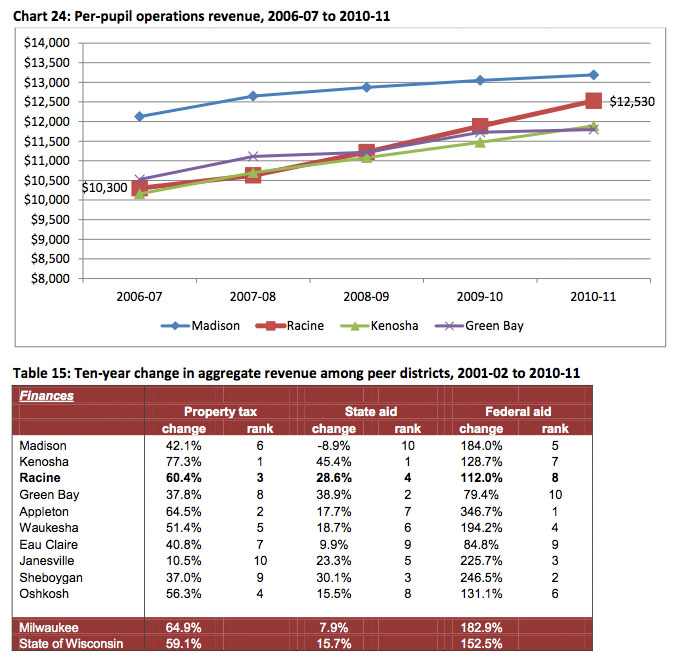
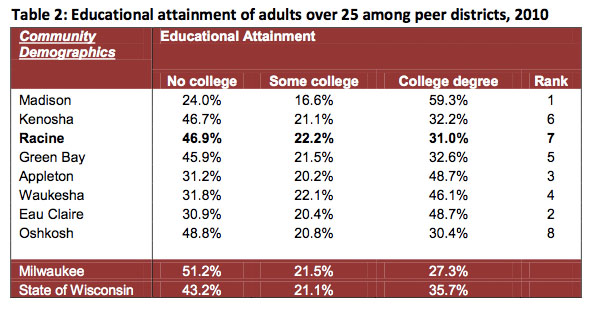
Comparing Racine to Madison, others; Racine school district holding itself accountable to goals, but academic achievement still lags peer districts


The Public Policy Forum

Racine Unified School District (RUSD) implemented a district-wide vision for improvement in March 2009. Called the North Star vision, it is intended to specify “the path to successful completion of high school for all RUSD students with an ultimate goal of every graduate being ready for a career and/or college.” It includes performance targets at each grade level to be used in creating school improvement plans and in setting school-level learning targets.
The vision is the result of a collaborative effort by the school board, district administrators, the teachers and administrators unions, and the support staff union. A simple graphic illustrating the measures of focus at each grade level has been widely distributed to parents, teachers, and district stakeholders.

Public Policy Forum Report (PDF):

For dedicated readers, this 14th Annual Comparative Analysis of the Racine Unified School District will look quite different from the previous 13 reports. For the first time, we compare the district’s performance to its own goals, as well as to its peers and to its past performance. The peer comparison tables, which have been the hallmark of previous reports, appear in Appendix I. The body of the report is focused on the district goals established in 2009 as the North Star vision, which according to the district, “is a shared vision that clearly identifies the path to successful completion of high school for all RUSD students with an ultimate goal of every graduate being ready for a career and/or college.”
As in previous reports, we also present contextual information about the Racine community and student body. RUSD has experienced many changes over the past 14 years, including: slipping from the third largest district in the state to the fourth largest, becoming a majority minority district, and now having most of its students quality for free or reduced-price lunch. The community has also become less wealthy during this time and seen fewer adults obtain college degrees. It is clear that RUSD has many challenges to overcome and a loss of significant state aid for this school year is yet another challenge. Consequently, this year’s report also includes a more in-depth analysis of the district’s fiscal situation.

Share

Madison Prep Academy would open in former church on Near West Side

Matthew DeFour:

Madison Preparatory Academy would open next fall in a former church on the city’s Near West Side if the School Board approves a contract for the controversial charter school.
The non-profit organization that would run the school has signed a letter of intent to lease the former Mount Olive Lutheran Church at 4018 Mineral Point Road, according to a business plan for the school released Saturday morning.
The site is on a Metro bus route and includes a 32,000-square-foot facility and 1,200-square-foot house. It also achieves the school’s goal of being located near the Downtown, said Urban League of Greater Madison President Kaleem Caire.
“It’s a good neighborhood,” Caire said. “We would hope the neighbors would want to get involved with the kids in the school.”
The business plan lays out several other new details including a daily schedule from 8 a.m. to 5 p.m. with 90-minute classes, report cards for parents and performance bonuses for staff.

Meanwhile, Progressive Dane announces its opposition to the proposed Madison Preparatory IB Charter school.

Share

Proposed Madison Preparatory Academy IB Charter School Business & Education Plans

Education Plan (PDF) via a kind Kaleem Caire email:

Madison Preparatory Academy’s educational program has been designed to be different. The eight features of the educational program will serve as a powerful mix of strategies that allow Madison Prep to fulfill its mission: to prepare students for success at a four-year college or university by instilling Excellence, Pride, Leadership and Service. By fulfilling this mission, Madison Prep will serve as a catalyst of change and opportunity for young men and women who live in a city where only 48% of African American students and 56% of Latino students graduate from high school. Madison Prep’s educational program will produce students who are ready for college; who think, read, and write critically; who are culturally aware and embrace differences among all people; who give back to their communities; and who know how to work hard.
One of the most unique features of Madison Prep is the single gender approach. While single gender education has a long, successful history, there are currently no schools – public or private – in Dane County that offer single gender education. While single gender education is not right for every student, the demand demonstrated thus far by families who are interested in enrolling their children in Madison Prep shows that a significant number of parents believe their children would benefit from a single gender secondary school experience.
Madison Prep will operate two schools – a boys’ school and a girls’ school – in order to meet this demand as well as ensure compliance with Title IX of the Education Amendments of 1972. The schools will be virtually identical in all aspects, from culture to curriculum, because the founders of Madison Prep know that both boys and girls need and will benefit from the other educational features of Madison Prep.
The International Baccalaureate (IB) curriculum is one of those strategies that Madison Prep’s founders know will positively impact all the students the schools serve. IB is widely considered to be the highest quality curricular framework available. What makes IB particularly suitable for Madison Prep is that it can be designed around local learning standards (the Wisconsin Model Academic Standards and the Common Core State Standards) and it is inherently college preparatory. For students at Madison Prep who have special learning needs or speak English as a second language, IB is fully adaptable to their needs. Madison Prep will offer both the Middle Years Programme (MYP) and the Diploma Programme (DP) to all its students.
Because IB is designed to be college preparatory, this curricular framework is an ideal foundation for the other aspects of Madison Prep’s college preparatory program. Madison Prep is aiming to serve a student population of which at least 65% qualify for free or reduced lunch. This means that many of the parents of Madison Prep students will not be college educated themselves and will need the school to provide considerable support as their students embark on their journey through Madison Prep and to college.
College exposure, Destination Planning, and graduation requirements that mirror admissions requirements are some of the ways in which Madison Prep will ensure students are headed to college. Furthermore, parents’ pursuit of an international education for their children is increasing rapidly around the world as they seek to foster in their children a global outlook that also expands their awareness, competence and comfort level with communicating, living, working and problem solving with and among cultures different than their own.
Harkness Teaching, the cornerstone instructional strategy for Madison Prep, will serve as an effective avenue through which students will develop the critical thinking and communication skills that IB emphasizes. Harkness Teaching, which puts teacher and students around a table rather than in theater-style classrooms, promotes student-centered learning and rigorous exchange of ideas. Disciplinary Apprenticeship, Madison Prep’s approach to literacy across the curriculum, will ensure that students have the literacy skills to glean ideas and information from a variety of texts, ideas and information that they can then bring to the Harkness Table for critical analysis.
Yet to ensure that students are on track for college readiness and learning the standards set out in the curriculum, teachers will have to take a disciplined approach to data-driven instruction. Frequent, high quality assessments – aligned to the standards when possible – will serve as the basis for instructional practices. Madison Prep teachers will consistently be analyzing new data to adjust their practice as needed.

Business Plan (PDF), via a kind Kaleem Caire email:

Based on current education and social conditions, the fate of young men and women of color is uncertain.
Black and Hispanic boys are grossly over-represented among youth failing to achieve academic success, are at grave risk of dropping out of school before they reach 10th grade, are disproportionately represented among adjudicated and incarcerated youth, and are far less likely than their peers in other subgroups to achieve their dreams and aspirations. Likewise, boys in general lag behind girls in most indicators of student achievement.
Research indicates that although boys of color have high aspirations for academic and career success, their underperformance in school and lack of educational attainment undermine their career pursuits and the success they desire. This misalignment of aspirations and achievement is fueled by and perpetuates a set of social conditions wherein men of color find themselves disproportionately represented among the unemployed and incarcerated. Without meaningful, targeted, and sustainable interventions and support systems, hundreds of thousands of young men of color will never realize their true potential and the cycle of high unemployment, fatherless homes, overcrowded jails, incarcerated talent, deferred dreams, and high rates of school failure will continue.
Likewise, girls of color are failing to graduate high school on-time, underperform on standardized achievement and college entrance exams and are under-enrolled in college preparatory classes in secondary school. The situation is particularly pronounced in the Madison Metropolitan School District where Black and Hispanic girls are far less likely than Asian and White girls to take a rigorous college preparatory curriculum in high school or successfully complete such courses with a grade of C or better when they do. In this regard, they mimic the course taking patterns of boys of color.
Additionally, data on ACT college entrance exam completion, graduation rates and standardized achievement tests scores provided to the Urban League of Greater Madison by the Madison Metropolitan School District show a significant gap in ACT completion, graduation rates and standardized achievement scores between students of color and their White peers.
Madison Preparatory Academy for Young Men and Madison Preparatory Academy for Young Women will be established to serve as catalysts for change and opportunity among young men and women in the Greater Madison, Wisconsin area, particularly young men and women of color. It will also serve the interests of parents who desire a nurturing, college preparatory educational experience for their child.
Both schools will be administratively separate and operated by Madison Preparatory Academy, Inc. (Madison Prep), an independent 501(c)(3) established by the Urban League of Greater Madison and members of Madison Prep’s inaugural board of directors.
The Urban League of Greater Madison, the “founder” of Madison Prep, understands that poverty, isolation, structural discrimination, limited access to schools and classrooms that provide academic rigor, lack of access to positive male and female role models in different career fields, limited exposure to academically successful and achievement-oriented peer groups, and limited exposure to opportunity and culture experiences outside their neighborhoods contribute to reasons why so many young men and women fail to achieve their full potential. At the same time, the Urban League and its supporters understand that these issues can be addressed by directly countering each issue with a positive, exciting, engaging, enriching, challenging, affirming and structured learning community designed to specifically address these issues.
Madison Prep will consist of two independent public charter schools – authorized by the Madison Metropolitan School District Board of Education – designed to serve adolescent males and females in grades 6-12 in two separate schools. Both will be open to all students residing within the boundaries of the Madison Metropolitan School District (MMSD) who apply, regardless of their previous academic performance.

Much more on the proposed Madison Preparatory Academy IB Charter School, here.

Share

Lawsuits for School Reform?: Parent Power May Insert Itself in L.A. Unified’s Teachers’ Contract; Demand that the LAUSD Immediately Comply with the Stull Act

RiShawn Biddle:

Earlier this year, Dropout Nation argued that one way that school reformers — including school choice activists and Parent Power groups — could advance reform and expand school choice was to file lawsuits similar to school funding torts filed for the past four decades by school funding advocates. But now, it looks like Parent Power activists may be filing a lawsuit in Los Angeles on a different front: Overhauling teacher evaluations. And the Los Angeles Unified School District may be the place where the first suit is filed.
In a letter sent on behalf of some families Wednesday to L.A. Unified Superintendent John Deasy and the school board — and just before the district begins negotiations with the American Federation of Teachers’ City of Angels unit over a new contract — Barnes & Thornburg’s Kyle Kirwan demanded that the district “implement a comprehensive system” of evaluating teachers that ties “pupil progress” data to teacher evaluations. Kirwan and the group he represents are also asking for the district to begin evaluating all teachers “regardless of tenure status” and to reject any contract with the American Federation of Teachers local that allows for any veteran teacher with more than a decade on the job to go longer than two years without an evaluation if they haven’t had one in the first place.

We represent minor-students currently residing within the boundaries of the Los Angeles Unified School District (the “District” or “LAUSD”), the parents of these students, and other adults who have paid taxes for a school system that has chronically failed to comply with California law.
Our clients seek to have the District immediately meet its obligations under the Stull Act, a forty year old law that is codified at California Education Code section 44660 et seq. (the “Stull Act“).
In relevant part, the Stull Act requires that “[t]he governing board of each school district establish standards of expected pupil achievement at each grade level in each area of study.”
Cal. Educ. Code § 44662(a). The Stull Act requires further that “[t]he governing board of each school district … evaluate and assess certificated employee performance as it reasonably relates to … [t]he progress of pupils toward the standards established pursuant to subdivision (a) and, if applicable, the state adopted academic content standards as measured by state adopted criterion referenced assessments ….” Cal. Educ. Code§ 44662(b)(l).
In the forty years since the California Legislature passed the Stull Act, the District has never evaluated its certificated personnel based upon the progress of pupils towards the standards established pursuant to Education Code section 44662(a) and, if applicable, the state adopted academic content standards as measured by the state adopted criterion referenced assessments; never reduced such evaluations to writing or added the evaluations to part of the permanent records of its certificated personnel; never reviewed with its certificated personnel the results of pupil progress as they relate to Stull Act evaluations; and never made specific recommendations on how certificated personnel with unsatisfactory ratings could improve their performance in order to achieve a higher level of pupil progress toward meeting established standards of expected pupil achievement.

Share

The Monopoly on Education

Teacher Man:

I love this scene in Goodwill Hunting because it sums up in large part how I feel about the current education system (only Matt Damon says it way cooler than I ever will).
Does it trouble anyone else that university presidents (in Canada at least, I can’t vouch for the USA) make more money than the Prime Minister does? It is primarily tax dollars that pay both of their salaries (most universities in Canada operate with about 60-70% of their costs covered by the government). How about the whole notion of publishing journal articles in a specific language that only certain people can speak effectively (APA, MLA, Chicago etc)? If you do not want to lay eyes on a somewhat cynical rant about the tyranny of post-secondary education monopolies then please avert your eyes.
Cynical or Realistic?
In my masters course last week someone who was taking their first course in several years (after being in the workforce for a substantial period of time) asked me why so much emphasis was placed on getting the exact period and comma marks right when citing sources (she was not questioning the validity of citing a source, only the extremely specific emphasis put on the minutiae of it). My response shocked her a little.

Share

Future principals lean on mentoring project

Michelle Dobo:

After revving up a few hundred adolescents in the Central Middle School auditorium during a recent homecoming pep rally, educators had to get the children out the doors and onto school buses idling outside.
And there wasn’t much time to do it.
As the children began to get up, principal Darren Guido jumped to direct traffic. Moments later, outside, aspiring school leader Nakia Fambro noticed some students were dallying. She rushed to the office.
“If you are a bus rider, the buses are leaving in 30 seconds,” Fambro announced over the intercom system, repeating the urgent message several times.

Share

NIXTY Responds to Adrian Sannier of OpenClass: You are not Open. You are betting the future of Pearson on the ability to beat Open.

Nixty:

Adrian of OpenClass responds to our questions. See our responses below:
Adrian writes:
@Nixty, a competitor to OpenClass, asks:
What happens when readily available free courses/texts help students learn better than Pearson’s closed expensive courses/texts?
What happens when we have clear research support that shows how students taking the open and free course learn more than students taking Pearson’s closed and expensive course?
Pearson’s stated aim is to make the LMS a commodity so they can sell more of their closed content and course tools. What happens when Pearson isn’t selling enough of their closed content and course tools?
Adrian’s Answer: Is this a trick question? Doesn’t this boil down to the more general question — What happens when a free product is better than one you pay for? There’s only one conclusion I can come to – free wins that round. And ‘for pay’ has to come up with something worth paying for, which is the essence of competition, the arms race that drives economics to produce improvement. I believe Pearson has proven it is up to that challenge for the long haul.

Share

Traditional Newspaper Education Coverage in Seattle

Charlie Mas:

The Seattle Times has made their perspective clear: they support the current school board. Not only did they endorse the incumbents in the upcoming election, they have gone out of their way to claim that the Board is not to blame for the recent scandals. They write that the Board has learned from those mistakes – not that they made any mistakes – and will do better now – not they they hadn’t done well enough before. The Times would have us believe that the Board isn’t to blame, but that the system is to blame – nevermind that the Board controls the system.

Share

Seattle Cluster Grouping Talk

Melissa Westbrook:

I attended the talk last night by Dr. Dina Bulles put on by Wedgwood Elementary (and held at Nathan Hale High). (FYI, her name is pronounced Bree-yays.) The other SPS staff represented were the principal of Wedgwood, Chris Cronas, Ex. Director, Phil Brockman, and head of Advanced Learning, Bob Vaughn. Mr. Cronas pointed out that several Wedgwood teachers were in attendance as well. There were a large number of seats put out but the room wasn’t full. My guess is it was about 60 people.
Dr. Bulles explained that in her district, Paradise Valley School district (which is just outside of Phoenix, Arizona), all of their elementary schools use cluster grouping. (Her district is about 35,000 students and there are 31 elementary schools.) She said out of those 35,000, about 5,000 student received gifted classes/services. (Help me out anyone else who attended; I thought she said towards the end that this was included high school students taking AP/IB. Is that what you heard?) She also made a startling statement that 68% of her teachers (and I believe this is in elementary) had 3 years or less of teaching experience. Wow.

Share

Ignoring the Achievement Gap

Andrew Rotherham:

Ah, the achievement gap. So much trouble to fix, so why bother trying? That seems to be the attitude in Washington, where pundits have spent the last several months ripping the current focus on improving the low end of student performance in our nation’s schools. In September the Obama Administration put forward a plan to offer waivers to states that want more flexibility — i.e., less ambitious targets — under the No Child Left Behind (NCLB) Act. Last week the bottom really fell out when the Senate committee that handles education passed a rewrite of the No Child law basically leaving it to states to figure out how (and probably, in practice, even whether) to close the gaps. In other words, a decade after an overwhelmingly bipartisan effort to get serious about school accountability, it’s open season on a strong federal role in education. How did we get here?
Let’s start with the pundits. Leading the charge is the American Enterprise Institute’s Rick Hess, who, in the fall issue of National Affairs, launched a contrarian broadside against NCLB’s focus on low-achieving students. “The relentless focus on gap-closing has transformed school reform into little more than a less objectionable rehash of the failed Great Society playbook,” Hess wrote. Next came a September report from the Thomas B. Fordham Foundation, another conservative think tank, claiming that the current focus is shortchanging high-achievers. Yet the data in the Fordham report didn’t support its alarmist conclusions that high-achievers were being hurt by today’s policies. The truth is, according to Fordham’s own data, that high-performers didn’t fare that badly overall. Other evidence bears this out. None of that slowed down the pundits.

Share

Support the Teaching Geography Is Fundamental Act Send Letters to Congress : 5,452 Letters Sent So Far

Speak up for Geography:

Geography has long been recognized as a “core academic subject” in federal education legislation. However, unlike all the other core academic subjects, including history, civics, economics, foreign languages and the arts, there is no dedicated federal funding stream to advance geography education. As a result, our nation is facing a crisis in geographic literacy that is jeopardizing our global competitiveness, our position of diplomatic leadership, and our ability to fill and retain over 150,000 jobs in geospatial technology in the next decade.

Share

CPS to use tougher standard for evaluating schools

Joel Hood:

After years of futility inside the classroom, Chicago Public Schools soon will adopt a more rigorous internal evaluation system that judges schools on how well they prepare students for college, a move that could lead to more school closings in the years ahead.
This stricter method of evaluation promises to be an eye-opener for many parents, considering the current process used for years already paints a bleak picture of the district: 42 percent of schools — 207 elementary and 76 high schools — are on probation for low-academic performance and poor attendance.
Seventy-two schools have been on probation for five consecutive years, and 16 of them for 15 years in a row.
Approximately 123,000 students are in underperforming schools, officials said, prompting parents in large numbers to uproot their families for neighborhoods with better schools inside or outside the city. Maps presented to the school board Wednesday showed a correlation between some of the city’s poorest-performing schools and schools that are most underenrolled.

Share

The Seattle Times continues to lower their Standards

Melissa Westbrook:

Update: a reader asked about who pays for these audits and I mistakenly said the SAO. It turns out that the Legislature had passed a law for a hotline but had not funded it. For the first year, the SAO ate the cost for hotline investigations but could not sustain that cost. So if the State Auditor chooses to go forward with hotline requests (and I’m sure they don’t follow-thru with all of them), it costs the district $83.60 per hour. (I just removed that “number of hours” as that is for the NEXT audit, not this special one.)
On the one hand you could say, “Well, look at that money and the SAO found nothing illegal.” On the other hand, you can look at this sad and sorry mess of a process and say that it sure doesn’t look good or smell good. I’ll have more to report on this after I read the SAO work product documents which I believe will make compelling reading.
End of update
A new low for reporting is the Times’ article about the MLK, Jr. building sale.

Share

New Wisconsin Charter School Legislation: The Good, the Bad, and the Ugly

Mike Ford:

3 this week to approve the latest version of Senate Bill 22 (SB-22). The bill expands chartering authority to Wisconsin Cooperative Educational Service Agencies, and most importantly creates an independent statewide charter school authorizing board.

The Good

I have blogged recently about the absurdity of Madison Prep having to get its education plan approved by the school board of a district that has proved incapable of effectively educating the very students Madison Prep seeks to serve. The state charter authorizing board would give startup charter schools like Madison Prep an authorizer option outside of their local school board. No longer would a resistant board be a brick wall for new charter schools.

Share

US Ed Department Takes Aim at Schools of Education

The Federal Register (PDF):

The Department has identified the following constituencies as having interests that are significantly affected by the topics proposed for negotiations. The Department plans to seat as negotiators individuals from organizations or groups representing these constituencies:

  • Postsecondary students, including legal assistance organizations that represent students.
  • Teachers.
  • Financial aid administrators at postsecondary institutions.
  • Business officers and bursars at postsecondary institutions.
  • Admissions officers at postsecondary institutions.
  • State officials, including officials with teacher preparation program approval agencies, State teacher licensing boards, higher education executive officers, chief State school officers, State attorneys general, and State data system administrators.
  • Institutions that offer teacher preparation programs, including schools of education.
  • Institutions of higher education eligible to receive Federal assistance under Title III, Parts A, B, and F, and Title V of the HEA, which include Historically Black Colleges and Universities, Hispanic-Serving Institutions, American Indian Tribally Controlled Colleges and Universities, Alaska Native and Native Hawaiian- Serving Institutions, Predominantly Black Institutions, and other institutions with a substantial enrollment of needy students as defined in Title III of the HEA.
  • Two-year public institutions of higher education.
  • Four-year public institutions of higher education.
  • Private, non-profit institutions of higher education.
  • Private, for-profit institutions of higher education.
  • Operators of programs for alternative routes to teacher certification.
  • Accrediting agencies.
  • Students enrolled in elementary and secondary education, including parents of students enrolled in elementary and secondary education.
  • School and local educational agency officials, including those responsible for hiring teachers and evaluating teacher performance.
    The topics the committee is likely to address are as follows:

    • The requirements for institutional and program report cards on the quality of teacher preparation (Section 205(a) of the HEA);
    • The requirements for State report cards on the quality of teacher preparation (Section 205(b) of the HEA);
    • The standards to ensure reliability, validity, and accuracy of the data submitted in report cards on the quality of teacher preparation (Section 205(c) of the HEA);
    • The criteria used by States to assess the performance of teacher preparation programs at higher education institutions in the State, the identification of low-performing programs (Section 207(a) of the HEA), and the consequences of a State’s termination of eligibility of a program (Section 207(b) of the HEA);
    • The definition of the term ”high quality teacher preparation program” for the purpose of establishing the eligibility of an institution to participate in the TEACH Grant program (Section 420L(1) of the HEA);
    • The definition of the term ”high quality professional development services” for the purpose of establishing the eligibility of an institution to participate in the TEACH Grant program (Section 420L(1) of the HEA); and
    • The service and repayment obligations for the TEACH Grant Program (Subpart E of 34 CFR 686).

Share

Toughest Exam Question: What Is the Best Way to Study?

Sue Shellenbarger:

Here’s a pop quiz: What foods are best to eat before a high-stakes test? When is the best time to review the toughest material? A growing body of research on the best study techniques offers some answers.
Chiefly, testing yourself repeatedly before an exam teaches the brain to retrieve and apply knowledge from memory. The method is more effective than re-reading a textbook, says Jeffrey Karpicke, an assistant professor of psychological sciences at Purdue University. If you are facing a test on the digestive system, he says, practice explaining how it works from start to finish, rather than studying a list of its parts.
In his junior year of high school in Cary, N.C., Keenan Harrell bought test-prep books and subjected himself to a “relentless and repetitive” series of nearly 30 practice SAT college-entrance exams. “I just took it over and over again, until it became almost aggravating,” he says.

Share

College Readiness Is Lacking, New York City Reports Show

Fernanda Santos:

Only one in four students who enter high school in New York City are ready for college after four years, and less than half enroll, according to the A-through-F high school report cards released on Monday.
Those numbers, included for the first time in the report cards, confirmed what the state suggested several months ago: the city still has a long way to go to prepare students for successful experiences in college and beyond. And they were a signal that graduation rates, long used by Mayor Michael R. Bloomberg as a validation of his education policies, were not as meaningful as they seemed.
“There’s a huge change in life chances for kids who are successful in post-secondary education,” the city’s chief academic officer, Shael Polakow-Suransky, said. “We really have a task to prepare kids for that, and the data is one of the most motivating tools.”

Share

Denver’s Moment of Reckoning is Approaching

Moira Cullen:

Is Denver going to follow in the footsteps of other reform minded urban school districts that saw momentum, change, and improvement fade away? Or will we be one of the few cities to sustain and even accelerate effective school reform?
In less than two weeks, the most hotly contested and expensive school board race in the history of Colorado will come to an end. It looks like nearly $1 million will be spent by both sides in this election by the time Election Day arrives on November 1st.
Denver has a seven-person school board with four members currently supporting the Superintendent Tom Boasberg and a broad set of reforms while the remaining three board members have relied upon Diane Ravitch to try to thwart nearly every reform initiative. Needless to say, if two of the three seats go to anti-reform candidates, Boasberg will need to look for another job and the Colorado reform community is going to have to look to some other districts for bold leadership.
Denver has been the epicenter for reform in Colorado since Michael Bennet took the helm of Denver Public Schools (DPS). Most of the reforms, which were highlighted in Colorado’s Race to the Top application and elsewhere, are dependent upon Denver leading the charge.

Share

Madison Prep’s proposal raises questions

Anne Arnesen, Barbara Arnold, Nan Brien and Carol Carstensen:

We applaud the Urban League’s energy and persistence in identifying the significant achievement gap that remains in Madison schools. We welcome the fact that the Urban League has helped focus broader community discussion on this issue, and the need to serve more effectively and successfully African-American and Hispanic students. The achievement gap is real and must be addressed.
While the Madison Preparatory Academy may provide a fine educational experience for 840 students, the Madison Metropolitan School District is charged with improving outcomes for more than 12,000 children of color. We may be better served by using our limited and diminishing resources:
1. To increase the number of students in AVID (Advancement Via Individual Determination) by expanding this nationally proven and successful program, now in all four high schools, to lower grade levels. AVID is a college readiness system that accelerates learning for students in the academic middle who may not have a college tradition in their families. Ultimately, AVID uses research-based instructional strategies to increase academic performance schoolwide. East High, the first Madison school to implement AVID, has had two graduating classes. These graduates, who attend a variety of Wisconsin colleges and universities, are 90 percent students of color and 74 percent low income; 52 percent of these graduates speak a language other than English as their first language.

Share

Why no school? Really no good reason

Chris Rickert:

I will not be working in the office Thursday. I have to care for my kids, two of whom, like lots of other Wisconsin public school students, have the day off.
Why, you ask, are classes canceled on this entirely unremarkable Thursday the week before Halloween? On a day not set aside for any national holiday, nor part of any traditionally recognized vacation season, nor beset by record-breaking snowfall or some other natural cataclysm?
Well, because historically, a couple of consecutive weekdays in October have been something of a Wisconsin public schools-recognized holiday — the traditional time for the annual convention of the statewide teachers union, the Wisconsin Education Association Council.
I know what you’re saying: “Don’t be ridiculous. Teachers have two and a half months in the summer to hold their convention! Why wouldn’t they have it then?”
And I hear you; an October teachers convention does defy logic. Yet, that’s been the case until this year, when things managed to get even more illogical.

Share

Why We Can’t Fire Our Way to Urban School Reform

Christina Collins:

A recent SchoolBook article on the high teacher turnover at one of Eva Moskowitz’s Harlem Success Schools raises an important question in the debate over improving urban schools — how can we stop corporate education reform’s focus on “getting rid of bad teachers” from creating a level of instability in school staffing that hurts our city’s students?
The case of turnover in the Harlem Success schools is only the latest example of this issue, but it’s a striking one. Over a third of the teachers at Harlem Success 3 have chosen to leave the school in the past few months, a decision Moskowitz describes as “frankly, unethical.” At the same time, however, Moskowitz chooses to employ her staff with a policy of “at will employment” rather than a negotiated contract. Under this model, she and her principals have the right to terminate teachers’ service at the school at any time, for any reason. In fact, Steven Brill’s Class Warfare describes the case of one new teacher who was “forced out” only a few months into the school year when a young principal at Harlem Success decided she wasn’t a “good fit” for the school.

Share

Halting a Runaway Train: Reforming Teacher Pensions for the 21st Century

Michael B. Lafferty:

When it comes to public-sector pensions, writes lead author Michael B. Lafferty in Fordham’s newest report, “A major public-policy (and public-finance) problem has been defined and measured, debated and deliberated, but not yet solved. Except where it has been.” As recounted in Halting a Runaway Train: Reforming Teacher Pensions for the 21st Century, these exceptions turn out to be revealing–and encouraging. As leaders around the country struggle to overhaul America’s controversial and precarious public-sector pensions, this study draws on examples from diverse fields to provide a primer on successful pension reform. Download to find valuable lessons for policymakers, workers, and taxpayers looking for timely solutions to a dire problem.

The complete report can be downloaded here.

Share

Toughest Exam Question: What Is the Best Way to Study?

Sue Shellenbarger:

Here’s a pop quiz: What foods are best to eat before a high-stakes test? When is the best time to review the toughest material? A growing body of research on the best study techniques offers some answers.
Chiefly, testing yourself repeatedly before an exam teaches the brain to retrieve and apply knowledge from memory. The method is more effective than re-reading a textbook, says Jeffrey Karpicke, an assistant professor of psychological sciences at Purdue University. If you are facing a test on the digestive system, he says, practice explaining how it works from start to finish, rather than studying a list of its parts.
In his junior year of high school in Cary, N.C., Keenan Harrell bought test-prep books and subjected himself to a “relentless and repetitive” series of nearly 30 practice SAT college-entrance exams. “I just took it over and over again, until it became almost aggravating,” he says.

Share

Two Oakland schools to split from OUSD

Katy Murphy:

On Wednesday night at Oakland Technical High School, the Oakland school board votes on a staff resolution to close five elementary schools, Lakeview, Lazear, Marshall, Maxwell Park and Santa Fe. But the board is expected to be presented with another downsizing proposal, too: The faculties at two other schools, ASCEND and Learning Without Limits, have voted to secede from OUSD and operate those schools as independently run charters.
You can read more about it here. That story will be in Tuesday’s Tribune. (And here is a link to a Sunday story about school closures.)
District staff estimate the budget shrinks by roughly $5,500 for each student who leaves OUSD (additional funds, such as the parcel tax, go to the district regardless of its enrollment/attendance). The enrollment of the two elementary schools adds up to about 800 — which means the district’s budget could take a hit of more than $4 million at the same time the administration is trying to save $2 million by closing schools.

Share

Teacher Quality Bonanza

DFER:

While a small number of cynics out there still argue that classroom teachers are not really an important ingredient in a child’s overall education recipe, one of the most important developments in K-12 education policy in the last few years has been the recognition that decades-old teacher evaluations (where the best a child can hope for is a ‘satisfactory’ teacher over an ‘unsatisfactory’ teacher) aren’t up for the task of recognizing which teachers are hitting the ball out of the park with their students.
At DFER, we’ve long believed that the widespread irrelevance of excellence itself in the K-12 world has created a culture that has actively done damage to the lives of too many children who deserved much, much better from our nation’s most important public institution.
But there have been a lot of positive developments in this area of late. There’s obviously a long way to go, and surely some of what has been done to-date will need to be changed/enhanced/expanded, but we are clearly closer to a day where the link between teaching and learning is more clear in workplace evaluations for educators. (And we continue to hope and believe that this will usher in a new era where successful teachers are treated more like the community heroes that we believe they are.)

Share

Chicago Charter Schools Could Get Longer Day Money

Rebecca Vevea:

Chicago charter schools could soon receive financial incentives similar to those being offered to city elementary schools that vote to lengthen the school day.
The Chicago Board of Education will vote on a resolution Wednesday that would create a $4.4 million grant fund for charter schools that choose to extend their day. Individual schools would eligible to receive $75,000 and individual teacher stipends of $800. Roughly 42 schools will be awarded money under the program, which Chicago Public Schools spokeswoman Becky Carroll estimated will cost about $6 million.
Carroll told the Chicago News Cooperative in September that charter schools would not be included in the city’s longer day incentive program, which has been one of Mayor Rahm Emanuel’s signature education initiatives. She said the decision to incorporate charters followed “an organic conversation” between CPS and charter operators and is about ensuring “equity in the system.”
The move to include charter schools is the latest salvo in the fight between the district and the Chicago Teachers Union over the length of the school day.

Share

Wisconsin budget panel backs expanding charter school program statewide

Jason Stein:

An independent charter school program would expand to medium and large school districts around Wisconsin, under a bill passed Wednesday by Republicans on the Legislature’s budget committee.
The proposal passed 12-3 on a party-line vote, with Republicans voting in favor and Democrats voting against.
The bill would take an independent charter school program currently operating in only Milwaukee and Racine and extend it statewide to districts with more than 2,000 students. That would apply to roughly a quarter of the state’s districts.
Republicans said it would help provide another options for students whose schools are failing them.
“The bill we are taking up today is truly something that is going to help the long-term prospects of Wisconsin,” said Rep. Robin Vos (R-Burlington), a co-chairman of the committee.
But Democrats said that the program would undermine local control of schools by elected officials in favor of an unelected board. They said the proposal could also prove another financial blow to regular public schools that are losing nearly $800 million in state aid over two years as part of the state budget and having tight state caps placed on their property tax levies.

Share

Milwaukee Choice Enrollment Growth Outpaces Levy Growth

Mike Ford:

The Milwaukee Journal Sentinel (MJS) reports today on the 10.3% local tax levy increase in Milwaukee attributable to the Milwaukee school choice program. Because the choice program is not a taxing authority, the Milwaukee Public Schools (MPS) levy is used as a fiscal agent to pay 34% of the total cost of the MPCP. As I’ve noted before, the levy used to pay for choice does not lower the actual total revenue MPS receives.
There are two reasons for the increase in the MPCP levy this year. First, the local share of the cost of the choice program increased from 30% in 2010-11 to 34% this year due to a reduction in state poverty aid used to offset the MPCP levy. The second and more important reason, which Erin Richards focuses on in her MJS article, is the increase in choice program enrollment. The Department of Public Instruction estimates 22,400 Milwaukee students are using choice this year, up from about 20,300 last year. The rise is a direct result of changes in the 2011-13 state budget that raised income eligibility requirements for participating students and allowed suburban schools to enroll Milwaukee pupils through the program.

Share

The Effect of Charter Schools on Student Achievement

Julian R. Betts and Y. Emily Tang via a kind Deb Britt email:

Charter schools are largely viewed as a major innovation in the public school landscape, as they receive more independence from state laws and regulations than do traditional public schools, and are therefore more able to experiment with alternative curricula, pedagogical methods, and different ways of hiring and training teachers. Unlike traditional public schools, charters may be shut down by their authorizers for poor performance. But how is charter school performance measured? What are the effects of charter schools on student achievement?
Assessing literature that uses either experimental (lottery) or student-level growth- based methods, this analysis infers the causal impact of attending a charter school on student performance.
Focusing on math and reading scores, the authors find compelling evidence that charters under-perform traditional public schools in some locations, grades, and subjects, and out-perform traditional public schools in other locations, grades, and subjects. However, important exceptions include elementary school reading and middle school math and reading, where evidence suggests no negative effects of charter schools and, in some cases, evidence of positive effects. Meta-analytic methods are used to obtain overall estimates on the effect of charter schools on reading and math achievement. The authors find an overall effect size for elementary school reading and math of 0.02 and 0.05, respectively, and for middle school math of 0.055. Effects are not statistically meaningful for middle school reading and for high school math and reading. Studies that focus on urban areas tend to find larger effects than do studies that examine wider areas. Studies of KIPP charter middle schools suggest positive effects of 0.096 and 0.223 for reading and math respectively. New York City and Boston charter schools also appeared to deliver achievement gains larger than charter schools in most other locations. A lack of rigorous studies in many parts of the nation limits the ability to extrapolate.

Share

On Charter Authorizing

Alex Medler:

Charter schools provide plenty of compelling news. Often the coverage is of great schools producing amazing outcomes for kids. But too often the stories are more tragic or sordid. A school’s governing board becomes mired in dysfunctional arguments; a school’s students are performing badly on state tests for several years running; somebody absconds with money; or a student with disabilities is discouraged from enrolling in a school.
Facing these unfortunate circumstances, a person is likely to shout, “Somebody should do something!” The outraged observer is correct. Generally, the “somebody” that ought to act is a charter school authorizer. Strong charter school authorizers screen initial applicants to avoid future failures. They also implement practices that respect each school’s autonomy while also protecting against abuses and ensuring that floundering schools close. Twenty years into the charter school movement, it appears that it will be difficult to hold all charter schools accountable unless we start to hold authorizers accountable for fulfilling their responsibilities.

Share

Minnesota educators tackle standards for evaluating principals

Tom Weber:

With increasing pressure over the last decade to improve student achievement, a growing body of research highlights the crucial role school principals play in creating good environments for learning.
But in Minnesota, there is no uniform method to evaluate the state’s roughly 1,700 principals. That’s about to change, due to a law passed this summer, and a group of educators who will develop the evaluation criteria and method.
In the state education budget that passed this summer was a requirement that every principal be evaluated starting the 2013 school year. The law also lays out what must be measured.

Share

Wisconsin Districts consider paying teachers based on evaluations

Erin Richards and Tom Tolan:

At Nicolet Union High School, science teacher Karyl Rosenberg keeps the evaluations she’s received over the past 21 years in neat files: one for each of her first three years of probationary teaching, and one every third year after that.
So far this year, she’s been observed twice briefly by a principal. But how she will be formally evaluated in years to come is still unclear.
That’s because many districts across the state, including Nicolet, are developing new systems for measuring teacher performance that aim to better distinguish superior educators from those who are average or below par. They will likely use student achievement growth as one measure of performance, and the results of the evaluation may help administrators decide whom to promote, dismiss or provide with more targeted help.
Research continues to show that the most significant in-school factor to improve student performance is teacher effectiveness, but Wisconsin districts such as Nicolet have been spurred to action by another factor: the Act 10 legislation signed by Gov. Scott Walker.
The legislation has dramatically limited collective bargaining in about two-thirds of the state’s districts so far, and it allows for pay structures and staffing decisions based on factors other than seniority. But for quality rather than years of experience to be used as a determining factor in such decisions, administrators need an accurate tool to assess it.

Share

Newspapers neglect critical information about Public Disclosure Commission issues

Laurie Rogers:

On Oct. 24, a Spokesman-Review reporter called me to talk about education. Over five years of education advocacy, this was the second phone call I’ve received from a SR reporter.
The first call came Oct. 13, after I submitted a Letter to the Editor about the formal complaint I filed Sept. 28 with the Public Disclosure Commission (PDC). This PDC complaint concerns Spokane Public Schools and school board candidate Deana Brower. Reporter Jody Lawrence-Turner called me to ask for a copy of the complaint.
On Monday, Lawrence-Turner called again as I was driving home with my daughter and a student I’m tutoring. Before I talked with Lawrence-Turner, I confirmed that we were having a conversation that was NOT on the record. Having confirmed that, I talked with her about various education-related topics.
This is the article that showed up in the paper today: http://www.spokesman.com/stories/2011/oct/25/caign-limit-trend-shifts-to-smaller-races
If Lawrence-Turner wonders why I asked if our conversation was off the record, all she needs to do is look at her articles. Gee, do you think The Spokesman-Review and Lawrence-Turner want Brower to win the school board election? I offered my entire blog to Lawrence-Turner, the information in it, and the links to district emails – and this is what she wrote. It looks to me like yet another slanted article with unsupported insinuations regarding school board candidate Sally Fullmer and a local community member, and with an accompanying free pass for opponent Brower.

Related: asking questions.

Share

Settlement of Somali harassment complaints in Minn. schools to require reporting; School Silences ‘Kids For Christ’

Associated Press:

A Minnesota school district must report to the federal government any future allegations of harassment against Somali students as part of a tentative agreement to end a civil rights investigation, the district’s superintendent said Monday.
St. Cloud Superintendent Bruce Watkins said all but the final details of the agreement had been reached with the Department of Education’s Office of Civil Rights. The deal up for board approval Thursday night requires that the district make its schools more welcoming to Somalis; it finds that the district broke no federal rules in handling previous incidents, Watkins said.

Todd Starnes:

An Oklahoma school district is facing a lawsuit for allegedly forbidding organizers of a Christian club from promoting events on campus.
“This is a simple matter of a school district targeting a Christian organization,” said Matt Sharp, an attorney representing the “Kids for Christ,” a community-led Christian group suing the Owasso Public Schools.

Share

Wisconsin Assembly should ice teacher discipline bill

Mary Bell:

If you want to tell if someone is a good driver, you watch them drive. If you want to tell if someone is a good teacher, watch them teach. When it comes to evaluating teachers, the further from the classroom you get, the weaker the measure is.
There’s no doubt about it – high-quality evaluation systems for teachers and principals help students and schools. Our union of educators has called for consistent evaluations for years – and even advanced our own proposal back in January. We have been one of many voices on the State Superintendent’s Educator Effectiveness Design Team, which is near to releasing a comprehensive evaluation framework.
The education community knows what works: professional development, consistent and thorough classroom observation and using results to help good educators become great.
It was troubling, then, when last week the state Senate voted to advance a bill to tie teacher discipline – even firing – to students’ Wisconsin Knowledge and Concepts Exam (WKCE) test scores.

Share

Communities Rebel Against Cuomo’s Cap on Local Property Taxes; Madison’s Property Taxes Flat this year after a 9% increase in 2010

Thomas Kaplan

A much-heralded cap on property taxes championed by Gov. Andrew M. Cuomo is encountering resistance as some communities across New York chafe at what amounts to a restriction on their spending and seek to exempt themselves from the new limits.
The communities, which include affluent New York City suburbs and rural communities near the border with Canada, are declaring that they cannot restrain the growth of property taxes and still comply with a variety of state-mandated programs and provide the services residents expect. And now dozens of town and county boards are overriding, or proposing to override, the cap.
“We should be able to dictate our own financial future,” said Lee V. A. Roberts, the supervisor in the Westchester County town of Bedford, where the Town Board has already voted to grant itself a waiver from the cap.
The Legislature approved the tax cap in late June, an effort to limit the annual growth of local property taxes to 2 percent or the rate of inflation. After that measure passed, Mr. Cuomo vowed that it would “provide much-needed relief” from rising taxes, and he was so proud of the law that he signed it six times, once in his office and five times on the front lawns of houses in high-tax communities.

The Madison School Board unanimously adopted the 2011-12 district budget and tax levy on Monday, saving the average Madison homeowner $2.74 over their 2010-11 property tax bill.
The $372 million budget requires the district to levy slightly more than $245 million in taxes, down 0.03 percent, or about $62,000, from last year’s levy.
The district gets more than $40 million in state funding and more than $10 million in federal funding. The rest of the budget gap is filled by student fees, special education funding and small-class-size funding, said Assistant Superintendent for Business Services Erik Kass.
Superintendent Dan Nerad’s $3.5 million spending recommendations were amended into the adopted budget, but Kass said $2.5 million of that amount was reallocated money that already was built into June’s preliminary budget.

Ally Boutelle:

Madison Metropolitan School District Superintendent Dan Nerad has proposed about $3.5 million in additional spending on top of the school district’s current budget for 2012.
MMSD spokesperson Ken Syke said about $2.5 million of that money will come from sources previously unaccounted for, but income taxes in the City of Madison may need to be upped to cover the remaining additions.
“$1.6 million of that [money] became available because of debt defeasance, and $937,000 of it is coming from revenue from a Medicaid time study,” he said.
In addition to the newly available $2.5 million, the district has introduced a recommendation for a total of $1,034,935 in additional funding for school maintenance programs, a statement issued by the district said.

Matthew DeFour:

The Madison School Board is considering about $3.5 million in additional spending proposals before it sets its 2011-12 budget and property tax levy Monday night.
The new spending proposed by Superintendent Dan Nerad would come on top of the $369 million budget approved in June.
For an average Madison home valued at $239,239, the new spending would mean $28.71 more than what the board approved in June, for a December bill of $2,665.12. The school tax bill on the average home still would decline $2.74.
Nerad proposed the new spending because of additional revenue identified by the district since the board voted in June. The net result of the new spending and revenue would be a property tax levy that is about the same as the 2010-11 school year.

Much more on the Madison School District’s 2011-2012 $372,000,000 budget, here.

Share

WEAC assesses future of annual convention as school districts consider alternatives

Matthew DeFour:

Most area schools will be closed Thursday and Friday, but with the annual teachers union convention canceled districts are considering whether to do away with the mid-semester break in the future.
Many school districts had already set their calendars for this year by the time the Wisconsin Education Association Council announced in May it would cancel its fall convention.
But Sun Prairie and McFarland have decided to hold classes next year on the days previously set aside for the WEAC convention. Others, including Cambridge, Belleville and DeForest, are thinking about doing the same.
“Early indications are people would favor having regular classes on those days to reduce breaks in instruction for students,” DeForest Superintendent Jon Bales said. “It also allows for the addition of makeup snow days at the end of the year without going too far into the month of June.”

Share

Wisconsin school districts adjust to canceled teacher convention

Matthew Bin Han Ong:

The annual state teachers union convention that has traditionally meant a two-day school holiday at the end of October is off this year, leaving public school districts with decisions about how to schedule students and teachers.
The Wisconsin Education Association Council canceled the convention, which would have been Thursday and Friday this week, after changes in state law weakened the union and its local affiliates.
Without the certainty of having input into school calendars through the negotiations process, members could not guarantee that they could all get the days off from school, said WEAC President Mary Bell, who added that the convention was “the flagship piece of professional development that we provided for members.”
Some school districts, with their calendars already set before the convention was called off, are keeping the school holiday for students but bringing teachers in for training or other activities. Others, such as Waukesha, are keeping the holiday and treating it as two unpaid days for teachers.
The Brown Deer School District scheduled classes.

Share

When charter schools get too picky

Jay Matthews:

The Pacific Collegiate School in Santa Cruz, Calif., is a public charter school. It must hold a random lottery when it has more applicants than vacancies. It is not supposed to be selective.
Yet somehow its average SAT score has risen to the top 10th of 1 percent nationally. Less than 10 percent of its students are from low-income families, compared with 40 percent in its city. Maybe that has something to do with the fact that the school is allowed to ask (not require, it emphasizes) that every family donate $3,000 and 40 hours of volunteer time a year.
As a supporter of the charter school movement, I get grief from people who say that charters — independent public schools using tax dollars — are private schools in disguise. They are almost always wrong about that, but there are enough Pacific Collegiate situations to make me wonder whether the rules need revision.

Share

There’s Enough Math in Finance Already. What’s Missing is Imagination.

Jason Gots:

For some of us, it was Spock. For others, a humiliating performance as a pilgrim in the kindergarten musical.  For me, it was William Blake’s relentless (and beautiful) attacks on Reason. But everyone at some point encounters – and many of us swallow – the dangerous notion that creativity and calculation are irreconcilable enemies. 
This perspective lives at the very heart of our school curricula from first grade through graduate school, as our talents are identified and we, complicit in the scheme, label ourselves ‘artistic’ or ‘sporty’ or ‘scientific.’ No doubt there are real, epigenetic differences in the way people think and see the world, but in epigenesis lies the key: Nature gives us talents, but nurture determines how we use them, and how mono or multidimensional our minds become. 
Like many quants – the mathematicians whose equations shape high-stakes decision making on Wall Street – Emanuel Derman arrived on Wall Street with little knowledge of economic theory. Unlike many of his colleagues, though, he had a background in theoretical physics, a field in which imagination and mathematics are happy bedfellows. From 1990-2000, Derman led Goldman Sachs’ Quantitative Strategies group, presiding over the rise of mathematical modeling as the engine driving financial betting on Wall Street. 

Share

2 teachers union lobbyists teach for a day to qualify for hefty pensions

Ray Long and Jason Grotto:

SPRINGFIELD —- Two lobbyists with no prior teaching experience were allowed to count their years as union employees toward a state teacher pension once they served a single day of subbing in 2007, a Tribune/WGN-TV investigation has found.
Steven Preckwinkle, the political director for the Illinois Federation of Teachers, and fellow union lobbyist David Piccioli were the only people who took advantage of a small window opened by lawmakers a few months earlier.

Share

The DOJ intervenes on behalf of a Muslim school teacher who claimed that the board of her Illinois school district was guilty of religious bias.

Dorothy Rabinowitz:

In the end it couldn’t have come as any great shock when the Department of Justice intervened on behalf of a Muslim school teacher who claimed that the board of her Illinois school district was guilty of religious bias. Nor could it have come as any surprise that the Board of Education, Berkeley School District 87 Cook Country Illinois, was finally forced to settle the case brought against it by the DOJ. Still, even Americans accustomed to the relentless — more precisely the relentlessly selective — political correctness of the Obama Justice Department had to have been startled at the facts of this case and the deranged notions of equity that had impelled Eric Holder’s DOJ to go rushing into battle against the school district.
The school teacher in question, Safoorah Khan, a middle school math lab instructor, had worked at the school for barely a year when she applied for some 19 days unpaid leave so that she could make a pilgrimage to Mecca. The school district denied the request: She was the only math lab instructor the school had, her absence would come just at the period before exams, and furthermore, the leave she wanted was outside the bounds set for all teachers under their union contract.

Share

Old, crumbling schools are, sadly, a Wisconsin tradition

Paul Fanlund:

Last week I walked into West High School for the first time since our daughter, Kate, graduated in 2001.
I’d been warned I might be taken aback by how much the place had changed in a decade. But in fact, I had the opposite reaction. Based on my few hours there, it doesn’t seem to have changed much at all.
It had the same delightful, eclectic, intellectual vibe and ethnic diversity one would expect at the public high school located nearest the University of Wisconsin-Madison campus.
Its student body of 2,100 — largest of the city’s four high schools — hails from 55 countries. It routinely has more semifinalists for National Merit Scholarships, 26 last year, than any school in Wisconsin.

Related: Madison School District maintenance referendums.

Share

A Silicon Valley School That Doesn’t Compute

Matt Richtel:

The chief technology officer of eBay sends his children to a nine-classroom school here. So do employees of Silicon Valley giants like Google, Apple, Yahoo and Hewlett-Packard.
But the school’s chief teaching tools are anything but high-tech: pens and paper, knitting needles and, occasionally, mud. Not a computer to be found. No screens at all. They are not allowed in the classroom, and the school even frowns on their use at home.
Schools nationwide have rushed to supply their classrooms with computers, and many policy makers say it is foolish to do otherwise. But the contrarian point of view can be found at the epicenter of the tech economy, where some parents and educators have a message: computers and schools don’t mix.
This is the Waldorf School of the Peninsula, one of around 160 Waldorf schools in the country that subscribe to a teaching philosophy focused on physical activity and learning through creative, hands-on tasks. Those who endorse this approach say computers inhibit creative thinking, movement, human interaction and attention spans.

Share

We Petition the Obama Administration to promote legislation to prevent public schools from starting earlier than 8 a.m.

Terra Snider, via a kind JH Snider email:

Considerable research confirms the relationship between school start times, sleep deprivation, and student performance, truancy, and absenteeism, as well as depression, mood swings, impulse control, tobacco and alcohol use, impaired cognitive function and decision-making, obesity, stimulant abuse, automobile accidents, and suicide. Mounting evidence about the biology of adolescent sleep, and about the impact of later start times, shows that starting school before 8 a.m. not only undermines academic achievement but endangers health and safety. Because logistical and financial issues prevent local school systems from establishing safe and educationally defensible hours, however, federal legislation mandating start times consistent with student health and educational well-being is essential.

Terra Snider:

As the parent of two former and one current Severna Park High School student, I’ve been living with the issue of early high school start times for years. Although the consensus of scientific opinion is that teenagers (and young adults) would be better off if school hours were better aligned with their biological clocks, the possibility of changing school hours inevitably sparks raging controversy, both here and across the country.
Changing school hours costs money, and we all know school systems don’t have a lot of that on hand. It also means changing the way we do things, and most of us don’t like doing that much either. On the other hand, Moses didn’t come down from Mount Sinai with commandments that schools must start at 7:17 a.m. and end at 2:05 p.m.
Surely if we know students learn better, and are healthier and safer, with different hours, we should make that our number one priority. Shouldn’t we?
The Severna Park High School CAC (and the now defunct countywide CAC) have been working on the issue of high school start time for years, decades even – to no avail. Many of us have become convinced that the only solution to the problem is a national mandate. That’s why I created a petition on We the People on WhiteHouse.gov, a new platform that allows anyone to create and sign petitions asking the Obama Administration to take action on a range of issues.

Share

Transporting Finland’s education success to U.S.

Mark Phillips:

Finland is dominating my educational radar screen.
When I read Linda Darling Hammond’s excellent “The Flat World and Education” (2010) a few months ago, her description of “The Finnish Success Story” fascinated me. Watching the film American Teacher last month, the most hopeful piece of information for me was that in Finland teaching is the most admired job by college students. In the Q and A that followed a local showing of the movie, questions and comments about the Finnish system dominated. A few days later The Answer Sheet reprinted a compelling letter from Diane Ravitch to Deborah Meier reporting on her visit to Finland and on the Finnish system of education. Finland. Finland. Finland.
And now comes a book by Pasi Sahlberg, the leading authority on Finland’s educational reform strategy, “Finnish Lessons,” to be published next month by Teachers College Press. A former teacher, leader of professional development for the Ministry of Education and then with the World Bank, where he wrote a definitive report on Finnish education, Sahlberg is now the leader of one of Finland’s major organizations in the field of innovation.

Share

Charters and Minority Progress

Wall Street Journal:

A tragedy of American politics is that civil rights groups like the NAACP oppose education reform, even as reform’s main beneficiaries are poor and minority students in places like Harlem and New Orleans. The latest evidence comes in a study showing that black students in charter schools outperform their peers in traditional public schools.
The California Charter Schools Association looked at the state’s Academic Performance Index (API), which runs on a scale from 200 to 1000, and found that the average black charter student outscored the average black traditional school student by an average of 18 points over the last four years of publicly available data.
In reform hubs like Los Angeles, the charter advantage was 22 points, in Sacramento 48 points, in Oakland 51 and in San Francisco 150. In San Diego, the other major urban center, traditional schools outscored charters by an average of eight points.

Share

Kindergarden Readiness in the Madison School District


PDF version.

Share

Grading the Teachers Schools have a lot to learn from business about how to improve performance

Melinda & Bill Gates:

America’s schoolteachers are some of the most brilliant, driven and highly skilled people working today–exactly the kind of people we want shaping young minds. But they are stuck in a system that doesn’t treat them like professionals.
In most workplaces, there is an implicit bargain: Employees get the support they need to excel at their jobs, and employers build a system to evaluate their performance. The evaluations yield information that employees use to improve–and that employers use to hold employees accountable for results.
At Microsoft, we believed in giving our employees the best chance to succeed, and then we insisted on success. We measured excellence, rewarded those who achieved it and were candid with those who did not. Teachers don’t work in anything like this kind of environment, and they want a new bargain.

Share

The State Of Education In Nebraska

WOWT:

After a bleak State of the Schools Report was released Wednesday by Nebraska’s Department of Education, many are wondering what needs to be changed in our schools to improve student scores. One special Omaha Public Schools teacher is not discouraged.
The Nebraska Teacher of the Year was awarded Tuesday at Liberty Elementary School at 20th and St. Mary. She has been a kindergarten teacher there for the past eight years. Despite the report, which some would say is disappointing, Luisa Palomo has a lot of hope for our students.
Palomo made her first official address under her new title Thursday at UNO to high school students interested in becoming future educators. “I did not see it coming, but I’m thrilled, I’m thrilled that I get to share the good things that are happening at our school and in Omaha with people around the country.”
Some of the alarming statistics outlined in the report show that Nebraska is falling behind, particularly in math scores. Palomo says steps are being taken to improve Nebraska’s education scores, including here in Omaha.

Share

Tea Party and Teachers’ Union Make Strange Brew

Jonathan Alter:

The age-old tension between federal authority and states’ rights is back in a big way in this year’s presidential campaign, with Republican candidates taking the let-the-states-handle-it position on everything from environmental regulation to health-care reform.
Now President Barack Obama’s education policy, a rare bipartisan winner, may also be headed back to the states, which were collectively responsible in recent years for dumbing down standards, ignoring obvious failure and otherwise jeopardizing the whole future of the country.
With the support of Republicans, Obama over the past three years has moved aggressively to set high education standards from Washington and let states and localities figure out how to meet them. But now the Tea Party is pushing Republicans to abolish the Department of Education and resist any federal “intrusions” into education.

Share