School Information System

Brooklyn School Meeting Draws Protest

Barbara Martinez:

Hundreds of protesters descended on Brooklyn Thursday, laying bare the deep philosophical divide that has become central to the Bloomberg administration’s education policy: whether the city should fix failing schools or shut them down.
The dichotomy came to a head this week as the Panel for Educational Policy met twice to vote on whether to shutter 22 schools deemed failures because its students can’t read or do math on grade level.
The panel, which is populated mostly by Bloomberg appointees, voted to close 10 schools at its meeting Tuesday and was expected to vote to close the other 12 Thursday night.
The administration and charter-school advocates argue that some schools are such failures they must be shut down completely and replaced with new schools. Students are allowed to register at the new schools, but for the most part, the new schools start up with different teachers and administrators. The city maintains that the new schools are more effective.

Share

New Jersey Voucher Bill Fact-Check

New Jersey Left Behind:


NJ’s voucher bill, the Opportunity Scholarship Act, is the big education news story today. Assembly Bill 2810 will be the subject of a hearing today before the Assembly Commerce and Economic Development Committee and proponents and opponents are going to the mattresses. Excellent Education for Everyone (E3) is running print ads that begin, “My school is failing me! I go to one of the worst schools in New Jersey. There are 80,000 kids just like me. The New Jersey Education Association wants to me to stay here. Will you help me get out?” New Jersey Teachers Association is running its own ad campaign, and has put out this set of talking points for parent leaders to use to lobby against the bill, which passed through the Senate Education Committee last month. (Here’s coverage from The Wall Street Journal and NJ Spotlight.)

Share

Ending the education wars

Conor Williams:

Recently retired New York City schools chancellor Joel Klein made headlines this week when he told the Times of London that “it’s easier to prosecute a capital-punishment case in the U.S. than terminate an incompetent teacher.” The New York Post blared, “Joel: Easier to ax a killer than a teacher.” The prize for most sensational probably goes to Liz Dwyer’s headline, “Joel Klein Compares Teachers to Murderers.”
There’s plenty of scorched earth between Klein’s words and these headlines, reflecting how unnecessarily polarized the education reform wars remain, even over the smallest changes in policy.

Share

Lessons for Online Learning

Erin Dillon and Bill Tucker:

Advocates for virtual education say that it has the power to transform an archaic K-12 system of schooling. Instead of blackboards, schoolhouses, and a six-hour school day, interactive technology will personalize learning to meet each student’s needs, ensure all students have access to quality teaching, extend learning opportunities to all hours of the day and all days of the week, and innovate and improve over time. Indeed, virtual education has the potential not only to help solve many of the most pressing issues in K-12 education, but to do so in a cost-effective manner. More than 1 million public-education students now take online courses, and as more districts and states initiate and expand online offerings, the numbers continue to grow. But to date, there’s little research or publicly available data on the outcomes from K-12 online learning. And even when data are publicly available, as is the case with virtual charter schools, analysts and education officials have paid scant attention to–and have few tools for analyzing–performance. Until policymakers, educators, and advocates pay as much attention to quality as they do to expansion, virtual education will not be ready for a lead role in education reform.

Share

Educating the Mayor

Melissa Westbrook:

I learned Mayor is having an informational briefing tomorrow morning about charter schools. It will be done by two staff from the Center for Reinventing Public Education from UW. Now this is fine but I will say that the CRPE is not exactly neutral on charters (the majority of their research is around it with them being in the pro column). Of course, it is a little odd use of time in a state that has no charter law and has turned it down three times.
When I saw the e-mail yesterday, I called and asked if I could come and listen. The staffer was very nice, said no and then said he would check. I was told today, sorry but no.
The issue isn’t so much that I can’t go. I’m sure there won’t be any other media there but I operate on the “it doesn’t hurt to ask” policy.

Speaking of Mayors, I’ve invited the four candidates for Madison Mayor to chat about education topics. Should they respond affirmatively, I will post the video conversations here.

Share

Carol Moseley Braun Answers: As Mayor of Chicago, How Will You Fix Education?

Fox Chicago News:

1. What criteria will you use in selecting the next CEO of the Chicago Public Schools?
I support hiring a superintendent for the Chicago Public Schools with a strong and proven track-record in education. Strong managerial skills and the ability to work with community leaders, parents, and teachers will also be extremely important qualities I will consider as mayor.
2. What will you do to keep the students who are in Chicago Public Schools safe?
I believe schools must be places where the community comes together. Parents, local businesses, community organizations, and local law enforcement must all play a role in providing a safe and secure space of learning for Chicago’s youth. As Senator, I was sponsor of the Midnight Basketball program, which brought local youth together with local police officers. I will provide an educational curriculum with more art, drama, and music classes to keep more students in school and engaged in activities to keep the gangs at bay. In addition, vocational training will provide students with the skills to be more competitive in the workforce and less likely to join gangs.

Share

Honesty on Application Essays

Scott Anderson:

While this particular website might be new, the idea is hardly innovative. That there are entrepreneurs willing to traffic in essays is no secret to anyone who evaluates admission applications for a living. And if the evidence and anecdotes of déjà vu experienced by admission officers are any indication, such sites probably do a brisk business. In that sense, the public premiere of a new outfit would border on prosaic if it weren’t for the fervent and opposing arguments that inevitably follow:
“Access to essays levels the playing field and helps students from schools with lackluster college counseling programs compete in today’s take-no-prisoners admission wars!”
“The sale of essays promotes plagiarism and diminishes the capacity of students to think for themselves!”
If the first claim is misguided (and conventional wisdom among admission professionals suggests that it is), the second one is incomplete. Yes, plagiarism is a nasty potential byproduct of these businesses. And reliance on samples of other people’s work to create one’s own can certainly constrain rather than inspire. But there’s also an important practical point that usually gets overlooked:

Share

Los Angeles Schools’ Panel Looking at Race Issues

Leiloni de Gruy:

Acknowledging that the achievement gap between African-American students and those of other races has persisted far too long, the Los Angeles Unified School District has established an African-American Education Working Committee designed to help create a plan to replicate “best practices” district-wide.
The 25-member committee has met twice since it was formed in mid-January, and has yet to determine specifics on what practices will be implemented and how.
But, committee member and Community Coalition lead organizer for youth programs Tonna Onyendu said “The beginning has been about introducing everyone to what the task force is about, and what the purpose is and why we are convening. Then we also made sure we were all on the same page in terms of what the goals of the task force are, which is to improve the educational outcome of African-American students within LAUSD.”

Share

Warning: This Game Is Not for Children

Donna Perry:

In the middle of this winter of our discontent, the rearrangement of a state education Board may be going unnoticed by busy, weary families. But changes announced this week for the state Board of Regents has a whole lot to do with the future opportunities these families can expect for their children, whether they realize it or not. Chairman Robert Flanders, who provided strong leadership as an unwavering supporter of the bold reform vision of state Education Commissioner Deborah Gist, is stepping down and former House Majority Leader and friend to unions and union lawyers, George Caruolo, is Governor Chafee’s pick for new Board Chairman.
Though it may be unfair to prejudge incoming appointments, it’s a foregone conclusion to state that for the Board to lose Judge Flanders and the equally strong Gist supporters Angus Davis and Anna Cano-Morales all at once spells setbacks for the Gist engine for sure. But to characterize this as a victory for the Chafee-Union alliance, and a defeat for the lightning rod Commissioner is to miss the shameful truth. After all, if the leadership of the teachers’ unions wants to reclaim their turf as the unnamed but fully operating Commissioners of Education, what record of victory are they actually trying to reclaim?

Share

West Virginia State superintendent candidates

Davin White:

Deputy State Schools Superintendent Jorea Marple believes pre-kindergarten through 12th-grade education in West Virginia has reached a pivotal point, and the state’s current direction for schools is just beginning to show benefits.
Mark Manchin, executive director of the state School Building Authority, wants to develop policies that help provide a “high-quality, 21st Century education” for children. He also promises to help support teachers and school administrators, provide safe and up-to-date school buildings and work with state lawmakers and the governor to ensure the state Board of Education’s agenda is advanced.
Carolyn Long, chairwoman of the West Virginia University Board of Governors, believes her experience in both higher education and other public schools could help bring “these two cultures together” to serve the needs of West Virginia.

Share

The value of humanities

Chrystia Freeland:

Throughout its 900-year history, Oxford University has survived the Bubonic Plague, the English Civil War, and a host of other maladies. Oxford Vice Chancellor Andrew Hamilton takes solace in the University’s resilient history as he grapples with the decision by the UK coalition to slash funding for higher education by 80%:

[The budget cuts] are pretty bad. The challenge for us obviously is the speed with which we have to confront the issues that result from them… One of the proposals that has been recently passed by government in the UK is to allow the cost of undergraduate education charged to students to rise. And again, that is happening in a very short period of time. Changes of this significant kind-I think we would all much prefer to be able to manage the cuts and manage any rise in tuition fees that will occur over a longer period, but we’re not being given that luxury. We’re going to have to manage them over a very short period of time, as little as two or three years. And that is going to be quite the challenge.

Share

Prepare your middle-schooler for college

Jay Matthews:

Even in middle school, there are a few easy things (and some more challenging steps) students can do to up their chances at a college admission. Join Jay Mathews to discuss these tactics.

Share

Houston School District offering free SAT testing in class

Ericka Mellon:

All high school juniors in the Houston Independent School District will have the chance to take the SAT college entrance exam in class for free this April.
Typically, students only can take the SAT on Saturdays or Sundays. HISD officials say the district will be only the third in the country to offer the in-class testing — which should significantly increase the number of students taking the exam.
Nearly 5,000 of HISD’s graduates in 2010 — less than half — took the SAT, according to the district. It’s likely other students took the ACT exam, which most colleges accept as well, but that number wasn’t immediately available for the Class of 2010.

Share

Teacher Licensure in Wisconsin – Who is Protected: The Parents or the Education Establishment?

Mark Schug & Scott Niederjohn:

It has been 10 years since Wisconsin overhauled an old set of rules for state teacher licensure (PI 3 and PI 4) and replaced it with a new set called PI 34. At the time of its approval in 2000, PI 34 was warmly welcomed by state leaders and legislators from both sides of the aisle. It was praised as a way to create a new generation of Wisconsin teachers.
The purpose of this report is to assess PI 34 in an effort to learn whether it has made good on these high expectations.
The underlying issue in this assessment has to do with occupational licensure. Why is it widespread in many states including Wisconsin? There are two viewpoints. The first is that consumers don’t have enough information to make judgments regarding the purchase of services from members of certain occupations. Licensure, according to this view, serves as a means to protect consumers from fraud and malpractice.
The second argument is made by economists. It opposes the first. Prominent economists claim that licensure benefits members of various occupations more than it benefits consumers. It does so by limiting access to the occupations in question, thus reducing competition. Those seeking protection from barriers of this sort believe that the various regulations will eventually enhance their incomes. The costs to consumers include reduced competition and restricted consumer choice.

PI 34’s weaknesses far outweigh its strengths. The weaknesses include the following:

  • PI 34 undervalues the importance of subject-matter knowledge in initial training programs for teachers and in teachers’ professional development activity.
  • PI 34 imposes an overwhelming regulatory system–dwarfing, for example, the regulatory system governing licensure for medical doctors.
  • PI 34 rules for licensure renewal fail to ensure that renewal will depend on demonstrated competence and professional growth. These rules create incentives for pro forma compliance, cronyism, and fraud.
  • PI 34 sets up high barriers (a single, proprietary avenue) for entrance into teaching. It makes licensure conditional on completion of approved training programs requiring, normally, at least two years of full-time enrollment in education coursework. Many highly trained professionals contemplating career changes are deterred by these requirements from becoming teachers, despite demand for their services.
  • PI 34 has no built-in measures for linking teacher licensure to teacher competence. Wisconsin has no evidence that any incompetent teacher has ever been denied licensure renewal.
  • PI 34 enables education producers (WEAC and the DPI) to dominate the licensure system. In this system, parents and students are marginalized.
  • PI 34 is particularly onerous for educators in large urban districts like Milwaukee, where producing academic gains is a challenging problem, and school principals, struggling to hire competent teachers, would benefit greatly from a flexible licensure system.

Related: An Email to Madison Superintendent Dan Nerad on Math Teacher Hiring Criteria.

Share

The Thomas Beale Cipher: A Modern Take on an Old Mystery

Jane Doh:

It’s the stuff of legends: A group of men comea across what would be today worth $65 million in gold and silver while on expedition in early-19th-century New Mexico territory. Then, they transport said treasure thousands of miles and bury it in Virginia. One of them, named Thomas Jefferson Beale, leaves three ciphertexts, simply strings of comma-separated numbers, with an innkeeper in Virginia, who forgets about it for more than 20 years.
One day, the innkeeper, realizing that Beale isn’t coming back, opens the box and tries to solve the riddle. Frustrated, he then tells the story and passes along the texts to a friend, J.B. Ward, who cracks one of the three ciphertexts, but not the one that actually gives the precise location of the treasure. More than a hundred years go by, and no one can solve the remaining two ciphers, not even with the benefit of modern computers, and the treasure, if it exists, may still be out there, waiting in the mountains of Virginia.
Picking up on this unsolved mystery, modern storyteller Andrew S. Allen created a short film The Thomas Beale Cipher, a refreshingly modern take on this century-old mystery. In Allen’s story, Professor White, a cryptographer who has recently run into some poor luck, has figured out a way to solve the Beale ciphers. But this knowledge is dangerous, and federal agents are hunting him down.

Share

Think twice About an MBA

The Economist:

Business schools have long sold the promise that, like an F1 driver zipping into the pits for fresh tyres, it just takes a short hiatus on an MBA programme and you will come roaring back into the career race primed to win. After all, it signals to companies that you were good enough to be accepted by a decent business school (so must be good enough for them); it plugs you into a network of fellow MBAs; and, to a much lesser extent, there’s the actual classroom education. Why not just pay the bill, sign here and reap the rewards?
The problem is that these days it doesn’t work like that. Rather, more and more students are finding the promise of business schools to be hollow. The return on investment on an MBA has gone the way of Greek public debt. If you have a decent job in your mid- to late- 20s, unless you have the backing of a corporate sponsor, leaving it to get an MBA is a higher risk than ever. If you are getting good business experience already, the best strategy is to keep on getting it, thereby making yourself ever more useful rather than groping for the evanescent brass rings of business school.

Share

G.O.P. Governors Take Aim at Teacher Tenure

Trip Gabriel & Sam Dillon:

Seizing on a national anxiety over poor student performance, many governors are taking aim at a bedrock tradition of public schools: teacher tenure.
The momentum began over a year ago with President Obama’s call to measure and reward effective teaching, a challenge he repeated in last week’s State of the Union address.
Now several Republican governors have concluded that removing ineffective teachers requires undoing the century-old protections of tenure.
Governors in Florida, Idaho, Indiana, Nevada and New Jersey have called for the elimination or dismantling of tenure. As state legislatures convene this winter, anti-tenure bills are being written in those states and others. Their chances of passing have risen because of crushing state budget deficits that have put teachers’ unions on the defensive.

Share

Florida Lawmaker Wants Teachers To Grade Parents

WBPF:

A central Florida lawmaker wants school teachers to grade parents on their children’s report cards.
State Rep. Kelli Stargel, R-Lakeland, recently proposed a bill that would require public school teachers to grade the parents of their students in kindergarten through third grade.
A grade of “satisfactory,” “unsatisfactory” or “needs improvement” would be added to their children’s report cards.
The grading system would be based on the following criteria:

Share

New Advanced Placement Biology Is Ready to Roll Out, but U.S. History Isn’t

Christopher Drew:

While the College Board plans to unveil a sweeping revision to Advanced Placement biology courses on Tuesday, it is delaying similar changes in United States history by a year to address concerns from high school teachers.
The changes in both subjects are part of a broad revamping of A.P. courses and exams to reduce memorization and to foster analytic thinking. But while the new biology curriculum is specific about what material needs to be covered, some teachers complained that parts of the history course seemed vague, and the board said it needed more time to clarify what should be studied.
Board officials said they expected to publish the new United States history curriculum next fall. That curriculum will now take effect in the 2013-14 school year, they said, rather than in 2012-13, when the new biology program is to begin.

Share

Out Educate: School and the State of the Union

Amanda Read:

namored with President Obama’s plans for the country.
Perhaps it’s no surprise that the rumored “Sputnik moment” fell flat. After all, the “clean green” mantra lit up with squiggly bulbs just doesn’t ignite the creativity of the populace like the notion of going to the moon. Of course there was more to the president’s technological ideals than that, but he invested too many words in education to make them sound believable.
In a way Obama was playing it safe by pulling out the motherhood-and-apple-pie concept of winning the future through education for the children. Nobody (except the Grinch) would argue against something done for the children, would they?

“When a child walks into a classroom, it should be a place of high expectations and high performance. But too many schools don’t meet this test. That’s why instead of just pouring money into a system that’s not working, we launched a competition called Race to the Top.”

Ah, but Mr. President, a crucial distinction must be made here. There is a difference between education and federal spending on education. Since when has federal involvement in education helped the economy or improved learning?

Share

‘A Rosa Parks moment for education’

Kevin Huffmana:

Last week, 40-year-old Ohio mother Kelley Williams-Bolar was released after serving nine days in jail on a felony conviction for tampering with records. Williams-Bolar’s offense? Lying about her address so her two daughters, zoned to the lousy Akron city schools, could attend better schools in the neighboring Copley-Fairlawn district.
Williams-Bolar has become a cause célèbre in a case that crosses traditional ideological bounds. African American activists are outraged, asking: Would a white mother face the same punishment for trying to get her kids a better education? (Answer: No.)
Meanwhile, conservatives view the case as evidence of the need for broader school choice. What does it say when parents’ options are so limited that they commit felonies to avoid terrible schools? Commentator Kyle Olson and others across the political spectrum have called this “a Rosa Parks moment for education.”

Share

Higher education is not broken

Michael Wixom:

Gov. Brian Sandoval’s State of the State address has certainly given us all a great deal to consider. His proposals for Nevada’s public higher education system, in particular, will prompt needed dialogue. However, it is critical that such discussions begin with correct assumptions, and contrary to what we have been told, the Nevada System of Higher Education is not broken.
As evidence of that assertion, some point to our universities’ six-year graduation rates (for the period beginning in 2004) of only 50 percent. However, that statement is misleading. When student transfers and eight-year graduation rates are reflected in the calculation, the graduation rate is much higher, ranging from 55 to 70 percent — certainly in need of improvement, but a respectable figure in any national comparison.
Many have been critical of Nevada’s community college graduation rates, which range from 5 to 26 percent. However, many, if not most, community college students don’t attend community colleges to graduate from a community college — they attend to take specific courses or they transfer within a relatively short period of time. These are designed to be access institutions, and graduation rates, taken alone, really don’t adequately reflect their mission.

Share

Education expert says flat test scores are result of student apathy

Alan Borsuk:

Henry Kranendonk describes himself as “a person who’d never served on anything other than a church board” until the day about three years ago when he got a call from an aide to Margaret Spellings, then the U.S. secretary of education.
Would he join an elite group of somewhat frustrated people working near the top of the national education pyramid?
Well, that’s not quite how it was put. But that’s a practical reading of what being a member of the National Assessment Governing Board has meant for Kranendonk, who was the top math specialist in Milwaukee Public Schools at that point.
Those unhappy numbers, released last week, about how only one in five high school seniors across the country is proficient in science? The data a year ago that put MPS fourth- and eighth-graders near the bottom of the proficiency list among 18 urban districts? Those reports over the last decade that showed Wisconsin had the largest or close to the largest gaps in the U.S. between white and black students in reading and math?

Share

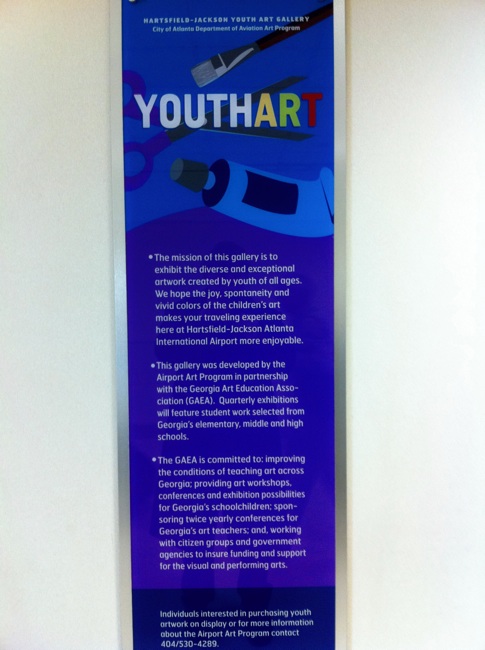
Atlanta Airport Youth Art Gallery


The Atlanta Airport Art Program

Perhaps Madison could initiate something like this.

Share

DeKalb, GA finds teachers could have accessed tests late at night

Megan Matteucci:

Principals and teachers may have violated state procedures by entering locked DeKalb County school closets on weekends and late at night to access students’ answers to standardized tests.
If so, they weren’t caught on camera, but their security key cards gave them away.
The Atlanta Journal-Constitution learned DeKalb County school district’s internal investigation into possible cheating on the Criterion-Referenced Competency Test hinged on illegal access to the tests and led to 24 educators being removed from the classroom this week. The list includes principals, assistant principals and teachers who are now doing administrative jobs.
“There’s a chain of evidence that requires only certain people to have access to those tests,” schools’ spokesman Walter Woods said Friday. “There were several instances where employees accessed school over the weekend, and those employees were flagged.”

Share

Early results promising in Houston school reform effort

Ericka Mellon:

Student attendance rates are up, suspensions are down and math performance is improving in the nine struggling Houston ISD schools taking part in the district’s experimental reform program called Apollo 20.
But the instruction in many classrooms remains too basic and boring, according to the first major progress report on the $29 million effort being watched by urban districts nationwide. Questions also remain about future funding of the program.
HISD Superintendent Terry Grier, who released the Harvard University report to the school board on Saturday, described the first-semester results as “very good news” but acknowledged some weaknesses.
“This is a three-year pilot,” he said. “You’re not going to turn around the lowest-performing schools in the district, all of them, in a year.”
The Apollo program launched in August at five middle schools and four high schools that ranked among the lowest-achieving in the Houston Independent School District. The effort started with a staff shake-up. Grier’s administration replaced all the principals, and about 40 percent of the teachers are new to the campuses.

Share

The Process for Discussing Madison School District High School Alignment

Superintendent Dan Nerad:

This is to provide clarity, transparency and direction in improving our high school curriculum and instruction, with ongoing communication.
(As presented to the MMSD Board of Education on January 6, 2011)
The following guiding principles were discussed:

Lots of related links:

Share

What happened to studying?
You won’t hear this from the admissions office, but college students are cracking the books less and less

Keith O’Brien:

They come with polished resumes and perfect SAT scores. Their grades are often impeccable. Some elite universities will deny thousands of high school seniors with 4.0 grade point averages in search of an elusive quality that one provost called “intellectual vitality.” The perception is that today’s over-achieving, college-driven kids have it — whatever it is. They’re not just groomed; they’re ready. There’s just one problem.
Once on campus, the students aren’t studying.
It is a fundamental part of college education: the idea that young people don’t just learn from lectures, but on their own, holed up in the library with books and, perhaps, a trusty yellow highlighter. But new research, conducted by two California economics professors, shows that over the past five decades, the number of hours that the average college student studies each week has been steadily dropping. According to time-use surveys analyzed by professors Philip Babcock, at the University of California Santa Barbara, and Mindy Marks, at the University of California Riverside, the average student at a four-year college in 1961 studied about 24 hours a week. Today’s average student hits the books for just 14 hours.

Share

Proposed Changes in Madison’s Open Enrollment Policy

Dylan Pauly:

The attached proposed changes to Policy 4025 reflect the amendments to Wis. Stat. §118.51, which now permits a nonresident district to consider whether a student has been habitually truant for purposes of allowing open enrollment into the non-resident district. This change applies to students who lived in the district, moved outside of the district boundaries, and are seeking to stay in the district as a nonresident student. A second change allows a district to prohibit a nonresident student from attending district schools after an initial acceptance if the student is habitually truant during either semester of the current school year. The open enrollment period begins February 7, 2011 and ends February 25, 2011.

Much more on open enrollment, here.
Wisconsin’s 2011-2012 open enrollment application period is February 7, 2011 to February 25, 2011.

Share

Madison School District Strategic Plan: 2 Year Action Plans

Superintendent Dan Nerad: Year two action plans.
Much more on Madison’s strategic planning process here.

Share

A Measured Approach to Improving Teacher Preparation

Chad Aldeman, Kevin Carey, Erin Dillon, Ben Miller, and Elena Silva, via email:

Over the next five years, more than a million new teachers will enter public school classrooms. But the system in place to produce these teachers–supported by an ever-expanding set of federal financial aid programs and multimillion-dollar federal grants–offers no guarantees of quality for anyone involved, from the college students who often borrow thousands of dollars to attend teacher preparation programs to the districts, schools, and children that depend on good teachers.
“Simply put, the nation’s thousands of teacher preparation programs are good at churning out teachers but far less successful at ensuring that those teachers meet the needs of public schools and students,” say the authors of a new Education Sector policy brief. In A Measured Approach to Improving Teacher Preparation, analysts Chad Aldeman, Kevin Carey, Erin Dillon, Ben Miller, and Elena Silva examine the way the United States currently prepares teachers and offers some specific suggestions on how to improve it.

Share

Why 4-K is a good idea

Jami Collins & Vikki Kratz:

Mary was four years old when she entered the pre-kindergarten program in Marshall. Her parents were struggling with her behavior. She had a significant speech delay. She didn’t like snuggling with them. She didn’t want to read books. And she refused to let her parents touch her hair.
“What are we doing wrong?” her parents wondered.
Mary’s early childhood teachers worked with her parents and her pediatrician to help diagnose the problem: Mary had autism. Her teachers created a special education plan for her, which included “social stories” — books of pictures from Mary’s daily life that helped explain mysterious rituals like brushing her hair.
The teachers taught Mary how to read facial expressions and verbalize her feelings, instead of having tantrums. They took her on field trips to public places, so she could get used to the noise and bustle of other people.
As Mary’s parents began to understand autism, the teachers supported them by offering advice. The intense, early intervention helped Mary and her family learn to manage her autism. By sixth grade, Mary was doing so well she was able to exit special education services for good.

Much more on Madison’s planned 4k program, here.

Share

Do students at selective schools really study less?

Games with Words:

So says Philip Babcock in today’s New York Times. He claims:

Full-time college students in the 1960s studies 24 hours per week, on average, and their counterparts today study 14 hours per week. The 10-hour decline is visible for students from all demographic groups and of all cognitive abilities, in every major and at every type of college.

The claim that this is true for “every type of college” is important because he wants to conclude that schools have lowered their standards. The alternative is that there are more, low-quality schools now, or that some schools have massively lowered their standards. These are both potentially problems — and are probably real — but are not quite the same problem as all schools everywhere lowering their standards.
So it’s important to show that individual schools have lowered their standards, and that this is true for the selective schools as well as the not-selective schools. The article links to this study by Babcock. This study analyzes a series of surveys of student study habits from the 1960s to the 2000s, and thus seems to be the basis of his argument, and in fact the introduction contains almost the identical statement that I have quoted above. Nonetheless, despite these strong conclusions, the data that would support them appear to be missing.

Share

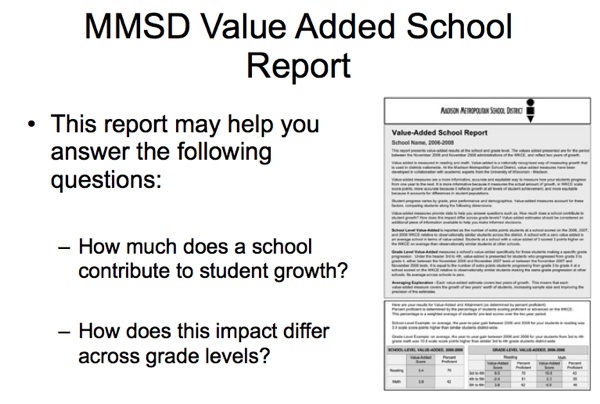
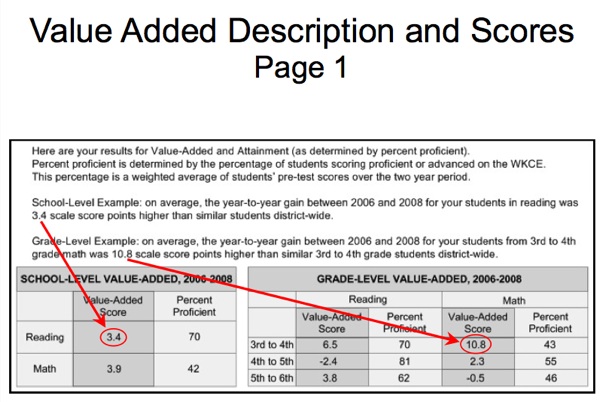
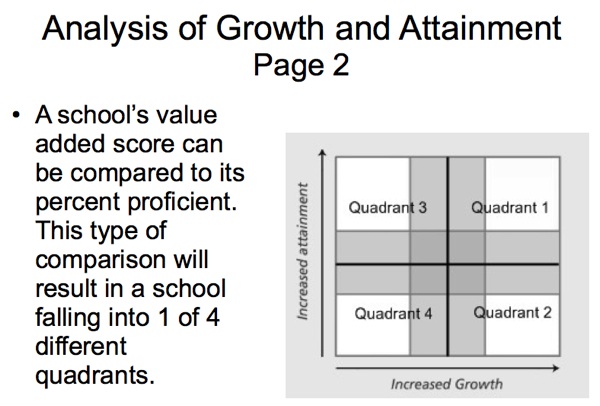
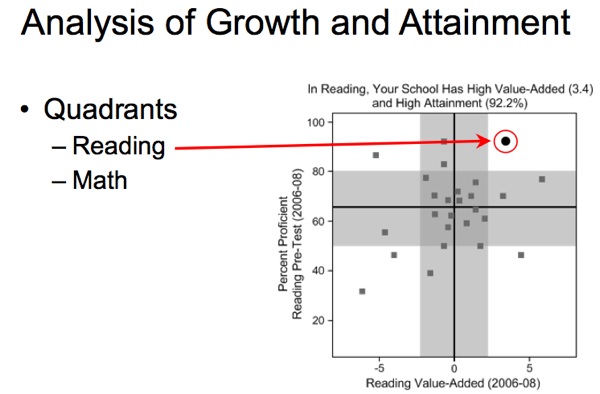
Value Added Assessment in Madison Presentation


Value Added Resource Center @ Wisconsin Center for Education Research

Complete report 1.4MB

Summary.

Much more on value added assessment here.


Madison’s value added assessment program is based on the oft-criticized wkce.

Share

‘Embedded honors’ program has issues

Mary Bridget Lee:

The controversy at West High School continues about the Madison School District’s new talented and gifted program. Students, parents and teachers decry the plan, pointing to the likelihood of a “tracking” system and increasingly segregated classes.
While I am in agreement with them here, I must differ when they mistakenly point to the current “embedded honors” system as a preferable method for dealing with TAG students.
The idea itself should immediately raise red flags. Teaching two classes at the same time is impossible to do well, if at all. Forcing teachers to create twice the amount of curriculum and attempt to teach both within a single context is unrealistic and stressful for the educators.
The system creates problems for students as well. There is very little regulation in the execution of these “embedded honors” classes, creating widely varying experiences among students. By trying to teach to two different levels within one classroom, “embedded honors” divides teachers’ attention and ultimately impairs the educational experiences of both groups of students.
While the concerns raised about Superintendent Dan Nerad’s plan are legitimate, “embedded honors” as a solution is not.

Lots of related links:

Share

A Collaboration to Transform Education in Los Angeles

L.A. Compact, via a David Baskerville email:

In February 2009, leaders from the Los Angeles Education Community publicly signed the L.A. Compact – a collaborative commitment to transform education in Los Angeles. The Compact signers have pledged to put the interests of students first. They have committed to work together to meet the following goals:

Goal 1: All students graduate from high school
Goal 2: All students have access to and are prepared for success in college
Goal 3: All students have access to pathways to sustainable jobs and careers

As part of their commitment, the signers pledged to release an initial data report in order to facilitate the measurement of their progress against these baselines in future years. The data in this report details Los Angeles Unified School District’s rates of graduation, enrollment, preparation, and more. It then follows LAUSD graduates and tracks their progress in post-secondary education. At this point in its development, the report highlights several important markers as we discuss collaborative opportunities for improvement. The measurements and their sources will continue to be refined and expanded over the coming years.

L.A. Compact.

Share

No Child Left Behind, perfection and caveats

Nick Anderson:

A couple of highly valued sources have taken issue with a story I wrote in today’s paper about the No Child Left Behind law.
The gist of their complaint, I believe, is that I did not walk readers through more of the fine print of the 2002 law to explain the context of the well-known goal of all students passing state tests by 2014. So let’s do that now.
First of all, here’s what the law says:
Section 1111 (b)(2)(F) Accountability–Timeline: Each State shall establish a timeline for adequate yearly progress. The timeline shall ensure that not later than 12 years after the end of the 2001-2002 school year, all students in each group described in subparagraph (C)(v) will meet or exceed the State’s proficient level of academic achievement on the State assessments under paragraph (3).
This excerpt from a rather long statute marks the core of the promise of No Child Left Behind. “All students” means what it says. “Shall ensure” is self-evident. “Proficient” means, essentially, passing the test. The requirement here is for states to chart a path toward 100 percent proficiency by 2014. Not 90 percent, or 80 percent, but 100 percent.

Share

Georgia’s DeKalb yanks 24 teachers from classroom on cheating allegations

Megan Matteucci and Jaime Sarrio:

Twenty-four DeKalb County educators have been reassigned to nonschool duties over irregularities in 2009 state testing that affected nine schools and possibly 1,400 students. The unidentified educators, both teachers and principals, could face losing their teaching licenses. The DeKalb District attorney will review the investigation conducted by the school system and determine if criminal charges are warranted.
DeKalb County schools Interim Superintendent Ramona Tyson said 29 current and former employees were referred to the state Professional Standards Commission.
Phil Skinner, AJC DeKalb County schools Interim Superintendent Ramona Tyson said 29 current and former employees were referred to the state Professional Standards Commission.
School officials told The Atlanta Journal-Constitution Thursday they referred 24 educators and five former employees to the Georgia Professional Standards Commission after an internal investigation uncovered numerous irregularities on the April 2009 Criterion-Referenced Competency Tests.
“No cheating has been proved and no one has come forward and admitted to cheating,” schools spokesman Jeff Dickerson said. “But we couldn’t have these individuals in the classroom right now. We made these decisions based on what is best for our students.”

More here.

Share

Building Sage (Open Source Math) on Amazon EC2

A quarter or two ago my son Andy took a rather unique course at the University of Washington. In his Math 480b: Programming for the Working Mathematician course, Andy learned about a number of important topics including the Unix command line, Python programming (including classes, exceptions and decorators). In the second half of the quarter they learned about the Sage open source math system.
The course ended by teaching the students how to make a genuine contribution to Sage. They were asked to find an open bug, figure out how to fix it, fix it, and to create and submit a patch. In essence, they learned a very practical skill that is taught all too rarely in school — how to be a contributor to an open source project. This is pretty significant. Despite the presence of the word “open”, I have come to learn that many people don’t understand the actual workings of the process. Walking the students through it, and having them make an actual contribution, will ensure that they leave school with this knowledge under their belt. With any luck it will be easier for them to find jobs and they’ll be more useful and more productive once they start.

Share

Public School Principals: No Good Deed Left Unpunished

Christian Schneider:

Over at the mothership, Sunny Schubert has a wonderful column about a teacher she knows that has attempted to infuse his school with a little class. Zach, the fresh faced 22 year old newbie, decided he needed to set himself apart from his 7th grade students, so he started wearing a tie to school. For this transgression, he was mocked by the veteran teachers, none of whom saw any reason to dress up for school. In a show of solidarity with their teacher, Zach’s students actually started wearing ties to school – while the other teachers took time out of their day to trash his classroom with gaudy neckties.
This story is good enough – but Schubert also mentions a wildly entertaining “scandal” brewing at Glendale Elementary School in Madison, which serves a large number of African-American children. (In fact, Glendale has the highest percentage of poor and minority students at any Madison elementary school.)
In 2005, Mickey Buhl took over as Glendale’s principal, with the purpose of instilling the school with a new attitude and more innovative techniques. Since he took over, the school’s test scores have risen dramatically.

Share

A rebellion at Madison West High School over new curriculum

Lynn Welch

When Paul Radspinner’s 15-year-old son Mitchell wanted to participate in a student sit-in last October outside West High School, he called his dad to ask permission.
“He said he was going to protest, and wanted to make sure I had no problem with it. I thought, ‘It’s not the ’60s anymore,'” recalls Radspinner. The students, he learned, were upset about planned curriculum changes, which they fear will eliminate elective class choices, a big part of the West culture.
“It was a real issue at the school,” notes Radspinner. “The kids found out about it, but the parents didn’t.”
This lack of communication is a main reason Radspinner and 60 other parents recently formed a group called West Cares. Calling itself the “silent majority,” the group this month opposed the new English and social studies honors classes the district is adding next fall at West, as well as Memorial. (East and La Follette High Schools already offer these classes for freshmen and sophomores.)
The parents fear separating smarter kids from others at the ninth-grade level will deepen the achievement gap by pushing some college-bound students into advanced-level coursework sooner. They also believe it will eviscerate West’s culture, where all freshmen and sophomores learn main subjects in core classes together regardless of achievement level.
“It’s a big cultural paradigm shift,” says parent Jan O’Neil. “That’s what we’re struggling with in the West community.”

Lots of related links:

Share

2010 State Teacher Policy Yearbook Blueprint for Change

National Council on Teacher Quality, via email:

Most states’ evaluation, tenure and dismissal policies remain disconnected from classroom effectiveness.

  • Teacher evaluation is a critical attention area in 42 states because the vast majority of states do not ensure that evaluations, whether state or locally developed, preclude teachers from receiving satisfactory ratings if those teachers are found to be ineffective in the classroom. In addition, the majority of states still does not require annual evaluations of all veteran teachers, and most still fail to include any objective measures of student learning in the teacher evaluations they do require.
  • In 46 states, teachers are granted tenure with little or no attention paid to how effective they are with students in their classrooms. While there are a few states that have vague requirements for some consideration of evidence, and a few others that promise that teacher evaluations will “inform” tenure decisions, only Colorado, Delaware, Oklahoma and Rhode Island demand that evidence of student learning be the preponderant or decisive criterion in such decisions.
  • Dismissal is a critical attention area in 46 states. There are at least two state leaders taking this issue head on. In Oklahoma, recent legislation requires that tenured teachers be terminated if they are rated “ineffective” for two consecutive years, or rated as “needs improvement” for three years running, or if they do not average at least an “effective” rating over a five-year teaching period. In Rhode Island, teachers who receive two years of ineffective evaluations will be dismissed. Any teacher with five years of ineffective ratings would not be eligible to have his or her certification renewed by the state.

Share

Fixing Teacher Tenure Without a Pass-Fail Grade

Andrew Rotherham

Education eyes were on Washington this week to see what President Obama would say about schools in his State of the Union address. But just as in 2010, if you really want to follow the action on education reform, it’s better to look toward the states. All the new governors (29), education chiefs (18 new ones elected or appointed since November) and legislators (nearly 1,600) mean things are more fluid in the states, where teacher tenure is becoming a major flash point. Florida and New Jersey are considering pretty much ending tenure altogether. And while those states may be ground zero for tenure battles, Idaho, Illinois, Indiana, Ohio and Pennsylvania are also considering significant changes.
Quick primer: When people refer to tenure for public-school teachers, what they’re really talking about is a set of rules and regulations outlining due process for teachers accused of misconduct or poor performance. The elaborate rules often make it nearly impossible to fire a teacher. Joel Klein, who recently stepped down as New York City schools chancellor, has pointed out that death-penalty cases can be resolved faster than teacher-misconduct cases. In some places, the due-process rules are part of collective-bargaining agreements, and in others they’re state law. In either case, there is a consensus among education reformers and some teachers’-union leaders that the rules need to be changed and the process streamlined. The contentious debate tends to be about how to modify what constitutes due process — as negotiators did in a landmark teachers’ contract in the District of Columbia in 2009 — rather than get rid of it altogether.

Share

Duncan’s school of wisdom

George Will:

“Since 1995 the average mathematics score for fourth-graders jumped 11 points. At this rate we catch up with Singapore in a little over 80 years . . . assuming they don’t improve.”
– Norman R. Augustine,
retired CEO of Lockheed Martin
What America needs, says one American parent, is more parents who resemble South Korean parents. Education Secretary Arne Duncan, 46, a father of a third-grader and a first-grader, recalls the answer Barack Obama got when he asked South Korean President Lee Myung-bak, “What is the biggest education challenge you have?” Lee answered: “Parents are too demanding.” They want their children to start learning English in first rather than second grade. Only 25 percent of U.S. elementary schools offer any foreign-language instruction.
Too many American parents, Duncan says, have “cognitive dissonance” concerning primary and secondary schools: They think their children’s schools are fine, and that schools that are not fine are irredeemable. This, Duncan says, is a recipe for “stasis” and “insidious paralysis.” He attempts to impart motion by puncturing complacency and picturing the payoff from excellence.

Share

Chinese University scraps exams to boost teaching of classic books

Elaine Yau:

Exams are out, the Great Books are in.
In a far-reaching overhaul of undergraduate education, Chinese University will scrap exams for most mandatory subjects and boost the teaching of both Western and Chinese classics.
The changes are part of the university’s preparation to lengthen degree courses from three years to four years next year.
Details of the overhaul revealed yesterday include a drastic reduction in the number of final exams for mandatory courses in general education, languages, physical education and information technology.
“We will focus on the classics by [authors such as] Adam Smith, Charles Darwin and Karl Marx. We want students to cite classics when thinking about modern problems,” said Leung Mei-yee, director of the university’s general education foundation programme.

Share

Low expectations and other forms of bigotry

The Economist:

SMALL rays of light can illuminate surprisingly large areas of darkness. The fuss continues to rumble on about the decision by Michael Gove, the education secretary, to publish revised school league tables showing how many pupils achieved a reasonable pass in five core subjects: English, maths, a foreign language, a science subject and either history or geography (a cluster of subjects that he is calling the English baccalaureate). This marked a sudden switch away from a system in which schools reported how many pupils gained a reasonable pass (an A, B or C grade) in any five subjects including English and maths.
As my colleagues in the Britain section reported earlier this month, this transparency ambush has already achieved one desired and desirable effect: to expose how many schools were boosting their scores by pushing pupils into soft, often vocational subjects which counted for as much as a pass in chemistry, French or history.

Share

Wisconsin NAEP science results exceed national average

Wisconsin DPI, via a kind reader’s email:

cience scores for Wisconsin students exceeded the national average on the National Assessment of Educational Progress (NAEP) science assessment, administered between January and March of 2009.
The state’s scale scores on the assessments were 157 at both fourth and eighth grades, eight points higher than the national scale scores of 149 for both grades. In state-by-state comparisons, Wisconsin’s results at fourth grade were higher than those in 27 states, not significantly different from those in 12 states, and lower than seven states. At eighth grade, Wisconsin’s results were higher than 27 states, not significantly different than 14 states, and lower than five states.

Jack Buckley

Today I am releasing the 2009 National Assessment of Educational Progress science results.
Students were assessed at the fourth, eighth, and twelfth grades. Over 156,000 students at grade 4, 151,000 at grade 8, and 11,000 at grade 12 took the assessment. We have national results for public and private school students at all three grades. At grades 4 and 8, we also have results for public school students in 46 states and the Department of Defense schools. The state samples were combined and augmented with sampled students from the four non-participating states plus the District of Columbia, along with a national sample of private school students, to create the full national samples for grades 4 and 8. The twelfth-grade sample is smaller because there are no state-representative samples at that grade.

WEAC statement.
NCES state profiles.

Share

The Future for Public Education in California

EdSource:

As California starts a new year and a new decade–with new state leadership–what major forces will affect public education? And how will they either help or hamper our schools’ ability to cope with the dual pressures of financial adversity and the need to improve student achievement?
Please join us for this year’s EdSource Forum and get a view of what this new decade holds from state and national leaders who see these issues, and the future for California public education, from a variety of different vantage points.

Share

Reading between the lines

The Economist:

WHAT good would a gathering of literary types be if it didn’t coincide with a little acrimony and rancour? South Asia’s largest book festival is under way in Jaipur, Rajasthan, a five-hour drive (if you’re lucky) from Delhi. From January 21st to the 25th a couple of hundred authors, tens of thousands of book-lovers and a few Nobel laureates cram the lawns of the Diggi palace in the Pink City.
The annual Jaipur Literature Festival is now big enough–32,000 attended last year; this year the tally will be much higher–that there should be no need for anyone to stir up controversy to get attention. Nonetheless, shortly before the event Hartosh Singh Bal, an (Indian) editor of a local magazine, accused William Dalrymple, a (British) writer who co-directs the festival, of being “pompous” and setting himself up as an arbiter of writers’ taste in the country.
Stung, Mr Dalrymple accused Mr Bal, in turn, of racism. A flurry of angry commentary has followed in the Indian press and beyond, along with a discussion of whether or why Indian writers crave foreign approval, especially from Brits.

Share

Young inventors prompt colleges to revamp rules

Alan Scher Zagier:

Tony Brown didn’t set out to overhaul his college’s policies on intellectual property. He just wanted an easier way of tracking local apartment rentals on his iPhone.
The University of Missouri student came up with an idea in class one day that spawned an iPhone application that has had more than 250,000 downloads since its release in March 2009. The app created by Brown and three other undergraduates won them a trip to Apple headquarters along with job offers from Google and other technology companies.
But the invention also raised a perplexing question when university lawyers abruptly demanded a 25 percent ownership stake and two-thirds of any profits. Who owns the patents and copyrights when a student creates something of value on campus, without a professor’s help?

Share

K-12 Tax & Spending Climate: New Mexico Gov. Susana Martinez: We ‘are not under-taxed; the government has simply over-spent’

Andrew Malcolm:

Like fellow Republican governor Nikki Haley of South Carolina, New Mexico’s new governor, Susana Martinez, is her state’s first female chief executive. She is also the nation’s first Latina governor, as Haley is the first woman governor in the United States of Indian descent.
But Martinez is not new to public service, having been a prosecutor for nearly a quarter-century. Her full biography is here. Her husband, Chuck Franco, has also had a long career in law enforcement. See the couple’s photo below greeting a little girl.
Last week with Alaska Gov. Sean Parnell’s State of the State address, we heard of the strong economy in the country’s largest state geographically. (For links to all of the state of the state addresses published on Top of the Ticket so far, please scroll to the bottom.)
With New Mexico, however, we return to the familiar 2011 governmental theme of deficits and the need to cut spending. Martinez hits that theme strongly, imposing several major changes from policies of her predecessor, Democrat Bill Richardson.
She has ordered the state jet sold, cut expenses at the governor’s residence by 55%, including letting go the two personal chefs who had been working there, cut her cabinet members’ salaries by 10% and frozen all new vehicle purchases, except for law enforcement, among other stringencies.

Share

Data reveal wide higher ed Dane County attainment gap

Todd Finkelmeyer::

The Chronicle of Higher Education released a nifty interactive map which shows the percent of those 25-and-older with at least a bachelor’s degree in each county across the United States.
This remarkable tool, which relies heavily on Census Bureau data, not only allows one to break college attainment figures down by gender and race (Asian, black, Hispanic, white) in each county, but also lets one compare these statistics decade to decade.
The good news is 44.4 percent of all residents 25-and-older in Dane County now have at least a bachelor’s degree. That’s the highest percentage of any county in the state and ranks among the national leaders.
Conversely, while 45.0 percent of whites here have a four-year degree, only 18.5 percent of blacks do. That 26.5 percentage point gap locally is larger than in Milwaukee County — which the Chronicle singles out as an area where the college attainment gulf between whites and blacks is especially wide.
Not that this gap in Dane County should stun anyone, says Sara Goldrick-Rab, an assistant professor of educational policy studies and sociology at UW-Madison.

Share

There is more than one way to teach a class

Sunny Schubert:


A young friend of mine – I’ll call him Zach because that is, indeed, his name – graduated from college last May and started his first teaching job in August: 7th-grade Spanish in a school with a fairly high population of low-income children.
Zach is a very good-looking young man, but I must emphasize the word “young” because he has, for lack of a better term, a baby face.
Well aware of the fact that he looks younger than some of his students, Zach decided last summer that every day, he would wear a dress shirt and tie to school.
This was a source of amusement for some of his students, who had apparently never seen a teacher wearing a tie before.
It was NOT amusing to his fellow teachers, however, some of whom apparently felt Zach was making them look bad.
One day, all the male teachers wore ties – loud ties, ugly ties, sloppy ties, with T-shirts and sweatshirts.

Share

Introducing Hispanics for School Choice

Aaron Rodriguez:

Hispanics for School Choice (HFSC), a non-profit organization founded in Milwaukee County, is hosting a coming out event at the United Community Center (UCC) on January 24th. It marks the first time in Wisconsin history that leaders in the Hispanic community have organized to expand the Milwaukee Parental Choice Program.
A Buzz at the State Capitol
Last week, Executive Board members of Hispanics for School Choice created somewhat of a buzz as they descended upon the State Capitol to circulate their legislative agenda. Associates from the American Federation of Children and School Choice Wisconsin accompanied HFSC in separate meetings with Senate Majority Leader Scott Fitzgerald, Assembly Speaker Jeff Fitzgerald, Education Committee Chair Steve Kestell, and Secretary of the Department of Administration Mike Huebsch to discuss a timetable of moving the School Choice program forward.
HFSC Board Members were also given exclusive entry to a closed caucus in the Grand Army of the Republic Hearing Room before Assembly Republicans – an access rarely granted to non-profit organizations of any sort for any reason. Before the 60-member caucus, Board Members of HFSC were introduced communicating the idea that HFSC aimed to be more of a resource to legislators than a needy lobbyist.

Share

The worst of “best practices”

Roxanna Elden:

District, county, and state education offices are fond of sharing “best practices” through professional development. The idea is to spread the word about strategies that work in some schools so other teachers can use these strategies and get the same great results. There are times when it works this way. Unfortunately, things can get complicated when the same people who pick and distribute best practices are also responsible for checking whether they are being done correctly, and when none of those people are current teachers. Here’s an example of how the sharing of best practices sometimes works once supervising offices get involved.
Phase one: A school seems to be successful in educating students in a given subject or demographic sub-group. Let’s call this School A.
Phase two: A team of people who want to know what made School A successful descends upon the school. They sit in the classrooms. They ask questions. Then the team comes back with a report that says something like, “Teachers at School A are successful because they ask students to make their own test using fill-in-the-blank test questions. This is a research-based report.”
Phase three: The information from the report is filtered through a series of people sitting in a quiet, student-less office. Materials are created. Packets are made.

Share

The Educationist View of Math Education

Barry Garelick:

In Jay Greene’s recent blog post, “The Dead End of Scientific Progressivism,” he points out that Vicki Phillips, head of education at the Gates Foundation misread her Foundation’s own report. Jay’s point was that Vicki continued to see what she and others wanted to see: “‘Teaching to the test makes your students do worse on the tests.’ Science had produced its answer — teachers should stop teaching to the test, stop drill and kill, and stop test prep (which the Gates officials and reporters used as interchangeable terms).”
I was intrigued by the education establishment’s long-held view as Jay paraphrased it. This view has become one of the “enduring truths” of education and I have heard it expressed in the various classes I have been taking in education school the last few years. (I plan to teach high school math when I retire later this year). In terms of math education, ed school professors distinguish between “exercises” and “problems”. “Exercises” are what students do when applying algorithms or routines they know and can apply even to word problems. Problem solving, which is preferred, occurs when students are not able to apply a mechanical, memorized response, but rather have to apply prior knowledge to solve a non-routine problem. Moreover, we future teachers are told that students’ difficulty in solving problems in new contexts is evidence that the use of “mere exercises” or “procedures” is ineffective and they are overused in classrooms. One teacher summed up this philosophy with the following questions: “What happens when students are placed in a totally unfamiliar situation that requires a more complex solution? Do they know how to generate a procedure? How do we teach students to apply mathematical thinking in creative ways to solve complex, novel problems? What happens when we get off the ‘script’?”

Share

Restoring the Faculty Voice

Dan Berrett:

Faculty members from the unions of public colleges from 21 states met this weekend in Los Angeles and committed to launching a campaign with a lofty goal: assuring the future of higher education.
Participants reviewed and many expressed support for a set of organizing principles contained in a draft document called “Quality Higher Education for the 21st Century” that was prepared by the California Faculty Association. It advocates for more scrupulous analysis of calls to reform higher education. “Wholesale embrace of change without careful thought and deliberation can take us in the wrong direction,” the document states, “not toward reforming higher education but, in fact, toward deforming precisely those aspects of American higher education that have made it the envy of the world.”

Share

A Breath of Fresh Air on Ed Reform

Melissa Westbrook:

I do wish I had attended the Washington Policy Center breakfast last week. One reason is the speaker was Dr. Andres Alonso, the head of Baltimore Schools. He sounds like an interesting guy and I would have liked to hear him in person.
However, a couple of readers (Greg is one), pointed out that there was coverage of his speech in this week’s Crosscut. What is interesting is he seems the non-firebreathing, anti-union, anti-parent Michelle Rhee. He came into an incredibly poor situation:
Only 35 percent of Baltimore’s students received high-school diplomas the year before Alonso arrived. Proficiency levels as measured by standardized tests were in the cellar. Over nine years the district lost 25,000 students, dwindling from 106,540 in 1999 to 81,284 in 2008.
In the same period the district gained 1,000 staff, Alonso said. With costs rising despite continuing enrollment declines, “baseline aid from the state to the city had doubled…. It was clearly an organization not sustainable over time.”
How could they lose over 25,000 students and gain 1,000 staff? Who was the superintendent before this guy?

Share

The art of good writing

Adam Haslett:

In 1919, the young EB White, future New Yorker writer and author of Charlotte’s Web, took a class at Cornell University with a drill sergeant of an English professor named William Strunk Jr. Strunk assigned his self-published manual on composition entitled “The Elements of Style“, a 43-page list of rules of usage, principles of style and commonly misused words. It was a brief for brevity. “Vigorous writing is concise,” Strunk wrote. “When a sentence is made stronger, it usually becomes shorter.” Half a century later, when preparing his old professor’s manuscript for publication, White added an essay of his own underlining the argument for concision in moral terms. “Do not overwrite,” he instructed. “Rich, ornate prose is hard to digest, generally unwholesome, and sometimes nauseating.” Strunk & White, as the combined work came to be known, was issued in 1959 and went on to become a defining American statement of what constituted good writing, with 10m copies sold, and counting. Its final rule summoned the whole: “Prefer the standard to the offbeat.”
Though never explicitly political, The Elements of Style is unmistakably a product of its time. Its calls for “vigour” and “toughness” in language, its analogy of sentences to smoothly functioning machines, its distrust of vernacular and foreign language phrases all conform to that disciplined, buttoned-down and most self-assured stretch of the American century from the armistice through the height of the cold war. A time before race riots, feminism and the collapse of the gold standard. It is a book full of sound advice addressed to a class of all-male Ivy-Leaguers wearing neckties and with neatly parted hair. This, of course, is part of its continuing appeal. It is spoken in the voice of unquestioned authority in a world where that no longer exists. As Lorin Stein, the new editor of the celebrated literary magazine The Paris Review, recently put it to me: “It’s like a national superego.” And when it comes to an activity as variable, difficult and ultimately ungovernable as writing sentences, the allure of rules that dictate brevity and concreteness is enduring.

Share

More choice in schools needed

James Gleason:

The Gleason Family Foundation has long had an intense interest in the quality of education. With great disappointment over the decades, we’ve watched our public education system continually fail to meet the needs of all children.
The education special interests tell us that the crisis in education is a fabricated one. But the growing body of achievement data overwhelmingly shows that K-12 student performance, particularly in urban school systems, has been middling at best, comparing unfavorably even to some Third World countries.
Rochester, like all too many urban school systems, graduates fewer than 50 percent of its students, many of whom are totally unprepared to meet the challenges of an increasingly high tech world.

Share

Virtual School Enrollment Cap Stifles Choice

James Wigderson:

Today marks the beginning of School Choice Week.
Well, members of the Wisconsin legislature have several important choices ahead of them as they look at the educational landscape in this state.
The temptation is to sweep our state’s educational problems under the rug with one heck of a broom for an excuse, “there is no money.”
To give in to that temptation would be wrong and there are steps the legislature can take to restore educational innovation and improve educational access without breaking the bank.
One of the steps would be to eliminate the cap on online public charter school enrollment. The cap is one of the most shameful educational policy holdovers from the Governor Jim Doyle era, and it needs to be repealed.

Share

Chinese schoolchildren to sit compulsory manners classes

Peter Foster:

From primary school onwards, Chinese children will now receive lessons in the art of queuing, good table manners, how to respect their elders and betters and the correct way to write letters, emails and even send SMS messages.
Older children will be tutored in the arts of introducing oneself to strangers, dealing politely with members of the opposite sex, making public speeches and the rudiments of dealing with foreigners and (to Chinese eyes, at least) their strange ways.
“The goal is to let students know that China is a country with a long history of civilisation, rituals and cultures,” said the guidelines which were published on the ministry’s website.

Share

Calculating the difference in New Jersey charter schools

Bob Braun:

It’s New Jersey School Choice Week. Gov. Chris Christie signed a proclamation encouraging all citizens to “join the movement for educational reform.”
Or, at least, his brand of reform, one that includes cutting $1 billion from traditional public schools while spending taxpayer money on independent schools that have somehow failed to enroll New Jersey’s neediest children, those with handicaps, language problems, and very low income.
In the last few days, the governor issued a study that purported to show charters “outperforming” traditional schools, approved 23 more charters, proposed laws making it easier to create the independent but publicly funded schools, and hired an organization run by Geoffrey Canada, the champion of New York charter schools, to try his magic in Paterson.
Some critics argue state studies comparing scores of charter schools with their home districts were not scientific and unbiased and, if they showed anything, proved test score averages can be improved by not enrolling children who don’t do well on standardized tests.

Share

It’s time for Oklahoma to excel in education

Bill Price:

The 2011 legislative session presents a historic opportunity for Oklahoma to lead in improving our children’s future through comprehensive education reform. The combination of a reform-minded Legislature, governor and state school superintendent, along with an engaged public, provides a unique window for passing the greatest educational improvements in our lifetime.
The first reform is choice in education through an educational tax credit scholarship act that follows the example of the states that have seen the most rapid improvement in educational achievement. This bill empowers parents to find the schools that will best meet their children’s needs, stimulates the creation of innovative scholarship schools, and provides the competition that has been proven to greatly improve the public schools.
Choice also is promoted by expanding the charter school laws, allowing the state schools superintendent to charter new schools, and freeing these highly successful charter schools to finance their own infrastructure needs.

Share

And Then What Happened?

Roger Rosenblatt:

I have a good feeling about this class. I’m going to like them. Liking a class is more practically useful than it sounds. In a likable class, discussions are freer, more open. When the students like one another, they take everyone’s work more seriously. In another class I taught, after a woman read a section of her novel aloud, another woman asked, “May I be your friend?” The first woman answered, “You already are.” The students will also feel safe with one another and will trust the group with personal information they use in their writing.
In my novel-writing workshop, a student wrote about a woman who was taking care of her husband, whose mind was deteriorating. She too was deteriorating from the effort. She told her story as a novel, but the students understood it was her own. They respect such disclosures. They unite with one another like a noisy brood of brothers and sisters. And they can always unite against me.

Share

Suitable to whom? Legislators defining a “suitable” education or curriculum for Kansas schools won’t necessarily keep the state out of court.

The Lawrence World:

From a practical standpoint, we would like to think that every action taken by the Kansas Legislature would be “suitable” for the state.
However, that word has spawned considerable controversy in Kansas as it pertains to education funding — controversy that has landed the state in court before and may do it again.
Gov. Sam Brownback wants to avoid that and many Kansans would agree with his contention that defending state laws in court is a poor use of precious resources. To that end, in his State of the State address, Brownback invited legislators to better define “a suitable education.”
Like many Kansans, Brownback quoted a term that actually doesn’t appear in Article 6 of the Kansas Constitution, which covers education. The actual wording is that the legislature “shall make suitable provision for finance of the educational interests of the state.” The sentence even appears under Section 6: Finance.

Share

Pro-school choice organization launched

Georgia Pabst:

Hispanics for School Choice, an organization designed to expand school choice programs, launched Monday at a gathering at the United Community Center.
The group’s legislative agenda includes:

  • Removing the enrollment cap in the Milwaukee Parental Choice Program.
  • Expanding choice schools to allow students from Milwaukee to attend schools throughout Milwaukee County.
  • Allowing all parents to participate in choice by lifting income limits.
  • Expanding school choice to other cities.

“Despite differences in political philosophies, our community agrees that school choice is educationally effective in educating our children, and we’re serious about getting the best for our children,” said Zeus Rodriguez, president of the organization.
The school choice movement has backed an array of options outside the traditional public school system. Proponents argue that such programs expand options for parents and pressure public schools to operate more efficiently. Critics argue that the choice program drains resources from public schools, and that public funds shouldn’t flow to private, often religious schools.

Share

Dumbed-down diplomas Low academic standards have students paying more for less

Craig Brandon:

The news that 45 percent of college students learn little or nothing during their first two years of college comes as no surprise to those who have been studying higher education. But it should serve as a wake up call for parents who go deeply into debt to purchase a very expensive diploma for their children.
The researchers who studied more than 2,300 undergraduates found that nearly half showed no significant improvement in the key measures of critical thinking, complex reasoning and writing by the end of their sophomore years. After four years, 36 percent of students still did not demonstrate significant improvement.
Undergraduate students just aren’t asked to do much, according to findings in the new book, “Academically Adrift: Limited Learning on College Campuses.” Half of students did not take a single course requiring 20 pages of writing during their prior semester. One-third did not take a single course requiring even 40 pages of reading a week.

Share

Austin superintendent rallies task force to get back to long-term plan

Melissa B. Taboada:

Austin schools Superintendent Meria Carstarphen met with facilities task force members Saturday to encourage them to broaden their scope and not to focus as much on the district’s looming budget crisis.
In recent weeks, the task force seemed to stray a bit from its mission of creating a 10-year plan on future schools, renovations and attendance zones. After it earlier this month named nine schools that could be closed for efficiency’s sake, outraged community members rallied to save their schools.
Although the long-term plan probably will have recommendations on closures, task force members said they felt pressured to produce short-term fixes to help the district get past one of the worst anticipated budget shortfalls in its history.
On Saturday, Carstarphen, in effect, told task force volunteers that was her burden, not theirs.
“There’s only so much in efficiencies you can do,” she said. “You can’t do it all. You don’t need to do it all.”

Austin School Board.
The Austin School District’s 2010-2011 budget is $973,997,900 for 86,000 students ($11,325.55 per student). Madison’s 2010-2011 budget is $379,058,945 (according to the January, 2011 “State of the District” presentation for 24,471 students. That is $15,490 per student.

Share

Let students make the right choice

Lindsay Burke:

Expect to hear the phrase “school choice” more than usual in the coming days. The fourth week of January is National School Choice Week, and advocates for educational freedom across the country will be highlighting its effectiveness for children.
Why school choice? Economist Milton Friedman best stated the philosophy behind it: “You can subsidize the producer or you can subsidize the consumer. In education, we subsidize the producer; we subsidize the school. If you subsidize the student instead, you would have competition. The student could choose which school he would go to, and that would force the schools to improve and to meet the tastes of their students.”
But you don’t have to get philosophical. Just ask the kids.

Share

The Difference Engine: More pennies, please

The Economist:

EVER since 1982, when the American penny (one-cent piece) ceased being minted from brass and started being made instead from zinc with a thin coating of copper, eighth-graders at some of the country’s more inspired schools have been given a nifty little experiment in electrochemistry to do for homework. Your correspondent’s 13-year-old came home recently with goggles and instructions to find the amounts of copper and zinc in a modern penny. While in class, each kid had first carefully weighed three such coins on a scientific balance. After that, the rest was up to them (and their dads).
The experiment is designed to test the pupils’ knowledge of the galvanic series, and the science that explains how corrosion occurs. The series lists metals according to their resistance to electrochemical reaction–with the “noblest” (eg, palladium, platinum and gold) at the top of the rankings, and the most reactive or “basest” (eg, beryllium, zinc and magnesium) at the bottom. Copper comes 11 places above zinc in the table. Thus, when the two metals share an electrolyte, the zinc (being much the more reactive) will dissolve into the solution long before the copper. In a similar way, zinc anodes attached to the hulls of ships protect the vessels’ steel plates from rusting away by being sacrificed instead.

Share

UW-Madison Professor Honored By President Obama

Channel3000:

President Barack Obama is honoring 11 people, including a University of Wisconsin-Madison engineering professor, for their mentoring efforts.
Douglass Henderson was named a recipient of the Presidential Awards for Excellence in Science, Mathematics, and Engineering Mentoring.
Henderson, 10 other people from around the nation and four organizations will receive the awards at a White House ceremony in the next week.

Share

Probation rallies Atlanta Public Schools supporters

Kristina Torres:

The threat to revoke the accreditation of Atlanta Public Schools last week was as ominous as a shark fin: Could one unruly school board somehow pull the whole city under?
Shortly after the school system was placed on probation, however, powerful interests in the city and state coalesced into a formidable defensive line. Loss of accreditation, they said, simply can’t happen.
“Come September, we will have an accredited, functioning school system,” state Rep. Edward Lindsey, R-Atlanta, said of a Sept. 30 deadline facing the school board to improve its governance. “We are all committed we will work our way through this … issue. That’s the most important message any of us could give.”

Share

George Washington University launches online prep school

Daniel de Vise:

George Washington University has opened a private college-preparatory high school that will operate entirely online, one of the nation’s first “virtual” secondary schools to be affiliated with a major research university.
The opening of a laboratory-style school under the banner of a prestigious university generally counts as a major event among parents of the college-bound. The George Washington University Online High School, a partnership with the online learning company K12 Inc., is competing with brick-and-mortar prep schools and with a small but growing community of experimental online schools attached to major universities.
Online learning may be the next logical step in the evolution of university “lab” schools, an ongoing experiment in pedagogy. Online instruction holds the potential to transcend the factory model of traditional public education, allowing students to learn at their own pace. In the ideal online classroom, no lesson is ever too fast or too slow, and no one ever falls behind.

Smart.

Share

Got Dough? How Billionaires Rule Our Schools

Joanne Barkan:

The cost of K-12 public schooling in the United States comes to well over $500 billion per year. So, how much influence could anyone in the private sector exert by controlling just a few billion dollars of that immense sum? Decisive influence, it turns out. A few billion dollars in private foundation money, strategically invested every year for a decade, has sufficed to define the national debate on education; sustain a crusade for a set of mostly ill-conceived reforms; and determine public policy at the local, state, and national levels. In the domain of venture philanthropy–where donors decide what social transformation they want to engineer and then design and fund projects to implement their vision–investing in education yields great bang for the buck.
Hundreds of private philanthropies together spend almost $4 billion annually to support or transform K-12 education, most of it directed to schools that serve low-income children (only religious organizations receive more money). But three funders–the Bill and Melinda Gates Foundation, the Eli and Edythe Broad (rhymes with road) Foundation, and the Walton Family Foundation – working in sync, command the field. Whatever nuances differentiate the motivations of the Big Three, their market-based goals for overhauling public education coincide: choice, competition, deregulation, accountability, and data-based decision-making. And they fund the same vehicles to achieve their goals: charter schools, high-stakes standardized testing for students, merit pay for teachers whose students improve their test scores, firing teachers and closing schools when scores don’t rise adequately, and longitudinal data collection on the performance of every student and teacher. Other foundations–Ford, Hewlett, Annenberg, Milken, to name just a few–often join in funding one project or another, but the education reform movement’s success so far has depended on the size and clout of the Gates-Broad-Walton triumvirate.

Share

Using an iPad as a Textbook

Laura Goode

For some classes at the University of Notre Dame, iPads are replacing textbooks — at least temporarily.
The school is studying the use of the Apple Inc. tablet among students to see how it affects learning, and after a test this fall found that students students thought the device made their class more interesting.
“Moments before the start of class, I could place a video into students’ dropboxes, and the majority of them would arrive having already watched it and able to discuss it. Those sorts of things made the class more interesting and dynamic and could never have happened in the past,” said Assistant Professor Corey Angst, the professor behind the project. Half of the students ultimately said they strongly agreed that the iPad made their project management course more interesting.
The study, called the eReader Project, looked at undergraduates in a project-management course at Notre Dame’s Mendoza College of Business this past fall. The sampling of students was small: 40 students in the course used Wi-Fi iPads for seven weeks of the semester; a second wave of 38 students received in the second half of the semester.

Share

New Jersey lawmakers advance school voucher program for students in failing schools

Jessica Calefati:

A state Senate committee voted Thursday to advance a program that would offer vouchers for students in failing public schools to attend private and parochial schools.
The Opportunity Scholarship Act is a signature piece of Gov. Chris Christie’s education reform agenda and another proposal over which he and the state’s largest teachers union are coming to blows. The New Jersey Education Association vehemently opposes the voucher program, calling it “a government bailout for struggling private schools.”
If implemented, the bill would cost about $825 million and serve 40,000 students in 166 chronically failing public schools by its fifth year. It could be a boon for parochial schools, which have been closing in droves because of declining enrollment, but could also force reductions in state aid to public school districts.

Share

Time for Change is Now – Milwaukee’s New Superintendent

Alan Borsuk:

If the Milwaukee Public Schools system keeps operating the way it is now, things just aren’t going to get much better. If we want things genuinely to improve, big changes need to be made. And the time for making changes is now.
I’m not presenting my views. I’m describing the views of Gregory Thornton.
With a half-year as superintendent of MPS behind him, he is beginning to make moves that are sure to define the success or failure of his time in Milwaukee – and may have a major impact on the shape of education in the city for years to come.

  • Lengthening school days and teacher workdays.
  • Giving administrators freer hands in hiring and assigning teachers.
  • Revising rules that make seniority the deciding factor in who gets laid off or reassigned when cuts are made.
  • Revamping teacher evaluations and maybe pay, including student performance as a factor.
  • Giving management more freedom to schedule training for teachers.
  • Revising the relationship between the School Board and the administration so the superintendent has a freer hand.

Share

Supporting Wisconsin School Reform

Wisconsin State Journal:

We heard encouraging words about school reform last week from Republican leaders in the state Legislature.
For starters, those leaders — Sen. Luther Olsen of Ripon and Rep. Steve Kestell of Elkhart Lake — both seem focused on change and flexibility, essential parts of any movement forward with our public schools. And both seem committed to reducing the mandates and state demands on local school systems.
That type of increased local control will be necessary not only to truly bring about change to public schools but also to maneuver them through an era of exceedingly tight budgets. Funding for schools no doubt will be squeezed as Gov. Scott Walker deals with the state’s $3 billion-plus deficit in his two-year budget proposal next month.

Share

Idahoans speak out on education reform

Jusin Corr:

It was a packed house today as teachers, parents, superintendents, and members of the community showed up to voice their concerns or approval for Superintendent of Public Instruction Tom Luna’s comprehensive plan for education reform.
It was also a historic day at the Statehouse as the Joint Finance-Appropriation Committee took public comment for the first time ever, and boy did they ever take public comment.
It was standing room only as people crowded in to give their 3-minute testimonies on Luna’s plan to overhaul K-12 education in Idaho.
“Hansen has been hit hard by the cuts to education,” said teacher Lauren Peters. “Unlike many districts, we were unable to pass our override levy. So our children lost out. Our drama and music classes are entirely gone.”
“We don’t have the money,” said Danielle Aarons, a mother. “We have to make cuts. It’s not fun, it’s hard. But at home, in our budgets, this is what we have to do. It’s simple math.”
The first major point of Luna’s plan includes merit pay for teachers and doing away with their tenure.
“Currently, there is no accountability system where districts, schools, or teachers are recognized or rewarded for top performance, or corrected when performance is poor,” said Colby Gull, Superintendent of Challis schools.

Share

Some schools giving desks the boot

Amy Hetzner:

Concentration broken only by the soft whispers of student questions, the fifth-graders in Hartland South Elementary School teacher Holly Albrecht’s class lounge on bean bags, perch on fabric cubes or lightly bounce on stability balls.
With the entire class studiously completing math tests, a couple of students choose to work at a table pushed to a corner during a redesign of Albrecht’s classroom. But the room’s sole desk goes abandoned.
Just changing the furniture by removing almost all of the desks and most of the chairs in her classroom has brought about changes in her students, Albrecht said, aiding concentration and providing more flexibility for how they learn. Other teachers in her school have taken notice and are planning changes of their own, budget allowing.
“The kids love it,” Albrecht said.
Although this is only a few teachers and only one school building, such moves to get rid of the traditional desk-and-chair design of an upper-elementary-grade classroom are part of a larger rethinking of the school experience.

Everything old is new again.

Share

State of the Madison School District – January, 2011

The Madison School District: 2.6MB PDF

The Report
The 2011 State of the District Report brings into focus the great strengths and challenges of the Madison Metropolitan School District, and sheds light on our strategies, plans and priorities for keeping all of the community’s children on a secure path toward learning and healthy development.
Mission Critical
The mission statement of the Madison Metropolitan School District focuses on our commitment to ensuring that our students develop a love of learning, and the necessary citizenship skills that will allow them to function effectively in an evermore complex world and be of assistance to the communities in which they reside.
MMSD In Context
Students:
The MMSD is the second largest school district in Wisconsin with 24,796 students. This is the 3rd Friday of September 2010 count and includes pre-kindergarten through 12th grade.
Student Population by Race/Ethnicity:
White 47%
African-American 24%
Hispanic 17%
Asian 10%
Multiracial 6%
Native American 1%

  • 49% Free and Reduced Price Lunch Students (37% State Avg.)
  • 17% English Language Learners (6% State Avg.)
  • 70 different languages spoken as the primary language in the homes of MMSD students
  • 15% Students with Disabilities (14.1% State Avg.)

Employees FTEs*
Total 6,286 3,853.4
Some employee groups:
Teachers 2,626 2,500.61
Substitutes 729 N/A
Educational Assistants 625 480.55
Custodians 211 211.0
* Full-time equivalent; 1.0 FTE = a full-time position
Financial Status:
With the 2009-10 fiscal year ending June 30, 2010, the Madison Metropolitan School District’s General Fund (10) expenditures were less than budgeted, allowing the district to increase fund balance over last year by $5.15 million, to $40.49 million.
The adopted 2010-11 budget continues to put resources where they are most needed – in the classrooms. The budgeted spending for all funds is a total of $379,058,945 which is an increase of $8,771,475 or 2.37% over 2009- 10.
The total property tax levy increased by $10,823,758 or 4.62%, with a mill rate increase of $0.88 or 8.65%. The following graph shows the breakdown of 2009-10 Actual Revenue by four major categories.

1.5MB complete report.

Share

Penn Law Professor Too Lazy To Come Up With New Multiple Choice Questions Causes Exam SNAFU

Elie Mystal:

=And here’s a good one: don’t reuse exam questions just because you are teaching at a different law school. It’s called “the internet,” professors. Your students have access to it and can find your old questions. If you put in just a little bit of work, you can come up with entirely new exam questions.
It’s your job! You get paid for it!
And if you do your job with minimal diligence, you won’t end up like Penn Law professor William Wilson Bratton, and we won’t have to write about you…
Last year, a visiting professor at NYU got into trouble for re-using exam questions. It’s a mistake that’s so easy to avoid that I’m surprised to see it happen again. But maybe we just need to post one of these stories every year to encourage professors to demonstrate basic competence stay on their toes.

Share

New Jersey Governor pitches plan to school reform advocates

Nora Muchanic:

Governor Chris Christie has some changes in mind when it comes to education in the Garden State.
Christie invited players in the education reform movement to Trenton on Wednesday for a showing of “Waiting for Superman”, the acclaimed documentary that looks at the failures of public education.
Christie said beforehand it’s his goal to turn those failures around.
“The failed teacher must be shown the door, bad schools must be closed and start over,” Gov. Christie said.
Hoping to give students in troubled districts more choices, the state has just approved the opening of 23 new charter schools across New Jersey. Charters are publicly funded schools that operate independently.

Share

The purpose of college in 2011

Christopher Howard:

The Purpose of College in 2011
There exists a familiar crescendo during the holiday season that achieves its apex as the New Year begins. If your family is like mine, it began with great anticipation about gifts, both receiving them and choosing just the right one.
But after the presents were opened and the last bit of leftover turkey devoured, we turned our attention to contemplating the purpose of the holidays and our ambitions for the upcoming New Year. As the president of one of America’s oldest institutions of higher learning, Hampden-Sydney College, I thought it appropriate to offer my comments on the purpose of a college, for higher education is, or should be, central to the ambitions of all our young men and women.
A bit of history is illustrative.
Universities, when they were established more than a thousand years ago, focused on educating clergy and instilling religious piety. Over the years, religious education was supplement and then supplanted by the notion of civic virtue and, eventually, by secular humanism which became the core purpose of institutions of higher learning. The 1800s gave rise to the German university with its graduate students and deliberate focus on research. The American concept of a liberal arts education, which included emphasis on teaching and, usually, the shaping of moral character, was shaken to its core as research universities attracted talented professors, eager students, and government and foundation dollars. But undergraduate students still needed some degree of moral formation or at least some growing up. Colleges and universities still have to address this need — particularly for the Millennials — our wonderfully over-programmed, over-achieving and, at times, over-confident young people born after 1979.

Share

New Jersey Tries to Duplicate Harlem Children’s Zone

Lisa Fleisher:

The methods behind the Harlem Children’s Zone education and social project have been praised by President Barack Obama and lionized in the film “Waiting for Superman.'” But the integrated approach to raising successful children has been tough to repeat — and now New Jersey is going to give it a try.
Officials in Paterson, N.J., will begin working with experts from the Harlem Children’s Zone to mimic the model, the Christie administration said Wednesday.
Few details were given about what exactly that might look like. Geoffrey Canada, the outspoken president of Harlem Children’s Zone, will work with city officials “over the coming weeks and months” to create a program. It’s unclear whether there will be additional federal, state or private funding for the Paterson experiment.

Share

Students, teachers profit from financial literacy

Felicia Thomas-Lynn:

Shekira Roby is only 11 years old, but she is already becoming fluent in the language of money.
She has studied the time value of money, the concept of risk and reward, as well as the importance of budgeting and most of all how to save.
“I’m almost up to $100,” said Roby, who has also become adept at counting money as one of four tellers at the in-school bank at the Business and Economics Academy of Milwaukee or BEAM, where she is a sixth-grader.
The type of learning she and others are engaged in at the school already is paying dividends toward her financial future, said Tim O’Driscoll, director for the Center for Economic Education at the Lakeland College Milwaukee Center.
“People have to save more at a younger age,” O’Driscoll implored. “In society, there is a tremendous lack of knowledge about personal finances and just basic economics.”

Share

The Private High School Option

Eliza Woolf:

During spring semester 2010, Katherine Parker (a pseudonym) resigned from her position as a tenure-track history professor at a regional comprehensive university, on the border between the South and the Midwest, to work at an elite private high school. She left, she says, for a number of reasons including low pay, frozen salaries, and cost-of-living adjustments that never came; insufficient resources for travel, research, and instruction; blatant administrative condescension toward faculty; and a poor personal fit with the region and its culture. There was also, Parker explains, “the sense that I was becoming more and more disconnected from my work — phoning it in because it no longer offered anything exciting.”
For three successive years, Parker attempted to find a better position within the ivory tower, and every year she was a finalist for “a great job.” But, in the end, each of the search committees offered her dream academic job to another candidate. In the midst of the 2009-10 job season, Parker decided that the plummeting state of the academic market meant that it was time to explore other options. She’d had enough. “Private school teaching attracted me because it combined the work I already knew I enjoyed with an institution that could support that work better (more resources, fewer students, more support for those students). It also promised a higher caliber of student.”

Share

Atlanta public high schools placed on probation

CNN:

Atlanta’s public school system was told Tuesday it has until September 30 to make progress on a series of recommendations or risk its high schools losing their certification, a fate that would affect the college hopes of many of the system’s graduates.
The probationary status stems from complaints that conflicts between members had severely hampered the school board’s ability to govern effectively, according to a statement from AdvancEd, the world’s largest school accrediting agency and the parent company of the Southern Association of Colleges and Schools.
“This is designed to improve the school system,” Mark Elgart, president and CEO of AdvancED, said at a news conference Tuesday. “The (school) board and the system have a choice here: They can choose to proactively take actions designed to improve it, building on these actions we have outlined, or they can fight it.”

Share

St. Paul (Minnesota) Schools Strategic Plan

St. Paul Public Schools

“Achievement, alignment and sustainability. We will focus all of our efforts in these three areas to build the strong schools that will become the heart, and the hope, of our communities.” Superintendent Valeria S. Silva
Strong Schools, Strong Communities is our strategy for improving education for all students – without exception or excuse. The plan focuses clearly on the needs of students.
Changes, which will be phased in over the next three years, will require us to think differently about some of our long-held beliefs. The changes reflect the best and most successful practices in urban education. They honor and support the elements that have been successful in Saint Paul.
The plan will allow our schools to focus on delivering an education that will reach not only the children who are thriving today in Saint Paul but all of the students in our district. And, we believe, the changes we are making will reconnect many students to the communities where they live – truly making the schools the heart of our community.
We invite you to learn more by clicking on any of the links below, or by attending an upcoming information session near you (see end of page for dates, times and locations).

Tom Weber has more.

Share

Education reform needs a new starting point

Kai Ryssdal:

I don’t know if you’ve been following the discussion that’s been out there the past week or so, about a book written by a Chinese-American woman named Amy Chua. It’s about the differences — the very big differences — between western and Asian styles of parenting. Suffice it to say that Amy Chua is a strict mom: A’s are the only grade that’s acceptable, three hours of piano practice every day is barely enough — that kind of thing.
Anyway, I’ve been wracking my brain trying to find a Marketplace angle to the thing. Commentator and educator Michelle Rhee says it’s all Marketplace.
MICHELLE RHEE: We’ve lost our competitive spirit. We’ve become so obsessed with making kids feel good about themselves that we’ve lost sight of building the skills they need to actually be good at things.

Share

Public School Districts – Return on Educational Investment: Madison Has a “Low ROI”

The Center for American Progress, via a kind reader’s email:

The Wisconsin school systems of Oshkosh and Eau Claire are about the same size and serve similar student populations. They also get largely similar results on state exams-but Eau Claire spends an extra $8 million to run its school system
This report is the culmination of a yearlong effort to study the efficiency of the nation’s public education system and includes the first-ever attempt to evaluate the productivity of almost every major school district in the country. In the business world, the notion of productivity describes the benefit received in exchange for effort or money expended. Our project measures the academic achievement a school district produces relative to its educational spending, while controlling for factors outside a district’s control, such as cost of living and students in poverty.
Our nation’s school system has for too long failed to ensure that education funding consistently promotes strong student achievement. After adjusting for inflation, education spending per student has nearly tripled over the past four decades. But while some states and districts have spent their additional dollars wisely–and thus shown significant increases in student outcomes–overall student achievement has largely remained flat. And besides Luxembourg, the United States spends more per student than any of the 65 countries that participated in a recent international reading assessment, and while Estonia and Poland scored at the same level as the United States on the exam, the United States spent roughly $60,000 more to educate each student to age 15 than either nation.
Our aims for this project, then, are threefold. First, we hope to kick-start a national conversation about educational productivity. Second, we want to identify districts that generate higher-than-average achievement per dollar spent, demonstrate how productivity varies widely within states, and encourage efforts to study highly productive districts. Third–and most important–we want to encourage states and districts to embrace approaches that make it easier to create and sustain educational efficiencies.
This report comes at a pivotal time for schools and districts. Sagging revenues have forced more than 30 states to cut education spending since the recession began. The fiscal situation is likely to get worse before it gets better because the full impact of the housing market collapse has yet to hit many state and local budgets. At a time when states are projecting more than $100 billion in budget shortfalls, educators need to be able to show that education dollars produce significant outcomes or taxpayers might begin to see schools as a weak investment. If schools don’t deliver maximum results for the dollar, public trust in education could erode and taxpayers may fund schools less generously.
While some forward-thinking education leaders have taken steps to promote better educational efficiency, most states and districts have not done nearly enough to measure or produce the productivity gains our education system so desperately needs. Some fear that a focus on efficiency might inspire policymakers to reduce already limited education budgets and further increase the inequitable distribution of school dollars. To be sure, our nation’s system of financing schools is unfair. Low-income and minority students are far more likely to attend schools that don’t receive their fair share of federal, state, and local dollars. But while the issue of fairness must be central to any conversation about education finance, efficiency should not be sacrificed on the altar of equity. Our nation must aspire to have a school system that’s both fair and productive.
Our emphasis on productivity does not mean we endorse unfettered market-based reforms, such as vouchers allowing parents to direct public funds to private schools. Nor do we argue that policymakers should spend less on education. Indeed, we believe neither of these approaches can solve the nation’s pressing education challenges. Transforming our schools will demand both real resources and real reform. As Education Secretary Arne Duncan recently said: “It’s time to stop treating the problem of educational productivity as a grinding, eat-your-broccoli exercise. It’s time to start treating it as an opportunity for innovation and accelerating progress.”

Madison’s results can be seen here. I asked Superintendent Dan Nerad what benefits citizens, students and parents received from Madison’s greater per student spending, then, for example, his former Green Bay school district in this recent interview.
Madison spent $15,241 per student according to the 2009-2010 Citizen’s Budget. I’ve not seen a 2010-2011 version.


Share

Schools Tested By Budget Cuts Learn New Strategies

Larry Abramson:

The size of classes in schools around the country is growing. Half the districts responding to a recent poll say they are increasing class size because of budget pressures. Many school officials fear this will hurt students.
But some education reformers say there are ways to boost class size and save money at the same time.
Marguerite Roza analyzes school spending for the Bill & Melinda Gates Foundation. She’s been watching districts deal with tight budgets through across-the-board cuts and other desperation moves.
Roza says she’s worried that schools view tight spending limits as a lose-lose proposition.

Challenging economic times present an opportunity to rethink many processes…

Share

Idaho K-12 Reform Plans Included Bargaining Transparency

Maureen Dolan:

Under the proposed plan, all new educators will have two-year contracts with raises and bonuses based on student achievement. Teachers with seniority will not be protected from workforce reduction layoffs, and collective bargaining will be limited to salary and wage-related benefits.
“We think that gives the local elected school board more control over the staff and the people that work in their schools,” Luna said.
The plan further requires that once agreements between local teachers unions and school boards are reached, they must be published online immediately by school districts. In addition, collective bargaining negotiations for those contracts must take place during open meetings, with parents, teachers and the public able to observe.
The state will publish a fiscal report card for every district showing per-pupil spending, how much of a district’s budget is going into the classroom, how much is spent on administration and how each district compares to other districts in the state.
Funding for the reform package aligns with the governor’s proposed K-12 public schools budget of $1.2 billion, and includes a multi-year spending strategy using revenue from some cost-saving measures to pay for other programs.

Share

Skandera: Time to raise the bar in New Mexico

Robert Nott:

The education secretary nominee fired off one of her first public salvos last week, and it was a dilly. Responding to Education Week’s Quality Counts grade of an F in K-12 Achievement and a D+ in Chance for Success in the report (though we got an overall grade of C), Hanna Skandera said, “It is unacceptable that New Mexico has an F in K-12 achievement and that our rankings have decreased each year. … For every decision that needs to be made, we will ask, ‘Are New Mexico students the winners in this decision?’ Our focus must be on the classroom.”
That’s the same argument all the challengers for Santa Fe’s board of education are making as they continue to hit the campaign trail this month (more on that in a moment).

Share

Struggling San Francisco schools ousting half their teachers

Jill Tucker:

Three San Francisco schools have begun the unsavory task of replacing half their teachers to fulfill a bargain that got them $5 million each in federal grants aimed at boosting test scores.
Bryant Elementary, Carver Elementary and Everett Middle are among 10 San Francisco schools that landed on the state’s list of the 188 lowest-performing schools and are now required to take drastic steps to turn themselves around.
All told, the three schools must replace 26 teachers. Those teachers will get first choice to occupy vacancies left by retiring teachers at other schools. Those who transfer will remain at their current jobs through this school year.

Share

A Review of the Nation’s Education Schools

National Council on Teacher Quality:

It’s never been done.
We’re going to do it.
Every year across the country, around a quarter of a million people enter the teaching profession. Almost all of them are prepared in the nation’s schools of education. If the country is serious about bending upward the curve of its students’ stagnant academic performance, improving the preparation of new teachers would seem to be a crucial step. And yet, very little is known about the quality of teacher preparation programs–their selectivity, the content and pedagogical knowledge that they demand that their teacher candidates master, or how well they prepare candidates for the rigors of the classroom. Without such knowledge, people thinking about becoming teachers can’t make informed choices about where to get trained, district superintendents and principals don’t know where to look for well-prepared teachers, and policymakers lack the means to sanction poorly performing education schools.

Share

Tight spenders among S.D. school districts tout efficiency

Josh Verges:

South Dakota public schools spent only 1.4 percent more per student in 2009-10 than they did the year before, and some of the leanest districts again are near Sioux Falls.
The average district spent $7,958 per student last school year on its general, special education and pension funds, up from $7,850 the year before, according to the South Dakota Department of Education.
Sioux Falls came in at $7,288 per student, which ranks 124th among 154 districts. At $6,018, Chester Area spent the least. Superintendent Mark Greguson said that with 345 students – not counting its online high school for those in Hutterites colonies – Chester is able to maximize its teaching staff.

Madison spent $15,241 per student in 2009-2010, according to the most recent Citizen’s Budget.

Share

Students, Teachers Praise Single-Gender Classrooms

Channel3000, via a kind reader’s email:

Marshall Middle School in Janesville is in its second year of offering single-gender classrooms, and students and teachers said the program has made a positive difference in their education.
Currently, more than 200 school districts around the country are testing out the teaching method, and about 10 schools in Wisconsin offer a single-gender classroom program.
Marshall Middle School teacher Charles Smith said getting eighth-grade boys and girls to agree on music isn’t easy. But his social studies class is girls only, and Smith said the class prefers to study to the music of Beyonce.
“If the kids are comfortable, they feel better about it. Then this is a good place for them,” said Smith.
Smith said the single-gender classroom is about making students feel comfortable.
While his students learn, he said he’s also learning how to better tailor his lessons.

Related: Madison Preparatory Academy

Share

A tale of two Seattle school districts

Nora Liu:

FOR decades, families in southeast Seattle have sent their children off every morning to low-performing neighborhood schools. And for equally as long, we have asked for better.
We have been told to be patient, that things will improve. We have been told that it’s not the school’s fault — it’s the children we send there. We have been told to be better parents. We have been told, because we are poor or immigrants or African American, that we shouldn’t expect academic success.
But we don’t believe this, and we are impatient. We know that across the country, children just like ours are excelling in school and succeeding in college.We are the Filipino Community of Seattle, East African Community Services, the Vietnamese Friendship Association, African American Community/Parent Coalition and more than a dozen other community organizations that represent the families and children of southeast Seattle. Together, we are the Southeast Seattle Education Coalition and we are tired of waiting.

Somewhat related: Madison School District 2007 Small Learning Community Grant Application

Share