School Information System

The science of science education

Irving Epstein:

More minority students need to be lured into the sciences. One program has been a resounding success.
At most universities, freshman chemistry, a class I’ve taught for nearly 40 years, is the first course students take on the road to a career in the health professions or the biological or physical sciences. It’s a tough course, and for many students it’s the obstacle that keeps them from majoring in science. This is particularly true for minority students.
In 2005, more than two-thirds of the American scientific workforce was composed of white males. But by 2050, white males will make up less than one-fourth of the population. If the pipeline fails to produce qualified nonwhite scientists, we will, in effect, be competing against the rest of the world with one hand tied behind our backs.
We’ve been able to survive for the last several decades in large measure because of the “brain drain” — the fact that the most able students from other countries, particularly China and India, have come here to study science at our best universities and, in many cases, have stayed to become key players in our scientific endeavors.

Share

Berkeley High May Cut Out Science Labs
The proposal would trade labs seen as benefiting white students for resources to help struggling students.

Eric Klein:

Berkeley High School is considering a controversial proposal to eliminate science labs and the five science teachers who teach them to free up more resources to help struggling students.
The proposal to put the science-lab cuts on the table was approved recently by Berkeley High’s School Governance Council, a body of teachers, parents, and students who oversee a plan to change the structure of the high school to address Berkeley’s dismal racial achievement gap, where white students are doing far better than the state average while black and Latino students are doing worse.
Paul Gibson, an alternate parent representative on the School Governance Council, said that information presented at council meetings suggests that the science labs were largely classes for white students. He said the decision to consider cutting the labs in order to redirect resources to underperforming students was virtually unanimous.
Science teachers were understandably horrified by the proposal. “The majority of the science department believes that this major policy decision affecting the entire student body, the faculty, and the community has been made without any notification, without a hearing,” said Mardi Sicular-Mertens, the senior member of Berkeley High School’s science department, at last week’s school board meeting.

La Shawn Barber has more.
Related: English 10.

Share

Times Guest Column on STEM Education

Charlie Mas:

There was a guest column in the Seattle Times by Bonnie Dunbar, the president and CEO of The Museum of Flight and a former astronaut, encouraging the community to support STEM education efforts.
The column itself was the usual pointless pablum that we typically see in these guest columns. Lots of goals with no action plan. The interesting bit, as usual, comes in the reader comments in which members of the community writes that we DON’T need more engineers because there are lots of them standing in unemployment lines and that engineering jobs are being outsourced to India and China or to people from India and China who come to the U.S. on guest worker visas.
This article is also written completely without reference to the ineffective math education methods adopted over the past ten years.

Share

New Programs Aim to Lure Young Into Digital Jobs

Steve Lohr:

Growing up in the ’70s, John Halamka was a bookish child with a penchant for science and electronics. He wore black horn-rimmed glasses and buttoned his shirts up to the collar.
“I was constantly being called a geek or a nerd,” he recalled, chuckling.
Dr. Halamka grew up to be something of a cool nerd, with a career that combines his deep interests in medicine and computing, and downtime that involves rock climbing and kayaking.
Now 47, Dr. Halamka is the chief information officer at the Harvard Medical School, a practicing emergency-ward physician and an adviser to the Obama administration on electronic health records.
Hybrid careers like Dr. Halamka’s that combine computing with other fields will increasingly be the new American jobs of the future, labor experts say. In other words, the nation’s economy is going to need more cool nerds. But not enough young people are embracing computing — often because they are leery of being branded nerds.

Share

Are we dumbing down 9th grade physics?

Jay Matthews:

I am keeping my weekly Extra Credit column alive on this blog with occasional answers to reader questions, the format of that column I did for many years in the Extras before they died. This teacher, Michael Feinberg (no relation to the co-founder of the KIPP schools with the same name), sent me a copy of an intriguing letter about physics he sent to the Montgomery County school superintendent, and agreed to let me get an answer and use it here.
Dear Dr. Weast:
I am a retired MCPS teacher; I taught Physics at both Kennedy H.S. and Whitman H.S. until the time that I retired in 2005. After retirement I have, on occasion, tutored Physics students.
When the 9th grade Physics curriculum was introduced I opposed it on the grounds that Physics should be taught at a higher mathematical level. While tutoring students in both grades 9 and 11/12 I see that this is true; students in 11th grade learn rigorous Physics with mathematical applications while students in 9th grade usually do descriptive worksheets. I believe that it unfair that students in 9 th grade receive the same honors credit for what is promoted as the same curriculum but is not the same.

Share

Will Cleveland High School Become Seattle Superintendent Maria Goodloe-Johnson’s Crown Jewel or Albatross?

Nina Shapiro:

As Seattle Public Schools released new details about its latest transformation plan for perpetually-troubled Cleveland High School over the past week, there’s been a collective eye roll among some teachers there.
“I’ve been here for 15 years and every other year we do this,” says math teacher David Fisher, referring to a long string of ballyhooed overhauls that the Beacon Hill school has embarked on at the behest of the district.
One thing is different: The district is promising to pour money into this reinvention of Cleveland as the School of Science, Technology, Engineering and Mathematics (STEM). It proposes to spend more than $4 million over the first three years, according to a report at last Wednesday’s school board meeting by Superintendent Goodloe-Johnson. That’s a lot of money for a school that is already up and running. (See the breakdown of spending on page 8 of this pdf.)

Melissa Westbrook has more.

Share

40 years later, chemistry show is still a hit

Deborah Ziff:

It would seem to hold all the appeal of listening to someone read the dictionary aloud.
But hundreds of people will pack into a room on the UW-Madison campus Saturday to attend a presentation on the properties of carbon dioxide, liquid nitrogen and zirconium.
In short, the choice activity in Madison on Saturday is a chemistry lecture.
If it sounds like a snooze, then you don’t know Bassam Shakhashiri.
This is the 40th time the UW-Madison professor has held his annual Christmas show extravaganza, otherwise known as “Once upon a Christmas cheery, in the lab of Shakhashiri.”
With a flair for showmanship, Shakhashiri is like a magician who wows audiences by using science, rather than sleight of hand or illusions. Beakers erupt with material, solutions turn psychedelic colors, chemicals explode thunderously – all to an audience oohing and ahhing as if they were watching Harry Houdini.

Share

Notes and Commentary on a Seattle STEM High School

Charlie Mas:

I attended the Cleveland STEM Community Meeting on December 4 with my wife and 8th grade daughter.
First, the important parts.
My daughter is excited about the program. To her it looks like a good mix of the academic challenge of Garfield with the more personalized instruction (and project-based learning) of NOVA. She got most excited when she saw a list of the possible classes in the Global Health Academy.
My wife and I are much more confident about the probability that the program will actually be there and that it will be something like what has been advertised.
There was a pretty good crowd of people there – I’d say about forty to fifty (not counting staff).
The folks from Cleveland who were there are excited about the program and have a very clear picture of the idea – the project-based learning, the integration of technology, the alignment between classes, the extended school day and accelerated schedule, etc.
The STEM program looks real and, to us, it looks good. They still have some things to work out. The schedule is inspired, but needs some tinkering. They haven’t figured out how to get the student:computer ratio to the promised 1:1. They are still missing a lot of the curricular elements – they haven’t found the puzzle pieces but they know what they have to look like.

Share

Job prospects drawing agriculture students

David Mercer:

Tristesse Jones will probably never drive a tractor or guide a combine through rows of soybeans at harvest time.
There isn’t a farm within miles of where she grew up on Chicago’s west side, but she’s set to graduate with a bachelor’s degree in crop sciences from the University of Illinois’ agriculture school next spring.
“People ask me what is my major, and they say ‘What is that? So you want to grow plants?’ ” Jones said.
She is one of a growing number of students being drawn to ag schools around the country not by ties to a farm but by science, the job prospects for those who are good at it and, for some, an interest in the environment.
Enrollment in bachelor’s degree programs in agriculture across the country grew by 21.8 percent from 2005 to 2008, from about 58,300 students to nearly 71,000, according to surveys conducted by the U.S. Department of Agriculture. And the numbers are likely higher – not all schools respond to the surveys.

Share

White House Plans Campaign to Promote Science and Math Education

Kenneth Chang:

To improve science and mathematics education for American children, the White House is recruiting Elmo and Big Bird, video game programmers and thousands of scientists.
President Obama will announce a campaign Monday to enlist companies and nonprofit groups to spend money, time and volunteer effort to encourage students, especially in middle and high school, to pursue science, technology, engineering and math, officials say.
The campaign, called Educate to Innovate, will focus mainly on activities outside the classroom. For example, Discovery Communications has promised to use two hours of the afternoon schedule on its Science Channel cable network for commercial-free programming geared toward middle school students.
Science and engineering societies are promising to provide volunteers to work with students in the classroom, culminating in a National Lab Day in May.

Share

Computer pioneer Sir Maurice Wilkes: vision and vacuum tubes

Jack Schofield:

Sir Maurice Wilkes, 96, one of the pioneers of British computing, strolls through the history the he helped create
Walk round the National Museum of Computing at Bletchley Park and sooner or later you’ll hear a cry of recognition and someone will say: “I remember using one of those.” It probably doesn’t happen often to The Millionaire, a mechanical calculator that went into production in 1893, but Sir Maurice Wilkes spotted it, adding: “We used to have one in the lab. I hope it’s still there.”
In this case, “the lab” was what became the Cambridge University Computer Lab, which Wilkes headed from 1945 until 1980. It was where he built Edsac, one of the world’s first electronic computers, using sound beams traversing baths of mercury for the memory units. Edsac (Electronic Delay Storage Automatic Calculator) first ran in May 1949, so this year a dinner was held to celebrate its 60th birthday. And, of course, to celebrate Wilkes himself, who is a bright, sharp 96 years of age, and has seen most of the history of computing at first hand.
How sharp? On seeing the museum’s air traffic control display, which fascinates many visitors, he immediately asks: “Where’s the radar?” Ah, well, there isn’t one. The displays are running real radar sequences but they’re recorded. Wilkes, the consummate hardware guy, doesn’t just see the screen, he looks to see how the whole system fits together.

Share

Blast ‘eyeQ’ with Science

Daniel Willingham:

Every week or two I get an email from a teacher, parent, or school board member seeking my opinion about a curriculum or product. I’m not a product reviewer, so until now I’ve declined. But some of the products seem so ill-conceived that I thought it was worth writing about them. So I’m starting an occasional series on this blog called “Hall of Shame” in which I’ll feature educational products that are unsupported or contradicted by scientific evidence, and yet are actually in use in schools.
eyeQ is a computer program currently being tested in Salt Lake City Schools which the makers describe as “an effective tool for Brain Enhancement, Reading Improvement, and Vision Therapy or Eye Training.” Near-sighted users are promised that they likely will see an improvement in their vision. Improvements in reading speed of 100% in less than one month are described as typical.
You can try the first lesson free at the website. You are encouraged to read at different paces (some that are clearly meant to be faster than you could possibly read), to follow a moving object as it appears and disappears at different spots on the screen, and to visualize an object expanding, guided by an oval that increases in size.

Share

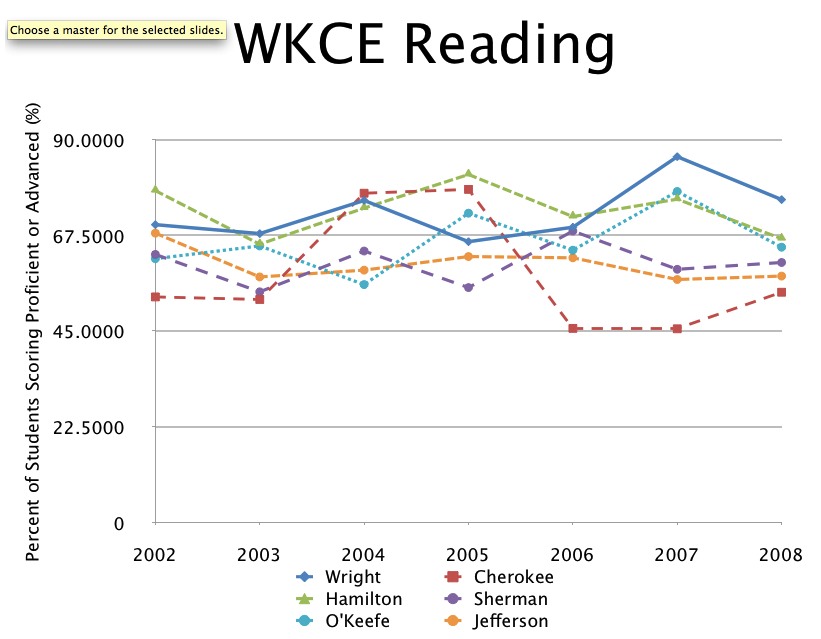
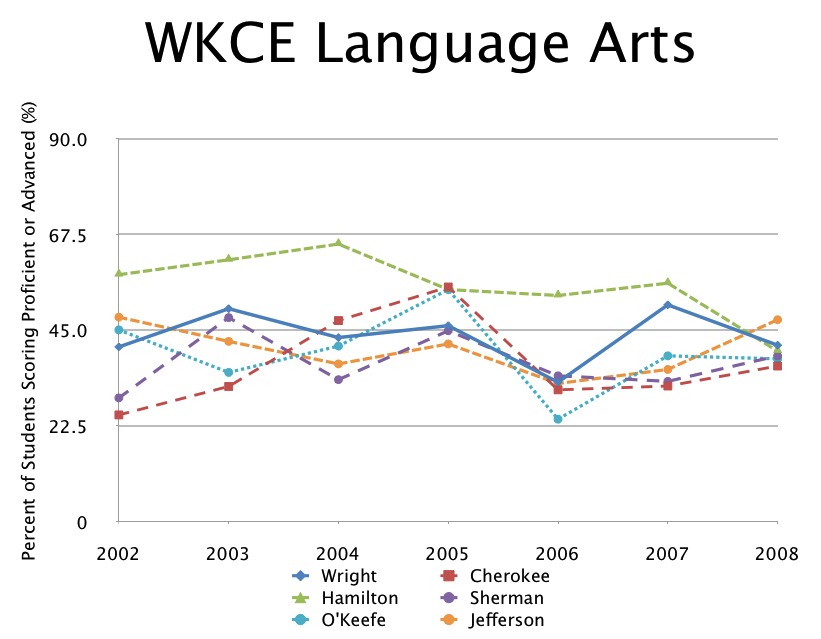
How Do Students at Wright Compare to Their Peers at Other MMSD Middle Schools?

Via Jeff Henriques:

Examining the performance of only economically disadvantaged students in 8th grade, after two years and a quarter at Wright Middle School, compared with other MMSD middle schools.

Click for a larger view:


Share

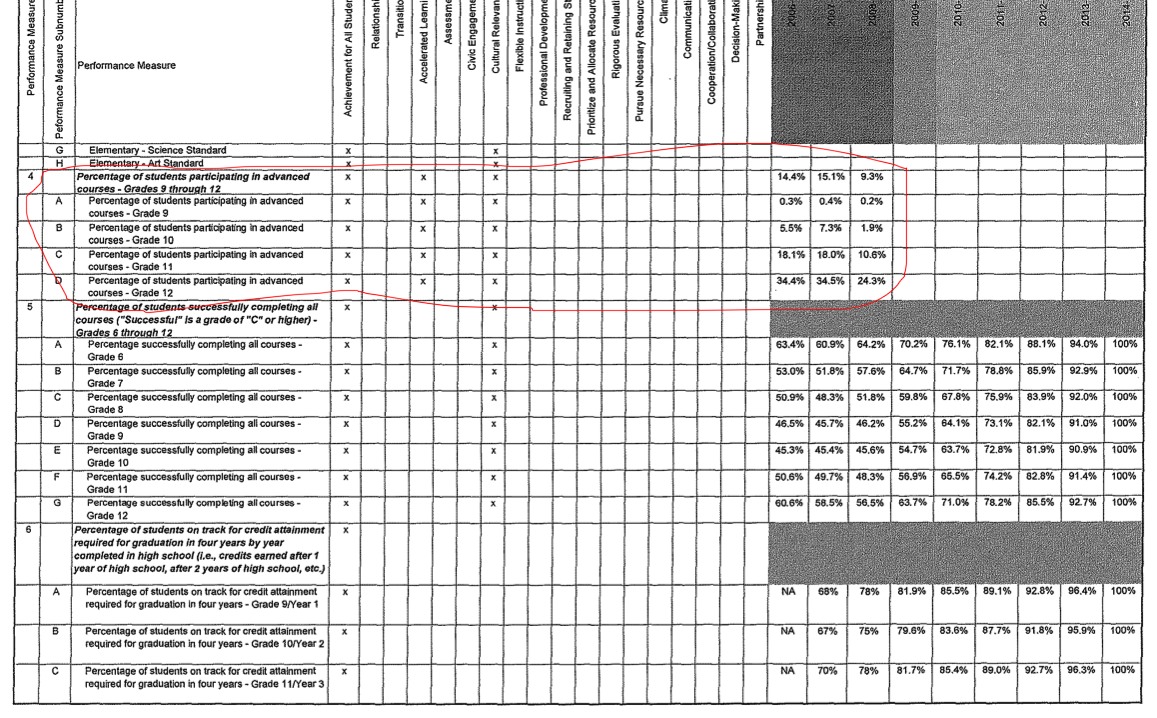
Madison School District Strategic Plan: Nirvana by 2014/2015?

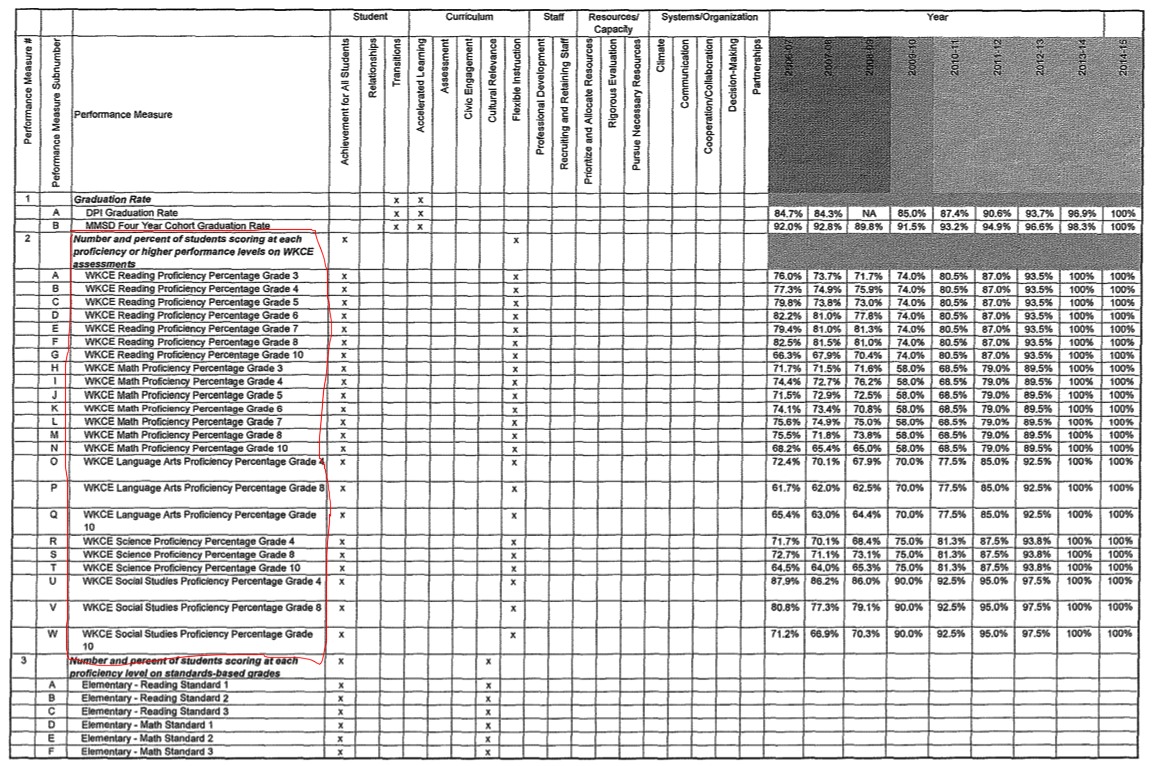
The Madison School Board recently passed the District’s Strategic Plan. Superintendent Dan Nerad has now published a draft document outlining performance measures for the plan (this is positive). The 600K PDF document is well worth reading. Mr. Nerad’s proposed performance measures rely on the oft criticized – for its lack of rigor – state exam, the WKCE. The Wisconsin Department of Public Instruction recently stated that “Schools should not rely on only WKCE data to gauge progress of individual students or to determine effectiveness of programs or curriculum“.
A few highlights from the 600K PDF document:

Related:

Discussing these data is a step in the right direction. Unfortunately, use of the WKCE does not instill much confidence, from my perspective.

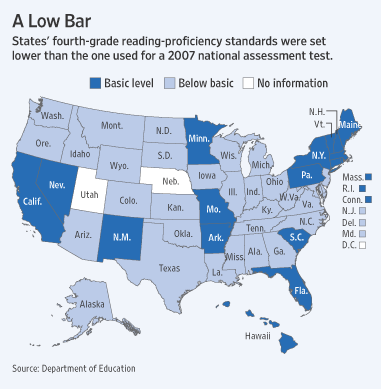
via “Some States Drop Testing Bar” by John Hechinger.
Happy Halloween!

Share

Why We’re Failing Math and Science

Wall Street Journal:

The problem is well-known: The U.S. lags far behind other developed countries at the K-12 level in terms of measured performance in math and science courses.
What can be done to change that? The Wall Street Journal’s Alan Murray posed that question to three experts: Joel Klein, chancellor of the New York City Department of Education; Amy Gutmann, president of the University of Pennsylvania; and Christopher Edley Jr., dean of the law school at the University of California at Berkeley, who was also a member of the Obama administration transition team working on education issues.
Here are edited excerpts of their discussion:
It’s the Teachers
ALAN MURRAY: What will it take to get the American system up to the level of some of the other developed countries in terms of math and science education?
JOEL KLEIN: The most important thing is to bring to K-12 education college graduates who excel in math and science. Those countries that are doing best are recruiting their K-12 teachers from the top third of their college graduates. America is recruiting our teachers generally from the bottom third, and when you go into our high-needs communities, we’re clearly underserving them.
MR. MURRAY: How do you explain that? It doesn’t seem to be a function of money. We spend more than any of these other countries.
MR. KLEIN: We spend it irrationally. My favorite example is, I pay teachers, basically, based on length of service and a few courses that they take. And I can’t by contract pay math and science teachers more than I would pay other teachers in the system, even though at different price points I could attract very different people. We’ve got to use the money we have much more wisely, attract talent, reward excellence.

Share

Stillwater, MN 9th Grade AP Geology students use new technology to map data

James Warden:

Brady Tynen needed to find out which states have the largest concentrations of people with mixed American Indian-African American ancestry. The Stillwater Junior High ninth-grader could have pored through the U.S. Census database, noted the appropriate percentage, ranked the states in a list and tried to divine some trend.
Then again, his geography class is just 50 minutes long, and Tynen needed to repeat Wednesday’s exercise two more times for different groups.
Thankfully, the Census website can show the information on a map with the press of a few buttons. In mere minutes, Tynen could tell that the group he was looking at is concentrated in the eastern U.S., particularly southern states like Louisiana, Mississippi and Georgia.
“Maps are a good way to find out all sorts of things,” he said. “It’d be kind of hard if you didn’t have a map because maps organize your data.”
The exercise gave students in Sara Damon’s ninth-grade Advanced Placement geography class a taste of a technology called geographic information systems (GIS). GIS is simply technology that merges data with maps. Something as basic as Google Maps can be considered GIS because it links a map to data, in that case street addresses.

Stillwater high school offers 17 Advanced Placement classes, according to the AP Course Audit Website.

Share

Beware The Reverse Brain Drain To India And China

Vivek Wadhwa:

I spent Columbus Day in Sunnyvale, fittingly, meeting with a roomful of new arrivals. Well, relatively new. They were Indians living in Silicon Valley. The event was organized by the Think India Foundation, a think-tank that seeks to solve problems which Indians face. When introducing the topic of skilled immigration, the discussion moderator, Sand Hill Group founder M.R. Rangaswami asked the obvious question. How many planned to return to India? I was shocked to see more than three-quarters of the audience raise their hands.
Even Rangaswami was taken back. He lived in a different Silicon Valley, from a time when Indians flocked to the U.S. and rapidly populated the programming (and later executive) ranks of the top software companies in California. But the generational difference between older Indians who have made it in the Valley and the younger group in the room was striking. The present reality is this. Large numbers of the Valley’s top young guns (and some older bulls, as well) are seeing opportunities in other countries and are returning home. It isn’t just the Indians. Ask any VC who does business in China, and they’ll tell you about the tens of thousands who have already returned to cities like Shanghai and Beijing. The VC’s are following the talent. And this is bringing a new vitality to R&D in China and India.
Why would such talented people voluntarily leave Silicon Valley, a place that remains the hottest hotbed of technology innovation on Earth? Or to leave other promising locales such as New York City, Boston and the Research Triangle area of North Carolina? My team of researchers at Duke, Harvard and Berkeley polled 1203 returnees to India and China during the second half of 2008 to find answers to exactly this question. What we found should concern even the most boisterous Silicon Valley boosters.

Share

Disruptive Innovation: Nature’s Scitable Replaces Life Sciences Textbooks

Patty Seybold:

Just over a year ago, Nature Publishing Group’s new Education Division quietly launched the Beta of a revolutionary idea: Replace expensive textbooks with a free collaborative learning space for science. Scitable.com went live in January, 2008 and has quickly become a magnet for serious students of genetics (the first field that Nature is addressing).
Now, a year after its beta, Scitable.com is alive and well. Students and faculty from all over the world are actively using Scitable’s resources to teach and learn about genetics.
What can you do on Scitable?

Share

Madison Homeschool families replicate space station

Amelia Vorpahl:

A group of 13 Madison-area kids and their families replicated the International Space Station at Elver Park Friday, using over a mile of plastic tape, and spanning nearly two soccer fields.
The six families who participated in constructing the two-dimensional model are part of a network of homeschooled children and their parents in the Madison area. Each family chose sections of the space station to research and construct, and then made signs explaining their parts’ size and function.
David Dexheimer, activity organizer and parent of one of the children participating, said the goal of the project was to teach the kids about how the space station works. He said he came up with the idea a few weeks ago by looking at a NASA educational website.
“I’ve always been into space stuff and so is my daughter,” Dexheimer said. “This just worked into our curriculum well, in terms of all the math and science you need.”
The families arrived at the park around 8:30 a.m. and started constructing the model with plastic barricade tape, secured to the ground with golf tees.

Share

Artificial life is only months away, says biologist Craig Venter

Mark Henderson:

Artificial life will be created within four months, a controversial scientist has predicted. Craig Venter, who led a private project to sequence the human genome, told The Times that his team had cleared a critical hurdle to creating man-made organisms in a laboratory.
“Assuming we don’t make any errors, I think it should work and we should have the first synthetic species by the end of the year,” he said.
Dr Venter, who has been chasing his goal for a decade, is already working on projects to use synthetic biology to create bacteria that transform coal into cleaner natural gas, and algae that soak up carbon dioxide and turn it into hydrocarbon fuels. Other potential applications include new ways of manufacturing medicines and vaccines.
Dr Venter’s prediction came after scientists at his J. Craig Venter Institute, in Rockville, Maryland, announced that they had developed a new method of transplanting DNA into bacteria, promising to solve a problem that has held up the artificial life project for two years.

Share

My summer at the Woodstock for technologists

Simon Daniel:

It’s not every day you move an atom with a mouse click. But this is precisely what I do one day at the Singularity University, a new institution supported by Google and Nasa, which aims to educate a select group of entrepreneurs and scientists about the rapid pace of technology.
The class of 40 students – who are taking time out of their working lives – has settled into a busy routine. Our 12-hour days are crammed with experiments, visits to technology centres including IBM and Willow Garage, and discussion with experts. The purpose is to open our eyes to the pace of change and future possibilities.
On Wednesday we arrive at IBM Almaden research centre, a series of black glass buildings in the hills near San Jose. Unassuming office doors open to reveal scientists working away in a scene reminiscent of a sci-fi movie. We meet Kevin Roche, who is building complex machines that can deposit thin films of atoms to form nano-scale devices.
This is where, in 1989, the physicist Donald Eigler built a scanning tunnelling microscope and demonstrated the ability precisely to manipulate individual atoms by rearranging xenon atoms to spell out IBM. In homage, we use a similar machine and write SU (for Singularity University) by selecting iron atoms with a mouse and nudging them across the screen.
We open another door and witness magnetic “racetrack” memory experiments. This is the idea of storing data in magnetic field domains that can then slide or “race” along nano-wires so they can be read quickly. The idea may help our future portable devices to store hundreds of times more video.

Share

Schools Boost Science, Math With Hands-On Teaching

Christy Goodman:

To answer the age-old question “When am I going to use this?,” school systems in Calvert, Charles and St. Mary’s counties are working to enrich their science, technology, engineering and mathematics programs by using hands-on teaching, guest speakers and real-world experiments and applications.
Charles is expanding its Gateway to Technology to all middle schools after a successful pilot program last year, school system spokeswoman Katie O’Malley-Simpson said. The program is part of the nationally recognized Project Lead the Way curriculum, which supports engineering and science.
“It focuses on showing, rather than telling, students how to use engineering in everyday problems,” O’Malley-Simpson said. “They see that because they are applying their skills as they learn them.”

Share

US Students are Average on International Tests

US Department of Education:

Major findings include:
Reading
In PIRLS 2006, the average U.S. 4th-graders’ reading literacy score (540) was above the PIRLS scale average of 500, but below that of 4th-graders in 10 of the 45 participating countries, including 3 Canadian provinces (Russian Federation, Hong Kong, Alberta, British Columbia, Singapore, Luxembourg, Ontario, Hungary, Italy, and Sweden).
Among the 28 countries that participated in both the 2001 and 2006 PIRLS assessments, the average reading literacy score increased in 8 countries and decreased in 6 countries. In the rest of these countries, including the United States, there was no measurable change in the average reading literacy score between 2001 and 2006. The number of these countries that outperformed the United States increased from 3 in 2001 to 7 in 2006.
Mathematics
The 2007 TIMSS results showed that U.S. students’ average mathematics score was 529 for 4th-graders and 508 for 8th-graders. Both scores were above the TIMSS scale average, which is set at 500 for every administration of TIMSS at both grades, and both were higher than the respective U.S. score in 1995.
Fourth-graders in 8 of the 35 other countries that participated in 2007 (Hong Kong, Singapore, Chinese Taipei, Japan, Kazakhstan, Russian Federation, England, and Latvia) scored above their U.S. peers, on average; and 8th-graders in 5 of the 47 other countries that participated in 2007 (Chinese Taipei, Korea, Singapore, Hong Kong, and Japan) scored above their U.S. peers, on average.
Among the 16 countries that participated in both the first TIMSS in 1995 and the most recent TIMSS in 2007, at grade 4, the average mathematics score increased in 8 countries, including in the United States, and decreased in 4 countries. Among the 20 countries that participated in both the 1995 and 2007 TIMSS at grade 8, the average mathematics score increased in 6 countries, including in the United States, and decreased in 10 countries.
In PISA 2006, U.S. 15-year-old students’ average mathematics literacy score of 474 was lower than the OECD average of 498, and placed U.S. 15-year-olds in the bottom quarter of participating OECD nations, a relative position unchanged from 2003.
Fifteen-year-old students in 23 of the 29 other participating OECD-member countries outperformed their U.S. peers.
There was no measurable change in U.S. 15-year-olds’ average mathematics literacy score between 2003 and 2006, in its relationship to the OECD average, or in its relative position to the countries whose scores increased or decreased.
Science
The 2007 TIMSS results showed that U.S. students’ average science score was 539 for 4th-graders and 520 for 8th-graders. Both scores were above the TIMSS scale average, which is set at 500 for every administration of TIMSS at both grades, but neither was measurably different than the respective U.S. score in 1995.
Fourth-graders in 4 of the 35 other countries that participated in 2007 (Singapore, Chinese Taipei, Hong Kong, and Japan) scored above their U.S. peers, on average; and 8th-graders in 9 of the 47 other countries that participated in 2007 (Singapore, Chinese Taipei, Japan, Korea, England, Hungary, the Czech Republic, Slovenia, and the Russian Federation) scored above their U.S. peers, on average.
While there was no measurable change in the average score of U.S. 4th-graders or 8th-graders in science between 1995 and 2007, among the other 15 countries that participated in the 1995 and 2007 TIMSS at grade 4, the average science score increased in 7 countries and decreased in 5 countries; and among the other 18 countries that participated in both the 1995 and 2007 TIMSS at grade 8, the average science score increased in 5 countries and decreased in 3 countries.
In PISA 2006, U.S. 15-year-old students’ average science literacy score of 489 was lower than the OECD average of 500, and placed U.S. 15-year-olds in the bottom third of participating OECD nations. Fifteen-year-old students in 16 of the 29 other participating OECD-member countries outperformed their U.S. peers in terms of average scores.
Technical notes about the data sources, methodology, and standard errors are included at the end of this report.

Joanne has more.

Share

Wolfram|Alpha Chemistry 101

Wolfram:

This week the American Chemical Society (ACS) is holding its Fall 2009 National Meeting & Exposition in Washington, DC, USA. In honor of professional chemists, educators, and students, we’re celebrating chemistry this week. If you are attending the meeting and would like a personal introduction to Wolfram|Alpha or the technology behind it, drop by the Wolfram Research booth, #2101.
Wolfram|Alpha contains a wealth of chemistry data, and provides you rapid computations that ensure accuracy and save time. Wolfram|Alpha is also an incredible learning tool, especially for new chemistry students looking for ways to learn, understand, compare, and test their knowledge of chemistry basics. Many of the topic areas found on an introductory or advanced course syllabus can be explored in Wolfram|Alpha.
Need to compute how many moles are in 5 grams of iron? Query “how many moles are in 5 grams of iron?”, and Wolfram|Alpha quickly computes your input and returns a result, along with unit conversions.

Share

Life is transformed

Financial Times Editorial:

Genetic engineering is beginning to live up to its name. Over the past 30 years it has meant transferring existing genes, one at a time, between organisms. Now – under the banner of “synthetic biology” – scientists are using the principles of systems engineering to transform whole organisms and potentially even to create novel forms of life.
Synthetic biology is sufficiently different from old-style genetic engineering to need a new system of regulation and governance, plus a fresh effort by its practitioners to tell the public what they are up to. Enormous benefits could flow from their work – practical pay-offs, such as new medicines and biofuels, as well as scientific insights into the nature of life.
But there are serious concerns too. First is bio-safety. Synthetic biology involves the production of novel living organisms that are self-replicating and potentially uncontrollable if something goes wrong.
Such fears were voiced in the mid-1970s when scientists first discovered how to snip a piece of DNA out of one organism and splice it into another. Indeed everyone in the field agreed to a voluntary moratorium on genetic engineering while they considered the safety consequences. Soon work resumed and, to this day, no serious accident can be blamed on the genetic manipulation of microbes.

Share

For Today’s Graduate, Just One Word: Statistics

Steve Lohr:

At Harvard, Carrie Grimes majored in anthropology and archaeology and ventured to places like Honduras, where she studied Mayan settlement patterns by mapping where artifacts were found. But she was drawn to what she calls “all the computer and math stuff” that was part of the job.
“People think of field archaeology as Indiana Jones, but much of what you really do is data analysis,” she said.
Now Ms. Grimes does a different kind of digging. She works at Google, where she uses statistical analysis of mounds of data to come up with ways to improve its search engine.
Ms. Grimes is an Internet-age statistician, one of many who are changing the image of the profession as a place for dronish number nerds. They are finding themselves increasingly in demand — and even cool.
“I keep saying that the sexy job in the next 10 years will be statisticians,” said Hal Varian, chief economist at Google. “And I’m not kidding.”

Share

Bill Gates: Tough US immigration stance a ‘huge mistake’; Seeks More exceptions for ‘smart people’

Austin Modine:

Bill Gates called US immigration restrictions a “huge mistake” while on tour of India today, urging America to open its golden doors for more “smart people.”
The Microsoft billionaire spoke out on US immigration at a software CEO forum Monday in New Deli while visiting the country to receive the Indira Gandhi Prize for Peace, Disarmament, and Development.
“I have been speaking about some of the immigration restrictions that the US has got involved in, and they are terrible for the US and also terrible for the world,” India’s national newspaper The Hindu quotes Gates saying. “The US Congress is very tough on immigration, in general. And my position has been, well, that is unfortunate, but what about making an exception for smart people, people with engineering degrees and letting such people come in.”
Adding that Microsoft has always been against tougher immigration laws, Gates said stricter US policy would be a “huge mistake.”

Share

Education reform in Massachusetts A chance for charters

The Economist:

Independent public schools may be getting a chance in the Bay State
MASSACHUSETTS ranks at or near the top of national measures of how well schoolchildren do at reading and mathematics. A leader in early-years education, it is also applauded for its vocational, technical and agriculture schools. Still, there are problems. The disparity between students in affluent districts and those in low-income urban ones is shocking. In the Concord/Carlisle school district, for instance, 92% of students graduated from high-school on time and planned to attend a four-year college or university in 2007, compared with just 12.8% in Holyoke, one of the poorest cities in the state.
Many states have turned to charter schools (self-governing publicly-funded schools) to close achievement gaps like that, but charters are a tricky subject in Massachusetts even though the few they do have, such as Boston Collegiate, are among the best in the country. Unions abhor them while the school boards that run most public schools fear losing power and funding. Politicians have been unwilling to take on Massachusetts’s mighty unions.
Last year Deval Patrick, the self-styled “education governor” of the state, unveiled a 55-point plan to overhaul the state’s education system. The governor’s package includes the introduction of three types of “readiness schools” to turn around poorly performing districts. Like charters, they will have greater flexibility, autonomy and will be held accountable for their results. But they will not be fully independent, remaining under the control of local school boards. Mr Patrick will introduce a bill authorising these schools later this month. One sort would have an external partner, such as a university, while another would be teacher-led.

Share

Your e-mail has emerged as a winner of £500,000.00 GBP (Five hundred thousand British Pounds) in our on-going Google Promotion

Library of Congress Vatican Exhibit:

Classical Roots of the Scientific Revolution.
For over a thousand years–from the fifth century B.C. to the fifth century A.D.–Greek mathematicians maintained a splendid tradition of work in the exact sciences: mathematics, astronomy, and related fields. Though the early synthesis of Euclid and some of the supremely brilliant works of Archimedes were known in the medieval west, this tradition really survived elsewhere. In Byzantium, the capital of the Greek-speaking Eastern empire, the original Greek texts were copied and preserved. In the Islamic world, in locales that ranged from Spain to Persia, the texts were studied in Arabic translations and fundamental new work was done. The Vatican Library has one of the richest collections in the world of the products of this tradition, in all its languages and forms. Both the manuscripts that the Vatican collected and the work done on them in Rome proved vital to the recovery of ancient science–which, in turn, laid the foundation for the Scientific Revolution of the 16th and 17th centuries. In the Roman Renaissance, science and humanistic scholarship were not only not enemies; they were natural allies.

Share

Remembering Apollo 11

The Big Picture:

40 years ago, three human beings – with the help of many thousands of others – left our planet on a successful journey to our Moon, setting foot on another world for the first time. Tomorrow marks the 40th anniversary of the July 16, 1969 launch of Apollo 11, with astronauts Neil A. Armstrong, Michael Collins and Edwin E. “Buzz” Aldrin Jr. aboard. The entire trip lasted only 8 days, the time spent on the surface was less than one day, the entire time spent walking on the moon, a mere 2 1/2 hours – but they were surely historic hours. Scientific experiments were deployed (at least one still in use today), samples were collected, and photographs were taken to document the entire journey. Collected here are 40 images from that journey four decades ago, when, in the words of astronaut Buzz Aldrin: “In this one moment, the world came together in peace for all mankind”. (40 photos total)

Share

Apollo 11 by numbers

Ian Bott:

Almost 40 years since the first Moon landing on July 20 1969, the Apollo space programme remains one of the most eye-catching achievements in the history of science.
The anniversary also brings back glorious memories for Nasa, the US space agency formed more than 50 years ago, and the programme’s success contrasts with the relatively pedestrian activities that space agencies perform today.
Here, the Financial Times takes a look back at the Apollo programme through figures. Click on each number to see how it fits into the story of the mission.

Share

Why America is flunking science

Chris Mooney and Sheril Kirshenbaum:

In the recent Tom Hanks/Ron Howard film “Angels & Demons,” science sets the stage for destruction and chaos. A canister of antimatter has been stolen from CERN — the European Organization for Nuclear Research — and hidden in the Vatican, set to explode right as a new pope is about to be selected.
Striving to make these details as realistic as possible on screen, Howard and his film crew visited CERN, used one of its physicists as a science consultant, and devoted meticulous care to designing the antimatter canister that Hanks’ character, Robert Langdon, and his sexy scientist colleague, Vittoria Vetra (Ayelet Zurer), wind up searching for.
But there was nothing they could do about the gigantic impossibility at the center of the plot. While the high-energy proton collisions generated at CERN do occasionally produce minute quantities of antimatter — particles with the opposite electrical charge as protons and electrons, but the same mass, which can in turn be combined into atoms like antihydrogen — it’s not remotely enough to power a bomb. As CERN quips on a Web site devoted to “Angels & Demons,” antimatter “would be very dangerous if we could make a few grams of it, but this would take us billions of years.”

Share

The Periodic Table of Videos

The University of Nottingham:

ables charting the chemical elements have been around since the 19th century – but this modern version has a short video about each one.
We’ve done all 118 – but our job’s not finished. Now we’re updating all the videos with new stories, better samples and bigger experiments.
Plus we’re making films about other areas of chemistry, latest news and occasional adventures away from the lab.

Share

Indiana providing teaching fellowships in Science, Technology, Engineering & Mathematics (STEM)

The Woodrow Wilson National Fellowship Foundation:

The Woodrow Wilson Indiana Teaching Fellowship seeks to attract talented, committed individuals with backgrounds in the STEM fields–science, technology, engineering, and mathematics–into teaching in high-need Indiana high schools. Learn more…
Funded through a $10 million grant from the Lilly Endowment, the Fellowship offers rigorous disciplinary and pedagogical preparation, extensive clinical experience, and ongoing mentoring. Eligible applicants include current undergraduates, recent college graduates, midcareer professionals, and retirees who have majored in, or had careers in, STEM fields.

When will the MMSD and the State of WI follow suit?
Related:

Share

How I Spent My Summer: Hacking Into iPhones With Friends

Yukari Iwatani Kane:

Like many teenagers, Ari Weinstein spends his summers riding his bike and swimming. This year, the 15-year-old had another item on his to-do list: Foil Apple Inc.’s brightest engineers and annoy chief executive Steve Jobs.
Ari is part of a loose-knit group of hackers that has made it a mission to “jailbreak” Apple’s iPhone and iPod touch. The term refers to installing unapproved software that lets people download a range of programs, including those not sanctioned by Apple.
Since Apple began selling its latest iPhone 3GS on June 19, Ari and six online cohorts spent hours a day probing the new product for security holes. This weekend, one of the member of the group, dubbed the Chronic Dev Team, released the jailbreaking software they’ve been working on. Ari says the program is a test version with some bugs, but that users have successfully downloaded it. A quarter-million people have visited the site, he says.
“Coding and testing things that may or may not work, and figuring things out, is a really rewarding experience,” says Ari, a Philadelphia resident who began hacking when he was 11.

Share

Wisconsin’s New K-12 Academic Standards

Alan Borsuk:

Wisconsin education officials are aiming to move into the national mainstream by setting firmer standards for what children should learn in school and finding better ways to measure achievement.
A new report from the American Diploma Project praises Wisconsin’s proposed new set of standards for high school English and math. The report is the latest of several indications that changes are being made when it comes to student expectations – and that others are noticing.
Wisconsin built a reputation in recent years for having loosely written state standards. The state was viewed as setting the bar about as low as anywhere in the country in determining if students were proficient, and taking too rosy an approach to deciding whether schools were getting adequate results.
Several national groups, some of them with conservative orientations but others harder to peg politically, criticized the state for its softness.
The report from the Diploma Project, issued last week, says that in revising its statement of what students are expected to learn in English and math, “Wisconsin has taken an important step to better prepare young people for success in post-secondary education and in their careers.”

Much more on the WKCE here.

Share

Is Wisconsin state-of-the-art for K-12 science and math education?

Anneliese Dickman:

The Public Policy Forum’s latest report, released today, finds that of the 10 career clusters predicted to grow the most over the next five years, seven include occupations requiring strong backgrounds in science, math, technology, or engineering (STEM). Of the 10 specific jobs predicted to be the fastest growing in the state, eight require STEM skills or knowledge and six require a post-secondary degree.
Do Wisconsin’s state educational policies reflect this growing need for STEM-savvy and skilled workers? Are Wisconsin education officials focusing on STEM in a coherent and coordinated way? Our new report probes those issues by examining state workforce development data and reviewing state-level policies and standards that impact STEM education.
We present several policy options that could be considered to build on localized STEM initiatives and establish a greater statewide imperative to prioritize STEM activities in coordination with workforce needs. Those include:

Amy Hetzner has more.

Share

American IT grads unprepared and unemployable: Indian CEO Vineet Nayar

Richi Jennings:

Vineet Nayar is reported to have called Americans graduates “unemployable”; the CEO of IT services vendor HCL Technologies was speaking recently in New York. In IT Blogwatch, bloggers debate racism, stereotyping, sweatshops, and H1B visas.
By Richi Jennings, your humble blogwatcher, who has selected these bloggy tidbits for your enjoyment. Not to mention the best gaming toilets…
Rob Preston reports inflammatory comments with dignity:

via Lou Minatti.

Share

Gender gap in maths driven by social factors, not biological differences

Ed Yong:

History has had no shortage of outstanding female mathematicians, from Hypatia of Alexandria to Ada Lovelace, and yet no woman has ever won the Fields medal – the Nobel prize of the maths world. The fact that men outnumber women in the highest echelons of mathematics (as in science, technology and engineering) has always been controversial, particularly for the persistent notion that this disparity is down to an innate biological advantage.
AdaLovelace.jpgNow, two professors from the University of Wisconsin – Janet Hyde and Janet Mertz – have reviewed the strong evidence that at least in maths, the gender gap is down to social and cultural factors that can help or hinder women from pursuing the skills needed to master mathematics.
The duo of Janets have published a review that tackles the issue from three different angles. They considered the presence of outstanding female mathematicians. Looking beyond individuals, they found that gender differences in maths performance don’t really exist in the general population, with girls now performing as well as boys in standardised tests. Among the mathematically talented, a gender gap is more apparent but it is closing fast in many countries and non-existent in others. And tellingly, the size of the gap strongly depends on how equally the two sexes are treated.

Share

Larry Summers Vindicated? Global Study Shows Greater Male Variability in Math, Reading Scores

Mark Perry:

The tables above show selected statistics from the paper Global Sex Differences in Test Score Variability (see summary here), published by two economists, one from the London School of Economics and the other from the Helsinki School of Economics. Analyzing standardized test scores in reading and mathematics from the OECD’s “Program for International Student Assessment” (PISA), a survey of 15-year olds in 41 industrialized countries, the authors found that:
Our analysis of international test score data shows a higher variance in boys’ than girls’ results on mathematics and reading tests in most OECD countries. Higher variability among boys is a salient feature of reading and mathematics test performance across the world. In almost all comparisons, the age 15 boy-girl variance difference in test scores is present. This difference in variance is higher in countries that have higher levels of test score performance.

Share

Eastern Michigan University Newest Safety Tool is Crime Mapping

USNewswire:

One of the most important tools in crime prevention and safety is getting an accurate and timely picture of what is going on.
Eastern Michigan University and the City of Ypsilanti are taking that picture one step further.
By partnering with EMU’s Institute for Geospatial Research, EMU’s Department of Public Safety and the Ypsilanti Police Department have created a mapping/tracking system for area crime.
“We saw an opportunity to use EMU resources to help the campus and the community by providing timely, accurate information that enhances the safety of our campus,” said Sue Martin, president of EMU.
“This is part of our commitment to having a transparent police agency,” said Greg O’Dell, executive director of public safety at EMU. “With this addition to our Web site, people have total access to a lot of information.”
“We want to increase the awareness of what’s going on out there. If we increase awareness, people will have a better understanding of what is going on and take appropriate action,” said O’Dell.
The crime mapping application is located on the DPS Web site (http://geodata.acad.emich.edu/Crime/Main.htm) and provides users with a visual representation of where crime is occurring by adding markers to a map of the campus and the city. The application uses the Google mapping Web interface to plot the points where crimes occur.
“DPS posts the data daily to its Web site and the application looks at that data and maps it,” said Mike Dueweke, manager of EMU’s Institute for Geospatial Research.

Share

Teachers asked to bring green mapmaking to schools

Desy Nurhayati:

High school teachers in Greater Jakarta participating in an environmental workshop Saturday, were encouraged to bring the Green Map system to their students, to raise their environmental awareness.
In one of the workshops, volunteers from the Green Map Indonesia community shared their experience of mapmaking toward a sustainable community development with teachers.
The teachers were expected to be able to deliver the system to their students and start mapping out their green surroundings, volunteer Elanto Wijoyono said during the session.
“Students can start by mapping out their schools before expanding to other areas.”
“They can also explore many interesting things they find during the mapping activities,” he said, adding the system could be a more enjoyable approach to learning, combined with other subjects in the curriculum.
Creating Green Maps would make students more responsive to preserving the environment, said Marco Kusumawijaya, another Green Map volunteer.

Share

Community members learn safer ways to get to school

Kathy Chang:

bright lime-green T-shirts, groups of parents, students and teachers of the 16 elementary schools in Woodbridge Township and residents in the surrounding areas volunteered their time over the weekend to be part of making the routes to their individual schools safer.
Top and above: Teacher Beth Heagen, from Woodbine Avenue Elementary School No. 23 in Avenel, leads Bhavika Shah and her children Hetri, 8, a third-grader, and Ishika, 6, a firstgrader, as they travel through the streets that they and other students walk each day to get to school, looking for unsafe conditions as well as positive ones.
Dr. Wansoo Im, president of Vertices LLC, a GIS consulting firm, and a professor at Rutgers University in New Brunswick, led the group of a dozen or so people at Woodbine Avenue Elementary School No. 23 in Avenel to kick off the Discovering Safe Routes to School event, which was a walkability assessment, on May 30.
Each person was given a pedometer and took a map of the route, a survey and a digital camera to take photographs of what each one felt needed improvement, such as implementation of sidewalks, dangerous street crossings and overgrown shrubbery, and also what the participants felt worked well in the area.
“This event is an outgrowth of the walk we took with former Olympic racewalker [Mark Fenton] last year,” said Mayor John E. McCormac. “Our job as public officials is to keep the kids safe. What is safe to us might not be what is safe to an 8-year-old kid. The kids walk these routes every day.”

Share

Report From China: “Novels are not taught in class, and teachers encourage outside reading of histories rather than fiction.”

Annie Osborn in the Boston Globe:

Teen’s lessons from China. I am a product of an American private elementary school and public high school, and I am accustomed to classrooms so boisterous that it can be considered an accomplishment for a teacher to make it through a 45-minute class period without handing out a misdemeanor mark. It’s no wonder that the atmosphere at Yanqing No. 1 Middle School (“middle school” is the translation of the Chinese term for high school), for students in grades 10-12, seems stifling to me. Discipline problems are virtually nonexistent, and punishments like lowered test scores are better deterrents for rule breaking than detentions you can sleep through.
But what does surprise me is that, despite the barely controlled chaos that simmers just below the surface during my classes at Boston Latin School, I feel as though I have learned much, much more under the tutelage of Latin’s teachers than I ever could at a place like Yanqing Middle School, which is located in a suburb of Beijing called Yanqing.
Students spend their days memorizing and doing individual, silent written drills or oral drills in total unison. Their entire education is geared toward memorizing every single bit of information that could possibly materialize on, first, their high school entrance exams, and next, their college entrance exams. This makes sense, because admission to public high schools and universities in China is based entirely on test scores (although very occasionally a rich family can buy an admission spot for their child), and competition in the world’s most populous country to go to the top schools makes the American East Coast’s Harvard-or-die mentality look puny.
Chinese students, especially those in large cities or prosperous suburbs and counties and even some in impoverished rural areas, have a more rigorous curriculum than any American student, whether at Charlestown High, Boston Latin, or Exeter. These students work under pressure greater than the vast majority of US students could imagine.

(more…)

Share

Math & Science: China dominates NSA-backed coding contest

Patrick Thibodeau:

Programmers from China and Russia have dominated an international competition on everything from writing algorithms to designing components.
Whether the outcome of this competition is another sign that math and science education in the U.S. needs improvement may spur debate. But the fact remains: Of 70 finalists, 20 were from China, 10 from Russia and two from the U.S.
TopCoder Inc., which runs software competitions as part of its software development service, operates TopCoder Open, an annual contest.
About 4,200 people participated in the U.S. National Security Agency-supported challenge. The NSA has been sponsoring the program for a number of years because of its interest in hiring people with advanced skills.
Participants in the contest, which was open to anyone — from student to professional — and finished with 120 competitors from around the world, went through a process of elimination that finished this month in Las Vegas.
China’s showing in the finals was also helped by the sheer volume of its numbers, 894. India followed at 705, but none of its programmers were finalists. Russia had 380 participants; the United States, 234; Poland, 214; Egypt, 145; and Ukraine, 128, among others.

Share

Hiring Math Teachers…… Former Bear Stearns Trader is Now Teaching High School Math on Long Island, NY

Peter Robison pens an interesting look at the current opportunity to hire teachers with a strong math background, advocated locally by Janet Mertz & Gabi Meyer:

After Irace got his termination papers in June from JPMorgan Chase, he called “Brother K.”
Brother Kenneth Hoagland, the principal at Kellenberg, a private Catholic institution, taught Irace at Chaminade High School in Mineola, New York.
Hoagland called Irace in for an interview in August, when he needed a replacement for a math instructor on leave. A month later, the former trader was teaching quadratic equations and factoring to freshmen in five 40-minute periods of algebra a day. He enrolled in refresher math classes at Nassau Community College, sometimes learning subjects a day or two ahead of the kids. This semester, he’s teaching sixth-graders measurements and percentages.
Conditioning Drills
Seated at wooden desks, 21 to 39 in each class, they get excited when he flashes the animated math adventures of a robot named Moby onto a classroom projector. After school, Irace, now 198 pounds (90 kilograms), puts a whistle on a yellow cord around his neck and runs girls through conditioning drills as an assistant coach for the lacrosse team. The extra coaching stipend runs $1,000 to $2,000 for the season.

Share

Wanted: environmentally conscious students prepared to dive into the vortex

Amy Nip:

Local students can compete for a place on the world’s first expedition testing how to clean up a floating patch of plastic waste more than 1,000 times bigger than Hong Kong.
The estimated 4 million tonnes of plastic waste floating on the Pacific Ocean was discovered in 1997 by boat captain Charles Moore. He caught sight of the trash while on his way home after finishing a Los Angeles-Hawaii sailing race.
Called the Plastic Vortex, the trash inspired Project Kaisei, an America-based environmental organisation that studies marine pollution, to plan an expedition in July and August – and it will look for volunteers in Asian universities.
“This is one of the top 10 man-made disasters ever, but no one knows about it,” said Doug Wood- ring, ocean and conservation expert from the Hong Kong team. “It’s in the ocean and no one sees it.”
Project Kaisei’s pilot mission aims to test technologies and evaluate the problem before a full-scale cleanup in 18 months.

Share

The disinformation campaign about U.S. schools

Walt Gardner:

Repetition doesn’t make something true. The latest reminder was a piece by Financial Times columnist Clive Crook, in which he warns that America’s long-term economic prospects are bleak because of a “calamitous” failure of schools to produce a high-quality workforce. This alarmist view is not limited to Crook. It has been echoed by Bill Gates and philanthropist Eli Broad, and by a host of organizations, such as the Business Roundtable.
OPEN FORUM
Should job creation favor men? 05.19.09
Now is the time for right-to-repair law 05.18.09
Open forum: Journalism students lead way 05.16.09
More Open Forum »
It’s easy to understand why people take at face value what reformers with impressive credentials say about education. They can be intimidating. But that’s no excuse. As a wag quipped: In God we trust, all others bring evidence.
So let’s look at the evidence.
In October 2007, B. Lindsay Lowell of Georgetown University and Hal Salzman of the Urban Institute concluded that the United States has a problem on the demand side of the equation – not on the supply side. This crucial distinction is lost in the heated debate, resulting in widespread misunderstanding.

Share

Teaching Arts and Sciences Together

Mae Jemison:

ae Jemison is an astronaut, a doctor, an art collector, a dancer … Telling stories from her own education and from her time in space, she calls on educators to teach both the arts and sciences, both intuition and logic, as one — to create bold thinker.

Share

World-Class Knowledge
Annual Geography Bee Tests Students’ Grasp of the Globe

Maria Glod:

Politicians fret these days about how U.S. students stack up in math and science compared with peers in India, China, Singapore and elsewhere. Some of them wonder how many American children could find those countries on a globe. Such talk is driving an effort in Congress to ensure that students learn more about other countries and cultures.
Critics of the No Child Left Behind law, which requires annual math and reading tests in grades three through eight and once in high school, say it has pushed subjects including geography, history and art to the side.
Rep. Chris Van Hollen (D-Md.) and other lawmakers are trying to change that with a bill called the Teaching Geography is Fundamental Act. The legislation would provide funds for teacher training, research and development of instructional materials.
Van Hollen said he has been distressed by surveys showing that students in the United States have a poor grasp of geography. He said the bill has bipartisan support and 70 co-sponsors.

Share

Giving Kids a Jump on Technology Innovative Mitchellville Shows Off Its Success

Ovetta Wiggins:

You could see the pride in third-grader Kuron Anderson’s eyes as he jumped from his tiny chair to talk about his technology project. He called it “The Many Faces of the Man,” a digital photo mosaic that he created to celebrate the election of President Obama.
“I worked hard on it, and I did my best,” Kuron said.
He then methodically explained how he used about 1,000 pictures to create his project for the first science and technology fair last month at the Mitchellville School of Math, Science and Technology in Bowie.
“This is the before picture,” the 8-year-old said, pointing to the cutout on the cardboard display. “And if you step back, you will see his face on the computer. It is made up of cell images.”

Share

Pass bill to boost science, math teachersPass bill to boost science, math teachers

Wisconsin State Journal Editorial

: Public schools across Wisconsin expect a critical shortage of math and science teachers in the next few years. Supply is not keeping up with demand.


That’s why the Legislature should approve Senate Bill 175. This sensible proposal would lure more math and science professionals into classrooms by creating a shorter and less expensive route to a teaching license for anyone with a college degree.


SB 175 also could attract more black men into the teaching profession to serve as role models in urban schools — a key selling point for Rep. Jason Fields, D-Milwaukee, who is part of a bipartisan group of sponsors.

Share

Science the theme for all-school event at Wingra

Pamela Cotant:

Kindergartner Sylvia Bazsali and eighth-grader Ally Marckesano stood side-by-side as they learned about the formation of earthquakes and mountains by experimenting with frosting, graham crackers and fruit roll-ups.
Marckesano helped Bazsali with the lesson, which ended with a taste test — the evidence still on Bazsali’s lips.
“We’ve been kind of buddy-buddies lately,” said Marckesano, who has four younger siblings.
The activity was part of Wingra School’s annual all-school unit when students in kindergarten through eighth grade learn together. The two-week event had a science theme under a camp-like structure this year.
“It energizes the school in a way that’s incredible,” said Mary Campbell, director of education at the private school at 3200 Monroe St.

Share

Android ABC’s

Miwa Suzuki:

A child robot, or CB2, has been made in a laboratory at Osaka University in Japan. A scientific team is trying to teach the robot to think and act like a baby.
A bald, child-like creature dangles its legs from a chair as its shoulders rise and fall with rhythmic breathing and its black eyes follow movements across the room.
It’s not human — but it is paying attention.
Below the soft silicon skin of one of Japan’s most sophisticated robots, processors record and evaluate information. The 130-centimetre humanoid is designed to learn just like a human infant.
The creators of the Child-robot with Biomimetic Body, or CB2, say it’s slowly developing social skills by interacting with humans and watching their facial expressions, mimicking a mother-baby relationship.
“Babies and infants have very, very limited programs. But they have room to learn more,” said Osaka University professor Minoru Asada, as his team’s 33-kilogram invention kept its eyes glued to him.

Share

An Interview with US Education Secretary Arne Duncan

Science:

What do we know works to improve student achievement in K-12 STEM [science, technology, engineering, and mathematics] education?
A.D.: I’d say great teachers, who know the content.
How do we know that?
A.D.: I think that’s true in any subject area. If you get outstanding teachers, kids learn.
What’s the evidence for that?
A.D.: Lots of evidence points to the fact that great teachers have an impact.
What is it about effective teachers that makes a difference?
A.D.: Lots of factors. It’s not one. In this area, it sounds like common sense, but still, having teachers that truly know the content is critically important. You can’t teach what you don’t know. So that’s a starting point. Beyond that, what do great teachers look like? They are passionate, they have high expectations–this is a calling, not a job. They go way beyond the call of duty to make sure that students are getting what they need. And they are really able to differentiate instruction, to work with kids who are struggling and those who are on track to becoming the next generation of chemists and physicists.
You mentioned content. But there are studies that have found what teachers majored in in college doesn’t necessarily affect their ability to improve student achievement.
A.D.: You’re right. I’m not talking about what you major in. I’m saying that you can’t teach physics if you don’t know physics. You don’t have to have majored in physics. Maybe you come out of industry, or out of some other place. I worry a lot about how many folks are teaching classes in which they are not experts in the content. To me, that’s a big part of the problem. We don’t have enough teachers today who are experts in math and science. This is not just high school, it’s also fifth, sixth, seventh grade.

Share

Bioscience, genetics, ecology revolutionizing ‘Ag Ed’ class

Erin Richards:

In Craig Kohn’s classroom at Waterford Union High School, students use traditional Punnett square diagrams to study animal genetics.

But they also use 80-pound Foster, the living, breathing class Holstein calf, and talk about his genetics and which of those traits they can predict his offspring may have generations from now.

Using Foster requires more post-lesson cleanup in the school’s agriculture education classroom, but students say Kohn’s lessons bring science alive. It is fun, real and far more engaging than memorizing facts and formulas.

The approach represents part of a revolution in agriculture education that is under way across Wisconsin and the United States.

The so-called “cows and plows” high school curriculum – animal science, plant science and mechanics – once dominated by farm kids in Carhartt jackets and Wranglers has morphed into courses that cover turf management, wildlife ecology, landscape design, biotechnology, organic farming, genetic engineering, sustainable water, biodiesel production and meat science.

The developments have exciting implications, from a wave of new student interest in agri-science to ample post-secondary career prospects.

Many school leaders are harnessing the potential of the programs. The Hartland-Lakeside School District is designing an organic farming charter school; state agriculture officials hope a similar urban agriculture school could take root in Milwaukee.

Share

The Ethics of DNA Databasing: The House Believes That People’s DNA Sequences are Their Business and Nobody Else’s

An online debate at The Economist:: Professor Arthur Caplan:

Emmanuel and Robert Hart Professor of Bioethics and Director, Centre for Bioethics, Penn University
There are, it is increasingly said, plenty of reasons why people you know and many you don’t ought to have access to your DNA or data that are derived from it. Have you ever had sexual relations outside a single, monogamous relationship? Well then, any children who resulted from your hanky-panky might legitimately want access to your DNA to establish paternity or maternity.

Craig Venter, Against:

As we progress from the first human genome to sequence hundreds, then thousands and then millions of individual genomes, the value for medicine and humanity will only come from the availability and analysis of comprehensive, public databases containing all these genome sequences along with as complete as possible phenotype descriptions of the individuals.

Share

Price Drop: Stocks, Homes, Now Triple-Word Scores

Carl Bialik:

A trio of words — one that’s slang for pizza, another defined as a body’s vital life force and a third referring to a snoring sound — have conspired to change the game of Scrabble.
“Za,” “qi” and “zzz” were added recently to the game’s official word list for its original English-language edition. Because Z’s and Q’s each have the game’s highest point value of 10, those monosyllabic words can rack up big scores for relatively little effort. So now that those high-scoring letters are more versatile, some Scrabble aficionados would like to see the rules changed — which would be the only change since Alfred Butts popularized the game in 1948.
For non Scrabble-rousers, there are analogs for the proposed re-evaluations in other leisure pursuits. Some notable mispriced assets: Vermont Avenue in Monopoly, three-point field goals in basketball and football and overtime losses in hockey. Yet traditionalists say rules should endure; it’s up to players to exploit them.
In Scrabble, players form words on a 15-by-15-space board using 100 tiles — two of them blanks that can stand in for any letter, and 98 tiles with letters and corresponding point values. Players draw seven tiles to start the game and refresh their set after each turn.

Share

American Adults Flunk Basic Science

Science Daily:

Are Americans flunking science? A new national survey commissioned by the California Academy of Sciences and conducted by Harris Interactive® reveals that the U.S. public is unable to pass even a basic scientific literacy test.
Over the past few months, the American government has allocated hundreds of billions of dollars for economic bailout plans. While this spending may provide a short-term solution to the country’s economic woes, most analysts agree that the long-term solution must include a transition to a more knowledge-based economy, including a focus on science, which is now widely recognized as a major driver of innovation and industry.
Despite its importance to economic growth, environmental protection, and global health and energy issues, scientific literacy is currently low among American adults. According to the national survey commissioned by the California Academy of Sciences:
Only 53% of adults know how long it takes for the Earth to revolve around the Sun.

Share

Intel Science Winners Announced: Two from Wisconsin

Brooke Crothers:

Intel has announced the winners of the pre-college Intel Science Talent Search 2009.
The winner, Eric Larson, 17, of Eugene, Ore., was awarded a $100,000 Intel Scholarship. Larson won for his research project “classifying mathematical objects called fusion categories. Eric’s work describes these in certain dimensions for the first time,” Intel said in a statement.
Larson’s background is described on this Siemens Foundation site, which discussed his project and his background last year. The Siemens post states that Larson, in addition to his mathematics prowess, is a piano player and a four-time winner of the Oregon Junior Bach Festival.
He is the son of Steven Larson and Winifred Kerner of Eugene, both members of the music faculty at the University of Oregon, according to the The Oregonian newspaper.

Philip Streich, 18, of Platteville, Wis placed third (home school) and Gabriela Farfan of Madison placed tenth (Madison West High School). Congratulations all around!

Share

How Science Teachers Enact the Curriculum


Sadhana Puntambekar
:

Scientific knowledge seems to grow at an exponential rate. The sheer amount of data and knowledge and understanding of the world and of the universe keeps growing. That’s obvious. But less obvious is the fact that approaches to science education also change over time.
Of course science education still involves teaching students about the current scientific knowledge base. But another part of science education receiving attention is teacher-facilitated inquiry–that is, helping students learn how to ask a scientific question, how to pursue that question through a series of activities, and how to make activities and data sources cohere.
When science teachers adopt innovative curricula, it’s important that they structure students’ activities as a unit, rather than as a set of linear, discrete events. That’s because students learn with deeper understanding when the teacher has woven the concepts and activities into a coherent whole. Recent research by UW-Madison education professor Sadhana Puntambekar has helped to pinpoint how that’s done, and how science teachers effectively facilitate classroom discussion.
Coherent presentation of activities in a science unit is especially critical when students use a variety of information resources–for example, books, CD-ROMs, and hypertext systems–along with their hands-on activities. Students need teacher help, or scaffolding, as they work to make sense of all the available information.

Share

What’s Memorial Done Lately?

Madison Memorial has had a pretty good couple of weeks. Last night the boys basketball team won its sixth straight Big Eight conference championship in a rollicking and highly-entertaining showdown with conference runner-up Madison East. Last week, Memorial’s boys swimming team won the state championship. Today’s State Journal reports that Memorial senior Suvai Gunasekaran will be heading off to Washington as one of the 40 finalists in the Intel Science Talent Search. And last week Memorial senior violinist Ben Seeger was the winner of the Steenbock Youth Music Award in the Bolz Young Artist Competition.
It’s also worth pointing out that Suvai will be joined by Gabriela Farfan of West at the Intel Science Talent Search (and so MMSD is supplying 5% of the nation’s finalists), and that Ben was joined in the Bolz Young Artists Competition finals by Alice Huang of West (the overall winner) and Ansel Norris of East (and so MMSD supplied 75% of the finalists in this statewide competition).
Madison schools – a diversity of excellence.

Share

Face of space Tyson laments Americans’ scientific illiteracy


PJ Slinger:

Neil deGrasse Tyson is one in a million.
He said so himself.
“There are six-and-half billion people on this planet, and there are 6,500 astrophysicists, so that makes each of us (astrophysicists) one in a million,” Tyson said Monday night at the Wisconsin Union Theater as part of the UW’s Distinguished Lecture Series.
It’s too bad there aren’t a lot more like Tyson, who kept the packed house enthralled with his charisma, knowledge and off-the-cuff humor for more than two hours.
Tyson is the 21st century face of space, a mantle previously held by the late, great Carl Sagan. Tyson is director of the Hayden Planetarium and the host of PBS’ “NOVA ScienceNOW” program, aimed at educating a new generation of Americans in science.
And that is no small task.
Tyson pointed out numerous examples of scientific illiteracy in the U.S., including a general lack of understanding and a belief in silly superstitions.
On the screen behind him he showed a photo of the inside of an elevator in a tall building, and how there was no button for the 13th floor.
“We are supposedly a technologically advanced country, and yet people are afraid of the number 13?” he said.

Share

Thinning on Top

Share

Nature Makes a Comeback on Wisconsin School Classes

Andy Hall:

Geeta Dawar takes her seventh grade science students outside their Madison school to examine cracks in the sidewalk.
David Spitzer gets his Madison elementary students to notice flocks of migrating geese overhead as the kids walk to school.
And David Ropa has his seventh graders, even on an arctic morning, use their bare hands to dip testing vials into Lake Mendota.
Nature is on the rise in many schools across Wisconsin, as educators strive to reverse a major societal shift toward technology and indoor activities. Today’s students are the first generation in human history raised without a strong relationship with the natural world, said Jeremy Solin, who heads a state forest education program at UW-Stevens Point for students in kindergarten through high school.
The phenomenon of “nature deficit disorder” — a term coined by author Richard Louv in his 2005 book “Last Child in the Woods” — is contributing to childhood obesity, learning disabilities, and developmental delays, experts say.

Share

Milwaukee Schools Likely to Require more Math & Science

Alan Borsuk:

Three years of math, three years of science – start getting ready, all you sixth-graders in Milwaukee Public Schools.
A School Board committee voted 3-0 Monday night to increase the requirements for graduating from MPS from two years each of math and science to three, effective with the class of 2014-’15, members of which are currently sixth-graders.
In addition, students would need to complete a half-year’s worth of either an online course, community service or a service-learning project.
The proposal will go to the full board tonight and is expected to be approved.

Share

Scores on Science Test Causing Concern in U.S.

Maria Glod:

U.S. students are doing no better on an international science exam than they were in the mid-1990s, a performance plateau that leaves educators and policymakers worried about how schools are preparing students to compete in an increasingly global economy.
Results of the Trends in International Mathematics and Science Study (TIMSS), released yesterday, show how fourth- and eighth-graders in the United States measure up to peers around the world. U.S. students showed gains in math in both grades. But average science performance, although still stronger than in many countries, has stagnated since 1995.
Students in Singapore, Taiwan, Japan and Hong Kong outperformed U.S. fourth-graders in science. The U.S. students had an average score of 539 on a 1,000-point scale, higher than their peers in 25 countries.

Share

Stuck-in-the-Past Va. Physics Texts Getting Online Jolt

Michael Alison Chandler:

The average high school physics class in Virginia traverses 2,000 years of thinking, encompassing the Archimedes principle of buoyancy and Newton’s laws of motion, and stopping abruptly at about the turn of the 20th century. Educators want the course to advance to today’s string theorists and atom-smashing particle physicists.
But before they can modernize physics education, they need a breakthrough in a textbook system that often leaves courses in physics and other subjects decades behind the times.
Rather than waiting two years for the Virginia Board of Education to review its science standards, then another year for publishers to print new physics texts, the state secretaries of education and technology asked a dozen teachers to write their own chapters in biophysics, nanotechnology and other emerging fields and post them online.
By February, physics teachers from Vienna to Tappahanock should be able to rip, mash and burn new chapters in real-time physics, said Secretary of Technology Aneesh P. Chopra. The virtual pages, which cost the state and schools nothing except teacher time, will be an optional, free supplement to hardbound books.

Share

Research scientist helps Edgewood eighth-graders explore biochemistry

Pamela Cotant:


Students at Edgewood Campus School are learning with the help of a research scientist.
This is the third year Edgewood is participating in the SMART (Students Modeling A Research Topic) Team program where students learn what active research scientists investigate in their labs. Along the way, students learn hands-on molecular modeling to better understand biochemistry and what happens when diseases occur.
“It tries to show students what research science is like,” said Edgewood Campus School teacher Dan Toomey. “Science is not a collection of facts.”
Toomey’s three eighth-grade science classes are participating in the program, which was integrated into his classroom after he first ran it as an after-school program.
For one activity this year, the students created a three-dimensional model of amino acids to learn how they interact.
“It’s a lot easier than, like, seeing a picture,” said eighth-grader Anna Heffernan.

Share

Science Evolves in Classrooms

Daniel de Vise:

In the past six years, science has slipped as a priority in public schools while reading and mathematics have grown dominant.
But in coming years, experts say, the same federal law that elevated reading and math could spark a resurgence of science in the classroom.
The 2002 No Child Left Behind law required states to test students in science starting in the 2007-08 year, on top of reading and math assessments mandated from the start. Virginia has given science tests since 1998, but the exams are new for Maryland and the District. (Separately, Maryland tests high school students in biology as a graduation requirement.)
Unlike the reading and math test results, science scores won’t be used to grade schools for accountability. But education leaders predict that the scores will matter when disseminated to the public.

Share

Edgewood students study St. Croix River

Pamela Cotant:

Edgewood High School students presented their research findings last week at the St. Croix River Research Rendezvous — concrete evidence of their days of wading knee deep, navigating through dense brush and searching forests for mushrooms.
Eleven students in Edgewood’s advanced environmental field education class spent two weeks this summer studying mussel, rusty crayfish, mushroom, beaver and frog populations in Minnesota’s enormous St. Croix State Park. A first for the school, seven of the students will present their research at the Rendezvous at the Warner Nature Center at Marine on St. Croix, Minn.
The National Park Service at the St. Croix National Scenic Riverway, which is in eastern Minnesota and northwestern Wisconsin, will include the students’ research in data it is compiling.
“It was hard — messy. You’re out there every day … all hours,” said Arial Shogren, a senior this year who studied crayfish. “Our work does get used and that’s exciting.”

Share

Nanotechnology 101

Margaret Blohm @ GE: “Nanotechnology lets you do stuff we thought impossible”.

via Grey Goo News. GE Podcasts.

Share

Doggie Biscuit for Kohn: Author rips testing, other sacred classroom concepts

By Lisa Schencker:

Rising test scores are no reason to celebrate, author Alfie Kohn told teachers at the Utah Education Association (UEA) convention on Friday.
Schools that improve test scores do so at the expense of other subjects and ideas, he said.
When the scores go up, it’s not just meaningless. It’s worrisome,” Kohn told hundreds of educators on the last day of the convention. “What did you sacrifice from my child’s education to raise scores on the test?”
Kohn, who’s written 11 books on human behavior, parenting and schools, spent nearly two hours Friday morning ripping into both established and relatively new education concepts. He slammed merit pay for teachers, competition in schools, Advanced Placement classes, curriculum standards and testing–including Utah’s standards and testing system — drawing mixed reactions from his audience.
“Considering what we hear a lot, it was pure blasphemy,” said Richard Heath, a teacher at Central Davis Junior High School in Layton.
Kohn called merit pay–forms of which many Utah school districts are implementing this year–an “odious” type of control imposed on teachers.
If you jump through hoops, we’ll give you a doggie biscuit in the form of money,” Kohn said.

(more…)

Share

Earth Science Week

2008:

AGI is pleased to announce the theme of Earth Science Week 2008: “No Child Left Inside.” Being held October 12-18, Earth Science Week 2008 will encourage young people to learn about the geosciences by getting away from the television, off the computer, and out of doors.
AGI hosts Earth Science Week in cooperation with sponsors as a service to the public and the geoscience community. Each year, local groups, educators, and interested individuals organize celebratory events. Earth Science Week offers opportunities to discover the Earth sciences and engage in responsible stewardship of the Earth. The program is supported by the U.S. Geological Survey, NASA, the National Park Service, the AAPG Foundation, and other geoscience groups.

Share

Buffett’s Chinese Investment: Seeking Engineers

Keith Bradsher:

MidAmerican also sees promise in BYD’s battery technologies for storing wind energy and solar energy, Mr. Sokol said. Difficulties in storing energy for when the wind is not blowing or the sun is not shining have limited the deployment of these renewable energy technologies.
More broadly, Berkshire Hathaway wants to tap into China’s engineering talent and is doing so through BYD, which has 11,000 engineers and technicians among its 130,000 employees.
Mr. Buffett did not attend the news conference, but said in a statement that he was impressed with Mr. Wang’s record as a manager.

Share

India’s Cram-School Confidential: Two Years, One Test, 40,000 Students

Eric Bellman:

Town Fills With Teens Studying Full-Time For a College Entrance Exam; ‘Bansalites Rock’
KOTA, India — Hoping to boost his chances of getting into a top college, Rohit Agarwal quit his high school and left home.
The 16-year-old moved from the far northeast corner of India in June, with two suitcases and a shoulder bag. He took a two-hour flight and a six-hour train ride to the dusty town of Kota, India’s cram-school capital.
More than 40,000 students show up in the arid state of Rajasthan every year, looking to attend one of the 100-plus coaching schools here. These intensive programs, which are separate from regular high school, prepare students for college-entrance exams. In Kota, most of the schools focus on the prestigious Indian Institutes of Technology.
The seven IITs nationwide are statistically tougher to get into than Harvard or Cambridge. While around 310,000 students took the entrance exam this April, only the top 8,600 were accepted. A whopping one-third of those winners in the current academic year passed through Kota’s cramming regimen.

Share

Massachusetts Lowers Science Standards

Worcester Telegram:

The state Board of Elementary and Secondary Education this week took a step back from educational excellence by approving “emergency rules” that will permit high school students to appeal for relief from the MCAS science requirement after just one failure.
The change undermines a key goal of the state’s education reform effort: to ensure all high school graduates have achieved at least minimal competence in science.
An appeals process exists for English or math requirements. However, students are eligible to appeal only after failing those portions of the MCAS tests three times — a policy that, properly, gives students an incentive to improve their skills.

Share

WHERE WE STAND: America’s Schools in the 21st Century

Via a kind reader’s email:

Monday, September 15th
9:00 p.m. on Milwaukee Public Television (Channel 10)
11:00 p.m. on Wisconsin Public Television stations
In 1995, America’s college graduation rate was second in the world. Ten years later, it ranked 15th. As so many nations around the world continue to improve their systems of education, America can no longer afford to maintain the status quo. In an ever-changing, increasingly competitive global economy, is the U.S. doing all it can to prepare its students to enter the workforce of the 21st century and ensure our country’s place as a world leader?
WHERE WE STAND: America’s Schools in the 21st Century examines the major challenges for U.S. schools in the face of a changing world. Divided into five segments, topics include globalization; measuring student progress; ensuring that all students achieve; the current school funding system, and teacher quality.
WHERE WE STAND is airing at a critical time in our country’s history. Along with its companion website and a variety of dynamic outreach activities across the country, the program will inspire a national dialogue in the weeks prior to the November elections. Nationally recognized education experts and leading proponents of educational reform will put these examples in context. They include Geoffrey Canada, CEO of the Harlem Children’s Zone; Diane Ravitch, education historian; Wendy Puriefoy, President of Public Education Network; Chester Finn, Senior Fellow at the Hoover Institute; Rick Hess, Director of Education Policy Studies, AEI; Michael Rebell, Executive Director of the Campaign for Educational Equity; and Sharon Lynn Kagan, Associate Dean for Policy, Teacher’s College at Columbia University.

(more…)

Share

MythBuster Adam Savage: 3 Ways to Fix U.S. Science Education

Adam Savage:

When Jamie Hyneman and I speak at teacher conventions, we always draw a grateful crowd. They tell us Thursday mornings are productive because students see us doing hands-on science Wednesday nights on our show MythBusters, and they want to talk about it. These teachers are so dedicated, but they have difficulty teaching for the standardized tests they’re given with the budgets they’re not given. It’s one reason the U.S. is falling behind other countries in science: By 2010, Asia will have 90 percent of the world’s Ph.D. scientists and engineers. We’re not teachers, but our show has taught us a lot about how to get people interested in science. Here are three humble suggestions that might help reinvigorate American science education.

Share

A Teacher on the Front Line as Faith and Science Clash

Amy Harmon:

David Campbell switched on the overhead projector and wrote “Evolution” in the rectangle of light on the screen.
He scanned the faces of the sophomores in his Biology I class. Many of them, he knew from years of teaching high school in this Jacksonville suburb, had been raised to take the biblical creation story as fact. His gaze rested for a moment on Bryce Haas, a football player who attended the 6 a.m. prayer meetings of the Fellowship of Christian Athletes in the school gymnasium.
“If I do this wrong,” Mr. Campbell remembers thinking on that humid spring morning, “I’ll lose him.”
In February, the Florida Department of Education modified its standards to explicitly require, for the first time, the state’s public schools to teach evolution, calling it “the organizing principle of life science.” Spurred in part by legal rulings against school districts seeking to favor religious versions of natural history, over a dozen other states have also given more emphasis in recent years to what has long been the scientific consensus: that all of the diverse life forms on Earth descended from a common ancestor, through a process of mutation and natural selection, over billions of years.

Share

Judge says UC can deny class credit to Christian school students

Bob Egelko:

A federal judge says the University of California can deny course credit to applicants from Christian high schools whose textbooks declare the Bible infallible and reject evolution.
Rejecting claims of religious discrimination and stifling of free expression, U.S. District Judge James Otero of Los Angeles said UC’s review committees cited legitimate reasons for rejecting the texts – not because they contained religious viewpoints, but because they omitted important topics in science and history and failed to teach critical thinking.
Otero’s ruling Friday, which focused on specific courses and texts, followed his decision in March that found no anti-religious bias in the university’s system of reviewing high school classes. Now that the lawsuit has been dismissed, a group of Christian schools has appealed Otero’s rulings to the Ninth U.S. Circuit Court of Appeals in San Francisco.

Share

A Second-Rate Secondary Education
High schools need to start treating their students with the same respect colleges do.

Leon Botstein:

The weakest and most vulnerable element in education, particularly in the developed world, is the education of adolescents in our secondary-school systems. Relative economic prosperity and the extension of leisure time have spawned an inconsistent but prevalent postponement of adulthood. On the one hand, as consumers and future citizens, young people between the ages of 13 and 18 are afforded considerable status and independence. Yet they remain infantilized in terms of their education, despite the earlier onset of maturation. Standards and expectations are too low. Modern democracies are increasingly inclined to ensure rates of close to 100 percent completion of a secondary school that can lead to university education. This has intensified an unresolved struggle between the demands of equity and the requirements of excellence. If we do not address these problems, the quality of university education will be at risk.
To make secondary education meaningful, more intellectual demands of an adult nature should be placed on adolescents. They should be required to use primary materials of learning, not standardized textbooks; original work should be emphasized, not imitative, uniform assignments; and above all, students should undergo inspired teaching by experts. Curricula should be based on current problems and issues, not disciplines defined a century ago. Statistics and probability need to be brought to the forefront, given our need to assess risk and handle data, replacing calculus as the entry-level college requirement. Secondary schools and their programs of study are not only intellectually out of date, but socially obsolete. They were designed decades ago for large children, not today’s young adults.

Raise, not lower standards. Quite a concept. Clusty Search: Leon Botstein.
High School Redesign.

Share

Michigan High-School Students Will Have Increased Chances to Develop Science and Engineering Skills

Business Wire:

To help meet the economic and business challenges ahead and retain Michigan’s position as the state with the highest percentage of engineers in the nation, Michigan high-school students will get significantly increased chances to develop critically needed engineering, science and math skills in 2009, thanks to a restructuring of the FIRST Robotics Competition (FRC) in Michigan.
“Although it is impossible to predict the future, including the economic opportunities and challenges Michigan may face, it is clear that to re-energize our economy we need more than a favorable business tax environment and financial incentives alone,” said Bloomfield, Mich. resident and FIRST in Michigan Director, Francois Castaing.
“We need a steady flow of new engineers and technicians who will help existing and new industries tackle international competition and environmental challenges,” he continued. “Michigan needs the next Larry Page to start another Google or to invent a new fuel from crab grass.”

Share

As education in Iowa slips, where’s the public outcry?

Des Moines Register Editorial:

What would it take for Iowa – and the nation – to fully prepare students for the globally competitive world of today and tomorrow?
What does that mean for the curriculum, training of teachers and expectations for students? What is the best way to transform classrooms to deliver this world-class education, not just to elite students but to everyone? Are national standards the answer, or should that be left to states?
Those are some of the questions The Des Moines Register’s editorial board has asked in recent months. We’ve talked with educators and policymakers, we’ve visited schools and we’ll visit others here and abroad.
everal things are clear from conversations to date:
One is a growing, though hardly universal, concern that the United States must better educate students to keep its competitive edge in a fast-changing global economy. The rise of Asia and the flattening of the world with technology – allowing jobs to move virtually anywhere in the world – create great opportunities but also pose significant threats. That’s especially worrisome when American youngsters perform so poorly in math and science on international tests compared to their peers in many other places.
Interest grows in higher standards.

Share

Nobelist Slams Education

Physics Nobel prize winner Dr. Leon Lederman criticizes the state of science education in the U.S. In this ScienCentral video, he explains who’s to blame and what it will take to make a change.

Share

India plans massive technical education push

EETimes:

The government is launching a three-year initiative to boost technical education.
The Ministry of Human Resource Development will head the effort designed to overhaul India’s education system, which lags other developing countries. Officials said the effort aims to improve the quality of Indian education by expanding the capacity of institutions and creating new ones.
Regional, social and gender disparities in higher and technical education are also being addressed in the new strategy, which is being bolstered by a nine-fold budget increase for technical education. At the same time, the ministry said, regional governments need to do more to support technical education.
The federal government plans to establish eight new Indian Institutes of Technology, known for producing top researchers for global technology firms. Also planned are two more Indian Institutes of Science, Education and Research. Twenty new Indian Institutes of Information Technology are also planned.

Share

Teachers learn principles to pass on to in-demand students

Kathleen Gallagher:

How many teachers does it take to make a pingpong ball launcher?
More than one, 84 high school and middle school teachers participating in a two-week training class at the Milwaukee School of Engineering found out.
On Friday, they finished learning how to work cooperatively to make pingpong ball launchers and marble sorters, and to rip apart everything from flashlights to strap hinges so they could remake them to work better.
As a result, each is now certified to teach one Project Lead the Way class in digital electronics, civil engineering and architecture, or another engineering topic.
The Project Lead the Way-trained teachers are part of a push that powerful forces in the state have gotten behind.

Share

The Third World Challenge

Bob Compton, via a kind reader’s email:

ersonally, I know that China and India are not “Third World” countries, but that is because I’ve traveled to those countries and I deeply admire their cultures and their people.
The inspiration for the name “Third World Challenge” came a statement made to me by a professor at the Harvard Graduate School of Education when I showed my film Two Million Minutes for the HGSE faulty. “We have nothing to learn from education systems in Third World countries,” he intoned with much gravitas, “Much less a Third World country that lacks freedom of speech.” To my surprise, no other faculty member rose to challenge that statement.
While I certainly expected a more open-minded and globally aware audience at Harvard, I have now screened my film around the country and a surprisingly large segment of the American population believes India and China’s K-12 education systems are inferior to that of the United States. While no American makes the statement with the boundless hubris of a Harvard professor, the conclusion often is the same – America is number one in education and always will be.
This of course is not true. American students’ academic achievement has been declining vis-à-vis other developed countries for more than 20 years. What is now surprising and worrisome is US students are even lagging the developing world.

Share

Marquette’s new engineering school will focus on creating a collaborative culture and produce grads and marketable ideas.

Milwaukee Journal-Sentinel Editorial:

The spark plug igniting this creative combustion is engineering school Dean Stan Jaskolski, who returned to his alma mater five years ago after retiring as chief technology officer at Eaton Corp. and a stint on the board of the National Science Foundation.
Jaskolski is re-engineering the engineering program with money, innovation and collaboration. The new engineering complex will link up faculty and students from all levels and disciplines, along with sales and marketing students and labs. Out of this intellectual stew, Jaskolski believes, will come a better prepared, more innovative engineering graduate. The school has raised $60 million out of the $100 million needed to build the complex.

Share

Are Video Games the New Textbooks?

Julia Hoppock:

Immune Attack” is still in its final stage of development and is not on shelves yet, but can be downloaded for free at their website. The game has already been evaluated in 14 high schools across the country with nearly a thousand more educators registered to evaluate it in the next phase of development. The reaction among teachers who have used the game has been positive.
Woodbridge, Va., high school AP biology teacher Netia Elam says the video game brought the concepts of immunology to life for her students.
“[With text books] they might read something, drag vocabulary words onto paper, or use their math, but they’re not really integrated into it,” Elam said. “Because they are playing video games, they were really engrossed in what they were doing. They took on more of an interest and more of an initiative to pay attention.”

Share

California: Education Data Tells a Sorry Story

Dan Walters:

“Most incoming (community college) students are not ready for college-level work,” the report says. “In addition, relatively few of these students reach proficiency during their time (in community college).”
That’s interesting, but it also raises this question: Since virtually all of those community college students graduated from high school, what is that telling us about the level of K-12 instruction?
One presumes, perhaps naively, that if someone possesses a California high school diploma, thus signifying 12 years of education costing taxpayers around $130,000, that someone must possess basic reading, writing and computational skills.
Remember, we’re not talking about the roughly one-third of California’s teenagers who don’t graduate from high school; with few exceptions we’re talking about graduates who have enough gumption to attend community college, and yet, this report says most don’t have the appropriate basic skills for college-level studies. By the way, that also doesn’t count the large numbers of high school graduates – well over a third – who require remedial instruction after being accepted into the California State University system.

Share

Germans eye kindergarten for next engineers

Richard Milne:

Germany’s shortage of engineers has become so acute that some of its leading companies are turning to nursery schools to guarantee future supplies.
Industrial giants such as Siemens and Bosch are among hundreds of companies giving materials and money to kindergartens to try to interest children as young as three in technology and science.
Many European countries from Switzerland to Spain suffer shortages of graduates. But the problem is especially acute in Germany, renowned as a land of engineering. German companies have 95,000 vacancies for engineers and only about 40,000 are trained, according to the engineers’ association.
“It is a new development in that we have seen we need to start very early with children. Starting at school is not good enough – we need to help them to understand as early as possible how things work,” said Maria Schumm-Tschauder, head of Siemens’ Generation21 education programme.

Share

Put a Little Science in Your Life

Brian Greene:

A COUPLE of years ago I received a letter from an American soldier in Iraq. The letter began by saying that, as we’ve all become painfully aware, serving on the front lines is physically exhausting and emotionally debilitating. But the reason for his writing was to tell me that in that hostile and lonely environment, a book I’d written had become a kind of lifeline. As the book is about science — one that traces physicists’ search for nature’s deepest laws — the soldier’s letter might strike you as, well, odd.
Brian Greene:

A COUPLE of years ago I received a letter from an American soldier in Iraq. The letter began by saying that, as we’ve all become painfully aware, serving on the front lines is physically exhausting and emotionally debilitating. But the reason for his writing was to tell me that in that hostile and lonely environment, a book I’d written had become a kind of lifeline. As the book is about science — one that traces physicists’ search for nature’s deepest laws — the soldier’s letter might strike you as, well, odd.

But it’s not. Rather, it speaks to the powerful role science can play in giving life context and meaning. At the same time, the soldier’s letter emphasized something I’ve increasingly come to believe: our educational system fails to teach science in a way that allows students to integrate it into their lives.
Allow me a moment to explain.

Share

Zeum: An Arts & Technology Museum for Kids & Families

zeum.com

Zeum is a non-profit multimedia arts and technology museum with a mission to foster creativity and innovation in young people of all backgrounds, communities and learning styles. By providing hands-on experiences in four core creative processes (animation, sound and video production, live performance and visual arts), we encourage youth to share their stories, build their voices, and use multimedia tools for creative self-expression.

Share

Keeping Science In Children’s Orbit
As Schools Focus on Reading and Math, Educator Has Students’ Eyes on the Skies

Theresa Vargas:

Bob Nicholson can make the sun rise in the west, the stars come out at noon and the moon wax and wane with his whims.
“I will show you what the sky will look like on your last day of fifth grade,” the 56-year-old educator told students gathered one afternoon this month in the domed planetarium at T.C. Williams High School in Alexandria.
“This is not only a space machine,” he continued, “it’s a time machine.”
Open-mouthed, the Lyles-Crouch Traditional Academy fifth-graders stared up as the sun suddenly took Nicholson’s cue, rising and setting on the course it would take June 19, the last day of school.

Share

Science Students Need To Get Out Of The Classroom

Joann Klimkiewwicz:

It’s a late Wednesday morning and these three high school students from Meriden should be hunkered down in the classroom. But here they are, jammed around a digital monitor at the Peabody Museum of Natural History in New Haven, fingers hovering over the touchscreen display that morphs scorpions and other critters through evolutionary time.
“Oh, wow,” says Alexis Rivera, 16, neck craning and eyes fixed to the screen. “This is crazy.”
Rivera was among 40 biology students from Orville H. Platt High School who fanned across the museum last week for a field trip on biodiversity, peering at ecological dioramas and touching interactive displays. To education experts, this is “informal” or “free-choice” science learning, which means it’s happening outside of school.
“When we’re in class, we can say, ‘Do you know that bird, the so-and-so?'” says Walt Zientek, the school’s special-education teacher for science. He is standing in the dimmed exhibit hall on Connecticut birds as his students weave their way through the museum’s three floors.

Share

‘Hands-on’ science teaching gains momentum in Wisconsin

Karyn Saemann:

In an approach based in Green Bay that has spread down the Lake Michigan shoreline, about 40 Wisconsin districts (though not Madison) belong to a consortium called the Einstein Project, a nonprofit group that buys the kits from publishers, leases them for a nominal fee to schools and arranges teacher training on their use.
Hailed as a national model by the National Science Teachers Association, the Einstein Project began on a shoestring and now has 10 employees, two kit warehouses and a $1 million annual budget supported by the rental fees, year-round fundraising and private and corporate backing.
But critics of the hands-on movement charge that without textbooks and the structured reading, teacher-driven learning and broad memorization of facts that traditionally define classroom science, kids are being short-changed on core knowledge.
A major fight over science curriculum in California got national attention in 2004, as the state weighed a proposal to allow no more than 25 percent of science classroom time for hands-on activities. But in an abrupt reversal after intense debate, the adopted standard reads that at least 25 percent of science classroom time has to be hands-on.
Stanley Metzenberg, an assistant biology professor from California State University-Northridge, said in congressional testimony that reading is critical for scientists and that children are best served through traditional textbooks and teacher-directed instruction.

Share

Public school, church plant seeds of learning

Tom Heinen:

As part of nearby Trinity Presbyterian Church’s adopt-a-school partnership with Townsend Street School, about 50 fifth-grade students from the public school are growing flowers and vegetables in eight raised planting beds and learning about science and nature from church volunteers in the garden and in their classrooms. Last fall, the class “put the garden to bed” by pulling vegetation and laying straw.
“A lot of these kids don’t have experience in tending anything, in watching something grow,” said Trudy Holyst, a church member and research chemist at the Blood Center of Wisconsin who goes into the two fifth-grade classrooms about twice a month to teach basic botany and scientific observation. “They’ve done a really good job. Almost all the seeds we started in the classroom have germinated.”

Share

The science teacher: Memorial’s Ben Senson goes the extra mile to challenge and engage his students

Maggie Rossiter Peterman:

With a meter stick in his hand, Ben Senson instructs his ninth-grade science students on how to calculate formulas for force using levers and fulcrums.
He sketches out an equation on the whiteboard, turns around, adjusts the meter stick on a spring scale and calls for a reading.
“Where do I put the weight for a third-class lever?” the Memorial High school [Map] teacher quizzes.
No one answers.
“Come on, man,” Senson cajoles. “We have to pre-read our labs so we know what we’re going to do. If you’re running short of time, make sure you get the spring scale reading. Do the math later.”
Grabbing their lab sheets and purple pens, the freshmen split into groups to complete the assignment for an Integrated Science Program.
“The equations are hard to remember,” Shannon Behling, 14, tells a classroom visitor. “It gets confusing.” But she sees the value of the assignment: “We may not use this stuff, but it gets your brain to think in a different way.”

Share

Prince William Schools Join to Design Regional Science/Technology Magnet

Ian Shapira:

Prince William County, after years of longing, may finally get a selective magnet school to serve as a mini-rival to Fairfax County’s prestigious Thomas Jefferson High School for Science and Technology.
The Prince William, Manassas and Manassas Park school systems recently won a $100,000 state grant to design a regional “governor’s school” that would open by fall 2010 and specialize in math, science and technology.
The yet-unnamed school, which would have rigorous admissions requirements, would differ in key respects from Thomas Jefferson, a full-day governor’s school in the Alexandria section of Fairfax that draws students from across Northern Virginia. Students would still attend neighborhood schools, traveling to the new magnet campus only for high-level classes.

Share