School Information System

School Test Scores Rise as More Low Scoring Students Drop Out

Margaret Downing:

A few years ago, I signed on as a volunteer tutor at my local elementary. I was matched with a student — I’ll call him Eddie — who was failing miserably at both the math and English portions of the TAAS (Texas Assessment of Academic Skills), a statewide minimal skills test that was the precursor to today’s TAKS (Texas Assessment of Knowledge and Skills).
I took him on in math, it being the worst of all his subjects, and began a series of one-on-one weekly meetings. It soon became apparent that while Eddie’s multiplication and division skills were very shaky, his ability to subtract once we got into double digits was no better. Asked to compute 25 minus 17, Eddie’s eyes darted around the room looking for an escape hatch. There were too many numbers to count on his fingers.
Word problems only ramped up the agony.

Share

Schools & Property Values

Richard Green:

ne of my good GW friends, knowing that my daughters had just finished navigating the college admissions process, lent me her copy of Acceptance, a novel about crazed parents and their slightly less crazed children going through the college application process in a fictitious Maryland county that just happens to contain the National Institutes for Health. The novel is quite funny, and one passage stood out:

Her public school might as well have been a private school, and in a way, it was. There was no tuition, per se, but irrational real estate prices served to filter out most of the rabble and ;end it a somewhat exclusive air, or so she’d heard her mother say.

This paragraph summarizes why I support school choice. Affluent people have school choice–they can pay for private school, or they can move to places with excellent public schools (whose excellence is capitalized into land prices). Meanwhile, kids of poor families are stuck in dysfunctional school districts with no place to go. Just spending money on these schools doesn’t seem to solve the problem–

Share

“The Schools Aren’t Teaching Our Kids What They Need to Know”

Bob Herbert:

Ignorance in the United States is not just bliss, it’s widespread. A recent survey of teenagers by the education advocacy group Common Core found that a quarter could not identify Adolf Hitler, a third did not know that the Bill of Rights guaranteed freedom of speech and religion, and fewer than half knew that the Civil War took place between 1850 and 1900.
“We have one of the highest dropout rates in the industrialized world,” said Allan Golston, the president of U.S. programs for the Bill and Melinda Gates Foundation. In a discussion over lunch recently he described the situation as “actually pretty scary, alarming.”
Roughly a third of all American high school students drop out. Another third graduate but are not prepared for the next stage of life — either productive work or some form of post-secondary education.
When two-thirds of all teenagers old enough to graduate from high school are incapable of mastering college-level work, the nation is doing something awfully wrong.
Mr. Golston noted that the performance of American students, when compared with their peers in other countries, tends to grow increasingly dismal as they move through the higher grades:

Common Core of Data.

Share

Proposal to Cut Milwaukee School Busing by 70%!

Alan Borsuk:

A Milwaukee School Board committee voted unanimously Tuesday night “to reduce massive busing” within Milwaukee Public Schools, a step that could lead to major changes in the way the system functions and the options parents and students are given in selecting schools.
The board’s finance committee said it wanted $20 million cut from the amount spent on busing by the 2009-’10 school year, more than two-thirds of the amount spent to bus students who do not fit into special categories or have special needs.
If implemented as envisioned by the main sponsor, board member Michael Bonds, the $20 million savings would be spent on a list of efforts to improve and build up faltering schools, primarily on the north side.
More broadly, it would be the strongest step toward cutting busing in Milwaukee since court ordered school desegregation began in 1976. At one time, more than 70% of all students in the city were bused to school; currently, more than 50% of students are bused, and MPS spends more than $55 million on busing.
The African American Education Council, an organization founded by state Rep. Polly Williams (D-Milwaukee), has been pushing for a year for a large cut in busing in the city and was behind its inclusion as a goal in a strategic plan MPS adopted last year. Members of the organization were key advocates for Bonds’

A bold, fascinating and energy friendly move.

Share

New Report From KIPP Charters

Jay Matthews:

Educators argue often whether their work should be judged by test scores. There are thoughtful people on both sides of the debate. We journalists tend to focus on exam results because so many of our readers say that is what they want, and such information is relatively easy to get from regular public schools.
Private schools, unfortunately, rarely provide such information, and data from public charter schools have also been difficult to obtain. Charters are public schools; their students, unlike private school students, take the same state tests regular public school students do. But they are not part of the public school systems that have staffs assigned to gather and release test score results, so their data sometimes emerge in a haphazard way, or not at all.
Thank goodness, then, for those few charter school groups that focus intently on test data and make that data readily available to the public. Those school networks include Achievement First, Aspire, Green Dot, Edison, IDEA, Noble Street, Uncommon Schools, YES and a few others designed to give children from low-income families the extra time, encouragement and great teaching they need.

Share

Columbus, Stoughton Granted Startup Funds for 4-Year-Old Kindergarten; Background on Madison’s inaction

Quinn Craugh:


School districts in Stoughton, Columbus, Deerfield, Sauk Prairie and Janesville were among 32 statewide named Monday to receive Wisconsin Department of Public Instruction grants to start kindergarten programs for 4-year-olds.
But it may not be enough for at least one area district.
Getting 4-year-olds enrolled in kindergarten is a key step to raising student achievement levels and graduation rates, particularly among children from low-income families, national research has shown, DPI spokesman Patrick Gasper said.
School districts’ efforts to launch 4K programs have been hampered because it takes three years to get full funding for the program under the state’s school-finance system, according to DPI.
That’s what these grants are supposed to address with $3 million announced for 4K programs to start this fall.
Columbus, one of the school districts that qualified for the grant, would get an estimated $62,814 to enroll 87 children this fall.

Related: Marc Eisen on Missed Opportunity for 4K and High School Redesign.

The good news is that the feds refused to fund the school district’s proposal to revamp the high schools. The plan was wrongheaded in many respects, including its seeming intent to eliminate advanced classes that are overwhelmingly white and mix kids of distressingly varied achievement levels in the same classrooms.
This is a recipe for encouraging more middle-class flight to the suburbs. And, more to the point, addressing the achievement gap in high school is way too late. Turning around a hormone-surging teenager after eight years of educational frustration and failure is painfully hard.
We need to save these kids when they’re still kids. We need to pull them up to grade level well before they hit the wasteland of middle school. That’s why kindergarten for 4-year-olds is a community imperative.
As it happens, state school Supt. Elizabeth Burmaster issued a report last week announcing that 283 of Wisconsin’s 426 school districts now offer 4K. Enrollment has doubled since 2001, to almost 28,000 4-year-olds statewide.
Burmaster nailed it when she cited research showing that quality early-childhood programs prepare children “to successfully transition into school by bridging the effects of poverty, allowing children from economically disadvantaged families to gain an equal footing with their peers.”

Madison Teachers Inc.’s John Matthews on 4 Year Old Kindergarten:

For many years, recognizing the value to both children and the community, Madison Teachers Inc. has endorsed 4-year-old kindergarten being universally accessible to all.
This forward-thinking educational opportunity will provide all children with an opportunity to develop the skills they need to be better prepared to proceed with their education, with the benefit of 4- year-old kindergarten. They will be more successful, not only in school, but in life.
Four-year-old kindergarten is just one more way in which Madison schools will be on the cutting edge, offering the best educational opportunities to children. In a city that values education as we do, there is no question that people understand the value it provides.
Because of the increasing financial pressures placed upon the Madison School District, resulting from state- imposed revenue limits, many educational services and programs have been cut to the bone.
During the 2001-02 budget cycle, the axe unfortunately fell on the district’s 4-year-old kindergarten program. The School Board was forced to eliminate the remaining $380,000 funding then available to those families opting to enroll their children in the program.

Jason Shephard on John Matthews:

This includes its opposition to collaborative 4-year-old kindergarten, virtual classes and charter schools, all of which might improve the chances of low achievers and help retain a crucial cadre of students from higher-income families. Virtual classes would allow the district to expand its offerings beyond its traditional curriculum, helping everyone from teen parents to those seeking high-level math and science courses. But the union has fought the district’s attempts to offer classes that are not led by MTI teachers.
As for charter schools, MTI has long opposed them and lobbied behind the scenes last year to kill the Studio School, an arts and technology charter that the school board rejected by a 4-3 vote. (Many have also speculated that Winston’s last minute flip-flop was partly to appease the union.)
“There have become these huge blind spots in a system where the superintendent doesn’t raise certain issues because it will upset the union,” Robarts says. “Everyone ends up being subject to the one big political player in the system, and that’s the teachers union.”
MTI’s opposition was a major factor in Rainwater’s decision to kill a 4-year-old kindergarten proposal in 2003, a city official told Isthmus last year (See “How can we help poor students achieve more?” 3/22/07).
Matthews’ major problem with a collaborative proposal is that district money would support daycare workers who are not MTI members. “The basic union concept gets shot,” he says. “And if you shoot it there, where else are you going to shoot it?”
At times, Matthews can appear downright callous. He says he has no problem with the district opening up its own 4K program, which would cost more and require significant physical space that the district doesn’t have. It would also devastate the city’s accredited non-profit daycare providers by siphoning off older kids whose enrollment offsets costs associated with infants and toddlers.
“Not my problem,” Matthews retorts.

It will be interesting to see where incoming Madison Superintendent Dan Nerad takes this issue.
Kindergarten.
Share

Dan Nerad on Green Bay’s Hispanic Population Growth

Elizabeth Ries:

By the year 2017, the institute projects, 17 percent of Brown County’s population will be Hispanic. In Green Bay public schools, that projection is already a reality.
“We are just about there right now,” Superintendent Dan Nerad said.
The data show immigrants consume more in state and local services than they pay into the system through state and local taxes, but the report adds that immigrants contribute to economic growth by opening businesses and spending money here, and says it’s unlikely the influx of immigrants had any negative impact on job opportunities for long-time residents.
The most expensive public service is K through 12 education, but school officials see that service as an investment.
“It’s all part of the changing demographic in our country,” Nerad said.
Nerad said it’s his responsibility to educate all children in Green Bay, although he acknowledges a changing demographic isn’t always easy to handle.

The Economic Impact of Immigration on Green Bay by David Dodenhoff.

Share

More on Technology Education

Brian Back:

“If we don’t teach this to them,” Joan Fecteau, an MPS instructional technology leader, told me, “then we are doing as much of a disservice as not teaching them to read or write.”
But you can’t teach driving by sitting at a desk. You have to get behind the wheel. Let’s give kids hands-on experience under teacher supervision.
Fecteau not only teaches students but teachers as well. “Some teachers don’t know enough about the Internet to understand how to avoid viruses and tracking devices. For example, clicking on a pop-up window can lead to malicious spyware or unintended Web pages being displayed.”
It is apparent to parents that most kids are far beyond their teachers’ and parents’ understanding. The one institution that has the mission to teach is not keeping up. We need to give schools the nod and the resources to do it – which is code for funding. Oh, no, did I say that?

Lauren Rosen Yeazel’s recent words generated some interesting discussion on technology and schools.
In my view, technology, per se, is not the core issue. Critical thinking and knowledge come first, then tools. Tools we purchase today will be long obsolete by the time our children graduate (maybe this argues for some technology presence in high school). Ideally, our schools should have fast fiber and wireless (open) networks, and as Momanonymous noted, perhaps teacher compensation might include a laptop/mobile device allowance.
I am generally against teaching kids powerpoint, particularly before they’ve mastered the art of writing a paper.

Share

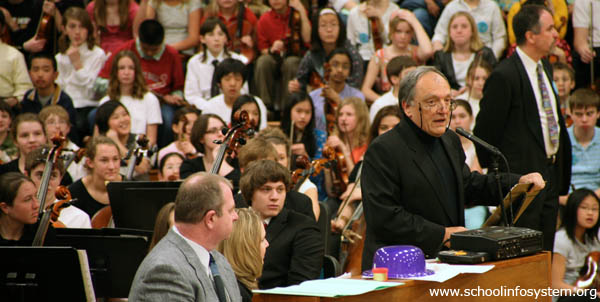
An Elementary Lesson in Classical Music

Nelson Hernandez:

If music hath charms to soothe the savage breast, as the English dramatist William Congreve wrote about three centuries ago, yesterday it did something even more remarkable: It quieted a concert hall packed with 2,500 fourth-graders.
The young students, vibrating with energy, were from Prince George’s County. For the first time, the county has sent all of its fourth-graders to a series of concerts at the Kennedy Center this week in a partnership with the National Symphony Orchestra.
All meaning 8,000.
Before the concert began, the students were making music of their own. After leaving scores of school buses waiting outside in the parking lot, the students marveled at the center’s flag-draped Hall of Nations. One group of seven singing girls from Port Towns Elementary School in Bladensburg, holding hands in a circle, played a clapping game in time with a ditty about “The Simpsons.”

Share

California Parents Await Ruling on Homeschooling

Ashley Surdin:

Parents of an estimated 166,000 children in California are eagerly awaiting a state appellate court ruling on whether they have a constitutional right to home-school their children without a teaching credential.
That question sprouted unexpectedly on Feb. 28, when a panel of three judges ruled that parents or tutors of children who are home-schooled must be certified by the state, basing their ruling on a rarely enforced state education law. Few parents knew the law existed.
The court’s ruling — since suspended pending a June rehearing — threatens to send back to the classroom those children who now spend their days studying math, Spanish or the Bible in the comfort of their living rooms.
Reaction to the ruling quickly spread through the state, home to the nation’s largest number of home-schoolers, and across the country.

Encyclopedia Brittannica on Home Schooling.

Share

Suburban DC Schools Reject Metal Detectors

Daniel de Vise:

In spring 1991, after a teenage girl stabbed a classmate in the cafeteria of an Anacostia school, the D.C. Board of Education voted to install metal detectors at the front entrances of 10 middle and high schools.
No other school system in the region has embraced the technology, even as metal detectors have multiplied in courthouses, museums and other public buildings across the region over the past two decades.
Many school officials view metal detectors as costly, impractical and fallible. To suburban parents, they conjure up images of armed camps. Even at Albert Einstein High School in Kensington, where three loaded guns were found in a locker last week, consensus is building against them.
“I don’t want my son to come to school through metal detectors. That’s prison,” said Alex Colina, speaking to several hundred other parents at a community meeting Monday night.

Share

For high school students, it’s the ultimate field trip — real-life lessons learned by volunteering abroad.

Cindy Loose:

When Bethesda high school student Jenna Kusek first saw where she’d be living for three weeks in Tanzania, she thought, “You’ve got to be kidding.”
This hole in the ground is the toilet? A trickle of cold water from an elevated hose is the shower?
But Kusek soon gained a new perspective. The white stucco house she shared with other teen volunteers last summer was a mansion by local standards, and better than the concrete-block house they would spend their days building for a local teacher. A cold shower, she realized, was a luxury unavailable to the village kids. A year after the trip, tears come to her eyes when she talks about how guilty she began feeling about having access to any kind of shower.
“Compared to how people lived in the village, our housing was too good to be true,” says Kusek, 18, a senior at Walt Whitman High School. “I knew before I went to Africa that I was blessed, but I had no idea how lucky I was. I can’t believe now the things we once took for granted.”

Putney Student Travel.

Share

Black-White Gap Widens for High Achievers

Debra Viadero:

New research into what is commonly called the black-white “achievement gap” suggests that the students who lose the most ground academically in U.S. public schools may be the brightest African-American children.
As black students move through elementary and middle school, these studies show, the test-score gaps that separate them from their better-performing white counterparts grow fastest among the most able students and the most slowly for those who start out with below-average academic skills.
“We care about achievement gaps because of their implications for labor-market and socioeconomic-status issues down the line,” said Lindsay C. Page, a Harvard University researcher, commenting on the studies. “It’s disconcerting if the gap is growing particularly high among high-achieving black and white students.”
Disconcerting, but not surprising, said researchers who have studied achievement gaps. Studies have long shown, for instance, that African-American students are underrepresented among the top scorers on standardized tests, such as the National Assessment of Educational Progress. Fewer studies, though, have traced the growth of those gaps among high and low achievers.
The reasons why achievement gaps are wider at the upper end of the achievement scale are still unclear. But some experts believe the patterns have something to do with the fact that African-American children tend to be taught in predominantly black schools, where test scores are lower on average, teachers are less experienced, and high-achieving peers are harder to find.

Thanks to Jenny Root for emailing this article.

Share

Venezuala’s Orchestra for At Risk Students

Bob Simon @ 60 Minutes:

Through a system of early training and local orchestras, Venezuela has not only provided an uplifting musical experience for its at-risk youth, but also developed an orchestra that is world famous.

video

Share

Arts Education Gravely Ignored

Suchita Shah:

Imagine a program that produced a fourfold increase in the number of students recognized for academic achievement. What if that initiative also resulted in three times as many students elected to leadership positions at their schools? And imagine that these children would be four times as likely to be in math or science fairs, and also to perform community service. On top of all that, they would also be three times as likely to win an award for exceptional school attendance.
If public school administrators and government officials knew of such a program, I would demand that it be implemented in our schools and that we invest in it immediately. Guess what? We already know of such a program that does achieve all those benefits: It’s called the arts.
According to Americans for the Arts, children deeply involved in arts programs receive the aforementioned benefits, and then some. Yet, paradoxically, schools are cutting arts programs — ranging from band to theater to painting — because of funding limitations.

Share

Green Charter School News

Environmental Charter High School (CA)
Michael Frome Academy (MN)
“Hands On, Feet Wet” at River Crossing Charter School (WI)
Yuba Environmental Science Charter Academy (CA)
Prairie Crossing Charter School (IL)
Laura Jeffrey Academy (MN)
Keyes to Learning Charter School (CA)

(more…)

Share

“Mayor’s Failure to Consult Schools is a Bad Sign”

Lucy Mathiak:

I read with interest the Thursday editorial on “The mayor and the schools.” As a member of the School Board, I agree that a closer working relationship and collaboration between the city and the Madison Metropolitan School District would be a positive thing. Certainly there are critical issues in planning, housing development patterns, transportation, zoning, and other matters that have a critical impact on our district in both the short and the long term.
For example, the “best planning practices” of infill have had a great deal to do with enrollment declines in isthmus schools by replacing family housing with condos. Decisions by the traffic engineering officials — such as roundabouts at $1.2 million each — have an impact on our budget. When the city annexes land on the periphery, it affects how and where we must provide schools; we do not have a right to refuse to also annex the students that go with the land.
Without a voice in decisions and processes, we are effectively at the mercy of the city on key issues that affect how we use the scarce resources that we have under state finance.

More on the Mayor’s proposal here.

Share

Private Education: Is it Worth It?

The Economist:

FEE-PAYING schools have long played a giant part in public life in Britain, though they teach only 7% of its children. The few state-educated prime ministers (such as the current one) went to academically selective schools, now rare; a third of all MPs, more than half the appointed peers in the House of Lords, a similar proportion of the country’s best-known journalists and 70% of its leading barristers were educated privately. There is no sign that the elevator from independent schools to professional prominence is slowing: nearly half of the undergraduates at Oxford and Cambridge were privately schooled too.
Many ambitious parents would like to set their children off on this gilded path. But there is a problem: the soaring cost. Fees at private day schools have more than doubled in the past 20 years, in real terms; those at boarding schools have risen even faster (see chart). Since 2000 fees have risen by at least 6% every year, according to Horwath Clark Whitehill, a consultancy—double retail-price inflation and half as much again as the growth in wages. If this continues, a four-year-old embarking on a career in private day schools this autumn will have cost his parents around £170,000 ($335,000) in today’s money by the time he completes secondary school. So even though more Britons than ever before describe themselves as comfortably off, the share of children being educated privately is barely higher than it was two decades ago.

Share

Concessions Program Helps Put Young People Back in the Game

Sopan Joshi:

Working the Mayorga Coffee stall 129 at Nationals Park, Charnika Burts has energy and a plan.
“I want to train to be a computer technician,” she said. “I love computers.”
Two years ago, Burts dropped out of Anacostia High School in her senior year, quit playing basketball and stopped thinking about a future. Soon she was drifting from one minimum-wage job to another.
“Every day I ask myself why I dropped out, and I still can’t figure it out,” she said. “Don’t nobody get a decent job without a school diploma.”
The ballpark coffee stall might be her ticket to getting back on track.
She is one of 25 D.C. teenagers recruited for a youth development program run by Juma Ventures, a San Francisco-based nonprofit group that helps people from ages 16 to 20 work stadium concession stands, most of them on the West Coast. The idea is to help them work their way toward higher education

Share

It’s harder to get into some of Rhode Island’s charter schools than it is to get into the Ivy League.

Jennifer Jordan:

This spring marks the fourth in a row that Sara and Christopher Nerone will cross their fingers and apply to the Compass School, hoping that their daughter Sophie, 9, will finally be accepted to the free, public charter school in South Kingstown.
The Nerones will also try — for the third year — to get their younger daughter, Phoebe, 6, into the small, environmentally focused school, which emphasizes student projects rather than traditional textbook learning.
Chances are slim. It’s tougher to get into the Compass School than Harvard, which has a 9-percent acceptance rate. For the last couple of years, Compass has received about 200 applicants for 10 available spots, after giving 10 spaces to siblings of current students. The majority are kindergarten spots, plus a few last-minute openings each year in grades 1 through 8.
This year, 234 families have applied. That means more than 200 families will be disappointed when the Compass School holds its annual lottery this Wednesday.
Competition for Rhode Island’s charter schools is fierce. Nine of the state’s 11 charter schools are so popular, they conduct lotteries each spring to fill the few dozen places each has available. Hundreds of students languish on wait lists with little hope of ever getting in.

Share

High-schoolers find new interest in FFA

Ruben Navarrette:

Most of the high-school teens selling at today’s livestock auction at the Maricopa County Fair are members of the National FFA Organization. But it doesn’t mean they’re all future farmers.
Sarah Carter, a senior at Dobson High School in Mesa and president of her school’s FFA club, hopes to use profits from selling a goat she raised to help pay for college. She plans to be a veterinarian.
Students who take part in FFA are a holdover from an era when Future Farmers of America clubs were a bigger part of life in schools around the nation. However, fewer clubs today raise livestock. Instead, the group has evolved to focus more on biotechnology and other areas of science.

Share

Milwaukee City Leaders See Role in Schools

Larry Sandler:

A new term could bring a new emphasis on education to City Hall, as elected officials push for a stronger voice on an issue they say is vital to Milwaukee’s future.
Otherwise, many of the issues will be familiar when a new term starts Tuesday for Mayor Tom Barrett and the Common Council.
Such perennial themes as economic development, public safety, transportation, taxes and state aid will continue to dominate the agenda over the next four years, Barrett and leading aldermen said in separate interviews.
On April 1, voters re-elected Barrett and 13 of 15 aldermen by comfortable margins. New to the council will be Aldermen-elect Milele Coggs, who defeated the jailed Ald. Michael McGee, and Nik Kovac, replacing Ald. Mike D’Amato, who did not seek re-election. Both the new and returning officials will be sworn in Tuesday.

Madison’s Mayor appears to be paying more attention to our public schools, as well.

Share

Character Counts, But Not by Race

Mona Charen:

The public schools, perhaps more than any other institution in American life, are afflicted with “sounds good” syndrome. Let’s teach kids about the dangers of smoking. Sounds good. Let’s improve math scores with a new curriculum called “whole math.” Sounds good. Let’s reduce teen pregnancy and sexually transmitted diseases by teaching sex ed. Sounds good. Let’s have cooperative learning where kids help one another. And so on.
The Fairfax County, Va., schools (where my children attend) recently joined a nationwide “sounds good” trend by introducing a character education curriculum. Students were exhorted to demonstrate a number of ethical traits like (I quote from my son’s elementary school’s website) “compassion, respect, responsibility, honesty.” It would be easy to mock the program — each trait, for example, is linked to a shape (respect is a triangle, honesty is a star). The intention to help mold character is a laudable one. But this program, like so much else about the public schools in the “sounds good” era, has foundered.
The curriculum made news recently when a report ordered by the school board evaluated student conduct for “sound moral character and ethical judgment” and then grouped the results by race. Oh, dear. It seems that among third graders, 95 percent of white students received a grade of “good” or better, whereas only 86 percent of Hispanic kids did that well and only 80 percent of black and special education students were so rated.
Martina A. “Tina” Hone, an African-American member of the school board, told the Washington Post that the decision to aggregate the evaluations by race was “potentially damaging and hurtful.”

Share

Indianapolis Schools: 1 Licensed Teacher Not Teaching per 53 Students

Andy Gammill:

When the superintendent brought in auditors to look at the Indianapolis Public Schools bus operation in December, the department couldn’t say how many routes it runs each day. Auditors had to guess.
When the school district tried to dismiss 14 administrators this year, it missed a deadline to notify the employees and now must pay their full salaries for another year.
Although the district struggles to hire teachers and is chronically short-staffed, it has 10,000 job applications that have never been reviewed.
That confusion and lack of oversight represent what may be the biggest challenge to the state’s largest school district as it continues efforts to reform.
Over the past three years, Superintendent Eugene White has tackled classroom shortcomings such as weak teaching and poor discipline. Now he has started to remake the crippling bureaucracy behind practices that are often inefficient, sometimes illegal and occasionally dangerous to children.
Others before him have tried, only to be defeated by a culture steeped in an attitude of “this, too, shall pass.”
“I’ve heard it ever since 1971 that I’ve been in IPS: ‘Just wait it out,’ ” said Jane Ajabu, the district’s personnel director. “Unfortunately, the people in the district have adopted the attitude of: ‘It’s mediocre, it’s ineffective, that’s just how it is.’ ”
Large urban school districts are notoriously inefficient, and at least one measure suggests IPS may be worse than other Indiana districts. Its bureaucracy has an unusually high proportion of licensed educators working outside classrooms.
For every 53 students, IPS has one licensed educator working in a nonteaching job. Across the state, only Gary Public Schools has as high a ratio of administrators to students. Other Marion County districts have 86 to 156 students per licensed educator in a job outside the classroom.

Share

Looking Back, Looking Forward: A Chat with Melania Alvarez

While working on another project, I came across the transcript of an interview I did with Melania Alvarez in early 2004. Melania was an MMSD parent and an assessment analyst at the UW-Madison prior to leaving the area shortly after the election (Melania lost to Johnny Winston, Jr in April, 2004Winston’s transcript).
I found the transcript interesting. The topics discussed in 2004 certainly apply today, from curriculum to school discipline/violence and the budget.

Share

“Free Range Kids”

Lenore Skenazy:

I left my 9-year-old at Bloomingdale’s (the original one) a couple weeks ago. Last seen, he was in first floor handbags as I sashayed out the door.
Bye-bye! Have fun!
And he did. He came home on the subway and bus by himself.
RELATED: Listen to Ms. Skenazy on WNYC.
Was I worried? Yes, a tinge. But it didn’t strike me as that daring, either. Isn’t New York as safe now as it was in 1963? It’s not like we’re living in downtown Baghdad.

Share

Lacking Credits, Some Students Learn a Shortcut

Elissa Gootman:

Dennis Bunyan showed up for his first-semester senior English class at Wadleigh Secondary School in Harlem so rarely that, as he put it, “I basically didn’t attend.”
But despite his sustained absence, Mr. Bunyan got the credit he needed to graduate last June by completing just three essay assignments, which he said took about 10 hours.
“I’m grateful for it, but it also just seems kind of, you know, outrageous,” Mr. Bunyan said. “There’s no way three essays can possibly cover a semester of work.”
Mr. Bunyan was able to graduate through what is known as credit recovery — letting those who lack credits make them up by means other than retaking a class or attending traditional summer school. Although his principal said the makeup assignments were as rigorous as regular course work, Mr. Bunyan’s English teacher, Charan Morris, was so troubled that she boycotted the graduation ceremony, writing in an e-mail message to students that she believed some were “being pushed through the system regardless of whether they have done the work to earn their diploma.”

Share

Project GRAD

www.projectgrad.org:

Currently, only 70 percent of all students in public high schools graduate and this number drops to just 53 percent of students from low income families. By the end of fourth grade, low income students, by various measures, are already two years behind other students. By the time these students reach 8th grade, they are three grade levels behind in reading and math. If they reach 12th grade, low-income and minority student achievement levels are about four years behind those of other young people. Low graduation rates are evidence that, in the earlier grades, schools are not meeting the fundamental achievement needs of low-income students.
The bottom line should be alarming for all Americans. A very high proportion of our students are leaving public schools unprepared to gain access to our country’s economic, social and political opportunities. As we strive to become a nation in which no child is left behind, all U.S. public school students deserve the opportunity to graduate from high school and college.

Getting into UCLA.

Share

Wall of silence broken at state’s Muslim public school

Katherine Kersten:

Recently, I wrote about Tarek ibn Ziyad Academy (TIZA), a K-8 charter school in Inver Grove Heights. Charter schools are public schools and by law must not endorse or promote religion.
Evidence suggests, however, that TIZA is an Islamic school, funded by Minnesota taxpayers.
TIZA has many characteristics that suggest a religious school. It shares the headquarters building of the Muslim American Society of Minnesota, whose mission is “establishing Islam in Minnesota.” The building also houses a mosque. TIZA’s executive director, Asad Zaman, is a Muslim imam, or religious leader, and its sponsor is an organization called Islamic Relief.

Share

“Ill Prepared Students Flood Iowa Community Colleges”

Lisa Rossi:

Nearly one-third of freshmen at Iowa’s community colleges took at least one remedial course last fall, but an even larger percentage of the freshmen needed additional high-school-level instruction in one or more subject areas, a Des Moines Register survey has found.
The trend has educators frustrated and concerned.
While community colleges have long accepted that part of their role is to be a bridge between high schools and four-year colleges and universities, some community college advocates are becoming exasperated with the number of ill-prepared students arriving from high schools.
“I just think it’s unfortunate that such a large percentage of students who arrive at our door are in need of additional remediation to come up to the college level,” said M.J. Dolan, executive director of the Iowa Association of Community College Trustees.
The Register’s survey of the community colleges found that 31.5 percent of incoming freshmen last fall took one or more remedial courses to improve their understanding of certain academic subjects.

Share

Pride in public schools fuels positive involvement

Joe Fitzgerald:

According to her job description, West Roxbury’s Kathleen Colby is the YMCA’s liaison to the classrooms of this city, charged with assuring parents that Boston public schools offer “good and valid options” for their children.
That, of course, challenges a widely held assumption that public education in this city is a wasteland.
“I’ve heard that, too,” she said. “Absolutely. And the people who make that assumption are absolutely wrong. There are fabulous things happening in this city that no one knows about because no one writes about them.”
When the Y created the job five years ago, Colby was such an obvious candidate that she began receiving calls and e-mails from friends and teachers, urging her to apply.
“It’s not a job as much as it’s a passion,” she explained. “I’ve been talking about our schools for years because of what my own kids have experienced. We’ve received so much that I just can’t help wanting to give something back.”

Colby’s son is a student at Boston’s Latin School. BLS is part of the Boston public schools but “admits students on a competitive basis“.

Share

Technology in the Madison Schools

I am the parent of 2 children, one in first grade and the other soon to enter Kindergarten. I recently registered my child for Kindergarten where I was handed a very helpful folder with lots of great information in it. It had pictures of children learning in various contexts and text touting the wonderful education Madison children receive. The curious thing is that in the center of the folder is a picture of children using computers that are most likely more than 10 years old. Across the picture in large print it says “Welcome to Madison’s Award Winning Schools!” Opposite the picture is a paragraph stating that there is a 4 to 1 computer ratio and that computers are integral to the K-12 instructional program. While I don’t doubt all this to be true, just how old is that computer that is “integral” to my child’s instructional program? Is my child getting the experiences that meet today’s standards for knowledge in this area? While this is just a picture, it caused me to look around my daughter’s school and to talk to a few teachers. What I learned was appalling.
Many teachers do their grades at home, not because of time, but because their classroom computer is so old and slow that it freezes on them or times out during an upload and they lose all of their data. I was stunned and confused. We as parents have been hearing about this new system that will allow us better access to seeing how our kids are doing in school and yet the teachers can’t even enter data from their classrooms. Should we not be embarrassed as a district? Can we really claim truth in the text filled folds of the aforementioned folder?

(more…)

Share

Schools ignored abuse warnings for 2 decades

John Iwasaki:

Seattle Public Schools will pay $3 million for failing to act on dozens of warnings that a popular teacher was molesting some of his fifth-grade students, a pattern that lasted two decades.
The most abused girl will receive $2.5 million, which her attorney said will be the largest reported settlement paid by a school district in Washington to a single victim in a sex-abuse case.
Under the settlement, approved Monday in King County Superior Court, the district acknowledged negligence in failing to protect two girls from Laurence “Shayne” Hill, 58, who has admitted to molesting at least seven girls while teaching at Broadview-Thomson Elementary in North Seattle.
The girls’ lawyers said the district protected Hill even though at least 15 teachers and staff members made at least 30 reports to administrators that he was grabbing girls’ buttocks and having them sit on his lap, sometimes in darkened classrooms, since the mid-1980s.

Related by Doug Erickson & Andy Hall: Former Waunakee educational assistant wasn’t reported by the Madison Schools.

Share

University opens up with more free course options

The Standard:

ARTS AND HISTORY, business and management, education, social sciences, languages and information technology will be covered in 10 more units of courseware that have been added to the Open University of Hong Kongs suite of free courseware on the web.
New units include The Development of the Chinese Communist Party (1927-1937), which introduces the establishment of the party and explains Mao Zedongs rise to power.
Apart from the learning materials such as text, maps and charts, an audio clip of a lecture is also included to help people better understand the course and the influence of the Long March. References and recommended book lists are also given as supplements.
Those seeking additional business knowledge can choose Management and Developments in Management Thinking and The Mathematics of Finance.

Share

Wisconsin Virtual school bill a bright spot

Patrick Marley & Steven Walters:

The new law guarantees the online schools can open this fall. Their future was in doubt after an appeals court ruled in December that one school – the Wisconsin Virtual Academy run by the Northern Ozaukee School District – did not qualify for state aid of $5,845 per student.
The measure was a workable compromise that allows the schools to continue while the effect of the virtual school system on students and taxpayers is studied, Doyle spokeswoman Jessica Erickson said in a statement.
Rose Fernandez, president of the Wisconsin Coalition of Virtual School Families, said in a statement her group would fight to remove the cap but hailed the new law for keeping the schools open.
“This was grassroots democracy at its finest; a blow to powerful special interests; and, most important, a win for Wisconsin’s children,” she said in her statement.

Wisconsin State Journal Editorial:

One bright spot as the Legislature adjourned its regular business for the year was a compromise allowing virtual schools to stay open.
Gov. Jim Doyle signed Senate Bill 396 into law Monday, capping an unfortunate roller-coaster ride for the parents and their 3,400 children who attend about a dozen online schools across Wisconsin.
The bill modernizes out-of-date state laws that failed to anticipate the advent of certain students learning from home over the Internet.
The bill also improves accountability and instruction for online schools.
Only certified teachers will be allowed to develop lesson plans and grade assignments. Teachers must be trained to effectively teach online and respond quickly to student and parent inquiries.

Much more on virtual schools here.

Share

Today’s college students have tuned out the world, and it’s partly our fault

Ted Gup:

I teach a seminar called “Secrecy: Forbidden Knowledge.” I recently asked my class of 16 freshmen and sophomores, many of whom had graduated in the top 10 percent of their high-school classes and had dazzling SAT scores, how many had heard the word “rendition.”
Not one hand went up.
This is after four years of the word appearing on the front pages of the nation’s newspapers, on network and cable news, and online. This is after years of highly publicized lawsuits, Congressional inquiries, and international controversy and condemnation. This is after the release of a Hollywood film of that title, starring Jake Gyllenhaal, Meryl Streep, and Reese Witherspoon.
I was dumbstruck. Finally one hand went up, and the student sheepishly asked if rendition had anything to do with a version of a movie or a play.

Share

Madison Busing to Continue for Most Madison Catholic Schools

WKOW-TV:

he MMSD finance and operations committee of the school board on Tuesday voted to approve a plan to continue bus services for Madison’s Catholic schools. MMSD provides bus transportation under state law.
Under the plan, two schools, Queen of Peace and St. Maria Goretti, will adjust their schedules so they can share a bus. The kindergarten noon bus at St. Dennis will be discontinued, as will bus service to Edgewood. The eliminations would affect a handful of families and they will receive vouchers from MMSD to cover the cost of private transportation.
The school schedule adjustments and two route cancellations will save the public schools about $140,000 a year, according to MMSD officials.

The Madison School District eliminated private school busing last spring – a decision that was undone via an adminstrative snafu.

Share

Madison Mayor Proposes Expansion of Low Income Housing Throughout Dane County in an Effort to Reduce the MMSD’s Low Income Population

Dean Mosiman:

Mayor Dave Cieslewicz is proposing a regional approach to affordable housing to help ease high concentrations of poor students in Madison schools.
Cieslewicz is proposing to merge the city and Dane County public housing authorities into a single entity that would take a more regional view.
The authorities handle federal vouchers that offset rent payments, public housing and support first-time buyers.
Cieslewicz also wants to make communities outside Madison eligible for money from the city’s Affordable Housing Trust Fund, which now stands at $4 million.
Over time, the proposals might spread low-income housing more evenly through the region, which would help all schools, Cieslewicz said.

Madison Demographics: 82.2% white (Dane County = 87.5%) with 15% of the population living below poverty (2000 census; Dane County = 9.4%). 43% of the Madison School District’s students were classified as “low income” for the 2007-2008 school year.

Share

Florida’s Virtual School

Curtis Krueger:

At one of Florida’s largest public schools, students take classes in English literature, Spanish and calculus. They join clubs, enter science fairs and talk one on one with their teachers.
But no one complains about mystery meat from the school cafeteria, no one ever gets asked to — or snubbed at — a school dance, and there is no football team to cheer for.
A decade after its founding, the Florida Virtual School has become a quiet force in the state’s education system. It’s an Internet-based school that offers free, accredited classes for middle school and high school students in Florida. More than 54,000 students took courses last year, and it’s growing.
“They are the largest state-led virtual school program based in the United States,” said Susan Patrick, president of the North American Council for Online Learning. “I think that they have one of the most innovative education solutions for how we can better serve students.”
Janice Barnard, whose 17-year-old daughter is taking Virtual School classes in a program affiliated with Tampa’s Blake High School, says, “It’s not for everyone. You must have a self-motivated child, somebody who wants to learn, who wants to achieve.”

Related: Moore’s Law, Culture, School Change and Madison’s “Virtual Campus”. Much more on virtual schools.

Share

Mequon-Thiensville School District’s Declining Enrollment & Budget

Lawrence Sussman:

By this September, the number of teachers who work for the Mequon-Thiensville School District is expected to have shrunk 17% since January 2001, Superintendent Robert Slotterback said last week.
The district, like many others in Wisconsin, is functioning with fewer teachers and dealing with smaller student enrollments, rising costs and an electorate that in referendums in 2006 and 2002 told the district that it could not spend significantly more money.
Slotterback maintains, though, the district has not reduced its course offerings or lowered its standards.
“We have not really had to eliminate student options,” he said. “Your class size may have gotten bigger, but I am not aware of any class option that we have eliminated. We have not purposely shrunk the options for kids up to this point.”

Share

Favorite Education Blogs of 2008

Jay Matthews:

Early last year, as an experiment, I published a list of what I and commentator Walt Gardner considered our favorite education blogs. Neither Gardner nor I had much experience with this most modern form of expression. We are WAY older than the Web surfing generation. But the list proved popular with readers, and I promised in that column to make this an annual event.
My promise was actually more specific: “Next year, through bribery or trickery, I hope to persuade Ken Bernstein, teacher and blogger par excellence, to select his favorite blogs and then let me dump on his choices, or something like that.” As I learned long ago, begging works even better than bribery or trickery, and Bernstein succumbed. Below are his choices, with some comments from me, and a few of my favorites.
They are in no particular order of quality or interest. Choosing blogs is a personal matter. Tastes differ widely and often are not in sync with personal views on how schools should be improved. I agree with all of Bernstein’s choices, even though we disagree on many of the big issues.
Bernstein is a splendid classroom teacher and a fine writer, with a gift for making astute connections between ill-considered policies and what actually happens to kids in school. He is a social studies teacher at Eleanor Roosevelt High School in Prince George’s County and has been certified by the prestigious National Board for Professional Teaching Standards. He is also a book reviewer and peer reviewer for professional publications and ran panels on education at YearlyKos conventions. He blogs on education, among other topics, at too many sites to list. He describes his choices here as a few blogs he thinks “are worthwhile to visit.”

Share

Madison School Board Says No to City Infrastructure Costs for a Potential New East Side School Development

There was an interesting discussion that unfortunately received no publicity during the March 24, 2008 school board meeting regarding proposed Sprecher Road [map] seven figure infrastructure costs (this spending would, perhaps have begun the process of constructing a new east side school). The Board voted 3-3 (Yes: Carstensen, Moss and Silveira; No: Cole, Kobza and Mathiak with Winston absent), which resulted in a no on these costs. Watch the video here. It would seem ill advised to begin borrowing money for a new school given the ongoing budget challenges. Last spring’s downtown school closing unpleasantness is another factor to consider with respect to potential new edge schools.

Share

Madison School District Administration’s Proposed 2008-2009 Budget Published

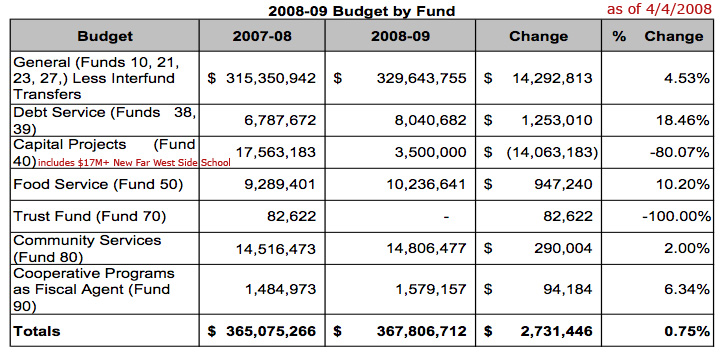
The observation of school district budgeting is fascinating. Numbers are big (9 or more digits) and the politics significant. Many factors affect such expenditures including local property taxes, state and federal redistributed tax dollars, enrollment, grants, referendums, new programs, politics and periodically local priorities. The Madison School District Administration released it’s proposed 2008-2009 $367,806,712 budget Friday, April 4, 2008 (Allocations were sent to the schools on March 5, 2008 prior to the budget’s public release Friday).
There will be a number of versions between this proposal and a final budget later this year (MMSD 2008-2009 Budget timeline).
I’ve summarized budget and enrollment information from 1995 through 2008-2009 below:

(more…)

Share

School Choice, Now More Than Ever

Jason Riley:

This week’s revelation that 17 of the nation’s 50 largest cities have high school graduation rates below 50% surely saddened many. But it surprised few people attuned to the state of U.S. public education. Proponents of education choice have long believed that dropout rates fall when families can pick the schools best suited for their children.
So news that Sol Stern, a veteran advocate of school choice, is having second thoughts about the ability of market forces to improve education outcomes is noteworthy. Mr. Stern explains his change of heart in the current issue of the indispensable City Journal, a quarterly magazine published by the Manhattan Institute. And his revised views on the school choice movement warrant a response.
Inside of two decades, charter school enrollment in the U.S. has climbed to 1.1 million from zero. Two tiny voucher programs in Maine and Vermont blossomed into 21 programs in 13 states and the District of Columbia. Tuition tax credits, once puny and rare, are now sizeable and commonplace. The idea that teacher pay should be based on performance, not just seniority, is gaining ground. Not bad for a small band of education reformers facing skepticism from the liberal media and outright hostility from well-funded, politically connected heavies like the National Education Association.

Related: Alan Borsuk: Wisconsin Black 8th-Graders Rank Worst in Nation in Writing and 2007 Nation’s Report Card: Writing.

Share

46%

Milwaukee Journal-Sentinel Editorial:

That’s how much a bold initiative aims to cut births to teen mothers in Milwaukee — necessary to break the cycle of poverty to which teen pregnancy contributes.
It is no small thing to set a goal – if you’re committed to meet it.
That’s why Milwaukee should be impressed with one particularly significant goal set this week – decreasing births to teen mothers here by 46% by 2015.
This is setting the bar high. More important, it’s clear from both the people involved and the approach that the intent is genuine.
Milwaukee Health Commissioner Bevan Baker, co-chair of a United Way committee that will oversee the effort, announced the “metric” on Wednesday at the Women’s Initiative Luncheon at the Italian Community Center. Betsy Brenner, president and publisher of the Milwaukee Journal Sentinel, is the other co-chair.

Share

CTM: Esperanza Rising

Children’s Theatre of Madison:

Middle school students are a notoriously tough audience.
But at a recent theater arts workshop at Wright Middle School in Madison, students shed their inhibitions as they stomped their feet, practiced the breathing exercises of actors and helped make mariachi music.
In the process, they began to appreciate the effort, energy and excitement of producing a play like “Esperanza Rising,” a Children’s Theatre of Madison production that will begin on April 4 and continue weekend performances through April 20.
Members of the Esperanza cast, the director, musicians and others associated with the production ran theater arts workshops at Hawthorne Elementary and Cherokee Middle School in Madison last week as well as at Wright Middle School.
When Jane Schroeder, outreach educator for CTM, asked students in Erika Meyer’s music class whether they had read the book “Esperanza Rising” by Pam Munoz Ryan, Jennifer Neblett, a sixth-grader at Wright, eagerly raised her hand.

Share

2008 Bolz Young Artist Competition


Madison Symphony Orchestra:

Congratulations to the 2008 Winners! Pianist Hong-En Chen and violinist Leah Latorraca took top honors in the competition held Wed night in Overture Hall. Each received a $1,000 scholarship. Violinist Chauntee Ross and pianist Naomi Latorraca were awarded Honorable Mentions and each received a $500 scholarship. All four finalists performed with John DeMain and the MSO at the Spring Young People’s Concert.

Share

Long Beach school district is a finalist for Broad Prize

Seema Mehta:

The Long Beach Unified School District was again named a finalist Wednesday for the prestigious Broad Prize, which honors academic excellence and strong performance by minority and poor students in urban districts across the nation.
“It’s a huge honor,” said Christopher J. Steinhauser, superintendent of the nearly 91,000-student district. “We pride ourselves on a path of continual improvement, and to be recognized by the [Eli and Edythe Broad] foundation as one of the top five school systems in America every time we’ve been eligible is a huge honor for teachers, students and parents.”
In 2003, Long Beach Unified won the prize, which includes $500,000 in college scholarships. The district — the third-largest in California — has been a top-five finalist every year it has been eligible since the inception of the prize, an honor that comes with $125,000 in scholarships. Districts that win the prize are then ineligible for three years.
The four other finalists this year are districts in Fort Lauderdale, Fla., and Miami, as well as the Aldine Independent School District near Houston and the Brownsville Independent School District on the Texas-Mexico border. The winner will be announced Oct. 14 in New York City.

Share

Statistics refute rhetoric on school spending

Dan Walters:

California’s perennial debate over how much it is and should be spending on its largest-in-the-nation public school system has escalated sharply this year as the state faces a whopping budget deficit and Gov. Arnold Schwarzenegger proposes – whether seriously or not is uncertain – to take a big bite out of the schools’ money to close it.
The educational establishment and its allies in the Democratic leadership of the Legislature are howling about the governor’s proposal that school spending be whacked by $4.8 billion from what the constitution otherwise would require it to be through the 2008-09 fiscal year.
The Democrats have vowed to block any budget that makes a substantial reduction in state school aid and the California Teachers Association and other school groups have resumed their high-decibel complaint that California’s per-pupil spending is already near the bottom of the states.
Republicans and other critics, meanwhile, complain that California is wasting much of its school money on bloated administration and ineffective, faddish educational nostrums. They cite the state’s near-bottom rankings in national educational achievement test scores.
In the midst of this Sturm und Drang, the Census Bureau on Tuesday issued an extremely detailed accounting of what states (and the District of Columbia) are spending on their schools. It undercuts the mantras being chanted by both of the Capitol’s warring political factions.

Share

Class Size Reduction “Not a Silver Bullet,” New Research Review Finds; Poor and Minority Students Benefit Most Quality Teaching, Political Climate, Are Key Determinants of Success

Teachers College @ Columbia University:

Ask the average parent or teacher what change they’d most like to see in their school, and there’s a good chance the answer will be “smaller classes.”
Now a new review of major research on the subject finds that reduced class size is far from a universal panacea, and may have no bearing at all on student achievement unless enacted under the right political, economic and academic conditions. Those include quality teaching, targeting of schools and children likeliest to benefit, and avoidance of perverse incentives that can spawn unintended negative consequences.
“Class size reduction is not a silver bullet,” writes Douglas Ready, Assistant Professor of Education at Teachers College, Columbia University, in his paper, Policy, Politics and Implications for Equity. “Establishing appropriate class size is a balancing act between children’s development needs and contemporary fiscal realities. The matter assumes even greater complexity when we consider the relationship between class size and educational equity.”
Ready’s review of the literature does show that poor and minority students are likelier to benefit from class size reduction efforts than white students and students from wealthier families.

Share

New Madison School Chief Meets & Greets

Susan Troller:

Dan Nerad is already beginning to reach out to the community, three months before he formally steps into his new role as Madison’s next superintendent of schools.
In The Capital Times’ offices on Wednesday, School Board President Arlene Silveira introduced Nerad to staff members, noting that last week was spring break in Green Bay, where he is currently the superintendent of schools.
“Dan spent his vacation in the Doyle Building,” Silveira said, referring to the site of the Madison school district’s central administration.
Nerad was in Madison Wednesday, speaking to media editorial boards and joining current Superintendent Art Rainwater to address a lunch meeting of the Madison Downtown Rotary club.
“My role will be to add value to what is already an excellent school district,” Nerad told the Rotarians. He added that he is committed to the goal of continuous improvement.
“You have to focus on the next steps,” he said.
During his visit to The Capital Times, Nerad described innovations in Green Bay during his tenure. They include specialty focus areas in each of the district’s four high schools and a plan for 4-year-old kindergarten slated to begin during the 2008-2009 school year.

Watch a brief video of Dan Nerad’s remarks at Saturday’s Memorial / West Strings Festival.

Share

An Unlikely Obsession: School Auctions

Winnue Hu:

PATTY FURNER circled the chandelier-lit catering hall, trolling for bargains as she passed by row after row of gorgeously wrapped gift baskets at an auction this month to benefit the Hillside Elementary School in Livingston, N.J.
Ms. Furner, in her worn white sneakers, walked by cliques of well-heeled Livingston parents without bothering with small talk. She glanced right over a sketch of a new playground to be financed with auction proceeds, since her two daughters do not go to school there.
Instead, Ms. Furner, 44, a stay-at-home mother from nearby Union Township, had only one thing in mind: sizing up the 230-plus gift baskets to decide how to spread around her baby-sitting earnings. “It’s an addiction,” she said. “It’s the excitement of trying to win that prize you want.”

Share

Elmbrook passes state’s largest school referendum

Andy Szal:

The largest school district referendum on the ballot was approved but most other large school spending measures failed when submitted to voters in the spring election.
A total of 30 referendums totaling more than $165 million were approved Tuesday. Thirty-one failed, representing nearly $285 million.
The Elmbrook school district gained $62.2 million to renovate and expand Brookfield Central and East high schools. A referendum last year for $108.8 million failed in the suburban Milwaukee district.
Of the 12 districts with referendums exceeding $10 million, only measures in Racine and La Crosse passed. Racine passed a $16.5 million referendum, while La Crosse passed a $20.9 million referendum. Voters in La Crosse also rejected a second referendum for $35 million to construct a new elementary school.

Wisconsin DPI Referenda site. More from George Hesselberg.

Share

Spellings: Graduation Rates Should Be Uniform, Disaggregated

David Hoff:

Secretary of Education Margaret Spellings says she will soon propose rules that would require all states to use the same formula to calculate high schools’ graduation rates. She said she would require schools to disaggregate data by socioeconomic status, race, and other categories—just as schools are required to do for test scores under NCLB.
She announced the plan in a speech she delivered at an event kicking off a series of summits on drop outs sponsored by America’s Promise Alliance. But she left many questions unanswered.

Share

The Grinding Battle with Circumstance: Charter Schools and the Potential of School-Based Collective Bargaining

Jonathan Gyurko [196K PDF]:

Despite its teacher union origins as a vehicle for teacher-led, bottom-up innovation and early bi-partisan support, the charter movement was adopted by political conservatives as a vehicle for market-oriented education reforms. In the process, teacher unions largely repudiated an idea they helped launch. Yet recently, a flurry of discussion has emerged regarding an evolving and potentially productive relationship between charter schools and teacher unions. These discussions were precipitated by the recent actions of a few notable policy entrepreneurs whose work may suggest political and policy alternatives that could advance and sustain the policies embedded in the charter model.
This paper chronicles the political history of the charter school movement in the United States, starting with ideas promulgated by the late American Federation of Teachers President Albert Shanker and continuing through the embrace of charter schools by political conservatives. Through a review of available research, the paper assesses the current state of the charter school movement, including an assessment of charter school achievement data and a critique of the charter school policy framework, with particular emphasis on charter school financing, philanthropic support, and access to human capital. The paper also describes the recent and politically counter-intuitive work by the United Federation of Teachers, New York City’s teachers union, in founding two charter schools.
With the broad history and state of the charter school movement established, this paper analyzes recent events through the agenda setting frameworks developed by Baumgartner and Jones (1993) and Kingdon (1984). Specifically, the paper argues that the charter school movement may be approaching an instance of “punctuated equilibrium” due to the charter school movement’s changing “policy image” and the loss of “monopolistic control” over the charter school agenda by a small interest group. The paper concludes that school-based collective bargaining may be a “new institutional structure” that could have transformative and productive consequences for the charter school movement.

Share

Wisconsin Per Student Spending Drops in National Rankings from 11th to 17th, Remains Above Average

Alan Borsuk:

For better or worse – and you could get heated arguments about it – Wisconsin appears to be well on its way to becoming a middle-of-the-pack state when it comes to the amount of money put into grade school and high school education.
Wisconsin collected the 17th highest amount per student in taxes to pay for education in 2005-’06, the U.S. Census Bureau said in a report released Tuesday. And the gap between Wisconsin and the national average was less than $400.
A decade earlier, the state ranked 11th, and education revenue per student was almost $800 more than the average.
Those indicators mesh with other data, such as reports on teacher salaries nationwide, that indicate spending on education in Wisconsin remains above national averages but is moving down.
The heated debate about what that all means would come from people such as Republicans in the state Legislature who have argued for years that taxes are too high and education spending should be brought into line with other states, and school district officials and teachers organizations that claim services and staff are being cut because of spending caps that have been in place for almost 15 years.

Related by Pete Selkowe:

This gloomy Monday brings another of those reports about Wisconsin’s economy guaranteed to add to your malaise. (Like last week’s report on the county’s slow real estate value growth, Property values, the have’s and the have not’s.)
Today’s report — Measuring Success: Benchmarks for a Competitive Wisconsin — grades the state (alas, no curve, no Gentleman’s C) by comparing us to other states. Sit down before you read further, because the news isn’t good.
— For example: Wisconsin’s per capita income is $34,476, compared to the national average of $36,629, a difference of 5.9% (and the largest gap since 1991). The comparison is worse when our incomes are matched against folks in Illinois ($38,297) and Minnesota ($38,751).
— Not only do our jobs not pay as much, but we’re not growing very many more of them. In 2006, the number of Wisconsin jobs increased 0.7%, down from a growth rte of 1.1% in 2004 and 1.2% in 2005. Wisconsin trails the national average of 1.8% job growth.
— How about the growth in private businesses? The number of new private businesses in Wisconsin dropped 0.4% in 2006, while the number of businesses nationally grew 2.5%. All of Wisconsin’s neighbors had increases in 2006.
The study is released annually by Competitive Wisconsin, Inc. (CWI), a nonpartisan consortium of state agriculture, business, education and labor leaders. Measuring Success grades Wisconsin on 33 areas of interstate competitiveness; compared to our performance in past years, 17 benchmarks changed this year: eight improvements and nine declines.

K-12 Tax & Spending climate summary. Channel3000 has more.

Share

Stein Scholars Get Help with College Costs

Felicia Thomas-Lynn:

f all goes well, Deja Daniel’s dream of earning a degree won’t be obscured by the nightmare of mounting college-loan debt that often dogs new graduates for many years.
At age 17, the high school senior is getting in on the ground level of a multifaceted program that allows her to earn money for college, and apply for scholarships and financial aid, while academically preparing her for the rigors of college-level work.
“I was already looking at college, but the program has made it easier for me,” said Daniel, one of the first Stein Scholars, named in honor of late philanthropist Marty Stein.
Stein left a portion of his estate to be used for the scholarship program, administered through the Boys & Girls Clubs of Greater Milwaukee.
“We aren’t just interested in getting kids to college, but we want to see them graduate from college,” said Naryan Leazer, director of the program for juniors and seniors.

Share

How to Disagree: An Attempt at a “Disagreement Hierarchy”

Paul Graham:

The web is turning writing into a conversation. Twenty years ago, writers wrote and readers read. The web lets readers respond, and increasingly they do—in comment threads, on forums, and in their own blog posts.
Many who respond to something disagree with it. That’s to be expected. Agreeing tends to motivate people less than disagreeing. And when you agree there’s less to say. You could expand on something the author said, but he has probably already explored the most interesting implications. When you disagree you’re entering territory he may not have explored.
The result is there’s a lot more disagreeing going on, especially measured by the word. That doesn’t mean people are getting angrier. The structural change in the way we communicate is enough to account for it. But though it’s not anger that’s driving the increase in disagreement, there’s a danger that the increase in disagreement will make people angrier. Particularly online, where it’s easy to say things you’d never say face to face.
If we’re all going to be disagreeing more, we should be careful to do it well. What does it mean to disagree well? Most readers can tell the difference between mere name-calling and a carefully reasoned refutation, but I think it would help to put names on the intermediate stages. So here’s an attempt at a disagreement hierarchy:

Share

Uncontested election gives new board members opportunities

Susan Troller:

Without opponents in their races for Madison School Board seats, candidates Ed Hughes and Marjorie Passman have spent more time identifying issues that unite rather than divide them.
Although both candidates said they were concerned by the lack of interest in this spring’s school board race, they admitted that it had offered some unique opportunities.
“In a contested election, there’s a tendency to pigeonhole the candidates,” Hughes, a Madison attorney who is running for his first elected office, said in a recent interview.
Hughes said that in a more normal election, Passman’s extensive classroom experience and passionate enthusiasm for teaching and teachers would have labeled her as the teachers’ union candidate.
“She would have been pushed towards MTI. It’s likely I would have been pushed in the other direction. It’s far more subtle than that and it’s not fair to either one of us,” he observed.

Share

School Board? Who…. me?

Erin Richards:

According to the Wisconsin Association of School Boards, candidates for local office should have these qualifications:

  1. A belief that all kids are entitled to a good education
  2. An open mind
  3. A willingness to attend seminars to help them make intelligent decisions about school affairs
  4. An ability to work with other school board members
  5. Time

There are a few others, but you get the idea; it’s not like you need a graduate degree in economics for this gig. So why, according to a recent Journal Sentinel analysis, are almost 70% of local school board races in the five-county metro area going uncontested?
Seems like with all the concern over achievement rates, No Child Left Behind testing and cuts to school programs that more people, rather than fewer, would be interested in having a vote on what happens to their local district. One person has told us that part of it may be because so many schools have cut civics courses that illuminate how local government works.

Share

Salute to D.C.’s College Tuition Champion

Mary Beth Sheridan:

He is a seven-term U.S. representative and a prominent Republican, but Tom Davis hasn’t forgotten what it was like to grow up as one of five children in a struggling family, with a father serving time in prison.
“We had no money,” Davis (R-Va.) said recently at a reception, recounting how he went to Amherst College thanks to a scholarship. “I understand what it means to be a young kid, when you talk about college, and make that a reality.”
Davis is a champion of a federally funded initiative that has sent thousands of D.C. residents to college. He and other supporters of the D.C. Tuition Assistance Grant Program were honored at the reception this month in the Senate.
The program, launched in 2000 and recently renewed, provides tuition subsidies of up to $10,000 per year to D.C. residents to attend public colleges elsewhere in the country. It offers smaller amounts to those choosing private colleges in the D.C. metropolitan area or historically black colleges around the nation. It aims to compensate for the District’s lack of a full public university system.

Share

RISE OF THE ‘ROCK STAR’ SCHOOL SUPERINTENDENT

Patrick Jonsson:

No Child Left Behind has created a demand for school administrators who can take the pressure, and some 20 percent of school districts are now seeking superintendents because of a shortage.
The list reads more like demands from a Hollywood agent than from a candidate to lead the schools for an antebellum-tinged suburb of Atlanta.
To come to work here in Clayton County, a failing school district in Georgia, former Pittsburgh superintendent John Thompson wants $275,000 in salary, a $2 million consulting budget, a Lincoln Town Car with a driver, and money to pay a personal bodyguard.
Sound a bit hefty for someone likely to pull a power lunch in a junior high cafeteria? Maybe not.
Fewer qualified candidates, rising expectations, and a near-impossible job description are creating a new breed of superintendents: Call them central office rock stars. These candidates say that, for the right price, they’re willing to do an unpopular job that can take a heavy personal and professional toll to whip underperforming districts into shape.
The trend is exacerbated in struggling minority districts – many in the South – the very ones feeling the greatest pinch from new federal and state accountability laws.

Share

Many Potential Leaders of Tomorrow Reject the Role

Laura Sessions Stepp:

A new nationwide survey of girls and boys found that a majority of children and youths in the United States have little or no interest with achieving leadership roles when they become adults, ranking “being a leader” behind other goals such as “fitting in,” “making a lot of money” and “helping animals or the environment.”
The study commissioned by the Girl Scouts of the USA and released today determined that three-quarters of African American girls and boys and Hispanic girls surveyed already identify themselves as leaders, a much larger group than white youths, about half of whom think of themselves this way.
The youths defined leaders as people who prize collaboration, stand up for their beliefs and values, and try to improve society. Girls in particular endorsed these approaches, although a majority of boys did, as well. Yet when asked in focus groups about leadership styles among adults, what they described was traditional top-down management.

Girls Scouts USA:

irl Scouts has always been about leadership. Even at the youngest ages, Girl Scouts gain leadership skills that they can carry with them throughout their lives. The organizational focus on leadership shows girls that they are leaders in their everyday lives, and they will continue to be leaders as they get older.
In 2000, Girls Scouts of the USA (GSUSA) formed the Girl Scout Research Institute (GSRI), which serves as a center for research and public policy information on the healthy development of girls. GSRI is a vital extension of GSUSA’s commitment to addressing the complex and ever-changing needs of girls.
The latest study from GSRI is Change It Up! What Girls Say About Redefining Leadership. You may download the study, the press release, and a fact sheet about Girl Scouts of the USA below.

Share

2008 Madison Memorial / West Area Strings Festival Photos / Video


Watch a 15 minute video excerpt here and check out the event photos.
Incoming Madison Superintendent Dan Nerad made a few remarks , as did Madison Symphony Orchestra Conductor John DeMain .

Share

John DeMain’s Remarks at the 2008 Memorial / West Strings Festival


Madison Symphony Orchestra Conductor John DeMain made a few remarks at Saturday’s Memorial / West area Strings Festival. Watch the video. Much more about John DeMain.
Incoming Madison Superintendent Dan Nerad’s remarks. Event photos and video.

Share

Calling for Clear, Specific Content

American Educator:

Nearly 20 years ago, the nation coalesced around a sound idea for improving schools: standards-based reform. The standards were supposed to establish what students ought to know and be able to do and, as a result, offer clear guidance to teachers, curriculum writers, textbook and assessment developers, and professional development providers. They were supposed to result in a well-aligned system that provides teachers all the resources and supports they need—at least, that’s what we were promised.
Teachers know all too well just how broken that promise is. The typical state’s standards are nowhere near strong enough to serve as the foundation for a well-aligned, coherent educational system. The AFT has been reviewing state standards for more than a decade, and our findings—that state standards are, for the most part, either much too vague or much too long (and sometimes, oddly, both)—have been confirmed by many other reviewers.
We should be outraged. As readers of American Educator know, cognitive science has established that knowledge builds on knowledge-the more you know, the faster you learn.* And so it’s imperative that standards offer carefully sequenced content from the beginning of kindergarten through the end of high school. But they don’t. And as a result, we have some serious problems:

Share

Creativity Step by Step: A Conversation with Choreographer Twyla Tharp

Diane Coutu:

The notion that some people are simply born artistic – and that there is a profile that can help organizations identify them – is quite firmly entrenched. All the talk of genetic determination nowadays undoubtedly has a lot to do with that. But the idea that creativity is a predetermined personality trait probably appeals at a psychological level because it gives people an excuse for not innovating or initiating change themselves, reducing the problem of creativity to a recruitment challenge.
Significantly, the people least likely to buy into the idea that creativity is preordained are the creative geniuses themselves. Choreographer Twyla Tharp, for one, doesn’t subscribe to any notion of effortless artistry. As someone who has changed the face of dance, she’s certainly qualified to have an opinion. The winner of a MacArthur fellowship (popularly called “the genius grant”), two Emmy awards, and a Tony award, she has written and directed television programs, created Broadway productions, and choreographed dances for the movies Hair, Ragtime, and Amadeus. Tharp, now 66, did all this while creating more than 130 dances—many of which have become classics—for her own company, the Joffrey Ballet, the New York City Ballet, the Paris Opera Ballet, London’s Royal Ballet, and American Ballet Theatre. The author of two books, she is now in the process of simultaneously developing new ballets for the Miami City Ballet, American Ballet Theatre, and Pacific Northwest Ballet.
At her Manhattan home, Tharp met with HBR senior editor Diane Coutu to discuss what it takes to be a choreographer. In these pages, she shares what she has learned about fostering creativity, initiating change, and firing even top-notch performers when push comes to shove. In her suffer-no-fools way, she talks about her “monomaniacal absorption” with her work and the need to be tough, even ruthless, when that work is at stake. What follows is an edited version of their conversation.

Share

Annual review rates state-funded preschool programs

Karen Uhlenhuth:

Although many states, including Kansas, are subsidizing public preschool for growing numbers of children, Missouri is serving fewer than it did five years ago.
The National Institute for Early Education Research on Wednesday released its yearly review of state-funded preschool. It found that more states are spending more money to enroll more children in higher-quality preschools. That’s important because children who attend good preschools on average do better on social and learning yardsticks.
Nationally, spending bumped to $3,642 per child, reversing four years of falling support. And for the first time, more than 1 million children nationwide were enrolled in state-funded preschool during the 2006-2007 school year.
Locally, the picture differs quite a bit between Kansas and Missouri.
Support for preschool is reflected in Kansas’ At-Risk Four-Year-Old Children Preschool Program. From the 2001-2002 school year, enrollment grew 168 percent to 5,971 in 2006-2007.
In Missouri, enrollment for 3- and 4-year-olds in 2006-2007 was 4,972, a 12-percent increase over the year before, but a 12-percent drop from 2001-2002. One factor has been stagnant funding, said Jo Anne Ralston, director of Early Childhood Education for the state education department.
“Legislators have crafted bills to get more funding for preschool, but there has not been a lot of support,” she said. On the contrary, Ralston said, Missouri’s preschool program competes with veterans and other constituencies for fees from casinos.

8.4MB complete 2007 report.

Share

More on Generational Change, Education & Moore’s Law

Cringely:

Let’s consider for a moment what many readers will find to be a politically incorrect position: because of cheap computers and the Internet, the ability to solve problems ad hoc has become more efficient than teaching kids about problems and issues that will never face them. As a result, the United States has let itself become less competitive by putting so much money into a product (a kid) making both its cost and its ability globally uncompetitive. So, instead of putting more effort into making globally competitive products, we put more effort into blaming those who are smarter at using technology that was mostly invented here.
If the idea is to give everyone a nice comfortable pension, if the same money invested each year in a typical kid’s education was instead invested in an IRA, it would give that kid a very comfortable living upon reaching age 65.
Well this is a terrible position to take, don’t you think? It treats our children like capital goods and denies them any ability to excel, dooming them to mediocrity.
Really?
My Mom (Mrs. Cringely to you) once said, “I may not have been the best mother, but at least I got all my kids through school.”
“No you didn’t,” I replied (this is a true story, by the way). “We would have made it through school with or without you.” And we would have.
Not wanting to put too much of a Libertarian spin on it, because I am certainly not a Libertarian, this is a fact that is missed by so many people. There will always be achievers, whether they go to public schools, private schools, home schools, magnet schools, charter schools, or no schools at all. While it is fine for society to create opportunities for advancement, what’s more important is removing BARRIERS to advancement. And for the most part that’s not what we are about.
What we tend to be about as a society is building power structures and most of those power structures, including schools and governments, are decidedly reactive. This is not all bad. After all, the poster child for educational and government proactivity in the 20th century may have been the Taliban in Afghanistan.

Related: Moore’s Law, Culture & School Change.

Share

Children, Technology, Risk Taking and the “Nanny State”

Dr. Tanya Byron [2.5MB PDF]:

When I was asked by the Prime Minister to carry out an independent review of the risks children face from the internet and video games, I realised two things.
First, how integral these new technologies have become to the lives of young people and second, how important it is that we educate ourselves about the benefits and dangers they bring.
As a clinical pyschologist specialising in child and adolescent mental health – and as the mother of two children – I wanted to understand how and why young people use the internet and video games.
Hardly a day goes by without a news report about children being brutalised and abused in the real world or its virtual counterpart. Some make links between what happens online or in a game, and what happens on the streets or at home.
These headlines have contributed to the climate of anxiety that surrounds new technology and created a fiercely polarised debate in which panic and fear often drown out evidence. The resultant clamour distracts from the real issue and leads to children being cast as victims rather than participants in these new, interactive technologies.
It quickly became apparent that there was a big difference between what concerned parents understand and what their technologically savvy children know. The rapid pace at which new media are evolving has left adults and children stranded either side of a generational digital divide. Put bluntly, the world of video games has come a long way since the early days of Pac Man. And while change and innovation are undoubtedly exciting, they can also be challenging or just plain scary.
But panic or no panic, the virtual world and the real world do contain risks, and children left to navigate a solo path through either, face many dangers.
The trouble is that although as adults we instinctively know how to protect our children offline, we often assume that their greater technological expertise will ensure they can look after themselves online. But knowledge is not the same as wisdom.
This review is about the needs of children and young people. It is about preserving their right to take the risks that form an inherent part of their development by enabling them to play video games and surf the net in a safe and informed way.
By listening to children and young people and putting them at the heart of this review – and by replacing emotion with evidence – I hope I have provided some very necessary focus to what is a very necessary debate.

Slashdot discussion.

Share

John Matthews has run Madison’s teachers union for 40 years. Is it time for a change?

Jason Shephard:

But while Matthews laments the failures of government to improve teaching and learning, he glosses over his own pivotal role in local educational leadership. That role includes standing in the way of programs like 4-year-old kindergarten that could help the district meet its educational objectives.
Beginning in the next few weeks, a school board made up mostly of rookies will begin to address the challenges ahead. A new superintendent starting July 1 — Daniel Nerad, formerly top dog in Green Bay — inspires hope of new solutions to nagging problems. But the third pillar of power is John Matthews. He’s been around the longest and arguably knows the most.
Already, Matthews has cemented his legacy from building a strong, tough union. But now, some are wondering if Matthews will also leave behind a legacy of obstructing key educational change.

Clusty Search: John Matthews.

Share

Numbers Don’t Tell Whole Story at Madison’s Glendale Elementary

Susan Troller:

Glendale Elementary may be failing by test-based standards, but it’s succeeding by human ones.
The question of how we recognize good schools and bad ones has become a pressing issue.
In Washington, Congress is debating the reauthorization of the No Child Left Behind legislation. Locally, Madison and Sun Prairie parents have recently been upset over boundary changes that some see as sending their children to less desirable schools.
At the same time, the movement toward inclusivity in special education, a growing minority population and increasing poverty rates throughout Dane County, particularly in Madison, have put a sharp point on some important questions:

  • Do advanced students suffer when they share a classroom with struggling students?
  • How should schools address the stresses of poverty?
  • Are test scores a reliable measure of a school’s effectiveness?

This story doesn’t attempt to answer those questions; educational researchers have been struggling with them for decades. Instead, it puts one Madison elementary school under the microscope where all those currents come together — a school that by No Child Left Behind’s test-based standards is clearing failing. Yet, by the assessment of a number of parents, volunteers and other fans, the school is succeeding beyond all expectations.
A closer look at Glendale Elementary, a 50-year-old Madison school within the noisy shadow of U.S. 51, shows a school where success is occurring in ways that test scores can’t measure and poverty rates don’t reveal.

Share

Tax credits for private-school grants a win-win

Erich Cochling:

Education spending has increased at a breakneck pace in Georgia over the past decade, outpacing inflation substantially. Since 1994 per-student spending has more than doubled, representing an increase in spending each year of nearly 10 percent. In 2007 per-student spending exceeded $10,000 for the first time in Georgia’s history.
But despite the high level of spending, Georgia was ranked 48th among the states in high school graduation rates in 2007. That is exactly where the state ranked in 2000. In some of the intervening years, Georgia dropped to 50th, managing to beat out only the District of Columbia and avoid the dishonorable title of “worst in the nation.” State SAT scores have remained stagnant for years in Georgia, with rankings hovering painfully close to 50th. While that trend seems to have changed in 2007, a positive thing no doubt, time will tell whether the improvement is based in real academic achievement or a redesigned exam.
These facts point to a sobering reality that demands our attention: Every four years a generation of students in failing schools graduates unprepared for higher education or the work force, if they graduate at all. To these students, the lack of a quality education can and likely will have devastating results. And requiring students to be subjects in a protracted experiment in education reform seems inhumane at the very least.
Fortunately, Gov. Sonny Perdue and the General Assembly have recognized the plight of these students and have championed legislation to give them hope through education choice.

Share

Offering Teachers Incentives; and a Chance to Live Their Faith

Samuel Freedman:

Nearly every morning last September, his first month teaching at St. Patrick’s School here, Raymond Encarnacion arrived to find the same girl waiting outside his closed and darkened classroom. She stood with her backpack and coat, and sometimes she gave a joking groan when he showed up, because his presence meant there wouldn’t be some pushover of a substitute.
All Mr. Encarnacion initially knew about her from the roster of his sixth graders was that her name was Ashley. So he asked in perfect innocence why she was always at school so early. The answers trickled out. Her father had died, her mother worked a daybreak shift, and Ashley herself was responsible for waking, feeding, dressing and checking the homework of several younger cousins. She usually got up at 4 a.m.
Hearing her disclosures, so unpitying and matter-of-fact, Mr. Encarnacion thought back to his own year as a sixth grader. His family lived in Westfield, N.J., a prosperous suburb with renowned public schools. His mother, a nurse, was his alarm clock, his breakfast chef, his chauffeur to school. “Everything,” he put it recently, recalling the childhood comforts, “was right there for me.”

Share

Kenya: No Equity in Learning, Says Former VC

Watoro Kamau:

Access to public secondary schools and universities by the poor has remained elusive despite government efforts to ensure equity in provision of education, a former university don has said.
Prof Ezra Maritim, a former Egerton University Vice-Chancellor, said the apparent stratification of secondary schools promotes inequality and inequity in access to higher education.
Prof Maritim said that despite tuition fee waiver in secondary schools, children from poor backgrounds had continued to be marginalised as some national schools charges are in excess of Sh60,000 annually.
Many children from poor families perform well in KCPE and are admitted to national schools but are locked out due to their inability to pay the high fees. The former vice-chancellor argued that while the government was committed in theory to equity in education in general, the achievement of that commitment at the university level remains elusive.
He said the categorisation of secondary schools into four classes; district, provincial, national and private has only helped in widening the gap and denying the poor access to higher education.

Share

‘OPERATION SAFE PASSAGE’ | Parents keep kids home, fearing retaliation — so cops will escort them

Maudlyne Ihejirika:

“You got one of ours. We’re gonna get one of yours.”
That reality of gang life has kept nearly 200 Crane High School students from the ABLA Homes out of school since March 7, when a reputed gang member from ABLA gunned down another student who lived in rival gang territory. Their parents refuse to send them.
“You know they’re coming for somebody from ABLA, and it doesn’t have to be a gang member,” said a 16-year-old girl, a junior who was afraid to be identified.
So officials have come up with “Operation Safe Passage,” an unprecedented plan to protect students who fear they may be the next target.
Police to watch over buses
When spring break ends next week, Crane students from ABLA — also known as “the Village” — will gather at one central location each morning. CTA buses will pick them up after they’ve walked en masse to the bus stop.
Then a Chicago Police escort will follow the buses to a transfer point, where under the watchful eyes of even more officers, they will board second buses to Crane at 2245 W. Jackson. They will enter the school under police watch.

Share

Glimmers of Progress at a Failing School

Winnie Hu:

THIRD grade has always been a hard year for Rahmana Muhammad’s children, and therefore for her. All of a sudden, it seems to this mother of four, their textbooks have fewer pictures, their homework lasts for hours, and their test scores plummet.
So Ms. Muhammad, 39, was not sure what to expect last month when she arrived at the Newton Street School in Newark to pick up a report card for her youngest child, Dyshirah, 9, who is in third grade. After climbing the concrete stairs to Dyshirah’s classroom, Ms. Muhammad greeted the teacher, Kevin Kilgore, and hunkered down at a low table with the report card. Opening it, she found a C in reading, and a D in math.
Ms. Muhammad looked over at Dyshirah, a slight girl with a head full of braids, who was tracing sentences in a book with her finger. Mr. Kilgore, 22, assured Ms. Muhammad that Dyshirah had made a lot of progress, earning an average of 51 percent on her class math tests compared with 17 percent at the beginning of the marking period.
“I’m not happy but I’m optimistic,” said Ms. Muhammad, a supermarket customer service representative who graduated from Newton in 1982. “I see the changes. Before, I couldn’t pay her to read anything, and now she’ll come in and say, ‘Can I read this to you?’ ”

Share

Teachers Tap Video-Sharing in the Classroom

Joseph De Avila:

When Richard Colosi wanted to teach his first-grade class about insects, he turned to the Web for help. Mr. Colosi, who works at Canandaigua Primary School in upstate New York, went to his laptop and put on a video parody of “The Dating Game” that featured different types of insects. The video was produced by a teacher in another school district and posted on TeacherTube, a video-sharing site for students and educators.
Video in the classroom has evolved since the days when teachers wheeled in film projectors on carts. More teachers are using online video-sharing sites modeled after Google Inc.’s YouTube to engage with students. And video is no longer a one-way channel of communication; students are participating in the creation of videos, too.
On TeacherTube, educators share material, such as instructional math videos, with classrooms around the world. Another site, SchoolTube, mainly hosts videos produced by students in class with the help of their teachers.
Teachers who use the sites say they value the opportunity to see what other educators are doing in their classrooms, and students say they enjoy having an outlet to showcase their work. Also, “kids are becoming more technologically inclined,” says Mr. Colosi, and such video helps to hold their interest.

Share

Many Muslims Turn to Home Schooling

Neil MacFarquhar:

Like dozens of other Pakistani-American girls here, Hajra Bibi stopped attending the local public school when she reached puberty, and began studying at home.
Her family wanted her to clean and cook for her male relatives, and had also worried that other American children would mock both her Muslim religion and her traditional clothes.
“Some men don’t like it when you wear American clothes — they don’t think it is a good thing for girls,” said Miss Bibi, 17, now studying at the 12th-grade level in this agricultural center some 70 miles east of San Francisco. “You have to be respectable.”
Across the United States, Muslims who find that a public school education clashes with their religious or cultural traditions have turned to home schooling. That choice is intended partly as a way to build a solid Muslim identity away from the prejudices that their children, boys and girls alike, can face in schoolyards. But in some cases, as in Ms. Bibi’s, the intent is also to isolate their adolescent and teenage daughters from the corrupting influences that they see in much of American life.
About 40 percent of the Pakistani and other Southeast Asian girls of high school age who are enrolled in the district here are home-schooled, though broader statistics on the number of Muslim children being home-schooled, and how well they do academically, are elusive. Even estimates on the number of all American children being taught at home swing broadly, from one million to two million.
No matter what the faith, parents who make the choice are often inspired by a belief that public schools are havens for social ills like drugs and that they can do better with their children at home.

Share

Pennsylvania Plans to Boost Gifted Programs

Joe Smydo:

The state Board of Education today will consider a new process for identifying “gifted” children and beefing up the monitoring of gifted programs, steps advocates say would help provide a mind-stretching education for the state’s top students.
Under the current law, students are classified as gifted if they score at least 130 on an IQ test and meet other criteria, such as performing one or more years above grade level and excelling in one or more subject areas.
The proposed change would classify students as gifted if they meet the IQ threshold or meet multiple other criteria. Advocates said the change is needed because IQ tests don’t always flag gifted students, particularly those from disadvantaged homes, children with disabilities and deep-thinkers who don’t do well on timed tests.
“There are many school districts that will look at that and say, ‘If you do not have the magic number, you are not in,’ ” said David Mason, president of Pennsylvania Association for Gifted Education and a retired York County school administrator.
Advocates said they didn’t consider the potential change a watering down of eligibility criteria or something that would swell the ranks of gifted students. About 70,000 of the state’s 1.8 million school-age children receive gifted services, according to the state board.

Share

Student Robot Competition

Wall Street Journal Video.

Share

Texas panel nixes talk of school vouchers for dropouts

Terrence Stutz:

A special state committee on high school dropouts on Tuesday appeared to nix the idea of a private school voucher program for those students, but left open the possibility of the state contracting with private firms to help dropouts complete their education.
Before adopting its long-range plan to reduce the dropout rate and improve the college and workforce readiness of high school graduates in Texas, the nine-member state panel reacted to widespread criticism from education groups that it was opening the door to a limited voucher program.
Key members of the High School Completion and Success Initiative Council said they don’t believe a traditional school voucher program could be launched without approval of the Legislature. Under a voucher program, students can attend any school their parents choose – private or public – at state expense.
“I do not read this language in any way supporting a voucher program,” said Don McAdams, a member of the council and former president of the Houston school board.
His reference was to language in the council’s plan that states, “All students should have the opportunity to select from multiple pathways, including alternative delivery systems, to achieve postsecondary success.”

Share

Madison school board candidates Hughes and Passman discuss the achievement gap

Marc Eisen @ Isthmus:

In one key way, the Madison school district is no different than any other urban school system in the country — poor kids and kids of color just aren’t learning as much as other students.
We asked the two Madison school board candidates on the April 1 ballot — Marj Passman is the lone candidate for Seat 6, while Ed Hughes is running unopposed for Seat 7 — how they would address the achievement gap.
Interestingly, both see early education as part of the solution, but both also stopped short of endorsing the introduction of 4-year-old kindergarten in Madison.
We ended our five-week series of questions for the candidates with an open-ended query on what they felt were an overlooked issue in the schools.
Both gave thoughtful responses.
Passman suggested the schools needed to do more about the pervasiveness of substance abuse among teenagers, while Hughes said the district needs to pay more attention to why parents pull their children out of the Madison schools.

Share

Madison’s New Superintendent Meets the Mayor

Jason Joyce’s weekly look at Madison Mayor Dave Cieslewicz’s schedule reveals a meeting with Madison’s new Superintendent, Dan Nerad this Thursday morning, along with Joel Plant. [clusty / google]

Share

Colorado School District Drops Grade System

Fox31:

One Colorado school district is going to shake things up by getting rid of grades.
The move includes traditional letter grades and grade levels.
The Adams County School District 50 school board approved a new system that lets students progress at their own pace.
Students will need to master 10 skill levels to graduate. They could end up graduating earlier, or later than fellow classmates. It just depends upon how long they need in order to master the skills.
District administrators says the new system will focus on students’ competence, rather than achievement for grades.
There are other school districts across the country that have adopted this type of system.
The district says it will put an explainer on transcripts for students applying to college, since the students will not have grade point averages or class rankings.

Related: Proposed Madison School District Report Card/Homework Changes.

Share

School Cell Phone Policy

Samara Kalk Derby:

As it stands, Madison school district policy strictly forbids students from having cell phones in school. The Student Senate will recommend to the School Board next month that phones be allowed to be used before and after school and during lunch.
“I don’t know many teenagers who would like to be separated from their cell phone,” said Laura Checovich, 17, president of the Student Senate and a student at West High School.
“Right now, the current policy is that you could be expelled just for having one in your backpack or in your pocket. We thought that was pretty drastic and thought it needed to be looked at again,” she said.
Some students leave their cell phones in their lockers, but Checovich estimates that between 80 and 90 percent of students keep their phones in their pockets or backpacks, which is prohibited under current school policy.
The School Board directed the Student Senate in December to research and recommend potential changes to district policy on cell phone use in schools. The Senate’s recommendations will be confined to policy in the high schools. The Senate will present its findings to the board at a 5 p.m. meeting April 14 at La Follette High School.

Share

Madison to Finalized Elementary School Name Tonight

Susan Troller:

The long saga of naming Madison’s newest elementary school will end tonight as the School Board makes its selection from four final choices.
The names are Jeffrey Erlanger, an advocate for people with disabilities; Paul J. Olson, a conservationist and well-known Madison educator; Howard Temin, a Nobel Prize-winning UW cancer researcher; and Ilda Thomas, a community activist who helped found Centro Hispano.
The Erlanger and Olson names have received the most community support to date.
“We have the school, the principal, the boundaries. We are looking forward to having a name,” School Board President Arlene Silveira said this morning.
The four final names were recommended to the board by a citizen committee which met extensively in January and early February, winnowing a pool of 87 names submitted by the public down to four.

Share

A Decade of the Challenge Index: Send Me Your School and Your Opinion

Jay Matthews:

The Challenge Index, my device for assessing high schools on college-level course participation, was born 10 years ago this month in The Post and Newsweek. At the beginning it was mostly a way to draw attention to a book I had written, “Class Struggle: What’s Wrong (and Right) with America’s Best Public High Schools.” I feared that my prose was far too stuck in the minutiae of classroom life to win much of an audience but hoped that a list of schools ranked in a new way might tweak some curiosity.
In May, Newsweek will again publish its annual Top High Schools list, using the Challenge Index rating method, just as The Post published its annual Challenge Index list of D.C. area schools in December. These lists have taken on a life of their own. Newsweek’s Top High Schools was the most visited feature on the Newsweek.com Web site last year. The Post’s local list is also popular, and both are targets of controversy, producing by far the most questions and comments coming to my e-mail boxes.
Is this good? I would like you to tell me. These past 10 years I have been quoting regularly from the lists’ most acidic critics, as well as their warmest friends. But the arguments on both sides have grown stale and predictable. I have a new idea for advancing the debate.
First, I would like to ask all high schools that have strong Advanced Placement, International Baccalaureate or Cambridge programs and have NOT gotten the Newsweek list entry form to e-mail highschools@newsweek.com right away and request one. If you gave at least as many AP, IB or Cambridge exams last May as you had graduating seniors last year, you should qualify for the Newsweek list. We gather all of our information for the list directly from the qualifying high schools. We have sent out thousands of forms, but we don’t want to miss anybody. If you know of a high school that you think has been overlooked, please forward this column to the principal. I figure the more schools on the list, the more varied and interesting the opinions of the list.

Share

Carstensen Poised to Move on From Madison School Board

Doug Erickson:

Madison School Board member Carol Carstensen has handed out enough high school diplomas to know that, eventually, everyone must move on.
It is her turn now. After six terms and 18 years on the board, she will step down following the April 1 elections.
Some say it’s too soon; others say it’s about time.
A steadfast liberal, Carstensen, 65, can exasperate conservatives. Perhaps no one is more responsible for higher school property taxes in Madison in recent years — she supported all 14 referendum questions during her tenure and instigated several of them.
Yet she never lost a board election, even after enraging some constituents by supposedly disrespecting the Pledge of Allegiance. As she leaves, there is apt symbolism in the years she has served.
“At 18, you get to graduate,” she says.

Share

Madison School Board Candidate Take Home test: Taxes & Military Recruitment

Marc Eisen @ Isthmus:

The Madison Metropolitan School District’s policy on military recruitment in schools, along with advertisements for the armed forces, is one issue that has generated significant comment to the school board recently.
Marj Passman and Ed Hughes, who are running unopposed for Seats 6 and 7 on the board, respectively, differ on this policy. Both also discuss the perennially contentious topic of school financing.
Here’s what we asked the two candidates this week.

Share

Invitation to HOPE/SIS Forum on Educational Equity – April 3

You are all enthusiastically invited to attend a public forum on Educational Equity on April 3, 2008 at 6:30pm at Centro Hispano of Dane County [Map] organized by HOPE (Having Options in Public Education) and SIS (School Info System). Rafael Gomez will be leading a panel discussion on the topic of Equity in Public Education followed by an audience Q & A that will focus on the following questions:

  1. Are equal programs the same as equitable programs?
  2. How do recent Board decisions (e.g., attendance boundaries and high school design) ensure equity and/or address the achievement gap?
  3. Have other recent decisions/changes been made that will positively impact closing the achievement gaps?
  4. How are we addressing the issue of ensuring equity in education in a diverse urban population?

Other panelists will include a member of the MMSD Board of Education, a representative from the Urban League, a representative from Centro Hispano, and a former member of the MMSD Equity Task Force. (The Equity Task Force’s final report from March 2007 is attached.)
Thank you for your commitment to quality in our public schools and we sincerely hope you will be able to join us for this interesting and informative conversation.
Nancy Donahue, HOPE Organizer
320-9847

Share

2008 Wisconsin Charter Schools Conference

Ingrid Beamsley:

April 21-22 at the Madison Concourse Hotel [map].
Wisconsin State Superintendent Elizabeth Burmaster will open the conference with her keynote presentation on Monday morning.
Dean Kern, Director of the Charter Schools Program at the U.S. Department of Education will also be speaking on Monday.
Speakers and Schedule.
Howard Fuller, Founder & Director at the Institute for the Transformation of Learning at Marquette University will provide a keynote presentation Monday during lunch. See an on-line video interview with Howard Fuller by Alan Borsuk of the Milwaukee Journal Sentinel.
Be sure not to miss these presentations.
Remember to Register!
Wisconsin Charter Schools Association
PO Box 1704
Madison, WI 53701-1704
Phone: 608-661-6946
www.wicharterschools.org

Share

Moore’s Law, Culture & School Change

Cringely:

Here, buried in my sixth paragraph, is the most important nugget: we’ve reached the point in our (disparate) cultural adaptation to computing and communication technology that the younger technical generations are so empowered they are impatient and ready to jettison institutions most of the rest of us tend to think of as essential, central, even immortal. They are ready to dump our schools.
I came to this conclusion recently while attending Brainstorm 2008, a delightful conference for computer people in K-12 schools throughout Wisconsin. They didn’t hold breakout sessions on technology battles or tactics, but the idea was in the air. These people were under siege.
I started writing educational software in 1978. The role of instructional technology has changed since then from a gimmick to a novelty to an effort to an essential component of any curriculum. Kids can’t go to school today without working on computers. But having said that, in the last five years more and more technical resources have been turned to how to keep technology OUT of our schools. Keeping kids from instant messaging, then text messaging or using their phones in class is a big issue as is how to minimize plagiarism from the Internet. These defensive measures are based on the idea that unbound use of these communication and information technologies is bad, that it keeps students from learning what they must, and hurts their ability to later succeed as adults.
But does it?
These are kids who have never known life without personal computers and cell phones. But far more important, there is emerging a class of students whose PARENTS have never known life without personal computers and cell phones. The Big Kahuna in educational discipline isn’t the school, it is the parent. Ward Cleaver rules. But what if Ward puts down his pipe and starts texting? Well he has.
Andy Hertzfeld said Google is the best tool for an aging programmer because it remembers when we cannot. Dave Winer, back in 1996, came to the conclusion that it was better to bookmark information than to cut and paste it. I’m sure today Dave wouldn’t bother with the bookmark and would simply search from scratch to get the most relevant result. Both men point to the idea that we’re moving from a knowledge economy to a search economy, from a kingdom of static values to those that are dynamic. Education still seems to define knowing as more important than being able to find, yet which do you do more of in your work? And what’s wrong with crimping a paragraph here or there from Cringely if it shows you understand the topic?
This is, of course, a huge threat to the education establishment, which tends to have a very deterministic view of how knowledge and accomplishment are obtained – a view that doesn’t work well in the search economy. At the same time K-12 educators are being pulled back by No Child Left Behind, they are being pulled forward (they probably see it as pulled askew) by kids abetted by their high-tech Generation Y (yes, we’re getting well into Y) parents who are using their Ward Cleaver power not to maintain the status quo but to challenge it.

There’s no question that revolution is in the air. The education process is ripe for change for a number of reasons, including those mentioned by Cringely. We’ve seen substantial education spending increases over the past decade, which are unlikely to continue growing at the same pace, given other spending priorities such as health care and infrastructure. The ongoing flap over the proposed Madison report card changes is another example of change in the air. Links:

Cringely has posted a followup article here.

Share

Governance & Change

Wall Street Journal:

The modern academy is notoriously immune from accountability, as Larry Summers so painfully learned at Harvard. So it is worth noting, and applauding, the achievements of Hank Brown, the best college president you’ve never heard of, who retired this month from the University of Colorado.
Mr. Brown took over as interim president in April 2005 when the school of 50,000 was in turmoil. This was a couple of months after CU professor Ward Churchill had become infamous, and a year after the school’s athletic department was accused of offering alcohol and sex to recruit football players. A former U.S. Senator, Mr. Brown was reappointed in 2006 in a permanent capacity.
Mr. Brown proceeded to oversee a complete examination of Mr. Churchill’s work, and the ethnic studies professor was eventually fired because of fraudulent scholarship, not his politics. Mr. Brown then initiated a complete review of CU’s tenure policies, making it easier for his successors to get rid of deadwood. He also took on the equally sensitive subject of grade inflation, insisting that the university disclose student class rank on transcripts. If a B average puts a student at the bottom of his class, future employers will know it.
Frederick Hess, who researches higher education at the American Enterprise Institute, says there may be plenty of other people who know how to fix a university. But the reason there are so few Hank Browns goes back to Machiavelli. “When a leader tries to wrestle with these things,” Mr. Hess notes, “there are influential constituencies that he upsets. It’s much easier to manage the status quo than to enforce change.”

Share

Making Physics Fun

Jay Rath:


When I was little, I wanted to be an inventor. Not the next Edison, perhaps, but at least Caractacus Potts, who built “Chitty Chitty Bang Bang,” or Bernie in the “Sugar and Spike” comic books.
Alas, unlike those fictional whizzes, I have never been able to fashion a teleportation device from an eggbeater and flashlight, or create a flying car. It’s the 21st century and I really want a flying car. Maybe if I had visited the UW-Madison’s physics museum as a child, I could have one by now.
As public school break draws to a close, a trip to the museum might encourage your own budding inventors, and demonstrate that science can be as much fun as vacation — at least when presented the right way.
The L.R. Ingersoll Physics Museum occupies room 2130 of Chamberlin Hall. It’s a long, gold-colored chamber of hands-on exhibits overlooking University Avenue. The physics department’s original pendulum clock ticks ponderously as busts of Newton, Tesla and Einstein glower over candy-colored amusements whose names sound as if they were drawn straight from a magic show.

Share

Living in a Post-National Math Panel World

Barry Garelick:

The British mathematician J. E. Littlewood once began a math class for freshmen with the following statement: “I’ve been giving this lecture to first-year classes for over twenty-five years. You’d think they would begin to understand it by now.”
People involved in the debate about how math is best taught in grades K-12, must feel a bit like Littlewood in front of yet another first year class. Every year as objectionable math programs are introduced into schools, parents are alarmed at what isn’t being taught. The new “first-year class” of parents is then indoctrinated into what has come to be known as the math wars as the veterans – mathematicians, frustrated teachers, experienced parents, and pundits – start the laborious process of explanation once more.
It was therefore a watershed event when the President’s National Mathematics Advisory Panel (NMP) held its final meeting on March 13, 2008 and voted unanimously to approve its report: Foundations for Success: The Final Report of the National Mathematics Advisory Panel.

National Math Panel.

Share

How Can the Achievement Gap Be Closed? A Freakonomics Quorum

Stephen Dubner:

The black-white gap in U.S. education is an issue that continues to occupy the efforts of a great many scholars. Roland Fryer and Steve Levitt have poked at the issue repeatedly; a recent study by Spyros Konstantopoulos looked at class size as a possible culprit, to little avail.
We gathered a group of people with wisdom and experience in this area — Caroline Hoxby, Daniel Hurley, Richard J. Murnane, and Andrew Rotherham — and asked them the following question:
How can the U.S. black-white achievement gap be closed?
Here are their responses:

Share

Educational Equity

George Wood:

Do we have an “achievement gap” in schools in the United States or an “educational debt” that we owe many of our children and communities? This is the question that Forum Convener Gloria-Ladson Billings puts before us in her featured piece in this edition of The Forum’s newsletter. It is a question that challenges us to revisit our nation’s oft-repeated but yet-to-be realized commitment to equal educational opportunity – a commitment fundamental to our future as a democracy.
Repaying the Educational Debt is the third in a series we have sent out asking for your comments. (See earlier essays from Convener’s Carl Glickman and Deborah Meier.) These essays are being developed in conjunction with The Forum’s white paper on the appropriate federal role in supporting public schooling, which will be released on April 23rd of this year. We intend to follow this framework document with recommendations on equity, teaching and learning, and community accountability in calling for a renewal of our commitment to the public, democratic purpose of our public schools. Your comments on each of these essays are helping us frame these recommendations.

Share

3 more districts expect to offer 4-year-old kindergarten

Karyn Saemann:

Two area school districts will begin offering kindergarten for 4-year-olds in the fall.
A third will do it, but only if it gets state help.
The Stoughton and Deerfield school boards voted Monday night to provide half-day 4K.
The Cambridge School Board approved it, but made its approval contingent on receiving state money.
Cambridge Board Vice President Marcia Staubli said today, “If we don’t get the grant, we’re going to revisit the issue” on April 28, the next regular board meeting.
Stoughton and Deerfield officials said they also plan to apply for state start-up grants, for up to $3,000 per student.
They join Marshall and Wisconsin Heights, which now offer 4K, and Monona Grove, which will begin in the fall. About two-thirds of districts statewide now have 4K. To enroll, children must be 4 years old by Sept. 1, 2008. Conventional kindergarten starts at age 5.

Related: Marc Eisen on 4 year old kindergarden. More here

Share

Milwaukee Parent Site Digs into the School Budget

Dani McClain:

How can Milwaukee Public Schools support its high-achieving programs while meeting its mandate to improve struggling schools?
That’s the central question at a web site parents at Milwaukee German Immersion School have launched to weigh in on the district’s budget process for the 2008- ’09 school year.
District officials have asked the specialty elementary school, which has just over 580 students and consitently gets more than three-fourths of them scoring in the proficient or advanced range on state test scores, to cut around $180,000 from next year’s budget.
Last month, principal Albert Brugger and the school’s Governance Council responded by submitting a proposal that cuts music and physical eduation from the school’s offerings. The school has lost its assistant principal and art teacher in recent years due to budget constraints.

Share