School Information System

In the Mainstream but Isolated

Daniel de Vise:

Victoria Miresso cannot button a shirt, match a sock or tell one school bus from another. Yet at Roberto Clemente Middle School in Germantown, she is expected to function much like any other sixth-grader, coping with class changes, algebra quizzes and lunchroom bullies.
Victoria’s parents say she is a victim of inclusion: a trend, in Montgomery County and across the nation, toward shutting down traditional special education classes and placing special-needs students in regular classrooms at neighborhood schools.
“At this point, we’re about halfway through the school year, and she hasn’t learned anything,” said Laura Johnson, her mother. “It’s not fair for her to go to school and sit there and be teased because she doesn’t understand what they’re teaching her.”
Montgomery school officials say Victoria is no victim. She is, however, one of the first generation of students who cannot attend secondary learning centers, a network of self-contained classrooms open to special education students at eight middle and high schools in the county since the 1970s. Montgomery school leaders decided in 2006 to phase out the centers, part of an ongoing shift of special-ed students and teachers out of separate classrooms and into the general school population.
Share

US Eases No Child Sanctions

Maria Glod:

Sanctions would be eased for some schools that narrowly miss academic targets in a pilot program the Education Department announced yesterday, marking a significant shift for enforcement of the No Child Left Behind law.
Education Secretary Margaret Spellings, using her administrative authority, said she will allow 10 states to move away from the 2002 law’s “pass-fail” system, which makes no distinction between a school in which many students fail reading and math tests and one that misses targets because a few students fall short. She said the pilot will allow states to focus on schools with students that need the most help.

Share

Put young children on DNA list, urge police

Mark Townsend & Anushka Asthana:

Primary school children should be eligible for the DNA database if they exhibit behaviour indicating they may become criminals in later life, according to Britain’s most senior police forensics expert.
Gary Pugh, director of forensic sciences at Scotland Yard and the new DNA spokesman for the Association of Chief Police Officers (Acpo), said a debate was needed on how far Britain should go in identifying potential offenders, given that some experts believe it is possible to identify future offending traits in children as young as five.
‘If we have a primary means of identifying people before they offend, then in the long-term the benefits of targeting younger people are extremely large,’ said Pugh. ‘You could argue the younger the better. Criminologists say some people will grow out of crime; others won’t. We have to find who are possibly going to be the biggest threat to society.’
Pugh admitted that the deeply controversial suggestion raised issues of parental consent, potential stigmatisation and the role of teachers in identifying future offenders, but said society needed an open, mature discussion on how best to tackle crime before it took place. There are currently 4.5 million genetic samples on the UK database – the largest in Europe – but police believe more are required to reduce crime further. ‘The number of unsolved crimes says we are not sampling enough of the right people,’ Pugh told The Observer. However, he said the notion of universal sampling – everyone being forced to give their genetic samples to the database – is currently prohibited by cost and logistics.

Via Bruce Schneier.

Share

Some missed gist of school choice report

Patrick Wolf & John Witte:

We released a set of five baseline reports on the Milwaukee Parental Choice Program last month, the first new studies of the voucher program using individual student data since 1995. Since then, many stories and commentaries have been published. Some of those contained inaccurate, incomplete or misleading information.
First, our research project is supported by a large consortium of philanthropies with diverse positions regarding school choice but a uniform commitment to non-interference in the research. We would not conduct this research under any other conditions. Our funders include the Annie E. Casey, Joyce, Kern, Lynde and Harry Bradley, Robertson and Walton Family foundations.
We listed this complete set of funding organizations at the start of each of our five reports. Unfortunately, Alan J. Borsuk’s Feb. 26 Journal Sentinel story about the studies (“Voucher study finds parity,”) reported the names of only three of the six philanthropies. The omission created a false impression – subsequently repeated by Mary Bell (“Voucher school achievements are still not measurable,” March 8) – that the evaluation is primarily backed by “pro-voucher” foundations.
That is simply not true.
Second, no reliable conclusions about the effectiveness of the choice program can or should be drawn from these initial descriptive data. We provided that important guidance throughout our reports. Nevertheless, many commentators chose to ignore it.

Share

10 Signs of What Is Not a Crummy Poor-Kid School

Jay Matthews:

Two engaging books came out a year ago, each so compelling I planned a major column with guest commentators and debates and confetti and dancers and rock music. Then life intruded. I never got it together. Now my only face-saving option is to make these books the latest selections to our Better Late Than Never Book Club, this column’s way of heralding works that I never get around to reading when I should.
The books are ” ‘It’s Being Done’: Academic Success in Unexpected Schools” by Karin Chenoweth, and “Collateral Damage: How High Stakes Testing Corrupts America’s Schools,” by Sharon L. Nichols and David C. Berliner. My mistake was to see the two volumes as yin and yang, left and right, liberal and conservative, a distillation of the education wars, when they are in some ways complementary. So I will do Chenoweth’s book today and Nichols-Berliner in two weeks.
I need to issue a bias alert for ” ‘It’s Being Done.’ ” Chenoweth is a former Washington Post columnist whose work I have admired for many years. She said she was hired by the Achievement Alliance–a coalition of five educational organizations–to find and describe “schools where poor children and children of color do better than their peers in others schools.” She profiles several regular public schools that meet her criteria. But the most interesting part of the book is her description of a school she removed from her list, even though its test scores looked good.

Share

Growing Cheers for the Home-Schooled Team

Joe Drape:

Taber Spani, one of the best high school girls basketball players in the nation, holds hands with two opponents as a coach reads a Bible verse. It is the way each game in the National Christian Homeschool Basketball Championships begins.
This is more than a postseason tournament for the 300 boys and girls teams from 19 states that have competed here over the past six days. As the stands packed with parents and the baselines overrun by small children attest, this is also a jamboree to celebrate faith and family.
“You build friendships here with other girls who know what it’s like to be self-motivated and disciplined and share your values,” said Spani, a junior who plays for the Metro Academy Mavericks of Olathe, Kan. “I wouldn’t trade this tournament for anything.”
Only a decade ago, home-school athletics was considered little more than organized recess for children without traditional classrooms. Now, home-school players are tracked by scouts, and dozens of them have accepted scholarships to colleges as small as Blue Mountain in Mississippi and as well known as Iowa State.

Share

New report card for Madison middle schoolers draws praise, criticism

Andy Hall:

Congratulations, dear seventh grader, for nailing science class.
Your science grade this quarter is A, 4, 3, 3, M, S, R.
Now, let’s take a look at your English grade…
That’s a preview of how, beginning in the fall, parents of middle school students might read a new type of report card coming to the Madison School District.
The change will make Madison one of the first districts in Dane County to adopt middle school report cards based directly upon how well students are mastering the state’s standards that list what they’re supposed to learn in every subject.
In some ways, Madison’s change isn’t radical. The district is retaining traditional report card letter grades. And the district’s elementary students, like many around the state, already receive report cards based upon the state’s academic standards.
The shift is being met, however with a mixture of criticism and hope.

Related: Madison Middle School Report Card/Homework Assessment Proposed Changes.

Share

Dual Enrollment Grows: Pennsylvania High School Students Take College Classes via State Program

Any Sostek:

Sitting in the back row of her South Fayette High School economics class, Emily Cord waved off her teacher as he passed out voter-registration cards.
“I’m not 18 till June,” she said.
An hour later, however, she was sitting in ECO102, Principles of Macroeconomics, at Community College of Allegheny County, with classmates beyond not just the voting age but the drinking age.
Emily is one of thousands of Pennsylvania students enrolled in both high school and college classes through the state’s dual enrollment program, which pays part of the college tuition.
A state report released last month notes “extraordinary demand and interest on the part of students” in the program. Since the dual enrollment program started in the 2005-06 school year, state funding has doubled, to $10 million for the current school year.
In the 2006-07 school year, the number of participants increased 69 percent from the previous year, from 7,270 students to 12,267 students statewide.

Related:

Share

Virtual schools measure passes

Stacy Forster & Patrick Marley:

The Assembly overwhelmingly voted for a bill protecting virtual schools Tuesday – a compromise measure Gov. Jim Doyle and other key Democrats support.
The bill was passed in a flurry of activity as the Legislature winds down the regular session that ends Thursday. The Assembly also approved a bill to remove teacher residency requirements in Milwaukee, and the Senate passed a bill requiring new police officers to undergo psychological exams.
Democrats in the Assembly were unsuccessful in attempting to force a vote on the Great Lakes compact.
Tuesday also marked the all-but-certain death of a bill requiring the state to provide information about involuntary mental health commitments to a federal database checked for gun purchases. Supporters of the measure, including Doyle, said the bill was necessary to help avoid shootings like the one last year at Virginia Tech.
The virtual schools bill passed 96-1 Tuesday; Rep. Dave Travis (D-Waunakee) voted against it. The agreement was reached after Doyle said he would sign a bill on virtual schools only if it capped enrollment.

Related editorial.

Share

Milwaukee’s School Choice: Preliminary Analysis Gives Average Grades

Anneliese Dickman:

Back in 2001, then-Milwaukee Mayor John Norquist summarized his case for school choice by stating: “Vouchers work. They don’t hurt taxpayers, and they encourage public schools to do better.”
Norquist’s conviction was strongly supported by school choice proponents and vociferously refuted by opponents. All the while, the Public Policy Forum cautioned that very little data existed to either support or refute him.
Now, for the first time in over a decade, data are available to shed light on the efficacy and effectiveness of Milwaukee’s private school voucher program. An ambitious five-year longitudinal study is under way to evaluate the school choice program and compare its performance to Milwaukee Public Schools. Last month’s research reports, the study’s first, provide us with the long-elusive data.
As expected, school choice proponents and opponents each have come away with their own distinct interpretations of this data. However, certain conclusions are inescapable.
First, the new findings have reframed the policy debate over school choice, pulling it away from the original goals of school choice proponents. There was a time when school choice was touted as a panacea, as the competitive leverage the public schools needed to improve, as a means to empower parents and save low-income students from bad schools. With the latest data, however, the Milwaukee voucher program is now simply portrayed as a popular program that pleases parents and performs at least as well as MPS.

Share

A Short Video on the Decline of US Math Skills

Mark Perry:

Q: What does a major state university do when test scores on a precalculus math exam for incoming freshmen continue to decline year after year, while at the same time high school GPAs of incoming freshmen are going up?
A: If your answer is “make the test easier,” go to the head of the class!

Share

Wisconsin High School Graduation Data Comparison

Amy Hetzner:

According to an independent research group, Wisconsin has the nation’s 11th highest graduation rate. However, the rate reported by the group is lower than estimates by the state Department of Public Instruction and the U.S. Department of Education.
That and other facts about the state’s schools are included in a new report card released today by the Alliance for Excellent Education, an advocacy organization that has pushed hard in recent years to increase the rigor of the nation’s secondary schools. (One of the members of the organization’s governing board, by the way, is Clinton-era U.S. Education Secretary Richard Riley.)
Although apparently updated, the report includes mostly recycled data, including a reference to the controversial notion that some of Wisconsin’s schools are “dropout factories” where 60% of students fail to reach 12th grade after four years.

Share

Waukesha West makes it 7 straight

Amy Hetzner:

Waukesha West High School’s Academic Decathlon team marched to a seventh straight state championship Tuesday, aided by veteran and new teammates as well as a seasoned coach.
The team won in a dominating fashion. Its overall score of 52,111 out of a possible 60,000 points set a state record. Nearly 10,000 points separated West from the second-place team from Sun Prairie High School.
“All our hard work has finally paid off,” said West student David Haughney. “It’s just an exhilarating feeling. It’s awesome. It’s mind-blowing.”
The latest win sends the team to California for the national championships at the end of next month. Waiting for them is a team from Moorpark High School, a California school that West beat at the national event in 2002 and placed second behind the following year.

Share

High school students to test their ingenuity in hard-charging robotic competition

Stanley Miller II:

A few of the robots charged out of their starting positions as if fired from cannons, blazing across the track, extending wiry metal arms and slapping huge, brightly colored balls off a catwalk hovering above.
Some robots limped a few feet before sputtering to a stop. Others collided with their mechanical teammates, spinning out of control.
It’s a good thing Thursday was just practice.
The idea of battling robots might conjure up images of smashing and bashing, but at the FIRST Wisconsin Regional Robotics Competition today and Saturday at the U.S. Cellular Arena, it’s all about technology and teamwork.
Sixty high school squads from nine states are competing, including 27 from Wisconsin. The event is free and open to everyone, and the players promise to put on a show.

Learn more here.

Share

Teen STD Rates Cause for Concern, Not Panic

Jacob Goldstein:

One in four American women between the ages of 14 and 19 has a sexually transmitted disease, according to the first national study to look at their combined prevalence, the CDC said.
That figure — alarming on its face — is worth a closer look.
The majority of those cases are infections with strains of a virus, human papillomavirus, that are associated with genital warts and cancer. But most people who get infected with HPV never know it, because the virus goes away without causing any health problems. “It is important to realize that most HPV infections clear on their own,” noted a summary of the study that the CDC emailed to us.
Indeed, several common infections lumped into the big bin labeled “STD” can have mild or no effects on many patients — an issue that has prompted some leaders in the field to call for a dialing back of the nomenclature. The home page of the American Social Health Association says:

Share

The Wisconsin Homegrown Lunch Program

WKOW-TV:

The Wisconsin Homegrown Lunch program helps Madison school kids understand where food really comes from.
Joe LaBarbera takes us on a journey that follows some of the students to the farm where some of it grows.
Doug Wubben is a project coordinator for Wisconsin Homegrown Lunch — working to give kids their first real taste of life on the farm — and a lesson in the first link of the food chain that eventually leads to their plate.
While this is about bringing the kids to the farm – sometimes they’ll actually bring farmers into the classroom.
“This year, and also last year, we had a couple farmer educators come out and they did some workshops in the classroom,” Teacher Marissa Carr-Flowers says.
These kids are learning how to plant seeds, grow food and spend a day away from their classroom. make no mistake — they are still learning.

Share

Gifted Kids Blog: Unwrapping the Gifted

Tamara Fisher:

I have a pet peeve. Well, my sister would tell you that I have more than one pet peeve … but when it comes to the education of gifted children, there’s something that really irritates me. I have a few examples that will help me to explain and illustrate…
A month or two ago, a tiny article appeared deep in an area newspaper with the headline, “Chancellor wants math, science program for elite high schoolers.” The article stated that the chancellor at Montana Tech (an excellent engineering, math, science, and mining school) is considering creating a residential program for about 40 of Montana’s top math and science students. They would be dual enrolled in high school and college for the two year program. The students would be selected based on test scores, interviews, and recommendations, and would have to be Montana residents at least 15 years old. An anonymous donor is willing to help significantly with the program’s costs.
While many, if not most, of you live in states where Governor’s Schools and other such similar options are available for some of your gifted students, nothing of the sort exists here in Montana. To my knowledge, this would be the first option of its kind in my state.
I excitedly read the little article until I came upon the last paragraph. And that’s when my ears started steaming: “Concerns include the effect on local school districts if their top students transferred to the program at Tech. Districts’ financial support is based partly on the size of enrollment, and outstanding students often help to boost schools’ composite scores on standardized tests.”

RSS feed

Share

Officials increase security at Toki Middle School

Andy Hall:

Madison school officials on Tuesday said they ‘re strengthening security at Toki Middle School to calm concerns from staff members and parents that the building is becoming too chaotic.
Beginning today, Toki will get a second security guard and also will get a dean of students to assist with discipline problems. The guard is being transferred from Memorial High School, while the dean of students is an administrative intern who has served at La Follette High School.
“I think very shortly Toki will get back on its feet, ” said Pam Nash, the Madison School District ‘s assistant superintendent overseeing middle and high schools.
The moves come a week after about 100 parents, school staff members and top district officials attended an emotional, three-hour Parent Teacher Organization meeting at which speakers expressed fears about safety and discipline at the West Side school.

via Madison Parents’ School Safety Site.
Channel3000:

Police were called to Toki 107 times last school year for incidents that included 17 disturbances, 11 batteries, five weapons offenses and one arson, WISC-TV reported.
So far this year, police have been called to 26 incidents. The district security chief said the school is safe, though, and he warned the numbers can be misleading.
There was no way to compare those numbers to police calls at other Madison middle schools because the district doesn’t keep that data itself. But the district security chief said they are working on that.
Toki PTO President Betsy Reck said “it’s a start,” but she said she believe there needs to be a clearly defined “behavior plan” posted immediately that shows appropriate behaviors and the consequences if they are not followed.
Reck said she wants consistent consequences applied to negative behavior.

Share

Madison School District Presentation on Standards Based Report Cards

Watch the District’s presentation to the Madison Board of Education. Much more on the proposed “Standards Based” report cards, here.
Share

How to Fix K-12 Education

David Bessoud:

This month, I want to use this forum to publicize a report that came out last fall with solid advice for how to improve our schools. As we think about K-12 mathematics education, as we engage in the debate of what should succeed No Child Left Behind, I believe that this report provides a useful, research-based framework in which to situate that debate. And I believe that this report has implications for how we think about mathematics teaching in our colleges and universities, a topic to which I shall return in later columns.
The report in question was issued by McKinsey & Company in September, 2007, How the world’s best-performing school systems come out on top [1]. Their procedure was straight-forward. They took the ten top-performing countries according to the OECD’s Programme for International Student Assessment (PISA): Australia, Belgium, Canada, Finland, Hong Kong, Japan, Netherlands, New Zealand, Singapore, and South Korea, and asked what practices are common among them. They tested their conclusions by comparing these practices with those in the US school systems that have seen the most dramatic increase in National Assessment of Educational Progress (NAEP) or TIMSS scores or have been consistent finalists for the Broad Prize for Urban Education. These school systems are Atlanta, Boston, Chicago, New York, and Ohio.
None of their conclusions should be surprising. The three practices that they identified are on most people’s lists of what they would like to see. What is eye-opening is how effective these practices can be and how important it is to focus on them. In my own paraphrase, they are

  1. Recruit teachers from among the most highly literate and numerate college students.
  2. Support teachers with continual coaching, peer-mentoring, and professional development.
  3. Have clear standards for system performance, intervene quickly and effectively when problems arise, and allocate resources so that those with the greatest need get the most support.

Share

MUAE “Conversation With the Candidates”

Madison United for Academic Excellence (MUAE) will be hosting a “Conversation With the Madison School Board Candidates” on Tuesday, March 11, at 7:00 p.m. in the Wright Middle School LMC, 1313 Fish Hatchery Road. Marjorie Passman and Ed Hughes are running for Seats 6 and 7, respectively. Both are running unopposed. Please join us for a relaxed and productive dialogue, sans political sparring. Bring your questions, comments, concerns and ideas. The candidates are as eager to listen as they are to speak.
As an introduction to the candidates —
Isthmus Take-Home Test, Week One: http://www.thedailypage.com/daily/article.php?article=21758

Isthmus Take-Home Test, Week Two: http://www.thedailypage.com/isthmus/article.php?article=21825
Marjorie Passman’s website: http://marjpassmanforschoolboard.com/

Ed Hughes’s website: http://www.edhughesforschoolboard.com/
All are welcome!

Share

Badger Spelling Bee Champ

Pat Simms:


Fourteen-year-old Kara Walla of Hales Corners gave God a lot of credit for her victory Saturday in the 2008 Badger State Spelling Bee.
God and good genes.
Home-schooled by her parents with her four siblings, the teenager comes from a family of spellers — her father, Wade, placed ninth in the Scripps National Spelling Bee in 1982 representing Montana, and her aunt, Theresa Walla, came in 27th in the national contest in 1976.
After 16 rounds of spelling against 48 other contenders at Monona Grove High School, Kara carved her own place in the family legacy by spelling ampicillin (an antibiotic).
Before that, she correctly spelled the Greek word echinoderm (a category of marine animal), which 12-year-old Sam Maki of Owen had missed. Third was Natalie LaPointe of Bayfield, who missed the word disciform (of round or oval shape).
Madison city champion Erich Wegenke went out in the fourth round on the word sassafras.

Channel3000 has more.

Share

2008 African American History Challenge

aahc32008.jpg

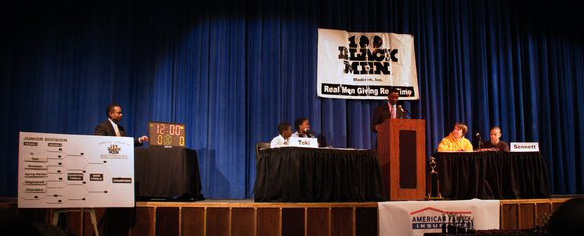
Many thanks to the 100 Black Men of Madison for organizing the 14th annual African American History Challenge. More photos here. Five Madison middle schools participated this year: Cherokee, Sennett, Spring Harbor, Toki and Edgewood.

Share

Freedom Means Responsibility

George McGovern:

Nearly 16 years ago in these very pages, I wrote that “‘one-size-fits all’ rules for business ignore the reality of the market place.” Today I’m watching some broad rules evolve on individual decisions that are even worse.
Under the guise of protecting us from ourselves, the right and the left are becoming ever more aggressive in regulating behavior. Much paternalist scrutiny has recently centered on personal economics, including calls to regulate subprime mortgages.
With liberalized credit rules, many people with limited income could access a mortgage and choose, for the first time, if they wanted to own a home. And most of those who chose to do so are hanging on to their mortgages. According to the national delinquency survey released yesterday, the vast majority of subprime, adjustable-rate mortgages are in good condition,their holders neither delinquent nor in default.
There’s no question, however, that delinquency and default rates are far too high. But some of this is due to bad investment decisions by real-estate speculators. These losses are not unlike the risks taken every day in the stock market.

About George McGovern.

Share

At Charter School: Higher Teacher Pay

Elissa Gootman:

A New York City charter school set to open in 2009 in Washington Heights will test one of the most fundamental questions in education: Whether significantly higher pay for teachers is the key to improving schools.
The school, which will run from fifth to eighth grades, is promising to pay teachers $125,000, plus a potential bonus based on schoolwide performance. That is nearly twice as much as the average New York City public school teacher earns, roughly two and a half times the national average teacher salary and higher than the base salary of all but the most senior teachers in the most generous districts nationwide.
The school’s creator and first principal, Zeke M. Vanderhoek, contends that high salaries will lure the best teachers. He says he wants to put into practice the conclusion reached by a growing body of research: that teacher quality — not star principals, laptop computers or abundant electives — is the crucial ingredient for success.
“I would much rather put a phenomenal, great teacher in a field with 30 kids and nothing else than take the mediocre teacher and give them half the number of students and give them all the technology in the world,” said Mr. Vanderhoek, 31, a Yale graduate and former middle school teacher who built a test preparation company that pays its tutors far more than the competition.

Related: The Teacher Free Agent Market in Denver.

Share

California Court: Credential Needed to Home School

AP:

California parents without teaching credentials cannot legally home school their children, according to a recent state appellate court ruling.
The immediate impact of the ruling was not clear. Attorneys for the state Department of Education were reviewing the ruling, and home schooling organizations were lining up against it.
“Parents do not have a constitutional right to home school their children,” Justice H. Walter Croskey wrote in a Feb. 28 opinion for the 2nd District Court of Appeal.
Noncompliance could lead to criminal complaints against the parents, Croskey said.

An earlier post on this item can be found here.
Bob Egelko & Jill Tucker:

A California appeals court ruling clamping down on homeschooling by parents without teaching credentials sent shock waves across the state this week, leaving an estimated 166,000 children as possible truants and their parents at risk of prosecution.
The homeschooling movement never saw the case coming.
“At first, there was a sense of, ‘No way,’ ” said homeschool parent Loren Mavromati, a resident of Redondo Beach (Los Angeles County) who is active with a homeschool association. “Then there was a little bit of fear. I think it has moved now into indignation.”
The ruling arose from a child welfare dispute between the Los Angeles County Department of Children and Family Services and Philip and Mary Long of Lynwood, who have been homeschooling their eight children. Mary Long is their teacher, but holds no teaching credential.
The parents said they also enrolled their children in Sunland Christian School, a private religious academy in Sylmar (Los Angeles County), which considers the Long children part of its independent study program and visits the home about four times a year.

NPR:

Parents who home-school their children need a teaching credential, according to a recent appellate court ruling in California. What does the ruling mean for those who home-school more than 1 million American children?

Share

After School Programs in the 21st Century: Their Potential and What It Takes to Achieve It

Priscilla M. D. Little, Christopher Wimer, and Heather B. Weiss, Harvard Family Research Project:

Harvard Family Research Project’s (HFRP) Issues and Opportunities in Out-of-School Time Evaluation briefs highlight current research and evaluation work in the out-of-school time field. These documents draw on HFRP’s research work in out-of-school time to provide practitioners, funders, evaluators, and policymakers with information to help them in their work. This brief looks at 10 years of research on after school programs and finds implications for the future of the after school field.
This research brief draws on seminal research and evaluation studies to address two primary questions: (a) Does participation in after school programs make a difference, and, if so (b) what conditions appear to be necessary to achieve positive results? The brief concludes with a set of questions to spur conversation about the evolving role of after school in efforts to expand time and opportunities for children and youth in the 21st century.

Share

Homeowners Petition to Leave the Waukesha School District

Milwaukee Journal-Sentinel Editorial:

The fact that 66 out of 99 residents in the Meadowbrook Farms single-family home development in Pewaukee are willing to spend an average of $700 more in property taxes to leave the Waukesha School District says something about the disturbing trend in what the district is offering its families.
If the district and taxpaying voters in the district want to become more attractive to families moving into Waukesha County, they’re going to have to find ways to reverse that trend and be willing to pay the price.
As the Journal Sentinel’s Amy Hetzner detailed in a Tuesday article, two sets of property owners plan to ask a state panel to overrule the Waukesha School Board’s denial of their requests to detach from Waukesha and join Pewaukee’s school system

Share

High Schools Add Classes Scripted by Corporations
Lockheed, Intel Fund Engineering Courses

Anne Marie Chaker:

In a recent class at Abraham Clark High School in Roselle, N.J., business teacher Barbara Govahn distributed glossy classroom materials that invited students to think about what they want to be when they grow up. Eighteen career paths were profiled, including a writer, a magician, a town mayor — and five employees from accounting giant Deloitte LLP.
“Consider a career you may never have imagined,” the book suggests. “Working as a professional auditor.”
The curriculum, provided free to the public school by a nonprofit arm of Deloitte, aims to persuade students to join the company’s ranks. One 18-year-old senior in Ms. Govahn’s class, Hipolito Rivera, says the company-sponsored lesson drove home how professionals in all fields need accountants. “They make it sound pretty good,” he says.
Deloitte and other corporations are reaching out to classrooms — drafting curricula while also conveying the benefits of working for the sponsor companies. Hoping to create a pipeline of workers far into the future, these corporations furnish free lesson plans and may also underwrite classroom materials, computers or training seminars for teachers.
The programs represent a new dimension of the business world’s influence in public schools. Companies such as McDonald’s Corp. and Yum Brands Inc.’s Pizza Hut have long attempted to use school promotions to turn students into customers. The latest initiatives would turn them into employees.

Share

A Look at California’s Dropouts

Nanette Asimov:

If California hopes to stop hemorrhaging the billions of dollars it spends by producing so many high school dropouts, the state needs to give schools better incentives to hold on to troubled students, change its graduation requirements and do more to plug the problem, researchers warn.
Each year, about 120,000 students fail to get a diploma by age 20, according to the California Dropout Research Project, which on Wednesday released detailed recommendations for state lawmakers and educators.
Each annual wave of dropouts costs the state $46.4 billion over their lifetimes because people without a high school diploma are the most likely to be unemployed, turn to crime, need state-funded medical care, get welfare and pay no taxes, according to the report.
“California uses a number of strategies to reduce dropout rates … but together they are insufficient to address the problem,” say the researchers, led by education Professor Russell Rumberger of UC Santa Barbara.

Share

The Teacher Free Agent Market in Denver

Mike Antonucci:

The autonomy movement in Denver is leading to a strange phenomenon: a boom market for quality teachers:

Diane Kenealy interviewed for a teaching job at West Denver Preparatory Charter School on Jan. 9, received a job offer within 24 hours and accepted the position three days later.
Compare that rapid hiring to this spring’s staffing calendar in traditional Denver Public Schools, which dictates principals can’t schedule interviews with teaching candidates until the middle of March.
Even then, they can only talk to candidates already working in a city school.
A DPS principal who wants to talk to a college senior such as Kenealy, who spends her summers teaching poor children in Denver, has to wait another full month, until mid-April.

Share

The Whole Child

Here in Massachusetts these days, we are hearing more and more from the Governor and educators about “The Whole Child.” They say we should be sure, in our schools, not to get distracted from a focus, in a holistic way, on the whole child.
I have heard about this “whole child,” but I have yet to have anyone explain what that could mean. I know that it has been said, of boys, for instance, that they are made of “snakes and snails and puppy dogs’ tails,” and of girls, that they are mostly “sugar and spice and everything nice,” but I can’t believe that completes the inventory.
Each student may be considered from a neuro-psychological, socio-economic, philosophical, dental, muscular-skeletal, ethnic, spiritual, academic, motivational, personality configuration, family, allergic, drug-resistant, blood-type, intellectual, gastrointestinal and athletic point of view, among a large group of other perspectives.
This raises the question of what parts of the whole child the school might be best qualified and equipped to work with? Surely no imaginable set of teachers, nurses, hall monitors, principals, bus drivers, coaches, and so on can deal with all the various characteristics of each human being who comes as a student to their school.
It would appear that a school and its staff might have to choose which aspects of the whole child should be their focus. In recent decades, self-esteem, tolerance, social consciousness, respect for differences, and environmental awareness have taken up a good deal of time in the schools. Perhaps as a consequence, our students tend to be in-numerate and a-literate. The Boston Globe reports today that: “37 percent of public high school graduates who enter public higher education may not be ready.”

(more…)

Share

Do little ones need formal lessons?

Hilary Wilce:

War has broken out over the under-fives. As the Government moves to bring in a compulsory “nappy curriculum” for pre-schoolers, thousands of protesters are lobbying to keep children’s early years out of the hands of Whitehall bureaucrats. Their case is being brought before Parliament, and early-childhood experts from around the world are backing their cause.
The latest of these is educational psychologist Aric Sigman, who, in a research paper commissioned by the campaigners, sets out the evidence that early computer-based learning, which the new curriculum explicitly encourages, has a negative effect on language, maths, reading and brain development.
“Parents and the educational establishment should, in effect, ‘cordon-off’ the early years of education,” he concludes, “providing a buffer zone where a child’s cognitive and social skills can develop without the distortion that may occur through the premature use of ICT.”
The cause of the furore is the Government’s early years foundation stage, which sets out a detailed learning framework for the under-fives. Everyone who works with young children, be they childminders, play assistants or nursery teachers, will be required to use it from this September. The framework stresses that although children develop at different rates and young children learn by play and exploration, it lists 69 goals that most children should attain by the age of five, and outlines how children must be assessed against them.

Share

Let Them Drop Out, Then Get Them Back

Jay Matthews:

Every time I hear from a teacher, I learn something. It may be a new reading report, a promising homework technique, a story of a student’s success. And sometimes it is a taboo-busting, eye-widening, troublemaking idea. Consider the e-mail that Michael Goldstein, founder of the MATCH Charter Public High School in Boston, sent, saying that if a kid wants to drop out, let him.
I would usually hit the delete button on something that impolitic. But Goldstein has created one of the most successful inner-city high schools in the country. He has proven to me time and again that he knows what he is talking about.
I think our awful dropout rate — only half of urban low-income students complete high school — is the most difficult educational problem in the country. It may require much more than our usual buzzword solutions such as “engaging lessons,” “personal contact” or “individualized instruction.” What Goldstein wants to do is sort of educational jujitsu: Let the force of the kid’s rush out of school bring him back, somewhat later, with enough money to get the learning he finally realizes he needs.
I am going to quote Goldstein’s e-mail in full, because anyone who is willing to risk his splendid reputation to this degree should have a chance to explain all the details. He wrote in response to my request for solutions to the hopelessness found in many of our urban high schools, exemplified by Washington Post Staff Writer Lonnae O’Neal Parker’s two-part series in November on Calvin Coolidge Senior High School senior Jonathan Lewis, a potential dropout if there ever was one.

Share

Education Revolt in Watts

Drew Carey video:

Vikki Reyes has had it with Locke High, the school her daughters attend in the Watts neighborhood of Los Angeles. She walked in on class one day and recalls “the place was just like a zoo!” Students had taken control, while the teacher sat quietly with a book.
Frank Wells has also had it with Locke High. When he became principal he says gangs ruled the campus. He tried to turn things around but ran into a “brick wall” of resistance from the school district and teachers union.

Share

Obama cracks a ruler, and the crowd goes wild

Mark Barabak:

They came to cheer. They got a lecture. The crowd went wild.
During a Barack Obama town-hall meeting on the economy, the topic turned to education, which, the Illinois senator said, could not be remedied by spending alone. “It doesn’t matter how much money we put in if parents don’t parent,” he scolded.
The line is one the Democrat delivers often, but on Thursday in Beaumont, Texas, he struck a remarkable chord with his mostly African American audience.
“It’s not good enough for you to say to your child, ‘Do good in school,’ and then when that child comes home, you’ve got the TV set on,” Obama lectured. “You’ve got the radio on. You don’t check their homework. There’s not a book in the house. You’ve got the video game playing.”
Each line was punctuated by a roar, and Obama began to shout, falling into a preacher’s rhythm. “Am I right?”
“So turn off the TV set. Put the video game away. Buy a little desk. Or put that child at the kitchen table. Watch them do their homework. If they don’t know how to do it, give ’em help. If you don’t know how to do it, call the teacher.”
By now, the crowd of nearly 2,000 was lifted from the red velveteen seats of the Julie Rogers Theatre, hands raised to the gilded ceiling. “Make ’em go to bed at a reasonable time! Keep ’em off the streets! Give ’em some breakfast! Come on! Can I get an amen here?”

Share

Madison School Board Detailed Agenda Posted Online – Including a Proposed Wisconsin Center for Education Research Contract

A reader’s email mentioned that the Madison School Board has begun posting more detailed agenda items on their meeting web page. Monday, March 3’s full agenda includes Superintedent Art Rainwater’s discussion of the proposed Middle School report card changes along with a recommendation to approve an agreement with the Wisconsin Center for Education Research (1.5MB PDF):

The focus of this project is to develop a value-added system for the Madison Metropolitan School District and produce value-added reports using assessment data from November 2005 to November 2007. Since the data from the November 2007 assessment will not be available until March 2008, WCER will first develop a value-added system based on two years of state assessment data (November 2005 and November 2006). After the 2007 data becomes available (about Ma r c h 1 2008), WCER will extend the value-added system so that it incorporates all three years of data. Below, we list the tasks for this project and a project timeline.
Task 1. Specify features o f MMSD value-added model
Task 2. Develop value-added model using 2005 and 2006 assessment dat a
Task 3. Produce value-added reports using 2005 and 2006 assessment data
Task 4. Develop value-added model using 2005, 2006, and 2007 assessment
Task 5. Produce value-added reports using 2005-2007 assessment data

August, 2007 presentation to the Madison School Board’s Performance & Achievement Committee on “Value Added Assessment”.

Share

Immersion Presents: Monterey Bay Live Broadcasts

Location: Monterey Bay National Marine Sanctuary
Dates: Sunday, March 2 – Friday, March 7
Times (EST): 11 am, 12 am, 1 pm, 2 pm, 3 pm
Program Length: 30 minutes
Immersion Presents:

How do you get kids to say “I want to be a scientist when I grow up?” Dr. Robert Ballard, known for discovering the Titanic among other scientific breakthroughs, may have the answer. The renowned oceanographer’s latest quest is not to discover underwater secrets, but to inspire the next generation of ocean explorers by introducing kids to the thrill of discovery and encouraging them to pursue the science and environmental careers so critical for the health of the planet.
From March 2–7, 2008, Immersion Presents Monterey Bay, a cutting-edge, interactive educational program led by Dr. Ballard and a team of scientists from the National Oceanic and Atmospheric Administration (NOAA) and other institutions, will use telepresence technology – a combination of satellite and Internet connections – to transport young people live to a scientific expedition in Monterey Bay National Marine Sanctuary.
Students will explore in real-time one of the planet’s most spectacular and most important biodiversity hotspots where they will experience majestic 100-foot-tall kelp forests, take a day trip out to the deep sea in NOAA’s research vessel R/V Fulmar, and study endangered marine mammals like the grey or blue whale and the threatened California sea otter.
“When kids see scientists in action, whether diving a kelp forest, exploring with an ROV, or getting up close to a whale, they immediately discover that being a scientist means much more than wearing a white coat in a lab,” said Dr. Ballard, founder of Immersion Presents. “With everyone talking about ‘going green,’ now more than ever we need kids to get excited about the environmentally focused careers that will help protect the planet. Immersion expeditions show kids that science is not only far from boring or nerdy, it is absolutely essential to preserve one of our most threatened resources, the oceans.”
“Many of our kids only know what a jellyfish is from watching Sponge Bob on television,” said Hector Perez, club director of the Chicago’s Union League Boys & Girls Club, which participates in the program. “It’s hard for kids to imagine being part of something that they’ve never seen before. Immersion Presents’ virtual science expeditions open their minds, transporting them to a whole new world of ocean discoveries, new technology, and exciting career opportunities.”

Share

Judge orders homeschoolers into government education

Bob Unruh:

A California court has ruled that several children in one homeschool family must be enrolled in a public school or “legally qualified” private school, and must attend, sending ripples of shock into the nation’s homeschooling advocates as the family reviews its options for appeal.
The ruling came in a case brought against Phillip and Mary Long over the education being provided to two of their eight children. They are considering an appeal to the state Supreme Court, because they have homeschooled all of their children, the oldest now 29, because of various anti-Christian influences in California’s public schools.
The decision from the 2nd Appellate Court in Los Angeles granted a special petition brought by lawyers appointed to represent the two youngest children after the family’s homeschooling was brought to the attention of child advocates.

Share

Wisconsin Legislature Still Split on Virtual Schools, Autism

Patrick Marley:

As the Legislature heads into the last days of its session, Democrats and Republicans remain far apart on bills that would protect virtual schools and expand health coverage for children with autism.
With the clock running out, nothing may happen this year on those issues. Then again, in the final frantic moments of legislative sessions, surprise compromises can arise, just as one did Thursday on ending the pay of fired Milwaukee police officers charged with serious crimes. Now, those officers continue to receive pay until they exhaust their appeals, which can take years.
The legislative session ends March 13, but lawmakers have not announced any meetings past next week.
The Assembly’s latest meeting – which adjourned just before 5 a.m. Friday – bogged down over the autism bill. Democrats delayed a vote on the bill until Wednesday after Republicans who control the house rewrote it.
The version Senate Democrats passed Tuesday would require insurance companies to cover treatment for autism. Assembly Republicans changed the bill Friday to drop the insurance mandate and instead plow $6 million in state taxpayer money into a state autism program.

Share

Suggested Characteristics of a New Waukesha Superintendent

Waukesha Taxpayer’s League:

The WTL was asked by the Waukesha School District what three criteria we would be looking for in a new superintendent. Here is our response.
1. Strong fiscally conservative background with a desire to be creative in finding solutions to budget woes other than referendums and new fees. Stability is a must to protect the children and deliver a high quality of education.
2. Knowledge and belief in charter and virtual schools including but not limited to “IQ academies”. These are great tools to address different learning styles, abilities and interests of children so they can succeed.
3. Belief in high academic standards in the core subjects to be competitive not only locally but worldwide. We have a worldwide economy and thus must deliver an education that will allow our children to compete worldwide.

Share

What Makes Finnish Kids so Smart?
Finland’s teens score extraordinarily high on an international test. American educators are trying to figure out why.

Ellen Gamerman:

High-school students here rarely get more than a half-hour of homework a night. They have no school uniforms, no honor societies, no valedictorians, no tardy bells and no classes for the gifted. There is little standardized testing, few parents agonize over college and kids don’t start school until age 7.
Yet by one international measure, Finnish teenagers are among the smartest in the world. They earned some of the top scores by 15-year-old students who were tested in 57 countries. American teens finished among the world’s C students even as U.S. educators piled on more homework, standards and rules. Finnish youth, like their U.S. counterparts, also waste hours online. They dye their hair, love sarcasm and listen to rap and heavy metal. But by ninth grade they’re way ahead in math, science and reading — on track to keeping Finns among the world’s most productive workers.
The Finns won attention with their performances in triennial tests sponsored by the Organization for Economic Cooperation and Development, a group funded by 30 countries that monitors social and economic trends. In the most recent test, which focused on science, Finland’s students placed first in science and near the top in math and reading, according to results released late last year. An unofficial tally of Finland’s combined scores puts it in first place overall, says Andreas Schleicher, who directs the OECD’s test, known as the Programme for International Student Assessment, or PISA. The U.S. placed in the middle of the pack in math and science; its reading scores were tossed because of a glitch. About 400,000 students around the world answered multiple-choice questions and essays on the test that measured critical thinking and the application of knowledge. A typical subject: Discuss the artistic value of graffiti.

More:

The Norssi School is run like a teaching hospital, with about 800 teacher trainees each year. Graduate students work with kids while instructors evaluate from the sidelines. Teachers must hold master’s degrees, and the profession is highly competitive: More than 40 people may apply for a single job. Their salaries are similar to those of U.S. teachers, but they generally have more freedom.
Finnish teachers pick books and customize lessons as they shape students to national standards. “In most countries, education feels like a car factory. In Finland, the teachers are the entrepreneurs,” says Mr. Schleicher, of the Paris-based OECD, which began the international student test in 2000.
innish high-school senior Elina Lamponen saw the differences firsthand. She spent a year at Colon High School in Colon, Mich., where strict rules didn’t translate into tougher lessons or dedicated students, Ms. Lamponen says. She would ask students whether they did their homework. They would reply: ” ‘Nah. So what’d you do last night?'” she recalls. History tests were often multiple choice. The rare essay question, she says, allowed very little space in which to write. In-class projects were largely “glue this to the poster for an hour,” she says. Her Finnish high school forced Ms. Lamponen, a spiky-haired 19-year-old, to repeat the year when she returned.
Lloyd Kirby, superintendent of Colon Community Schools in southern Michigan, says foreign students are told to ask for extra work if they find classes too easy. He says he is trying to make his schools more rigorous by asking parents to demand more from their children.

Share

An overhaul addresses how kids learn, not what courses they take.

Jennifer Brown:

Loveland High School used to offer watered-down math for students flunking geometry and algebra.
Then the geometry and construction teachers created a course that’s all the rage at Loveland High — a house-building class where students learn the slope of a line by determining the pitch of a roof.
The school started with two classes last year and now has six. Enrolled students have outperformed their classmates on state tests. And now Thompson School District is creating an algebra course where students will convert a gas-guzzling car to an electric one.
That creative course design is an illustration of what Gov. Bill Ritter envisions under his new education initiative — a revamping of curricula from preschool to college to produce courses focused more on content than titles.
Details of the governor’s initiative are still sketchy, though a 28-page draft of the legislation is likely to become official this week.

Share

As driving deaths mount, some teens ask for tighter restrictions

AP:

Sami Wilson has attended the funerals of seven friends in the past two years. She’s 17 years old.
Wilson is a senior at Princeton High School, which has been particularly hard hit by traffic deaths involving teenagers.
”You kind of just get used to the feeling of a funeral around here,” Wilson told the Star Tribune.
But it’s not just a problem in this one Minnesota city. No state in the country has a higher percentage of teenagers behind the wheel in deadly crashes than Minnesota.
Teens were driving in 18.4 percent of Minnesota’s fatal traffic accidents from 2004 to 2006, according to figures compiled by the U.S. Department of Transportation. The national average was 14.3 percent.
Roughly every five days, a Minnesota teen dies in a traffic crash. Already this month, a 17-year-old died without a seat belt in a head-on crash in Winona County, while another 17-year-old crossed the center line and collided head-on with a bus in southeastern Morrison county, killing a 53-year-old driver.
The Insurance Institute for Highway Safety recently gave Minnesota and nine other states a marginal grade because they don’t limit teenage riders and night driving.
Many states, including Wisconsin, prohibit 16-year-olds from carrying more than one passenger or driving after midnight. In the last year, legislatures in Illinois, Ohio and Idaho tightened night driving or passenger laws for teen drivers.

Share

Kids & Steriods

Shaun Powell:

This is about the kids, they said, over and over, trying harder than Roger Clemens to sound convincing. The members of the House committee looking into steroid use in baseball pounded that theme into our brain last week at the hearing. Kids are getting bad messages about performance-enhancing drugs. Kids are being betrayed by ballplayers. Kids are being wrongly influenced by the superstars.
Well, sure, no problem there. Let’s look out for all kids – yours, mine, everyone’s.
But don’t tell me kids are being suckered by star athletes on steroids and then condone, through silence, drug use by entertainers.
Don’t send the media moral police chasing Barry Bonds and Roger Clemens and Mark McGwire, then release the Entertainment Tonight poodles on Sylvester Stallone.
Don’t spend thousands of dollars examining steroid use in baseball, then feel it’s not worth spending two cents checking out 50 Cent.
And please, don’t suggest that kids admire pro athletes more than they do actors and singers and rappers. These entertainers impact the way our kids walk, talk, dress and behave. Yet marijuana and cocaine somehow give them credibility with a young audience bent on rebellion. And with regard to the drug of the moment, there was no outcry from Congress or the media when dozens of A-list entertainers recently were linked to getting steroids through a Long Island chiropractor.

Share

Nevada Charter School Tension
State, local moratoriums on new applications have education officials, lawmakers butting heads

Emily Richmond:

Nevada parents want the option of sending their children to charter schools.
State and local education officials say they won’t approve charter schools unless they can ensure the schools meet standards.
That’s all good, right? Well, it has educators and lawmakers in the bureaucratic equivalent of a schoolyard shoving match.
Following the Clark County School District’s lead, the State Board of Education in November said it was suspending approval of new charter school applications. The education officials said they did not have the staff to handle the workload. So, they said, until they can handle new charter schools properly, they aren’t going to handle them at all.
There were some tense exchanges among state board members and lawmakers in the days leading up to and following the moratorium vote.
Some lawmakers were infuriated, alleging the motives had more to do with turf protection than logistical challenges. A few legislators suggested the vote had violated the state’s open meeting law.

Share

BEST U.S. FACTORY JOBS IN RISING JEOPARDY

Mark Trumbull:

A new round of cutbacks by Detroit’s automakers carries a larger message – that America’s manufacturing workers are under new pressure in jobs where labor unions had once been able to command middle-class wages for assembly-line jobs.
The point was punctuated this week as General Motors announced the largest ever annual loss by a maker of automobiles. In a bid to restore profitability, GM said it would offer incentives to convince older, highly paid assembly workers to retire early. Ford and Chrysler are pursuing similar worker buyouts.
The moves signal what some analysts say is an accelerating effort to trim wages and workforces. Essentially, the old Big Three are becoming a much smaller three. The pressures facing Detroit fit a larger pattern. Many US manufacturers are facing rising pressure from foreign rivals. The good news is that US factories are becoming more competitive. The bad news is that the needed streamlining is coming at the expense of American workers.
“Those jobs are going and they’re not coming back,” says Gary Chaison, a labor expert at Clark University in Worcester, Mass. In part, he says, manufacturers see moves such as the job buyouts as “a path for them to become low-cost producers by eliminating the high costs of American labor.”

Share

Thinking about the Next Few Decades: “Let Us Light A Candle While We Walk, Lest We Fear What Lies Ahead”

Fabius Maximus:

Many people look to the future with fear. We see this fear throughout the web. Right-wing sites describe the imminent end of America: overrun by foreigners, victim of cultural and financial collapse. Left-wing sites describe “die-off” scenarios due to Peak Oil, climate change, and ecological collapse – as the American dream dies from takeover by theocrats and fascists.
Most of this is nonsense, but not the prospect of massive changes in our world. But need we fear the future?
The past should give us confidence when we look ahead. Consider Dodge City in 1877. Bat Masterson is sheriff, maintaining some semblance of law in the Wild West. Life in Dodge is materially only slightly better from that in an English village of a century before. But social and technological evolution has accelerated to a dizzying pace, and Bat cannot imagine what lies ahead.

Well worth reading as Madison prepares for a new Superintendent and two new school board members.

Share

PTOs’ aid not just in bake sales anymore

Amanda Keim & Andrea Natekar:

Faced with belt-tightening from state and local coffers, Arizona’s public schools are relying more and more on parent-teacher groups to pay for items they say they need, but can’t afford.
No longer content to simply hold bake sales and stand on the sidelines, these parents are taking the lead in raising hundreds of thousands of dollars for items that can directly impact classroom instruction.
Computers and other classroom technology. Rock-climbing walls. Mandarin Chinese lessons. Playground shade structures.
While at some East Valley schools, primarily those in lower-income neighborhoods, principals struggle to even get PTOs off the ground, parents at other more well-off schools use sharp business acumen to help fund what they say are needed educational tools.
“The money just isn’t there. When you look at the way the schools are funded compared to 48 other states in the country, they just don’t have the money,” said Marjorie Desmond, PTO president at Scottsdale’s Cheyenne Traditional School, which raises more than $60,000 annually. “Legislation moves very slowly and the kids grow up very quickly. The parents want to have what’s best for their own kids, and that’s how they make an impact most quickly, is getting involved at the grass-roots level.”

Share

Madison School Board PA Committee Credit for Courses Taken Outside the District Discussion


Watch the public appearances (including a discussion about the proposed report card changes) along with the Committee’s discussion on this matter. Janet Mertz’s latest post can be read here, along with a number of related links.

Share

Madison West High Drama Benefit

via a Cyndie Spencer email:

Once again, excuse the duplicates… this is another great cause for West High School. Denny and i are planning to attend….
Please join Friends of West High Drama Friday March 7, 2008 at 7 PM at the Madison Club for a fundraiser to upgrade the sound system in the West High Auditorium. (see attached invite). We’ve planned a fun, welcoming and relaxing evening to celebrate the amazing student talent at West. We very much hope you can attend!
Meet the cast of West’s spring musical “A Chorus Line”. Hear them sing selections from the show as well as entertain you with some of the best “Singing Valentines” from West’s celebration of Valentine’s Day.
Enjoy delicious appetizers/dessert & bid on a few select auction items (condo in Myrtle Beach; theater tickets & dinner). Cash bar available.
Tickets are $35/person ($25 tax deductible). While tickets will be available at the door, your advance purchase helps us enormously in our planning. If you cannot attend but would like to contribute, please send your contribution made out to FMPS-Friends of West High Drama to Kay Plantes, 3432 Sunset Dr, Madison WI 53705.
We thank you in advance for your support. Your attendance and/or contribution are very much needed to improve the quality of life at West H.S. for all students.
Questions or to unsubscribe from this email, please reply to the address above or call Ruth Saecker (608-233-6943).

Share

Home-School Support: Parents advocate bill on leaving public school

Colin Poitras:

Anita Formichella is tired of hiding like a criminal.
“The sound of the doorbell literally strikes terror in my heart,” said Formichella, a bespectacled, middle-aged former school volunteer from Redding in her testimony to members of the legislature’s select committee on children on Tuesday.
For the past two years, Formichella said she has hidden in her house, shouting through the door when people knock because she fears the person on the other side might be a state social worker coming to take her children away.
Formichella isn’t a child abuser. She has never been cited for child neglect. She is a teacher. A home-school teacher. And therein lies the rub.
Within weeks of pulling her children from the public school system in 2006, Formichella received a letter from the local school superintendent requiring her to sign a form and submit more evidence that her children were being properly schooled. If she didn’t, Formichella said, she would risk a neglect investigation by the state Department of Children and Families. Formichella was frightened at first, then incensed.
“That’s a heinous, heinous thing to threaten a parent,” Formichella said outside the hearing room Tuesday. “And [the school superintendent] knew me!”

Share

Update on Madison BOE policy regarding students taking non-MMSD courses:

The February 25, 2008 Meeting of the Performance & Achievement Committee was devoted to developing a policy regarding students taking non-MMSD courses. The proposal Pam Nash suggested to the committee was essentially identical to the highly restrictive one she had originally proposed during the December, 2006 meeting of this committee: students would be permitted to earn a maximum of TWO ELECTIVE credits for course work and only when no comparable course is offered ANYWHERE in the District. Even Rainwater felt these rules were overly restrictive. He seemed willing (i) to increase the number of credits a student could earn, and (ii) to permit students to take a course offered elsewhere in the District if the student could not reasonably access the District’s course. Discussion of the Nash proposed policy ensued, but no specific revisions to it were made during this committee meeting. Both Maya and Johnnie (2 or the 3 members of the committee) suggested that the District needed to research the topic better, e.g., investigate what other comparable school districts in WI (e.g., Appleton which has in place a much less restrictive policy) were doing and to obtain feedback from the guidance departments of each of the 5 high schools, before the BOE should vote on approving a policy. Lawrie, chair of this committee, bypassed having a vote on whether to recommend the Nash version of the policy to the full BOE since she clearly would have lost such a vote. Instead, she simply stated that she had ALREADY placed this topic on the agenda for a special meeting of the BOE to be held March 10th, a meeting at which public appearances will NOT be permitted. Why the urgency now after we have been waiting for 6 years for the District to develop a policy in this matter? Possibly, the new Board that starts in April would approve a different policy, one that better meets the needs of students. Thus, folks, your only remaining opportunities to influence this policy to be approved by the BOE on March 10th are (i) to email and phone members of the BOE between now and March 10, telling them your opinions and why, ideally with examples of specific students, and (ii) to attend the March 10th meeting so the Board members will know you are watching how they vote.
Related:

Share

Madison School Board Committee Recommends Far West Side Boundary Changes

Susan Troller:

A Madison School Board committee recommended Monday night that students at Madison’s newest elementary school now under construction should attend Toki Middle School, not Jefferson Middle School as originally planned.
Members of the board’s long range planning committee also recommended final boundary Plan F for elementary school students in the Memorial High School attendance area that would send children in the neighborhood around Channel 3 to Falk Elementary School instead of Chavez Elementary or the new school, located west of Highway M.
The full School Board plans to vote on the recommendations March 3 at its regular meeting at the Doyle Administration Building at 7 p.m. There will be an opportunity for public commentary before the vote.
Among some west side parents, the most controversial part of planning the changes to accommodate the new school has been deciding which children and neighborhoods will attend Falk Elementary School, which has the west side’s highest percentage of low income students.
Numbers of low income students in the Memorial area range from 22 percent at Crestwood to 66 percent at Falk. Under the proposed plan, Falk’s low income percentage would drop to 57 percent.

Share

A Report on Voucher, Milwaukee Public School Performance

Alan Borsuk:

The first full-force examination since 1995 of Milwaukee’s groundbreaking school voucher program has found that students attending private schools through the program aren’t doing much better or worse than students in Milwaukee Public Schools.
The researchers gave a sample of voucher students the same tests given to public school students in Wisconsin and compared the results to those of a scientifically matched group of MPS students. Overall, they found, fourth-grade voucher students scored “somewhat lower” than MPS students but eighth-grade voucher students scored “somewhat higher.”
At all grades, both MPS and voucher students had overall test scores well below the 50th percentile nationally, and generally around the 33rd percentile, meaning they were generally scoring lower than two-thirds of students.
Results for individual voucher schools were not released as part of the study, despite calls from several legislators and others to see the private school results.
The study was conducted by the School Choice Demonstration Project, part of the Department of Education Reform at the University of Arkansas. The main researchers included John Witte, a University of Wisconsin-Madison professor who conducted studies of the Milwaukee voucher program in its early years from 1990 to 1995, before the Legislature dropped the requirement for such studies.

Share

Study but don’t cap online schools

Wisconsin State Journal Editorial:

An audit to help gauge how virtual schools are performing in Wisconsin is reasonable.
But slapping a cap on how many children can enroll in online schools is unnecessary and potentially harmful.
Gov. Jim Doyle ‘s last-minute demand for a cap threatens to ruin a solid bipartisan deal to keep these interesting schools going.
The governor should drop his veto threat, and the Legislature should give Doyle and the teachers union the audit they want.
That way, a dozen virtual schools in Wisconsin serving 3,500 students can stay open and expand if more parents choose to enroll their children.
Key state lawmakers recently put together compromise legislation to keep virtual schools going after a court ruling threatened to shut them down. A court ruled in December that the Wisconsin Virtual Academy, based in suburban Milwaukee, violates state laws controlling teacher certification, charter schools and open enrollment.

Share

Doyle Defends Plan to Cap Virtual Schools Enrollment

Channel3000:

Gov. Jim Doyle said that he can’t understand why some are upset over his last-minute proposal to cap enrollment in virtual schools.
State lawmakers are trying to keep virtual schools open after a December court ruling said they were violating state law.
Without a change in law, as many as 12 schools that enroll 3,500 students could start closing as early as next school year.
Doyle recently told lawmakers that he would veto any bill that doesn’t cap enrollment while state officials study several issues related to the schools.
Republicans and Democratic Sen. Jon Erpenbach have expressed frustration at Doyle’s demands, which came after they thought they had agreement on a bill.

Share

My Suggested Changes to the Proposed MMSD Policy on Students Taking Outside Courses

February 25, 2008 draft proposal from Janet Mertz regarding the proposed MMSD Policy.
It is the policy of the Board to expand the opportunities for students to take courses outside of the District without increasing the costs to the District and without undermining the integrity of the diploma a student receives from the District. A student may receive credit for taking such outside courses. No District funds shall be utilized to pay for the costs to a student taking courses under this policy.
Taking outside courses if a student wishes to receive credit toward graduation.

  • By May 1 of the previous school year for first semester courses and by December 1 for second semester courses, the student shall submit to his/her principal or the principal’s designee the student’s request to take a course under this policy. Within 15 school days after receiving the student’s request, the principal, in consultation with the appropriate staff member(s), shall make a recommendation to the Superintendent or his/her designee as to whether the course shall be approved. Within 15 school days after receiving the principal’s recommendation, the Superintendent or his/her designee shall notify the student whether his/her request has been granted or denied.
  • A student may receive credit toward graduation. The grade will be recorded but not counted in the GPA.
  • Credits toward graduation shall be granted in the following manner:
  • No more than 4 credits per year.
  • No more than 11 credits may be applied to the total graduation requirement.
  • The student’s transcript shall include a description of the course, the institution, if any, the date the course was completed, the credit, and the grade.
  • No grades shall be included as part of a student’s grade point average (GPA).
  • All costs related to taking the course shall be the responsibility of the student and/or his/her parent/guardian.
  • Taking outside courses if a student does not wish to receive credit.
  • By May 1 of the previous school year for first semester courses and by December 1 for second semester courses, the student shall submit to his/her principal or the principal’s designee the students’ request to take a course under this policy. Within 15 days after receiving the student’s request, the principal, in consultation with the appropriate staff member(s), shall make a recommendation to the Superintendent or his/her designee as to whether the course shall be approved. Within 15 days after receiving the principal’s recommendation, the Superintendent or his/her designee shall notify whether his/her request has been granted or denied.
  • The student’s transcript shall include a description of the course, the institution, if any, the date the course was completed, and the pass/fail grade unless the student or his/her parent/guardian request that the student’s letter grade appear on the transcript in which case the student’s letter grade will appear on the transcript.
  • No grade shall be included as part of the student’s GPA.
  • All costs related to taking the course shall be the responsibility of the student and/or the student’s parent/guardian.
Share

Madison School District Memo on Students Taking Outside Courses

MMSD Legal Services; 18 Page 758K PDF

On January 8, 2007, the Board took the following action:
lt is recommended that the Board direct the Administration to: 1) freeze new procedures or guidelines for credit towards graduation for courses taken outside the MMSD until the Administration reports to the Board about whether current MMSD policies need to be updated or changed in view of any technological changes in the law and other opportunities; 2) develop a proposal on either the implementation and communication of the policies and procedures to parents and students for consistency across the District at the levels affected; and 3) have the Administration give the Board the pros and cons of adopting a policy like the one proposed by Dr. Mertz as a draft proposal. It is further recommended that the Administration review all nine of the policies, including the proposed “Guidelines for Coursework Outside the MMSD'” for possible revision, consolidation, or propose a newly created policy.
Attached is Exhibit 1, an amended draft of the policy previously submitted to the Board in a memo from Pamela Nash dated May 4, 2007. The amendments modify the timing of a student’s appiication to take courses outside the MMSD and the response time of the District. This time frame is modeled after the Youth Options time frame.
Also attached to this Memorandum is a copy of a policy proposal previously submitted by Dr. Janet Mertz, Exhibit 2A, and the District’s analysis of that proposal,
Exhibits 2 and 2B. These documents were also submitted to the Board of Education under cover of Dr. Nash’s memo of May 4, 2007. This matter is scheduled to be heard before the Performance and Achievement Committee on February 25, 2008.

Background audio, video and documents are available here. The School Board’s Performance & Achievement Committee meets today @ 5:00p.m to discuss this memorandum. [Directions & Map] Attend the meeting and send your thoughts to: comments@madison.k12.wi.us

Share

The Community Network Solution
In reweaving the social fabric of a city or town, relationships trump rank.

Karen Stephenson:

Business leaders are in­creasingly aware that the health of their enterprise is intimately connected with the health of the communities where they operate. As employers, they sometimes find themselves drawn in to help solve local problems. But they are also often frustrated by those efforts, and no wonder. When a community sets out to address complex problems, such as economic stagnation, sprawl, and failing schools, the ef­fort usually ends up going nowhere. Competing agendas surface, members delegate responsibilities to staff, difficult decisions get postponed. Hopes fade and interest flags as the hidden challenges and underlying conflicts become apparent.
The quiet failure of such initiatives is often attributed to human nature, or to some flaw in the process that shaped the effort. But in fact, the problem usually starts when the project organizers compose their first list of proposed participants. The organizers ask themselves: Who are the power brokers around town? Who are the key players? Who from business, government, education, and nonprofits should be involved?
Once the list is compiled, the usual suspects are convened. They assemble with enthusiasm, write a vision statement, sign up for committees, and pledge support. A press release goes out: “Local Leadership Team Sets to Work!”

Share

Madison School Board to Discuss Credit for Non-MMSD Courses Today @ 5:00p.m.

The Performance & Achievement committee meets today at 5:00p.m. [Directions & Map] to discuss a policy on credit for non-MMSD courses. Janet Mertz has been following this issue for years, in an effort to support a “clearly written policy” on such courses. Read Janet’s summary after the most recent discussion of this matter (26 November 2007):

Madison School Board Performance & Achievement Committee Meeting 11/26/2007At the November 26, 2007 meeting of the MMSD BOE’s Performance and Achievement Committee [18MB mp3 audio], the District’s Attorney handed out a draft of a policy for the District’s Youth Options Program dated November 20, 2007. It is a fine working draft. However, it has been written with rules making it as difficult as possible for students to actually take advantage of this State-mandated program. Thus, I urge all families with children who may be affected by this policy now or in the future to request a copy of this document, read it over carefully, and then write within the next couple of weeks to all BOE members, the District’s Attorney, Pam Nash, and Art Rainwater with suggestions for modifications to the draft text. For example, the current draft states that students are not eligible to take a course under the YOP if a comparable course is offered ANYWHERE in the MMSD (i.e., regardless of whether the student has a reasonable method to physically access the District’s comparable course). It also restricts students to taking courses at institutions “located in this State” (i.e., precluding online courses such as ones offered for academically advanced students via Stanford’s EPGY and Northwestern’s CTD).

The Attorney’s memorandum dated November 21, 2007 to this Committee, the BOE, and the Superintendent outlined a BOE policy chapter entitled “Educational Options” that would include, as well, a policy regarding “Credit for Courses Taken Outside the MMSD”. Unfortunately, this memo stated that this latter policy as one “to be developed”. It has now been almost 6 years (!) since Art Rainwater promised us that the District would develop an official policy regarding credit for courses taken outside the MMSD. A working draft available for public comment and BOE approval has yet to appear. In the interim, the “freeze” the BOE unanimously approved, yet again, last winter has been ignored by administrators, some students are leaving the MMSD because of its absence, and chaos continues to rein because there exists no clearly written policy defining the rules by which non-MMSD courses can be taken for high school credit. Can anyone give us a timetable by which an official BOE-approved policy on this topic will finally be in place?

Links:

Meanwhile, online learning options abound, including the news that National Geographic has invested in education startup ePals. Madison, home of a 25,000 student public school system, offers a rich learning environment that includes the University of Wisconsin, MATC and Edgewood among others.

Share

When cheers turn to depression

Stan Grossfeld:

She just wanted six-pack abs. So in the summer of 2003, Dionne Passacantando, a 17-year-old high school cheerleader, gymnast, and vice president of her Allen (Texas) High School class, made a decision she regrets. She bought anabolic steroids from a boy on the school football team.
“Nobody frowned upon it,” she says. “It was easier for me to get those than it probably was to buy beer.”
But after injecting herself with Winstrol every other day for five weeks, she became suicidal.
“I was the last person in the world you’d think would use anabolic steroids,” she says.
Her story is part of a much larger picture. The Mitchell Report, which detailed steroid use in major league baseball, noted that while steroid use among high schoolers seems to be declining, it is still estimated that 3-6 percent of students nationally have tried them. That means that, at a minimum, hundreds of thousands of high school students are using.

Share

Washington County 4-H and Madison West Rocket Club Selected for NASA Event

Channel3000:

Four Washington County teens are among 18 groups in the nation invited to display their rocket-building skills to NASA space shuttle engineers this spring.
The challenge for the team, all members of the county’s 4-H rocketry club, was to design and build a reusable rocket. It had to be capable of carrying a science payload to one mile above the surface and returning safely to the ground.
Their 7-foot rocket will be launched in late April at the Marshall Space Flight Center in Alabama as part of NASA’s Student Launch Initiative.
A rocket club from Madison West High School in Madison also was selected this year.

Donald Behm has more:

With spring deadlines looming, four Washington County teens are working weekends to build a high-powered rocket to launch in front of NASA space shuttle engineers.
Their challenge: Design and build a reusable rocket capable of carrying a science payload to one mile above the surface and returning safely to the ground.
The team, all members of the county’s 4-H rocketry club, is one of only 18 groups in the United States invited to display their skills this year as part of NASA’s Student Launch Initiative. Their rocket will be launched in late April at the Marshall Space Flight Center in Huntsville, Ala.
“It cannot be wrecked,” said Katlin Wagner, 15, a freshman at Slinger High School and the defending rocketry champ among 4-H youth in the county. “We must be able to put it back together and use it again.”

Share

Wisconsin “Senate Says Whoa on School Innovation”

Patrick McIlheran:

The best explanation – I mean the funniest – as to why the state Senate put a poison-pill enrollment cap on virtual schools was from state Sen. Russ Decker, the Weston Democrat who helped do it.
The fault lies with the schools, he says. Just too many parents were opting for them. In growth, “some of those virtual schools are pushing the envelope.”
Leave aside that pushing the envelope – inventing a new way to deliver a good education – is the point. On its face, the sentiment that the schools were growing faster than legally proper is nonsense.
Parents choose virtual schools, in which students are taught at home via daily online lessons, by the same law that allows any parent to send her child to any other public school. This open enrollment law has no upper limit and is now used by 23,000 students statewide. As for virtual schools, which account for 3,300 of those, the law did not limit their growth either until two months ago when a lawsuit by the Wisconsin Education Association Council, the state’s dominant teachers union, hit the jackpot. Decker’s envelope exists solely in his head.
So the Senate, on party lines with the exception of one honorable Democrat, installed one – dictating that for two years, virtual schools can grow no larger. They can inch up to 4,500 students by 2014, but senators also set auditors to studying the program. All this was needed, says Decker, because Gov. Jim Doyle wouldn’t agree to let the schools stay open otherwise.

Milwaukee Journal-Sentinel Editorial:

There is still time to save Wisconsin’s virtual schools, but the clock is ticking after a state Senate vote this week that unwisely capped enrollment and blew up a bipartisan compromise.
In a letter to legislators on the eve of the vote, Gov. Jim Doyle called for a cap on enrollment and recommended a study to determine how well virtual schools were serving students and what their fiscal impact was on existing public schools and property taxes.
The request for a study is sensible enough, but the cap is a solution looking for a problem. And now, despite exceptions for siblings of existing students and for students who signed up during the current open enrollment period, some children may be denied the opportunity to learn in an environment that is best suited to their needs.
Legislation was needed after a state Court of Appeals ruled in December that the Wisconsin Virtual Academy, operated by the Northern Ozaukee School District, was not eligible for state aid. That ruling threatened the existence of all 12 online schools in the state, which serve more than 3,000 students.
The compromise plan was a good one that balanced the need to legalize virtual schools while imposing new standards on them. It had the support of the state Department of Public Instruction.
The Senate vote sends the measure back to the Assembly, where Rep. Brett Davis (R-Oregon) said Thursday he would draft new legislation that includes a financial audit but not a cap. He also planned to send a letter to Doyle inviting the governor or his staff to a hearing on Monday to explain why a cap is necessary.

Much more on Wisconsin’s Virtual Schools here.

Share

The Leadership Limbo

Frederick Hess & Coby Loup:

In the era of No Child Left Behind, principals are increasingly held accountable for student performance. But are teacher labor agreements giving them enough flexibility to manage effectively? The Leadership Limbo: Teacher Labor Agreements in America’s Fifty Largest School Districts, answers this question and others.
The main findings:

  • Thirty, or more than half, of the 50 districts have labor agreements that are ambiguous. The collective bargaining agreements and the formal board policies in these districts appear to grant leaders substantial leeway to manage assertively, should they so choose.
  • Fifteen of the 50 districts are home to Restrictive or Highly Restrictive labor agreements. Nearly 10 percent of the nation’s African-American K-12 students population attend school in the 15 lowest-scoring districts-making these contracts major barriers to more equal educational opportunity.
  • The study also found that districts with high concentrations of poor and minority students tend to have more restrictive contracts than other districts-another alarming indication of inequity along racial and class lines.

Madison’s collective bargaining agreement can be found here.teachercba07-09.pdf

Share

Reaction to the Wisconsin Senate’s Virtual School Bill

Amy Hetzner:

The executive director of the Wisconsin Association of School Boards said today that he is disappointed that compromise legislation that would have ensured the survival of the state’s virtual schools seems to be falling apart.
“We had a bipartisan legislation that virtual schools could continue and meet our state standards and now we’re getting into some last-minute politicking and I think that’s very disappointing,” said John Ashley, whose group includes nearly all of the state’s 426 school boards.
“It was a legitimate bipartisan effort that’s unraveling,” he said. “And I think the real effect is going to be on our students. It’s unfortunate to see politics at this stage. I mean we don’t have that much of a (legislative) session left.”
In contrast, the Wisconsin Education Association Council, which brought a lawsuit that now threatens the ability of the state’s virtual charter schools to enroll students statewide and collect taxpayer dollars, released a statement by its president supporting the state Senate’s latest action.

More here.

Share

Students in Madison’s Alternative School

Andy Hall:

Alan is one of about 200 Madison middle and high school students who, having previously struggled in traditional school settings, now are thriving in the new homes of alternative education programs in elementary schools and in an office building.
Halfway through the school year, a controversial relocation of four alternative education programs appears to have been completed smoothly.
Some parents feared there’d be problems when the alternative programs for older students were moved to buildings with elementary students — the first time in at least a decade such an arrangement has been tried in Madison.
Students in the alternative programs long have assisted in the schools as part of their program requirements, but there were concerns that basing the programs’ classrooms there could expose young children to older students’ harsh language, smoking and violence.

Share

UW persuades Minority Student Network to bring offices here

Susan Troller:

Recently, the University of Wisconsin scored a coup over Harvard and Penn when it persuaded the Minority Student Achievement Network to bring its offices from Evanston, Ill., to the Wisconsin Center for Education Research here.
So what, exactly, is the Minority Student Achievement Network (MSAN), and why were prestigious major research universities vying to offer it a home?
The group, whose Wisconsin members include the Madison Metropolitan School District and the Green Bay school system, is a consortium of about 25 high-performing school districts from across the country. They joined forces in 1999 to figure out why their students of color aren’t doing as well in school as their white counterparts.
Besides Green Bay and Madison, other districts that have been part of the group include Ann Arbor, Mich.; Shaker Heights, Ohio; Cambridge, Mass., White Plains, N.Y. and Chapel Hill, N.C.
All are public school districts where education is a well-funded community priority. All have been disappointed that even in their relatively affluent public schools, minority students still lag behind white and Asian students.

Share

Wisconsin Governor Doyle Caps Virtual School Enrollment

Steven Walters:

It will take a new Capitol compromise to keep Wisconsin’s virtual schools open after action Tuesday by the state Senate.
t the request of Gov. Jim Doyle, the Senate voted to cap enrollment for online schools at the current level – now about 3,500 students statewide – while a study is done on virtual learning.
Under the Senate changes, that number of online students could not go up again until the 2011-’12 school year, and then only by about 875 students. Dozens of parents and virtual school students came to the Capitol on Tuesday to fight the enrollment cap.
The 18-15 vote by the Senate – controlled by Democrats – sends the measure to the Assembly, which is run by Republicans.
The Assembly will meet for only a few more days before its scheduled adjournment next month. There might not be time to negotiate a compromise to changes dictated by Doyle, who promised to veto any bill without an enrollment cap.
If the Assembly does not act, virtual schools might not continue. In a ruling that threatened all online schools, the Court of Appeals ruled in December that the 800-student Wisconsin Virtual Academy, operated by the Northern Ozaukee School District, was not eligible for state aid, now $5,845 per student per year.

More on Wisconsin Virtual Schools, along with an update from WisPolitics.

Share

DC Schools Chancellor Wants to Test “Differentiated Learning”

V. Dion Haynes:

D.C. Schools Chancellor Michelle A. Rhee plans to establish an experimental program that would offer customized lessons for disabled, regular and gifted students in the same classroom, a key component of her strategy to reduce exorbitant special education costs.
Rhee’s proposal would launch a “differentiated learning” laboratory at West Elementary School in Northwest Washington, then replicate it citywide. Under the proposal, which is being met with skepticism from some West teachers and parents, the system would hire a private special-education school to run the program.
The proposal is among several actions Rhee is taking to overhaul special education, which for years has lacked high-quality programs for learning-disabled and physically disabled students. The system spends about $137 million on private school tuition annually for about 2,400 children (out of more than 9,400 disabled students) whom it cannot serve in the public schools.
Since 2006, the D.C. public schools have been under a federal court order to eliminate a backlog of more than 1,000 decisions from hearing officers regarding placement of students in special education programs. The order stemmed from a consent decree that settled a class-action suit filed by parents protesting the system’s long delay in providing services for the students.
Federal law requires schools to practice “inclusion” — putting special education students in regular classrooms whenever possible — a mandate the system has ignored in countless cases, advocates say. Under differentiated learning or differentiated instruction, an approach that has been used in schools in Prince George’s and Montgomery counties and across the nation over the past decade, students are grouped in the same classroom according to their ability levels and learning styles. They get the same lesson but are given different assignments and tasks based on their abilities.
For instance, a third-grade class in St. Louis recently was assigned to report on Martin Luther King Jr., with some students writing a timeline, others illustrating pages and others comparing the era of the slain civil rights leader to today.
Rhee is proposing to go a step further than most other districts using the concept. She wants to treat all students in the differentiated instruction classrooms much like special education students, with each getting an education plan outlining how teachers would address the child’s specific strengths, weaknesses and learning style.
Special education “is about individualization of instruction — that is going to be the overarching theme of these schools. Every kid — gifted kids — need really good individualization,” Rhee said in an interview. “All kids will benefit when we’re operating in that manner.”

Share

Cultural diversity courses take root in schools

Erin Richards:

Stoecker never studied diversity issues, at least not directly, in high school. And that’s something at least one Milwaukee-area school district is trying to change: Starting this fall, Muskego High School will offer a cultural diversity class to 11th- and 12th-graders. The elective course will address issues such as white privilege in a community that is at least 97% Caucasian, Associate Principal John LaFleur said.
Meanwhile, area higher education institutions have spent the last several years ramping up multiculturalism course offerings and activities, in some cases requiring that students take diversity courses as part of their general education. More often than not, professors say, students arrive from high school largely ignorant about the four traditionally defined minority groups – African-Americans, Latinos, Asian-Americans and American Indians.
“I think part of why this is attracting attention is that all the metaphors we used to use – melting pot, mosaic – just aren’t working anymore, because they let us skirt the ideas of injustice and equal distribution of goods,” said Christine Krueger, an associate professor of English at Marquette University and the director of core curriculum.

Share

Madison School Board Update on Recruiting Policy and Public Appearances

Susan Troller:

A new policy to clarify rules on recruiting Madison high school students for the military, for post-secondary education opportunities or for potential employment is under review by the Madison School Board, but is not quite ready to pass muster.
At a meeting Monday night, the board sent the recruitment policy back to the administration for additional work and chose to table a discussion about the sales of military ads on school grounds until the recruitment policy changes are complete.
Anti-war activists have argued that the ads constitute recruiting materials and are by current policy banned anywhere except in school guidance offices. In addition, some students have complained that recruiters can be overly aggressive in pursuing students.
“I think we’re pretty close to making a decision on the revised recruitment policy,” Board President Arlene Silveira said in an interview this morning, “but we wanted some additional clarification from the administration, and we wanted to make sure the changes in the rules make sense to the people in the schools who will be working with them.”
She also said the board wanted to ensure the policy was fair and consistent toward all individuals and organizations coming into the schools to recruit students, whether they are promoting military service, employment or educational opportunities.
Issues include how many visits recruiters may make to a school, and whether activities like hanging around the cafeteria during lunch to talk with students would be permitted.
Superintendent Art Rainwater said that while only about one percent of Madison students go into the military, 80 percent go on to post-secondary education. He emphasized that treatment of recruiters, no matter who they represent, must be consistent.

Share

Save the Wisconsin Virtual School Compromise

Milwaukee Journal-Sentinel Editorial:

On the state Senate’s calendar today is a bill that would keep alive the state’s virtual schools by imposing standards on them and making sure funding for the schools continues. On Monday, various groups were in discussions on what form the final bill would take and whether it would be amended to include such items as a cap on the number of students allowed to enroll in the schools.
The Senate should reject such amendments and any attempt to weaken this bipartisan compromise measure that was carefully crafted by Sen. John Lehman (D-Racine), Rep. Brett Davis (R-Oregon) and Sen. Luther Olsen (R-Ripon). It is backed by the state Department of Public Instruction.
Right now, the state has 12 virtual schools that serve more than 3,000 children, according to the Wisconsin Coalition of Virtual School Families. The future of those schools was put in jeopardy after the state Court of Appeals ruled in December that they were not entitled to state aid. The bill put together by Lehman and others would restore that funding by requiring virtual schools to meet specific standards, among them having the same number of hours of instruction per year as traditional classrooms and using certified, licensed teachers.
Virtual schools are a sound alternative for some children, and it’s clear from state test scores that most kids in virtual schools do well. It’s also clear that their parents care passionately about the schools.

Share

“The Power of Vouchers”

Alex Tabarrok:

Many studies of education vouchers have looked at the achievement of children who are given vouchers and who transfer to private schools. Generally these studies have found small but meaningful improvements (e.g. here and here). A voucher program, however, is about much more than transferring students from lousy public schools to better private schools it’s about creating incentives to improve the public schools.
Florida’s Opportunity Scholarship Program rated schools. Students at schools that received an F in multiple years became eligible for a voucher that allowed them to attend a private or higher-rated public school. In Feeling the Florida Heat? (ungated version) a paper sponsored by the Urban Institute Rouse et al. look at what happened at failing schools.

Share

The Most Irritating Education Expert in America

Jay Matthews:

I am breaking the rules of book-reviewing by admitting right away that I like Chester E. “Checker” Finn Jr., whose memoir, “Troublemaker: A Personal History of School Reform Since Sputnik,” just came out. For an education reporter, Finn is a godsend — the most quotable man in his field. But that also means he is funny, irreverent and often as irritating as he can be.
I think that’s good. I don’t know him well personally, other than seeing him in the supermarket occasionally. (A very picky shopper, he is murder on the produce.) We don’t always agree, particularly over a recent column of mine that criticized a report by his Thomas B. Fordham Institute.
But I love the fact that no one is spared his acidic sense of humor. That makes him a first-class writer, and “Troublemaker” may be the best of his many books. It’s $26.95, from Princeton University Press, though you can buy it for less online. The book offers one of the most enjoyable, astute and fair-minded reviews of the topsy-turvy course of our national effort to improve schools. It flavors that complex tale with the story of Checker Finn, a smart kid from Dayton, Ohio, who wisely attached himself to some of the most thoughtful political figures of his era and brought their practical approach to fixing schools to a new generation. Among them were Daniel Patrick Moynihan, who served as a Democratic senator from New York from 1977 to 2001; William J. Bennett, a Reagan administration education secretary; and Lamar Alexander, an education secretary in administration of President George H. W. Bush and now a Republican senator from Tennessee.

Share

Chicago’s Turnaround Plans for Failing Schools

Amanda Paulson:

It looks like a typical day at a typical American grammar school: Students proceed in single file down hallways, a class of fourth-graders listens to their teacher read aloud, and students in another class work in small groups on independent projects.
But Andre Cowling, the tall, imposing new principal of Harvard Elementary on Chicago’s South Side, shakes his head in wonder at it all. Last year, he says, “this wouldn’t have been possible.”
Harvard is one of several public schools here to get a top-to-bottom housecleaning in recent years – including replacing the principal and most teachers – in a bid to lift student achievement out of the nation’s academic basement. The drastic approach is known as “turnaround,” and Chicago is embracing it more than any US city, though it’s unproven and is controversial among teachers, many parents, and students.
“It’s risky in that it’s new and has an untested track record,” says Andrew Calkins, senior vice president at Mass Insight, a nonprofit group focused on school reform, and coauthor of a report on turnaround schools. “It’s logical in that the other choice is to keep on doing what’s been tried before, and we know what the results of that will be. What you try to do if you’re Chicago is to minimize the risk and maximize the possibility of a good outcome” by thinking through everything that’s needed to improve the climate for learning at a school.

Share

The Dumbing of America: Call Me a Snob, but Really, We’re a Nation of Dunces

Susan Jacoby:

Despite an aggressive marketing campaign aimed at encouraging babies as young as 6 months to watch videos, there is no evidence that focusing on a screen is anything but bad for infants and toddlers. In a study released last August, University of Washington researchers found that babies between 8 and 16 months recognized an average of six to eight fewer words for every hour spent watching videos.
I cannot prove that reading for hours in a treehouse (which is what I was doing when I was 13) creates more informed citizens than hammering away at a Microsoft Xbox or obsessing about Facebook profiles. But the inability to concentrate for long periods of time — as distinct from brief reading hits for information on the Web — seems to me intimately related to the inability of the public to remember even recent news events. It is not surprising, for example, that less has been heard from the presidential candidates about the Iraq war in the later stages of the primary campaign than in the earlier ones, simply because there have been fewer video reports of violence in Iraq. Candidates, like voters, emphasize the latest news, not necessarily the most important news.
No wonder negative political ads work. “With text, it is even easy to keep track of differing levels of authority behind different pieces of information,” the cultural critic Caleb Crain noted recently in the New Yorker. “A comparison of two video reports, on the other hand, is cumbersome. Forced to choose between conflicting stories on television, the viewer falls back on hunches, or on what he believed before he started watching.”
As video consumers become progressively more impatient with the process of acquiring information through written language, all politicians find themselves under great pressure to deliver their messages as quickly as possible — and quickness today is much quicker than it used to be. Harvard University’s Kiku Adatto found that between 1968 and 1988, the average sound bite on the news for a presidential candidate — featuring the candidate’s own voice — dropped from 42.3 seconds to 9.8 seconds. By 2000, according to another Harvard study, the daily candidate bite was down to just 7.8 seconds.

A teacher friend once mentioned that “if we’re doing such a good job, why do so few people vote?”

Share

Speaking of Report Cards: “So, Is That Like an A?”

Maura Casey:

Time was that a fifth grader’s greatest concern about gym was whether he or she would be picked last for the kickball team. Now, in schools in Hartford, that 10-year-old would-be athlete is being graded on how he or she “establishes and maintains a healthy lifestyle by avoiding risk-taking behavior.” In music class, students are being graded on how they make “connections between music and other disciplines through evaluation and analysis of compositions and performances.” That is pretty far from just trying to sing “Yankee Doodle” on key.
These examples come from a new report card, introduced last November in all of Hartford’s elementary schools. It measures 58 academic, social and behavioral skills and, including other information, can run as long as seven pages.
Not surprisingly, the language was produced by a committee. Some of the wording is clear; anyone can understand “shows courtesy and respect toward others.” But the academic measurements, which are designed to grade areas of student performance that are also measured on state standardized tests, seem more likely to confuse than illuminate.
Christopher Leone, the spokesman for the Hartford school district, said that the goal was to give parents more detailed information about the progress of their children. He says that so far the response from parents has been overwhelmingly positive. The district hasn’t surveyed the teachers, but the report card made me appreciate, as nothing else has ever done, why teachers say they are buried in paperwork.

Much more on Madison’s proposed report card changes here.

Share

Wisconsin Bill Proposes to Grant Awards to add World Language Instruction in Grades One to Six

Lauren Rosen, via email:

Dear Colleagues,
I am writing to share that Senators Lassa, Schultz and Risser have introduced Senate Bill 466 cosponsored by Representatives Hebl, Musser, Hixson, Sheridan, Berceau, Cullen and Schneider. This bill, currently referred to the Committee on Education, proposes grant awards to school districts to add instruction in world languages other than English in grades one to six. This bill can be viewed at http://www.legis.state.wi.us/2007/data/SB-466.pdf. Please consider reviewing the bill, sharing this proposed legislation with others, and contacting your legislators to share your perspective and assess their position.
=====
I believe this is the golden opportunity for Madison to start keeping up with creating global citzens by supporting a bill that would allow us to request funds to start elementary school language programs. If MMSD doesn’t that too is a message from the school board that they really aren’t so interested in global citizens.
I can only hope that MMSD is willing to act on behalf of the interest of its community members with children in the schools.

Share

Arts Task Force Urges Community Participation

Kristopher Schiltz:

A School Board-supported task force is calling on the community to step up their support for arts education or risk losing vital programs to budget

audio. More here from a UW Journalism class coverage of the Madison School District.

Share

English Learners Put High-Tech Blackboards to New Use

Emily Alpert:

Small hands flock into the air, fluttering before the oversized computer screen. Teacher Maria Vazquez picks a first-grader from the crowd. She bounds up to the interactive board, takes the stylus from Vazquez’ outstretched hand, and neatly highlights a few Spanish words, touching the tool to the 6-foot-wide screen. There’s no ink, no paper, no projectors — just the wide, kid-level touch screen, upon which every child’s eyes are fixed.
With that screen, Vazquez can conjure up images from the web, play videos, display textbook pages, give and grade quizzes, craft diagrams and broker chats with kids from afar; she can swap notes and lessons with fellow teachers, track students’ answers and how fast they respond. Hours spent grading are a thing of the past. Kids are rapt before the glowing screen.

Share

KIPP: McDonogh 15 School For the Creative Arts

Bob Lefsetz pays a visit (via email):

After breakfast at Mother’s, Marty, Felice and myself took a cab deep into the French Quarter to the McDonogh School, where the Mr. Holland’s Opus Foundation was presenting the music program with a slew of instruments. That’s what the Mr. Holland’s Opus Foundation does, grant instruments to school music programs. It was started by Michael Kamen, who composed the music for the movie. He wanted students to have the same opportunity he had, to learn an instrument in school, to be fulfilled, to be enriched. Felice runs the Foundation.
I’d been hearing about all the great work the Foundation had been doing in New Orleans for two years. And on a site visit a couple of months back, Tricia had encountered Kelvin Harrison and his program. She believed they were worthy, they deserved the instruments. The program had started after Katrina with no instruments. Mr. Harrison had taught his students on recorders when the ordered instruments hadn’t arrived. But now he was up and running, he needed more. And that’s why we were there.
The environment in the building was completely different from my educational experience. Instead of sterility, I found vibrancy. Silhouettes graced the cafeteria, with explanations of each. One student said his creation was as big as the 24″ rims on his older brother’s car. That cracked me up. But I loved the banner on the far side of the room: “Climb the mountain to college.” There were aphorisms all over the place. Informing the students to pay attention now, to apply themselves now, to prepare, for otherwise, in the future, they’d be left out.
And after reading the display about Black History Month, learning exactly who Booker T. Washington was, we ascended the stairs to the third floor, where Mr. Harrison was warming up the band. Brass members were playing notes. I prepared myself. This was going to be awful. An endurance test. You know what it’s like being in the vicinity of someone learning an instrument. You want to support them, but the sound is grating, you can’t read, you can’t watch television, you just want the noise to stop.
After quieting everybody down, Mr. Harrison looked at the assembled multitude and said the band was going to play a couple of numbers. They were going to start with “Oye Como Va”.
Oh, I know it wasn’t a Santana original. But that’s where I heard it. Coming out of John “Muddy” Waters’ room in the dorm all of freshman year. I’ve come to love “Abraxas”. I bought it on vinyl. And have a gold CD. I’ve got all the MP3s. I love “Oye Como Va”. I was trepidatiously excited. Then the two players on keys rolled out the intro, the drummers started hitting the accents, the horn players lifted their instruments to their lips and the band started to swing!
I couldn’t believe it! Fifth graders? My high school’s band wasn’t this good. This was good enough for college! The flutes are wailing. I notice the drummer is a girl. And yes, that tiny figure behind the keyboard, she’s hitting every note. Trombone players got up and soloed. Tears started coming to my eyes. This was education! If I could play in a band like this, I’d want to come to school!
And when they finished, there was raucous applause. And then they lit into Herbie Hancock’s “Watermelon Man”. These little kids, they had soul!

(more…)

Share

No Child Outside the Classroom

Roxana Popescu:

When No Child Left Behind became law in 2002, teachers suspected there’d be some casualties—they just didn’t think field trips would be one of them. Since the federal government’s landmark overhaul of U.S. schools, class trips have plummeted at some of the country’s traditional hot spots for brown-bag learning. The new emphasis on standardized testing has resulted in “a reluctance to take kids out of the classroom,” says Natalie Bortoli, head of the visual-arts program at the Chicago Children’s Museum, which has lost more than a tenth of its field-trip business since 2005. At Mystic Seaport, a maritime museum on the Connecticut coast, school traffic has slowed more than a quarter since 2005, while Boston’s New England Aquarium has lost nearly the same amount since 2003. Even NASA’s Johnson Space Center has started to see its figures stagnate, says marketing director Roger Bornstein, “and stability is not our goal.”
Teachers blame the bear market in part on No Child Left Behind, which requires schools to get students up to state targets in reading and math by 2014 or face sanctions that could result in school takeovers or closings. “Curriculums are so much tighter than they used to be,” says Susan Lewis, an elementary-school teacher in San Antonio, Texas. Add in rising transportation costs, and field trips are fast becoming history. Compton Avenue Elementary School in Los Angeles has halved its trips in the past three years. “They were all academically based,” says principal Claudia Ross, but they no longer fit a budget focused on test scores, not general enrichment.

Share

“Rainwater’s reign: Retiring school superintendent has made big impact”

Susan Troller on retiring Madison Superintendent Art Rainwater:

Later this month, a new contract between Dr. Daniel Nerad and the Madison Metropolitan School District will signal the end of an era. For over a decade, Art Rainwater has been at the helm of Madison’s public schools, guiding the district during a period of rapid demographic change and increasingly painful budget cutting. Both admirers and critics believe Rainwater has had a profound impact on the district.
Retiring Madison schools superintendent Art Rainwater may have the name of a poet, but his first ambition was to be a high school football coach.
“I grew up loving football — still do — especially the intellectual challenge of the game. I was obsessed with it,” Rainwater explained in a recent interview.
In fact, during his early years as an educator, Rainwater was so consumed by his football duties for a Catholic high school in Texas he eventually switched from coaching to school administration for the sake of his family.
In some ways, Rainwater has been an unusual person to lead Madison’s school district — an assertive personality in a town notorious for talking issues to death. His management style grows out of his coaching background — he’s been willing to make unpopular decisions, takes personal responsibility for success or failure, puts a premium on loyalty and hard work and is not swayed by armchair quarterbacks.

A few related links:

Much more on Art here. Like or loath him, Art certainly poured a huge amount of his life into what is a very difficult job. I was always amazed at the early morning emails, then, later, seeing him at an evening event. Best wishes to Art as he moves on.

Share

Virtual schools lobby to survive

Amy Hetzner:

Following a December appeals court decision that questioned the legality of about a dozen virtual schools in the state, officials with those schools worked hard to convince their students’ families they would remain open until summer.
Now, amid the three-week application period for participation in the state’s open enrollment program, they are trying to convince both current and prospective families that they will be around for at least another year. And they are doing so through a blitz of online open houses, information sessions and advertising hitting all corners of Wisconsin.
“Some of them (parents) are real concerned and some of them don’t seem concerned at all,” said Kurt Bergland, principal of Wisconsin Virtual Academy, a virtual charter school run by the Northern Ozaukee School District. “I guess the proof will be in the pudding when someone actually puts us down on their open enrollment application.”
WIVA is under perhaps more pressure than other virtual charter schools in the state, as the target of a lawsuit filed by the Wisconsin Education Association Council charging it operated in violation of state laws regarding teacher licensure, charter schools and open enrollment. A three-judge panel of the District 2 Court of Appeals in Waukesha issued a decision with statewide implications that sided with WEAC, the state’s largest teachers union.

Share

Minnesota pays to help high schoolers rack up college credits, but CLEP offer slow to catch on

Paul Tosto:

Pass a free exam. Get college credit.
Seems like a sweet deal for Minnesota high school students looking to save money on college. But after operating for more than a year, state education officials are finding a lot fewer takers than they expected for the College-Level Examination Program.
About 900 tests have been taken since the state began paying the exam fee in 2006 – far fewer than the 5,000 initially projected for last year and 7,500 hoped for this year.
Part of the problem, officials say, is that CLEP toils in the shadows of Advanced Placement, International Baccalaureate and other better-known options for high school students trying to get a jump on college credit.
Another issue: While the tests are recognized by some 2,900 schools across the country, including the Minnesota State Colleges and Universities system, the University of Minnesota-Twin Cities grants credit for only a few of the 34 CLEP exams and sets the bar for passing higher than other schools.
Despite low exam participation to date, officials say they’re buoyed by the jump in student interest last year – particularly from schools in greater Minnesota – and are trying to spread the word to high schools and home-schoolers about the opportunity. This school year, students have until June 30 to take as many as six CLEP exams paid for by the state, with the only cost being an administrative fee that runs about $15 to $25 per test.

Share

Ballard Visits Madison

Robert Ballard spoke at Saturday’s Friends of UW Hospital & Clinic’s dinner. Ballard provided an interesting look at his work over the decades, which included some interesting education related comments:

  • The joint Woods Hole – MIT Program apparently serves mostly foreign PhD. students (“we are educating our competitors”), which lead to
  • The Jason Project,
  • an attempt to create science and engineering interest in middle school students. Ballard said that if we’ve not generated such interest by the 8th grade, it is too late.
Share

Miami Expands Magnet Access

Kathleen McGrory:

Miami-Dade Schools Superintendent Rudy Crew rolled out a proposal Thursday to provide students throughout the county with greater access to specialty programs such as magnet schools, International Baccalaureate programs and K-8 Centers.
The proposed plan, dubbed the Equity & Access Plan, will create rigorous, specialized academic programs in areas that don’t yet have them, Crew said. It would run for three years, beginning in 2008, and cost about $6 million.
”When you look at the map, what you’ll essentially see is that the distribution [of programs] here has been at best, or possibly at worst, random,” Crew said. “This conversation was based largely on the need to change that map so you have more children having access to high-demand programs.”
Currently, most K-8 centers are clustered in the southern half of the county or near Aventura. Many urban neighborhoods, other than downtown Miami, do not have magnet programs nearby.
And the lone specialty school for math and science, the Maritime and Science Technology Academy, is tucked away on Key Biscayne.
Among Crew’s recommendations:

  • Develop 10 new International Baccalaureate programs, to join the 14 existing programs. Hialeah-Miami Lakes Senior, Miami Carol City Senior, and Miami Beach Senior would be among the host schools.
  • Open two new mathematics and science senior high school programs. One would be a senior high school for medical technologies at the former Homestead Hospital. The other would be in northwest Miami-Dade County.
  • Develop six new magnet programs, four of which would be housed in schools in the southern part of the county.

While Crew said he is prepared to raise money to fund future projects, likely through federal and state grants, he said his initial goal was to take a strategic look at the placement of academic programs.

One of the three finalists for the Madison Superintendent position, Steve Gallon, hailed from Miami-Dade.

Share

In Support of Wisconsin Virtual Schools

Milwaukee Journal-Sentinel Editorial:

The future of the state’s 12 virtual schools was unclear after the state Court of Appeals ruled in December that they were not entitled to state aid. This bipartisan bill, which is moving through both houses of the Legislature, would impose new standards and ensure that funding continues.
But with Wisconsin schools knee-deep in the open enrollment process and legislative time at a premium, Senate Majority Leader Russ Decker (D-Weston) and Assembly Speaker Mike Huebsch (R-West Salem) must make this bill a priority.
And the state teachers union, which brought the lawsuit that led to the Court of Appeals decision, should resist the impulse to try to force changes to the legislation or derail it.
The bill has not been scheduled for action yet, but the legislators who negotiated the compromise – state Sen. John Lehman (D-Racine), Rep. Brett Davis (R-Oregon) and Sen. Luther Olsen (R-Ripon) – want the measure to be considered as soon as possible.
Among the bill’s provisions: Virtual schools must have the same number of hours of instruction per year as traditional classrooms; must use only certified, licensed teachers to develop lesson plans and to grade assignments; and must make all records available under the state open records law. In addition, the state Department of Public Instruction, which backs the bill, could operate an online academy to advise districts that want to start their own online schools.

Share

Madison hosts all-city Scrabble tournament

Emily Mills:

Break out the dictionaries and the little wooden squares because it’s time for a Madtown Scrabble smackdown!
A citywide Scrabble tournament, organized by Madison Family Literacy, aims to help raise funds for reading and education programs for adults and children in the city. The tournament runs from February 23-24 at the Hilldale Shopping Center, and kicks off with a challenge game between Mayor Dave and whoever makes the highest bid for the honor of schooling him at wordplay.
Started in 1999 as part of the federal Even Start program, Madison Family Literacy (MFL) grew out of a need to restructure and move ahead when federal funds began to dry up for the various original branches of the organization. The programs provide adult education courses in English literacy, high school equivalency, employment readiness, childhood development and other essential skills to various at-risk and lower income families throughout Madison. They also provide daily early childhood classes for up to 50 children. And though many local and national groups, including Attic Angels, Returned Peace Corps Volunteers and the Barbara Bush Foundation have chipped in to help keep the program afloat, finances remain tight.
Patti La Cross, the current coordinator, explains: “In the past four years, several things have happened: The federal budget for Even Start was reduced by about 70% and in succession the two other Madison Even Start grants were reaching the end of their four-year cycles. So, we voluntarily merged, eventually becoming One Grant — Madison Family Literacy — and serve the city’s least educated, lowest income families on just over 1/3 of the original funds. And our success at meeting or exceeding all our performance indicators still went up!”
In addition to those families it was already serving, the program took on over 30 Hmong refugee families who began moving into subsidized housing in Madison back in July of 2004. Despite less money coming in and being told to cut back, MFL actually added services for these and other ethnic groups in the area.

Share

Case Studies of Higher-Performing Middle Schools

SUNY-Albany:

Case studies are produced as part of a larger study of middle schools conducted during the 2006-07 school year. Research teams investigated ten consistently higher-performing and six consistently average-performing middle schools based on student performance on New York State Assessments of 8th-grade English Language Arts and Mathematics.
Research teams used site-based interviews of teachers and administrators, as well as analysis of supportive documentation, to determine differences in practices between higher- and average-performing schools in the sample.

Share

High School Teaches Thoreau in the Woods

Larry Abramson:

Teachers across the country offer to take the class outside when the weather is nice, but one program offered by a high school in northern Vermont holds classes outdoors all year long.
The Walden Project is an alternative program focused on environmental studies and on the teachings of Henry David Thoreau, who did some of his best thinking outdoors at Walden Pond.

Share

Tin-eared and Wrong-headed

TJ Mertz:

At the Board of Education meeting Monday (2/4/2008) a proposal was put forth to enact new limits on public testimony. This proposal and the way it was introduced and discussed showed some on the Board at their worst, both tin-eared and wrong-headed. These are overlapping criticisms, because with the interactions between elected officials and the public, perceptions (tin-eared) and realities (wrong-headed) are inseparable.
Before I go further a caveat is in order. I did not attend the meeting on Monday and only watched the last 45 minutes or so at home. Still, I’m pretty confident in what I have to say.

Share

Charters’ competitive edge

Eli Broad:

Charter schools — public schools that have been exempted from selected state and local regulations — are changing the competitive landscape of American elementary, middle and high schools. Some have had a rocky track record; some have been plagued by mismanagement and poor performance. But overall, the exchange of greater autonomy for greater accountability has worked. Those that have failed to perform have been shut down.
In Los Angeles, which has more charter schools than anywhere in the nation, charters are the key to raising the performance of all public schools. And they offer a lesson that can be applied elsewhere.
Consider the stark reality of the Los Angeles Unified School District: Of the more than 700,000 students in the nation’s second-largest district, only 44% graduate in four years. For Latino students, that number drops to 41%.
Now look at the graduation rates of high-performing charter schools, which usually replace lower-performing public ones: Green Dot Public Schools, which operates 12 charter schools in Los Angeles, has an 80% graduation rate. Of those students, nearly all go on to college, and two-thirds attend four-year universities. In the next five years, Green Dot will expand to serve a remarkable 8% of all high school students in Los Angeles.

Share

Md. Moves to Recruit 1,000 Foster Parents by 2010

Ovetta Wiggins:

Maryland has launched an aggressive campaign to increase the number of foster families, aiming to recruit at least 1,000 foster parents by 2010.
More than 10,000 children in Maryland are in out-of-home placements, and about 20 percent are in group homes.
“That’s too many,” said Norris West, a spokesman for the Maryland Department of Human Resources, which places children in foster homes and group homes. “One thousand by 10 is a way to come up with a better balance.”
Maryland has 2,800 foster families, and the campaign seeks to increase that number by 35 percent in two years.
Department Secretary Brenda Donald said Maryland is trying to reverse an alarming trend: One thousand foster parents were lost from 2003 to 2007.

Share

Breaking the Education Truce

Andrew Wolf:

Quite a debate among advocates of school choice has been ignited by Sol Stern’s article on school choice in the current number of City Journal.
Mr. Stern is a longtime advocate of school choice, whose book “Breaking Free: Public School Lessons and the Imperative of School Choice” is a bible to many in the voucher movement.
Now Mr. Stern, in “School Choice Isn’t Enough,” suggests that for choice to work, close attention must be paid to how and what children are taught in the classroom. Without such attention, Mr. Stern argues, the choice movement is doomed and may already be failing, as evidenced by results in Milwaukee, the largest venue where a voucher system exists, and in New York City where a grab-bag of incentivist proposals has been put in place by Mayor Bloomberg.
Mr. Stern contrasts these results with those in Massachusetts, where choice has not taken hold but where a tough curriculum, a testing regimen for both students and teachers, and rigorous academic standards have been put into place.
On the recently released NAEP tests, Massachusetts topped the list on fourth and eighth grade math and fourth and eighth grade reading. This has been peripherally touched on in the presidential campaign, as Mitt Romney raises these impressive results on the campaign trail. Pitted against Mr. Stern and his fellow “instructionists” is another Manhattan Institute heavyweight, Senior Fellow Jay Greene of the University of Arkansas. Mr. Greene, the pure incentivist, has lashed out at Mr. Stern in a reply just posted on the City Journal Web site.

Share

Race out as reason to deny Madison school transfers

Susan Troller:

Madison School Board members voted Monday night to halt the practice of using race as a reason to deny transfers by white students to other school districts for the current open enrollment period, which began Monday and continues through Feb. 22. [About open enrollment: Part and Full Time]
The decision was made by unanimous vote during the board’s regular meeting, following a closed-door session with district superintendent Art Rainwater and the district’s legal staff.
Last year, the portion of the district’s open enrollment policy focusing on achieving racial balance in district schools affected about 120 students whose requests for transfer were denied, Rainwater said in a short interview following the meeting.
He said he had no idea how many students might be affected during the current enrollment period.
He also said that the Madison district has been closely following state statute regarding open enrollment, although it is the only district in the state to have denied transfers based on race.
“We take the laws of the state of Wisconsin very seriously,” Rainwater said. “I guess I’d question why in the past the other districts weren’t following the law as it’s written.”

Background: Madison Schools’ Using race to deny white student transfers to be topic for the School Board by Andy Hall

Share

School Programs Hope Babies in the Classroom Will Reduce Bullying

Nick Wingfield:

It’s just Nolan Winecka’s second time teaching a class of fifth graders at Emerald Park Elementary School in this Seattle suburb, and it shows as he stares nervously at the two dozen kids surrounding him.
He burps. And the class erupts in giggles.
Nolan is 6 months old and hasn’t had any formal pedagogical training. But to the group that put him in the classroom, he has everything he needs to help teach children an unconventional subject. A Canadian nonprofit group, Roots of Empathy, is now bringing to the U.S. a decade-old program designed to reduce bullying by exposing classrooms to “empathy babies” for a whole school year.
Nolan is one of 10 babies in a test of this latest education craze in Seattle-area schools. In all, more than 2,000 empathy babies are cooing, crawling and crying in classrooms in Canada, Australia, New Zealand and the U.S. The idea is that children — typically from kindergarten to eighth grade — can learn by observing the emotional connection between the babies and their parents, who volunteer for the program and who are with them in the classroom. It’s part of a wave of programs aimed at boosting the “emotional literacy” of youngsters in schools by getting them to recognize and talk about their feelings rather than act out aggressively.

Share

Group to Monitor the Milwaukee Public Schools

Alan Borsuk:

An impressive group of what Sister Joel Read called “good, critical friends” came together Monday to announce that it was launching an effort aimed at providing both support and pressure for Milwaukee Public Schools to meet the ambitious goals of its new strategic plan.
Representatives of the business community, labor, education institutions, community groups and the state and local political worlds took part in the session at the new downtown headquarters of Manpower International, led by Read, the retired president of Alverno College.
“You’ve got a buy-in here,” said Mayor Tom Barrett, who will be a member of the committee, known as the Accountability and Support Group. “We all know what’s at stake here – the future of the city.”
Jeff Joerres, chief executive officer of Manpower, told the group that life needs to be put into the strategic plan because the future of the economy of the city depends on education and commitment to success. There is no option about whether to make sure there is momentum in improving education, he said.
The group will meet quarterly to look at how things are going in MPS, beginning in May, Read said. She said she expected the meetings to be demanding and detailed.
“We’ll do the things that good, critical friends do,” she said.
Circuit Judge Carl Ashley, a member of the group, said this is a time of necessity and opportunity for MPS – necessity because of the importance of improving educational results, and opportunity because “there is a coordinated community response” to what is going on.

Related editorial:

A new citizens’ committee reviewing plans for improving instruction must insist that MPS reach its high goals.

Share

High school students test their sales skills

Pamela Cotant:

These days, students practicing their selling skills in DECA use merchandise such as cell phones, iPods and digital cameras.
But that ‘s not only change in the organization. DECA, which once stood for Distributive Education Clubs of America but now goes only by the shortened name, has expanded its original retail focus.
“Now it is a focus in marketing of which retail is a part, ” said Marie Burbach, executive director of Professional Partners of Wisconsin DECA in Madison.
At the recent District 3 Career Development Conference at Oregon High School, 15 different careers were represented in areas as diverse as automotive services, apparel and accessories and sports and entertainment.

Share