School Information System

Don’t Show & Don’t Tell

It is an actual true fact that many if not most educators in our high schools do not allow students in general to see the exemplary academic work of their peers in their own school. (Academic work in this case does not include dance, drama, newspaper, music, band, yearbook, etc.).
The feeling seems to be that if students are exposed to this good work they will be surprised, envious, discouraged, intimidated, and more likely just to give up and stop trying to do good academic work themselves.
For these reasons, it is another actual true fact that many history and social studies teachers at the high school level have taken care not to let their students see the exemplary history research papers published in The Concord Review over the last twenty years, for many of the same reasons, including a general desire to protect their students from the dangerous and damaging effects of academic competition, which are believed to have the same risk of producing those feelings of envy, depression, anxiety, and intimidation mentioned above.
Putting aside for the moment those risks seen to be attendant on having students shown and/or told about the exemplary academic work of their high school peers, isn’t it about time that we turned our attention to another potential source of those same harmful feelings we have described?
In fact, many, if not most, high school basketball players are known not only to be exposed to and to watch games played by other students at their own school, but also they may be found, in season, watching college basketball games, and even professional NBA games, with no educator or counselor even monitoring them while they do.
Surely, the chances of the majority of high school basketball players getting a four-year college athletic scholarship are slim, and their chances are vanishingly small of ever playing for an NBA team. And yet, we carelessly allow them to watch these players, whose skill and performance may far exceed their own, even though the chance of their experiencing envy, anxiety, intimidation, and so on, must be as great as they would feel in being exposed to exemplary academic work, which we carefully guard them from!
While there may be nothing we can practically do at present to prevent them from watching school concerts, plays, dance recitals, and band performances, or reading the school newspaper, we must take a firmer line when it comes to allowing them, especially in their own homes, or visiting with their friends, to watch college and professional sports presentations.
We should try to be consistent. If we truly believe that showing students and/or telling them about fine academic work by people their own age is harmful, we must take a firmer stand in blocking their access to games and matches, particularly on national television, which expose them to superior athletic performances.
(more…)

Share

Broad environment for teacher training is best

South China Morning Post Editorial:

For those outside the region, whether a degree-granting institution has to be called a university would seem of little consequence. There are institutions of learning the world over that have high standing and do not feel the need to change their name. The Massachusetts Institute of Technology and Dartmouth College in the United States, Imperial College in London and Australia’s Royal Melbourne Institute of Technology are among them. In the teacher-training sphere, the Hong Kong Institute of Education’s (HKIEd’s) British and Singaporean counterparts, although affiliated to universities, have retained their separate identities.
In East Asia, particularly in countries steeped in the Confucian tradition, however, institutions are well aware of the added cachet that designation as a university brings. If the name of the Institute of Education in Tai Po was firmly entrenched in the minds of Hongkongers, there might have been less of a problem. But its creation in 1994 from the amalgamation of five colleges of education offering subdegree courses post-dated reforms that put in place the present university system. It has offered full degree courses only since 1998. Although about 77 per cent of its students are studying for degrees, HKIEd is perceived as being inferior to those institutions designated as universities. Because it is not called a university, it has also faced difficulties collaborating with universities overseas.
HKIEd’s demand is to be allowed to “rectify” its name as a university. In rejecting its request, the University Grants Committee is not saying that HKIEd has not lived up to the high standards it has set for itself. Rather, the committee has taken the broader view, formed after a review of international trends, that teacher education should take place in a multidisciplinary environment for the benefit of students, staff and the community. The view deserves support; it is intellectually sound and eminently sensible. Single-discipline institutions are the product of a bygone era. All over the world, the trend has been to merge them into bigger entities or allow them to grow by developing new programmes. The aim is to facilitate the cross-fertilisation of ideas and multidisciplinary collaboration.

Share

Hurdles for a Plan to Turn Catholic Classrooms Into Charter Schools

Javier Hernandez:

To the Roman Catholic bishop of Brooklyn, it seemed like an act of salvation on par with Noah and the ark. Mayor Michael R. Bloomberg heralded it as a “win-win situation.”
They had unveiled a plan to convert four Catholic schools scheduled for closing into public charter schools, giving their students and teachers a soft landing and avoiding a crippling infusion of children into crowded neighborhood schools. But despite the celebratory air this month as Mr. Bloomberg and the bishop, Nicholas A. DiMarzio, announced the idea, the plan faces significant legal, political and educational hurdles.
Lawsuits over church-state questions seem inevitable. And with the mayor already locked in a battle to keep control of the city’s public schools, it may be an inopportune time to ask Albany to scrap a law that bars the conversion of private schools into charter schools.
If the proposal is approved, it would allow four charter schools to be created without the perennial problem of finding classroom space. It could also result in a new type of charter school, one led largely by traditional institutions like the Roman Catholic Church, in a movement that has been dominated by out-of-the-box organizations branded as agents of change.

Share

Wisconsin Open Enrollment for ’09/10 Closes 2/20/2009


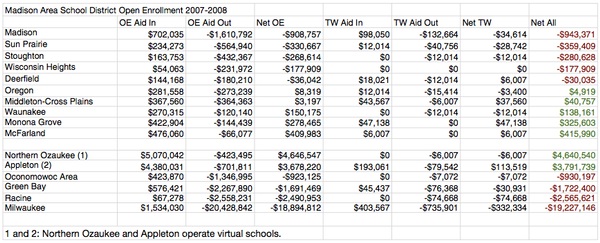
Details available in this .xls file from the Wisconsin DPI.
A few links as the open enrollment period draws to a close:

Via a kind reader’s email.

Share

A Chicago Teacher on Magnet Schools

Victor Harbison:

Given the recent economic news, it seems everyone wants to talk about the long-term impact of short-term thinking. Why not do the same with education and magnet schools? Think of the issues educators faced 30 or 40 years ago: Smart kids not being challenged? Academically under-prepared kids, most of them ethnic minorities, moving in and test scores going down? It’s completely logical that they chose a path to create magnet schools. But it was a short-term solution that has had long-term negative consequences.
I take my students to lots of outside events where they are required to interact with students who come from magnet or high-performing suburban schools. What I see time after time is how my kids rise to the occasion, performing as well (or at least trying to) as those students whose test scores or geographic location landed them in much more demanding academic environments.
On a daily basis, I see the same kids who do amazing things when surrounded by their brightest counterparts from other schools slip into every negative stereotype you can imagine, and worse, when surrounded by their under-performing peers at our “neighborhood” school.
When educational leaders decided to create magnet schools, they didn’t just get it wrong, they got it backwards. They pulled out the best and brightest from our communities and sent them away. The students who are part of the “great middle” now find themselves in an environment where the peers who have the greatest influence in their school are the least positive role models.
Schools adapted, and quickly. We tightened security, installed metal detectors, and adopted ideas like zero-tolerance. And neighborhood schools, without restrictive admission policies based on test scores, quickly spiraled downward — somewhat like an economy. Except in education, we can’t lay off students who have a negative impact on the school culture. That is why adopting such a business model for the educational system has been and always will be a recipe for failure.
What should have been done was to pull out the bottom ten percent. Educational leaders could have greatly expanded the alternative school model and sent struggling students to a place that had been designed to meet their educational needs.

Clusty search: Victor Harbison.

Share

Jeb Bush on School Choice

Fred Barnes:

What comes through when Mr. Bush is asked about education is how radical his views are. He would toss out the traditional K-to-12 scheme in favor of a credit system, like colleges have.
“It’s not based on seat time,” he says. “It’s whether you accomplished the task. Now we’re like GM in its heyday of mass production. We don’t have a flourishing education system that’s customized. There’s a whole world out there that didn’t exist 10 years ago, which is online learning. We have the ability today to customize learning so we don’t cast young people aside.”
This is where Sweden comes in. “The idea that somehow Sweden would be the land of innovation, where private involvement in what was considered a government activity, is quite shocking to us Americans,” Mr. Bush says. “But they’re way ahead of us. They have a totally voucherized system. The kids come from Baghdad, Somalia — this is in the tougher part of Stockholm — and they’re learning three languages by the time they finish. . . . there’s no reason we can’t have that except we’re stuck in the old way.”

Share

Mayoral control of schools not a cure-all, report says

Alan Borsuk:

Turning over control of a school system to a mayor is no cure-all for problems, and it is “messy, difficult work” to make such changes, according to an analysis of other cities being released today by the Greater Milwaukee Foundation.
The report and a forum set for Monday night to discuss it amount to firing the starting gun on a crucial debate over whether the mayor or some new body should take over Milwaukee Public Schools, or whether the MPS School Board should be revamped.
Mayor Tom Barrett is signaling that he is more serious than at any point since he was elected in 2004 about the possibility of putting the school system under his control.
“It’s time we do have a conversation about what’s best for the children of this community,” he said.
Barrett did not give a direct answer on whether he wants control of MPS but said, “We have to have significant change in the fiscal management of the district if it’s going to survive.”
He said he did not want to take over MPS in the absence of other steps to deal with problems that threaten the school system. They include an estimated $2.4 billion in commitments to pay benefits to current and future retirees. Progress on such issues almost surely would take broad, innovative agreements between city, state and union leadership.

Complete Report (PDF):

To what extent has governance reform in large, urban public school districts resulted in better student performance, greater accountability, and more educational innovation? When a school district is governed by a mayor, do the district’s fortunes improve?
The answers to these questions, unfortunately, are not clear cut. Large urban districts that have experienced governance reform have often seen several iterations of reform over the course of several years and mixed results. Still, despite the complexity of their reform efforts over the past decade, comparable school districts have much to teach policymakers and educators in Milwaukee. The Public Policy Forum researched several comparable districts and came up with these key findings:

Share

Battle of Boston: Charter vs. Pilot Schools

Jay Matthews:

In the national charter school debate, Boston has special significance. The city has unleashed imaginative teachers to run both independent charter schools and semi-independent “pilot” schools, with much of the rest of the country waiting to see which does best.
Teachers unions and charter opponents have put unusual emphasis on this contest. Boston pilot schools were designed to show that schools with collectively bargained pay scales and seniority protections could do just as well as charters, whose teachers are usually non-union.
Charters, independently operated schools with public funding, were not designed to be anti-union. American Federation of Teachers founding president Al Shanker originated the charter idea. But many conservatives who think unions stand in the way of raising student achievement have embraced the charter school cause, thus politicizing the debate. Their side just won the first round in Boston, and they are not likely to let charter opponents forget it.
A study by scholars from Harvard, MIT, Michigan and Duke, sponsored by the Boston Foundation, shows the Boston charters are doing significantly better than pilots in raising student achievement. This includes results from randomized studies designed to reduce the possibility that charters might benefit from having more motivated students and parents. The study is called “Informing the Debate: Comparing Boston’s Charter, Pilot and Traditional Schools.”
People who see charters as a ruinous drain on regular public schools, and a threat to job security and salary protections for teachers, are not going to accept this verdict. The data come from just one city, with many qualifications. For instance, the randomized results apply only to charters so popular they have more applicants than they can accept. Less popular charters were not included in that part of the study; they could have reduced the charters’ measured gains if their data had counted.

Share

Survey for Secondary Teachers of Government & Social Studies

Cindy Koeppel @ The Dirksen Center, via email:

The Dirksen Congressional Center of Pekin, Il — http://www.dirksencongressionalcenter.org — has partnered with Federal Network, Inc. of Washington, DC — http://www.fednet.net/ — to develop a website geared to secondary teachers of Government and Social Studies. Our initial idea is this: the teacher in the classroom, when teaching concepts and terms relevant to the legislative branch, will be able to show sample footage from the House and Senate organized in a glossary format. If, for example, you are teaching about a filibuster, you will be able to click on “filibuster” and see digitized video of senators filibustering.
We are very excited by the prospects for this cutting-edge offering. In order to make this conceptual product a success, we seek your feedback and commentary. The product is for teachers, so we appreciate your thoughtful input. The survey will take less than five minutes to complete.
Thank you for participating. Your feedback is important.
SURVEY: http://www.zoomerang.com/Survey/?p=WEB228RNXYEBSU
Cindy Koeppel
ckoeppel@dirksencenter.org
The Dirksen Congressional Center
2815 Broadway
Pekin, IL 61554
http://www.dirksencongressionalcenter.org

Share

Some schools are finding rehabilitation for playground bullies can save otherwise decent students from lives of despair

Lau Kit-wai:

Ah Ho’s story is more common than many realise. Lee Tak-wai, an outreach worker with the Hong Kong Playground Association, says bullying has become a pervasive problem in schools.
“In the past, things were black and white: we had the bad youngsters and the good ones. But the line has become blurred and problematic behaviour is more common among teenagers,” Lee says. “Bullying has spread like an epidemic.”
A survey of 1,552 lower secondary students last year found that aggressive physical action – including shoving and kicking – had increased by 31 per cent compared with a similar study in 2001. Conducted jointly by the Playground Association and City University, the survey found that threatening behaviour such as taking others’ belongings and forcing victims to pay for snacks had risen by 42 per cent.
Educators and social workers view most bullies as products of circumstance. “School bullies are usually low achievers,” Lee says. “They often don’t receive sufficient attention from their parents and their relationships with teachers are strained. Since they can’t get a sense of achievement in school, they resort to improper behaviour to draw people’s attention and build their self-image. It’s a vicious cycle.”

Share

Busing or Extra Money for High Poverty Schools?

T. Keung Hui via a kind reader’s email:

North Carolina’s two largest school systems have taken vastly different approaches to two thorny issues — student reassignment and educating low-income students with hefty academic deficiencies.
Wake County, the state’s largest district, has used buses instead of greenbacks to address the academic needs of low-income students.
To meet the demands of growth and support a diversity policy aimed at reducing the number of high-poverty schools, Wake’s system moves thousands of students each year to different schools, sometimes sending kids on bus rides of more than 20 miles.
Charlotte-Mecklenburg Schools, the second-largest district in North Carolina, has shifted to a system of largely neighborhood schools, resulting in a stratified mix of affluent schools in the suburbs and high-poverty schools near downtown Charlotte.
Instead of busing kids to balance out the level of low-income students at each school, the district pours millions of dollars into these high-poverty schools each year to boost the performance of academically disadvantaged students.

Share

Madison School District Seeks Community Volunteers for Strategic Planning Teams

Pat Schneider:

The Madison School District is inviting members of the community to join them in putting into action five priorities for the future identified in a major planning bash last month.
The “strategic priorities” were developed by a planning committee — 60 strong — that met for a marathon 22 hours over several days in January. See a school district article about the process here.
The process was open and inclusive with more than token representation by people of color, committee member Annette Miller on Monday told members of Communities United, a Madison coalition committed to promoting social justice. “I didn’t feel like I was the African-American representing the whole African-American community,” Miller said.
The process may have been close to the ground, but the priorities developed by the committee smack of “educationalese” (and writing by committee) in the draft report released Monday to Communities United.
As roughly translated into plain English, they are: eliminate the achievement gap between students of color and white students; evaluate programs and personnel, then prioritize and allocate resources equitably; recruit and retain staff members who reflect the cultural composition of the student body; “revolutionize” Madison education with rigorous, culturally relevant and accelerated learning opportunities; provide a safe, welcoming learning environment for all children by building ties to the community, confronting fears about diversity, and being accountable to all.

Share

Smaller school districts looking to consolidation

Gena Kittner:

Three area school districts in need of building renovation or expansion are taking very tentative steps toward consolidation — a touchy topic for residents worried about losing a community’s identity.
The Belleville, Monticello and New Glarus school districts, located in Dane and Green counties, are asking the state Department of Public Instruction for $10,000 to study the idea of combining their programs and student populations.
“I think it’s just a case of having a nice discussion and getting solid, objective information,” said Randy Freese, superintendent for the Belleville School District.
Facing continued tight budgets, districts around the state will be looking at options to save money, and “investigating consolidation is definitely one of those options,” said Patrick Gasper, DPI spokesman. “I think we’ll see more people looking into it.”
Using money approved as part of the 2007-09 state budget, the DPI has funded grants for at least eight other district groups, including Pecatonica and Argyle in Lafayette and Iowa counties.

Share

Face of space Tyson laments Americans’ scientific illiteracy


PJ Slinger:

Neil deGrasse Tyson is one in a million.
He said so himself.
“There are six-and-half billion people on this planet, and there are 6,500 astrophysicists, so that makes each of us (astrophysicists) one in a million,” Tyson said Monday night at the Wisconsin Union Theater as part of the UW’s Distinguished Lecture Series.
It’s too bad there aren’t a lot more like Tyson, who kept the packed house enthralled with his charisma, knowledge and off-the-cuff humor for more than two hours.
Tyson is the 21st century face of space, a mantle previously held by the late, great Carl Sagan. Tyson is director of the Hayden Planetarium and the host of PBS’ “NOVA ScienceNOW” program, aimed at educating a new generation of Americans in science.
And that is no small task.
Tyson pointed out numerous examples of scientific illiteracy in the U.S., including a general lack of understanding and a belief in silly superstitions.
On the screen behind him he showed a photo of the inside of an elevator in a tall building, and how there was no button for the 13th floor.
“We are supposedly a technologically advanced country, and yet people are afraid of the number 13?” he said.

Share

UW’s Delta Teaching Program

Kiera Wiatrak:

In its first five years on campus, Delta has made a profound impact on UW-Madison’s teaching and learning culture. A fall 2008 review found that more than 400 faculty and instructional staff enhanced their teaching practices in some way as a direct result of Delta workshops.
As Delta grows, it continues to receive recognition for its efforts. On Monday, Feb. 9, Delta will be presented with the National Consortium for Continuous Improvement in Higher Education’s Award for Leveraging Excellence.
Delta members are encouraged to take Delta courses and small-group-facilitated programs, attend roundtable dinners and seminars, and participate in the Delta internship program to learn how to implement Delta’s three pillars — teaching-as-research, learning community and learning-through-diversity — into the classroom.

Share

Madison School District Departing Parent Surveys

Via a kind reader’s email. Three surveys for families that have left the Madison School District for the following destinations [PDF]:

Related Links:

The Madison School District’s tax and spending authority is based on its enrollment.

Share

Madison School District Survey for Parents Who Have Left

via a kind reader’s email:

Superintendent Dan Nerad is conducting a survey of families who left the MMSD and invites your participation.
If you opted to not enroll your child/children in their MMSD school — if they attend private school, you home school or you moved out of the District — or you are strongly considering the same and you are willing to participate in this survey, please let Superintendent Nerad know. Send your contact information to his assistant, Ann Wilson (awilson@madison.k12.wi.us or 608 663-1607).

Related: Wisconsin Open Enrollment begins February 2, 2009.

Share

Madison School District’s Strategic Planning Process, An Update


I was honored to be part of the Madison School District’sStrategic Planning Process” this weekend. More than 60 community members, students, parents, board members and district employees participated.
The process, which included meetings Thursday (1/29/2009) from 8 to 6 Friday (1/30/2009) from 8 to 5 and Saturday (1/31/2009) from 8 to 12, thus far, resulted in the following words:
MMSD Mission Statement (1/30/2009):

Our mission is to cultivate the potential in every student to thrive as a global citizen by inspiring a love of learning and civic engagement, by challenging and supporting every student to achieve academic excellence, and by embracing the full richness and diversity of our community.

Draft Strategic Priorities
1. Student:
We will eliminate the achievement gap by ensuring that all students reach their highest potential. To do this, we will prepare every student for kindergarten, create meaningful student-adult relationships, and provide student-centered programs and supports that lead to prepared graduates. (see also student outcomes)
2. Resource/Capacity:
We will rigorously evaluate programs, services and personnel through a collaborative, data-driven process to prioritize and allocate resources effectively and equitably, and vigorously pursue the resources necessary to achieve our mission.
3. Staff
We will implement a formal system to support and inspire continuous development of effective teaching and leadership skills of all staff who serve to engage our diverse student body while furthering development of programs that target the recruitment and retent ion of staff members who reflect the cultural composition of our student body.
4. Curriculum
We will revolutionize the educational model to engage and support all students in a comprehensive participatory educational experience defined by rigorous, culturally relevant and accelerated learning opportunities where authentic assessment is paired with flexible instruction.

5. Organization/Systems:

We will proudly leverage our rich diversity as our greatest strength and provide a learning environment in which all our children experience what we want for each of our children. We will:

  • Provide a safe, welcoming learn ing environment
  • Coordinate and cooperate across the district
  • Build and sustain meaningful partnerships throughout our community
  • Invite and incorporate (require) inclusive decision-making
  • Remain accountable to all stakeholders
  • Engage community in dialogue around diversity confront fears and misunderstandings
Share

Well-Connected Parents Take On School Boards

Michael Alison Chandler:

For a new generation of well-wired activists in the Washington region, it’s not enough to speak at Parent-Teacher Association or late-night school board meetings. They are going head-to-head with superintendents through e-mail blitzes, social networking Web sites, online petitions, partnerships with business and student groups, and research that mines a mountain of electronic data on school performance.
In recent weeks, parent-led campaigns helped bring down a long-established grading policy in Fairfax County and scale back the unpopular practice of charging fees for courses in Montgomery County. They have also stoked debates over math education in Frederick and Prince William counties.

Links:

Share

Private Schools Feel the Pinch Amid Recession

Mary Pilon:

Trinity Episcopal School survived Hurricane Ike last fall. But then another storm hit — the economy.
The Galveston, Texas, school, where tuition is between $5,000 and $8,000 a year, has seen its enrollment drop 12%, says David Dearman, the head of the school. Many parents of its students were among the 3,000 workers laid off by the area’s largest employer, the University of Texas Medical Branch. At the end of 2008, the school’s endowment was $800,000, down about 20% from July.
The school has ramped up donation efforts through its Web site, and held car washes and bake sales. It stopped using substitute teachers — other staff members now step in when a teacher is out sick. “Our school will survive, but it will take years to recover,” Mr. Dearman says.
Trinity Episcopal School is one of many kindergarten-through-12th-grade private schools caught in the middle of an economic tempest: anemic endowments, dwindling donations, financially strapped parents slashing tuition from the family budget, and an exodus to suburbs with more appealing public schools where costs are lower.
“The discourse has shifting from sustainability to survivability,” says Myra McGovern, a spokeswoman for the National Association of Independent Schools.

Share

Obama Should Acknowledge His Catholic School Roots

William McGurn:

Of the many parallels between Barack Obama and John F. Kennedy, one has eluded all coverage: Both attended Catholic school as children. In fact, while JFK may have been the Irish Catholic from Boston, he spent less time at the Canterbury School in Connecticut than did young Barry (as he was then called) at St. Francis of Assisi in Indonesia.
At a time when America’s 6,165 Catholic elementary and 1,213 secondary schools are celebrating Catholic Schools Week, President Obama’s first-hand experience here opens the door to a provocative opportunity. In his inaugural address, the president rightly scored a U.S. school system that “fail[s] too many” of our young people. How refreshing it would be if he followed up by giving voice to a corollary truth: For tens of thousands of inner-city families, the local parochial school is often the only lifeline of hope.
“When an inner-city public school does what most Catholic schools do every day, it makes the headlines,” says Patrick J. McCloskey, author of a new book called “The Street Stops Here,” about the year he spent at Rice High — an Irish Christian Brothers school in Harlem. “President Obama has a chance to rise above the ideological divide simply by giving credit where credit is due, by focusing on results, and the reason for those results.”

Share

2009 Madison Teachers, Inc. Candidate Questionnaire

1.2MB PDF File. This document includes responses from Madison School Board seat 1 candidates Arlene Silveira and Donald Gors, Seat 2 candidate Lucy Mathiak and a number of other local and statewide candidates for office in the upcoming April, 2009 election. Via a kind reader’s email.

Share

4 Year Old Kindergarten Again Discussed in Madison

Tamira Madsen:

But there is controversy with 4K, and not just because of the cost. In other districts that have started programs, operators of private centers that stand to lose tuition dollars have emerged as opponents.
That’s unlikely to be true for Renee Zaman, director of Orchard Ridge Nursery School on Madison’s west side, who said last week that her center would be in a good position to participate with a 4K program because they already teach 84 4-year-olds and because all of their early childhood teachers are state certified.
But Zaman also said she hopes that the district doesn’t push a 4K program through too quickly. She is particularly worried that the curriculum might focus too heavily on academics.
One sticking point in past 4K discussions in Madison was concern from the teachers union, Madison Teachers Inc., that preschool teachers at off-site programming centers might not be employees of the school district.
But Nerad and MTI Executive Director John Matthews have had many discussions about 4K over the past several months, and Matthews said as long as no district teachers are displaced, he is in favor of the program.

Related: Marc Eisen on “Missed Opportunities for 4K and High School Redesign”.

Share

Gates Advocates Charter School Growth

Bill Gates 2009 Letter:

These successes and failures have underscored the need to aim high and embrace change in America’s schools. Our goal as a nation should be to ensure that 80 percent of our students graduate from high school fully ready to attend college by 2025. This goal will probably be more difficult to achieve than anything else the foundation works on, because change comes so slowly and is so hard to measure. Unlike scientists developing a vaccine, it is hard to test with scientific certainty what works in schools. If one school’s students do better than another school’s, how do you determine the exact cause? But the difficulty of the problem does not make it any less important to solve. And as the successes show, some schools are making real progress.
Based on what the foundation has learned so far, we have refined our strategy. We will continue to invest in replicating the school models that worked the best. Almost all of these schools are charter schools. Many states have limits on charter schools, including giving them less funding than other schools. Educational innovation and overall improvement will go a lot faster if the charter school limits and funding rules are changed.
One of the key things these schools have done is help their teachers be more effective in the classroom. It is amazing how big a difference a great teacher makes versus an ineffective one. Research shows that there is only half as much variation in student achievement between schools as there is among classrooms in the same school. If you want your child to get the best education possible, it is actually more important to get him assigned to a great teacher than to a great school.
Whenever I talk to teachers, it is clear that they want to be great, but they need better tools so they can measure their progress and keep improving. So our new strategy focuses on learning why some teachers are so much more effective than others and how best practices can be spread throughout the education system so that the average quality goes up. We will work with some of the best teachers to put their lectures online as a model for other teachers and as a resource for students.

Share

In School for the First Time, Teenage Immigrants Struggle

Jennifer Medina:

Fanta Konneh is the first girl in her family to go to school. Not the first to go to college, or to graduate from high school. Fanta, 18, who grew up in Guinea after her family fled Liberia, became the first to walk into a classroom of any kind last year.
“Just the boys go to school, so I always knew I was left out,” said Fanta, a student at Ellis Preparatory Academy in the South Bronx. “But here, I am trying. I can say many things I did not know before. I can learn things more.”
New York City classrooms have long been filled with children from all over the world, and the education challenges they bring with them. But hidden among the nearly 150,000 students across the city still struggling to learn English are an estimated 15,100 who, like Fanta, have had little or no formal schooling and are often illiterate in their native languages.
More than half of these arrive as older teenagers and land in the city’s high schools, where they must learn how to learn even as their peers prepare for state subject exams required for a diploma.

Share

Give All You Can: My New “Spread the Wealth” Grading Policy

Mike S. Adams, Townhall.com 26 January 2009:

Good afternoon students! I’m writing you this email to announce that I’m making some changes in the grading policies I announced two weeks ago when I sent an email with an attached course syllabus. As you know, we now have a new president and I thought it would be nice to align our class policies with some of the policies he will be implementing over the next four years. These will be changes you can believe in and, I hope, changes that will inspire hope, which is our most important American value.
Previously, I announced that I would use a ten-point grading scale, which means that 90% of 100 is an “A,” 80% is a “B,” 70% is a “C,” and 60% is enough for a passing grade of “D.” I also announced that I will refrain from using a “plus/minus” system – even though the faculty handbook gives me that option.
The new policy I am announcing today is that those who score above 90 on the first exam will have points deducted and given to students at the bottom of the grade distribution. For example, if a student gets a 99, I will then deduct nine points and give them to the person with the lowest grade. If a person scores 95 I will then deduct five points and give them to the person with the second lowest grade. If someone scores 93 I will then deduct three points and give them to the next lowest person. And so on.
My point, rather obviously, is that any points above 90 are really not needed since you have an “A” regardless of whether you score 90 or 99. Nor am I convinced that you need to “save” those points for a rainy day. Those who are failing, however, need the points–not unlike the failing banks and automakers that need money to avoid the danger of bankruptcy.
After our second examination, I intend to take a more complex approach to the practice of grade redistribution. I will not be looking at your second test scores but, instead, at the average of your first two test scores. In the process, I may well decide to start taking some points from students in the “B” range. For example, if someone has an average of 85 after two tests I may take a few points and give them away to someone who is failing or who is in danger of failing. I think this is fair because the person with an 85 average is probably unlikely to climb up to an “A” or fall down to a “C.” I may be wrong in some individual cases but, of course, my principal concern is not the individual.

(more…)

Share

Wisconsin school open enrollment starts February 2, 2009

AP:

Wisconsin parents who want to send their children to a school outside the district in which they live can start applying Feb. 2.
The open enrollment period for next school year ends three weeks later on Feb. 20.
The program has grown in popularity since it started in the fall of 1998. Only about 2,400 students participated that school year. But last year, nearly 26,000 did.
Parents interested in enrolling their children are encouraged to do so online at the Department of Public Instruction’s Web site. Parents will be notified April 10 about whether their request has been approved or denied.

Share

Informational Community Sessions on the Madison Fine Arts Task Force

Tuesday March 10, 2009 6 to 8p.m.
Memorial High School – Wisconsin Neighborhood Center [Map]
Thursday March 12, 2009 6 to 8p.m.
LaFollette High School in the LMC [Map]
The Madison Metropolitan School District (MMSD) will be sharing the recommendations of the Fine Arts Task Force. We are cordially inviting you to attend one or both of these sessions.
The focus of each session will be a presentation of the findings and recommendations of the Fine Arts Task Force followed by an opportunity for discussion. The Executive Summary and complete Fine Arts Task Force Report can be found at http://www.mmsd.org/boe/finearts/.
We are looking forward to sharing this information with you and hearing your thoughts about the research and recommendations provided by the Fine Arts Task Force.
Feedback from sessions and the recommendations from the Fine Arts Task Force will assist in improving the MMSD K-12 Fine Arts program and opportunities for our students,
If you have any questions or comments, please contact Julie Palkowski at jpalkowski@madison.k12.wi.us
Lisa Wachtel
Executive Director of Teaching and Learning
Julie Palkowski
Coordinator of Fine Arts
Please share this information with others that may be interested in attending these sessions and/or sharing their comments.

Share

DC Discipline Code Under Review As Suspensions Lose Impact

Bill Turque:

Senior class president Christopher Jolly says suspensions are so common at Anacostia High School — where eight students were injured, including three who were stabbed, in a melee two months ago — that they have become meaningless as a form of discipline.
“The fact that everyone knows someone who has been suspended before often causes kids not to respect the suspension process,” Jolly said at a community forum this month on D.C. Schools Chancellor Michelle A. Rhee’s proposal to revise the District’s student behavior code.
Rhee’s changes would move the system in a direction that makes sense to Jolly: away from out-of-school suspension as the disciplinary method of choice and toward counseling, peer influence and more options for keeping suspended students in school.
Officials said reliable data on suspensions are hard to come by because recordkeeping has been slipshod. But the available numbers suggest a dramatic surge. According to District figures, suspensions grew 72 percent between the 2006-07 and 2007-08 school years, from 1,303 to 2,245. That represents 4.5 percent of total enrollment. Numbers through November, the latest available for the current academic year, show suspensions running slightly behind last year.

Share

Is educational success, key to global competition, a matter of time, money or choice?

Investors Business Daily:

The argument over what to do about America’s struggling schools is still raging. Programs such as No Child Left Behind have achieved some success by introducing a measure of accountability into the process. But American students continue to get clobbered on international tests by other countries whose school systems spend less money per student and have larger average class sizes.
Facing budget realities in a down economy, Gov. Arnold Schwarzenegger recently proposed shortening the school year by five days to contribute $1.1 billion in savings toward the state’s $42 billion budget shortfall.
State school superintendent Jack O’Donnell vehemently disagreed, saying a longer school year was needed to prepare students for “the competitive global economy.”
The operative word here is “competitive.” Success in the marketplace depends on being able to produce the best product at the lowest cost. Competition in the business world produces a better product at less cost. Why shouldn’t it be so in education? Well, it is.
According to the Organization for Economic Cooperation and Development, 70% of the countries that outperformed the U.S. in combined math and science literacy among 15-year-olds had more schools competing for students. Countries ranging from Japan to Latvia all had more education options than American students.

Share

What’s It All About, Alfie?

In many books, more articles, and perhaps 200 appearances a year, Alfie Kohn does what he can to spare United States students the evils of competition. While he can’t do much about athletic competition, or economic competition or the unfairness of love and war, he tries hard and successfully to persuade educators that making academic distinctions among students hurts them.
A story is told of an unpopular officer at the U.S Naval Academy who knew he was disliked (his nickname was “The Wedge” as “the simplest tool known to man”) and he was always on the lookout for ways to assert his dominance. Once he berated a formation of midshipman for being unsatisfactory by pointing out that while their toes were all lined up, their heels were as much as two or three inches out of line! The officer candidate in charge of the formation replied that he recognized the problem, and would try to see that all midshipmen in future could be issued the same size shoes!
Of course, Mr. Kohn would not, I believe, argue that having different size feet should be corrected to prevent some students from feeling inferior, but he does object to anything in school which might reveal that some are brighter and some more diligent than others. It is not clear how he thinks students can be prevented from noticing this for themselves, but he is insistent that testing and other forms of academic competition should not be allowed to reveal such differences.
Some people feel that in law, for instance, competition among arguments makes arriving at the facts of a case more likely. Competition among the producers of goods and services are thought by some to make improvements in quality and reduction in price more likely. It is even claimed that some works of art and literature are better than others, although serious efforts have of course been made to make such judgments less common.

(more…)

Share

ACLU to sue Minneapolis charter school that caters to Muslims

Randy Furst & Sarah Lemagie:

The Minnesota ACLU has filed suit against TIZA, a charter school in Inver Grove Heights and Blaine, claiming it is promoting the Muslim religion.
The American Civil Liberties Union of Minnesota filed suit Wednesday against a publicly funded charter school alleging that it is promoting the Muslim religion and is leasing school space from a religious organization without following state law.
The suit was filed in U.S. District Court in Minneapolis against Tarek ibn Ziyad Academy, known as TIZA, and the Minnesota Department of Education, which the ACLU says is at fault for failing to uncover and stop the alleged transgressions. The suit names the department and Alice Seagren, the state education commissioner, as co-defendants.

Share

Using the recession to clobber charter schools

Chester Finn:

Around the country, school districts are urging officials to crack down on charter school growth–and on existing charter schools–because, they assert, there isn’t enough money in strapped state budgets to pay for this sector–and of course the districts must come first.
I’m seeing this in Ohio, in Utah and in Massachusetts and do not doubt that it’s happening all over the place.
But of course it’s completely cockeyed. If every public-school pupil in America attended a charter school, the total taxpayer cost would be 20-30% LESS than it is today. That’s because charters are underfunded (compared with district schools) and thus represent an extraordinary bargain–even if their overall academic performance isn’t much different from that of district schools. Think of it as the same amount of learning at three-quarters of the price.

Share

It’s Not That Kids Need Preschool — but It Can Help

Sue Shellenbarger:

Brickbats are flying over President Obama’s plan to expand government-funded preschool. Advocates argue all children need access to preschool; opponents cite studies pointing only to benefits for disadvantaged kids. The debate leaves parents wondering how much — if any — preschool their children really need.
Weighing the decision last year, Peter Canale, father of three small children, got caught in the crossfire. Co-workers and family members warned him, “you’d be crazy not to send your kid to some kind of preschool,” he says. But the Yonkers, N.Y., financial-services manager, who never attended preschool himself and whose wife stays home with their children, was skeptical; “I thought pre-K was a fad,” he says.
Actually, all kinds of kids reap some academic benefits from preschool, a growing body of research shows. Among 22 scholarly studies I reviewed, the five that encompass children from middle- and high-income families show preschool grads enter kindergarten with better pre-reading and math skills than those in other kinds of care or at home with their parents. To be sure, the benefits for mainstream kids are smaller than for children from poor or disadvantaged homes, but they’re still significant.

Brave New Dorms

George Leef:

Political indoctrination in the guise of “Residence Life” programs took a pounding during a National Association of Scholars debate.
In last week’s Clarion Call, I wrote about the debate over academic freedom at the recent National Association of Scholars conference in Washington, D.C. But equally important was the contentious final session, devoted to the agenda of the “Residence Life” movement.
That movement is a nationwide initiative that has managers of student dorms teaching a leftist political catechism to students under their control in an effort to radicalize them.
The discussion focused on the infamous ResLife program at the University of Delaware. It took some interesting turns, including opposition to the programs from AAUP president Cary Nelson. He is a man of the left, but nevertheless doesn’t want to see curriculum and instruction handed over to people who aren’t even remotely scholars.
First to speak was Adam Kissel of the Foundation for Individual Rights in Education (FIRE). He explained the objectives of the Residence Life movement generally and concentrated on the University of Delaware, where the program was first seen in all its authoritarian splendor: prying questions, indoctrination sessions, and special “treatment” for students who were either uncooperative or, worse, had the temerity to disagree. Kissel made it clear that the ResLife agenda consists of clumsy, authoritarian indoctrination of students meant to color their thinking toward leftist bromides about the environment, capitalism, institutional racism and so forth.

(more…)

Share

Public High Schools & The Concord Review

Thomas Oberst:

It was a great pleasure to speak with you at the National Association of Scholars meeting in Washington. Thank you for sending me information about The Concord Review.
The Concord Review represents an opportunity for high school students to challenge themselves in both History and Expository Writing Skills. It would appear that many of the leading private and selective public schools take advantage of the opportunity to publish in The Concord Review. I am surprised more schools are not taking advantage of the opportunity that The Concord Review is providing, particularly given the state of writing and history in high schools.
I have noticed over the past 10 years that a number of the better public schools in the more financially advantaged suburban towns around Boston have been extending their reach of academic experiences and academic engagements outside of the standard High School Curriculum. I attribute this, in part, to the number of suburban parents that have some children in elite private schools and others in local elite public schools and have brought to the public schools many of the tactics and practices of the private schools.
The Concord Review is an opportunity for high school students to publish and should be more aggressively pursued by the public schools whose students lack writing skills. I am certainly going to make my local high school and its headmaster aware of The Concord Review.
Best Regards,
Tom Oberst

Thomas P. Oberst
Principal
Strategic Technology
27 Snow Street
Sherborn, Massachusetts 01770

Share

An Education Bailout? It Won’t Improve Schools

Greg Forster:

It looks like the trillion-dollar “stimulus” (read: pork) bill is going to include a hefty dose of spending on schools. Of course, we don’t know yet what the proposed bill will contain, and the proposal will undergo a lot of revision when it goes through the congressional sausage grinder. But from the leaks and preliminary reports, respectable observers are estimating that as much as $70 billion or even $100 billion may ultimately end up going to K-12 schools. For comparison, after the radical expansion of federal education spending that came with No Child Left Behind, the feds now spend about $40 billion per year on K-12 education.
Politically, it’s a shrewd move. They don’t really care what they’re building, as long as they’re building something, so as long as they’re building a bunch of roads and bridges and community centers they may as well build some schools, too. The teachers’ unions have successfully spread the myth that schools desperately need more facilities spending, even though facilities spending per student almost doubled from 1990 to 2005 (after inflation). So “New School to Be Built” is always a crowd-pleasing headline.

Share

Waukesha schools expand online academy to grades 6-8

Erin Richards:

To keep up with competition among virtual schools in the state, the Waukesha School District’s virtual charter high school has received the green light to expand its computer-based learning environment to middle school students next year.
The Waukesha School Board approved a proposal last week to add grades six, seven and eight in the 2009-’10 academic year to “>iQ Academy Wisconsin, perpetuating a trend in virtual-school growth that’s happening elsewhere around the country.
The 5-year-old iQ Academy is one of 18 virtual schools in Wisconsin that residents can attend for free through open enrollment.
Susan Patrick, president of the International Association of K-12 Online Learning, said virtual high schools around the country are expanding rapidly to include middle-school opportunities.
“We’re seeing a lot of growth on both sides: Elementary programs that started as K-5 or K-6 are expanding to middle-school programs, and at the high-school level, we’re seeing them reaching back to the middle-school grades,” Patrick said.
Virtual high schools that expand to middle schools often do so because they want to make sure students are competent in the academic content for core courses at the high school level, Patrick said.
Typically, virtual schools exist in one of two forms. Thirty-four states, including Wisconsin, have part-time virtual schools that serve as supplemental programs for students behind on credits or to offer students a class they can’t get in their public school. Students may spend a portion of their normal, supervised school day logging into an online course.

Share

On 4K in Madison

Tamira Madsen:

Abplanalp, who has been working on the 4-K project for the seven years since joining the district as lead elementary principal, said there isn’t a timetable in place as to when the program would start.
But she wouldn’t count out the 2009-10 school year if three main issues can be ironed out.
“Could we get things in place by the fall? We think we could if we got the go-ahead,” Abplanalp said Thursday afternoon. “If not, it’s because we have issues to work out contractually with MTI (the teacher’s union). … We also have to work out community site issues, negotiating (contract) issues and financial issues.”

Share

Boston grads falter in public colleges, Are more likely to get degrees at private university

James Vaznis:

The local public colleges that enroll the most Boston high school graduates have had a dismal record seeing them through to a degree, with many posting graduation rates of less than 25 percent, according to a study that reviewed the collegiate careers of the city’s class of 2000.
Only 20.7 percent of the 150 students from the class who attended the University of Massachusetts at Boston – the most popular four-year public college for Boston high school students – graduated by the spring of 2007. By contrast, the most popular private school, Northeastern University, has handed degrees to 82.5 percent of the 80 Boston students from that class who enrolled there by the fall of 2001.
The rates at other popular public colleges were even worse. Bunker Hill Community College graduated 14.2 percent of its 155 Boston students, while Roxbury Community College had a graduation rate of 5.9 percent for its 101 Boston enrollees, according to new data released by the Boston Private Industry Council at the Globe’s request. The council is a group of city business leaders who work on education policy issues.

More here.

Share

Teacher Union Contracts and High School Reform

Mitch Price:

Are teachers unions and collective bargaining agreements barriers to high school reform and redesign efforts in Washington, California, and Ohio? The short answer: sometimes, but not as often as many educators seem to think.
On one hand, collective bargaining agreements (CBAs)–long, complex, and unwieldy documents which can be difficult for an overworked principal to navigate–are often perceived as obstacles by many principals and other educators, and to a certain extent this perception becomes reality. And, while these perceptions can limit school-level flexibility and autonomy, there are also restrictive provisions within CBAs that do so as well.
On the other hand, CBAs tend to have waiver provisions. In many cases, districts and teachers unions can also negotiate side agreements on individual issues (e.g., memoranda of understanding, or MOUs) to provide desired flexibility. And, in perhaps our most significant finding, many of the CBA provisions that we analyzed were more flexible than educators and reform advocates often suggest.
Finally, many CBA provisions that we studied were simply ambiguous. This ambiguity could potentially allow for greater latitude for an aggressive principal who is looking for greater flexibility and willing to push the envelope, while serving to limit a more cautious or timid principal who looks to the CBA for explicit authority or permission first before acting.

Share

Arts & the Economy Report

Mariel Wozniak, via email: The National Governor’s Association 4.5MB PDF Report:

Today, the National Governors Association (NGA) has released Arts & the Economy: Using Arts and Culture to Stimulate State Economic Development. This comprehensive report is a product of the long-standing partnership between the NEA and NGA, with extensive research support from the National Assembly of State Arts Agencies (NASAA). At this moment, the report is enjoying front page status on the NGA website at www.nga.org . It’s not often that governors receive information from the NGA that gives such high priority to the arts as a policy solution to the issues they are facing. Arts & the Economy arrives on the desks of governors at what is obviously a critical decision-making period for all states. We’re confident you will find it is a valuable resource to share with your governor, legislators, constituents and advocates as you move through the budget process for FY 10.

This page discusses the importance of the arts and culture to states, and lists all the arts reports and issue briefs the NGA has produced with the NEA, with NASAA’s assistance.
Here is a quotation I placed in one of the meeting rooms in the Ruth Bachhuber-Doyle Adm. Building during my tenure at MMSD. It ought to be in every school:

“Our greatest scientists are generally skilled in non-verbal thinking yet we usually discourage science students from studying artistic subjects. Unless we reverse this trend, they will continue to be cut off from thought processes that lead to creative breakthroughs.”
Dr. Robert Root-Bernstein, Professor of Physiology at Michigan State University, formerly scientist with the Salk Institute.

Share

Melinda Gates’ Mission to Improve Education

MICHELLE MAJOR and TERI WHITCRAFT:

But Melinda Gates is especially passionate about improving education here in the United States. The foundation has invested nearly $4 billion in education, with $2 billion going to high schools. It has helped 2,602 struggling schools create new models of teaching and learning to improve performance and graduation rates.
One of those schools is the Bronx Engineering and Technology Academy. The school is filled with academic superstars, but it wasn’t always that way.
BETA was once part of the failing John F. Kennedy School, which in 2002 had 5,000 students. That big school was divided into five smaller schools with more intense curriculums.
The kids at BETA have made a big turnaround since then. Principal Rashid Davis said 78 percent of the students came into the school performing below grade level, but the school’s graduation rate for the class of 2008 is 90 percent. Ninety percent of the students are also going on to college.
“The great thing is that as you see in a school like BETA, these kids can do the work, and it doesn’t matter what Zip code they’re from,” Gates said. “You put kids in a school with a great curriculum, they’ll rise up and they’ll do it. They like to be challenged. And I see it over and over again in schools across the U.S.”

Share

Putting More School in Bremerton Preschools

Marietta Nelson:

Kneeling on a furry white rug at Friends Childcare and Preschool in Bremerton, 3-year-old Damari Bowers leans forward as teacher Wanda Selg-Gonzales reads from a book of rhymes.
“Diddle diddle dumpling, my son John,” she reads, pausing to look at her students. “What rhymes with John?”
“Lawn! Fawn!” Damari shouts, throwing his hands up in the air.
“That’s right,” answers Selg-Gonzales, who since 1999 has operated the child care from her home on Cogean Avenue.
Selg-Gonzales runs an independent child care, but her tight connection to the Bremerton School District for the past four years means she receives training and classroom materials from the district.
As a result, her child-care kids are already familiar with the district reading curriculum, called Open Court, and other important academic skills before they hit kindergarten classrooms.

Share

Advanced Math Courses at UW-Madison for High School Students

Tonghai Yang, via email:

Math 234 (Calculus III, after Calculus BC) this Fall on MWF 7:45-8:35am to accomodate advanced High School Students in Madison area so that they can take this course without missing too many their regular school work.
We did it last semester for the first time and had excellent reception from high school students attended (about 20). Another 20 were regular college students. I am teaching this course next Fall.
We will also offer
Math 340 (Linear Algebra) during Spring 2010 onMWF 7:45-8:35am for the same reason. Dr. Meyer will teach this course.

Share

Madison’s Cherokee PTO/Math Meeting Cancelled Tonight

Weather conditions have caused this evening’s Cherokee Middle School PTO/Math Meeting to be cancelled. The event will be rescheduled soon, hopefully in February.
Much more on the Madison School District’s Math Task Force Report here.

Share

Sun Prairie School Board Approves 4-Year-Old Kindergarten Plan

Channel3000:

The Sun Prairie School Board on Monday night approved moving forward with plans to offer 4-year-old kindergarten in the school district.
Sun Prairie Assistant Superintendent Alice Murphy said the board approved the plan with a 6-1 vote.
More than 200 schools across the state offer a 4K program. Sun Prairie school district officials said that the classes could be taught in day care centers.
“That would be the ideal setting that 4-year-old comes to the day care in the morning, is dropped off, and then at 8:30 a.m. or 9 in the morning the certified teacher moves in and presents the 4K instructional program for two and a half hours,” Murphy said.

Share

Records show Waunakee School District didn’t slow drinking party investigation

Matthew DeFour:

In the weeks following an underage drinking party near Waunakee in September 2007, rumors swirled about why the School District didn’t move more quickly to discipline football players who were involved.
Though the insinuation in some circles was school officials were dragging their feet to keep Waunakee at full strength in the playoffs, recently released documents show the district investigation was delayed at the insistence of a Dane County sheriff’s detective investigating criminal activity at the party.
State law allows law enforcement agencies to release reports that could help school officials discipline students, but individual police departments set their own policies and not everyone agrees on the best policy.
If a police agency is stingy with how it chooses to share information, it can delay the school’s ability to mete out swift punishment intended to deter underage drinking in the first place.
In the case of the Waunakee football players, the district got mixed messages from the Dane County Sheriff’s Office.

Share

Middleton-Cross Plains students embrace creative problem soloving

Pamela Cotant:

Each year, students from the Middleton-Cross Plains Area School District head over to the Memorial Union on the University of Wisconsin-Madison campus to spend a day stretching their mind.
The activity emphasizes creativity, teamwork and problem solving skills.
Fourth- and seventh-grade students from the district participate on two different days. The event is run by staff members who work with gifted and talented programs in the district– Ruth Frawley, Kelle Anderson, Jacki Greene, Cheryl Saltzman and Amy Weber.
The creative problem solving day is designed to “give them an opportunity to get away from their normal environment and work with a small team,” said Anderson, gifted and talented research teacher in Cross Plains.
“It tests your mind skills,” said Derek Rogeberg, a seventh-grader from Glacier Creek Middle School.
For the recent event, 120 fourth-graders and 120 seventh-graders came from Elm Lawn, Northside, Park, Sauk Trail, Sunset Ridge and West Middleton elementary schools and Glacier Creek and Kromrey middle schools.

Share

The Madison School District’s 2009 Strategic Planning Team

Members include:
Abplanalp, Sue, Assistant Superintendent, Elementary Schools
Alexander, Jennifer, President, Chamber of Commerce
Atkinson, Deedra, Senior Vice-President, Community Impact, United Way of Dane County
Banuelos, Maria,Associate Vice President for Learner Success, Diversity, and Community Relations, Madison Area Technical College
Bidar-Sielaff, Shiva, Manager of Cross-Cultural Care, UW Hospital
Brooke, Jessica, Student
Burke, Darcy, Elvehjem PTO President
Burkholder, John, Principal, Leopold Elementary
Calvert, Matt, UW Extension, 4-H Youth Development
Campbell, Caleb, Student
Carranza, Sal, Academic and Student Services, University of Wisconsin
Chandler, Rick, Chandler Consulting
Chin, Cynthia, Teacher, East
Ciesliewicz, Dave, Mayor, City of Madison
Clear, Mark, Alderperson
Cooper, Wendy, First Unitarian Society
Crim, Dawn, Special Assistant, Academic Staff, Chancellor’s Office, University of Wisconsin-Madison
Dahmen, Bruce, Principal, Memorial High School
Davis, Andreal, Cultural Relevance Instructional Resource Teacher, Teaching & Learning
Deloya, Jeannette, Social Work Program Support Teacher
Frost, Laurie, Parent
Gamoran, Adam Interim Dean; University of Wisconsin School of Education
Gevelber, Susan, Teacher, LaFollette
Goldberg, Steve, Cuna Mutual
Harper, John, Coordinator for Technical Assistance/Professional Development, Educational Services
Her, Peng,
Hobart, Susie, Teacher, Lake View Elementary
Howard, James, Parent
Hughes, Ed, Member, Board of Education
Jokela, Jill, Parent
Jones, Richard, Pastor, Mt. Zion Baptist Church
Juchems, Brian, Program Director, Gay Straight Alliance for Safe Schools
Katz, Ann, Arts Wisconsin
Katz, Barb, Madison Partners
Kester, Virginia, Teacher, West High School
Koencke, Julie, Information Coordinator MMSD
Laguna, Graciela, Parent
Miller, Annette, Community Representative, Madison Gas & Electric
Morrison, Steve, Madison Jewish Community Council
Nadler, Bob, Executive Director, Human Resources
Nash, Pam, Assistant Superintendent for Secondary Schools
Natera, Emilio, Student
Nerad, Dan, Superintendent of Schools
Passman, Marj, Member, Board of Education
Schultz, Sally, Principal, Shabazz City High School
Seno, Karen,Principal, Cherokee Middle School
Sentmanat, Jose, Executive Assistant to the County Executive
Severson, Don, Active Citizens for Education (ACE)
Steinhoff, Becky, Executive Director, Goodman Community Center
Strong, Wayne, Madison Police Department
Swedeen, Beth, Outreach Specialist, Waisman Center
Tennant, Brian, Parent
Terra Nova, Paul, Lussier Community Education Center
Theo, Mike, Parent
Tompkins, Justin, Student
Trevino, Andres, Parent
Trone, Carole, President, WCATY
Vang, Doua, Clinical Team Manager, Southeast Asian Program / Kajsiab House, Mental Health Center of Dane County
Vieth, Karen, Teacher, Sennett
Vukelich-Austin, Martha, Executive Director, Foundation for Madison Public Schools
Wachtel, Lisa, Executive Director of Teaching and Learning
Zellmer, Jim, Parent
Much more here.
The Strategic Planning Process Schedule [PDF]

Share

“Fewer Teachers, More Automation”

John Robb:

We constantly think that we need more teachers. That may not be the case. In fact we may need fewer, better teachers in combination with better automation (particularly in college). Some points:

  • The delta of experience between attending a lecture and watching a video of a lecture? Nada. If anything, the video is better since you can rewind it, view it at the best vantage point (vs. at the back of a big lecture hall), and view it in a quiet relaxed space.
  • Video lectures (as most colleges are doing now) make it possible to get the best. A dozen of the best lecture series could serve to replace 99% of lectures now being given by less gifted teachers.
  • Interactive education, like what MIT is providing now, is highly computerized. Almost all of it could be done online.
  • The interactive process of learning/application via collaboration is something that is perfectly suited for virtual worlds. JIT information in combination with simulated real world application within a collaborative environment is something that is going on with WoW right now (on a massive scale).

Sara Rimer:

The physics department has replaced the traditional large introductory lecture with smaller classes that emphasize hands-on, interactive, collaborative learning. Last fall, after years of experimentation and debate and resistance from students, who initially petitioned against it, the department made the change permanent. Already, attendance is up and the failure rate has dropped by more than 50 percent.
M.I.T. is not alone. Other universities are changing their ways, among them Rensselaer Polytechnic Institute, North Carolina State University, the University of Maryland, the University of Colorado at Boulder and Harvard. In these institutions, physicists have been pioneering teaching methods drawn from research showing that most students learn fundamental concepts more successfully, and are better able to apply them, through interactive, collaborative, student-centered learning.
The traditional 50-minute lecture was geared more toward physics majors, said Eric Mazur, a physicist at Harvard who is a pioneer of the new approach, and whose work has influenced the change at M.I.T.
“The people who wanted to understand,” Professor Mazur said, “had the discipline, the urge, to sit down afterwards and say, ‘Let me figure this out.’ ” But for the majority, he said, a different approach is needed.

Certainly worth exploring as part of Madison’s strategic plan. School Board member Ed Hughes has mentioned virtual learning and collaboration a number of times.

Share

School Leaving Age: Extending compulsory education is no panacea for idle youth

The Economist:

WORKLESS children were “idling in the streets” and “tumbling about in the gutters”, wrote one observer in 1861 of the supposedly baleful effects of a reduction in the use of child labour. Such concerns eventually led to schooling being made mandatory for under-tens in 1880. The minimum school-leaving age has been raised five times since then and now stands at 16; but panic about feral youths menacing upright citizens and misspending the best years of their lives has not gone away.
Today’s equivalent of the Victorian street urchin is the “NEET”–a youth “not in education, employment or training”. And the same remedy is being prescribed: by 2013 all teenagers will have to continue in education or training until age 17, and by 2015 until 18. Now there are political rumours that the education-leaving age could be raised sooner, perhaps as early as this autumn. Bringing the measure forward is said to be among the proposals being prepared for the “jobs summit” Gordon Brown has grandly announced.
During downturns young people tend to have more difficulty finding, and staying in, work than older ones. So a policy that would keep them off the jobless register has obvious appeal for the government. Youngsters who have studied for longer may, moreover, be better placed for an eventual upturn, whenever that might be. And, unlike other measures on Mr Brown’s wish-list, this one is achievable by ministerial edict.

Share

Charter Schools Can Close the Education Gap
It is not acceptable for minority students to be four grade levels behind.

Joel Klein & Al Sharpton:

Dear President-elect Barack Obama,
In the afterglow of your election, Americans today run the risk of forgetting that the nation still faces one last great civil-rights battle: closing the insidious achievement gap between minority and white students. Public education is supposed to be the great equalizer in America. Yet today the average 12th-grade black or Hispanic student has the reading, writing and math skills of an eighth-grade white student.
That appalling four-year gap is even worse in high-poverty high schools, which often are dropout factories. In Detroit, just 34% of black males manage to graduate. In the nation’s capital — home to one of the worst public-school systems in America — only 9% of ninth-grade students go on to graduate and finish college within five years. Can this really be the shameful civil-rights legacy that we bequeath to poor black and Hispanic children in today’s global economy?
This achievement gap cannot be narrowed by a series of half-steps from the usual suspects. As you observed when naming Chicago superintendent Arne Duncan to be the next secretary of education, “We have talked our education problems to death in Washington.” Genuine school reform, you stated during the campaign, “will require leaders in Washington who are willing to learn from students and teachers . . . about what actually works.”
We, too, believe that true education reform can only be brought about by a bipartisan coalition that challenges the entrenched education establishment. And we second your belief that school reformers must demonstrate an unflagging commitment to “what works” to dramatically boost academic achievement — rather than clinging to reforms that we “wish would work.”

Share

Educators Resist Even Good Ideas From Outsiders

Jay Matthews:

With two massive parental revolts nearing victory in Fairfax County, and mothers and fathers elsewhere in the area plotting similar insurgencies, it is time to disclose a great truth about even the best educators I know: As much as they deny it, they really don’t like outsiders messing with the way they do their jobs.
I don’t like that either. Do you? We know what we are doing. Most other folks don’t. We are polite to outsiders, but only to mollify them so we can hang up and get back to work.
The problem is that schools, unlike most institutions, are handling parents’ most precious possessions, their children. That aggravates the emotional side of the discussion. It makes it more likely that smart educators are going to write off parents as interfering idiots, even if they actually have a good idea and data to prove it.
I was a school parent for 30 years. The last kid graduated from college in 2007, but a grandchild has just appeared. That sound you hear is California teachers muttering at the thought of me at their door, brimming with helpful suggestions. I know how this works. The school people smile and nod, but nothing happens. Sure, some parent ideas are daft. But important queries are also shrugged off.

Share

A Charter Setback in Florida

Wall Street Journal:

As Chicago schools chief, Arne Duncan has found innovative ways to skirt the restrictive cap on the number of charter schools that can operate in Illinois, thus expanding opportunities for low-income kids. So it’s instructive to contrast Mr. Duncan’s can-do attitude with that of Florida Governor Charlie Crist, whose inaction last week handed a victory to opponents of school choice.
On December 2 a Florida District Court struck down a law that created the Florida Schools of Excellence Commission, an alternative authorizer of charter schools formed in 2006 under Governor Crist’s predecessor, Jeb Bush. The state had 30 days to appeal to the Florida Supreme Court but let the deadline pass last week.
Download Opinion Journal’s widget and link to the most important editorials and op-eds of the day from your blog or Web page.
The upshot is that only local school boards will be able to authorize charter schools, creating a fox-in-the-hen-house situation in which the same institutions that most oppose school choice will be in a position to block its expansion. Charter schools compete with district schools for students and teachers. And the teachers unions that control the traditional public school system fear that more charters mean smaller school districts and fewer dues-paying union jobs.

Locally, the Studio School charter initiative was killed by a slight Madison School Board majority.

Share

Marketing Milwaukee High Schools

Lori Price:

Anything can happen in high school in Milwaukee.
It could be a day of boat building at the Inland Seas High School of Expeditionary Learning.
Or establishing connections to some of the nation’s historically black colleges at schools in the Outlook University Independent School Network.
Or writing tunes at the Milwaukee High School of the Arts.
In Milwaukee, students have a choice – and many of them, along with their parents, spent Saturday checking out options at the Great Schools Milwaukee High School Fair at the Shops of Grand Avenue.
More than 1,000 students and their families were expected to attend the event that showcased 53 schools.
The goal of the fair that resembles an exhibition of colleges or potential employers is to give Milwaukee families one place to gather information about local public and private schools, said Jodi Goldberg, director of Great Schools Milwaukee, a local affiliate of the San Francisco-based organization that focuses on parental involvement in school choice.
“We still want them to visit the schools, because it’s not enough to just have a packet of information to make a decision,” Goldberg said. “But here, parents can see what’s available for their child.”

Share

Madison Math Task Force Public Session Wednesday Evening 1/14/2009

The public is invited to attend the Cherokee Middle School PTO’s meeting this Wednesday, January 14, 2009. The Madison School District will present it’s recent Math Task Force findings at 7:00p.m. in the Library.
Cherokee Middle School
4301 Cherokee Dr
Madison, WI 53711
(608) 204-1240

Notes, audio and links from a recent meeting can be found here.
A few notes from Wednesday evening’s meeting:

  • A participant asked why the report focused on Middle Schools. The impetus behind the effort was the ongoing controversy over the Madison School District’s use of Connected Math.
  • Madison’s math coordinator, Brian Sniff, mentioned that the District sought a “neutral group, people not very vocal one end or the other”. Terry Millar, while not officially part of the task force, has been very involved in the District’s use of reform math programs (Connected Math) for a number of years and was present at the meeting. The 2003, $200,000 SCALE (System-Wide Change for All Learners and Educators” (Award # EHR-0227016 (Clusty Search), CFDA # 47.076 (Clusty Search)), from the National Science Foundation) agreement between the UW School of Education (Wisconsin Center for Education Research) names Terry as the principal investigator [340K PDF]. The SCALE project has continued each year, since 2003. Interestingly, the 2008 SCALE agreement ([315K PDF] page 6) references the controversial “standards based report cards” as a deliverable by June, 2008, small learning communities (page 3) and “Science Standards Based Differentiated Assessments for Connected Math” (page 6). The document also references a budget increase to $812,336. (additional SCALE agreements, subsequent to 2003: two, three, four)
  • Task force member Dr. Mitchell Nathan is Director of AWAKEN [1.1MB PDF]:

    Agreement for Releasing Data and Conducting Research for
    AWAKEN Project in Madison Metropolitan School District
    The Aligning Educational Experiences with Ways of Knowing Engineering (AWAKEN) Project (NSF giant #EEC-0648267 (Clusty search)) aims to contribute to the long-term goal of fostering a larger, more diverse and more able pool of engineers in the United States. We propose to do so by looking at engineering education as a system or continuous developmental experience from secondary education through professional practice….
    In collaboration with the Madison Metropolitan School District (MMSD), AWAKEN researchers from the Wisconsin Center for Educational Research (WCER) will study and report on science, mathematics, and Career and Technical Education (specifically Project Lead The Way) curricula in the district.

  • Task force member David Griffeath, a UW-Madison math professor provided $6,000 worth of consulting services to the District.
  • Former Madison Superintendent Art Rainwater is now working in the UW-Madison School of Education. He appointed (and the board approved) the members of the Math Task Force.

Madison School Board Vice President Lucy Mathiak recently said that the “conversation about math is far from over”. It will be interesting to see how this plays out.
I am particularly interested in what the ties between the UW-Madison School of Education and the Madison School District mean for the upcoming “Strategic Planning Process” [49K PDF]. The presence of the term “standards based report cards” and “small learning communities” within one of the SCALE agreements makes me wonder who is actually driving the District. In other words, are the grants driving decision making?
Finally, it is worth reviewing the audio, notes and links from the 2005 Math Forum, including UW-Madison math professor emeritus Dick Askey’s look at the School District’s data.
Related: The Politics of K-12 Math and Academic Rigor.

Share

School Tries to Beat Drop Out Odds

Julia McEvoy:

High schools are supposed to produce graduates. But some schools are dubbed drop out factories. At Chicago’s Robeson High, on the city’s South Side, the graduation rate is just 39 percent. It is a place where more students quit than graduate. Almost all of the 1,300 kids here fail to meet state standards. But everyday, there are administrators, teachers and students who come to school hoping to make a difference. We’re spending time at Robeson High because we want to understand the complex issues that go into a student’s decision to quit. And we want to know why other students in the same place hang in there and graduate against the odds.
“This school is not for the faint of heart.”–Principal Morrow.
Related: Meet the students and teachers from 50/50: The Odds of Graduating.
A week before school starts, Robeson staff gathers in the media center to go over what to expect.

Share

Dane County schools tighten security measures

Andy Hall:

The Verona School District is planning to become the first in Dane County to lock all doors at some schools and require visitors to appear on camera to receive permission to enter, and the first to require that high school students display identification badges at all times. Many students support the moves, even as others question whether they’re really needed in the community that calls itself “Hometown, USA.”
In Middleton, educators are deep into discussions that could lead to asking taxpayers for $3.5 million for cameras, other equipment and remodeling projects to tighten security at their 10 schools. Madison school officials have begun a major review of security measures that by spring could lead to proposals to control the public’s access to that district’s 48 schools.
These are signs that despite tight budgets, Wisconsin educators are pushing ahead in their efforts to keep schools safe — efforts that took on added urgency with the 2006 slaying of Weston High School principal John Klang by a student, and other tragedies across the nation.

Related: Gangs & School Violence forum and police calls near Madison high schools: 1996-2006.

Share

Wisconsin Task Force on Arts & Creativity

creative.wisconsin.gov:

In March of 2008, Lieutenant Governor Barbara Lawton and State Superintendent Elizabeth Burmaster formed the Wisconsin Task Force on Arts and Creativity in Education and they began their work to assert the central role of the arts and creativity in education in this 21st century global economy. (You can watch a short video on the Task Force’s launch here.) The Co-Chairs and Task Force members alike understand creativity to be the bedrock of the arts, the renewable resource that will be the sustainable energy of this economy. As international expert Charles Landry says, “Creativity is one of the last remaining legal ways to gain an unfair advantage over the competition.
Through this web site you will learn about the Task Force and its workgroups. You can listen to the testimony from the Public Forums and experience the resources that influenced the Task Force’s work.

Share

Utah Prepares for School Budget Reductions

Lisa Schencker:

Utah education leaders are preparing for the worst when it comes to budget cuts.
State Superintendent Patti Harrington said Thursday her office is eliminating a tuition reimbursement program for employees, will offer early retirement incentives for staff and might have to lose 15 to 45 people depending on how much lawmakers cut. State Board of Education members on Thursday also approved guidelines for school districts to follow, possibly this year and in the future, when it comes to making major unexpected cuts.
Lawmakers voted during a special session in the fall to hold education harmless for this fiscal year. But in the face of widening budgetary gaps, legislative leaders have urged a 7 1/2 percent cut to education by June 30. The education appropriations subcommittee will meet Monday to begin discussing strategies.
Rep. Merlynn Newbold, R-South Jordan, who co-chairs that committee, said it is unlikely lawmakers will continue to spare education this fiscal year.
“It just becomes increasingly difficult without annihilating every other department in the state,” Newbold said.
But the committee’s other co-chair, Sen. Howard Stephenson, R-Draper, said cuts to education in general likely still won’t be as deep as to other programs. However, the State Office of Education will likely endure the same depth of cuts as other agencies, he said.
Greg Haws, a State Board of Education member, noted that cuts to education this fiscal year would be especially hard on schools because the fiscal year is already nearly half over.

Share

Madison Math Program Public Input Session

The Madison School District Administration held a public input session on the recent Math Task Force report [3.9MB PDF] last evening at Memorial High School. Superintendent Dan Nerad opened and closed the meeting, which featured about 56 attendees, at least half of whom appeared to be district teachers and staff. Math Coordinator Brian Sniff ran the meeting.
Task force member and UW-Madison Professor Mitchell Nathan [Clusty Search] was in attendance along with Terry Millar, a UW-Madison Professor who has been very involved in the Madison School District’s math programs for many years. (Former Madison Superintendent Art Rainwater recently joined the UW-Madison Center for Education Research, among other appointments). UW-Madison Math professor Steffen Lempp attended as did school board President Arlene Silveira and board members Ed Hughes and Beth Moss. Jill Jokela, the parent representative on the Math Task Force, was also present.
Listen via this 30MB mp3 audio file. 5.5MB PDF Handout.
Related:

Share

A New Indoor Pool/Parking Complex at Madison West High School?

A proposed $17,624,450 eight lane indoor pool, diving well, fitness center, community activity/wellness pool and a two-level parking deck for Madison West High School was on Monday evening’s Madison School Board agenda [441K PDF].
I found this interesting and wondered if funding might come from an earmark (McCain / Feingold on earmarks), or possibly the Obama stimulus (the “splurge”, or borrowing on our grandkids credit cards).
Madison Mayor Dave Cieslewicz’s wishlist (it includes $14,000,000 for “public pools at Warner Park and Reindahl”, but no funds for this, as far as I can see).
I have not seen the details of Wisconsin Governor Jim Doyle’s “stimulus” list.
It will be interesting to see how this plays out, in light of the District’s strategic plan, academic priorities, other high school facilities and how the operating costs are covered.
Listen to the discussion: 23MB mp3 audio fileDoug Erickson.

Share

Madison School Board Election: April 7, 2009

Via the Madison City Clerk’s Office, Seat 1 will have a competitive race with Donald Gors, Jr. facing incumbent Arlene Silveira. Arlene has served as President for the past two years. The current occupant of seat 2, Lucy Mathiak is running unopposed.
A bit of history: Arlene was first elected in April, 2006. Her victory over Maya Cole (subsequently elected a year later) occurred in one of the narrowest local election wins in recent history. Seat 1 was previously held by former Madison Teacher Bill Keys. Lucy Mathiak defeated incumbent Juan Jose Lopez in that same election.
There’s no shortage of local history contained within the links above.

Share

ACLU Report Reveals Arrests At Hartford-Area Schools On Rise

ACLU:

Police arrests of students at Hartford-area schools are on the rise, according to a new American Civil Liberties Union report released today, a trend that disproportionately impacts children of color.
The ACLU report, entitled “Hard Lessons: School Resource Officer Programs and School-Based Arrests in Three Connecticut Towns,” also shows how the use by school districts in Hartford, East Hartford and West Hartford of school resource officers who are not adequately trained and whose objectives are not clearly defined leads to the criminalization of students at the expense of their education.
The report’s findings are just the latest examples of a disturbing national trend known as the “school to prison pipeline” wherein children are over-aggressively funneled out of public schools and into the juvenile and criminal justice systems.
“Our goal is to ensure that everyone has an equal opportunity to receive a quality education,” said Jamie Dycus, staff attorney with the ACLU Racial Justice Program and the primary author of the report. “Relying too heavily on arrests as a disciplinary measure impedes that goal and only serves to ensure that some of our most vulnerable populations are criminalized at very young ages before alternatives are exhausted that could lead to academic success.”
According to the report, students in West Hartford and East Hartford are arrested at school at a rate far out of proportion to their numbers. During the 2006-07 school year, for example, black and Hispanic students together accounted for 69 percent of East Hartford’s student population, but experienced 85 percent of its school-based arrests. In West Hartford during the same year, black and Hispanic students accounted for 24 percent of the population, but experienced 63 percent of the arrests.

Related:

Share

Five running for state schools chief

Scott Bauer:

Five people are vying to become the next superintendent of education in Wisconsin, a position that will help shape education policy in the state for the next four years.
The five come from a variety of backgrounds — one is a school superintendent, two are college professors, one is a virtual schools leader, and another is the deputy superintendent.
Tuesday is the deadline for those who want to run for the position to file signatures with the state. It’s also the deadline for all other spring elections, including judicial openings and the state Supreme Court.
The field for the education secretary race and any other with more than two candidates will be narrowed to two in a Feb. 17 primary. The election is April 7. The new education secretary takes over July 1 for Libby Burmaster, who decided against seeking a third term.
The state superintendent is largely an administrative post, with little actual power over setting policy, but able to use the position to advocate for their priorities across the state.
The superintendent is responsible for governing Wisconsin’s public schools, administering state and federal aid, and offering guidance to teachers and administrators. The superintendent also crafts a spending request every two years to run the agency and provide state aid to public schools, which is subject to approval by the Legislature.
Despite the diverse field seeking the post this year, all five candidates agree on many issues such as the need for reform statewide, changes to the No Child Left Behind Law, and improving Milwaukee schools. But they also disagree on major areas, such as the need to repeal a law affecting teacher salaries, that could play a major factor in who wins.

The candidates:

Share

American Students Set International Benchmark in Academic Expository Writing!

The Concord Review is the only journal in the world for the academic expository writing
of secondary students, and provides a benchmark for students in other countries to
try to reach. In this case, it is the performance mostly of United States secondary students that sets the world benchmark/standard which other countries can aspire to emulate…:

Share

Baltimore Symphony Trains Disadvantaged Kids

Weekend Edition:

On a block with boarded-up row houses and broken windows sits Baltimore’s Harriet Tubman Elementary School. Practically all of the students at the school get free or reduced-price lunches. Some of the kids live in homeless shelters.
But a remarkable new music program lives inside the school’s unremarkable walls. OrchKids is a collaboration between the Baltimore Symphony Orchestra and the school. The idea is to introduce disadvantaged students to classical music, and maybe change their lives in the process.
The Baltimore Symphony’s Dan Trahey runs the OrchKids program. This is the first year of the project, which has started with the younger students — mostly first-graders. Each year, it’ll grow to eventually encompass the whole school.
Trahey has an advanced music degree and is a trained orchestra musician. Before taking over OrchKids, he says he felt like he was performing for the wrong audience — symphony subscribers who really didn’t need the music.

Share

Nature Makes a Comeback on Wisconsin School Classes

Andy Hall:

Geeta Dawar takes her seventh grade science students outside their Madison school to examine cracks in the sidewalk.
David Spitzer gets his Madison elementary students to notice flocks of migrating geese overhead as the kids walk to school.
And David Ropa has his seventh graders, even on an arctic morning, use their bare hands to dip testing vials into Lake Mendota.
Nature is on the rise in many schools across Wisconsin, as educators strive to reverse a major societal shift toward technology and indoor activities. Today’s students are the first generation in human history raised without a strong relationship with the natural world, said Jeremy Solin, who heads a state forest education program at UW-Stevens Point for students in kindergarten through high school.
The phenomenon of “nature deficit disorder” — a term coined by author Richard Louv in his 2005 book “Last Child in the Woods” — is contributing to childhood obesity, learning disabilities, and developmental delays, experts say.

Share

Blue Man Group Creates High-Tech NYC Preschool

Margot Adler:

You may have come across Blue Man Group over the years — the humanoid trio with blue heads who play weird instruments on stage and do crazy things. But Blue Man Group is no longer three quirky performance artists; they are a multimillion dollar operation with seven companies in North America, Europe and Japan.
The original founders of the group have started a preschool in New York’s East Village that is called — appropriately — Blue School.
At first glance, Blue School seems very normal in comparison to the blue-headed performance artists. There are cheery classrooms, books, clay, blocks — all the things expected in a good preschool. There are a few Blue Man things, like the speaking tubes that snake along the ceiling and allow kids to speak to each other from a distance.

Share

Madison School District seeks input on proposed math changes

Andy Hall:

A series of potentially controversial proposals will be outlined next week as residents are invited to help shape how math is taught in the Madison School District.
Among the recommendations from a task force that recently completed a one-year study:
• Switch to full-time math teachers for all students in grades five through eight.
• The math task force’s executive summary and full report
• Substantially boost the training of math teachers.
• Seriously consider selecting a single textbook for each grade level or course in the district, rather than having a variety of textbooks used in schools across the district.
The task force was created in 2006 by the Madison School Board to independently review the district’s math programs and seek ways to improve students’ performance.

Related links:

Share

Needy Schools Turn to Parents For Funding

Anne Marie Chaker:

Public schools across the country, hurt by state- and local-government cutbacks, are tapping an alternative source of cash: Mom and Dad.
Parent groups and local nonprofit organizations have long raised money for activities like class trips, school dances and after-school clubs. But many parents say they now are shelling out for core curricular items that were once publicly funded — from classroom supplies to teachers’ salaries.
This fall, a parent group in Columbia, S.C., bought 100 dictionaries for a middle-school teacher who had requested them. In Kentucky, the Middletown Elementary School parent-teacher association has been discussing helping to pay the salary of a teacher aide whose job might get cut. And in Sunrise, Fla., the Sawgrass Elementary School PTA is kicking in $3,000 for news magazines that the district used to buy for classroom use. The group also is considering eliminating funding for specialized after-school clubs to free up money for classroom study programs.

Related: A look at Wisconsin’s K-12 state spending growth.

Share

Offer vouchers for special education: It would save money and improve quality

Marcus Winters:

About 13% of public school students in New York State are enrolled in special education. Educating each of them costs taxpayers many thousands of dollars more than it does to educate a regular student. With the financial crisis compelling Gov. Paterson, Mayor Bloomberg and other officials around the state to make cuts that have the least impact on services to which we have become accustomed, now is the time for them to give a special-education voucher program a second look. Aside from offering better educational outcomes, such a program would significantly reduce expenditures.
Contrary to popular belief, tuition charged by private schools, where vouchers can be used, is actually lower than public school per-pupil expenditures. Take Florida, which is home to the nation’s first voucher program for disabled students. Under the program, all disabled students are eligible for a voucher that is worth the lesser of the amount the public school would have spent on them or the tuition at a chosen private school. The value of the average voucher for disabled students there is $7,295. Not only is this far less than what the state spends to educate a disabled student in a public school, it is even below the state’s much lower average per-pupil cost of educating all students, both disabled and regular enrollment.
In other words, the public system actually saves money when it pays for students to attend private school, and even more money when those students are disabled.

Share

Scientist sets High Expectations for Milwaukee High School

Alan Borsuk:

High expectations. High performance.
It’s been that way throughout Patricia Hoben‘s life.
A doctorate in biophysics and biochemistry from Yale. Influential work as a science adviser in Washington.
And now: founder and head of a small high school on the south side, where low-income students are being pushed to commit themselves to two things: High expectations. High performance.
In its second year, many of the 140 students of Carmen High School of Science & Technology show signs they are making those commitments. And Hoben shows the traits that make schools like this succeed: Unrelenting dedication, clear vision, an ability to bring people together, and a positive outlook.
Hoben’s personal path to founding the charter school is definitely different from the personal paths, up to this point, of Carmen’s students, more than 90% of them Latino, almost 90% low-income.
That hasn’t stopped them from coming together. It’s too early to see definite results, but the school seems to have its act together more than many schools with such short histories.
Attendance is high, averaging 92%. There is a serious-minded feeling in classrooms and even (comparatively speaking) in the lunchroom. Kids appear to be on-task a high portion of the time. The dress code includes ties for the boys and buttoned shirts with collars for both boys and girls. The aim here is to give teens from an impoverished neighborhood something much like a private high school experience.

Share

A Doctorate in the School of Life

Tony Barboza:

Rueben Martinez is known for his many callings: Barber. Longtime bookstore owner. MacArthur award winner. Speaker at high schools, colleges and universities across the country. Holder of more honorary degrees than he can count.
And now Martinez, 68, is a college professor. A presidential fellow, to be exact.
Starting next month, Martinez will be responsible for Chapman University’s efforts to recruit first-generation students, especially Latinos, into science and math programs.
University administrators said the fellowship is part of a twofold strategy of boosting its science enrollment while more aggressively recruiting students from such central Orange County communities as Santa Ana, Anaheim and Orange — where the 6,000-student campus is located.
Martinez said that during his visits to high schools, he likes to conduct one-on-one interviews with rapid-fire questions to find out about students’ interests and determine how serious they are about pursuing their education.
“What I tell these kids today is that a college degree can be a reality,” he said. “I tell them: ‘If you don’t like high school you’re going to dig college, man.’ “

Share

Obama’s $10,000,000,000 Early Childhood Education Pledge

Sara Mead:

Advocates for early childhood education are understandably excited about their prospects under President-elect Barack Obama’s administration. During the campaign, Mr. Obama pledged to increase federal early education spending by $10 billion annually.
Currently, the two largest federal early childhood programs, Head Start and the Child Care and Development Block Grant, spend about $12 billion annually combined. A $10 billion increase would almost double that investment.
Just as remarkably, Mr. Obama deliberately singled out early education as an important investment he would prioritize even in tight economic times. Add in a potentially $1 trillion economic stimulus package that’s raising the prospects for even previously inconceivable public investments, and advocates are downright giddy.
It seems terribly Grinch-like to throw cold water on these hopes. But in fact this is a dangerous moment for both Mr. Obama and the early education movement.

Share

Is Recess Necessary?

Jay Matthews:

I often spout opinions on matters about which I know nothing, so I understand when my favorite peer group — the American people — does the same. The latest example is a survey of 1,000 U.S. adults [931K PDF] by the Robert Wood Johnson Foundation, which specializes in public health projects, and Sports4Kids, a national nonprofit organization that supports safe and healthy playtime in low-income elementary schools.
According to the survey’s press release, “seven out of 10 Americans disagree with schools’ policies of eliminating or reducing recess time for budgetary, safety or academic reasons.” I realize most people don’t know how poisonous recess can be for urban schools with severe academic needs, but I was surprised to see the news release fail to acknowledge this. It even suggests, without qualification, that “in low-income communities” recess time “offers one of our best chances to help children develop into healthy, active adults who know how to work together and resolve conflicts.”
Few Americans have an opportunity to experience what teaching in urban schools is like. The people I know who have done so have developed a well-reasoned antipathy for the typical half-hour, go-out-and-play-but-don’t-kill-anybody recess. In my forthcoming book, “Work Hard. Be Nice,” about the Knowledge Is Power Program, I describe the classroom and playground chaos KIPP co-founders Mike Feinberg and Dave Levin encountered before starting their first KIPP fifth grade in a Houston public elementary school, the beginning of their successful program:

Share

CRG Network Posts Milwaukee Public Schools’ Expenditures Online

Alan Borsuk:

CRG Network, the citizen organization that emerged from the recall campaign against Milwaukee County Executive Tom Ament in 2002, has come up with more than 432,000 answers to the question of how Milwaukee Public Schools spends its money.
The organization has posted a massive database with that many bills paid by MPS in 2006, 2007 and the first half of 2008.
Given that MPS is, among other things, a $1.2 billion-a-year business, there’s a lot of stuff there, ranging from payments for a few bucks to reimburse a principal for parking at a conference to six-figure amounts for contracts with University of Wisconsin researchers and millions of dollars in payments to bus companies.
Conservative talk show hosts and bloggers in recent weeks have targeted items in the database for attention, such as $16,958 in 49 invoices for Cousins Subs, many of them involving food for events involving teacher training.
Chris Kliesmet, executive administrator of CRG Network, said there have been more than 50,000 hits on the Web site with the database, some of them from foreign countries, including Iraq.

A great idea. Every school district should do this.

Share

Geoffrey Canada Talks about Schools & Harlem

GEL Video:

In one of the all-time most popular Gel talks, Geoffrey Canada describes how his nonprofit, the Harlem Children’s Zone, works to help young people in inner-city Harlem. Canada issues a sober indictment of failing schools, then describes the solution he has created.
Canada was recently profiled in the book Whatever It Takes, on Fresh Air with Terry Gross, and two years ago on 60 Minutes. If you don’t know about Geoffrey Canada, you should. This video is a good place to start.

Share

L.A.’s new arts school an expensive social experiment

Mitchell Landsberg:

The campus has long been intended as a local school, mostly serving students from surrounding neighborhoods. Critics say the district’s best resources shouldn’t be restricted geographically.
With just nine months left before it opens, a new arts high school in downtown Los Angeles still lacks a principal, a staff, a curriculum, a permanent name and a clearly articulated plan for how students will be selected — critical details for a school that aims to be one of the foremost arts education institutions in the United States.
Central High School No. 9 does have a completed campus, believed to be the second most expensive public high school ever built in the United States. But the very fact that it offers what may be the finest such facilities in the region has fueled a debate over the district’s plan to operate it primarily as a neighborhood school, with fewer than one-quarter of its slots allotted to students citywide.

Share

An Article Full of “Good Cheer” – Merry Christmas! Bringing the Power of Education to Children around the World

Knowledge @ Wharton via a kind reader’s email:

After a trek in the Himalayas brought him face-to-face with extreme poverty and illiteracy, John Wood left his position as a director of business development at Microsoft to found Room to Read, an award-winning international education organization. Under his leadership, more than 1.7 million children in the developing world now have access to enhanced educational opportunities. Room to Read to date has opened 725 schools and 7,000 bilingual libraries, and funded more than 7,000 scholarships for girls. Wood talked with Knowledge@Wharton about the launch of Room to Read, the book he wrote called Leaving Microsoft to Change the World and his personal definition of success.
Knowledge@Wharton: Our guest today is John Wood, founder of Room to Read. John, thank you so much for joining us.
John Wood: Thank you.
Knowledge@Wharton: I read your book back in 2006. You began it with the epiphany you had during your trip to Nepal which inspired you to do what you’re doing now and led to the creation of Room to Read. Can you tell us a little bit about that story?
Wood: Certainly. The book is called Leaving Microsoft to Change the World. The nice thing is I got that title before Bill Gates could get that title for his book, because, of course, Bill has now left Microsoft and is going to do amazing things to change the world through the Gates Foundation. My own personal journey to devoting my life to education was undertaken because, in so many places where I’ve traveled, whether it be post-Apartheid South Africa or post-Khymer Rouge Cambodia or the mountains of Nepal, you just find so many kids who have so little opportunity to gain the gift of education. To me, it just seemed like a very cruel Catch-22, that you would meet people who say, “We are too poor to afford education, but until we have education, how will we ever not be poor.” Throughout places I traveled, be it India, Nepal, Cambodia or Vietnam, I kept meeting kids who wanted to go to school but they couldn’t afford it. I would have kids ask me for a pencil. I thought, “How could something so basic be missing?”

Share

Should voters pick School Board representatives?

Doug Hissom:

Milwaukee Ald. Bob Donovan apparently doesn’t have room for democracy, at least when it comes to the Milwaukee School Board.
Donovan wants an appointed School Board as opposed to letting the public choose their representatives. He calls it a priority on his Christmas wish list.
“To me (improvements and gains made under appointed boards) shows that the problems lie with bloated bureaucracy and poor governance that keep real improvements from happening in the classroom,” Donovan says.
“Sadly, this mayor (Tom Barrett) and this administration can’t seem to make up its mind on what to do, and so we continue to drift.”
Perhaps the timing is right for major changes at MPS, Donovan says, seemingly unaware that no one is actually calling for a wholesale sacking of the School Board and the MPS administration.
“The clock is ticking,” he says.

Some advice for the Detroit Public Schools

Detroit Free Press Editorial:

Now that Connie Calloway has been ousted as superintendent by the Detroit school board that hired her less than two years ago, a group of prominent local citizens is offering the DPS board some unsolicited advice about finding a good successor.
It won’t be easy, given the mess the district is in and especially given the board’s reputation as an employer and the state’s impending appointment of a powerful financial manager to get the DPS books in order. Here’s the text of a letter the group sent Tuesday to DPS Board President Carla Scott. The names of the signers are at the bottom.
Dear Honorable Carla D Scott, M.D.:
We are united in a fervent belief that a dynamic public education system is both imperative and possible here in Detroit. Because of that belief and our commitment to public education, we have conducted extensive research, both individually and collectively, to identify the dynamics that have enabled other urban districts to achieve turnarounds in the education they provide their students.
Clearly, a cornerstone of any successful school district, large or small, is aneffective superintendent who is focused on improving achievement scores, graduation rates and other critical indicators of performance.
Our kids need all of us working together to fix a broken system. Including these criteria in your selection process can help assure that we are working together with the single focus of improving the education that our children receive.

Share

Madison’s Foundation for Public Schools

Melanie Conklin:

In the woodworking shop at Memorial High School, senior Taylor Trummer configures the toe-kick on a three-dimensional computer model of a bookshelf.
He’s designing an “instant library” for mass production as a special project. The class will then make the shelves to distribute books to families in need.
Nearby, in a biology classroom, Dan Wise cradles a corn snake as it attempts to wrap around the sunglasses tucked into his sweater, while Brooke Ferrell extends her arm as a walking stick strolls up it.

Much more on the Foundation for Madison Public Schools here.

Share

2005-2007 US County Property Tax Comparison

Tax Foundation:

Interestingly, while local property taxes have remained relatively flat, taxpayers have supported a large increase in State of Wisconsin taxes spent on K-12 public school districts. Of course these funds largely come from the same wallets that support property taxes.
Related:

Share

Shared School Buildings: Looking for Common Ground

Elissa Gootman:

Ben Sherman, principal of the new East-West School of International Studies in Flushing, Queens, was mortified one morning when a fire drill unexpectedly interrupted a cultural program, sending students and visitors from Korea scurrying outside.
The drill had been planned by the principal of Intermediate School 237, whose building Mr. Sherman’s school shares and who was unaware of the performance because of what both now say was poor communication.
Relations were difficult. “He expected us to throw up our arms and welcome him,” I.S. 237’s longtime principal, Joseph D. Cantara, said of Mr. Sherman. “I didn’t like the idea of another school coming into my building.”
But after a tense year, Mr. Sherman said he swallowed his ego and started popping by Mr. Cantara’s office for daily advice. Over dinner, they found that Mr. Cantara had been a student teacher at Mr. Sherman’s elementary school. Lately, when their monthly meeting arrives, “there’s almost nothing to talk about,” Mr. Sherman said.

Share

On Nashville School Demographics

Chris Echegaray:

Her father, Tim Clo, was asked if he would send her to a public school in East Nashville, a working-class neighborhood that over the past decade has attracted legions of young professionals and their families.
The oddity was that East Nashville parents and neighbors seemed as interested in Kenya’s education as her parents, Clo said. Parents were adamant that Clo should send his daughter to Lockeland Design Center elementary school.
“It was word of mouth more than anything,” Clo said, as he waited for Kenya, now 5, outside the school. “We had these conversations in parks, by the pool, with people asking where we were going to go for kindergarten. In general, at first, what we heard was that public schools were not that good. We thought about private school.”
For years, many white parents like Clo would choose private schools over Metro public schools for their children.
Lockeland enrollment figures show that parents of white students have bucked that trend.
The student population is 60 percent white and 35 percent African-American, with the rest divided between Asians and Hispanics. The removal of two pre-kindergarten classes, which were predominantly black, helped boost the numbers.

Share

“Educating children is not the same as directly funding school systems”

Brian Gottlob @ the Buckeye Institute, via a kind reader’s email 1.1MB PDF:

A child-centered school finance policy that supports the choices of parents can create higher-quality schools and more equality in the educational opportunities available to children. The only way to ensure that all children have the same educational opportunities and equal resources to obtain them and at the same time create powerful incentives to improve school performance, is to adopt a student-centered school funding system.
Public schools are nominally “free,” but pricing, which implicitly occurs through housing markets, fundamentally limits access to better schools and consigns less wealthy families to less desirable schools. The subsequent separation of students along class lines also means that the non-financial inputs critical to good schools, such as peer and family influences, can be even more unevenly distributed than financial resources. The unequal distribution of opportunity remains even when state aid is targeted at the “neediest” schools. state money that simply equalizes financial resources will have limited effects on the root causes of education inequities.
This report outlines an alternative approach that seeks to overcome the limits of past attempts to equalize opportunities. It investigates the combined policies of open enrollment (in public, charter, and private schools) with financial support that follows the child. such a system will make the differences in local resources for education funding largely irrelevant. We limit our report to the mechanics and implementation issues of such a system, but to highlight how key policy choices would affect its implementation and costs. The report and demonstrate its fiscal impacts. our purpose is not to argue for particular policies within such a systeis an introduction to and not the final word on a fundamental shift in school finance policy in Ohio. As such, it will invite many questions and concerns that will deserve further research.
The report:

  • highlights the need for a reform of ohio’s school finance system.
  • Documents ohio’s level of financial support and compares it to other states.
  • Discusses the role of property taxes in funding schools.
  • outlines the basic structure of a child-centered school finance system.
  • Presents a basic weighted system of per-pupil financial support and creates a matrix of students in ohio schools to estimate the expenditures required to fund each child under a child-centered finance system.
  • Presents a model to calculate the expenditures required to fund a child-centered system at different levels of per-pupil financial support and under various policy choices.
  • Analyzes the implications for property taxes within communities under different policy choices within a child-centered funding system.
  • Estimates how much money businesses and individuals would contribute towards the education of deserving, needy students after the introduction of a tax credit for donations to scholarship-granting organizations.

Share

Geoffrey Canada and Education’s Future

Jay Matthews:

I have devoted many years to writing about schools, but much of the time I am really writing about poverty. Paul Tough has devoted several years to writing about poverty, but much of the time he is really writing about schools.
This is apparent in his insightful book “Whatever It Takes: Geoffrey Canada’s Quest to Change Harlem and America.” You don’t see the words “schools” or “education” in the title, but be assured this is one of the best books ever written about how poverty influences learning, and vice versa.
As usual, I am late reviewing the book because I took my time reading it. I got a copy in September, when it came out. Books like this I like to absorb slowly and carefully. I keep them in a small room in my house where I know I will be alone, at least for short periods of time. It makes for great concentration, even if my reviews always miss their deadlines.
I have institutionalized this personal failing by creating the Better Late Than Never Book Club, of which Tough’s book is the latest featured selection. The club — which sells no books and offers no discounts, sorry — celebrates volumes I consider so important that I review them even if they are months, and in some cases years, past their publication dates.

Share

Obama’s Education Secretary is a “Diplomatic Reformer”

The Economist:

DURING the election campaign the economy submerged most talk of education. But beneath the surface, a debate churned between the self-proclaimed reformers and the teachers’ unions. By choosing Arne Duncan, Chicago’s schools chief and one of his own basketball buddies, Barack Obama this week has managed to please both sides.
School reformers had been edgy for weeks, noting that Mr Obama’s transition team included Linda Darling-Hammond, an education professor at Stanford University. Ms Darling-Hammond is a vocal critic of No Child Left Behind (NCLB), the federal law that promotes testing and accountability. Many feared that she would nudge Mr Obama towards the unions or even become education secretary herself.
If Ms Darling-Hammond represented one end of the debate, at the other extreme were Joel Klein and Michelle Rhee, chancellors of the school systems of New York and Washington, DC, respectively. Both have supported charter (independently-run but government-funded) schools and paying teachers by results. Both have championed tough accountability. But both have infuriated unions, and Mr Obama has opted not to pick a fight.

Share

A Doomed Crusade for More Diverse Schools

Peter Applebome:

Dick Hubert’s one-man campaign to desegregate, however slightly, the Blind Brook school district thudded to its inevitable close at 10:55 p.m. Monday, at the end of a long school board meeting.
The auditorium where the meeting took place was virtually empty. The board members, so animated earlier about the cost of glue sticks and the intricacies of earth science curriculum, seemed to make a point of looking as uninterested as possible as he read his statement.
“At this point, there is nothing more for me to add to this dialogue,” Mr. Hubert concluded. “The United States will be a majority nonwhite country in the adult lifetime of the children in your care. The only question is: How well will you have prepared them for being citizen leaders in this society?”
The board members barely looked up. He left the building and walked out into the cold rain.
Mr. Hubert, a 70-year-old retired television journalist who runs a small video production company, may not have made the most adroit case for his argument that Blind Brook, which is wealthy and 93 percent white, should make it a priority to merge some services and build links with its neighboring school district in Port Chester, which is largely poor and working class and 80 percent minorities.

Share

Primary Education in India

Share

Wisconsin Virtual Schools Leader Running For State Post

Channel3000:

The leader of an independent coalition for families of students who attend virtual schools wants to become the Wisconsin state superintendent.
Rose Fernandez announced her candidacy for education secretary on Wednesday.
She joins three other announced candidates. They are Beloit schools superintendent Lowell Holtz, Concordia University professor Van Mobley and deputy state superintendent Tony Evers.

Share

No Democrat Left Behind

RiShawn Biddle:

There wasn’t much celebration yesterday for Barack Obama’s nomination of Arne Duncan as Secretary of Education from either the American Federation of Teachers President Randi Weingarten (who praised Duncan for helping “students with the greatest needs”) or from National Education Association honcho Van Roekel (who said nothing at all). The unions, long used to getting their way with Democratic Party leaders, were more disappointed that their favorite pick — Obama adviser and No Child Left Behind Act critic Linda Darling-Hammond — didn’t get the nod.
But the real celebration came from another corner of the Democratic National Committee — the motley crew of centrist city officials and liberal activists who have long-championed (and helped pass) No Child in the first place. Declared former Daily News reporter, Joe Williams, who runs the New York-based Democrats For Education Reform: “[Duncan] will lead the charge of breaking the existing ideological and political gridlock to promote new, innovative and experimental ideas in education.”

Share

School Choice Group Recruits 10,000 New Supporters in Just Five Weeks

MarketWatch:

More than 10,000 people signed up to join a coalition supporting school vouchers and scholarship tax credit programs over the past five weeks, the Alliance for School Choice announced today. The Alliance, a nonprofit organization headquartered in Washington, D.C., had anticipated reaching its goal of recruiting 10,000 new supporters by the end of January.
The new supporters are members of the School Choice Works campaign, which officially launched in mid-November. Membership in School Choice Works is free. School Choice Works is the first national interactive and social media campaign launched by the coordinated school choice movement. More information is available at www.LetParentsChoose.org.
The Alliance, which is the nation’s largest organization promoting school choice, provides members with free bumper stickers, e-mail action updates, free news magazines, and information on how they can help promote education reform in their states.
“The quick and overwhelming success of this campaign is testament to the strength of support for school choice across the country,” said Andrew Campanella, national campaign director for the School Choice Works project. “We look forward to continuing to recruit individuals who want to make a difference in education reform in their states.”

Share

Milwaukee Schools to consider future of busing, middle schools

Alan Borsuk:

The Milwaukee School Board on Tuesday night will face a serving of a stew with many of the ingredients that make life complicated in Milwaukee Public Schools. How it decides what parts to eat or not eat will say a lot about the prospects for change in the system.
The board will take up a multi-part proposal from north side member Michael Bonds to realign a cluster of schools in the vicinity of W. Hampton and W. Silver Spring avenues from N. Green Bay Ave. to N. 35th St.
Included in the proposals are closing Carleton School, converting McNair Academy to a middle school with an emphasis on arts and science, and attempting for the first time to provide short-distance bus service to nearby schools as an alternative to busing to distant parts of town. For families living in the affected area, busing options to schools elsewhere would be restricted as a way of encouraging enrollment in the local schools.
Bonds’ proposal is one of the boldest attempts in years to reduce busing and invigorate the idea of attending schools near home. It comes after the board agreed in principle to make major cuts in busing – a stand that has not been translated into action yet.
But two School Board committee meetings last week brought out how many factors are at play. Among them:
Busing: Do people put their kids on buses to distant schools because they want to or because they don’t have much choice? Milwaukee has one of the most expansive busing policies in the country. The $102 million neighborhood school plan in recent years failed to persuade parents to take their kids off buses. Is anything different now?
K-8 vs. middle schools: Middle schools have been in sharp decline in MPS as schools offering kindergarten through eighth grade programs have increased rapidly. Is that because parents really want K-8s or because they haven’t been given quality choices in middle schools? The prevailing thinking in MPS has been that K-8s are popular, but there appears to be a growing counter-movement, with Bonds as a leading voice for middle schools.

Share

An Update on Madison’s Small Learning Community / High School “Redesign” Plans

The Madison School Board recently received a presentation (25mb mp3 file) from the Administration on its plans for High School “redesign” and the use of the $5,500,000 Small Learning Community grant funded by our federal tax dollars. Assistant Superintendent Pam Nash along with representatives from the four large high schools participated in the discussion. The Board asked some interesting questions. President Arlene Silveira asked how this initiative relates to the District’s “Strategic Planning Process”? Vice President Lucy Mathiak asked about opportunities for advanced students.
Related:

The interesting question in all of this is: does the money drive strategy or is it the other way around? In addition, what is the budget impact after 5 years? A friend mentioned several years ago, during the proposed East High School curriculum change controversy, that these initiatives fail to address the real issue: lack of elementary and middle school preparation.

Share

Menomonee Falls Superintendent Dr. Keith Marty to Facilitate Madison’s “Strategic Planning Process”

A recent Madison School Board meeting discussed the planned “Strategic Review” 10MB mp3 audio. Superintendent Dan Nerad mentioned that he planned to retain Menomonee Falls Superintendent Dr. Keith Marty to facilitate the process. Links:

Board members asked the Superintendent about committee staffing (public & staff names), timing and funding.

Share

On Changing the High School “Challenge Index”

Jay Matthews:

The minute I saw that Coolidge High School in the District had given a startling 750 Advanced Placement tests last May, and that only 2 percent of those exams had received passing scores, I knew I was in trouble.
For 10 years I have been ranking high schools based on participation in AP, International Baccalaureate and other college-level exams. I call this the Challenge Index. It is the system used by Newsweek in its annual list of top high schools and by The Washington Post in its annual ratings of all Washington area schools, published today in The Post Extra sections and on washingtonpost.com.
Every year I receive thousands of e-mails about these lists, and my refusal to include test scores in the ranking calculations. Some readers praise me for recognizing schools that work hard to prepare students from poor families for college-level courses and tests, even if their scores aren’t good. Others denounce me for giving high ratings to schools full of such students, because many people think low scores should disqualify a school from appearing on anybody’s best schools list.

Share

Ira David Socol on Teach for America, KIPP Schools, and Reforming Education

Thomas:

Today we present readers an in-depth interview with Ira David Socol, author of “The Drool Room” and the web site “SpeEdChange.” Our interest in talking with Ira centered upon three critical factors.
First, there is little doubt that Ira is passionate about education and the process of learning. More importantly, that passion is relentlessly focused on creating a learning process that is responsive to the needs of learners.
Second, to be frank, Ira shares some of our views on how best to reform education. He notes that there are a multitude of ways to create positive learning opportunities for students but our current school structures prevent the flexibility necessary to provide alternate paths. Like OpenEducation.net, he is also a strong proponent of the use of technology yet does not buy into the “digital natives” nonsense.

Share