School Information System

Seattle Public Schools Budget Feedback

Melissa Westbrook:

I was asked recently, by a leader up the food chain, what I would do to improve community engagement. Here’s what I would do but do let us know what you would like to see.

  • I would go with the George Costanza method. Do the opposite of what you are currently doing.
  • Shorter but more specific presentations.
  • Take ALL questions from the general audience. (I do believe there is a place for small group discussions but not on every subject.)
  • As long as it is within the topic, lead but don’t tell people what they can and can’t discuss .
  • Have the meetings not all in one week but over a series of weeks.

Share

Class Divide? More Teacher Absences in Poorer Districts

Barbara Martinez:

New York City teachers get 10 sick days during their 184-day school year, and most stick to that number. But 20% of teachers take more than that amount — and a small percentage take 30 or more days off, according to Department of Education figures.
The data show that for some of the poorest districts, like the South Bronx and Brooklyn’s Brownsville neighborhood, more than 20% of the teachers are out two weeks or more during the school year. The teachers union cautions that the absence data includes all types of absences, including things like professional development and jury duty over which teachers have no control. And not all poor districts have high-absentee teachers.
Still, in districts like the one that contains the Upper East Side, the percentage of teachers absent two weeks or more is below the average.

Ron Isaac:

The Wall Street Journal, attack dog for the righteous marketplace, apostle of “bang for the buck” for civil servants, and conscience of the all-day businessman’s lunch for dividends gluttons, decried in an April 28 piece the alleged statistic that public school teachers tend to exhaust their annual ten-day “sick bank,” especially in poorer areas of the city.
They suspect that teachers’ claim of sickness is often a ploy and mask for their contemptuous attitude towards professional duty. They see teachers who get sick as slackers who if they cared about kids would have immune systems better able to repel microbes. They plainly feel that unions are the enablers of teachers’ audacity.
Perhaps it’s true about teachers burning through their ten days over ten months. But a fragment of truth without context is no truth at all, but as an instrument to exploit the public’s gullibility, it’s more serviceable than an out and out lie.

Share

School’s footprint can’t be missed

Laurel Walker:

If someone asked you for a memory from elementary school, what would come to mind?
Fourth-grader Maggie Lombardi remembers way back to first grade at Randall Elementary School in Waukesha. PJ Day. Popcorn and reading. She got to bring a blanket and a stuffed animal and watch “Finding Nemo.” Even her teacher wore pajamas.
“It was super cool,” she wrote.
Maggie’s dad, Jim Lombardi, an electrical engineer who attended the same school between 1969 and 1976, has memories, too, if a bit more vague. Happiness. A great learning experience from great teachers. Fun times with friends.
He still stays in touch with some of those friends who’ve settled in the same diverse neighborhood around Carroll University. Now his kids go to school with some of their kids, he wrote.
Maggie’s grandmother, former Waukesha mayor Carol Lombardi, walked the same hallways as a student in the early 1940s.
“I was a very good student, and usually the teacher’s pet,” she said. “I got to ring the bell in the morning. I got to answer the school phone. A lot of the kids hated me because I was doing all those things, but I learned so much responsibility.”

Share

End Nears in L. Merion School Redistricting Court Battle

Brad Segall:

Closing arguments were expected on Monday morning in federal court in Philadelphia in a redistricting lawsuit brought against the Lower Merion School District.
US District Judge Michael Baylson is hearing from both sides on Monday and says he will render a quick verdict, although he says that decision may not come on Monday.
Nine parents from South Ardmore are suing the school district alleging that Lower Merion used race as a factor in a redistricting plan.

Share

HOMESCHOOL TO HARVARD: A Remarkable Education Story!

Wayne Allen Root:

This is the story the teachers unions wish never happened. This is the story that proves all their hysterical demands for more money are nothing but a sham. This is the story that makes the unions and education bureaucrats sick to their stomachs. This is the personal story of my daughter Dakota Root.
In each of the books I’ve written, I’ve taken great care to acknowledge my beautiful and brilliant little girl, Dakota. I often noted that Dakota and her parents were aiming for her acceptance at either Harvard or Stanford and would accept nothing less. The easy part is aiming for gold. The hard part is achieving it. “Homeschool to Harvard” is a story about turning dreams into reality.
Dakota has been home-schooled since birth. While other kids spent their school days being indoctrinated to believe competition and winning are unimportant, and that others are to blame for their shortcomings and failures, Dakota was learning the value of work ethic, discipline, sacrifice and personal responsibility. While other kids were becoming experts at partying, Dakota and her dad debated current events at the dinner table. While other kids shopped and gossiped, Dakota was devouring books on science, math, history, literature, politics and business. I often traveled to business events and political speeches with my home-schooled daughter in tow. While other kids came home to empty homes, Dakota’s mom, dad, or both were there every day to share meals and a bedtime kiss and prayer. Despite a crazy schedule of business and politics, I’m proud to report that I’ve missed very few bedtime kisses with my four home-schooled kids.

Share

The Death of Local Control

Fort Wayne Journal-Gazette:

A Republican lawmaker put out a news release at the end of this year’s legislative session boasting that lawmakers approved more local control and funding flexibility for schools.
Just try to convince members of your local school board that’s the case.
In the wake of a $297 million reduction in education spending statewide, school districts struggle to cut costs without laying off teachers, eliminating programs or shuttering schools. But the minimal leeway they once enjoyed is gone – stripped along with the small percentage of local property tax levy they controlled and handed over to the state in exchange for an increase in the sales-tax rate.
“What local control?” quips Diana Showalter, superintendent of Manchester Community Schools. “When the state assumed control of the general fund, they took control of the major financial source for the schools. … When we can’t control our own destiny through the collection of property taxes, we are setting ourselves up for a difficult time.”

Share

K-12 Tax & Spending Climate: The Future Of Public Debt, Bank for International Settlements Debt Projections

John Mauldin:

“Seeing that the status quo is untenable, countries are embarking on fiscal consolidation plans. In the United States, the aim is to bring the total federal budget deficit down from 11% to 4% of GDP by 2015. In the United Kingdom, the consolidation plan envisages reducing budget deficits by 1.3 percentage points of GDP each year from 2010 to 2013 (see eg OECD (2009a)).
“To examine the long-run implications of a gradual fiscal adjustment similar to the ones being proposed, we project the debt ratio assuming that the primary balance improves by 1 percentage point of GDP in each year for five years starting in 2012. The results are presented as the green line in Graph 4. Although such an adjustment path would slow the rate of debt accumulation compared with our baseline scenario, it would leave several major industrial economies with substantial debt ratios in the next decade.
“This suggests that consolidations along the lines currently being discussed will not be sufficient to ensure that debt levels remain within reasonable bounds over the next several decades.
“An alternative to traditional spending cuts and revenue increases is to change the promises that are as yet unmet. Here, that means embarking on the politically treacherous task of cutting future age-related liabilities. With this possibility in mind, we construct a third scenario that combines gradual fiscal improvement with a freezing of age-related spending-to-GDP at the projected level for 2011. The blue line in Graph 4 shows the consequences of this draconian policy. Given its severity, the result is no surprise: what was a rising debt/GDP ratio reverses course and starts heading down in Austria, Germany and the Netherlands. In several others, the policy yields a significant slowdown in debt accumulation. Interestingly, in France, Ireland, the United Kingdom and the United States, even this policy is not sufficient to bring rising debt under contro
[And yet, many countries, including the US, will have to contemplate something along these lines. We simply cannot fund entitlement growth at expected levels. Note that in the US, even by “draconian” estimates, debt-to-GDP still grows to 200% in 30 years. That shows you just how out of whack our entitlement programs are.
Sidebar: This also means that if we – the US – decide as a matter of national policy that we do indeed want these entitlements, it will most likely mean a substantial VAT tax, as we will need vast sums to cover the costs, but with that will come slower growth.]

TJ Mertz reflects on the Madison School District’s 2010-2011 budget and discusses increased spending via property tax increases:

I was at a meeting of Wisconsin Alliance for Excellent Schools people yesterday. Some of the people there were amazed at the hundreds of Madisonians who came out to tell the Board of Education that they preferred tax increases to further cuts. Some of the people were also perplexed that with this kind of support the Board of Education is cutting and considering cutting at the levels they are. I’m perplexed too. I’m also disappointed.

We’ll likely not see significant increases in redistributed state and federal tax dollars for K-12. This means that additional spending growth will depend on local property tax increases, a challenging topic given current taxes.
Walter Russell Mead on Greece’s financial restructuring:

What worries investors now is whether the Greeks will stand for it. Will Greek society resist the imposition of savage cuts in salaries and public services, and will the government’s efforts to reform the public administration and improve tax collection (while raising taxes) actually work?
The answer at this point is that nobody knows. On the plus side, the current Greek government is led by the left-wing PASOK party. The trade unions and civil service unions not only support PASOK; in a very real way they are the party. Although the party’s leader George Papandreou is something of a Tony Blair style ‘third way’ politician who is more comfortable at Davos than in a union hall, the party itself is one of Europe’s more old fashioned left wing political groups, where chain-smoking dependency theorists debate the shifting fortunes of the international class war. The protesters are protesting decisions made by their own political leadership; this may help keep a lid on things. If a conservative government had proposed these cuts, Greece would be much nearer to some kind of explosion.
On the minus side, the cuts are genuinely harsh, with pay cuts for civil servants of about 15% and the total package of government spending cuts set at 10 percent of GDP. (In the United States, that would amount to federal and state budget cuts totaling more than $1.4 trillion, almost one quarter of the total spending of all state and local governments plus the federal government combined.) The impact on Greek lifestyles will be even more severe; spending cuts that severe will almost certainly deepen Greece’s recession. Many Greeks stand to lose their jobs and, as credit conditions tighten, may face losing their homes and businesses as well.

Much more on the Madison School District’s 2010-2011 budget here.

Share

Despite Push, Success at Charter Schools Is Mixed

Trip Gabriel:

In the world of education, it was the equivalent of the cool kids’ table in the cafeteria.
Executives from the Bill and Melinda Gates Foundation, McKinsey consultants and scholars from Stanford and Harvard mingled at an invitation-only meeting of the New Schools Venture Fund at a luxury hotel in Pasadena, Calif. Founded by investors who helped start Google and Amazon, this philanthropy seeks to raise the academic achievement of poor black and Hispanic students, largely through charter schools.
Many of those at the meeting last May had worried that the Obama administration would reflect the general hostility of teachers’ unions toward charters, publicly financed schools that are independently run and free to experiment in classrooms. But all doubts were dispelled when the image of Arne Duncan, the new education secretary, filled a large video screen from Washington. He pledged to combine “your ideas with our dollars” from the federal government. “What you have created,” he said, “is a real movement.”

Share

What the next Wisconsin governor could do on education

Alan Borsuk:

Reading the information released Thursday about the Milwaukee Public Schools budget for next year, with its grim warnings about hundreds of job cuts and swelling benefit costs, my mind wandered.
I had a vision of the new governor of Wisconsin unveiling his budget proposals in February and deciding (this is the most fanciful part) that he was going to break with established positions of whichever political party he represents. He decided to give a speech to the Legislature like this:

Folks, we need to stop posturing, and we all know that’s one of our most striking talents here in the Capitol. Man, the legislators the last two years should have made commercials for Posturepedic. Lots of talk, little dealing with the real issues. No more, people. Things are too serious.
From Superior to Kenosha – and especially in Milwaukee – we’ve got a really deep education problem. That goes in some serious ways for just plain education. But it goes especially for paying for education. If the school system in your hometown isn’t financially broken, it’s under huge stress and it’s going to be broken soon. Show me figures that say I’m wrong.

Share

Texas education schools need to do a better job preparing teachers

William McKenzie:

The National Council on Teacher Quality has come out with an assessment of how Texas’ schools of education prepare instructors for the classroom. The bottom line is some of our schools need a lot of work.
In this Viewpoints piece, David Chard, dean of SMU’s Annette Caldwell Simmons School of Education and Human Development, is honest about the shortcomings of his program, which actually does okay on this survey. As we talk here about quality teachers, I hope we have more voices like Chard’s saying this is what we need to do to improve. Better that, than defensive reactions.
If you have time over the weekend, I encourage you to read Chard’s piece and this accompanying DMN story. The way in which teachers are prepared – or not prepared – directly affects the classroom.

Share

HERESY

A Boston High School Senior, Chrismaldy Morgado, writing an Op-Ed in The Boston Globe today, has claimed that students have some responsibility for their own academic achievement.
The Boston Globe may be forgiven for printing such a heretical claim, because it is trying to give a “voice” to young people, and the high school student may not be aware that his suggestion goes against the settled wisdom of the vast majority of U.S. Edupundits.
Our Edupundits are in substantial agreement, often repeated, that “the principal variable in student academic achievement is teacher quality.” I have nowhere found much interest in my own argument that the principal variable in student academic achievement is student academic work.
Yet here is a high school Senior, writing that: “students seem to socialize more than they should. In hallways, stairwells, and bathrooms, students sit and talk to their friends after the late bell rang for classes.” He adds that: “My friends agree that new teachers alone are not going to solve the problems at Burke [Jeremiah Burke High School in Boston is one of 35 schools in the state that is asking its staff to re-apply for their jobs]. Jussara Sequeira, a Junior, said: “Some of us students are not trying hard enough and I don’t think the school’s teachers should pay the consequences.”
Paul Zoch, a high school Latin teacher, in Doomed to Fail [2004] points out that: “the United States looks to its teachers and their efforts, but not to its students and their efforts, for success in education. That being the accepted wisdom, students are free to do nothing more than wait for the teachers to create success for them. Education reform literature rarely contains the thought that our students are primarily failing because they do not study enough.” Another heretic!
Many thanks to Paul Zoch, Diane Ravitch, Chrismaldy Morgado, and Jussara Sequeira for pointing out the egregious folly of leaving student effort out of the analysis of those things which make for academic success in the schools.
It is hard to understand how so many Edupundits miss this essential sine qua non of good learning outcomes for our schools. One possibility is that their view is so lofty and unfocused that they never take the academic work of mere students into account.
Tony Wagner at Harvard has found that only three high schools in the country, for instance, ever sit down in a focus group with their graduates and ask them for their thoughts about their education while they were at the school.
This still does not completely explain why students’ academic responsibility gets so routinely overlooked in all the multi-billion-dollar efforts at school reform.
Paul Zoch writes: “In reading about Japanese education, one is repeatedly struck by the expectation that the students must work hard for success, in contrast to the United States, where the teacher is expected to work hard to find a way for the students to succeed…Effort and self-discipline are considered by the Japanese to be essential bases for accomplishment. Lack of achievement, then, is attributed to the failure to work hard.”
What chance is there that the voices of Chirsmaldy Morgado and Jussara Sequeira will be heard in their call for more student academic effort in Boston high schools? It is hard to say. So much attention and concern, on the part of parents and the rest of us, seems to be on whether our students have friends and are having a good time in school, rather than whether they are working as hard as they can academically. It is far easier to blame teachers if student academic achievement is too low.
If we listened to those two public high school students, we should surely inform our students at the start of every school year, that they have the responsibility to pay attention, do their homework, read books and write papers, and in general give their very best efforts to making the most out of the free public education which has been provided them. Let’s tell them that their academic success is their job. It is up to them how much they learn and how much they grow in competence through their own work in school.
“Teach by Example”
Will Fitzhugh [founder]
Consortium for Varsity Academics® [2007]
The Concord Review [1987]
Ralph Waldo Emerson Prizes [1995]
National Writing Board [1998]
TCR Institute [2002]
730 Boston Post Road, Suite 24
Sudbury, Massachusetts 01776-3371 USA
978-443-0022; 800-331-5007
www.tcr.org; fitzhugh@tcr.org
Varsity Academics®
www.tcr.org/blog
Share

Lessons From Catholic Schools for Public Educators

Samuel Freedman:

ithin the 242 pages of Diane Ravitch’s lightning rod of a book, “The Death and Life of the Great American School System,” there appear exactly three references to Catholic education. Which makes sense, given that Ms. Ravitch is addressing and deploring recent efforts to reform public schools with extensive testing and increasing privatization.
Yet what subtly informs both her critique and her recommendations for improving public schools is, in significant measure, her long study of and admiration for Roman Catholic education, especially in serving low-income black and Hispanic students.
In that respect, Ms. Ravitch and her book offer evidence of how some public-education scholars and reformers have been learning from what Catholic education is doing right. What one might call the Catholic-school model is perhaps the most unappreciated influence on the nation’s public-education debate.

Share

2009-2010 Madison Area Public School Fee Comparison

via a kind reader 67K PDF

Share

Time 100: Rhode Island Education Commissioner Deborah Gist

Amanda Ripley:

When Deborah Gist became commissioner of Rhode Island schools in 2009, she pledged to make every decision in the best interests of children — something we’ve heard before and rarely seen happen. Then she started doing it.
At first, no one outside Rhode Island noticed. Gist, 43, announced that staffing decisions would be based on teacher qualifications, not seniority. She also launched a new evaluation system in which teachers get annual reviews — an idea practiced in only 15 other states. When she learned that Rhode Island’s teacher-training programs had one of the lowest test-score requirements for entrance, she found out which state set the bar the highest — then raised Rhode Island’s one point above it.

Share

Madison School District Maintenance Report estimates $3,000 cost to replace single school toilet! What?

Susan Troller:

At $2,000 to $3,000 to replace a single toilet, and the same to repair a leaky faucet, it’s no surprise some Madison School Board members are suffering sticker shock when it comes to a new facility report on short- and long-term maintenance needs for Madison’s public schools.
In fact, Lucy Mathiak, board vice president, wonders if the numbers can even be trusted. “It makes me feel like I’m channeling Bill Proxmire when he challenged the costs on Pentagon toilets,” she says, referring to the late U.S. senator from Wisconsin. “Frankly, getting this information cost us a lot of money and, to say the least, I’m underwhelmed with the product.”
The estimates, though, might not be entirely out of whack with commercial repairs.
While swapping out an old toilet or sink at home could cost $500 or less, such a repair in an institutional or industrial setting might run upward of a couple thousand dollars, particularly if there were hazardous materials involved, or extensive tile or plumbing rework, experts say.

Related: Madison School Board member may seek audit of how 2005 maintenance referendum dollars were spent.

Share

Madison High School Comparison: Advanced Levels of Academic Core Courses

Lorie Raihala 91K PDF via email:

For years there has been broad disparity among the four MMSD high schools in the number of honors, advanced/accelerated, and AP courses each one offers. In contrast to East and LaFollette, for instance, West requires all students, regardless of learning level or demonstrated competence, to take standard academic core courses in 9th and 10th grade. There has also been wide discrepancy in the requirements and restrictions each school imposes on students who seek to participate in existing advanced course options.
Parents of children at West have long called on administrators to address this inequity by increasing opportunities for advanced, accelerated instruction. Last year Superintendent Dan Nerad affirmed the goal of bringing consistency to the opportunities offered to students across the District. Accordingly, the Talented and Gifted Education Plan includes five Action Steps specifically geared toward bringing consistency and increasing student participation in advanced courses across MMSD high schools. This effort was supposed to inform the MMSD master course list for the 2010/11 school year. Though District administrators say they have begun internal conversations about this disparity, next year’s course offerings again remain the same.
Please consider what levels of English, science, and social studies each MMSD high school offers its respective 9th and 10th graders for the 2010-11 school year, and what measures each school uses to determine students’ eligibility for advanced or honors level courses.

Related: English 10 and Dane County AP Course Comparison.
I appreciate Lorie’s (and others) efforts to compile and share this information.
Update: 104K PDF revised comparison.

Share

Charter School Autonomy: A Half-Broken Promise

Dana Brinson & Jacob Rosch:

This Fordham Institute study finds that the typical charter school in America today lacks the autonomy it needs to succeed, once state, authorizer, and other impositions are considered. Though the average state earns an encouraging B+ for the freedom its charter law confers upon schools, individual state grades in this sphere range from A to F. Authorizer contracts add another layer of restrictions that, on average, drop schools’ autonomy grade to B-. (Federal policy and other state and local statutes likely push it down further.) School districts are particularly restrictive authorizers. The study was conducted by Public Impact.

Share

Weak reform for Milwaukee schools

Wisconsin State Journal Editorial:

A minor bill aimed at improving Milwaukee’s failing schools barely passed the Legislature last week during the final day of session.
It was a weak and fallback response to the terrible problem of countless Milwaukee children falling behind their peers in reading and math and failing to earn diplomas.
What the Legislature should have done is give Milwaukee’s mayor the power to appoint the urban district’s school chief. That could have prompted swift, bold change with clear accountability for results.
Gov. Jim Doyle had championed mayoral appointment as the best way to shake up Milwaukee’s failing schools and save more children from academic ruin.

Share

Secret straw poll guided Madison School Board deliberations

Gayle Worland:

Madison School Board members used a secret straw poll, conducted via e-mail, to guide their deliberations over how to close a nearly $30 million budget hole for next year.
The move has raised questions about whether the board violated the state open meetings law by coming to agreement on decisions before taking a public vote.
“In my opinion it violates the spirit of the open-meeting procedures, if not the exact letter,” said Peter Fox, executive director of the Wisconsin Newspaper Association.
But board president Arlene Silveira defended the process, saying the board sought to make its handling of the 2010-11 budget as transparent as possible. With more than 200 potential budget cuts proposed by district administrators, the board needed a way to streamline the process of reviewing the cuts, she said.

Share

K-12 Tax & Spending Climate: New Jersey Governor Discusses Spending Growth Control

John Gramlich:

But there’s another line Christie likes to use to describe the fiscal situation he inherited: “The day of reckoning is here.” It’s difficult to argue his point. While nearly all states are in deep fiscal trouble, New Jersey is in deeper than most. Its deficit amounts to 37 percent of the entire state budget. Christie has responded by proposing to slash billions of dollars in state spending on everything from aid to municipalities to the normally sacrosanct K-12 education system. More than 1,300 state government positions would be eliminated.
The governor’s proposal — and his unapologetic defense of it — have made him a villain to mayors, teachers, superintendents and other public employees. But Christie, perhaps more than any other governor these days, has captured the imagination of conservatives who admire his eagerness to take on powerful public employee unions. Many Republicans believe that Christie’s tough stance on spending is hitting exactly the right political note in a major election year marked by anti-government anger and Tea Party activism.
Indeed, with the governorships of 37 states up for grabs in November — and state finances not expected to improve much anytime soon — Christie’s budget-cutting quest and all the hot rhetoric both for and against it may amount to much more than political theater. It may be a preview of how some new Republican governors will lead in states they win this year. In Pennsylvania, Attorney General Tom Corbett, the front-runner to become the GOP’s candidate for governor, says he’s been paying close attention to what’s going on in the state next door. Chris Christie, he told Stateline in an interview, “has made a very good example.”

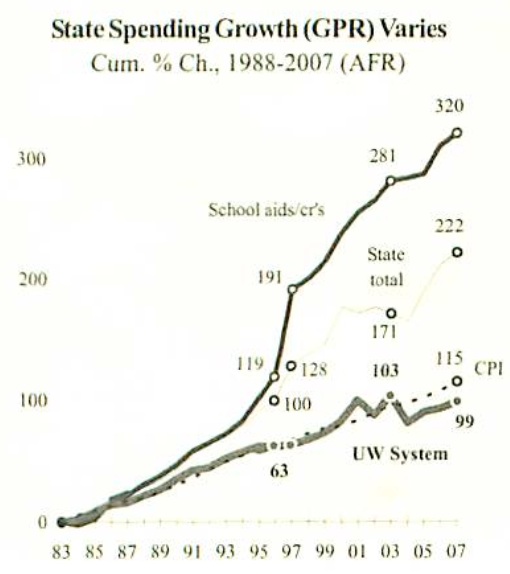
It is difficult to see growth in redistributed state and federal tax dollars for K-12 organizations over the next few years.
State of Wisconsin K-12 redistributed tax dollars have grown substantially over the past 25+ years, as this chart illustrates.


Redistributed state tax dollars are generated from personal & corporate income taxes and fees.
The Economist has more on New Jersey:

I watched him campaign last year. His message was simple: he vowed to cut spending and red tape. He also stressed that he was not Jon Corzine, the unpopular Democratic governor. Mr Corzine, for his part, emphasised that Mr Christie was a) a Republican and b) fat. The first argument alone would usually be enough to win an election in New Jersey. But last year was a bad time to be a) an incumbent or b) a former boss of Goldman Sachs, and Gov. Corzine was both.
I wondered at the time if Mr Christie meant what he said about doing painful things to rescue New Jersey from its deep pit of debt. It seems that he did. In no time at all, he plugged a short-term budget gap by slashing spending. He has also set his sights on the outlandish benefits enjoyed by some public-sector workers, citing as an example a 49 year old retiree who paid $124,000 towards his retirement benefits and expects to get back $3.8m.
He proposed to balance the budget for fiscal 2011 by cutting a third from projected outlays. He suggested that teachers’ pay be frozen, rather than raised by 4-5%, and that they contribute a small amount (1.5% of salary) towards their health benefits.

Share

Public, students speak out against Grand Rapids schools’ online education, superintendent scales back plan

Kym Reinstadler:

About 600 people attended Monday’s rescheduled Grand Rapids Board of Education meeting, with nearly 50 registering days in advance to question the board about proposed changes, including a controversial shift to online instruction at the city’s high schools.
But Wes Viersen said he came to answer the board’s questions about online classes. The Creston High School senior considers himself an expert in online courses, having completed 14 this year — a feat he said he could verify with the transcript in his pocket.
“Overall, the quality of E2020 is horrible,” Viersen told the board. “I completed courses, but I did not get an adequate education.”

Frequently asked questions about Grand Rapids proposed High School Curriculum changes.

Share

Test scores may keep Camden seniors from graduating

Joseph Gidjunis:

Hundreds of Camden City high school seniors are unsure if they’ll graduate this year after learning they failed at least part of the state’s Alternate High School Assessment, formerly known as the SRA.
But Camden’s seniors aren’t alone, as the first round of statewide testing in January resulted in massive failure — 90 percent of the 4,500 students who took the language arts section and two of every three of the 9,500 students who took the math section, didn’t pass — according to the Education Law Center, an urban school advocacy organization, which obtained the results of the test.
Across New Jersey, 120 school districts had no student pass the language arts section and 40 school districts saw no student pass math, said Education Law Center Director of the Secondary Reform Project Stan Karp.

More from New Jersey Left Behind.

Share

Celebrating new Seattle Chinese institute

Linda Shaw:

A new institute dedicated to spreading Chinese language and culture across Washington state was officially launched Monday, a partnership of Seattle Public Schools, the University of Washington and Hanban, a Chinese nonprofit group affiliated with China’s Ministry of Education.
Called the Confucius Institute, it will join about 250 similar organizations across the globe, one of a number of Hanban’s efforts to capitalize on the growing international interest in China.
Its efforts have been met with suspicion in some communities, most recently in suburban Los Angeles, where some parents expressed concern that a Hanban program might promote the Chinese government’s political views.
Washington officials don’t share those worries.
“We see nothing but upsides to teaching the languages and cultures of the world,” said Stephen Hanson, the UW’s vice provost of global affairs.

Share

Madison School Board Votes 5-2 to Continue Reading Recovery (Howard, Hughes, Moss, Passman, Silveira: Yes; Cole & Mathiak Vote No)

Gayle Worland:

With Monday’s actions, the board still has about $5.6 million to deal with – either through cuts, property tax increases, or a combination of the two – when it meets again next week to finalize the district’s preliminary budget for 2010-11. So far, the board has made about $10.6 million in cuts and approved a levy increase of $12.7 million, a tax hike of $141.76 for the owner of a $250,000 Madison home.
In an evening of cost shifting, the board voted to apply $1,437,820 in overestimated health care insurance costs to save 17.8 positions for Reading Recovery teachers, who focus on the district’s lowest-performing readers. That measure passed 5-2, with board members Maya Cole and Lucy Mathiak voting no. The district is undergoing a review of its reading programs and Cole questioned whether it makes sense to retain Reading Recovery, which she said has a 42 percent success rate.

Related: 60% to 42%: Madison School District’s Reading Recovery Effectiveness Lags “National Average”: Administration seeks to continue its use.
Surprising, in light of the ongoing poor low income reading scores here and around Wisconsin. How many more children will leave our schools with poor reading skills?
The Wisconsin State Journal advocates a teacher compensation freeze (annual increase plus the “step” increases).

Share

With the cash running dry, milking more out of the schools we have got is a better priority than building new ones

The Guardian:

From Thatcher to Major, and from Blair to Brown, the most heated arguments about education have turned on the question of choice. The election of 2010 is no different, but this time it is hard to concentrate on the debate, because of the distracting background din of the steel being sharpened for the savage years ahead. The row over fees for state nurseries which has now beset the Conservatives is a more instructive guide to what the next few years have in stall than any of the choice agendas we are being asked to choose from.
The Conservatives’ Michael Gove has long argued the best way to raise standards in general – and most particularly in deprived places – is to enable disgruntled parents to walk away from failing local authorities and establish schools of their own. Regarded by Mr Gove as a natural extension of Tony Blair’s academy programme, the plan is inspired by an 18-year old experiment in Sweden. And, until recently, the most pertinent questions related to the Swedish evidence. Initially positive signs have recently been overshadowed by the nation slipping down the educational league, and growing fears that gains in its free schools may have come at the expense of other institutions. As the scale of the post-election retrenchment becomes clearer, however, the really big question is the one acutely posed yesterday by a top Conservative councillor. Although Kent’s leader, Paul Carter, later “clarified” that he supported the party line, his query about where the cash will come from still demands an answer.

Share

Low Income, Top Scores: A School Defies the Odds

Sharon Otterman:

To ace the state standardized tests, which begin on Monday, Public School 172 in Sunset Park, Brooklyn, finds money for coaches in writing, reading and math. Teachers keep detailed notes on each child, writing down weaknesses and encouraging them to repeat tasks. There is after-school help and Saturday school.
But at the start of this school year, seven or eight students were still falling behind. So the school hired a speech therapist who could analyze why they and other students stumbled in language. A psychologist produced detailed assessments and recommendations. A dental clinic staffed by Lutheran Medical Center opened an office just off the fourth-grade classrooms, diagnosing toothaches, a possible source of distraction, and providing free cleanings.
Perfection may seem a quixotic goal in New York City, where children enter school from every imaginable background and ability level. But on the tests, P.S. 172, also called the Beacon School of Excellence, is coming close — even though 80 percent of its students are poor enough to qualify for free lunch, nearly a quarter receive special education services, and many among its predominately Hispanic population do not speak English at home.

Share

The State of the Humanities

Susan O’Doherty:

I’ve been thinking about Peter Conn’s article in the Chronicle about the depressing current and predicted future of academic employment in the humanities. The entire article is worth reading, but I was struck especially by his discussion of the need to communicate the value of the humanities to both the academy and the population at large, and to integrate these disciplines better into the world’s business:
Collectively, those of us who profess the humanities must make a sustained effort to explain to our various constituencies–students, parents, legislators, journalists, even our own university trustees (I speak from personal experience of that latter group)–that these disciplines, and the traditions they represent, are not merely ornamental and dispensable. They lie near the heart of mankind’s restless efforts to make sense of the world. Debates over war and peace, justice and equity: From the uses of scientific knowledge to the formulation of social policy, the humanities provide a necessary dimension of insight and meaning.
Generally, law school is considered the initial step on the path to a life of public service. Of course it’s important to understand the laws of the country you’re serving, but I’ve been having fun imagining what the government would look like with more humanities scholars running things. Here’s what I’ve come up with, and I hope you’ll add your thoughts:

Share

Madison Area schools face a big task in hiring and keeping minority teachers

Gayle Worland:

Madison has never had many black teachers, and now it faces another challenge in providing diverse role models for its students: a wave of black baby boomers nearing retirement.
Nearly 27 percent of the public school district’s African-American teachers, social workers, counselors and other front-line classroom professionals are at or over the district’s minimum retirement age of 55.
Henry Hawkins, an art teacher at Jefferson Middle School, has no plans to retire soon, but the 66-year-old who began teaching in the late 1960s sees the problem: As he’s watched his students become more and more diverse, the diversity among his colleagues has lagged.
“Part of the cycle is for students to be able to identify. It’s important in a sense to see oneself,” Hawkins said.

Share

Linda Darling-Hammond gets her own theme song

Education Excellence; The Gadfly:

This week, Mike and Andy discuss Charlie Crist’s veto, Linda Darling-Hammond’s charter school, and Race to the Test’s quickly narrowing field. Then Amber tells us about a new PEPG study on teacher compensation, and Stafford eats a cold cheese sandwich–and loves it! Click here to listen through our website and peruse past editions. To download the show as an mp3 to your computer, click here.

Share

A Few Words on Teachers


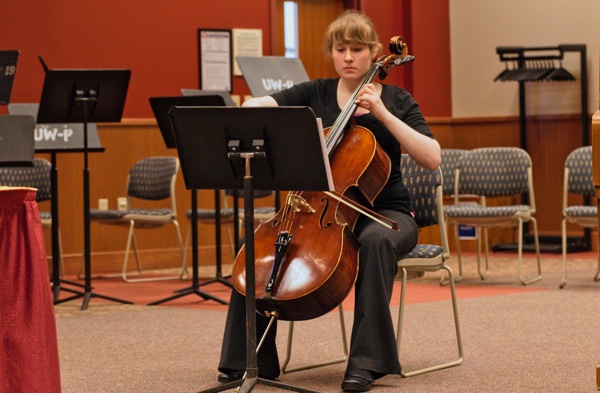
I had the wonderful opportunity to attend the 2010 Wisconsin Solo & Ensemble Festival. It is a true delight to enjoy the results of student and teacher practice, dedication and perseverance.
I very much appreciate the extra effort provided by some teachers on behalf of our children.
I thought about those teachers today when I received an email from a reader asking why I continue to publish this site. This reader referred to ongoing school bureaucratic intransigence on reading, particularly in light of the poor results (Alan Borsuk raises the specter of a looming Wisconsin “reading war“).
I’ll respond briefly here.
Many years ago, I had a Vietnam Vet as my high school government teacher. This guy, took what was probably an easy A for many and turned it into a superb, challenging class. He drilled the constitution, Bill of Rights, Federalist Papers and the revolutionary climate into our brains.
Some more than others.
I don’t have the ability to stop earmark, spending or lobbying excesses in Washington, nor at the State, or perhaps even local levels. I do have the opportunity to help, in a very small way, provide a communication system (blog, rss and enewsletter) for those interested in K-12 matters, including our $400M+ Madison School District. There is much to do and I am grateful for those parents, citizens, teachers and administrators who are trying very hard to provide a better education for our children.
It is always a treat to see professionals who go the extra mile. I am thankful for such wonderful, generous people. Saturday’s WSMA event was a timely reminder of the many special people around our children.

Share

Time for a Wisconsin Reading War….

Alan Borsuk:

Start the war.
What about Wisconsin? Wisconsin kids overall came in at the U.S. average on the NAEP scores. But Wisconsin’s position has been slipping. Many other states have higher overall scores and improving scores, while Wisconsin scores have stayed flat.
Steven Dykstra of the Wisconsin Reading Coalition, an organization that advocates for phonics programs, points out something that should give us pause: If you break down the new fourth-grade reading data by race and ethnic grouping, as well as by economic standing (kids who get free or reduced price meals and kids who don’t), Wisconsin kids trail the nation in every category. The differences are not significant in some, but even white students from Wisconsin score below the national average for white children.
(So how does Wisconsin overall still tie the national average? To be candid, the answer is because Wisconsin has a higher percentage of white students, the group that scores the highest, than many other states.)
Start the war.

Related: Reading Recovery, Madison School Board member suggests cuts to Reading Recovery spending, UW-Madison Professor Mark Seidenberg on the Madison School District’s distortion of reading data & phonics and Norm and Dolores Mishelow Presentation on Milwaukee’s Successful Reading Program.

Share

K-12 Tax & Spending Climate: A Revolt Grows in New Jersey

NY Post:

New Jersey voters just sent another loud reminder of their disgust with out-of-control taxes.
Of 537 school budgets up for a vote in the Garden State, 315 — a whopping 59 percent — went down in flames Tuesday.
That’s more than the state’s seen in decades.
Why so many rejections?
Because some 80 percent of those budgets sought property-tax hikes.

Share

For School Company, Issues of Money and Control

Stephanie Strom:

When the energy executive Dennis Bakke retired with a fortune from the AES Corporation, the company he co-founded, he and his wife, Eileen, decided to direct their attention and money to education.
Mrs. Bakke, a former teacher, said she had been interested in education since the summer she was a 12-year-old and, together with a friend, opened the Humpty Dumpty Day School, charging $2 a week in “tuition” to parents of the children attending. Mr. Bakke was eager to experiment with applying business strategies and discipline to public schools.
The Bakkes became part of the nation’s new crop of education entrepreneurs, founding a commercial charter school company called Imagine Schools. Beginning with one failed charter school company they acquired in 2004, they have built an organization that has contracts with 71 schools in 11 states and the District of Columbia. Imagine is now the largest commercial manager of charter schools in the country.

Share

Minnesota Teacher Union Lobbying

Mike Antonucci:

Minnesota lawmakers felt their Race to the Top application was adversely affected by insufficient teacher union buy-in. So they heeded the union’s repeated calls for “a seat at the table” by giving Education Minnesota President Tom Dooher, well, a seat at the table. Unfortunately, it was a seat at the legislators’ table during a committee hearing and Dooher is not only the union president, but a registered lobbyist.
Republican state Rep. Mark Buesgens said it was “like having Vito Corleone watching over his foot soldiers.”
The Democrats said the meeting was a working group and not a full committee hearing, so Dooher’s presence at the legislators’ table was not a breach of protocol. However, the Minnesota House voted 128-2 yesterday to bar lobbyists and executive branch members from sitting at the committee table with lawmakers during official meetings.

Share

In NJ school cut debate, insults overshadow issues

Geoff Mulvihill:

They’re the kind of obscenity-laced schoolyard taunts that could get a student suspended.
But the target of this tirade is New Jersey’s Gov. Chris Christie — and the perpetrators are the state’s teachers, irate over his calls for salary freezes and funding cuts for schools.
In Facebook messages visible to the world — not to mention their students — the teachers have called Christie fat, compared him to a genocidal dictator and wished he was dead. The postings are often riddled with bad grammar and misspellings.
“Never trust a fat f…,” read one profane post on the Facebook page, “New Jersey Teachers United Against Governor Chris Christie’s Pay Freeze,” which has some 69,000 fans, many of them teachers.
“How do you spell A– hole? C-H-R-I-S C-H-R-I-S-T-I-E,” read another.

Share

Houston Seeks Parent Input on High School Reforms

Ericka Mellon:

The Houston school district has scheduled meetings to discuss with parents its plans for reforming Lee, Jones, Kashmere and possibly Sharpstown high schools. HISD Superintendent Terry Grier and his staff presented the plans, which include extending the school day and year and offering students small-group tutoring, at a school board workshop last week. District officials plan to implement the changes this coming school year, so the turnaround is fast — and the parent meetings are just around the corner. After columnist Lisa Falkenberg got a tip about the upcoming meeting at Lee from a peeved state lawmaker, I asked the district for a list of all the meetings. It took a day to get it, but here it is:

Share

L.A. study affirms benefits of preschool

Carla Rivera:

Children enrolled in Los Angeles Universal Preschool programs made significant improvements in the social and emotional skills needed to do well in kindergarten, according to a study released Monday. The gains were especially pronounced for English language learners, the study showed.
The findings confirmed observations of preschool teachers that children attending high-quality programs are better prepared for kindergarten. For the first time, the study provided data to back up those observations, officials with the nonprofit preschool organization said.
“This is unique because there’s very little research in terms of cognitive progression in the preschool years,” said Celia C. Ayala, chief operating officer for Los Angeles Universal Preschool. “We know there are differences, we see the differences, but this gives us a way to assess improvements.”

Clusty Search: Los Angeles Universal Preschool.

Share

The Education Mess: Can We Build a Better National School System? No….

Jerry Pournelle:

Diane Ravitch was one of the architects of No Child Left Behind, but in her new book she now admits that it isn’t working, and is in fact helping kill the kind of education she advocates. She continues to believe that the American public schools do a poor job, and that we can build a much more successful system of public education.
I agree with her on the first point. She’s dead wrong on the second. We can’t build a better system.
That’s not a cry of despair, it’s a statement of fact. There is never going to be a national school system much better than what we have now. It may get worse, but it won’t get much better.
We could build a better school system by the simple expedient of abolishing the Department of Education. Some of us thought we could manage that when Reagan was swept into office, but the liberal establishment with the support of the teachers unions wouldn’t permit that: and Reagan needed Congressional support for his defense measures. Some of us remember that when Reagan took office, only ten years before the collapse of the Soviet Union, the United States looked to be in bad shape, with too many overseas commitments — what Walter Lippman called drafts on our power — and too little actual power, either military or diplomatic. The military needed a big shakeup and buildup, we needed to look into our overseas commitments, financial reforms were desperately needed, and the liberals, knowing all this, were willing to help — provided that they got their share of liberal programs. The Department of Education was one of their bastions, and they would fight to the death — or at least to the death of the Republic — to prevent it from being abolished.

Less centralization, including the breakup of big districts would be a great step forward.

Share

K-12 Tax & Spending Climate: New Jersey voters reject school budgets in heated elections

Star-Ledger:

New Jersey voters took a stand on school spending and property taxes Tuesday, rejecting 260 of 479 school budgets across 19 counties, according to unofficial results in statewide school elections.
In the proposed state budget he unveiled last month, Gov. Chris Christie slashed $820 million in aid to school districts and urged voters to defeat budgets if teachers in their schools did not agree to one-year wage freezes. The salvo ignited a heated debate with the state’s largest teachers union.
Christie said the cuts were necessary to help plug an $11 billion state budget gap.
In many districts Tuesday, the governor made himself heard as 54 percent of the spending plans were rejected, according to unofficial returns. If the trend continues, it would mark the most budget defeats in New Jersey since 1976, when 56 percent failed. Typically, voters approve more than 70 percent of the school budgets.

Share

A Toxic Dispute With Teachers in Washington, DC

New York Times:

Last fall, Michelle Rhee, the tough-minded and creative schools chancellor in Washington, laid off 266 teachers, citing a budget crunch. She has since reported finding a budget surplus. The city’s teachers’ union, which challenged the layoffs unsuccessfully last fall, has now asked a judge to review them again. The atmosphere has grown increasingly toxic.
Some of Ms. Rhee’s critics have implausibly suggested that she might have withheld information to justify the layoffs. It would be terrible for the city’s children if the dispute reached a point where it upended the innovative union contract that Ms. Rhee and union leaders provisionally agreed to earlier this month.
The contract, which changes the terms under which teachers are paid and evaluated, could pave the way for better schools for the District of Columbia’s students and could become a model for agreements between school districts and teachers’ unions around the country.

Share

What to do with ‘persistently underperforming’ schools?

San Francisco School Board Member Rachel Norton:

On April 20, the San Francisco Board of Education will convene a policy discussion to discuss the Superintendent’s plans for our 10 schools labeled “persistently underperforming” by the state of California.
This list was created as part of the state’s efforts to qualify for Race to the Top. It designates five percent of the state’s schools as failing, and prescribes one of four turnaround models for districts to take. There’s no choice in the matter, though it’s unclear under state law when these actions would have to be taken. If, however, a district wants to apply for Federal funds to help implement one of the turnaround models, it must submit a plan in the next few weeks–and begin the work within six months.
I am not crazy about any of the turnaround models. They assume that school leaders are so stupid that–D’oh! We never thought of replacing principals! We never thought of reconstitution (which we tried in this district and which failed, miserably)! Charter schools! Wow! (Even though charter schools have as mixed a record as traditional public schools–no miracles here.) School closure! (How does closing a school affect the achievement of its former students, exactly?)

Share

Department of Education’s “Race to the Top” Program Offers Only a Muddled Path to the Finish Line

William Peterson & Richard Rothstein:

In short, the Race to the Top 500-point rating system presents a patina of scientific objectivity, but in truth masks a subjective and somewhat random process.
This competition was a trial run for Secretary Duncan of a policy approach he hopes to make permanent. The Obama administration has proposed that formula-driven Title I funding16 be frozen at its present level, without future adjustment for inflation, and that increases in federal education spending be devoted entirely to a new collection of competitive grants, some of which have similar requirements to RTT, and some of which, as indicated above, attempt to create incentives for initiatives not included in RTT. Because such a reduction in real Title I funding would further exacerbate state fiscal crises, and because this trial run of a competitive system has proven to have little credibility, the administration should rethink its approach to federal education aid and its relationship to school improvement.
Yet for now, the Department of Education proposes to go through an identical process for judging a second round of applications by July. States that lost in the March competition have been invited to re-apply, and several are doing so, again investing time and expense to re-do their applications. Experts in these states are likely to spend many hours studying the review process employed in March, so they can recommend small changes in their states’ applica- tions to exploit the quirks of the Department’s rating system. Such gaming is unlikely to reflect an actual improvement in the education policies of applicant states.

Share

Comments on the Seattle Public Schools’ Strategic Plan Update

Charlie Mas:

So I was just thinking about the progress on the Strategic Plan. I know I shouldn’t. It only serves to upset and frustrate me. Nevertheless…
Focusing just on the primary themes and elements of the Plan, it still doesn’t look good.
1. Ensuring Excellence in Every Classroom
1A. Adopt an aligned curriculum in math and science
They haven’t done this. They’re nowhere with regard to science; I don’t think they’ve even gotten started. They’re not much further along with math. They have standardized the textbooks (for the most part), and they have posted pacing guides, but there’s no evidence that they have aligned the curriculum. In fact, it doesn’t appear that they have any ability to align the curriculum, that they even know how to align curriculum, or that they know what aligned curriculum would look like. After making bold statements on PowerPoints and paying millions to vendors, they appear to be completely adrift.
1B. Develop districtwide assessments in math and reading
This is a reference to the MAP, but it isn’t districtwide yet and teachers either don’t know how to use the results or simply aren’t choosing to use them. There were supposed to be a lot of other common assessments, but there’s no evidence to suggest that they are either in use or useful. Mostly this was an excuse to funnel millions to a vendor for a data warehouse which isn’t ready yet and will be of questionable utility when it is ready.

Related: Madison School District Strategic Plan.

Share

The Bad Teacher Protection Racket

Mike Nichols:

Legislators trying to help save a generation of Milwaukee children from lives of poverty and unemployment want to add a new law to the books in Madison this week.
They should, if they want to make a real difference, also delete one.
Part of the new education bill passed by the Senate the other day, and now being considered by the Assembly, calls for rigorous, annual teacher performance evaluations – something that many districts all across America already supposedly administer.
But not really.
Last year, the New Teacher Project researched teacher evaluations in 12 districts, both big and small, across the country. Methods and frequency of evaluation differed from district to district, but one thing was found to be strikingly similar. Virtually all teachers in the districts studied are told over and over and over again that they are either good or great. In districts that use binary rating systems, for instance, (generally “satisfactory” and “unsatisfactory” categories are used) more than 99% of teachers are given the “satisfactory” designation, according to the researchers.

Share

K-12 Tax & Spending Climate: The People & Their Government: Distrust, Discontent, Anger & Partisan Rancor

The Pew Research Center:

By almost every conceivable measure Americans are less positive and more critical of government these days. A new Pew Research Center survey finds a perfect storm of conditions associated with distrust of government – a dismal economy, an unhappy public, bitter partisan- based backlash, and epic discontent with Congress and elected officials.
Rather than an activist government to deal with the nation’s top problems, the public now wants government reformed and growing numbers want its power curtailed. With the exception of greater regulation of major financial institutions, there is less of an appetite for government solutions to the nation’s problems – including more government control over the economy – than there was when Barack Obama first took office.
The public’s hostility toward government seems likely to be an important election issue favoring the Republicans this fall. However, the Democrats can take some solace in the fact that neither party can be confident that they have the advantage among such a disillusioned electorate. Favorable ratings for both major parties, as well as for Congress, have reached record lows while opposition to congressional incumbents, already approaching an all- time high, continues to climb.

Share

An analysis of pay-for-grades schemes

Daniel Willingham:

Roland Fryer is an economist at Harvard University who had an idea for a straightforward method of getting kids at urban schools more engaged: Pay ’em.
Four reward schemes were tried in four different cities, each in a randomized control trial lasting one year. The results are reported in Time magazine this week.
New York City: Students were promised pay for higher standardized test scores. There was no effect.
Chicago: Students were paid for higher grades. The rewards prompted higher attendance rates and higher grades, but standardized test scores were not improved.
Washington, D.C.: Students were rewarded for improved behaviors such as good attendance, refraining from fighting, and so on. There was a modest improvement on standardized test scores.

Share

Alternate Path for Teachers Gains Ground

Lisa Foderaro:

Not long ago education schools had a virtual monopoly on the teaching profession. They dictated how and when people became teachers by offering coursework, arranging apprenticeships and granting master’s degrees.
But now those schools are feeling under siege. Officials in Washington, D.C., and New York State, where some of the best-known education schools are located, have stepped up criticisms that the schools are still too focused on theory and not enough on the craft of effective teaching.
In an ever-tightening job market, their graduates are competing with the products of alternative programs like Teach for America, which puts recent college graduates into teaching jobs without previous teaching experience or education coursework.
And this week, the New York State Board of Regents could deliver the biggest blow. It will vote on whether to greatly expand the role of the alternative organizations by allowing them to create their own master’s degree programs. At the extreme, the proposal could make education schools extraneous.

Related, Janet Mertz: An Email to Madison Superintendent Dan Nerad on Math Teacher Hiring Criteria.

Share

Five hard truths about charter schools

Jay Matthews:

Many people get too excited about the latest hot education innovation. They lose their sense of perspective. It has happened even to me once or twice. When we wander off like that, we need someone with a sharp intellect and strong character to pull us back to reality.
One such person is Paul T. Hill, director of the Center on Reinventing Public Education and John and Marguerite Corbally Professor at the University of Washington Bothell. He has written a short, wise book, “Learning As We Go: Why School Choice is Worth the Wait,” which provides the clearest explanations I have seen for why independent public charter schools need more time to develop. Hill believes it is worth waiting for charters to make what he thinks will be widespread positive impact on the quality of education. He thinks they are more promising than a renewed fondness for strengthening bureaucracy and standardizing instruction that seems to be bubbling in some foundations and national advocacy groups.
Hill makes five simple points and more or less devotes a chapter to each. Here is what he says, with some fussing and worrying by me. If you want to add your ideas to these, or explain why these are nonsense, the comments box below awaits.

Share

The teacher salary debate we long needed to have

Mike Kelly:

Since 2001, spending by local towns across New Jersey has risen by 70 percent, with average 4 percent raises for teachers each year playing a major role in the increases. During that same period, property taxes have risen by 56 percent.
You don’t need to be a math major to know that you can’t pay for a 70 percent spending hike with “only” a 56 percent increase in tax revenues. So how did towns make up the difference?
Answer: Trenton.
For many towns and school districts, the revenue gap was filled in with state aid. And that state aid has come largely from income taxes and other fees.
But then came the recession and the sharp drop in incomes – and income taxes.
And then came Chris Christie, handily beating the well-funded, union-backed incumbent Democratic governor, Jon Corzine.
Corzine did not lose because he wasn’t smart enough or because he did not have enough campaign cash of his own. He lost because voters no longer had confidence that he could deliver on his promise to find ways to cut spending and deliver some measure of property tax relief.

Share

Madison School Board to Discuss the Superintendent’s Proposed Administrative Reorganization Monday Evening

Organization Chart 352K PDF
Reorgnanization Budget 180K PDF
February, 2010 background memo from Superintendent Dan Nerad.
I spoke with the Superintendent Friday regarding the proposed reorganization. The conversation occurred subsequent to an email I sent to the School Board regarding Administrative cost growth and the proposed reduction in Superintendent direct reports.
I inquired about the reduction in direct reports, the addition of a Chief Learning Officer, or Deputy Superintendent and the apparent increased costs of this change. Mr. Nerad said that he would email updated budget numbers Monday (he said Friday that there would be cost savings). With respect to the change in direct reports, he said that the District surveyed other large Wisconsin Schools and found that those Superintendents typically had 6 to 8, maybe 9 direct reports. He also reminded me that the District formerly had a Deputy Superintendent. Art Rainwater served in that position prior to his boss, Cheryl Wilhoyte’s demise. He discussed a number of reasons for the proposed changes, largely to eliminate management silos and support the District’s strategic plan. He also referenced a proposed reduction in Teaching & Learning staff.
I mentioned Administrative costs vis a vis the current financial climate.
I will post the budget numbers and any related information upon receipt.
Finally, I ran into a wonderful MMSD teacher this weekend. I mentioned my recent conversation with the Superintendent. This teacher asked if I “set him straight” on the “dumbing down of the Madison School District”?
That’s a good question. This teacher believes that we should be learning from Geoffrey Canada’s efforts with respect to the achievement gap, particularly his high expectations. Much more on the Harlem Children’s Zone here.
Finally, TJ Mertz offers a bit of commentary on Monday evening’s Madison School Board meeting.

Share

K-12 Tax & Spending Climate: New Jersey’s ‘Failed Experiment’

James Freeman:

‘I said all during the campaign last year that I was going to govern as if I was a one-termer,” explains New Jersey Governor Chris Christie on a visit this week to the Journal’s editorial board. “And everybody felt that it was just stuff you say during a campaign to sound good. I think after the first 12 weeks, given the stuff I’ve done, they figure: ‘He’s just crazy enough to do it.'”
Call it crazy, or just call it sensible: Mr. Christie is on a mission to make New Jersey competitive once again in the contest to attract people and capital. During last fall’s campaign, while his opponent obliquely criticized Mr. Christie’s size, some Republicans worried that their candidate was squishy–that he wasn’t serious about cutting spending and reining in taxes. Turns out they were wrong.
Listen to Mr. Christie’s take on the state of his state: “We are, I think, the failed experiment in America–the best example of a failed experiment in America–on taxes and bigger government. Over the last eight years, New Jersey increased taxes and fees 115 times.” New Jersey’s residents now suffer under the nation’s highest tax burden. Yet the tax hikes haven’t come close to matching increases in spending. Mr. Christie recently introduced a $29.3 billion state budget to eliminate a projected $11 billion deficit for fiscal year 2011.

Share

On Stanford Education School’s Charter Difficulties

Andrew Rotherham:

My take on the Stanford charter school situation is below. Punchline: This is sad in some powerful ways, it’s not funny.

But the New York Times story demands a bit more discussion. (Plus it buries the lede…check out the Shalvey quote)

In the story Linda Darling Hammond points out that the Stanford school takes all kids. Sure, but so do many other public schools (including some in the community including Aspire Public Schools, a network of public charters established by a former CA school superintendent) that have better results. More on that below. That uncomfortable reality also makes Diane Ravitch’s quote in the story really curious. This situation doesn’t illustrate much about the debate about schools and poverty overall, but it does again show that there are big differences among schools serving similar kids and that powerful and intentional instruction matters.

Share

Oakland schools fact-finding report released

Jill Tucker:

With a one-day teacher strike looming in Oakland, a fact-finding report released Thursday gave both the district and the teachers union some ammunition in the bitter battle over a new labor contract.
The report, a required step following failed contract negotiations, validated the district’s claims of financial desperation, but it also gave a nod to the Oakland Education Association’s claims of relatively low teacher pay and need for small class sizes.
It urged both sides to get over the past – a history mired in fiscal mismanagement and bitterness.

Share

Seattle Teachers Union Bristles at New Coalition’s Effort to Muscle In on Contract Negotiations

Nina Shapiro:

Contract negotiations began this week between Seattle Public Schools and the teachers union, and the atmosphere is already getting testy–but not between the parties you might expect. Seattle Education Association president Olga Addae is peeved over a new coalition led by the non-profit Alliance for Education that is trying to muscle in on the talks.
Although technically no one else is allowed at the bargaining table besides the union and the district, the “Our Schools Coalition” last week launched a campaign to influence the process by unveiling a list of nine proposed changes it would like to see in the new contract–all of which are aimed at supporting good teachers and weeding out the bad.
While the group’s ideas are not necessarily new, its effort to influence the negotiations is. And the coalition may have the political clout to do just that.

Share

Grade Inflation: Who Really Failed?

Scott Jaschik:

Dominique G. Homberger won’t apologize for setting high expectations for her students.
The biology professor at Louisiana State University at Baton Rouge gives brief quizzes at the beginning of every class, to assure attendance and to make sure students are doing the reading. On her tests, she doesn’t use a curve, as she believes that students must achieve mastery of the subject matter, not just achieve more mastery than the worst students in the course. For multiple choice questions, she gives 10 possible answers, not the expected 4, as she doesn’t want students to get very far with guessing.
Students in introductory biology don’t need to worry about meeting her standards anymore. LSU removed her from teaching, mid-semester, and raised the grades of students in the class. In so doing, the university’s administration has set off a debate about grade inflation, due process and a professor’s right to set standards in her own course.
To Homberger and her supporters, the university’s action has violated principles of academic freedom and weakened the faculty.

Related: Marc Eisen: When A Stands for Average: Students at the UW-Madison School of Education Receive Sky-High Grades. How Smart is That?.

Share

Film: The Cartel – Children Left Behind

Jeannette Catsoulis:

A mind-numbing barrage of random television clips and trash-talking heads, “The Cartel” purports to be a documentary about the American public school system. In reality, however, it’s a bludgeoning rant against a single state — New Jersey — which it presents as a closed loop of Mercedes-owning administrators, obstructive teachers’ unions and corrupt school boards.
Blithely extrapolating nationally, the writer and director, Bob Bowdon, concludes that increased financing for public schools is unlikely to raise reading scores but is almost certain to raise the luxury-car quotient in administrator parking lots. To illustrate, Mr. Bowdon rattles off a laundry list of outrages — like a missing $1 billion from a school construction budget — and provides a clumsy montage of newspaper headlines detailing administrative graft.
The evidence may be verifiable (and even depressingly familiar), but its complex underpinnings are given short shrift. Instead Mr. Bowdon, a New Jersey-based television reporter, employs an exposé-style narration lousy with ad hominems and emotional coercion. In one particularly egregious scene he parks his camera in front of a weeping child who has just failed to win a coveted spot in a charter-school lottery — another tiny victim of public school hell. Later, confronted with the president of the New Jersey Education Association, Mr. Bowdon performs the rhetorical equivalent of poking a lion with a stick and running away.

Share

Another Chicken Little Madison School District Budget

Lynn Welch:

It’s a good thing Madison is a full of certified smarty-pants. It takes a high level of smarts just to comprehend the complex and shifting budget situation faced by the Madison school district. Even some school board members have a hard time making sense of it.
“I’ve never seen anything quite like this,” says Lucy Mathiak, the board’s vice president, of the process by which the district has presented information about its proposed $372.8 million budget this year. “When you have the health and welfare of schools on the line, I feel like I have to ask for answers. It’s not a comfortable position.”
Frustrated, Mathiak first raised questions about how the district came to its projected $30 million budget hole in her School Daze blog. She notes, first of all, that the gap was closer to $18 million, presuming the board exercises its existing ability to raise taxes, as approved by voters in a 2008 referendum: “This means that the draconian school closings and massive staff layoffs reported earlier are unlikely to happen.”
But even if that gap is plugged, new ones are opening up. Recently the district was told by a consultant that it needs to do $85.7 million in repairs to existing buildings over the next five years, well beyond the $4 million a year it budgets to this end.

Share

“Concerns about Collection of Student Data”

Representative John Kline (R-MN):

Rep. John Kline (R-MN), the U.S. House Education and Labor Committee’s senior Republican member, today warned sensitive student information could be at risk through vast data warehouses that collect private, personally identifiable information on school children. The committee heard testimony on the risks to students’ personal information during a hearing on data collection in the K-12 education system.
“Today’s hearing reinforces the need for federal, state, and local policymakers to ensure sensitive personal information about our children is safeguarded, and student and family privacy rights are protected. Efforts to collect vast troves of information on our students, tracking them from cradle to career, raise serious concerns,” said Kline. “Information on student performance, while important to a child’s success in the classroom and ensuring we have the best teachers serving in our schools, should not supersede our responsibility to protect a student’s personal information.”
The committee heard testimony from Professor Joel Reidenberg, academic director of the Center on Law and Information Policy at the Fordham University School of Law, who shared his research into security weaknesses in current state-based data systems and the potential that state data warehouses could be commandeered to create an unprecedented federal tracking system for maintaining private student information.

Share

Better food at a school near you

Susan Troller:

Local foodies are cheering the news that Wisconsin lawmakers this week passed legislation that will help bring local farm products to school lunchrooms.
The Assembly passed AB 746, which creates a statewide council to coordinate the process of selling Wisconsin-grown products to schools. The Senate concurred on the Farm-to-School initiative which is cheering news to Wisconsin farmers and advocates for more fresh foods on school menus.
Meanwhile, a newly released report from chef Beth Collins and Lunch Lessons about Madison’s school meal program says the Madison school district’s food service facilities, staff and organization pose no barriers to putting healthier, less processed food on kids’ plates at school. But district budget woes and time constraints, plus the lack of a well-focused plan, still pose significant hurdles to upgrading what kids eat at school.

Share

Incoming Milwaukee Public Schools chief lays out goals for district

Erin Richards:

Milwaukee’s incoming schools leader will focus on improving student achievement, creating more efficient and effective district operations, and partnering with parents, businesses and community members when he takes the reins of the state’s largest public school system in July.
That’s according to Gregory Thornton, Milwaukee Public Schools’ superintendent-in-waiting, who for the first time in public Tuesday began laying out his plan for improvement and hinting at the changes those inside and outside the system can expect to see over the next few years.
“I’m excited because I think Milwaukee is at a very key place,” Thornton said. “I think we’re at a tipping point . . .  I believe we need to tip this thing in a way that young people can be successful.”
Thornton’s discussion was part of a Newsmaker Luncheon hosted by the Milwaukee Press Club at the downtown Newsroom Pub. He answered questions from a panel of local journalists as well as audience members.
From the start, Thornton said, he will have to do “some housekeeping” in the district. Change will happen, he said, and those standing in the way will not be encouraged to stick around.

Share

Are charters’ students doing better? New way of grading schools will tell

Peggy Walsh-Sarnecki:

The latest report on Michigan’s charter schools, to be presented to the state Board of Education today, does not compare the performance of charter students to those in traditional public schools — a controversial practice done in past years.
In previous years, the annual report compared test scores in all charter schools with the average score of 20 traditional (and mostly low-performing) districts in which about 75% of Michigan charter schools are located. By that measure, charter schools do better.
The new 33-page annual report, created by the Michigan Department of Education and Michigan State University, explores topics including student performance and profiles. The report also recommends giving the department more authority over charter schools and a small increase in funding to pay for that.

Share

100 Years of Genetics at the University of Wisconsin-Madison


James Crow, professor emeritus of genetics at the UW-Madison recently gave a talk to the Madison Literary Club on “100 Years of Genetics at the University of Wisconsin-Madison.


Click to download a 4.5mb .zip file that contains a few images from Monday’s Madison Literary Club talk.

Share

Vicki McKenna & Don Severson Discuss the Madison School District’s Budget and Maintenance Referendum Accounting

24MB mp3 audio file. Much more on the 2010-2011 budget and 2005 maintenance referendum, and potential audit, here.

Share

Miss. county schools ordered to comply with desegregation order

Spencer Hsu:

A federal judge Tuesday ordered a rural county in southwestern Mississippi to stop segregating its schools by grouping African American students into all-black classrooms and allowing white students to transfer to the county’s only majority-white school, the U.S. Justice Department announced.
The order, issued by Senior Judge Tom S. Lee of the U.S. District Court of Southern Mississippi, came after Justice Department civil rights division lawyers moved to enforce a 1970 desegregation case against the state and Walthall County.
Known as Mississippi’s cream pitcher for its dairy farms and bordering Louisiana 80 miles north of New Orleans, Walthall County has a population of about 15,000 people that includes about 54 percent white residents and 45 percent African American residents, according to the U.S. Census.

Share

In Support of Madison School District’s Budget Growth

Progressive Dane:

Despite the 2008 referendum which so many of us worked so hard to pass, state actions and inaction have once again placed the quality of our public schools in jeopardy. It is time to stand up for our schools (again).
On Sunday April 18th at 1:00 pm at Warner Park Community Recreation Center – 1625 Northport Dr. – the Madison Metropolitan School District Board of Education will hold their second Public Hearing on the 2010-11 district budget. The Board needs to hear from the community that we value education and are willing to pay to keep our schools strong. Progressive Dane urges community members to attend and make their voices heard.
Even if you don’t want to speak at the meeting, you can attend register with positive message. If you can’t make on Sunday, the Board can be contacted at board@madison.k12.wi.us.

Share

Cameron’s UK parent school promise

BBC:

Conservative leader David Cameron has made an election centrepiece of plans to allow parents and other providers to set up schools with state funding.
Launching his party’s manifesto, Mr Cameron has promised parents “the power to get a good new school in your community”.
The manifesto also says all schools, including primaries, will be able to have the autonomy of academy status.
And there is a commitment that all pupils should read by the age of six.

Share

A Right Denied

Dear Public Education Advocate:
Yesterday I attended the premier showing of A Right Denied produced by Bob Compton who also produced 2 Million Minutes and few other related documentaries about education systems in the US and the world.
In between watching the Masters or the Yankees lose a few ballgames this weekend, please review this information and in particular, the attached 240 slide PPT presentation prepared by Whitney Tilson who is featured in A Right Denied. Whitney’s research and factual data took a few years to compile and is the basis for the documentary. I have been following Whitney’s work closely for a few years and if you asked me if I could have dinner with any one person in America today who would it be; my answer (after my wife of course) Whitney Tilson. Please review his material and feel free to share this with those you know.
While the achievement gap among racial groups and the sad inequities based solely one’s zip code are illustrated, so is the decline in the U.S. education system on a whole – the data is alarming.
Some select pieces from the PPT slides (5.5MB PDF):
Why hasn’t additional money resulted in improved results?

  1. Teacher quality has been falling rapidly over the past few decades
  2. Our school systems have become more bureaucratic and unaccountable
  3. As a nation, have been so rich for so long that we have become lazy and complacent. Our youth are spending more time watching TV, listening to iPods, playing video games (up 25% in the last four years), going to sporting events, etc. rather than studying hard. These two pictures capture what’s happening in China vs. the U.S. (see slide number 15).

Americans watch more than twice as much TV as any other country. (Watching the Masters or Baseball is exempt however.)
Achievement Gap #1 – We are falling behind all economic competitors.

  • 15-year-olds trail almost all other OECD countries in Math and Science.
  • Our High School graduation rate lags nearly all OECD countries.
  • US is among the leaders in college participation but ranks in the bottom half or college completion.
  • The college completion rate in the US has stagnated and our competitors have surpassed us.
  • American students score highly in self-confidence. 72% agree or strongly agree; “I get good marks in Mathematics”, yet we are near the bottom internationally in mathematics.

Achievement Gap #2 – Academic achievement of low-Income, minority students is dramatically lower than their more affluent peers. You already know this but, did you know;

  • The black-white achievement gap is already one year in kindergarten?
  • The majority of Black and Latino 4th graders struggle to read a simple children’s book.
  • The achievement gap widens the longer students are in school.
  • Black and Latino 12th graders read and do math at the same level as white 8th graders.
  • Massachusetts and NYC have made great strides in math the past six years.
  • Very few children from low-income households are graduating from any four-year college, and this has stayed consistent for the past 40 years.
  • 74% of students at elite colleges are from the top quartile of households and only 9% are from the bottom half of households.
  • Even the better high school graduates today are alarmingly unprepared for college. Close to half need remedial courses.

Two general approaches to fixing our schools

  • Improve the current system and create alternatives to the current system. Adopt both strategies.
  • Too many school systems today are dominated by the “Three Pillars of Mediocrity.”
    • Lifetime Tenure
    • Lockstep Pay
    • System Drive by seniority (not merit)
  • Teacher Quality and Effectiveness. Teacher quality has been declining for decades. College seniors who plan to go into education have very low test scores.
  • Teacher certification has little impact on student achievement.

Please review the trailer http://www.2mminutes.com/films/ and the slide presentation attached which I know you will appreciate. I would encourage you to purchase the CD too or you can borrow mine if you like, I also have 2 Million Minutes and 2 Million Minutes: The 21st Century Solution.
Doug

Share

Teachers Embrace the Power of Prayer A New Jersey teacher’s union prays for Chris Christie’s death.

Allysia Finley:

Hell hath no fury like a teacher’s union scorned. To close a $10.7 billion budget deficit, New Jersey’s Republican Governor Chris Christie last month proposed slashing education by $820 million, an equivalent to a 5% cut for each school district. That follows on the heels of an across-the-board pay freeze.
Not happy is the Bergen County Education Association, which sent a letter to 17,000 members asking them to pray for the governor’s death. The letter offers a sample prayer that begins: “Dear Lord, this year you have taken away my favorite actor, Patrick Swayze, my favorite actress, Farrah Fawcett, my favorite singer, Michael Jackson, and my favorite salesman, Billy Mays. . . . I just wanted to let you know that Chris Christie is my favorite governor.”

Share

Milwaukee Representative Grigsby Statement on Education Reform Announcement

The Milwaukee Drum:

Today, State Representative Tamara Grigsby (D-Milwaukee) joined other education supporters to announce a new education reform proposal designed to increase supports for Milwaukee Public Schools and its democratically-elected school board. Grigsby issued the following statement regarding today’s activities:
“If this compromise were about mayoral takeover, I would not be here in support of it today. Over the past year, much of the debate surrounding MPS has been about who runs the schools, rather than the quality of education being given to our children. Now that the debate surrounding takeover has come to an end, I’m glad that so many different stakeholders have been able to join together to find common ground with the best interests of Milwaukee’s children in mind.
“This compromise is not about a change in governance, nor is it about school control. This compromise is about support for our schools and providing a consistent, quality education for our children. For education to improve, MPS needs more community support, more district support, and more state support. You will not find a takeover of any sort in this legislation. Instead, this proposal puts in place important policies designed to support and strengthen Milwaukee Public Schools and maintain its democratically-elected, empowered school board.

Share

NJ gov wants teachers union leader fired for memo

Angela Delli Santi:

The president of a state teachers union left a meeting Monday with Gov. Chris Christie after refusing to fire a local president who wrote a memo that joked about the governor’s death, further escalating a rift that began before Christie’s election.
Christie spokesman Mike Drewniak said the governor wants Bergen County teachers union head Joe Coppola fired for his “irresponsible” memo. The memo from the Bergen County Education Association to its locals included a closing prayer that read:
“Dear Lord this year you have taken away my favorite actor, Patrick Swayze, my favorite actress, Farrah Fawcett, my favorite singer, Michael Jackson, and my favorite salesman, Billy Mays. I just wanted to let you know that Chris Christie is my favorite governor.”

Share

Additional Discussion on the Madison School District’s 2010-2011 Budget

Gayle Worland:

“We still have the big stuff ahead, some of the harder discussions,” School Board President Arlene Silveira said. “So it’s good to get some of these items off the table.”
Superintendent Dan Nerad started the budget discussion Monday with the news that more than nine full-time jobs for bilingual resource specialists had been double-counted in budget estimates, allowing the board to remove $632,670 in expenses for those duplicate positions.
Also, the rise in employee health insurance costs for the 2010-11 school year had been overestimated, resulting in costs that are $1.4 million less than projected, Nerad said.

Much more on the 2010-2011 budget here.

Share

Videos on Proposed Milwaukee Public Schools’ Governance Changes

The Milwaukee Drum:

Share

Madison School Board member may seek audit of how 2005 maintenance referendum dollars were spent

Susan Troller, via a kind reader’s email:

Where did the money go?
For more than a year, Madison School Board member Lucy Mathiak has been asking Madison school district officials for a precise, up-to-date summary of how $26.2 million in 2005 maintenance referendum dollars were spent over the last five years.
She’s still waiting, but her patience is wearing out.
Now the sharp-tongued budget hawk says she may ask the school board as early as Monday night to authorize an outside audit that would identify how the money approved by taxpayers in 2005 for repairs and maintenance of dozens of the district’s aging buildings was actually spent between 2005 and fall of 2009.
“We need to have a serious, credible accounting for where the money went from the last referendum, and I haven’t seen that yet,” Mathiak told The Capital Times. “I’m ready to ask for an audit, and I think there are other board members who are equally concerned.”

Related: Proposed Madison School District Maintenance Referendum: 1999, 2005 and 2010 Documents:

The Madison School District is considering another maintenance referendum ($85M?). The documents below provide a list of completed (1999, 2005) and planned projects (2010+). The reader may wish to review and compare the lists:

The 2005 special election included 3 referenda questions, just one of which passed – the maintenance matter.

Share

Fewer Students, More Teachers: Even as enrollment falls, school districts keep hiring.

Wall Street Journal:

New York Governor David Paterson wants to reduce state aid to local school districts next year by 5% to address the state’s $9.2 billion budget deficit, and state educators are complaining that the cuts could result in teacher layoffs. Maybe so, but the reality in New York and other states is that teacher hires in recent years have far outpaced student enrollment.
A new report from the Empire Center for New York State Policy found that New York public schools added 15,000 teachers between 2000 and 2009, even though enrollment fell by 121,000 students over the same period. New York City, home to the nation’s largest school system, added 7,000 teachers and 4,000 nonteaching professionals (guidance counselors, administrators, nurses) even as its enrollment was decreasing by 63,000 kids, according to state data.
Teachers unions prefer fewer students per class because it means more dues-paying jobs, but the evidence that it improves academic outcomes is thin. In any case, the Empire Center report found that “by national standards, class sizes in New York were small even before the further staff expansion of the past nine years.” In 2008 New York’s pupil-teacher ratio was 13.1, the eighth lowest among the 50 states, and its per-pupil spending ($16,000) leads the nation.

Share

Proposed Madison School District Maintenance Referendum: 1999, 2005 and 2010 Documents

The Madison School District is considering another maintenance referendum ($85M?). The documents below provide a list of completed (1999, 2005) and planned projects (2010+). The reader may wish to review and compare the lists:

The 2005 special election included 3 referenda questions, just one of which passed – the maintenance matter.

Share

Obama’s Blueprint for Total Federal Control in Public Education

Lew Cypher (Libertarian):

Win or lose with healthcare “reform”, there is another socialist crisis looming, thanks to the Obama administration, but one that most conservatives and many libertarians will not only go along with but actually applaud, until it is forever too late. The battle over our schools has been being lost for nearly a decade and with the help of conservatives who do not understand how The late Senator Edward Kennedy and the current Pelosi ally, U.S. Representative George Miller pulled one over on Bush and the GOP with No Child Left Behind (NCLB). The defining impact of NCLB was not what it imposed on the nation’s public schools but that it opened the door to direct Federal control of one of the most intimately local institutions in American history and culture (Will, 2007). That Federal control of the schools is precisely why Democrats who railed against the law for its first four years did not overturn it after taking control of Congress in 2007, when the law first came up for renewal. Democrats may not like details within NCLB but they apparently like the idea of federal control of the schools more than they dislike the current law, considering that they have left NCLB unchanged until Obama has proposed his “Blueprint for Education” (Turner, D). Many of the same people who bitterly opposed Obama on healthcare will now jump through all his various hoops to help him further take over the nation’s schools on a federal level by accepting his shiny false lure of blaming education’s ills on so-called “bad” teachers (Navarrette). The proof of the falsehood in the lure to punish “bad” teachers is in which states won first approval under Obama’s first canary in the coal mine for federal takeover of the schools, also known as Race To The Top; states whose teachers unions agreed to the so-called reforms (Anderson & Turque).

Share

State leaders, Education Minnesota get a wake-up call on reform.

Minneapolis Star-Tribune:

Disappointment was widespread last month when Minnesota failed to make the list of finalists for federal Race to the Top education funds. For a state accustomed to being a national leader in education, it was a rude awakening to be bested by winners Delaware and Tennessee and eight other finalists.
Still, the poor showing can be the kick in the teeth Minnesota needs to jump-start educational reforms, and it should serve as a wake-up call for a teachers union that has wielded too much power in preserving the status quo. Minnesota lost points in the competition for poor plans to produce better educators and close the achievement gap, and for not having more support from its teachers unions.

Share

College not mandatory under exam program

Marc Tucker:

Ze’ev Wurman and Sandra Stotsky, in their opinion piece (“Grade 10 Diploma Not a Wise Idea,” Insight, April 4) misrepresented our proposals.
They suggest that the State Consortium on Board Examination Systems is proposing to send all of the high school students in our states to community colleges at the age of 16. Not so.
We offer the option of going to community college after the sophomore year in high school to students who pass exams showing they can do college-level work. But students who pass these exams could stay in high school to take a career and technical program or a program designed to prepare them for admission to selective colleges. High schools would be obligated to give students who don’t pass their exams additional instruction in the areas in which they are weak, so they could succeed the next time they take the exam.

Share

K-12 Tax & Spending Climate: 66% Say America Is Overtaxed

Rasmussen Reports:

When thinking about all the services provided by federal, state and local governments, 75% of voters nationwide say the average American should pay no more than 20% of their income in taxes. However, the latest Rasmussen Reports national telephone survey finds that most voters (55%) believe the average American actually pays 30% or more of their income in taxes.
Sixty-six percent (66%) believe that America is overtaxed. Only 25% disagree.
Lower income voters are more likely than others to believe the nation is overtaxed.
Not surprisingly, the tax issue provokes a wide gap between the Political Class and Mainstream Americans. Eighty-one percent (81%) of Mainstream American voters believe the nation is overtaxed, while 74% of those in the Political Class disagree (see more about the Political Class and Mainstream Americans).

Share

Redesigning Education: Rethinking the School Corridor

Trung Le:

“I am entirely certain that twenty years from now we will look back at education as it is practiced in most schools today and wonder how we could have tolerated anything so primitive.”

– John W. Gardner, Secretary of Health, Education and Welfare, “No Easy Victories” (1968)
Education reform is in the air and taking root in thousands of classrooms across the country. From overhauling No Child Left Behind to closing poorly performing schools and raising student expectations, the push for change is powerful. Yet, the space where most learning takes place–the school and classroom–has changed little over the last 200 years.
Even before students set foot in a classroom, most schools still are built like factories: long hallways, lined with metal lockers, transport students to identical, self-contained classrooms. School designers call these hallways “double-loaded corridors.” The factory model of control and direct instruction still pervades most new schools. If we are to have thorough-going school reform, we must change the design model, too, starting with the place students first enter the school.

Share

State budget cuts singe one Naperville school district, scorch another

Noreen Ahmed Ullah:

Two years ago, Indian Prairie School District 204 was building state-of-the art schools and athletic facilities. For years, new homes regularly had been added to the tax rolls, which kept dollars rolling in. Administrators in the district covering south and west Naperville decided to expand kindergarten to a full school day.
In the older neighborhoods to the north and east, Naperville School District 203 was enlarging its older schools rather than building new ones. Although the district spent more per pupil than its southern neighbors, kindergarten remained a half-day program, which didn’t sit well with some parents.
But in recent weeks, District 204 approved plans to cut 145 teachers and $21.4 million out of next year’s budget, while its neighbors in District 203 made small budget adjustments that left the educational program largely intact.

Share

K-12 Tax & Spending Climate: The Great Debt Bailout


“Hellasious”:

This blog was created in late 2006 in order to “vent” my frustration over the huge debt bubble and what I perceived to be the risks it posed to the global economy. In summary, I claimed that the economy had become hooked on debt to create additional GDP growth – or “growth” in quotation marks – and that the finance “tail” was wagging the real economy “dog”.
Soon thereafter, the bubble burst – first in the U.S. and then everywhere else. What followed was the worst economic crisis since the Great Depression. And we are still in the midst of it, albeit in ever-mutating form, so today’s post is meant as a tour d’horizon, a quick summary of how I see things shaping up today.
I believe all that has happened so far is The Great Debt Bailout. Governments and central banks have issued trillions in new government-backed debt, some to replace private debt gone bad (bailouts for billionaires) and some to finance massive budget deficits (pennies for penniless). It is a policy mishmash produced by the combination of (a) Bernankean revulsion to monetary deflation and (b) Keynesian aversion to economic recession.

As School Districts consider property tax increases to address spending growth and flat or reduced redistributed state and federal tax dollars, it may well be useful to keep local goodwill in reserve for future funding challenges.
Related: Peter Gorenstein: Pray For Inflation — It’s Our Only Hope and New Jersey’s K-12 Staffing growth.

Share

Homeschoolers don’t match stereotypes

Chanel Volpel:

I was flipping through the paper the other day, and one of the comics stood out to me. (Yes, I do still enjoy reading the funny pages; it’s relaxing after a long day.) It was Ziggy, one of my favorites, because of its cute illustrations, and funny one-liners.
In this particular comic, Ziggy was at the doctor’s office, sitting on a chair next to the doctor, when he looked at the diploma on the wall. Then he cried out, “Wait a minute! This says you were homeschooled!”
I laughed, because it was a stereotypical illustration of a common reaction that people have of homeschoolers, such as myself.
One of my favorite reactions happened at my school, Fox Valley Technical College. I was chatting with another student before my class and, somewhere in the conversation, I mentioned having been homeschooled. She looked at me in amazement, and exclaimed, “I would have never guessed you were homeschooled!”

Share

A pact for D.C. school reform

Washington Post:

THROUGHOUT the torturous contract talks between D.C. schools and teachers, Chancellor Michelle A. Rhee vowed she would not agree to anything that didn’t further her efforts at reform. The innovative agreement announced Wednesday is evidence of that resolve — and also of a gutsy willingness by local and national union leaders to make the changes that are needed if D.C. children are to do better in school.
Ms. Rhee and officials of the Washington Teachers’ Union reached an accord — subject to ratification by the full membership and approval by the D.C. Council — that would provide base salary increases of 21 percent over five years. In return, school officials would get important tools to reward teachers who do well with children and hold accountable those who don’t. This includes a performance-based bonus system to be instituted in the fall, greater autonomy in assigning teachers and better means of getting rid of teachers unable to produce results.

Share

Vouchers and the Rising Tide

Greg Forster:

I haven’t had a chance to read the details yet, but from the executive summary of the new results released today by the School Choice Demonstration Project, it looks like vouchers have done a good job of improving education for all students in the city of Milwaukee.
What? That’s not the way you heard it?
Of course not. Because the new result, taken in isolation from other information, simply says that after two years, the voucher students are making learning improvements about the same as public school students. The scores for the voucher students are higher, but the difference is not statistically certain.
However, let’s plug that into the larger universe of information. We know – from the very same research project – that vouchers are improving education in Milwaukee public schools. The positive incentives of competition and the improved matching of student needs to school strengths are causing public schools to deliver a better education.

Share

New Orleans Schools See Progress Despite Troubles

PBS NewsHour:

In his ongoing look at efforts to turn around ailing schools in New Orleans and Washington, D.C. John Merrow reports on the use of alternative school programs in Louisiana and progress on negotiations between a teachers union and public schools in the nation’s capital.
JIM LEHRER: The “NewsHour”‘s special correspondent for education, John Merrow, has been tracking changes in the public schools of New Orleans and Washington, D.C., two cities that are being watched nationally.
We begin in New Orleans tonight. John looks at alternative schools for students with behavior and academic problems.
JOHN MERROW: When school superintendent Paul Vallas arrived in New Orleans three years ago, he faced a tough challenge: how to educate students who are way behind academically or who have gotten in trouble with the law.
This school, Booker T. Washington, was designed for teenagers who are performing at an elementary school level. Although three-fourths of students in Vallas’ district are at least one grade level behind, here, the problem is extreme.

Share

A Food Revolution in School Lunches

Kari McLennan:

Has anyone been watching Jamie Oliver’s Food Revolution? I have and I have to say that Jamie is truly inspiring. He’s got so much passion and drive. I wish I had a pinky’s worth of his. If you’re not familiar with Jamie, he has a long career that I believe started with his simple cooking show The Naked Chef. Since then he’s revolutionized the British school lunch program and is now on to America’s unhealthiest city to continue the revolution.
So just what is so bad about school lunches? Well, this is certainly not a new topic for The Green Mama, but it’s important because kids are the future and habits are created when we’re young. This is the first generation that is not expected to live longer than their parents due mostly to obesity. One in three Illinois children is overweight or obese and according to the Community Food Security Commission, 1 in 3 children will develop type 2 diabetes. It’s heartbreaking.

Share

Loudoun County raises property taxes, lowers school funding

Sholnn Freeman:

Loudoun County officials approved a $1.4 billion annual budget Tuesday that includes a property tax increase and a 2.5 percent cut in school system funding.
The county Board of Supervisors adopted a tax rate of $1.30 per $100 of assessed value, a 4.4 percent increase over this year’s rate. Ben Mays, deputy chief financial officer for the county, said the average tax bill for homeowners should go up only about 2.5 percent because of declining property values. The average commercial tax bill could fall by that amount because property values in that category have dropped even more, he said.
Earlier in the year, the county had proposed a tax rate of $1.40 per $100 of assessed value but scaled back after an outpouring of e-mails from taxpayers who cited economic distress brought on by the recession. Under the approved fiscal 2011 budget plan, the county will cut about 75 full-time positions, 50 of which are currently unfilled, Mays said.

Share

D.C. Deal With Teachers Union A Model For U.S.?

All Things Considered:

One of Washington, D.C.’s angriest, most bitter disputes may be coming to an end. After more than two years of wrangling, District of Columbia schools Chancellor Michelle Rhee and the city’s teachers union have reached a tentative agreement on a new contract.
The deal could become a model for school reform around the country.
It comes after a protracted, three-year dispute that got so nasty, few thought it would ever be resolved. Rhee and union officials made key concessions that once seemed unattainable, but it was worth it, Rhee said at a hastily arranged news conference.
“We’ve had one goal since [starting the job as chancellor], and that is to build a school system that ensures that every child in this city, regardless of where they live, has the opportunity to obtain an excellent education through our public school system,” Rhee said.

Share

School Choice Deserves the Red Carpet Treatment

Christian Schneider:

I generally have a great deal of sympathy for regular schmoes who look inordinately like famous people. Through no fault of their own, they walk through life being judged on what they are not (the famous person), rather than what they are (a working stiff that is sick of being told he looks like Jim from “The Office.”)
Imagine if you were the guy who works at Kinko’s who looks sort of like Matt Damon. (Trust me, this is going somewhere.) People don’t notice that you may be better looking than your average guy – they only judge you on how far you fall short of looking like Jason Bourne. (After all, if you looked exactly like Matt Damon, you probably wouldn’t be working at Kinko’s. Staples, maybe – but certainly not Kinko’s.)
On Wednesday of this week, the results of a longitudinal study of the Milwaukee Parental Choice Program (MPCP) were released. The study, mandated by a state law enacted in 2006 and conducted by researchers at the University of Arkansas, is an attempt to compare student achievement in the Choice program in Milwaukee to similar students in the Milwaukee Public Schools (MPS).

Share

States Skeptical About ‘Race to Top’ School Aid Contest

Sam Dillon:

A dozen governors, led by Bill Ritter Jr. of Colorado, sat with Secretary of Education Arne Duncan in a hotel ballroom in Washington a few weeks back, praising his vision and gushing with enthusiasm over a $4 billion grant competition they hoped could land their states a jackpot of hundreds of millions of dollars.
But for many of those governors, the contest lost some sizzle last week, when Mr. Duncan awarded money to only two states — Delaware and Tennessee.
Colorado, which had hoped to win $377 million, ended in 14th place. Now Mr. Ritter says the scoring by anonymous judges seemed inscrutable, some Coloradans view the contest as federal intrusion and the governor has not decided whether to reapply for the second round.

Share

Ongoing evaluation of Milwaukee Choice Program finds students achieving on same level as peers

Stacy Forster:

Students in the Milwaukee Parental Choice Program scored at similar levels as their peers not participating in the school choice program, according to a study released Wednesday.
Researchers from the University of Arkansas and the University of Wisconsin-Madison, who led the study, presented their findings at UW-Madison. The study also found that Milwaukee Public Schools are doing better than expected when compared with other urban school districts.
The reports released Wednesday represent the midway point of a five-year study of the oldest and largest public voucher program in the United States, which provides funding for more than 20,000 students to attend private schools in Milwaukee.
The comparison between students in private voucher schools and those in public schools was made two years after large panels of students in the program and students in the Milwaukee public school system had been carefully matched to each other.

Share

Minnesota Governor Urges Changes in Teacher Licensing

Associated Press:

Minnesota was hoping for $330 million in grants, which go to states deemed innovative in their school policies. In the next round, Minnesota can’t get more than $175 million.
Pawlenty wants more latitude to let experts become teachers without going through traditional routes, to reassign teachers based on effectiveness and to more closely link teacher pay to student performance.
Democratic state Rep. Mindy Greiling said the alternative licensure proposal has a better shot than the others.

Related: An Email to Madison Superintendent Dan Nerad on Math Teacher Hiring Criteria by Janet Mertz:

Part of our disagreement centers around differing views regarding the math content knowledge one needs to be a highly-qualified middle school math teacher. As a scientist married to a mathematician, I don’t believe that taking a couple of math ed courses on how to teach the content of middle school mathematics provides sufficient knowledge of mathematics to be a truly effective teacher of the subject. Our middle school foreign language teachers didn’t simply take a couple of ed courses in how to teach their subject at the middle school level; rather, most of them also MAJORED or, at least, minored in the subject in college. Why aren’t we requiring the same breathe and depth of content knowledge for our middle school mathematics teachers? Do you really believe mastery of the middle school mathematics curriculum and how to teach it is sufficient content knowledge for teachers teaching math? What happens when students ask questions that aren’t answered in the teachers’ manual? What happens when students desire to know how the material they are studying relates to higher-level mathematics and other subjects such as science and engineering?
The MMSD has been waiting a long time already to have math-qualified teachers teaching mathematics in our middle schools. Many countries around the world whose students outperform US students in mathematics only hire teachers who majored in the subject to teach it. Other school districts in the US are taking advantage of the current recession with high unemployment to hire and train people who know and love mathematics, but don’t yet know how to teach it to others.

Share

Wisconsin Likely to Adopt “Common Core” K-12 Standards, Drop Oft-Criticized WKCE

Gayle Worland:

Wisconsin students can count on one hand the number of times they’ll still have to take the math section — or any section — of the Wisconsin Knowledge and Concepts Exam, the annual weeklong test whose results for 2009-10 were scheduled to be released Wednesday.
That’s because the WKCE is expected to give way in a few years to tests based on new national academic standards proposed last month that could become final this spring.
The District of Columbia, Puerto Rico, the Virgin Islands and all 50 U.S. states except Alaska and Texas in the fall signed on to the development of the Common Core State Standards for math and English, which spell out what the nation’s public schoolchildren should be taught from kindergarten through high school.
When the final standards are unveiled, probably in late May, Wisconsin likely will adopt them, said Sue Grady, executive assistant to the state school superintendent.

Share

Lessons from the First Round of Race to the Top

The New Teacher Project:

In Round 1 of Race to the Top, the U.S. Department of Education delivered on its promise to hold states to a high bar for reform. Only 2 states out of 16 finalists and 41 total applicants were selected for awards: Delaware and Tennessee.
These states won because they outlined bold, comprehensive visions of reform and demonstrated the ability to make them a reality. Statewide teacher effectiveness policies were the foundation for their success. They focused on putting effective teachers in every classroom and giving teachers the critical feedback and support they need to do their best work. They shifted to evaluation systems that improve their ability to recognize great teachers and respond to poor performance. Together they set a new benchmark for reform that Round 2 applicants must meet in order to win.
This analysis offers a close look at the scoring of the Round 1 finalists. It refutes some of the most common myths about Race to the Top and offers important lessons for states applying for the $3.4 billion in funding that remains available in Round 2.
At the same time, it examines scoring deficiencies that the Department of Education must address. While these issues did not result in a lowering of the bar for Round 1 winners, they could mean the difference between winning and losing for states applying in Round 2.

Share

How health education could pay off

Lotus Yu:

The ongoing health care debate has focused on accessible and affordable health care. Although reforming health care policies is important, we need to change the health behaviors that make our health system one of the most expensive in the developed world. Costly chronic diseases such as diabetes and heart disease are linked to obesity, smoking and diet – things we can do something about.
The Michigan Youth Risk Behavior Survey found that nearly one-fifth of high school students smoke cigarettes and binge drink. Over 50% do not attend any physical education classes, and the number of overweight youth has been increasing. These behaviors set the stage for lifelong obesity, smoking habits and poor diet.
According to Trust for America’s Health, in five years, Michigan could save $545 million in annual health care costs by spending just $10 per person on programs to increase physical activity, encourage better nutrition and prevent the use of tobacco.

Share

Ravitch is Wrong Week, Day #1

Stuart Buck:

Diane Ravitch’s new book “The Death and Life of the Great American School System: How Testing and Choice Are Undermining Education” has been burning up the charts. Ravitch has been ubiquitous, writing op-eds in support of her book, doing lectures and interviews all over the place, and being reviewed in all sorts of high-profile venues.
As an overall matter, the book says little, if anything, that is actually new on the subjects of testing and choice. What Ravitch is really selling with this book is the story of her personal and ideological conversion. Not so long ago, she was writing articles like “In Defense of Testing,” or “The Right Thing: Why Liberals Should Be Pro-Choice,” a lengthy article in The New Republic that remains one of the most passionate and eloquent defenses of school choice and vouchers in particular. Now she seems to be a diehard opponent of these things. But she’s not saying anything that other diehard opponents haven’t already said countless times.

Share

Education for all: India shows the way

Khaleej Times:

India’s United Progressive Alliance government has come out with a landmark legislation making education a fundamental right for all children between the ages six and 14. The Right of Children to Free and Compulsory Education Act, 2009, was first introduced in the Indian Parliament way 
back in 2002.
It took more than seven years for this act — which makes access to education a fundamental right — to be notified after much debate in and outside the Parliament. The importance of the legislation can be gauged from the fact that there are nearly 300 million Indians below the age of 15, many of whom belong to poor families that can ill-afford the high cost of primary education.
There are about 10 million children in the targetted age group who are today not in school, but working in factories, farms and other places, often in abysmal condition, and helping their parents make both ends meet. It remains to be seen how many of these children can be brought back to classes.
The effectiveness of the landmark measure will depend on how state governments will ensure its implementation. Education falls under the concurrent list in the Indian Constitution and states have a major responsibility in ensuring access, especially to primary education. While many of the southern and western states have a better track record, those in the north and east have been laggards. Guaranteeing free education to millions of children — and making it legally enforceable — will also cost a lot of money. The federal government led by the Congress Party has asserted that funding would not be a problem. Estimates are that a whopping $40 billion will be needed over the next five years and the government has promised a mere $5.5 billion to states during this period.

Share

Charter school and Latino leaders push unions to innovate

Bruce Fuller:

Antonio Villaraigosa, the handsome high-voltage mayor of Los Angeles, really comes alive when recalling his start in local politics–as a labor organizer agitating for reform inside decrepit and overcrowded schools. “I cut my teeth working for the union. I cultivated these young teachers who had come to these schools to change the world,” he said, brimming with pride.
Back in 1989, one of those teachers, Joshua Pechthalt, joined Villaraigosa for a rally downtown in Exposition Park. Pechthalt remembers his charismatic young friend pumping up the crowd. “Antonio was the master of ceremonies who had parents and teachers on their feet,” recalled Pechthalt, now vice president of United Teachers Los Angeles (UTLA). “When we see each other, to this day, we give each other a hug.”

Share

L.A. school board to discuss Student Transfer permit policy

Carla Rivera:

The Los Angeles Board of Education on Tuesday will consider amending a new policy that limits the ability of students who live in the district to attend school elsewhere, a contentious issue expected to draw scores of parents to the afternoon meeting.
In February, Los Angeles schools Supt. Ramon C. Cortines moved to limit the types of permits issued to families seeking attendance in other districts, allowing exemptions only for students whose parents work within the boundaries of the other school district and for students who would complete fifth, eighth or 12th grades next year.
Last year, L.A. Unified granted permission to more than 12,200 students to enroll in 99 other districts, including Torrance, Culver City and Santa Monica-Malibu. Cortines estimates that the district is losing $51 million in state per-pupil funding, money that could help to close a $640-million budget shortfall.

Share