School Information System

Balance of power could shift with school board election

Jason Shephard:

On April 3, voters will elect three members to the Madison Board of Education. At least two will be newcomers, replacing retiring Ruth Robarts and Shwaw Vang, while board president Johnny Winston Jr. is runing for a second term. Victories by Beth Moss and Marj Passman could give Madison Teachers Inc., the teachers union, greater control of the board’s majority. A victory by Maya Cole, meanwhile, could provide a continued 4-3 split between MTI-endorsed politicians and more reform-minded officials. Here’s a look at the three races.

Share

Closing Marquette: A preposterous idea

A letter to the editor that appeared in the Cap Times:

Dear Editor: As leaders in the Marquette neighborhood, we are extremely disappointed with the discussion of possibly closing Marquette Elementary School.
The Marquette neighborhood is an incredible success story. The economic upswing of this neighborhood has been tied directly to the positive programs being presented at Marquette and Lapham schools.
The $3.5 million addition and improvements made to the O’Keeffe/Marquette complex a few years ago brought incredible stability to this neighborhood. The voters and taxpayers citywide realized the importance of the improvements in keeping families in the downtown area and overwhelmingly approved this expenditure. It would be an egregious slight to abandon this elementary school as throngs of young families have moved into the Marquette neighborhood and greatly improved the housing stock and precipitated a building boom.
It is unprecedented that a diverse neighborhood that could walk in close to 300 students to fill their re-modeled school in a kindergarten through fifth grade configuration would be threatened with closing. It would be beyond belief that a School Board would ask a neighborhood to send five busloads of students to a crowded Lapham building at a cost of $36,000 per bus or $180,000 for the upcoming school year. We support the continuing elementary programs at Marquette and Lapham and keeping O’Keeffe Middle School at its current size.
We realize the school funding dilemma that the whole state faces has led to this situation. We are hoping that these inequities will change and that the option to de-stabilize our community is taken off the table.
Judy Olson
6th District alderperson
Anya Firszt
president,Greater Williamson Area Business Association
Gary Kallas
director, Wil-Mar Neighborhood Center
Published: March 22, 2007

Share

Madison’s Fund 80 & Elections

TJ Mertz:

In this morning’s Wisconsin State Journal there is a story that again misrepresents the place of Madison School Community Recreation and Fund 80 in the district and the community.
The chart comparing Fund 80 levies in Madison to those in other districts ignores the fact that most or all of those locales have municipal recreation programs paid for by municipal taxes. Due to a historical quirk, Madison has very little in the way of a municipal recreation department and programs and services that other locales fund via municipal or county taxes are funded and governed by the school district via Fund 80. In order to get a realistic comparison of Madison’s spending on recreational and community education programming one must look at total levies devoted to this. The last time I did this (early 2006) I found that the combined spending on MSCR and the Madison Parks Department was about $20 million. De Moines, IA (about the same size) has a parks and recreation budget of about $20 million. Ann Arbor, MI is about half the size of Madison and has a Parks and Recreation budget of $12 million. Green Bay, also about half the size has a Parks and Recreation Budget of $8 million. In other words, the spending in these areas is very much in line with what others spend.

There’s been no shortage of discussion on Fund 80 here. 2006 / 2007 Madison School District $333M+ Citizen’s Budget.
Related:

  • Amy Hetzner: Community Service Levies Climbed Since Revenue Caps Lifted:

    But once the Legislature removed the caps on the community service levies for the 2000-’01 school year and gave school districts an opportunity to keep their recreational activities from conflicting with educational programs, more took advantage of it.
    “I think – when you look at districts across the state – that’s really what caused the jump,” said Art Rainwater, superintendent of the Madison Metropolitan School District, which in 2005-’06 had the largest community service levy in the state.
    Like some of the bigger community service funds, Madison’s supports a full recreation department with adult and youth programming. But it also helps pay for television production activities, after-school activities, a gay and lesbian community program coordinator and part of a social worker’s time to work with low-income families, Rainwater said.
    The School District’s community service levy is expected to grow to $10.5 million in the coming school year. In contrast, the same levy for Milwaukee Public Schools – which serves nearly four times as many children in its educational programs – is expected to reach $9.3 million, said Michelle Nate, the district’s director of finance.
    Although the state Department of Public Instruction has issued guidelines to school districts on how they should use their community service levies, it leaves it up to local residents to decide whether their school boards do so wisely and legally.

  • Carol Carstensen: Fund 80 is Worth our Support.
  • Lucy Mathiak: Community Service Fund 80, Can We talk?
  • Ruth Robarts: A Tale of Two Budgets: the Operating Budget for Madison Schools versus its Budget for Community Programs and Services
  • A look at the City of Madison’s parcel count growth.

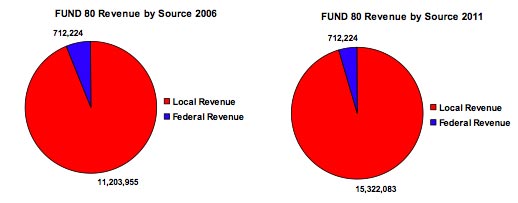
The charts are from Lucy Mathiak’s post:


Share

Reality Check: Taxpayers Pay For Lobbying

Colin Benedict on Channel3000:

Wisconsin taxpayers are paying millions to lobby state lawmakers, in many cases, for more money.
Dane County does it too — it spent nearly $175,000 last session, WISC-TV reported. Part of it was for more money from the state to pay for county nursing home patients, and Dane County argued against the taxpayer bill of rights.
Rock County spent about $6,400 on similar issues, WISC-TV reported.
Schools do this as well. The Madison Metropolitan School District spent $133,000 on lobbying, with some of the tax money spent trying to get more tax money into the classrooms.
The district is on record fighting against revenue limits and against limits to local control, WISC-TV reported.

Share

What was the MMSD Budget in 2004/05?

Help! I’m getting a major headache. I’ve been trying to track some changes in the MMSD budget over the last 5-10 years, and I have noticed that the numbers aren’t always the same in the different places that I have been looking. At first, I figured it just me and that definitions for budget categories change from year to year. However, I decided to look at something simple and straightforward: What was the total MMSD budget for 2004/2005? I have included the sources of this information for anyone who wants to check my work, but I tell you it’s driving me nuts.

  • $370,226,157 – This number comes from an April 2006 Executive Summary
  • $363,366,630 – This is from a 10/24/05 Budget Amendments and Tax Levy document and this budget number includes interfund transfers.
  • $320,039,617 – If we remove interfund transfers from the budget, the above document lists this number as our total budget.
  • $316,822,781 – I found this budget amount listed twice: in a five year budget forecast from 2/14/05 and a preliminary budget forecast dated 3/7/05
  • $317,695,011 – On 5/3/05, the 2005-06 Budget and Financial Summaries document listed this amount for the 2004/05 budget.
  • $317,163,034 – this amount is similar but not identical; it comes from page 233 of the 2005-06 Budget Book released on 5/17/05
  • $318,789,509 – this is the MMSD 2004/05 budget according to DPI’s website
  • $334,626,013.5 – this is a final guess at a budget number and it comes from the Five Year Financial Forecast document that the District had prepared by PMA Financial Network. This number is based on FY2004 and FY2005 data for Fund 10 ($265,678,423; $272,015,465) and Fund 27 ($66,148,621; $65,409,518). I just added the amounts for each fund for each FY (2004: $331827044; 2005: $337424983) and then averaged them as I wasn’t sure what the relation was of a FY (fiscal year) to a school budget year. I should also state the obvious that I know the MMSD budget includes expenses beyond these two funds, but that was all that was in the document.

I realize that some variability can be the result of numbers computed before the end of the school year, but shouldn’t all of the numbers computed after the end of the 2004/05 school year be the same? I have to be honest, this doesn’t make me feel very confident about the District’s money management abilities.

Share

Hard MMSD Budget Still Has Wiggle Room

Scott Milfred:

It’s a contentious fact that has run through so many Madison School Board races and referendums in recent years:
Madison schools spend a lot — $12,111 per student during the 2005-06 school year.
If the district is spending that much, how can it be in crisis?
The answer is complex and a bit murky. Yet a few things are clear.
Liberal Madison has long spent more than most K-12 districts in Wisconsin. This was true before the state adopted school revenue limits in the 1990s, and the caps only reinforced this today.
“When revenue caps went in, everyone was basically frozen in place,” Madison School Superintendent Art Rainwater said Friday. “We do spend more than the state average. But that has been the expectation of our community.”
So why does Madison spend more? Berry points to Madison’s higher number of staff who aren’t teachers. Madison hires a lot of social workers, psychologists, nurses and administrators.
Madison spends more per pupil than Racine, Green Bay and Kenosha — as well as the state average — on student and staff services, administration and building and grounds. And Madison’s non- instructional costs are rising as a percentage of its spending.
“Madison is actually de- emphasizing instruction,” Berry contends.
In addition, Berry suspects Madison is over-identifying students for learning disabilities.

Links: Madison spending, student and staffing history. 2006/2007 MMSD Citizen’s Budget. Carol Carstensen’s thoughts on a 2007 Referendum.

Share

Budget Impacts at Franklin-Randall–Don’t Get Mad, Get Active!!

(This letter is being distributed to parents of Franklin-Randall students, but should concern everyone in the MMSD and Regent Neighborhood)
SCHOOL FUNDING CRISIS:
Don’t get mad, get active!!
March 16, 2007
The School Board recently announced sweeping budget cuts for the coming school year that will have a severe impact on Franklin-Randall, as well as other schools in the district. Following Tuesday’s PTO meeting, parents in attendance agreed that we must act QUICKLY to address this crisis. Below, we have summarized the funding crisis, and how cuts to our and other schools will affect our children’s education and safety. Most importantly, we conclude with specific ideas that we can all implement, to positively address this crisis.
Brief overview of the FUNDING CRISIS: Wisconsin has placed an indefinite “Budget Cap” on all additional funding towards schools. Every year there are increased costs to our schools to cover teacher salaries, increased student numbers, and increased maintenance costs. Without intervention and change, Madison’s reputation for excellence in education is going to change significantly, and with that, so will the diversity, appeal, and attraction of our city.
How will current district recommendations directly affect the education and safety of your children in the Franklin-Randall community?
*As a result of the “SAGE” program being cut from our schools, Franklin-Randall class sizes will rise from 15 to 22 for Kindergarten and First grade, and from 15 to 24 for Second and Third grades this Fall.
*Franklin will lose 5.1 teacher allocations; this most likely means that 3 classroom teachers will be laid-off, and there will be reductions throughout Art, Music, PE, and Reach.
*Randall will lose 1.6 teacher allocations.
*Randall will lose the 5th grade strings program (last year 4th grade strings was cut).
How will cuts at OTHER schools affect the education and safety of your children?
All of our city’s elementary school children come together in middle and high schools; sub-standard education in any one of these schools will therefore affect all students eventually: a loss for one school will become a loss for all.
What can I do NOW?
1. Talk to people at your bus stop, in your neighborhood, and in the hallways at school when you’re there– work together to come up with at least one idea to present at the Rescue Our Schools brainstorm session. This meeting will follow the monthly PTO meeting (Tuesday, April 10th at 6:30) in the Randall Library.
2. Talk to grandparents, aunts, uncles, and neighbors who DON’T have children about how these changes to our schools will affect them. One key point to address is that our city is only as appealing as its future, and our children are the future. Everyone, with or without kids, will be affected. Wisconsin has a history of valuing education and performance; if this changes, we are giving up a source of identity and pride!
3. Attend the Information and Advocacy Session at the Doyle Administration Building, Thursday, March 29th at 6:30pm
4. Form shared child-care groups with friends and neighbors to allow for more parental presence in the schools. Make it a goal to do this in some capacity weekly. These cooperatives will allow you to watch or volunteer at more school functions, participate in school trips, or attend school board meetings. Education research definitively shows, that the more YOU are involved, the more success your child will have in school!
5. As you are able, contribute with time or money to the PTO! $100 can buy a violin that will last 10 years! Commit to a half-hour stint helping on the playground weekly — this equates to invaluable community-building, camaraderie, injury prevention, as well as much-needed breaks for our teachers.
6. Attend the MMSD School Board Meetings, held on Mondays at the Doyle Administration Bldg at 545 W. Dayton St, next door to the Kohl Center. Beginning at 7:15, any person or group can make a “Public Appearance” (up to three minutes each) to deliver opinions / make arguments about any school-related topic. To find out more, go to www.madison.k12.wi.us : under “District Information” click on “Board of Education”, then under “Meetings”, click on “Board of Education Calendar”.
7. Become active in the you school PTO!!! Sign up to be on the Franklin-Randall List-Serve — This is a fast, easy and inexpensive way for people to notify each other about F-R events and news. Simply send an email to: F-R_pto-subscribe@yahoogroups.com, with “subscribe” in the subject line. To find out about all the up-coming meetings and events, go to the F-R PTO website. Site address is www.franklinrandallpto.org
8. Don’t forget to VOTE on Tues, April 3rd, during Spring break–And if you’re not in town, vote ABSENTEE! To vote absentee, go anytime within one week before the election, to the City-County Building at 210 Martin Luther King Jr. Blvd, Rm. 103. 8-4:30pm. Alternatively, by calling 266-4601, you may ask the city to mail you a ballot (English, Spanish or Hmong), or simply go online: www.cityofmadison.com/clerk/voterabsentee.cfm (also downloadable in English, Spanish or Hmong)
What can I do long-term?
Ultimately, we have to address long-term changes to school funding at the State and National level. Through grassroots organizing directed at raising awareness of the issues, we can make a change. We must reach out to like-minded groups (other PTO’s, PTA etc.), and legislators around the state. To this end, following April’s PTO meeting, we will meet to collect ideas, and organize our strategies —
*PLEASE come to the PTO Meeting, April 10th at 6:30pm (Randall Library)!! *
Thank you for taking the time to read this, and for taking action in whatever way you can!
Concerned Franklin-Randall Parents
For further information, please contact any of us:
Sari Judge 233-1754, Megan Brown 250-0552, Kate Zirbel 661-9090,
Mollie Kane 232-1809, Erika Kluetmeier, 238-6209

Share

WEAC, the EAW & the Waukesha School Board

Waukesha Taxpayer’s League:

alaries and benefits are by far the largest portion of the School District budget and the increases dictate what the School Board must do with programs and corresponding reductions in programs. During the ’90’s, negotiations used to begin with presentation of proposals of both sides, the EAW (Education Association of Waukesha) and the Waukesha School Board (the elected body that should be working on behalf of taxpayers to provide the best education possible). This was done so that negotiations was a give/take process (taxpayers usually gave more than they received in return). Recently, a couple of WTL members had a three way conversation with Bill Baumgart, President of the Waukesha School Board. In that conversation, the WTL verified that the School Board does not vote or have an acceptable QEO done prior to negotiations as a basis to work from. The School District also hasn’t filed with the appropriate Schedule D required by law at the close of negotiations for previous years. Following is the ‘proposal-less non-protection’ contract used by the School District of Waukesha (ie. Waukesha School Board) and the EAW. Is there a difference between the two groups??

Share

Strangling Wisconsin Education With Underfunded Special Ed

Paul Soglin:

I met with some special education teachers on Tuesday and wish to share my observations about the Madison Metropolitan School District (MMSD). These are my observations and conclusions, not theirs.

  • For the 1996-97 school year the State of Wisconsin paid 40.223% of the cost of special education. For 2006-2007 the state paid  28%. (Here is a MMSD memo on the subject from 2005)
  • The MMSD cannot lower the expenditures for special education and so the lost state revenues must be made up by cuts in general education.
  • The lost funding amounts to about $8 million dollars this year.
  • In the 2001-2002 school year the MMSD enrolled 197 children with a Primary Disability of Autism. That number rose to 303 for this school year. Twenty five years ago that number was less than five. If one out of every 166 children are autistic, there should be 150 autistic children in the MMSD.
  • A 2003 district study showed that 93 of the autistic children enrolled that year moved into the district from not just Wisconsin and the United States, but all over the world. That number does not include the children of families who moved to Madison prior to their child’s fifth birthday.

My conclusions: Special eduction is just one of several factors driving the cost of educating our children. More significant is the cost of educating so many children enrolled in the MMSD who’s families are below the poverty line.

There is no question that the original outstanding commitment to special education of the MMSD in the 1980’s combined with the high level of services (Waisman Center, etc) attracted a significant number of families to the MMSD.

More on state K-12 finance from Paul here:

he Madison Metropolitan School District (MMSD) struggles to make budget cuts. Some taxpayers are assuming that if they, as students, could get a quality education twenty or forty years ago, then, with a little fine tuning, it can be today’s students.
The world and Wisconsin education has changed. Here are some of the differences from thirty years ago:

Share

Carstensen opposes consolidation, seeks referendum

Carol Carstensen circulated the e-mail below and gave permission to post it here:

I am opposed to the proposal to close/consolidate schools on the east side – I am also opposed to increasing class size (eliminating SAGE classes) in the lower poverty elementary schools (which includes Lapham and Marquette) and I am opposed to increasing the class size for specials (art, music, phy ed and REACH). Those proposals account for about $3.1M of the $7.1M proposed cuts.
I do not think there are other areas to cut that I could support, therefore, I believe it is time to talk about a referendum to maintain schools and programs that enrich our community. I am working on a proposal that for a referendum that would:
1) provide 15:1 class sizes at the 7 schools where SAGE is to be cut and the 3 schools that don’t have SAGE;
2) retain the class sizes for specials
3) keep existing schools open
4) restore strings for 4th and 5th graders
5) a number of other items that I am still working on.
This would come to about $6 M – which would cost about $100 in increased taxes on a $250,000 house.
Honesty compels me to say that, as of this moment, I do not have support from other Board members on this.

Share

Reaction to Waukesha School Budget Cutbacks & State Financial Aid

Amy Hetzner:

About 500 parents, students and spectators packed a school auditorium Monday night, pleading for help from local legislators in dealing with a financial situation that some predicted would devastate the School District.
“If we can pay for a stadium for a bunch of overpaid baseball players, we can certainly pay for an education for all of our children,” Heyer Elementary School parent Cheryl Gimignani told the six legislators participating in the forum in North High School’s auditorium.
The event came just two days before the School Board is set to approve $3.4 million worth of program and service cuts to balance its 2007-’08 budget.
Administrators have recommended eliminating the equivalent of 62 full-time staff positions, which would raise class sizes, delay band and orchestra instruction and nearly eliminate elementary guidance, elementary library and gifted programs in the district.
They blame the school system’s financial woes on perennial discrepancies between what the state allows the district to raise under revenue caps and its actual expenses. A separate law, the qualified economic offer, virtually guarantees teachers annual compensation increases of 3.8% while revenue grows by about 2%.
But the legislators offered little hope that much will change, at least in the near future, and said the school system would be better off looking for cost savings than expecting more money from Madison. Any change to the state funding system for schools likely would not benefit residents in Waukesha County, who already pay more in taxes than they receive back in aid from the state, they said.
“I do not want to change the formula,” said state Sen. Mary Lazich (R-New Berlin), “because if we tamper and change the formula, the school districts that I represent will lose, not gain.”

Lazich’s comments illustrate the unlikely nature of significant state K-12 finance changes that would benefit property rich school districts like Madison and Waukesha.

Share

Parents Balk at Proposed Cuts

Andy Hall:

The Madison School District’s struggle to handle a $10.5 million budget shortfall moved into a new stage Monday night, as 17 people spoke out against proposed cuts and a School Board member urged her colleagues to turn to voters for more money.
The School Board began struggling with the budget cuts following Superintendent Art Rainwater’s announcement Friday of his plans for addressing the shortfall, including consolidation of schools on the city’s East Side, increases in kindergarten through third-grade class sizes at seven elementary schools and changes in how services are delivered to students with speech and language problems.
The district’s budget next year will rise 1.9 percent to $339.1 million. But cuts are needed because that increase, which is limited by state revenue caps, isn’t enough to allow the district to continue all current services.
At the School Board meeting, five parents of Crestwood Elementary students protested Rainwater’s proposal to remove the school next year from the state’s Student Achievement Guarantee in Education (SAGE) program, which limits class sizes in grades K-3 to 15 students in order to aid low-income students.

Share

An Alt View on Concessions Before Negotiations

Carol Carstensen:

I thought it might be helpful to provide some facts and explanations about the topic of health insurance – hopefully this will clear up some of the misinformation and misconceptions present in the public discussions. It is important to remember that the focus must be on the total package settlement – because that is what has an impact on the budget. For example, Sun Prairie’s agreement to make changes in its health insurance (by using a joint committee to find a way to reduce health insurance costs) has been praised, as it should be. It should be noted, however, that Sun Prairie’s total package settlement was 4.75% – while Madison’s package, without switching health insurance carriers, was 3.98%. (A rough estimate is that a 4.75% settlement would have cost Madison about $1.5 Million more.)

Related:

Share

“Bitter Medicine for Madison Schools”:
07/08 budget grows 3.6% from 333M (06/07) to $345M with Reductions in the Increase

Doug Erickson on the 2007/2008 $345M budget (up from $333M in 2006/2007) for 24,342 students):

As feared by some parents, the recommendations also included a plan to consolidate schools on the city’s East Side. Marquette Elementary students would move to Lapham Elementary and Sherman Middle School students would be split between O’Keeffe and Black Hawk middle schools.
No school buildings would actually close – O’Keeffe would expand into the space it currently shares with Marquette, and the district’s alternative programs would move to Sherman Middle School from leased space.
District officials sought to convince people Friday that the consolidation plan would have some educational benefits, but those officials saw no silver lining in having to increase class sizes at several elementary schools.
Friday’s announcement has become part of an annual ritual in which Madison – and most other state districts – must reduce programs and services because overhead is rising faster than state-allowed revenue increases. A state law caps property-tax income for districts based on enrollment and other factors.
The Madison School District will have more money to spend next year – about $345 million, up from $332 million – but not enough to keep doing everything it does this year.
School Board members ultimately will decide which cuts to make by late May or June, but typically they stick closely to the administration’s recommendations. Last year, out of $6.8 million in reductions, board members altered less than $500,000 of Rainwater’s proposal.
Board President Johnny Winston Jr. called the cuts “draconian” but said the district has little choice. Asked if the School Board will consider a referendum to head off the cuts, he said members “will discuss everything.”
But board Vice President Lawrie Kobza said she thinks it’s too early to ask the community for more money. Voters approved a $23 million referendum last November that included money for a new elementary school on the city’s Far West Side.
“I don’t see a referendum passing,” she said.

Links: Wisconsin K-12 spending. The 10.5M reductions in the increase plus the planned budget growth of $12M yields a “desired” increase of 7.5%. In other words, current Administration spending growth requires a 7.5% increase in tax receipts from property, sales, income, fees and other taxes (maybe less – see Susan Troller’s article below). The proposed 07/08 budget grows 3.6% from 333M+ (06/07) to $345M (07/08). Madison’s per student spending has grown an average of 5.25% since 1987 – details here.
UPDATE: A reader emails:

The spectre of central city school closings was what prompted some of us to resist the far-west side school referendum. Given the looming energy crisis, we should be encouraging folks to live in town, not at the fringes, strengthen our city neighborhoods. Plus, along with the need to overhaul the way we fund schools, we need a law requiring developers to provide a school or at least the land as a condition to development.

UPDATE 2: Susan Troller pegs the reduction in the increase at $7.2M:

Proposed reductions totaled almost $7.2 million and include increases in elementary school class sizes, changes in special education allocations and school consolidations on the near east side.
Other recommendations include increased hockey fees, the elimination of the elementary strings program and increased student-to-staff ratios at the high school and middle school levels.

UPDATE 3: Roger Price kindly emailed the total planned 07/08 budget: $339,139,282

Share

$1.74B Tax and Fee Increases in Governor Doyle’s Proposed Wisconsin 07-09 Budget

Bob Lang, Director: Legislative Fiscal Bureau, 92K PDF:

A number of legislators have requested information concerning state tax and fee changes included in the 2007-09 budget recommendations of the Governor. This memorandum responds to those inquiries.
The attached table provides a brief description of each state tax and fee modification proposed in the Governor’s bill. The table consists of three parts: (1) tax increases and decreases; (2) fee increases and decreases; and (3) measures which would enhance the collection of current taxes or fees. Each entry in the table includes the agency name, the Legislative Fiscal Bureau’s budget summary document item that describes the change in more detail, a summary of the proposed modification, and an estimate of the revenue change due to the tax or fee modification.
In the table, GPR represents general fund revenue. Revenue to a program revenue account is signified by PR and SEG signifies revenue to a segregated fund. “Unknown” means that no estimate of the revenue impact is available at this time. The fiscal effects shown in the table reflect estimates made by the administration; estimates prepared by this office during budget deliberations may be different.

Steven Walters:

Democratic Gov. Jim Doyle’s proposed two-year budget includes $1.74 billion in higher taxes and fees, according to a report by the Legislative Fiscal Bureau released Friday.
To put that number in perspective, it amounts to about $630 for each of the 2.76 million Wisconsin income tax filers for 2005.
The budget Doyle presented two years ago, before he won a second term in November, included $304 million in tax and fee increases, according to the non-partisan Fiscal Bureau.
The report says taxes would go up by a total of $1.37 billion by mid-2009, and listed the largest increases as:

Wisconsin residents paid 33.4% of income in taxes during 2006. More on Doyle’s proposed budget here.

Share

Senator Mike Ellis on Governor Doyle’s Proposed Budget

Jo Egelhoff:

While Senator Ellis can turn complex policy into a sentence or two, he claims Governor Doyle has magically turned tax hikes into tax cuts! About that Ellis quips “No wonder the governor is proposing a third year of math and science for high school students. Talk about new math…”
Ellis and his staff have poured over the Fiscal Bureau’s budget analysis “finding one time bomb after another.” The roarin’ and raspy Senator points out that Doyle’s sleight of hand creates new segregated funds out of whole cloth. An example shows up on page 238 of the Fiscal Bureau’s review – the newly created “Health Care Quality Fund” (HCQF). Here’s where all those new taxes (“hospital tax”, “cigarette tax”) show up as Revenues.

Share

Madison Superintendent’s 2007-2008 Proposed Budget Changes

Art Rainwater on the reductions in increases to the proposed 2007-2008 MMSD Budget [1.4MB PDF]:

Dear Board of Education,
The attached is my recommendation for the service reductions required to balance the budget for 2007-2008. They are provided to you for review in advance of my Recommended Balanced Budget for 2007-2008 which will be available on April 12, 2007. You requested that the service reductions be presented to you in advance to provide sufficient time for your study and analysis.
After 14 years of continuous reductions in our services for children there are no good choices. While these service reductions are not good for children or the health of the school district they represent our best professional judgment of the least harmful alternatives.
The process that we used to study, analyze, consider and finally recommend the items presented was done over a period of weeks. We first reviewed each department and division of the district and listed anything that could be reduced or eliminated legally or contractually. We narrowed that list to those items which we believed would do the least harm to:

  • Our academic programs,
  • The health and safety of our schools,
  • The opportunities for student involvement,
  • Our ability to complete our legal and fiscal requirements

The document presented to you today is the result of those discussions. The items are broken into four categories:

  1. Reductions to balance the budget ( Impact Statements provided)
  2. Reductions analyzed, discussed and not included (Impact statements provided)
  3. Reductions reviewed and not advanced
  4. Possible revenues dependent on legislative action

The administration is prepared to provide you further analysis and respond to questions as we continue to work to approve a final working budget in May.

2006/2007 Citizen’s Budget ($333M+) for 24,342 students. I did not quickly notice a total proposed 2007/2008 spending number in this document.
UPDATE: Overall spending will grow about 3.4% from $333M to $345M per Doug Erickson’s article.
Links: NBC15 | Channel3000

Share

The Future of Our Schools: The Funding Crisis

The League of Women Voters of Dane County, Dane County PTO’s, Principals and School Boards
Panel Presentation featuring:

Questions to follow presentations
Wednesday, April 11, 2007
7:00 ? 9:30 p.m.
Meriter Main Gate Grand Hall
333 W. Main Street, Madison[map]
(free parking across the street)
All Welcome! Come and Bring a friend!
For more information:
The League of Women Voters of Dane County 232-9447

Share

School District Annual Reductions in Budget Increases

Doug Erickson:

Madison School District administrators are scheduled to announce today their recommendations for millions of dollars in program and staff cuts, a grim step in a budget process that typically consumes the School Board’s attention each spring.
Larger class sizes at the elementary level and bigger caseloads for special education teachers likely will be among the proposals.
Consolidating schools on the city’s East Side also is a strong possibility – parents there already are mobilizing to beat back the idea – although district officials would not confirm that such a proposal will be part of today’s announcement.
The district’s most recent budget forecast in January put next year’s shortfall at $10.5 million. That number was being refined Thursday but is in the ballpark, district officials said.

Related:

The MMSD’s budget increases annually. A variety of perspectives on enrollment, spending and staff history can be found here.
Those interested in school finance might check out Monday’s brown bag lunch meeting “Financing Quality Education“.

Share

Why this year is different for state public school funding

Beth Swedeen:

Many people in Madison continue to say that the district and its leadership (including the Board of Education) are helpless in changing the revenue caps and the way public education is funded in Wisconsin. They point out that the revenue caps have been in place for 14 years and at least during in the last three budget cycles (since 2000), districts have been screaming for help. I’m not a political insider, but here’s at least some reasons that this year (and definitely the budget cycle in 2009) is significantly different:

Steven Walters and Stacy Forster along with numerous notes & links:

Despite Gov. Jim Doyle’s public – and repeated – promises that his budget proposal would pay for two-thirds of public education costs, an analysis released today showed that it falls short of that goal.
In a 624-page summary of the budget that Doyle gave legislators last month, the Legislative Fiscal Bureau said the state would pay 65.3% of public school costs in the year that begins July 1, and 65.5% of those costs in the following year.

Share

Madison’s Reading Battle Makes the NYT: In War Over Teaching Reading, a U.S.-Local Clash

Diana Jean Schemo has been at this article for awhile:

The program, which gives $1 billion a year in grants to states, was supposed to end the so-called reading wars — the battle over the best method of teaching reading — but has instead opened a new and bitter front in the fight.
According to interviews with school officials and a string of federal audits and e-mail messages made public in recent months, federal officials and contractors used the program to pressure schools to adopt approaches that emphasize phonics, focusing on the mechanics of sounding out syllables, and to discard methods drawn from whole language that play down these mechanics and use cues like pictures or context to teach.
Federal officials who ran Reading First maintain that only curriculums including regular, systematic phonics lessons had the backing of “scientifically based reading research” required by the program.
Madison officials say that a year after Wisconsin joined Reading First, in 2004, contractors pressured them to drop their approach, which blends some phonics with whole language in a program called Balanced Literacy. Instead, they gave up the money — about $2 million, according to officials here, who say their program raised reading scores.
“We had data demonstrating that our children were learning at the rate that Reading First was aiming for, and they could not produce a single ounce of data to show the success rates of the program they were proposing,” said Art Rainwater, Madison’s superintendent of schools.

Much more on Reading First and Madison, here.
Notes & Links:

UPDATE: Joanne Jacobs:

In part one of his response, Ken DeRosa of D-Ed Reckoning provides a reading passage altered to force readers to guess the meaning from context. Struggling this way does not inspire love of reading.
In part two, DeRosa analyzes the statistics to argue Madison students aren’t doing better in reading compared to other Wisconsin students; if anything, they’ve slipped a bit. Because the state reading test was made easier and the cut score for proficiency was lowered, all Wisconsin students look better. However, there was no progress in fourth-grade reading on the federal NAEP test.
With help from Rory of Parentalcation, who’s great at finding data, Ken shows that claims of fantastic progress by black students are illusory. Their scores improved on the easier test at a slightly slower rate than white students. It looks like to me as though blacks nearly caught up in basic skills but remain far behind at the proficient and advanced level. Perhaps someone who knows more statistics than I do — lots of you do — can find flaws in Ken’s analysis.

NYT Letters to the editor. Finally, others have raised questions about the MMSD’s analysis and publication of test score data.
Andrew Rotherham:

Diana Schemo’s NYT story on Reading First is not surprisingly sparking a lot of pushback and outraged emails, especially from the phonicshajeen. But, they have a point. There are problems with Reading First, but this may not be the best example of them at all…but, while you’re there, don’t miss the buried lede in graf eight…it’s almost like Schemo got snowed by all sides at once on this one…

Share

Governor Doyle’s Proposed Budget Does Not Save the Madison School District:
Proposed Budget provides 65% of public school costs via redistributed sales, income, corporate taxes and fees, rather than 67%.

I’ve received some emails on this story. It seems there are two approaches to “fixing” the Madison School District’s $333M+ budget for our 24,342 students. Blame the state/federal government, or work locally to build support for our public schools in terms of volunteer hours, partnerships and money.
I believe that latter approach is far more likely to succeed because we have more control all around and we have a vested interest in our community’s future. That’s also why I support Maya Cole (vs. Marj Passman) and Rick Thomas (vs. Beth Moss) for school board. Ruth Robarts, Lucy Mathiak and Lawrie Kobza have proven that the board and individual members can be effective. An insider friend mentioned that Doyle’s budget is “thinly balanced”, which likely explains the reality. The Madison School Board’s majority decision (4-3) with respect to concessions before negotiations magnifies the governance issue. Watch the candidates discuss this issue, among others recently.
Those interested in this issue should check out Monday’s (3/12 from 12 to 1:00p.m.) brown bag lunch on Financing Quality Education. [map]
Steve Walters and Stacy Forster:

Despite Gov. Jim Doyle’s public – and repeated – promises that his budget proposal would pay for two-thirds of public education costs, an analysis released today showed that it falls short of that goal.
In a 624-page summary of the budget that Doyle gave legislators last month, the Legislative Fiscal Bureau said the state would pay 65.3% of public school costs in the year that begins July 1, and 65.5% of those costs in the following year.
Because public schools cost about $9 billion every year, each 1% equals about $90 million – money that is tight as legislators begin the process of reviewing Doyle’s budget and drafting changes to it. Legislators will act on their version of the budget over the next three or four months.

Legislative Fiscal Bureau Summary. Via WisPolitics. More on Wisconsin’s school finance climate here. The Associated Press has also posted an article here:

The nonpartisan Legislative Fiscal Bureau said Tuesday in a summary of the budget the governor gave to legislators in January that the state would pay 65.3 percent of public school costs in the year that begins July 1 and 65.5 percent during the next year.

The AP article references some special and school choice funding changes that may help some districts:

David Schmiedicke, the governor’s budget director, said the budget proposal is just short of the 66 percent goal next year because it includes more money for specific programs such as aid to students with disabilities, subsidies for small class sizes and free breakfasts, and $21 million more to pay for Milwaukee’s school choice program.

Share

2006 – 2007 Madison School District $333M+ Citizen’s Budget


[JPG | PDF | .xls versions] MMSD Statistics.
Paul Soglin’s observations on the MMSD’s funding issues, special ed and our politicians.

Share

Menomonee Falls School District Works with Community on 4 Year Old Kindergarten

Amy Hetzner:

When the Menomonee Falls School District opens its doors to a new 4-year-old kindergarten program this fall, private day cares in the village will open theirs to it, too.
Using an idea that’s catching on throughout the state, the district plans to partner with local preschool and child care centers to give 4-year-olds a half-day program that proponents say will give them an educational boost for years to come.
“The goal to all of this is to provide quality 4-year-old services for each and every child who resides in the school district, so when they come to 5-K they’ve got the same kindergarten basis,” said Marlene Gross-Ackeret, Menomonee Falls’ director of pupil services, and one of the key players in its 4-K initiative.
Almost every Wisconsin school district looking to add a new 4-year-old kindergarten program is considering such a collaborative approach, said Jill Haglund, an early-childhood education consultant for the state Department of Public Instruction who estimated that the partnerships exist in about 50 school systems. Even Milwaukee Public Schools collaborates with some community partners, placing its teachers at off-campus sites, despite having its own extensive 4-K programs.

Quite a contrast to the general Madison School District approach with respect to After School and classes taken outside our public school district. More here.

Share

Wisconsin’s K-12 Spending Climate

Avrum Lank:

Per capita income will continue to grow in Wisconsin through 2009, but at a slower rate than in the nation as a whole, according to an economic outlook released Friday by the state Department of Revenue.
Employment also will grow, but manufacturing jobs will decline, the report said.
Even so, corporate income tax collections are growing about four times faster than all state tax revenue, reflecting robust business profits.
“The U.S. economy is expected to slow this year,” the report said. The state’s economy also will slow “before returning to stronger growth in 2008.”
Jobs in the state will grow 0.8% this year to 2,892,800 – less than the 1% growth last year. Growth rates of 1.3% in 2008 and 1.2% in 2009 will bring the job total to slightly fewer than 3 million, the report said.
However, manufacturing jobs will fall from 507,300 last year to 502,900 by 2009.
Per capita personal income will rise about 8%, to $33,174 in 2009 from $30,706 last year, using constant 2000 dollars.
That is a decline to 96.2% of the national average in 2009, from 96.7% last year.

Wisconsin Department of Revenue Economic Outlook 292K PDF
Changing state K-12 funding to benefit Madison (perceived as a rich district based on property values and spending growth) will be difficult given our higher than state average per student spending and some of the issues noted above. The politics of this issue can be seen in those who have supported (and those who have not, including our own Senator Fred Risser) the Pope-Roberts/Breske resolution. Senator Risser’s bills.

Share

Financing Quality Education, March 12

Financing Quality Education: A Five-Year Look
March 12, 12:00 noon to 1:00 p.m.
Lower Conference Room
222 South Hamilton Street, Madison
Bring your brown-bag lunch and join others concerned about Madison schools to discuss long-range plans to help the district meet the financial challenges created by the state-imposed revenue limits.
The meeting and discussion will help identify the stakeholders and possible steps needed to begin and shape long-term view of the MMSD and its budget.
Some ideas were laid out on schoolinfosystem.org:
https://www.schoolinfosystem.org/archives/2006/03/a_5_year_approa.php:
“[Ask] what is the best quality of education that can be purchased for our district for $280 million a year. Start with a completely clean slate. Identify your primary goals and values and priorities. Determine how best to achieve those goals to the highest possible level, given a budget that happens to be $40 million smaller than today’s. Consider everything – school-based budgeting, class sizes, after-school sports, everything.”
Everyone and all ideas are welcome at this brown-bag discussion in the lower level conference room at 222 S. Hamilton Street.
For more information, contact Ed Blume at edblume@mailbag.com or by phone at 225.6591.

Share

Marj Passman & Tony Casteneda Discuss The Madison School Board Race

Madison School Board Seat 5 candidate Marj Passman talked with Tony Castañeda recently on WORT-FM. Marj faces Maya Cole in the April 3, 2007 spring election. Marj and Tony discussed health care costs, curriculum, governance, special education, this website, and the Madison School District’s $331M+ budget.
Listen via this 5.7MB mp3 audio file. A transcript will be posted when available.

Share

Wisconsin’s School Finance Climate

Andy Hall on local referendums:

Layoffs and pay cuts are looming in a western Dane County school district, and officials in the Adams-Friendship area are contemplating closing two elementary schools after voters rejected two school referendums last week.
Voters also approved referendums Tuesday for a $14.68 million elementary school in Sun Prairie and $2.48 million to avert school cuts in Pardeeville 30 miles north of Madison.
But ballot measures were narrowly defeated in the Wisconsin Heights School District, which includes Mazomanie and Black Earth, and Adams-Friendship, 75 miles north of Madison.

Student population, expense and tax revenue growth all affect local school district budgets.
Andy also posted an article on a survey conducted by the Wisconsin Association of School District Administrators:

Twenty-seven percent of superintendents said their school boards have held discussions during the past few years about the possibility of dissolving or consolidating their school districts. Among those districts, more than 90 percent said the talks were prompted by financial problems.
Increasing portions of districts report changes that could reduce the quality of educational services. Since the 1998-99 school year, for example, the percentage of districts increasing class sizes grew from 48 to 74 percent. The percentage laying off teachers during that period rose from 36 to 62 percent.

Wistax reported recently that Wisconsin residents paid 33.4% of income in taxes, up from 30.7% in 2003. Decisions like this do not help pass referendums, much less build confidence in our $331M+ local school district.

Share

The MMSD five years from now

Financing Quality Education: A Five-Year Look
March 12, 12:00 noon to 1:00 p.m.
Lower Conference Room
222 South Hamilton Street, Madison
Bring your brown-bag lunch and join others concerned about Madison schools to discuss long-range plans to help the district meet the financial challenges created by the state-imposed revenue limits.
The meeting and discussion will help identify the stakeholders and possible steps needed to begin and shape long-term view of the MMSD and its budget.
Some ideas were laid out on schoolinfosystem.org:
https://www.schoolinfosystem.org/archives/2006/03/a_5_year_approa.php:
“[Ask] what is the best quality of education that can be purchased for our district for $280 million a year. Start with a completely clean slate. Identify your primary goals and values and priorities. Determine how best to achieve those goals to the highest possible level, given a budget that happens to be $40 million smaller than today’s. Consider everything – school-based budgeting, class sizes, after-school sports, everything.”
Everyone and all ideas are welcome at this brown-bag discussion in the lower level conference room at 222 S. Hamilton Street.
For more information, contact Ed Blume at edblume@mailbag.com or by phone after March 1 at 225.6591.

Share

Recent Madison School Board Discussions, Including Teaching & Learning Effectiveness, Superintendent Search Consultant and Extracurricular Activities

Teaching & Learning Department Effectiveness

Video | mp3 audio

Superintendant Search Consultant

Video | mp3 audio

Extracurricular Activities

Video | mp3 audio

Share

Going to the Mat for WPS

Jason Shephard:

Suzanne Fatupaito, a nurse’s assistant in Madison schools, is fed up with Wisconsin Physicians Service, the preferred health insurance provider of Madison Teachers Inc.
“MTI uses scare tactics” to maintain teacher support for WPS, Fatupaito recently wrote to the school board. “If members knew that another insurance [plan] would offer similar services to WPS and was less expensive — it would be a no-brainer.”
WPS, with a monthly price tag of $1,720 for family coverage, is one of two health coverage options available to the district’s teachers. The other is Group Health Cooperative, costing $920 monthly for a family plan.
During the past year, the Madison school board has reached agreements with other employee groups to switch from WPS to HMO plans, with most of the savings going to boost pay.
In December, the board held a secret vote in closed session to give up its right to seek health insurance changes should negotiations on the 2007-09 teachers contract go into binding arbitration. (The board can seek voluntary insurance changes during negotations.)
“What we’ve done is taken away a huge bargaining chip,” says board member Lucy Mathiak. “Every other major industry and public sector has had to deal with health-insurance changes, and we’ve got a very real $10 million deficit.”
MTI Executive Director John Matthews says other employee unions “made a big mistake” in switching to HMO plans. Matthews has long maintained that WPS provides superior coverage, despite its higher costs and disproportionate number of complaints. And he defends the paycheck he collects from WPS as a member of its board, saying he’s better able to lobby for his teachers.

Much more on this issue, including links, audio and a transcript, here.

Share

Cutbacks in Class, Upgrades on the Field

Amy Hetzner:

If successful, Kettle Moraine High School would be the latest school in the state to perform a pricey upgrade to its athletic facilities at a time when many school districts complain they have to reduce services or are holding referendums to raise tax dollars to keep existing programs.
“I don’t think the two efforts are directly in conflict,” said Larry Laux, a member of the field project committee and parent of a football player. “It is a little bit awkward, I’ll grant you that.”
Already, Arrowhead and Brookfield Central high schools have replaced grass football fields with the synthetic stuff. Both were funded by donations from private groups, although the Elmbrook School District has pledged to match half of the $830,000 upgrade of Brookfield Central’s stadium.

Share

Concessions Made in Advance of MTI Negotiations by a Majority of the Madison School Board

It will be interesting to see how voters on February 20 and April 3 view this decision by a majority of the Madison School Board: Should the Board and Administration continue to give away their ability to negotiate health care benefits ($43.5M of the 2006/2007 budge) before MTI union bargaining begins? Read the 2005 MMSD/MTI Voluntary Impasse Agreement [1.1MB PDF; see paragraph’s 2, 10 and 11]. The 2007 version, alluded to in Andy Hall’s article below, will be posted when it sees the light of day.
This is an important issue for all of us, given the MMSD’s challenge of balancing their growing $331M+ budget, while expenses – mostly salaries and benefits – continue to increase at a faster rate. Mix in the recent public disclosure of the district’s $5.9M 7 year structural deficit and I doubt that this is the best approach for our children.
Recently, the Sun Prairie School District and its teachers’ union successfully bargained with DeanCare to bring down future costs for employee health insurance.

Andy Hall, writing in the Wisconsin State Journal asks some useful questions:

But with the Madison School Board facing a $10.5 million budget shortfall, is the board giving away too much with its promises to retain teachers’ increasingly pricey health insurance and to discard its legal mechanism for limiting teachers’ total compensation increase to 3.8 percent?

Yes, School Board Vice President Lawrie Kobza said Saturday, “I feel very strongly that this was a mistake,” said Kobza, who acknowledged that most board members endorse the agreement with Madison Teachers Inc., the teachers union.

State law allows districts to avoid arbitration by making a so-called qualified economic offer, or QEO, by boosting salaries and benefits a combined 3.8 percenter a year.

“To agree before a negotiation starts that we’re not going to impose the QEO and negotiate health care weakens the district’s position,” Kobza said. She contended the district’s rising health-care costs are harming its ability to raise starting teachers’ salaries enough to remain competitive.

The “voluntary impasse resolution” agreements, which are public records, are used in only a handful of Wisconsin’s 425 school districts, according to the Wisconsin Employment Relations Commission.

Four of the 7 current Madison School Board Members were backed by MTI during their campaigns (Arlene Silveira, Carol Carstensen, Shwaw Vang and Johnny Winston, Jr.). Those four votes can continue this practice. Independent School Board members Lawrie Kobza and Ruth Robarts have spoken publicly against the concessions made in advance of negotiations. If you support or oppose this approach, let the board know via email (comments@madison.k12.wi.us), or phone.

Related links, media and transcripts:

  • What’s the MTI Political Endorsement about?:

    In 2006-07 the Madison School district will spend $43.5M on health insurance for its employees, the majority of the money paying for insurance for teachers represented by Madison Teachers, Inc. (MTI) That is 17% of the operating budget under the revenue limits.
    In June of 2007, the two-year contract between the district and MTI ends. The parties are now beginning negotiations for the 2007-09 contract.
    The Sun Prairie School district and its teachers union recently saved substantial dollars on health insurance. They used the savings to improve teacher wages. The parties joined together openly and publicly to produce a statement of the employees health needs. Then they negotiated a health insurance package with a local HMO that met their needs.

  • The MMSD Custodians recently agreed to a new health care plan where 85% of the cost savings went to salaries and 15% to the MMSD.
  • Ruth Robarts discussed concessions in advance of negotiations, health care costs and the upcoming elections with Vicki McKenna recently. [6.5MB MP3 Audio | Transcript]
  • What a Sham(e) by Jason Shephard:

    Last week, Madison Teachers Inc. announced it would not reopen contract negotiations following a hollow attempt to study health insurance alternatives.
    Not to put too fine a point on it, but anyone who suggests the Joint Committee on Health Insurance Issues conducted a fair or comprehensive review needs to get checked out by a doctor.
    The task force’s inaction is a victory for John Matthews, MTI’s executive director and board member Wisconsin Physicians Service.
    Losers include open government, school officials, taxpayers and young teachers in need of a raise.
    From its start, the task force, comprised of three members each from MTI and the district, seemed to dodge not only its mission but scrutiny.

(more…)

Share

A K-12 View from 35,000 Feet

I happened to sit next to the Curriculum Coordinator (20+ years in that District) for a large, growing US School District recently ( north of 100,000 students). I found some of the comments interesting:

  • They cycle through superintendents every 2 to 3 years. The Supers are paid $300K+ with “lots of benefits”.
  • The new super is decentralizing all over the place, pushing control down.
  • They use trailers as enrollment moves around the community.
  • The new super wants to require any children in grades K-3 not reading at grade level to have only one task per day (beyond lunch, recess and PE) – read. This involves tracking.
  • I asked what sort of curriculum they used for reading: Whole language with “lots of phonics”. I asked if they used Reading Recovery. The person said that they evaluated RR but felt it was “far too expensive”.
  • Offer a great deal of IB and AP courses. They also have magnet schools, though the person said that they are less popular now that the district has gone back to neighborhood schools (evidently there was a successful reverse discrimination lawsuit). They have evidently received “a great deal of federal funds” to support IB and AP.
  • 8th graders who cannot read at grade level will go to a different set of curriculum or school than those who are at or above.

This district spends about $7,900 per student annually (Madison is in the $12,500 range).
Interestingly, this is the 2nd time during the past 12 months that I’ve sat next to an educator on their way to a conference sponsored by curriculum publishers.

Share

Wisconsin Governor’s 2007 Budget Address

Jim Doyle:

First and foremost, this budget maintains the state’s commitment to fund two-thirds of the cost of our kids’ education.
Especially when you consider how much more it costs just to fuel the busses and heat the schools, the funding I’m providing is hardly extravagant. Schools will have a modest, 3 percent increase to keep up with inflation – so that our kids continue to get a great education.
Second, we should make a major new investment in school breakfast, four-year-old kindergarten, and smaller class sizes from kindergarten through third grade … because getting the right start is so critical to our kids’ education.
Third, we must reform the school financing formula to make it fairer, more flexible, and more focused on the needs of our kids.
We can start by helping rural districts with transportation costs, providing relief to schools with declining enrollment, and continuing to address the disparity faced by our lowest spending districts.

WisPolitics budget blog.

Share

Madison Schools Superintendent Art Rainwater on Budget Season

Art Rainwater:

Budget season is not as much fun as the other seasons. We approach budget season with anxiety because each new budget season means that we will again reduce the services that our students need. Under the current revenue cap law, yearly service reductions are a fact of life for most school districts in Wisconsin. The demands for students to gain more knowledge and skills increase every year while resources to meet their needs decrease every year.
Budget season creates intense concern among staff and parents and makes adversaries among friends. Priorities must be set, and when all of the input has been gathered and discussion completed, it is the responsibility of the elected Board of Education to make those final priority decisions.

Share

The School Referendum Season Commences

Bonnie Jenko:

What’s needed now in terms of facilities wasn’t even an illusion 50 years ago. How many of us would like to have heart surgery in a hospital built in 1950 but never upgraded? How about taking the car to a repair shop that looks just like it did in 1955? Comparatively, schools built in the 1950s cannot provide the educational facilities needed for a 21st-century education.
Yes, property taxes will increase. Until there is reform on that front, that’s how we provide for education in Wisconsin.
A significant motivation for today’s families moving to the suburbs is the potential of better schools. The taxpayers of yesterday built and paid for the schools that today’s students attend. Now it’s our turn to continue the strong academic tradition of quality schools in our communities.

Share

Wisconsin Governor Doyle Proposes a 4% Increase in Property Taxes

Steven Walters:

Gov. Jim Doyle will ask the Legislature to let local governments raise their fall property tax levies by 4% – double the limit of the past two years, but a rate the governor said would still control local taxes.
He also said his plan would impose tight limits to protect homeowners, who now pay about 71% of all property taxes. In 1990, homeowners paid 60% of the property tax burden.
Last year, property taxes in the state hit a record $8.7 billion. Two state credits lowered the total that property owners had to pay to $7.9 billion.
Levy controls that expired on Jan. 1 limited local governments to increases of 2% a year or the growth in new construction in their communities, whichever was greater. That allowed Milwaukee, where new construction grew by 3.3%, and other local governments with similar growth to raise their levies by more than 2% last year.
Public school spending is controlled by separate formulas. Partly because of the passage of so many local referendums, the average statewide levy for public schools rose 5.4% last year, according to the non-partisan Wisconsin Taxpayers Alliance.

Wisconsin Resident’s Total 2006 Tax Rate: 33.4% of Income according to WISTAX:

For the third consecutive year, total taxes paid by Wisconsin individuals and firms relative to personal income increased in 2006. They now claim 33.4% of income, up from a 2003 low of 30.7%. Both the federal and state tax burdens increased in 2006, while the local government burden dipped slightly.

Share

Wisconsin Governor Doyle Proposes an Expanded 4 Year Old Kindergarden

Jason Stein:

s part of his two-year budget proposal to be unveiled Tuesday, the Democratic governor said he will pay for prenatal visits for poor expectant mothers, expand 4-year-old kindergarten classes and help provide in-home care for the elderly. The plans will help students succeed and frail seniors stay in their homes while saving the state money over the long run, Doyle said.
“I believe really strongly in good early childhood development and I think everybody who is involved in education understands how important it is for kids to get off to a good start,” Doyle said in an interview. “To me, this is one of the best investments that you can make and the payoff comes in very many ways.”
But unlike his previous two budgets, Doyle has an ally in the state Senate, now controlled by Democrats. Political observers said at least some of Doyle’s ideas could pass, including proposals to expand 4- year-old kindergarten and send more money to struggling rural school districts, often represented by Republican lawmakers.
“We need to set our priorities, and one of the priorities is our children, and we’ve just got to find the funding for them,” Senate Majority Leader Judy Robson, D-Beloit.
Doyle has not said how he would pay for the programs.
Todd Berry, president of the Wisconsin Taxpayers Alliance, said it was unclear whether Doyle’s proposals actually increase spending or redistribute existing money for schools or other items.

Share

Wisconsin Economic Outlook

Wisconsin Department of Revenue [300K PDF]:

Based on the current economic forecast and recent collection experience, General Purpose Revenue (GPR) tax collections in fiscal year (FY) 2007 will increase 3.8% relative to FY 2006 to $12.491 billion. This Department of Revenue (DOR) estimate is $69 million (0.6%) below the Legislative Fiscal Bureau (LFB) estimate for FY 2007 collections issued in January 2006.
GPR tax collections are estimated to increase 3.6% in FY 2008 to $12.941 billion and 4.0% in FY 2009 to $13.462 billion.
GPR tax collections by DOR during the first four months of FY 2007 increased 3.6% over the comparable period of FY 2006 from $3.322 billion to $3.443 billion. During this period, individual income tax receipts increased 4.3% to $1.888 billion; sales tax revenue increased 2.8% to $1.111 billion, and corporate collections increased 12.5% to $261 million.

Share

Wisconsin State K-12 Budget Notes

Jason Stein:

Gov. Jim Doyle will maintain in his upcoming budget proposal the state’s commitment to funding two-thirds of the cost of public schools – the state’s single biggest expenditure and the largest source of revenue for most schools, a Doyle spokesman confirmed Friday.
Senate Majority Leader Judy Robson, D-Beloit, said that the state’s funding level for schools was important to property taxpayers.
“It’s good to keep that commitment because then we can keep the property taxes even or lower the property taxes,” Robson said.
Todd Berry, president of the Wisconsin Taxpayers Alliance, agreed but noted that more money from the state doesn’t necessarily mean more money for schools overall. That’s because their revenues are kept under state limits and they could have to lower property taxes if their state aids rise, he said.
Though Doyle and other past Republican governors have referred to the state’s funding commitment as a full two- thirds, it technically has fallen short of that in the past because calculations don’t include other fees and federal money that schools might receive, Berry said.

Share

School Closings & the Long-Term Outlook

School closings need to be considered in light of the long-term (5-10 years or more) outlook – a 3-5 year outlook, yet alone 1-2 years, is not nearly long enough when considering a measure whose impact lasts for many years, at a student/family level, as well as financial.
What muddies this school closing picture is the outlook for continued enrollment increases on the east side of town, not just the far west and southwest sides. I’ve heard the district is considering purchase of land not far from the interstate with an eye to building an elementary school there one day. It’s hard to imagine building a new school for $10+ million, when other schools less than five miles away have recently been closed. I believe the combination of continued growth on the east side, combined with the continuing increasing birth rate (births have been up every year here for the past ten years, which is a significant explanatory factor for why there is increasing enrollment pressures on almost all our city schools) will render school closures quite unnecessary.
However, the picture gets further complicated when we recognize that the MMSD budget will be $40 million smaller (in real terms) over the next five years (give or take). The only way to find that kind of money is to increase class sizes. The only questions are how, where, when, and by how much. (Which again is why I think a 5-year plan is needed, to ensure these painful adjustments are done in a way that least harms the quality of education.)
Ultimately, the appropriateness and wisdom of closing any school, from a strictly financial perspective, rests on what the long-term picture looks like. This picture needs to combine long-term enrollment projections (at a neighborhood/school level) with a variety of realistic scenarios as to how class sizes may change as the long-term budget situation continues to deteriorate. Without such projections, the district runs a serious risk of doing the wrong thing: by either closing schools when it later proves unnecessary, or by leaving them open when it later proves we would have done better to close them.
Peter Gascoyne
GascoyneP@aol.com
608-256-9680

Share

Isthmus school targetted for closing

From all appearances, the MMSD administration desperately wants to close Lapham Elementary without giving serious consideration to other cost-saving options.
The 2006 East Area Task Force concluded that closing a school would be harmful.
Weigh in on whether to close a school by contacting board members and administators with this e-mail address: comments@madison.k12.wi.us

Share

Connecticut Governor Proposes Income Tax Increase to Raise $3B for K-12

Jennifer Medina:

Using a decisive election victory to take a political risk, Gov. M. Jodi Rell on Wednesday proposed raising Connecticut’s income tax to 5.5 percent from 5 percent to pay for a $3.4 billion increase in education spending over the next five years.
Ms. Rell also proposed increasing the state’s cigarette tax by 49 cents, to $2 a pack, which her assistants said would bring in an additional $169.2 million during the next two years.
In delivering her budget message to the Democratic-controlled State Legislature, Ms. Rell, a Republican, characterized the income tax increase as a “wrenching decision,” but said it was the best way to pay for the record-breaking increase in financing the state’s public schools. But even as she called for increased taxes as part of her $35.8 billion, two-year budget plan, Ms. Rell also proposed eliminating the estate tax and the often-criticized car tax, which local governments assess on automobiles at widely varying rates.

Share

Minnesota Governor Proposes $75M for Additional College Prep

Megan Boldt:

In his State of the State speech last month, Pawlenty argued that too many Minnesota students coast through high school with no plan for what they are going to do after graduation.
To combat that, the Republican governor wants lawmakers to give $75 million over the next two years to high schools so they can teach tough courses that clearly relate to future careers or majors and to require every student to earn one year of college credit before they graduate.
He also wants all high school students to take four years of a foreign language and to get workplace training and internships so they can be qualified for jobs at companies that will have to compete in a global economy.

Share

Doyle wants state to pay for added school choice

Steven Walters & Stacy Forster:

Making good on a promise, Gov. Jim Doyle today will announce that he wants the state to pay all costs associated with last year’s expansion of the school choice program – a change he said could save Milwaukee residents about $21 million in property taxes over the next two years.
It will be one component of what is expected to be a wide-ranging package that the governor is to unveil at Elm Creative Arts Elementary School to help revitalize Milwaukee. Last week, Doyle promised that the package would also include anti-crime and job-creation elements.
It will also include a “substantial commitment” to Milwaukee Public Schools, Doyle said Tuesday. He declined to give details of how his plan would help the troubled district, however.

Seth Zlotocha has more, as does Mark Belling.

Share

Local School Climate Tea Leaves?

A Capital Times Editorial:

At a time when Madison should be discussing the very real challenge of retooling our schools so that they can educate our young to be the leaders of the 21st century, when we should be getting serious about how to ensure that all citizens have access to affordable housing, and when we should be strategizing about how to diversify our economy in order to provide the jobs that will be required by our burgeoning population – and to protect the dwindling number of unionized industrial jobs that remain – the City Council will tonight discuss whether to put an advisory referendum about trolleys on the spring ballot.
Yikes!

Share

Arbitrator Rules in Favor of MTI vs WEAC

Mike Antonucci:

Arbitrator Peter Feuille ruled the 1978 agreement between the Wisconsin Education Association Council (WEAC) and Madison Teachers Inc. (MTI) is an enforceable contract and its provisions remain in effect. The decision is seen as a victory for MTI in a long-festering dispute with its parent union.
WEAC had long chafed under the Madison agreement, reached at a time when the state union was in danger of being splintered into many independent locals. The document committed WEAC to reimbursing MTI for its legal expenses, and acknowledged a large degree of autonomy for the local. During a conflict in 2001, WEAC sought to unilaterally dissolve the agreement. After years of court battles, the two unions finally agreed on binding arbitration last year.

Share

Comments on the 2006 Madison Edge School Referendum & Possible Closure of a “Downtown School”

Dan Sebald:

I’m somewhat incredulous about the comments from the Madison School Board President Johnny Winston Jr. in Susan Troller’s article about Monday’s meeting. Do I understand correctly? The School Board packaged the new west side elementary school with two other spending items to ensure its passage as a referendum on last November’s ballot, and now the School Board is reluctant to put forth a referendum to fully fund downtown schools? And they give no reassurance about seeking to keep the downtown school curriculums and class size intact?
And what of these comments about no public outcry? If the public is to do the political footwork to get rid of draconian state-imposed caps, we wouldn’t need a School Board.
From someone who has no vested interest in one’s own children’s education yet recognizes the importance of a solid education for everyone, I say Madison’s school system is in obvious decline.
My opinion is that if the modus operandi is school funding by referendums and we get a referendum for a new school on the edge of the city, then we get a referendum to fund downtown schools.
If that referendum fails, then it fails, which would be a good indication of where priorities in the community lie and also a sad disappointment.
Dan Sebald Madison

This is a fascinating issue, particularly given the folks that lined up to support last fall’s referendum.

Share

More Federal Money for Pell Grants, Special Education, Title I and Head Start

The Doyle Report:

This week, House and Senate Democrat Appropriators agreed on a long overdue funding resolution for fiscal year (FY) 06 that provides $2.3 billion in additional funding over FY06 and includes an additional $1.17 billion for education over FY 06 levels.
Highlights from the House appropriations resolution include:

  • Pell Grants: $13.6 billion, an increase of $615.4 million to increase the maximum Pell grant by $260 to $4,310.
  • Special Education: $10.7 billion for IDEA Part B state grants, an increase of $200 million to help school districts serve 6.9 million children with disabilities.
  • Title I K-12 Grants: $12.8 billion, an increase of $125 million to provide approximately 38,000 additional low-income children performing below grade level with intensive reading and math instruction.
  • Title I School Improvement Fund: $125 million for this new program to target assistance to the 6,700 schools that failed to meet No Child Left Behind requirements in the 2005-2006 school year.
  • Head Start: $6.9 billion, an increase of $103.7 million.

See also the Committee for Education Funding.

Share

How Should We Fund Education?

Chris Lufter:

We are sure that this statement will shock this community: The Waukesha Taxpayers League agrees that we have an educational funding problem in Wisconsin.
While there may be widespread agreement with that statement, how we got into this predicament and, more importantly, how we resolve the funding issue is where disagreement exists. As the saying goes, “one must know history well or history is bound to repeat itself.” A brief review of school funding history is in order.
During the late ’80s and early ’90s, education spending was out of control. Double-digit property tax increases were common. The only way to control school taxes and spending was to oust local school board members – always a difficult feat. Fiscally responsible school boards were rendered helpless by state mediation/arbitration law which sent contract disputes to an arbitrator for resolution. The problem was, the arbitrator’s decision was heavily influenced by settlements in surrounding districts. If one district settled at a high level of salary and benefit increases, soon all districts were mandated to provide such settlements. Large settlements combined with increased hiring led to escalating school spending and taxes. Property taxes in particular rose at unbearable rates, angering taxpayers across Wisconsin.
In the early ’90s, responding to an angry electorate, the Legislature passed a “revenue cap” law limiting the amount of revenue a district could collect from property and state taxes, effectively limiting spending. This cap was formulated to allow for inflation and student enrollment changes. Some contend that districts are only allowed to increase spending by 2 percent annually, but Wisconsin Taxpayers Alliance figures show that school spending increases have averaged 4 percent yearly since 2001.
To make revenue caps workable, salary and benefits (80 percent of school budgets) also needed to be reined in. The Legislature passed what is commonly called the QEO: qualified economic offer. This law prohibits mediation/arbitration if a district offers the teachers union at least a 3.8 percent salary and benefit increase. However, huge loopholes developed in QEO law, resulting in average salary increases of more than 5 percent annually, not including the increasing cost of health and retirement benefits.
This legislation intentionally created a shortfall between the money generated by revenue caps and the QEO to force districts to prioritize spending within their budgets that had become padded with new programs and staff for years. To provide for some local control of spending, the Legislature included the referendum process for any spending over the revenue caps.
Also passed was “two-thirds funding.” This means that the state provides two-thirds of the cost of education in Wisconsin. This was a huge shift in taxes from the local to the state level. This two-thirds funding is actually a very complex formula that distributes this money unevenly. Property rich districts and big spending districts get less state money than property poor districts and lesser spending districts. Waukesha is considered a property rich district, so we receive less than twothirds funding.
The state of Wisconsin currently spends $5.89 billion on kindergarten through 12thgrade education. This represents 39.3 percent of the state’s general fund. Local property taxes (after all credits) increased 5.4 percent to $3.79 billion. These figures demonstrate how generous Wisconsin taxpayers are to our schools.

Christ Lufter is President of the Waukesha Taxpayers League.

Share

Denver Schools Get Bonuses for Student Population Growth

Allison Sherry:

Some of the Denver’s most popular public schools will get pots of cash this spring for attracting students from out of the district or from charter schools.
The move is designed to draw students back to Denver public schools, which have lost more than 8,000 students in the past six years.
Places like the Center for International Studies, the Denver School of the Arts, and East and Thomas Jefferson high schools will receive cash – from $20,000 to $156,000 – because they attracted “new” kids this year to their rolls, Denver Public Schools administrators said Thursday.
District leaders consider “new” students as those previously attending school out of the district or at a charter school.
Charter schools are public but are operated privately and get to keep the bulk of state per-pupil money. In Denver, that is about $6,500 per student.
For each “new” student, Denver schools will receive $1,395, but to receive the money, the school had to have a net gain of students.

Share

School Finance: K-12 Tax & Spending Climate

School spending has always been a puzzle, both from a state and federal government perspective as well as local property taxpayers. In an effort to shed some light on the vagaries of K-12 finance, I’ve summarized below a number of local, state and federal articles and links.
The 2007 Statistical Abstract offers a great deal of information about education and many other topics. A few tidbits:

1980 1990 2000 2001 2002 2003 2004
US K-12 Enrollment [.xls file] 40,878,000 41,216,000 47,203,000 47,671,000 48,183,000 48,540,000 NA
US K-12 Deflated Public K-12 Spending – Billions [.xls file] $230B 311.8B $419.7B $436.6B $454.6B $464.8B $475.5B
Avg. Per Student Spending $5,627 $7,565 $8,892 $9,159 $9,436 $9,576 NA
US Defense Spending (constant yr2000 billion dollars) [.xls file] $267.1B $382.7B $294.5B $297.2B $329.4B $365.3B $397.3B
US Health Care Spending (Billions of non-adjusted dollars) [.xls file] $255B $717B $1,359B $1,474B $1,608B $1,741B $1,878B
US Gross Domestic Product – Billions [.xls file] 5,161 7,112 9,817 9,890 10,048 10,320 10,755

(more…)

Share

Spring, 2007 Madison Referendum?

Susan Troller:

Is there another school referendum in Madison’s immediate future?
If it means saving small schools in the center of the city that face closings or consolidations in the path of this year’s $10.5 million budget-cutting juggernaut, some neighborhood advocates argue it would be well worthwhile.
Matt Calvert, a Lapham-Marquette elementary school parent, said he favored a referendum that would provide money to the district for the next several years so that it would not close schools, increase class sizes or cut programs in an effort to close its budget gap.

Share

Madison School District’s Press Release on Reduced State Special Education Funding

Madison Metropolitan School District:

The state’s failure to pay for mandated special education and English Language Learner (ELL) costs reduced available resources to Madison Schools by over $11.6 million, according to information released to Rep. Mark Pocan (D-Madison) by the Legislative Fiscal Bureau (LFB).
At the district’s request, Pocan asked the LFB to calculate the reimbursement for special education and ELL expenses comparing the level of state categorical aid during the 1993-94 school year (the first year of state-imposed revenue limits) and the 2005-06 school year. School districts statewide were reimbursed for special education expenses at nearly 45% for 1993-94. The reimbursement for 2005-06 slipped to below 29%, translating to a loss of over $9.4 million in resources for Madison Schools compared to 1993-94.
For ELL students, the 1993-94 state reimbursement to districts for expenses was 33.1%. Currently, school districts are reimbursed at 11.5%, a loss of over $2.2 million in resources for Madison Schools compared to 1993-94.
For decades the state had a statutory provision requiring reimbursement for special education to be 63%, but the statute was eliminated from law in the 1999-2001 biennial budget.

The State of Wisconsin has been increasing it’s overall K-12 funding during this time, including the much discussed commitment to fund 2/3 of school district budgets. It would be interesting to see a summary of the spending changes over time, including areas that saw increases, and like this example, decreases.

Share

Sun Prairie’s February 20 New School Referendum

Sun Prairie School District:

On February 20, 2007, voters within the Sun Prairie Area School District will be asked to vote on a referendum to build a 7th elementary school within the school district.

Cliff Miller has more.

Share

NY Governor Spitzer to Tie Increased School Funds to Performance

Maria Newman:

Gov. Eliot Spitzer of New York said today that he would allocate more money to the state’s public education system in his 2008 budget proposal, but he said the increased spending would be tied to better results from schools, educators and students.
“There will be no more excuses for failure,” Mr. Spitzer said. “The debate will no longer be about money, but about performance.”
The governor, in office for less than a month, did not tip his hand today on how much the public school system will get in the budget that he will submit to the state Legislature on Wednesday. But in an address to school leaders and legislators, he said that every school district that receives at least $15 million more this year in his new budget, or 10 percent more than in the previous year, would be subject to a new “contract for excellence” that will dictate how they can spend those funds.
Schools that do not perform well, he said, would be shut down. Educators who do not meet performance goals would be dismissed. A new accountability system would monitor how schools are performing academically and whether they are making the best use of their money, he said. Also, the schools will be judged on whether their academic programming is helping students perform better.
“We should be ready to close more schools that fail — perhaps as many as 5 percent of all the schools in the state if we have to,” he said.

Spitzer’s Speech, “A Contract for Excellence” is available here.
Jonathan Mandell comments.

Share

Wisconsin School Finance: QEO, Revenue Caps and Sage

Andy Hall:

The revenue caps and QEO are transforming the operations of public schools, pushing school officials and the public into a never-ending cycle of cuts, compromises and referendums.
Most districts reduced the number of academic courses, laid off school support staff and reduced programs for students at the highest risk of failure, according to a survey of 278 superintendents during the 2004-05 school year by groups representing administrators and teachers.
Public schools, the most expensive single program in Wisconsin, account for about 40 cents of every dollar spent out of the state’s general fund.
In the old days, school boards wanting more money for school operations could simply raise taxes, and risk retribution from voters if they went too far.
Revenue caps stripped school boards of that power, requiring them instead to seek the permission of voters in ballot questions.
“We’re literally governing by referendum,” complained Nancy Hendrickson, superintendent of the Pecatonica Area School District in Blanchardville, 35 miles southwest of Madison.

Much more on the Madison School District’s $331M+ budget here and here.

Share

Spending & Education Commentary

Richard S. Davis, writing in the Spokesman Review:

What should the state spend on public schools?
In Olympia today, there is only one right answer: More.
And that answer has budget-busting consequences.
Gov. Chris Gregoire, the current education governor – when has the mansion not been occupied by an education governor? – has proposed increasing per student spending by 25 percent. Republicans don’t disagree, though they might spend it differently. And the governor has called her education budget, which goes a long way toward depleting a $1.9 billion surplus, just a down payment.
Not satisfied with promises, nine school districts went to court earlier this month, suing for more state money. They didn’t say how much they wanted, possibly to avoid low-balling the judge. The courts can be very generous with other people’s money.
But there are limits to how much is available. The current surplus will be spent in a few years. And when “more” means higher taxes, public support erodes quickly.
Perhaps, rather than focusing on how much we are spending, we should be asking how well existing money is being spent.

Joanne has more.

Share

Elmbrook Schools Set $99.3M Referendum

Lisa Sink:

Elmbrook School District officials have 10 weeks to persuade voters to make state history, after the School Board voted tonight to schedule an April 3 referendum seeking a record-setting $99.3 million to upgrade the district’s two high schools.
The board voted 6-1, with Patrick Murphy opposed, to approve the plan to substantially renovate and expand Brookfield Central and East high schools on their existing sites. They agreed to knock $500,000 off the formerly eyed $99.8 million amount, at the request of board member Steve Schwei.
His reason: “I want people to round down to $99 million (rather) than to round up to $100 million.”
Board members also agreed to add a second ballot question asking residents to allow the district to borrow another $9.5 million to add more gymnasium space to both high schools. That vote was also 6-1, but with board member Tom Gehl opposed.

Share

State Legislative Panel Supports Increased School Spending Limits & Property Tax Authority

Andy Hall:

Madison school officials were heartened Monday by a bipartisan state study panel’s backing of a measure that would allow the School Board to raise more than an additional $2 million a year.
That would cost the owner of an average city home about $25 a year.
If approved by the Legislature, the proposal would essentially allow school boards to boost their revenue limits by up to 1 percent, which in Madison would be $2.2 million next year. Boards would need to OK such moves by a two-thirds vote, and the spending would be in effect for just one year at a time.
Madison and some other districts with relatively high levels of spending and property values have strong financial disincentives against exceeding the revenue caps. Madison taxpayers, for example, pay $1.61 for every $1 the district exceeds the revenue cap due to the school funding formula, which works to equalize the tax burden between richer and poorer districts.
But the measure that advanced Monday wouldn’t subject Madison and similar districts to that financial penalty.
An additional tax of $2.2 million would mean the owner of an average Madison home valued at $239,400 would pay about $25 more per year, said Doug Johnson, a Madison School District budget analyst. The district’s property tax levy is $209.2 million.

The Madison School Board’s Communications Committee recently released a list of spending increase authority changes they would like to see the State enact. More on the School District’s $331M+ Budget.
David Callendar has more.

Share

Shifts in School Costs Significantly Increase Racine County Property Taxes

Jennie Tunkieiecz:

But taxpayers across the western half of Racine County saw dramatic jumps in their tax bills as the result of the western county school districts taking on the full cost of special education, which had previously been paid for in the county portion of the property taxes.
The Village of Union Grove jumped from fourth to second place among cities and villages. Janice Winget, village clerk/treasurer, said she has been hearing the outrage from people coming in to pay taxes.
“The average hit was probably $500 to $600, if not more,” Winget said. “The schools tried to warn people it was going to happen, but no one had the idea it was going to have that effect on people.”

Share

Prep School Payday

Ellen Gamerman:

Since its founding in 1970, Forsyth Country Day School in Lewisville, N.C., has built an idyllic campus and become known for sending graduates on to the Ivy League. Forsyth stands out another way, too: Its headmaster, Henry M. Battle Jr., received more than $300,000 in salary and bonuses in 2004-05, according to the school’s most recently available tax filings. That’s nearly double the national median salary for private-school chiefs — and above the pay at names like New York’s Dalton and Connecticut’s Choate Rosemary Hall.
Across the country, the job description for private-school headmasters is changing — and that is rapidly lifting their pay. With competition fierce for candidates who combine CEO-level business acumen and academic credentials, total compensation packages worth $400,000 or more are increasingly common. In some cases, candidates are getting new perks, from college-style sabbaticals to travel stipends.

Share

Established School Districts Losing Students

Josh Kelley:

After decades of adding classrooms and teachers, school districts in some of the Valley’s more established neighborhoods are wrestling with enrollment declines.
The loss of students, which results in le ss state funding, will lead to tighter budgets and difficult decisions for large districts in Mesa, Phoenix and Scottsdale.
In the Paradise Valley district, enrollment dropped by 373 students last year. But district officials anticipate residential development, making it tricky to determine the need for a new high school.
“Up until you hit that peak, you’re growing and people are used to, ‘Hey, we’ve got a thousand new kids,’ ” said Chuck Essigs, director of government relations for the Arizona Association of School Business Officials. “Those thousand kids are nice revenue generators for the district, and people get used to that.”

Barb Schrank noted the enrollment changes in public school districts around the Madison area last fall.

Share

Daily Newspapers Support Wisconsin School Finance Reform

Milwaukee Journal-Sentinel Editorial:

The need for a new state school funding system is starkly illustrated by the fix in which the Waukesha School District finds itself. Caught between rising costs, state mandates and state caps, the district faces a $3.4 million budget shortfall in the next school year. To meet the shortfall, district administrators have suggested cutting the equivalent of about 62 full-time positions in 2007-’08.
The cuts may not prove devastating to the system right now, but they do point to the fact that many school districts have pared the fat from their systems and are now starting to cut into bone. And more cutting will come as expenses, especially health care costs, continue to rise.
What’s needed is not mere tinkering, such as the proposal to eliminate the “qualified economic offer,” which has helped to suppress teacher pay. What’s needed is a new plan that rethinks how schools are financed and is able to put some kind of brake on racing health care costs.

Wisconsin State Journal Editorial:

Aloud school bell has been ringing across Wisconsin for years now, and it’s not the end of recess.
It’s an alarm bell — one that state leaders can no longer ignore.
Wisconsin’s school financing system is an out-of-date and unfair mess. For many schools, the state essentially forces them to increase spending faster than they are allowed to raise revenue.
About the only way around the rigid formula is to ask voters for more money in referendums, which are difficult to pass, divide communities, hinder efficiencies and create financial instability. Districts also have dramatically different transportation, special education and security needs, which a new funding formula must better account for.

Share

Notes on Minnesota’s K-12 State Tax Dollar Spending Plans

Laura McCallum:

A two-percent increase in the basic amount schools get for each student would cost around $300 million a year. Pawlenty told school board members he recognizes that school costs for fuel, salaries and health insurance are going up.
“I concede the reality, we have got to get you more money, we got to get you at least inflation and hopefully better, particularly when you look at all the variables. But we have a system where we are always in crisis.”
Pawlenty suggested that one factor for the constant school funding crunch is that school leaders can’t do much to control costs. The biggest expense for schools is salaries and health insurance for teachers and staff. Pawlenty says he doesn’t think teachers make too much money, but he has pushed for an alternative way of paying teachers. His Q Comp performance pay program is voluntary for districts, and 34 districts have signed up so far.
Pawlenty told school board members that while he supports early childhood education, he’s not sure the state should require every school district to offer all-day kindergarten. DFL legislative leaders have called for statewide all-day K, at a cost of $160 million a year.

Share

Financially Support Madison Schools’ Math Festival

Ted Widerski:

The Talented and Gifted Division of MMSD is busy organizing ‘MathFests’ for strong math students in grades 4 – 8. These events are planned to provide an opportunity for students to interact with other students across the city who share a passion for challenging mathematics. Many of these students study math either online, with a tutor, by traveling to another school, or in a class with significantly older students.
These events will be hosted by Cuna Mutual Insurance and American Family Insurance. Students will have an opportunity to learn math in several ways: a lecture by a math professor, group learning of a new concept, and individual and small group math contests. Over 300 students from 38 schools will be invited to participate.
The funding for this project is challenging as there are no significant MMSD funds available. A plea for funding in the last several weeks has resulted in gifts totaling about $1000. Those gifts will guarantee that the middle school Mathfest will be held on Wednesday, February 21st.
In order to hold the Elementary MathFests on each side of Madison would require additional donations. Gifts totaling $1600 would provide the necessary support to provide 200 students with a very special experience. If anyone or any group would like to contribute, it would be most appreciated. Please contact me: Ted Widerski, TAG Resource Teacher at: twiderski@madison.k12.wi.us
Thank you for supporting this math event.

Share

Notes on the QEO

Milwaukee Journal-Sentinel Editorial:

Gov. Jim Doyle – Democrat and ally of the Wisconsin Education Association Council, the state’s chief umbrella teachers union – has tried to rescind the QEO in the past. The Republican-controlled Legislature wouldn’t hear of it. Since then, one chamber, the Senate, has shifted Democratic. And rescission of the QEO is an idea whose time may be near.
But any such step mustn’t take place in isolation. The QEO is part of an intricate financing mechanism for schools, whose most troubling cost is health care, which is rising out of control. Any abolition of the QEO must be part of a plan that rethinks how schools, including health care, are financed.

Share

School Advertising on the Way

Anita Clark:

adison public schools will allow advertising at athletic sites for the first time under a plan that has won unanimous approval from School Board members.
In its continuing search for new sources of money, the Madison School District said Wednesday it will begin accepting advertisements in its high school gymnasiums and other athletic locations.
The district hopes to make about $200,000 over two years.
“I really think we’re on the right track here,” said board President Johnny Winston Jr., a longtime advocate of finding new revenue sources who chaired a committee that studied the issue.

Susan Troller has more.

Share

West High School PTSO Meeting of 08-Jan-2007

The West High School PTSO met on January 8, 2007 with featured guest West teacher Heather Lott,
coordinator for the Small Learning Community grant implementation. The video below only includes Heather Lott’s presentation and questions that followed. It does not include other portions of the meeting such as Dr. Holmes report of the West Principal, nor reports from West PTSO officers.
The video QT Video of the meeting is 117MB, and 1 hour and 27 minutes long. Click on the image at left to watch the video. The video contains chapter headings which allow quick navigation to sections of the meeting. The video will play immediately, while the file continues to download.
Lott presented an overview of the three-year Federal SLC grant (Year 1, 2003-2004; Year 2, 2004-2005; Year 3, 2005-2006), what changes were begun in the year prior and the changes and goals for the 2006-2007 school year, post-SLC grant. She emphasized that the SLC plan would take 7 years to “complete” and that the remaining 4 years would need to be funded. The 3 year federal grant paid her salary and for professional development only. Budget cuts for the 2006-2007 year and continuing fiscal problems in the district will hamper making the desired progress.
When asked how much, minimally, West would need make acceptable progress in the implementation of the SLC plan, Dr. Holmes suggested $20,000.
She also presented data showing discipline improvements and academic achievement improvements over the SLC years.
Discussions also included the topics of differentiation and heterogeneity, and general discussions from parents of incoming West students on the social aspects of the small learning communities.
Slides for Heather Lott’s presentation are in PowerPoint and PDF for your convenience.

Share

Notes and Links on the Madison K-12 Climate and Superintendent Hires Since 1992

Madison Superintendent Art Rainwater’s recent public announcement that he plans to retire in 2008 presents an opportunity to look back at previous searches as well as the K-12 climate during those events. Fortunately, thanks to Tim Berners-Lee’s World Wide Web, we can quickly lookup information from the recent past.
The Madison School District’s two most recent Superintendent hires were Cheryl Wilhoyte [Clusty] and Art Rainwater [Clusty]. Art came to Madison from Kansas City, a district which, under court order, dramatically increased spending by “throwing money at their schools”, according to Paul Ciotti:

In 1985 a federal district judge took partial control over the troubled Kansas City, Missouri, School District (KCMSD) on the grounds that it was an unconstitutionally segregated district with dilapidated facilities and students who performed poorly. In an effort to bring the district into compliance with his liberal interpretation of federal law, the judge ordered the state and district to spend nearly $2 billion over the next 12 years to build new schools, integrate classrooms, and bring student test scores up to national norms.
It didn’t work. When the judge, in March 1997, finally agreed to let the state stop making desegregation payments to the district after 1999, there was little to show for all the money spent. Although the students enjoyed perhaps the best school facilities in the country, the percentage of black students in the largely black district had continued to increase, black students’ achievement hadn’t improved at all, and the black-white achievement gap was unchanged.(1)
The situation in Kansas City was both a major embarrassment and an ideological setback for supporters of increased funding for public schools. From the beginning, the designers of the district’s desegregation and education plan openly touted it as a controlled experiment that, once and for all, would test two radically different philosophies of education. For decades critics of public schools had been saying, “You can’t solve educational problems by throwing money at them.” Educators and advocates of public schools, on the other hand, had always responded by saying, “No one’s ever tried.”

Cheryl Wilhoyte was hired, with the support of the two local dailies (Wisconsin State Journal, 9/30/1992: Search No Further & Cap Times Editorial, 9/21/1992: Wilhoyte Fits Madison) by a school board 4-3 vote. The District’s budget in 1992-1993 was $180,400,000 with local property taxes generating $151,200,00 of that amount. 14 years later, despite the 1993 imposition of state imposed annual school spending increase limits (“Revenue Caps“), the 2006 budget is $331,000,000. Dehli’s article mentions that the 1992-1993 School Board approved a 12.9% school property tax increase for that budget. An August, 1996 Capital Times editorial expressed puzzlement over terms of Cheryl Wilhoyte’s contract extension.
Art, the only applicant, was promoted from Acting Superintendent to Superintendent in January, 1999. Chris Murphy’s January, 1999 article includes this:

Since Wilhoyte’s departure, Rainwater has emerged as a popular interim successor. Late last year, School Board members received a set of surveys revealing broad support for a local superintendent as opposed to one hired from outside the district. More than 100 of the 661 respondents recommended hiring Rainwater.

Art was hired on a 7-0 vote but his contract was not as popular – approved on a 5-2 vote (Carol Carstensen, Calvin Williams, Deb Lawson, Joanne Elder and Juan Jose Lopez voted for it while Ray Allen and Ruth Robarts voted no). The contract was and is controversial, as Ruth Robarts wrote in September, 2004.
A February, 2004 Doug Erickson summary of Madison School Board member views of Art Rainwater’s tenure to date.
Quickly reading through a few of these articles, I found that the more things change, the more they stay the same:

Fascinating. Perhaps someone will conduct a much more detailed review of the record, which would be rather useful over the next year or two.

Share

For The Record: Wisconsin School Finance Adequacy Initiative

Channel 3’s For the Record recently interviewed Allen Odden (University of Wisconsin-Madison), Tim Schell (Waunakee School District) and Jennifer Thayer (Monroe School District) regarding their participation in the Wisconsin School Finance Adequacy Initiative. 77MB mp4 video file (suitable for video ipods and other devices).
Neil Heinen’s conversation with Allen, Jennifer and Tim includes some interesting comments on funding and education quality.

Share

A Call for an Honest State Budget

Wisconsin State Journal Editorial:

Wisconsin’s state government ended the past fiscal year with a giant deficit of $2.15 billion, according to the accounting methods used by most businesses.
But the state’s books show a cozy balance of $49.2 million.
The discrepancy results from years of Wisconsin governors and legislators manipulating the accounting process to hide irresponsible budget decisions.
Those accounting tricks must stop. Wisconsin should begin to hold itself to the more business-like accounting methods used by Wall Street and by 16 other states the Generally Accepted Accounting Principles, known as GAAP.

Wisconsin’s fiscal situation makes it unlikely that there will be substantial changes in state funding for K-12 schools, particularly for rich districts like Madison that spend 23% ($333,000,000 for 24,576 students) more per student than the state average. Current state law penalizes districts that increase local school spending (property taxes) via referendum via reduced state aids. This means that for every $1.00 of new local spending above state revenue growth caps, Madison taxpayers must pay $1.61.
The 2/20/2007 and 04/03/2007 school board election presents an interesting contrast between candidates who believe that the best interests of our children are served by advocating for larger state spending beyond the typical 3.5%+ annual increases in the District’s budget and those who view the likelihood of substantial state changes for rich districts, like Madison as remote and therefore advocate more efficient management of the extraordinary resources we currently have. Health care costs present a useful example of this issue: Inaction [What a Sham(e)] vs discussion and some changes (in this example, 85% of the health care cost savings went to salaries).]

Share

Mayors and Public Schools

There’s been a great deal of activity vis a vis Mayoral control and influence over local public schools:

Locally, Mayor Dave has been, as far as I can tell, very quiet vis a vis substantive public school issues, other than periodically meeting with MTI’s John Matthews. I’m unaware of any similar parental meetings on what is a critical issue for any community: raising our next generation with the tools necessary to contribute productively to our society (and I might add, support a growing economic/tax base). Madison has long strongly supported it’s public schools with above average taxes and spending.
Former Madison Mayor (and parent) Paul Soglin weighs in on this topic:

For over thirty years I said, “There is nothing a mayor can do that has the impact on a city that is as great as the public school system.”
The mayor needs to be a partner, a protector, an advocate for the public school system. Any mayor who lets a week go by without having some contact, involvement or support with public education is not doing the job.

Perhaps the April, 2007 Mayor’s race will include some conversations about our $333,000,000; 24,576 student K-12 system.

Share

Wisconsin Governor Doyle Again Focuses on Teacher Pay

Steven Walters:

In what could be the biggest fight yet over repealing the controversial law limiting the pay raises of Wisconsin’s teachers, Gov. Jim Doyle and Democrats who run the state Senate once again are taking aim at it.
The so-called qualified economic offer law was passed in 1993 to control property taxes on homes.
It says that teachers unions and school boards at a collective bargaining impasse cannot request binding arbitration, if the unions have been offered wage and fringe benefit raises that total 3.8% a year. If increased fringe benefits costs eat up the 3.8%, school boards don’t have to offer teachers any pay raise.
Stoking the Capitol fire is the Wisconsin Education Association Council, the state’s largest teachers union, which says the entire school-aid formula is so broken it must be reinvented this year – a change the union says should include abolishing the qualified economic offer law.
Backing up Republicans such as Rhoades is Wisconsin Manufacturers & Commerce, the state’s largest business group and one of the most powerful Capitol lobbying groups.
“Any effort to repeal QEO is a non-starter with the business community because it’s going to lead to pressure to raise property taxes,” said Jim Pugh, the business group’s spokesman. “Wisconsin has the seventh-highest taxes in the nation.”
But the largest teachers union, an equally powerful Capitol force, says the school-aid formula is so broken a new one must be passed this year – a huge task that legislators might not have the time, will or cash to approve.
Wisconsin Education Association Council President Stan Johnson said the formula fails the poorest one-third of all public school students – the ones who need the most help.
Since 1993, Johnson says, the pay-raise limit has caused average salaries for Wisconsin’s teachers to fall to 24th nationally overall and to 30th nationally for starting teachers.
The law has meant that property taxes have been controlled “on our backs” for the past 13 years, Johnson said.
It “has been their property tax relief program,” Johnson said of Capitol officials.
Although the council spent $1.9 million to help re-elect Doyle, Johnson said he did not know whether the Democratic governor will include a complete new school-aid formula in his state budget proposal.

Related Links:

Share

Education Sector Study: Cutting Provisions In Union Contracts Could Free Funds

Jay Matthews:

U.S. public schools could have as much as $77 billion more a year to improve teaching if they reduced spending on seniority pay increases, teacher’s aides, class size limits and other measures often found in teacher union contracts, a new study contends.
he provisions include salary increases based on years of experience or educational credentials; professional development days; sick and personal days; class size limits; use of teacher’s aides; and generous health and retirement benefits.
Teachers union officials sharply disputed the report’s findings. School administrators and school board representatives said that although they would like more flexibility in the use of funds, there was little evidence that cutting such provisions would raise achievement.

250K PDF Report.

Education Sector Press Release by Marguerite Roza
:

State and federal accountability systems are putting immense pressure on public schools to improve the performance of low-achieving students. To respond, schools must be able to recruit and retain high-quality teachers, strengthen curricula, and take other steps to provide struggling students with the help they need.
But such efforts are expensive and, as the nation faces the cost of caring for an aging population and other challenges in the years ahead, it is unlikely that education will receive a great deal of new funding. Education leaders, as a result, will increasingly have to scrutinize their existing budgets to find ways to fund their reform initiatives. One potentially valuable source of funds for reform are common provisions in teacher contracts that obligate schools to spend large amounts of money on programs that lack a clear link to student achievement.

Andrew Rotherham has more:

New ES report by school finance guru Marguerite Roza makes the uncomfortable but important point that there is a lot of money in education now that could be repurposed to greater effect within education. WaPo here. Similar to the point made by the recent Skills Commission report. To some this could appear as picking on teachers, and it will be framed that way, but the simple fact is that education is, by it’s nature, pretty labor intensive, and most of the $500 billion spent annually is tied up in labor costs. Consequently, pace our good friend Willie Sutton, that’s one place policymakers are going to have to look for funds. In other words, we need to get serious about financing education, but also about refinancing it as well. And, we have to take on what is a four letter word in many education circles, productivity.

Mike Antonucci:

Education Sector has released an exceptional report by Marguerite Roza that quantifies the costs of various standard provisions in collective bargaining agreements that have little or no connection to improved student achievement or even efficient distribution of resources. Items like automatic raises for experience, university credits, and paid professional development end up totaling almost 19 percent of all education spending, without any indication that they are giving us what we’re after: better schools.
Roza suggests more flexibility is needed:

Share

Local School Budget Tea Leaves

The Madison School Board Communication Committee’s upcoming meeting includes an interesting 2007-2009 legislative agenda for state education finance changes that would increase District annual spending (current budget is $333,000,000) at a higher than normal rate (typically in the 3.8% range):

4. 2007-09 Legislative Agenda
a. Work to create a school finance system that defines that resources are necessary to provide students with a “sound basic education.” Using Wisconsin’s Academic Standards (which is the standard of achievement set by the Legislature), coupled with proven research that lays out what is necessary to achieve those standards, will more clearly define what programs and services are required for students to attain success.
b. Support thorough legislative review of Wisconsin’s tax system; examining all taxing.
c. Provide revenue limit relief to school districts for uncontrollable costs (utilities, transportation). [ed: This shifts the risk to local property taxpayers, which has its pros and cons. The definition of “uncontrollable” would be interesting to read.]
d. Allow a local board of education to exceed the revenue limits by up to 2% of the district’s total budget without having to go to referendum. [ed: $6,660,000 above the typical 3.8% annual spending growth: $333,000,000 2006/2007 budget + 3.8% (12,654,000) + 2% (6,660,000) = $19,314,000 increase, or 5.8%]
e. Allow school districts to exceed the revenue limits for security-related expenses by up to $100 per pupil enrolled in the district. [ed: about $2,400,000]
f. Modify the school aid formula so negative tertiary school district (Madison) taxpayers aren’t penalized when the district borrows. (Madison Schools’ taxpayers have to pay $1.61 for every dollar borrowed.) [ed: This will cost other districts money]
g. Improve Medicaid reimbursement from state to school districts (current law allows the state to “skim” 40% of the federal Medicaid reimbursement dollars for school-based services).
h. Support state aid reimbursement for 4-year old kindergarten programs, similar to the reimbursement for 4-year old kindergarten in Milwaukee choice and charter schools.
i. Support increasing state aid for public school transportation costs.
j. Support allowing a declining enrollment school district to use the highest enrollment in a 5-year period for purposes of calculating its revenue limit. [ed: I wonder if the MMSD perceives itself as a growing or declining district, given the attendance projections used to support new schools over the past several years? Perhaps this item is the answer? The current state funding scheme rewards growing districts. Barb Schrank noted the enrollment changes in surrounding districts last fall.]
k. Support additional resources for mandated special education and English as a Second Language programs, currently reimbursed at 28% and 12%, respectively (when revenue limits began, the reimbursement was 45% and 33% respectively).
l. Maintain current law for disbursement of resources from the Common School Fund for public school libraries.
m. Support increase in per meal reimbursement for school breakfast programs.

There are some good ideas here, including a thorough review of Wisconsin’s tax system. Many of these items, if enabled by the state, would result in higher property taxes (Wisconsin is #1 in property taxes as a percentage of the home’s value) for those living in the Madison School District. Any of these changes would likely help address the District’s $5.9M structural deficit.
I trust that there are some additional budget scenarios in play rather than simply hoping the state will change school finance to help the Madison School District (unlikely, given several recent conversations with state political players). Madison already spends 23% more per student than the state average.
Related:

  • A 5 Year Approach to the Madison School District’s Budget Challenges; or what is the best quality of education that can be purchased for our district for $280 million a year?
  • 2007/2008 Madison School District Budget Outlook: Half Empty or Half Full?
  • Budget notes and links
  • Sarah Kidd’s historical charts on District staffing, attendance and spending.
  • Italian Minister of Economy & Finance Tommaso Padoa-Schioppa:

    I now come to the last and conclusive theme of my argument. Controlling expenditure always has to balance technical arguments and constraints, with the legitimate and competing claims (often drawing on very different ideological Weltanschauungen) on the resources managed, directly and indirectly, through the political processes. Balancing the two elements is a difficult exercise, as I experience on a daily basis.
    Political economists have blamed the difficulty on the fact that the time-horizon of a typical political cycle is shorter than the one relevant on average for the society as a whole, in turn leading the legislature to attribute a smaller weight to the long-run implications of public expenditure policies than it would be socially desirable. Empirical evidence shows that discretionary public expenditure tends to rise before the elections irrespective of the political orientation of the incumbent government, and also in spite of the weak evidence of a relation between the size of pre-election spending and the election outcomes. The politicians’ short horizons and the long lag between reforms and their beneficial effects gives rise to a pervasive tension in expenditure control.
    For Faust, the lure of Mephistopheles’ services is greatly enhanced by the fact that the price – albeit a terrible one – is to be paid later. For politicians, the lure of the support obtained through public expenditure is similarly enhanced by the fact that public debt will be paid (o reneged) by next generations, often well after the end of one’s political career. As to myself, having inherited a public debt larger than GDP, and having committed myself and my government to comply with sound fiscal principles, I scarcely can afford even to contemplate the possibility of accepting Mephistopheles’ services.

Tea Leaves.
Update: I recently learned that the MMSD’s Joe Quick wrote this list, which was not voted on by the Madison School Board.

Share

Teacher Rules, Roles & Rights National Collective Bargaining Searchable Database

National Council on Teacher Quality:

the portal is the first of its kind-empowering anyone to analyze and compare the day-to-day operations of teachers and schools in a single district or all fifty. You can choose to download the full text of a teacher contract, just the salary schedule, and even the school calendar. Or perhaps you just have a single question and don’t want to wade through lengthy documents. Most likely the answer in our database, easily retrieved in three quick steps using our report generator. The database provides answers to over 300 questions, ranging from salary and benefits to how a teacher gets evaluated–with more getting added all the time.
The more this site gets used, the more powerful it will become. We invite users to contribute knowledge and ideas to our data collection, helping us keep the site current, accurate and fair. Consider this site the central depository for teacher policies. To ensure the accuracy of this database, we will be vetting all user feedback before posting any changes.

The 158 page collective bargaining agreement (7/1/2005 to 6/30/2007) between Madison Teachers, Inc. and the Madison Metropolitan School District is available here [540K pdf]. Additional links and documents can be found here.
Mike Antonuccia has more.

Share

Education for all is just a bad dream

Jo Egelhoff:

Wisconsin is failing minority and low-income students. Plain and simple. Of the 10 issue areas featured in the Post-Crescent’s end-of-year “Editorial Agenda Update,” at least six are critically reliant on our schools performing – performing much better than they do now – and performing better and better around the state, not just here in our cozy, cuddly Fox Cities backyard.
Think about it. Success in these six important “Issue” areas – labeled by the Post-Crescent as Economic Development, Fiscal Responsibility, Education (of course), Government Accountability, Working Poor, and Citizenship have at their core a well-performing education system.
Then think about this. According to The Fordham Report 2006: How Well Are States Educating Our Neediest Children?, Wisconsin is doing a dreadful job in closing the achievement gap between the haves and the have-nots. The difference in achievement scores between Wisconsin white and African-American students is in the dead-last position – tied with Minnesota.

Share

Schools Seek and Find Gifted Students

Daniel de Vise:

Not every student at Bannockburn is above average. But 70 percent of the third-grade class has been identified as gifted, based on tests and other academic indicators. The school serves one of the largest concentrations in the region of students capable of working beyond their assigned grade, sometimes well beyond.
“We’re constantly trying to find things to pique their interest,” said Peterson, whose students have lately practiced dividing numbers into 32nds in their heads.
The bumper crop of gifted children at Bannockburn is a result not of some exclusive magnet program but of Montgomery County’s aggressive policy on identifying academic talent. The county screens every second-grader for extraordinary ability. In most other school systems, it’s left to parents or teachers to initiate the process. Also, Montgomery’s criteria for “giftedness” are unusually broad, covering not just intelligence data but also classroom performance and the impressions of teachers and parents.
That approach drives up the numbers — 40 percent of Montgomery’s 139,000 students carry the label — and creates a gifted majority at schools such as Bannockburn, which serves an affluent, highly educated neighborhood.

Share

Wisconsin’s $2.15 Billion State Budget Deficit

Stacy Forster:

The state’s financial books show that Wisconsin ended the last fiscal year with a $2.15 billion deficit, under accounting principles that are standard for private companies, according to a report that the Wisconsin Taxpayers Alliance released Friday.
State Budget Director David Schmiedicke said the budget was balanced as required under state law, and that the difference between the two numbers is a matter of timing – how certain costs are accounted for and when they are paid. He added that other states run GAAP deficits, depending on the year.
The $2.15 billion deficit – nearly $400 for each of Wisconsin’s 5.5 million residents – is about what the state spends to run correctional institutions or the University of Wisconsin System over a two-year budget.
It was outlined this month in the state’s Comprehensive Annual Financial Report, which must be filed every year, like a corporation’s annual report.

Share

NCLB and the Stress Between “Bringing up the Bottom and Supporting High End Kids”

A reader involved in these issues emailed this article by Andrew Rotherham:

Second, the story highlights my colleague Tom Toch’s criticism that a lot of tests states are using under NCLB are pretty basic. That’s exactly right. I’m all for better tests, but isn’t that, you know, an indictment of schools that can’t even get kids over a pretty low bar rather than an indictment of the law? In other words, excepting some fine-grained issues around special populations, NCLB can’t be wildly unrealistic in what it demands of schools and really basic at the same time, can it? The story doesn’t sift through that in detail but would be nice if some journo would.* The reality is that we don’t deliver a very powerful instructional program in a lot of schools, and that’s not the fault of NCLB.
……
*Related, there is a tension between high-performing students and low-performing ones in terms of where to put resources and attention. Not completely binary, and plenty of students falling behind today could be high performers in better schools. But still there and mostly talked about in code words rather than forthrightly: Are we as a nation better off really focusing on the millions of kids at the wrong end of the achievement gap even if its suboptimal for kids on the high end? And spare me the rhetoric about how you can easily do both. You can to some extent but constrained resources, carrots and sticks in policy, and time constraints all make tradeoffs a reality.

A few other readers have mentioned that this is a conversation Madison needs to have.

Share

Wisconsin Resident’s Total 2006 Tax Rate: 33.4% of Income

WISTAX:

For the third consecutive year, total taxes paid by Wisconsin individuals and firms relative to personal income increased in 2006. They now claim 33.4% of income, up from a 2003 low of 30.7%. Both the federal and state tax burdens increased in 2006, while the local government burden dipped slightly.

  • State tax collections rose 5.3%, while federal receipts grew 5.2%. Both increases were smaller than in 2005.
  • Local tax collections, primarily property taxes, rose 2.5% in 2006. The increase was the smallest since 1998’s 1.8% rise.
  • For the sixth consecutive year, sales tax collections increased less than 5%. Prior to 2001, the sales tax rose at least 5% for nine straight years.
  • Wisconsin’s top income tax rate is 6.75%. Since 1978, when the top rate was 11.4%, it has been lowered five times.
  • Personal income rose 4.2% in 2005, lower than 2004’s 6.2% increase

Share

Reading Between the Lines: Madison Was Right to Reject Compromised Program

Jason Shephard:

From the beginning, Mary Watson Peterson had doubts about the motivations of those in charge of implementing federal education grants known as Reading First. As the Madison district’s coordinator of language arts and reading, she spent hundreds of hours working on Madison’s Reading First grant proposal.
“Right away,” she says, “I recognized a big philosophical difference” between Madison’s reading instruction and the prescriptive, commercially produced lessons advocated by Reading First officials. “The exchange of ideas with the technical adviser ran very counter to what we believe are best practices in teaching.”
The final straw was when the district was required to draft daily lesson plans to be followed by all teachers at the same time.
“We’ve got 25,000 kids who are in 25,000 different places,” says Superintendent Art Rainwater. The program’s insistence on uniformity “fundamentally violated everything we believe about teaching children.”
In October 2004, Rainwater withdrew Madison from the federal grant program, losing potentially $3.2 million even as the district was cutting personnel and programs to balance its budget. Rainwater’s decision, made without input from the school board, drew intense criticism and became an issue in last year’s board elections.

From a public policy perspective, the School Board should have discussed the $3.2M, particularly given the annual agony over very small changes in the District’s $333M+ budget.
The further concern over a one size fits all Reading First requirement (“We’ve got 25,000 kids who are in 25,000 different places,” says Superintendent Art Rainwater.) is ironic, given the push toward just that across the District (West’s English 10 [Bruce King’s English 9 report] and the recently proposed changes at East High School).
Barb Williams noted that other “blessed by the District” curriculum are as scripted as Reading First in a December, 2004 letter to Isthmus. More here via Ed Blume and here via Ruth Robarts.
It will be interesting to see what Diana Schemo has to say about Reading First.

Share

Let the Money Follow the Student

Marie Gryphon:

Only by empowering parents to choose their children’s schools can Mayor-elect Fenty achieve his goal of a quality education for every child. He should increase public school choices, lift the arbitrary cap on the number of charter schools allowed in DC, and expand the district’s nascent but promising school voucher program.
Poor teaching quality, one of the District’s worst problems, is exacerbated by public school administrators who prefer to hire education majors instead math and science majors, even though the latter make better teachers in their subjects. Giving parents the ability to choose which public schools get their money discourages these and other counterproductive practices, as Harvard economist Caroline Hoxby has found.

Share

Work to change school funding already begun

A story by Kayla Bunge in The Monroe Times reports:

MADISON — With a new legislative session beginning in just about a week, the issue of school funding is certain to receive more attention.
And two local legislators — 17th District Sen. Dale Schultz, R-Richland Center, and 27th District Sen. Jon Erpenbach, D-Middleton — already have begun working.
Schultz, the former Senate majority leader, played a leading role in creating the Special Committee on Review of the State School Aid Formula.
The committee’s purpose, he said, is “to recognize the special challenges that small school districts have trying to continue to provide a quality education in rural communities where student populations are declining.”

(more…)

Share

Parent Group Seeks Control of High School Repair Budget

Dion Haynes:

“We’re trying to see if a local school can do things that the present school system is too dysfunctional to handle,” said Chuck Samuels, chairman of Wilson’s local school restructuring team, the group of parents and teachers that advises the principal. “From this seed of a pilot project could grow more autonomy for Wilson and for other schools to do the same.”
Last year, Wilson parents and teachers explored the idea of becoming a charter school after becoming frustrated by the central office’s slow response to their maintenance problems and by its move to cut $400,000 from the school’s budget to cover a systemwide shortfall.
To avert the exodus of the highest-performing comprehensive high school from the system, Janey signed an agreement with the Wilson parents and teachers allowing them to devise a proposal for becoming independent of the central office by taking charge of areas such as the budget and teacher hiring.

Share

Property Tax Levies in Wisconsin #1 As a % of Home Values

Avram Lank:

Property taxes in Wisconsin are the nation’s highest in proportion to the value of owner-occupied homes, according to a recent national study.
hat is “nothing terribly new or earth-shaking,” said Todd A. Berry, president of the Wisconsin Taxpayers Alliance in Madison, who predicted the taxes still are too low to cause a fundamental change in state policy.
The study results are “a combination of two things,” Berry said. “We are a higher property tax state . . . (and) our median home value is lower. Put those together, and it is going to push us up.”

The Tax Foundation [Gerald Prante]:

No tax riles the American people more than property taxes, especially real estate taxes that are based on the value of their homes and land. According to a recent Tax Foundation poll, property taxes are thought to be the least “fair” of all state and local taxes.
Most likely, part of the reason for this loathing is that taxpayers are more acutely aware of what property taxes cost them than they are of income, payroll, corporate, or sales taxes. Sometimes, property taxes are paid into an escrow account without much personal attention from the taxpayer, but often property taxes involve the actual writing of a huge check to the local government.
Key Findings:

  • Property taxes highest in the Northeast, Texas, Illinois, and Wisconsin
  • New York and New Jersey dominate list of high-tax counties
  • About half of all property taxes go to public schools
  • Property taxes rose faster than incomes from 2002 to 2004
  • Housing market decline may force local governments to cut spending or raise property tax rates

Prante’s last point regarding the relationship between changes in the housing market, tax assessments and rates is an important factor to watch. Madison has experienced substantial housing growth (and therefore parcel quantity and values) over the past decade. If/when that changes, there will be some blowback with respect to assessments, millrates and the net taxes we pay.
Add the Madison School District’s recently revealed 7 year structural deficit, the subsequent need to reduce the annual school district spending increases in it’s current $333M+ budget by a larger than normal amount and we have a rather challenging school spending environment. Complete report: 409K PDF

Share

On the QEO (Qualified Economic Offer)

Jay Bullock:

Here’s the short story on the QEO: Back in the early 1990s, when Tommy Thompson, et al., did their part to appease the anti-taxers regarding school costs and property taxes, they implemented a trio of reforms. The QEO (qualified economic offer) law allowed school districts to impose a 3.8% cap on increases in public school teacher salaries and benefits without bargaining, given that bargaining first comes to an impasse. The second reform placed caps on how much revenue districts could raise from the local levy. The third was a promise–not a statutory requirement like the other two–that a full two-thirds of funding for schools would be paid out of the state’s general fund, also to keep property taxes low.
District administrators and school boards hate the revenue caps; teachers hate the QEO; the legislature (when Republican-flavored, anyway) hates the 2/3 promise. And I’d bet 98% or more of the rest of the state probably couldn’t even tell you what any of the three things are.

Share

Funding Gaps: 2006

EdTrust:

School finance policy choices at the federal, state, and district levels systematically stack the deck against students who need the most support from their schools, according to a report released today by the Education Trust.
The report, Funding Gaps 2006, builds on the Education Trust’s annual studies of funding gaps among school districts within states. For the first time the report includes data and analysis on:

  • How federal Title I funds widen rather than narrow the education funding gaps that separate wealthy states from poor states; and,
  • How funding choices at the school district level provide enhanced funding to schools serving higher concentrations of affluent students and white students at the expense of schools that serve low-income students and students of color.

Wisconsin’s Title 1 allocation per “poor child” is $1,577.00 [PDF Report]. One interesting piece of data: Wisconsin school district receipts from federal sources are 6.1% of total revenues. The state average is 8.9%. (Minnesota is 6% while Illinois is 8.6% and Iowa is 8.3%). The State of Wisconsin provides, on average 52.2% of district revenues (above the federal average of 47.1%). Local tax receipts are, on average 41.7% of district revenues (national average is 43.9%).

Share

Local Politics: Zig and Zag with the Madison Studio School

Steven Elbow’s Tuesday article in The Capital Times on the proposed Madison Studio School included a rather tantalizing opening quote from organizer Nancy Donahue:

When Nancy Donahue began her effort for a charter school in Madison, she had no idea she would be wading into a world of politics.
“It’s a campaign,” said Donahue, who hopes to have her arts- and technology-oriented Studio School up and running next fall. “And before this I was very apolitical. But I’ve learned if you believe in something you do what you have to do.”

A couple of close observers of Madison’s political tea leaves emailed some additional context:

Former teacher and Progressive Dane education task force member Kristin Forde is a member of the Madison Studio School’s “core planning group”. In the past, Forde has participated in School Board candidate interviews and a Progressive Dane (PD) candidate Forum.
Madison School Board President Johnny Winston, Jr. has been and is supported by PD along with recently elected (in one of the closest local elections in memory – by 70 votes) board member Arlene Silveira.
PD reportedly requires any candidate they endorse to back all of their future candidates and initiatives. [ed: Shades of “with us or against us“. Evidently both Russ Feingold and Barack Obama have not read the memo.]

I find PD’s positions interesting. They recently strongly supported the Linden Park edge school [map] (opposed by a few locals who dislike the sprawl implications, though it handily passed in November, with 69% voting in favor). I do think Madison is behind the innovation curve with respect to online learning and possibly charters. Appleton has 12 charter schools, including an online school.
Background documents:

The timing and politics are a challenge, given the recently disclosed 7 year Madison School District structural deficit which will require larger than normal reductions in the 2007 / 2008 budget increases.
I have very fond memories of Madison’s Preschool of the Arts.
It will be interesting to see if the Studio School supporters endorse PD’s spring, 2007 candidates, which include Johnny Winston, Jr who is standing for re-election.

Share

Madison Studio School Public Hearing Today @ 5:00p.m.

Will you have an opportunity to register SUPPORT for The STUDIO SCHOOL at today’s (5:00pm) public hearing by the Madison School Board?
With the approval of the school board, the public charter school of arts and technology would open next fall in Madison. See more about The STUDIO SCHOOL (SIS Links) here:

Please contact school board members to voice your support for creating this new educational opportunity, within the public school system, for children in Madison. Thank you.

Share

Milwaukee School Property Tax Error

Larry Sandler & Sarah Carr:

Milwaukee taxpayers accidentally got a $9.1 million tax break – and city and Milwaukee Public Schools officials now have a $9.1 million headache.
Because of a paperwork snafu between MPS and City Hall, the property tax bills mailed this month inadvertently left out a tax increase that the School Board approved in October.
Now fingers are being pointed, the schools are demanding that the city come up with the money, and city officials are huddling in high-level, closed-door meetings to figure out what went wrong and how it can be fixed.
City officials aren’t saying what options are under study or whether they might include a special tax assessment or borrowing money to be paid back in future years.

Share

2007 – 2008 Madison School District Budget Discussions Underway

Watch Monday evening’s school board discussion [Video | Download] of the upcoming larger than usual reductions in revenue cap limited increases in the District’s 2007 – 2008 budget (they are larger than normal due to the recently disclosed 7 year structural budget deficit). The 2006 / 2007 budget is $333M+ (it was $245M in 98/99 while enrollment has remained flat, though the student composition continues to change).

Related Links:

Share

07/08 Budget Discussions Begin

Superintendent Art Rainwater sent a memo to the School Board [550K PDF] outlining 10 categories that will be considered as the District prepares a balanced 2007/2008 budget in April, 2007. This budget will be more challenging due to the recently disclosed $6M structural deficit, which means that the reduction in the Distict’s revenue cap limited spending increases in its’ $333M+ budget will be larger than usual. The discussion categories include:

  1. Athletics/Extra Curricular
  2. Consolidate Schools
  3. Teacher/Staff Ratios
  4. Building/Facilities
  5. Reduce Administrative Staffing
  6. Services
  7. Student Services
  8. Curriculum Development and Support
  9. Decrease allocations for instructional supplies/materials/equipment by up to 20%
  10. Eliminate/Reduce District Student Programs/Services
Share

QEO Politics: Politicians Discuss Wisconsin’s Qualified Economic Offer

Jason Stein:

To avoid arbitration, the QEO mandates that districts maintain the same increasingly costly benefits for teachers, Leistikow said.
“Districts are put in a terrible box,” Leistikow said. “Repealing the QEO will give school districts more flexibility in managing their benefits cost.”
The WEAC union, a staunch and powerful Doyle supporter, would like to see both the QEO and revenue caps eliminated, President Stan Johnson said. “It’s got to be part of a total package,” he said.
Doyle, however, favors keeping the revenue limits to hold down property taxes, Leistikow said.
Odden said repealing the QEO but leaving the revenue caps in place would leave school districts in a difficult position.
“Unless there’s a major change in the school funding formula, I wouldn’t predict that the QEO would be eliminated,” Odden said.
If it happened, the effect would probably be higher salary and wage costs at the expense of other programming and items in school budgets, including possibly job cuts, Odden said.

There will be no shortage of challenges dealing with revenue cap limits to growth in the Madison School District’s $332M+ budget during the upcoming 2007/2008 process, including the recently disclosed 7 year structural deficit.

Share

More Notes on Re-Thinking K-12

Amanda Paulson:

What if the solution to American students’ stagnant performance levels and the wide achievement gap between white and minority students wasn’t more money, smaller schools, or any of the reforms proposed in recent years, but rather a new education system altogether?
That’s the conclusion of a bipartisan group of scholars and business leaders, school chancellors and education commissioners, and former cabinet secretaries and governors. They declare that America’s public education system, designed to meet the needs of 100 years ago when the workplace revolved around an assembly line, is unsuited to today’s global marketplace. Already, they warn, many Americans are in danger of falling behind and seeing their standard of living plummet.

Rotherham adds:

I think we need to think more daringly, yes, but I don’t think we tried everything or nearly hard enough to improve American schools within the current context. But I think that is sort of irrelevant today because the context has changed so much and consequently more of the same amounts to trying to make the current system work to do things we don’t want it to do anymore anyway.

Locally, dealing with the recently disclosed 7 year structural deficit in the Madison School District’s $332M+ budget will require strong leadership, open minds and the ideas contained in Peter Gascoyne’s words.
V. Dion Haynes has more.

Share

2007/2008 Madison School District Budget Outlook: Half Empty or Half Full?

Susan Troller’s piece today on the larger than usual reduction in “revenue cap limited” increases (say that quickly) in the Madison School District’s $332M+ 2007/2008 budget is interesting, from my perspective, due to what is left unsaid:

  • The District has been running a “structural deficit for years, revealed only recently after school board Vice President Lawrie Kobza spent considerable time seeking an answer to the question:

    “Why did our equity go down this past year since we, the board, passed a balanced budget in 2005/2006? Why did it go down by $2.8M (about a 1% variance in last year’s $319M+ budget)?

    Superintendent Art Rainwater responded:

    “The way we have attempted to deal with maintaining the quality of education as long as we could was to budget very, very aggressively, realizing that we had an out of fund balance ($5.9M in 2006/2007). We made the decision 7 years ago or so to budget aggressively and try to manage to that budget believing that we would use less fund equity over time than if we set aside a set amount. So that’s been our approach. That fund equity has now come down to the point that we believe we can’t do that any more and we will not bring you a balanced budget that is aggressive particularly where it gets into aggressive on the revenue side in how much efficiency we believe we can budget. So, what the effect of that is to increase the amount you have to pay.

  • I’ve not seen a published figure on how much the District’s equity has declined during this “7 year aggressive” budget posture. The District’s operating budget in 1998/1999 was approximately $245M. The current year’s budget is $332M. Enrollment has remained flat during this time.
  • Madison is a “rich” district, spending 23% more per student than the state average. Madison is also a property tax rich district, with an average property value per student of $775,000 (Appleton is $411K, Milwaukee $267K, Verona 526K and Middleton-Cross Plains $779K) – via SchoolFacts 2006. George Lighbourn’s recent WPRI school finance article is, in my view correct:

    Even the most vocal proponents of change understand the reality that big changes are not in the offing. They know that they are up against the most formidable impediment to change, the printout, that age-old tabulation showing how much money each school district will get out of Madison. Any change that shows dozens of school districts will see a decline in state aid has almost no chance of succeeding.

  • All of this points to the importance of managing the $332M+ budget well, choosing the most effective curriculum and building public confidence for future referendums. I wonder when the public might have learned of the structural deficits (and the District’s dwindling cash equity) had elections gone a different way the past few years (reformers vs old guard)? Learn more about the April, 2007 School Board election.
  • Notes/links:

School finance is a mess. However, the Madison School District’s $332M+ budget provides resources far beyond most public school systems. Throwing up our arms and blaming the state or feds, or ? will not solve anything and certainly does not put our children’s interests first. Transparency, responsibility, creativity, local control (be careful what we wish for with respect to state and federal school finance updates) and wise investments are key to maintaining the community’s remarkable financial and voluntary public education support.

Share

Milwaukee Evaluates Online Textbooks & Free Wireless Internet for Students

Erin Richards:

Milwaukee Public Schools may go digital with some learning resources as the district selects about $7.7 million worth of new language arts, foreign language, technology education and social studies textbooks.
With a new wireless network expected to bring free broadband Internet access into the homes of MPS students by next semester, Superintendent William Andrekopoulos said the district could start to “expand its textbook options” and look at more paperless models. But questions remain about if and how the district would make the most necessary resource – computers – available to a largely low-income population of students.
“This is the first time we’ve started looking at online options, especially with language arts material,” Andrekopoulos said last month, after a School Board committee voted to move forward with the textbook adoption process. The committee’s recommendation was approved by the full board on Nov. 30.
Aquine Jackson, chief academic officer for MPS, said electronic options could improve some of the literacy curricula that need supplemental resources. At a district-estimated $6.7 million worth of materials, language arts texts for grades K-8 and spelling for grades K-5 constitute the bulk of material that’s up for adoption.

Share

America’s Million-Dollar Superintendents

J.H. Snider:

The signature feature of the SEC’s newest rules, effective Dec. 15, is that companies must add up all compensation in a single figure, which facilitates easy comparisons across time and companies. To derive a total-compensation number, the SEC made difficult and controversial assumptions about the present value of stock options, deferred compensation, and other uncertain future income streams. But the effort was widely defended because the health of financial markets depends on such transparency.
Similarly, the efficient operation of public school systems requires that the public understand how its money is being spent. Surprisingly, however, public school systems have far lower standards of transparency for executive compensation than public companies’.

Share