School Information System

Nonstop campus construction eats up education dollars

Andrea Neal:

Despite the economic downturn affecting the housing market, construction continues apace on Indiana’s college campuses. It’s little wonder. Public universities have little incentive to stop building.
That’s because most projects are paid for through debt financing: a buy-now, pay-later approach that spreads out costs over time and thus minimizes the impact on taxpayers and students.
It also masks long-term effects and contributes to the rising costs of higher education in Indiana. Since 2001, state appropriations for debt service have increased 66 percent while funding for university operating expenses has increased 22 percent.
“I think one of the hidden costs — multimillion-dollar costs people aren’t aware of at all — is debt servicing,” said Murray Sperber, professor emeritus at Indiana University. Sperber has written extensively about college sports and how they’ve diverted funds away from the core academic mission of big colleges.

Share

Raising African American Student Achievement: California Goals, Local Outcomes

EdSource:

alifornia’s nearly half-million African American students often get lost in the state’s policy debates about improving student achievement, in part because they represent less than 8% of the K-12 student population. This 24-page report asks:

  • How are African American students in California’s public school system doing?
  • What do we know about how and where these students are succeeding academically?
The report finds that although the academic achievement of the state’s African American students is improving, California educators and policymakers still have much to do to ensure that these students are served more effectively and consistently within the K-12 system. But the report also finds good reason to hope that this is possible. Behind the state-level numbers, African American student achievement varies widely across California districts and schools, with these students doing well academically in many places.
Share

Madison schools need to get real on equity, New value-added approach is needed for improving schools

Madison School Board Member Ed Hughes, writing in this week’s Isthmus:

A couple of weeks ago in these pages, Marc Eisen had some harsh words for the work of the Madison school district’s Equity Task Force (“When Policy Trumps Results,” 5/2/09). As a new school board member, I too have some doubts about the utility of the task force’s report. Perhaps it’s to be expected that while Eisen’s concerns touch on theory and rhetoric, mine are focused more on the nitty-gritty of decision making.
The smart and dedicated members of the Equity Task Force were assigned an impossible task: detailing an equity policy for me and other board members to follow. Equity is such a critical and nuanced consideration in school board decisions that, to be blunt, I’m not going to let any individual or group tell me what to do.
I am unwilling to delegate my responsibility to exercise my judgment on equity issues to a task force, no matter how impressive the group. Just as one school board cannot bind a future school board’s policymaking, I don’t think that the deliberations of a task force can restrict my exercise of independent judgment.
Admittedly, the task force faced a difficult challenge. It was obligated by the nature of its assignment to discuss equity issues in the abstract and offer up broad statements of principle.
Not surprisingly, most of the recommendations fall into the “of course” category. These include “Distribute resources based on student needs” and “Foster high academic expectations for all students.” I agree.

Related:

Share

DC Teacher Contract Would End Seniority

V. Dion Haynes:

The Washington Teachers’ Union is discussing a proposed three-year contract from the school system that would eliminate seniority, giving Schools Chancellor Michelle A. Rhee more control in filling vacancies, a union member familiar with the talks said yesterday.
Without seniority, Rhee could place teachers based on qualifications or performance rather than years of service, said the union member, who spoke on condition of anonymity because the talks are confidential. The union member said Rhee sought the provision as a recruiting tool so she could offer talented candidates the position of their choice. She would be able to fill positions with less experienced teachers.
Under the proposed contract, teachers would give up seniority in exchange for annual raises of about 6 percent, more personal-leave days and more money for supplies, the union member said. In the last contract, which expired in the fall, teachers received a 10 percent raise over two years.
Rhee “does want to infuse some new blood [into the schools]. She wants to make it attractive for young people coming in to advance,” said the union member, adding that the union’s negotiating team will meet with her tomorrow or Friday. “We’ve come to realize we’re going to have to give in to her.”

Share

Wisconsin Structural Deficit: $1,682,000,000

Bob Lang, Director: Legislative Fiscal Bureau [83K PDF], via WisPolitics. Wisconsin State tax receipts are expected to grow by about 2%, according to this article by Steven Walters. Madison’s 2008/2009 $367M budget notes and links. Perhaps somewhat related: Mary Williams Walsh takes a look at State’s pension accounting.

Share

Arizona School District Consolidation

Meghan Moravcik:

School districts that unify this fall will have an extra year to combine their governing boards, administration and finances under a bill signed by Gov. Janet Napolitano.
New unification provisions would also phase out money that small school districts receive over four years, rather than taking it away all at once.
On Nov. 4, voters will decide whether to unify 76 elementary and high-school districts across the state into 27 new K-12 districts.

Share

More on Madison’s Leopold Elementary School Overcrowding

Tamira Madsen:

Over the last six weeks, Assistant Superintendent Sue Abplanalp and Chief Information Officer Kurt Kiefer have created an array of options based on research and surveys of faculty and parents. The options include remodeling classrooms, increasing the size of fourth-grade classes, relocating the computer lab to the library, or incorporating music and art in one classroom, since each room currently is scheduled for use only 50 percent of the school day. The project to remodel and reconfigure the classrooms would cost $20,000.
The administration will decide on one of several available options, and Abplanalp anticipates that decision will be made in the next few weeks.
But teachers and parents have hopes for a much broader solution for the school, which serves a large number of students in nearby apartments.

Many notes and links on proposed Leopold changes.

Share

School votes come amid economic woes, investigations

Jennifer Sinco Kelleher:

On Tuesday, voters will decide the fates of school budgets across Long Island. Most will be asked to support or reject spending increases that would inflate taxes during trying economic times of soaring gas and food prices.
“I think we are in a recession. In general, it’s impacting all of us,” said Donna Jones, superintendent of the Brentwood district, whose $295 million budget proposal is the largest on Long Island. “We know that these are challenging times.”
But she is hopeful voters will see the worth of new initiatives such as the implementation of a nine-period day for middle schools and the freshman center, and the creation of an online system where parents can track student records, such as report cards and attendance.
Compounding economic worries is the state attorney general’s subpoenas of all 124 Long Island districts over the issue of “double-dipping” – previously-retired administrators receiving salaries on top of hefty pensions after returning to work.

Share

NJ Assembly OKs ending school budget votes, moving elections

Tom Hester, Jr.:

Public votes on school budgets would be eliminated and April school board elections moved to November under a bill approved Monday by the state Assembly.
The bill, hailed as a vital election reform by backers and antidemocratic by critics, was pushed by Assembly Speaker Joseph Roberts Jr. was approved 45-31.
It comes after this year’s school election drew just 14 percent of voters. No school election in the past 25 years has topped 20 percent turnout.
“I know one thing for sure, and that is that our current system that elects school board members is a system that’s broken and needs to be fixed,” said Roberts, D-Camden.
New Jersey is the only state where voters in most districts can give direct approval to their entire school property tax bill. The average homeowner in the state pays about $6,800 per year in property taxes _ the highest in the nation _ and schools get the largest share.
The bill would eliminate budget votes, except on spending that exceeds a 4 percent cap on tax levy increases.

Share

Democrats for School Choice

Wall Street Journal Editorial:

When Florida passed a law in 2001 creating the Corporate Tax Credit Scholarship Program for underprivileged students, all but one Democrat in the state legislature voted against it. Earlier this month, lawmakers extended the program – this time with the help of a full third of Democrats in the Legislature, including 13 of 25 members of the state’s black caucus and every member of the Hispanic caucus. What changed?
Our guess is that low-income parents in Florida have gotten a taste of the same school choice privileges that middle- and upper-income families have always enjoyed. And they’ve found they like this new educational freedom. Under the scholarship program, which is means-tested, companies get a 100% tax credit for donations to state-approved nonprofits that provide private-school vouchers for low-income families

Share

Fuel costs sting Dallas-area school districts

Matthew Haag:

Area school districts are finding ways to cut costs as fuel prices soar. Some are taking shorter field trips. Others prohibit bus drivers from idling. And some are raising prices in the lunch line.
“Fuel costs trickle on through everything,” said Tony Harkleroad, a Richardson ISD administrator. “We either have to cut other things within our budget to cover cost increases like this, or we have to find other ways to raise revenue.”

Perhaps increasing fuel costs are a benefit for expanded virtual learning opportunities.

Share

Germantown Referendum Climate Notes

Mike Nichols:

The people who live in Germantown said on April 1 that they do not think they need a new elementary school, at least not one that costs as much as the Germantown School Board says.
By a margin of 55% to 45%, the residents of Germantown voted no, and probably thought it meant something.
It doesn’t. The school board now says that shouldn’t count.
The board has now directed staff to prepare another, identical referendum and put it on the ballot again this coming November.
Prodoehl, who is the president of the Germantown Citizens Action Coalition, a group that really wasn’t very active the first time around but just might be now, calls this a “slap in the face.”

Share

Leopold seeks long-term solutions

Kurt Gutknecht:

Leopold Elementary School is getting a new principal this summer but for many teachers and parents, it seems like déjà vu all over again.
For years, Leopold has dealt with a series of temporary remedies to deal with overcrowding, including sending students to different schools, a new addition and remodeling space to accommodate more classrooms.
The Leopold Parent Faculty Organization is asking the Madison Metropolitan School Board to find a long-term solution to the problem, although it might accept some temporary measures en route to a “real” solution.
Some worry that some of temporary solutions, such as carving out more classroom space, may turn out to be the status quo, as has happened when “temporary” classrooms came to be considered in determining the school’s capacity.

A 2005 Leopold expansion referendum which would have created an 1100 student facility failed.

Share

Despite Funding Issues, Public Schools Row On

Matt McFarland:

This afternoon, at the oldest and largest high school regatta in the country, a Fairfax County public school boys’ rowing team, in its 19th year, will attempt to win the Stotesbury Cup for the fourth time in five years. It will duel with private schools such as St. Joseph’s Prep of Philadelphia, a perennial national power that recently built a $3 million boathouse.
Jefferson doesn’t have its own million-dollar boathouse. The Fairfax team will row down Philadelphia’s Schuylkill River in a boat in which the naming rights of each seat had to be sold to raise $6,100 for the team.
The Jefferson boys’ team, one of the most successful high school sports teams in the Washington area, receives no financial funding from Fairfax County. Jefferson’s recent success exceeds other area teams, but like all their area public competition, the Colonials must hold fundraisers.

Share

Waukesha Schools May End Junior Kindergarden

Amy Hetzner:

Gov. Jim Doyle on Friday let stand a provision in the state budget-repair bill that would force school systems by 2013 to expand their limited 4-year-old kindergarten programs to all eligible students or – as could be the case in Waukesha – end the programs.
The budget amendment is seen as a reprieve from state school Superintendent Elizabeth Burmaster’s stricter interpretation this year.
Burmaster had told school systems in January that junior-kindergarten programs that were not offered to all 4-year-olds in a district would not be funded in 2008-’09.
Spokesman Patrick Gasper said the Department of Public Instruction knew of five districts other than Waukesha with programs that the change would affect, including large systems such as Kenosha Unified and Beloit.
The other districts are Monona Grove, Beaver Dam and Two Rivers.
Kenosha has been thinking of expanding its 4-K program, which was started about seven years ago in a fourth of its elementary schools through a special state-financed program, said Kathleen Barca, the district’s executive director of school leadership.
But Waukesha Superintendent David Schmidt said that even with the five-year phase-in, the new requirement made it unlikely that his district would be able to maintain a decades-old kindergarten-readiness offering for students identified as needing extra help.
The district educates about 100 students a year in its 4-K program.

Waukesha’s Executive Director of Business Services, Erik Kass, will assume a similar position in Madison this summer.

Share

Brown vs. Board of Education

Britannica:

A Law case in which, on May 17, 1954, the U.S. Supreme Court ruled unanimously that racial segregation in public schools violated the Fourteenth Amendment to the Constitution, which declares that no state may deny equal protection of the laws to any person within its jurisdiction. The decision declared that separate educational facilities were inherently unequal. Based on a series of Supreme Court cases argued between 1938 and 1950, Brown v. Board of Education of Topeka completed the reversal of Plessy v. Ferguson (1896), which had permitted “separate but equal” public facilities. Strictly speaking, the 1954 decision was limited to the public schools, but it implied that segregation was not permissible in other public facilities.

May 17, 1954.

Share

School Funding’s Tragic Flaw

Kevin Carey:

Public education costs a lot of money — over $500 billion per year. Over the last century, there have been huge changes in where that money comes from and how it’s spent. In 1930, only 17 percent of school funding came from state sources, and virtually none came from the federal government. Today, the state / local / federal split is roughly 50/40/10 (individual states vary). People still say all the time that “most” school funding comes from local property taxes, but that hasn’t actually been true since the mid-1970s.
On the whole, this change has been of tremendous benefit to disadvantaged students. As states have assumed the primary role in funding education, they’ve tended to distribute money in ways that are, on the whole, more equitable. The same is true for federal funding, most of which is spent on behalf of poor students and students with disabilities. (This works because taxpayers have a weird psychological relationship with their tax dollars. Rationally, people should view every dollar they pay in taxes and receive in services as equal, regardless of the basis of taxation or the source of the services. But they don’t. People feel very strongly that locally-generated property taxes should be spent locally, while they feel less ownership over state taxes and even less over federal dollars. As a result, they’ll tear their hair out if you propose transferring 10 percent of their local property tax dollars to a low-income district across the state, but they’re far more sanguine if you propose a state school funding formula with precisely the same net result in terms of the taxes they pay and the dollars their local school district receives. It doesn’t make sense, but that’s okay, because this irrational jurisdiction-dependent selflessness is what allows for the redistributionist school funding policies that poor students depend on to get a decent education.)

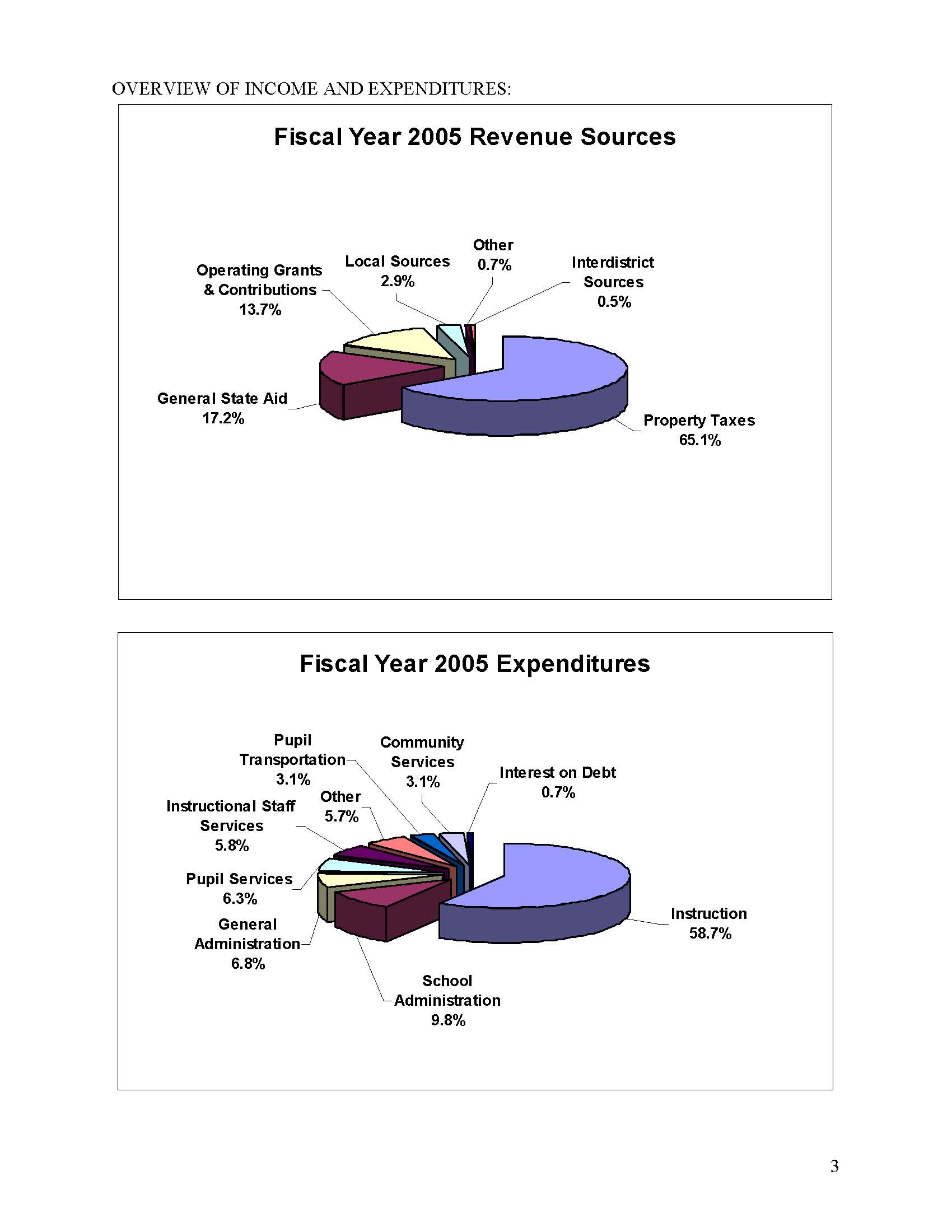
Madison’s revenue sources are a bit different than Carey’s example: 65.1% from local property taxes, 17.2% redistributed state taxes and the rest from grants, contributions and other sources.
Related links:

Finally, Patrick McIlheran notes that Wisconsin’s tax burden continues to rise:

Wisconsin’s entwined state and local governments taxed a sum equal to 12.3% of Wisconsinites’ income last year. That was up from 12.2% the year before and 12.1% the year before that. This biennium, the state is spending 10.5% more than last. Ever, the numbers rise.
They rise because the state’s costs do. But taxpayers, too, pay more for gasoline, food, power and practically everything else. Times are tough. You’d think the least government could do would be to avoid piling on.

Share

Waukesha begins looking at an operating referendum

Amy Hetzner:

District officials blame the financial troubles on the discrepancy between what they can raise under revenue caps, which increase roughly 2% a year, and expenditures that grow about 4% a year.
A $4.9 million annual addition to the district’s operating revenue that was approved by voters in an April 2001 referendum gave the district only a few years free from cutting programs and services. Another referendum attempt in April 2005 that would have raised taxes to help avoid further staff reductions failed by a substantial margin.
Board member Patrick McCaffery warned that the board risked another referendum setback if it proceeds without searching for additional efficiencies, including closing a school and realigning attendance boundaries

Waukesha’s Executive Director of Business Services, Erik Kass will soon join the Madison School District in a similar capacity. K-12 Tax & Spending Climate.

Share

Foundation for Madison Public Schools Celebrates Carol Carstensen’s School Board Tenure

Samara Kalk Derby:

More than 100 friends, colleagues, family members and parents showed up at a farewell party Wednesday at Olbrich Gardens to say goodbye and thank you to Carol Carstensen, who served six terms on the Madison School Board and stepped down after the spring elections.
“There will never be another Carol Carstensen. I will predict that,” said School Board member Johnny Winston Jr. “There will never be another School Board member in this community that will serve 18 years. I miss her already.”
Winston called it a wonderful experience to work with Carstensen.
“She really not only knew the material and had a grasp of the issues going on, but she also had her pulse on the community as well,” he said.
Former board member Nan Brien, who served with Carstensen in the early 1990s, said that for 18 years Carstensen was the spokesperson on the board for all the kids in the district.
“She was particularly adamant that all kids, no matter their background, have an opportunity for the best education. That is the heart and soul of who Carol Carstensen is,” Brien said.

Carol reflects on her tenure, including three accomplishments she takes personal pride in: Wright Middle School, renaming 5 middle schools to reflect the diversity of our community and establishment of the Joe Thomas award.
Much more on Carol Carstensen here. Watch a brief video interview with Carol during her most recent campaign.
More on the Foundation for Madison Public Schools here. John Taylor’s 2003 challenge grants energized the formation of FMPS.

Share

Wisconsin’s Structural Deficit: $1,700,000,000

Steven Walters:

State government faces a long-term imbalance between spending commitments and tax collections of almost $1.7 billion – even if the budget-repair bill that passed the Senate on Tuesday becomes law.
That figure is $800 million more than last fall, when the budget was adopted.
The Legislative Fiscal Bureau blamed the higher long-term deficit on the sluggish economy, because tax collections are expected to grow by only 2% – less than half the 5.5% annual growth in the past. Every 1% lag in tax collections means state government collects $130 million less in taxes.
Fiscal Bureau Director Bob Lang gave legislators the $1.7 billion estimate of the so-called “structural deficit,” which is the projected shortfall Gov. Jim Doyle and legislators face next year when they must pass the 2009-’11 budget.

Share

Assistant LA Superintendent Sounds Off

Mitchell Landsberg interviews Ramon Cortines:

“I’ve tackled some of the sacred cows in my recommendations, such as the issues of contracts, how much money we could receive from that. Such as the issue of health benefits, and how much money we could receive by capping that. And increasing the co-pay.”
Cortines was at times unsparing of LAUSD’s failures, saying that the district is organized for the benefit of the adults who work there, not the children they are hired to serve. He said the school board passes too many resolutions that “aren’t worth the paper [they’re] printed on.” And he said the district had “abdicated our responsibility” for Locke High School, which is about to be turned over to Green Dot Public Schools, the big charter operator. Students didn’t get a pass, though: He said the district needs to enforce “a code of behavior” based on the idea that they don’t just have rights — they also have responsibilities.

Clusty Search: Ramon Cortines.

Share

Legal Advocacy and Education Reform: Litigating School Exclusion

Deann Hill Rivkin:

School exclusion has existed as a dark side of public education since the creation of America’s public schools. Several cases in the United States Supreme Court memorably invalidated State and school system efforts to deny equal educational opportunities to marginalized school children and youth. In these cases, the over-riding multiple values of education were poignantly articulated in the majority decisions.
School exclusion has stubbornly persisted. It takes many forms. This article surveys the most prominent pathways to school exclusion, highlighting what has been called the “School-To-Prison-Pipeline.” Various legal challenges are also evaluated. The pros and cons of litigating school exclusion cases are also assessed.

Share

Commentary on: Should Student Results Count in Grading Teachers?

Followup on Student Test and Teacher Grades:

I am a retired elementary school principal from Long Island, N.Y. I was also a teacher, counselor and school psychologist during my 39 years in public education.
It was, to say the least, appalling to learn in John Merrow’s “Student Tests — and Teacher Grades” (op-ed, May 9) that teachers’ unions prevailed, at least in New York state, in eliminating the quality of student performance in determining a teacher’s tenure. Besides violating common sense, it is counter to most other evaluations. For instance, aren’t coaches in any sport evaluated by the performance of their respective charges, be they teams or individuals?
In my estimation, the evaluation of a teacher’s performance for tenure consideration at K-12 level should be based primarily on that teacher’s students performance, i.e., results, just as we judge the quality of performance in many other activities, be it sports, sales, etc.
Leon W. Zelby
Norman, Okla.
Blame the teachers and the unions — how often do we have to hear the same old tired arguments as to why the American educational system is failing?
I taught music for 20 years in both public and private schools, and there have always been good students and bad students.
Sorry, parents — when your kids don’t do well in school, it is usually due to lack of discipline at home. Parents who acquiesce to the whims of a child, refuse to impose rules, and blame the teacher are begging for their child to fail. Through the years, I watched as good teachers left the profession in disgust. For all their hard work, the pay is still low, administrators and parents still lack respect, and when something goes wrong, well, we still blame the teacher.

Share

Leapold Elementary’s Population Again Rises to the Top

Channel3000:

Dozens of parents and staff members attended Monday night’s Madison Metropolitan School District’s Board of Education meeting to shed new light on an old problem: overcrowding at a local elementary school.
The issue of overcrowding at Aldo Leopold Elementary School is prompting some parents and teachers to tell the board solutions they’d like to see to relieve the problem.
Some said that the obvious solution would be to build a new Leopold Elementary or perhaps to adjust the school’s boundaries. The group presenting the board with the findings of a parent-teacher survey about the challenges at the school, WISC-TV reported.
The school is at 99 percent attendance with 718 students and can only handle eight more students, officials said.

Monday evening’s Board meeting included a brief discussion of a much larger Leapold School – perhaps similar to the failed 2005 referendum that would have created a building suitable for 1100+students.

Share

Pair Break Barriers for Charter Schools

Jay Matthews:

They won a legal battle to force Maryland to increase public funding for charter schools more than 60 percent. They opened two charter schools in Prince George’s County and befriended the superintendent there even though the county had a reputation as hostile to the charter movement. They run one of the largest charter school networks in the country.
Yet Dennis and Eileen Bakke remain relatively unknown in local education circles.
Dennis, 62, and Eileen, 55, live in Arlington County. He knows business; she is into education. Few people guess, and the Bakkes never volunteer, what an impact they have had on education in the region and beyond. Their Imagine Schools organization, based in Arlington, oversees 51 schools (four in the Washington area) with 25,000 students. By fall, it plans to have 75 schools with 38,000 students.
Jason Botel, who directs KIPP charter schools in Baltimore, is one educator who knows what the Bakkes have accomplished. “Their funding of advocacy efforts has helped make sure that . . . charter schools like ours can provide a great education for children in Maryland,” he said.

Imagine Schools’ report card.

Share

No Child Left Behind Lacks Bite: Worst-Performing Schools Rarely Adopt Radical Remedies

Robert Tomsho:

Critics of the federal No Child Left Behind law, including Democratic presidential candidates vowing to overhaul or end it, have often accused it of being too harsh. It punishes weak schools instead of supporting them, as Sen. Barack Obama puts it.
But when it comes to the worst-performing schools, the 2001 law hasn’t shown much bite. The more-radical restructuring remedies put forth by the law have rarely been adopted by these schools, many of which aren’t doing much to address their problems, according to a federal study last year.
The troubles in the restructuring arena reflect broader questions about whether NCLB is a strong enough tool to bring about the overhaul of American education. In many ways, the law was an outgrowth of “A Nation at Risk,” a pivotal 1983 federal report that warned that a “rising tide of mediocrity” in education could undermine the nation’s competitiveness. That report ushered in the era of accountability and testing, which eventually spawned NCLB.
Supporters maintain the law is helping to fuel learning gains. In the most recent National Assessment of Educational Progress tests, reading and math scores for fourth and eighth graders rose compared to 2005, albeit only by a few points.
But NCLB gave states — not the federal government — authority to set the academic standards for local schools. And so, while NCLB requires all students to be proficient in reading and math by 2014, states determine what proficiency is and how they will test for it. A 2007 federal study found states don’t exactly agree on proficiency.

Related: Commentary on Wisconsin’s Department of Public Instruction Standards. DPI Website.

Share

Are gifted students getting left out?

Carla Rivera
Highly intelligent, talented students need special programs to keep them engaged and challenged. But experts say too often they aren’t even identified — especially in low-income and minority schools.
If you reviewed Dalton Sargent’s report cards, you’d know only half his story. The 15-year-old Altadena junior has lousy grades in many subjects. He has blown off assignments and been dissatisfied with many of his teachers. It would be accurate to call him a problematic student. But he is also gifted.
Dalton is among the sizable number of highly intelligent or talented children in the nation’s classrooms who find little in the standard curriculum to rouse their interest and who often fall by the wayside.
With schools under intense pressure from state and federal mandates such as No Child Left Behind to raise test scores of low-achieving pupils, the educational needs of gifted students — who usually perform well on standardized tests — too often are ignored, advocates say.
Nationally, about 3 million kindergarten through 12th-grade students are identified as gifted, but 80% of them do not receive specialized instruction, experts say. Studies have found that 5% to 20% of students who drop out are gifted.
There is no federal law mandating special programs for gifted children, though many educators argue that these students — whose curiosity and creativity often coexist with emotional and social problems — deserve the same status as those with special needs. Services for gifted students vary from state to state. In California, about 512,000 students are enrolled in the Gifted and Talented Education program, which aims to provide specialized and accelerated instruction.
But many gifted students who might benefit from the program are never identified, particularly those in economically disadvantaged communities, advocates say. Legislation sponsored by state Sen. Louis Correa (D-Santa Ana) aimed at training teachers to identify gifted students from low-income, minority and non-English speaking families stalled last year after estimates found that it could cost up to $1.1 million.

Share

No Small Plan: Public Boarding Schools for Chicago

Carlos Sadovi and Stephanie Banchero, via a kind reader’s email:

Public boarding schools where homeless children and those from troubled homes could find the safety and stability to learn are being pursued by Chicago Public Schools officials.
Under the plan, still in the nascent stages, the first pilot residential program could open as soon as fall 2009. District officials hope to launch as many as six such schools in the following years, including at least one that would operate as a year-round school.
The proposal puts Chicago at the forefront of urban school reform, as cities struggle to raise the academic achievement of students hampered by dysfunctional homes and other obstacles outside school.
Some districts, including Chicago, have looked for solutions from small schools to single-sex campuses. But residential schools are a bolder — and far more expensive — proposition. Long an option for the affluent, boarding schools are virtually unheard of for the disadvantaged.
Chicago Public Schools chief Arne Duncan said he does not want to be in the “parenting” business, but he worries that some homes and some neighborhoods are unsafe, making education an afterthought.
“Some children should not go home at night; some of them we need 24-7,” he told the Tribune. “We want to serve children who are really not getting enough structure at home. There’s a certain point where dad is in jail or has disappeared and mom is on crack … where there isn’t a stable grandmother, that child is being raised by the streets.”
Chicago school officials are still working through details of the plan, and it’s not clear whether the schools would be run by the district, outside agencies or some combination of the two.
It’s also not certain how the schools would be funded, who would shoulder the liability of keeping students overnight or how students would be selected.
In April, as part of its Renaissance 2010 new schools program, the district will put out a formal request for boarding school proposals. Officials have already met with interested groups in Chicago.
Officials have also visited several public and private boarding schools across the country and asked some to submit proposals.
Duncan said he has dreamed for years about opening boarding schools, but only last year, when he hired Josh Edelman, son of Children’s Defense Fund founder Marian Wright Edelman, did the idea take off.

(more…)

Share

Proximity & Power
Why do the headquarters of state teachers’ unions tend to be so close to state capitol buildings?

Jay Greene & Jonathan Butcher:

If you stand on the steps of a state capitol building and throw a rock (with a really strong arm), the first building you can hit has a good chance of being the headquarters of the state teachers’ union. For interest groups, proximity to the capitol is a way of displaying power and influence. The teachers’ union strives to be the closest. It wants to remind everyone that it is the most powerful interest group of all.
To see who has the most powerful digs, we actually bothered to measure just how close interest group offices are to state capitol buildings. We started with a list of the 25 most influential interest groups, as compiled by Fortune magazine. We then used Google Maps to plot the location of the state offices of those 25 interest groups and measured the distance to the capitol building.
The results are illuminating. Of the 25 most influential interest groups, the teachers’ union is the closest in 14 of the 50 states. By comparison, the AFL-CIO is the closest in seven states. The American Association of Retired Persons (AARP) and the National Federation of Independent Business are the closest in five states, each. The American Association for Justice (AAJ)—the leading organization of U.S. trial lawyers, formerly known as the Association of Trial Lawyers of America, or ATLA—is the closest in four states.

Share

School turnaround projects are enormously difficult propositions. They must be guided by four basic realities.

Frederick M. Hess:

Across the nation, educators are struggling to turn around troubled schools. In the District of Columbia, Chancellor Michelle Rhee has teams seeking to overhaul 27 schools targeted for “restructuring” by the federal No Child Left Behind Act (NCLB).
This is hardly uncharted territory. Reformers have spent decades proposing new remedies for low-performing schools. Magnet programs, schools without walls, block scheduling, site-based management, and a litany of other popular ideas have emerged, only to disappoint.
Today, NCLB’s mandated restructuring of schools that fail to make “adequate yearly progress” for five consecutive years has fueled extensive new efforts. NCLB spells out five options for such schools: reopening as a public charter school; replacing most staff; contracting out operations to a new organization; turning the keys over to the state; or adopting “any other major restructuring of the school’s governance.” Modest variations of the amorphous fifth option have proven the most popular, by far.
More than 2,000 schools across the United States are currently in the process of restructuring, which has given rise to a nascent “turnaround” industry. The Louisiana School Turnaround Specialist Program is recruiting and grooming a cadre of school leaders. In New York, the Rensselaerville Institute runs a school turnaround program. At the University of Virginia, the graduate schools of education and business have partnered to train “turnaround specialists.” In Chicago, the Chicago International Charter School has launched ChicagoRise to provide management expertise and support for turnaround projects.

Share

UK Reading Recovery Study

Institute of Education:

New research into the progress of 500 children published today shows that young children who were the poorest readers – and the very lowest-achieving in their class – can go on to outperform the national average within two years. They must be given four to five months of one-to-one tuition by specially trained Reading Recovery teachers for about 30 minutes a day while the children are aged six.
The research by the Institute of Education into the Every Child a Reader project shows that boys benefit to the same extent as girls and that one-to-one tuition helps to reduce the gender gap. The presence of Reading Recovery teachers also helps the other children in the school who do not attend the Reading Recovery lessons.
The two-year research project looked at the reading and writing progress of the lowest achieving children in 42 schools in ten inner London boroughs with the biggest social problems. The eight poorest readers in each class, then aged six, were selected. Eighty-seven of these children had the benefit of the Reading Recovery special tuition programme and their progress was compared to a group of children of similar ability and backgrounds, who did not receive the same tuition.
After one year children who had received the tuition had reading ages that matched their chronological age, and were 14 months ahead of the children in the comparison group.

Complete report here.
Much more on Reading Recovery here.

Share

“No Surprises in School Budget, but Referendum Looms”

Tamira Madsen:

Facing a possible referendum and $9.2 million hole for the 2009-10 school year, no major alterations are anticipated to the school 2008-09 budget that will be finalized Monday by Madison School Board members.
When new superintendent Dan Nerad starts in July, referendum discussion will come to the forefront for the Madison Metropolitan School District. If Board members decide to propose a referendum, which could occur as early as November, they will request taxpayers consider overriding state-imposed revenue gaps so that services and programs won’t have to be severely slashed from the district’s budget.
In the meantime, only one administrative amendment and two Board amendments are on the agenda and approval is expected at the School Board meeting as superintendent Art Rainwater presents plans for the final budget of his tenure. Rainwater, who has worked with the district for 14 years — including the last 10 as superintendent — will retire this summer. Nerad will take over on July 1.
School Board members are well aware of the multi-million budget cuts looming for the 2009-10 school year, and Rainwater said he wasn’t surprised with short list of amendments.
“I think the overall intention for the Board from day one was really and truly to work to preserve exactly what we have,” Rainwater said during a telephone interview Friday.

Notes and links on the proposed $367,806,712 2008/2009 budget.
Three proposed budget amendments:

  • Limit Fund 80 spending to a 4% increase [19K PDF]
  • Limit Fund 80 spending to a 4% increase [19K PDF]
  • Increase technology purchases by $100,000 and reduced the reserve for contingency
  • Limit Fund 80 spending to a 4% increase [9K PDF]
  • Increase the Fund 80 tax levy by $60,000 for the Madison Family Literacy / Even Start Literacy Program [9K PDF]

Much more on Fund 80 here.

Share

On Madison’s Lack of a 4K Program

Andy Hall:

In Madison, where schools Superintendent Art Rainwater in a 2004 memo described 4K as potentially “the next best tool” for raising students’ performance and narrowing the racial achievement gap, years of study and talks with leaders of early childhood education centers have failed to produce results.
“It’s one of the things that I regret the most, that I think would have made a big impact, that I was not able to do,” said Rainwater, who is retiring next month after leading the district for a decade.
“We’ve never been able to get around the money,” said Rainwater, whose tenure was marked by annual multimillion-dollar budget cuts to conform to the state’s limits on how much money districts can raise from local property taxpayers.
A complicating factor was the opposition of Madison Teachers Inc., the teachers union, to the idea that the 4K program would include preschool teachers not employed by the School District. However, Rainwater said he’s “always believed that those things could have been resolved” if money had been available.
Starting a 4K program for an estimated 1,700 students would cost Madison $5 million the first year and $2.5 million the second year before it would get full state funding in the third year under the state’s school-funding system.
In comparison, the entire state grant available to defray Wisconsin districts’ startup costs next year is $3 million — and that amount is being shared by 32 eligible districts.
One of those districts, Green Bay, is headed by Daniel Nerad, who has been hired to succeed Rainwater in Madison.
“I am excited about it,” said Madison School Board President Arlene Silveira, who is envious of the 4K sign-up information that appears on the Green Bay district’s Web site. “He’s gone out and he’s made it work in Green Bay. That will certainly help us here as we start taking the message forward again.
Madison’s inability to start 4K has gained the attention of national advocates of 4K programs, who hail Wisconsin’s approach as a model during the current national economic downturn. Milwaukee, the state’s largest district, long has offered 4K.
“It’s been disappointing that Madison has been very slow to step up to provide for its children,” said Libby Doggett, executive director of Pre-K Now, a national nonprofit group in Washington, D.C., that campaigns for kindergarten programs for children ages 3 and 4.
“The way 4K is being done in your state is the right way.”

Related:

  • Marc Eisen: Missed Opportunity for 4K and High School Redesign
  • MMSD Budget History: Madison’s spending has grown about 50% from 1998 ($245,131,022) to 2008 ($367,806,712) while enrollment has declined slightly from 25,132 to 24,268 ($13,997/student).
Share

Seattle Drops Office of Equity, Race and Learning Support; Downsizes Teaching & Learning

Jessica Blanchard:

After four years and a number of embarrassing public-relations gaffes, Seattle Public Schools plans to cut its controversial Office of Equity, Race and Learning Support as part of a central office shake-up.
The move is part of the first phase of a staff reorganization aimed at saving money, helping departments collaborate more and better aligning resources with the goals in Superintendent Maria Goodloe-Johnson’s upcoming strategic plan.
The reorganization will go into effect in July and will merge some departments in the district’s “learning and teaching” division, elevate some positions and combine others.
About 15 managers and other staff members in the district’s “learning and teaching” division will lose jobs, but can apply for other district work, including nine new positions.
Though the Office of Equity, Race and Learning Support will be eliminated, its responsibilities will be transferred to other departments, district spokeswoman Patti Spencer said Thursday. “The district’s dedication to this work remains as strong as ever,” she said.

Related: “When Policy Trumps Results“.
Diversity on Affirmative Action for Law Schools by Bryan Atwater.

Share

Media Education Coverage: An Oxymoron?

Lucy Mathiak’s recent comments regarding the lack of substantive local media education coverage inspired a Mitch Henck discussion (actually rant) [15MB mp3 audio file]. Henck notes that the fault lies with us, the (mostly non) voting public. Apathy certainly reigns. A useful example is Monday’s School Board’s 56 minute $367,806,712 2008/2009 budget discussion. The brief chat included these topics:

  • Retiring Superintendent Art Rainwater’s view on the District’s structural deficit and the decline in it’s equity (Assets – Liabilities = Equity; Britannica on the The Balance Sheet) from $48,000,000 in the year 2000 to $24,000,000 in 2006 (it is now about 8% of the budget or $20M). (See Lawrie Kobza’s discussion of this issue in November, 2006. Lawrie spent a great deal of time digging into and disclosing the structural deficits.) Art also mentioned the resulting downgrade in the District’s bond rating (results in somewhat higher interest rates).
  • Marj asked an interesting question about the K-1 combination and staff scheduling vis a vis the present Teacher Union Contract.
  • Lucy asked about specials scheduling (about 17 minutes).
  • Maya asked about the combined K-1 Art classes (“Class and a half” art and music) and whether we are losing instructional minutes. She advocated for being “open and honest with the public” about this change. Art responded (23 minutes) vociferously about the reduction in services, the necessity for the community to vote yes on operating referendums, ACT scores and National Merit Scholars.
  • Beth mentioned (about 30 minutes) that “the district has done amazing things with less resources”. She also discussed teacher tools, curriculum and information sharing.
  • Ed Hughes (about 37 minutes) asked about the Madison Family Literacy initiative at Leopold and Northport. Lucy inquired about Fund 80 support for this project.
  • Maya later inquired (45 minutes) about a possible increase in Wisconsin DPI’s common school fund for libraries and left over Title 1 funds supporting future staff costs rather than professional development.
  • Beth (about 48 minutes) advocated accelerated computer deployments to the schools. Lucy followed up and asked about the District’s installation schedule. Johnny followed up on this matter with a question regarding the most recent maintenance referendum which included $500,000 annually for technology.
  • Lucy discussed (52 minutes) contingency funds for energy costs as well as providing some discretion for incoming superintendent Dan Nerad.

Rick Berg notes that some homes are selling below assessed value, which will affect the local tax base (property taxes for schools) and potential referendums:

But the marketplace will ultimately expose any gaps between assessment and true market value. And that could force local governments to choose between reducing spending (not likely) and hiking the mill rate (more likely) to make up for the decreasing value of real estate.
Pity the poor homeowners who see the value of their home fall 10%, 20% or even 30% with no corresponding savings in their property tax bill, or, worse yet, their tax bill goes up! Therein lie the seeds of a genuine taxpayer revolt. Brace yourselves. It’s gonna be a rough ride.

The Wisconsin Department of Revenue noted recently that Wisconsin state tax collections are up 2.3% year to date [136K PDF]. Redistributed state tax dollars represented 17.2% of the District’s revenues in 2005 (via the Citizen’s Budget).
Daniel de Vise dives into Montgomery County, Maryland’s school budget:

The budget for Montgomery County’s public schools has doubled in 10 years, a massive investment in smaller classes, better-paid teachers and specialized programs to serve growing ranks of low-income and immigrant children.
That era might be coming to an end. The County Council will adopt an education budget this month that provides the smallest year-to-year increase in a decade for public schools. County Executive Isiah Leggett (D) has recommended trimming $51 million from the $2.11 billion spending plan submitted by the Board of Education.
County leaders say the budget can no longer keep up with the spending pace of Superintendent Jerry D. Weast, who has overseen a billion-dollar expansion since his arrival in 1999. Weast has reduced elementary class sizes, expanded preschool and kindergarten programs and invested heavily in the high-poverty area of the county known around his office as the Red Zone.
“Laudable goals, objectives, nobody’s going to argue with that,” Leggett said in a recent interview at his Rockville office. “But is it affordable?”
It’s a question being asked of every department in a county whose overall budget has swelled from $2.1 billion in fiscal 1998 to $4.3 billion this year, a growth rate Leggett terms “unacceptable.”

Montgomery County enrolls 137,745 students and spent $2,100,000,000 this year ($15,245/student). Madison’s spending has grown about 50% from 1998 ($245,131,022) to 2008 ($367,806,712) while enrollment has declined slightly from 25,132 to 24,268 ($13,997/student).
I’ve not seen any local media coverage of the District’s budget this week.
Thanks to a reader for sending this in.
Oxymoron

Share

Red ties and boys’ pride: Sowing the seeds of good schools in the Midwest

The Economist:

EVERY weekday, 300 boys gather in a gym on Chicago’s South Side. They are all black. More than 80% are poor. Over the past few weeks Chicago has seen a surge in gang violence. But here boys stand in straight lines. Each wears a blazer and a red tie. And in unison they begin to shout their creed: “We believe. We are the young men of Urban Prep. We are college-bound.”
Urban Prep Charter Academy opened in 2006, part of an effort to bring 100 new schools to Chicago’s bleakest areas by 2010. Richard Daley, the city’s mayor, announced Renaissance 2010 (“Ren 10”) in 2004; Chicago’s business leaders created the Renaissance Schools Fund (RSF) to help support it. Backers of this ambitious scheme hope it will spur competition across the school district. On May 6th RSF held a conference to discuss the “new market of public education”.
At the core of Ren 10 is the desire to welcome “education entrepreneurs”, as RSF calls them. Ren 10 lets them start schools and run them mostly as they choose (for example, with longer days and, in some cases, their own salary structure); it also sets the standards they must meet. Schools receive money on a per pupil basis, and may raise private funds as well.

Share

Why Milwaukee’s Busing Won’t End

Bruce Murphy:

As I’ve noted in the past, the headlines and placement of stories can heavily influence how readers perceive the news. A classic case was a story that ran in the Journal Sentinel two weeks ago, headlined “MPS board slashes busing.”
The Milwaukee Public Schools board did no such thing. The board simply set a goal to cut busing without spelling out how it would be accomplished – sort of like announcing a budget cut without specifying any spending to be reduced. As reporter Alan Borsuk noted in his second graph, “what will actually result will not be clear for perhaps several years.” Borsuk, never shy about caveats, also noted that most busing is required by state law (for special education students, students attending private schools, minority students traveling to suburban schools under Chapter 220, etc.) and cannot be changed by the school board.

Share

Exploring KIPP

Roy Romer:

Part of the reason KIPP charters have seen success is because of their rigorous standards and extended learning day. These are both concepts that the campaign has been advocating since its beginning — we believe that charter schools, when coupled with high standards, effective teachers, and time and support for learning, hold bold promise for academic excellence.

Share

Video: Madison School Board Discusses the Proposed $367,806,712 2008/2009 Budget

Watch the 56 minute video. Budget links and notes.
Share

Fatal Accidents Erode Perk of Off-Campus Lunches

Winnie Hu:

The students used to overflow the wooden booths and green tables at Don Jono’s Pizzeria, racing through pepperoni slices and large sodas before driving the quarter-mile back to Smithtown High School West in time for their next class.
But now the pizzas pile up behind the counter. Pete Crescimanno, a compact man with a neat black mustache who co-owns the place, estimates that he has lost more than $500 a week in sales since the school district ended its longstanding policy of allowing seniors to go off-campus for lunch. One recent morning, Mr. Crescimanno and an assistant pounded and tossed dough in a nearly empty storefront, with only the radio to break the silence.
“It’s not the same, and you miss that because you used to prepare for the kids and now you don’t see them,” he said. “Of course, you miss the business, but you also miss the fact that they’re not here anymore.”

Share

Vouchers & Achievement

Jeb Bush:

Unfortunately, in a recent editorial regarding the Taxation and Budget Reform Commission, the St. Petersburg Times employs worn-out diversionary tactics to obfuscate the issues and conceal its true position — the paper’s editorial board despises the concept of providing school choice options to low-income students. Let’s end the theatrics and address the real questions going before the Florida people on November’s ballot. This debate is on keeping the promise of a quality education for all of Florida’s students.
Florida students are no longer just competing with students in Georgia, California, New York and Texas for coveted high-wage jobs. They are competing with their peers around the world. Countries like China, Sweden and Singapore are focusing on tomorrow’s economy and placing a premium on education and innovation to ensure they can keep pace with their rivals. For decades, America set that pace, and now we are falling behind.
We need all schools — here and in the 49 other states — to get better for our country’s future. The only way to improve student performance is through continual and perpetual reform of education. Florida needs a 21st century education system for a 21st century world, and school choice can be an important catalyst to make this vision a reality.

Share

50 State Charter School Law Comparison (Wisconsin Ranks “B”)

The Center for Education Reform (1.1MB PDF):

In their recent report analyzing the politics of charter school laws, Christiana Stoddard and Sean P. Corcoran of Education Nextrelied upon The Center for Education Reform’s (CER) Charter School Law Rankings and Profiles to study the success of the charter school movement.
As they recognized, the strength of a law could impact the way in which healthy charter schools grow and how they serve students. Having laws with certain components is critical.
CER welcomes this scrutiny and the dozens of other research reports, which utilize its rankings as a guide for assessing policy. We also recognize that not all researchers find the work we have done for ten years on law strength compelling. Researchers at the University of Colorado at Boulder find our data and conclusions a bit hard to swallow. They argue that what CER considers strong components of a law – flexibility, autonomy, equitable funding – are actually weaknesses. Despite their claims that the weakest are actually the strongest, the data do not lie. States with strong laws by our standards (and those shared almost universally by the research community whether friend or foe) create strong schools.
Put another way, strong laws matter.

Share

Making Teacher Hiring Less Comfortable

Jay Matthews:

For those who still think helping children learn is everybody’s top priority in our schools, let me cite a disturbing dispute over where to send several hundred teachers at 23 D.C. schools that are about to be closed for inadequate enrollment.
D.C. Schools Chancellor Michelle A. Rhee wants the principals of her remaining schools to decide which of those excess teachers they will hire, within the limits of a contract that guarantees them jobs somewhere in the system. Urban schools don’t work if all adults in each building don’t agree on what must be done to make them work. There is no chance of that shared vision if each principal is not allowed to pick the players on his or her team.
Unfortunately, many kind and well-intentioned teachers and parents in the District and other cities have a different view. Their first priority is not so much that children learn, but that they feel secure and comfortable. They want those excess teachers to accompany the students they know at their current school to whichever school the children are transferred to. That way, they say, the kids will have an easier and more comfortable transition.
Some members of the Washington Teachers’ Union, which is in the midst of a leadership fight, also say they fear Rhee is resisting this more genial approach because she wants to get rid of any teachers who can’t find principals who want them.

Share

Online Education Cast as “Disruptive Innovation”

Andrew Trotter:

Technology-based forces of “disruptive innovation” are gathering around public education and will overhaul the way K-12 students learn—with potentially dramatic consequences for established public schools, according to an upcoming book that draws parallels to disruptions in other industries.
Disrupting Class: How Disruptive Innovation Will Change the Way the World Learns predicts that the growth in computer-based delivery of education will accelerate swiftly until, by 2019, half of all high school classes will be taught over the Internet.
Clayton M. Christensen, the book’s lead author and a business professor at Harvard University, is well respected in the business world for his best-sellers The Innovator’s Dilemma, published in 1997, and The Innovator’s Solution, published in 2003.
Those books analyze why leading companies in various industries—computers, electronics, retail, and others—were knocked off by upstarts that were better able to take advantage of innovations based on new technology and changing conditions.
School organizations are similarly vulnerable, Mr. Christensen contends.
“The schools as they are now structured cannot do it,” he said in an interview, referring to adapting successfully to coming computer-based innovations. “Even the best managers in the world, if they were heads of departments in schools and the administrators of schools, could not do it.”
Under Mr. Christensen’s analytical model, the tables typically turn in an industry even when the dominant companies are well aware of a disruptive innovation and try to use it to transform themselves

There’s no doubt that a revolution is underway in education. LIke other industries, it is doubtful that many of the current players will make the turn, which is likely why issues such as credit for non MMSD courses is evidently such a problem. Two related articles by Cringely provide useful background.
More:

Like the leaders in other industries, the education establishment has crammed down technology onto its existing architecture, which is dominated by the “monolithic” processes of textbook creation and adoption, teaching practices and training, and standardized assessment—which, despite some efforts at individualization, by and large treat students the same, the book says.
But new providers are stepping forward to serve students that mainline education does not serve, or serve well, the authors write. Those students, which the book describes as K-12 education’s version of “nonconsumers,” include those lacking access to Advanced Placement courses, needing alternatives to standard classroom instruction, homebound or home-schooled students, those needing to make up course credits to graduate—and even prekindergarten children.
By addressing those groups, providers such as charter schools, companies catering to home schoolers, private tutoring companies, and online-curriculum companies have developed their methods and tapped networks of students, parents, and teachers for ideas.
Those providers will gradually improve their tools to offer instruction that is more student-centered, in part by breaking courses into modules that can be recombined specifically for each student, the authors predict.
Such providers’ approaches, the authors argue, will also become more affordable, and they will start attracting more and more students from regular schools.

Share

Firing Back on “When Policy Trumps Results”

TJ Mertz:

Marc Eisen of the Isthmus has checked in again on the Madison Schools with a column titled “When Policy Trumps Results.” This time the target of his ill informed scribblings is the equity work of the district, particularly the Equity Task Force, of which I was a member. It is a hatchet job.
Mr. Eisen gets his facts wrong, misreads or misrepresents task force documents and at no point engages with the content of the task force’s work. We offered the Board ideas for policies and practices that we thought would help produce and assess results. You would never know that reading Mr. Eisen’s column. Despite the title, all he seems to care about is style.
In return, I’m going to wield the axe. I’m going to go paragraph by paragraph to highlight the low level of knowledge and effort Eisen displays and the ultimate emptiness of his critique, hitting some other things along the way (quotes from Mr. Eisen in italics). Mr. Eisen’s column probably does not deserve this much attention. However the power of the press is such that often when uncorrected, “the legend becomes fact.” I believe equity work in our school district is too important to allow that to happen. Let’s get started.

Comments on “When Policy Trumps Results”.

Share

Pearson in talks to Acquire Chinese schools

Roger Blitz:

Pearson, publisher of the Financial Times, is in advanced talks about acquiring a chain of private schools in Shanghai, the first time it would own an education institution anywhere in the world.
Although the size of the deal for LEC is low – its 15 schools made revenues of less than $10m – it offers a way of entering the heavily regulated Chinese education market.
LEC schools provides after-school education for children aged five to 12 whose parents pay for them to learn English. Pearson has made forays into China through FTChinese.com and Penguin. At its annual meeting last month, it announced board appointments aimed at growing its education business outside the US.
The LEC deal, which has been in the works for at least a year, would run counter to competitors in the education market who have been abandoning or selling up their international operations to private equity and focusing on the US.
Pearson insiders say the shift in education is moving towards technology platforms and software in education rather than printed textbooks, and the LEC schools offer among other benefits a way of showcasing products such as interactive boards.

Fascinating.

Share

2008-2009 Madison School Board Budget Discussion

Monday evening’s (5/5/2008) meeting agenda (PDF) includes a discussion of the proposed $367,806,712 budget. It will be interesting to see what type of changes to retiring Superintendent Art Rainwater’s last budget are discussed. Perhaps, a place to start would be the report card initiative from the District’s curriculum creation department (Teaching & Learning). Watch a presentation on the proposed “Standards Based” report cards. Contact the Madison School Board here comments@madison.k12.wi.us

Share

From High School to the Future

Dr. Sara Goldrick-Rab:

With loads of financial support from both CPS (Arnie Duncan) and the Gates Foundation (among others) CCSR and the school system built a tracking system that allows them to follow kids out of high school and into college & work, to see how they do– and even more importantly, to figure out how to help them do better.
It’s so unusual for a school district, especially one as large as Chicago’s (130+ high schools!) to have the data capacity to do this. The vast majority of high schools in the U.S. rely on a student exit questionnaire administered in the spring of senior year, which asks kids “What are your plans for the fall” (choices include 4 yr college, 2yr college, work, etc) and their responses are used as a proxy for the real destination. In other words, the college-going rate for a high school or district is based on a student’s self-report in May of senior year. This is a highly inaccurate measure, as several different data sources have proven– plenty of kids who say they are going to college do not (or do not go to the kind of school they said they were going to, even if they were admitted and accepted) because they realize they cannot afford it, or get side-tracked during the summer, and many who say they aren’t going, do decide to show up at a community college. Clearly districts need a much more reliable source of information if they are to learn about their high school graduates, and use that information to inform and change their educational practices.

Useful.

Share

Americans Vastly Underestimate Spending on Schools and Teacher Salaries, Survey Finds

William G. Howell & Martin R. West:

Do Americans have an accurate grasp of how much is currently being spent on public education? Not according to a recent analysis of national survey results by University of Chicago’s William Howell and Brown University’s Martin R. West published in the summer issue of Education Next. The average respondent surveyed in 2007 thought per pupil spending in their district was just $4,231 dollars, even though the actual average spending per pupil among districts was $10,377 in 2005 (the most recent year for which data are available).
Howell and West also found Americans think that teachers earn far less than is actually the case. On average, the public underestimated average teacher salaries in their own state by $14,370. The average estimate among survey respondents was $33,054, while average teacher salary nationally in 2005 was actually $47,602.
Almost 96 percent of the public underestimate either per-pupil spending in their districts or teacher salaries in their states.
Howell and West also looked at whether some citizens are better informed about education spending than others. In general, they found that the responses of men were closer to the truth than those of women, and that parents of school-aged children gave more accurate responses about teacher salaries. Homeowners also appeared to be much more responsive than other Americans to higher spending levels in their districts. In districts spending more than $10,000 per pupil, for example, the responses of homeowners were closer to actual spending levels than those of individuals who rented or lived with other families. Homeowners appeared better informed about teacher salaries too, offering responses that were $7,502 higher than non-homeowners’ responses.

Complete Report – PDF.

Share

“Madison Schools Committed to Equity and Excellence”

Madison School District:

is the title of a three page feature in the current edition of Teachers of Color magazine. The lead article, written by Lisa Black – Special Asst. to the Supt. for Race & Equity, profiles the multi-faceted MMSD Race and Equity initiative that began six years ago.
Black writes, “Beginning with the development of an educational framework, innovative and progressive professional development, and local and national partnerships, the MMSD has experienced significant gains in closing the achievement gap.”
Sidebar articles are written by Supt. Art Rainwater, La Follette HS Principal Joe Gothard, Sennett MS Asst. Principal Deborah Ptak and Media Production Manager Marcia Standiford.

Share

When Policy Trumps Results

Marc Eisen makes sense:

Much to its credit, the Madison school board has mostly ignored the March 2007 recommendations of the district’s Equity Task Force. This earnest but unhelpful committee delved into the abstractions of what distinguishes “equity” from “equality,” how the board might commit to equity and what esoteric guidelines could measure that commitment.
………….
This point needs to be emphasized. Madisonians aren’t afraid to tax themselves. They just want good services in return and know that their money isn’t being wasted.
But I can’t for the life of me see them rallying around a pompous and abstruse equity policy, especially one that reads like it was formulated by the UW Department of Leftwing Social Engineering. (Example: “Equity will come about when we raise a generation of children tolerant of differences and engaged in their democracy to stop the processes leading to inequity.”)
The school board, after a suitable 14-month delay, should politely shelve the task force’s recommendations when it finally gets around to voting on them in May.

Kurt Vonnegut’s Harrison Bergeron provides a timely read after Marc’s article.

Share

Introduction to a standards-based system . . . assessment

Madison School District Department of Teaching & Learning:

The Wisconsin Model Academic Standards (WMAS) articulate what students should know and be able to do in each curricular area. Community leaders and staff in the Madison Metropolitan School District (MMSD) elaborated upon these state standards to frame district curriculum and instruction.
Curriculum can be thought of as the planned educational experiences taught in each subject area at each grade level. Standards-based instruction focuses on teaching the knowledge and skills which support students’ continual progress toward meeting the standards.
This article focuses on assessment, the process of using multiple strategies to measure student learning.
The remainder of this article will use mathematics as an example of a content area to demonstrate the use of standards-based assessment. MMSD teachers assess the content standards (i.e., number and algebra) as well as the process standards (i.e., communication, problem solving, and reasoning).
Research indicates that in addition to quizzes and tests, a variety of daily assessment tools (i.e., questioning, observations, discussions, and presentations) are needed to create a more thorough picture of what a student understands.

Share

Parents turn to states for autism help

Jeff Sell:

Jeff Sell, a Texas trial lawyer with four children, recently became a lobbyist for the Maryland-based Autism Society of America, a job that has him crisscrossing the country to persuade state lawmakers to make life easier for people who have the little-understood developmental disability.
He shut down his law firm, which had pursued legal cases linking autism with vaccines. But rather than move to Maryland, Sell is staying in Texas, so his twin 13-year-old sons can continue to receive state-financed treatment for their autism. If he moves, Sell said, his sons would be on a years-long waiting list for therapy that costs as much as $60,000 a year.
“I live in Texas, basically, because it’s economically feasible for me to survive in Texas,” Sell said.
One of the toughest problems facing autism patients, their families and policymakers is paying for treatment. Families are increasingly relying on states to help them cope with the financial, medical and educational needs.
Governors and lawmakers have tried to ease those costs with two different approaches: by requiring private insurers to pick up the tab for more services or by creating new or expanding existing public health programs, such as Medicaid, to cover autism treatment.

Share

Obama Urges Parents to Be More Responsible

Nick Timiraos:

At a stop in Hickory, N.C., after promising to spend $18 billion on education, Sen. Obama said: “This money is not going to make a difference if parents don’t parent.”
He has folded the line into his stump speech across North Carolina and a TV advertisement in the state, where one-third of the Democratic electorate is African-American, ahead of Tuesday’s primary.
The ad, called “Turn It Off,” shows Sen. Obama in a classroom promising to improve education. “But the truth is, government can’t do it all,” he says. “As parents, we need to turn off the TV, read to our kids.”
The personal-responsibility line typically brings the loudest applause from African-American audiences. Sen. Obama first delivered it in an unscripted moment before a mostly black audience in Beaumont, Texas, in February.

Indeed, money is not the key issue, Obama is right about parent’s key role.

Share

Rebuilding New Orleans Schools

Adam Nossiter:

Citizen-run boards have suddenly been thrust into managing individual schools all over the city. Neophyte teachers barely out of college instruct students sometimes older than they are. A wide range of teaching styles has been employed, from the rotelike call-and-response methods of the KIPP (Knowledge Is Power Program) Foundation school to more traditional textbook-based approaches. For the first time, parents are being asked to choose schools for their children (though in many cases the parents are absent, and the student is being raised by relatives).
Success will be a tall order in a school district where 85 percent of some 32,000 students are a year and a half to two years below their grade level. In a typical district, the figure would be around 15 percent, said Paul G. Vallas, the new superintendent here.
Worse, a third of the students here are some four years below grade level, a challenge that Mr. Vallas, a veteran of the Chicago and Philadelphia schools, calls “extreme.”
Yet nearly a year into the job, Mr. Vallas professes to be unfazed. With no politics in his way — he answers neither to the neutered parish school board nor to the mayor, but to the state — he is far freer to plan grand schemes than in the much larger cities where he made his mark.

Share

Study: Reading First Fails to Boost Reading Skills

Maria Glod:

Children who participate in the $1-billion-a-year reading initiative at the heart of the No Child Left Behind law have not become better readers than their peers, according to a study released today by the Education Department’s research arm.
The report from the Institute of Education Sciences found that students in schools that use Reading First, which provides grants to improve grade-school reading instruction, scored no better on reading comprehension tests than peers in schools that don’t participate. The conclusion is likely to reignite the longstanding “reading wars,” because critics argue the program places too much emphasis on explicit phonics instruction and doesn’t do enough to foster understanding.
Reading First, aimed at improving reading skills among students from low-income families, has been plagued by allegations of mismanagement and financial conflicts of interest. But the Bush administration has strenuously backed the effort, saying it helps disadvantaged children learn to read. About 1.5 million children in about 5,200 schools nationwide, including more than 140 schools in Maryland, Virginia and the District, participate in Reading First.
The congressionally mandated study, completed by an independent contractor, focused on tens of thousands of first-, second- and third-grade students in 248 schools in 13 states. The children were tested, and researchers observed teachers in 1,400 classrooms.

Many links, notes and a bit of (local) history on Reading First here.
The complete report can be found here:

Created under the No Child Left Behind Act (NCLB) of 2001, the Reading First program provides assistance to states and districts in using research-based reading programs and instructional materials for students in kindergarten through third grade and in introducing related professional development and assessments. The program’s purpose is to ensure that increased proportions of students read at or above grade level, have mastery of the essential components of early reading, and that all students can read at or above grade level by the end of grade 3. The law requires that an independent, rigorous evaluation of the program be conducted to determine if the program influences teaching practices, mastery of early reading components, and student reading comprehension. This interim report presents the impacts of Reading First on classroom reading instruction and student reading comprehension during the 2004-05 and 2005-06 school years.
The evaluation found that Reading First did have positive, statistically significant impacts on the total class time spent on the five essential components of reading instruction promoted by the program. The study also found that, on average across the 18 study sites, Reading First did not have statistically significant impacts on student reading comprehension test scores in grades 1-3. A final report on the impacts from 2004-2007 (three school years with Reading First funding) and on the relationships between changes in instructional practice and student reading comprehension is expected in late 2008.

Share

The Spending Side of the Higher Education Equation

Scott Jaschik:

Across sectors of higher education, only a minority of spending by colleges supports direct instructional costs, according to a report being released today as part of an effort to reframe the debate over college costs.
“The Growing Imbalance: Recent Trends in U.S. Postsecondary Education Finance,” is the result of an unusual attempt to change the way colleges and policy makers analyze higher education. The report — issued for the first time today and now to be an annual project — examines not only revenues, but how colleges actually spend their money.
After years in which people have read about tuition going up, and about state support covering smaller shares of public higher education budgets, the idea is to focus on what results from these and other trends. Some of the findings challenge conventional wisdom — such as the widely quoted belief that the top expense for higher education is the personnel costs associated with professors and other employees.
The report was produced by the Delta Cost Project, part of the Lumina Foundation for Education’s Making Opportunity Affordable program. The overarching thesis of the work is that higher education will do a better job of serving students if everyone is aware of where the money goes — not just how much college costs. By examining the different spending patterns at different types of institutions, the report notes growing gaps among sectors and among items receiving financial support. For example, spending per student at private research universities is almost twice that of public research universities.

Share

Black Kids on Milwaukee Buses May Slip into School Lore

Eugene Kane:


It could be the end of an era.
Black children and yellow school buses long have been inextricably linked in the history of education in America. It started with the historic 1954 Brown v. Board of Education decision that allowed for school desegregation in cities like Milwaukee. That led to widespread busing movements that allowed black students to attend classes outside their neighborhoods at predominantly white schools.
A decision by the Milwaukee School Board last week to drastically reduce the amount of busing in the district will alter a fundamental relationship that has existed in this city for generations of students.
But what the Milwaukee School Board did was not a statement about the racial makeup of the city’s public schools, many of which are predominantly African-American. School Board member Michael Bonds, the architect of the plan, says busing isn’t about desegregation anymore.
“When the district is 88% minority, it’s not about race,” Bonds told me. “It’s about the fact we’ve spent $57 million on a failed policy.”

Related by Alan Borsuk: Busing Change Won’t Be Easy. Madison Mayor Dave’s proposed low income housing expansion throughout Dane County may require more busing.

Share

Counting High School Graduates

Milwaukee Journal-Sentinel Editorial:

A proposal to standardize the way states calculate high school graduation rates makes sense.
A report earlier this month examining America’s 50 largest school districts found that Milwaukee Public Schools had a graduation rate of only 46.1%. The report by America’s Promise Alliance, an advocacy group, reported that Detroit was at the bottom of that list with a graduation rate of 24.9%.
Wait a minute, MPS officials countered. Our graduation rate is 66%.
Who’s right?
Both probably are. That’s the problem U.S. Education Secretary Margaret Spellings hopes to solve by changing some of the rules under the No Child Left Behind Act, which Congress is considering reauthorizing.
Under the proposal, states would be required to use a uniform method of calculating high school graduation rates by the 2012-’13 school year. As it stands now, comparing graduation rates is difficult. Under the proposal, only students who complete school on time with a regular degree can be counted as graduates. Students who take longer than four years or who earn an alternative diploma, such as a GED certificate, would not be counted.

Share

Seattle’s Special Education Reform

Emily Heffter:

As a task force begins this spring to revamp Seattle Public Schools’ approach to special education, it’s likely many classrooms around the district will begin to look more like Eckstein’s. The details haven’t been worked out, but in general, the district will try to deliver services to the students instead of bringing the students to the services.
A consultant recommended Seattle try to include more students in general-education classes and educate more special-education students at their neighborhood schools.
As the diagnosis of disabilities becomes more refined, school districts nationwide are faced with students whose needs are more complicated. At the same time, districts face federal requirements to meet individual students’ educational needs in the least restrictive environment possible.
Balancing those two realities can be difficult, said Doug Gill, the director of special education for the Washington state Office of the Superintendent for Public Instruction.
“What I see is districts serving kids, sometimes with more complex needs, and as you see kids served with more complex needs, you need, really, a more specialized environment,” he said.

Seattle Special Education Review – Full Document (PDF). Seattle Special Education PTSA.

Share

Nearness Learning: The Death of Distance

The Economist:

“Nearness learning” is a more appropriate term for what the Open University’s business school offers, according to its dean in an interview for Which MBA, published by the Economist Intelligence Unit
When the Open University (OU) was founded in 1969, it represented one of the most important educational innovations of the 20th century, not just in Britain, but across the world.
Established by Britain’s then prime minister, Harold Wilson, it is considered by many to be the first university to offer genuinely high-quality degrees through distance learning. It was originally to be called the “University of Air”, because most of its lectures took the form of late-night broadcasts on the BBC. Indeed, for many Britons of a certain age the Open University will be a formative memory. Long before Britain had transformed itself into a 24-hour society, most will remember the sinking feeling of finding out that, come midnight, the only thing on their television was a hirsute OU professor, dryly working his way through the laws of thermodynamics.

Something to consider with respect to the clash between District and Student interests.

Share

Rainwater (Nerad) Adds 2 to Madison Staff

The Capital Times:

Superintendent Art Rainwater will add a longtime Madison-area educator and a staff member new to the district to his Madison Metropolitan School District staff, pending approval at next week’s School Board meeting.
Ann Yehle will assume the post of executive director of educational services and Erik Kass will take over as assistant superintendent for business services. If these major positions are approved by the Board, Yehle and Kass are expected to be named to the jobs May 5 and will begin their jobs July 1.
Yehle, who currently works as an administrator in the Wisconsin Department of Public Instruction’s Division of Reading and Student Achievement, was the principal at Sherman Middle School for six years.

Clusty Search: Ann Yehle / Erik Kass

Share

Edweek Chat: The Use of International Data to Improve US Schools

4/30/2008 @ 2:30p.m. CST:

Join us for a live Web chat about the impact of A Nation at Risk and the potential for using international comparison data to improve academic standards and student achievement in U.S. schools.
Twenty-five years ago, a federal commission issued the landmark report that declared a “rising tide of mediocrity” in U.S. education posed a threat to America’s prosperity and status in the world. Today, many policymakers and members of the business and education communities are sounding the same alarm bells.
Some experts are recommending that the United States put more stock in measuring itself against other countries, including having individual states benchmark their progress against those countries to get a clear and true picture of the status of American education. Would that help improve education in America? What can the United States do to improve education and continue to compete globally? Are the problems with the U.S. education system, compared with those of other industrialized countries’, overblown? Join us for this discussion.
About the guests:
• Dane Linn, is the director of the education division of the National Governors Association, a Washington-based research and advocacy organization that has taken an active role in examining how states might align their academic standards and practices to those of top-performing nations
• Iris C. Rotberg, is the co-director of the Center for Curriculum, Standards, and Technology at George Washington University, in Washington, D.C.
Submit questions in advance.

Related: Fordham Foundation – Wisconsin DPI’s Academic Standards = D-. The Madison School District is implementing “value added assessment” based on the DPI standards.
Watch the Madison School Board’s most recent discussion of “Value Added Assessment“.

Share

Madison’s Two New School Board Members

Andy Hall:

Marj Passman is so excited she ‘s having trouble sleeping.
Ed Hughes is sleeping just fine — so far, he adds with a chuckle.
Monday evening, Passman and Hughes will be sworn in as members of the Madison School Board. It will mark the first time either has held public office.
Their path to the board was easier than expected — both ran unopposed — and their arrival comes at an unusually quiet moment in Madison ‘s public school system. Thanks to a one-time windfall from special city of Madison taxing districts, the schools are averting budget cuts for the first time in 14 years.
But Passman, 66, a retired teacher, and Hughes, 55, a lawyer, know that by summer ‘s end the board will be deep into discussions about asking voters to approve millions of dollars in extra taxes to avoid budget cuts for coming years.
They ‘ve been doing their homework to join the board — an act that will become official with a ceremony at the board ‘s 5 p.m. meeting at the district ‘s headquarters, 545 W. Dayton St.
Passman and Hughes fill the seats held by retiring board members Carol Carstensen, the board ‘s senior member who gained detailed knowledge of issues while serving since 1990, and Lawrie Kobza, who developed a reputation for carefully scrutinizing the district ‘s operations during her single three-year term.

Related Wisconsin State Journal Editorial:

Few jobs are as difficult and thankless as serving on a local school board.
Just ask Lawrie Kobza and Carol Carstensen.
The two Madison School Board members chose not to seek re-election this spring after years of honorable and energetic service.
Their replacements — Ed Hughes and Marj Passman — were sworn in Monday evening.
The fact that no one in Madison, a city steeped in political activism, chose to challenge Hughes or Passman for the two open board seats suggests increasing wariness toward the rigors of the task.
The job comes with token pay, a slew of long meetings, frequent controversy and angry calls at home. On top of that, the state has put public schools into a vise of mandates and caps that virtually require unpopular board decisions.

Share

Wisconsin Heights among districts looking at consolidation

Andy Hall:

Wisconsin Heights, a cash-hungry school district on the western edge of Dane County, is among a growing number of area school systems considering consolidation to deal with financial pressures.
Kay Butcher, a Wisconsin Heights School Board member who backed two referendums rejected by voters this year and last year, said it’s important to start discussions with other districts.
“I brought up the issue of consolidation because I feel if we can’t pass a referendum, we have to find an alternative,” said Butcher, who raised the issue at an April 14 board meeting.
“I wouldn’t say that there’s anybody out there that’s gung-ho about the idea, but we have to talk about what are we going to do.”
The board is scheduled to continue that discussion tonight as part of a wide-ranging look at options for the district, which faces a budget shortfall estimated at $500,000 to more than $700,000 in the 2008-09 school year and larger deficits in later years.

An interesting “District” oriented perspective. The real question: what’s best for the students?

Share

“In Education, Parents Deserve to Have a Choice”

Jim Wooten:

The nagging question since Republicans took full control under the Gold Dome is this: What difference does it make?
In many areas, the difference is hard to see. Not so with education. Bit by bit, Georgia is catching up with other states in giving parents control over the education our children receive.
That is one of the major differences that surfaces repeatedly in legislative debate about education, about health care and, in general, about the role of government in our lives. It’s become especially noticeable in the past year. Democrats and Republicans are beginning to divide philosophically here, as they do nationally.
The debate generally breaks down as to whether we as citizens are responsible enough to choose what’s best for us — or whether wiser, better-informed and more compassionate bureaucrats should exercise that authority.
It’s the transcendent conflict of our time, made all the more urgent by the fact that the national tax base is shrinking while lifestyle choices grow dependence. In 2004, according to the Washington-based Tax Foundation, 42.5 million Americans filed returns and had zero tax liability, up from 32 million four years earlier. Non-payers have increased 160 percent since 1985, the foundation reports. Meanwhile, out-of-wedlock births make government a second parent.

Share

Report: More Governors Prioritizing Pre-K

Pew:

Pre-K Now today released Leadership Matters: Governors’ Pre-K Proposals Fiscal Year 2007, a comprehensive analysis of governors’ leadership and budgetary commitments to expanding access to pre-kindergarten. If legislatures across the country approve these proposals, for the third straight year more children than ever before will have access to pre-k. Every governor who proposed pre-k increases last year received state legislative approval for increased funds. “Two years ago just 11of the nation’s governors had pre-k on their policy and budgetary agendas,” said Libby Doggett, Ph.D., executive director of Pre-K Now. “Our report shows that number has more than doubled with proposals by 24 governors to increase funding for pre-k. We expect these commitments to guide state legislatures and improve our schools. High-quality pre-k is critical to helping states meet the standards and mandates of No Child Left Behind and is the first step to improving K-12 education.”
Gubernatorial increases to pre-k were bolstered for 2007 by favorable state revenue forecasts. Twenty-two states are likely to enjoy increased income in fiscal year 2007 while 26 others anticipate fiscal stability. Governors who once felt hamstrung by budget shortfalls are emerging with plans to improve educational opportunities in their states by advancing pre-k.

Share

Milwaukee School Board Approves Large Busing Cut, Shift Funds to Classroom

Alan Borsuk:

A unanimous Milwaukee School Board agreed Thursday night “to reduce massive busing” in Milwaukee Public Schools, but to soften a proposed timetable for achieving ambitious cuts.
But while all nine members generally agreed on the goal of getting more kids off buses and into improved neighborhood schools, what will actually result will not be clear for perhaps several years.
The board action, in effect, fired the starting gun on a process that will require balancing the desire of thousands of parents to send their children to schools somewhere other than their neighborhood with the desire to see more money spent in classrooms and less on buses.
Board member Michael Bonds, who proposed the resolution, said, “This is an opportunity for us to put millions of dollars back into the classroom, to provide our students with a quality, comprehensive education.”

A bold, green move. More here.
MPS Parentnet:

Last night MPS board members moved to reduce voluntary busing, for a potential savings of millions of dollars. In our recent meeting with Directors Spence and Thompson, busing has been identified as a source of tremendous savings. Despite the Neighborhood Schools Initiative, students are still being bused all over city to schools that are not citywide.
All members seem to support the idea of reducing busing, but several are concerned about options for parents who use the bus as child care. It’s important for the district to keep in mind that its main mission is to educate children, first and foremost. It can’t be in the position of sacrificing the academic goals of the district in order to provide services for parents that it can no longer afford.

Share

Madison’s Sennett Middle School Discipline Climate & Security Cameras

Channel3000:

But her enthusiasm for the cameras pales in comparison to a new district-wide middle school program started this year called Positive Behavior Intervention Support, or PBIS.
“This is very good for kids — very, very good,” Lodholz said.
The PBIS program uses positive behavior support coaches like Sennett’s Jennifer Tomlinson. She works with students, teachers and staff to teach positive behavior skills to students.
Often the behavior is rewarded and promoted by the students themselves, through handmade posters or activities aimed at showcasing such behaviors, WISC-TV reported.
Officials said the key is to actually instruct kids how to behave correctly, be it through mediation sessions, classroom instruction or other innovative approaches.
“We need to teach kids how to be accountable for their actions and that’s what we’re doing through this system,” Tomlinson said.
Lodholz said the program helps offer instruction to students on how they should be behave. She said the PBIS program builds upon other Sennett school strategies and that it all seems to be working.
Last year incidents of misconduct at Sennett totaled 1,706, and 1,169 suspensions were handed out.
But in the 2007-08 school year to date, with the cameras and new program, Sennett’s seen more than 730 fewer misconduct incidents — at 973 — and only 94 suspensions.

Share

A Look at Sacramento’s High School “Redesign” Initiative

Linking Education and Economic Development and the Sacramento City Unified School District [488K PDF]:

Over the past five years, the Sacramento City Unified School District (SCUSD) in partnership with LEED—Linking Education and Economic Development, the Carnegie Corporation of New York, and the Bill & Melinda Gates Foundation has implemented a system-wide redesign of the District’s high schools. With the assistance of community members, teachers principals, and especially parents and students, we have worked to create new models for high school learning in the 21st Century. To share the results of this effort, including accomplishments, lessons learned, and ongoing challenges, partners came together to create the “Report to the Community on the Education for the 21st Century (e21) High School Redesign Initiative: 2002-2007 and Beyond”. This Executive Summary captures some of the key elements of this Report

Complete report [1.9MB]
LEED Website.
Bruce King’s evaluation of Madison West High School’s Small Learning Community (SLC) implementation.
Examining the data from Madison’s SLC grants.

Share

25 Years After a Nation At Risk: Annual US Education Spending has Grown from $16B to 72B

Greg Toppo:

Twenty-five years ago this week, Americans awoke to a forceful little report that, depending on your point of view, either ruined public education or saved it.
On April 26, 1983, in a White House ceremony, Ronald Reagan took possession of “A Nation at Risk.” The product of nearly two years’ work by a blue-ribbon commission, it found poor academic performance at nearly every level and warned that the education system was “being eroded by a rising tide of mediocrity.”
It kick-started decades of tough talk about public schools and reforms that culminated in 2002’s No Child Left Behind, the Bush administration law that pushes schools to improve students’ basic skills or face ever-tougher sanctions.
Twenty-five years later, the sole teacher on the 1983 panel says the tough talk was just what the doctor ordered.
“In order to move a nation to make changes, you have to find some very incisive language,” Jay Sommer says. Now 81 and teaching Hebrew at a suburban synagogue, Sommer was a high school language teacher in New Rochelle, N.Y., when tapped to help produce the report.

Paul Orfalea offers some related thoughts here.

Share

Schools & Property Values

Richard Green:

ne of my good GW friends, knowing that my daughters had just finished navigating the college admissions process, lent me her copy of Acceptance, a novel about crazed parents and their slightly less crazed children going through the college application process in a fictitious Maryland county that just happens to contain the National Institutes for Health. The novel is quite funny, and one passage stood out:

Her public school might as well have been a private school, and in a way, it was. There was no tuition, per se, but irrational real estate prices served to filter out most of the rabble and ;end it a somewhat exclusive air, or so she’d heard her mother say.

This paragraph summarizes why I support school choice. Affluent people have school choice–they can pay for private school, or they can move to places with excellent public schools (whose excellence is capitalized into land prices). Meanwhile, kids of poor families are stuck in dysfunctional school districts with no place to go. Just spending money on these schools doesn’t seem to solve the problem–

Share

Proposal to Cut Milwaukee School Busing by 70%!

Alan Borsuk:

A Milwaukee School Board committee voted unanimously Tuesday night “to reduce massive busing” within Milwaukee Public Schools, a step that could lead to major changes in the way the system functions and the options parents and students are given in selecting schools.
The board’s finance committee said it wanted $20 million cut from the amount spent on busing by the 2009-’10 school year, more than two-thirds of the amount spent to bus students who do not fit into special categories or have special needs.
If implemented as envisioned by the main sponsor, board member Michael Bonds, the $20 million savings would be spent on a list of efforts to improve and build up faltering schools, primarily on the north side.
More broadly, it would be the strongest step toward cutting busing in Milwaukee since court ordered school desegregation began in 1976. At one time, more than 70% of all students in the city were bused to school; currently, more than 50% of students are bused, and MPS spends more than $55 million on busing.
The African American Education Council, an organization founded by state Rep. Polly Williams (D-Milwaukee), has been pushing for a year for a large cut in busing in the city and was behind its inclusion as a goal in a strategic plan MPS adopted last year. Members of the organization were key advocates for Bonds’

A bold, fascinating and energy friendly move.

Share

New Report From KIPP Charters

Jay Matthews:

Educators argue often whether their work should be judged by test scores. There are thoughtful people on both sides of the debate. We journalists tend to focus on exam results because so many of our readers say that is what they want, and such information is relatively easy to get from regular public schools.
Private schools, unfortunately, rarely provide such information, and data from public charter schools have also been difficult to obtain. Charters are public schools; their students, unlike private school students, take the same state tests regular public school students do. But they are not part of the public school systems that have staffs assigned to gather and release test score results, so their data sometimes emerge in a haphazard way, or not at all.
Thank goodness, then, for those few charter school groups that focus intently on test data and make that data readily available to the public. Those school networks include Achievement First, Aspire, Green Dot, Edison, IDEA, Noble Street, Uncommon Schools, YES and a few others designed to give children from low-income families the extra time, encouragement and great teaching they need.

Share

Columbus, Stoughton Granted Startup Funds for 4-Year-Old Kindergarten; Background on Madison’s inaction

Quinn Craugh:


School districts in Stoughton, Columbus, Deerfield, Sauk Prairie and Janesville were among 32 statewide named Monday to receive Wisconsin Department of Public Instruction grants to start kindergarten programs for 4-year-olds.
But it may not be enough for at least one area district.
Getting 4-year-olds enrolled in kindergarten is a key step to raising student achievement levels and graduation rates, particularly among children from low-income families, national research has shown, DPI spokesman Patrick Gasper said.
School districts’ efforts to launch 4K programs have been hampered because it takes three years to get full funding for the program under the state’s school-finance system, according to DPI.
That’s what these grants are supposed to address with $3 million announced for 4K programs to start this fall.
Columbus, one of the school districts that qualified for the grant, would get an estimated $62,814 to enroll 87 children this fall.

Related: Marc Eisen on Missed Opportunity for 4K and High School Redesign.

The good news is that the feds refused to fund the school district’s proposal to revamp the high schools. The plan was wrongheaded in many respects, including its seeming intent to eliminate advanced classes that are overwhelmingly white and mix kids of distressingly varied achievement levels in the same classrooms.
This is a recipe for encouraging more middle-class flight to the suburbs. And, more to the point, addressing the achievement gap in high school is way too late. Turning around a hormone-surging teenager after eight years of educational frustration and failure is painfully hard.
We need to save these kids when they’re still kids. We need to pull them up to grade level well before they hit the wasteland of middle school. That’s why kindergarten for 4-year-olds is a community imperative.
As it happens, state school Supt. Elizabeth Burmaster issued a report last week announcing that 283 of Wisconsin’s 426 school districts now offer 4K. Enrollment has doubled since 2001, to almost 28,000 4-year-olds statewide.
Burmaster nailed it when she cited research showing that quality early-childhood programs prepare children “to successfully transition into school by bridging the effects of poverty, allowing children from economically disadvantaged families to gain an equal footing with their peers.”

Madison Teachers Inc.’s John Matthews on 4 Year Old Kindergarten:

For many years, recognizing the value to both children and the community, Madison Teachers Inc. has endorsed 4-year-old kindergarten being universally accessible to all.
This forward-thinking educational opportunity will provide all children with an opportunity to develop the skills they need to be better prepared to proceed with their education, with the benefit of 4- year-old kindergarten. They will be more successful, not only in school, but in life.
Four-year-old kindergarten is just one more way in which Madison schools will be on the cutting edge, offering the best educational opportunities to children. In a city that values education as we do, there is no question that people understand the value it provides.
Because of the increasing financial pressures placed upon the Madison School District, resulting from state- imposed revenue limits, many educational services and programs have been cut to the bone.
During the 2001-02 budget cycle, the axe unfortunately fell on the district’s 4-year-old kindergarten program. The School Board was forced to eliminate the remaining $380,000 funding then available to those families opting to enroll their children in the program.

Jason Shephard on John Matthews:

This includes its opposition to collaborative 4-year-old kindergarten, virtual classes and charter schools, all of which might improve the chances of low achievers and help retain a crucial cadre of students from higher-income families. Virtual classes would allow the district to expand its offerings beyond its traditional curriculum, helping everyone from teen parents to those seeking high-level math and science courses. But the union has fought the district’s attempts to offer classes that are not led by MTI teachers.
As for charter schools, MTI has long opposed them and lobbied behind the scenes last year to kill the Studio School, an arts and technology charter that the school board rejected by a 4-3 vote. (Many have also speculated that Winston’s last minute flip-flop was partly to appease the union.)
“There have become these huge blind spots in a system where the superintendent doesn’t raise certain issues because it will upset the union,” Robarts says. “Everyone ends up being subject to the one big political player in the system, and that’s the teachers union.”
MTI’s opposition was a major factor in Rainwater’s decision to kill a 4-year-old kindergarten proposal in 2003, a city official told Isthmus last year (See “How can we help poor students achieve more?” 3/22/07).
Matthews’ major problem with a collaborative proposal is that district money would support daycare workers who are not MTI members. “The basic union concept gets shot,” he says. “And if you shoot it there, where else are you going to shoot it?”
At times, Matthews can appear downright callous. He says he has no problem with the district opening up its own 4K program, which would cost more and require significant physical space that the district doesn’t have. It would also devastate the city’s accredited non-profit daycare providers by siphoning off older kids whose enrollment offsets costs associated with infants and toddlers.
“Not my problem,” Matthews retorts.

It will be interesting to see where incoming Madison Superintendent Dan Nerad takes this issue.
Kindergarten.
Share

Dan Nerad on Green Bay’s Hispanic Population Growth

Elizabeth Ries:

By the year 2017, the institute projects, 17 percent of Brown County’s population will be Hispanic. In Green Bay public schools, that projection is already a reality.
“We are just about there right now,” Superintendent Dan Nerad said.
The data show immigrants consume more in state and local services than they pay into the system through state and local taxes, but the report adds that immigrants contribute to economic growth by opening businesses and spending money here, and says it’s unlikely the influx of immigrants had any negative impact on job opportunities for long-time residents.
The most expensive public service is K through 12 education, but school officials see that service as an investment.
“It’s all part of the changing demographic in our country,” Nerad said.
Nerad said it’s his responsibility to educate all children in Green Bay, although he acknowledges a changing demographic isn’t always easy to handle.

The Economic Impact of Immigration on Green Bay by David Dodenhoff.

Share

Seminar tries to clear up confusion about inclusion

Paul Sloth:

Julie Maurer hopes to see a day when parents of children with special needs, parents like her, don’t have to advocate for their children in public school
Maurer hopes the system changes and schools accept children, like her daughter, Jenny, as easily as children who will never carry a label like “learning disabled” or “emotionally disabled.”
Maurer’s daughter, now 20, attends the University of Wisconsin-Parkside after graduating from Racine Unified.
A small group of parents, educators and disability advocates spent a few hours Saturday at the United Way of Racine County, 2000 Domanik Drive, with University of Wisconsin-Milwaukee education professor Elise Frattura, clearing up the confusion of including special education students in regular education classrooms.
Those years, from elementary school through high school, were marked by Maurer’s struggles to get her daughter into regular classrooms instead of being isolated from the rest of the children her age.
A preschool teacher encouraged Maurer to read the federal special education law, so as to understand what she should expect her daughter to receive in school.

Share

In Favor of Classroom White Boards

Terri Pederson:

Technology has grown by leaps and bounds everywhere — including in the classroom. Interactive white boards and other parts of a 21st century classroom have been added to three classrooms in Beaver Dam Unified School District.
“It’s pretty crazy,” BDHS student Mitch Drunasky said. “I’ve never seen anything like it. It’s the biggest talk in the classrooms.”
“I love the board,” Beaver Dam High School student Lauren Bailey said. “It is really convenient. You don’t even have to erase things.”
BDUSD technology coordinator Aaron Vanden Heuvel said the district has been working with Heartland Business Systems in Appleton to receive a grant to use the 21st century package classrooms in the district.

Share

More on Technology Education

Brian Back:

“If we don’t teach this to them,” Joan Fecteau, an MPS instructional technology leader, told me, “then we are doing as much of a disservice as not teaching them to read or write.”
But you can’t teach driving by sitting at a desk. You have to get behind the wheel. Let’s give kids hands-on experience under teacher supervision.
Fecteau not only teaches students but teachers as well. “Some teachers don’t know enough about the Internet to understand how to avoid viruses and tracking devices. For example, clicking on a pop-up window can lead to malicious spyware or unintended Web pages being displayed.”
It is apparent to parents that most kids are far beyond their teachers’ and parents’ understanding. The one institution that has the mission to teach is not keeping up. We need to give schools the nod and the resources to do it – which is code for funding. Oh, no, did I say that?

Lauren Rosen Yeazel’s recent words generated some interesting discussion on technology and schools.
In my view, technology, per se, is not the core issue. Critical thinking and knowledge come first, then tools. Tools we purchase today will be long obsolete by the time our children graduate (maybe this argues for some technology presence in high school). Ideally, our schools should have fast fiber and wireless (open) networks, and as Momanonymous noted, perhaps teacher compensation might include a laptop/mobile device allowance.
I am generally against teaching kids powerpoint, particularly before they’ve mastered the art of writing a paper.

Share

Trapped in the Middle – Income Stagnates

Justin Lahart & Kelley Evans:

Are you better off than you were eight years ago? For a growing number of middle-class Americans, the answer is “No.”
Here and elsewhere, middle-class earnings aren’t keeping up with the cost of living. Rising gasoline and food prices, health bills, child-care and education costs are leaving less to set aside for retirement. With the housing market in turmoil, even the asset many had come to count on — the value of their homes — is threatened.It isn’t just a reflection of the current economic slowdown and rise in commodity prices: Middle-class incomes have been stagnant for several years. The well-heeled keep doing better, with the wealthiest 1% of U.S. families garnering the largest share of income since 1929.
“This is a squeezing-down cycle, and people are trying to hang on,” says Randy Riggs, pastor at First Presbyterian Church in this city in the heart of Pennsylvania Dutch Country. “Five years ago, I had these visions of what the church could do and hoped to raise funds to do so. I can’t be a dreamer at the moment.” Mr. Riggs says he recently tabled a project to renovate the church’s chapel because he sensed he couldn’t raise enough money.

More food for thought with respect to taxes and school spending.

Share

On California’s School Budget

Seema Mehta:

South Orange County families are being urged to donate $400 per student to save the jobs of 266 teachers in the Capistrano Unified School District.
Parents at Long Beach’s Longfellow Elementary are among countless statewide who are launching fundraising foundations.
Bay Area parents launched a campaign featuring children standing in trash cans; the theme is “Public Education Is Too Valuable to Waste.”
A free public school education is guaranteed by the state Constitution to every California child. But as districts grapple with proposed state funding cuts that could cause the layoffs of thousands of teachers and inflate class sizes, parents are being asked to dig deeper into their pocketbooks to help.
“Public education is free, but an excellent public education is not free at this point,” said Janet Berry, president of the Davis Schools Foundation, which recently launched the Dollar-a-Day campaign, urging citizens of the city near Sacramento to donate $365 per child, grandchild or student acquaintance.
But “we never really imagined the magnitude of the problem, the budget cuts, would be this great.”

Share

California Parents Await Ruling on Homeschooling

Ashley Surdin:

Parents of an estimated 166,000 children in California are eagerly awaiting a state appellate court ruling on whether they have a constitutional right to home-school their children without a teaching credential.
That question sprouted unexpectedly on Feb. 28, when a panel of three judges ruled that parents or tutors of children who are home-schooled must be certified by the state, basing their ruling on a rarely enforced state education law. Few parents knew the law existed.
The court’s ruling — since suspended pending a June rehearing — threatens to send back to the classroom those children who now spend their days studying math, Spanish or the Bible in the comfort of their living rooms.
Reaction to the ruling quickly spread through the state, home to the nation’s largest number of home-schoolers, and across the country.

Encyclopedia Brittannica on Home Schooling.

Share

Sadly, kids’ struggle with writing goes on

In light of West High School Principal Ed Holmes’s budgetary decision to shut down the Writing Lab after almost 40 years in existence, I share this recent column from Barbara Wallraff, who writes the column Word Court.
America’s eighth-graders and high school seniors got their writing “report cards” the other day — the results for the writing part of the 2007 National Assessment of Educational Progress were announced. Just a third of eighth-grade students and a quarter of high school seniors are “proficient” in writing. Oh, dear! And yet federal authorities consider this encouraging news — that’s how bad the situation is.
Granted, the average scores are a few points higher than they were when the test was given in 2002. And the improvement is almost across the board, at least among the eighth-graders. Students in every ethnic group except American Indians are doing better, and the gap white and black eighth-graders is narrowing. Also granted, better is better — and mountains of behavior modification research demonstrate that praising successes is a more effective way to bring about change than criticizing failures.
But still, isn’t cheering because a third of the kids are doing well like congratulating ourselves that we made it a third of the way to the finish line in a race? Or that we managed to pay a third of our bills? Speaking of thirds, a 2003 survey by the College Board concluded that a third of employees at America’s blue-chip corporations are pretty bad at writing and need remedial training. And speaking of writing, can everybody see the handwriting on the wall? The message is terribly disheartening. Writing isn’t just a skill that people tend to need to earn a good living — it’s one of our basic means of communication.
The question is what to do about the two-thirds or three-quarters of our young people who are less than proficient. Keeping on doing whatever we’ve been doing isn’t suddenly going to start yielding different results. Admittedly, the sorry state of America’s writing skills is a vast, long-term problem to which experts have devoted whole careers. So who am I to propose a solution?
Writing is different from other skills. In math, you either get the concept or you don’t. In history, you either know who did what when or you don’t. But writing isn’t right or wrong, just better or worse. Learning to write is something each of us does individually, in our own way — which makes me suspect that sweeping initiatives, no matter how brilliant and well-funded (hah!), aren’t what’s needed.
May I suggest, instead, that anybody who has the time , energy and interest in young people encourage them, one at a time, to write — and read? (Reading skills and writing skills go hand in hand.) Ask kids to write you emails. Lend them a favorite book , and tell them what the book has meant to you. Ask them about what they’ve been reading.
If you’re a parent, you’re probably doing this for your own kids, and you probably know the statistics about what a huge advantage it gives kids if their parents take an interest in their education. If you’re only, or also, a concerned citizen — well, there are plenty of kids who aren’t lucky enough to be growing up in your family. Wouldn’t it make you proud to help a few of them?
For more:

Share

“Mayor’s Failure to Consult Schools is a Bad Sign”

Lucy Mathiak:

I read with interest the Thursday editorial on “The mayor and the schools.” As a member of the School Board, I agree that a closer working relationship and collaboration between the city and the Madison Metropolitan School District would be a positive thing. Certainly there are critical issues in planning, housing development patterns, transportation, zoning, and other matters that have a critical impact on our district in both the short and the long term.
For example, the “best planning practices” of infill have had a great deal to do with enrollment declines in isthmus schools by replacing family housing with condos. Decisions by the traffic engineering officials — such as roundabouts at $1.2 million each — have an impact on our budget. When the city annexes land on the periphery, it affects how and where we must provide schools; we do not have a right to refuse to also annex the students that go with the land.
Without a voice in decisions and processes, we are effectively at the mercy of the city on key issues that affect how we use the scarce resources that we have under state finance.

More on the Mayor’s proposal here.

Share

Private Education: Is it Worth It?

The Economist:

FEE-PAYING schools have long played a giant part in public life in Britain, though they teach only 7% of its children. The few state-educated prime ministers (such as the current one) went to academically selective schools, now rare; a third of all MPs, more than half the appointed peers in the House of Lords, a similar proportion of the country’s best-known journalists and 70% of its leading barristers were educated privately. There is no sign that the elevator from independent schools to professional prominence is slowing: nearly half of the undergraduates at Oxford and Cambridge were privately schooled too.
Many ambitious parents would like to set their children off on this gilded path. But there is a problem: the soaring cost. Fees at private day schools have more than doubled in the past 20 years, in real terms; those at boarding schools have risen even faster (see chart). Since 2000 fees have risen by at least 6% every year, according to Horwath Clark Whitehill, a consultancy—double retail-price inflation and half as much again as the growth in wages. If this continues, a four-year-old embarking on a career in private day schools this autumn will have cost his parents around £170,000 ($335,000) in today’s money by the time he completes secondary school. So even though more Britons than ever before describe themselves as comfortably off, the share of children being educated privately is barely higher than it was two decades ago.

Share

The Changing Look of the Milwaukee Public Schools

David Arbanas posts a useful graphic:

The Milwaukee public schools released their $1.2billion budget proposal yesterday. Alan Borsuk has more on the budget.:

Enrollment in the schools you first think of when you think of Milwaukee Public Schools is expected to shrink another 4.7% by September, Superintendent William Andrekopoulos said Monday as he released a $1.2 billion budget proposal for the coming school year.
That means the number of students in the main roster of MPS schools – elementary, middle and high schools staffed by teachers employed by MPS – will be 20% smaller than it was 10 years earlier and will be below 80,000 for the first time in decades. Half of that decline of more than 19,000 students will have come between fall 2005 and fall 2008, if the forecast is correct.
At the same time, participation in the private school voucher program may exceed 20,000 next year, MPS officials projected. That compares to about 6,000 students 10 years ago.
But the voucher growth is not the only aspect of the changing face of Milwaukee education. MPS officials forecast that the number of students living in the city who will use the state’s open enrollment law to attend suburban public schools will be 4,196 in the coming school year. A decade ago it was zero.

Milwaukee’s budget includes a school by school breakdown, which is rather useful.

Share

Iowa Lawsuit: State is Failing to Educate Students

Megan Hawkins & Jennifer Jacobs:

The families allege that state officials have allowed the quality of Iowa’s education system to significantly slip, so much so that high school graduates are inadequately prepared for college or the workplace.
“The quiet, ugly truth is that Iowa’s educational system is but a shadow of its glorious past, and our leaders are whistling by its graveyard,” the lawsuit says.
Pomerantz said that over the past 30 years he has lobbied for Iowa’s education system to change. It hasn’t, so Pomerantz said he had no choice but to back the lawsuit that asks the state to adopt measures such as creating a statewide, mandatory curriculum to ensure equal opportunities for all students.
A national expert said similar court cases have taken up to 10 years to resolve, and in most cases the courts are broad in their directives and reluctant to dictate to legislatures or schools specific steps to take. Other states have faced education equity lawsuits that mostly challenge whether schools have adequate resources. The Iowa lawsuit appears to be unique because it challenges programming available to students.

Share

School Choice: The Bad Good News

David Kirkpatrick:

In the ongoing debate over school choice in its various dimensions such as vouchers, tuition tax credits, charter schools, a stepping back to obtain a broader overview seems to be virtually nonexistent, or at least it is rare to find such an observation. The fact of the matter is that school choice is already a reality for the overwhelming majority of students and their parents.
The largest such category consists of those choosing the public school they attend. A few years ago a survey of public school parents as to why they live where they do found a majority, about 53%, said it was so the children could attend school in the district, or even to live in the attendance area of the specific school being used. Fifty-three percent of about 50,000,000 public school students is twenty-six million.
As an aside this leads to a few pertinent considerations as well. Opponents of school choice, especially of the use of vouchers, regularly base that opposition on the view that this would permit wholesale flight from the public schools. This, of course, is actually not just a weak defense of their position but strengthens the pro-voucher view because it is saying that students, or at least huge numbers of them, are being forced to attend public schools against their will and, in the words of former National Education Association (NEA) President Keith Geiger, they can’t be allowed to “escape.”
Moreover it shows a lack of awareness of the public opinion poll and its implication that 26 million students are not going to go anywhere, vouchers or no, since they are already where they and/or their parents want to be. And there are perhaps at least a few million more who are happy where they are but didn’t show up in the poll because they aren’t where they are because they specifically moved there for that purpose but coincidentally already lived where they find the schools to be satisfactory. However, that number, whatever it may be, will not be included here because its actual size is unknown.

Share

Racine’s 3 Superintendent Finalists Were all Bought Out of their Contracts

Pete Selkowe:

Let’s put this in perspective:
When Tom Hicks, Racine Unified School District superintendent, was eased out last fall, he took with him about $200,000 in salary and benefits just for going away. The district paid the final year of his contract without Hicks having to work for it.
That’s chicken feed compared to the payout received in 2006 by one of RUSD’s three superintendent finalists when she was forced to resign. She got $279,000 — a year’s salary of more than $155,000, another $56,000 for benefits earned but not taken, and an extra $68,000. Plus, the board agreed to buy her $327,000 home.

Share

Competition Improves Results in Many Areas, What About Schools?

Letters to the Wall Street Journal Editor regarding School Choice: Now More Than Ever:

We, of course, have school choice in America as long as those who choose a non-public school pay their own way.
The failure of some public schools to achieve academic excellence should not be used as an argument in favor of vouchers. The real issue is whether or not our present system of financing education affords all students freedom of choice in selecting a school — public or private. Truly, the present system does not provide this freedom of choice.
Bob Meldrum
Harper Woods, Mich.
Mr. Riley presents a good argument illustrating the benefits of school choice replete with the results of studies on charter schools and the like. He doesn’t need to limit the illustration to schools and school choice programs. The simple facts are that public schools in the U.S. are a state-run monopoly and that a free market will outperform a monopoly every time.
Do you really need a study to see freedom’s superior ability to deliver goods and services that are actually needed and wanted? If so, there was a big study in the last century. It was called the Soviet Union. This century continues with several smaller studies — Cuba, Venezuela, North Korea and Argentina, to name a few.

Share

Milwaukee City Leaders See Role in Schools

Larry Sandler:

A new term could bring a new emphasis on education to City Hall, as elected officials push for a stronger voice on an issue they say is vital to Milwaukee’s future.
Otherwise, many of the issues will be familiar when a new term starts Tuesday for Mayor Tom Barrett and the Common Council.
Such perennial themes as economic development, public safety, transportation, taxes and state aid will continue to dominate the agenda over the next four years, Barrett and leading aldermen said in separate interviews.
On April 1, voters re-elected Barrett and 13 of 15 aldermen by comfortable margins. New to the council will be Aldermen-elect Milele Coggs, who defeated the jailed Ald. Michael McGee, and Nik Kovac, replacing Ald. Mike D’Amato, who did not seek re-election. Both the new and returning officials will be sworn in Tuesday.

Madison’s Mayor appears to be paying more attention to our public schools, as well.

Share

Indianapolis Schools: 1 Licensed Teacher Not Teaching per 53 Students

Andy Gammill:

When the superintendent brought in auditors to look at the Indianapolis Public Schools bus operation in December, the department couldn’t say how many routes it runs each day. Auditors had to guess.
When the school district tried to dismiss 14 administrators this year, it missed a deadline to notify the employees and now must pay their full salaries for another year.
Although the district struggles to hire teachers and is chronically short-staffed, it has 10,000 job applications that have never been reviewed.
That confusion and lack of oversight represent what may be the biggest challenge to the state’s largest school district as it continues efforts to reform.
Over the past three years, Superintendent Eugene White has tackled classroom shortcomings such as weak teaching and poor discipline. Now he has started to remake the crippling bureaucracy behind practices that are often inefficient, sometimes illegal and occasionally dangerous to children.
Others before him have tried, only to be defeated by a culture steeped in an attitude of “this, too, shall pass.”
“I’ve heard it ever since 1971 that I’ve been in IPS: ‘Just wait it out,’ ” said Jane Ajabu, the district’s personnel director. “Unfortunately, the people in the district have adopted the attitude of: ‘It’s mediocre, it’s ineffective, that’s just how it is.’ ”
Large urban school districts are notoriously inefficient, and at least one measure suggests IPS may be worse than other Indiana districts. Its bureaucracy has an unusually high proportion of licensed educators working outside classrooms.
For every 53 students, IPS has one licensed educator working in a nonteaching job. Across the state, only Gary Public Schools has as high a ratio of administrators to students. Other Marion County districts have 86 to 156 students per licensed educator in a job outside the classroom.

Share

Inside the Middle Class: Bad Times Hit the Good Life

Pew Research Center:

This report on the attitudes and lives of the American middle class combines results of a new Pew Research Center national public opinion survey with the center’s analysis of relevant economic and demographic trend data from the Census Bureau. Among its key findings:
Fewer Americans now than at any time in the past half century believe they’re moving forward in life.
Americans feel stuck in their tracks. A majority of survey respondents say that in the past five years, they either haven’t moved forward in life (25%) or have fallen backwards (31%). This is the most downbeat short-term assessment of personal progress in nearly half a century of polling by the Pew Research Center and the Gallup organization.
When asked to measure their progress over a longer time frame, Americans are more upbeat. Nearly two-thirds say they have a higher standard of living than their parents had when their parents were their age.

Related: Latest local school budget and referendum discussion.

Share

10 Facts About US K-12 Education

US Department of Education:

The U.S. Constitution leaves the responsibility for public K-12 education with the states.
The responsibility for K-12 education rests with the states under the Constitution. There is also a compelling national interest in the quality of the nation’s public schools. Therefore, the federal government, through the legislative process, provides assistance to the states and schools in an effort to supplement, not supplant, state support. The primary source of federal K-12 support began in 1965 with the enactment of the Elementary and Secondary Education Act (ESEA).

Share

Looking Back, Looking Forward: A Chat with Melania Alvarez

While working on another project, I came across the transcript of an interview I did with Melania Alvarez in early 2004. Melania was an MMSD parent and an assessment analyst at the UW-Madison prior to leaving the area shortly after the election (Melania lost to Johnny Winston, Jr in April, 2004Winston’s transcript).
I found the transcript interesting. The topics discussed in 2004 certainly apply today, from curriculum to school discipline/violence and the budget.

Share

Technology in the Madison Schools

I am the parent of 2 children, one in first grade and the other soon to enter Kindergarten. I recently registered my child for Kindergarten where I was handed a very helpful folder with lots of great information in it. It had pictures of children learning in various contexts and text touting the wonderful education Madison children receive. The curious thing is that in the center of the folder is a picture of children using computers that are most likely more than 10 years old. Across the picture in large print it says “Welcome to Madison’s Award Winning Schools!” Opposite the picture is a paragraph stating that there is a 4 to 1 computer ratio and that computers are integral to the K-12 instructional program. While I don’t doubt all this to be true, just how old is that computer that is “integral” to my child’s instructional program? Is my child getting the experiences that meet today’s standards for knowledge in this area? While this is just a picture, it caused me to look around my daughter’s school and to talk to a few teachers. What I learned was appalling.
Many teachers do their grades at home, not because of time, but because their classroom computer is so old and slow that it freezes on them or times out during an upload and they lose all of their data. I was stunned and confused. We as parents have been hearing about this new system that will allow us better access to seeing how our kids are doing in school and yet the teachers can’t even enter data from their classrooms. Should we not be embarrassed as a district? Can we really claim truth in the text filled folds of the aforementioned folder?

(more…)

Share

Wisconsin Virtual school bill a bright spot

Patrick Marley & Steven Walters:

The new law guarantees the online schools can open this fall. Their future was in doubt after an appeals court ruled in December that one school – the Wisconsin Virtual Academy run by the Northern Ozaukee School District – did not qualify for state aid of $5,845 per student.
The measure was a workable compromise that allows the schools to continue while the effect of the virtual school system on students and taxpayers is studied, Doyle spokeswoman Jessica Erickson said in a statement.
Rose Fernandez, president of the Wisconsin Coalition of Virtual School Families, said in a statement her group would fight to remove the cap but hailed the new law for keeping the schools open.
“This was grassroots democracy at its finest; a blow to powerful special interests; and, most important, a win for Wisconsin’s children,” she said in her statement.

Wisconsin State Journal Editorial:

One bright spot as the Legislature adjourned its regular business for the year was a compromise allowing virtual schools to stay open.
Gov. Jim Doyle signed Senate Bill 396 into law Monday, capping an unfortunate roller-coaster ride for the parents and their 3,400 children who attend about a dozen online schools across Wisconsin.
The bill modernizes out-of-date state laws that failed to anticipate the advent of certain students learning from home over the Internet.
The bill also improves accountability and instruction for online schools.
Only certified teachers will be allowed to develop lesson plans and grade assignments. Teachers must be trained to effectively teach online and respond quickly to student and parent inquiries.

Much more on virtual schools here.

Share