School Information System

More on the Madison School District’s Proposed Talented & Gifted Plan

Gayle Worland:

The new program would help meet the needs of students through better identification and enrichment.
Lorie Raihala had planned for her kids to attend public school — but over the years, the lack of programming for talented and gifted students proved too frustrating.
“We tried very hard for six years to make it work for them, and we’re very supportive of the public school system, so we really wanted it to work,” Raihala said. But it affected their emotional well-being, that their needs weren’t being met in the classroom.”
So Raihala’s children moved to a private school. And Raihala joined a group of parents pushing for a commitment by the Madison School District to improve programming for its talented and gifted, or TAG, students.
That group will score a victory Monday night when a plan drafted by the district that would overhaul how TAG students are identified and supported through their school careers comes before the Madison School Board. The three-year plan would replace current TAG policy, which has been out of compliance with state statutes since 1990.

Share

Tulsa Public Schools Proposal to the Gates Foundation

Tulsa Public Schools:

America is at a crossroads. After leading the way in universal primary and secondary education, the academic achievements of American students have fallen behind those in many other countries. Over half of these deficiencies come as a result of the wide achievement gaps that exist along racial/ethnic and socio-economic lines. Tulsa Public Schools (TPS) represents just one of many American school districts combating the challenges of deficient academic performance.
Tulsa Public Schools believes that the best weapon in the battle to bring about greater academic success and college-readiness in the American student is an effective teacher. It is eager to seize the opportunity to become a model and catalyst for change for the rest of the nation.
TPS will swiftly implement its Teacher Effectiveness initiative with the support of a Gates’ partnership but is determined to execute this initiative in the absence of a Gates’ partnership if necessary. The plan outlined below was developed out of the painstaking work of dozens of teachers, principals, and central office employees. Three Tulsa Classroom Teachers Association officers were intimately involved in every step of the development process. The TPS Board of Education is enthusiastically supportive and will make all necessary changes to local regulations to enable the full implementation. Likewise, Oklahoma legislative leadership and senior executives at the Oklahoma State Department of Education have committed to promoting changes in state law and practice necessary to make these strategies possible. Moreover, local business leaders and philanthropists have pledged to generate local funding support.

View the complete Tulsa proposal here (7MB PDF).

Share

More on the Madison School District’s $12M Budget Deficit

Channel3000:

A multimillion-dollar budget shortfall means major decisions are afoot for Madison Metropolitan School District officials.
The district’s school board is getting a first look this week at how to deal with a budget massively in the red, and Superintendent Dan Nerad gave a breakdown on Friday on the proposal being put forward.
Overall the district is facing a $12 million shortfall in the next school year. Nerad said that he has a plan to address it. He said he thinks the proposal will affect learning and taxpayers as little as possible.
Nerad said he has had his staff hard at work scouring the district budget, trying to find out how to mitigate two major changes in state funding. The first is a nearly $3 million drop in the revenue cap and the second is a 15-percent cut in state aid.
“We’re really pushing to say what’s out there, where can we make these budget decisions and I’m looking from this point forward and I’ve been here for a year, and we feel real good about these options,” Nerad said.
To cover the loss in revenue cap funding, district officials are contemplating taking $300,000 from its contingency fund and adjusting budget amounts for elementary teachers’ salaries and substitute teacher days. The district came in under budget in the new teachers hired this year and fewer sub days have been used, WISC-TV reported.

Share

Milwaukee Schools’ Power struggle likely to be messy

Alan Borsuk:

The decision by Gov. Jim Doyle and Milwaukee Mayor Tom Barrett last week to push for giving Barrett control of some major aspects of Milwaukee Public Schools will prompt a historic, intense and almost surely messy test of the body politic of the city and the state when it comes to education issues.
Here’s an early guide on what to watch for when it comes to body parts and their role in the debate:
• Spine: Any major change in the status quo around here takes a lot of backbone – this is Milwaukee, after all. Making a change as controversial as this will take an especially large amount of determination. Are Doyle and Barrett willing to put that much of their spines into this fight?
Are opponents such as the Milwaukee teachers union sufficiently determined to fight a powerful list of backers, including not only Doyle and Barrett but major business leaders, U.S. Secretary of Education Arne Duncan and state school superintendent Tony Evers?

Share

Format War Clouds E-Book Horizon

Geoffrey Fowler:

Thinking about making the leap to digital books? First, you’ll need to add a jumble of new lingo to your dictionary: .epub, pdb, BeBB, and Adobe Content Server 4, just to name a few.
The burgeoning marketplace for e-books is riddled with inconsistent and incompatible formats. That means there’s often little guarantee that an e-book you buy from one online store, like the new Barnes & Noble store, will work on popular reading devices like Amazon.com’s Kindle or Sony’s Reader.
In fact, most popular reading devices and e-book stores use proprietary formats. Amazon only sells Kindle-format books (called “.azw”), which can only be viewed on its Kindle e-reader and with software Amazon has made for Apple’s iPhone. Barnes & Noble uses a proprietary format (called “.pdb”), which can only be read with software the bookseller has made for PCs, iPhones and BlackBerrys.
That’s why Sony won applause from some e-book watchers by announcing Thursday that its e-book store was switching from a proprietary format called BeBB to Epub, an open standard put together by an industry group called the International Digital Publishing Forum. Sony’s Reader has long been able to open files in the Epub format.

Share

K-12 Tax & Spending Climate: Dane County Expects Higher Property Tax Growth

Matthew DeFour:

For only the second time in 13 years, Dane County Executive Kathleen Falk said she won’t be able to hold property tax growth to her self-imposed index.
Coupled with the value of existing Dane County residential property this year dropping $700 million, or 2 percent, that means homeowners may see a higher county property tax increase than usual.
County property tax increases have been relatively low in recent years because of the county’s tremendous growth and Falk’s practice of increasing the property tax levy by the rate of population growth plus inflation. But the index for next year would be based on inflation of 0.75 percent and population growth of 0.44 percent, or 1.19 percent — “the lowest in recent memory,” Falk wrote to the County Board.
If she stuck to the limit, the total tax levy would increase $1.4 million. But next year, Human Services faces $2 million in state cuts and the Sheriff’s Office costs $1 million more just to maintain services.

Share

Hillsborough schools and teachers’ union join hands with Florida voucher advocates to train private school teachers

Tom Marshall:

On a normal day, oil and water just don’t mix.
Public schools and teachers’ unions don’t say nice things about those who support school vouchers, sending kids to private schools with public money. Most of the time, such folks just don’t get along.
But Wednesday wasn’t a normal day.
In a move that experts are calling nearly unprecedented, the Hillsborough County schools and teachers’ union have joined forces with a nonprofit Florida voucher group to help train private school teachers.
Step Up for Students — which runs the state’s tax credit voucher program — plans to spend at least $100,000 on classes for teachers who serve its scholarship students, among the county’s most economically disadvantaged children. The school district and union will provide space in the jointly developed Center for Technology and Education.

Share

Detroit School Woes Deepen

Alex Kellogg:

Five employees of the Detroit public school system were charged Wednesday with multiple felonies as part of an investigation into alleged corruption and the loss of tens of millions of dollars in school funds.
The charges come as the Detroit Public Schools is struggling with an estimated budget deficit of $259 million and weighing a potential bankruptcy filing.
Zuma Press
Robert Bobb, emergency financial manager for Detroit Public Schools, shown last week, is expected to decide this month whether to make a bankruptcy filing.
Kym Worthy, the prosecutor for Wayne County, announced the charges Wednesday. If convicted, the accused could face decades of jail time because Michigan law allows harsh penalties for public officials found guilty of wrongdoing.
The allegations include eight felony embezzlement charges against a district administrative staffer and a high-school teacher’s aide who together allegedly embezzled more than $50,000. Another clerical worker at an elementary school was charged with writing checks and withdrawing roughly $25,000 of the district’s money. The smallest alleged crime was related to a food-services employee accused of stealing more than $400 of lunch money at another elementary school.

Share

Expanding the Charter Option

Anne Marie Chaker:

Andrea Byrd, mother of two boys, had enough with her son’s school. After she and her older son, Andrae, moved from Mississippi to Memphis a year ago, the formerly straight-A student “started dumbing himself down,” she says, to fit in with the other boys at his new school.
“I needed to get my child into a school where there were high expectations,” Ms. Byrd says. A charter school had recently opened nearby, but the 34-year-old single mom hesitated over getting an application since Tennessee law required her son to either be considered low-performing–which he wasn’t–or attend a low-performing school–which he didn’t–in order to get in. But all that changed a few weeks ago, when the state enacted a law for charter schools to also include students from low-income families. Two weeks ago, Ms. Byrd went into the Power Center Academy for an application. Later that same day, she got a call to say Andrae had been accepted.
The U.S. Education Department is engaged in a high-pressure campaign to get states to lift limits on charter schools through a $4 billion education fund, Race to the Top, that encourages more charters as one of the criteria for states to qualify for a piece of the pie. A total of 40 states and the District of Columbia permit charter schools.

Share

EDITORIAL: Revolutionize the classroom

Palm Beach Post:

We hope that the Palm Beach County School District gets the $120 million grant it’s seeking from the Bill and Melinda Gates Foundation. But first we need to deal with the infamous “70 percent” number.
In charts and text, the grant application says several times that only 30 percent of the district’s 13,000 teachers are “effective.” Which means that 70 percent must be “ineffective.” Last week, Laura Green of The Post reported those percentages. Of course, teachers have been outraged.
In a “Management Letter” to employees, Superintendent Art Johnson blamed the media. He said it was “unfortunate” that The Post article “left teachers to believe that 70 percent of PBSD teachers are ineffective.” He said that conclusion was based on a statistic in the application “which indicated that only 30 percent of PBSD reading and math teachers taught students who achieved MORE than a year’s growth in the same year.”
Dr. Johnson’s blame-shifting is disingenuous. His explanation of the statistics is not in the Gates application, so Ms. Green could not have reported it based on that document. Rather than blame The Post, Dr. Johnson should have accepted responsibility for the confusion and moved on.
And now, we will move on – to the proposal itself. The remainder of the district’s application contains remarkable candor and worthy goals. It also hints at – but does not nail down – how to achieve those goals. The foundation’s money and a hefty chunk from the district would help provide those specifics.
A big goal is to close racial achievement gaps. The graduation rate for white students is 87 percent, but it’s 20 points lower for Hispanics and 30 points lower for African-Americans – in a majority-minority district.

Share

Pittsburgh schools polish final pitch for big Gates grant

Joe Smydo:

Invited by the Bill & Melinda Gates Foundation to compete for half a billion dollars in teacher-effectiveness grants, Tulsa Public Schools in Oklahoma put about 80 people to work on a proposal.
Pittsburgh Public Schools, also invited to apply, invested hundreds of employee hours on its plan and worked so closely with outside technical advisers, McKinsey and Co., that it gave them office space at district headquarters in Oakland.
Hillsborough County Public Schools in Florida assembled focus groups of teachers, administrators and community members to gather input for a proposal, which has been through nine or 10 drafts.
The proposals had to be turned in by Friday, but the unusually rigorous application process isn’t over yet.
In all, 10 invitees — most of them urban districts in various stages of broad improvement campaigns — will meet Wednesday in Seattle to make presentations to Gates officials. Then they’ll wait to see who is selected for prestigious Gates funding — and wonder whether Microsoft Chairman Bill Gates and his wife will have a hand in the decision-making.

Share

Three Peas in a Pod

Aaron Pallas:

Mike Bloomberg’s comments at Monday’s press conference announcing plans to extend a test-based promotion policy to grades four and six were eerily reminiscent of Arne Duncan’s and Joel Klein’s reactions to two reports on social promotion released by the Consortium on Chicago School Research in 2004. The Chicago Consortium, an independent research group studying Chicago schools, examined the effects of promotional gates at the third-, sixth- and eighth-grade levels. (I reviewed one of the draft reports at the request of the Consortium.) The findings were unequivocal: Test-based retention did not alter the achievement trajectories of third-graders, and sixth-graders who were retained had lower achievement growth than similar low-achieving students who were promoted. Implementing the eighth-grade promotional gate reduced overall dropout rates slightly, but clearly lowered the likelihood of high school graduation for very low achievers and students who were already overage for grade at the time they reached the gate.
David Herszenhorn, writing in the New York Times at the time, described a Chicago press conference releasing the reports. He quoted Arne Duncan, then the chief executive of the Chicago public schools, as saying, “Common sense tells you that ending social promotion has contributed to higher test scores and lower dropout rates over the last eight years … I am absolutely convinced in my heart, it’s the right thing to do.” Herszenhorn delicately noted that Duncan made claims about the promotional policies that were not supported by the two reports. “While the report drew no such conclusion,” he wrote, “[Duncan] credited the tough promotion rules for improvements in the system as a whole, including better overall test scores, higher graduation and attendance rates and a lower overall dropout rate.”
In the same article, Herszenhorn suggested that NYC Chancellor Joel Klein had “seemed to push aside the findings.” He cited a statement by Klein that, “The Chicago study strongly supports our view that effective early grade interventions are key to ending social promotion and preparing students for the hard work they will encounter in later grades.” Klein’s statement was patently false: the Chicago studies didn’t examine early grade interventions. Rather, authors Jenny Nagaoka and Melissa Roderick pointed out that a great many students in Chicago were struggling well before the third-grade promotional gate, suggesting the desirability of early intervention with struggling students.

Share

Pay Wisconsin teachers for performance

Wisconsin State Journal Editorial:


“You’re finally going to begin to see some innovation in teacher compensation.”
— Gov. Jim Doyle
It’s about time.
For too long, Wisconsin public school teachers have earned their pay based on years of service and advanced degrees.
Their performance wasn’t a factor.
Finally, it appears, that’s going to change, thanks to pressure from President Barack Obama and his reform-minded Education Secretary Arne Duncan.
Obama recently announced $4.35 billion in competitive grants for states that propose innovative ways to improve student achievement, especially among disadvantaged students. But to qualify for Obama’s “Race to the Top” grants, states must allow local school districts to use student test scores in evaluating teachers — something Wisconsin law now bans.
Duncan recently called Wisconsin’s law “simply ridiculous.” And Rep. Brett Davis, R-Oregon, and Sen. Randy Hopper, R-Fond du Lac, introduced legislation Tuesday to repeal the state’s silly ban on pay for performance.
No one is suggesting that testing be the only factor in evaluating teachers. Moreover, the focus should be on student progress over time — not a single test. School districts should compare student performance at the beginning of a school year with their performance at the end to help gauge the effectiveness of teachers and teaching techniques.

Share

Six States in National Governor’s Association Center Pilot Project See Rise in Number of Students Taking and Succeeding on AP Exams

NGA [Complete Report 1.6MB PDF]:

To maintain the competitiveness of America’s workforce and ensure that U.S. students are prepared to succeed in college, states increasingly are recognizing the importance of offering a rigorous, common education curriculum that includes Advancement Placement (AP) courses. A new report from the NGA Center for Best Practices (NGA Center) titled Raising Rigor, Getting Results: Lessons Learned from AP Expansion, has demonstrated that it is possible for states to raise rigor and get results at scale by increasing student access to AP courses.
The report looks at the efforts of six states–Alabama, Georgia, Kentucky, Maine, Nevada and Wisconsin–that received funding as part of the NGA Center’s Advanced Placement Expansion project toincrease the participation of minority and low-income students in AP courses at 51 pilot high schools in rural and urban school districts.
“Nationwide, hundreds of thousands of smart, ambitious students have the ability, but lack the opportunity, to get a head start on college through AP courses,” said John Thomasian, director of the NGA Center. “With nearly two-thirds of jobs in 2014 expected to require at least some college, this report demonstrates that increasing students’ participation in challenging coursework bolsters their ability to compete in a highly skilled, 21st century workforce.”

Madison East High School ranked “19th in this list of increases in enrollment by pilot school”


Related: Dane County High School AP Course Offerings and proposed Madison School District Talented & Gifted Plan.
Amy Hetzner has more.

Share

The Madison School District = General Motors?

A provocative headline.
Last Wednesday, Ripon Superintendent Richard Zimman spoke to the Madison Rotary Club on “What Wisconsin’s Public Education Model Needs to Learn from General Motors Before it is too late.” 7MB mp3 audio (the audio quality is not great, but you can hear the talk if you turn up the volume!).
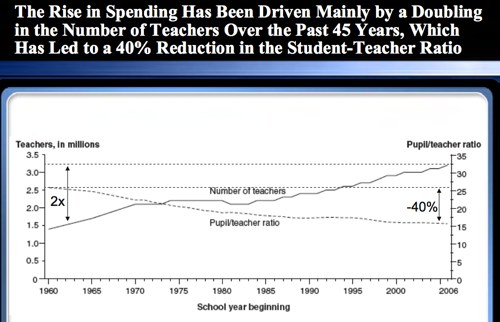
Zimman’s talk ranged far and wide. He discussed Wisconsin’s K-12 funding formula (it is important to remember that school spending increases annually (from 1987 to 2005, spending grew by 5.10% annually in Wisconsin and 5.25% in the Madison School District), though perhaps not in areas some would prefer.
“Beware of legacy practices (most of what we do every day is the maintenance of the status quo), @12:40 minutes into the talk – the very public institutions intended for student learning has become focused instead on adult employment. I say that as an employee. Adult practices and attitudes have become embedded in organizational culture governed by strict regulations and union contracts that dictate most of what occurs inside schools today. Any impetus to change direction or structure is met with swift and stiff resistance. It’s as if we are stuck in a time warp keeping a 19th century school model on life support in an attempt to meet 21st century demands.” Zimman went on to discuss the Wisconsin DPI’s vigorous enforcement of teacher licensing practices and provided some unfortunate math & science teacher examples (including the “impossibility” of meeting the demand for such teachers (about 14 minutes)). He further cited exploding teacher salary, benefit and retiree costs eating instructional dollars (“Similar to GM”; “worry” about the children given this situation).
Zimman noted that the most recent State of Wisconsin Budget removed the requirement that arbitrators take into consideration revenue limits (a district’s financial condition @17:30) when considering a District’s ability to afford union negotiated compensation packages. The budget also added the amount of teacher preparation time to the list of items that must be negotiated….. “we need to breakthrough the concept that public schools are an expense, not an investment” and at the same time, we must stop looking at schools as a place for adults to work and start treating schools as a place for children to learn.”
In light of this talk, It has been fascinating to watch (and participate in) the intersection of:

Several years ago, former Madison Superintendent Art Rainwater remarked that “sometimes I think we have 25,000 school districts, one for each child”.
I found Monday evening’s school board meeting interesting, and perhaps indicative of the issues Zimman noted recently. Our public schools have an always challenging task of trying to support the growing range of wants, needs and desires for our 24,180 students, staff members, teachers, administrators, taxpayers and parents. Monday’s topics included:

I’ve not mentioned the potential addition of 4K, high school redesign or other topics that bubble up from time to time.
In my layperson’s view, taking Zimman’s talk to heart, our public schools should dramatically shrink their primary goals and focus on only the most essential topics (student achievement?). In Madison’s case, get out of the curriculum creation business and embrace online learning opportunities for those students who can excel in that space while devoting staff to the kids who need them most. I would also like to see more opportunities for our students at MATC, the UW, Edgewood College and other nearby institutions. Bellevue (WA) College has a “running start” program for the local high school.

Chart via Whitney Tilson.
Richard Zimman closed his talk with these words (@27 minutes): “Simply throwing more money at schools to continue as they are now is not the answer. We cannot afford more of the same with just a bigger price tag”.
General Motors as formerly constituted is dead. What remains is a much smaller organization beholden to Washington. We’ll see how that plays out. The Madison School District enjoys significant financial, community and parental assets. I hope the Administration does just a few things well.

Share

10 online textbooks ready for use in California classrooms

Seema Mehta:

Painting online textbooks as a boon to student achievement and school district coffers, state Education Secretary Glen Thomas announced today that 10 free digital high school math and science textbooks are ready to be used in California classrooms.
The likelihood of students tapping them when schools open in a couple of weeks is slim, because of school districts’ textbook-adoption policies and teacher training needs, but Thomas said the move marks the first step in something that will revolutionize education in California.
“This is a groundbreaking initiative,” he told more than 100 representatives of schools, technology companies and others gathered at the Orange County Department of Education. “We think that technology is one of the ways to reform and improve education.”

Share

A Hard Lesson for Teachers

Dana Mattioli:

Widespread layoffs caused by tight school budgets are forcing thousands of teachers out of the classroom, in some cases, permanently. Many are taking other jobs or considering changing careers, even as they anxiously hope to be recalled.
When school begins this month, as many as 100,000 of last year’s teachers won’t have jobs, resulting in an overall drop in education jobs in the U.S., estimates Carmen Quesada, director of field operations for the National Education Association, the nation’s largest teachers’ union.
That’s a jolt to people drawn to teaching in part for its recession-proof reputation. The number of people working in local education has increased every year since 1983, according to the Bureau of Labor Statistics. That streak is now in jeopardy: Local schools employed fewer people overall, including nonteachers, in July, the latest month available, than in July 2008. The majority of the layoffs have involved nontenure teaching positions, with cuts determined by seniority.
Judith Franco is among those affected. She taught typing and business technology at Westglades Middle School in Parkland, Fla., for two years before being laid off in June–one of 394 teachers laid off by the Broward County Public Schools.

Share

Milwaukee boarding school plan revived, tweaked

Erin Richards:

When a proposal for a public boarding school in Milwaukee failed to win financial support from state lawmakers this summer, the concept of a college preparatory boarding school for local, urban teens appeared dead.
But now, Milwaukee Board of School Directors President Michael Bonds is reviving the idea, with a twist:
He wants to open a boarding school for 150 high school students next fall that would operate as a charter school by an organization other than MPS. The district would provide funding for the day school, while the charter school would handle the costs of supervision and instruction outside of normal academic hours.
“It’s an opportunity to provide at-risk kids an environment that’s conducive to learning,” Bonds said. “We would have to put out a (request) to see what kinds of proposals are out there. There may be models of boarding schools that are feasible academically and economically.”
Members of the School Board’s Innovation/School Reform committee will vote on Bonds’ boarding school resolution Tuesday. It would put the board on record for supporting the idea and ask for outside proposals.

Share

Secretary of Education Arne Duncan, educational kingmaker

Nia-Malika Henderson:

When Arne Duncan was the head of the Chicago public schools, one of the calls he dreaded most came from a certain federal bureaucracy — the Department of Education.
“It wasn’t a call about teaching kids to read,” Duncan recalled. “It was a call about a compliance report or something.”
Now Duncan sits atop the Education Department — meaning he’s the one making those calls to school systems across the country, hoping to reshape education and the role of the federal government in what traditionally has been a state and local effort.
With nearly $5 billion in stimulus funds at his disposal, Duncan has the chance to be a sort of educational kingmaker, doling out money to states as he sees fit. He’s also got something intangible but just as important — a close friend in the White House, in President Barack Obama.
And that’s a combination that some are saying could end up making Duncan the most powerful education secretary in the history of the job.

Share

Wealthy Suburbs Accept Low-Income Homes

Nick Timiraos:

Westchester County, a mostly affluent suburb outside New York City, agreed Monday to build hundreds of affordable housing units in heavily white communities, part of a settlement that could challenge other U.S. counties to expand housing for minorities.
The settlement with the U.S. Department of Justice and the Department of Housing and Urban Development ended a $180 million federal lawsuit brought by the Anti-Discrimination Center of Metro New York, a nonprofit housing group in New York, over Westchester’s responsibility to enforce fair housing laws.
Westchester, which runs along New York City’s northern boundary, will spend more than $50 million over the next seven years to build or acquire 750 homes, including at least 630 in cities with few minorities.
Federal housing officials portrayed the settlement as a warning sign they would step up enforcement on communities that accept federal money for housing redevelopment.

Share

Pilot math project involves SRI, USF and Helios Education Foundation

Tampa Bay Business Journal:

SunBay Digital Mathematics, a math education pilot project, began this week in Pinellas County.
The Helios Education Foundation and the Pinellas County School District are partnering with SRI International and the University of South Florida’s College of Education in a project to set the direction for middle school mathematics, a release said.
The one-year project involves 15 seventh-grade teachers in seven Pinellas schools. They will attend workshops and monthly meetings focused on using technology-based curriculum based on advanced math concepts.
The Pinellas Education Foundation is the fiscal agent for funding the project.

Share

Monona Grove School District “Tentative” Goals

Peter Sobol:

The board met 7/22 to discuss district goals for the coming year. The tentative goals, which we will be discussing at Wednesday’s board meeting are currently:
1) Achieve measureable increase in student achievement in core academic areas using these assessments: DIBELS, MAP , WKCE, EXPLORE, PLAN and ACT.
2) Develop measures ot assess student achievement in Encore areas and electives.
3) Align curriculum, instruction and assessment wiht standards/skill in core academic areas as defined by DIBELS, MAP , WKCE, EXPLORE, PLAN and ACT.
4) Close the achievement gaps with attention to race, ethnicity and socio economic status, using measureable assessments provide DIBELS, MAP , WKCE, EXPLORE, PLAN and ACT and reduce disproportionality with regard to placement of minority students in special edcuation.

Monona Grove School District.

Share

MPS struggling to create stable corps of principals

Alan Borsuk:

To be a successful principal, Julia D’Amato says, you need to be “a 29-baller.”
That’s someone who can juggle 29 balls at the same time, not dropping any of them. That’s what it feels like to run a school, says D’Amato, principal of Reagan High School, the south side school she has led from birth in 2003 to the top bracket of Milwaukee high schools now.
It’s hard to find people who can juggle like that.
And it’s hard for Milwaukee Public Schools to find top-notch people to lead approximately 200 schools.
As a new school year approaches, MPS is struggling with creating a strong, stable corps of principals. How so?
More than 20% of elementary and kindergarten-through-eighth-grade schools have someone different at the helm now than a year ago, and turnover in recent years has, in general, been high. MPS officials say there are 58 principals with three years of experience or less, almost one-third of the total.

Share

$11,654,078 Additional Madison School District Spending Via the Federal Taxes & US Treasury Borrowing (“Stimulus”)

Madison School District Superintendent Dan Nerad [838K PDF]:

As part of Federal Stimulus funding iliat will be made available the district will receive American Recovery and Reinvestment Act (ARRA) funds to be used over a two year period.
These funds are in IDEA, IDEA EC and Title 1.
Program Costs/FundingiConsultation Service Employment Contract
The district has prepared a two year funding proposal along with a budget analysis for 2009-10 and 2010-11 for each of the sources for your review. The proposal amounts are as follows:
IDEA – $6,199,552
IDEA EC – $293,082
Title I – $5,161,444
Salary Savings
The funding proposals would increase FTE’s and include funding sources during the two year period of the ARRA funds

The proposal includes quite a bit of professional development, such as $400,000 for dual language immersion, $1.48M for 4K staff and $456,000 for 4K furniture and $100,000 for talented & gifted assessment.
Plan B, without 4K spending, includes $1,150,000 for professional development in the following areas: Topics include universal design, differentiation, mental health,
inclusive practices, autism, and quality IEPs.

Share

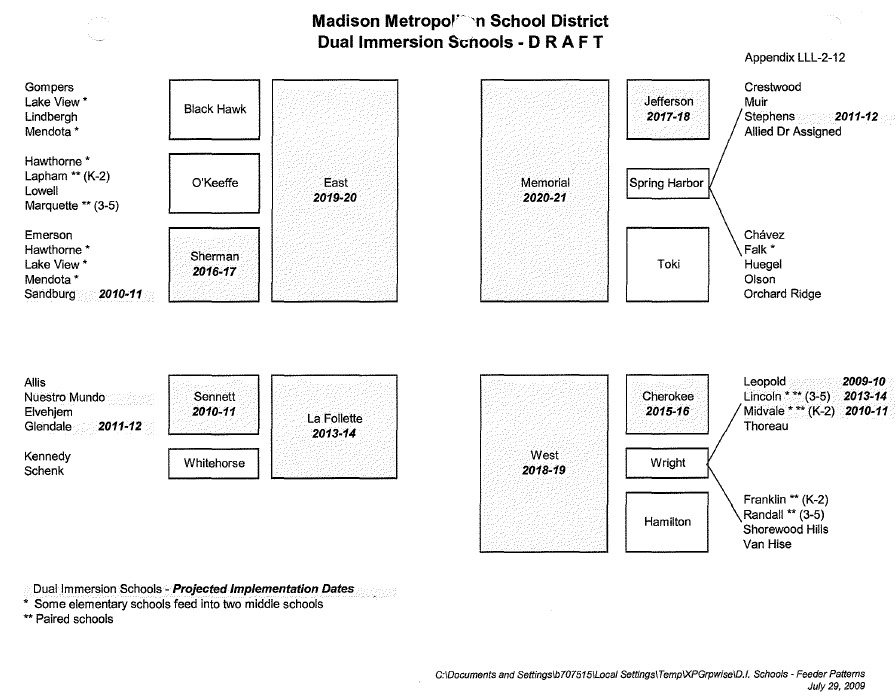
District Wide Dual Immersion Proposal for the Madison Public Schools

Click for a larger version, or download one page pdf document here.

Fascinating.

Share

Property Tax Implications of the Madison School District 09/10 Budget Deficit

Madison Superintendent Dan Nerad [100K PDF]:

The 2009-11 State of Wisconsin Biennial budget created two issues for the Madison Metropolitan School District as it relates to the 2009-10 budget. The two main issues are from a reduction in the amount of revenue the school district is projected to receive in 2009-10 and a reduction in the amount of state aid the school district is projected to receive in 2009-10.
The amount of revenue the district is projected to lose amounts to $2,810,851 for the 2009-10 school year compared to the preliminary budget approved by the board of education, This amount is due to the decrease in numerous categorical aids the school district receives annually and the reduction of the per pupil increase from $275 per child to $200 per child.
The amount of state aid the school district is projected to lose is in 2009-10 is approximately $9.2 million, Under current revenue limit laws, for every dollar of state aid lost, the school district would have the ability to increase taxes by that same amount. Over the past month, administration has worked to mitigate the tax impact due to the loss in state aid.

Share

KIPP 15th Anniversary Gala Photos, Videos, Notes & Links and The Case for School Reform

Knowledge is Power Program

Share

A middle school for the artist

Jessica Jordan:

An educational dream pitched by three Hall County teachers takes flight Monday when 120 students and six teachers come together for the first day of school at the da Vinci Academy.
The pilot program provides innovative learning opportunities for gifted students with a penchant for the arts and sciences. But that’s only half of the reason it’s making a splash with educators across the Southeast. The program also will operate at about 60 percent to 70 percent of the cost per student compared to a traditional middle school, Hall County school Superintendent Will Schofield said.
Though states have made unprecedented cuts to public school funds, educators are trying to make the most of every penny while pushing programs that engage students and get results.
Schofield said the da Vinci Academy is a great example of how schools can do more with less.
“I think it truly is some Renaissance thinking is these difficult times,” he said. “It’s the exciting side of chaotic and difficult times.
That’s when you see the best in people and that’s when you see the worst in people, and I think what we’re seeing is the best in terms of innovative thinking, new ways of doing something that we’ve done the same way for a long time.

Share

Madison School District Elementary Math Curriculum Purchases

Superintendent Dan Nerad [64K PDF]:

MMSD has begun a three-year implementation plan to achieve an equitable and balanced mathematics program at tbe elementary level. The plan was developed and refined through collaboration with teachers, Instructional Resource Teachers and principals over the course of the past several years. The plan includes the materials described below (details via this 64K PDF),
With the attached order, MMSD has provided each classroom teacher in the District with a Learning Mathematics in the Primary/Intermediate Grades instructional guide and the set of teacher resources from the Investigations program. The third component of the teacher materials is Teaching Student Centered Mathematics by John Van de Walle, which is in place in most classrooms but will continue to be ordered using ELM or Title I funds, as necessary. Additional professional resources have been or are being purchased at the building level to create a library available for all staff to access as needed. Those resources include Primary Mathematics textbooks and teacher guides, Thinking Mathematically and Children’s Mathematics by Thomas Carpenter, Teaching Number series from Wright, among other recommended titles.
MMSD has provided all Title I schools with the Primary Mathematics (Singapore) workbooks and Extra Practice workbooks for the 2009-2010 school year. All manipulatives have been ordered for Title I schools over tbe past two years and are in place. Non-Title I schools have been and will continue to use ELM funds to purchase tbe student components for the implementation of a balanced mathematics classroom.

Related:

Share

As Classrooms Go Digital, Textbooks Are History

Tamar Lewin:

At Empire High School in Vail, Ariz., students use computers provided by the school to get their lessons, do their homework and hear podcasts of their teachers’ science lectures.
Down the road, at Cienega High School, students who own laptops can register for “digital sections” of several English, history and science classes. And throughout the district, a Beyond Textbooks initiative encourages teachers to create — and share — lessons that incorporate their own PowerPoint presentations, along with videos and research materials they find by sifting through reliable Internet sites.
Textbooks have not gone the way of the scroll yet, but many educators say that it will not be long before they are replaced by digital versions — or supplanted altogether by lessons assembled from the wealth of free courseware, educational games, videos and projects on the Web.
“Kids are wired differently these days,” said Sheryl R. Abshire, chief technology officer for the Calcasieu Parish school system in Lake Charles, La. “They’re digitally nimble. They multitask, transpose and extrapolate. And they think of knowledge as infinite.

Share

Oregon’s a slow starter in race to better schools

The Oregonian:

Public school systems, like cross-country teams, are only as good as their slowest runners.
Oregon has to remember that as it toes the starting line in the Race for the Top, a competition for $4 billion in stimulus money the Obama administration is offering to states that demonstrate they are ready to adopt serious school reforms, and run with them.
As hard as it is to admit, that doesn’t sound much like Oregon. This is a state where the Democratic Legislature, urged on by the state teachers union, just passed a law blocking the expansion of popular virtual charter schools. It’s a place where charter schools, performance pay for teachers and other reforms strongly supported by President Obama and his education secretary, Arne Duncan, are disdained by most of the educational establishment.
Yes, there are Oregon schools, and some entire districts, doing creative, impressive things. The Oregonian’s Betsy Hammond last week described the tremendous effort by teachers and administrators that led Clackamas High School to become the largest high school in Oregon to reach every federal performance target. There are many other pioneering, innovative efforts in places such as Redmond, Forest Grove, Sherwood, Beaverton and Tillamook

Share

Who’s holding royal flush in MPS superintendent search?

Alan Borsuk:

The Milwaukee School Board took its stand last week on how it will play Superintendent Draw, the big-time game of poker coming up for Milwaukee schools:
With a lot of money in the pot and the usual players at the table.
But the politics and atmosphere surrounding the search for a school chief could be overshadowed by an even bigger and more colorful game: MPS Hold ‘Em, in which the battle is over who calls the shots when it comes to directing the state’s largest and most challenging school system.
MPS Hold ‘Em has been brewing for months, particularly since the release of a consultant’s report in April that described MPS as a poorly run business. That triggered talk of a mayoral takeover of MPS or other changes in the system.
Now it is shaping up that MPS Hold ‘Em will either come to a head soon or the game will cease for at least the foreseeable future.
Why is MPS Hold ‘Em linked to Superintendent Draw? Two reasons:

Share

The fruitful alliance of Arne Duncan and Rupert Murdoch

Elizabeth Green:

The New York Post patted its own back today, hard, for helping the state renew the mayor’s control of the public schools. The surprising thing is that Secretary of Education Arne Duncan joined in, thanking the newspaper, owned by the ambitious Rupert Murdoch, for its “leadership” and “thoughtfulness.”
New York City newspapers have a proud tradition of waging campaigns both on and off the editorial page, and then congratulating themselves when they hit their marks. But having a cabinet member for a sitting president join the cheering is more unusual.
“I think that must be out of context, that Arne Duncan is giving the Post credit for mayoral control,” the president of the principals’ union, Ernest Logan, said when I called to ask his impression.
Richard Colvin, who directs the Hechinger Institute for education journalism at Columbia University, said he found the whole news story baffling. “It reads like nothing I’ve ever seen. It reads like the worst kind of back-patting, self-congratulatory press release that has no perspective whatsoever,” he said.

Share

Madison Public Schools’ Arts education gets needed support

Anne Katz & Barbara Schrank, co-chairwomen, MMSD Arts Task Force, via a kind reader’s email:

Kudos and thanks to the Madison School District Board of Education and Superintendent Dan Nerad for their support of arts education opportunities for all students, with additional thanks to members of the Arts Education Task Force.
The task force of art teachers and citizens has worked since 2007 with Board members and administrative and teaching staff on a plan that supports, enhances and sustains arts education in Madison’s public schools. The Board approved the plan on July 20.
In adopting the plan, the Board showed support of the arts as a priority for a quality public education.
The process took hard work by committee members, administrative and teaching staff and input from over 1,000 community members who have been thoughtful, inquisitive and dedicated to nurturing students’ talent and creativity through the arts. These plans will move forward with leadership, support and a strong partnership between the district and the community.
We are proud to live in a community with educational leaders who understand that arts and creativity are essential components of a 21st century education.

Share

1 Year Summary of Madison’s Implementation of “Standards Based Report Cards”

Notes and links on “Standards Based Report Cards” here.

Share

Proposed Madison School District Talented & Gifted Plan

Madison School District Superintendent Dan Nerad’s memo [100K PDF] on the Proposed Talented & Gifted Plan [1.2MB PDF]:

Background
Wisconsin Administrative Rule 8.01 (2)(t)2 states that each school district shall establish a plan and designate a person to coordinate the gifted and talented program. The previous Talented and Gifted (TAG) Plan approved by the Madison Metropolitan School District (MMSD) Board was in 1991. 2008-09 highlighted several independent yet related events which served to underscore both the urgency of and District-wide benefit for an updated Plan. Among the events that converged to result in the need to update the Talented and Gifted Plan were:

  • Superintendent Dr. Daniel Nerad was hired in July 2008. Dr. Nerad recognized the need for addressing the issues related to Talented and Gifted programming;
  • The last TAG Plan (1991) approved by the District was found by the DPI to be out of compliance;
  • An increase in open enrollment leaving the District spurred conversation regarding strategies to attract and retain students;
  • Families leaving the District were surveyed to gather information regarding their reasons for leaving MMSD. A desire for improved Talented and Gifted programming was one of several emerging themes; and
  • A new Strategic Plan was developed through extensive community involvement. The Strategic Plan clearly demands a rigorous and challenging education for all students.

Process In response to the events described above, the Superintendent charged the Teaching & Learning TAG Division to develop a process to create an updated Plan. The TAG Division met on a regular basis to define major areas for improvement in alignment with the National Association for Gifted Children standards. A Talented and Gifted Advisory Committee comprised of 30 members was convened in early spring. This group met five times between February and June to provide input and critique the evolving draft. The Superintendent and TAG Coordinator hosted a community input session on March 26. Senior Management, Instructional Council and Principals reviewed drafts and provided input. In order to ensure a timely and high quality Plan, a subcommittee of the Talented and Gifted Advisory Committee was invited to continue to work with TAG staff to complete the Plan during June and July.
There have been significant challenges in the process leading to the development of the enclosed plan. These challenges include communication, changes in leadership and an evolving level of District and community trust in MMSD’s commitment to providing high quality education for all stUdents. Overcoming these challenges is an on-going process, one captured in the language of the plan with respect to continual improvement. Although there are aspects of current MMSD talented and gifted programming that are sound and valued, the need for overall structural improvements and re-vitalization is recognized byal!.
In addition to the TAG Division staff, we sincerely appreciate the members of the TAG Advisory Committee for their extraordinary gift of time and dedication toward creating this plan. Special recognition goes to TAG Advisory Subcommittee members Kerry Berns, Bettine Lipman, Laurie Frost, Chris Gomez Schmidt and Carole Trone for their continuing support and input through the final draft of this plan.
MMSD Strategic Planning The enclosed TAG Plan aligns, supports and strengthens important aspects of the Strategic Plan. In particular, the TAG Plan undergirds District-wide efforts to: enhance assessments to guide appropriate levels of instruction; accelerate learning for all students; embed differentiation as core practice in all classrooms; and map and develop a comprehensive and articulated curriculum K-12 in order to increase curricular rigor for all students.
Executive Plan Summary Based upon the framework set forth by the National Association for Gifted and Children standards and areas identified by MMSD for improvement, eight key goal areas addressed in this Plan are:

(more…)

Share

Charter Schools Eschew Teacher Tenure

Danielle Williamson:

The agreement between teachers and management at the North Central Charter Essential School is similar to one that may be found at almost any traditional public school. There is a salary scale with lanes and steps, and stipends for extra duties. Some teachers serve as representatives for the larger group in a “collaborative bargaining process.”
Absent from the school’s teachers’ employee handbook, however, is a clause that gives veteran teachers job protection. “Professional status,” more commonly known as tenure, doesn’t exist there. Everyone is an employee at will, and a teacher of 10 years can be dismissed as easily as a first-year educator.
“If a teacher is not a fit, we have to be honest about that,” said Patricia May, principal of the Fitchburg school. “That’s not working for anybody.”
Having no union affiliations appears to be working for the area’s charter schools. Despite a full-court press from the state’s second largest teachers union, charter schools in Central Massachusetts haven’t hopped onto the union bandwagon. Statewide, only one charter school has signed up with the American Federation of Teachers in the two years the organization has been approaching charters, which are publicly financed but operate outside of school districts.

Share

Confucianism at large in Africa

Bright B Simons:

A features writer for the Economist once insisted that the Mandarin character for Africa means “wrong continent”. This is perhaps because there is a perception that the teachers have frequently been wrong-headed about Africa, and have tended to get it wrong whenever they have moved out of their comfort zones in trading and infrastructure development.
Such a view is not entirely right, and China has in recent years taken great pains to show the world that it is a well-rounded emerging power with a complete strategy for engagement in places like Africa.
Its Confucius institutes are an interesting feature in this show of sophistication. The Hanban – the Chinese National Office for teaching Chinese as a Foreign Language – began spreading them from 2004 when it set up the first one in the South Korean capital of Seoul.
Top Chinese officials have made no effort to disguise the propaganda value they perceive in the spread of the institutes, but so far very little in the way of a coherent strategy has emerged as to how they can be integrated into the mainstream of Chinese foreign policy, which nowadays is driven, as everyone knows, by a mercantilist view of global politics and economics. Africa has not been spared this ambiguity.

Share

‘Obama Effect’ at school: Black parents volunteer, expect more

Greg Toppo:

A new survey suggests that President Obama’s victory last November had a positive effect not just on the academic expectations of black Americans — it may have raised parents’ interests in volunteerism.
The “Obama Effect,” documented last winter, showed that Obama’s rise during the 2008 presidential election helped improve African Americans’ performance on skills tests, which helped narrow a black-white achievement gap.
In the new findings, African-American parents of children in K-12 schools say they’re much more likely to volunteer in a classroom this fall, in effect narrowing a volunteering gap.
The survey, being released today by GreatSchools, a San Francisco non-profit that promotes parental involvement, finds a jump of 37 percentage points in the portion of African-American parents who say they’ll volunteer in their child’s school — 60% vs. 23% a year ago.

Share

Milwaukee Public Schools targeted in complaint over instruction of English as second language

Georgia Pabst:

Milwaukee Public Schools is not complying with civil rights law in effectively teaching English to Spanish-speaking students, according to a federal complaint filed by the League of United Latin American Citizens of Wisconsin.
The complaint, filed at the Office of Civil Rights in the U. S. Department of Education office in Chicago, claims MPS and the Milwaukee School Board are not complying with the Civil Rights Act.
The district receives federal funds for teaching English to students who speak another language, and the U.S. Supreme Court has ruled that school districts must help such students overcome language barriers so they can succeed in all of their classes, said Darryl Morin, state director of LULAC.
“LULAC of Wisconsin has serious concerns regarding the education theory, programming and resources allocated to these efforts at MPS,” he said.
Morin said MPS has used uncertified and unqualified teachers in the program.
The U.S. Department of Education confirmed that its Office of Civil Rights has received the complaint. Jim Bradshaw, a spokesman for the department in Washington, D.C., said the office is evaluating the complaint to determine whether an investigation is appropriate. The evaluation process should take about a month, he said.
MPS spokeswoman Roseann St. Aubin said district officials can’t comment because they just received the complaint Tuesday and have not reviewed it.

Share

Michelle Rhee: Partnering With City Year DC to Tackle Dropout “Catastrophe”

Alice Korngold:

Washington, D.C.’s public school system has 45,000 students and an abysmal dropout rate of about 50%, typical of large cities. With a goal to remedy this dropout “catastrophe” (Gen. Colin Powell’s term), while being constrained by a tight economy, D.C. Chancellor Michelle Rhee is looking to–in her words–“leverage opportunities for the greatest change.”
To this end, Rhee believes that one of the best investments that D.C. Public Schools (DCPS) has made in the past year is its partnership with City Year DC. In 2008/09, City Year corps members proved themselves in a pilot program in 4 of Washington’s most challenging elementary schools.
Jeff Franco, Executive Director of City Year DC explained that “we offered to help the Chancellor to solve her worst headaches.” After rigorous training, corps members coached, tutored, and mentored children in grades K to 2, and successfully demonstrated that they could help improve children’s reading ability. This achievement will be instrumental in changing the life trajectory of these kids–ultimately increasing the likelihood that they will graduate from high school, go to college, and later, earn greater incomes.
“I’ve been thrilled with the results of this first year,” Rhee told me. So thrilled that she and Franco plan a “feeder pattern” strategy to have corps members continue working with these same children all through elementary school, middle school, and high school, while also expanding City Year’s involvement with additional schools. The end game: reduce the dropout rate.

Share

Fixing D.C.’s Schools: The Charter Experiment

Dan Keating & Theola Labbe-DeBose:

A 2008 Post review finds that charter schools are outperforming public schools.

NPR:

As part of the program’s ongoing series focusing on education, host Michel Martin talks to Kavitha Cardoza, a reporter for NPR member station WAMU-FM in Washington, D.C.
Cardoza explains a significant development in the education world: recent test scores of public school children in the nation’s capital notably surpassed their charter school counterparts, adding yet another layer to the national debate on the value of charter schools vs. public schools.

Share

Scholarships 101: How to fund an education after high school

Marnie Ayers:

Getting an education is vital to financial stability and future success but the cost of education beyond high school continues to rise. Luckily Federal Student Aid offers financial aid programs that help millions of students attend college, universities and trade schools each year.
The billions of dollars of help from Federal Student Aid is administered by the U.S. Department of Education and comes in the forms of grants such as the Pell and National SMART Grant and work-study and low interest loans such as the Federal Perkins Loan and the Stafford Loan. Some grants require a cumulative GPA of 3.0 while loans have interest rates around 5%.
Each year, millions of students benefit from federal financial aid programs. For information on programs you might qualify for visit FederalStudentAid.ed.gov or call 800-4Fed-Aid. Applying for federal aid is free and the application is called FAFSA (Free Application for Federal Student Aid). Free help is available throughout the application process. The College Scholarship Fraud Protection Act protects people from financial aid fraud.

Share

Internal NEA Report on Performance Pay Calls for “Creating a Positive

Mike Antonucci:

ver since candidate Barack Obama began promoting the concept of performance pay in 2007, the National Education Association has labored to generate a coherent strategy to stay ahead of the issue. The union realizes a consistent “no, no, no” may be satisfying and direct, but is harmful to its public image and its relationship with moderate Democrats and Republicans alike.
Last year, NEA assigned its teacher quality department to visit six locations that had established alternative compensation models and to interview union officers, members and staff to determine the lessons and pitfalls of various approaches. The results were compiled in a 51-page report (labeled “Not For External Distribution” and “intended for NEA leaders and staff only”) titled Alternative Compensation Models and Our Members. I have uploaded the document to EIA’s Declassified page.
The six locations were the local school districts of Denver and Eagle County, Colorado, Hamilton County, Tennessee, Helena, Montana, and Manitowoc, Wisconsin, along with the state of Minnesota, which has its statewide Q Comp program.
Reactions to the programs were all over the map, with some teachers loving the new system and others hating it, but a few common sentiments were expressed. The most important of these was the lack of simplicity. Many teachers didn’t understand exactly how their pay or bonuses were being generated and were forced to trust the district administrators to correctly apply and compute the pay. This is problematic for a lot of reasons, not the least of which is knowing how much should be in your check each pay period. This complexity makes the clarity of the traditional salary schedule more appealing by comparison.

Share

Duncan Wields $100 Billion to Make U.S. Schools Like Chicago’s

Molly Peterson:

Sue Duncan has taught poor kids at her after-school center on Chicago’s South Side for 48 years. She says her son Arne spent seven days a week there as he was growing up.
“It was absolutely formative,” Arne Duncan, 44, said of working with his mother. He learned that “kids from totally dysfunctional home situations, total poverty, can do extraordinarily well if we give them a chance.”
What he absorbed matters because Duncan is now U.S. education secretary, in charge of improving a public school system that ranks below those of other developed nations in some studies. He’s armed with $100 billion in stimulus money from his friend, President Barack Obama, more than twice the budget of any of his predecessors.
“We want to put unprecedented resources out there, but the tradeoff is unprecedented reform,” said Duncan, who ran Chicago’s public schools before taking on the U.S. job in January. He said in an interview he wants to “fundamentally change the status quo” by raising academic standards, holding states and schools more accountable, and luring “the best and the brightest” into teaching.

Share

Hawaii schools’ failure to meet benchmarks troubles officials

Loren Moreno:

ducation officials have few explanations for what they consider to be a disturbing trend — year after year Hawai’i’s high schools struggle to make “adequate yearly progress” under the federal No Child Left Behind law.
Just three of Hawai’i’s 33 regular public high schools were able to demonstrate sufficient progress under the federal mandate this year: Campbell, Kaiser and Kalani.
“It’s a multitude of reasons. One is the rigor of the federal mandate. But also, in high school, kids are dealing with a lot of different issues,” said Gerald Teramae, principal of Kalani High School. “It’s tough. The kids are older, they have different agendas.”
While Kalani was one of the high schools to make AYP this year, that doesn’t mean the school is not struggling under the federal law, Teramae said.
Ninety percent of Kalani’s students demonstrated proficiency in reading, but only 48 percent of its students demonstrated proficiency in math concepts. That’s just two points above the state mandated benchmark of 46 percent.

Share

What have private schools done for (some of) us?

Royal Statistical Society: Significance:

Many parents in Britain make huge financial sacrifices to send their children to private schools. Are those sacrifices worthwhile? What return, if any, do they get? Do their children end up in better careers, earning more, than if they have been educated at the expense of the state?Francis Green, Stephen Machin, Richard Murphy and Yu Zhu examine who exactly benefits from the privileges of the Old School Tie.

Via Mrs. Moneypenny.

Share

Breakthrough Cincinnati:

Believing in the Power of Young People:

Breakthrough Cincinnati is a four year, tuition free academic enrichment program that offers both summer and school year programs for under-served Cincinnati public middle school students. Breakthrough students apply in the fifth grade (sixth and seventh graders are welcome to apply, but spots are limited) and attend through the summer preceding their 9th grade year.
School Year Program
Starting in the fall of 2009, Breakthrough Cincinnati will be offering twice a week tutoring, homework help and academic enrichment lessons for all students who participated in the Summer Academic Session. Breakthrough Cincinnati is actively recruiting talented high school and college students to serve as teachers in this program. Please click on the link on the left-hand side of this page for more information on the school year program, including teacher application forms.
In addition, Breakthrough Cincinnati will be hosting a High School information Night and a Reunion Party in the fall. Information on these events will be mailed home and posted on the News and Events section of this web-site as it becomes available.

Share

Federal Tax Receipts Decline 18%, Dane County (WI) Tax Delinquencies Grow

Stephen Ohlemacher:

The recession is starving the government of tax revenue, just as the president and Congress are piling a major expansion of health care and other programs on the nation’s plate and struggling to find money to pay the tab.
The numbers could hardly be more stark: Tax receipts are on pace to drop 18 percent this year, the biggest single-year decline since the Great Depression, while the federal deficit balloons to a record $1.8 trillion.
Other figures in an Associated Press analysis underscore the recession’s impact: Individual income tax receipts are down 22 percent from a year ago. Corporate income taxes are down 57 percent. Social Security tax receipts could drop for only the second time since 1940, and Medicare taxes are on pace to drop for only the third time ever.
The last time the government’s revenues were this bleak, the year was 1932 in the midst of the Depression.
“Our tax system is already inadequate to support the promises our government has made,” said Eugene Steuerle, a former Treasury Department official in the Reagan administration who is now vice president of the Peter G. Peterson Foundation.

Channel3000.com recently spoke with Dane County Treasurer Dave Worzala on the growing property tax delinquencies:

While there aren’t any figures for this year, property tax delinquencies have been on a steep climb the last few years, WISC-TV reported.
Delinquencies increased 11 percent in 2006, 34 percent in 2007 and 45 percent in 2008, where there is now more than $16 million in unpaid taxes in the county.
“It affects us in that we have to be sure that we have enough resources to cover county operations throughout the year even though those funds aren’t here. And we do that, we are able to do that, but 40 percent increases over time become unsustainable,” said Dane County Treasurer David Worzala.
“I can see that there are probably some people that either lost their jobs or were laid off, they’re going to have a harder time paying their taxes,” said Ken Baldinus, who was paying his taxes Thursday. “But I’m retired, so we budget as we go.”
Big portions of those bills must go to school districts and the state. Worzala said the county is concerned about the rise in delinquencies because if the jumps continue the county could run into a cash flow issue in paying bills.

Resolution of the Madison School DistrictMadison Teachers, Inc. contract and the District’s $12M budget deficit will be a challenge in light of the declining tax base. Having said that, local schools have seen annual revenue increases for decades, largely through redistributed state and to a degree federal tax dollars (not as much as some would like) despite flat enrollment. That growth has stopped with the decline in State tax receipts and expenditures. Madison School District revenues are also affected by the growth in outbound open enrollment (ie, every student that leaves costs the organization money, conversely, programs that might attract students would, potentially, generate more revenues).

Share

Dumb Money Too many nations are wasting their school spending. Here’s how to get it right.

Stefan Theil:

“If we want to become a strong economy again, the best thing we can do is have an educated workforce.” Few would object to U.S. Secretary of Education Arne Duncan’s explanation of why Washington is funneling $100 billion to schools and universities as part of February’s giant stimulus package. Indeed, other countries are following suit, with Britain, Germany, Canada, China, and others making new education funding part of their anticrisis strategies.
What’s far less clear is that this money is going where it’s most needed–or likely to have the greatest social and economic payoff. In Germany, the bulk of nearly €10 billion in new school spending is being used to renovate buildings–a bonanza for construction companies and popular with parents and teachers, but unlikely to have much effect on the quality of German graduates. In Britain, Prime Minister Gordon Brown is pushing for more PCs and Web access in schools–another policy that’s popular but considered irrelevant by educators. In the United States, a July audit by the Government Accountability Office found that schools were not using the stimulus money to boost student achievement, as promised by Duncan, but to fund their general budgets. And in still other countries, governments are using money to help build new world-class universities–projects that a World Bank study in July warned risk bleeding resources away from more desperately needed areas. “I’m not sure that the people making these decisions even realize the trade-offs involved,” says Jamil Salmi, author of the study.
That’s particularly unfortunate today, given the economic stakes. According to an April report by McKinsey, the United States’ GDP would have been 9 to 16 percent–or $1.3 trillion to $2.3 trillion–higher in 2008 had U.S. high-school graduates attained the average skills of their peers in Canada, Finland, or South Korea. This fall, the Organization for Economic Cooperation and Development (OECD) will unveil a similar study in Paris detailing the losses suffered by other laggards. Andreas Schleicher, author of the OECD study, says that “in a whole row of countries, the economic losses of educational underperformance are significantly higher than the costs of the financial crisis.” What’s worse, he says, countries pay the price for their mistakes year after year.

Share

Minnesota Teachers Now Have New Opportunity to Start and Run District Schools

Teacher Partenerships:

eacher professional partnerships (TPPs) are formal entities, organized under law (partnerships, cooperatives, limited-liability corporations, etc.), that are formed and owned by teachers to provide educational services. TPPs may enter into contracts to manage entire schools, a portion of a school or to provide some other educational service. Teachers are in charge and they manage or arrange for the management of the schools and/or services provided. The school district is not managing the school; nor is a district-appointed single leader in charge (e.g. a principal).

Share

A Chance to Say Yes The GOP and Obama Can Agree on School Reform

Richard Bond, Bill McInturff & Alex Bratty:

Many issues have created a “politics as usual” atmosphere on Capitol Hill recently, but when it comes to educating our children, it appears President Obama and the Republican Party share some views. This commonality of interest provides the president and the GOP a rare opportunity to cooperate on a major issue.
In a March address on education, the president proposed several reforms, three of which the Republican Party has been championing for years.
First, he called for merit pay for teachers:
“Good teachers will be rewarded with more money for improved student achievement, and asked to accept more responsibilities for lifting up their schools.”
Next, he called for removing ineffective teachers:
“Let me be clear: If a teacher is given a chance . . . but still does not improve, there is no excuse for that person to continue teaching. I reject a system that rewards failure and protects a person from its consequences.”
Finally, he called for the expansion of public charter schools:

Share

Time for Oregon schools to stretch

John Tapogna:

Will Oregon be among the recipients of the Race to the Top Fund, $4 billion in stimulus package money that the Obama administration has set aside to encourage new ways of teaching?
Lost in the clatter of the health-care debate, President Obama quietly launched his plan to transform America’s schools in late July. Fed up with sluggish learning gains and stubborn gaps in achievement between rich and poor kids, the administration has leveraged the stimulus package to create several well-endowed venture funds aimed at entrepreneurial states, school districts and nonprofits eager to test new ways of teaching.
The grand prize is the Race to the Top Fund, $4 billion being dangled in front of perhaps as few as a dozen states. The prospect of being among this elite group of innovators has unleashed a cascade of legislation across the country as lawmakers scrambled to align state laws with the Obama vision. Already the fund has altered the K-12 landscape before it’s awarded a single dollar.

Share

The Tradeoff Between Teacher Wages and Layoffs to Meet Budget Cuts

Marguerite Roza via a Deb Britt email:

School districts faced with large budget gaps could avoid some or all teacher layoffs by rolling back salaries. While this option may not work for all districts, a new analysis shows that district officials–and teachers unions–could both serve students and teachers by trimming classroom pay.
Marguerite Roza based her analysis on the fact that 93 percent of school districts in the U.S. negotiate and structure teacher-pay according to a fixed salary schedule, consisting of annual as well as step increases. Step increases average 3.16 percent a year. The annual increase for the salary schedules she calculated at the average Consumer Price Index (CPI) for the 1997–2007 period at 2.87 percent. The total for the two, at 6.03 percent, may not make sense this year, says Roza.
In a simple chart, she provides five possible decision-options showing how, if salaries are rolled back, fewer teachers get laid off and class sizes increase by fewer students.

Share

Online education comes into its own

Carol Lloyd:

As the job market grows softer and less nourishing than a jelly doughnut, reports show more people are returning to school to immunize their careers and feed their souls. But “school” is not necessarily the idyll of leafy campuses and long afternoons arguing philosophy in oak-paneled rooms.
Online education, long an ugly duckling of the ivory towers of the world, is coming into its swan years.
In its annual report on the state of online education, the Sloan Consortium reported in 2008 that online education continues to grow at a much faster rate than its brick-and-mortar competitors. Anecdotal evidence suggests that 2009’s economic woes will only accelerate the pattern.
“We have seen our small university double in size this year,” says Scott Stallings, director of marketing and admissions for California InterContinental University, a for-profit “distance education” university in Diamond Bar (Los Angeles County). “I believe this can be attributed to our low cost of tuition and the large influx of students who need their degrees to remain competitive.”

Share

Wisconsin Governor Doyle going after student performance, federal money

Mark Pitsch:


Gov. Jim Doyle is planning a series of education reforms designed to boost student achievement and help the state compete for billions of dollars in federal school improvement grants.
The changes include better tracking of student performance, using test data to help evaluate teachers and raising high school graduation requirements.
“We’re going to be working very hard in my administration with the Legislature, with educators in the state, to put together really, I think, a transformational application that will help Wisconsin education for years to come,” Doyle said in a recent interview.
But it’s unclear whether the state would even qualify for the federal money — part of a $4.35 billion program dubbed “Race to the Top” — because of a state law that bars using student test scores to evaluate teachers.
Draft rules for the program prohibit states that have such laws in place from receiving the money. Secretary of Education Arne Duncan last week called Wisconsin’s law “ridiculous.”

Wisconsin Representative Mike Huebsch:

Cut education funding by 3 percent. Check.
Make sure teachers’ raises aren’t jeopardized by the cuts. Check.
Pretend property taxes won’t go up. Check.
Begin dismantling Wisconsin’s School Choice Program. Check.
Jeopardize Wisconsin’s eligibility for new federal education funding. Check.
This is the state of public education in Wisconsin under the leadership of self-proclaimed education governor Jim Doyle and Democrat majorities in the state Senate and Assembly.
Governor Doyle and Democrat lawmakers wrote a state budget that cuts school funding $294 million, raises property taxes $1.5 billion, repeals the Qualified Economic Offer, says local school boards can’t consider the recession, job loss rates, and property values when negotiating teacher compensation and makes politically-motivated changes to the Milwaukee Parental Choice Program (School Choice).
Now the governor shrugs off reports that Wisconsin won’t be eligible to participate in the Obama Administration’s Race to the Top grant program, while Democrat lawmakers remain predictably silent. Approximately $4.35 billion will be doled out to states with plans for reforming public education. Under the proposed application guidelines released by the United States Department of Education last week, only Wisconsin, New York and California would be barred from receiving federal funds.

Share

School spotlight: Summer program combines science and black history

Pamela Cotant:

For the last 14 years, a summer program has found a way to make learning about a particular area of science fun while also exposing elementary and middle school students to blacks who have made a difference in that field.
This year, flight was the theme for the program, called a Celebration of Life. In general, about two-thirds of those in attendance are returning participants like Synovia Knox, who also had four siblings who attended.
“Each year I would leave wanting to be someone else,” said Knox, who has attended since third grade. “They just make everyone seem so interesting.”
The annual event is one of the programs put on by the African American Ethnic Academy of Madison. The site of the program and its co-sponsor is the BioPharmaceutical Technology Center Institute, the non-profit affiliate of Promega, which offers the use of its Fitchburg facilities.
The program, which is held during the morning for two weeks, is divided into two sessions — one for students entering grades three through five and another for students going into grades six through eight. A total of 28 students attended this year and the organizers hope the numbers will grow, said Barbara Bielec, who helps run the Celebration of Life as the K-12 program coordinator for the BioPharmaceutical Technology Center Institute.

Promega offered the Madison School District free land in the mid-1990’s for a tech oriented Middle School. The offer was turned down and the proposed school eventually became Wright Middle School.

Share

Rent, Read and Return

Stephanie Lee:

Students frequently rent DVDs to watch in their dorm rooms, but soon they may start checking out something much heavier and pricier: textbooks.
Saying they offer an alternative to the textbook industry’s bloated prices, a growing number of companies are renting new and used titles at reduced prices. Among them are Chegg, BookRenter and the Follett Higher Education Group, which will test drive a rental service at campus bookstores this fall. They join a number of colleges that have already started their own on-campus programs.
With all of them, the concept is essentially to pay to check out textbooks as if they’re out of a library — only there are more copies and titles, and they can be used for longer periods of time. Through Chegg, for instance, a student searches for a book and rents it for up to a certain number of days, such as up to a quarter or a semester. Users are promised discounts of 65 to 85 percent off the list price, but if they don’t return a book on time, they are charged full price. The same punishment applies to doodling in the margins, since the books are meant for reuse. As a disclaimer on Chegg warns: “Highlighting in the textbook is OK — to a certain extent. Writing in the book is not accepted.”

Share

Washington Steps Up on Schools

New York Times Editorial, via a kind reader’s email:

The federal government talks tough about requiring the states to improve schools in exchange for education aid. Then it caves in to political pressure and rewards mediocrity when it’s time to enforce the bargain. As a result, the country has yet to achieve many of the desperately needed reforms laid out in the No Child Left Behind Act of 2002 and other laws dating back to the 1990’s.
Education Secretary Arne Duncan is ready to break with that tradition as he prepares to distribute the $4.3 billion discretionary pot of money known as the Race to the Top Fund. States that have dragged their feet or actively resisted school reform in the past are screaming about the rigorous but as yet preliminary criteria by which their grant applications will be judged.
President Obama gave fair notice of this shift in a speech earlier this year, when he talked about pressuring the states to do better by the country’s 50 million schoolchildren. But Mr. Duncan will need cover from the White House to weather the storm.
The long and detailed list of criteria just released by the administration includes a fine-grained evaluation process under which states get points for reforms they have made and points for changes they promise to make — and conditional funding that can be revoked if they don’t make them. The process finally allows the federal government to reward states that have made progress and to bypass slackers.

Share

Ineligible Players on Madison High School’s Basketball Teams, Madison West High’s Coach and Athletic Director is Out

Rob Schultz:

Last March, the Regents forfeited a WIAA tournament upset victory over Baraboo for using a player who had an unexcused absence prior to the game.
Hodge, 46, who was the boys basketball coach, athletic director and minority service coordinator at his alma mater, claimed West principal Ed Holmes and school district administrators used that instance to railroad him out of West. He said it was a retaliatory move for rebutting the district’s stance during a controversial arbitration hearing in 2008.
“It had nothing to do with my coaching,” said Hodge, who took the Regents to the WIAA state tournament twice, won six WIAA regional titles and two Big Eight Conference titles during his tenure. He had a 121-149 overall record.
“It was all about the theory of retaliating against me because I went public about how the district treats its employees if they have an issue.”
Data provided to The Capital Times and Hodge from an anonymous source showed there were 82 unexcused absences logged by players from his team that went unpunished.
Madison East had 117 unexcused absences that would have forced the Purgolders to relinquish 15 victories and a regional title, while Madison La Follette had 73 unexcused absences and Madison Memorial 12, according to the source’s data.
According to the data, Memorial — which won the WIAA Division 1 state title — had only one case of an ineligible player scoring in a game.
The source also has data that claimed that some of East’s unexcused absences were changed to excused absences after Hodge lodged a complaint about all the schools’ unexcused absences with the WIAA March 9.
Hodge gave the data he received before and after he lodged the complaint with the WIAA to John Matthews, the executive director of Madison Teachers, Inc. He said Matthews brought the data to the attention of MMSD superintendent Dan Nerad.
The district then investigated Hodge’s assertions and recently sent its conclusions to the WIAA, according to the WIAA’s Dave Anderson, “Their findings did not reveal substance to the allegations that were made,” said Anderson, who will begin duties as the WIAA’s executive director Monday.

Share

13 Schools In Washington, DC to Offer Specialty Programs

Bill Turque:

D.C. Schools Chancellor Michelle A. Rhee, seeking to stanch declining enrollment and the exodus of students to the District’s fast-growing charter schools, announced Tuesday that 13 public schools will launch plans for specialized programs in science and technology, arts and languages.
Theme-based schools are a widely employed educational idea, and the District has several specialty high schools, including Duke Ellington School of the Arts, McKinley Technology High School and School Without Walls.
What makes Rhee’s proposal different is that the “catalyst schools” will remain neighborhood schools open to all eligible students without an application or other admissions requirements. Eaton Elementary, for example, will remain the school for its Northwest D.C. neighborhood but will also develop a Chinese language and culture program.
Rhee said D.C. families should not have to look far from home to find innovative school options for their children.

Share

A Message from Wisconsin State Senate President Fred Risser on the K-12 Budget, the QEO and Tax Redistributions

Fred Risser, via a kind reader’s email:

July 30, 2009
Dear ________
Due to your interest in the public education, I am writing to update you on the outcome of the 2009 State Budget and how it will impact K-12 Education in Wisconsin.
Despite the financial difficulties that the state finds itself in, a number of programs in this budget will have a positive and lasting effect on public education.  The high point of the budget this year is the repeal of the Qualified Economic Offer (QEO). Since the QEO was passed, teacher pay has lost more than 7% to inflation and fallen even further behind in per capita income. Wisconsin has long prided itself in having a top-notch public education system, yet we have lost countless qualified educators over this law. The elimination of the QEO removes one obstacle toward ensuring that our children have access to the best educators possible.
Other items of note in this budget include additional funding for the expansion of Four-Year-Old Kindergarten programs; increases in aid for high-poverty districts; and additional grant funding to improve school safety efforts.
Unfortunately, the reduction in available state funding resulted in some cuts in school aids.  However, I was pleased that overall funding for public education was maintained at a reasonable level under current circumstances, ensuring that we are able to give Wisconsin students the best resources possible. Funding education is an investment in the future of Wisconsin.
Thank you for your continued support of public education in Wisconsin.  If I can ever be of assistance to you, please do not hesitate to contact my office.
Most sincerely,
FRED A. RISSER
President,
Wisconsin State Senate

Share

“How can I help to get these kids a Lapdesk?

Maria Karaivanova:

“How can I help to get these kids a Lapdesk?” – I get this question all the time from my friends and classmates. And I want to have a good answer. An actionable, simple answer such as: “Go to our website, choose a school from the database and buy a Lapdesk for them.”
So how can our company make this happen? One of my main goals this summer is to launch an online initiative and to develop a plan for scaling it up – creating a home for individual donors who will become “Lapdesk friends”.
While our current website www.lapdesk.co.za is functional and rich in information, I want to take it to the next level: to turn it into a dynamic communications platform connecting Lapdesk’s partners, sponsors and beneficiaries. I want to enable individuals to donate Lapdesks to a school of their choice and to track our progress – all online.

Share

Special Education Vouchers

Jay Greene:

In 1975, Congress passed legislation giving students with disabilities the right to an appropriate education at public expense. But having a right is only as good as your ability to enforce it. In New York City and elsewhere, public schools regularly delay and frustrate disabled students seeking appropriate services–everything from tutoring to speech therapy to treatment of severe disabilities–making their federally protected right all but meaningless. Rather than compelling families with disabled children to contend with obstinate public school systems, we should give them the option of purchasing the services they need for their children from a private provider. That is, we should give them special-ed vouchers–good for the same amount of money that we already spend on them in the public school system–that they could then use to pay for private school. Not only would this bring better services to disabled New York students; it could also save the public money.
Many parents of disabled students have a lot of trouble ensuring that public schools give their kids an appropriate education. The parents have to know what they’re entitled to, and most do not. They must negotiate services from the local schools–but the schools are experienced in these negotiations, while the parents generally aren’t, so the schools often get away with minimizing their responsibilities. And even if parents win at the negotiating table, getting the schools actually to deliver on their promises is enormously difficult.

Share

Education in Chicago: Why School Reform Won’t Happen

Bill Sweetland:

At the end of my last blog, I said that in my next post I would show why so-called “school reform” has become another empty abstraction, a slogan for politicians. I said I would demonstrate why there is no chance that real school reform will ever happen in Chicago. Here are half a dozen reasons:
(1) For 50 years we — the public, the critics of education, the education establishment itself — have known that schooling is in deep trouble, and not just public instruction in ghetto schools. Yet no substantive reforms have been carried out.
Everything has been proposed, everything tried — several times. The latest cure-all promises tough, real action and painless, revolutionary, unprecedented, serendipitous, timely benefits. Its results have proven to be mixed — and puny.
The more we talk, the greater the uncertainty about what to do grows. The more ideas put forward, the more difficult practical action becomes. The more we “innovate,” the more resistant and hardened the problems of removing ignorance become.

Share

More on Wisconsin, California and New York’s Law Against Tying Teacher Pay to Class Performance

PBS NewsHour:

“If you set and enforce rigorous and challenging standards and assessments, if you put outstanding teachers at the front of the classroom, if you turn around failing schools, your state can win a ‘Race to the Top’ grant that will not only help students out-compete workers around the world, but let them fulfill their God-given potential,” President Obama said.
Some reforms are controversial.
The reforms touted by the Obama administration have supporters and detractors.
California, New York and Wisconsin have laws against tying teacher pay to how their students perform in class. Teacher unions, which are organizations with teacher members that use collective bargaining to get better pay and benefits, are also wary of teacher pay reform.
“The devil really is in the details. On the issues where you have differences, you try to work those out,” Randi Weingarten, president of the American Federation of Teachers, told the Washington Post.
As head of schools in Chicago, Secretary Duncan started a program that paid some teachers according to how their students performed to see if it worked.

Share

Chicago school reform is a real estate program to reverse white flight

Edward Hayes:

If Mayor Richard Daley walks into your office and tells you to remove your car from his parking space, you will do it. If he sends in one of his flunkeys to tell you to move your bloody car, you will do it. The only distinction between the two requests is how much you grovel, bow, and scrape before doing as you are told. Past Chicago Public School (CPS) CEO, Paul Vallas, walked into the Chicago Teacher Union (CTU) president’s office in 1995 and told her to move her union out of his way because the mayor said so. She did. You would too. That was the whole of Chicago School Reform. It didn’t make any difference at all whether the messenger was Vallas, Arne Duncan, new CEO Ron Huberman, or Pee Wee Herman. When Mayor Daley says make a hole, you get out of the way, and you do it with a smile.
Non-educator Vallas did nothing to make schools better for struggling urban youth; non-educator Duncan did less, and the new non-educator Huberman after three months on the job is on paternity leave following his announcing that he and his male partner have a baby. Real educators who previously sat in the CPS superintendent’s office did not have direct backing from City Hall. They were weak administrators that chose not to fight the CTU. They may have tried, but not one of them did anything except appear to be busy.

Share

A Race to the Bottom? Wisconsin’s Academic Standards & Teacher Accountability

Charles Barone:

One of the funnest and most instructive concepts in philosophy is the “logical fallacy.” Here’s an example:

  1. Nothing is better than eternal happiness.
  2. Eating a hamburger is better than nothing.
  3. Therefore, eating a hamburger is better than eternal happiness.

The arguments being advanced by the interest groups that are lining up in opposition to President Obama’s and Secretary Duncan’s call to tear down teacher-student data firewalls bear a striking similarity to hamburger eating and eternal happiness.

First up, the great state of New York:
1. The Race to the Top Guidance issued by Secretary Duncan on Friday states that:
“to be eligible under this program, a State must not have any legal, statutory, or regulatory barriers to linking student achievement or student growth data to teachers for the purpose of teacher and principal evaluation.”
2. New York law states that:
“The regents shall, prescribe rules for the manner in which the process for evaluation of a candidate for tenure is to be conducted. Such rules shall include a combination of the following minimum standards: a. evaluation of the extent to which the teacher successfully utilized analysis of available student performance data and other relevant information when providing instruction but the teacher shall not be granted or denied tenure based on student performance data.”

Reactions in California and Wisconsin.

Share

Join me at the REACH Awards Day next Wed 8/5; Education Reform’s Moon Shot; A $4B Push for Better Schools; Taken to school: Obama funding plan must force Legislature to accept education reforms; President Obama Discusses New ‘Race to the Top’ Program

1) I hope you can join me a week from Wednesday at the REACH Awards Day from 10-12:30 on Aug. 5th at the Chase branch on 39th and Broadway (see full invite at the end of this email).
REACH (Rewarding Achievement; www.reachnyc.org) is a pay-for-performance initiative that aims to improve the college readiness of low-income students at 31 inner-city high schools in New York by rewarding them with up to $1,000 for each Advanced Placement exam they pass. I founded it, with funding from the Pershing Square Foundation and support from the Council of Urban Professionals.
This past year was the first full year of the program and I’m delighted to report very substantial gains in the overall number of students passing AP exams at the 31 schools, and an even bigger gain among African-American and Latino students (exact numbers will be released at the event). As a result, more than 1,000 student have earned nearly $1 MILLION in REACH Scholar Awards! Next Wednesday, the students will come to pick up their checks, Joel Klein will be the highlight of the press conference at 11am, and there will be a ton of media. I hope to see you there! You can RSVP to REACH@nycup.org.
2) STOP THE PRESSES!!! Last Friday will go down in history, I believe, as a key tipping point moment in the decades-long effort to improve our K-12 educational system. President Obama and Sec. Duncan both appeared at a press conference to announce the formal launch of the Race to the Top fund (KIPP co-founder Mike Feinberg also spoke and rocked the house!). Other than not being there on vouchers, Obama and Duncan are hitting ALL of the right notes, which, backed with HUGE dollars, will no doubt result in seismic shifts in educational policy across the country.
Here’s an excerpt from Arne Duncan’s Op Ed in the Washington Post from Friday (full text below — well worth reading):

Under Race to the Top guidelines, states seeking funds will be pressed to implement four core interconnected reforms.
— To reverse the pervasive dumbing-down of academic standards and assessments by states, Race to the Top winners need to work toward adopting common, internationally benchmarked K-12 standards that prepare students for success in college and careers.
— To close the data gap — which now handcuffs districts from tracking growth in student learning and improving classroom instruction — states will need to monitor advances in student achievement and identify effective instructional practices.
— To boost the quality of teachers and principals, especially in high-poverty schools and hard-to-staff subjects, states and districts should be able to identify effective teachers and principals — and have strategies for rewarding and retaining more top-notch teachers and improving or replacing ones who aren’t up to the job.
— Finally, to turn around the lowest-performing schools, states and districts must be ready to institute far-reaching reforms, from replacing staff and leadership to changing the school culture.
The Race to the Top program marks a new federal partnership in education reform with states, districts and unions to accelerate change and boost achievement. Yet the program is also a competition through which states can increase or decrease their odds of winning federal support. For example, states that limit alternative routes to certification for teachers and principals, or cap the number of charter schools, will be at a competitive disadvantage. And states that explicitly prohibit linking data on achievement or student growth to principal and teacher evaluations will be ineligible for reform dollars until they change their laws.

(more…)

Share

Should Higher Education Be Free?

Max Page:

Andrew Delbanco effectively describes the tragedy that is unfolding at American universities: after a generation of expanding of opportunity, both private and public colleges are increasingly out of reach of the lower classes [“The Universities in Trouble,” NYR, May 14]. Unfortunately, Delbanco avoids the solution that is sitting right before him: free higher education. That’s the way most of the civilized world deals with the cost of higher education. And we have past and present examples in our own nation of providing free higher education–the GI Bill, CUNY, California’s community colleges, Georgia’s HOPE scholarships. My father went from immigrant to soldier to Ph.D. in the space of a decade, thanks to the GI Bill.
Would this be insanely expensive? The total cost of sending every single public university undergraduate to college for a year (that group makes up 75 percent of the total college enrollment) was $39.36 billion in 2006-2007. That’s not chicken feed, but it’s less than the bailout amount for two large banks, or the cost of three or four months in Iraq.

Share

Nearly 75% of DC Residents Want Vouchers: Where Does Washington, DC Go in K-12 Education?

Paul DePerna & Dan Lips:

Historically, the District of Columbia has struggled to improve the educational opportunities available to students living in the nation’s capital. Over the past decade, District residents have witnessed signifi cant changes in the D.C. education system. New reforms have included the creation of nearly sixty public charter schools on approximately ninety campuses; Mayor Adrian Fenty and Chancellor Michelle Rhee’s overhaul of the traditional public school system; and the creation of the federal D.C. Opportunity Scholarship Program.
As policymakers in District government and on Capitol Hill consider the future of these and other education reform initiatives, attention should be paid to the views of D.C. citizens. In July 2009, the Friedman Foundation for Educational Choice commissioned Braun Research, Inc. to conduct a statistically representative survey of 1,001 registered voters in the District of Columbia.
Why conduct a survey on education issues in the District of Columbia? Why now?
This is a critical moment for the District and its residents. With so many proposals being suggested in the public domain – to initiate, expand, scale back, or eliminate programs and policies – it can be dizzying to policy wonks and casual observers alike. We hope that this survey can bring a pause for perspective. Each of the organizations endorsing this survey’s fi eldwork felt it was important to take a step back and refl ect on the wishes of
D.C. citizens regarding their city’s education system.

Joanne has more.

Share

Don Severson & Vicki McKenna Discuss the Madison School District’s $12M Budget Deficit

26MB mp3 audio file.

Share

Madison School District Strategic Planning Update, with Links

Madison Board of Education President Arlene Silveira, via email:

TO: MMSD Strategic Planning Committee
Good afternoon,
I am writing to provide you with a Board update on the MMSD strategic plan. Before getting into details, I again want to thank you for all of the time and effort you put into development of the plan. It is appreciated.
On July 21, the Board of Education held our second meeting to review the strategic planning document that you, our community-based strategic planning committee, submitted. The Board unanimously approved the following components of the new strategic plan. The mission, beliefs and parameters were approved with no changes to the plan you submitted. Some language in the strategic objectives was modified for clarity and completeness.

We have not yet approved any of the action plans.

Much more on the Strategic Planning Process here.

Share

A story from the trenches — send me more!; DAVID STEINER ELECTED COMMISSIONER OF EDUC FOR NY; As Charter Schools Unionize; Must unions always block innovation in public schools?; NEA Discovers It Is a Labor Union; So You Want to Be a Teacher for America?

1) If you read anything I send out this year, let this be it. One of my friends responded to the survey I sent around a couple of weeks ago by emailing me this story of his experience as a TFA teacher in the South Bronx a decade ago (though he’s no longer there, he is still (thankfully) very much involved with educating disadvantaged kids). It is one of the most powerful, heart-breaking, enraging things I have ever read — and perfectly captures what this education reform struggle is all about. Stories like this about what REALLY goes on in our failing public schools need to be told and publicized, so please share yours with me:

Whitney,
Thanks so much for putting this survey together. It brought back some memories well beyond the few questions about what it was like to teach in the South Bronx with TFA back in the late nineties. I want to emphasize here that I no longer teach in the Bronx, so I have little idea how things have changed and have seen the current Administration take a number of important steps that may be making a great impact. I’m not close enough to the ground to know, but my guess is that there are still plenty of schools in the Bronx and in every other low-income community in the country that reflect some of the miserable stuff I saw in my school. You should really start collecting a book of stories like these. Among all the people I know who’ve done TFA, these stories are just a few among many sad ones.
As I filled out the survey, I was first reminded of the art teacher in our school. She was truly a caricature of bad teaching. Like something out of the movies. She spent almost every minute of every day screaming at the top of her lungs in the faces of 5-8 year olds who had done horrible things like coloring outside the lines. The ART teacher! Screaming so loud you could hear her 2-3 floors away in a decades old, solid brick building. When she heard I was looking for an apt, she sent me to an apt broker friend of hers. I told the friend I wanted to live in Washington Heights. “Your mother would be very upset with me if I let you go live with THOSE PEOPLE. We fought with bricks and bats and bottles to keep them out of our neighborhoods. Do you see what they have done to this place?” This same attitude could be heard in the art teacher’s screams, the administration’s ambivalence towards the kids we were supposed to be educating and the sometimes overt racism of the people in charge. The assistant principal (who could not, as far as I could tell, do 4th grade math, but offered me stop-in math professional development for a few minutes every few months with gems like “these numbers you see here to the left of the zero are negative numbers. Like when it is very cold outside.”) once told me “I call them God’s stupidest people” referring to a Puerto Rican woman who was blocking our way as we drove to another school. She also once told me I needed to put together a bulletin board in the hallway about Veteran’s Day. I told her we were in the middle of assembling an Encyclopedia on great Dominican, Puerto Rican and Black leaders (all of my students were Dominican, Black or Puerto Rican). “Mr. ____, we had Cin-co de May-o, and Black History Month, and all that other stuff. It is time for the AMERICAN Americans.”
Not everyone in the school was a racist. There were many hard working teachers of all ethnicities who did not reflect this attitude at all. But the fact that the leadership of the school and a number of the most senior teachers was either utterly disdainful of the students they taught, or has completely given up on the educability of the kids, had a terrible effect on overall staff motivation. And many of the well-meaning teachers were extremely poorly prepared to make a dent in the needs of the students even if they had been well led. The Principal told more than one teacher there that “as long as they are quiet and in their seats, I don’t care what else you do.” This was on the day this person was HIRED. This was their first and probably last instruction. He never gave me a single instruction. Ever. And I was a new teacher with nothing but TFA’s Summer Institute under my belt. The Principal proceeded to get a law degree while sitting in his office ignoring the school. When we went to the Assistant Superintendent to report that the school was systematically cheating on the 3rd grade test (i.e., the third grade team met with the principal and APs, planned the cheating carefully, locked their doors and covered their windows and gave answers) she told the principal to watch his back. A few months later, inspectors came from the state. After observing our mostly horrible classes for a full day, they told us how wonderful we were doing and that they had just come down to see what they could replicate in other schools to produce scores like ours. And the list goes on and on.
Like when I asked the principal to bring in one of the district’s special education specialists to assess two of my lowest readers, both of whom had fewer than 25 sight-words (words they could recognize on paper) in the 3rd grade, he did. She proceeded to hand one of the students a list of words that the child couldn’t read and tell her to write them over again. Then she went to gossip with the Principal. After explaining to him in gory detail, IN FRONT OF THE STUDENT, that she had just been “dealing with a case where a father had jumped off a roof nearby and committed double-suicide with his 8 year old daughter in his arms”, she collected the sheet with no words on it, patted the child on the head and left. No IEP was filed nor was I allowed to pursue further action through official channels (I lobbied the mother extensively on my own). I never asked for her to come back to assess the other student.
Our Union Rep was said to have tried to push another teacher down a flight of stairs. The same Union Rep, while I was tutoring a child, cursed out a fellow teacher in the room next door at the top of her lungs so the child I was tutoring could hear every word. When I went to address her about it, the other teacher had to restrain the Rep as she threatened to physically attack me. And when the cheating allegations were finally take up by city investigators, the same Union Rep was sent to a cushy desk job in the district offices. I hear that most of the people I’m referencing here are long gone now, and some of them actually got pushed out of the system, but how rare can this story really be given the pitiful results we see from so many of our nation’s poorest schools and how far the system goes to protect horrible teachers and administrators like the ones I worked with?
At the same time as all of this was happening, by the way, the few good teachers in the building often became beaten down and disillusioned. One of the best in my building was consistenly punished for trying to make her corner of the school a better place for learning. They put her in a basement corner with no ventilation, no windows and nothing but a 6-foot-high cubicle-style partition separating her from the other 5 classrooms in the basement. After fighting the good fight she went to teach in the suburbs. When I got a financial firm to donate 20 computers, the principal said he didn’t have the resources to get them setup for use and refused to allow them into the school. When I had my students stage a writing campaign to get the vacant lot behind the building turned into a playground, the principal wanted me silenced.
The saddest thing about the whole damn mess was that our K-3 kids still REALLY WANTED TO LEARN. Every day they came eager for knowledge. And every day this cabal of cynicism, racism and laziness did everything within their powers to drain it out of them. It was unreal. Don’t get me wrong. There were some good teachers there. And some well meaning, but poor teachers. But in many classrooms, the main lesson learned was that school became something to dread, many adults thought you were capable of very little, and some adults couldn’t be bothered to lift a finger.
I hope if any of the good, hard-working teachers who fought so hard to rid the school of this mess read this, they’ll know I’m not lumping them in with the rest. But the problem was, when I addressed the worst practices in the school at a staff meeting, the bad teachers laughed and the good teachers took it the hardest and thought I was criticizing them.
Thanks again for the survey. Let’s make these stories known.

(more…)
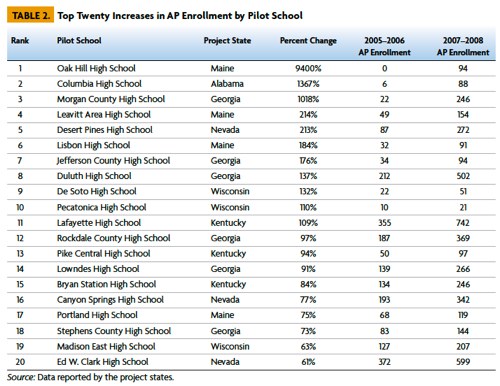
Share

Do You Know a High-Achieving Student Kept From College Because of Money?

Jay Matthews:

I try to stay away from the New York Review of Books. It is a trap for aimless readers like me. I may enjoy a piece on the last Khan of Mongolia. But that makes me want to sample a letter about derivatives or a review of what Titian thought of Tintoretto. Pretty soon it’s bedtime and I have forgotten to do important stuff like talk to my wife and watch “The Closer” on TNT.
Yet I couldn’t resist a piece in the May 14 issue by Columbia University humanities professor Andrew Delbanco about the sorry state of American higher education. In most respects, it was a splendid analysis of what ails our universities: bad investments, recession, elitism, etc. But on one crucial point he lost me. That was his conclusion that “a great many gifted and motivated young people are excluded from college for no other reason than their ability to pay, and we have failed seriously to confront the problem.”
I noticed he did not identify even one person to whom this had happened. Like many writers in the review, Delbanco was observing from the scholarly heights. His was a wide-angle view, full of national statistics and global analysis. That was one of the pleasures of reading the piece, to see all these issues in historical and social context.

Share

WIBA’s Mitch Henck Discusses the Madison School District’s Budget with Don Severson

24MB mp3 audio file. Mitch and Don discuss the Madison School District’s $12M budget deficit, caused by a decline in redistributed tax dollars from the State of Wisconsin and generally flat enrollment. Topics include: Fund 80, health care costs, four year old kindergarten, staffing, property taxes (which may increase to make up for the reduced state tax dollar funding).
Madison School District Board President Arlene Silveira sent this message to local Alders Saturday:

Good afternoon,
Below is an update of the MMSD budget situation.
As you know, the biennial budget was signed into law at the end of June. The budget had numerous provisions that will effect the future of public education that include:

  • Repeal of the Qualified Economic Offer (QEO)
  • Decrease in funding for public education by the state of approximately $14720million
  • Decrease in the per pupil increase associated with revenue limits

The repeal of the QEO will potentially impact future settlements for salries and benefits. The decrease in funding for public education by the state creates the need for a tax increase conversation in order to sustain current programs. The decrease in the revenue limit formula will cause MMSD to face more reductions in programs and services for the next 2 years at a minimum.
EFFECT OF STATE BUDGET ON MMSD

  • Decrease in state aid: $9.2 million
  • Reduction in revenue: $2.8 million (decrease in the per pupil increase from $275 to $200/pupil)

Total decrease: projected to to be $12 million
Last May, the Madison Board of Education passed a preliminary 2009-10 budget that maintained programs and services with a modest property tax increase. The groundwork for our budget was laid last fall when the Board pledged our commitment to community partnership and the community responded by supporting a referendum that allowed us to exceed revenue caps to stabilize funding for our schools. Two months later, with programs and staff in place for next year, we find ourselves faced with State funding cuts far exceeding our worst fears.
HOW DID THIS HAPPEN?
We are in this position in part because Wisconsin’s school funding formulas are so complicated that the legislature and supporting agencies did not accurately predict the budget’s impact on school districts. State aid to Madison and many other districts was cut by 15%. In practical terms, coupled with additional State cuts of $2.8 million, MMSD is saddled with State budget reductions of $12 million this year.
This grim situation is a result of a poor economy, outdated information used by the legislature, and a Department of Public Instruction policy that penalizes the district for receiving one-time income (TIF closing in Madison). Federal stimulus funds will, at best, delay cuts for one year. We are left with a gaping budget deficit when many fiscal decisions for the upcoming school year cannot be reversed.
WHAT ARE WE GOING TO DO?
We are working on strategies and options and are looking carefully at the numbers to ensure our solutions do not create new problems. We will evaluate options for dealing with the budget in early August.
To repair our budget, we are working with legislators and the DPI to appeal decisions that have placed us in this position. We continue to look for changes in resource management to find additional cost reductions. We are seeking ways to offset the impact of school property tax increases if we need to increase our levy.
At the same time, we pledge that we will not pass the full cost of the cuts along as increased property taxes. We will not resort to massive layoffs of teachers and support staff, t he deadline having passed to legally reduce our staff under union contracts.
I will be back in touch after our August meeting when we have made decisions on our path forward.
If you have any questions, please do not hesitate to contact me.
Arlene Silveira
Madison Board of Education
608-516-8981

Related: Sparks fly over Wisconsin Budget’s Labor Related Provisions.

Share

Online classes: Convenient option or growing cash cow for the University of Wisconsin-Milwaukee?

Erica Perez:

Students registering for fall classes this summer at the University of Wisconsin-Milwaukee will see a 30% increase in the number of online classes, but the convenience comes with a price: as much as $275 per course on top of regular tuition.


University officials say the increase is part of a strategy to boost enrollment and revenue by meeting a growing demand for the online format, which appeals to students who commute, work full time or have families.


But the move is also a way for UWM to pass more of its costs to students at a time when it faces a $20 million budget cut over the next two years that will be only partially offset by a tuition increase.


The trend toward online courses raises two key questions at a time when UWM students are registering for fall classes: Will the shift in scheduling mean more local students have to take the pricier online courses, and where does the money raised by the online fees go?


The pricing of online courses varies by college, but the fees particularly frustrate some undergraduates in the College of Letters and Science, which charges $275 above regular tuition for each online course.

Share

The Dad Who Holds Schools to the Rules

Emily Alpert:

David Page says the problem is that parents are on their own. Teachers have a union. So do principals. School board members get to vote plans up or down and top administrators make decisions in the salmon-pink offices of San Diego Unified.
But parents are often too intimidated to speak up or too star-struck with school staffers to question them, Page said. Education is a world loaded with its own numbing lingo — categorical funding, supplement not supplant, program improvement — and it seems overwhelming to understand it, let alone to fight it.
“They think, ‘They make six figures and they’re educated. Who am I to second guess them?'” Page said.
Yet Page has done just that. If parents at the poorer schools in San Diego Unified did have a union, he might be their leader, with all the fans and foes that entails. Seventeen years after the father of six first walked into a parents’ meeting at Ross Elementary in Kearny Mesa, unsure of his rights and unfamiliar with the jargon, Page has become a human encyclopedia on the rules that govern funds for disadvantaged kids and a dogged fighter for parents in communities sometimes left out of decisions.
He is one of the few parents across the state that jets to Sacramento for meetings of the state Board of Education, pores over complex regulations on education spending, and explains it all to befuddled parents at the school district committee that oversees funds for children in poverty, which he has led for six years. Page also leads the nonprofit California Association of Compensatory Education and sits on the board of the Family Area Network, which advises the state on parent involvement.

Share

As More Charter Schools Unionize, Educators Debate the Effect

Sam Dillon:

Dissatisfied with long hours, churning turnover and, in some cases, lower pay than instructors at other public schools, an increasing number of teachers at charter schools are unionizing.
Labor organizing that began two years ago at seven charter schools in Florida has proliferated over the last year to at least a dozen more charters from Massachusetts and New York to California and Oregon.
Charter schools, which are publicly financed but managed by groups separate from school districts, have been a mainstay of the education reform movement and widely embraced by parents. Because most of the nation’s 4,600 charter schools operate without unions, they have been freer to innovate, their advocates say, allowing them to lengthen the class day, dismiss underperforming teachers at will, and experiment with merit pay and other changes that are often banned by work rules governing traditional public schools.
“Charter schools have been too successful for the unions to ignore,” said Elizabeth D. Purvis, executive director of the Chicago International Charter School, where teachers voted last month to unionize 3 of its 12 campuses.
President Obama has been especially assertive in championing charter schools. On Friday, he and the education secretary, Arne Duncan, announced a competition for $4.35 billion in federal financing for states that ease restrictions on charter schools and adopt some charter-like standards for other schools — like linking teacher pay to student achievement.

Share

An innovative British special needs school is setting new standards

Brendan O’Malley:

One side of Heron Road, south London, is lined with grey-brick, bay-windowed Victorian terraced houses. The other is dominated by a strikingly modern building.
Michael Tippett School stands within a frame of timber pillars spanned by orange and maroon louvres, its walls are covered with slats of chestnut cladding and its eco-roof is topped with a thin carpet of mauve plants.
Many schools for children with severe and complex special needs are designed to protect the children from the outside world and seem to hide them away.
But through the front doors of Michael Tippett you can see the social hub of the school, a double-storey atrium, the garden and the undulating landscape of a small community park beyond.
Situated in a part of Lambeth borough that is dominated by vast regimented blocks of flats and crammed terraces, this generous entrance is a bold statement about the value put on educating the least able in the community.
“It has to do with dignity and respect for the people we work with,” said head Jan Stogdon. “The building reflects the ethos of the school.”
Michael Tippett is named after the British composer whose music celebrated the resilience of the human spirit in the face of oppression. The 70 pupils, aged 11 to 19, have their own daily struggles against the limitations of their own complex needs and severe or profound learning difficulties. Some have sight or hearing impairments, a number have gastrotomy tubes and others are at various points on the autistic spectrum.

Share

Can Wisconsin go from ‘ridiculous’ to ‘impressive’ in education?

Alan Borsuk:

Simply ridiculous.
If you wanted to gain good standing with some guy giving away a mountain of money, you would probably be alarmed if you heard him use that language publicly about you.
You’d have choices at that point. You could get upset and tell him to keep his stupid money. You could try to convince him that you weren’t ridiculous without really changing your ways. Or you could change your ways.
U.S. Secretary of Education Arne Duncan is that guy right now. Wisconsin is who he’s talking about. And it’s certainly clear that only the third option is going to please him. He wants change.
The immediate subject is $4.35 billion that Duncan and the education department will be awarding to states this year and next. Called the Race to the Top program, the goal is to help states that are leading the way in innovation and commitment to improving achievement, particularly among low-income and minority students.
President Barack Obama and Duncan on Friday unveiled proposed rules on how the money will be awarded. One of the firmest: “To be eligible under this program, a state must not have any legal, statutory or regulatory barriers to linking student achievement or student growth data to teachers for the purpose of teacher and principal evaluation.”
Wisconsin is one of the few states that have such a rule, right there in state law.
Or, as Duncan put it in a New York Times interview: “Believe it or not, several states, including New York, Wisconsin and California, have laws that create a firewall between students and teacher data. I think that’s simply ridiculous. We need to know what is and is not working and why.”

Share

Sparks fly over Wisconsin budget’s labor-related provisions

Steven Walters & Stacy Forster:

As the dust settles around the new state budget, partisan disagreement continues over the boost that unions – particularly education unions – got by making it easier for them to sign up thousands of new members and by repealing the 3.8% annual limit on teachers’ pay raises.
The provisions passed because Democrats, who got control of the Legislature for the first time in 14 years, partnered with Democratic Gov. Jim Doyle to advance changes the governor and unions had been pushing for years.
Unions traditionally help elect Democratic politicians. The largest teachers union, the Wisconsin Education Association Council, spent about $2.1 million before last November’s elections, with much of that backing Democrats.
Most of the labor-related provisions in the budget were added to provide people with “good, family-supporting jobs,” said Rep. Mark Pocan (D-Madison), co-chairman of the Legislature’s Finance Committee.
“The idea that we’re shifting back to the worker, rather than just big business and management, that’s part of what Democrats are about,” Pocan said.
It also helped that the two top Democratic legislators, Assembly Speaker Mike Sheridan of Janesville and Senate Majority Leader Russ Decker of Weston, are veteran labor leaders.
Sheridan is the former president of a Janesville union for General Motors; Decker was a union bricklayer when he was elected president of the Central Wisconsin Building Trades.
In a statement, Sheridan said Assembly Democrats focused on giving workers struggling through the recession “an opportunity to negotiate for better working circumstances or wages.” They also made sure the budget included tax breaks to help businesses create and protect jobs, he said.
Republican leaders say taxpayers will be the ultimate losers, when they must pay public employees higher wages and better benefits.
Republicans also say Doyle and Democratic legislative leaders approved the changes to thank unions for their campaign cash and endorsements before last November’s elections. The Democrats also are laying groundwork to win support heading into the 2010 elections, GOP lawmakers say.

One striking example of lobbying effectiveness during challenging economic times: the budget includes a change to arbitration rules between school districts and teacher unions:

To make matters more dire, the long-term legislative proposal specifically exempts school district arbitrations from the requirement that arbitrators consider and give the greatest weight to
revenue limits and local economic conditions. While arbitrators would continue to give these two factors paramount consideration when deciding cases for all other local governments, the importance of fiscal limits and local economic conditions would be specifically diminished for school district arbitration.

This is obviously the kind of thing frequently seen in Washington…. It would be interesting to see the players (and money) behind this legislation. In related local news, the Madison School District and the local teacher union have yet to agree to a new contract. Perhaps this arbitration change plays a role in the process?

Share

In the Future, the Cost of Education Will Be Zero

Josh Catone:

The average cost of yearly tuition at a private, four-year college in the US this year was $25,143, and for public schools, students could expect to pay $6,585 on average for the 2008-09 school year, according to the College Board. That was up 5.9% and 6.4% respectively over the previous year, which is well ahead of the national average rate of inflation. What that means is that for many people, college is out of reach financially. But what if social media tools would allow the cost of an education to drop nearly all the way down to zero?
Of course, quality education will always have costs involved — professors and other experts need to be compensated for their time and efforts, for example, and certain disciplines require expensive, specialized equipment to train students (i.e., you can’t learn to be a surgeon without access to an operating theater). However, social media can drastically reduce much of the overhead involved with higher education — such as administrative costs and even the campus itself — and open source or reusable and adaptive learning materials can drive costs down even further.
One vision for the school of the future comes from the United Nations. Founded this year by the UN’s Global Alliance for Information and Communication Technology and Development (GAID), the University of the People is a not-for-profit institution that aims to offer higher education opportunities to people who generally couldn’t afford it by leveraging social media technologies and ideas.

Share

Charter schools need a shout-out in Madison action plans

Scott Milfred:

Yet try to find any mention of charter schools in the Madison School District’s new strategic plan and you’ll feel like you’re reading a “Where’s Waldo?” book. You almost need a magnifying lens to find the one fleeting reference in the entire 85-page document. And the words “charter school” are completely absent from the strategic plan’s lengthy and important calls for action.
It’s more evidence that much of liberal Madison clings to an outdated phobia of charter schools. And that attitude needs to change.
Nearly 10 percent of Wisconsin’s public schools are charters. That ranks Wisconsin among the top five states. Yet Madison is below the national average of 5 percent.
Charter schools are public schools free from many regulations to try new things. Parents also tend to have more say.
Yet charters are held accountable for achievement and can easily be shut down by sponsoring districts if they don’t produce results within a handful of years.
One well-known Madison charter school is Nuestro Mundo, meaning “Our World” in Spanish. It immerses kindergartners, no matter their native language, in Spanish. English is slowly added until, by fifth grade, all students are bilingual. My daughter attends Nuestro Mundo.
It was a battle to get this charter school approved. But Nuestro Mundo’s popularity and success have led the district to replicate its dual-language curriculum at a second school without a charter.
The School Board has shot down at least two charter school proposals in recent years, including one for a “Studio School” emphasizing arts and technology.
Madison School Board President Arlene Silveira told me Friday she supports adding charter schools to the district’s action plans in at least two places: under a call for more “innovative school structures,” and as part of a similar goal seeking heightened attention to “diverse learning styles.”

I agree. I believe that diffused governance, in other words a substantive move away from the current top down, largely “one size fits all” governance model within the Madison public schools is essential.

Share

Chicago Report: STILL LEFT BEHIND

Civic Committee of The Commercial Club of Chicago
June 2009
KEY FINDINGS 150K PDF
Most of Chicago’s students drop out or fail. The vast majority of Chicago’s elementary
and high schools do not prepare their students for success in college and beyond.
There is a general perception that Chicago’s public schools have been gradually
improving over time. However, recent dramatic gains in the reported number of CPS
elementary students who meet standards on State assessments appear to be due to
changes in the tests made by the Illinois State Board of Education, rather than real
improvements in student learning
.
At the elementary level, State assessment standards have been so weakened that most
of the 8th graders who “meet” these standards have little chance to succeed in high
school or to be ready for college
. While there has been modest improvement in real
student learning in Chicago’s elementary schools, these gains dissipate in high school.
The performance of Chicago’s high schools is abysmalwith about half the students
dropping out of the non-selective-enrollment schools, and more than 70% of 11th
grade students failing to meet State standards
. The trend has remained essentially flat
over the past several years. The relatively high-performing students are concentrated
in a few magnet/selective enrollment high schools. In the regular neighborhood high
schools, which serve the vast preponderance of students, almost no students are
prepared to succeed in college
.
In order to drive real improvement in CPS and fairly report performance to the public,
a credible source of information on student achievement is essential. Within CPS
today, no such source exists. CPS and the State should use rigorous national
standardized tests. Also, the Board of Education should designate an independent
auditor with responsibility for ensuring that published reports regarding student
achievement in CPS are accurate, timely and distributed to families and stakeholders
in an easily understood format.
Efforts to provide meaningful school choices to Chicago’s families must be aggressively
pursued–including expanding the number of charter and contract schools in
Chicago. Most of these schools outperform the traditional schools that their students
would otherwise have attended; and the choices that they offer parents will help spur
all schools in CPS to improve.

Share

Detroit’s Schools Are Going Bankrupt, Too

Paul Kersey & Michael Van Beek:

Am I optimistic that they can avoid it . . . ? I am not.” That’s what retired judge Ray Graves said this week when asked whether the Detroit public schools, which he is advising, would be forced into bankruptcy. Facing violence, a shrinking student body, and graduating just one out of every four students who enter the ninth grade on time, the city’s schools have been stumbling for years. Now they face a seemingly insurmountable deficit and are expected to file for bankruptcy protection at about the time that students should be settling down in a new school year.
As embarrassing as such a filing would be, it also may be the only thing that can force the kinds of changes Detroit schools need–as the financial turmoil is just the latest manifestation of a system in terminal decline.
Detroit is like many urban school districts–large, unwieldy and bureaucratic, with a powerful union that makes the system unable to adapt to changing circumstances and that until very recently had an indulgent political class that insulated it from reform. That insulation came in two forms. The first was neglect. Mayor Kwame Kilpatrick spent several years distracted by a scandal stemming from his affair with a staffer. He resigned last year, pleaded guilty to obstruction of justice, and was sentenced to four months in jail. Had he been an effective mayor, he might have also been a powerful advocate for students.

Share

Private Schools as Charities: The war against fee-paying schools takes on new life

The Economist:

EVEN among left-wingers, few talk about banning independent schools nowadays. There are craftier ways of overhauling the education system to fight privilege. One of them hit the headlines this week when the Charity Commission published its first “public-benefit” assessment, including five private schools among its chosen charitable specimens. Two–Highfield Priory in Lancashire and S. Anselm’s in Derbyshire–failed the tough new requirement to show that they are helping the general public. The schools have a year to come up with a plan to get on track, or risk being taken over or closed down.
For centuries education has been considered a charitable activity, with no questions asked. In 2006 the rules were changed. Under the Charities Act of that year, schools are no longer entitled to the tax breaks that charitable status confers simply because they provide teaching. Instead, they have to demonstrate that they are actively benefiting the public. It has fallen to the regulator to interpret and apply the law: the commission says charities that charge fees, such as private schools, must ensure that “people in poverty” can use their services. The two schools that the commission flunked did not provide those who cannot afford the fees “sufficient opportunity to benefit”.

Share

California threatened with loss of funds if it doesn’t use test scores in evaluating teachers

Jason Felch & Jason Song:

U.S. education secretary is expected to withhold millions of dollars in education stimulus money if the state doesn’t comply with his demand.
California could lose out on millions of federal education dollars unless legislators change a law that prevents it from using student test scores to measure teachers’ performance, Secretary of Education Arne Duncan is expected to announce in a speech today.
California has among the worst records of any state in collecting and using data to evaluate teachers and schools.
Moreover, a 2006 law that created a teacher database explicitly prohibited the use of student test scores to hold teachers accountable on a statewide basis, although it did not mention local districts.
Only a few of the state’s nearly 1,000 districts evaluate teachers by using their students’ scores, though a dozen more are considering such moves, according to state officials. Los Angeles Unified, the state’s largest, does not grade teachers based on student performance.
Data-driven school reform is a major focus of the Obama administration’s education policies.

Share

Obama to unveil $4 billion school improvement plan

Reuters:

President Barack Obama is set to announce on Friday a competition for $4 billion in federal grants to improve academic achievement in U.S. schools, the Washington Post reported on Thursday.
Obama wants states to use funds from the competition, dubbed the “Race to the Top,” to ease limits on so-called charter schools, link teacher pay to student achievement and move toward common U.S. academic standards, the Post said.
Charter schools receive public funding but generally are exempt from some state or local rules and regulations. They are operated as an alternative to traditional public schools.
“What we’re saying here is, if you can’t decide to change these practices, we’re not going to use precious dollars that we want to see creating better results; we’re not going to send those dollars there,” Obama told the Post in an interview.

Michael Shear and Nick Anderson have more.

Share

Proposed “Common Core Standards”

The Common Core State Standards Initiative is a joint effort by the National Governors Association Center for Best Practices (NGA Center) and the Council of Chief State School Officers (CCSSO) in partnership with Achieve, ACT and the College Board [10MB PDF]:

Governors and state commissioners of education from across the country committed to joining a state-led process to develop a common core of state standards in English-language arts and mathematics for grades K-12. These standards will be research and evidence-based, internationally benchmarked, aligned with college and work expectations and include rigorous content and skills. The NGA Center and CCSSO are coordinating the process to develop these standards and have created an expert validation committee to provide an independent review of the common core state standards, as well as the grade-by-grade standards. The college and career ready standards are expected to be completed in July 2009. The grade-by-grade standards work is expected to be completed in December 2009.

“>10MB Proposed standards pdf document.

Share

An Apple for Your Teacher

Anne Marie Chaker:

It’s shaping up to be a grim year for the Spokane Public School district in Washington state. Like so many others, it is making deep cuts in everything from teaching staff to school supplies this coming school year. But there’s one bright spot for the district: The amount of federal dollars to incorporate technology in the classroom–and to train teachers to use it–is expected to double to about $160,000 from the previous year.
At the same time school districts around the nation are bracing for a round of severe belt-tightening as a result of strained state and local budgets, they’re also getting a significant bump in federal funding to make their classrooms more tech-savvy, which they hope will help improve student performance.
Students at North Carolina’s Greene Central High School use their school-issued laptops to collaborate on a social-studies project: Some school districts have seen increased funding for technology as staff and other programs are suffering substantial cuts.
The only problem: Districts are prohibited from using the money for any other purpose–which can mean that they have to cut staff and other programs while spending lavishly on computers.
The Enhancing Education Through Technology program was authorized in 2002 as part of the Bush-era No Child Left Behind law. But the level of funding steadily declined to $267.5 million in 2008 from $700.5 million six years earlier–a 62% drop. The economic-stimulus package signed into law by President Barack Obama in February restored $650 million in funding to the program, to be used over the course of the next two school years. States are expected to receive those funds this week to distribute to their school districts.

Share

Detroit Schools Official On State Of System

NPR:

Education Secretary Arne Duncan has called Detroit’s schools a “national disgrace.” The system suffers from budget deficits, corruption and a falling student population. Detroit Public Schools Emergency Financial Manager Robert Bobb, the official who will decide whether the school system will file for bankruptcy protection by the end of the summer, discusses the financial state of the Detroit Public School system.

Kai Ryssdal interviews Detroit’s emergency financial manager Robert Bobb.

Share

Cleveland schools planning more buildings in areas where enrollment is dropping, study shows

Thomas Ott:

The Cleveland school district continues to plan for new elementary schools in blighted neighborhoods where enrollment has plunged, threatening to chew up state construction money that could be used in more stable parts of town, an analysis shows.
Enrollment is dropping faster than projected in some neighborhoods, primarily on the East Side. If construction continues, taxpayers could wind up paying for more school space than is needed, according to a report released today by the Bond Accountability Commission. The group monitors the one-third local share of a $1.5 billion construction and renovation program.
The analysis by commission administrator James Darr assumes that more than 25 schools not scheduled for work will close. If the buildings remain open, the surplus of space will soar, he said.
Darr called on the district to promptly shrink or eliminate schools where necessary.

Share

Madison School District Strategic Planning Update

On July 21, the Board unanimously approved the following components of the new strategic plan.

  • Mission
  • Beliefs
  • Parameters
  • Strategic Objectives

We have not yet approved any of the action plans.
New Mission: Our mission is to cultivate the potential in every student to thrive as a global citizen by inspiring a love of learning and civic engagement, by challenging and supporting every student to achieve academic excellence, and by embracing the full richness and diversity of our community.
Strategic Objectives:

Student
We will ensure that all students reach their highest potential and we will eliminate achievement gaps where they exist. To do this, we will prepare every student for kindergarten, raise the bar for all students, create meaningful student-adult relationships, and provide student-centered programs and supports that lead to prepared graduates.
Curriculum
To improve academic outcomes for all students and to ensure student engagement and student support, we will strengthen comprehensive curriculum, instruction and assessment systems in the District.
Staff
We will implement a formal system to support and inspire continuous development of effective teaching and leadership skills of all staff who serve to engage and support our diverse student body while furthering development of programs that target the recruitment and retention of staff members who reflect the cultural composition of our student body.
Resource/Capacity
We will rigorously evaluate programs, services and personnel through a collaborative, data-driven process to prioritize and allocate resources effectively and equitably, and rigorously pursue the resources necessary to achieve our mission.
Organization/Systems
We will promote, encourage, and maintain systems of practice that will create safe and productive learning and work environments that will unify and strengthen our schools, programs, departments and services as well as the District as a whole.

Next steps:
We did not approve any action plans. We went around the table and listed our priority areas and the Administration will develop action plans to support those areas and bring them back to the Board in August. There will be plenty of opportunity for discussion around the action plans brought forward. We have structured our process this way to ensure we keep moving forward as the plan is Important for setting the future direction of the District.
Arlene

Share

School districts struggle to pay retirees’ health benefits

Bob Kelleher:

Some Minnesota school districts may have to go into debt to pay for the rising cost of health care for their retired employees.
Local Minnesota governments have until October to sell bonds — without a public referendum — to help pay for retired employees’ health care. But with the economy in the tank, some people are unhappy about paying higher property taxes to fund someone else’s health benefits.
The retirees’ health policy costs fall under something accountants call OPEB — Other than Pension Employee Benefits. OPEB obligations, especially for health care, are really starting to put the squeeze on school districts statewide.
“We’re actually paying for a larger number of retirees, from a pot that is generated by a smaller number of students,” said Robert Belluzzo, superintendent of the Hibbing school district.
In that district, $1 of every $5 of its budget goes to retiree benefits, primarily for health care. Meanwhile, Belluzzo says the retiree pool keeps growing.
“The number of retiree health insurance plans is more than the number of active insurance plans that we have,” said Belluzzo.

Share

Who Will Congress Put First? Children or Teachers Unions?; Testing Tactics Helped Fuel D.C. School Gains; Why Cory Booker Likes Being Mayor of Newark; No Ordinary Success; Gates Says He Is Outraged by Arrest at Cambridge Home

1 & 2 here
3) A wise comment in response to one of my recent emails:

Petrilli is right on the money – I can’t tell you how many times I’ve heard certain reformers denigrate “higher order thinking” and “problem solving” as just more union code words for an anti-accountability agenda. The problem is, when they insist that all that matters is basic skills and proficiency tests, they sound ridiculous to parents and teachers, and that limits their effectiveness. Basic skills, just because they’re easily tested, are NOT all that matter, and our pursuit of more and more accountability needs to not be accompanied by a dumbing down of the accountability systems so we can have an easier time measuring and can make an argument against those who inappropriately assert that everything is unmeasurable.

4) A great blog post following the recent death of Frank McCourt, the author of Angela’s Ashes, who taught in NYC public schools for decades before becoming an author:

Frank McCourt was my English teacher in my senior year at Stuyvesant (class of ’74). He introduced us to African literature such as Chinua Achebe’s Things Fall Apart, which sounded even more dramatic in his thick brogue.
When one student asked why we should read this book, what possible use would it be to us in our lives, he answered, “You will read it for the same reason your parents waste their money on your piano lessons. So you won’t be a boring little shyte the rest of your life.”
It was the most honest answer to such a question I ever heard from any teacher. Whenever the question came to my head about any subject thereafter I fondly remembered Mr. McCourt and resolved not to be a boring little shyte.

(more…)

Share

OP hopefuls meet for first time, critique Jim Doyle’s tenure, make their cases to be governor.

Marc Eisen & Charlie Sykes via a kind reader’s email:

Sykes: The Milwaukee Public Schools have been an educational and fiscal disaster for a long time. Is it time to blow up MPS? Is it time to consider a state takeover?
Walker: It’s time to do something dramatic. Whether or not it’s a state takeover–Tommy Thompson talked about that a decade ago. An alternative would be to break it up into smaller districts. When you start talking about anywhere from 80,000 to 100,000 kids, it becomes very difficult for anybody to get their hands around it.
I would lift the lid entirely on school choice. I would allow schools throughout the county to [participate]. Take Thomas Moore, which has a very successful program, but can’t currently operate [as a choice school] because part of its property is in St. Francis. I would allow for expansion, and I would lift some of the limits on charter schools,
Neumann: There is dramatic change needed in education. What’s going on in policy in Madison right now is that more rules, regulations and red tape are being thrown at our choice and charter schools so that less and less dollars get to the classroom. They’re tying the hands of the innovative people in education. We need to expand the opportunity in choice and charter schools.

Share

K-12 Wisconsin Tax & Spending Climate: A look at Wisconsin’s Economic Base

Thomas Hefty & John Torinus, Jr:

Our state motto is “Forward,” but Wisconsin is falling behind in the economic race to create jobs and raise family incomes.
As we’ll show here, Wisconsin is lagging its own economic performance of the 1990s and losing ground to other states–especially to other upper Midwest states like Minnesota, Iowa and Illinois. It is even failing to meet its own goals–established in 1997 with much fanfare by a blue ribbon commission–for ramping up the state economy.
Although our political and media leaders ignore these failings, Wisconsin residents intuitively understand how our economic anemia has sapped their incomes and diminished their opportunities.
Since 2005, Wisconsin has experienced growing out-migration. Our citizens have voted with their feet, moving to states where they foresee a better future.
In the end, gauging economic success is really pretty simple for most people. Is Wisconsin gaining jobs? Are family incomes rising? Are wages increasing? In a word: No. Yet our state officials go out of their way (perhaps understandably) to emphasize the good news about Wisconsin business while ignoring the bad.
Consider how officials in the Doyle administration have massaged the unemployment rate to make Wisconsin job performance look better than it really is.

Share

My Totally Unscientific Teacher Quality Survey

My survey:

Based on your experience working in a traditional public school serving primarily low-income and/or minority students, what percentage of the teachers you worked with were (the numbers in the three boxes must add up to 100):

  • Good/great (you would be happy to have your child in the class)
  • Fair, but improvement is possible (you would have reservations having your child in the class)
  • Horrible and unlikely to ever improve (you would NEVER permit your child to be in the class)

46 people responded and here were the results:
Good/great: 20%
Fair: 35%
Horrible: 45%
This is obviously a very skewed group of mostly TFA teachers in the worst schools, but nevertheless I’m shocked that the horrible number is so high. If this figure is even close to being right, then the problem is even bigger than I thought. I’ll have to think about the implications of this, but one obvious one is the enormous importance of changing union contracts (and other factors) that make it impossible to remove horrible teachers — and let’s be clear, everyone knows who they are. There may be some tough calls regarding whether to keep certain teachers in the “fair” category, but horrible ones who are unlikely to ever improve need to find another line of work — but, esp in this economy, they will fight to the death to keep their very nice jobs…
2) Here’s a comment from one person who responded to the survey:
Good/great: 50%
Fair: 30%
Horrible: 20%

I taught in NYC for 5 years, from 2002-2007; I taught 5th grade, all subjects, and I was not TFA, but was NYCTF. One quibble with your survey and its framing: I would not want my daughter in any classroom in my school, regardless of the teacher quality. The curriculum (Teacher’s College reading and writing; Everyday Math, virtually zero science, social studies, art and music) was either bad or nonexistent, and the social environment (harsh, chaotic) was not fit for any child. I agree that teacher quality is huge, but it’s not enough to overcome all other problems. Great schools are great schools when all or most of the moving parts (teachers, administrators, curriculum, accountability, environment, seriousness of purpose, parental involvement, et al) are working. Planes can fly if they lose an engine, even two. They can’t fly on one. At least not for very long.

Share

Madison School Proposed Board Strategic Plan Discussion – Audio

The Madison School Board discussed the proposed Strategic Plan [PDF] last evening. Listen to this discussion via this 85MB mp3 audio file. Much more on the proposed Strategic Plan here. Some recent written questions from the Board to the Administration can be found here.

Share