School Information System

Ariz. college to position sensors to check class attendance Devices would be installed in underclassmen lecture halls; some say infringes on privacy

David Brazy:

Students at Northern Arizona University will have a hard time skipping large classes next fall because of a new attendance monitoring system.
The new system will use sensors to detect students’ university identification cards when they enter classrooms, according to NAU spokesperson Tom Bauer. The data will be recorded and available for professors to examine.
Bauer said the university’s main goal with the sensor system is to increase attendance and student performance.
“People are saying we are using surveillance or Orwellian [tactics] and, boy, I’m like ‘wow,’ I didn’t know taking attendance qualified as surveillance,” Bauer said.
University President John Haeger is encouraging professors to have attendance be a part of students’ grades, but he added it is not mandatory and up to each professor to decide, Bauer said.

Share

Madison School board votes to save jobs, but doesn’t finalize budget yet; $250,000 home to see a $224.46 increase in property taxes, above the $2186.35 paid in 2009 (roughly 10%)

Gayle Worland:

The owner of a $250,000 Madison home would pay $224.46 more in school property taxes next winter under a budget still under discussion by the Madison School Board.
In what many — including three board members — thought would be a wrap-up Tuesday night of the board’s two-month process to close an initial $30 million budget gap, the board voted to save most of the district jobs still on the chopping block, largely with the help of $794,491 in employee health insurance savings.
But it left several items on the table until a final vote on the preliminary budget June 1, including:

A Madison home assessed at $257,000 paid 2186.35 in Madison School District taxes last year. A $224.46 increase is about 10%……
Much more on the 2010-2011 budget here.
The next school board election is in April, 2011, when the seats currently occupied by Ed Hughes and Marj Passman will be on the ballot.
November, 2010 elections that affect K-12 taxes & spending include the governor and assembly races.

Share

Do Teachers Get To Vote on Salary Freezes?

New Jersey Left Behind:

No disrespect intended towards the 71,000 members of the facebook page “New Jersey Teachers United Against Gov. Christie’s Pay Freeze,” but the zeitgeist of NJ seems to be in step with Gov. Christie, Ed Sec Schundler, and the New Jersey School Boards Association’s call for local unions to agree to salary concessions. A recent Rasmussen poll showed that only 28% of New Jersey residents oppose pay freezes, not to mention that school budgets failed two weeks ago at an unprecedented rate; however, 2/3 of school districts that won salary freezes won budget approval. (Here’s a complete list).
There is no doubt a cadre of teachers out that who would happily accept pay freezes, especially with the added incentive that agreements signed within the month will delay implementation of the 1.5% base pay contribution towards health benefits. (Translation: a one-year pay freeze adopted before May 22nd is really a 1.5% pay increase.) However, we’re starting to hear reports of districts where local union leadership is bypassing membership and declining to put such an agreement to a vote. One example: in Bridgewater-Raritan Regional School District, a large Somerset County district with a 1,360 member teacher union, the president of BREA explained to the Star-Ledger why he didn’t allow a formal vote after the School Board asked for one: “We truly believe that the executive committee(s) has a handle on how members feel. We talked to people and teachers and we listened.”

Share

Gifted students shortchanged as schools push low achievers

Jill Tucker

As California’s public schools have increasingly poured attention and resources into the state’s struggling students, high academic learners – the so-called gifted students – have been getting the short shrift, a policy decision that some worry could leave the United States at a competitive disadvantage.
Critics see courses tailored for exceptional students as elitist and not much of an issue when compared with the vast number of students who are lagging grades behind their peers or dropping out of school. But a growing chorus of parents and advocates is asking the contentious question: What about the smart kids?
“We have countries like India, Singapore, China, and they realize the future productivity of their country is an investment in their intellectual and creative resources,” said gifted education expert Joseph Renzulli.

Share

Seattle Public Schools Budget Feedback

Melissa Westbrook:

I was asked recently, by a leader up the food chain, what I would do to improve community engagement. Here’s what I would do but do let us know what you would like to see.

  • I would go with the George Costanza method. Do the opposite of what you are currently doing.
  • Shorter but more specific presentations.
  • Take ALL questions from the general audience. (I do believe there is a place for small group discussions but not on every subject.)
  • As long as it is within the topic, lead but don’t tell people what they can and can’t discuss .
  • Have the meetings not all in one week but over a series of weeks.

Share

OpenCourseWare: Opportunities for the EdTech Entrepreneur

Audrey Watters:

The Instructional Technology Council recently released a report on the trends in distance education and online learning at community colleges. Among its findings: Enrollment in distance education courses increased by over 20%, while overall community college enrollment increased by less than 2%. Clearly online learning offers many opportunities to students, teachers and academic institutions. But what are the opportunities for entrepreneurs?
The Case for OpenCourseWare
Of course, entrepreneurs can benefit themselves from taking online classes. As Bill Gates said in a recent speech at M.I.T., he’s a “super happy user” of the university’s OpenCourseWare program, which offers free online courses, noting that he “retook physics” along with over a dozen of the other online offerings. Gates praised OpenCourseWare for offering a blend of the best of video technology, professional instruction and testing, and argued that accreditation too should be separated from place-based learning. Gates stated that “What’s been done so far has had very modest funding. This is an area we need more resources, more bright minds, and certainly one that I want to see how the foundation could make a contribution to this.”

Share

The 21st Century Classroom – Alfie Kohn

Thomas:

As a former administrator, I have had the good fortune to visit a significant number of classrooms over the years. Because I have been witness to bad or indifferent teaching, there has always been a special feeling of excitement during those times I was able to witness the talents of a true professional at work in the classroom. It also has encouraged me to be reflective on my years in the classroom.
Having begun teaching in the 1970’s at the high school level, my approach in the early years was very traditional. My classroom would have been best described as teacher-centered and my organizational skills combined with my ability to relate to students created a room that earned me high marks from my administrators.
In the early nineties though, it became increasingly clear that my methods were growing less popular with students. In addition, I found myself less and less successful on the most important element, student achievement. My classroom was well-managed and discipline issues seldom arose, but my students seemed to be losing interest in the subjects that I taught.

Share

Filmmaker takes aim at ‘Cartel’ of education

Dana Barbuto:

Journalist-turned-documentarian Bob Bowdon saw something very wrong with the New Jersey public education system. More than $400,000 of public money was earmarked for each classroom, yet an alarming rate of students were not proficient in reading or math.
Once he dug deeper, Bowdon found a flawed system that embraced cronyism, squandered money and frowned upon alternative education options such as charter schools. Bowdon spent three years pointing his camera at New Jersey administrators, teachers, unions, students and parents and the result is the documentary “The Cartel,” opening at Kendall Square in Cambridge today. The film focuses on his home state of New Jersey, but Bowdon assures it is a case study likely evident across the country. As the film points out, in 12 percent of U.S. schools, less than 60 percent of freshmen make it to senior year.
Q: Did you ever think you’d be a documentary filmmaker?
A: Well, it wasn’t some sort of lifelong dream. I got a film certificate from New York University, but it really wasn’t to become a filmmaker. This issue wasn’t well covered by traditional media. Education is an emerging national disaster and that story needed long-form treatment.

Share

Class Divide? More Teacher Absences in Poorer Districts

Barbara Martinez:

New York City teachers get 10 sick days during their 184-day school year, and most stick to that number. But 20% of teachers take more than that amount — and a small percentage take 30 or more days off, according to Department of Education figures.
The data show that for some of the poorest districts, like the South Bronx and Brooklyn’s Brownsville neighborhood, more than 20% of the teachers are out two weeks or more during the school year. The teachers union cautions that the absence data includes all types of absences, including things like professional development and jury duty over which teachers have no control. And not all poor districts have high-absentee teachers.
Still, in districts like the one that contains the Upper East Side, the percentage of teachers absent two weeks or more is below the average.

Ron Isaac:

The Wall Street Journal, attack dog for the righteous marketplace, apostle of “bang for the buck” for civil servants, and conscience of the all-day businessman’s lunch for dividends gluttons, decried in an April 28 piece the alleged statistic that public school teachers tend to exhaust their annual ten-day “sick bank,” especially in poorer areas of the city.
They suspect that teachers’ claim of sickness is often a ploy and mask for their contemptuous attitude towards professional duty. They see teachers who get sick as slackers who if they cared about kids would have immune systems better able to repel microbes. They plainly feel that unions are the enablers of teachers’ audacity.
Perhaps it’s true about teachers burning through their ten days over ten months. But a fragment of truth without context is no truth at all, but as an instrument to exploit the public’s gullibility, it’s more serviceable than an out and out lie.

Share

Grade-A ideas From virtual-reality science instruction to meditation for teachers, these approaches aim to reinvigorate education for all ages.

Patti Hartigan:

Art From the Start The current rage in education is STEM, or science, technology, engineering, and mathematics. But creative types are working valiantly to turn STEM into STEAM – with the A standing for the arts. At the Boston Arts Academy, for instance, the arts are infused in every subject. While creative pursuits are often the first to go when budgets are cut, this high school continues to innovate as it engages students through the arts. The ninth grade just wrapped up a unit on African civilization with a multimedia celebration called “Africa Lives.” The students got their hands dirty. And they mastered the material.
“High school shouldn’t be a preparation for life,” says co-headmaster Linda Nathan. “It should be life.”
Nathan is not alone in her belief that the arts foster deep learning. Young Audiences of Massachusetts, a nonprofit that brings artists into schools, is inaugurating an arts integration program at the Salemwood Elementary School in Malden this fall. Visiting artists will help teachers incorporate the arts into the literacy and social studies curriculums. If the pilot program takes off, Young Audiences hopes to make it a model for other Extended Learning Time schools like Salemwood. Explains executive director Diane Michalowski Freedland: “We need to think big.”

Share

School’s footprint can’t be missed

Laurel Walker:

If someone asked you for a memory from elementary school, what would come to mind?
Fourth-grader Maggie Lombardi remembers way back to first grade at Randall Elementary School in Waukesha. PJ Day. Popcorn and reading. She got to bring a blanket and a stuffed animal and watch “Finding Nemo.” Even her teacher wore pajamas.
“It was super cool,” she wrote.
Maggie’s dad, Jim Lombardi, an electrical engineer who attended the same school between 1969 and 1976, has memories, too, if a bit more vague. Happiness. A great learning experience from great teachers. Fun times with friends.
He still stays in touch with some of those friends who’ve settled in the same diverse neighborhood around Carroll University. Now his kids go to school with some of their kids, he wrote.
Maggie’s grandmother, former Waukesha mayor Carol Lombardi, walked the same hallways as a student in the early 1940s.
“I was a very good student, and usually the teacher’s pet,” she said. “I got to ring the bell in the morning. I got to answer the school phone. A lot of the kids hated me because I was doing all those things, but I learned so much responsibility.”

Share

No Grading, More Learning

Scott Jaschik:

When Duke University’s Cathy Davidson announced her grading plan for a seminar she would be offering this semester, she attracted attention nationwide. Some professors cheered, others tut-tutted, and others asked “Can she do that?”
Her plan? Turn over grading to the students in the course, and get out of the grading business herself.
Now that the course is finished, Davidson is giving an A+ to the concept. “It was spectacular, far exceeding my expectations,” she said. “It would take a lot to get me back to a conventional form of grading ever again.”
Davidson is becoming a scholar of grading. She’s been observing grading systems at other colleges and in elementary and secondary schools, and she’s immersed herself in the history of grading. (If you want to know who invented the multiple choice test, she’ll brief you on how Frederick J. Kelly did so at Emporia State University and how he later renounced his technique.)
But it was her own course this semester — called “Your Brain on the Internet” — that Davidson used to test her ideas. And she found that it inspired students to do more work, and more creative work than she sees in courses with traditional grading.

Share

End Nears in L. Merion School Redistricting Court Battle

Brad Segall:

Closing arguments were expected on Monday morning in federal court in Philadelphia in a redistricting lawsuit brought against the Lower Merion School District.
US District Judge Michael Baylson is hearing from both sides on Monday and says he will render a quick verdict, although he says that decision may not come on Monday.
Nine parents from South Ardmore are suing the school district alleging that Lower Merion used race as a factor in a redistricting plan.

Share

Saving money now on education will cost lots later

Cynthia Tucker:

When you see a cluster of elementary schoolchildren at a bus stop or street-crossing, struggling with bristling backpacks full of textbooks and school papers, it’s hard to imagine that kids in distant lands are carrying even weightier tomes, slogging through more homework and spending longer hours in class. But many of them are. That’s among the reasons that American children consistently post lower test scores than children in several other countries.
Education activists — from mega-wealthy wise men such as Bill Gates to policy experts such as Education Secretary Arne Duncan — believe the nation’s economic competitiveness depends on lifting our academic standards. Some even worry that the current generation of schoolchildren may be the first whose level of educational attainment falls below that of their parents.
Given widespread fears about the nation’s ability to maintain its leadership in a world growing smaller and flatter, should we allow school systems to go broke as a result of the recession? Is this any time for widespread teacher layoffs, overcrowded classrooms and shorter school days?

Share

Madison High School Course Comparison – 2010

The Madison School District, via a kind reader’s email. PDF / HTML.

Share

Boards should not shortchange brightest students

StarNews Online:

As school systems grapple with almost certain budget cuts, they should passionately resist taking significant bites out of programs that challenge bright students to reach higher.
New Hanover County school officials are considering cuts to the county’s program for academically gifted students as one way to cope with a dire budget outlook. One proposal, if adopted, would force small schools to share gifted-education teachers. A few years ago, the board took the bold step of insisting that each school have its own specialized teacher for students identified as Academically and Intellectually Gifted (AIG, not to be confused with the bailed-out insurance giant).
Parents and some teachers naturally fear that changes could affect the quality and the reach of gifted education.
No Child Left Behind and other accountability mandates focus mainly on bringing all students to an acceptable minimum level. When a teacher’s time is consumed with bringing students up to grade level, often the quick learners go unchallenged.

Share

The Death of Local Control

Fort Wayne Journal-Gazette:

A Republican lawmaker put out a news release at the end of this year’s legislative session boasting that lawmakers approved more local control and funding flexibility for schools.
Just try to convince members of your local school board that’s the case.
In the wake of a $297 million reduction in education spending statewide, school districts struggle to cut costs without laying off teachers, eliminating programs or shuttering schools. But the minimal leeway they once enjoyed is gone – stripped along with the small percentage of local property tax levy they controlled and handed over to the state in exchange for an increase in the sales-tax rate.
“What local control?” quips Diana Showalter, superintendent of Manchester Community Schools. “When the state assumed control of the general fund, they took control of the major financial source for the schools. … When we can’t control our own destiny through the collection of property taxes, we are setting ourselves up for a difficult time.”

Share

State leadership lacking

Wisconsin State Journal Editorial:

School reform: D-
Gov. Jim Doyle and the Democratic-run Legislature failed to overhaul an outdated and unfair school financing system. And they made school budgets harder to balance in the future by lifting limits on teacher pay hikes. Even with Sen. Mark Miller, D-Madison, and Rep. Mark Pocan, D-Madison, chairing the state budget committee, Madison schools were stung by a huge and unforeseen cut in state aid.
Wisconsin was out of shape and finished way behind the pack in the first round of President Barack Obama’s “Race to the Top” competition, which is steering billions of dollars for education innovation to other states.
Despite Doyle’s best efforts, the Legislature also failed to shake up failing Milwaukee Public Schools. A meager bill giving the state schools superintendent some additional but limited power to force change in Milwaukee saves our leaders from an “F.”

Share

K-12 Tax & Spending Climate: The Future Of Public Debt, Bank for International Settlements Debt Projections

John Mauldin:

“Seeing that the status quo is untenable, countries are embarking on fiscal consolidation plans. In the United States, the aim is to bring the total federal budget deficit down from 11% to 4% of GDP by 2015. In the United Kingdom, the consolidation plan envisages reducing budget deficits by 1.3 percentage points of GDP each year from 2010 to 2013 (see eg OECD (2009a)).
“To examine the long-run implications of a gradual fiscal adjustment similar to the ones being proposed, we project the debt ratio assuming that the primary balance improves by 1 percentage point of GDP in each year for five years starting in 2012. The results are presented as the green line in Graph 4. Although such an adjustment path would slow the rate of debt accumulation compared with our baseline scenario, it would leave several major industrial economies with substantial debt ratios in the next decade.
“This suggests that consolidations along the lines currently being discussed will not be sufficient to ensure that debt levels remain within reasonable bounds over the next several decades.
“An alternative to traditional spending cuts and revenue increases is to change the promises that are as yet unmet. Here, that means embarking on the politically treacherous task of cutting future age-related liabilities. With this possibility in mind, we construct a third scenario that combines gradual fiscal improvement with a freezing of age-related spending-to-GDP at the projected level for 2011. The blue line in Graph 4 shows the consequences of this draconian policy. Given its severity, the result is no surprise: what was a rising debt/GDP ratio reverses course and starts heading down in Austria, Germany and the Netherlands. In several others, the policy yields a significant slowdown in debt accumulation. Interestingly, in France, Ireland, the United Kingdom and the United States, even this policy is not sufficient to bring rising debt under contro
[And yet, many countries, including the US, will have to contemplate something along these lines. We simply cannot fund entitlement growth at expected levels. Note that in the US, even by “draconian” estimates, debt-to-GDP still grows to 200% in 30 years. That shows you just how out of whack our entitlement programs are.
Sidebar: This also means that if we – the US – decide as a matter of national policy that we do indeed want these entitlements, it will most likely mean a substantial VAT tax, as we will need vast sums to cover the costs, but with that will come slower growth.]

TJ Mertz reflects on the Madison School District’s 2010-2011 budget and discusses increased spending via property tax increases:

I was at a meeting of Wisconsin Alliance for Excellent Schools people yesterday. Some of the people there were amazed at the hundreds of Madisonians who came out to tell the Board of Education that they preferred tax increases to further cuts. Some of the people were also perplexed that with this kind of support the Board of Education is cutting and considering cutting at the levels they are. I’m perplexed too. I’m also disappointed.

We’ll likely not see significant increases in redistributed state and federal tax dollars for K-12. This means that additional spending growth will depend on local property tax increases, a challenging topic given current taxes.
Walter Russell Mead on Greece’s financial restructuring:

What worries investors now is whether the Greeks will stand for it. Will Greek society resist the imposition of savage cuts in salaries and public services, and will the government’s efforts to reform the public administration and improve tax collection (while raising taxes) actually work?
The answer at this point is that nobody knows. On the plus side, the current Greek government is led by the left-wing PASOK party. The trade unions and civil service unions not only support PASOK; in a very real way they are the party. Although the party’s leader George Papandreou is something of a Tony Blair style ‘third way’ politician who is more comfortable at Davos than in a union hall, the party itself is one of Europe’s more old fashioned left wing political groups, where chain-smoking dependency theorists debate the shifting fortunes of the international class war. The protesters are protesting decisions made by their own political leadership; this may help keep a lid on things. If a conservative government had proposed these cuts, Greece would be much nearer to some kind of explosion.
On the minus side, the cuts are genuinely harsh, with pay cuts for civil servants of about 15% and the total package of government spending cuts set at 10 percent of GDP. (In the United States, that would amount to federal and state budget cuts totaling more than $1.4 trillion, almost one quarter of the total spending of all state and local governments plus the federal government combined.) The impact on Greek lifestyles will be even more severe; spending cuts that severe will almost certainly deepen Greece’s recession. Many Greeks stand to lose their jobs and, as credit conditions tighten, may face losing their homes and businesses as well.

Much more on the Madison School District’s 2010-2011 budget here.

Share

Despite Push, Success at Charter Schools Is Mixed

Trip Gabriel:

In the world of education, it was the equivalent of the cool kids’ table in the cafeteria.
Executives from the Bill and Melinda Gates Foundation, McKinsey consultants and scholars from Stanford and Harvard mingled at an invitation-only meeting of the New Schools Venture Fund at a luxury hotel in Pasadena, Calif. Founded by investors who helped start Google and Amazon, this philanthropy seeks to raise the academic achievement of poor black and Hispanic students, largely through charter schools.
Many of those at the meeting last May had worried that the Obama administration would reflect the general hostility of teachers’ unions toward charters, publicly financed schools that are independently run and free to experiment in classrooms. But all doubts were dispelled when the image of Arne Duncan, the new education secretary, filled a large video screen from Washington. He pledged to combine “your ideas with our dollars” from the federal government. “What you have created,” he said, “is a real movement.”

Share

What the next Wisconsin governor could do on education

Alan Borsuk:

Reading the information released Thursday about the Milwaukee Public Schools budget for next year, with its grim warnings about hundreds of job cuts and swelling benefit costs, my mind wandered.
I had a vision of the new governor of Wisconsin unveiling his budget proposals in February and deciding (this is the most fanciful part) that he was going to break with established positions of whichever political party he represents. He decided to give a speech to the Legislature like this:
•
Folks, we need to stop posturing, and we all know that’s one of our most striking talents here in the Capitol. Man, the legislators the last two years should have made commercials for Posturepedic. Lots of talk, little dealing with the real issues. No more, people. Things are too serious.
From Superior to Kenosha – and especially in Milwaukee – we’ve got a really deep education problem. That goes in some serious ways for just plain education. But it goes especially for paying for education. If the school system in your hometown isn’t financially broken, it’s under huge stress and it’s going to be broken soon. Show me figures that say I’m wrong.

Share

Just How Many Bad Teachers Does Houston Have

Ericka Mallon:

Not very many — if you believe the principals’ evaluations, which even teachers concede aren’t very good. The Houston school board heard a presentation Thursday from the New Teacher Project, and it included some fascinating data — from HISD’s own records and from surveys of teachers and principals. One slide (No. 14 below) particularly stood out: It showed that only 3.4 percent of teachers in the Houston Independent School District were rated “below expectations” or “unsatisfactory” on any domain on their appraisals between the 2005-06 school year and last school year. Looking at the domain ratings on all the evaluations from that time period, only 1 percent were below proficient.

Share

HERESY

A Boston High School Senior, Chrismaldy Morgado, writing an Op-Ed in The Boston Globe today, has claimed that students have some responsibility for their own academic achievement.
The Boston Globe may be forgiven for printing such a heretical claim, because it is trying to give a “voice” to young people, and the high school student may not be aware that his suggestion goes against the settled wisdom of the vast majority of U.S. Edupundits.
Our Edupundits are in substantial agreement, often repeated, that “the principal variable in student academic achievement is teacher quality.” I have nowhere found much interest in my own argument that the principal variable in student academic achievement is student academic work.
Yet here is a high school Senior, writing that: “students seem to socialize more than they should. In hallways, stairwells, and bathrooms, students sit and talk to their friends after the late bell rang for classes.” He adds that: “My friends agree that new teachers alone are not going to solve the problems at Burke [Jeremiah Burke High School in Boston is one of 35 schools in the state that is asking its staff to re-apply for their jobs]. Jussara Sequeira, a Junior, said: “Some of us students are not trying hard enough and I don’t think the school’s teachers should pay the consequences.”
Paul Zoch, a high school Latin teacher, in Doomed to Fail [2004] points out that: “the United States looks to its teachers and their efforts, but not to its students and their efforts, for success in education. That being the accepted wisdom, students are free to do nothing more than wait for the teachers to create success for them. Education reform literature rarely contains the thought that our students are primarily failing because they do not study enough.” Another heretic!
Many thanks to Paul Zoch, Diane Ravitch, Chrismaldy Morgado, and Jussara Sequeira for pointing out the egregious folly of leaving student effort out of the analysis of those things which make for academic success in the schools.
It is hard to understand how so many Edupundits miss this essential sine qua non of good learning outcomes for our schools. One possibility is that their view is so lofty and unfocused that they never take the academic work of mere students into account.
Tony Wagner at Harvard has found that only three high schools in the country, for instance, ever sit down in a focus group with their graduates and ask them for their thoughts about their education while they were at the school.
This still does not completely explain why students’ academic responsibility gets so routinely overlooked in all the multi-billion-dollar efforts at school reform.
Paul Zoch writes: “In reading about Japanese education, one is repeatedly struck by the expectation that the students must work hard for success, in contrast to the United States, where the teacher is expected to work hard to find a way for the students to succeed…Effort and self-discipline are considered by the Japanese to be essential bases for accomplishment. Lack of achievement, then, is attributed to the failure to work hard.”
What chance is there that the voices of Chirsmaldy Morgado and Jussara Sequeira will be heard in their call for more student academic effort in Boston high schools? It is hard to say. So much attention and concern, on the part of parents and the rest of us, seems to be on whether our students have friends and are having a good time in school, rather than whether they are working as hard as they can academically. It is far easier to blame teachers if student academic achievement is too low.
If we listened to those two public high school students, we should surely inform our students at the start of every school year, that they have the responsibility to pay attention, do their homework, read books and write papers, and in general give their very best efforts to making the most out of the free public education which has been provided them. Let’s tell them that their academic success is their job. It is up to them how much they learn and how much they grow in competence through their own work in school.
“Teach by Example”
Will Fitzhugh [founder]
Consortium for Varsity Academics® [2007]
The Concord Review [1987]
Ralph Waldo Emerson Prizes [1995]
National Writing Board [1998]
TCR Institute [2002]
730 Boston Post Road, Suite 24
Sudbury, Massachusetts 01776-3371 USA
978-443-0022; 800-331-5007
www.tcr.org; fitzhugh@tcr.org
Varsity Academics®
www.tcr.org/blog
Share

Lessons From Catholic Schools for Public Educators

Samuel Freedman:

ithin the 242 pages of Diane Ravitch’s lightning rod of a book, “The Death and Life of the Great American School System,” there appear exactly three references to Catholic education. Which makes sense, given that Ms. Ravitch is addressing and deploring recent efforts to reform public schools with extensive testing and increasing privatization.
Yet what subtly informs both her critique and her recommendations for improving public schools is, in significant measure, her long study of and admiration for Roman Catholic education, especially in serving low-income black and Hispanic students.
In that respect, Ms. Ravitch and her book offer evidence of how some public-education scholars and reformers have been learning from what Catholic education is doing right. What one might call the Catholic-school model is perhaps the most unappreciated influence on the nation’s public-education debate.

Share

Fact-Checking Linda Darling-Hammond

New Jersey Left Behind:

Bob Braun at the Star-Ledger writes of renowned education scholar Linda Darling-Hammond’s lecture in New Brunswick this week in which she lauds New Jersey’s success in closing the achievement gap among White, Black, and Hispanic students. “She listed measures of success in New Jersey — higher graduation rates, higher test scores, higher national rankings. Darling-Hammond drew gasps of appreciation by noting that, on one national exam, the average scores of black and Latino students in New Jersey were as high as the average scores of all students in her home state, California.”

Let’s put aside graduation rates for the moment (though just for the moment) and look more closely at the data that Darling-Hammond cites. There’s only one national test that NJ and California students take: the National Assessment of Educational Progress, fondly known as the NAEP. And while it’s true that average scores in California for all 4th and 8th graders (the two age groups tested by NAEP) are comparable to average scores for Black and Latino students in NJ, there’s one piece of data missing from Dr. Darling-Hammond’s analysis: 53% of California’s students are eligible for free and reduced lunch, the metric for establishing economic disadvantage.

Share

A Bill of Goods

Arthur Goldstein:

Bill Gates is amazed at what he sees happening at KIPP charter schools. Bill has no idea those same things happen at Francis Lewis High School, and countless other public schools, each and every day. Because Bill believes in the very same “reforms” that have caused Francis Lewis, my school, to balloon to 250 percent capacity, he surreptitiously funded the Learn NY campaign to preserve mayoral control (in practice, mayoral dictatorship). So I don’t trust him, and I don’t think he knows much about education, despite the millions he throws around imposing his pet projects on us. Still, I withheld judgment when he sent his new program to my school. I did not participate, but I said nothing to those who chose otherwise.

The Measures of Effective Teaching program, sponsored by the Gates Foundation, is now at my school and many others across the city. Teachers were told this study would show what worked and did not work in the classroom. They hoped it would give them ideas on how to reach their students more effectively. How long should you pause after posing a question? Did certain seat arrangements promote more interaction? Is group work always more effective than lecturing?

Share

2009-2010 Madison Area Public School Fee Comparison

via a kind reader 67K PDF

Share

Time 100: Rhode Island Education Commissioner Deborah Gist

Amanda Ripley:

When Deborah Gist became commissioner of Rhode Island schools in 2009, she pledged to make every decision in the best interests of children — something we’ve heard before and rarely seen happen. Then she started doing it.
At first, no one outside Rhode Island noticed. Gist, 43, announced that staffing decisions would be based on teacher qualifications, not seniority. She also launched a new evaluation system in which teachers get annual reviews — an idea practiced in only 15 other states. When she learned that Rhode Island’s teacher-training programs had one of the lowest test-score requirements for entrance, she found out which state set the bar the highest — then raised Rhode Island’s one point above it.

Share

The coming melt-down in higher education (as seen by a marketer)

Seth Godin:

For 400 years, higher education in the US has been on a roll. From Harvard asking Galileo to be a guest professor in the 1600s to millions tuning in to watch a team of unpaid athletes play another team of unpaid athletes in some college sporting event, the amount of time and money and prestige in the college world has been climbing.
I’m afraid that’s about to crash and burn. Here’s how I’m looking at it.
1. Most colleges are organized to give an average education to average students.
Pick up any college brochure or catalog. Delete the brand names and the map. Can you tell which school it is? While there are outliers (like St. Johns, Deep Springs or Full Sail) most schools aren’t really outliers. They are mass marketers.
Stop for a second and consider the impact of that choice. By emphasizing mass and sameness and rankings, colleges have changed their mission.
This works great in an industrial economy where we can’t churn out standardized students fast enough and where the demand is huge because the premium earned by a college grad dwarfs the cost. But…

Share

Madison schools could consider teacher pay freeze

Gayle Worland:

The Madison School Board on Monday could discuss reopening the district’s 2009-11 teacher contract to institute a salary freeze estimated to save about $3.5 million.
And some board members who said they oppose renegotiating the current contract said they are open to the idea of asking for a pay freeze for teachers when bargaining begins again next year for the 2011-13 school years.
“I think it’s a small chance of it happening, but I definitely would support re-opening it,” said newly elected board member James Howard, referring to the current two-year contract that the district and Madison Teachers Inc. settled last October after months of talks. “I think teachers and everyone else have to play their part in this.”

Share

K-12 Tax & Spending Climate: The national debt and Washington’s deficit of will

Joel Achenbach:

Bill Gross is used to buying bonds in multibillion-dollar batches. But when it comes to U.S. Treasury bills, he’s getting nervous. Gross, a founder of the investment giant Pimco, is so concerned about America’s national debt that he has started unloading some of his holdings of U.S. government bonds in favor of bonds from such countries as Germany, Canada and France.
Gross is a bottom-line kind of guy; he doesn’t seem to care if the debt is the fault of Republicans or Democrats, the Bush tax cuts or the Obama stimulus. He’s simply worried that Washington’s habit of spending today the money it hopes to collect tomorrow is getting worse and worse. It even has elements of a Ponzi scheme, Gross told me.
“In order to pay the interest and the bill when it comes due, we’ll simply have to issue more IOUs. That, to me, is Ponzi-like,” Gross said. “It’s a game that can never be finished.”

Share

On Local School Budgets & Teacher Compensation

Peter Sobol:

I have to at least give credit the WSJ for continuing to keep education front and center of their Sunday opinion section. This last Sunday, under the headline “Protect kids from cuts” the WSJ takes on the issue of closing the remaining Madison SD budget gap and editorializes for a pay freeze for teaching staff. Although the current budget situation probably makes reducing compensation for staff in one way or another inevitable, I don’t think that devaluing the teaching profession can be construed as “Protecting kids”. After all, the number one factor in educational outcomes is the placement of a highly qualified teacher in front of each class.
Attracting quality teachers means we have to be sure it is rewarding profession, so balancing the budget through reductions in teacher compensation is in the long term unsustainable. If the current situation was a one or two year problem then a freeze might serve as a bridge to recovery, and although I don’t know the Madison situation I’m pretty sure their problems are similar to ours: shortfalls that extend year after year for the foreseeable future. The article notes that the Madison teachers receive the “standard” 1% raise this year. This year that seems inappropriate, but the fact that the same 1% is the “standard” every year since 1993 is also a problem.

I don’t think that 1% annual raises have been “standard since 1993”. I would certainly like to see a substantive change in teacher compensation, replacing the current one size fits all approach.
Current Madison School Board Member Ed Hughes, noted in May, 2005 that:

Here is an excerpt from the article in this morning’s State Journal that deserves comment: Matthews said it was worth looking at whether layoffs can be avoided, but he was less optimistic about finding ways to achieve that.
He said MTI’s policy is that members have to have decent wages, even if it means some jobs are lost.
The last teachers contract provided a 1 percent increase in wage scales for each of the past two years. This year’s salary and benefits increase, including raises for seniority or advanced degrees, was projected at 4.9 percent, or $8.48 million. Teachers’ salaries range from $29,324 to $74,380.
“The young teachers are really hurting,” Matthews said, adding that the district is having difficulty attracting teachers because of its starting pay.
Mr. Matthews states that young teachers are really hurting. I assume by “young” he means “recently-hired.” On a state-wide basis, the starting salary for Madison’s teachers ranks lower, relatively speaking, than its salaries for more experienced teachers. Compared to other teacher pay scales in the state, Madison’s scale seems weighted relatively more toward the more-experienced teachers and less toward starting teachers. This has to be a consequence of the union’s bargaining strategy – the union must have bargained over the years for more money at the top and less at the bottom, again relatively speaking. The union is entitled to follow whatever strategy it wants, but it is disingenuous for Mr. Matthews to justify an apparent reluctance to consider different bargaining approaches on the basis of their possible impact on “young teachers.”
According to the article, Mr. Matthews also stated that “the district is having trouble attracting teachers because of its starting pay.” Can this possibly be true? Here’s an excerpt from Jason Shepard’s top-notch article in Isthmus last week, “Even with a UW degree, landing a job in Madison isn’t easy. For every hire made by the Madison district, five applicants are rejected. June Glennon, the district’s employment manager, says more than 1,200 people have applied for teaching jobs next year.”

Share

Madison School District Maintenance Report estimates $3,000 cost to replace single school toilet! What?

Susan Troller:

At $2,000 to $3,000 to replace a single toilet, and the same to repair a leaky faucet, it’s no surprise some Madison School Board members are suffering sticker shock when it comes to a new facility report on short- and long-term maintenance needs for Madison’s public schools.
In fact, Lucy Mathiak, board vice president, wonders if the numbers can even be trusted. “It makes me feel like I’m channeling Bill Proxmire when he challenged the costs on Pentagon toilets,” she says, referring to the late U.S. senator from Wisconsin. “Frankly, getting this information cost us a lot of money and, to say the least, I’m underwhelmed with the product.”
The estimates, though, might not be entirely out of whack with commercial repairs.
While swapping out an old toilet or sink at home could cost $500 or less, such a repair in an institutional or industrial setting might run upward of a couple thousand dollars, particularly if there were hazardous materials involved, or extensive tile or plumbing rework, experts say.

Related: Madison School Board member may seek audit of how 2005 maintenance referendum dollars were spent.

Share

Madison High School Comparison: Advanced Levels of Academic Core Courses

Lorie Raihala 91K PDF via email:

For years there has been broad disparity among the four MMSD high schools in the number of honors, advanced/accelerated, and AP courses each one offers. In contrast to East and LaFollette, for instance, West requires all students, regardless of learning level or demonstrated competence, to take standard academic core courses in 9th and 10th grade. There has also been wide discrepancy in the requirements and restrictions each school imposes on students who seek to participate in existing advanced course options.
Parents of children at West have long called on administrators to address this inequity by increasing opportunities for advanced, accelerated instruction. Last year Superintendent Dan Nerad affirmed the goal of bringing consistency to the opportunities offered to students across the District. Accordingly, the Talented and Gifted Education Plan includes five Action Steps specifically geared toward bringing consistency and increasing student participation in advanced courses across MMSD high schools. This effort was supposed to inform the MMSD master course list for the 2010/11 school year. Though District administrators say they have begun internal conversations about this disparity, next year’s course offerings again remain the same.
Please consider what levels of English, science, and social studies each MMSD high school offers its respective 9th and 10th graders for the 2010-11 school year, and what measures each school uses to determine students’ eligibility for advanced or honors level courses.

Related: English 10 and Dane County AP Course Comparison.
I appreciate Lorie’s (and others) efforts to compile and share this information.
Update: 104K PDF revised comparison.

Share

Some Papers Are Uploaded to Bangalore to Be Graded

Audrey Williams June:

Lori Whisenant knows that one way to improve the writing skills of undergraduates is to make them write more. But as each student in her course in business law and ethics at the University of Houston began to crank out–often awkwardly–nearly 5,000 words a semester, it became clear to her that what would really help them was consistent, detailed feedback.
Her seven teaching assistants, some of whom did not have much experience, couldn’t deliver. Their workload was staggering: About 1,000 juniors and seniors enroll in the course each year. “Our graders were great,” she says, “but they were not experts in providing feedback.”
That shortcoming led Ms. Whisenant, director of business law and ethics studies at Houston, to a novel solution last fall. She outsourced assignment grading to a company whose employees are mostly in Asia.
Virtual-TA, a service of a company called EduMetry Inc., took over. The goal of the service is to relieve professors and teaching assistants of a traditional and sometimes tiresome task–and even, the company says, to do it better than TA’s can.

Share

Charter School Autonomy: A Half-Broken Promise

Dana Brinson & Jacob Rosch:

This Fordham Institute study finds that the typical charter school in America today lacks the autonomy it needs to succeed, once state, authorizer, and other impositions are considered. Though the average state earns an encouraging B+ for the freedom its charter law confers upon schools, individual state grades in this sphere range from A to F. Authorizer contracts add another layer of restrictions that, on average, drop schools’ autonomy grade to B-. (Federal policy and other state and local statutes likely push it down further.) School districts are particularly restrictive authorizers. The study was conducted by Public Impact.

Share

Weak reform for Milwaukee schools

Wisconsin State Journal Editorial:

A minor bill aimed at improving Milwaukee’s failing schools barely passed the Legislature last week during the final day of session.
It was a weak and fallback response to the terrible problem of countless Milwaukee children falling behind their peers in reading and math and failing to earn diplomas.
What the Legislature should have done is give Milwaukee’s mayor the power to appoint the urban district’s school chief. That could have prompted swift, bold change with clear accountability for results.
Gov. Jim Doyle had championed mayoral appointment as the best way to shake up Milwaukee’s failing schools and save more children from academic ruin.

Share

Oregon educational system offers Google Apps

David Weinberger:

Oregon has signed a deal with Google that enables any school district to provide Google Apps for Education [faq] for free to its students and teachers. This includes Google Gmail, Calendar, Contacts, Sites and Pages, Talk, Video, Groups, Docs, and Postini email management. Google Apps for Ed lets the school district use its own domain names rather than Google.com.
Google Apps for Ed is alwaysfree to schools, so the effect of this contract will depend on whether these are simply services students can use, or if students are actually expected to do their work with Google Docs et al. If the latter, this would be a step toward establishing Google (and its cloudy ways) as the educational default, the way Apple’s educational program inserted Macishness into the brains of our young. One Google Account Per Child!
It will be interesting also, of course, if it decreases the purchase of other software; Google says it will save Oregon $1.5M, but doesn’t say how)

Share

K-12 Tax & Spending Climate: Wisconsin Governor Candidates Tom Barrett and Scott Walker: Both run as budget hawks

Jack Craver:

A couple weeks ago Scott Walker proudly released Milwaukee County’s budget numbers, which showed the county with a surplus, after a deficit had been projected at the beginning of the year.
Not to be beaten (unless there’s a metal pipe around) Tom Barrett released the city of Milwaukee’s numbers today:

Share

Secret straw poll guided Madison School Board deliberations

Gayle Worland:

Madison School Board members used a secret straw poll, conducted via e-mail, to guide their deliberations over how to close a nearly $30 million budget hole for next year.
The move has raised questions about whether the board violated the state open meetings law by coming to agreement on decisions before taking a public vote.
“In my opinion it violates the spirit of the open-meeting procedures, if not the exact letter,” said Peter Fox, executive director of the Wisconsin Newspaper Association.
But board president Arlene Silveira defended the process, saying the board sought to make its handling of the 2010-11 budget as transparent as possible. With more than 200 potential budget cuts proposed by district administrators, the board needed a way to streamline the process of reviewing the cuts, she said.

Share

K-12 Tax & Spending Climate: New Jersey Governor Discusses Spending Growth Control

John Gramlich:

But there’s another line Christie likes to use to describe the fiscal situation he inherited: “The day of reckoning is here.” It’s difficult to argue his point. While nearly all states are in deep fiscal trouble, New Jersey is in deeper than most. Its deficit amounts to 37 percent of the entire state budget. Christie has responded by proposing to slash billions of dollars in state spending on everything from aid to municipalities to the normally sacrosanct K-12 education system. More than 1,300 state government positions would be eliminated.
The governor’s proposal — and his unapologetic defense of it — have made him a villain to mayors, teachers, superintendents and other public employees. But Christie, perhaps more than any other governor these days, has captured the imagination of conservatives who admire his eagerness to take on powerful public employee unions. Many Republicans believe that Christie’s tough stance on spending is hitting exactly the right political note in a major election year marked by anti-government anger and Tea Party activism.
Indeed, with the governorships of 37 states up for grabs in November — and state finances not expected to improve much anytime soon — Christie’s budget-cutting quest and all the hot rhetoric both for and against it may amount to much more than political theater. It may be a preview of how some new Republican governors will lead in states they win this year. In Pennsylvania, Attorney General Tom Corbett, the front-runner to become the GOP’s candidate for governor, says he’s been paying close attention to what’s going on in the state next door. Chris Christie, he told Stateline in an interview, “has made a very good example.”

It is difficult to see growth in redistributed state and federal tax dollars for K-12 organizations over the next few years.
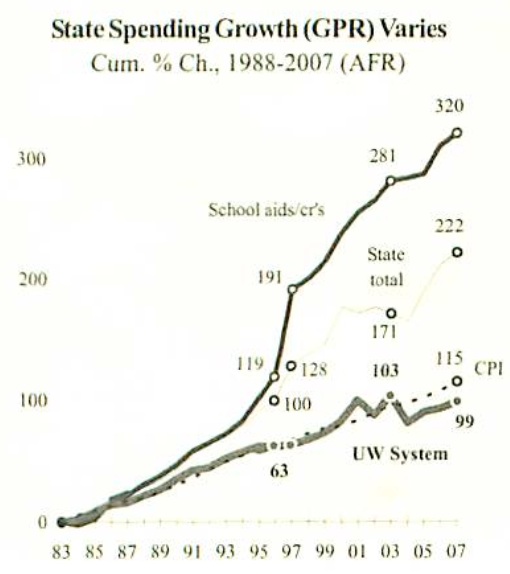
State of Wisconsin K-12 redistributed tax dollars have grown substantially over the past 25+ years, as this chart illustrates.


Redistributed state tax dollars are generated from personal & corporate income taxes and fees.
The Economist has more on New Jersey:

I watched him campaign last year. His message was simple: he vowed to cut spending and red tape. He also stressed that he was not Jon Corzine, the unpopular Democratic governor. Mr Corzine, for his part, emphasised that Mr Christie was a) a Republican and b) fat. The first argument alone would usually be enough to win an election in New Jersey. But last year was a bad time to be a) an incumbent or b) a former boss of Goldman Sachs, and Gov. Corzine was both.
I wondered at the time if Mr Christie meant what he said about doing painful things to rescue New Jersey from its deep pit of debt. It seems that he did. In no time at all, he plugged a short-term budget gap by slashing spending. He has also set his sights on the outlandish benefits enjoyed by some public-sector workers, citing as an example a 49 year old retiree who paid $124,000 towards his retirement benefits and expects to get back $3.8m.
He proposed to balance the budget for fiscal 2011 by cutting a third from projected outlays. He suggested that teachers’ pay be frozen, rather than raised by 4-5%, and that they contribute a small amount (1.5% of salary) towards their health benefits.

Share

We Have Met the Enemy and He Is PowerPoint; “PowerPoint Makes us Stupid”

Elisabeth Bumiller:

Gen. Stanley A. McChrystal, the leader of American and NATO forces in Afghanistan, was shown a PowerPoint slide in Kabul last summer that was meant to portray the complexity of American military strategy, but looked more like a bowl of spaghetti.
“When we understand that slide, we’ll have won the war,” General McChrystal dryly remarked, one of his advisers recalled, as the room erupted in laughter.
The slide has since bounced around the Internet as an example of a military tool that has spun out of control. Like an insurgency, PowerPoint has crept into the daily lives of military commanders and reached the level of near obsession. The amount of time expended on PowerPoint, the Microsoft presentation program of computer-generated charts, graphs and bullet points, has made it a running joke in the Pentagon and in Iraq and Afghanistan.
“PowerPoint makes us stupid,” Gen. James N. Mattis of the Marine Corps, the Joint Forces commander, said this month at a military conference in North Carolina. (He spoke without PowerPoint.) Brig. Gen. H. R. McMaster, who banned PowerPoint presentations when he led the successful effort to secure the northern Iraqi city of Tal Afar in 2005, followed up at the same conference by likening PowerPoint to an internal threat.

Much more on Powerpoint & schools here.
Related: Seth Godin and Pascal-Emmanuel Gobry on PowerPoint.

Share

Public, students speak out against Grand Rapids schools’ online education, superintendent scales back plan

Kym Reinstadler:

About 600 people attended Monday’s rescheduled Grand Rapids Board of Education meeting, with nearly 50 registering days in advance to question the board about proposed changes, including a controversial shift to online instruction at the city’s high schools.
But Wes Viersen said he came to answer the board’s questions about online classes. The Creston High School senior considers himself an expert in online courses, having completed 14 this year — a feat he said he could verify with the transcript in his pocket.
“Overall, the quality of E2020 is horrible,” Viersen told the board. “I completed courses, but I did not get an adequate education.”

Frequently asked questions about Grand Rapids proposed High School Curriculum changes.

Share

Test scores may keep Camden seniors from graduating

Joseph Gidjunis:

Hundreds of Camden City high school seniors are unsure if they’ll graduate this year after learning they failed at least part of the state’s Alternate High School Assessment, formerly known as the SRA.
But Camden’s seniors aren’t alone, as the first round of statewide testing in January resulted in massive failure — 90 percent of the 4,500 students who took the language arts section and two of every three of the 9,500 students who took the math section, didn’t pass — according to the Education Law Center, an urban school advocacy organization, which obtained the results of the test.
Across New Jersey, 120 school districts had no student pass the language arts section and 40 school districts saw no student pass math, said Education Law Center Director of the Secondary Reform Project Stan Karp.

More from New Jersey Left Behind.

Share

Madison School Board Votes 5-2 to Continue Reading Recovery (Howard, Hughes, Moss, Passman, Silveira: Yes; Cole & Mathiak Vote No)

Gayle Worland:

With Monday’s actions, the board still has about $5.6 million to deal with – either through cuts, property tax increases, or a combination of the two – when it meets again next week to finalize the district’s preliminary budget for 2010-11. So far, the board has made about $10.6 million in cuts and approved a levy increase of $12.7 million, a tax hike of $141.76 for the owner of a $250,000 Madison home.
In an evening of cost shifting, the board voted to apply $1,437,820 in overestimated health care insurance costs to save 17.8 positions for Reading Recovery teachers, who focus on the district’s lowest-performing readers. That measure passed 5-2, with board members Maya Cole and Lucy Mathiak voting no. The district is undergoing a review of its reading programs and Cole questioned whether it makes sense to retain Reading Recovery, which she said has a 42 percent success rate.

Related: 60% to 42%: Madison School District’s Reading Recovery Effectiveness Lags “National Average”: Administration seeks to continue its use.
Surprising, in light of the ongoing poor low income reading scores here and around Wisconsin. How many more children will leave our schools with poor reading skills?
The Wisconsin State Journal advocates a teacher compensation freeze (annual increase plus the “step” increases).

Share

Vermont will not seek federal education grant

Associated Press:

Vermont will not seek millions of dollars in a federal grant program aimed at improving failing schools, joining a handful of states in dropping out of the “Race to the Top” program despite strapped budgets.
The competitive grant requires states to link teacher pay to student performance and invest in charter schools, which would require policy and legislative changes in Vermont, commissioner Armando Vilaseca said Monday.
After spending hundreds of hours reviewing the application and program, the state will not apply, Vilaseca said.

Share

When the System Works

New York Times Editorial:

Education Secretary Arne Duncan has vowed to press states to remake the 5,000 or so chronically failing schools that account for about half of the nation’s dropouts and usually serve — or more to the point fail to serve — the poorest children. A $4 billion school improvement fund is intended to give states the help and the incentive to turn these schools around.
Piecemeal plans that evaporate once the grant money is spent won’t do the job. Only comprehensive, districtwide approaches deserve to be financed.
Local administrators — and the Department of Education in Washington — should be paying close attention to what is happening in North Carolina’s Charlotte-Mecklenburg school system.

Share

K-12 Tax & Spending Climate: Pension Financing Shortfall Is a Threat on the Horizon for Illinois

David Greising:

The clamor over the state’s estimated $13 billion budget deficit –and concerns over jobs and spending that prompted the protests — tends to drown out discussion of an issue that economists identify as perhaps the biggest long-term threat to Illinois’s financial health: The state’s shortfall of at least $61 billion in pension funding and the lack of any realistic plan to catch up.
In fact, the state’s pension troubles are even more dire than the official figures would indicate, according to a review of pension data and other economic studies by the Chicago News Cooperative. Illinois, which sold $3.47 billion in securities so it could make its required contribution to pension funds this year, is laying plans to sell at least $4.6 billion more to meet its obligations for fiscal 2011 — a move that is likely to jolt financial markets and many investors who thought years would pass before the state tried another sale of notes to cover its pension costs. Taxpayers ultimately will bear the burden as the need to pay for the bonds strains the state budget and threatens spending in other areas.

Share

With the cash running dry, milking more out of the schools we have got is a better priority than building new ones

The Guardian:

From Thatcher to Major, and from Blair to Brown, the most heated arguments about education have turned on the question of choice. The election of 2010 is no different, but this time it is hard to concentrate on the debate, because of the distracting background din of the steel being sharpened for the savage years ahead. The row over fees for state nurseries which has now beset the Conservatives is a more instructive guide to what the next few years have in stall than any of the choice agendas we are being asked to choose from.
The Conservatives’ Michael Gove has long argued the best way to raise standards in general – and most particularly in deprived places – is to enable disgruntled parents to walk away from failing local authorities and establish schools of their own. Regarded by Mr Gove as a natural extension of Tony Blair’s academy programme, the plan is inspired by an 18-year old experiment in Sweden. And, until recently, the most pertinent questions related to the Swedish evidence. Initially positive signs have recently been overshadowed by the nation slipping down the educational league, and growing fears that gains in its free schools may have come at the expense of other institutions. As the scale of the post-election retrenchment becomes clearer, however, the really big question is the one acutely posed yesterday by a top Conservative councillor. Although Kent’s leader, Paul Carter, later “clarified” that he supported the party line, his query about where the cash will come from still demands an answer.

Share

Los Angeles’ Markham Becomes Flashpoint for Teacher Seniority Reform Debate

Rob Manwaring:

We recently highlighted Markham middle school, a low performing schools in Los Angeles, in a report on low performing school improvement. Now Markham has become the flashpoint of the debate in California to overhaul teacher seniority policies. Governor Schwarzenegger recently visited Markham to highlight the problems at this school which unfortunately became a victim of seniority staffing policies (See related story). As part of a fresh start restructuring of the school, a non-profit organization established by the Mayor let all of the teachers at Markham go, rehired some of them, but mainly hired new young teachers to staff the school. The goals was to model the school after successful charter schools in the district like Green Dot. Unfortunately the school was still subject to the district’s collective bargaining agreement. So when the LA Unified faced a budget problem, it laid off over half of the staff at Markham in the summer of 2009, and has yet to be able to backfill those positions. The school is also part of a lawsuit by the ACLU to stop LAUSD from doing further harm at Markham and school like it.
Earlier this spring, the a task force created by LA’s superintendent, Ramon Cortines and chaired by Ted Mitchell, CEO of New Schools and chair of the State Board of Education (and my old boss), developed a set of recommendations to overhaul the district’s teacher and administrator policies including evaluation, seniority, tenure, differentiated compensation and career pathways. The report is worth a look. But, part of what this group determined was that there needed to be several changes in state law to allow them to implement the changes proposed.

Share

UK Curriculum Changes

BBC:

Head teachers have been urged to back an overhaul of the school curriculum by Education Secretary Mike Russell.
The Curriculum for Excellence (CfE) is to be implemented in secondary schools across Scotland in August.
But there have been union threats of disruption over the controversial, planned changes.
The changes, already in place in primary schools, are designed to give teachers more freedom and make lessons less prescriptive.
Mr Russell said: “Head teachers are at the heart of any successful school.

Share

Times of No Money

G. Rendell:

Some 25 years ago, a quasi-country quartet calling themselves “The Girls Next Door” had a moderate hit with a ditty about how “love will get you through times of no money better than money will get you through times of no love.” Which is fine as far as it goes, but doesn’t explain why the fool thing has been going through my head for the last week or so.
Then I did some translating. First off, I remembered all the times I was told (also about 25 years ago) that God is love. So, by substitution, the aphorism became “God will get you through times of no money better than money will get you through times of no God.” Which seems likely to be true, although I claim no particular expertise in these matters.
And then I remembered a T-shirt I saw a while back — “I believe in God, but I spell it Nature.” (Not sure whether that’s a quote or not. Doesn’t really matter.) Substituting again, we arrive at “Nature will get you through times of no money better than money will get you through times of no Nature.” Which seems like a pretty clear expression of the precautionary principle as applied to climate change.

Share

The State of the Humanities

Susan O’Doherty:

I’ve been thinking about Peter Conn’s article in the Chronicle about the depressing current and predicted future of academic employment in the humanities. The entire article is worth reading, but I was struck especially by his discussion of the need to communicate the value of the humanities to both the academy and the population at large, and to integrate these disciplines better into the world’s business:
Collectively, those of us who profess the humanities must make a sustained effort to explain to our various constituencies–students, parents, legislators, journalists, even our own university trustees (I speak from personal experience of that latter group)–that these disciplines, and the traditions they represent, are not merely ornamental and dispensable. They lie near the heart of mankind’s restless efforts to make sense of the world. Debates over war and peace, justice and equity: From the uses of scientific knowledge to the formulation of social policy, the humanities provide a necessary dimension of insight and meaning.
Generally, law school is considered the initial step on the path to a life of public service. Of course it’s important to understand the laws of the country you’re serving, but I’ve been having fun imagining what the government would look like with more humanities scholars running things. Here’s what I’ve come up with, and I hope you’ll add your thoughts:

Share

Unions, States Clash in Race to Top

Neil King, Jr. & Stephanie Banchero:

The Obama administration’s signature education initiative has incited tense showdowns in states across the country as unions and state officials feud over strategies to compete for $3.4 billion in federal funding.
The skirmishes come as states jockey for cash under the administration’s Race to the Top program, which seeks to reward states that are pushing to overhaul their education systems.
Applications for the second round are due by June 1, with winners to be chosen in September. Of the 40 states that submitted applications in the first round, only 16 were picked as finalists.
U.S. Education Secretary Arne Duncan ramped up pressure on the unions last month when he cited the advantage of union cooperation in picking just two states–Delaware and Tennessee–as winners in the competition’s first round. Those states will share $600 million.

Share

A $34 million crisis of confidence in Washington, D.C. schools

Bill Turque:

ollow the money, if you can.
First, Chancellor Michelle A. Rhee announces that an extra $34 million is available in the D.C. schools budget for teacher pay raises. Two days later, Chief Financial Officer Natwar M. Gandhi declares that not only is most of it nonexistent but also that Rhee is running a projected $30 million over budget in her central office operation.
Within hours, Rhee says an unspecified $29 million has been “identified” to fund the raises.
How this happened, why and how it will be resolved still isn’t clear. Rhee and Gandhi are saving most of their answers for scheduled testimony before the D.C. Council on Friday. Hanging in the balance is the fate of the District’s $140 million tentative agreement with the Washington Teachers’ Union, which is contingent on Gandhi’s certification that the pact is financially sound.

Share

Time to judge teachers the way teachers judge kids

Ruben Navarrette:

Teachers unions need a hug. After all, they’re having a really bad year.
So bad that their members are lashing out – blasting Education Secretary Arne Duncan after he questioned the effectiveness of teachers colleges, criticizing President Barack Obama for his approach to education reform, etc.
In fact, teachers are getting so flustered that they’re contradicting themselves. It’s acceptable for teachers to distinguish good students from bad students. But it’s outrageous for administrators to do the same with teachers. In contract negotiations, teachers like being part of a collective. But when an underperforming Rhode Island school district fired more than 70 educators at once, teachers complained about being judged collectively. When a student succeeds, teachers claim credit for a job well-done. When a student fails, it’s the parents who catch the blame for falling down on the job.

Share

Linda Darling-Hammond gets her own theme song

Education Excellence; The Gadfly:

This week, Mike and Andy discuss Charlie Crist’s veto, Linda Darling-Hammond’s charter school, and Race to the Test’s quickly narrowing field. Then Amber tells us about a new PEPG study on teacher compensation, and Stafford eats a cold cheese sandwich–and loves it! Click here to listen through our website and peruse past editions. To download the show as an mp3 to your computer, click here.

Share

A Few Words on Teachers


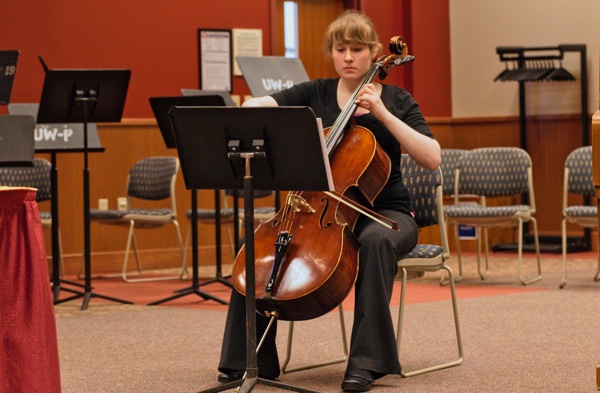
I had the wonderful opportunity to attend the 2010 Wisconsin Solo & Ensemble Festival. It is a true delight to enjoy the results of student and teacher practice, dedication and perseverance.
I very much appreciate the extra effort provided by some teachers on behalf of our children.
I thought about those teachers today when I received an email from a reader asking why I continue to publish this site. This reader referred to ongoing school bureaucratic intransigence on reading, particularly in light of the poor results (Alan Borsuk raises the specter of a looming Wisconsin “reading war“).
I’ll respond briefly here.
Many years ago, I had a Vietnam Vet as my high school government teacher. This guy, took what was probably an easy A for many and turned it into a superb, challenging class. He drilled the constitution, Bill of Rights, Federalist Papers and the revolutionary climate into our brains.
Some more than others.
I don’t have the ability to stop earmark, spending or lobbying excesses in Washington, nor at the State, or perhaps even local levels. I do have the opportunity to help, in a very small way, provide a communication system (blog, rss and enewsletter) for those interested in K-12 matters, including our $400M+ Madison School District. There is much to do and I am grateful for those parents, citizens, teachers and administrators who are trying very hard to provide a better education for our children.
It is always a treat to see professionals who go the extra mile. I am thankful for such wonderful, generous people. Saturday’s WSMA event was a timely reminder of the many special people around our children.

Share

Time for a Wisconsin Reading War….

Alan Borsuk:

Start the war.
What about Wisconsin? Wisconsin kids overall came in at the U.S. average on the NAEP scores. But Wisconsin’s position has been slipping. Many other states have higher overall scores and improving scores, while Wisconsin scores have stayed flat.
Steven Dykstra of the Wisconsin Reading Coalition, an organization that advocates for phonics programs, points out something that should give us pause: If you break down the new fourth-grade reading data by race and ethnic grouping, as well as by economic standing (kids who get free or reduced price meals and kids who don’t), Wisconsin kids trail the nation in every category. The differences are not significant in some, but even white students from Wisconsin score below the national average for white children.
(So how does Wisconsin overall still tie the national average? To be candid, the answer is because Wisconsin has a higher percentage of white students, the group that scores the highest, than many other states.)
Start the war.

Related: Reading Recovery, Madison School Board member suggests cuts to Reading Recovery spending, UW-Madison Professor Mark Seidenberg on the Madison School District’s distortion of reading data & phonics and Norm and Dolores Mishelow Presentation on Milwaukee’s Successful Reading Program.

Share

Governance: Madison School Board Members Proposed 2010-2011 Budget Amendments: Cole, Hughes, Mathiak, Moss & Silveira. Reading Recovery, Teaching & Learning, “Value Added Assessment” based on WKCE on the Chopping Block

Well worth reading, particularly Maya Cole’s suggestions on Reading Recovery (60% to 42%: Madison School District’s Reading Recovery Effectiveness Lags “National Average”: Administration seeks to continue its use) spending, Administrative compensation comparison, a proposal to eliminate the District’s public information position, Ed Hughes suggestion to eliminate the District’s lobbyist (Madison is the only District in the state with a lobbyist), trade salary increases for jobs, Lucy Mathiak’s recommendations vis a vis Teaching & Learning, the elimination of the “expulsion navigator position”, reduction of Administrative travel to fund Instructional Resource Teachers, Arlene Silveira’s recommendation to reduce supply spending in an effort to fund elementary school coaches and a $200,000 reduction in consultant spending. Details via the following links:
Maya Cole: 36K PDF
Ed Hughes: 127K PDF
Lucy Mathiak: 114K PDF
Beth Moss: 10K PDF
Arlene Silveira: 114K PDF
The Madison School District Administration responded in the following pdf documents:

Much more on the proposed 2010-2011 Madison School District Budget here.

Share

Seattle’s Superintendent Performance Review

Charlie Mas:

Well, while folks are talking about having the public kibbitz on school district labor contracts, I suppose we can’t help having comments on the Superintendent’s contract as well. The Board will soon take up the matter of the Superintendent’s annual performance review and action on her contract.
How has the Superintendent done?
I suppose the only proper way to answer that question would be to review her performance relative to her job description and the performance expectations for her that were established and defined in advance. These performance expectations should, of course, all be objectively measurable outcomes. That is, after all, her definition of accountability.
She wrote:

Share

Changing Teacher Tenure: Last Teacher In, First Out? New York City Has Another Idea

Jennifer Medina:

Peter Borock, 23, is in his second year teaching history at Health Opportunities High School in the South Bronx. It could be his last.
With New York City schools planning for up to 8,500 layoffs, new teachers like Mr. Borock, and half a dozen others at his school, could be some of the ones most likely to be let go. That has led the schools chancellor, Joel I. Klein, into a high-stakes battle with the teachers’ union to overturn seniority rules that have been in place for decades.
Facing the likelihood of the largest number of layoffs in more than a generation, Mr. Klein and his counterparts around the country say that the rules, which require that the most recently hired teachers be the first to lose their jobs, are anachronistic. In an era of accountability, they say, the rules will upend their efforts of the last few years to recruit new teachers, improve teacher performance and reward those who do best.

Share

K-12 Tax & Spending Climate: A Revolt Grows in New Jersey

NY Post:

New Jersey voters just sent another loud reminder of their disgust with out-of-control taxes.
Of 537 school budgets up for a vote in the Garden State, 315 — a whopping 59 percent — went down in flames Tuesday.
That’s more than the state’s seen in decades.
Why so many rejections?
Because some 80 percent of those budgets sought property-tax hikes.

Share

For School Company, Issues of Money and Control

Stephanie Strom:

When the energy executive Dennis Bakke retired with a fortune from the AES Corporation, the company he co-founded, he and his wife, Eileen, decided to direct their attention and money to education.
Mrs. Bakke, a former teacher, said she had been interested in education since the summer she was a 12-year-old and, together with a friend, opened the Humpty Dumpty Day School, charging $2 a week in “tuition” to parents of the children attending. Mr. Bakke was eager to experiment with applying business strategies and discipline to public schools.
The Bakkes became part of the nation’s new crop of education entrepreneurs, founding a commercial charter school company called Imagine Schools. Beginning with one failed charter school company they acquired in 2004, they have built an organization that has contracts with 71 schools in 11 states and the District of Columbia. Imagine is now the largest commercial manager of charter schools in the country.

Share

K-12 Tax & Spending Climate: Montana Passes the Piggy Bank for Cost-Saving Ideas

Stephanie Strom:

Nothing is forcing Montana, one of only two states to boast a budget surplus, to cut costs.
Nothing, that is, except its voluble governor, Brian Schweitzer, a Democrat and deficit hawk.
“Four years ago, when most states were awash in cash and new revenues were rolling in, I didn’t allow the Legislature to spend it or commit it,” Mr. Schweitzer said. “I vetoed more than 40 bills.”
He also has vigilantly cut costs, but by January, he said, he had “exhausted all the easy ideas.” So he turned for help to his constituents. He featured a pink piggy bank on his Web site and invited them to click on it and submit their ideas for trimming state expenses.
The Montana Accountability Project attracted more than 1,000 suggestions that included placing sensors in state buildings to turn lights off, switching to a four-day workweek for state employees, abolishing the death sentence and reducing the cost of appeals.

Share

Hundreds of Orange County teachers strike over pay and benefits cuts

Carla Rivera:

Hundreds of Orange County teachers were walking picket lines Thursday, the first day of a strike protesting pay and benefits cuts in the Capistrano Unified School District.
Schools in the 51,000-student district remained open, but most after-school activities and sports events were canceled.
Scores of substitute teachers were hurriedly brought in to preside over classrooms with lesson plans that included enrichment activities in line with state education standards. But there were reports that some students were leaving campuses because there were too few substitutes.

Share

K-12 Tax & Spending Climate: Democrat Controlled Assembly & Senate pass Bill that Reduces Madison’s SAGE Funding by $2M; District must be prepared for More Redistributed State Tax Dollar Changes

Dee Hall:

A bill that Madison School District officials say could take state funding from the district passed the state Senate on Thursday without changes and is headed to the desk of Gov. Jim Doyle.
The measure would increase the maximum class size in schools receiving funding under the Student Achievement Guarantee in Education program. The limit would become 18 students per class, up from the current maximum of 15, which would make SAGE more affordable for some school districts.

4K proponents have argued that the “State” will pay for this service over time. Clearly, counting on redistributed State tax dollars should be done with a measure of caution.

Share

271 Literacy: Backward Mapping

“The Review embodies Will Fitzhugh’s idea about how to get students thinking and writing. In supporting him, you would be helping a person who is building what should and can become a national education treasure.” Albert Shanker, 1993
“What is called for is an Intel-like response from the business and philanthropic community to put The Concord Review on a level footing with a reasonable time horizon.” Denis P. Doyle, 2010

Denis Doyle:

With recent NAEP results (holding steady) and the RTTT announcements (DE and TN are the two finalists in this round) everyone’s eye continues to focus on the persistent problem of low academic achievement in math and English Language Arts. And that’s too bad; it’s time for a change.
Instead of looking exclusively at the “problem,” it’s time to see the promise a solution holds. It’s time to “backward map” from the desired objective–universal literacy–to step-by-step solutions. Achieving true literacy–reading, writing, listening and speaking with skill and insight–is, as Confucius said, a journey of a thousand miles; we must begin with a single step. Let’s begin at the end and work our way backwards.
How might we do that? Little noted and not long remembered is the high end of the literacy scale, high flyers, youngsters who distinguish themselves by the quality of their work. By way of illustration, young math and science high flyers have the Intel Talent Search to reward them with great fanfare, newspaper headlines and hard cash (the first place winner gets a $100,000 scholarship) and runners-up get scholarships worth more than $500,000 in total.
That’s as it should be; the modern era is defined by science, technology and engineering, and it is appropriate to highlight achievement in these fields, both as a reward for success and an incentive to others.
But so too should ELA receive public fanfare, attention and rewards. In particular, exemplary writing skills should be encouraged, rewarded and showcased.
It was the Council for Basic Education’s great insight that ELA and math are the generative subjects from which all other knowledge flows. Without a command of these two “languages” we are mute. Neither math nor English is more important than the other; they are equally important.
Indeed, there is a duality in literacy and math which is noteworthy–each subject is pursued for its own sake and at the same time each one is instrumental. Literacy serves its own purpose as the fount of the examined life while it serves larger social and economic purposes as a medium of communication. No wonder it’s greatest expression is honored with the Nobel Prize.
What is called for is a Junior Nobel, for younger writers, something like the Intel Talent Search for literary excellence. In the mean time we are lucky enough to have The Concord Review. Lucky because its editor and founder, Will Fitzhugh, labors mightily as a one-man show without surcease (and without financial support). We are all in his debt.
Before considering ways to discharge our obligation, what, you might wonder, is The Concord Review?
I quote from their web site: “The Concord Review, Inc., was founded in March 1987 to recognize and to publish exemplary history essays by high school students in the English-speaking world. With the 81st issue (Spring 2010), 890 research papers (average 5,500 words, with endnotes and bibliography) have been published from authors in forty-four states and thirty-seven other countries. The Concord Review remains the only quarterly journal in the world to publish the academic work of secondary students.” (see www.tcr.org)
Lest anyone doubt the importance of this undertaking, permit me to offer a few unsolicited testimonials. The first is from former Boston University President John Silber, “I believe The Concord Review is one of the most imaginative, creative, and supportive initiatives in public education. It is a wonderful incentive to high school students to take scholarship and writing seriously.
The other is from former AFT President Al Shanker: “The Review also has a vital message for teachers. American education suffers from an impoverishment of standards at all levels. We see that when we look at what is expected of students in other industrialized nations and at what they achieve. Could American students achieve at that level? Of course, but our teachers often have a hard time knowing exactly what they can expect of their students or even what a first-rate essay looks like. The Concord Review sets a high but realistic standard; and it could be invaluable for teachers trying to recalibrate their own standards of excellence.”
Can an enterprise which numbers among its friends and admirers people as diverse as John Silber and Al Shanker deserve anything less than the best?
What is called for is an Intel-like response from the business and philanthropic community to put TCR on a level footing with a reasonable time horizon. Will Fitzhugh has been doing this on his own for 22 years (he’s now 73) and TCR deserves a more secure home (and future) of its own.

“Teach by Example”
Will Fitzhugh [founder]
Consortium for Varsity Academics® [2007]
The Concord Review [1987]
Ralph Waldo Emerson Prizes [1995]
National Writing Board [1998]
TCR Institute [2002]
730 Boston Post Road, Suite 24
Sudbury, Massachusetts 01776-3371 USA
978-443-0022; 800-331-5007
www.tcr.org; fitzhugh@tcr.org
Varsity Academics®
www.tcr.org/blog

Share

Minnesota Teacher Union Lobbying

Mike Antonucci:

Minnesota lawmakers felt their Race to the Top application was adversely affected by insufficient teacher union buy-in. So they heeded the union’s repeated calls for “a seat at the table” by giving Education Minnesota President Tom Dooher, well, a seat at the table. Unfortunately, it was a seat at the legislators’ table during a committee hearing and Dooher is not only the union president, but a registered lobbyist.
Republican state Rep. Mark Buesgens said it was “like having Vito Corleone watching over his foot soldiers.”
The Democrats said the meeting was a working group and not a full committee hearing, so Dooher’s presence at the legislators’ table was not a breach of protocol. However, the Minnesota House voted 128-2 yesterday to bar lobbyists and executive branch members from sitting at the committee table with lawmakers during official meetings.

Share

Transforming Britain’s Schools

The Economist:

THE general election due in Britain on May 6th is not the one David Cameron was chosen to fight. The opposition Conservatives made him their leader in 2005 after a barnstorming speech delivered without notes to their annual conference. His pitch: that he could persuade the electorate to trust him with public services and offer tax cuts too, by “sharing the proceeds of growth”. It was a formula worthy of an earlier young, centrist, opposition politician: Tony Blair, who in 1997 led Labour to victory after 18 years of Conservative rule.
Now there is nothing to share: taxes will have to rise and public spending fall. But still Mr Cameron is reprising Mr Blair. In 1997 Mr Blair memorably said that his priorities were “education, education, education”. In the run-up to this election, education reform is the main, perhaps the only, broad and deeply thought-out proposal from his self-styled heir.

Share

Your education, brought to you by…

KALWNews.org:

t wasn’t too long ago that I was in high school, munching on Pizza Hut, In-N-Out and Kentucky Fried Chicken at lunch next to the Dasani and Coca Cola vending machines while wearing a school t-shirt sporting several local business sponsors.
The mix of education and corporate sponsorship seemed to be a win-win situation-the school district got money that was directed back into education and maintenance of facilities, the students were happy with non-cafeteria food, the cafeteria workers did little to prepare the meals besides handing them out and the sponsors maintained a steady stream of product and advertisement consumers. This was back in 2004, a few years before most of us could foresee the pending economic doom that awaited us.
In the past few years what seemed a relatively controlled partnership based solely on food has evolved into an intense, targeted marketing venture during a time when schools are hurting for money. In San Diego, Rancho Bernardo calculus instructor Tom Farber started selling ads on his exams at $10-30 a pop. The reason? Copies for tests would cost more than $500 per year, and his budget was only $316. The rest of the money would have to come from somewhere.

Share

K-12 Tax & Spending Climate: New Jersey’s Voters Turn Down Many School District Budgets

New Jersey Left Behind:

Today’s Wall Street Journal:
The election results are obviously a big setback for the Democratic Party-government union alliance that has ruled Trenton for the past decade. So far, Governor Christie is winning the spending debate. The lesson for other governors is that opposition from public-employee unions is not insurmountable if you can articulate to voters what’s at stake.
Joseph Marbach, Dean of the College of Arts and Sciences at Seton Hall:
I think the governor was very successful in … portraying the teachers union as out of touch with what’s going on with working families. The voters are more aligned with his position… I think it … gives him continued momentum to continue to rein in costs.

Share

Montgomery County to weigh student performance as a third of teachers’ reviews

Daniel de Vise:

Montgomery County teachers and school system leaders signed an agreement Tuesday that calls for test scores and other student performance data to “factor strongly” in one-third of every teacher’s evaluation, saying theirs is the first school system in Maryland to specify how much that data will count as a factor in teacher ratings.
The teachers and administrators acted in response to a new state law that allows student test scores to be used as a “significant” component of teacher evaluations. The law is part of Maryland’s proposal for federal education aid under President Obama’s $4 billion “Race to the Top” competition. Maryland is seeking as much as $250 million in the contest, which awards money to states whose applications show the strongest commitment to the president’s education reform agenda.
Test scores have been a part of Montgomery’s decade-old Teacher Professional Growth System, just as they factor into teacher evaluations in many other school districts. But Race to the Top has put school systems under pressure to place test scores front and center in those evaluations and to quantify their role in rating teachers.

Share

In NJ school cut debate, insults overshadow issues

Geoff Mulvihill:

They’re the kind of obscenity-laced schoolyard taunts that could get a student suspended.
But the target of this tirade is New Jersey’s Gov. Chris Christie — and the perpetrators are the state’s teachers, irate over his calls for salary freezes and funding cuts for schools.
In Facebook messages visible to the world — not to mention their students — the teachers have called Christie fat, compared him to a genocidal dictator and wished he was dead. The postings are often riddled with bad grammar and misspellings.
“Never trust a fat f…,” read one profane post on the Facebook page, “New Jersey Teachers United Against Governor Chris Christie’s Pay Freeze,” which has some 69,000 fans, many of them teachers.
“How do you spell A– hole? C-H-R-I-S C-H-R-I-S-T-I-E,” read another.

Share

U.S. tapping S.F. school’s recipe for success

Jill Tucker:

A top education official in the Obama administration sat in San Francisco’s Marshall Elementary School cafeteria taking notes Monday as parents, teachers and administrators recited a recipe for what it takes to turn around a struggling school.
The main ingredients included quality teachers, involved parents and a supportive principal mixed perhaps with a new dual-immersion language program. Time must be allowed to let it all take hold.
It is the kind of formula federal officials would love to see in place at schools across the country. Too many schools are failing year after year with no end in sight, said U.S. Deputy Secretary of Education Tony Miller.

Share

Obama repeals Bush-era Title IX policy

Valerie Strauss:

The Obama administration is throwing out a Bush-era policy under the Title IX gender equity law that critics said made it easy for schools and colleges to avoid offering equal opportunities for women in athletics.
Title IX, passed in 1972, required schools to use a comprehensive evaluation to decide whether females were being given equal opportunity to participate.
In 2005, under then President George W. Bush, a new policy allowed schools to use a simple survey of women as its evaluation, and to combine non-responses with negative responses. Critics said gave institutions an easy way to avoid providing equal athletic opportunities for females.

Share

The Education Mess: Can We Build a Better National School System? No….

Jerry Pournelle:

Diane Ravitch was one of the architects of No Child Left Behind, but in her new book she now admits that it isn’t working, and is in fact helping kill the kind of education she advocates. She continues to believe that the American public schools do a poor job, and that we can build a much more successful system of public education.
I agree with her on the first point. She’s dead wrong on the second. We can’t build a better system.
That’s not a cry of despair, it’s a statement of fact. There is never going to be a national school system much better than what we have now. It may get worse, but it won’t get much better.
We could build a better school system by the simple expedient of abolishing the Department of Education. Some of us thought we could manage that when Reagan was swept into office, but the liberal establishment with the support of the teachers unions wouldn’t permit that: and Reagan needed Congressional support for his defense measures. Some of us remember that when Reagan took office, only ten years before the collapse of the Soviet Union, the United States looked to be in bad shape, with too many overseas commitments — what Walter Lippman called drafts on our power — and too little actual power, either military or diplomatic. The military needed a big shakeup and buildup, we needed to look into our overseas commitments, financial reforms were desperately needed, and the liberals, knowing all this, were willing to help — provided that they got their share of liberal programs. The Department of Education was one of their bastions, and they would fight to the death — or at least to the death of the Republic — to prevent it from being abolished.

Less centralization, including the breakup of big districts would be a great step forward.

Share

K-12 Tax & Spending Climate: New Jersey voters reject school budgets in heated elections

Star-Ledger:

New Jersey voters took a stand on school spending and property taxes Tuesday, rejecting 260 of 479 school budgets across 19 counties, according to unofficial results in statewide school elections.
In the proposed state budget he unveiled last month, Gov. Chris Christie slashed $820 million in aid to school districts and urged voters to defeat budgets if teachers in their schools did not agree to one-year wage freezes. The salvo ignited a heated debate with the state’s largest teachers union.
Christie said the cuts were necessary to help plug an $11 billion state budget gap.
In many districts Tuesday, the governor made himself heard as 54 percent of the spending plans were rejected, according to unofficial returns. If the trend continues, it would mark the most budget defeats in New Jersey since 1976, when 56 percent failed. Typically, voters approve more than 70 percent of the school budgets.

Share

A Toxic Dispute With Teachers in Washington, DC

New York Times:

Last fall, Michelle Rhee, the tough-minded and creative schools chancellor in Washington, laid off 266 teachers, citing a budget crunch. She has since reported finding a budget surplus. The city’s teachers’ union, which challenged the layoffs unsuccessfully last fall, has now asked a judge to review them again. The atmosphere has grown increasingly toxic.
Some of Ms. Rhee’s critics have implausibly suggested that she might have withheld information to justify the layoffs. It would be terrible for the city’s children if the dispute reached a point where it upended the innovative union contract that Ms. Rhee and union leaders provisionally agreed to earlier this month.
The contract, which changes the terms under which teachers are paid and evaluated, could pave the way for better schools for the District of Columbia’s students and could become a model for agreements between school districts and teachers’ unions around the country.

Share

California State Education Budget Update Event

Brian Kaplan, via email:

The state budget once again appears to be in flux. The Governor has promised no cuts to education. But education leaders have disputed this claim and are once again faced with significant program reductions. The governor’s May Revise will provide additional details on how the public school districts will fare in 2010-2011. Our panelists will address the impact of the budget on education from multiple perspectives.
Moderator
John Fensterwald, Writer of The Educated Guess and Journalist in Residence at Silicon Valley Education Foundation

Share

What to do with ‘persistently underperforming’ schools?

San Francisco School Board Member Rachel Norton:

On April 20, the San Francisco Board of Education will convene a policy discussion to discuss the Superintendent’s plans for our 10 schools labeled “persistently underperforming” by the state of California.
This list was created as part of the state’s efforts to qualify for Race to the Top. It designates five percent of the state’s schools as failing, and prescribes one of four turnaround models for districts to take. There’s no choice in the matter, though it’s unclear under state law when these actions would have to be taken. If, however, a district wants to apply for Federal funds to help implement one of the turnaround models, it must submit a plan in the next few weeks–and begin the work within six months.
I am not crazy about any of the turnaround models. They assume that school leaders are so stupid that–D’oh! We never thought of replacing principals! We never thought of reconstitution (which we tried in this district and which failed, miserably)! Charter schools! Wow! (Even though charter schools have as mixed a record as traditional public schools–no miracles here.) School closure! (How does closing a school affect the achievement of its former students, exactly?)

Share

Department of Education’s “Race to the Top” Program Offers Only a Muddled Path to the Finish Line

William Peterson & Richard Rothstein:

In short, the Race to the Top 500-point rating system presents a patina of scientific objectivity, but in truth masks a subjective and somewhat random process.
This competition was a trial run for Secretary Duncan of a policy approach he hopes to make permanent. The Obama administration has proposed that formula-driven Title I funding16 be frozen at its present level, without future adjustment for inflation, and that increases in federal education spending be devoted entirely to a new collection of competitive grants, some of which have similar requirements to RTT, and some of which, as indicated above, attempt to create incentives for initiatives not included in RTT. Because such a reduction in real Title I funding would further exacerbate state fiscal crises, and because this trial run of a competitive system has proven to have little credibility, the administration should rethink its approach to federal education aid and its relationship to school improvement.
Yet for now, the Department of Education proposes to go through an identical process for judging a second round of applications by July. States that lost in the March competition have been invited to re-apply, and several are doing so, again investing time and expense to re-do their applications. Experts in these states are likely to spend many hours studying the review process employed in March, so they can recommend small changes in their states’ applica- tions to exploit the quirks of the Department’s rating system. Such gaming is unlikely to reflect an actual improvement in the education policies of applicant states.

Share

Comments on the Seattle Public Schools’ Strategic Plan Update

Charlie Mas:

So I was just thinking about the progress on the Strategic Plan. I know I shouldn’t. It only serves to upset and frustrate me. Nevertheless…
Focusing just on the primary themes and elements of the Plan, it still doesn’t look good.
1. Ensuring Excellence in Every Classroom
1A. Adopt an aligned curriculum in math and science
They haven’t done this. They’re nowhere with regard to science; I don’t think they’ve even gotten started. They’re not much further along with math. They have standardized the textbooks (for the most part), and they have posted pacing guides, but there’s no evidence that they have aligned the curriculum. In fact, it doesn’t appear that they have any ability to align the curriculum, that they even know how to align curriculum, or that they know what aligned curriculum would look like. After making bold statements on PowerPoints and paying millions to vendors, they appear to be completely adrift.
1B. Develop districtwide assessments in math and reading
This is a reference to the MAP, but it isn’t districtwide yet and teachers either don’t know how to use the results or simply aren’t choosing to use them. There were supposed to be a lot of other common assessments, but there’s no evidence to suggest that they are either in use or useful. Mostly this was an excuse to funnel millions to a vendor for a data warehouse which isn’t ready yet and will be of questionable utility when it is ready.

Related: Madison School District Strategic Plan.

Share

The Bad Teacher Protection Racket

Mike Nichols:

Legislators trying to help save a generation of Milwaukee children from lives of poverty and unemployment want to add a new law to the books in Madison this week.
They should, if they want to make a real difference, also delete one.
Part of the new education bill passed by the Senate the other day, and now being considered by the Assembly, calls for rigorous, annual teacher performance evaluations – something that many districts all across America already supposedly administer.
But not really.
Last year, the New Teacher Project researched teacher evaluations in 12 districts, both big and small, across the country. Methods and frequency of evaluation differed from district to district, but one thing was found to be strikingly similar. Virtually all teachers in the districts studied are told over and over and over again that they are either good or great. In districts that use binary rating systems, for instance, (generally “satisfactory” and “unsatisfactory” categories are used) more than 99% of teachers are given the “satisfactory” designation, according to the researchers.

Share

K-12 Tax & Spending Climate: The People & Their Government: Distrust, Discontent, Anger & Partisan Rancor

The Pew Research Center:

By almost every conceivable measure Americans are less positive and more critical of government these days. A new Pew Research Center survey finds a perfect storm of conditions associated with distrust of government – a dismal economy, an unhappy public, bitter partisan- based backlash, and epic discontent with Congress and elected officials.
Rather than an activist government to deal with the nation’s top problems, the public now wants government reformed and growing numbers want its power curtailed. With the exception of greater regulation of major financial institutions, there is less of an appetite for government solutions to the nation’s problems – including more government control over the economy – than there was when Barack Obama first took office.
The public’s hostility toward government seems likely to be an important election issue favoring the Republicans this fall. However, the Democrats can take some solace in the fact that neither party can be confident that they have the advantage among such a disillusioned electorate. Favorable ratings for both major parties, as well as for Congress, have reached record lows while opposition to congressional incumbents, already approaching an all- time high, continues to climb.

Share

An analysis of pay-for-grades schemes

Daniel Willingham:

Roland Fryer is an economist at Harvard University who had an idea for a straightforward method of getting kids at urban schools more engaged: Pay ’em.
Four reward schemes were tried in four different cities, each in a randomized control trial lasting one year. The results are reported in Time magazine this week.
New York City: Students were promised pay for higher standardized test scores. There was no effect.
Chicago: Students were paid for higher grades. The rewards prompted higher attendance rates and higher grades, but standardized test scores were not improved.
Washington, D.C.: Students were rewarded for improved behaviors such as good attendance, refraining from fighting, and so on. There was a modest improvement on standardized test scores.

Share

Five hard truths about charter schools

Jay Matthews:

Many people get too excited about the latest hot education innovation. They lose their sense of perspective. It has happened even to me once or twice. When we wander off like that, we need someone with a sharp intellect and strong character to pull us back to reality.
One such person is Paul T. Hill, director of the Center on Reinventing Public Education and John and Marguerite Corbally Professor at the University of Washington Bothell. He has written a short, wise book, “Learning As We Go: Why School Choice is Worth the Wait,” which provides the clearest explanations I have seen for why independent public charter schools need more time to develop. Hill believes it is worth waiting for charters to make what he thinks will be widespread positive impact on the quality of education. He thinks they are more promising than a renewed fondness for strengthening bureaucracy and standardizing instruction that seems to be bubbling in some foundations and national advocacy groups.
Hill makes five simple points and more or less devotes a chapter to each. Here is what he says, with some fussing and worrying by me. If you want to add your ideas to these, or explain why these are nonsense, the comments box below awaits.

Share

Merit Pay for Teachers

Alan Pagano:

A heated debate surrounding merit pay for teachers has existed for decades in the United States, where since the 1920s public schools began awarding compensation primarily according to title and years of experience rather than performance.
Political leaders such as President Barack Obama and US Secretary of Education Arne Duncan have recently expressed support for the notion of merit pay for teachers. In March 2009, Obama said that teachers should be treated “like the professionals they are while also being held more accountable. Good teachers will be rewarded with more money for improved student achievement, and asked to accept more responsibilities for lifting up their schools.”
This has reinvigorated the debate, with many groups staking out positions on either side. The National Education Association, for example, has opposed merit pay, while the United Federation of Teachers, at least in part, seems to support the idea.
Here is a summary of questions and pro and con responses within the debate.

Share

The teacher salary debate we long needed to have

Mike Kelly:

Since 2001, spending by local towns across New Jersey has risen by 70 percent, with average 4 percent raises for teachers each year playing a major role in the increases. During that same period, property taxes have risen by 56 percent.
You don’t need to be a math major to know that you can’t pay for a 70 percent spending hike with “only” a 56 percent increase in tax revenues. So how did towns make up the difference?
Answer: Trenton.
For many towns and school districts, the revenue gap was filled in with state aid. And that state aid has come largely from income taxes and other fees.
But then came the recession and the sharp drop in incomes – and income taxes.
And then came Chris Christie, handily beating the well-funded, union-backed incumbent Democratic governor, Jon Corzine.
Corzine did not lose because he wasn’t smart enough or because he did not have enough campaign cash of his own. He lost because voters no longer had confidence that he could deliver on his promise to find ways to cut spending and deliver some measure of property tax relief.

Share

K-12 Tax & Spending Climate: Madison property values see first decline in 35 years

Dean Mosiman:

There’s new evidence the deep national recession has taken a toll on Madison: the value of all real estate dropped by 3.1 percent for 2010, the first decrease in at least 35 years, according to data released by the city Friday.
Falling values do more than reduce the net wealth of property owners. Along with a slowdown in construction, they mean that under current tax rates, fewer dollars will be available to fund the rising costs of city, school and other public services 2011.
“There can’t be new spending. We’re going to have to cut where we can,” Mayor Dave Cieslewicz said in a phone interview from a transit research tour in the Netherlands. “Despite that, there will be considerable pressure on taxes.”

Local government units have been living off of parcel and assessed value growth for decades. This change has significant taxpayer implications…

Share

Madison School Board to Discuss the Superintendent’s Proposed Administrative Reorganization Monday Evening

Organization Chart 352K PDF
Reorgnanization Budget 180K PDF
February, 2010 background memo from Superintendent Dan Nerad.
I spoke with the Superintendent Friday regarding the proposed reorganization. The conversation occurred subsequent to an email I sent to the School Board regarding Administrative cost growth and the proposed reduction in Superintendent direct reports.
I inquired about the reduction in direct reports, the addition of a Chief Learning Officer, or Deputy Superintendent and the apparent increased costs of this change. Mr. Nerad said that he would email updated budget numbers Monday (he said Friday that there would be cost savings). With respect to the change in direct reports, he said that the District surveyed other large Wisconsin Schools and found that those Superintendents typically had 6 to 8, maybe 9 direct reports. He also reminded me that the District formerly had a Deputy Superintendent. Art Rainwater served in that position prior to his boss, Cheryl Wilhoyte’s demise. He discussed a number of reasons for the proposed changes, largely to eliminate management silos and support the District’s strategic plan. He also referenced a proposed reduction in Teaching & Learning staff.
I mentioned Administrative costs vis a vis the current financial climate.
I will post the budget numbers and any related information upon receipt.
Finally, I ran into a wonderful MMSD teacher this weekend. I mentioned my recent conversation with the Superintendent. This teacher asked if I “set him straight” on the “dumbing down of the Madison School District”?
That’s a good question. This teacher believes that we should be learning from Geoffrey Canada’s efforts with respect to the achievement gap, particularly his high expectations. Much more on the Harlem Children’s Zone here.
Finally, TJ Mertz offers a bit of commentary on Monday evening’s Madison School Board meeting.

Share

K-12 Tax & Spending Climate: New Jersey’s ‘Failed Experiment’

James Freeman:

‘I said all during the campaign last year that I was going to govern as if I was a one-termer,” explains New Jersey Governor Chris Christie on a visit this week to the Journal’s editorial board. “And everybody felt that it was just stuff you say during a campaign to sound good. I think after the first 12 weeks, given the stuff I’ve done, they figure: ‘He’s just crazy enough to do it.'”
Call it crazy, or just call it sensible: Mr. Christie is on a mission to make New Jersey competitive once again in the contest to attract people and capital. During last fall’s campaign, while his opponent obliquely criticized Mr. Christie’s size, some Republicans worried that their candidate was squishy–that he wasn’t serious about cutting spending and reining in taxes. Turns out they were wrong.
Listen to Mr. Christie’s take on the state of his state: “We are, I think, the failed experiment in America–the best example of a failed experiment in America–on taxes and bigger government. Over the last eight years, New Jersey increased taxes and fees 115 times.” New Jersey’s residents now suffer under the nation’s highest tax burden. Yet the tax hikes haven’t come close to matching increases in spending. Mr. Christie recently introduced a $29.3 billion state budget to eliminate a projected $11 billion deficit for fiscal year 2011.

Share

On Stanford Education School’s Charter Difficulties

Andrew Rotherham:

My take on the Stanford charter school situation is below. Punchline: This is sad in some powerful ways, it’s not funny.

But the New York Times story demands a bit more discussion. (Plus it buries the lede…check out the Shalvey quote)

In the story Linda Darling Hammond points out that the Stanford school takes all kids. Sure, but so do many other public schools (including some in the community including Aspire Public Schools, a network of public charters established by a former CA school superintendent) that have better results. More on that below. That uncomfortable reality also makes Diane Ravitch’s quote in the story really curious. This situation doesn’t illustrate much about the debate about schools and poverty overall, but it does again show that there are big differences among schools serving similar kids and that powerful and intentional instruction matters.

Share

The Paper Debate

Robbie Brown:

Before each tournament, Sam Crichton, a senior on the Wake Forest debate team, meticulously stocks a half-dozen Rubbermaid tubs with computer printouts. Each sheet of paper — perhaps 5,000 total — summarizes the argument in, say, a presidential speech or op-ed piece. These “cards” have been sorted into manila files, grouped into brown accordion folders, stacked into the tubs and labeled by argument type: affirmatives, disadvantages, counterplans, critiques, case arguments/negatives, backfiles.
There are 50 tubs for the entire Wake Forest team — a traveling library of debate research. With the aid of all those pages of argumentation, debaters can summon up well-reasoned, highly specific points about nuclear disarmament, this year’s topic for college policy debaters. What if an affirmative team contends that nuclear armament has hurt Africa? What if a negative team cites Heidegger to bolster its response?
“There’s a strange comfort in reading off a sheet of paper,” Mr. Crichton says. “Having all of this paper may seem like a form of chaos, but to me it actually seems more organized.”

Share

Milwaukee’s Plans for a One Size Fits All Reading Curriculum

Alan Borsuk:

The textbooks and the workbooks and the teachers manuals and all the other materials were displayed attractively. There were mini-candy bars and cloth shopping bags for visitors to take.
America’s biggest text book companies – Pearson, McGraw-Hill and Houghton-Mifflin Harcourt – each had large, handsome displays.
For three days last week, the third-floor library of the Juneau High School building was the center of looming big change in the way children in Milwaukee Public Schools are taught reading. MPS officials are selecting a new reading program.
A special committee will make a recommendation and the School Board will make the choice in the winner-takes-all curriculum selection process. The sunlit scene in the Juneau library was the part of the process where anyone could take a look and give input.
It was an amiable scene. The representatives of the publishers were friendly, talkative, knowledgeable, and quite willing to schmooze. “Great tie,” one told me as I walked down the aisle. She appeared to know something about this tie that no one else had noticed in the 20 years I’ve owned it.

University of Wisconsin-Madison Psychology Professor Mark Seidenberg has written a number of articles on Madison’s reading programs.

Share

An Open Mind

Katie Hafner:

At 83, Marian C. Diamond has been teaching anatomy at the University of California, Berkeley, for 50 years. Her class is so popular that it’s difficult for students to get in, though she holds court at the campus’s largest lecture hall, with room for 736.
She begins by opening a colorful hatbox. Dressed in an elegant suit and scarf with her hair swept back into a chig non, Professor Diamond pulls on a pair of latex gloves and reveals the box’s contents: a human brain. It is in alcohol, she says, “because alcohol will preserve the brain. Need I say more?” The students laugh as they take this in. She has the room in the palm of her hands.
Professor Diamond is one of the tweedy celebrities of cyberspace. Videos of her anatomy course, Integrative Biology 131, have been viewed nearly 1.5 million times on YouTube, where they have been available since 2005 to anyone with an Internet connection. Some of the world’s foremost scholars are up there for viewing, tuition free. From Yale, you can tune into an economics class by a professor with his own home-price index, Robert Shiller, or a course by the Milton scholar John Rogers. The undisputed rock star academic is Walter H. G. Lewin of the Massachusetts Institute of Technology, who flies across the room to demonstrate that a pendulum swings no faster or slower when there is an added mass (Professor Lewin) hanging at the end.

Share

Why Homeschool? The Highlights of Free Education

An Education Life:

Why homeschool? Maybe to brush up for an exam, get a sense of what a college is like, or just to learn. In the articles listed below, writers who know the fields weigh in on some of the highlights of free education.

  • Economics | Yale: My Teacher Is an Index
  • French | Carnegie Mellon: VoilĂ ! A Better e-Course
  • Music | Connexions: The Music Lesson
  • History | M.I.T.: Asian Culture Through a Lens
  • Psychology | Yale: Why We Go Cuckoo for …
  • Psychology | Yale: Smiles, Sex and Object Permanence
  • Genetics | U.C.L.A.: Decoding DNA
  • Physics | U.C. Berkeley: Atoms and Antimatter
  • Physics | U.C. Irvine: The Marvel of Science
  • Linear Algebra | M.I.T.: The Matrix
  • Computer Science | Stanford: They Have a Class for That
  • Anatomy | U.C. Berkeley: The Inner Body


  • Every school should provide opportunities for their students to take advantage of online courses. They are a great complement to traditional teaching, and a way to reduce or eliminate local curriculum creation expenditures.

    Share

    Oakland schools fact-finding report released

    Jill Tucker:

    With a one-day teacher strike looming in Oakland, a fact-finding report released Thursday gave both the district and the teachers union some ammunition in the bitter battle over a new labor contract.
    The report, a required step following failed contract negotiations, validated the district’s claims of financial desperation, but it also gave a nod to the Oakland Education Association’s claims of relatively low teacher pay and need for small class sizes.
    It urged both sides to get over the past – a history mired in fiscal mismanagement and bitterness.

    Share

    Seattle Teachers Union Bristles at New Coalition’s Effort to Muscle In on Contract Negotiations

    Nina Shapiro:

    Contract negotiations began this week between Seattle Public Schools and the teachers union, and the atmosphere is already getting testy–but not between the parties you might expect. Seattle Education Association president Olga Addae is peeved over a new coalition led by the non-profit Alliance for Education that is trying to muscle in on the talks.
    Although technically no one else is allowed at the bargaining table besides the union and the district, the “Our Schools Coalition” last week launched a campaign to influence the process by unveiling a list of nine proposed changes it would like to see in the new contract–all of which are aimed at supporting good teachers and weeding out the bad.
    While the group’s ideas are not necessarily new, its effort to influence the negotiations is. And the coalition may have the political clout to do just that.

    Share

    Florida Politics: Governor Crist Vetoes SB6 – Changes to Teacher Tenure

    Kyle Munzenrieder:

    Gov. Charlie Crist has vetoed the Jeb Bush-backed, controversial SB6. The education bill would have eliminated tenure for newly hired teachers, and would have tied a portion of teachers’ salaries to test score results.
    “I say we must start over. This bill has negatively affected the morale of our parents, teachers and students,” Crist said.
    The bill was opposed by many teachers and school boards, including Miami-Dade’s. About 25 percent of county teachers called out “sick” on Monday to protest the bill.

    Tom Vander Ark sees NEA’s hand in this veto.

    Share