School Information System

We’re ripe for a great disruption in higher education

Margaret Wente:

How would you like to go to MIT – for free? You can now. Starting this spring, the Massachusetts Institute of Technology will be offering free online courses to anyone, anywhere in the world, through its new digital arm, MITx. These courses will be much more than lectures on videotape. Students will be able to interact with other students online and have access to online labs and self-assessment tools. And here’s the really revolutionary part: If you can show you’ve learned the material, for a small fee, MITx will give you a credential to prove it. No, it’s not a full-blown MIT degree. But employers will probably be impressed.

Share

Bill aims to give home-schooled students access to public high school sports

Anita Kumar:

Seventeen-year-old Katie Wormald has more than a passing interest in soccer. She’s been playing since she was 5, plans to compete in college — and maybe earn a business degree to start a soccer-related company.
But because Wormald attends classes in her living room instead of a classroom, she lost a chance to play on a more competitive public high school team. Instead, she plays in recreational leagues, on travel teams and at a small, local private school.

Share

K-12 Tax & Spending Climate: The Heartland Tax Rebellion

The Wall Street Journal:

Oklahoma Governor Mary Fallin is starting to feel surrounded. On her state’s southern border, Texas has no income tax. Now two of its other neighbors, Missouri and Kansas, are considering plans to cut and eventually abolish their income taxes. “Oklahoma doesn’t want to end up an income-tax sandwich,” she quips.
On Monday she announced her new tax plan, which calls for lowering the state income-tax rate to 3.5% next year from 5.25%, and an ambition to phase out the income tax over 10 years. “We’re going to have the most pro-growth tax system in the region,” she says.

Share

Why Pay for Intro Textbooks?

Mitch Smith:

If ramen noodle sales spike at the start of every semester, here’s one possible reason: textbooks can cost as much as a class itself; materials for an introductory physics course can easily top $300.
Cost-conscious students can of course save money with used or online books and recoup some of their cash come buyback time. Still, it’s a steep price for most 18-year-olds.
But soon, introductory physics texts will have a new competitor, developed at Rice University. A free online physics book, peer-reviewed and designed to compete with major publishers’ offerings, will debut next month through the non-profit publisher OpenStax College.

Share

The GAAP in Wisconsin state finances

Steve Prestegard:

The Wisconsin Policy Research Institute’s George Lightbourn on the correct way to assess state finances (which is not now being done by the Walker administration, nor was it done by the Doyle, McCallum, Thompson, Earl, Dreyfus, Schreiber or Lucey administrations, and so on, and so on, and so on):

Sheila Weinberg from the Institute for Truth in Accounting coined the term, “political math.” When politicians delay a payment and refer to the delay as a “savings,” they’re using political math. Or when no money is set aside for a bill they know is coming due, practitioners of political call the IOU a “savings.” It’s political math that allows state government to meet the balanced budget requirement while state accountants show it to be running a $3 billion deficit (according to the official tally released over the Christmas holiday).
Both Republicans and Democrats have used political math to make budgets balance over the years. Political math allowed my former boss Scott McCallum to balance the budget using one-time tobacco money and it was political math that green lighted Jim Doyle to “borrow” over $1 billion from the transportation fund. Thanks to political math, Governors and legislatures of all political stripe have been able to buy more government than they could really afford.

Share

Digital Exams on the iPad

Fraser Speirs:

It’s prelim week at Cedars. In Scotland, pupils with additional needs can use a “Digital Question Paper” to complete their exam.
A DQP is a PDF with embedded forms. The pupil sits at a computer and fills in the form to answer the questions. For exams involving graphs, equations or other hard-to-do-on-the-computer things, they can also switch to working on paper. At the end of the exam, the PDF is printed out and the exam goes away on paper with the rest to be marked.
So this week it’s been my job to get this going. I thought it would be useful to write down the process and considerations for doing this on our computer infrastructure.

Share

More on Madison Superintendent Dan Nerad’s Achievement Gap Presentation: $105,600,000 over 5 Years

Pat Schneider:

Madison Schools Superintendent Dan Nerad packed the house Monday night for what he termed “a call to action” to the community to join his administration in a strategy to close the racial achievement gap that has haunted the school district for decades.
His blueprint for change, “Building our Future,” weighs in at 100 pages and took an hour to outline with a Power Point presentation to an audience of about 200 at the Fitchburg Community Center. The proposal will be digested, dissected and debated in the weeks to come, including at a series of community meetings hosted by the school district.
But one thing is clear: from Nerad’s point of view, the future of children of color in our city lies not only in the hands of the teachers and administrators who shape their lives at school, but also in the hands of their families, their neighbors, and members of the community who live and work all around town.
“It can’t be the schools alone; it has to be the schools working with the community if we’re going to have outcomes,” he said.

Tepid response to Nerad’s plan to close achievement gap in Madison school district; $105,600,000 over 5 Years.

Share

Tepid response to Nerad’s plan to close achievement gap in Madison school district; $105,600,000 over 5 Years

Nathan Comp:

Madison school superintendent Dan Nerad unveiled his long awaited, and much anticipated plan (mp3 audio) to close the district’s more than 40-year-old racial achievement gap Monday night before the full school board and around 75 citizens who packed into a room inside the Fitchburg library.
The 109-page plan, titled “Building Our Future: The Preliminary Plan for Eliminating Gaps in MMSD Student Achievement,” makes about 40 recommendations at a cost of $60.3 million over the next five years.
Several recommendations called for building on existing programs, like AVID/TOPS, an acclaimed program that focuses on students in the academic middle.
Others, like a “parent university,” a model school for culturally relevant teaching, career academies within the high schools and a student-run youth court, would be new to the district.

Ideally, substantive program review in necessities such as reading and math would occur prior to the addition of new spending.
Matthew DeFour helpfully puts dollars ($105,600,000 over 5 years, about 5.6% of the roughly $1,860,000,000 that the District will spend over the same period) to the proposal. How does that compare with current programs and the proposed the proposed Madison Preparatory IB charter school?

Share

Union Upset by Comments From Emanuel on Schools

Hunter Clauss:

As the Chicago Public Schools begin what are certain to be contentious contract talks with the Chicago Teachers Union, Mayor Rahm Emanuel emerged as the star of a new online video criticizing the union and promoting charter schools, whose teachers mostly are not unionized.
An interview with Mr. Emanuel is a highlight of the 35-minute video, produced by the Michigan-based Education Action Group Foundation and the Fox News political analyst Juan Williams. Mr. Williams narrates the video, saying the union is “radically politicized” and is “repeatedly providing terrible examples for Chicago’s schoolchildren.”
A spokeswoman for Mr. Emanuel said last week that the mayor did not share those views of the union, and his comments in the video were more measured, but union officials were still upset. The mayor discussed how he faced union opposition to some of his education proposals, such as extending the length of the school day this year.

Share

Ten Thoughts on the Preliminary MMSD Budget Figures for 2012-13

Madison School Board Member Ed Hughes:

It’s a little early for budget season, but Sunday’s State Journal included an article by Matt DeFour that kicks off discussion of the school district’s finances for 2012-13. According to the article, preliminary numbers indicate about a $12.4 million budget gap for the district.
Here are ten quick thoughts on these preliminary figures.
1. To make sense of budget gap talk, it’s helpful to understand the assumptions behind the concept. Budget gaps are traditionally calculated within the context of a school district’s state-imposed revenue limit authority. (For the sake of clarity, it’s helpful to think of revenue limits as spending limits.). Costs are projected to go up by X millions, the school district is constrained by revenue limits to increase its spending by no more than Y millions, and the difference between X and Y is the measure of the gap that traditionally has to be bridged through painful budget cuts.


Wisconsin Property Tax Growth: 1984-2012 (!)

Share

Outsider’s wild teacher-evaluation idea

Jay Matthews:

Luke Chung, president and founder of a software development company in Tysons Corner, volunteered many times to help the Fairfax County school system with computer and business issues. He was a nice guy, so when the county needed to fill two slots reserved for outsiders (what educators often call non-educators) on the Teacher Performance Evaluation Task Force, he was appointed.
He might have seemed to some a genial innocent who would not get in the way of the teachers, principals and administrators who were the majority. But Chung was an experienced manager motivated to nudge the task force in new directions. He revealed in his company blog his astonished reaction to the key issue:
“As an outsider who has never been evaluated as a teacher, you can imagine my surprise to discover that although principals were judged by their school’s student performance, student performance is not part of a teacher’s performance evaluation in our county,” he wrote. “Are you kidding me?” Chung’s italics, not mine.
He got the basics. “Not all students are equal, and we don’t want to have a system where teachers are evaluated solely on student performance because the incentive would be to only want to teach good students,” he wrote. He saw some sense in value-added measurements, rating teachers on how much their students improved. But there were practical problems, he said, “such as kids moving in and out of classes within the year, impacts on kids outside teacher control, whether the test is a good measurement, multiple teacher collaborative environments, etc.”

Share

Pennsylvania Schools’ Financing Fight Pits District Against ‘Charter on Steroids’

Sabrina Tavernise:

The Chester Upland School District is more than $20 million in debt, its bank account is almost empty and it cannot afford to pay teachers past the end of this month.
To make matters worse, the local charter school, with which the district must divide its financing, is suing the district over unpaid bills.
The district’s fiscal woes are the product of a toxic brew of budget cuts, mismanagement and the area’s poverty. Its problems are compounded by the Chester Community Charter School, a nonprofit institution that is managed by a for-profit company and that now educates nearly half of the district’s students.
The district sees the charter as a vampire, sucking up more than its fair share of scarce resources. The state, it says, is giving the charter priority over the district.
“It’s not competition, it’s just draining resources from the district,” said Catherine Smith, a principal at Columbus Elementary, a district school. “It’s a charter school on steroids.”

Share

University has become an unaffordable luxury

The Investor:

I think going to university is now too expensive, time consuming, restrictive and potentially soul-destroying for people with talent to bother with anymore.
University has become a terrible deal, and most ambitious people shouldn’t go.
There, I said it.
I don’t know why it’s taken me so long to admit to myself that tuition fees, student loans, and the fact that any muppet who can write his or her own name now goes to university means it’s a waste of time to do so.

Share

More time for open enrollment

Matthew DeFour:

Wisconsin’s public school open enrollment period begins Monday, and for the first time, families will have three months to decide whether and where to enroll their students outside of their home school district.
For the Madison School District, the extra time could mean more families choosing to leave for other districts or virtual schools, though Superintendent Dan Nerad said it’s too early to know what the affect will be.
“By the nature that there’s an open window, that’s likely to happen for us as well as other districts around the state,” Nerad said.
Gov. Scott Walker signed legislation last week extending the official open enrollment period from three weeks in February to three months. Applications must be completed by April 30.
Proponents of the change, including school choice advocates and the virtual school industry, tout open enrollment as giving parents and students more control of their educational options.

Related: Madison School District Outbound Open Enrollment Applications 2010-2011 School Year; As of 3/18/2010.

Share

Madison Schools Superintendent Nerad unveils $12.4 million plan to close school achievement gap

Matthew DeFour:

Altogether, Nerad makes about 40 recommendations in six categories — instruction, college and career readiness, culturally relevant practices, school environment, family engagement and staff diversity.
“The plan is based on the view that there isn’t one thing alone the school district can do to eliminate achievement gaps,” Nerad said. “We’re attempting to be comprehensive with the proposal.”
The plan’s projected cost for next year is $12.4 million, which Nerad is recommending come from the district’s untapped property taxing authority under state-imposed limits. The amount includes adding about 67.5 positions, including behavioral support staff, reading specialists and parent liaisons.
Some recommendations wouldn’t take effect until future years. The district estimates they will cost $20.9 million in 2013-14 and $26.6 million by 2016-17. The district doesn’t have the authority to raise property taxes by that amount, though Nerad said part of the discussion in coming months will involve whether the private and nonprofit sectors can help fund the strategies.
“We’re going to have to struggle through the conversation of how to get it done,” Nerad said.

Related:

Listen to most of the speech via this 25mb .mp3 file.

Share

Evaluating the Madison Metropolitan School District’s 2012 Plan to Eliminate the Racial Achievement Gap

Kaleem Caire, via email:

February 6, 2011
Greetings Community Member.
This evening, at 6pm at the Fitchburg Library, Madison Metropolitan School District Superintendent Daniel Nerad will present his plan for eliminating the racial achievement gap in our public schools to the Board of Education. We anticipate there will be many citizens in the audience listening in.
While we are pleased that our advocacy over the last 19 months has resulted in the District developing a plan to address the gap, we are also mindful of history. Our organization has pushed hard for our public school system to embrace change, address the gap and expand educational opportunity many times before.
In the 1960s, Madison learned that a wide gap existed between black and white students in reading, math and high school completion in Madison’s public schools. In the 1970s, the Urban League of Greater Madison reported that just 60% of black students were graduating from the city’s public high schools. In the 1980s, ULGM released a widely reported study that found the average GPA for a black high school student attending the city’s public high schools was 1.58 on a 4.00 scale, with 61% scoring below a 2.0 GPA. It also found that a disproportionate number of black students were enrolled in remedial math and science classes, and that black students were significantly over-represented in special education and school suspensions. Then, in the 1990s, the Wisconsin Policy Research Institute issued a report that stated there were two school districts in MMSD, one that poorly served black children and one that served everyone else.
Today, just 48% of black and 56% of Latino students are graduating from high school. Just 1% of black and 7% of Latino high school seniors are academically ready for college. Nearly 40% of all black boys in middle school are enrolled in special education, and more than 60% of black and 50% of Latino high school students earn below a 2.0 GPA.
Over the years, several district-wide efforts have been tried. Unfortunately, many of these efforts have either been discontinued, unevenly implemented, ineffective, lacked the support of parents/community/teachers, or failed to go far enough to address the myriad needs of students, families, teachers and schools. Madison also has a well-documented history of not heeding the advice of leaders and educators of color or educational experts, and not investing in efforts to codify and replicate successful strategies employed by its most effective educators. MMSD also has not acted fast enough to address its challenges and rarely looks beyond its borders for strategies that have proven effective elsewhere in the country.
The stakes are higher now; too high to continue on our present course of incrementalism rooted in our fear of the unknown, fear of significant change, and fear of admitting that our view of Madison being the utopic experience of the Midwest and #1 city in the U.S. doesn’t apply to everyone who lives here. We no longer have the luxury of time to figure out how to address the gap. We cannot afford to lose nearly 300 black, 200 Latino and an untold number of Southeast Asian and underprivileged white students each year from our public schools. And we cannot afford to see hundreds of students leave our school system each year for public and private schools outside of the Madison Metropolitan School District.
We must embrace strategies that work. We must also behave differently than we have in the past, and can no longer afford to be afraid of addressing intersection or race and poverty, and how they are playing out in our schools, social relationships and community, and impacting the educational success of our kids.
Furthermore, we need all hands on deck. Everyone in our community must play a role in shaping the self-image, expectations and outcomes of our children – in school, in the community and at home. Some children have parents who spend more quality time with their career and coworkers than with their family. Some children have a parent or relative who struggles to raise them alone. Some have parents who are out of work, under stress and struggling to find a job to provide for their family. And unfortunately, some children have parents who make bad decisions and/or don’t care about their well-being. Regardless of the situation, we cannot allow the lack of quality parenting to be the excuse why we don’t reach, teach, or hold children accountable and prepare them for the future.
As we prepare to review the Superintendent’s plan, we have developed a rubric that will allow for an objective review of his proposal(s). The attached rubric, which you can access by clicking here, was developed and informed by members of the staff and Board of Director of ULGM, business and community leaders, and teachers and leading experts in the field of K-12 and higher education. The tool will be used by an independent Community Review Panel, organized by the Urban League. pver the next several weeks to vet the plan. The intent of this review is to ensure MMSD has an optimal plan for ensuring that all of the children it serves succeed academically and graduate from high school prepared for college and work.
Specifically, our reasons for establishing this rubric and a Community Review Panel are four-fold:

  • Develop an objective and comprehensive understanding of the plan and its many elements;
  • Objectively review the efficacy of the plan, its goals and objectives, and desired outcomes;
  • Formally communicate thoughts, concerns and ideas for supporting and/or improving the plan; and
  • Effectively engage the Madison community in supporting and strengthening its public schools.

We have high expectations of the Superintendent’s plan. We hope for a bold, transformational, aggressive and concise plan, and stand ready to assist the Superintendent and his team in any way we can. We hope you will be standing their with us, with your arms outstretched and ready to uplift or babies – the next generation.
All Hands on Deck!
Onward.
Team Urban League of Greater Madison
Phone: 608-729-1200
Fax: 608-729-1205
www.ulgm.org
www.madison-prep.org
Urban League of Greater Madison 2012 Agenda

Share

No Money Down

Kevin Kiley:

With public university administrators continually arguing for tuition increases to counter state appropriations cuts, it seems far-fetched that their budget problems could be solved by eliminating student tuition and fees altogether.
But that’s the idea put forth by a group of students from the University of California at Riverside, who in January proposed a new funding model for the University of California system that seeks to solve two of the system’s biggest problems: unpredictable and large decreases in state appropriations, and the steady increase in tuition costs.
Under the students’ plan, called the UC Student Investment Proposal, students in the system would pay no upfront costs for their education but would agree to pay 5 percent of their income to the system for 20 years after graduating and entering the workforce

Share

Successful schools get high marks for culture

Alan Borsuk:

Here are things that impressed Desiree Pointer Mace when she and her husband were considering where to send their first child for school: The seventh and eighth graders at Woodlands School, 5510 W. Blue Mound Road, held the door for guests, said hello and shook hands. And you could ask a student in any class what he or she was working on and get a good answer.
Pointer Mace is not your typical parent. She is associate dean for graduate programs in education at Alverno College.
But if her credentials are distinctive, the goals she has for school for her children are not unusual: A place where they thrive and develop, both in academics and in personal traits.
Only some of the things she – or any good parent – want can be reduced to numbers or grades. A lot of important aspects of a school involve quality, not quantity. They can be put under the broad label of “school culture.”
Show me a good school and I’ll show you a place where kids not only get good grades and scores, but a place where relationships of all kinds matter and are healthy.

Share

What would Sharon do?

Cringely:

This is my third and (I hope) last column in a series on education. If things work as planned this is where I’ll make some broad generalizations that piss-off a lot of people, incite a small riot in the comments section, after which we’ll all feel better and switch to discussing the Facebook IPO. So let’s get to it. I believe that education is broken in the U.S. and probably everywhere else, that it is incapable of fixing itself, and our only significant hope is to be found in the wisdom of Sharon Osbourne.
These conclusions are based on my experiences as a teacher, a parent, on the content of those two previous columns, one visit to OzzFest, and on my having this week read a couple books:
The Learning Edge: what technology can do to educate all children, by Alan Bain and Mark E. Weston.
Teaching Minds: How Cognitive Science Can Save Our Schools, by Roger Schank.

Share

Research about the (Achievement) Gap

Mary Battaglia kindly forwarded this email sent to the Madison School Board:

The high school graduation racial gap has been in the Madison news as though it only affects our fair city. It does not require much research, something the local media has failed to do, to see this is a national concern. According to an analysis called “Schott 50 State Report on Black Males in Public Education,” nationally only 47% of black males graduated from high school in 2007. (1) It has been reported that Madison’s graduation rate for black males is 50%. Obviously a pathetic rate compared to the 87% for whites, but what has not been a part of the local conversation is how Madison compares in relationship to the rest of the nation, and perhaps figure out where black males are graduating at a higher rate, and why. The Schott’s report, revealed two communities with large minority populations with much better graduation outcomes than the rest of the nation, Baltimore and Fort Bend, Texas. What MMSD should be looking into is what are these cities doing, and what curricula or community effort has made them successful? One interesting part of the gap for Madison and the state of Wisconsin is the high rate of whites graduating. While Wisconsin is the worst defender in the racial gap, the states total graduation rate is one the highest in the nation.
When you read various assessments of the “reason” for the gap nationally, the theories include the lack of financial investment, lack of good teachers, and the lack of community structure. While I find these proposals reasonable, I fail to understand how in this community they are relevant. MMSD spends well over $13,000 per student, lack the overwhelming urban problems of Milwaukee and Chicago, and have many fine teachers that somehow get non-minority students educated. These excuses ring hallow as to why MMSD has such a poor rate. What does ring true is we are not educating the population as it exist today. In the last 25 years the MMSD’s minority rate has increased from 20% to one closer to 48%. (2) In the last 25 years MMSD has changed from a district of less than 25% free and reduced lunch to one that is closer to 50%. (3)Madison is still teaching to the population of 25 years ago, the students have changed, but the curriculum has not.
Perhaps, MMSD could improve the graduation rate for all students, with a significant change of focus. For example, MMSD’s high school’s emphasize 4 year college candidates when many of the students would do better in a 2 year or technology school focus. There has been an increased coordination with MATC, but what would be beneficial is to offer a dual graduation for students, so as they graduate from MMSD, they also have a 2 year degree or a certificate from MATC. This is a system that has been successful in a high school in North Carolina. (4) A student that wants to head to college still has that opportunity and perhaps a chance to make some money to support the effort. Perhaps, another way to improve graduation outcomes would include an overhaul of the summer school program. Currently, MMSD summer school staff are paid poorly, the programs focus is mostly on students that have flunked their classes and need a recovery grade, and the programs poor reputation have lead many staff to discourage students from participating. (5) Why not invest in a comprehensive retooling of the summer program that provides a better salary for staff, and includes enrichment, regular classes, as well as recovery options. Let’s find a creative summer program with smaller class sizes and build a program that is the envy of the country and one that works. If summer school is going to be provided, then make it an awesome program, not just a warehouse for failing kids. Perhaps, as most research reveals, early education is a key component to better graduation outcomes, and the district finally is getting a 4K program up and running after a decade long battle with the union.
Madison Prep was an idea, but it is a unique group of students that would select to participate in such a rigorous program, which means an already motivated student or parents with very high expectations, both factors that frequently mean a student would do well anyway. MMSD needs to look at students that may not be that motivated or academically talented and assess what works to keep them engaged. The one thing MMSD has no control over is probably the most important issue for a students outcome. Research concludes the number one predictor of a students academic success is parental expectations. (6) Our schools cannot change parental expectations, however, they can change what a student expects. MMSD students need to expect a positive future, a purpose and a reason to stay in school. Not all kids will succeed but more than half of the black male students should. Let’s develop a district that gives all the students the opportunity to succeed.
blackboysreport.org
http://legistar.cityofmadison.com/attachments/3b609f41-9099-4e75-b894-06f56ab57ca5.pdf
DPI.wi.gov Public school data
http://www.durhamtech.edu/admissions/highschoolstudent.htm

This statement is based on personal experience of having many staff, from middle school up to high school, discourage my daughter who struggles in math from attending summer school. I have also spoke to many parents with the same experience.
http://www.childtrendsdatabank.org/?q=node/366
*** Of note the data of graduation rate is debated in academic circles as the data is not always standardized. Some data includes GED and 5 year rates others include only 4 year rates.
Thanks,
Mary Kay Battaglia

Much more on the proposed Madison Preparatory IB charter school, here.

Share

Parents hold keys to setting higher education expectations

Pearl Chang Esau:

Arizonans cannot afford to wait for better education. Although Arizona is one of the fastest improving states in education, at the current rate, it would take decades for our students to catch up with those in the number one state in the country, Massachusetts.
Arizona students continue to lag their national and international peers in academic performance, high school graduation rates and degree attainment. With 74 percent of Arizona fourth graders below proficient in reading and 69 percent of our eighth graders below proficient in math, the gap is only widening between the preparedness of our graduates and the skills and knowledge Arizona employers require.
Fortunately, Tucson has many examples of bright spots that show all of us the potential for Arizona education. Tucson Unified School District’s University High School was recently named a 2011 Higher Performing School by the National Center for Education Achievement; Vail Unified School District is nationally recognized for its use of technology to engage students and raise student achievement; BASIS Charter School, which started in Tucson and has grown to other parts of the state, was named a top high school by Newsweek and U.S. News & World Report; and the University of Arizona is ranked among the top public research universities in the nation. All of them embrace a culture of high expectations and are working to ensure all students graduate ready to compete and succeed in the 21st century global economy.

Pearl Chang Esau is President/CEO of Expect More Arizona.

Share

Scientific publishing: The price of information

The Economist:

SOMETIMES it takes but a single pebble to start an avalanche. On January 21st Timothy Gowers, a mathematician at Cambridge University, wrote a blog post outlining the reasons for his longstanding boycott of research journals published by Elsevier. This firm, which is based in the Netherlands, owns more than 2,000 journals, including such top-ranking titles as Cell and the Lancet. However Dr Gowers, who won the Fields medal, mathematics’s equivalent of a Nobel prize, in 1998, is not happy with it, and he hoped his post might embolden others to do something similar.
It did. More than 2,700 researchers from around the world have so far signed an online pledge set up by Tyler Neylon, a fellow-mathematician who was inspired by Dr Gowers’s post, promising not to submit their work to Elsevier’s journals, or to referee or edit papers appearing in them. That number seems, to borrow a mathematical term, to be growing exponentially. If it really takes off, established academic publishers might find they have a revolution on their hands.

Share

School expulsion law challenged as unconstitutional

Matthew DeFour:

A state law that allows school districts to deny enrollment to students expelled by other districts is unconstitutional, according to a lawsuit filed Wednesday in Dane County Circuit Court.
The suit was filed against the Oregon School District, which denied enrollment to a middle school student after the Janesville School District expelled him in November.
The student was expelled after serving suspensions last October for an alleged sexual assault and possession of tobacco on campus, according to the complaint. The student denied both charges, the complaint states.
Jeffrey Spitzer-Resnick, an attorney with Disability Rights Wisconsin. said his organization disapproves of the expulsion law, which has been on the books since 1997. The state constitution guarantees a free education to all students between the ages of 4 and 20.

Share

Erin School to kids: BYO gadgets

Erin Richards:

The eighth-graders sat hunched over photos of European art, looking for a single painting to emulate for a class project.
But only one student cracked open an actual art history book; the rest slid their thumbs across vivid photos on iPod Touches, or clicked through Google image files on laptops or netbooks they’d brought from home.
In an attempt to bring more technology into the classroom without investing in school-funded 1-to-1 laptop initiatives, more school districts like Erin are experimenting with “bring your own device” opportunities, in which teachers adjust curriculum to leverage whatever hand-held or portable computing device children’s parents allow them to bring to school.
The first “BYOD” day at Erin School was an experiment undertaken in honor of Wisconsin’s Digital Learning Day, part of a national initiative Wednesday spearheaded by the nonprofit Alliance for Excellent Education marked by real-life activities in 39 states and virtual participation in online forums.

Share

More on the economic benefits of universities

Andrew Gelman, via a kind reader’s email:

Last year my commenters and I discussed Ed Glaeser’s claim that the way to create a great city is to “create a great university and wait 200 years.”
I passed this on to urbanist Richard Florida and received the following response:

This is a tough one with lots of causality issues. Generally speaking universities make places stronger. But this is mainly the case for smaller, college towws. Boulder, Ann Arbor and so on, which also have very high human capital levels and high levels of creative, knowledge and professional workers.
For big cities the issue is mixed. Take Pittsburgh with CMU and Pitt or Baltimore with Hopkins, or St Louis. The list goes on and on.
Kevin Stolarick and I framed this very crudely as a transmitter reciever issue. The university in a city like this can generate a lot of signal, in terms of innovation or even human capital and the city may not receive it or push it away. A long ago paper by Mike Fogarty showed how innovations in Pittsburgh and Cleveland, by universities in these communities, tended to be picked up in Silicon Valley or even Tokyo.

I responded: Another factor in the interaction is: how good does the university have to be? Glaeser cited UW and Seattle, but that’s kind of a funny example, because I don’t think UW was such a great university 30 years ago. On the other hand, given the existence of Boeing and Microsoft, UW is good enough to do the job of providing a center for the creative class. Perhaps Ohio State (another good but not great university) has played a similar role in Columbus.

Share

Imbalance of power in education

The Guardian:

The dangers which Peter Wilby points out (Does Gove realise he is empowering future dictators?, 31 January) were recognised 70 years ago. Unfortunately secretaries of state know very little history. The Oxford historian Dr Marjorie Reeves, when invited to be on the Central Advisory Council For Education (England) in 1946, was told by the permanent secretary, John Redcliffe-Maud, that the main duty of council members was “to be prepared to die at the first ditch as soon as politicians try to get their hands on education”.
A war had been fought to prevent the consequences of such concentrated power. The 1944 Education Act, hammered out during the war years, created a “maintained system” of education as a balance of power between central government, local government responsibility, the voluntary bodies (mainly the churches) and the teachers. That balance is now disappearing fast, without the public debate it needs and with hardly a squeak from Labour. The existing education legislation refers to the fast-disappearing “maintained schools”, leaving academies and free schools exposed, without the protection of the law, to whatever whimsical ideas are dreamt up by the present or future secretaries of state, to whom they are contracted with minimal accountability to parliament.
Professor Richard Pring
Green Templeton College, Oxford
• The removal of 3,100 vocational subjects from the school performance tables from 2014 (Report, 31 January) has major implications. It is certainly the case that “perverse incentives” were created by the league tables to use soft options to boost school league table positions – the phenomenon known as gaming. However, the cull to 70 accepted vocational subjects, with 55 allowed on the margins, essentially destroys vocational and technical education. Given that the old basis is the one for the current (2012 and 2013) tables, a whole raft of students are on worthless courses.

Share

The Perilous Conflation Of Student And School Performance

Matthew Di Carlo:

Unlike many of my colleagues and friends, I personally support the use of standardized testing results in education policy, even, with caution and in a limited role, in high-stakes decisions. That said, I also think that the focus on test scores has gone way too far and their use is being implemented unwisely, in many cases to a degree at which I believe the policies will not only fail to generate improvement, but may even risk harm.
In addition, of course, tests have a very productive low-stakes role to play on the ground – for example, when teachers and administrators use the results for diagnosis and to inform instruction.
Frankly, I would be a lot more comfortable with the role of testing data – whether in policy, on the ground, or in our public discourse – but for the relentless flow of misinterpretation from both supporters and opponents. In my experience (which I acknowledge may not be representative of reality), by far the most common mistake is the conflation of student and school performance, as measured by testing results.

Share

‘Business as usual’ isn’t working for Madison schools

Nichelle Nichols:

I am running for the Madison School Board because I care about the state of our public schools and this community.
The facts are: I am employed at the Urban League of Greater Madison and spoke in support of Madison Prep as a parent and citizen. Am I running because Madison Prep was voted down? No. My focus is broader than the charter school proposal, but the Madison Prep vote was a defining moment in my decision to declare candidacy.
It became apparent to me as I sat in the auditorium that night that we can no longer afford to wait for our district to take the casual approach to the urgent matter of minority under-achievement. Our entire community is affected by the failure to do so.
Every child in this district — from the at-risk, the middle-of-the-road student, to the most academically talented — should have an equal opportunity to thrive in our school system. And here’s the reality, Madison — we are not delivering.
It’s been hard for us to accept that we are a different community than we were 10 years ago, but we are. If we move beyond politically correct conversations about race and poverty, we’d readily realize that we cannot go about “business as usual.”

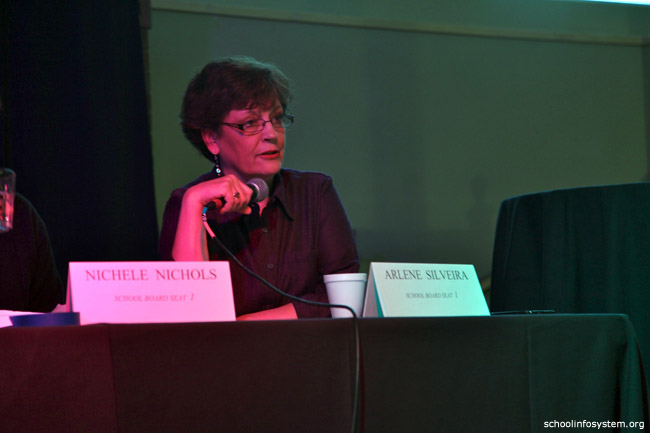
The 2012 Madison School Board Contest:

Seat 1 Candidates:

Nichele Nichols
www.nichols4schoolboard.org
email: nnichols4mmsd@gmail.com

Arlene Silveira (incumbent)
www.arleneforschoolboard.com
email: arlene_Silveira@yahoo.com

Seat 2 Candidates:

Mary Burke
www.maryburkeforschoolboard.net
email: maryburkewi@gmail.com

Michael Flores
www.floresforschoolboard.org
email: floresm1977@gmail.com

Listen to the recent DCCPA candidate forum via this 75MB mp3 audio file.

Share

Challenge to schools: Embracing digital textbooks

Kimberly Hefling:

Are hardbound textbooks going the way of slide rules and typewriters in schools?
Education Secretary Arne Duncan and Federal Communications Commission chairman Julius Genachowski on Wednesday challenged schools and companies to get digital textbooks in students’ hands within five years. The Obama administration’s push comes two weeks after Apple Inc. announced it would start to sell electronic versions of a few standard high-school books for use on its iPad tablet.
Digital books are viewed as a way to provide interactive learning, potentially save money and get updated material faster to students.

Share

US university endowments post 19% return

Anji Raval:

The performance of US university endowments has continued to improve, with an average return of 19.2 per cent posted in the year to June 30, according to a new study.
The financial crisis and accompanying slide in equity markets negatively affected educational endowments, putting further stress on a sector that has been reeling from a decline in government funding. Public universities have been pushed in recent years to fill budget gaps through investments and donations as the cost of education has increased, a problem highlighted in last week’s state of the union address by President Barack Obama.
In spite of the upturn in returns from the 11.9 per cent reported for 2010, the first positive returns since 2007, educational endowments were unlikely to recover to pre-crisis levels for several years yet, said John Walda, president and chief executive of the National Association of College and University Business Officers (Nacubo), which represents more than 2,500 US higher education institutions.

Share

My Evening With Diane Ravitch and a Couple Thousand of Her Closest Friends

Darren:

On Friday night, January 20th, my friend and fellow conservative blogger Mr. Chandler of Buckhorn Road zipped down to the Sacramento Convention Center to hear a talk by noted “education historian” Diane Ravitch. I didn’t realize it was sponsored by a bunch of teachers unions; I thought it was going to be an intellectual talk by someone who used to agree with me but now has switched sides. I thought I was going to get some really good information that would “challenge my assumptions” and make me think. Instead, what I got was, if you’ll pardon the mixed metaphor, a liberal red-meat bacchanalia. As Mr. Chandler described it, we were “pilgrims in an unholy land”.

Share

Teaching With Authenticity & Authority

Eugene Wallingford:

What is this?
A new teaching with authority.
— Mark 1:27
Over the last few weeks, we’ve been processing student assessments from fall semester. Reading student comments about my course and other profs’ courses has me thinking about the different ways in which students “see” their instructors. Two profs can be equally knowledgable in an area yet give off very different vibes to their class. The vibe has a lot to do with how students interpret the instructor’s behavior. It also affects student motivation and, ultimately, student learning.
Daniel Lemire recently offered two rules for teaching in the 21st century, one of which was to be an authentic role model. If students know that “someone ordinary” like a professor was able to master the course material, then they will have reason to believe that they can do the same. Authenticity is invaluable if we hope to model the mindset of a learner for our students.
It is also a huge factor in the classroom in another way as well. Students are also sensitive to whether we are authentic users of knowledge. If I am teaching agile approaches to software development but students perceive that I am not an agile developer when writing my own code outside the course, then they are less likely to take the agile approaches seriously. If I am teaching the use of some theoretical technique for solving a problem, say, nondeterministic finite state machines, but my students perceive that I do something else when I’m not teaching the course, then their motivation to master the technique wanes.

Share

An Open Letter to Urban Superintendents in the United States of America

Neerav Kingsland:

You work immense hours and subject yourself to scathing criticism all in the pursuit of better serving children. I know a few of you–and without fail you are all passionate about your work. In short, I’m a fan. So know that I’m not writing this letter to attack anyone–rather, I aim to offer advice, which I hope some of you accept.
In the following letter I aim to convince you of this: the single most important reform strategy you can undertake is to increase charter school quality and market share in your city–with the ultimate aim of turning your district into a charter school district.
In other words: rid yourself of the notion that your current opinions on curriculum, teacher evaluation, technology, or anything else will be the foundation for dramatic gains in student achievement. If history tells us anything, they will not be:

Part II, Part III, Part IV, Part V

Share

Harvard Targeted in U.S. Asian-American Discrimination Probe

Daniel Golden:

The U.S. Education Department is probing complaints that Harvard University and Princeton University discriminate against Asian-Americans in undergraduate admissions.
The department’s Office for Civil Rights is investigating a complaint it received in August that Harvard rejected an Asian- American candidate for the current freshman class based on race or national origin, a department spokesman said. The agency is looking into a similar August 2011 allegation against Princeton as part of a review begun in 2008 of that school’s handling of Asian-American candidates, said the spokesman, who declined to be identified, citing department policy.
Both complaints involve the same applicant, who was among the top students in his California high school class and whose family originally came from India, according to the applicant’s father, who declined to be identified.

Steve Hsu on Transparency in college admissions:

Today we learned from Bloomberg that the U.S. Education Department is investigating complaints that Harvard University and Princeton University discriminate against Asian-Americans in undergraduate admissions. It is a common belief among Asian-American families that their children are held to higher academic standards than applicants from other ethnic groups, including whites. Such practices were openly acknowledged as a result of internal investigations at universities like Berkeley and Stanford in the 1980s and 1990s. Have they now been corrected?
Statistics seem to support a claim of widespread discrimination across most of elite higher education. For example, in comprehensive statistics compiled as part of Duke University’s Campus Life and Learning project (as reported in a recent analysis by Duke economist Peter Arcidiacono and collaborators), Asian-American students averaged 1457 out of 1600 on the math and reading portion of the SAT, compared to 1416 for whites, 1347 for Hispanics and 1275 for blacks. There is every reason to believe that a similar pattern holds at nearly all elite universities in America, with some notable exceptions such as Caltech. In fact, Duke may be one of the mildest offenders when it comes to Asian-American admissions: with the goal of increasing its overall student quality, Duke has reportedly been more friendly recently to Asian-American applicants than traditional powers such as Harvard and Princeton.

Share

Why Urban, Educated Parents Are Turning to DIY Education

Linda Perlstein:

They raise chickens. They grow vegetables. They knit. Now a new generation of urban parents is even teaching their own kids.
In the beginning, your kids need you–a lot. They’re attached to your hip, all the time. It might be a month. It might be five years. Then suddenly you are expected to send them off to school for seven hours a day, where they’ll have to cope with life in ways they never had to before. You no longer control what they learn, or how, or with whom.
Unless you decide, like an emerging population of parents in cities across the country, to forgo that age-old rite of passage entirely.
When Tera and Eric Schreiber’s oldest child was about to start kindergarten, the couple toured the high-achieving public elementary school a block away from their home in an affluent Seattle neighborhood near the University of Washington. It was “a great neighborhood school,” Tera says. They also applied to a private school, and Daisy was accepted. But in the end they chose a third path: no school at all.

Share

Inflated SAT Scores Reveal ‘Elasticity of Admissions Data’

Eric Hoover:

In the Wild West of college admissions, there is no Data Sheriff.
The latest reminder arrived on Monday when Claremont McKenna College announced that a senior administrator had resigned after admitting to falsely reporting SAT statistics since 2005. In an e-mail to the campus, Pamela B. Gann, the college’s president, said an internal review found that scores for each fall’s freshman class had been “generally inflated by an average of 10-20 points each.” The apparent perpetrator was Richard C. Vos, long the college’s dean of admissions and financial aid, who has resigned from the college.
The announcement has shaken those who work on both sides of the admissions process. In the span of 24 hours, Mr. Vos, described by several colleagues as an engaging and thoughtful dean, has become a symbol of the pressures that come with top-level admissions jobs. As one mid-career dean said on Tuesday, “I just keep thinking about how much pressure an experienced and mature admissions professional must be under to do whatever he did.”

Share

Reversal of the Trend: Income Inequality Now Lower than It Was under Clinton

William McBride:

Numerous academic studies have shown that income inequality in the U.S. over the 20th century exhibits a U-shape. After reaching a peak in the 1920s, it fell during the Great Depression and World War II and rebounded mainly in the 1980s and 1990s.1 The rebound has been attributed to various economic factors, such as globalization, immigration, the growth of super-star salaries, and the computer revolution. However, these factors might better be described as the normal outcomes of a growing economy, according to Adam Smith’s idea that the division of labor is limited by the extent of the market. The resurgence of inequality has also been attributed to tax policy, particularly the reduction of top marginal rates on personal income from 94 percent in 1945 to 28 percent in 1988.2
The first decade of the 21st century does not exhibit the same trend. Based on the most recent IRS data, from 2009, income inequality has fluctuated considerably since 2000 but is now at about the level it was in 1997. Thus, the Bush-era tax cuts (which had provisions benefitting both high- and low-income taxpayers) did not lead to increased income inequality. By contrast, inequality rose 12 percent between 1993 and 2000, following two tax rate increases on high-income earners. Thus, changes in inequality over the last two decades appear to be driven more by the business cycle than by tax policy.

Share

India’s schools fail to keep pace with growth

James Lamont

In a dim, windowless classroom at GMS Moradbas school in rural Haryana state in north India, 40 young girls in their dark blue uniforms crouch on the floor in four straight lines.
Each is following a monotone reading by one of their classmates from a history book about one of India’s liberation heroes. Not a computer, let alone a desk is in sight. Outside, beyond a field of yellow mustard seed and sparring goats, a new high-rise medical college rises above the mist on the edge of the town of Nuh, an hour’s drive from Gurgaon, a new city born out of India’s IT outsourcing boom.

Share

Madison Public Schools’ Superintendent Nerad’s request community input into his plan to eliminate the long-standing Racial Achievement Gap

via email:

Below is a letter from Dr. Daniel Nerad, Superintendent of the Madison Metropolitan School District. Please show up on Monday, February 6 to learn about his plan and register to participate in an input session. We need you to exercise your voice, share your view and speak to our children’s needs. In the words of Dr. Martin Luther King, Jr.:
We will have to repent in this generation not merely for the hateful words and actions of the bad people but for the appalling silence of the good people.
— “Letter from Birmingham Jail,” April 16, 1963
February 2, 2012
RE: Invitation to attend Board of Education meeting on Monday, February 6, 2012
Dear Community Leader:
As you may know, this Monday, February 6, 2012, we are poised to present to the Board of Education a significant and system-wide plan to close the achievement gaps in the Madison Metropolitan School District.
Building Our Future: A Plan for Eliminating Gaps in MMSD Student Achievement
We invite you to attend Monday’s Board of Education workshop at the Fitchburg Public Library, 5530 Lacy Road in Fitchburg beginning at 6:00 p.m. This workshop is for presentation purposes only. Members of the public will not have the opportunity to speak. However, Monday’s workshop marks the beginning of a two-month, community-wide engagement process. We invite parents, students, and residents concerned about the future of our children to join one or more of the many sessions held throughout Madison to learn about the achievement gaps in the MMSD and discuss and provide input into the plan.
I have greatly appreciated your concern, commitment, and willingness to challenge us to provide the kind of education that every child deserves and is due. Together, we must eliminate our achievement gaps.
The Board of Education workshop on Monday, February 6th is just the beginning. Please consider participating in one of the upcoming information and input sessions. To register for a session, go to: www.mmsd.org/inputsession
Beginning Tuesday, February 7, go to: www.mmsd.org/thefuture to read more about the Plan.
Sincerely,
Daniel A. Nerad
Superintendent of Schools
Reprinted from a letter sent to community leaders today by Superintendent Nerad. We are sharing this to inform you and help the Madison Metropolitan School District get the word out. We have not yet seen the plan and therefore, this email should not viewed as an endorsement of it. We will reserve judgment until after the plan is released, we have had a chance to review it, and the public has responded.

Share

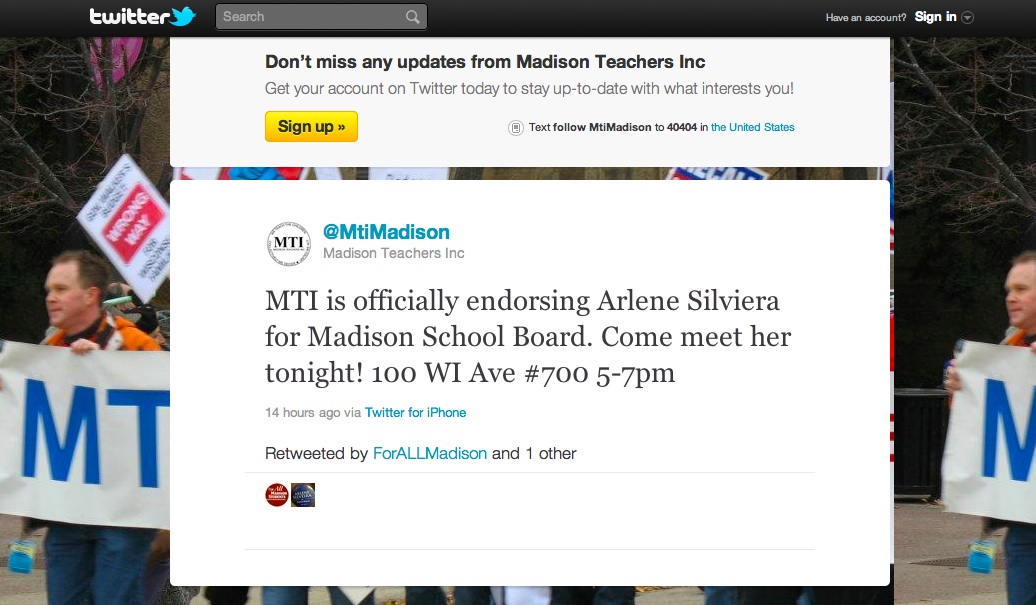
Arlene Silveira & Michael Flores Madison Teachers, Inc. Candidate Q & A

Michael Flores
Arlene Silveira
Question 23 has implications for the future of our public schools, along with the proposed Madison Preparatory Academy IB charter school:

Given Act 10’s negative Impact on Collective Bargaining Agreements, will you introduce and vote for a motion to adopt the Collective Bargaining Agreements (182 page PDF Document) negotiated between MTI and The Madison Metropolitan School District as MMSD policy?

Both Silveira and Flores answered Yes.

Seat 1 Candidates:

Nichele Nichols
www.nichols4schoolboard.org
email: nnichols4mmsd@gmail.com

Arlene Silveira (incumbent)
www.arleneforschoolboard.com
email: arlene_Silveira@yahoo.com

Seat 2 Candidates:

Mary Burke
www.maryburkeforschoolboard.net
email: maryburkewi@gmail.com

Michael Flores
www.floresforschoolboard.org
email: floresm1977@gmail.com

1.25.2012 Madison School Board Candidate DCCPA Event Photos & Audio
Listen to the event via this 77MB mp3 audio file.
I suspect that at least 60% of Wisconsn school districts will adopt their current teacher contracts as “handbooks”. The remainder will try different approaches. Some will likely offer a very different environment for teachers.

Share

Stakes high for Nerad on achievement gap proposal, including his contract which currently expires June, 2013

Matthew DeFour:

lot is riding on Madison Superintendent Dan Nerad’s upcoming plan for improving low-income, minority student achievement.
The plan is billed as a blueprint for addressing an intractable, divisive issue in Madison, and it could also factor into the upcoming School Board discussion of Nerad’s future in Madison.
The United Way of Dane County has made closing the achievement gap one of its primary issues for more than 15 years through the Schools of Hope tutoring program. But president Leslie Howard said the recent debate over the proposed Madison Prepatory Academy charter school has drawn more public attention to the issue than ever before.
“I don’t want to say something so grandiose that everything’s at stake, but in some ways it feels like that,” Howard said.

Much more on the proposed Madison Preparatory IB charter school, here.
Related links:
When all third graders read at grade level or beyond by the end of the year, the achievement gap will be closed…and not before
“They’re all rich, white kids and they’ll do just fine” — NOT!
Acting White
Event (2.16.2012) The Quest for Educational Opportunity: The History of Madison’s Response to the Academic Achievement Gap (1960-2011)

Share

Wisconsin Schools “Among the Best”, Financial Literacy

Tony Evers & Peter Bildsten:

Wisconsin is fortunate to have many fine K-12 schools educating our young people. The quality of this state’s educational system is among the best in the United States, and the same can be said for Wisconsin teachers.
Those accolades notwithstanding, there is one area in which Wisconsin schools should consider focusing some of their educational muscle: personal financial literacy.
More than ever before, our children — by the time they graduate from high school — need to be able to cope in the increasingly fast-paced world of financial services.
Today, many young people rarely handle cash, opting instead for the use of debit cards, credit cards and smartphones to make purchases. Those who have jobs probably never see a paycheck because most employers use direct deposit for their payrolls. And, most teens probably have never read the fine print of the contract for their mobile telecommunications devices.

Wisconsin 25th in 2011 NAEP Reading, Comparing Rhetoric Regarding Texas (10th) & Wisconsin NAEP Scores: Texas Hispanic and African-American students rank second on eighth-grade NAEP math test.
Fascinating. Tony Evers is Superintendent of the Wisconsin Department of Public Instruction. Much more at www.wisconsin2.org.

Share

Getting Ready For The Common Core

Susan B. Neuman:

States are now working intently on developing plans that will make new, common standards a reality. A recent report from Education First and the Editorial Projects in Education Research Center concludes that that all but one of the 47 states adopting the Common Core State Standards is now in the implementation phase. Seven states have fully upgraded professional development, curriculum materials, and evaluation systems in preparation for the 2014-2015 school year.
Nary a word has been spoken about how to prepare teachers to implement common standards appropriately in the early childhood years. Although the emphasis on content-rich instruction in ways that builds knowledge is an important one, standards groups have virtually ignored the early years when these critical skills first begin to develop.
Young children are eager to learn about the sciences, arts, and the world around them. And, as many early childhood teachers recognize, we need to provide content-rich instruction that is both developmentally appropriate and highly engaging to support students’ learning.

Share

Can Obama Really Lower the Cost of College?

Andrew Rotherham:

Let’s cut right to the chase — I have about the same chance of being picked up by the Boston Red Sox as a utility player as President Obama does of having his proposals to control college costs get through Congress this year. But looking at what the President proposed on Friday (in a raucous speech at the University of Michigan) through the lens of short-term Capitol Hill feasibility misses the significance of what Obama is up to. Just a few years ago, the ideas the President hinted at in last week’s State of the Union and is now describing in more depth were considered fringe topics, basically the province of a few wonks and reform-minded policymakers. Talk of improving productivity in higher education bordered on blasphemy. Now the President of the United States is on board.
Obama wants to provide more data to parents and students about what colleges cost and how their students do after graduation. He also wants to change how federal aid works in order to create incentives for schools to keep costs down and keep interest on federal student loans low. Most noteworthy is his attempt to catalyze innovations at colleges and universities to improve productivity and encourage states to reform higher education through a grant competition similar to his Race to the Top program that has led many states to adopt K-12 reforms in order to win federal dollars. More specifics on the higher-ed competition will accompany the President’s budget request in February.

Share

Media, district levy advocacy not appropriate, not leadership

Laurie Rogers

“And I tell you this: you do not lead by hitting people over the head. Any damn fool can do that, but it’s usually called ‘assault’ – not ‘leadership’.”
— Dwight D. Eisenhower, as told to Emmet John Hughes, for “Re-Viewing the Cold War: Domestic Factors and Foreign Policy in the East-West Confrontation”
Last year, someone said to me: “Laurie, I heard you’re a nut job. So tell me, who are you, really?” I said: “You’ve heard me talk. What do you think?” The person chuckled and said: “I kind of like you. I think you care.”
I do care. I have a fierce protective instinct toward the community, the country, and the children. I’m a patriot, but no politician. I’m not interested in making money or gaining political allies through District 81, the union or the media. I was trained as an old-style reporter, with an eye to supportable facts and a determination to know and report the truth. I’m not a natural extrovert, but five years of dealing with administrators and board directors have turned me into a fighter. I’m not a liar, and I’m no quitter, and I don’t know how to do just the bare minimum of anything (except dusting).

Share

How to grade a teacher: United Teachers Los Angeles and the school district should get behind a teacher-led evaluation system.

James Encinas, Kyle Hunsberger and Michael Stryer:

We’re teachers who believe that teacher evaluation, including the use of reliable test data, can be good for students and for teachers. Yes, yes, we know we’re not supposed to exist. But we do, and there are a lot more of us.
In February the membership of United Teachers Los Angeles will vote on a teacher-led initiative urging union leaders to negotiate a new teacher evaluation system for L.A. Unified. The vote will allow teachers’ voices to be heard above the din of warring political figures.
Although LAUSD and UTLA reached a contract agreement in December that embraced important school reforms, they haven’t yet addressed teacher evaluation. Good teaching is enormously complex, and no evaluation system will capture it perfectly. But a substantive teacher-led evaluation system will be far better for students and teachers than what we have now, a system in which virtually all teachers receive merely “satisfactory” ratings from administrators.

Share

Stanford Professors Daphne Koller & Andrew Ng Also Launching a Massive Online Learning Startup

Audrey Watters:

These are interesting times to be a Stanford professor. Or to stop being a Stanford professor, as the case may be…
Last week, news broke that Professor Sebastian Thrun would be stepping down from teaching at Stanford to launch an online learning company called Udacity. Udacity is an outgrowth of his incredibly popular Artificial Intelligence class offered through Stanford last fall.
Now it appears that two other Stanford professors Daphne Koller and Andrew Ng (Ng taught last term’s massive Machine Learning class) have started their own company, Coursera, one that offers a very similar service as Thrun’s.
According to the startup’s jobs page, the two are “following up on the success of these courses to scale up online education efforts to provide a high quality education to the world. Out platform delivers complete courses where students are not only watching web-based lectures, but also actively participating, doing exercises, and deeply learning the material.”

Education is undergoing a revolution (curricular deliver, opportunities for students, high and low cost delivery). Will Madison be part of it? We certainly have the resources and infrastructure. Will intransigence reign?

Share

Jindal’s Education Moon Shot

Wall Street Journal:

Newt Gingrich wants the U.S. to return to the moon, but as challenges go he has nothing on Louisiana Governor Bobby Jindal’s school reform plans.
Mr. Jindal wants to create America’s largest school voucher program, broadest parental choice system, and toughest teacher accountability regime–all in one legislative session. Any one of those would be a big win, but all three could make the state the first to effectively dismantle a public education monopoly.
Louisiana is already one of 12 states (including Washington, D.C.) that offer school vouchers, but its program benefits fewer than 2,000 students in New Orleans. Governor Jindal would extend eligibility to any low-income student whose school gets a C, D or F grade from state administrators. That’s almost 400,000 students–a bit more than half the statewide population–who could escape failing schools for private or virtual schools, career-based programs or institutions of higher education.

Share

Event (2.16.2012) The Quest for Educational Opportunity: The History of Madison’s Response to the Academic Achievement Gap (1960-2011)

Kaleem Caire, via email

In 2011 Kaleem Caire, President and CEO of the Urban League of Greater Madison, reintroduced the topic of the Academic Achievement Gap that exists in theMadison Metropolitan School District (MMSD). As reported, just 48% of African American students and 56% of Latino students graduated on time from MMSD in 2010.
Just as staggering as these statistics is the fact that until the conversation was reintroduced, a large majority of our community was not aware that the academic achievement gap even existed. Why is that? Four more important questions may be: How did we get here?What have we proposed before? Why has this problem persisted? AND – What should we do now? To answer these questions, and many more, the Urban League of Greater Madison would like to invite you to participate in a community forum moderated by Derrell Connor.
Agenda:
6:00 Welcome Derrell Connor
6:05 Introduction of Panel
Milele Chikasa Anana
Dr. Richard Harris
Joseph Hill
Dr. John Odom
Alfonso Studesville
6:15 History of Madison’s Academic Achievement Gap
6:30 Panel
6:45 Q&A from Audience Members

Much more on the proposed Madison Preparatory IB charter school, here.

Share

Milwaukee School Board majority chooses jobs over saving money

Milwaukee Journal-Sentinel:

The Milwaukee School Board is once again ignoring Superintendent Gregory Thornton’s request to explore privatizing a portion of the school lunch program. And that’s just another sign that the board is more concerned with saving union food service jobs than with saving money that could be better spent on educating kids.
The board and Thornton have been down this road before. In his latest proposal, Thornton asked the board to approve the establishment of a leased commissary. The board voted down the proposal, 5-4, in favor of a central kitchen run by district staff. They would not even consider the possibility of looking at other options to see if those would be more cost effective.
In a cash-strapped district, this makes absolutely no sense.
“I was just talking about privatizing a piece of it,” a frustrated Thornton said. “I was not talking about how to transport the food or service the food.”
The board appears to be against exploring any food service options that would eliminate union jobs. Currently, the food service workforce includes 48 temporary employees and more than 100 part-time employees. Administrators say they have had a hard time filling food service jobs.

Share

The Perils of ‘Bite Size’ Science

Marco Bertamini & Marcus Munafo:

IN recent years, a trend has emerged in the behavioral sciences toward shorter and more rapidly published journal articles. These articles are often only a third the length of a standard paper, often describe only a single study and tend to include smaller data sets. Shorter formats are promoted by many journals, and limits on article length are stringent — in many cases as low as 2,000 words.
This shift is partly a result of the pressure that academics now feel to generate measurable output. According to the cold calculus of “publish or perish,” in which success is often gauged by counting citations, three short articles can be preferable to a single longer one.
But some researchers contend that the trend toward short articles is also better for science. Such “bite size” science, they argue, encourages results to be communicated faster, written more concisely and read by editors and researchers more easily, leading to a more lively exchange of ideas.

Share

2011 Annual Florida School District Rankings

Gerard Robinson Video.
Florida Department of Education:

The Florida Department of Education today released a numerical ranking of the state’s 3,078 public and charter schools, grouped by elementary, middle, high and combination schools. This ranking coupled with the district rankings, makes it easier for parents and taxpayers to view information about Florida’s education system.

Share

Sustained Positive Effects on Graduation Rates Produced by New York City’s Small Public High Schools of Choice

Howard S. Bloom and Rebecca Unterman:

During the past decade, New York City undertook a district-wide high school reform that is perhaps unprecedented in its scope, scale, and pace. Between fall 2002 and fall 2008, the school district closed 23 large failing high schools (with graduation rates below 45 percent), opened 216 new small high schools (with different missions, structures, and student selection criteria), and implemented a centralized high school admissions process that assigns over 90 percent of the roughly 80,000 incoming ninth-graders each year based on their school preferences.
At the heart of this reform are 123 small, academically nonselective, public high schools. Each with approximately 100 students per grade in grades 9 through 12, these schools were created to serve some of the district’s most disadvantaged students and are located mainly in neighborhoods where large failing high schools had been closed. MDRC researchers call them “small schools of choice” (SSCs) because of their small size and the fact that they do not screen students based on their academic backgrounds.

Share

Wisconsin’s “F” on Science Curriculum Standards; “Worthless”; Madison Superintendent Dan Nerad Comments

Fordham Institute: The State of State Science Standards 2012:

Wisconsin’s science standards–unchanged since 1998, in spite of much earlier criticism, ours included–are simply worthless. No real content exists to evaluate.
In lieu of content, the “authors” have passed the buck by merely citing unelaborated references to the now outdated National Science Education Standards (NSES). Rather than using the NSES as building blocks for a comprehensive set of science standards, however, Wisconsin has used them as an escape hatch to avoid hard work and careful thought

WKOW:

Madison Schools Superintendent Dan Nerad says the state already has plans to review its standards in all areas.
“I think we have to be cautious not to look at the current state because it is very much in flux right now,” Nerad says. “Things are going to change. it doesn’t makes sense to look backwards as it does to look forward.”

Remarkable. Much more at www.wisconsin2.org.

Share

American school kids trash Jamie Oliver’s Food Revolution

Graeme Culliford and Nick Owens:

It was Jamie Oliver’s toughest challenge… getting US ­youngsters to ditch junk food and eat a healthier diet.
But six months after he ­convinced an LA school to swap fattening burgers for low-calorie salads, his ­revamped menu is – literally – being binned.
Hundreds of students at West Adams Preparatory High School, where his hit show Jamie Oliver’s Food Revolution was filmed, are ­refusing to eat his cuisine.
Instead, bins are overflowing with the TV chef’s veg curries, quinoa salads, Thai ­noodles and wheatbread burgers.
Many youngsters even go without lunch altogether.

Share

Old-school system needs its own recess

Chris Rickert:

The Janesville Gazette reported last week that principals at some of the city’s public elementary school are attributing some major positive academic and behavioral trends to a relatively minor change: moving recess from after to before lunch.
I remember the post-lunch recess — chasing girls, pick-up football, the bloody nose I gave my best friend.
In fact, I remember school-day and school-year schedules being much the same as the ones my 5-year-old daughter and 7-year-old son experience at their Madison public elementary school — from the timing of recess, to summer vacation, to days off to honor such notables as Polish-born Revolutionary War hero Casimir Pulaski (keep in mind this was the Chicago area, which has a large Polish population).
I suppose that could be because at some point decades ago, the public education establishment discovered the perfect academic schedule and, well, why tinker with something that works?
Janesville’s experience suggests something else, though: that post-lunch recess is just another public education tradition among a slew of public education traditions that could benefit from a fresh pair of eyes.

Share

My experience with the new iTunes U Course Manager

Sunset Lake Software:

Last week, Apple unveiled two new education-related products: iBooks textbooks and the new iTunes U courses. While both interest me, I was particularly fascinated by the new iTunes U courses and how they bundle information together. I converted my existing Advanced iPhone Development iTunes U class into a full course (which you can subscribe to for free) a few days ago. I wanted to write about what I learned in the process of doing this.
As I mentioned, I taught a course in 2010 at the Madison Area Technical College on advanced iPhone (now iOS) development. We recorded this course and made videos of the sessions available for free on iTunes U. Both the spring semester and fall semester of 2010 can be found as video collections in 720p HD on iTunes U. Each class session is roughly three hours long, because they were part of a once-a-week professional development course.

Share

Obama Proposes College-Aid Changes

Laura Meckler:

Seeking to control spiraling college costs, President Barack Obama is proposing tying federal student aid to universities’ tuition rates and the value they provide graduates.
The plan would affect three programs that provide institutions with student aid–Supplemental Education Opportunity Grants, Perkins Loans and Work Study. Under the current formula, schools with the highest tuitions get the most money, because the programs help fill the gap between what students can afford and what they are charged.
Mr. Obama would change that by rewriting the formula so that schools that keep tuition down and that provide “good value” would be rewarded with more money. The White House didn’t say what would constitute good value but said the new formula would include measures such as graduation rates; that’s in contrast to the current formula, which rewards longevity in the program.

Share

Madison Prep’s Private School Plans “in Doubt”

Matthew DeFour:

Madison Preparatory Academy doesn’t have the money to open as a private school next fall and its future is in the hands of the Madison School Board, according to a lead supporter of the charter school proposal.
Supporters still want to open Madison Prep in the fall but haven’t been able to raise about $1.2 million needed to run the school because its future beyond next year remains uncertain, Madison Prep board chairman David Cagigal said last week; moreover, a key donor said her support is contingent on School Board backing.
Cagigal said the private school option was never intended to be more than an interim plan before the school opened as a public charter school. One of the most common reasons charter schools fail is lack of funding, he added.
“We can’t approach these donors unless we mitigate the risk,” Cagigal said. “The only way we can do that is seek a 2013 vote.”
Cagigal acknowledged that if the School Board doesn’t vote on opening Madison Prep as a charter school in 2013, “then we may have to wait.”

Much more on the proposed Madison Preparatory IB charter school, here.
The fate of Madison Prep was discussed at a recent school board candidate forum.

Share

Oakland schools denied secession bids

Katy Murphy:

Charter schools: The Oakland school board rejected the charter school petitions submitted by the faculties of ASCEND and Learning Without Limits, public elementary schools in the Fruitvale area that want to secede from the school district. The district’s charter schools office recommended that the board approve the request, but Superintendent Tony Smith took a different stance, pointing to the financial investment the district has made in the schools since they opened.
This section of a staff resolution seems to sum up the superintendent’s position: “Whereas, the District cannot succeed at its strategic plan to create a Full Service Community School District that serves the whole child … if after millions of dollars in investment, individual schools that have achieved because of the District’s investment can separate and opt out of the District, with the consequence that the District loses its collective identity as a school system serving children in all neighborhoods in

Share

An L.A. teacher reviews her review

Coleen Bondy:

For the first time this year, LAUSD has prepared reports for teachers that rate their effectiveness. When I received an email saying I could now view my own personal “Average Growth over Timereport, I opened it with a combination of trepidation, resignation and indignation.
First, the indignation. It is, I think, the key factor that has kept me teaching past the five-year mark, when most new teachers quit the profession. I am in my sixth year of teaching after a nearly 20-year career as a professional writer. I know that I am smart, hardworking and competent, and despite the many frustrations of teaching in the Los Angeles Unified School District, I have refused to throw in the towel — as so many do.
Indignation is also what fueled my reaction when I saw the rating the school district sent. It showed me to be on the low side of average for high school English teachers in the district.

Share

Harvard Initiative for Learning and Teaching

Harvard:

PLEASE NOTE: This is a provisional website meant to convey vital information to those interested. Our much-improved website will launch here soon, so stay tuned!
Launched through a generous gift from Gus and Rita Hauser, the Harvard Initiative for Learning and Teaching (HILT) is a Presidential Initiative to catalyze experimentation in teaching that improves student learning. It will capitalize on, strengthen, and broaden the scope of existing learning and teaching activities at Harvard, transform Harvard students’ educational experience in keeping with current and future technological and pedagogical needs, build on Harvard’s leadership in the research, application, and assessment of innovative pedagogy, and develop a robust, synergistic network of expertise, scholarly work, and creativity through dedicated University support that flows to the Schools and allows for sharing across Harvard campuses.

Share

Groundswell of Approval for Moving School Board Elections to November

New Jersey Left Behind:

Yesterday there were 38 New Jersey school boards that had voted to move their elections to November. Today, just a week after passage of the new legislation, there are 56. Odds are the numbers will continue to increase as boards hold regular business meetings, debate the pros and cons, and pass the required resolution. (Coverage from NJ Spotlight and Trenton Times; here’s a FAQ sheet from the DOE, which includes a sample resolution.)
Assemblyman Wayne DeAngelo, who sponsored the bill, said, “When we spend in the state of New Jersey anywhere from $7 to $9 million a year on school board elections, with voter turnout across the state at approximately 15 percent, I think we’re doing a disservice to the residents.”

This is a good idea.

Share

ALEC Reports on the War on Teachers

Anthony Cody:

As state after state rewrites their education laws in line with the mandates from Race to the Top and the NCLB waiver process, the teaching profession is being redefined. Teachers will now pay the price – be declared successes or failures, depending on the rise or fall of their students’ test scores. Under NCLB it was schools that were declared failures. In states being granted waivers to NCLB, it is teachers who will be subjected to this ignominy. Of course we will still be required to label the bottom 5% of our schools as failures, but if the Department of Education has its way, soon every single teacher in the profession will be at risk for the label.
This revelation came to me as I read the Score Card on Education prepared by the American Legislative Exchange Council (ALEC), authored by Dr. Matthew Ladner and Dan Lips. This is a remarkable document. It provides their report on where each of the states stands on the education “reform” that has become the hallmark of corporate philanthropies, the Obama administration and governors across the nation.
It begins with a histrionic comparison between the struggle over our schools and the Battle of Britain in the Second World War. The authors write:

Share

History, Not “Conspiracy”: Kaleem Caire’s Connections

Allen Ruff, via a kind email:

First of a series
The recent controversy over the Urban League of Greater Madison’s proposal for a Madison Preparatory Academy has been framed primarily as a local story pitting contending interests within the city. The charter school’s promoters, supporters and mainstream media have portrayed the ULGM’s CEO and President, Kaleem Caire as the Prep’s public champion and native son returned home on a mission to help “close the achievement gap,” the racial disparities in Madison’s schools.
But Caire’s well-established national ties, spanning more than a decade, to numbers of conservative foundations, think tanks and individuals bent on privatizing public school coffers, creating for-profit schools, and destroying teachers’ unions, certainly suggest that there is more to the story.
Caire has consistently dismissed any suggestion of his links to various right-wing efforts. On occasion he has admitted some distant connections but asserted his independence by saying, “They have their agenda, but we have ours.” Lately, he has taken to waving off critic’s references to such ties as nothing more than “guilt-by-association crap” or part of a “conspiracy” and “whisper campaign” coming from those trying to discredit the Mad Prep Academy project. However, a readily traceable history reveals some truth to the charges.

180K PDF version.
Much more on the proposed Madison Preparatory IB charter school, here.
Clusty Search: Allen Ruff, Blekko, google, bing.

Share

Under education reform, school principals swamped by teacher evaluations

Amanda Paulson:

School principals, including some who back more rigorous review of teachers, are balking at education reforms required by Race to the Top. New teacher evaluations are all-consuming, they say.
Sharon McNary believes in having tough teacher evaluations.
But these days, the Memphis principal finds herself rushing to cram in what amounts to 20 times the number of observations previously required for veteran teachers – including those she knows are excellent – sometimes to the detriment of her other duties.
“I don’t think there’s a principal that would say they don’t agree we don’t need a more rigorous evaluation system,” says Ms. McNary, who is president of the Tennessee Principals Association as well as principal at Richland Elementary. “But now it seems that we’ve gone to [the opposite] extreme.”
In New York, which is also beginning to implement a new teacher evaluation system this year, many principals are even less constrained in their opinion

Share

The True Cost of High School Dropouts

Henry Levin and Cecilia Rouse:

ONLY 21 states require students to attend high school until they graduate or turn 18. The proposal President Obama announced on Tuesday night in his State of the Union address — to make such attendance compulsory in every state — is a step in the right direction, but it would not go far enough to reduce a dropout rate that imposes a heavy cost on the entire economy, not just on those who fail to obtain a diploma.
In 1970, the United States had the world’s highest rate of high school and college graduation. Today, according to the Organization for Economic Cooperation and Development, we’ve slipped to No. 21 in high school completion and No. 15 in college completion, as other countries surpassed us in the quality of their primary and secondary education.

Share

A Disrupted Higher-Ed System

Jeff Selingo:

The “disruption” of the higher-ed market is a popular refrain these days. Rising tuition prices and student debt have left many wondering if the current model is indeed broken and whether those like Harvard’s Clay Christensen are right when they say that innovations in course delivery will eventually displace established players.
What exactly those innovations will look like remains a matter of debate. One view from Sheryl Sandberg, chief operating officer of Facebook, envisions a future in which every industry will be disrupted and “rebuilt with people at the center.”
In this recent interview with The Wall Street Journal, Sandberg talked specifically about the gaming industry, which has been upended by the popularity of social-gaming venues, such as Words With Friends and Farmville.

Share

Education & The State of Our Union

Matthew McKnight:

On primary and secondary education, Obama essentially advocated three directives: raise the dropout age to eighteen, continue his Race to the Top program, and loosen the standardized restrictions on teachers. Obama is right to say that the minimum requirements set by No Child Left Behind, in the ten years the law has been in effect, have done little to shrink the achievement gap, and to consider an alternative. But it’s too early to know if Race to the Top is the right one. The first, sufficiently rigorous evaluation will begin in March, and will only be completed and released two years later. He’s also right to say that “teachers matter,” and that good ones ought to have the freedom and income to do their job well.
That education cannot be treated in a bubble is an important truth that should not be missed. And yet, while the President’s diagnosis–even with its simplifications–was accurate, his prescriptions were light on details. “Challenges remain,” he said, but “we know how to solve them.” Do we? It was not even clear how to resolve tension between his stated desire not to confine educators to “teaching to the test” and the way the Race to the Top rewards testing, aside from handing it off to individual states. Injunctions like “more competition” miss the wide scope of the problem. Indeed, in a country where the fault lines in education align so neatly along economic, racial, and geographic divisions, there’s almost an urge to accept rhetorical shows of confidence, and not look too far beyond them.

Share

Raising Wisconsin’s Student Achievement Bar?

Alan Borsuk:

What if you suddenly found out that half of the eighth-graders in Wisconsin, all kids you thought were highly rated readers, really didn’t merit being called proficient? That instead of four out of five being pretty decent in math, it was really two out of five?
You better start thinking how you’d react because it’s likely that is what’s coming right at us. That’s how dramatic a proposal last week by the state Department of Public Instruction is.
As parents, teachers, school leaders, politicians, community leaders and taxpayers, will we be motivated to do better? Will we see the need for change? Will we rise to the occasion? Or will we settle for being discouraged and basically locked into what we’ve come to expect?
Here’s what’s going on: With Congress failing to pass a revision, originally due in 2007, of the education law known as No Child Left Behind, the U.S. Department of Education has begun issuing waivers from the enforcement program of the increasingly dysfunctional law. Wisconsin wants a waiver – it’s one of the things people such as Republican Gov. Scott Walker and Democratic-oriented Superintendent of Public Instruction Tony Evers agree on. So a task force developed a proposal. People have until Feb. 3 to react to the proposal and the application is to be submitted Feb. 21.
The plan will change a lot of important dynamics of what students and schools in Wisconsin are expected to accomplish. It calls for publicly rating all schools on a 1 to 100 point scale, with student outcomes as a key factor. Schools that score low will face orders to improve and, possibly, closing. And that goes for every school with students whose education is paid for with public dollars – in other words, private schools in the voucher programs for Milwaukee and Racine kids are included.
Overall, the waiver plan means we are at the point where Wisconsin gets serious about raising expectations for student achievement. Wisconsin is regarded as having one of the lowest bars in the U.S. for rating a student as proficient. No more, the proposal says.
….
Eighth-grade reading: Using the WKCE measuring stick, 86% of students were rated as “advanced” or “proficient.” Using the NAEP measuring stick, it was 35% – a 51-point difference. At least as vivid: Using the WKCE measure, 47% of eighth-graders were “advanced,” the top bracket. Using the NAEP measure, it was 3%. Three percent! In other words, only a handful of kids statewide would be labeled advanced under the new system, not the nearly half we’re used to.
Fourth-grade reading: On the WKCE scale, 82% were proficient or advanced. On the NAEP scale, it was 33%.
Eighth-grade math: WKCE, 78% proficient. NAEP: 41%.
Fourth-grade math: WKCE: 79% proficient. NAEP: 47%.

A substantial improvement in academic standards is warranted and possibly wonderful, assuming it happens and avoids being watered down. The rightly criticized WKCE was an expensive missed opportunity.
Related: www.wisconsin2.org

Share

NCTQ Sues UW Ed Schools over Access to Course Syllabi

Kate Walsh, via a kind reader’s email:

As reported by the Milwaukee Journal-Sentinel and the Associated Press, NCTQ filed a lawsuit yesterday — a first for us — against the University of Wisconsin system.
UW campuses issued identically worded denials of our requests for course syllabi, which is one of the many sources of information we use to rate programs for the National Review of teacher preparation programs. They argue that “syllabi are not public records because they are subject to copyright” and therefore do not have to be produced in response to an open records request.
We believe that the University’s reading of the law is flawed. We are engaged in research on the quality of teacher preparation programs, and so our request falls squarely within the fair use provision of copyright law. What’s more, these documents were created at public institutions for the training of public school teachers, and so should be subject to scrutiny by the public.
You can read our complaint here.

Related Georgia, Wisconsin Education Schools Back Out of NCTQ Review

Public higher education institutions in Wisconsin and Georgia–and possibly as many as five other states–will not participate voluntarily in a review of education schools now being conducted by the National Council for Teacher Quality and U.S. News and World Report, according to recent correspondence between state consortia and the two groups.
In response, NCTQ and U.S. News are moving forward with plans to obtain the information from these institutions through open-records requests.
In letters to the two organizations, the president of the University of Wisconsin system and the chancellor of Georgia’s board of regents said their public institutions would opt out of the review, citing a lack of transparency and questionable methodology, among other concerns.
Formally announced in January, the review will rate education schools on up to 18 standards, basing the decisions primarily on examinations of course syllabuses and student-teaching manuals.

When A Stands for Average: Students at the UW-Madison School of Education Receive Sky-High Grades. How Smart is That?

Lake Wobegon has nothing on the UW-Madison School of Education. All of the children in Garrison Keillor’s fictional Minnesota town are “above average.” Well, in the School of Education they’re all A students.
The 1,400 or so kids in the teacher-training department soared to a dizzying 3.91 grade point average on a four-point scale in the spring 2009 semester.
This was par for the course, so to speak. The eight departments in Education (see below) had an aggregate 3.69 grade point average, next to Pharmacy the highest among the UW’s schools. Scrolling through the Registrar’s online grade records is a discombobulating experience, if you hold to an old-school belief that average kids get C’s and only the really high performers score A’s.
Much like a modern-day middle school honors assembly, everybody’s a winner at the UW School of Education. In its Department of Curriculum and Instruction (that’s the teacher-training program), 96% of the undergraduates who received letter grades collected A’s and a handful of A/B’s. No fluke, another survey taken 12 years ago found almost exactly the same percentage.

Share

What Americans Keep Ignoring About Finland’s School Success

Anu Partanen:

Everyone agrees the United States needs to improve its education system dramatically, but how? One of the hottest trends in education reform lately is looking at the stunning success of the West’s reigning education superpower, Finland. Trouble is, when it comes to the lessons that Finnish schools have to offer, most of the discussion seems to be missing the point.
The small Nordic country of Finland used to be known — if it was known for anything at all — as the home of Nokia, the mobile phone giant. But lately Finland has been attracting attention on global surveys of quality of life — Newsweek ranked it number one last year — and Finland’s national education system has been receiving particular praise, because in recent years Finnish students have been turning in some of the highest test scores in the world.
Finland’s schools owe their newfound fame primarily to one study: the PISA survey, conducted every three years by the Organization for Economic Co-operation and Development (OECD). The survey compares 15-year-olds in different countries in reading, math, and science. Finland has ranked at or near the top in all three competencies on every survey since 2000, neck and neck with superachievers such as South Korea and Singapore. In the most recent survey in 2009 Finland slipped slightly, with students in Shanghai, China, taking the best scores, but the Finns are still near the very top. Throughout the same period, the PISA performance of the United States has been middling, at best.

Share

Madison Teachers, Inc. Solidarity Newsletter

65K PDF, via a kind email.

Share

New Study Gives Small Schools Initiative a Thumbs Up

Mary Ann Giordano

The small schools initiative that has been the hallmark of the Bloomberg administration’s schools policy seems to be working, a new study has found.
Winnie Hu reports in The New York Times on Thursday that the study found that students who attend public high schools that have about 100 students in each grade were more likely to graduate.
The continuing study is described as “one of the largest and most comprehensive reviews of the impact of small schools on learning.” Its $3.5 million cost is covered by the Bill and Melinda Gates Foundation, and the study is conducted by MDRC, a nonprofit education research group based in Manhattan.
The study found that students at small high schools were more likely to earn a diploma than students who attend larger schools, The Times reports.

Related: Small Learning Communities

Share

Can Computers Replace Teachers?

Andrew Rotherham:

Steve Jobs didn’t think that technology alone could fix what ails American education. It’s worth remembering that in the wake of last week’s breathless coverage of Apple’s new iBooks platform, which the company promises will radically change how students use and experience textbooks. Under Apple’s plan, companies and individuals will be able to self-publish textbooks, ideally creating a wider array of content. Students will be able to download and use these books on their iPad much like they would use a regular textbook — including highlighting passages, making notes and pulling out passages or chapters that are especially important to them. Apple says it also plans to cap the price of textbooks available through iBooks at $14.99, a significant departure from the price of many textbooks now.
Critics were quick to pounce that Apple wasn’t being revolutionary enough. Former school superintendent and current ed-tech investor Tom Vander Ark chided Apple for not thinking past textbooks, which he considers hopelessly 20th century. Others worried that Apple’s real goal wasn’t to open up the textbook industry but to control it and profit from it through restrictive licensing agreements and a platform that dominates the market. I’m sure the for-profit company’s shareholders will be horrified at that news.

Share

Madison to get 1,400 iPads for schools by next fall

Matthew DeFour:

Madison teachers will soon be handing out Apples to students.
The School District for the first time plans to buy more than 600 iPads for use in the majority of schools this spring. Another 800 iPads are expected to be in classrooms by next fall, all paid for with money from a state settlement with Microsoft.
District officials are enthusiastic about the possibilities presented by tablets, from students wirelessly sharing classroom work to replacing workbooks purchased each year with online “apps.” Other districts in Dane County and around the state are already experimenting with tablets.
In Madison, the popular computing device presents a “jumping off” moment for technology in classrooms that hasn’t happened with desktop and laptop computers, said Bill Smojver, the district’s director of technical services.
“This is the most significant transition point for having digital learning at the optimal level,” Smojver said.

Matthew DeFour:

Madison isn’t the first school district in Dane County to experiment with iPads in the classroom.
Amy Nelson, a Sun Prairie School District speech therapist, uses tablets with all students from fifth graders to 4-year-olds. One program makes it easier to teach verb tenses, as she can show a boy running, rather than explain running with a motionless picture card.
“It’s definitely the up-and-coming technology and kids are really excited about it too,” Nelson said. “They’re learning something and working on skills, but to them they just think they’re playing sometimes.”
The Monona Grove School District is also using iPads to help autistic and other disabled students communicate, said Kathy Sanders, a library media and technology specialist in the Monona Grove School District.

Share

High Schools Are Step One Of Two

mckaythomas:

MG Siegler in his latest TechCrunch article posits that although Apple’s new iBooks strategy is admirable in its effort to fix problems in public high schools, that it’s not realistic and that their market strategy should revolve around colleges and college textbooks.
On the surface, which seems logical enough, his argument is sound. But It ignores the one, HUGE driving force in education: money.
Nearly all high schools are public, or receive public funding in one way or another and help to satisfy the law which states that students of high school age must attend school. Textbooks are merely a means of teaching these students topics which help these schools qualify for their funding.

Share

Louisiana Governor Jindal says education reforms can’t wait for another generation of kids

Barabar Leader:

Education was the topic of discussion in northeast Louisiana Thursday as Governor Bobby Jindal and the state’s new Superintendent of Education John White visited the area.
Jindal spoke to the Monroe Chamber of Commerce about what he called a “critical time” in Louisiana’s history and the role his aggressive education reform package will play in the state’s continuing journey to improvement.
White joined Jindal at the Monroe Chamber of Commerce but spent most of his visit in area schools observing teachers and students.

Share

Madison Teachers Candidate Endorsement(s)


To all of you with #recallwithdrawal: Time to focus on Arlene and Micheal for #MMSDBOE!! #99percent
MTI is officially endorsing Arlene Silviera for Madison School Board. Come meet her tonight! 100 WI Ave #700 5-7pm


1.25.2012 Madison School Board Candidate DCCPA Event Audio.
Seat 1 Candidates:
Nichele Nichols
www.nichols4schoolboard.org
email: nnichols4mmsd@gmail.com
Arlene Silveira (incumbent)
www.arleneforschoolboard.com
email: arlene_Silveira@yahoo.com
Seat 2 Candidates:
Mary Burke
www.maryburkeforschoolboard.net
email: maryburkewi@gmail.com
Michael Flores
www.floresforschoolboard.org
email: floresm1977@gmail.com
via a kind reader’s email

Share

Progessive Dane Endorses Michael Flores & Arlene Silveira (i) for Madison School Board

Progressive Dane:

Madison School District Board
Seat 1: Arlene Silveira Website / Facebook
Seat 2: Michael Flores Website / Facebook
Now we have to make sure they get elected! That takes money (some) and work (lots).
The money part is easy–come to the Progressive Dane Campaign Fund-raiser
Sunday February 12, 5-7 pm
Cardinal Bar, 418 E Wilson St
(Potluck food, Cash Bar, Family Friendly)
Meet the candidates, hear about Madison School District and Dane County issues, pick some to work on this year!

Both Madison School Board races are contested this year.

Seat 1 Candidates:

Nichele Nichols
www.nichols4schoolboard.org
email: nnichols4mmsd@gmail.com

Arlene Silveira (incumbent)
www.arleneforschoolboard.com
email: arlene_Silveira@yahoo.com

Seat 2 Candidates:

Mary Burke
www.maryburkeforschoolboard.net
email: maryburkewi@gmail.com

Michael Flores
www.floresforschoolboard.org
email: floresm1977@gmail.com

1.25.2012 Madison School Board Candidate DCCPA Event Audio.

Share

First Niagara’s $3M to shape CT school-reform debate

Hartford Business, via a kind Doug Newman email:

First Niagara Bank has pledged $3 million to support a nonprofit group that is representing business interests in Connecticut’s education reform debate.
The money will go to Hartford’s Connecticut Council for Education Reform (CCER), which is led by a group of prominent Connecticut business leaders including former Hartford Financial Services Group CEO Ramani Ayer, and Peyton Patterson, the former chief executive of NewAllinace Bank, which was acquired by First Niagara Bank last year.
The Connecticut Council for Education Reform also unveiled Thursday its education agenda for the upcoming legislative session, which includes urging the state to adopt:
–Teacher and leader employment and retention policies that attract the highest quality professionals and insist upon effectiveness as defined by their ability to demonstrate improvement in student performance, not seniority, as the measure of success defined by redesigned evaluation systems.

Share

Has Students Come First hurt teacher unions in Idaho?

Kristin Rodine:

Idaho’s controversial new school reform laws gutted teacher associations’ collective bargaining powers, but local union leaders say they can still work effectively with their district administration to help shape policies.
“This (legislation) basically said to districts that if you don’t want to work with teachers in these areas, you can say by law you don’t have to do it anymore,” Boise Education Association President Andrew Rath said. “But I think they’ve found that districts want to work with the teachers.”
Association leaders Sam Stone of Caldwell and Luke Franklin of Meridian agreed.
“We can always talk to our district,” Franklin said. “Our relationship isn’t really ‘us against them.'”
The Students Come First laws, unveiled by schools Superintendent Tom Luna one year ago and approved by the 2011 Legislature, limits teacher contract negotiations to the issues of pay and benefits and eliminates working conditions and other issues from master contracts.

Share

Björk’s Latest Experiment: Teaching Science

Nick Neyland:

Björk turned her last album into an app. Now she’s turning her music into a science exhibit for city students, with an unusual three-week run at a Queens museum better known for its molecule models and retired spacecraft.
The singer arrives at the New York Hall of Science next month to hold a series of classes for middle school students, as well as six open-to-the-public concerts in the museum’s Great Hall. Björk will also stage four shows at a more conventional concert venue: Manhattan’s Roseland Ballroom.
“The whole idea is to take music education out of a bookish, academic thing and into a more physical, tactile experience,” said Björk, 46 years old, in an interview as she was preparing for the event.

Share

Let’s evaluate all ways to close gap

Madison School Board Candidate Mary Burke

n recent listening sessions with Madison parents, I heard how we can improve our schools, what we can be really proud of and stories about our wonderful teachers. In these discussions and in others, people have talked about addressing the racial achievement gap and shared concerns about Madison Prep.
For the 12 years I have been involved in Madison schools, I have been championing education and addressing the racial achievement gap. An East High teacher and I co-founded the AVID/TOPS program, which I also supported financially and continue to co-chair. This program has increased the number of students graduating and going on to post-secondary education. But AVID TOPS alone is not enough. We need to do more.
When Madison Prep was discussed last fall, it was the only proposal put on the table in the last five years to significantly address the racial achievement gap. At that time the teachers union and the planners of Madison Prep were in agreement that the school would run with Madison School District employees, union teachers and under the leadership of the district (as an instrumentality). A major concern raised was that Madison Prep would pull resources needed by existing schools.

Share

Learning to Write Teaches Westerly Students Science
“Therefore, in conclusion, learning to write promotes scientific thinking. Other districts would do well to take notice.”

Posted by Julia Steiny Columnist EducationNews.org on January 25, 2012

Back in December 2009, excited 4th graders at Westerly’s State Street School (http://sss.westerly.k12.ri.us/) sat down to take a practice science test. Like little sports jocks, the kids approached the task as if it were training for the big game coming in the spring, the statewide science NECAP (http://en.wikipedia.org/wiki/NECAP).
In 2008, the whole Westerly district had performed so poorly on that test that teachers actually volunteered their time to form a K-12 Science Task Force focused on redeeming their sullied academic reputation. (See last week’s column about this Task Force (link to my column from last week) .)
Then, insult to injury, in 2009 State Street’s scores tanked again.
The heat was on. State Street had already started implementing the Task Force’s recommendations, including its strong emphasis on teaching writing.
Wait. Writing? That’s English, not science.
But more on this in a moment.
Westerly’s students had struggled particularly with the “inquiry” part of the NECAP, where kids to do a hands-on task and draw conclusions from what they see in front of them.
State Street’s Principal Audrey Faubert says, “Science (NECAP) is only given at the 4th grade (and later at 8th and 11th), so K-3 weren’t exposed to the rigors of testing. We decided to give all the kids an inquiry task to complete. And the faculty also took some of the released test items from the RIDE website. (http://www.ride.ri.gov/assessment/necap_releaseditems.aspx) Even though they’d been teaching inquiry with the science kits (http://www.uri.edu/hss/education/GEMSNET-URI/index.html) , it was interesting for the teachers to be on the other side of a test.”
But the spotlight’s glare was on those 4th graders.
Faubert smiled sadly, “The room was buzzing. The kids thought they did fantastic.”
Working in pairs, the school’s entire teaching staff scored the kids’ work. The results were enough to induce clinical depression.
But as it turns out, the school’s good efforts hadn’t quite paid off yet. The Task Force was onto a good thing when they decided writing was key to learning science. State Street’s instruction had only just started to take root.
Here’s the problem: Old science was about answers. When a test asks a question like: “How does wind change sand dunes?” somewhere in the science textbook was an answer that the kid was supposed to have memorized.
New science is about thinking and reasoning. The way Faubert puts it is: “The (NECAP) science test is a thinking test, not a knowledge test. Science isn’t about recall any more, but about synthesizing information.” New science poses essential questions, such as the sand dunes example, but now the kids need to derive the answer themselves, by sorting through data. Teachers provide techniques, tools, research methods, and experiences. But like scientists themselves, students must do their own research and figure out what their discoveries mean.
Writing is always the product of thinking. Writing forces a kid to organize her thoughts to be expressive and communicate clearly.
Middle-school principal Paula Fusco says “Prior to the work of the Task Force, we’d left writing up to the English teacher. But whatever the kids did or didn’t know, they weren’t able to communicate their understanding of science.
To work on that understanding, Fusco says, “we’ve been taking the vocabulary out of NECAP–infer, predict, explain. So the kids aren’t afraid of the words they’re encountering.”
The ability to define “predict” doesn’t help at all if the ability to MAKE a prediction isn’t also a familiar habit. Kids need to demonstrate, by their writing, that they understand what they need to DO when the test asks them to predict, infer or explain.
Similarly, Fusco’s teachers began to work with the kids on “sentence starters” to guide their thinking–However, In conclusion, Whereas, Therefore.
Fortunately, Westerly’s students were in the habit of writing in science journals. But they had used them mainly to record observations. Faubert says, “Every teacher brought in examples of their students’ science journals. Oh, here are the strengths and weaknesses right in our own notebooks. We’d never had the kids prove their thinking in their journals. Think like a scientist, based on what’s in front of you. Prove your thinking. Prove your thinking. We said that so many times.”
At the end of the day, teaching the kids to EXPLAIN their predictions and reasoning was the clearest way to teach them habits of scientific thinking. And those explanations also helped the teachers assess kids’ understanding and misunderstanding.
By February, State Street dared to try another practice test with the 4th graders. Again, the staff scored it together. Ahhh, much better. So much so, Faubert felt more confident about improving on the 49 percent proficiency they’d managed in the prior year’s test.
In fact, when the results were released last Fall, State Street kids hit 80 percent proficiency, 8th highest in the state, out of over 150 schools that take that test. (And Westerly is the 8th lowest-income community in the state.)
Superintendent Roy Seitsinger’s take on the situation is this: “Nobody (meaning veteran educators) signed up for what we’re doing now. Most of the people weren’t trained to bring students through a thinking process. Now the educators’ job is to teach kids how to sift through all that information and to be critical, reflective and make decisions. We have too much information and not nearly enough sorting skills.”
Therefore, in conclusion, learning to write promotes scientific thinking. Other districts would do well to take notice.

Julia Steiny is a freelance columnist whose work also regularly appears at EducationViews.org and GoLocalProv.com. She is the founding director of the Youth Restoration Project, a restorative-practices initiative, currently building a demonstration project in Central Falls, Rhode Island. She consults for schools and government initiatives, including regular work for The Providence Plan for whom she analyzes data. For more detail, see juliasteiny.com or contact her at juliasteiny@gmail.com or c/o GoLocalProv, 44 Weybosset Street, Providence, RI 02903.


Share

Tenured Professor Departs Stanford U., Hoping to Teach 500,000 Students at Online Start-Up

Nick DeSantis:

he Stanford University professor who taught an online artificial intelligence course to more than 160,000 students has abandoned his tenured position to aim for an even bigger audience.
Sebastian Thrun, a professor of computer science at Stanford, revealed today that he has departed the institution to found Udacity, a start-up offering low-cost online classes. He made the surprising announcement during a presentation at the Digital – Life – Design conference in Munich, Germany. The development was first reported earlier today by Reuters.
During his talk, Mr. Thrun explored the origins of his popular online course at Stanford, which initially featured videos produced with nothing more than “a camera, a pen and a napkin.” Despite the low production quality, many of the 200 Stanford students taking the course in the classroom flocked to the videos because they could absorb the lectures at their own pace. Eventually, the 200 students taking the course in person dwindled to a group of 30. Meanwhile, the course’s popularity exploded online, drawing students from around the world. The experience taught the professor that he could craft a course with the interactive tools of the Web that recreated the intimacy of one-on-one tutoring, he said.

Share

How School Choice Became an Explosive Issue

Kevin Carey:

Bill Cosby and Dick Morris presumably disagree about most things, so it’s instructive to note that both have officially endorsed “School Choice Week,” which began yesterday with a series of rallies and events around the country celebrating the idea of parents being able to decide where their children go to school. Indeed, school choice seems like such an obviously good idea that the most interesting thing about School Choice Week is why it exists at all.
That school choice is valuable is beyond dispute. That’s why there’s a multi-billion dollar private school industry serving millions of students. And it’s why there is a much larger system of school choice embedded in the American real estate market. While some parents pay school tuition directly, many more pay it through their monthly mortgage and property tax bills. Anyone who has deliberately purchased a home in a “good” school district is, by definition, a beneficiary and supporter of school choice.

Share

Matthew Battles: It doesn’t take Cupertino to make textbooks interactive

Matthew Battles:

Absent the glamour of the black mock turtleneck, Apple’s Thursday event, held at the Guggenheim Museum in New York, still came bearing flowers of rhetoric, lovingly transplanted from their native soil in Cupertino’s sunny clime. One such rhetorical staple, the feature checklist, made its appearance about nine minutes in. Usually, the checklist is used to contrast Apple’s latest magical object with the feature set of lesser smartphones or other misbegotten tech tchotchkes; it was more than a little eye-popping to see the same rhetoric of invidious comparison used against the book in full — that gadget which, as senior VP Phil Schiller reminded us, was invented (in its print incarnation) back at the end of the Hundred Years’ War.

Share

University of Washington Admissions and Failing K-12 Education

Cliff Mass:

A week ago there was an article in the Seattle Times describing a large drop in applicants to the UW this year. Considering that other WA State schools have not seen a similar decline and all state colleges are experiencing essentially the same tuition increases, why are UW applications down?
Could it be the incessant articles and editorials by the Seattle Times about how the UW is turning down strong applicants to let in more out of state students? How about this Seattle Times headline last spring:
“Why straight-A’s may not get you into the UW this year”
which suggested that
“High-school seniors with top test scores didn’t get in.
Students who got into more prestigious schools were wait-listed at the UW.
Valedictorians with straight-A’s were denied admission, while out-of-state students with lower grades were accepted.”

Share

School choice is alive and growing — in other states

Richard Rider:

The most important domestic subject that I FAIL to adequately cover is K-12 education. It’s potentially the most effective tool we have for increasing vertical mobility in our society — and hence is currently misused as the best single method to repress disadvantaged minorities.

What the education unions and their bought-and-paid-for Democrat allies have done to inner city black and Hispanic kids would warm the cockles of any KKK Grand Dragon. The Progressives’ steadfast opposition to improving education angers me every time I think about it.

Thus I include intact below an excellent op-ed on the topic from the LOS ANGELES DAILY NEWS. It’s upbeat — giving the growing success of the school choice movement in all its many flavors.

Sadly, California is one of the least successful states in this effort to improve education. All we hear from CA liberals is that we don’t spend enough. But the growing popularity and acceptance of school choice in other states is going to make it more and more difficult for our voters to ignore this innovation.

Share

Education a key solution

Barbara Prindiville:

The top priority facing southeastern Wisconsin – and, indeed, the biggest challenge for the entire state – is the creation of more new jobs.
There are many good ideas for creating new jobs, and many deserve further consideration. The creation of new venture capital funds, tax breaks for industries and workforce training incentives for companies that locate in Wisconsin are all worthy of further consideration and possible action.
But the best strategy for creating new jobs is to look at what companies want when deciding where to expand a plant or locate a production facility. No doubt, they look at quality of life, housing, transportation, the overall community and other factors.
However, time and again, one of the top assets that attracts new jobs is a quality education system at all levels that produces bright, articulate and engaging future workers who accept the challenge of the new international economy and the interdependent global economic landscape. That starts at kindergarten and continues beyond high school. Gone are the days when a student could graduate from high school and move to a job that could last a lifetime.

Share

1.25.2012 Madison School Board Candidate DCCPA Event Audio


Listen to the event via this 77MB mp3 audio file.
The event was sponsored by the Dane County Council of Public Affairs.
Seat 1 Candidates:
Nichele Nichols
www.nichols4schoolboard.org
email: nnichols4mmsd@gmail.com
Arlene Silveira (incumbent)
www.arleneforschoolboard.com
email: arlene_Silveira@yahoo.com
Seat 2 Candidates:
Mary Burke
www.maryburkeforschoolboard.net
email: maryburkewi@gmail.com
Michael Flores
www.floresforschoolboard.org
email: floresm1977@gmail.com
via a kind reader. It is great to see competitive races.
UPDATE 2.8.2012: A transcript is now available.

Share

Pennsylvania’s Property Tax Independence Act

Pennsylvania Representative Jim Cox, via a kind reader’s email:

Details of the latest plan to eliminate and replace school property taxes have been finalized and the legislation will be introduced shortly in the Pennsylvania House and Senate.
House Bill 1776, The Property Tax Independence Act, looks in part to the former School Property Tax Elimination Act (SPTEA) for its basic structure. While The Property Tax Independence Act mirrors some of the provisions of the former SPTEA, the plan has been comprehensively rewritten to account for lawmakers’ concerns and preferences in order to eliminate objections common to the previous legislation.

  • The Property Tax Independence Act will eliminate school property and local school nuisance taxes across the Commonwealth and will replace those taxes with funding from a single state source.
  • The Property Tax Independence Act introduces a modernized school funding method that is based on 21st century economic realities.
  • The Property Tax Independence Act will ABOLISH the school property tax as well as eliminate the local school earned income tax and nuisance taxes such as the per capita and privilege-to-work taxes imposed by school districts.
  • The Property Tax Independence Act uses in great measure our current sales tax mechanism to fund schools, restoring the original intent of the tax.
  • The sales tax provides a predictable and stable funding source that is tied to economic growth. This is in clear contrast to the school property tax which is not based on economic growth and is subject to much variation.
  • Current school spending regularly exceeds tax revenue and The Property Tax Independence Act addresses this problem head on by limiting school budget increases to the rate of inflation.

Wisconsin’s property taxes have increased significantly over the years. How long will this continue?


Much more, here.

Share

Highland Park (MI) Schools in jeopardy of closing, governor says in letter

Melanie Scott:

As Highland Park schools officials pleaded their case against an emergency manager to officials in Lansing on Friday, Gov. Rick Snyder sent a letter to the district’s parents informing them that without state intervention there would be no district by the end of next month.
Parents of Highland Park School District students told district officials today they received a letter from the governor informing them of the school district’s dire financial situation.
In a letter dated Jan. 20, Snyder told parents finances for the school district have reached a crisis stage and during the 2010-11 school year, the district was $3 million over budget.
The letter also mentioned the state forwarded an emergency advance of $188,000 to the district on Jan. 13.

Share

The Dangerous Notion That Debt Doesn’t Matter

Steven Rattner:

WITH little fanfare, a dangerous notion has taken hold in progressive policy circles: that the amount of money borrowed by the federal government from Americans to finance its mammoth deficits doesn’t matter.
Debt doesn’t matter? Really? That’s the most irresponsible fiscal notion since the tax-cutting mania brought on by the advent of supply-side economics. And it’s particularly problematic right now, as Congress resumes debating whether to extend the payroll-tax reduction or enact other stimulative measures.
Here’s the theory, in its most extreme configuration: To the extent that the government sells its debt to Americans (as opposed to foreigners), those obligations will disappear as aging folks who buy those Treasuries die off.

Larry Summers Executive Summary of Economic Policy Work, December 2008 (PDF):

Closing the gap between what the campaign proposed and the estimates of the campaign offsets would require scaling back proposals by about $100 billion annually or adding newoffsets totaling the same. Even this, however, would leave an average deficit over the next decade that would be worse than any post-World War II decade. This would be entirely unsustainable and could cause serious economic problems in the both the short run and the long run.

via Ryan Lizza.

Share

Coming soon: A new Florida school grading formula

Kathleen McGrory:

The way Florida grades its public schools will soon be changing.
On Tuesday, the state Board of Education heard an extensive presentation on proposed changes to the school grading formula.
The ideas ran the gamut, from incorporating the test scores of children with disabilities, to giving extra points to students who boost their test scores into the highest range.
Of course, high school grades will have to take into account the new end-of-course exams, which are being given this year in algebra, geometry and biology. Some middle-school students will also be taking the exams — and the grades given to middle schools need to reflect that, too.

Share

Building debt

Michael Pettis:

In the paper Flyvbjerg looks at infrastructure projects in a number of countries (not in China, though, because he needed decent data) and shows how the benefits of these projects are systematically overstated and the costs systematically understated. More important, he shows how these terrible results are simply the expected outcomes of the way infrastructure projects are typically designed and implemented.
It is not a very happy paper in general, but I am pretty sure that many people who read it probably had a thought similar to mine: if infrastructure spending can be so seriously mismanaged in relatively transparent systems with greater political accountability, what might happen in a country with a huge infrastructure boom stretching over decades, much less transparency, and very little political accountability? Isn’t the potential for waste vast?

Share

Skype helps Lodi students interact with teacher in Thailand

Pamela Cotant:

Learning about southeast Asia from a teacher in Thailand is making the curriculum come alive for Lodi High School students.
Every morning, the students receive instruction via Skype from Tuke-Karnteera Ingkhaninan, a teacher from the Sa-nguan Ying School in Suphanburi, Thailand. Then early in the evening, Mark Kohl, a Lodi High School teacher, instructs students at the Thailand school about United States history.
“We can see it a lot more clearly instead of reading about it in a textbook,” said Lodi senior Becky Thuot, 18.
Senior Savannah Sundt, 17, agreed, noting that is was meaningful when Ingkhaninan talked about a festival she would attend that evening and the Lodi students could hear fireworks going off as part of it.

Share

The New American Divide

Charles Murray:

The ideal of an ‘American way of life’ is fading as the working class falls further away from institutions like marriage and religion and the upper class becomes more isolated. Charles Murray on what’s cleaving America, and why.
America is coming apart. For most of our nation’s history, whatever the inequality in wealth between the richest and poorest citizens, we maintained a cultural equality known nowhere else in the world–for whites, anyway. “The more opulent citizens take great care not to stand aloof from the people,” wrote Alexis de Tocqueville, the great chronicler of American democracy, in the 1830s. “On the contrary, they constantly keep on easy terms with the lower classes: They listen to them, they speak to them every day.”
Americans love to see themselves this way. But there’s a problem: It’s not true anymore, and it has been progressively less true since the 1960s.
People are starting to notice the great divide. The tea party sees the aloofness in a political elite that thinks it knows best and orders the rest of America to fall in line. The Occupy movement sees it in an economic elite that lives in mansions and flies on private jets. Each is right about an aspect of the problem, but that problem is more pervasive than either political or economic inequality. What we now face is a problem of cultural inequality.

Share

Sharing a Screen, if Not a Classroom

Kyle Spencer:

In a hushed first-grade classroom at Public School 55 in the South Bronx, Edward Muñoz, a bashful 7-year-old in scuffed sneakers and a worn hoodie, was sounding out tricky words with his tutor.
Together they plowed through a book about a birthday barbecue, tackling the words “party” and “presents.” Then they played a rousing game of word-based tic-tac-toe, with Edward eventually declaring victory.
Exchanges like theirs take place every day in classrooms around the country, now that links between early literacy gains and later school success have been clearly documented.
But Edward’s tutor was not in the classroom. His school, a 20-minute walk from the nearest subway stop in a crime-plagued neighborhood, has long had trouble finding tutors willing to visit. “It is hard to get anyone to volunteer,” said the school’s principal, Luis Torres, who sometimes cancels fire drills because of the gunfire he hears outside.

Share