School Information System

First details of proposed Wisconsin school accountability system revealed

Matthew DeFour:

The state could more aggressively intervene in the lowest-performing publicly funded schools under a proposed accountability system unveiled Monday.
The system would rate schools on a scale of 0 to 100 based on student performance and growth on state tests, closing achievement gaps and preparing students for college and careers. Ratings also would be tied to dropout rates and third-grade literacy levels.
The http://dpi.state.wi.us/esea/pdf/eseawaiver_coverletter.pdf“>http://dpi.state.wi.us/esea/index.html“>Department of Public Instruction released a draft application to the U.S. Education Department for a waiver from the 10-year-old federal No Child Left Behind Act, which State Superintendent of Public Instruction Tony Evers said “has shackled schools by being overly prescriptive and prohibiting creative reforms.”
“Wisconsin’s request for flexibility from NCLB is driven by the belief that increasing rigor across the standards, assessment and accountability system will result in improved instruction and improved student outcomes,” Evers said

DPI’s Initial Draft Full Waiver Proposal (2.5MB PDF):

Raising Expectations, Increasing Rigor
As noted in Principle 1, DPI has significantly raised expectations for schools and the proportion of students who graduate ready for college and career, as indicated by the adoption of rigorous academic standards, higher cut scores based on NAEP as the state transitions to SBAC, increasingly rigorous and adaptive assessment systems, and increased graduation requirements. The new accountability report card and the new system of support, rewards, and recognition will reflect these new expectations. While the state has previously emphasized graduation rates (and boasted one of the highest in the nation), DPI also recognizes the state has significant achievement and graduation gaps. The accountability index prioritizes achievement and attainment using measures which emphasize not only graduation, but also the proportion of students graduating college and career ready. Additionally, the system examines achievement gaps within and across schools as a means to address the state’s existing gaps. Using a multifaceted index will help pinpoint areas of need within a school, as well as areas of strength, and help schools track their progress at meeting the needs of all student subgroups. Within the system of support, identified schools will participate in diagnostic reviews and needs assessments (Priority and Focus Schools, respectively) to identify their instructional policies, practices, and programming that have impacted student outcomes and to differentiate, and individualize reforms and interventions. While planning and implementing reforms, schools and districts will have access to increasingly expansive and timely data systems to monitor progress. Additionally, the state will require Priority and Focus Schools to implement RtI (with the support of the Wisconsin RtI Center and its resources) to ensure that all students are receiving customized, differentiated services within a least restrictive environment, including additional supports and interventions for SwDs and ELLs as needed, or extension activities and additional challenge for students exceeding benchmarks.

Share

2012 Madison School Board Candidate Website & Contact Information

Seat 1 Candidates:
Nichele Nichols
www.nichols4schoolboard.org
email: nnichols4mmsd@gmail.com
Arlene Silveira (incumbent)
www.arleneforschoolboard.com
email: arlene_Silveira@yahoo.com
Seat 2 Candidates:
Mary Burke
www.maryburkeforschoolboard.net
email: maryburkewi@gmail.com
Michael Flores
www.floresforschoolboard.org
email: floresm1977@gmail.com
via a kind reader. It is great to see competitive races.

Share

Hold district accountable for deceit, academic failure and questionable activity
“Where ignorance is bliss, ignorance of ignorance is sublime.” – Paul Dunham

Laurie Rogers, via a kind email:

Last week, I went to a Spokane Public Schools math presentation at Indian Trail Elementary School. It was billed as a forum in the school newsletter and on the reader board outside of the school. It was not, in any way, a forum. It was a tightly controlled 20-minute presentation that offered no data, little information, allowed for no parent input and was patronizing in tone.
At one point, parents were asked to define math to the person next to us. (The principal said he would not offer his definition.) We also were told to describe to our neighbor a math experience we’d had. These conversations ended right there, thus being pointless. We watched a video of several small children talking about the importance of math. The kids were cute, but the video was long. It was made clear to us that math is hard, parents don’t get it (see slide 7 of the presentation), “traditional math” is no longer useful, and math is intimidating to all. Printed materials reinforced the idea of parent incompetence, with students supposedly “taking the lead” and teaching their parents.
Parents were warned to stay positive about math, however, despite our supposed fear and lack of skill, and we also were told what a “balanced” program looks like – as if that’s what Spokane actually has.

Related: Math Forum audio & video.

Share

Report Card on American Education: Ranking State K-12 Performance, Progress, and Reform

Dr. Matthew Ladner and Dan Lips:

ALEC’s 17th edition of the Report Card on American Education contains a comprehensive overview of educational achievement levels (performance and gains for low-income students) for the 50 states and the District of Columbia (see full report for complete methodology). The Report Card details what education policies states currently have in place and provides a roadmap for legislators to follow to bring about educational excellence in their state.
Focusing on the reforms recently enacted in Indiana, and with a foreword by Indiana Governor Mitch Daniels, this Report Card on American Education examines the experiences other states can learn from the struggles and triumps in Indiana.
Authors Dr. Matthew Ladner and Dan Lips analyze student scores, looking at both performance as well as how scores have improved over recent years. Additionally, each state is graded based on its current education policies.

Wisconsin ranks 19th.

Share

Minnesota’s public pensions: A worse-case scenario

Mark Haveman:

This is the status of Minnesota’s public pension fund obligation. And it may be optimistic.
You’ve got to be very careful if you don’t know where you’re going,” Yogi Berra once famously said. “Because you might not get there.”
Berra’s characteristically unique advice is worth keeping in mind for anyone addressing the issue of public pensions.
Lots of uncertainty, to say the least, comes into play in guaranteeing lifetime retirement incomes for hundreds of thousands of Minnesota public employees — past, present and future. And wherever we do arrive in this effort will have profound implications for government employees and taxpayers, and for the future of public services in our state.
According to the latest data on the condition of Minnesota’s public pension funds, the bleeding has stopped but there is still considerable work to do.
As of last summer, the three major statewide pension plans that provide pensions for the bulk of Minnesota’s public employees — the Minnesota State Retirement System for state workers, the Public Employees Retirement Association for local workers and the Teachers Retirement Association for teachers — were, altogether, $10.5 billion short of meeting their long-term obligations.

Share

Seattle’s Pendulum Problem

Charlie Mas:

District leadership style has swung back and forth between two extremes. It needs to be stopped and held at the center.
The Seattle School Board of 2000 – 2003 contributed to the financial fiasco that toppled the Olchefske administration. It was not just their misplaced trust, but the blindness of their trust that allowed things in the district – not just the financial reporting – to spiral down. They could have found the budget problem in the numbers reported to them (Director Bass did find it), but the majority of them lacked the necessary skepticism to look for it.
In response, the voters replaced them with a more activist board. It started with Director Bass elected in 2001. The four board directors elected in 2003 formed a much more hands-on and skeptical board majority – perhaps too much. They found a District that was poorly managed. They found all kinds of problems that had grown over the years and they were blunt and public about exposing it. I won’t say that they were wrong, but they were perhaps impatient. Culture doesn’t change overnight. This Board was accused of micro-managing the district and they were accused of being dysfunctional.

Share

Public speaking for normal people

Jason Freedman:

I just gave a presentation on 42Floors to 150 people. It went well. I was really proud of: 1) our team, 2) our product and 3) the way we were able to present it. It was as if we were telling people about it in our living room, but there just happened to be 150 people there. Afterwards, several people told me that it felt like it was a very polished presentation. But the reality is we didn’t practice at all. In fact, three minutes before we went on stage, my co-founder turned to me and said, “Jason, we really should’ve practiced.” I said, “Nah, don’t worry. We’ll be fine.” And we winged it, and it came off ever so naturally.
Before I pat myself on the back too much, let me tell you how I felt inside. Thirty seconds before I was supposed to go on, I was standing there on the side and all of a sudden my heartbeat went from normal to racing like I was in the middle of marathon. Uggghhh. I hate it when this happens. It’s kind of like how you feel when you blush: you’re reminded how little control you have over your own body. For a brief moment, I was upset with my body for reacting this way. I was upset with myself for reacting this way, actually. I should be more confident than this.

Share

The Inevitability of the Use of Value-Added Measures in Teacher Evaluations

Madison School Board Member Ed Hughes

Value added” or “VA” refers to the use of statistical techniques to measure teachers’ impacts on their students’ standardized test scores, controlling for such student characteristics as prior years’ scores, gender, ethnicity, disability, and low-income status.
Reports on a massive new study that seem to affirm the use of the technique have recently been splashed across the media and chewed over in the blogosphere. Further from the limelight, developments in Wisconsin seem to ensure that in the coming years value-added analyses will play an increasingly important role in teacher evaluations across the state. Assuming the analyses are performed and applied sensibly, this is a positive development for student learning.
The Chetty Study
Since the first article touting its findings was published on the front page of the January 6 New York Times, a new research study by three economists assessing the value-added contributions of elementary school teachers and their long-term impact on their students’ lives – referred to as the Chetty article after the lead author – has created as much of a stir as could ever be expected for a dense academic study.

Much more on value added assessment, here.
It is important to note that the Madison School District’s value added assessment initiative is based on the oft-criticized WKCE.

Share

The business of high school sports drives Wisconsin tournament fight

Kevin Binversie:

Like it or not, sports is a business. From big-time professional leagues like the National Football League to local high school action, sports have been a reliable revenue stream for decades.
At the college level, successful athletic programs have paid dividends for their schools by generating cash. Sporting events boost local economies in tourist dollars, money spent at bars, restaurants and hotels, and of course tax revenue for local government.
It’s the fight over local business and tax revenue that has become the real center stage in a battle over tournament scheduling and the location of tournaments that is raging between the University of Wisconsin-Madison’s Athletic Department and the Wisconsin Interscholastic Athletic Association, which officiates high school sports in the Badger State. At issue is where the boys and girls state basketball tournaments will play in 2013 and beyond.

Share

Texas school district cuts sports in desperate attempt to improve grades and prevent shutdown

Associated Press:

Eliminating high school athletics during a school year is unusual, especially in a sports-loving state such as Texas.
But that’s exactly what’s happening in this small ranching community where the school district is taking desperate measures to prevent a state-mandated closure due to poor academics.
The Premont Independent School District is even deploying its superintendent, a constable and high school principal to the homes of truant students in an effort to improve dismal attendance.

Share

School reform proposals are in limbo in Missouri General Assembly

Jason Hancock:

Missouri lawmakers are facing increasing pressure to deal with a potential flood of student transfers stemming from the loss of accreditation in urban school districts like Kansas City’s.
But looming over this year’s legislative session is a pledge by House Speaker Steve Tilley, a Perryville Republican, that any plan to deal with school transfers to suburban districts, or adjustments to the state’s school funding formula, be coupled with ideas that have doomed previous reform efforts.
Those include controversial measures such as expanding charter schools, eliminating teacher tenure, basing teacher pay on student achievement and offering tax credit vouchers to parents who want to send children to private schools.

Share

Wisconsin DPI seeks comments on draft NCLB waiver request; “Education for today’s world requires increased rigor and higher expectations”

Wisconsin Department of Public Instruction, via a kind reader’s email:

MADISON — Wisconsin’s request for waivers from several provisions of federal education law creates the expectation that every child will graduate ready for college and careers by setting higher standards for students, educators, and schools.
“Education for today’s world requires increased rigor and higher expectations,” said State Superintendent Tony Evers. “The federal No Child Left Behind Act (NCLB) has shackled schools by being overly prescriptive and prohibiting creative reforms that would help more students gain the skills needed for further education and the workforce. Wisconsin’s request for flexibility from NCLB is driven by the belief that increasing rigor across the standards, assessment, and accountability system will result in improved instruction and improved student outcomes.”
To receive waivers, state education agencies must demonstrate how they will use flexibility from NCLB requirements to address four principles: transitioning to college- and career-ready standards and assessments; developing systems of differentiated recognition, accountability, and support; evaluating and supporting teacher and principal effectiveness; and reducing duplication. The Department of Public Instruction has posted its draft waiver request online and is asking for public comment through a survey. After the two-week comment period, the agency will revise the waiver request and submit it to the U.S. Department of Education by Feb. 21.

Share

Oakland schools try new way of placing teachers

Jill Tucker:

In the world outside public education, people apply for a job they want, interview with their potential boss, compete against other applicants and are ultimately selected if they look like a good fit for the position.
It doesn’t work that way in public education.
In schools, teachers do all the normal things to get hired, but when it comes to placement, seniority is what counts, not the perfect fit. The teacher with the longest tenure in a district gets first dibs on any available job at a school, with the principal – the school’s boss – getting little or no input.
School district officials in Oakland want to change that, believing that it’s in the best interests of students when a teacher – new, veteran or in between – wants to work at a school and the school wants that teacher.

Share

Making Longer Chicago School Day Happen May Have a Budget-Busting Price Tag

Rebecca Vevea:

Six months after barely closing a $712 million deficit, Chicago Public Schools officials have spent nearly $10 million that has not yet been budgeted in their aggressive push to lengthen the school day.
Fifty schools have gone to a longer day this year. With the entire city school system moving to a seven-and-a-half-hour school day next year, parents and community members are questioning how the cash-strapped district plans to pay for the extended time at more than 675 schools.
Becky Carroll, the school district’s spokeswoman, said that cuts would need to be made elsewhere to allow the costs of a longer day to fit into the district’s nearly $6 billion budget.
“A budget is about priorities, and you invest in what your priorities are,” she said. “At the end of the day, this is a critical priority.”

Share

Madison Teachers’ Solidarity Newsletter

January 17, 2012 PDF
January 09, 2012 PDF. Via Madison Teachers, Inc..

Share

UK Schools minister cracks down on league table ‘incentives’

BBC:

Schools minister Nick Gibb has said he wants to stop schools prioritising their rankings in exam league tables over ensuring a good education for all their pupils.
New league tables for England, out next week, show which schools boost pupils’ progress from ages 11 and 16.
Mr Gibb said the old system allowed schools to exploit tables, and some used it to help boost their rankings.
Labour gave the move a cautious welcome.

Share

Hopes, Fears, & Reality: A Balanced Look at American Charter Schools in 2011

Robin Lake, Betheny Gross, via a kind Deb Britt email:

Charter schools are public schools. Historically, however, the relationship between school districts and charters has been nonexistent at best, antagonistic at worst. As the charter sector continues to grow steadily, an analysis of the national landscape explores how that relationship needs to start changing–and where it already has.
This year’s 6th annual edition of Hopes, Fears, & Reality provides a clear roadmap for school districts and charter schools interested in working together to improve education options. The report explains the risks and technical challenges behind charter-district collaboration and provides powerful examples of how they can be overcome.

Share

What Hawaii Teachers Are Saying About Agreement

Katherine Poythress:

Emails and direct messages from teachers wanting to vent about the proposed contract between their union and the state have been flowing into my inbox.
Every single one came with a request not to publish the name of the writer. “I just want you to know,” they say, of the reason they’re writing. The problem with knowing, though, is that you can never un-know. These teachers were sharing thoughts that give deep insight into educators’ concerns as they head to the polls Thursday to vote on the new contract.
You might be shocked to learn that some of them said they would prefer abiding with the “last, best and final” offer Gov. Neil Abercrombie imposed on them last July, than take the deal struck earlier this month. They all have their reasons for thinking the way they do about the current agreement. Reasons that deserve to be aired.
So we made a deal of our own. I asked the ones who had contacted me if it would be OK to share their words with our readers — with the understanding that I will not publish or share names, positions or any information that could betray their identities. We granted them anonymity because they said they feared retaliation and wouldn’t share their thoughts otherwise.

Share

Are national charter schools a game changer or a fad?

Alan Borsuk:

Where will the thin blue line lead these children? What will their path mean to Milwaukee’s education scene?
I’m talking about the 330 kindergarten through fifth-grade students at Milwaukee Scholars Charter School.
The corridors of the school’s new building at 7000 W. Florist Ave. have gray carpeting – except for blue stripes near each wall.
When students pass in the halls, whether in groups or solo, they are required to walk only on the blue stripe on the right side of the hall as they face it. Get caught off that stripe and you can get marked down in the school’s discipline system.
Minus the blue lines and with a discipline system that isn’t structured quite so firmly, Milwaukee Math and Science Academy, a charter school at 110 W. Burleigh St., brings to mind the same questions for its 160 kindergarten through fifth-grade pupils.

Share

Is Milwaukee back on the reform radar?

Katy Venskus:

There used to be a time when Milwaukee was considered one of the most active education reform cities in the country. The City’s private school choice program, the oldest and largest in the country, was our ticket to fame (or infamy, depending on who you ask) through most of the 1990’s. The choice program was supposed to be a game changer to public education. It was supposed to set off a chain reaction of innovation and competition that would not only improve the lives of children, but change the way we configured our education policy for the City of Milwaukee. In short, we were going to be the hotbed of the reform movement for decades to come.
Sadly, the game changing education movement we expected didn’t come to pass. There is no doubt, however, that the existence of parent choice in Milwaukee has changed the lives of thousands of kids. The movement that created and protected the choice program fostered the development of two of the City’s best charter schools and promoted a small sector of independent charters authorizers and schools. Unfortunately, aside from these developments there has been little large-scale reform in Milwaukee since the mid-1990’s. Instead of a catalyst, the choice program became a scapegoat for both political parties and many status quo stakeholders. The failing public school district in Milwaukee has been allowed to sink deeper and deeper into the quicksand while union interests and their status quo Democrats blamed the choice program for all the public schools considerable ills. The GOP used the choice program as the be-all-end-all urban education solution, and was happy to let thoughtful public school policy and funding fall by the way side. The independent charter school community put their heads down and tried to stay out of the political fray – they served small pockets of kids very well, but without the ability or the will to take their model to scale. As a result, Milwaukee, not only fell behind, we fell off the map entirely.

Share

Counting the costs of a digital classroom

Kai Ryssdal:

It’s not the iPhone 5, it’s not the iPad 3, but there was a big Apple product announcement today. A new version of its iBooks software geared at providing interactive student textbooks, which would be read — of course — on the iPad. The potential hurdles are many, including the fact that iPads still cost around $500.
We wanted to get away from the business case study, though, and explore what this might actually eventually mean in the classroom. So we called Katie Cohen. Until June of last year, she was a high school science teacher in the Los Angeles Unified School District. Katie, thanks for being with us.
Katie Cohen: Thank you very much.
Ryssdal: So listen, in any ideal world, if all of your had had iPads, what would that have meant for you as a teacher?

Share

Apple, America and A Squeezed Middle Class

Keith Bradsher & Charles Duhigg:

Companies like Apple “say the challenge in setting up U.S. plants is finding a technical work force,” said Martin Schmidt, associate provost at the Massachusetts Institute of Technology. In particular, companies say they need engineers with more than high school, but not necessarily a bachelor’s degree. Americans at that skill level are hard to find, executives contend. “They’re good jobs, but the country doesn’t have enough to feed the demand,” Mr. Schmidt said.
Some aspects of the iPhone are uniquely American. The device’s software, for instance, and its innovative marketing campaigns were largely created in the United States. Apple recently built a $500 million data center in North Carolina. Crucial semiconductors inside the iPhone 4 and 4S are manufactured in an Austin, Tex., factory by Samsung, of South Korea.
But even those facilities are not enormous sources of jobs. Apple’s North Carolina center, for instance, has only 100 full-time employees. The Samsung plant has an estimated 2,400 workers.
….
“We shouldn’t be criticized for using Chinese workers,” a current Apple executive said. “The U.S. has stopped producing people with the skills we need.”

Well worth considering from a curricular, finance and social perspective.

Share

Student Math Scores Jump 20 Percent with HMH Algebra Curriculum for Apple® iPad®; App Transforms Classroom Education

Houghton Mifflin Harcourt:

Pilot study finds students in Riverside Unified School District who used Houghton Mifflin Harcourt’s HMH Fuse™: Algebra 1 app were also more motivated, attentive, and engaged than traditionally educated peers.
Global education leader Houghton Mifflin Harcourt (HMH) today announced the results of a yearlong pilot of HMH Fuse: Algebra I, the world’s first full-curriculum Algebra app developed exclusively for the Apple iPad, involving the Amelia Earhart Middle School in California’s Riverside Unified School District. The pilot showed that over 78 percent of HMH Fuse users scored Proficient or Advanced on the spring 2011 California Standards Tests, compared with only 59 percent of their textbook-using peers.
The pilot showed that over 78 percent of HMH Fuse users scored Proficient or Advanced on the spring 2011 California Standards Tests, compared with only 59 percent of their textbook-using peers.”
The first assessment of the pilot– Riverside’s district Algebra benchmark -took place during the second trimester of the 2010-2011 year. Students using HMH Fuse scored an average of 10 percentage points higher than their peers. The app’s impact was even more pronounced after the California Standards Test in spring 2011, on which HMH Fuse students scored approximately 20 percent higher than their textbook-using peers.

Christina Bonnington has more.

Share

Comparability of State and Local Expenditures Among Schools Within Districts: A Report From the Study of School-Level Expenditures

Ruth Heuer RTI International, Stephanie Stullich U.S. Department of Education:

Title I of the Elementary and Secondary Education Act of 1965 (ESEA) requires that, taken as a whole, services provided in Title I schools from state and local funds be at least comparable to those provided in non-Title I schools (Section 1120A). The purpose of this comparability requirement is to ensure that federal assistance is providing additional resources in high-need schools rather than compensating for an inequitable distribution of funds that benefits more affluent schools. The Title I comparability requirement allows school districts to demonstrate compliance in a number of ways, including through a district-wide salary schedule, and does not require districts to use school-level expenditures. Several recent policy reports have called for revising the Title I comparability provision to require comparability of actual school-level expenditures (Hall and Ushomirsky, 2010; Miller, 2010; Luebchow, 2009; Roza, 2008).
Until recently, data on school-level expenditures have not been widely available, in part because most school districts have not designed their accounting systems to track revenues and expenditures at the school level. However, the American Recovery and Reinvestment Act of 2009 (ARRA) required each school district receiving Title I, Part A, ARRA funds to report a school-by- school listing of per-pupil education expenditures from state and local funds for the 2008-09 school year to its state education agency and required states to report these data to the U.S. Department of Education.
This report from the Study of School-Level Expenditures presents findings on how state and local education expenditures at the school level vary within school districts. This study is not examining compliance with the current Title I comparability requirement, nor does it examine the comparability of resources between districts. Rather, it focuses on the question of whether Title I schools and higher-poverty schools have comparable levels of per-pupil expenditures as non-Title I schools and lower-poverty schools within the same district. More specifically, this report examines three questions:

Share

Wisconsin Property Tax Growth: 1984-2012 (!)


A chart from the January 9, 2012 edition of WISTAX’s Focus. One wonders how long this can be sustained.
Wistax.

Share

Madison’s Phoenix Program Review

Madison School District (150K PDF):

Basic Information
The Phoenix program began serving students in the fall of 2010-11. The Phoenix program was housed in the Doyle Administration Building
During this school year the program served
35 middle school students and
33 high school students
28 middle school students progressed through the Phoenix program and returned to an MMSD educational environment
24 high school students progressed through the Phoenix program and returned to an MMSD educational environment
7 middle students were expelled from the Phoenix program due to behavioral issues 9 high students were expelled from the Phoenix program due to behavioral issues
Curriculum
The first year the curriculum consisted of on-line academics supported by additional resource material.
Each quarter a student could receive up to a .25 credit in Community Service, Career Planning, English, Writing, Math, Physical Education, Science, Social Studies
The program’s partnership with community FACE and district PBST staff allowed the students to participate in social emotional skill development forty-five hours per week.

Much more on the “Phoenix Program”, here.
P.S. This Madison School District document includes a header that I’ve not seen before: “Innovative Education”. I also noticed that the District (or someone) placed a billboard on the Beltline marketing Cherokee Middle School’s Arts education.

Share

Why Does Buffalo Pay for Its Teachers to Have Plastic Surgery?

Jordan Weissmann:

In Buffalo, New York, the heart of the American rust-belt, the public school system pays for its teachers to get plastic surgery. Hair removal. Miscrodermabrasian. Liposuction. If you can name the procedure, it’s probably covered.
No, I am not exaggerating. And no, this article is not an excuse to make “Hot For Teacher” cracks. When I write that Buffalo’s school system pays, I mean it literally. The perk is included as a self-insured rider in its teachers’ contract. Therefore, the district has to cover the cost of each nip and tuck itself. There’s no co-pay, so the school district ends up footing the entire bill. It estimates the current annual cost at $5.2 million, down from $9 million in 2009.
This in a city where the average teacher makes roughly $52,000 a year. The plastic surgery tab would pay salaries for 100 extra educators.
s The Buffalo News has reported, the rider existed for years with little notice. It dates back at least to the 1970s, when “getting a little work done” wasn’t par for the course among women (and some men) of a certain age. Instead, it was intended to cover serious reconstructive surgery, on burn victims, for instance. In 1996, the rider was nearly cut. But after the daughter of a district employee was hurled through a windshield during a car wreck, requiring surgery to repair scars on her face and body, union officials lobbied to keep the benefit in place.

Share

How Does a School Board Enforce Policy?

Charlie Mas:

I see a lot of support among the District leadership for clear job descriptions and duties for everyone in the District – everyone, that is, except the District leadership. Each Board member will acknowledge that the Board has the duty to enforce policy yet no Board member will allow that duty to be explicitly stated in any document. It does not appear in the newly adopted Series 1000 Policies. It does not appear in the policy that describes the duties of the Board. It does not appear in the policy on governance. Now the Board is going to adopt two more elements of Board policy that should mention this duty yet fail to do so.
The board policy preamble on the Board meeting agenda this week is an ideal place for it, but instead the preamble makes reference to it only vaguely and euphemistically as “governance tools”. It says that policies can be used by the superintendent to hold staff accountable but it neglects to say that they can be used by the Board to hold the superintendent accountable.

Share

Wisconsin Governor Walker says education bill based on task forces is nearing

Erin Richards:

Before a crowd of hundreds of school district officials and school board members in Milwaukee, Gov. Scott Walker announced Thursday that recommendations from a variety of state education task forces will soon be solidified in formal legislation.
The work of three main groups spearheaded by Walker over the past year – a reading task force, a team that’s looked at how to design a statewide teacher and principal evaluation system, and a group figuring out how to rate school quality – will make up a reform package of education legislation, Walker said.
Meanwhile, some critics questioned the governor’s tone of collaboration and cooperation Thursday, saying that after cutting education spending and limiting collective bargaining, he’s trying to play nice now only because he’s likely facing a recall election.
Even state Superintendent of Public Instruction Tony Evers, who has worked closely with Walker on the task forces and praised the work of those involved, made it clear he was concerned about being left out of the legislation-drafting process.

Matthew DeFour:

The proposed legislative reforms have been developed over the past year by three statewide task forces working separately on improving literacy, developing a teacher evaluation model and creating a school accountability system to replace No Child Left Behind.
State Superintendent of Public Instruction Tony Evers, who helped lead all three groups, said he wasn’t involved in drafting the education legislation, but would support any actions that are the direct product of the task forces “and deliver on the intent of these collaborative groups.”
“Many students’ schools are already planning for more budget cuts next year on top of cuts made this year,” Evers said in a statement. “Education reforms must be fully funded and not simply be more unfunded mandates that result in further cuts to educational programming for our students.”
Rep. Sondy Pope-Roberts, D-Middleton, ranking Democrat on the Assembly Education Committee, said in a statement she has concerns the work of the task forces was “being hijacked for political gain.”
“It is unnerving to hear that (Evers) was not consulted during the drafting of this legislation,” Pope-Roberts said. “Cutting our state’s foremost education experts out of the process at this time is very shortsighted and reckless.”

Much more on the Read to Lead Task Force, here.

Share

Stormy waters ahead as ‘disruptive forces’ sweep the old guard

Sarah Cunnane:

Online education will turn the academy inside out, argue US authors. Sarah Cunnane reports
Graduation rates in the US have fallen, and states have slashed funding for higher education. As a result, public universities have raised tuition fees, and many are struggling to stay afloat during the recession. But two authors working in the US higher education sector claim that the academy has a bigger battle on the horizon: the “disruptive innovation” ushered in by online education.
This disruption, they say, will force down costs, lure prospective students away from traditional “core” universities, transform the way academics work, and spell the end for the traditional scholarly calendar based around face-to-face teaching.
Clayton M. Christensen, the Kim B. Clark professor of business administration at Harvard Business School, and Henry J. Eyring, advancement vice-president at Brigham Young University-Idaho, outline their ideas in The Innovative University: Changing the DNA of Higher Education from the Inside Out.

Share

Why Education Publishing Is Big Business

Tim Carmody:

On the heels of Apple’s big education and iBooks event, it’s worth taking a quick snapshot of the education publishing industry as it stands today.
Not because the tools announced today will inevitably transform the future of education the way iTunes and the iPhone did the music and smartphone industries — however fun that may be to imagine.
Rather, you simply can’t understand Apple’s interest in breaking into the education market without at least a little understanding of that market’s scope. And you can’t understand why Apple’s adopted the approach that it has without understanding that market’s connection to our wider media ecosystem.

Share

One Education Spending & Reform

New Jersey Governor Chris Christie

Renewing his call for passage of a vouchers pilot program, the Opportunity Scholarship Act, the governor drilled into his education reform proposals for government cost-savings.
“Let’s face it: more money does not necessarily lead to a better education,” Christie said. “Today, in Newark, we spend $23,000 per student for instruction and services. But only 23% of ninth graders who enter high school this year will receive high school diplomas in four years. Asbury Park is similar: per pupil costs, at almost $30,000 a year, are nearly 75% above the state average. But the dropout rate is almost 10 times the state average. And math S.A.T. scores lag the state average by 180 points.
“It is time to admit that the Supreme Court’s grand experiment with New Jersey children is a failure,” the Governor added. “63% of state aid over the years has gone to the Abbott Districts and the schools are still predominantly failing. What we’ve been doing isn’t working for children in failing districts, it is unfair to the other 557 school districts and to our state’s taxpayers, who spend more per pupil than almost any state in America.”

Share

The Coming Higher-Ed Revolution

  Stuart Butler:

In recent decades, key sectors of the American economy have experienced huge and disruptive transformations — shifts that have ultimately yielded beneficial changes to the way producers and customers do business together. From the deregulation that brought about the end of AT&T’s “Ma Bell” system, to the way entrepreneurs like Steve Jobs forever changed the computer world once dominated by IBM, to the way the internet and bloggers have upended the business model of traditional newspapers, we have seen industries completely remade — often in wholly unexpected ways. In hindsight, such transformations seem to have been inevitable; at the time, however, most leaders in these fields never saw the changes coming.
The higher-education industry is on the verge of such a transformative re-alignment. Many Americans agree that a four-year degree is vastly overpriced — keeping many people out of the market — and are increasingly questioning the value of what many colleges teach. Nevertheless, for those who seek a certain level of economic security or advancement, a four-year degree is absolutely necessary. Clearly, this is a situation primed for change. In as little as a decade, most colleges and universities could look very different from their present forms — with the cost of a college credential plummeting even as the quality of instruction rises.

Share

Schools likely to lose accreditation, experts say

Greg Toppo:

It happens more often than you’d think, but it needs to happen more often than it does,” says Mark A. Elgart, president and CEO of AdvancED, a private Atlanta-based accreditation agency that works with about 30,000 schools. In the past five years, the organization has pulled accreditation on four school systems and a dozen private schools, for reasons ranging from poor academic performance to governance to financial fraud.
“It’s become more rigorous,” says Terry Holliday, commissioner of the Kentucky Department of Education. “I think there was a time accreditation just meant you had a certain number of library books and staff.” Now, he says, “accreditation does look at outcomes.”
Accreditation, sort of a Good Housekeeping Seal of Approval for schools, matters to districts because losing it can lead to a state takeover or an exodus of students. For individual high schools, it can mean that students lose a competitive edge as they apply to college.

Share

How to solve the achievement gap in Madison?

Nathan Comp:

Just when all signs indicated that supporters of Madison Preparatory Academy were abandoning hope of joining forces with the Madison school district, they’ve decided to give it one more shot. They’re seeking another vote on the controversial charter-school proposal in late February.
Urban League of Greater Madison CEO and president Kaleem Caire says Madison Prep will open this fall as a private entity, but hopes it will transition into the district in 2013, once the district’s union contract expires.
Board members who voted against the charter school in December expressed concerns that it would put the district in breach of its contract with Madison Teachers Inc., due to a provision requiring district schools to hire union staff.
School board president James Howard, who voted for Madison Prep, says the board may not have time to address the proposal in February.
Whether the Urban League — which proposed Madison Prep as an ambitious step toward closing the district’s decades-old achievement gap — can recapture its earlier momentum is uncertain, considering that Superintendent Dan Nerad and school board members seem particularly excited about their own plans to address the issue.
“We’re going at it from so many different angles right now,” says board member Beth Moss. “I can’t see how we can’t make some improvement.”

Much more on the proposed Madison Preparatory IB charter school, here.
Fascinating.

Share

Video: Is school choice good or bad for public education?

Ted Bauer, via a kind email:

We produced the above piece for PBS NewsHour in November of 2011; the focus was on new school choice initiatives in Indiana and the backlash they’re receiving. School choice remains a major issue in education as 2012 begins, so we wanted to convene several experts for a discussion on the topic. Feel free to add your own comments below, as well.

Share

Apple’s Electronic Textbook/Book Event


The Verge.
Apple’s controversial license terms are discussed here.

Share

The thread of knowledge

Leora Moldofsky:

Two decades after it was first devised at Princeton’s Center for Creative Leadership, the learning development concept known as 70/20/10 is transforming Melbourne Business School’s approach to workplace learning.
The concept has spurred Mt Eliza, the executive education arm of MBS, to develop an interactive online tool called Thread, which is due to be launched this month. Mt Eliza has high expectations for Thread, with hopes that it can transform the executive education provider in Victoria, Australia, into a world leader in e-learning.
It is canvassing for a partnership with Ashridge – the UK business school that provides Mt Eliza with online modules through Virtual Ashridge – as well as with other international business schools.
While Mt Eliza will not comment on the talks, Matt Williams, design manager for Thread, says: “Whenever we need to partner with a European institution, it tends to be Ashridge”. The two schools collaborate on a Masters of Management programme and several executive education courses.

Share

Slip in India’s school standards: Decline in reading, math skills despite right to study

The Telegraph:

The quality of elementary education is falling in rural schools almost two years after education was made a fundamental right in April 2010.
The Annual Status of Education Report (ASER) 2011, a survey of government and private schools in rural areas conducted by the NGO Pratham, shows a decline in schoolchildren’s “learning outcome levels” compared with the previous year, whether in reading or arithmetic skills. (See chart)
However, students of private schools have done slightly better than those of government schools, reveals the annual survey, started seven years ago and considered most authoritative.
For example, 56 per cent Class V students at government schools were unable to read Class III-level text but the figure was 38 per cent in private schools.

Share

School voucher program gets fresh look in Louisiana

Sarah Carr:

When Gov. Bobby Jindal pushed through New Orleans’ school voucher program four years ago, political interest in using taxpayer money to send students to private schools had waned across the country. School choice advocates had suffered several stinging defeats, causing some to throw their weight behind charter schools, which generally receive more bipartisan support.
In 2009, St. Joan of Arc School in New Orleans had more than 80 students receiving vouchers.
Now, as officials expect Jindal to begin an effort to expand Louisiana’s voucher program, the national landscape has changed dramatically.
Although charter schools continue to dwarf vouchers in terms of overall growth, voucher programs have rebounded on the national political and educational scene in the past year. In 2011, more than 30 states introduced bills that would use taxpayer dollars to send children to privately run schools, according to the National Conference of State Legislatures. That’s up more than 300% from the previous year, when only nine voucher bills were introduced.

Share

NY Governor Reduces State Spending .2%; Crafts Budget On Public Pension, Teacher Evaluation Reform

Zack Fink:

Governor Andrew Cuomo on Tuesday proposed an overhaul to the state’s pension system and new teacher evaluation system while presenting his $132.5 billion budget plan for the next fiscal year.
The plan reduces overall spending by .2 percent from last year.
In a PowerPoint presentation, Cuomo said his executive budget includes no new taxes, one shot revenues or gimmicks.
It also closes a budget gap of $3.5 billion.
However, while the governor plans to increase education spending by 4 percent or roughly $805 million, he also plans to make that increase contingent upon real reform and, specifically, teacher evaluations.
He’s giving the state’s teachers 30 days to come up with a statewide evaluation system or he will write his own into the budget for the legislature to approve.
Districts would have one year to get the new system up and running or the state would withhold the promised 4 percent increase in school aid.

Philissa Cramer has more.

Share

EdWeek Ranks Wisconsin’s education system 18th in U.S.

Matthew DeFour:

Wisconsin’s education system ranks 18th in the nation, according to an annual analysis published by Education Week.
The analysis draws on a variety of data, some of which are a couple of years old, so it doesn’t reflect changes in the past year under Gov. Scott Walker.
The report rated Wisconsin in six categories: chance for success; K-12 achievement; standards, assessments and accountability; teachers; school finance; and transitions and alignment.
The state scored highest in school finance, ranking ninth nationally. The lowest marks came in standards, assessment and accountability, where Wisconsin ranked 46th.

Much more at wisconsin2.org

Share

What is this Voucher Loophole?

Mike Ford:

Last Friday’s Capital Times included an article by Jessica Van Egeren on the need to close what DPI spokesman John Johnson and others have deemed the voucher loophole. Van Egeren writes:
“The so-called loophole was inserted into the state budget at the final stage of approval in June by members of the budget-writing Joint Finance Committee. The last-minute language allowed voucher schools to expand from their sole location in Milwaukee to Racine.”
It is worth pointing out that the while the language enabling the expansion of school choice to Racine did occur near the end of the budget process, expanding the Milwaukee Parental Choice Program (MPCP) to Racine was hardly a new concept. A proposal to bring vouchers to Racine was included and passed in the original Assembly version of the 2007-2009 budget (it was eventually removed during the budget process).

Share

Do Charter Schools Sacrifice Non-Charter Kids?

New Jersey Left Behind:

Dr. Bruce Baker has a good blog post up called “NJ Charter School Data Round-Up” in which he compares demographics between NJ charter schools and traditional schools in high-poverty urban areas and considers the policy implications. He discusses problems with scalability, and that charters in cities like Newark “continue to serve student populations that differ dramatically from populations of surrounding schools” when one examines eligibility for free/reduced lunch, special education enrollment, and students still learning English.
The comments to his post are worth pondering.

Share

Leveling the field: What I learned from for-profit education

Christopher R. Beha:

It was the second week of UNIV 101: University of Phoenix New Student Orientation, and Dr. U. was talking about goals.
“What is goals?” she asked in her melodious Polish accent. There were four of us in UNIV 101, me and Ty and Rob and Junior, and no one seemed quite sure what to make of the question. Thus far there had been little evidence of Socratic irony or indirection holding a prominent place in the pedagogical toolkit here at Phoenix, so if Dr. U. was asking what is goals? then the answer was almost certainly somewhere in the reading. Shuffling through the printouts in front of me, I saw it written at the top of a page: “Simply stated, goals are outcomes an individual wants to achieve in a stated period of time.” By then, Ty’s hand was already up.
“Goals,” he told Dr. U., “are when you have something you want to accomplish in the future.”

Share

Wolfram Education Portal

Wolfram Education:

Wolfram has long been a trusted name in education–as the makers of Mathematica, Wolfram|Alpha, and the Wolfram Demonstrations Project, we’ve created some of the most dynamic teaching and learning tools available. We are pleased to offer the best of all of our technologies to you here in the Wolfram Education Portal, organized by course. In the portal you’ll find a dynamic textbook, lesson plans, widgets, interactive Demonstrations, and more built by Wolfram education experts. You can take a look at the types of materials we offer below, but to get full access to all materials, you need to sign up for a free account.

Share

Teaching & Learning with Digital Tools in the Humanities

Monica Bulger:

During graduate school, I participated in an experimental seminar, “Literature+: Cross-Disciplinary Models of Literary Interpretation,” taught by Alan Liu. He asked students to form groups around topics of their choosing and perform analyses using digital tools on their materials. Most students shared similar research interests and organized their projects around a content-based theme. Our group represented four different disciplines and formed around our interest in digital tools, rather than content. Professor Liu created a toybox of links to various textual analysis tools that generated visualizations, translations, data about word counts, etc. Each of us took a tool in which we were to become “expert,” and applied that tool to data we had collected for our research.

Share

Driven off the Road by M.B.A.s

Rana Foroohar:

Bob Lutz, the former Vice Chairman of General Motors, is the most famous also-ran in the auto business. In the course of his 47-year rampage through the industry, he’s been within swiping range of the brass ring at Ford, BMW, Chrysler and, most recently, GM, but he’s never landed the top gig. It’s because he “made the cars too well,” he says. It might also have something to do with the fact that Maximum Bob, who could double as a character on Mad Men, is less an Ă©minence grise than a pithy self-promoter who has a tendency to go off corporate message. That said, his new book, Car Guys vs. Bean Counters: The Battle for the Soul of American Business, has a message worth hearing. To get the U.S. economy growing again, Lutz says, we need to fire the M.B.A.s and let engineers run the show.
Lutz’s main argument is that companies, shareholders and consumers are best served by product-driven executives. In his book, Lutz wisecracks his way through the 1960s design- and technology-led glory days at GM to the late-1970s takeover by gangs of M.B.A.s. Executives, once largely developed from engineering, began emerging from finance. The results ranged from the sobering (managers signing off on inferior products because customers “had no choice”) to the hilarious (Cadillac ashtrays that wouldn’t open because of corporate mandates that they be designed to function at -40°F). It’s pretty easy to imagine Car Guy Lutz removing his mirrored shades and shouting to the cowering line manager, “Well, customers in North Dakota will be happy. Too bad nobody else will!”

Share

January 16, 2012 Reaction to WPRI’s Report on Teacher Compensation

Mike Ford:

Unsurprisingly, the new WPRI report on reforming teacher compensation (authored by yours truly) has some critics. The response from the Wisconsin Education Association Council (WEAC) in today’s Journal Sentinel was disappointing, but totally expected. WEAC calls my proposal a distraction. President Mary Bell states it is unfair to administrators who, among other things, do not have time to “develop a system for distributing funds.”
Opposition from WEAC to $50 million in new funding for teachers on the grounds that administrators will not have the time to find a way to spend it was a surprise. The real threat of the proposal, I imagine, is that it ties additional funding to school performance, and allows principals in successful schools to manage as they see fit.

Share

College presidents suggest differentiated tuition

Kathleen McGrory:

Should an engineering degree cost more than a degree in English? Or a degree in education?
The question was posed at a House Education Committee meeting Friday.
On hand for the discussion: University of Florida President Bernie Machen, Florida State University President Eric Barron and state University System Chancellor Frank Brogan.
The topic is timely. Gov. Rick Scott has called on universities to produce more majors in science, technology, engineering and mathematics — but without extra dollars from the state. Scott’s proposed budget does not boost funding for public colleges and universities.

Share

Mike’s school groove: Why taking on union will pay off

Joe Williams:

After a pretty rough year at Department of Education headquarters, Mayor Bloomberg appears to have gotten his school-reform groove back. It couldn’t come at a more crucial time. The city’s public schools have made some real progress on Bloomberg’s watch, but need a new shot in the arm to help many more students meet higher standards and ensure they’re ready for college.
The mayor laid out a bold and aggressive agenda in his State of the City Address last week, full of common-sense ideas that hark back to the early days of his tenure when no cow was too sacred in the pursuit of higher achievement.
Back then, he took on the three pillars of the education bureaucracy — tenure, seniority and lock-step teacher pay — and refocused our schools on empowerment for teachers and principals and more accountability for results.

Share

Emergent Spanish for Educators @ Madison’s Cherokee Middle School

Rafael Gomez, via a kind email:

Dear Cherokee Staff:
We have an opportunity to have Emergent Spanish for Educators (Jan. to April 2012) The class will take place at Cherokee every Mondays starting Jan. 23 at 3:30 to 5:45 except the session it will be from 3:45 to 4:45.
Calender:1/30, 2/6, 2/13, 2/20 2/27 3/5 3/12 3/ 19 3/26. 4/4 4/11 4/16 4/23 4/30
All participants will get 3 PAC credits. It is 30 hours of instruction.
Description of the course:
This course will provide participants with skills needed to make an easy transition from English only into Emergent Spanish and have fun while doing it. Participants will be assisted to become more comfortable using their Spanish pronunciation, construction of basic statements and conversing in Spanish with instructor and/or participants.All participants will end up with a learning center to continue learning Spanish.
Objectives:
1. Acquire a repertoire o Spanish vocabulary
2. Increase comfort level to use Spanish
3. Increase awareness of culture and language
4. Gain skill to use their learning center.
Ritual:Participants will interact with parents and students who are native Spanish speakers.
If you have any questions, please contact me.
Rafael Gomez

Share

Apple to announce tools, platform to “digitally destroy” textbook publishing

Chris Foresman:

Apple is slated to announce the fruits of its labor on improving the use of technology in education at its special media event on Thursday, January 19. While speculation has so far centered on digital textbooks, sources close to the matter have confirmed to Ars that Apple will announce tools to help create interactive e-books–the “GarageBand for e-books,” so to speak–and expand its current platform to distribute them to iPhone and iPad users.
Along with the details we were able to gather from our sources, we also spoke to two experts in the field of digital publishing to get a clearer picture of the significance of what Apple is planning to announce.
So far, Apple has largely embraced the ePub 2 standard for its iBooks platform, though it has added a number of HTML5-based extensions to enable the inclusion of video and audio for some limited interaction. The recently-updated ePub 3 standard obviates the need for these proprietary extensions, which in some cases make iBook-formatted e-books incompatible with other e-reader platforms. Apple is expected to announce support for the ePub 3 standard for iBooks going forward.

Share

Unions adapt to new rules, even as they fight to reverse them

Ben Wieder:

It took nearly a year for Dale Kleinert to negotiate his first teachers’ contract. When Kleinert started his job as schools superintendent in Moscow, Idaho, the talks were already underway. Then, discussions reached an impasse. There were disagreements over pay and health care costs, and the pace slowed further when first an outside mediator and later a fact-finder didn’t render a decision. It wasn’t until May of 2011 that Kleinert and his union counterparts finally reached an agreement.
Just before then, while Kleinert and the teachers were still stuck, Republican lawmakers in Boise were finishing work on plans to take away much of the leverage that Idaho teachers had long enjoyed in these kinds of negotiations. So for Kleinert’s next round of talks with Moscow’s teachers, which began pretty much right after the previous ones wrapped up, the rules were very different.

Share

Yes, vote for kids by asking the adult questions about school levies

Laurie Rogers, via a kind email:

In Eastern Washington, voters are being asked to approve school district levies in a Feb. 14 election. Spokane residents might have seen one or two or 10 billion signs about it strategically placed around the city. I saw a “vote yes for kids” sign at City Hall, tacked to the incoming side of the city bulletin board. I mentioned it to a woman at the counter, and she took it down.
Twice on its front page, The Spokesman-Review published pro-levy material that (to a journalist), can only be seen as full-page advertisements. First was “Anatomy of a Levy.” Then there was “Faces of a Levy.” Where can it go from there? Ears of a Levy? Elbows of a Levy? Butt-cheeks of a levy?
Meanwhile, the union president published a pro-levy article in the KIDS Newspaper, and the school district helpfully delivered that pro-levy article to elementary schools and students across the city.
Clearly, the district, union and newspaper want us to support the levy. Some local advocates would rather we not. Whatever you decide, please don’t just stay home. If just three people vote on the levy, it will pass or fail based on the three votes. As you’re bombarded with a heavy emotional campaign to “vote yes for the kids,” however, here are a few things to consider.

Share

Sun Prairie’s $2.4M Ashley Field Construction

sp-eye:

How does a project increase 42% in less than a year? How does it mushroom 83% in less than 2 years?
WHY WHY WHY does this district continue to pound for more than more, better than best? And how do these numbers keep growing? What originally was discussed as a maximum taxpayer commitment of $475,000 has ballooned into the idea of going to referendum with the “new building (elementary school) referendum? Note once again that no decision has been made to even BUILD a new building…but athletic director McClowry and district administration put forth a Situation Report that sure seems certain that that is what’s going to happen?
Let’s stroll back through time, shall we? Take a look see at how the landscape of the Ashley Project has changed.

More, here.

Share

Wisconsin Senate to take up Open Enrollment schools bill Tuesday

Jason Stein:

The state Senate will take up a bill Tuesday to rewrite the open enrollment law governing when students can transfer out of their home district into another district.
The bill would allow students and parents more time to request a move to a district outside their own. It would require students’ home districts to share details about any discipline problems with the outside district.
The bill has ping-ponged back and forth between the Senate and Assembly for the last year as the two houses have worked to agree on amendments.
The Senate action will come amid a busy day at the Capitol, with opponents to Walker expected to deliver more than 700,000 signatures seeking to force a recall election against him.
Supporters said the open enrollment bill would help students struggling in one district move into another one where they can thrive. Opponents argue the legislation could harm some school districts by siphoning off students to other districts, including virtual schools that rely on the Internet to help teach students in their own homes.

Share

Video: What Can Charter Schools Do?

Eva Moskowitz with Maria Bartiromo, via a kind Doug Newman email.

Share

Teachers Or Algorithms?

Vinod Khosla:

In my last post, I argued that software will take over many of the tasks doctors do today. And what of education? We find a very similar story of what the popular – and incredibly funny! – TED speaker Sir Ken Robinson calls “a crisis of human resources” (Click here for the RSA talk from the same speaker which has been animated in a highly educational fashion). At the TED 2010 conference, he stated that “we make poor use of our talents.” Indeed, in the same way that we misuse the talents and training of doctors, I believe we misuse the talents and training of teachers.
I want to comment on what I consider a far greater misuse of talent and training: that of our children/students, mostly here talking about high school education. We have focused so much of our education system on children attending primary school, then middle school, then high school, all with the objective of attending university. This is a progression that still remains unchanged and largely unchallenged. Yet, this system is completely linear and, most tragically, unwaveringly standardized not only through instruction methods, but also through testing. Worse, it is mostly what I call “fixed time, variable learning” (the four-year high school) instead of “fixed learning, variable time” to account for individual students’ capabilities and status.
Identifying Emerging Trends In Education
There are new key trends that I see emerging in education enabled by advancing technology: namely decentralization and gamification. By understanding these trends, it is much easier to imagine why we won’t need teachers or why we can free up today’s teachers to be mentors and coaches. Software can free teachers to have more human relationships by giving them the time to be guidance counselors and friends to young kids instead of being lecturers who talk at them. This last possibility is very important–in addition to learning, schools enable critical social development for children through teacher student relationships and interacting with other children–classrooms of peers and teachers provide much more than math lessons. And by freeing up teachers’ time, technology can lead to increased social development rather than less as many assume.

Well worth reading.

Share

We Should All Vote in the Same Place We Pay Our Taxes

Mike Nichols:

Six school districts in Wisconsin – Hartland-Lakeside, Phelps, Oregon, Oshkosh, Beloit and Sparta – have scheduled school referendums for either February or April.
My advice to school officials who want to prevail: encourage high turn-out among voters who cast their ballots at polling places that are actually inside the schools themselves. It, oddly enough, makes a significant difference.
You probably don’t believe this. Neither did voters who were part of an extensive study of polling places in Arizona in 2000 when a ballot initiative proposed raising the state sales tax to support education spending.
Published in the Proceedings of the National Academy of Sciences, the study on what’s known as “priming” concluded that voters in school buildings are unaware of the influence of so-called “environmental stimuli.” We like to think we’re smarter than that. Who wants to admit that their vote was based even in part on whether they were standing in a school hallway or a gym rather than a church or a town hall when they cast their ballot? Are we that easily manipulated?

Share

Wisconsin K-12 Tax & Spending Climate: Medicaid Meltdown

Steven Walters

A long-awaited audit documents the perfect storm that swamped state government’s ability to manage Wisconsin’s Medicaid program, which provided health care to 1.18 million elderly, poor and disabled at a cost of $7.5 billion last year.
It’s an alarming read, even for an eyes-glaze-over financial report. It could be a tea party manifesto. It explains why Democrats, who ran the Capitol for a two-year period that ended a year ago, blocked earlier requests for the audit.
Between 2007 and 2011, state Auditor Joe Chrisman and his staff found, Medicaid budget and program controls were drowned by factors that included:
A state hiring freeze and a requirement that state workers take eight unpaid days for two straight years.
The 2008-’09 expansion of Medicaid to more than 100,000 children, families, pregnant women and adults without dependent children.
The recession, which cost thousands their jobs, forcing them and their families onto Medicaid rolls.
Between 2007 and 2011, the cost of Medicaid went up by 51% (from $5 billion to $7.5 billion), while its caseload went up by 36% (from 870,201 to 1.18 million). But there’s so much more to ask about those numbers. At some point, lawmakers who must approve Medicaid budgets should ask the state Department of Health Services:

Out of control healthcare spending certainly affects K-12 budgets….

Share

Schools As Collateral Damage: The Price We Pay For A Decade Of Tweed’s Failed Policies

Leo Casey:

Much like the brief torrential rain which drenched New Yorkers on Thursday morning, Mayor Bloomberg’s Thursday afternoon State of the City Address received a deluge of media attention. Today, the print and electronic media feature talk of his jeremiad against the UFT, of his attempted resurrection of ‘market reforms’ such as merit pay which have been discredited even in ‘reform’ circles, as study after study has shown them ineffective, and of his claims that he will introduce a new evaluation system by fiat. Tellingly, nowhere will you read an account of what the Mayor’s proposed imposition of closure under the Turn-Around model would mean for the PLA schools, were he to be successful in implementing it.
Consider what is happening to just a few of the PLA schools. Note that we use here the performance data that, the DoE insists, informs their decisions on the future of schools.

Share

New York City gets a Software Engineering High School

Joel Spolsky:

This fall New York City will open The Academy for Software Engineering, the city’s first public high school that will actually train kids to develop software. The project has been a long time dream of Mike Zamansky, the highly-regarded CS teacher at New York’s elite Stuyvesant public high school. It was jump started when Fred Wilson, a VC at Union Square Ventures, promised to get the tech community to help with knowledge, advice, and money.
I’m on the board of advisors of the new school, which plans to accept ninth graders for fall of 2012. Here’s why I’m excited about this new school:

Share

Take note: Buy-in required for teaching success

Alan Borsuk:

Naomi Lemberger says the way she takes notes in class helps things stick in her brain. She doesn’t use the usual approach (scribble for page after page, then promptly forget – I’ve been doing it all my life).
In a typical instance, she takes those conventional notes within a box covering the upper right section of a sheet of paper and equal to about half the sheet. In a column on the left side of the paper, she writes down questions or sometimes phrases that her main notes cover. And, after a class or at the end of a unit, she writes in a box across the bottom of the sheet a reflection – basically, a summary of what she thinks she learned. She reviews the overall results, especially when she’s preparing for tests. Teachers frequently review her notes.
It’s a system called Cornell Notes. It goes back more than half a century and has been used (and often dropped) in many schools, including several in the Milwaukee area.
At Brookfield East, where Lemberger is a junior, Cornell Notes is a key element of the education program – and a key, in the opinion of school leaders and many teachers, to why the already high-performing school has seen an uptick in overall student success in recent years.

Share

Commentary on Teacher Pay for Performance, with UW-Madison Ed School Reflections

Todd Finkelmeyer

School principals then would have discretion over how to use those funds, as long as they go to teachers. Those dollars could be spent on one-time teacher bonuses, teacher development projects or however the principal sees fit. “The idea is to give principals more power and to help them create a culture of success,” says Ford.
To be eligible to participate in the program, schools also would have to agree to eliminate the traditional teacher pay schedules that mainly reward longevity on the job.
“The No. 1 goal of public education in everything we do is raising academic achievement,” says Ford. “So in the report I propose a framework that takes into account the views of teachers and the existing research on what motivates teachers.”
It’s certainly an interesting concept. But would it work?
Adam Gamoran, a UW-Madison professor of sociology and educational policy studies, says that while research clearly shows some teachers are much more effective than others, what’s not so clear is which attributes these top educators share and whether or not it’s even possible to lead them to teaching more effectively with incentives.

Share

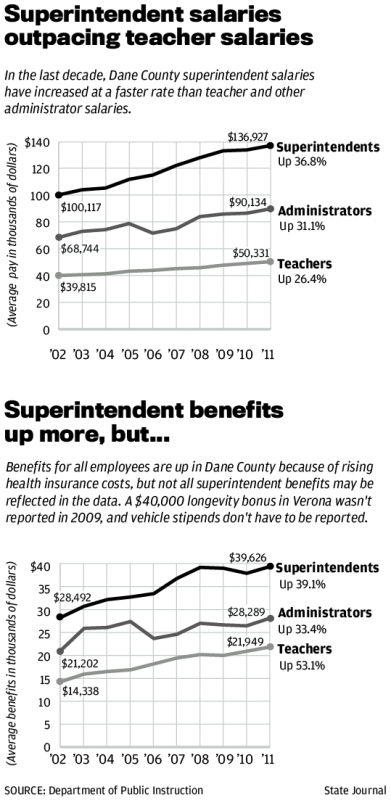
School superintendents’ bonuses may be ‘an issue from the public’s point of view’


Matthew DeFour:

Next year, Verona superintendent Dean Gorrell is in line to collect a $50,000 longevity bonus on top of his $140,000 salary.
In 2014, Madison superintendent Dan Nerad qualifies for a $37,500 payment for six years of service, which like Gorrell’s would be paid into a retirement account. Nerad already receives an annual $10,000 payment into his retirement account, which is separate from his state pension and in addition to a $201,000 yearly salary.
And in 2017, Monona Grove superintendent Craig Gerlach can leave the job with an extra year’s salary, currently $150,000, paid into a retirement account over the following five years.
Over the past decade, such perks have been added to some Dane County superintendent contracts, even as, on average, their salary increases outpaced teacher pay hikes, according to data provided by the Department of Public Instruction.
“Any type of payout at that level is clearly going to be an issue from the public’s point of view,” Dale Knapp, research director at the Wisconsin Taxpayers Alliance, said of the longevity payouts. “The problem becomes once these start getting into contracts, it becomes competition and then they become more prevalent.”
Adding bonus language to superintendent contracts became increasingly popular in recent years as school districts faced state-imposed rules on increasing employee compensation.

Perhaps, one day soon, teachers will have similar compensation freedom, or maybe, superintendents should operate under a one size fits all approach…
I’d rather see teacher freedom of movement, and compensation.

Share

A New Approach to Teacher Compensation

Mike Ford:

Teachers are the most important factor in determining the success of students. No technology, curriculum, or standard can supplant the need for a quality teacher in every classroom. We know children learn differently, we know there is no single recipe for a successful teacher, yet we continue to pay teachers as if they are interchangeable assembly-line workers producing an identical commodity called education.
In a report released this week I propose dumping district-wide lock-step pay schedules that reward only formal education and years on the job in favor of a compensation reform that rewards and motivates teachers in a way conducive to raising the academic achievement. I do not propose a merit pay system that gives bonuses to individual teachers in return for raising test scores.
Why? The track record of such systems can at best be called uneven. Teachers are not uniformly motivated by monetary compensation. Research by UW-Madison professor Allan Odden and others shows teachers value collaboration and student success above other factors. Any reform that does not recognize this is doomed to fail. No less important, students need schools that deliver consistent teacher quality from start to finish so that the work of a good teacher in one grade is not undone by a sub-par teacher the next.

Share

K-12 Tax & Spending Climate: It’s Worse Than You Think

Steve Prestegard

Regular readers know that state finances were worse than the Doyle administration admitted during its eight years of fiscal incompetence. But state finances are also worse than the Walker administration admits now.
The proof is the state’s Comprehensive Annual Fiscal Report, an inch-thick annual tree-killer that summarizes the differences between politicians’ claims about the state’s fiscal health, and the reality of the state’s fiscal health.
The differences lie in correctly measuring state finances, as the Wisconsin Taxpayers Alliance explains:

A recent WISTAX publication mentioned that Wisconsin Medicaid spending increased 87% from 2006 to 2011!

Share

Charter schools on Washington legislative agenda ‘worth the fight’: Many say we can’t wait longer for solution; others worry

Brian Rosenthal:

The proposals would allow charter schools in the state, establish a process for failing schools to be taken over by outside organizations and continue an overhaul of the way all teachers and principals are evaluated.
Charters, which are public but independent schools allowed to use unconventional techniques, would be closely monitored by a state board, lawmakers said. Only 50 would be allowed in the state – with no more than 10 new ones authorized each year. Each would be required to adopt a specific plan to serve educationally disadvantaged children.
The evaluations, which would include student test scores and classroom observations, would build on a pilot system already used in several districts in the state, lawmakers said.
Poor performance on the evaluations could lead teachers to lose their tenure, but the focus would be on improvement of teaching methods.

Share

Contempt, confusion, and cheers in State of the City reactions

Philissa Cramer:

Minutes after Mayor Bloomberg finished delivering his State of the City address today, reactions started flying about his aggressive slate of education proposals.
The reactions ranged from withering (in the case of UFT President Michael Mulgrew) to bewildered (Ernest Logan, principals union president) to supportive (charter school operator Eva Moskowitz and others whose organizations would benefit from the proposals).
Below, I’ve compiled the complete set of education-related reactions that dropped into my inbox. I’ll add to the list as more reactions roll in.

Share

Madison Prep backers seek school board re-vote

Nathan Comp:

When asked why he didn’t second Ed Hughes’ motion at the Dec. 19 meeting to delay the schools’ opening until 2013, Howard replied, “We had not discussed the implications of what that means. I think we have time if we’re talking about 2013, to make sure we do it correctly, because we don’t know what the rules of the game will be in 2013.”
Superintendent Dan Nerad said, “Whether it will move forward I don’t know. That depends on whether the motion gets on the floor. I don’t have a read on it at this point.”
Others aren’t as diplomatic. “This is a waste of time and money for all involved,” said TJ Mertz, an Edgewood College professor and district watchdog who is among Madison Prep’s most ardent critics.
“The votes are not there and will not be there,” he continued. “It distracts from the essential work of addressing the real issues of the district, including issues of achievement for students in poverty.”

Much more on the proposed Madison Preparatory IB charter school, here.

Share

Arkansas Education Board approves 4 new charter Schools

Associated Press:

Arkansas’ education board has approved four new charter schools.
The board voted unanimously Monday in favor of Cross County School District’s proposed charter elementary school. The board also approved applications for proposed charter schools in Lincoln, Osceola and Warren.
Department of Education spokesman Seth Blomeley says charter schools are eligible to apply for up to $600,000 in federal money to use toward startup and other one-time costs.

Share

Adelanto parents pull ‘trigger’ to upgrade school

Christina Hoag:

Cecelia Thornton sets up a makeshift classroom at her kitchen table every day after school to tutor her grandchildren in reading and writing with materials she buys at the local thrift store in the Mojave Desert town of Adelanto (San Bernardino County).
The 5- and 6-year-olds, she said, just aren’t learning enough in their classes at Desert Trails Elementary School.
That’s the key reason why she and a band of other parents and guardians filed a petition Thursday under California’s “parent trigger” law to demand reforms at the K-6 school where just 35 percent of pupils last year tested proficient in reading and 46 percent in math.

Share

The Evil Economics Of Judging Teachers

Maria Bustillos:

The Times and a host of other publications heralded last week’s new study extolling the lifelong money-earning benefits of having a good primary/middle-school teacher. Oh, yay! Let’s do what these economists from the National Bureau of Economic Research suggest, right?
Actually, ugh, no. What economists Raj Chetty and John N. Friedman of Harvard and Jonah Rockoff of Columbia want to do, apparently, is to identify and fire “weaker” teachers, for the sake of a barely perceptible increase in students’ “lifetime income.” Nobody has actually tried this yet; the report doesn’t describe an experiment. It’s just the conclusion they draw from their analysis of massive amounts of data gathered from public schools in New York City and cross-referenced against IRS records and the like.
Here’s a bit from the summary of the original paper. Note that a “high-VA” (“value-added”) teacher is a “good” one–meaning by this, solely, that the teacher in question has succeeded in raising standardized test scores.

Share

It’s hard to overestimate the value of a good teacher

Nicholas Kristof:

Our faltering education system may be the most important threat to our economy and well-being, writes Nicholas D. Kristof, so it’s frustrating that the presidential campaign is mostly ignoring the issue. The obvious policy solution is more pay for good teachers, more dismissals for weak teachers.
Suppose your child is about to enter the fourth grade and has been assigned to an excellent teacher. Then the teacher decides to quit. What should you do?
The correct answer? Panic!
Well, not exactly. But a landmark new research paper underscores that the difference between a strong teacher and a weak teacher lasts a lifetime. Having a good fourth-grade teacher makes a student 1.25 percent more likely to go to college, the research suggests, and 1.25 percent less likely to get pregnant as a teenager. Each of the students will go on as an adult to earn, on average, $25,000 more over a lifetime — or about $700,000 in gains for an average size class — all attributable to that ace teacher back in the fourth grade. That’s right: A great teacher is worth hundreds of thousands of dollars to each year’s students, just in the extra income they will earn

Share

Royal Society offers ways to overhaul ICT Teaching

BBC:

The Royal Society has suggested ways the government can overhaul information and communications technology (ICT) teaching in schools.
It follows promises from Education Secretary Michael Gove to scrap the way the subject is taught currently.
The body, which oversees UK sciences, recommends dividing computing into distinct subjects such as computer science and digital literacy.
It said the government must do more to recruit specialist ICT teachers.

Share

Madison Prep supporters vow to keep pushing until vote is yes

Dan Simmons:

Leaders of a proposed charter school for low-income minority students said Friday that they expect to have sufficient funding and will open Madison Prep as a private academy next fall but will continue to return to the Madison School Board for approval, starting with a proposed revote in February to make the school a publicly funded charter starting in 2013.
That would be just weeks before a Madison School Board election in which two Madison Prep supporters are vying for seats.
“We will go back, and we’ll go back, and we’ll go back until the vote is a yes,” said Laura DeRoche-Perez, director of school development at the Urban League of Greater Madison. “That is because we cannot wait.”
The prospects for school board approval for the 2013 opening, at least with the current board, appear uncertain after the same board voted against the school opening in 2012 by a 5-2 margin in December. Those who opposed cited the school’s plan to use non-union teachers and staff and concerns over the school’s accountability to taxpayers and the district and don’t appear to have wavered in their opposition.

Much more on the proposed Madison Preparatory IB charter school, here.

Share

The Value-Add Map Is Not the Teaching Territory, But You’ll Still Get Lost without It

Greg Forster:

Since we’re so deep into the subject of value-added testing and the political pressures surrounding it, I thought I’d point out this recently published study tracking two and a half million students from a major urban district all the way to adulthood. (HT Whitney Tilson)
They compare teacher-specific value added on math and English scores with eventual life outcomes, and apply tests to determine whether the results are biased either by student sorting on observable variables (the life outcomes of their parents, obtained from the same life-outcome data) or unobserved variables (they use teacher switches to create a quasi-experimental approach).

Much more on value added assessment, here.

Share

The Great Teacher Debate

Jerry Ortiz y Pino:

New Mexico lawmakers are considering a proposal from the Martinez administration to link teacher evaluations to student test scores. This is a crucial element in the overall reform plan offered by Public Education Secretary Hanna Skandera. Not surprisingly, it’s proving contentious. It will be a huge topic in the coming 30-day legislative session set to begin Tuesday, Jan. 17.
The Obama administration’s education secretary, Arne Duncan, favors eliminating legal barriers to linking student test scores to teacher evaluations. That means student tests could determine tenure, raises and even termination. He talks about it in the Atlantic Monthly article “What Makes a Great Teacher?” which goes into great detail about the efforts of educational researchers to tease out what constitutes excellence in teaching. Are great teachers just hard-wired that way, or can we cultivate them?

Share

The Costs of Online Learning

Tamara Butler Battaglino, Matt Haldeman, and Eleanor Laurans:

The latest installment of the Fordham Institute’s Creating Sound Policy for Digital Learning series investigates one of the more controversial aspects of digital learning: How much does it cost? In this paper, the Parthenon Group uses interviews with more than fifty vendors and online-schooling experts to estimate today’s average per-pupil cost for a variety of schooling models, traditional and online, and presents a nuanced analysis of the important variance in cost between different school designs. These ranges–from $5,100 to $7,700 for full-time virtual schools, and $7,600 to $10,200 for the blended version–highlight both the potential for low-cost online schooling and the need for better data on costs and outcomes in order for policymakers to reach confident conclusions related to the productivity and efficiency of these promising new models. Download “The Costs of Online Learning” to learn more.

Share

Parents Rebel Against School

Stephanie Banchero:

Fed-up parents of students attending a low-performing school in Southern California aim to use the power given to them by the state to take an unusual step: fire the school.
This power, called a Parent Trigger, was passed into law in California in 2010, but parents are attempting for only the second time to use it at Desert Trails Elementary outside Los Angeles. Their effort to force Adelanto Elementary School District to overhaul the school, or turn it into a charter school run by the parents themselves, is expected to be closely watched across the nation.
Similar legislation passed in Texas and Mississippi last year and is under consideration in Florida, Pennsylvania and Indiana this year.

Share

Bloomberg Vows Tougher Steps to Help Troubled Schools

David Chen & Anna Phillips:

Mayor Michael R. Bloomberg, directly confronting leaders of the teachers’ union, proposed on Thursday a merit-pay system that would award top performers with $20,000 raises and threatened to remove as many as half of those working at New York City’s most troubled schools.
Delivering his 11th and penultimate State of the City address, Mr. Bloomberg vowed to double down on his longstanding efforts to revive the city’s long-struggling schools, saying, “We have to be honest with ourselves: we have only climbed halfway up the mountain, and halfway isn’t good enough.”
“We cannot accept failing schools,” he said during an often-passionate one-hour speech at Morris High School in the Bronx. “And we cannot accept excuses for inaction or delay.”

Share

Madison Prep and Urban League to seek new vote on Madison Prep

Kaleem Caire, via email:

MEDIA ADVISORY
For immediate release: January 12, 2012
Contact: Laura DeRoche-Perez
Director of School Development
Urban League of Greater Madison
2222 S. Park St., Suite 200
Madison, WI 53713
Lderoche@ulgm.org
608-729-1230 (office)
608-556-2066 (cell)
Urban League and Madison Prep Boards to Hold Press Conference
Will announce their plans to seek a new vote on authorizing the opening of Madison Prep for 2013
WHAT: Madison Preparatory Academy and the Urban League of Greater Madison will announce their intentions to seek a February 2012 vote by the Madison Metropolitan School District Board of Education to authorize Madison Prep to open in the fall of 2013. Three MMSD Board of Education members have already shared their support of the motion.
WHEN: 3:30 pm CST, Friday, January 13
WHERE: Urban League of Greater Madison, 2222 S. Park St., Madison, WI 53713
WHO: Madison Preparatory Academy Board of Directors
Urban League of Greater Madison
Others
For more information, contact Laura DeRoche-Perez, Director of School Development, Urban League of Greater Madison, at lderoche@ulgm.org or 608-729-1230.

Much more on the proposed Madison Preparatory IB charter school, here.

Share

Time to Ax Public Programs That Don’t Yield Results (Start with Head Start)

Joel Klein, via a kind reader’s email:

Barack Obama has been accused of “class warfare” because he favors closing several tax loopholes — socialism for the wealthy — as part of the deficit-cutting process. This is a curious charge: class warfare seems to be a one-way street in American politics. Over the past 30 years, the superwealthy have waged far more effective warfare against the poor and the middle class, via their tools in Congress, than the other way around. How else can one explain the fact that the oil companies, despite elephantine profits, are still subsidized by the federal government? How else can one explain the fact that hedge-fund managers pay lower tax rates than their file clerks? Or that farm subsidies originally meant for family farmers go to huge corporations that hardly need the help?
Actually, there is an additional explanation. Conservatives, like liberals, routinely take advantage of a structural flaw in the modern welfare state: there is no creative destruction when it comes to government programs. Both “liberal” and “conservative” subsidies linger in perpetuity, sometimes metastasizing into embarrassing giveaways. Even the best-intentioned programs are allowed to languish in waste and incompetence. Take, for example, the famed early-education program called Head Start. (See more about the Head Start reform process.)
The idea is, as Newt Gingrich might say, simple liberal social engineering. You take the million or so poorest 3- and 4-year-old children and give them a leg up on socialization and education by providing preschool for them; if it works, it saves money in the long run by producing fewer criminals and welfare recipients — and more productive citizens. Indeed, Head Start did work well in several pilot programs carefully run by professionals in the 1960s. And so it was “taken to scale,” as the wonks say, as part of Lyndon Johnson’s War on Poverty.

Share

Race talk fuels tension in Madison Prep debate

Pat Schneider:

That Kaleem Caire, the charismatic champion of the Madison Preparatory Academy, is frustrated by the proposal’s defeat before the Madison School Board last month should surprise no one.
But the prospect that resentment over the defeat of the proposal runs so deep that it could poison the initiative’s future prospects as a private school or public charter — that’s a distressing possibility whose existence is just now emerging.
The proposal for the school by the Urban League of Greater Madison has won many supporters because of the embarrassingly persistent achievement gap between whites and minorities in the Madison School District, but when Caire spoke Monday to Communities United, a community group dedicated to social justice, his passionate appeal to go beyond the district’s existing model was laced with anger towards the School Board members who voted down the plan.
Much of the discussion Monday between Caire and a handful of staffers from the Urban League — where he is president and CEO — and those at the Communities United meeting centered around the ultra-sensitive topics of race and racism.
Even in that friendly environment (the informal, nonpartisan coalition was already on record in favor of the school), Caire’s accusations against school officials were rejected as political spin by a Madison City Council member on hand and criticized as more of the “race card” by an African-American activist who has skirmished with Caire before over Madison Prep. But a Latina parent and activist greeted his words as an apt assessment of the situation in Madison schools.

Much more on the proposed Madison Preparatory IB charter school, here.

Share

Minnesota Dual High School/College Credit

Center for School Change:

Take advantage of great dual credit courses at your high school! Many of Minnesota’s high schools offer Dual Credit programs that allow qualifying students to earn college credit while still in high school at little or no cost. Dual Credit programs are a great way for high school students to challenge themselves academically, earn college credit, and save time and money. Eligible high school students can choose to participate in the following dual credit programs: Postsecondary Enrollment Options (PSEO),Concurrent Enrollment (CE), Advanced Placement (AP) and International Baccalaureate (IB).

Share

On Her Majesty’s School Inspection Service

Craig Jerald:

After more than a decade (and four years behind schedule) Congress finally seems ready to reauthorize the Elementary and Secondary Education Act. For years, critics have complained that the law’s focus on test scores offers far too narrow a picture for judging school quality. There is also concern that the “adequate yearly progress,” or AYP, formula is too inflexible to diagnose the strengths and weaknesses of schools.
The track record of NCLB also suggests that it hasn’t been especially successful in turning around the most troubled schools. In fact, among the 1,200 schools identified for “corrective action” in 2005-06, fully 70 percent were still under an improvement category three years later.

Share

Oregon districts start their own charter schools to gain federal funding, flexibility

Nicole Dungca:

When a fledgling charter school took over the Cottrell Elementary building this fall, district administrators didn’t worry about losing per-pupil state funding, and there were no protests decrying the move as a threat to public education.
That’s because the Oregon Trail School District created the charter school.
Amid increasing budget constraints and continued pressure to reform public education, some savvy educators are taking advantage of federal charter school grants of up to $500,000 to create a hybrid: the district-initiated charter school.
In Oregon, taxpayers finance charter schools, which are typically run by organizations independent from school districts. But two Clackamas County districts have discovered the Oregon charter school law can provide extra funds and flexibility for their own innovative programs.

Share

A Radical Solution For America’s Worsening College Tuition Bubble

Kevin Carey:

Over the last three decades, through good economic times and bad, one of the few constants in American life has been the relentless rise in the price of higher education. The numbers are stark: According to the non-profit College Board, public four-year universities raised tuition and fees by 8.3 percent this year, more than double the rate of inflation. This was typical: Over the last decade, public university tuition grew by an average of 5.6 percent above inflation every year. And the problem is also getting worse: In the 1990s, the annual real increase was 3.2 percent. In the 1980s, it was 4.5 percent.
Even as the economy has reorganized itself to make college degrees increasingly indispensable for the pursuit of a decent career, federal financial aid programs and family income haven’t been able to keep up with incredibly buoyant tuition bills. Students and families have been left with only one recourse: borrowing. The federal government is now lending college students over $100 billion per year, a 56 percent per-student increase, after adjusting for inflation, from just ten years ago. Most undergraduates borrow today, and leave college with an average of over $25,000 in debt. And as the many signs displayed by the Occupy movement attest, some young people owe much more than that. For a growing number of students, entering the lucrative college-educated realms of the economy is like being smuggled across the border–you can get to the promised land if you try hard enough, but you arrive in a state of indentured servitude to the shady operators who overcharged you for the trip.

Share

Madison’s La Follette High School team shows off financial savvy at Investment Challenge

Judy Newman:

More than 125 high school students from the Madison area showed off their financial savvy Tuesday at the Finance and Investment Challenge Bowl.
The contest pitted teams from 32 local schools against each other, two teams at a time, with experts in the financial industry serving as moderators and judges.
The teens fielded questions such as:

Share

Gates Foundation Urges Better Teacher Evaluations, Neglects to Mention Quick and Easy Method

Nina Shapiro:

​The Bill and Melinda Gates Foundation just came out with its latest advice for how to improve schools. As the foundation sees it, districts don’t have a good sense of who their good and bad teachers are, and need better evaluations. But is this really the problem?
Ever since it abandoned its former educational preoccupation, small schools, the Gates Foundation has hit upon stellar teaching as the key to transforming the nation’s schools. It’s not exactly a new idea, but it’s one worthy of rediscovering.
A Stanford economist named Eric Hanushek has put into numerical terms a concept that most people know with their gut. A New Yorker story on the matter a few years ago summarized his findings: “Students of a very bad teacher will learn, on average, half a year’s worth of material in one school year. The students in the class of a very good teacher will learn a year and a half’s worth of material.”

Share

Science Envy

Historian David McCullough was asked by a reporter recently if he started writing any of his books with a theme. He said that when he became interested in a subject he started reading to see what he could find out about it, but he had no advance idea of what would result.
Even those of our teachers who do work with students on research papers too frequently indulge in the science envy of requiring them to have a thesis. Students are asked to have some prior notion of the history they will read which they will test to see whether it is falsifiable or not.
Science is rich, famous and powerful, so it is not surprising that it is envied in our culture, but it should be remembered that its practice is to reduce, as much as possible, reality to numbers.
History does not lend itself well to a reduction to numbers, as it is about human beings, who also cannot very well be competently encompassed by numerical descriptions.
Words are the numbers of history, and words connote as much as they denote, they contain and evoke possibility and ambiguity in ways that the number users of science sometimes find annoyingly imprecise and quite uncomfortable.
The study of history should begin with curiosity about people and events: What was that person really like? How did that event come to happen and what resulted from it? These are the sort of non-thesis questions that our students of history should be asking, instead of fitting themselves out for their journey of learning about the past hampered with the straitjacket of a thesis.
Serious history students are often curious over something they have read about. They want to know more, and, when they have learned quite a bit, they frequently want to tell others what they have discovered. Like scientists, they are curious, but unlike them, they are willing to live with the uncertainties that are the essential ingredients of human experience.
Science has earned our admiration, but its methods are not suitable to all inquiries and we should not let envy of the success of science mislead us into trying to shrink-wrap history to fit some thesis with which students would have to begin their study of history.
David McCullough has reported that when he speaks to groups very often he is asked how much time he spends doing research and how much time he spends writing. He said he is never asked how much time he spends thinking.
The secondary students of history published in The Concord Review do not generally begin their work with a thesis to prove or disprove, but rather with wonder about something in history. The quality of their papers reveals that not only have they done a good deal of reading and research–if there is any difference there–but that they also have spent some serious time thinking about what they have learned, as well as how to tell someone else about it.
They have inevitably encountered the complex causes of historical events (no control groups there) and the variety of forces and inclinations both within and without the historical figures they have studied.
Some of these students are very good in calculus, science, and so forth, but they realize that history is a different form of inquiry and provides a non-reductionist view of the truth of human life, but one that may be instructive or inspiring in several ways.
So I urge teachers of students of history, who are asking them to write serious research papers, to let them choose their own topics, based on their own wonder and curiosity about the past, and to relieve them of the science envy of a thesis requirement. Let them embark on their own study of some part of the immense and mysterious ocean of history, and help them return with a story and an understanding they can call their own and can share, through serious research papers, with other students of history.
————————
“Teach by Example”
Will Fitzhugh [founder]
The Concord Review [1987]
Ralph Waldo Emerson Prizes [1995]
National Writing Board [1998]
TCR Institute [2002]
730 Boston Post Road, Suite 24
Sudbury, Massachusetts 01776-3371 USA
978-443-0022; 800-331-5007
www.tcr.org; fitzhugh@tcr.org
Varsity Academics®
www.tcr.org/blog

Share

James Howard: Board responsible for narrowing gap

Madison School Board President James Howard

Accountability for significantly narrowing the achievement gap must be at the top of the Madison School District agenda in 2012. How long should the current members of the School Board, Superintendant Dan Nerad, the administration and staff have to demonstrate gains in narrowing the gap?
In 2010 a five-year strategic plan was implemented with narrowing achievement gaps as the number one priority, and we are now starting to get results from the initiatives in the plan.
What will the level of accountability be for those of us who approved the plan? What will the level of accountability be for those of us who have responsibility for implementing the plan?
The question must be: Have we achieved the desired results or educational outcomes demanded by the taxpayers?

Share

California community colleges approve overhaul

Nanette Asimov:

Over the objections of angry college students and worried faculty members, California community college leaders voted Monday to support a systemwide overhaul that could end many free classes for older adults and squeeze out students who fail to move quickly through the system.
The 22 recommendations approved by the college system’s Board of Governors are intended to address a devilish problem: Essential classes are in critically short supply and thousands of students are turned away from classes they need because of the state’s economic crisis.

Share

Scott Milfred talks Madison Prep, Walker recall, Iowa results on “For the Record”

Wisconsin State Journal:

Click here to watch Sunday’s “For the Record” on WISC-TV (Ch. 3) with Neil Heinen. Panelists include State Journal editorial page editor Scott Milfred, Republican insider Brandon Schulz and The Progressive editor Matt Rothschild. They bantered about the recent Iowa caucus results, the U.S. Senate race in Wisconsin, the likely gubernatorial recall and the coming Madison School Board elections, which Milfred argues are likely to decide whether a charter school called Madison Preparatory Academy opens its doors.”

Share

Charter-School Management Organizations: Diverse Strategies and Diverse Student Impacts

Joshua Furgeson, Brian Gill,
Joshua Haimson, Alexandra Killewald, Moira McCullough, Ira Nichols-Barrer, Bing-ru Teh, Natalya Verbitsky-Savitz Mathematica Policy Research; Melissa Bowen, Allison Demeritt,
Paul Hill, Robin Lake Center on Reinventing Public Education

Charter schools–public schools of choice that are operated autonomously, outside the direct control of local school districts–have become more prevalent over the past two decades. There is no consensus about whether, on average, charter schools are doing better or worse than conventional public schools at promoting the achievement of their students. Nonetheless, one research finding is clear: Effects vary widely among different charter schools. Many educators, policymakers, and funders are interested in ways to identify and replicate successful charter schools and help other public schools adopt effective charter school practices.
Charter-school management organizations (CMOs), which establish and operate multiple charter schools, represent one prominent attempt to bring high performance to scale. Many CMOs were created in order to replicate educational approaches that appeared to be effective, particularly among disadvantaged students. Attracting substantial philanthropic support, CMO schools have grown rapidly in the past decade. Some of these organizations have received laudatory attention through anecdotal reports of dramatic achievement results.
The National Study of CMO Effectiveness aims to fill the gap in systematic evidence about CMOs, providing the first rigorous nationwide examination of CMOs’ effects on students’ achievement and attainment. The study includes an examination of the relationships between the practices of individual CMOs and their effects on student achievement, with the aim of providing useful guidance to the field. Mathematica Policy Research and the Center on Reinventing Public Education (CRPE) are conducting the study with funding from the Bill & Melinda Gates Foundation and the Walton Family Foundation and project management assistance from the NewSchools Venture Fund. This updated edition of the report provides key findings from the study on CMO practices, impacts, and the relationships between them. A forthcoming report will explore promising practices in greater depth.

Share

Stanford Free Classes – A review from a Stanford Student

pennyhacks:

Recently Stanford has started a new initiative to bring free classes to the public. From what I’ve seen from statistics, this venture has been extraordinarily successful with over 100,000 sign ups. Most likely only a fraction went through with the class, but that’s still a lot of people, especially for the first time. There has been quite a lot of press about these classes, but none seem to take into account the effects it has on the students that attend Stanford. Despite the success and the raves of great reviews, I was not at all satisfied by the CS229a: Applied Machine Learning, one of the three courses offered to the public fall quarter. Before I begin though, I want to say that I completely agree that education should not be locked up for only a few to use and I also agree that since education, in my mind, is a right, then it should be provided for free. Thus the Stanford initiative to do this is a great thing. However, there are quite a few things that hopefully Stanford will change in the future.

Share

Teacher Retention: Estimating The Effects Of Financial Incentives In Denver

Eleanor Fullbeck:

There is currently much interest in improving access to high-quality teachers (Clotfelter, Ladd, & Vigdor, 2010; Hanushek, 2007) through improved recruitment and retention. Prior research has shown that it is difficult to retain teachers, particularly in high-poverty schools (Boyd et al., 2011; Ingersoll, 2004). Although there is no one reason for this difficulty, there is some evidence to suggest teachers may leave certain schools or the profession in part because of dissatisfaction with low salaries (Ingersoll, 2001).
Thus, it is possible that by offering teachers financial incentives, whether in the form of alternative compensation systems or standalone bonuses, they would become more satisfied with their jobs and retention would increase. As of yet, however, support for this approach has not been grounded in empirical research.
Denver’s Professional Compensation System for Teachers (“ProComp”) is one of the most prominent alternative teacher compensation reforms in the nation.* Via a combination of ten financial incentives, ProComp seeks to increase student achievement by motivating teachers to improve their instructional practices and by attracting and retaining high-quality teachers to work in the district.

Share

The Ignominious Ignorance Behind Bonnie Dumanis’ Education Plan for San Diego

Doug Porter:

In a move that qualifies as one of the most ignorant and opportunist positions ever taken by a local politician; the Dumanis Mayoral Campaign announced its “Bold” educational initiative this past Thursday at a press conference. The details of the effort–expanding the school board, creating oversight committees and establishing a bureaucracy within the City government to oversee “liaison” efforts were widely reported in the local news media. Candidate Dumanis got lots of face time on local tv news as her plan was uncritically rolled out to the electorate.
The local press failed to notice that Carmel Valley, where the Dumanis presser was held isn’t even in the San Diego Unified School District. The Mayoral candidate appeared blissfully unaware that schools in that area are part of the San Dieguito district as she prattled on about “Leadership, vision and experience are needed to put our schools on a new path because it’s clear the path we are on today is the wrong one.”
Asked about who she worked with in drafting her plan, Dumanis would only say that she’d consulted with an unnamed group of teachers, parents, students and others interested in reform. It’s clear though, that if you look at her list of campaign contributors, the “Bold” plan is largely drawn from the wreckage of the failed San Diegans for Great Schools ballot initiative that, despite receiving over $1 million in donations from a few well heeled “philanthropists”, couldn’t gather enough signatures to be placed in front of the voters.

Share

Senator’s bill would cap Cal State University presidents’ salaries

Nanette Asimov:

The salaries of California State University campus presidents would be capped, and discussions about their pay would be held in public, under a bill being proposed by a state senator frustrated that CSU has been raising executive pay as well as tuition.
The proposal comes months after CSU trustees hired a campus president in San Diego for $400,000 a year – $100,000 more than his predecessor – and at the same meeting that they approved a 12 percent tuition increase.
“It is not reasonable to give $100,000 raises to executive positions, especially when simultaneously raising tuition,” said state Sen. Ted Lieu, D-Torrance (Los Angeles County), author of SB755.

Share