School Information System

Idea of New Attention Disorder Spurs Research, and Debate

Alan Schwarz:

With more than six million American children having received a diagnosis of attention deficit hyperactivity disorder, concern has been rising that the condition is being significantly misdiagnosed and overtreated with prescription medications.
 
 Yet now some powerful figures in mental health are claiming to have identified a new disorder that could vastly expand the ranks of young people treated for attention problems. Called sluggish cognitive tempo, the condition is said to be characterized by lethargy, daydreaming and slow mental processing. By some researchers’ estimates, it is present in perhaps two million children.
 
 Experts pushing for more research into sluggish cognitive tempo say it is gaining momentum toward recognition as a legitimate disorder — and, as such, a candidate for pharmacological treatment. Some of the condition’s researchers have helped Eli Lilly investigate how its flagship A.D.H.D. drug might treat it.

Share

The home-school conundrum Meeting the German Christians who claimed asylum in America

The Economist:

Civil disobedience does not come easily to Morristown, a conservative spot of almost 30,000 souls. Yet city fathers swore to endure jail time, if necessary, to shield Uwe Romeike, his wife Hannelore and their seven children, from federal agents with orders to expel them from Morristown, where they have lived since fleeing Baden-Württemberg in 2008. A stand-off seemed likely when, on March 3rd, the Supreme Court declined to hear a final appeal against the Romeikes’ expulsion, handing victory to the American government, which had always rejected the family’s claims to be refugees from religious and social persecution. However, a day later federal officials put the family’s deportation on indefinite hold—thereby allowing them to stay without setting a legal precedent (and without insulting Germany, a close ally).
 
 German laws forbid parents from educating their children at home in almost all cases, citing society’s interest in avoiding closed-off “parallel societies”. Germany’s highest court calls schools the best place to bring together children of different beliefs and values, in the name of “lived tolerance”. In plainer language, the Romeikes believe that, if they return to Germany, their children face being taken to school by force. This happened in 2006: the youngsters wept as they were driven away in a police van. (On the next school morning supporters showed up and officers backed off.) Worse, their children might be taken into care—this is the family’s greatest fear, prompting their flight from Germany. As the Romeikes scanned the globe for options, the Home School Legal Defence Association, a Virginia-based group, urged them to apply for asylum in America. The hope was to cause a fuss in the press, says an HSLDA lawyer, Michael Donnelly, and to “fuel the flame of liberty in Germany”.
 

Share

Is college worth it? Too many degrees are a waste of money. The return on higher education would be much better if college were cheaper

The Economist:

WHEN LaTisha Styles graduated from Kennesaw State University in Georgia in 2006 she had $35,000 of student debt. This obligation would have been easy to discharge if her Spanish degree had helped her land a well-paid job. But there is no shortage of Spanish-speakers in a nation that borders Latin America. So Ms Styles found herself working in a clothes shop and a fast-food restaurant for no more than $11 an hour.
 
 Frustrated, she took the gutsy decision to go back to the same college and study something more pragmatic. She majored in finance, and now has a good job at an investment consulting firm. Her debt has swollen to $65,000, but she will have little trouble paying it off.

Share

Many American universities offer lousy value for money. The government can help change that

The Economist:

YOU cannot place a value on education. Knowledge is the food of the soul, Plato supposedly remarked. Great literature “irrigates the deserts” of our lives, as C.S. Lewis put it. But a college education comes with a price tag—up to $60,000 a year for a four-year residential degree at an American university.
 
 A report by PayScale, a research firm, tries to measure the returns on higher education in America (see article). They vary enormously. A graduate in computer science from Stanford can expect to make $1.7m more over 20 years than someone who never went to college, after the cost of that education is taken into account. A degree in humanities and English at Florida International University leaves you $132,000 worse off. Arts degrees (broadly defined) at 12% of the colleges in the study offered negative returns; 30% offered worse financial rewards than putting the cash in 20-year Treasury bills.
 
 None of this matters if you are rich and studying fine art to enhance your appreciation of the family Rembrandts. But most 18-year-olds in America go to college to get a good job. That is why the country’s students have racked up $1.1 trillion of debt—more than America’s credit-card debts. For most students college is still a wise investment, but for many it is not. Some 15% of student debtors default within three years; a startling 115,000 graduates work as caretakers.

Share

These charts explain what’s behind America’s soaring college costs

Ronan Keenan:

The growing $1.1 trillion student debt burden in the US has been well documented, yet concerns are subdued. That’s because the burden, unlike the housing crisis, won’t cause a sudden economic crash. Instead, it will prompt a slow strangulation of spending spread over many years. Congress has made some minor efforts to reduce interest rates on debt, but the necessity for such large loans must be scrutinized. And that means confronting the indulgences of colleges.
 
 Tuition costs have soared in recent decades. In 1973, the average cost for tuition and fees at a private nonprofit college was $10,783, adjusted for 2013 dollars. Costs tripled over the ensuing 40 years, with the average jumping to $30,094 last year. Even in the last decade the increase was a staggering 25%.
 
 The ability of colleges to raise costs has been facilitated by a sharp increase in federal student aid. Lenders freely dispense credit to students, safe in the knowledge that all loans are guaranteed by the government. Between 1973 and 2012, federal aid (inflation-adjusted) increased more than 500%. Looking at a shorter period, between 2002 and 2012, total federal aid to students ballooned an inflation-adjusted 106% to $170 billion.

Share

Coursera Creates Bricks & Mortar Learning Hubs

Sean Coughlin:

Online university providers, which offered people the chance to study from home, are turning full circle by creating a network of learning centres where students can meet and study together.
 
 Instead of demolishing the dusty old classrooms, the online university revolution is responsible for opening some new ones.
 
 Coursera, a major California-based provider of online courses, is creating an international network of “learning hubs”, where students can follow these virtual courses in real-life, bricks and mortar settings.
 
 And there are thousands of meet-ups in cafes and libraries where students get together to talk about their online courses.

Share

Humans Steal Jobs From Robots

Craig Trudell, Yuki Hagiwara and Ma Jie:

Inside Toyota Motor Corp.’s oldest plant, there’s a corner where humans have taken over from robots in thwacking glowing lumps of metal into crankshafts. This is Mitsuru Kawai’s vision of the future.

“We need to become more solid and get back to basics, to sharpen our manual skills and further develop them,” said Kawai, a half century-long company veteran tapped by President Akio Toyoda to promote craftsmanship at Toyota’s plants. “When I was a novice, experienced masters used to be called gods, and they could make anything.”

These gods, or Kami-sama in Japanese, are making a comeback at Toyota, the company that long set the pace for manufacturing prowess in the auto industry and beyond. Toyota’s next step forward is counter-intuitive in an age of automation: Humans are taking the place of machines in plants across Japan so workers can develop new skills and figure out ways to improve production lines and the car-building process.

Meanwhile: Europe’s manufacturers experiment with the ‘smart factory’.

Share

How Higher Ed Contributes to Inequality

Dana Goldstein:

In 2011, Cornell political scientist Suzanne Mettler highlighted poll results showing a striking phenomenon: About half of the Americans receiving federal assistance in paying college tuition or medical bills believe they have never benefited from a government social program. The results are evidence of what Mettler has termed “the submerged state”—a series of policies, like tuition tax credits or federally-guaranteed student loans, that are practically invisible to citizens. That invisibility, she argues, erodes public support for the very idea of government playing an active role in people’s lives.
 
 Now in a new book, Degrees of Inequality, Mettler reveals how, over the past 60 years, American higher-education policy has gone from being visible and effective (the GI Bill and the Pell grant program) to being invisible and inefficient ($32 billion in federal funding for for-profit colleges with abysmal graduation rates). Congressional polarization along party lines, it turns out, played a major role, as did plummeting federal and state support for four-year public universities.

Share

Students could be paying loans into their 50s

Katherine Sellgren:

Most students will still be paying back loans from their university days in their 40s and 50s, and many will never clear the debt, research finds.
 
 Almost three-quarters of graduates from England will have at least some of their loan written off, the study, commissioned by the Sutton Trust, says.
 
 The trust says the 2012 student finance regime will leave people vulnerable at a time when family costs are at a peak.
 
 Ministers said more students from less advantaged homes were taking up places.
 
 The study, written by researchers at the Institute for Fiscal Studies (IFS), assessed the impact of the new student loan system for fees and maintenance, introduced in England from September 2012 to coincide with higher tuition costs of up to £9,000 a year.
 
 The study – entitled Payback Time? – found that a typical student would now leave university with “much higher debts than before”, averaging more than £44,000.

Share

Rise in number of unqualified teachers at state-funded schools in England

Richard Adams:

Unions reacted angrily on Thursday after official figures showed a sharp rise in the number of unqualified teachers employed by state-funded schools in England.
 
 The growth follows education secretary Michael Gove’s 2012 decision to give academies and free schools the freedom to hire staff without standard qualifications such as a postgraduate certificate in education.
 
 The Department for Education figures reveal that, after years of decline in the number of unqualified teachers in classrooms, there was a sharp jump from 14,800 in 2012 to 17,100 in November last year, when the national survey was carried out.

Share

K-12 Tax & Spending Climate: In Crime and Economics, Data Has Its Own Biases

Whet Moser:

Davidson’s comment surprised a lot of people because, well, lots of perceptive, well-educated people have a lot of debt—it’s almost part and parcel now with becoming well-educated—and, even if they don’t have the data at hand, they had a lot of experience suggesting that household debt is problematic. Particularly by 2009—if you’d recently graduated college and bought a house not long before, then you’d done both at peak both. Perhaps you knew people who’d done it, or just ran the numbers on doing it. (His comment didn’t age well, as Mike Konczal points out.)

Share

With Free Tuition, Mich. Students Hear ‘You Are Going To College’

Michael Martin:

This is TELL ME MORE from NPR News. I’m Michel Martin. This spring, we’re joining our colleagues at Morning Edition to take a closer look at paying for college. So far in this series, we’ve talked about navigating the mountains of paperwork, whether working during school is a good idea, and if so, how much is too much. And we’ve also talked about the huge debt that many students face after graduation. But imagine if all those worries went away.
 
 What if the city you lived in footed the bill for college? Kalamazoo, Michigan is doing that. In 2005, a group of anonymous donors pledged enough money to pay the tuition at any of Michigan’s public universities and community colleges for every student who graduated from the district’s public high schools.


Share

“The Theft of the Century”: Education in Mexico

Robin:

The Mexican government wisely decided that before the educational system in Mexico could be fixed, they first needed to figure out what they were dealing with. For that reason, EPN ordered the first ever Census of Schools, Teachers and Students of Basic and Special Education (basic meaning primary and middle schools).
 
 The results show the magnitude of the problem. Here are some key findings:
 
 1. “39,222 people supposedly assigned to a school in which no one actually knows them (“aviators”)
 
 2. 30,695 people who claim to be teachers, but who in reality work for the SNTE [National Union of Education Workers] or the CNTE [National Coordinating Committee of Education Workers—a dissident teachers group];
 
 3. 113,259 people who claim to be in a school, but who are located “in another place of work” (fugitives)
 
 4. 114,998 people who receive pay as active teachers, but who do it in the name of people who have already retired or passed away.”
 
 And this is a gross underestimate, since the states with “the with the most corrupt and backwards systems (Oaxaca, Chiapas, and Guerrero), refused to participate and were not included in the census.” Yikes.

Share

What’s Behind America’s Soaring College Costs?

Ronan Keenan:

The growing $1.1 trillion student debt burden in the US has been well documented, yet concerns are subdued. That’s because the burden, unlike the housing crisis, won’t cause a sudden economic crash. Instead, it will prompt a slow strangulation of spending spread over many years. Congress has made some minor efforts to reduce interest rates on debt, but the necessity for such large loans must be scrutinized. And that means confronting the indulgences of colleges.
 
 Tuition costs have soared in recent decades. In 1973, the average cost for tuition and fees at a private nonprofit college was $10,783, adjusted for 2013 dollars. Costs tripled over the ensuing 40 years, with the average jumping to $30,094 last year. Even in the last decade the increase was a staggering 25 percent.

Share

K-12 Tax & Spending Climate: The Financial Vulnerability of Americans

Atif Mian & Amir Sufi::

Excessive household debt was crucial in explaining the severity of the Great Recession. So where are we now? Have households strengthened their financial position since 2009? Are household balance sheets strong enough to prevent another massive pull back in spending if there are significant job losses?
 
 To answer to these questions, we look at evidence from the 2012 National Financial Capability Study by FINRA. (We are grateful to Annamaria Lusardi, an expert on financial literacy, for pointing us to the data used in this post.) This survey is a representative sample of 25,000 individuals who were asked mostly qualitative questions about their finances. The survey was put into the field three years after the worst of the Great Recession.
 
 The survey responses are shocking, and should put fear into all of us about the financial vulnerability of U.S. households.

Related: MADISON SCHOOLS’ REFERENDUM & POSSIBLE BOUNDARY CHANGE COMMENTARY
 
.

Share

Wesleyan bucks trend, lets students graduate in 3 years

Marcella Bombardieri:

They’ve given up on studying abroad, taking a summer vacation, or getting a full night’s sleep. Cookies or a granola bar on the run often constitute meals. Friends give them guilt trips for skipping out on the senior year bonding experience.
 
 But for a few students at Wesleyan University seeking to earn a degree in three years, there will be a big payoff: saving tens of thousands of dollars in tuition.
 
 
 Wesleyan, a liberal arts college sometimes called a “little Ivy,” appears to be the most elite school yet to embrace the idea of helping students cut down on the exorbitant cost of a college education by speeding up their journey to graduation.
 
 The sheer enormity of tuition prices has helped the concept of a three-year bachelor’s degree gain a foothold in recent years at a few dozen schools around the country, including the University of Massachusetts Amherst and Lesley University.
 
 
 The number of students choosing to participate remains tiny at most of the colleges, because of the difficulty of doing so and the enduring allure of four years in the ivory tower. And some educators worry that three years isn’t enough time for young people to find themselves intellectually or emotionally. But the endorsement from Wesleyan (sticker price $61,000 a year) may yet help popularize the idea.

Share

As Parents Struggle to Repay College Loans for Their Children, Taxpayers Also Stand to Lose

Marian Wang:

Parents are increasingly struggling to repay federal loans they’ve taken out to help cover their children’s college costs, according to newly released federal data.
 
 The Parent Plus program allows parents to take out essentially uncapped amounts to cover college costs, regardless of the borrower’s income or ability to repay the loan. As the cost of college has risen, the program has become an increasingly critical workaround for families that max out on federal student loans and can’t pay the rest out of pocket.
 
 Education Department officials have long said that they simply don’t have figures on how many of the loans were in default. But the agency has finally run some numbers. The data shows that default rates, while still modest, have nearly tripled over the last four years. About five percent of loans originated in fiscal year 2010 were in default three years later. The default rate at for-profit colleges is much higher, at 13 percent.
 
 Overall, there is about $62 billion in outstanding debt from Parent Plus, according to the new data. The average Parent Plus loan borrower owes about $20,300. The Education Department compiled the numbers at the request of a government committee that is working on new rules for the program.

Share

Public Schools Can’t Help but Curb Freedom of Expression

Neil McCluskey:

It was trending on Twitter all day on Tuesday: #ReligiousFreedomForAll. The impetus was the Sebelius v. Hobby Lobby case being argued before the Supreme Court, and disgust over government forcing people to pay for medical treatments they find immoral. But if people cared about public schooling as much as they do Obamacare, hashtags defending all kinds of freedom would be the daily norm on Twitter.

Just like Obamacare, public schools — government institutions for which all people must pay — regularly violate basic rights. They have to: Among many curbs on freedom, to avoid chaos schools have to have rules about what students and teachers can say, and decisions must be made about what is — and is not — taught.

Consider the nationally covered Easton Area School District v. B.H. case (colloquially known as “I (Heart) Boobies”), which the Supreme Court refused to hear a few weeks ago. It involved two students in Easton, PA, who were suspended for wearing pink, breast-cancer-awareness bracelets that carried the “boobies” message. The district argued that the bracelets, with their intentionally attention-grabbing message, threatened school“decorum” and “the civility of discussion in the classroom.”

Share

Dance of the lemons Reformers want to make it easier to sack bad teachers

The Economist:

JOSH, a young social-studies teacher working in a tough part of Los Angeles, had been on the job for less than a year when word came that it might not last much longer. Its public finances in ruins, California was slashing budgets and laying off thousands of teachers. Josh’s headmaster fought to keep him, but his hands were tied; under the state’s strict “last in, first out” seniority rules, enshrined in statute, the most recent recruits had to be fired first, regardless of ability.

Luckily Josh found a job at a charter school (funded by the state but run independently). Three years later, he says he can understand why experienced teachers deserve protection; as a newbie, the help he received from veterans at his first school was invaluable. Yet others seemed to be serving time; it was hard to see them “chuckle on” in the cafeteria when he was being told to leave.

Share

More Financial Aid + Less Need to Work = More STEM Graduates?

Goldie Blumenstyck:

Students who major in the sciences often spend more time in out-of-class work—in labs or field research—than other students do. That means less time to earn money while in college, and sometimes it’s the reason financially needy students switch out of science, technology, engineering, or mathematics, the STEM fields.

Would an extra $1,000 a year in financial aid help some of those STEM-inclined students stick with it?

That’s the essence of a new study getting under way next fall at 11 Wisconsin colleges. With $4-million from the Great Lakes Higher Education Guaranty Corporation, which will make possible the extra $1,000 a year, and a $1.5-million grant from the National Science Foundation, Sara Goldrick-Rab will study the effects of the extra aid by comparing the academic paths of 1,000 students who will get the money with 1,000 others who won’t.

The grants won’t displace other financial aid that the students are otherwise due to receive, and when students are told they are getting the money, “it’s not going to say, ‘You’ve got to do STEM,’” says Ms. Goldrick-Rab, an associate professor of educational-policy studies and sociology at the University of Wisconsin at Madison. The idea behind the project is simply to see if giving students fewer reasons to work, and no other requirements, makes a difference in helping more lower-income students pursue STEM majors.

Share

An Update on Credit for Non Madison School District Courses; Instructional Policy Changes

The Madison School District (PDF):

Effective July 1, 2016, increase math and science graduation requirements by 1 credit each and eliminate specific math course requirements

Remove references to the High School Graduation Test (HGST)

Add language permitting course equivalencies

Related: notes and links on Credit for non-Madison School District courses.

Share

K-12 Tax & Spending Climate: Cities See a ‘Bright Flight’ Highly Educated Americans Increasingly Move to More Affordable Metro Areas in South, West

Neil Shah:

Highly educated Americans are choosing cheaper metropolitan centers in the West and South over more dominant—and expensive—population centers on the coasts and former industrial hubs.

After flocking to areas with ample employment opportunities such as New York City and Los Angeles for years, the nation’s most educated are fanning out in search of better jobs, lower housing costs and improved quality of life.

The 25 U.S. counties with the largest net inflow of people older than 25 with graduate or professional degrees arriving from out of state are nearly all linked to more affordable cities like Raleigh, N.C., and San Antonio, according to an analysis of census data by The Wall Street Journal.

Demographers cite several causes for the shift, including soaring property prices in coastal areas, stagnant paychecks and heightened wariness about the increase in debt that is often the price of admission in bigger cities. The proliferation of regional technology hubs in places such as Raleigh also plays a role, while taxes are often lower in parts of the South.
“It’s a kind of middle-class flight—a bright flight,” said William Frey, a demographer at the Brookings Institution, a think-tank in Washington, D.C. “People are moving to where the cost of living is reasonable.”

Madison is considering a further property tax increase via referendum this fall.

Share

Commentary on the Growth in Federal K-12 Redistributed Tax Dollar Spending

Reihan Salam:

Rather than shift the tax burden from households with children to relatively high-earning households without children, Felix Salmon of Reuters proposes increasing federal education funding. This strikes me as ill-conceived for a number of reasons. If anything, I would suggest that we move in the opposite direction. Though federal spending represents a relatively small share of K-12 spending at present (13 percent of the total as of 2010), this understates the extent of federal influence, as federal mandates shape how much of the remaining spending is disbursed. And so the U.S. has a far more centralized, far more tightly-regulated K-12 system than is commonly understood. The chief virtues of a decentralized system — the potential for innovation as different jurisdictions and educational providers embrace new approaches to instruction, management, compensation, recruitment, and scaling successful approaches, among other things — are greatly undermined by the prescriptiveness of federal education policy, which has grown worse under the Obama administration thanks to its use of policy waivers to impose its vision of education reform on local districts. We thus have the worst of both worlds: we have a theoretically decentralized system plagued by a lack of creativity and experimentation outside of charter schools, which serve fewer than 4 percent of K-12 public school students; and we have a federal government that imposes enormous compliance costs on K-12 schools without actually providing much in the way of resources. Salmon’s strategy is to double down on centralization; let’s keep imposing compliance costs, yet let’s at least do more to finance schools as well. Another approach would be to foster creativity and experimentation by having the federal government take on the tasks to which it is best suited.

As Rick Hess and Andrew Kelly of the American Enterprise Institute have argued, the federal government could play to its strengths by abandoning its efforts to tightly regulate local schools and instead (a) promote basic research in cognitive science and human learning; (b) serve as a “scorekeeper” that measures educational outcomes and, just as importantly, spending levels across districts and student populations so that the public will have more reliable data on the return on investment; (c) encourage competition and innovation not by prescribing that local communities embrace charter schools or vouchers (though both ideas could do a great deal of good, and state and local electorates ought to embrace these ideas of their own volition) but by addressing the compliance costs created by federal mandates, encouraging alternative paths to teacher certification to expand the teacher talent pool and get around onerous licensing requirement; and (d) develop a bankruptcy-like mechanism that would allow dysfunctional school districts to restructure their obligations without first having to appeal to state education authorities. One of the more attractive aspects of this agenda, incidentally, is that it largely allows contentious questions about the best approach to educating children to state and local officials while providing parents and policymakers with meaningful yardsticks to evaluate the success or failure of different approaches.

Share

Where Federal Education Funds Should Really Be Going

Avi Yaschin:

The Fix Is it scandalous to claim that not everyone needs a university degree? When we look at some of the major trends swamping the American economy, like unemployment and student debt, the real scandal is how we neglect vocational education, even though it is a solution to both of these crises. Skilled labor could fill a bulk of vacant jobs, and a cohort of learners could be saved from the quicksand of student debt, if only we placed more importance, and more resources, on vocational training. But alas, vocational education programs don’t seem to get the respect (read: funding) that they deserve.

Vocational training programs do not preclude a college education. In fact, professional licenses and certifications were found to lead to higher earnings both in combination with, and in the absence of, post-secondary degrees. Having an alternative credential, like LEED accreditation, is associated with an earnings premium for every level of educational achievement, with the exception of master’s degree holders, according to a report by the US Census Bureau. So while my standpoint may sound averse to university degrees, it’s not; it’s simply asking for us to dedicate more public resources and respect for educational programs that better suit the needs of many students, and better suit the needs of the skilled economy.

The college degree dream is an unsuitable paradigm for the future of the American labor force. President Obama’s plan to boost domestic innovation and reduce dependence on foreign production will only come about if we focus further resources on training Americans for the careers that need them. With apprenticeships, workforce training and professional certification courses that teach workers the skills they need now, we can reach a more appropriate proportion between middle skills education and the university degree system. The prevailing pursuit of the American dream has placed college degrees on a precarious pedestal. But as middle-skills become synonymous with the middle class, why shouldn’t the American Dream include blue-collar work?

Share

First Test For College Hopefuls? Decoding Financial Aid Letters

NPR, via a kind reader email:

Around the country, millions of parents of prospective college freshmen are puzzling over one big question: How will we pay for college?

The first step for many families is reviewing the financial aid award letters they receive from each school. But often those letters can be confusing. Some are filled with acronyms and abbreviations, others lump scholarships and loans together. And because they’re often very different, they’re also difficult to compare.

Chris Reeves, a guidance counselor at Beechwood High School in Fort Mitchell, Ky., tells NPR’s David Greene that he fields lots of questions from families trying to decipher their award letters. “They don’t always understand that part of the financial aid package includes loans,” he says.

But loans “don’t really reduce your costs,” explains Mark Kantrowitz, founder of the financial aid website FinAid.org and publisher of Edvisors Network. “They simply spread them out over time. … A loan is a loan. It has to be repaid, usually with interest — which increases your costs.”

Share

The Madison Teachers, Inc. Budget Process

Madison Teachers, Inc. Newsletter via a kind Jeannie Kamholtz email (PDF):

Each year about this time MTI engages in the process of developing its Budgets for the ensuing fiscal year, in this case July 1, 2014 through June 30, 2015. MTI has two (2) budgets, one for MTI (the Union) and one for the MTI Building Corporation, the owner of MTI’s headquarter’s building.

MTI’s Budget is the operating Budget under which the Union provides services to the members of its five (5) bargaining units; i.e. the Teacher/professional unit (MTI); the Educational Assistants bargaining unit (EA-MTI); the Clerical/Technical bargaining unit (SEE-MTI); the Substitute Teacher bargaining unit (USO-MTI); and the Security Assistants bargaining unit (SSA-MTI).

The Union’s Budget provides funds for bargaining, member representation, member and Union legal services, legislative action, public relations, and labor solidarity with other unions experiencing crisis. The Union Budget also provides funds for rent paid to the MTI Building Corporation for office and meeting space, staffing, equipment lease/purchase, telephone, printing and the like, to enable the Union to perform the services required to fulfill its obligation to the members of the various bargaining units.
The Union’s Budget, in addition to dues, also includes
funds for political action, paid by those who are willing to advance the cause of education and those who are represented by MTI.

The MTI Solidarity Fund is included in the Budget, but is not funded by dues. Rather, these funds assist members in need and come from voluntary contributions by MTI members and others.

Share

Battle lines forming in LA Unified for ‘Local Control’ spending

Vanessa Romo:

The battle over the new money coming into LA Unified from the state’s new Local Control Funding Formula starts in earnest tomorrow when Superintendent John Deasy lays out his plan for the 2014-15 budget.
Deasy is meeting with reporters to unveil his spending priorities plan for an estimated $390 million the district will receive in extra resources, before he presents it to the school board on Tuesday.

It’ll be the first glimpse of how well (or how poorly) competing interests have lobbied for a piece of the pie, and it’s likely to kick off of an intense debate over dollars as the district — like all school districts in California — formulates its Local Control and Accountability Plan (LCAP) over the next couple of months.

A preview of the pressures came into view today when Communities for Los Angeles Student Success (CLASS) and various constituencies outlined their wish-list for some of the districts’ neediest schools.

Under the new plan, districts will receive a base grant per student. Beyond that, students who are either low-income, foster youth or English learners earn supplemental money. Additionally, schools with more than 55 percent of low-income students get concentration grants.

Report looks at earning potential of RI graduates

Alison Bologna:

A new report from the Rhode Island Campaign for Achievement Now looks at the state’s education system.

Christine Lopes of RI-CAN said Thursday that the group looks at statewide date to measure trends and outcomes.

This is the fourth report generated in four years, and this year a focus is on earning power for students who graduate from a high school in Rhode Island.

“We found that a high school graduate in Rhode Island can earn about $25,000 a year. What’s even more startling is there’s a $40,000 a year gap between a student who graduates high school and a student that has a bachelor’s or higher,” Lopes said.

State Education Commission Deborah Gist said she wasn’t completely surprised by that.

Share

High School in Southern Georgia: What ‘Career Technical’ Education Looks Like

James Fallows:

Earlier this month my wife and I spent about a week, in two visits, in the little town of St. Marys, Georgia, on the southernmost coast of Georgia just north of Florida and just east of the Okefenokee Swamp. It’s a beautiful and historic town, which is best known either as the jumping-off point for visits to adjoining Cumberland Island National Seashore or for the enormous Kings Bay naval base, which is the East Coast home of U.S. Navy’s nuclear-missile submarine fleet and which is the largest employer in the area.

St. Marys is known to our family for its complicated and often-troubled corporate history, which I described long ago in a book called The Water Lords and which we’ll return to in upcoming posts. But it also highlights an aspect of American education which we’ve encountered repeatedly in our travels around the country and is well illustrated by the school shown above, Camden County High School, or CCHS from this point on.

Share

Prediction: No commencement speaker will mention this – the huge gender degree gap for the Class of 2014 favoring women

Mark Perry:

Now that we’re about a month away from college graduation season, I thought it would be a good time to show the updated chart above of the huge college degree gap by gender for the upcoming College Class of 2014 (data here). Based on Department of Education estimates, women will earn a disproportionate share of college degrees at every level of higher education in 2014 for the ninth straight year. Overall, women in the Class of 2014 will earn 140 college degrees at all levels for every 100 men, and there will be a 638,200 college degree gap in favor of women for this year’s class (2.21 million total degrees for women vs. 1.57 million total degrees for men). By level of degree, women will earn: a) 160 associate’s degrees for every 100 men, b) 130 bachelor’s degrees for every 100 men, 149 master’s degrees for every 100 men and 106 doctoral degrees for every 100 men.

Over the next decade, the gender disparity for college degrees is expected to increase according to Department of Education forecasts, so that by 2022, women will earn 148 college degrees for every 100 degrees earned by men, with especially huge gender imbalances in favor of women for associate’s degrees (162 women for every 100 men) and master’s degrees (162 women for every 100 men).

Share

Does Classroom Time Matter? A Randomized Field Experiment of Hybrid and Traditional Lecture Formats in Economics

Theodore J. Joyce, Sean Crockett, David A. Jaeger, Onur Altindag, Stephen D. O’Connell:

We test whether students in a hybrid format of introductory microeconomics, which met once per week, performed as well as students in a traditional lecture format of the same class, which met twice per week. We randomized 725 students at a large, urban public university into the two formats, and unlike past studies, had a very high participation rate of 96 percent. Two experienced professors taught one section of each format, and students in both formats had access to the same online materials. We find that students in the traditional format scored 2.3 percentage points more on a 100-point scale on the combined midterm and final. There were no differences between formats in non-cognitive effort (attendance, time spent with online materials) nor in withdrawal from the class. Comparing our experimental estimates of the effect of attendance with non-experimental estimates using only students in the traditional format, we find that the non-experimental were 2.5 times larger, suggesting that the large effects of attending lectures found in the previous literature are likely due to selection bias. Overall our results suggest that hybrid classes may offer a cost effective alternative to traditional lectures while having a small impact on student performance.

Share

Benchmarking UK students vs Chinese: Light Years From Wisconsin

Richard Adams:

England’s GCSE pupils will be benchmarked against their Chinese counterparts from 2017, in a response from exam regulators to ministers’ calls to toughen up a marking system they say has been discredited by years of grade inflation.

At the urging of the education secretary, Michael Gove, Ofqual has unveiled a plan to link GCSE grades to levels achieved by pupils in China, Singapore and other countries deemed to be high-performing.

Glenys Stacey, Ofqual chief regulator, conceded that the watchdog was responding to a written request from Gove that exams should be more demanding because international tables suggest the UK has fallen behind even as results appear to have improved.

But the idea of an international educational currency prompted concern from teaching unions, who said some countries excluded certain types of children to boost their scores in international tests.

Light years away from the Wisconsin Department of Public Instruction’s lost decades with the oft-criticized WKCE.

Share

What happens to all the Asian-American overachievers when the test-taking ends?

Wesley Yang

I understand the reasons Asian parents have raised a generation of children this way. Doctor, lawyer, accountant, engineer: These are good jobs open to whoever works hard enough. What could be wrong with that pursuit? Asians graduate from college at a rate higher than any other ethnic group in America, including whites. They earn a higher median family income than any other ethnic group in America, including whites. This is a stage in a triumphal narrative, and it is a narrative that is much shorter than many remember. Two thirds of the roughly 14 million Asian-Americans are foreign-born. There were less than 39,000 people of Korean descent living in America in 1970, when my elder brother was born. There are around 1 million today.

Asian-American success is typically taken to ratify the American Dream and to prove that minorities can make it in this country without handouts. Still, an undercurrent of racial panic always accompanies the consideration of Asians, and all the more so as China becomes the destination for our industrial base and the banker controlling our burgeoning debt. But if the armies of Chinese factory workers who make our fast fashion and iPads terrify us, and if the collective mass of high-­achieving Asian-American students arouse an anxiety about the laxity of American parenting, what of the Asian-American who obeyed everything his parents told him? Does this person really scare anyone?

Earlier this year, the publication of Amy Chua’s Battle Hymn of the Tiger Mother incited a collective airing out of many varieties of race-based hysteria. But absent from the millions of words written in response to the book was any serious consideration of whether Asian-Americans were in fact taking over this country. If it is true that they are collectively dominating in elite high schools and universities, is it also true that Asian-Americans are dominating in the real world? My strong suspicion was that this was not so, and that the reasons would not be hard to find. If we are a collective juggernaut that inspires such awe and fear, why does it seem that so many Asians are so readily perceived to be, as I myself have felt most of my life, the products of a timid culture, easily pushed around by more assertive people, and thus basically invisible?

Share

Stopping a Shortcut to In-State Tuition

Ry Rivard

In a tit-for-tat with two companies that helped out-of-state students pay much lower in-state rates, the University of Colorado system changed its tuition policy.

The change, made last fall, has put one of the two companies out of business and may be forcing a change in tactics by the second. Both companies, Tuition Specialists and In-State Angels, promised to help parents and students save thousands of dollars by getting in-state tuition for nonresident students.

Both companies are based in Boulder and share the unusual business model. It’s so unusual that Tuition Specialists, founded in 2007, sued In-State Angels, founded in 2011, for stealing its idea.

The idea? “At Tuition Specialists we pave your road to in-state tuition,” claims the older of the two companies.

Share

Wal-Mart has a lower acceptance rate than Harvard

Christopher Ingraham:

This year’s Ivy League admissions totals are in. The 8.9 percent acceptance rate is impressively exclusive, but compared to landing a job at Wal-Mart, getting into the Ivy Leagues is a cakewalk.

Last year when Wal-Mart came to D.C. there were over 23,000 applications for 600 jobs. That’s an acceptance rate of 2.6%, twice as selective as Harvard’s and over five times as choosy as Cornell.

Share

The Northwestern University Football Union and the NCAA’s Death Spiral

Dave Zirin:

“Pigs get fat, hogs get slaughtered,” – Mark Cuban

The experts said that the efforts of the Northwestern University football team to form a union would crash and burn. The experts scoffed that these naïve jocks would lose their case before the National Labor Relations Board. The experts all believed that this is what they call “settled law.” After all, since the 1950s, when the widow of a football player who died on the field of play failed in her efforts to sue the NCAA for worker’s compensation, it was clear to the courts that these were not workers but “student-athletes.” The experts were proven wrong on Wednesday and the established order in the sports world has been shaken to its foundations.

The NLRB has ruled that& the Northwestern Wildcats are in fact workers. They ruled that since players do not get class credit for playing football and that they are given value for their time playing football, namely an annual scholarship that is worth over $60,000, then yes, they can organize themselves into a union.

Share

Maybe paying for good grades is not so bad

Jay Matthews:

I have been compiling data on college-level courses and exams at every public high school in the Washington area since 1998. It’s fun, like collecting baseball cards. Sometimes schools make progress. Sometimes they slip. Sometimes I find weird and exciting statistical jumps.

This year, the numbers from Stafford County triggered my curiosity. Three of its schools had big increases in Advanced Placement tests given last May. Those are difficult three-hour exams at the end of tough courses. Many students who would do well in them don’t take them, even though they help prepare for college. But at Colonial Forge High School, the number of AP tests jumped 25 percent. Tests at North Stafford High were up 56 percent. At Stafford High, the increase was 105 percent, from 543 to 1,113 tests. The passing rates declined slightly from the previous year, but the number of tests with passing scores was much higher.

Share

Should We Rank Colleges Based on Their Graduates’ Earnings?

Jordan Weissmann:

recently reported on PayScale’s newest batch of college rankings, which compare how much a school’s graduates earn to how much they pay for tuition. In other words, it calculates each institution’s financial return on investment, which seems a far saner way to look at the value of a degree than anything that U.S. News, for instance, has cooked up. (In case you were wondering, PayScale ranked Harvey Mudd College at No. 1, with a $1.094 million 20-year net ROI on $116,800 tuition; MIT, Caltech, and Stanford came in at Nos. 2, 3, and 4, respectively.)

But not everybody feels so warmly about the idea of judging schools according to their ROI—particularly academics, who expressed qualms last year when President Obama proposed his own ratings system for colleges that would take into account how much graduates make. With the PayScale list out, Cedar Riener, a professor of psychology at Randolph-Macon College, took me—and PayScale—to task with a blog post titled “The Absurdity of Ranking Colleges by Graduate Salaries.” Riener was particularly irked by my decision to focus on colleges at the very bottom of PayScale’s list that offered alumni a negative return—meaning students spent more on their education than they made back in extra earnings.

Share

Elementary Financial Literacy: Lesson Ideas and Resources

Brian Page:

My daughter is in elementary school. She hates math, but she loves to count her own money! I have used her allowance to help bring basic mathematics alive, including some of the lessons created by the U.S. President’s Advisory Council on Financial Capability exhibited on the website Money As You Grow. These are 20 essential, age-appropriate financial lessons — with corresponding activities — written explicitly for parents. At a time when parents are most involved with their children’s lives, this is an ideal resource to engage them about teaching money management skills at home.

Schools are beginning to partner with organizations and provide matched savings programs, which enlist donors to make contributions to low-income children’s college accounts. My dream would be to see these opportunities available for every student. I doubt that matched savings programs in our elementary schools are scalable in the immediate future, but they may be in the years that lie ahead. Research has found that such opportunities lead to improvements in knowledge and attitudes toward money.

However, schools don’t need a matched savings program partner to integrate financial literacy skills. As you will read below, there are a number of ways that financial literacy can be integrated into English and mathematics.

Share

Big data: are we making a big mistake?

Time Harford:

Big data is a vague term for a massive phenomenon that has rapidly become an obsession with entrepreneurs, scientists, governments and the media.

Five years ago, a team of researchers from Google announced a remarkable achievement in one of the world’s top scientific journals, Nature. Without needing the results of a single medical check-up, they were nevertheless able to track the spread of influenza across the US. What’s more, they could do it more quickly than the Centers for Disease Control and Prevention (CDC). Google’s tracking had only a day’s delay, compared with the week or more it took for the CDC to assemble a picture based on reports from doctors’ surgeries. Google was faster because it was tracking the outbreak by finding a correlation between what people searched for online and whether they had flu symptoms.

Not only was “Google Flu Trends” quick, accurate and cheap, it was theory-free. Google’s engineers didn’t bother to develop a hypothesis about what search terms – “flu symptoms” or “pharmacies near me” – might be correlated with the spread of the disease itself. The Google team just took their top 50 million search terms and let the algorithms do the work.

Share

When one New Zealand school tossed its playground rules and let students risk injury, the results were surprising

Sarah Boesveld:

It was a meeting Principal Bruce McLachlan awaited with dread.

One of the 500 students at Swanson School in a northwest borough of Auckland had just broken his arm on the playground, and surely the boy’s parent, who had requested this face-to-face chat with its headmaster, was out for blood.

It had been mere months since the gregarious principal threw out the rulebook on the playground of concrete and mud, dotted with tall trees and hidden corners; just weeks since he had stopped reprimanding students who whipped around on their scooters or wielded sticks in play sword fights.

He knew children might get hurt, and that was exactly the point — perhaps if they were freed from the “cotton-wool” in which their 21st century parents had them swaddled, his students may develop some resilience, use their imaginations, solve problems on their own.

The parent sat down, stone-faced, across from the principal.

“‘My son broke his arm in the playground, and I just want to make sure…” he began.

“And I’m thinking ‘Oh my God, what’s going to happen?’” Mr. McLachlan recalled, sitting in his “fishbowl” of an office one hot Friday afternoon last month.

The parent continued: “I just wanted to make sure you don’t change this play environment, because kids break their arms.”

Share

Yes, Private Schools Beat Public Schools

Jason Bedrick

How can researchers publish a book concluding that government schools are outperforming private schools despite all the evidence to the contrary? By ignoring all the evidence to the contrary, of course.

Writing at Education Next, Patrick Wolf casts a gimlet eye on the claims of Sarah and Chris Lubienski in their book, The Public School Advantage: Why Public Schools Outperform Private Schools:

Research on this question goes back some 30 years. From James Coleman’s early observational studies of high schools to the experimental voucher evaluations of the past 15 years, researchers have routinely found that similar students do at least as well and, at times, better academically in private schools than in public schools. How have the Lubienskis come up with this surprising finding?

Share

Will You Obey Your Robot Boss?

Jessica Lieber:

People are always joking about our robot overlords, but before robots become the world’s rulers, they’re probably going to be our bosses at work first. Either way, it’s important to know how pliable we humans are going to be.

Researchers at the University of Manitoba were curious about how far people would go in obeying the commands of a robot, so they designed an experiment that echoes Stanley Milgram’s infamous obedience studies, in which many participants obeyed an authority figure who told them to administer painful electrical shocks to strangers.

Substitute a small but slightly evil-sounding humanoid robot for the lab-coated researcher, and give the participants a really, really boring task rather than a morally fraught one, and you have the set up below. It’s actually a little uncomfortable to watch.

Share

The Drugging of the American Boy

By Ryan D’Agostino:

By the time they reach high school, nearly 20 percent of all American boys will be diagnosed with ADHD. Millions of those boys will be prescribed a powerful stimulant to “normalize” them. A great many of those boys will suffer serious side effects from those drugs. The shocking truth is that many of those diagnoses are wrong, and that most of those boys are being drugged for no good reason—simply for being boys. It’s time we recognize this as a crisis.

If you have a son, you have a one-in-seven chance that he has been diagnosed with ADHD. If you have a son who has been diagnosed, it’s more than likely that he has been prescribed a stimulant—the most famous brand names are Ritalin and Adderall; newer ones include Vyvanse and Concerta—to deal with the symptoms of that psychiatric condition.

The Drug Enforcement Administration classifies stimulants as Schedule II drugs, defined as having a “high potential for abuse” and “with use potentially leading to severe psychological or physical dependence.” (According to a University of Michigan study, Adderall is the most abused brand-name drug among high school seniors.) In addition to stimulants like Ritalin, Adderall, Vyvanse, and Concerta, Schedule II drugs include cocaine, methamphetamine, Demerol, and OxyContin.

Share

“we don’t believe now is the time to move individual (charter school) proposals forward” – Madison Superintendent

Madison Superintendent Jennifer Cheatham (3MB PDF):

While we are busy working in the present day on the improvement of all of our schools, a key aspect of our long-term strategy must include the addition or integration of unique programs or school models that meet identified needs. However, to ensure that these options are strategic and that they enhance our focus rather than distract from it, we need to build a comprehensive and thoughtful strategy.

We need to think in depth about how options like additional district charter schools would meet the needs of our students, how they would support our vision and close opportunity gaps for all. The things we are learning now from our high school reform collaborative, which was just launched, and the review of our special education and alternative programs, which is now in progress, will be powerful information to help build that strategy over the coming school year.

Until we establish that more comprehensive long-term strategy, together with the Board and with direction and input from our educators and families, we don’t believe now is the time to move individual proposals forward. Both the district and those proposing a charter option should have the guidance of a larger strategy to ensure that any proposal would meet the needs of our students and accomplish our vision.

Related: A majority of the Madison School Board rejected the proposed Madison Preparatory Academy IB Charter School. Also, the proposed (and rejected) Studio School.

Share

These U.S. Colleges and Majors Are the Biggest Waste of Money

Derek Thompson:

This morning we published a review of recent research by PayScale on the most valuable colleges and majors in America, based on self-reported earnings by individuals who graduated from hundreds of schools.
 
 Some of you asked: What about the least valuable colleges and majors in America? What a mischievous question! So we looked into that, too.
 
 Here are the eleven schools in PayScale’s data with a 20-year net return worse than negative-$30,000. In other words: these are the schools where PayScale determined that not going to college is at least $30,000 more valuable than taking the time to pay for and graduate from one of these schools.

Share

The Single Best Idea for Reforming K-12 Education

Steve Denning:

I have been asked for my “single best idea for reforming K-12 education”. When you only have one shot, you want to make it count. So I thought I would share my idea here, in case anyone has a brighter insight.

Root cause: factory model of management

To decide what is the single best idea for reforming K-12 education, one needs to figure out what is the biggest problem that the system currently faces. To my mind, the biggest problem is a preoccupation with, and the application of, the factory model of management to education, where everything is arranged for the scalability and efficiency of “the system”, to which the students, the teachers, the parents and the administrators have to adjust. “The system” grinds forward, at ever increasing cost and declining efficiency, dispiriting students, teachers and parents alike.

Given that the factory model of management doesn’t work very well, even in the few factories that still remain in this country, or anywhere else in the workplace for that matter, we should hardly be surprised that it doesn’t work well in education either.

Share

WHAT HAPPENS TO OUR BRAINS WHEN WE EXERCISE AND HOW IT MAKES US HAPPIER

Leo Widrich:

Exercise has been touted to be a cure for nearly everything in life, from depression, to memory loss, Alzheimer’s disease, Parkinson’s and more. At the same time, similar to the topic of sleep, I found myself having very little specific and scientific knowledge about what exercise really does to our bodies and our brains.
 
 “Yes, yes, I know all about it, that’s the thing with the endorphins, that makes you feel good and why we should exercise and stuff, right?” is what I can hear myself say to someone bringing this up. I would pick up things here and there, yet really digging into the connection of exercise and how it effects us has never been something I’ve done.
 
 Inspired by a recent post from Joel on what makes us happy I’ve set out to uncover the connection between our feeling of happiness and exercising regularly.

Share

It’s impossible to work your way through college nowadays

Randy Olson:

Earlier today, I ran across a conversation about how the cost of tuition at Michigan State University (MSU) has changed over the years. I had just finished talking with my grandpa over the phone, and he had spent the latter half of the talk extolling the virtues of working your way through college (without family support), so I was rightly annoyed on the topic already.

The creator of the discussion pointed to the historical trends for MSU’s tuition, and in another comment pointed to the Federal minimum wage trends. If you crunch some of the numbers there, you’ll get the chart below showing the number of hours a student must work on minimum wage to pay for a single credit hour at MSU. I’ll provide the data set here to save you the number crunching*.

Share

Mediocre may be closer than it appears

Jonathan Butcher:

When driving, if you look in your side-view mirror, you’re reminded that “objects in mirror are closer than they appear.” In Arizona, lawmakers, parents, and schools are struggling to gauge how close we are to high achievement levels in our state.
 
 Since 2011, more and more schools earned higher scores on the state’s A-F report cards. Nearly 63 percent of schools in the state earned an A or a B on the most recent ratings. This might mean that the low performance we fear for students is quietly slipping behind us.
 
 Or that Arizona has taken an exit off of the highway.
 
 Last November, research from the Arizona Board of Regents revealed that half of Arizona’s high schools only had 5 percent or fewer of their graduates earn bachelor’s degrees within 6 years (the national average is 60 percent). Just 40 of the state’s high schools accounted for 62 percent of all of the Arizona high school graduates that finished college around the country.

Share

Vergara case inside court, dueling press conferences outside

Vanessa Romo:

As lawyers in the Vergara v. California case made their closing arguments inside the court room for the benefit of an audience of one – Judge Rolf Treu – their dueling press conferences held outside were directed at a statewide audience, to be broadcast by a number of television cameras.
 
 The state defense team got their side of the story out first at an early morning event with the message that state laws that offer employment protections for public school teachers help California public schools “keep the American dream alive.”

Share

Help me put 3D printers in UK schools

Luke Johnson:

If I had my life again I know what I would do: I’d be an inventor. I can think of nothing more creatively and intellectually rewarding than devising and making wonderful new products. As Nikola Tesla, one of the greatest inventors, said: “I do not think there is any thrill that can go through the human heart like that felt by the inventor as he sees some creation of his brain unfolding to success . . . Such emotions make a man forget food, sleep, friends, love everything.”

Now it could be argued that one is never too old to switch careers: after all, I’ve dabbled in a few fields over the decades – restaurants, stockbroking, television, healthcare – and even writing for newspapers. But I have always held the view that inventing is a younger person’s game; or at least, a pursuit one should embark upon at a young age.

Share

College students bypassing degrees on purpose

Eddie Small:

Kevin Floerke has been down this route before.

A student at Santa Rosa Junior College in Northern California, Floerke, 26 years old, already graduated in 2010 from UCLA, where he majored in archaeology.

This time, however, he’s not after a degree. He’s just trying to master a set of techniques and technologies that will help him verify the details he finds while doing fieldwork.

“I’m really there to learn the program itself and be able to use it in a professional setting,” he said.

Share

Does School Board Leadership Matter?

By Arnold F. Shober & Michael T. Hartney:

Are the nation’s 90,000-plus school board members critical players in enhancing student learning? Are they part of the problem? Are they harmless bystanders? Among the takeaways are the following:

Board members, by and large, possess accurate information about their districts when it comes to finance, teacher pay, collective bargaining, and class size. Whether they were knowledgeable from the outset or surround themselves with savvy staff and administrators, many are making decisions from an informed point of view.

But such knowledge is not uniformly distributed. Surprisingly, members who were never educators themselves are more accurately informed than their peers who once were (or still are) educators. Likewise, political moderates appear to have more accurate knowledge than their liberal or conservative counterparts.
A district’s success in “beating the odds” academically is related to board members’ focus on the improvement of academics. Unfortunately, not all board members have this focus; some prefer a broader approach, such as developing the “whole child.”

Board members elected during on-cycle, at-large elections are more likely to serve in districts that “beat the odds” than those chosen by voters off-cycle or by ward. In some localities, how board members are elected may deter the best and brightest from taking on these key roles.

What does this mean for education governance? School board members and their attitudes do matter—so it’s important to take seriously who gets elected and how. Even as we strive to bring about structural reforms and governance innovations in the education system, we should also be working to get better results from the structures in place in most communities today.

Share

Activist Coalition Wins Control of L.A. Teachers Union

Samantha Winslow:

An activist slate pledging to reenergize teachers to fight attacks on public schools has just won leadership of United Teachers-Los Angeles, the second-largest teachers local in the country.
 
 Union Power’s presidential candidate, Alex Caputo-Pearl, beat out nine candidates with 48 percent—more than twice the votes of his nearest opponent, incumbent Warren Fletcher.
 
 Caputo-Pearl needed 50 percent to win outright, however, so he will face an April runoff against Fletcher.
 
 Outside the top spot, the coalition won outright every spot it ran for, 24 seats. “In every area, in every position it was a big margin between the Union Power candidates and our opponents,” said teacher Rebecca Solomon, who won an executive board spot. “It’s not against one person: it’s everywhere.

Share

What Chinese people really think of US schools

Penelope Trunk, via a kind reader:

The best evidence of this trend? Waldorf is taking off in China. These photos are from Carolyn Drake’s trip to the Chengdu Waldorf School where there is a five-year waiting list.

Waldorf is notorious for not teaching kids to read until they ask to learn. Waldorf kids play pretty much non-stop until third grade. And self-directed learning rules the day. Every day. Until high school, when kids focus solely on their year-long passion project.

In the US, Waldorf is typically the school of choice for parents who believe in self-directed homeschooling but choose not to do it themselves.

So if you want to ensure your kids can compete in the workplace of the future, forget Mandarin. Everyone will speak English. Focus instead of homeschooling. Test-based schooling will be the ghetto of the 21st century.

Share

Blaming Poverty On Culture Is Not A Solution

Eugene Robinson:

Blaming poverty on the mysterious influence of “culture” is a convenient excuse for doing nothing to address the problem.

That’s the real issue with what Rep. Paul Ryan, R-Wis., said about distressed inner-city communities. Critics who accuse him of racism are missing the point. What he’s really guilty of is providing a reason for government to throw up its hands in mock helplessness.

The fundamental problem that poor people have, whether they live in decaying urban neighborhoods or depressed Appalachian valleys or small towns of the Deep South, is not enough money.

Share

Income Inequality by State, 1917 to 2011

Estelle Sommeiller & Mark Price:

According to state-level data, available only through 2011, the largest gaps between the top 1 percent and the bottom 99 percent are in Connecticut and New York. In both states the top 1 percent in 2011 earned on average over 40 times the income of the bottom 99 percent of taxpayers. This reflects in part the relative concentration of the financial sector in the greater New York City metropolitan area. After New York and Connecticut, the next eight states with the largest gaps between the top 1 percent and bottom 99 percent in 2011 are Florida (where the top 1 percent earned 32.2 times as much as the bottom 99 percent, on average), Massachusetts (30.2), Nevada (29.5), Wyoming (27.6), California (26.8), Texas (26.3), Illinois (24.5), and New Jersey (23.9). Even in the 10 states with the smallest gaps between the top 1 percent and bottom 99 percent in 2011, the top 1 percent earned between about 12 and 17 times the income of the bottom 99 percent. Those states include Kentucky (where the top 1 percent earned 16.7 times as much as the bottom 99 percent, on average), Idaho (16.3), Delaware (16.2), New Mexico (15.6), Nebraska (15.5), Mississippi (15.2), Maine (14.9), Iowa (13.7), Alaska (13.5), and Hawaii (12.1). Reported in Table 5 are the threshold incomes required to be considered part of the top 1 percent by state. Table 5 also includes the threshold to be included in the 1 percent of the 1 percent (or the top 0.01 percent). Finally, the average income of the top 0.01 percent (the highest one out of 10,000 taxpayers) is ranked among the 50 states. Connecticut had the highest average income in 2011 for the top 0.01 percent, $57.2 million. Wyoming’s top 0.01 per

Share

K-12 Tax & Spending Climate: Managing Corrections Costs

National Conference of State Legislators:

States will spend $40 billion to incarcerate and supervise offenders in fiscal year (FY) 2014, according to the National Confer- ence of State Legislatures’ (NCSL) State Budget Actions: FY 2013 & 2014. This is a modest 2.5 percent increase over FY 2013 costs, with cor- rections a shrinking portion of overall state spending. In a growing number of states, legisla- tures have enacted policy shifts that make more effective use of corrections dollars but that also remain attentive to public safety.

Forty states, the District of Columbia and Puerto Rico budgeted more in general funds for correc- tions in FY 2014 than in the previous fiscal year (Figure 1, on page 4). Only six states—Con- necticut, Maine, Mississippi, Nebraska, North Dakota and Oklahoma—and Puerto Rico in- 40 creased spending by more than 5 percent. Nine states—Indiana, Kentucky, Louisiana, Nevada, 35 New Mexico, Ohio, Rhode Island, Virginia and 30 Wyoming—budgeted to spend less in the cur- rent fiscal year. Decreases range from .2 percent 25 in New Mexico to 8.4 percent in Wyoming. 20 Spending in New Jersey remains unchanged.

Share

k-12 Tax & Spending Climate: In San Jose, generous pensions for city workers come at expense of nearly all else

Michael Fletcher:

Here in the wealthy heart of Silicon Valley, the roads are pocked with potholes, the libraries are closed three days a week and a slew of city recreation centers have been handed over to nonprofit groups. Taxes have gone up even as city services are in decline, and Mayor Chuck Reed is worried.

The source of Reed’s troubles: gold-plated pensions that guarantee retired city workers as much as 90 percent of their former salaries. Retirement costs are eating up nearly a quarter of the city’s budget, forcing Reed (D) to skimp on everything else.

“This is one of the dichotomies of California: I am cutting services to my low- and moderate-income people . . . to pay really generous benefits for public employees who make a good living and have an even better retirement,” he said in an interview in his office overlooking downtown.

Share

Smart Regulation for Strong Schools

Robin Lake:

I recently read a fascinating Wall Street Journal article by Raymond Zhong, a Delhi-based reporter, about regulating global financial markets. I’m by no means a finance person; what caught my interest were the insights relevant to education and how we oversee and regulate schools.

Zhong presented leading theories from Andrew Haldane and others about how to most effectively regulate global financial institutions in a way that minimizes costly and onerous reporting and maximizes strong, viable, and productive financial firms. I thought there were important lessons for charter authorizing, which is becoming more and more process-oriented and risk-averse. Districts and state education agencies that are serious about promoting innovation and managing performance should pay attention to four lessons from Zhong’s piece.

Share

Large majority opposes paying NCAA athletes, Washington Post-ABC News poll finds

Alex Prewitt:

A new Washington Post-ABC News poll finds that a large majority of the general public opposes paying salaries to college athletes beyond the scholarships currently offered.

Only 33 percent support paying college athletes. At 64 percent, opposition is nearly twice as high as support, with 47 percent strongly against the idea. Nearly every demographic and political group opposes it except non-whites, for whom 51 percent support. The breakdown among whites (73 percent oppose, 24 percent support) tilted strongly in the opposite direction, echoing the perspective of NCAA President Mark Emmert.

“We have long heard from fans that there is little support for turning student-athletes into paid employees of their universities,” Emmert said in a statement. “The overwhelming majority of student-athletes, across all sports, play college athletics as part of their educational experience and for the love of their sport — not to be paid a salary.”

Share

Elementary Data: Madison’s Proposed $39,500,000 Maintenance & Expansion Referendum


Madison Schools’ March, 2014 Facility Plan (PDF)::

Shorewood Elementary: In conjunction with building an elevator tower, add a four-classroom addition. The additional classrooms are a relatively easy gain based on the building design.

Shorewood’s 2013-2014 Low Income Population: 33.8%; All Madison Elementary Schools: 52.1%

2012-2013 Basic & Minimal Reading Proficiency: 34.3% Madison School District: 62.5%


In conjunction with building an elevator tower, add a new cafeteria. Convert the existing cafeteria into four classrooms.

Midvale’s 2013-2014 Low Income Population: 60.9%; All Madison Elementary Schools: 52.1%

2012-2013 Basic & Minimal Reading Proficiency: 72.3% Madison School District: 62.5%

Wisconsin DPI School Report Cards: Midvale | Shorewood | Madison School District. Enrollment data.

Related: Madison’s 16% property tax increase since 2007, Median Household Income Down 7.6%, Middleton’s property taxes 16% less. Madison spends about $15k per student, double the national average.

Commentary on Madison and Surrounding School Districts; Middleton’s lower Property Taxes (16%)

Prior to spending more money from what is at best a flat tax base, perhaps Madison citizens might review previous maintenance referendum spending.

Share

Current Madison Elementary School Boundaries…. & the School Board Election


Two Madison School Board candidates recently expressed opposition to boundary changes:

Flores also said when students and parents walk to their schools, it fosters family connections and relationships between families and school faculty.

“If (any) boundary changes obstruct from that, then I’m against that,” said Flores, who also said he supports asking voters for money to expand crowded schools and improve aesthetics. “If we allowed that big of a gap to happen to our own houses, our community would look dilapidated.”

Strong said the neighborhood school concept could benefit the Allied Drive area, where students — predominantly from low-income families — do not attend the same schools.

“A neighborhood school in that area is something we should look at because you do have these kids that are being bused to all these different schools,” he said.

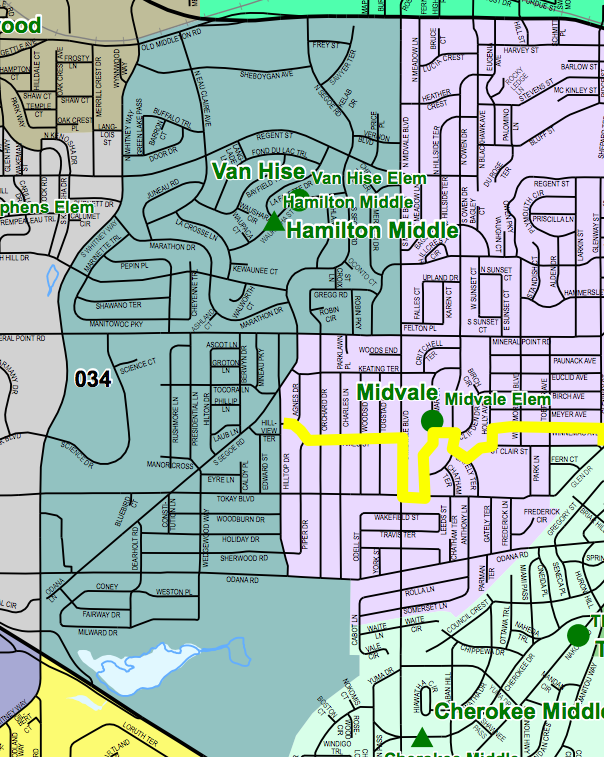
I invite readers to review the District’s current boundaries [2.5MB PDF] vis a vis “walkability”. I continue to be astonished that the community apparently supports such a wide range of low income population across our schools.

Related: Madison’s current low income school population distribution:

Madison has long supported a wide variation in school demographics. The chart above, created from 2013-2014 Madison School District middle school demographic data, illustrates the present reality, with the largest middle school – near west side Hamilton – also featuring the smallest percentage low income population.

Share

University of Chicago Is Outlier With Growing Debt Load

Michael McDonald and Brian Chappatta:

The University of Chicago has been trying to stand out from its elite rivals and is doing so in one category: amassing debt. That’s put its credit rating at risk.

The university founded by oil magnate John D. Rockefeller in 1890 is in the midst of a $1.7 billion development plan. As municipal interest rates remain close to generational lows, it may borrow as much as $900 million in the next four years, according to Standard & Poor’s. The plan prompted S&P and Moody’s Investors Service to cut the school’s credit outlook to negative. Chicago already has $3.6 billion of debt — the most relative to its endowment among the richest U.S. schools.

“When you look at the University of Chicago, they are an outlier — they are highly leveraged,” said Diane Viacava, an analyst at Moody’s in New York. “They need very strong cash flow to be able to provide the pledged revenue to pay for the debt service.”

Share

Build it and they may come Management schools are on a building spree. That is a risk for some

The Economist:

BUSINESS-SCHOOL students are a pampered bunch. Scholars sipping a glass of red in the posh rooftop bar of Oxford’s Saïd Business School could be forgiven for thinking they had wandered into the nearby Randolph Hotel by mistake. Stanford students can view an impressive modern-art collection housed in its own museum. Harvard Business School MBAs can book a masseuse to relieve the stress of a hard day slaving over case studies.
 
 Life for the next generation of business students is to get even cushier. In the past few years the leading schools have been raising vast amounts to spend on new facilities. On January 9th Yale’s School of Management formally opened its swanky new home, designed by Foster + Partners, Norman Foster’s architecture practice. The Kellogg School of Management in Illinois will soon start work on a new headquarters (see artist’s impression, above) for its MBA programme on the shores of Lake Michigan, at a cost of $200m. Stanford’s business school spent $345m on its new campus, largely thanks to the largesse of Phil Knight, the founder of Nike.

Meanwhile, Madison’s K-12 world considers another $39,500,000 on bricks and mortar despite issues with previous spending and long term disastrous reading results.

Share

Public school advocates dismiss voucher popularity at their own risk

Chris Rickert:

Usually, the popularity of something is an indication that people value it. Public school proponents and anti-voucher Democrats might want to keep that in mind, as their tendency to downplay support for vouchers can sound like an excuse for avoiding improvements to public schools that keep public school enrollments strong.

….

Pope did not respond to my messages, but her concern about shifting tax dollars from public schools to voucher schools seems misplaced, given that, on average, taxpayers spend about $5,000 more per public school student than they spend on a voucher.

Income limits keep the wealthy from entering the voucher program. But even if the limits didn’t exist and despite the alleged cost-shifting identified by DPI, this country has long committed to providing all children with taxpayer-funded educations. A taxpayer-funded education at a private school is still a taxpayer-funded education. What’s more, in Wisconsin, it’s a cheaper one.

Share

Education in Kenya: Paid-for private schools are better value for money than the “free” sort

The Economist:

THERE can scarcely be two words in Kenya that cause more resentment than “school fees”. It is now more than ten years since charges for state primary schools in east Africa’s biggest economy were abolished by law. Yet it is an open secret that education is not truly free. In fact, fees are rising. Dorcas Mutoku, a policeman’s wife whose two sons attend a public primary school in the capital, Nairobi, has found that levies have simply been renamed. She has to find the equivalent of $35 for a one-off “signing-on” fee, and pay almost as much again for admission fees. End-of-term exams, uniforms and books cost at least another $10 per child.

Kenya’s parents will get their day in court on February 21st, when a lawsuit will be heard that accuses Jacob Kaimenyi, the education minister, and Belio Kipsang, his top civil servant, of failing to implement the law. Musau Ndunda, head of the national parents’ association, which is bringing the suit, says the government is guilty of “extraordinary doublespeak” when its officials ask why anyone would pay to send their child to school. Adding to Mr Ndunda’s frustration is his awareness, shared by many thousands of Kenyan parents, that the illicit fees are not being spent on better books and facilities but are merely padding the incomes of school administrators, none of whom—as far as he can tell—has been prosecuted.

We know best” is rather pervasive.

Share

k-12 Tax & Spending Climate: Rhode Island Public Sector Pension Reform

The Economist:

WHEN Central Falls—a city of 19,000 people squeezed into barely one square mile—filed for bankruptcy in 2011, it sent shivers across Rhode Island and America. Some retired civil servants saw their pensions cut from $27,000 a year to $12,000. To stop the state from heading in the same direction, Gina Raimondo, its treasurer (pictured), launched a campaign to overhaul Rhode Island’s pension system, one of many that is in deep trouble (see map). She went from town to town explaining why change was needed, earning a reputation as a fiscally responsible Democrat with a bright political future. The legislature passed reforms in November 2011.


Share

Google sued for data-mining students’ email

Lisa Vaas:

Google is in hot water for scanning millions of students’ email messages and allegedly building “surreptitious” profiles to target advertising at them.
 
 According to Education Week, a “potentially explosive” lawsuit is wending its way through US federal court, now being heard in the US District Court for the Northern District of California.
 
 In court filings, plaintiffs charge that Google data-mines Gmail users – a group that includes students who use the company’s Apps for Education tool suite.

Share

Philly school district broke, but the pay is good

Maura Pennington:

Salaries for employees in the Philadelphia school district are staggering.
 
 The district has 10 superintendents who make a combined $1.64 million annually. Superintendent William Hite tops the list at $270,000, and his deputy makes $210,000. Eight assistant superintendents each make $145,000.
 
 For the sake of comparison, Gov. Tom Corbett makes $175,000 annually.
 
 And while the district’s budget director makes $128,724, Philadelphia is operating so deeply and persistently in a deficit that students are underserved by actual school personnel.
 
 Department heads with titles such as “chief talent officer” and “chief of strategic partnerships” pull in six-figure salaries from the school district, but so do 13 deputy department chiefs.
 
 In total, 395 employees on the district payrolls make more than $100,000, although not a single one is a teacher or a staff member who spends the majority of his or her time in the classroom.
 
 The list, however, includes 218 principals and 60 assistant principals. The average base salary for a principal is $137,919.
 
 But those numbers soon may change. The principals’ union, the Commonwealth of School Administrators, struck a tentative deal this month with the district that features a 15 percent pay cut. Even with that, most senior administrators would still earn six-figure salaries.

Share

Half of U.S. Business Schools Might Be Gone by 2020

Patrick Clark:

Richard Lyons, the dean of University of California, Berkeley’s Haas School of Business, has a dire forecast for business education: “Half of the business schools in this country could be out of business in 10 years—or five,” he says.
 
 The threat, says Lyons, is that more top MBA programs will start to offer degrees online. That will imperil the industry’s business model. For most business schools, students pursuing part-time and executive MBAs generate crucial revenue. Those programs, geared toward working professionals, will soon have to compete with elite online alternatives for the same population.
 
 Lower-ranked business schools, rather than recognized names such as Harvard Business School and Wharton, are most vulnerable to this phenomenon. When the big players start offering online degrees, they’ll draw far-flung students who might otherwise have opted for the convenience of a part-time program close to home.
 

Share

Netflix’s Reed Hastings: “Get Rid of Elected School Boards”

BeyondChron:

On March 4th, 2014, Billionaire Netflix CEO, Reed Hastings delivered the keynote speech to the California Charter School Association’s annual conference. In that keynote speech, Mr. Hastings made a shocking statement: Democratically elected school board members are the problem with education, and they must be replaced by privately held corporations in the next 20-30 years.
 
 Reed Hastings has just over a billion dollars, riches built on software companies and the entertainment giant Netflix. Mr. Hastings also sat on the California State Board of Education from 2000 to 2004, when he stepped down amid controversy.
 
 Hastings, who sits on Rocketship’s national strategy advisory board, has invested millions in Rocketship. He’s also made significant political action committee contributions on Rocketship’s behalf, most recently, he poured $50,000 into a PAC to support pro-charter Santa Clara County Office of Education members.

Share

Rethinking Education: Why Our Education System Is Ripe For Disruption

Naveen Jain:

Our education system is not broken, it has just become obsolete
 
 When I think of all the tremendous, seemingly impossible feats made possible by entrepreneurs, I am amazed that more has not been done to reinvent our education system. I want all entrepreneurs to take notice that this is a multi-hundred billion dollar opportunity that’s ripe for disruption.
 
 Our collective belief is that our education system is broken so we spend tremendous energy in trying to fix it. We conveniently place the blame on problems that stem from budget cuts, teacher layoffs, inadequate technology in our schools and our education policies. We need to recognize the fact that our education system is NOT BROKEN but has simply become OBSOLETE. It no longer meets the needs of the present and future generation.
 
 Our education system was developed for an industrial era where we could teach certain skills to our children and they were able to use these skills for the rest of their lives working productively in an industry. We are now living in a fast paced technological era where every skill that we teach our children becomes obsolete in the 10 to 15 years due to exponentially growing technological advances. Meanwhile, new categories of jobs are being created because of these technological advances. It’s hard to imagine that half of the jobs that exist today didn’t exist 25 years ago.

Share

K-12 Tax & Spending Climate: Today California teachers need to protect their pensions by dismantling Ohio manufacturers

Suzanne Berger:

In May 2013 shareholders voted to break up the Timken Company—a $5 billion Ohio manufacturer of tapered bearings, power transmissions, gears, and specialty steel—into two separate businesses. Their goal was to raise stock prices. The company, which makes complex and difficult products that cannot be easily outsourced, employs 20,000 people in the United States, China, and Romania. Ward “Tim” Timken, Jr., the Timken chairman whose family founded the business more than a hundred years ago, and James Griffith, Timken’s CEO, opposed the move.
 
 The shareholders who supported the breakup hardly looked like the “barbarians at the gate” who forced the 1988 leveraged buyout of RJR Nabisco. This time the attack came from the California State Teachers Retirement System pension fund, the second-largest public pension fund in the United States, together with Relational Investors LLC, an asset management firm. And Tim Timken was not, like the RJR Nabisco CEO, eagerly pursuing the breakup to raise his own take. But beneath these differences are the same financial pressures that have shaped corporate structure for thirty years.
 
 Urging Timken shareholders to vote for the split, Relational Investors argued that they should want “pure-play” companies, focused on a single industrial activity. Investors would then be free to balance their portfolios by selecting businesses in industrial sectors with varying degrees of risk and sensitivity to different phases of economic cycles. A firm such as Timken—about one-third a steel company (a materials play) and about two-thirds a bearings and power transmission business (an industrial components play)—would lock investors into a mix that, Relational Investors claimed, leads to a discount on share price.

Share

Choosing to Learn: Self Government or “central planning”, ie, “We Know Best”

Joseph L. Bast, Lindsey Burke, Andrew J. Coulson, Robert C. Enlow, Kara Kerwin & Herbert J. Walberg:

Americans face a choice between two paths that will guide education in this nation for generations: self-government and central planning. Which we choose will depend in large measure on how well we understand accountability.
 
 To some, accountability means government-imposed standards and testing, like the Common Core State Standards, which advocates believe will ensure that every child receives at least a minimally acceptable education. Although well-intentioned, their faith is misplaced and their prescription is inimical to the most promising development in American education: parental choice.
 
 True accountability comes not from top-down regulations but from parents financially empowered to exit schools that fail to meet their child’s needs. Parental choice, coupled with freedom for educators, creates the incentives and opportunities that spur quality. The compelled conformity fostered by centralized standards and tests stifles the very diversity that gives consumer choice its value.

Well Worth Reading.

Share

Shaking Up the Classroom Some Schools Scrap Age-Based Grade Levels, Focusing on Mastery of Material

Stephanie Banchero:

There are no seventh-graders in the Lindsay Unified School District.
 
 Instead, in the “Content Level 7″ room at Washington Elementary, 10 students, ages 11 to 14, gather around teacher Nelly Lopez for help in writing essays. Eight sit at computers, plowing through a lesson on sentence structure, while a dozen advanced students work on assignments in pairs.
 
 The 4,100-pupil district at the base of the Sierra Nevada range is part of an experiment shaking up classrooms across the country. Called competency-based learning, it is based on the idea that students learn at their own pace and should earn credits and advance after they master the material—not just because they have spent a year in a certain class.

The Lindsay School District plans to spend $41,922,607 during the 2013-2014 school year for 4,130 students, or 10,150.73 per student. This is about 1/3 less than Madison’s 15K per student spending.

Share

We Wish We Weren’t in Kansas Anymore: An Elegy for Academic Freedom

Michael Meranze:

ONE OF THE GREAT CLAIMS of American higher education is that it protects and encourages something called “academic freedom,” a guarantee of protection for teachers and students to engage in free inquiry and exchange no matter how inconvenient or unpopular the ideas they express in their scholarship, teaching, or studies. In contrast to more repressive countries, so the story goes, US academic freedom is well established and secure. Indeed, this claim carries so much weight that some college and university administrators use it to defend opening branch campuses in repressive countries, asserting that these campuses will not only protect academic freedom, they will provide a model for their host countries. There is a problem though. These claims ignore a crucial set of facts: because of the increased privatization of public universities, the increasing managerial domination of public and private colleges and universities, and the narrowing of public employee speech rights, the legal and practical underpinnings of academic freedom are weaker than they have been in decades. Academic freedom is being hollowed out by the economic and social transformation of higher education. It needs to be rebuilt along with the colleges and universities that should provide it a home.

In December of 2013 the Kansas Board of Regents took a series of steps that may dramatically reduce academic freedom in the state’s higher education institutions. Apparently responding to political criticism over one University of Kansas professor’s anti-NRA tweet, the regents instituted a sweeping new policy regulating the proper and improper uses of social media. The policy regulates a wide range of expression and increases the power of university executives over the speech of faculty and staff. The Board defined social media broadly as “any facility for online publication and commentary, including but not limited to blogs, wikis, and social networking sites.” It declared that “the chief executive officer of a state university has the authority to suspend, dismiss or terminate from employment any faculty or staff member who makes improper use of social media.” In focusing on social media, the Kansas regents sidestepped faculty academic freedom within the classroom (although it is unclear about faculty emails with students), and by granting CEOs the power to control external expression and the right of internal electronic dissent, the Board threatens to return Kansas’s higher education system to an earlier day, 90 years ago, when administrators believed that they had the right to dismiss faculty for their opinions or expressions. That these regulations govern the terrain of electronic communication threatens to embroil both faculty and the universities and colleges in an ever-expanding structure of surveillance and censorship.

Share

Mastery Charter Schools is a win for Camden

Laura Waters:

“All is flux, nothing stays still,” said Plato, but you’d never know that in Camden. It’s still the worst school system in New Jersey despite decades of strategic plans and revolving superintendents and money and good intentions.
 
 Now Mastery Charter Schools, based in Philadelphia, has had applications approved to open two new charters in Camden, right across the Delaware River. Yesterday Gov. Christie attended a ground-breaking ceremony for another approved Camden applicant, the KIPP Cooper Norcross Academy.

Share

Slaying the UK Performance Tables Monster

Icing on the cake blog:

When looking at the data available, the three things which jumped up and down demanding attention were our old friend ‘Similar Schools’, the almost total lack of historical data and the ‘Value Added Measures.’
 
 Oh no, those ‘not at all similar schools’ are back…
 
 Now, I ranted about ‘Similar Schools’ last week in the Ofsted Schools Data Dashboard. I argued that – based on the information available on the OSDD website – the similar schools measure was tosh of the highest water. As far as I can/could tell from the OSDD, Ofsted’s idea of a similar school is one in which the children who were assessed in Year 2 were assessed at similar levels. I’m still not sure about this – it may be those in year 3, or it could be all of the children in Key Stage 2 – the supporting documentation on the OSDD site is unclear. But, either way, what I have found out about the way the performance tables select ‘similar schools’ is much, much more worrying.

Share

New York Mayor & Charter School Operator Governance Battle

Al Baker & Javier Hernandez:

She was a darling of Mayor Michael R. Bloomberg’s administration, given free space to expand her charter schools from a single one in Harlem into a network larger than many New York State school districts. Along the way, her Success Academy empire became a beacon of the country’s charter school movement, its seats coveted by thousands of families as chronicled in the film “Waiting for ‘Superman.’ ”
 
 But eight years into her crusade, Eva S. Moskowitz is locked in combat with a new mayor, Bill de Blasio, who repeatedly singled her out on the campaign trail as the embodiment of what he saw was wrong in schooling, and who last week followed his word with deed, canceling plans for three of her schools in New York City while leaving virtually all other charter proposals untouched.
 Never was their battle more clear than in Albany on Tuesday, where each took part in simultaneous rallies — which each insisted had nothing to do with the other, but which felt like a duel nonetheless.

Share

Textbooks replaced by iTunes U downloads

Sean Coughlan:

Teachers at the independent school are making their own online library of lessons and course materials for GCSE, A-levels and International Baccalaureates.
 
 These are interactive resources, with video links and lesson notes, customised for the specific needs and speeds of their classes. There are extension exercises and links to further reading and ideas.
 
 They are made to share on iTunes U, the academic version of Apple’s iTunes download service, so pupils can access them at school or at home or anywhere else.
 
 There has been a huge amount of hype about online university courses – the so-called Moocs (massive online open courses).
 
 But here in this ancient university city, it’s a school that is really putting the idea of online courses into practice.
 
 “Start Quote
 In two years’ time we may have to make decisions about whether we have printed textbooks”
 Tricia Kelleher Stephen Perse Foundation principal
 It still requires excellent teachers – to make them and to make sense of them – but you can see the far-reaching possibilities of creating the exam course equivalent of a box set of a TV series.

Share

Finland working to expand early education

Michael Alison Chandler:

Finland often ranks among the highest-performing countries on international math and reading tests. The Nordic nation gets results despite one surprising fact — compulsory schooling does not start until age 7.
 
 As the United States pushes to improve its competitiveness through greater access to early education, with programs in the District and elsewhere that provide universal preschool to children as young as 3, this seems surprising. How do they do it?

Share

GO Public Film Offers Inside View of Schools

Lisa Alva Wood:

GO PUBLIC offers an authentic fly-on-the-wall perspective of a public school district that every voter needs to see. This fresh and recent documentary film gives the viewer a frank, and sometimes painful, look inside the lives of the people in Pasadena Unified Schools – and it’s a long shot from the tree-lined lawns of the famous Craftsman neighborhoods we know from Rose Parade week. This is the nitty-gritty of public school life. The focus on quality, real quality, from everyone at school, is a heartening lesson for any viewers, voters, district decision-makers and educators. Could every school district, every classroom, every office, withstand this kind of exposure? Could our own ethics pass the documentary film test?

Share

The New College Campus

The New York Times:

Imagine meeting someone who says she works at a university. Some years ago, it would have been fairly safe to assume that she was a professor, and a member of the middle class with enviable job security. Not anymore. Two reports make clear that the nature of the college work force has changed substantially, possibly to the detriment of educational quality.
 
 “The Just-In-Time Professor,” released last month by the Democratic staff of the House Committee on Education and the Workforce, describes a growing population of more than one million adjunct and other nontenure-track instructors. “In 1970, adjuncts made up 20 percent of all higher education faculty,” the report says. “Today, they represent half.”

Share

Teachers union rejects Gov Christie’s gloomy outlook on pension costs

Laura Waters:

On Tuesday a gloomy Chris Christie donned a hair shirt instead of a fleece jacket and proffered his 2015 fiscal-year budget sermon to Statehouse legislators. Total state spending will come to $34.4 billion, which includes a $2.25 billion state-mandated payment towards New Jersey’s “exploding” retirement fund for public workers in order to atone for the “past sins” from “governors and legislators who paid little or nothing into the system.” We worship on “the altar of these three things: pensions, health, and debt,” Father Christie intoned hoarsely (he had a cold) and we must reform our pension system or we’ll end up in the fiscal hell of Detroit. Then he quoted Mahatma Gandhi.
 
 We hardly recognize the man, diminished in girth and bluster, preaching penance. But at least school funding is intact.
 
 Here’s the highlights:

Share

Officials’ Pay at Public Colleges Rises Faster Than at Private

Benjamin Mueller:

The median base salary of senior administrators at American public universities rose by 2.5 percent in the 2014 fiscal year, a rate slightly higher than that at private universities, according to a report being released this week that’s based on a survey by the College and University Professional Association for Human Resources. The report marked the first time in four years that the rate of salary growth for administrators at public colleges outpaced that of their peers at private ones.
 
 Administrators’ salaries climbed by 2.3 percent at private universities and by 2.4 percent over all, comfortably outpacing the 1.5-percent rate of inflation in 2013. The increases signal that more institutions seem to be rebounding from the recession, at least enough to be able to carve out pay raises for senior officials.

Share

Debt And The Modern Parent Of College Kids

NPR Staff
t’s college touring season, and many parents are on the road with their teenagers, driving from school to school and thinking about the college application — and financial aid — process that looms ahead.
Many baby boomers have already been through this stage with their kids, but because the generation spans about 20 years, others still have kids at home. So how should boomers plan to pay for school when, on average, students graduate from college in the U.S. with $25,000 in debt?
Ron Lieber, who writes about personal finance for The New York Times, tells Morning Edition’s David Greene about planning strategies and pitfalls to avoid. Go to npr.org to read or listen to the rest of the story

Share

Study: More Adult Pell Grant Students, Not Enough Graduating

Claudio Sanchez
National Public Radio
The federal government each year gives needy college students billions of dollars they don’t have to pay back — $34.5 billion to be exact. More than 9 million students rely on the Pell Grant program. But a new study says much of the money is going to people who never graduate.
Sandy Baum, an expert on student financial aid, has been leading a group in a study of the 48-year-old Pell Grant program. Their report, commissioned by the nonprofit College Board, confirms what many have known for years about grant recipients.
“We have always known that the completion rates are lower than what we’d like them to be,” Baum says. “But what we really learned was that there are so many students who are not the traditional Pell Grant student, who are not young people from low-income families but rather are adults seeking to improve their labor force opportunities. So understanding how important Pell Grants are to these students, and how poorly designed they are to actually serve these students, was something of an awakening.”
aum says these are people 25 years and older who were hit hard by the recession — lost their jobs, went back for more training and education, but have struggled to complete their schooling.
Baum says they get little or no guidance about what to study or even what school to choose. “If you’re an adult, you’re more likely to see a sign on the bus or hear that your neighbor went to school someplace. You really don’t have many options,” she says. Older, nontraditional students, Baum says, now make up nearly half of all Pell Grant recipients, but only 3 percent ever earn a bachelor’s degree. High dropout rates, though, are not limited to older students. Among 18- to 25-year-olds in the program, only a fraction earn a bachelor’s degree within six years — often because they’re just not ready for college-level work.
Sophia Zaman, a recent graduate from the University of Massachusetts, Amherst, says Pell Grant recipients like her don’t drop out because they can’t handle the work — higher tuition and fees push them out. “I have numerous friends who were unable to afford taking on a fourth year of college because — and my university was not unique — we faced a 16 percent tuition increase,” she says. Zaman, who now lobbies Congress on behalf of the U.S. Student Association, says the $8,600 she received in Pell Grants over four years wasn’t enough. She still had to work three part-time jobs to make ends meet.
Researchers agree that Pell Grants cover only a fraction of what they once covered. Their key finding, however, is that the Pell Grant program must now serve two equally needy but very different populations — young and old.
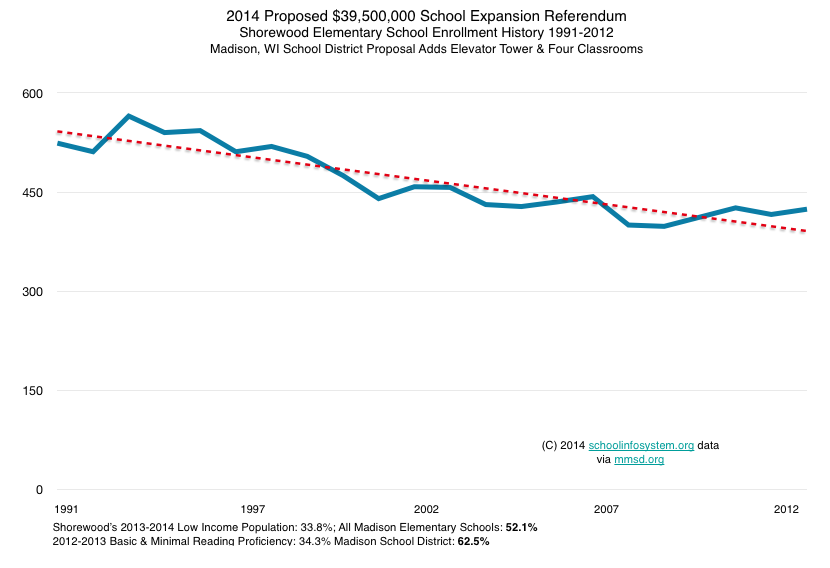
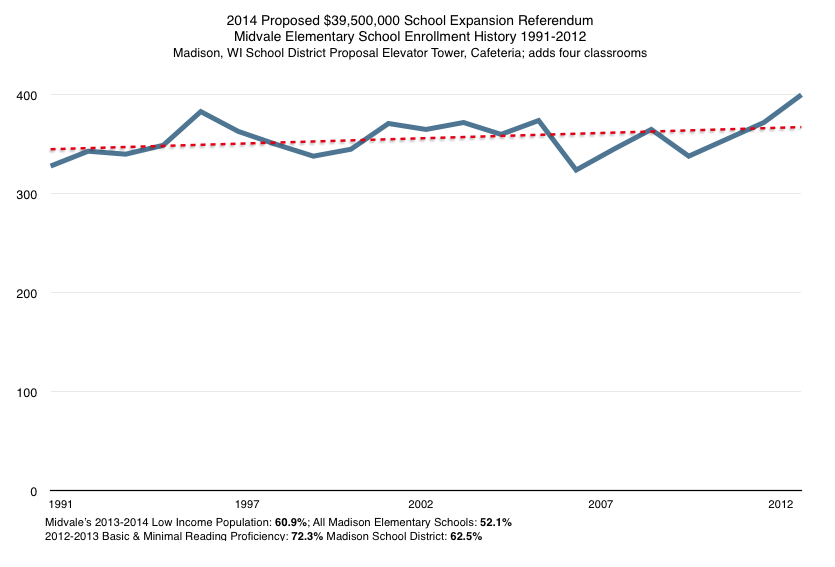
Share

Percentages of poor students keep rising

The percentage of low-income students in Wisconsin and Madison schools continues to grow.
Madison’s percentage of students who qualify for free or reduced-price lunch reached 56.5 percent this year, up from 51 percent last year, according to the state Department of Public Instruction. That’s up from 44 percent five years ago and 31 percent a decade ago. Wisconsin’s rate reached 42.5 percent, up from 41.5 percent last year and 29.5 percent in the 2003-04 school year. More than 100 of the state’s 424 school districts have a majority of students who qualify as low-income.
Children from households with annual incomes at or below 130 percent of the federal poverty rate, or $29,055 for a family of four, qualify for a free lunch. Children from households with annual incomes under 185 percent of the federal poverty rate, or between $29,055 and $41,348 for a family of four, qualify for a reduced-price lunch.
Wisconsin State Journal
March 20, 2012

Share

Maine Education Reform Proposal

Jay Field:

Students could enroll outside their home districts, and public tuition dollars would flow to private religious schools, under education reforms laid out by the LePage administration in Skowhegan this morning. Besides expanded school choice, the administration is also pushing legislation to toughen and standardize teacher and principal evaluation statewide and expand career and technical education. Some praise the proposals as bold and innovative, but others dismiss them as divisive and unfair.
The scene of the big announcement invoked a part of the governor’s education agenda that pretty much everyone seems to agree with. At just after 9 a.m., LePage welcomed guests assembled inside an automotive garage at a Skowhegan technical school, then turned the podium over to his education commissioner.
Stephen Bowen turned and marveled at the hydraulic lifts and other machinery. “It’s great to be in this facility,” he said. “I love this backdrop back here. I have a car, by the way, that I may bring in here later, ’cause there was something rattling on my way up here.”

Share

It’s education, smarty

Rolf Wegenke:

Before I became president of the Wisconsin Association of Independent Colleges and Universities, I worked in economic development in the administrations of five Wisconsin governors, both Democrats and Republicans. Over those years, leaders in both parties called for “jobs, jobs, jobs.”
Some economists rate Wisconsin’s personal income growth levels in 48th place. Now, in an election year and in a time of recession and jobless recovery, the critical question is what can the state do to promote job creation? The Journal Sentinel Editorial Board has rightly made jobs and job creation its sole agenda item for 2012.
There is a direct link between the level of educational attainment (percentage of the population with a postsecondary degree) in a state and the growth of personal income in that state. Because of that link, there is also a clear and certain pathway to economic growth and job creation.
The Wisconsin Technology Council has called upon the state to add 150,000 degree-holders to bring Wisconsin to the national average. Competitive Wisconsin Inc., a coalition of corporate and union leadership, not wishing our state to be average, urged Wisconsin to add 170,000 baccalaureate degree-holders to bring this state up to the level of our neighbor, Minnesota.

Share

Should Home-Schoolers Play for High School Teams?

Room for Debate:

Legislation to allow home-schooled students to play varsity sports at public schools passed the Republican-controlled Virginia Assembly on Wednesday. It will now go before the State Senate. Robert McDonnell, Virginia’s Republican governor, has said he supports the bill.
Alabama and Mississippi are considering similar legislation, and 25 states now allow home-schooled students to play sports at public schools with varying restrictions. Is this a move in the right direction?

Share

UW-Madison on the Value of AP Courses; AP Report to the Nation

UW News:

The College Board AP Report to the Nation shows that students who earn advanced placement credit in high school typically experience greater academic success in college, are better prepared for coursework, and are more likely to earn a college degree than their peers.
In 2011, 903,630 seniors took an AP exam before leaving high school with 540,619 scoring a three or higher. That doubles the 431,573 who took the exam in 2001 when only 277,507 scored a three or higher. In all, 62,068 students across Wisconsin took AP exams in 2011.
Joanne Berg, University of Wisconsin-Madison vice provost for enrollment management, says that “students who took AP credits were able to graduate sooner than other students, were able to start advanced courses sooner, and actually free up courses for other students who weren’t able to take AP credits.”
Along with the release of the report, representatives from the UW-Madison are also featured in several videos speaking to the value of the AP program. The videos can be viewed here.

View and download the 2011 AP Report to the Nation, here:

The 8th Annual AP Report to the Nation (.pdf/1.7MB) reports on each state’s efforts to improve high school achievement by involving greater segments of the student population — and traditionally underserved minority students in particular — in rigorous AP courses.

The state supplements can be viewed here.

Share

Q&A with Deborah Gist: Involving teachers in evaluation policy

Nick Pandolfo:

Deborah Gist, Rhode Island’s Commissioner of Elementary and Secondary Education, has implemented some major reforms since assuming her role in 2009. She has raised the score required to pass teacher-certification tests and allowed a superintendent to fire all of the teachers at a school that was resisting reforms. Perhaps most notably, she has overseen the implementation of a new teacher-evaluation system. The Hechinger Report recently interviewed Gist about her state’s new approach to evaluating teachers.
Since changing your teacher-evaluation process in 2009 to include students’ standardized test-scores and yearly evaluations of teachers and administrators, what has the feedback been? Where are you at as far as implementing the changes, how is it going, and what have you learned?

Share

Apps for Kids interview

Mark Frauenfelder:

I started Apps for Kids because my 8-year-old daughter Jane and I like to play games on the iPhone and iPad together. We have a lot of fun checking out new apps, and then seeing if we can beat each other’s high scores. My friends who have kids of their own were always asking Jane and me what apps they should download, and so I thought maybe we should share that advice to a larger audience. So we started Apps for Kids, and people seem to really like it

Share

Report cards for schools? Only if done thoughtfully

The Sacramento Bee:

California voters made a pact in 1988 when they approved Proposition 98.
The state would provide a guaranteed minimum level of funding for public schools. In exchange, schools would be held “accountable for the job they do and the tax dollars they spend.” Every year each school would publish a School Accountability Report Card – the SARC.
A generation later, that report card still is not very readable and has little role in driving school improvement. A 2004 UCLA report concluded, “Running the school system without a useful and understandable SARC is like driving a $100,000 sports car with a broken speedometer, temperature gauge and gas gauge.”
Unfortunately, political leaders faced with the overly complex, confusing system seem to lunge in opposite directions.

Share

Detroit Schools’ No. 1 Mission: Getting Kids To Class

Larry Abramson:

Ask Detroit teachers about their biggest challenge, and many will say, “You can’t teach kids who don’t come to class.” Last year, the average Detroit public high school student missed at least 28 days of school.
Now, as part of its effort to get parents more involved, the district has launched a major initiative to improve attendance. The effort includes parent workshops and attendance agents charged with pushing parents to send their kids to school every day.
George Eason is one of Detroit’s 51 attendance agents. He’s staring at a printout that says a lot about the city’s attendance problems. He flips the pages, counting the absences that one student has racked up only midway through the school year.

Share

Connecticut Governor Malloy pushes education spending

Ben Prawdzik, via a kind reader’s email:

Gov. Dannel Malloy has indicated that he plans to make good on his promise to enact education reform — he has announced a series of legislative proposals over the past week aimed at improving and expanding schooling opportunities in Connecticut.
Malloy’s proposals, if enacted by the state’s General Assembly convening for its legislative session today, would affect students in levels ranging from preschool to professional job training programs. Last Thursday, Malloy proposed allocating an additional $12 million of the state budget to boost the quality and accessibility preschool education in the state. The next day, the governor announced that he will propose legislation to change the Connecticut Technical High School (CTHSS) system to tailor its curricula to the needs of the state’s employers so that students will be better prepared for employment upon graduation. On Monday, Malloy put forth a legislative proposal to improve low-achieving schools and increase charter and magnate school funding.
“We made a promise to our kids that education will prepare them for college or the workforce,” Malloy said in a Feb. 6 press release. “Transforming our educational system — fixing the schools that are falling short and learning from the ones that are graduating high-achievers — will help us develop the skilled workforce that will strengthen our state and our economy.”

Share

Madison Prep, unions overshadow School Board races

Jack Craver:

Two seats on the eight-member board are opening up. In both races, opponents of the proposed charter school, which is being championed by the Urban League of Madison as a way to target the long-standing achievement gap between white and minority students, are pitted against supporters of the plan.
Arlene Silveira, an incumbent who voted against Madison Prep, is being challenged by Nichelle Nichols, the vice president of learning for the Urban League. Similarly, in an open seat that Madison Prep supporter Lucy Mathiak is vacating, Mary Burke, a wealthy philanthropist (and former state secretary of Commerce) who pledged $2.5 million to the Madison Prep project, is running against Michael Flores, a firefighter with union backing.
John Matthews, president of Madison Teachers Inc, says his union is planning to be very active in support of Silveira and Flores. In not-so-subtle terms, he challenged Burke’s ability to understand the challenges that the Madison middle class and poor face in the school system.
“She’s a one percenter,” he said, invoking the language of the Occupy Wall Street movement. “She’s a very nice person, a very well-intentioned person but you want somebody who understands what it’s like to be a parent and understands the needs of parents to be involved.”

Related: 1.25.2012 Madison School Board Candidate DCCPA Event Audio.
Seat 1 Candidates:
Nichele Nichols
www.nichols4schoolboard.org
email: nnichols4mmsd@gmail.com
Arlene Silveira (incumbent)
www.arleneforschoolboard.com
email: arlene_Silveira@yahoo.com
Seat 2 Candidates:
Mary Burke
www.maryburkeforschoolboard.net
email: maryburkewi@gmail.com
Michael Flores
www.floresforschoolboard.org
email: floresm1977@gmail.com
Much more on the proposed Madison Preparatory IB charter school, here.
Arlene Silveira & Michael Flores Madison Teachers, Inc. Candidate Q & A.

Share