| School Information System |
 | Sponsorships | Sponsorships |
|
|
Next week, Waukesha School District leaders plan to take an unusual step, one they contend is necessary after cutting $9.4 million worth of services over the past seven years: They will sit down with their teachers union to hash out a contract with help from a mediator.What's more unusual is the culprit that Waukesha Superintendent David Schmidt blames in part for the district's financial woes: the state law intended to help school districts keep down teacher compensation costs.
"To some degree, we'd like to say we can control our labor costs," Schmidt said. "The QEO makes that harder."
Schmidt has company in other state school officials who contend the QEO, known more formally as the qualified economic offer law, has created fiscal problems for them. After 15 years with the law, considered one leg of the state's so-called three-legged stool for school funding, calls for change are coming from many quarters.
At issue is what some have called the cap gap that exists between the roughly 2% increase in school revenue allowed annually under current law and the 3.8% boost in salaries and benefits practically guaranteed by the QEO, which says school boards can avoid arbitration if they offer teachers compensation increases in that amount.
"That's probably the core issue right now within our system that's causing some frustration from school district administrators," said state Rep. Brett Davis (R-Oregon).
Although Waukesha school officials have not revealed the details of talks with the teachers union, indications are that their unusual move this year toward mediation and possible arbitration is to seek less than a 3.8% package increase for their teachers.
In addition to school leaders who complain the law's conflict with revenue caps has forced staff cuts, teachers say the QEO increase has suppressed salaries. Critics contend it has helped educators keep inflated benefits.
Newsletter signup | Send us your ideas
The publication this year of U.S. News & World Report's first ranking of high schools has parents in a twitter, worrying that their property taxes are too high (or too low), or that public education has failed them entirely. But leaving aside the merits and methodology of these particular rankings, we might wonder whether rankings matter at all and, more importantly, if they should.In fact, there are some numbers that really matter. Getting them is the rub.
To understand this problem, consider another set of rankings, released about the same time as the high-school rankings, that didn't garner as much attention: bar-exam passage rates. The school at which I teach -- New York Law School -- jumped to fifth on the list of New York area law schools (with an all-time high passage rate of 90%), while Benjamin N. Cardozo Law School at Yeshiva University leapfrogged to third, behind only NYU and Columbia.
Cardozo, however, is ranked 52nd by U.S. News among all law schools (fourth in New York), while New York Law School is ranked in the "third tier" of law schools (along with Albany, Hofstra, Pace and Syracuse). So which ranking matters?
On the one hand, the U.S. News ranking would seem to be more comprehensive, because bar passage rate is only one of many factors it considers. On the other hand, what good is a law degree if a graduate can't practice because he doesn't pass the licensing exam?
Moreover, if the bar exam measures a student's fitness to practice law (as the bar examiners claim), a school's bar passage rate should be a pretty good indication of how the school is doing in turning out graduates who know how to practice law.
Nevertheless, according to a paper commissioned by the Association of American Law Schools, bar passage rate accounts for only 2% of a school's overall rank in the U.S. News survey. This doesn't seem right.
Of course there are other things that matter to law-school graduates -- like getting a job. Although the U.S. News rankings purport to measure a school's success at placing its graduates into gainful employment, the rankings do not distinguish between success at placing students at high-paying corporate law jobs versus low-paying paralegal-type jobs. Nor do they distinguish between jobs that graduates want and the jobs that graduates get. Students who assume that going to a more highly ranked school is more likely to get them a good job are essentially being misled by lazy reporting.
The U.S. News rankings are also heavily weighted toward reputation, which would seem to have some real world significance. But again, "reputation" is misleading, and often irrelevant. Beyond the top 20 or so law schools, law firms care less about the ranking of a school when making hiring decision and more about the ranking of the students at the schools.
Put a different way, there are really two kinds of law schools: those at which students decide where they want to interview, and those where firms decide. The large majority of law schools belong to the latter group. Hiring partners admit that they use GPA or other bright-line criteria (like law review membership) to interview at Tier 2, 3, and 4 schools, while taking resumes from nearly everyone at Tier 1 schools.
In short: The difference between the 55th-ranked law school and the 105th law school is of little significance in determining which students are more likely to get a good job. At both schools, unless a student is in the top 15% or 20% of his class, he has little chance of getting a high-paying job directly upon graduation. Students might be better served by going to a lower-ranked law school and doing better, rather than going to middling law school and not doing as well.
Students and parents are led astray by U.S. News because in putting a simple number on something that is incredibly complex, they are missing the nuances that are likely to be more important. But schools themselves -- high schools and law schools -- are partly to blame, because they resist fully disclosing important information.
Just as law schools would better serve their constituencies by releasing accurate information about numbers that matter -- bar results, jobs, and average salaries -- high schools should make more of an effort to fully disclose test scores, college admissions, class sizes and other important data. More information may put some schools under a harsh light. But it will help students and parents decide whether those high taxes and tuition rates are worth it. The alternative is letting U.S. News decide for us.
Mr. Stracher is publisher of the New York Law School Law Review and author of "Dinner with Dad: How I Found My Way Back to the Family Table" (Random House, 2007).
Newsletter signup | Send us your ideas
Adam Nystrom remembers being taunted by classmates in middle school for needing so many special-education courses."They'd say, 'Oh, that's the retard class,' and everybody would laugh," recalls Adam, who suffers from a learning disorder that impedes reading ability. "I wouldn't really say anything because there isn't anything funny about it."
Adam, now 20 years old, spent a tumultuous 13 years in the local public-school system. He played pranks on teachers and disrupted lectures with a talking pen that delivered punch lines from the movie "Napoleon Dynamite." At Choctawhatchee High School, he struggled to pass Florida's mandatory graduation test, taking the exam six times. Once, he drew a suspension.
But Adam's academic journey ended in success. He became a varsity wrestler and was selected three times to be a part of the homecoming king and queen's royal court. After graduating in 2006, he joined the Army, fulfilling a childhood dream.
A major force behind his turnabout: the school district's program for mainstreaming special-education students into regular classrooms.
As the momentum for such programs has accelerated across the country, many have faced serious obstacles. Special-education students account for a disproportionate amount of discipline problems and sometimes commit violent acts. Teachers say they often lack the training and resources to handle them. Many parents have fought to keep schools and classrooms segregated, saying school administrators have used mainstreaming, also known as "inclusion," as a pretext for cost cutting.
To free up funds for his special-education overhaul -- which initially focused on elementary-school reading -- Mr. Gaetz began by making deep cuts in central-office spending. He eliminated more than 40 administrative positions, saving the district about $6 million a year. Some displaced personnel took special-education positions in the schools, which were given additional funds and broad latitude to hire more psychologists, social workers and special-ed teachers as they saw fit. Educators say such site-based management of mainstreaming programs was rare at the time.
Newsletter signup | Send us your ideas
If mathematics is like a foreign language, then those who teach the subject ought to be fluent.That is the goal of an intensive pilot program by the Silicon Valley Leadership Group and Intel that aims to improve the math skills of students in underperforming Bay Area elementary and middle schools.
Helping students means helping their teachers first - and that includes some veteran educators.
Take Marivic Walch of Bishop Elementary School in Sunnyvale, who has been teaching for seven years and describes herself as a "math queen."
"I had many aha moments," she said.Modeled after a successful program in Vermont, the 80-hour pilot course taught 38 Bay Area teachers in the past four months how to improve their skills from basic math all the way to algebra. The program is set to expand in 2008, more than doubling its scope, training 100 teachers in 20 schools in San Jose, Gilroy, Redwood City, Foster City, Newark and San Francisco.
"The idea is to turn this into a fluency training in the language of math," said Mark Pettinger, external affairs manager for Intel. "This is meant for teachers who are good teachers."
Newsletter signup | Send us your ideas
It won't exactly be a jolly post-Christmas gift that each principal in Milwaukee Public Schools will receive Jan. 9.What they will get are packets of information on the budget forecast for next year and the numbers they are to use in putting together a spending plan for their schools.
Good luck, principals - the information in most every case is going to be grim, so much so that some schools may ask to close or merge with others.
The planning assumptions put together by MPS administrators and approved by the Milwaukee School Board include:
• Another major decline in enrollment, 4.7% in the main roster of MPS schools, 4.1% when alternative schools and charter schools not staffed by MPS employees are included.
If the forecast proves true, there will be 77,546 students in September 2008 in that main roster, which is to say, the schools you normally think of when you think of MPS, compared with 96,942 in September 1998, a decline of more than 20% in a decade. The decline from a year ago to this year was 3.8%.
Including the alternative and charter schools, the forecast is for 83,787 for next fall, down from 87,360 this year.
Newsletter signup | Send us your ideas
Lost in the hubbub over a home-school educator’s election to chair of the S.C. Board of Education in 2009 is the man who will precede her in the post — Al Simpson of Lancaster.Simpson takes over the gavel as state school board chairman from John Tindal of Manning when the panel convenes for its next meeting in mid-January. State board members follow a policy of picking their future leader a year in advance.
Simpson cast a critical preliminary vote Dec. 12 that enabled Kristin Maguire of Clemson to defeat Fred “Trip” DuBard, a Florence businessman.
“We had two good candidates,” he said. “I don’t think this vote is going to cause any problems with the board.”
Maguire, he said, “has a whole year to prepare to move up. She’ll do a fine job. She’s shown me she’s dedicated to public schools.”
So is Simpson.
A product of South Carolina public schools, Simpson’s three children attend Lancaster County public schools, where he said he has seen choice work for families.
Newsletter signup | Send us your ideas
Wisconsin State Journal Editorial:
he teachers union in Wisconsin wants all public schools to spend more time teaching students about organized labor.Here 's a better idea with much greater need:
Require the leaders of the teachers union to enroll in a remedial civics class.
The Wisconsin Education Association Council showed how badly it needs a refresher course in the basic framework of American government when it lobbied against a sensible limit on the governor 's out-of-control veto powers.
WEAC suffers the dubious distinction of being the only organization in the state to register this year with the state Ethics Board to lobby against Senate Joint Resolution 5. The resolution, heading to voters for final approval this spring, will rein in the most outlandish veto power in the nation -- the notorious "Frankenstein " veto.
Modern governors, Republicans and Democrats, have used this veto trick with increasing gall. They cross out all but a handful of unrelated words and figures across long passages of spending bills. The remaining bits and pieces of sentences can then be stitched together to create law completely unrelated to the original text.
It 's a lot like the way literature 's Dr. Frankenstein stitched together his monster.
Newsletter signup | Send us your ideas
“Lawyers, I suppose, were children once,” wrote English essayist Charles Lamb.Now, it seems, the lawyers are children. Well, maybe not quite. But here in Gotham, a handful of law-themed high schools and middle schools are teaching student the ropes of legislation and litigation. Law-themed high schools? Yep, you heard that right.
The curricula at the public schools, some of which are part of the New Century Initiative, a decade-long effort to improve schools in the inner-cities, isn’t all-law-all-the-time. Students are expected to follow the curriculum outlined by the Department of Education, so reading, writing and ‘rithmetic stay on the agenda.
But much of the curricula relates directly to law. At the Urban Assembly Academy of Government and Law in Manhattan’s Lower East Side, for instance, freshmen take U.S Government for two semesters. By their sophomore year, students begin taking an American law course taught by a former attorney.
Freshmen at the Urban Assembly School for Law and Justice in Brooklyn preside over a hypothetical case involving injury suffered from Fluffy, a ferocious dog, and an apartment building owner that is sued as a result.
Newsletter signup | Send us your ideas
Former Fed Chairman Alan Greenspan:
Global economic growth has brought "hundreds of millions” of people out of abject poverty, particularly in Asia, the former Fed chief pointed out, and that has been the result of market forces at work.
"The most extraordinary example is China. China is moving towards capitalism. that’s precisely what it’s doing,” Greenspan said. Nevertheless, Greenspan argued, rising inequality of income is creating new problems, and declining U.S. education standards, especially in math and science, are doing harm to the historic "balancing” of income levels.
Newsletter signup | Send us your ideas
While Iowa's school system continues to rank high nationwide, it is no longer at the top in reading or math as it was in the early 1990s, according to results from a highly regarded exam called the National Assessment of Educational Progress."We're not competitive," said Des Moines businessman Marvin Pomerantz, a longtime education advocate who has criticized the results produced on Jeffrey's watch. Pomerantz even threatened to sue the state last fall over what he called a failure to provide an adequate education for all children.
"We don't win when we compete with other kids and countries," he said. "We used to win. We were best in the nation. Now we're not the best."
Results from the 2007 National Assessment of Educational Progress, published last fall, showed that seven states had children who ranked above Iowans in fourth-grade math, four did better in fourth-grade reading, seven ranked higher in eighth-grade math and three scored better in eighth-grade reading. Nearly half the nation's students recorded average scores similar to Iowa's, according to the report.
Newsletter signup | Send us your ideas
JUDY WOODRUFF: Now, using public school military academies to teach leadership and boost test scores in low-income urban neighborhoods. NewsHour correspondent Elizabeth Brackett of WTTW-Chicago has our report.ELIZABETH BRACKETT, NewsHour Correspondent: The cadets at the Marine Military Academy in Chicago listen up as commands are given. One hundred and twenty eight students attend the new school, the fifth in the Chicago public school system to adopt a military model.
The program is led by Retired Lieutenant Colonel Rick Mills.
RICK MILLS, Chicago Public Schools: The purpose of the military academy programs is to offer our cadets and parents an educational choice among many choices in Chicago public schools and to provide an educational experience that has a college prep curriculum, combined with a military curriculum.
ELIZABETH BRACKETT: Over 10,000 Chicago high school students now wear a military uniform to class.
Newsletter signup | Send us your ideas
James Ely of Madison has made a late December entrance to the 2008 Madison School Board race.On Friday, an official in the City Clerk's Office said Ely is a registered candidate for Seat 7, which will be open next spring when veteran School Board member Carol Carstensen retires from the board.
Ely has until 5 p.m. on Wednesday, Jan. 2, to turn in his nomination papers, which had not been filed as of Friday.
Ely will take on Ed Hughes, a Madison attorney whose children have attended east side schools and who declared his candidacy for the Carstensen seat over six months ago.
Newsletter signup | Send us your ideas
There's still time to complete the MMSD Board of Education Community Fine Arts Task Force's Arts Education Survey.
Access to the on-line surveys will remain open through December 31, 2007. Input from the community is very important and will help inform and strengthen the Task Force?s recommendations on arts education (dance, music, theater, visual arts). The results of this work will be compiled and presented to the Madison Metropolitan School District Board of Education next spring and shared with the public. All individual answers will be kept confidential. In appreciation of your time in completing the on-line survey, your name, if provided at the end of the survey, will be entered into a drawing for a chance to win a pair of complimentary tickets to a Madison performance or admission to local arts venues.
If you have any questions, please feel free to contact task force members at fineartstaskforce@madison.k12.wi.us.
here are three distinct surveys. Please select the one on-line survey that best represents you. Click here for the survey, available in English, Spanish, and Hmong: http://mmsd.org/boe/finearts/.
Newsletter signup | Send us your ideas
Long after the final bell at Thomas Jefferson Elementary School in Anaheim, more than 100 students from first through sixth grade sit quietly at their desks. The only sounds are of pencils moving, chairs squeaking and the occasional whisper.This is homework time for one of the 46 schools where 4,800 students are enrolled in Anaheim Achieves, an after-school program operated by the Anaheim Family YMCA.
In room 16, first-graders have finished their homework assignments and are drawing a picture of a cat from a book. Some glance at others' work. Some giggle. Some are fully absorbed. Once done, students must write a sentence describing what is happening in the picture.
"It helps them with their comprehension skills," said Julia Turchek, a first-grade teacher who volunteers every Monday and Wednesday.
Now in its ninth year, the program works closely with several Orange County school districts, such as Magnolia, Savanna, Centralia and Anaheim, and collaborates with other support groups, including the city of Anaheim, Orange County Department of Education, Boys and Girls Clubs of America and AmeriCorps. Together they help address the academic and mentoring needs of children.
Newsletter signup | Send us your ideas
Science teacher Rod Ziolkowski is spending his winter break working, just as he did Thanksgiving and practically every evening and weekend since the fall. Ziolkowski, dedicated as he is, is not preparing lesson plans but writing college recommendations for his students at Whitney High School in Cerritos. He expects to crank out 100 or more letters by the time admissions deadlines arrive in January.He has plenty of company. At public and private schools from coast to coast, teachers are engaged in one of the most time-honored but overlooked aspects of the admissions process.
A strong teacher recommendation can add flesh, bones and personality to a packet of test scores and grade point averages and convince a college admissions director that a particular student would be a valuable asset on campus.
Newsletter signup | Send us your ideas
Simply put, Fairfax high schools set a higher bar for grades than those in Montgomery. To earn an A in Fairfax, it takes a score of 94 to 100. In Montgomery, it takes a score of 90 or higher. Standards for grading in the two counties, including bonus point calculations, are so out of sync that it appears possible for a Fairfax student to earn a 3.5 grade-point average for the same work that gets a Montgomery student a 4.6 GPA.Parents nationwide are increasingly frustrated with wild variations in grading systems that, they say, are costing their children thousands of dollars in merit-based scholarships and leaving them disadvantaged in college admissions.
Sensitivity to grading is particularly acute in Fairfax and Montgomery -- large, affluent counties that send more students to college each year than other local school systems. But grading disparities also have enraged students and parents elsewhere.
Newsletter signup | Send us your ideas
Massachusetts Institute of Technology:
We've selected a range of materials to help you:
- Show science demonstrations by MIT faculty in your classroom.
- Provide alternate explanations to reinforce key concepts.
- Guide students to additional homework problems and exam examples.
- Add to your knowledge.
Newsletter signup | Send us your ideas
I asked readers how to fix Coolidge High. They quickly filled my e-mail basket with suggestions. Interestingly, this varied group of people agreed on so many points I can summarize their recipe for turning around Coolidge -- and schools like it -- in just seven steps:1. Train teachers better. Greg Prudich, president of the Mercer County (W.Va.) Board of Education, said training must be "intense, disciplined, research-based, and result-directed. Require it, and a lot of it. We do a lot of teacher training, and it does benefit everyone." But it has to fit with whatever the individual school is doing, and include follow-up sessions by the trainer and the principal. Too many school districts schedule big training sessions that are little more than the fad of the month, delivered by a high-priced speaker. Susan Sandler, president of the Justice Matters Institute in San Francisco, notes her group and others have just produced a study, "High Schools for Equity," focusing on five urban public high schools that are having success. The study was conducted by Linda Darling-Hammond at Stanford University and recommends more investment in teacher preparation and development.
ad_icon
2. Let principals hire and fire staff. One math teacher at another D.C. high school said, "Principals need the ability to clean house and hire teachers that will continually strive for progress and not give up hope on our children." Barry Fitzpatrick, principal of Mount Saint Joseph High School in Baltimore, said, "It seems to me this would allow for the creation of a motivated core of teachers." I have examined closely some charter high schools that are raising student achievement in low-income neighborhoods. Their ability to recruit the best teachers they can find, and dismiss those who are not productive, is among their greatest advantages over schools like Coolidge.
3. Remove disruptive students. This seems obvious to many readers. One reader who favors giving good, serious students their own classes acknowledged the idea has a significant flaw. This reader, with 34 years of experience in urban public education, said: "The most common argument against my proposal was always, 'Would YOU want to work in the place where the OTHER students were grouped?' " The reader said: "I would be willing to work in both. Both groups of students are important and valuable, but they cannot be approached in the same manner." A Montgomery County teacher who specializes in helping disruptive and at-risk youth had three practical solutions for dealing with such students: Get them into more extracurricular activities, upgrade cafeteria food and require school uniforms. Several readers said that was fine, but if troubled students interfered with the learning of conscientious kids, they had to be put somewhere else.
Newsletter signup | Send us your ideas
Our nation's classrooms no longer emphasize substantive expository and persuasive writing built upon strong foundational knowledge. This dumbing down of students' writing and reading is one of the main reasons that students are not ready for college after graduating from our high schools.During this last decade, public-school teachers have been forced to teach the personal victimization narrative (with an emphasis on "voice") to get their students ready for the state-mandated tests which contain writing prompts such as "the importance of understanding your heritage," "a time you made an important choice," "the importance of accepting others as they are," "the affect someone you admire can have on your life," "whether it is important to seek friendships with people who are different from you," or "the importance of participating in an activity you enjoy."
Students have been taught that they will get a higher score on these writing prompts if they will build up a dramatic social injustice, victimization essay even if the personal references are bogus. Correct grammar, spelling, usage, punctuation, and capitalization are not factored into the final score so long as they do not "disrupt" communication; and if the student makes a high enough score on his essay, the questions on the multiple-choice editing/revising section count very little.
Newsletter signup | Send us your ideas
Parents at an elementary school here gathered last Thursday afternoon with a holiday mission: to prepare boxes of food for needy families fleeing some of the world’s horrific civil wars.The community effort to help refugees resembled countless others at this time of year, with an exception. The recipients were not many thousands of miles away. They were students in the school and their families.
More than half the 380 students at this unusual school outside Atlanta are refugees from some 40 countries, many torn by war. The other students come from low-income families in Decatur, and from middle- and upper-middle-class families in the area who want to expose their children to other cultures. Together they form an eclectic community of Buddhists, Christians, Hindus, Jews and Muslims, well-off and poor, of established local families and new arrivals who collectively speak about 50 languages.
“The fact that we don’t have anything in common is what we all have in common,” said Shell Ramirez, an American parent with two children at the school.
Newsletter signup | Send us your ideas
Tom Loveless, senior fellow and director of the Brown Center on Education Policy at the Brookings Institution, has been making trouble again. His latest report asks, "How Well Are American Students Learning?" It upends hitherto highly regarded research based on data from several countries that says more time for instruction and homework has a negative correlation with achievement -- in other words, the more teaching at school and more homework at home, the less you learn.Loveless thought that didn't make much sense, given other research that associates more time on task with more learning. In the report, he comes at the international data from a different direction, focusing on changes in instructional and homework time rather than on static measures. He finds that class time strongly correlates with achievement and that the apparent negative effect of homework disappears.
I was thinking: uh-oh. New data on homework, anything on homework, is always going to get mixed reviews. The pro- and anti-homework camps are dug in, their artillery lined up, their troops heavily armed. Loveless is a conscientious researcher, but I suspect he will pay for his attempt to clarify the issue.
Newsletter signup | Send us your ideas
School’s out for the holidays, and it’s probably the last thing on anyone’s mind. But in the marginalized world of music education, a good deal of serious thinking needs to be done. Now that Charles Dickens’s Christmas ghosts have made their rounds for the year, perhaps they might be enlisted to provide perspective and encourage some soul-searching.The crisis of the moment has partly to do with Mayor Michael R. Bloomberg’s announcement last summer that New York City schools would be required to teach the arts, and that principals would be rated annually on their success, much as they are in other subjects. In theory this could put some muscle behind the adventurous curriculum (or blueprint, as it is called) that the city’s Department of Education and a panel of arts consultants drew up in 2004: a kindergarten-through-12th-grade program that envisions choral and instrumental performance, the fostering of musical literacy and the consideration of the role music plays in communities and the world at large. The music proposed for this course was admirably boundary-free, cutting a swath from Beethoven and Puccini through folk songs, spirituals, jazz and pop.
The problem is that the 2004 blueprint is recommended rather than required. Given the paucity of music teachers in the system — there was one music teacher for every 1,200 students in 2006, Education Department officials have said — schools that could execute it in all its glory were few. Exactly how (and how quickly) that can change is unclear.
Newsletter signup | Send us your ideas
I took an Introduction to American Politics honors class with Professor John J. Pitney this past semester. He is a masterful teacher and this post will capture the lessons I drew on how to effectively engage a class. I hope it's useful for other teachers reading this.Be respected as an authority on the material: In any place where students are intellectually curious, they first want to be assured that you know your stuff. At most good high schools or colleges, it's assumed teachers know the material. But effective teachers will provide background on how and why they know what they're talking about. As students, we're trained to be skeptical, so convince us.
Tell stories. This is a universal Good Thing for effective communicating, no less in formal teaching. His stories are all the more vivid since he was there (earlier in his career) -- in D.C., in Albany, in the back room, wherever. 1) Make a statement, 2) Illustrate with a story, 3) Repeat.
Be weird and wacky. Pitney stomped and jumped all over the classroom. He did weird impersonations. He raised his voice, lowered his voice. He laughed. He showed odd videos. All this made him memorable. Weird is good.
Newsletter signup | Send us your ideas
Teach for America, a high-profile organization that recruits college graduates to work at least two years as teachers in low-performing schools, might be coming to Milwaukee.Wendy Kopp, the founder and chief executive officer of the New York-based organization, visited recently, primarily in an effort to raise money but also to talk about the organization adding Milwaukee to the list of more than two dozen locations nationwide where it places teachers.
There would be substantial hurdles to clear before the idea could go forward. At minimum, there wouldn't be Teach for America people in Milwaukee classrooms until September 2010.
"We're at such the beginning stages of even thinking about this - the conversation around whether it would ever make sense to build a Teach for America presence here in Milwaukee," Kopp said in an interview. But she said the idea had appeal.
Jim Rahn, education program officer for the Kern Family Foundation, based in Waukesha, said: "I've felt for a long time . . . that it would be a benefit, a blessing to Milwaukee, and you could add Racine and Kenosha, if we could find a way to work with Teach for America to provide another vehicle for talented, committed youth to enter the field of education, serving particularly in high-needs schools."
The Kern foundation has emerged as a major force in local philanthropy and was one of two destinations for Kopp during her visit. The other was the Bradley Foundation.
Newsletter signup | Send us your ideas
"It's an exciting year in D.C. public schools!" Burton told the Back to School Night crowd, and there were nods and murmurs of assent.He ticked off an impressive list of Coolidge's new and improved. A renovated teachers' lounge; a new community resource center; $1.3 million in paint, plumbing and roofing; almost $3 million for a new track-and-field area. Six Advanced Placement classes were added, and $15,000 was found to send almost 20 percent of the teachers to AP training. Zero tolerance was the new law -- no phones or iPods -- and for the first time, Coolidge required uniforms.
"Our kids look like ladies and gentlemen when they come to school," said Terry Goings, president of the Parent Teacher Student Organization.
Yes, yes they do, the crowd responded.
"Thank you for your faith in public schools," said Victor Reinoso, deputy mayor for education.
"This is going to be the best high school in the District!" said Greg Roberts, a 1975 Coolidge alum whose D.C. Children and Youth Investment Trust donated funds.
Newsletter signup | Send us your ideas
http://www.telegraph.co.uk/ (search for "stripper school")
A schoolboy had a 16th birthday to remember after a stripper ordered by his mother turned up at his drama class.
The boy's mother apparently booked a "gorilla" to mark her son's big day through an agency, but a stripper turned up instead.
The woman even asked her son's teacher at Nottingham's Arnold Hill School and Technology College to film the event so the family could see the boy's reaction.
The stripper, who arrived halfway through the lesson, first walked the unnamed boy around the class on all fours like a dog.
She then spanked him 16 times - once for each year - to the sound of Britney Spears, before stripping down to her bra and knickers.
Boy, do I miss the good 'ol days.
Newsletter signup | Send us your ideas
An understanding of basic math and reading is a better indicator of future academic success than behavior is in preschool and kindergarten students, according to a recent study led by a Northwestern professor.SESP professor Greg Duncan led an 11-person team in a four-year study researching factors affecting how well students do in school.
"We were interested in assessing the relational predictive power of various skills … kids had when they entered school," Duncan said.
The researchers studied students entering school, looking at their academic performance, sociability and the number of fights they were involved in. They looked at data for students, in some cases up to seventh grade, and found that those who mastered elementary math and literacy skills early on were more likely to succeed in school, regardless of behavior, than those who were well-behaved but didn't master academics. The study controlled for economic and family factors.
Newsletter signup | Send us your ideas
Judged by the Australian Labor Party's education policy and subsequent comments by Deputy Prime Minister and Education Minister Julia Gillard, the answer is straightforward. In a recent interview in this paper, Gillard, on being asked the core purpose of her portfolio, replied: "So while my portfolio can be a mouthful, I'll be happy to be referred to simply as 'the minister for productivity'."
Such a utilitarian view of education is mirrored by Labor's policy document entitled Establishing a National Curriculum to Improve Our Children's Educational Outcomes, released last February.The opening paragraph, in justifying the need for a nationally consistent curriculum in core areas such as mathematics, the sciences, English and history, argues: "For Australia to succeed in a highly competitive global economy, our children need to have the best education possible.
"Better education outcomes deliver a real and tangible benefit to our nation's economy, lifting productivity and allowing people to get better jobs that pay more."
Referring to a speech by Productivity Commission head Gary Banks, Labor's national curriculum paper justifies investing more in education by linking raised standards to increased productivity and building human capital. Another paper released early this year, Federalist Paper 2: The Future of Schooling in Australia, written on behalf of state and territory governments, also justifies the needto strengthen standards by linking education to higher economic efficiency and workforce participation.
Newsletter signup | Send us your ideas

John Keilman and Kuni Takahashi:
It has been 11 years since Olivia and Juan Francisco Casteñeda left the poverty of Zacatecas, Mexico, for the poverty of the Quad Cities.More here.Despite their struggles, they have no doubt that they made the right decision.
Back home, they said, they would be lucky to find jobs at all, while the cost of food would be even higher. Though the family often runs short of money in Rock Island--needing help to pay bills or feed the five kids and two grandkids--Juan Francisco Casteñeda said life in America is better by reason of simple arithmetic.
"In Mexico, the pay is much less than here," he said in Spanish. "There, for eight hours of work they pay 100 pesos"--about $9.
Castaneda, 47, pulls down about $24,000 annually from his job in a scrap yard, cutting up John Deere tractors and other old machinery with a torch. It's a decent salary for someone with little education and no English skills, and it has allowed the family to buy an aging, drafty three-bedroom house. But it's not nearly enough to meet the family's needs.
The kids get their clothing secondhand, and five girls share a single bedroom. Food often comes from a church pantry. In the winter, their monthly gas bill--about $480--is higher than their $420 mortgage payment. Even in a land of relative plenty, it's a hard way to live.
Newsletter signup | Send us your ideas
Kuss Middle School serves students in Fall River, Mass., a former mill town that has struggled economically for decades. Students at Kuss have struggled, too, usually falling short of making the academic progress required under the No Child Left Behind law.Then, last year, the school received a grant to experiment with extending the school day. Teachers got paid at a higher hourly rate.
Students weren't thrilled at first with leaving school at 4:15 p.m. instead of at 2:20 p.m. But the added hours gave them more time for physical education and let them select special interest classes, in which teachers bolstered student skill deficits as revealed by testing. By the end of the year, student scores had risen by enough to enable Kuss to make the progress required under the federal No Child Left Behind law.
The only surprise is that more districts haven't lengthened school schedules set decades ago to accommodate a farm economy rather the information economy of today.
Newsletter signup | Send us your ideas
Georgia’s new Special Needs Scholarship program was built on the promise that public school families of disabled children would get more schooling options. It was, nonetheless, a disappointment for most first-year applicants. According to state Department of Education figures, of 5,750 families who applied for a tuition voucher, 85 percent either couldn’t find a campus to accept their children, couldn’t afford the additional private school costs or didn’t meet all of the scholarship’s eligibility criteria. Nearly 900 families are getting financial aid, however, and supporters are convinced more children will be helped next year if more schools are willing to accept the vouchers. State lawmakers narrowly passed Georgia’s first K-12 school voucher program in the spring. Modeled after a Florida program, the plan was to give families of public special-education students more educational choices by offering them tuition vouchers to use at participating private schools. When the program opened this summer, education department and school officials were flooded with telephone calls, e-mails and applications. By the September deadline, thousands had applied. Late last month, 899, or 15 percent, of them received tuition checks. Families looking for vouchers were stymied partly by timing. Still, families, special education advocates and private school administrators say one of the biggest obstacles to finding a new school was the cost. Parents are expected to pick up the tab for any tuition the voucher does not cover, as well as expenses such as transportation and physical therapy.
Newsletter signup | Send us your ideas
Local school districts continued to turn to the unrestricted community service levy this school year, boosting taxes paid to the fund by 10%, almost twice the increase in their total property tax income.Tax and spending growth in Madison's Fund 80 has also been controversial.For the 2007-'08 school year, the 60 public school districts in the five-county metro Milwaukee area plan to raise nearly $22.6 million through the community service levy, which has grown rapidly since the state Legislature removed it from under revenue caps seven years ago.
Statewide, school systems will receive about $66.6 million in community service funds through property tax increases this school year, according to information from the state Department of Public Instruction. That compares with just over $17 million raised by Wisconsin school districts for community service activities in 2000-'01, the first year the fund came out from under the state revenue controls.
When legislators first removed community service activities from under the strictures of revenue caps, they said they did so because school districts that run recreational departments for their communities should not be forced to cut educational services to fund outside activities.
Newsletter signup | Send us your ideas
Freedom to Learn (FTL) is a statewide initiative aimed at improving student achievement and engagement in our Michigan schools. FTL is the catalyst for changing the way students learn and teachers teach. The demands of a 21st century educational system make this change necessary.The Art & Science of One to One Education & Coaching.FTL empowers teachers to individualize instruction for every child -- truly to leave no child behind. FTL creates an environment where every child can have an Individualized Education Plan (IEP), where learning occurs anytime and anywhere, where students are motivated by their own medium of expression. FTL accomplishes this new educational vision through a one-to-one learning environment, in which every student and teacher has access to his or her own wireless laptop in a wireless environment.
6. One-to-One Education Is Accepted As the Global Goal. Three-quarters of U.S. school superintendents are planning for it. Maine, Massachusetts, South Dakota, Michigan, Arizona, Utah; England, Australia, Brazil, Mexico, Singapore, Nigeria, India, and China are implementing it. If your state or country is not planning for this, you will be left behind in the 21st century. Using global digitized knowledge to teach and learn will become the only obvious solution in education; the goal becomes connecting every child to this knowledge via the Net.
Newsletter signup | Send us your ideas
When Daniel Barenboim returns to the Royal Festival Hall in the new year, where he made his London debut at the age of 13, he is planning to launch an impassioned plea to educate young people about music.It will be the first time in more than 40 years that Barenboim has performed all of Beethoven's 32 piano sonatas in London; the last time he played them in their entirety was at the Queen Elizabeth Hall in 1967.
But as well as performing eight concerts, the legendary pianist and conductor is using his return to the Southbank next month to warn that in many countries, music has disappeared from the education curriculum, making it appear elitist and depriving people of a life-enriching experience.
Barenboim will deliver a series of lectures, as the first speaker in the Southbank Centre's "Artist as Leader" programme, looking at the role of the artist in society.
He said: "Music has disappeared from the education curriculum and this has far-reaching consequences. It means there are billions of people who have no contact with music, and I believe their lives are all the poorer for that."
In the Southbank Centre members' magazine, he said: "The problem is that music now appears only to a small quantity of the population and therefore it is too expensive, which in turn makes music look elitist, which of course it isn't."
Newsletter signup | Send us your ideas
To evaluate the adequacy and efficiency of preschool education, the RAND Corporation has undertaken the California Preschool Study to improve understanding of achievement gaps in the early elementary grades, the adequacy of preschool education currently given, and what efficiencies or additional resources might be brought to bear in early care and education. Despite rising achievement levels in recent years, a substantial percentage of second- and third-graders do not meet state education standards in English-language arts and mathematics. Some groups of students are falling short by larger margins than others. English learners and students whose parents did not graduate from high school have the highest proportion who fall short of proficiency in second and third grade. Percentages of black, Hispanic, and economically disadvantaged students falling short of proficiency in the same grades are also high. Measures of student performance in kindergarten and first grade show similar patterns of who is ahead and who is behind. Preschool appears to be a promising strategy for narrowing achievement differences. The size of the achievement gaps that currently exist and the strength of the evidence of favorable education benefits from well-designed preschool programs make a solid case for considering preschool as a component of a multi-pronged strategy for closing achievement gaps in California.
Newsletter signup | Send us your ideas
Beginning teachers have better academic credentials than their predecessors did a decade ago, suggesting that tougher requirements at all levels — from the federal government to the local teacher's college — have forced teachers' colleges to improve offerings while luring more qualified candidates into teaching.A new study, released today by the Educational Testing Service, which designs the Praxis test taken by most new teachers, finds that qualifications have risen rapidly, with candidates' verbal SAT scores rising 13 points and math scores rising 17 points. The percentage of candidates reporting a 3.5 GPA or higher rose from 27% to 40%.
The gains hold across gender, racial and ethnic lines.
Newsletter signup | Send us your ideas
Officials Give School One Year Extension
BOSTON -- State officials are allowing a controversial special education school to use electric shock treatments on students for another year.
But the state's Office of Health and Human Services said the extension for the Judge Rotenberg Educational Center comes with conditions.
The decision comes after an August incident in which two emotionally disturbed students were wrongly given dozens of shocks after a prank call from a person posing as a supervisor.
After the Aug. 26 call, the teens, ages 16 and 19, were awakened in the middle of the night and given the shock treatments, at times while their legs and arms were bound. One teen received 77 shocks and the other received 29. One boy was treated for two first-degree burns.
Newsletter signup | Send us your ideas
I'M KIND OF EMBARRASSED to see this happen in Tennessee: "According to the Williamson County School System, self defense is no defense when it comes to getting suspended for fighting. " In that case, I think she should sue the school system and principal for failing to protect her.
Newsletter signup | Send us your ideas
They are bored -- so much so that they may not pay attention in class or will act out in frustration.Related: "They're all rich, white kids and they'll do just fine" by Laurie Frost & Jeff Henriques:Some make poor grades, either because they no longer care or because they have spent so many of their younger years unchallenged that when they suddenly face a rigorous course in middle or high school, they don't know how to study.
They are the nation's gifted children, those with abilities beyond other children their age. Too many of their abilities, advocates argue, remain untapped by U.S. schools that don't serve them as they focus instead on lifting low-achieving students to meet the goals of the federal No Child Left Behind law.
Statistically, 20 percent of U.S. school dropouts test in the gifted range, said Jill Adrian, director of family services at the Davidson Institute for Talent Development, a nonprofit founded by philanthropists Bob and Jan Davidson out of a concern that the nation's most gifted and talented children largely are neglected and underserved.
Two of the most popular -- and most insidious -- myths about academically gifted kids is that "they're all rich, white kids" and that, no matter what they experience in school, "they'll do just fine." Even in our own district, however, the hard data do not support those assertions.When the District analyzed dropout data for the five-year period between 1995 and 1999, they identified four student profiles. Of interest for the present purpose is the group identified as high achieving. Here are the data from the MMSD Research and Evaluation Report from May, 2000:
Group 1: High Achiever, Short Tenure, Behaved
This group comprises 27% of all dropouts during this five-year period.
Newsletter signup | Send us your ideas
Collin Levy interviews Michelle Rhee:
"I see it as a social justice issue--I want them all to be in excellent schools. The kids in Tenleytown are getting a wildly different educational experience than the kids in Anacostia, so our schools are not serving their purpose."Clusty search on Michelle Rhee.So says D.C. schools Chancellor Michelle Rhee, who has brought an unusual sense of urgency to her new job. One of her first decisions was to get rid of the furniture. When she arrived last summer, she says, there was a whole area, complete with couch and chair and TV for lounging in her sprawling, pink-carpeted office. Wasted space, she thought, "When am I ever going to have time to sit?"
That was a pretty good prediction for a woman whose first five months on the job have been a whirlwind of jousting with the dinosaurs in the city's education bureaucracy. So far, in her quest to turn around the public school system, she's taken on the unions, the city council and, most recently, hundreds of angry central-office workers.
This week, the city council gave preliminary approval to Chancellor Rhee's request for authority to fire nonunion employees in the central office. She knew it was going to be a political firestorm, but she's worked hard to convince her skeptics that protecting an ossified bureaucracy isn't in anyone's best interests. "I think it's a critical piece of this equation," she says of the personnel legislation, "and if someone like me can come in, guns blazing, and make all the hard calls . . . we can actually see how much progress we can make for the kids."
Newsletter signup | Send us your ideas
More and more teenagers are publishing their photos, diaries, videos and art online, fueled in part by social networking sites such as Facebook and MySpace, according to a report released Wednesday.Almost two-thirds of online teens have created something online, whether it's a personal Web page or a remixed video, according to a study by the Pew Internet & American Life Project. Sites such as Facebook and MySpace have opened the doors, giving them many of the necessary tools.
"Social networking is this fabulous opportunity to share content," said Amanda Lenhart, co-author of report. "You're not just posting it in a vacuum. You're also getting feedback from people."
The report found that 39 percent of online teens have shared their personal art, photos, stories or videos on the Internet, up from 33 percent in 2004. Almost 30 percent have penned their own online journal or blog, up from 19 percent in 2004. And 26 percent, up from 19 percent, have remixed content - often known as mashups - using the content they find online and turning it into their own creations, the study said.
"I think it's becoming a cultural norm for younger people to share and produce information and content for their peers online," said Fred Stuzman, co-founder of ClaimID.com and a graduate student at the University of North Carolina at Chapel Hill.
Newsletter signup | Send us your ideas
It wasn’t enough for Beverly Petrie and her fellow school activists to help the Stillwater district reap some funding in the Nov. 6 election. After they fought for the levy, they figured there was more to be done. So, they decided to set their sights on lobbying the Legislature on behalf of the district this winter.“One of the things we heard a lot during the [levy] campaign is people believe it’s the state’s responsibility to pay for public schools,” Petrie said. “So, hearing that so often during the campaign, it’s hard for us to let it all collapse at this point.”
Thus began Stillwater schools’ legislative action committee, still without an official name or agenda.
Around the Twin Cities, parents are banding together to take the cause of their school districts to the Capitol. Often, they’re trying to help secure more funding. With the beginning of the legislative session about two months away, such groups are now holding their first meetings and formulating legislative platforms.
Newsletter signup | Send us your ideas
Her mother had her young and Tawana Webster did the same with her kids, the first one born when she was still a child.
Looking for love, acceptance, who’s to say why she became pregnant at 14? She still doesn’t know.But she didn’t want the same for her children.
Her oldest, a 19-year-old graduate of Schlagle High School, received a junior college football scholarship. She attended each of his high school games, froze in the bleachers and cheered him on.
Her 17-year-old daughter graduates next year and wants to be a nurse. Schlagle teacher Mal McCluskey called recently and said a boy was hanging all over her. Webster sat her daughter down that night before dinner.
Your conduct and the way you carry yourself are very important, Webster, 34, told her. You don’t want people thinking of you that way. You have more going for you than that. Learn from my mistakes.
Newsletter signup | Send us your ideas
FLORIDA TODAY analyzed seven years of misbehavior incidents reported by the district to the state. The newspaper calculated a rate, which is the number of incidents per student, so schools could be compared regardless of their enrollment size.The findings, which cover the 2000-01 through 2006-07 school years, showed:
- The rate of minor violations, such as skipping detention and classroom misconduct, has been on the rise for six of the past seven years, including the past two, while the rate of serious offenses steadily declined each year. Still, both serious and minor incidents in middle schools outpaced those at the high school level. Serious incidents include fighting, drug and tobacco use and possession, battery and making threats against others.
- Showing disrespect toward teachers and insubordination -- the blatant refusal to follow directions or rules -- were among the most common minor violations committed by middle-schoolers.
- Of the 12 middle schools, Jackson in Titusville had the highest rate of overall incidents, including minor and serious offenses, each year, except 2001-02 when it had the second highest rate behind Southwest in Palm Bay. Two beachside schools -- Hoover in Indialantic and DeLaura in Satellite Beach -- had the lowest rate of overall incidents during the past seven years.
Newsletter signup | Send us your ideas
The causes of autism remain largely shrouded in mystery, but there are some types of the disorder that can be traced to specific gene defects. The most common of these — responsible for roughly 5% of autism cases — is a flaw in the X chromosome that causes a condition known as Fragile X Syndrome. Because the defect has been studied on a molecular level, it provides a unique window into understanding autism — and treating it. And that is why a paper published in this week's issue of the journal Neuron is bound to generate excitement, even though the work was done in rodents. It shows that wide-ranging symptoms of Fragile X, which include epilepsy, impaired mental functioning, aberrant brain structure and other abnormalities, can be reversed. The work, researchers say, holds enormous promise for humans with Fragile X and probably for other forms of autism as well.
Newsletter signup | Send us your ideas
Top education officials are taking a get-tough approach in their struggle to improve city high schools. They’re grilling all the principals on everything from test scores to student attendance. The sessions are modeled on a successful crime prevention program in New York and they are subjecting principals to a level of scrutiny they aren’t used to.In recent years, the story of Chicago’s public schools has been one of two different districts, the elementary schools and the high schools. In the lower grades, test scores are on the rise and optimism abounds. But in the high schools, large numbers of kids continue to drop out, the graduation rate remains stuck at around fifty percent and test scores have shown little to no improvement. Arne Duncan is Chicago Public Schools' CEO.
DUNCAN: And so we really wanted to put a spotlight on high school performance. Principals are accountable for their body of work, which is their school’s performance.To drive home the message, Duncan and his aides are embracing a program initially designed to cut down on crime, not high school dropouts. The New York City Police Department launched COMPSTAT in 1994. Every week, local precinct commanders would come before top police officials, armed with statistics, and have their crime-fighting strategies picked apart. The Chicago Public Schools version of the program puts high school principals in the hot seat.
Newsletter signup | Send us your ideas
A charter school that will serve students with autism-spectrum disorders in grades 6 to 10 is being hailed as a haven for teens with special needs -- and their families.You can see the ache in Tamara Phillips' eyes.
As her autistic daughter, now 14, has grown, so too has the loneliness: her daughter's loneliness in school, but also the parents' loneliness -- because having an autistic child can seem a solitary climb up a very long hill. "There's a lot of pain," Phillips said.
Tired of it feeling alone and weary of years of pushing public schools to better educate their kids, a group of parents of autistic children is starting a charter school specifically for older students with the disorder. When Lionsgate Academy opens, scheduled for the fall of 2008, it will be the only public school in Minnesota -- and one of only a handful in the country -- designed for children with autism-spectrum disorders.
Newsletter signup | Send us your ideas
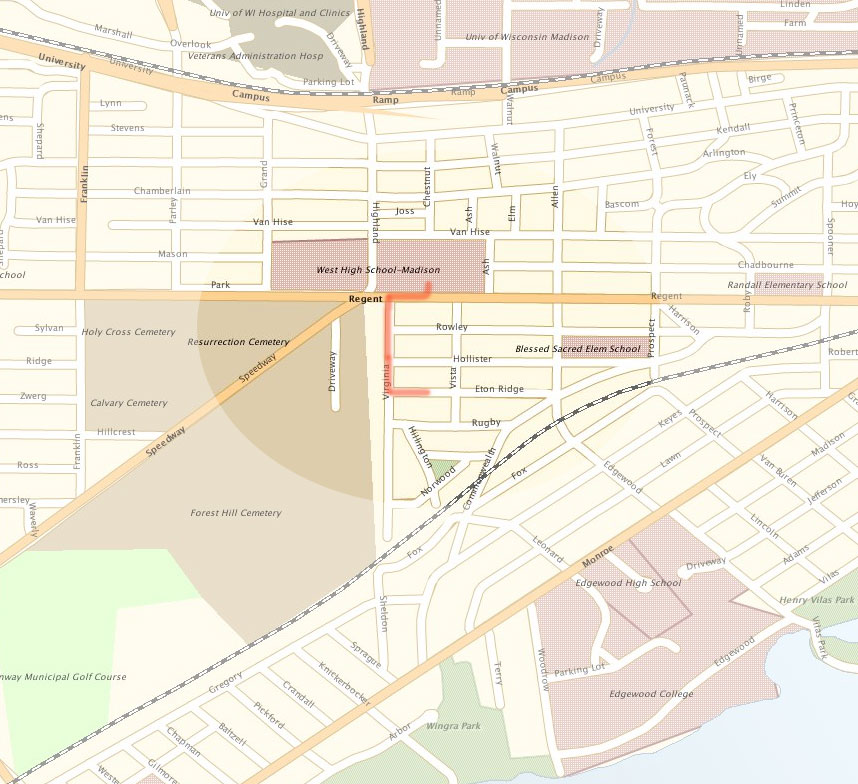
Around 6:26 p.m. on December 20th Madison police responded to the 2300 block of Eton Ridge to meet with a robbery victim. A 16-year-old told police he had just finished basketball practice and was crossing Regent Street when he observed a group of approximately seven individuals. The victim walked from Regent Street to Virginia Terrace [MAP]
to where his car was parked on Eton Ridge. As he neared his vehicle he says three from the group he had noted moments earlier came up quickly behind him. He says perpetrator #1 grabbed him and demanded money. He did not have any money. The victim says #1 next rummaged through his pockets and stole his iPhone.No weapon was seen, and it is not known whether this robbery and another (case #152841) that happened on N. Mills Street two hours later are connected.
Newsletter signup | Send us your ideas
Lakshmi Pratury talks about letter-writing, and shares a series of notes her father wrote her before he died. This short talk may inspire you to set pen to paper too.video
Newsletter signup | Send us your ideas
This is an interesting paradox, a District that takes great pride in some area rankings while at the same time being resistant to such movements. Transfers can go both ways, of course. Redistributed state tax dollar transfers and local property tax & spending authority dollars are tied to enrollment.The future of the state's voluntary school integration program in Madison was thrown into doubt Thursday by a formal opinion from Wisconsin Attorney General J.B. Van Hollen declaring it unconstitutional to use race to block students' attempts to transfer to other school districts.
The 11-page opinion, issued in response to a Sept. 17 request by Deputy State Superintendent of Public Instruction Tony Evers, isn't legally binding. However, courts consider interpretations offered by attorneys general, and the opinions can carry weight among lawmakers, too.
Madison is the only one of the state's 426 public school districts that invokes race to deny some students' requests to transfer to other districts under the state's open enrollment program, the Wisconsin State Journal reported on Sept. 9.
In response to Van Hollen's opinion, Madison schools Superintendent Art Rainwater said he and the district's legal staff will review the document and confer with DPI officials before commenting.
"As we always have, we have every intention of obeying the law," Rainwater said.
Figures compiled by the State Journal showed the Madison School District cited concerns over increasing its "racial imbalance" in rejecting 140 transfer requests involving 126 students for this school year. There are more applications than students because some filed more than one request.
All of the students involved in those rejected transfer requests were white.
The number of race-based rejections represents a 71 percent increase over the previous year, according to data supplied by the district. The number of rejections has nearly tripled since the 2004-05 school year.
Todd Richmond has more along with Alan Borsuk:
According to DPI spokesman Patrick Gasper, Madison is the only district in the state that could be directly affected. The Madison district has refused to allow students, almost all of them white, to enroll in other districts because of racial balance issues. This year, about 125 students were kept from transferring, Madison Superintendent Art Rainwater said.Milwaukee Public Schools followed a similar practice in the late 1990s but changed policies about eight years ago, allowing students to attend suburban schools under the state's open enrollment law regardless of the impact on school integration in Milwaukee.
Newsletter signup | Send us your ideas
What should be done about the quality and quantity of standardized testing in U.S. schools? We touched on the subject in Freakonomics, but only insofar as the introduction of high-stakes testing altered the incentives at play — including the incentives for some teachers, who were found to cheat in order to cover up the poor performance of their students (which, obviously, also indicates the poor performance of the teachers).Personally, I used to love taking standardized tests. To me, they represented the big ballgame that you spent all season preparing for, practicing for; they were easily my strongest incentive for paying attention during the school year. I realize, however, that this may not be a common view. Tests have increasingly come to be seen as a ritualized burden that encourages rote learning at the expense of good thinking.
So what should be done? We gathered a group of testing afficionados — W. James Popham, Robert Zemsky, Thomas Toch, Monty Neill, and Gaston Caperton — and put to them the following questions:
Should there be less standardized testing in the current school system, or more? Should all schools, including colleges, institute exit exams?
Newsletter signup | Send us your ideas
A groundbreaking effort to prepare Texas preschoolers for kindergarten has eaten up millions of taxpayer dollars but has yet to deliver on the investment, according to a new report released by the Texas Education Agency.The findings spotlight a lack of budget transparency, little accountability and a lot of administrative overhead in the Texas Early Education Model, or TEEM, a state program run out of the University of Texas Health Science Center in Houston.
The program "operates in a netherworld of state finance" far removed from TEA oversight, according to the report by Edvance Research Inc., a San Antonio consulting firm.
State officials have pumped more than $45 million into the program since 2003. Yet the report found no proof that most children fared better in TEEM than in conventional preschool programs.
"I thought those were pretty damning conclusions," said Samuel Meisels, a critic who runs the Erikson Institute, a Chicago graduate school that specializes in early-childhood development.
Newsletter signup | Send us your ideas
Sun Prairie residents are weighing whether, as students around the district are shuffled to fill a new elementary school, the make-up of a school with a lot of poor children should get an extra shake-up.A proposal that would sharply lower the number of children at Westside Elementary School who receive free and reduced lunch would be good for that building, agreed most speakers at a three-hour public hearing Tuesday night.
But some parents whose children face a move when Creekside Elementary School opens in the fall wonder whether there would be too much upheaval as the effort to even out Westside's demographics ripples district-wide.
To accomplish the desired socioeconomic goals at Westside, more enrollment boundary lines would have to be redrawn than if the district were simply filling the new school.
Newsletter signup | Send us your ideas
Sports provide many opportunities for students, often well beyond the physical effort, competition and team building skills. These two articles provide different perspectives on sports, particularly the climate around such activities and the people who give so much time to our next generation.
The Dane County Sheriff 's Office has fired Lt. Shawn Haney because he released to the Waunakee School District a report on a September underage drinking party allegedly involving Waunakee High School students.Bob Gosman:Lester Pines, attorney for the 21-year veteran of the department who has no previous disciplinary record, said the termination was based on an ethics violation resulting from a "conflict of interest. "
The sheriff 's report described a Sept. 30 incident that led to five people, including a member of the Waunakee High School football team, being charged with various misdemeanors. According to a criminal complaint filed Nov. 13, a witness told sheriff 's deputies investigating the party that "the majority of the Waunakee High School football team " was at the party.
Waunakee School District Superintendent Charles Pursell did not return messages left Tuesday. He previously said several students, including football players, were disciplined in connection with the party and an elementary school teacher 's aide accused of hosting the party resigned. He also has said players weren 't disciplined before an important playoff game because the district 's investigation had not yet determined that any of them attended the party.
The coaching lifer, much like the three-sport varsity athlete, is on its way to extinction.I learned a number of things from my coaches many (!) years ago - including Walz. Those include:But walk into a Wisconsin Lutheran boys basketball practice, and it's obvious there is plenty of life left in that team's 62-year-old coach.
It has been quite a season for Dale Walz and the Vikings (4-1). Walz picked up his 500th career victory Dec. 7 when the Vikings topped Hartford, 58-47. More good news came Sunday when he learned he will be enshrined in the Wisconsin Basketball Coaches Association Hall of Fame next October.
Walz, in his 35th year as a coach at the prep level, enjoys the game as much as ever. The Vikings play host to Slinger in a big Wisconsin Little Ten Conference game tonight at 7:30.
"I've known since college I wanted to be a high school basketball coach," Walz said. "The challenge is always there. There's not a day that goes by at any time of the year when I don't think about basketball."
Walz, an assistant principal at Wisconsin Lutheran, has remained true to himself while making subtle adjustments to how the game and kids have changed since he ran his first practice at Lakeside Lutheran in 1973.
"He's still intense, but everybody mellows a little," said Ryan Walz, Walz's second-oldest son and the Vikings' junior varsity coach. "He's changed with the kids, which is part of the reason he's coached as long as he has."
Update: Susan Lampert Smith:
Boy, that Homecoming drinking party in Waunakee has a hangover that won't go away.So far, it's cost the jobs of a Waunakee teacher's aide, at whose home the party was allegedly held, and that of a 22-year veteran of the Dane County Sheriff's Office, who was apparently fired ratting out the miscreants to the WIAA. Of course, that might have been because his son played for the football team of Waunakee's arch rival, DeForest.
There are some lessons to be drawn from this fiasco: First, it seems that high school sports are just a little too important to people who are old enough to know better.
DeForest wasn't the only Badger Conference town where people were rubbing their hands together in glee over rumors that, as one witness told the cops, "the majority of the Waunakee High School football team" was at the party. The celebrants hoped the players would get punished and miss some games. But really, why celebrate an event that could have cost lives in drunken-driving crashes?
Newsletter signup | Send us your ideas
Excel versions of the 2007-08 Class Size Preliminary Report are posted in the right-hand sidebar of this page. The report includes average class size data at the citywide, borough, district, and school levels. Given recent improvements in the course coding for the High Schools Scheduling and Transcripts (HSST) system, the high school (grades 9-12) portion of this year’s class size report is produced using a different methodology from previous years. For this reason, this year’s high school data is not comparable to the high school data posted in last year’s report. Please click here for a detailed explanation of the average class size calculation methodology.A detailed PowerPoint presentation provides helpful information summarizing and explaining the report. It includes a review of salient changes to our reporting format, analysis of preliminary class size reductions, and other important notes about the preliminary data.
Newsletter signup | Send us your ideas
On the heels of news that better than two-thirds of the state’s school districts now offer 4-year-old kindergarten, an apparent backlash has turned the tide in several southeastern Wisconsin school districts.Related - Marc Eisen: Missed Opportunity for 4K and High School Redesign.
First, there was the Elmbrook School Board narrowly rejecting administrators’ proposal to extend a 4K pilot that's several years old. Then, on Monday, the Muskego-Norway School Board unanimously shot down a proposal to start junior kindgarten.
Last night, the Plymouth School Board held an hours-long hearing into whether to continue a 4K program that was started just last year. One of the guests was Republican state Sen. Glenn Grothman, a vocal opponent of 4K who has previously compared the publicly funded preschool program to communist schemes.
Newsletter signup | Send us your ideas
School districts will pay the cost of advanced placements exams for students eligible for free or reduced lunch under a bill Gov. Jim Doyle signed into law Wednesday.This bill allows the Department of Public Instruction to apply for federal funds to cover the costs of these exams. AP exams help students earn college credit while still in high school.
Under previous state law, the local school district was required to pay for these exams. The U.S. Department of Education had taken the state's previous statutory language to mean that only state or local funds should pay for these exams, which has prevented the state from receiving any sort of federal assistance.
“This common-sense fix allows Wisconsin school districts to compete for federal grants to cover the cost of advanced placement exams for low-income students,” said Lehman. “Wisconsin schools have missed out on $140,000 in grants this past year alone."
Newsletter signup | Send us your ideas
Walter H. G. Lewin, 71, a physics professor, has long had a cult following at M.I.T. And he has now emerged as an international Internet guru, thanks to the global classroom the institute created to spread knowledge through cyberspace.Virtual learning offers many opportunities for students AND teachers.Professor Lewin’s videotaped physics lectures, free online on the OpenCourseWare of the Massachusetts Institute of Technology, have won him devotees across the country and beyond who stuff his e-mail in-box with praise.
“Through your inspiring video lectures i have managed to see just how BEAUTIFUL Physics is, both astounding and simple,” a 17-year-old from India e-mailed recently.
Steve Boigon, 62, a florist from San Diego, wrote, “I walk with a new spring in my step and I look at life through physics-colored eyes.”
Professor Lewin delivers his lectures with the panache of Julia Child bringing French cooking to amateurs and the zany theatricality of YouTube’s greatest hits. He is part of a new generation of academic stars who hold forth in cyberspace on their college Web sites and even, without charge, on iTunes U, which went up in May on Apple’s iTunes Store.
n his lectures at ocw.mit.edu, Professor Lewin beats a student with cat fur to demonstrate electrostatics. Wearing shorts, sandals with socks and a pith helmet — nerd safari garb — he fires a cannon loaded with a golf ball at a stuffed monkey wearing a bulletproof vest to demonstrate the trajectories of objects in free fall.
Newsletter signup | Send us your ideas
Fully half of the Class of 2006 at Lew Wallace High School, in the Rust Belt city of Gary, Indiana, graduated despite flunking the state's Graduation Qualifying Exam repeatedly, which they are supposed to pass to graduate. Students had had five chances to pass, but the school ushered them out into the "real world" anyway.The school was hardly an exception to some Iron Law that students don't pass if they don't pass the test. Five percent of the state's graduates in 2006 donned cap-and-gown without ever passing the GQE. At 52 high schools, at least 10 percent of graduating seniors repeatedly flunked it
Newsletter signup | Send us your ideas
When Alex entered kindergarten, his teacher noticed he was having difficulties. He could not pass the school readiness test. His pediatrician determined he had ADHD. No one told me he might also have learning disabilities.Blake passed the readiness test and seemed to be doing fine until second grade. In third grade, he began to slip in reading and other subjects that required him to read.
I read to my kids. We did homework and extra work together. I made flash cards and bought computer programs to help them. Why couldn’t my children read?
Newsletter signup | Send us your ideas
The latest plan will be presented to the public with an opportunity for comment early next year, said Sue Abplanalp, assistant superintendent for elementary schools.515K PDF.Known as Plan A, it moves fewer children and brings building capacities and numbers of low-income students at all schools into closer alignment, said Kurt Kiefer, Madison schools' director of research.
Click on an image for a larger version.


Newsletter signup | Send us your ideas
A few articles on the current tax and spending climate:
In some markets where real-estate values had been rising sharply for years, property taxes are still climbing. That is because it can take a long time for assessments, which commonly are based on a property's estimated market value, to catch up with the realities of the real-estate market.Property taxes supply $65% of the Madison School District's $349M budget (2007-2008) [Citizen's Budget with 2.5MB PDF amendments]The lag time has led to an outcry to cut property taxes reminiscent of the 1970s, says Gerald Prante, an economist with the Tax Foundation, a nonprofit, nonpartisan research group in Washington.
"In many cases, incomes were growing faster than property-tax bills in the 1990s," Mr. Prante says. "Recently, property-tax bills have grown faster than incomes, on average."
State and local property-tax collections increased 50% from 2000-06, according to Census Bureau data. During the same time period, the median household income rose 15%, before adjustment for inflation.
Despite all the deductions, loopholes and clever accountants the federal income tax is strongly progressive. Moreover the federal tax system remains progressive even if you include the payroll tax, corporate taxes and excise taxes. The chart below with data from the Congressional Budget Office, shows the effective tax rate by income class from all federal taxes. Effective tax rates are considerably higher on the rich than the poor.The effective tax rate is higher on the rich and the rich have more money – put these two things together and we can calculate who pays for the federal government. The final column in the table shows the share of the 2.4 trillion in federal tax revenues that is paid for by each income category.
School taxes increased more than 7 percent statewide, the biggest increase in 15 years, fueling renewed cries for reform of the state school funding system.The state school finance system is "broken, " said Pete Etter, interim superintendent of the tiny Black Hawk School District about 60 miles south of Madison, which had the highest local school property tax increase of any district in the state. "It 's not only Black Hawk. It 's every district in the state. "
Critics say the system is flawed because state revenue limits for districts don 't grow enough, if at all. If state aid is insufficient, districts must turn to taxpayers, sometimes through referendum.
Dane County range
School taxes -- as well as the total tax bill -- depend mostly on where you live.
Newsletter signup | Send us your ideas
Listen to the discussion [47MB MP3 Audio].
Andy Hall & Brittany Schoep:
"This is one of the most important things we've brought before you," Rainwater told the board. "It is critically needed to ensure our schools continue to be safe."Susan Troller has more:"We're walking a really fine line right now," School Board President Arlene Silveira said. "I think these positions will really help keep us on the positive side of that line."
The high school positions are designed to help students with behavior, academic, social, transitional and other problems who can hurt themselves and the learning environment, Memorial High School Principal Bruce Dahmen said.
In an interview before Monday night's meeting, Pam Nash, assistant superintendent for high schools and middle schools said, "The number of incidents I deal with in the high schools and middle schools is going up every year. We want to get a proactive handle on it. It's as simple as that."Related:"This is not only important but critical to the future of our schools," Superintendent Art Rainwater said as he recommended an initial proposal to spend $720,500 for security measures. The money is available through the recently signed state budget, a windfall Madison schools did not know they would get when the Board inked the final budget in October.
The board approved hiring four case managers at East, West, Memorial and La Follette and five positive behavior coaches will be brought on board at O'Keeffe, Sherman, Jefferson, Black Hawk and Whitehorse middle schools.
Newsletter signup | Send us your ideas
Seventh-grader Jessica Dodson walked into class and yanked Eric Clapton from the wall -- the guitar, not the guitarist. Classmate Corey Cook already had Carlos Santana cradled in his lap, plucking out E-minor, C and G chords.Kevin Carey has more."On the C chord, I'm hearing some funky sounds," teacher Darlene Dawson said after her 17 students at Metz Middle School in Manassas played "Eleanor Rigby" in unison. She played along with the students, having taken up the guitar just a few months ago.
This isn't the kind of music class Dawson, a teacher for 25 years, is used to teaching. Or the kind students are accustomed to attending. Or what most students in U.S. schools are offered.
The elective class at Metz -- with guitars named after guitarists -- is being given as music education programs across the country are facing difficult times. Despite research showing that students who study music have better attendance, achievement and lifetime earnings, music classes are struggling to survive.
Newsletter signup | Send us your ideas
Children at the Oakdale School here in southeastern Connecticut returned this fall to learn that their traditional recess had gone the way of the peanut butter sandwich and the Gumby lunchbox.No longer could they let off their youthful energy — pent up from hours of long division — by cavorting outside for 22 minutes of unstructured play, or perhaps with a vigorous game of tag or dodgeball. Such games had been virtually banned by the principal, Mark S. Johnson, along with kickball, soccer and other “body-banging” activities, as he put it, where knees — and feelings — might get bruised.
Newsletter signup | Send us your ideas
Perhaps the most bizarre of all of the school restructuring programs is mathematics. Math is an exact science, loaded with absolutes. There can be no way to question that certain numbers add up to specific totals. Geometric statements and reasons must lead to absolute conclusions. Instead, today we get "fuzzy" Math. Of course they don't call it that.As ED Watch explains, "Fuzzy" math's names are Everyday Math, Connected Math, Integrated Math, Math Expressions, Constructive Math, NCTM Math, Standards-based Math, Chicago Math, and Investigations, to name a few. Fuzzy Math means students won't master math: addition, subtraction, multiplications and division.
Instead, Fuzzy Math teaches students to "appreciate" math, but they can't solve the problems. Instead, they are to come up with their own ideas about how to compute.
Here's how nuts it can get. A parent wrote the following letter to explain the everyday horrors of "Everyday Math." "Everyday Math was being used in our school district. My son brought home a multiplication worksheet on estimating. He had 'estimated' that 9x9=81, and the teacher marked it wrong. I met with her and defended my child's answer.
The teacher opened her book and read to me that the purpose of the exercise was not to get the right answer, but was to teach the kids to estimate. The correct answer was 100: kids were to round each 9 up to a 10. (The teacher did not seem to know that 81 was the product, as her answer book did not state the same.)"
Social, political, multicultural and especially environmental issues are rampant in the new math programs and textbooks. One such math text is blatant. Dispersed throughout the eighth grade textbooks are short, half page blocks of text under the heading "SAVE PLANT EARTH." One of the sections describes the benefits of recycling aluminum cans and tells students, "how you can help."
In many of these textbooks there is literally no math. Instead there are lessons asking children to list "threats to animals," including destruction of habitat, poisons and hunting. The book contains short lessons in multiculturalism under the recurring heading "Cultural Kaleidoscope." These things are simply political propaganda and are there for one purpose - behavior modification. It's not Math. Parents are now paying outside tutors to teach their children real Math - after they have been forced to sit in classrooms for eight hours a day being force-fed someone's political agenda.
Newsletter signup | Send us your ideas
Ensuring the opportunity for generations of young people to further their education. The Fund for Wisconsin Scholars (FFWS) is here to help reduce the financial barriers to college and to lighten the debt that most Wisconsin students incur during their college years. The founding gift of $175,000,000 from John P. and Tashia F. Morgridge creates a permanent endowment to provide grants for eligible, lower-income, talented graduates of Wisconsin public schools attending a Wisconsin public post-secondary educational institution.
Newsletter signup | Send us your ideas
As a classroom teacher who taught English for over 33 years, I have worked with literally thousands of students; and I am tired of the education elites and high-paid consultants who tell educators never to use the "drill and kill" method for fear of boring their students.
Newsletter signup | Send us your ideas
Michael Shaughnessy interviews the Washington Post's Jay Matthews:
7) What do you see as the top ten concerns in education? What are the biggest concerns in the Washington Circle?Matthews list is comprehensive and on target.My concerns or Washington's? I will go with mine:
- Low standards and expectations in low-income schools.
- Very inadequate teacher training in our education schools.
- Failure to challenge average students in nearly all high schools with AP and IB courses.
- Corrupt and change-adverse bureaucracies in big city districts.
- A tendency to judge schools by how many low income kids they have, the more there are the worse the school in the public mind.
- A widespread feeling on the part of teachers, because of their
inherent humanity, that it is wrong to put a child in a challenging situation where they may fail, when that risk of failure is just what they need to learn and grow.- The widespread belief among middle class parents that their child must get into a well known college or they won't be as successful in life.
- A failure to realize that inner city and rural schools need to give students more time to learn, and should have longer school days and school years.
- A failure to realize that the best schools--like the KIPP charter schools in the inner cities---are small and run by well-recruited and trained principals who have the power to hire all their teachers, and quickly fire the ones that do not work out.
- The resistance to the expansion of charter schools in most school district offices.
Newsletter signup | Send us your ideas
Ten years after I am dead and gone, I suspect only two people will give much thought to me, and their names are Henry and Hannah.They're my legacy, so I hope they thrive -- and I sure hope they remember me fondly.
Henry and Hannah are, of course, my children, now ages 15 and 19, respectively. Like any parent, I spend a lot of time thinking about my kids, including how I can best help them financially.
This isn't simply about coughing up dollars and cents, though the sums involved have been frighteningly large. Rather, what it's really about is passing along values.
Yes, I want my kids to be financially successful. But mostly, I want them to be competent, contented managers of their own money, so they don't spend their lives agonizing over their finances and dogged by foolish mistakes.
I am not claiming to have the road map for every parent. We all have different values, different incomes and strong ideas about how best to raise children -- and you will likely scoff at some of the things I've done. With that caveat, here are a dozen ways I have endeavored to help my kids financially.
Newsletter signup | Send us your ideas
The schools are virtual, but the children learning from them are very real.And, sometimes, real kids have real problems.
Brennan Fredericks, 16, had big problems in middle school. His parents, Dan and Donna of Black Earth, said his former school did little to protect him from bullies. He has life-threatening food allergies and, his mother said, other kids would throw peanut butter sandwiches at him and taunt him.
"He 'd sit all alone at a table labeled peanut ' and get picked on, " Donna Fredericks said.
It got so bad that the thought of going to school made him ill.
After home schooling their son through much of eighth grade, the family was delighted to find the Monroe Virtual High School, a charter school run out of the Monroe School District.
To fulfill high school requirements, Brennan can choose between high school and college courses, which arrive with books and online homework. When it 's time to take exams, a teacher from the Monroe school drives to Black Earth and administers the test at the local library.
It has worked well for a kid who struggled in regular school.
Newsletter signup | Send us your ideas
1. Are there any countries where you can you see lions and tigers and bears in the wild?2. What is the only U.S. state to allow its residents to cast absentee ballots from outer space?
3. If you could somehow hover at a point in space just above the equator, roughly how fast would the ground below be moving relative to you?
4. It was originally named the Flavian Amphitheater, but nobody calls it that today. What is its more common name?
Newsletter signup | Send us your ideas
That view is not shared by the Hmong, many of whom felt betrayed by the United States when the war ended. Using battered radios, the veterans here have followed what to them are the confusing events of recent years: the friendship proclaimed between Vietnam and the United States and the arrest in June of Vang Pao, the former Hmong general who faces charges in the United States of plotting to attack the Laotian government.Much more on Vang Pao and Madison here (our latest elementary school was to be named for Pao).Mr. Pao’s indictment in California, after a federal sting operation in which a government agent posing as an arms dealer offered him weapons, is bewildering to the veterans here. Attacking Communists was the very job Mr. Pao was paid to do by the C.I.A.
Mr. Yang and his group say they still hope for a democratic Laos but have given up any notion that they can assist in the overthrow of the Communist government.
Newsletter signup | Send us your ideas
Monday, Nov. 5, wasn't a good day for the U.S. military in Madison.Some related books that are well worth reading:Over at the Doyle administration building, anti-war activists were lobbying the Madison school board to remove Army recruitment signs from high school sports stadiums.
Critics say the ads mislead impressionable young people and support unconscionable war-making. I have a problem with that.
I'm at a loss to understand how a sign asking, "Are you Army strong?" and giving a recruiter's phone number represents a threat to young people. On a list of the top 2,000 baleful media images thrust before kids — have you seen the American Apparel ads pitched to teenage girls? — this ranks maybe 1,834th.
Over at East High, meanwhile, the military's estrangement from the good people of Madison was in even starker relief.
Roughly 70 parents and students turned out for a "junior night" look at post-graduation prospects for college, technical school, and yes, the military. Not one participant stopped by the military recruitment table, Sgt. Frederick Hutchison of the Marines and Machinist Mate Michael Pflanzer of the Navy told me.
Per school district policy, recruiters will have two more cracks at East High kids, and Pflanzer guardedly thought some would eventually sign up.
Oh sure, East High kids will enlist, I thought as I walked out the door carrying college-bound material for my own junior daughter. But they'll probably be black- and brown-skinned kids, or Hmong, and blue-collar kids who aren't laser-focused on college the way that the children of the professional classes are taught to be.
"This wonderful book will introduce you to the “Misty” warriors—157 of them flying two-seat F-100s seeking out targets for bomb-dropping fighters over North Vietnam. This book goes beyond the normal war story. It proves to be engaging and accessible to fighter pilot and civilian alike. Bury Us Upside Down serves to remind us of why war is such a serious endeavor. We would do well as a nation to heed the lessons and messages it contains."Bury Us Upside Down - Amazon Link
Newsletter signup | Send us your ideas
Insight School of Wisconsin, one of the state's newest publicly chartered virtual schools, could not disagree more profoundly with the recent Court of Appeals ruling that a virtual school violated Wisconsin law because its teachers and students are not entirely located within one school district's borders.The ruling is a step back for education. It hurts Wisconsin's quest to be economically competitive in a high-tech, online educational world. Most disturbingly, it hurts some of the neediest students we're all trying so hard to help.
The Appeals Court ruling denies what is already happening in schools. As a former teacher and principal, let me point out the obvious: Technology has changed the classroom. Online schools, video programming and Web-based distance learning have obliterated school district borders. The world is now our classroom.
Visit a school today and you'll likely see that it's already linked to one of the state's 33 distance learning networks. You might see a distance-taught class over BadgerNet taught by teachers in another city, state or country.
Newsletter signup | Send us your ideas
It's shortly after 1 p.m. Wednesday, and while most of her peers across Texas are in school, 18-year-old Angelina Banda is driving to her $7.50-an-hour job at Home Depot."I need Pampers," said Banda, who has a 2-year-old daughter and a 4-month-old son.
The young mom is enrolled in a special program at Houston's Furr High School, which allows her to attend class in the morning and work in the afternoon.
Similar programs designed to keep teens from dropping out of school could become more popular thanks to a new law that makes it easier for districts to obtain state funding for students with nontraditional schedules.
Evening, weekend classes
State Rep. Scott Hochberg, who proposed the bill, said he hopes it encourages districts to offer evening or weekend classes for students who must work to support their families and cannot attend school during the conventional 8 a.m. to 3 p.m. day.
Newsletter signup | Send us your ideas
Via a reader's email: David Savageau (Contributing Editor of Expansion Management Management):
Three out of 10 of us either work in an educational institution or learn in one. Education eats up 8% of the Gross National Product. Keeping it all going is the biggest line item on city budgets. Whether the results are worth it sometimes makes teachers and parents--and administrators and politicians--raise their voices and point fingers.Here are some of their top locations:In the 1930s, the United States was fragmented into 130,000 school districts. After decades of consolidation, there are now fewer than 15,000. They range in size from hundreds that don't actually operate schools--but bus children to other districts--to giants like the Los Angeles Unified District, with three-quarters of a million students.
Greater Chicago has 332 public school districts and 589 private schools within its eight counties. Metropolitan Los Angeles takes in 35 public library systems. Greater Denver counts 15 public and private colleges and universities. Moving into any of America's metro areas means stepping into a thicket of school districts, library systems, private school options and public and private college and universities.
Related:
The Madison area, which includes all of Dane County as well as immediately adjoining areas, was awarded A+ for class size and spending per pupil in public schools, and for the popularity of the city's public library.Channel3000:The greater Madison area scored an A for being close to a college town and for offering college options.
Private school options in the greater Madison area were graded at B+.
There has been some confusion in the response to the rankings because they lump together numerous school districts -- urban, suburban and rural.
The engineering-based program is just one example of the district's willingness to bring college-level learning to his high school students. That effort appears to be paying off nationally, WISC-TV reported."It reinforces that what we're trying to do as a district and as an area is working," said Granberg. "And it's getting recognized on a national level, not just a local or state level."
"This is not a community that accepts anything but the best and so that bar is always high," said Madison Metropolitan School District Superintendent Art Rainwater.
Rainwater also credits the ranking to teacher development programs."We spend an awful amount of time and an awful amount of effort working with our teachers in terms of how they deliver instruction to individual children," said Rainwater.
He said the school district will continue to improve techniques, focusing on the needs of every student.
Newsletter signup | Send us your ideas
The Minneapolis school district has been struggling in the past few years with low student achievement, declining enrollment, money shortages, and frequent leadership changes. Now, its leaders are staking their hopes on a new strategic plan to help revitalize the system and rebuild public confidence.At a meeting last week, the school board adopted a set of nine recommendations drawn from the plan 36K PDF. They form a broad outline for the district as it addresses complaints that have prompted hundreds of city families to sign their children up for private, charter, and nearby suburban schools.
The recommendations include raising expectations and academic rigor for students, correcting practices that perpetuate racial and socioeconomic achievement gaps, building a stronger corps of principals and teachers, and shoring up the district’s financial health.
Minneapolis’ strategic plan still must be shaped into concrete steps to be implemented in the coming months, a process made tougher by next year’s projected $11 million shortfall in the roughly $650 million budget.
Newsletter signup | Send us your ideas
The Washington Post Challenge Index measures a public high school's effort to challenge its students. The formula is simple: Divide the number of Advanced Placement, International Baccalaureate or Cambridge tests a school gave by the number of seniors who graduated in June. Tests taken by all students, not just seniors, are counted. Magnet or charter schools with SAT combined verbal and math averages higher than 1300, or ACT average scores above 27, are not included, since they do not have enough average students who need a challenge.Local schools on the list include: Madison Memorial and VeronaThe rating is not a measurement of the overall quality of the school but illuminates one factor that many educators consider important.
Newsletter signup | Send us your ideas
When students from her 10th-grade honors class returned from summer break, Arrowhead High School teacher Kathy Nelson organized an online open-house activity to discuss three novels they had read during their time off.After six hours, the English teacher at the Hartland school had a 178-page transcript of her students' dialogue and a new appreciation of the power the remote technology of the Internet can lend to the sometimes intensely interpersonal field of teaching.
"You think of computers as being cold," she said. "But they were really into some deep topics."
Even as fully virtual schools face an uncertain future after a state appeals court this week found one such school violated state laws, most of today's students are more likely to encounter an online learning experience like that practiced in Nelson's honors English classroom.
Instead of replacing the face-to-face interaction of a brick-and-mortar school with a virtual-school experience, Nelson and other teachers throughout the Milwaukee area are using online discussion boards, textbooks, surveys and collaborative features to extend class time beyond the traditional school day.
Newsletter signup | Send us your ideas
For years, Jonathan Schuster's mother begged the public schools here to put her son in a special program where he could get extra help for his emotional problems. By 11th grade, Jonathan had broken his hand punching a wall and been hospitalized twice for depression -- once because he threatened to kill himself with a pocket knife.But teachers insisted that Jonathan, who suffers from attention deficit disorder, learning disabilities and bipolar disorder, could get by in regular classrooms. His mother, Kathleen Lerch, says the reason was cost. "It was all about the bottom line," she says. Citing confidentiality, school officials declined to discuss Jonathan's case but said they seek to provide an appropriate education to all children.
Advocates for the disabled have long promoted the inclusion of special-education children in regular classes, a practice called mainstreaming. Many educators view mainstreaming as an antidote to the warehousing of children with special needs in separate, and often deficient, classrooms and buildings.
Now, some experts and parents complain that mainstreaming has increasingly taken on a new role in American education: a pretext for cost-cutting, hurting the children it was supposed to help. While studies show that mainstreaming can be beneficial for many students, critics say cash-hungry school districts are pushing the practice too hard, forcing many children into classes that can't meet their needs. Inclusion has evolved into "a way of downsizing special education," says Douglas Fuchs, a Vanderbilt University education professor.
Districts have a powerful motivation to cut special-education costs. U.S. schools spend almost twice as much on the average disabled student as they do on a nondisabled peer, according to a 2004 federal study. But the study also found that, in recent years, per-student special-education costs rose more slowly than for the general population. One of the likely reasons, researchers found, was cost savings from mainstreaming.
Newsletter signup | Send us your ideas
The good news is that the feds refused to fund the school district's proposal to revamp the high schools. The plan was wrongheaded in many respects, including its seeming intent to eliminate advanced classes that are overwhelmingly white and mix kids of distressingly varied achievement levels in the same classrooms.Related:This is a recipe for encouraging more middle-class flight to the suburbs. And, more to the point, addressing the achievement gap in high school is way too late. Turning around a hormone-surging teenager after eight years of educational frustration and failure is painfully hard.
We need to save these kids when they're still kids. We need to pull them up to grade level well before they hit the wasteland of middle school. That's why kindergarten for 4-year-olds is a community imperative.
As it happens, state school Supt. Elizabeth Burmaster issued a report last week announcing that 283 of Wisconsin's 426 school districts now offer 4K. Enrollment has doubled since 2001, to almost 28,000 4-year-olds statewide.
Burmaster nailed it when she cited research showing that quality early-childhood programs prepare children "to successfully transition into school by bridging the effects of poverty, allowing children from economically disadvantaged families to gain an equal footing with their peers."
Newsletter signup | Send us your ideas
There's an odd phenomenon being reported in tony enclaves across the country: highly educated, highly compensated couples popping out four or more children--happily and by choice. In Loudoun County, a suburb of Washington, four-packs of siblings rule the playgrounds. In New York City, real estate agents tell of families buying two or three adjacent apartments to create giant spaces for their giant broods. Oradell, N.J., is home to so many sprawling clans that residents call it Fouradell. In a suburb of Chicago, the sibling boomlet is called the Wheaton Four.Of course, big families never really disappeared. Immigrants tend to have more kids, as do Mormons, some Catholics and a growing cadre of fundamentalist Christians. But in the U.S. today, the average number of children per mom is about 2, compared with 2.5 in the 1970s. While 34.3% of married women ages 40 to 44 had four or more children in 1976, only 11.5% did in 2004, according to the Current Population Survey. Though factoring in affluence can be statistically tricky, an analysis by Steven Martin, associate professor of sociology at the University of Maryland, shows that the proportion of affluent families with four or more kids increased from 7% in 1991-96 to 11% in 1998-2004. Andrew Cherlin, a sociology professor at Johns Hopkins University, speculates, "For most people, two is enough because there are so many other competing ways to spend your time and money. People prefer to have fewer kids and invest more in them. My guess is the wealthy are having more because they enjoy children, and they have the time and resources to raise them well. They don't have to make those trade-offs."
Newsletter signup | Send us your ideas
After more than a decade of aiding younger students, the Schools of Hope project is heading to high school.The Schools of Hope Leadership Team, a 27-member community group, decided Wednesday to establish a tutoring program for ninth graders in the Madison School District.
More than 50 volunteer adult tutors — and possibly many more — will be sought to serve at least an hour a week in high schools.
Newsletter signup | Send us your ideas
Eight-year-old Ben Shapiro's days are a blur of gymnastics, piano playing, and art history lessons. He can also be found doing fractions, reading a biography of Marco Polo, and, soon, delving into physics. But he's not at school. And he's not alone.He is part of a fast-evolving home-school movement that is traveling away from the stereotype of child and parent at the kitchen table. Shapiro does spend most of his day with his mother, but not alone. Instead, she shuttles him from one group activity to another.
The home is no longer where all the action is in this new wave of home schooling. Although some instruction takes place at home, parents now choose from an increasing number of options that allow their children to interact with and learn alongside other home-schooled peers. The opportunities for socialization are numerous - swim lessons at the YMCA, staging a play with like-minded friends found over the Internet, or any of myriad academic courses offered at cooperative schools in the area.
"It all can be subcontracted," said Marcia Coakley, who teaches her 14-year-old son and 12-year-old daughter at home in Medway. "There's so many resources out there, it's almost hard to decide."
Newsletter signup | Send us your ideas
The idea that more time in school produces better results could get a small boost today with the release of international data from the Brookings Institution. The study finds adding 10 minutes of math instruction to an eighth-grader's day translates into a jump in math skills.
The findings come as a handful of states and school districts experiment with packing more minutes into the school day and, in a few cases, more days into the year.The study, which examined eighth-grade math scores in 20 countries, found that five of seven that added instructional minutes from 1995 to 2003 showed improved skills. Of the 13 countries that subtracted time, 10 got worse results. The three exceptions were Latvia, the Netherlands and the USA.
Most U.S. eighth-graders got 45 minutes of daily math instruction in 2003, down from 49 in 1995, but their scores on the Trends in Mathematics and Science Survey improved slightly. Researcher Tom Loveless says that is an anomaly, and more time in class could help boost scores. But even 450 more minutes of math, or two weeks' worth, would shrink the gap between the USA and top-scorer Singapore by less than 5%, he says.
Newsletter signup | Send us your ideas
Teaching is attracting better-qualified people than it did just a few years ago, according to a report released Tuesday by the Educational Testing Service.Prospective teachers who took state teacher licensing exams from 2002 to 2005 scored higher on SATs in high school and earned higher grades in college than their counterparts who took the exams in the mid-1990s, the report said.
On the other hand, the report found that those attracted to the profession continued to make up a strikingly homogeneous group — prospective teachers were overwhelmingly white and female — at a time when the proportion of public school students nationwide who are black, Hispanic or other minorities was nearly half and rising.
Newsletter signup | Send us your ideas
The Washington Post sports pages this weekend were full of detailed analyses of our beloved local football, basketball and baseball teams. It was inside stuff, lapped up by readers like me who care about these sports and love to see the latest numbers.Why can't we get that excited about what is happening inside our schools? Okay, watching great teachers explain the mysteries of plate tectonics or cultural assimilation is not as exciting as seeing Todd Collins complete a pass to Ladell Betts for a touchdown. But our schools do have some intriguing statistics, just like sports teams. I spent my weekend using them to look inside several high schools in the Washington area and finding some thrilling surprises.
Last week's column was about the new best high schools list in U.S. News & World Report, and how it compares to the Challenge Index list in Newsweek. That is, as the economists say, the macro part of the school assessment game, the big picture. Today, I want to look at the micro part, the inside-the-school perspective, aided by the latest Challenge Index rankings of this region's 186 public high schools, coming out in The Post and on this Web site Thursday.
The Challenge Index ranks schools by their college-level test participation rates -- the number of Advanced Placement, International Baccalaureate and other college-credit exams given at each school, divided by the number of graduating seniors. I do not factor in how well students do on those exams in the main rankings, because I have been convinced by successful AP and IB teachers that even students who struggle with the exams are much better off academically than if they did not take a college-level course and test at all.
Newsletter signup | Send us your ideas
When it does battle on the Web, Google rarely loses. Last year's closure of Google Answers, however, marked a rare setback for the search giant. An even bigger shock is that Yahoo! succeeded where Google failed. Yahoo! Answers—a site where anyone can post a question in plain English, including queries that can't be answered by a traditional search engine—now draws 120 million users worldwide, according to Yahoo!'s internal stats. The site has compiled 400 million answers, all searchable in its archives. According to the Web tracking company Hitwise, Yahoo! Answers is the second-most-visited education/reference site on the Internet after Wikipedia.The blockbuster success of Yahoo! Answers is all the more surprising once you spend a few days using the site. While Answers is a valuable window into how people look for information online, it looks like a complete disaster as a traditional reference tool. It encourages bad research habits, rewards people who post things that aren't true, and frequently labels factual errors as correct information. It's every middle-school teacher's worst nightmare about the Web.
Newsletter signup | Send us your ideas
Crunching the numbers with poverty factored in shows variety of winnersMost once-a-week tutors find their way into Lincoln Elementary School through a network of churches. But Joan Prewitt simply walked in the front door and asked if she could help.
Prewitt, a grandmother, had tried the same thing at another elementary school, but she never heard back. But Lincoln has a volunteer coordinator paid with private donations, and Prewitt became one of more than 50 volunteer reading tutors who help propel Lincoln's test scores into the ranges more typical of middle class schools across town.
Neighborhood poverty or affluence predict test scores for most schools across Madison County. But Lincoln Elementary students did better than expected in reading and math this year, expectations based on the fact that nearly all of Lincoln's families qualify for free or reduced-price lunch.
"I just wanted something to do with my time that I felt was somewhat more worthwhile," said Prewitt. "I knew Lincoln was in a neighborhood that could use some help."
"Economic background is what matters, not race," said Dr. John Humphrey, a principal in north Huntsville for more than 10 years. "I've always believed that. And then, along came Lincoln Elementary.
"They're proving you can overcome the economic barrier."
Newsletter signup | Send us your ideas
Betsy Hammond & Lisa Grace Legnicer:
A t least 25 Oregon schools whose students are behind in reading and math have turned down federal aid intended to help those students learn more, an analysis by The Oregonian has found.Not taking the money -- typically $200,000 a year -- allows a school to dodge consequences and pressure to improve brought by the federal No Child Left Behind law.
As a result, students in those schools don't get free tutoring and don't have the extra teachers and teacher training that federal money would buy. Parents don't get letters notifying them of their school's achievement problems and plans to improve, and students lose the opportunity to transfer to a better-performing school.
"Why would they turn down the money? It's not like we don't need the tutoring," says Madison junior Betelehem Shenbulo. She would have failed algebra II last year without the help of a tutor paid with federal funds, the 16-year-old says.
"I have seen people struggle this year, really struggle, but tutoring is not available anymore," she says. "We should still have it."
Under No Child Left Behind, any school receiving federal funds to help disadvantaged students that misses academic performance targets two years in a row is put on a federal must-improve list.
Nationwide, more than 2,500 schools -- including 80 in Oregon -- have been put on the federal list. They face consequences if they don't improve.
Newsletter signup | Send us your ideas
Statewide, school property taxes are up 7.4%, the largest increase since 1992-93. About 35% of districts had double-digit increases, compared to 21% last year. A late state budget and no new state aid contributed to the tax jump, although the legislature offset some of the increase with additional property tax credits.
Newsletter signup | Send us your ideas
Joey @ UT-Austin: (video)
This has to be one of the best ACTLab class presentations I have seen in a long time. Pretty much every project hit hard. And there were many that hit well above the mark. So lets take a look at those:Laser Harp! Yeah that is right, Derek, a student of mine, along with Drake as his programmer and Sandy as a consultant created a laser harp. While he ran into many issues, he did have a proof of concept to show off. Check it out:
Newsletter signup | Send us your ideas
We are at a point in our high schools and middle schools where we need to take some action to assure the public that our schools remain safe and secure," Superintendent Art Rainwater said. He noted that public safety had become a significant issue in neighborhoods throughout the city.Related:But long time board member Carol Carstensen asked to table the proposal, and other board members agreed to put the decision off a week for more study.
"I'm probably going to vote for it," she said. "But I would like a little more time and more details in the next week."
Newsletter signup | Send us your ideas
Many of Madison's elementary school teachers spoke out to the Madison Metropolitan School District's Board of Education on Monday night.
Carrying brightly colored signs, the group protested the increased class size for gym, arts and computer classes. The larger related arts classes are known by some as "one and one-half classes," WISC-TV reported.District officials started the policy at the elementary level this year to save money.
Some teachers said their students, many of whom come from low-income backgrounds, are getting short-changed."I teach in a school with 46 percent or more kids on free or reduced lunch," said Rhonda Schilling, a music teacher for Thoreau and Hamilton elementary schools. "Many of the kids come from really rough backgrounds, and those are the kids in particular that shine often in the arts. They need that contact time with their teacher."
Newsletter signup | Send us your ideas
OK, ready? Start your push-ups. Fifteen-year-old boys, you have to do at least 16. Fifteen-year-old girls, at least seven.That's one of several physical fitness tests that fifth-, seventh-and ninth-graders in public schools across California take every year – and a lot of the students don't measure up.
The state released its latest round of scores for the California Physical Fitness Test yesterday, and they were barely better than last year's – which were also bad.
Only 27.1 percent of California students in fifth grade, 30.9 percent in seventh grade and 30.1 percent in ninth grade met fitness standards in six areas: cardiovascular endurance, percentage of body fat, abdominal strength and endurance, trunk strength and flexibility, upper body strength and endurance, and overall flexibility.
Looked at another way, more than two in three public school students in the state are out of shape
Newsletter signup | Send us your ideas
My contribution to the (endless) Race-IQ debate is out in this week's New Yorker. You can read it here. In the meantime, the psychologist Richard Nisbett has also published a rejoinder to the James Watson-Will Saletan foolishness in Sunday's New York Times. It is--characteristically--very good, and includes this:More here.
Newsletter signup | Send us your ideas
Just as modern technology is allowing many people in our country to work out of their home, innovative public school districts nationwide are allowing students to learn from home via virtual schools without having to attend a traditional brick-and-mortar school. Our education system in Wisconsin utilizes virtual schools, which are changing the way education is delivered to some students. As we prepare our children for the 21st Century workplace, we have to seriously consider the role of virtual schools and how they can enhance student achievement. We must ensure our state laws allow public schools to continue offering this important alternative school setting.Virtual schools are not for every student. They certainly are not meant to, and will not, replace traditional brick-and-mortar schools. Virtual schools simply are an option for certain students who learn better outside of the traditional classroom setting. Gifted and talented students, as well as students with special needs, can benefit from this model of learning. To ensure high quality, state licensed teachers monitor a student's progress, while parents play an active role in the daily education of their child.
Since first posting about the Court of Appeals decision that eliminated funding for the so-called Wisconsin Virtual Academy (WIVA) last week, I have had a fairly active and interesting comment thread (as has, way on the other side of the issue, Rick Esenberg).I spent some time engaging on the comments with some of the usual suspects saying the usual things – Dad29: "In the end, the Leftist State will have unfettered power and control over all its citizens. So the ideology is about control (power.)"; karl marx: "What a surprise!! Mike Plaisted is against children and for the UNION." There were also the K12 talking-points to deal with on mainstream radio (MSR) and the wing-nut blogs – you know, WEAC is just interested in money and protecting their union hacks in the classrooms; the opinion means we can’t our kids with homework anymore; and blah-di blah blah.
Newsletter signup | Send us your ideas
With a teacher for a mom and a physician's assistant for a dad, Matthew North had two experts on the case from birth, but his problems baffled them both. "Everything was hard for Matthew," says Theresa North, of Highland Ranch, Colo. He didn't speak until he was 3. In school, he'd hide under a desk to escape noise and activity. He couldn't coordinate his limbs well enough to catch a big beach ball.Matthew, now 10, was evaluated for autism and attention deficit hyper-activity disorder, but the labels didn't fit. "We filled out those ADHD questionnaires a million times, and he always came out negative," Theresa recalls. "When we found this place, I cried. It was the first time someone said they could help."
This place is the Sensory Therapies and Research [STAR] Center, just south of Denver, which treats about 50 children a week for a curious mix of problems. Some can't seem to get their motors in gear: they have low muscle tone and a tendency to respond only minimally to conversation and invitations to play. Others are revved too high: they annoy other children by crashing into them or hugging too hard. Many can't handle common noises or the feel of clothing on their skin. A number just seem clumsy. Adults can remember kids like these from their own childhood. They were the ones called losers, loners, klutzes and troublemakers. At STAR Center they wear a more benign label: children with sensory processing disorder (SPD).
Newsletter signup | Send us your ideas
And, perhaps, a crime.
Steinberg, a Temple University psychology professor, helped draft an American Psychological Association brief for a 2005 case in which the U.S. Supreme Court outlawed the death penalty for crimes committed before age 18.
That ruling relies on the most recent research on the adolescent brain, which indicates the juvenile brain is still maturing in the teen years and reasoning and judgment are developing well into the early to mid 20s. It is often cited as state lawmakers consider scaling back punitive juvenile justice laws passed during the 1990s.
Newsletter signup | Send us your ideas
The Madison school board on Monday night is set to consider approving a $780,000 plan to tackle problem behavior in middle and high schools.Channel3000:Principals have been complaining that behavior issues are creeping up, said Assistant Superintendent Pam Nash. That includes everything from running in the hallways to bullying to fighting.
School officials want to hire what amounts to be a behavior coach in its middle and high schools. The staff person would work with students with behavior issues, reaching out to them and contacting their parents or county agencies, as needed.
At the high school level, the proposal would add four behavior and case managers to work with students who are already having problems, who may be disengaged or disruptive.
At the middle school level, the district wants to add seven and a half positive behavior coordinators who would help teach students how to be better school citizens."In our middle schools, I would say if there is one area that we have seen a bit of a shift in behavior, it's bus behavior," said Pam Nash, assistant superintendent for Madison Middle and High Schools. "We have more issues on middle school buses than any of us would like. That's an area, that behavior piece, that we want to target as well."
Part of the school security proposal would include adding two extra security guards at each of the city's four high school and installing surveillance and radio equipment at middle schools.
Newsletter signup | Send us your ideas
Presents data on crime and safety at school from the perspectives of students, teachers, principals, and the general population. A joint effort by the Bureau of Justice Statistics and the National Center for Education Statistics, this annual report examines crime occurring in school as well as on the way to and from school. It also provides the most current detailed statistical information on the nature of crime in schools, school environments, and responses to violence and crime at school. Data are drawn from several federally funded collections including the National Crime Victimization Survey, Youth Risk Behavior Survey, School Survey on Crime and Safety, and School and Staffing Survey.
Newsletter signup | Send us your ideas
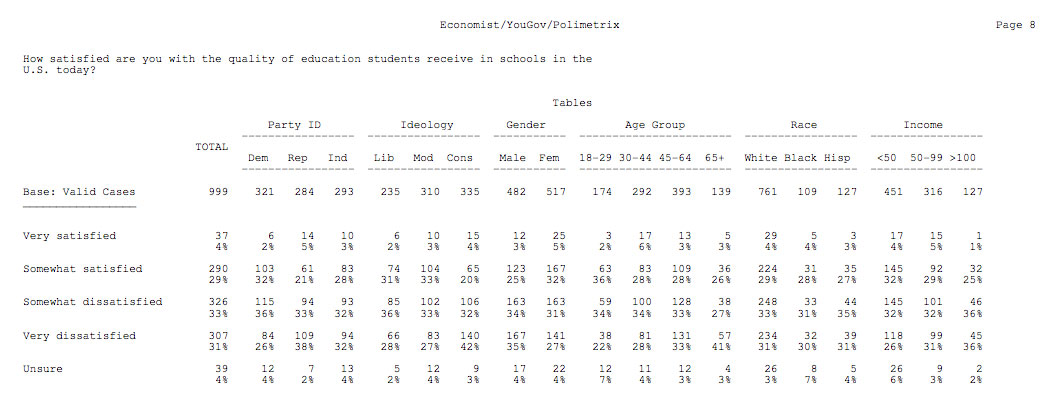
The Economist/YouGov/Polimetrix 192K PDF.
Newsletter signup | Send us your ideas
Maryland's attempts to turn around its worst schools in the past several years have largely failed, according to a report by a Washington-based nonprofit education research group.Of the 76 schools labeled failing for at least five years, only 12, or 16 percent, have improved significantly since 2004, the Center on Education Policy found.
"Even in an advanced state like Maryland, that has tried to deal with these problems for a decade ... we just don't know what to do," said Jack Jennings, president of CEP.
Newsletter signup | Send us your ideas
Milwaukee Journal-Sentinel Editorial:
It's exhausting work, the pay is low, the fruits of the labor are sometimes hard to see. But those facts haven't discouraged thousands of America's brightest college students from applying to work for the fast-growing non-profit Teach for America.Wisconsin's most troubled urban school districts might benefit from this program, in which new graduates from some of America's most prestigious universities spend two years teaching in low-income schools.
State education officials, local administrators and the teachers unions should make reasonable accommodations so that no artificial barriers prevent the program from being launched in Wisconsin. The Kern Family Foundation of Waukesha, which has education reform as part of its mission, is pushing to bring Teach for America to the state.
Teach for America grew out of a senior thesis by founder Wendy Kopp at Princeton University. During its first year in 1990, the organization sent 500 people into six low-income communities. This year, 5,000 TFA teachers are working across the country, and the TFA alumni network numbers thousands more.
Teach for America recruits and trains recent graduates from schools like Dartmouth, Princeton, Notre Dame, Marquette and the University of Wisconsin-Madison. The 2007 class has 43 UW alumni; nearly 500 from Wisconsin's public and private schools have participated since the program's inception. TFA trains the new teachers and helps them obtain alternative certifications; the schools pay their salaries.
Newsletter signup | Send us your ideas
Jesus Reyes, a fifth-grader at Dodge Elementary School, stands in front of a green piece of fabric in the school's library, reading a script he wrote about last week's Grand Island sewer emergency.Anne Eisenberg:As the camera on a MacBook laptop records him, an image on its screen replaces the fabric with photos Jesus took on a trip to the city's wastewater plant this week.
Later, a classmate, Dayne Jaros, records an introduction to Jesus' piece, handing his Internet viewers off to "our on-the-spot reporter, Jesus."
The end result, an audio and video broadcast accessed over the Internet, is miles beyond kids fiddling around with their parents' video camera for a school project.
In fact, increasingly elaborate podcasts like Jesus and Dayne's are giving several area schools a medium for largely self-directed projects that provide a whole new realm to bring writing, reading and listening skills to life.
With podcasts, "learning becomes more than just a grade in the gradebook," said Jamey Boelhower, who teaches English at Centura public school near Cairo. "It matches the culture and the world they're growing up in."
At Lincoln Elementary School, about a dozen students are working on a range of podcasting projects, most of them with only basic staff instruction, said Maura Hendrickson, the school's integration specialist.
These days, students who miss an important point the first time have a second chance. After class, they can pipe the lecture to their laptops or MP3 players and hear it again while looking at the slides that illustrate the talk.At least two companies now sell software to universities and other institutions that captures the words of classroom lectures and syncs them with the digital images used during the talk — usually PowerPoint slides and animations. The illustrated lectures are stored on a server so that students can retrieve them and replay the content on the bus ride home, clicking along to the exact section they need to review.
When it’s time to cram, the replay services beat listening to a cassette recording of a class, said Nicole Engelbert, an analyst at Datamonitor, a marketing research company in New York.
“Students already have an iPod and they already use them all the time,” she said. “You don’t need to train them.”
Professors who know less than their students do about MP3 players won’t be at a disadvantage, because the systems require little technical skill to operate. “The best lecture-capture solutions simply require the speaker to turn on a mike and push a button to start the recording,” she said. “They are simple to use.”
Newsletter signup | Send us your ideas
Along with the Christmas trees and family gatherings, there's another end-of-the-year ritual in Oakland - a candlelight vigil for the murdered.The body count is woven into the civic consciousness here - a number chased by homicide inspectors, studied by criminologists, lamented in churches, reported by journalists. Every mayor leaves City Hall on broken promises to quell the violence, and the killings continue. An additional 115 have been killed this year, putting Oakland on pace for another gruesome record.
In the last five years, 557 people were slain on the city's streets, making Oakland the state's second-most murderous city, behind Compton.
Most victims are young, black men who are dying in forgotten neighborhoods of East and West Oakland.
A handful of their killers, speaking from prison, describe an environment where violence is so woven into the culture that murder has become a symbol of manhood.
Newsletter signup | Send us your ideas
Metro Schools Director Pedro Garcia's legacy as an idea man has hit a snag.The school chief once enjoyed strong support for his ideas on reforming Nashville's public education. But after Metro failed to meet No Child Left Behind requirements for four years in a row — one of the first two Tennessee districts to do so — state officials have a louder voice in how the district is run.
And its leaders are listening.
Board members want to take the state's advice and hold off on Garcia's new ideas until the district gets a handle on the basics. The attitude marks a significant shift in the dynamic between the board, the director and the state Department of Education.
"Some things have come back to haunt us," said District 7 board member Edward Kindall, who represents north Nashville. "I can't totally blame Dr. Garcia or the administration. I think in some instances, we haven't focused on the right thing."
Amid the innovations, many of Metro's students have been struggling to learn math and reading. Poor reading scores among Hispanic and black students and dismal math scores across the county prompted the failing marks under No Child Left Behind.
"Clearly the administration has tried to make a lot of big splashes with their innovation, but they haven't always given a lot of thought to what they're doing," said Erick Huth, president of the Metro Nashville Education Association, the teachers union.
Newsletter signup | Send us your ideas
A generation after America decided to get tough on kids who commit crimes – sometimes locking them up for life – the tide may be turning. States are rethinking and, in some cases, retooling juvenile-sentencing laws. They’re responding to new research on the adolescent brain and studies that indicate teens sent to adult court end up worse off than those who are not: They get in trouble more often, they do it faster and the offenses are more serious. Some states are reconsidering life without parole for teens. Some are focusing on raising the age of juvenile court jurisdiction, while others are exploring ways to offer kids a second chance, once they’re locked up – or even before. "There has been a huge sea change...it’s across the country," said Laurie Garduque, a program director at the MacArthur Foundation, which is heavily involved in juvenile justice reform.
Newsletter signup | Send us your ideas
Wisconsin State Journal Editorial:
The state Court of Appeals just handed the Legislature an important assignment:Update state laws governing public education to take advantage of the opportunities presented by online learning in virtual schools.
Lawmakers should dig into the homework, starting now.
Virtual schools, which deliver coursework via computer to educate students in their homes, have great potential as a cost-effective alternative to standard schools.
But last week the District 2 Court of Appeals in Waukesha put the future of virtual education in Wisconsin in doubt.
The court ruled that the Wisconsin Virtual Academy based in suburban Milwaukee violates state laws controlling teacher certification, charter schools and open enrollment.
The three-judge panel also put the academy in a financial bind by ordering the state to stop paying for students who attend the academy when those students are not residents of the local school district.
Newsletter signup | Send us your ideas
There are more and more groups of professionals who are committed to making information freely available to the public through the Internet. Many universities and scientists are willing to share their lectures and expertise. Instructional videos are available for students of all ages—elementary through graduate school.SciVee is operated in partnership with the Public Library of Science (PLoS), the National Science Foundation (NSF) and the San Diego Supercomputer Center (SDSC). It has a relatively new Web site that contains some material for elementary students and larger quantities of material for older students through scientists. Young people who are interested in careers in science will be fascinated by the various topics being studied. Just seeing what is going on at different universities may help students focus on their future objectives.
Examples of videos available at the sight include Where Does Water Go When It Rains? Dissections, and Freezing by Boiling. There is also much information on highly sophisticated topics that will be appealing for highly able high school students.
Newsletter signup | Send us your ideas
What is the rationale for all United States high students passing three advanced courses in math and science to receive a high school diploma? What is the rationale for "all" high school graduates satisfying the requirements for admission to a four-college program? There is none!The United States is the uncontested leader of the world in scientific research in respect to published accomplishments, Nobel Prizes, volume of research and expenditures on scientific research. The United States is the leader of the world in technology and the unchallenged leader of the world in the global economy. The United States dominates the world because of its educational systems, including K-12 public education, post-secondary colleges and universities that produce the most highly educated, productive and successful workforce in the world.
Newsletter signup | Send us your ideas
Milwaukee Journal-Sentinel Editorial:
Wisconsin kids may be locked out of the virtual schoolhouse after a state Court of Appeals decision Wednesday that threatens the future of online learning for public schoolchildren. But the Legislature can fix the problem by crafting a law that makes clear that the state supports such alternative and innovative means of instruction.Patrick McIlheran:.........
Virtual schools offer parents a credible alternative for students who don't do well in traditional settings. Judging from 2006 Wisconsin Knowledge and Concepts Examination scores, the kids attending Wisconsin Virtual Academy are thriving. They score at or above the state average in most subjects at nearly every grade level.
This sort of competition, also seen in the Milwaukee Parental Choice Program, has the potential to improve education in Wisconsin. The Legislature, as well as state Superintendent Elizabeth Burmaster, must embrace such innovation instead of shrinking from it.
"They could learn a lot from our teachers about a new way of teaching," Rose Fernandez told a radio interviewer.She's a parent at Wisconsin Virtual Academy, the Fredonia-based online public charter school. She was talking about the Wisconsin Education Association Council, the state teachers union whose slogan is, "Every kid deserves a great school."
WEAC, not in a learning mood, had just gotten a court to outlaw Fernandez's kids' great school. About 850 children who attend the school are now left hanging after Wednesday's Wisconsin Court of Appeals decision. The school will stay open while it appeals, but a further loss would endanger every virtual school in the state.
Why would the teachers union try to kill a high-performing public school?
Because, said a written statement from the union, laws written for traditional schools can't be applied to virtual schools. We need new laws to "make them accountable."
Accountable? Such as testing students and reporting results? They do that. The academy's scores on state tests are just dandy - exactly in line with schools in Cross Plains, Mukwonago and Fond du Lac that the academy families I talked to would otherwise use. Ninety-two percent of the academy's students score proficient or advanced in reading.
And if the virtual school doesn't satisfy, parents can put their kids back in the school down the block. Yet it's the virtual school that may get closed. Have you heard of the union suing to close any brick-and-mortar schools that are failing?
All irrelevant, argued the Wisconsin Department of Public Instruction. It sought, with the union, to close the academy. Whether the school successfully teaches is beside the point, said the department's lawyer. Whether it fits the state's regulatory model is what counts. The court agreed.
This makes Wisconsin unique, says Susan Patrick, who heads the North American Council for Online Learning. She used to head educational technology at the U.S. Department of Education. She says to her knowledge, no state has shut down virtual schools over a teacher licensing dispute.
Newsletter signup | Send us your ideas
Money and effort aren't enough to impart the skills and knowledge needed in a cut-throat worldSPOOKED by the effects of globalisation on their low-skilled citizens, rich countries have been pouring money and political energy into education. In the United States, it has been proclaimed that no child will be left behind. Whether this programme, launched by George Bush in 2002, has raised standards will be a big issue in the 2008 presidential election. Next year Britain will introduce ambitious new qualifications, combining academic and vocational study. For the industrial countries of the Organisation for Economic Co-operation and Development (OECD), average spending on primary and secondary schooling rose by almost two-fifths in real terms between 1995 and 2004.
Oddly, this has had little measurable effect. The latest report from the OECD's Programme for International Student Assessment shows average attainment staying largely flat. This tome, just published, compares the reading, mathematical and scientific progress of 400,000 15-year-olds in the 30 OECD countries and 27 others, covering 87% of the world economy. Its predecessors in 2000 and 2003 focused on reading and maths respectively. This time science took centre stage.
Newsletter signup | Send us your ideas
Andrew Freeman, via a reader's email:
Encouraging teens to drive safely, honor a curfew, or simply make good choices is an enormous task. However, there's something else parents should add to their list -- something that can open many opportunities for high school students: persuade them to take advanced math.Trust me. I know how hard it can be to convince high school students of the importance of taking a course they may not want, particularly when many seem to have an aversion to this subject. However, as a college admissions professional, I've seen the difficulties students experience without an adequate math background. I've seen how the lack of math skills limits their choices.
Chances are your son or daughter may not want to put down the video game remote to pick up a scientific calculator. They may even believe their deepest aspirations don't require a lot of math. However, the reality is that more than 50 percent of students change their majors at least once. So, even if the major they choose now doesn't require advanced math, the odds are good the one they pick later probably will.
And that's not the only good reason for improving math skills. In high school, you get up to 40 weeks to learn the material. In college, you get about 15. Students who enter college without the necessary math skills are often required to take non-credit skill-building courses. This extra review could mean a crammed first semester schedule or an additional semester in college.
Math doesn't have to be a teenager's nightmare. Encourage them to ask questions in class, stay for help, find a tutor, access math Web sites, take advantage of WXXI's Homework Hotline or find out if your school offers math-specific study halls.
Newsletter signup | Send us your ideas
Autistic children have more gray matter in areas of the brain that control social processing and sight-based learning than children without the developmental disability, a small study said on Wednesday.Researchers combined two sophisticated imaging techniques to track the motion of water molecules in the brain and pinpoint small changes in gray matter volume in 13 boys with high-functioning autism or Asperger syndrome and 12 healthy adolescents. Their average age was 11.
The autistic children were found to have enlarged gray matter in the parietal lobes of the brain linked to the mirror neuron system of cells associated with empathy, emotional experience and learning through sight.
Those children also showed a decrease in gray matter volume in the right amygdala region of the brain that correlated with degrees of impairment in social interaction, the study found.
Newsletter signup | Send us your ideas
Wisconsin Center for Education Research:
The Consortium for Policy Research in Education (CPRE) has documented a steady increase in per-pupil education funding in the U.S. over the past 100 years. After adjusting for inflation, education funds have risen on average about 3.5% annually. UW-Madison education professor Odden says the consistent rise in spending has not, however, been accompanied by a similar rise in student performance, at least over the past 30 to 40 years.Much more on Allen Odden. Related: K-12 Tax & Spending Climate:Current education goals are thus not likely to be met without determining how better to use school resources.
Today, about 60% of the education dollar is spent on instruction. Another 10% is spent on administration, 10% on instructional and pupil support, 10% on operations and maintenance, 5% on transportation, and 5% on food and miscellaneous items. Odden says this pattern is similar across districts, regardless of demographics and enrollment.
To align resources with strategies for improving student achievement, Odden suggests thinking of education spending as divided into three “portions”:
- One portion for core instructional services, professional development, and site administration;
- A second portion for instructional and pupil support services, which help the education system accomplish the goal of student achievement in the core subjects; and
- A third portion for overhead (school operation and maintenance, transportation, food services, and central office administration).
Newsletter signup | Send us your ideas
AT first glance, it doesn’t seem tragic that our leaders don’t study Latin anymore. But it is no coincidence that the professionalization of politics — which encourages budding politicians to think of education as mere career preparation — has occurred during an age of weak rhetoric, shifting moral values, clumsy grammar and a terror of historical references and eternal values that the Romans could teach us a thing or two about. As they themselves might have said, “Roma urbs aeterna; Latina lingua aeterna.”*None of the leading presidential candidates majored in Latin. Hillary Clinton studied political science at Wellesley, as did Barack Obama at Columbia. Rudy Giuliani had a minor brush with the language during four years of theology at Bishop Loughlin Memorial High School in Brooklyn when he toyed with becoming a priest. But then he went on to major in guess what? Political science.
How things have changed since the founding fathers.
Newsletter signup | Send us your ideas
The kids at St. Peter's School have started asking questions, and like any good first-grade teacher, Colleen O'Dwyer is a master of deflection."I tell them nothing's been decided," she was saying, as she and Courtney Carthas, a second-grade teacher, sat with seven kids for the after-school book club.
Technically, that's true, as the final decision to close the Dorchester parochial school has not been made by Cardinal Sean O'Malley. But the stars and the numbers are aligned against St. Peter's, and it is only a matter of time.
To describe St. Peter's as a victim of consolidation in an archdiocese trying to stem a decline in enrollment in its urban schools is to completely miss the importance of the building and those who people it. Sitting on Bowdoin Street, at the foot of Meetinghouse Hill, St. Peter's is more than a school. It is a haven, a sanctuary, four stories of red-brick proof that all is not lost in one of the city's toughest neighborhoods.
St. Peter's has 156 students, but with its after-school programs serves about 400 children who live around Meetinghouse Hill. One of them is Alaister Santos, a chatty, personable first-grader. When they were preparing to commemorate the first anniversary of the death of the great Barry O'Brien, the school's biggest private benefactor, Alaister had only one question: "Where was he shot?"
Newsletter signup | Send us your ideas
From ACM Technews
MIT recently announced the completion of its OpenCourseWare project, a pioneering effort launched in 2002 to digitize classroom material for all of MIT's 1,800 academic courses. The course material is available for free online for anyone to use.
At the completion celebration on the MIT campus in Cambridge, Mass., university President Susan Hockfield announced a new portal for OCW, one specifically designed for high school teachers and students, called "Highlights for High School." The portal's home page provides MIT's introductory science, engineering, technology, and math courses, with lecturer's notes, reading lists, exams, and other classroom information. The OCW resources, including video-taped labs, simulations, assignments, and hands-on material, have been specifically tailored to match the requirements of high school Advanced Placement studies.
Since its launch five years ago, the data on usage has been impressive. On a 50-course pilot site, an estimated 35 million users logged in, with about 15 percent being educators, 30 percent students, and the rest being what MIT calls "self learners" with no education affiliation, says OCW's Steve Carson. The recently formed OCW Consortium has 160 member institutions creating and sharing their own course materials sites based on MIT's model.
One of the most surprising findings is that two of MIT's course videos, "classical mechanics" and "differential equations," ranked in iTunes top 10 videos, at number three and number seven, respectively. "This expresses, to me, the hunger in this world for learning, and for good learning materials," says Hockfield.
OCW Consortium
Network World Article
MIT Open Courseware For High Schools
Newsletter signup | Send us your ideas
Court Opinion.
Wisconsin Coalition of Virtual School Families Statement
WEAC (Wisconsin State Teachers Union)
Wisconsin Department of Public Instruction Statement
Top Wisconsin Lobbyists (2005-2006 Legislative Session) via the Wisconsin State Ethics Board (1.7MB PDF):
Wisconsin Manufacturers & Commerce $1,591,931Much more on the Wisconsin Virtual Academy here.
Wisconsin Education Association Council $1,533,186
Wisconsin Hospital Association Inc (WHA) $1,532,927
Wisconsin Independent Businesses Inc $1,103,747
Wisconsin Merchants Federation $1,088,632
Wisconsin Farm Bureau Federation $1,084,664
Forest County Potawatomi Community $860,260
Arjo Wiggins Appleton Limited $843,677
Wisconsin Insurance Alliance $755,313
Wisconsin Energy Corporation $722,367
Wisconsin Counties Association $720,284
A virtual school based in the Northern Ozaukee School District plans to appeal a court ruling that it violates several state laws and ask for a stay of an order that would prevent it from receiving payments for non-district students enrolled at the school.Rick Esenberg:The ruling against Wisconsin Virtual Academy "threatens every online school program in Wisconsin," WiVA Principal Kurt Bergland said. "There's thousands of kids and teachers and families in all those schools that are now involved with this, whether they realize it or not."
The decision by the District 2 Court of Appeals in Waukesha, which was released today, overturns a previous decision by an Ozaukee County judge.
"As the law presently stands, the charter school, open-enrollment and teacher certification statutes are clear and unambiguous, and the District is not in compliance with any of them," Judge Richard Brown wrote on behalf of the three-judge panel that decided the case.
There were three issues. The first two had to do with where the school was located and where the children attend. State law requires that the answer to both questions be the district that chartered the school, Northern Ozaukee. The school's administrative offices are located there but its teachers work from home around the state and the students, who do their work at home, also live in various locations. The Court of Appeals held that the district is, literally, located wherever its teachers live and that its students attend at wherever their home happens to be. You can read the statute that way, but that reading is by no means compelled. It seems just as plausible to say that the school is located, and children attend, at the location where the administrative offices are located.
Newsletter signup | Send us your ideas
Improvement in math and science education is a priority in Madison, as it is across the nation.Links:Science, technology, engineering and math (STEM) training is not only of growing importance to our technology-dependent society, these disciplines also represent esthetically compelling advances in human knowledge that all students should have the opportunity to appreciate.
Since 2003, UW Madison and the Madison School District have been involved in a unique partnership, funded by the National Science Foundation, to reform science and math education from kindergarten through graduate school.
Preliminary results are encouraging. This five-year endeavor, SCALE -- System-wide Change for All Learners and Educators -- has partners that include three universities and large school districts in Madison, Los Angeles, Denver and Providence, R.I. The NSF made exploring new forms of partnership its key feature.
Improving STEM education has proven resistant to traditional "you do your thing, I 'll do mine " approaches. SCALE 's successes underscore the wisdom of NSF 's emphasis on partnership.
SCALE incorporates research on student learning and teacher professional development. SCALE puts premiums on increasing teachers ' STEM subject matter knowledge and boosting their teaching skills.
In one preliminary study, teachers showed a significant increase in content knowledge after attending SCALE science professional development institutes in Los Angeles.
SCALE partners believe the most important resource in a school is its teachers, an idea that has not always been central to reform. However, the final measure of effectiveness is increased student understanding and performance. In 2009-2010, a randomized study involving 80 elementary schools in Los Angeles will provide definitive data on SCALE 's impact on student performance in science.
In Madison, SCALE teams of district math teachers and UW-Madison faculty have designed and provided content and in-service teacher professional development institutes. Each institute focused on a set of key concepts in middle school mathematics.During 2004-06, these teams presented 19 workshops involving about 425 attendees. Teachers showed significant gains in math content knowledge, allowing them to create better learning environments in their classrooms, and UW faculty benefited from these experiences. Due to the success of this program, it has been adapted and extended to elementary mathematics and middle school science.
We also must attend to the preparation of future teachers at our universities, and to the "gateway " courses, such as calculus, for students aspiring to STEM-related occupations.
SCALE has been supporting partnerships to explore improvements in these areas at our three universities. For example, SCALE is helping cross institutional and cross-disciplinary committees in the redesign of UW math and science teacher content courses at the elementary and middle school level.
The primary SCALE lesson is the importance of meaningful, imaginative partnerships. To quote Benjamin Franklin: We must all hang together, or assuredly we shall all hang separately.
Millar is a mathematics professor and associated dean of the graduate school at UW-Madison.
Newsletter signup | Send us your ideas
All are invited to the monthly meeting of the HOPE (Having Options in Public Education) meeting on Wednesday, 12/12, 6:30-8:00pm at Escape Coffee House, 916 Willy St. [Map] Featured will be brief presentations by UW Professor John Witte regarding recent research on school choice and charters, and Bryan Grau of Nuestro Mundo Community School regarding what the NMCS Board has learned navigating MMSD.
Name Lauren Cunningham
E-mail: cunningham.lauren@sbcgobal.net
Telephone 221-9338
Newsletter signup | Send us your ideas
U.S. Students Fall Short in Math and Science
Teenagers in a majority of industrialized nations taking part in a leading international exam showed greater scientific understanding than students in the United States—and they far surpassed their American peers in mathematics, in results that seem likely to add to recent consternation over U.S. students’ core academic skills.
New results from the 2006 Program for International Student Assessment, or PISA, released today, show U.S. students ranking lower, on average, than their peers in 16 other countries in science, out of 30 developed nations taking part in the exam.
Newsletter signup | Send us your ideas
On Dec. 13, The Washington Post will mark the 10th year of the Challenge Index, my high school rating system, with our latest ranked list of all 185 public schools in the Washington area. Since 1998, Newsweek magazine also has been publishing its national best high schools list using the same method.I am particularly excited this time because we have some competition. U.S. News & World Report, at the urging of Andrew J. Rotherham, my friendly adversary on this issue, has just published its own "America's Best High Schools" list at usnews.com. I have long celebrated what I call the School Rating Scoundrel's Club, composed of those of us who think that rating and ranking -- despite their many critics -- are useful ways to help readers figure out which schools are best for them. I admire the U.S. News college rankings and am intrigued by its new high school list. It is strengthened by Rotherham's commitment to improving schools, but it is also too complicated for its own good.
The Challenge Index rates and ranks schools by just one number, the college-level test participation rate, calculated by dividing the number of Advanced Placement, International Baccalaureate or Cambridge tests -- college-level exams given in high school -- by the number of graduating seniors. The U.S. News list mixes together several numbers. It looks for schools in the 40 states for which it has data whose average state test scores exceed statistical expectations and whose minority proficiency rates exceed state averages for those groups. Schools that survive that initial screening are then ranked based on a weighted formula that includes both AP test participation and AP test scores.
The essential differences between the two ways of ranking reflect the differences between Rotherham and me. Only 36, Rotherham has served as an education adviser to President Bill Clinton, has founded two education policy and research organizations and is a member of the Virginia Board of Education, the youngest appointee to that board in modern times. He is a policy maker. His high schools list is based on key factors in the policy process: test scores, minority achievement and college readiness as measured by AP participation and success. U.S. News and the statisticians at Standard & Poor's, led by Paul Gazzerro, the director of analytical criteria for School Evaluation Services, have compiled the list using a basic policy-making tool--data collected each year by state government
Newsletter signup | Send us your ideas
Girls won top honors for the first time in the Siemens Competition in Math, Science and Technology, one of the nation’s most coveted student science awards, which were announced yesterday at New York University.More here.Janelle Schlossberger and Amanda Marinoff, both 17 and seniors at Plainview-Old Bethpage John F. Kennedy High School on Long Island, split the first prize — a $100,000 scholarship — in the team category for creating a molecule that helps block the reproduction of drug-resistant tuberculosis bacteria.
Isha Himani Jain, 16, a senior at Freedom High School in Bethlehem, Pa., placed first in the individual category for her studies of bone growth in zebra fish, whose tail fins grow in spurts, similar to the way children’s bones do. She will get a $100,000 scholarship.
The three girls’ victories is “wonderful news, but I can’t honestly say it’s shocking,” said Nancy Hopkins, a biologist at the Massachusetts Institute of Technology.
Newsletter signup | Send us your ideas
It's too bad Los Angeles Unified School District officials didn't make the first assignment for their new spin doctors spinning the news that they've hired spin doctors.The district's fledgling public relations effort stumbled this week, when news leaked out that Supt. David Brewer handed out contracts worth more than $350,000 a year to a team of consultants charged with improving the district's public image.
Team leader and former Telemundo news director Victor Abalos says he's a not PR man, but a broker of "communication strategies" for "target audiences" that will help the district get its good news to a disenchanted public.
Newsletter signup | Send us your ideas
Almost all Latino adults born in the United States to immigrant parents are fluent in English, but among their parents, just fewer than 1 in 4 say they are skilled English speakers, according to a report released Thursday by the Pew Hispanic Center in Washington, D.C."The ability to speak English very well and the amount of English used increase sharply from one generation to another among Hispanics," said one of the report's authors, D'Vera Cohn. "The first generation speaks mainly Spanish and doesn't speak English very well. The second generation speaks English very well but holds onto its Spanish. And by the third generation and beyond, English is universal and pervasive, and Spanish fades into the background."
The results of the study are intuitive, but at a time of high levels of immigration and a debate over how well immigrants are integrating into American society, it provides a detailed snapshot of English acquisition over generations among Latino immigrants, who comprise the majority of foreign-born people residing in the United States.
Newsletter signup | Send us your ideas
AP:
An ongoing study done by the University of Oklahoma Health Sciences Center is examining how parenting and other factors affect the long-term behavior of teenagers.The "youth asset study" is being funded by the federal Centers for Disease Control and Prevention. Researchers are looking at how 17 "assets," including parental involvement and religion, factor into teenage behavior.
During the past five years, researchers have interviewed 2,200 Oklahoma City-area children and their parents, looking into risky behaviors and the level of parental involvement. The goal of the $4 million study is to determine which assets strongly correlate with well-adjusted teens and, conversely, those assets that don't seem to affect teens involved in activities including drug use and sex.
"The most important analysis will be to see how these (behaviors) change over time ... and how the presence or absence of assets contributes to those changes," said principal investigator Roy Oman, an associate professor at the OU College of Public Health.
Newsletter signup | Send us your ideas
The science of early childhood development is as persuasive as the science of global climate change. Today, both challenges urgently call for a transformative politics.
Newsletter signup | Send us your ideas
As all of you are well aware, one of the most vexing issues facing public education today is funding and 14 years of revenue controls that have been placed on Wisconsin schools, causing on-going erosion in programs and services.
On Thursday, December 6, 7:00-9:00 PM, 1919 Alliant Energy Center Way, Alliant Energy Center, Madison [Map], a community forum sponsored by the Wisconsin Way will be held to discuss the issue of taxation and public investment.
The Wisconsin Way is a non-partisan, grassroots effort to create a fair and equitable funding system that promotes excellence in education and public service. Area residents with different viewpoints are being invited to come together for a public conversation on taxes and possible solutions to the challenges we face in protecting and preserving Wisconsin?s quality of life and our great schools.
To learn more about Wisconsin Way, you can the website: http://www.wisconsinway.org
We are attempting to get a head count for turnout, so if you think you might attend, please contact me (even at this late date).
Also, if you have questions, don?t hesitate to contact me. Friends and neighbors are welcome as well.
Thanks much for your consideration.
Jeff Leverich leverichj@weac.org Telephone 608 276-7711
Newsletter signup | Send us your ideas
The students with the highest Advanced Placement exam scores in Wisconsin are both graduates of Marshfield High School.
Noah Elmhorst and Jamie Robertson, Wisconsin 's 2007 Advanced Placement state scholars, were to be recognized at a ceremony at the school, Assistant Principal Elizabeth Dostal said last week.
"We have had past AP State Scholars, but we have never had the top male and the top female in the same year, " Dostal said. "We were just pleasantly surprised. "
Marshfield High has 1,385 students and offers 23 AP classes, Dostal said. Elmhorst took 17 of the advanced classes, while Robertson took 13, she said.
Statewide, 25,020 Wisconsin students took 39,811 AP exams in the 2006-2007 school year. More than 68 percent of those students earned a grade of three or higher.
Nationwide, more than 1.4 million high school students took more than 2.5 million AP exams in 2007.
Newsletter signup | Send us your ideas
Black students in Montgomery County high schools passed 1,062 Advanced Placement tests this year, making the school system the first, along with the New York City public schools, to cross the thousand-test threshold.Superintendent Jerry D. Weast announced the results yesterday at a news conference. He challenged education leaders to engage in a "friendly competition" to increase AP participation among black students, who remain underrepresented in the college preparatory program.
In the District, the number of AP exams taken by black students rose by nearly 50 percent, though the number of passing scores rose only slightly, the school district reported.
Black students in Prince George's County took 740 more tests than they did last year, a 34 percent increase, and about 100 more exams received passing marks. AP performance among black students in Fairfax County was essentially unchanged.
Montgomery, Fairfax and most other D.C. area school systems have posted tremendous gains in AP testing in this decade, part of a vast expansion nationwide in college-level course work in high schools. Although most school systems remain focused on overall AP results, some districts have publicly campaigned to raise the performance of black students.
Newsletter signup | Send us your ideas
Via a reader's email:
LVM Dreams Big is working to bring the FIRST Boundless Playground to the state of Wisconsin by 8/8/08!December 4th 5:30-7:30 Great Dane Night! Spend an evening at the Great Dane Brew Pub [Map] - free food, fun and a very special guest! Donation Stations will also be available to help build the FIRST Boundless Playground in the state of Wisconsin!Join our effort to kick down physical barriers and raise a play structure that opens a world of play to all children.
Please help us build the dream so that children of all abilities can reach the highest heights and learn the lessons of childhood through play.
Since forming in 2005, the committee has worked to raise funds to support the mission of improving accessibility while also promoting physical fitness and increasing safety for all children.
Newsletter signup | Send us your ideas
Rose Fernandez, via a reader's email:
On Tuesday of this week, in a Waukesha courtroom, the state governmental agency responsible for our public schools and a labor union came before the Wisconsin Court of Appeals and pleaded with the judges to keep parents out of public schools. Yes, that's right. The state and the teachers union are at war with parents and I'm mad as heck about it. (Madder than heck, actually, but trying to keep this blog family friendly).This issue was discussed extensively by Gregg Underheim during the most recent Wisconsin DPI Superintendent race (April, 2005). Audio / Video here.According to the Department of Public Instruction and the state teachers' union, parents are the problem. And these bureaucracies know just how to fix it. They want to keep parents, and indeed anyone without a teaching license, out of Wisconsin public schools.
Of course WEAC, the state teachers' union, likes that idea. Licenses mean dues. Dues mean power.
DPI likes it because ........well, could it be just because WEAC does?
The lawsuit before the Court of Appeals was filed by WEAC in 2004 in an effort to close a charter school that uses an on-line individualized curriculum allowing students from all over the state to study from home under the supervision of state certified faculty. The school is the Wisconsin Virtual Academy (WIVA). The Northern Ozaukee School District took the bold step of opening this new kind of school in the fall of 2003 after DPI approved their charter. Hundreds of families around the state enrolled their children under open enrollment that first year and mine was one of them. WIVA has grown every year since and this year has more than 800 students.
In January of 2004, WEAC filed their lawsuit against the school and DPI who authorized its existence. Later that year in a stunning reversal DPI switched sides and moved to close its own public school. DPI alleges that parents are too involved in their own children's education.
That's right. They argue parents are too involved.
I've always thought parental involvement in a child's education was a good thing. What do I know? I don't have a teacher's license.
Much more on the Wisconsin Virtual Academy. Also check out www.wivirtualschoolfamilies.org.
Newsletter signup | Send us your ideas
In this education nirvana, teachers would decide what to teach and when. Teachers and parents would hire and fire principals. No supervisors from downtown would tell anyone -- neither teachers nor students -- what to wear.These are among the ideas a delegation of teachers and their union officers are urging L.A. schools Supt. David L. Brewer to include in the school reform plan he will present to the school board Tuesday.
If Brewer passes on the delegation's proposals, the union can go directly to the seven-member Board of Education. Employee unions recently have had success in getting the board to overrule the superintendent on health benefits for some part-time workers and on school staffing.
At stake now is the Los Angeles Unified School District's effort to turn around its 34 most troubled middle and high schools. The data suggests the urgency: As many as three-quarters of the students in these "high priority schools" scored well below grade level across multiple subjects on last year's California Standards Tests.
Whatever remedy emerges is likely to become a blueprint for widespread reform efforts. Brewer and his team are working on their 11th draft; the drafts have evolved significantly since September because of resistance inside and outside the school system.
Newsletter signup | Send us your ideas
Providing day care was once seen as a way to get low-income parents into the workforce, but now, using child care to pull future generations out of poverty is capturing the imagination of government and businesses alike.
From St. Paul's North End to north Minneapolis to Wayzata to Blue Earth County, a number of projects aim to get more daycare workers introducing 3- and 4-year-olds to what they'll be learning in kindergarten."Right now, we've got about 50 percent of our kids not ready for kindergarten," said state Sen. Tarryl Clark, DFL-St. Cloud. "For many families, child care is today's preschool. And with very high percentages of parents working, we can make a difference here."
Newsletter signup | Send us your ideas
Jacob, a former Issaquah student with severe disabilities, used to love it when other students visited his special-education classroom.His mother said it helped him learn how to talk to other kids.
So when Jacob, who has been diagnosed with autism and mental retardation, went to live at the state-run Frances Haddon Morgan Center in Bremerton, his mother expected similar success. For years, school-aged Morgan Center residents had attended Bremerton public schools.
But this year the district decided it no longer has the classroom space to accommodate them. Recently, the district reached an agreement with the state Department of Social and Health Services, which runs the Morgan Center, to open a classroom on the institution grounds.
On Wednesday, Disability Rights Washington filed a lawsuit saying that taking these youths out of public school violates state and federal laws against discrimination.
The lawsuit, filed on behalf of eight youths ranging in age from 14 to 20, names the school district, the state Office of Superintendent of Public Instruction and DSHS as defendants, saying each played a role in the decision.
Newsletter signup | Send us your ideas
MY life’s greatest sorrow stems from my inability to feel close to other women. At 41, I’ve cautiously cultivated a few cherished female friendships. But generally I feel a kind of skittish distrust and discomfort when dealing with most women, particularly women in packs.......
I want to remain optimistic. After all, here I am with three daughters. What am I to teach them? Cautionary tales about men’s harmful proclivities abound. But how do we help our girls navigate the duplicitous female maze? How do we ensure that they behave authentically, respect humanity over fleeting alliances, and squash the nasty tribal instincts that can inflict lifelong distress?
Newsletter signup | Send us your ideas
We can hardly get anyone to apply to teach at our school.The crowd of about 400 Milwaukee Public Schools principals and administrators had gathered in late August for the annual school year kick-off program. Superintendent William Andrekopoulos was taking questions.
The voice - we're paraphrasing his longer statement - belonged to James Sonnenberg, veteran principal of Westside Academy, a 650-student kindergarten through eighth-grade school in two buildings near N. 35th St. and W. Lisbon Ave. Westside is one of the more successful schools in MPS, with a dedicated staff and eighth-grade test results well above the district average.
But Sonnenberg told Andrekopoulos how few applicants he gets for openings at his school, how he had to push the central office to give him names of candidates to fill a teaching position last summer, how he offered a job to one woman who said she would have to check with her father about working there, and how he never heard back from her.
Newsletter signup | Send us your ideas
Wisconsin has the worst black/white achievement gap in the country. The Milwaukee Public Schools have big truancy, security and parental apathy problems. The system graduates about 50% of its students. How hard can it be to graduate from MPS with D's, yet half don't? Encounter an illiterate adult, and it'll break your heart.You'd think parents, the education establishment and politicians would be running around like their hair was on fire, but they're not even cutting their bangs.
Don't look to the teachers union for answers. They're advocates for teachers, not kids. They just go with the slogan "Every kid deserves a great school" because it has a better ring to it than "We want more money." The slogan also implies that they think MPS is great. They will even protect some bad teachers.
Newsletter signup | Send us your ideas
Assistant school superintendents here are routinely summoned to a 10 a.m. Thursday meeting where they must answer for missing test scores, overdue building repairs and other lapses, which are presented in painful detail on PowerPoint slides. Excuses are not an option.It is the latest evolution of Compstat, a widely copied management program pioneered by the New York Police Department in 1994. Paterson is one of a half-dozen school districts around the country that have embraced this confrontational approach, known here as SchoolStat, in an effort to improve school performance and overhaul bureaucracies long seen as bloated, wasteful and unresponsive to the public.
SchoolStat borrows the tactics of the Compstat program — regular, intense meetings in which police officials famously pick apart crime data and, just as often, their subordinates — to analyze police performance and crime trends, and to deploy resources to trouble spots. The school version taps into an ever-expanding universe of data about standardized testing and school operations to establish a system of accountability.
In Maryland, the process has been credited with reducing teacher vacancies and increasing student immunization rates in Baltimore schools. In Montgomery County, Md., it has pushed principals to come up with strategies like encouraging students to take the Preliminary SAT by offering a free pancake breakfast if they attend.
Newsletter signup | Send us your ideas
When I took my first serious history course in college, the president of the university (a history buff himself) spoke to our class and encouraged us to submit our papers to various journals for publication. Being rather inexperienced, it had never occurred to me to submit anything I had ever written to anyone for publication. In my mind, I was "just" a student and couldn't imagine anyone being interested in what I wrote.
Now it is possible not only for serious college students to publish their work, but it is also possible for serious high school history students to publish the papers that they have researched. The Concord Review gives young people this opportunity. The Review is the only quarterly journal in the world to publish the academic expository research papers of secondary history students. Papers may be on any historical topic, ancient or modern, foreign or domestic.
Many of these young authors have sent reprints of their papers along with their college application materials. Their research has helped them to gain admission to some of the nation's (and world’'s) best universities.
High school teachers also use The Concord Review in their classes to provide examples of good historical writing. What a wonderful opportunity for students to see the work of age peers who have taken their work seriously.
Included on The Concord Review Website [www.tcr.org] are over 60 sample essays for both students and teachers to view so they can get an idea of the quality of work accepted.
At this site, you will also find information about The National Writing Board, an independent assessment service for the academic writing of high school students of history. Each submission is assessed by two readers who know nothing about the author. These readers spend more than three hours on each paper. Three-page evaluations, with scores and comments, are then sent, at the request of the authors, to Deans of Admissions at the colleges to which they apply.
http://resources.prufrock.com/GiftedChildInformationBlog/tabid/57/Default.aspx [RSS]
Newsletter signup | Send us your ideas
Late one spring afternoon last year, a mystery man sat in the back of a creative-writing seminar at Stanford. Evidently a student, he was much older than anyone else in the room. He was wearing a black blazer and white Nikes. He said his name was Phil.As the days passed, the man's identity gradually came into focus. The instructor "made several vague allusions to Phil taking off in his private jet," recalls André Lyon, an English major enrolled in the class. And tales about Michael Jordan found their way into the man's literary discourse.
After a couple of weeks, a rumor began to circulate that the old dude in the Nikes was Philip H. Knight, the billionaire founder of the world's largest sportswear company.
Newsletter signup | Send us your ideas
In her final year at James Hubert Blake High School in Silver Spring, Amber Rountree chose to take consumer math, a course designed to teach students how to balance a checkbook and shop for a home loan. She rates it the easiest math class she has taken in high school but also the most useful.Once a common course offering, consumer math is being phased out as school systems raise their expectations of how much math students should know when they graduate. Twenty or 30 years ago, Algebra I might have sufficed. Today, that course is regarded as an absolute minimum, a gateway to Advanced Placement study and college. Students routinely take it in middle school.
That leaves consumer math and other "checkbook math" classes relegated to a handful of schools, mostly in poor communities. College-bound students generally avoid the class, reasoning that it would look bad on a transcript.
"In a lot of places, this course has been a dead-end street," said Francis "Skip" Fennell, president of the National Council of Teachers of Mathematics in Reston.
The gradual elimination of the course from high schools comes as lawmakers, corporate leaders and many parents are decrying the financial illiteracy of the young. Fourteen states, including Virginia, have created new mandates for personal finance
Newsletter signup | Send us your ideas
When today's college graduates get together for a reunion someday, they may decide to do it by computer. That's because right now, nearly one in five college students takes at least one class online, according to a new survey.For professors, the growth of e-learning has meant a big shift in the way they deal with students.
Take professor Sara Cordell of the University of Illinois-Springfield: Her day doesn't end at 6 p.m., as it does for some college professors.
Cordell sits at her computer in her campus office to chat with a half-dozen students gathered in front of their screens: One is in Tennessee, another in California's central valley, another in Ohio. They're all here to talk about Thomas Hardy's 19th-century novel Tess of the D'Urbervilles.
Newsletter signup | Send us your ideas
As Jackie Robson rushed off to Japanese 101, a pink sign on the main door of her college dorm reminded her to sign out. There were more rules: an 11 p.m. curfew, mandatory study hours, round-the-clock adult supervision and no boys allowed in the rooms.Jackie is 14. She never spent a day in high school.
Like the other super-bright girls in her dorm, the Fairfax County teen bypassed a traditional education and countless teenage rites, such as the senior prom and graduation, to attend the all-female Mary Baldwin College in the Shenandoah Valley.
The school offers students as young as 12 a jump-start on college in one of the leading programs of its kind. It also gives brainy girls a chance to be with others like them. By all accounts, they are ready for the leap socially and emotionally, and they crave it academically.
Last spring, Jackie finished eighth grade at Langston Hughes Middle School in Reston. This fall, she's taking Psychology 101, Japanese 101, English 101, Folk Dance and U.S. History 1815-1877: Democracy and Crisis.
Newsletter signup | Send us your ideas
East Valley school districts are preparing for sweeping changes in the way they are required to teach children who do not yet speak English.A new state law, set to go into effect in August, will require schools to segregate children who cannot pass an English exam into separate classrooms. Those students will take at least four hours of English language instruction, squeezing out much of their time for other subjects such as science, social studies and math.
It’s a big change: Currently, most English learners spend their school days in mainstream classrooms surrounded by English-speaking peers.
The rules will apply to any child who cannot pass the state’s new English proficiency exam, the Arizona English Language Learner Assessment, dubbed “AZELLA.”
The impending changes leave some educators uneasy. At a recent meeting of the Mesa Unified School District governing board, some members worried that English learners would graduate late because the required four-hour English lessons wouldn’t give them enough time to earn required credits in other subjects.
“If they don’t pass AZELLA, they can’t go into concept classes. Then they can’t pass AIMS. It’s a double-whammy,” said Superintendent Debra Duvall. “There is community concern about this one-size-fits-all mind-set.”
Newsletter signup | Send us your ideas
Via a kind reader email: Martin Haberman:
For many urban youth in poverty moving from school to work is about as likely as having a career in the NBA.While urban schools struggle and fail at teaching basic skills they are extremely effective at teaching skills which predispose youth to fail in the world of work.The urban school environment spreads a dangerous contagion in the form of behaviors and beliefs which form an ideology.This ideology "works" for youngsters by getting them through urban middle and secondary schools.But the very ideology that helps youth slip and slide through school becomes the source of their subsequent failure.It is an ideology that is easily learned, readily implemented, rewarded by teachers and principals, and supporting by school policies.It is an ideology which schools promulgate because it is easier to accede to the students' street values than it is to shape them into more gentle human beings.The latter requires a great deal of persistent effort not unlike a dike working against an unyielding sea.It is much easier for urban schools to lower their expectations and simply survive with youth than it is to try to change them.Clusty Search on Martin Haberman. Haberman is a Distinguished Professor of Education at the University of Wisconsin-Milwaukee.The ideology of unemployment insures that those infected with it will be unable to enter or remain in the world of work without serious in-depth unlearning and retraining.Urban youth are not simply ill prepared for work but systematically and carefully trained to be quitters, failures, and the discouraged workers who no longer even seek employment.What this means is that it is counterproductive to help urban schools do better at what they now do since they are a basic cause of their graduates living out lives of hopelessness and desperation.
The dropout problem among urban youth--as catastrophic as it is--is less detrimental than this active training for unemployment.We need be more concerned for "successful" youth who graduate since it is they who have been most seriously infected.They have been exposed longest, practiced the anti-work behaviors for the longest period, and been rewarded most.In effect, the urban schools create a pool of youth much larger than the number of dropouts who we have labeled as "successful" but who have been more carefully schooled for failure.
Newsletter signup | Send us your ideas
Last fall, 10 Massachusetts public schools embarked on an experiment: Lengthen the school day by at least 25 percent, give students extra doses of reading, writing, and math, and let teachers come up with creative ways to reinforce their lessons.The extra time appears to be working.
As a whole, schools with longer days boosted students' MCAS scores in math, English, and science across all grade levels, according to a report to be released today. And they outpaced the state in increasing the percentage of students scoring in the two highest MCAS categories.
The data, to be presented at a national conference in Boston on expanded learning time, is the first comprehensive look at the effectiveness of extra time. The promising state test results show that a longer school day, with more opportunities for hands-on learning, has had a positive impact on student achievement, educators said.
Newsletter signup | Send us your ideas
In an age of media saturation and ubiquitous advertising, some schools are trying professional marketing campaigns to sell the notion that 'school is cool.'In most places kids may not be overjoyed to attend school, but they tolerate it. It's a stepping stone, their parents remind them over and over, to better things, like college, an interesting, well-paying job and a stable family life. In other places, especially poor neighborhoods, though, kids don't regard school as a necessary evil but rather as a burden. For a lot of kids in poor neighborhoods, school is definitely not cool.
"It's no secret," says New York City schools chief Joel Klein. "All you have to do is ask kids in these areas and they'll tell you: school is not their thing. They don't want to be identified as being good at it. Studying is not something they want to be seen doing," he says.
So Klein is setting out to sell school achievement to schoolchildren—much in the same way that kids are sold soda, breakfast cereal or pop music. With the help of an as yet unnamed advertising agency, he's launching a slick multimedia campaign complete with celebrity pitchmen, viral marketing schemes, free videos and give-away prizes aimed at "rebranding" academics.
Newsletter signup | Send us your ideas
Federal lawmakers are considering the broadest effort ever to limit what children eat: a national ban on selling candy, sugary soda and salty, fatty food in school snack bars, vending machines and à la carte cafeteria lines.Whether the measure, an amendment to the farm bill, can survive the convoluted politics that have bogged down that legislation in the Senate is one issue. Whether it can survive the battle among factions in the fight to improve school food is another.
Senator Tom Harkin, Democrat of Iowa and the chairman of the Agriculture Committee, has twice before introduced bills to deal with foods other than the standard school lunch, which is regulated by Department of Agriculture.
Several lawmakers and advocates for changes in school food believe that an amendment to the $286 billion farm bill is the best chance to get control of the mountain of high-calorie snacks and sodas available to school children. Even if the farm bill does not pass, Mr. Harkin and Senator Lisa Murkowski, Republican of Alaska, who is also sponsoring the amendment, vow to keep reintroducing it in other forms until it sticks.
Newsletter signup | Send us your ideas
When the Desire Street Academy football team plays in a Louisiana state semifinal playoff game Friday night, the Lions will feature three starting linemen who weigh at least 300 pounds and two others who weigh 270 and 280 pounds, reflecting a trend in which high school players are increasingly reaching a size once seen almost exclusively among linemen in college and the N.F.L.High school football rosters reveal weight issues that go beyond the nation’s overall increase in obesity rates among children. Two studies this year, one published in The Journal of the American Medical Association and another in The Journal of Pediatrics, found that weight problems among high school football players — especially linemen — far outpaced those of other male children and adolescents.
Now coaches and researchers fear that some young athletes may be endangering their health in an effort to reach massive proportions and attract the attention of college recruiters.
“The old saying was, ‘Wait till you get to college to make it a business,’” said Rusty Barrilleaux, the coach at Hammond High in southeastern Louisiana and a former offensive lineman at Louisiana State. “It’s still fun, but if you want to get to college, you have to get that size. The pressure is definitely on.”
Newsletter signup | Send us your ideas
As readers of a conservative blog debated the subject of teacher salaries, a writer using the pseudonym "Observer" weighed in.The West Bend teachers' salaries made him sick, the person wrote, adding that the 1999 Columbine High School killers had the right idea.
"They knew how to deal with the overpaid teacher union thugs. One shot at a time! Too bad the liberls (sic) rip them; they were heros (sic) and should be remembered that way," the writer said.
But police say the writer was a teacher himself - and the past president of a teachers union - apparently posing as a teacher-hater.
Newsletter signup | Send us your ideas
Jim Carlton
Wall Street Journal
Last year, when Amherst College welcomed 473 new students to its idyllic campus, 10% of them came from QuestBridge.
But QuestBridge is no elite private school. It's a nonprofit start-up in Palo Alto, Calif., that matches gifted, low-income students with 20 of the nation's top colleges. In return, the schools -- including Princeton, Yale, Stanford and Columbia -- give scholarships to the students and pay QuestBridge for helping to diversify their student bodies.
The program is gaining in popularity because it addresses a growing interest of private and public colleges: increasing the diversity of their student bodies without relying solely on race. Since some states banned racial preferences in college admissions, many public colleges have begun focusing on income as a means to broaden the backgrounds of their students. Private schools, while not bound by the states' restrictions, are also eager to admit more students from low-income families.
QuestBridge isn't the only program that helps schools achieve diversity by focusing on the economically disadvantaged. The Posse Program, launched in 1993 by a New York nonprofit, specializes in sending groups of students who already know each other to top colleges. It got its start after the founder, Deborah Biel, discovered that several of the inner-city youth she had worked with in New York had dropped out of college. When she asked why, one responded that he didn't have his posse with him.
Another program called Mathematics, Engineering, Science Achievement, or MESA, helps recruit low-income students for the University of California, California State University and other California colleges. Upward Bound, a long-running federal program, feeds low-income high-school students into colleges all over the country. And some colleges, including schools that are partnering with QuestBridge, have begun their own recruiting programs for low-income students.
The efforts come as diversity remains elusive, particularly at elite colleges. According to a 2004 study by the Century Foundation, a New York-based research group, at the 146 most selective colleges in the U.S., just 3% of the students came from families that ranked in the bottom 25% in income, while 74% came from the top 25%.
School officials say that having a more diverse student body will make their graduates better prepared for the real world. "Every student we graduate today is going to work in a shrinking world with tremendous disparities," says Jeff Brenzel, dean of undergraduate admissions at Yale University, which began using QuestBridge this academic year. "We want the Yale undergraduate body to reflect that reality to whatever degree we can."
QuestBridge was conceived by Michael McCullough, an emergency-room doctor, in 2003, and it has been run by him and Tim Brady, who helped to write the business plan for Yahoo Inc. The program has created a network of about 30,000 recruiters, including high-school counselors, teachers and youth ministers, to identify a pool of about 4,000 talented, disadvantaged students.
QuestBridge contacts the nominees by both email and old-fashioned mail. They are asked to fill out a 17-page application that, like regular college applications, requires essays and short answers. But the questions are tailored to better suit a low-income student's skills. For example, instead of asking why they like a particular poem, the students might be asked what obstacles they have overcome.
Last year, the pool of names was winnowed down to about 1,600 finalists based on criteria that also included income, grade point averages and community service. "We want to help those who help others," Dr. McCullough says.
The finalists' applications are then matched with QuestBridge partners. Last year, about half of the finalists were admitted to their match with partial to full scholarships. Those who aren't admitted through the program can still apply to other QuestBridge partners, frequently using the QuestBridge application plus a supplement and having their application fees waived. Their names are also kept in a pool for other opportunities, such as when an employer needs an intern or law schools are seeking low-income talent down the line.
Once they're at school, the students get support from QuestBridge mentors through online forums on Facebook and other sites. Alumni organizations that will provide mentoring are also being set up.
Each college or university that uses the program pays QuestBridge $40,000 to $70,000 annually in recruiting fees. But QuestBridge says that only half of its $1.6 million annual budget comes from those fees. The other half comes from philanthropic groups, including the Goldman Sachs Foundation, the William and Flora Hewlett Foundation and the Edward Fein Foundation.
One student who has gone through QuestBridge is Dante Lamarr Benson, a 19-year-old from Camden, N.J., who is now in his sophomore year at Pomona College in Claremont, Calif., with a full scholarship. An African-American, Mr. Benson says he was raised by his grandmother and made the dean's list at a high school where as many as half of the students drop out. When he received a QuestBridge application in the mail, he was skeptical of his chances of getting into a prestigious college and reluctant to fill it out. But he did, he says, and "to simply put it, QuestBridge changed my life."
For Dr. McCullough, the program is the second educational project. He and his wife, Ana, a lawyer, started a program in 1994 that provided an intense, five-week "boot camp" at Stanford, from which the couple received their professional degrees. But the camp required too much money and staff, so the couple replaced it with QuestBridge.
To scale up the new program, the two turned to Mr. Brady, who had left Yahoo after becoming one of the multimillionaires that helped get the company going in the 1990s. Mr. Brady, who declined a QuestBridge salary, says he was looking for a nonprofit to focus on and agreed to become chief executive after a mutual friend connected him with Dr. McCullough.
QuestBridge's use of the Internet has allowed it to have a big impact relatively quickly. In addition to its showing at Amherst last year, 2% to 6% of the accepted freshmen at Princeton, Wellesley and Williams last year were QuestBridge applicants, and 62 QuestBridgers were accepted at Stanford. In total, the program has placed 2,300 low-income students in top colleges in the four years of its existence. By contrast, the Posse Program has placed 1,850 students in 18 years.
QuestBridge now plans to expand the program by adding 10 more colleges as partners, capping the program at 30. And next year, they plan to launch a one-week boot camp, with hundreds of low-income students converging in Palo Alto to hear from Dr. McCullough and others on what they can expect in the Ivy League and how to thrive there.
"We hope that in 10 years we'll have added a new generation of talented and thoughtful minds to American leadership, drawn from the lowest economic spectrum," Dr. McCullough says.
Email your comments to cjeditor@dowjones.com.
November 16, 2007
It should perhaps be noted that the diversity being aimed for here is racial and socioeconomic diversity; intellectually and academically, these students are all top notch. --LAF
Newsletter signup | Send us your ideas
Whenever I hear about elementary schools that have cut out social studies and science instruction in order to devote 90 minutes or even two hours a day to reading instruction, my main question is, “What on earth are the kids reading for all that time?”Watch or listen to a recent Madison speech by Karin Chenoweth.It’s a rhetorical question because I pretty much know what they are reading—they are reading folk tales, adventure stories, relationship stories, some humor (the author of Captain Underpants must be very wealthy by now). Sometimes they will read some non-fiction, but not usually in any kind of coherent fashion. The kids will read a story about butterflies and then one about bicycles and one about Martin Luther King, Jr. None of this is objectionable, but it is not providing them the real intellectual nutrition children need and crave—a carefully chosen course of reading in science and history that will allow them to understand those stories about butterflies and Martin Luther King, Jr.
The reading blocks kids have been sentenced to are not devoted solely to reading. They often spend an inordinate amount of time on “reading strategies,” which give me a headache just thinking about them—predicting, summarizing, outlining, making text-to-text connections, identifying the “purpose” of reading a particular work—the list goes on and on. Not that there’s anything wrong with any of them, but a little of them goes a long way. The countless hours that are being spent on reading strategies would be much better spent on building the store of background knowledge children need to be able to comprehend sophisticated text, including textbooks, newspapers, magazines, and all the things educated citizens are expected to be able to read.
Newsletter signup | Send us your ideas
California public schools dominated a national ranking of high schools released Friday, countering the usual depiction of the state's schools as lagging behind their counterparts elsewhere in the country.In a first-ever ranking of high schools by U.S. News & World Report magazine -- best-known for its influential and controversial ranking of colleges and universities -- 23 of the top 100 schools in the nation were from California, including 10 from the Los Angeles area.
No other state has as many schools on the list, although New York City and its suburbs, with 20 schools, have by far the most of any metropolitan area, and Massachusetts has the highest percentage of its schools ranked among the top 505 profiled.
The top-ranked school in California was Pacific Collegiate School, a charter campus in Santa Cruz, which was ranked No. 2 in the country behind Thomas Jefferson High in Virginia, just outside Washington, D.C.
Also in the top 10 were the Oxford Academy at No. 4, a college preparatory school in the Anaheim Union High School District that accepts students by examination, and the Preuss School at No. 10, a charter school under the joint oversight of the San Diego Unified School District and UC San Diego. The Preuss School is currently under a cloud because of allegations of grade-tampering, but that would apparently not have affected its ranking, since U.S. News relied on standardized test scores, not grades.
In the Los Angeles area, the top-rated school was Gretchen Whitney High in Cerritos, at No. 12. The ranking was the latest in a long list of honors for the school, and Principal Patricia Hager was both proud and circumspect.
"Well, I'd like to be No. 1," she joked in an interview. "I'm very proud because this is a very special place, and I appreciate any opportunity I get to have that recognized."
At the same time, she said, "It's interesting how we define things like 'successful' and 'top performer' -- what does it mean? As a public educator, it concerns me how we use those terms. Every school has something going for it, so in a way it's unfair to other schools that don't score highly on tests. Philosophically it's a dilemma, but I won't refuse the attention."
Newsletter signup | Send us your ideas