School Information System

The New Soft Paternalism

The Economist covers a fascinating subject:

For its exponents, this is a paternalism for the times. People are jealous of their freedoms; yet they squander them. They resent outside authorities telling them how to live their lives, but they lack self-command. They have legions of entrepreneurs dedicated to serving them better, but often they fail even to understand the embarrassment of offerings that is spread before them. Some gentle guidance would not go amiss.
But if such manipulation is sometimes a necessity, should it be made a virtue? (John Stuart) Mill, for one, would have disapproved.

He who lets the world choose…his plan of life for him, has no need of any other faculty than the ape-like one of imitation. He who chooses his plan for himself must…use observation to see, reasoning and judgment to foresee, activity to gather materials for decision, discrimination to decide, and when he has decided, firmness and self-control to hold to his deliberate decision.

Reasoning, judgment, discrimination and self-control—all of these the soft paternalists see as burdens the state can and should lighten. Mill, by contrast, saw them as opportunities for citizens to exercise their humanity. Soft paternalism may improve people’s choices, rescuing them from their own worst tendencies, but it does nothing to improve those tendencies. The nephews of the avuncular state have no reason to grow up.

Share

UW-Madison and MATC Finalize Transfer Agreement

Channel3000:

A new agreement allows qualified students at Madison Area Technical College guaranteed admission to the University of Wisconsin-Madison as transfer students.
The program announced Wednesday by both schools is intended for students who begin as freshmen in MATC’s liberal arts transfer program.
Qualified students who complete 54 credits in specified areas and earn a 3.0 grade-point average will be guaranteed admission to UW-Madison when they apply as transfer students.

Share

LA Not so Confidential

Education Sector:

Los Angeles is rightly known as a cultural bellwether because of its diverse population, thriving entertainment industry, and powerful artistic community. But the city is also a harbinger of educational change, as two recent developments suggest. Democratic Mayor Anthony Villaraigosa is seeking substantial control over the Los Angeles Unified School District, while minority parents are demanding alternatives to the city’s existing public schools, putting them at odds with the teachers’ union and the school district. The result is a debate pitting Democrats against Democrats in the city.
Who gets to control schools is of course an old debate. Historically, urban school districts have vacillated between centralized and decentralized control. Villaraigosa’s bid for more leverage over the Los Angeles school system is a reflection of the frustration of urban mayors today: They are politically accountable for school performance and whether a city offers quality public schools but have little control over actual educational decision-making.
Villaraigosa has stopped short of calling for outright control of the schools, saying he would retain an elected school board. But he is still seeking to choose the next superintendent, to have control over major budget decisions, and to launch an ambitious effort to turn around low-performing schools, so it is obvious where he would like power to be vested. This was enough to prompt the National School Boards Association at its annual meeting this month to pass a resolution strongly opposing mayoral control, a measure clearly aimed at Villaraigosa. Meanwhile, with Los Angeles Superintendent Roy Romer on his way out, the power struggle complicates the search for a replacement.

Share

Doyle’s School Related Vetoes

Governor Doyle vetoed several school related bills, including those related to SAGE changes and virtual schools. Details here and here.

Share

Nan Brien on Local Property Taxes

Nan Brien:

In recent weeks Madison homeowners received their 2006 assessments. Most of us saw an increase in the value of our homes. What will this mean for the next property tax bill?
Last spring Grandparents United for Madison Public Schools attempted to explain that school property taxes had actually gone down for many Madison homeowners over the previous 10 years.
Now it’s time to revisit five factors that influence the school district’s role in your property tax bill.
School District tax levy: Property taxpayers fund a little less than two-thirds of the Madison School District budget, which was $321 million in 2005-06.

Share

Arlene Silveira: Thanks for support, now it’s on to work

A letter to the editor
Dear Editor: I want to thank my supporters and many volunteers during the spirited run for Seat 1 of the Madison School Board. I appreciate the challenging forums and discussions with the press and community members, who have shown why Madison is always considered among the top school systems in the United States.
I also thank those who voted for me in this close election a choice that was confirmed with a well-organized and competent recount.
I look forward to being sworn in on April 24 for Seat 1, and from then on, serving every child, school and family in the best way I know how. I will represent all the district and will seek information from all sources, listen carefully and make sound choices when voting on all issues.
I am eagerly anticipating being the School Board member I promised to be during the campaign: ensuring access to all, welcoming all, improving on a strong school system, and respecting taxpayer dollars in school spending.
Arlene Silveira
Madison School Board member-elect
Fitchburg
Published: April 18, 2006
The Capital Times

Share

Teachers Unions as Agents of Reform

Sara Reed:

Voters in Denver, Colo., in 2005 overwhelmingly approved a $25 million tax increase to fund a new, nine-year performance-based pay system for the city’s teachers. Brad Jupp taught in Denver’s public schools for 20 years, and was the lead DCTA negotiator on the team that negotiated the pilot project in 1999, and for the next 5 years he worked on the team that implemented the ProComp pilot.
ES: Why were you able to develop a pay-for-performance model in Denver when other places haven’t been?
BJ: Denver had a combination of the right opportunities and people who were willing, once they saw the opportunities, to put aside their fears of losing and work with other people to try to take advantage of those opportunities. The people included a school board president willing to say, “If the teachers accept this, we’ll figure out how to pay for it. They included the teacher building reps who said, “This is too good to refuse outright; let’s study it.” They included a local foundation that, once we negotiated the pay for performance pilot, realized we might actually be serious and offered us a million dollars to help put it in place. They included the Community Training and Assistance Center, the group that provided us with technical support and a research study of our work. They were willing to take on the enormous and risky task of measuring the impact of the pilot. And they included 16 principals in Denver who were able to see that this was going to be an opportunity for their faculties to build esprit de corps, to make a little extra money, to do some professional development around measuring results. I don’t really think there was a secret ingredient other than people being able to move past their doubts and seize an opportunity. It was a chance to create opportunities where the rewards outweighed the risks. I don’t think we do that much in public education.
………
But public schools have a harder time making changes, especially in the way people are paid, for a number of reasons. First, we don’t have a history of measuring results, and we don’t have a results-oriented attitude in our industry. Furthermore, we have configured the debate about teacher pay so that it’s a conflict between heavyweight policy contenders like unions and school boards. Finally, we do not have direct control over our revenue. It is easier to change a pay system when there is a rapid change in revenue that can be oriented to new outcomes. Most school finance systems provide nothing but routine cost of living adjustments. If that is all a district and union have to work with, they’re not going to have money to redistribute and make a new pay system.

Fascinating interview.

Share

Seattle’s Teaching of Math adds up to Much Confusion

Jessica Blanchard:

Rick Burke remembers looking at his elementary-school daughter’s math homework and wondering where the math was.
Like many Seattle schools, his daughter’s school was teaching “reform” math, a style that encourages students to discover math principles and derive formulas themselves. Burke, an engineer, worried that his daughter wasn’t learning basic math skills.
“It was a lot of drawing pictures and playing games,” he said. “Her whole first-grade year was pretty much a lateral move.”
So for the past few years, Burke and his wife have been tutoring their three children after school — and this fall, they plan to switch them to North Beach Elementary, which uses a more traditional approach to math.

Sarah Natividad adds:

The biggest problem is that the teachers currently in service never learned enough math to begin with, and so can’t be expected to teach what they don’t already know. We only think our teachers know math because they know just as little math as we do. If you want to know how scarily ignorant of math our teachers are, I suggest reading Liping Ma’s Knowing and Teaching Elementary Mathematics for a start.
I’ve written about this on my own blog, and I’m not just talking out of my butt here. I’ve taught math to these potential teachers. They lack the prerequisite skills to pass a college algebra class. You can tell who in the class is in the Elementary Education program; they’re the ones sitting in the back row, getting a D on every exam because they have to use a calculator to do three times two (and they think this is normal). So when Bob Brandt of Bellevue says “How do you know three times two equals six? Any idiot knows that,” I would counter that an exceptional idiot must be teaching his kids math. We’ve raised an entire generation of teachers who don’t even know enough about math to know that they are ignorant of it.

D-Ed Reckoning touches on math as well.

Share

Leaving Boys Behind: Public High School Graduation Rates

Jay Greene and Marcus Winters:

This study uses a widely respected method to calculate public high school graduation rates for the nation, for each state, and for the 100 largest school districts in the United States. We calculate graduation rates overall, by race, and by gender, using the most recent available data (the class of 2003).

Among our key findings:

  • The overall national public high school graduation rate for the class of 2003 was 70 percent.
  • There is a wide disparity in the public high school graduation rates of white and minority students.
  • Nationally, the graduation rate for white students was 78 percent, compared with 72 percent for Asian students, 55 percent for African-American students, and 53 percent for Hispanic students.
  • Female students graduate high school at a higher rate than male students. Nationally, 72 percent of female students graduated, compared with 65 percent of male students.
  • The gender gap in graduation rates is particularly large for minority students. Nationally, about 5 percentage points fewer white male students and 3 percentage points fewer Asian male students graduate than their respective female students. While 59 percent of African-American females graduated, only 48 percent of African-American males earned a diploma (a difference of 11 percentage points). Further, the graduation rate was 58 percent for Hispanic females, compared with 49 percent for Hispanic males (a difference of 9 percentage points).
  • The state with the highest overall graduation rate was New Jersey (88 percent), followed by Iowa, Wisconsin, and North Dakota, each with 85 percent. The state with the lowest overall graduation rate was
    South Carolina (54 percent), followed by Georgia (56 percent) and New York (58 percent).

Sarah Carr notes that some question the methods used in this analysis:

Milwaukee public high schools have one of the worst graduation rates [chart] in the country among large school districts, according to a new report that takes the unusual step of trying to make comparisons across large school districts as well as states.

Tamar Lewin also takes a look at this report:

The report, “Leaving Boys Behind: Public High School Graduation Rates,” found that 59 percent of African-American girls, but only 48 percent of African-American boys, earned their diplomas that year. Among Hispanics, the graduation rate was 58 percent for girls, but only 49 percent for boys.
“It’s a fairly large difference, particularly when you consider that unlike differences across racial and ethnic groups, boys and girls are raised in the same households, so it’s not so easy to explain the differences by their community, or their income level,” said Jay P. Greene, an author of the report.
Mr. Greene helped set off widespread national alarm with findings several years ago that almost one in three high school students, and almost half the African-American and Hispanic students, did not complete high school. His research has been widely embraced by policy makers, though some researchers argue that his method overstates the dropout problem over all and among minorities in particular.

Share

Allied Drive Property Purchase Approved

Kristian Knutsen covers last night’s Madison City Council meeting where they approved the purchase of several allied drive properties. The City’s goal is to redevelop the purchased lots.

Share

SAT Math Pro

A free math preparation service.

Share

Can We Talk 3: 3rd Quarter Report Cards

Ms. Abplanalp and MMSD District Staff (cc’d to the Board of Education),
 
I read with some confusion your letter [350K PDF] sent to all elementary school parents about the lack of measurable change in students marking period as too small to report to parents on their third quarter report cards.  
 
Here’s my confusion.  I have complained many times about the lack of communication from MMSD to parents concerning students grades or progress.  At the elementary level the “grade issue” seems to do with the lack of any measurable assessments.  While I know testing is a bad word in the education world I find it amusing that between the end of Jan. and beginning of April,  my two elementary students failed to have any measurable change in their grades.  My 7th grader had a full report card…..with grades and everything.  I’m old at 42, but we used to have report cards come home every 6 weeks. My parents could assess my progress rather well that way, and I got lots of candy from Grandma.  I accept the quarter system as being more practical but seriously…you can’t even accomplish quarterly reports.  
 
I am wondering why my two elementary students were sent home early on April 4th.  My tax dollars went to pay for what?…..four grades evaluated out of 31 (not including behavior grades).  The teachers spent the time to log onto the computers to tell me about one grade in reading and 3 in math.  My daughter who is in 5th grade tells me lots of social studies and science occurred from Jan. to April but I guess none was graded.  The paper work, the early release, the time spent logging on for four grades has to rank up there with the last day of school with the amount of  waste of tax payer money (last day is one and 1/2 hour of school with bus service and all). 

(more…)

Share

The School Transformation Plan

A Strategy to Create Small, High-Performing College-Preparatory Schools in Every Neighborhood of Los Angeles
Green Dot Public Schools, Bain & Company [180K PDF]:

Public school reform has become the #1 issue for the City of Los Angeles. While most acknowledge the poor state of the public education system, the discussion to date has largely focused on governance issues, such as mayoral control and district break-up. This whitepaper is intended to refocus the debate on a future vision for public schools in Los Angeles about which all stakeholders will be enthusiastic. Simply put, every child in Los Angeles should have the opportunity to attend a small, safe, college-preparatory public school. This whitepaper also provides a strategy for how the City of Los Angeles can take advantage of its historic opportunity to make this vision a reality. With $19 billion in bond funding, the Los Angeles Unified School District has unparalleled resources to execute a dramatic transformation.

via Eduwonk.

(more…)

Share

Food Policy and Physical Education

To those concerned about the success of the Madison Schools,
I am writing to express my support for the positive changes proposed by the district with respect to food policy. It is exciting that the district has been proactive in including students, parents, health providers, educators, and policy makers. As a pediatrician working with childhood obesity and childhood diabetes, I believe our schools do- and can have an even more positive influence- on the health of our children. 
We are all struggling with the epidemic of childhood obesity, its costs, ramifications, and its effect on children and their families. We need to address this problem though our families, through our communities, and definitely through our schools. We continue to “leave many children behind” when it comes to healthy nutrition and physical activity. The State of California has shown that children with greater fitness levels, also have greater academic levels. Supporting an environment for achieving this is imperative for our children.
Healthy food choices should always be offered even if it means different fund raising methods in our schools including removing soda, and other unhealthy food practices.  It is time for the Board to look carefully at how they can help be part of the solution regarding this problem and the long-term health of our students. 

(more…)

Share

Coke’s CEO on Soda in Schools

Chad Terhune:

WSJ: How well is the company responding to the obesity issue?
Mr. Isdell: We are in what I would call the bull’s-eye of public opinion with regard to calorie consumption. It’s something I inherited and something as an industry we have not been able to rebut effectively at this point in time. It’s something we are working diligently on as an industry…. We really need to widen the debate. For example, Diet Coke, a zero-calorie beverage, is actually in the obesity debate because there has been a demonization of carbonated soft drinks. But if it’s really about obesity, why would you not want people to drink a diet soft drink?
WSJ: Why should any regular sodas be sold in middle or high schools?
Mr. Isdell: It’s high schools where the current policy we have is 50% noncarbonated drinks. In the middle schools [full-calorie sodas are sold from vending machines] only after school [according to an industrywide agreement.]
I saw this interesting piece on a guy in California who came out very strongly and said, “Why am I allowed to vote and I can own a gun, but I can’t choose my own soft drink?” I think when you reach high school, you do have a level of sophistication and you can be allowed to choose what you wish…. There are some schools where some kids are making good money bootlegging soft drinks in and selling them to students…. I think that is not all bad for us. After all, every kid likes being rebellious.

Share

MPS Plans Free Web Access

Tom Held:

Looking to give poorer students the technological muscle to scale the “digital divide,” the Milwaukee Public Schools district is turning to the promise of an emerging wireless service described as “Wi-Fi on steroids.”
Using WiMax, MPS would provide free broadband Internet service to the homes of all MPS students and staff.
The district would be one of the first public entities in the country to launch a WiMax system, using television channels that the Federal Communications Commission allocated for educational purposes. A pilot system covering roughly 5 square miles is scheduled to be operating by August 2007.

Share

Conflicting Interests

John D. Wiley:

Having said all this, let me turn, now, to some of the reasons for the growing public cries for better accountability, and some of the problems I think we need to address in our system of self-regulation:
1. Even in the best-performing universities, there is still considerable room for improvement. To mention one high-visibility area, I think it is nothing short of scandalous that, in 2006, the average six-year graduation rate is only around 50 percent nationwide. Either we are doing a disservice to under-prepared or unqualified students by admitting them in the first place, or we are failing perfectly capable students by not giving them the advising and other help they need to graduate. Either way, we are wasting money and human capital inexcusably. Even at universities like mine, where the graduation rate is now 80 percent, if there are peer institutions doing better (and there are), then 80 percent should be considered unacceptably low.
Now, if we were pressured to increase that number quickly to 85 percent or 90 percent and threatened with severe sanctions for failing to do so, we could meet any established goal by lowering our graduation standards, or by fudging our numbers in plausibly defensible ways, or by doing any number of other things that would satisfy our self-interest but fail the public-interest test. Who’s to stop us? Well, I submit these are exactly the sorts of conflicts of interest the accrediting organizations should be expected to monitor and resolve in the public interest. The public interest is in a better-educated public, not in superficial compliance with some particular standard. The public relies on accreditors to keep their eye on the right ball. More generally, accrediting organizations are in an excellent — maybe even unique — position to identify best practices and transfer them from one colleges to another, improving our entire system of higher education.

Share

Minority Student Achievement Network Conference on Saturday 4/22 at J.C. Wright

Via a an email from Johnny Winston, Jr.

The Madison Metropolitan School District presents its 2nd Annual Minority Student Achievement Network Conference for students of color on Saturday April 22, 2006 at 8 am to 2 pm at James C. Wright Middle School located at 1717 Fish Hatchery Road. Students and families of middle school children are invited. If you have questions, please contact Diane Crear, Special Assistant to the Superintendent at 204-1692 or Michelle Olson, Minority Services Coordinator at LaFollette High School at 204-3661.
Topic for students and parents include: Achieving in High School, Health Matters, Goal Setting, Careers in Journalism and Science; SPITE programs and “Success for your Student.” Keynote address by the performance group “Elements of Change.” Refreshments will be provided during the morning and lunch in the afternoon at no cost to the participants. There will be limited on-site registration.
Hope to see you on Saturday April 22nd at the MMSD’s 2nd Annual Minority Student Achievement Network Conference at 8 am to 2 pm at James C. Wright Middle School.
Please share this information with other interested persons or organizations. Thank you.

Share

States Help Schools Hide Minority Scores

Frank Bass, Nicole Ziegler Dizon and Ben Feller:

States are helping public schools escape potential penalties by skirting the No Child Left Behind law’s requirement that students of all races must show annual academic progress.
With the federal government’s permission, schools aren’t counting the test scores of nearly 2 million students when they report progress by racial groups, an Associated Press computer analysis found.
Minorities – who historically haven’t fared as well as whites in testing – make up the vast majority of students whose scores are being excluded, AP found. And the numbers have been rising.
“I can’t believe that my child is going through testing just like the person sitting next to him or her and she’s not being counted,” said Angela Smith, a single mother. Her daughter, Shunta’ Winston, was among two dozen black students whose test scores weren’t broken out by race at her suburban Kansas City, Mo., high school.
To calculate a nationwide estimate, AP analyzed the 2003-04 enrollment figures the government collected – the latest on record – and applied the current racial category exemptions the states use.
Overall, AP found that about 1.9 million students – or about 1 in every 14 test scores – aren’t being counted under the law’s racial categories. Minorities are seven times as likely to have their scores excluded as whites, the analysis showed.
Less than 2 percent of white children’s scores aren’t being counted as a separate category. In contrast, Hispanics and blacks have roughly 10 percent of their scores excluded. More than one-third of Asian scores and nearly half of American Indian scores aren’t broken out, AP found.

Citizens’ Commission on Civil Rights website.
Carrie Antifinger notes that the loophole snares 33% of Wisconsin minority students.
Andrew Rotherham:

First, a reader of some of the back and forth might end up thinking that the law requires some minimum subgroup or that the feds set the subgroup size. It doesn’t, they don’t. Here are the exact AYP regulations from the Federal Register (pdf) and here is Ed Trust’s explanatory piece. It’s left up to the states although the feds approve the state plans and consequently have approved the various sizes in effect now. Now they’re trying to figure out how to clean up (pdf) some of the mess they’ve created.

Share

Students Receive Academic Honors

Via the Capital Times:

Three Madison students are among 800 high school seniors honored for their academic excellence by the National Achievement Scholarship Program, which recognizes talented African-American youths.
Aubrey M. Chamberlain and Adeyinka Lesi, both seniors at West High School, and Kayla M. McClendon, a senior at Memorial High School, were named Achievement Scholarship winners.
The National Achievement Program, a privately financed academic competition, is conducted by the National Merit Scholarship Corporation. Competitors for the award were chosen based on their high scores on the Preliminary SAT/National Merit Scholarship Qualifying Test, taken when the students were juniors. Finalists were judged on their academic record, recommendation by their high school principals, submission of an essay about personal interests and goals, and earning an SAT score that confirmed their PSAT performance.

Share

The heterogeneous debate: Some say best students get short shrift

Sandy Cullen:

Some parents say the Madison School District’s spending cuts, combined with its attempts to close the achievement gap, have reduced opportunities for higher-achieving students.
Jeff Henriques, a parent of two high-achieving students, said one of the potential consequences he sees is “bright flight” – families pulling students with higher abilities out of the district and going elsewhere because their needs aren’t being met.
One of the larger examples of this conflict is surfacing in the district’s move toward creating “heterogeneous” classes that include students of all achievement levels, eliminating classes that group students of similar achievement levels together.
Advocates of heterogeneous classes say students achieving at lower levels benefit from being in classes with their higher-achieving peers. But some parents of higher-achieving students are concerned their children won’t be fully challenged in such classes – at a time when the amount of resources going to talented and gifted, or TAG, programs is also diminishing.

Check out Part I and Part II of Cullen’s series.
Watch Professor Gamoran’s presentation, along with others related to the homogeneous / heterogeneous grouping debate here. Links and commentary and discussion on West’s English 10. Jason Shepherd took a look at these issues in his “Fate of the Schools” article.

Share

Madison Schools Make Effort to Close the Achievement Gap

Sandy Cullen:

Working in conjunction with the Schools of Hope project led by the United Way of Dane County, the district has made progress in third-grade reading scores at the lowest achievement levels. But racial and income gaps persist among third-graders reading at proficient and advanced levels.
Other initiatives are taking place in the middle and high schools. There, the district has eliminated “dead-end classes” that have less rigorous expectations to eliminate the chance that students will be put on a path of lower achievement because they are perceived as not being able to succeed in higher-level classes.
In the past, high school students were able to take classes such as general or consumer math. Now, all students are required to take algebra and geometry – or two credits of integrated mathematics, combining algebra, statistics and probability, geometry and trigonometry – in order to graduate.
One of the district’s more controversial efforts has been a move toward “heterogeneous” classes that include students of all achievement levels, eliminating classes that group students of similar achievement levels together.
Advocates of heterogeneous classes say students who are achieving at lower levels benefit from being in classes with their higher-achieving peers. But others say the needs of higher-achieving students aren’t met in such classes.
And in addition to what schools are already doing, Superintendent Art Rainwater said he would like to put learning coaches for math and reading in each of the district’s elementary schools to improve teachers’ ability to teach all students effectively.

The first part of Cullen’s series is here.

Share

In Carson, Teachers Say No Thanks to Grant

Mitchell Landsberg:

The concept of Talent Development rests largely on two pillars. One is a special ninth-grade “academy” that focuses extra attention on freshmen, who are at the highest risk of dropping out. Once students make it to 10th grade, the odds are strong that they will graduate.
The other pillar involves a different way of scheduling classes. Known as the “four-by-four block schedule,” it breaks the school year into quarters, and the school day into four 90-minute classes. The idea is to make each course more intensive, collapsing a semester’s work into 10 weeks. It also gives students the opportunity to take more courses over a school year — 16, compared with 12 in a typical schedule. If a student flunks a class, there are more opportunities to make it up.
John Francis Polytechnic High School in Sun Valley adopted the four-by-four schedule in 2004, along with other aspects of the Talent Development program. Last June, 92% of its ninth-graders had enough credits to move up to 10th grade, about one-third more than the previous year.

Share

Milwaukee schools build their budgets

The Web site of the Milwaukee schools includes the documents school use to build their budgets. Unlike the MMSD, which creates a budget in a black box at the top, the Milwaukee district appears to build a budget publicly from the bottom up. I prefer Milwaukee’s approach.

Share

Promises Betrayed

Five years ago we moved to Madison. A big factor in this decision was the expectation that we could rely on Madison public schools to educate our children. Our eldest went through West High School. To our delight the rigorous academic environment at West High transformed him into a better student, and he got accepted at several good public universities.
Now we are finding this promise betrayed for our younger children. Our elementary school appears to be sliding into disarray. Teachers and children are threatened, bullied, assaulted, and cursed at. Curricula are dumbed down to accommodate students who are unprepared for real school work. Cuts in special education are leaving the special needs kids adrift, and adding to the already impossible burdens of classroom teachers. To our disappointment we are forced to pull one child out of public school, simply to ensure her an orderly and safe learning environment.
Unless the School Board addresses these challenges forcefully and without obfuscation, I am afraid a historic mistake will be made. Madison schools will slip into a vicious cycle of middle class flight and steady decline. The very livability of our city might be at stake, not to mention our property values.
To me the necessary step is clear. The bottom five to ten percent of students, and especially all the aggressive kids, must be removed from regular classes. They should be concentrated in separate schools where they can receive the extra attention and intensive instruction they need, with an option to join regular classes if they are ready.

(more…)

Share

Richard Davis Birthday Bash Audio / Video

Richard Davis’s Friday night Birthday Bash (Richard mentioned that his birthday is actually tax day, April 15) seemed an appropriate way to wrap up a beautiful Madison week, with temperatures reaching into the 70’s. The bash was held Friday night at Mills Hall and included participants from the Bass Conference Faculty.

Audio / Video:

Conference pictures are available here.

More on Richard: Wikipedia | Clusty | Google | Yahoo

Share

The Changing Face of Madison’s Schools

Sandy Cullen:

Other school districts surrounding Madison also are seeing an increase in minority and low-income students.
In Sun Prairie and Verona, the percentage of minority students is more than five times what it was in the early 1990s, while the percentage of low-income students in Verona has more than doubled. Both districts also have seen significant growth in the number of Hispanic students who are not proficient in English.
Private schools in the Madison area also are seeing increases in their percentage of minority students. In the last seven years, minority enrollment increased 54 percent at Edgewood High School, where minorities now make up nearly 12 percent of the student body. At Madison Country Day School, in the Waunakee School District, 17 percent of its 247 students are minorities, up from 15 percent in 1997.
Between 1997 and 2004, enrollment at private schools in the Madison School District increased by 400 students, according to figures compiled by the district. Edgewood spokeswoman Kate Ripple said most Madison students who enroll in the private Catholic high school do so because of its faith component.

Share

Madison Schools, New Population, New Challenges

Sandy Cullen:

Twenty-five years ago, less than 10 percent of the district’s students were minorities and relatively few lived in poverty. Today, there are almost as many minority students as white, and nearly 40 percent of all students are considered poor – many of them minority students. And the number of students who aren’t native English speakers has more than quadrupled.
“The school district looks a lot different from 1986 when I graduated,” said Madison School Board member Johnny Winston Jr.
The implications of this shift for the district and the city of Madison are huge, city and school officials say. Academic achievement levels of minority and low-income students continue to lag behind those of their peers. Dropout, suspension and expulsion rates also are higher for minority students.
“Generally speaking, children who grow up in poverty do not come to school with the same skills and background” that enable their wealthier peers to be successful, Superintendent Art Rainwater said. “I think there are certainly societal issues that are race-related that also affect the school environment.”
While the demographics of the district’s students have changed dramatically, the makeup of the district as a whole doesn’t match.
The overall population within the school district, which includes most of Madison along with parts of some surrounding municipalities, is predominantly white and far less likely to be poor. And most taxpayers in the district do not have school-age children, statistics show, a factor some suggest makes it harder to pass referendums to increase taxes when schools are seeking more money.
Forty-four percent of Madison public school students are minorities, while more than 80 percent of residents in the city are white, according to U.S. Census figures for 2000, the most recent year available. And since 1991, the percentage of district students who qualify for free or reduced-price lunches has nearly doubled to 39 percent; in 2000, only 15 percent of Madison’s residents were below the poverty level.
Although the city’s minority and low-income population has increased since the 2000 census, it’s “nowhere near what it is in the schools,” said Dan Veroff, director of the Applied Population Laboratory in UW- Madison’s department of rural sociology.

Barb Schrank asked “Where have all the Students Gone? in November, 2005:

There’s a lot more at work in the MMSD’s flat or slightly declining enrollment than Cullen’s article discusses. These issues include:

Thoreau’s most recent PTO meeting, which included 50 parent and teacher participants, illustrates a few of the issues that I believe are driving some families to leave: growing math curriculum concerns and the recent imposition of mandatory playground grouping without any prior parent/PTO discussion.
Student losses, or the MMSD’s failure to capture local population growth directly affects the district’s ability to grow revenue (based on per student spending and annual budget increases under the state’s revenue caps).
The MMSD’s failure to address curriculum and govenance concerns will simply increase the brain flight and reduces the number of people supporting the necessary referendums. Jason Shepherd’s recent article is well worth reading for additional background.
Finally, Mary Kay Battaglia put together some of these numbers in December with her “This is not Your Grandchild’s Madison School District“.

Share

Building Knowledge: The Case for Bringing Content into the Language Arts Block

E.D. Hirsch, Jr.:

I am sure that the power of vested interests is vastly exaggerated compared with the gradual encroachment of ideas…. Soon or late, it is ideas, not vested interests, which are dangerous for good or evil.
—J. M. Keynes
The General Theory of Employment,
Interest, and Money
Consider the following sentence, which is one that most literate Americans can understand, but most literate British people cannot, even when they have a wide vocabulary and know the conventions of the standard language:
Jones sacrificed and knocked in a run.
Typically, a literate British person would know all the words in the sentence yet wouldn’t comprehend it. (In fairness, most Americans would be equally baffled by a sentence about the sport of cricket.)

Share

Views on California’s Proposition 82 (preschool for all 4 year olds)

Two articles on Proposition 82:

  • Dana Hull:

    It sounds like a no-brainer for advocates of early childhood education: a state ballot initiative that would offer preschool to every 4-year-old in California, free of charge to parents. What preschool wouldn’t be all for that?
    But as the June 6 election approaches, an increasingly vocal number of preschools are lining up against it.
    Some Montessori schools fear Proposition 82, dubbed the Preschool for All Act, would lead to state standards that could compromise their teaching methods and mixed-age classrooms. Faith-based preschools say they would be at a competitive disadvantage because the measure wouldn’t fund schools that offer religious instruction. Others worry a requirement that teachers earn a bachelor’s degree would drive them out of business.
    “I am going to vote no, and I am very much in favor of universal preschool,” said Bonnie Mathisen, director of Discovery Children’s House, a Montessori school in Palo Alto. “I just feel that Prop. 82 is not the right way to go about it. When you get down to the nitty-gritty, a lot of preschools will be left out.”

  • Dana Hull:

    The children, ages 3 to 6, are part of a class of 28 at Casa di Mir Montessori School in Campbell. While many schools group children by age, Montessori believes children of different ages teach, help and learn from each other.
    Tara started the year as a kindergartner at a local elementary school, where her parents were stunned to learn there was homework. She rebelled against its structure, and her parents struggled with what to do. In January, they enrolled Tara at Casa di Mir.
    “Montessori is perfect for her,” says Haleh, Tara’s mom. “They don’t ring a bell to start class; they play a flute. She wrote a four-page journal about cats.”

  • Joanne Jacobs has more
Share

“Standardize Education”

Paul Hoss:

The Times is to be congratulated for its tough-love posture on No Child Left Behind legislation (editorial, April 9). Too many states shortchange too many students with “loophole” diplomas by lowering their standards on their way to the deadline of 2014 for all students being “proficient” in math and English. This inevitable fiasco could be avoided if the U.S. went to a national curriculum, with corresponding assessments and standards to be met by all students nationwide. Talk about equity and equal access for all.
Singapore, Hong Kong, Taiwan, South Korea and Japan — the top five performers on math exams — all benefit from this standardization of what’s expected in their schools. So could the United States.

Share

Union Wants Early Say on School Reform

Joel Rubin:

A coalition led by the L.A. teachers group will reveal its own plan for revamping the district a day before the mayor outlines his proposal.
Intent on being a player in the ongoing scrum over the future of Los Angeles schools, the powerful teachers union and a coalition of community organizations will outline Monday their own plan to overhaul the city’s public school system.

Share

Math Rebellion Up North: Ashland Students Favor New Algebra Course, Fewer Enroll in Core Plus

Kevin O’Brien:

An overwhelming majority of Ashland students who were given the choice between traditional math and the Core Plus curriculum decided to take algebra I courses next school year, according to a report given Monday by Ashland High School Principal Steve Gromala.
In a report to the Ashland School Board, it was noted that 83 percent of students signed up for algebra I, which was offered for the first time in several years after parents and board members demanded an alternative to the Core Plus curriculum.
A total of 170 students, including 115 incoming freshmen and 55 of next year’s sophomores, enrolled in the newly offered algebra I course for the 2006-07 school year. By comparison, 34 students enrolled in Core Plus 1.
The addition of algebra I next school year is the first step toward offering a dual-track math curriculum that will allow incoming freshmen to choose between algebra classes and Core Plus. Additional classes such as geometry, algebra II and pre-calculus will be added in future years as students advance.

(more…)

Share

Nice Update to the Madison School District Website

check it out.

Share

Computers May Not Boost Student Achievement

Greg Toppo:

Give a kid a laptop and it might not make any difference.
That’s the message from research presented here Monday, which suggests that spending millions of dollars to bring technology into kids’ homes and schools has decidedly mixed results.
Taxpayer-supported school computer and Internet giveaways are political gold, but studies have questioned whether they actually help student achievement. This research, presented at the American Educational Research Association’s annual meeting, confirms skeptics’ doubts.
In one study, researchers from Syracuse and Michigan State universities examined a program that gave laptop computers to middle-school students in Ohio in 2003. Preliminary findings are mixed.
“Overall, we don’t know if it is a worthwhile investment,” says Syracuse researcher Jing Lei.

We should not spend money on these things unless and until we get the basics right (Math, reading/writing and science).

Share

Fairfax Success Masks Gaps for Black Students

Maria Glod:

Black students in Fairfax County are consistently scoring lower on state standardized tests than African American children in Richmond, Norfolk and other comparatively poor Virginia districts, surprising Fairfax educators and forcing one of the nation’s wealthiest school systems to acknowledge shortcomings that have been masked by its overall success.
Even within Fairfax schools, black elementary school students are outperformed on reading and math tests by whites and some other students, including Hispanics, poor children and immigrants learning English.

Well worth reading.

Share

Omaha Schools Split Along Ethnic Lines

AP:

In a move decried by some as state-sponsored segregation, the legislature voted Thursday to divide the Omaha school system into three districts — one mostly black, one predominantly white and one largely Hispanic.
tate Sen. Pat Bourne of Omaha decried the bill, saying, “We will go down in history as one of the first states in 20 years to set race relations back.”
“History will not, and should not, judge us kindly,” said state Sen. Gwen Howard of Omaha.
There is no intent to create segregation,” said state Sen. Ernie Chambers (Omaha), the legislature’s only black senator and a longtime critic of the school system.
He argued that the district is already segregated, because it no longer buses students for integration and instead requires them to attend their neighborhood school.
Chambers said the schools attended largely by minorities lack the resources and well-qualified teachers provided others in the district. He said the black students he represents in north Omaha would receive a better education if they had more control over their district.

Share

“Keep Option To Recount Ballots By Hand”

Paul Malischke:

Because of Madison’s close School Board election, you may be witnessing the last manual recount of election results in Wisconsin for some time to come. A bill in the Legislature, poised to become law, will outlaw manual recounts for municipalities that use machine-readable ballots.
Under current law, the board of canvassers may use automatic voting machines for recounts, but the board may also perform a manual count of the ballots.
Senate Bill 612 would change that. Buried on page 18 of this 120-page bill is a requirement that all recounts be done by machine for machine-readable ballots, unless a petition for a manual recount is approved by a circuit court. The bill passed the Senate unanimously and is under consideration by a committee in the Assembly.
This bill should be changed. We need to preserve the ability to conduct a manual recount.
In September 2005, the non-partisan U.S. Government Accountability Office summarized the flaws in the computerized voting machines now being sold. The conclusion of the GAO was that “key activities need to be completed” before we have secure and reliable electronic voting systems.
In the Madison School Board race there was a large number of undervotes (ballots that were not counted by the machine). Seven wards had an undervote of more than 20, and three more were more than 10 percent.

I observed the recount of Ward 52 this week. Interestingly, hand recounts (by two different people) confirmed Maya’s 231 votes while the same people counted Arlene’s votes and ended up with 300, twice. The machine, however, counted 301 on election night and during the recount. I agree with Malischke.
Greg Borowski and Tom Kertscher looked at another unusual election issue (from the November, 2004 election) last spring, voting gaps:

In Madison, the city counts of the number of ballots cast, but doesn’t routinely try to reconcile that figure with the number of people recorded as having voted in an election. The firm found in Madison 133,598 people were recorded as having voted but 138,204 ballots were cast, a difference of more than 4,600. The actual number of ballots cast overall was 138,452, but the city doesn’t have a figure for the number of people recorded as having voted, Deputy City Clerk Sharon Christensen said.”

(more…)

Share

San Diego School District Overhauls Physics Curriculum

Robert Tomsho:

When San Diego’s school district began overhauling its science-education curriculum five years ago, it wanted to raise the performance of minority, low-income and immigrant students.
But parents in middle- and upper-income areas, where many students were already doing well, rebelled against the new curriculum, and a course called Active Physics in particular. They called it watered-down science, too skimpy on math.
A resistance movement took hold. Some teachers refused to use the new textbooks, which are peppered with cartoons. They gathered up phased-out texts to use on the sly. As controversy over the issue escalated, it played a part in an election in which the majority of the school board was replaced. Now, further curriculum changes are under consideration.
The skirmishes in the nation’s eighth-largest urban school district reflect a wider battle over how to make science classes accessible to a broader array of students while maintaining their rigor.
Amid mediocre U.S. scores on international science tests and predictions of future shortages of scientists and engineers, policy makers have begun requiring more science in schools. By 2011, 27 states will require high-school students to take at least three science courses to graduate. In 1992, only six had such requirements.

Share

Parents Weigh in on Middle Schools

Aruna Jain:

Last year, Joan Blair’s daughter enrolled at A. Mario Loiederman Middle School, the new creative and performing arts school in Silver Spring. She is learning high-school-level Spanish, ranks above grade level in math, and takes theater and arts courses that she loves. But her science and social studies classes, where students of different academic levels are grouped together, are not rigorous enough, Blair said.
“As a teacher, how are you going to meet the needs of all students if they are all mixed together?” Blair asked.
She was among the more than 100 parents, teachers and educators who filed into Francis Scott Key Middle School in Silver Spring on a recent Monday night to offer concerns and suggestions at a community outreach session aimed at helping the Montgomery County school system improve its middle schools. The event was the last of three such sessions that drew crowds of county residents and educators eager to participate in a middle school reform initiative launched last fall.
The initiative was partially prompted by a middle school audit released last year that showed a lag in achievement, particularly among African American and Hispanic students, students learning English, students with disabilities and those living in poverty. The independent audit found that county middle schools are not consistent in the application of curriculum standards, the quality of school improvement programs, teacher training opportunities and discipline procedures.

Share

LA Mayor’s Public School Takeover Plans

Joel Rubin and Duke Helfand:

Villaraigosa’s advisors look at extending the academic year and selling the headquarters.
As Mayor Antonio Villaraigosa pursues control of the Los Angeles school system, his advisors are considering wide-ranging changes that could gut the central bureaucracy, sell the district’s headquarters, keep students in class until 5 p.m. and extend the academic year to 10 1/2 months.

Share

A Parent’s Questions About the Elimination of Honors Courses

Jay Matthews:

Like many journalists, I love to read other people’s mail. West Potomac High School parent John Dickert kindly sent me an exchange of messages with Ann Monday, assistant superintendent for instructional services for the Fairfax County public schools. Their dialogue shows why Fairfax County educators disagree with many parents over the new policy of eliminating honors courses in 11th grade and leaving students a choice of a regular class or an Advanced Placement course in humanities subjects such as history.

Share

Waukesha Charter Schools

Amy Hetzner:

The Waukesha School District already operates four charter schools. In addition to the two proposed schools discussed at Wednesday’s meeting, La Casa de Esperanza has expressed interest in opening a charter school as well.
Under Wisconsin law, however, charter schools outside Milwaukee and Racine have to get the approval of their local school boards before they can open.
South’s proposed charter school would build on Project Lead the Way, a leading pre-engineering curriculum among American high schools that is now in its second year at South.
In addition to continuing that four-year curriculum, the charter school could offer special math and science courses geared to support students’ engineering coursework. School planners also say they would like it to involve work experience for students, who would be provided mentors in the engineering field.

Share

Stanford: First virtual high school for the gifted

Becky Bartindale:

Stanford University’s Education Program for Gifted Youth is taking the next logical step: launching what is believed to be the nation’s first online high school for gifted students.
The virtual high school will offer a full standard curriculum — and more — for students in 10th through 12th grades, leading to a high school diploma.
The only restrictions? Students will have to prove their intellectual prowess — and come up with the tuition of about $12,000 a year. Applications are being accepted later this month, classes will begin in the fall.
Gifted students around the world already flock to the program at Stanford, in part because many schools are unable to offer everything that advanced students need.
“The gifted are among those left behind,” said Patrick Suppes, a philosophy professor emeritus from Stanford who directs the Stanford program. “For reasons that aren’t bad policy, No Child Left Behind worries most about students who are underperforming.

Stanford’s Educational Program for Gifted Youth website.

Share

The Internet & Higher Education: From Fad to Worse?

Terry Heaton:

He offers an extensive list of innovations in education to which he’s been exposed over the years, one of which is the internet. Each, he notes, promised to transform education.
Some of those much-heralded innovations are long forgotten. Others remain housed somewhere on the campus, but I think it is fair to say that higher education hasn’t changed all that much, that none of these ideas proved to be as transformative as their advocates predicted. Compared to their advance billing, they all turned out to be short-term enthusiasms or — more bluntly — educational fads.
So the internet is a fad that has failed to transform higher education. This, I believe, may be the most ignorant statement I’ve ever heard from an academic. The internet has already altered all education forever, because a great deal of knowledge is now accessible without memorization, contemplation, research or study. That higher education “hasn’t changed all that much” may be more a reflection of the self-serving nature of the institution than what he sees as the false promises of “fads.” Moreover, I think it’s a little early to proclaim that the internet isn’t transformative.

Share

Why the GMCC Opposes the Taxpayers Protection Amendment

Greater Madison Chamber of Commerce [pdf]

The Greater Madison Chamber of Commerce (GMCC) Board of Directors opposes the Wisconsin Taxpayer Protection Amendment and has urged legislators to vote against SJR 63 and AJR 77.
What the Wisconsin Taxpayer Protection Amendment (WTPA) proposes and what the likely outcome will be are two different things. While we believe that limiting or reducing taxes is a laudable goal, we disagree that this proposed amendment is the best way to achieve that. The GMCC’s intent is to bring balance to the discussion.
It is our position that the state constitution is not a place to implement permanent limitations that are sure to have major long term consequences. There are many unresolved questions and arguments raised by others related to WTPA which are outlined below. GMCC shares many of these questions and concerns.

via an email from Jennifer Alexander.

(more…)

Share

San Francisco Schools: Student Funding Follows Kids

Lisa Snell:

San Francisco is one of a handful of public school districts across the nation that mimic an education market. In these districts, the money follows the children, parents have the right to choose their children’s public schools and leave underperforming schools, and school principals and communities have the right to spend their school budgets in ways that make their schools more desirable to parents.
Thanks to weighted funding, schools get more money for harder-to-educate students. Principals decide how to allocate funds.
In San Francisco the weighted student formula gives each school a foundation allocation that covers the cost of a principal’s salary and a clerk’s salary. The rest of each school’s budget is allocated on a per student basis. There is a base amount for the “average student,” with additional money assigned based on individual student characteristics: grade level, English language skills, socioeconomic status, and special education needs.
. . . The more students a school attracts, the bigger the school’s budget. So public schools in San Francisco now have an incentive to differentiate themselves from one another. Every parent can look through an online catalog of niche schools that include Chinese, Spanish, and Tagalog language immersion schools, college preparatory schools, performing arts schools that collaborate with an urban ballet and symphony, schools specializing in math and technology, traditional neighborhood schools, and a year-round school based on multiple-intelligence theory. Each San Francisco public school is unique. The number of students, the school hours, the teaching style, and the program choices vary from site to site

Via Joanne Jacobs

Share

Commission on NCLB: Teacher Quality Hearing

Aspen Institute:

Quality Teachers Equal Quality Schools: Impact of the No Child Left Behind Act on Teacher Quality, Recruitment, Retention, and Distribution.
The hearing will help inform the Commission on how to improve NCLB so that it can assist in the improvement of teacher quality, recruitment, retention, and distribution.

The LA Times has more.

Share

NY City Grades School Principals

Elissa Gootman:

New York City will give grades from A to F each year and principals at failing schools could be removed.

Share

Advanced Placement’s Growth Places it Under Scrutiny

Ms Cornelius:

Today’s New York Times has an interesting article about whether the Advanced Placement program is actually worthy of its reputation.
The Advanced Placement program, administered by the College Board, began 50 years ago as a way to give a select few high school students a jump-start on college work. But in recent decades, it has morphed into something quite different – a mass program that reaches more than a million students each year and is used almost as much to impress college admissions officers and raise a school’s reputation as to get college credit. As the admissions race has hit warp speed, Advanced Placement has taken on new importance, and government officials, educators and the College Board itself have united behind a push to broaden access to A.P. courses as a matter of equity in education.

Share

Oprah on Education: What Bill & Melinda Gates Want You To Know

Oprah:

t’s their first interview together…Bill and Melinda Gates. What they want you to know. Then, Lisa Ling investigates America’s silent epidemic. And, what Anderson Cooper uncovered just minutes from the White House. Why Oprah is shocked, and you will be, too!

Share

Madison School Board Seat 1 Election Recount Begins


Channel3000 mentioned the recount today.
Room 103, City County Building [map]

Share

Reorganizing the Reorganization

Diane Ravitch:

But what is obvious is that once again a major decision—one might even say a revolutionary decision—affecting the most important public institution in the city and the lives of 1.1 students has been taken without any public consultation. Once again, the leaders at Tweed met behind closed doors with their management consultants and their experts in corporate governance, along with chosen staff members, and reached decisions that will have sweeping implications for the public school system.
Something is terribly wrong with this scenario. Public agencies in a democracy are not free to make major policy changes without public consultation, public feedback, public review, and other efforts to forge a consensus. That is the way democratic governance is supposed to work. What we have now seems to be the behavior and actions of a monarchy or a privately held corporation that has no stockholders; its leaders can do whatever they wish without seeking public input or public assent.

Share

Leopold Additions Included in 2006 MMSD Operating Budget

Channel3000:

The Madison school board voted 4–3 Monday night to include additions to Leopold Elementary School in next year’s operating budget.
A final vote will come at a later meeting, but this essentially means that construction can start with our without a referendum.

Background on Leopold here. Johnny Winston, Jr., Juan Jose Lopez, Bill Keys and Shwaw Vang voted for the motion while Carol Carstensen, Lawrie Kobza and Ruth Robarts voted against it, preferring, I’m told, to consider this question with the entire 2006/2007 budget, which the board has not yet seen.
Student rep Connor Gants pointed out (he also voted for it) that the motion does not really matter as it could be changed when the 2006/2007 budget is actually approved. More on the budget, here.
Channel3000 has an update here.

Share

Irvine Co. To Donate $20M to Schools

David Haldane:

The Irvine Co. said Monday it would provide $20 million over the next 10 years to fund fine arts, music and science programs for fourth- through sixth-graders in the Irvine Unified School District.
The money will be in addition to the $25 million pledged by the Newport Beach developer to Irvine schools in 2000, officials said.
“We think it’s an important investment to acknowledge the importance of these programs in providing a comprehensive quality education in the school district,” said Michael LeBlanc, a company senior vice president.
Dean Waldfogel, the school district’s superintendent, expressed delight.”We’re very excited,” he said. “This will allow us to maintain the program at its current level.”

Share

Schools Struggle with Requiring PE

Lucas Johnson II:

At Moore Elementary School, fourth-grader Michael Turri looks forward to 30 minutes of jump-rope at the start of the day.
“It really gets my brain going,” said the 10-year-old. “You need to do this stuff to get through life.”
That’s one of the approaches this suburban Nashville school takes to thwart a growing childhood obesity problem. Students at Moore are required to take PE every day.
Now, some state lawmakers are pointing to Moore as a model for the state in a plan to set tougher phys ed standards for all schools

Share

LA Charters & Public School Transformation

Eduwonk:

Steve Barr is winning. Also, note the LA Times descriptor of charters, long at 22 words but not too shabby though it doesn’t get at the open admissions issue. Incidentally, per the posts below and the need to change public schools, this is the equation that ought to scare the teachers’ unions into moving on the issue: Steve Barr, strong union proponent, Teamster, along with a very big coalition of almost entirely minority parents is at odds with the teachers’ union and the school district in LA. You don’t need to be an ace political consultant to see the problem there…And if Barr doesn’t succeed, these guys (Clint Bolick, Ken Starr, and company) are more than willing to help out..

Share

Students’ lawsuit threats kept secret

Katherine Goodloe of Milwaukee Journal Sentinel Reports:
Federal agency decides in Cedarburg case that releasing documents violated privacy rights.
Cedarburg – The next time a student threatens to sue a public school district, taxpayers probably won’t know anything about it.
That’s because the entire process can be kept secret unless the dispute enters a courtroom, after the U.S. Department of Education found that releasing notices of claim filed by two students in the Cedarburg School District violated federal student privacy rights. The finding directly conflicts with the state’s long-standing practice that such notices – which serve as precursors to lawsuits – are considered public documents.
more….

Share

Affordable Health Care: Four Wisconsin Proposals

A forum hosted by Progressive Dane and The Edgewood College Human Issues Program.
Thursday, April 6th 6:30 to 8:30 at Edgewood College’s Anderson Auditorium, in the Predolin Humanities Center.
Access to health insurance has become a national crisis, but there are bold, creative proposals to fix it. Please join us to hear four great proposals to make affordable health care widely available locally and statewide. Representatives from each plan will briefly describe their proposal, followed by ample time for audience questions and open discussion.
Co-Sponsors include: The League of Women Voters, The Democratic Party of Dane County, The South Central Federation of Labor, The Four Lakes Green Party, and The Center for Patient Partnerships at the UW-Madison.
The presenters and four major health care plan proposals are:

(more…)

Share

Skills tests for teachers miss mark, studies find

Greg Toppo:

The skills tests that most public school teachers must pass to get a job are poor predictors of whether they’ll actually be good teachers — and in some cases may even keep good ones from entering the classroom, new research suggests.
A pair of long-term studies presented here at the annual meeting of the American Educational Research Association challenge longstanding policies in 48 states that require teachers to pass standardized exams to get jobs.
In one, Marc Claude-Charles Colitti of Michigan State University examined data going back to 1960 and found teachers’ scores had almost no correlation to principals’ evaluations of their classroom performance.
“How smart a teacher is doesn’t necessarily tell us that they’re a good teacher,” he says. Teachers’ SAT or ACT college entrance exam scores, or even their own scores on fifth-grade skills tests when they were children, would be as accurate at telling whether they’ll be good teachers, he says.

Share

Wisconsin Charter School Update

(more…)

Share

Lawmakers Try to Expel Junk Food From Schools

AP:

Trying to shrink the growing waistlines of children, lawmakers want to expel soda, candy bars, chips and other junk food from the nation’s schools.
Dangerous weight is on the rise in kids. This week, the federal Centers for Disease Control and Prevention said the rate of obese and overweight kids has climbed to 18 percent of boys and 16 percent of girls. Four years ago, the number was 14 percent.
Lawmakers blame high-fat, high-sugar snacks that compete with nutritious meals in schools.
“Junk food sales in schools are out of control,” Senator Tom Harkin, D-Iowa, senior Democrat on the Senate Agriculture, Nutrition and Forestry Committee, said Thursday. “It undercuts our investment in school meal programs and steers kids toward a future of obesity and diet-related disease.”

Share

What’s Wrong with America’s High Schools?

Time.com:

Shawn’s friends are not alone in their exodus. Of the 315 Shelbyville students who showed up for the first day of high school four years ago, only 215 are expected to graduate.
In today’s data-happy era of accountability, testing and No Child Left Behind, here is the most astonishing statistic in the whole field of education: an increasing number of researchers are saying that nearly one out of three public high school students won’t graduate, not just in Shelbyville but around the nation.
For Latinos and African-Americans, the rate approaches an alarming 50 percent. Virtually no community, small or large, rural or urban, has escaped the problem.
There is a small but hardy band of researchers who insist the dropout rates don’t quite approach those levels. They point to their pet surveys that suggest a rate of only 15 percent to 20 percent.

Share

Priorities for upcoming budget

In the upcoming budget deliberations, I urge the board to direct as many available funds as possible to proven in-school programs which support the board’s three stated goals:

* All students complete 3rd grade able to read at grade level or beyond.
* All students complete Algebra by the end of 9th grade and Geometry by the end of 10th grade.
* All students, regardless of racial, ethnic, socioeconomic or linguistic subgroup, attend school at a 94 percent attendance rate at each grade level.


On the flip side, I urge the board to avoid cuts in proven in-school programs that support these goals.
To go a step further, I urge the board to initiate new in-school programs and expand those MMSD programs already proven to succeed.

Share

Schools Need Our Help in Preventing Medication Errors

Valerie Ulene:

Schools are under an incredible strain to simply educate children — let alone medicate them — so it’s hardly surprising that dispensing drugs at school leads to an alarming number of errors. The surprise is that parents and doctors don’t work harder to prevent them.
The laws requiring schools to dispense drugs were designed to protect children with medical problems, such as asthma and diabetes. Such kids wouldn’t be safe at school if their medications weren’t available.
ut a large, and growing, number of children are taking a wide variety of medications, including psychoactive drugs, that frequently have little to do with safety. Instead, the drugs are often prescribed — at least in part — to improve attentiveness and concentration and to enhance academic performance.
The resulting burden for schools is enormous. About 5% of children receive medication during a typical school day. Each year, the Los Angeles Unified School District dispenses about 450,000 doses of medications.

Share

New York City Tries More Ways to Fix Schools

David Herszenhorn:

The New York City schools chancellor, Joel I. Klein, is once again rethinking the nation’s largest school system.
He has hired Chris Cerf, former president of Edison Schools, the commercial manager of public schools in 25 states. He has retained Alvarez & Marsal, a consulting firm that revamped the school system in St. Louis and is rebuilding the system in New Orleans. And he has enlisted Sir Michael Barber, a former adviser to Prime Minister Tony Blair of England who is now at McKinsey & Company in London.
They are evaluating everything from how textbooks and paper are bought, to how teacher training programs are chosen, to how students, teachers, principals and schools are judged. They are running focus groups of dozens of principals, and they are studying districts in England, Canada and California.
Their primary goal is to find ways to relax much of the very centralization put in place by the Bloomberg administration and give principals a far freer hand, provided the schools can meet goals for attendance, test scores, promotion rates and other criteria.

Share

Teaching the Unreachable

Joanne Jacobs:

Stuart Buck recounts a conversation with a friend, a black man teaching high school English at a mostly black school in Georgia, about the challenge of teaching students who’ve made it to 10th grade without learning how to read. The friend says:

“It’s just impossible for me to spend one or two semesters and get someone caught up on 9 or 10 years of schooling. And then there are always some kids that just don’t care, and no matter what I try, they just won’t do the work. So the government is going to tell me that because of a handful of students that are unreachable, therefore I’m a bad teacher? No way.”

The teacher also talks about confronting a boy, who says, “You can’t tell me what to do. You’re not my dad.”

“Then I said, ‘No, I am your dad. I’m the only grown male who is willing to stand out here, before God and before anyone else who is listening, and to tell you that I love you and that I’m here for you. Now you tell me, if that’s not a dad, then what is?’

“That’s when the kid just started sobbing.”

The boy’s behavior improved. But he’s still going to flunk the class. He hasn’t done most of the work and has no chance of passing the test.

Update: On Right Wing Nation, the prof writes about trying to teach a bright, hard-working student who’d made it to college without understanding how to compute a mean or median or how to abstract an idea from an example. The professor wonders why nobody taught him math in high school.

Share

Cole asks for recount

Maya Cole released the following to the media this afternoon:

Feeling obligated to her supporters, Maya Cole filed a petition for a recount in her election loss for a school board seat on April 4.
“As a public candidate, I feel compelled to respond to the dozens of people who asked me to seek a recount,” Cole said in a press statement.
“This election truly illustrates that every vote counts. I don’t want any voter who made an effort to go to the polls to feel as if there was any question about the accuracy of the result,” she said. “This race was just so close.”
Cole lost the contest for Madison School Board Seat 1 to Arlene Silveira by 86 votes, 17,933 to 17,847, a margin of .24 percent.
“I called Arlene to let her know about the recount. I have no hard feelings toward her. I wished her the best of luck on the board, because only a fluke would change the result,” Cole added.
Cole filed a petition for a recount on Friday afternoon with the Madison city clerk’s office.

The State Journal has more.

Share

Virtual Schools, Real Innovation

Andrew Rotherham:

A WISCONSIN court rejected a high-profile lawsuit by the state’s largest teachers’ union last month seeking to close a public charter school that offers all its courses online on the ground that it violated state law by depending on parents rather than on certified teachers to educate children. The case is part of a national trend that goes well beyond virtual schooling: teachers’ unions are turning to the courts to fight virtually any deviation from uniformity in public schools.
Unfortunately, this stance not only hinders efforts to provide more customized schooling for needy students, it is also relegating teachers to the sidelines of the national debate about expanding choice in public education.
Virtual charter schools grab headlines, but they are actually relatively minor players. The Center for Education Reform reports that there are 147 online-only charter schools in 18 states, with 65,354 students. In other words, virtual schools make up just 4 percent of the entire public charter school sector. And a third of them can be found in just one state, Ohio.
Still, they are valuable for many students. For example, a student in a rural community with few schooling options who finds the curriculum in her school too limiting might be better served through an online program that allows her to learn at her own pace. So, too, might a ninth grader who finds unbearable the jock-and-popularity culture that still largely prevails in our high schools. And some parents may want to be more involved in their child’s education than is possible in traditional public schools but don’t have the time or resources to do fully independent home schooling.

Andy Smarick has much more on this issue:

The article’s launching point is virtual schools, but there are three basic arguments here. First, the future of public education is more diversity and greater parental choice. Many of us hope this is the case and some of us actually believe it, but for it to be written so matter-of-factly and published on the pages of the old gray lady nearly gave me the vapors.

Share

Legality of teacher bargaining unit questioned

Sandy Cullen:

A behind-the-scenes dispute over whether Madison School Board member Lawrie Kobza should be allowed to vote on the district’s next teachers contract has led to her questioning the legality of the teachers bargaining unit.
That, in turn, has brought charges from Madison Teachers Inc. that Kobza is trying to break up the teachers bargaining unit.
The issue of whether Kobza – whose husband is employed as a high school soccer coach under the MTI teachers contract -should recuse herself from negotiating and voting on the 2007-2009 contract was raised last fall by School Board member and former MTI president Bill Keys.

Owen Robinson has more.

Share

MMSD decides to comply with ethics policy

I sent the following letter to board president Carol Carstensen a few days ago:

In correspondence with MMSD Attorney Clarence Sherrod, I learned that the district and board have not complied with Board Policy 9000A 4, which reads:

Board members, the Superintendent, the Assistant Superintendent for Business Services, and all employees with District purchasing authority shall (1) file a Statement of Economic Interests with the Legal Counsel of the Board prior to April 30th of each year and (2) file a disclosure form with the Assistant Superintendent for Business Services or her/his designee within 30 days after entering into an employment or independent contractor agreement contemplating annual compensation of $1,000.00 or more.

When I requested copies of the Statements of Economic Interests filed in compliance with 9000A 4, Attorney Sherrod provided . . . copies. I summarized the filings by individual and year in the attached table. As you can see, very few board members or employees filed annually.
Board Policy 9000A provides the following sanctions for failure to comply:

Employees violating this policy or procedure are subject to discipline, up to and including dismissal. Board members who fail to file the required Statement of Economic Interest shall not be paid until such filing is effected.

I request that you, as Board president, direct the MMSD to comply with Board Policy 9000A 4 by April 30th, 2006, and annually thereafter, so that a formal complaint or other action will not be necessary.

(more…)

Share

IBM Helping Employees Move into Classrooms

Natalie Gott:

After more than three decades at IBM, Larry Leise and Susan Luerich could be planning a leisurely retirement. Instead, the married couple are headed back to college, with plans to start new careers in retirement as high school science teachers.
“Seeing the proverbial light bulb come on (in a student), there is no better feeling,” said Luerich, 54. “It’s a way to give back.”
And their bosses at IBM Corp. are only too happy to help.
Luerich and Leise, 58, are among the first batch of IBM employees taking the company up on its offer to pay for the college classes needed to leave Big Blue behind for a math or science classroom, where a shortage of qualified teachers concerns a company that thrives on high-tech innovation.

Share

Should Schools Be Included in Taxpayer Amendment

Mike Ellis:

Unfortunately, it appears the controls proposed for school districts under the constitutional amendment could undo all that. Just as troubling, it also appears the amendment could seriously disequalize taxes and spending across school districts in Wisconsin – something that itself would appear to violate an existing constitutional mandate that requires school districts to be “as nearly uniform as practical.”
When the proposed amendment was introduced last month, I asked the Legislative Fiscal Bureau to analyze its effect on school levies compared to the statutory revenue controls in current law. Because the proposed constitutional limits would not be in effect until the 2009-10 fiscal year, the bureau analysis estimated the effect of the amendment if it had been in effect for the current school year rather than the current statutory controls.
According to the Fiscal Bureau analysis, “In the absence of the statutory revenue limits, the total allowable levy under the joint resolutions would have been $3.71 billion, which would have been an increase of $117.8 million compared to the actual 2005-06 levy.”
That begs the question, why would we amend the constitution to increase property taxes more than $100 million? How can that be labeled taxpayer protection?

Share

Bill Strikes at Low-Nutrition Foods in School

Marian Burros:

Under the bill, an amendment to the National School Lunch Act, high nutritional standards would be required of all food sold on school premises. That means not just in cafeterias but in vending machines, school stores and snack bars as well, even at fund-raising events.
The measure, which has strong bipartisan support in both houses, would do on a national level what many school districts have been trying to do for years: require that the schools set an example by providing only healthful food and so perhaps reduce the incidence of childhood obesity.
Senator Lisa Murkowski, Republican of Alaska, has watched what goes on in the school her two teenage sons attend.

Share

The Elephant in the School Board Meeting

Scott Niederjohn [PDF File]:

These requests were overwhelmingly rejected by the voters with more than 70% of ballots cast as “no” on each of the measures. Perhaps voters recognize that many school districts are ignoring the elephant sitting right in their meetings.
Data from the Wisconsin Association of School Boards (WASB) database show that teacher health insurance costs have grown much faster than teacher salaries in recent years.i In fact, the average annual Wisconsin teacher health benefit costs in 2002-2003 were over 46% of the average annual base teacher salary. In 1984-1985, health benefit costs averaged just 14% of average annual teacher salaries. 2001-2002 data from the U.S. Census Bureau shows that Wisconsin provides the second most generous fringe benefits in the nation, in terms of per-pupil costs, for teachers. Only New York teachers enjoy more lucrative benefit packages than educators in Wisconsin. In 2001-2002, Wisconsin taxpayers spent an average of $1,397 per pupil on public school teacher benefits while the national average was $884 per pupil.

Share

Cole on fence over recount

Cole on fence over recount

Madison School Board candidate Maya Cole said today that she is still trying to decide whether to ask for a recount of the vote in her race.
Cole lost Tuesday’s election to Arlene Silveira by 86 votes, less than one quarter of 1 percent of the almost 36,000 votes cast.
“My opinion is that I don’t think a recount is going to bring about a change” in the outcome, Cole said in a telephone interview, adding that she doesn’t want to waste time or money.
But Cole also said she has had some 20 people contact her since the election to urge her to ask for a recount.
It is hard to get people to vote at a time when national voting scandals have eroded confidence in the political process, she said, adding that she wants her next move, whatever it is, to still encourage her supporters to stay engaged. “I don’t want people to feel like their vote didn’t count.”
Cole said she hopes she and her top advisers will have a consensus by later today or Friday.
Published: April 6, 2006
http://www.madison.com/tct/news/index.php?ntid=79201&ntpid=2

Share

New Vision for School Board

A Capital Times Editorial:

But assuming that Mathiak and Silveira will be joining the board, we think that this marks a major transition point.
Mathiak and Silveira are both smart and independent. They got to know each other well during the many forums that were held during the long campaign that preceded Tuesday’s voting.
If they are as smart and committed as we think they are, Mathiak and Silveira will link up with Kobza, a relative board newcomer elected in something of an upset last year, and try to work together across the lines of division on the board.
It this trio does commit to work together for a set of smart and necessary goals budget transparency, administration accountability, and better analysis of minority achievement and curriculum initiatives they will become the dynamic core of a board that will be able to function far more smoothly as a whole. We believe that, for all the infighting that has caused concern in recent years, members as distinct as current board President Carol Carstensen and Robarts can be brought into that whole if the newer members of the board demand it.

Share

Discussion of The Special Madison School Board Meeting on Student Absences

Madison School Board Member Juan Jose Lopez discussed tonight’s of the Madison Board of Education meeting agenda with WORT’s Tony Casteneda this morning. MP3 audio file. The MMSD has cancelled tonight’s Board meeting based on a Wisconsin Statute.

Share

Struggling Students Want Vocational Education, Poll Shows

Mitchell Landsberg:

The poll of California 9th- and 10th-graders, conducted for the James Irvine Foundation, found that six in 10 students didn’t particularly like school and weren’t motivated to succeed. But of those disaffected students, more than 90% said they would be more motivated if their school offered classes relevant to their future careers.
The poll was conducted to coincide with the launch of an Irvine Foundation center dedicated to encouraging the growth of career-oriented education in California. The foundation is spending $6 million on a new San Francisco-based center called ConnectEd: The California Center for College and Career.

Share

Survey: Teens Lack Financial Literacy

AP:

They like to spend it, but young people don’t know much about how money works. On average, high school seniors answered correctly only 52.4 percent of questions about personal finance and economics, according to a nationwide survey released Wednesday….

Share

Program on Vouchers Draws Minority Support

Diana Jean Schemo:

Washington’s African-American mayor, Anthony A. Williams, joined Republicans in supporting the program, prompted in part by a concession from Congress that pumped more money into public and charter schools. In doing so, Mr. Williams ignored the ire of fellow Democrats, labor unions and advocates of public schools.
“As mayor, if I can’t get the city together, people move out,” said Mr. Williams, who attended Catholic schools as a child. “If I can’t get the schools together, why should there be a barrier programmatically to people exercising their choice and moving their children out?”
School-choice programs have fervent opponents, and here, public school officials worry that the voucher program will diminish the importance of the neighborhood school, though the program serves only a relative few of the district’s 58,000 students. National critics of school choice like Reg Weaver, president of the country’s largest teachers’ union, the National Education Association, accused voucher supporters of “exploiting the frustration of these minority parents to push for a political agenda” intended to undermine public schools.

Share

Trends in International Mathematics & Science Study

Institute of Educational Sciences:

The new TIMSS 1999 Video Study report on eighth-grade science teaching examines how students in 5 countries, including the United States, experience science as it is actually taught.

Share

Wellness Initiatives

Jamaal Abdul-Alim:

Black pedometer in hand, Greendale Middle School Spanish teacher Barb Rampolla hits the track behind her school to do three or four laps a few times a week.

Last summer, she joined an area fitness center. Over Christmas vacation, she abstained from her favorite holiday treats – and won a contest for not gaining any weight over winter break.

Fruits and vegetables are now a regular part of her diet. She’s feeling better, too.

“And I have to say that my clothes fit better,” said Rampolla, 58. “And for a woman, that’s really good.”

Share

2004 US Census Data on Public School Financing

US Census Bureau:

Education finance data include revenues, expenditures, debt, and assets (cash and security holdings) of elementary and secondary public school systems. These data are available in viewable tables and downloadable files. Information related to file layouts and definitions can be found in the Technical Documentation below.

Share

Spellings on NCLB

US Education Secretary Margaret Spellings:

Few voices have been stronger in support of education reform over the years than your editorial page. Which is why it troubles me to have to respond to your March 24 editorial “Spellings Test.”

(more…)

Share

Election Link Roundup

  • Susan Troller: New Blood for Schools:

    Madison voters want tighter fiscal control from their School Board, said one longtime schools observer in the wake of Tuesday night’s vote.
    Newcomer Lucy Mathiak unseated four-term incumbent Juan Jose Lopez in one race while Arlene Silveira squeaked past Maya Cole by just 86 votes to win the seat being vacated by Bill Keys’ decision not to seek re-election. Cole said this morning that she is still thinking about asking for a recount.

  • Channel3000
  • NBC 15
  • Sandy Cullen and Danya Hooker
  • New Blood Bodes Well for Madison Schools – WiSJ Editorial
Share

“Autism epidemic doubted”

Susanne Rust:

Indeed, special education figures that are being used to suggest an autism explosion are faulty and confounded, said Paul Shattuck, a researcher at the university’s Waisman Center and author of the study, which appears in today’s issue of the journal Pediatrics.

From 1993 to 2003, statistics compiled by the U.S. Department of Education showed a 657% increase in autism across the country – an explosive jump that signaled an epidemic to many.

But Shattuck discovered that, at least in most cases, the numbers are not only misleading, they’re likely inaccurate. On one hand, they don’t support a dramatic increase in autism prevalence, but on the other, the figures could be underestimating the absolute number of children with the condition.

Share

New Issue of Teacher’s College Record

The new issue of the online Teacher’s Collge Record includes two video clips of AERA President and Madison’s own Gloria Ladson-Billings on education and social justice and two essays from James B. Conant on “Public Education and the Structure of American Society.” I believe that these are all in the free content area, although you may need to register. http://www.tcrecord.org/
TJM

Share

A Study of Core Plus Mathematics Students Attending Michigan State University

Richard O. Hill and Thomas H. Parker: Department of Mathematics – Michigan State University [Complete Study: PDF]:

One measure of the effectiveness of a high school mathematics program is the success students have in subsequent university mathematics courses. As part of a large-scale study of Michigan students, we analyzed the records of students arriving at Michigan State University from four high schools which adopted the Core-Plus Mathematics program. Those students placed into, and enrolled in, increasingly lower level courses as the implementation progressed; the downward trend is statistically very robust (p < .0005). The grades these students earned in their university mathematics courses were also below average (p < .01). ACT scores suggested the existence but not the severity of these trends. Over the past two decades there has been a growing awareness of the inadequacy of the mathematical skills of American high school graduates. That was the assessment of the 1983 report A Nation at Risk [9]. Many subsequent studies point to the same conclusion. The most recent National Assessment of Educational Progress (NAEP) Report [2] concluded that only 17 percent of US twelfth graders were proficient at mathematics (1). International comparisons also indicate a relatively low level of mathematics achievement by US high schoolstudents. The Third International Mathematics and Science Study (TIMSS) assessed the ‘Mathematics Literacy’ of end-of -secondary students in 22 countries and found that US students statistically outperformed only two countries, Cyprus and South Africa [13]. Related studies suggest that the mathematics courses taken by American high school students are often at a lower level than those taken by their international peers, and that US high schools are offering a wide assortment of courses which lack the focus and coherence found in many foreign curricula [14]. This situation has been of particular concern on college and university campuses, where large numbers of students require remedial courses to bring their mathematical knowledge and skills up to what is required for college-level mathematics and science courses.

Share

Election & SIS Commentary

I would like to thank the four candidates for their hard work and unflagging good cheer. Congrats, Arlene and Lucy. I direct special heartfelt warm thanks to you, Jim, for all the time, effort and good will that you put into providing this site and also to all its regular contributors. This forum is such a useful public service. For me it has been a lifeline. You have successfully brought many important issues into public view for a much-needed airing. Judging from yesterday’s results, people are starting to pay attention. Please let’s keep it up. Much more work ahead.

Share

A Look at Differences in The Mathiak / Cole Vote

Click to view a ward by ward analysis of the differences in the Mathiak / Cole vote. City of Madison Ward map is available here.

Share

Congratulations to Arlene and Lucy

And thank you to Juan and Maya.
I hope that everyone who posts on the blog and who worked in the campaigns will do everything possible to help Lucy and Arlene accomplish what they articulated for the MMSD in their campaigns.

Share

Voting

I just voted. We like to bring our children to vote, so we waited till after preschool. My parents did the same thing.
I love voting. I love being part of a democracy. Usually, even when I think my candidates will lose, I leave the polling place with a little spring in my step. I especially love school board election, in part because I study school board elections. Today was different.
This was the first time I have decided who to vote for while in the booth. It is a strange election. On one hand I could rejoice that I can see good things about more than one candidate, but that’s not what I’m feeling. There has been too much bitterness and nastiness and the lines have been drawn boldly, but strangely. Some have called it the status quo vs. change, but I think even the status quo candidates think that MMSD can do better in a multitude of areas.
What has been called the “transparency” issue has loomed large. I prefer to think of this as being about how much deference should be given to the administration and how active a role should the board take. The3 budget and MTI negotiations are part of this, but it is bigger. This issue also presents problems. If you support expanded roles for the board (as I do), then the question of who fills these roles becomes very important. It isn’t enough to just support those who agree with you about the roles of the board, you have to look closely at what they (and their opponents) would do with that power.
An example of the strange ways the lines have been drawn is the ability grouping issue. Both ability grouping and mixed ability grouping are the status quo in MMSD. Neither has a whole lot to do with the deference issues that seemed so central to the races a few weeks ago, but the lines have been drawn and some of us are uncomfortable with the choices we now face.
Lastly there is the issue of supporters. It is a strange time when self-proclaimed conservatives actively support self-proclaimed progressives. I don’t even know what this means, except that perhaps true conservatives see no chance of electing one of their own (and whatever you think of Mathiak and Cole, they are not movement conservatives).
I also love the secret ballot, so I’m going to leave it at this. I’d love to hear from others who also struggled with these choices.
TJM

Share

MATHIAK AND COLE WILL PROTECT PROGRAMS

I believe there has been enough ineffective communication on the school board and I am ready for decisions based on solid data and careful discussion. I believe that Maya Cole and Lucy Mathiak will both bring that to the board.
I am also certain that if we do not vote for them, we will endanger the strings programs, the TAG program and others that current board members deem unnecessary, even though they serve a diverse population of students.
We are a family looking for other educational options for our kids because we are tired of fighting to get our children’s needs met in the Madison Schools. We are tired of “being patient,” as one teacher told us. We are ready for our children to have access to challenges. Cole and Mathiak will serve the board well in examining the current school district agenda and exposing the truth.
– Elizabeth A. Dohrn, Madison
March 30, 2006 – WI State Journal

Share

The Power of Blogs

Marisue, Your comments are closed so I have to open a new post. Curiously, you as one of the regular posters here complain about the influence of blogs and talk radio. I saw lots of your candidates’ supporters at the 92.1 radio forum and many of your associates, especially from the special ed bloc, post here regularly.
So what’s the beef exactly–that folks can speak their minds freely and reference materials and sources not otherwise available in the echo chamber that has until recently been our political scene here in Madison?
I am happy to have this place to debate ideas. I welcome the disagreement so long as it isn’t personal. I think that’s something alot of folks have gotten sick of with the way the current board majority functions–if you don’t fall in step, you’re attacked personally.
So let’s keep talking, posting new data, pushing for answers together–here, and hopefully before a school board dedicated to those same principles.

Share

VOTE

Arguably every school board election is important, but this one is critical—this is a race for control of the majority. Maya Cole and Lucy Mathiak, two admirable, excellent candidates on their own, if elected today will shift the majority, in combination with Ruth Robarts and Lawrie Kobza. The result will be a new day in district politics. This new era will be marked by civility, public accessibility, accountability and cooperation, a far cry from the way the current board majority has run things. But BOTH Lucy and Maya must be elected for this to happen.
Arlene Silveira, Maya Cole’s worthy opponent, is firmly in the Carstensen, Keys, Lopez, Vang and Winston camp. Arlene has their support along with the endorsement of MTI. I have been impressed with her easy, professional manner. However, I disagree strongly not only with her blanket commitment to heterogeneity but also as to what her election would represent–business as usual,
If nothing else, this race has shaken up Madison politics. So-called progressives smear a graduate of Camp Wellstone/social justice activist as conservative. The liberal newspaper endorses what would in any other year have been described as the “pro-business” candidate while the conservative paper endorses her opponent, the stay-at-home mom. Local “progressives” spread rumors about PAC money from conservatives despite the strenous protests of an incredibly independent candidate who has always disavowed PAC money.
The only way I can really make sense out of it is that it’s outcome-based –do you want the board to continue on the current path, or is it time for a change? Thus, the CapTimes can endorse Mathiak and Silveira because this will keep the status quo in charge. The WSJ wants to see a change so endorses Cole and Mathiak.
Today is a perfect early spring day in our fair city. My neighborhood will echo with the happy shouts and laughter from the Randall playground when I leave the house this morning. Please take the time to stop by your ward and vote. This is for them.
One last thought: thank you to the candidates and all the members of the school board. While I may disagree profoundly with some of you, I have the greatest respect for your commitment to our schools and dedication to public service.

Share

NEW IDEAS NEEDED TO KEEP QUALITY SCHOOLS – Mathiak and Cole

Madison public schools have been ranked among the best in the country. That is one of the reasons we moved here 16 years ago. Unfortunately, financial pressures from state-imposed caps, coupled with bad curriculum decisions, have our district moving in the wrong direction.
We need strong leadership from the school board, board members who will connect with the public and find solutions that meet the needs of all of our students, new ideas and fresh perspectives. That’s why I am voting for Maya Cole and Lucy Mathiak. We can do better for our children and our community. We must.
– Jane Doughty, Madison
March 30, 2006 WI State Journal

Share

CURRENT BOARD FAILS OUR MINORITY STUDENTS

Dear Editor,
For the past five years I’ve been a volunteer tutor at a Madison elementary school with high minority enrollment, and I’ve seen firsthand how the district has failed to respond adequately to its changing demographics.
Minority students remain underserved and under-educated by a rigid, one-size- fits-all curriculum that promotes politically correct symbolism more than solid academic progress by all its students.
The district desperately needs new leadership that will focus on matters of substance instead of better public relations, as advocated by Arlene Silveira. I urge readers to vote for Maya Cole and Lucy Mathiak. If elected, they, along with Lawrie Kobza and Ruth Robarts, could form a new board majority that would improve public education in Madison.
– Carl Silverman, Madison
March 30, 2006 WI State Journal

Share

Mathiak and Cole Support Increased Educational Opportunities for All Students

Dear Editor,
I was glad to see the Capital Times’ endorsement of Lucy Mathiak for the Madison School Board. Mathiak will tackle the problems facing our school district with vigor and clarity, and she will demand accountability from administrators. Mathiak’s advocacy in our schools represents a wide range of needs and interests; she wants to ensure the best academic opportunities for all students.
Unfortunately, parents from Madison Partners for Inclusive Schools have mischaracterized Mathiak, as well as candidate Maya Cole, as wanting to limit students’ access to educational opportunity. Nothing could be further from the truth. Mathiak and Cole are skeptical of the District’s push toward compulsory heterogeneous classrooms precisely because this practice hobbles many students’ opportunities to learn. Administrators of our middle and high schools have eliminated course options in core subjects, reduced the choice of instructional levels, and prohibited motivated students from advancing with appropriate curriculum and learning peers.
Administrators have argued that advanced academic programs segregate students unfairly, since the advanced classes have been populated mainly by white, middle-class children. They think to address this injustice by doing away with the programs. This tactic reveals a prejudice of low expectations on their part: they apparently do not expect that low-income, minority students will ever qualify for advanced placement.
In fact, depriving gifted children of support and opportunity at school most hurts those gifted students from low-income families and traditionally marginalized groups. Families with money and connections can get educational enrichment for their children outside of school; families struggling to make ends meet cannot. The District’s own report on high school dropouts identifies 27% of them as having shown high ability as younger children; a large portion of these were minority students. Nurturing these students by identifying them early on, grouping them with learning peers, and pulling them into advanced, accelerated classes might have kept them engaged in school and fostered their potential.
Proponents of “equalizing” educational opportunity believe that filling classrooms with children of widely ranging abilities will help motivate students at risk. But, they have not evaluated the data to see if this is actually so. Administrators are moving ahead to expand the standard course/heterogeneous classroom initiative without studying whether or not it has helped struggling students to succeed. In contrast, supporters of Mathiak in the Madison TAG Parents group have compiled a long list of studies on the issue of heterogeneous classrooms vs. ability grouping. Jeff Henriques, a leader of the TAG Parents group, provided not only a summary of this research with citations and abstracts from some 60 articles, but also hard copies of approximately 40 papers to the School Board earlier this year. I myself have sent similar information, in smaller doses, to various school officials. Anyone looking for these sources can easily find them on the TAG Parents’ website.
Lucy Mathiak and Maya Cole will not endorse curriculum policy without taking a hard look at the data and carefully considering the complex issues involved. Our diverse student body has diverse learning needs. We need equal opportunity for every child, not the same education for all.
Sincerely,
Lorie Raihala
Madison

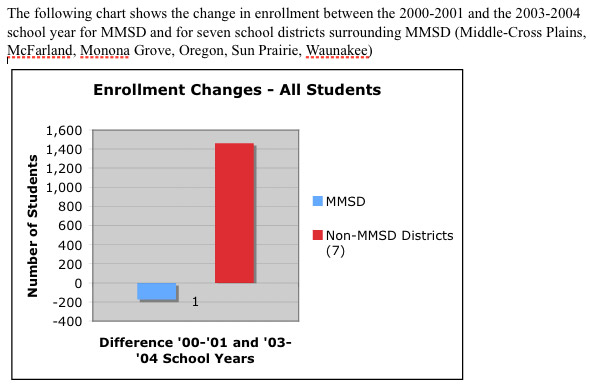
Share

WIBA’s Mitch Henck Interviews Seat 2 Candidate Lucy Mathiak

MP3 audio file of this recent interview. Lucy and Mitch discussed heterogeneous classes, among other issues.

Share