School Information System

MADreads

Kristian Knutsen:

Looking for a different book to read every day? If so, the Madison Public Library can be of assistance. Early this month, the library started publishing live a new blog named MADreads. It features a short book review nearly every day, starting with “contemporary urban fantasy,” how-to guides and historical fiction, before moving on to everything in between and beyond.

Share

UF study: ‘Don’t call us, we’ll call you’ class tool may aid math students

University of Florida:

It’s a feeling nearly everyone remembers experiencing at least once: sitting in class unprepared, silently praying the teacher won’t call your name.
For those students, the days of quiet safety may be numbered.
A new University of Florida study suggests that when teachers use a hand-held computer that randomly chooses whom to call on, even the quiet student in the back won’t be missed.
And that may not be a bad thing. It turns out students actually do better in class when they know their number could come up at any time.

Share

“Controversy Aside, State Embraces Charter Schools”

Sandy Cullen:

School used to be a struggle for seventh-grader Justin Fobes, who said he was getting “straight F’s” before enrolling at the River Crossing Environmental Charter School in Portage last fall.
“I just couldn’t sit still,” said Justin, 13.
At River Crossing, Justin is now getting A’s and B’s. And he no longer has trouble sitting still, Justin said, adding, “They actually tire you out.”
Every Friday, the middle school’s 18 students literally have a field day – doing everything from a controlled prairie burn to restoring wetlands. Such hands-on approaches to learning are fueling the rapid increase in public charter schools in Wisconsin and other states as teachers, parents and others seek to help students not succeeding in regular classrooms.

Share

Homework Help, From a World Away

Amit Paley:

In an hour-long session that cost just $18, the Indian tutor, who said his name was Mike, spent an hour walking Del Monte through such esoteric concepts as confidence intervals and alpha divisions, Del Monte recalled. He got an A on the final exam. “Mike helped me unscramble everything in my mind,” the 20-year-old said.
Thousands of U.S. students such as Del Monte are increasingly relying on overseas tutors to boost their grades and SAT scores. The tutors, who communicate with students over the Internet, are inexpensive and available around the clock, making education the newest industry to be outsourced to other countries.

Share

Wisconsin’s “Broad interpretation of how NCLB progress can be “met” through the WKCE”

A reader involved in these issues forwarded this article by Kevin Carey: Hot Air: How States Inflate Their Educational Progress Under NCLB [Full Report: 180K PDF]

Critics on both the Left and the Right have charged that the No Child Left Behind Act tramples states’ rights by imposing a federally mandated, one-size-fits-all accountability system on the nation’s diverse states and schools.
In truth, No Child Left Behind (NCLB) gives states wide discretion to define what students must learn, how that knowledge should be tested, and what test scores constitute “proficiency”—the key elements of any educational accountability system. States also set standards for high school graduation rates, teacher qualifications, school safety and many other aspects of school performance. As a result, states are largely free to define the terms of their own educational success.
The Pangloss Index ranks Wisconsin as the most optimistic state in the nation. Wisconsin scores well on some educational measures, like the SAT, but lags behind in others, such as achievement gaps for minority students. But according to the Wisconsin Department of Public Instruction, the state is a modern-day educational utopia where a large majority of students meet academic standards, high school graduation rates are high, every school is safe and nearly all teachers are highly qualified. School districts around the nation are struggling to make Adequate Yearly Progress (AYP), the primary standard of school and district success under NCLB. Yet 99.8 percent of Wisconsin districts—425 out of 426—made AYP in 2004–05.
How is that possible? As Table 2 shows, some states have identified the large majority of districts as not making AYP. The answer lies with the way Wisconsin has chosen to define the AYP standard.
NCLB requires states to base AYP designations on the percentage of students who score at the “proficient” level on state tests in reading and math. That percentage is compared to a target percentage, which must be met by both the student body as a whole and by “subgroups” of students, such as students from specific racial and ethnic populations. Districts that fail to make AYP for multiple consecutive years become subject to increasingly serious consequences and interventions.
Wisconsin has a relatively homogenous racial makeup and many small school districts, resulting in fewer subgroups in each district that could potentially miss the proficiency targets. But Wisconsin’s remarkable district success rate is mostly a function of the way it has used its flexibility under NCLB to manipulate the statistical underpinnings of the AYP formula.

Bold added. Also via eduwonk.
Kevin Carey comments on a Indiana newspaper’s editorial coverage of this issue:

Then comes the final pox-on-both-their-houses flourish, “what does any of it, really….” Maybe there are people out there who really don’t think that reporting accurate public information about the success of the school system has anything to do with the success of the school system. I just didn’t expect to find newspapers among their number.

Share

National Education Standards?

Kevin Kosar:

Over the past six months, the need for national education standards has been talked up. The idea, in short, is that the U.S. should have brief written statements of the skills and knowledge children should attain at each grade level for each subject area. The federal government would either encourage or require states to base their schools’ curricula on these standards. Education colleges, in turn, would train would-be teachers in the standards.

Share

Learning Communities in Kansas City

Jean Merl:

So when a new principal arrived at the imposing red brick campus in a tough, high-poverty neighborhood, this is how she greeted him:
“Hi, I’m Patty Kamper, and this is my last year here.”
That was in 1996, but Kamper is still there, teaching art at a transformed Wyandotte. Today the halls are orderly, and students work industriously in small “communities” with the same teachers throughout their high school years. Attendance, achievement test scores and the graduation rate have climbed steadily.
Kamper and most city leaders credit a school reform program called First Things First.

Kansas City Schools went through a substantial court ordered spending increase during the 1990’s.

Share

High School Documentary Film Making

Educational Video Center.

Share

“Lawmakers must give parents school choice”

Christine Maddox Ellerbee:

I am committed to my home here in Camden. But that commitment is seriously being tested by the state of Camden’s public schools.
As a parent, I have done all I can do. Many of us find ourselves in the same boat. We have agitated for change, made phone calls and visited anyone who would listen. We have formed organizations, started scholarship funds, even taken to the streets. All this in an attempt to get those with position and influence to do something to improve the public school product and public school experience of our children.
We have been patient even as our schools floundered in academic rankings, failing to graduate our children and terrified us daily with horrific conditions no one should have to endure. We have begged for access to alternatives to these schools so our children will at least feel safe. But no matter what we do, we are unable to change the fundamental politics that hold our children as prisoners in a failing system.

Share

The Baby Sitters’ Guide

Channel3000:

Baby sitters may be more prepared than ever for caring for kids these days, but how much is that preparation worth?
A survey of more than 500 parents found the pay for baby sitters ranged from $1.25 an hour to $16 an hour.
“I will hear in the range from $1 an hour to $10 an hour,” said baby sitting instructor Joyce Muxfeld. “I often have at least one person in the class who said they receive about $10 an hour.”
On June 1, the state’s minimum wage will change. Minors will make $5.90 an hour, but baby sitters earn a lot more than that.

Share

AJC: Superintendent’s Compensation & Public Knowledge

Atlanta Journal-Constitution Editorial:

Should metro-area school superintendents earn more than the governor?
More to the point, if they do earn more, shouldn’t taxpayers at least be aware of it?
When it comes to the paychecks of school chiefs, what local taxpayers see isn’t always what superintendents get. An Atlanta Journal-Constitution analysis found clauses deep in the contracts of 14 metro superintendents that gave the school officals an average of $33,900 in nonsalary pay last year. A notable and laudable exception is the city of Gainesville, which posts Superintendent Steven Ballowe’s evaluation scores each year on its Web site.

Share

UK National Union of Teachers: “School Inclusion Can Be Abuse”

BBC:

Children with special needs are far more likely to be excluded
Including children with special educational needs in mainstream classrooms can be “a form of abuse”, a professor of education has said. John MacBeath of Cambridge University was commenting on a report he co-wrote for the National Union of Teachers.
NUT general secretary Steve Sinnott called for an audit of provision around England as a step towards addressing “major areas of policy failure”.
But ministers said children were taught successfully in a range of settings.
Schools Minister Andrew Adonis said: “We put the needs of the child first.”
The Cambridge report, The Costs of Inclusion, said teachers and teaching assistants were often going “beyond the call of duty” to help children with special educational needs (SEN).

National Union of Teacher’s press release.

The complete report is evidently not online. However, Gregor Sutherland mentioned that the report is available for £7. His email: gs280 at cam.ac.uk

Share

Job: MMSD Coordinator of Mathematics

Madison Metropolitan School District:

Lead K-12 mathematics programming; develop and promote documents defining the mathematics program and expectations; organize and promote professional development opportunities; seek and implement research-based best practices in mathematics education; serve on various district and Teaching & Learning committees and task forces; create, recommend and administer budget for mathematics curriculum coordination; coordinate Evaluation of Learning Materials in mathematics; serve as District liaison with state, private, professional, city, and local mathematics groups and organizations; seek and develop relationships with institutions of higher education to coordinate inservice and preservice mathematics education; collaborate with other District departments to ensure all students have the opportunity to learn standards-based mathematics; develop and promote standards-based assessment tools and practices; analyze District mathematics student achievement data and use the data to inform action plans; supervise and evaluate instructional resource teacher staff and program assistant; author grant applications; coordinate mathematics grants; support District Improvement Plans, decisions and initiatives; demonstrate evidence of cultural competence.

Additional MMSD jobs can be found here.

Share

Mother Hopes to Educate School Board on Special Needs Students

Channel3000:

When it comes to educating children, parents play a crucial role outside of school. But Rose Helms, whose child, Michael, has autism, wants to take her influence inside the classroom.
This is why there was a special guest in Michael Helms’ special education class on Wednesday. The guest was Art Phillips, an Evansville school board member and a police officer.
“My interest is to learn about what the needs are, and if our district and our employees are meeting those needs to help the children out,” said Phillips. “That’s the biggest thing that I want to find out.”

Share

Shameful reading scores for MMSD sophomores

According to the data on DPI’s Web site, the combined percentages for minimum and basic categories (these are below grade level) for MMSD’s 10th graders on the WKCE reading test in November 2004 were:

All students – 26%
African American – 53%
Asian – 29%
Hispanic – 51%
White – 15%

The real shame lies, not in the scores, but in the MMSD’s lack of any systematic program to raise these students’ reading abilities before graduation.
A few schools may offer Read 180, a remedial curriculum praised by staff in the MMSD and other districts.
Pam Nash illustrated the MMSD’s weak commitment to Read 180 in a response to my question on how much money the current budget includes for Read 180. Pam wrote:

The district has not included any specific budget for 2006-07 that would be utilized for READ 180. Individual building principals may utilize existing supply/formula and staffing allocations to provide READ 180 strategies within existing curriculum offerings. Read 180 will be offered at all four high schools and Brearly Street Alternatives. (emphasis added)

Given that implementation of Read 180 costs about $40,000 per school, according to district figures, Read 180 won’t be expanded to schools currently without it.
From the WKCE scores, probably 20% to 26% of MMSD graduates cannot read their diploma, let alone read well enough to continue their education or land a job that pays a living wage. (The percentage might be lower than 20% since many non-readers may drop out before graduation.)
Additionally, the superintendent and some board members like to brag that the MMSD closed the achievement gap because children of color are no longer over represented in the minimum category on the third grade reading test. Obviously, that’s a pitiful claim when more than half of Madison’s African American 10th graders can’t read at grade level.

Share

Let them Eat Kale

The Economist:

Plans to improve school meals are causing havoc
JUST over a year ago, Jamie Oliver, a camera-friendly chef, called for a revolution in school kitchens. In a television series, he chronicled the decline in school lunches and showed that junk food-addicted children could be taught to tuck into what he calls “pukka nosh”. It proved a traumatic experience for the young gourmands, some of whom demonstrated for the return of chips and burgers. Mr Oliver’s antics have also tweaked the government, upset some dinner ladies and shaken the catering market.
“Jamie’s School Dinners” galvanised parents, who demanded that schools ditch grotesque inventions such as the Turkey Twizzler and adopt wholesome fare such as shepherd’s pie and lentil soup. Worried about a looming general election, the government hastily responded to Mr Oliver’s demands. Ruth Kelly, who was then the education secretary, promised to ban junk food in schools and asked a panel of experts to suggest nutritional guidelines.

(more…)

Share

Scholarships for Students of Color

Black Excel.

Share

Colleges Chase as Cheats Shift to Higher Tech

Jonathan Glater:

At the University of California at Los Angeles, a student loaded his class notes into a handheld e-mail device and tried to read them during an exam; a classmate turned him in. At the journalism school at San Jose State University, students were caught using spell check on their laptops when part of the exam was designed to test their ability to spell.

Share

Technology in Education

In the wake of the annual EdWeek Technology Counts issue, there has been some discussion surrounding the idea that technology is education is harmful. I attribute this to a few factors, including to overstated claims for educational technology in the past, concerns about very specific uses of technology in education like calculators, and the comfort some of us take in the instructional environments we experienced. This rejection of technology is unfortunate, however. Effectively utilized technology has an important role to play in increasing the effectiveness of our schools.
The focus on technology as an end in and of itself is very misplaced in K-12. Instead, districts should focus on providing an adequate level of infrastructure for staff and students and then using technology where it can improve student and staff productivity, allow for a more personalized learning experience, and provide an interactive learning experience.

(more…)

Share

Schools in seven Wisconsin metro areas rated highly

Seven metropolitan areas of Wisconsin are in the top 25 metros for public schools in the country, according to a survey ranking U.S. school districts with 3,300 students or more. The survey was conducted by Expansion Management Magazine, a monthly business publication for executives of companies that are actively looking to expand or relocate facilities within the next three years. The seven metropolitan areas of Wisconsin—Sheboygan (5), Eau Claire (7), Madison (8), Wausau (11), Appleton(16), Oshkosh-Neenah (20), and Fond du Lac (24)—appeared in a list of the 25 Top Metros for Public Schools. Schools in these areas, plus Green Bay and La Crosse, were named to the magazine’s 5-Star Public Schools Metros list.
“I am extremely proud of Wisconsin teachers and students for their dedication to quality teaching and learning, and their hard work shows in this survey of the best metropolitan school systems in the nation,” said State Superintendent Elizabeth Burmaster. “Our students, overall, consistently score among the very best in the nation on the major college entrance exams and high school graduation rates. This affirmation of the quality of Wisconsin schools from an independent, unbiased study, underscores our students’ dedication to excellence in learning and academic achievement, and the support they
receive from their teachers, families, and communities.
“Public education in Wisconsin is moving forward, supported by our early learning and classsize reduction programs. This recognition tells us that we are on the right track and must continue to invest in education, pre-kindergarten through university. Our sustained efforts as students, educators,parents, community volunteers, and citizens will ensure that our students graduate with the knowledge and skills they need to succeed in postsecondary education, the workplace, and as citizens of our 21st century global society,” she said.
The magazine rated the metro area schools as a way of providing a basis for executives to compare the type of work force they are likely to encounter in various communities around the country. Using the data from its 15th annual Education Quotient ratings, which compared 2,800 secondary school districts throughout the country, Expansion Management grouped school districts into Metropolitan
Statistical Areas (MPAs). Public schools in those 362 MPAs were compared according to a variety of categories, including college admission test scores, graduation rates, beginning and average teacher
salaries, per pupil expenditures, and student-teacher ratio.
Bill King, chief editor of Expansion Management Magazine, speaking to the importance of quality schools to business success, said, “Today’s workers, most of whom are high school graduates, must possess skills far beyond those needed just a generation ago. Clearly, the quality of the public schools is a pretty good indicator of the type of manufacturing work force a company is likely to encounter in a
particular community.”
NOTE: A list of the Best Overall U.S. Metros for Public Schools with 3,300 students or more, according to Expansion Management magazine, follows.
Top Metros for Public Schools
1. State College, Pa.
2. Ithaca, N.Y.
3. Lawrence, Kan.
4. Iowa City, Iowa
5. Sheboygan, Wis.
6. Charlottesville, Va.
7. Eau Claire, Wis.
8. Madison, Wis.
9. Columbia, Mo.
10. Harrisonburg, Va.
11. Wausau, Wis.
12. Ames, Iowa
13. Missoula, Mont.
14. Grand Forks, N.D.-Minn.
15. Billings, Mont.
16. Appleton, Wis.
17. Bloomington, Ind.
18. Flagstaff, Ariz.
19 Glens Falls, N.Y.
20. Oshkosh-Neenah, Wis.
21. Blacksburg-Christianburg-Radford, Va.
22. Jonesboro, Ark.
23. Burlington-South Burlington, Vt.
24. Fond du Lac, Wis.
25. Ocean City, N.J
For further information, contact Joseph Donovan, Communications Officer, DPI, 608.266.3559
Share

Little Things and Big Things

I had a very nice day today chaperoning the Randall Safety Patrol at the Wisconsin Dells. First, Susan Smith and Phil Watters who have worked with the Safety Patrol all year deserve much thanks. The AAA, who sponsor the Safety Patrol and made the trip possible also deserve praise.
But mostly it was the students who made it such a good day. They were great; polite, well behaved, interesting and fun. There were many other Safety Patrol groups from around the state there and I can say without reservation that none were better behaved and none seemed to enjoy themselves as much as our group. What a great combination. It is easy to lose track of some of the little things like this that are part of our school system, but we shouldn’t. They made me both happy and proud.
I’d like to keep this upbeat, but am compelled to close on a down note. Susan Smith is the School Nurse at Franklin and Randall. Next year, due to financial considerations she will also serve a third school and almost assuredly will not be able to continue as a Safety Patrol mentor. This may seem like a small loss for the district as a whole, but after today it seems like a big one to me.
TJM

Share

California’s Charter School Performance

EdSource:

This second annual analysis of charter school performance in California compared how well charter schools did versus noncharters, as measured by the percentage of schools that met their 2005 Academic Performance Index (API) growth targets. The 20-page report also looks at charter school performance by grade level (elementary, middle, and high schools) and by charter type—start-ups versus conversions; classroom-based versus nonclassroom-based. Moreover, using data from a spring 2005 EdSource survey, it compares the performance of charters by the amount of student instructional time and degree of school autonomy.

Share

Acting White

by ROLAND G. FRYER

“Go into any inner-city neighborhood, and folks will tell you that government alone can’t teach kids to learn. They know that parents have to parent, that children can’t achieve unless we raise their expectations and turn off the television sets and eradicate the slander that says a black youth with a book is acting white.”

—Barack Obama, Keynote Address, Democratic National Convention, 2004
Acting white was once a label used by scholars, writing in obscure journals, to characterize academically inclined, but allegedly snobbish, minority students who were shunned by their peers.
Now that it has entered the national consciousness—perhaps even its conscience—the term has become a slippery, contentious phrase that is used to refer to a variety of unsavory social practices and attitudes and whose meaning is open to many interpretations, especially as to who is the perpetrator, who the victim.
I cannot, in the research presented here, disentangle all the elements in the dispute, but I can sort out some of its thicker threads. I can also be precise about what I mean by acting white: a set of social interactions in which minority adolescents who get good grades in school enjoy less social popularity than white students who do well academically.

Share

The Model Students

From the New York Times a discussion of how Asian families value education and how those family values result in successful students.
The Model Students
By NICHOLAS D. KRISTOF
Why are Asian-Americans so good at school? Or, to put it another way, why is Xuan-Trang Ho so perfect?
Trang came to the United States in 1994 as an 11-year-old Vietnamese girl who spoke no English. Her parents, neither having more than a high school education, settled in Nebraska and found jobs as manual laborers.
The youngest of eight children, Trang learned English well enough that when she graduated from high school, she was valedictorian. Now she is a senior at Nebraska Wesleyan with a 3.99 average, a member of the USA Today All-USA College Academic Team and a new Rhodes Scholar.
Increasingly in America, stellar academic achievement has an Asian face. In 2005, Asian-Americans averaged a combined math-verbal SAT of 1091, compared with 1068 for whites, 982 for American Indians, 922 for Hispanics and 864 for blacks. Forty-four percent of Asian-American students take calculus in high school, compared with 28 percent of all students.

(more…)

Share

Assist students who enter high school with poor academic skills

A report from an organization called MDRC strikes a responsive chord because the report stresses the need to “assist students who enter high school with poor academic skills” instead of dumping them in English 10 and to improve instructional content and practice:

[The report] offers research-based lessons from across these evaluations about five major challenges associated with low-performing high schools: (1) creating a personalized and orderly learning environment, (2) assisting students who enter high school with poor academic skills, (3) improving instructional content and practice, (4) preparing students for the world beyond high school, and (5) stimulating change in overstressed high schools.
The overall message of this synthesis is that structural changes to improve personalization and instructional improvement are the twin pillars of high school reform. Small learning communities and faculty advisory systems can increase students’ feelings of connectedness to their teachers. Especially in interaction with one another, extended class periods, special catch-up courses, high-quality curricula, training on these curricula, and efforts to create professional learning communities can improve student achievement. School-employer partnerships that involve career awareness activities and work internships can help students attain higher earnings after high school. Furthermore, students who enter ninth grade facing substantial academic deficits can make good progress if initiatives single them out for special support. These supports include caring teachers and special courses designed to help entering ninth-graders acquire the content knowledge and learning skills that they missed out on in earlier grades.

Share

MMSD 2006-2007: Budget is not Final

Allocations were sent to schools in early April 2006 for staffing for the 2006-2007 school year. This represents about 80%+ of the district’s budget. These are NOT final allocations. (For example, the School Board HAS NOT made a decision to cut Grade 4 strings for next year – that is the Superintendent’s proposal.)
The school board HAS NOT approved the budget for next year. What has been implemented is based upon the Superintendent’s recommendations to the School Board, but will not be final until the School Board approves budget, currently scheduled to take place on May 31st.
There will be another public budget hearing, Tuesday, May 30th at the Doyle building, 545 W. Dayton St. I’m not yet sure of the starting time.

Share

A Look at School Textbooks

Alex Johnson:

President Bush’s No Child Left Behind initiative put almost every imaginable part of the U.S. education system under a microscope, establishing national standards for teacher training, student testing and basic funding. But glaring in its omission from the program is any significant examination of that most basic of classroom tools, the textbook.
As younger, inexperienced teachers are thrown into classrooms to meet new federal standards, as much as 90 percent of the burden of instruction rests on textbooks, said Frank Wang, a former textbook publisher who left the field to teach mathematics at the University of Oklahoma.
And yet, few if any textbooks are ever subjected to independent field testing of whether they actually help students learn.
“This is where people miss the boat. They don’t realize how important the textbooks are,” Wang said. “We talk about vouchers and more teachers, but education is about the books. That’s where the content is.”

Share

Academic Performance Index

California Department of Education Academic Performance Index (API) – Reports and Data Files.

Share

Can Computers Help Schools?

Jay Matthews:

But I can’t help it. My focus has always been on what is going on in the classroom, rather than the principal’s office or the school board meeting room or the exhibition floors of all those education conferences that look like software fairs. In the classes I visit, plenty of students are working on computers. I am happy they are mastering the essential tools of modern life. But I wish there were more evidence that those hours tapping keyboards are making them better at reading, writing and math.
I used to get considerable pleasure from debunking school computer miracle stories. One of my proudest moments in the 1990s was a story about a New Jersey middle school hailed by President Clinton for its sharp increase in achievement scores after computers were installed. I visited the school, talked to the teachers, checked the arrival date of the new technology and discovered that the test scores had gone up before the computers got there. The real heroes were a very energetic principal, a great faculty and an innovative curriculum.

Share

Tipping the Scales

WKOW-TV:

One in five Wisconsin children are overweight or obese. That number jumps to 1 in 4 when you look at Wisconsin’s high schools. Perhaps more disturbing, almost half of those overweight kids here in Wisconsin, are at risk for developing Type II Diabetes or Coronary Artery Disease.

Share

Ex University President to Lead US Math Panel

Diane Jean Schemo:

The Bush administration has named a former president of the University of Texas at Austin to lead a national panel to weigh in on the math wars playing out across the country. The politically fraught battle pits a more free-form approach to teaching math against the traditional method that emphasizes rules and formulas to solve number problems.
In traditional math, children learn multiplication tables and specific techniques for calculating 25 x 25, for example. In so-called constructivist math, the process by which students explore the question can be more important than getting the right answer, and the early use of calculators is welcomed.
According to a 2005 study by ACT, the college entrance exam organization, only 40 percent of high school seniors were ready to take the most basic college-level algebra course.

More on the National Math Panel.

Share

Numbers Don’t Lie

Martha Stark:

I believe in the power of numbers. I don’t know when my belief in numbers began. Perhaps when I was a child. My high school dropout, bookkeeper dad came home each week to tell us that he had played the numbers — my neighborhood’s equivalent of lotto but lots more complex.
Dad would convert every thought and dream to a number with help from his trusty dream book. You had a dream about mice? Consult the book. “That’s a 12, 17 or 21. What was the mouse doing — climbing out of a garbage can? Well climbing is a 21, 34, or 42 and garbage is a 17, 39, or 32. So, let’s play 12 and 21 (the reverse of each other), 17 (it appeared twice), and 34, the year your mom was born.”

Share

Counting the Cash for K-12

DeHavilland Blog:

Excellent report here on education spending titled “Counting the Cash for K-12: The Facts About Per-Pupil Spending in Colorado [pdf],” published by the Independence Institute. While the report is focused on education spending in Colorado, they use national data in several instances for comparative purposes, and the information they provide is relevant to people across the country with an interest in K12 spending.
Their primary conclusion is that we should look less at how much we spend per student and more at how we’re spending, since school budgets and per-pupil spending do not correlate with achievement. What’s more, people can manipulate or reframe spending figures to make them look better or worse depending on their purposes – a trick that can confuse the entire discussion.

Share

Madison School Board Meeting Video Archives Online

MMSD-TV is doing a great job making board meeting archives available online. Check them out.

Share

Speak Up For Fine Arts Education’s Future

I have been an outspoken advocate for elementary strings the past several years, because this course is a highly valued, high demand academic course that is part of the K-12 MMSD music curriculum but has been repeatedly put on the cut list without any meaningful curriculum planning taking place from year to year. However, I also strongly believe there has been a lack of long-term planning in all fine arts education since cuts began about 1999. Perhaps other academic areas have needed the administration’s attention, such as reading and math. That’s understandable, but the School Board missed yearly opportunities to put in place other structures to plan for the future of fine arts education in Madison – community committee is an example of one option they might have considered pursuing.
I was encouraged two weeks ago when the Performance and Achievement and Partnership Committee chairs indicated an interest in working on not only the cuts to elementary strings, but also other aspects of fine arts education. I hope a community-led fine arts education committee is formed from these two Board committees that will undertake long-term, strategic planning for fine arts education in Madison. I would like to see such planning include music, visual arts, dance, theater, etc. – all facets of the arts that bring joy and enrichment to the citizens in our community, growth to our city’s economy now and in the future and play an important academic role in the excellent education our children receive.
Again, School Board members can be emailed at: comments@madison.k12.wi.us

Share

Community groups can apply for MMSD funding

The school board agenda for tonight’s meeting (May 15) shows that the board will discuss funding for the following groups:

– The Gay, Lesbian, and Straight Education Network
– The Center for Academically Talented Youth
– The Kajsiab House Project
– The Youth Empowerment Academy.

Johnny Winston, Jr. previously chose these groups and convinced the board to fund them without inviting all community groups to apply through a request for proposals, which could be used to solicit programs to further specific MMSD goals. (Funds for the Youth Empowerment Academcy were previosly provided through a grant to The Charles Hamilton Houston Institute, Inc.)
Board member Ruth Robarts raised concerns about this funding approach the first time around, and her concerns remain valid.
Since Johnny Winston, Jr. and the board continue to fund community groups, it would be wise for any and all community groups to apply for funding from the MMSD. I suppose that proposals could be sent to Johnny Winston, Jr. or Supintendent Rainwater.

Share

Speak Up For Strings – Thanks for Emailing the School Board: Keep The Emails Coming

MMSD’s School Board meets tonight to discuss the 2006-2007 school budget. There are no public appearances on tonight’s agenda, but the Madison community can continue to email the School Board in support of elementary strings at: comments@madison.k12.wi.us. Thank you to the parents and community who have attended the public hearing and who have sent emails to the School Board in support of elementary strings for Madison’s 9- and 10-year old students.
Cutting elementary strings will hurt low-income children! Keep the emails coming in support of about 550 low-income children who signed up for elementary strings – no other organization in Madison or Dane County offers an academic year long class that teaches this many children how to play an instrument. Madison School Board: Let’s work together to enhance this learning experience for our children; not tear it down and not tear it down before hearing from and working with the community.
I support restoring elementary strings to 2x per week, and I support forming a community task force on elementary strings and fine arts education to build fine arts education in Madison, not continue to tear it down. I reject late spring reports from the District administration that are clearly biased against this course and have not engaged teachers, music professionals, the community in the preceding 4 years! It’s not a administrative staffing issue, but it is poor, poor planning. We’ve had revenue caps since the early 1990s, and the Superintendent has been cutting fine arts since 1999 with no long-term plan in place, no community task force formed.
Call for an end to unfair cuts to elementary strings – cut 50% last year. No other high demand, highly valued course has been targeted in any year let alone year in and year out for cuts for 5 springs!
The state needs to take action on school financing; Madison needs the MMSD School Board to take action on elementary strings and fine arts educationl. Work with the community – please start now!

Share

End Near for Reading Recovery in MMSD?

The reduction of over $680,000 of ESEA Title 1 entitlement grant dollars challenges the district to change the way students and teachers are supported under Title 1. The current direct service model of student support cannot be supported in the long run with current funding. The administration will use the first semester of next year to develop a new model. (Page 252, Department & Division Detailed Budgets)

The MMSD uses Title 1 money to fund Reading Recovery. Does the statement above mean the end of Reading Recovery in the district?

Share

MSRI Workshop on Equity in Math Education

This is to briefly summarize from my point of view what went on at the MSRI workshop on equity in math education last week. (Vicki was also there and may wish to give her side of the story so you get a more complete picture. It was a very broad workshop, 13 hours a day for 3 days. The web site is down right now, but you can view a cached version here.)
The charge of the workshop was to brainstorm solutions to the underrepresentation of (racial and ethnic) minorities in mathematics and mathematics courses which frequently serve as gatekeepers to other areas.
The participants were thus rather heterogeneous, policy-makers, mathematics educators, mathematicians and teachers, including several groups of young people from various projects who serve as mentors and tutors in mathematics.
The talks and presentations were thus rather mixed, from talks by a law professor about constitutional issues on education to examples of math games played by young tutors and an actual 9th grade math class right with 22 students from a nearby high school right in front of all participants.
There were also some chilling descriptions of the abominable conditions at some schools serving mostly black and native American students.
The usual disagreements between research mathematicians and math educators were not brought to the surface much, but were brought up in many personal conversations during breaks and meals. However, there was general agreement that the underrepresentation of minorities is a serious national problem, and that more resources and better teachers are crucial to its solution.
However, no firm solutions or consensus emerged.
The two things I took away from the workshop are:

  1. the need for more math content by math teachers, mainly at the elementary and middle school teachers, and
  2. a small but important comment by a representative from the American Indian Science and Engineering Society: Asked about cultural sensitivity in math classes for her students, she answered that even though there are some issues around this, but in the end, her students need to learn “main-stream” mathematics in order to succeed, not take watered down courses; and the earlier this starts, the more beneficial it will be to her students.
Share

States Struggle to Computerize School Records

Sam Dillon:

Nearly all states are building high-tech student data systems to collect, categorize and crunch the endless gigabytes of attendance logs, test scores and other information collected in public schools — and the projects in some states seem to have gone haywire.
In North Carolina, a statewide school computer system known as NC WISE is years behind schedule, and estimated costs have risen to $250 million. Teachers have nicknamed it NC Stupid. California has spent $60 million on a system, and officials estimated that the state would spend an additional $60 million in coming years to help school districts connect to it.

Wisconsin’s status on student longitudinal data can be found here.

National Center for Educational Accountability.

Share

More Funding for Adult Literacy Education

Andy Hall:

America is heading for an explosion in the number of immigrant children who grow up unable to read, write or fit into society, a national literacy expert says.
Robert Wedgeworth, president of ProLiteracy Worldwide, a nonprofit agency based in Syracuse, N.Y., plans to tell an audience in Madison today that the nation must sharply increase support for adult education programs.

Share

Stoughton Middle Schoolers are Finalists in a National Science & Technology Contest

Amanda Becker:

For the fourth straight year, a team of Stoughton middle schoolers will compete this month in the finals of a national science and technology contest, cementing the district’s reputation as a hotbed for young inventors.
The honor extends the dynasty developing at River Bluff Middle School, where students won a gold medal at the national competition last year for inventing a fire alarm to wake children that combined water jets and a voice alarm inside a stuffed animal.

Christopher Columbus Award website.

Share

The Model Students

Nicholas Kristof:

Why are Asian-Americans so good at school? Or, to put it another way, why is Xuan-Trang Ho so perfect?
Trang came to the United States in 1994 as an 11-year-old Vietnamese girl who spoke no English. Her parents, neither having more than a high school education, settled in Nebraska and found jobs as manual laborers.
The youngest of eight children, Trang learned English well enough that when she graduated from high school, she was valedictorian. Now she is a senior at Nebraska Wesleyan with a 3.99 average, a member of the USA Today All-USA College Academic Team and a new Rhodes Scholar.

(more…)

Share

Mathcounts National Championship

Tara Bahrampour:

It wasn’t quite a Miss America pageant, but it had a gusto of its own. To the beat of rock music, more than 200 middle schoolers in T-shirts adorned with pi symbols or jokes about binary numbers jogged into a Crystal City hotel conference hall yesterday, waving and holding up signs identifying their home states.
The 57 teams — from every state, plus the District, the U.S. territories and military or State Department schools around the world — had spent the day vying for the MathCounts national championship, and they were about to find out which four-member team had won.

Madison area middle schools that participated included Hamilton (Madison), Jefferson (Madison), Eagle (Fitchburg), Badger Ridge (Verona) and Madison Country Day School (Waunakee). Mathcounts website.

Share

MadCAP Spring Concert Video Clips

MadCAP held their music studio recital last night. 20MB video clip excerpts.
Share

French Universities & US K-12

Alex Tabarrok:

The United State’s has one of the most admired university systems in the world and one of the most deplored k-12 systems. Could the difference have something to do with the fact that universities operate in a competitive market with lots of private suppliers while k-12 is dominated by monopolistic, government provided schools?
What would our university system look like if it operated like the k-12 system?
Look to France for the answer. The riots of 1968 forced the government to offer a virtually free university education to any student who passes an exam but as a result the universities are woefully underfunded especially for the masses. Amazingly, with just a few exceptions for the elites, students are required to attend the universities closest to their high schools. Sound familiar?

Share

MMSD Offline

It appears that the MMSD site is down http://www.mmsd.org/.
Does anyone know why or how long it has been down?
TJM

Share

The Deification of Mathematics

The Economist:

Google constantly leaves numerical puns and riddles for those who care to look in the right places. When it filed the regulatory documents for its stockmarket listing in 2004, it said that it planned to raise $2,718,281,828, which is $e billion to the nearest dollar. A year later, it filed again to sell another batch of shares—precisely 14,159,265, which represents the first eight digits after the decimal in the number pi (3.14159265).
The mathematics comes from the founders, Sergey Brin and Larry Page. The Russian-born Mr Brin is the son of a professor of statistics and probability and a mother who works at NASA; Mr Page is the son of two computer-science teachers. The breakthrough that made their search engine so popular was the realisation that the chaos of the internet had an implicit mathematical order. By counting, weighting and calculating the link structures between web pages, Messrs Page and Brin were able to return search results more relevant than those of any other search engine.

Share

Local Property Tax Assessment Challenges Are Way Up This Year

Lee Sensenbrenner:

Prices seemed to be falling as he was buying, he said, and he paid less for his condominium than ones that were sold a month or two earlier. He paid $259,000, including a parking stall, and his fight against City Hall is to have it assessed at $221,000 rather than $241,000, plus $18,000 for the parking stall, which is now treated as a separate property.
He said others in the building have nicer views and are higher up, but have lower assessments for the same floor space. In particular, he points to Ald. Mike Verveer’s condo two floors above him, which faces the lake instead of the courtyard, and is assessed at $231,000. Like those of all units in the building, its assessed value did not increase from 2005 to 2006.
“Obviously,” Taylor wrote in a letter submitted to the Assessor’s Office, “my second-floor unit’s value should be far less than a fourth-floor unit with a lake view.”

A close look at assessments raises many more questions. Some municipalities, such as Fitchburg reassess properties every 3 to 5 (or longer) years rather than annually as Madison does. Learn more via Access Dane (I do find it odd that some publicly financed data requires a “subscription” – we have the opportunity to pay twice).
Sensenbrenner’s article provides more grist for the consideration of a fall referendum.

Share

School Board / Community Resources

Via the DeHavilland Blog:

Share

Seattle School Board Puts off Decision on Math Textbooks

Jessica Blanchard:

New math textbooks for Seattle middle- and high-school students are on hold.
Concerned that it may cost too much and not produce results, School Board members have delayed a decision to allow more time to study the issue.
At stake is whether the district adopts a single style of teaching math that focuses more on understanding concepts than honing computation skills — a prospect that has sparked debate among parents, teachers and administrators.

Share

An Impasse on Civic Science

Brett:

Many experts outside of Harvard advocate teaching the practical side of science to nonscientists so that they will be able to make sense of it in their everyday lives. Yet few scientists appreciate the civic importance of making science understandable for all students, said Jon Miller, a professor of political science at Northwestern University.
“General education courses need to be, for scientists, your last chance to speak to someone before they are elected senator,” he said.

Share

No States Meet Teacher Quality Goal

Ben Feller:

Not a single state will have a highly qualified teacher in every core class this school year as promised by President Bush’s education law. Nine states along with the District of Columbia and Puerto Rico face penalties.
The Education Department on Friday ordered every state to explain how it will have 100 percent of its core teachers qualified – belatedly – in the 2006-07 school year.

Share

FMPS Seeks a President

Foundation for Madison Public Schools. www site

Share

Increasing minority population reflected in preschool, kindergarten

Sandy Cullen:

Forty-five percent of children in the United States under the age of 5 are minorities, according to Census Bureau numbers released Wednesday.
“In Madison, those numbers are higher,” said Karen Dischler, intergenerational program coordinator for RSVP of Dane County and co-director of the United Way’s Preschools of Hope project. This year, just under 50 percent of kindergarten students in the Madison School District are minorities.
The growing number of minority students is largely the result of higher birth rates among minorities coupled with a rise in immigration.

Share

Renewable energy grants for schools & nonprofits

We Energies has posted on its website a Request for Proposals (RFP) to identify and to competitively select the best customer-sited renewable energy projects to receive customer project incentives under the We Energies “Renewable Energy Development” program:

We Energies will provide financial incentives ranging from $10,000 to $100,000 to selected customer-owned renewable energy projects that are interconnected to the We Energies distribution system and meet the eligibility criteria of ownership by a not-for-profit organization, not-for-profit educational/academic institution, unit of government, or special district or authority defined as government under Wisconsin law. In addition, all proposed projects need to include a strong and clearly-identified outreach and educational component that will be used to inform and educate members of the general public about renewable energy in a ongoing and continuous manner. In all cases, incentive recipients must be existing We Energies retail electric customers in Wisconsin.
Incentives shall not exceed 50% of total installed project cost less any federal or state government incentive or credit and less any Focus on Energy funding. Proposed solar photovoltaic and wind energy system projects must have a site assessment completed (preferably though the Wisconsin Focus on Energy Site Assessment Program, or equivalent). The assessment shall provide an estimate of the energy output of the project once operational. In addition, all installations must be completed by a Focus on Energy designated Full Service Installer.
There may be up to five rounds of incentive applications and evaluations. Deadline for first round of applicants is May 31, 2006.

Share

A Judge Stands Up for Ignorance

Debra Saunders:

I wish I were shocked at a last-minute judicial fiat that runs roughshod over a much-needed school reform — much as, in a different age, a French aristocrat’s coach might ram over peasants unfortunate enough to stand in the way. In this brave new world, if anyone tries to improve schools — and you can’t improve schools without raising standards — no matter how weak those standards are, some court likely will step in to quash the reform lest it hurt someone.
As if ignorance doesn’t hurt children.

Share

Math or Technology: Take Your Pick

Sarah Natividad:

Recently Utah schools have been given an F for technology use in the classroom (or lack thereof). This is one area I hope Utah continues to fail in. Technology has been touted as a fabulous tool for teaching math and other subjects, but it’s not. Technology teaches technology; you still have to learn math separately if you want to know math too.

I agree. The basics come first – technology, which changes frequently and may not always be appropriate (see Powerpoint, and here.)

Share

Denver Schools Seek Non-Traditional Instructors

Karen Rouse:

In a move some say could shake up traditional teacher-hiring practices, the Douglas County School District on Wednesday asked the state to let it create its own licensing program to more quickly bring nontraditional teachers into the classroom.
The district – which is already eyeing a pipe-fitter, Naval officer and instructors from China as potential teachers – said current state licensing regulations cut some of the most talented workers out of the teaching pool.
“It’s saying, ‘Here is somebody in the community who has real-world experience, but we can’t hire them because they’re not licensed,”‘ said Kristine Sherman, vice president of Douglas County’s school board.

Share

Scores on New SAT Expected to Decline

Jay Matthews:

College Board officials say they are expecting as much as a five-point average decline in math and verbal scores on the new SAT, leading many high school counselors to conclude that the longer test is wearing out test takers and hurting their performance.
At least 15 colleges and universities have reported even greater drops in the average scores on the nation’s leading college entrance exam among applicants for this fall’s freshman class. On the nine campuses of the University of California, the largest user of the SAT, average scores declined by 15 points, and the University of North Carolina at Chapel Hill reported a 12-point drop. Final national figures are not expected until August.

Share

“Asbestos Removal – Who Knew?”

WKOW-TV:

Madison’s Sandburg Elementary School is in the midst of an asbestos clean-up…but no one notified the parents. A parent with children at the school contacted 27 News after discovering the project.
We spoke with to Madison district officials about the asbestos removal guidelines they follow. They say it’s not standard procedure to notify parents, nor are they required by law to notify them. Doug Pearson, director of Madison’s district building services, says the project does not pose a health concern.

Share

Tom Beebe Presentation at Van Hise

Carol Carstensen:

Parent Group Presidents:
One more message from me. Van Hise Elementary is inviting the public to their meeting next Tuesday, May 16 to hear a presentation about state funding by Tom Beebe of Wisconsin Alliance for Excellent Schools (WAES). WAES has ideas about how schools ought to be funded and is working to build a state-wide movement to bring about change at the state level. Here are the details:
When: Tuesday, May 16 at 7 p.m.
Where: Van Hise Elementary Cafeteria [Map]
Tom gave a presentation to the Board last October and it is well worth your time (though I know how hectic May is).
Carol

More on Tom Beebe.

Share

Turn over problems among MMSD staff?

Does the MMSD have a problem with high turnover? Two comments raise the issue in the undated 2006 budget document Department & Division Detailed Budgets:

A challenge at the middle school level includes the frequent turn-over of teachers assigned to teach mathematics. (page 88)


Middle School science teachers are developing pedagogical content expertise to be able to teach standards-based science to support the MMSD K-8 Science & Scope & Sequence. A facet of this work will include writing and implementing a Title II Part B grant to support district efforts. Challenges include designing and supporting professional development with adequate rigor and duration in light of teacher “turn-over” in MMSD and working with middle school principals to support hiring, transferring and maintaining highly-qualified science (and mathematics) teachers in science positions. (page 94)

Share

Exotic Education: Stars Of Reptile Exhibit Teach Fourth-graders About Conservation

Sandy Cullen:

Some fourth-graders at Madison’s Marquette Elementary School got to see something Wednesday they likely never will again — Principal Joy Larson wearing a boa.
Not the fluffy, feathery kind, mind you.
The 45-pound, 8 1/2-foot boa draped around Larson’s neck and shoulders was scaly and very much alive.
The red-tailed boa constrictor was one of three reptiles who took a field trip from their home at Chicago’s Shedd Aquarium to promote its new exhibit “Lizard and the Komodo King,” which is on view through February.

Share

Grade-a-Matic

Cheri Lucas:

Can an automated grading system score human articulation and reason? The tool Paris uses compares student work to “training” essays, or models of the class assignment, at each scoring level. SAGrader, software developed by Ed Brent, a sociology professor at the University of Missouri at Columbia, works similarly. His students type a sociology essay about community, for example, into an input field on the assignment’s Web site. Moments after students click on the Submit button, SAGrader assesses whether they have identified concepts such as urban renewal or gentrification and have used appropriate examples.

Share

MSCR: Middle School After-School Programs wins in top award category

A Madison School’s TV Channel 10 video, MSCR: Middle School
After-School Programs received a “Significant Community Programming”
distinction at the annual awards for the Wisconsin Association of PEG
Channels (WAPC). WAPC represents local public, educational and
government access cable channels across the state.
The TV program, cooperatively produced by Lindy Anderson of the
Madison Schools’ media production department and Nicole Graper of
Madison School & Community Recreation (MSCR), highlights the
variety of after-school programs and services available to Madison’s
middle school children.
This award marks the third year in a row MMSD-TV has been honored at
the annual ceremony. Previous awards have been presented to MMSD-TV
from the Wisconsin School Public Relations Association, the National
Alliance for Community Media and the Wisconsin Educational Media
Association.
MMSD-TV 10 can be seen on the Charter Cable system in Madison and
surrounding areas.
For more information, contact:
Marcia Standiford, 663-1969

Share

Cut Soda Demand with Education

Wisconsin State Journal Editorial:

The most effective way to improve the diets of young people is to educate them to make healthful choices.
That’s worth remembering in the aftermath of last week’s announcement that sugared sodas will be banned from U.S. schools by the 2009-2010 school year.
The ban, voluntarily agreed to by the nation’s largest beverage distributors, addresses the public health problems that have accompanied the soaring consumption of sodas in the past generation.

The WiSJ is correct – education is key. I imagine that there will be “underground” soda suppliers once these changes are implemented.

Share

A Revolution of One

Larry Sankey:

My European friends ask me all the time why America doesn’t do what they do in Europe. The first time I was asked was 20 years ago by a friend from the Netherlands. Just recently I was asked by a German friend. Why not allocate money for all the schools from the state’s general tax base, and not by district according to real estate taxes, as is the current practice? Then every school gets the same amount of money per student no matter whether the students are black, white, brown, or any other minority. Whether their parents are rich or poor. That ways no child is truly left behind.
I believe that when this is seen as an integration issue, basically a black and white issue, it short changes both blacks and whites. Specifically poor blacks and poor whites. Because it is the poor of both races and other minorities who have poor schools and end up stuck in a cycle of poor education which leads to prison or poverty or both. Which leads to in turn poor education for the next generation. My finely tuned sense of paranoidar leads me to suspect that it’s a good way for the rich folk to keep out the competition. Kids with rich parents don’t have to compete with the poor for a good college education and later for good jobs and eventually for a nice house in a good neighborhood. It keeps poor folk right where they are generation after generation. A kind of neo-serfdom. The poor and middle class, distracted by arguments over integration, spend time fighting each other over busing, as America under-educates its potential workforce into third world status. Meanwhile the privileged point their fingers at minorities and blame them for generation after generation of failure. But this is a failure of the system. Given the same chance at education, the poor, all the poor, minority or otherwise, would have much improved lives.

Share

Reining in Charter Schools

NY Times Editorial:

The charter school movement began with the tantalizing promise that independently operated schools would outperform their traditional counterparts — if they could only be exempted from state regulations while receiving public money. It hasn’t quite worked out that way. With charter laws now on the books in about 40 states and thousands of schools up and running, the problem has turned out to be too little state oversight, not too much.

Joanne has more.

Share

Recommendations for 2006-2007 Budget

Active Citizens for Education offers the following recommendations for the consideration of the MMSD Board of Education in the allocation of funds for the 2006-2007 budget: (I appeared on WIBA, 1310, this evening with Brian Schimming and discussed the MMSD proposed budget and ACE recommendations) [18MB mp3]

(more…)

Share

A day as a Regent sparks new pride

A reader emailed this article: Verona High School Student Kristen Zubke visits Madison West High School for a day [April 2006: full student newspaper 25MB]:

On Monday, March 27th, I took it upon myself to shed a little light on our neighboring rivals, the Madison West Regents. I was shadowing a friend, but I guess you could say I did a little undercover investigating just to see if I really felt the Wildcat shame as I previously professed. My day was in one word, shocking. Overall I witnessed a school that strongly resembled an outrageous metropolitan school such as that seen on the television show, Boston Public. Despite its many obvious downfalls, there are indeed perks to being a Regent, yet in the end, my appreciation of Verona went up after seeing the chaos at West. I may not openly be proud of Verona’s reputation, but our education morphed my shame into pride.

(more…)

Share

Cutting Elementary Strings Hurts Children From Families With Low and Moderate Incomes

Members of the Board of Education,
I am writing to urge you all to vote in support of continuing the strings program in elementary schools.
I am a parent of a 6th grader at Hamilton Middle School, and I am fortunate to have been able to afford private and group violin lessons outside the school system for my son, since kindergarten. I can not tell you what a huge benefit this has been to him, in terms of teaching him to strive towards a rewarding goal, the joy of working together in a group of other learners, and appreciating the goodness of the arts in a troubled world.
And yet I know that the disadvantaged children in MMSD have no opportunity at all to play a violin or other instrument in elementary school unless the strings program continues.
It is clear to me and all music instructors that if a child starts violin in 6th grade, it is by far more difficult for them and much more likely that they will become frustrated and give up.
Starting in grade 4 will not only help students learn and stay with it, but will be a better use of the precious funds that we do allocate to strings in all grades — a better foundation means better participation and more benefits in the later grades.
My own son did not take strings in 4th and 5th grade, because I felt it was better to give another spot to a family that did not have another means to offer strings to their child. He now participates in 6th grade. I can tell you that with all the other major adjustments of the transition to middle school, starting a stringed instrument from scratch would have added a lot of stress to our family.
Please, please find a way to continue strings in 4th and 5th grades. I have been to enough meetings to know that there are things that could be cut from the budget that are way less important than strings.
Thank you,
Jane Sekulski
PS. If you have never seen the movie “Music of the Heart”, please consider doing so. It is based on a true story, which is documented in the film “Small Wonders”, of a violin program in inner city New York. The documentary is even better.

Share

Educators Blend Divergent Schools of Thought

Jay Matthews:

In the first year of the YES College Preparatory School, community service was as important as reading, writing and mathematics. The public charter school’s name stands for Youth Engaged in Service, and its mostly low-income students moved through city neighborhoods like young social workers, practicing their academic skills by collecting information on bus routes, health clinics and many other real-world topics.

Share

How much is this going to cost? Is it worth it?

Page 98 of the undated 2006 budget document includes the following:

Library Media Services Division initiatives contemplated for the upcoming 2006-07 school year include (a) the consolidation of the elementary and middle school Technology and Information Literacy curricula, (b) the expansion of Accent database services to bookrooms and high school textbook collections, (c) the transition from a magnetic tape-based video distribution system to a datacast and optical disc-based distribution system and (d) further expansion of district-wide online subscriptions.


The document leaves to the reader’s imagination what the initiatives might cost or whether they’re worth the cost, because it offers no rationale or estimated expenditure that I can find.
Further, the document gives the board and public no information with which to compare the value of these initiatives to other ways the money might be spent. Yet, those are exactly the choices the board and community ought to be able to make through budgeting.

Share

Speak Up for Strings Tonight: Public Appearances at Board Public Hearing On the Budget – 6:30 p.m. Tuesday, May 9th at Memorial High School

Dear Madison Community,
Children and parents are encouraged to speak in support of elementary strings and to bring their instruments to tonight’s School Board public hearing on the budget if they would like to play. My husband, Fred Schrank, who is the principal bassist with the MSO and who teaches orchestra to elementary and middle school children in the district, will be there. I’ve asked him if he would accompany those children who might want to play for the School Board to show their support for the course. The public hearing begins 6:30 p.m at Memorial High School, 201 S. Gammon Road, Auditorium [map].
For your information – the School Board takes students who want to speak for 3 minutes (or play for 3 minutes) first. I also have signs and will have colored markers for students or others who want to make signs for the School Board to see.
The Superintendent’s proposal to cut Grade 4 strings is unacceptable, incomplete and would put in place a music curriculum planning process AFTER the cut is made to Grade 4 strings instruction. His conceptual idea is to plan to offer elementary children experiences with varied instruments in the 07-08 school year when Grade 5 strings would be cut and there would be no more elementary strings. That’s a curious idea. Why? Current General Music practice is to offer children experiences on different instruments – so the planning would not result in any meaningful curriculum change except the elimination of elementary stringed instrument instruction. What kind of plan would that be? No community planning took place this year for music education, which DPI recommends as best practice for standards based curriculum planning – include professionals and the community in the effort. The only plan is to cut Grade 4 strings, with planning for next steps to follow. Without good planning and good information – bad practice and bad decisions follow.
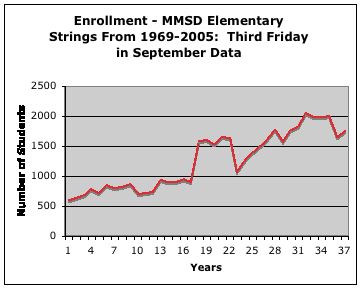
My question: Where’s the planning been for the past year, for the past 5 years? Our kids deserve better. Hundreds of children and community members have spoken in support of the elementary strings course over the years and emails and support for this course remain strong as demonstrated by the children once again this year through their enrollment in this course – over 1,700 children in September (550+ low income children who will be hurt the most by this cut).
After 5 springs of advocating for this course, I’m exasperated and annoyed; but when I listen to children and parents tell their stories about their hopes and dreams, I get reinvigorated as I was last night after listening and speaking. Last night, Ruth Robarts, Shwaw Vang and Lucy Mathiak spoke strongly in support of the program and in working on strings through the Performance and Achievement and the Partnership Committees. I think the idea to collaborate among board committees is novel and appropriate for Fine Arts – and may be for other areas. I feel involving the community – music and art professionals, parents, organizations in the process is critical to the long-term success of fine arts education in Madison, especially in tight financial times.
Also, Lawrie Kobza, School Board Vice President, reminded the Superintendent that the School Board had additional options to his proposal to consider – the Superintendent’s options plus keeping the course the same as this year or restoring the course to what it was two years ago (2x per week for 45 minutes).
So, please, if you have time tonight, come and Speak Up For Strings! Even if it’s only to stop in on your way to and from another event (it’s that crazy time of year with concerts, sporting games, dances and preparation for graduations taking up lots of time) and register with the Board in support of the course. I’ll be there to help with registering to speak in support, or simply registering your support. Each person’s presence makes a difference – individually and collectively!
Best,
Barbara Schrank
P.S and FYI – the Supt.’s proposed Grade 4 strings cut would not affect any current teachers and would be made through retirements and resignations. However, 1,700 children would lose something they dearly value that provides them with so much. I think, over time, our community will lose even more.

Share

The Preschool Fade

Joanne Jacobs:

Georgia’s Preschool System Gets High Marks, proclaims the LA Times. Georgia provides full-day preschool to all four-year-olds, regardless of financial need. The program, which started in 1995, is very popular. But the academic gains fade away in a few years.

Share

Confessions of an Engineering Washout

Douglas Kern:

Not long ago, I showed up for my first year at Smartypants U., fresh from a high school career full of awards and honors and gold stars. My accomplishments all pointed towards a more verbal course of study, but I was determined to spend my college days learning something useful. With my strong science grades and excellent standardized test scores, I felt certain that I could handle whatever engineering challenges Smartypants U. had to offer. Remember: Kern = real good at math and science. You will have cause to forget that fact very soon.

via edspresso.

Share

Writing the Case for Public School Reform

Julia Hanna:

“One observation that we made early in PELP is that school systems have essentially not changed their personnel practices around hiring and retention since the end of World War II,” says Thomas. It was assumed then that applicants for a teaching position didn’t want to do anything else, or that they didn’t have many other options, conditions that clearly don’t hold in today’s world, where vacancy rates in urban districts can reach as high as 50 percent at the start of the school year.
Thomas was struck by the Philadelphia district’s approach to recruitment and retention. First, Tomás Hanna, special assistant to the district CEO, assembled a task force in 2002 of district employees and private-sector talent to create a blueprint for what came to be called the Campaign for Human Capital. He then oversaw the implementation of a variety of efforts, including a marketing blitz touting the benefits of teaching in Philadelphia; a recruitment event, “Rolling Out the Red Carpet”; leadership training programs for principals; and a mentoring program for new teachers.

Share

America’s Apartheid School System

Minnesota Public Radio:

Jonathan Kozol, the former teacher who has written about race, poverty and education for nearly four decades, spoke about what he calls the “restoration of apartheid schooling in America” Friday at Carleton College in Northfield.

audio

Share

Why Are Public Discussions of the Budget Last on the Agenda?

Why is presentation and discussion of next year’s school budget last on the agenda, following a substantial meeting agenda and, tonight, a public hearing. I don’t understand why there aren’t more public discussions planned for the budget. Perhaps the budget discussion timeline will be discussed further tonight. I hope so, because I think public discussion of the budget and the Board’s decisions are important. What process is followed and decisions made are likely to affect the outcome of future referendums.

(more…)

Share

Speak Up For Strings – Monday At Midnight? Tuesday at 6:30 p.m.

In my previous post on Speak Up for Strings, I wrote about two ways to contact the School Board – one way is by speaking to the School Board at public appearances; which,is normally after the minutes of a meeting – at the beginning, before the board begins it’s business. A special Board meeting is scheduled for today, but public appearances will not be until agenda item 10, which follows many substantive agenda items, so chances to speak will not be until later in the evening – perhaps quite late.

(more…)

Share

Why Does Elementary Stringed Instrument Instruction Matter? One Reason – Student Demand is Strong

I sent the following letter to the School Board last week after reviewing data and text on elementary strings sent to the School Board by the Fine Arts Coordinator. In late March, I spoke before the School Board about working together on strengthening strings and fine arts education and hoped that we would not see another spring of “surprise reports.” Shwaw Vang and others thought this was a good idea, but I guess the administration did not agree. Following my talk, the Superintendent sent a memo to the School Board with a proposal to eliminate elementary strings the end of next school year and offer General Music.
For the past five springs, in one form or another, reports on strings have been presented to the School Board, which present data and give reasons why not to teach strings. These reports are all prepared by top administrators with basically no input from or curriculum review by teachers, parents, students, the community. No other data are presented in the same manner and with as much detail as this course – none, which I find troubling. Courses are dropped for lack of enrollment, which is not the case with elementary strings. Also, no other academic course has come before the School Board year after year for cuts – not even open classroom, ropes, wrestling.
I have MMSD historical data on strings from when the course was first introduced. In spite of the administration’s best efforts to cut the course,

  • demand from students remains strong and
  • the community still values the course.

In a comment, Lucy Mathiak wrote: “As a board member, I do not see the issue as strings vs. math vs. athletics, which is how the annual budget pageant usually works. I see the issue as strings and math and athletics vs. cost overruns in building projects, growth in business services, and expenditures for contracted services that may or may not benefit our schools.
Attacking strings, or extracurriculars, or sports, will not put teachers, librarians, and other key staff into schools. Nor will it repair curricula that are of questionable efficacy. If we want good schools, the conversation starts with what is in the budget — ALL of the budget — and whether the budget supports the kind of programs that we value in our schools.” I strongly agree with her statement, because focusing on ALL of the budget keeps the focus on what’s important – student learning and achievement. An increasing body of research and experience shows studying an instrument positively affects student achievement. If so, why isn’t the School Board working with the community to strengthen fine arts education.
Dear School Board Members,
You recently received some statistical information from the District Fine Arts Coordinator on string instrumental enrollment for Grades 4-12 that was in response to a question from Ms. Carstensen on enrollment.
I feel the information presented could have been titled, “Reasons [the Administration Wants] to Cut Elementary Strings,” which, of course I found strange and inconsistent with data on this course and how other data are presented to the School Board [for issues/practices the administration supports].
I would like to provide you with some additional information that I believe provides a bigger picture and shows how this course has grown as the District has changed:

  1. Historical Enrollment:

    [Please excuse me, I don’t know how to change the x axis to years. Year 1 is 1969 and the last year is 2005.] This data was kept in the Fine Arts Department by those overseeing the elementary strings enrollment. I have a copy of the original chart, which I would be happy to provide MMSD if they cannot find a copy of this information..
    The dip around year 23 (1991) was due to a proposal to cut elementary strings and the later dip around year 29 was due to the inability to replace an FTE. You can see the strong growth in the course following a proposal to cut the course. During the 1990s enrollment grew, peaking in the early 2000s at 2,049. Even with the Superintendent’s proposals to cut the course, demand for instruction remains strong. During the same time period in the 1990s, low-income and minority enrollment in the elementary grades increased (while total enrollment in elementary school declined). Even with the proposed cuts to elementary strings since 2002, enrollment has stayed strong, consistently about 50% of 4th and 5th grade students participate. This course is a high demand, highly valued course as growth in enrollment continues to show.
  2. Elementary Strings – Demographics and Over Time:
    When you look at the statistics you received on elementary strings – I would recommend that you look at the entire course over time as well as student groups over time (cohorts). If you look at the course over time, you see increases in demographics at all grade levels as you see increases in low-income and minority in the total student population – that’s moving in the right direction and teachers deserve praise for this. In fact, if you look at the low-income (%) enrollment in Grade 4 strings this year – that percentage is 2.8% lower than the percentage of low-income students in the entire Grade 4 this year.
    Also, when students go from Grades 5 to Grade 6, they have another choice of instrument to study – a band instrument. When you look at the historical enrollment in instrumental music from grades 5 to 6, you will see an increase in students opting to play an instrument in Grade 6. Elementary strings plays a role in preparing students to read music and to perform with other students in an ensemble. The curriculum is an instrumental curriculum from Grades 4-12. [Low income children have no other viable option to learn how to play an instrument – $2,000 per year for lessons and instrument rental.]

(more…)

Share

Geology by Light Plane


UW Geologist Louis J. Maher, Jr:

Light plane photography of many United States locations, including a number in Wisconsin.

Fabulous, via Doc Searls.

Share

School Reform in Danger

NY Times Editorial:

This was supposed to be a landmark year for the No Child Left Behind Act, which requires the states to close the achievement gap between white and minority students in exchange for federal education dollars. By this year, states were to have put a highly qualified teacher in every classroom and created rigorous annual math and reading tests in grades three through eight.
The state tests and standards are still wildly uneven, and mediocre in many places. The teacher quality measures are also in jeopardy, with many states defining the problem away by simply labeling their teacher corps “highly qualified.”

Share

NEA Opposed to NAACP on No Child Left Behind

Andrew Rotherham:

It’s official, the National Education Association is on record opposed to the NAACP in the CT anti-NCLB lawsuit (pdf). The NAACP response here(pdf). I think this is what they call a harbinger…but remember, no political problem here for Democrats to worry about…as you were!

Share

All Boys Class in the Works At Grafton

Katharine Goodloe:

he Grafton School board will consider a proposal Monday to create a largely self-contained all-boys class, with 28 students led by a single teacher.
If the board approves the one-year proposal, the district would become one of just a handful of public middle schools across the nation to offer a single-sex classroom.
“Some kids get lost in the shuffle of every 45 minutes, heading to a new teacher,” Engel said. “There are a number of boys who could benefit from a structure that’s a bit different from the norm.”
Across the country, single-sex classrooms have become more popular in recent years.

Share

Strings Program – Why is it So Important?

Reader Andrea Cox emails:

I don’t understand why it’s so important to keep the elementary strings program. Some things have to go because of the budget constraints imposed upon the schools. Strings strikes me as much less important than, say, class size, mathematics, or reading. We can’t have everything without major changes in how the school funding is set at the state level.
(I would have posted a “comment” to this topic, but I couldn’t figure out how to do this on the site.)

Share

Marshmallows and Public Policy

A longtime reader emailed David Brooks most recent column:

Around 1970, Walter Mischel launched a classic experiment. He left a succession of 4-year-olds in a room with a bell and a marshmallow. If they rang the bell, he would come back and they could eat the marshmallow. If, however, they didn’t ring the bell and waited for him to come back on his own, they could then have two marshmallows.
In videos of the experiment, you can see the children squirming, kicking, hiding their eyes — desperately trying to exercise self-control so they can wait and get two marshmallows. Their performance varied widely. Some broke down and rang the bell within a minute. Others lasted 15 minutes.
The children who waited longer went on to get higher SAT scores. They got into better colleges and had, on average, better adult outcomes. The children who rang the bell quickest were more likely to become bullies. They received worse teacher and parental evaluations 10 years on and were more likely to have drug problems at age 32.

Lots of Mischel test links here. Sara has more on this at the Quick and the Ed.

(more…)

Share

Announcement of 2006/2007 Madison School Board Committee Assignments

Via a Johnny Winston, Jr. email:

Dear Members of the Madison Media:
I am pleased to announce the following Madison School Board standing committee assignments:

  • Finance and Operations: Lawrie Kobza, Chair – Carol Carstensen & Lucy Mathiak
  • Long Range Planning: Carol Carstensen, Chair – Lawrie Kobza & Arlene Silveira
  • Human Resources: Ruth Robarts, Chair – Shwaw Vang & Lawrie Kobza
  • Performance and Achievement: Shwaw Vang, Chair – Carol Carstensen & Ruth Robarts
  • Community Partnerships: Lucy Mathiak, Chair – Shwaw Vang & Arlene Silveira
  • Communications/Legislative: Arlene Silveira, Chair – Lucy Mathiak & Ruth Robarts

Members of the Board of Education were placed based on their knowledge, skills and interests. Attached is a copy of a PowerPoint presentation [128K PDF], that I will make at Monday night’s school board meeting entitled “School Board President’s Presentation.” Please contact me if you have any questions or comments regarding the Madison Board of Education standing committee assignments. Thank you.
Johnny Winston, Jr.
President, Madison School Board
jwinstonjr@madison.k12.wi.us
347-9715 cell

Share

A Letter to Parents Regarding Reading

Brett:

Research has clearly shown that parental involvement – parents seen reading in the home, parents reading to their children, parents ensuring that children have an array of reading materials available to them – is one of the most critical indicators of success in helping a child learn how to read.
And the education community treats this as an unmentionable secret.

Share

Jim Doyle’s Wisconsin Covenant

Channel 3000:

Gov. Jim Doyle asked the University of Wisconsin-Madison Board of Regents Friday to support his “Wisconsin Covenant” plan.
First proposed at his State of the State address, the plan calls for eighth-graders to make a pact with the state. The students would have to sign a pledge to stay out of trouble, take college prep classes and earn a B average — and in return the state provides a financial aid package for a college in the UW system.
“This is our opportunity as a state to declare that among our very, very highest priorities is to increase the number of college graduates. And one of the ways to do it is to make sure that kids who have met their promise to us, no matter what their economic background, have college ahead of them,” said Doyle.

Doyle’s press release.

Share

Business Services: Growing and growing and growing

While the school board refused last year to get outside advice on the operations of Business Services, the department just keeps growing and growing and growing.
Compared to 2004-2005 budget, the number of Food Service Workers would increase by 11.32 FTE if the board approves the administration’s proposed budget. District enrollment will decline by approximately 336 students between 2004-2005 and next year. Why does it take 11 more people to feed 336 fewer students?
The job category “trades” would grow by 7 FTE from last year to next year, while cutting 1 painter and 1 carpenter, according to the proposed budget.
But what’s really odd, the budget approved by the board in the summer of 2005 shows 27 FTE in trades. Now the administration asserts that the revised budget approved in October 2005 increased the number to 35 FTE. Not! At least not that I can find. No place does the revised budget show an increase in FTEs in trades.
Is someone “cooking” the numbers or padding the payroll to increase the Business Services domain?

Share

“I have private preference but a public purse”

Nefertiti Denise Jones:

My 5-year-old daughter, Elizabeth Virginia, now attends a private school that teaches foreign language and arts and offers after-school music and dance classes. But tuition is forcing me to look at Atlanta Public Schools next year for kindergarten.
When I first started researching where to send Elizabeth next year, I was looking for private schools that offered tuition assistance. I also sent an e-mail, however, to my Atlanta Board of Education representative asking him to sell me on taking my child out of private school and placing her into public school. His energetic reply made me look at Atlanta schools.

(more…)

Share

NPR’s OnPoint Discusses the Top High School List

Anthony Brooks [Listen: 20MB mp3]:

Mention public education in the United States and the word “reform” is soon to follow. The need to reform the nation’s schools is almost as old as public education itself. Invariably the debate about how to improve public schools focuses on what’s wrong with them.
But across the country there are examples of schools that work; classrooms abuzz with creativity and the excitement of learning. They’re run by committed teachers, overseen by innovative principals and supported involved parents.

Participants include:

  • Jay Mathews, Contributing Editor for Newsweek Magazine and Education Reporter for the Washington Post
  • Robert Schwartz, Professor at Harvard Graduate School of Education
  • Michael Satarino, Principal of Talented and Gifted Magnet School in Dallas, TX – Newsweek’s #1 public high school in the United States
  • Spencer Kern, senior at Martin Luther King school in Nashville, TN, Newsweek’s #39 public high school in the United States

Background links: Newsweek’s top 1138 high school list, and Jay Matthews on Why AP Matters.
Andrew Rotherham has more.

Share

The Economics of Plagiarism

Tyler Cowen:

The economics of plagiarism are changing:
1. Plagiarism is now easier to catch and publicize, mostly because of the Web, Google, and computer search programs.
2. We are exposed to more influences, whether consciously or not, than before.
3. “Cut and paste,” and other technologies, make cheating and plagiarism easier.

Share

High School Wins National Award

Tara Bahrampour:

Over the last five years, Wakefield, which has the highest percentage of immigrant and minority students of any high school in the county, has significantly increased participation in Advanced Placement tests.
More than half of Wakefield students qualify for federally subsidized lunches, and nearly 83 percent are members of a minority group. The school’s students come from more than 60 countries and speak more than 40 languages. Almost 17 percent speak a first language other than English.
“I think that this school is a particularly effective school, and it gets better every year,” said School Superintendent Robert G. Smith. Wakefield High plans to use the money from the award to expand college-preparatory programs.
In spring 2004, the school instituted a program called the Wakefield High School AP Network, designed to increase the diversity of the students taking honors and AP courses.

James Collier has more.

Share

Civics Education in Schools

Liam Julian:

Last month, the Washington Post’s David Broder wrote a column trumpeting the value of teaching civics to American students. He interviewed Sandra Day O’Connor and former Colorado Governor Roy Romer (now serving as Superintendent of Los Angeles’s schools), both of whom are spokespersons for the Campaign for the Civic Mission of Schools (CMS).
A trip to CMS’s website reveals many applause-worthy sentiments—indeed, simply acknowledging the importance of civics education is commendable.
Yet both CMS and Broder’s fawning column make the same mistake that plagues many civic education initiatives. Instead of proposing that students learn civics through rigorous study of historical events, meaty biographies of important Americans, or lessons that integrate American history and politics with philosophy and character education, CMS offers a different model. One that puts the cart before the horse.
CMS offers “six promising approaches to civic learning” of which “Guided discussion of current local, national, and international issues and events” is one. What does this look like? The organization envisions teachers discussing “issues students find personally relevant … in a way that encourages multiple points of view.”
The problems with this proposal are legion. It says that issues discussed be limited to those that “students find personally relevant.” One wonders how relevant most 14-year-olds would find many international events, such as the recent country-wide protests in Nepal or Chinese President Hu Jintao’s U.S. visit. A major objective of civics instruction should be to educate students and make international events and issues relevant in their lives. It doesn’t work the other way around.

Joanne comments as well: “All opinion, no facts”. Jeff Jarvis on a new French-German history text.

Share

Report Card on American Education

American Legislative Exchange Council:

LEC has released its newest edition of The Report Card on American Education: A State by State Analysis 1983-1984 to 2003-2004. The Report Card contains over 50 tables and figures that display in various ways more than 100 measures of educational resources and achievement. It strengthens the growing consensus that simply spending more taxpayer dollars on education is not enough to improve student achievement. In addition, the report includes analysis on numerous factors that affect the public education system, including demographics, school choice and charter school initiatives.

full report[pdf]

Share

Taking the SAT, Graduating Middle School

All Things Considered:

These days, more than 100,000 students are taking the SAT while they’re still in middle school. Some are under increasing pressure to get ready for college, no matter how early. And some want to qualify for prestigious academic summer programs such as the one at Johns Hopkins University.

Share

Announcement from Madison School Board President Johnny Winston, Jr. (and the 04 / 07 elections)

Via a Johnny Winston, Jr. MMSD email:

It is with great humility that I announce that I have been elected to serve as President of the Madison School Board. I am honored to have the opportunity to provide leadership to our school district and community. Serving as President is the culmination of part of a life long dream to be a public servant.
I was elected to the board in 2004. During my tenure, I have served as Chair of the Finance and Operations and Partnership Committees and most recently as role of Vice President. I welcome working with the entire elected school board. Some of the critical matters for us to address include but are not limited to: the building of new schools to accommodate our growing district, student achievement, parent involvement and strengthening communication and partnership efforts in our community. Together, we can identify and implement creative solutions to these issues.

Johnny, along with Shwaw and Ruth’s seat are up for election in April, 2007. Today’s public announcement by former Madison School Board member Ray Allen that he’s running for Mayor [more on Ray Allen] (same 04/07 election) and MTI’s John Matthews recent lunch with Mayor Dave mean that positioning for the spring election is well under way.
Another interesting element in all this is the proposed fall referendum for a new far west side elementary school [west task force] and the Leopold expansion (I still wonder about the wisdom of linking the two questions together…., somewhat of a do-over for Leopold linked to another question). Have the local prospects for passing a referendum improved since the May, 2005 vote where two out of three failed (including a much larger Leopold expansion)?
I think it’s hard to say:

Televising all board meetings and a more active district website may or may not help, depending of course, on what’s being written or mentioned.
Jason Shephard’s seminal piece on the future of Madison’s public schools will resonate for some time.
It will be an interesting year. I wish the entire Board well as they address these matters. It’s never too early to run for school board 🙂 Check out the election pages for links and interviews.

(more…)

Share