School Information System

“They’re All Federal Educators Now”

Interesting words from the Cato Institute:

For decades, conservatives stood against big-government intrusions into American education. They defended local control of schooling, championed parental choice, and pushed to abolish the federal Department of Education. But then, tragedy struck: Republicans took power in Washington, and conservatives suddenly learned to love big government. Indeed, some are now so enamored of it that they are proposing what was once unthinkable: having the federal government set curricular standards for every …

Share

Panel Calls for College Database

Morning Edition:

A commission assembled by Education Secretary Margaret Spellings finds that college is too expensive. The panel says students and parents would benefit from a common database that explains what different schools offer.

One day, I hope that a similar searchable database is available for parents seeking K-12 information locally.

Share

Madison School Board HR Committee: Health Care Costs Discussion

Ruth Robarts, Chair of the Madison School Board’s HR Committee held a meeting last night to discuss health care costs.

Watch the proceedings, or listen [mp3 audio]

Robert Butler’s article is well worth reading “How Can This Continue: Negotating Health Insurance Changes

Parent KJ Jakobson’s remarks, notes and links related to health care costs followed the May, 2005 referenda where two out of three initiatives lost. Local voters will determine the fate of one referendum question this November 7, 2006 (in three parts). Much more on health care here.

Share

Pro-referendum leader doesn’t care about parents of TAG students

From the list serve of the pro-referendum group, Communities and Schools Together (CAST):

We have at least three people willing to translate into Spanish (anyone for Hmong?). I think that the “newsletter blurb” and the FAQ are musts. Do we want anything else? I’ll get these started with the volunteers on Wednesday or Thursday.
At the Wright PSO meeting one of the things that really got me was a father who talked at length about “so little money for the children.” I thought about how many of these families have made such great sacrifices for their children’s futures, leaving their homes, coming to strange country, struggling with language… that to them it is a no brainer to spend a bit more for the schools. We hear about “Bright Flight,” but when it comes down to it I care a lot more about giving these immigrants what they came for than I do about catering to those who threaten to move out or go to private schools. I think I share their values more and know I want what they have to offer for our shared future.
Sorry for getting on the soapbox, but it was very moving to hear how simple the referendum question appeared to them. Like anyone else they wanted the figures and the details, but when they heard them there was no question where they stood. Hell, it seems simple to me too. (emphasis added)


It’s a sad comment from a leader of a group which supposedly advocates for quality education for all kids. (No one on the CAST listserve called him on his statement. Does his thinking represent all of the leadership?)
I won’t invade the writer’s privacy by revealing his name; however, if he has any courage in his convictions, he’ll post his thinking behind his comment.
I’m voting NO on the referendum.

Share

No Teacher Left Behind

Opinion Journal:

Schools of education have gotten bad grades before. Yet there are some truly shocking statistics about teacher training in this week’s report from the Education Schools Project. According to “Educating School Teachers,” three-quarters of the country’s 1,206 university-level schools of education don’t have the capacity to produce excellent teachers. More than half of teachers are educated in programs with the lowest admission standards (often accepting 100% of applicants) and with “the least accomplished professors.” When school principals were asked to rate the skills and preparedness of new teachers, only 40% on average thought education schools were doing even a moderately good job.
The Education Schools Project was begun in 2001, with foundation funding, to analyze how America trains its educators and to offer constructive criticism. Its report card this week is significant for two reasons. First, it is based on four years of broad and methodical research, including surveys of school principals and of the deans, faculty members and graduates of education schools. In addition, researchers studied programs and practices at 28 institutions. No matter how many establishment feathers get ruffled by the results of these inquiries, miffed educators can’t easily brush off the basic findings: There are glaring flaws and gaps in our teacher-training system.
The report’s most stunning revelation–to outsiders at least–is that nobody knows what makes a good teacher today. Mr. Levine compares the training universe to “Dodge City.” There is an “unruly” mix of approaches, chiefly because there is no consensus on how long teachers should study, for instance, or whether they should concentrate on teaching theory or mastering subject matter. Wide variations in curricula, and fads–like the one that produced the now-discredited “fuzzy math”–make things worse. Compare such chaos with the training for professions such as law or medicine, where, Mr. Levine reminds us, nobody is unleashed on the public without meeting a universally acknowledged requisite body of knowledge and set of skills.

Share

Notes & Links on Reading First

Andrew Rotherham:

Title I Monitor is all over it here. Quick reax: First, this is going to walk on the message the Secretary was hoping to get out next week in her big speech. Second, harder to argue that Jack Jennings is in the tank for Democrats now, here is his recent evaluation praising Reading First! Finally, politically, this could set the issue of good reading instruction back a good bit, and that’s seriously a real shame.

Joanne has more. Local notes & links.

Share

The Ballad of Big Mike

Michael Lewis:

When he did this, Mitchell opened the book for him. She didn’t care much about football, but she fairly quickly became attached to Michael. There was just something about him that made you want to help him. He tried so hard and for so little return. “One night it wasn’t going so well, and I got frustrated,” Mitchell says, “and he said to me, ‘Miss Sue, you have to remember I’ve only been going to school for two years.”’
His senior year he made all A’s and B’s. It nearly killed him, but he did it. The Briarcrest academic marathon, in which Michael started out a distant last and had instantly fallen farther behind, came to a surprising end: in a class of 157 students, he finished 154th. He had caught up to and passed three of his classmates. When Sean saw the final report card, he turned to Michael with a straight face and said, “You didn’t lose; you just ran out of time.”

From Lewis’s new book: The Blind Side.
Jason Kottke has more.

Share

Baraboo Referendum Loss (2nd Round) Notes

Christina Beam:

Supporters of a five-year, $7.5 million school referendum — who appeared to have made no headway in their campaign since the same referendum question failed six months ago — were devastated by Tuesday night’s defeat.
When the same referendum was on the ballot April 4, voters rejected it by 64 votes, or 1 percent. Last week, with only 11 fewer voters weighing in, the measure failed by about 2 percent, or 135 votes.
“Obviously, we need to be doing something different than what we are because we’re not connecting with people we need to connect with,” School Board President Kevin Vodak said.

Links:

The Madison School District has a three part (one question) referendum on this November’s ballot (11/7).

Share

Hands-on Science Brings Deforest Teacher Kudos

Ellen Williams-Masson:

The mock forensics exercise is one of many hands-on approaches that fifth-grade science teacher Anne Tredinnick uses to illustrate the scientific method and share a love of science with her pupils.
Tredinnick has been named the Middle School Teacher of the Year by the Department of Public Instruction and is under consideration to be Wisconsin’s representative in the National Teacher of the Year program.
A state selection committee picks four educators from a pool of 86 Herb Kohl Education Foundation teacher fellows for the Teacher of the Year awards, choosing representatives from elementary school, middle school, high school and special services. The other three teachers selected are Terry Kaldhusdal of Oconomowoc for the elementary level, Carl Hader of Grafton for the high school level, and Rebecca Marine of Menomonie for special services.

Share

Hope after Katrina: New Orleans Public Schools

Kathryn Newmark & Veronique De Rugy:

According to the plan’s “educational network model,” the school system would include a mix of charter, contract, and system-run schools, organized in small “networks” of similar schools. The Algiers Charter School Association, for example, could be one network within the larger school system.
All schools will have considerable autonomy—including control over staffing, the authority to set their own budgets, and the freedom to offer extended school days or longer school years—but will be held accountable for results, and funds will follow students as they choose the schools that best meet their needs. A network manager will provide support and accountability for each network of schools. A “lean” district office will focus on policymaking instead of top-down operational decisions, including a small “strategy group” that will set learning standards and ensure the equitable allocation of resources, but will not mandate teaching methods or control school spending. The other major component of the district organization will be a new central support-services office that will provide optional assistance to help schools obtain services such as food preparation and transportation. One superintendent will direct the network managers, strategy group, and services office and report to the school board, whose role will be oversight, not execution.
The plan explicitly rejects an all-charter-school system, but preserves many of the advantages of such a system, such as flexibility and decentralization. The plan also provides enough structure and support to help school leaders be successful without impinging on their autonomy. In fact, it seems that, within this framework, even the system-run schools will be indistinguishable from charter schools.

Joanne has more.

Share

Schoolmates Made Fun Of Boys Charged in Plot

Kari Lydersen:

Shawn R. Sturtz and William C. Cornell were inseparable, according to friends and acquaintances at Green Bay East High School. They ate lunch together, played with Yu-Gi-Oh game cards during class and played video games after school.
They shared some other things: At 300 pounds each, the two 17-year-old boys felt the verbal barbs and bullying of classmates, and, according to police, each had a fascination with the 1999 attack at Columbine High School near Denver.
Authorities here say that over the past two years, the pair plotted in secret to carry out their own version of the Columbine attack. They stockpiled guns and ammunition and mixed homemade explosives and napalm in Cornell’s large, yellow Victorian house in a leafy neighborhood a few blocks from the high school.
Last week, Sturtz proposed carrying out the plan, which involved shooting guns and setting off explosives in the school while blocking the exits with burning napalm, according to John P. Zakowski, Brown County district attorney.

More here.

Share

Schools fight cheaters who use tech tools

Sharon Noguchi:

The Advanced Placement government assignment over the summer was to read and analyze political commentator Chris Matthews’ book “Hardball.” So four friends at American High School in Fremont did what they say everyone else was doing: divvied up the 13 questions about the book and exchanged answers via e-mail. They each altered the text slightly, then handed in their individual papers.
The students call it collaboration. The teachers call it cheating.
As technology makes it easier than ever to cheat, educators are combating the intractable problem on at least three fronts: setting clear standards, using technology to fight back, and talking with students and parents about ethics and pressure.
Many students use e-mail to share work and program iPods and cell phones to cheat in class in new ways. On the flip side, schools can hire services that use computers to scan essays for plagiarism; one leading service claims its business is doubling every year.
Throughout the South Bay and across the Peninsula, schools are banning electronic devices and stiffening penalties. Turning around attitudes is more challenging.

Maria Glod posts a related article: “Students Rebel Against Database Designed to Thwart Plagiarists”.

Share

Robarts Confirms She Won’t Seek Re-Election

Andy Hall (who’s been busy this week):

Madison School Board member Ruth Robarts confirmed Friday that she won’t seek re-election, ending her sometimes-stormy tenure that over the past decade earned her praise for being a watchdog but also the label of “public enemy No. 1.”
“It is primarily for personal reasons. A decade is a long time to meet every single Monday night,” Robarts said.
Also, she said, governments benefit from the energy of newcomers.

Ruth announced her intention to not seek re-election in Jason Shephard’s spring 2006 article: “The Fate of the Schools“. Ruth has done a tremendous service for the community via her strong, independent voice on the Board. She will be missed. Ruth was instrumental in getting this site rolling.
Johnny Winston, Jr. confirmed that “he’ll be in their swinging” next April. Check out these video interviews of Ruth, Johnny and others in the April, 2004 election.

Share

6 city students get perfect ACT score

Andy Hall:

They began by seeking balance, and wound up finding perfection.
An unprecedented six Madison School District students attained a perfect score on recent ACT college entrance exams, district officials said Friday.
Just 11 Wisconsin students received a score of 36, the top possible mark, out of 45,500 tested in April and June.
During that period, 178 of 837,000 students nationwide received a perfect composite score in the assessment of English, mathematics, reading and science skills.
“I want to start by saying, ‘Wow!’ ” Pam Nash, the assistant superintendent overseeing Madison’s middle and high schools, told the students, their parents and educators Friday at a celebration at West High School.

More on the ACT scores here and here.
The Badger Herald has more:

Though Nash argued the quality of Madison’s public high schools contributed to the scores, she added natural talent, intelligence and hard work from the six students was also crucial to their success.
“Reading is important, and Madison emphasizes that,” Nash said. “But the kids themselves … chose the academic route.”
But Poppe, a Madison West senior surprised with the outcome of the test, attributes his perfect score to a healthy breakfast and a little practice.
“I did one of the practice tests and made sure to get a good breakfast,” he said. “I think a lot of the classes I took earlier in high school helped, but I think some people are more comfortable in a testing environment.”

Share

Freshman Closed Campus: Praise & Scorn at East

Andy Hall:

Chiengkham Thao says it’s working.
Anna Toman and Moises Diaz think it’s got problems.
They and the 420 or so members of their Madison East High School freshman class find themselves part of a grand experiment — the first Madison high school in at least a dozen years to close its campus.
The school’s 1,400 older students still are allowed to lounge outside during their 30-minute lunch break.
Better yet, they’re able to jump into cars for a dash from 2222 E. Washington Ave. to Burger King, McDonald’s or Taco Bell.
But for East’s freshmen, there’s one choice for lunch — the cafeteria — as school officials attempt to reduce the school’s truancy rate.

Share

Accountant pays district for Audit Error

Mike Johnson & Kay Nolan:

By the time Virchow Krause & Co.’s accounting error was discovered, the mistake had been repeated and the deficit had ballooned to $2.7 million in fall 2004, prompting a downgrading of the district’s bond rating and budget freezes, district officials said.
The firm discovered the error during a 2004 audit and reported it to the district. After about 1 1/2 years of negotiations, Virchow Krause agreed to pay the district $275,000 and to forgive $15,476 owed to the firm by the district. The School Board approved the settlement agreement late Tuesday.

Share

Audit Finds Education Department Missteps

Ben Feller:

A scorching internal review of the Bush administration’s billion-dollar-a-year reading program says the Education Department ignored the law and ethical standards to steer money how it wanted.
The government audit is unsparing in its view that the Reading First program has been beset by conflicts of interest and willful mismanagement. It suggests the department broke the law by trying to dictate which curriculum schools must use.
Reading First aims to help young children read through scientifically proven programs, and the department considers it a jewel of No Child Left Behind, Bush’s education law. Just this week, a separate review found the effort is helping schools raise achievement.

This audit confirms that Reading First is yet another example of rampant cronyism within President Bush’s administration. MMSD was wise to stand up to federal blackmail by refusing to abandon its successful elementary reading program.
US Education Secretary Margaret Spelling’s statement. The complete Inspector General report [2.9MB PDF].

Share

“MBA Students Likely to Cheat”

Sharda Prashad:

Who says cheaters never prosper?
MBA students in Canada and the United States are more likely to cheat than students in other disciplines because they believe it is how the business world operates — and because they believe their peers cheat, according to a new study.
The study found that 56 per cent of graduate business students admitted to cheating in the last year, compared with 47 per cent of non-business students. More than 5,000 MBA students from 11 graduate business schools in Canada and 21 schools in the U.S. took part.
Jim Fisher, vice-dean of MBA programs at University of Toronto’s Rotman School of Management, said he wasn’t surprised by the results, since MBA students are highly competitive and have a high need for achievement. “There is a propensity for those types of behaviour.”

Share

Wingra School Receives Anonymous Donation up to $5M

Susan Troller:

Anonymous donors have pledged up to $5 million to a private school group to purchase and preserve Dudgeon School on Monroe Street.
The plan initially gives $1 million to Wingra School to purchase and begin renovations on the building it has rented for 34 years. The building is owned by the city of Madison, and its sale price is $750,000.
Up to $4 million more would be available as part of a matching contribution program spanning 10 years, and is designed to help preserve and upgrade the building for its continued use as an education center in the neighborhood.
The gift comes with a set of conditions that must be fulfilled to help preserve the building’s historic presence and personality. Those conditions include keeping the former public school as a neighborhood polling place and ensuring that the grounds in front of and behind the building remain open to the public as a neighborhood athletic field and playground.

More from Dean Mosiman, Channel3000 and NBC15.

Share

DPI’s Burmaster Proposes Teacher Bonuses

Alan Borsuk:

State schools Superintendent Elizabeth Burmaster proposed Thursday that Wisconsin provide $5,000 annual bonuses to highly qualified teachers to teach in high-needs schools such as most of those in the Milwaukee Public Schools.
Burmaster also said the next state budget should include $1.6 million for pilot projects in Milwaukee schools that want to extend the school year beyond the conventional 180 days a year; $1 million in grants for arts programs in MPS schools; and significant property tax relief for city of Milwaukee residents through changes in how the voucher school program is funded.
In unveiling her proposals for the two-year state budget that will take effect July 1, Burmaster said Wisconsin should stick to funding two-thirds of the cost of general operation of schools throughout the state, a step that would require an additional $588 million over the two-year period. The state is providing about $5.9 billion in local school aid this year; continuing at the two-thirds level would present a major challenge to an already-stressed budget

Share

Major Changes Needed to Boost K-8 Science Achievement

The National Academies:

Improving science education in kindergarten through eighth grade will require major changes in how science is taught in America’s classrooms, as well as shifts in commonly held views of what young children know and how they learn, says a new report from the National Research Council. After decades of education reform efforts that have produced only modest gains in science performance, the need for change is clear. And the issue takes on even greater significance with the looming mandate of the federal No Child Left Behind Act, which says that states must measure students’ annual progress in science beginning in 2007.
Being proficient in science means that students must both understand scientific ideas and demonstrate a firm grasp of scientific practices. The report emphasizes that doing science entails much more than reciting facts or being able to design experiments. In addition, the next generation of science standards and curricula at the national and state levels should be centered on a few core ideas and should expand on them each year, at increasing levels of complexity, across grades K-8. Today’s standards are still too broad, resulting in superficial coverage of science that fails to link concepts or develop them over successive grades, the report says. Teachers also need more opportunities to learn how to teach science as an integrated whole — and to diverse student populations.

Share

Alberta’s Booming Schools

The Economist:

Many educators acknowledge that over the past 30 years Alberta has quietly built the finest public education system in Canada. The curriculum has been revised, stressing core subjects (English, science, mathematics), school facilities and the training of teachers have been improved, clear achievement goals have been set and a rigorous province-wide testing programme for grades three (aged 7-8), six (10-11), nine (13-14) and twelve (16-17) has been established to ensure they are met.
It is all paying off. Alberta’s students regularly outshine those from other Canadian provinces: in 2004 national tests, Alberta’s 13- and 16-year-olds ranked first in mathematics and science, and third in writing. And in international tests they rank alongside the best in the world: in the OECD’s 2003 PISA study, the province’s 15-year-olds scored among the top four of 40 countries in mathematics, reading and science (see table).

Share

Madison School District Policy Change Regarding Credit for Non-MMSD Courses

I emailed this message to the Madison School Board:

A policy change has recently been implemented in the MMSD regarding whether students can receive high school credit for courses offered by the MMSD that they take elsewhere (e.g.’s, via correspondence through UW-Extension, Stanford’s EPGY, and Northwestern’s Letterlinks programs, attendance at UW or MATC, summer programs offered through the Wisconsin Center for Academically Talented Youth and Northwestern’s Center for Talent Development).
Prior to this fall, students could receive high school credit for non-MMSD courses as long as they obtained prior written approval that the courses they planned to take were deemed worthy of high school credit. I have recently learned that this is no longer true. Rather, the only non-MMSD courses that can currently be approved for high school credit are ones in which a comparable course is not offered ANYWHERE in the District.
Why the change in policy?

(more…)

Share

Notes & Links on MTI – WEAC Relations

A reader involved in these issues sent this link [strong language warning] [Mike Antonucci’s website]:

WEAC felt MTI had overstepped its authority and, in an effort to punish MTI, unilaterally terminated the 1978 affiliation agreement. MTI claimed WEAC could not take such action, and sought arbitration. WEAC resisted, and MTI sued WEAC to compel arbitration. After losing in county court, MTI won its point in state and federal appeals courts.
From July 18-20, 2006 – more than five years after the SCEA incident – attorneys for MTI and WEAC crossed swords in front of arbitrator Peter Feuille of the University of Illinois. EIA has obtained a copy of the transcript, and the proceedings not only provided a detailed and enlightening look at the history and internal politics of WEAC, but supplied yet more evidence that the bonds of unionism are sometimes composed of dollar bills, and little else.

MTI’s website | WEAC. Alan Borsuk has more.

Share

Yale University to post courses on Web for free

Reuters:

Yale University said on Wednesday it will offer digital videos of some courses on the Internet for free, along with transcripts in several languages, in an effort to make the elite private school more accessible.
While Princeton University, Massachusetts Institute of Technology and others already offer course material online without charge, Yale is the first to focus on free video lectures, the New Haven, Connecticut-based school said.
The 18-month pilot project will provide videos, syllabi and transcripts for seven courses beginning in the 2007 academic year. They include “Introduction to the Old Testament,” “Fundamentals of Physics” and “Introduction to Political Philosophy.”

Share

Issue Data On School Incidents, Report Says

Lori Aratani & Ernesto Londono:

In a 77-page report [5.2MB PDF]commissioned by the Montgomery County Council, the Office of Legislative Oversight examined the school system’s method for tracking fights, bomb threats and other serious incidents. It found that although the district has tracked the incidents since 1973, the figures are not released publicly and the information is not detailed enough to allow school officials to identify trends or even the number of times a student has been in trouble.
The report also said that by November, the school system, police department and state’s attorney’s office should develop guidelines for what types of incidents school officials must report to authorities.
Police officers and prosecutors are seeking the guidelines because they believe principals sometimes deal with criminal activity internally. But negotiations over the guidelines have been contentious, and reaching an agreement has been difficult, said council member Phil Andrews (D-Gaithersburg-Rockville), chairman of the council’s public safety committee.

Share

Markets in everything: unhealthy school dinners

New Economist:

he parents claim they are taking action because pupils are turning up their noses at what they describe as “overpriced, low-fat rubbish”.
Four of them are using a supermarket trolley to make daily runs with fish and chips, pies, burgers, sandwiches and fizzy drinks from local takeaways.
Staff at Rawmarsh Comprehensive School, near Rotherham, South Yorkshire, have called in environmental health and education officials. They are looking into whether the women are allowed to sell food without an operating licence and whether they are covered by food hygiene regulations.

Share

Madison School District Fall Referendum Video

Watch this brief video.

Much more on the November 7 election and referendum here.

Share

Benefit Performance for GSA for Safe Schools

Mark your calendars!
Stage Q is having a benefit performance of Carolyn Gage’s play “Ugly Ducklings” for GSA for Safe Schools. Under the direction of Jan Levine Thal, the benefit performance will be held on Friday, September 29th, at 8:00 p.m. at the Bartell Theater (113 E Mifflin Street). Call 608-661-9696, ext. 3, for tickets. Cost is $15.
“Ugly Ducklings” picks up where “Tea and Sympathy” and “The Children’s Hour” left off. Set in a girls’ summer camp, the play explores the dynamics of homophobia in a same-sex environment. A gothic thriller, “Ugly Ducklings” examines the unhealthy turns that relationships between girls can take when they are not allowed their natural expression. The so-called “Ophelia Syndrome” comes alive as the cabin of younger girls, their self-esteem still reinforced by the primacy of their relationships, comes into contact with the older girls who have begun to turn against themselves and each other in their attempts to conform to the pressures of compulsory heterosexuality. Angie, a middle-class college student, is falling in love with another counselor at the camp, Rene, who is a working-class “out” lesbian. Against this backdrop of intense homophobia, the young women struggle with their feelings for each other and the problems of defining themselves in a society that insists they be invisible. The camp legend about a monster in the lake parallels the adult phobias about lesbianism, and, confronted with an attempted child suicide, campers and counselors are compelled to face their worst fears in the microcosmic world of the summer camp.
Pre-theater event: Cafe Montmartre (127 E. Mifflin) between 6:30 and 7:45. Light snacks will be offered. You may also purchase dinner.

Share

Research: School diversity may ease racial prejudice

A small study and I confess I haven’t looked at the study itself, but a reminder that some important aspects of education aren’t measured by standardized tests.
TJM
Research: School diversity may ease racial prejudice
More bias seen in kids in mostly white setting
By Shankar Vedantam
The Washington Post
Published September 19, 2006
White children in 1st and 4th grades who live in areas and attend schools with little ethnic diversity are more likely to blame a black child than a white child when presented with ambiguous information involving potential misbehavior, according to a study released last week that explores the origins of bias.
Researchers showed 138 white children attending a rural Middle Atlantic school a number of pictures and then asked them what they thought was happening.
One set of pictures, for example, showed a child sitting on the ground with a pained expression, while another child stood behind a swing–suggesting that the child on the ground might have been pushed. Another interpretation would be that the child on the ground had fallen off.
In every case, the pictures showed children of different races. In some, a white child stood behind the swing and a black child was on the ground. In other pictures, a black child was the potential perpetrator, and the white child the potential victim.
While 71 percent of the 7- and 10-year-old children said the pictures showed evidence of wrongdoing when the child behind the swing was black, only 60 percent guessed that the white child had pushed the black child when the roles were reversed, University of Maryland researchers Heidi McGlothlin and Melanie Killen reported last week in the journal Child Development.
The paper noted that white children at a more diverse school had not shown such a bias in a previous experiment, suggesting that greater social contact among children of different ethnicities may prevent or reduce bias among youngsters.
Copyright © 2006, Chicago Tribune

Share

Artists Working in Education

Molly Snyder Edler:

Artists Working in Education (AWE) presents “A Celebration of Children’s Art,” a collection of work created this summer by kids who participated in AWE’s Truck Studio Program.
“A Celebration of Children’s Art” hangs in the Milwaukee City Hall Rotunda, Sept. 19 through Oct. 6. There is an opening reception on Tuesday, Sept. 19 from 5 to 7 p.m. at City Hall, 200 E. Wells St.
The exhibit features paintings, collages, plaster casts and fiber arts pieces made by four to 14-year-olds who were instructed by professional artists, art teachers and college-level art students through the Truck Studio Program.
“All of the work is created by children in Milwaukee’s most challenged neighborhoods,” says Sally Salkowski Witte, AWE executive director. “To me, it’s entirely appropriate that their artwork is positioned, at least for a short time, where those who have a great deal of power to make a difference will pass by every day.”

Artists Working in Education website.

Share

Five truths I’ve learned from five weeks of teaching

Elliot H (a 4th grade teacher in Phoenix):

Since I finally have a moment to pause and reflect, I thought I would use one of my infrequent posts to put down some of the things I’ve discovered thus far. In no particular order…
1. The achievement gap is very, very real. Most of my fourth graders don’t know the meaning of simple words like “show” and “pair.” Most can’t do their 2s times-tables. Most read at least a grade level behind. Most have writing skills that could charitably be called atrocious. It’s a miracle that so many of them can find Arizona on a map, because they certainly can’t find anything else (but, to be fair, 7th graders were placing “Europe” in Oregon and “Greenland” in Montana).
Then there’s the one non-special ed. nine-year-old who I last week taught to read the word “the.”
It’s not that they can’t do it. My kids are a bright, energetic, inquistive bunch. Nor is it that they have no prior knowledge — it’s just floating around in shards, unconnected to anything meaningful. I have to ask this question, though: If thirty students have gone through 4 years of many different schools and understand so little, isn’t that a sign that something has gone horribly wrong?

Share

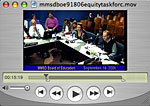
Madison Schools Equity Task Force Discussion [audio / video]

Watch or listen to most of the discussion: Video | 32MB mp3 audio

Susan Troller has more.

Share

“In Many Classrooms, Honors in Name Only”

Jay Matthews:

During a visit in March to an honors sophomore English class in an impoverished area of Connecticut, Robyn R. Jackson heard the teacher declare proudly that her students were reading difficult texts. But Jackson noticed that their only review of those books was a set of work sheets that required little thought or analysis.
Jackson, an educational consultant and former Gaithersburg High School English teacher, sought an explanation from a school district official. He sighed and told her, “We have a lot of work to do to help teachers understand what true rigor is.”
In an American education system full of plans for better high schools, more and more courses have impressive labels, such as “honors,” “advanced,” “college prep” and “Advanced Placement.” But many researchers and educators say the teaching often does not match the title.

Brett has more:

One of the biggest misperceptions among the public is that NCLB sets high academic standards for students and schools, and punishes those who do not meet them. In reality, NCLB does not set any standards, nor does it specify which tests are used to measure student outcomes against those standards. Rather, it only tells the states that they must set their own academic standards, and that they must select the tests used to measure student achievement. (See here for a good overview of the law.)

Share

“Like Lambs to the Slaughter…”

Zachary Norris:

Like the teacher on the show, I was greeted by a dysfunctional buzzer upon arrival at my school. A fitting symbol of the system’s disarray, they were desperately in need of teachers and couldn’t let me in once I got there. Many of my peers in the program were “surplussed,” bouncing around from school to school until the district administrators decided where our services could be put to best use. Upon arrival at my school, I was placed in a classroom that had not been cleaned by the previous year’s teacher, who I later learned was a first-year teacher that had quit in February. It is common in Baltimore for rookie teachers to quit during the school year. In fact, in my first year in Baltimore, only two out of the six first-years who started the year at my school actually finished. The result of this trend was a staff crunch, and my classroom role swelled at times to above forty students (ranging in age form 3rd to 6th grade, with up to 16 IEP students). It is criminal.
Speaking of criminal, how much of the City’s budget is spent on pointless professional development programs like the one shown on The Wire’s season premiere? Educational consultants with six-figure salaries rattle off clever acronyms like IALAC (I Am Loved And Competent) in steamy August auditoriums and cafeterias. I mean really, how many teachers actually use that stuff? I know I never did. As the frustration of the teachers builds to a crescendo, the professional development meeting devolves into a gripe session about the student population and the hopelessness of their situation. This in itself is destructive, perpetuating negative stereotypes of students and lending to the apathy of teachers. So in the end, the good intentions of administrative policies turn into a completely destructive activity. Welcome to education in Baltimore.

Matthew Yglesias adds:

But what would it mean — what could it mean — to close the achievement gap between high- and low-SES students in American schools? For a whole variety of reasons, this just doesn’t seem like it’s going to be possible. At the outer limit, more prosperous parents are always going to be able to re-open the gap by investing even more resources in their kids’ education. An education and child development arms race to the top might not be a bad thing, but it wouldn’t close any socioeconomic gaps. To do that, you actually need to tackle inequality itself. In the context of a reasonably egalitarian society, a well-functioning school system shouldn’t exhibit massive achievement gaps, but in the context of a wildly inegalitarian one there’s no way the school system can singlehandedly set everything back to zero.

Share

Math Organization Attempts to Bring Focus to Subject

Sean Cavanagh:

More than 15 years after its publication of influential national standards in mathematics, a leading professional organization has unveiled new, more focused guidelines that describe the crucial skills and content students should master in that subject in elementary and middle school.
The National Council of Teachers of Mathematics last week released “Curriculum Focal Points for Prekindergarten Through Grade 8 Mathematics,” a document that supporters hope will encourage the polyglot factions of state and local school officials, textbook publishers, and teachers to set clearer, more common goals for math learning.
While the report is being published by the NCTM, it was reviewed by numerous math experts from across the country, some of whom have strongly disagreed with the organization’s past positions on essential skills. The new document reflects an attempt to overcome those conflicts and focus on a number of crucial, agreed-upon concepts.
“I would hope that this has a large impact, because I believe it gets it right,” said R. James Milgram, a Stanford University mathematics professor and a critic of the math organization’s previously issued national standards. He was one of 14 individuals who provided an outside, formal review of the document. “I would like to hope that this represents a new era of cooperation,” he added. “I hope that what this represents is an end to the math wars.”

Much more here and here.

Share

Equity Policy Discussions

Susan Troller:

Deciding which schools should get how many staff members and other resources is a hot topic, and Madison School Board members are tussling over it now.
A majority of board members asked on Monday night to continue the discussion at next week’s meeting, despite board President Johnny Winston Jr.’s reluctance to put the issue on the Sept. 25 agenda.
Winston said the equity issue, which has to do with the fair allocation of resources to students and schools, was too broad to be hurried into discussion. He also said it has the potential to be very divisive. When equity formulas are put in place, some schools gain and some schools lose resources, based on the unique needs of their students.
“It’s a very complex issue,” Winston said.
He is concerned that the board could make hasty changes in how the district’s existing policy is applied, creating “ramifications we don’t fully understand,” he said in an interview today. The district and its financial situation were very different more than a decade ago when the current equity policy was put in place, he said.

Discussion audio and video are available here.

Share

Third Friday Counts

The official Download fileThird Friday Counts were distributed to the Board of Education last night (and shared with the Advocates for Madison Public School list serve this morning). Contrary to dire predictions and assessments (see here: and here), the district is growing. This will mean some increased funding under the current formula and that is good news.
However, the reassignments of the first weeks reveal how the continued tight budget situation limits flexibility in ways that disrupt schools, teachers, families and children.
I believe that this growth is further evidence that passage of the referendum is necessary; that the time to act is now at the beginning of the projected upswing in enrollments.
TJM

Share

Miracle Math

Typical of many math textbooks in the U.S., this one is thick, multicolored,and full of games,puzzles,and activities,to help teachers pass the time, but rarely challenge students. Singapore Math’s textbook is thin, and contains only mathematics — no games. Students are given briefexplanations, then confronted with problems which become more complex as the unit progresses.

ednext20064_38b.jpg


Barry Garelick [232K PDF]:

It was another body blow to education. In December of 2004, media outlets across the country were abuzz with news ofthe just-released results of the latest Trends in International Mathematics and Science Study (TIMSS) tests. Once again despite highly publicized efforts to reform American math education (some might say because of the reform efforts) over the past two decades, the United States did little better than average (see Figure 1). Headquartered at the International Study Center at Boston College and taken by tens of thousands of students in more than three dozen countries, TIMSS has become a respected standard of international academic achievement. And in three consecutive TIMSS test rounds (in 1995, 1999,and 2003), 4th- and 8th-grade students in the former British trading colony of Singapore beat all contenders, including math powerhouses Japan and Taiwan. United States 8th graders did not even make the top ten in the 2003 round; they ranked 16th. Worse, scores for American students were, as one Department of Education study put it,”among the lowest of all industrialized countries.”

Share

Civic Involvement Tied to Education

Amy Goldstein:

High school dropouts are significantly less likely than better-educated Americans to vote, trust government, do volunteer work, or go to church, according to a new report that reveals a widening gap in “civic health” between the nation’s upper and lower classes.
The report, a portrait of civic life in the United States, finds that Americans’ disengagement from their communities during the past few decades has been particularly dramatic among adults who have the least education. Among people who lack a high school diploma, the percentage who have voted plummeted from 1976 to 2004 to 31 percent — half the 62 percent of college graduates who voted in 2004.
The class divide is the most striking finding of the report, prepared by leading social scientists and released yesterday by the National Conference on Citizenship, a nonprofit organization created by Congress. “High school dropouts are . . . nearly voiceless in a system that fails them,” said John Bridgeland, a former domestic policy adviser to President Bush who is chief executive officer of Civic Enterprises and leads the conference’s advisory board.

Full Report: [630K PDF]

Share

“State School Spending is Above Average”

Channel3000:

A new report by the Wisconsin Taxpayers Alliance found that Wisconsin’s schools spend about 11 percent more per student than the national average.
The report finds the state spends about $9,000 per student, which puts Wisconsin 12th highest nationwide based on 2004 census data. The national average was is about $1,000 less.

Paul Soglin adds a few comments here.

Share

Teaching Math, Singapore Style

NY Times Editorial:

The countries that outperform the United States in math and science education have some things in common. They set national priorities for what public school children should learn and when. They also spend a lot of energy ensuring that every school has a high-quality curriculum that is harnessed to clearly articulated national goals. This country, by contrast, has a wildly uneven system of standards and tests that varies from place to place. We are also notoriously susceptible to educational fads.
One of the most infamous fads took root in the late 1980’s, when many schools moved away from traditional mathematics instruction, which required drills and problem solving. The new system, sometimes derided as “fuzzy math,’’ allowed children to wander through problems in a random way without ever learning basic multiplication or division. As a result, mastery of high-level math and science was unlikely. The new math curriculum was a mile wide and an inch deep, as the saying goes, touching on dozens of topics each year.

Much more, here.

Share

“Teacher Education Is Out of Step with Realities of Classrooms”

Arthur Levine:

most education schools are engaged in a “pursuit of irrelevance,” with curriculums in disarray and faculty disconnected from classrooms and colleagues. These schools have “not kept pace with changing demographics, technology, global competition, and pressures to raise student achievement,” the study says.
A majority of teacher education alumni (61 percent) reported that schools of education did not prepare graduates well to cope with the realities of today’s classrooms, according to a national survey conducted for the study. School principals also gave teacher education programs low grades, with fewer than one-third of those surveyed reporting that schools of education prepare teachers very well or moderately well to address the needs of students with disabilities (30 percent), a diverse cultural background (28 percent) or limited English proficiency (16 percent).

Full Report. Joanne has more.

Share

Should for-profit companies run public schools? An entrepreneur and a principal weigh in.

Steven Wilson & George Wood:

Steven F. Wilson
Senior fellow, Harvard’s John F. Kennedy School of Government; founder and former CEO of Advantage Schools
George Wood
Principal, Federal Hocking High School, Stewart, Ohio; director, the Forum for Education and Democracy

Share

MIT dean takes aim at admissions anxiety

Justin Pope
AP Education Writer
Though just teenagers, the applicants to the Massachusetts Institute of Technology are a scarily accomplished lot. They have started businesses and published academic research. One built a working nuclear reactor in his garage. In their high schools, they have led every extracurricular club and mastered the SAT.
But surprisingly few have done what Marilee Jones, the woman who actually decides which one in seven MIT applicants gets in, thinks 18-year-olds ought to be doing.
Not many sleep eight hours a night, or eat three meals a day. Few spend time each day just staring into space.
And Jones is blunt about the consequences.
The quest for perfection “is making our children sick,” the MIT dean of admissions told a recent gathering of college admissions professionals in Boston. She means it literally, snapping off statistics on the increase in ulcers, anxiety disorders and control disorders such as cutting and anorexia.
“Kids aren’t supposed to be finished,” she said. “They’re partial. They’re raw. That’s why we’re in the business.”
For years, high school teachers and counselors have been complaining about the emotional and physical toll of the competition for slots in selective colleges. SAT prep classes and an arms race of extracurricular resume-building, they say, are draining the fun out of life for their students.

Share

UW System Campus Admission Advice

Megan Twohey:

Tuesday’s meeting also included campus-specific admissions advice:

  • Madison: For the second year, applicants must take and submit the writing portion of the ACT. Postponed applicants – those who are neither admitted nor denied admission in the initial review process – should submit the supplemental application. The university expects to use its waiting list more often because it is finding it increasingly difficult to predict whether accepted students will enroll.
  • Eau Claire: Space is tight in the nursing program, so students should make sure to apply on time. Decisions aren’t made on a case-by-case basis. Students in the nursing program must meet or exceed the minimum requirements, including having taken high school chemistry and biology.

Share

Local Students in the Admissions Pressure Cooker

DEBORAH ZIFF
Wisconsin State Journal
Sunday, September 17, 2006
dziff@madison.com
Madison West High School senior Eliza Zimmerer is a teaching assistant in a bio- technology class.
She mentors younger students and leads freshmen through orientation. She’s involved in student government. Captain of the varsity tennis team. Honor roll. French honor society.
Her resume goes on and on, but she still wonders if it’s enough to get her into some of her preferred schools. And she’s not alone.
“It’s really apparent here, as it is in almost any high school,” said Becky Bebber-Wells, a guidance counselor at West. “Now, more and more kids are trying to apply to these select colleges. They feel if they don’t get in, that’s the end.
“They’re taking a full load of courses, doing a sport or two, they might be working a part- time job,” she said. “And of course, homework. They’re also going to bed really late and getting up really early.”
Bebber-Wells recalls a recent day in her office when a sophomore came in crying because she couldn’t get into one class for a “perfect schedule.”
“She about had a nervous breakdown,” she said.
The agonizing and hand- wringing over getting into a top-tier college isn’t just something that happens with students aiming for the Ivy League.
Zimmerer, who’s looking at Rice University, Carleton College, UW-Madison and a handful of other schools, said she chooses her activities based on what she values, rather than what will look good on a college resume. But she admits the nonstop schedule is demanding.
“It’s pretty exhausting,” she said. “The classes I’m taking really require a lot of work. On top of that pressure, not only do I have to write an essay for English class, I also have to write a personal statement for Madison.”
To ease the waiting-game grief, UW-Madison uses a rolling admissions process, letting students know whether they’ve been accepted within four to six weeks of application rather than waiting until April•1.
“Who do you think has a better senior year, someone applying to Harvard or Wisconsin?” UW-Madison Dean of Admissions Robert Seltzer asked rhetorically.
On a recent evening at Memorial High School, parents of seniors sat in the auditorium to learn about what their children need to do to prepare for college.
“It’s so different these days,” Tina Moses, whose daughter Lisa is a senior, said after the session. Both she and her husband went to UW-Madison, one of the schools Lisa is considering.
“It’s much more competitive. I never questioned I’d be accepted at Madison,” she said. “Now you’re lucky if you get in.”
Moses said she looks at the personal-statement section on college applications and thinks, “You know they are saying the exact same thing as everyone else.”
She recalled seeing a newspaper article about a high- school-age girl who spent her summer break volunteering in Africa.
“I feel like, oh God, does my child have to go to Africa to stand out?”
Copyright © 2006 Wisconsin State Journal

Share

November 7, 2006 Referendum & Election Page Update

I’ve updated the election page with information and links regarding the November 7, 2006 selection.
Links include the Madison School District’s information page, boundary changes and the open government complaint documents (and District Attorney Brian Blanchard’s recent response) related to the School Board’s closed meetings over the Linden Park land purchase. A motion to make the deal public (before the final Board vote) failed on a 3-3 vote – Shwaw Vang was absent (Shwaw’s seat is up for election in April, 2007). Supporting open government were Carol Carstensen, Lawrie Kobza and Ruth Robarts (Ruth’s seat is up for election in April, 2007. She is not seeking re-election).
Supporting a closed approach (and prevailing) were Bill Keys (did not seek re-election, replaced by Arlene Silveira who defeated Maya Cole by 70 out of 33,000+ votes in one of the closest local elections in years – having said that, Arlene, in the words of a friend “has been a good addition to the board”), Juan Jose Lopez (defeated by Lucy Mathiak) and Johnny Winston, Jr. (Johnny’s seat is up in April, 2007. I assume he’s running, but if Mayor Dave seeks the County Executive seat, perhaps Johnny will give that position a run and face former School Board member Ray Allen?). Art Rainwater is correct when he said that education is inherently political.

Share

Opting Out of Private School

Nancy Keates:

It’s the lurking fear of every private-school parent: The kid next door is getting just as good an education at the public school — free of charge.
Ben and Courtney Nields of Norwalk, Conn., agonized over the issue last year when they moved their daughter Annie from the New Canaan Country School, set on a 72-acre campus, to a public school for first grade. The move was primarily economic — they have twins entering kindergarten this year and faced tuition bills of $22,500 per child.
“It was like taking your child out of the Garden of Eden,” says Mrs. Nields. But Annie thrived at the school. Her confidence grew and the teacher, say the Nieldses, was phenomenal.
Across the country, some schools and education professionals report a growing movement from private to public. Among the possible reasons: Private-school tuition has grown sharply, while some colleges are boosting the number of students they take from public schools. New studies have suggested that public-school students often tested as well or better than their private school peers. And increasingly, public schools are enriching their programs by holding the same kinds of fund-raisers often associated with private schools, such as auctions and capital campaigns.
“But lately there’s strong anecdotal evidence of frequent movement from private schools to public schools. There are more choices for parents now.”
Some public schools are actively recruiting private-school students. At Torrey Pines Elementary in La Jolla, Calif., Principal Jim Solo began holding monthly tours and meetings for private-school families four years ago. Many students had left for private or charter schools. While he says it was not a main motivator, having students return to the school increased state funding, as the district is paid on a per-pupil basis.

Locally, I’ve seen movement both ways. A number of parents have left over curriculum and climate issues while others have jumped back in because the public schools offer services or curriculum not available in the private school world. Homeschooling is another growing factor.

Share

Private School Parents Control Board

Destroying Public Schools
New York Times
September 16, 2006
At Odds Over Schools
By BRUCE LAMBERT
LAWRENCE, N.Y.
[This] school district has been changing, house by house, as Orthodox Jewish families have flocked here over the last two decades, gradually at first and then in growing numbers.
While not yet a majority, the Orthodox have nonetheless emerged as the dominant force in a clash of cultures. And the front line in this battle is Lawrence’s once highly regarded public school system.
In each of the last four years, Orthodox voters mobilized to defeat the school budget — one of the longest losing streaks on Long Island. Then in July, they took charge of the school board, though few of the Orthodox send their children to public schools. Out of seven seats, the new majority consists of four Orthodox members and one ally.
[M]any of this district’s Orthodox residents object to paying school taxes that average about $6,000 per home for a system they do not use. Their leaders also complain that more public money should be channeled to the Orthodox day schools, which by law are limited to tax-financed busing, books and special education services.
“We feel invaded,” said an Atlantic Beach delicatessen customer, a self-described non-Orthodox Jew and activist parent who declined to give her name. “We don’t mind them being here, but taking over and shutting down the school system is not the right thing.” (Atlantic Beach is part of the Lawrence school district.)
Experts who track expanding Orthodox neighborhoods around the nation say the conflict in Lawrence has far-reaching implications.
“Other communities are watching Lawrence very closely, for fear they may be next,” said Prof. William B. Helmreich, the director of the Center for Jewish Studies at Queens College. Orthodox adherents “are cohesive, they marshal forces and vote as a bloc,” he said. “It could happen anywhere.”
It has already happened in Rockland County, where Orthodox residents control the East Ramapo school board. Similar strains have arisen over the schools and other services in Lakewood, N.J., home to a large Orthodox population.
“It’s ominous,” said Steven Sanders, a former New York City assemblyman who was chairman of the State Assembly’s Education Committee. “This is not going to be an isolated situation. This is a worrisome trend. The common thread is not religion. The common thread is people who don’t feel invested in educating other people’s children. What do you do when a community is significantly comprised of individuals who don’t have a stake in public schools when they’re already spending for private schools? It’s a fracturing of the social compact.”

Share

“Promoting the End of Social Promotion”

Jay Greene and Marcus Winters:

Should the grade-level a student is in be based entirely on how old he is or at least partially on how skilled he is? This is the fundamental question underlying the debate over social promotion — the practice of moving students to the next grade regardless of whether they have acquired the minimal skills covered in the previous grade. Advocates of social promotion suggest that it is best to group students by age rather than by skill. Students who are held back a grade are separated from their age-peers and, the argument goes, this social disruption harms them academically. Opponents of social promotion favor requiring students to demonstrate minimal skills on a standardized test before they receive automatic promotion to the next grade.
Until now the bulk of the research favored social promotion. Most studies found that students who were retained tended to fare less well academically than demographically similar students who were promoted. The problem with this previous research is that it was never entirely clear whether retained students did worse because they were retained or because whatever caused them to be retained led to worse outcomes. This is especially a problem because these previous studies examined retention based on educator discretion. If teachers decide that one student should be retained while another demographically similar student should be promoted, they probably know something about those students that suggests that the promoted student has better prospects than the retained student. When researchers match students on recorded demographic factors they cannot observe or control statistically for what a teacher saw that led that teacher to promote one student while retaining the other.

The complete report is available here.

Share

Technology: “It Can Do More Harm Than Good”

Ryan Boots:

I’ve been something of a cheerleader on the use of new media in the classroom, principally in the form of digital textbooks.  But similar to what we’ve already seen with the calculator, such technology has the potential to inflict damage in the classroom.

Exhibit A: Right Wing Prof flipped his lid a couple of days ago over a math lesson titled "Making Money from Lemons" (produced by Microsoft no less–oh, the irony).  Just one problem: the lesson didn’t actually involve any, you know, math.  Just a bunch of mouse clicks that an orangutan could be trained to perform. 

Exhibit B: Educomputer vendor Steve Hargadon did an interview with author Larry Cuban on his 2001 book "Oversold and Underused: Computers in the Classroom".  I highly recommend all of Hargadon’s post, but I find this paragraph particularly important:

Share

Studio School Update

Susan Troller:

The backers of the Studio School were given permission by the Madison school board last year to pursue the planning grant.
Donahue said the proposed Studio School will focus on providing a school-wide, arts rich curriculum for elementary school students. It would be chartered with the Madison school district in a way similar to the district’s very successful dual immersion Spanish language school, Nuestro Mundo Inc., or its other charter school, Wright Middle School. Both schools focus on issues of multi-culturalism and integrating social action into the curriculum.

More on the Studio School.

Share

North Carolina & Math Standards

Todd Silberman:

Despite North Carolina students’ steady improvement in reading and math, their performance on state end-of-grade tests has been far better than on the National Assessment of Educational Progress. In fact, North Carolina stands out because of the wide gap between results on the state and national tests.
In 2005, about 84 percent of North Carolina eighth-graders earned proficient or better scores on state math tests; 32 percent were proficient or advanced on the national math test. Only West Virginia showed a sharper difference.
“When you see the huge disparity that you do between proficiency levels [on state and national tests], at least part of it is about rigor,” said Ross Weiner, policy director for the Education Trust, a Washington group that advocates for poor and minority students. “North Carolina has a bigger difference than most other states. That raises questions about expectations and whether North Carolina’s standards are high enough to demonstrate that students are learning what they need to know.”

More on “how states inflate their progress under No Child Left Behind“.

Share

The End of Cupcake Days

Eric Zorn:

There were some two dozen of us in the 4th grade classroom at parent orientation night this week, and not one of us looked the least bit disappointed when the teacher, Mrs. Rand, announced “absolutely no cupcakes this year!”
She’d done the math. Naturally. And she figured that if every child had a little birthday party — where a parent brings in treats, drinks, maybe goodie bags — she’d lose roughly 10 hours of total classroom instruction time over the course of the year.
Parents have done the math too. The one responsible for buying the treats (usually the mother and usually cupcakes) and making sure they get to school at the right time and that kids with dietary restrictions are provided with edible options also loses an hour or so.

Share

The Midwest Academic Talent Search

Madison United for Academic Excellence (MUAE) is hosting an informational session about the Midwest Academic Talent Search (MATS) program run by the Center for Talent Development (CTD) at Northwestern University.
The MATS provides an opportunity for academically advanced students in grades three through nine to take an out-of-grade-level standardized test. Students in grades three through six may take the Explore test (essentially an ACT designed for eighth graders); students in grades six through eight may take the SAT test; and students in grades six through nine may take the ACT test. For students who routinely hit the ceiling of their district and state level tests, an out-of-grade-level test may be the only way to truly know what they know. Test results may be used for advocacy purposes, as well as to access a wide array of advanced educational experiences across the country.
Our guest speaker for the evening will be Carole Nobiensky, longtime staff member and Director of Programs at the Wisconsin Center for Academically Talented Youth (WCATY).
Please join us on Wednesday, September 27, from 7:00 p.m. to 8:30 p.m. in Room 209 of the Doyle Administration Building, 545 West Dayton Street.

Share

All Kindergartners Need to Know….

Kate Grossman:

The state laid out Tuesday what it wants every kindergarten student to know, an exhaustive list that includes everything from writing letters and identifying shapes to understanding that hurting others is wrong and the value of a sense of humor.
Illinois has had broad learning goals for all students since 1997 but until now hadn’t specified what that meant for kindergarten students. Specific goals for clusters of other grades and preschoolers already have been established.
The 172 new “benchmarks,” or skills, cover language arts, math, science, social science, physical development and health, fine arts, foreign language and social/emotional developme

Share

As Homework Grows, So Do Arguments Against It

Valerie Strauss
The nation’s best-known researcher on homework has taken a new look at the subject, and here is what Duke University professor Harris Cooper has to say:
Elementary school students get no academic benefit from homework — except reading and some basic skills practice — and yet schools require more than ever.
High school students studying until dawn probably are wasting their time because there is no academic benefit after two hours a night; for middle-schoolers, 1 1/2 hours.
And what’s perhaps more important, he said, is that most teachers get little or no training on how to create homework assignments that advance learning.
The controversy over homework that has raged for more than a century in U.S. education is reheating with new research by educators and authors about homework’s purpose and design.
No one has gone as far as the American Child Health Association did in the 1930s, when it pinned homework and child labor as leading killers of children who contracted tuberculosis and heart disease. But the arguments seem to get louder with each new school year: There is too much homework or too little; assignments are too boring or overreaching; parents are too involved or negligent.

Share

Math Wars Earthquake

Tamar Lewin:

In a major shift from its influential recommendations 17 years ago, the National Council of Teachers of Mathematics yesterday issued a report urging that math teaching in kindergarten through eighth grade focus on a few basic skills.
If the report, “Curriculum Focal Points,” has anywhere near the impact of the council’s 1989 report, it could signal a profound change in the teaching of math in American schools. It could also help end the math curriculum struggles that for the last two decades have set progressive educators and their liberal supporters against conservatives and many mathematicians.
At a time when most states call for dozens of math topics to be addressed in each grade, the new report sets forth just three basic skills for each level. In fourth grade, for example, the report recommends that the curriculum should center on the “quick recall” of multiplication and division, the area of two-dimensional shapes and an understanding of decimals. It stopped short of a call for memorization of basic math facts.
The 1989 report is widely seen as an important factor nudging the nation away from rote learning and toward a constructivist approach playing down memorization in favor of having children find their own approaches to problems, and write about their reasoning.
“It was incredibly influential,” said Chester E. Finn Jr., a Department of Education official in the Reagan administration. “More than half the states explicitly acknowledged it in devising their own standards. This report is a major turnaround.”

Lewin’s article references a 2005 document: “10 myths of NCTM (Fuzzy) Math“.
NCTM source materials and related links here.

Share

Enrollment projection errors create school turmoil

Susan Troller:

But because the projected enrollment numbers don’t match the actual numbers of students at Stephens this year, one grades 2-3 classroom is being dropped, with students assigned to other classrooms and Bazan’s job at Stephens eliminated.
The same scenario is playing out at five other elementary schools where teachers and sections are being eliminated due to smaller than expected student populations, district spokesman Ken Syke said. Meanwhile, nine elementary schools are over projected enrollments and will be adding sections to address bursting-at-the-seams populations.
The district will add 10 classes at these schools to add capacity. Four teachers will be hired, in addition to shifting teachers from the under-enrolled schools.
Schools where classes are being eliminated include Crestwood, Falk, Kennedy, Randall, Schenk and Stephens. Schools that are adding teachers include Glendale, Hawthorne, Lake View, Mendota, Marquette, Muir, Sandburg, Thoreau and Leopold. Two teachers will be added at Leopold, which had a particularly large increase in students.

Share

The Not-So-Public Part of the Public Schools: Lack of Accountability

Samuel Freedman:

WHEN Mayor Michael R. Bloomberg and Chancellor Joel I. Klein gained unprecedented power over the vast archipelago of public education in New York more than four years ago, they were the beneficiaries of three beliefs widely held in the city.
The first was that the system of decentralized control, ended after 35 years by the State Legislature in June 2002, had been a misadventure of bureaucratic inefficiency, academic inconsistency and persistent corruption.
The second was that the education program advocated by Mr. Bloomberg’s predecessor, Rudolph W. Giuliani, with its emphasis on steering public money into vouchers for private schools, was too radical for New York.
The final factor was that Mr. Bloomberg, astride a personal fortune, and Mr. Klein, an anti-trust lawyer in the Clinton administration, were so independent and incorruptible they could be trusted to run a system with more than a million students and a budget well into the billions with few, if any, of the traditional forms of government or community oversight.

Share

90 Area Students Named National Merit Scholar Semifinalists

The Capital Times:

Sixty-seven students at six Madison high schools have been named semifinalists in the 52nd annual National Merit Scholarship Program, announced today. It is one of the most prestigious academic competitions for high school students nationwide. In addition, 23 students from the surrounding area have also been named semifinalists.

Share

Facebook & Privacy

Danah Boyd:

Facebook implemented a new feature called “News Feeds” that displays every action you take on the site to your friends. You see who added who, who commented where, who removed their relationship status, who joined what group, etc. This is on your front page when you login to Facebook. This upset many Facebook members who responded with outrage. Groups emerged out of protest. Students Against Facebook News Feeds is the largest with over 700,000 members. Facebook issued various press statements that nothing was going to change. On September 5, Mark Zuckerberg (the founder) told everyone to calm down. They didn’t. On September 8, he apologized and offered privacy options as an olive branch. Zuckerberg invited everyone to join him live on the Free Flow of Information on the Internet group where hundreds of messages wizzed by in the hour making it hard to follow any thread; the goal was for Facebook to explain its decision. In short, they explained that this is to help people keep tabs on their friends but only their friends and all of this information is public anyhow.

Share

Texas Gives Teachers in 76 Schools $7M in Bonuses

Ericka Mellon:

Some critics of merit pay argue it puts too much emphasis on standardized tests, but Perry and Texas Education Commissioner Shirley Neeley defended the state’s plan for compensating teachers who prove themselves.
“When you reward excellence, excellence becomes the standard,” Perry said Tuesday at Oleson Elementary in the Aldine Independent School District.
Eleven schools in Houston ISD and two schools in North Forest ISD also are expecting the staff bonuses. Schools had to give at least 75 percent of the bonus money to teachers, but they could include others.
Perry said the bonuses could be as large as $10,000. At Oleson Elementary, the figure was much lower. Some at the campus received $2,800 while others earned $1,100 based on the school’s formula, said Principal Cassandra Cosby.

Share

Failure to Understand Science is a National Security Issue

Charles Anderson:

A hint of the politicians’ dilemma was buried in a May 10 New York Times-CBS News poll about the performance of U.S. elected officials on a host of policy issues.
Not surprisingly, neither President Bush nor Congress earned high marks. What startled me, though, was the response to this question: “Regardless of how you usually vote, do you think the Republican Party or the Democratic Party is more likely to see to it that gasoline prices are low?”
Fifty-seven percent of the respondents said that the Democrats could keep prices low. Another 14 percent chose the Republicans or both parties. Seventy-one percent of Americans, in other words, see the price of gas as a political issue. This is tantamount to living in a fantasy world and ignoring both the economic law of supply and demand and the accumulating environmental damage caused by our fossil-fuel-dependent economy.
It’s not surprising that many politicians choose to respond to numbers like these with stopgap measures that delay the inevitable reckoning, hoping that something will come up in the meantime. But the root of the problem stretches beyond Washington to an electorate that can’t evaluate science-based statements. It’s time, then, for a sea change in science education in our nation’s schools.
Imagine how politicians would act differently if the public were more knowledgeable about ideas currently considered too arcane for political debate—fossil-fuel supply chains; hidden costs not included in the price we pay for a product; and the chemistry of tailpipe emissions.
That scenario remains imaginary for now, since, by every indication, the public is ill-equipped to evaluate arguments based on such ideas. Adults and children know that pollution is bad for the environment and that trees are good, but they have no idea why experts see the price of gasoline as connected to housing policies, ethanol production, or plug-in hybrids.

Share

Elections, Referendums, School Boards and Administrators

Aaron Bensonhaver:

Phil Hartley, legal counsel for the school boards association, said one area that school board members and superintendents often get into trouble is in supporting a referendum or candidate.
Hartley said either can support such situations on their own time, but must be careful not to use tax money, including being on the clock while campaigning, while working for the cause.
He said using tax money to encourage people to vote is OK, but doing so to encourage people to vote a certain way can get systems into trouble, which usually amounts to fines of $1,000-$10,000, depending on the number of violations of the Ethics and Government Act, which is also the law that requires candidates to disclose contributions they have received.

(more…)

Share

Schools Active Year Round

Madison Schools Superintendent Art Rainwater:

Twenty-two year old Louisa Brayton stepped before her class of 12 students to begin the first day of school. It was not only her first day but also the first day for all of her students and more importantly the first day of school in Madison Wisconsin. It’s March, 1838 and school will be in session for only two months.
How times have changed! School now operates all year.
After school ended last June, over 4,000 children continued in school for the following six weeks. Some attended because they needed extended time to learn and to reach a level where they will be successful next year; others took courses to extend their knowledge in their area of interest. Many of the students who attended our morning summer program continued at school in the afternoon in recreation programs conducted by our own Madison School & Community Recreation (MSCR) department.

Share

Return to Basics in Teaching Math

Critics of “Fuzzy” Methods Cheer Educators’ Findings; Drills Without Calculators. Taking Cues from Singapore.
John Hechinger:

The nation’s math teachers, on the front lines of a 17-year curriculum war, are getting some new marching orders: Make sure students learn the basics.
In a report to be released today, the National Council of Teachers of Mathematics, which represents 100,000 educators from prekindergarten through college, will give ammunition to traditionalists who believe schools should focus heavily and early on teaching such fundamentals as multiplication tables and long division.
The council’s advice is striking because in 1989 it touched off the so-called math wars by promoting open-ended problem solving over drilling. Back then, it recommended that students as young as those in kindergarten use calculators in class.
Those recommendations horrified many educators, especially college math professors alarmed by a rising tide of freshmen needing remediation. The council’s 1989 report influenced textbooks and led to what are commonly called “reform math” programs, which are used in school systems across the country.
Francis Fennell, the council’s president, says the latest guidelines move closer to the curriculum of Asian countries such as Singapore, whose students tend to perform better on international tests. There, children focus intensely on a relative handful of topics, such as multiplication, division and algebra, then practice by solving increasingly difficult word and other problems. That contrasts sharply with the U.S. approach, which the report noted has long been described as “a mile wide and an inch deep.”
If school systems adopt the math council’s new approach, their classes might resemble those at Garfield Elementary School in Revere, Mass., just north of Boston. Three-quarters of Garfield’s students receive free and reduced lunches, and many are the children of recent immigrants from such countries as Brazil, Cambodia and El Salvador.
Three years ago, Garfield started using Singapore Math, a curriculum modeled on that country’s official program and now used in about 300 school systems in the U.S. Many school systems and parents regard Singapore Math as an antidote for “reform math” programs that arose from the math council’s earlier recommendations.
The Singapore Math curriculum differs sharply from reform math programs, which often ask students to “discover” on their own the way to perform multiplication and division and other operations, and have come to be known as “constructivist” math.

Links:

Strong parent and teacher views on the MMSD’s math strategy may well spill over to non-support for referendums and incumbent board members, particularly in light of increasing UW Math Department activism on this vital matter.

Share

High School Dropouts Face Steep Costs

Ben Feller:

Dropping out of high school has its costs around the globe, but nowhere steeper than in the United States.
Adults who don’t finish high school in the U.S. earn 65 percent of what people who have high school degrees make, according to a new report comparing industrialized nations. No other country had such a severe income gap.
Adults without a high school diploma typically make about 80 percent of the salaries earned by high school graduates in nations across Asia, Europe and elsewhere. Countries such as Finland, Belgium, Germany and Sweden have the smallest gaps in earnings between dropouts and graduates.
The figures come from “Education at a Glance,” an annual study by the Paris-based Organization for Economic Cooperation and Development. The report, released Tuesday, aims to help leaders see how their nations stack up.

Share

Working in Schools May Reduce Senior’s Property Taxes

Katharine Goodloe:

Seniors citizens in Germantown may soon be able to get a discount on their property taxes – by working in schools throughout the year to earn it.
The district is considering adopting a program, popular in several Wisconsin districts, that places seniors in school-based roles, then issues them a check to be applied toward their property tax bill.
Richmond Elementary in Waukesha County adopted the program eight years ago, and seniors there can work up to 78 hours a year for $5.50 an hour. They must be age 62 or older, and at the end of the year a two-party check is issued to the senior and to the county treasurer to be applied to their property tax bill.
“Everybody I talk to, I tell them what I’m doing and they can’t believe I’m getting money off my property taxes for doing this,” said Lois Fast, 78, one of the school’s seven volunteers in the Senior Citizen Tax Exchange Program, or STEP.

Share

Per Pupil Spending Parity

Sara Neufeld:

The city spends the equivalent of about $11,000 per child in its regular public schools.
Charter schools in the city receive $5,859 per child in cash and the rest in services that the school system provides, such as special education and food.
Two city charter schools, City Neighbors and Patterson Park Public, appealed that formula to the state school board in 2005, saying it limited their ability to choose how to provide services.
The state school board ruled in the charter schools’ favor, and the city school system appealed that decision in court.
“All we’re asking for is parity,” said Bobbi Macdonald, president of the City Neighbors board. “We’re not asking for anyone to spend more money on charter school kids.”

Via Joanne.

Share

How Lowering the Bar Helps Colleges Prosper

Daniel Golden:

Twice a year, after reviewing applicants to Duke University, Jean Scott lugged a cardboard box to the office of President Terry Sanford. Together, Ms. Scott, director of undergraduate admissions from 1980 to 1986, and Mr. Sanford pored over its contents: applications from candidates she wanted to reject but who were on his list for consideration because their parents might bolster the university’s endowment. Ms. Scott won some battles, lost others and occasionally they compromised; an applicant might be required to go elsewhere before being taken as a transfer.
“There was more of this input at Duke than at any other institution I ever worked for,” says Ms. Scott, now president of Marietta College in Ohio. “I would have been very pleased to have the best class as determined by the admissions office, but the world isn’t like that.”
Over more than 20 years, Duke transformed itself from a Southern school to a premier national institution with the help of a winning strategy: targeting rich students whose families could help build up its endowment. At the same time, and in a similar way, Brown University, eager to shed its label as one of the weakest schools in the Ivy League, bolstered its reputation by recruiting kids with famous parents. While celebrities don’t often contribute financially, they generate invaluable publicity.

Share

On Homework: Busy Work

Ben Wildavsky:

Perhaps homework really is out of control in certain (generally affluent) schools and districts. But that would be a far narrower problem than the national epidemic these authors describe. Their books are best understood as part of a broader ideological struggle over the direction of American education. From his approving invocation of Noam Chomsky to his denunciation of testing and other accountability-based reforms, it’s clear that Kohn sees homework as just one more instrument of social control. Even the valid points he makes (for instance, that the correlation between homework and academic achievement in some grades doesn’t necessarily imply causation) are undercut by his tendentious approach. There’s no small irony in a professional provocateur like Kohn accusing respected researchers of being “polemicists” who cherry-pick studies to buttress their preexisting views. Bennett and Kalish, though less overtly political, are just as apt to cast children in the role of an oppressed class.
It’s a shame these volumes aren’t more credible. Averages notwithstanding, some kids certainly do get buried in assignments of dubious worth — and in those cases Bennett and Kalish’s lobbying tips could prove useful. Similarly, Kohn’s insistence that schools justify both the quantity and quality of the work they’re assigning is perfectly reasonable. But in the absence of more persuasive evidence that American kids are plagued by excessive, rather than insufficient, academic rigor — homework included — parents and policymakers should look elsewhere for a nuanced and reliable guide to this eminently worthy subject. ·

Share

Mississippi Free School Fruit Pilot Program

Reuters:

Results of a pilot program in Mississippi hints that distributing apples, oranges and other fresh fruit free of charge at school may be an effective part of a comprehensive program aimed at improving students’ eating habits.
During the 2004-2005 school year as part of the Mississippi Fresh Fruit and Vegetable Pilot Program, 25 secondary schools gave out free fresh fruit and vegetables during the school day and provided nutrition education to promote and support the program.
Initial results based on 851 participating students in grades 5, 8, and 10 from 5 schools suggest that the program significantly increased the variety of fruit and vegetables tried by the students in all three grades.
The program appeared to be most effective among students in grades 8 and 10, report Doris J. Schneider from the Child Nutrition Program, Mississippi Department of Education and colleagues in the current issue of the Morbidity and Mortality Weekly Report, a publication of the U.S. Centers for Disease Control and Prevention.

Share

Children from low-income families often suffer exclusion at school

Children from low-income families often suffer exclusion at school
Tuesday, September 05, 2006
BY JOAN MADELEINE DOUGHTY
©2006 Ann Arbor News
Imagine this: You live in Ann Arbor. Your first-grade student comes home from school and tells you the teacher handed out cupcakes today – to every child except yours and two others. Why? “Teacher said I wasn’t on the list of kids who were paid for.”
You call the teacher and are told you never sent in money for daily snacks. The reason you didn’t pay was because you couldn’t. With four mouths to feed, living on disability, you struggle to pay your rent, utilities and food bills. There is no money for extras. And now your child watches, while almost everyone in the class enjoys snacks every day.
Does this really happen in Ann Arbor? It does not. If it did, we would collectively rise in protest. We can’t imagine a teacher who would skip a student when distributing treats just because his or her parent is too poor to pay. In fact, when research showed hungry children had trouble focusing on academics, policy makers universally embraced the concept of free and reduced school breakfast and lunch programs.
Now ask yourself this: Which would a child rather have – a cupcake or school pictures? A bag of chips or a yearbook? Every year in most of our children’s classrooms, teachers hand out school picture packets to some kids, but not others. They give certain children yearbooks, but skip their peers. Why? Because their parents didn’t pay. Sometimes by choice, but more often the reason is financial.

(more…)

Share

Hundreds of kids flock to state’s new online schools

Linda Shaw:

Washington’s two newest online schools didn’t know how many students to expect when they announced they would open their virtual doors this fall. Leaders cautiously hoped for 250, maybe 300 as a start.
They were low — way low. As school starts, the two public schools are happily struggling to handle double and triple that number.
Insight School of Washington, the state’s first fully online high school, stopped accepting students after 650, and has 1,000 more who’ve expressed interest. The Washington Virtual Academy, a K-8 based in Steilacoom, has 652 students registered, and another 500 in the application pipeline.
It’s another spurt in the growth of online learning in Washington state, where more than 9,000 students took one or more online classes last year.
Going to school via computer is “not for most kids,” said Bill Finkbeiner, executive director of Insight School, a partnership between a Portland company and the small Quillayute Valley School District in Forks. “Most students are going to do better in traditional high schools. But there are a significant percentage of students who don’t fit in to a regular high school and, for many of them, this is a good option.”

Share

Advice for (School) Administrators

Ms. Cornelius:

A while back, a friend asked me what advice I would give administrators, since we were discusing advice to new teachers. After having gotten through the first few weeks of school, I am riled up enough now that I’m going to pick up that challenge. So here we go: advice for vice principals, principals, assistant superintendents, superintendents, and any other person who gets to dip their toes into actual policy-making for the educational world.

Share

Outsourcing Homework

Charles McGrath:

For $9.95 a page she can obtain an “A-grade” paper that is fashioned to order and “completely non-plagiarized.” This last detail is important. Thanks to search engines like Google, college instructors have become adept at spotting those shop-worn, downloadable papers that circulate freely on the Web, and can even finger passages that have been ripped off from standard texts and reference works.
A grade-conscious student these days seems to need a custom job, and to judge from the number of services on the Internet, there must be virtual mills somewhere employing armies of diligent scholars who grind away so that credit-card-equipped undergrads can enjoy more carefree time together.

Share

America on the cusp of education renaissance

Matthew Ladner:

In the past, a lack of data enabled stagnation. Armchair observations of real-estate agents were often the most sophisticated opinions regarding the quality of local schools. Today, online services like www.greatschools.net provide a mountain of comparative testing and parental review data in a few short clicks.
New technologies and practices, such as self-paced computer-based instruction and data-based merit pay for instructors, hold enormous promise which has only begun to be explored. That said, disadvantaged children in KIPP Academy schools, among others, have achieved phenomenal academic results not with new technologies, but rather with old-fashioned “time on task” hard work and extended school days.
In short, we now have the primordial soup of a market for schools.

Via Joanne.
No doubt. I’ve mentioned before that Milwaukee, over the next few decades (despite stops and starts) will have a far richer K-12 climate than Madison. Madison has the resources and community to step things up – I hope we do so (does it have the leadership?).

Share

Madison Teen Gets Perfect SAT Score

Doug Erickson:

e represented Wisconsin in the National Spelling Bee. Now Robert Marsland III has another claim to fame.
The Madison high school senior earned a perfect score on the SAT college entrance exam, a feat all the more impressive because the test was revamped and expanded this year, with a writing essay added.
Last year, 1,050 students got a perfect 1600 score, according to the College Board, which administers the test. This year, just 238 students earned the new perfect score of 2400.

Share

“Candy isn’t Dandy in Madison Schools”

Susan Lampert Smith:

Expect details of the Madison School District plan in the coming week. Here’s what my sticky fingers were able to pry out of Mary Gulbrandsen, student services director:
Soda pop has already vanished from Madison school vending machines. Candy is no longer sold in school, and in two years, no school group will be allowed to sell candy for fundraising.
(Horde your hockey team candy bars – soon you can sell them on eBay as collectors’ items!)

Share

Reality Doesn’t Meet the Ambitions Of Many Teens

Elizabeth Agnvall:

As parents and guidance counselors encourage high school students beginning the new school year to pursue their dreams, a new study suggests that many of them are setting their sights too high.
Researchers at Florida State University (FSU) studied teens’ educational and occupational plans between 1976 and 2000 and found a widening gap between what teens believe they will do after graduation and their actual achievements, a problem that the study’s authors say can lead to wasted resources, anxiety and distress.
“High school students’ plans for what they will achieve are increasingly distant from what’s likely,” said lead author John Reynolds. The FSU sociology professor said other studies have shown a disconnect between students’ goals and their achievements, but this one shows that the gap has grown in the past 30 years.

Share

How Can This Continue: Negotating Health Insurance Changes

Robert Butler[PDF]:

Health insurance has become the most prevalent issue discussed at the bargaining table today. Recent premium increases for school districts with July renewal
dates have focused even more attention on this issue.
Many administrators and board members ask: How can this continue? How do we communicate to our employees, our taxpayers and other interested constituents the effect that our health insurance costs have on our budgets? How do we maintain and, hopefully, expand our educational offerings when our costs for health insurance continue to eat up an ever larger portion of our budget?
There are many factors that have contributed to the high cost of health insurance: utilization of services, demographic trends (such as life expectancy and obesity), healthcare provider consolidation, duplication of services, new products and services, the growing number of uninsured, marketing of prescription drugs, medical malpractice expenses, level of benefits and plan design, among others.
This article will provide insight on how to address items that we can control at the bargaining table: the level of benefits, plan design and consumer behavior. Remember, health insurance is an economic and emotional issue; people don’t always make rational decisions when negotiating over this topic.

Butler is Co-Director of Employee Relations Services, Staff Counsel; Wisconsin Association of School Boards.
Negotiating health care costs with employees is the first item on the Board’s Human Resources Committee agenda: Monday, September 25, 2006 @ 6:00p.m. in the McDaniels Auditorium [map].

Share

The Hidden Cost of Curriculum Narrowing

Craig Jerald [PDF]:

in March, The New York Times published a major education story under the headline “Schools Cut Back Subjects To Push reading and Math.” The article claimed that “thousands of schools across the nation are responding to the reading and math requirements laid out in No Child left Behind […] by reducing class time spent on other subjects and, for some low-proficiency students, eliminating it.”1 The headline appeared “above the fold” in the Sunday edition of the Times, the most valuable and influential real estate in american print journalism.
Predictably, the rest of the media quickly picked up the story in a series of ripples extending outward to other newspapers and magazines to radio and finally to television, cycling back to newspapers in the form of outraged editorials. By the time the story hit the late-night talk shows and drive-time airwaves, commentators had begun to express near hysterical dismay that social studies, science, and the arts were all but disappearing from american schools.
Not so fast. as often happens when complex educational issues encounter the popular media, the extent of the problem was blown out of proportion. The original study on which the Times based its story had actually found that about one third of districts reported that their elementary schools had reduced social studies and science “somewhat” or “to a great extent,” and about one fifth said the same of art and music.

More about the Center for Comprehensive School Reform and Improvement. Via Rotherham.

Share

Schools Find Free Veggies a Hard Sell

Mike Stobbe:

Bad news – but probably no surprise to parents – when it comes to young children and vegetables: A government study showed fifth-graders became less willing to try vegetables and fruits when more were offered as free school snacks.
Older kids in the same study upped the amount of fruit they ate, but there was no change in their vegetable consumption.
The study results are somewhat disappointing for champions of getting more fresh produce into school lunchrooms.

Share

Teacher Blogs

Maria Sacchetti:

One Needham teacher gushed about the time a student worried that Australia would fall off the planet — and how that led to a lesson on gravity. A Brookline teacher banned the word “stuff” from her fourth-graders’ vocabulary. A young teacher, also from Needham, got personal, thanking parents for their support after her husband died.
Meet the newest group of bloggers drawing audiences online: teachers.
Teacher-generated blogs have been increasingly popping up from Needham to Martha’s Vineyard, many in the past year. Teachers at all grade levels reveal glimpses of themselves as well as the magical moments — and at times, difficult ones — that can happen in a classroom. Parents, in turn, scour the blogs, post comments, or borrow snippets to use as dinner conversation with their children.
As students head back to school this week, teachers are again typing dispatches during breaks at school, or from home in their pajamas.

Share

Philadelphia Opens High Tech School

Jon Hurdle:

Philadelphia on Thursday opened a public high school where students work on wireless laptops, teachers eschew traditional subjects for real-world topics and parents can track their child’s work on the Internet.
Called “The School of the Future” and created with help from software giant Microsoft, it is believed to be the first in the world to combine innovative teaching methods with the latest technology, all housed in an environmentally friendly building.
The school, which cost the school district $63 million to build, is free and has no entrance exams. The 170 students in the inaugural ninth-grade class were selected by lottery from 1,500 applicants.

Joanne says it’s New Tech with the same old curriculum.

Share

Madison School District Progress Report

Via a Johnny Winston, Jr. email:

Welcome back to school! I hope you had a wonderful summer. On August 28th the Madison school board approved plans Plan CP2a and Plan CP3a relative to boundary changes that will be necessary if the November 7th referendum to construct an elementary school on the Linden Park site passes or fails. The plan will need to be adjusted depending on enrollment. The board also passed a resolution to place $291,983.75 of the Leopold addition/remodeling monies in the contingency fund of the 2006-07 budget if the referendum passes less the expenses incurred relative to the initial financing of the project
On August 21st, Partnerships, Performance and Achievement and Human Resources convened. The Partnerships Committee (Lucy Mathiak, Chair) discussed strengthening partnerships with parents and caregivers and is working to develop a standard process for administering grants to community partners. Performance and Achievement (Shwaw Vang, Chair) had a presentation on the English-as-a-Second Language Program. Human Resources (Ruth Robarts, Chair) discussed committee goals and activities for 2006-07
On August 14th the board approved a policy that allows animals to be used in the classroom by teachers in their educational curriculum but also protects students that have allergies or other safety concerns. Questions about the November referendum were discussed and an additional JV soccer program at West High school was approved. This team is funded entirely by parents and student fees. The Finance and Operations Committee (Lawrie Kobza, Chair) met to discuss concepts and categories of a document called the People’s Budget that would be easier to read and understand. Lastly, three citizens were appointed to the newly created Communications Committee (Arlene Silveira, Chair): Deb Gurke, Tim Saterfield and Wayne Strong

(more…)

Share

Report Finds U.S. Students Lagging in Finishing College

Tamar Lewin:

The United States, long the world leader in higher education, has fallen behind other nations in its college enrollment and completion rates, as the affordability of American colleges and universities has declined, according to a new report.
The study, from the National Center for Public Policy and Higher Education, found that although the United States still leads the world in the proportion of 35- to 64-year-olds with college degrees, it ranks seventh among developed nations for 25- to 34-year-olds. On rates of college completion, the United States is in the lower half of developed nations.
“Completion is the Achilles’ heel of American higher education,’’ said Patrick M. Callan, president of the center, a nonprofit, nonpartisan organization based in San Jose, Calif., and Washington.

Wisconsin’s “Report Card” [200K PDF]: Preparation: B+, Participation A-, Affordability: F, Completion: A, Benefits: B- and Learning: I. 2004 Report Card.

Share

“How We Dummies Succeed”

Robert Samuelson:

If you’re looking for the action in education, forget the Ivy League. Talk instead to Anthony Zeiss, president of Central Piedmont Community College in Charlotte. It has six campuses and 70,000 students taking classes in everything from remedial English to computer networking. With about 12 million students, the nation’s 1,200 community colleges help answer this riddle: Why do Americans do so badly on international educational comparisons and yet support an advanced economy?
At this back-to-school moment, the riddle is worth pondering. Those dismal comparisons aren’t new. In 1970, tests of high school seniors in seven industrial countries found that Americans ranked last in math and science. Today’s young Americans sometimes do well on these international tests, but U.S. rankings drop as students get older. Here’s a 2003 study of 15-year-olds in 39 countries: In math, 23 countries did better; in science, 18. Or consider a 2003 study of adults 16 to 65 in six advanced nations: Americans ranked fifth in both literacy and math.

Share

Top Ten No Sympathy Lines

Steve Dutch:

This Course Covered Too Much Material…
Great! You got your money’s worth! At over $100 a credit, you should complain about not getting a lot of information. If you take a three credit course and get $200 worth of information, you have a right to complain. If you get $500 worth, you got a bargain.

Share

TEDTalks: Sir Ken Robinson Talk

Sir Ken Robinson:

is author of Out of Our Minds: Learning to be Creative, and a leading expert on innovation and human resources. (Recorded February, 2006 in Monterey, CA.)

[Video | mp3 Audio | Downloadable video]

Share

Locked-in lunches now for East High 9th-graders

A story from Susan Troller and The Capital Times:

Freshmen at East High School will no longer be spending their lunch hours at Burger King or the local convenience store.
A new closed-campus policy for ninth-graders went into effect today at Madison’s oldest public high school.
“We’re interested in getting our entering freshmen off to a good start,” East Principal Alan Harris said as he explained the sharp departure from a policy that had given freshmen through seniors the ability to come and go at lunch time.

(more…)

Share

First item on Human Resources Agenda for MMSD: Negotiating health care costs with employees

In August the Human Resources Committee of the Madison School Board—Lawrie Kobza, Shwaw Vang and I–voted unanimously to adopt committee goals for 2006-07 previously presented in this blog.
Human Resources Committee of Madison Board To Set Agenda

Accordingly, Bob Butler, a collective bargaining consultant from the Wisconsin Association of School Boards, will discuss why and how school boards should approach negotiating changes in the cost of employee health insurance plans [How Can This Continue? Negotiating Health Insurance Changes]. The meeting of the Human Resources Committee is currently scheduled for 6:00 p.m. in McDaniels Auditorium on Monday, September 25.

Share

Learning to Teach Math

“John Dewey”:

I am in a class in which the teacher is, shall we say, an adherent of the National Council of Teachers of Mathematics (NCTM) and its standards. In fact, the NCTM standards and our understanding of same make up a portion of the syllabus. Our first assignment is a comparison of those standards with the math standards for the state in which we reside for a particular “content standard”, grade level, and “process standard. The content standard describes what students are supposed to learn. The process standard describes how they are supposed to learn it. I got assigned Geometry/11th grade/representation. “What is ‘representation’?” I hear you asking. Expressing things in different ways, I think. You can use a graph to express a function, or a table of values, or a formula, for example. Which one is best to analyze the problem at hand, I think is what they’re getting at but they go on and on in the standards, bringing in all sorts of ways to show things which might be good things to mention as an aside, but to devote so much class time to it supplants the basics that they are supposed to be learning. (And which educationists think is mundane, and mind numbing.)

Joanne has more. John Dewey background.

Share

The Ed School Disease, Part Two

Jay Matthews:

I read Stanford University educational historian David F. Labaree’s new book, “The Trouble With Ed Schools,” shortly after last week’s column scorching those same education schools. You would think his wonderfully insightful book, which is even harder on ed schools than I was, would make me feel good. Here is a distinguished education school professor who knows that world so well, and he is validating my opinions.
Instead, the book made me ashamed of myself. It was similar to the feeling of loathsome guilt I had when I was eight years old and beat up a five-year-old with a lisp next door who had annoyed me for reasons I no longer recall. Labaree succeeds in making American education schools such objects of pity, suffering from decades of low status and professional abuse, that you want to give the next ed school professor you meet a big hug and promise to bake her a plate of cookies.
That is not the worst part. In last week’s online column, and in a column in The Washington Post Magazine Aug. 6, I fussed over the failure of education schools to pass on tips from the real world of expert teachers working in inner city schools. I cited several methods used by famous teachers who have raised student achievement significantly. I decried the response from many ed school people: We can’t teach that until we subject it to thorough research.
But Labaree has gone a long way toward convincing me that ed schools are doing no such thing. He concludes, after an exhaustive examination of the birth and evolution of teacher training in the United States, that education schools have about as much impact on what happens in U.S. classrooms as my beloved but woeful Washington Nationals are having this season on the pennant race.
Teachers in training, he shows, are far more influenced by their memories of how their own school teachers behaved, and by orders and advice they get from supervisors and colleagues in the schools that eventually employ them. Rookie teachers are happy for the credential they get from ed schools that allow them to start earning a paycheck, but they don’t use very much of what they learn there, Labaree says.
At the heart of the book is a Frankie and Johnnie romance between two losers, ed schools and child-centered progressive education. Labaree notes several books that have decried the effect on public schools of progressive education, including the thoughts of theorist John Dewey. Then he asks a simple question: What evidence is there that many classroom teachers are actually doing anything that Dewey would want them to do? As the faculty lounge saying goes, Dewey advocates are supposed to act like a guide on the side, letting each student follow his or her natural instincts and curiosity, rather than a sage on the stage, dispensing wisdom which everyone must write down and memorize.

Share

Fear is Shaping Our Children

Patricia Pearson:

The helmet perfectly symbolizes childhood today. Nothing is safe, kids should be wary of everything, pass the Ritalin. This phenomenon would be laughable if it weren’t so serious.
“Summertime,” goes that wonderful old song by the Gershwins, “and the livin’ is easy.”
Well, it used to be, anyway. This past one seemed fraught with peril, as they usually do, these days, for parents. Allergies, skin cancer, air pollution, injuries, drownings, heat stroke, West Nile virus … oh my.
Gone are the golden afternoons of my own childhood, when I left the house without a hat, or sun screen, to noodle about on my bike (without a helmet) and play hide-and-seek in the bushes (without benefit of mosquito repellant or pedophile spray) and invariably stayed out until supper (which consisted of fattening foods).
Now, my children cannot exit my home from May through October unless they are dressed in the equivalent of a hazmat suit.

Share

Stereotypes and the Achievement Gap

Richard Monastersky:

In a striking experiment about stereotypes and academic achievement, African-American seventh graders performed better in school months after they were asked to spend 15 minutes thinking about their identity and values.
The results of the study, published in today’s issue of the journal Science, demonstrate how racial stereotypes can adversely affect minority students and how simple interventions can partly counteract those stresses, researchers said on Thursday. . . .

Share

MPS Often Lacks Librarians

Alan Borsuk:

If your children are elementary school students in Milwaukee Public Schools, there’s a strong chance that Lisa Chatman or Mildred McDowell will be their librarian this year.
Don’t expect Chatman or McDowell to read stories to your kids. Don’t expect them to check out books, keep the shelves orderly or choose new books or other materials to purchase. In fact, don’t expect Chatman or McDowell to set foot in the building more than occasionally.
That’s because Chatman and McDowell work in central administration. To meet state regulations, they are listed officially as the certified supervising librarians at more than 60 elementary schools this year. But the hands-on work in the libraries will be done by paraprofessionals, aides, teachers or volunteers, often with limited hours and limited background in library work.

Share

A Day in the Life of a School Principal

Marketplace:

As schools return to session, we get sent to the principal’s office to find out how hard his job really is.

audio

Share