School Information System

Daily Newspapers Support Wisconsin School Finance Reform

Milwaukee Journal-Sentinel Editorial:

The need for a new state school funding system is starkly illustrated by the fix in which the Waukesha School District finds itself. Caught between rising costs, state mandates and state caps, the district faces a $3.4 million budget shortfall in the next school year. To meet the shortfall, district administrators have suggested cutting the equivalent of about 62 full-time positions in 2007-’08.
The cuts may not prove devastating to the system right now, but they do point to the fact that many school districts have pared the fat from their systems and are now starting to cut into bone. And more cutting will come as expenses, especially health care costs, continue to rise.
What’s needed is not mere tinkering, such as the proposal to eliminate the “qualified economic offer,” which has helped to suppress teacher pay. What’s needed is a new plan that rethinks how schools are financed and is able to put some kind of brake on racing health care costs.

Wisconsin State Journal Editorial:

Aloud school bell has been ringing across Wisconsin for years now, and it’s not the end of recess.
It’s an alarm bell — one that state leaders can no longer ignore.
Wisconsin’s school financing system is an out-of-date and unfair mess. For many schools, the state essentially forces them to increase spending faster than they are allowed to raise revenue.
About the only way around the rigid formula is to ask voters for more money in referendums, which are difficult to pass, divide communities, hinder efficiencies and create financial instability. Districts also have dramatically different transportation, special education and security needs, which a new funding formula must better account for.

Share

MySpace to Give Parents More Information

Julia Angwin:

In a bid to appease government critics, News Corp.’s popular Web site MySpace.com is planning to offer free parental notification software — a move that risks alienating its young users.
Parents who install the monitoring software on their home computers would be able to find out what name, age and location their children are using to represent themselves on MySpace. The software doesn’t enable parents to read their child’s e-mail or see the child’s profile page and children would be alerted that their information was being shared. The program would continue to send updates about changes in the child’s name, age and location, even when the child logs on from other computers.

Share

Milwaukee’s MATC to Train Students in Advanced Manufacturing

Erica Perez:

A three-year, $2 million grant from the U.S. Department of Labor will allow the Milwaukee Area Technical College to recruit and train 1,600 workers in five areas of advanced manufacturing where local businesses are projected to have critical shortages.
The money also will help MATC build a more strategic career-planning system, said Duane Schultz, associate dean in the division of technology and applied sciences for MATC. The goal: to anticipate earlier what jobs will be available locally and train students in those areas.
MATC surveyed about 30 local companies, including Master Lock, General Automotive Manufacturing and Rockwell Automation. In all, they said they would have roughly 1,745 openings in the next three years for computer numeric control machinists, welders and fabricators, maintenance technicians, quality inspectors and production manufacturing technicians.
Average entry-level wages for these jobs range from $11 to $15 an hour.
“We targeted our (program) around manufacturing because it’s such a strong part of the southeast Wisconsin job base,” said John Stilp, vice president of MATC’s Mequon campus.

Share

Hybrid Learning

Megan Twohey:

The English professor at the University of Wisconsin-Milwaukee used to gather his students in a classroom twice a week. He would stand in the front lecturing for an hour and a half.
Now he limits his face-to-face instruction to once a week. His students spend the rest of class online, posting comments about assigned reading, engaging in online discussions and, in some cases, grading each other’s work.
It is part of hybrid learning, a combination of in-person and online instruction that is on the rise in colleges and universities across the country.
UWM, a pioneer of the method, has offered a smattering of hybrid courses for years. With half a million dollars from the Alfred P. Sloan Foundation, the university plans to launch soon a variety of hybrid degrees, from a bachelor’s in criminal justice to a master’s in occupational therapy.

Share

Milwaukee Schools to Ban Cell Phones

Alan Borsuk:

Principals throughout Milwaukee Public Schools were ordered Tuesday to crack down on students carrying cell phones and similar electronic devices inside schools.
Seeking to improve safety after a first semester marred by numerous violent incidents, Superintendent William Andrekopoulos told principals to come up with effective policies banning cell phones, with some exceptions, by Jan. 29, when the second semester starts.
He also announced that students who use cell phones to summon outsiders to a school for reasons that threaten safety will be expelled from school.
In addition, he said that Milwaukee County’s new district attorney, John Chisholm, has agreed to consider charging people involved in violence at schools with felonies. Generally, people involved in fighting have been given municipal disorderly conduct tickets, which Andrekopoulos said was too weak a punishment to be effective.

Share

“America’s Best Classroom Teacher”

Jay Matthews:

Rafe Esquith is the most interesting and influential classroom teacher in the country, but he is not getting nearly as much glory as he deserves. He won’t SAY that, of course. Modesty is one of the big lessons taught to his fifth graders in room 56 at the Hobart Boulevard Elementary School in Los Angeles, and Esquith believes that role modeling is one of the most important things that teachers do.
But on the cover of his terrific new book, “Teach Like Your Hair’s On Fire: The Methods and Madness Inside Room 56,” Esquith hints at what he is feeling when he, a film addict, sees the latest movie based on some other teacher’s life. Underneath his name on the cover are these words: “An Actual Classroom Teacher.”

Share

Denver’s School for the 21st Century

Joann Gonchar:

On a 10-acre parcel at the southern edge of the master-planned community that is emerging on the site of Denver’s former Stapleton International Airport, educators at an unusual high school are working to provide its diverse student body with a rigorous science, math, and technology focused liberal arts education.
The Denver School of Science & Technology (DSST) is not a neighborhood school, however. Few of its 400 students are Stapleton residents. DSST is a public charter school that admits students from the entire metropolitan area by lottery only. Low-income students make up at least 40 percent of each class, and at least 45 percent are girls. All are expected to attend four-year colleges, despite varying degrees of academic preparation before high school.
To house the ambitious program, officials imagined a building “where kids could feel good about coming to school and about being involved in the sciences,” says David Ethan Greenberg, DSST founder and member of its board of directors. The school’s architect, klipp, responded with a colorful building made up of a pleasing collection of different sized volumes clad in brick, stucco, and metal. The facility opened in January 2005, after DSST spent is first semester of operation in temporary quarters at a parochial school.

Share

Education and Educational Research in an Era of Accountability: Insights and Blind Spots

I am pleased to invite you to a conference on “Education and Educational Research in an Era of Accountability: Insights and Blind Spots“, to be held on February 7-8, 2007, at the Pyle Center [map], near the University of Wisconsin-Madison campus. Attendance is free, and we very much hope that members of the local educational community will be able to attend. The conference is sponsored by the Department of Educational Policy Studies at the University of Wisconsin-Madison. A schedule detailing the presentations is attached.
The conference will examine the impact on schools of the increased accountability, rationalization, and standardization of education symbolized and accelerated by the No Child Left Behind Act. It will also look at recent shifts in educational research that are associated with these trends, out of which a new emphasis on, and a new definition of, “scientific research” have emerged.
The conference will start Wednesday evening, February 7th, with a keynote address by Professor Richard F. Elmore, who is the Gregory R. Anrig Professor of Educational Leadership at the Harvard Graduate School of Education, and Co-Director of the Consortium of Policy Research in Education. Professor Elmore will be introduced by Dean Julie Underwood of the UW School of Education. He is particularly interested in complex efforts at the school level to improve the quality of instruction. He seeks to understand how current state and federal accountability systems can work to support those efforts, as well as how these systems may unintentionally work at cross purposes with school and district level efforts. His recent works include School Reform from the Inside Out and the co-edited Redesigning Accountability Systems for Education.

(more…)

Share

Reduced Math Rigor

Wilfried Schmid:

What is 256 times 98? Can you do the multiplication without using a calculator? Two thirds of Massachusetts fourth-graders could not when they were asked this question on the statewide MCAS assessment test last year.
Math education reformers have a prescription for raising the mathematical knowledge of schoolchildren. Do not teach the standard algorithms of arithmetic, such as long addition and multiplication, they say. Let the children find their own methods for adding and multiplying two-digit numbers! For larger numbers, let them use calculators! One determined reformer puts it decisively: “It’s time to acknowledge that continuing to teach these skills (i.e., pencil-and-paper computational algorithms) to our students is not only unnecessary, but counterproductive and downright dangerous.”
Mathematicians are perplexed, and the proverbial man on the street, when hearing the argument, appears to be perplexed as well: improve mathematical literacy by downgrading computational skills?
Yes, precisely, say the reformers. The old ways of teaching mathematics have failed. Too many children are scared of mathematics for life. Let’s teach them mathematical thinking, not routine skills. Understanding is the key, not computations.
Mathematicians are not convinced. By all means liven up the textbooks, make the subject engaging, include interesting problems, but don’t give up on basic skills! Conceptual understanding can and must coexist with computational facility – we do not need to choose between them!

Much more, here.

Share

Notes on Minnesota’s K-12 State Tax Dollar Spending Plans

Laura McCallum:

A two-percent increase in the basic amount schools get for each student would cost around $300 million a year. Pawlenty told school board members he recognizes that school costs for fuel, salaries and health insurance are going up.
“I concede the reality, we have got to get you more money, we got to get you at least inflation and hopefully better, particularly when you look at all the variables. But we have a system where we are always in crisis.”
Pawlenty suggested that one factor for the constant school funding crunch is that school leaders can’t do much to control costs. The biggest expense for schools is salaries and health insurance for teachers and staff. Pawlenty says he doesn’t think teachers make too much money, but he has pushed for an alternative way of paying teachers. His Q Comp performance pay program is voluntary for districts, and 34 districts have signed up so far.
Pawlenty told school board members that while he supports early childhood education, he’s not sure the state should require every school district to offer all-day kindergarten. DFL legislative leaders have called for statewide all-day K, at a cost of $160 million a year.

Share

Spring, 2007 Madison School Board Election Update

Some updates regarding the April 3, 2007 (and a Seat 3 primary February 20th, 2007) Spring school board elections:

Much more on the 2007 elections here.

Share

Notes on Single Sex Schools

Vivian Roe:

No matter what side of these specific issues you fall on, one thing is undeniable: The Milwaukee Public Schools system is failing. We’ve got such horrible statistics when it comes to the dropout rate, illiteracy, proficiency in math and science, discipline in the schools, etc., that even friends from out of state know of our educational crisis.
We’ve got a nasty reputation, but it’s well-deserved.
So when I read that single-sex schools are “controversial” while teachers in essence “deserve more,” I conclude that in reality it’s exactly the opposite.
To disclose, I am a “St. Mary’s Girl” – all-girls St. Mary’s Academy class of 1987. I got an excellent education there, and I was very disappointed when the school closed in 1991.
With none of the distractions of flirting with boys, dressing up to impress boys, not wanting to be “too smart” in front of the boys, we learned. Which is all teenagers are supposed to do in school anyway.
What I remember the most is that being in a relaxed atmosphere, where the learning style and interests of girls was catered to, made each day bring with it lessons in maturity, responsibility and life discipline.
Mind you, we were hardly cloistered and had a good deal of opportunity to mingle with boys (particularly from all-boys Thomas More and Marquette University High School). And it was clear that our counterparts were experiencing the same on their side of the spectrum.

Michael Mathias adds another perspective.

Share

Madison United for Academic Excellence Meeting on Our High Schools

Madison United for Academic Excellence (MUAE — www.madisonunited.org) will hold its next monthly meeting on Tuesday, January 23, at 7:00 p.m. in Room 209 of the Doyle Administration Building. The topic for the evening will be our high schools. An informal panel of students and parents from each of our four high schools will be joining us for the evening. They will provide us with an insider’s view of their school communities and update us on recent events at their schools. We also hope to have a representative from the MMSD Student Senate at the meeting.
Here is the complete list of topics that we will be discussing that evening:
1) A comparison of the four high schools, in terms of course offerings — especially in terms of high-end course offerings, especially at the 9th and 10th grade levels.
2) An update on Superintendent Rainwater’s December 4 “High Schools of the Future” presentation, including his plans for a two-year high school “study” and the freeze he has put on any further changes in our high schools while the study is going on.
3) The difference between TAG, honors, accelerated, advanced, AP (Advanced Placement) and IB (International Baccalaureate) classes; the evidence regarding AP courses and tests and later success in college; and the AP audit that is going to be conducted this year.
4) An update on the current situation at each high school.
5) A report on the MMSD Student Senate’s recent discussion of embedded honors and complete heterogeneity in the high school classroom.
6) An update on the Youth Options Program and the general issue of receiving MMSD credit for non-MMSD courses.

Share

Community Members Petition for Joe Gothard to be Named LaFollette High School Principal

Channel3000.com:

Some Madison community members are circulating a petition to put forward a candidate to be La Follette High School’s next principal.
That name is Joe Gothard, who is the former dean of students at La Follette and currently serves as principal at Akira Toki Middle School, WISC-TV reported.
Questions about who would lead the school began to swirl after former principal John Broome stepped down last month after only six months on the job. Loren Rathert, a Madison Metropolitan School District veteran has stepped in to serve as interim principal for the remainder of the school year.
Some of those behind the petition said that Gothard is “exactly what La Follette needs” and is “tough, intelligent, and personable,” WISC-TV reported.

Much more on LaFollette High School here.

Share

Wisconsin Charter School Update

Green Charter Schools” in Wisconsin Trails Magazine
2007 Wisconsin Charter Schools Conference Co-Sponsored by WCSA & DPI.

Why Public Charter Schools [PDF]?
Links to 34 “green” charter schools

Share

More School Board Candidate Tea Leaves

Former Madison Mayor Paul Soglin weighs in on Progessive Dane’s “Loyalty Oath” requirement:

PD basically demands a loyalty oath from all candidates seeking its endorsement. The absolutist position of PD in regards to candidates is one of the reasons that the present mayor, no longer needing them to establish his left credentials, is not renewing his membership.
And there have always been good progressives (yes, with a small ‘p’), comfortable with most of the Democratic Party and Progressive Dane agendas.
But all of this challenges Progressive Dane. It would seem that a political party that demands adherence to a strict platform would find meddling in the internal workings of another party morally and politically reprehensible.

Some current Madison School Board members along with several 2007 candidates have been endorsed by Progressive Dane. Brenda Konkel weighs in on the “PD spin“. Much more on the 2007 Madison School Board elections here. Progressive Dane has endorsed Beth Moss (Seat 3 candidates include Pam Cross-Leone, Moss and Rick Thomas) along with incumbent School Board President Johnny Winston, Jr. (Seat 4; Johnny’s opponent is Tom Brew).

Share

Notes on Racine’s Boundary/Busing Decision

Milwaukee Journal-Sentinel Editorial:

“Desegregation in Racine and throughout the nation has failed based upon the mechanism used, which is busing,” said County Supervisor Ken Lumpkin, who publishes a black community newspaper. Lumpkin’s partner in a debate held last week, board member Randy Bangs, argued that ending long bus rides would give students more time for other activities, such as studying, and may help close the achievement gap.
Mattie Booker, who taught in the district before desegregation, argued that busing students was necessary.
“I watched black and brown kids play jacks in classes because their teachers did not have what it took to teach them,” she told the crowd at the debate. Her partner in the debate, Sister Michelle Olley of the Racine Dominicans, was School Board president when the board adopted the desegregation policy in 1977. She said it worked throughout the 1970s and 1980s.

Share

“Do you want innovative public school options in Madison?

If you do, then your support of The Studio School charter school proposal is critical. Please let the school board know. Write letters. Email them [comments@madison.k12.wi.us]. Call them. Attend the meeting on January 22nd! I have heard from a board member that if the “pressure” to vote for opening this school in the fall isn’t strong enough, board members will not vote in favor of this proposal January 29th.
The opportunity to offer this innovative educational option with the possibility of up to $450,000.00 of federal funding over the next two years will not be available to MMSD again.
For more information to find out how to help, community members are invited to join us for our planning group’s general meeting on January 17th (this Wednesday) at 6:30 PM at the Sequoya Branch of the Public Library [Map]. You can also go to our website for more information.

Share

An LA School Finds a Singular Road to Success

Howard Blume:

Schools rise to the level of expectation we place upon them,” said James S. Lanich, coauthor of the just-released “Failing Our Future: The Holes in California’s School Accountability System and How to Fix Them.” “If we don’t have a high level of expectation, schools won’t improve.”
Hundreds of California schools are “failing” under the federal standards, but one that’s shining bright — and adding its own wrinkle to the debate over school reform — is Ralph Bunche Elementary, named for the black American diplomat who won the 1950 Nobel Peace Prize.
At this school, the primary mover has been first-time Principal Mikara Solomon Davis, who arrived in mid-2000. Some would say she’s done the near impossible.
Bunche has blown past the target score of 800 on the state’s Academic Performance Index. Its 868 compares favorably to the scores at schools in Beverly Hills and San Marino. A school would score 875 if every student scored “proficient” on standardized tests.
And that means pushing parents, who adjusted to a principal who in her first year issued more than 100 suspensions in a school of 467 students.
“There was such an issue with discipline that you couldn’t teach. Disrespect for teachers and adults was the norm,” said Solomon Davis. When parents confront her over a suspension, “I begin by saying, ‘Our goal is college for your child. We’re not here to punish,’ ” Solomon Davis said.

Share

For Teachers, Being ‘Highly Qualified’ Is a Subjective Matter

Michael Alison Chandler:

To overhaul public education, the No Child Left Behind law required a massive expansion of student testing. But it also called for states to ensure that all teachers in core academic subjects are “highly qualified” to help students succeed — an unprecedented mandate that has delivered less than promised.
The law, which turned five years old this week, has held schools to increasingly higher standards for student achievement. For teachers, however, standards meant to guarantee that they know their subjects are often vague and open to broad interpretation.
Legal loopholes and uneven implementation by states and the U.S. Department of Education have diluted the law’s impact on the teaching workforce, some education experts say. They say that meeting the standards of quality is more about shuffling paper than achieving two vital goals: ensuring that teachers are prepared to help students succeed and reducing the teacher talent gap between rich and poor schools.

Share

Wisconsin DPI Ordered to Write Rules Identifying Gifted Children

Amy Hetzner:

The state Department of Public Instruction must write more specific rules for how Wisconsin school districts should identify gifted and talented students, a Dane County circuit judge ordered Friday.
The ruling by judge Michael Nowakowski gave a rare court win to advocates for gifted student education. Yet the judge rejected a request that the DPI create rules detailing what programs districts have to provide to gifted students and provide a more vigorous enforcement of its standards.
Todd Palmer, the New Glarus parent and attorney who filed the suit, called the judge’s ruling “a tremendous victory for gifted students in this state.”
It comes at a time when Palmer and others argue that services for gifted children are in danger because of the twin pressures of school budget constraints and efforts to raise proficiency levels among low-performing students.
Currently, DPI’s rules on identifying students in need of gifted and talented services require only that school districts use “multiple criteria that are appropriate for the category of gifted including intelligence, achievement, leadership, creativity, product evaluations, and nominations.”

Share

Friends of Johnny Winston, Jr. School Board Campaign -Seat 4

Dear Friends & Supporters of Education:
On Tuesday April 3rd, I am seeking to be re-elected to the fourth seat on the Madison School Board. I ran for election to the Board of Education in 2004, because I felt that public service is a wonderful opportunity to continue giving back to the community that helped educate me from childhood to adulthood. But, I’m not done … Tough times are ahead … More difficult decisions need to be made … Every student in the MMSD needs the opportunity for a quality education to be prepared for successful participation in our global economy.

(more…)

Share

Financially Support Madison Schools’ Math Festival

Ted Widerski:

The Talented and Gifted Division of MMSD is busy organizing ‘MathFests’ for strong math students in grades 4 – 8. These events are planned to provide an opportunity for students to interact with other students across the city who share a passion for challenging mathematics. Many of these students study math either online, with a tutor, by traveling to another school, or in a class with significantly older students.
These events will be hosted by Cuna Mutual Insurance and American Family Insurance. Students will have an opportunity to learn math in several ways: a lecture by a math professor, group learning of a new concept, and individual and small group math contests. Over 300 students from 38 schools will be invited to participate.
The funding for this project is challenging as there are no significant MMSD funds available. A plea for funding in the last several weeks has resulted in gifts totaling about $1000. Those gifts will guarantee that the middle school Mathfest will be held on Wednesday, February 21st.
In order to hold the Elementary MathFests on each side of Madison would require additional donations. Gifts totaling $1600 would provide the necessary support to provide 200 students with a very special experience. If anyone or any group would like to contribute, it would be most appreciated. Please contact me: Ted Widerski, TAG Resource Teacher at: twiderski@madison.k12.wi.us
Thank you for supporting this math event.

Share

A judge says Preston Hollow Elementary segregated white kids to please parents. The reality is deeper and maybe more troubling.

On a sunny September morning in 2005 Preston Hollow Elementary School hosted Bike to School Day. Dozens of grinning children with fair skin played and talked outside in the courtyard, relaxing happily after rides through their North Dallas neighborhood of garish mansions and stately brick homes. Parents shared tea and fruit, capturing the smiles of their kids with digital cameras. A police officer gave the group a friendly lecture on bicycle safety. Inside the classrooms surrounding the courtyard, other children watched glumly. Many of them lived in the modest apartment complexes off Central Expressway, separated from their school by busy roads and shopping centers. Those kids, nearly all them Hispanic and black, took the bus to school.
As their classmates parked their bikes and snacked on fruit and juice the other children waited in English as a second language (ESL) classes. A federal judge would later rule that many of them shouldn’t have been there. Their language skills were good enough to be in the same classes as the kids who rode their bikes to Preston Hollow.

From Dallas Observer, January 11, 2007.

(more…)

Share

Time on the Job

WKOW-TV notes that Madison Schools Superintendent Art Rainwater has banked quite a bit of unused sick leave time (and therefore money upon his retirement).
WKOW-TV raises some useful policy questions. However, I do think Art is to be commended for the extraordinary amount of time he spends in the community. I’ve been amazed at how frequently I see his name appear around town.
I certainly have had some disagreements with certain policies that he has pushed such as one size fits all mandatory classroom groupings, but Art is to be commended for his extensive time in the schools and community.

Share

Madison School Board Election: Take Home Test Week 1, Seat 5

Kristian Knutsen:

Here are the responses from the two candidates for Seat 5, Maya Cole and Marjorie Passman.

Much more on the April 3, 2007 election (and February 20, 2007 Seat 3 Primary) here.

Share

Notes on the QEO

Milwaukee Journal-Sentinel Editorial:

Gov. Jim Doyle – Democrat and ally of the Wisconsin Education Association Council, the state’s chief umbrella teachers union – has tried to rescind the QEO in the past. The Republican-controlled Legislature wouldn’t hear of it. Since then, one chamber, the Senate, has shifted Democratic. And rescission of the QEO is an idea whose time may be near.
But any such step mustn’t take place in isolation. The QEO is part of an intricate financing mechanism for schools, whose most troubling cost is health care, which is rising out of control. Any abolition of the QEO must be part of a plan that rethinks how schools, including health care, are financed.

Share

School Advertising on the Way

Anita Clark:

adison public schools will allow advertising at athletic sites for the first time under a plan that has won unanimous approval from School Board members.
In its continuing search for new sources of money, the Madison School District said Wednesday it will begin accepting advertisements in its high school gymnasiums and other athletic locations.
The district hopes to make about $200,000 over two years.
“I really think we’re on the right track here,” said board President Johnny Winston Jr., a longtime advocate of finding new revenue sources who chaired a committee that studied the issue.

Susan Troller has more.

Share

West High School PTSO Meeting of 08-Jan-2007

The West High School PTSO met on January 8, 2007 with featured guest West teacher Heather Lott,
coordinator for the Small Learning Community grant implementation. The video below only includes Heather Lott’s presentation and questions that followed. It does not include other portions of the meeting such as Dr. Holmes report of the West Principal, nor reports from West PTSO officers.
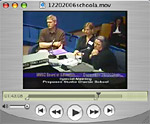
The video QT Video of the meeting is 117MB, and 1 hour and 27 minutes long. Click on the image at left to watch the video. The video contains chapter headings which allow quick navigation to sections of the meeting. The video will play immediately, while the file continues to download.
Lott presented an overview of the three-year Federal SLC grant (Year 1, 2003-2004; Year 2, 2004-2005; Year 3, 2005-2006), what changes were begun in the year prior and the changes and goals for the 2006-2007 school year, post-SLC grant. She emphasized that the SLC plan would take 7 years to “complete” and that the remaining 4 years would need to be funded. The 3 year federal grant paid her salary and for professional development only. Budget cuts for the 2006-2007 year and continuing fiscal problems in the district will hamper making the desired progress.
When asked how much, minimally, West would need make acceptable progress in the implementation of the SLC plan, Dr. Holmes suggested $20,000.
She also presented data showing discipline improvements and academic achievement improvements over the SLC years.
Discussions also included the topics of differentiation and heterogeneity, and general discussions from parents of incoming West students on the social aspects of the small learning communities.
Slides for Heather Lott’s presentation are in PowerPoint and PDF for your convenience.

Share

News on boundary changes?

Does anyone have any news on the meeting on January 10 on boundary changes on the north side?
The rumor mill says that the administration offered a plan to close Lapham.
How could closing Lapham improve the situation on the north side?

Share

More on School Violence

Ruth’s recent post on the Madison School District’s Student Discipline Code generated some email. There are a number of related posts available here, including the Fall, 2005 Gangs & School Violence Forum Audio / Video. Post your comments here.

Share

It’s the right time for Madison School Board to review student discipline code

In The Capital Times, reporter Susan Troller tells the stories of students and teachers who recently experienced violence at Madison schools or school-related activities. The story underscores how important it is for the Madison School Board to take a hard look at violent misconduct at all levels. The board must consider whether the current discipline system needs change–both to improve safety for students and staff and to ensure that interventions are prompt, consistent, unbiased and effective.
The MMSD administration has made some presentations on its ideas during the fall of 2006. Before the board considers changes, I hope that the board will hear more about the facts, particularly the facts about violent incidents. No changes will help unless they are carefully calibrated to the facts.
Facing Violence at School:Social events canceled as girls caught in hostilityFacing Violence at School

Share

Madison Superintendent Rainwater Tells MTI about Resignation Plans Before He Tells the School Board?

In a guest editorial in The Capital Times on January 10, 2007, MTI leader John Matthews explains that Madison school superintendent Art Rainwater unveiled his plan to resign at the end of 2007-08 to the teachers union leader long before he told the Madison Board of Education in an executive session on Monday, January 8, 2007.

“When Madison Superintendent of Schools Art Rainwater announced on Monday that he will retire in June of 2008, the news did not catch me by surprise for two reasons.
First, he proclaimed when he was appointed superintendent in 1999 that he would serve for 10 years, the duration of his contract. He said then that he and his wife, a teacher in Verona, planned to retire in 2008.
Secondly, he told me at our regular weekly meeting during the week of Dec. 18 that he would advise the School Board of his resignation when school resumed in January.

(more…)

Share

Notes and Links on the Madison K-12 Climate and Superintendent Hires Since 1992

Madison Superintendent Art Rainwater’s recent public announcement that he plans to retire in 2008 presents an opportunity to look back at previous searches as well as the K-12 climate during those events. Fortunately, thanks to Tim Berners-Lee’s World Wide Web, we can quickly lookup information from the recent past.
The Madison School District’s two most recent Superintendent hires were Cheryl Wilhoyte [Clusty] and Art Rainwater [Clusty]. Art came to Madison from Kansas City, a district which, under court order, dramatically increased spending by “throwing money at their schools”, according to Paul Ciotti:

In 1985 a federal district judge took partial control over the troubled Kansas City, Missouri, School District (KCMSD) on the grounds that it was an unconstitutionally segregated district with dilapidated facilities and students who performed poorly. In an effort to bring the district into compliance with his liberal interpretation of federal law, the judge ordered the state and district to spend nearly $2 billion over the next 12 years to build new schools, integrate classrooms, and bring student test scores up to national norms.
It didn’t work. When the judge, in March 1997, finally agreed to let the state stop making desegregation payments to the district after 1999, there was little to show for all the money spent. Although the students enjoyed perhaps the best school facilities in the country, the percentage of black students in the largely black district had continued to increase, black students’ achievement hadn’t improved at all, and the black-white achievement gap was unchanged.(1)
The situation in Kansas City was both a major embarrassment and an ideological setback for supporters of increased funding for public schools. From the beginning, the designers of the district’s desegregation and education plan openly touted it as a controlled experiment that, once and for all, would test two radically different philosophies of education. For decades critics of public schools had been saying, “You can’t solve educational problems by throwing money at them.” Educators and advocates of public schools, on the other hand, had always responded by saying, “No one’s ever tried.”

Cheryl Wilhoyte was hired, with the support of the two local dailies (Wisconsin State Journal, 9/30/1992: Search No Further & Cap Times Editorial, 9/21/1992: Wilhoyte Fits Madison) by a school board 4-3 vote. The District’s budget in 1992-1993 was $180,400,000 with local property taxes generating $151,200,00 of that amount. 14 years later, despite the 1993 imposition of state imposed annual school spending increase limits (“Revenue Caps“), the 2006 budget is $331,000,000. Dehli’s article mentions that the 1992-1993 School Board approved a 12.9% school property tax increase for that budget. An August, 1996 Capital Times editorial expressed puzzlement over terms of Cheryl Wilhoyte’s contract extension.
Art, the only applicant, was promoted from Acting Superintendent to Superintendent in January, 1999. Chris Murphy’s January, 1999 article includes this:

Since Wilhoyte’s departure, Rainwater has emerged as a popular interim successor. Late last year, School Board members received a set of surveys revealing broad support for a local superintendent as opposed to one hired from outside the district. More than 100 of the 661 respondents recommended hiring Rainwater.

Art was hired on a 7-0 vote but his contract was not as popular – approved on a 5-2 vote (Carol Carstensen, Calvin Williams, Deb Lawson, Joanne Elder and Juan Jose Lopez voted for it while Ray Allen and Ruth Robarts voted no). The contract was and is controversial, as Ruth Robarts wrote in September, 2004.
A February, 2004 Doug Erickson summary of Madison School Board member views of Art Rainwater’s tenure to date.
Quickly reading through a few of these articles, I found that the more things change, the more they stay the same:

Fascinating. Perhaps someone will conduct a much more detailed review of the record, which would be rather useful over the next year or two.

Share

Isthmus Take Home Test 2007: Week 1, Seat 4

Kristian Knutsen:

To help voters assess the candidates, Isthmus is conducting its second annual Take Home Test of the hopefuls.
Here are the responses from the two candidates for Seat 4, incumbent Johnny Winston, Jr. and challenger Tom Brew.

Much more on the April 3, 2007 (February 20, 2007 Seat 3 Primary) School Board election, here.

Share

For The Record: Wisconsin School Finance Adequacy Initiative

Channel 3’s For the Record recently interviewed Allen Odden (University of Wisconsin-Madison), Tim Schell (Waunakee School District) and Jennifer Thayer (Monroe School District) regarding their participation in the Wisconsin School Finance Adequacy Initiative. 77MB mp4 video file (suitable for video ipods and other devices).
Neil Heinen’s conversation with Allen, Jennifer and Tim includes some interesting comments on funding and education quality.

Share

A Call for an Honest State Budget

Wisconsin State Journal Editorial:

Wisconsin’s state government ended the past fiscal year with a giant deficit of $2.15 billion, according to the accounting methods used by most businesses.
But the state’s books show a cozy balance of $49.2 million.
The discrepancy results from years of Wisconsin governors and legislators manipulating the accounting process to hide irresponsible budget decisions.
Those accounting tricks must stop. Wisconsin should begin to hold itself to the more business-like accounting methods used by Wall Street and by 16 other states the Generally Accepted Accounting Principles, known as GAAP.

Wisconsin’s fiscal situation makes it unlikely that there will be substantial changes in state funding for K-12 schools, particularly for rich districts like Madison that spend 23% ($333,000,000 for 24,576 students) more per student than the state average. Current state law penalizes districts that increase local school spending (property taxes) via referendum via reduced state aids. This means that for every $1.00 of new local spending above state revenue growth caps, Madison taxpayers must pay $1.61.
The 2/20/2007 and 04/03/2007 school board election presents an interesting contrast between candidates who believe that the best interests of our children are served by advocating for larger state spending beyond the typical 3.5%+ annual increases in the District’s budget and those who view the likelihood of substantial state changes for rich districts, like Madison as remote and therefore advocate more efficient management of the extraordinary resources we currently have. Health care costs present a useful example of this issue: Inaction [What a Sham(e)] vs discussion and some changes (in this example, 85% of the health care cost savings went to salaries).]

Share

Desegregation, neighborhood schools face off as Racine Redraws School Boundaries

Dani McClain:

More than 100 Racine residents gathered Tuesday to hear panelists debate the merits of desegregation vs. neighborhood schools.
The forum, sponsored by the Racine Taxpayers Association, comes as the U.S. Supreme Court deliberates on school desegregation battles in Louisville, Ky., and Seattle, and as the Racine Unified School District decides how to redraw its own district boundaries for next year.
“Desegregation in Racine and throughout the nation has failed based upon the mechanism used, which is busing,” said County Supervisor Ken Lumpkin, who publishes a black community newspaper called Insider News.
Mattie Booker, who taught in the Racine Unified School District in the days before desegregation, argued that transporting students is necessary to achieve equityThe forum, sponsored by the Racine Taxpayers Association, comes as the U.S. Supreme Court deliberates on school desegregation battles in Louisville, Ky., and Seattle, and as the Racine Unified School District decides how to redraw its own district boundaries for next year.
“Desegregation in Racine and throughout the nation has failed based upon the mechanism used, which is busing,” said County Supervisor Ken Lumpkin, who publishes a black community newspaper called Insider News.
Mattie Booker, who taught in the Racine Unified School District in the days before desegregation, argued that transporting students is necessary to achieve equity

Share

Art Rainwater on Principals

Madison Schools Superintendent Art Rainwater:

Over 20 years ago Dr. Ron Edmonds, a Harvard researcher, first reported the critical role that a school principal’s instructional leadership plays in creating successful learning opportunities for all students. That fundamental proposition has borne the test of further research and time and is now included in almost all school reform measures.
While there is general acceptance of the critical nature of instructional leadership by the school principal, the demanding nature of that role for a lone individual who bears that responsibility is not often described. The principal of a school, whether a large urban high school or a small rural elementary school, shares the responsibility for the future of every student in his/her building.

Share

Madison School Board Seat 3 Candidates: Take Home Test, Week 1

Kristian Knutsen posts the very useful Isthmus Take Home Tests, starting with Seat 3 candidates (who have a February 20, 2007 primary) Pam Cross Leone, Beth Moss and Rick Thomas. Much more on the election here.

Share

School Choice: How Low Income Parents Search for the Right School

Paul Teske, Jody Fitzpatrick, and Gabriel Kaplan [1.1MB PDF Report]:

Starting with the economist Milton Friedman, supporters of school choice have assumed that competition would lead to better schools, and that parents could do a better job of assigning children to schools than could school administrators. The debate on the first assumption is raging. The second assumption has received little attention, except from those who assert that middle-class families can make good choices but impoverished families can’t.
Barriers to parent choice can all be overcome, but it will take planning, organization, and some modest public spending.
Our new research paints a very different picture of how low-income and minority families in big cities choose schools when they get the chance. Like middle-class parents who have always had choices, low-income parents don’t look for alternatives if their children are happy and successful in school. But once they start thinking about school options, low-income families want information about schools and think hard about the choices they have. Poor parents seek to escape problems evident in their children’s current school, and have definite ideas about the differences between one child and another (our studious boy, our distractible girl) that lead them to search for an appropriate match between child and school.
But our results also identify barriers that must be overcome before low-income parents can become the types of savvy consumers that can make school choice work well for them.

Center on Reinventing Public Education
Alan Borsuk has more:

The researchers based their findings on surveys conducted about a year ago with 300 parents in Milwaukee, 300 in Washington, D.C., and 200 in Denver. Milwaukee and Washington are on the cutting edge of school choice in the United States, each with wide arrays of options for parents, including numerous charter schools and private schools that take part in publicly funded voucher programs for low-income families.
“This report’s general finding is that low-income urban parents report feeling more well informed than was anticipated,” the researchers said in the report, being released today. “They are extremely satisfied with their choices, and most do not believe that they lacked any important information when they made their choice.”
The optimistic conclusions about school choice – in the broadest sense of the term – do not include an assessment of whether parents were actually making good choices in terms of schools where academic achievement is strong or where their children specifically would thrive.

Share

Advocating Single Sex Schools

Milwaukee Journal-Sentinel Editorial:

The School Board should proceed down this path, but cautiously. As officials of the Milwaukee Public Schools have noted, private schools have long offered single-sex education. Parents who send their children to public schools deserve that choice, too. But officials should be prepared to abandon this experiment if it is shown to hurt girls, as gender separation did in the past.
The proposal is to open an all-boys school and an all-girls school in September, though that target date may not be met. There should not be a rush to do so. Getting the schools right is more important than getting them open quickly. MPS has yet to specify what grade levels the schools would encompass.
The initial impetus for proposals to separate school kids by sex was to help girls, who lagged behind boys in math and science. The theory was that girls were too reticent around boys and that the sexes had different styles of learning. In an all-female setting, girls wouldn’t be afraid to show how smart they were, and the material could be presented in a feminine style. Also, such a setting would permit girls to take leadership roles they would be too bashful to assume in a co-ed milieu.

Share

More Demand for Mandarin Classes

Sarah Carr:

In Milwaukee, the School of Languages added Chinese as a partial immersion program this school year. The Marshall Montessori International Baccalaureate High School is starting to build a Mandarin program. When the Milwaukee Academy of Chinese Languages opens in the fall, students as young as 4 will have at least a half-hour of Chinese-language instruction daily.
The trend is as strong in urban public schools as it is in wealthier suburban and private ones, according to experts. The University School of Milwaukee in River Hills, one of the most elite and expensive private schools in the area, will offer Chinese next school year as part of a new global studies program at the school. Ten University School teachers will travel to China in summer in preparation. “I think we see China as the next emerging power, and there’s an intense interest both among our students and our parents,” said Roseann Lyons, the head of the upper school.
This year, the College Board unveiled its first Advanced Placement exam in Mandarin; AP exams are often considered in college admissions, and good scores can provide students with college credit. The College Board surveyed schools about their interest in the exam before its release, and the Chinese exam caught the interest of 10 times more schools than a new topic normally would, said Michael Levine, a vice president of the Asia Society, a non-profit organization that works to educate Americans about Asian cultures.

Share

At 10 a.m., is it lunch or brunch?

Edward Kenney:

Senior Jernai Turner dug into a plateful of hearty beef macaroni for lunch last week in the Brandywine High School cafeteria.
Not a bad lunch. But for Turner and her fellow diners, bacon and eggs might have been more appropriate: Lunchtime at the school starts at 10:30 a.m.
The early start time is common at schools in Delaware and elsewhere, as scheduling large numbers of students into a cafeteria with limited seating dictates spreading the lunch shifts out.
But, Jernai said, “Sometimes, you don’t have the appetite, and you don’t eat. It is too early. I think lunch should start around 11:30.”
It could be much worse: Lunch is served beginning at 8:20 a.m. at Central High School in Philadelphia and at 9:05 a.m. at Bayside High School in Virginia Beach, Va.

Share

Madison Superintendent To Retire In 18 Months

From Channel 3000:

MADISON, Wis. — Madison Metropolitan School District Superintendent Art Rainwater announced on Monday night that he will retire next year.
Rainwater informed the district’s Board of Education at their Monday meeting. His retirement will be effective the end of next school year, which will be June 30, 2008, according to a district press release.
“I am thankful for the opportunity to serve the board and the Madison community,” said Rainwater in the news release. “This is a great school district and a great community that has always put the welfare of our children first. I am honored to contribute to this effort.”
Rainwater said that he gave the board 18 months notice so they would have sufficient time to conduct a search for the next superintendent.
Rainwater has been the district’s superintendent since February 1999.

Share

View from the MMSD Student Senate

At its November 21, 2006, meeting, the MMSD Student Senate discussed many issues of interest to this blog community (e.g., completely heterogeneous high school classes, embedded honors options, etc.). Here is the relevant section from the minutes for that meeting:
Comments and Concerns:

  • regular classes don’t have a high enough level of discussion
  • students who would normally be in higher level courses would dominate heterogeneous class discussions
  • bring students up rather than down
  • honors classes help students who want to excel to do so
  • array of advanced and regular classes in every subject
  • honors and AP classes are dominated by a certain type of students (concerning ethnicity, socio-economic status, neighborhood, family, etc.)
  • honors within regular classes — response to whether or not regular students are an integral part of the class:
      not isolating
      discussion level is still high
      homework is the same (higher expectation for essays; two textbooks)
      teachers don’t cater to one type of student in discussions
  • there’s a risk of losing highly-motivated students to private schools
  • being in a classroom with students of similar skill levels is beneficial
  • teachers teach very differently to honors/advanced/AP students than they do to regular students
  • least experienced teachers are given to students who need the most experienced teachers (new teachers get lowest level classes)
  • sometimes split classes will be divided so that the honors students will be doing work in the front of the classroom while the regular students are doing lab work in the back
  • the problem is with the average classes
  • won’t help anything to cut TAG classes
  • mental divide among students in classes where honors and regular students are in the same classroom
  • more behavioral problems in regular classes (possibly more behavioral problems) à cycle teachers through so that one teacher isn’t stuck with the same type of student for an extended time
  • college is a factor to consider
  • Main problems to bring to BOE:

    • higher standards for all students *
    • division within classes creates too many boundaries *
    • not bad to keep advanced classes in some disciplines *
    • voluntary peer education *
    • colleges consider accelerated course loads (factor to consider) *

    *Group majority

    (more…)

    Share

    Mayors and Public Schools

    There’s been a great deal of activity vis a vis Mayoral control and influence over local public schools:

    Locally, Mayor Dave has been, as far as I can tell, very quiet vis a vis substantive public school issues, other than periodically meeting with MTI’s John Matthews. I’m unaware of any similar parental meetings on what is a critical issue for any community: raising our next generation with the tools necessary to contribute productively to our society (and I might add, support a growing economic/tax base). Madison has long strongly supported it’s public schools with above average taxes and spending.
    Former Madison Mayor (and parent) Paul Soglin weighs in on this topic:

    For over thirty years I said, “There is nothing a mayor can do that has the impact on a city that is as great as the public school system.”
    The mayor needs to be a partner, a protector, an advocate for the public school system. Any mayor who lets a week go by without having some contact, involvement or support with public education is not doing the job.

    Perhaps the April, 2007 Mayor’s race will include some conversations about our $333,000,000; 24,576 student K-12 system.

    Share

    LaFollette ranks third on most indicators

    With the debate about high school redesign and the furor over the four-block schedule at LaFollette, I looked at DPI data for Madison’s high schools. On nearly every indicator, LaFollette ranks third behind West and Memorial, with East ranking fourth.
    See the data
    here.

    Share

    Wisconsin Governor Doyle Again Focuses on Teacher Pay

    Steven Walters:

    In what could be the biggest fight yet over repealing the controversial law limiting the pay raises of Wisconsin’s teachers, Gov. Jim Doyle and Democrats who run the state Senate once again are taking aim at it.
    The so-called qualified economic offer law was passed in 1993 to control property taxes on homes.
    It says that teachers unions and school boards at a collective bargaining impasse cannot request binding arbitration, if the unions have been offered wage and fringe benefit raises that total 3.8% a year. If increased fringe benefits costs eat up the 3.8%, school boards don’t have to offer teachers any pay raise.
    Stoking the Capitol fire is the Wisconsin Education Association Council, the state’s largest teachers union, which says the entire school-aid formula is so broken it must be reinvented this year – a change the union says should include abolishing the qualified economic offer law.
    Backing up Republicans such as Rhoades is Wisconsin Manufacturers & Commerce, the state’s largest business group and one of the most powerful Capitol lobbying groups.
    “Any effort to repeal QEO is a non-starter with the business community because it’s going to lead to pressure to raise property taxes,” said Jim Pugh, the business group’s spokesman. “Wisconsin has the seventh-highest taxes in the nation.”
    But the largest teachers union, an equally powerful Capitol force, says the school-aid formula is so broken a new one must be passed this year – a huge task that legislators might not have the time, will or cash to approve.
    Wisconsin Education Association Council President Stan Johnson said the formula fails the poorest one-third of all public school students – the ones who need the most help.
    Since 1993, Johnson says, the pay-raise limit has caused average salaries for Wisconsin’s teachers to fall to 24th nationally overall and to 30th nationally for starting teachers.
    The law has meant that property taxes have been controlled “on our backs” for the past 13 years, Johnson said.
    It “has been their property tax relief program,” Johnson said of Capitol officials.
    Although the council spent $1.9 million to help re-elect Doyle, Johnson said he did not know whether the Democratic governor will include a complete new school-aid formula in his state budget proposal.

    Related Links:

    Share

    Milwaukee Pushes Single Sex Schools

    Alan Borsuk:

    In documents made available in advance of a School Board committee meeting Tuesday, MPS administrators said, “MPS strongly believes that parents should be given the opportunity to choose single-sex schools for their children if they believe that these schools will help their children.”
    Specific schools are not spelled out in the resolution to be considered Tuesday – in fact, it doesn’t pinpoint whether the focus should be on high schools, middle schools or even elementary grades.
    But the MPS administration, led by Superintendent William Andrekopoulos, recommended giving the idea a green light and allowing administrators to seek proposals for two single-sex schools, with the goal of opening them for the coming school year. That plan is expected to be recommended by the board’s Innovation and School Reform Committee on Tuesday and be approved by the full board Jan. 25.

    Share

    Debating the Education of Young Adolescents

    Kate Zernike:

    First, educators created junior high schools, believing preteens needed to be treated like adults. But those students weren’t ready to be treated as high school students, either. So reformers created the concept of middle schools, which were supposed to be a warm bath to ease the transition. Now, an increasing number of schools across the country, including in Baltimore and Philadelphia, are shifting the middle grades back to elementary school.
    But some research suggests that may not be the solution, either. So the age-old issues persist, with some variation from decade to decade: surging hormones make students irritable and sleepy. They struggle to relate to their peers and gain independence from their parents. To hear some parents tell it, one day their babies are innocent elementary schoolers in overalls, the next they’re dressing like Paris Hilton and simulating sex on the middle-school dance floor. How do you solve a problem like adolescence? Is there anything schools can do?
    The move toward middle schools, after the push for junior high that started in the late 19th century, was supposed to create environments that were more serious than the story-hour life of elementary schools, though less impersonal and confidence-zapping than the controlled chaos of high schools.

    Share

    Education Sector Study: Cutting Provisions In Union Contracts Could Free Funds

    Jay Matthews:

    U.S. public schools could have as much as $77 billion more a year to improve teaching if they reduced spending on seniority pay increases, teacher’s aides, class size limits and other measures often found in teacher union contracts, a new study contends.
    he provisions include salary increases based on years of experience or educational credentials; professional development days; sick and personal days; class size limits; use of teacher’s aides; and generous health and retirement benefits.
    Teachers union officials sharply disputed the report’s findings. School administrators and school board representatives said that although they would like more flexibility in the use of funds, there was little evidence that cutting such provisions would raise achievement.

    250K PDF Report.

    Education Sector Press Release by Marguerite Roza
    :

    State and federal accountability systems are putting immense pressure on public schools to improve the performance of low-achieving students. To respond, schools must be able to recruit and retain high-quality teachers, strengthen curricula, and take other steps to provide struggling students with the help they need.
    But such efforts are expensive and, as the nation faces the cost of caring for an aging population and other challenges in the years ahead, it is unlikely that education will receive a great deal of new funding. Education leaders, as a result, will increasingly have to scrutinize their existing budgets to find ways to fund their reform initiatives. One potentially valuable source of funds for reform are common provisions in teacher contracts that obligate schools to spend large amounts of money on programs that lack a clear link to student achievement.

    Andrew Rotherham has more:

    New ES report by school finance guru Marguerite Roza makes the uncomfortable but important point that there is a lot of money in education now that could be repurposed to greater effect within education. WaPo here. Similar to the point made by the recent Skills Commission report. To some this could appear as picking on teachers, and it will be framed that way, but the simple fact is that education is, by it’s nature, pretty labor intensive, and most of the $500 billion spent annually is tied up in labor costs. Consequently, pace our good friend Willie Sutton, that’s one place policymakers are going to have to look for funds. In other words, we need to get serious about financing education, but also about refinancing it as well. And, we have to take on what is a four letter word in many education circles, productivity.

    Mike Antonucci:

    Education Sector has released an exceptional report by Marguerite Roza that quantifies the costs of various standard provisions in collective bargaining agreements that have little or no connection to improved student achievement or even efficient distribution of resources. Items like automatic raises for experience, university credits, and paid professional development end up totaling almost 19 percent of all education spending, without any indication that they are giving us what we’re after: better schools.
    Roza suggests more flexibility is needed:

    Share

    West High School Small Learning Community Presentation 1/8/2007 @ 7:00p.m.

    Madison West Small Learning Community Coordinator Heather Lott is giving a presentation at Monday evening’s PTSO meeting: “SLC Post-Grant Update and Discussion”. Location: Madison West High School LMC [Map] West’s implementation of Small Learning Communities has been controversial due to the move toward a one size fits all curriculum (English 9 and English 10).
    Background Links:

    Loading Clusty Cloud …

    Parents with children potentially on their way to West High School should check out this Monday evening event.

    Share

    Fame Junkies

    Jake Halpern
    Recently profiled on ABC’s 20/20, the soon-to-be published book Fame Junkies highlights anecdotes and research on the attitudes of American kids (and adults) regarding fame.

    Fame Junkies chronicles journalist Jake Halpern’s journey through the underbelly of Hollywood and into the heart of the question that bedevils us all: Why are Americans so obsessed with fame and celebrities?
    We live in a country where more people watch the ultimate competition for celebrityhood – American Idol – than watch the nightly news on the three major networks combined. So what are the implications of this phenomenon? In his new book, Fame Junkies, Halpern explores the impact that celebrity-obsession is having on three separate niches of Americans: aspiring celebrities, entourage insiders, and diehard fans.
    Halpern begins his journey by moving into a gated community inhabited almost entirely by aspiring child actors. During his stay, he interviews dozens of kids and teenagers, who seem to have an almost religious conviction that fame is a cure-all for life’s problems. What’s truly impressive is that these anecdotes are then supported with hard evidence. As part of the extensive research that he did for this book, Halpern teamed up with several statisticians and orchestrated a survey involving three separate school systems and over 650 teenagers. Many of his findings were deeply troubling. For example – when given the option of “pressing a magic button” and becoming stronger, smarter, famous, or more beautiful – boys in the survey chose fame almost as often as they chose intelligence, and girls chose it more often. Among today’s teenagers, says Halpern, fame appears to be the greatest good.
    In second part of his book, Halpern becomes an honorary member of the Association for Celebrity Personal Assistants (ACPA) where he spends a great deal of time with Annie Brentwell who has slavishly devoted every iota of her personal and professional life to celebrities like Oliver Stone, Sharon Stone, and (most recently) Dennis Hopper. In her spare time, when she is not serving Hopper, Brentwell teaches at a school that the ACPA runs to teach aspiring assistants; and, of course, Halpern tags along. This section of Fame Junkies also investigates a fascinating vein of psychological research on what type of people are most likely to “bask in reflected glory” or BIRG. For example, college students with low self-esteem are far more likely to embrace their school’s football team when it wins and dissociating themselves from that same team when it loses. Halpern goes on to consider how BIRG research applies to Hollywood.

    Share

    Why You Should Learn Algebra

    David Eggenschwiler:

    EVERY YEAR, as many California high school seniors struggle with basic algebra, which is required for graduation, Times readers complain, “Who needs it? How many students will ever use it?” Well, I use it every day; I’m using it now, even though I haven’t worked an algebraic equation since my son was in the seventh grade several years ago.
    Mathematics and science are unnatural practices. As physics professor Alan Cromer has brutally and elegantly written, “the human mind wasn’t designed to study physics,” and of course mathematics is the language of physics. “Design” here does not indicate an intelligent designer, which would suggest a creator with a math phobia. Rather it indicates evolutionary processes by which the human brain and mind have come to be what they are.
    During the approximately 2 million years that it took for our Homo forebears to progress from habilis to sapiens, they had little use for mathematical reasoning abilities. Their sapientia seems to have been more suited in a good Darwinian sense to the immediate demands of their survival, such as eating, mating and avoiding premature death. Whether for good or ill, as time may tell, our situations have changed much in the last few thousand years, and so have demands on our poor, lagging minds. I don’t mean only the obvious and oft-repeated claim that technical jobs require greater skills. That is clear enough in auto mechanics and computer programming. I mean the need to think abstractly, systematically and rationally in various ways.

    Share

    edu2.0

    Web-Based Education for School & Home:

    edu 2.0 is an important concept and the next step in the evolution of education technology. Read more….

    Share

    Local School Budget Tea Leaves

    The Madison School Board Communication Committee’s upcoming meeting includes an interesting 2007-2009 legislative agenda for state education finance changes that would increase District annual spending (current budget is $333,000,000) at a higher than normal rate (typically in the 3.8% range):

    4. 2007-09 Legislative Agenda
    a. Work to create a school finance system that defines that resources are necessary to provide students with a “sound basic education.” Using Wisconsin’s Academic Standards (which is the standard of achievement set by the Legislature), coupled with proven research that lays out what is necessary to achieve those standards, will more clearly define what programs and services are required for students to attain success.
    b. Support thorough legislative review of Wisconsin’s tax system; examining all taxing.
    c. Provide revenue limit relief to school districts for uncontrollable costs (utilities, transportation). [ed: This shifts the risk to local property taxpayers, which has its pros and cons. The definition of “uncontrollable” would be interesting to read.]
    d. Allow a local board of education to exceed the revenue limits by up to 2% of the district’s total budget without having to go to referendum. [ed: $6,660,000 above the typical 3.8% annual spending growth: $333,000,000 2006/2007 budget + 3.8% (12,654,000) + 2% (6,660,000) = $19,314,000 increase, or 5.8%]
    e. Allow school districts to exceed the revenue limits for security-related expenses by up to $100 per pupil enrolled in the district. [ed: about $2,400,000]
    f. Modify the school aid formula so negative tertiary school district (Madison) taxpayers aren’t penalized when the district borrows. (Madison Schools’ taxpayers have to pay $1.61 for every dollar borrowed.) [ed: This will cost other districts money]
    g. Improve Medicaid reimbursement from state to school districts (current law allows the state to “skim” 40% of the federal Medicaid reimbursement dollars for school-based services).
    h. Support state aid reimbursement for 4-year old kindergarten programs, similar to the reimbursement for 4-year old kindergarten in Milwaukee choice and charter schools.
    i. Support increasing state aid for public school transportation costs.
    j. Support allowing a declining enrollment school district to use the highest enrollment in a 5-year period for purposes of calculating its revenue limit. [ed: I wonder if the MMSD perceives itself as a growing or declining district, given the attendance projections used to support new schools over the past several years? Perhaps this item is the answer? The current state funding scheme rewards growing districts. Barb Schrank noted the enrollment changes in surrounding districts last fall.]
    k. Support additional resources for mandated special education and English as a Second Language programs, currently reimbursed at 28% and 12%, respectively (when revenue limits began, the reimbursement was 45% and 33% respectively).
    l. Maintain current law for disbursement of resources from the Common School Fund for public school libraries.
    m. Support increase in per meal reimbursement for school breakfast programs.

    There are some good ideas here, including a thorough review of Wisconsin’s tax system. Many of these items, if enabled by the state, would result in higher property taxes (Wisconsin is #1 in property taxes as a percentage of the home’s value) for those living in the Madison School District. Any of these changes would likely help address the District’s $5.9M structural deficit.
    I trust that there are some additional budget scenarios in play rather than simply hoping the state will change school finance to help the Madison School District (unlikely, given several recent conversations with state political players). Madison already spends 23% more per student than the state average.
    Related:

    • A 5 Year Approach to the Madison School District’s Budget Challenges; or what is the best quality of education that can be purchased for our district for $280 million a year?
    • 2007/2008 Madison School District Budget Outlook: Half Empty or Half Full?
    • Budget notes and links
    • Sarah Kidd’s historical charts on District staffing, attendance and spending.
    • Italian Minister of Economy & Finance Tommaso Padoa-Schioppa:

      I now come to the last and conclusive theme of my argument. Controlling expenditure always has to balance technical arguments and constraints, with the legitimate and competing claims (often drawing on very different ideological Weltanschauungen) on the resources managed, directly and indirectly, through the political processes. Balancing the two elements is a difficult exercise, as I experience on a daily basis.
      Political economists have blamed the difficulty on the fact that the time-horizon of a typical political cycle is shorter than the one relevant on average for the society as a whole, in turn leading the legislature to attribute a smaller weight to the long-run implications of public expenditure policies than it would be socially desirable. Empirical evidence shows that discretionary public expenditure tends to rise before the elections irrespective of the political orientation of the incumbent government, and also in spite of the weak evidence of a relation between the size of pre-election spending and the election outcomes. The politicians’ short horizons and the long lag between reforms and their beneficial effects gives rise to a pervasive tension in expenditure control.
      For Faust, the lure of Mephistopheles’ services is greatly enhanced by the fact that the price – albeit a terrible one – is to be paid later. For politicians, the lure of the support obtained through public expenditure is similarly enhanced by the fact that public debt will be paid (o reneged) by next generations, often well after the end of one’s political career. As to myself, having inherited a public debt larger than GDP, and having committed myself and my government to comply with sound fiscal principles, I scarcely can afford even to contemplate the possibility of accepting Mephistopheles’ services.

    Tea Leaves.
    Update: I recently learned that the MMSD’s Joe Quick wrote this list, which was not voted on by the Madison School Board.

    Share

    More Notes on Milwaukee’s Plans to Re-Centralize School Governance

    Milwaukee Journal-Sentinel Editorial:

    Looking for the path to effective education, leaders of the Milwaukee Public Schools have long slogged through the wilderness of school reform only to end up where they started. All used to be centralized at MPS. Then decentralization became the watchword. Now centralization is again in.
    This lunging between two opposite approaches is in a way understandable. Getting big-city school systems to work is no easy task, to judge from the rarity of the accomplishment. Superintendent William Andrekopoulos is right in being dissatisfied with the slow pace of improvement and in searching for ways to step it up. And recentralization does carry the force of logic for decentralized schools that have failed to improve.
    Still, as onetime MPS chief Howard Fuller reminded us when we reached him in New Orleans, where he is consulting, neither centralization nor decentralization is a magic bullet. The key ingredient for great schools are “people committed to do whatever it takes to educate our children.”
    n doing so, MPS must minimize the red tape, which has clogged school operations. Another trick the system must manage is to refrain from hurting the schools that have thrived under decentralization, an example of which is Hamlin Garland Elementary School on Milwaukee’s south side. Borsuk highlighted the school in another article this week.

    Madison appears to be rather centralized, with a push for standardized curriculum, generally lead by downtown Teaching and Learning staff. I often wonder how practical this actually is, given 24,000+ students and thousands of teachers and staff. Perhaps, in 2007 and going forward, the best solution is to support easy to access internet based knowledge tools for teachers where they can quickly review a variety of curriculum (including those not blessed by the central administration) with notes and links from others. This could likely be done inexpensively, given the wide variety of knowledge management tools available today.

    Share

    Spellings Says No Child Left Behind Act on Track

    Amit Paley:

    “We’ve made more progress in the last five years than the previous 28 years,” Spellings said. “Can the law be improved? Should we build on what we’ve done and all of that sort of thing? You bet. But I don’t hear people saying: ‘You know what? We really don’t need to have education for all students.’ ”
    Her remarks come as various groups begin to weigh in on the law and what they believe works and what does not. The No Child Left Behind law is scheduled to be reauthorized by Congress, but it is uncertain when lawmakers will act.
    The Forum on Educational Accountability — a coalition that includes education, religious, civil rights and disability rights groups — said yesterday that the law overemphasizes standardized tests and arbitrary academic targets. The coalition also criticized penalties the law imposes on schools that fail to meet standards.
    “We don’t have to throw out the whole law and make a big political battle,” said Reginald M Felton, a senior lobbyist for the National School Boards Association, a member of the coalition. “But we need to change from the punitive, ‘gotcha!’ kind of approach to actual support for progress.”

    Rotherham has more on NCLB.

    Share

    Teacher Rules, Roles & Rights National Collective Bargaining Searchable Database

    National Council on Teacher Quality:

    the portal is the first of its kind-empowering anyone to analyze and compare the day-to-day operations of teachers and schools in a single district or all fifty. You can choose to download the full text of a teacher contract, just the salary schedule, and even the school calendar. Or perhaps you just have a single question and don’t want to wade through lengthy documents. Most likely the answer in our database, easily retrieved in three quick steps using our report generator. The database provides answers to over 300 questions, ranging from salary and benefits to how a teacher gets evaluated–with more getting added all the time.
    The more this site gets used, the more powerful it will become. We invite users to contribute knowledge and ideas to our data collection, helping us keep the site current, accurate and fair. Consider this site the central depository for teacher policies. To ensure the accuracy of this database, we will be vetting all user feedback before posting any changes.

    The 158 page collective bargaining agreement (7/1/2005 to 6/30/2007) between Madison Teachers, Inc. and the Madison Metropolitan School District is available here [540K pdf]. Additional links and documents can be found here.
    Mike Antonuccia has more.

    Share

    Education for all is just a bad dream

    Jo Egelhoff:

    Wisconsin is failing minority and low-income students. Plain and simple. Of the 10 issue areas featured in the Post-Crescent’s end-of-year “Editorial Agenda Update,” at least six are critically reliant on our schools performing – performing much better than they do now – and performing better and better around the state, not just here in our cozy, cuddly Fox Cities backyard.
    Think about it. Success in these six important “Issue” areas – labeled by the Post-Crescent as Economic Development, Fiscal Responsibility, Education (of course), Government Accountability, Working Poor, and Citizenship have at their core a well-performing education system.
    Then think about this. According to The Fordham Report 2006: How Well Are States Educating Our Neediest Children?, Wisconsin is doing a dreadful job in closing the achievement gap between the haves and the have-nots. The difference in achievement scores between Wisconsin white and African-American students is in the dead-last position – tied with Minnesota.

    Share

    Notes on the Use of Student Digital Id Cards

    Bruce Schneier:

    However, Green MSP Patrick Harvie said the suggestion was troubling.
    “We should be preparing young people for the reality of defending their privacy and civil liberties against ever-more intrusive government systems,” he argued.
    “We’ve heard proposals for airport-style scanners and random drug testing in schools, fingerprinting is already in place in some schools. There’s a risk of creating environments which feel more like penal institutions than places of learning.
    “These ID cards will do absolutely nothing to address the causes of bullying. Instead they will teach the next generation that an ID card culture is ‘normal’, and that they should have to prove their entitlement to services.”

    Share

    A Surprising Secret to a Long Life: Stay in School

    Gina Kolata:

    James Smith, a health economist at the RAND Corporation, has heard a variety of hypotheses about what it takes to live a long life — money, lack of stress, a loving family, lots of friends. But he has been a skeptic.
    Yes, he says, it is clear that on average some groups in every society live longer than others. The rich live longer than the poor, whites live longer than blacks in the United States. Longevity, in general, is not evenly distributed in the population. But what, he asks, is cause and what is effect? And how can they be disentangled?
    He is venturing, of course, into one of the prevailing mysteries of aging, the persistent differences seen in the life spans of large groups. In every country, there is an average life span for the nation as a whole and there are average life spans for different subsets, based on race, geography, education and even churchgoing.
    But the questions for researchers like Dr. Smith are why? And what really matters?

    Share

    Trying to Find Solutions in Chaotic Middle Schools

    Elissa Gootman:

    Driven by newly documented slumps in learning, by crime rates and by high dropout rates in high school, educators across New York and the nation are struggling to rethink middle school and how best to teach adolescents at a transitional juncture of self-discovery and hormonal change.
    The difficulty of educating this age group is felt even in many wealthy suburban school districts. But it is particularly intense in cities, where the problems that are compounded in middle school are more acute to begin with and where the search for solutions is most urgent.
    In Los Angeles, the new superintendent, David L. Brewer III, has vowed to transform middle schools as a top priority, and low-performing schools are experimenting with intensive counseling.
    In Philadelphia and Baltimore, school systems are trying to make the middle school problem literally disappear, by folding grades six through eight into K-8 schools. In one Columbia, S.C., school district, all five middle schools have begun offering some form of single-sex classes, on the theory that they promote self-esteem and reduce distractions.

    Share

    School envy a 2-way street for China, U.S.

    Sarah Carr:

    China’s schools have struck fear in the West with their relentless focus on subjects such as physics and math – areas where American students have struggled compared with other nations.
    However, visits to dozens of schools in China and hundreds in the United States reveal that both countries love to hate their own schools, and live in awe of others’ strengths. While Americans revere the Chinese mastery of basic subjects such as math and geography, the Chinese extol the American emphasis on creativity and nurturing individual talent.
    In the prosperous seaside region of Zhejiang, the situation’s changing, though, as entrepreneurs inject some of the country’s relatively new capitalist fervor into the schools. The result is a panoply of schools that comes close to resembling Milwaukee’s education scene in its diversity – hardly what one would expect to find in a Communist state.
    Students attend fancy private schools focused on such non-academic subjects as kung fu martial arts. A fledgling school voucher program aims to give families more choices as well as strengthen alternative and private schools. Educators describe a shift toward more local control and creativity in teaching. And parents like Xu are closely examining their new options.

    Share

    Schools Seek and Find Gifted Students

    Daniel de Vise:

    Not every student at Bannockburn is above average. But 70 percent of the third-grade class has been identified as gifted, based on tests and other academic indicators. The school serves one of the largest concentrations in the region of students capable of working beyond their assigned grade, sometimes well beyond.
    “We’re constantly trying to find things to pique their interest,” said Peterson, whose students have lately practiced dividing numbers into 32nds in their heads.
    The bumper crop of gifted children at Bannockburn is a result not of some exclusive magnet program but of Montgomery County’s aggressive policy on identifying academic talent. The county screens every second-grader for extraordinary ability. In most other school systems, it’s left to parents or teachers to initiate the process. Also, Montgomery’s criteria for “giftedness” are unusually broad, covering not just intelligence data but also classroom performance and the impressions of teachers and parents.
    That approach drives up the numbers — 40 percent of Montgomery’s 139,000 students carry the label — and creates a gifted majority at schools such as Bannockburn, which serves an affluent, highly educated neighborhood.

    Share

    Montessori Goes Mainstream

    Jay Matthews:

    The American Montessori Society, based in New York, reported 7 percent membership growth in just the past year, and many of the schools are getting ready to celebrate the centennial of the Montessori beachhead.
    Once considered a maverick experiment that appealed only to middle-class white families in the States, Montessori schools have become popular with some black professionals and are getting results in low-income public schools with the kind of children on which Montessori first tested her ideas.
    The stubborn Italian physician and her contemporary, U.S. philosopher and psychologist John Dewey — who believed that learning should be active — are considered perhaps the most influential progressive thinkers in the modern history of education.

    Madison has at least two Montessori schools, here and here.

    Share

    New Math and Science Repository

    This note comes from a listserve, and I thought that it was worthwhile to pass it on:

    Internet Scout, a 12-year-old UW-Madison online research project, unveiled its new national math and science educational project, the Applied Math and Science Education Repository.
    Read more: http://www.news.wisc.edu/13307.html

    Share

    School Board head faces challenger

    Susan Troller reports in the Cap Times:

    When Tom Brew takes on incumbent School Board President Johnny Winston Jr. in the spring election for Seat 4, he, like Winston, will bring a lifetime of experience with Madison schools to the race.
    Brew’s own children attended Huegel and Orchard Ridge schools and graduated in the late ’80s to mid-90s. A lifelong Madisonian, he attended the former Longfellow Elementary and Central High schools.
    “I felt I had some different viewpoints to offer from Johnny’s,” Brew said this morning. “Basically, I think Johnny has had a go-along-to-get-along attitude.”

    (more…)

    Share

    Milwaukee Schools Criticized for Decentralized Approach

    Alan Borsuk:

    The picture that the team painted was not pretty. Clearly favoring a strong central administration, the team said decentralization in MPS had “gone too far.”
    “Decentralization has rendered the central office instructional unit (in MPS) irrelevant to the process of raising student achievement,” the report says. The team said some schools were using a hodgepodge of materials to teach students, and no one was leading these schools to be more effective. From the School Board to the classroom, there was not a clear vision of what it takes to succeed.
    ut the report particularly is critical of the attitude among the 70-plus people the team interviewed, from top MPS leaders to teachers and parents.
    “MPS has seen only small, incremental gains in student achievement over the last several years,” it says. “More problematic, however, is that many people in the district see these marginal improvements as acceptable. . . . A sense of urgency to raise student achievement is not apparent throughout the organization. The board, administration and staff appear fairly complacent.”
    The report adds, “Interviews with MPS staff indicated that most were proud of the gains that the district had made, even though scores reflected minimal progress.”

    Share

    A Direct Challenge

    Direct Instruction is just curriculum that uses direct, systematic, and explicit instruction. Any one of the direct instruction curricula would improve academic performance if it were used in the MMSD.
    This comes from an Education Week article in 1999:

    When an independent research group evaluated the research backing up 24 popular school reform models this year, it found two surprises.
    The first surprise was that only three programs could point to strong evidence that they were effective in improving student achievement. The second surprise was that Direct Instruction, a program long scorned by many educators and academics for its lock-step structure, was one of them.
    Direct Instruction grew out of studies on the teaching of beginning reading that Siegfried Engelmann began at the University of Illinois in the 1960s. Thirty years later, only 150 schools across the country use on a schoolwide basis the program he developed. By comparison, Success for All, another reform model with high marks for its solid research base, is used in more than 1,100 schools.
    Thousands more schools, however, use Direct Instruction’s commercially produced materials–usually in remedial classrooms, special education resource rooms, or special programs for disadvantaged students.
    “We were sort of like the plague for regular education,” says Mr. Engelmann, now 67 and a professor at the University of Oregon. “Regular education would have nothing to do with us. It wasn’t until the last few years that we started to break the mold.”

    Share

    A New Year for School Reform

    NY Times Editorial:

    The No Child Left Behind Act broke new ground when it required the states to educate impoverished children up to the same standards as their affluent counterparts, in exchange for federal aid. The law did not just drop out of the sky. It represented a deliberate attempt by Congress to ratify and accelerate the school reform effort that swept the country in the early 1990’s, when the states began to embrace standards-based accountability systems that quickly showed promising results.
    The achievement gains have fallen far short of what Congress hoped for when it passed the landmark federal law — and also far short of what the country needs to keep pace with its economic rivals. In addition, student performance has flattened in recent years. In many cases, that is because states that reaped all of the early, easy gains that are typically achieved by merely paying attention to a long-neglected problem failed to do the tougher work necessary to sustain their reforms.
    Recent studies offer sobering news about the challenges that lie ahead. Happily, there is also encouraging news from the states that have stayed the course and continued to build rigorous, standards-based reforms.

    Share

    Wisconsin’s $2.15 Billion State Budget Deficit

    Stacy Forster:

    The state’s financial books show that Wisconsin ended the last fiscal year with a $2.15 billion deficit, under accounting principles that are standard for private companies, according to a report that the Wisconsin Taxpayers Alliance released Friday.
    State Budget Director David Schmiedicke said the budget was balanced as required under state law, and that the difference between the two numbers is a matter of timing – how certain costs are accounted for and when they are paid. He added that other states run GAAP deficits, depending on the year.
    The $2.15 billion deficit – nearly $400 for each of Wisconsin’s 5.5 million residents – is about what the state spends to run correctional institutions or the University of Wisconsin System over a two-year budget.
    It was outlined this month in the state’s Comprehensive Annual Financial Report, which must be filed every year, like a corporation’s annual report.

    Share

    NCLB and the Stress Between “Bringing up the Bottom and Supporting High End Kids”

    A reader involved in these issues emailed this article by Andrew Rotherham:

    Second, the story highlights my colleague Tom Toch’s criticism that a lot of tests states are using under NCLB are pretty basic. That’s exactly right. I’m all for better tests, but isn’t that, you know, an indictment of schools that can’t even get kids over a pretty low bar rather than an indictment of the law? In other words, excepting some fine-grained issues around special populations, NCLB can’t be wildly unrealistic in what it demands of schools and really basic at the same time, can it? The story doesn’t sift through that in detail but would be nice if some journo would.* The reality is that we don’t deliver a very powerful instructional program in a lot of schools, and that’s not the fault of NCLB.
    ……
    *Related, there is a tension between high-performing students and low-performing ones in terms of where to put resources and attention. Not completely binary, and plenty of students falling behind today could be high performers in better schools. But still there and mostly talked about in code words rather than forthrightly: Are we as a nation better off really focusing on the millions of kids at the wrong end of the achievement gap even if its suboptimal for kids on the high end? And spare me the rhetoric about how you can easily do both. You can to some extent but constrained resources, carrots and sticks in policy, and time constraints all make tradeoffs a reality.

    A few other readers have mentioned that this is a conversation Madison needs to have.

    Share

    Wisconsin Resident’s Total 2006 Tax Rate: 33.4% of Income

    WISTAX:

    For the third consecutive year, total taxes paid by Wisconsin individuals and firms relative to personal income increased in 2006. They now claim 33.4% of income, up from a 2003 low of 30.7%. Both the federal and state tax burdens increased in 2006, while the local government burden dipped slightly.

    • State tax collections rose 5.3%, while federal receipts grew 5.2%. Both increases were smaller than in 2005.
    • Local tax collections, primarily property taxes, rose 2.5% in 2006. The increase was the smallest since 1998’s 1.8% rise.
    • For the sixth consecutive year, sales tax collections increased less than 5%. Prior to 2001, the sales tax rose at least 5% for nine straight years.
    • Wisconsin’s top income tax rate is 6.75%. Since 1978, when the top rate was 11.4%, it has been lowered five times.
    • Personal income rose 4.2% in 2005, lower than 2004’s 6.2% increase

    Share

    The Allure of Magnet Schools

    Ian Shapira:

    Educators, parents and teenagers in Northern Virginia say there is a growing demand for exclusive magnet schools similar to Thomas Jefferson, a regional “governor’s school” in the Alexandria section of Fairfax that admits fewer than 20 percent of applicants. They believe such schools are more desirable because their high-level math and science courses and stringent application process make them look formidable to university admissions officers.
    Prince William’s proposal comes two years after neighboring Loudoun County created its own exclusive magnet school, the Academy of Science. It screens students based on grades, performance on a standardized test and a creative writing sample. The school on average admits fewer than 30 percent of students who apply. Academy Director George Wolfe said it is the only public school in Northern Virginia aside from Thomas Jefferson that has rigorous academic admissions criteria for the entire student body.

    Share

    Notes on Multi-Age Classrooms

    Amy Hetzner:

    In fact, the only indication this is a multiage classroom comes more than an hour into the day’s math lesson, when the students are divided into two groups – first-graders with Weber, second-graders with gifted-specialist Kristin Stein.
    Since the beginning of the school year, the Menomonee Falls school has been trying out the multiage classroom as a way to raise student achievement and forge better relationships with parents and students. Riverside Principal Kathy Myles is so encouraged thus far that she hopes to add another class – for third- and fourth-graders – next year.
    “My whole thing is about creating options for learners,” said Myles, who also thinks it’s important to keep traditional grade-level classes for students who learn better that way.

    Share

    How Much Does a Neighborhood Affect the Poor?
    Government test tracks families who moved; girls flourish, not boys.

    Jon Hilsenrath & Rafael Gerena-Morales:

    Climbing out of poverty hasn’t been as easy as getting on the bus. She says her life is now drug-free and more stable, and her children are growing up in a better environment. Yet in many ways, her struggles traveled with her.
    “You really need to have a focus to get out of the ghetto,” says Ms. Grayson, a New York native.
    Her experience offers clues to a question society has wrestled with for years: Can a family escape poverty by getting out of the neighborhood where it takes root? It also sheds light on the government’s shifting efforts to use housing policy as a solution to poverty.
    A $16 billion federal infrastructure has built up around housing vouchers designed to give poor families more choices about where to live. About two million families currently use “Section 8” vouchers that allow them to move with subsidized rent. Since 1993, the government has been demolishing urban housing projects and forcing families to resettle in other places, sometimes with vouchers.
    But results show that may only partially be true. “It would have been wonderful to have discovered the magic bullet,” says Jeffrey Liebman, a Harvard economist who has studied the program.
    Findings, he says, were more complicated. Among them: boys whose families moved actually fared worse than boys who stayed in bad neighborhoods. Girls, however, fared significantly better. Adults felt better, physically and mentally, than those who stayed behind, but didn’t do better financially.

    Share

    Reading Between the Lines: Madison Was Right to Reject Compromised Program

    Jason Shephard:

    From the beginning, Mary Watson Peterson had doubts about the motivations of those in charge of implementing federal education grants known as Reading First. As the Madison district’s coordinator of language arts and reading, she spent hundreds of hours working on Madison’s Reading First grant proposal.
    “Right away,” she says, “I recognized a big philosophical difference” between Madison’s reading instruction and the prescriptive, commercially produced lessons advocated by Reading First officials. “The exchange of ideas with the technical adviser ran very counter to what we believe are best practices in teaching.”
    The final straw was when the district was required to draft daily lesson plans to be followed by all teachers at the same time.
    “We’ve got 25,000 kids who are in 25,000 different places,” says Superintendent Art Rainwater. The program’s insistence on uniformity “fundamentally violated everything we believe about teaching children.”
    In October 2004, Rainwater withdrew Madison from the federal grant program, losing potentially $3.2 million even as the district was cutting personnel and programs to balance its budget. Rainwater’s decision, made without input from the school board, drew intense criticism and became an issue in last year’s board elections.

    From a public policy perspective, the School Board should have discussed the $3.2M, particularly given the annual agony over very small changes in the District’s $333M+ budget.
    The further concern over a one size fits all Reading First requirement (“We’ve got 25,000 kids who are in 25,000 different places,” says Superintendent Art Rainwater.) is ironic, given the push toward just that across the District (West’s English 10 [Bruce King’s English 9 report] and the recently proposed changes at East High School).
    Barb Williams noted that other “blessed by the District” curriculum are as scripted as Reading First in a December, 2004 letter to Isthmus. More here via Ed Blume and here via Ruth Robarts.
    It will be interesting to see what Diana Schemo has to say about Reading First.

    Share

    New Year’s resolutions offer a chance to examine schools, education in state

    Marisue Horton:

    As we head into the season for making New Year’s resolutions, here’s my wish list for resolutions relating to education in 2007:

    1. Embrace our differences. Education is the ability to provide opportunity and challenges to all students. Each child is a gift and has talent. Families, schools and politicians need to avoid pitting one group of learners against another. All are valuable.
    2. Build understanding and avoid condemnation. Parents, learn to advocate for children by defining the problem to be resolved. School staff, encourage family input and work together to find solutions. Community members, visit and offer to volunteer in your public schools. Before criticizing schools, look carefully at what they are doing. Know the issues.
    3. Educate the public by researching the issues. Members of the media, do your homework. We are sitting on one of the best research institutions in the world. Don’t fuel the fires of divisiveness on educational issues by quoting sources without researching their assertions.
    4. Appreciate school staff. There is no greater career, nor many that are open to as much public criticism, as teachers. Take time to thank a teacher, appreciate their work by attending and participating in school events. Find out what’s going on in your public schools each day.
    5. Get involved in solutions to improve public education. Define waste. Rather than criticize local decision-making, share ideas for fiscal responsibility. Help boards of education and administration make districts more effective. Acknowledge that 13 years of revenue caps are stripping our public schools of their ability to effectively educate students. Referendums are NOT the answer. They are little more than panhandling for our kids. Stop asking us to beg for our future.
    6. Acknowledge that leadership matters. Support the hiring of the best quality staff. Ask for local progress reports on your schools. Talk to your legislators and other policymakers about the state’s responsibility to keep their commitments on public education. If you believe in two-thirds funding from the state, demand that legislators live up to their promises!

    Marisue Horton
    Madison schools parent
    Verona

    Share

    Let the Money Follow the Student

    Marie Gryphon:

    Only by empowering parents to choose their children’s schools can Mayor-elect Fenty achieve his goal of a quality education for every child. He should increase public school choices, lift the arbitrary cap on the number of charter schools allowed in DC, and expand the district’s nascent but promising school voucher program.
    Poor teaching quality, one of the District’s worst problems, is exacerbated by public school administrators who prefer to hire education majors instead math and science majors, even though the latter make better teachers in their subjects. Giving parents the ability to choose which public schools get their money discourages these and other counterproductive practices, as Harvard economist Caroline Hoxby has found.

    Share

    The Underground History of American Education Available Online – Free

    John Taylor Gatto’s book:

    I want to open up concealed aspects of modern schooling such as the deterioration it forces in the morality of parenting. You have no say at all in choosing your teachers. You know nothing about their backgrounds or families. And the state knows little more than you do. This is as radical a piece of social engineering as the human imagination can conceive. What does it mean?
    One thing you do know is how unlikely it will be for any teacher to understand the personality of your particular child or anything significant about your family, culture, religion, plans, hopes, dreams. In the confusion of school affairs even teachers so disposed don’t have opportunity to know those things. How did this happen?
    Before you hire a company to build a house, you would, I expect, insist on detailed plans showing what the finished structure was going to look like. Building a child’s mind and character is what public schools do, their justification for prematurely breaking family and neighborhood learning. Where is documentary evidence to prove this assumption that trained and certified professionals do it better than people who know and love them can? There isn’t any.

    Share

    ILLITERACY REINFORCES PRISONERS’ CAPTIVITY

    James Sterngold:

    State prisons are crowded with inmates lacking a basic education — Their dismal job prospects mean they’re likely to land back behind bars.
    Gregory Davenport, a congenial 46-year-old in prison blues, shared with a visitor to the big state penitentiary here a common inmate’s lament — he left behind two well-educated daughters with whom he could not correspond because he could not read.
    But Davenport, serving time for a burglary conviction, is one of the lucky ones. He has finally made progress in his long struggle with illiteracy, a breakthrough he described while holding one of the more sought-after prizes in California’s overburdened corrections system — a classroom seat. He had to wait a year to get into a class in a cramped trailer at the prison in Norco, the California Rehabilitation Center, but now he gets six hours a day of instruction and help with a learning disorder.

    Share

    Work to change school funding already begun

    A story by Kayla Bunge in The Monroe Times reports:

    MADISON — With a new legislative session beginning in just about a week, the issue of school funding is certain to receive more attention.
    And two local legislators — 17th District Sen. Dale Schultz, R-Richland Center, and 27th District Sen. Jon Erpenbach, D-Middleton — already have begun working.
    Schultz, the former Senate majority leader, played a leading role in creating the Special Committee on Review of the State School Aid Formula.
    The committee’s purpose, he said, is “to recognize the special challenges that small school districts have trying to continue to provide a quality education in rural communities where student populations are declining.”

    (more…)

    Share

    Teaching Violence, and Control, to Children

    All Things Considered:

    Karate instructor Louise Rafkin describes the way that she teaches children to hit. Childhood is a violent time, Rafkin says, and her students learn how to control their innate violence.
    As Rafkin talks with two of her young students, one describes the power struggles at his school.

    Share

    Middle School Reform Discussions

    Joel Rubin:

    Most frustrating, Chavez-Palmer said, is the difficulty in getting students and parents to follow through on her recommendations for tutoring and other services. At a recent meeting, only 20 parents showed up.
    There is little Chavez-Palmer and the other counselors can do to compel middle school students to work harder. A district policy requiring principals to hold back eighth-grade students who fail to meet minimal standards in English and math is largely ignored, said Collins, the chief instructional officer.
    The small piece of leverage counselors do have over failing students — threatening to ban them from informal graduation ceremonies schools hold for eighth-graders — often does little to sway students.
    “As long as I go on to the ninth grade,” a 14-year-old boy shrugged when Diane-Chavez raised the prospect.
    “You didn’t pass the majority of your classes in seventh grade and went on to eighth. The same will happen this year,” the blunt-talking counselor replied. “But what’s going to happen next year? How many times do you think Huntington Park High School is going to allow you to do this?”

    Share

    Random Breath Tests at High School Events

    Kristian Munson:

    When Los Gatos High School students return to campus after winter break, they will be given random Breathalyzer tests at school functions.
    The measure proved necessary after staff discovered students under the influence of alcohol at several school activities this year, said Principal Doug Ramezane.
    The school has used Breathalyzers for several years, but randomly using the tests will be a new procedure.
    “We’ve always had a Breathalyzer at dances and we’ve used it whenever we felt there was a need,” Ramezane said, such as if a student appeared drunk.
    In October, five students were identified as being either under the influence of alcohol and/or possessing alcohol or marijuana at the school’s Coronation Ball. At three of the four home football games this year, students were found under the influence, school officials said.

    Share

    Wisconsin School Boards Evaluate Governance Focus

    Amy Hetzner:

    Under the model, used by a number of school boards in the state, the board develops a set of expectations and then holds its administrators accountable to achieve those goals and report on progress.
    The result is a more focused board that has more objective criteria for evaluating the performance of the school superintendent, said Sue Kutz, president of the Racine Unified School Board, which began using policy governance this year.
    Monthly monitoring reports and a review of the board’s goals are used to evaluate the superintendent’s performance, she said, rather than a subjective evaluation that focuses on “the last great fiasco that happened.”
    Boards are also spared the details and decision-making on issues for which they have little expertise.
    “As a way of doing business, it seems to make so much more sense than the old way,” Kutz said.

    Interesting. Serving on a school board is perhaps one of the most difficult public service positions “available” today. The recently revealed $6M Madison School District structural deficit (in place for 7 years) along with ongoing curriculum questions and a recent lack of oversight obligations such as reviewing the Superintendent requires a vigilant, active board.

    Share

    Parent Group Seeks Control of High School Repair Budget

    Dion Haynes:

    “We’re trying to see if a local school can do things that the present school system is too dysfunctional to handle,” said Chuck Samuels, chairman of Wilson’s local school restructuring team, the group of parents and teachers that advises the principal. “From this seed of a pilot project could grow more autonomy for Wilson and for other schools to do the same.”
    Last year, Wilson parents and teachers explored the idea of becoming a charter school after becoming frustrated by the central office’s slow response to their maintenance problems and by its move to cut $400,000 from the school’s budget to cover a systemwide shortfall.
    To avert the exodus of the highest-performing comprehensive high school from the system, Janey signed an agreement with the Wilson parents and teachers allowing them to devise a proposal for becoming independent of the central office by taking charge of areas such as the budget and teacher hiring.

    Share

    Madison Studio Charter School: A Final Push – You can Help

    Dear Supporters of The Studio School:
    As you probably know, we met with the MMSD Board members last Wednesday and are satisfied with how the Board meeting went. Many individuals took the opportunity to speak at the meeting and each of them did a fantastic job! THE OUTCOME OF THE MEETING IS THAT WE NEED TO PREPARE A RESPONSE TO THEIR QUESTIONS and have very limited time to accomplish this since they need to have it by January 18th. So here’s our plan:
    We need to put together three short-term task forces:

    1. “money team” to work on the budget and financing
      • Determine what an accurate and detailed representation of costs and revenues would look like and fill in the numbers.
      • Consider creative ways to finance the school with the implementation grant Help! We need more school finance expertise for this one.
      • We still need money to file for tax exempt status ($750) Help! If we could get a/some contributions to cover this cost, we have found an attorney who will file it pro bono…
      • So if we could get a sizable donation to get this school started since the district’s finances are in such a bad state, the Board would be more favorably disposed to our proposal. (This would be added to federal grant funds of $340,000.)
    2. “people team” to reach out to a more diverse population (Kristin Forde is going to organize this.)
      Meet with or provide information to people we haven’t had an opportunity to connect with so we can share information about the school and encourage them to attend the January 22nd meeting to express support and interest in The Studio School Help! We could use some marketing expertise.

    3. “plan team” to develop a clearer description of the school and how it would actually work, including the technology
      Develop a more detailed implementation plan and a clearer representation of how it will operate and look. Help! I can work on this but I would like some people (parents, educators, interested parties) to collaborate with me in order to figure out how to communicate it more clearly.

    If you or anyone you know can help out over the next few weeks, please have them contact me. This is our last opportunity to pull it all together and make The Studio School a choice for Madison children – this means that we need to start the new year ready to get it done.
    We have made it to this point because of the dedication and hard work of our core planning group and the assistance and support from people like you. We are almost there! A “final push” kickoff meeting is scheduled for January 3rd at 6:00…location to be determined. After that, we have two weeks to get it all done. So please let me know ASAP if you, or someone you know, can lend us a hand.
    Thank you for your continued support. We are looking forward to celebrating and sharing our success in February after the final vote on January 29th!
    WITH WARM WISHES TO YOU AND YOUR FAMILIES….
    Nancy Donahue
    218-9338
    The Studio School, Inc.

    Share

    Property Tax Levies in Wisconsin #1 As a % of Home Values

    Avram Lank:

    Property taxes in Wisconsin are the nation’s highest in proportion to the value of owner-occupied homes, according to a recent national study.
    hat is “nothing terribly new or earth-shaking,” said Todd A. Berry, president of the Wisconsin Taxpayers Alliance in Madison, who predicted the taxes still are too low to cause a fundamental change in state policy.
    The study results are “a combination of two things,” Berry said. “We are a higher property tax state . . . (and) our median home value is lower. Put those together, and it is going to push us up.”

    The Tax Foundation [Gerald Prante]:

    No tax riles the American people more than property taxes, especially real estate taxes that are based on the value of their homes and land. According to a recent Tax Foundation poll, property taxes are thought to be the least “fair” of all state and local taxes.
    Most likely, part of the reason for this loathing is that taxpayers are more acutely aware of what property taxes cost them than they are of income, payroll, corporate, or sales taxes. Sometimes, property taxes are paid into an escrow account without much personal attention from the taxpayer, but often property taxes involve the actual writing of a huge check to the local government.
    Key Findings:

    • Property taxes highest in the Northeast, Texas, Illinois, and Wisconsin
    • New York and New Jersey dominate list of high-tax counties
    • About half of all property taxes go to public schools
    • Property taxes rose faster than incomes from 2002 to 2004
    • Housing market decline may force local governments to cut spending or raise property tax rates

    Prante’s last point regarding the relationship between changes in the housing market, tax assessments and rates is an important factor to watch. Madison has experienced substantial housing growth (and therefore parcel quantity and values) over the past decade. If/when that changes, there will be some blowback with respect to assessments, millrates and the net taxes we pay.
    Add the Madison School District’s recently revealed 7 year structural deficit, the subsequent need to reduce the annual school district spending increases in it’s current $333M+ budget by a larger than normal amount and we have a rather challenging school spending environment. Complete report: 409K PDF

    Share

    Fall 2007 Madison Virtual Campus Grand Opening

    Joan Peebles and Kelly Pochop:

    In Fall 2007, the Madison Metropolitan School District will celebrate a “grand opening” of the Madison Virtual Campus which will be able to serve staff and students with opportunities to learn using online tools and methods. While the Madison Virtual Campus will provide online learning services across the entire district, students and teachers will benefit in particular.
    Over the next nine months, staff from all divisions within the Teaching and Learning Department will be developing ways to deliver professional development to teachers in buildings across the district. Teachers will be able to receive training to support and improve their classroom instruction without the need for traveling to workshops across the district or planning for substitute teachers during their intermittent absences to receive instructional training.

    Share

    Accountability

    Matthew Henry Hall; Insider Higher Ed.

    Share

    Judge tosses out mayor’s takeover of L.A. schools

    Howard Blume and Joel Rubin:

    A Superior Court judge Thursday struck down legislation that gave Mayor Antonio Villaraigosa substantial authority over the Los Angeles Unified School District, a stunning setback to his plans for assuming direct control of dozens of Los Angeles schools.
    Judge Dzintra Janavs said the law, which would have taken effect Jan. 1, violated multiple provisions of the state Constitution and the Los Angeles City Charter. She ordered public officials “to refrain from enforcing or implementing” any part of Assembly Bill 1381, which codified Villaraigosa’s powers.
    In a late afternoon news conference, the mayor vowed to seek an expedited appeal.

    Share

    On the QEO (Qualified Economic Offer)

    Jay Bullock:

    Here’s the short story on the QEO: Back in the early 1990s, when Tommy Thompson, et al., did their part to appease the anti-taxers regarding school costs and property taxes, they implemented a trio of reforms. The QEO (qualified economic offer) law allowed school districts to impose a 3.8% cap on increases in public school teacher salaries and benefits without bargaining, given that bargaining first comes to an impasse. The second reform placed caps on how much revenue districts could raise from the local levy. The third was a promise–not a statutory requirement like the other two–that a full two-thirds of funding for schools would be paid out of the state’s general fund, also to keep property taxes low.
    District administrators and school boards hate the revenue caps; teachers hate the QEO; the legislature (when Republican-flavored, anyway) hates the 2/3 promise. And I’d bet 98% or more of the rest of the state probably couldn’t even tell you what any of the three things are.

    Share

    Barbara Golden / MAFAAC Update

    WORT-FM’s new website includes archived audio. Barbara Golden’s 12/18/2006 appearance can be heard here [mp3 audio.]

    Share

    LaFollette’s four block schedule: good or bad?

    When the four block schedule began at LaFollette a few years ago, the MMSD praised its succeses:

    Under the new “four block” schedule, La Follette High School students are missing school less, are better behaved and are taking tougher courses, all of which is adding up to better academic performance, an analysis of first quarter data shows. Press release, December 17, 1997.
    La Follette High School students flourished during the first year of the school’s four block schedule, a year-end summary reports. Press release, September 9, 1998

    (more…)

    Share

    Homeschool-Public School Bonds Growing

    Jessica Blanchard:

    More parents are supplementing lessons at home by embracing public school partnerships.
    Students at the tiny, nondescript public school building in North Seattle have no playground, no formal cafeteria, no sports teams, no bells signaling the end of class.
    They come and go as they please, and the nearly 250 who pass through the halls don’t even consider themselves public school students.
    They’re among the more than 20,000 children statewide who are thought to opt out of public schools each year. They and their parents are drawn instead to the flexibility and freedom of homeschooling.

    Meanwhile, another Wisconsin virtual high school opens.

    Share

    Watch a Discussion of the Proposed Madison Studio School

    Watch this 2 hour discussion or download the 69MB video clip.

    Much more on the Madison Studio School.
    Ben Popper:

    “I want to know why these charter options exist in other parts of the state, but not in Madison,” said Christina Navaro. “Here in the shadow of this amazing university, why don’t we have the choices that will keep parents in the public school system?”
    Becky Van Houten, director of the Preschool of the Arts, where Donahue had taught, tried to give a historical perspective on the importance of a Reggio education.
    “The educators who created Reggio were reacting to the terrors of fascist regimes,” she said. “They wanted to educate students who would not simply go along with what they were told.”

    Zig & Zag with the Madison Studio School Politics.

    Share

    Funding Gaps: 2006

    EdTrust:

    School finance policy choices at the federal, state, and district levels systematically stack the deck against students who need the most support from their schools, according to a report released today by the Education Trust.
    The report, Funding Gaps 2006, builds on the Education Trust’s annual studies of funding gaps among school districts within states. For the first time the report includes data and analysis on:

    • How federal Title I funds widen rather than narrow the education funding gaps that separate wealthy states from poor states; and,
    • How funding choices at the school district level provide enhanced funding to schools serving higher concentrations of affluent students and white students at the expense of schools that serve low-income students and students of color.

    Wisconsin’s Title 1 allocation per “poor child” is $1,577.00 [PDF Report]. One interesting piece of data: Wisconsin school district receipts from federal sources are 6.1% of total revenues. The state average is 8.9%. (Minnesota is 6% while Illinois is 8.6% and Iowa is 8.3%). The State of Wisconsin provides, on average 52.2% of district revenues (above the federal average of 47.1%). Local tax receipts are, on average 41.7% of district revenues (national average is 43.9%).

    Share