School Information System

Mentors needed

Would you be willing to serve as an academic mentor for a highly able student who needs the expertise of a trained adult? Mentorships may provide a student with an opportunity to independently research a topic in depth, or to explore and experiment within an academic area of passionate interest. Mentors are needed in math, the visual and performing arts, science, social studies, technology, and writing. We would work with the student’s classroom teachers to find a time each week for you and the student to meet.
If you are interested in serving as a mentor, please email Kerry Berns, MMSD TAG resource teacher, at kberns@madison.k12.wi.us.

Share

Spring 2007 Madison School Board Election Update

I’ve updated the election page with the following information:

Share

Wisconsin Governor Doyle Proposes a 4% Increase in Property Taxes

Steven Walters:

Gov. Jim Doyle will ask the Legislature to let local governments raise their fall property tax levies by 4% – double the limit of the past two years, but a rate the governor said would still control local taxes.
He also said his plan would impose tight limits to protect homeowners, who now pay about 71% of all property taxes. In 1990, homeowners paid 60% of the property tax burden.
Last year, property taxes in the state hit a record $8.7 billion. Two state credits lowered the total that property owners had to pay to $7.9 billion.
Levy controls that expired on Jan. 1 limited local governments to increases of 2% a year or the growth in new construction in their communities, whichever was greater. That allowed Milwaukee, where new construction grew by 3.3%, and other local governments with similar growth to raise their levies by more than 2% last year.
Public school spending is controlled by separate formulas. Partly because of the passage of so many local referendums, the average statewide levy for public schools rose 5.4% last year, according to the non-partisan Wisconsin Taxpayers Alliance.

Wisconsin Resident’s Total 2006 Tax Rate: 33.4% of Income according to WISTAX:

For the third consecutive year, total taxes paid by Wisconsin individuals and firms relative to personal income increased in 2006. They now claim 33.4% of income, up from a 2003 low of 30.7%. Both the federal and state tax burdens increased in 2006, while the local government burden dipped slightly.

Share

Students Charged in Snow-Day Hoax

AP:

Two teenage girls posted a fake announcement on their school district’s Web site that said school was closed for the day due to winter weather, police said.

Share

Wisconsin Governor Doyle Proposes an Expanded 4 Year Old Kindergarden

Jason Stein:

s part of his two-year budget proposal to be unveiled Tuesday, the Democratic governor said he will pay for prenatal visits for poor expectant mothers, expand 4-year-old kindergarten classes and help provide in-home care for the elderly. The plans will help students succeed and frail seniors stay in their homes while saving the state money over the long run, Doyle said.
“I believe really strongly in good early childhood development and I think everybody who is involved in education understands how important it is for kids to get off to a good start,” Doyle said in an interview. “To me, this is one of the best investments that you can make and the payoff comes in very many ways.”
But unlike his previous two budgets, Doyle has an ally in the state Senate, now controlled by Democrats. Political observers said at least some of Doyle’s ideas could pass, including proposals to expand 4- year-old kindergarten and send more money to struggling rural school districts, often represented by Republican lawmakers.
“We need to set our priorities, and one of the priorities is our children, and we’ve just got to find the funding for them,” Senate Majority Leader Judy Robson, D-Beloit.
Doyle has not said how he would pay for the programs.
Todd Berry, president of the Wisconsin Taxpayers Alliance, said it was unclear whether Doyle’s proposals actually increase spending or redistribute existing money for schools or other items.

Share

New Jersey Math Teacher Leon Varjian Discusses his Madison Roots

Dee Hall:

Now that the lakes have finally frozen over, longtime Madison residents may gaze (if their eyes don’t tear up too badly) over the bleak landscape of Lake Mendota and reminisce about that fateful February 28 years ago when the Statue of Liberty came to town.
Of course it wasn’t the real statue (which is still firmly planted in Upper New York Bay) but an elaborate prank that came at a time when the city was still feeling the effects of anti-war riots and a fatal bombing nearly a decade earlier.
Leading the march toward levity – literally – was a scruffy UW-Madison student named Leon Varjian. The New Jersey native organized boom- box parades and toga parties on State Street and was one of the architects of the Statue of Liberty ruse, which has been named one of the top college pranks of all time.
Varjian, who already held bachelor’s and master’s degrees from other universities in mathematics, came to the city in the fall of 1977 with the goal of studying in “the graduate school of fun.”

Share

Wisconsin Economic Outlook

Wisconsin Department of Revenue [300K PDF]:

Based on the current economic forecast and recent collection experience, General Purpose Revenue (GPR) tax collections in fiscal year (FY) 2007 will increase 3.8% relative to FY 2006 to $12.491 billion. This Department of Revenue (DOR) estimate is $69 million (0.6%) below the Legislative Fiscal Bureau (LFB) estimate for FY 2007 collections issued in January 2006.
GPR tax collections are estimated to increase 3.6% in FY 2008 to $12.941 billion and 4.0% in FY 2009 to $13.462 billion.
GPR tax collections by DOR during the first four months of FY 2007 increased 3.6% over the comparable period of FY 2006 from $3.322 billion to $3.443 billion. During this period, individual income tax receipts increased 4.3% to $1.888 billion; sales tax revenue increased 2.8% to $1.111 billion, and corporate collections increased 12.5% to $261 million.

Share

Wisconsin State K-12 Budget Notes

Jason Stein:

Gov. Jim Doyle will maintain in his upcoming budget proposal the state’s commitment to funding two-thirds of the cost of public schools – the state’s single biggest expenditure and the largest source of revenue for most schools, a Doyle spokesman confirmed Friday.
Senate Majority Leader Judy Robson, D-Beloit, said that the state’s funding level for schools was important to property taxpayers.
“It’s good to keep that commitment because then we can keep the property taxes even or lower the property taxes,” Robson said.
Todd Berry, president of the Wisconsin Taxpayers Alliance, agreed but noted that more money from the state doesn’t necessarily mean more money for schools overall. That’s because their revenues are kept under state limits and they could have to lower property taxes if their state aids rise, he said.
Though Doyle and other past Republican governors have referred to the state’s funding commitment as a full two- thirds, it technically has fallen short of that in the past because calculations don’t include other fees and federal money that schools might receive, Berry said.

Share

Notes on School Violence

India McCanse:

Violence in our schools is preventable, but we don’t seem to understand how to do that. Our first response is to blame the Milwaukee Public Schools: If something goes wrong, it’s the fault of the school system.
I wonder how many of us who hold MPS responsible have visited a school and seen for ourselves how difficult life there can be.
What we don’t see from the outside are talented and devoted teachers and staff who make it their duty every day to educate and support our kids. What we don’t know is how many disadvantaged youth have no hope for the future, give up and become part of the problem. And what we don’t feel is the anxiety of thousands of parents for the safety and well-being of their children in a public school.

Share

School Closings & the Long-Term Outlook

School closings need to be considered in light of the long-term (5-10 years or more) outlook – a 3-5 year outlook, yet alone 1-2 years, is not nearly long enough when considering a measure whose impact lasts for many years, at a student/family level, as well as financial.
What muddies this school closing picture is the outlook for continued enrollment increases on the east side of town, not just the far west and southwest sides. I’ve heard the district is considering purchase of land not far from the interstate with an eye to building an elementary school there one day. It’s hard to imagine building a new school for $10+ million, when other schools less than five miles away have recently been closed. I believe the combination of continued growth on the east side, combined with the continuing increasing birth rate (births have been up every year here for the past ten years, which is a significant explanatory factor for why there is increasing enrollment pressures on almost all our city schools) will render school closures quite unnecessary.
However, the picture gets further complicated when we recognize that the MMSD budget will be $40 million smaller (in real terms) over the next five years (give or take). The only way to find that kind of money is to increase class sizes. The only questions are how, where, when, and by how much. (Which again is why I think a 5-year plan is needed, to ensure these painful adjustments are done in a way that least harms the quality of education.)
Ultimately, the appropriateness and wisdom of closing any school, from a strictly financial perspective, rests on what the long-term picture looks like. This picture needs to combine long-term enrollment projections (at a neighborhood/school level) with a variety of realistic scenarios as to how class sizes may change as the long-term budget situation continues to deteriorate. Without such projections, the district runs a serious risk of doing the wrong thing: by either closing schools when it later proves unnecessary, or by leaving them open when it later proves we would have done better to close them.
Peter Gascoyne
GascoyneP@aol.com
608-256-9680

Share

My Thoughts on Lapham-Marquette

Over the past week, I have had several heartfelt e-mails from residents of the Lapham-Marquette neighborhood, urging me and other board members to oppose closing Lapham School. To put the e-mails in context, let us all remember that there are MANY proposals out there because EVERYTHING is on the table thanks to the $10 million structural deficit that the district faces.
For those of you who are unaware of my background, let me share with you that I have lived in the Marquette neighborhood since 1978, first as a renter and now as a home owner. My membership # at Willy St. is 10. Yes, ten. My roots go deep, as does my memory of community history. After all, I chose to live there when we had to step over drunks to get to the laundromat, and anyone could get a good dose of grease and indigestion at Dolly’s. I moved in when there were crack houses around the corner, and stayed because it was a values choice.
So where do I stand on “don’t close Lapham?” This is the gist of what I am replying to the e-mails:
I have lived in the Marquette neighborhood since 1978 and was engaged in the vigorous and divisive neighborhood debate over whether to reopen Lapham. Having opposed reopening Lapham at the time because the optimistic demographic projections seemed unsupportable, and having predicted that we would end up at exactly this point, I am now disinterested in closing it so that we can debate the issue once more in ten years. I would note that the majority of children in Lapham are still being bused from the Marquette side of the isthmus; after all these years, the school as family magnet argument has not lived up to predictions.
That said, there is a brutal bugetary reality before the district. $10 million in structural – ongoing – deficit is going to mean change for all of our schools. For that reason, I will be supporting a review of staffing levels for the current population and demographics. (I urge everyone considering the debate to look at the demographics http://www.madison.k12.wi.us/topics/stats/2006/byincome.htm for ALL of our elementary schools and understand that as a progressive I must be concerned for the schools that are functioning with high levels of poverty and inadequate staffing.)
I urge the people who are so passionate about not closing Lapham or combining the pair to be proactive about proposals that can make keeping the school open easier to support. This means finding ways to use the space for some segment of district administration or renting space to community groups or finding some other use that goes beyond the current structure. E.g., the district used to rent space to the Tenney Lapham nursery school.
This time around, it is going to take a lot more than rhetoric or advocacy for referenda to address the very real shortage of resources that we face.

Share

School board candidates: What do you think of closing schools?

David Cohen suggested that I ask candidates their positions on closing a school on the isthmus or east side.
So, candidates, if you’re elected to the board, will you vote to support closing a school? A simple yes or no will suffice; however, if you’d like to elaborate, feel free.

Share

Isthmus school targetted for closing

From all appearances, the MMSD administration desperately wants to close Lapham Elementary without giving serious consideration to other cost-saving options.
The 2006 East Area Task Force concluded that closing a school would be harmful.
Weigh in on whether to close a school by contacting board members and administators with this e-mail address: comments@madison.k12.wi.us

Share

Connecticut Governor Proposes Income Tax Increase to Raise $3B for K-12

Jennifer Medina:

Using a decisive election victory to take a political risk, Gov. M. Jodi Rell on Wednesday proposed raising Connecticut’s income tax to 5.5 percent from 5 percent to pay for a $3.4 billion increase in education spending over the next five years.
Ms. Rell also proposed increasing the state’s cigarette tax by 49 cents, to $2 a pack, which her assistants said would bring in an additional $169.2 million during the next two years.
In delivering her budget message to the Democratic-controlled State Legislature, Ms. Rell, a Republican, characterized the income tax increase as a “wrenching decision,” but said it was the best way to pay for the record-breaking increase in financing the state’s public schools. But even as she called for increased taxes as part of her $35.8 billion, two-year budget plan, Ms. Rell also proposed eliminating the estate tax and the often-criticized car tax, which local governments assess on automobiles at widely varying rates.

Share

Minnesota Governor Proposes $75M for Additional College Prep

Megan Boldt:

In his State of the State speech last month, Pawlenty argued that too many Minnesota students coast through high school with no plan for what they are going to do after graduation.
To combat that, the Republican governor wants lawmakers to give $75 million over the next two years to high schools so they can teach tough courses that clearly relate to future careers or majors and to require every student to earn one year of college credit before they graduate.
He also wants all high school students to take four years of a foreign language and to get workplace training and internships so they can be qualified for jobs at companies that will have to compete in a global economy.

Share

The College Board’s AP Report to the Nation

Wisconsin ranked 13th in the percentage of public school students scoring 3 or higher on an AP exam during their high school years.
The College Board:

Almost 15 percent (Wisconsin = 15.8%) of public school graduates from the class of 2006 achieved during their high school years an AP® Exam grade of 3 or better (the score predictive of college success 1). This achievement represents a significant improvement since the class of 2000, when just 10 percent of public school graduates were achieving this result. The College Board, the not-for-profit membership association that administers the AP Program, released the third annual Advanced Placement Report to the Nation, which also showed that since 2000, all 50 states and the District of Columbia achieved an increase in the percentage of high school graduates that had earned an exam grade of 3 or higher on the college-level AP Exams.
The Report also highlights new independent research, which bolsters previous research findings that students who participate in AP have significantly better college grades and college graduation rates than academically and economically similar students who did not take the demanding courses and exams.
Media and others occasionally rank states, districts, and schools on the basis of AP Exam results, despite repeated warnings that such rankings may be problematic. AP Exams are valid measures of students’ content mastery of college-level studies in academic disciplines, but should never be used as a sole measure for gauging educational excellence and equity.

92K Wisconsin Summary pdf.
Sam Dillon:

More high schools across the nation are offering Advanced Placement courses to help students get into college and get ready for its academic rigors. In the process, however, many minority students who often need help most urgently are missing out.
“Taking rigorous courses is good for high school students, and there’s a lot of evidence that kids who have taken A.P. courses — even if they don’t do well on the tests — do better in college,” said Mike Cohen, president of Achieve Inc., a nonprofit organization created by state governors and business leaders that works to raise academic standards.
As increasing numbers of high schools offer the courses, minority enrollment in them has become a focus of study. Although African-American students were underrepresented last year, Asian students were the opposite; 11 percent of students who took the tests were Asian, while only 6 percent of the student population was Asian. About 62 percent of students who took the exams were white, while 65 percent of the nation’s student population was white, the report said.

Share

Doyle wants state to pay for added school choice

Steven Walters & Stacy Forster:

Making good on a promise, Gov. Jim Doyle today will announce that he wants the state to pay all costs associated with last year’s expansion of the school choice program – a change he said could save Milwaukee residents about $21 million in property taxes over the next two years.
It will be one component of what is expected to be a wide-ranging package that the governor is to unveil at Elm Creative Arts Elementary School to help revitalize Milwaukee. Last week, Doyle promised that the package would also include anti-crime and job-creation elements.
It will also include a “substantial commitment” to Milwaukee Public Schools, Doyle said Tuesday. He declined to give details of how his plan would help the troubled district, however.

Seth Zlotocha has more, as does Mark Belling.

Share

Too Many AP Courses?

Jay Matthews:

How many Advanced Placement courses are enough? Here in the Washington area, a hotbed of AP mania, the College Board provided an answer for the first time yesterday: Five is plenty in a high school career. Any more, the official response suggested, might be just showing off.
Trevor Packer, executive director of the AP program, said he had spoken to a number of college officials about how many of the college-level courses were needed to impress admissions officers and prepare for the rigors of higher education. They told him that “three, four or five AP courses are sufficient” in a high school career, he said. Under that scenario, a student could max out with one AP course as a sophomore and two each in junior and senior years. “Beyond that, they are interested in seeing students participate in other activities.”

Share

Local School Climate Tea Leaves?

A Capital Times Editorial:

At a time when Madison should be discussing the very real challenge of retooling our schools so that they can educate our young to be the leaders of the 21st century, when we should be getting serious about how to ensure that all citizens have access to affordable housing, and when we should be strategizing about how to diversify our economy in order to provide the jobs that will be required by our burgeoning population – and to protect the dwindling number of unionized industrial jobs that remain – the City Council will tonight discuss whether to put an advisory referendum about trolleys on the spring ballot.
Yikes!

Share

School Board Candidate Meet and Greet: Wednesday, 2.7.2007 @ 7:00p.m.

Madison Public Library (Central) [map]
Democracy for Wisconsin:

Our February meeting will be an opportunity for you to meet many of the candidates running for election this spring in Madison. It can be difficult to separate the wheat from the chaff in nonpartisan races, so I encourage you to come on out and judge the candidates for yourself. We will be voting on endorsements in at least some of these races.

Share

This Bush Education Reform Really Works

A story by Sol Stern posted on City Journal highlights the success of Reading First and includes striking parallels to our superintendent’s response to the program:

Reading First, though much maligned, succeeds in teaching kids to read. . . .
A comprehensive study by an outside evaluator will appear in 2007, measuring Reading First’s influence on student achievement nationally. But some states and districts are already seeing significant improvement. When the relevant congressional committees hold hearings on NCLB reauthorization, they might start by looking to neighboring Virginia, where they’ll discover a dramatic example of Reading First’s power. With apologies to Dickens, we might call it a tale of two school districts—one welcoming Reading First, the other disdaining it.

(more…)

Share

Outline of math task force

I believe that the school board voted to move forward on the superintendent’s recommendation to form a math task force. The board asked the administration to:
Initiate and complete a comprehensive, independent and neutral review and assessment of the District’s K-12 math curriculum.

· The review and assessment shall be undertaken by a task force whose members are appointed by the Superintendent and approved by the BOE. Members of the task force shall have math and math education expertise and represent a variety of perspectives regarding math education.
· The task force shall prepare and present to the BOE a preliminary outline of the review and assessment to be undertaken by the task force. The outline shall, at a minimum, include: (1) analysis of math achievement data for MMSD K-12 students, including analysis of all math sub-tests scores disaggregated by student characteristics and schools; (2) analysis of performance expectations for MMSD K-12 students; (3) an overview of math curricula, including MMSD’s math curriculum; (4) a discussion of how to improve MMSD student achievement; and (5) recommendations on measures to evaluate the effectiveness of MMSD’s math curriculum. The task force is to present the preliminary outline and a timeline to the BOE for comment and approval.
· The task force is to prepare a written draft of the review and assessment, consistent with the approved preliminary outline. The draft is to be presented to the BOE for review and comment.
· The task force is to prepare the final report on the review and assessment.

More details of the superintendent’s plans are here.

Share

Virtual Schools Are Right for Some Families

Nichole Schweitzer:

As principal of Wisconsin Connections Academy (WCA), the state’s first virtual K-8 school, I see on a daily basis the benefits a standards-based virtual education provides for students from around the state.
Every student has unique learning needs. Some students learn best by reading, others by listening and still others by doing. In the same manner, a traditional school is best for some students and a virtual school is best for others. Wisconsin has been an educational leader for many years, and virtual schools are just one of the ways in which Wisconsin is staying at the forefront of education.
Virtual school teachers work with each student to modify lessons, and generally meet the student’s unique needs and learning style. This personalized approach to education is a good option for students who may be far ahead of or behind their peers, for students who need a more flexible schedule, or for students who learn best outside the walls of a traditional school, such as Jacob Martin.
Jacob is an 8th grade student at WCA. Because of his autism, Jacob benefits from learning in a more personalized setting: his home. Jacob recently wrote an essay about why he likes attending a virtual school, and he explained in his own words why a virtual school works best for him.

Share

Harlem program forms a circle of success for kids

Leonard Pitts, Jr.:

Canada’s other key innovation: Think big. What good is it to save one child and send him into a neighborhood where every other child is failing? “Well, after a while, it has an impact on your child. That kid either never goes outside again or they learn to adjust in that environment.”
He calls that a ”negative contagion.” And, he asked, ”What if we could create a positive contagious effect?” Meaning, what if we could send that child out into a peer group of other children who were also doing well? As he sees it, it’s not enough to save a child here and there. We have to save the children.
So overall, the zone serves more than 9,000 kids. They have smaller classes, a longer school day and a longer school year than their peers. Their teachers are paid more and given more classroom freedom, but are also held more accountable. After school, the kids take karate and yoga classes, get tutored, paint murals, practice plays, dance, write.

From a good friend.

Share

Arbitrator Rules in Favor of MTI vs WEAC

Mike Antonucci:

Arbitrator Peter Feuille ruled the 1978 agreement between the Wisconsin Education Association Council (WEAC) and Madison Teachers Inc. (MTI) is an enforceable contract and its provisions remain in effect. The decision is seen as a victory for MTI in a long-festering dispute with its parent union.
WEAC had long chafed under the Madison agreement, reached at a time when the state union was in danger of being splintered into many independent locals. The document committed WEAC to reimbursing MTI for its legal expenses, and acknowledged a large degree of autonomy for the local. During a conflict in 2001, WEAC sought to unilaterally dissolve the agreement. After years of court battles, the two unions finally agreed on binding arbitration last year.

Share

How Not to Pick a School

Brigid Schulte, via a reader:

We are a white, middle-class family. Our children attend our neighborhood public school, Mount Vernon Community School, two blocks from our house in Alexandria. The student body is 55 percent Hispanic, 22 percent black and 19 percent white. More than 60 percent of the children are poor enough to qualify for free or reduced-price lunch. More than 40 percent speak a language other than English at home. And the test scores, while passable, aren’t among the school district’s best.
It’s a school with the kind of statistics that can so unnerve some white, middle-class parents that they move to mostly white areas — or spend tens of thousands of dollars on private schools.
Last week, I held the PTA open house for parents of prospective students. I posted the announcement on our neighborhood e-mail group list. I received some enthusiastic responses from people who know parents with children already at the school. And I also got this one: “We are in the process of starting the research. I am plowing through the state website with the test results now so I will see how this school compares.” The writer mentioned two other schools she was considering, schools with more white kids and higher test scores.

The Civil Rights Project.

Share

Madison Schools’ “Restorative Justice”

“Madison Parent”:

The superintendent, school board president and other school board candidates are already talking as if this were a done deal. But what is “restorative justice,” and what will it mean to have student misconduct addressed with a “restorative justice” approach? A layperson’s online search leads to academic papers in the criminal and juvenile justice area from fields ranging from sociology, social work, philosophy and theology, but not much specific research or data on whether or how “restorative justice” has been found to work as an approach to addressing misconduct in schools. The decision to move away from a discipline-based approach to a “restorative justice” approach will have an immediate, on-the-ground, daily impact on the school climate and educational experience encountered by the students and teachers in our schools, and parents of children in the public schools here may very well have the following questions:

Share

New Orleans’ Schools: Reading, Writing, Resurrection

Amy Waldman:

The storm ravaged the city’s architecture and infrastructure, took hundreds of lives, exiled hundreds of thousands of residents. But it also destroyed, or enabled the destruction of, the city’s public-school system—an outcome many New Orleanians saw as deliverance. That system had begun with great promise, in 1841, as one of the first in the Deep South. It had effectively ended, in 2005, in disaster—and not just the natural kind. Its defining characteristics were financial high jinks and low academic performance. On the last state achievement test before Katrina hit, 74 percent of eighth-graders had failed to demonstrate “basic” skills in English/Language Arts, and 70 percent scored below “basic” in math. The Orleans Parish School Board, which ran the city’s schools, was $450 million in debt. Yet these numbers did not begin to capture the day-to-day texture of the schools: when students held a press conference to express their post-Katrina wishes, they asked for textbooks, toilet paper, and teachers who liked them.

Share

Dayton School Practice Test Controversy

Scott Elliott:

And seventh graders knew that the square Coral drew was a rhombus because it had four sides.
The question is, how did they know?
In each case the students had seen these questions — or questions that were nearly identical — on practice tests they took the week before the school administered the Ohio Achievement Tests.
In all, a Dayton Daily News investigation found 44 questions on practice tests taken by City Day students that were identical or substantially the same as questions that appeared on the actual state exam they took just days later.
And when state report cards came out last year, huge gains in the percentage of students who passed the test helped propel the chronically underperforming school out of the state’s lowest rating category of “academic emergency.”

Share

School Board Candidate Video Chat: Seat 3 Candidate Rick Thomas

Rick Thomas Rick Thomas Watch a video conversation with Madison School Board Seat 3 Candidate Rick Thomas [8MB]. Pam Cross Leone, Beth Moss and Thomas face off in the February 20, 2007 primary election.
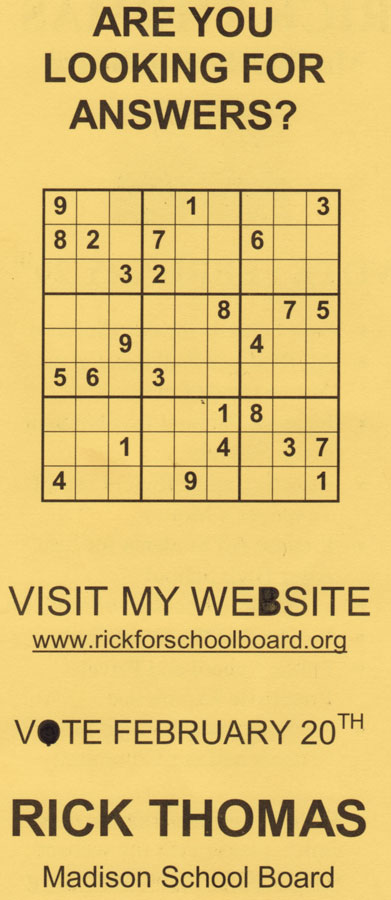
Much more on the election, here. Rick’s literature has a handy Sudoku puzzle on the back.

Share

Whole-language Wolves in Sheep’s Clothing

Louisa Moats 324K PDF:

How to Tell When “Scientifically-Based Reading Instruction” Isn’t.
In this practitioners’ guide, renowned reading expert Louisa Moats (author of the American Federation of Teachers’ Teaching Reading Is Rocket Science and an earlier Thomas B. Fordham Foundation report, Whole Language Lives On: The Illusion of “Balanced” Reading Instruction) explains how educators, parents, and concerned citizens can spot ineffective reading programs that surreptitiously hide under the “scientifically-based” banner.
While the field of reading has made enormous strides in recent years—especially with the publication of the National Reading Panel’s landmark report and enactment of the federal Reading First program discredited and ineffectual practices continue in many schools. Although the term “whole language” is rarely used today, programs based on its premises, such as Reading Recovery, Four Blocks, Guided Reading, and especially “balanced literacy,” are as popular as ever. These approaches may pay lip service to reading science, but they fail to incorporate the content and instructional methods proven to work best with students learning to read. Some districts, such as Denver, openly shun research-based practices, while others, such as Chicago, fail to provide clear, consistent leadership for principals and teachers, who are left to reinvent reading instruction, school by school.

Press Release.

Share

Book: The Outrage of Project Follow Through: 5 Million Failed Kids Later

Zig Engelmann:

The book is not designed for educators but for the general public. The events start in 1964, when I got my first job in education (at the Institute for Research on Exceptional Children at the University of Illinois) and proceed from there to the present through a series of first-person vignettes and episodes that present the human side of what we did and why we did it. I think it delivers a powerful message.
Many episodes are dramatic—at least they were when we experienced them. I believe they show that we knew what we were talking about because we’d done more than theorize or observe through the sterile literature. We were completely involved in working with teachers, kids, and schools for more than 20 years in different manifestations of Follow Through. The book also provides short tours of work we’ve done with various types of learners, from the autistic, those with traumatic brain damage, and the deaf, to preschoolers, at-risk high school students, and the gifted.
The theme of the book is that urban school districts, as they are currently configured, can’t possibly work because their structure, logic, and philosophy are anti-scientific. Overall, the book will probably sadden you, but hopefully, it will provide an interesting journey and won’t discourage you.

Share

Online Classes Go Mainstream

Seema Mehta:

Hathaway, who hopes to be a novelist, is among 1 million kindergarten through high school student enrollments in virtual schooling across the nation, according to the North American Council for Online Learning, a nonprofit organization for administrators, teachers and others involved in online schooling.
Enrollment, counted as the total number of seats in all online classes, not the number of students, has grown more than 20 times in seven years, and the group expects the numbers to continue to jump 30% annually.
To deal with the growth, the University of California is launching an extensive effort to make sure applicants’ online high school courses are on par with traditional classroom instruction.
Nearly half the states offer public school classes online, and last year Michigan became the first in the nation to require students to take an online course to graduate from high school. In California, a state senator introduced a bill last week to allow public high school students to take online classes without depriving schools of the state funding they receive for attendance.

Share

Comments on the 2006 Madison Edge School Referendum & Possible Closure of a “Downtown School”

Dan Sebald:

I’m somewhat incredulous about the comments from the Madison School Board President Johnny Winston Jr. in Susan Troller’s article about Monday’s meeting. Do I understand correctly? The School Board packaged the new west side elementary school with two other spending items to ensure its passage as a referendum on last November’s ballot, and now the School Board is reluctant to put forth a referendum to fully fund downtown schools? And they give no reassurance about seeking to keep the downtown school curriculums and class size intact?
And what of these comments about no public outcry? If the public is to do the political footwork to get rid of draconian state-imposed caps, we wouldn’t need a School Board.
From someone who has no vested interest in one’s own children’s education yet recognizes the importance of a solid education for everyone, I say Madison’s school system is in obvious decline.
My opinion is that if the modus operandi is school funding by referendums and we get a referendum for a new school on the edge of the city, then we get a referendum to fund downtown schools.
If that referendum fails, then it fails, which would be a good indication of where priorities in the community lie and also a sad disappointment.
Dan Sebald Madison

This is a fascinating issue, particularly given the folks that lined up to support last fall’s referendum.

Share

‘Virtual’ courses rile teachers union

Non-union teachers could be used online
By Susan Troller
The prospect of a virtual school program in Madison is causing a confrontation in the real world between the Madison school district and John Matthews, executive director of Madison Teachers Inc., the teachers’ union.
At issue is whether the Madison district will be violating its collective bargaining contract with local teachers if it develops a virtual school learning program that includes courses taught online by instructors who are not members of MTI.
A virtual learning proposal, under development by the district for over a year, will be presented to the school board for consideration within the next month or so.
“Our position is that only MTI teachers can instruct kids,” Matthews said in an interview. “If someone providing the online instruction is not a licensed teacher in our district, I can’t tell you what the quality of the education will be.”
Matthews wrote a letter this week chastising Board President Johnny Winston Jr. for his advocacy of the online school proposal.

(more…)

Share

Spring 2007 Madison School Board Candidate Updates

Isthmus’s latest very useful school board candidate take home tests are now available. This week’s topics include volunteerism and the contents of an 8th grade graduation speech:

Much more on the election here.

Share

More Federal Money for Pell Grants, Special Education, Title I and Head Start

The Doyle Report:

This week, House and Senate Democrat Appropriators agreed on a long overdue funding resolution for fiscal year (FY) 06 that provides $2.3 billion in additional funding over FY06 and includes an additional $1.17 billion for education over FY 06 levels.
Highlights from the House appropriations resolution include:

  • Pell Grants: $13.6 billion, an increase of $615.4 million to increase the maximum Pell grant by $260 to $4,310.
  • Special Education: $10.7 billion for IDEA Part B state grants, an increase of $200 million to help school districts serve 6.9 million children with disabilities.
  • Title I K-12 Grants: $12.8 billion, an increase of $125 million to provide approximately 38,000 additional low-income children performing below grade level with intensive reading and math instruction.
  • Title I School Improvement Fund: $125 million for this new program to target assistance to the 6,700 schools that failed to meet No Child Left Behind requirements in the 2005-2006 school year.
  • Head Start: $6.9 billion, an increase of $103.7 million.

See also the Committee for Education Funding.

Share

“MIDDLE SCHOOLS ARE the great disaster of the education system”

Michael Jonas:

With so many middle schools performing poorly, the movement for K-8 schools is gaining momentum in Boston and nationwide. But some education reformers think combining the middle grades with high school, rather than elementary school, is a better formula.

Share

Seattle School Board creates ‘profile’ of the next superintendent

Jessica Blanchard:

The next leader of Seattle Public Schools should be inspirational, able to work well with others, committed to reducing the academic achievement gap and ideally will have experience as an educator, the Seattle School Board agreed.
During a marathon work session Wednesday, the board fine-tuned a list of 10 qualifications to create a “profile” of the person who will take over for departing Superintendent Raj Manhas later this year.

Seattle School Board Superintendent Search Page.

Share

Zogby on Philadelphia School Governance Reforms

Andrew Rotherham:

Guest Post from Charles Zogby, he’s currently Senior Vice President for Education Policy with K-12* and the former Secretary of Education Commonwealth of Pennsylvania. He was active in the reform efforts in Philly while he was secretary. Responding to this post he writes: I wanted to respond to your recent post regarding RAND’s analysis of the various school management options deployed in Philadelphia. You note in your post that for profit and non-profit managers received more resources but did no better in producing academic performance. This is not an entirely accurate picture of either the conditions of the schools or the challenge that the private mangers were handed.

Share

Seat 3 Madison School Board Candidate Pam Cross-Leone Nominated for the Athena Award

Debra Carr-Elsing:

The red carpet season is under way in Hollywood, and Madison has its own recognition programs this time of year. Among them is The Business Forum’s annual ATHENA Awards.
Ten nominees will be honored this year, and one will be named the 2007 ATHENA Award recipient when the business group presents its 10th annual fundraiser March 6 at the Monona Terrace Convention Center.
This year’s nominees are:
Pam Cross-Leone, team trainer, Madison Gas & Electric Co.

Beth Moss and Rick Thomas are also running for Seat 3. The primary is February 20, 2007.

Share

Toffler on the Future School

Alvin Toffler tells us what’s wrong — and right — with public education, by James Daly:

Forty years after he and his wife Heidi set the world alight with Future Shock, Alvin Toffler remains a tough assessor of our nation’s social and technological prospects. Though he’s best known for his work discussing the myriad ramifications of the digital revolution, he also loves to speak about the education system that is shaping the hearts and minds of America’s future. We met with him near his office in Los Angeles, where the celebrated septuagenarian remains a clear and radical thinker.
You’ve been writing about our educational system for decades. What’s the most pressing need in public education right now?
Shut down the public education system.
That’s pretty radical.
I’m roughly quoting (Microsoft chairman) Bill Gates, who said, “We don’t need to reform the system; we need to replace the system.”
Why not just readjust what we have in place now? Do we really need to start from the ground up?
We should be thinking from the ground up. That’s different from changing everything. However, we first have to understand how we got the education system that we now have. Teachers are wonderful, and there are hundreds of thousands of them who are creative and terrific, but they are operating in a system that is completely out of time. It is a system designed to produce industrial workers.
Let’s look back at the history of public education in the United States. You have to go back a little over a century. For many years, there was a debate about whether we should even have public education. Some parents wanted kids to go to school and get an education; others said, “We can’t afford that. We need them to work. They have to work in the field, because otherwise we starve.” There was a big debate. Late in the 1800s, during the Industrial Revolution, business leaders began complaining about all these rural kids who were pouring into the cities and going to work in our factories. Business leaders said that these kids were no good, and that what they needed was an educational system that would produce “industrial discipline.”
Let’s have a little exercise. Walk me through this school you’d create. What do the classrooms look like? What are the class sizes? What are the hours?
It’s open twenty-four hours a day. Different kids arrive at different times. They don’t all come at the same time, like an army. They don’t just ring the bells at the same time. They’re different kids. They have different potentials. Now, in practice, we’re not going to be able to get down to the micro level with all of this, I grant you, but in fact, I would be running a twentyfour- hour school, I would have nonteachers working with teachers in that school, I would have the kids coming and going at different times that make sense for them.
The schools of today are essentially custodial: They’re taking care of kids in work hours that are essentially nine to five — when the whole society was assumed to work. Clearly, that’s changing in our society. So should the timing. We’re individualizing time; we’re personalizing time. We’re not having everyone arrive at the same time, leave at the same time. Why should kids arrive at the same time and leave at the same time?

Well, well worth reading. We do need to re-think and re-implement a system that is, as Toffler points out, largely based around Frederick Taylor’s early 20th century thinking.

Share

How Should We Fund Education?

Chris Lufter:

We are sure that this statement will shock this community: The Waukesha Taxpayers League agrees that we have an educational funding problem in Wisconsin.
While there may be widespread agreement with that statement, how we got into this predicament and, more importantly, how we resolve the funding issue is where disagreement exists. As the saying goes, “one must know history well or history is bound to repeat itself.” A brief review of school funding history is in order.
During the late ’80s and early ’90s, education spending was out of control. Double-digit property tax increases were common. The only way to control school taxes and spending was to oust local school board members – always a difficult feat. Fiscally responsible school boards were rendered helpless by state mediation/arbitration law which sent contract disputes to an arbitrator for resolution. The problem was, the arbitrator’s decision was heavily influenced by settlements in surrounding districts. If one district settled at a high level of salary and benefit increases, soon all districts were mandated to provide such settlements. Large settlements combined with increased hiring led to escalating school spending and taxes. Property taxes in particular rose at unbearable rates, angering taxpayers across Wisconsin.
In the early ’90s, responding to an angry electorate, the Legislature passed a “revenue cap” law limiting the amount of revenue a district could collect from property and state taxes, effectively limiting spending. This cap was formulated to allow for inflation and student enrollment changes. Some contend that districts are only allowed to increase spending by 2 percent annually, but Wisconsin Taxpayers Alliance figures show that school spending increases have averaged 4 percent yearly since 2001.
To make revenue caps workable, salary and benefits (80 percent of school budgets) also needed to be reined in. The Legislature passed what is commonly called the QEO: qualified economic offer. This law prohibits mediation/arbitration if a district offers the teachers union at least a 3.8 percent salary and benefit increase. However, huge loopholes developed in QEO law, resulting in average salary increases of more than 5 percent annually, not including the increasing cost of health and retirement benefits.
This legislation intentionally created a shortfall between the money generated by revenue caps and the QEO to force districts to prioritize spending within their budgets that had become padded with new programs and staff for years. To provide for some local control of spending, the Legislature included the referendum process for any spending over the revenue caps.
Also passed was “two-thirds funding.” This means that the state provides two-thirds of the cost of education in Wisconsin. This was a huge shift in taxes from the local to the state level. This two-thirds funding is actually a very complex formula that distributes this money unevenly. Property rich districts and big spending districts get less state money than property poor districts and lesser spending districts. Waukesha is considered a property rich district, so we receive less than twothirds funding.
The state of Wisconsin currently spends $5.89 billion on kindergarten through 12thgrade education. This represents 39.3 percent of the state’s general fund. Local property taxes (after all credits) increased 5.4 percent to $3.79 billion. These figures demonstrate how generous Wisconsin taxpayers are to our schools.

Christ Lufter is President of the Waukesha Taxpayers League.

Share

Palo Alto School Board Rejects Classes in Mandarin

Jesse McKinley:

It would have seemed to be a perfect fit: an academically ambitious plan for an ambitiously academic city.
But after weeks of debate occasionally tinged with racial overtones, the Palo Alto Unified School District decided early Wednesday against a plan for Mandarin language immersion, citing practical concerns as well as whether the classes would give the small group of students in them an unfair advantage.
The proposal, which was voted down 3 to 2 after a marathon six-hour meeting of the district school board, would have established two classes taught mostly in Mandarin — the world’s most spoken language, used by nearly one billion Chinese — to 40 kindergarten and first-grade students at a local elementary school.
Grace Mah, a second-generation Chinese-American and the founder of Palo Alto Chinese Education, which lobbied for the program, said the vote was a major disappointment.
“I think there’s a number of people who are afraid of change,” said Ms. Mah, a 46-year-old computer engineer and a mother of two, including a third-grader in Palo Alto schools. “I think here’s a number of people who don’t believe in alternative education. And I think there’s a number of people who insist on equity, when in life, it just isn’t.”

Mandarin is offered at one Madison High School – Memorial.

Share

A Tide for School Choice

George Will:

Fifty-seven years later, Sumner Elementary School in Topeka is back in the news. That city’s board of education is still wrongly preventing the right people from getting into that building. Two educators wanted to use Sumner for a charter school, a public school entitled to operate outside the confinements of dictated curricula and free from many work rules written by teachers unions. Their school would have been a back-to-basics academy from kindergarten through fifth grade, designed to attack Topeka’s 23-point gap between the reading proficiency of black and Hispanic third-graders and that of whites.
When the school board rejected the application of the two educators — African American women — but praised their dedication to children, one of the women was not mollified: “A bleeding heart does nothing but ruin the carpet.”
Sumner is a National Historic Landmark because in 1950 Oliver Brown walked with his 7-year-old daughter Linda the seven blocks from their home to Sumner, where he unsuccessfully tried to enroll her. But Topeka’s schools were segregated, so Linda went to the school for blacks 21 blocks from her home, and her father went to court. Four years later came Brown v. Board of Education of Topeka.

Share

Notes on Washington DC’s School Climate

Marc Fisher:

Somehow, when good, bright people get serious about the fact that thousands of children emerge from this city’s schools year after year without knowing how to read well enough to get a decent job, those good people end up busying themselves with little boxes on a piece of paper.
Both say the schools alone can’t make the fix; the city must intercede in the lives of dysfunctional families before children are born. Both agree the District has to knock down the walls that separate the agencies that deal with family pathologies — agencies focused on prenatal care, child abuse, substance problems, street crime, absentee parents, unemployment, adult illiteracy, and on and on must finally coordinate how myriad arms of the city deal with a single child.
Both Reinoso and Bobb can and do catalogue the failures of the school board, the impossibility of getting stuff done in the labyrinth of the school bureaucracy and the fact that there is precious little reason for parents to send their kids to D.C. schools if they have any choice.

Share

Milwaukee Schools to “Cull Troublemakers”

Alan Borsuk:

Milwaukee Public Schools Superintendent William Andrekopoulos said Thursday that his budget proposal for next year will call for more students to be placed in alternative schools, with the goal of reducing the number of students who are doing poorly – and who frequently are the source of problems – in the main body of high schools and middle schools.

Related Milwaukee Journal-Sentinel Editorial.

Share

How Much Are Public School Teachers Paid?

Jay Greene and Marcus Winters:

Education policy discussions often assume that public school teachers are poorly paid. Typically absent in these discussions about teacher pay, however, is any reference to systematic data on how much public school teachers are actually paid, especially relative to other occupations. Because discussions about teacher pay rarely reference these data, the policy debate on education reform has proceeded without a clear understanding of these issues.
This report compiles information on the hourly pay of public school teachers nationally and in 66 metropolitan areas, as collected by the U.S. Bureau of Labor Statistics (BLS) in its annual National Compensation Survey. We also compare the reported hourly income of public school teachers with that of workers in similar professions, as defined by the BLS. This report goes on to use the BLS data to analyze whether there is a relationship between higher relative pay for public school teachers and higher student achievement as measured by high school graduation rates.

Share

“No Need to Worry About Math Education”

From a reader involved in these issues, by Kerry Hill: Demystifying math: UW-Madison scholars maintain focus on effective teaching, learning

Tuesday, January 30, 2007 – By Kerry Hill
New generation of Math Ed
Many people still see mathematics as a difficult subject that only a select group of students with special abilities can master. Learning math, they believe, consists of memorizing facts and mastering the application of complicated concepts and procedures.
“That’s simply not true,” says Thomas Carpenter, who has plenty of research to justify his succinct rebuttal.
A pioneering cohort of education researchers at UW-Madison – led by Carpenter, Thomas Romberg, and Elizabeth Fennema, all emeriti professors in the Department of Curriculum and Instruction – have shown, for instance, that children of all abilities enter school with an informal base of mathematical knowledge that enables them to learn more substantive material than traditionally taught.

(more…)

Share

Why Johnny can’t read very well and what to do about it

Teacher Thomas Biel:

Juan/Sean/John doesn’t read too well because we don’t teach him how very well. Results from the 2005-’06 Wisconsin Knowledge and Concepts Examinations show that 55% of Milwaukee Public Schools 10th-graders do not read at a proficient level. The majority of our kids have reading problems.
Leaders in the school district, in the Legislature and at the federal level need to take a stand and do something practical, like earmarking funds for literacy wherever literacy is a problem.
We need to go way beyond literacy coaches and in-content-area reading programs to try to solve this problem.
Reading should be made a department in every high school just as math, science and English are, and reading classes should become a part of every high school curriculum.
I’m not saying that we don’t teach reading in the high schools. But, primarily, we teach reading to students who already can read. Those who can’t, or who can’t read well, struggle, and many fail. If they aren’t designated special education or a special needs learner, these students disappear into the cracks of the system.
Typically, the struggling reader who has fallen behind somewhere in his education gets to high school and is expected to take the same English, history, science and math classes as the proficient reader.
The student in junior-year English who reads at a third-grade level but is studying the essays of Ralph Waldo Emerson or “The Fall of the House of Usher” will drown in language he doesn’t understand. The textbooks he has to read for history, science and math will be eight grades beyond his reading level.

(more…)

Share

Bill Cosby talks about what teachers need to do better.

Teacher Magazine:
Published: January 1, 2007
Tough Love
Bill Cosby talks about what teachers need to do better.
By Denise Kersten Wills
Bill Cosby made headlines in October when he urged teachers to do a better job of explaining to students the importance of the subjects they teach.
—Erinn
The comedian, best known as the beloved Dr. Huxtable from TV’s long-running hit The Cosby Show, has been outspoken in recent years about what the black community needs to do to close the racial achievement gap.
The Cos isn’t a classroom veteran, but neither is he a stranger to education—he holds master’s and doctorate degrees in the field.
We followed up with Cosby and asked him to explain his remarks.
Recent newspaper accounts said you had attacked teachers for not doing enough to help kids.
They heard me, but they didn’t print what I did. What came out was, ‘Well, he’s at it again, and now he’s after the teachers.’
Subscription Required

Share

Arkansas Town Offers Students Free College Education

Associated Press:

Prospects for the future changed significantly for many students at El Dorado High School on Monday with the announcement by an oil company that it is putting up $50 million for college scholarships in its working-class hometown over the next 20 years. Murphy Oil Co. said it wants to increase the number of students who attend college and perhaps attract new businesses to El Dorado, with the scholarships a selling point. It said it also hopes the program will help create better jobs here for students to come back to after graduating from college.”This is a huge day. As of today, El Dorado High School graduates will have an unprecedented opportunity to continue their education,” Superintendent Bob Watson told students.”For some students, this is life-changing. Students who have worked hard, but would not have been able to attend college because of financial limitations, now have the means to do so.”The program begins with this spring’s graduating class. El Dorado High School has about 250 graduates each year, about 65 percent of whom go to college.Students gathered at an assembly screamed and applauded when the program was unveiled.

Share

Talented Students On Hold

Kristen Stephens and Jan Riggsbee
DURHAM – In his State of the Union address last week, President Bush called on Congress to reauthorize the No Child Left Behind Act (NCLB), saying “We must increase funds for students who struggle…and make sure these children get the special help they need.” But NCLB, as it is currently implemented, largely ignores another important group that is struggling — gifted and talented students.
Our society typically views struggling students as those who are disadvantaged by ability or demonstrated achievement level — those students not meeting proficiency levels for their respective grade.
However, gifted and talented students struggle because they sit in our classrooms and wait. They wait for rigorous curriculum. They wait for opportunities to be challenged. They wait for engaging, relevant instruction that nurtures their potential.
And, as they wait, these students lose interest in their passions, become frustrated and unmotivated from the lack of challenge their schools’ curricula provide them. As a result, they become our lost talent.

Share

Gifted student feels Left Behind

Dave Toplikar
January 30, 2007
Lawrence ninth grader to speak up for high achievers during Capitol visit.
As No Child Left Behind policy is reviewed this year, there is one group of students some think may have been left behind — those who are high achievers.
“Most of the time I’m stuck in regular classes,” said Dravid Joseph, a ninth-grader at West Junior High. “Sometimes I’m bored with what I’m doing there.”
Partially for that reason, Dravid will join a contingent of some of Kansas’ most gifted students who will travel Wednesday to Topeka to advocate for specialized classes for more than 15,000 of their peers across the state.
Similar stories from Wisconsin and beyond:

Share

Spring 2007 Election Update: Cross-Leone, Moss and Thomas Discuss Volunteerism

Kristian Knutsen:

Let’s skip the issues this week and probe the Madison school board candidates on their community involvement and their advice for students moving up to high school. We’ve asked them to describe their most fulfilling volunteer experiences, as well as what they would say to a graduating class of eighth graders.

Here are the responses for the candidates for Seat 3: Pam Cross-Leone, Beth Moss, and Rick Thomas.

Much more on the election here.

Share

Denver Schools Get Bonuses for Student Population Growth

Allison Sherry:

Some of the Denver’s most popular public schools will get pots of cash this spring for attracting students from out of the district or from charter schools.
The move is designed to draw students back to Denver public schools, which have lost more than 8,000 students in the past six years.
Places like the Center for International Studies, the Denver School of the Arts, and East and Thomas Jefferson high schools will receive cash – from $20,000 to $156,000 – because they attracted “new” kids this year to their rolls, Denver Public Schools administrators said Thursday.
District leaders consider “new” students as those previously attending school out of the district or at a charter school.
Charter schools are public but are operated privately and get to keep the bulk of state per-pupil money. In Denver, that is about $6,500 per student.
For each “new” student, Denver schools will receive $1,395, but to receive the money, the school had to have a net gain of students.

Share

School Finance: K-12 Tax & Spending Climate

School spending has always been a puzzle, both from a state and federal government perspective as well as local property taxpayers. In an effort to shed some light on the vagaries of K-12 finance, I’ve summarized below a number of local, state and federal articles and links.
The 2007 Statistical Abstract offers a great deal of information about education and many other topics. A few tidbits:

1980 1990 2000 2001 2002 2003 2004
US K-12 Enrollment [.xls file] 40,878,000 41,216,000 47,203,000 47,671,000 48,183,000 48,540,000 NA
US K-12 Deflated Public K-12 Spending – Billions [.xls file] $230B 311.8B $419.7B $436.6B $454.6B $464.8B $475.5B
Avg. Per Student Spending $5,627 $7,565 $8,892 $9,159 $9,436 $9,576 NA
US Defense Spending (constant yr2000 billion dollars) [.xls file] $267.1B $382.7B $294.5B $297.2B $329.4B $365.3B $397.3B
US Health Care Spending (Billions of non-adjusted dollars) [.xls file] $255B $717B $1,359B $1,474B $1,608B $1,741B $1,878B
US Gross Domestic Product – Billions [.xls file] 5,161 7,112 9,817 9,890 10,048 10,320 10,755

(more…)

Share

Why are school boards choosing to charter?

You’ll find the answer in the ATTACHED article from the “Wisconsin School News,” monthly journal of the Wisconsin School Boards Association. Appleton Embraces Charter Schools by Annette Talis. [650K PDF]

Share

Health Literacy

Jane Brody:

Whether you left school at 16 or have a doctorate; whether your annual income is in four figures or six; whether you are black, white, Hispanic, Asian or American Indian, chances are there have been many medical encounters that left you with less than optimal understanding about how you can improve or protect your health.
National studies have found that “health literacy” is remarkably low, with more than 90 million Americans unable to adequately understand basic health information. The studies show that this obstacle “affects people of all ages, races, income and education levels,” Dr. Richard H. Carmona, the United States surgeon general, wrote in the August issue of The Journal of General Internal Medicine, which was devoted to health literacy.

Share

Grammar Girl

Mignon Fogarty:

Mignon works hard to balance the needs of her business with the growing success of the Grammar Girl podcast. If more than a few days pass without a new Grammar Girl episode, it is almost certain that she has a deadline for a client’s project. Never fear! She will return.
Grammar Girl believes that learning is fun, and the vast rules of grammar are wonderful fodder for lifelong study. She strives to be a friendly guide in the writing world. Her arch enemy is the evil Grammar Maven who inspires terror in the untrained and is neither friendly nor helpful.

Share

Spring, 2007 Madison Referendum?

Susan Troller:

Is there another school referendum in Madison’s immediate future?
If it means saving small schools in the center of the city that face closings or consolidations in the path of this year’s $10.5 million budget-cutting juggernaut, some neighborhood advocates argue it would be well worthwhile.
Matt Calvert, a Lapham-Marquette elementary school parent, said he favored a referendum that would provide money to the district for the next several years so that it would not close schools, increase class sizes or cut programs in an effort to close its budget gap.

Share

Madison School District’s Press Release on Reduced State Special Education Funding

Madison Metropolitan School District:

The state’s failure to pay for mandated special education and English Language Learner (ELL) costs reduced available resources to Madison Schools by over $11.6 million, according to information released to Rep. Mark Pocan (D-Madison) by the Legislative Fiscal Bureau (LFB).
At the district’s request, Pocan asked the LFB to calculate the reimbursement for special education and ELL expenses comparing the level of state categorical aid during the 1993-94 school year (the first year of state-imposed revenue limits) and the 2005-06 school year. School districts statewide were reimbursed for special education expenses at nearly 45% for 1993-94. The reimbursement for 2005-06 slipped to below 29%, translating to a loss of over $9.4 million in resources for Madison Schools compared to 1993-94.
For ELL students, the 1993-94 state reimbursement to districts for expenses was 33.1%. Currently, school districts are reimbursed at 11.5%, a loss of over $2.2 million in resources for Madison Schools compared to 1993-94.
For decades the state had a statutory provision requiring reimbursement for special education to be 63%, but the statute was eliminated from law in the 1999-2001 biennial budget.

The State of Wisconsin has been increasing it’s overall K-12 funding during this time, including the much discussed commitment to fund 2/3 of school district budgets. It would be interesting to see a summary of the spending changes over time, including areas that saw increases, and like this example, decreases.

Share

Sun Prairie’s February 20 New School Referendum

Sun Prairie School District:

On February 20, 2007, voters within the Sun Prairie Area School District will be asked to vote on a referendum to build a 7th elementary school within the school district.

Cliff Miller has more.

Share

Elementary String Education for Nine and Ten Year Olds: Private Funding Required

According to a meeting I had with the Superintendent, he says MMSD will require $300,000 to fund elementary string instruction and that private funding and/or grants will be needed to continue Elementary String Education in the Madison public schools. Without this funding, he is likely to again propose cutting this Madison public school tradition of nearly 40 years.
I’m exploring setting up a specific fund for string education at either the Foundation for Madison Public Schools or the Madison Community Foundation, so tax deductible contributions can be made in support of the curriculum. Madisonians United for String Education for Students (MUSEs) is a working title for a group of parents who want to keep elementary string instruction in our public schools for our young children. We welcome your ideas on next steps. Personally, we feel if this is the route we have to take, an endowment fund will be needed to ensure the course continues into the future.
I met last week with the Superintendent who said he a) supports elementary string curriculum instruction during the school day, b) would accept proposals for privately funding elementary string education. I also said the support and/or leadership of the Fine Arts Coordinator was important to such an effort, and he agreed, saying the Fine Arts Coordinator would be supportive.
Public schools surrounding Madison have strong, growing elementary string courses, because the community values the course and this is the foundation course for more advanced instrumental training/experiences in middle and high school. Plus, elementary string courses make their school districts attractive to parents deciding where to live and to send their children to school. Many parents want their children to have the experience of learning to play an instrument and to make music with other students. Private lessons can cost $2,000 or more per year – few families can afford this, especially low income families. That’s what’s special about Madison’s elementary strings program. In Madison, in previous years, Grade 4 and 5 strings taught about 500+ low-income students annually.
String instrument instruction offers a number of benefits for children – they can be sized to a small child, they are “easy” to take home to practice, all types of cultural and popular music can be played on the string instruments, and these instruments lend themselves to ensemble playing. Furthermore, learning how to play an instrument prepares you for playing a string or band instrument in middle school or for chorus, because you learn how to read music. Through the one- to two-year elementary course, children experience the joy of making music and performing through discipline and practice. Also, by offering this course Madison’s public schools stand shoulder to shoulder with what the surrounding school districts value and offer their children.
Lastly, I’m also be looking at various financial information to develop some proposals for the School Board’s consideration. I welcome your support and ideas.

Share

Whole Language in Sheep’s clothing

Joanne Jacobs:

In a Fordham report, Whole-Language High Jinks, reading expert Louisa Moats warns that ineffective whole-language reading programs with names like “balanced literacy” are trying to grab funding intended for programs that have been proven far more effective. New York City, Denver and Salt Lake City have been misled by programs that are whole language in disguise, Moats writes. Warning signs include:

  • Use of memorization and contextual guessing, instead of direct, systematic teaching for word recognition and actual comprehension;
  • Rejection of explicit phonics, spelling, or grammar instruction;
  • Application of the whole-language principles for English language learners.

Share

NY Governor Spitzer to Tie Increased School Funds to Performance

Maria Newman:

Gov. Eliot Spitzer of New York said today that he would allocate more money to the state’s public education system in his 2008 budget proposal, but he said the increased spending would be tied to better results from schools, educators and students.
“There will be no more excuses for failure,” Mr. Spitzer said. “The debate will no longer be about money, but about performance.”
The governor, in office for less than a month, did not tip his hand today on how much the public school system will get in the budget that he will submit to the state Legislature on Wednesday. But in an address to school leaders and legislators, he said that every school district that receives at least $15 million more this year in his new budget, or 10 percent more than in the previous year, would be subject to a new “contract for excellence” that will dictate how they can spend those funds.
Schools that do not perform well, he said, would be shut down. Educators who do not meet performance goals would be dismissed. A new accountability system would monitor how schools are performing academically and whether they are making the best use of their money, he said. Also, the schools will be judged on whether their academic programming is helping students perform better.
“We should be ready to close more schools that fail — perhaps as many as 5 percent of all the schools in the state if we have to,” he said.

Spitzer’s Speech, “A Contract for Excellence” is available here.
Jonathan Mandell comments.

Share

Stretching Truth with Numbers: The Median Isn’t the Message

Stephen Jay Gould:

My life has recently intersected, in a most personal way, two of Mark Twain’s famous quips. One I shall defer to the end of this essay. The other (sometimes attributed to Disraeli), identifies three species of mendacity, each worse than the one before – lies, damned lies, and statistics.
Consider the standard example of stretching the truth with numbers – a case quite relevant to my story. Statistics recognizes different measures of an “average,” or central tendency. The mean is our usual concept of an overall average – add up the items and divide them by the number of sharers (100 candy bars collected for five kids next Halloween will yield 20 for each in a just world). The median, a different measure of central tendency, is the half-way point. If I line up five kids by height, the median child is shorter than two and taller than the other two (who might have trouble getting their mean share of the candy). A politician in power might say with pride, “The mean income of our citizens is $15,000 per year.” The leader of the opposition might retort, “But half our citizens make less than $10,000 per year.” Both are right, but neither cites a statistic with impassive objectivity. The first invokes a mean, the second a median. (Means are higher than medians in such cases because one millionaire may outweigh hundreds of poor people in setting a mean; but he can balance only one mendicant in calculating a median).

Share

Studies Find Benefits to Advanced Placement Courses

Jay Matthews:

In the midst of a national debate over whether Advanced Placement courses place too much pressure on U.S. high school students, a team of Texas researchers has concluded that the difficult courses and three-hour exams are worth it.
In the largest study ever of the impact of AP on college success, which looked at 222,289 students from all backgrounds attending a wide range of Texas universities, the researchers said they found “strong evidence of benefits to students who participate in both AP courses and exams in terms of higher GPAs, credit hours earned and four-year graduation rates.”
A separate University of Texas study of 24,941 students said those who used their AP credits to take more advanced courses in college had better grades in those courses than similar students who first took college introductory courses instead of AP in 10 subjects.

Madison United for Acadmic Excellence has a useful comparison of AP and other “advanced” course offerings across the four traditional Madison high schools. Much more on local AP classes here.
Wisconsin Advanced Placement Distance Learning Consortium.
Verona High School Course Prospectus, including AP.
Middleton High School Course List.
Monona Grove High School Course Catalog [320K PDF]
Sun Prairie High School Courses.
Waunakee High School Course Index.
McFarland High School Course Guide.
Edgewood High School.
Jay Matthews has more in a later article.

Share

On Musical Talent

David Shenk:

How can we explain the vast differences in musical ability? How can one species produce Paul Simon and William Hung? Are we born with musical talent, or do we develop it? Let’s sort through the research:

Share

The Declining Quality of Mathematics Education in the US

Leland McInnes:

Mathematics education seems to be very subject to passing trends – surprisingly more so than many other subjects. The most notorious are, of course, the rise of New Math in the 60s and 70s, and the corresponding backlash against it in the late 70s and 80s. It turns out that mathematics education, at least in the US, is now subject to a new trend, and it doesn’t appear to be a good one.
To be fair the current driving trend in mathematics education is largely an extension of an existing trend in education generally. The idea is that we need to cater more to the students to better engage them in the material. There is a focus on making things fun, on discovery, on group work, and on making things “relevant to the student”. These are often noble goals, and it is something that, in the past, education schemes have often lacked. There is definitely such a thing as “too much of a good thing” with regard to these aims, and as far as I can tell that point was passed some time ago in the case of mathematics.

Share

Teacher Excellence and the Reality of Teaching

Message from the Vice President, AERA
November 14, 2006
Christine Sleeter
California State University, Monterey Bay
christine_sleeter@csumb.edu
Being a teacher educator these days can be a strange experience. Over the past several months, I have given numerous presentations depicting teaching as intellectually challenging, complex work. Using case studies of teachers in diverse classrooms, I have argued that learning to teach well is complicated, partly because excellent teachers know how to engage their students in thinking deeply about things that matter, while embedding the teaching of skills and basic content in broader ideas and problems that have relevance to their students. Ron Berger’s descriptions of teaching and learning in An Ethic of Excellence are not only brilliant and inspiring, but helpful illustrations of what classroom teaching and learning can be.
As teacher educators, this is the kind of teaching we try to promote. Linda Darling-Hammond’s most recent book Powerful Teacher Education develops excellent portraits of the best in preservice teacher education. [Highlights Alverno College in Milwaukee – LJW]. In New Zealand, the Ministry of Education has been sponsoring an Iterative Best Evidence Syntheses program, connecting research on teaching to diverse students’ learning, and to teacher professional development. For example, professional development linked to enhanced children’s learning incorporates teachers’ knowledge and skills, provides theoretical content knowledge related to practice, involves teachers in analyzing data from their own settings, and engages them in critical reflection that stretches their thinking and challenges their assumptions most recent issue of Harvard Educational Review, Betty Achinstein and Rod Ogawa examine two cases of beginning teachers whose students were out-scoring those of their peers on state tests, but who were pushed out of their teaching positions because of their refusal to follow the script.
What is going on here? It is true that teacher education as a whole has not done nearly as well as it could in preparing teachers to teach all students well. At the same time, reducing learning to teach to learning to follow a script greatly shortchanges what teaching and learning could be. It is ironic that teaching has become exceedingly prescribed and determined at a time when the U.S. is aggressively exporting its version of democracy and personal liberty. Not only is tolerance for diverse perspectives currently the lowest it has been in my lifetime, but support for intellectual inquiry and creativity in education seems to have disappeared.
To prompt consciousness-raising, curriculum theorist Thomas Poetter wrote a novel, The Education of Sam Sanders. Set in about 2030, it tells the story of a student who rebelled against rote learning and test preparation because he wanted to read whole books of his own choosing. His rebellion awakened some teachers’ memories of a time when teaching and learning involved harnessing reading, writing, and math skills to explore interdisciplinary themes of significance to the lives of students. Books that had been banned were brought out of a locked vault. Teachers began working collaboratively to design engaging curricula. You’ll have to read the book to find out what happened.
I believe it is essential that we demand more for students. In part, this means demanding more from our own teacher education programs. Our work as teacher educators needs to be grounded in the realities of the diverse students who populate classrooms today. But rather than acquiescing to formulas and scripts, we must re-invigorate a vision of, in the words of Maria de la Luz Reyes and John Halcón, The Best for our Children.

Share

Wisconsin School Finance: QEO, Revenue Caps and Sage

Andy Hall:

The revenue caps and QEO are transforming the operations of public schools, pushing school officials and the public into a never-ending cycle of cuts, compromises and referendums.
Most districts reduced the number of academic courses, laid off school support staff and reduced programs for students at the highest risk of failure, according to a survey of 278 superintendents during the 2004-05 school year by groups representing administrators and teachers.
Public schools, the most expensive single program in Wisconsin, account for about 40 cents of every dollar spent out of the state’s general fund.
In the old days, school boards wanting more money for school operations could simply raise taxes, and risk retribution from voters if they went too far.
Revenue caps stripped school boards of that power, requiring them instead to seek the permission of voters in ballot questions.
“We’re literally governing by referendum,” complained Nancy Hendrickson, superintendent of the Pecatonica Area School District in Blanchardville, 35 miles southwest of Madison.

Much more on the Madison School District’s $331M+ budget here and here.

Share

Milwaukee Schools’ Enrollment Dip

Sarah Carr:

Enrollment in the main roster of Milwaukee Public Schools is expected to take its sharpest dip in years this fall, dropping by more than 3,300 students.
Less than 10 years ago, enrollment in traditional MPS schools was at about 97,000, and this September officials predict it will be only about 81,600.
The projections were released Friday night by MPS officials as part of a budget forecast for next school year. Superintendent William Andrekopoulos attributed the accelerated slide to growth in the private school voucher program, decreasing population in the city and crime and poverty rates scaring off potential newcomers.
“There are not as many families migrating to Milwaukee as in the ’90s,” he said.

Share

Why Teacher Unions Are Good for Teachers and the Public

Diane Ravitch:

They Protect Teachers’ Rights, Support Teacher Professionalism, and Check Administrative Power.
We live in an era when leaders in business and the media demand that schools function like businesses in a free market economy, competing for students and staff. Many such voices say that such corporate-style school reform is stymied by the teacher unions, which stand in the way of leaders who want unchecked power to assign, reward, punish, or remove their employees. Some academics blame the unions when student achievement remains stagnant. If scores are low, the critics say it must be because of the teachers’ contract, not because the district has a weak curriculum or lacks resources or has mediocre leadership. If some teachers are incompetent, it must be because of the contract, not because the district has a flawed, bureaucratic hiring process or has failed to evaluate new teachers before awarding them tenure. These critics want to scrap the contract, throw away teachers’ legal protections, and bring teacher unions to their collective knees.
It is worth recalling why teachers joined unions and why unions remain important today. Take tenure, for example. The teacher unions didn’t invent tenure, despite widespread beliefs to the contrary. Tenure evolved in the 19th century as one of the few perks available to people who were paid low wages, had classes of 70 or 80 or more, and endured terrible working conditions. In late 19th century New York City, for example, there were no teacher unions, but there was already ironclad, de facto teacher tenure. Local school boards controlled the hiring of teachers, and the only way to get a job was to know someone on the local school board, preferably a relative. Once a teacher was hired, she had lifetime tenure in that school, but only in that school. In fact, she could teach in the same school until she retired—without a pension or health benefits—or died.

More on Diane Ravitch. Joanne adds notes and links to Diane’s words.

Share

Notes on Outsourcing Public Education

Leo Casey:

Edwize has obtained a copy of the RFP [Request for Proposal] for “Partnership School Support” that the New York City Department of Education has hidden from the general public in a remote precinct of its website accessible only to private vendors with passwords. In it one finds the details of one of the central components of the latest structural reorganization Chancellor Klein want to impose on New York City public schools.
What is remarkable about the RFP is the general plan to outsource to these private ‘partnership’ entities virtually all of the educational support functions traditionally fulfilled, for better or for worse, by the DOE. Instructional program, professional development, special education: all of these and more will now be organized and supported by the Partnerships. And in contrast to the current intermediaries such as New Visions and Urban Assembly, this RFP invites ‘for profit’ EMOs [Educational Maintenance Organizations, modeled after Health Maintenance Organizations or HMOs] like Edison Schools and Victory Schools to become Partnerships.

Share

More on the Proposed Madison Studio School


The Madison School Board discussed the proposed Madison Studio School recently. Watch the video and read these recent articles:

  • Mayoral Candidates Endorse the Studio School by Susan Troller
  • Board Wants Study of Studio School by Deborah Ziff
  • Don’t Rush Approval of Studio School by John Keckhaver
  • Chafing at Charters by Jason Shephard:

    But citizen praise was matched by district badmouthing. At every stage, district officials exaggerated the potential problems posed by the school, and at no point did they provide evidence that they had worked to resolve them.
    For example, Rainwater wants the 44-student school to have its own full-time principal and secretary, while Studio School backers want to save money by sharing Emerson’s resources.
    Rainwater’s insistence on spending more money, which could torpedo the proposal, left some shaking their heads. Kobza asked whether it would make sense to even consider other charters, as Rainwater’s rules would make them financially unviable.
    Rainwater, amazingly, conceded the point: “I agree that you would never have a charter school” given these requirements, he said.

(more…)

Share

What’s the MTI political endorsement about?

In 2006-07 the Madison School district will spend $43.5M on health insurance for its employees, the majority of the money paying for insurance for teachers represented by Madison Teachers, Inc. (MTI) That is 17% of the operating budget under the revenue limits.
In June of 2007, the two-year contract between the district and MTI ends. The parties are now beginning negotiations for the 2007-09 contract.
The Sun Prairie School district and its teachers union recently saved substantial dollars on health insurance. They used the savings to improve teacher wages. The parties joined together openly and publicly to produce a statement of the employees health needs. Then they negotiated a health insurance package with a local HMO that met their needs.
The Madison School district has no choice but to look for ways to reduce future health insurance costs, while keeping a high quality of care. What we pay our teachers in the future depends on it–both in wages and in post-retirement benefits. What we can offer to our children in programs depends on it.
We have made some progress in reducing future health insurance costs for some of the union-represented employees and for our administrators. I hope that board members elected in April will continue down this path. It’s not an easy path.
MTI plays hard ball in its election endorsements. It is looking for candidates that will continue coverage by Wisconsin Physicians Services (WPS)—no matter what else is available. It is also telling the incumbents what kind of treatment to expect from executive director John Matthews if the incumbent takes his or her board role seriously enough to represent the kids’ interest at the negotiating table. For an example, see MTI’s newsletter for late January:
http://www.madisonteachers.org/Solidarity/Solidarity%2006-07/solid012207.pdf [65K PDF]

Share

Madison’s Mendota Elementary School beats the odds

What does it take to truly create a school where no child is left behind?
That question defines what is probably the most pressing issue facing American public education, and a high-poverty school on Madison’s north side west of Warner Park seems to have figured out some of the answers.
Mendota Elementary is among a small handful of schools in Madison where the percentage of children from low-income families hovers above 70 percent. But contrary to what most research would predict, Mendota’s standardized test scores meet or beat Madison’s generally high district averages, as well as test scores from throughout the state, on the annual Wisconsin Knowledge and Concepts Exam.
In fact, Mendota’s test scores even exceed those of many other local schools where the majority of students come from more affluent homes with a wealth of resources to devote to child raising, including both time and money.
From “Successful schools, successful students” by reporter Susan Troller, The Capital Times, January 26, 2007.

(more…)

Share

Late January School Board Progress Report

The Madison Board of Education is faced with several great challenges over the next few months. One of the biggest is the announcement that Superintendent Art Rainwater will retire at the end of the June 2008. The board will be working with a consultant to assist in hiring the next superintendent. Another board challenge is the budget shortfall of $10.5 million dollars. Lack of state and federal funding, unfunded and under funded mandates, revenue limits and the qualified economic offer, all contribute to the annual budget woes. While addressing these issues the Board continues its discussion and analysis on positive student behavior in our schools. These changes will lead from a punitive approach to a preventive and restorative justice methodology. This model will increase school safety and lead to changes in the student Code of Conduct and Board policy that can be applied fairly to all students.

(more…)

Share

High School Research Studies Database

Education Commission of the States:

This unique resource is for you:

  • If your governor or your legislator has asked you to tell him/her what the research says on education issues
  • If you don’t know whom to trust — and find it difficult to navigate potential bias and the selective use of data
  • If you don’t have time to read 25 pages and trudge through complicated explanations of methodology
  • If you need to cut through the mud right to the findings and policy implications.

Share

The Baltimore Algebra Project

Sherrilyn Ifill:

was recently trying to list the 10 most encouraging initiatives by black people in 2006 and I thought I’d share one with you. It’s the Baltimore Algebra Project, a group of African American inner-city teens who’ve evolved from tutors to activists in an effort to force change in the failing Baltimore City School system. The Algebra Project, many of you may know, was created by the brilliant soft-spoken civil rights activist and organizer Robert Moses, who left the U.S. to live in Africa, in the 1960s. When Moses returned to the U.S., he became convinced that the abysmal performance of African American students in math and science are a major barrier to full citizenship and empowerment. He created a program designed to help African American students excel in math in science. There are Algebra Projects in several U.S. cities. The Baltimore Algebra Project began as a tutoring program, but the young people in the project – students at many of the city’s struggling schools – have become increasingly more activist over the past 3 years. Finally, frustrated at continuing inequities in the school system, the Project announced the launch of “Freedom Fall” [fascinating – more at Clusty] this past September. They marched on the headquarters of the school board, and in a stroke of courage and brilliance created an alternative school board, called the Freedom Board.

Share

Spending & Education Commentary

Richard S. Davis, writing in the Spokesman Review:

What should the state spend on public schools?
In Olympia today, there is only one right answer: More.
And that answer has budget-busting consequences.
Gov. Chris Gregoire, the current education governor – when has the mansion not been occupied by an education governor? – has proposed increasing per student spending by 25 percent. Republicans don’t disagree, though they might spend it differently. And the governor has called her education budget, which goes a long way toward depleting a $1.9 billion surplus, just a down payment.
Not satisfied with promises, nine school districts went to court earlier this month, suing for more state money. They didn’t say how much they wanted, possibly to avoid low-balling the judge. The courts can be very generous with other people’s money.
But there are limits to how much is available. The current surplus will be spent in a few years. And when “more” means higher taxes, public support erodes quickly.
Perhaps, rather than focusing on how much we are spending, we should be asking how well existing money is being spent.

Joanne has more.

Share

Making our schools a top priority: Investment in education will always pay off in society

Bill Baumgart:

When I was first contacted about writing a guest opinion, I thought, “What a great opportunity to share my strong feelings about public education.” Then I realized I need to be aware that everyone will not feel the same as me nor for the same reasons and I must be cautious lest I alienate them. But I was asked for my views, so I will give them.
I believe education of our youth is the most valuable thing we as adults can provide to them. Similarly it is a great responsibility we hold. For the youth it gives them the future. They, of course, must decide how to use it. Often overlooked is the value that is returned to us as providers. If we have done well, we will have real contributors to our society in our future: our doctors, nurses, community leaders, engineers, lawyers, writers, ethical politicians and journalists. And we will provide the teachers for that next generation so this responsibility can go on.
None of this comes free. There is a cost and I agree it is substantial. But if you look at it as an investment, you will find a return on your money. There is the development of the future as shown in the preceding paragraph. There is also the concrete value of your community and the property you hold. It is accepted that the quality of life and property values are directly related to the education provided in that community. We all can think of areas where we would rather not live and raise our children, but you would also find that in many of those you could afford to buy a house. There is a direct correlation between the quality of local education and property value. Why else is an evaluation of the schools always a prime part of buying a house?

(more…)

Share

NYC Public Schools, Minus the Public

Leo Casey:

Last week, Mayor Bloomberg and Chancellor Klein unveiled yet another in a permanent revolution of structural reorganizations, highlighting a program which would allow private entities to assume a prominent role in the management of New York City public schools. For months, there had been rumors swirling around the exact nature of this “Partnership” program, so much so that the New York Times had published an October article on the DOE’s plans, describing them as private management of scores of schools. When a large group of labor, community based organizations, education advocates and elected officials met earlier this month to plan opposition to these efforts, Klein announced publicly that “as long as I am the chancellor of the public school system… the city of New York public schools will remain public schools.” With that announcement, speculation shifted to what the exact nature of the RFP for the “Partneship” would be.
The RFP is now out, sort of. It is hidden deep on the DOE web site, and only registered DOE vendors, such as Edison and Urban Assembly [two entities which have publicly indicated their interest], can actually see it.

Share

A Thought on Education

Bill:

My wife is a teacher, she teaches in Middle School. To be polite, a lot of her kids appear to be uninterested in the learning experience. Instead of wasting their time and the time of kids who actually wanted to learn, I’ve suggested that the school remodel a few classrooms to give these uninterested kids a leg up in their future careers. This special classroom would be equipped with a cash register, a cooking surface, a deep fryer, a soda fountain, and a system that offers orders for the students to fill correctly. The kids would be graded on their ability to operate the equipment, and tests would include simulated customer orders. Additional equipment would include mops and brooms, which they would use to clean up the room at the end of the class. Extra credit could be offered for asking “would you like fries with that, ma’am?” or “Biggie size, sir?”

Share

Math Education: An Inconvenient Truth

Watch an excellent explanation of current math instruction and alternatives to it. I’ve never before seen such clear demonstrations of current math education. It really helps make the current math controversies much more concrete. Go to You Tube.

Share

Singapore Math is a plus for South River students

Chandra M. Hayslett:

It’s also different from American math in that fewer topics are taught in an academic year, giving the instructor the opportunity to teach the concept until it is mastered. “There’s a tendency in the United States to teach a topic, then it’s never seen or heard from again,” said Jeffery Thomas, president of SingaporeMath.com Inc., the official distributor of the math books based in Oregon City, Ore.
The American Institute for Research, one of the largest behavioral and social science research organizations in the world, says Singapore Math is better than American math because Singapore’s textbooks provide a more thorough understanding of concepts, while traditional American math books barely go beyond formulas and definitions. Before someone in Singapore can become a teacher, she must demonstrate math skills superior to her American counterparts, according to the AIR, which is based in Washington, D.C. Additionally, Singapore offers an alternative math framework for low-performing students, but at a slower pace and with greater repetition.

Share

Madison School Board Discusses an Independent Math Curriculum Review

The Madison School Board’s 2006/2007 Goals for Superintendent Art Rainwater included the “Initiatiation and completion of a comprehensive, independent and neutral review and assessment of the District’s K-12 math curriculum”. Watch the discussion [Video] and read a memo [240K PDF] from the Superintendent regarding his plans for this goal. Much more here and here.
Barbara Lehman kindly emailed the Board’s conclusion Monday evening:

It was moved by Lawrie Kobza and seconded by Ruth Robarts to approve the revised plan for implementation of the Superintendent’s 2006-07 goal to initiate and complete a comprehensive, independent, and neutral review and assessment of the District’s K-12 math curriculum as presented at this meeting, including extension for completion of the evaluation to the 2007-08 school year. The Board of Education shall receive a report in 2006-07 with analysis of math achievement data for MMSD K-12 students, including analysis of all math sub-test scores disaggregated by student characteristics and schools in addition to reports in subsequent years. Student representative advisory vote * aye. Motion carried 6-1 with Lucy Mathiak voting no.

Share

WI – MI College Tuition Pact in Jeopardy

Megan Twehey:

The University of Minnesota is threatening to pull out of a tuition reciprocity agreement between Minnesota and Wisconsin unless its students from Wisconsin start paying between $1,200 and $2,700 more a year.
Wisconsin has rejected the proposal, but the University of Minnesota is pushing back.
“We would like to reach agreement within the existing agreement,” said Craig Swan, vice provost for undergraduate education at the University of Minnesota. “That’s the preferable outcome. But I don’t want to rule other things out.”

Share

1989-2006 Math Comparison: Are Students Better Now?

math8906.jpg
W. Stephen Wilson [75K PDF]:

Professors are constantly asked if their students are better or worse today than in the past. This paper answers that question for one group of students.
For my fall 2006 Calculus I for the Biological and Social Sciences course I administered the same final exam used for the course in the fall of 1989. The SAT mathematics (SATM) scores of the two classes were nearly identical and the classes were approximately the same percentage of the Arts and Sciences freshmen. The 2006 class had significantly lower exam scores.
This is not a traditional research study in mathematics education. The value of this study is probably in the rarity of the data, which compares one generation to another.
….
Nineteen eighty-nine is, in mathematics education, indelibly tied to the National Council of Teachers of Mathematics’ publication, Curriculum and Evaluation Standards for School Mathematics (1989), which downplayed pencil and paper computations and strongly suggested that calculators play an important role in K-12 mathematics education. My 2006 students would have been about two years old at the time of this very influential publication, and it could easily have affected the mathematical education many of them received. Certainly, one possibility is that mathematics preparation is down across the country, thus limiting the pool of well prepared college applicants.

Wilson is a Professor of Mathematics at Johns Hopkins University.

Share

Elementary Strings: Update and Community Appeal

Action and Help Needed: I am beginning to work with some parents and others in the community to raise awareness and possibly financial support for all fine arts education. If you are interested in learning more, or would like to help, let me know (schrank4@charter.net or 231-3954). I will be posting on the blog more of what we are doing, including surveys and petitions of support.
Due to the proposed budget gap for next year and the Superintendent’s preliminary discussion idea to cut up to $300,000 from elementary strings, our focus will be on this course in the short-term. Elementary strings is only one piece of Fine Arts Education, but there is no other organization that teaches so many low income children how to play an instrument for about $200 per child vs. $2,000 per child in private instruction. We would like to resolve this issue this spring, working collaboratively with the administration and the school board.
The School Board would like proposals from the community re supporting elementary strings. I have begun working with parents and others on this topic, and I welcome ideas and support from readers of this blog. In addition to various proposals for School Board consideration, which I’m being encouraged to submit, we feel there is a need to raise awareness of the importance of a strong, vibrant standards-based, academic fine arts education. For an instrumental curriculum that meets national and state standards, course instruction begins in Grade 4 and classes are held at least twice weekly during the day.
The demand for elementary strings from parents and students has been and continues to be strong; but sadly, I feel the administration (not the School Board) has been a barrier to moving forward in partnership with the community, preferring each year to cut and to whittle away the course each year rather than gather the community together to bring ideas and solutions to the table. Last November, I asked District Administration for the following basic information: number of elementary string students, number of FTEs, number of middle and high school band and string students, number of FTEs, and revenue collected. I have not received this information, which I need to work on proposals, even though I have asked for the information repeatedly. The administration may have a lot on their plate, but I was only asking for basic information needed to develop some proposals for board consideration. I thought, perhaps the administration is working on their own proposals to continue this course, but that is not the case.
Up until a few years ago, there were nearly 2,000 4th and 5th grade students taking elementary strings, 30-40% of these children were low income (600+ children). During the 1990s, as the district’s low income population increased, enrollment in elementary strings doubled from about 1,000 students in 1991 to more than 1,900 in after the year 2000.
Elementary strings has been part of the Madison schools for more than 40 years. Growing school districts around Madison offer this course, and the enrollment is growing. Grandparents and parents who live in Madison took this course when they were in elementary school. The large string festival is one of other opportunities that make our elementary schools unique. If we want to keep parents sending their children to Madison, and to keep the needed diversity in our schools, I think this course is important and unique to Madison.
I hope some of you will join me in supporting a vibrant fine arts education for our children and working on proposals for elementary strings. Thank you for reading this blog item,
Barb

(more…)

Share

Will Increasing Class Time Help?

Jay Matthews:

My favorite at the moment is time. Are our students getting enough hours of teaching and learning to reach the achievement goals we have set? Should the school day, or the school year, be longer?
Help Find Great Middle Schools
Jay Mathews is working on a Washington Post Magazine article about great middle schools, public or private, in the District, Maryland and Virginia based on reader emails and letters. If you know of some great middle schools, send their names to Jay at mathewsj@washpost.com or 526 King St. suite 515, Alexandria, VA, 22314, and tell him in detail what makes them great.
high schools
Top 184 Local Schools
Washington-area students are taking AP and IB exams at a greater rate than in anywhere else in the country.
Top 10: Federal Lunch Subsidies
Top 10: Equity and Excellence Rate
Change in Rating Since 2005
2006 Nationwide Rankings
The 100 Best High Schools in U.S.
Complete Coverage
Save & Share Article What’s This?
Digg
Google
del.icio.us
Yahoo!
Reddit
Facebook
There is plenty in the news on this. Massachusetts has launched a $6.5 million public-private partnership to lengthen the school day in 10 schools in five districts. New Mexico Gov. Bill Richardson, one of the cleverest of the pack of presidential candidates descending upon us, has proposed both a longer school day and a longer school year for low-performing schools in his state. Policy makers in Minnesota, Delaware, Pennsylvania and Illinois are all considering adding time for learning.

Elena Silva has more.

Share

Parents Sound Off on Detroit School Plan

Mark Hicks:

The reorganization is part of the district’s controversial plan to shutter 47 schools this summer and five more during summer 2008 in a bid to save $19 million.
The struggling district lost nearly 12,600 students last fall after a teachers strike, and more than 50,000 have left in the last eight years. The district lists an enrollment of 116,800 students.
At Monday’s forum, representatives from the district’s consolidation team cited declining birth rates, competition from charter schools and the city’s population loss as factors.
The decreases represent a natural phenomenon, said DPS’s Jeffery Jones. “This is not unique to Detroit.”

Share

Elmbrook Schools Set $99.3M Referendum

Lisa Sink:

Elmbrook School District officials have 10 weeks to persuade voters to make state history, after the School Board voted tonight to schedule an April 3 referendum seeking a record-setting $99.3 million to upgrade the district’s two high schools.
The board voted 6-1, with Patrick Murphy opposed, to approve the plan to substantially renovate and expand Brookfield Central and East high schools on their existing sites. They agreed to knock $500,000 off the formerly eyed $99.8 million amount, at the request of board member Steve Schwei.
His reason: “I want people to round down to $99 million (rather) than to round up to $100 million.”
Board members also agreed to add a second ballot question asking residents to allow the district to borrow another $9.5 million to add more gymnasium space to both high schools. That vote was also 6-1, but with board member Tom Gehl opposed.

Share

State Legislative Panel Supports Increased School Spending Limits & Property Tax Authority

Andy Hall:

Madison school officials were heartened Monday by a bipartisan state study panel’s backing of a measure that would allow the School Board to raise more than an additional $2 million a year.
That would cost the owner of an average city home about $25 a year.
If approved by the Legislature, the proposal would essentially allow school boards to boost their revenue limits by up to 1 percent, which in Madison would be $2.2 million next year. Boards would need to OK such moves by a two-thirds vote, and the spending would be in effect for just one year at a time.
Madison and some other districts with relatively high levels of spending and property values have strong financial disincentives against exceeding the revenue caps. Madison taxpayers, for example, pay $1.61 for every $1 the district exceeds the revenue cap due to the school funding formula, which works to equalize the tax burden between richer and poorer districts.
But the measure that advanced Monday wouldn’t subject Madison and similar districts to that financial penalty.
An additional tax of $2.2 million would mean the owner of an average Madison home valued at $239,400 would pay about $25 more per year, said Doug Johnson, a Madison School District budget analyst. The district’s property tax levy is $209.2 million.

The Madison School Board’s Communications Committee recently released a list of spending increase authority changes they would like to see the State enact. More on the School District’s $331M+ Budget.
David Callendar has more.

Share

Sun Prairie High School Tightens Fighting Policies

Gena Kittner:blk.

Throwing a punch on high school grounds here will get you arrested, removed from school and in some cases could land you in jail.
After two significant fights at Sun Prairie High School in December, one involving as many as six students, the city’s high school has changed the way it deals with violence at school.
The message came Jan. 4 and 5 over the school’s public address system: If a student is involved in a violent act or there is a substantiated threat of physical violence, he or she will be arrested and removed from the school by Sun Prairie police, Principal Paul Keats said.
Previously, fighting students could be cited by police, but not necessarily removed from the building, he said.

Share

Early Start in Business Teaches Lessons

Carol Hymowitz:

Many CEOs who have scaled the corporate ladder say their early start in business gave them their best advantage. While many of their classmates socialized, they were punching time cards, earning money and learning management lessons they still use — from how to promote new ideas to organizing work efficiently and handling arduous schedules.

Who can forget the early paper routes, particularly on blustery winter mornings, or cleaning a restaurant’s grease trap…..

Share

Learning the Three R’s – In College

Heather LeRoi:

Should he have learned about such math concepts well before getting to college? Probably.
But the reality is, he hadn’t. And remedial education classes – or developmental coursework, as many colleges prefer to call it these days – offer Lythjohan, who’s considering a career in nursing or business, that second chance.
Lythjohan is far from alone.
According to a 2004 report by the National Center for Education Statistics, 28 percent of incoming freshmen nationwide enrolled in at least one remedial reading, writing or mathematics course at postsecondary institutions in 2000. At public two-year colleges, the figure jumps to 42 percent.

Share

Taking Middle Schoolers Out of the Middle

Elissa Gootman:

The two schools, in disparate corners of the nation’s largest school system, are part of a national effort to rethink middle school, driven by increasingly well-documented slumps in learning among early adolescents as well as middle school crime rates and stubborn high school dropout rates.
The schools share the premise that the way to reverse years of abysmal middle school performance is to get rid of middle schools entirely. But they represent opposite poles in the sharp debate over whether 11- through 13-year-olds are better off pushed toward adulthood or coddled a little longer.
Should the nurturing cocoon of elementary school be extended for another three years, shielding 11-year-olds from the abrupt transition to a new school, with new students and teachers, at one of the most volatile times in their lives?

Share

On National Teacher Certification

Michael Alison Chandler:

Although some wonder how much the program raises student achievement, there is a growing movement toward national certification. The number of board-certified teachers has tripled in the past five years to more than 55,000 nationwide. Increasingly, school systems are seeking to raise teacher quality.
Prince George’s County School Superintendent John E. Deasy said board certification helps teachers reflect on their profession in a way that often leads to faculty-room discussions about sharing lesson ideas. “Education is one of the most isolated professions,” he said. “This is a very public process.”
Deasy said he aims to get 10 percent of the county’s teachers board-certified, up from less than 1 percent now. To accomplish this goal, Prince George’s has increased its annual stipend for board-certified teachers to $5,000 from $3,000, according to the school system. That’s on top of a $2,000 stipend from Maryland.
The states with the highest financial incentives tend to have the most board-certified teachers. In North Carolina, where teachers can receive a 12 percent pay increase each year they have a valid certificate, an estimated 13 percent of teachers are board-certified; in South Carolina, where teachers earn a $7,500 bump each year, about 11 percent are board-certified.

Share