School Information System

Employers Offer Help On College Admissions

Anne Marie Chaker:

Companies are rolling out a new benefit that aims to alleviate a big source of stress for many middle-aged employees: help getting their kids into college.
A number of employers are inviting former college admissions officers to lecture and offer advice to employees. Some are contracting with outside consulting firms to guide employees through the labyrinth of testing, admissions and financial aid.
This past spring, Boston-based law firm Bingham McCutchen offered its employees access to a college admissions question-and-answer hotline and one-on-one counseling sessions. Last month, Millennium Pharmaceuticals offered a seminar and individual financial-counseling sessions for employees interested in strategies on how to save for college. And accounting firm RSM McGladrey, a unit of H&R Block, has begun offering a Web-based seminar that gives an overview of college-admissions testing.

Share

Does the Teach for America programme really improve schools?

The Economist:

AS THE 58,000 pupils of the District of Columbia Public Schools (DCPS) begin a new school year, their teachers are adjusting to a controversial new boss. Michelle Rhee, a rookie superintendent, is an unusual choice to run one of the worst school systems in America. She is the youngest chancellor ever of DC’s public schools and the first non-black to run the system in four decades. But the most interesting aspect of Mayor Adrian Fenty’s choice is that Ms Rhee is an alumna of an outfit called Teach for America.
Only about half of Americans growing up in poverty complete high school, and those who do reach only an eighth-grade standard. In an effort to solve that problem, Teach for America (TFA) recruits top college graduates—usually people without teaching qualifications or experience—and asks them to spend two years teaching some of the nation’s poorest children. “We need fundamental systemic change and we believe our people can help be a force for that,” says Wendy Kopp, TFA’s founder and CEO.

Share

SilkRoad Project

Yo Yo Ma and Laura Freid:

The Silk Road Project is a not-for-profit arts, cultural and educational organization founded in 1998 by cellist Yo-Yo Ma, who serves as its artistic director, and led by Laura Freid, executive director and CEO. The Project has a vision of connecting the world’s neighborhoods by bringing together artists and audiences around the globe. Inspired by the cultural traditions of the historic Silk Road, the Silk Road Project is a catalyst promoting innovation and learning through the arts.

Curriculum for teachers:

Road Project
Along the Silk Road explores the vast ancient network of cultural, economic, and technological exchange that connected East Asia to the Mediterranean. Students learn how goods, belief systems, art, music, and people traveled across such vast distances, resulting in interdependence among disparate cultures. Yo-Yo Ma has referred to the Silk Road as the “Internet of antiquity,” and by studying this network of trading routes, students not only learn about the historical interconnectedness of people and ideas throughout the world, but also gain a new perspective on contemporary issues of globalization.
Along the Silk Road is a multidisciplinary course of study including materials appropriate for social studies, geography, art and music classes.

Share

SAS CEO Blasts Old-School Schooling; The War of Minds

James Goodnight:

But that clear and present danger is not here today. It’s a slowly growing problem that we haven’t really faced up to, that we are rapidly losing our lead in this war for minds. The Cold War is over. The arms race is over. It’s now a mind race.
Countries like China, India, and Korea have invested heavily in education over the last decade. They are now producing more scientists and engineers than we are. It is my concern that as we look to the future, innovation is going to come from the other side of the world.
Lacking a clear and present danger, the American education system is not mobilizing to support science, technology, engineering and math. Today’s generation of kids is the most technology savvy group that this country has ever produced. They are born with an iPod in one hand and a cell phone in another. They’re text messaging, e-mailing, instant messaging. They’re on MySpace, YouTube & Google. They’ve got Nintendo Wiis, Game Boys, Play Stations.
Their world is one of total interactivity. They’re in constant communication with each other, but when they go to school, they are told to leave those “toys” at home. They’re not to be used in school. Instead, the system continues teaching as if these kids belong to the last century, by standing in front of a blackboard.
Education has not changed, and that’s a problem. It was a good system when I came through, but today’s kids have changed, and that’s the part that educators are not realizing. It’s the kids that have changed, and our education system needs to change along with them.

Slashdot discussion.

Share

Milwaukee’s New Teacher Contract Changes the Hiring Process

Alan Borsuk & Sarah Carr:

A tentative teacher contract agreement announced Wednesday for Milwaukee Public Schools would mean the process of hiring teachers would start sooner each spring and operate with more of a welcome mat for people willing to work in high-needs schools or teach subjects in which there are shortages of teachers.
The agreement would change the date by which teachers give notice that they will be retiring or resigning for the next school year from April 1 to March 1 and would allow schools to begin interviewing for openings March 1 instead of May 1.
It also would allow about 40 schools with weak records to interview new applicants for MPS jobs from the start of the interviewing period. Now, only current MPS teachers can be considered in the first round of interviews. Low-performing schools and schools in less-popular neighborhoods say they have trouble attracting job candidates under the current system and are cut off from going outside the system until the summer.
The new contract also would allow any school to interview new applicants for jobs in subjects that are hard to fill – math, science, special education and bilingual instruction – from the start of the hiring process.
Tim Daly, president of The New Teacher Project, praised the changes in the contract, saying that more Milwaukee teachers could now have a say in who their colleagues are.

The Madison School District attempted to change the criteria used when teachers are surplused, transferred or laid off during the most recent negotations with Madison Teachers, Inc – without success:

FURTHER ISSUES: Matthews said another issue that is likely to cause consternation among MTI members during contract negotiations has to do with administration proposals to change the criteria used when teachers are surplused, transferred or laid off.
Matthews said the district is trying to shift the current seniority system to one that relies on the judgment of principals and administrators about where and how teachers should be assigned, and positions allocated.
“We’ve worked smoothly with the current system for years, and I simply don’t understand why this kind of evil proposal is being brought forward,” Matthews said. “It’s just absurd.”

More here.

Share

Madison Mayor’s Perspective on the Schools

Mary Yeater Rathbun:

Bill Clingan will become part of a bridge between the mayor’s office and the Madison School District if the City Council confirms Clingan’s appointment as the director of its new Economic and Community Development Department.
As Mayor Dave Cieslewicz told the Capital Times editorial Board this week, the city has no real authority over the schools but they are crucial to the city’s success in fighting crime and in promoting economic development.
“We need to find the right way to engage with the schools,” he said. “Bill Clingan is part of the answer.”
Clingan, 53, was a Metropolitan Madison School District board member from 2003 through 2005.
Business relocation decision are based in large part on access to a skilled work force and quality of life issues, Cieslewicz said. Both are related to good schools, he added.
“We shouldn’t miss the opportunity presented by a new school district superintendent,” Cieslewicz said.
He added he had already met with the consultants who are helping the school district pick a new district superintendent to replace Art Rainwater, who is retiring at the end of this school year. Rainwater has been at the head of Madison’s schools since February 1999.

Outgoing School Board member Lawrie Kobza defeated incumbent Bill Clingan in April, 2005 [site history at archive.org].
Former Madison Mayor Paul Soglin has more.

Share

US Department of Education Response to Madison’s SLC Grant Application

Angela Hernandez-Marshall 971K PDF:

We have completed our review of applications received under the Smaller Learning Communities Program (CFDA 84.215L) [MMSD SLC Application]. The Department received a total of 236 eligible applications in this competition. Of these, 38 were selected for funding. Unfortunately, your application was not selected for funding this year.
Each application received a comprehensive review b y external reviewers who had experience implementing, documenting, or evaluating policies, programs, or practices at the national, state, or district level to improve the academic achievement of public high school students. Panel members included teachers, school, district, and state administrators, technical assistance providers, education researchers and program evaluators. Using the criteria published in the Federal Register notice, three reviewers independently rated each application and documented strengths and weaknesses.
The Department does not return copies of unfunded application to the applicant but we will retain a copy of your application until the end of this calendar year in the event that you wish to discuss it with us. We are enclosing a copy of the reviewers’ evaluations and comments, which you may use to strengthen your proposal for future competitions. To that end, please check our website beginning in November 2007 for information about the next Smaller Learning Communities grants competition: http://www.ed.gov/programs/slcp/applicant.html.
We appreciate the time and thought that went into the planning and preparation of your application. Your ongoing school improvement efforts are critical to improving educational services that will meet the unique needs o f high school students. Again, we do regret that we are unable to support your application and thank you for your effort.
Please forward any further inquiries to me at smallerlearningcornmunities@ed.gov.

The first reviewer noted (page 3) that “(5) As part of the district’s strategic planing there is no examination of the successes and weaknesses of previous SLC initiatives (pages 15-16).”.
Related, via Jeff Henriques:

Share

Analysis of Local Schools & Districts Based on 2007 WKCE Data

Madtown Chris, via email:

The 2007 state testing data is out and I thought I’d take another look. Again I’m looking here at Dane County area schools only compared with each other and state-wide as well. The data you will see only includes non-poor students — you can read more about why below.
Some Madison Elementary Schools are Tops
As you can see, Madison schools are simultaneously excellent and terrible. The top 8 are MMSD schools as are 6 of the bottom 10. Wow!
Not only does MMSD have top elementary schools in the area but the top 8 are above the 95% percentile statewide. That means those 8 schools are better (with respect to my measurements) than 95% of the other elementary schools in Wisconsin.
Furthermore, MMSD schools Lowell, Randall, and Van Hise are the #1, #2, and #3 elementary schools STATEWIDE. Yes you heard right. According to my ranking those are the 3 best elementary schools in the state for non-poor students.
Of the top 25 schools statewide, 7 are MMSD schools. No other area schools make the top 25.
You might consider moving to one of those attendance areas because these schools and the students in them are really, really good.

Much more on the WKCE here [RSS].

Share

Wisconsin’s Low State Test Score Standards (“The Proficiency Illusion”)

Alan Borsuk:

The study found that “cut scores” – the line between proficient and not proficient – vary widely among the 26 states, casting doubt on the question of what it means when a state says a certain percentage of its students are doing well. Those percentages are central to the way the federal No Child Left Behind education law works.
The law’s accountability system, which focuses on things such as whether a school or district is making “adequate yearly progress,” is driven largely by how many students meet the standards a state sets for proficiency in reading and math. The goal is that all students, with a handful of exceptions, be proficient by 2014.
“Five years into implementation of the No Child Left Behind Act, there is no common understanding of what ‘proficiency’ means. . . . This suggests that the goal of achieving ‘100 percent proficiency’ has no coherent meaning, either,” says a summary of the study, issued by the Washington, D.C.-based Thomas B. Fordham Institute.
To illustrate the differences among the states, the study’s authors gave an example in which a fourth-grader in Wisconsin would be regarded as proficient if the child could correctly answer a fairly simple question involving cats and dogs, while a child in Massachusetts would not be proficient if he or she couldn’t answer a formidable question about the meaning of a passage by Leo Tolstoy.

From the Fordham Institute report:

Cats and Dogs vs. Tolstoy
Wisconsin
This is a fourth-grade item with a difficulty equivalent to Wisconsin’s proficiency cut score (16th percentile).
Which sentence tells a fact, not an opinion?
A. Cats are better than dogs.
B. Cats climb trees better than dogs.
C. Cats are prettier than dogs.
D. Cats have nicer fur than dogs.
Massachusetts
This is a fourth-grade item with a difficulty equivalent to Massachusetts’ proficiency cut score (65th percentile).
Read the excerpt from “How Much Land Does a Man Need?” by Leo Tolstoy
So Pahom was well contented, and everything would have been right if the neighboring peasants would only not have trespassed on his wheatfields and meadows. He appealed to them most civilly, but they still went on; now the herdsmen would let the village cows stray into his meadows, then horses from the night pasture would get among his corn. Pahom turned them out again and again, and forgave their owners, and for a long time he forbore to prosecute anyone. But at last he lost patience and complained to the District Court.
What is a fact from this passage?
A. Pahom owns a vast amount of land.
B. The peasant’s intentions are evil.
C. Pahom is a wealthy man.
D. Pahom complained to the District Court.
Source: Thomas B. Fordham Institute. The correct answers are B for the first item and D for the second.

Fordham Institute Study.
Much more on Wisconsin’s Knowledge & Concepts Exam here [RSS], including a recent Madison School Board Performance & Achievement Committee discussion on using WKCE to “Measure Student Performance“. Clusty Search on WKCE.
Ian Shapira:

A new study of state achievement tests offers evidence that the No Child Left Behind law’s core mission — to push all students to score well in reading and math — is undermined by wide variations in how states define a passing score.

Share

Through a Lens, Darkly

David Margolick:

During the historic 1957 desegregation of Little Rock Central High School, 26-year-old journalist Will Counts took a photograph that gave an iconic face to the passions at the center of the civil-rights movement—two faces, actually: those of 15-year-old Elizabeth Eckford on her first day of school, and her most recognizable tormentor, Hazel Bryan. The story of how these two women struggled to reconcile and move on from the event is a remarkable journey through the last half-century of race relations in America.
It was a school night, and Elizabeth Eckford was too excited to sleep. The next morning, September 4, 1957, was her first day of classes, and one last time she ironed the pleated white skirt she’d made for the occasion. It was made of piqué cotton; when she’d run out of material, she’d trimmed it with navy-blue-and-white gingham. Then she put aside her new bobby socks and white buck loafers. Around 7:30 a.m. the following day, she boarded a bus bound for Little Rock Central High School.
Other black schoolchildren were due at Central that historic day, but Elizabeth would be the first to arrive. The world would soon know all about the Little Rock Nine. But when Elizabeth Eckford tried to enter Central, and thereby become the first black student to integrate a major southern high school, she was really the Little Rock One. The painfully shy 15-year-old daughter of a hyper-protective mother reluctant to challenge age-old racial mores, she was the unlikeliest trailblazer of all. But as dramatic as the moment was, it really mattered only because Elizabeth wandered into the path of Will Counts’s camera.

Share

Schools Without Playgrounds

Diane Loupe:

Children’s television show host Fred Rogers understood something that, apparently, Atlanta Public Schools doesn’t.
Rogers, the late host of “Mister Rogers’ Neighborhood,” said “Play gives children a chance to practice what they are learning. … They have to play with what they know to be true in order to find out more, and then they can use what they learn in new forms of play.”
But the Atlanta public school system doesn’t include playgrounds or playground equipment when it builds elementary schools. Though school system officials told The Sunday Paper that their “no-playground” practice is only that—a practice and not a stated policy—it’s a practice that is taking its toll on children, parents and teachers.
In the city of Atlanta, about 42 percent of property taxes are allocated for the school system. Some of that tax money will go to maintain and fix playground equipment once it’s provided—but it’s parents, not the school system, who have to provide it.
A group of parents in East Atlanta is doing exactly that. On August 10 at 9 p.m., when patrons of the Earl pay an $8 entry fee to hear indie-rockers Deerhunter, the Spooks and Chopper, they will be helping to finance a playground at Burgess-Peterson Academy, an Atlanta public school.

Share

UC Berkeley first to post full lectures to YouTube

Greg Sandoval:

YouTube is now an important teaching tool at UC Berkeley.
The school announced on Wednesday that it has begun posting entire course lectures on the Web’s No.1 video-sharing site.
Berkeley officials claimed in a statement that the university is the first to make full course lectures available on YouTube. The school said that over 300 hours of videotaped courses will be available at youtube.com/ucberkeley.

Share

Update on funding for task forces

From Art Rainwater:

The Math Task Force was not funded by NSF. We have received funding from the University to conduct the Mathematics Evaluation part of the proposal that went to NSF. The rest of the proposal funded a case study of the actual process used by the Task Force we will not conduct that part.
We were notified last week that the Smaller Learning Communities Grant was not funded. We are reviewing the critique from the reviewers with plans to reapply in November.

Share

West High School Homecoming Police Calls

Madison Police Department:

Both of these Police Reports did not include West High’s address (30 Ash Street). The incident address can be a factor in reporting school related issues. See the Madison Parents’ School Safety Site’s Police call data summary from July 2006 to June 2007. NBC 15 also covered these incidents.

Share

Mathiak’s “concerns” about small learning communities

In response to my open records request to Lucy Mathiak for her records about small learning communities, I received a copy of the following e-mail which she sent to Jim Zellmer on July 6, 2007. I asked Lucy whether she wanted to post it or whether she’d prefer that I post it. Since she didn’t respond, here’s the memo:

Hi Jim,
This is provided as background only. I am not ready to go public with my concerns – yet. FWIW, tho, this is what I said to administration and the P&A committee:
Thank you for all of the hard work and time that has gone into developing the SLC grant proposal. I understand that this is an important opportunity to bring resources into the district to help focus on high school transitions and achievement.
While I am, in principle, supportive of the idea of SLC’s, I confess that I am baffled and disappointed by the proposal that I received for the reasons outlined below. I apologize in advance for what has turned out to be a lengthy iteration of what I view as significant problems in the proposal and in the programs if they are enacted.

(more…)

Share

Our Schools Must Do Better

Via a reader’s email: Bob Hebert:

I asked a high school kid walking along Commonwealth Avenue if he knew who the vice president of the United States was.
He thought for a moment and then said, “No.”
I told him to take a guess.
He thought for another moment, looked at me skeptically, and finally gave up. “I’m sorry,” he said. “I don’t know.”
The latest federal test results showed some improvement in public school math and reading scores, but there is no reason to celebrate these minuscule gains. We need so much more. A four-year college degree is now all but mandatory for building and sustaining a middle-class standard of living in the U.S.
Over the next 20 or 30 years, when today’s children are raising children of their own in an ever more technologically advanced and globalized society, the educational requirements will only grow more rigorous and unforgiving.
A one- or two-point gain in fourth grade test scores here or there is not meaningful in the face of that overarching 21st-century challenge.
What’s needed is a wholesale transformation of the public school system from the broken-down postwar model of the past 50 or 60 years. The U.S. has not yet faced up to the fact that it needs a school system capable of fulfilling the educational needs of children growing up in an era that will be at least as different from the 20th century as the 20th was from the 19th.
“We’re not good at thinking about magnitudes,” said Thomas Kane, a professor of education and economics at the Harvard Graduate School of Education. “We’ve got a bunch of little things that we think are moving in the right direction, but we haven’t stepped back and thought, ‘O.K., how big an improvement are we really talking about?’ ” Professor Kane and I were discussing what he believes are the two areas that have the greatest potential for radically improving the way children are taught in the U.S. Both are being neglected by the education establishment.

Herbert is spot on. The same old, same old (or, “Same Service”) strategy at ever larger dollar amounts has clearly run its course.
Herbert’s words focus on addressing teacher quality

“Concerned about raising the quality of teachers, states and local school districts have consistently focused on the credentials, rather than the demonstrated effectiveness — or ineffectiveness — of teachers in the classroom.”

, and alternative school models:

The second area to be mined for potentially transformative effects is the wide and varied field of alternative school models. We should be rigorously studying those schools that appear to be having the biggest positive effects on student achievement. Are the effects real? If so, what accounts for them?
The Knowledge Is Power Program (KIPP), to cite one example, is a charter school network that has consistently gotten extraordinary academic results from low-income students. It has worked in cities big and small, and in rural areas. Like other successful models, it has adopted a longer school day and places great demands on its teachers and students.
Said Professor Kane: “These alternative models that involve the longer school day and a much more dramatic intervention for kids are promising. If that’s what it takes, then we need to know that, and sooner rather than later.”

Share

Do Charter Schools Improve Behavior?

Jay Matthews:

More than 1.2 million students are attending more than 4,000 charter schools in 40 states and the District, up from 200,000 students in just 600 charter schools a decade ago. Charters are hot commodities, the public school equivalent of hybrid cars or left-handed relief pitchers. But many people are puzzled why that is so.
Charters are independent public schools that don’t have to follow many school district rules. They can usually choose their own curriculums and hire and fire staff without dealing with the teachers union. Those freedoms are enough to win the support of some parents, but most, I think, also want to know what such schools would do for their children.
That is where the allure of charters becomes harder to figure out. Several studies have shown that, on average, they don’t raise student achievement more than regular public schools with students of similar backgrounds. Yet many charters, even some with mediocre academic records, get lots of applications. What is going on?

Share

Utah Voucher Politics Update

Bob Bernick & Lee Davidson:

Utah’s powerful Republican legislative leaders have quietly formed a political issue committee aimed at defeating a referendum on November’s ballot that would repeal a private school tuition voucher law passed by the 2007 Legislature.
That is not the only quiet move in the voucher battle. Loopholes in Utah campaign law are also allowing some groups on both sides of the fight to hide exactly who is providing hundreds of thousands of dollars of their funding.
The state’s voucher law would provide tuition payments of between $500 to $3,000 per child, based on parents’ income, to private schools. An anti-voucher citizen referendum petition drive last spring was successful, and the question of whether to repeal the new law will be on the November ballot.
With anti-voucher sentiment winning in recent public opinion polls in Utah, the GOP legislative leaders decided to take action to “educate citizens” on what the voucher law would really do, said Jeff Hartley, who has been hired by the Informed Voter Project PIC to run the leaders’ campaign.

Share

Inconvenient Youths

Ellen Gamerman:

Jim and Robyn Dahlin knew replacing the roof of their home in Greenbrae, Calif., would be expensive. But they hadn’t planned to spend an extra $15,000 on solar panels. For that, they have their 8-year-old son, Luke, to thank.
After Luke acted in a school play about global warming, he went on a campaign to get his parents to install the panels. He routinely lectured his dad from the backseat of the minivan about how reducing their energy consumption could help save the planet.
Mr. Dahlin says he put Luke off at first, not wanting to “just give in and sound like a big wet-noodle parent.” But after doing more research about the energy savings, he relented. Luke, he says, “is proud that we’re trying to do our part.”
In households across the country, kids are going after their parents for environmental offenses, from using plastic cups to serving non-grass-fed beef at the dinner table. Many of these kids are getting more explicit messages about becoming eco-warriors at school and from popular books and movies.

Share

Have you read “HANDS ON, FEET WET,” a fascinating story about River Crossing Environmental Charter School and its students?

Jen McCoy:

They proclaim to hate textbooks, but River Crossing Environmental School students now have a soft spot for at least one, because they are featured in it.
The “Hands On, Feet Wet,” book chronicles the five-year history of the charter school through stories, photographs and a DVD. Publication was made possible through the Department of Public Instruction Charter Schools Dissemination Grant.
“I get very bored when I am sitting at a desk reading a textbook, but here I have something I can look forward to in the morning,” said Aaron Christensen, 12. “There is a different way of learning.”
The grant, $84,217, was used toward the book and the first phase of a math curriculum, according to Victoria Rydberg, River Crossing teacher. She submitted the grant in December 2005, and by this summer Rydberg was suffering from writer’s cramp.
“If I could do it again, I would definitely recruit more help for the DVD and writing. Many of the people who contributed writing did so on a very tight timeline,” Rydberg said. “It was a great experience, and I hope that next summer, I can get out on the river and kayak.”

Ask Victoria Rydberg, teacher / author, to send you a FREE copy: rydbergv@portage.k12.wi.us
Students Like River Crossing
Hands On, Feet Wet
GREEN CHARTER SCHOOLS NETWORK

Share

A gifted student on ID’ing giftedness

Amy Hetzner:

In addition to hearing testimony at three public hearings in August, the state Department of Public Instruction also accepted written statements through the end of the last month on its proposed changes to the rule guiding the identification of gifted students in Wisconsin [PDF File].
Tucked among those 16 pages of comments was this perspective (with some editing for space):

“I am a fifteen-year-old home schooled student, and currently a full-time special student at the University of Wisconsin-Madison. I spent nine years at EAGLE School of Madison, and one year at James Madison Memorial HS (MMSD).
“I also belong to two organizations for gifted students: Cogito (cogito.org) and Gifted Haven (giftedhaven.net). Cogito is run by the Center for Talented Youth, an organization sponsored by Johns Hopkins University. It is primarily populated by math- and science-oriented kids and teens who live in the United States, and who participated in a talent search in middle school. Membership is by invitation only. (I am not an active member of the community.)

Share

A return to traditional math

Kris Sherman:

Tacoma’s eighth-through-12th-grade algebra, geometry, pre-calculus and calculus students are cracking open new math textbooks worth more than half a million dollars. It’s the fourth math series to be used in the city’s high schools in the last seven years.
“Like everybody else, we’re in a constant quest to find that program that’s going to best work to get kids to standard,” assistant superintendent Michael Power said.
School district officials believe the new curriculum is easier to use, better aligned with local and state standards and gives kids a higher chance at success than previous math program.
“We weren’t getting the growth (in achievement) that we wanted to see,” said secondary math facilitator Patrick Paris. “Our scores at the high school level were relatively flat.”
Administrators realized early this year that the Saxon math program implemented last fall wasn’t working out in the upper grades. They asked a curriculum review team to find a replacement.
The team scrutinized available programs for high school study before settling on the Prentice Hall algebra-geometry-algebra series of texts and Houghton Mifflin pre-calculus and calculus books.
The School Board approved the $530,000 plus tax and shipping purchase Aug. 23.
Saxon math remains in the lower grades, where its back-to-basics approach is credited, in part, with helping raise scores this year.

Share

Autism & Vaccines: An Update

Jeneen Interlandi:

Despite mounting scientific evidence to the contrary, thousands of families still ardently believe that vaccines containing the mercury-based preservative thimerosal are the cause of their children’s autism. A study published Wednesday in The New England Journal of Medicine concluding that there is no correlation between thimerosal and neuropsychological development in young children is unlikely to dissuade them. And two articles accompanying the new study, including one that sounds the alarm about a coming onslaught of civil lawsuits against vaccinemakers by autism families, will hardly defuse the emotionally charged issue. Together, the three journal pieces highlight the the tangle of scientific, medical and legal strands underlying one of our most enduring and complicated public-health controversies.

Share

“U of I, Iowa State Use Student Data to Sell Credit Cards”

Clark Kauffman:

Iowa’s two largest public universities are aggressively marketing credit cards to their students as part of an arrangement that generates millions of dollars for the schools’ privately run alumni organizations.
Publicly, the University of Iowa and Iowa State University have expressed concern over the debt of their students, many of whom graduate with $25,000 to $30,000 in bills to pay. The schools say they are trying to reduce that debt load.

Share

Special Education: When Should Taxes Pay Private Tuition?

John Hechinger:

A decade ago, Tom Freston, then a top Viacom Inc. executive, began a legal battle to force New York City to pay for his son’s tuition at a Manhattan private school for children with learning disabilities.
Today, the U.S. Supreme Court is set to hear arguments to resolve the central question of the case: Must parents of special-education students give public schools a chance before having taxpayers reimburse them for private-school tuition? How the justices respond will have broad implications for school budgets and the movement toward “mainstreaming,” or educating disabled children in regular classrooms. Mr. Freston, pledging to donate any proceeds, has said the fight is about principle, not money.
Under a landmark 1975 special-education law, now known as the Individuals with Disabilities Education Act, school systems must provide a “free appropriate” public education to disabled students. Congress, alarmed that schools were warehousing kids with special needs in poorly equipped classrooms, said that, wherever possible, the children should be placed in the “least restrictive environment” — often the same classrooms as their nondisabled peers. In 2005, about 54% of special-education students spent 80% or more of the school day in a regular classroom, up from 33% in 1990.
Nonetheless, the act permits parents to seek public financing for private schools if they can establish that the public schools can’t meet their children’s needs. About 88,000 of the nation’s more than six million special-education students are educated in private schools or in private residential facilities at public expense.

Share

Absent From Class

There are many important variables to consider in evaluating the causes for academic failure or success in the high school classroom. The training of the teacher, the quality of the curriculum, school safety, the availability of books, and so on, are factors studied extensively, and all of them play a part.
But I would argue that the most important variable in student academic achievement is student academic work, including classroom work.
Why do so many of our high school students do so little academic work? Because they can get away with it.

A close study of the academic demands on students in the vast majority of our high school classrooms would disclose, I feel certain, that one of the principal reasons for students’ boredom is that they really have nothing to do but sit still and wait for the bell.
In most classrooms, the chances of a student being called on are slight, and of being called on twice are almost non-existent. If a student is called on and has not done the required reading or other class preparation, most probably the teacher will just call on someone else. There are no real consequences for being unprepared. As a result, many, if not most, students are not contributing in class and that can only deepen their boredom.
By contrast, on the football or soccer field, every player is called on in every practice and in nearly every game. Even for players on the bench, there is a constant possibility that they will be asked to perform at any time. If they don’t know what to do then, the embarrassment and disapproval will be swift and obvious. The same also could be said for high school theater productions, performances of the band or chorus, participation in model United Nations, and most of the students’ other activities.
In extracurricular activities, the student faces a kind of peer pressure to do well that is usually lacking in the classroom. Peers in the classroom may even think it is cool for another student to “get away with” having done no preparation.

(more…)

Share

Editorial: A rather dismal first

Milwaukee Journal-Sentinel Editorial:

Scores on a national test amounted to a punch in the stomach for Wisconsin. Black fourth- and eighth-graders did worse in Wisconsin in reading than in any other state in the nation. What’s more, nowhere else was the gap in scores between those two groups as wide as it was here.
Such bleak results are not new, and efforts to close the gap here have been intense. Yet they have yielded the same dismal outcome.
Wisconsin’s future hinges on the extent to which today’s kids become contributing members of society. The reading scores must serve as a rallying cry to step up the efforts – and change methods, if necessary – to improve the children’s reading abilities.
But government, business, non-profit groups, churches and the black community itself must do a better job of alleviating the poverty at the root of this problem.

Share

Family Wins Suit for Autistic Son’s Health Care

NPR (Larry Abramson):

Two years ago, Jacob Micheletti was diagnosed with autism.
His parents say Applied Behavior Analysis (ABA) has transformed their son from a boy who was retreating into darkness into a precocious, gregarious kid.
Jake’s father, Joe Micheletti, who works for the state of New Jersey, assumed the family’s insurance company would cover the treatment costs. They were not, which came as a shock, Micheletti said. So he took the case to the state’s highest court — facing off with fellow co-workers along the way — and won.

Share

Against School: How Public Education Cripples our Kids, and Why

John Taylor Gatto:

How do we educate our children to be active, critical thinkers and not dumb passive consumers serving someone else interests? For however strange this may sound to you, it may have been “marketing” itself to bring us the terrible education system most civilized countries have adopted in the last century or so.
The advent of mass production required a growth in mass consumption as well, but back then most people “considered it both unnatural and unwise to buy things they didn’t actually need“.

We don’t need Karl Marx‘s conception of a grand warfare between the classes to see that it is in the interest of complex management, economic or political, to dumb people down, to demoralize them, to divide them from one another, and to discard them if they don’t conform.

Mandatory schooling was a godsend on that count. School didn’t have to train kids in any direct sense to think they should consume nonstop, because it did something even better: it encouraged them not to think at all.

Non-sense, paranoia?

Prof. Cubberley, who was Dean of Stanford’s School of Education, wrote in his 1922 book entitled Public School Administration: “Our schools are . . . factories in which the raw products (children) are to be shaped and fashioned.. . . And it is the business of the school to build its pupils according to the specifications laid down.

The essay I present here today, “Against School” by John Taylor Gatto, is a definitive eye-opener for all those buying into our present education system without any critical perspective.

We have become a nation of children, happy to surrender our judgments and our wills to political exhortations and commercial blandishments that would insult actual adults. We buy televisions, and then we buy the things we see on the television. We buy computers, and then we buy the things we see on the computer.

And, worst of all, we don’t bat an eye when Ari Fleischer tells us to “be careful what you say“, even if we remember having been told somewhere back in school that America is the land of the free. We simply buy that one too. Our schooling, as intended, has seen to it.

This is what Prof. Gatto writes without hesitation. He looks in depth at our present education system and analyzes the history and motives that have brought about “school” as we know it today.

And the more I look at it, the more I see how devastatingly negative, traditional school really is. As I have, if you are a parent to some young minds, consider well and deeply where and how to give them an education, and how to avoid the pitfalls of those paralyzing psychological handicaps that the traditional education system imposes on everyone.

School trains children to be employees and consumers; teach your own to be leaders and adventurers. School trains children to obey reflexively; teach your own to think critically and independently.

Read this fascinating essay in full:

Against School: How Public Education Cripples our Kids, and Why:

I taught for thirty years in some of the worst schools in Manhattan, and in some of the best, and during that time I became an expert in boredom.
Boredom was everywhere in my world, and if you asked the kids, as I often did, why they felt so bored, they always gave the same answers: They said the work was stupid, that it made no sense, that they already knew it. They said they wanted to be doing something real, not just sitting around. They said teachers didn’t seem to know much about their subjects and clearly weren’t interested in learning more. And the kids were right: their teachers were every bit as bored as they were.
Boredom is the common condition of schoolteachers, and anyone who has spent time in a teachers’ lounge can vouch for the low energy, the whining, the dispirited attitudes, to be found there.
When asked why they feel bored, the teachers tend to blame the kids, as you might expect. Who wouldn’t get bored teaching students who are rude and interested only in grades? If even that.
Of course, teachers are themselves products of the same twelve-year compulsory school programs that so thoroughly bore their students, and as school personnel they are trapped inside structures even more rigid than those imposed upon the children.

Every parent should take some time to read their children’s textbooks, particularly Connected Math, which appears to take a more consumer oriented approach to math education.

Share

College Admissions: Tense Times in Bronxville

Susan Dominus:

IN THE WEE HOURS OF THE MORNING last Halloween, Maria Devlin and her mother, Donna, were both wide awake in their apartment in Bronxville, N.Y., scanning an essay that shared Maria’s most profound thoughts on “one or two of her principal intellectual interests.” The buzz from what had become, of late, a 10 p.m. ritual hot chocolate — part soothing balm, part energizing caffeine — had come and gone. Now they were struggling to focus on proofreading that essay as well as some other college application forms due to be mailed the next day. On photocopied pages, they practiced squeezing Maria’s many accomplishments — National Merit finalist, area all-state flutist (honor ensemble), numerous playwriting awards — into the too-small lines scattered throughout the page. Once Maria’s mother found a way to make it all fit, with abbreviations and tiny, neat letters, Maria would commit the list to the official page in clean, precise writing. Around 2 in the morning, a friend sent Maria an e-mail message: What are you doing? Maria told her and fired back the same question. A.P. American history, the friend wrote. Gotcha, wrote Maria. She had already aced her Advanced Placement exams in American history, world history and French, not to mention calculus, a class she took her junior year, one of only four students in her grade at Bronxville High School to do so. It was accomplishments like that, as well as her near-perfect SATs, her near-perfect G.P.A., her in-progress novel and her natural gifts as a studio artist that put Maria, then 17, in line for the scholarship for which she was applying.
That night, she was finishing off her application for the Woodruff Scholarship at Emory University in Atlanta, a full ride that would cover room, board and tuition. Other students worried about just getting into a good school; Maria was worried about getting one of those schools to take her in its arms and give her everything she needed and perhaps a little bit more — money for books or maybe funds for summer travel. Her father’s income as a computer programmer placed the family in that awkward spot, comfortable enough that they couldn’t be sure of comprehensive financial aid but so stretched with three kids in a high-tax town that even a generous scholarship, if it was incomplete, would leave them in difficult straits. In applying to a typically competitive school, her classmates were looking at odds like 1 in 4 or maybe 1 in 10. Maria, in shooting for a full merit scholarship, was looking at odds like 1 in 100. More than 2,600 students were nominated by their high schools to apply for Emory’s scholarship program, for example, but only 23 would be chosen for the Woodruff.

Share

Commentary: State vs. Federal (NAEP) Tests

Diane Ravitch:

THE release this week of national test scores in reading and math was an embarrassment for the state Department of Education. Scores nationally and in many individual states showed modest gains from 2005 to 2007, but New York did not – even though the Education Department had trumpeted “gains” on its tests just weeks earlier.
The federally sponsored National Assessment of Educational Progress (NAEP) is known in the education world as the gold standard of testing. In 2002, Congress authorized NAEP testing in every state to serve as a check of the states’ own claims about their progress. (Congress rightly worried that individual states would dumb-down tests that they themselves develop and administer.)
Just a few months ago, the state Education Department celebrated large gains for eighth-grade students in both reading and math. In May and June, The New York Times ran front-page stories heralding major improvements in the state test scores for eighth-graders: “Eighth Graders Show Big Gain in Reading Test” and “City Students Lead Big Rise on Math Tests.”
In grade 8, the Education Department reported, the share of students meeting state reading standards jumped from 49.3 percent to 57 percent – a remarkable single-year rise, especially in a grade where academic performance had stagnated for several years. Similarly, the portion of eighth-graders meeting state math standards jumped from 53.9 percent to 58.8 percent.
These are very impressive gains. Unfortunately, they all failed to show up in the NAEP results (a fact the Times mentioned not on its front page but at the end of a story on page A20).

Share

9/24/2007 Performance & Achievement Meeting: 4 Year Old Kindergarden & “A Model to Measure Student Performance with Ties to District Goals”

The Madison School Board’s Performance & Achievement Committee met Monday evening. Topics discussed included:

  • 4 Year Old Kindergarden
  • A Model to Measure Student Performance with Ties to District Goals (39 Minutes into the mp3 file). Growth vs status goals. MMSD proposes to adopt a “Valued Added” which will “control for the effects of different external factors”:
    • poverty
    • mobility
    • parent education
    • english language proficiency, and
    • race and ethnicity.

    District Goal: Look at the composite overall average growth for the district across all schools and all grade levels in the areas of reading and math. Based on the WKCE scores.

    30MB 87 Minute mp3 audio file.

    Notes: 56 minutes (Maya Cole): “Why are we using WKCE and how is that going to tie into our curriculum and student improvement so that it ends up back in the classroom and not just measuring test scores?”. Art Rainwater responded that “this kind of measurement is not expected to do the day to day informing of instruction inside the classroom”, “informing the instruction occurs inside the classroom on a day to day basis”. Art also mentioned the District’s “Student Intervention Monitoring system [also SIMS]. [1:00]”.

Share

An Update on the Foundation For Madison Public Schools

Susan Troller:

“Be true to your school” could be the motto of a challenge the Foundation for Madison’s Public Schools has issued to friends and supporters of public education here.
According to Martha Vukelich-Austin, foundation president, it’s taken less than 10 months for over half the schools in Madison to meet a challenge grant aimed at helping build individual endowments at every local elementary, middle and high school in the city.
The foundation is an independent, nonprofit community group that raises money to help support public education in Madison.
The grant promises to match every dollar raised at each individual school with 50 cents from the Madison Community Foundation — which manages the funds for the Foundation for Madison Public Schools — up to $3,750 at each of 48 schools. Pledges totalling up to $180,000 will yield an extra $90,000 for the schools, for a total of $270,000 to be divided among 48 schools.
…….
For example, Mendota Elementary School, with one of Madison’s highest poverty rates among its students but strong academic scores, had an endowment of $36,745 as of the second week in September. Other elementary schools with impressive endowments include Thoreau, with $54,968, and Shorewood, with $39,047.
East High School has an endowment of $82,944, and tiny Shabazz City High has an endowment of $63,027, compared with West High School’s $26,800, Memorial High School’s $26,397 and La Follette High School’s $13,632.
Among middle schools, Cherokee and Spring Harbor lead the pack with $63,886 and $59,855 respectively.

Local entrepreneur John Taylor provided a $250K “Challenge Grant” in December, 2003. It would be interesting to add his perspective to the the conversation. Clusty Search on John Taylor.

Share

A Law Best Left Behind

Jason Riley:

With its focus on testing, achievement, accountability and transparency, the No Child Left Behind Act has undoubtedly altered the terms of the education debate in the U.S. But the law, which is set to expire this year, remains seriously flawed, and the Bush administration’s weak enforcement of its best provisions argues against renewal.
George Miller, the 17-term liberal Democrat from California who chairs the House Education Committee, has issued a reauthorization draft proposal, and his provisions aren’t entirely without merit — he wants performance pay for teachers — but almost. On balance, his proposals do nothing to close accountability loopholes in NCLB and in most cases would expand them.
Mr. Miller’s “multiple measures” provision is a good example. NCLB uses math and reading test scores to determine whether students in a school are making Adequate Yearly Progress (AYP) toward proficiency. Mr. Miller’s changes would allow schools to use less rigorous measures — like social-studies test results, good attendance and dropout rates — to grade AYP. We’ve gotten to the point where some consider merely showing up for school to be the equivalent of learning.
The soft bigotry of low expectations is also apparent in Mr. Miller’s plan to allow “local assessment” of educational progress. Right now, each state is charged with implementing its own academic norms and applying them uniformly in all school districts. Everyone in Illinois takes the same exam to measure AYP. Under the proposed changes, school districts would be allowed to walk away from state standards and create their own tests. The ability to compare districts would vanish, along with another way for parents to hold schools accountable.

Share

Monona Grove Superintendent Moves on

Karyn Seamann:

Gary Schumacher’s future is as wide open as the no-walls classrooms he taught in 30 years ago.
His “new adventure” might involve teaching at the college level, which he has dabbled in, or a job in the private sector.
It will likely be somewhere warm.
“I’ve gotten less tolerant of Wisconsin winters,” said Schumacher, who announced last week he would leave his post as Monona Grove superintendent on June 30, with some ideas but no specific plan for what comes next.
Schumacher has been superintendent of Monona Grove since 2000.
“There have been challenging times here, no doubt, but this has been a great experience. It’s just time to move on,” he said.
School Board President John Kitslaar said the search for a replacement will begin in October. The first step, he said, will be deciding whether to hire a consultant to oversee the process or to handle it in-house.

Share

How To Calculate School Taxes

Waukesha Taxpayer’s League:

Waukesha Forward has published their new newsletter and much of what they said, we agree with-the support the AB447, AB448 and AB449, the call on the union to slow down the rate of growth of teachers’ salaries. However, while we appreciate the board’s attempt to slow down the administrative salaries, we believe they should have been frozen. If our district adminstrative costs were brought into line with other districts (per position comparison), our district could have saved hundreds of thousands (see WaukeshaForward.org). In addition to slowing down the rate of growth in teacher salaries, we also believe there needs to be changes in the insurance–copays AND contributions to premiums. These are all things that the Waukesha Taxpayers League has supported for a very long time.
Now that we are coming into tax season, we will give a lesson on how to calculate school taxes. This has been an area of contention we have had with the school district and the way the tax increases get underplayed. Sometimes, the newspaper catches the misreprentation and sometimes they don’t.

The slowing real estate market will place more emphasis on “mill rate” increases vs. assessed values.

Share

Somes schools, students make a hash of anti-junk food law

Stacy Finz:

Despite a new law designed to ban the sale of junk food at California schools, the kiosk at Santa Clara High is stocked with chocolate-chip cookies, the lunch window at Novato High serves up potato chips, and the concession stand at Albany High is doing a booming business in Cheetos.
But don’t call the food police. All three districts are in compliance with the state law that requires snacks and individual entrees sold on campus to contain fewer calories and less fat and sugar.
It seems that while kids were preparing to go back to school this fall, food manufacturers were busy re-creating their products – shrinking portions, eliminating trans fats and baking instead of frying – to make them meet the requirements of the Food Nutrition Standards Bill by July 1.
The statute is intended to improve students’ diets by nudging them into eating a well-rounded healthful lunch. But so far, that goal has proved elusive. Some campuses, such as Piedmont Middle School, appear to be ignoring the regulations altogether. And others let kids make a meal of revamped snack foods.

Share

The New Affirmative Action

David Leonhardt:

In another time, it wouldn’t have been too hard to guess where Frances Harris would have ended up going to college. She has managed to do very well in very difficult circumstances, and she is African-American. Her high school, in the Oak Park neighborhood of Sacramento, was shut down as an irremediable failure the spring before her freshman year, then reopened months later as a charter school. Midway through high school, her father developed heart problems and became an irritable fixture around the home. She also discovered that he was not actually her biological father. That was a man named Leroy who, when her mother took Harris to see him, simply said his name was George and waited for her to leave. In Harris’s senior year, her mother lost her job at a nursing home and the family filed for bankruptcy.
Harris somehow stayed focused on teenage life. She earned an A-minus average and she distinguished herself as a debater. Her basketball teammates sometimes teased her for using big words, but they also elected her co-captain. As she led me on a tour of her school and her neighborhood one day this summer, she introduced me around with an assured ease that most adults can’t manage, even if her sentences are peppered with “like,” “you know” and “Oh, my God.” Her bedroom in the bungalow she shares with her parents is a masterpiece of teenage energy, the walls covered with her prom-queen tiara, her purple-and-white basketball jersey (No. 3) and photos of her friends. “The hardest part of high school,” she says, “was to be smart and cool at the same time.” She decided her dream college was the University of California, Los Angeles.
Ten or 20 years ago, Frances Harris almost certainly would have been admitted. Her excellent grades might not have even been necessary, because Berkeley and U.C.L.A. — the jewels in the U.C. system — accepted almost all of the African-Americans who met the basic application requirements. To an admissions officer, Harris would have seemed like gold: diversity and achievement, wrapped up in a single kid.

Share

Residents Meet to Discuss Future of Madison Schools

Channel3000:

Madison residents met Thursday night to share ideas and concerns about the future of area schools.
A district-wide community roundtable tackled issues dealing with budget cuts, school closures, and school board leadership.
Residents from all over the city also discussed statewide education funding reform, keeping neighborhood schools open and improving the overall budget process.
Organizers said the roundtable helps stimulate new ideas and make current ones stronger.
“Even people who think they know each other and know each other’s points of view, when they really sit down and talk, they realize, ‘Oh, I didn’t know that about you. I didn’t know you shared that concern,'” said Rebecca Kemble, co-chair of the East Attendance Area PTO.
A district-wide forum with the Madison School Board is set for Oct. 21 at 3 p.m. at the University of Wisconsin-Madison Memorial Union.

Share

Donor Of New Atlases Says Schools Shrugged Them Off

Susan Troller:

Don Becker finds it odd and annoying that in a time of dwindling resources and a beleaguered budget he’s had trouble giving money to Madison’s public schools.
It’s not that he hasn’t tried, and hasn’t been successful in the past, at providing help to a number of schools on items ranging from books to bus rides to practice shirts for girls’ athletic teams.
But when it came to signing a check for $2,500 last year to buy updated atlases for classrooms at Muir Elementary School, Becker’s money disappeared into a bureaucratic hole at the Doyle Administration Building for months on end. When he tried to follow up on what happened to his donation, he said he was given several different explanations for the delay in purchasing the books.
The bottom line was that when his wife went back this fall to volunteer in her favorite classroom, there was still no sign of the atlases.
Last week, in frustration, Becker called Rand-McNally, the publisher, and bought the atlases himself at what he says is a better price than the district had negotiated. Then he asked for his money back.
According to Becker, he was initially told by Steve Hartley, the district’s chief of staff, that although he would get his donation returned, the district would not provide its sales tax certificate number to Rand-McNally so that the $127 tax charged to Becker for the purchase of the atlases could be reimbursed.

Share

School crimes under wraps: Assaults, robberies not always reported to police

Jessica Blanchard & Casey McNerthney:

King County prosecutors on Wednesday charged two Seattle teenagers in a sexual assault on a developmentally disabled female classmate in a Rainier Beach High School restroom in June — an incident that school officials never reported to police.
A Seattle P-I review of police and Seattle Public Schools records shows that case isn’t the only likely crime that wasn’t reported to police. While a majority of incidents on school campuses were recorded into the district’s safety and security logs and reported to police if necessary, some incidents weren’t — including cases of assaults and strong-arm robberies.
In a few cases, parents or victims say school officials urged them not to report the crimes to police at all.
Pegi McEvoy, who recently took over as interim manger of Seattle schools’ safety and security department, acknowledged that the district had a “fragmented” system for documenting and tracking alleged crimes on campuses. This fall, though, district security specialists began filing their reports electronically — one of a handful of changes intended to streamline and strengthen the reporting process, she said.

Related:

Share

Helicopter Parenting: a Breakdown

Sue Shellenbarger:

Among my many private worries as a parent, I’ve wondered if I hover too much. New research on helicopter parents confirms it: I am one.
I have plenty of company. An estimated 40% to 60% of college parents qualify as helicopter parents, and they come from all socioeconomic groups, based on a thought-provoking study of 75 officials, professors and staff at 15 universities. The study, which is drawing attention on campuses, moves the helicopter-parent debate onto new ground by identifying types of parental hovercraft, ranging from benign to pathological.
There’s room to disagree on the boundaries of healthy parental involvement with college-age students, the focus of the research. Nevertheless, I found the typology a helpful lens for sizing up my parenting. If you’re wondering where you stand, here are a few of the most distinct types:

Share

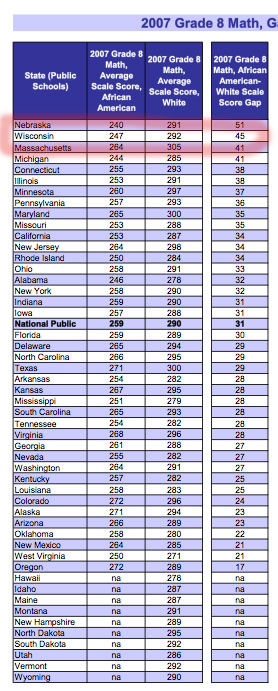
NAEP Math Results: Ohio and Wisconsin Comparison

The 2007 NAEP results have just been released. There are many interesting results one can learn by looking at this data. In addition to the very serious racial gap in Wisconsin which has been commented on by The Educational Trust [Grade 4 Math NAEP Analysis | 80K PDF ] [Grade 8 Math NAEP Analysis | 80K PDF] and the Wisconsin Department of Public Instruction [172K PDF], there are strong indications of other problems in mathematics education in Wisconsin. Consider the following data comparing results for whites and blacks in Ohio and Wisconsin from the first year NAEP results were given by states and the 2007 results. As background, 12 points on NAEP is generally thought to be about the change from one year to the next on a given test. This is not a good estimate when looking over 15 to 17 years, since part of the rise in the test score likely came from changes made in textbooks and in what teachers teach because of the change in the NAEP Framework in the early 1990s.


For example, in Trends in Mathematics and Science Study, TIMSS, fourth grade math was tested in 1995 and 2003, and the results were flat while the NAEP results went up enough to allow statisticians to conclude the increase was statistically significant.


I assume that some of the rise in NAEP over this period is because students are learning more about the topics covered in NAEP, but that this is not the only
reason for the rise in NAEP scores.


The data below is comparison data between the results in two states at two different years, so the point estimate for a year of schooling seems to be a reasonable guideline. If so, Wisconsin has lost about a year to Ohio. Something needs to be done about this.

NAEP Fourth Grade Mathematics
Whites 1992 2007
Wisconsin 233 250
Ohio 222 250 Ohio gained 11 points on Wisconsin
Blacks 1992 2007
Wisconsin 195 212
Ohio 194 225 Ohio gained 14 points on Wisconsin
NAEP Eighth Grade Mathematics
Whites 1990 2007
Wisconsin 279 292
Ohio 268 291 Ohio gained 10 points on Wisconsin
Blacks 1990 2007
Wisconsin 236 247
Ohio 233 258 Ohio gained 14 points on Wisconsin

Share

Five Ways to Boost Charter Schools

Jay Matthews:

Sara Mead and Andrew J. Rotherham, two of my favorite educational researchers, have inspired me to save the charter school movement with five brilliant if perhaps too far-sighted suggestions for reform.
The Washington-based think tank Education Sector www.educationsector.org has just published their paper, “A Sum Greater Than the Parts: What States Can Teach Each Other About Charter Schooling.” They may be horrified by what I have done with their facts and insights, but I think my ideas will push charters in the right direction — more good ones and fewer bad ones.
In theory, charter schools are a great idea. There are now more than 4,000 of them with more than 1 million students in 40 states and the District. These independent public schools give smart educators with fresh ideas a chance to show what they can do without the deadening hand of the local school system bureaucracy around their necks. They also give public school parents more choice. The problem is, as one former state charter school official told me, there are a lot of loons out there starting charter schools. We don’t seem to be able to get rid of their loony schools as easily as the original advocates of charter schools promised. That is one reason why charter schools, despite including some of the best public schools I have ever seen, do no better on average than regular public schools in raising student achievement.
Here are my suggestions for fixing that situation, based largely on what I learned from Mead and Rotherham:
1. Stop letting local school boards authorize charters. Mead, a senior research fellow at the New America Foundation, and Rotherham, co-director of Education Sector and a member of the Virginia Board of Education, used a grant from the Annie E.Casey Foundation to analyze reports they oversaw on charter schools in California, Minnesota, Arizona, Ohio, Texas, Colorado, Florida and Michigan and four cities: New York, Indianapolis, Chicago and the District. They conclude that “perhaps the most significant lesson of the charter school movement to date” is that the number and quality of charter schools depend on who does the authorizing and how well they do it. State school boards, universities and independent bodies like the D.C. Public Charter School Board appear to do a better job of authorizing charters than local school boards, which see charters as competition for students, funds and prestige. California, Colorado and Florida have built strong charter systems with local school boards as the prime authorizers, but only by creating alternative authorizers for charter proposals that get turned down by local school boards.

The complete report is available here: Education Sector Reports: Charter School Series
A Sum Greater Than the Parts: What States Can Teach Each Other About Charter Schooling
, by Sara Mead and Andrew Rotherham.

Share

‘Ho-hum’ says much about school choice foes

Patrick McIlheran:

Ho-hum: Another study suggesting good results from school choice in Milwaukee, not that it will make much of a dent with the opposition.
This tells you something about the opposition.
The latest study links the ability of poor parents to take state aid to religious schools to improvements at Milwaukee Public Schools.
Researcher Rajashri Chakrabarti found that while school choice showed little effect on MPS early on, it showed a much bigger effect after key changes in late 1990s: The Wisconsin Supreme Court cleared the way for religious schools to take part, greatly increasing the options, and changes in funding made MPS feel the loss of students more keenly.
Math, language arts and reading scores at Milwaukee’s public schools showed more improvement after new competition came into the picture, says Chakrabarti. Scores improved more at schools that were more subject to competition – schools where a greater proportion of students were poor and could use a voucher if their parents chose. This shows the improvements weren’t driven by other changes in MPS, such as new leadership. It was the increased competition, she says.
It’s plain to Fuller, a former MPS superintendent, that choice helps public schools, too. “It gives a superintendent leverage,” he says. While there are many in MPS who try improving schools out of professionalism, there are some teachers and administrators who resist reform. Competition strengthens the reformers’ hand.

Share

More Notes on the Madison Superintendent Search

Rebecca Kremble: [Additional Links & Background here]

Last week, the consultants hired to organize the superintendent search conducted 31 hour-long individual and focus group sessions to gather information from concerned citizens and stakeholders about the strengths and challenges of the Madison School District, as well as characteristics we would like to see in the next superintendent.
I attended three of these sessions — two general community sessions and the Parent-Teacher Organization representatives ‘ focus group.
Many different opinions were expressed on a broad array of topics, but in each there was widespread agreement about two issues: the need for a more transparent budget process and the vastly underused resource of potential partnerships with parents, businesses and community members who are willing to participate in the creation of a thriving public education system that benefits all of our students.
Many people also expressed the perception that the School Board is powerless in relation to the administration. This perception is fueled by the fact that the board as a whole is actually not connected to its source of power (the residents of the district) in any broad-based, comprehensive way.
It is time for concerned citizens to find common ground on district-wide issues so that we can give the board the support it needs to make principled, proactive decisions about the future of our schools, instead of making decisions that falsely pit schools against each other or that divide taxpayers who have children in public schools from those who do not.
The district is at a point of great opportunity with the promise of a new superintendent, the pressures of a possible referendum, and a School Board that seems willing to engage the public in productive dialogue based on shared concerns rather than divisive ones. (At its planning meeting with the search consultants, the board requested that the written surveys be returned to them so that they could use the input for planning purposes not connected with the superintendent search.)

(more…)

Share

WI reading gap is nation’s worst

From a story by Alan J. Borsuk in the Milwaukee Journal Sentinel:

The average reading ability for fourth- and eighth-grade black students in Wisconsin is the lowest of any state, and the reading achievement gap between black students and white students in Wisconsin continues to be the worst in the nation.
Those are among the facts found in a mass of testing results released Tuesday by the U.S. Department of Education, the latest results from a long-standing federal program called the National Assessment of Education Progress. It is the closest thing to a nationwide standardized testing program for reading and math ability.
The gap between blacks and whites was worse in Wisconsin than, say, Louisiana? Yes.
The average score for black fourth-graders in reading was lower than, say, Washington, D.C., or Alabama? Yes.

Share

“Why are You Sweating?”

Teacher Lance Chapman:

I asked all 140 of my eighth-grade students to divide 10 by 2. Just eight of them wrote down 5.
I knew my students would need remedial work, but I had no idea it would be to this extent. One of the first standards for eighth-grade physical science is manipulating this equation: speed equals distance divided by time (S = D/T). This is a foundation for upper-level skills in physical science. Next come velocity, acceleration, and gravity. I knew that many of my eighth-grade students would have trouble converting fractions into decimals, but I never fathomed that 10 divided by 2 would give so many of them trouble.
They made comments such as, “Mr. Chapman, this is science class, not math class. I hate math.” Almost half of the first periodic assessment given in November will be based on division, multiplication, and addition to solve for a scientific term. Division remedial work was a must.

Share

How a Virtual AP Course Changed Her Son

Jay Matthews:

Maria Allen worried about her son Matthew’s prospects in high school and beyond. He had always been regarded as an underachiever by his teachers. He received B’s in middle school with virtually no effort because he did well on what were, she thought, very easy tests.
Every new school year, the Reston mother donned her Super Nag persona, got on his case and tried to turn around his bad habits and attitude. It never worked. By the second quarter, whenever her attention turned to other matters, he stopped working, and his teachers started complaining.
So she was more than a little surprised when Matthew asked if he could take an Advanced Placement biology course online at the beginning of eighth grade, when he was only 14 years old. She knew where he got the idea. His big brother, a high school junior, had signed up for online AP biology so he would have time for other courses during the school day. She laughed. Good joke, Matthew. But he brought it up again. He was serious. Even when she showed him the demanding syllabus on the Web site apexlearning.com, he did not back down.
Well, she thought, why not? Her Super Nag act had not worked. She paid the $600 course fee and waited, without much hope, to see what would happen next.
“Matthew continued to put negligible effort into his middle-school work,” Allen told me, “but in biology, he started to work hard, very hard, in fact. And, even more remarkably, he continued to work hard throughout the year.”
She said he took a full complement of eighth-grade honors courses, but they demanded very little. “Unencumbered by any significant homework,” she said, “Matt had plenty of time available to log on to AP bio for a few hours each evening, and so he often did better on AP quizzes and assignments than my high school junior, who was always swamped with homework and competing deadlines from several other challenging courses.”

Share

The Legacy of Little Rock

Shelby Steele:

ifty years ago today, riot-trained troops from the 101st Airborne Division escorted nine black students through the doors of Central High School in Little Rock. Just 48 hours earlier, President Eisenhower deployed–in a single day–1,000 troops to restore order and to reassert federal authority in Arkansas’s capital city.
For weeks the entire nation had watched on television as a mob of angry white adults gathered each morning to prevent the nine black students from integrating Central High. It would come to be remembered as one of the ugliest and meanest white mobs of the entire civil rights era. And because of television–then still a very new medium–the horrible images of people galvanized by ferocious racial hatred were seared into the national consciousness.
Finally, Arkansas Gov. Orval Faubus succumbed to a kind of madness, if not to a perverse politics of racial hatred, and withdrew the National Guard from Central High, effectively turning the school over to the raging mob. The nine courageous black students, who had suffered so much to integrate the school, were withdrawn for their own protection. So, for a time, the authority of the mob prevailed over all governmental authority–local, state and federal. And this was the provocation that pushed a reluctant President Eisenhower to deploy federal troops.

Share

Board Talks Will Focus on a New Blueprint

Susan Troller
The Capital Times
September 25, 2007

Football coach Barry Switzer’s famous quote, “Some people are born on third base and go through life thinking they hit a triple,” could easily apply to schools and school districts that take credit for students who enter school with every advantage and continue as high achievers all along.
But how do you fairly judge the job that teachers, schools and districts with many children who have significant obstacles — obstacles like poverty, low parental expectations, illness and disability or lack of English proficiency — are doing? Likewise, how do you make certain that your top students are adding growth every year as they go through school, rather than just coasting toward some average or proficient standard?

(more…)

Share

Madison School District Talented & Gifted Spending vs. Total Budget

mmsdtag.jpg

Madison United for Academic Excellence has a meeting this evening:

Out of Level Testing Opens Doors of Opportunity, Midwest Academic Talent Search—MATS),” 7:00 p.m. McDaniels Auditorium, Doyle Administration Building, 545 W. Dayton Street. [Map]

This chart presents a useful opportunity to review spending via the handy $339M+ MMSD Citizen’s Budget for 2007-2008 (The citizen’s budget is one of the work products from Lawrie Kobza’s stint on the finance and operations committee this past year).
2007-2008 Student Count: 24,268

Share

Happy Birthday, Sputnik.
Fifty years ago, a small Soviet satellite was launched, stunning the U.S. and sparking a massive technology research effort. Could we be in for another “October surprise”?

Gary Anthes:

Quick, what’s the most influential piece of hardware from the early days of computing? The IBM 360 mainframe? The DEC PDP-1 minicomputer? Maybe earlier computers such as Binac, ENIAC or Univac? Or, going way back to the 1800s, is it the Babbage Difference Engine?
More likely, it was a 183-pound aluminum sphere called Sputnik, Russian for “traveling companion.” Fifty years ago, on Oct. 4, 1957, radio-transmitted beeps from the first man-made object to orbit the Earth stunned and frightened the U.S., and the country’s reaction to the “October surprise” changed computing forever.
Although Sputnik fell from orbit just three months after launch, it marked the beginning of the Space Age, and in the U.S., it produced angst bordering on hysteria. Soon, there was talk of a U.S.-Soviet “missile gap.” Then on Dec. 6, 1957, a Vanguard rocket that was to have carried aloft the first U.S. satellite exploded on the launch pad. The press dubbed the Vanguard “Kaputnik,” and the public demanded that something be done.
The most immediate “something” was the creation of the Advanced Research Projects Agency (ARPA), a freewheeling Pentagon office created by President Eisenhower on Feb. 7, 1958. Its mission was to “prevent technological surprises,” and in those first days, it was heavily weighted toward space programs.
Speaking of surprises, it might surprise some to learn that on the list of people who have most influenced the course of IT — people with names like von Neumann, Watson, Hopper, Amdahl, Cerf, Gates and Berners-Lee — appears the name J.C.R. Licklider, the first director of IT research at ARPA.
Armed with a big budget, carte blanche from his bosses and an unerring ability to attract bright people, Licklider catalyzed the invention of an astonishing array of IT, from time sharing to computer graphics to microprocessors to the Internet.

Share

End, Don’t Mend, No Child Left Behind

Neal McCluskey:

Congress has taken up renewal of the No Child Left Behind Act, with a major hearing in the House education committee. Unfortunately, despite little evidence that NCLB has done any good, there’s no reason to believe Congress will improve it. After more than a century of industrial-era schooling, policy-makers are still unwilling to do what’s necessary and turn public education on its head.
NCLB’s results have been ambiguous at best. The most positive news has come from the Center on Education Policy, a Washington think tank, which found that scores on state tests have risen under NCLB. But CEP only had usable pre- and post-NCLB scores for 13 states and could do full analyses for only seven.
Nationally representative measures offer worse news: Improvements on National Assessment of Educational Progress math exams have slowed under NCLB, and reading outcomes have either stagnated or declined, depending on the grade.
These outcomes should be no surprise. The federal Institute for Education Sciences recently confirmed that states are in a race to the bottom on standards, setting them as low as possible so they’re easy to hit. But that’s just symptomatic of a more basic problem: No matter how revolutionary politicians say laws like NCLB are, they always preserve the same institutional structures we’ve had for more than a century, in which politicians and bureaucrats have all the power, and parents and children have none.

Share

Bernanke: Education Is Best Investment

Jeannine Aversa:

Education is the best investment not only for workers but also for the economy in a time of continuing competitive strain, Federal Reserve Chairman Ben Bernanke said Monday.
“Education – lifelong education for everyone – from toddlers to workers well advanced in their careers – is indeed an excellent investment for individuals and society as a whole,” said Bernanke. He spent most of his professional life as a teacher and is married to one.
Economists have long recognized that the skills of the work force are an important source of economic growth, the Fed chairman said in a speech.
Although the United States has long been a leader in expanding educational opportunities, it also has long grappled with challenges such as troubling high-school dropout rates, particularly for minority and immigrant youths, as well as frustratingly slow and uneven progress in raising test scores, he said.

Share

A UW-Madison education prof seeks middle school science teachers to participate in a professional development project.
Improving science teaching with hypertext support

Researcher: Sadhana Puntambekar
Email puntambekar@education.wisc.edu
Phone: (608) 262-0829
Link to site: www.compassproject.net/info
News context:
Science Magazine: The World of Undergraduate Education
Previous participants include:
Contacts:
Kelly Francour: kfrancou@marinette.k12.wi.us
Dana Gnesdilow: gnesdilow@wisc.edu
Hands-on science lab activities provide students with engaging ways to learn. But sometimes students don’t fully learn the concepts behind what they’re doing.
A hypertext computer environment being developed and field tested gives students graphical ways to practice learning and relating science concepts like ‘force’ and ‘energy,’ for example.
The program, called CoMPASS, helps ensure that hands-on construction activities leads to student understanding of the underlying deep science principles and phenomena.
UW-Madison education professor Sadhana Puntambekar points out that reading, writing, and communicating are an essential part of science instruction.
Research has pointed out the important role of language in science. Yet informational text is seldom used to complement hands-on activities in science classrooms.
This CoMPASS computer environment gives students a graphical, interactive, hypertext ‘concept map’ to help students visualize concepts and their relations. Navigating these ‘concept maps’ helps student make connections between abstract concepts, and to select text resources based on the relatedness of the documents to each other.
Eighth-grade students using the CoMPASS ‘concept maps’ performed better on essay question requiring depth. On a concept mapping test, students using CoMPASS made richer connections between concepts in their own maps (6th and 8th grades)
The CoMPASS environment helps teachers, too. It gives them another way to observe how well students learn.
The system is being used in inquiry-based curriculum units in sixth and eighth grade science classes. To date, CoMPASS has been used by over 1000 students in sixth and eighth grades in Wisconsin and Connecticut.

(more…)

Share

Busy Traffic, Children Create Danger Zones Outside Schools

Deborah Ziff:

For about seven minutes after the bell sounds the end of the school day at Thoreau elementary, chaos rules.
Children tumble out of the school in gleeful disorder and parents arrive to pick them up by car, foot or bike – all while traffic whizzes past on busy Nakoma Road.
At Thoreau, some parents park directly across from the school where they must make the treacherous journey across Nakoma, often with little ones in tow, without a crosswalk nearby.
“It’s very frightening,” said Thoreau Principal Elizabeth Fritz, “because the drivers of the cars aren’t as careful as one would hope.”

Share

When teacher recruitment became a problem, Paul Perotti found the solution: cheap housing

Sam Whiting:

Ground will be broken this fall on a two-story 20-unit apartment community to go with the 40 units already standing on a surplus school property in Santa Clara. The groundbreaker is Paul Perotti, 58, former superintendent, and the housing is for teachers.
“I was superintendent of the Santa Clara Unified School District here from 1994 to 2005. I had this idea in about 1999.
At first my thought was ‘well, everybody is talking about the high cost of living in this valley and there was an exodus of teachers migrating to the Central Valley. You could afford to live there. A lot of teachers were getting hired by us, getting trained and then leaving.
I wasted six months meeting with federal agencies in housing, local people in government, state people. If I played totally by their rules I didn’t feel I could do what I needed to do. There were tons of restrictions. I decided to forget all that. Let’s start thinking as if we’re Intel and we’re going to build a big new facility in Santa Clara, and we have no restrictions. The first thing was ‘what’s it going to cost us?’ It was about $5.6 million. The land is free. The deal was it wouldn’t cost the school district $1. We’re going to pay for it with rent money.
I didn’t want to do it unless we could charge 50 percent or less of the current market rate . Otherwise it wasn’t significant. We did the numbers, checked them 100 times. We came up with $635 a month for a one-bedroom, when the going rate was $1,800. Our two-bedroom started out at $990 when they were going for $2,500.

Share

Waukesha Teacher Compensation: Education over Experience

Amy Hetzner:

Nearly a decade after the School District started shifting its pay scale to emphasize education over experience, about one-third of Waukesha teachers are at the top of the school system’s salary schedule.
More than 300 of 960 district teachers made $70,507 in 2006-’07, the highest salary available to teachers and other certified staff without picking up extra duties.
District officials are careful to point out that the compressed salary schedule, in which teachers can earn large pay boosts for reaching certain benchmarks in graduate and post-graduate education, doesn’t cost the district more than a traditional schedule that pays based on a mixture of experience and education.
But because many of the teachers earning top pay also have seniority privileges protecting them from layoffs, the top-loaded pay system could cause problems as the district looks to more staff cuts to balance its budgets.

More at the Waukesha Taxpayer’s League.

Share

Joppatowne High School’s Homeland Security Career Academy

Chris Colin:

Dedicated to everything from architecture to sports medicine, “career academies” claim to offer high school kids focus, relevancy, and solid job prospects. Now add a new kind of program to the list: homeland security high. In late August, Maryland’s Joppatowne High School became the first school in the country dedicated to churning out would-be Jack Bauers. The 75 students in the Homeland Security and Emergency Preparedness magnet program will study cybersecurity and geospatial intelligence, respond to mock terror attacks, and receive limited security clearances at the nearby Army chemical warfare lab.
The new school is funded and guided by a slew of federal, state, and local agencies, not to mention several defense firms. Officials say it will teach kids to understand the “new reality,” though they hasten to add that the school isn’t focused just on terrorism. School administrators, channeling Cheneyesque secrecy, refused to be interviewed for this story. But it’s no secret that the program is seen as a model for the rest of the country, with the Pentagon and other agencies watching closely.
Students will choose one of three specialized tracks: information and communication technology, criminal justice and law enforcement, or “homeland security science.” David Volrath, executive director of secondary education for Harford County Public Schools, says the school also hopes to offer “Arabic or some other nontraditional, Third World-type language.”

Share

Writers’ Rooms

The Guardian:

The Guardian has an extensive list of writers and the rooms in which they write (with photos and descriptions by the authors).

Share

“PROXIMITY is not destiny, educationally speaking”

Joanne Jacobs:

A generation of experience with racial integration has taught a clear lesson: Sitting black kids next to white kids in school is not a silver bullet that zaps unequal achievement.
However, the faith that proximity leads to equal achievement remains the cargo cult of education. In June, the U.S. Supreme Court barred school assignments based on race to increase racial diversity. So school leaders immediately began considering economic integration plans instead.
Sit poor kids next to middle-class kids. That should work!
Presidential candidate John Edwards – Mr. Two Americas – has made this the core of his education proposals. He promises “a million housing vouchers” over five years to move poor kids to better schools in the `burbs plus $200 million to create magnet schools that will lure affluent kids to inner-city schools.
The magnet school scheme was tried from 1985 to 1997 in Kansas City, Mo., at a cost of $2billion. To lure suburban white students, Kansas City’s inner-city schools were equipped with lavish facilities: Indoor pools, gymnasia, high-tech science labs, computers, etc. But programs designed for the needs and interests of middle-class white suburbanites did not serve inner-city blacks. And few suburban students were willing to commute to city schools for a luxury athletic complex or a classics magnet. Test scores remained dreadful. By 1997, the district actually had a smaller percentage of white students than when the plan started.
Well, what about moving poor kids to better schools?

Much more on Kansas City here.

Share

www.coleschoolcast.org

In an effort to keep people informed of my activities on the Madison School Board, and to encourage people to participate in school-related activities, I have started a podcast, which I am calling the Maya Cole Schoolcast. You can find it at www.coleschoolcast.org. You can also subscribe to the podcast with iTunes or any other podcast software. You can find it by searching the podcast directory for Maya Cole.
Please feel free to give me your comments and suggestions. This edition includes a discussion with several Madison Alders regarding safe walk to school among other topics.

Share

Madison schools’ lunch period isn’t what it used to be

Andy Hall:

And somehow, in a time window one third the size that many adults take for lunch, 215 young children crowd around picnic-style tables, consume chicken nuggets — or whatever they brought from home — and hustle outside to play.
Squeezed by tight school budgets, the federal No Child Left Behind law and Wisconsin Department of Public Instruction rules on instructional time, the school lunch period isn’t what it used to be in many school districts.
ver the years,” said Frank Kelly, food services director of the Madison School District, who estimates that overall, school lunch periods in the district have been trimmed about 10 minutes over the past 10 years.
“I don’t think people are going to accept anything less than this.”
In fact, in response to complaints from parents four years ago, Madison officials eased the lunch crunch a bit for elementary students by using the last five minutes of the class period before lunch to move students to the cafeteria.
There was talk four years ago of expanding the elementary lunch period to 35 minutes. But the idea was dropped after officials estimated it might cost more than $2 million to pay teachers and lunch supervisors.
“We don’t have much flexibility in extending that,” said Sue Abplanalp, an assistant superintendent who oversees Madison’s elementary schools.
While DPI leaves it up to local officials to determine the length of lunch periods, Madison educators say they believe they attain a decent compromise by giving:
•Elementary students 20 minutes.
•Middle school students 30 to 34 minutes.
•High school students about 35 minutes (except at West High School, where most students get 55 minutes under a plan initiated last year).
Those schedules are typical of what’s found around Wisconsin, said Kelly, who has worked in food service for 31 years.
“For most of our people, it works very well,” Madison schools Superintendent Art Rainwater said.

Share

A Beloved Professor Delivers the Lecture of a Lifetime

Moving On
Jeff Zaslow
Wall Street Journal
September 20, 2007

Randy Pausch, a Carnegie Mellon University computer-science professor, was about to give a lecture Tuesday afternoon, but before he said a word, he received a standing ovation from 400 students and colleagues.
He motioned to them to sit down. “Make me earn it,” he said.
What wisdom would we impart to the world if we knew it was our last chance? For Carnegie Mellon professor Randy Pausch, the question isn’t rhetorical — he’s dying of cancer. Jeff Zaslow narrates a video on Prof. Pausch’s final lecture.
They had come to see him give what was billed as his “last lecture.” This is a common title for talks on college campuses today. Schools such as Stanford and the University of Alabama have mounted “Last Lecture Series,” in which top professors are asked to think deeply about what matters to them and to give hypothetical final talks. For the audience, the question to be mulled is this: What wisdom would we impart to the world if we knew it was our last chance?
It can be an intriguing hour, watching healthy professors consider their demise and ruminate over subjects dear to them. At the University of Northern Iowa, instructor Penny O’Connor recently titled her lecture “Get Over Yourself.” At Cornell, Ellis Hanson, who teaches a course titled “Desire,” spoke about sex and technology.
At Carnegie Mellon, however, Dr. Pausch’s speech was more than just an academic exercise. The 46-year-old father of three has pancreatic cancer and expects to live for just a few months. His lecture, using images on a giant screen, turned out to be a rollicking and riveting journey through the lessons of his life.
He began by showing his CT scans, revealing 10 tumors on his liver. But after that, he talked about living. If anyone expected him to be morose, he said, “I’m sorry to disappoint you.” He then dropped to the floor and did one-handed pushups.
[photo]
Randy Pausch and his three children, ages 5, 2 and 1.
Clicking through photos of himself as a boy, he talked about his childhood dreams: to win giant stuffed animals at carnivals, to walk in zero gravity, to design Disney rides, to write a World Book entry. By adulthood, he had achieved each goal. As proof, he had students carry out all the huge stuffed animals he’d won in his life, which he gave to audience members. After all, he doesn’t need them anymore.
He paid tribute to his techie background. “I’ve experienced a deathbed conversion,” he said, smiling. “I just bought a Macintosh.” Flashing his rejection letters on the screen, he talked about setbacks in his career, repeating: “Brick walls are there for a reason. They let us prove how badly we want things.” He encouraged us to be patient with others. “Wait long enough, and people will surprise and impress you.” After showing photos of his childhood bedroom, decorated with mathematical notations he’d drawn on the walls, he said: “If your kids want to paint their bedrooms, as a favor to me, let ’em do it.”
While displaying photos of his bosses and students over the years, he said that helping others fulfill their dreams is even more fun than achieving your own. He talked of requiring his students to create videogames without sex and violence. “You’d be surprised how many 19-year-old boys run out of ideas when you take those possibilities away,” he said, but they all rose to the challenge.
He also saluted his parents, who let him make his childhood bedroom his domain, even if his wall etchings hurt the home’s resale value. He knew his mom was proud of him when he got his Ph.D, he said, despite how she’d introduce him: “This is my son. He’s a doctor, but not the kind who helps people.”
He then spoke about his legacy. Considered one of the nation’s foremost teachers of videogame and virtual-reality technology, he helped develop “Alice,” a Carnegie Mellon software project that allows people to easily create 3-D animations. It had one million downloads in the past year, and usage is expected to soar.
“Like Moses, I get to see the Promised Land, but I don’t get to step foot in it,” Dr. Pausch said. “That’s OK. I will live on in Alice.”
Many people have given last speeches without realizing it. The day before he was killed, Martin Luther King Jr. spoke prophetically: “Like anybody, I would like to live a long life. Longevity has its place.” He talked of how he had seen the Promised Land, even though “I may not get there with you.”
Dr. Pausch’s lecture, in the same way, became a call to his colleagues and students to go on without him and do great things. But he was also addressing those closer to his heart.
Near the end of his talk, he had a cake brought out for his wife, whose birthday was the day before. As she cried and they embraced on stage, the audience sang “Happy Birthday,” many wiping away their own tears.
Dr. Pausch’s speech was taped so his children, ages 5, 2 and 1, can watch it when they’re older. His last words in his last lecture were simple: “This was for my kids.” Then those of us in the audience rose for one last standing ovation.
Write to Jeffrey Zaslow at jeffrey.zaslow@wsj.com
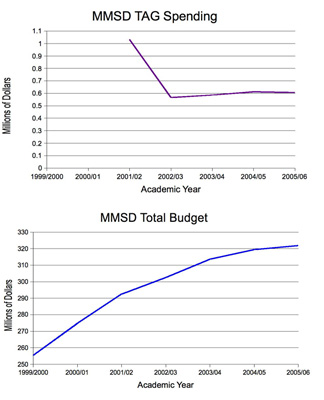
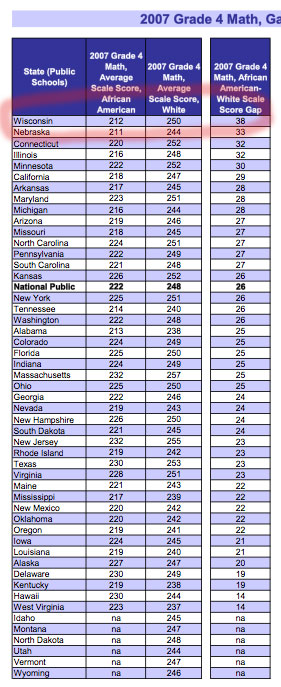
Share

Waukesha Schools’ Health Care Savings

Amy Hetzner:

As it continues to negotiate contracts with eight employee groups, the School Board has approved health insurance changes and modest salary increases that are expected to reduce overall compensation costs for non-unionized employees this school year.
Other employees will hopefully take note, School Board President William Baumgart said.
“This was a small group of people in comparison to the total district,” Baumgart said of the approximately 70 administrators, secretaries and technical staff covered by the settlement. “We feel if we’re going to put emphasis on saving money in employee costs, we’re going to have to do it at all levels. And this will be the first one.”
Under the one-year settlement the School Board approved last week, non-unionized employees will pay higher deductibles, office co-payments and drug costs for their health care. They also will continue to pay 5% of their health insurance premiums.
Salaries will increase by 2% this school year for the pool, except for assistant principals who will receive a 1% pay boost. Overall, the changes are expected to reduce costs for covered employees by 0.63%, or $31,647, less than what the district spent last school year, said Erik Kass, executive director of business services for the district.

Locally, health care costs [RSS] have been a topic of much discussion and controversy.

Share

Civic Literacy Report

Intercollegiate Studies Institute:

  • College Seniors Failed a Basic Test on America’s History and Institutions.
  • Colleges Stall Student Learning about America.
  • America’s Most Prestigious Universities Performed the Worst.
  • Inadequate College Curriculum Contributes to Failure.
  • Greater Learning about America Goes Hand-in-Hand with More Active Citizenship.

Anita Weier has more, along with Tracey Wong Briggs:

Students don’t know much about history, and colleges aren’t adding enough to their civic literacy, says a report out today.
The study from the non-profit Intercollegiate Studies Institute shows that less than half of college seniors knew that Yorktown was the battle that ended the American Revolution or that NATO was formed to resist Soviet expansion. Overall, freshmen averaged 50.4% on a wide-ranging civic literacy test; seniors averaged 54.2%, both failing scores if translated to grades.
“One of the things our research demonstrates conclusively is that an increase in what we call civic knowledge almost invariably leads to a use of that knowledge in a beneficial way,” says Josiah Bunting, chairman of ISI’s National Civic Literacy Board. “This is useful knowledge we are talking about.”

Share

Michelle Rhee on the Washington, DC School System

Video:

It may not be Cornell ’77, but here and just below (part 1) and here and the second video below (part 2) are videos of a speech Michelle Rhee gave the other night discussing the state of affairs in Washington, D.C. that are well worth checking out. If you want the inside view of the challenges there and the ones facing urban schools more generally, you can’t do much better than this. I keep hearing how there is nothing to any of these issues reformers keep raising…starting to think maybe I’m being snowed…See also this Richard Whitmire post:

The surprise star at last night’s launch of the Democrats For Education Reform was Michelle Rhee, the new DC schools chancellor. With her humor and spunk very much intact in spite of smacking repeatedly against what may be the worst-run school central office in the entire country, Rhee regaled a crowd of about 100 national education reformers at the Hotel Washington across from the U.S. Treasury Department with fresh stories from close quarters bureaucratic combat.

Share

Jesse Jackson, Jr. On School Choice

Democrats for Education Reform:

But the times seem to have changed a bit. At Monday’s night’s DFER DC launch at the Hotel Washington, Jackson seemed to be embracing what I like to call the Anti-Crappy Schools Doctrine. Forget whether a school is a traditional public school, or a charter school, or private school – how do we make sure every kid in America is able to attend a GOOD school?
Nearly a decade after the Milwaukee rally, Jackson Jr. was talking about “alarming dropout rates” the dangers of a “monopoly” filled with failing schools, etc. He was suggesting that every American child be entitled to a good public education “or charter education or whatever kind of education we can to produce the kind of Americans that we’ll all be proud of in the future.”
With the Washington Monument to his left, Jackson Jr. was highlighting the fact that his own parents sought the best for him by sending him to the elite St. Albans Episcopal School in DC as a kid. He talked about “pushing the envelope to make the majority party in this country” approach education with a more open mind.
“We must explore options,” Jackson Jr. said. “Every option for every American child so that every child might have the high-quality education they deserve in their lifetime.”
“We need more competition in the system.”

Share

U.S. Set to Offer Math Grants Modeled on Reading First

Sean Cavanagh:

A year and a half ago, President Bush proposed the creation of a new federal mathematics effort that would offer millions of dollars in grants to school districts to adopt proven strategies for improving classroom instruction in that subject.
Last month, federal lawmakers gave the president what he was looking for—with some differences.
Administration officials had pictured the new program, called Math Now, as being modeled on Reading First, the $1 billion-a-year federal effort that provides money for research-based improvements in reading instruction in the early grades.
But in the end, Congress’ vision differed. Math Now—included as part of a broader piece of legislation to support math and science education and research known as the America COMPETES Act, which Mr. Bush signed into law Aug. 9—is authorized to receive less half the amount the administration had wanted: $95 million a year, not $250 million.

Share

City Audit Finds Underreporting of School Violence

Randi Weingarten:

[Editor’s note: City Comptroller William C. Thompson, Jr. released an audit on Sept. 19 that found that many safety incidents in New York City public schools are not being reported as required under state law. For the 10 large high schools audited, 21 percent of the sampled incidents were not reported, including 14 percent of those incidents deemed serious.]
While we know the mayor and the chancellor want schools to be safe, this audit confirms a practice educators and the UFT have complained about for years: the failure to report all school incidents. Now with data driving all education decision-making, this audit couldn’t have come at a more important time.

Share

“Politically Correct Trumps Substance Every Time”

Paul Soglin on Why the Prospects for Madison are so Bleak, Part II:

“Struck by the number of residents who said if things don’t improve soon, they’ll consider moving elsewhere.” Good grief. Its been going on for over a decade and really picked up around 2000. The school enrollment figures clearly show that. And go look at the private schools, bulging at the seams, for confirmation.
That’s OK. This is Madison. All is forgiven. Throw a good party on State Street, recycle a few beer cans, vote to impech Bush-Cheney, and it does not matter that we are losing the city.
Politically correct trumps substance every time.

Related: Barb Schrank on “Where have all the Students Gone?”:

MMSD Lost 174 Students While the Surrounding School Districts Increased by 1,462 Students Over Four School Years. Revenue Value of 1,462 Students – $13.16 Million Per Year*

Share

City, School District get $9 million windfall

Andy Hall:


An unprecedented windfall is on the horizon for the city of Madison and Madison School District, promising to relieve some budget pressures and affect major issues such as the city ‘s hiring of 30 police officers and the School Board ‘s debate over whether it still needs to ask voters for more money in a referendum.
Under a proposal from Madison Mayor Dave Cieslewicz, the city would receive $3.7 million and the School District would get $5.4 million in money flowing from two fast-developing special taxing districts created years ago by the city. In addition, Dane County and Madison Area Technical College would receive a little less than $1 million apiece.
“It ‘s significant news, and very good news, for the School District and the city, ” Madison Mayor Dave Cieslewicz said Wednesday. “The amount is unprecedented. ”
The one-time payouts would occur by the end of next year if the City Council votes to close the two tax incremental financing districts as recommended by city staff members who say the move is necessary under state law.

Share

New Study of Teacher Hiring Policies in Milwaukee Shows Success of School-based Hiring, But Forced Placements Still Hamper Efforts to Attract and Retain Quality Teachers

The New Teacher Project:

According to a NEW STUDY, the Milwaukee Public Schools (MPS) and the Milwaukee Teachers’ Education Association (MTEA) have made great strides in their joint efforts to create a more effective teacher hiring and evaluation model. However, the school system’s current school staffing and teacher transfer practices continue to cause dissatisfaction among many teachers. The study, conducted by The New Teacher Project (TNTP), a national non-profit organization dedicated to the improvement of teacher quality in America’s public schools, indicated that such shortcomings hamper Milwaukee’s efforts to build, support, and retain a high-quality teaching force, especially in its highest-need schools.
The New Teacher Project’s extensive study was funded by the Joyce Foundation and conducted with the cooperation of both MPS and the MTEA. TNTP staff conducted a briefing for members of the Milwaukee Board of School Directors at last night’s public meeting. The scope of the study included a detailed survey that drew over 2,000 responses from 5,000 MPS teachers, a survey of MPS principals, an in-depth examination of the MTEA contract with MPS, and interviews with school principals and district administrators. The organization’s final analysis shows that:

Alan Borsuk has more.

Share

Sugar Finds Its Way Back to the School Cafeteria

Andrew Martin:

STUNG by harsh publicity about fat kids and threatened with lawsuits, the nation’s three largest beverage companies finally got some love last year when they voluntarily agreed to remove sugary drinks from schools.
In the place of soda and sugar-laden beverages, Coca-Cola, PepsiCo and Cadbury Schweppes agreed that only water, low-fat milk and 100 percent juice would be offered in elementary and middle schools. In high schools, sports drinks, light juices and diet drinks would also be allowed.
The announcement was brokered by the Alliance for a Healthier Generation, a collaboration of the American Heart Association and the William J. Clinton Foundation, and it was widely praised. Former President Bill Clinton, who attended the press conference, called the decision “courageous.”
“Shrewd” was probably a better word.

Share

Cherokee Middle School’s Back to School Night

I enjoyed a wonderful 90 minutes at Madison’s Cherokee Middle School this evening. The teachers presented course materials and discussed student (and parent) expectations. I particularly appreciated the loudspeaker announcements when it was time to change classrooms and begin a new period. Reminded me of my school days decades ago. Karen Seno runs a great school.

Share

Madison’s Superintendent Search: Public Input

The public has an opportunitiy to provide input regarding qualities sought for the new Superintendent:

  • 9/19/2007; 7:00p.m. at Memorial High School (Auditorium) [Map]
  • 9/20/2007; 7:00p.m. La Follette High School (Auditorium) [Map]

I passed along a few general thoughts earlier today:

  • Candor
    An organization’s forthrightness and philosophy is set from the top.
    I cited examples including: the past method of discussing referendum costs without the effect of negative aid (reduction in state aids that requires increased local property taxes), parsing math and reading test results, structural deficits and collecting data on new initiatives to determine their validity and utility [RSS]. Public/Taxpayer confidence in our $340M+ school district is critical to successful future referendums.

  • Interact with our rich community
    Madison offers an unprecedented financial and intellectual environment for someone willing to seize the opportunity.

  • Raise academic expectations via a substantive, world class curriculum
    We do our students no favors by watering down curricular quality.

Susan Troller has more.

Share

Kobza’s exit is a serious matter

A Capital Times Editorial:

The decision of Madison School Board member Lawrie Kobza not to seek a second term, while anticipated, is both significant and troubling.
Along with veteran Carol Carstensen, who will also step down after next April’s election, Kobza is a School Board member who has seriously embraced the difficult work of budgeting.
Since her election three years ago, Kobza has meticulously studied the intricate process by which the school district shapes it complex spending plans. A successful lawyer with a young family and multiple civic responsibilities, she nonetheless has carved time out of her weekly schedule to meet with experts on budgeting at the district’s Dayton Street headquarters and with independent analysts.
When Carstensen announced that she was stepping down after serving the better part of two decades on the board, the hope was that Kobza would fill the gap created by the loss of the body’s most serious player in the budget process.
That won’t happen. Kobza’s legitimate frustration with the way the board has operated combined with personal and professional demands to make her decide against seeking re-election.

Share

Shabaz Allows Trial For Whistle-blower

Kevin Murphy:

A jury will get to decide if a Madison Metropolitan School District employee speaking out about alleged bid-rigging cost her a promotion, a federal judge ruled.
Linda Martin had worked in the district’s transportation office since 1989, but was passed over in November 2002 for the newly created position of transportation coordinator. A month later, Martin was transferred to the accounting department as her transportation clerk’s job was eliminated.
Although the school district contends Martin wasn’t qualified for the coordinator’s job, that argument is contradicted by the district’s interviewing her for the position, according to U.S. District Judge John Shabaz’s decision issued Thursday. It also is under dispute whether the district’s choice, Jeff Fedler, was more qualified than Martin.
Fedler had worked for a school bus vendor, First Student, formerly Verona Bus, before being recommended in May 2002 by Martin’s supervisor, Rene Bremer, for the job Martin was seeking.

Share

The Changing Racial and Ethnic Composition of U.S. Public Schools

Rick Fry:

The 5-4 decision by the U.S. Supreme Court in June to strike down school desegregation plans in Seattle and Louisville has focused public attention on the degree of racial and ethnic integration in the nation’s 93,845 public schools. A new analysis of public school enrollment data by the Pew Hispanic Center finds that in the dozen years from 1993-94 to 2005-06, white students became less isolated from minority students while, at the same time, black and Hispanic students became slightly more isolated from white students.
These two seemingly contradictory trends stem mainly from the same powerful demographic shift that took place during this period: an increase of more than 55% in the Hispanic slice of the public school population. Latinos in 2005-06 accounted for 19.8% of all public school students, up from 12.7% in 1993-94.
In part because whites now comprise a smaller share of students in the public schools, white students are now more likely to be exposed to minority students. In 1993-94, fully one-third (34%) of all white students attended a nearly all-white school (this report defines a school as “nearly all-white” if fewer than 5% of the students are non-white). By 2005-06, just one in five white students (21%) was attending a nearly all-white school.

Alan Borsuk:

Mix two parts population growth (among Latino and African-American students) and one part population decline (white students). Fold in a continuing pattern in which whites, blacks and Latinos generally live separately from each other. Let the mixture steep in a much cooler climate – legal, political and social – toward integrating schools.
This recipe for re-segregation is the subject of two new national studies.
Both say the tide of desegregation that roiled America from the 1950s through the 1970s has turned, and the reduction in racial separation that often came via court order and school bus is being reversed.
But there is a twist: Largely because there are so many more minority students than in the past, fewer whites are going to schools that are all-white or close to it.
At the same time, the numbers of all-minority schools are increasing.
Within several years, for the first time, fewer than half of the nation’s kindergarten through 12th-grade students will be white.

The Civil Rights Project [192K PDF Report]:

This new report released by The Civil Rights Project at UCLA finds that for the first time in three decades, the South is in danger of losing its leadership as the nation’s most integrated schools. The report examines the effects of the dual processes of racial transformation and resegregation on the educational opportunity of students, as well as the relationship between race and poverty and its implications in light of the recent Supreme Court decisions. The report concludes with recommendations for school districts.

Bruce Murphy has more.

Share

Students’ ‘Evolving’ Use of Technology

Andy Guess:

That may not be the most surprising finding from a report released last week by the Educause Center for Applied Research, the analytical arm of the nonprofit group that promotes effective technology use in higher education. But it certainly provides a jumping-off point for an investigation into how students use information technology in college and how it can be harnessed to improve the learning experience.
In at least one central respect, proponents of technology in the classroom are on to something: Most students (60.9 percent) believe it improves their learning.
The changes in technological habits aren’t revolutionary per se, as the authors point out; rather, students are making “evolutionary” gains in access to the Internet for everyday uses, inside the classroom and out. Perhaps the most visible of these changes is the continuing increase in the proportion of students with laptops, which has grown to 73.7 percent of respondents (while an almost-total 98.4 percent own a computer of some kind). More surprisingly, over half of laptop owners don’t bring them to class at all, with about a quarter carrying them to lectures at least once a week.

Share

Schools by Age, Not Address

Amy Hetzner:

Theory” and “experiment” were two ways Waukesha School Board members last week described the district’s move to create two schools focused solely on the lower or upper elementary grade levels.
But staff in schools already organized around such grade levels describe the model another way: child-focused.
“Really, the whole building kind of revolves around those early learners,” said Deb Ristow, principal of Pewaukee Lake Elementary School, which has housed students in kindergarten through third grade since 2002.
Although not as common in southeastern Wisconsin, “grade centers” that serve students for a fraction of their elementary years make up one of every five elementary schools nationwide, according to an analysis by the Educational Research Service. The facilities can be kindergarten-only centers, pre-kindergarten through second- or third-grade buildings or third- through fifth- or sixth-grade schools.

Share

Schools Within Schools: Possibilities and Pitfalls of High School Reform

Valerie Lee and Douglas Ready:

How effective is whole-school high school reform, such as the Schools-Within-Schools (SWS) model? What benefits does it have for students and in which areas does it fall short? This book seeks to answer these questions through the compelling stories of five public high schools that have embraced the SWS method. In order to fully understand the effectiveness of such a system, Valerie Lee and Douglas Ready have delved into every aspect of the reform in these settings, including participants’ reactions, curriculum structures, governance and leadership, and the allocation of students to the schools. The result is a thoughtful look at the SWS model that considers the benefits and problems of implementation, along with issues of equity and access.

Erick Robelen:

The idea that many U.S. high schools are too large and impersonal to serve students well has gained considerable credence in research and policy circles.
But starting over from scratch with thousands of small, stand-alone high schools is also often seen as expensive and impractical. As a result, many districts in recent years have pursued the cheaper option of simply breaking up their large high schools into smaller schools within schools.
A new book tells a cautionary tale about that understudied alternative, training its sights on five high schools examined closely over time. What emerges is largely a story of the differences between theory and reality, of what can go wrong if school officials aren’t careful, and of many missed opportunities to make the most of a smaller learning environment. Probably the single most salient finding of Schools Within Schools: Possibilities and Pitfalls of High School Reform is that the approach led to increased stratification of students by race, academic ability, and socioeconomic status. The authors also describe as surprisingly rare the cases of instructional innovation tied to the smaller structure.
The book says that, typically, the same campuses would have separate academies, or subunits, as the authors call them, ranging from those known to be “full of brains” to others that were deemed “dumping grounds” for weak students.
………..
The authors note that while there has been substantial research on high school size and small schools, “very little research” has specifically evaluated the effectiveness of the schools-within-schools model.
“Similar to many other educational reforms,” the book says, “the SWS reform has been promoted and implemented without a solid base of empirical evidence to support it.”

The implementation of “Small Learning Communities” within the current Madison high schools has been rather controversial.
Amazon: Schools Within Schools

Share

Back to School: Reading, Writing and Internet Safety

Adam Hochberg:

As students return to school in Virginia, there’s something new in their curriculum. Virginia is the first state to require public schools to teach Internet safety.
The mandate is in response to concerns about sex offenders and other adults preying on young people they’ve met through social-networking Web sites such as MySpace. It’s one of several steps states are taking to try to protect children and teenagers online.
George Washington High School in Danville, Va., is one of the largest schools in southern Virginia. But there’s one thing almost all of its 1,800 students have in common — MySpace pages.
Gene Fishel, an assistant Virginia attorney general, came to the school auditorium to give a lesson about Internet safety — especially on social-networking sites such as MySpace, Facebook, and Xanga that teenagers often use to communicate, and criminals sometimes use to prowl for victims.

Share

What do you want in a Madison schools superintendent?

Andy Hall:


Wanted: Superintendent for Madison School District, Wisconsin’s second-largest school system, responsible for about 24,000 students, 3,700 employees and a $340 million budget.
Pay negotiable. Current superintendent, Art Rainwater, receives a salary of $190,210.
Women and minorities are encouraged to apply. While historical records are incomplete, district observers believe that except for Cheryl Wilhoyte, who served from 1992 to 1998, the superintendents who have served since the position was created in 1855 have been white males.

Provide your input here.

Share

More Parents Take Advantage of Free Tutor Service

Jeffrey Solochek:

When Heather Schaeffer heard she could get free tutoring for her children, she didn’t think twice.
“I said, ‘Thank you, God.’ Because I didn’t read until junior high. My father had to get a second job so I could go to Sylvan,” Schaeffer said Wednesday night, as she attended a tutoring provider fair at Northwest Elementary. “I just raced right over.”
Last year, Schaeffer had no problems getting her son, Sylvester, and daughter, Gretchen, into the federally funded program, a component of the No Child Left Behind Act. In Pasco County, as nationally, just a small percentage of the children eligible for services actually took advantage.
This year, the number of eligible students has grown along with the generally favorable word of mouth. Schaeffer worries that her kids won’t get access to the services that the federal government promises to low-income children who attend schools that don’t make adequate yearly academic progress for three or more years.

Share

Put to The Test

American Public Media:

“I read a quote from a young lady in New York. She said, ‘I don’t ever remember taking an exam. They just kept passing me along. I ended up dropping out in the 7th grade. I basically felt nobody cared.'”
There was no national requirement to test and measure all students, to make sure everyone knew how to read and write, do basic math. The president told the crowd in Ohio that the United States needs testing; he called it the “right” thing for America.
“I understand taking tests aren’t fun,” the president quipped. “Too bad. We need to know in America. We need to know whether or not children have got the basic education.”
And testing was just the beginning. The more ambitious endeavor: equalize education. To do that, the law set up a new definition of what it means to be a good school. This new definition, adequate yearly progress, or AYP, requires schools to show they’re raising test scores among each group of students. Schools can’t hide in good averages anymore. They must prove their poor and minority students are passing the tests too. This new definition of what it means to be a good school is having a dramatic impact on everything about education.
Four years after President Bush signed No Child Left Behind, there’s a different kind of celebration going on in the media center of Western Guilford High School in Greensboro, North Carolina. The walls are decorated; there are cakes and casseroles on the tables. Veteran English teacher Angela Johnson is calling it quits, abruptly, in the middle of the school year. Students, colleagues and friends from her 30-year career have gathered to say goodbye. Someone hands her a microphone, and she pulls her glasses up onto her nose, the prepared English teacher, ready with a speech.

Share

Volunteers Sought for Area Schools

Nicholas Heynen:


Verona elementary school students who participated in the United Way of Dane County-led Schools of Hope tutoring program showed better-than-expected improvement in reading and class-participation last year, according to program organizers who are kicking off a major volunteer recruitment effort this week.
The Schools of Hope program began in 1995 in Madison as a journalism project by the Wisconsin State Journal and WISC-TV (Ch. 3) examining Madison ‘s public schools, and it grew into a countywide effort to reduce racial disparities in achievement patterns. Schools of Hope provides reading and math tutoring for children from preschool through fifth grade.
In 2005, the program expanded to Sun Prairie, and in 2006, it expanded to four Verona-area schools. There, organizers said two-thirds of the 30 third-grade students who received tutoring for the full year showed significantly greater progress on their Measure of Academic Progress reading tests than anticipated. The MAP is a national nonstandardized test that measures individual academic improvement in students.
Also in 2006, the United Way reported that the percentage of third-grade minority students in participating Madison-area schools who had below-average reading ability had declined from 28.5 percent to 5.5 percent from 1995 to 2005.
According to evaluations from participating Verona schools, 95 percent of school staff felt the program contributed to student success, and all staff expressed a wish to continue to work with volunteer tutors this year.
Such results, coupled with the enthusiasm of teachers, parents and volunteers for the program, has fueled the expansion of the program to almost 30 schools in Madison, Sun Prairie and Verona.

Share

Kobza decides to not run for school board next year

Andy Hall:

Madison School Board Vice President Lawrie Kobza announced Monday that she won’t seek re-election, and retired teacher Marj Passman immediately jumped into the race to succeed her.
Kobza’s move guarantees that the board will gain two new members in the April 1 election.
“I’ve very much appreciated the opportunity to serve on the School Board, but I have a number of other personal and professional interests which I would like to explore and I just need more time in the week to do so,” Kobza wrote in an e-mail to Board President Arlene Silveira, schools Superintendent Art Rainwater and reporters.
Kobza, a lawyer, will leave the board after serving a single three-year term.

Susan Troller:

Madison School Board Vice President Lawrie Kobza announced this morning that she will not seek re-election in next spring’s School Board race.
Elected to her first term on the board in 2005, Kobza joins longtime board member Carol Carstensen in announcing that she will not run again.
In an e-mail this morning, Kobza said she has a number of personal and professional interests that she hopes to explore and needs the time to do so.
Two candidates, Marj Passman and Ed Hughes, have announced that they will seek slots on the seven-member School Board.

Share

Rookie Chicago Principal Faces Early Challenges

David Schaper:

At the John D. Shoop Academy on Chicago’s South Side, Principal Lisa Moreno ushers students inside for an early breakfast.
She greets her uniformed flock, then heads to the playground, where she keeps a close eye on some of the eighth graders who are already testing her staff.
“You just try to make sure that they don’t think that they run the school,” she says.
Moreno is one of 170 new principals in the Chicago public school system this year. Since 2004, more than 350 of the school system’s principals have retired, taking advantage of early retirement incentives. Like Chicago, many other school systems across the country are facing the same turnover, as baby boomer principals near retirement age. And for the rookie principals, challenges come early and often.

Share

The HOPE (Having Options in Public Education) Coalition

The HOPE (Having Options in Public Education) Coalition is a grassroots group of concerned parents, educators, and community members who believe creating and sustaining new educational options would strengthen MMSD. New options in public schools would benefit students, families, teachers, and our community. Options are needed because “one size does not fit all”! The diversity of students’ backgrounds and learning styles requires a diversity of learning models.
The HOPE Coalition met last week to discuss the superintendent search. We found 3 characteristics to be important for our incoming superintendent. Using the points below, and/or your own words, please make your voice heard! You may copy and paste the below paragraphs if you are pressed for time. The superintendent should:

  • be an innovative problem solver. The candidate should have a demonstrated record of running a district that has successfully implemented new ideas and creative approaches (charter schools, magnet schools, 4K, etc.) to serve a diverse population of learners. The new superintendent should be committed to offering a variety of educational models within public schools so that families have options that can address the needs of students with a wide range of strengths, interests and learning styles.
  • demonstrate a collaborative leadership style. The candidate should have a history of fostering open, frequent communication with parents and other taxpayers; non-profit organizations; university faculty; and city, county and state government officials. The new superintendent should build collaborative partnerships that bring parents, teachers and community members together for the benefit of students.
  • cultivate a climate of less centralized authority throughout MMSD. The candidate should empower staff both at the district and individual school sites, giving them the authority to use their specific expertise to its fullest potential. The superintendent should allow local school administrators the flexibility to run their school, in collaboration with teachers, so that it most effectively addresses the needs of the students and families that it serves. School-based decisions may involve curriculum, budgeting, staffing, extracurricular programming, etc.

Make your voice heard…
… to the Board! Email them all (comments@madison.k12.wi.us) or contact them individually (go to www.mmsd.org/boe and scroll down to find contact information). This may be the most influential means of sharing your opinion!
… to the consultants hired for the search! Complete their survey by going to www.mmsd.org/topics/supt and scrolling down to find the link to it. You will also find information about the community input sessions. Please attend one! and tell us your impression of how successful it was.
Encourage friends, neighbors, and coworkers to make their voices heard too! Please contact Sarah Granofsky (s.granofsky@gmail.com) or Lauren Cunningham (cunningham.lauren@sbcglobal.net) with any questions or suggestions, or if you would like to learn more about HOPE for Madison.

Share

Holes Found in U.S. Rules on Teachers

Debra Viadero:

New reports looking at how the teacher-quality provisions of the No Child Left Behind Act are playing out in the nation’s classrooms suggest that, while compliance with the 5½-year-old federal law is widespread, problems and inequities persist and, in the end, labeling a teacher “highly qualified” is no guarantee of effectiveness.
“I think the high compliance rate suggests there were states that set the bar low and, in a way, grandfathered in a lot of teachers,” said Kerstin Carlson Lefloch, a primary author of “Teacher Quality Under NCLB: Interim Report,” a large-scale study released last week by the U.S. Department of Education [PDF]. “To get to the real story, you have to look below the surface, and that’s where we’re still seeing variation and still seeing inequities.”
Under the wide-ranging federal law, which is up for congressional reauthorization, states had until the end of this past school year to ensure that they were staffing 100 percent of their core academic classes with highly qualified teachers. Such teachers are defined as those who have a bachelor’s degree, are fully certified, and can show mastery of the subjects they teach, either by completing coursework, passing state subject-matter tests, or meeting some other state-set criteria.

Share

Spanish bilingual schools no longer just for remedial education

Tyche Hendricks:

In a sunny classroom at the Escuela Bilingüe Internacional on the Oakland-Berkeley border, a group of kindergartners clustered around a table, busily pasting scraps of colored paper onto collages, as their teacher offered guidance and glue.
A boy named Ian bounced up to the teacher, Rocío Salazar, and exclaimed, “Look! I made my name!”
“A ver tu nombre,” she replied smoothly, repeating the boy’s words, but in Spanish. “Donde está tu nombre?”
“Aquí!” pointed Ian, picking up on the Spanish.
“Qué bueno!” encouraged Salazar, who runs her class entirely in Spanish and gently guides her English-speaking pupils toward the new language.
A new school year has begun at the year-old Escuela Bilingüe, believed to be the state’s first and only Spanish bilingual private school, where 110 children, about equally divided between English and Spanish speakers, are starting with a full immersion in Spanish. They are expected to graduate speaking, reading and writing fluently in both English and Spanish and with a mastery of all the usual academic subjects.
Private bilingual schools for students of French and German are well established – there are at least five French bilingual schools in the Bay Area alone – and they’ve long been popular among well-heeled parents with European connections wanting to raise cultured children who can skillfully navigate the global economy.

Share

Revisiting the Canon Wars

Rachel Donadio:

Twenty years ago, when Reagan and Gorbachev were negotiating the end of the cold war and college cost far less than it does today, a book arrived like a shot across the bow of academia: “The Closing of the American Mind,” by Allan Bloom, a larger-than-life political philosophy professor at the University of Chicago. Subtitled “How Higher Education Has Failed Democracy and Impoverished the Souls of Today’s Students,” it spent more than a year on the best-seller list, and today there are more than 1.2 million copies in print. Saul Bellow, who had urged his brilliant and highly idiosyncratic friend to write the book in the first place, wrote the introduction. (Bellow later cast Bloom as the main character in “Ravelstein.”)
Bloom’s book was full of bold claims: that abandoning the Western canon had dumbed down universities, while the “relativism” that had replaced it had “extinguished the real motive of education, the search for a good life”; that rock music “ruins the imagination of young people”; that America had produced no significant contributions to intellectual life since the 1950s; and that many earlier contributions were just watered-down versions of Heidegger, Nietzsche, Weber, Freud and other Continental thinkers. For Bloom, things had gone wrong in the ’60s, when universities took on “the imperative to promote equality, stamp out racism, sexism and elitism (the peculiar crimes of our democratic society), as well as war,” he wrote, because they thought such attempts at social change “possessed a moral truth superior to any the university could provide.”

Saigon South International School Recommended Reading List: Grades 6 to 12 [PDF.]

Share

Debbie Heimowitz brings cyber bullying to light in a new film

Sam Whiting:

Back when Debbie Heimowitz was a middle schooler in Castro Valley, if you wanted to cut somebody down you talked behind her back. Now you post your putdowns on the Internet. Heimowitz, a 26-year-old grad student at Stanford, has made a film about this online cruelty.
“Cyber bullying is harassing someone using the Internet, cell phones and any sort of digital technology. A common scenario is they will find somebody’s picture on the Internet that they know from school. Let’s say it’s ‘Amy.’ I download the picture, Photoshop it, go to MySpace, create a new account, create a new e-mail address and display this whole ‘I Hate Amy’ MySpace page. Then I have everybody at school write mean things about Amy in the comments section. Amy finds out that now everybody at the school hates her and has no clue who started this page.

Share

Texas: More students taking AP exams, improving scores

Katherine Cromer Brock:

The number of students taking Advanced Placement tests increased almost 10 percent between 2006 and 2007, according to information released Thursday by the Texas Education Agency.
In addition, 52 percent of students who took the test are minorities, compared with 45 percent five years ago. Nationally, 35 percent of test-takers are minorities.
Not only has participation in the AP program increased, but performance has also improved significantly.
Students at most high schools have the option of taking AP classes. They take exams at the end of the course and are given a score of 1 to 5, with 5 being the highest. Most colleges and universities award credit for AP scores of 3 or higher. In 2006, 51.4 percent of tests scored at 3 or higher. In 2007, that number increased to nearly 53 percent.

Share

High School Football: Silence on Concussions Raises Risks of Injury

Alan Schwarz:

To Kelby Jasmon, there was only one answer. The question: If he received yet another concussion this football season, while playing offensive and defensive line for his high school in Springfield, Ill., would he tell a coach or trainer?
Jasmon, with his battering-ram, freshly buzz-cut head and eyes that danced with impending glory, immediately answered: “No chance. It’s not dangerous to play with a concussion. You’ve got to sacrifice for the sake of the team. The only way I come out is on a stretcher.”
Jasmon, a senior with three concussions on his résumé, looked at two teammates for support and unity. They said the same thing with the same certainty: They did not quite know what a concussion was, and would never tell their coaches if they believed they had sustained one.
Matt Selvaggio, who plays with Jasmon on both lines, said: “Our coaches would take us out in a second. So why would we tell them?”
Many of the 1.2 million teenagers who play high school football are chanting similar war whoops as they strap on their helmets. They either do not know what a concussion is or they simply do not care. Their code of silence, bred by football’s gladiator culture, allows them to play on and sometimes be hurt much worse — sometimes fatally.

Share

Making the Grade: How to Get Your Kid a Good Credit Score

Jonathan Clements:

Like many college kids, my daughter Hannah ended up with a credit-card problem. But it wasn’t the problem I feared.
As students head off to college, many parents worry that their sons and daughters will apply for a fistful of credit cards and amass a heap of debt. Indeed, 42% of freshmen have credit cards, and they carry an average balance of $1,585, according to a study by college lender Nellie Mae.
But in her freshman year, Hannah didn’t rack up a single charge — because she had a heck of a time just getting a card.
• Getting carded. To be honest, I don’t really want Hannah to have a credit card. But I do want her to have a decent credit score. And one of the best ways to earn that score is to get a credit card, charge a small sum each month and then dutifully pay off the balance.

Share

The Achievement Trap: How American is Failing Millions of High-Achieving Students from Lower-Income Families

Groundbreaking report just released by the Jack Kent Cooke Foundation. Here is the September 10, 2007, press release:
MAJOR TALENT DRAIN IN OUR NATION’S SCHOOLS, SQUANDERING THE POTENTIAL OF MILLIONS OF HIGH-ACHIEVING, LOWER-INCOME STUDENTS, NEW REPORT UNCOVERS
Current education policy focused on “proficiency” misses opportunity to raise achievement levels among the brightest, lower-income students
WASHINGTON, DC – A disturbing talent drain in our nation’s schools, squandering the potential of millions of lower-income, high-achieving students each year was exposed today before the U.S. House of Representative’s Education Committee. New research cited at the hearing shows that students who demonstrate strong academic potential despite obstacles that come with low incomes, are currently ignored under No Child Left Behind (NCLB).
Alternative NCLB legislation being debated in the Education Committee hearing today includes provisions that could, for the first time, hold schools accountable for the academic growth of students performing at advanced levels. The report cited in the testimony -Achievement Trap: How America is Failing 3.4 Million High-Achieving Students from Lower-Income Families – is a first-of-its-kind look at a population below the median income level that starts school performing at high levels, but loses ground at virtually every level of schooling and suffers a steep plummet in college.

(more…)

Share

Where in the world is geography?

Leslie Newell Peacock:

None of the students in Dr. Brooks Green’s geography classes last week could tell him where the Strait of Hormuz was. One of his history students said she knew it was in the Middle East — somewhere.
Green, who is a professor at the University of Central Arkansas in Conway, is dismayed by the fact that none of the 46 students he quizzed knew about what some consider the most important spot on earth currently: The narrow sea lane that provides the only passage to the open ocean for the oil from the Persian Gulf states.
If students don’t know where a country is, or a people, how can they understand them?
With the change in the way Arkansas schools are to teach geography, he fears, ignorance over the world we live in is going to get worse.
Thanks to an increased emphasis on world history in middle school (it was previously taught in elementary grades), geography as a stand-alone course has gone out the window. It will now be “embedded” as one of four social studies “strands” (history, economics and civics are the other three) into other classes in grades K-8.

Share