School Information System

Wanted: Parents

Ellen Guettler and Catherine Winter:

Advocates for kids are trying to persuade more families to adopt teenagers. If teenagers in foster care don’t find permanent families, they face a grim future. They “age out” of foster care, usually when they turn 18 years old, and many wind up on the streets. Every year, more than 24,000 American young people age out of foster care.

Share

Bridging Gaps in Colleges Is Goal: Florida’s State University System is part of a plan to help minority and low-income students

Luis Zaragoza:

Florida and 18 other public university systems are pledging to increase the number of minority and low-income students who graduate from college. The initiative responds to a wide gap between the graduation rates for minority and low-income students and those for more affluent white students. Regardless of income, black and Hispanic students obtain bachelor’s degrees at lower rates: 41 percent for both minority groups, compared with 64 percent for white students, 2006 U.S. Department of Education statistics show. Schools across the country plan to beef up remedial education and financial-aid programs to cut that difference in half by 2015, participants said during a Wednesday news conference.

Share

Police Will Be At Barneveld Schools Wednesday

Channel3000.com:

The Barneveld School District said it will continue to have a police presence Wednesday.
Schools officials said they have identified the student they said is responsible for making a threat about a shooting set to occur later this week. District officials said that the graffiti was found on a bathroom wall.
District Superintendent Joe Bertone said that the student has been suspended pending an expulsion hearing from the school board.

Share

Sun Prairie Will Get A New High School

WKOW-TV:

un Prairie School District has spent the past few years warning residents that the schools there are becoming too crowded as the city expands.
This referendum wasn’t the first, but it was the first to pass. The District will get a new High School that will house 10th, 11th and 12th graders. The current High School will be used for 8th and 9th grade.
It’s a $96 million dollar cost for the new school.

Meanwhile, West Bend’s $119M referendum was defeated 62.6% to 37.4%.

Share

If only the good news about Wisconsin education was true

Roger Frank Bass:

Finally, there was some really good news about education. According to the Wisconsin Department of Public Instruction, the percentage of proficient readers in the third grade had increased from 64.8% in 1998 to 87.4% in 2005. And this improvement was broad-based – every minority group advanced substantially.

If only it were true

Deception No. 1: Test questions, their scoring and definitions of “proficiency” changed constantly. The number of test items, the kinds of items (multiple choice vs. short answer) and their content varied every year the test was given. The score needed for proficiency dropped more than 40%, from 50 in 1998 to 29 in 2005.

That sleight of hand entailed complex statistics to estimate how hard the revised test might be for the next crop of third-graders. That estimate, rather than criteria for effective reading, became the cutoff for proficiency. Obviously, even if mathematics could prove that two tests are equally hard, changing the questions every year meant that subsequent tests weren’t assessing the same thing. The tests were apples and oranges, and the mathematics a red herring.

Deception No. 2: Reading skills were less important than student guessing, and the test’s margin of error. Fifty-three of the test’s 58 items were multiple choice with four possible answers. So on average, students guessed 13 answers correctly. In addition, the test’s margin of error was six points.

Now remember, only 29 correct were needed for “proficiency” in 2005. So with 13 for guessing and six for test error, we have 19 of those 29 (65%). And that’s only the beginning. The statistical estimates of proficiency contributed additional error margins that were never added to the students’ scores.

(more…)

Share

A Long Weekend? How About a Whole Year?

Caren Osten Gerszberg:

WHEN Peter and Jill Feuerstein sit around the dinner table with their teenage children, Betsy and Ben, it’s not unusual for them to have an animated discussion about a remote village in China, India or Zimbabwe. But unlike many people in their hometown of Larchmont, N.Y., the Feuersteins have a personal connection with these places. In June 2002, they embarked on a yearlong journey around the world with their two kids, then ages 14 and 11, in tow.
“The result is that all of these places matter to us now,” Mr. Feuerstein said. “The trip was a watershed experience for all of us.”
They are not alone. A growing number of American families with school-age children are turning their wanderlust into reality, say travel experts. Missions to expose children to cultural diversity and spend quality time together are among the reasons some parents are willing to exchange violin lessons and after-school sports for, say, a chance to dig for sapphires in New Zealand or to learn about land mines in Laos.

Share

Seven Warnings and One Mistake in High School Reform

Jay Matthews:

I receive many reports on how to improve our schools. This is an occupational hazard. Reading them is often confusing, depressing, disorienting and maddening. But there is no help for it. The academic papers, commission recommendations and task force action plans are usually written by some of the smartest experts in the country. They have stuff I need to know, so I plow through them.
It is best that I be vague, however, about what the margins of these reports look like after I have finished with them. I have just gone through, for instance, a paper by two leading experts, W. Norton Grubb of the University of California, Berkeley, and Jeannie Oakes of the University of California, Los Angeles. I looked forward to reading their report, “‘Restoring Value’ to the High School Diploma: The Rhetoric and Practice of Higher Standards. 432K PDF” It was published by the Education and the Public Interest Center at the University of Colorado at Boulder and the Education Policy Research Unit at Arizona State University. They focus on the push for rigor in high schools and argue that the discussion spends too much time on narrow definitions of rigor, based on test scores and demanding courses, and ignores other conceptions, such as more sophisticated levels of understanding and the ability to apply learning in unfamiliar settings.
The authors write well and know their stuff. Nonetheless, here are some of the words I wrote on the margins: “stupid,” “so what?” “no! no!” “recipe for disaster,” “booo!” “who cares?” and a few others I may not quote on a family Web site.
Ordinarily, I would use this column to flay Grubb and Oakes for disagreeing with me on how to fix high schools, my favorite topic. But I am writing this on a lovely Saturday, with the leaves turning and the birds happily washing themselves in the little puddles left by my garden-watering wife. Why don’t I, just this once, write about this report’s good points? They include at least seven astute warnings about sloppy thinking in the high school reform debate. Here they are, plus one mistake in their thinking that I could not resist trashing.

Related:

Share

New Study Gives Hovering College Parents Extra Credit

Jay Matthews:

Despite the negative reputation of “helicopter parents,” those moms and dads who hover over children in college and swoop into their academic affairs appear to be doing plenty of good.
That’s the conclusion of one of the nation’s most respected college surveys in a report, to be released today, that experts call the first to examine the effects of helicopter parenting.
Data from 24 colleges and universities gathered for the National Survey of Student Engagement show that students whose parents were very often in contact with them and frequently intervened on their behalf “reported higher levels of engagement and more frequent use of deep learning activities,” such as after-class discussions with professors, intensive writing exercises and independent research, than students with less-involved parents.

The 2007 National Survey of Student Engagement (NSSE)

Share

Learning and inequality

The Economist:

Good news: the education gap between men and women is narrowing
FEW things have been more true, and more universally believed, than that women get the rough end of life in poor countries. They bear the burden of child-rearing and a disproportionate share of the work of running the household, and rarely have real equality before the law. Social preferences for boys over girls are deep-seated: in China and north-western India, around 120 baby boys survive to age four for every 100 baby girls.
Yet the sexual balance of power in the world is changing, slowly but surely. New evidence can be found in the 2007 World Development Indicators from the World Bank. It is something to celebrate.

Share

The making of a UPS driver
When big brown found that its twentysomething drivers were flunking out in droves, it had a serious problem on its hands: how to train generation y for a hard blue-collar job.

Nadira Hira:

It’s 9:45 A.M., and at 93 degrees and 1,000% humidity, Saddle Brook, N.J., feels more like the Serengeti than suburbia. I’m in a doorless truck, wearing high-waisted shorts, facing a day full of handcarts and heavy boxes. When I arose at 5:45 this morning – an hour I haven’t seen the daytime side of since … ever – the day had something of the adventurous about it. Like more of my Generation Y peers than one might expect, I’d never worn a uniform, or even properly nine-to-fived it for that matter, and here at last was my chance.
UPS would soon fix me, though. At 8:15, after touring the huge open warehouse of concrete and conveyor belts that is UPS’s Saddle Brook center, I met Vincent “Vinny” Plateroti, a UPS “driver service provider,” or DSP – that’s UPS for driver – of 21 years and my escort for the day. At 8:45, we attended the “pre-work communications meeting,” or PCM – UPS for morning meeting – which included reports from the previous day and a short but detailed lecture on hydration.

Share

Fear and Allergies in the Lunchroom

Claudia Kalb:

About 11 million Americans suffer from food allergies, and their numbers are climbing. Allergists also say they’re seeing more children with multiple allergies. Why do allergies appear to be on the rise? One of the most intriguing theories, dubbed the “hygiene hypothesis,” is that we’ve all become too clean. The immune system is designed to battle dangerous foreign invaders like parasites and viruses and infections. But clean water, antibiotics and vaccines have eliminated some of our most toxic challenges. Research even posits that kids born by Caesarean section, which have risen 40 percent in the last decade, could be at higher risk for allergies, perhaps because they were never exposed to healthy bacteria in their mothers’ birth canals.

Share

Report: Parents Taking a More Active Role in Raising Children

STEPHEN OHLEMACHER :

Teachers and politicians have been clamoring for years for parents to get more involved with their children. The message appears to be getting through – at least to some.
Parents are setting greater restrictions on TV watching and are reading more to youngsters than they did a decade ago, the government reported Wednesday.
They are also encouraging more participation in extracurricular activities that focus on education, according to the report.
The findings suggest adults are reacting to a more dangerous world, while parents and students are dealing with increased competition to get into good colleges, experts said.
“Whether it’s a realistic panic or not, things like school shootings or child abductions or pedophile predators, that has a certain group of American parents pretty worried,” said Angela Hattery, a sociology professor at Wake Forest University.

Share

Double Jeopardy: Repeat Births to Teens; One in Five Teens Giving Birth are Already Mothers

David Carrier:

What is worse than having a baby as a teenager? For one in five teens giving birth, it is having another baby as a teen. A new Child Trends research brief reveals that 20 percent of births to female teens between the ages of 15 and 19 in 2004 were to teens who were already mothers.
The brief, Repeat Teen Childbearing: Differences Across States and by Race and Ethnicity, highlights state-level data on second and higher order births. The proportion of teen births that are repeat births in each state tends to mirror overall teen birth rates:

Share

Academic Achievement

By Michael Strand
Critics with a bent for sarcasm, for years, have derided the No Child Left Behind law by giving it what they think is a more descriptive title.
No Child Allowed Ahead, they call it.
And it’s not hard to see why. Newspapers and news magazines across the country have documented state after state and district after district gutting or eliminating millions of dollars in funding for programs for their highest-achieving students, diverting that money into programs for low-achieving students in order to meet the mandates of the law.
“I don’t think we’ve seen a tremendous change in our district, for which I’m grateful,” said Salina School Board president Carol Brandert, who later described the situation as “fortunate.”
If Brandert — a former English teacher well-known for being a stickler for using the right word — is using words that sound oddly passive, there’s a reason.
The question of cutting programs for top students has never come up, she said.
When Kay Scheibler first started heading the gifted program at Salina Central High School, 13 states mandated programs for top students. Today, Kansas is the only state with such a mandate.
“It’s mandated, so we’re not going to see any major changes without some legislative action,” she said.
“We’re unique, one out of 50,” confirmed Kansas Commissioner of Education Alexa Posny.
State law regarding those formally identified by their school as gifted closely parallels that for special education students, even using the same terminology — gifted students have an “Individual Education Plan.”

Share

Challenges welcome at school

Patrick McILheran:

I wrote on Friday that St. Anthony’s, largest elementary school in Milwaukee’s choice program, shows that parents will opt for rigor. It shows, as well, that choice schools can handle difficult cases.
Virtually all of St. Anthony’s students are from low-income families. About 98% come from homes where Spanish is the language, says Principal Ramon Cruz. Many come, he says, because of St. Anthony’s approach to language.
You wouldn’t think that. Classes are not bilingual. The school is an immersion in English from the first day. Parents want this, says Cruz. They can get the alternative, having their children taught for at least a while in Spanish, at the nearby public school.
“The parents come to me and say, ‘We want the kids to learn the English language,’ ” says Cruz, an ex-MPS principal for whom English is a second language.
So tots in 4-year-old kindergarten are working on their English vocabulary. Nearby, another group works with a Spanish-fluent aide, in English, on letter names. They’ll start to read by January, says school president Terry Brown.

Share

Rethinking How to Teach the New Teachers

Denise Caruso:

SCHOOL enrollments are increasing year by year, but qualified teachers are leaving the classroom in droves. More than a million veteran teachers are nearing retirement, and more will follow.
More than two million new teachers will be needed in the next decade alone, according to the National Education Association, and we should hope that they start lining up soon.
Economic research shows that an educated work force is the foundation of a stable economy. A good education does more than just increase a person’s earning potential. Studies find that regions that produce well-educated high school graduates have a higher rate of business start-ups and more economic activity. Graduates also provide communities with a continuing pool of taxpaying labor.
As teacher rosters shrink, the question is this: How long will such regions be able to hold onto those benefits?

Share

MIT’s Open Courseware Updates

Updated this fall with the publication of nearly all MIT courses.
Courses by Department. What a fabulous resource.
Madison’s approach to this issue.

Share

Utah: At $8.4M, school voucher fight costlier than last governor’s race

Robert Gehrke:

The campaign clash over education vouchers has run up a tab that easily would fund Utah’s voucher program well into its second year.
The more than $8 million in campaign expenditures, reported to the Lieutenant Governor’s Office on Tuesday, included $2.6 million alone from Utah-based Overstock.com’s Chief Executive Officer Patrick Byrne and family.
The contributions from Byrne and his parents, John and Dorothy, made up three-quarters of the $3.5 million pro-voucher forces raised since September. Earlier in the campaign, Byrne gave $290,000.
“I have been lucky to be the recipient of the American dream,” Byrne said. “Whether you want to become a teacher or artist, an entrepreneur or doctor, having a great education is one of the keys to reaching dreams.”
The voucher program, which narrowly passed in the Legislature, must survive a referendum on Tuesday to be enacted.
Fundraising and spending between Oct. 27 and the election won’t be disclosed until January, under requirements of Utah law.
Most of the spending on both sides went to pay for the relentless campaigns that have targeted residents through TV, radio, newspapers, billboards and direct-mail ads.

Share

Wingra School proves that progressive education works. Could it be a model for a public charter school?

Jason Shephard:

Inside Wingra School, the day is just beginning, and already Lisa Kass is commandeering a discussion about violence sparked by storyboards written by her fourth- and fifth-grade students.
“Why do you play violent videogames?” she asks. “Do you think the violence affects you?” This leads to a 45-minute discussion that temporarily pushes back a math lesson.
“It’s cartoon violence, it’s not real violence,” says one boy. “Well, really the goal is to kill people,” admits another. That, says a third student, is why he plays mostly strategy videogames.
The students at Wingra are articulate, reflective and eager to share their opinions. They refine their thoughts as Kass prods them to be more specific or clearer.
Kass, a 19-year veteran Wingra teacher, says later: “I don’t want to censor them, but I want them to think about what’s appropriate and what effects violence might have on them and others.”

Related:

Share

Columbia (Missouri) Parents for Real Math

Math Excellence in Columbia Missouri Public Schools:

To: Columbia Public Schools Board of Education and Superintendent Phyllis Chase
An increasing number of parents and community leaders have expressed concern about the various math curricula currently used in the Columbia Public Schools (CPS). These experimental math programs go by the names of Investigations (TERC), Connected Math (CMP) and Integrated Math (Core Plus) and they emphasize “self-discovery” over mathematical competency. We are concerned because these curricula have been discredited and abandoned in other regions of the country after they failed to deliver demonstrable results. The failed curricula are currently the only method of instruction in the elementary grades and middle schools. At higher grade levels, CPS has actively discouraged students from enrolling in math courses that place more emphasis on widely accepted standard methods. And, while implementing and evaluating these programs, the Columbia School District did not provide open access to meetings or adequately consider the concerns of professional mathematicians, parents and community leaders.
Therefore, we, the undersigned, would like to express our deep concern with the following issues and to propose that the Columbia School District adopt the following goals:
1. Protect the right of students to become computationally fluent in mathematics. We expect students to receive direct instruction in standard algorithms of all mathematical operations and laws of arithmetic so that they can master the skills that allow fast, accurate calculation of basic problems. This goal cannot be met with the current Investigations/TERC math curriculum for lower grade levels.
2. Ensure that math instruction is flexible enough to allow for various learning styles and is age and grade-level appropriate. The elementary level should focus on math standards that will build a solid base of mathematical skills for ALL students. Middle school curricula should build a bridge between the fundamental arithmetic learned in elementary school and the more abstract concepts taught in high school. At both the elementary and middle school levels the curricula should allow teachers the flexibility to meet the needs of all types of learners. This goal cannot be met with the Connected Math program currently used in middle and junior high schools.

Related: Columbia Parents’ blog site, which offers a number of useful posts. [RSS]
Math Forum Audio / Video.
Via a reader.

Share

Running Start gives high-schoolers jump-start on college credit

Amy Rolph:

If those college-prep classes feel a little emptier in high school these days, it’s because they are. About 10 percent of the students aren’t there.
Those 17,000 juniors and seniors aren’t truant. They’re enrolled at the local community college, getting a jump-start on earning college credit before high school graduation even rolls around.
That’s about how many high school students the State Board of Community and Technical Colleges estimates are enrolled in Running Start, the early entrance program that lets qualifying juniors and seniors earn college and high school credit at the same time and without paying anything. Enrollment has grown steadily since the program’s launch in 1990 — so much so that community college officials say it’s costing them almost $35 million a year to educate those extra high school students.
Success has its price, and the community colleges will ask the Legislature for $35 million more over five years — specifically $7 million each year.
“Over time, the Running Start program has grown successfully and the reimbursement the colleges get has stayed the same, while inflation has steadily grown,” said Suzy Ames, spokeswoman for the state community college board.
Community colleges are entitled to 70 percent of the money earmarked for each Running Start student, Ames said. But with more students wanting to start college early, the colleges have to add classes, faculty and staff to accommodate them.

Related: Madison’s Dual Enrollment Climate.
Running Start.
Celeste Flint:

I don’t think Seattle’s coffee addiction is making our students smarter. High schools have lowered the bar too far, and everybody knows it.
At age 10, American students score well above the international average, but by age 15, when American students are tested against those in 40 other countries, they drop to 25th place, according to an ABC report.
Youth literally get dumber the longer they stay in American schools.
With high school teachers so sensitive to self-esteem issues that they make it impossible to fail, it’s only natural that motivated young people want to get out.
Running Start is the fire escape out of the collapsing American education system. But as a result, the 17,000 Washington Running Start students, many who aren’t quite ready for higher education, are taking a toll on college courses.
Many high school students just don’t have the maturity to handle a real workload, and as a result the dumbing-down continues into college.
Being a transfer student from a community college, I witnessed countless high school students regularly skip classes, not do the homework and then complain until the teacher slowed down the course. Inevitably half the material was re-taught.

Share

Autism ‘Epidemic’ Largely Fueled by Special Ed. Funding, Shift in Diagnosing

AP:

A few decades ago, people probably would have said kids like Ryan Massey and Eddie Scheuplein were just odd. Or difficult.
Both boys are bright. Ryan, 11, is hyper and prone to angry outbursts, sometimes trying to strangle another kid in his class who annoys him. Eddie, 7, has a strange habit of sticking his shirt in his mouth and sucking on it.
Both were diagnosed with a form of autism. And it’s partly because of children like them that autism appears to be skyrocketing: In the latest estimate, as many as one in 150 children have some form of this disorder. Groups advocating more research money call autism “the fastest-growing developmental disability in the United States.”
Doctors are concerned there are even more cases out there, unrecognized: The American Academy of Pediatrics last week stressed the importance of screening every kid for autism by age 2.

More here.

Share

Milwaukee School’s 9% Property Tax Increase & School Funding Notes

Alan Borsuk:

In his statement, (Milwaukee Mayor Tom) Barrett says, “School Board members must come to grips with the costs of outstanding obligations and annual operations. Tough, fundamental decisions must be made, and must be made soon.”
That is something that was widely acknowledged at the board meeting, even as board members used a way of cutting the levy proposal that did not involve having to decide on cutting any current services in MPS.
The approved budget calls for spending $17.1 million less than Andrekopoulos proposed, but that amount will come from not making some pension and debt service payments that were in the budget for this year. MPS financial chief Michelle Nate said the decision, in itself, will not put pension or debt service funds into difficulty, but it is basically a one-time-only solution. And the overall decisions on the budget and the general forecast for MPS mean major changes will have to be made, she said.
This will be the first time in nine years that MPS will not spend the maximum amount allowed by state law, and board members worried about long-term effects. The less a school district spends, the less it gets in state aid in following years. The $17.1 million cut will mean $6.6 million less in state aid a year from now, Nate said.
That means MPS will start its budget process in spring that much further in trouble. Several board members said painful decisions might have to be made on things such as what level of busing the district can continue to offer.
The board did not debate new spending ideas proposed by Andrekopoulos, including $8 million to reduce high school class sizes and improve programs in areas such as foreign language, music and art; $5 million to improve math achievement; and $300,000 to restore ninth-grade basketball teams at some schools. Those ideas effectively were approved.

Related: “The school district must be more efficient, but political and business leaders must work to fix a flawed state aid formula.”

Share

Revisiting Racial and Ethnic Disparities in Health Outcomes At and After Birth

Sai Ma:

Intergroup differences in health can reflect on and result in unequal life opportunities. In particular, racial and ethnic disparities in birth outcomes have long been a concern for both researchers and policy makers. Differences in health at birth are especially critical because they may lead to disparities in health as well as socioeconomic conditions throughout one’s whole life. This dissertation contributes to three aspects of the existing literature regarding race/ethnicity and birth outcomes: First, it uses a propensity scoring estimation method to reassess the differences in birth outcomes across racial/ethnic groups. The result suggests the use of OLS may not be a practical concern, although propensity score estimation shows its own advantages and thus should be used as sensitivity analysis to complement OLS. Second, an examination of biracial infants shows that father’s race and ethnicity are relatively unimportant, but the presence of unreported fathers has a strong association with birth outcomes, which might be a source of bias in existing data, and a significant signal of potential post-birth health problems. Finally, this research investigates the competing power of different birth outcome measures as predictors of infant mortality. The results show that the importance of risk factors and birth outcome measures varies by race/ethnicity, gender, and time, which suggests a need to tailor prevention and education efforts, especially during the postneonatal period. These results, taken in combination, lead to the conclusion that policy makers need to not only continue focusing on closing the recognized gap between black and other racial/ethnic groups in birth outcomes, but also pay more attention to subpopulations that are traditionally not considered as at risk and certain time periods that are previously regarded as less risky.

Share

Parents prove charter schools work

Scott Milfred:

The magic of charter schools isn’t so much the innovation they strive to achieve. The magic is the effect these schools have on parents.
At the Nuestro Mundo charter school on Madison’s East Side, you have to win a lottery to get your child into the program. This is true even for parents like me who live just a few blocks from Allis Elementary School, where Nuestro Mundo (which means “Our World ” in Spanish) is housed.
Imagine that — parents flooding a city school with enrollment applications for their kids. This is the opposite trend that Madison fears and must avoid.
Though rarely discussed in a frank way, Madison is increasingly nervous about middle- to upper-income parents losing faith in city schools and moving to the suburbs. As so many Madison leaders love to say: “As the schools go, so goes the city. ” Madison doesn ‘t want to become Milwaukee.

Related: Where have all the students gone?

Share

Girls outpace boys on Illinois tests

Stephanie Banchero and Darnell Little:

irls in Illinois grade schools outperformed boys on every state achievement exam last school year, according to a Tribune analysis, a twist in performance that has perplexed state officials and educators across the state.
Historically, girls have scored higher than boys in reading and writing, while boys did better on the science and some of the math exams.
But while Illinois’ boys showed modest increases in most subjects and grades in recent years, girls have progressed much more rapidly, according to the 2007 Illinois State Report Card data made public Wednesday.

Share

Motorcycles and Kids

Doonesbury.

Share

A new International Baccalaureate program is raising the game in middle school

Jay Matthews:

The letter published in the Reston Connection four years ago said the program at Langston Hughes Middle School promoted “socialism, disarmament, radical environmentalism, and moral relativism, while attempting to undermine Christian religious values and national sovereignty.”
The Middle Years Program, part of the International Baccalaureate system, was just getting started at Langston Hughes, and it wasn’t the first time an IB program had been slapped around in Fairfax County. W.T. Woodson High School had thrown out its IB courses in 1999, in part because some parents and teachers thought they were too global and played down American history. Syndicated columnist Thomas Sowell reported in 2004 that Fairfax parents were in revolt against IB. It was an exaggeration, but there was enough of a fight to raise concern about the program’s future in the Washington area’s biggest school district.
Some parents and teachers at Langston Hughes, and next door at South Lakes High School, where the MYP continued for ninth- and 10th-graders, distrusted a program invented in Switzerland and alien to what they remembered of their own more traditional middle school days. Other parents and teachers thought the MYP was wonderfully rigorous, with its commitment to global awareness, foreign languages and writing. The differences of opinion appeared to reflect tension between Americans who thought the country was too soft and those who thought the country was too dumb.
Who won? A visit to Langston Hughes this fall reveals that the people favoring smarter students have beaten those fearing foreign influence to an apparently invisible pulp. It is hard to find anyone who even remembers when the school’s unusual curriculum was considered a threat to American values. Instead, past and present Langston Hughes parents are greeting an unexpected jump in SAT scores at South Lakes — the biggest this year in Fairfax County — as proof that they were right to go with the MYP, perhaps the most challenging middle school program in America for non-magnet schools.

Share

Kids & Parenting Series: Tutors

WKOW-TV:

Parents face challenges every day. Thats why 27 News created the Parenting Project. Its a resource of information for parents of children of all ages. Each week, the Parenting Project provides useful information from experts, professionals, and other parents. Learn about everything from teething… to teenagers… to recall alerts…to how to find more time in your busy day.

Watch the report: video or listen via this mp3 audio file.

Share

High school dropouts’ price is high

T. Keung Hui:

High school dropouts are costing North Carolina taxpayers millions of dollars each year, according to a new report, but there’s sharp disagreement on what is the best way to solve the problem.
The report released Wednesday by the Milton & Rose D. Friedman Foundation says a single year’s group of dropouts costs the state’s taxpayers $169 million annually in lost sales tax revenue and higher Medicaid and prison costs. It’s the first time a specific dollar figure has been given for the cost of dropouts in this state.
“In additional to the personal consequences it has on dropouts, this has a very real cost for taxpayers,” said Darrell Allison, president of Parents for Educational Freedom in North Carolina. The group instigated the report as part of its efforts to get public money vouchers for students to attend private schools.
The report’s recommended solution of using taxpayer-funded vouchers to help students pay for private schools has drawn a sharp dividing line between supporters and critics of public schools.

Share

A Taste of College Work Provides Just the Spark

Anita Weier
A class started by a UW-Madison professor four years ago to give disadvantaged people a university experience has blossomed, resulting in about 40 of 100 “graduates” going on to college at the University of Wisconsin and elsewhere.
It’s also inspiring the current Odyssey class of 31, who gather every Wednesday night in a classroom at the Harambee Center in south Madison to stimulate their minds and learn literature and writing techniques, as well as history and philosophy.
“These are people who don’t have money but have extraordinary potential. We give them a chance and it’s amazing what can happen,” literature professor Emily Auerbach said before a recent class began. “This gives them a sense of the riches they can find.”

Read more about The Odyssey Project … and consider making an end-of-year contribution.

Share

Bullying costs school $4M

Colleen Jenkins:

After a bully attacked Danny Heidenberg at Hillel School of Tampa, his parents complained to the principal of the Jewish community day school.
When the bully broke 12-year-old Danny’s arm in January 2004, they sued.
On Monday, a Hillsborough jury ordered the school to pay $4-million for failing to keep Danny safe.
Now 16, he has permanent nerve damage in his left hand and likely won’t be able to follow in his surgeon parents’ footsteps. The verdict sends a strong message to schools, the family’s attorney said.
“Schools have to wake up to the point that bullying is serious and supervision is serious,” said David Tirella, an attorney with Cohen, Jayson & Foster. “They allowed a bully to escalate.”

Share

“Identical Strangers’ Explore Nature vs. Nurture”

Joe Richman:

What is it that makes us who we really are? Our life experiences or our DNA? Paula Bernstein and Elyse Schein were born and raised in New York City. Both women were adopted as infants and raised by loving families. They met for the first time when they were 35 years old and found they were “identical strangers”: they had been separated as infants as part of a secret research study of identical twins designed to examine the question of nature verses nurture. “When the families adopted these children, they were told that their child was already part of an ongoing child study. But of course, they neglected to tell them the key element of the study, which is that it was child development among twins raised in different homes,” Bernstein said. The results of the study, that ended in 1980, have been sealed until 2066 and given to an archive at Yale University. Of the 13 children involved in the study, three sets of twins and one set of triplets have discovered one another. The other four subjects of the study still do not know they have identical twins.

Share

Special ed is drawn into exam debate

Liz Bowie:

With thousands of special-education students in Maryland high schools failing the state’s graduation exams, parents and advocates are deeply divided about whether these students should have to pass the tests.
The discussion is taking place as part of a larger debate by the state school board over whether all students, beginning with the Class of 2009, must pass High School Assessments in English, algebra, biology and American government before they can receive a diploma.
While about two-thirds or more of students are passing the tests, only about one-third of those in special education are doing so. There are about 30,000 special-education students in Maryland high schools.

Share

Board of Education Progress Report — October, 2007

I hope your school year is going well. Below is the October BOE update.
If you have any questions please do not hesitate to contact myself at
asilveira@madison.k12.wi.us or the entire board at
comments@madison.k12.wi.us
Arlene Silveira

Superintendent Search: Our consultants presented a summary of the
community input sessions on the desired characteristics for a new
superintendent. Read the entire report at www.mmsd.org/topics/supt/.
The desired superintendent characteristics approved by the BOE are
also available at this site. The consultant firm is recruiting and
screening candidates and will bring a slate of candidates back to the
BOE in January.
Fine Arts Task Force (FATF): The FATF is seeking community input on
their goals for Fine Arts education. The survey is available at
www.mmsd.org/boe/finearts/.
Referendum: The District will receive an approximate $5.5M windfall
from the city as a result of closing 2 tax incremental districts (TID).
The BOE voted to use this money to close our projected budget gap for
the ’08/09 school year. Because we will use the money to close the
projected gap, we also made the decision that we will not go to
referendum in the Spring ’08. In the summer of ’08, the BOE will begin
discussions of a possible operating referendum to cover the gap for the
’09/10 school year and beyond.
Performance and Achievement Committee: (Lawrie Kobza, Johnny Winston
Jr., Maya Cole). The committee started discussions on different school
models (charter, magnet, neighborhood, etc.). Discussions will continue
in committee. The committee reviewed a plan/proposal to expand our Play
and Learn program by making the program “mobile”. Further discussion
will continue at full BOE. The committee began the discussion of
updating district performance goals to make them more measurable and
relevant. The first goal being evaluated is focused on improving
student achievement.
Human Resources Committee: (Johnny Winston Jr., Lawrie Kobza, Beth
Moss). The committee reviewed the results of a study that had been
requested by the BOE to determine how the MMSD Administrator pay and
benefits structure and related policies compare to other selected school
districts in Wisconsin. Discussion will continue in committee.
Communications Committee: (Beth Moss, Lawrie Kobza, Carol Carstensen).
WAES (Wisconsin Alliance for Excellent Schools) made a presentation on
state funding. A legislative update on the state budget was also
provided.
Finance and Operations Committee: (Lucy Mathiak, Carol Carstensen, Maya
Cole). The committee took the lead at analyzing the TID and referendum
options and making recommendations to the full BOE for vote (above).
Long Range Planning: (Carol Carstensen, Lucy Mathiak, Beth Moss).
There was a presentation on all of the initiatives in the District’s
Energy Management Program. There are many exciting programs in place
across the District. Since our program was put into effect, we have
decreased consumption rates and expenditures. Had we continued to
consume at 1997 consumption rates, our utility expenditures would have
been $4,400,000 more.
Community Partnerships: (Maya Cole, Johnny Winston Jr., Lucy Mathiak).
The committee is in the process of defining “Partnerships”. They are
also reviewing the policy on parent involvement in the schools.

Share

Madison School Board Discussion of School Models, Including Basic and Alternative Approaches

The Madison School Board’s Performance and Achievement Committee recently discussed alternative education models. Watch the video here (or download the mp4 file via a CTRL Click. mp4 files can be played back on many portable media players such as iPods). Listen via this mp3 audio file.
Related:

Share

Advertising & Schools

Pat Schneider:

t’s just a logo and a phone number, says Arlene Silveira, president of the Madison School Board.
But to members of TAME, Truth and Alternatives to Militarism in Education, the “Army Strong” ad that has cropped up on scoreboards at stadiums and gymnasiums this fall looks a lot like an endorsement of an Army future for Madison high school students.
“Students are at an age to figure out what to do with their lives,” parent and TAME member Vicki Berenson said Thursday. “When they see ‘Army’ on the field every day, it starts to seem normal.”
TAME is urging parents and others concerned over military recruitment in the high schools to come to the School Board meeting Monday to protest outside school district headquarters at 545 W. Dayton St., then head inside to sign up at 6:50 p.m. to speak out against the ads.

Share

Finding Online Homework Help

Wall Street Journal:

With school in full swing, many kids are shouldering hours of nightly homework. When students are stumped, they can turn to their (sometimes clueless) parents or head to a flurry of online homework help sites.
We looked around for sites appropriate for our sixth-grade tester. And we wanted help solving this geometry problem: what is a better buy? A square pizza measuring 8 inches by 8 inches that costs $10 or a round pizza with a 9-inch diameter that also costs $10?
Our first site was thebeehive.org. Created by the not-for-profit One Economy Corp. as a tool to help low-income families, the site offers easy access to information on a wide range of topics. By clicking on “school” on the home page (none of the other topics looked at all relevant), we got right to homework help. The section is divided into elementary-, middle- and high-school help.
Our answer was just a few clicks away. “Math” in the high-school section took us to Webmath.com, which offered a coherent explanation of how to do the problem along with a “circle calculator” on which to do the arithmetic. We went to “geometry problem solver,” then to “geometry-circles,” and there was the formula; we plugged in the information we had, the diameter, to get the answer: the square pizza is bigger.

Share

Japanese Lesson: How Do You Say Taken for a Ride?

Yukari Iwatani Kane & Yuka Hayashi:

Fresh out of college, Sam Gordon bought a one-way ticket to Tokyo for a chance to explore Japan’s exotic culture while teaching English at the nation’s largest language school. All it took to get the job was one simple interview.
The adventure, which began five years ago, has abruptly come to an end. His employer, Nova Corp., hasn’t paid him since September. The company closed its operations last week and filed for court protection, following a government crackdown on its business strategy. With $20 left in his bank account, the 28-year-old Mr. Gordon says he is living on his credit card.
“At least I have a big fridge and still have some food in it,” says Mr. Gordon. He doesn’t want to go home to Milford, Del., just yet, he says, because he’d have to borrow money for the plane ticket.

Share

Nicholas

Will Okun:

“C’mon, Nick, it’s nothing bad. I just want to tell your parent what a great job you are doing thus far,” I confided.
“Well, you are going to have to tell me,” Nick asserted. “There is no one here but me. I am my own parent.”
Nicholas Bounds is one of the top students in my Senior English class. He attends school every day, and often arrives to our first period class early. He works dutifully in class and faithfully completes his homework every night. He writes with honesty, intelligence and intensity. He scored a 23 in Math on the ACT. Nicholas is a shining star in the otherwise stormy night of black male education in the West Side of Chicago.
Nicholas Bounds also lives in a homeless shelter for teenagers. Every day, he leaves the shelter at 7 a.m. for school and arrives back at 11 p.m. after his part-time job at U.P.S. He was telling me the truth; he has been his own parent since he was 15 and in the eighth grade.

Share

“Math Power: How to Help Your Child Love Math Even If You Dont’

“Math Power: How to Help Your Child Love Math Even If You Dont’,” the only
book by a mathematician written for parents of children aged 1-10, is
about to go out of print for the second time. Both times the publisher
sold its trade books to another publisher just as it was published, so
none of the four publishers made any effort to publicize it. This time,
however, I have a good offer to buy the remaining copies. I really want
it to get into as many libraries as possible — and many hands. There
are many copies left.
If you can get a library to offer me a thank you note and give me the
address, I will send that library an autographed copy free for the tax
deduction. If you want an autographed copy, I will be glad to send you a
copy for $10. The price on the cover is $19.95, and it’s fine to resell
them at this time. If you can find an outlet or use them yourself, I can
send a box of 18 books for $140. (No autographs on those books because
they will be inside the box.) There are MANY boxes available.
“Math Power” had excellent reviews from both sides of the “Math Wars” when
it first appeared in 1997, and another from “The Library Journal,” but
without some publisher publicity, books don’t sell. It may be that math
is not a popular subject in this culture; there is other evidence.

(more…)

Share

Fashion Bullies Attack — In Middle School

Vanessa O’Connell:

Aryana McPike, a sixth-grader from Springfield, Ill., has a closet full of designer clothes from Dolce & Gabbana, Juicy Couture, True Religion and Seven For All Mankind. But her wardrobe, carefully selected by a fashion-conscious mother, hasn’t won her friends at school.
Kids in her class recently instructed her that she was wearing the wrong brands. She should wear Apple Bottoms jeans by the rapper Nelly, they told her, and designer sneakers, such as Air Force 1 by Nike. She came home complaining to her mother that “all the girls want to know if I will ever come to school without being so dressed up.”
Teen and adolescent girls have long used fashion as a social weapon. In 1944, Eleanor Estes wrote ““>The Hundred Dresses,” a book about a Polish girl who is made fun of for wearing the same shabby dress to school each day. The film “Mean Girls” in 2004 focused on fashion-conscious cliques among high-school teens. But today, guidance counselors and psychologists say, fashion bullying is reaching a new level of intensity as more designers launch collections targeted at kids.

Share

Some Date: How Homecoming is Losing out to Hanging Out

Jeff Zaslow:

Last month, a boy asked my 16-year-old daughter to his school’s homecoming dance. She agreed to go, bought a new dress and made a hairdresser appointment.
The boy never bought tickets to the dance. Neither did his friends. They decided that attending homecoming wouldn’t be cool, and instead planned to just dress up that night, go out for dinner and then hang out with their dates at someone’s house.
My daughter was disappointed, as were her girlfriends. They would have loved to have been taken to the dance, to show off their dresses, to see and be seen.
At 6 p.m. on the night of the boycotted dance, about a dozen of these girls and their dates gathered in one boy’s backyard so a mob of parents could photograph them. I found it dispiriting. My heart went out to those girls — all dressed up with no place to go. Couldn’t we, as parents, have demanded that the boys take our daughters to the dance? Why did we stand there, clicking our digital cameras, saying nothing?
I live in suburban Detroit, but this phenomenon is playing out elsewhere in the country, too — a telling example of the indifference with which young people today view dating, chivalry and romance.

Share

Sham Standards

Joanne Jacobs:

Kate Riley’s 10-year-old son received a letter of congratulations signed by Washington’s governor and state superintendent.

“Congratulations!’ it started. “… We are very proud of you, and you should be very proud of yourself.”
Apparently, my son “achieved the state reading, writing and mathematics learning standards.”

But her autistic son, who spends most of his time in a special-education classroom, is years behind. He “can read some words, can add a little and can barely draw a straight line.”
An editorial writer, Riley has backed high standards since she tutored a 30-year-old high school graduate with a third-grade reading level. But she agreed that students with special needs should have alternative ways to show mastery of the standards, such as providing a portfolio of work.

Share

High rate of violence seen in teens’ lives

Peter Schworm:

More than 40 percent of male high school students in Boston say they have carried a knife and more than 40 percent of all students believe it would be easy to get a gun, according to a new public health survey.
One in five students has witnessed a shooting and does not feel safe in his or her neighborhood, the survey found.
The report, which surveyed more than 1,200 students in 18 Boston public high schools in the spring of 2006, found that two-thirds of students said they had witnessed violence in the year before the survey, and one-third had been involved in a fight themselves. Nearly 40 percent of male students had been assaulted, and 28 percent said they did not feel safe on the bus or train.
The report, which city officials are releasing today to launch a series of community meetings on teenage health, highlights the pervasive exposure to violence among city teenagers and the fear it can generate.
The survey’s finding of widespread fistfights – more than one-third of male and female students reported having hit, punched, kicked, or choked someone in the past month – was also disturbing, Ferrer said. Such violence can easily intensify to weapon use, she said.
“We’re missing the precursor to more serious violence, which is a lot of aggressive behavior,” she said. “We need to give our students some skills on how to resolve conflict before it escalates.”
Marcus Peterson, a member of a youth antiviolence group called Operation Greensboro said public apathy contributes to the persistent violence.
“It’s not really an issue anymore,” he said. “It’s just accepted.”

Share

Education & Regrets

Scott McLemee:

Its topic, in brief, is the relationship between education and regret – how each one creates the conditions for the other. The books you read at a certain age can put you on the wrong path, even though you don’t recognize it at the time. You are too naively ambitious to get much out of them — or too naive, perhaps, not that it makes much difference either way. And by the time you realize what you should have read, it’s too late. You would understand things differently, and probably better, had you made different choices. You would be a different person. Instead, you wasted a lot of time. (I know I did. There are nights when I recall all the time spent on the literary criticism of J. Hillis Miller and weep softly to myself.)
The booklet consists of transcripts of two meetings of N+1 contributors (a mixture of writers and academics, most in their 20’s and 30’s) as they discuss what they regret about their educations. Each contributor also submits a list of eight “Books That Changed My Life.”
The structure here seem to involve a rather intricate bit of irony. There is an explicit address to smart people in their teens, or barely out of them, offering suggestions on what to read, and how. It can be taken as a guide to how to avoid regret. The reflections and checklists are all well-considered. You could do a lot worse for an advice manual.

Share

Leap Of Faith

Chico Harlan, Hector Emanuel, Peter McBride:

NINE TEENAGERS STUFF THE LAST FIVE ROWS OF A BOEING 737, listening to the plane’s mechanical orchestra — the whistle of its warming engines, the hum of its slow taxi — scanning for alerts of doom. Eight of them have never flown before. All of them spend their days behind the barbed-wire fences of Oak Hill, the decaying youth detention center in Laurel reserved for the District’s worst male juvenile offenders.
Yet at 4:30 on this August morning, a white-painted Oak Hill bus with grated windows deposited the teens at Baltimore-Washington Thurgood Marshall International Airport. For the next eight days, freedom will supplant regimen in their lives. No 7 a.m. wake-up calls. No sudden lockdown searches for contraband. No mandatory lights out. The teens will land in Phoenix and begin an adventure both ambitious and risky: In the wilderness of Arizona and Utah, they will pitch tents, hike canyons, leap from cliffs and paddle through rapids. The teens, some of whom can’t swim or have never seen mountains, will enter a different world. And then they’ll return to their own.

Share

How to Educate Yourself Online

John Wesley:

The web is an amazing educational resource. The quantity of information available on any given topic is more than most people will ever need, and probably more than they can handle. This vast amount of information is the web’s greatest strength, but also creates major usability problems. If you try to educate yourself online without a clear strategy, you’ll quickly find yourself frustrated and misinformed.
Effective online education goes beyond finding answers. It requires you to process numerous information sources, evaluate them based on credibility and relevance, and piece together a mosaic-like picture of the truth.

Share

Preteens Trading Fairy Wands for Fishnets

Brigid Schulte:

Gabby Cirenza wanted to be a referee for Halloween. The outfit she liked had a micro-mini black skirt and a form-fitting black and white-striped spandex top held together with black laces running up the flesh-exposing sides. She looked admiringly at the thigh-high black go-go boots that could be…

Share

Student beaten at Hayward High can sue district, appeals court says

Bob Egelko:

A man who says he was badly injured by gang members on his second day at Hayward High School while campus safety supervisors sat in their offices nearby, oblivious to the attack, has won the right to a trial in his lawsuit against the school district.
The plaintiff, identified by a state appeals court as Luis M., suffered a ruptured spleen and other injuries in the February 2003 attack, his lawyer, Robert Abel, said Monday. The state First District Court of Appeal ruled Friday that he can go to trial on his negligence claim against the Hayward Unified School District.
Abel said Luis M. was a 15-year-old sophomore and unaffiliated with any gang when the attack happened. He had just transferred from San Francisco to Hayward, where his mother thought the environment would be better for him, Abel said.
Luis M. transferred to another school after the attack and graduated but still suffers from his injuries, the lawyer said.

Share

The Science Education Myth

Vivek Wadhwa:

Political leaders, tech executives, and academics often claim that the U.S. is falling behind in math and science education. They cite poor test results, declining international rankings, and decreasing enrollment in the hard sciences. They urge us to improve our education system and to graduate more engineers and scientists to keep pace with countries such as India and China.
Yet a new report by the Urban Institute, a nonpartisan think tank, tells a different story. The report disproves many confident pronouncements about the alleged weaknesses and failures of the U.S. education system. This data will certainly be examined by both sides in the debate over highly skilled workers and immigration (BusinessWeek.com, 10/10/07). The argument by Microsoft (MSFT), Google (GOOG), Intel (INTC), and others is that there are not enough tech workers in the U.S.

Share

The Scandal of College Tuition

Bruce Murphy:

Given the soaring increases in tuition, students will look for the best deal, and it’s not in Wisconsin. One way to measure that is to look at Pell Grants, which go to low-income students. Wisconsin has a net outflow of Pell recipients, meaning we lose more student grantees than we gain. Meanwhile, the percentage of students from low-income families attending UW-Madison has been dropping for two decades.
In the last decade, as the JS story noted, tuition rose from $2,860 to $6,330 at UW-Madison and from $2, 847 to $6,191 at UW-Milwaukee.
The main reason for the increase is declining state support, which must be made up by hiking tuition. Tuition is the fastest-rising of all taxes and fees in Wisconsin. Though Democrats have been somewhat resistant at times, the bipartisan approach to budget control for at least the last 15 years has been to stiff the students, passing on the highest fee increases to them. Students, you see, are less likely to vote.

Share

The Educational Octopus

Mark Perry:

Every politically controlled educational system will inculcate the doctrine of state supremacy sooner or later. . . . Once that doctrine has been accepted, it becomes an almost superhuman task to break the stranglehold of the political power over the life of the citizen. It has had his body, property and mind in its clutches from infancy. An octopus would sooner release its prey. A tax-supported, compulsory educational system is the complete model of the totalitarian state.
–Isabel Paterson, The God of the Machine (1943)

Share

Schools Raise Bar for Classes for the Gifted

Elissa Gootman:

In an effort to transform the city’s gifted and talented programs, which he has long derided as a hodgepodge of offerings that have favored children in certain neighborhoods and with well-connected parents, Schools Chancellor Joel I. Klein announced a plan yesterday to limit the programs to students who score in the top 5 percent on admissions tests.
At a news conference yesterday announcing his plan, the chancellor estimated that roughly half the children in gifted programs now might not meet the new standards because they did not score in the 95th percentile or above on admissions tests. There have been no standard citywide cutoffs on admissions exams; last year, available slots in gifted programs were filled by the top scorers in each school district, and before that the admissions process varied throughout the city.
“In some districts you’ll find that half the kids that got in wouldn’t have met the 95th percentile threshold, and in other districts you’ll find a much different number,” Mr. Klein said. “The number is significant, and if you talk citywide, about half, that could be certainly in the ballpark.”

Share

Denver Schools: Offer Birth Control

John Ensslin:

Denver Public Schools high school health clinics should be allowed to dispense contraceptives if the individual schools approve, a report on the system recommended Monday.
Birth-control options would include condoms, the morning-after pill and contraceptive pills. They would be dispensed with a parent’s approval.
A 21-page report by a task force studying Denver’s school- based health clinics makes several recommendations on expanding services provided by the 20- year-old system run with Denver Health. They include:
• Hiring more school nurses and part-time case managers.

Share

Mom101: Mom, why’d a teacher get kicked in the head?

Bessie Cherry:

Above is a direct quote from the most recent edition of my daughter’s school newsletter, the Lapham Elementary Lookout. Parts of Madison’s Affiliated Alternatives program were moved into her K-2 school this year as a budget Band-Aid that kept Marquette and Lapham from consolidating into one large kid factory. At the time, the decision was steeped in controversy, politics, and emotion. I defaulted to the “for Affiliated Alternatives moving in” side as I vehemently opposed the consolidation option.
I like to think I’m an open-minded person, not the type of mom who’d get all freaked out about some alternative teens under the same roof as my young ‘un. I recall actually being intrigued by the idea that high school students would be attending school just one floor above my six-year-old. I know there was a moment in which I wondered why, exactly, these students needed an alternative to traditional high school, so I looked it up online. It seemed like a great program with educational options for every type of student, those who’d fallen behind in coursework, were pregnant, those who needed vocational skill training in addition to regular schoolwork, the inevitable et ceteras of adolescence. When I read the Lookout, I thought, smoking on school grounds! Tsk, tsk. Ah, well, nothing a kid couldn’t run into walking down the street. Could be worse.

Share

If You Want Good High School Grades, Move to Texas

Jay Matthews:

Ten years ago, I had the good fortune to win the confidence of two energetic teachers, Cliff Gill and Don Phillips at Mamaroneck High School in Westchester County, N.Y. They told me exactly how they assessed their students.
Gill, a math teacher, was tough. If a student missed two homework assignments, five points were subtracted from the student’s 100-point report card grade. A third missed assignment meant another five points off. Everyone at that school knew how hard it was to get an A in Mr. Gill’s class.
Phillips, a social studies teacher, was easy. He called himself the Great Grade Inflator. If a student with poor writing skills did his best on a paper, Phillips was inclined to give the student just as high a grade as a top student who turned in college-quality work. About 90 percent of the grades in Phillips’s history courses were 90 or above on that 100-point scale.
No one asked Phillips to raise his standards. No one asked Gill to ease up. Grading at Mamaroneck High, as at most of the public high schools I have visited, is considered the teacher’s prerogative, a matter of academic freedom. A teacher who gives many F’s may be pressured to raise some of those grades to keep parents happy, but that is about as far as principals will go in interfering with teachers’ assessment decisions.
Robert M. Hartranft, a retired nuclear engineer in Simsbury, Conn., does not like this at all. He cannot understand why public school administrators, who so often declare their commitment to equal treatment of every student, put up with such outrageous and inexplicable variation in what remains the most important assessments their students get–grades on report cards.

Share

Report Card for Parents

Catherine Donaldson-Evans:

Parents in Connecticut might be the ones getting the report cards if a proposed plan makes the grade at a Manchester public school district.
Steven Edwards, a Republican member of the Manchester Board of Education who’s up for re-election Nov. 6, wants parents to be evaluated on a handful of what he says are objective measures — including whether their children have done the homework and eaten a good breakfast.
“I tried to design something modest [measuring] things that virtually everybody would agree parents should do to help their kids,” Edwards said. “We don’t have our staff making any subjective evaluations.”
The idea has angered parents, and the local PTA vows to fight the plan.

Share

A Principal Who Cracks Down on Stress

Sara Rimer:

It was 6:30 p.m. The lights were still on at Needham High School, here in the affluent Boston suburbs. Paul Richards, the principal, was meeting with the Stress Reduction Committee.
On the agenda: finding the right time to bring in experts to train students in relaxation techniques.
Don’t try to have them teach relaxation in study hall, said Olivia Boyd, a senior. Students, she explained, won’t want to interrupt their work. They were already too busy before or after school for the training.
No one is busier than Josh Goldman. Captain of varsity tennis, president of the Spanish club and a member of the student council and the Stress Reduction Committee, Josh was not able to squeeze in the meeting at all.
Mr. Richards noted his absence wryly. “Josh is a perfect example,” he said. “He’s got a hundred things going on.”

Share

“School Choice: The Findings”

Tyler Cowen:

This new Cato book is a good introduction to the empirical literature on vouchers and charter schools. For my taste it places too much weight on standardized tests, but admittedly that is the main way to compare educational results over time or across countries. I believe the lax nature of government schooling in the U.S. often leaves the upper tail of the distribution free to dream and create, but I would not wish to push that as an argument against vouchers. If you’re interested in bad arguments against vouchers, and their rebuttals, Megan McArdle offers a long post.

Share

Gains Seen in Retooled Teacher Education

Vaishali Honawar:

A study that scrutinizes 22 teacher-preparation programs in Louisiana says that it is possible to prepare new teachers who are as effective as, or sometimes more effective than, their experienced colleagues.
Experts say the study, the first of its kind to come out of a state that has implemented a multi-pronged approach to improving its teacher training, shows that it is possible for states and universities to work hand in hand with teacher-educators to produce higher-quality teachers and consequently raise the bar for the profession.
Louisiana required all its teacher programs, public and private, to undergo a major redesign between 2000 and 2003. While the state-mandated study released last week, the first of what are to be yearly reports on their effectiveness, had data for only three of the redesigned programs—all of them alternative-certification courses—the results were encouraging. The three produced 155 new teachers in math, science, and social studies in 2005-06 who performed as well as, or in some cases outperformed, experienced teachers and entered teaching in public schools.

Complete Study: 327K PDF.

Share

Madison’s charter schools offer unique options

Andy Hall:

n its fourth year, the Madison school district’s Spanish-English charter school is so popular that the parents who helped found the East Side school are having trouble getting their children in and there’s talk of expanding the program.
The district’s other charter school, Wright Middle, is one student above capacity and this year has a waiting list for the first time.
A growing number of residents say Madison needs more places, like charter schools Nuestro Mundo and Wright, that offer unique options to students. In response, the School Board has begun probing possibilities.
“The critical issue is, ‘What do we need to do to engage a broader range of students in what’s happening in school?'” board member Carol Carstensen said at an Oct. 22 Performance and Achievement Committee meeting that examined ways the district could create programs or schools.
In Dane County, charter schools operate in the Madison, Verona, Middleton-Cross Plains, Monona, Marshall and Deerfield districts.

Share

Madison United for Academic Excellence Meeting on Charter Schools

Please join us at the next Madison United for Academic Excellence meeting on Monday, October 29, at 7:00 p.m. in the Wright Middle School LMC, 1717 Fish Hatchery Road. Our guests will be Paula Sween and Dory Witzeling from the Odyssey-Magellan charter school for gifted students in grades 3-8 in Appleton and Senn Brown of the Wisconsin Charter Schools Association. Ms. Sween was one of the founders of the Odyssey-Magellan program. She is currently the TAG Curriculum Coordinator for the Appleton school district. Ms. Witzeling is a teacher and parent at the school.
All are welcome!

Share

Five minutes of glory

Virginia Heffernan:

Typically parents justify the price of these videos, which range from $300 to $5,000, as an investment against a scholarship, one that might save a kid tens of thousands on annual tuition. Student-Athlete Showcase, which was founded in 2003 by Rex Grayner, a former college baseball player, also offers clients a full-dress press package — a so-called E-Profile that includes a résumé, a highlight reel, stats and a selective bio that looks suspiciously like a pedigree (the athletic achievements of a student’s dame and sire are underscored). As a sports matchmaker, Student-Athlete Showcase now boasts of winning clients an average of $12,000 in scholarship money, or a total of $1.7 million since the site’s introduction.

Share

Few Wisconsin Schools Receive Federal Charter Aid

Amy Hetzner:

In a move applauded by some charter school advocates, the state Department of Public Instruction has approved only 10 of 50 applications so far this year for federal funding aimed at expanding independent public schools.
Triggering the new scrutiny was a reminder this year from the U.S. Department of Education about requirements for the grants. That included ensuring Wisconsin applicants met the federal definitions for such terms as “eligible applicant” and “charter school,” according to Education Department spokeswoman Elaine Quesinberry.
The 20% approval rate contrasts to previous years, when state administration of charter school grants helped fuel a boom of such schools. In 2006 alone, the DPI approved 100 of 121 applications, an 83% acceptance rate.
The federal intervention addresses concerns about the degree to which entities using the charter school title are autonomous and accountable, said Todd Ziebarth, a policy analyst with the National Alliance for Public Charter Schools.

Share

Police calls and discipline rates – middle schools

Madison Parent:

Following on our previous post, we’ve taken a look at the same categories of data, but this time for MMSD middle schools. The same data notes from the previous post apply here, with a couple of additional notes: the police call data for Toki includes police calls for Orchard Ridge Elementary School, if any, since those schools share the same block; and enrollment dropped in many of the middle schools between the comparison years (enrollment declined about ten percent in the aggregate for MMSD middle schools; school-specific enrollment information is available at the DPI web site).

Share

Real Public School Spending vs. Real Oil Prices 1929-2007

edspending19272007.jpg

Mark Perry:

Using these data from the U.S. Department of Education and oil prices from Global Financial Data, the graph above (click to enlarge) shows expenditures per pupil in public elementary and secondary schools from 1929-2007, adjusted for inflation, and oil prices during the same period, also adjusted for inflation. Both series are price indexes set to equal 100 in 1929.
The data for public school spending are only available through the 2001-2002 school year from the Department of Education, and I was unable to find a comparable series through 2007, but I extended the series from 2002 through 2007 by assuming that the trend in spending for education would continue (about a 3% per year real growth rate).

Share

Online Education: Tailoring, Measuring and ‘Bridging’

Andy Guess:

As information technology leaders convened for the Educause meetings Thursday in Seattle, they talked about some of the same issues that are attracting attention in higher ed outside of technology circles: links to K-12, making courses more engaging and measuring what students learn.
Looming over the proceedings was the stepped-up pressure from state governments, accreditors and the Department of Education that has led in recent years to a greater focus on assessment and learning outcomes. The implication of the accountability movement on information technology is clear in an example offered by Blackboard’s Peter Segall, the company’s president for higher education in North America: The two-year public colleges in Mississippi have adopted the company’s outcome system to track student progress against specific goals, he said. The reason? To “demonstrate accountability” to the citizens of the state.

Share

New Media Literacy And Education: What To Teach? Public Voice – Part 2

Robin Good:

New media literacy is the key missing component from our schools curricula. If you are to provide to your kids the mental tools and the manual skills required by today society you must help your sons master early in their teenage years how to express and communicate in person as well as through analog and digital media.
The teachers your government pays for are often the least media literate people you can find around, while leaving this key education component to the self-learning opportunities that the online world offers without any preparation, is akin to trying to learn singing from soccer stadium fans.
But the heart of the matter is not just the training of young mind in the skilled use of new media technologies, but rather the development of their critical thinking skills, their research and analysis methods, as well as their own individual and very personal voice: their public voice.

Share

Audio: Madison School Board 2007-2008 Final $349M Budget Discussion

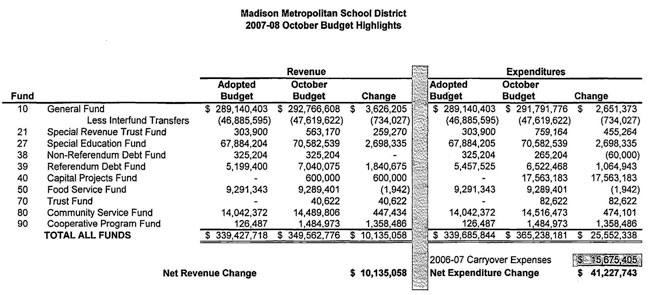
Listen to the Madison School Board discuss the District Administration’s proposed final 2007-2008 budget: $349M, up $10M from the previously approved $339M last spring. The Board had an interesting discussion regarding the use of these new funds. Final approval is scheduled for Monday evening, 10/29/2007 @ 5:45p.m.:

Approval of Finalized 2007-08 Budget Adjustments and Adoption of the Tax Levy.

19MB mp3 audio
It will be interesting to see where these additional funds are spent, particularly in light of the annual spring ritual of reducing the budget increases. Send your thoughts to the Madison School Board: comments@madison.k12.wi.us

Share

Teacher Credentials and Student Achievement in High School: A Cross-Subject Analysis with Student Fixed Effects

Charles T. Clotfeler, Helen F. Ladd and Jacob L. Vigdor [488K PDF]:

We use data on statewide end-of-course tests in North Carolina to examine the relationship between teacher credentials and student achievement at the high school level. The availability of test scores in multiple subjects for each student permits us to estimate a model with student fixed effects, which helps minimize any bias associated with the non-random distribution of teachers and students among classrooms within schools. We find compelling evidence that teacher credentials affect student achievement in systematic ways and that the magnitudes are large enough to be policy relevant. As a result, the uneven distribution of teacher credentials by race and socio-economic status of high school students – a pattern we also document – contributes to achievement gaps in high school.

http://www.caldercenter.org/.

Share

Teach Program

Intel:

Intel Teach uses a “Train the trainer” model to provide both face-to-face and online instruction to help teachers around the world integrate technology into their classrooms. Teachers create lesson plans that can be immediately implemented and that meet local and national education goals and standards.
Working with governments – national, regional or local – worldwide, Intel introduces the program in interested countries and communities, which are selected based on strength of their commitment to the program. Intel then works with an initial group of teachers to help them become Intel Teach trainers themselves. These trainers in turn are responsible for sharing their new skills with other teachers in their region.
To ensure that program curriculum maintains relevancy and reflects lessons learned from feedback and research, Intel regularly provides updated material to the Intel Teach trainers.

Share

Parent and Teen Internet Use

Alexandra Rankin Macgill:

Parents today are less likely to say that the internet has been a good thing for their children than they were in 2004. However, this does not mean there was a corresponding increase in the amount of parents who think the internet has been harmful to their children. Instead, the biggest increase has been in the amount of parents who do not think the internet has had an effect on their children one way or the other. Fully, 87% of parents of teenagers are online — at least 17% more than average adults.
Parents check up on and regulate their teens’ media use, not just in terms of the internet, but with television and video games as well. However, those rules lean slightly more towards the content of the media rather than the time spent with the media device.

Share

Iowa Governor says every district should use tougher curriculum in next two years

Pat Curtis:

Culver say nearly 50 percent of American high school graduates that want to pursue higher education, have to take a remedial course when they get to college. “In Iowa, we’re much better than that,” Culver said, “we do very well in terms of preparedness, but I want to be the best. One way I think to get there is to encourage districts across the state to adopt the core curriculum standards.”

Share

Madison School Board Fine Arts Task Force Seeks Input From the Community

Dear Community Members,
The Madison Metropolitan School District (MMSD) values the arts as an integral component of a quality education for all students. Research has shown that involvement in the arts teaches children many important academic skills as well as enriches personal growth and development. Tight budgets, however, have increasingly affected the arts education we offer our children. Further, the District has monitored a downward trend in participation in arts offerings among low-income students and students of color for a number of years.
The Madison Board of Education formed the Community Fine Arts Task Force to gather information from the community and provide recommendations to the Board on MMSD’s arts education program. Specifically, the Board asked the Task Force to:

  1. Identify community goals for MMSD K-12 arts education including curricular, co-curricular and extracurricular;
  2. Recommend approaches for increasing participation in arts education for low-income students and
    students of color; and

  3. Recommend priorities for District funding of fine arts education.

October through December, the Task Force will be distributing surveys and conducting community conversations to gather information from the community on its goals for fine arts education. Your input is very important and will help inform and strengthen the Task Force’s work. The result of this work will be completed and presented to the School Board next spring.
We appreciate your participation in this important effort. To take the online survey and to learn more about the Community Fine Arts Task Force, go to www.mmsd.org/boe/finearts/ .
Sincerely,
Arlene M. Silveira, President

Share

The Narrowing Gap in Teacher Qualifications and its Implications for Student Achievement in High Poverty Schools

Donald Boyd, Hamilton Lankford, Susanna Loeb, Jonah Rockoff and James Wyckoff: 227K PDF

No Child Left Behind, state assessment-based accountability policies and new routes into teaching have all had profound effects on the labor market for teachers. In this research we explore the how the distribution of teacher qualifications and student achievement in New York City have changed from 2000 through 2005 using data on teachers and students. We find: the gap between the qualifications of New York City teachers in high-poverty schools and low-poverty schools has narrowed substantially over this period, the gap-narrowing associated with new hires has been driven almost entirely by the substitution of teachers entering through alternative certification routes, for uncertified teachers in high-poverty schools, these changes resulted from a direct policy intervention eliminating unlicensed teachers, and perhaps most intriguing, much larger gains could result if teachers with strong teacher qualifications could be recruited.

http://www.caldercenter.org/.

Share

LITERARY STYLE BY THE NUMBERS

Steven Berlin Johnson:

But the two stats that I found totally fascinating were “Average Words Per Sentence” and “% Complex Words,” the latter defined as words with three or more syllables — words like “ameliorate”, “protoplasm” or “motherf***er.” I’ve always thought that sentence length is a hugely determining factor in a reader’s perception of a given work’s complexity, and I spent quite a bit of time in my twenties actively teaching myself to write shorter sentences. So this kind of material is fascinating to me, partially because it lets me see something statistically that I’ve thought a great deal about intuitively as a writer, and partially because I can compare my own stats to other writers’ and see how I fare. (Perhaps there’s a literary Rotisserie league lurking somewhere on those Text Stats pages.)

Share

Giving India’s Slum Children A New Sense of Class

Rama Lakshmi:

Neelamdevi Thakur lives in a working-class slum and earns a living washing dishes in middle-class homes twice a day. In the past year, two of her five children, who attend an affluent private school, have returned home speaking words that she had never heard from her other children, who study in government schools.
They have begun speaking English.
They point to the vegetables in their meal and say “turnip,” “cauliflower” and “radish” in English, a language that for many Indians denotes social status and opportunity. They sing nursery rhymes in English and refuse to take the tortilla-like Indian bread called roti to school for lunch, instead demanding sandwiches and noodles. The children, ages 5 and 7, now want to cut a cake on their birthday, like the other children in their classes.
“I don’t understand what they say, but my chest swells with pride every time they speak English. Their life will be far superior to mine,” Thakur said, wiping her moist eyes with the edge of her blue floral sari. She compares the two with her 12-year-old son, who attends a government-run school in the neighborhood. “He comes home with bruises, scars and broken teeth. His teachers are either absent or sit in class knitting sweaters,” she said.

Share

iTunes U Welcomes Off-Campus Content

The Chronicle of Higher Education:

On its iTunes U portal, Apple’s digital-music store has already built up an impressive empire of recorded college lectures and events, all available for downloading. Now iTunes U is casting its gaze outside the ivory tower.
The portal has unveiled a new section, “Beyond Campus,” which collects educational material from museums, radio stations, and other public institutions. iTunes users can still watch lectures from Berkeley and guest speeches from Duke, but they can now also view live music performances from the Smithsonian Institution’s Global Sound Live series and take video walkthroughs of Richard Serra’s sculptures the Museum of Modern Art.

ars technica has more.

Share

Law Punishes Truancy by Taking Away Teens’ Car Keys

Susan DeFord:

At schools across Maryland, educators and motor vehicle officials have teamed up to enforce a new state law that is the latest strategy to deter habitual truancy.
The measure, which took effect Oct. 1, denies a learner’s permit to students younger than 16 who have more than 10 unexcused absences during the prior school semester.
Whether they are in public or private school or are home-schooled, teens must submit a certified, sealed school attendance form as part of their application. The Motor Vehicle Administration will not accept forms from students if there is evidence of tampering or alteration, agency spokesman Buel Young said. The law probably will affect thousands of teenagers: In the last budget year, more than 14,500 16-year-olds earned provisional driver’s licenses.
A teenager must be at least 15 years, 9 months old before applying for a Maryland learner’s permit, and the driver must hold that learner’s permit for at least six months, Young said.

Share

Bridging the gaps by banding together

Tracy Jan:

Jairon Arias missed more than 40 days of school in the third grade, and when he did show up, he arrived one or two hours late. His classmate Cristian Posada was a recent immigrant from El Salvador and spoke limited English. Joel Ramos, the son of Salvadoran immigrants, also struggled with reading and writing because of his limited vocabulary.
All three were chosen at the beginning of the last school year as they entered the fourth grade to participate in a school system experiment to boost state test scores among Latino and African-American boys, the lowest achieving groups in the Boston public schools. Principals at 44 elementary, middle, and high schools chose 10 academically struggling boys to keep close tabs on through the school year.
The students in the so-called “10 Boys” clubs received extra tutoring, attended group lunches, and went on outings with their principals, with the goal of creating camaraderie and a support network that would help them score at the highest levels on the MCAS tests.
The program appears to have helped to bridge a persistent achievement gap between white and Asian students and their black and Latino peers, according to tests results released yesterday by the state Department of Education.

Clusty Search: 10 Boys Boston.

Share

Schools take hard line against public displays of affection

Stella Chavez:

A 7-year-old boy in Duncanville gets in trouble for telling a classmate to wear a darker shirt because he can see her bra strap. The school suspends him and labels the incident as sexual harassment.
In Keller ISD, school officials catch an eighth-grade girl holding hands with a friend and tell her to stop.
From bans on hugging to labeling comments as sexual harassment, schools are cracking down on anything that smacks of sex. Critics say teachers and administrators have become too fearful of lawsuits and have stopped letting kids be kids.
Recent precedent-setting lawsuits have made it clear that school officials must respond to complaints of student-on-student sexual harassment or face possible court action.
“I think it’s the kind of world we live in today, but you would hope that common sense would prevail,” said Jeff Horner, a Houston attorney who represents school districts.

Share

Harvest Time for Hawthorne Elementary

Susan Troller:

First grade teacher Amy Covey loves the outdoors and wants to share that passion with students.
On Wednesday morning there was a definite autumn chill in the wind as students from all grades at Hawthorne Elementary School picked up trowels, shovels, rakes and hoes to clean out the garden space Covey helped establish at the school located near Gardner Baking Company off of East Washington Avenue.
The students were delighted to pull carrots and beets from the ground, searched for a few last beans, and even sampled the leaves of nasturtiums as they pulled the plants from the garden in preparation for winter.
Some wrinkled their noses as they bit into the scalloped, edible leaves. Others grinned while they chewed, describing them as “peppery” and “spicy.”
Students have been gardening at Hawthorne since 2003 when Covey and her students wrote plans and grants to establish what has become an outdoor classroom for the entire school.

Share

Master of Science in Biotechnology Open House

UW-Madison:

The Master of Science in Biotechnology is an ideal solution for professionals in the biotechnology industry seeking to move into positions of greater responsibility or leadership.
Practical and results oriented, this two-year program provides the scientific, legal and business foundation necessary for succeeding and advancing in one of the fastest growing and most complex industries in the world.
Market research shows that professionals holding an advanced degree in biotechnology can earn up to 30% more annually than those with B.S. degrees. Furthermore, 90% of our graduates cite a significant or considerable impact on their careers pre-graduation.
Our unique program combines the most current scientific coursework and practical business practices for a productive career in biotechnology.

Learn more about Fall 2008 admission.
Informational Open House for Prospective Students
Wednesday, November 7, 2007
5:30 p.m.
MG&E Innovation Center
Conference Room 50
University Research Park
510 Charmany Drive
Madison

Share

Madison High School Police Calls & Discipline Rates:
Comparing 2001/2002 and 2005/2006

Madison Parent’s School Safety Site:

When there’s violence at school, parents want answers to their questions about school safety. If parents are told “our school is safer than other schools”, where’s the data that supports that vague reassurance? Police call-for-service data (as posted on this site from time to time) is one indicator of school crime, but it’s only part of the picture, and may not be a reliable basis of comparing school to school – or even comparing whether the safety situation in one particular school is improving or deteriorating.
We looked at police call data for East, LaFollette, Memorial and West High Schools in 2001-02, and in 2005-06. (Data notes: This data was obtained by public records request to the Madison Police Department. Due to the format in which the data was provided, the call totals for each school are for calls made to the block in which each school is located, rather than the specific street address of the school. Calls for each year were tallied over a July 1 through June 30 period in order to track the corresponding school years used for comparison below. Variations in school enrollment between the comparison years aren’t reported here since they don’t appear to affect the analysis or conclusions, but that information is readily accessible on the DPI web site. The DPI web site is also the source of the discipline data presented below.)

Share

Wisconsin Budget Delay Favors Rich Schools

Amy Hetzner:

The delay in approving a budget in Wisconsin could end up benefiting residents in the state’s wealthiest communities.
Legislators were unable to meet a Sept. 28 deadline set by the state Department of Public Instruction that would have allowed them to increase general aid to school districts by $79.3 million in the 2007-’08 school year in time to reduce next year’s tax bills.
So on Tuesday, when they approved the second-latest budget in state history, they did what some called the next best thing by putting the same amount into the school tax levy credit. The credit increase is expected to be signed into law by Gov. Jim Doyle.
That would be a boon to residents in districts such as Elmbrook and Mequon-Thiensville, where taxpayers have long complained that their money is siphoned off to support schools in other parts of the state. But it would mean less money for school systems such as Milwaukee and Racine, where the argument is that residents with less wealth need more help to ensure their children get a chance at an education on par with those in richer communities.
The reason for the difference is that, unlike general school aid, the state’s school levy tax credit is distributed based on the school property tax burden in individual municipalities. That largely means the credit goes to residents in the wealthiest areas.

Share

Too Graphic: Sex, Literature, and Our Schools

Britannica Blog:

Nate Fisher isn’t teaching English any more at Guildford High in Guildford, Connecticut. The untenured teacher resigned under pressure after being accused by a ninth-grade girl’s parents of giving her a graphic novel, Eightball #22, by Daniel Clowes, an acclaimed artist who recently drew a cartoon series for the New York Times. The book, also known as Ice Haven, depicts or discusses sex, partial nudity, and a man watching a woman in the shower.

Share

Tension Tied to Race Percolates in Ithaca

David Staba:

Nestled in the hills near Cayuga Lake’s southern tip, surrounded by creeks, waterfalls and two of the Northeast’s more prestigious colleges, this city of about 30,000 has long prided itself on its cultural diversity.
In 1997, the Utne Reader put Ithaca — where students from Cornell University and Ithaca College boost the population to about 50,000 — atop its list of “America’s Most Enlightened Towns,” trumpeting an environment-friendly business community and a local currency system intended to support city merchants.
A popular bumper sticker here reads, “Ithaca: 10 square miles surrounded by reality.”
But as reality encroaches, residents and community leaders now concede that racial tensions have long simmered at Ithaca High School, a volatile mix of blue-collar youths from the city, children of the farms in the surrounding countryside and the sons and daughters of professors.
“This community is at the boiling point, because not only students are frustrated, so are parents,” said James Turner, founder of the Africana Studies and Research Center at Cornell. “There’s a broad-based lack of confidence in the leadership of the district. I’m watching this go from bad to worse.”

Share

In Shift, 40% of Immigrants Move Directly to Suburbs

Sam Roberts:

About 4 in 10 immigrants are moving directly from abroad to the nation’s suburbs, which are growing increasingly diverse, according to census figures released yesterday.
The Census Bureau’s annual survey of residential mobility also found that after steadily declining for more than a half-century, the proportion of Americans who move in any given year appears to have leveled off at about one in seven.
“For blacks, especially, it mimics the 50s-style suburban movement, most pronounced for married couples with children, owners and the upwardly mobile,” said William H. Frey, a Brookings Institution demographer.
Dr. Frey’s analysis of mobility patterns found that while Hispanic and Asian immigrants were more likely to settle first in the nation’s cities, “after they get settled, they follow the train to the suburbs.”

Share

Portsmouth School Board’s ADHD flier draws fire

Cheryl Ross:

Last month, the School Board sent a warning to parents about the “harmful effects” of drugs used to treat attention deficit hyperactivity disorder.
Much of the flier’s information was taken from the Internet, including from a Web site run by a group founded by the Church of Scientology.
This week, six national organizations and eight local groups sent a letter requesting that the School Board retract the flier and send a new one stating that ADHD is a disease that requires treatment.
P O L L
Should the Portsmouth School Board have sent a controversial flier on Attention Deficit Hyperactivity Disorder to parents?
Yes
No
Undecided
View results
Latest Videos
Once-injured turtle returned to the ocean
H.S. Football: Green Run 62, Ocean Lakes 18
Yacob Hailemariam returns home
Being a war correspondent takes a lot of equipment
California Wildfires Turn Deadly
GOP Jindal Wins Louisiana Gov. Race
Drought Intensifying Tri-state Water War
See the complete Pilot, exactly as in print
– View stories, photos and ads
– E-mail clippings
– Print copies
Log in or learn more
The groups include the American Academy of Child & Adolescent Psychiatry, the Virginia chapter of the American Academy of Pediatrics, and the Tidewater chapter of Children and Adults with Attention Deficit/Hyperactivity Disorder.
The flier was sent “to instill fear in parents,” said E. Clarke Ross, CEO of the Landover, Md.-based national office of CHADD. “It’s not based on published science, but on propaganda.
“This is the first time I’ve heard of this kind of propaganda being officially disseminated from a school system to its pupils,” Ross said.

Share

Fixing the Milwaukee Public Schools: The Limits of Parent-Driven Reform

David Dodenhoff, PhD.:

The Milwaukee Public Schools (MPS) district, like many of its big-city counterparts in other states, continues to suffer from poor student performance. Student test scores and dropout rates are at deplorable levels, both in absolute terms and in comparison with the rest of Wisconsin. This fact has led to a veritable cottage industry dedicated to improving educational outcomes in Milwaukee. The district itself has embraced two reforms in particular: public school choice and parental involvement.
Advocates of public school choice claim that by permitting parents to choose among a variety of public school options within the district, competition for students will ensue. This should improve school effectiveness and efficiency, and ultimately lead to better student outcomes.
Proponents of parental involvement argue that even first-rate schools are limited in their effectiveness unless parents are also committed to their children’s education. Thus, the parental involvement movement seeks to engage parents as partners in learning activities, both on-site and at home. Research has shown that such engagement can produce higher levels of student performance, other things being equal.
Research has also shown, however, that both reforms can be stifled in districts like MPS, with relatively large percentages of poor, minority, single-parent families, and families of otherwise low socioeconomic status. With regard to public school choice, many of these families:

  • may fail to exercise choice altogether;
  • or
    may exercise choice, but do so with inadequate or inaccurate information;

  • and/or
    may choose schools largely on the basis of non-academic criteria.

As for parental involvement, disadvantaged parents may withdraw from participation in their child’s education because of lack of time, energy, understanding, or confidence.
This study offers estimates of the extent and nature of public school choice and parental involvement within the MPS district. The basic approach is to identify the frequency and determinants of parental choice and parental involvement using a national data set, and extrapolate those results to Milwaukee, relying on the particular demographics of the MPS district.

Alan Borsuk has more along with John McAdams:

Rick Esenberg has beat us to the punch in critiquing the methodology of this particular study. As he points out, it’s not a study of private school choice, only a study of choice within the public sector.

George Lightburn:

ecently, the Wisconsin Policy Research Institute (WPRI) released a report entitled, Fixing Milwaukee Public Schools: The Limits of Parent-Driven Reform. Unfortunately, the headline in the Milwaukee Journal Sentinel read, “Choice May Not Improve Schools.” That headline not only misrepresented the study, it energized those who are dying to go back to the days when parents were forced to send their children to whichever MPS school the educrats thought best.
So that there is no misunderstanding, WPRI is unhesitant in supporting school choice. School choice is working and should be improved and expanded. School choice is good for Milwaukee’s children.
Here are the simple facts about the WPRI study:
1. The study addressed only public school choice; the ability of parents to choose from among schools within MPS. The author did not address private school choice.

A Capitol Times Editorial:

Credit is due the Wisconsin Policy Research Institute for releasing a study that confirms what the rest of us have known for some time: So-called “school choice” programs have failed to improve education in Milwaukee.
The conservative think tank funded by the Bradley Foundation has long been a proponent of the school choice fantasy, which encourages parents to “shop” for schools rather than to demand that neighborhood schools be improved — and which, ultimately, encourages parents to take publicly funded vouchers and to use the money to pay for places in private institutions that operate with inadequate oversight and low standards for progress and achievement.

Share

Violence at Lapham

Police were called to the alternative program at Lapham Elementary after a teacher tried to break up a fight on Tuesday. She fell, was kicked in the head, and taken away in an ambulance.
The Madison police Web site includes no incident report on the event.

Share

Dual Enrollment Courses — Up From Obscurity

Jay Matthews:

Dual enrollment courses are usually community college or four-year college courses taken by high school students, either at the college or at their high schools with instructors paid by, or at least supervised by, the college. Looking at the records of 299,685 dual enrollment students in Florida, the researchers found that taking dual enrollment courses correlated to higher rates of high school graduation, enrollment in two-year and four-year colleges and academic performance in college. Students who took dual enrollment courses while enrolled in Florida high schools had higher college grade point averages and more college credits three years after high school graduation than similar students who had not done dual enrollment.
A review of the records of 2,303 New York students found those in the “College Now” dual enrollment program were more likely to pursue a bachelor’s degree and have better college grades their first semester than students of similar backgrounds who did not do dual enrollment.
Despite the evidence that these college courses — like AP and IB — give high school students a taste of college rigor that can bring college success, the researchers reported that many students are being denied a chance to take them. The ill-considered limits on high schoolers who want to take college-level courses is also a big problem for AP, and suggests that most of our high school administrators and many state education officials are in dire need of an attitude adjustment.

Related from Janet Mertz:

Nash’s “Guidelines” state that no credit will be permitted for non-MMSD courses whenever THEY deem they offer a comparable course (i.e., regardless of format) ANYWHERE in the MMSD. Even when the MMSD doesn’t offer a comparable course, they will permit a maximum of TWO ELECTIVE credits, i.e., they can not be used to fulfill specific requirements for graduation. Thus, if these Guidelines are allowed to stand, no credit whatsoever will be permitted for any high school or college course the district offers that a student takes, instead, via WCATY, EPGY, UW-Extension, online, correspondence, etc., regardless of the student’s ability to access the District’s comparable course.

Share

A Little Help Can Go a Long Way for Schools

Anjuman Ali:

Madison’s schools are doing a remarkable job of educating children despite challenges posed by changing demographics and shrinking budgets.
But schools need our help to keep giving kids the skills and knowledge they need to succeed in life.
I learned this by being principal for a day at Wright Middle School on the city’s South Side. The program, organized by the Foundation for Madison’s Public Schools, allows business and community leaders to walk a day in the shoes of principals in Madison’s public schools.
At Wright, I interacted with an extraordinary group of educators and staff, including Principal Nancy Evans, observed classes and met students whose enthusiasm, creativity and challenges provided a glimpse into this city and this state’s future.
A majority of children at Wright live in poverty and a majority needs help in reading and math. And their numbers are growing not just at this charter school, but also in other Madison public schools.

Share

Texas parents, schools spar over special needs

Sarah Viren:

At age 9, Jodie threw tantrums so violent his elementary school threatened to call the police. The next year, the special education student tried to strangle an aide on the school bus, his mom said.
Diagnosed first with bipolar disorder and more recently as having Asperger syndrome, the bespectacled Kingwood boy has a history of biting, kicking, swearing and soiling himself to get attention.
Since he was in third grade, Humble Independent School District administrators have moved Jodie to at least three different schools. At one of the latest, the district’s center for children with emotional disturbances, Carol Allred found her son in a timeout room covered in his own waste.
She pushed then, as before, for taxpayer-funded private schooling.
But only this year, after Jodie had fallen behind two grades in reading and spent countless hours isolated from other students because of his outbursts, did school officials agree.

Share

“Colleges Bring in More Money, But Tuition Isn’t Going Down: Senators question why cost of education is still increasing”

Justin Pope:

Colleges and universities raked in money by the billions last year. But their investing success now has a price — a movement in Congress to force the wealthiest schools to spend more of their money to keep down tuition.
In recent weeks, a string of colleges and universities have announced enviable investment results. Leading the way was Yale, which earned 28 percent over the year ending June 30, increasing the school’s endowment to $22.5 billion overall.
Harvard, the world’s wealthiest university with $34.9 billion, beat the market again with a 23 percent return. There also were good returns for smaller schools such as Bowdoin (24.4 percent) and William & Mary (19.2 percent).

Share

Wisconsin Teacher Misconduct Revocations Below National Average

Todd Richmond:

In Wisconsin, the review found the licenses of 251 teachers were revoked during that five-year period for offenses ranging from overdue taxes to sex with students to drunken driving. The 44 sexual misconduct revocations represent 18% of those revocations and only a fraction of the 100,000 or so licensed educators who worked in Wisconsin classrooms each of those years.
By comparison, 26% of the nearly 10,000 teacher license revocations the review identified nationwide during that span were for sexual misconduct.

Share

Online IPS classes help teens catch up, get ahead

Andy Gammill:

Andrea Martin needed high school credits in biology and health, but the alternative school in Indianapolis Public Schools she attends doesn’t offer those classes.
Instead of forgoing the credits, Martin enrolled in IPS’ new virtual school, which offers basic courses for students like her, remedial courses for those who have fallen behind, and advanced courses.
Each evening after her shift at a KFC restaurant, Martin goes home and logs on to her classes for up to five hours a night. She likes that she can go as fast or slow as she wants but sometimes wishes a teacher were there to help answer a question or clarify a point.
“It’s good, but sometimes it’s a little hard because you’re teaching yourself, and it’s hard to find the answers,” she said. “It’s kind of hard where you can’t ask but have to do it on your own.”
A teacher is available to consult with students, but the online classes are much more self-directed than a typical high school classroom. So far the costs have been small but will increase as staff and courses are added.

Video

Share

Is That 4-Year-Old Really a Sex Offender?

Yvonne Bynoe:

Could my son be accused of sexual harassment? He’s a good boy. He likes watching “Thomas the Tank Engine” on television and playing “Simon Says.” Like many 3-year-olds, he’s very affectionate. Unfortunately, hugging his teacher may get him suspended from nursery school.
I doubt that it will happen to my son. But the frightening fact is that it could. I recently learned that children nationwide, some of preschool age, have been suspended from school or taken to jail after being accused of sexual harassment. In their zeal to avoid lawsuits, educators seem to be ignoring important information, such as whether the accused child intended to commit a crime or even knows how to pronounce the word “harassment.”
Sex education tends to be controversial, partly because parents have such varying and often strongly held beliefs about how, when and even if the topic should be introduced to their children. But if schools have the authority to brand a 3-year-old a sex offender, they also have the responsibility to provide parents with clear guidelines about appropriate physical conduct.
It’s great that we are more aware than ever about sexual harassment in schools. But it is a terrible mistake to permanently label children who are barely out of diapers.

Share

Madison School District Proposed Final 2007-2008 Budget: $349M

The Madison School District’s Administration proposed a $349,562,776 final 2007-2008 budget last night [$14,404.26/student (24,268)]. This represents an increase of $10,136,058 from the adopted current year budget ($339,427,718). It also represents a $16,460,911 increase (4.94%) over the 2006-2007 revised budget. [Citizen’s Budget]
MMSD Budget Amendments and Tax Levy Adoption for 2007-2008 11.6MB PDF
It will be interesting to see where these additional funds are spent. Send your thoughts to the Madison School Board: comments@madison.k12.wi.us
Superintendent Rainwater mentioned last night that 55 additional students “open enrolled” out of the MMSD this year, taking their spending authority with them. The numbers are evidently “trending up”.

Share