School Information System

Find More Than 4,000 Math Lessons on Open Curriculum

Richard Byrne:

Open Curriculum is a new entry into the lesson depot market. Like similar sites, Open Curriculum offers a collection of thousands of resources for teaching mathematics. You browse the Open Curriculum resource lists according to grade level and topic. As you might guess, a lot of the featured resources are Khan Academy materials. In addition to the Khan Academy materials you will find lessons created and shared by other teachers.

Open Curriculum provides more than just a collection of mathematics lesson materials. In your Open Curriculum account you can create and share your own lessons and units of study. You can also upload existing materials to incorporate into the lessons and units that you create in Open Curriculum.

Share

College Selectivity and Degree Completion

Scott Heil, Liza Reisel & Paul Attewell:

How much of a difference does it make whether a student of a given academic ability enters a more or a less selective four-year college? Some studies claim that attending a more academically selective college markedly improves one’s graduation prospects. Others report the reverse: an advantage from attending an institution where one’s own skills exceed most other students. Using multi-level models and propensity score matching methods to reduce selection bias, we find that selectivity, measured by a college’s average SAT score, does not have an independent effect on graduation. Instead of a selectivity effect we find relatively small positive effects on graduation rates from attending a college with higher tuition costs. We also find no evidence that students who do not attend highly selective colleges suffer reduced chances of graduation as a result, all else being equal.

Share

America’s Math Crisis

Dick Resch

Americans could use a crash course in math.
According to a new study from the Brookings Institution, jobs in science, technology, engineering and math are vacant for more than twice as long as other positions — largely because employers can’t find people with the math and science skills to fill them.

In fact, high school graduates with science, technology, engineering and math (STEM) skills are in greater demand than college grads without them.

Related: Math Forum Audio & Video and wisconsin2.org.

Share

Let’s Stop Trying To Teach Students Critical Thinking

Dennis Hayes:

in knowledge passively? But there is a problem with the widespread treatment of critical thinking as a skill to be taught.

The truth is that you can’t teach people to be critical unless you are critical yourself. This involves more than asking young people to “look critically” at something, as if criticism was a mechanical task.

As a teacher, you have to have a critical spirit. This does not mean moaning endlessly about education policies you dislike or telling students what they should think. It means first and foremost that you are capable of engaging in deep conversation. This means debate and discussion based on considerable knowledge – something that is almost entirely absent in the educational world. It also has to take place in public, with parents and others who are not teachers, not just in the classroom or staffroom.

Share

Rating US Colleges: in 1911

US Archives (PDF)

President Obama wants to rate colleges’ “value.” Higher ed leaders hate the idea, writes Libby Nelson on Vox. When the feds tried to rate colleges by quality — in 1911 — college leaders lobbied so vigorously they got the Babcock report quashed.

The U.S. Bureau of Education’s Kendric Babcock, a former college president, rated 600 colleges and universities by how well they prepared students for graduate work. Class 1 graduates would need only a year of graduate school to finish a degree, he estimated. In Class 2 and 3, students would need more time. Class 4 graduates would start out two years behind, he predicted.

via Joanne Jacobs.

Share

What Are the Most Powerful Uses of Tech for Learning?

Katrina Schwartz:

When we talk about the digital divide in education, the discussions revolve mainly around two factors: lack of access to the internet and lack of knowing how to use that access in powerful ways that can fuel learning beyond consuming content.

There are a lot of powerful tools for change available to educators and plenty of creative, inspired educators working hard to put available technology to work in classrooms. A lack of excellence is not the problem in education; access to technology and guidance for participating in the digital space in powerful ways are much bigger challenges.

That is the message Karen Cator, president and CEO of Digital Promise and former head of the Office of Technology at the US Department of Education, is spreading around the country. “When we think about students who do not have access to these kinds of powered-up learning environments, that’s a problem,” Cator said at a presentation sponsored by SVForum, a non-profit that organizes ed-tech events. From Cator’s perspective, the digital learning gap can be broken down into three parts: access, participation and powerful use.

Share

Teacher tenure refugees flee public schools

James Richardson

When public school administrators and teachers in Washington, D.C., recently laced up their sensible shoes and launched an unprecedented canvassing campaign to goose slumped enrollment rates, the panicked affectation was unmistakable.

Short of horse-drawn carriage makers, few industries have suffered such a pronounced decline in market share than government-run schools in America’s urban centers. Consider the numbers: forty-four percent of the District’s public student population has abandoned conventional neighborhood schools for public charters.

But while the taxpayer-financed campaign was designed to signal fresh responsiveness to parents, the effort merely reinforced the perception that entrenched teachers and labor unions were braving the sweltering heat out of self-interest. No students means no jobs.

Here, where traditional public school enrollment has dipped by 30,000 students in just the last 18 years, administrators believe the key to stemming the exodus of public school refugees lies in diverting precious resources from improving instruction to marketing.

To augment the hard sell being made door-to-door by principals, the school system even retained the pricey data miners who twice won the White House for President Barack Obama.

The hiring of that degree of experience doesn’t come on the cheap — the system spent at least $44,000 for five two-hour huddles with the Obama campaign veterans and for a statistical model to pinpoint students most likely to leave the traditional public education system, according to a review of receipts by the Washington Post — and not without cause.

If enrollment trends remain constant, soon a majority of students in the nation’s capital city will be educated in charter schools. Said another way: roughly half of parents living in the seat of the federal government don’t trust government-run schools to properly educate their children.

But D.C.’s expanding educational marketplace isn’t especially unique. To the west, in California, and north, in New York, working poor communities are rejecting traditional schools whose intractable tenure regime has punished budgets, and in turn students, for decades.

Last month, a Superior Court judge in Los Angeles invalidated California’s tenure law, which shielded even grossly underperforming teachers from termination.

That verdict, which credit agency Moody’s rated a positive development for the state’s cash poor school system, prompted the filing of a parallel lawsuit this month by a group of 11 New York City students arguing the current system had denied them the right to a “sound education” promised them in the state constitution.

Spooked by the possibility that the court may finally eliminate protections for lousy teachers, one New York City public school educator, Franceso Portelos, preemptively retaliated by warning a fellow instructor on Twitter to “look away” if a “disservice” was done to two students who brought the suit.

The city had previously spent in excess of $600,000 in an unsuccessful, two-year attempt to terminate that same teacher’s employment for a host of grievances.

But in the same period that the city was fighting to exercise a measure of the same employment freedom that managers in the private sector wield as a matter of course, the number of students in New York City charter schools spiked by 24%, up to more than 48,000. Teachers like Portelo, girded by tenure safeguards, have fixed that basement, and it won’t be long before multiple stories are built atop it.

Now, the hemorrhaging enrollment rates in government-run schools isn’t the result of a profound pedagogical debate, at least not directly, among America’s parents that teachers in charter schools are necessarily better and more committed than their counterparts at traditional public schools, because they’re not.

Underperforming educators can be found in any institution, public or private, charter or traditional, but only the best among them treat education as a commodity and parents as consumers. The marketplace demands change, and traditional public schools instead remain fixed in decades past — hoping to dupe earnest-but-forgiving parents into believing that their self-interest is on par with concern for students, because it isn’t.
Share

Finnish Basic Education Standards

Finnish National Board of Education

The overall distribution of lesson hours for basic education and the minimum number of lessons for core subjects during basic education are decided by the Government. The present distribution of lesson hours was confirmed in 2012 and will be implemented together with the new core curriculum in 2016.

The new distribution of lesson hours in basic education (pdf, in Finnish)

The distribution of lesson hours stipulate such matters as the core subjects taught to all pupils, and the distribution of teaching hours between various subjects.

The national core curriculum is determined by the Finnish National Board of Education. It includes the objectives and core contents of different subjects, as well as the principles of pupil assessment, special-needs education, pupil welfare and educational guidance. The principles of a good learning environment, working approaches as well as the concept of learning are also addressed in the core curriculum. The present national core curriculum for basic education was confirmed in January 2004 and it was introduced in schools in August 2006.

Share

Secrets of amazing teachers: What both sides of the education reform debate get wrong about autonomy and accountability

Elizabeth Green:

The common view of great teachers is that they are born that way. Like Michelle Pfeiffer’s ex-marine in “Dangerous Minds,” Edward James Olmos’s Jaime Escalante in “Stand and Deliver,” and Robin Williams’s “carpe diem”–intoning whistler in “Dead Poets Society,” legendary teachers transform thugs into scholars, illiterates into geniuses, and slackers into bards through brute charisma. Teaching is their calling—not a matter of craft and training, but alchemical inspiration.

Bad teachers, conversely, are portrayed as deliberately sadistic (as with the Sue Sylvester character on “Glee”), congenitally boring (Ben Stein’s nasal droner in “Ferris Bueller’s Day Off”), or ludicrously dim-witted (Mr. Garrison from “South Park”). These are the tropes of a common narrative, a story I’ve come to call the “Myth of the Natural-Born Teacher.”

Even in the rare cases where fictional teachers appear to improve—as happens in “Goodbye, Mr. Chips,” the novel-turned-film, in which a bland schoolteacher named Mr. Chips comes to “sparkle”—the change is an ugly duckling–style unmasking of hidden pizzazz rather than the acquisition of new skill. Others think Mr. Chips has become a “new man,” but in fact, we are told, he has only peeled back a “creeping dry rot of pedagogy” to reveal the “sense of humor” that “he had always had.”

Share

A New Ratio for the Japanese Cram School

Yuriko Nagano:

Yuuki Takano, an athletic sixth grader, hopes to attend a private junior high school with a strong soccer team after he graduates from his Tokyo public elementary school next year.

To help him pass the junior high school’s notoriously difficult entrance exams this winter, Yuuki’s mother, Asuka Takano, decided to place him in a traditional Japanese preparatory school, made up of big classes with dozens of students. The schools are often called cram schools, or juku in Japanese.

Mrs. Takano assumed her son would do well there, as she had attended a big cram school herself when she was preparing to enter a private high school.

Share

Madison’s High School “Coursework Review”

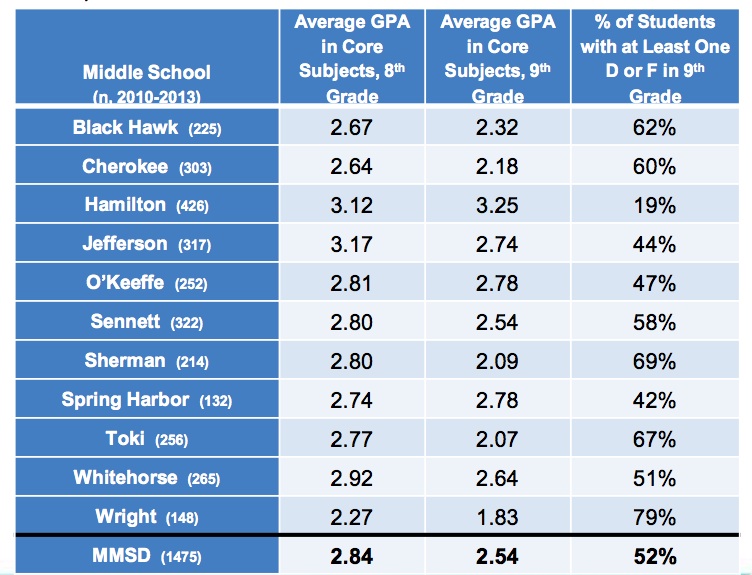
Average GPA in Core Subjects in 8th and 9th Grades and Percentage of Students Receiving a D or F in a Core Course in 9th Grade, by Feeder School, 2010 – 2013:

Madison School District 1.3MB PDF Presentation:

In focus groups, several teachers noted what they perceived to be a lack of adequate preparation their students received in previous years, and in some cases a lack of understanding about the curriculum to which their students have been exposed.

In focus groups at each MMSD school, a broad majority of students stated they have been in classes where the instructional purpose and relevance of what they were learning was unclear.

Each set of stakeholders interviewed for this project referenced the challenges posed by poor alignment of instruction from one grade level to the next, particularly between middle and high schools.

In focus groups, several teachers and students alike noted that adjusting to increased levels of homework in high school was a challenge for many.

Student focus groups reported varying experiences in Middle School with homework counting towards students’ overall grades may be contributing to a difficult transition into high school for some students

There is significant lack of course syllabi across schools.

When asked what a diploma should mean, there was much consensus across stakeholder groups that it should include the following, but also a lack of confidence that an MMSD diploma currently represented each of these for all graduates:

Competence in core subject areas
Exposure to a broad curriculum including the arts
Reading and critical thinking skills
Having a global perspective
Knowledge and ability to access employment and/or postsecondary education
Ability to work in groups
Curiosity as a lifelong learner
“Real world” experience tied to the classroom
Citizenship and self-sufficiency
“21st Century skills”

Recommendations
Redefine What an MMSD Diploma Means By Setting Common Learning Outcomes and Assessments for All Graduates

Create Clear Personalized Student Pathways

Define Multiple Career-Field and Academic Pathways for High School Students

Engage Deeply with Local Postsecondary Stakeholders for Alignment and Expansion of Dual Credit Options

Continue to Engage With Local Employers for Alignment and Student Work-Based Learning Opportunities

Continue to Promote and Develop AVID as a Pathway Option, While Monitoring More Closely Before Expanding

Encourage Innovation in Projects and Assessments

Regarding the “lack of course syllabi”, full, required implementation of Infinite Campus (or similar) would address this issue. Millions have been spent…

Number of Students in Class of 2013 Who Took AP World Language Courses, by High School and Feeder Middle School, 2010-2013

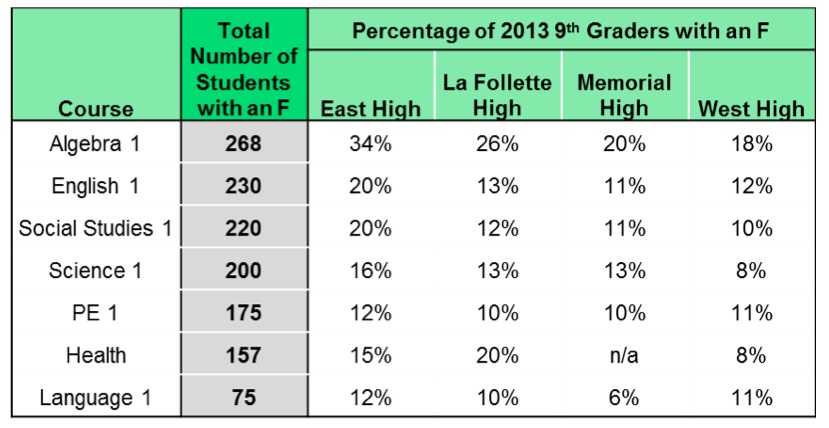
The Most Failed Courses in 9th Grade with Percentage of Students With One Failed Semester by School, 2013

AP courses available at all four comprehensive high schools:

Calculus AB
Calculus BC
French Language
Spanish Language
Environmental Science
Statistics
European History

Select AP courses not available at all high schools:

Proportion of Students Enrolled in AP Courses and Scoring a 3 or Higher on AP Exams by Race and SpEd/ELL Status, 2013

The Most Failed Courses in 9th Grade with Percentage of Students With One Failed Semester by School, 2013

Background links: English 10

Small Learning Communities

High School “Redesign”

Share

Close Business Schools / Save the Humanities

William Major:

I. Close the Business Schools

Ask anyone professing the humanities today and you come to understand that a medieval dimness looms. If this is the end-times for the ice sheets at our poles — and it is — many of us also understand that the melt can be found closer to home, in the elimination of language and classics departments, for instance, and in the philistinism represented by governors such as Rick Scott of Florida and Patrick McCrory of North Carolina, who apparently see in the humanities a waste of time and taxpayer subsidies. In the name of efficiency and job creation, according to their logic, taxpayers can no longer afford to support bleary-eyed poets, Latin history radicals, and brie-nibbling Francophiles.

That there is a general and widespread acceptance in the United States that what is good for corporate America is good for the country is perhaps inarguable, and this is why men like Governors Scott and McCrory are dangerous. They merely invoke a longstanding and not-so-ugly stereotype: the pointy-headed humanist whose work, if you can call it that, is irrelevant. Among the many easy targets, English departments and their ilk are convenient and mostly defenseless. Few will rise to rush the barricades with us, least of all the hard-headed realists who understand the difficulties of running a business, which is what the university is, anyway.

Share

Why Are Campus Administrators Making So Much Money?

Lawrence Wittner:

Americans committed to better living for bosses can take heart at the fact that college and university administrators — unlike their faculty (increasingly reduced to rootless adjuncts) and students (saddled with ever more debt) — are thriving.

In 2011, the last year for which figures are available, 42 private college and university presidents received more than a million dollars each for their work. Robert Zimmer (University of Chicago) was the best-paid, at $3,358,723. At public colleges and universities, nine top administrators garnered more than $1 million each in 2012-2013, with the best-paid, E. Gordon Gee (Ohio State University), receiving $6,057,615.

Since then, it’s likely that the number of millionaire campus presidents has increased, for their numbers have been growing rapidly. Indeed, in 2012-13, the number of public university presidents receiving at least $1 million for their services more than doubled over the previous year.

In addition to their formal compensation, college and university presidents receive some very lavish perks. These at times include not only free luxury cars and country club memberships, but free university housing. James Milliken, the chancellor of the City University of New York, attended by some of the nation’s most impoverished students, lives rent-free in an $18,000-a-month luxury apartment on Manhattan’s posh Upper East Side. From 2000 to 2007, when Gordon Gee was chancellor at Vanderbilt University, he benefited from a $6 million renovation of the university mansion in which he and his wife resided. According to a New York Times article, after Gee moved on to his multi-million dollar job at Ohio State, he was known for “the lavish lifestyle his job supports, including a rent-free mansion with an elevator, a pool and a tennis court and flights on private jets.”

Share

K-12 Tax & Spending Climate: The Typical Household, Now Worth a Third Less

Economic inequality in the United States has been receiving a lot of attention. But it’s not merely an issue of the rich getting richer. The typical American household has been getting poorer, too.

The inflation-adjusted net worth for the typical household was $87,992 in 2003. Ten years later, it was only $56,335, or a 36 percent decline, according to a study financed by the Russell Sage Foundation. Those are the figures for a household at the median point in the wealth distribution — the level at which there are an equal number of households whose worth is higher and lower. But during the same period, the net worth of wealthy households increased substantially.

The Russell Sage study also examined net worth at the 95th percentile. (For households at that level, 95 percent of the population had less wealth.) It found that for this well-do-do slice of the population, household net worth increased 14 percent over the same 10 years. Other research, by economists like Edward Wolff at New York University, has shown even greater gains in wealth for the richest 1 percent of households.

Share

More Schools Open Their Doors to the Whole Community

Caroline Porter

On a recent weekday here, a steady stream of people dropped by one central location for food stamps, family counseling and job ideas—their local school.

While instruction has ended for the summer, these classrooms remain open as part of a wider trend around the country of “community schools,” where public and private groups bring services closer to students and residents year round and, in some cases, help boost student performance.

With backing at local, state and federal levels, the decades-old idea for improving schools and neighborhoods is gaining ground despite some funding uncertainties and doubts about community schools’ success.

The largest coordinator of such programs, Communities in Schools, saw a 6% increase in its reach in the 2012-13 school year, covering schools with a total of more than 1.3 million students in 26 states.

Share

A year after shakeup plan bombed, is Milwaukee Public Schools ready to move forward?

Alan Borsuk:

Gregory Thornton, the former superintendent of Milwaukee Public Schools, was good at talking about the positive things underway for the schools. He’d get revved up as he rattled off initiatives and data. At the start of school a year ago, he did in a conversation with me.

Then he abruptly changed tone.

“I’ve got 15 or 20 schools that just need a lot of help,” he said.

They just needed to start over. He said he was going to propose seeking ideas for anyone who had them on how to turn around those schools. Could that include independent charter school operators? Yes, he said. Whoever had a good plan for getting better success.

It’s almost a year later, and MPS is launching a program to improve low-performing schools. Is it the shake-things-up, turn-around vision Thornton held out? For better or worse, no. This is Milwaukee. This is MPS.

I hope the tastes-milder, maybe-more-filling version of revving up low-performing schools is successful. Fourteen schools have been designated as “commitment schools” based on proposals the staff of each one made.

In broad terms, each of the proposals includes fresh ideas on what the schools will offer and how they’ll offer it, and, I’m assured by MPS leaders, fresh willingness by staff members to work together on better outcomes.

Seven of the 14 schools are large high schools with reputations for being, shall we say, challenging: Bradley Tech, James Madison, North Division, Pulaski, South Division, Vincent, and Washington. An eighth is Barack Obama School of Career and Technical Education, a new kindergarten through 12th-grade school combining two faltering schools in the former Custer High School building.

Share

Madison teachers head back to school to new evaluations, student discipline code

Pat Schneider:

As Madison teachers prepare to head back to school, big changes they’re facing include a new teacher evaluation system mandated by the state and a new discipline policy adopted by the Madison School Board, according to Madison Teachers Inc. president Mike Lipp.

“There’s a lot of confusion and some apprehension” about the new teacher evaluation system, Lipp said. And of the district’s new Behavior Education Plan, designed to cut the number of suspensions, Lipp said he is “100 percent for keeping kids in class. There’s a cost, though.”

“I’m hoping these things work, I really do,” said Lipp, athletic director at West High School, where he formerly taught science.

The teacher evaluation and student behavior initiatives will be the focus of professional development sessions for teachers on Aug. 27 and 28. Students begin returning to school on Sept. 2, the day after Labor Day, with staggered start days according to grade.

Teachers have long been evaluated and sections of the union contract have called for evaluation, Lipp said. But Wisconsin school districts are required under state law to implement one of two codified systems this coming school year.

Share

What We Mean When We Say Student Debt Is Bad

Susan Dynarski:

Once again, the headlines are filled with claims that student loans are bad. Several articles have highlighted results from a Gallup poll that shows that college graduates who borrow for college are less happy, healthy and wealthy than debt-free graduates. The Gallup report (which is cautious in its interpretation of the data) has been drawn into a rising chorus of news media reports on the negative consequences of borrowing: Student loans not only make you sick but also hamper homeownership and delay marriage.

Student loans need reform. But recent reports obscure the key benefit of borrowing for college: a college education.

The highlight of the Gallup report is a comparison of the well-being of college graduates who did not borrow and those who borrowed more than $50,000. As I discussed in this New York Times article in June, 43 percent of undergraduates borrow nothing, and 98 percent borrow less than $50,000. The report is therefore comparing the 43 percent of undergraduates who borrow nothing with those with the highest debt loads.

Share

The New American University: Massive, Online, And Corporate-Backed

Molly Hensley-Clancy:

Five years ago, Arizona State University (ASU), like many other giant public universities, was lagging in the field of online education, with just 1,200 students enrolled in its degree programs. Today, that enrollment has swelled to 10,000, and by next year, when an influx of Starbucks baristas enroll in online programs through a highly publicized partnership announced last month, it is expected to have more than twice as many online students. But for ASU, 25,000 students is hardly enough. The school has set its sights on growing online enrollment to at least 100,000 students in the next five years — more than tripling a 2011 goal of 30,000 students by 2020.

“If the University of Phoenix can have 400,000 students, most of them online, why can’t a real university like Arizona State grow to a similar size?” Phil Regier, the dean of ASU’s online programs, asked rhetorically in an interview with BuzzFeed.

The goal, Regier said, is to make ASU into an online giant, but one that doesn’t fall into the familiar traps of the University of Phoenix and other for-profit universities. For-profits like Phoenix were the original pioneers in online education but have struggled in recent years with low completion, high student loan default rates, and allegations of poor quality and misleading marketing practices.

Michael Crow, ASU’s dynamic president of 12 years, has trumpeted the expansion of ASU Online as a mission of increased access and educational innovation. But some critics say that its rapid growth is something else: a pursuit of profit that has already taken the university too far in the direction of corporatization, leading it to operate more as a business concerned with generating revenue than as a public university. The deal with Starbucks, they say, is a prime example of a blurring line between for-profit companies and public universities’ online programs.

Share

The Battle for Adjunct Faculty Rights

Sam Levin:

In an effort to establish better working conditions and increased job security, 78 percent of adjunct faculty at Mills voted in May to join SEIU Local 1021, the union that represents more than 50,000 public sector and nonprofit workers in Northern California. That means that non-tenured professors at the college now have basic union protections and representation. And last week, professors, union representatives, and administrators began the process of negotiating the college’s first-ever union contract for adjuncts. Mills was the first private, nonprofit college in the Bay Area to have its adjuncts unionize and a number of other local schools are now following suit.

While activists celebrate this milestone, Mills administrators have, according to a number of adjuncts and labor activists, responded with a series of retaliatory actions. SEIU 1021 has already filed four unfair labor practice charges against Mills, alleging that the college has implemented policy changes without giving the union proper notice or an opportunity to bargain — and has retaliated and discriminated against two faculty members for union organizing. Critics say the administration’s actions reflect an ongoing failure to support adjuncts and a level of resistance to unionization that contrad

Share

Princeton committee recommends end of grade deflation era

Angela Wang:

Following decades of rampant grade inflation, the average GPA and fraction of A-grades given dropped dramatically from 2003-05 — the years right before the current grading policy was implemented — according to a report released by the University on Tuesday morning.

The report, which was prepared at the request of University President Christopher Eisgruber ’83 after only a few months in office, suggests that the controversial grade deflation policy has had little direct effect on grading. Implementation began in the fall of 2005 at a time when A-grades and GPA averages had decreased significantly already, only to increase unabated soon after the policy was put in practice, the report noted.

The grade deflation policy — which states that no department should give more than 35 percent A-grades overall — has been widely criticized since its inception. At the time it was approved, it was thought that the policy would curb grade inflation and other colleges would follow suit.

Related: WHEN A STANDS FOR AVERAGE: STUDENTS AT THE UW-MADISON SCHOOL OF EDUCATION RECEIVE SKY-HIGH GRADES. HOW SMART IS THAT?.

Share

The University of California Acts Like a Private School

kcrw.com

Faced with a cash crunch, UC campuses are cutting back on new students from California. Out-of-state newcomers have to pay more, so they’re on the increase. The “Crown Jewel of the Golden State” now depends on tuition — and California parents are organizing against what they call a “betrayal.” We’ll hear from one of them and get the University’s explanation.

Share

The Diploma is the Message: Doug Rushkoff Invents a Master’s Program That Matters

Jed Oelbaum:

As you sit back in your Aeron chair, drinking stale office coffee and letting your eyes swim out of focus in the artificial glow of your MacBook, take a moment to consider where you went wrong. You were going to be great! You were going to write a book, or go to law school and represent the poor and oppressed, or something. Face it – it’s probably time to quit your job and do something exciting. Why not go back to school? God knows your job isn’t making you any smarter. The rat race will be there when you get back. And while your stupid friends are slaving away towards their grad degrees in fetid hellholes like Cambridge and New Haven, you could be a pioneering student of the future in the veritable heaven on Earth that is Queens, NY.

City University of New York’s Queens College and digital media theorist Douglas Rushkoff are teaming up to create a Master’s program in Media Studies for the technologically minded, socially conscious upstarts who will define the way we see the world for years to come. “Instead of training people to become marketers or to write the next useless phone app, we’re going to support people who want to see through the media, and use it to wage attacks on the status quo,” Rushkoff says. “This is media studies for Occupiers.”

Share

Study on Parental Longevity Is Short on Causation

Susan Dynerski:

A recent paper by two sociologists purports to show that sending your children to college is a great way to extend your life. Accessing the paper requires a subscription, but it is discussed in this news article and this post.

In the paper, the authors compare the life spans of people whose children did and did not go to college. They do some statistical adjustments in making this comparison, and to a rough approximation are comparing the longevity of parents who have similar finances and education but whose children have different levels of education. Their key finding: Parents with college-educated children live longer.

“Adult offspring’s educational attainments have independent effects on their parents’ mortality, even after controlling for parents’ own socioeconomic resources,” the authors say. They hypothesize that college-educated children encourage their parents to engage in healthier behaviors, and that’s why they live longer.

Share

UK Free schools ‘popular with non-white families’

Richard Adams:

The government’s free schools programme has proved to be popular with non-white families, according to the first academic analysis of the policy, which also found free schools attracted brighter and slightly better-off primary-aged pupils compared with the national average.

“Free schools have emerged most strongly in neighbourhoods with high proportions of non-white children, compared with the national average, and that within those neighbourhoods they have admitted even higher proportions of non-whites,” the report’s authors, led by Prof Francis Green of the Institute for Education, said.

The research, funded by the Economic and Social Research Council, looked at the neighbourhoods and enrolments of 88 primary and 63 secondary mainstream free schools that opened between 2011 and September 2013.

In primary schools, researchers found that white children made up only a third of the free school population, which is less than half the national average in England and well below the proportion of the white ethnic population in the neighbourhoods where the schools were sited.

Share

Explaining how pensions work might alarm rather than empower – strongly disagree….

Pauline Skypala:

What is the difference between per cent and percentage points? I was pulled up on this some years ago soon after joining the FT, and have since discovered many others, including prominent academics, who are not aware of the distinction.

Does it matter? For the sake of accuracy, yes it does. Given the general lack of numeracy and financial understanding though, it is a minor detail.

The financial industry has long maintained that financial education is the missing factor in making us all better customers for their wares. As financial decision-making is increasingly passed from institutions to individuals and becomes more and more complex, the apparent need for better education becomes more pressing.

Few would disagree that an appreciation of interest rates, compound interest, annual percentage rates and inflation should be taught as standard to all school children. It would not go amiss if they learned about the stock market either.

That alone, though, would not necessarily equip them to make decisions about how to invest for retirement, say. There is a distinct lack of agreement about how to do that among the professionals, for a start. There is also no agreement on the extent to which a better understanding of investment risk would lead to better decision-making.

A recent publication by Allianz, the insurer, reveals a belief on the part of some contributors that financial education would prevent the recurrence of a 2008-style crisis and contribute to lowering wealth inequality, while others maintain it is all too complex and we should leave decisions to the experts.

Share

Commentary on College Remediation Rates

Carol Burris:

College remediation rates are used to justify the need for the Common Core. For diehard reformers, the lack of “rigorous standards” is res ipsa loquitur –the culpability is such that one can disregard the other possible contributing factors that result in student remediation.

The argument is both political and simplistic. It is political because time and again the facts about college remediation are distorted or framed to cause maximum alarm. It is simplistic because it fails to acknowledge the complexity of the problem, seeing college remediation solely as a function of inadequate high school preparation.

Let’s begin with how reformers distort the facts. Here is one example. According to Boston Globe columnist Scot Lehigh, Secretary of Education Arne Duncan said the following in Massachusetts earlier this year:

Share

Top UK universities urge scrapping of free-for-all student recruitment plan

Richard Adams:

Wendy Piatt, director-general of the Russell Group of universities – which represents research-intensive universities such as Oxford and Manchester – said the HEPI report on Australia’s experience raised “serious concerns” about the ending of firm controls on student numbers.

“Now that the government no longer intends to use the sale of the student loan book to fund the uncapping of student numbers in England, we would urge it to abandon the policy or at least consider much more robust ways of controlling costs and quality,” Piatt said.

“We would be extremely concerned if the substantial funds required to pay for additional students were taken from the already very stretched budget for research and higher education. It would be very worrying if this policy leads to less funding per student. Good teaching requires proper levels of investment.”

While Australia spent years preparing the groundwork for open enrolments in its universities, the English approach “was put together quickly and remains fuzzy,” according to Hillman, including the Treasury’s forecast of an additional 60,000 students a year.

Share

Kardashian Index

Judith Curry:

I am concerned that phenomena similar to that of Kim Kardashian may also exist in the scientific community. I think it is possible that there are individuals who are famous for being famous. – Neil Hall

If you are scratching your head wondering who Kim Kardashian is, she is a reality TV star with millions of fans and online followers. When I first spotted tweets about the Kardashian factor, I rolled my eyes and ignored them. I inadvertently landed on an article about the Kardashian factor by following a tweet from Kirk Englehardt. Its interesting, sort of entertaining and irritating at the same time, but the article and the responses to it are raising some important issues.

The Kardashian Index: a measure of discrepant social media profile for scientists

Share

Big jump in number of millennials living with parents reported

Walter Hamilton:

More Americans than ever live in multigenerational households, and the number of millennials who live with their parents is rising sharply, according to a study released Thursday.

A record 57 million Americans, or 18.1% of the population, lived in multigenerational arrangements in 2012, according to the Pew Research Center. That’s more than double the 28 million people who lived in such households in 1980, the center said.

A multigenerational family is defined as one with two or more generations of adults living together.

Moving in with parents becomes more common for the middle-aged
Walter Hamilton
The sluggish job market and other factors have propelled the rise in millennials living in their childhood bedrooms.

About 23.6% of people age 25 to 34 live with their parents, grandparents or both, according to Pew. That’s up from 18.7% in 2007, just prior to the global financial crisis, and from 11% in 1980.

Parasite Single“.

Share

” Children aren’t worth very much—that’s why we no longer make many”

Sarah Perry:

The nineteenth and twentieth centuries have been characterized by a massive decline in fertility, beginning in rich western countries and spreading all over the world. It is a transformation that is still underway in poor countries today.

Technological advances have, over the same period, radically decreased child mortality and increased life span. Modern parents need not have many children to ensure that one or two survive; almost all children survive to reproductive age. But Darwinian genetic interests cannot explain the modern decline in fertility (if Darwinian interests dominated, fertility should increase with increased survival, as observed in many historical elites). Rather, the fertility decline to present levels is mostly an economic response to the changing value of children, and to the changing economic relationship of parents and children. The economic transformation is not spontaneous, but the product of cultural transformation through education.

The economic value of children has decreased, but this is not the most important cause of the fertility decline. The transformation of countries from predominantly agricultural to predominantly urban reduced the value of children, especially where the industrial employment of children was restricted. Each child’s labor contributed positive value to a family farm or cottage industry, but in an urban setting, children began to have negative economic value. Indeed, the fertility decline correlates somewhat—though not perfectly—with the transformation from agrarian to city life.

Children are an incredible blessing.

Share

Licensed teachers overwhelm number of job openings

Chicago Tribune:

School officials who hire teachers who aren’t properly credentialed for their positions often cite a lack of suitable candidates, in part because of teacher shortages in certain areas. But the most current state data available show that most fields actually had a surplus of newly licensed candidates available for hire. A higher ratio means fewer newly qualified teachers were hired.

Share

How the Government Exaggerates the Cost of College

David Leonhardt:

But it turns out the government’s measure is deeply misleading.

For years, that measure was based on the list prices that colleges published in their brochures, rather than the actual amount students and their families paid. The government ignored financial-aid grants. Effectively, the measure tracked the price of college for rich families, many of whom were not eligible for scholarships, but exaggerated the price – and price increases – for everyone from the upper middle class to the poor.

Share

New Rochelle Board of Education Declares War on Free Speech – Bans Criticism of Board Members, Grants “Right to Interrupt” to Board Members

Robert Cox:

NEW ROCHELLE, NY — Welcome to the administration of New Rochelle Board of Education President Lianne Merchant – where free speech goes to die and all dissent will be crushed. In her first act as the newly elected senior board President, Merchant waited until the last minute to unveil sweeping changes to board policy that eliminates any guarantees of public input into school board meetings as what can only be seen as a prelude to eliminating entirely any public involvement in school board meetings.

Beset by criticism over an unfolding story of corruption and incompetence on its watch, and infighting among its own members, the New Rochelle Board of Education last night proposed to “solve” that problem by severely curtailing public engagement during school board meetings.

THE NEWLY GUTTED POLICY: 9340 Public Participation in Meetings_REV_Track Changes

There are currently numerous criminal investigations going on concerning school district employees, the recent Board President was deposed after he was found to have misappropriated $13,000 to pay for his personal medical insurance, the U.S. Department of Justice filed a lawsuit against the District asserting the District lied to investigators after wheel-chair bound students were left behind during a fire at the local high school, the District was issued fines and violation notices related to an asbestos exposure incident at an elementary school after an investigation by the New York State Department of Labor which also found the district never checked the license of its asbestos abatement contractor (the license was forged), the District’s business manager (since fired) paid out millions of dollars to contractors with no-bid contracts and invoices lacking required documentation, filed phony documents during a New York State Comptroller Audit, and in a report to the New York State Department of Taxation and Finance, and lied repeatedly about a $3.5 million dollar environmental services contract that was never drafted or signed.

Share

Eton headmaster: England’s exam system unimaginative and outdated

Rebecca Ratcliffe:

England’s “unimaginative” exam system is little changed from Victorian times and fails to prepare young people for modern working life, Eton’s headmaster has said.

Tony Little said there was a risk that “misleading” test scores may become more important than education itself, and warned against a narrow focus on topping rankings.

“There is a great deal more to an effective and good education than jostling for position in a league table,” Little wrote in a Viewpoint article for the Radio Times.

He said England’s attempts to copy the highly academic schooling offered in areas of the far east such as Shanghai was ironic, since schools there were now looking at the value of giving children a more rounded education.

“Here is the irony; we seem intent on creating the same straitjacket the Chinese are trying to wriggle out of,” he wrote. “We should be wary of emulating Shanghai just as they themselves see some value in the liberal values of an all-round education – something we have traditionally been good at.”

Shanghai is rated the top education system in the OECD’s Pisa tests (Programme for International Student Assessment), which compare the performance of children in 65 countries.

Share

Commentary on the Wisconsin Supreme Court’s Recent Act 10 Decision

Janesville Gazette:

Is it good policy? Perhaps Act 10 was an overreach with its union-busting provisions, but it addressed a fiscal need in Wisconsin and the school districts and municipalities that receive state aid.

Public employee benefits had become overly generous and burdensome on employers, and Act 10 addressed that by requiring employees to contribute their fair shares. The result has saved the state and local governments millions of dollars. Those savings have helped those local governments address state aid cuts and ongoing budget challenges.

Now that the legal questions surrounding Act 10 are resolved, let’s move forward with a clear understanding that the law is here to stay and that public employers and employees still must work together to ensure that quality workers continue to provide quality services.

Sly Podcasts – Madison Teachers, Inc. Executive Director John Matthews.

Alan Borsuk:

With freedom comes responsibility.

This is one of the important lessons most parents hope their children learn, especially teenagers. OK, you got a driver’s license. You’re hot about all the things you can do. But there are an awful lot of things you shouldn’t do, and won’t do if you’re smart.

So what will teens learn from school leaders all across Wisconsin in the next few years? I’m hoping they’ll learn that with freedom comes responsibility, and I’m even somewhat optimistic that, overall, they will. That won’t be universally true. There are always the kids who just can’t resist flooring it when the light turns green.

But in most school districts, the freedom school boards and administrators were given in 2011, when Gov. Scott Walker and Republicans in the legislative majorities won the battle of Act 10, has been used with restraint and good judgment. A lot of superintendents and principals, and even teachers, are seeing pluses to life without the many provisions of union contracts.

I don’t want to overstate that — there are also a large number of teachers still feeling wounded from the hostility toward educators that was amped up by the polarizing events of 2011. Many teachers are anxious about how the greater freedoms their bosses now have to judge, punish and reward will be used. There also remain serious reasons to worry about who is leaving teaching and whether the best possible newcomers are being attracted to classrooms.

David Blaska:

More mystifying is why The Capital Times would do a story focusing solely and entirely on that minority dissent. (“Act 10 is ‘textbook’ example of unconstitutionality.”) Can’t expose its tender readers to the majority opinion, apparently.

Local government here in the Emerald City has done its best to evade the law, extending union contracts into 2016. County Exec Joe Parisi likes to say the union has saved the county money. At the very least, AFSME costs its members dues. There is nothing to prevent county managers from working cooperatively with employees to determine best practices. That is Management 101.

Ditto the teachers union, plaintiff in the just-decided Supreme Court case. The teachers union — as we argued in “Hold your meetings where there is beer” — runs the County Board. Now Mary Burke’s complicity with succoring MTI — she’s got their endorsement — becomes the lead issue in the governor’s race.

If you are a Madison public school teacher who doesn’t want to make fair share payments, let me know. We’ll bring suit. Post a private message on Facebook.

Much more on Act 10, here.

Share

Comparison of letter positions in eight languages

Proofreader.com:

My May 27 blog post of the distribution of letters in English toward the beginning, middle and end of words seemed well-received, and generated quite a few compliments, and not a few requests to do the same for other languages. One reader was even inspired to do a similar project in French.

Since I already had the code, I thought, why not? Now the only problem was getting my hands on a corpus; you can read about my adventures in this regard, as well as some more esoteric analysis of this data set, on my other, geekier blog; suffice it to say I was quite fortunate to find the Europarl Parallel Corpus, a collection of proceedings of the European Parliament with simultaneous translations in twenty languages. Since every language has the same subject matter, we’re maximizing the chances that any differences we see are actually due to the language, not because of differences in the corpus.

I chose the seven languages with the most speakers in the European Parliament, plus Finnish because I thought it would be interesting to have a non-Indo-European language to compare as well.

Note that accents are aggregated with their non-accented versions; this is not ideal, since many languages consider accented characters separate letters, but it’s really the only way we can make the datasets comparable, by reducing everything to the Basic Latin alphabet.

Share

It’s harder to be a poor student in the U.S. than in Russia

Roberto Ferdman:

It isn’t easy to be a disadvantaged high school student anywhere, but the U.S. education system appears to be particularly unkind to its less privileged youth.

Poor students have a tougher time overcoming their socioeconomic odds in the U.S. than in Canada, France, Russia, and 33 other countries, according to a new global report by the OECD. Only about 20 percent of disadvantaged students in the U.S.—those in the bottom 25th percentile of the PISA index of economic, social and cultural status— show academic performance that’s in the top 25th percentile internationally. In Russia and France, that percentage is only slightly higher; in Canada it’s nearer to 35 percent. In a handful of East Asian countries, including Singapore, Vietnam, and several provinces in China, well over 60 percent of disadvantaged students rank in the top quarter of international students. The average among all OECD member countries is roughly 25 percent.

Share

Middle School Students Plan to Break Dress Code, Principal Screams Terrorism

D Johnson:

A group of Georgia middle school students decided they had enough of the school dress code and would violate it together in an act of civil disobedience. The school, Cowan Road Middle, found out about the plan and suspended the students for…terrorism.
What?

According to WSB-TV (emphasis added):

“To me it was just a bunch of 13-year-olds acting crazy,” said Christopher Cagle, the father of a suspended honor roll student.

Cagle said the principal called the students’ actions terroristic threats. He said the principal was too swift and severe with the punishment.”

Read more at http://pandaunite.org/ndaa-middle-school-students-plan-to-break-dress-code-principal-screams-terrorism/#FdIlDubvj0sOkdQZ.99

Share

A Short List of Things that Do Not Explain Our Educational Mediocrity…

Amanda Ripley:

Everywhere I go, people bring me theories about why one country’s students seem smarter than another. Many of these theories make intuitive sense. Some make no sense at all. The good news is that the research helps us rule out a bunch of things based on what we do know about educational outcomes around the world:

A Short List of Things that Do NOT Explain Education Outcomes:

1. School Lunches

I hear this a lot, mostly because many people have heard that Finland–an educational utopia–gives free lunches to all students. While I think it’s a good idea to provide free lunch to all students, and I agree Finnish school lunches are quite delicious (as are Korean school lunches–see photo), free lunch does not seem to be a common theme among top performing countries.

For example, Canada, which has significant child poverty but very strong education outcomes, is rather stingy when it comes to lunch. Nine out of 10 students bring their own lunches in Canada, according to this 2008 report (which is fascinating, though a bit dated). In Poland, which also has better education outcomes than the U.S., the high school where I spent the most time did not even have a cafeteria, let alone free meals.

Share

Ranking College Professors

Betsy Hammond:

Reed College rates No. 1 in the nation for professors who rate high in the eyes of their students, according to a survey of 130,000 college students released Monday by the Princeton Review.

The publisher of college guides asked students to complete a detailed survey covering all aspects of their college experience. Questions included a five-level rating of whether professors are accessible and “interesting and bring their material to life,” plus open-ended questions including “comment on your professors and your overall academic experience” and “what are the greatest strengths of your school?”

At no U.S. college were students more effusive about their professors than at Reed, the most selective college in Oregon, where super-smart students learn at an intellectually curious, lushly green campus in Southeast Portland.

Perhaps as a result, Reed students were No. 4 in the nation in the average amount of time they reported studying outside of class. (Harvard students were No. 11.) Reed students also enjoy the No. 3 best classroom experience, Review officials report.

Share

Commentary on New Jersey’s School Equity Ruling’s 25th Anniversary

Laura Waters:

Therefore, relying on local property taxes to fund schools is unconstitutional and adequate funding, including compensatory services for disadvantaged students in New Jersey’s poorest 29 districts, “must be guaranteed and mandated by the State.” (Those 29 districts were called “Abbott districts” because the first name on the alphabetical list of plaintiffs was Raymond Abbott, a 12-year-old student from Camden. Two districts were added later.)

The court didn’t limit its pronouncement of inequity to funding formulas. The judges also pointed to the necessity of education reform in terms that today seem prescient.

In the second paragraph of the 69-page decision, Wilentz writes (emphasis my own): “We note the convincing proofs in this record that funding alone will not achieve the constitutional mandate of an equal education in these poorer urban districts; that without educational reform, the money may accomplish nothing; and that in these districts, substantial, far-reaching change in education is absolutely essential to success. The proofs compellingly demonstrate that the traditional and prevailing educational programs in these poorer urban schools were not designed to meet and are not sufficiently addressing the pervasive array of problems that inhibit the education of poorer urban children. Unless a new approach is taken, these schools — even if adequately funded –will not provide a thorough and efficient education.”

ELC’s litigation on behalf of New Jersey’s poorest students during Abbott II (it also filed a voluminous amicus brief for Robinson) has produced the most progressive and ethical schoolfunding mechanism in the country.

While we seem to rifle through funding formulas like teenagers through clothing fads — QEA, CEIFA, SFRA — Abbott districts are no longer dependent on local tax levies. In 2012, for example, the Camden public schools, which serve 15,000 students, had total revenues of $377 million, or about $27,000 per pupil. Local taxpayers were responsible for only 1.9 percent of that total.

Share

A Tale of ‘Too Big to Fail’ in Higher Education

Kevin Carey:

For the last two years, the City College of San Francisco has operated in the shadow of imminent death. It is the city’s main community college, with 77,000 students, and in June 2012 its accreditor warned that chronic financial and organizational mismanagement threatened its future. If the problems weren’t fixed in short order, the accreditor said, it would shut down the college. A year later, the accreditor decided that City College’s remedial efforts were too little, too late, and ordered the campus to close its doors this July.
 
 The political backlash was fierce. The faculty union lodged a formal complaint with the Department of Education against the accreditor, the Accrediting Commission for Community and Junior Colleges, challenging its right to exist. A separate lawsuit is scheduled to go to trial this year. Politicians including the House minority leader, Nancy Pelosi, whose district includes part of City College, issued public condemnations. Finally, last month, with the scheduled closing date weeks away, the accreditor gave in. The college was granted two more years to improve, and most observers assume that the threat of dissolution has passed.

Share

Yum, McDonald’s bottom line shrinks as Americans eat healthier

Lisa Baertlien:

Yum Brands Inc’s disappointing Pizza Hut and Taco Bell results, along with other data, suggested the U.S. fast-food business remained weak in the second quarter and that industry leader McDonald’s Corp continues to struggle.
 
 The U.S. fast-food segment has lagged the broader restaurant sector, due to weak job growth and stagnant pay among the lower-wage diners who frequent such restaurants. The sector also is struggling to remain relevant as more consumers move away from decadent food like cheeseburgers and french fries to fresher, healthier fare.

Share

“Equal Access to Good Teachers”

Joy Resmovits:

The Obama administration will announce plans on Monday to enforce a long-ignored federal mandate: a decade-old requirement that states give students of all ethnic and socioeconomic backgrounds equal access to good teachers.

The new initiative, called “Excellent Educators for All,” aims to bring states into compliance with a teacher equity mandate in the No Child Left Behind Act, the George W. Bush-era law that requires states to reward and punish schools based on standardized test scores.

There are three parts to the effort: By April 2015, states must submit “comprehensive educator equity plans” that detail how they plan to put “effective educators” in front of poor and minority kids. To help states write the plans, the Education Department will create a $4.2 million “Education Equity Support Network.” And this fall, the Education Department will publish “Educator Equity profiles” that highlight which states and districts fare well or poorly on teacher equity.

Secretary of Education Arne Duncan will announce the changes Monday at a roundtable with teachers and President Barack Obama. The White House is framing the initiative as the latest of Obama’s executive actions to circumvent congressional gridlock.

It’s not yet clear, though, exactly how the department will hold states accountable for all this planning — and ultimately produce changes in classrooms. The department’s initial press release on the effort also did not specify how it will define “effective” teachers.

Share

K-12 Tax & Spending: State Health Care Spending on Medicaid

Pew Charitable Trusts:

Medicaid is the largest health insurance program in the United States, covering both acute and long-term care services for over 66 million low-income Americans—children and their parents, as well as elderly and disabled individuals.1 This report focuses on the impact of Medicaid on the states, including trends in spending and enrollment, and the anticipated effects of the Affordable Care Act.

Share

Art in the Future Will Be for Everyone

Carter Cleveland:

Before talking about the future of art, I’d like to draw your attention to the past, to another form of human expression: music.

Pre-20th century, the music world in the West resembled the art world today. If you listened to professional music, were informed about the genre and attended performances, you were part of an elite class.

Today, it’s hard to imagine a world where listening to music has anything to do with class. Not everyone can afford front-row seats to a Justin Timberlake concert, but everyone knows his music. You can ask anyone on the street about their favorite band and watch their eyes light up. In contrast, try asking someone on the street about their favorite artist and rarely will you find a similarly enthusiastic response. (If this thought experiment doesn’t make sense, you probably live in New York or London—two cities that together account for over 60% of the global art market.)

Share

How Finland Keeps Kids Focused Through Free Play

Tim Walker:

Like a zombie, Sami—one of my fifth graders—lumbered over to me and hissed, “I think I’m going to explode! I’m not used to this schedule.” And I believed him. An angry red rash was starting to form on his forehead.

Yikes, I thought. What a way to begin my first year of teaching in Finland. It was only the third day of school and I was already pushing a student to the breaking point. When I took him aside, I quickly discovered why he was so upset.

Throughout this first week of school, I had gotten creative with my fifth grade timetable. Normally, students and teachers in Finland take a 15-minute break after every 45 minutes of instruction. During a typical break, students head outside to play and socialize with friends while teachers disappear to the lounge to chat over coffee.

I didn’t see the point of these frequent pit stops. As a teacher in the United States, I’d spent several consecutive hours with my students in the classroom. And I was trying to replicate this model in Finland. The Finnish way seemed soft and I was convinced that kids learned better with longer stretches of instructional time. So I decided to hold my students back from their regularly scheduled break and teach two 45-minute lessons in a row, followed by a double break of 30 minutes. Now I knew why the red dots had appeared on Sami’s forehead.

Come to think of it, I wasn’t sure if the American approach had ever worked very well. My students in the States had always seemed to drag their feet after about 45 minutes in the classroom. But they’d never thought of revolting like this shrimpy Finnish fifth grader, who was digging in his heels on the third day of school. At that moment, I decided to embrace the Finnish model of taking breaks.

Share

How hard is it to be a teacher? Story from Japan.

Daniel Willingham:

About six weeks ago, Amanda Ripley published an article suggesting that it be made more difficult to become a teacher. I’ll add one story.

My colleague at the University of Virginia, Shige Oishi, is, without exaggeration, a brilliant and highly accomplished man. I recently learned that he briefly thought about a career in teaching in Japan. I asked why he didn’t pursue it.

He told me “I wasn’t sure I could do it. The entrance examination is very very difficult. I knew I would have to study at least a year, and then I wasn’t sure I could pass.”

Share

A College Education Saddles Young Households with Debt, but Still Pays Off

Daniel Carroll and Amy Higgins:

Many parents believe their children must get a college degree—especially if they want to have at least as comfortable a lifestyle as their parents had; yet the price of a college degree has been rising rapidly over the past three decades. As costs have risen, more and more students and their families have turned to education loans for financing. This trend, combined with the strong propensity for households to form among individuals of similar education levels, has led to much larger student loan debt burdens for households headed by young adults who have attended college. In the 1989 Survey of Consumer Finances, real (inflation-adjusted) average student loan debt for young households (those headed by someone between 22 and 29 years of age) with a college degree was $3,420. In 2010, the same average was $16,714, nearly a 400 percent increase. For households with some college, but without a college degree, average student loan debt rose about 270 percent.

Share

Another Challenge to Teacher Tenure Status Quo

Mokoto Rich:

David Boies, the star trial lawyer who helped lead the legal charge that overturned California’s same-sex marriage ban, is becoming chairman of the Partnership for Educational Justice, a group that former CNN anchor Campbell Brown founded in part to pursue lawsuits challenging teacher tenure.
Mr. Boies, the son of two public schoolteachers, is a lifelong liberal who represented Al Gore in Bush v. Gore and prosecuted Microsoft in the Clinton Administration’s antitrust suit. In aligning himself with a cause that is bitterly opposed by teachers’ unions, he is emblematic of an increasingly fractured relationship between the Democrats and the teachers’ unions.
As chairman of the new group, Mr. Boies, 73, will join Ms. Brown as the public face of a legal strategy in which the group organizes parents and students to bring lawsuits against states with strong tenure and seniority protections.

Share

Commentary on Madison’s Long Term Achievement Gap Challenges; Single Year Data Points…

Pat Schneider:

“It seems reasonable to attribute a good share of the improvements to the specific and focused strategies we have pursued this year,” Hughes writes. The process of improvement will become self-reinforcing, he predicts. “This bodes well for better results on the horizon.”

Not so fast, writes Madison attorney Jeff Spitzer-Resnick in his Systems Change Consulting blog, the results are not all they’re cracked up to be upon closer examination.

At Madison East High School, for example, the results reveal significant academic problems and huge racial disparities, but no information about school discipline issues, Spitzer-Resnick writes.

The number of East High 9th graders failing two or more courses dropped to 33 percent last school year from 38 percent the year before, the report says.

“This is still a very high rate of failure,” Spitzer-Resnick says and points out the significantly more troubling breakdown for African-American (49 percent) and special education (45 percent) 9th graders who failed two or more courses.

Spitzer-Resnick plots out other disparities in student achievement and argues that the lack of data on school discipline means there are no goals or accountability for the implementation of a new behavior plan the school district will launch next year.

Tim Slekar, education policy activist and dean of the School of Education at Edgewood College who blogs at The Chalk Face, says that the gains in the MMSD report “are so small that attributing a cause and effect relationship between the scores and the improvement plan is way too premature.”

Background links: Ed Hughes and Madison’s long term disastrous reading results.

Much more on Madison and nearby Districts use of the MAP assessment, including results from 2011-2012.

It would be useful to compare results over the past few years, rather than just the current school year.

Share

Academics call for guidelines on use of online learners’ data

Chris Parr:

Guidelines to ensure the ethical use of data gathered from online learners need to be developed, to prevent the misuse of personal information, a group of academics has said.

Delegates at the Asilomar Convention for Learning Research in Higher Education, which took place in California earlier this month, have produced a framework to promote the appropriate use of both learners’ personal information, and any research based on their activity.

The document states that six principles should inform the collection, storage, distribution and analysis of information gathered from people who engage with online learning resources such as massive open online courses.

These include having respect for the rights and dignity of learners and ensuring that digital technologies never erode the relationships that make learning “a humane enterprise”.

“Virtually all modern societies have strong traditions for protecting individuals in their interactions with large organizations, especially for purposes of scientific research, yet digital media present problems for the inheritors of those traditions,” the document says.

Share

Foxconn’s newest product: a college degree

Rob Schmitz:

There are a lot of lines at a typical Foxconn factory in China. There’s the assembly line, where thousands of young people – typically high school dropouts – put together each and every part of an iPad. It’s tedious, mind-numbing work, and that’s why assembly line workers usually don’t stick around very long. They quit, and that necessitates another line: The hiring line outside a Foxconn factory is, at any given time, hundreds of applicants long, migrants from the countryside who arrive each day to replace workers who’ve quit. When you consider the manufacturer has a million workers – it’s China’s largest private employer – this labor cycle isn’t surprising.

But it is costly.

“The turnover rate is pretty high and it’s impossible to retain all our workers,” says Li Yong Zhong, a manager at Foxconn’s Chengdu plant, “But we’d like every employee to be able to develop and improve their knowledge, skills and income so that they’ll want to stay here.”

Share

Middle-class parents should give their children more freedom

The Economist:

IN 1693 the philosopher John Locke warned that children should not be given too much “unwholesome fruit” to eat. Three centuries later, misguided ideas about child-rearing are still rife. Many parents fret that their offspring will die unless ceaselessly watched. In America the law can be equally paranoid. In South Carolina this month Debra Harrell was jailed for letting her nine-year-old daughter play in a park unsupervised. The child, who had a mobile phone and had not been harmed in any way, was briefly taken into custody of the social services.

Share

The Benefits of Failing at French

William Alexander:

I USED to joke that I spoke French like a 3-year-old. Until I met a French 3-year-old and couldn’t hold up my end of the conversation. This was after a year of intense study, including at least two hours a day with Rosetta Stone, Fluenz and other self-instruction software, Meetup groups, an intensive weekend class and a steady diet of French movies, television and radio, followed by what I’d hoped would be the coup de grâce: two weeks of immersion at one of the top language schools in France.
 
 “French resistance” took on an entirely new meaning as my brain repelled every strategy I employed. Yet my failure was in fact quite unremarkable. Advertising claims notwithstanding, few adults who tackle a foreign language achieve anything resembling proficiency. In the end, though, it turns out that spending a year not learning French may have been the best thing I could’ve done for my 57-year-old brain.

Share

Estimates of the Continuously Publishing Core in the Scientific Workforce

John P. A. Ioannidis, Kevin W. Boyack, Richard Klavans:

The ability of a scientist to maintain a continuous stream of publication may be important, because research requires continuity of effort. However, there is no data on what proportion of scientists manages to publish each and every year over long periods of time.

Methodology/Principal Findings

Using the entire Scopus database, we estimated that there are 15,153,100 publishing scientists (distinct author identifiers) in the period 1996–2011. However, only 150,608 (<1%) of them have published something in each and every year in this 16-year period (uninterrupted, continuous presence [UCP] in the literature). This small core of scientists with UCP are far more cited than others, and they account for 41.7% of all papers in the same period and 87.1% of all papers with >1000 citations in the same period. Skipping even a single year substantially affected the average citation impact. We also studied the birth and death dynamics of membership in this influential UCP core, by imputing and estimating UCP-births and UCP-deaths. We estimated that 16,877 scientists would qualify for UCP-birth in 1997 (no publication in 1996, UCP in 1997–2012) and 9,673 scientists had their UCP-death in 2010. The relative representation of authors with UCP was enriched in Medical Research, in the academic sector and in Europe/North America, while the relative representation of authors without UCP was enriched in the Social Sciences and Humanities, in industry, and in other continents.

Conclusions

The proportion of the scientific workforce that maintains a continuous uninterrupted stream of publications each and every year over many years is very limited, but it accounts for the lion’s share of researchers with high citation impact. This finding may have implications for the structure, stability and vulnerability of the scientific workforce.

Share

Advice to a Beginning Graduate Student

Manuel Blum:

READING, STUDYING, THINKING,
STARTING OFF on the PhD,
DEEP in the MIDDLE of the PhD,
WRITING it all up.
YOU

READING:
Books are not scrolls.
Scrolls must be read like the Torah from one end to the other.
Books are random access — a great innovation over scrolls.
Make use of this innovation! Do NOT feel obliged to read a book from beginning to end.
Permit yourself to open a book and start reading from anywhere.
In the case of mathematics or physics or anything especially hard, try to find something anything that you can understand.
Read what you can.
Write in the margins. (You know how useful that can be.)
Next time you come back to that book, you’ll be able to read more.
You can gradually learn extraordinarily hard things this way.

Consider writing what you read as you read it.
This is especially true if you’re intent on reading something hard.

I remember a professor of Mathematics at MIT,

Share

Families Borrow Less for College More Income, Savings Are Used to Cover Costs, Survey Finds

Karen Damato:

Cost-conscious families “are not going to write a blank check” for college, Ms. Ducich said. “They are making a lot of decisions to control the cost.”

For one thing, more students attended a two-year public college, and many such students live at home. The 34% of students using two-year public schools was the highest in the seven years the study has been conducted.
“You can save an enormous amount of money” at a two-year school, said Christopher Russo, 22, of Bridgewater, N.J., who received an associate degree in May from nearby Raritan Valley Community College.

Because of medical and financial issues, his family was unable to contribute to college costs. Still, Mr. Russo is debt-free, with summer earnings combined with grants and scholarships having covered Raritan Valley’s full cost—$4,600 in 2013-14 for local-county residents taking 15 credits a semester.

Mr. Russo will incur a limited amount of debt when he continues his education this fall at Rutgers, the State University of New Jersey. While some of his friends attending private colleges will end up with huge debt burdens, he said, “I’ll be out of debt incredibly fast,” probably a few years after graduation, thanks to his in-state tuition at Rutgers and spending the first two years at a community college.

Share

The Problem With College Rankings

David Bell:

As a Princeton professor, I really ought to love college rankings. The most famous of them, by U.S. News and World Report, currently places my employer first among national universities, nudging out Harvard and Yale. Forbes’s list of “America’s Top Colleges” has us at a respectable third. While Money’s brand-new “Best Colleges” ranking takes us down a notch to fourth, it still puts us ahead of the other Ivies. Go, Tigers!

In fact, as with most of my colleagues, what was once mild amusement at this Game of Lists is fast turning into serious annoyance. Far too many Boards of Trustees fixate on their school’s rankings, and a college president whose school drops sharply in the U.S. News list now has about as much job security as a Big Ten football coach after a third consecutive losing season. As a result, far too many schools design their policies explicitly with U.S. News in mind. Among the most nefarious consequences has been the shift of precious financial aid dollars away from students with real financial need, toward affluent ones who can boost a school’s average SAT and “yield” (the percentage of admitted students who actually matriculate). Stephen Burd filed an excellent report on this trend last year in The Washington Monthly, but it is all too obvious to anyone who, like me, has teenage children at an affluent high school (I know several families with “one-percent” level annual incomes whose offspring receive substantial merit scholarships).

Is the problem simply the way the rankings are designed? If this were so, in one respect the Money list might offer a welcome corrective. Unlike U.S. News, which gives the most weight to academic reputation and student retention rates, Money takes “affordability” as one of three equal factors, and within this category places significant emphasis on debt. Money will grade down colleges that offer merit scholarships to the affluent while skimping on aid to needy students, forcing them to take out higher loans.

Share

Autism Parents Build Virtual Birdhouse for Others

Rabbi Jason Miller:

Dani Gillman was a single mom in Metro Detroit with an autistic daughter, Brodie, who ran a popular blog detailing her daughter’s challenges and successes as a way to help other parents of autistic children. Using a pencil and paper, she vigilantly kept track of her daughter’s daily regimen, including diet, medications and vitamins, sleeping patterns, bathroom usage and doctor visits. These notes were then organized in a 3-ring binder, but the data Dani recorded was difficult to process in order to adapt Brodie’s daily routine – and it was easy to misplace the binder.

Enter Ben Chutz. In 2011, when Brodie was six-years-old, Ben and Dani began dating. The tech-savvy, entrepreneur with strong organizational skills took one look at the methods Dani employed to keep track and analyze Brodie’s complicated life and was immediately puzzled. “He said there must be a better way of doing this,” Dani recalled. “Ben wanted to know why I wasn’t using newer and better technology for this daily practice.” She explained to him that she had searched and there simply wasn’t any better option available.

Ben, 29, came up with the idea for “Birdhouse for Autism” not only so the two could raise Brodie using the data of her daily patterns, but also to help other parents of autistic children find the answers they need. Just as Dani, 36, has been a salvation for tens of thousands of parents with her mommy blog, “I’m Just That Way,” now the Michigan couple, who also have an infant son Julian, are helping thousands of parents across North America with the Birdhouse website and mobile application. The name “Birdhouse” is derived from the anonymous nickname Dani uses for Brodie on the blog and because, as Dani explains, “It sounds like a warm, safe place for a bird.”

Share

A science lesson that can explain my rise

Luke Johnson:

My favourite subject at school was chemistry but I never imagined that one particular biochemical reaction would dominate my career. Yet so it has proved. And that almost magical natural event is called fermentation. It shows how what we learn in the classroom can play an unexpected role in adult life.

This fantastic process underlies the production of not just alcohol, but bread too – and indeed pizza. Under anaerobic conditions, certain single-cell fungi called yeast will convert carbohydrates into a variety of products. For bread the dough is leavened with baker’s yeast, then allowed to rise (or proofed). This step releases carbon dioxide into the dough, as well as a complex mix of other compounds such as ketones, alcohols, aldehydes and esters. Many of these are evaporated by subsequent baking. Others impart particular flavours and consistency to the crust and crumb of the bread.

There is something transcendent in seeing flour transformed via fermentation and baking into a delicious loaf, be it a ciabatta, baguette or bloomer. Bakers at both my companies Patisserie Valerie and Gail’s take simple ingredients and transform them into delicacies produced via fermentation, ranging from croissants to muffins to cupcakes. And I have been involved with countless restaurants, from PizzaExpress to Rocket, that take flour, water, yeast, salt, cheese and tomato and transmute them into enticing pizza.

Share

Wall Street as cause and beneficiary of skyrocketing university tuition

Cory Doctorow:

A deep, carefully argued, carefully research report from Debt and Society makes a strong case that sky-high tuition (and brutal, lifelong student debt, up 1000% in 15 years) is not primarily caused by bloated administrations or high professors’ salaries. The explanation is a lot more banker-y.

Cuts to public spending drove universities to hike tuition, and the students made up the difference through loans, which benefit financial institutions. The university-as-business ethos that followed drove administrators to float lucrative (for the financial sector) bonds to create showy physical plant for their campuses, further driving up the cost of tuition and the finance-sector revenues from student debt. It’s even worse in the for-profit university sector, where all of these financial shenanigans and the attending lifetime of debt are accompanied by “dismal graduation rates.”

The spending on actual education — classrooms, faculty, etc — has held steady through this period, but ten percent of America’s $440B annual post-secondary education spend goes into investors’ pockets.

Share

The Decline of Drudgery and the Paradox of Hard Work

Brendan Epstein Miles S. Kimball:

We develop a theory that focuses on the general equilibrium and long-run macro- economic consequences of trends in job utility. Given secular increases in job utility, work hours per capita can remain approximately constant over time even if the income e§ect of higher wages on labor supply exceeds the substitution e§ect. In addition, secular improvements in job utility can be substantial relative to welfare gains from ordinary technological progress. These two implications are connected by an equation áowing from optimal hours choices: improvements in job utility that have a significant e§ect on labor supply tend to have large welfare effects.

Keywords: Labor supply, work hours, drudgery, income e§ect, substitution e§ect, job utility.

Share

A Brief History of the Humanities Postdoc

Sydni Dunn:

When Harriet A. Zuckerman joined the Andrew W. Mellon Foundation in 1991, postdoctoral fellowships in the humanities were rare. If, that is, they existed at all.

At the time, postdocs were unique to the sciences, where they’d already become a standard phase in the life cycles of young scholars. The positions had been created to give newly-minted Ph.D.’s in STEM fields a few additional years of training before they entered the job market by ushering them into laboratories to assist established scientists in their research. Science postdocs were far from perfect—they offered low pay and often-frustrating work conditions—but graduates flocked to the programs.

Fast forward about two decades, and graduates in the humanities are now doing roughly the same thing. Search Vitae’s job bank, or scan the Academic Jobs Wiki’s Humanities and Social Science Postdocs fork, and you’ll hit upon dozens of fellowship opportunities. Pursue a Ph.D. in the humanities, and you’re almost certain to hear plenty of opinions—whether from your own advisors or from other experts—on how postdocs should figure into your job search.

Share

And now: The criminalization of parenthood

Radley Balko:

A couple of themes we explore here at The Watch are the increasing criminalization of just about everything and the use of the criminal justice system to address problems that were once (and better) handled by families, friends, communities and other institutions. A few examples from recent headlines show those themes intersecting with parenthood.

The first story comes from South Carolina, where a mother was jailed and charged with “unlawful conduct toward a child” for . . . leaving her 9-year-old daughter alone to play in a park. Lenore Skenazy of “Free Range Kids” comments:

Here are the facts: Debra Harrell works at McDonald’s in North Augusta, South Carolina. For most of the summer, her daughter had stayed there with her, playing on a laptop that Harrell had scrounged up the money to purchase. (McDonald’s has free WiFi.) Sadly, the Harrell home was robbed and the laptop stolen, so the girl asked her mother if she could be dropped off at the park to play instead.

Harrell said yes. She gave her daughter a cell phone. The girl went to the park—a place so popular that at any given time there are about 40 kids frolicking—two days in a row. There were swings, a “splash pad,” and shade. On her third day at the park, an adult asked the girl where her mother was. At work, the daughter replied.

Share

Kudoso router only allows internet access after chores

David Lee:

A router that only allows internet access after household chores have been completed is being developed in the US.

Kudoso allows parents to set a list of tasks that unlock minutes to be used online.

The device’s makers hope to eventually incorporate fitness apps into the system to reward children who regularly exercise.

One parenting expert told the BBC she thought the technology “seems a bit over the top”.

Parenting author Judy Reith, who runs parentingpeople.co.uk, said concern was growing about internet use.

“I’ve interviewed a lot of parents,” she said.

Share

Some districts balk at latest serving of school lunch rules

Robert Gebelhoff:

Salty chips. Candy bars. Full-calorie sodas.

Don’t expect to find any of this in schools anymore — not in hot lunches, not in vending machines, not even in high school snack bars.

Schools across the nation are preparing to work with stricter standards for nutrition from the U.S. Department of Agriculture, as part of a nationwide campaign championed by first lady Michelle Obama to eliminate empty calories. The new standards took effect Tuesday for all schools that participate in the National School Lunch Program and will build off previously implemented standards that limited serving sizes and restricted what food was healthy enough for the program.

What can students expect to find? Wheat bread, low-calorie drinks, meals with limited sugar, fat and salt.

Some district officials are saying they’re all for healthy food, but they have to sell enough hot lunches to break even on their program — and that won’t work if the kids shun the food. They also are a little prickly about federal officials telling them what to do.

“We believe that proper food nutrition and meal portion guidelines are best decided at a local level,” said Rick Petfalski, School Board president for the Muskego-Norway School District.

Opting out of the program means Muskego-Norway will no longer receive federal money for its meals, but it also means the district is free to serve whatever it wants.

Already losing money because fewer kids were buying the meals, the district will now have to cover the cost of free and reduced lunches on its own. It will do this partly by spending less on foods that students don’t eat and — they believe — increasing the number of kids buying lunches by providing tastier meals.

Share

Hothouse kids have a chance to cool off

Patti Waldmeir::

It is summer in the land of the midnight Tiger Mum, the gruelling Chinese school year has finally drawn to a close, and mainland children are recovering from late-night homework projects by doing what? Attending summer school.

According to a recent survey by the Shanghai Education Commission, one-third of the city’s students wish they had less homework over the summer holiday. It is a remarkable testament to the mainland’s culture of education that the other two-thirds did not immediately agree: half just said they wanted homework that was less boring.

Of course summer schools are in full swing throughout the northern hemisphere now, not just in study-crazy China. Pre-school grads around the world are sweating it out in summer school because someone told their tiger parents that it would give them a jump on kindergarten.

Share

Disruption Ahead: What MOOCs Will Mean for MBA Programs

Knowledge @ Wharton:

In a new research paper, Christian Terwiesch, professor of operations and information management at Wharton, and Karl Ulrich, vice dean of innovation at the school, examine the impact that massive open online courses (MOOCs) will have on business schools and MBA programs. In their study — titled, “Will Video Kill the Classroom Star? The Threat and Opportunity of MOOCs for Full-time MBA Programs” — they identify three possible scenarios that business schools face not just as a result of MOOCs, but also because of the technology embedded in them. In an intereview with Knowledge@Wharton, Terwiesch and Ulrich discuss their findings.

An edited transcript of the interview appears below.

Knowledge@Wharton: Christian, perhaps you could start us off by describing the main findings or takeaways from your research?

Terwiesch: Let me preface what we’re going to discuss about business schools by saying that Karl and I have been in the business school world for many, many years. We love this institution, and we really want to make sure that we find a sustainable path forward for business schools.

Business schools in the world of these massive online courses are somewhat threatened, and a lot of that has to do with our cost structure. We are very expensive organizations. There are two main reasons for that. We do two things. We teach and we do research, but only the teaching part comes with revenues, and so often, the research work that we do, all this great research work that is funded for us, is funded by our students. The second thing is, honestly, like most non-profits, we don’t always have an eye on efficiency. If you and I were running an airline together and we were to fly our planes half empty, very quickly, bad things might start to happen. Yet that culture of efficiency and productivity is something that we haven’t had in the business schools. As these MOOCs come along, the cost pressure on our institutions is going to change because suddenly, there’s a very serious alternative to coming to a two-year degree program at Wharton.

Share

Reality check: should private education be subsidised for UK poorer pupils?

James Ball:

Eye-catching research on private schools has come out strongly in favour of a scheme that would lead to the state funding places at top private schools for the children of less well-off parents. It would certainly be a scheme popular with the winners – if not those who miss out – but do the numbers in the report really bear out the case that the Social Market Foundation is making?

Share

Can We Predict Which Teens Are Likely To Binge Drink? Maybe

Maanvi Singh:

More than half of 16-year-olds in the United States have tried alcohol. While many of them learn to drink responsibly, some go on to binge on alcohol, putting themselves at risk for trouble as adults. Researchers still aren’t sure why that is.

But it may be possible to predict with about 70 percent accuracy which teens will become binge drinkers, based on their genetics, brain function, personality traits and history, according to a study published Wednesday in Nature.

And as prediction tools get better, the researchers say, we’ll be better able to warn and help those who are most at risk.

“It’s sort of a deep mystery — why do some people become addicted and others don’t,” says Hugh Garavan, an associate professor of psychiatry at the University of Vermont and the study’s senior author.

Share

Status Quo Governance: 9 months after development deal, Malcolm X Academy remains empty

Erin Richards:

Remember last fall when the Common Council and Milwaukee Public Schools approved plans to turn the vacant Malcolm X Academy into a renovated school, low-income apartments and commercial space?

Critics at the time said it was a poorly conceived rush job designed to prevent a competing private school, St. Marcus Lutheran School, from acquiring the building as an expansion site.

Supporters said the public-private partnership would help kids and put part of the sprawling Malcolm X building, covering almost five acres on the city’s north side, back on the tax rolls.

Nine months later, nothing has been done.

The developer hasn’t applied for tax credits, let alone bought the building. Both were key to the deal. The Common Council still must act on final development plans before permits for construction can be issued, city officials say.

MPS and one of the development partners say the deal is still on, but nobody will say — publicly, anyway — the cause for the hold-up. Both suggest the other is dragging its feet.

Meanwhile, Henry Tyson, the superintendent of St. Marcus Lutheran School, submitted a letter of interest for another nearby empty MPS building — Lee School. That was in May. Six weeks later, a Milwaukee teacher who works for the teachers union submitted a proposal to turn Lee into a charter school run by district staff.

“We continue to say what we’ve said before: that this is a shell game to keep usable buildings out of the hands of high-quality voucher and charter school operators,” Tyson said.

Share

Wisconsin Court Upholds Law Curbing Unions’ Rights

Mark Peters & Caroline Porter:

Wisconsin’s highest court upheld a law ending most collective-bargaining rights for government employees in the state, a blow for public-sector unions that have been stymied in their efforts to reverse the controversial measure championed by Republican Gov. Scott Walker.

The law, passed in 2011, rocked the state, leading to mass protests and recall elections, while making Mr. Walker a favorite of conservatives across the country. The measure put Wisconsin at the center of a national debate over the role of public-employee unions, particularly in the wake of a recession that battered government finances.

Much more on Act 10, here.

Background links: Mary Spicuzza, Jason Stein & Monica Davey.

Share

Job security for teachers helps everyone

Liza Featherstone:

A New York City parents group is joining a nationwide trend — recently filing a lawsuit that challenges teacher tenure laws.
 Mona Davids of the New York City Parents Union sued in State Supreme Court in Staten Island on behalf of 11 plaintiffs who suffered in classrooms with bad teachers. A similar suit is pending in Albany by the Partnership for Educational Justice, led by former CNN anchor Campbell Brown, who has dedicated her post-TV career to crusading against teachers’ unions.
 
 These actions are part of a national lawsuit wave to undermine tenure for public schoolteachers. In California, a group called Students Matter recently won a suit: The court found the state’s teacher tenure protections unconstitutional. Students Matter plans to sue in New Jersey, Connecticut, Maryland, Minnesota, New Mexico and Oregon.
 
 Groups claiming to represent kids and parents shouldn’t attack the profession. Teacher unions and tenure provisions don’t hurt students. If you don’t believe me, try sending one of your kids to public school in Massachusetts and another to public school in Mississippi, and see how each fares. (Student reading and math proficiency scores are above the national average in Massachusetts, where unions and job protections are more prevalent.
 According to the National Center for Educational Statistics, reading and math proficiency lags below average in Mississippi, where teachers do not have tenure.)

Share

K-12 Tax & Spending Climate: Washington’s Next Big Bailout

The Wall Street Journal:

Labor unions like to promote their generous defined-benefit pensions. Yet when these benefits prove unsustainable, workers can lose their jobs and retirement savings. The kicker is that taxpayers may soon be tapped to perpetuate this double fraud.

That’s the main take-away from a new report by the Pension Benefit Guaranty Corporation (PBGC), which insures multi-employer pension plans for 10.4 million workers and retirees. The federal agency projects that its deficit for multi-employer plans will balloon to $49.6 billion by 2023 from $8.3 billion. Last year the PBGC forecasted a deficit of $26.2 billion in 2022, and its upward revision reflects the increasing likelihood that more plans will become insolvent and sooner.

Multi-employer plans are prevalent in industries like mining, manufacturing and construction where workers often shift among employers. Because unions collectively bargain benefits across multiple employers, workers don’t lose pension benefits when they change jobs. While unions cite portability as a selling point, it’s also a fatal design flaw because the plans require multiple businesses for support.

Share

AFL-CIO finds hope in inequality debate

Barney Jopson and Robin Harding:

The issue is high on the US political agenda ahead of November’s midterm elections and Mr Trumka – a mustachioed former coal miner and scourge of America’s wealthiest “1 per cent” – is using it to bring new life and new allies to his organisation. “The public is in front of the policy. They’ve been talking about this before [Thomas] Piketty’s book came out,” he says, referring to the unexpected bestseller on inequality.

Stagnant wages have contributed to rising wealth disparity and Mr Trumka, who became AFL-CIO president in 2009, has underscored that its mission is fighting for higher pay. “Every place I go, that’s all people talk about,” he says. “They really don’t talk about the deficit or the Federal Reserve. They talk about wages, and how they’re stretched, and how they’re losing ground all the time, and how their kids’ college loans are eating them alive.”
Beyond the minimum wage itself, Mr Trumka lobbies President Barack Obama and Congress on a range of issues – including trade, immigration and criminal justice – with policies that he says would lift private sector pay, or at least stop corporate executives from forcing it down.

Share

Moody’s Issues Negative Outlook for Higher Education

Don Troop:

On the heels of a similarly downcast assessment by Standard & Poor’s, Moody’s Investors Service has issued a negative outlook for the higher-education sector in the United States. The credit-rating agency also issued individual reports on median benchmarks for the finances of public and nonprofit private colleges, noting significant tuition-revenue declines at both types of institutions.

While American higher education faces limited growth prospects over the next 12 to 18 months, Moody’s says, positive trends like strong long-term demand for higher education and reduced household debt could help create conditions for colleges to stabilize over the next year. But Moody’s cautions that the institutions will face continued financial pressures in the near term.

Share

Core Supporters: We’ve Just Been Too Darned Principled!

Neal McCluskey:

The argument for the Core – to the extent one has even been given – has mainly been a simple one of “build high standards and success will come.” See, for instance, this recent op-ed from former Tennessee Representative Harold Ford (D), or these superficial videos from the U.S. Chamber of Commerce Foundation. For the most part, they simply assert that the Common Core represents high standards, and that’s what we need to vault near top place in the world educational and economic competition. This ignores the major empirical evidence I and many others have brought against the Core, and national standards generally, showing that standards – much less the Core itself – have demonstrated no such power. But Core supporters have very rarely engaged that crucial evidence, including before Washington did their bidding and coerced lightning-quick state adoption of the Core.

Of course, most of the pro-Core strategy has not been to rigorously defend the Core or nationalization generally, but to denigrate opponents. And perhaps there is some good news in that regard: some Core advocates are rebuking that strategy. This could simply be because the effort has not worked – indeed, much of the repentance in the Politico article seems to be a back-handed compliment about how principled and high-brow Core advocates have been – but if nothing else, at least dropping the cheap shots will make the debate a bit less acrimonious.

Much more on the Common Core, here.

Share

Abnormal brain structure in youth who commit homicide.

Cope LM1, Ermer E2, Gaudet LM3, Steele VR1, Eckhardt AL1, Arbabshirani MR1, Caldwell MF4, Calhoun VD1, Kiehl KA1.:

Violence that leads to homicide results in an extreme financial and emotional burden on society. Juveniles who commit homicide are often tried in adult court and typically spend the majority of their lives in prison. Despite the enormous costs associated with homicidal behavior, there have been no serious neuroscientific studies examining youth who commit homicide.

METHODS:
Here we use neuroimaging and voxel-based morphometry to examine brain gray matter in incarcerated male adolescents who committed homicide (n = 20) compared with incarcerated offenders who did not commit homicide (n = 135). Two additional control groups were used to understand further the nature of gray matter differences: incarcerated offenders who did not commit homicide matched on important demographic and psychometric variables (n = 20) and healthy participants from the community (n = 21).

Share

Secrets of Ivy League tour guides

Liz Lian:

In McCosh Courtyard on a sunny October afternoon, Princeton students mill about between classes while my friend Sybil, a junior, stands facing her Orange Key tour group. We smile and wave at each other over the heads of the thirty or so prospective students and their parents eagerly listening to Sybil. As I walk by, I catch a snippet of her presentation: “In general,” she says, “Princeton students aren’t really concerned with GPA.”

I laugh to myself at the absurdity of her comment. In a rigorous Ivy League atmosphere where students are divided into quintiles based on GPA cutoffs, how could this be true? I texted Sybil immediately after I heard her comment: “Stop lying to your tours!!” To which she responded: “They tell us to say that!”

Over lunch a few days later, Sybil—who, like all the other tour guides quoted in this article, agreed to be included on the condition that her real name not be used—lists several more pieces of exaggerated information she shares during her tours. She once begrudgingly told a tour group, “There’s no such thing as a typical or a bad dorm room” just one day after an incident that scarred her deeply. She had killed a large insect in her fourth-floor room, and when she returned to clean it up moments later, found a three-inch cockroach eating it. With a hint of bitterness, Sybil recalls a parent from another tour who asked her what the dating scene was like. “I said, ‘You can make it what you want it to be.’ Lie!” We both laugh. Some Princeton students do date, but Sybil is hinting at her frustration—shared by many of her peers—with ephemeral relationships that mostly blossom on “the Street,” the stretch of campus where most Princeton parties occur.

Share

An Attack on the Ivy League Is an Attack on Meritocracy Itself

Yishai Schwartz:

illiam Deresiewicz’s New Republic cover story, “Don’t Send Your Kid to the Ivy League,” has made a stir for his indictment of elite universities as bastions of inequality and intellectual indolence. Less discussed, however, is his claim that the Ivy League’s “narrow conception of what constitutes a valid life: affluence, credentials, prestige” has become a larger cultural problem, infecting American society in general. Generations of students, Deresiewicz argues, are having their souls sucked out of them as they strive to conform to these institutions’ narrow model of the good life. So he doesn’t just attack the conduct of Ivy League colleges; he assails the entire premise of an educational meritocracy. But in doing so, Deresiewicz ignores the values of that meritocracy and displays an unjustified optimism about what might take its place.

In Deresiewicz’s hands, the word “meritocracy” becomes a canard, as he condemns the Ivy League for creating a perverse incentive-structure and credential rat-race that prevents students from “building a soul.” According to Deresiewicz, the Ivy League’s cutthroat social competition and superficial standards for success drive students (and potential applicants) in artificial, anti-intellectual, and anti-contemplative directions. Because of the Ivy League, Deresiewicz explains, high school students spend their time in SAT prep instead of reading poetry, and rather than doing meaningful volunteer-work in their local soup kitchen, they run off to Africa for college essay–driven service trips. But Deresiewicz’s critique is half caricature and half wishful thinking. He ignores the ways in which these universities do promote precisely those values and behaviors that are critical to what Deresiewicz labels “the soul.”

Share

Do U.S. Principals Overestimate Poverty?

Amanda Ripley:

In the meantime, it does appear that U.S. principals are overestimating poverty compared to principals in other countries. Does it matter? It depends on the principal. No matter how you measure it, child poverty is high in the U.S. compared to other developed countries, so the problems are real and present in many U.S. schools. But hyper-awareness of poverty can make a mediocre principal worse—by providing a compelling explanation for education failures that conveniently shifts much of the blame to the home and society at large. And when combined with the reductionist, blame-poverty narratives propagated in many U.S. education colleges, books and blogs, this mindset can excuse all manner of in-school failures.

One of the things I noticed while interviewing principals and teachers in other countries is that they were not nearly as conscious of poverty stats as their American peers. In every country I visited (including Poland and South Korea, which have higher poverty rates than, say, Finland), I asked principals roughly what percentage of their kids would be considered disadvantaged. None of them could tell me off the top of their heads.

In a strong system, that obliviousness can be an asset. One Finnish teacher who had a significant number of refugee students in his class explained it to me this way: “I don’t want to think about their backgrounds too much. I don’t want to have too much empathy for them because I have to teach. If I thought about all of this too much, I would give better marks to them for worse work. I’d think, ‘Oh, you poor kid. Oh, well, what can I do?’ That would make my job too easy.”

The pursuit of redistributed taxpayer funds (“grants”, referendums, annual spending growth, staffing) drives everything.

Share

Student loans: Taking away the free ride for colleges

Alex Pollock:

Looking at the rapid growth of student loans and the escalating price of college from a financial perspective, we see a typical interaction of credit expansion and price, quite similar to what happens in a housing bubble or any other bubble. Pushing credit at a sector makes its prices rise. The rising prices, in the cases of both housing and higher education, lead to cries that since the prices are now unaffordable, there has to be more credit. More (and more heavily subsidized) credit the politicians often enough deliver, and the escalation goes on.

This self-reinforcing dynamic is intensified when there are important parties who get cash from the loans for themselves, but have no risk at all when the loans default. In the most recent housing bubble such parties included lenders who promoted and originated but then sold their mortgage loans. In education, the most important risk-free beneficiaries are the colleges themselves, which keep raising their prices, promote the loans, get the cash from the loans, and don’t have to worry about what happens when the loans they promoted subsequently default.

Interacting credit-price expansions inevitably come to face growing defaults. In a recent paper*, the Federal Reserve Bank of New York observes that “the measured delinquency rate on student debt is the highest of any consumer debt product.” This measured rate of student loans 90 days or more past due is 17%–indeed very high delinquency. But, the New York Fed goes on to say, the real or “effective delinquency rate,” which they calculate by comparing 90 day past dues specifically to those student loans where borrowers are being asked to repay, is over 30%!

Share

Longtime Loudoun superintendent reflects on public education as he retires

Q: You began your career at a time when barriers began to come down in public education. What was that like?

A: I saw the integration of schools. I saw it in the area of race, and I saw it in special education. Many kids who couldn’t attend school before suddenly had access to school.

[Before 1978], there were kids who were mentally fine and cognitively fine, but because they happened to be in a wheelchair they were given homebound instruction. That was supposed to be equal to coming to school every day, but we all knew it wasn’t.

I’m sure it was [an answer to the prayers] of so many parents. It was also eye-opening to me as an educator because I got a chance to work with people who specialized in individualized instruction.

Share

Average European IQ by Country

Jakub Marian :

Please note: Quality of education greatly influences IQ scores, i.e. a lower average IQ is more indicative of lower access to wide-scale quality education rather than innate intelligence (see my explanation of the issue). Also, testing conditions influence results; wealthier countries are more likely to be able to afford better testing conditions for participants.

The data may be outdated for some countries (not all up-to-date statistical data was available for all countries). Because of inevitable statistical errors, isolated figures must be taken with a grain of salt.

Before using strong words in the comments, please consider:

Share

The Curse of Smart People

apenwarrm:

Anyway, this big company that now employs me is rumoured to hire the smartest people in the world.

Question number one: how true is that?

Answer: I think it’s really true. A suprisingly large fraction of the smartest programmers in the world *do* work here. In very large quantities. In fact, quantities so large that I wouldn’t have thought that so many really smart people existed or could be centralized in one place, but trust me, they do and they can. That’s pretty amazing.

Question number two: but I’m sure they hired some non-smart people too, right?

Answer: surprisingly infrequently. When I went for my job interview there, they set me up for a full day of interviewers (5 sessions plus lunch). I decided that I would ask a few questions of my own in these interviews, and try to guess how good the company is based on how many of the interviewers seemed clueless. My hypothesis was that there are always some bad apples in any medium to large company, so if the success rate was, say, 3 or 4 out of 5 interviewers being non-clueless, that’s pretty good.

Share

Teacher tenure refugees flee public schools

James Richardson:

When public school administrators and teachers in Washington, D.C., recently laced up their sensible shoes and launched an unprecedented canvassing campaign to goose slumped enrollment rates, the panicked affectation was unmistakable.

Short of horse-drawn carriage makers, few industries have suffered such a pronounced decline in market share than government-run schools in America’s urban centers. Consider the numbers: forty-four percent of the District’s public student population has abandoned conventional neighborhood schools for public charters.

But while the taxpayer-financed campaign was designed to signal fresh responsiveness to parents, the effort merely reinforced the perception that entrenched teachers and labor unions were braving the sweltering heat out of self-interest. No students means no jobs.

Here, where traditional public school enrollment has dipped by 30,000 students in just the last 18 years, administrators believe the key to stemming the exodus of public school refugees lies in diverting precious resources from improving instruction to marketing.

To augment the hard sell being made door-to-door by principals, the school system even retained the pricey data miners who twice won the White House for President Barack Obama.

Share

Wanted: A Future for Philosophy

Adam Briggle & Robert Frodeman:

How goes it with the institution of philosophy? Consider the situation of “Jeremy,” a Ph.D. student in the graduate program at the University of North Texas. As a second-year student, he has a teaching fellowship. This means that in addition to taking nine credit hours of graduate coursework, he teaches two sections of “Contemporary Moral Issues” each semester. Each section has 45 students. Jeremy is responsible for the entirety of the class, just as any professor would be.
 
 In 2014, for teaching four courses a year, Jeremy earns $14,199. That’s about $2,500 above the poverty level as established by the U.S. Department of Health and Human Services. But Jeremy, like most graduate students at UNT, does not receive a tuition waiver. After he pays tuition and fees—some $8,000 a year—his annual salary comes to about $6,000 for nine months’ work.

Share

Adjuncts Outsourced in Michigan

Colleen Flaherty:

Colleges and universities have outsourced lots of services in the past several decades, from food preparation and delivery to bookstores to sanitation. But to many academics it is taboo to even consider outsourcing the faculty.
 Not in Michigan. In recent years, a handful of community colleges in that state have outsourced the recruitment and hiring of adjunct instructors – who make up the overwhelming majority of the community college teaching force – to an educational staffing company. Just last week, the faculty union at a sixth institution, Jackson College, signed a collective bargaining agreement allowing EDUStaff to take over adjunct hiring and payroll duties.
 
 
 Read more: http://www.insidehighered.com/news/2014/07/21/colleges-assign-adjunct-hiring-third-party#ixzz386Z0jm3Q
 Inside Higher Ed

Share

Madison Schools Float 3.87% Property Tax Increase for the 2014-2015 $402,464,374 budget

Madison School District 600K PDF:

July 1 Equalization Aid estimate was $4.8 million less than budget. Before any cost cutting, the November 2014 tax levy estimate would change from a 1.99% increase to a 3.86% increase.

However, the November 2014 tax base estimate has also changed from a 0.0% increase to a 3.5% increase. This was based on the City of Madison assessed data released in April 2014

The tax rate, which estimates the tax impact on the average value home, was presented in the Budget Proposal as increasing from $11.86 (per $1,000) to $12.11 (per $1,000) or an estimated $57.88 increase on the property tax bill of an average value home.

The tax rate estimate has been revised to $11.91 (per $1,000), or an estimated $11.55 increase on the property tax bill of an average value home.

Tap for a larger version.

Might Low income student distribution be addressed?

Madison has long supported a wide variation in school demographics. The chart above, created from 2013-2014 Madison School District middle school demographic data, illustrates the present reality, with the largest middle school – near west side Hamilton – also featuring the smallest percentage low income population.

Much more on Madison’s 2014-2015 402M budget, here.

Share

Magnus Carlsen’s Parents on Raising the World’s Best Chess Player

Alex Clark:

HOW DO YOU SPOT a chess prodigy? Is there a moment—perhaps when he makes a boldly brilliant move out of nowhere or plasters his bedroom with pinups of Bobby Fischer and Garry Kasparov—when it all becomes clear?

Well, that wasn’t quite how it happened for Henrik Carlsen and Sigrun Øen, parents of 23-year-old Magnus Carlsen, the Norwegian who became a grandmaster at 13 and the youngest-ever world No. 1 at 19, and whose peak World Chess Federation rating (2,882) is the highest in history. Last November, Carlsen defeated Viswanathan Anand to become the World Chess Champion, a title he will defend against Anand later this year in a yet-to-be-decided location—possibly Norway.

Share

The segregation of kindergartners — by the numbers

Elaine Weiss and Emma García

Growing up black or Hispanic in the United States today means high odds of living in concentrated poverty: in neighborhoods in which at least 40 percent of the residents are poor. This connection between minority status and being surrounded by poor peers is true, as well, in the school setting. Not only do most U.S. kids begin school in classrooms that are heavily segregated—white kids in heavily white classrooms, minority kids in heavily black and Hispanic classrooms—black and Hispanic kindergartners are also disproportionately surrounded by poor peers.

Nationwide, 25 percent of kindergartners are from low-income households. If schools reflected this makeup regardless of the racial composition of classrooms, students would be in classes in which about one in four of their peers were low-income. Yet most white students (three in five) are in classrooms in which just a little more than one in ten of their classmates are poor. Only 11 percent of Hispanic and only 7 percent of black students enter school into such low-poverty classrooms.

Share

How to end homework for moms

Jay Mathews:

My worst memory of homework was the Tootsie Roll log cabin project our daughter did for what otherwise seemed a well-run elementary school in Scarsdale, N.Y. All parents have had such moments. They reappear in nightmares long after the kid has gotten a job and a health plan and doesn’t need our help with anything anymore.

Mel Riddile knows this and wants to prevent such occurrences. Riddile is a former national high school principal of the year. He led both J.E.B. Stuart High School in Fairfax County and T.C. Williams High School in Alexandria and has much to say about the homework complaints that pour into me from readers.

“I had a particular pet peeve regarding poster board projects, which I referred to as more work for middle-class moms,” Riddile said. “Working in a high-poverty school, it was easy to see how students, who either could not afford or could not get parental help to construct elaborate poster board projects, were penalized both emotionally and academically for what amounted to glorified busywork.”

Share

The End of Genius

Joshua Wolf Shenk:

WHERE does creativity come from? For centuries, we’ve had a clear answer: the lone genius. The idea of the solitary creator is such a common feature of our cultural landscape (as with Newton and the falling apple) that we easily forget it’s an idea in the first place.

But the lone genius is a myth that has outlived its usefulness. Fortunately, a more truthful model is emerging: the creative network, as with the crowd-sourced Wikipedia or the writer’s room at “The Daily Show” or — the real heart of creativity — the intimate exchange of the creative pair, such as John Lennon and Paul McCartney and myriad other examples with which we’ve yet to fully reckon.

Historically speaking, locating genius within individuals is a recent enterprise. Before the 16th century, one did not speak of people being geniuses but having geniuses. “Genius,” explains the Harvard scholar Marjorie Garber, meant “a tutelary god or spirit given to every person at birth.” Any value that emerged from within a person depended on a potent, unseen force coming from beyond that person.

Share

More Public School Choices; Fewer Voucher Applicants

Cassandra MD Hart:

This study examines public school characteristics, and public and private school market characteristics, associated with participation among elementary-aged students in a means-tested school voucher program in Florida. Participants are more likely than eligible nonparticipants to come from disadvantaged public schools on multiple dimensions. On average, participants’ public schools have lower aggregate student achievement, and higher rates of disciplinary incidents. Participants’ schools receive less positive ratings on various measures from principals and teachers. Participants face more competitive private school markets, and less competitive public school markets, than do nonparticipants. When these factors are considered together, the mean achievement and disciplinary incident rate of students’ own public schools, as well as public and private school market variables, independently predict voucher use.

Share

Is Google Making Us Stupid? The Impact of the Internet on Reading Behaviour

Val Hopper & Channa Herath:

This study explored the impact of the Internet on our reading behaviour. Using an exploratory survey, it examined the online and offline reading behaviour of individuals, and determined the underlying patterns, the differences between online and offline reading, and the impacts of the online environment on individuals’ reading behaviour. The findings indicated that there were definite differences between people’s online and offline reading behaviours. In general, online reading has had a negative impact on people’s cognition.
 
 Concentration, comprehension, absorption and recall rates were all much lower while reading online than offline.

Share

Children Enlist in African Religious Battles

Drew Henshaw:

An elderly Muslim met his end under a hail of rocks hurled from a Christian mob during a flare-up of religious hatred here in February. The first stone flew from a 13-year-old Boy Scout.

Children are being drawn into violence in new ways in several parts of Africa—including this country, Nigeria, and Somalia—as religious strife changes the face of conflict. The young have long occupied the front lines of civil wars on the continent, but most of those have ended.

Now, nations here confront a changing, more asymmetrical kind of conflict, featuring Islamic terrorists who use children as martyrs, or Christian lynch mobs who kill Muslims with help from neighborhood teenagers. That puts governments and aid workers up against boys like Anicet N’gueretoum, who aren’t quite child soldiers, but also not innocent kids anymore.

Share

Do standardized tests matter?

TedTalk video

Share

Why Do Americans Stink at Math?

Elizabeth Green:

When Akihiko Takahashi was a junior in college in 1978, he was like most of the other students at his university in suburban Tokyo. He had a vague sense of wanting to accomplish something but no clue what that something should be. But that spring he met a man who would become his mentor, and this relationship set the course of his entire career.

Takeshi Matsuyama was an elementary-school teacher, but like a small number of instructors in Japan, he taught not just young children but also college students who wanted to become teachers. At the university-affiliated elementary school where Matsuyama taught, he turned his classroom into a kind of laboratory, concocting and trying out new teaching ideas. When Takahashi met him, Matsuyama was in the middle of his boldest experiment yet — revolutionizing the way students learned math by radically changing the way teachers taught it.

Instead of having students memorize and then practice endless lists of equations — which Takahashi remembered from his own days in school — Matsuyama taught his college students to encourage passionate discussions among children so they would come to uncover math’s procedures, properties and proofs for themselves. One day, for example, the young students would derive the formula for finding the area of a rectangle; the next, they would use what they learned to do the same for parallelograms. Taught this new way, math itself seemed transformed. It was not dull misery but challenging, stimulating and even fun.

Share