School Information System

The Rise of Extreme Daycare

Alissa Quart:

In the garden of Dee’s Tots Childcare, amid the sunflowers, cornstalks, and plastic cars, a three-year-old girl with beads in her braids and a two-year-old blond boy are shimmying. These are Deloris Hogan’s 6:45 p.m. pick-ups. Nearby, also dancing, are four kids who won’t be picked up until late at night, as well as two “overnight babies,” as Deloris calls them. Dee’s Tots stays open 24 hours a day, seven days a week; the children’s parents work unconventional hours, producing an unexpected cycle of drop-offs and reunions. One afternoon in August, the kids bounce on the center’s inflatable castles, rustle around at the sand tables, and eat a watermelon snack. Then it gets dark.

Well-paid professionals who work evenings may be able to afford one or two nannies, or they may have partners who stay at home. But parents like the ones who rely on Dee’s can’t afford such luxuries.

Share

Wisconsin superintendent seeks an Increase in Redistributed State Tax Dollars to $12,800,000,000

Erin Richards & Kelly Meyerhoffer:

State Superintendent Tony Evers wants to boost funding for Wisconsin’s K-12 schools by $613 million in the next biennial budget, combined with increases to the amount of money schools can raise in local taxes, and a new way of funding the Milwaukee voucher program.

The Wisconsin Department of Public Instruction’s 2015-’17 budget request released Monday kicks off the conversation about the future of public school funding, ahead of Gov. Scott Walker and the Legislature putting together the biennial state budget in early 2015.

But the newly elected Legislature is even more conservative than the previous two Legislatures — neither of which warmed to Evers’ similar “Fair Funding for our Future” budget proposals in 2010 and 2012.

“This is our third kick at the cat to get Fair Funding passed,” said DPI spokesman John Johnson.

The proposal calls for a 2.5% increase in state aid in the first year of the budget, which Johnson said would put the state back on track from the education cuts in the last four years. The 2016-’17 school year would see an even larger increase, 4.9%, in state aid. In total, that accounts for a $453 million increase in general school aid, according to the DPI.

The plan also calls for a $160 million increase in separate aid for specific uses, known as categorical aid.

More significant for school districts is Evers’ aim to increase the revenue limit — or the amount districts can raise in state aid and local property taxes — by $200 per pupil in 2015-’16 and $204 per pupil in 2016-’17.

Current state law calls for no increase to the revenue limit in 2015-’16 and thereafter, according to the DPI.

The DPI wants to tie the revenue limit increase each year to the rate of inflation.

Props to Molly Beck for including total spending. Ideally, the article would incorporate performance information…

Wisconsin’s K-12 taxes & spending have increased substantially over the years. Outcomes

Share

I taught my black kids that their elite upbringing would protect them from discrimination. I was wrong

Lawrence Otis Graham:

I knew the day would come, but I didn’t know how it would happen, where I would be, or how I would respond. It is the moment that every black parent fears: the day their child is called a nigger.

My wife and I, both African Americans, constitute one of those Type A couples with Ivy League undergraduate and graduate degrees who, for many years, believed that if we worked hard and maintained great jobs, we could insulate our children from the blatant manifestations of bigotry that we experienced as children in the 1960s and ’70s.

We divided our lives between a house in a liberal New York suburb and an apartment on Park Avenue, sent our three kids to a diverse New York City private school, and outfitted them with the accoutrements of success: preppy clothes, perfect diction and that air of quiet graciousness. We convinced ourselves that the economic privilege we bestowed on them could buffer these adolescents against what so many black and Latino children face while living in mostly white settings: being profiled by neighbors, followed in stores and stopped by police simply because their race makes them suspect.

But it happened nevertheless in July, when I was 100 miles away.

Related: The Poverty & Education Forum.

Share

Dormant for now, expect Common Core to flare in next Scott Walker term

Alan Borsuk:

January approaches and so, presumably, does the first hot round of education action of the second term of Republican Gov. Scott Walker.

There will be many other rounds, especially by the time the state budget is completed in June. In solidly re-electing Walker on Tuesday, Wisconsin voters made clear which side is going to prevail on some big questions about the future of kindergarten through 12th grade education.

But start with January, when the new Legislature convenes with solid Republican majorities in both the Assembly and Senate.

On July 17, Walker issued a remarkable, one-sentence statement:

“Today, I call on the members of the state Legislature to pass a bill in early January to repeal Common Core and replace it with standards set by people in Wisconsin.”

Pretty much nationwide, the Common Core went quiet as an issue during the several months leading up to the election.

At the time of Walker’s statement, several states had acted to drop out of the nationwide effort to have consistent goals for what students should learn in reading, language arts and math at each grade level.

The objecting states set standards of their own, and the Common Core had become a hot-button issue for opposing President Barack Obama and liberal educators, even if sometimes facts got in the way. Oh, well.

Share

MTI’s Michele Ritt Honored

Madison Teachers, Inc. Solidarity Newsletter, via a kind Jeannie Kamholtz email (PDF):

AFL-CIO Wisconsin President Phil Neuenfeldt presented MTI activist Michele Ritt with the State Union’s Public Sector Organizer of the Year Award, at last Tuesday’s MTI Faculty Representative Council meeting. Neuenfeldt commented that in spite of Governor Walker’s pledge to “divide and conquer” public sector Unions, that he sees the opposite as he travels Wisconsin. He said, “Solidarity among working people is really strong – and that it is because of activists like Michele Ritt, and Unions like MTI.” Neuenfeldt said success is built on one-to-one organizing and that MTI is in the forefront of that.

Michele enthusiastically recruited numerous new MTI members last school year and began recruiting during the summer at the school to which she transferred last school year. Last spring, Michele was elected to the Dane County Board. She also chairs MTI’s Special Education Sub- Committee.

Share

Don’t fight school choice in Camden

Arthur Barclay:

Why does a Rutgers University professor from one of the most affluent towns in New Jersey want to take away great schools from Camden families?
Everywhere I turn, Julia Sass Rubin seems to be talking for Camden’s poor. Just last week she told one of the state’s largest newspapers: “People in abject poverty don’t have the bandwidth to even evaluate charter schools. It’s just not going to be high on their list.”

Excuse me? That deeply offensive comment toward low-income families in Camden shows not only her complete disregard of our families, but a dangerous misunderstanding about what our families want.

Meanwhile, Madison continues with its monolithic, one size fits all K-12 governance model.

Minneapolis offers students a wide variety of choices.

Share

Anti-charter backlash grows

Laura Waters:

Everywhere I turn, Julia Sass Rubin seems to be talking for Camden’s poor. Just last week she told one of the state’s largest newspapers: “People in abject poverty don’t have the bandwidth to even evaluate charter schools. It’s just not going to be high on their list.”

Excuse me? That deeply offensive comment toward low-income families in Camden shows not only her complete disregard of our families, but a dangerous misunderstanding about what our families want.

Absurd. Yet we have similar “we know best sentiments in Madison“. This despite long term disastrous reading results.

Why parents prefer charters.

Share

Deep Learning

memkite:

Added 152 new Deep Learning papers to the Deeplearning.University Bibliography, if you want to see them separate from the previous papers in the bibliography the new ones are listed below. There are many very interesting papers, e.g. in the medicine (e.g. deep learning for cancer-related analysis such as mammogram and pancreas cancer, and heart diseases), in addition to the social network category as shown here:

Share

UNC students blame capitalism, white supremacy for academic scandal

Kate Griese:

UNC students blamed racism and heteropatriarchal capitalism for the recent UNC academic scandal during a rally Wednesday afternoon.
A report released last week found that special classes were created for student athletes in order for them to remain grade-eligible to participate in games.

Students at the University of North Carolina at Chapel Hill blamed racism and heteropatriarchal capitalism for the recent academic scandal that has plagued the university.

Gathering Wednesday afternoon, members of the Real Silent Sam coalition gathered to share their response to the recently released “Investigation of Irregular Classes in the Department of African and Afro-American Studies at the University of North Carolina at Chapel Hill,” which found that certain classes in the former African and Afro-American Department were created simply to keep athletes grade-eligible.

“I think that, intentional or not, words have a lot of power and the language and proceedings of this investigation have shown that we don’t value athletes and we don’t value black studies.”

Share

Commentary and Results of the Madison School District’s Maintenance Referendum Survey (3% Response)

Madison School District Administration (PDF):

MMSD received a total of 3,081 responses to the online survey. However, only Question #1 received the maximum number of responses; Questions #2-13 averaged around 2,200 respondents. Normally, a response rate is calculated by dividing the number of responses by the number of invitations to complete the survey. However, it is difficult to estimate an exact response rate to this survey, given that there was not a set number of invitations. The denominator, or number of possible respondents, could be calculated in a variety of ways, and that the survey allowed for an individual or family to take the survey multiple times. However, we have provided a couple possibilities for calculating a response rate, which should be considered very coarse estimates:

Per Housing Unit in MMSD Boundaries – According to ACS data, MMSD has about 100,000 occupied housing units, so about 3% of households within MMSD boundaries responded to any portion of the survey.

Per Households of MMSD Students – About 1,600 respondents reported having children in MMSD, and MMSD’s students as of October 2014 live in about 17,000 different households, so about 9% of households with MMSD students responded.

These response rates are high enough to be relatively certain about the survey results; the 2,200 responses to most questions out of 100,000 households would lead to a margin of error of about 2% with 95% confidence, and the margin of error relative to MMSD households would be similar.

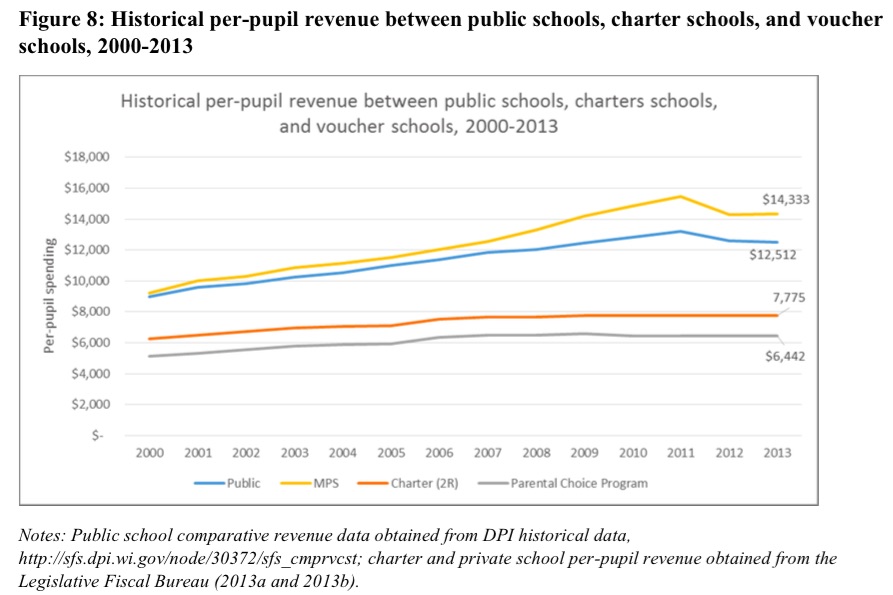
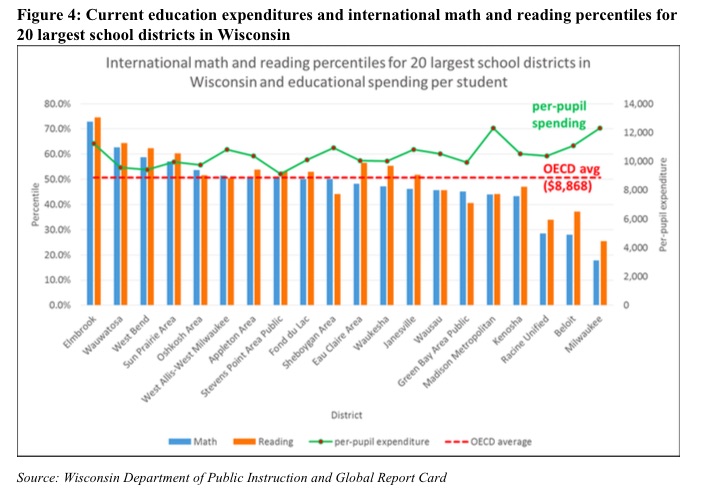
Madison’s 2014/2015 budget includes a 4.2% property tax increase while spending between $15,000 and 16,000 per student – double the national average.

Related:

Madison’s long term disastrous reading results.

Substantial questions have been raised about the District’s last maintenance referendum. Unfortunately, we’ve not seen any additional information.

K-12 taxes and spending have increased substantially over the years, with little change in academic outcome.

Share

Are the Kids Really All Right?

Sandra Knisely:

As the cost of higher education increases, campus experts debate how to protect students from making disastrous choices — and explore whose responsibility it is to do so.

“This is insane.”

That’s what Susan Fischer ’73, ’79 told an out-of-state father when he called the UW–Madison Office of Student Financial Aid to discuss taking out a loan package totaling almost $160,000.

The response? “He said, ‘I appreciate your opinion, but our children want to go [to the UW], and we’re going to let them,’ ” says the office’s longtime director.

For the UW experts who study or work closely with student borrowers, discussions about debt usually lead to discussions with and about parents. After all, the current federal financial aid system is built on the assumption that parents will provide their college-aged children with at least some measure of financial support until age twenty-four. Yet for students who come from families less adept at financial decision-making, the existing student-loan structure can put them at a disadvantage.

A growing number of UW researchers are focused on developing a better understanding of the impact of indebtedness, both on the well-being of individual students and on the system of higher education as a whole. For example, School of Human Ecology Dean Soyeon Shim is overseeing the first longitudinal study of its kind to track the effect of financial literacy and indebtedness on young-adult well-being. And Nicholas Hillman, an assistant professor of educational leadership and policy analysis, is developing ethical frameworks for college financial-aid strategies and policy recommendations related to student loans.

Share

The Price is Right

Jenny Price

Who decides how much college tuition will be each year? Why does it keep going up (and up)? Is it worth the price? Studies — and graduates — say yes.

Once upon a time, students could make enough money to cover the entire cost of going to college by working during their summer and winter breaks.

These days, that sounds like a fairy tale.

Consider this recent headline from the Onion, which didn’t quite feel like satire: “New Parents Wisely Start College Fund That Will Pay for 12 Weeks of Education.”

The price tag for attending college has increased dramatically over the last two decades, with tuition more than tripling at public universities between 1988 and 2008, according to the National Conference of State Legislatures. That trend includes the UW, where tuition went up 140.6 percent between the 2002–03 and 2012–13 academic years.

About one-fourth of that increase was directly due to the Madison Initiative for Undergraduates (MIU), a program students approved to address access to classes, improve advising, and offer more financial aid.

The intense focus over ever-increasing tuition bills even prompted New York Senator Charles Schumer to suggest penalizing schools that don’t keep tuition costs within the rate of inflation. Yet frustrated students and parents continue to find ways to pay because they believe that a four-year degree is worth the expense — and there is plenty of evidence that they are right.

Share

How the “performance revolution” came to athletics—and beyond.

James Suroweicki:

The arms race centers on an obsessive scrutiny of every aspect of training and performance. Trainers today emphasize sports-specific training over generalized conditioning: if you’re a baseball player, you work on rotational power; if you’re a sprinter, on straight-line explosive power. All sorts of tools have been developed to improve vision, reaction time, and the like. The Dynavision D2 machine is a large board filled with flashing lights, which ballplayers have to slap while reading letters and math equations that the board displays. Football players use Nike’s Vapor Strobe goggles, which periodically cloud for tenth-of-a-second intervals, in order to train their eyes to focus even in the middle of chaos.

Training is also increasingly personalized. Players are working not just with their own individual conditioning coaches but also with their own individual skills coaches. In non-team sports, such as tennis and golf, coaches were rare until the seventies. Today, tennis players such as Novak Djokovic have not just a single coach but an entire entourage. In team sports, meanwhile, there’s been a proliferation of gurus. George Whitfield has built a career as a “quarterback whisperer,” turning college quarterbacks into N.F.L.-ready prospects. Ron Wolforth, a pitching coach, is known for resurrecting pitchers’ careers—he recently transformed the Oakland A’s Scott Kazmir from a has-been into an All-Star by revamping his mechanics and motion.

Then there’s the increasing use of biometric sensors, equipped with heart-rate monitors, G.P.S., and gyroscopes, to measure not just performance (how fast a player is accelerating or cutting) but also fatigue levels. And since many studies show that getting more sleep leads to better performance, teams are now worrying about that, too. The N.B.A.’s Dallas Mavericks have equipped players with Readiband monitors to measure how much, and how well, they’re sleeping.

Share

Why Parents Prefer Charters

Marlene Gonzalez and Hector Nieves:

What wasn’t said in the Oct. 29th NJ.com story, “N.J. charter schools see smaller percentages of poor and special needs students than districts,” was the implication that charter schools are the creation of better-off, better-educated parents who want to make sure their children are spared the miserable education of the state’s failing urban schools.

But the author of the study, Rutgers professor Julia Sass Rubin, seemed to blame poor parents for not getting more of their children into urban charter schools, saying, “People in abject poverty don’t have the band-width to even evaluate charter schools.”

Speaking on behalf of more than 1,000 families who made the choice to send their children to the LEAP Academy charter school in Camden, we have had the bandwidth to evaluate the education available to children in traditional public schools in cities such as Camden, Trenton and Newark. In spite of the thousands of dollars that poured into these districts, even when they have been under state oversight, the results have been atrocious and simply unacceptable.

Share

Commentary on standardized Tests

Grant Wiggins:

An old lament. Here’s what bugs me. Many of us made this argument 25 years ago. The limited value of secret one-shot standardized tests as feedback has been known for decades. They may be acceptable as low-stake audits; they are wretched as feedback mechanisms and as high-stakes audits. Why don’t audits work when they are high-stakes tests (unlike, say NAEP or PISA)? Because then everyone tries to “game” them through test prep. This inevitability was discussed by George Madaus and others 40 years ago.

Openness is everything in a democracy. Without such openness, what difference does it make if the PARCC or SB questions offer better tests – if we still do not know what the specific question by questions results are? There can be no value or confidence in an assessment system in which all the key information remains a secret. Indeed, in some states you can be fired for looking at the test as a teacher!

PARCC or no PARCC, educators and educational associations should demand that any high-stakes test be released after it is given, supported by the kind of item analysis noted above. We don’t need merely better test questions; we need better feedback from all tests. Fairness as well as educational improvement demand it. And PS: the same is true for district tests.

Share

K-12 Grants & Outcome Responsibilty

Larry Cuban

When foundation grants fail to achieve the objectives officials sought, philanthropists turn their backs, shrug, and walk away. They have no responsibility to districts, individual schools, teachers, students and parents for hopes raised and dashed. Donors are beyond the reach of being fired or voted out of office. Yet as anyone knows from personal experience, admitting error is crucial to insights into a problem and, ultimately invention of better ways to solve it.

For those who support philanthropic giving, this unaccountability is an exercise of personal liberty in taking actions for the public good and is in the best tradition of a democracy. Moreover, some have argued: “[S]uch virtual immunity represents foundations’ greatest strength: the freedom to take chances, to think big, to innovate, to be, in the words of the late Paul Ylvisaker of the Ford Foundation, ‘society’s passing gear.’ “ [i]

Being society’s “passing gear,” however, assumes that funders and their retinue of experts know best how to identify educational problems, sort out symptoms from fundamental causes, and adopt solutions that solve the problem. When donors bet foolishly or are simply wrong and projects and programs fail who are these funders answerable to for their errors in judgment? No one, as far as I can see.

related: “the grants made us do it “. “Small learning communities“.

Share

Risky bonds prove costly for Chicago Public Schools

Jason Grotto and Heather Gillers,:

Fresh from the world of high-stakes trading, David Vitale arrived at Chicago Public Schools a decade ago with a plan to transform the way it borrowed money.

With the district thirsty for cheap cash, plain old municipal bonds weren’t good enough anymore, and banks were standing by with attractive new options.

So Vitale, then the chief administrative officer at CPS, and other officials pushed forward with an extraordinary gamble. From 2003 through 2007, the district issued $1 billion worth of auction-rate securities, nearly all of it paired with complex derivative contracts called interest-rate swaps, in a bid to lower borrowing costs.

Share

The Places in America Where College Football Means the Most

Neal Irwin & Kevin Quely:

It is hard to explain to someone who grew up in a big city in the Northeast just how big a deal college football is in the Southeast.

College sports, and particularly football, occupy a role at the center of daily life in the South — like in South Carolina, where one of us grew up — that is hard to imagine for many people who grew up in New York or Boston.

Last month we published The Upshot’s map of college football fandom, showing where people root for what college teams. That map offers great detail about what teams college football fans root for in a given location, but nothing about how concentrated college football fans are in that place.

Here, we are looking at another question: not which teams fans root for, but the proportion of the population in various places who are fans of any college football team. We asked Facebook to compile that information, and the results offer a portrait of America’s college-football obsession — or lack thereof. To be more specific:

Share

Law Schools & Legal 1%

Jeffrey Toobin:

After every recession since the Second World War, the legal profession swiftly and robustly recovered. Not this time. The market for lawyers shrank following the post-2008 recession, and no one thinks that it’s coming all the way back. What’s happened in the legal world represents a twist on developments in the larger economy. In law, as in the nation, the rich are getting richer and the poor are getting poorer. With lawyers, though, it’s the system of professional education that’s directly contributing to inequality.

In the legal world, the haves are doing better than fine. In 1985, average profits per partner in The American Lawyer’s list of leading law firms was $309,000 ($623,000 in current dollars); today, the profits per partner for roughly the same group is about $1.5 million. These numbers hide an even greater disparity. Those at the very top of the pyramid—firms such as Wachtell, Lipton, Rosen & Katz; Quinn Emanuel Urquhart & Sullivan; Cravath, Swaine & Moore; and a handful of others—are thriving as never before, with annual profits per partner in the multimillions.

Share

On Student Loan Debt

Michael Haltman:

The cartoon below provides a tongue-in-cheek alternative payback method for unemployed or under-employed recent college graduates!

Currently the recent college graduate unemployment rate in the nation is running in the range of 8.5% compared to the overall national average under 6% (new employment data will be released tomorrow).

This statistic, when coupled with an average individual student loan debt burden of more than $29,000 and outstanding aggregate student loan debt nationally above $1 trillion, poses a problem.

In addition there are few parents of college-age students who haven’t heard the stories of college graduates unable to find full-time work in their chosen field instead taking part-time jobs or unpaid internships simply to build their resume.

Share

Using photos with English language learners

Larry Ferlazzo:

“A picture is worth a thousand words.”
— Unknown

Though the origin of this popular adage is unclear, one thing is clear: using photos with English-Language Learners (ELLs) can be enormously effective in helping them learn far more than a thousand words — and how to use them.

Usable images for lessons can be found online or teachers and students can take and use their own.

The activities presented below connect to multiple Common Core Standards including the following ELA Standards:

Share

On B-School Test, Americans Fail to Measure Up; “Improve K-12 Math”

Lindsay Gellman:

New waves of Indians and Chinese are taking America’s business-school entrance exam, and that’s causing a big problem for America’s prospective M.B.A.s.

Why? The foreign students are much better at the test.

Asia-Pacific students have shown a mastery of the quantitative portion of the four-part Graduate Management Admission Test. That has skewed mean test scores upward, and vexed U.S. students, whose results are looking increasingly poor in comparison. In response, admissions officers at U.S. schools are seeking new ways of measurement, to make U.S. students look better.

Domestic candidates are “banging their heads against the wall,” said Jeremy Shinewald, founder and president of mbaMission, a New York-based M.B.A. admissions-consulting company. While U.S. scores have remained consistent over the past several years, the falling percentiles are “causing a ton of student anxiety,” he said.

we continue to play in the “C” (D?) leagues.

Madison’s disastrous reading scores.

Math forum audio and video. Math task force.

Madison School Board Accountabilty Commentary.

Share

New on Campus: The 3-Year Degree

Melissa Korn:

To combat rising college costs and student debt, more schools are offering a time- and money-saving idea: a three-year bachelor’s degree.

Schools including Purdue University, the University of Iowa and the University of South Carolina are betting that students will want to finish college sooner by spending a year less on campus. Whether there will be many takers, however, remains unclear.

Many early experiments with accelerated degrees have fallen flat. While cost is a crucial consideration for most families, and the vast majority need to borrow money, many students are eager to enjoy every bit of traditional college life, including social activities, athletics and summers off. The accelerated programs require students to give up some of these perks.

“Parents are really interested in saving time and money, [but] the students are really interested in the four years of a college experience,” said Jenna Templeton, vice president of academic affairs at Chatham University in Pittsburgh.

Share

“major issue of these schools is the high concentration of low-quality teachers who tested poorly when receiving their teacher licenses.”

Education News 3:

The report suggests that these schools make a concerted effort to hire both veteran teachers and new teachers, with more incentives such as merit pay being offered to high performing teachers. The Legislature suggests allowing schools to use $5,000-$15,000 each year for this purpose.

“Those teachers that are the best prepared to teach these children should be able to get greater income and be rewarded for the wonderful job that they’re doing,” said Senator Sue Wilson Beffort.

However, not everyone agrees with the report. The Albuquerque Teachers Federation claim the report is merely pushing solutions based on half of the story.

“They don’t have an evaluation system that can truly identify effective teachers because they’re just relying on test scores I think it’s a wrong-headed reform scheme that has been disproven in many, many states,” said Ellen Bernstein, president of the Albuquerque Teachers Federation.
In order to create a successful school, low-income school leaders must use financial resources wisely to give the most support to the areas that need them, coordinate services, help teachers, keep track of student progress, and also maintain a good relationship that keeps parents and the community involved.
– See more at: http://www.educationnews.org/education-policy-and-politics/new-mexico-report-weak-teachers-not-just-poverty-hurt-learning/#sthash.ireU175S.dpuf

Share

In California education debate, the tide is turning

UT San Diego:

The easy re-election win of state Superintendent of Public Instruction Tom Torlakson on Tuesday was a big disappointment to education reformers. They believed Marshall Tuck — a polished, well-funded Democrat with a strong record as an education executive in Los Angeles — was the perfect candidate to unseat Torlakson, a Bay Area Democrat who has acted more like an appendage of the state teachers unions than a nonpartisan officeholder devoted to improving schools.

But in the big picture, we think Tuck’s candidacy will be remembered as one of the turning points in a period in which the school reform debate at long last took center stage in California. The education establishment is like a supertanker that requires the application of vast energy to make it to change course. There are subtle but unmistakable signs this course change has begun.

Share

UW Madison to assist liberal arts majors in job search

Dean Simmons:

Call it the cranky parent appeasement program, designed to arm UW-Madison students majoring in art history or Polish or zoology with answers to a common question: How will you get a job in that?

John Karl Scholz, dean of the College of Letters and Science, is launching a large new program to improve career planning and job outcomes for students in his college, by far the largest at the university with more than 16,000 undergraduates in 39 departments.

The effort comes amid some questions nationally about the value of a college degree, especially in liberal arts majors that don’t lend themselves directly to a career path but cost the same — and result in the same debt loads — as more job-ready majors such as accounting or nursing.

Scholz pointed to evidence that majoring in what makes the heart sing does lead to jobs that make the wallet smile.

“Trying to spark their imagination about what they can do with different majors strikes me as really important,” said Scholz, in his second year as dean.

Share

Harvard secretly photographed students to study attendance

Matt Rocheleau:

Harvard University has revealed that it secretly photographed some 2,000 students in 10 lecture halls last spring as part of a study of classroom attendance, an admission that prompted criticism from faculty and students who said the research was an invasion of privacy.

The clandestine experiment, disclosed publicly for the first time at a faculty meeting Tuesday night, came to light about a year-and-a-half after revelations that administrators had secretly searched thousands of Harvard e-mail accounts. That led the university to implement new privacy policies on electronic communication this spring, but another round of controversy followed the latest disclosure.

“You should do studies only with the consent of the people being studied,” Harvard computer science professor Harry Lewis said in an interview Wednesday.

Lewis said he learned about the study from two nontenured colleagues and asked administrators about it during the packed faculty meeting.

Share

Midterm Election Survey

Whiteboard Advisors:

54% of Insiders say the Republican win in the Senate will make post-secondary education a higher priority.

Exactly half of Insiders think Senate newcomers are unlikely to impact education policy or it’s too soon to tell. Echoing October’s report, Insiders said Lamar Alexander will “lead the charge.”

Education Insiders express slight optimism that both K12 and higher education policies will become higher priorities with Republican control of the Senate, though agreement between the President and Congress is unlikely. Insiders see attention gainful employment regulations as a possible area of focus.

Insiders repeatedly cite Senator Lamar Alexander, the presumptive chair of the HELP committee, as the key driving force behind both K12 and higher education legislation in the Senate. With the political winds in his favor, Alexander may have the support he needs to gain traction on key education policies. But Insiders do not see the newly elected senators as having a great impact on education policy.

Share

Madison Superintendent’s Perspective

Jennifer Cheatham:

Our strategy is no longer a laundry list of ever-changing “initiatives,” but instead a set of inter-related, long-term work aimed at eliminating the gaps in opportunity that lead to disparities in achievement.

It is directly focused on the day-to-day work of great teaching and learning. Put differently, our strategy directly impacts the daily work of teachers in a way that other efforts that have focused on the classroom periphery have not.

To be successful, this strategy requires us to continually monitor our progress, respond to issues as they arise, and manage the natural stages and pace of change.

As a district, we conduct a deep review of progress once a quarter — that first review is scheduled for this month. This process provides a space for us — school based leadership teams, central office, and board — to examine both implementation and outcomes, process concerns and questions from our staff, families and community, and to make adjustments, even major shifts in direction, if necessary.

If we use this process the way it was designed, we’ll continually identify strengths and challenges, understand root causes, collaboratively problem solve and chart our course forward.

Related: Madison’s disastrous reading results.

Jennifer Cheatham.

“Plenty of Resources”.

Share

Seeing Red: Stanford v. Harvard

Meg Bernhard:

STANFORD, Calif.—Stanford buzzes. Walk across any of the 8,000-plus acres of earthy-red tiles and dusty, rolling hills of the university’s grounds and you’ll find yourself dodging hundreds of bicycles, whose moving gears and wheels make the campus hum.

More than 13,000 bikes belonging to students and faculty traverse campus daily, according to the school’s website, and it’s no wonder why. Stanford University, a massive tract of land that occupies what was once Leland Stanford’s Palo Alto Stock Farm, is its own city, so large it requires an individual zip code.

In a way, the constant motion of Stanford’s bikers is indicative of the university’s dynamism. Even the university’s motto, “Die Luft der Freiheit weht”—or, “The Winds of Freedom Blow”—nods at Stanford’s focus on the cutting-edge of research and education in the 21st century.

Thousands of bikes decorate the Stanford campus.

Share

Fired school leaders get big payouts

Melanie Gutierrez:

A former Union City superintendent took home more than $600,000 last year, making her the top earner on a new online database tracking salary and benefit information for California public school employees.

Kari McVeigh, former superintendent of New Haven Unified School District in Union City, and two other superintendents from the Bay Area were among the highest-paid school employees in the state last year in large part because they were fired and received six-figure severance payouts, according to a Chronicle analysis of pay data recently made public by the state Controller’s Office.

The data shows that both small and large public school districts awarded administrators six-figure salaries, sometimes with lifetime health benefits, low- or no-interest home loans and golden parachutes, even as California emerged from a financial crisis that forced huge cuts to social service programs for the poor and elderly.

Share

Too Many Kids Quit Science Because They Don’t Think They’re Smart

Alexandra Osola:

For most students, science, math, engineering, and technology (STEM) subjects are not intuitive or easy. Learning in general—and STEM in particular—requires repeated trial and error, and a student’s lack of confidence can sometimes stand in her own way. And although teachers and parents may think they are doing otherwise, these adults inadvertently help kids make up their minds early on that they’re not natural scientists or “math people,” which leads them to pursue other subjects instead.

So what’s the best way to help kids feel confident enough to stay the STEM course? To answer this question, I spoke with Carol Dweck, a professor of psychology at Stanford University in California. Over the past 20 years, Dweck has conducted dozens of studies about praise’s impact on students’ self-esteem and academic achievement. Here is a transcript of our conversation, which has been condensed and lightly edited.

Alexandra Ossola: What sparked your interest in this field?

Share

The Changing Profile of Student Borrowers Biggest Increase in Borrowing Has Been Among More Affluent Students

Richard Fry:

Share of College Graduates From High-Income Families who Borrow Has DoubledIn 2012, a record share of the nation’s new college graduates (69%) had taken out student loans to finance their education, and the typical amount they had borrowed was more than twice that of college graduates 20 years ago. A new Pew Research Center analysis of recently released government data finds that the increase in the rate of borrowing over the past two decades has been much greater among graduates from more affluent families than among those from low-income families. Fully half of the 2012 graduates from high-income families borrowed money for college, double the share that borrowed in 1992-93.1

The rise in the rate of borrowing was also substantial among upper-middle-income graduates, with 62% of 2012 graduates from upper-middle-income households leaving college with debt, compared with 34% roughly 20 years ago.

Somewhat related: Wisconsin Governor Walker on the student loan crisis. Walker’s comments on the Doyle era mirror my limited experience.

Share

The best thing parents can do for schools

Lisa Grey:

I’m the parent of a public school student myself. So I know how much parents want to help.

American parents are more involved in the schools than ever before — much more so than in other countries.

I followed three American kids who studied as foreign exchange students in Finland, South Korea and Poland. You didn’t see parents at those schools. They weren’t coaching soccer or accompanying classes on field trips. I didn’t see those kinds of extracurricular activities. Instead, the parents were involved at home, working directly with their child’s education.

Research shows that it’s much more impactful to prioritize learning at home over community-building activities.

There’s this amazing study: The more time that parents spent on extracurriculars in a country’s schools, the worse the kids did in reading. It’s shocking.

Share

Five-year high schools challenge the K-12 model

Tim Nesbitt:

For years now, some school districts in Oregon have been allowing their high school seniors who are ready to graduate stay for another year, letting them take community college courses on the school district’s dime and bolstering their budgets with an extra year of state funding. Are these districts taking unfair advantage of the state’s school funding system? Maybe, but they are doing something that other districts should emulate for its purpose, creativity and results.

Critics contend that districts which offer extended high school programs have been helping themselves to a larger and unfair share of the state school fund, which provides funding for students until receipt of a diploma. (Restrictions kick in at ages 20 and 21.) Dallas High School enrolls 25 percent of last year’s senior class in its Extended Campus Program with Chemeketa Community College. Those students have earned the credits needed for a high school diploma. But, by postponing the award of their diplomas, the district can claim state funding averaging $6,500 for each of them – enough to pay for a full load of community college courses and provide support from the high school’s counselors as well.

Smaller districts like Lebanon and Redmond have copied the Dallas program. But, if any of Oregon’s large urban districts were to follow suit, they would spark a run on the K-12 bank. Suppose 25 percent of all high school seniors in Oregon were to opt into a program of this kind. The state would then have to come up with an extra $70 million a year or districts would have to redistribute that amount from their K-12 classrooms to support these additional students.

Rather than more years, the trend, imho, should be towards a shorter, more rigorous K-12 experience.

Share

The Teachers Unions First Lost The Media; Have They Now Lost Everyone Else, Too?

Andrew J. Rotherham & Richard Whitmire:

This may mark one of the great missed opportunities in education. With a sympathetic president as a partner, national union leaders could have spent the last five years telling their members the truth: The nation’s classrooms are changing fast, now at 50 percent poor and minority students, and our schools are simply not good enough for too many students. So the entire education sector, including teachers, must change as well.

But they didn’t. Instead, union leaders spent the last five years telling their members that change was not necessary. You are blameless, they insisted in their fight against “reformers.” You’re being demonized. Poverty is to blame, not our schools.

Those demanding change, they insisted, are “corporate reformers” out to “privatize” your schools. What’s needed instead, they told their teachers, was a massive digging-in to block those very changes.

Share

Stanford MBA’s shift away from tech

Poets & Quants:

Lured by some of the most exorbitant pay packages ever given to MBAs, Stanford University’s Graduate School of Business made finance once again the industry of choice this year. Nearly three of every ten MBA graduates at Stanford, or 29% of the Class of 2014, accepted job offers in finance, up from 26% last year. So much for all those reports suggesting that finance is out of favor.

The increase, largely due to more acceptances in private equity, investment banking and investment management, came at the expense of the technology industry and consulting. Last year 32% of Stanford’s graduating MBAs rushed into tech. This year, the percentage fell to just 24%. Consulting fell to 16%, down three full percentage points from the 19% who chose to become consultants last year. For the consulting industry, it’s one of the lowest draws out of the Stanford pool ever. Only five years ago, in 2009, 32% of the class headed into the field.

Share

Lies, Damned Lies, and College Admissions

Steve Cohen:

College-application season is shifting into high gear, and with it comes anxiety and abuses—on both sides of the admissions desk. Some wealthy parents will pay private counselors more than $40,000 for “tweaking” their kids’ essays, on the implicit promise that these consultants have connections inside admissions offices, where many once worked. For their part, admissions directors want more applications so that they can reject a higher percentage of qualified kids. By boosting their rejection rates, they improve their school’s position in most rankings. While the current admissions system works well for a small number of colleges and over-achieving kids, for everyone else, the process is broken. Colleges, government, and the media all share in the blame.

Recently, Inside Higher Education, with Gallup’s help, published its annual survey of college- admissions officers. The report was sobering: 93 percent of the college-admissions officers surveyed said they believed colleges lie about key data they report, such as average SAT scores of admitted students. Why? It makes their schools appear more selective, which attracts more applicants. Sixty-five percent of admissions officers said that their institution did not meet its enrollment goals last year.

Share

FL families begin using new parental choice scholarship accounts

Redefined Ed:

One of the nation’s newest parental choice programs is shifting into higher gear.

PLSAFamilies of hundreds of Florida students with significant special needs, including autism, Down syndrome and cerebral palsy, have been given the green light to begin using Personal Learning Scholarship Accounts for the 2014-15 school year.

So far, parents of more than 1,200 students have been awarded PLSAs, which give them the resources and flexibility to access a range of educational services, including private schools, tutors, therapists, curriculum and materials. The Florida program is the second of its kind in the country, and some education policy experts see it and a similar program in Arizona as models for a new wave in parental choice.
– See more at: http://www.redefinedonline.org/2014/11/fl-families-begin-using-new-parental-choice-scholarship-accounts/#sthash.aUCDrsjl.dpuf

Share

Philadelphia Schools: Another Year, Another Budget Crisis (spends $21,425/student)

Claudio Sanchez:

“Lets say you’re an employee making $70,000 a year.” says Stanski. “That’s about a $14,000 payment to your pension fund. It’s just not sustainable and yeah, it worries me tremendously.”

Philadelphia’s school superintendent, William Hite, says the math just doesn’t add up. The district, he says, has seen “years of reductions of revenue, years of spending beyond what the district was taking in — not just over the last two years but for the past decade.”

Marjorie Neff agrees. She’s a former principal and one of five members of the School Reform Commission that took over the district in 2001 to stabilize its finances. Instead, the commission has lurched from one budget shortfall to the next.

It has had to shut down 31 schools and lay off thousands of teachers, reading coaches, librarians, nurses and counselors in the last two years.

Related: Philadelphia spends $21,425 per student!

Share

97 Percent of Md. Teachers Receive ‘Effective’ Grades

WNEW:

A report card released Tuesday for Maryland public school teachers reveals nearly three percent of those educators are rated ineffective, the Maryland State Department of Education says.

Evaluations completed for the 2013-14 school year show that 97 percent of teachers were rated either “highly effective” or “effective” in the state’s three-tiered rating system.

The majority of those teachers, about 56 percent, were rated effective, while 41 percent received the highly effective rating and almost three percent were found ineffective.

MSDE says schools in the highest quartile for poverty and minorities have more ineffective and fewer highly effective teachers than schools in the lowest quartile for poverty.

Share

Why I Wasn’t Able to Talk to New York City’s Teachers

Joel Klein:

What makes for a great teacher? For generations, educators operated on the belief that great teaching was mostly an art, which the talented refine in the privacy of the classroom over many years of work. Think Sidney Poitier’s Mark Thackeray in To Sir with Love or Richard Dreyfuss as Glenn Holland in Mr. Holland’s Opus. The trouble with this romanticized idea is that it all depends on the individual. Yes, some educators grow and develop on their own initiative. But this model assumes that all teachers will naturally progress and negates the possibility that any educator can be coached or challenged to improve.

And because teaching happens behind closed doors, this conventional wisdom protects less-competent teachers from being assessed and, if necessary, removed. Truly awful teachers can effectively commit malpractice (like bad doctors) against thousands of unsuspecting students throughout a thirty-year career and still collect the same pay, benefits, and pensions as their most effective peers.

Share

Minneapolis’ worst teachers are in the poorest schools, data show

Alejandra Matos:

Minneapolis officials say they’re taking action to balance needs with abilities.

New teacher evaluation data show that Minneapolis schools with the largest number of low-income students have the highest concentration of poor-performing instructors.

Students in the most affluent neighborhoods of the city are far more likely to have the best and most experienced teachers, according to school district records obtained by the Star Tribune.

The new information is emerging as Minneapolis schools are facing federal scrutiny for an achievement gap between white and minority students that is among the worst in the nation.

“It’s alarming that it took this to understand where teachers are,” Superintendent Bernadeia Johnson said Friday. “We probably knew that, but now have the hard evidence. It made me think about how we need to change our staffing and retention.”

Share

NPR & School Discipline

Ross T:

Share

Once Sleepy Campaign Issue, Education Gains Clout

Philip Elliott:

Middle school art teacher Cynthia Bliss laced up her sneakers, grabbed a jacket and spent most of a recent Saturday asking strangers to help her oust Republican Gov. Scott Walker from office.

“We’re teachers in the area and this election is very important to us,” Bliss told one voter on the front steps of a house.

“You don’t even have to talk,” the older woman at the door replied. “We’re the choir you’re preaching to.”

Bliss, who teaches in Fort Atkinson, wrote down the answer and marched back to the sidewalk, where autumn leaves crunched underfoot. For her — and hundreds of other Wisconsin teachers — booting Walker from the Capitol has been a priority.

“If Scott Walker wins re-election, he will keep his current policies and put them on steroids,” Bliss said as she walked to the next house. “That’s not acceptable to me.”

Share

Returns on College Endowments Average 15.8. Percent

Tamar Lewin:

The average return, after fees, on college and university endowments was 15.8 percent in the fiscal year that ended in June, up from 11.7 percent the previous year, according to the preliminary data collected for the annual Nacubo-Commonfund Study of Endowments, which will be released in January. The largest endowments — those over $1 billion — had the highest average return, 16.8 percent. The study, based on data from 426 colleges, found that colleges were allocating more than half their investments — and almost two-thirds of the largest endowments — to alternative strategies such as hedge funds and private equity.

Share

State Education Rankings

Dr. Matthew Ladner & Dave Myslinski:

The 19th edition of the Report Card on American Education is a comprehensive overview of educational achievement levels, focusing on performance and gains for low-income students, in all 50 states and the District of Columbia. The Report Card details state-by-state grades in the following policy areas:

1. State Academic Standards

English and Language Arts

Mathematics
2. Private School Choice Programs

“A” Grade or Multiple programs
3. Charter Schools

Charter Schools Allowed
Charter School Law Grade
4. Teacher Quality

Delivering Well Prepared Teachers
Expanding the Teaching Pool
Identifying Effective Teachers
Retaining Effective Teachers
Exiting Ineffective Teachers
5. Online Learning

Multi-District, Full-time Online SchooDigital Learning Now! Metrics Achieved
6. Home School Regulation Burdens

Share

‘We have to do better’ – Trenton school officials seek reversal of low test scores

Jenna Pizzi:

For students from third to eighth grades, achievement has remained stagnant over the last five years. Last school year, the district had 26.9 percent of third graders ranked as proficient or above in language arts. That proficiency stayed in the low 20 percent range for grades four through seven. In eighth grade, 42.2 percent were ranked as proficient or higher in language arts and literacy.

Math scores hovered between 44 and 32 percent proficient in the 2013-2014 school year for grades three through six. For grades seven and eight, scores sank to 20 and 25 percent, respectively.

In the HSPA test given to 11th graders, there was a 71 percent proficiency in language arts and a 39 percent proficiency in math. There has been an improvement in language arts in the last four years, said Edward Ward, supervisor of instructional technology and accountability.

Johnson said her team is crafting a response by gathering information from teachers in high achieving schools in the district about their best practices and proven methods while also examining what works throughout the state and country.

Via Laura Waters.

Madison has long tolerated disastrous reading results.

Share

Walter Benjamin’s Radio Plays for Kids (1929-1932)

open culture:

Benjamin’s youth and adult programming has been collected by Verso press in a new book entitled Radio Benjamin, which “brings together some of his most accessible” thinking. “Fascinated by the impact of new technology on culture,” writes Verso, Benjamin “wrote and presented something in the region of eighty broadcasts using the new medium of radio.” Between 1929 and 1932, he delivered around 30 broadcasts he called “Enlightenment for Children” (Aufklärung für Kinder), many of which you can hear read in the original German by Harald Wiesner at Ubuweb (German speakers, listen to an episode above). These, Ubuweb informs us, focused on “introducing the youth to various, some of them classical, natural catastrophes, for instance the Lisbon earthquake of the 1750’s that so shook the optimism of Voltaire and the century.”

Another of Benjamin’s subjects was “various episodes of lawlessness, fraud and deceit, much of it recent.” During one such broadcast, “The Bootleggers,” Benjamin wonders aloud rhetorically, “should children even hear these kinds of stories? Stories of swindlers and miscreants who break the law trying to make a pile of dough, and often succeed?” He admits, “It’s a legitimate question.” He then goes on to elucidate “the laws and grand intentions that create the backdrop for the stories in which alcohol smugglers are heroes” and tells, in fascinating detail, a few “little tales” of said heroes.

Share

Greek Letters at a Price

Risa Doherty:

Imagine finding a bill for $200 in your mailbox because your daughter was late to a couple of sorority events. Imagine, too, that those who snitched were her new best friends. This is one of the unwelcome surprises of sorority membership.

Depending on the generosity of the vice president of standards, a fine can be reversed with proof of a qualifying reason, such as a funeral, doctor’s appointment or medical emergency, so long as a doctor’s note is forthcoming. A paper due or a test the next day? No excuse. (Fraternities, by the way, rarely impose even nominal fines to enforce punctuality.)

Now imagine attending mandatory weekend retreats, throwing yourself into charitable work, making gifts for your sisters and, at tradition-thick schools like the University of Alabama and University of Missouri, investing 30 to 40 hours pomping — threading tissue paper through chicken wire to create elaborate homecoming decorations or parade floats that outdo rivals’.

Continue reading the main story
RELATED COVERAGE

Go to Education Life »
During fall or winter rush, sororities court starry-eyed freshmen. They showcase their joyful conviviality with skits and serenades. They stress the benefits of joining, and brag about attracting the prettiest, smartest or most athletic. At many traditional sororities, however, not much energy is spent explaining what is expected, leaving many pledges unaware of the considerable time commitment and costs.

Photo

Some sororities will fine members for being late to events. It can be reversed, with a doctor’s note.

Share

The Crusades in Arab School Textbooks

J. Determine:

This article examines the depiction of the Crusades in Arab school textbooks. In theintroductory first part, perceptions of the Crusades manifest in Arab historiography aredescribed. In addition, modern political discourses referring to the Crusades among Arabauthors, politicians and representatives of political Islam are explained. In the second part,accounts of the Crusades in school textbooks from Saudi Arabia, Jordan, Syria, Lebanon,Palestine, Egypt, Libya and Tunisia are analysed, focusing on the sources used by the books’authors, the terminologies, conceptions, reasoning, and narratives found in them, and the resultsof the Crusades as they are portrayed. The third part concludes by explaining three different approaches to how the textbooks relate the history, and shows the historical sensibilitiesconcerning the Crusades as taught by the schoolbooks

Share

Despite angst over standardized testing, Wisconsin may be on right path

Alan Borsuk:

This may be the most politically incorrect thing I’ve ever said in this space: There are positive things to say about what’s going on in standardized testing in Wisconsin.

Everybody hates testing. Kids, teachers, politicians of all stripes. Even the biggest testing advocates in the country say there is too much testing. Testing is useless. It interferes with real education. There is a lot of reason to take the criticism seriously.

But I say: Maybe there’s hope, and maybe Wisconsin is on a new and good path.

First, an anecdote: About 15 years ago, I attended the annual gathering of testing chiefs from states across the country. I remember a panel discussion in which four experts described what was wrong with the way testing was being done.

The fifth person on the panel was the education adviser to the then-governor of Indiana. His message: That’s nice, but my boss and legislature want test scores.

Guess whose viewpoint prevailed. And things got only bigger, more pervasive and more controversial. In 2002, the No Child Left Behind federal education law went on the books, with its requirement that pretty much every public schoolchild in America be tested in reading and math every year from third through eighth grade and at one grade in high school.

Wisconsin’s WKCE has long been criticized for its lack of rigor and poor timing. Yet, it continued for years…

“Schools should not rely on only WKCE data to gauge progress of individual students or to determine effectiveness of programs or curriculum”.

Share

Commentary on Monolithic K-12 a Governance

Larry Cuban:

I do not suggest that educational philanthropists have caused centralized policymaking or loss of faith in professional educators’ judgment since both had begun in the mid-1960s with the Elementary and Secondary Education Act underwriting federal and state actions and continued through the 1980s–A Nation at Risk called for states to act on their recommendations–and into the 1990s with the spread of mayoral control in big cities. And of course, No Child Left Behind (2002) has the U.S. Secretary of Education intervening into local schools as never before.

I do suggest, however, that “muscular philanthropy” has accelerated consolidation of authority at local, state, and federal levels with the consequence of even further shrinking citizen and school professional participation in governing schools.

Donors have also helped governors and state legislatures compete for federal funds offered through Race To The Top by bankrolling organizations helping officials negotiate federal eligibility rules to apply for funding. State legislation allowing more charter schools, evaluating teachers on the basis of student test scores, and adopting Common Core State Standards and tests strengthened state applications for federal funds. Few local school boards were involved or practitioner voices heard as these state laws imposed top-down requirements on every district and school.

Centralized governing of schools over the past decades has been done not only in the name of increased efficiency in operations and developing excellence in schooling but also in seeking egalitarian outcomes: leave no child behind, college for all, and equipping minority and poor students with essential skills to enter a 21st century workforce. This deep concern for those who have been educationally disadvantaged over decades is part of the belief system of foundation and corporate executives who push for centralized governance, curriculum and testing mandates, and accountability rules.

Via Noel Radomski.

Share

The students from Hong Kong who daren’t voice open support for Occupy

The South China Morning Post:

For Leo, one of about 5,000 Hongkongers studying at Jinan University in Guangzhou, the democracy movement feels achingly distant but its effects ripple through his daily campus life, widening the gulf with mainland students.

Leo often travels home on weekends to visit his family and has seen the street skirmishes up close.

He strongly supports the protest but, back on campus on weekdays, he’s careful about how he shows his interest. He shares photos about the movement with mainland friends but they express little interest, he says.

Organising a social activity, even one as benign as a Christmas get-together, is frowned upon by the campus administration, so a gathering with a political bent is out of the question.

“Many of us [Hongkongers] support and understand the students who remain in Admiralty, Causeway Bay and Mong Kok,” said Leo, whose full name cannot be used due to fears of possible reprisals by the school. “So far, we haven’t felt a taboo on talking about it on campus. But the conversations are usually only among the Hong Kong students.”

Jinan has the most international student body of any mainland university. Nearly a third of its 35,320 students come from Hong Kong, Macau, Taiwan or overseas countries.

Share

Philadelphia schools crippled by budget “crisis” ($2,814,500,000 budget or $21,425/student!)

PBS Newshour:

JOHN TULENKO: Last month, about 1,000 ninth graders marched to the football field at Northeast High School for a very different kind of kickoff ceremony.

WOMAN: We are doing a mock graduation. It’s an opportunity for our incoming ninth grade class to make a commitment. We want to put the urge in them that they promise they are going to be right back here in June 2018.

JOHN TULENKO: But hanging over this ceremony and the odds students will graduate is a school budget crisis that’s been called the worst in the country. Northeast has 3,000 students and two principals, Sharon McColskey and Linda Carroll.

SHARON MCCOLSKEY, Northeast High: In past years, operating budgets were probably 10 times what ours is right now, if not more.

Just the thought of opening the schools with what we have in the bank, real or in our budget, was really scary.

Philadelphia’s 2014-2015 $2,814,500,000 budget for 131,362 (2013–14) students. That’s $21,425 per student!

Related: Philadelphia school reform commission cancels teacher union contracts.

Share

UCLA faculty approves diversity class requirement

Larry Gordon:

The faculty of UCLA’s largest academic unit voted by a narrow margin to require future undergraduates to take a course on ethnic, cultural, religious or gender diversity. The move came after three previous efforts had failed.

Officials announced Friday that the faculty of the UCLA College of Letters and Science voted 332 to 303, with 24 blank ballots, to start the requirement for incoming freshmen in fall 2015 and new transfer students in 2017.

Share

Paul Vallas Criticizes Rauner’s Position On Charter Schools, Education Issues

“Progress Illinois”:

Illinois Gov. Pat Quinn’s running mate Paul Vallas, a former school executive, says he and GOP gubernatorial candidate Bruce Rauner have fundamentally different views on education reform.

Vallas is the former head of the Chicago Public Schools as well as the school districts in New Orleans and Philadelphia. He was most recently the schools chief in Bridgeport, Connecticut.

In the past as a school district leader, Vallas has promoted some controversial education reforms like charter school expansion, which Quinn opposes.

Both Rauner — a millionaire venture capitalist who has been a leader in the corporate education reform movement — and his running mate Wheaton councilwoman Evelyn Sanguinetti support charter school growth.

Much more on Paul Vallas, here.

Share

2 firms that won LAUSD’s tech program most active in seeking meetings

Howard Blume:

More than a year before the Los Angeles Board of Education agreed to an iPads-for-all program, Apple and a leading curriculum company repeatedly sought meetings with school board members, newly released emails and records reviewed by The Times show.

The communications with the board and representatives from Apple and Pearson far exceeded those with other vendors vying for a share of the $1.3-billion initiative to provide a computer, loaded with curriculum, to every student, teacher and campus administrator.

The emails and documents do not indicate that board members violated laws or L.A. Unified’s ethics policy. But they show how the two companies tried to win lucrative contracts with the nation’s second-largest school system. Both companies offered to give school board members informational sessions about their products and to explain how they were currently being used within the district and elsewhere.

Share

Is Sudden Decline Of For-Profit Colleges Good For Education?

James Marshall Crotty:

Though most for-profit college programs will remain open under the new Obama administration gainful employment regulations, the brand value of the for-profit college industry has been significantly hurt by intense scrutiny at all levels of government. Investigations by 37 state attorneys general, the Consumer Financial Protection Bureau, the SEC and the Department of Justice (DOJ) have heaped a world of financial pain – enrollment at for-profit colleges is down 9.7% this year – and negative publicity on the sector. While some for-profits will fight the administration’s new regulations in court — or hope that a newly Republican Congress will block spending for the mandates – many for-profits have already decided to opt out of the market altogether.

Last week, the Pittsburgh-based Education Management Corporation (EDMC) decided to go private, in part to avoid quarterly scrutiny by investors of its sizable legal issues. Moreover, Grand Canyon University (GCU) – whose spirituality-inflected curriculum, sports teams (Go Antelopes), and profitability set it apart from other for-profits – is considering going nonprofit in part to avoid the “stigma” that is attached to the “for-profit college” label. Then there’s the case of Corinthian Colleges, which was forced to “teach out” or sell most of its North American locations.

Share

K – 12 tax and spending climate: Child poverty in U.S. is at highest point in 20 years, report finds

Gale Holland:

Child poverty in America is at its highest point in 20 years, putting millions of children at increased risk of injuries, infant mortality, and premature death, according to a policy analysis published Monday in the journal JAMA Pediatrics.

As the U.S. emerges from the worst recession since the Great Depression, 25% of children don’t have enough food to eat and 7 million kids still don’t have health insurance, the analysis says. Even worse: Five children die daily by firearms, and one dies every seven hours from abuse or neglect.

Share

Missouri education department facilitators are paid $500 per meeting “plus necessary expenses”

Alex Stuckey:

Every couple of weeks since late September, educators, parents and business leaders have traveled to Jefferson City to participate in work groups tasked with developing standards to replace Common Core.

The meetings were scheduled by the Department of Elementary and Secondary Education in two-day clusters during the work week, forcing participants to miss work to attend. Participants aren’t paid. They’re not even reimbursed for their travel, food or lodging.

But the controversial department-appointed facilitators and note takers are: $500 per meeting plus “necessary expenses,” department spokeswoman Nancy Bowles said.

“That’s surprising, especially since they say they don’t have money to pay the (group) members’ … travel expenses,” Rep. Kurt Bahr, R-O’Fallon, said. “That does seem like a pretty good wage. The meetings are an all day affair but no more than a standard work day.”

Share

Voter Turn-out Needed for MTI Recertification Elections

Madison Teachers, Inc. Solidarity Newsletter, via a kind Jeannie Kamholtz email (PDF):

Getting Organized! MTI now has over two hundred (200) Member Organizers including teachers, educational assistants, clerical-technical employees, substitute teachers, security assistants, and retired MTI members who are committed to helping the next generation maintain their Union. Member Organizers are volunteers who have agreed to serve as point people in their building/work location to help build awareness and support for MTI’s recertification elections.

Get-out-the-vote! In political elections, voter turnout is critical. In Union recertification elections, it is even more critical. The experiences of other Wisconsin public sector Unions show that when employees vote, they overwhelmingly vote Union YES! Where recertification elections have lost, it is because less than 51% of the eligible voters cast a ballot. Unlike political elections, in recertification elections a non-vote counts as a “no vote”.

In MTI’s recertification election, ballots can be cast 24 hours per day, seven days per week, via phone or computer, beginning at Noon on November 5 and continuing through Noon on November 25. The process is quick and efficient and should take no more than a couple minutes. That said, others have reported difficulties where votes were not counted, when they failed to accurately complete each step in the balloting process. It is for that reason that MTI is providing all MTI-represented employees with detailed voting instructions on posters, flyers and palm cards.

The MTI Recertification Election palm cards provide MTI-represented staff the phone number, web address and voting instructions. On the reverse side of the palm card, voters are asked to complete their name, work location & bargaining unit and give the completed card totheirMTIFacultyRepresentativeorMemberOrganizer.

After doing so,one will receivean“IVoted”button. Someworklocations will hold raffles using the completed palm cards. By collecting completed palm cards, your Union organizing team will be able to try to assure that the 51% threshold is met, as mandated by Walker’s Act 10, during the 20-day election period. Additional information on MTI’s recertification elections is available at www.madisonteachers.org.

Share

Power, Money, Schools, Influence & Elections: The $30,000,000 California Superintendent Race

Caroline Porter:

The campaign for California’s top education post, typically a low-wattage contest, has become this state’s hottest race because of a division among Democrats over tenure rules and other policies that diminish teachers’ union power.

One sign of the high attention: Nearly $30 million has been spent on campaigns for the post—of state superintendent of public education,—compared with $13 million on the contested race at the top of the ticket, for governor.

The amount of direct campaign contributions, donations to independent groups and advertisements is more than triple the amount spent in the last superintendent’s race, in 2010, according to Autumn Carter, executive director of California Common Sense, a nonpartisan think tank.

The two candidates for superintendent,–incumbent Tom Torlakson and challenger Marshall Tuck, both Democrats,–are squaring off on hot-button issues in education, such as tenure laws, teacher evaluations and the role of testing in schools. Recent polls suggest voters are evenly split between the two men.

“The fact that the superintendent race is an almost $30 million race,…that’s a little mind-boggling,” said Ms. Carter.

Dive in:

Tom Torlakson: duckduckgo | Candidate Website.

Marshall Tuck: duckduckgo | Candidate Website.

Share

K-12 Tax & Spending Climate: A few charts

Jason Karaian & Matt Phillips:

4. America’s escalating student debt…

The stock of outstanding student debt in the US has surged to more than $1.1 trillion. This isn’t all bad news—more people are in college, which is a good thing. But some economists suggest that the burden of student debt is reshaping the spending patterns of younger Americans, prompting them to put off buying houses, cars, and much else besides.

5. …And its outlandish university tuition costs

Everyone knows that higher education is a costly undertaking in the US. But until they see this chart, it’s hard to understand exactly how expensive it is. Since 1978 college tuition costs have surged more than 1,200%, compared with an increase of 280% for overall prices, as measured by the consumer price index. For the record, US colleges counter that this measure only captures the “sticker cost,” and actually overstates the amount most students really pay because of grants and other financial breaks.

Share

New report by the Sutton Trust: What Makes Great Teaching

Daisy Christodoulou:

Today the Sutton Trust and the University of Durham have published a fascinating new report called What Makes Great Teaching? It sets out to answer that title question, as well as looking at ways we can measure great teaching, and how that could be used to promote better learning. Here is my short summary of some key points from the report.

1. What is effective teaching? This report is very honest about the fact that we don’t have as clear an idea of what good teaching is as we think we do. I think this is an important point to make. Too often, reports like this one start from the point of assuming that everyone knows what good teaching is, and that the challenge is finding the time/money/will/methodology to implement changes. This report is saying that actually, there are a lot of misconceptions about what good teaching is, and as such, reform efforts could end up doing more harm than good. We need to think more clearly and critically about what good teaching is – and this report does that. As well as listing what effective teaching practices are, it also lists what ineffective practices are. This list has already received some media attention (including a Guardian article with a bit from me), as it says that some popular practices such as learning styles and discovery learning are not backed up by evidence. The report draws its evidence from a wide range of sources, including knowledge from cognitive psychology. It cites Dan Willingham quite a lot, and quotes his wonderful line that memory is the residue of thought. As regular readers will know, I think cognitive psychology has a lot to offer education, so it is great to see it getting so much publicity in this report.

Share

It’s All About Nuance. How to Convey and Discern Email Tone.

Karen Lachtanski:

Everyone has been there. You’re emailing back and forth with someone at work and then all of a sudden, a sentence gives you pause. You think, Wait a second. Is she mad at me?

You reread it. Five minutes go by and you still can’t tell if you somehow offended this person or are completely missing a joke. Eventually, you just craft a vague response and hope for the best.

Tone can be hard to discern and convey over email and any other digital communication. In fact, a 2005 study, amusingly titled “Egocentrism over e-mail,” found that people vastly overestimate how often the recipient of a message will correctly identify their intended tone, whether serious or sarcastic. Senders estimated nearly 80 percent accuracy. In reality, recipients sensed the right tone only 56 percent of the time.

Share

Pushing back on reckless critique of charter schools

Crystal Williams:

Who is Julia Sass Rubin and what does she have against my kids?

Yesterday, the Rutgers University associate professor was quoted in The Star Ledger saying that “people in abject poverty don’t have the bandwidth to even evaluate charter schools. . . .It’s just not going to be high on their list.”

And about a month ago, in her quest to restrict the choice that parents like me have, she falsely suggested that the school my child attends in Newark loses more black boys to attrition than the district schools and that our school doesn’t serve “difficult” black boys.

Nothing could be further from my reality.

Share

Newsroom Open House

The Simpson Street Free Press will celebrate 23 years of academic success – Sunday, November 2, 12-3pm. Visit Dane County’s first after-school (and summer) youth center dedicated solely to core subject academics. Meet our student writers and see academic achievement in action. Get a newsroom tour from local kids who tackle achievement gaps everyday – with writing and hard work. Preview data that shows real results. SSFP students will thank all of you, the many Friends and supporters who make this youth center, and our students, successful. Location: South Towne Mall, 2311 West Broadway.

The Simpson Street Free Press (SSFP) delivers core subject academic instruction in after-school settings. Students (ages 8-18) write and produce five separate youth newspapers, including a new bilingual publication: La Prensa Libre de Simpson StreetSSFP graduates (now in college) supervise younger students. SSFP also operates a network of youth book clubs. The goal of the SSFP is to foster literacy, spark student success, and bridge achievement gaps.

The SSFP formula accomplishes multiple outcomes. Central to SSFP pedagogy is across the curriculum instructional practices. Lesson plans are designed to support in-school learning. Students encounter predictable connections to the school day. Young writers conduct research, use technology, write and read extensively. They learn practical and transferable academic strategies. They acquire real-world workplace skills. School grades and attendance are measured.  SSFP students participate in civic discourse and influence their peers. As their name suggests, free speech and journalism are great ways to spark learning.

Share

How Standing Desks Can Help Students Focus in the Classroom

Holly Korbey

The rise of the standing desk may appear to be a response to the modern, eat-at-your-desk, hunched-over worker chained to her computer, but history paints a different picture: Hemingway, Benjamin Franklin, and Thomas Jefferson all stood while they worked. Donald Rumsfeld had a standing desk, and so did Charles Dickens. Workplaces are moving toward more standing desks, but schools have been slower to catch on for a variety of reasons, including cost, convenience, and perhaps the assumption that “sit down and pay attention” is the best way to learn.

Mark Benden, Associate Professor of Environmental and Occupational Health at Texas A&M Health Science Center, is looking to change all that. Too much sitting is bad for our health, he said, and students are now facing a host of challenges that may stem in part from too much time in a chair, including obesity and attention disorders. So five years ago, Benden and his team began studying what happened to students when they got out of their traditional seats and moved to standing desks.

Share

Innovation in Education: An Empty Promise

Mike Crowley:

Innovation is among the most abused buzzwords in education today. While few doubt the need for schools to innovate, often, it seems, some school leaders – innovation chasers – those who are keen to attach the label of “innovator” to themselves, have failed to understand what innovation really means.

Horace Dediu has coined the term “innoveracy” to describe those who suffer from innovation illiteracy, the inability to understand the concept and role of innovation. This, he contends, is rooted in a “misuse of the term and the inability to discern the difference between novelty, creation, invention and innovation”. I tend to agree with Dediu’s perspective: too often what is falsely celebrated as innovation is, in reality, mere novelty.

Disastrous reading results remain job number one.

Share

Uncontrolled expansion: how private colleges grew

Andrew McGettigan:

Greg Clark, the new universities minister, has a revised job specification for his higher education responsibilities. Along with preventing violent extremism and promoting education exports, his ministerial brief states that he will oversee “widening participation for students and providers”. It seems that the term “widening participation” has been redefined to mean encouraging more private colleges into the sector.

In this way, Clark takes on the legacy left by his predecessor, David Willetts, who told assembled university heads at the Universities UK spring conference in 2011 that “the biggest lesson I have learned is that the most powerful driver of public sector reform is to let new providers into the system. They do things differently in ways none can predict.”

Millions of pounds of public funding is already being spent to support study at private providers, but beyond well-known private institutions such as BPP University and the University of Buckingham, a host of less familiar private colleges are benefiting from recent policy changes.

Share

This University Teaches You No Skills—Just a New Way to Think

Issie Lapowsky:

Ben Nelson says the primary purpose of a university isn’t to prepare students for a career. It’s to prepare them for life. And he now has $70 million to prove his point.

Nelson is the founder and CEO of a new experiment in higher education called Minerva Project. He says when it comes to learning, job training is the easy part. With the emergence of online courses, it’s easier and cheaper than ever to acquire the hard skills you need to land a job. “Why would you spend a quarter of a million dollars and four years to learn to code in Python?” he says. “If that’s the role of universities, you’d have to be insane to go to universities.”

But that doesn’t mean Nelson believes the country’s liberal arts colleges are doing a particularly terrific job either. He argues most schools do little more than teach students a core canon of information, a practice he says is archaic, given how much information people have access to these days. “Today, it’s absurd to say you need to know this information and without this information, you’re not an informed person,” he says.

Share

Berkeley, a city consumed by a soda tax

Berkeleyside:

On Nov. 4, Berkeley voters will show where they stand on Measure D, the so-called Soda Tax. The proposed tax on sugary beverages has been one of the most hotly debated Berkeley issues in the city’s history, and certainly one that has brought in record levels of campaign expenditure. The No on Measure D lobby has spent $2.3 million in an attempt to defeat the tax, according to campaign finance reports. Former New York mayor Michael Bloomberg has contributed $432,071 in support of the soda tax. (That includes $265,235 for network advertising for commercials during the World Series, $96,836 for cable ads, and a cash donation of $170,000 to the Yes on Measure D effort.) UC Berkeley’s Robert Reich has been vocal in his views — writing a blog post about the issue titled “In its battle with Big Soda, Berkeley may once again make history,” and shooting a video on the same subject.

Gael McKeon has spent several weeks documenting both sides of the campaign with his camera to create this photo essay of a pivotal moment in Berkeley’s political history, one that may set the stage for change nationwide. We publish it exclusively on Berkeleyside. (The ‘No on D’ campaign declined to participate in this story.)

Share

Academics must question more: Romila

Pheroze L. Vincent:

Historian Romila Thapar asked a full house of Delhi’s intelligentsia on Sunday why changes in syllabi and objections to books were not being challenged.

Prof. Thapar was delivering the third Nikhil Chakravartty Memorial Lecture here on Sunday, titled ‘To Question or not to Question: That is the Question.”

“There are more academics in existence than ever before but most prefer not to confront authority even if it debars the path of free thinking. Is this because they wish to pursue knowledge undisturbed or because they are ready to discard knowledge, should authority require them to do so,” the eminent historian asked.

Share

7 countries where Americans can study at universities, in English, for free (or almost free)

Rick Noack:

Since 1985, U.S. college costs have surged by about 500 percent, and tuition fees keep rising. In Germany, they’ve done the opposite.

The country’s universities have been tuition-free since the beginning of October, when Lower Saxony became the last state to scrap the fees. Tuition rates were always low in Germany, but now the German government fully funds the education of its citizens — and even of foreigners.

Explaining the change, Dorothee Stapelfeldt, a senator in the northern city of Hamburg, said tuition fees “discourage young people who do not have a traditional academic family background from taking up study. It is a core task of politics to ensure that young women and men can study with a high quality standard free of charge in Germany.”

What might interest potential university students in the United States is that Germany offers some programs in English — and it’s not the only country. Let’s take a look at the surprising — and very cheap — alternatives to pricey American college degrees.

Share

An American School Immerses Itself in All Things Chinese (nothing like this in Madison)

Jane Peterson:

On weekday mornings, a stream of orange buses and private cars from 75 Minnesota postal codes wrap around Yinghua Academy, the first publicly funded Chinese-immersion charter school in the United States, in the middle-class neighborhood of Northeast Minneapolis. Most pupils, from kindergarten to eighth grade, dash to bright-colored classrooms for the 8:45 a.m. bell, eager to begin “morning meeting,” a freewheeling conversation in colloquial Mandarin.

Meanwhile, two grades form five perfect lines in the gym for calisthenics, Chinese style. Dressed neatly in the school’s blue uniforms, the students enthusiastically count each move — “liu, qi, ba, jiu, shi.”

By 9:15, a calm sense of order pervades the school as formal instruction begins for math, reading, social studies, history and science. Instructors teach in Mandarin, often asking questions that prompt a flurry of raised hands. No one seems to speak out of turn. “We bring together both East and West traditions,” explains the academic director, Luyi Lien, who tries to balance Eastern discipline with Western fun.

Madison has largely killed off any attempt at innovative charter schools. Ironically, the Minneapolis teachers union is authorized to approve for charter schools.

Share

Rethinking the Lecture: In the Information Age, It’s Time to Flip the Classroom

Ryan Craig:

It’s been my experience that too much of the same thing tends to end badly — and higher education is no exception. It was that way in college when my roommate Chris decided his life’s work was to take the Doodle Challenge — at the time, beating the record of 19 burgers within a 2.5 hour session at The Yankee Doodle, the local greasy spoon.

For Chris, downing 20 burgers meant two things: immortality by way of his name on a plaque above the door and not having to pay for the 20 burgers. Chris started out strong. It wasn’t until the tenth burger that he showed any signs of slowing. But, at burger number 12, Chris began to cough and spit, and we knew his chance at glory was over.We paid the bill and enveloped Chris like a fallen prizefighter, hustling him out of the Doodle. That was the last Chris saw of the Doodle for some time, but not the last he saw of those burgers.

Share

Kano Rides Global Coding Wave

Lorraine Luk:

Riding on growing interest in coding, London-based startup Kano Computing Ltd. has shipped thousands of toolkits that allow users to build a computer and write software easily.

Last year, Kano raised about $1.5 million through crowd-funding site Kickstarter to manufacture the kit. The company has also raised over $2 million from investors including Index Ventures, Apple’s former Senior Director James Higa and Lady Gaga’s former manager Troy Carter to strengthen its team and further develop the product, said Kano co-founder and chief executive Yonatan Raz-Fridman.

The company has shipped 18,000 kits to customers on its pre-order list, including Kickstarter CEO Yancey Strickler and Apple co-founder Steve Wozniak, said Raz-Fridman. Since the beginning of this month, the Kano kit has been available for $149.99 online, including free shipping to 86 countries.

Share

Princeton Gets 10 Times as Much Tax Money per Student as Public Colleges

Joe Pinsker:

In 2002, Meg Whitman (Princeton class of ‘77), then president of eBay, pledged $30 million to her alma mater to be put toward building a dorm in her own name. The ultimate cost of the 500-student dorm, which required “skilled masons to cut thousands of pieces of stone” and featured three-inch-thick oak doors, worked out to about $200,000 per bed. Despite parting with $30 million at the time, one economist estimated that the real cost of the donation to her was much less: $20 million, thanks to the tax exemptions that come with donating to a university. In essence, the U.S. Treasury covered the $10 million gap.

The government—and thus, taxpayers—give a surprising amount of money to elite private colleges, a lot of which is hard to see because it comes in the form of tax deductions like Whitman’s. Equally hard to see, and perhaps even more lucrative, is that the federal government doesn’t tax the income that universities earn on their billion-dollar endowments. Some of these deductions exist to promote research; others exist because colleges, as institutions, make commitments to serve the public good.

Share

The Inheritance of Education

Richard V. Reeves and Joanna Venator:

Income is the currency of most mobility research – but money is not all that matters in life. There is a long list of other goods in life, including education, wellbeing, trust, agency, interesting work, and so on. Like most mobility researchers, we focus on income because it does matter in itself; because it can be converted to many of the other goods; and because it provides a robust basis for measurement and comparison.

Schooling and Social Mobility

But the transmission of education advantage is also of great interest. Even if someone does not convert a higher level of education into higher income, they are still better off. They can choose more interesting jobs, even if they are not highly-paid. They have more knowledge of the world and possibly of themselves. Education is a good in its own right, not just as a ticket to a fatter paycheck.

Share

K-12 Tax & Spending Climate: Having Babies New Sex-Ed Goal as Danish Fertility Rates Drop

Frances Schwartzkopff:

Sex education in Denmark is about to shift focus after fertility rates dropped to the lowest in almost three decades.

After years of teaching kids how to use contraceptives, Sex and Society, the Nordic country’s biggest provider of sex education materials for schools, has changed its curriculum to encourage having babies under the rubric: “This is how you have children!”

Infertility is considered “an epidemic” in Denmark, said Bjarne Christensen, secretary general of the Copenhagen-based organization. “We see more and more couples needing to get assisted fertility treatment. We see a lot of people who don’t succeed in having children.”

Share

Today’s key fact: you are probably wrong about almost everything

Alberto Nardelli and George Arnett:

Britons overstate the proportion of Muslims in their country by a factor of four, according to a new survey by Ipsos Mori that reveals public understanding of the numbers behind the daily news in 14 countries.

People from the UK also think immigrants make up twice the proportion of the population as is really the case – and that many more people are unemployed than actually are.

Such misconceptions are typical around the world, but they can have a significant impact as politicians aim to focus on voter perceptions, not on the actual data.

Bobby Duffy, managing director of the Ipsos Mori social research institute, said:

Share

On Teacher Quality (Status Quo in Madison)

Frank Bruni:

More than halfway through Joel Klein’s forthcoming book on his time as the chancellor of New York City’s public schools, he zeros in on what he calls “the biggest factor in the education equation.”

It’s not classroom size, school choice or the Common Core.

It’s “teacher quality,” he writes, adding that “a great teacher can rescue a child from a life of struggle.”

We keep coming back to this. As we wrestle with the urgent, dire need to improve education — for the sake of social mobility, for the sake of our economic standing in the world — the performance of teachers inevitably draws increased scrutiny. But it remains one of the trickiest subjects to broach, a minefield of hurt feelings and vested interests.

Klein knows the minefield better than most. As chancellor from the summer of 2002 through the end of 2010, he oversaw the largest public school system in the country, and did so for longer than any other New York schools chief in half a century.

That gives him a vantage point on public education that would be foolish to ignore, and in “Lessons of Hope: How to Fix Our Schools,” which will be published next week, he reflects on what he learned and what he believes, including that poor parents, like rich ones, deserve options for their kids; that smaller schools work better than larger ones in poor communities; and that an impulse to make kids feel good sometimes gets in the way of giving them the knowledge and tools necessary for success.

Related: Madison’s recent 2014-2015 budget simply perpetuates the monolithic K-12 governance model, despite its long term, disastrous reading results.

Share

Most Autistic People Have Normal Brain Anatomy

Nueroskeptik:

Published in Cerebral Cortex by Israeli researchers Shlomi Haar and colleagues, the new research reports that there are virtually no differences in brain anatomy between people with autism and those without.

What makes Haar et al.’s essentially negative claims so powerful is that their study had a huge sample size: they included structural MRI scans from 539 people diagnosed with high-functioning autism spectrum disorder (ASD) and 573 controls. This makes the paper an order of magnitude bigger than a typical structural MRI anatomy study in this field. The age range was 6 to 35.

The scans came from the public Autism Brain Imaging Data Exchange (ABIDE) database, a data sharing initiative which pools scans from 18 different neuroimaging centers. Haar et al. examined the neuroanatomy of the cases and controls using the popular FreeSurfer software package.

Share

Parents feel ‘unequipped’ to help children with maths

Josie Gurney-Read:

“It’s not a subject, maths, it’s a language. A language, without which, we cannot communicate. The teaching of arithmetic and algebra, for example, is like teaching the grammar of this language.”

It will perhaps be unsurprising to most that Carol Vorderman, who spent 26 years as co-host on the Channel 4 quiz show Countdown, should be working towards giving schoolchildren the resources and opportunity to achieve highly in maths at primary school.

Having created The Maths Factor – an online maths school for primary age children – four years ago, Vorderman will attend the first ‘graduation day’ today, for children who have made exceptional progress through the program.

Related: Math Forum.

Share

study found student outcomes improved markedly in classes where faculty did practically anything other than lecture.

Rachel Pincus:

Being a nonprofit, however, Code.org looking for some financial help with this initiative, which also includes preparing teachers to introduce coding skills for the first time. The approximate cost of bringing coding classes to such a large audience will be $5 million, $1 million of which is spent just running the campaign itself. To this end, they’ve used a popular crowdfunding platform to an unusual end: instead of serving up some new gadget or material perk, their Indiegogo page for the initiative instead promises some more cerebral perks, including a Q&A; for you or your school with Code.org founder and CEO Hadi Partovi or even an opportunity to “act like Oprah for a day.” Larger donors can get tax deductions for their contributions, in a similar way to more conventional donation channels.

Share

UNC-Chapel Hill Should Lose Accreditation

Brian Rosenberg:

I have read many responses to the report of corruption at Chapel Hill. Some argue that those at the center of the activities were simply trying to help at-risk students, to which my response is that awarding credits and grades without providing instruction is not “help” in any sense that I can accept. In the case of student athletes, I see it as closer to exploitation for the benefit of the university. Some argue that this behavior is widespread among institutions with highly visible Division I sports programs and therefore should provoke no particular surprise or outrage.

I hope that this last claim is untrue. If it is, however, the only way to alter such behavior is to respond with force and clarity when it is uncovered. Reducing the number of athletic scholarships at Chapel Hill, or vacating wins, or banning teams from postseason competition, is in each case a punishment wholly unsuitable to the crime. The crime involves fundamental academic integrity. The response, regardless of the visibility or reputation or wealth of the institution, should be to suspend accredited status until there is evidence that an appropriate level of integrity is both culturally and structurally in place.

Anything less would be dismissive of the many institutions whose transcripts actually have meaning.

Share

Rethinking vocational high school as a path to college

Emily Hanford:

For years, vocational high schools have been seen as a lesser form of schooling – tracking some kids off to work while others were encouraged to go on to college and pursue higher income professions. But things are changing. Vocational high schools are focusing much more on preparing students for higher education.

At one of those schools – Minuteman Regional High School in Lexington, Massachusetts – students can learn traditional trades like carpentry, plumbing and welding. They can also learn high tech fields such as video game design, engineering, and biotechnology.

Minuteman students spend half their time in vocational classes – often referred to as “career and technical classes – and half their time in academic courses. About 60 percent of the school’s graduates go on to college. That’s not the way things were when principal Ernest Houle learned welding at a vocational high school back in the 1980s.

“The highest-level math I ever had in high school was an Algebra 1,” says Houle. “And that only happened my sophomore year because it fit in the schedule.”

Share

RACE FOR A SCHOOL PLACE: Trojan Horse academy among most sought after schools

Emma McKinney:

A school at the heart of the Trojan Horse scandal has proven to be one of most sought after secondaries in the Midlands, the Birmingham Mail can exclusively reveal.

Park View School the Academy in Alum Rock was flooded with 884 applications – despite only being able to offer 120 places to pupils this academic year.

The over-subscribed school was so popular with parents wanting their child to start Year 7 at the controversial academy this September that it was flooded with more than SEVEN applications for each of its places.

Share

School discipline: is this working?

This American Life:

Stories of schools struggling with what to do with misbehaving kids. There’s no general agreement about what teachers should do to discipline kids. And there’s evidence that some of the most popular punishments actually may harm kids.

Share

K-12 Tax & Spending Climate: Government Salaries Compared to Teachers and Other Professions

In addition to supporting members of Congress and civil servants, U.S. taxpayers support welfare recipients. And they support them lavishly, too. Hawaii, Massachusetts, and D.C. residents receive sizeable welfare payments (read: salaries). Indeed, the magnitude of these payments exceeds the average salary of an American teacher, as well as a soldier deployed in Afghanistan, by at least $10,000 per year.

The public can forget all the clap-trap they are hearing about austerity. Indeed, a fairly dull knife could cut billions of dollars from the U.S. government’s largess.

Share

How Standing Desks Can Help Students Focus in the Classroom

Holly Korbey:

The rise of the standing desk may appear to be a response to the modern, eat-at-your-desk, hunched-over worker chained to her computer, but history paints a different picture: Hemingway, Benjamin Franklin, and Thomas Jefferson all stood while they worked. Donald Rumsfeld had a standing desk, and so did Charles Dickens. Workplaces are moving toward more standing desks, but schools have been slower to catch on for a variety of reasons, including cost, convenience, and perhaps the assumption that “sit down and pay attention” is the best way to learn.

Mark Benden, Associate Professor of Environmental and Occupational Health at Texas A&M Health Science Center, is looking to change all that. Too much sitting is bad for our health, he said, and students are now facing a host of challenges that may stem in part from too much time in a chair, including obesity and attention disorders. So five years ago, Benden and his team began studying what happened to students when they got out of their traditional seats and moved to standing desks.

Share

It’s really difficult to fire a bad teacher. A group of Silicon Valley investors wants to change that

Danny Kim:

On a warm day in early June, a Los Angeles County trial-court judge, Rolf M. Treu, pink-cheeked beneath a trim white beard, dropped a bombshell on the American public-school system. Ruling in Vergara v. California, Treu struck down five decades-old California laws governing teacher tenure and other job protections on the grounds that they violate the state’s constitution.

In his 4,000-word decision, he bounded through an unusually short explanation of what was an unprecedented interpretation of the law. Step 1: Tenure and other job protections make it harder to fire teachers and therefore effectively work to keep bad ones in the classroom. Step 2: Bad teachers “substantially undermine” a child’s education. That, Treu wrote, not only “shocks the conscience” but …

Share

In this innovative kindergarten class, A is for ‘Action!’

Nita Lelyveld:

The palm trees are made of construction paper, the waves of shiny fabric. The actors wear straw hats, sunglasses and loud Hawaiian shirts.

They lean back in lawn chairs, legs too short to touch the ground. One holds a goblet, the other a picture book. In the background, Madonna sings of “La Isla Bonita.”

“Action!” the director calls out. Then, “Drink from your cup, Dyana, drink, drink, drink. Abel, read, turn the page.”

The shooting schedule has been grueling, especially given that the talent can’t stay on task for more than 10 minutes.

Share

I am a 14-year-old Yazidi girl given as a gift to an ISIS commander. Here’s how I escaped.

Mohammed Salih:

As the sun rose over my dusty village on Aug. 3, relatives called with terrifying news: Jihadists from the Islamic State of Iraq and al-Sham (ISIS) were coming for us. I’d expected just another day full of household tasks in Tel Uzer, a quiet spot on the western Nineveh plains of Iraq, where I lived with my family. Instead, we scrambled out of town on foot, taking only our clothes and some valuables.

After an hour of walking north, we stopped to drink from a well in the heart of the desert. Our plan was to take refuge on Mount Sinjar, along with thousands of other Yazidis like us who were fleeing there, because we had heard a lot of stories about Islamic State brutality and what they had done to non-Muslims. They’d been converting religious minorities or simply killing them. But suddenly several vehicles drew up and we found ourselves surrounded by militants wearing Islamic State uniforms. Several people screamed in horror; we were scared for our lives. I’ve never felt so helpless in my 14 years. They had blocked our path to safety, and there was nothing we could do.

Share

Florida school boards: Standard charter contracts unconstitutional?

Travis Pillow:

Florida school boards are questioning the constitutionality of standard charter school contracts as the state Board of Education gets set to vote on rules creating them.
Their objections appear in hundreds of pages of recent comments and letters to the state Department of Education. The Florida School Boards Association wrote in July: “We view this as an unconstitutional encroachment on the school board’s authority to operate, supervise, and control all public schools within the school district.”

The comments and letters were obtained by redefinED through a public records request. They reflect more than a year of public pushing and behind-the-scenes wrangling over standardized charter school contracts. The rules creating them are set to come before the state board at its November meeting.

The proposed contracts were set in motion by a 2013 law. Backed by charter school advocates, the law required the Department of Education to develop a standard contract that would serve as a starting point for agreements between charter schools and every district in the state. The stated goal: To streamline the contract process, set a baseline for expectations and create an opportunity for more meaningful negotiations.

Perhaps the author might research District operations?

Share

MYTHS AND REALITIES OF EBOLA VIRUS DISEASE in English and other languages

Ronald E. LaPorte, via a kind Richard Askey email:

Dear Friends,

Ebola is frightening. Most information from TV, Facebook, and from our governments is poor. We want to change this by providing to you the best possible scientific information about Ebola from leading scientists from Nigeria, Africa, the Library of Alexandria and experts world wide.

We have created a cutting edge lecture on Ebola for you to teach your students, share with your faculty and distribute to your friends. The Lecture has been translated by 20 scientific experts into Arabic, Chinese, English, Farsi, French, Hebrew, Japanese, Malay, Pashtu, Russian, Spanish and Urdu. It present the best possible scientific knowledge about this disease.

http://www.pitt.edu/~super1/lecture/lec52511/index.htm

Ebola Virus Disease is a severe, highly infectious and often fatal illness that first appeared 40 years ago. The present outbreak is the most devastating compared the previous 33. It is producing enormous fear and rumors due to lack of good quality scientific information. The outbreak and fear have almost ‘crushed’ the affected countries economically, health care and science

The Ebola Outbreak causes havoc due to misinformation. We therefore brought together a team of leading scientists from Nigeria, Africa and internationally to provide the best possible scientific information and share this lecture with you and the world.

We provide this to you as a “gift that is meant to be given”. Please share this with your students and faculty, and post the lecture on Facebook, tell others about it through Twitter, etc. The Library of Alexandria Lecture is free, developed by the global scientific community.

Include links to this from Universities, Libraries, schools media, etc.

Let us continue to learn and share the scientific facts about Ebola.

Drs. Elegba, Kana, Bello-Manga and Adiri
Faculty of Medicine
Kaduna State University, Nigeria
Ismail Serageldin, Ph.D., Director Library of Alexandria
Ronald LaPorte, Ph.D. Director Emeritus WHO Collaborating Centre, Pittsburgh

If you have questions contact Musa Kana musakana77@yahoo.com, or Ron
LaPorte,ronaldlaporte@gmail.com

And The Remarkable team of translators that can be found at the Lecture

October 2014

Share

‘The Bell Curve’ 20 years later: A Q&A with Charles Murray

James Pethokoukis:

October marks the 20th anniversary of “The Bell Curve: Intelligence and Class Structure in American Life,” the extraordinarily influential and controversial book by AEI scholar Charles Murray and Richard Herrnstein. Here, Murray answers a few questions about the predictions, controversy, and legacy of his book.

It’s been 20 years since “The Bell Curve” was published. Which theses of the book do you think are the most relevant right now to American political and social life?

American political and social life today is pretty much one great big “Q.E.D.” for the two main theses of “The Bell Curve.” Those theses were, first, that changes in the economy over the course of the 20th century had made brains much more valuable in the job market; second, that from the 1950s onward, colleges had become much more efficient in finding cognitive talent wherever it was and shipping that talent off to the best colleges. We then documented all the ways in which cognitive ability is associated with important outcomes in life — everything from employment to crime to family structure to parenting styles. Put those all together, we said, and we’re looking at some serious problems down the road. Let me give you a passage to quote directly from the close of the book:

Predicting the course of society is chancy, but certain tendencies seem strong enough to worry about:

  1. An increasingly isolated cognitive elite.
  2. A merging of the cognitive elite with the affluent.
  3. A deteriorating quality of life for people at the bottom end of the cognitive distribution.

Unchecked, these trends will lead the U.S. toward something resembling a caste society, with the underclass mired ever more firmly at the bottom and the cognitive elite ever more firmly anchored at the top, restructuring the rules of society so that it becomes harder and harder for them to lose. (p. 509)

Share

Madison Schools’ 2014-2015 Budget a No No for Governor Candidate Burke

Chris Rickert:

It’s no surprise Democratic nominee for governor and Madison School Board member Mary Burke isn’t saying how she plans to vote Monday on a proposed school district budget that includes a $100 tax increase for the average homeowner.
For purely political reasons, dropping that particular dime would be a pretty dumb thing to do.

Budgets are way more than just their impact on taxpayers/voters, though. They also reflect a school district’s priorities and approach to educating children and compensating teachers.

Burke hasn’t released an education plan in her campaign for governor, so it might be nice to know how she feels about some of those details before they start counting the votes nine days from now.

Specifically, I asked her about:

$4.1 million in spending on technology upgrades, including a plan to eventually put tablet computers in the hands of most students.

$1.5 million for a new behavior plan that de-emphasizes punishment in favor of teaching positive behavior skills.

$250,000 for a new staff evaluation system.

$150,000 for a “grow your own” system for recruiting employees, including ones that — in a district with an ethnically diverse student body but an almost all-white teaching staff — are “culturally responsive.”

Continuing to provide union staff with automatic raises for seniority and degree attainment.

Burke’s response was brief, emailed, unrevealing and on-message: “They all have merits but need to be considered in light of whether we can fund them while being responsible to the taxpayers.”

A scouring of the video recordings and available minutes of this year’s budget meetings also didn’t shed much light on where she stands.

She rarely offered an opinion during the meetings, but when she did it was usually as a voice of fiscal restraint, questioning the size of the tax levy and highlighting the need to take into account the current year budget’s effect on future years’ budgets.

Of course, it’s pretty safe to assume that Burke will vote against any budget that includes a tax increase. She has reminded reporters that’s what she did back in June when the preliminary budget was before the board. And she was the lone “no” vote on the final 2013-14 budget in November 2013, 27 days after she announced her run for governor.

Props to Rickert for diving into the details…. A no vote is rather easy, but this annual exercise simply perpetuates Madison’s monolithic K-12 governance model, despite its long term, disastrous reading results.

Share

What’s at Risk Without MTI?

Madison Teachers, Inc. PDF Newsletter via a kind Jeannie Kamholtz email (PDF):

Over the past few weeks, discussions have been occurring throughout the District about MTI’s upcoming MTI Recertification Elections. One of the most frequently asked questions by newer staff, those who are not aware of MTI’s many accomplishments over the years is, “what is at risk if we lose the Union?” To answer that question, one only needs to look around the State of Wisconsin to see what has happened in other school districts where employees no longer have a collective voice in the workplace.

In many school districts, employers have increased employee health insurance premium
contributions to 12%. Such an increase would decrease an employee’s pay between $61 and $212 per month, depending on the plan the individual has selected. Your Union is currently working with the District to collaboratively identify potential sources for health insurance savings rather than implementing a premium co-pay. The five Contracts for MTI represented employees do not now mandate any employee contribution toward health insurance.

For teachers who are new parents, MTI’s Contract provides paid time off during maternity leave via a combination of personal sick leave and Sick Leave Bank benefits. Non-probationary teachers also have the Contract right to take unpaid child rearing leaves of absence for a semester, a full school year, or up to two school years should they need or desire to stay home with their child(ren) for a period of time regardless of the child’s age. Those rights could disappear or erode without a Union to advocate for them.

For longtime teachers, educational assistants, clerical-technical staff and security assistants approaching retirement, MTI’s Contracts provide retiring employees with 100% of the value of their accumulated sick leave for the payment of post-retirement insurances. Many school districts have capped or reduced such benefits, forcing longtime employees to work longer in order to afford post- retirement insurance premiums.

Other school districts have added classes to the workday (without additional pay); extended the work year (without additional pay); required mandatory evening obligations (without additional pay); reduced benefits for disabled employees; eliminated planning time; pro-rated insurance benefits based on part-time status; eliminated just cause and due process protections against unfair discipline or dismissal; and destroyed salary schedules.

MTI encourages all represented employees to spend a few moments to page through their Collective Bargaining Agreement to see the entirety of the issues that the Union has negotiated for them over the past decades. Any or all of those negotiated items would be subject to employer discretion or whim without a Union as your collective voice. Standing together, we can continue to advocate for working conditions/learning conditions that educational employees and students need. Voting to recertify is the first step towards maintaining your collective voice at work.

Share