School Information System

The collapse of Turkish academia

Turkey Pulse:

The government had claimed that the purges — conducted at a stroke via legislative decrees — would target supporters of US-based preacher Fethullah Gulen, the accused mastermind of the putsch. After coming to power in 2002, the ruling Justice and Development Party (AKP) had opened dozens of new universities, and a large number of Gulenists had been appointed to their faculties as the alliance between the AKP and Gulen flourished. Indeed, the initial legislative decrees were largely aimed at scholars known as Gulenists.

But soon things changed, and academics of various stripes critical of the government came into the crosshairs. The latest legislative decree of Feb. 7 dealt perhaps the most devastating blow in this respect. More than 300 academics were expelled from their universities, including signatories of a Peace Declaration in January 2016, which had condemned a military crackdown in Kurdish-majority cities and towns. Academics who did not sign the original declaration but issued a separate one later to defend the right to free speech after their colleagues faced a judicial onslaught were not spared either. Illustrating just how wide the net was cast, the list included medical professor Cihangir Islam, a prominent Islamic activist and husband of Merve Kavakci, the first veiled woman to be elected to the Turkish parliament.

Share

Civics: FBI Director Comey: ‘There is no such thing as absolute privacy in America’

Mary Kay Mallonee and Eugene Scott:

There is no such thing as absolute privacy in America; there is no place outside of judicial reach,” Comey said at a Boston College conference on cybersecurity. He made the remark as he discussed the rise of encryption since 2013 disclosures by former National Security Agency contractor Edward Snowden revealed sensitive US spy practices.

“Even our communications with our spouses, with our clergy members, with our attorneys are not absolutely private in America,” Comey added. “In appropriate circumstances, a judge can compel any one of us to testify in court about those very private communications.”

But, he also said Americans “have a reasonable expectation of privacy in our homes, in our cars, in our devices.

“It is a vital part of being an American. The government cannot invade our privacy without good reason, reviewable in court,” Comey continued.

4th Amendment.

Duckduckgo: privacy and the Constitution.

Share

UW-Madison wins, UW-Milwaukee and Parkside lose under Scott Walker’s performance funding plan

Karen Herzog:

Consider the highly touted goal the UW System announced in April 2010 to boost the number of four-year degree holders in Wisconsin.

At the time, 26% of Wisconsin residents had a four-year college degree — a bit lower than the national average and significantly less than the 32% of Minnesota residents with a four-year degree.

The UW System announced it would raise the number of degrees campuses award each year by 30% over 15 years, with a goal of producing a total of 80,000 more four-year degree holders by 2025 than they would otherwise. To accomplish that, officials determined schools would have to confer 33,700 bachelor’s degrees annually by 2025, up from a rate of 24,766 bachelor’s degrees in 2009-’10.

In the last academic year — six years into the 15-year initiative — UW campuses awarded a total of 27,489 bachelor’s degrees. That’s 11% of the way toward the goal of a 30% increase over 15 years.

Share

Attention, Student Protesters: Use Your Words

Megan McArdle:

Sticks and stones may break your bones, but words will never hurt you. Or so we were told by our mothers. But events on both sides of continent in recent weeks seem to belie that old adage. A new generation of protesters has come to the conclusion that words do hurt — and that therefore, extreme measures, up to and including physical force, are justified to keep them from being spoken.

At Berkeley last month, a riot broke out over a speech planned by Milo Yiannopoulos, a sort of professional conservative troll who worked for Breitbart until a scandal over some hebephilic remarks cost him his job and his book contract. This was not simply setting things on fire or breaking a few windows (though those would have been quite bad enough); multiple people seem to have been beaten by the “antifas” (anti-fascists). In the videos that have been released so far, the anti-fascists look a lot closer Nazi brownshirts than the people they’re trying to stop. There was further violence this weekend in Berkeley at a pro-Trump march.

Then a few days ago, a speech by Charles Murray at Middlebury College in Vermont also turned violent, and a professor was injured as she walked with Murray after his speech. Murray has given his own personal account of what occurred, and a lengthy video of the proceedings is available on the web. They are not as frightening as what happened at Berkeley, but they are plenty horrifying enough: they shouted him down, refusing to allow him to speak, then banged on the building and pulled fire alarms when he was transferred him to a private room to do a streaming talk they were unable to disrupt. Finally, they tried to physically prevent him from leaving.

Share

Radical change for struggling schools? It’s reliably doable.

Mitchell Chester and John White:

But without exception and irrespective of the policies involved, the radical changes we’re describing happened because local leaders had the courage to insist that schools operate in conditions politically difficult to achieve, but essential to success. Those conditions include:

* Leadership: Every success we’ve seen involves empowering a new leader to make decisions that unflinchingly put the needs of students first.

* Autonomy: Radical improvement requires control over staffing, budget, schedules and school culture in ways that are often politically hard in traditional school systems.

* Teacher leadership: Great schools always feature increased collaboration for teachers and a willingness to provide wider avenues for their leadership within the school.

* A third-party player: Nonprofits external to the school system have helped guide nearly every real transformation we’ve seen, because they provide not just guidance and support, but also political insulation and durability.

* Flexibility given community conditions: While they require these principles, successful changes aren’t cookie-cutter solutions; they vary with their communities and cannot be replicated by exact recipe.

* Accountability: It must be clear who is responsible for achieving results and what happens in the event things don’t work out.

It’s no accident that these are precisely the principles that apply to the creation of successful new schools in neighborhoods where schools struggle. Indeed, there is much evidence that new school creation can be a profoundly effective strategy.

Locally, Madison has continued with its long-term nondiverse governance model, this, despite decades long disastrous reading results.

Share

Madison School District delays second Personalized Pathways implementation

Amber Walker:

The Madison Metropolitan School District will not add a second thematic learning community, or Personalized Pathway, at its high schools in the 2018-2019 school year as initially planned due to feedback from teachers, parents and community partners.

Alex Fralin, chief of secondary schools at MMSD, told the Madison School Board Monday night that pushing back the timeline will allow Pathways teams to evaluate the implementation process.

“We want to make sure that we are creating the space and the time for our teachers and our teams to go really deep, which is why we decided not to implement a second Pathway year two,” he said. “We also believe this will provide more time for a deeper study through an evaluation process.”

Personalized Pathways is a change to the current high school model. It emphasizes small learning communities where students take their core classes together, all tied to a central theme. The first theme, or Pathway, is health services. MMSD argues that the model will keep students engaged in their learning and allow them to graduate “college, career and community ready.”

Across MMSD, over 500 eighth graders applied to be a part of the health services Pathway when they enter high school in the 2017-2018 school year. Each high school has a cohort ranging in size from 112 to 130 students. Demand exceeded the amount of spaces available for Pathways at East and La Follette, where there are waitlists for students. Two-thirds of the Pathways cohort identify as students of color, and 58 percent qualify for free or reduced lunch. Students who are already in high school are not affected by the Pathways implementation.

Related: English 10

Share

As students move away from the humanities, universities adapt

Simona Choise:

Until a couple of years ago, Emma Thompson thought she would study theatre or music in university. She had been involved in musical theatre and decided to attend a specialized Toronto arts high school.

But in grade 11, a physics teacher sparked her interest in science. He helped her look for summer internships and choose the kind of high-school courses top engineering or science programs would require. So this fall, Ms. Thompson applied to half a dozen such university programs and is now waiting to hear which have accepted her. Already, Ryerson University has offered early admission.

“I am still taking musical theatre,” she said. “It’s a lot of work all the time, [but] … I want to keep the arts as a hobby, as something I could do as an extracurricular in university,” Ms. Thompson said.

Share

Tyler Cowen On America’s ‘Complacent Class’: How Self-Segregation Is Leading To Stagnation

Heidi Glenn:

In a new book, The Complacent Class, economist Tyler Cowen argues that the United States is standing still.

People have grown more risk averse and are reluctant to switch jobs or move to another state, he says, and the desire to innovate — to grow and change — has gone away.

In an interview with NPR’s Rachel Martin, Cowen says he’s worried that more and more communities are self-segregating — by income, education or race.

“We’re making decisions that are rational and even pleasurable from an individual point of view, but when everyone in society behaves this way — to cement in their own security, their own mobility — social mobility as a whole goes down, inequality goes up, many measures of segregation go up,” he says. “And ultimately a bill for this comes due.”

Share

The American Scholar: On Political Correctness

William Deresiewicz:

Let us eschew the familiar examples: the disinvited speakers, the Title IX tribunals, the safe zones stocked with Play-Doh, the crusades against banh mi. The flesh-eating bacterium of political correctness, which feeds preferentially on brain tissue, and which has become endemic on elite college campuses, reveals its true virulence not in the sorts of high-profile outbreaks that reach the national consciousness, but in the myriad of ordinary cases—the everyday business-as-usual at institutions around the country—that are rarely even talked about.

A clarification, before I continue (since deliberate misconstrual is itself a tactic of the phenomenon in question). By political correctness, I do not mean the term as it has come to be employed on the right—that is, the expectation of adherence to the norms of basic decency, like refraining from derogatory epithets. I mean its older, intramural denotation: the persistent attempt to suppress the expression of unwelcome beliefs and ideas.

Share

Amazon hands over Echo ‘murder’ data

BBC News:

Amazon has agreed to hand over data from an Amazon Echo that may have been operating as an alleged murder took place, after the defendant consented.

The technology giant had argued that it was against customer privacy.

Victor Collins was found dead in a hot tub in Arkansas in November 2015.

His friend James Andrew Bates denies murdering him. Prosecutors think the Echo may have captured fragments of audio from the scene as it listened for commands.
The “always on” Echo speaker makes recordings of audio it hears from a fraction of a second before it detects a wake word – either “Alexa” or “Amazon” – and that data goes to Amazon’s servers.

Share

Mathematics For Computer Science

Eric Lehman, F Thomson Leighton and Albert R Meyer:

This text explains how to use mathematical models and methods to analyze prob- lems that arise in computer science. Proofs play a central role in this work because the authors share a belief with most mathematicians that proofs are essential for genuine understanding. Proofs also play a growing role in computer science; they are used to certify that software and hardware will always behave correctly, some- thing that no amount of testing can do.

Simply put, a proof is a method of establishing truth. Like beauty, “truth” some- times depends on the eye of the beholder, and it should not be surprising that what constitutes a proof differs among fields. For example, in the judicial system, legal truth is decided by a jury based on the allowable evidence presented at trial. In the business world, authoritative truth is specified by a trusted person or organization, or maybe just your boss. In fields such as physics or biology, scientific truth is confirmed by experiment.1 In statistics, probable truth is established by statistical analysis of sample data.

Share

Civics: THE FIRE ON HARVARD AVENUE How Junk Arson Science Convicted a Mother of Killing Her Own Daughters

Liliana Segura:

But as with many arson cases that have come under scrutiny in recent years, the evidence against Garcia was flawed — based on circumstantial evidence, a flimsy fire investigation, and junk science. Garcia spent more than a decade in prison before her case was taken up by the Ohio Public Defender in Columbus. In 2015, she won a rare evidentiary hearing, with Sanchez arguing that advances in fire science should qualify as new evidence in Garcia’s case. The motion was based on a review of the evidence by Dr. DeHaan, whose book, “Kirk’s Fire Investigation,” is a staple in the industry. DeHaan, who has since retired, has spent years working to exonerate people wrongly accused of arson. His report exposed the lack of scientific validity behind Garcia’s conviction, pointing to accidental scenarios that were never explored, along with recent scientific studies that have further undermined the state’s case. “The court should be forced to realize it was a wrongful conviction, set it aside, and be done with it,” DeHaan said on the day of the hearing.

Share

My adventures in digital history.

Jonathan Rees:

I recently wrote an essay for the Chronicle of Higher Education called “Confessions of an Ex-Lecturer.” Yet my appearance this class (well, the first part of this class anyway) is going to be a lecture. Yes, I’m going to lecture about why and how I stopped lecturing. To get past this enormous contradiction, let me make a distinction between conveying historical content and making a pedagogical argument. You have no reason to memorize anything I say today. There will be no quiz later. Instead, this lecture explains my thinking about teaching history to you and see if I can convince you I’m right. I’ve adopted a lecture format here because I have to tell the story of how my thinking has changed in order for you to follow along with my reasoning.

My opinions on this subject are not popular in historical circles. As one of my former graduate school acquaintances put it on Twitter the other day: “[T]hey will pry the lecture out of my cold, dead hands.” I sympathize. Old habits die hard. That’s the way I learned history when I was in college. Indeed, I never had a class of any kind in college that had fewer than thirty people in it and the vast majority of those class periods consisted of people lecturing at us. A lot of those professors were really good at what they did – although I did take a class from a political science professor who looked up at the ceiling as he talked, which drove me completely crazy….but that’s a story for another time. The reasons I’ve sworn off lecturing in my own classes are twofold.

Share

New Johns Hopkins School of Education website grades K-12 reading, math programs

The Hub:

A new website launched by the Johns Hopkins University Center for Research and Reform in Education aims to help education leaders around the country evaluate K-12 reading and math programs, and to understand how those programs compare under a new federal education law.

The CRRE’s new website, Evidence for ESSA, examines academic programs through the lens of the Every Student Succeeds Act, President Barack Obama’s 2015 law that replaced No Child Left Behind. Evidence for ESSA uses the expertise and authority of the center’s faculty, as well as scholarly studies, to determine an academic program’s effectiveness under the new law.

Evidence for ESSA makes it easier for school leaders to determine which programs will comply with new federal regulations
The website functions as a kind of consumer report, says the School of Education’s Robert Slavin, director of the CRRE. The goal is to help judge how rigorously a program has been vetted, and to provide that information to the people who need it most.

Share

The Tragedy of Newcomb Mott, Who Thought He Could Walk Into Soviet Russia

Sarah Laskow:

When Newcomb Mott flew into the small airport in Kirkenes, Norway, in 1965, nothing had ever truly gone wrong in his life.

He was 27 and tall (over six feet), with notably red hair (though it was starting to recede from his high forehead). He was an American man from a well-off family. He had gone to college at Antioch, in Ohio. During his college years, he tried his hand at being a forest ranger in the Berkshires, a copy boy for the Toledo Blade, an assistant in the press gallery of the U.S. House of Representatives, and an elementary school teacher. At the time he landed in Kirkenes, he was working as a college textbook salesman. He’d lived for a time in Mexico, and visited close to 20 other countries. He dreamed of becoming an editor.

Mott was, as one U.S. ambassador would later describe him, “a kind of innocent abroad,” who had come to this isolated place, north of the Arctic Circle, on a whim. He had a confidence characteristic of young, educated, American white men in the 1960s—a feeling that everything would probably work out, because, the great majority of the time, everything did. But when Newcomb Mott illegally crossed the border into the USSR in 1965, aiming to collect a new stamp on his passport, everything did not go right for him.

Share

Intelligence has always been used as fig-leaf to justify domination and destruction. No wonder we fear super-smart robots

Stephen Cave:

As I was growing up in England in the latter half of the 20th century, the concept of intelligence loomed large. It was aspired to, debated and – most important of all – measured. At the age of 11, tens of thousands of us all around the country were ushered into desk-lined halls to take an IQ test known as the 11-Plus. The results of those few short hours would determine who would go to grammar school, to be prepared for university and the professions; who was destined for technical school and thence skilled work; and who would head to secondary modern school, to be drilled in the basics then sent out to a life of low-status manual labour.

The idea that intelligence could be quantified, like blood pressure or shoe size, was barely a century old when I took the test that would decide my place in the world. But the notion that intelligence could determine one’s station in life was already much older. It runs like a red thread through Western thought, from the philosophy of Plato to the policies of UK prime minister Theresa May. To say that someone is or is not intelligent has never been merely a comment on their mental faculties. It is always also a judgment on what they are permitted to do. Intelligence, in other words, is political

Share

Civics: Executive Order 9066 and the geography of Japanese American imprisonment

seri:

The victims—70,000 American citizens and 50,000 permanent residents—were detained without formal charges, and had no means of appeal.

In 1982 the Federal government openly acknowledged that the rationale of “military necessity” had been unfounded, and that the policy of internment arose from popular racism exacerbated by a failure of leadership. But 75 years later, the forced relocation and detention of civilians—presumed guilty based on the false assumption that ethnicity dictates national loyalty—remains a prescient warning when populist fear supplants reasoned evaluation in a time of crisis.

Share

PEJ Releases Video Explaining New Jersey’s Unjust “Last In, First Out” Quality-blind Teacher Layoff Law

Matthew Frankel, via a kind email:

A short video that explains New Jersey’s “last in, first out” (LIFO) teacher layoff law was released on social media today by Partnership for Educational Justice (PEJ), the nonprofit supporting six Newark parents and their pro bono legal team in a legal challenge to the constitutionality of this statute. In the lawsuit filed on November 1, 2016, the parents assert that New Jersey’s LIFO law violates students’ right to an education by unjustly requiring school districts to ignore teacher quality and retain ineffective teachers while laying off effective teachers, despite substantial research establishing that teacher quality is the most important in-school factor affecting student learning.

The video supports the plaintiff parents in their fight to end an illogical law that puts their children at risk of losing the thorough and efficient education guaranteed to them by the state constitution. By explaining the LIFO policy mandated by this law, the video also informs other New Jersey parents about the negative impact of LIFO and encourages them to follow the progress of the lawsuit. The video appears on PEJ’s website and will also be promoted on PEJ’s social media channels – Youtube and Facebook – as well as select local news platforms. The full script of the video is included at the end of this press release.

State funding for local school districts in the 2017-18 school year remains somewhat uncertain after Governor Christie’s budget address last week. But, in the 2017-18 state aid summary budget released by the State Education Department last Thursday, district allocations are projected to be flat with current funding rates. In Newark, this will result in a $60 million deficit for the public schools. Under the LIFO law, this financial situation forces the district to make a difficult decision: either lay off dozens or hundreds of teachers, many of whom are effective; or, retain ineffective teachers and make cuts to other educational expenditures. Newark Public Schools employ more than half of the state’s ineffective teachers, according to the most recent data released by the state education department. Other school districts around New Jersey are also facing significant funding deficits.

“Most parents I know have no idea about this law and how it hurts our kids,” said Wendy Soto, mother of two Newark Public School students and plaintiff in HG v. Harrington, the parent-led lawsuit challenging the state’s teacher layoff statute. “As a mother, I’m outraged that our children will be forced into classrooms with ineffective teachers while effective teachers are let go. I hope parents pay attention and join the fight to keep our best teachers in schools, especially with budget cuts on the horizon.”

“Especially as districts face significant funding deficits, it’s important that public school parents understand how the current teacher layoff law violates students’ right to a quality education,” said Ralia Polechronis, Executive Director of Partnership for Educational Justice. “Research is clear that teachers are the most critical in-school factor affecting student learning. Because of New Jersey’s LIFO law, districts like Newark, with a significant number of ineffective teachers, are forced to retain these ineffective teachers, and either lay off their more qualified colleagues or cut important educational programming. In the current funding climate, it’s more important than ever that New Jersey’s unconstitutional teacher layoff law is repealed.”

The video released by PEJ today highlights academic research showing that students with high-quality, effective teachers are more likely to graduate from high school, attend college, have higher paying jobs, and higher lifetime earnings than their peers who have ineffective teachers, even for just one year.

Newark ranked in the bottom third of twenty-five urban school districts investigated in a report released last year by the Fordham Institute looking into how difficult it is for ineffective veteran teachers to be removed. Newark Public Schools received only three out of a possible ten points awarded for degree of difficulty removing a veteran teacher who has been identified as ineffective, with ten indicating that it is easy to remove an ineffective teacher and zero indicating that it is very difficult.

To better understand the effect that LIFO layoffs would have on Newark’s overall teacher quality, Newark Public Schools ran the numbers in 2014 on a hypothetical teacher layoff scenario. Under the quality-blind LIFO layoff mandate, 85 percent of the teachers laid off would have been rated effective or highly effective, and only 4 percent of the teachers laid off would have been rated ineffective. Under a performance-based system, only 35 percent of teachers laid off would have been rated effective and no teachers rated highly effective would lose their jobs.

Since at least 2012, the Newark Public School district has avoided laying off effective teachers by paying millions of dollars per year to cover the salaries of ineffective – but more senior – teachers even when no school would agree to their placement in the school. This costly work-around, which cost the district $10 million dollars in 2016-17, has diverted valuable resources from educational programming and other expenses that could improve the education of Newark students.

Full script of the video released today:

Parents, did you know that some New Jersey school districts are facing a terrible budget crisis that will force them to lay off teachers?

Did you also know that state law mandates teachers must be laid off based only on seniority? The law is called Last In, First Out. It prohibits school districts from considering how good—or bad—teachers are.

This law is bad for students and unfair to some of New Jersey’s most qualified teachers.

In Newark, 85 percent of teachers who stand to lose their jobs have been rated “effective” and “highly-effective” by their principals. That’s hundreds of our best teachers being taken away from our children.

But, if schools were allowed to consider how well a teacher teaches, they could keep their best educators in classrooms with students.

We have the power to change this.

With great teachers, students learn more, are more likely to graduate high school, attend college, and earn a higher salary.

New Jersey’s education law should protect students first. Support the families fighting to keep great teachers in public schools. Our children deserve the best.

About Partnership for Educational Justice (PEJ)

Founded in 2014, Partnership for Educational Justice is a nonprofit organization pursuing impact litigation that empowers families and communities to advocate for great public schools through the courts. In addition to supporting teacher layoff litigation in New Jersey, PEJ is currently working with parents and students in New York and Minnesota in support of legal challenges to unjust teacher employment statutes in those states.

Background, here.

Partnership for Educational Justice.

Share

Wisconsin school districts’ debt soars after $1.35 billion in new borrowing

Annysa Johnson:

Public school districts in Wisconsin are in the midst of a building boom, financed by a surge in new debt not seen since the 1990s, a new analysis by the Wisconsin Taxpayers Alliance has found.

According to the report, voters in districts across the state approved through referendums borrowing $1.35 billion last year, 10 times more than in 2011 and the most since the alliance began keeping records in 1993. The previous high, adjusted for inflation, was $1.04 billion in 1996.

In per-pupil terms, the report says, borrowing has more than tripled from $2,313 in 2010 to $9,733 last year. And it shows no signs of abating. This spring, 23 districts have asked or will ask voters to approve nearly $708 million in new debt.

In southeastern Wisconsin alone, 10 school districts have won voter approval to take on nearly $400 million in debt for capital improvements since Jan. 1, 2015. Four others have failed in their requests to borrow an additional $151 million.

School districts defend the rise in debt, saying the improvements are needed to accommodate growing enrollment or to upgrade and maintain facilities in an increasingly competitive educational environment. And most districts remain well below their state-imposed borrowing caps, Taxpayers Alliance Research Director Dale Knapp said.

Share

Technology’s Purpose

Ian Bogost:

“No… it’s a magic potty,” my daughter used to lament, age 3 or so, before refusing to use a public restroom stall with an automatic-flush toilet. As a small person, she was accustomed to the infrared sensor detecting erratic motion at the top of her head and violently flushing beneath her. Better, in her mind, just to delay relief than to subject herself to the magic potty’s dark dealings.

Share

Uncertainty in Deep Learning

Yarin Gal:

So I finally submitted my PhD thesis (given below). In it I organised the already published results on how to obtain uncertainty in deep learning, and collected lots of bits and pieces of new research I had lying around (which I hadn’t had the time to publish yet). The questions I got about the work over the past year were a great help in guiding my writing, with the greatest influence on my writing, I reckon, being the work of Professor Sir David MacKay (and his thesis specifically). Weirdly enough, I would consider David’s writing style to be the equivalent of modern blogging, and would highly recommend reading his thesis. I attempted to follow David’s writing style in my own writing, explaining topics through examples and remarks, resulting in what almost looks like a 120 pages long blog post. So hopefully it can now be seen as a more complete body of work, accessible to as large an audience as possible, and also acting as an introduction to the field of what people refer to today as Bayesian Deep Learning. One of the interesting results which I will demonstrate below touches on uncertainty visualisation in Bayesian neural networks. It’s something that almost looks trivial, yet it has gone unnoticed for quite some time! But before that, I’ll review quickly some of the new bits and pieces in the thesis for people already familiar with the work. For others I would suggest starting with the introduction: The Importance of Knowing What We Don’t Know.

Share

Have Americans Given Up?

Derek Thompson:

Americans have fallen in love with the idea of their entrepreneurial spirit. Silicon Valley seems to have replaced New York City as the country’s metropolitan mascot of dynamism. Innovation is the unofficial buzzword of corporate America, and news organizations heap praise on the zillionaire startup heroes of the Millennial generation.

But this is a mirage, according to the economist and popular writer Tyler Cowen, whose new book is The Complacent Class: The Self-Defeating Quest for the American Dream. In fact, the nation’s dynamism is in the dumps. Americans move less than they used to. They start fewer companies. Caught in the hypnotic undertow of TV and video games, they are less likely to go outside. Even the federal government itself has transformed from an investment vehicle, which once spent a large share of its money on infrastructure and research, to an insurance conglomerate, which spends more than half its money on health care and Social Security. A nation of risk-takers has become a nation of risk-mitigation experts.

Share

Civics: Executive Branch And Freedom Of The Press

Baltimore Sun:

I’ve been debating this column in my head for weeks, because with some folks it seems as though there is only one allowable position when it comes to President Donald Trump: He’s the most dangerous president ever, and nothing good can come of his tenure.

If you want to go that route, go ahead. I am not attempting to defend Trump.

What I am deeply concerned about is the way the media have been covering him and, in some cases, feeding that worst-ever narrative. Trump is being treated unfairly in some parts of the mainstream media, and unless we deal with it honestly and openly, we are the ones who will wind up losing credibility even as we point our fingers at Trump for his lies.

Share

Survey: Do You Love or Hate Math and Science?

Thomas Lin:

When did you first fall in love with math or start to hate it? What about science? Did a particular class or subject in school thrill or frustrate you? Did your teachers inspire or discourage you? Part four of Quanta Magazine’s Pencils Down series invites you to share your story and explore everyone’s data points in the interactive graphic above.

If you completed the survey in one of the previous articles, no need to submit your data again. Find your hexagon by adding ?code=# to the end of this page’s URL, where # is the code number you were asked to save (do not include the # symbol). If you’re responding to the survey via the Submit Data button above, save the URL with your code number. All submissions are moderated, and we will try to update the results at least once an hour (January 2017 update: we are now updating results once every weekday) during normal business hours (Eastern Daylight Time). Switch between the math survey (in blue) and the science survey (in purple) by clicking the Science Data and Math Data buttons.

Share

Louisiana school voucher program earns a D for 2016

Danielle Dreilinger:

Measured like a school district, the Louisiana Scholarship Program earned 61.4 on a 150-point scale, Dunn said. That would be a D on the state public school report card, and worse than any public school system except for those in St. Helena Parish, Morehouse Parish and Bogalusa. No voucher program earned an A.

The individual school scores measure only the voucher students, who take state tests, and not the school as a whole. To protect students’ privacy, results are not published for schools with low voucher enrollment.

Thirty percent of the schools big enough to be counted earned less than 50 points, the equivalent of an F. They currently enroll about 15 percent of this year’s 6,695 voucher students. That’s according to fall 2016 figures.

New Orleans voucher programs skewed lower than their peers in the public Recovery School District, which serves mostly low-income children, according to NOLA.com | The Times-Picayune calculations.

Share

State Supreme Court Says California Officials Can No Longer Hide Documents In Personal Email Accounts And Devices

Techdirt:

Public servants discussing public business. Should be public records, right? California politicians don’t think so. The city of San Jose has spent eight years litigating the issue, hoping for the state’s courts to find it permissible for public officials to hide official communications in personal email accounts and personal devices.

In 2009, activist Ted Smith requested records from the city of San Jose, triggering a long-running lawsuit which has only now reached its conclusion. A state appeals court previously ruled for the city, finding records stored in personal accounts/devices to be beyond the reach of the state’s public records laws.

Fortunately, as the EFF reports, the state’s supreme court has overturned that decision, making it much more difficult for public officials to stay out of the public eye. The decision [PDF] deals with the many arguments the city made — several of which attempted to rewrite public records laws on the fly by taking certain phrases out of their context — but the bottom line is this: public records still belong to the public, no matter where they’re stored.

Share

How millions of kids are being shaped by know-it-all voice assistants

Michael Rosenwald:

As millions of American families buy robotic voice assistants to turn off lights, order pizzas and fetch movie times, children are eagerly co-opting the gadgets to settle dinner table disputes, answer homework questions and entertain friends at sleepover parties.

Many parents have been startled and intrigued by the way these disembodied, know-it-all voices — Amazon’s Alexa, Google Home, Microsoft’s Cortana — are impacting their kids’ behavior, making them more curious but also, at times, far less polite.

In just two years, the promise of the technology has already exceeded the marketing come-ons. The disabled are using voice assistants to control their homes, order groceries and listen to books. Caregivers to the elderly say the devices help with dementia, reminding users what day it is or when to take medicine.

Share

Unlocking Arabic: the Art and Poetry of Etel Adnan

Mona Kareem:

Throughout Etel’s literary and artistic career, which has lasted over six decades, she has constantly endeavored to deconstruct questions of language. This quest has its roots in her family history; whenever she is asked about Arabic, she refers to her parents’ house in Beirut, and recalls her Greek mother and Syrian father, who met through the Turkish language. Etel’s father was born in Damascus and later joined the Ottoman army, where he learned German and French. In her testimony “To Write in a Foreign Language,” Etel recalls her father’s attempts to teach her Arabic and explains how the many languages in her life often changed based on location: Turkish and Greek at home, French in school, Arabic in the streets. Etel says that her father spoke to her mother in Turkish, but during the wars he would write her romantic letters in French. In this way, French became the language with which Etel would battle the world.

Etel describes the Arabic language as her “paradise that is forever lost.” She often speaks about Arabic in terms of neglect and regret — perhaps even vindication — but she doesn’t allow these terms to overshadow her positive and more subversive relationships with the language. In her many attempts to return to and reclaim Arabic, she disrupts the necessity of language and its essentiality to literature and the litterateur. Etel deals with language as a political and artistic idea; it can be a dystopian poem that thinks in Arabic but is written in French, and it can also be a visual appropriation of words, and a constant act of translation from self to text to readers.

Share

How Colleges Lost Billions to Hedge Funds in 2016

Charlie Eaton:

A peculiar thing happened in 2016. While the Dow Jones industrial average grew by more than 13 percent, college endowments saw nearly a negative 2 percent rate of return. The worst endowment performance took place at the nation’s wealthiest private institutions. Harvard’s endowment alone shrank by $2 billion, a 5-percent decline. Out of the 40 biggest endowments, 35 declined in value.

What’s going on here?

A key factor is poor performance by the hedge-fund gurus that institutions have increasingly paid to manage their investment portfolios. Colleges have reason to be angry because hedge funds charge high fees even when they lose money. Colleges and universities spent an estimated $2.5 billion on fees for hedge funds in 2015 alone. They paid an estimated 60 cents to hedge funds for every dollar in investment returns between 2009 and 2015, according to a report by the Strong Economy for All Coalition. These fees helped each of the top five U.S. hedge-fund managers earn more than $1 billion in 2015 despite mixed performance.

Share

Art history & the brain

Christie Davies:

John Onians is one of Europe’s most innovative and wide-ranging art historians. A classicist by training and an expert on the theory and practice of Renaissance architecture, he became the pioneer of the teaching of World Art in British universities.

In European Art: A Neuroarthistory, his latest, expertly illustrated work, Onians has applied his ideas about how the workings of the brain relate to artistic expression to the entire spectrum of European art—from the very earliest cave paintings to Malevitch and Le Corbusier. The religious art of medieval Europe, including Gothic architecture, the works of Italian Renaissance, and the achievements of Velázquez, Canaletto, and Constable are all analysed in detail; here, though, I will specifically consider three of his topics.

Onians book provides a taut definition of “neuroarthistory,” and offers readers a sense of its growing legitimacy. Biological advances in the study of the physical structures of the brain, and particularly the possibility of using scanners to see which parts of that organ are involved when we undertake a particular activity, have transformed scientists’ understanding of unconscious mental processes. Art historians can now discard the once influential occult murk of psychoanalysis and also cast out the misleading idea that the structure of language is the key to explaining art.

Share

Van Hise’s “Special Sauce”

Laurie Frost and Jeff Henriques, via a kind email:

Dear Superintendent Cheatham and Members of the Madison School Board:

We are writing as an update to our Public Appearance at the December 12 Board meeting. You may recall that at that meeting, we expressed serious concerns about how the District analyzes and shares student data. For many years, it has seemed to us that the District reports data more with an eye towards making itself look good than to genuinely meeting children’s educational needs. As social scientists with more than two decades of involvement with the Madison schools, we have long been frustrated by those priorities.

Our frustration was stirred up again last week when we read the newly released MMSD 2017 Mid- Year Review, so much so that we felt called upon to examine a specific section of the report more closely. What follows is expressly not a critique of the MMSD elementary school in question, its staff, or its students. What follows is solely a critique of what goes on in the Doyle Building.

MMSD 2017 Mid-Year Review and Van Hise Elementary School’s “Special Sauce”

Near the end of the MMSD 2017 Mid-Year Review, there is an excited update on the “extraordinary [student] growth” happening at Van Hise Elementary School:

School Update: Van Hise students and families build on strengths
In last year’s Annual Report, Principal Peg Keeler and Instructional Resource Teacher Sharel Nelson revealed Van Hise Elementary School’s “special sauce,” which helped students achieve extraordinary growth in the Measures of Academic Progress (MAP) assessments. We reported that seventy percent of the school’s African American third through fifth grade students were proficient or advanced and half of third through fifth grade students receiving Special Education services were proficient.

We recently caught up with Principal Keeler and Ms. Nelson to get an update on their students’ progress.

“In the past, we felt that one of our strengths as a school was to hold kids to very high expectations. That continues to be the case. We promote a growth mindset and kids put their best effort toward their goals,” said Principal Keeler. “Our older students are provided a process for reflecting on how they did last time on the MAP assessment. They reflect on areas they feel they need to continue to work on and the goals they set for themselves. They reflect on what parts were difficult and what they can improve upon.”

Nelson discussed the sense of community among Van Hise students and how the Van Hise equity vision encompasses families as partners. “We have a comprehensive family engagement plan. We are working together with our families – all on the same page. The students feel really supported. We’re communicating more efficiently and heading toward the same goals,” Nelson said.

Principal Keeler added, “It’s been a fantastic year, it continues to get stronger.”

We got curious about the numbers included in this update — in part because they are some of the few numbers to be found in the 2017 Mid-Year Review — and decided to take a closer look. All additional numbers used in the analysis that follows were taken from the MMSD website.
As you know, Van Hise is a K-through-5th grade elementary school on Madison’s near west side. In 2015-16, it enrolled 395 students, 5% (20) of whom were African American and 9% (36) of whom received special education services. (Note: These percentages are some of the lowest in the District.) For purposes of explication, let’s say half of each of those groups were in grades K-2 and half were in grades 3-5. That makes 10 African American and 18 special education students in grades three-through-five.

The Mid-Year Review states that in 2015-16, an extraordinary 70% of Van Hise’s African American third-through-fifth grade students were proficient or advanced (in something — why not say what?). But 70% of 10 students is only 7 students. That’s not very many.

The Mid-Year Review also states that in 2015-16, an equally extraordinary 50% of Van Hise’s third- through-fifth grade special education students scored proficient (in something). But again, 50% of 18 students is only 9 students.

To complete the demographic picture, it is important to note that Van Hise is the MMSD elementary school with the lowest rate of poverty; in 2015-16, only 18% of its students were eligible for Free/Reduced Lunch. (Note: The Districtwide average is 50%).

We would argue that this additional information and analysis puts the Van Hise Elementary School update into its proper context … and makes the numbers reported far less surprising
and “extraordinary.”

The additional information also makes the Van Hise “special sauce” – whatever it is they are doing in the school to achieve their “extraordinary” results with African American and special education students – far less relevant for the District’s other elementary schools, schools with significantly higher percentages of African American, low income, and special education students.

In terms of its demographic profile, Van Hise is arguably the most privileged elementary school in Madison. Perhaps, then, its “special sauce” is nothing more than the time-worn recipe of racial, socioeconomic, and other forms of political advantage.

But be that as it may, it is not our main point. Our main objective here has been to provide a clear- cut example of how the MMSD cherry picks its examples and “manages” its data presentation for public relations purposes.

We believe the overarching drive to make the District look good in its glossy reports is a misguided use of District resources and stands as an ongoing obstacle to genuine academic progress for our most disadvantaged and vulnerable students.

The Appendices attached to this report consist of a table and several graphs that expand upon the foregoing text. We hope you will take the time to study them. (When you look at Appendices E and F, you may find yourselves wondering, as we did, what’s going on at Lindbergh Elementary School, where the African American students are performing much better than one would expect, given their demographics? Similarly, you may wonder what’s going on at Randall Elementary School, where the African American students are performing much worse than one would expect?)
Please feel free to contact us with any questions you may have about this analysis. As School Board members, you cannot work effectively on behalf of our community’s children unless you understand the District’s data. We are happy to help you achieve that understanding.

Respectfully,

Laurie Frost, Ph.D.
Jeff Henriques, Ph.D.

APPENDICES
Appendix A: MMSD Elementary School Demographics (2015-16)

Appendix B: Percentage of All Students Scoring Proficient/Advanced on Spring 2016 MAP Testing as a Function of the School’s Poverty Level

Appendix C: Percentage of All Students Scoring Proficient/Advanced on Spring 2016 MAP Testing as a Function of the School’s African American Student Enrollment

Appendix D: Percentage of All Students Scoring Proficient/Advanced on Spring 2016 MAP Testing as a Function of the School’s Special Education Student Enrollment

Appendix E: Percentage of African American Students Scoring Proficient/Advanced on Spring 2016 MAP Testing as a Function of the School’s Poverty Level

Appendix F: Percentage of African American Students Scoring Proficient/Advanced on Spring 2016 MAP Testing as a Function of the School’s African American Student Enrollment

Appendix G: Percentage of Special Education Students Scoring Proficient/Advanced on Spring 2016 MAP Testing as a Function of the School’s Poverty Level

Appendix H: Percentage of Special Education Students Scoring Proficient/Advanced on Spring 2016 MAP Testing as a Function of the School’s Special Education Enrollment

Note:

Appendices B through H utilize Spring 2016 MAP data for MMSD third-through-fifth grade students only. The scores for each school are simple averages of the percentages of students scoring proficient or advanced in reading or math across those three grades. We freely acknowledge that these calculations lack some precision; however, given the data we have access to, they are the best we could do.

Source: https://public.tableau.com/profile/bo.mccready#!/vizhome/MAPResults2015- 16/MAPResultsWithSchool

PDF Version.

The Madison School District’s 2016 “Mid Year Review“.

Madison expanded its least diverse schools, including Van Hise, via a recent tax increase referendum.

2005 (!) When all third graders read at grade level or beyond by the end of the year, the achievement gap will be closed…and not before.

Share

Japan Gets Schooled

Devin Stewart:

Dismay rippled through Japanese society over the summer after the venerated University of Tokyo lost its number one ranking, falling to number seven, in the Asia university rankings published by the Times Higher Education of London.

The University of Tokyo (known as Todai in Japan) occupies a cultural space akin to Harvard, Princeton, and Yale combined in the United States. It is the launching pad for those who go on to run the country’s elite institutions. After the rankings slip, many Japanese felt that the country itself—not just its university—had taken a tumble.

Todai’s defrocking is emblematic of a broader problem. Japan’s educational system is failing to keep pace with changes taking place in Japan and in the rest of the world. Its drop in the rankings was due to funding cuts, poor research output, and an insufficiently global “outlook.” In 2013, Japan spent 1.6 percent of its GDP on tertiary education, compared to 2.4 percent in South Korea and 2.6 in the United States, according to the OECD. Optimized for an earlier industrial age, anachronistic educational institutions are struggling to adapt to a globally competitive marketplace for students, faculty, funding, and jobs.

Share

Civics: University bans lecturers from using series of phrases that could be deemed sexist

Eleanor Harding:

It says ‘inclusive language’ must be used throughout all academic programmes to comply with the Equality Act as gendered words could be considered discriminatory.

Other rules include using ‘forename’ instead of ‘Christian name’ to avoid offending people of a diverse range of faiths.

And staff should avoid using the phrase ‘wheelchair bound’ because it is ‘patronising and pitying’, while ‘wheelchair user’ is ‘empowering’.

The document states: ‘Should individuals consider that in the course of interaction with students or staff that this code has not been adhered to and that further action is required, there are two courses of action.

Remarkable: the first amendment.

Share

Surveillance & Colics

Jon Schwarz:

Johnson and several top officials, including Secretary of Defense Clark Clifford and Secretary of State Dean Rusk, struggled with what to do in a fascinating phone call on November 4, 1968, the day before the election.

Johnson speaks of not wanting to be “a McCarthy” and worries about the certainty that “we’ll be charged with trying to interfere with the election.”

Rusk also equivocates, telling Johnson that “I do not believe that any president can make any use of interceptions or telephone taps in any way that would involve politics. The moment we cross over that divide we are in a different kind of society. … We get a lot of information through these special channels that we don’t make public. For example, some of the malfeasances of senators and congressmen and other people. … I think that we must continue to respect the classification of that kind of material.”

Clifford chimes in with another concern: that Americans just couldn’t endure learning how the world actually works. “I think,” Clifford frets, “that some elements of the story are so shocking in their nature that I’m wondering whether it would be good for the country to disclose the story, and then possibly to have a certain individual elected. It could cast his whole administration under such doubts that I would think it would be inimical to our country’s interests.”

Share

Australian software engineer got asked algorithm question when entering US

Pixelstech.net:

David is a software engineer from Sydney and he is a 24-year-old studied computer science and law at the University of New South Wales. In February, David just finished his study in Europe and prepared to stop over a few days in New York before returning back to Australia. The story begun at the immigration queue at Newark airport in New York.

When he was at the queue and waiting for clearing immigration checks, the TV was broadcasting some CNN news about the latest travel ban from Donald Trump administration. And he was asked some regular questions when it was his turn. He felt all clear when these questions were answered. But then the CBP(Customs and Border Protection) officer asked one last question.

“What do you do for a living?”

David told the officer that he is a software engineer. And the officer asked if he knew Python code, and David said yes. Thereafter a follow up question was asked.

Share

Madison School District Mid Year Review

Madison School District Administration:

We’re halfway through the school year and have some exciting updates to share with you. In this mid-year review, we’ll start by revisiting our vision for all Madison students (you can hear Superintendent Jennifer Cheatham describe that here), catch up with the graduates featured in our 2015-16 Annual Report, hear about progress on our efforts to diversify our workforce, get an inside look at how schools are building on last school year’s growth and more.

Superintendent Cheatham recently sat down with Madison Magazine to talk about the district’s progress in this fourth year of our Strategic Framework. Read the Q&A.

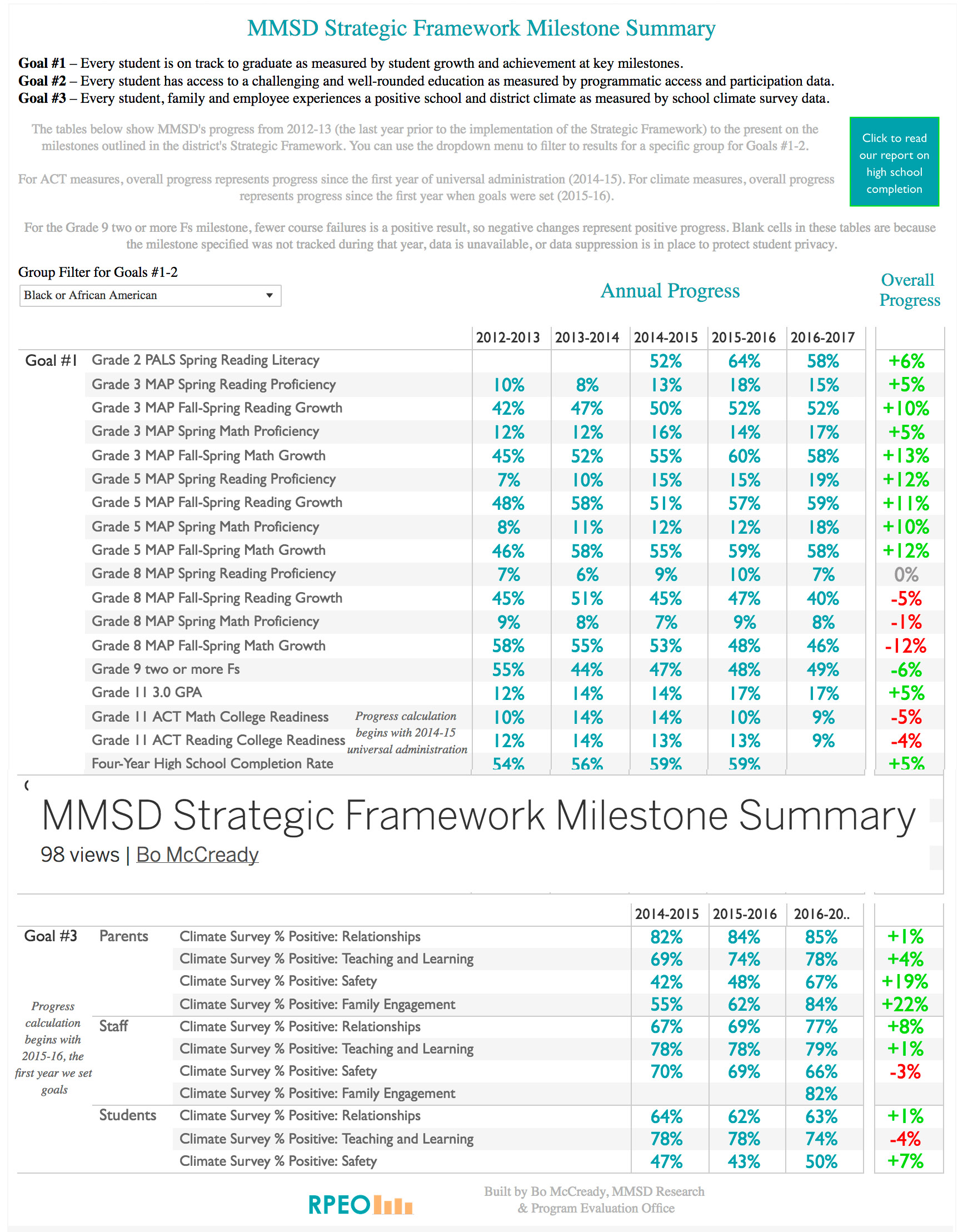
Data (!) on Van Hise’s “special sauce”.

Share

Reading…. Pop Quiz at the Pentagon

Helene Cooper & Eric Schmitt:

An avid reader, Mr. Mattis also says he wants the Defense Department’s regional desks to be able to think the way people in their respective countries would think, officials said. He wants military officials to have read the literature of the country in which they specialize and to really understand the countries, not just the issues that affect bilateral relations with the United States.

At the Pentagon last week, Mr. Mattis showed up unannounced and without aides in the Middle East policy office to ask a question of one of the desk officers.

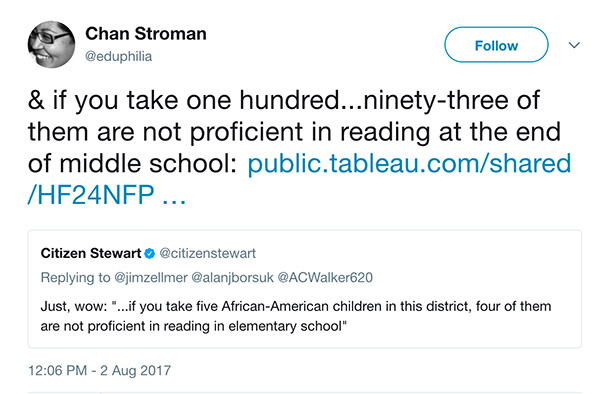
Unfortunately, Madison has long tolerated disastrous reading results.

Share

The View From Room 205 Can schools make the American Dream real for poor kids?

Linda Lutton:

The little kids are fourth graders. They go to William Penn Elementary School on Chicago’s West Side in the North Lawndale neighborhood.

It’s the first day of school, September 2014, and they’re filing into the auditorium because Mayor Rahm Emanuel is here to tout rising test scores. The head of Chicago Public Schools at the time, Barbara Byrd-Bennett, is here too.

She’s laying out the big idea that I want to wrestle with:

“No matter where you’re from, what neighborhood you call home, and no matter what your dreams are in life, it is right here at Penn that our children are going to get their start — so that they can have that dream, chase that dream, capture that dream and live it,” Byrd-Bennett tells the kids and their teachers.

Share

Middlebury College professor injured by protesters as she escorted speaker

Addison Independent:

Charles Murray, a political scientist who has been criticized for his views on race and intelligence, was invited to speak on campus by a student group. He was greeted late Thursday afternoon outside McCullough Student Center by hundreds of protesters, and inside Wilson Hall, students turned their backs to him when he got up to speak.

College officials led Murray to another location and a closed circuit broadcast showed him being interviewed by Stanger, the Russell J. Leng ’60 Professor of International Politics and Economics.

As Stanger, Murray and a college administrator left McCullough Student Center last evening following the event, they were “physically and violently confronted by a group of protestors,” according to Bill Burger, the college’s vice president for communications and marketing.

Burger said college public safety officers managed to get Stanger and Murray into the administrator’s car.

Share

Making math more Lego-like

Peter Reuell:

The Harvard trio of Arthur Jaffe, the Landon T. Clay Professor of Mathematics and Theoretical Science, postdoctoral fellow Zhengwei Liu, and researcher Alex Wozniakowski has developed a 3-D picture-language for mathematics with potential as a tool across a range of topics, from pure math to physics.

Though not the first pictorial language of mathematics, the new one, called quon, holds promise for being able to transmit not only complex concepts, but also vast amounts of detail in relatively simple images. The language is described in a February 2017 paper published in the Proceedings of the National Academy of Sciences.

“It’s a big deal,” said Jacob Biamonte of the Quantum Complexity Science Initiative after reading the research. “The paper will set a new foundation for a vast topic.”

Share

Civics & First Amendment: Middlebury students shout down author

Nicole Higgins DeSmet:

Murray is known for his 1994 book “The Bell Curve” that asserts genetic variations between races account for differences in socioeconomic success. He had been invited to speak at Middlebury about “Coming Apart,” which he authored in 2012. Students planned to disrupt Murray’s 4 p.m. speech at the school’s McCullough Student Center, according to an email announcement released on Wednesday.

But others waiting in line hoped for a chance to challenge Murray.

“It’s important to discredit him by trying to engage with him,” Cara Eisenstein, a student of international politics and economics, said. “I’m hopeful there will be an opportunity.”

Remarkable: the first amendment.

Share

CSUF lecturer suspended for attacking conservative student

Peter Van Voorhis:

“The University has completed its internal investigation regarding a February 8 rally held on campus during which a lecturer was alleged to be in an altercation with a student protester from the College Republicans,” CSUF Chief Communications Officer Jeffrey D. Cook confirmed in a statement to Campus Reform.

“The investigation substantiated the charges that a physical altercation occurred, that a campus employee struck a student, and that as a consequence the speech of the student group was stopped,” he elaborated, saying, “The prospect of an incident like this on our campus is profoundly troubling.”

“It’s great that the school is taking this seriously,” CSUF CR President Chris Boyle told Campus Reform. “We need to ensure that this professor never steps foot on campus and endangers a student again. It’s an important fight for the free-speech rights of students.”

Share

In a few decades, statistical analysis of literature has gone from crackpot theorising to cutting-edge research

The Economist:

NUMBER-crunching literary criticism was the butt of an academic in-joke in “Arcadia” (1993), Tom Stoppard’s cerebral play. Bernard Nightingale, a foppish poetry don, scoffs at a colleague who used a computer program to attribute an anonymous story to D.H. Lawrence. To Bernard’s “inexpressible joy”, he found that “on the same statistical basis, there was a ninety percent chance that Lawrence also wrote the ‘Just William’ books and much of the previous day’s Brighton and Hove Argus”. The “maths mob” skewered in Mr Stoppard’s play no longer seems so ridiculous; with the publication of the “New Oxford Shakespeare”, they have shaped the debate about authorship in Elizabethan England.

Share

Students speaking the language of college success

Alan Borsuk:

South Division has pretty bad results when it comes to graduation. Fewer than 40% of students graduated in four years, as of 2015, according to the Wisconsin Department of Public Instruction. Only a third of those who did graduate went on to post-secondary education.
Low graduation rates and low college success rates among low-income and minority students is a huge issue nationwide. This was underscored last week by a report from the Education Trust, a Washington-based nonprofit, offering data about the wide range of success rates for black students at universities and colleges nationwide. The report listed the University of Wisconsin-Milwaukee as one of 21 schools across the U.S. with particularly low success rates. Only 21% of black students who enrolled at UWM graduated within six years.

Share

How Google Street View Images Reveal the Demographic Makeup of the U.S. – MIT Technology Review

MIT Technology Review:

But how does the population of vehicles in an area relate to the local demographics? To find out, the team trained another deep-learning algorithm to learn the correlation between vehicle types and the data from U.S. Census and presidential election voting patterns in each precinct (an area of about 1,000 people). This training data set consisted of the data from 35 cities.
 
 They then used the rest of the data to test the deep-learning algorithm. The question they wanted to answer was: given the pattern of vehicles in an area, could the algorithm accurately predict the demographics as recorded in the U.S. Census and presidential voting data?
 
 It turns out that the deep-learning algorithm can do this remarkably well. “Using the classified motor vehicles in each neighborhood, we infer a wide range of demographic statistics, socioeconomic attributes, and political preferences of its residents,” they say.

Share

How Chinese Education Leaves Mothers Overburdened

Chen Jongnan:

Recently, while browsing Chinese social media, I was struck by the popularity of a new buzzword: “widowed parenting.”

Contrary to what you might think, widowed parents are not those whose spouses have died. Instead, the term refers to families in which one parent bears far more responsibility for raising children than the other. In the context of China’s fast-paced, stress-inducing cities like Shanghai, the phrase “widowed parent” is much more likely to be used by exasperated, exhausted mothers, especially when referring to the lack of fatherly involvement in their children’s upbringing and education.

It is not new for Chinese popular culture to target fathers who place the burden of child care too squarely on their partners’ shoulders. A memorable sketch from state broadcaster CCTV’s 2014 Chinese New Year gala featured two actors discussing how children act around their parents. “Whenever they see their mothers, kids are always so talkative,” says one. “It’s always ‘Mom, I’m hungry!’ or ‘Mom, I’m thirsty!’ But whenever they see their dads, the only question they ask is ‘Dad, where’s Mom?’”

Share

Children’s Rights and Voices in Changing Times

Kaleem Caire, via a kind email:

A Professional Development Seminar for Parents, Teachers and Community Educators; You don’t want to miss this!

Presented by
Dr. Elizabeth Blue Swadener
Professor of Justice and Social Inquiry (and Education Policy), and Associate Director of the School of Social Transformation at Arizona State University.

Thursday, March 9, 2017
5:45pm to 7:30pm
Lincoln Elementary School 909 Sequoia Trail, Madison

Free and Open to the Community
Food and Child Care Provided

Share

Seven Baltimore Police officers indicted on federal racketeering charges

Justin Fenton and Kevin Rector:

Seven Baltimore police officers who served in a high-profile gun unit were indicted Wednesday on federal racketeering charges — allegations that throw into question scores of cases aimed at getting weapons off the streets.

The officers are accused of shaking down citizens, filing false court paperwork and making fraudulent overtime claims, all while Justice Department investigators were scrutinizing the department for what they concluded was widespread civil rights violations.

Share

Another Breakthrough in Feminist Mathematics

John Rosenberg:

I have written many pieces over the years about the massive attempt to enroll more women in STEM fields, noting in one essay here that “Readers of the higher education press and literature may be forgiven for supposing that there is more research on why there are not more women in STEM fields than there is actual research in the STEM fields themselves.” Now comes a new book, Inventing the Mathematician: Gender, Race and Our Cultural Understanding of Mathematics (State University of New York Press), by Sara N. Hottinger, interim dean of arts and humanities and a professor of women’s and gender studies at Keene State College, suggesting that the problem may not be with women but with math.

In a revealing, just published interview with Hottinger, “Hidden Figures: Women’s studies meets mathematics in a new book arguing for a more inclusive cultural notion of numeracy,” Inside Higher Ed notes that her book’s “ultimate goal is to deconstruct our individual and cultural ideas about math — then build them back up again in a more inclusive fashion.”

Share

West Allis school district turns to taxpayers after blowing through $17.5 million in reserves

Annysa Johnson:

Andrew Chromy knew when he signed on as director of business services at the West Allis-West Milwaukee School District in October 2014 that the suburban Milwaukee district had overspent its budget by $5 million and was dipping into its fund balance.

It was not a best practice. But sometimes there are legitimate reasons to tap those reserves, which every district keeps on hand for cash flow and emergencies.

It wasn’t until three months later that he started to suspect something was seriously amiss.

While preparing for the annual spring 2015 debt payment, Chromy found a reference to a $2.59 million bill — for money borrowed to fund retiree benefits — that had never been budgeted.

Alarmed, he began digging through district accounts, department-by-department. What he found was a “muddy” accounting system with few internal controls — and millions of dollars in expenses that exceeded the district’s budget or were never budgeted at all.

“In all honesty, I was not sure how we were going to function the next year, we were so grossly over,” Chromy said.

That was just the beginning. By the time Chromy and the district’s auditors finished digging, they would find at least $14 million in overspending during the 2013-’14 and 2014-’15 school years alone — on everything from salaries and benefits to teacher training and technology — and questionable practices dating to at least 2007.

Share

Crisis in the classroom: New Indiana teachers repeatedly failing state exams

Bob Segall, via a kind reader:

In the past three years, thousands of new, would-be Indiana teachers have failed the state’s CORE content area assessment exams. The tests, which are each designed to evaluate teacher knowledge in a very specific subject area, are a prerequisite for new teachers to obtain their Indiana state teaching license.

The CORE teacher assessment tests are administered by Pearson Education, one of the nation’s largest standardized testing companies. In 2014, the Pearson tests replaced what was referred to as the Praxis II teacher exams, which had long been used to assess teachers’ content mastery. The Praxis II tests have a high passage rate for Indiana teachers. That is not the case for many of the Pearson exams, which have pass rates that are horrible.

During the 2015-2016 academic year, only 36% of prospective English teachers passed the CORE middle school English language arts exam.

A dismal 32% of would-be Indiana math teachers passed the CORE middle school math test.

And only 18% of aspiring science teachers passed the CORE middle school science exam.

Other CORE exams – including history, social studies, reading, economics and geography – all show first-time pass rates of less than 50%, according to state testing data obtained by WTHR.

Related: MTEL and the Wisconsin Department of Public Instruction’s attempts to weaken teacher licensing requirements.

Related: When A stands for average

Share

How education level is the biggest predictor of support for Geert Wilders

FT.com

Education, rather than exposure to immigrants, is emerging as the clearest nationwide indicator of the likelihood of Dutch voters supporting Geert Wilders’ anti-immigration Party for Freedom, according to an extensive Financial Times survey of In the Netherlands, a Party for Animals Is Winning Over Voters

Share

AALS Executive Committee responds to our letter concerning faculty diversity

Randy Barnett:

During our general discussion with the Committee, we mentioned one idea that such a task force might consider recommending: asking AALS member schools to report on the intellectual diversity of their faculty as part of their sabbatical evaluation–the way they currently report on other forms of diversity. In response, various Executive Committee members expressed objections to such a proposal– objections that Dean Areen reiterates in her letter on behalf of the Executive Committee. Fair enough. But this is the sort of issue we proposed be hashed out by a balanced task force, not between our rump group and the currently unbalanced Executive Committee. And we did not mention this idea in our letter of last week.

Share

Beijing Middle School 80 Percent Responsible for Student’s Death

Kevin Schoenmakers:

A school in Beijing is 80 percent responsible for the death of one of its students, a district court has ruled.

After being bitten by a dog on Dec. 17, 2015, the middle school pupil had received a series of four rabies vaccinations. Ten days later, he fainted after playing a game of basketball for his school league. He was rushed to the hospital but died that afternoon, local newspaper Beijing Evening News reported Monday.

According to an autopsy report, intense exercise had caused a “hypersensitive reaction” to the rabies vaccine. The boy — whom the report identified only with a pseudonym — ultimately died of heart failure. He was in his second year of middle school and was his parents’ only child.

Share

China considering offering financial incentives for second child: China Daily

Reuters:

China is considering introducing birth rewards and subsidies to encourage people to have a second child, after surveys showed that economic constraints were making many reluctant to expand families, the state-owned China Daily newspaper reported.

The potential move was revealed by Wang Peian, vice-minister of the National Health and Family Planning Commission at a social welfare conference on Saturday, the newspaper said on Tuesday.

Birth rates rose to 17.86 million in 2016, the highest level since 2000, after the country issued new guidelines in late 2015 allowing all parents to have two children amid growing concerns over the costs of supporting an aging population.

Share

The Privacy Revolution that never came

Mo Bitar:

Reading is complex. It requires specialized knowledge and a decade of practice. But by a certain age, reading becomes a thoughtless activity — you couldn’t imagine not knowing how to do it.
Deploying a server and setting up a reverse proxy engine: that’s pretty complex too. The difference between reading and managing servers is childhood.

Kids today are growing up with iPads in their laps that teach them how to code. Do you think this change will be inconsequential? In a hundred years, advanced tech savviness by all individuals will be as standard as reading.

Share

China’s top College To Face Ideological Inspections

Nectar Gan.

Share

Subsidizing Charity Liberally

Miranda Perry Fleischer:

When visiting America over 150 years ago, Alexis De Tocqueville was amazed by the role of charities in American society. Since De Tocqueville’s visit, the sector’s size and influence have grown enormously. So too have the legal benefits accorded them, the most important of which are governmental subsidies in the form of exemption from the corporate income tax and the ability to receive tax-deductible contributions. Given the sector’s importance and the cost of these benefits, whether the sector’s legal treatment reflects our society’s broader ideals merits examination. More specifically, our Constitution enshrines two bedrock principles of Western liberal democracies: limited government and equal opportunity. Does the legal treatment of the charitable sector further these ideals, or undermine them?

This Chapter explores the extent to which the charitable tax subsidies reflect these principles, as expressed in the two theories of distributive justice respectively associated with them, libertarianism and resource egalitarianism. This analysis shows that the subsidies’ current structure is much broader than necessary to reflect libertarian ideals, even under the more permissive classical liberal theories. As a result, the subsidies undermine the principle of limited government by coercing taxpayers to subsidize activities that are not the legitimate purview of government. The subsidies’ relation to resource egalitarianism is more complex: They are broader than the most common interpretations of resource egalitarianism justify, and undermine basic equality of opportunity notions both by subsidizing activities that increase the head-start of the wealthy and by giving wealthy taxpayers more say over government resources than poorer taxpayers. That said, the subsidies do reflect less well-known and more controversial accounts of resource egalitarianism that address expensive tastes and talent-pooling.

Share

‘There is no other medicine’: Texas father breaks law to treat self-harming autistic daughter with marijuana

Travis M. Andrews:

Along with her twin sister, she was born 26 weeks early. At 1 pound 12 ounces, she weighed slightly less than the healthy Keeley. Then, 10 hours into life, Kara suffered a brain hemorrhage. Seventeen years later, she’s lucky to be alive. But she has cerebral palsy and severe autism, which in her case causes compulsive self-injurious behavior that began with she was 4 years old.

“It’s a terrible sight to see,” her father, Mark Zartler, told The Washington Post via telephone from his home in Richardson, Tex. “She hits herself in the face repeatedly. She gets into a loop, and she can’t really stop. Sometimes she can self-recover, but other times it just extends and extends and extends.”

Share

How Historical Illiteracy Fuels Political Polarization

Rachel DiCarlo Currie

Greater knowledge of the past would help improve America’s public discourse.

Once again, President’s Day has come and gone and Americans spent little time reflecting on their past leaders—in part, because Americans know so little history at all, even about the country’s most well-known Founding Fathers. For example, in a 2012 survey commissioned by the American Council of Trustees and Alumni (ACTA), fewer than half (48%) of college graduates knew that George Washington was the American general at Yorktown; only 20% knew that James Madison was the “Father of the Constitution” (half thought it was Thomas Jefferson); only 17% knew what Abraham Lincoln’s Emancipation Proclamation actually said; and only 17% knew that the phrase “Government of the people, by the people, for the people” came from the Gettysburg Address (76% thought it came from either the Declaration of Independence or the Constitution).

Job 1 is reading.

Share

The Complacent Class

Dan Wang:

When the pie isn’t growing, it makes sense to dedicate yourself to protecting your own share. “What I find striking about contemporary America is how much we are slowing things down, how much we are digging ourselves in, and how much we are investing in stability,” Cowen writes. I’d put it in the following terms: too many parts of society are oriented towards bottom line activities of mistake avoidance instead of top line activities of taking risk and creating value.

Decades ago, people had a greater sense of urgency. As Cowen writes, some of this wasn’t always for the good. Anxious people are no longer so seduced by ideas like communism; and it’s a good thing that we haven’t had as many domestic bombings as the 2,500 between 1971 and 1972. But society loses other things when people aren’t dynamic. Not only is it economically unfortunate that productivity doesn’t grow; politics becomes more gridlocked, businesses wield greater monopoly power, and society as a whole loses the ability to regenerate itself. Toqueville considered the United States to be a land perpetually in motion; isn’t it a shame that seems no longer the case?

Americans are getting more passive—Cowen means this in the medical sense. More people are being prescribed opiods, antidepressants, and ADHD meds, all to induce calm. And: “Of all the drugs that might have been legalized [since the 1960’s], American citizens chose the one—marijuana—that makes users spacey, calm, and sleepy.”

“You can think of this book as detailing the social roots of the resulting slow growth outcome and explaining why that economic and technological stagnation has lasted so long.”

Share

Dallas senator gets salty with Richardson students during a school choice talk

Gromer Jeffers, Jr:

Sen. Don Huffines is passionate about giving public school students the choice to attend private schools.

But he’s raising eyebrows because of the combative tone he used Monday in Austin during a discussion about education at Texas PTA Rally Day with a group of students from Richardson ISD.

During one exchange, a student pushed back against a proposal to give students a stipend to attend private schools. She said, as other critics contend, that the voucher would not be large enough to allow the student to go to many high-dollar schools in North Texas.

Share

Civics: What Do You Think Is the Most Important Problem Facing This Country Today?’

GREGOR AISCH and ALICIA PARLAPIANO

Since the presidency of Franklin D. Roosevelt, the Gallup polling organization has asked Americans an open-ended question: “What do you think is the most important problem facing this country today?”

As Donald J. Trump prepares for his first major address to the nation on Tuesday, he has a unique set of issues to tackle. But there is not one singular issue that is dominating the American consciousness.

Share

Australian children’s author Mem Fox detained by US border control: ‘I sobbed like a baby’

Bonnie Melkin:

The Australian children’s book author Mem Fox has suggested she might never return to the US after she was detained and insulted by border control agents at Los Angeles airport.

Fox, who is famous worldwide for her best-selling books including Ten Little Fingers and Ten Little Toes and Possum Magic, was en route to a conference in Milwaukee earlier this month when she was stopped.

Share

Seeing Theory: A visual introduction to probability and statistics.

brown.edu

Seeing Theory is a project designed and created by Daniel Kunin with support from Brown University’s Royce Fellowship Program and National Science Foundation group STATS4STEM. The goal of the project is to make statistics more accessible to a wider range of students through interactive visualizations.

Share

The rise of the useless class

Yuval Noah Harari:

In fact, as time goes by, it becomes easier and easier to replace humans with computer algorithms, not merely because the algorithms are getting smarter, but also because humans are professionalizing. Ancient hunter-gatherers mastered a very wide variety of skills in order to survive, which is why it would be immensely difficult to design a robotic hunter-gatherer. Such a robot would have to know how to prepare spear points from flint stones, find edible mushrooms in a forest, track down a mammoth, coordinate a charge with a dozen other hunters and use medicinal herbs to bandage any wounds. However, a taxi driver or a cardiologist specializes in a much narrower niche than a hunter-gatherer, which makes it easier to replace them with AI. AI is nowhere near human-like existence, but 99 percent of human qualities and abilities are simply redundant for the performance of most modern jobs. For AI to squeeze humans out of the job market it need only outperform us in the specific abilities a particular profession demands.

As algorithms push humans out of the job market, wealth and power might become concentrated in the hands of the tiny elite that owns the all-powerful algorithms, creating unprecedented social and political inequality. Alternatively, the algorithms might themselves become the owners. Human law already recognizes intersubjective entities like corporations and nations as “legal persons.” Though Toyota or Argentina has neither a body nor a mind, they are subject to international laws, they can own land and money, and they can sue and be sued in court. We might soon grant similar status to algorithms. An algorithm could then own a transportation empire or a venture-capital fund without having to obey the wishes of any human master. Before dismissing the idea, remember that most of our planet is already legally owned by non-human intersubjective entities, namely nations and corporations. Indeed, 5,000 years ago much of Sumer was owned by imaginary gods such as Enki and Inanna. If gods can possess land and employ people, why not algorithms?

Share

Fujian School Bans Foreign Shoes to Halt Students’ One-Upmanship

Wang Lianzhang:

Foreign shoes were given the boot at a secondary school in eastern China in an effort to cure students of their sneaker fever.

According to a February post on Hupu.com, a popular internet forum on sports, a teacher told parents in a group chat message that students would only be allowed to wear domestic shoe brands.

“If we find any student still wearing imported shoes, parents should send domestic shoes to the school for them to change into,” the teacher from privately owned Zijiang Middle School in Jinjiang, a city in Fujian province, reportedly wrote. The regulation was implemented to put a stop to the trend of “invidious comparisons of luxury goods.”

“Some students aren’t competing in their studies but instead are competing for footwear, and they ask their parents to buy expensive imported shoes,” the teacher wrote, adding that the phenomenon ran contrary to the secondary school students’ “austere and healthy image.”

Share

The Nonwhite Student Behind the White Picket Fence

Melinda Anderson:

For youth and families, economic hardship and a lack of English proficiency can make navigating the school bureaucracy especially daunting, hindering parent engagement and students’ education. At Blair High School, one of the largest in Montgomery County with nearly 3,000 students, Hispanics are the single largest racial or ethnic group (32 percent); Spanish is the most frequently spoken language at home; and more than half of students (55 percent) are eligible for free-and-reduced meals, a common indicator of poverty.

Share

 Two Western Cultures of Privacy: Dignity versus Liberty

James Whitman:

In every corner of the Western world, writers proclaim “privacy” as a supremely important human good, as a value somehow at the core of what makes life worth living. Without our privacy, we lose “our very integrity as persons,” Charles Fried declared over thirty-five years ago. Many others have since agreed that privacy is somehow fundamental to our “personhood. 2 It is a commonplace, moreover, that our privacy is peculiarly menaced by the evolution of modem society, with its burgeoning technologies of surveillance and inquiry. Commentators paint this menace in very dark colors: Invasions of our privacy are said to portend a society of “horror,”3 to “injure [us] in [our] very humanity, ”4 or even to threaten “totalitarianism,”5 and the establishment of law protecting privacy is accordingly declared to be a matter of fundamental rights.6 It is the rare privacy advocate who resists citing Orwell when describing these dangers.

At the same time, honest advocates of privacy protections are forced to admit that the concept of privacy is embarrassingly difficult to define.7 “[N]obody,” writes Judith Jarvis Thomson dryly, “seems to have any very clear idea what [it] is.”‘8 Not every author is as skeptical as Thomson, but many of them feel obliged to concede that privacy, fundamentally important though it may be, is an unusually slippery concept. In particular, the sense of what must be kept “private,” of what must be hidden before the eyes of others, seems to differ strangely from society to society.

Share

A life of service is never easy. Having autism can make it even harder.

Gus Hardy:

The wind bites at my hands at 6:30 a.m. as I lock up my bike outside the Poverello Center, the state’s largest homeless shelter, in Missoula, Mont. I walk through the double door, slap the front desk for luck and hole up in a staff office so that I can make my necessary prayers for the day to come. I do not always remember to center myself, but on the days that I do I am able to pay better attention to the various people who are recently out of prison or are struggling with addiction or mental health issues, all of whom I have chosen to serve as a Jesuit volunteer in the Pacific Northwest. It is a hard job that requires a lot of people skills that do not come naturally for me because I was born with autism.

In my work I have been called “cold,” “impersonal” (and far worse) about as many times as I have been told that I am doing the work of God. No matter what people say, I look each person in the eye and try with everything I can muster to create the empathic connection that seems to come so easily to other people. It is bitter work for me, more than for most of the world, but God has called me to it, so I have got to step up.

Share

Will Democracy Survive Big Data and Artificial Intelligence?

Dirk Helbing, Bruno S. Frey, Gerd Gigerenzer, Ernst Hafen, Michael Hagner, Yvonne Hofstetter, Jeroen van den Hoven, Roberto V. Zicari, Andrej Zwitter:

The digital revolution is in full swing. How will it change our world? The amount of data we produce doubles every year. In other words: in 2016 we produced as much data as in the entire history of humankind through 2015. Every minute we produce hundreds of thousands of Google searches and Facebook posts. These contain information that reveals how we think and feel. Soon, the things around us, possibly even our clothing, also will be connected with the Internet. It is estimated that in 10 years’ time there will be 150 billion networked measuring sensors, 20 times more than people on Earth. Then, the amount of data will double every 12 hours. Many companies are already trying to turn this Big Data into Big Money.

Everything will become intelligent; soon we will not only have smart phones, but also smart homes, smart factories and smart cities. Should we also expect these developments to result in smart nations and a smarter planet?

Share

Mathematicians becoming data scientists: Should you? How to?

Jordan Ellengerg:

I was talking the other day with a former student at UW, Sarah Rich, who’s done degrees in both math and CS and then went off to Twitter. I asked her: so what would you say to a math Ph.D. student who was wondering whether they would like being a data scientist in the tech industry? How would you know whether you might find that kind of work enjoyable? And if you did decide to pursue it, what’s the strategy for making yourself a good job candidate?

Sarah exceeded my expectations by miles and wrote the following extremely informative and thorough tip sheet, which she’s given me permission to share. Take it away, Sarah!

Share

Digital Coloring Book

Digitavaticana (PDF)

Images from the Vatican Library Collections.

Share

A student was punished for filming professor’s anti-Trump rant. Then came the backlash.

Avi Selk and Peter Holley

When suspending Caleb O’Neil for recording his professor’s rant against then-President-elect Donald Trump, the dean of Orange Coast College said that the punishment should make the student “truly think through your actions and the consequences of those actions.”

But it was the college that rethought its actions — after two weeks of intense criticism that the California school was stifling a conservative student to protect a liberal professor.

The school canceled the suspension during a special board meeting Thursday, according to the Orange County Register, and issued a statement:

“The board believes this is in the interest of fairness and equity for all.”

“All” would include O’Neil — a 19-year-old Trump supporter — and his psychology professor Olga Perez Stable Cox, who called Trump a white supremacist in a classroom rant that O’Neil helped make viral.

Shortly after Election Day, Cox told her human sexuality class that Trump’s victory was “an act of terrorism.”

Share

Academia is too important to be left to academics

Maximillian Alvarez:

To be an academic in today’s America is to be plunged into a perennial identity crisis. And like most academic things, it’s a maddeningly elliptical, recursive, and small-bore sort of crisis. Fueling all our self-indulgent angst is a never-fully-acknowledged social contract, the one that, via countless professional canons and conventions, confirms your choice to be a so-called academic, to assume it not only as a profession, but an identity, and to wear on yourself the trappings that come with that identity without stopping to wonder how necessary they really are and whether they are actually killing your ability to be and do something better. Most of the time this doesn’t even feel like a choice at all, but it is. At other times, how to deal with this choice may seem more or less like a personal matter. But, in the age of Trump, the public implications of this choice, the civic implications, have been exposed more than ever before, and the stakes are as high as they’re going to get.

Share

My Sister Went to an “Alternative” School But That’s Not What Killed Her

Laura Waters:

The title of this recent exposé from Propublica jumped out at me: “‘Alternative’ Education: Using Charter Schools to Hide Dropouts and Game the System.” Incredulous, I read that “alternative schools” are “warehouses where regular schools stow poor performers.” The authors claim that these schools are almost exclusively for-profit charter schools that exist in order to enable regular schools to exercise a duplicitous endrun around the No Child Left Behind Act (NCLB), the federal education law that “refashioned the yardstick for judging schools.” According to their premise, villainous charter magnates have crafted “profit centers” that troll the traditional education market in search of struggling students that schools are eager to disenroll in order to preserve high graduation rates and standardized test scores. These children — “cast-offs” in the authors’ parlance — are abandoned in order to activate “a silent release valve for high schools …that are straining under the pressure of accountability reform.”

Share

Not So Special Ed Public school parents with special-ed kids often find themselves squaring off against school districts and the taxpayer-funded lawyers who protect them.

Share

When Work Disappears: Manufacturing Decline and the Falling Marriage-Market Value of Men

David Autor, David Dorn and Gordon Hanson:

The structure of marriage and child-rearing in U.S. households has undergone two marked shifts in the last three decades: a steep decline in the prevalence of marriage among young adults, and a sharp rise in the fraction of children born to unmarried mothers or living in single-headed households. A potential contributor to both phenomena is the declining labor-market oppor- tunities faced by males, which make them less valuable as marital partners. We exploit large scale, plausibly exogenous labor-demand shocks stemming from rising international manufactur- ing competition to test how shifts in the supply of young ‘marriageable’ males affect marriage, fertility and children’s living circumstances. Trade shocks to manufacturing industries have particularly negative impacts on the labor market prospects of men and degrade their marriage- market value along multiple dimensions: diminishing their relative earnings—particularly at the lower segment of the distribution—reducing their physical availability in trade-impacted labor markets, and increasing their participation in risky and damaging behaviors. As predicted by a simple model of marital decision-making under uncertainty, we document that adverse shocks to the supply of ‘marriageable’ men reduce the prevalence of marriage and lower fertility but raise the fraction of children born to young and unwed mothers and living in in poor single-parent households. The falling marriage-market value of young men appears to be a quantitatively important contributor to the rising rate of out-of-wedlock childbearing and single-headed chil- drearing in the United States.

Share

Milwaukee students will wear uniforms in effort to improve school climate

Annysa Johnson and Brittany Carloni:

When Pulaski High School mandated student uniforms this year, plenty of kids grumbled, according to Principal Lolita Patrick. But one boy actually thanked her.

The 10th grader had had lots of problems, academic and behavioral, his freshman year. So much so, he’d told staff last year that he might as well drop out and sell drugs “because he was tired of being judged by what he had to wear.”

The bullying stopped, Patrick said, when he returned in the fall to a school where he dressed like everyone else, in the same khaki pants and navy blue or red polo shirt.

“And guess what — he didn’t drop out. Not only is he in school, but he has managed to reduce the number of disciplinary referrals that he has received from last school year by 50%,” Patrick told Milwaukee Public Schools board members considering a districtwide uniform policy at a committee meeting earlier this month.

Share

How Governments Support Higher Education Through The Tax Code Federal and state income tax provisions aim to reduce costs for students and families

Pew Trusts:

To maximize the impact of higher education investments and achieve desired policy goals, policymakers should have knowledge of the full range of assistance provided to institutions and students. This means having an understanding of the billions of dollars made available through spending programs and the tax code. However, too frequently these two types of support are not considered in tandem, and most states lack the cost estimates they would need to determine how tax provisions for higher education compare in size to other postsecondary investments.

The federal government and the states each invested more than $70 billion in higher education-related spending programs, excluding loans, in academic year 2014, the latest year for which data are available. But that gure, as substantial as it is, does not paint a full picture of federal and state investments in higher education. It excludes the billions of dollars that the federal government and the 41 states plus the District of Columbia that levy personal income taxes provide to students and their families through tax expenditures—such as credits for tuition and college savings incentives—to help o set postsecondary costs.

These tax provisions—special deductions, credits, exclusions, and exemptions—allow people to reduce their income tax liability and result in lower federal and state government revenue. They are called tax expenditures because they are similar to direct spending both in their budgetary impacts and in the way they can bene t recipients. The tax code contains many such provisions that support speci c policy priorities, of which higher education is just one.

Share

Is it possible to modify individual human brains via social media?

Nicholas Russell:

To fight a weaponisation of data requires taking a reductionist view of human cognition. We must consider human beings to be simple input/output processes.

Despite the infinitely-complex structures of neurons within each human brain, that infinitely complexity can now be externally-understandable enough so that someone even possessing a modicum of power to remotely map stimulus/responseses on an individual basis.

Most Americans today not only have a unique physical identifier (in the form of a mobile phone), but also now have unique cognitive identifiers – in the form of social media accounts. Not only is one’s physical location traceable, but now also one’s mental state.

The American President today possesses access to systems that tracks each individual’s location in real-time. He also possesses a system can firstly derive an individual’s mental state. The ultimate question is, can that system of byte-streams modify individual mental states?

One wonders about the fates of Jack Dorsey and Mark Zuckerberg, heading publicly-traded companies collectively mapping the minds and moods of Americans in real-time. There would perhaps no more valuable databases for an authoritarian regime than these.
Most disconcertingly, far from humanising technology, our human leaders now look driven by machine logic.

Share

The polymath computer scientist David Gelernter’s wide-ranging ideas about American life.

Conor Friedersdorf:

David Gelernter: I think the lesson of Franklin is not that a science advisor can tell you all sorts of things about government and diplomacy and human nature, but that thoughtful people are almost never defined by a pre-existing intellectual shoe-box. The best scientists aren’t the dedicated drudges who have no other interests. The best take after Newton, Einstein and tens of thousands of lesser lights in their devotion to science and other things too. As a scientist handing out advice on the study of science, something I do as a college teacher, one of my main messages is that you can’t be an educated human being on the basis of science alone; another main message is that, sometimes, you can’t even be a scientist or technologist on the basis of science alone.

If I were loosely gathering topics of study into categories, I might call them arts, religion, scholarship, and science. As important as scholarship and science are, arts and religion are more important. Those were my main goals (my wife’s, too) in educating our two boys, who are now both in their 20s. Arts and religion define, in a sense, a single spectrum rather than two topics. And this spectrum is where you find mankind’s deepest attempts to figure out what’s going on in the universe. A student who doesn’t know the slow movement of Schubert’s B-flat major op post sonata, or the story of David and Absalom, needs to go back to school and learn better.

Share

Half of college students think their loans will be forgiven

Ed Zwirn:

According to a survey of 500 current college students conducted by LendEDU, a private firm that connects students and their families with student loans and loan refinancing, 49.8 percent believe they would be able to receive federal forgiveness on their student loans after graduation.

This belief is hardly justified, given the limited circumstances in which these loans can actually be forgiven.

The US Department of Education says that federal direct student loan borrowers can get off the hook if they enter public service jobs for a specified period of time, agree to teach in an underserved area, die or become permanently disabled, or if the school they attended shuts down while they are enrolled or within 120 days after they leave.

Share

PPE: the Oxford degree that runs Britain

Andy Beckett:

Monday, 13 April 2015 was a typical day in modern British politics. An Oxford University graduate in philosophy, politics and economics (PPE), Ed Miliband, launched the Labour party’s general election manifesto. It was examined by the BBC’s political editor, Oxford PPE graduate Nick Robinson, by the BBC’s economics editor, Oxford PPE graduate Robert Peston, and by the director of the Institute for Fiscal Studies, Oxford PPE graduate Paul Johnson. It was criticised by the prime minister, Oxford PPE graduate David Cameron. It was defended by the Labour shadow chancellor, Oxford PPE graduate Ed Balls.

Elsewhere in the country, with the election three weeks away, the Liberal Democrat chief secretary to the Treasury, Oxford PPE graduate Danny Alexander, was preparing to visit Kingston and Surbiton, a vulnerable London seat held by a fellow Lib Dem minister, Oxford PPE graduate Ed Davey. In Kent, one of Ukip’s two MPs, Oxford PPE graduate Mark Reckless, was campaigning in his constituency, Rochester and Strood. Comments on the day’s developments were being posted online by Michael Crick, Oxford PPE graduate and political correspondent of Channel 4 News.

Share

Mathematician Eugenia Cheng: ‘Yes, I am an anarchist!’

Nicola Davis:

Eugenia Cheng is a British mathematician who is senior lecturer at the School of the Art Institute of Chicago. Her main interest is higher-dimensional category theory but she has also written a book about the maths of baking entitled How To Bake Pi. Her latest book is Beyond Infinity: An Expedition into the Outer Limits of Mathematics.

What is higher-dimensional category theory? Can you describe it in a sentence?
It is the mathematics of mathematics. It does for mathematics the same thing that mathematics does for the world – it makes connections between things and it highlights patterns between things, so that we can be more efficient about how we use our brain power.

You’ve declared your vision is to ‘rid the world of mathematics phobia’. How do you erode it once it has taken hold?
Unfortunately, the kind of maths we teach in school is often not in any way useful for most people’s lives – people say “When am I ever going to need to solve a quadratic equation in my life?” The kind of maths I teach is about logical thinking, thinking your way through situations, understanding what is causing something to happen and working out how things fit together.

Share

‘Mob’ of ‘entitled children’ at Highland Park assembly gets called out by visiting author

Corbett Smith:

Best-selling author Jamie Ford was in Highland Park on Thursday, the keynote speaker at the town’s literary festival.

Earlier that day, he stopped by Highland Park High School, in one of the wealthiest school districts in the state, where he spoke to an assembly of freshmen and sophomores.

It did not go well.

On his personal website, Ford — who broke onto the literary scene in 2009 with his debut, Hotel on the Corner of Bitter and Sweet — chronicled how he was mocked by a group of students during his talk, “a thousand students, trolling me,” as teachers and a principal looked on.

“After visiting more than 100 schools, from inner-city schools in New York, the kind with clear backpacks and metal detectors, to elite international baccalaureate high schools, including one where the previous year’s guest speaker was Justin Bieber — I’ve finally had a school visit … go sideways,” Ford wrote. “I’m looking at you, Highland Park High School, and I’m confused.”

About halfway through the 50-minute talk, when Ford started a Q&A session, students began to interrupt with random cascades of clapping and cheering…..

Share

Liberia’s bold experiment in school reform

The Economist:

AT A school in the township of West Point, Monrovia, a teacher should be halfway through her maths lesson. Instead she is eating lunch. A din echoes around the room of the government-run school as 70 pupils chat, fidget or sleep on their desks. Neither these pupils nor the rest of Liberia is learning much. Bad teaching, a lack of accountability and a meagre budget have led to awful schools. Fourteen years of civil war and, more recently, the Ebola virus have stymied reforms. Children’s prospects are shocking. More than one-third of second-grade pupils cannot read a word; since many are held back, teenagers often share classes with six year olds (see chart). In 2014 only 13 candidates out of 15,000 passed an entrance exam to the University of Liberia. In 2013 none did.

Madison, however, continues with its non diverse K-12 governance.

Share

Education publisher Pearson reports biggest loss in its history

Mark Sweney:

Pearson has reported a pre-tax loss of £2.6bn for 2016, the biggest in its history, after a slump at its US education operation.

The world’s largest education publisher, which in January saw almost £2bn wiped from its stock market value after issuing its fifth profit warning in two years, reported the record loss after taking a £2.55bn non-cash charge for “impairment of goodwill reflecting trading pressures” in its North American businesses.

A spokesman said the charge related mainly to historic acquisitions of Simon & Schuster Education and National Computer Systems, purchased in 1998 and 2000 respectively, as a “necessary consequence” of the lower profit expectations announced last month.

Share

Wisconsin Department of Public Instruction Superintendent Candidate Debate Summary

Meg Jones:

“Here’s my concern about the bully pulpit. If her position is ‘I’m going to Milwaukee and I’m going to go to taxpayer subsidized parochial or private schools that are part of the choice program,’ that’s great. But she also has to visit public schools. …

“She better talk about both in a positive way. She represents all kids, all 680,000 public school kids in the state of Wisconsin. We need her to be an advocate for those kids,” Evers said.

Holtz, the former Whitnall superintendent, said he talked to a friend who knows DeVos and said the new secretary of education has always been dedicated to children and wants students to be successful. He also said the Trump administration has promised not to meddle in decisions by local school districts.

“Assuming they are people of their word, as President Trump says ‘we’re not going to be involved in the states as they have in the past.’ I welcome that with open arms. I don’t want D.C. dictating what we’re doing in Wisconsin,” Holtz said. “I want Wisconsin to choose the path moving forward. I do think she’s going to help us with that.”

The candidates were asked when they last taught in a classroom. Evers said it was in 1980, but as the state superintendent he visits classrooms around the state at least once a week — last week he was in Durand and this week in Green Bay.

Molly Beck:

“I’m still not sure that I violated anything. But if I did, I really am the kind of person who is willing to name it, own it and fix it,” said Holtz. “And I obviously fixed it because I’m not working at the school district. I wanted to keep that separation so I could run 100 percent of the time and not worry about that. If the ethics commission says it was a problem, which I’m not sure they’re going to, then of course whatever the remedy is (I’ll accept).”

During his 2009 campaign, Evers was fined $250 after he sent an email from his personal email account to a Green Bay education administrator on his work account to assist in planning a fundraiser and increasing turnout.

Holtz suggested the race should focus on issues, not his email use, but Evers said the emails are relevant because integrity matters to voters.

“I paid a small fine and learned the lesson on pressing the right button,” Evers said. “Yeah, I think there should be an investigation. It’s clear that I never thought integrity would be an issue in this campaign but it’s clear it’s going to be. People in Wisconsin should be concerned that someone in a position that Lowell Holtz was would be using his email to kind of plan and plot strategy.”

Much more on Tony Evers, here.

Share

10 things we should all do every day to keep our brains sharp

Katie Avis-Riordan:

As we get older, it’s easy for our brains to get rusty. That’s why we want to know how to keep them healthy and functioning at their best capacity.

So, in honour of World Thinking Day, we asked SharpBrains – an independent market research firm tracking applied brain science – to share some top tips for keeping our minds sharp and active.

1. Get clued up

Learn about your brain and how it functions. Just having a basic understanding will enable you to fully appreciate the ever-developing nature of the brain and its billions of neurons and synapses.

Some interesting facts include, the human brain is the largest brain of all vertebrates, relative to body size, Live Science states, and makes up about 2% of body weight. “The cerebrum makes up 85% of the brain’s weight. It contains about 86 billion nerve cells (neurons) — the ‘grey matter’. It contains billions of nerve fibers (axons and dendrites) — the ‘white matter’. These neurons are connected by trillions of connections, or synapses.”

Share

LA Teacher Union Dues Now Around $1,000 a year

Howard Blume:

Paying for Plan A was accomplished in part by persuading members last year to raise their dues by about 50%, to around $1,000 a year.

Caputo-Pearl has added eight senior union positions, with a ninth paid for by a national parent union. In line with his organizing and political goals, these jobs include a campaign research director, a political director, four organizers and two staff members to represent teachers at charter schools.

For years, Caputo-Pearl said, “UTLA was operating in a way that lacked sufficient strategy, coherence, and direction. … We have addressed this, and UTLA is operating with unprecedented strength.”

An emphasis on “adult employment“.

Share

The Bow-Tied Bard of Populism

McKay Coppins

“Look, it’s really simple,” Carlson says. “The SAT 50 years ago pulled a lot of smart people out of every little town in America and funneled them into a small number of elite institutions, where they married each other, had kids, and moved to an even smaller number of elite neighborhoods. We created the most effective meritocracy ever.”

“But the problem with the meritocracy,” he continues, is that it “leeches all the empathy out of your society … The second you think that all your good fortune is a product of your virtue, you become highly judgmental, lacking empathy, totally without self-awareness, arrogant, stupid—I mean all the stuff that our ruling class is.”

Share

A Republic in the Atlantic An innovative program combines reading the Great Books with character-building and community

Miguel Monjardino:

n a beautiful day in fall 2004, I walked up a mountain on Terceira Island in the Azores with six students. They were 15-year-olds, all enrolled in public high schools in the Azorean city of Angra do Heroísmo. I was 42. We talked about the Republic of Letters, a voluntary weekend program of readings and conversations that I was designing to prepare high school students for life in a university. At least, that was how I originally conceived of it. I was thinking conventionally: for most parents, academics, and politicians in Portugal, education is about skills, and jobs are the ultimate prize of a good education. As early as tenth grade, students must specialize in a particular field; grades and jobs are paramount.

But soon, I realized that I was wrong about what the Republic of Letters should be—especially as I reflected on a seminar that I had recently attended on Aeschylus’s play Agamemnon. The seminar, conducted by Anthony O’Hear at the Institute for Political Studies at the Catholic University of Portugal in Lisbon, had a huge impact on me, and I became convinced that my new program should not be about preparing students for university but preparing them for the challenges of living. Souls were more important than grades, skills, and academic degrees. Such a project, I felt, should intimately involve the ancient Greeks and classical notions of a liberal education.

Share

Surgeons Should Not Look Like Surgeons

Nassim Nicholas Taleb:

Now if I had to pick, I would overcome my suckerproneness and take the butcher any minute. Even more: I would seek the butcher as a third option if my choice was between two doctors who looked like doctors. Why? Simply the one who doesn’t look the part, conditional of having made a (sort of) successful career in his profession, had to have much to overcome in terms of perception. And if we are lucky enough to have people who do not look the part, it is thanks to the presence of some skin in the game, the contact with reality that filters out incompetence, as reality is blind to looks.

When the results come from dealing directly with reality rather than through the agency of commentators, image matters less, even if it correlates to skills. But image matters quite a bit when there is hierarchy and standardized “job evaluation”. Consider the chief executive officers of corporations: they not just look the part, but they even look the same. And, worse, when you listen to them talk, they will sound the same, down to the same vocabulary and metaphors. But that’s their jobs: as I keep reminding the reader, counter to the common belief, executives are different from entrepreneurs and are supposed to look like actors.

Share

Uniforms in schools may help but they aren’t the only answer

Alan Borsuk:

At one point during Thursday night’s Milwaukee School Board meeting, a representative of a large supplier of school uniforms attempted to give testimony that his company could assure that there would be an ample supply of polo shirts, khakis and such for all of the students in Milwaukee Public Schools if the board approved a citywide requirement for school uniforms.

School Board President Mark Sain cut him off — testimony on the merits of the idea were in order, sales pitches were out of order, he said.

But the guy and his company clearly are in line to be winners from the board’s 8 to 1 approval of the policy on uniforms. Bring on large sales of polo shirts!

What about the kids? The staff? Learning itself? Will they be winners?

Share

10 Tips to Improve Your Mental Math Ability

George Dvorsky:

Calculators are awesome, but they’re not always handy. More to the point, no one wants to be seen reaching for the calculator on their mobile phone when it’s time to figure out a 15 percent gratuity. Here are ten tips to help you crunch numbers in your head.

Mental math isn’t as difficult as it might sound, and you may be surprised at how easy it is to make seemingly impossible calculations using nothing but your beautiful brain. You just need to remember a few simple rules.

Add and Subtract From Left to Right

Remember how you were taught in school to add and subtract numbers from right to left (don’t forget to carry the one!)? That’s all fine and well when doing math with pencil and paper, but when performing mental math it’s better to do it moving from left to right. Switching the order so that you start with the largest values makes it a bit more intuitive and easier to figure out. So when adding 58 to 26, start with the first column and calculate 50+20=70, then 8+6=14, which added together is 84. Easy, peasy.

Share

What’s the price of meaningfulness?

Izabella Kaminska

I hate to be a nay-sayer about a well-intentioned post, and I expect some readers will disagree with my point of view vehemently. However, this article about the nature of work clearly implies that work is valuable only if it is perceived by the person doing it to be “creative”. But this is fallacious because “creative” is the new cool. It professes to be about finding meaningfulness in work in a quasi-Maslowean hierarchy of needs, that people should find some form of self actualization in work.

In fact, what has happened in America is that people have been trained to see manual work, unless it can somehow be seen as being “creative” like making artisanal pickles or restoring fancy furniture, as well as most service work, as demeaning drudgery. If you make something be perceived to be socially undesirable or not very worthy (as an excuse for giving lousy pay), you’ll breed unhappy workers merely by virtue of social contempt (see expectancy theory for more detail).

The fact is most people are not creative. And this is not just my personal opinion, this is Carl Jung. Even though Myers Briggs is over-used, it has its place (IMHO it’s more useful for looking at how certain types behave in organizational settings than in one-on-one or personal relationships). The Jung-derived Myer-Briggs framework differentiates between “intuitives” who are somewhat to very impatient with convention and rules and admire imaginative people, versus “sensing” types, who like following procedures and get very annoyed with what they perceive to be undisciplined “intuitives”. And even though this categorization needs to be taken with a fistful of salt, the population seems to skew heavily to sensing types (an estimated 70%) versus intuitives (30%).

Share

Civics: The War Of The Bots

Carole Cadwalladr:

In the course of the US election, Cambridge Analytica amassed a database, as it claims on its website, of almost the entire US voting population – 220 million people – and the Washington Post reported last week that SCL was increasing staffing at its Washington office and competing for lucrative new contracts with Trump’s administration. “It seems significant that a company involved in engineering a political outcome profits from what follows. Particularly if it’s the manipulation, and then resolution, of fear,” says Briant.

He suspects that Mercer is bringing the brilliant computational skills he brought to finance to bear on another very different sphere. “We make mathematical models of the financial markets which are probability models, and from those we try and make predictions. What I suspect Cambridge Analytica do is that they build probability models of how people vote. And then they look at what they can do to influence that.”

Finding the edge is what quants do. They build quantitative models that automate the process of buying and selling shares and then they chase tiny gaps in knowledge to create huge wins. Renaissance Technologies was one of the first hedge funds to invest in AI. But what it does with it, how it’s been programmed to do it, is completely unknown. It is, Bloomberg reports, the “blackest box in finance”.

Johan Bollen, associate professor at Indiana University School of Informatics and Computing, tells me how he discovered one possible edge: he’s done research that shows you can predict stock market moves from Twitter. You can measure public sentiment and then model it. “Society is driven by emotions, which it’s always been difficult to measure, collectively. But there are now programmes that can read text and measure it and give us a window into those collective emotions.”

THE war of the bots is one of the wilder and weirder aspects of the elections of 2016. At the Oxford Internet Institute’s Unit for Computational Propaganda, its director, Phil Howard, and director of research, Sam Woolley, show me all the ways public opinion can be massaged and manipulated. But is there a smoking gun, I ask them, evidence of who is doing this? “There’s not a smoking gun,” says Howard. “There are smoking machine guns. There are multiple pieces of evidence.”

“Look at this,” he says and shows me how, before the US election, hundreds upon hundreds of websites were set up to blast out just a few links, articles that were all pro-Trump. “This is being done by people who understand information structure, who are bulk buying domain names and then using automation to blast out a certain message. To make Trump look like he’s a consensus.”

Share

On the Issues: Tom Nichols

Marquette Law School:

Tom Nichols, Author of The Death of Expertise: The Campaign Against Established Knowledge and Why It Matters

In this new and provocative book, Naval War College Professor Tom Nichols argues that we live in dangerous times. “Never have so many people had access to so much knowledge, and yet been so resistant to learning anything,” he writes. Nichols points to a number of factors for why “expertise” is increasingly viewed with scorn, why experts are often seen as elitists. They include the ease with which information can be obtained on the internet, today’s brand of politics, trends in higher education, and media that confirm our biases. In short, Nichols sees us moving toward a nation where everyone knows everything. Or at least think they do. And he says that this has serious implications for our democracy. Tom Nichols is a professor of national security affairs at the U.S. Naval War College, an adjunct professor at the Harvard Extension School, and a former aide in the U.S. Senate. He is the author of several books on foreign policy and international security affairs, and has written for numerous national publications and websites.

Share

N Korea maths whizz’s long Hong Kong ride to freedom

Kristin Huang:

For Jong Yol-ri, the International Mathematical Olympiad in Hong Kong last year was his last chance for freedom.
If the then 18-year-old, two-time silver medallist in the ­competition waited another year, he would be too old to take part, losing his chance to travel and ­escape North Korea.

But the stakes for anybody crossing the Pyongyang regime are extreme — as the assassination this month of Kim Jong-nam, half-brother of leader Kim Jong-un, clearly shows.

Defectors caught and sent back to North Korea face years of imprisonment, or even death in camps, according to a 2012 report by the Committee for Human Rights in North Korea.

But when the moment came, Jong took it. On July 17 last year, a day after the competition, Jong sneaked out of the dormitory at the Hong Kong University of ­Science and Technology, where the event had been held, and took a taxi to the airport.

Share